Article

One-Pot Green Synthesis of Ashy Single-Crystalline NiO Nanoparticles Using Date Molasses for Enhanced Photo-Fenton-Like Degradation of Pyronin Y Under Solar Illumination

Chemistry Department, College of Science, Jouf University, Sakaka P.O. Box 72341, Aljouf, Saudi Arabia
Catalysts 2026, 16(4), 339; https://doi.org/10.3390/catal16040339
Submission received: 28 February 2026 / Revised: 3 April 2026 / Accepted: 7 April 2026 / Published: 9 April 2026

Abstract

A one-pot green combustion route was developed for the synthesis of ashy single-crystalline NiO nanoparticles using date molasses as a biogenic fuel and complexing medium. The obtained DM–NiO showed phase-pure cubic NiO with an average crystallite size of about 18 nm, a mesoporous texture with a BET surface area of 68.9 m2 g−1, a pore volume of 0.59 cm3 g−1, an average pore diameter of 17.6 nm, and a mean particle size of 43.6 ± 8.13 nm. Optical characterization revealed defect-mediated light absorption with an energy gap of 3.11 eV, supporting solar-light-driven activity. In the photocatalytic degradation of pyronin Y, the catalyst exhibited strong pH dependence, reaching its best H2O2-free performance at pH 11 with a pseudo-first-order rate constant of 0.0072 min−1, nearly six times higher than that at pH 3. The introduction of H2O2 markedly intensified the process, and at 9 mM H2O2, the rate constant increased to 0.048 min−1, representing more than a sixfold enhancement over photocatalysis alone, while complete disappearance of the main visible absorption band was achieved within 38 min under solar illumination. Radical trapping experiments identified photogenerated holes and hydroxyl radicals as the dominant oxidative species. The catalyst also retained high activity over four successive cycles, with degradation efficiencies decreasing only slightly from 91.8% to 85.7%. These results demonstrate that date-molasses-assisted combustion synthesis provides a sustainable route to defect-active mesoporous NiO with highly enhanced solar photo-Fenton-like performance for dye-contaminated wastewater treatment.

1. Introduction

The release of synthetic dyes into natural water is still a chemically complex and socially disruptive problem. A very small amount of dye can make a big difference in how light penetrates, suppressing photosynthetic productivity.
Many commercial dyes are made to exhibit lightfastness and chemical stability, so they do not work well with regular biological treatment and mild oxidants. This is why advanced oxidation processes (AOPs) are still a key way to remove dyes [1]. Photo-assisted AOPs are very appealing because photons can speed up redox cycling and raise the steady-state radical flux. AOPs that use semiconductor catalysts could change how charge is generated and recombined, which would change how fast oxidation happens under realistic irradiation [2,3]. Fenton-like systems are particularly special among these parameters. They are easy to use (just turn on a peroxide source to create strong oxidants), but they are also very complex because surface adsorption, interfacial electron transfer, and radical chain chemistry can be combined to improve efficiency and selectivity [4]. Modern heterogeneous and photo-Fenton frameworks prioritize reduced secondary sludge, enhance catalyst recovery and reuse, and extend operating durations, particularly when light can regenerate active sites or augment reactive oxygen species (ROS) pathways [5,6]. The worldwide push for lower-energy, decentralized treatment favors solar-driven photocatalysis rather than just “UV-lamp-active” approaches at laboratory scale.
Nickel oxide (NiO) is an interesting compound that lies at the intersection of semiconductor photocatalysis and surface redox chemistry. NiO is a p-type oxide, where its electronic behavior is affected by non-stoichiometry and defect chemistry. This can lead to surface states, adsorption properties, charge carrier lifetimes, and oxidant activation that are important for catalysis [7]. For cationic dyes, the surface charge of NiO and its pH dependence act as a “hidden control parameter.” Adsorption determines whether oxidation happens mostly in bulk solution (where radical encounters are limited by diffusion) or in an interfacial microenvironment where local concentrations of dye/ROS and surface-mediated electron transfer can greatly speed up decay. But the potential of NiO for solar AOPs is only as strong as the way it is made. Conventional preparation can require a lot of chemicals or energy, and it often forces an uncomfortable choice: highly crystalline particles may allow for cleaner charge transport but expose fewer active sites, while highly porous/defect-rich solids may absorb well but have faster recombination and weaker photochemical efficiency [7].
Green synthesis strategies attempt to escape this trap by using renewable organics as fuels, reductants, and complexants that guide nucleation and growth while lowering the environmental burden of the preparation stage [8,9]. In particular, solution/thermal combustion routes are attractive for scalable oxide synthesis because short, localized high-temperature events can promote crystallization, while rapid gas evolution can “self-template” porous morphologies that preserve accessible surface sites; mixed-fuel concepts further extend the tunability of morphology and defect chemistry without abandoning process simplicity [10,11,12]. In recent years, the development of green and sustainable synthesis strategies for transition metal oxide nanostructures, particularly NiO-based catalysts, has attracted considerable attention due to their environmental compatibility and cost-effectiveness. Biomass-aided combustion synthesis, utilizing plant extracts, sugars, polysaccharides, and agricultural leftovers to decrease, stabilize, and provide energy during nanoparticle creation, shows significant promise [13,14,15]. Biofuels such as glucose, starch, cellulose, aloe vera extract, and plant leaf extracts have been utilized to synthesize NiO nanostructures with adjustable morphology and enhanced catalytic efficiency [16,17]. Traditional biomass sources frequently exhibit low carbon content, diminished combustion enthalpy, and inadequate control over porosity and crystallinity. This makes it hard to activate catalytic sites and renders advanced oxidation processes less efficient. Even with these improvements, it is still not known how NiO nanostructures can be created by burning agro-industrial wastes that are abundant in complex organic compounds, including date fruit molasses (DM). DM is cheap and easy to find throughout North Africa and the Middle East. Its reducing sugars (glucose and fructose), organic acids, phenolic compounds, and minerals have an effect on how nanoparticles form, develop, and fix defects [18]. Date molasses is different from other biofuels since it may be used for many things. More exothermicity and gas evolution could lead to more porous, single-crystalline structures with more active sites and a larger surface area.
DM is chemically feasible and practically accessible as a biogenic fuel/complexant in transition metal precursor-driven combustion: oxidizable sugars can facilitate rapid exothermic reactions, while minor organics can coordinate Ni2+ ions, enhance homogeneity, and potentially influence defect populations and surface hydroxyl coverage. These features directly affect adsorption and ROS generation under irradiation. Biomass-derived synthesis media are not simply a “green label”; the extensive literature on green nanomaterials indicates that the nature of the biogenic matrix can function as a legitimate structure–property lever, altering crystallinity, surface chemistry, and defect landscapes in ways that affect catalytic behavior [8,9,19].
Pyronin Y (PY) is an intriguing model pollutant due to its bright color and cationic characteristics, which render adsorption and pH effects obvious in kinetics and mechanistic diagnostics. However, two mechanistic controls in solar NiO systems deserve explicit treatment: (i) pH, which modulates surface charge, dye–surface interaction, and the balance between hole-mediated oxidation and radical-mediated pathways; and (ii) peroxide dose, which can enhance ROS generation up to an optimum but introduce self-scavenging and nonproductive consumption pathways when overdosed—a common theme across photo-Fenton and peroxide-assisted AOP analyses [3,4,5,6].
In this context, the present work introduces a novel one-pot green combustion strategy utilizing date molasses as a biofuel for the synthesis of ashy single-crystalline NiO nanocatalysts (DM–NiO), which, to the best of our knowledge, has not been systematically investigated for photo-Fenton-like catalytic applications. The key novelty of this approach lies in: (i) the exploitation of a sustainable and ecofriendly-derived, sugar-rich biomass to generate highly porous NiO nanostructures with controlled crystallinity; (ii) the enhancement of catalytic activity through intrinsic defect formation and improved charge transfer properties induced by the combustion environment; and (iii) the integration of sustainability and circular economy principles by valorizing agricultural low-cost biomass into high-performance catalysts. Compared to previously reported plant-mediated or conventional combustion routes, the developed method provides superior structural features, enhanced visible-light absorption, and improved generation of reactive oxygen species, thereby significantly boosting the efficiency of solar-driven photo-Fenton degradation processes.

2. Results and Discussion

2.1. Crystallographic, Structural, and Textural Characterizations

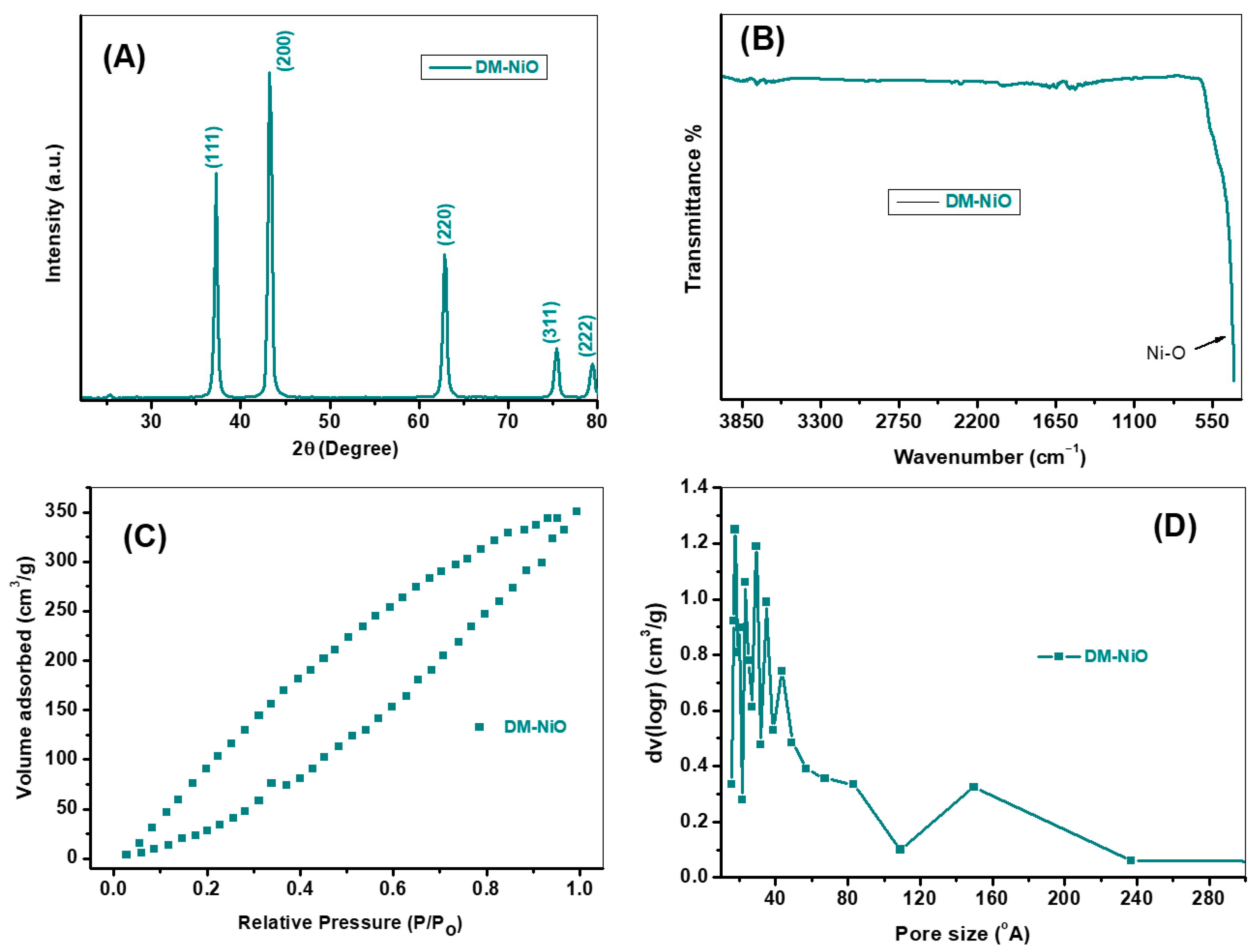
Figure 1 presents a comprehensive suite of characterization features for the developed date-molasses-derived nickel oxide (DM–NiO) catalyst, providing foundational insight into its crystallographic, structural, and textural properties. In Figure 1A, the X-ray diffraction (XRD) pattern shows a set of sharp, high-contrast reflections indexed at 2θ values of ~37.2°, 43.3°, 62.9°, 75.4°, and 79.4° that are respectively assigned to the (111), (200), (220), (311), and (222) crystallographic planes of the face-centered cubic (fcc) phase of busenite (NiO), conforming to the standard reference (JCPDS card no. 47-1049). The absence of extra peaks attributable to Ni(OH)2, Ni metal, or secondary nickel oxy-salts indicates that the developed biogenic combustion route produced a phase-pure NiO lattice rather than a multiphase residue. The pronounced intensity of the (200) line relative to neighboring reflections also refers a common signature in combustion/annealing-derived NiO where rapid crystallization and defect equilibration can bias growth along specific planes. Importantly, the pronounced narrowness of the peaks is indicative of excellent crystallinity, which is consistent with reports that thermally driven NiO formation yields well-developed rock-salt order when the exothermic nitrate–biogenic fuel reaction supplies a short, intense thermal burst followed by fast quenching. Using the Scherrer equation: D = Kλ/(β cosθ), where D denotes the crystallite size (nm), K represents the shape factor (typically 0.89), λ is the wavelength of the incident X-ray radiation (1.54056 Å), β corresponds to the full width at half maximum (FWHM) of the selected diffraction peak expressed in radians, and θ is the Bragg diffraction angle—the average crystallite size was calculated to be approximately 18 nm. This nanoscale dimension, achieved through a rapid combustion process in which the redox chemistry of natural sugars in date molasses facilitates the formation of such highly crystallized nanoparticles at relatively low calcination temperatures, as observed in other green synthesis approaches for metal oxides [20,21,22].
The Fourier-transform infrared (FTIR) spectrum shown in Figure 1B is largely featureless across the mid-IR “organic fingerprint” region, and then terminates in a strong absorption band in the low-wavenumber zone assigned to Ni–O lattice stretching (near ~550 cm−1). In green/biogenic combustion syntheses, residual organics from the biofuel can sometimes leave C–O/C=O assignments or broad O–H features from surface hydroxylation. Here, the near-flat baseline through most of the range suggests that the combustion/thermal treatment removed the majority of volatile/combustible organics, leaving inorganic NiO as the dominant IR-active phase, while the intense Ni–O vibration confirms the formation of the metal–oxygen framework that supports photocatalytic redox chemistry. Comparable NiO-containing systems frequently report Ni–O stretching bands in this same low-frequency region, and the clean suppression of organic bands is typically interpreted as evidence of effective post-combustion mineralization of the biogenic precursor matrix [21,22].
The nitrogen physisorption analysis, depicted in Figure 1C,D, quantifies the porous texture critical for catalytic activity. The N2 adsorption–desorption isotherm in Figure 1C is a definitive type IV isotherm according to IUPAC classification, which is the hallmark of mesoporous materials. The steadily rising uptake of P/Po toward unity further implies the presence of larger mesopores and/or interparticle voids, which is very plausible for an “ashy” combustion product where the rapid gas evolution (CO2, H2O, NOx) during the nitrate–sugar reaction can act as a transient, self-sacrificial template, freezing in void space as the oxide skeleton densifies. Thus, the developed biogenic avenue functions as a pore-former, producing a structure that is not merely crystalline (XRD) but also mass-transfer friendly, which is a crucial requirement for dye degradation where diffusion, adsorption, and radical attack must occur on practical timescales. Moreover, the combustion-derived oxides commonly end up with a complex hysteresis that encodes the pore network geometry (bottle-necking, ink-bottle effects, slit-like voids, etc.) [21,23]. The Brunauer–Emmett–Teller (BET) surface area derived from this isotherm is calculated to be 68.9 m2 g−1, a substantially high value for a combustion-synthesized oxide, underscoring the pore-forming role of the gaseous products released during the combustion of the organic molasses matrix. Further refinement of the textural analysis using pore size distribution is depicted in Figure 1D. The distribution is heavily skewed toward the mesopore range, with a primary set of small pores of a few nanometers in dimension in addition to wider pores of a few tens of nanometers. This type of hierarchical porosity is especially useful for photocatalysis chemistry. The smaller mesopores reveals an increase in adsorption and active sites per gram, while the bigger mesopores and interparticle voids operate as “highways” that make it easier for big dye molecules and oxidants to diffuse. The pore volume is 0.59 cm3/g, and the pore size is 17.6 nm. This pore architecture is consistent with the reported greenly synthesized NiO catalysts. Bio-assisted thermal methods often synthesize NiO that is quite crystalline but also of considerable porosity. It is hard to obtain this kind of pairing by slow, traditional calcination without sintering away surface area [21,22,24].

2.2. Morphological Features

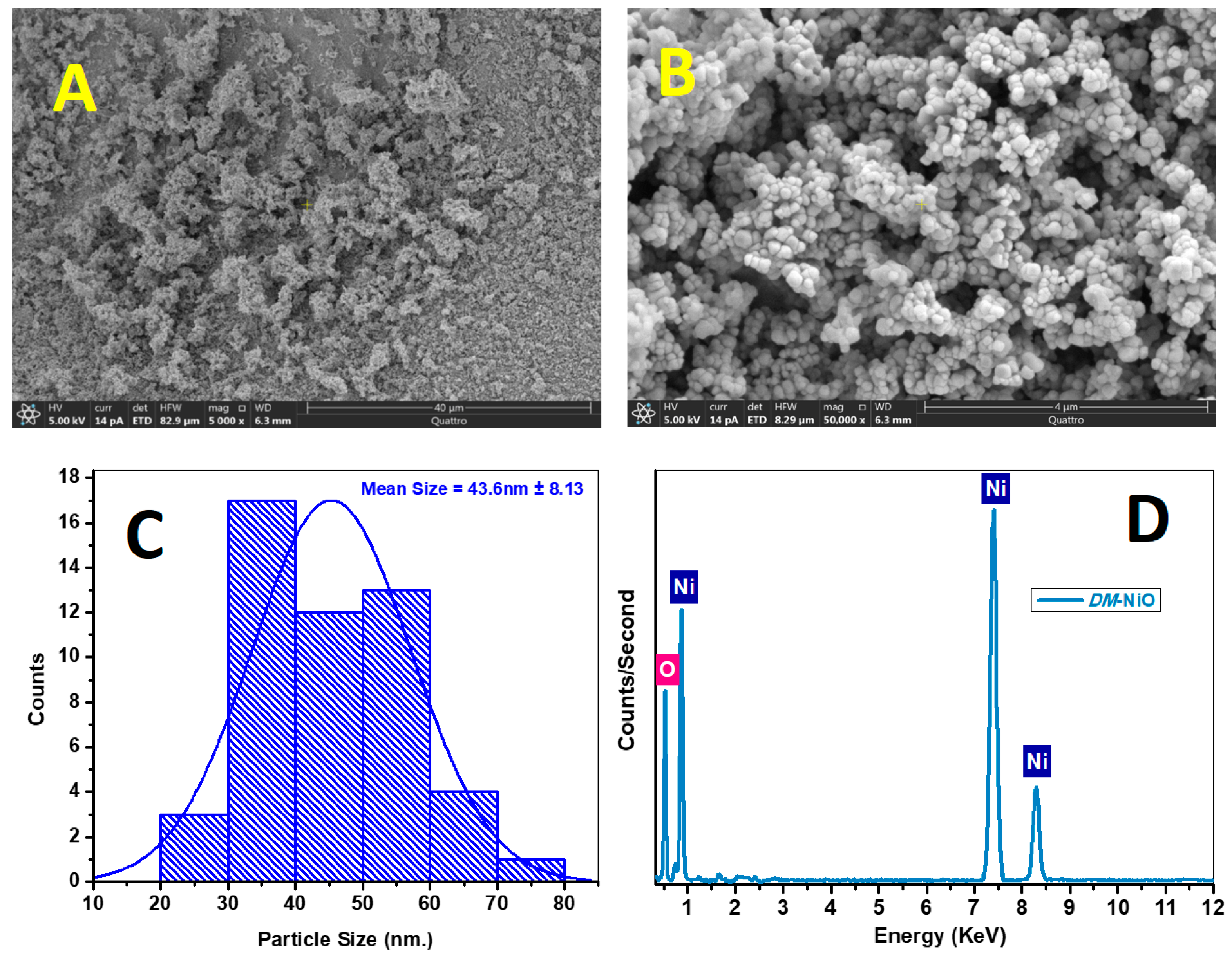
Figure 2 shows a detailed morphological and statistical analysis of the DM–NiO catalyst using scanning electron microscopy (SEM) and particle size distribution (PSD) analysis. This gives important visual and quantitative information about the nanostructure created by the developed date molasses combustion synthesis. The SEM micrographs show an “ashy-like” catalyst that created a lightweight, foam-like agglomeration during the combustion/calcination phase. This left behind a very rough, void-rich structure. The DM–NiO powder seems like a very porous, agglomerated structure made up of linked nanoparticles and twisted channels in the low-magnification image (Figure 2A). Most of these nanoparticles are almost spherical in shape, but some are irregular and polyhedral, which is typical of particles that form quickly during an exothermic combustion process. This creates a fluffy skeleton that resists dense sintering and keeps open diffusion pathways. In analogous NiO systems synthesized via solution–combustion methods, this “voluminous porous” morphology is consistently associated with the enhanced accessibility of surface active sites, as reactants can infiltrate macroporous voids while simultaneously interacting with nanoscale catalytic domains on the aggregate surface [25]. The SEM at higher magnification (Figure 2B) shows the inside texture of these aggregates more clearly. The clusters are made up of nanosized subunits that are tightly bonded together, giving the surface a cauliflower-like look with nanoscale “necks” and intergranular voids. This is a common microstructural feature of green/biogenic NiO powders. In the early stages of growth, organic residues and bio-derived ligands temporarily cap nuclei. However, during thermal treatment, partial coalescence happens, resulting in fused but still very rough particles instead of perfectly isolated spheres [26,27]. The particle-size histogram (Figure 2C) gives this explanation quantitative support: the DM–NiO has a mean particle size of about 43.6 nm with a modest spread (±8.13 nm), and most counts are in the 30–60 nm range, with a smaller tail going toward higher sizes. In reality, this distribution is best understood as the typical size of the nanoscale subunits that cover the surface of the agglomerate and are hence the main point of contact for catalysis. The predicted particle size is a balance between bio-assisted nucleation, which favors smaller sizes, and thermally induced coarsening/fusion, which favors bigger sizes [27,28]. From a reactivity standpoint, ~40–50 nm NiO is a good compromise because it has a high surface-to-volume ratio that provides plenty of adsorption and activation sites, but the particles are big enough to stop too much defect-assisted recombination that can happen in ultra-small, heavily disordered oxides where both surface states and bulk transport are important when the broad solar spectrum hits them [26]. The EDX spectrum (Figure 2D) shows that the DM–NiO catalyst is made up of only Ni and O, with no signs of impurities. This proves that the synthesized material is very pure and that stoichiometric nickel oxide was successfully made.

2.3. Optical Characterization

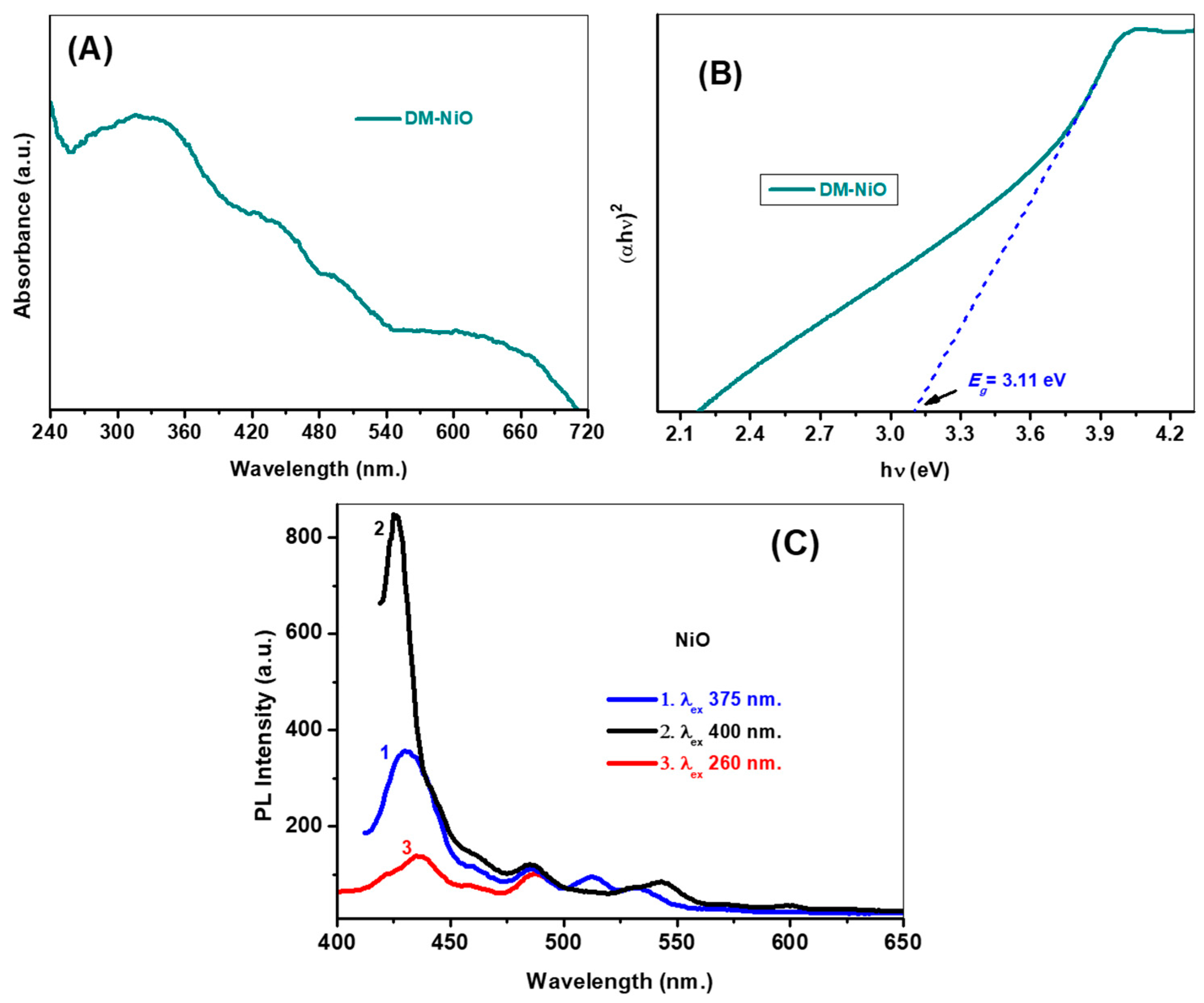
Figure 3 provides a detailed optoelectronic characterization of the DM–NiO catalyst, illustrating its light-harvesting efficiency, electronic band structure, and the dynamics of photogenerated charge carriers, which are essential for its role as a solar-driven photocatalyst.
In Figure 3A, the UV–Vis spectrum shows strong absorption in the UV region followed by a long tail extending into the visible. The intense UV absorption is typically associated with O2p → Ni3d charge-transfer transitions and near-edge electronic excitation, whereas the gradual visible-range tail often signals electronic disorder and defect-assisted sub-bandgap absorption (e.g., Ni vacancies/acceptor states, surface hydroxylation, and oxygen-related defects) that “soften” the absorption edge and broaden the solar harvesting span beyond the idealized band-edge cut-off [29,30,31]. Despite being considered a wide-gap oxide, pristine NiO can exhibit defect-coupled excited states that participate in interfacial charge transfer to dissolved O2, H2O/OH, or adsorbed dye molecules at a fraction of the solar spectrum [29,32]. The Tauc plot in Figure 3B yields an estimated band gap of Eg = 3.11 eV, which is wide enough to show that the fundamental absorption is UV-driven but low enough to show that modest defect densities and band-tail states can affect solar response [31,32]. The linear extrapolation to ~3.11 eV is consistent with a reasonably defined absorption edge, while the residual curvature/tailing at lower photon energies is fully compatible with defect-mediated absorption that is expected for nanostructured NiO with appreciable surface contribution [30]. Figure 3C shows the photoluminescence (PL) of the developed DM–NiO at different λex = 260, 375, and 400 nm that compliments the optoelectronic characterization. PL further addresses the radiative recombination pathways where its excitation dependence reveals how many emissive states exist and how efficiently they are populated. The spectra reveal a strong emission band in the violet/blue range (410–460 nm) with weaker shoulders that extend toward the green. The emission intensity increases as the excitation occurs closer to the absorption edge. In NiO nanoparticles, near-edge excitation feeds shallow trap and band-edge-adjacent recombination channels. Higher-energy excitation (260 nm), on the other hand, fills a wider range of states, including non-radiative relaxation routes like surface phonon coupling and defect-assisted multiphonon decay. This lowers the net PL yield even though the excitation energy is higher [30,31]. The presence of secondary low-intensity features toward longer wavelengths is caused by deeper defect levels (oxygen-related defects and surface defect complexes) that allow radiative relaxation to happen through intermediate states instead of direct band-edge recombination. In photocatalysis, a decreased PL intensity is often regarded as qualitative evidence of diminished electron–hole recombination and enhanced charge separation efficiency, which is associated with improved surface redox utilization upon illumination. This reasoning is consistent with sunlight-driven NiO-based degradation studies, in which synthetic routes facilitate defect engineering, concurrently altering the absorption edge and inhibiting recombination, hence enhancing pollutant removal kinetics under actual irradiation [30,31,32].

2.4. Photocatalytic Degradation of PY Using the Developed DM–NiO Catalyst

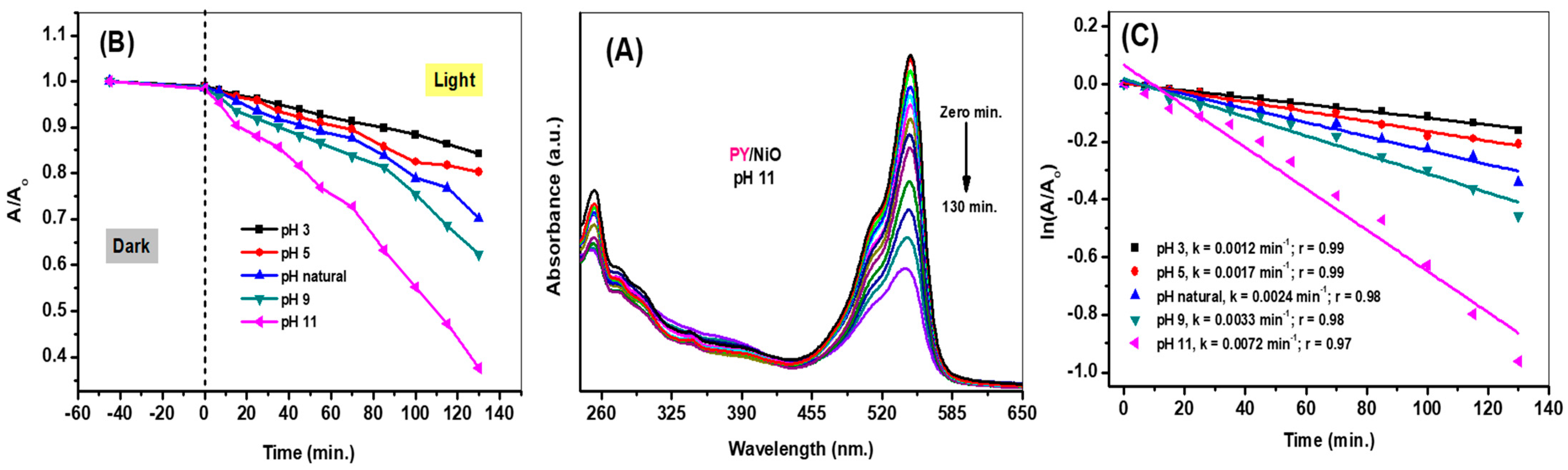
Figure 4 shows how effectively the DM–NiO nanocatalyst works as a photocatalyst to break down Pyronin Y (PY) when exposed to sunlight. Figure 4A shows how the UV–Vis absorption spectrum of PY changed over time when it was exposed to sunlight for 130 min at the optimal pH 11. The initial PY spectrum has a strong, pronounced absorption maximum at 546 nm. This is the hallmark π-π* transition of the conjugated xanthene core of the dye. As the solar-driven photocatalytic reaction continues, the strength of this characteristic peak steadily decreases. There are no noticeable bathochromic or hypsochromic shifts, and most importantly, no new absorption bands appear. This reveals that the rate-determining chemistry is not simply “decolorization by adsorption” but net photo-oxidative transformation in the catalyst’s interfacial zone [33,34]. The quantitative kinetic analysis of the pH-dependent activity is presented in Figure 4B,C. The normalized absorbance (A/A0) traces in Figure 4B show a dark period along 45 min intended to establish adsorption–desorption equilibrium, followed by a clearly faster decay once solar light is applied. This evidently indicates that the main removal pathway is photochemical rather than simple uptake on the solid. Moreover, the photodegradation of PY is noticeably increased as pH increases, culminating in the steepest decay at pH 11. This could be ascribed to the increased interaction between PY as a cationic dye and the oxide surface whose interfacial environment becomes increasingly deprotonated/negatively charged and more hydroxyl-rich at alkaline pH. Such electrostatic attraction can enrich PY near the surface and the higher availability of OH/surface–OH that can facilitate formation of strongly oxidizing OH, raising the effective local oxidant concentration at the reaction interface [15,34]. Importantly, the linear ln(A/A0) versus time plots in Figure 4C support pseudo-first-order kinetics and the estimated apparent rate constants quantify the pH influence. As estimated, k increases from 0.0012 min−1 (pH 3, r ≈ 0.99) to 0.0072 min−1 (pH 11, r ≈ 0.97), revealing a ~6 times acceleration, with intermediate values of 0.0017, 0.0024, and 0.0033 min−1 at pH 5, natural pH, and pH 9, respectively. This trend is fully consistent with literature observations that NiO-based photocatalysts often show markedly improved dye oxidation under conditions that (i) strengthen pollutant adsorption at the active surface and (ii) favor productive ROS generation over charge carrier recombination [15,35]. Noteworthily, Figure 4 also sets a starting point for further “photo-Fenton-like” testing with H2O2.

2.5. Photo-Fenton-Like Activity of the Developed DM–NiO Catalyst

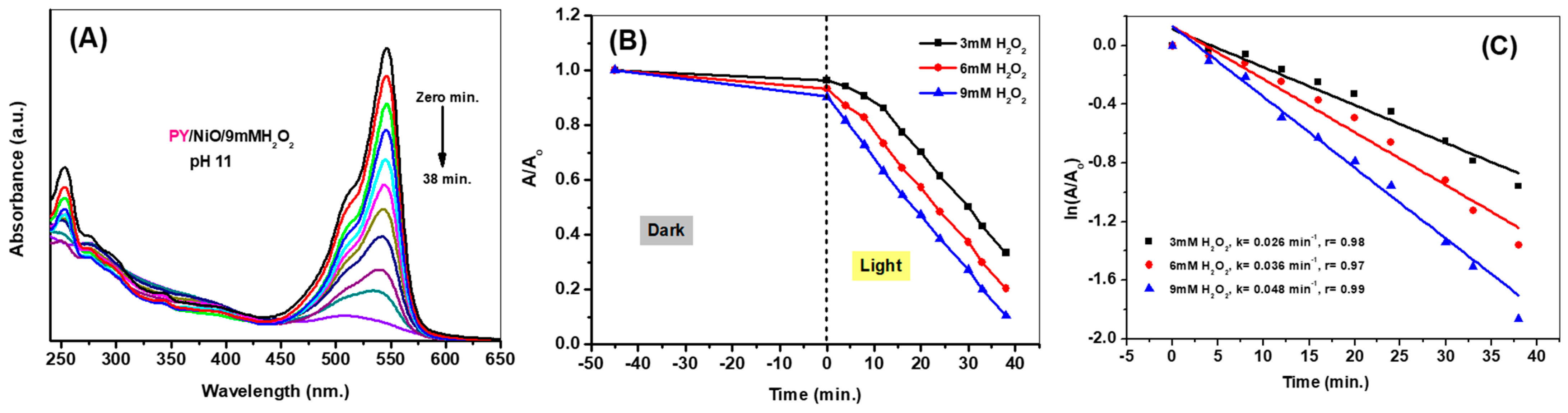
Figure 5 presents an improved photocatalytic system, where the solar-driven process is synergistically combined with a Fenton-like reaction by introducing hydrogen peroxide (H2O2) as an external oxidant with dosing (3, 6, 9 mM) at pH 11. The results clearly demonstrate the dramatic acceleration of PY degradation achieved under optimal alkaline conditions (pH 11) with the DM–NiO catalyst, transitioning the system from a conventional photocatalysis avenue to a highly efficient photo-Fenton-like process. Figure 5A illustrates the temporal decay of the characteristic PY absorption spectrum in the presence of 9.0 mM H2O2, displaying a rapid photodegradation of the dominant PY visible band accompanied by a progressive reduction in the UV features at shorter wavelengths. The dye’s visible absorption completely breaks down in just 38 min, compared to 130 min required without H2O2, underscoring the pivotal role of synergism between the developed DM–NiO and H2O2 in amplifying the oxidative capacity of the degradation system. This coupled attenuation is significant because the bleaching of the visible chromophore alone could indicate partial structural disruption, whereas the concurrent decay of the higher-energy bands is more indicative of deeper oxidative fragmentation of the aromatic/conjugated scaffold rather than simple decolorization. This behavior is typical of radical-dominated advanced oxidation under solar irradiation, where strongly oxidizing transients (especially OH) attack both the chromophoric unit and the auxochromic framework through fast addition/abstraction sequences, creating intermediates with weaker or shifted absorbance that subsequently diminish as oxidation proceeds [36,37].
Figure 5B,C plot the degradation profiles of PY and their corresponding pseudo-first-order kinetic in presence of H2O2 with concentrations of 3.0, 6.0, and 9.0 mM. The small decrease in A/A0 in the dark shows that adsorption/ion pairing at pH 11 only removes a small part of the total amount over 45 min of contact. Thus, the sharp decline after irradiation is mostly due to photocatalysis and oxidation. After being exposed to light, there was a clear dose-dependent response (9 mM > 6 mM > 3 mM H2O2), with 9 mM causing the biggest drop in normalized absorbance in about 40 min. Raising the concentration of H2O2 usually makes it more likely that useful interactions will happen at or near the catalyst contact. H2O2 can act as (i) an electron acceptor that prevents charge carrier recombination and (ii) a radical precursor, either directly by photolysis with intense photons or, more importantly, through catalytic or semiconductor-assisted routes. This increases the density of reactive oxygen species that are generated by light [37,38]. In heterogeneous photo-Fenton-like systems, these interconnected functions lead to the characterization of H2O2 not merely as a “additive,” but rather as a kinetic lever that regulates the steady-state radical flux, particularly under solar irradiation conditions characterized by moderate photon intensity and brief radical lifetimes [36]. Figure 5C further demonstrates that a pseudo-first-order model fits the deterioration results well, with high correlation (r ≈ 0.97–0.99) between ln(A/A0) and time. The predicted rate constants rise consistently from k = 0.026 min−1 (3 mM) to 0.036 min−1 (6 mM) and 0.048 min−1 (9 mM). This shows that the process is kinetically restricted by oxidant activation/ROS supply, not by adsorption saturation in these conditions. This is more than six times the rate constant of the optimum H2O2-free condition (k = 0.0072 min−1 at pH 11). This steady acceleration also means that the system has not yet reached the point when too much H2O2 becomes counterproductive by scavenging OH, which lowers the effective oxidizing strength and can flatten kinetic gains at higher doses. The absence of such curvature here is consistent with many solar AOP studies where the optimum H2O2 dose depends on the balance between radical generation and radical self-quenching, and the “best” point can shift with light intensity, pollutant load, and catalyst surface chemistry [39,40].
As shown in Table 1, the developed date-molasses-mediated combustion synthesis of NiO NPs in comparison with many previously reported NiO-based systems reveals a NiO catalyst of considerably high surface area and high efficiency as well as fast kinetics in the degradation process. As seen, the reported NiO-based catalysts operate under UV, UVA or visible irradiation for a pure NiO or composite systems. In contrast, the developed DM–NiO catalyst demonstrates superior performance under solar irradiation and near-practical conditions, without the need for complex heterostructures. Accordingly, when normalized against operational simplicity and irradiation conditions, the developed DM–NiO shows a highly competitive kinetic rate (0.048 min−1) and efficiency (91.8%), highlighting its practical advantage.

2.6. Study for Trapping of Charge Carriers/Oxidizing Species and Catalyst Reusability

Scavenger examinations and catalytic durability over several operational cycles are crucial for comprehending the practicality and mechanistic pathways of the designed DM–NiO catalyzed photo-Fenton-like system. The two studies were performed under deliberately different conditions: The scavenger evaluation was executed at pH 11 in the absence of H2O2, while the durability research was carried out at pH 11 in the presence of H2O2. That difference is essential because it distinguishes between “pure photocatalysis” (carrier-driven ROS) and “photo-Fenton-like assistance” (peroxide-amplified ROS).
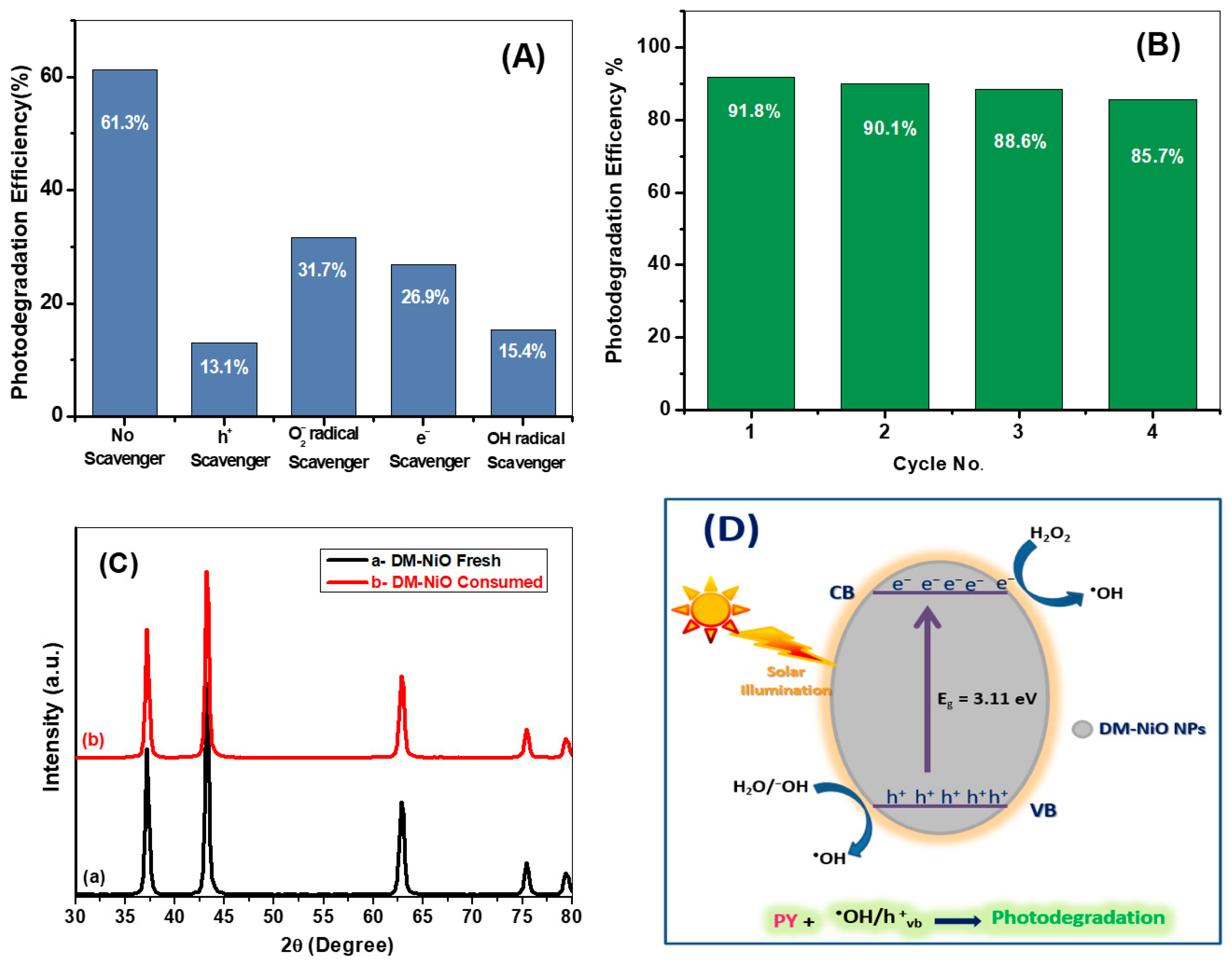
Without any quencher, the initial photodegradation efficiency in Figure 6A is about 61.3%, but it declines quickly when certain reactive routes are blocked. The strongest suppression occurs with the hole (h+) scavenger (decreased to ~13.1%) and with the OH scavenger (declined to ~15.4%). This paired collapse is a strong indicator that, in the absence of H2O2, the dominant oxidative route is a hole-initiated surface process that is tightly coupled to hydroxyl radical chemistry. Photogenerated holes on NiO either (i) oxidize adsorbed PY directly at/near the surface, or (ii) oxidize surface-bound OH/H2O to produce OH, which then attacks the dye in the interfacial region. Under strongly alkaline conditions, the availability of OH and surface –OH groups is maximized, so the h+OH channel becomes especially competitive. Similar scavenger hierarchies (h+ and OH as primary oxidants, with secondary roles for O2•−) are repeatedly reported for NiO-containing photocatalysts during dye degradation under light [44,45,46]. The O2•− scavenger produces a partial inhibition (efficiency reduced to ~31.7%), and the electron (e) scavenger also decreases performance (to ~26.9%), which together suggest that electron-side chemistry is supportive but not rate-dominant.
In Figure 6B, the durability profile (performed with H2O2) shows high retained activity across four repeated cycles: 91.8% → 90.1% →88.6% → 85.7%. That mild decline in the photodegradation efficacy is consistent with reusable photocatalysts working in peroxide-assisted oxidative environments, where the catalyst is repeatedly exposed to strong oxidants and reactive intermediates. The estimated slight decline in degradation efficiency could be ascribed to small physical loss of catalyst during recovery, gradual surface fouling by strongly bound intermediates/by-products, and subtle changes in the density of the most reactive surface hydroxyl/defect sites after repeated ROS exposure. Accordingly, the developed DM–NiO behaves as a recoverable/durable heterogeneous catalyst rather than a one-shot sacrificial reagent, consistent with reports on NiO-based photocatalysts and bio-derived NiO catalysts [14,47]. Importantly, XRD analysis conducted before and after the photocatalytic process (Figure 6C) confirms the preservation of the crystalline NiO phase without the appearance of any secondary phases or structural transformations, indicating excellent phase stability during the reaction.

2.7. Proposed Mechanism of Solar-Driven Photo-Fenton-Like Degradation of PY over NiO Catalyst

To gain deeper insight into the photocatalytic/photo-Fenton-like degradation mechanism, the radical scavenging experiments clearly indicate that photogenerated holes (h+) and hydroxyl radicals (OH) are the dominant reactive species, while superoxide radicals (O2) play a secondary role. This behavior can be rationalized based on the electronic structure and defect chemistry of NiO, as well as its interaction with H2O2 under solar irradiation. NiO is a p-type semiconductor with a relatively narrow band gap (3.11 eV), where the valence band is primarily composed of O 2p orbitals and the conduction band originates from Ni 3d states [48]. Under solar illumination, photon absorption promotes electrons from the valence band to the conduction band, generating electron–hole pairs (e/h+) (Figure 6D). The photogenerated holes possess strong oxidation potential and can directly oxidize surface-adsorbed H2O or OH to produce OH radicals, as expressed in Equation (1). Simultaneously, the photogenerated electrons can reduce dissolved oxygen to form O2 species, although this pathway is less dominant under the present conditions. A key factor contributing to the enhanced catalytic activity of the developed NiO is the presence of defect states, which act as electron trapping and transfer centers [34,49]. These defect sites effectively suppress electron–hole recombination and facilitate interfacial charge transfer, thereby increasing the lifetime of charge carriers. Moreover, they can promote the adsorption and activation of O2 and H2O2 molecules, enhancing the generation of reactive oxygen species. The introduction of H2O2 further establishes a photo-Fenton-like catalytic pathway, which significantly amplifies the degradation efficiency. In this system, H2O2 can directly interact with conduction band electrons to yield OH radicals (Equation (2)), further increasing ROS concentration. The photogenerated holes also contribute by oxidizing H2O2 to produce additional OH species (Equation (3)), establishing a synergistic multi-pathway ROS generation system that maximizes the generation of h+/OH reactive species, which are primarily responsible for the degradation of PY dye (Equation (4)).
NiO + hν → e(CB) + h+(VB)
H2O2 + eOH + OH
H2O2 + h+OH + H+
PY + OH/h+ → CO2 + H2O + intermediates

3. Materials and Methods

3.1. Materials

Date molasses was purchased from a local market in Sakaka city, Aljouf region, Saudi Arabia. Hydrochloric acid, tert-butyl alcohol, silver nitrate, Pyronine Y, methanol, hydrogen peroxide, and sodium hydroxide were provided by Sigma-Aldrich Chemicals (St. Louis, MO, USA). Nickel nitrate hexahydrate (>99%) and disodium salt of ethylene diamine tetracetic acid were provided by BDH chemicals (Poole, UK). All of the reagents and chemicals were utilized exactly as they were received, with no further purification. During the preparation, bi-distilled water was used.

3.2. Methods

3.2.1. Biogenic Synthesis of NiO Catalyst via a Solution Combustion Route in Presence of Date Molasses

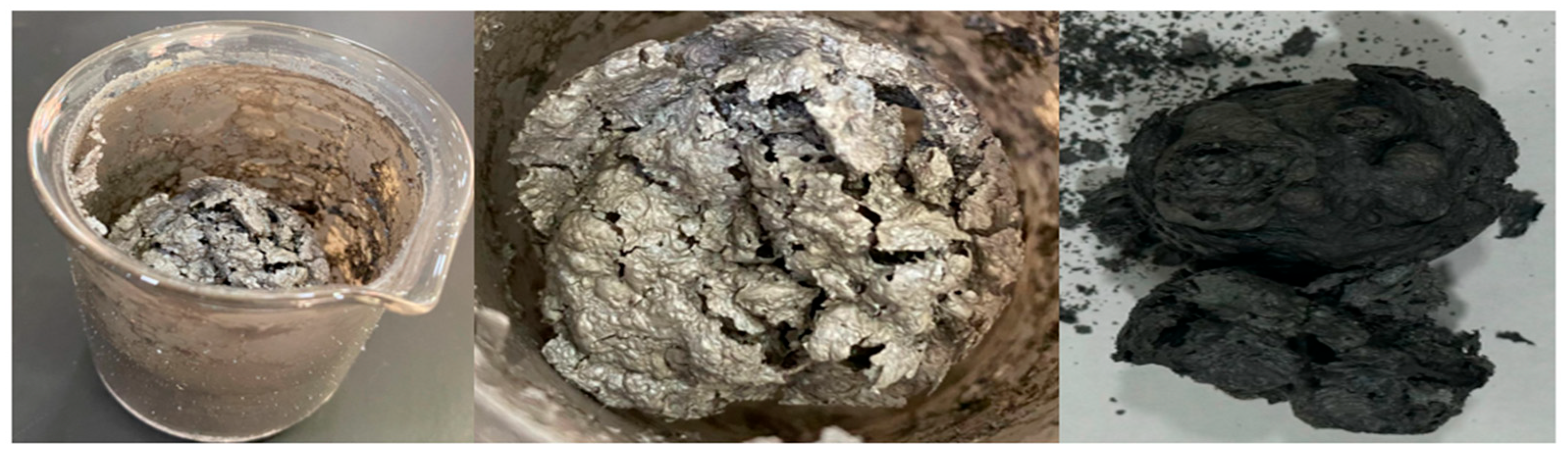
In a typical preparation, date molasses (1.0 g) was first dissolved in 25 mL of bi-distilled water in a glass beaker to obtain a homogeneous biogenic fuel solution. Nickel(II) nitrate hexahydrate (1.5 g) was then introduced, and the resulting mixture was sonicated for 10 min to enhance dissolution and promote intimate precursor–fuel mixing. The beaker was subsequently transferred to a muffle furnace preheated to 350 °C where the reaction mixture started a thermal treatment, at which the combustion temperature increased to 475 °C with a heating rate 10/min. The biogenic-mediated combustion process continued for 2 h, enabling a one-pot combustion/thermal conversion that produced a gray ashy NiO denoted as “DM–NiO,” as displayed in Figure 7.

3.2.2. Photocatalytic Experiments

The photocatalytic performance of the DM–NiO catalyst was evaluated by monitoring the degradation kinetics of PY under natural solar irradiation. In a typical run, 15 mg of DM–NiO was dispersed in 50 mL of an aqueous PY solution (10 ppm), while key operating variables including solution pH and the applied H2O2 dose of concentrations 3.0, 6.0, and 9.0 mM were systematically adjusted. Prior to illumination, the suspension was sonicated for 5 min to ensure uniform catalyst dispersion and minimize mass-transfer artifacts. The reaction mixture was then maintained in the dark for 45 min to establish adsorption–desorption equilibrium before initiating the photocatalytic step under sunlight irradiation with an intensity of 3.45 × 10⁴ lux, as measured by a PeakTech® digital multitester (Ahrensburg, Germany). At predetermined irradiation times, 3 mL aliquots were withdrawn and centrifuged to remove catalyst particles, and the residual PY concentration was quantified by UV–Vis spectrophotometry using the dye’s characteristic maximum at 546 nm. Notably, no additional absorption bands emerged during the reaction, indicating that colored intermediates did not accumulate to detectable levels under the applied conditions. The photodegradation efficiency was calculated according to:
E % = A 0 A t A 0 × 100
where A0 and At are, respectively, the initial absorbance and the absorbance after irradiation time of PY.

3.2.3. Charge Carrier Trapping Study

Charge carrier trapping experiments were conducted to elucidate the specific roles of photogenerated electrons (e) and holes (h+) in the photodegradation pathway. Selective quenchers were introduced individually to suppress targeted reactive species or charge carriers: tert-butyl alcohol was employed as a hydroxyl radical (OH) scavenger, ethylenediaminetetraacetic acid (EDTA) as a hole (h+) scavenger, silver nitrate (AgNO3) as an electron (e) scavenger, and methanol as a superoxide radical (O2) scavenger. For these tests, fixed amounts of each scavenger (0.4 g EDTA, 0.2 g AgNO3, 30 mL tert-butyl alcohol, or 40 mL methanol) were added to the reaction mixture prior to irradiation, while all other experimental parameters were kept constant.

3.2.4. Catalyst Reusability

The photostability and reusability of the catalyst were evaluated through four consecutive cycling experiments under the optimized operating conditions (50 mL working solution, [PY] = 10 ppm, catalyst dosage 15 mg, pH = 11 and [H2O2] = 9 mM). Upon completion of each photodegradation run, the photocatalyst was recovered from the treated suspension by centrifugation, and then thoroughly washed several times with distilled water to remove any loosely adsorbed dye molecules and reaction by-products. The cleaned solid was subsequently reused in the next cycle without further modification, while maintaining identical optimal parameters, including solution pH, catalyst loading, and the applied H2O2 dose.

3.3. Instruments

X-ray diffraction analysis was carried out using a D/Max2500VB2+/Pc diffractometer (Rigaku, Tokyo, Japan) equipped with Cu Kα radiation (λ = 1.54 Å). Fourier-transform infrared spectra were recorded on a Shimadzu IR Tracer-100 spectrophotometer (Nakagyo-ku, Japan). The specific surface area and pore size distribution were determined using the Brunauer–Emmett–Teller (BET) model and the Barrett–Joyner–Halenda (BJH) method, respectively. Morphological characteristics were examined by scanning electron microscopy (SEM), and microstructural investigation was carried out using a Thermo Scientific Quattro (Waltham, MA, USA). UV–visible absorption measurements were performed over the relevant spectral region using an Agilent Cary 60 spectrophotometer (Santa Clara, CA, USA).

4. Conclusions

A green combustion route using date molasses was successfully developed to synthesize defect-rich, mesoporous NiO nanoparticles with high surface area (68.9 m2 g−1) and nanoscale crystallinity (~18 nm). The prepared catalyst exhibited enhanced solar-driven photocatalytic/photo-Fenton activity toward pyronin Y degradation. The system showed strong pH dependence, achieving optimal performance at pH 11 with a rate constant of 0.0072 min−1. The addition of H2O2 significantly enhanced the kinetics, reaching 0.048 min−1 at 9 mM, with complete dye removal within 38 min. Mechanistic analysis confirmed that hydroxyl radicals and photogenerated holes are the dominant reactive species, facilitated by defect-induced charge separation and NiO– H2O2 synergistic interactions. The catalyst maintained good stability over four cycles with minimal loss in activity. These findings demonstrate that date-molasses-assisted synthesis provides an efficient and sustainable approach for producing high-performance NiO catalysts for solar-driven wastewater treatment.

Funding

This research received no external funding.

Data Availability Statement

The datasets generated and/or analyzed during the present study are available from the corresponding author upon reasonable request.

Conflicts of Interest

The author declares no conflicts of interest.

References

  1. Saravanan, A.; Deivayanai, V.C.; Kumar, P.S.; Rangasamy, G.; Hemavathy, R.V.; Harshana, T.; Gayathri, N.; Alagumalai, K. A detailed review on advanced oxidation process in treatment of wastewater: Mechanism, challenges and future outlook. Chemosphere 2022, 308, 136524. [Google Scholar] [CrossRef]
  2. Chauhan, P.S.; Singh, K.; Choudhary, A.; Brighu, U.; Singh, S.K.; Bhattacharya, S. Combined advanced oxidation dye-wastewater treatment plant: Design and development with data-driven predictive performance modeling. NPJ Clean Water 2024, 7, 15. [Google Scholar] [CrossRef]
  3. Satyam, S.; Patra, S. The Evolving Landscape of Advanced Oxidation Processes in Wastewater Treatment: Challenges and Recent Innovations. Processes 2025, 13, 987. [Google Scholar] [CrossRef]
  4. Thomas, N.; Dionysiou, D.D.; Pillai, S.C. Heterogeneous Fenton catalysts: A review of recent advances. J. Hazard. Mater. 2021, 404, 124082. [Google Scholar] [CrossRef] [PubMed]
  5. Guardiano, M.G.; Silva, Y.S.; Gimenes, R.; de Andrade, S.J.; Kondo, M.M.; da Silva, M.R.A. Continuous-Flow Solar Hetero-geneous Photo-Fenton Process in a Lab-Made Low-Cost CPC Photoreactor for Efficient Dye Degradation. ACS Omega 2025, 10, 32216–32225. [Google Scholar]
  6. Dong, C.; Yang, Y.; Hu, X.; Cho, Y.; Jang, G.; Ao, Y.; Wang, L.; Shen, J.; Park, J.H.; Zhang, K. Self-cycled photo-Fenton-like system based on an artificial leaf with a solar-to-H2O2 conversion efficiency of 1.46%. Nat. Commun. 2022, 13, 4982. [Google Scholar] [CrossRef] [PubMed]
  7. Makhado, K.P.; Mphahlele-Makgwane, M.M.; Kumar, N.; Baker, P.G.L.; Makgwane, P.R. Current updates on p-type nickel oxide (NiO) based photocatalysts towards decontamination of organic pollutants from wastewater. Mater. Today Sustain. 2024, 25, 100664. [Google Scholar] [CrossRef]
  8. Padayatchee, S.; Ibrahim, H.; Friedrich, H.B.; Olivier, E.J.; Ntola, P. Solution Combustion Synthesis for Various Applications: A Review of the Mixed-Fuel Approach. Fluids 2025, 10, 82. [Google Scholar] [CrossRef]
  9. Osman, A.I.; Zhang, Y.; Farghali, M.; Rashwan, A.K.; Eltaweil, A.S.; El-Monaem, E.M.A.; Mohamed, I.M.A.; Badr, M.M.; Ihara, I.; Rooney, D.W.; et al. Synthesis of green nanoparticles for energy, biomedical, environmental, agricultural, and food applications: A review. Environ. Chem. Lett. 2024, 22, 841–887. [Google Scholar] [CrossRef]
  10. Essawy, A.A.; Hussein, M.F.; Hasanin, T.H.A.; El Agammy, E.F.; Alsaykhan, H.S.; Alanazyi, R.F.; Essawy, A.E.-N.I. Insights for Precursors Influence on the Solar-Assisted Photocatalysis of Greenly Synthesizing Zinc Oxide NPs towards Fast and Durable Wastewater Detoxification. Ceramics 2024, 7, 1100–1121. [Google Scholar] [CrossRef]
  11. Essawy, A.A.; Hasanin, T.H.A.; Hussein, M.F.; El Agammy, E.F.; Essawy, A.E.-N.I. One-Pot Phyto-Mediated Synthesis of Fe2O3/Fe3O4 Binary Mixed Nanocomposite Efficiently Applied in Wastewater Remediation by Photo-Fenton Reaction. Catalysts 2024, 14, 466. [Google Scholar] [CrossRef]
  12. Essawy, A.A. Silver imprinted zinc oxide nanoparticles: Green synthetic approach, characterization and efficient sunlight-induced photocatalytic water detoxification. J. Clean. Prod. 2018, 183, 1011–1020. [Google Scholar] [CrossRef]
  13. Agalya, S.; Nehru, L.; Sagadevan, S. Green-synthesized nickel oxide nanoparticles for sustainable wastewater treatment and enhanced bacterial control. Ceram. Int. 2024, 50, 50185–50199. [Google Scholar] [CrossRef]
  14. Ravishankar, T.N.; Ananda, A.; Shilpa, B.M.; Adarsh, J.R. Eco-friendly synthesis of NiO and Ag/NiO nanoparticles: Applications in photocatalytic and antibacterial activities. R. Soc. Open Sci. 2025, 12, 241733. [Google Scholar] [CrossRef]
  15. Seete, I.; Bopape, D.A.; Mahlaule-Glory, L.M.; Tetana, Z.; Hintsho-Mbita, N.C. Plant-Mediated Synthesis of NiO Nanoparticles for Textile Dye Degradation in Water: A Review. Colorants 2025, 4, 7. [Google Scholar] [CrossRef]
  16. Hasan, I.M.A.; Salman, H.M.A.; Hafez, O.M. A new green method to NiO/MnO2 nanocomposite synthesis for efficient and sustainable dye removal from aqueous media. Sci. Rep. 2025, 15, 44664. [Google Scholar] [CrossRef]
  17. Kumar, P.; Kumar, V.; Dhiman, V. Green synthesis of NiO/PbO/ZnO ternary heterojunctions for photocatalytic degradation of hazardous organic pollutants. Sustain. Chem. Clim. Action 2025, 7, 100110. [Google Scholar] [CrossRef]
  18. Zenkin, K.; Durmuş, S.; Emre, D.; Bilici, A.; Yılmaz, S. Salvia officinalis leaf extract-stabilized NiO NPs, ZnO NPs, and NiO@ZnO nanocomposite: Green hydrothermal synthesis, characterization and supercapacitor application. Biomass-Convers. Biorefin. 2025, 15, 10149–10164. [Google Scholar] [CrossRef]
  19. Madi, K.; Chebli, D.; Ait Youcef, H.; Tahraoui, H.; Bouguettoucha, A.; Kebir, M.; Zhang, J.; Amrane, A. Green Fabrication of ZnO Nanoparticles and ZnO/rGO Nanocomposites from Algerian Date Syrup Extract: Synthesis, Characterization, and Augmented Photocatalytic Efficiency in Methylene Blue Degradation. Catalysts 2024, 14, 62. [Google Scholar] [CrossRef]
  20. Arbia, M.B.; Kim, S.-H.; Yoon, J.-B.; Comini, E. Preparation of NiO NWs by Thermal Oxidation for Highly Selective Gas-Sensing Applications. Sensors 2025, 25, 2075. [Google Scholar] [CrossRef] [PubMed]
  21. Divya, T.; Sridhar, P.; Vishalee, S.; Palani, P.; Venkatachalam, K. Biosynthesis of La/NiO Nanoparticles: Study of Photocatalytic Degradation of Anionic and Cationic Dye, and Their Antibacterial Activity. Iran. J. Sci. 2024, 48, 553–574. [Google Scholar] [CrossRef]
  22. Sabouri, Z.; Akbari, A.; Hosseini, H.A.; Khatami, M.; Darroudi, M. Egg white-mediated green synthesis of NiO nanoparticles and study of their cytotoxicity and photocatalytic activity. Polyhedron 2020, 178, 114351. [Google Scholar] [CrossRef]
  23. Sadiq, H.; Sadiq, H.; Garcia, A.-G.; Rodriguez, L.I.I.; Batool, K.; Sharifc, H.H.; Sharif, M. Preparation and photocatalytic deg-radation of methylene blue using a sulfanilic acid-functionalized NiO/GO ternary composite with electrochemical evaluation. RSC Adv. 2025, 15, 40984. [Google Scholar] [CrossRef]
  24. Feng, K.; Liu, G.; Zhang, Z.; Liu, H.; Lv, R.; Wang, X.; Chang, P.; Lin, J.; Barakos, G. Fractal Strategy for Improving Characterization of N2 Adsorption–Desorption in Mesopores. Fractal Fract. 2024, 8, 617. [Google Scholar] [CrossRef]
  25. Kim, J.; Lee, H.; Lee, J.; Yoo, H.; Jo, I.; Lee, H. Solution Combustion Synthesis of Ni-Based Nanocatalyst Using Ethylenediaminetetraacetic Acid and Nickel-Carbon Nanotube Growth Behavior. Materials 2023, 16, 7191. [Google Scholar] [CrossRef]
  26. Hamidian, K.; Rigi, A.H.; Najafidoust, A.; Sarani, M.; Miri, A. Study of photocatalytic activity of green synthesized nickel oxide nanoparticles in the degradation of acid orange 7 dye under visible light. Bioprocess Biosyst. Eng. 2021, 44, 2667–2678. [Google Scholar] [CrossRef]
  27. Sukumaran, J.; Priya, M.; Venkatesan, R.; Sathiasivan, K.; Khan, M.R.; Kim, S. Green Synthesis of Nickel Oxide Nanoparticles Using Leaf Extract of Aegle marmelos and Their Antibacterial, Anti-Oxidant, and In Vitro Cytotoxicity Activity. Microsc. Res. Tech. 2025, 88, 2830–2842. [Google Scholar] [CrossRef] [PubMed]
  28. Balto, H.; Amina, M.; Bhat, R.S.; Al-Yousef, H.M.; Auda, S.H.; Elansary, A. Green Synthesis of Nickel Nanoparticles Using Salvadora persica and Their Application in Antimicrobial Activity against Oral Microbes. Microbiol. Res. 2023, 14, 1879–1893. [Google Scholar] [CrossRef]
  29. Yasmeen, S.; Burratti, L.; Duranti, L.; Sgreccia, E.; Prosposito, P. Photocatalytic Degradation of Organic Pollutants—Nile Blue, Methylene Blue, and Bentazon Herbicide—Using NiO-ZnO Nanocomposite. Nanomaterials 2024, 14, 470. [Google Scholar] [CrossRef] [PubMed]
  30. Islam, R.; Abdur, R.; Alam, A.; Munna, N.; Ahmed, A.N.; Hossain, M.; Bashar, M.S.; Islam, D.; Jamal, M.S. Modulating Mn-doped NiO nanoparticles: Structural, optical, and electrical property tailoring for enhanced hole transport layers. Nanoscale Adv. 2025, 7, 133–143. [Google Scholar] [CrossRef]
  31. Ramesh, M. N and Fe doped NiO nanoparticles for enhanced photocatalytic degradation of azo dye methylene blue in the presence of visible light. SN Appl. Sci. 2021, 3, 817. [Google Scholar] [CrossRef]
  32. Tamesgen, T.; Ameya, M.A.; Sisay, G.; Yuanqi, L.; Kai, Z.; Beyene, T.T. Harnessing the power of S/N-doped NiO nanoparticles through bandgap tuning to achieve enhanced photocatalytic and antibacterial performances. Sci. Rep. 2025, 15, 28035. [Google Scholar] [CrossRef]
  33. Haq, A.u.; Hussein, R.K.; Panchal, S.; Saeed, M.; Abubakar, H.M.; Alrub, S.A. Solar-Driven Photocatalytic Degradation of Clothianidin Using Green NiO-GO Composite. Catalysts 2025, 15, 1078. [Google Scholar] [CrossRef]
  34. Hatshan, M.R.; Sushma, N.V.; Shubha, J.P.; Assal, M.E.; Kuniyil, M.; Adil, S.F. Green NiO nanoparticles: A sustainable solution for photocatalytic treatment of industrial color effluents. Arab. J. Chem. 2026, 19, 2202025. [Google Scholar] [CrossRef]
  35. Minisha, S.; Johnson, J.; Mohammad, S.; Gupta, J.K.; Aftab, S.; Alothman, A.A.; Lai, W.-C. Visible Light Photocatalytic Degradation of Environmental Pollutants Using Zn-Doped NiO Nanoparticles. Water 2024, 16, 340. [Google Scholar] [CrossRef]
  36. Dong, C.; Xing, M.; Zhang, J. Recent Progress of Photocatalytic Fenton-Like Process for Environmental Remediation. Front. Environ. Chem. 2020, 1, 8. [Google Scholar] [CrossRef]
  37. Zheng, T.-H.; Zhang, Z.-Z.; Liu, Y.; Zou, L.-H. Recent Progress in Catalytically Driven Advanced Oxidation Processes for Wastewater Treatment. Catalysts 2025, 15, 761. [Google Scholar] [CrossRef]
  38. Ahmad, W.; Shah, R.; Haq, H.U.; Khan, D.; Khan, S.; Al-Anazi, A.; Khan, J.A.; Binte Razzak, N.R.; Han, C. UV-Activated and Fe2+-Catalyzed H2O2 for the Treatment of Dye-Contaminated Water: Kinetics, Mechanism and Toxicity Investigations. Catalysts 2024, 14, 906. [Google Scholar] [CrossRef]
  39. Ali, M.A.; Maafa, I.M.; Qudsieh, I.Y. Photodegradation of Methylene Blue Using a UV/H2O2 Irradiation System. Water 2024, 16, 453. [Google Scholar] [CrossRef]
  40. Bule Možar, K.; Miloloža, M.; Martinjak, V.; Radovanović-Perić, F.; Bafti, A.; Ujević Bošnjak, M.; Markić, M.; Bolanča, T.; Cvetnić, M.; Kučić Grgić, D.; et al. Evaluation of Fenton, Photo-Fenton and Fenton-like Processes in Degradation of PE, PP, and PVC Microplastics. Water 2024, 16, 673. [Google Scholar] [CrossRef]
  41. Anwer, U.N.; Srinivasan, S. Green-synthesized NiO/Co3O4 heterostructure as an efficient visible-light photocatalyst for dye degradation with multifunctional performance. J. Alloys Compd. Commun. 2026, 9, 100155. [Google Scholar] [CrossRef]
  42. Lee, F.; Abdullah, L.C.; Ramli, I.; Shamsuri, A.A.; Daik, R.; Noor, I.S.M.; Md Jamil, S.N.A. Biogenic fabrication of S-scheme NiO–FeWO4 heterojunction nanocomposite using Cassava (Manihot esculenta Crantz) leaf extract for visible-light-driven dye degradation: Synthesis, characterisation and photocatalytic evaluation. Ceram. Int. 2025, 51, 60217–60233. [Google Scholar] [CrossRef]
  43. Nallathambi, D.; Sangeetha, R.; Geethapriya, J.; Nagoor Meeran, M. Green fabricated NiO spherical nanoparticles for photocatalytic assays of textile dye degradation. J. Indian Chem. Soc. 2025, 102, 101580. [Google Scholar] [CrossRef]
  44. Umukoro, E.H.; Akintunde, T.A.; Jeje, S.O.; Shongwe, M.B.; Afolabi, O.R.; Adekunle, A.S.; Oluwafemi, O.S. Photocatalytic removal of eosin yellow dye in wastewater using silver-nickel oxide modified zinc oxide (Ag-NiO/ZnO) nanocomposite. Next Mater. 2025, 8, 100896. [Google Scholar] [CrossRef]
  45. Lei, Y.; Yu, Y.; Lei, X.; Liang, X.; Cheng, S.S.; Ouyang, G.; Yang, X. Assessing the Use of Probes and Quenchers for Understanding the Reactive Species in Advanced Oxidation Processes. Environ. Sci. Technol. 2023, 57, 5433–5444. [Google Scholar] [CrossRef] [PubMed]
  46. Puga, F.; Navío, J.A.; Hidalgo, M.C. A critical view about use of scavengers for reactive species in heterogeneous photocatalysis. Appl. Catal. A Gen. 2024, 685, 119879. [Google Scholar] [CrossRef]
  47. Gebremichael, T.E.; Tesfaye, E.; Abebe, T.; Bekele, A.; Robi, Z.H. Bio-derived NiO nanoparticles from Colocasia esculenta leaf extract with enhanced antibacterial activity and efficient photocatalytic degradation of methylene blue. RSC Adv. 2026, 16, 2030–2043. [Google Scholar] [CrossRef]
  48. Siddique, K.; Azeem, F.; Attia, K.A.; Hussain, S.; Shahid, M.; Fiaz, S.; Sadak, O.; Hafez, Y.M.; Abdelaal, K.; Gunasekaran, S. Comparative efficacy of biologically and chemically synthesized nickel oxide nanoparticles for catalytic degradation of dyes and wastewater treatment. Sci. Rep. 2025, 15, 34666. [Google Scholar] [CrossRef] [PubMed]
  49. Eltaweil, A.S.; Talaat, E.; El-Monaem, E.M.A.; El-Subruiti, G.M. Photocatalytic removal of o-Nitro phenol using phyto-assisted synthesized NiO/CdS@g-GO catalyst. J. Solid State Chem. 2025, 343, 125159. [Google Scholar] [CrossRef]
Figure 1. X-ray diffraction patterns (A); FTIR spectra (B); N2 adsorption–desorption isotherm (C); and pore size distribution of the developed DM–NiO catalyst (D).
Catalysts 16 00339 g001
Figure 2. SEM micrographs at two magnifications (A,B); particle size distribution (C); and EDX analysis of the DM–NiO catalyst (D).
Catalysts 16 00339 g002
Figure 3. UV–Vis electronic spectra (A); Tauc plot (B); PL spectra at different excitation wavelengths of the developed DM–NiO NPs (C).
Catalysts 16 00339 g003
Figure 4. Temporal variations in the absorption spectrum of PY (10 ppm) during solar-driven photocatalytic degradation in the presence of DM–NiO (15 mg) at pH 11 photocatalyst (A); first-order kinetics of the employed photocatalytic degradation in absence of H2O2 at pH 3.0, 5.0, natural pH, 9.0, and 11 (B,C).
Catalysts 16 00339 g004
Figure 5. Temporal variations in the absorption spectrum of PY (10 ppm) during solar-driven photocatalytic degradation in the presence of DM–NiO and 9.0 mM H2O2 at pH 11 photocatalyst (A); first order kinetics of the employed photocatalytic degradation of 10 ppm PY in the presence of different concentrations of H2O2 (3.0, 6.0, 9.0 mM) at pH 11 (B,C).
Catalysts 16 00339 g005
Figure 6. Effect of tert-butyl alcohol as “OH scavenger”, EDTA as “h+ scavenger”, AgNO3 as “e scavenger”, and methanol as “O2 scavenger” on the photocatalytic degradation of pyronine Y (A); durability test of DM–NiO NPs in photodegrading Pyronine Y (10 ppm) under solar illumination at pH 11 in the presence of 9 mM H2O2 (B); XRD of the DM–NiO catalysts before and after photodegradation reaction (C); schematic diagram of the proposed mechanism employed during the photodegradation process (D).
Catalysts 16 00339 g006
Figure 7. Images of the biogenic-developed DM–NiO catalyst.
Catalysts 16 00339 g007
Table 1. Comparative analysis of NiO-based and metal oxide photocatalysts for dye degradation.
CatalystSynthesis MethodSurface Area (m2 g−1)Target PollutantDegradation Efficiency (%)Rate Constant k (min−1)ConditionsRef.
NiO NPs
NiO/Co3O4
Green synthesis (Plant extract)18.56
69.8
Victoria Blue dye53
78.1
--
--
UV light[41]
NiO
NiO-FeWO4
Green synthesis (Plant extract)/Chemical precipitation/Calcination54.15
102.62
Methylene Blue21.9
96.73
0.0035
0.049
Visible light[42]
NiO NPsPlant-mediated (Flower extract)--Congo Red73.20.028UVA light[43]
NiO NPsDate-molasses-mediated combustion68.9Pyronin Y91.80.048Solar light This work
Disclaimer/Publisher’s Note: The statements, opinions and data contained in all publications are solely those of the individual author(s) and contributor(s) and not of MDPI and/or the editor(s). MDPI and/or the editor(s) disclaim responsibility for any injury to people or property resulting from any ideas, methods, instructions or products referred to in the content.