Article

Exploring β-Myrcene Incorporation in Propene Copolymerization Using Half-Titanocene Catalysts

1
Department of Chemistry, Tokyo Metropolitan University, 1-1 Minami Osawa, Hachioji 192-0397, Tokyo, Japan
2
Istituto di Scienze e Tecnologie Chimiche “G. Natta”, Consiglio Nazionale delle Ricerche, Via A. Corti, 12, 20133 Milan, Italy
*
Authors to whom correspondence should be addressed.
Catalysts 2026, 16(5), 453; https://doi.org/10.3390/catal16050453
Submission received: 18 April 2026 / Revised: 8 May 2026 / Accepted: 10 May 2026 / Published: 13 May 2026

Abstract

The development of polyolefin from bio-renewables has been considered an important subject in terms of circular economy. In this study, exploring the possibility of β-myrcene (MY) incorporation in propene copolymerization has been studied in the presence of various catalysts: phenoxide-modified half-titanocene, Cp’TiCl2(O-2,6-iPr2-4-C6H3) [Cp’ = Cp* (C5Me5), Me3SiC5H4], and ketimide-modified half-titanicene, Cp’TiCl2(N=CtBu2) (Cp’ = Cp*, Cp). Among the complexes tested, the permethylated Cp* catalysts, Cp*TiCl2(O-2,6-iPr2-4-C6H3) and Cp*TiCl2(N=CtBu2), exhibited moderate catalytic activities in the copolymerizations, affording the copolymers up to 3 mol% MY incorporation. The other catalysts showed negligible activity in the attempted copolymerizations. The resulting copolymers were amorphous and possessed sole glass transition temperatures (Tg), suggesting uniform compositions; the Tg values decreased with increasing comonomer (MY) content, reaching values as low as −17 °C. The results introduce valuable insights into the structure–property relationships of myrcene-based copolymers and pave the way for the future designs of tailored molecular catalysts for the synthesis of biobased elastomers.

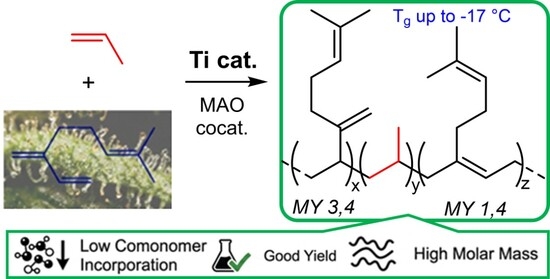
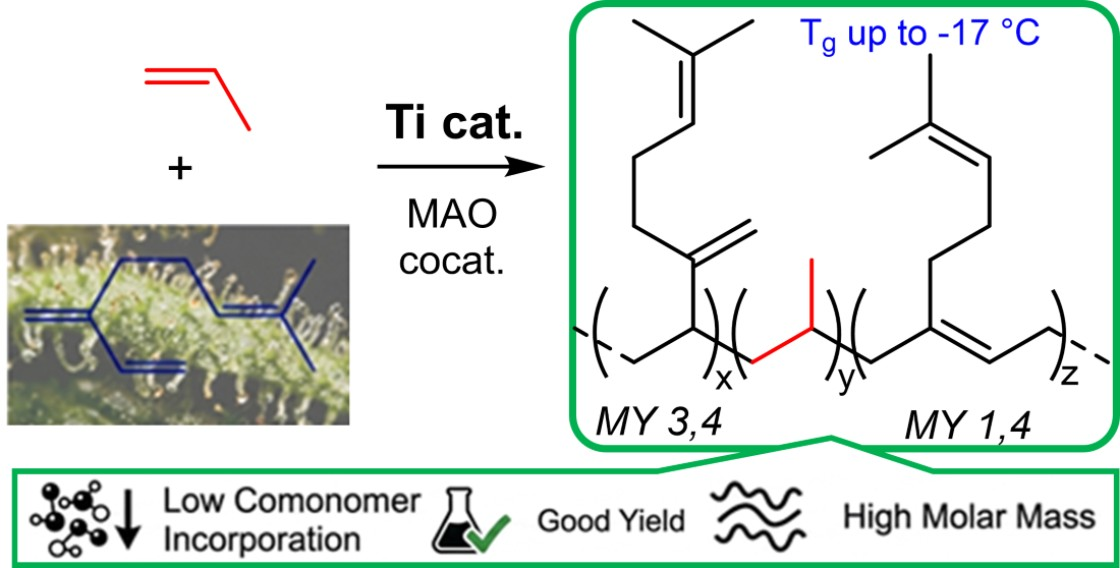
Graphical Abstract

1. Introduction

In recent times, there has been a notable shift in focus towards the synthesis of polymers derived from renewable resources from the viewpoint of the circular economy, because the conventional petroleum-based polymer industry finds itself under immense pressure to meet escalating demands for energy and resources [1,2]. For this reason, the synthesis of the new polyolefins, especially copolymers derived from renewable resources, has been a long-term interest [3,4,5,6,7]. In this context, there is a growing interest in using naturally abundant (mono)terpenes such as myrcene, 7-methyl-3-methylene-1,6-octadiene (MY) for the synthesis of polymeric materials, including elastomers [8]. This conjugated terpene, derived from citrus fruits and various plants, is a colorless oil that is found in nature as its β-isomer and, due to its natural availability and reactive conjugated 1,3-diene framework, may correspond to an alternative to isoprene and butadiene [9,10,11,12,13,14,15]. The copolymerization of olefins with conjugated dienes is inherently challenging due to mismatched monomer reactivities and the risk of catalyst deactivation. However, catalytic technology based on polymerization by transition metal catalysts, which is a core technology for the industrial production of polyolefins, makes it possible to synthesize a wide range of new polymers with naturally rich terpene-based conjugated dienes and various olefins [15]. Recently, in their seminal work on ethene (E)/MY copolymerization, Nomura and coworkers reported that phenoxide-modified half-titanocene catalysts were able to afford copolymers with rather high molecular weights, Mn = 6.60–8.50 × 10⁴ kg mol−1, and narrow Đ (1.4–2.0), via subsequent cyclization after ethene insertion [16]. E/MY copolymers exhibit promising elastic properties, and the elongation at break increased upon increasing the MY contents, with a decrease in the tensile strength and toughness. Recently, Capacchione synthesized E/MY copolymers using an [OSSO]-type titanium complex activated by methylaluminoxane (MAO) as cocatalyst, with remarkable trans-1,4 selectivity (92 mol%) and a well-defined “multiblock” architecture [17].
On the other hand, Hou was the first to use a scandium complex combined with [Ph3C][B(C6F5)4] affording propene(P)/MY copolymers with a MY content up to 34 mol%, narrow Đ (1.8–2.2) and molecular weight Mn up to 10 kg mol−1 [18]. Despite the promising ability of MY incorporation in this catalysis process, the catalyst systems exhibited low catalytic activities, especially compared with those in the E/MY copolymerization process, and the activity decreased upon increase in MY content.
Thus, to date, the copolymerization of MY with P has only been marginally addressed in the literature, and the contribution of Ti-based catalysts has yet to be systematically investigated. Therefore, in this work we present a systematic study on the copolymerization of MY with P with good yield using two different families of half titanocene catalysts: the phenoxide-type Cp’TiCl2(O-2,6-iPr2-4-C6H3) and the ketimide-modified Cp’TiCl2(N=CtBu2). The copolymerization yields high-molecular-weight random copolymers, despite the low amount of comonomer content. Thermal analysis of the resulting copolymers has been assessed as well.

2. Results

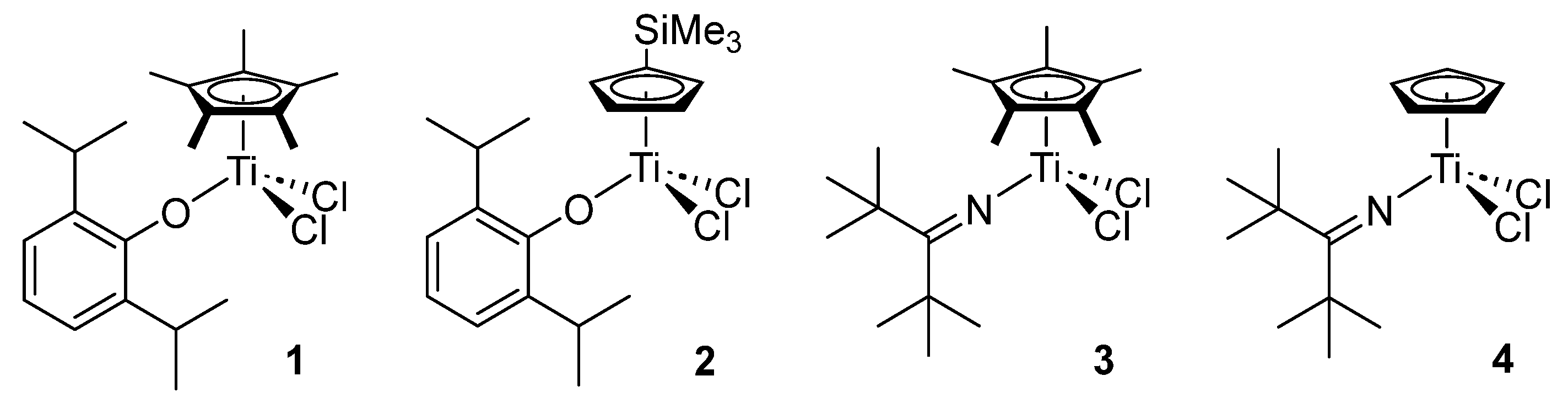
P/MY copolymers were synthesized using the two distinct families of half titanocene catalysts shown in Scheme 1: the phenoxide-type Cp’TiCl2(O-2,6-iPr2-4-C6H3) with Cp’ = Me5Cp (1) or (Me3Si)Cp (2) and ketimide-modified Cp’TiCl2(N=CtBu2) with Cp’ = Me5Cp (3) or Cp (4). All precursors were activated with dried MAO. The copolymerizations were conducted under optimized conditions at 4 bar of propene pressure, exploring various temperatures and comonomer feed ratios.
The phenoxide-modified Cp’TiCl2(O-2,6-iPr2-4-C6H3) half-titanocene was chosen in this study due to its previously reported efficiency in E/MY copolymerization [16]. On the other hand, ketimide-modified catalysts were chosen for their proven ability to copolymerize propene with sterically demanding cyclic olefins, including norbornene, cyclopentene, cyclohexene, and their derivatives [19,20,21]. In particular, CpTiCl2(N=CtBu2) catalyst 4 is able to efficiently catalyze the copolymerization of propene with cyclic olefins with good yield and norbornene incorporation [21].
All synthesized copolymers were analyzed by 1H spectroscopy to analyze the copolymer composition and MY insertion mode, SEC (PS calibration) to determine molecular weight and Ð, and DSC to assess the thermal properties. The copolymerization results are summarized in Table 1. The results of the homopolymerization of propene with the different catalysts are reported as blank experiments.
Recently, some authors have reported the homopolymerization of propene by ketimide-based half-titanocene catalysts 3 and 4 under various temperatures and pressure [22]. These catalytic systems exhibited remarkable activity for the synthesis of atactic polymers with ultra-high molar masses, affording materials with high ductility and mechanical properties. However, no results were reported for the polymerization of propene with catalysts 1 and 2. So, first of all, the phenoxide-catalysts were evaluated in propene homopolymerization at 4 bar and at different temperatures. While catalyst 1 exhibited the high activity, catalyst 2 proved to be significantly less productive. Notably, the activity observed for the phenoxide-based complexes was lower than that reported for ketimide catalysts (see for instance entry 3 vs. entry 13, and entry 5 vs. entry 17). Increasing the temperature from 25 to 60 °C resulted in a decrease in catalytic activity, possibly due to partial catalyst deactivation or enhanced chain-transfer processes at higher temperatures, as suggested by the reduction in the molar mass. A similar trend has been observed with ketimide catalysts, although the presence of the permethylated ligand appeared to enhance the catalyst stability at higher temperatures [22].
The methyl pentad distribution of the polypropenes, listed in Table S1 and shown in Figures S1–S4, reported in the Supplementary Materials, indicates that all samples are slightly syndiotactoid, with [rrrr] content ranging from 7.94 to 9.60, and the Bernoullian index around 1.0, suggesting weak syndiospecific chain end control [23]. For catalyst 1, a markedly higher increase in regioerrors can be observed going from 40 to 60 °C. Furthermore, catalyst 2 affords 2,1-threo and erythro regioirregulaties of approximately 20% at 40 °C [24].
Catalysts 1 and 3 are also efficient in the copolymerization of propene and myrcene, achieving polymers with good yield. The behavior of catalyst 4 in the copolymerization of myrcene with propene differs from that observed in propene homopolymerization and propene/norbornene copolymerization; indeed, in the presence of myrcene, no copolymerization occurs. These results are consistent with those observed in E/MY copolymerization, where this catalyst exhibits low activity and negligible comonomer incorporation [16]. Catalyst 2, which exhibits low activity in propene homopolymerization, yields only a negligible amount of copolymer. All these findings suggest that catalytic activity in copolymerisation was affected by the cyclopentadienyl fragment employed. Specifically, the Cp* analogs exhibited higher catalyst activity and afforded high molar mass copolymers with unimodal molecular weight distributions. At both 40 and 60 °C, catalyst 3 outperformed catalyst 1, although both catalysts showed a decrease in activity as the comonomer concentration in the feed increased (117.3 kg (molTi·h)−1, entry 14, vs. 79.3 kg (molTi·h)−1, entry 4, and 385.3 kg (molTi·h)−1, entry 18, vs. 92.4 kg (molTi·h)−1, entry 6). However, for catalyst 3, the decrease in activity with increasing MY content in the feed is more pronounced when compared to that of the polypropene.
Copolymers by both catalysts possess high molar mass as well as unimodal molecular weight distribution (Ð), with catalyst 3 affording the higher results. Molar masses decreased as the MY content in the feed increased; however, no significant changes were observed when the temperature was raised from 40 to 60 °C.
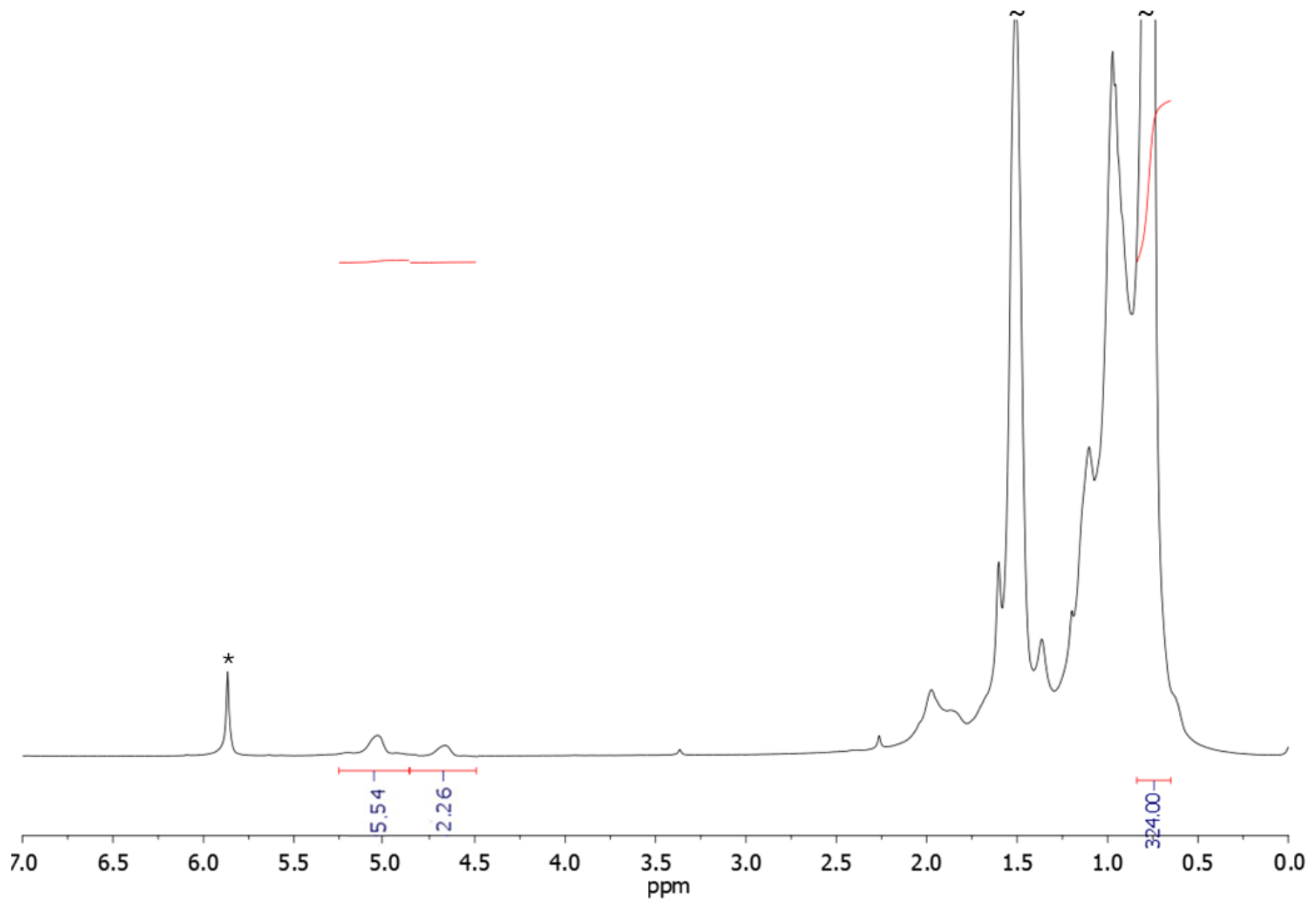
Polymer composition was determined by 1H spectroscopy according to Equations (S1)–(S4). NMR spectra were recorded in 1,1,2,2-tetrachloroethane-d2 to ensure that all the diagnostic resonances were clearly resolved and free from the deuterated solvent peak. Additional 1H spectra are also shown in the Supplementary Materials (Figures S5 and S6). Figure 1 shows the 1H spectrum of entry 9, which is the copolymer at a higher MY content.
Microstructural analysis shows that, regardless of the catalyst employed, the incorporation of myrcene into the polymer chain remains limited, even upon variation in the reaction conditions, with MY contents not exceeding 3.10 mol% (entry 9). This behavior is consistent with previous reports on diene/olefin copolymerizations, where steric hindrance and unfavorable insertion kinetics of bulky conjugated dienes restrict their incorporation. Notably, this trend is also evident for catalyst 1, which, despite its ability to incorporate up to 15.7 mol% of myrcene in E/MY copolymerization, exhibits significant lower comonomer incorporation under the present conditions [16]. Catalyst 3 promotes P/MY copolymerization with higher stereoselective control than catalyst 1, yielding up to 88 mol% of 1,4-units and 12 mol% of 3,4-units in the polymer backbone (entry 15). The observed difference in the selectivity between 1 and 3 might be explained by a simple speculation of stability in an equilibrium after 2,1-insertion generally considered in the polymerization of conjugated diene [15,16], but we are unsure of the details at this moment; in addition, a rather large PDI value has been observed in the resultant polymer prepared by 3 at 60 °C (entry 20), and also observed in the ethylene copolymerization with isoprene by Cp-ketimide catalyst (4) at 50 °C, affording copolymers with low isoprene contents [25]. More study, including of terpolymerization with ethylene, might be helpful.
It is evident that, despite the low comonomer content in the polymer chain, increasing MY concentrations in the feed leads to a decrease in both activity and molar mass. This low incorporation of the terpene, along with the decrease in activity and molar mass, may be connected to the tendency of these half-titanocenes to promote cyclo-isomerization [26]. Indeed, it is well known that ring-containing copolymers can be obtained with half-titanocene catalysts as well as zirconocene ones in the copolymerization of ethene or propene with butadiene and conjugated diene [27,28,29]. The presence of 1,2-cyclopentane rings was first reported by Galimberti and co-workers in the copolymerization of ethene with 1,3-butadiene with metallocene catalysts such as bis(η5-cyclopentadienyl)zirconium dichloride or rac-ethylenebis[(4,5,6,7-tetrahydro)-indenyl]zirconium dichloride [27]. In addition, a highly sterically hindered zirconocene,1 namely rac-methylenbis(3-tert-butyl-indenyl) zirconium dichloride, has been proven to be able to generate cyclopropane and cyclopentane rings in the copolymerization of propene with butadiene [27]. More recently, both cyclopentane and cyclohexane units have been detected in E/isoprene copolymers with the half-titanocene catalyst 1 used in this paper [25]. Furthermore, the microstructural analysis of E/MY copolymers from catalyst 1 reveals the presence of cyclopentane units, formed by the 2,1- insertion of myrcene followed by cyclization after E insertion [16]. According to the literature, the presence of these structures was linked to the absence of resonances at ca. 107 and 150 ppm, which are ascribed to methylidene carbon atoms [16]. The 13C-NMR spectra of copolymers from catalysts 1 and 3 seem not to show these resonances, especially resonances ascribed to the formation of cyclopentane/cyclohexane rings [16,25]. Further detailed microstructural analysis will be undertaken to better elucidate this hypothesis.
All copolymers exhibited a single glass transition temperature (Tg), confirming their fully amorphous nature and homogeneous composition. The measured Tg values decreased with increasing MY content (Figure S7) and remained intermediate between those of the respective homopolymers (from −76.5 to −56 °C as a function of microstructure for polymyrcene [11,30,31] and 0 °C for atactic polypropene). The most significant Tg reduction was observed for the copolymer from catalyst 1 with the highest MY incorporation (3 mol%), i.e., entry 9, which exhibited a Tg of −17 °C. Notably, the incorporation of 1 mol% MY using catalyst 1 (entry 8) resulted in a Tg of −11 °C. In contrast, entries 19 and 20 from catalyst 3 exhibited similar Tg values despite having nearly double the MY content. This behavior is likely attributable to differences in the copolymer microstructure and molecular mass; specifically, entry 8 possesses a high 3,4-myrcene content (≈ 40%) and Mw of 90 kg mol−1, whereas entries 19 and 20 contain a significantly lower 3,4-myrcene level (≈ 20%) and Mw of about 200 kg mol−1.
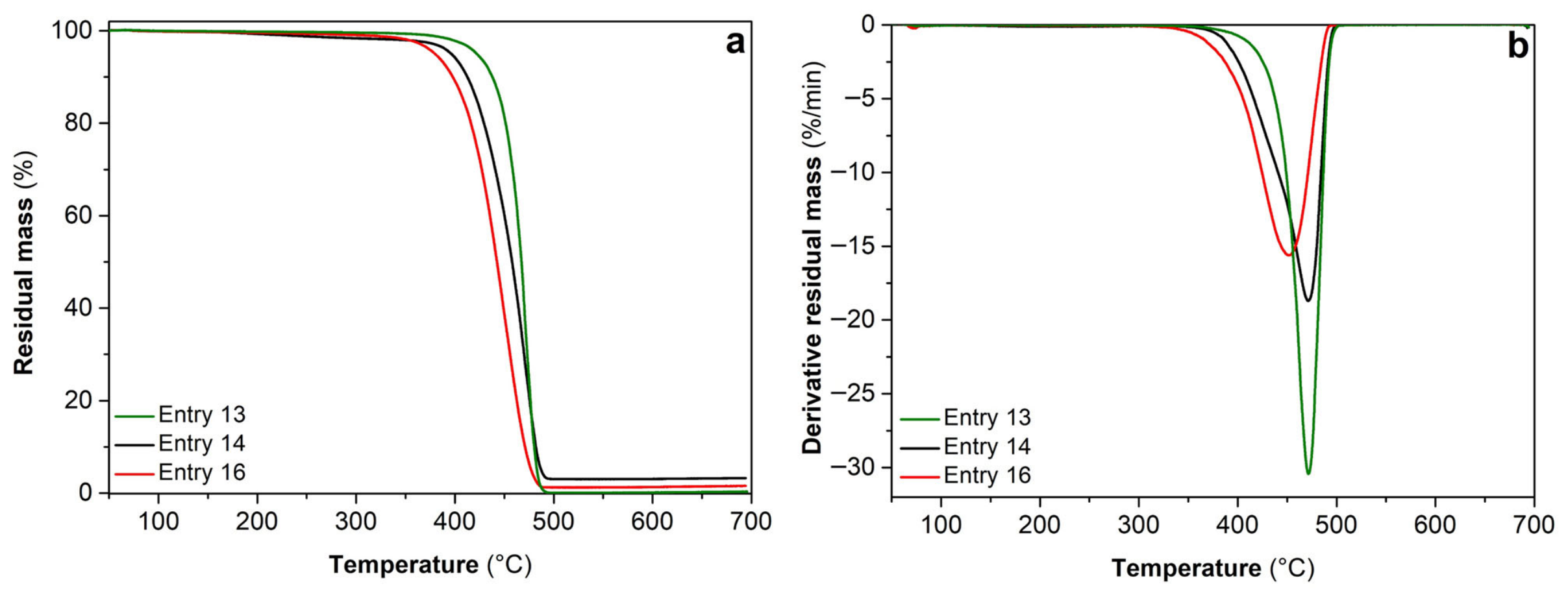
The thermal stability and decomposition profiles of selected samples synthetized with catalyst 3, namely PP homopolymer (entry 13) and the P/MY copolymers (entry 14 and entry 16), were investigated via thermogravimetric analysis (TGA) and derivative thermogravimetry (DTG), as illustrated in Figure 2. The thermal results obtained from thermograms, i.e., temperatures at mass loss of 5, 10 and 50% (T5%, T10% and T50%, respectively) and the temperature at the maximum degradation rate (Tmax), are reported in Table S2.
The PP homopolymer exhibited the highest thermal stability among the samples, characterized by a well-defined single-step degradation process with an onset temperature of 422 °C. Its DTG curve shows a sharp, narrow peak centered at 471 °C, indicating a rapid and uniform mass loss. The incorporation of MY units into the polymer backbone resulted in a systematic decrease in thermal stability. As the MY content increased from 0.33 mol% (entry 14) to 2.52 mol% (entry 16), both the T5% and Tmax values shifted progressively toward lower temperatures. Specifically, entry 14 showed a T5% reduction to approximately 400 °C and a Tmax similar to that obtained for the PP homopolymer, whereas entry 16 (2.52 mol% MY) exhibited the lowest thermal resistance, with T5% and Tmax at 380 and 451 °C, respectively. These results suggest that the presence of MY units facilitates the initiation of thermal decomposition, as a consequence of the higher susceptibility of the double bonds in the terpene-derived units compared to the saturated propene backbone. Furthermore, the slight broadening of the DTG peak in the copolymers compared to the homopolymer reflects a more complex degradation process resulting from the random distribution of MY units along the chain.

3. Materials and Methods

Every procedure and chemical handling was performed under a dry nitrogen atmosphere, utilizing conventional glovebox and Schlenk methodologies. To ensure moisture-free conditions, all glass equipment was dried at 130 °C in an oven and maintained under an inert atmosphere.
Nitrogen and propene were purified by passing them through molecular sieves and BTS catalysts. Toluene was dried with CaCl2, refluxed over metallic sodium, and freshly distilled prior to use. β-Myrcene was stirred with CaH2 overnight, followed by vacuum distillation, and subsequently stored at −20 °C under dry nitrogen. The commercial 10 wt% toluene solution of MAO underwent a drying process at 80 °C for 3 h under reduced pressure to eliminate the solvent and any volatile trimethylaluminum. Deuterated solvent for NMR measurements (C2D2Cl4, 99.5%atom D) was used as received without further purification. All reagents and solvent were purchased from Merck Life Science Srl (Milan, Italy). Catalysts were synthesized following the method reported in refs. [20,32].

3.1. Typical Reaction Procedure

The copolymerization of P and MY using a half-titanocene catalyst was conducted following a standard protocol. Initially, a 250 mL stainless-steel Büchi autoclave (Uster, Switzerland), equipped with a mechanical stirrer and a temperature-controlled thermostatic bath, was evacuated for two hours at 80 °C and then pressurized with nitrogen. Once cooled to room temperature, the vessel was charged with toluene, MY, and MAO solution in toluene to reach a final volume of 90 mL. After thermal equilibration at 40 °C, the reactor was saturated with propene at the required pressure. The copolymerization was started by injecting 10 mL of a toluene solution containing the catalyst, maintaining the propene pressure at a 4 bar. The reaction was stopped by the addition of 2 mL of an ethanol/HCl mixture. The resulting solution was transferred into acidified ethanol, and the precipitated polymer was isolated via filtration and washed. For further purification, the product was redissolved in toluene to eliminate residual monomers, reprecipitated in ethanol, and dried under vacuum for several hours until a constant weight was reached.

3.2. Characterization

NMR analysis was performed using a Bruker Avance 400 MHz spectrometer (Billerica, MA, USA), operating at 400 MHz for 1H and 100.58 MHz for 13C in PFT mode. The measurements were conducted at a temperature of 103 °C. The applied conditions were as follows: 10 mm probe, 90° pulse angle 13.5 μs power, 64K data points; acquisition time 4.52 s; relaxation delay 16 s; and 3K–4K transient. Proton broad-band decoupling was achieved with a 1D sequence using bi-waltz-16–32-power gate decoupling. The experimental sample (approximately 80 mg of copolymer) was prepared by dissolution in C2D2Cl4 within a 10 mm NMR tube.
Weight-average molar mass (Mw) and the corresponding dispersity index (Mw/Mn, Đ) were evaluated via size exclusion chromatography (SEC) at 145 °C, utilizing a Waters GPCV2000 high-performance system (Milford, MA, USA). The mobile phase consisted of o-dichlorobenzene, containing 0.05 wt/v% 2,6-di-tert-butyl-p-cresol as a stabilizer. Molecular weight was calculated through a calibration curve using narrow-distribution polystyrene standards.
The thermal properties of the samples were investigated using differential scanning calorimetry (DSC) and thermogravimetric analysis (TGA). DSC analysis was performed using a PerkinElmer (Waltham, MA, USA) DSC 8000 instrument. The samples were heated from −60 °C to 180 °C at a rate of 20 °C min−1 and kept at 180 °C for 3 min to delete the previous thermal history. Then, they were cooled to −60 °C at 20 °C min−1 and subsequently heated at the same rate up to 180 °C. The glass transition temperature (Tg) was determined from the second heating scan. TGA was performed using a PerkinElmer TGA7 instrument to evaluate the thermal stability and decomposition profile of the polymers. The sample (5 mg) was placed in a platinum pan and heated from 50 to 700 °C at a constant heating rate of 10 °C min−1 under a continuous nitrogen flow (25 mL min−1).

4. Conclusions

Propene copolymerization with myrcene has been investigated in the presence of half titanocene catalysts. Catalysts 1 and 3, the permethylated ones, are suitable for the synthesis of propene/β-myrcene copolymers in terms of catalytic activity but show limited efficiency in MY incorporation, which does not exceed 3 mol% regardless of the comonomer content in the feed or the polymerization conditions. The resulting copolymers are amorphous materials with Tg values that decrease as the comonomer content increases and remain intermediate between those of the corresponding homopolymers. Thermal analysis further indicates that the presence of comonomer units promotes the degradation; nonetheless, the copolymers exhibit high thermal stability consistent with the PP homopolymer reference. Overall, these findings highlight that the efficient synthesis of propene/β-myrcene copolymers remains a significant challenge to overcome; the further development of molecular catalysts is necessary to overcome the steric and kinetic barriers imposed by bulky bio-based monomers.

Supplementary Materials

The following supporting information can be downloaded at https://www.mdpi.com/article/10.3390/catal16050453/s1, Figure S1. Expanded region of 13C-NMR spectrum (108.58 MHz, C2D2Cl4, 103 °C) of entry 1, prepared at 25 °C and 4 bar by catalyst 1. Figure S2. Expanded region of 13C-NMR spectrum (108.58 MHz, C2D2Cl4, 103 °C) of entry 3, prepared at 40 °C and 4 bar by catalyst 1. Figure S3. Expanded region of 13C-NMR spectrum (108.58 MHz, C2D2Cl4, 103 °C) of entry 5, prepared at 60 °C and 4 bar by catalyst 1. Figure S4. Expanded region of 13C-NMR spectrum (108.58 MHz, C2D2Cl4, 103 °C) of entry 10, prepared at 40 °C and 4 bar by catalyst 2. Figure S5. 1H NMR spectrum of entry 2 (MY = 0.51 mol%), prepared by catalyst 1. Figure S6. 1H NMR spectrum of entry 4 (MY = 0.83 mol%), prepared by catalyst 1. Figure S7. 1H NMR spectrum of entry 6 (MY = 0.50 mol%), prepared by catalyst 1. Figure S8. 1H NMR spectrum of entry 7 (MY = 0.84 mol%), prepared by catalyst 1. Figure S9. 1H NMR spectrum of entry 8 (MY = 111 mol%), prepared by catalyst 1. Figure S10. 1H NMR spectrum of entry 14 (MY = 0.33 mol%), prepared by catalyst 3. Figure S11. 1H NMR spectrum of entry 15 (MY = 0.98 mol%), prepared by catalyst 3. Figure S12. 1H NMR spectrum of entry 16 (MY = 2.52 mol%), prepared by catalyst 3. Figure S13. 1H NMR spectrum of entry 18 (MY = 0.65 mol%), prepared by catalyst 3. Figure S14. 1H NMR spectrum of entry 19 (MY = 1.98 mol%), prepared by catalyst 3. Figure S15. 1H NMR spectrum of entry 20 (MY = 2.06 mol%), prepared by catalyst 3. Figure S16. Glass transition temperature as function of myrcene content from (a) catalyst 1 and (b) catalyst 3. Table S1. 13C NMR characterization of polypropylenes prepared with catalysts 1 and 2 and MAO. Table S2. TGA and DTG degradation temperatures of the selected polypropene and propene/myrcene copolymers obtained by catalyst 3.

Author Contributions

Conceptualization, S.L. and K.N.; validation, S.L., K.N. and F.B.; investigation, K.P. and A.V.; data curation, K.P., B.P. and A.V.; writing—original draft preparation, S.L., A.V. and F.B.; writing—review and editing, S.L., A.V., F.B. and K.N.; funding acquisition, S.L. and K.N. All authors have read and agreed to the published version of the manuscript.

Funding

This project was supported by the Bilateral Agreement CNR/JSPS—Joint Research Project 2025–2026 Project “Development of Degradable New Biobased Polyolefins by Half-Titanocene Catalysts” (No. JPJSBP120254003 KN). The project was also supported by a Grant-in-Aid for Scientific Research from the Japan Society for the Promotion of Science (JSPS, Grant No. 21H01942; 25K01583) to KN.

Data Availability Statement

The data supporting this article have been included as part of the Supplementary Materials. Data for this article are available.

Acknowledgments

The authors thank Fulvia Greco and Daniele Piovani for their valuable cooperation in NMR and SEC analyses. SL warmly thanks Incoronata Tritto for her valuable insights and fruitful discussions. KP expresses her thanks to the Tokyo Metropolitan government (Tokyo Global Partner Scholarship Program) for pre-doctoral fellowships.

Conflicts of Interest

The authors declare no conflicts of interest.

References

  1. Wang, Z.; Ganewatta, M.S.; Tang, C. Sustainable polymers from biomass: Bridging chemistry with materials and processing. Prog. Polym. Sci. 2020, 101, 101197. [Google Scholar] [CrossRef]
  2. Rosenboom, J.G.; Langer, R.; Traverso, G. Bioplastics for a circular economy. Nat. Rev. Mater. 2022, 7, 117–137. [Google Scholar] [CrossRef]
  3. Mülhaupt, R. Green polymer chemistry and bio-based plastics: Dreams and reality. Macromol. Chem. Phys. 2013, 214, 159–174. [Google Scholar] [CrossRef]
  4. Zhu, Y.; Romain, C.; Williams, C.K. Sustainable polymers from renewable resources. Nature 2016, 540, 354–362. [Google Scholar] [CrossRef]
  5. Kristufek, S.L.; Wacker, K.T.; Tsao, Y.-Y.T.; Su, L.; Wooley, K.L. Monomer Design Strategies to Create Natural Product-Based Polymer Materials. Nat. Prod. Rep. 2017, 34, 433–459. [Google Scholar] [CrossRef]
  6. Ricci, G.; Pampaloni, G.; Sommazzi, A.; Masi, F. Dienes Polymerization: Where We Are and What Lies Ahead. Macromolecules 2021, 54, 5879–5914. [Google Scholar] [CrossRef]
  7. Zhang, G.; Guo, B.; Zhang, L. Significant Trends in Rubber Research Driven by Environment, Resource, and Sustainability. Macromolecules 2025, 58, 5883–5903. [Google Scholar] [CrossRef]
  8. Hanssens, J.; Meneses, D.; Saya, J.M.; Orru, R.V.A. Terpenes and Terpenoids: How can we use them? Eur. J. Org. Chem. 2025, 28, e202401151. [Google Scholar] [CrossRef]
  9. Loughmari, S.; Hafid, A.; Bouazza, A.; El Bouadili, A.; Zinck, P.; Visseaux, M. Highly stereoselective coordination polymerization of β-myrcene from a lanthanide-based catalyst: Access to biosourced elastomers. J. Polym. Sci. Polym. Chem. 2012, 50, 2898–2905. [Google Scholar] [CrossRef]
  10. Anastasiou, D.E. Critical review and perspective on the production of synthetic and natural poly-β-myrcene. Polym. Bull. 2025, 82, 2717–2750. [Google Scholar] [CrossRef]
  11. Lamparelli, D.H.; Kleybolte, M.M.; Winnacker, M.; Capacchione, C. Sustainable Myrcene-Based Elastomers via a Convenient Anionic Polymerization. Polymers 2021, 13, 838. [Google Scholar] [CrossRef]
  12. Lamparelli, D.H.; Paradiso, V.; Monica, F.D.; Proto, A.; Guerra, S.; Giannini, L.; Capacchione, C. Toward more sustainable elastomers: Stereoselective copolymerization of linear terpenes with butadiene. Macromolecules 2020, 53, 1665–1678. [Google Scholar] [CrossRef]
  13. Lamparelli, D.H.; Winnacker, M.; Capacchione, C. Stereoregular polymerization of acyclic terpenes. ChemPlusChem 2022, 87, e202100366. [Google Scholar] [CrossRef]
  14. Grieco, S.; Di Girolamo, R.; Ritacco, R.; Falivene, L.; Leone, G. Comonomer Discrimination in Copolymerization of β-Myrcene: Ethylene Inhibition, Spectators, and Soft Elastomers with Isoprene. ACS Polym. Au 2025, 5, 645–655. [Google Scholar] [CrossRef]
  15. Nomura, K.; Jantawan, K. Modified half-titanocenes as polymerization catalysts: Basic concept, displayed promising characteristics and some mechanistic insights. Catalysts 2026, 16, 221. [Google Scholar] [CrossRef]
  16. Kitphaitun, S.; Chaimongkolkunasin, S.; Manit, I.; Makino, R.; Kadota, J.; Hirano, H.; Nomura, K. Ethylene/Myrcene Copolymers as New Bio-Based Elastomers Prepared by Coordination Polymerization Using Titanium Catalysts. Macromolecules 2021, 54, 10049–10058. [Google Scholar] [CrossRef]
  17. Niknam, F.; Buonerba, A.; Lamparelli, D.H.; Capacchione, C. An old tool to obtain new polymers from renewable resources: [OSSO]-type titanium-catalysed ethylene and myrcene copolymers. Faraday Discuss. 2026, 262, 152–168. [Google Scholar] [CrossRef]
  18. Ren, X.; Guo, F.; Fu, H.; Song, Y.; Li, Y.; Hou, Z. Scandium-catalyzed copolymerization of myrcene with ethylene and propylene: Convenient syntheses of versatile functionalized polyolefins. Polym. Chem. 2018, 9, 1223–1233. [Google Scholar] [CrossRef]
  19. Wang, W.; Qu, S.; Li, X.; Chen, J.; Guo, Z.; Sun, W.-H. Transition metal complex catalysts promoting copolymers of cycloolefin with propylene/higher olefins. Coord. Chem. Rev. 2023, 494, 215351. [Google Scholar] [CrossRef]
  20. Nomura, K. Half-titanocenes containing anionic ancillary donor ligands as promising new catalysts for precise olefin polymerisation. Dalton Trans. 2009, 38, 8811–8823. [Google Scholar] [CrossRef]
  21. Losio, S.; Boggioni, L.; Vignali, A.; Bertini, F.; Nishiyama, A.; Nomura, K.; Tritto, I. Poly(propene-co-norbornene)s with high molar masses, tunable norbornene contents and properties, in high yield by ketimide-modified half-titanocene catalysts. Polym. Chem. 2025, 16, 3709–3719. [Google Scholar] [CrossRef]
  22. Losio, S.; Bertini, F.; Vignali, A.; Fujioka, T.; Nomura, K.; Tritto, I. Amorphous elastomeric ultra-high molar mass polypropylene in high yield by half-titanocene catalysts. Polymers 2024, 16, 512. [Google Scholar] [CrossRef]
  23. Resconi, L.; Jones, R.L.; Rheingold, A.L.; Yap, G.P.A. High-Molecular-Weight Atactic Polypropylene from Metallocene Catalysts. 1. Me2Si(9-Flu)2ZrX2 (X = Cl, Me). Organometallics 1996, 15, 998–1005. [Google Scholar] [CrossRef]
  24. Carvill, A.; Zetta, L.; Zannoni, G.; Sacchi, M.C. ansa-Zirconocene-Catalyzed Solution Polymerization of Propene: Influence of Polymerization Conditions on the Unsaturated Chain-End Groups. Macromolecules 1998, 31, 3783–3789. [Google Scholar] [CrossRef]
  25. Guo, L.; Makino, R.; Shimoyama, D.; Kadota, J.; Hirano, H.; Nomura, K. Synthesis of Ethylene/Isoprene Copolymers Containing Cyclopentane/Cyclohexane Units as Unique Elastomers by Half-Titanocene Catalysts. Macromolecules 2023, 56, 899–914. [Google Scholar] [CrossRef]
  26. Yamamoto, Y. Transition-Metal-Catalyzed Cycloisomerizations of α,ω-Dienes. Chem. Rev. 2012, 112, 4736–4769. [Google Scholar] [CrossRef]
  27. Galimberti, M.; Albizzati, E.; Abis, L.; Bacchilega, G. 13C NMR analysis of α-olefins copolymers with 1,3-butadiene obtained with zirconocenes/methylalumoxane catalysts. Die Makromol. Chem. Macromol. Chem. Phys. 1991, 192, 2591–2601. [Google Scholar] [CrossRef]
  28. Pragliola, S.; Costabile, C.; Di Bartolomeo, F.; Longo, P. Copolymerization of Propene and Buta-1,3-diene in the Presence of Highly Hindered C2-Symmetric Zirconocene-Based Catalyst. Macromol. Rapid Commun. 2004, 25, 995–999. [Google Scholar] [CrossRef]
  29. Sun, B.; Wu, C.; Cui, D. Coordination Terpolymerization of Ethylene, Butadiene, and Styrene Using Thioanisole-Modified Rare-Earth Catalysts. Macromolecules 2025, 58, 12528–12538. [Google Scholar] [CrossRef]
  30. Ricci, G.; Boccia, A.C.; Palucci, B.; Sommazzi, A.; Masi, F.; Scoti, M.; De Stefano, F.; De Rosa, C. Synthesis of stereoregular polymyrcenes using neodymium-, iron- and copper-based catalysts. Polym. Chem. 2024, 15, 1367–1376. [Google Scholar] [CrossRef]
  31. Zhang, J.; Aydogan, C.; Patias, G.; Smith, T.; Al-Shok, L.; Liu, H.; Eissa, A.M.; Haddleton, D.M. Polymerization of Myrcene in Both Conventional and Renewable Solvents: Postpolymerization Modification via Regioselective Photoinduced Thiol–Ene Chemistry for Use as Carbon Renewable Dispersants. ACS Sustain. Chem. Eng. 2022, 10, 9654–9664. [Google Scholar] [CrossRef] [PubMed]
  32. Nomura, K.; Fujita, K.; Fujiki, M. Olefin polymerization by (cyclopentadienyl)(ketimide)-titanium(IV) complexes of the type. J. Mol. Catal. A Chem. 2004, 220, 133–144. [Google Scholar] [CrossRef]
Scheme 1. Phenoxide-modified Cp’TiCl2(O-2,6-iPr2-4-C6H3) with Cp’ = Me5Cp (1) or (Me3Si)Cp (2) and ketimide-modified Cp’TiCl2(N=CtBu2) with Cp’ = Me5Cp (3) or Cp (4) half-titanocenes used for the copolymerization of myrcene (MY) with propene.
Catalysts 16 00453 sch001
Figure 1. 1H-NMR spectrum of propene/myrcene (MY) copolymer (MY = 3.10 mol%), entry 9 in Table 1. Solvent peak is marked with the asterisk *. The ~ symbol indicates that the most intense signals (e.g., solvent) have been cropped to allow a better visualization of the lower-intensity resonances.
Catalysts 16 00453 g001
Figure 2. Thermal degradation behavior of polypropene homopolymer (Table 1, entry 13) and P/MY copolymers (Table 1, entries 14 and 16): (a) TGA and (b) DTG thermograms.
Catalysts 16 00453 g002
Table 1. Copolymerization of myrcene (MY) and propene (P) catalyzed by half-titanocene catalysts 14 a.
Catalysts 16 00453 i001
EntryCatalystP/MY bT (°C)Yield
(g)
Activity
kg (mol-Ti·h)−1
Mw c
(kg mol−1)
Ð cMY % d
(mol)
1,4 (%)3,4 (%)Tg e
(°C)
11--255.935938301.9------2
21/0.50250.8320.71882.90.515743−10
3--408.48424.03091.9------−2
41/0.50401.9879.32491.90.836238−7
5--601.4736.92257.9------−1
61/0.50600.9292.487.52.20.505545−10
71/0.75600.8181.196.92.40.845842−8
81/1.0601.02102.291.41.91.116238−11
91/1.5600.1817.658.22.03.106040−17
102--400.69534.81304.0------−11
111/0.5040Traces --
12--60Traces --
13 f3--4011.2044808322.6------2
141/0.50401.17117.33432.50.3367330
151/0.75403.15105.02801.50.988812−4
161/1.5400.4321.61441.62.528317−9
17 f--6012.9351736501.7------0
181/0.50602.57385.32932.10.656436−7
191/0.75602.9096.72871.51.987822−13
201/1.0601.40140.01834.72.068119−11
21 f4--406.08243314041.7------1
221/0.5040Traces --
23 f--603.8515436637.3------−2
241/0.5060Traces --
a Conditions: P(propene) = 4 bar, solvent = toluene, total volume = 100 mL, catalyst = 20 μmol; for homopolymerization, catalyst = 10 μmol, MAO as cocatalyst (Al/Ti = 2500). b Comonomer molar ratio in the feed (mol/mol). c Determined by SEC in o-dichlorobenzene at 145 °C against polystyrene standard. d Copolymer microstructure determined by 1H-NMR. e Glass transition temperature (Tg) determined by DSC (second heating). f ref. [22].
Disclaimer/Publisher’s Note: The statements, opinions and data contained in all publications are solely those of the individual author(s) and contributor(s) and not of MDPI and/or the editor(s). MDPI and/or the editor(s) disclaim responsibility for any injury to people or property resulting from any ideas, methods, instructions or products referred to in the content.