Review

Microwave-Assisted Biomass Pyrolysis to Hydrocarbons: A Review of Catalyst Evolution from Single-Function to Multi-Site Composites

1
College of Ocean Engineering and Energy, Guangdong Ocean University, No. 1, Haida Road, Zhanjiang 524088, China
2
Guangdong Provincial Key Laboratory of Intelligent Equipment for South China Sea Marine Ranching, Zhanjiang 524088, China
*
Author to whom correspondence should be addressed.
Catalysts 2026, 16(5), 450; https://doi.org/10.3390/catal16050450
Submission received: 19 April 2026 / Revised: 4 May 2026 / Accepted: 11 May 2026 / Published: 12 May 2026

Abstract

Microwave-assisted pyrolysis (MAP) has emerged as a revolutionary technology for converting solid waste into high-value hydrocarbons. However, conventional pyrolysis and traditional single-function catalysts often face an inevitable “performance trade-off” involving severe mass transfer resistance, poor microwave absorption, and rapid coking. This review systematically summarizes the recent evolution of catalyst design toward advanced multi-site composites. It highlights the synergistic mechanisms of integrating microwave-responsive cores, hierarchical pore networks, and metal-acid bifunctional sites to achieve ultrafast localized heat transfer, targeted bond cleavage, and in-situ coking suppression. Furthermore, this paper critically examines current bottlenecks in scaling MAP to industrial levels. To address these challenges, we discuss emerging solutions, including hydrogen-enriched co-pyrolysis, non-destructive in-situ regeneration, and the integration of machine learning frameworks for intelligent process optimization.

1. Introduction

Under the dual pressures of dwindling global fossil fuel reserves and the intensifying greenhouse effect, the search for renewable carbon sources has become a strategic consensus in the modern energy and chemical industries. As the most abundant renewable carbon resources in nature, lignocellulosic biomass and various carbon-containing solid wastes are regarded as ideal feedstocks for replacing traditional petrochemical resources and producing high-value-added chemicals and liquid fuels [1]. Among the various thermochemical conversion technologies, pyrolysis has garnered significant attention for its ability to directly convert macromolecular solid waste into bio-oil, syngas, and biochar under an inert atmosphere. However, conventional pyrolysis processes based on traditional external electric heating rely heavily on the slow heat conduction from the reactor walls to the interior of the feedstock. This inefficient heat transfer prolongs reaction times and causes uncontrolled secondary condensation of primary volatiles within the bed [2]. Consequently, the resulting bio-oil exhibits high oxygen content, low calorific value, and poor stability, failing to meet modern industrial standards [3].
To overcome the limitations of conventional thermodynamic heat transfer, microwave-assisted pyrolysis (MAP) has emerged as a revolutionary thermochemical conversion method. Microwave radiation can penetrate directly through the surface of materials, inducing dielectric loss at the molecular level through dipole polarization and ionic conduction, thereby achieving significant “volumetric heating” [4]. This transient, non-contact energy transfer significantly shortens reaction times and reshapes macromolecular bond-breaking kinetics. Consequently, it demonstrates immense potential for converting complex solid wastes into high-quality liquid oils, hydrogen-rich syngas, and valuable carbon materials, far exceeding conventional pyrolysis [3,5].
The fundamental reason microwave-assisted pyrolysis significantly improves product quality lies in its ability to simultaneously alter the macroscopic heat transfer and microscopic kinetic conditions of the reaction system. However, to avoid speculative mechanistic claims, it is crucial to rigorously distinguish between the thermal effects and the widely debated non-thermal effects (specific microwave effects) induced by electromagnetic radiation.
Thermal effects in MAP are primarily driven by selective volumetric heating. Unlike the distinct “hot outside, cold inside” temperature gradient characteristic of conventional heat transfer, microwaves penetrate deep into the material, enabling heating from the inside out [6]. More importantly, because natural biomass and catalysts possess significantly different dielectric loss tangents, microwave irradiation induces profound selective heating [4]. The introduction of microwave-absorbing receptors generates “micro-hotspots”—localized microscopic domains where temperatures far exceed the measurable macroscopic bed temperature [7]. It must be emphasized that the micro-hotspot effect is fundamentally a thermodynamic phenomenon; it provides localized extreme thermal energy to rapidly rupture stubborn chemical bonds (e.g., C-O and C-C bonds) without raising the bulk temperature of the entire reactor [7]. Conversely, non-thermal effects refer to the direct, non-thermodynamic interactions between the high-frequency alternating electromagnetic field and polar molecules or functional groups. Recent kinetic and mechanistic studies suggest that the continuous, rapid realignment of dipoles within the microwave field can theoretically increase the pre-exponential factor of the Arrhenius equation or lower the apparent activation energy required for the primary depolymerization of cellulose, hemicellulose, and lignin [8]. This direct electromagnetic perturbation promotes rapid macromolecular breakdown at noticeably lower macroscopic temperatures [8]. Nevertheless, the strict existence of non-thermal effects remains a subject of intense academic debate. Many researchers argue that purported “non-thermal” kinetic enhancements are often macroscopic manifestations of unmeasured, extreme micro-hotspots [4,8].
Therefore, in the context of this review, the remarkable efficiency and product selectivity observed in catalytic MAP are evaluated as a synergistic consequence: the thermodynamic thermal shocks provided by dielectric micro-hotspots [7], combined with the highly specific bond-cleavage pathways directed by the active catalytic sites [9,10].
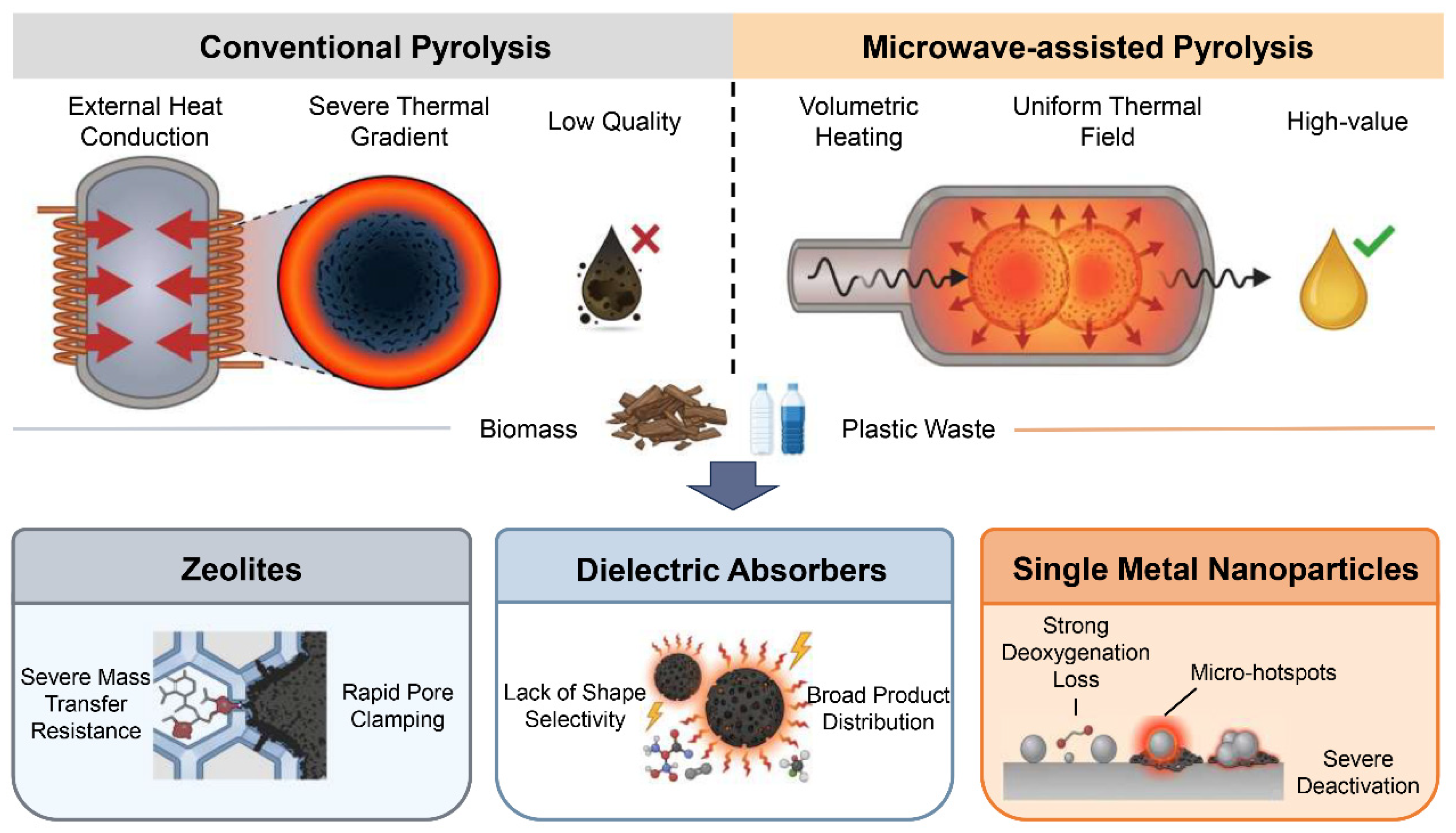
In recent years, researchers have conducted extensive and in-depth investigations into microwave-assisted catalytic pyrolysis systems. Regarding catalyst selection, early studies primarily focused on single-function materials, including isomorphous molecular sieves such as HZSM-5, carbon-based microwave-absorbing materials such as biochar, and various single-component transition metal oxides [11]. However, as research has progressed, the academic community has gradually recognized that single-material catalysts face severe challenges in complex and extreme microwave thermochemical environments. Zeolites are highly prone to pore blockage and coking-induced deactivation, metal components are highly susceptible to sintering under microwave discharge, and microwave-absorbing materials lack the ability to achieve precise, directed aromatization. Collectively, these issues constitute a bottleneck that limits the selectivity of target hydrocarbons and the lifespan of the catalyst [12]. Figure 1 conceptually illustrates these fundamental differences. It contrasts conventional heat transfer with microwave volumetric heating, while highlighting the ‘impossible triangle’ performance barrier that single-component catalysts currently face.
To break this deadlock, current research has decisively shifted toward the design of multi-site composite catalysts and the development of synergistic pyrolysis of multiple feedstocks. For example, the use of bifunctional silicon carbide (SiC) spherical catalysts for the efficient conversion of waste cooking oil [13], the development of alkali-metal-doped SiC foams for the ultrafast selective synthesis of monocyclic aromatics [14], and the application of N-doped bimetallic MOF-derived materials to promote the high-value co-pyrolysis of microalgae and marine plastic waste [15]. These cutting-edge studies demonstrate that nanoscale coupling of dielectric responses, spatial confinement, and multifunctional chemical sites is an effective approach for achieving highly efficient targeted hydrocarbon synthesis.
This paper aims to provide a systematic review of the latest advances in the field of microwave-assisted catalytic pyrolysis of solid waste for hydrocarbon production. Section 2 will begin by analyzing the catalytic mechanisms of current mainstream single-function catalysts (zeolites, wave-absorbing carriers, and metal particles) in microwave fields, as well as the “performance trade-off” they face. Section 3 will focus on how to overcome heat and mass transfer barriers at the microscopic scale through multi-site composite strategies (including core–shell structures, multi-level pore confinement, and bifunctional synergy). Section 4 will address the challenges of selectivity and deactivation faced during the industrial-scale upscaling of this technology, and will prospectively explore the strategic value of emerging approaches—such as co-pyrolysis of feedstocks, in-situ non-destructive regeneration, and artificial intelligence (AI/ML)—in the future intelligent optimization of the entire process chain. We hope that this multidimensional, comprehensive review will provide valuable theoretical references and design insights to facilitate the transition of microwave-assisted catalytic pyrolysis technology toward efficient and sustainable industrial applications.

2. Single-Function Catalyst

2.1. Zeolite Catalyst

To overcome the challenges of complex products and high oxygen content in conventional microwave pyrolysis, introducing catalysts into the reaction system is the only way to achieve the targeted production of high-quality hydrocarbons. However, single-function materials (such as molecular sieves, wave-absorbing carriers, or single metals) can typically address only one-dimensional issues in alternating microwave electric fields, making it difficult to simultaneously meet the comprehensive requirements of heat transfer, deoxygenation, and anti-coking. This chapter will review the current mainstream single-catalyst systems and provide an in-depth analysis of the performance “impossible triangle” they face in microwave fields.
Before delving into specific catalytic materials, it is essential to establish the quantitative baseline of MAP in the absence of targeted catalysts. During catalyst-free microwave pyrolysis and co-pyrolysis processes, reaction conditions, feedstock characteristics, and spatial distribution directly determine the conversion efficiency. For instance, in the pyrolysis of low-density polyethylene (LDPE) using chemically inert silicon carbide (SiC) strictly as a microwave absorbent, the thermal decomposition predominantly occurs within a narrow temperature window of 300–500 °C, requiring an average apparent activation energy of approximately 101 kJ/mol. As the microwave power increases from 400 W to 700 W, the yield of C1–C4 light gaseous products significantly increases from 51.9 wt% to 61.2 wt% [16]. Similarly, in the catalyst-free co-pyrolysis of low-rank coal (LRC) and deashed corncob (CR), maintaining an optimal amount of biomass volatiles can maximize tar production, reaching a peak yield of 11.12%, while minimizing the pyrolysis gas yield to 27.14% [17]. Furthermore, the spatial distribution model of feedstocks plays a critical role in non-catalytic systems. In the co-pyrolysis of tar-rich coal and oil shale, employing a two-layer loading mode (tar-rich coal in the upper layer and oil shale in the lower layer) yields significant synergistic effects. Under optimal conditions (750 °C and 1000 W heating power), the yields of tar and pyrolysis gas reach 9.0% and 21.9%, respectively. Compared to the individual pyrolysis of tar-rich coal, this specific spatial distribution achieves an absolute increase of 0.8% in tar yield and 1.6% in gas yield [18]. However, despite these physical and thermodynamic optimizations, the overall selectivity for high-value aromatics remains severely limited without the intervention of targeted catalytic sites, which necessitates the introduction of zeolites.

2.1.1. HZSM-5

In the field of vapor upgrading of pyrolyzed biomass, microporous molecular sieves, represented by HZSM-5, are undoubtedly the most widely used and best-understood reference catalysts. Its unique three-dimensional cross-linked microporous network (pore size approximately 0.55 nm) and abundant Brønsted acid sites (typical Si/Al ratio of 25–50) endow it with an irreplaceable “stereoselective catalytic” capability [6,14]. Upon contact with molecular sieves, oxygenated intermediates from primary biomass pyrolysis undergo rapid dehydration, decarboxylation, and decarbonylation at strongly acidic sites. This pathway removes most oxygen atoms, drastically reducing the product’s oxygen content from 40–50 wt% (in lignocellulosic feedstocks) to <10–15 wt% in the bio-oil [6,19]. Subsequently, under the physical confinement of microporous channels, these intermediates undergo directed oligomerization, cyclization, and aromatization, ultimately increasing the proportion of monocyclic aromatics (MAHs, such as benzene, toluene, and xylene) in the organic products to 30–60 wt%, while simultaneously suppressing the formation of heavy tar [14,19]. However, when researchers attempted to expose HZSM-5 directly to a microwave field on its own, the material’s shortcomings in terms of physical heat transfer and microscopic chemistry quickly became apparent. First, from the perspective of physical electromagnetic properties, traditional aluminosilicate molecular sieves (including HZSM-5) are virtually “microwave-transparent,” with a dielectric loss tangent (tan δ) typically below 10−2.
This means that under microwave radiation, the molecular sieve itself is extremely unlikely to generate heat through polarization and can only passively heat up through thermal conduction resulting from the absorption of microwaves by the biomass feedstock (or blended dielectric materials) [6,20]. In experimental-scale beds, this passive and non-uniform heating pattern easily leads to significant temperature gradients with axial temperature differences reaching 50–150 °C, preventing the advantages of microwave “rapid, uniform volumetric heating” from being fully realized on the catalyst surface, which directly hampers the rates of macromolecule cracking and aromatization. Second, an even more critical issue is the severe deactivation of HZSM-5 when processing complex biomolecules. The narrow micropores of HZSM-5 are ineffective when dealing with large oxygen-containing polymers (such as lignin-derived oligopolyphenols) [21]. These large molecular intermediates not only struggle to penetrate deep into the micropores to utilize the core acidic sites but are also highly prone to steric hindrance and congestion on the outer surface or at the pore entrances of the zeolite. In the high-temperature pyrolysis environment induced by microwaves, these trapped macromolecules rapidly undergo secondary condensation and excessive polymerization, forming dense and voluminous aromatic coke. This often increases the coke yield from <5 wt% (under non-catalytic or mild conditions) to 10–20 wt% or even higher [21,22]. Related studies have shown that during continuous processing of lignin-containing or high-resinous biomass, the number of acidic sites in HZSM 5 can decrease by 30–60% within a few hours, while pore volume and specific surface area can also decrease by 20–40%, resulting in rapid, nearly irreversible deactivation within a short period of time.
To alleviate the mass transfer barriers associated with a single type of zeolite, some studies have attempted to physically blend mesoporous materials (such as MCM-41) with ZSM-5. The aim is to utilize the spacious channels of the mesoporous material to buffer the pre-cracking of macromolecules, thereby reducing carbon buildup pressure on HZSM-5 and improving the total hydrocarbon yield [22]. However, this is merely a stopgap measure; physical blending still fails to fundamentally address the inherent defects of single molecular sieves in a microwave field, namely their “poor microwave absorption” and “extreme susceptibility of acidic sites to poisoning.” This compels researchers to move beyond the framework of single molecular sieves and seek novel materials capable of deep coupling with the microwave field.

2.1.2. Other Molecular Sieves (HY, Hβ, USY, MCM-41)

Beyond typical microporous HZSM-5, researchers have introduced larger-pore topological zeolites (e.g., Beta, Y, or USY) to mitigate mass transfer resistance. Beta molecular sieves feature three-dimensional intersecting pore channels formed by dodecagonal rings (pore size approximately 0.66 × 0.67 nm), which, compared to HZSM-5 (approximately 0.55 nm), can accommodate larger oxygen-containing oligomers into the pore channels to some extent [10,23]. Comparative and co-pyrolysis studies have shown that the use of molecular sieves with larger pore sizes in microwave systems typically alters the kinetic pathways of macromolecular cracking. Under specific conditions (e.g., biomass and plastic co-pyrolysis), porous molecular sieves facilitate efficient hydrogen transfer. This mechanism either increases hydrogen-rich gas (H2) yields or beneficially alters the polycyclic aromatic hydrocarbon distribution in the liquid products [24,25]. From a reaction kinetics perspective, wider pore channels do indeed lower the apparent activation energy during the initial stages of the reaction. Kinetic fitting results indicate that the apparent activation energy can be reduced by approximately 10–30 kJ·mol−1 compared to conventional HZSM-5 systems, thereby increasing the initial conversion rate of macromolecular precursors [26,27].
However, changes in the topological structure cannot fundamentally address the shortcomings of the silicon-aluminum zeolite family in microwave fields. Regardless of pore size, the tangent of the dielectric loss (tan Δ) of pure zeolite frameworks typically remains at a low level (mostly below 0.05) at the conventional microwave frequency of 2.45 GHz [10,28]. In the absence of effective microwave absorbers, the macroscopic heating rate of a pure molecular sieve bed often struggles to exceed the typical range of 20–40 °C/min and is prone to the formation of unpredictable cold spots and hot spots within the reactor [23,29]. This non-uniform temperature distribution not only reduces the catalytic selectivity for directed bond cleavage but may also induce undesirable secondary cracking side reactions. Specifically, recent studies on spatial distribution in microwave fields reveal that these undesirable secondary reactions are mainly driven by local thermal extremes [18]. In localized micro-hotspots, primary liquid vapors suffer from excessive thermal energy, leading to over-cracking into non-condensable light gases (e.g., CH4 and CO). Conversely, in underheated “cold spots,” primary heavy oligomers lack sufficient energy for targeted scission and instead undergo secondary condensation, forming polycyclic aromatic hydrocarbons (PAHs) and thermal coke that deactivate the catalyst. Second, although large pore channels delay pore-mouth blockage in the early stages of the reaction, they often shift the coking zone from the catalyst’s outer surface to the depths of the channels. Extensive kinetic and deactivation studies have confirmed that the increased residence time of large molecules within wide pore channels may actually increase the likelihood of deep dehydrogenation and aromatization reactions [23,26]. After 3 to 5 pyrolysis/regeneration cycles, the micropore volume of such porous zeolites still faces significant decline (under certain severe conditions, the loss rate of specific surface area can reach 50–70%), and the core Brønsted acid sites are similarly unable to escape coking coverage [10,27].
In summary, simply altering the framework type or physical pore size of molecular sieves makes it difficult to simultaneously achieve both “high-efficiency microwave absorption and heat generation” and “long-term anti-coking and shape retention” in a microwave field. These physicochemical limitations of such single-material insulators have naturally led researchers to turn their attention to another class of materials with exceptionally strong microwave responsiveness—microwave-absorbing carriers.

2.2. Absorptive Catalyst

Given the inherent limitations of passive heat transfer in pure silica-alumina molecular sieves under microwave irradiation, the introduction of dielectric materials with strong microwave responsiveness is an effective approach to overcoming these macroscopic heat transfer constraints. Such materials not only greatly optimize the heating kinetics of the bed but also significantly alter the cracking environment for large molecules at the microscopic scale.

2.2.1. Carbon-Based Absorbers

Carbon-based materials such as biochar and activated carbon are currently the most representative and widely used strong microwave-absorbing media in microwave pyrolysis. In contrast to the extremely low dielectric loss of molecular sieves, the graphitized microcrystalline structure of carbon materials is rich in delocalized π electrons. Under the influence of an alternating electromagnetic field at 2.45 GHz, these freely moving electrons can generate significant conduction loss and interfacial polarization (such as the Maxwell–Wagner type) [30,31]. This unique physical property enables the macroscopic heating rate of carbon-based substrates to often reach tens to hundreds of °C/min, allowing the target pyrolysis temperature to be reached in just a few minutes [31]. More importantly, under microwave radiation, intense energy dissipation occurs at the tips of carbon substrates, the edges of pores, or at metal adsorption sites, inducing “microscopic hot spots” with temperatures far higher than those of the macroscopic bed, and even localized discharge phenomena [31,32]. This extreme localized thermal shock effect can provide an extremely high instantaneous energy to break strong chemical bonds.
Quantitative mechanistic studies have confirmed that biochar’s inherent physical pore network, along with its surface-bound active oxygen-containing functional groups (such as carboxyl and carbonyl groups) and lattice defects, can contribute to the chemical evolution of primary volatiles to some extent, providing mild catalytic sites for the initial deoxygenation and rearrangement of oxygen-containing compounds [33]. However, native biochar generally suffers from limitations such as limited specific surface area, a monotonous pore structure, and a lack of strongly oriented catalytic sites; when used alone, it exhibits relatively weak selectivity for target hydrocarbons such as high-quality monocyclic aromatics. To overcome this performance gap, researchers have widely adopted chemical activation and heteroatom doping strategies. For example, the chemical activation of waste biomass using reagents like H3PO4, alkalis (e.g., KOH, NaOH), or metal salts (e.g., ZnCl2, FeCl3) creates high-performance catalytic carriers with hierarchical pore structures and vastly increased surface areas [34]. Furthermore, this activation process alters the carbon framework’s dielectric parameters, thereby optimizing microwave carbonization times and macroscopic heating rates [35].
Building upon a well-developed pore network, the further incorporation of metallic or non-metallic heteroatoms is key to endowing carbon substrates with advanced catalytic functionality. The use of high-value biochar derived from spent lithium-ion batteries, or the impregnation of biochar with metal chlorides, has been shown to enhance overall microwave absorption characteristics while introducing additional Lewis acid sites into the reaction system, thereby significantly altering the distribution profile of pyrolysis products [36,37]. More advanced composite designs, such as activated carbon materials co-doped with transition metals and nitrogen (Metal/N co-doped), have successfully integrated high dielectric loss, hierarchical mass transfer pathways, and dual redox active centers into the carbon framework. In these systems, transition metals—primarily iron (Fe), cobalt (Co), and nickel (Ni)—are predominantly employed. These specific metals are strategically selected because they readily coordinate with nitrogen dopants to form robust, atomically dispersed M-Nₓ active sites (e.g., Fe-N4 or Co-N4 configurations). In microwave co-pyrolysis tests of biomass and waste plastics, these multifunctional carbon-based materials demonstrated excellent synergistic effects, effectively guiding the directed conversion of volatiles into hydrogen-rich gases and monocyclic aromatic hydrocarbons [38].
In summary, through structural and surface chemical modifications, carbon-based materials have gradually moved beyond their role as mere heat carriers and have developed preliminary capabilities for catalytic cracking and directed deoxygenation. However, due to limitations on their maximum acidity, achieving optimal yields of aromatic products still requires deep coupling with other highly active catalytic components.

2.2.2. Inorganic Absorbers

Although carbon-based materials exhibit excellent microwave absorption properties, they are often prone to severe carbon consumption (gasification/oxidation) and structural collapse in extremely high-temperature microwave fields or environments containing trace amounts of oxygen. In contrast, inorganic absorbers such as silicon carbide (SiC) and transition metal oxides (e.g., Fe3O4), owing to their exceptional thermal shock stability and ablation resistance, have emerged as more ideal steady-state heat carriers in continuous, scalable microwave pyrolysis systems [39,40]. Silicon carbide (SiC) is a typical wide-bandgap semiconductor; its heat generation mechanism in microwave fields primarily relies on dipole polarization and interfacial polarization caused by lattice defects. SiC maintains a relatively stable dielectric constant even under harsh high-temperature conditions (e.g., 1000 °C), which significantly reduces the risk of “thermal runaway” commonly observed in pilot-scale reactors [40]. To further overcome the mass transfer resistance commonly associated with conventional powdered catalysts, researchers developed SiC foam with a three-dimensional interconnected network structure. This macroscopic porous structure not only allows microwaves to penetrate deeper into the catalytic bed but also effectively eliminates local cold spots [14,39]. Further studies have shown that doping the SiC foam framework with alkali metals can significantly enhance the microwave response rate at its surface; the microscopic thermal field induced within an extremely short time can efficiently promote the secondary cracking of macromolecular precursors and highly selectively generate monocyclic aromatic hydrocarbons (MAHs) [14].
Another class of inorganic absorbers that has attracted significant attention is magnetic metal oxides, particularly ferric oxide (Fe3O4). Unlike SiC, which relies solely on dielectric loss, Fe3O4 exhibits a dual energy absorption mechanism in microwave fields, involving both “dielectric loss” and “hysteresis loss” [11,41]. This dual-loss characteristic enables it to induce significant thermal effects even at relatively low microwave power levels. More importantly, Fe3O4 itself possesses redox active sites (Fe2+/Fe3+ electron transfer pairs), which endow it with chemical properties that go beyond those of a mere “physical heat-generating material.” In the microwave pyrolysis of microalgae (such as Spirulina residues) or waste plastics, iron-based absorbers not only create a microenvironment with extremely rapid heating, but the reactive oxygen species and lattice defects on their surfaces can also, to some extent, catalyze the cleavage of C–C and C–O bonds, significantly optimizing bio-oil yield. This approach even holds promise for directly converting certain polymers into broad-range liquid hydrocarbons that meet aviation fuel standards [41,42].
While SiC and Fe3O4 remain the most widely utilized inorganic absorbers, several other classes of advanced inorganic materials have been extensively explored to further tune dielectric and magnetic loss mechanisms. For instance, spinel ferrites (e.g., Ni-Zn or Co-based ferrites) have garnered significant attention because their high-frequency microwave magnetic properties and loss capacities can be precisely tailored by altering the divalent metal cations [43]. More recently, emerging 2D inorganic materials like transition metal carbides (MXenes, e.g., Ti3C2Tₓ) have been introduced. These advanced materials capitalize on their unique laminated structures and heterogeneous interfaces, which promote intense interfacial polarization and multiple internal microwave reflections, thereby significantly enhancing electromagnetic wave absorption and volumetric heating efficiency [44].
However, inorganic absorbers are similarly constrained by the “impossible triangle” of performance. Although they resolve the conflict between microwave heat transfer and material stability, pure SiC surfaces are chemically inert and possess almost no intrinsic activity for catalytic bond cleavage. Meanwhile, metal oxides (such as Fe3O4), while possessing some catalytic capability, lack the precisely confined microporous environment found in molecular sieves, resulting in a relatively broad distribution of products and making it difficult to achieve optimal selectivity for specific light aromatics [11]. Furthermore, in a strongly reducing atmosphere induced by microwaves (rich in CO and H2), iron-based oxides are prone to being deeply reduced to zero-valent iron (Fe0). Recent empirical studies have explicitly confirmed this deep phase transformation through quantitative crystallographic data. For example, during microwave-assisted carbothermal reduction, the characteristic X-ray diffraction (XRD) peaks of magnetite (e.g., 2θ = 35.4°) are frequently observed to diminish, while distinct new diffraction peaks emerge at 2θ = 44.7° and 65.0°, which are standard indicators of the highly crystalline metallic α-Fe0 phase [45,46]. This not only significantly alters their original microwave absorption patterns but may also lead to severe carbon deposition [11,42]. Consequently, neither molecular sieves nor microwave-absorbing carriers can independently achieve efficient heat generation, deep deoxygenation, and precise shape-selective decomposition in a microwave field.

2.2.3. Functions, Limitations, and Evolution

Looking at the performance of carbon-based and inorganic absorptive materials in the microwave-assisted pyrolysis of biomass for hydrocarbon production, their core value lies primarily in reshaping the physical mechanisms of heat transfer. By leveraging extremely high dielectric or magnetic losses, absorptive materials effectively eliminate heat transfer resistance and temperature gradients associated with conventional heating. This significantly reduces the response time required for biomass macromolecules to rise from room temperature to the target pyrolysis temperature, thereby substantially accelerating the pyrolysis process. What is even more unique is that the “microscopic hot spots” and even partial discharge effects generated on the surface of the absorptive material under the influence of an alternating electromagnetic field provide the reaction system with localized activation energy that cannot be achieved by a macroscopic isothermal field. Under these conditions, the initial dissociation of macromolecules and the release of volatile components are significantly accelerated. However, relying solely on their excellent physical heat-generating properties and weak surface chemical activity, wave-absorbing media are still unable to independently bridge the chemical gap between “crude macromolecular cracking” and “high-quality, directed synthesis of hydrocarbons.” Absorptive materials generally lack the strongly oriented catalytic sites required for deep hydrodeoxygenation (HDO) and selective aromatization. Consequently, when used independently, the intense thermal energy they provide frequently drives disordered secondary cracking and excessive condensation of primary volatiles. Not only does this result in a persistently high proportion of oxygen-containing derivatives in the liquid-phase bio-oil, but it also makes it difficult to achieve the selectivity of target light aromatic hydrocarbons (such as benzene, toluene, and xylene) at levels expected for industrial-scale production; furthermore, it even increases the risk of non-condensable gas and amorphous carbon deposits to some extent.
This situation—where materials excel at heat transfer but struggle with shape selection and deep deoxygenation—once again highlights the performance limitations of single-function materials in complex microwave fields. To achieve precise energy transfer and a perfect match with chemical reaction pathways, the trend in catalyst design will inevitably shift from single-component systems toward multidimensional coupling.

2.3. Metal Catalyst

Although the spatial confinement provided by molecular sieves and the physical heating of wave-absorbing materials have optimized the macroscopic reaction environment to some extent, they still lack sufficient chemical “tailoring” capabilities when dealing with the extremely robust C-O bonds (such as the beta-O-4 aryl ether bond in lignin) and C-C bonds found in biomolecules. Therefore, the introduction of highly catalytically active metal nanoparticles has become the key to achieving deep depolymerization and in-situ hydrogenation-deoxygenation (HDO).

2.3.1. Transition Metal Catalysts

Transition metals (primarily Ni, Fe, and Co) play a significant role in microwave-assisted pyrolysis due to their highly cost-effective catalytic activity. The intrinsic catalytic activity of transition metals stems from their unsaturated d-orbital electron configuration, which endows them with an exceptional ability to adsorb and activate oxygen-containing volatiles and hydroxyl radicals [47,48].
In microwave pyrolysis systems, different types of transition metals exhibit distinct reaction pathways. Nickel (Ni)-based catalysts are renowned for their strong C–C bond-breaking and tar reforming capabilities. In the microwave-assisted in-situ catalytic pyrolysis of complex solid wastes such as waste agricultural films, Ni-doped composite oxides (e.g., Fe/Ni/Co-Al2O3) can significantly reduce the apparent activation energy for the cracking of long-chain alkanes, thereby converting heavy tar into high-value liquid oil rich in light aromatic hydrocarbons [49]. In contrast, iron (Fe) and cobalt (Co) are not only more cost-effective but also demonstrate unique potential for decarboxylation and the directed depolymerization of specific oxygen-containing bonds. For example, the nitrogen-doped iron/biocarbon (N-Fe/BC) composite catalyst prepared via a microwave-induced one-step method can gently and efficiently guide the directed deoxygenation of volatile components, thereby significantly improving the purity and yield of phenol-enriched compounds in the liquid-phase products [50].
It is worth noting that under alternating microwave electromagnetic fields, transition metal nanoparticles with microscopic conductive or ferromagnetic properties not only serve as active centers for chemical reactions but also act as “micro-antennas.” At its tip, this often induces intense electrical discharges or microplasma effects, delivering extreme localized energy [51]. To further amplify this synergistic effect and prevent metal agglomeration during rapid heating, researchers have begun using metal–organic frameworks (MOFs) as precursors. Through microwave-assisted in-situ carbonization, MOF-derived Fe@C or bimetallic MOF nanomaterials can achieve atomic- or nanoscale-level high dispersion of metal sites and anchor them within a porous carbon framework [15,52]. In microwave-assisted pyrolysis tests involving microalgae (such as Chlorella) and marine plastic waste, these MOF-derived transition metal catalysts not only fully exploited the potential of plastic as a “hydrogen donor,” but also significantly increased the yield of target aromatics and the proportion of hydrogen (H2) released through the synergistic hydrogenation effect of the bimetallic system [15,24]. The engineering limitations of transition metals in high-temperature microwave fields should not be overlooked. Under the dual thermal stress of strong microwave absorption and partial discharge, dispersed transition metals (especially Ni and Fe) frequently exceed their Tammann temperatures. This localized overheating induces severe, irreversible thermal sintering, leading to a sharp decline in catalytic surface area within just a few cycles. In addition, transition metals often exhibit “excessively broad-spectrum” cracking behavior across the entire hydrocarbon chain. While this intense cracking and deep dehydrogenation capability offer advantages in the production of hydrogen-rich synthesis gas [24,51], when used to produce liquid aromatics, it readily leads to excessive vaporization of the volatile fractions or their secondary condensation into large amounts of coke, resulting in bottlenecks in the selectivity and yield of high-value liquid oils [49]. This lack of “precise control” over reaction pathways has naturally led researchers to turn their attention to precious metal systems that offer greater selectivity in bond cleavage and improved resistance to coking.

2.3.2. Precious Metals and Other Functional Metals

Given the limitations of non-precious metals—which tend to sinter and undergo extensive fragmentation across the entire chain in microwave fields—precious metals (such as Ru, Pt, and Pd) have emerged as the ideal choice for the synthesis of high-quality aromatic hydrocarbons due to their exceptional intrinsic hydrogenation-deoxygenation (HDO) activity and precise control over reaction pathways. Unlike transition metals, which tend to completely break down macromolecules, precious metals are more effective at “targeted depolymerization” of specific chemical bonds under microwave irradiation, and they significantly suppress unwanted secondary condensation.
Taking ruthenium (Ru) as an example, it has demonstrated exceptional chemical selectivity in processing the most refractory lignin components in biomass. Recent mechanistic studies have shown that carbon-supported ruthenium (Ru/C) catalysts can, under microwave irradiation, extremely precisely cleave the β-O-4 aryl ether bond (C-O bond) in lignin model compounds via the catalytic transfer hydrogenolysis (CTH) pathway [53]. Notably, coupling Ru nanoparticles with in-situ hydrogen-supplying media (e.g., methanol or formic acid) achieves highly efficient deoxygenation and depolymerization. Furthermore, this microenvironment effectively suppresses the excessive hydrogenation of aromatic rings, preserving the desired structural skeletons. This excellent selectivity allows for the complete retention of high-value-added mononuclear phenolic compounds or light aromatic skeletons [53,54]. Second, platinum (Pt) and palladium (Pd) demonstrate unique advantages in the treatment of high-energy C–C bonds and in aromatication for quality improvement. For example, by loading Pt onto a carbide-derived carbon-silicon carbide (CDC-SiC) bifunctional substrate with strong microwave-absorbing properties, and leveraging the synergistic effects of SiC’s rapid microwave-induced micro-heating and Pt’s exceptional bond-breaking ability, the catalytic cracking of extremely robust C–C bonds was successfully achieved at a mild macro-bed temperature [55]. Furthermore, during the online gas-phase upgrading of steam from biomass pyrolysis or the high-value conversion of hydrogen-rich solid waste (such as waste plastics), precious metal-modified zeolites (such as Pd/HZSM-5) can significantly suppress side reactions such as dehydrogenation coking. The “hydrogen spillover” effect induced by precious metals in a microwave field can rapidly stabilize the free radicals generated by primary cracking, thereby effectively directing the selective conversion of reaction intermediates into target monocyclic aromatics such as benzene, toluene, and xylene (BTX) [56,57]. However, precious metals also face significant barriers to engineering implementation. Their extremely high economic costs limit their large-scale standalone use in the pyrolysis of bulk, low-value solid waste [10,29]. Furthermore, although precious metals possess strong resistance to coking, their highly active metal sites remain at risk of poisoning when exposed to trace impurity atoms (such as toxic components like sulfur and chlorine) released during the co-pyrolysis of biomass and plastics [29,57]. Therefore, in practical applications, precious metals often need to be used in extremely low concentrations (typically less than 1% to 3% by weight) and must be thoroughly integrated with a carrier that possesses strong adsorption or site-selective binding capabilities.

2.3.3. Advantages and Limitations of Metal Catalysts

In summary, metal catalysts play a key role in the deep deoxygenation process within microwave pyrolysis systems. Due to their unique d-orbital electron configuration, metal nanoparticles can effectively activate bond-breaking processes, particularly for the C-O bonds in biomass, which are notoriously difficult to break. This property allows oxygen atoms in the network to be removed in large quantities through the formation of water or carbon oxides, thereby significantly reducing the oxygen content of the bio-oil and increasing its calorific value. However, the direct application of pure metal catalysts in a microwave field also faces unavoidable challenges. First, under the extremely high local temperatures (microscopic hot spots) induced by microwaves, highly reactive metal particles are highly prone to thermal agglomeration and sintering, resulting in a significant reduction in catalytic lifespan. Second, metal sites often exhibit a tendency toward indiscriminate cleavage of the entire chain. Due to the lack of physical spatial confinement similar to that found inside molecular sieves, the rearrangement pathways of reaction intermediates on the metal surface are highly random. This not only exacerbates the formation of dense carbon deposits but also makes it difficult to achieve the desired level of selectivity for the target monocyclic aromatics.

2.4. Comparison of Single-Function Catalysts

As discussed in Section 2.1, Section 2.2 and Section 2.3, individual catalytic components offer specific advantages in microwave-assisted pyrolysis (MAP). Nevertheless, cross-sectional analysis highlights a noticeable “performance trade-off” among macromolecular conversion, product selectivity, and long-term stability. To evaluate these contrasting behaviors quantitatively, Table 1 summarizes the core performance metrics of typical single-function catalysts based on experimental data from recent literature.
The quantitative data clearly demonstrate that the absence of catalytic intervention (blank control) results in incomplete depolymerization, yielding predominantly un-cracked aliphatic chains (e.g., 57.6 area% olefins) and negligible MAHs (<7 area%) due to random free-radical scission [24].
When purely microporous zeolites (e.g., ZSM-5) are employed, they impose severe physical mass transfer resistance. Large oxygenated macromolecules are entirely excluded from the microporous channels, forcing acid-catalyzed repolymerization to occur exclusively on the external surface [22]. This fundamental physical mismatch explains why the coke yield on single ZSM-5 rapidly surges to 5.2 wt%, leading to almost instantaneous deactivation and a suppressed aromatics yield of merely 4.5% [22]. To mitigate this, physically blending mesoporous materials (e.g., MCM-41) can reduce the coke deposition on ZSM-5 to 2.4 wt% by pre-cracking the macromolecules, yet this physical mixture still struggles to optimize the intrinsic dielectric heating efficiency [22].
Dielectric carbonaceous absorbers (e.g., activated carbon or modified biochar) successfully bridge the heating gap and promote initial decomposition. However, their catalytic capability relies heavily on specific heteroatom doping or active oxygen-containing groups, which are continuously consumed during the reaction [33]. Consequently, even when achieving a peak MAH yield of 60.3%, the selectivity drops significantly to 43.7% after just three cycles due to severe pore blockage by secondary carbon deposits [38].
Furthermore, a critical paradox exists regarding active metal loading. While single transition metals (e.g., N-Fe/BC) exhibit exceptional capabilities in deep deoxygenation—achieving up to 80.28% phenol selectivity—they are highly susceptible to structural collapse under intense microwave heating [50]. Evidence shows that after merely five cycles, the specific surface area dramatically collapses from 265 m2/g to 52 m2/g, accompanied by an irreversible decline in both oil yield and selectivity [50]. Although precious metals like Ru/C demonstrate excellent resistance to coking and maintain >98% aromatics selectivity over multiple cycles [53], their economic cost restricts their large-scale, single-use application in bulk solid waste processing.
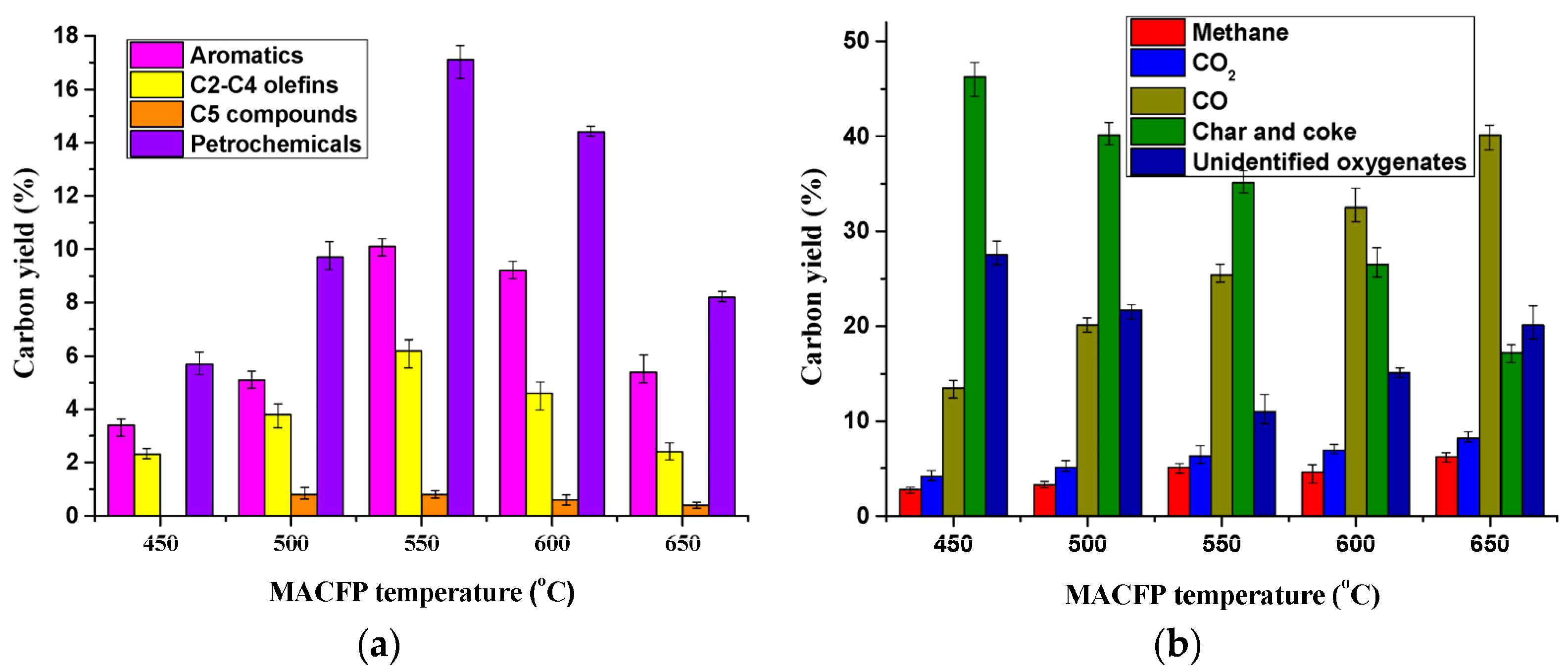
To visually substantiate the mass transfer limitations of single-component zeolites and the necessity of structural optimization discussed above, Figure 2 illustrates the analytical carbon yield distribution as a function of the catalyst composition. As explicitly demonstrated in the data, relying solely on pure microporous zeolites (“ZSM-5 only”) results in suboptimal aromatic yields and high levels of physical coking (Figure 2b) due to intense mass transfer resistance. In contrast, integrating mesoporous networks to pre-crack bulky molecules (e.g., optimizing the physical mixture to a 1:2 MCM-41/ZSM-5 ratio) successfully maximizes the yield of target petrochemicals and aromatics (Figure 2a) while significantly suppressing heavy, unidentified by-products.
Ultimately, this data-driven comparison definitively proves that no single-function material can independently overcome the performance bottleneck of MAP. The inherent contradiction between localized microwave heat generation, molecular size exclusion, and thermal sintering naturally motivates the paradigm shift toward the multidimensional synergistic systems discussed in Section 3.

3. Multisite Composite Catalyst

Given the inherent limitations of single-function materials in heat transfer, shape selection, and deoxidation within microwave-induced alternating electric fields, the design paradigm for catalysts has inevitably shifted toward multidimensional coupling. By engineering the material at the nanoscale and reconfiguring its active sites to organically integrate dielectric response, spatial confinement, and intrinsic bond-breaking capabilities, this approach represents the optimal solution currently available for the microwave-targeted hydrocarbon production from biomass. This chapter provides a systematic overview of the current mainstream composite catalytic systems and their synergistic mechanisms in microwave fields.

3.1. Molecular Sieve Core–Shell Structures and Multiscale Pore-Confined Catalysis

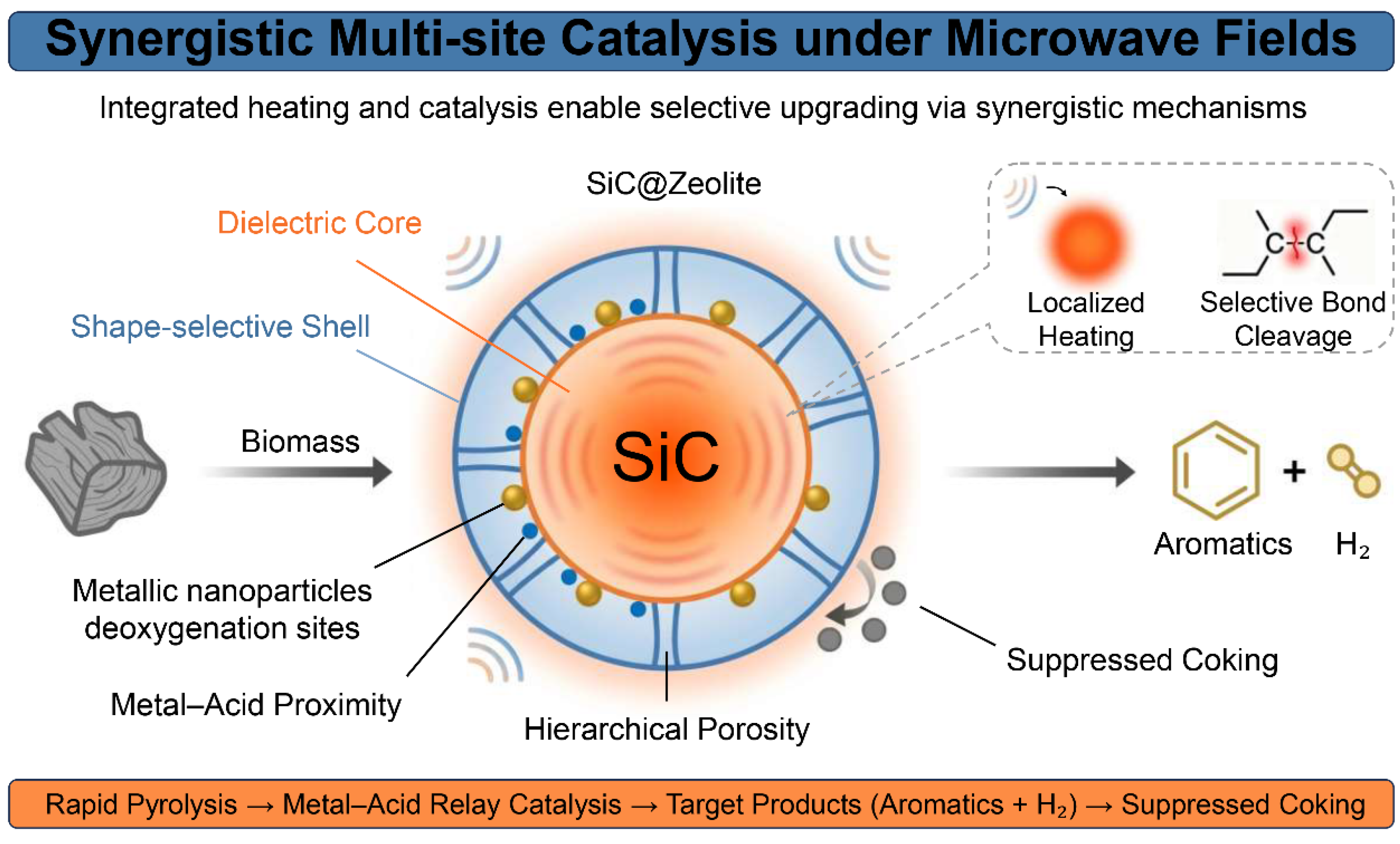
When using single-pore molecular sieves to process large biomolecules, there is a high risk of pore blockage and deactivation due to carbon deposition. To mitigate this physical mass transfer resistance, researchers have begun focusing on the “spatial geometry” of catalysts, attempting to redesign the reaction pathways for large molecules by constructing hierarchical pores and core–shell structures. As illustrated in Figure 3, a typical SiC@Zeolite core–shell composite catalyst exemplifies the synergistic multi-site catalysis mechanism under microwave irradiation. This design ingeniously integrates dielectric absorption, physical confinement, and chemical transformation, establishing a “production line” that spans from ultra-rapid pyrolysis to targeted quality enhancement.
For traditional microporous molecular sieves such as HZSM-5, the most well-established modification strategy involves introducing mesoporous or macroporous networks within their crystal structures. Through precise desilication techniques using alkali treatment or the introduction of organic soft templates, it is possible to “carve out” wide channels within the molecular sieves without compromising the integrity of the original microporous framework [58,59,60]. These mesoporous networks act like “highways” in a transportation hub; they not only significantly reduce the steric hindrance that prevents lignin-derived macromolecules from entering the catalyst’s interior but also provide greater space to accommodate carbon deposition precursors, thereby significantly delaying the deactivation of catalytic sites [61,62]. Mechanistic studies demonstrate that hierarchical pore formation transcends mere physical expansion; it triggers a robust ‘porosity–acidity synergy.’ This synergy fully exposes deeply buried Brønsted acid sites, substantially enhancing denitrogenation and deoxygenation efficiency while boosting light aromatic yields during biomass pyrolysis [63,64,65].
Building on the concept of multi-level porosity in a single material, the physical spatial nesting of silicon-aluminum materials with different pore size properties further enables the “graded processing” of pyrolytic volatiles. Assembling ZSM-5 with mesoporous silica materials (such as MCM-41 or SBA-15), or preparing it as a layered ZSM-5/SiO2 composite structure, is equivalent to establishing a natural “pretreatment unit” for complex primary cracking products [66,67,68]. Before the pyrolysis vapor reaches the core micropores, the external mesoporous substrate first undergoes moderate pre-cracking of the macromolecules. The “slimmed-down” oligomers then smoothly enter the micropores of ZSM-5, where they undergo precise cyclization and stereoselective isomerization. This relay-style spatially confined catalysis has demonstrated exceptional selectivity for low-carbon alkenes and aromatics in the microwave-assisted high-value conversion of cellulose and waste plastics (e.g., LDPE, co-pyrolysis of biomass and plastics) [67,69].
To address the critical issue of molecular sieves having “extremely poor wave-absorbing capabilities” in microwave systems, researchers ingeniously integrated dielectric wave-absorbing materials with molecular sieves through core–shell engineering, thereby achieving synchronous resonance in heat and mass transfer at the nanoscale. The most representative cutting-edge design is the microwave-responsive core–shell structure consisting of silicon carbide foam encapsulating zeolite (SiC foam@zeolite) [70]. In this ingenious configuration, the internal three-dimensional SiC foam skeleton acts as a highly efficient microwave absorber, capable of generating extremely high temperatures instantaneously within an electromagnetic field; meanwhile, the zeolite shell grown on the exterior creates a catalytically confined space. When waste plastics or biomass are heated to gasify and pass through this “heated catalytic shell,” the temperature gradient is effectively reduced and heat transfer uniformity is improved, thereby suppressing deep coking caused by secondary polycondensation [70,71].
It can be said that the dimensional upgrade of the spatial structure has revitalized the otherwise inactive molecular sieves within the microwave field. However, relying solely on pore widening and the physical composite of silicon-aluminum materials is still insufficient to endow the system with the chemical activity required for deep hydrogenation and targeted bond cleavage [72]. To completely remove stubborn oxygen-containing groups, it is necessary to introduce more reactive metal sites into these carefully designed pore networks, which has led to the development of the metal-acid bifunctional synergistic systems discussed in the next section.

3.2. Bifunctional Synergistic Catalysis Involving Metal and Acidic Sites

In the microwave-catalyzed upgrading of complex solid waste (such as biomass, waste plastics, and low-rank coal), relying solely on acidic sites or metal sites often results in a trade-off between the two. Acidic carriers lack the ability to undergo deep hydrogenation and deoxygenation (HDO) and to rapidly cleave long chains, whereas simple metal nanoparticles are highly prone to causing disordered over-cracking. To bridge this chemical gap, the development of bifunctional catalysts that combine metal active sites with abundant acidic sites (Brønsted/Lewis acids) has become the cornerstone of achieving highly selective conversions of target hydrocarbons [73,74]. In this dual-function system, reactants often undergo a sophisticated “relay transformation” mechanism. Taking metal-modified multi-porous ZSM-5 molecular sieves as an example, when gasified pyrolysis intermediates come into contact with the catalyst, surface-supported metal nanoparticles (e.g., Fe, Ce, or Ru) act as ‘pioneers’ to rapidly catalyze the preliminary hydrocracking and decarbonylation of macromolecules. Subsequently, these activated, low-carbon intermediates diffuse into the zeolite pores. Under the confinement of acidic sites, they undergo final oligomerization, cyclization, and directed aromatization [75,76,77]. In-depth mechanistic characterization (such as Py-GC/MS analysis) has confirmed that the controlled introduction of metal elements such as iron (Fe) or cerium (Ce) not only effectively modulates the ratio of Brønsted acids to Lewis acids within the molecular sieve but also significantly suppresses coke deposition caused by deep dehydrogenation under microwave irradiation, thereby substantially improving the purity and yield of benzene, toluene [77,78]. When dealing with extremely stubborn polyolefin plastics, a bifunctional system loaded with the precious metal ruthenium (Ru/Acid) has demonstrated a unique “hydrogen overflow” effect, using selective hydrocracking to precisely cleave long-chain polymers into high-quality liquid hydrocarbon fuels [76].
In a more cutting-edge approach, to overcome the inherent disadvantage of traditional silicon-aluminum molecular sieves—namely, their lack of microwave absorption—researchers have begun to apply the concept of bifunctional synergy to carriers with strong dielectric loss characteristics, such as biochar, activated carbon (AC), and silicon carbide (SiC) [13]. When synthesizing monocyclic aromatics from waste cooking oil, the use of a bifunctional SiC ball catalyst ensures rapid conversion of microwave energy while providing sufficient catalytic bond-breaking sites [13]. In the microwave pyrolysis of low-rank coal, researchers ingeniously synthesized Ni/Mo/P composite-modified biochar, in which phosphorus (P) doping provided the inert carbon framework with necessary acidic sites, while the introduction of the Ni/Mo bimetallic system significantly enhanced hydrogenation and lightening capabilities [79]. The “bimetallic” strategy is now playing an increasingly critical role in the design of bifunctional catalysts. Compared to single metals, bimetallic alloys (such as Fe-Co, Ni-CaO, and even certain iron-based microwave absorbers) exhibit remarkable electronic synergistic effects in microwave fields [41,80,81]. In the microwave-assisted hydrogenation of lignin or the co-pyrolysis of microalgae and high-density polyethylene (HDPE), carbon-supported bimetallic catalysts not only effectively prevent the high-temperature sintering of single metals under microwave hotspots but also precisely anchor and cleave specific chemical bonds [82,83]. Optimization techniques such as response surface methodology (RSM) have demonstrated that the synergy between this intermetallic electron transfer and the acidic substrate significantly alters the activation energy pathway of the reaction, enabling not only the efficient production of high-value aromatics but also the substantial release of hydrogen-rich gas under specific conditions [81,84].
It is evident that metal-acid bifunctional catalysts have successfully broken free from the constraints of single reaction pathways by integrating different chemical functions at the nanoscale. However, as research has progressed, it has become increasingly clear that relying solely on structural optimization of the catalyst still poses serious challenges—such as an imbalanced hydrogen-to-carbon ratio and heteroatom poisoning—when dealing with real-world solid waste of extremely complex composition.

3.3. Coupled Design of Dielectric Loss and Catalytic Active Sites

Although metal-zeolite bifunctional systems demonstrate excellent performance in reshaping macromolecular reaction pathways, if the entire catalyst framework lacks sufficient dielectric responsiveness, microwave energy can still only be dissipated through inefficient thermal conduction via external absorbers or the feedstock itself. To completely overcome this barrier to energy transfer, the most cutting-edge design paradigm currently involves the development of advanced microwave absorption-catalytic bifunctional composites, which enable the in-situ coupling of dielectric loss centers with chemical reaction sites [85,86].
The physical and chemical basis of this coupling design is founded on a deep understanding of the dielectric properties of complex systems. Microwave pretreatment or rate-controlled co-pyrolysis strategies can initially improve the feedstock’s dielectric properties and pore structure. Subsequently, in-situ carbonization generates a highly absorptive, synergistically doped carbon substrate, effectively paving the way for targeted catalytic deoxygenation [87,88].
An even more ingenious concept lies in the “energy funnel” effect at the microscopic scale. When highly active metal or bimetallic clusters (such as Ni-Co) are precisely anchored onto composite supports with strong microwave absorption capabilities (such as ZrO2-CaO or carbon-doped substrates), the energy absorbed by the support in an alternating electromagnetic field can be transferred directly to adjacent catalytic sites at an extremely rapid rate. This nanoscale heat conduction not only significantly reduces heat loss to the surroundings but also endows the composite catalyst with exceptional coke-resistant properties. Related studies have confirmed that, in microwave-catalyzed dry reforming or pyrolysis systems, the strong interaction between specific supports and metals, combined with microwave hotspots, can effectively suppress the deep polymerization of carbon deposit precursors [89].
In this field, the extreme thermal effects induced by microwave fields in nanostructures have even given rise to regeneration mechanisms that defy traditional thermodynamics. A groundbreaking study on iron-based nanogap catalysts has shown that microwave radiation can induce ultrafast heating and microplasma discharge within the nanogaps of the catalyst. This instantaneous, extremely localized high temperature not only directly drives the breaking of high-energy chemical bonds but also ingeniously couples with weak oxidants such as CO2, enabling the rapid in-situ removal of coke that coats the surface of deactivated sites without damaging the overall structure of the catalyst [90]. This design, which synchronizes “catalytic conversion” and “in-situ regeneration” within an extremely short timeframe, offers a novel approach to addressing the critical issue of metal catalyst lifespan. Of course, translating this ingenious design at the microscopic level into macroscopic engineering applications still requires addressing practical considerations such as reactor scaling and energy consumption management. When recycling waste polystyrene or carbon fiber composites, researchers have not only focused on optimizing the performance of the wave-absorbing-catalytic composites but have also begun to incorporate hybrid heating bench-scale reactors to address the potential for macroscopic temperature inhomogeneity that may arise during continuous scaling-up of pure microwave heating [91,92]. At the same time, leveraging advanced algorithms such as machine learning to model and predict energy consumption throughout the entire process—including the dielectric properties of the catalyst, microwave power, and product distribution—is increasingly becoming a key approach for guiding the industrial application of composite catalysts [93].

3.4. Comprehensive Evaluation and Existing Challenges

Looking back at the evolution of MAP catalysts, the transition from single-function materials to multi-site composites undeniably marks a significant technological leap. As quantitatively summarized in Table 2, integrating spatial confinement with bifunctional sites leads to remarkable initial performance peaks under diverse microwave conditions.
For instance, bimetallic zeolites like 1%Zn/2%Ga-HZSM5 can drive BTX selectivity to an impressive 82% [72]. Similarly, advanced architectures integrating dielectric carriers, such as Zn-promoted HZSM-5 on SiC foam, demonstrate exceptional synergistic cracking capabilities, pushing liquid aromatics to 93.5% while maintaining stability over 7 cycles [95]. Furthermore, cutting-edge designs using iron nanogaps on CNTs achieve ultrafast localized heating (11,057 K/min), enhancing in-situ decoking kinetics by 12.3 times [90].
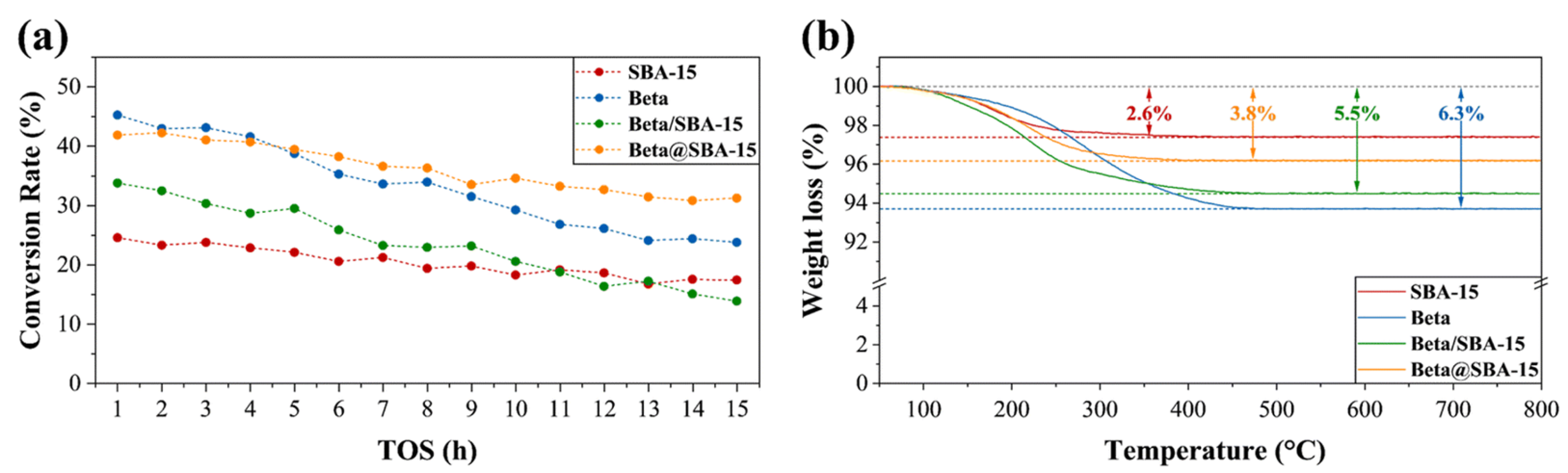
To explicitly validate the operational resilience of multi-site architectures over conventional materials, Figure 4 visualizes the continuous time-on-stream (TOS) stability and coking resistance of a representative core–shell composite catalyst (Beta@SBA-15) versus a standard reference. Unlike conventional single-function microporous zeolites that typically experience a sharp decline in activity due to rapid pore blockage and severe coking (as evidenced by a 6.3 wt% coke deposition), the synergistic hierarchical design in the composite system effectively suppresses the deep condensation of carbonaceous precursors, reducing coke formation to merely 3.8 wt%. As demonstrated by the sustained performance metrics over a 15-h extended operation, this multidimensional integration significantly prolongs the catalyst lifespan (limiting relative conversion loss to only 25.39%), providing a robust material foundation for continuous industrial application.
However, a cross-sectional analysis of these exact data metrics reveals severe inherent contradictions and unresolved engineering bottlenecks that persist despite structural complexification.
The primary contradiction lies in the discrepancy between initial shape-selectivity and long-term morphological stability when applied to heterogeneous feedstocks. While hierarchical pores and core–shell structures are conceptually flawless for mitigating mass transfer resistance and improving diffusion—such as how 0.1 M NaOH treated HZSM-5 suppresses PAH condensation [63]—empirical data expose a harsh reality regarding active site durability. For example, in AC-supported bimetallics, while Ce-Cu achieves 50.75% aromatics, switching the active metal to Ni (Ce-Ni/AC) makes the catalyst significantly more prone to carbon buildup and loss of active sites [83]. This highlights a severe feedstock and compositional sensitivity. Structural complexity alone cannot immunize the active sites from the progressive poisoning induced by heteroatom-rich real-world wastes; performance is heavily reliant on the specific pairing of metals and the purity of the feed.
The second major paradox emerges between nanoscale heat funneling and macroscopic product equilibrium. Advanced coupled catalysts leverage intense localized micro-hotspots to successfully overcome thermal sintering and facilitate deep bond cleavage. This is evidenced by Fe-Ni/SiC composites achieving a massive gas yield of 73.61 wt% (with 73.89 vol% H2) [86], or Fe-gap@CNTs generating extreme localized temperatures to convert coke into high-value CNTs [90]. Yet, this extreme “energy funneling” creates a macroscopic trade-off: scaling up these highly responsive dielectric carriers often induces uncontrollable thermal runaway. As noted in recent evaluations, while dielectric absorbers improve overall energy yield [96], the excessive localized thermal energy fundamentally shifts the reaction equilibrium toward deep dehydrogenation and excessive gasification, inadvertently over-cracking the target high-value liquid aromatics into non-condensable hydrogen-rich gases. Consequently, maximizing the yield of high-value liquid bio-oil inherently contradicts the intense micro-plasma effects necessary for continuous in-situ regeneration.
In conclusion, although multi-site composite catalysts have successfully circumvented the initial limits of single-function materials, current empirical data indicates that they heavily prioritize transient yield peaks over operational resilience.

4. Current Issues and Future Trends

4.1. Current Issues

Although multi-site composite catalytic systems have demonstrated tremendous potential for breaking through performance barriers in laboratory-scale experiments, when the scope of research expands from ideal gram-scale reaction conditions to real-world conditions involving continuous and scaled-up operations, microwave-assisted catalytic pyrolysis technology still faces unavoidable engineering and chemical challenges. Currently, the primary obstacles standing in the way of industrialization are the loss of product selectivity in complex systems and the rapid deactivation of catalysts during long-term operation. In the pursuit of high-quality liquid hydrocarbons (such as monocyclic aromatics or aviation-grade fuel fractions), insufficient product selectivity remains the most pressing challenge in this field. This lack of selectivity stems primarily from the extremely complex natural properties of solid waste feedstocks such as biomass. Real-world biomass feedstocks are rich in oxygen atoms and various heteroatoms (such as alkali metals, sulfur, and nitrogen), which often results in a natural “hydrogen-to-carbon (H/C) ratio deficit” during single-stage pyrolysis [97]. In hydrogen-scarce environments, primary volatiles frequently undergo uncontrolled secondary cross-reactions. These side reactions produce large quantities of complex heavy tar, which directly dilutes the yield of target hydrocarbons [97,98]. Furthermore, as microwave pyrolysis reactors scale up, heat and mass transfer within the solid-phase bed frequently deviate from ideal conditions. Recent reviews and studies on the amplification process indicate that, due to the extreme heterogeneity of dielectric properties within real solid waste systems, the bed inevitably exhibits an interlaced pattern of microscopic “hot spots” and “cold zones” under strong microwave radiation [5]. This uncontrolled thermal field distribution directly leads to divergent macromolecular cracking pathways—high-temperature zones may trigger excessive gasification and deep dehydrogenation, while low-temperature zones leave behind large amounts of incompletely depolymerized oligomers. Consequently, at the current stage of engineering scale-up, the composition of liquid-phase products remains extremely complex, and achieving precise targeting of specific carbon chain lengths or monocyclic aromatics remains challenging from a macro-control perspective [5].
If low selectivity is the main chemical challenge, the rapid and irreversible deactivation of catalysts determines whether this technology can move beyond the laboratory. As quantitatively compared in Table 1 and Table 2, different catalytic systems exhibit vastly different stability profiles, highlighting the need for a deeper mechanistic understanding of deactivation. In real-world microwave environments, catalyst deactivation is driven by three coupled mechanisms: chemical poisoning, physical coking, and thermal sintering. First, regarding chemical poisoning, the abundant heteroatoms in real biomass (such as alkali and alkaline earth metals) readily vaporize and permanently exchange with the protons of Brønsted acid sites in zeolites, irreversibly neutralizing their catalytic cracking capability [98]. Second, physical coking occurs through the deep Diels-Alder condensation of polycyclic aromatic hydrocarbons (PAHs). Because microwave volumetric heating accelerates the release of heavy oligomers, these bulky precursors often fail to diffuse through the micropores, rapidly polymerizing into dense graphitic coke on the external surface [99]. This encapsulation effect creates an insulating shell that simultaneously destroys the catalyst’s dielectric “microwave-absorbing capability” and its chemical “bond-cleavage capability.” For example, empirical data show that poorly designed bifunctional catalysts can suffer a severe collapse in specific surface area (e.g., from >800 m2/g dropping by over 20%) after just a single cycle due to massive carbon deposition. Third, thermal sintering is uniquely exacerbated by the microwave field itself. Under the influence of localized micro-discharges and rapid thermal shocks (hotspots) induced by high microwave power, active metal components (especially non-precious transition metals) frequently exceed their Tammann temperatures. This extreme localized thermal driving force severely accelerates the Ostwald ripening and migration of metal nanoparticles [100]. Consequently, highly active composite catalysts may experience an irreversible activity decline of up to 30% or more within the first five cycles, exposing a critical vulnerability in current multi-site designs [100].
This product diversification caused by the complexity of the feedstock, coupled with the short lifespan of catalysts resulting from extreme thermochemical conditions, necessitates the exploration of new approaches in feedstock pretreatment, reaction pathway redesign, and catalyst regeneration management for microwave-catalyzed pyrolysis.
Beyond chemical selectivity and catalyst lifespan, the economic viability and industrial scalability of these advanced multi-site catalytic systems remain severe hurdles that currently limit their practical application [23]. From a cost perspective, there is a prominent contradiction regarding active metal selection. While precious metals (e.g., Ru, Pt, Pd) demonstrate exceptional resistance to coking and precise bond-cleavage capabilities, their bulk market prices typically exceed tens of thousands of dollars per kilogram. Applying such expensive active phases to process low-value, heterogeneous solid wastes (which often yield products valued at merely $1–$3 per kilogram) is economically unviable [29]. Consequently, the industrial transition relies heavily on developing highly stable, low-cost transition bimetallic systems (e.g., Fe, Ni, Co-based alloys, typically costing under $20 per kilogram) that can mimic the performance of precious metals [23,29].
Furthermore, the scale-up preparation of current multi-site composite catalysts presents a significant bottleneck. Cutting-edge designs, such as MOF-derived core–shell structures or precisely engineered nanogaps, often require complex, energy-intensive laboratory-scale batch syntheses with yields typically limited to the gram or milligram scale [23]. Achieving reproducible, ton-scale manufacturing of these hierarchical materials necessitates the development of greener, simplified, and continuous synthesis protocols.
Finally, regarding industrial feasibility, macro-scale reactor engineering must be addressed. Most current studies rely on micro-gram (e.g., Py-GC/MS) or single-gram scale batch multimode cavity reactors. Moving to a continuous pilot-scale (e.g., >10 kg/h) exposes the fundamental physical limitations of microwaves. The penetration depth of 2.45 GHz microwaves into dense carbonaceous solid beds is often limited to a few centimeters, restricting the direct volumetric scale-up of conventional fixed-bed reactors [40]. To circumvent this and ensure uniform dielectric heating, continuous reactor geometries must be fundamentally redesigned. For instance, Auger (screw) reactors utilize continuous mechanical mixing to physically rotate the unheated core into the active microwave irradiation zone. Alternatively, microwave-transparent fluidized beds offer superior mass and heat transfer; however, scaling up their resonant cavities requires complex electromagnetic simulations and customized waveguide slot antennas (e.g., symmetrical circular designs) to prevent wave interference and plasma arcing from multi-magnetron arrays [39]. Furthermore, maximizing electrical-to-thermal energy conversion (magnetron efficiency is typically bottlenecked at 60–70%) and preventing macroscopic thermal runaway requires advanced engineering, such as hybrid-heated bench reactors that couple conventional external heating with internal microwave volumetric heating [92]. Ultimately, these innovative continuous reactor designs must be coupled with comprehensive Techno-Economic Assessments (TEA) to validate the overall commercial viability of the scale-up process [23,40].

4.2. Future Trends

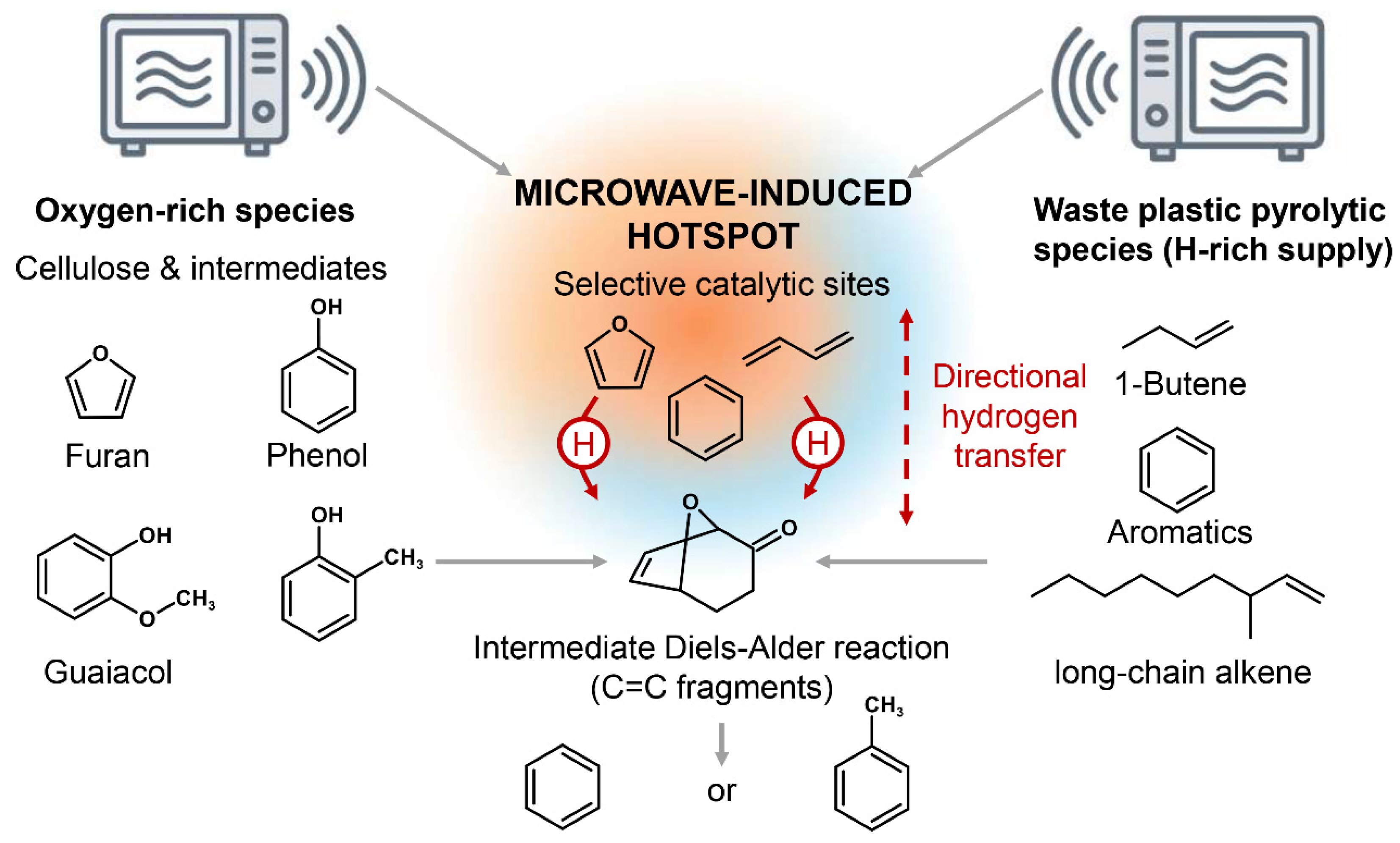
A key future direction is to move away from reliance on a single terrestrial lignocellulosic feedstock and instead explore feedstock combinations with greater potential. Macroalgae, due to their ability to avoid competing for arable land and their ease of decarboxylation to form alkanes, are emerging as a favored feedstock for microwave pyrolysis. Studies have shown that by adjusting the microwave pyrolysis temperature, the microstructure and mechanical properties of algal-based biochar can be precisely controlled, enabling it to serve as a catalyst support while exhibiting excellent stability [101,102]. At the same time, the co-pyrolysis of biomass and waste plastics is considered the most promising solution to the “hydrogen deficit.” As a feedstock with a high hydrogen-to-carbon (H/C) ratio, waste plastic can produce significant synergistic effects when combined with oxygen-rich biomass or sludge [103,104]. To further elucidate this chemical synergy network based on feedstock complementarity, this paper presents the mechanism diagram of microwave-induced co-pyrolysis shown in Figure 5.
As shown in Figure 3, this synergy stems not only from the complementary nature of physical heat transfer but also from molecular-level cross-coupling within microwave-induced hotspots. In the microwave field, hydrogen-rich species (such as long-chain alkenes) generated by the pyrolysis of waste plastics can undergo directional hydrogen transfer to oxygen-rich intermediates derived from biomass (such as furans and phenols produced by cellulose pyrolysis). This directional hydrogen transfer successfully stabilizes highly reactive oxygenated radicals. Concurrently, the resulting C=C fragments undergo Diels-Alder cycloaddition with biomass intermediates, significantly lowering the activation energy barrier for aromatization. Through this deep coupling of chemical components with the microwave thermal field, low-value solid waste can be precisely converted into target monocyclic aromatics and hydrogen-rich synthesis gas, maximizing energy output [103,105].
To address this inevitable, multi-pathway deactivation in industrial production, the development of low-energy, non-destructive in-situ regeneration technologies has become an urgent priority. Mechanistically, traditional high-temperature air-calcination (typically >550 °C) is highly destructive to advanced multi-site composites; the intense exothermic combustion of coke not only induces the irreversible dealumination of zeolite frameworks but also triggers severe thermal agglomeration of the carefully engineered metal nanoparticles. In contrast, emerging non-thermal plasma (NTP)-assisted regeneration offers a molecular-level solution. Instead of relying on macroscopic thermal combustion, NTP generates highly reactive oxygen species (ROS), such as atomic oxygen and ozone (O3), via high-voltage electrical discharges [106]. These highly energetic radicals can deeply penetrate the catalyst pores and directly oxidize dense graphitic coke into CO and CO2 at remarkably low macroscopic temperatures (often <250 °C) [106]. This “cold oxidation” mechanism completely bypasses the thermal damage threshold of the catalyst, successfully preserving both the hierarchical porous structure and the atomic dispersion of metal sites, thereby restoring the activity of catalysts (such as La/Hi-ZSM-5) to over 90% of their initial baseline [106]. Establishing such mechanism-driven, full-lifecycle catalyst management protocols will be pivotal for future commercialization. Furthermore, a thorough analysis of the deactivation mechanisms of industrially manufactured catalysts under real-world continuous operating conditions is crucial for establishing a comprehensive catalyst management system covering the entire lifecycle [107].
The most significant paradigm shift lies in the deep integration of artificial intelligence (AI) and machine learning (ML) into the field of pyrolysis. Because microwave pyrolysis involves the complex coupling of electromagnetic fields, flow fields, and chemical reaction fields, traditional empirical kinetic models often struggle to provide accurate predictions. To move beyond generic predictive concepts, recent research has demonstrated concrete, domain-specific applications of ML in MAP. For instance, in the realm of predictive process modeling, researchers have successfully implemented Explainable AI (XAI) frameworks to explicitly quantify the complex nonlinear relationships between specific feedstock properties, operating parameters, and the exact product distribution of lignocellulosic biomass [108]. This approach successfully bypasses traditional physical “black boxes,” allowing operators to understand exactly which variable drives the aromatic yield. Furthermore, ML is transitioning from passive prediction to the active rational design of composites. A compelling recent case study utilized ML algorithms to perform collaborative optimal design for metal-loaded ceramic pellets (ceramsite) [109]. By using algorithmic predictions to screen combinations of transition metals and ceramic matrices, the researchers drastically shortened the trial-and-error cycle required to maximize hydrogen production pathways under microwave irradiation [109]. This deep, data-driven integration—from decoding mechanistic pathways [110] to active material design—will provide the concrete algorithmic support necessary for the intelligent industrial scale-up of microwave pyrolysis technology.

5. Conclusions

This paper focuses on the development of microwave-assisted catalytic pyrolysis technology, whose core objective has always been to achieve the efficient depolymerization and high-value reconfiguration of macromolecular solid waste, such as biomass and waste plastics, within complex alternating electromagnetic fields. While early research confirmed the physical potential of microwaves for volumetric heating, it also starkly revealed the limitations of single-function materials. Microporous molecular sieves suffer from slow heat transfer and pore blockage; dielectric wave-absorbing materials lack the chemical reactivity required for directional bond breaking; and individual metal particles struggle to withstand sintering and deactivation caused by extreme thermal shock. These inherent defects in individual materials collectively form a “performance barrier” that limits the yield and purity of target hydrocarbons (especially high-value monocyclic aromatic hydrocarbons).
To overcome this barrier completely, the design philosophy of catalysts has inevitably undergone a profound shift from “individual action” to “multidimensional synergy.” This review elucidates the core mechanisms driving this paradigm shift. First, constructing hierarchical pore networks and core–shell structures creates the physical space required for precise mass transfer and macromolecular cleavage. Second, integrating metal-acidic bifunctional sites establishes a chemical relay, powering efficient deoxygenation followed by directed aromatization. Finally, coupling high-dielectric-loss carriers with catalytic centers at the nanoscale enables the ultimate conversion of electromagnetic energy into chemical reaction energy. These multi-site composite catalytic systems have fully demonstrated, at the laboratory scale, their exceptional synergistic effects in breaking the “impossible triangle” of heat transfer, deoxygenation, and stereoselective formation.
However, as we move toward truly large-scale commercial deployment, we must maintain a clear-eyed engineering perspective. Given the extremely complex nature of real-world solid waste, the loss of control over the microscale thermal field during continuous pilot-scale processes, and irreversible catalyst poisoning, simply improving the microstructure of the catalyst is no longer sufficient. Future breakthroughs will inevitably be built on “end-to-end” system integration. We need to actively expand into the feedstock sector, leveraging the synergistic co-pyrolysis of hydrogen-rich waste plastics and oxygen-containing biomass to eliminate the “hydrogen deficit” at its source. We must also develop non-destructive in-situ regeneration processes—such as those utilizing non-thermal plasma technology—to achieve precise management of the catalyst’s entire lifecycle. Ultimately, by deeply integrating interpretable machine learning with artificial intelligence (AI) frameworks, we can break down the “black box” nature of microwave-assisted thermochemical systems and achieve precise predictions of complex parameters and target product distributions. Only by deeply coupling materials innovation, reaction engineering, and data intelligence can microwave-assisted catalytic pyrolysis technology truly bridge the gap between the laboratory and industrial-scale applications, thereby establishing its vital strategic position within the landscape of sustainable clean energy and green chemistry.

6. Patents

The authors declare no patents arising from the work reported in this manuscript.

Author Contributions

Conceptualization, S.X. and Q.X.; methodology, S.X.; software, J.L.; validation, S.X. and J.L.; formal analysis, J.L.; investigation, S.X.; resources, S.X.; data curation, J.L.; writing—original draft preparation, S.X. and J.L.; writing—review and editing, S.X. and Q.X.; visualization, J.L.; supervision, Q.X. and S.X.; project administration, Q.X.; funding acquisition, S.X. and Q.X. All authors have read and agreed to the published version of the manuscript.

Funding

This work was supported by the National Natural Science Foundation of China (No.52476190), the National Natural Science Foundation of China (No. 52376171), Joint Training Demonstration Base Project for Graduate Students of “Guangzhou Institute of Energy Conversion, Chinese Academy of Sciences” in Guangdong Province, Zhanjiang Science and Technology Plan Project (2025A401002), Guangdong Basic and Applied Basic Research Foundation (2023A1515110541), Guangdong Basic and Applied Basic Research Foundation (2025A1515010722), Characteristic and Innovative Projects of General Institutions of Higher Education in Guangdong Province (2025KTSCX044), Youth S&T Talent Support Programme of Guangdong Provincial Association for Science and Technology (SKXRC2025404), Zhanjiang Non-Funded Science and Technology Research Program Projects (2025B01054).

Data Availability Statement

No new data were created or analyzed in this study. Data sharing is not applicable to this article.

Acknowledgments

The authors are grateful to the editors and reviewers for their valuable comments and suggestions on this manuscript. During the preparation of this manuscript, the authors used Gemini3.1 for language polishing and refining the visual aesthetics of the conceptual illustrations (Figure 1 and Figure 2). The authors have reviewed and edited the output and take full responsibility for the content of this publication.

Conflicts of Interest

The authors declare no conflicts of interest. The funders had no role in the design of the study; in the collection, analyses, or interpretation of data; in the writing of the manuscript; or in the decision to publish the results.

Abbreviations

The following abbreviations are used in this manuscript:
ACActivated carbon
BCBiochar
BTXBenzene, toluene, and xylenes
H/CHydrogen-to-carbon ratio
HDOHydrodeoxygenation
MAHsMonocyclic aromatic hydrocarbons
MAPMicrowave-assisted pyrolysis
SiCSilicon carbide

References

  1. Deng, W.; Feng, Y.; Fu, J.; Guo, H.; Guo, Y.; Han, B.; Jiang, Z.; Kong, L.; Li, C.; Liu, H.; et al. Catalytic Conversion of Lignocellulosic Biomass into Chemicals and Fuels. Green Energy Environ. 2023, 8, 10–114. [Google Scholar] [CrossRef]
  2. Syed, N.R.; Zhang, B.; Mwenya, S.; Aldeen, A.S. A Systematic Review on Biomass Treatment Using Microwave-Assisted Pyrolysis under PRISMA Guidelines. Molecules 2023, 28, 5551. [Google Scholar] [CrossRef] [PubMed]
  3. Dan, E.; McCue, A.J.; Dionisi, D.; Martín, C.F. On the Potential of Microwave Heating to Convert Waste into Added-Value Chemicals and Materials: A Review. Philos. Trans. R. Soc. A 2025, 383, 20240071. [Google Scholar] [CrossRef]
  4. Qiu, B.; Wang, Y.; Zhang, D.; Chu, H. Microwave-Assisted Pyrolysis of Biomass to High-Value Products: Factors Assessment, Mechanism Analysis, and Critical Issues Proposal. Chem. Eng. J. 2024, 498, 155362. [Google Scholar] [CrossRef]
  5. Li, J.; Lin, L.; Ju, T.; Meng, F.; Han, S.; Chen, K.; Jiang, J. Microwave-Assisted Pyrolysis of Solid Waste for Production of High-Value Liquid Oil, Syngas, and Carbon Solids: A Review. Renew. Sustain. Energy Rev. 2024, 189, 113979. [Google Scholar] [CrossRef]
  6. Tewari, K.; Burton, D.; Robinson, B.; Jiang, C.; Bhattacharyya, D.; Hu, J. Sustainable H2-Rich Syngas Production via Microwave-Assisted vs Conventional Catalysis of Pinewood. Ind. Eng. Chem. Res. 2026, 65, 1059–1073. [Google Scholar] [CrossRef]
  7. Chen, K.; Xu, Q.; Zhang, S. The Influential Mechanism of Absorbers and Active Metal on Microwave-Assisted Pyrolysis of Sargassum. Energies 2025, 18, 2723. [Google Scholar] [CrossRef]
  8. Liu, Y.; Ao, W.; Fu, J.; Siyal, A.A.; An, Q.; Zhou, C.; Liu, C.; Zhang, Y.; Chen, Z.; Yun, H.; et al. Microwave-Assisted Pyrolysis of Industrial Biomass Waste: Insights into Kinetic, Characteristics and Intrinsic Mechanisms. Energy 2024, 306, 132423. [Google Scholar] [CrossRef]
  9. Cavallaro, R.J.; Hori, C.E.; Duarte, C.R.; Barrozo, M.A.S. Hydrocarbon-Enriched Bio-Oil from Catalytic Microwave Pyrolysis of Macaúba Epicarp. Res. Sq. 2026. Preprint. [Google Scholar] [CrossRef]
  10. Ke, L.; Zhou, N.; Wu, Q.; Zeng, Y.; Tian, X.; Zhang, J.; Fan, L.; Ruan, R.; Wang, Y. Microwave Catalytic Pyrolysis of Biomass: A Review Focusing on Absorbents and Catalysts. npj Mater. Sustain. 2024, 2, 24–43. [Google Scholar] [CrossRef]
  11. Sun, W.; Yan, Y.; Wei, Y.; Ma, J.; Niu, Z.; Hu, G. Catalytic Pyrolysis of Biomass: A Review of Zeolite, Carbonaceous, and Metal Oxide Catalysts. Nanomaterials 2025, 15, 493–514. [Google Scholar] [CrossRef]
  12. Wang, W.; Gu, Y.; Zhou, C.; Hu, C. Current Challenges and Perspectives for the Catalytic Pyrolysis of Lignocellulosic Biomass to High-Value Products. Catalysts 2022, 12, 1524. [Google Scholar] [CrossRef]
  13. Zhang, L.; Wu, Q.; Wang, Y.; Ke, L.; Fan, L.; Yang, Q.; Zhang, Q.; Zou, R.; Liu, Y.; Cobb, K.; et al. Microwave-Assisted Catalytic Pyrolysis of Waste Cooking Oil to Monocyclic Aromatics under a Bifunctional SiC Ball Catalyst. J. Environ. Manag. 2024, 357, 120748. [Google Scholar] [CrossRef]
  14. Dai, A.; Wu, Q.; Zeng, Y.; Ke, L.; Shu, D.; Zhang, Q.; Dai, L.; Zou, R.; Ruan, R.; Wang, Y. Alkali Metal Doped SiC Foam Microwave Fast Response Catalyst for Selective Production of Monocyclic Aromatic Hydrocarbons from Polyethylene Pyrolysis. ACS Sustain. Chem. Eng. 2026, 14, 6099–6114. [Google Scholar] [CrossRef]
  15. Wan, S.; Yang, R.; Chen, C.; Zhao, X.; Luo, Z.; Zhao, S.; Jiang, M. Microwave-Catalytic Co-Pyrolysis of Chlorella Vulgaris and Marine Waste Plastics with N-Doped Bimetallic MOFs-Derived Additive for High-Value Oil Production: Characteristics and Mechanistic Analysis. Energy 2025, 332, 137047. [Google Scholar] [CrossRef]
  16. Vatankhah, F.; Kara, A.; García, A.C.; Chaouki, J. Kinetic Modeling of Polyethylene Pyrolysis under Microwave Irradiation toward Predictive Product Distribution. Chem. Eng. J. 2025, 525, 170441. [Google Scholar] [CrossRef]
  17. Wu, L.; Guan, Y.; Zhou, J.; Jiang, X.; Liu, T.; Pan, J. Effects of Variable Amounts of Volatiles in Corncob on Microwave Co-Pyrolysis of Low-Rank Coal and Corncob. Fuel 2023, 332, 126133. [Google Scholar] [CrossRef]
  18. Zhu, Y.; Li, C.; Cao, H.; Wu, L.; Yang, F.; Fu, S.; Zhou, J. Effects of Spatial Distribution of Tar-Rich Coal and Oil Shale and Primary Factors on Product Characteristics during Microwave Co-Pyrolysis. Fuel 2025, 385, 134085. [Google Scholar] [CrossRef]
  19. Pimenta, F.; Filho, E.; Diniz, Â.; Barrozo, M.A.S. Catalytic Microwave-Assisted Pyrolysis of the Main Residue of the Brewing Industry. Catalysts 2023, 13, 1170. [Google Scholar] [CrossRef]
  20. Razzak, S.A.; Hossain, M.M.; Zakir Hossain, S.M.; Lardhi, M.; Haq, B. Recent Advancement of Catalytic and Non-Catalytic Thermochemical Biomass Conversion Technologies toward Sustainable Hydrogen Production. Biomass Futur. 2026, 1, 100021. [Google Scholar] [CrossRef]
  21. Rosyadi, I. Novel Approaches to Zeolite Deactivation Mitigation and Regeneration in Biomass Gasification. J. Therm. Eng. 2025, 11, 1552–1584. [Google Scholar] [CrossRef]
  22. Xue, Z.; Zhong, Z.; Zhang, B. Microwave-Assisted Catalytic Fast Pyrolysis of Biomass for Hydrocarbon Production with Physically Mixed MCM-41 and ZSM-5. Catalysts 2020, 10, 685–695. [Google Scholar] [CrossRef]
  23. Ren, X.; Shanb Ghazani, M.; Zhu, H.; Ao, W.; Zhang, H.; Moreside, E.; Zhu, J.; Yang, P.; Zhong, N.; Bi, X. Challenges and Opportunities in Microwave-Assisted Catalytic Pyrolysis of Biomass: A Review. Appl. Energy 2022, 315, 118970. [Google Scholar] [CrossRef]
  24. Tu, Y.; Zhang, X.; Tang, A.; Zhang, Y.; Song, Z.; Cheng, Y.; Miao, P.; Guo, Y.; Kong, L. Microwave-Assisted Pyrolysis of Plastic Waste into Hydrogen over Fe/Beta Catalysts. Int. J. Hydrogen Energy 2026, 223, 154227. [Google Scholar] [CrossRef]
  25. Marchetti, L.; Guastaferro, M.; Tognotti, L.; Nicolella, C. Experimental Study on Microwave-Assisted Co-Pyrolysis of Plastic Waste and Biomass. Energies 2026, 19, 1322. [Google Scholar] [CrossRef]
  26. Ram, S.; Patil, Y.; Abdelrhman, F.; Memon, T.A.; Zhang, Y. Kinetics for Catalytic Pyrolysis of Organic Solid Wastes. Green Energy Fuel Res. 2025, 2, 328–359. [Google Scholar] [CrossRef]
  27. Jan, K.; Deka, D.; Yu, E.; Lu, T.; Li, K.; Jiang, H.; Nawaz, K.; Webb, E.; Ozcan, S.; Zou, R.; et al. Recent Advances in Chemical Recycling and Upcycling of Plastic Waste into Valuable Materials, Chemicals, and Energy: A Comprehensive Review. RSC Sustain. 2026, 4, 1667–1702. [Google Scholar] [CrossRef]
  28. Fang, H.; Hai, L.; Xie, R.; Yuan, J.; Zhang, Q. Progress in the Study of Microwave Pyrolysis Technology and Its Influencing Factors. J. Mater. Sci. Chem. Eng. 2024, 12, 30–61. [Google Scholar] [CrossRef]
  29. Abedin, A.; Daniszewski, A.C.; Bai, X.; Mai, H.D.; Gowda, A.S.L.; Aireddy, D.R.; Muley, P.; Wildfire, C. Microwave-Assisted Catalytic Conversion of Waste Biomass and Plastic Feedstocks via Thermochemical Routes. In Catalysis; Shekhawat, D., Ed.; Royal Society of Chemistry: London, UK, 2025; pp. 1–44. ISBN 978-1-83767-546-3. [Google Scholar]
  30. Talib, H. Microwave-Assisted Pyrolysis and Co-Pyrolysis: Oil, Char, and Gases-a Technological Review. El-Cezeri J. Sci. Eng. 2024, 11, 186–198. [Google Scholar] [CrossRef]
  31. Allende Leiva, S. Microwave-Assisted Pyrolysis for Biomass Recovery and Applications. Ph.D. Thesis, James Cook University, Townsville, Australia, 2023. [Google Scholar]
  32. Michałek, T.; Wojtaszek, K.; Youssif, M.M.; Żabiński, P.; Kołczyk-Siedlecka, K.; Kowalik, R.; Socha, R.P.; Hessel, V.; Wojnicki, M. Adsorption of Au(III), Pt(IV), Pd(II), and Rh(III) Ions on Activated Carbon in a Batch Reactor Supported by Microwave Radiation. Sci. Rep. 2025, 15, 5852. [Google Scholar] [CrossRef]
  33. Yang, H.; Chen, Z.; Chen, W.; Chen, Y.; Wang, X.; Chen, H. Role of Porous Structure and Active O-Containing Groups of Activated Biochar Catalyst during Biomass Catalytic Pyrolysis. Energy 2020, 210, 118646. [Google Scholar] [CrossRef]
  34. Lam, S.S.; Liew, R.K.; Wong, Y.M.; Yek, P.N.Y.; Ma, N.L.; Lee, C.L.; Chase, H.A. Microwave-Assisted Pyrolysis with Chemical Activation, an Innovative Method to Convert Orange Peel into Activated Carbon with Improved Properties as Dye Adsorbent. J. Clean. Prod. 2017, 162, 1376–1387. [Google Scholar] [CrossRef]
  35. Villota, E.M.; Lei, H.; Qian, M.; Yang, Z.; Villota, S.M.A.; Zhang, Y.; Yadavalli, G. Optimizing Microwave-Assisted Pyrolysis of Phosphoric Acid-Activated Biomass: Impact of Concentration on Heating Rate and Carbonization Time. ACS Sustain. Chem. Eng. 2018, 6, 1318–1326. [Google Scholar] [CrossRef]
  36. He, M.; Zhao, J.; Wang, D.; Liang, Q.; Wang, T.; Zhao, S.; Ma, W. Microwave-Assisted Catalytic Pyrolysis of Biomass with Biochar Materials Derived from Spent Lithium-Ion Batteries: Microwave Absorption and Pyrolysis Characteristics. J. Environ. Chem. Eng. 2024, 12, 112099. [Google Scholar] [CrossRef]
  37. Liu, Z.; Li, P.; Chang, C.; Wang, X.; Song, J.; Fang, S.; Pang, S. Influence of Metal Chloride Modified Biochar on Products Characteristics from Biomass Catalytic Pyrolysis. Energy 2022, 250, 123776. [Google Scholar] [CrossRef]
  38. Li, H.; Chen, X.; Fu, P.; Tang, B.; Zhuansun, X.; Sun, Z.; Lin, X. Synthesis of Metal and Nitrogen Co-Doped Activated Carbon Catalysts for the Co-Production of Monocyclic Aromatics and Hydrogen-Rich Gas from the Pyrolysis of Biomass and Plastic. Energy 2025, 316, 134652. [Google Scholar] [CrossRef]
  39. Tian, W.; Shi, J.; Feng, X.; Gao, L.; Wang, Y.; Liu, Y.; Wu, S. Design of a Microwave-Assisted Pyrolysis Device for Polypropylene Plastic Based on Symmetrical Circular Waveguide Slot Antenna. Symmetry 2026, 18, 230–244. [Google Scholar] [CrossRef]
  40. Beneroso, D.; Monti, T.; Kostas, E.T.; Robinson, J. Microwave Pyrolysis of Biomass for Bio-Oil Production: Scalable Processing Concepts. Chem. Eng. J. 2017, 316, 481–498. [Google Scholar] [CrossRef]
  41. Fan, S.; Zhang, Y.; Cui, L.; Xiong, Q.; Maqsood, T. Conversion of Polystyrene Plastic into Aviation Fuel through Microwave-Assisted Pyrolysis as Affected by Iron-Based Microwave Absorbents. ACS Sustain. Chem. Eng. 2023, 11, 1054–1066. [Google Scholar] [CrossRef]
  42. Suari, N.P.A.; Azis, M.M.; Cahyono, R.B. Optimization of Bio-Oil Production from Microwave-Assisted Pyrolysis of Spirulina Platensis Residue over Fe3O4 Catalyst. In AIP Conference Proceedings; AIP Publishing LLC: Melville, NY, USA, 2025; Volume 3295, p. 040002. [Google Scholar]
  43. Kempa, M.; Bovtun, V.; Kukhar, V.; Solopan, S.; Belous, A.; V’yunov, O.; Yakymenko, Y.; Kamba, S. High-Frequency and Microwave Magnetic Properties of Ni0.5Zn0.5Fe2O4 Spinel Ferrite Ceramics. J. Alloys Compd. 2025, 1036, 181675. [Google Scholar] [CrossRef]
  44. Wang, J.; Zhao, T.; Li, Z.; Duan, X.; Miao, Z.; Xiang, G.; Cai, W.; Wang, Q.; Liu, L.; Wu, G.; et al. Heterogeneous Interfaces and Interlayer Phonon Bridge Structures in Ti3C2Tx@BNNB for Efficient Thermal Management and Electromagnetic Wave Absorption. Chem. Eng. J. 2025, 513, 162934. [Google Scholar] [CrossRef]
  45. Peng, Z.; Li, Z.; Lin, X.; Yang, M.; Hwang, J.-Y.; Zhang, Y.; Li, G.; Jiang, T. Microwave Power Absorption in Materials for Ferrous Metallurgy. JOM 2017, 69, 178–183. [Google Scholar] [CrossRef]
  46. Jin, Y.; Zheng, C.; Sun, A.; Jiang, H.; Xiao, Y.; Li, J.; Luo, S.; Bao, Z.; Ma, X.-F.; Li, J. Synergistic Effect of Potassium Ferrate and Sodium Hydroxide in Lowering Carbothermal Reduction Temperature: Preparation of Magnetic Zero-Valent Iron-Doped Biochar for Antibiotic Removal. Processes 2025, 13, 2806. [Google Scholar] [CrossRef]
  47. Srinivasan, V.; Adhikari, S.; Chattanathan, S.A.; Park, S. Catalytic Pyrolysis of Torrefied Biomass for Hydrocarbons Production. Energy Fuels 2012, 26, 7347–7353. [Google Scholar] [CrossRef]
  48. Robinson, J.P.; Kingman, S.W.; Barranco, R.; Snape, C.E.; Al-Sayegh, H. Microwave Pyrolysis of Wood Pellets. Ind. Eng. Chem. Res. 2010, 49, 459–463. [Google Scholar] [CrossRef]
  49. Song, Z.-H.; Muhammad, I.; Ren, T.-Z.; Abulizi, A.; Okitsu, K. In Situ Catalytic Pyrolysis of Spent Mulching Film over Fe/Ni/Co-Doped α-Al2O3 for Light Oil and High-Value Aromatics. Ind. Eng. Chem. Res. 2025, 65, 326–338. [Google Scholar] [CrossRef]
  50. Luo, J.; Gong, G.; Cui, C.; Sun, S.; Lin, J.; Ma, R.; Sun, J. Microwave-Induced One-Pot Preparation of Bifunctional N-Fe/BC Catalysts and Oriented Production of Phenol-Enriched Bio-Oil from Biomass Pyrolysis: Catalyst Synthesis, Performance Evaluation, and Mechanism Insight via Theoretical Calculations. ACS Catal. 2022, 12, 11318–11339. [Google Scholar] [CrossRef]
  51. Psenovschi, G.; Calinescu, I.; Fiti, A.; Chisega-Negrila, C.-G.; Ionascu, S.-L.; Barbes, L. Microwave-Assisted Pyrolysis of Polyethylene and Polypropylene from End-of-Life Vehicles: Hydrogen Production and Energy Valorization. Sustainability 2025, 17, 6196. [Google Scholar] [CrossRef]
  52. Li, P.; Chen, Y.; Chen, H.; Chen, W.; Hu, J.; Chen, J.; Wang, P.; Chang, C.; Pang, S. Catalytic Enhancement of MOF-Derived fe@C Catalysts in Microwave-Assisted Co-Pyrolysis: Synergistic Integration with Bamboo-Based Pyrolytic Char and Microwave Carbonization. Energy 2025, 329, 136813. [Google Scholar] [CrossRef]
  53. Polidoro, D.; Selva, M.; Luque, R. Microwave-Assisted Catalytic Transfer Hydrogenolysis of Lignin-Derived Aromatic Ethers over Ru/C. Mol. Catal. 2023, 542, 113082. [Google Scholar] [CrossRef]
  54. Shao, L.; Wang, C.; Liu, Y.; Wang, M.; Wang, L.; Xu, F. Efficient Depolymerization of Lignin through Microwave-Assisted Ru/C Catalyst Cooperated with Metal Chloride in Methanol/Formic Acid Media. Front. Bioeng. Biotechnol. 2022, 10, 1082341. [Google Scholar] [CrossRef]
  55. Wang, W.; Wang, M.; Li, X.; Cai, L.; Shi, S.Q.; Duan, C.; Ni, Y. Microwave-Assisted Catalytic Cleavage of C–C Bond in Lignin Models by Bifunctional Pt/CDC-SiC. ACS Sustain. Chem. Eng. 2019, 8, 38–43. [Google Scholar] [CrossRef]
  56. Balasundram, V.; Ibrahim, N.; Kasmani, R.M.; Isha, R.; Hamid, M.K.A.; Hasbullah, H. Catalytic Upgrading of Biomass-Derived Pyrolysis Vapour over Metal-Modified HZSM-5 into BTX: A Comprehensive Review. Biomass Convers. Biorefinery 2022, 12, 1911–1938. [Google Scholar] [CrossRef]
  57. Dan, E.; McCue, A.J.; Dionisi, D.; Fernández Martín, C. Plastic Valorization into Added-Value Products via Microwave and Conventional Pyrolysis: A Review. ACS Environ. Au 2026, 6, 174–195. [Google Scholar] [CrossRef]
  58. Mishra, R.K.; Chistie, S.M.; Naika, S.U.; Mohanty, K. Catalytic Pyrolysis of Biomass over Zeolites for Bio-Oil and Chemical Production: A Review on Their Structure, Porosity and Acidity Co-Relation. Bioresour. Technol. 2022, 366, 128189. [Google Scholar] [CrossRef] [PubMed]
  59. Soltanian, S.; Lee, C.L.; Lam, S.S. A Review on the Role of Hierarchical Zeolites in the Production of Transportation Fuels through Catalytic Fast Pyrolysis of Biomass. Biofuel Res. J. 2020, 7, 1217–1234. [Google Scholar] [CrossRef]
  60. Qiao, K.; Shi, X.; Zhou, F.; Chen, H.; Fu, J.; Ma, H.; Huang, H. Catalytic Fast Pyrolysis of Cellulose in a Microreactor System Using Hierarchical Zsm-5 Zeolites Treated with Various Alkalis. Appl. Catal. A 2017, 547, 274–282. [Google Scholar] [CrossRef]
  61. Yao, N.-Y.; Cao, J.-P.; Cai, S.-J.; Chen, C.-X.; Zhao, X.-Y.; Pang, X.-B.; Xu, M.; Lu, Y.; Feng, X.-B.; Bold, T. Construction of Hierarchical High Acid-Capacity ZSM-5 for Enhancing Mass Transfer and Aromatization of Lignite Pyrolysis Volatiles. Ind. Eng. Chem. Res. 2026, 65, 248–258. [Google Scholar] [CrossRef]
  62. Pinard, L.; Jia, L.; Pichot, N.; Astafan, A.; Dufour, A. Catalytic Fast Pyrolysis of Biomass over Hierarchical Zeolites: Comparison of Mordenite, Beta, and ZSM-5. Energy Fuels 2024, 38, 14351–14364. [Google Scholar] [CrossRef]
  63. Yang, S.; Du, X.; Xing, P.; Li, K.; Niu, Q.; Zheng, S.; Zhang, X.; Huang, G.; Lu, Q.; Prins, W.; et al. Catalytic Pyrolysis of Lipid-Extracted Microalgae over NaOH-Treated HZSM-5: Porosity–Acidity Synergy in Aromatic Production and Denitrogenation. Energy Fuels 2026, 40, 2643–2652. [Google Scholar] [CrossRef]
  64. Xu, W.; Huang, Y.; Lin, Z.; Ruan, Q.; Yuan, P.; Li, Y. Bayesian Optimization of Hierarchical ZSM-5 for High-Efficiency Polyolefin Waste Recycling to Light Olefins. ACS Catal. 2025, 15, 20926–20938. [Google Scholar] [CrossRef]
  65. Rangel, M.D.C.; Mayer, F.M.; Carvalho, M.D.S.; Saboia, G.; De Andrade, A.M. Selecting Catalysts for Pyrolysis of Lignocellulosic Biomass. Biomass 2023, 3, 31–63. [Google Scholar] [CrossRef]
  66. Zhao, T.; Shen, L.; Lu, W.; Gu, Y.; Huang, Y.; Wang, W.; Li, Z.; Lin, H. Preparation of Sheet-like Core-Shell Structured ZSM-5/SiO2 Zeolite for Catalytic Pyrolysis of Low-Density Polyethylene to Produce Low-Carbon Olefins. J. Anal. Appl. Pyrolysis 2026, 194, 107557. [Google Scholar] [CrossRef]
  67. Li, Z.; Zhong, Z.; Zhang, B.; Wang, W.; Zhao, H.; Seufitelli, G.V.S.; Resende, F.L.P. Microwave-Assisted Catalytic Fast Pyrolysis of Rice Husk over a Hierarchical HZSM-5/MCM-41 Catalyst Prepared by Organic Base Alkaline Solutions. Sci. Total Environ. 2021, 750, 141215. [Google Scholar] [CrossRef] [PubMed]
  68. Chakraborty, S.; Mukherjee, D.; Bepari, S.; Kuila, D. Effect of Metal-Free Mesoporous Silica Incorporated ZSM-5 Composite on Thermo-Catalytic Pyrolysis of Polypropylene. J. Environ. Chem. Eng. 2025, 13, 115681. [Google Scholar] [CrossRef]
  69. Ma, H.; Gao, H.; Ma, J.; Zhao, J.; Zhang, C.; Wen, D. Supercritical Catalytic Cracking of n-Decane over Microwave-Synthesized Hierarchical Core–Shell Nano-beta@SBA-15 Composite Zeolite. RSC Adv. 2026, 16, 13559–13571. [Google Scholar] [CrossRef]
  70. Chen, Z.; Monzavi, M.; Latifi, M.; Samih, S.; Chaouki, J. Microwave-Responsive SiC Foam@zeolite Core-Shell Structured Catalyst for Catalytic Pyrolysis of Plastics. Environ. Pollut. 2022, 307, 119573. [Google Scholar] [CrossRef] [PubMed]
  71. Wei, X.; Xue, X.; Wu, L.; Yu, H.; Liang, J.; Sun, Y. High-Grade Bio-Oil Produced from Coconut Shell: A Comparative Study of Microwave Reactor and Core-Shell Catalyst. Energy 2020, 212, 118692. [Google Scholar] [CrossRef]
  72. Zhang, X.; Xu, W.; Peng, H. Metal-Modified Hierarchical Zeolite Catalysts for Catalytic Pyrolysis of Walnut Shells to Produce Light Aromatics. Reactions 2026, 7, 25–44. [Google Scholar] [CrossRef]
  73. Bai, Y.; Li, K.; Zhao, J.; Yang, C.; Bai, Y.; Sun, S.; Shang, H. Microwave-Assisted Catalytic Pyrolysis of Waste Plastics for High-Value Resource Recovery: A Comprehensive Review. Processes 2026, 14, 427–453. [Google Scholar] [CrossRef]
  74. Islam, K.M.O.; Ahmad, N.; Ummer, A.C.; Ahmed, U.; Siddiqui, M.N.; Millan, M.; Abdul Jameel, A.G. Microwave-Assisted Pyrolysis of Waste Plastics: A Comprehensive Review on Process Parameters, Catalysts, and Future Prospects. Results Eng. 2025, 26, 105571. [Google Scholar] [CrossRef]
  75. Zheng, Y.; Li, D.; Wang, J.; Lv, B.; Long, B.; Ding, Z.; Zheng, Z. Production of bio-aromatic by catalytic biomass pyrolysis over metal modified biomass-derived biochar-based catalyst. Trans. CSAE 2021, 37, 231–240. [Google Scholar] [CrossRef]
  76. Rorrer, J.E.; Ebrahim, A.M.; Questell-Santiago, Y.; Zhu, J.; Troyano-Valls, C.; Asundi, A.S.; Brenner, A.E.; Bare, S.R.; Tassone, C.J.; Beckham, G.T.; et al. Role of Bifunctional Ru/Acid Catalysts in the Selective Hydrocracking of Polyethylene and Polypropylene Waste to Liquid Hydrocarbons. ACS Catal. 2022, 12, 13969–13979. [Google Scholar] [CrossRef]
  77. Li, Y.; Nishu; Yellezuome, D.; Chai, M.; Li, C.; Liu, R. Catalytic Pyrolysis of Biomass over Fe-Modified Hierarchical ZSM-5: Insights into Mono-Aromatics Selectivity and Pyrolysis Behavior Using Py-GC/MS and TG-FTIR. J. Energy Inst. 2021, 99, 218–228. [Google Scholar] [CrossRef]
  78. Zhang, L.-Y.; Cao, J.-P.; Ren, X.-Y.; Feng, X.-B.; Wang, J.-X.; He, Z.-M.; Liu, T.-L.; Yang, Z.; Zhao, X.-Y.; Bai, H.-C. Catalytic Upgrading of Cellulose Pyrolysis Volatiles over Ce Modified Hierarchical ZSM-5 Zeolite: Insight into the Effect of Acid Properties on Light Aromatics and Catalyst Stability. Ind. Eng. Chem. Res. 2022, 61, 287–298. [Google Scholar] [CrossRef]
  79. Yi, Q.; Wang, Q.; Zhang, P.; Wang, G.; Xu, M.; Wang, G. Microwave Pyrolysis of Low Rank Coal to Light Aromatics Catalyzed by Ni/Mo/P Modified Bifunctional Biochar. J. China Coal Soc. 2025, 50, 563−571. [Google Scholar] [CrossRef]
  80. Liu, H.; Cui, J.; Zhao, Z.; Ren, Y.; Chen, B.; Li, L. Bifunctional Catalyst Fe-Co/AC for Synergistic Catalyzing Microwave-Assisted Lignin Hydrogenolysis. Renew. Energy 2025, 253, 123570. [Google Scholar] [CrossRef]
  81. Yue, W.; Ma, X.; Yu, Z.; Liu, H.; Li, M.; Lu, X. Ni-CaO Bifunctional Catalyst for Biomass Catalytic Pyrolysis to Produce Hydrogen-Rich Gas. J. Anal. Appl. Pyrolysis 2023, 169, 105872. [Google Scholar] [CrossRef]
  82. Fu, W.; Cheng, Y.W.; Xu, D.; Zhang, Y.; Wang, C.-H. Reaction Synergy of Bimetallic Catalysts on ZSM-5 Support in Tailoring Plastic Pyrolysis for Hydrogen and Value-Added Product Production. Appl. Energy 2024, 372, 123853. [Google Scholar] [CrossRef]
  83. Fan, D.; Yang, R.; Chen, C.; Qiu, S.; He, S.; Shi, H. Microwave Catalytic Co-Pyrolysis of Microalgae and High Density Polyethylene over Activated Carbon Supported Bimetallic: Characteristics and Bio-Oil Analysis. Renew. Energy 2024, 235, 121323. [Google Scholar] [CrossRef]
  84. Qin, W.; Yu, H.; Wang, C.; Qin, S.; Li, X. Experimental Study on Optimizing Hydrogen Production from Sludge by Microwave Catalytic Pyrolysis Using Response Surface Methodology. ACS Omega 2024, 9, 44474–44486. [Google Scholar] [CrossRef] [PubMed]
  85. Al-Qahtani, A.M. A Comprehensive Review in Microwave Pyrolysis of Biomass, Syngas Production and Utilisation. Energies 2023, 16, 6876. [Google Scholar] [CrossRef]
  86. Luo, J.; Gong, G.; Ma, R.; Sun, S.; Cui, C.; Cui, H.; Sun, J.; Ma, N. Study on High-Value Products of Waste Plastics from Microwave Catalytic Pyrolysis: Construction and Performance Evaluation of Advanced Microwave Absorption-Catalytic Bifunctional Catalysts. Fuel 2023, 346, 128296. [Google Scholar] [CrossRef]
  87. Liu, G.; Chen, H.; Ahmed, S.F.; Guo, X.; Fang, S.; Ma, W. Heating-Rate Controlled Microwave Co-Pyrolysis for Synergistically Doped Carbon Electrode Materials. ACS Appl. Energy Mater. 2026, 9, 2600–2610. [Google Scholar] [CrossRef]
  88. Venegas-Vásconez, D.; Orejuela-Escobar, L.M.; Villasana, Y.; Salgado, A.; Tipanluisa-Sarchi, L.; Romero-Carrillo, R.; Alejandro-Martín, S. Exploring the Role of Microwave Pretreatment in Enhancing Biomass Pyrolysis Efficiency and Environmental Performance. Processes 2025, 13, 3194. [Google Scholar] [CrossRef]
  89. Li, R.; Xu, W.; Deng, J.; Zhou, J. Coke-Resistant Ni–Co/ZrO2–CaO-Based Microwave Catalyst for Highly Effective Dry Reforming of Methane by Microwave Catalysis. Ind. Eng. Chem. Res. 2021, 60, 17458–17468. [Google Scholar] [CrossRef]
  90. Shen, X.; Zhao, Z.; Zhang, J.; Li, H.; Gao, X. Microwave Ultrafast Heating on Iron-Based Nanogap Catalysts for CO2 Reduction Coupling with Coke Removal. Adv. Sci. 2026, 13, e18411. [Google Scholar] [CrossRef]
  91. Zhi, Q.; Guan, W.; Guo, Y. Pyrolysis Process of Microwave-Enhanced Recovery of Sucker Rod Carbon Fiber Composite. Int. J. Heat Technol. 2022, 40, 151–156. [Google Scholar] [CrossRef]
  92. Leite, J.C.S.; Suota, M.J.; Ramos, L.P.; Lenzi, M.K.; Luz, L.F.L. Development of a Microwave-Assisted Bench Reactor for Biomass Pyrolysis Using Hybrid Heating. ACS Omega 2024, 9, 24987–24997. [Google Scholar] [CrossRef]
  93. Terapalli, A.; Kamireddi, D.; Sridevi, V.; Tukarambai, M.; Suriapparao, D.V.; Rao, C.S.; Gautam, R.; Modi, P.R. Microwave-Assisted in-Situ Catalytic Pyrolysis of Polystyrene: Analysis of Product Formation and Energy Consumption Using Machine Learning Approach. Process Saf. Environ. Prot. 2022, 166, 57–67. [Google Scholar] [CrossRef]
  94. Zhang, Y.; Chen, G.; Wang, L.; Tuo, K.; Liu, S. Microwave-Assisted Pyrolysis of Low-Rank Coal with K2CO3, CaCl2, and FeSO4 Catalysts. ACS Omega 2020, 5, 17232–17241. [Google Scholar] [CrossRef]
  95. Vatankhah, F.; Carrillo García, A.; Chaouki, J. Role of Bifunctional Metal-Promoted Zeolitic Catalyst in Microwave-Assisted Pyrolysis of Polyethylene to Monocyclic Aromatics. Energy Fuels 2024, 38, 20562–20576. [Google Scholar] [CrossRef]
  96. Akça, Ö.; Akgül, M. The Role of Dielectric Properties in Microwave-Assisted Pyrolysis of Forest Biomass. Düzce Üniv. Orman. Fak. Orman. Derg. 2025, 21, 158–170. [Google Scholar] [CrossRef]
  97. Nawaz, A.; Razzak, S.A. Co-Pyrolysis of Biomass and Different Plastic Waste to Reduce Hazardous Waste and Subsequent Production of Energy Products: A Review on Advancement, Synergies, and Future Prospects. Renew. Energy 2024, 224, 120103. [Google Scholar] [CrossRef]
  98. Tayyab, H.; Liu, S.; Zhang, H.; Shen, R.; Liu, Y.; Jiang, J.; Li, B. A Comprehensive Review on the Chemical Processes and Catalytic Mechanisms Involved in the Conversion of Biomass to Carbon Materials. J. Mater. Chem. A 2026, 14, 14007–14072. [Google Scholar] [CrossRef]
  99. Wang, S.; Xu, L.; Lin, R.; Sun, D.; Zhang, H. Microwave-Assisted Upcycling of Coke Wastes from a Pilot-Scale Biomass Pyrolysis System: Method Optimization and Mechanism Insights. Renew. Energy 2026, 261, 125274. [Google Scholar] [CrossRef]
  100. Li, X.; Luo, Z.; Xiao, R. Research Progress on Selective Depolymerization of Waste Plastics to High-Quality Liquid Fuels. Energy Environ. Prot. 2025, 39, 1–11. [Google Scholar] [CrossRef]
  101. Lou, B.; Parker, M.; Roumeli, E. Effects of Pyrolysis Temperature of Macroalgal Biomass on the Structure and Mechanical Properties of Produced Biochar. BioResources 2025, 20, 4152–4173. [Google Scholar] [CrossRef]
  102. Widawati, T.F.; Refki, M.F.; Rochmadi; Budiman, A. Exploring Microwave-Assisted Pyrolysis of Sargassum sp. for Optimal Process Parameters and Product Insights. ASEAN J. Chem. Eng. 2024, 24, 210–228. [Google Scholar] [CrossRef]
  103. Shen, Y. Microwave-Assisted Pyrolysis of Biomass and Plastic Wastes for Hydrogen Production. Green Chem. 2025, 27, 10402–10422. [Google Scholar] [CrossRef]
  104. Chang, Y.H.; Chong, W.W.F.; Wong, K.Y.; Muhamad Fazly, A.P.; Woon, K.S.; Chiong, M.C.; Tan, J.P.; Mong, G.R. Enhancing Bioenergy Efficiency: Microwave-Assisted Co-Pyrolysis of Plastic and Sludge Waste with Catalytic Upgrading. Energy 2025, 335, 138052. [Google Scholar] [CrossRef]
  105. Bisht, P.; Mishra, A.; Anand, V.; Singh, A.; Tiwari, H.; Shobana, S.; Kumar, G.; Kumar, S.; Pant, K.K.; Prajapati, S.K. Microwave-Assisted Pyrolysis of Biomass for Bioenergy Production. Renew. Sustain. Energy Rev. 2026, 226, 116344. [Google Scholar] [CrossRef]
  106. Li, X.; Lv, Z.; Shao, S.; Zhu, Y.; Cheng, J.; Dong, W. Regeneration of Deactivated Hierarchical La/Hi-ZSM-5 for Catalytic Pyrolysis of Rape Straw Assisted by Ozone from Nonthermal Plasma. Energy Fuels 2020, 34, 14159–14168. [Google Scholar] [CrossRef]
  107. Luna-Murillo, B.; Pala, M.; Paioni, A.L.; Baldus, M.; Ronsse, F.; Prins, W.; Bruijnincx, P.C.A.; Weckhuysen, B.M. Catalytic Fast Pyrolysis of Biomass: Catalyst Characterization Reveals the Feed-Dependent Deactivation of a Technical ZSM-5-Based Catalyst. ACS Sustain. Chem. Eng. 2021, 9, 291–304. [Google Scholar] [CrossRef]
  108. Kale, R.D.; Lenka, M.; Rao, C.S. Leveraging Explainable AI Framework for Predictive Modeling of Products of Microwave Pyrolysis of Lignocellulosic Biomass Using Machine Learning. J. Anal. Appl. Pyrolysis 2025, 192, 107249. [Google Scholar] [CrossRef]
  109. Song, X.; Luo, S. Machine Learning + Microwave Pyrolysis: Optimal Design for the Collaborative Preparation of Hydrogen Production with Ceramsite. Int. J. Hydrogen Energy 2025, 178, 151629. [Google Scholar] [CrossRef]
  110. Yang, L.; Allaoui, B.E.; Wu, X.; Wu, T.; Chai, W.S.; Pang, C.H. The Role of Artificial Intelligence in Biomass Pyrolysis: Advancing Predictive Modelling and Mechanistic Understanding through Machine Learning—A Comprehensive Review. Bioresour. Technol. 2026, 443, 133777. [Google Scholar] [CrossRef]
Figure 1. Comparison of heating mechanisms between conventional and microwave-assisted pyrolysis, and the performance bottlenecks of single catalysts.
Catalysts 16 00450 g001
Figure 2. Effect of catalyst composition (single vs. physically mixed composite) on the carbon yield of (a) desirable petrochemicals and (b) undesirable by-products during the microwave-assisted catalytic fast pyrolysis of biomass. The data explicitly demonstrates that the optimal composite ratio (1:2 MCM-41/ZSM-5) significantly maximizes aromatic yields while mitigating the severe coking associated with pure ZSM-5 (“ZSM-5 only”). (Reprinted/Adapted from Ref. [22], an open-access article distributed under the terms of the Creative Commons CC BY license).
Catalysts 16 00450 g002
Figure 3. Synergistic catalytic mechanism and reaction pathway of multi-site composite catalysts (e.g., SiC@Zeolite) under microwave fields.
Catalysts 16 00450 g003
Figure 4. Analytical evaluation of catalyst stability: (a) Time-on-stream performance trajectory demonstrating the sustained catalytic activity of a hierarchical core–shell composite catalyst compared to a conventional benchmark. (b) Thermogravimetric analysis (TGA) confirming the excellent coking resistance of the multidimensional design. (Reprinted/Adapted from Ref. [69], an open-access article distributed under the terms of the Creative Commons CC BY-NC 3.0 license).
Catalysts 16 00450 g004
Figure 5. Network of co-pyrolysis between biomass and waste plastics under microwave-induced hotspots: directed hydrogen transfer and Diels-Alder synergistic mechanisms.
Catalysts 16 00450 g005
Table 1. Quantitative comparison of yield, selectivity, and stability among single-function catalysts in MAP.
Catalyst TypeCore Yield DataProduct SelectivityStability & Coking BehaviorRef. (Year)
No CatalystTotal gas yield is only 62.5 wt%.Extremely low MAHs (6.6 area%).
Predominantly un-cracked olefins (57.6 area%) and alkanes (32.6 area%).
Incomplete reaction due to the absence of active sites, following a random free-radical cracking pathway.[24] (2026)
Zeolites
(e.g., HZSM-5)
Total carbon yield of petrochemicals is 13.1%.C2–C4 olefins selectivity: 8.2%.
Aromatics yield: ~4.5%.
Coke yield reaches 5.2 wt%.
Rapid deactivation as large molecules fail to enter micropores and polymerize on the external surface.
[33,36,38] (2020–2025)
Dielectric Absorbers
(e.g., Active Carbon, Biochar)
Highest liquid yield reaches 35.5% (Metal/N-AC).
Gas yield reaches 525 mg/g (sNCMHC-C).
MAHs content peaks at 60.3% (Metal/N-AC).
H2 selectivity reaches 50.22 vol% (sNCMHC-C).
Coke blocks active sites; MAHs drop to 43.7% after 3 cycles (Metal/N-AC).
Active oxygen-containing groups are rapidly consumed during catalysis.
[41,50,52] (2022–2025)
Transition Metals
(e.g., Ni, Fe)
Gas yield peaks at 35.35 wt% (Fe@C-8BC).
Highest bio-oil yield reaches 97.67 wt% (Fe particles for PS).
H2 content up to 55.65 vol% (Fe@C-8BC).
Phenol selectivity reaches 80.28% (N-Fe/BC).
Bio-oil yield drops from 47.97 wt% to 41.73 wt% after 5 cycles (N-Fe/BC).
Sharp decline in surface area (from 265 to 52 m2/g) due to site loss and pore collapse.
[41,50,52] (2022–2025)
Precious Metals
(e.g., Commercial 5% Ru/C)
BPE conversion reaches 100% within 5 min.Aromatics selectivity is exceptionally high at 92% (Toluene 58%, Phenol 21%, Benzene 13%).Excellent stability: BPE conversion stabilizes at 58–61% and aromatics selectivity remains at 98–99% after 6 continuous cycles.[53] (2023)
Table 2. Quantitative performance metrics of typical multi-site composite catalysts in MAP.
Catalyst TypeFeedstock & MW ConditionsCore Yield DataProduct SelectivityStability & Coking MetricsRef. (Year)
(Hierarchical & Core–Shell)
Hierarchical ZSM-5
(0.1 M NaOH treated)
Lipid-extracted microalgae; Py-GC/MS, 500 °CAromatic yield increased by 11% vs. untreated.High deoxygenation (0.91) and denitrogenation (0.49).Mesopores improved diffusion and suppressed PAH condensation.[63] (2026)
Core–Shell
(SiC foam@ZSM-5)
LDPE; Customized microwave reactor (450 °C).Liquid yield: 35.3 wt%; Gas: 64.0 wt%.Olefins in gas: 51.0–65.6 vol%; Total olefins & aromatics: 58.6–64.9%.SiC core directed heat, suppressing unwanted alkanes and coke.[70] (2022)
(Metal-Acid Bifunctional)
Bimetallic Zeolite
(1%Zn/2%Ga-HZSM5)
Walnut shell; Fast pyrolyzer, 400 °C.Total aromatic yield: 3.876 × 10⁴ a.u./mg.Maximum BTX selectivity: 82%.NaOH treatment and bimetallic synergy reduced condensation coking.[72] (2026)
Bimetallic/AC
(40% Ce-Cu/AC)
C. vulgaris + HDPE (1:1); Microwave co-pyrolysis (800 W).Max bio-oil yield: 25.8%.Aromatics: 50.75%; Deoxygenation: 44.38%.Highly dependent on active metal (Ce-Ni/AC was prone to carbon buildup).[83] (2024)
Alkali/Transition Metals
(K2CO3, FeSO4)
Low-rank coal; Microwave pyrolysis (800 W, 30 min).Syngas output increased 1.72× (K2CO3) and 1.40× (FeSO4).K2CO3 reduced tar asphaltenes by 0.66×.Developed pore structures improved semicoke gasification reactivity.[94] (2020)
(Dielectric Coupled Design)
Zn/Ni-promoted ZSM-5
(on SiC foam)
LDPE; Microwave pyrolysis (360 °C, 600–900 W)Total liquid yield: 43.6 wt%.Liquid comprised 93.5% aromatics (63.7% BTEX); Gas: 32.8 vol% H2. Resisted carbon deposition (0.3 wt% residue) and stable over 7 cycles.[95] (2024)
Modifiers/Absorbers
(MoO3/HZSM-5)
Forest waste biomass; Microwave heating.Improved overall energy conversion and yield.MoO3 promoted N-rich oil; HZSM-5 doubled MAHs.Biochar generation shifted the system to full-volume heating.[96] (2025)
Bifunctional Absorber
(Fe-Ni/SiC)
LDPE; 500–1800 W, 800 °C.Max gas yield: 73.61 wt%.H2 concentration: 73.89 vol%. Coke was directionally converted into high-value CNTs.[86] (2023)
Nanogaps
(Fe-gap@CNTs)
Waste PP + CO2; 200 W, ultrafast heating (11,057 K/min).Massive H2 and CO production.Residual coke converted to low-defect CNTs (ID/IG = 0.192).CO2 decoking reduction kinetics were enhanced by 12.3 times.[90] (2026)
Disclaimer/Publisher’s Note: The statements, opinions and data contained in all publications are solely those of the individual author(s) and contributor(s) and not of MDPI and/or the editor(s). MDPI and/or the editor(s) disclaim responsibility for any injury to people or property resulting from any ideas, methods, instructions or products referred to in the content.