Article

Theoretical Investigation on the Spontaneous Transformation of Framework Octahedral to Tetrahedral Aluminum in Zeolites via Proton-Cation Exchange


1
Department of Physics, Yuxi Normal University, Yuxi 653100, China
2
School of Physics and Physical Engineering, Qufu Normal University, Qufu 273165, China
*
Authors to whom correspondence should be addressed.
Catalysts 2026, 16(5), 440; https://doi.org/10.3390/catal16050440
Submission received: 10 April 2026 / Revised: 30 April 2026 / Accepted: 5 May 2026 / Published: 9 May 2026

Abstract

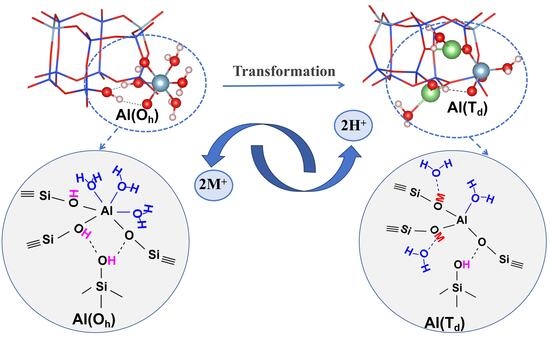
First-principles calculations are employed to systematically investigate the dynamic evolution from Al(Oh) to Al(Td) in zeolites induced by proton–cation exchange (Cu+, Li+, Na+, NH4+). The protons directly bonded to Al(Oh) are found to be essential for structural stability. Single cation exchange preserves the six-coordinated Al(Oh), while double exchange triggers spontaneous conversion to four-coordinated Al(Td), accompanied by stepwise detachment of two water molecules. Different cations exhibit variations in spatial occupation patterns and water-binding strength. The coordination effect of metal cations and the hydrogen bonding effect of NH4+ dominate the transformation of the aluminum coordination configurations. Protons directly bonded to Al(Oh) serve as strong Brønsted acid sites. Single exchange indirectly reduces the activity of adjacent protons, whereas double exchange eliminates Al–O–H bonds to stabilize Al(Td). This work reveals a cooperative mechanism among cation species, exchange number, water binding, and electronic coupling that controls the Al(Oh) to Al(Td) transformation, providing a theoretical basis for activating Al species and for designing high-performance catalysts with controlled acid site distributions via ion exchange.

Graphical Abstract

1. Introduction

Zeolites are an important class of microporous aluminosilicate materials, finding widespread applications in catalysis, adsorption, and ion exchange due to their unique pore structure, tunable acidity, and excellent thermal stability [1,2,3,4,5]. The performance of zeolites is largely determined by the coordination state and distribution of aluminum within their framework [6,7,8]. By precisely regulating the coordination environment of aluminum, the acidity, pore accessibility, and stability of zeolites can be optimized, thereby enhancing their catalytic performance in specific reactions [9,10,11,12]. In recent years, the development of advanced characterization techniques has led to a more profound understanding of the dynamic changes in the aluminum coordination state within zeolites [13,14]. Considerable interest has arisen in the conversion of framework-associated octahedral aluminum (Al(Oh)) to tetrahedral aluminum (Al(Td)). This dynamic transition not only reveals the tunable nature of acid sites in zeolites but also provides new insights for the design of high-performance zeolite catalysts.
Al(Oh) is a special type of aluminum species. Although it exhibits octahedral coordination, it remains connected to the zeolite framework through chemical bonds [15,16,17,18,19,20,21,22,23,24]. Bourgeat-Lami et al. [15] utilized NMR and other techniques to reveal that a portion of the aluminum in zeolite beta can exist in an octahedral coordination state under specific conditions, such as following the introduction of protons. They proposed that this octahedral aluminum is an integral part of the zeolite framework. More importantly, the authors observed that this octahedral aluminum could reversibly revert to tetrahedral coordination after ion exchange with sodium or potassium cations. The reversible transformation of framework-associated octahedral aluminum to tetrahedral aluminum in zeolites was clearly reported in zeolite Y by B. H. Wouters et al. [16]. Through the application of NMR spectroscopy, the research revealed that in mildly calcined zeolite Y, interaction with water leads to the conversion of a fraction of framework aluminum from tetrahedral to octahedral coordination, with the aluminum remaining connected to the framework. The study further demonstrated that this octahedral aluminum could be reversibly converted back to the tetrahedral form upon subsequent adsorption of ammonia. Our research group, utilizing 27Al NMR experimental characterization and first-principles calculations, has revealed for the first time the detailed structure and reversible transformation mechanism of Al(Oh) [17]. The study found that the critical prerequisite for the existence of this octahedral Lewis acid site is the presence of multiple Brønsted acid sites (BAS) in its vicinity, specifically requiring three protons. When the proton concentration decreases (e.g., by increasing the Si/Al ratio or through ion exchange to convert it into a non-acidic form), the tetrahedral BAS becomes thermodynamically more stable. The above studies not only confirm the reversible transformation of the coordination state of framework aluminum in zeolites but also elucidate that its core regulatory mechanism lies in variations in the local proton concentration. We further investigated the specific manifestation of this dynamic process during typical chemical modification procedures. It was found that the proton–cation exchange process can effectively disrupt the original thermodynamic equilibrium, thereby spontaneously inducing the transformation of Al(Oh) to Al(Td).
The transformation of Al(Oh) to Al(Td) elicited by the proton–cation exchange has garnered considerable attention [10,13,25,26,27,28,29,30,31,32], as it offers a fundamental insight into the intrinsic tunability of acid sites in zeolites. Drake et al. [30] found that in hydrated H+-USY and H+-ZSM-5, aluminum exists in both tetrahedral and octahedral coordination. Upon dehydration, the octahedral aluminum reversibly converts back to the tetrahedral form. When H+ was replaced with NH4+ or Cu+, a significant reduction in octahedral aluminum was observed, attributed to fewer water molecules associated with these cations. This directly demonstrates that H+ (and the water molecules it attracts) is a key factor leading to the increase in aluminum coordination number. In contrast, upon exchange with Na+, NH4+, or Cu+, this proton-induced effect is weakened or reversed, thereby favoring the stabilization of aluminum in its tetrahedral form. Sartbaeva et al. [28], using high-resolution NMR and pair distribution function analysis, found that the NH4+ exchange process itself can alter the local environment of some Al atoms in Na-Y and Na-A zeolites. Notably, they observed a partial transformation of aluminum from tetrahedral to octahedral coordination, which demonstrates that NH4+, as an exchange cation, can directly influence the coordination state of aluminum, although the specific outcome may depend on the initial form and the experimental conditions. The research results of Lisboa et al. [26] indicate that aluminum in non-tetrahedral coordination, such as octahedral coordination, may be connected to the framework and can be reversibly restored to tetrahedral coordination through ion exchange with cations like Na+ and K+ or by adsorbing NH3. Liu et al. [13] investigated mordenite zeolite as a model system and modulated the states of aluminum species through various methods, revealing the dynamic evolution of aluminum coordination environments in zeolites. Their study found that when NH4-type mordenite (NH4-MOR) is converted to proton-type mordenite (HMOR) via calcination, a portion of the aluminum species, originally present entirely in tetrahedral coordination within the zeolite framework, transforms into octahedral and distorted tetrahedral states. Accumulated experimental evidence has demonstrated that the coordination environment of Al in zeolites is strongly modulated by cation species, proton distribution and hydration conditions. Hydrated protons tend to stabilize octahedral Al, whereas the exchange of protons by cations such as NH4+, Cu+, and Na+ reduce content of bound water and weakens proton-induced structural effects, thereby facilitating the stabilization and recovery of tetrahedral Al. In addition, cation exchange directly alters the local microenvironment of framework Al and triggers reversible interconversion between octahedral and tetrahedral Al, which is highly dependent on the zeolite topology and experimental conditions. Although such a reversible Al coordination transition has been widely validated across various zeolite frameworks, the underlying mechanistic details remain poorly understood. Current knowledge is primarily established on ex situ post-characterization, which only identifies the initial and final structural states rather than capturing the real-time atomic-scale dynamic evolution during coordination conversion. Specifically, how the zeolite framework accommodates geometric distortion upon ion exchange, the functional role of intermediate hydration states, and the atomic-level structural evolution accompanying the Al(Oh) to Al(Td) transformation still lack systematic theoretical interpretation, highlighting the critical requirement for further investigations to fill this critical research gap.
In this work, the mechanism by which proton-cation exchange influences the coordination structure of Al species in zeolites will be systematically investigated. This study aims to unravel the intricate dynamic interactions among cation species, the number of exchanged protons, water binding strength, and electronic coupling effects during the Al(Oh) to Al(Td) transformation; thereby, it provides new insights into the evolution of the Al coordination environment. By employing proton–cation exchange as a tool to regulate aluminum coordination, researchers are expected to simultaneously optimize multiple catalytic parameters.

2. Results and Discussion

2.1. Structure and Stability

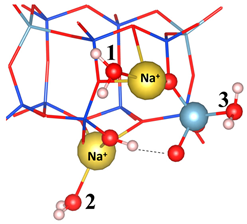
The structure of the Al(Oh) in the primitive cell is shown in Figure 1a, which corresponds to one of the aluminum atoms within the Al–O–Si–O–Al pair, in which the positions of all three protons (see Figure 1a, ①, ②, and ③) are displayed and labeled as H+-1, H+-2, and H+-3. To more clearly illustrate the structural features, we also present the structure of Al(Oh) in the double-6-ring (D6R), as shown in Figure 1b, where one of the Al–O–Si bonds in the 6-ring is hydrolyzed, thus forming a silanol. None of the three Brønsted protons originally present in the CHA cavity remain solvated. Instead, two of these protons (H+-1 and H+-2) become firmly bonded to the framework oxygen atoms associated with the Al(Oh) site, while the third is consumed during the formation of a silanol group (H+-3). Consequently, the transformation from Al(Td) to Al(Oh) results in the complete loss of the three original Brønsted acid sites. The Al in the Al(Oh) is coordinated to three framework oxygen atoms (Of) and three water oxygen atoms (Ow) in the fac-Al(Of)3(H2O)3 arrangement (as shown in Figure 1c).
The AIMD results show that Al(Oh) exhibits superior stability, regardless of whether the temperature is 300 K or 450 K, as shown in Figure 1d,e. In the same manner as in previous reports [33], a running average was employed to obtain accurate averages of the internal energies for configurations along the AIMD trajectories. The breadth of the sampling bins was 2000 configurations per data point, and the running average traces showed good convergence between running average traces for both simulations. Reported average internal energies are given by the final 2000 configurations from the AIMD simulations (see Figure 1d,e), which ensures that no spurious contributions are collected from unequilibrated configurations at the start of the simulation. Compared with the ambient temperature of 300 K, the total internal energy of the system at 450 K increases by 92 kJ·mol−1. From a kinetic perspective, this substantial energy enhancement provides a direct driving force for the water detachment process. Elevated temperature intensifies atomic thermal motion and weakens the interfacial interaction between the substrate and confined water molecules, thereby affecting the migration and detachment rates of adsorbed water. Although high temperature may kinetically promote water detachment, the overall framework of the Al(Oh) system remains intact and stable. Considering the lower intrinsic energy of the system at 300 K and the highly consistent structural evolution observed across different temperatures, subsequent discussions focus exclusively on the results obtained under 300 K conditions.

2.2. One Cation Exchange One H+

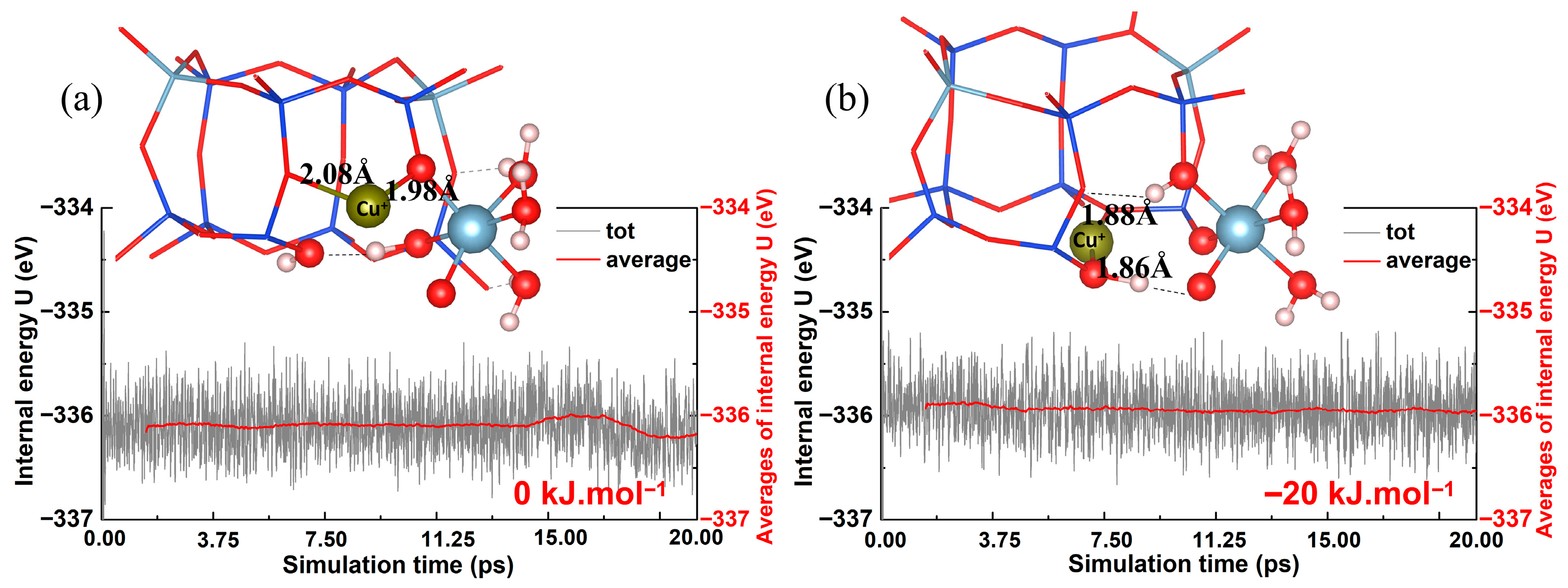
The effect of proton-cation exchange on the structural stability of the Al(Oh) was systematically investigated. The examined cations included Cu+, Li+, Na+, and NH4+, all of which have been experimentally observed to readily exchange with protons and promote the transformation of the Al(Oh) to Al(Td) [10,13,25,26,27,28,29,30,31,32]. A case of exchanging one proton with one cation was first examined, using Cu+ as a representative cation, and focused on the exchange of Cu+ with H+-1 or H+-2. The results are presented in Figure 2. The average energy calculations reveal that the system energy for Cu+ exchanging with the proton H+-2 is 20 kJ·mol−1 lower than H+-1. The other cations exhibit similar trends: the system energies at H+-2 are 15 kJ·mol−1, 13 kJ·mol−1, and 19 kJ·mol−1 lower than those at H+-1 for Li+, Na+, and NH4+ exchanging with one H+, respectively (see Figure S1 for details). Upon summarizing the exchange behavior of all four cations, a key conclusion is that single proton-cation exchange exerts no influence on the coordination configuration of Al(Oh). Following 20 ps of AIMD simulations, the Al(Oh) maintains high structural stability, remaining coordinated with three Of and three Ow.
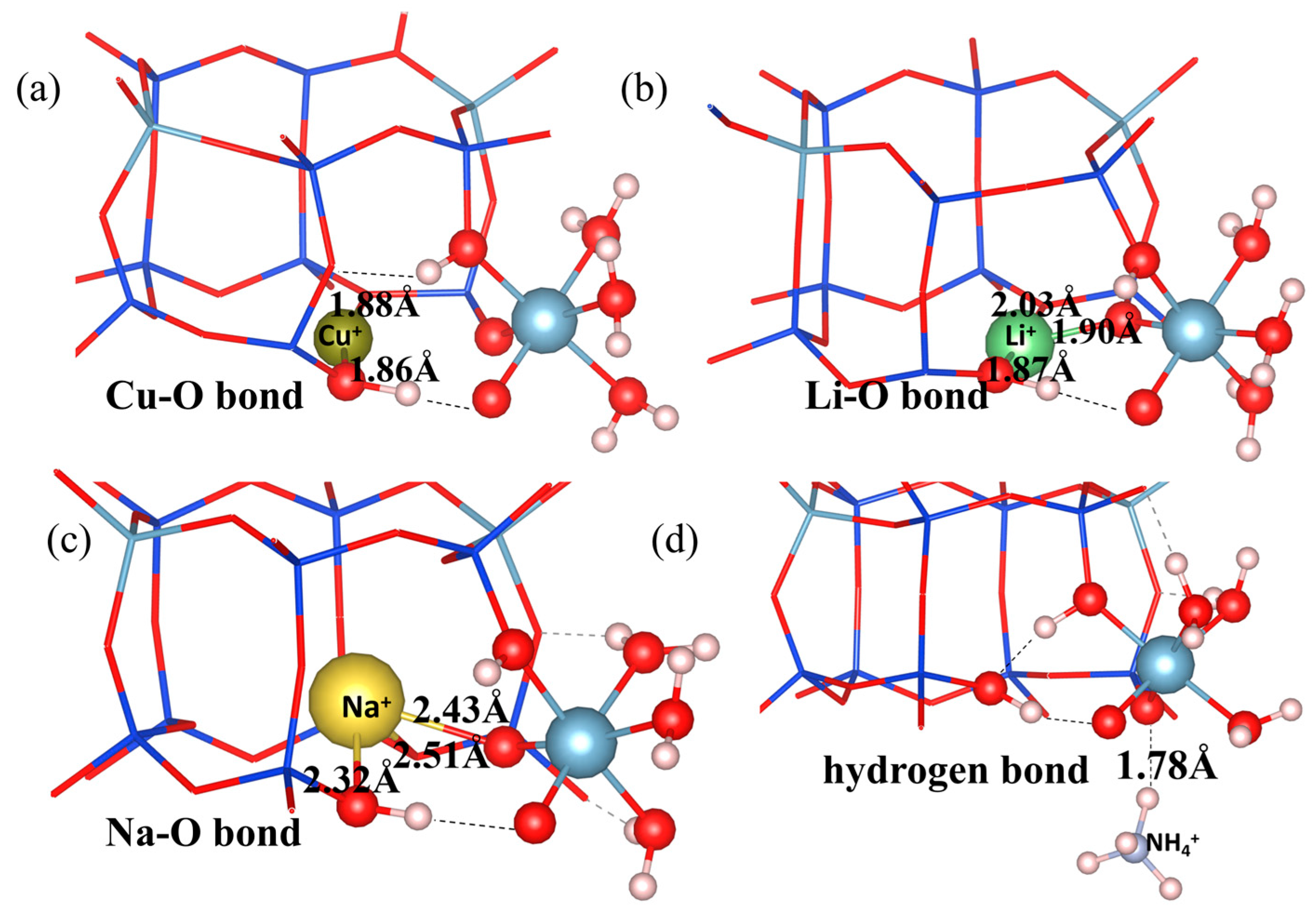
Single proton-cation exchange at H+-2 yields a lower system energy; thus, only the structures at H+-2 were analyzed in detail (see Figure 3). The Cu+ is mainly adsorbed near the center of the bottom 6-ring. In addition to bonding with the oxygen atom at the original H+ site, the Cu+ also interacts with other adjacent Of, forming Cu-O bonds of approximately 1.86–2.59 Å. Similarly, Li+ and Na+ exhibit comparable adsorption sites, forming Li-O bonds of 1.86–2.59 Å and Na-O bonds of 2.32–2.51 Å, respectively. In contrast, the adsorption site of NH4+ differs from those of the other three cations. NH4+ forms a hydrogen bond of 1.78 Å with the oxygen atom at the original H+ site. These findings demonstrate that Cu+, Li+, and Na+ share similar coordination environments and interact with the zeolite framework mainly via metal-oxygen coordination bonds. In contrast, NH4+adopts a distinct adsorption configuration stabilized by hydrogen bonding rather than ionic coordination, reflecting a fundamentally different stabilization mechanism. Such differences arise from the ionic radii, charge densities, and chemical properties of these cations, which govern their adsorption preferences and stability after proton exchange.

2.3. Two Cations Exchange Two H+

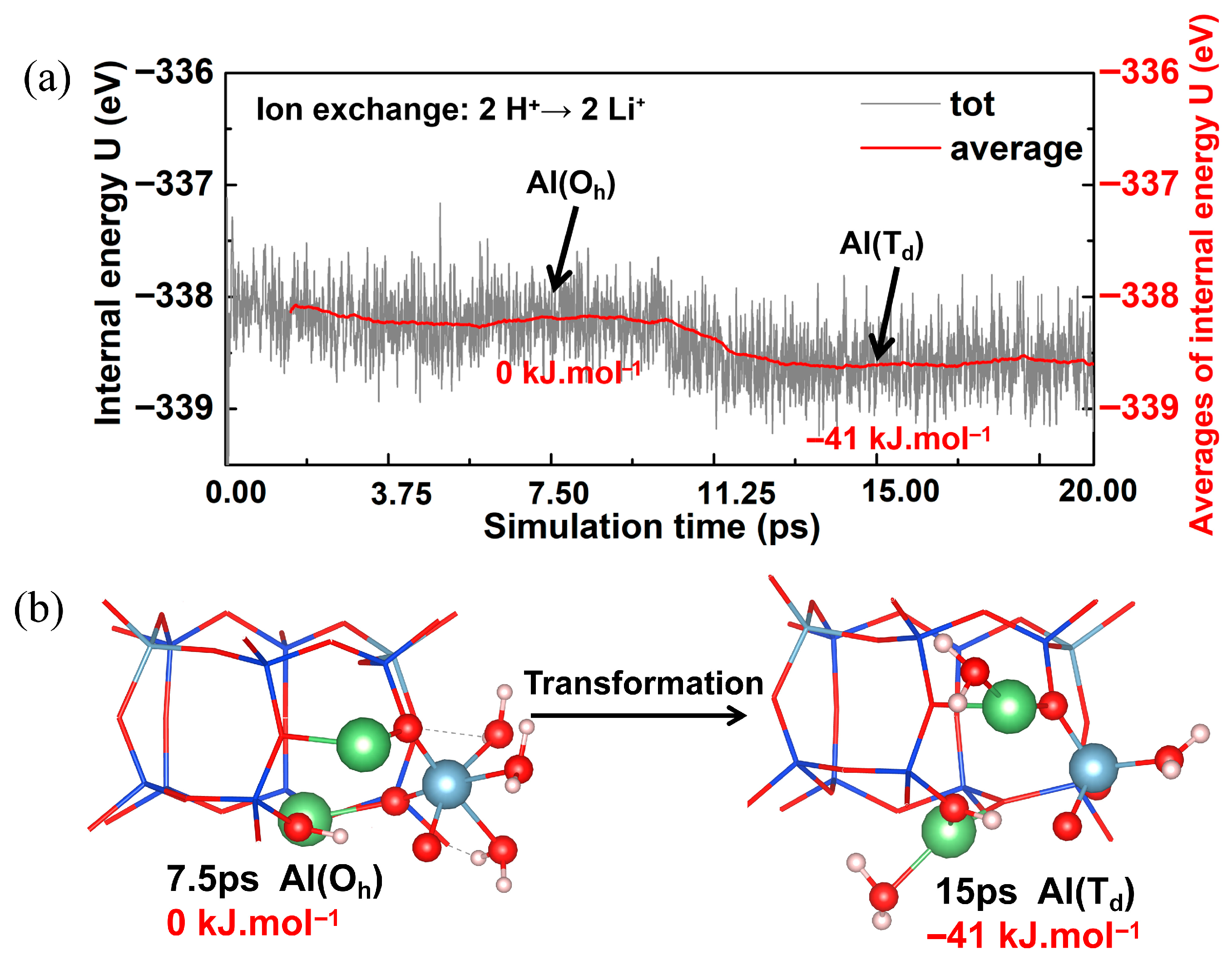
The ion exchange behavior between two cations and two protons was systematically investigated. Taking Li+ as a representative cation, two Li+ ions were simultaneously exchanged with the H+-1 and H+-2 (see Figure 4). During the AIMD simulations, Al(Oh) spontaneously transformed into Al(Td), and the reduced Al(Td) structure exhibited higher stability, with a system internal energy reduction of 41 kJ·mol−1. Specifically, the intact six-coordinated Al structure could be clearly observed at 7.5 ps. By 15 ps, the water molecules bound to the central Al interacted with the cations, where each Li+ coordinates to one water molecule. Consequently, only one of the three water molecules originally coordinated to the central Al remained, leading to the structural transformation from six-coordinated to four-coordinated Al. Other cations, including Cu+, Na+, and NH4+, yielded analogous results, forming Al(Td) structures with system internal energy decreases of 66 kJ·mol−1, 42 kJ·mol−1, and 64 kJ·mol−1, respectively (see Figure S2). Notably, for Na+ and NH4+, the spontaneous structural transformation occurred rapidly within the initial 3 ps of AIMD simulations. These results demonstrate that the cation-exchange induced Al(Oh) to Al(Td) transformation is general, with the transformation rate depending on the cation species. The significant decrease in internal energy after the transformation indicates that the four-coordinate Al(Td) structure is thermodynamically more favorable. These findings also provide a new route for tuning the coordination environment of Al species in zeolites.
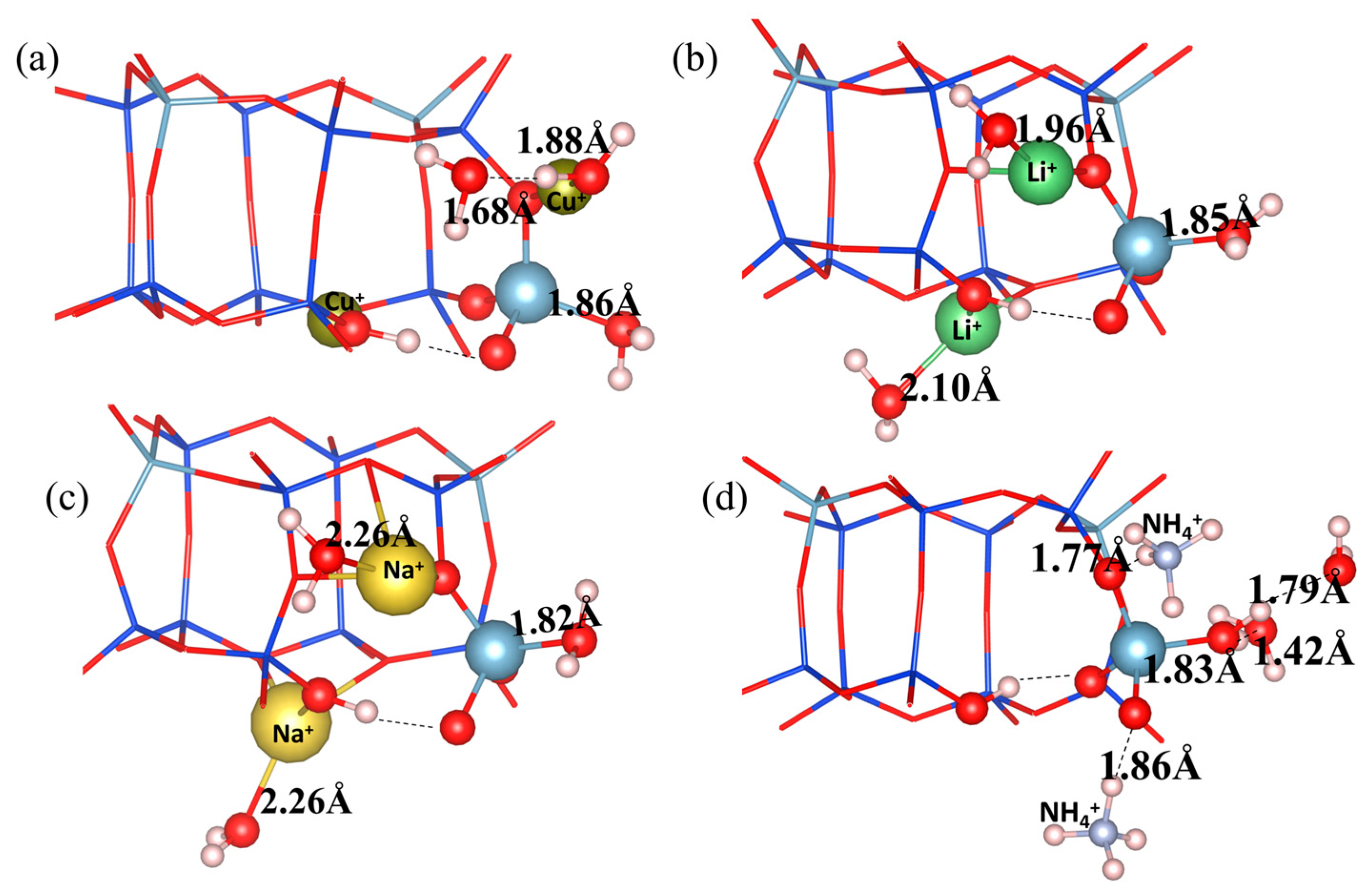
The optimal configuration for the transformation of Al(Oh) to Al(Td) after the exchange of two cations with two H+ is displayed in Figure 5. For metal cations, the cation exchanged at H+-2 occupies the center of the bottom 6-ring, while the cation exchanged at H+-1 is located in the side 4-ring (see Figure 5a–c). Among the three water molecules originally adsorbed on Al(Oh), two interact with metal cations, forming Cu–Ow, Li–Ow, and Na–Ow bonds with lengths of approximately 1.88 Å, 2.00 Å, and 2.26 Å, respectively; the resulting Al(Td) structure is connected to three Of and one Ow. For NH4+, it does not occupy the structural center but forms hydrogen bonds of 1.77 Å and 1.86 Å with the Of at the original H+ positions. Meanwhile, the two water molecules detached from Al(Oh) are linked to the residual water molecule adsorbed on Al via hydrogen bonds with lengths of 1.42 Å and 1.79 Å (see Figure 5d). Notably, during the structural transformation of Al species induced by cation exchange, inorganic metal cations (Cu+, Li+, Na+) and NH4+ exhibit remarkably different spatial occupation modes and interfacial interaction characteristics. Inorganic metal cations share identical spatial occupation configurations, whereas their interaction strengths with the zeolite framework and adsorbed water molecules display evident quantitative discrepancies. The metal–water (M–Ow) bond lengths follow the sequence: Cu+ (1.88 Å) < Li+ (2.00 Å) < Na+ (2.26 Å), which directly indicates a gradual decrease in interaction intensity. This result suggests that cations with higher charge density tend to form shorter coordination bonds and possess stronger binding ability with water molecules. In stark contrast, NH4+ adopts a completely different spatial distribution and interaction pattern. Rather than occupying the central sites of six-membered or four-membered rings, NH4+ forms two stable hydrogen bonds with Of at the original H+ exchange sites, implying strong interaction between NH4+ and the zeolite framework. Moreover, the unique hydrogen bond network constructed by NH4+ and water molecules provides an extra driving force for the transformation from Al(Oh) to Al(Td). Overall, the coordination effect of metal cations and the hydrogen-bonding effect of NH4+ synergistically dominate the topological reconstruction of local microstructures in zeolites. The quantitative differences in bond length and interaction strength are the fundamental reason for the distinct structural transformation behaviors induced by different cations.
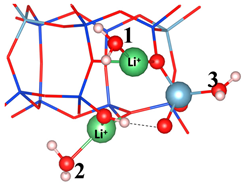
The change in coordination number of the central Al atom during the transformation from Al(Oh) to Al(Td) arises from the detachment of two water molecules. Our previous research has demonstrated that individual water molecules are firmly bound to Al(Oh) species, with an interaction energy of at least 118 kJ·mol−1 [17]. In this work, we systematically investigated the binding of water molecules within the Al(Td)_2M+ structure. For the four systems with different cation-exchanged forms, water molecules were sequentially removed from the zeolite cages, and the results are summarized in Table 1. The detachment energies of water molecule no. 2 indicate that the binding strength of a single water molecule with the three metal cations follows the order Cu+ > Li+ > Na+. Cu+ exhibits the strongest binding due to its high polarizing ability arising from the d10 electronic configuration and partial covalent contribution. Although Li+ possesses the highest charge density and strong ion-dipole interactions, its lack of covalent character results in only moderate binding. In contrast, Na+ shows the weakest binding owing to its largest ionic radius and lowest charge density. This sequence reflects that the binding energy decreases linearly with increasing ionic radius and increases with increasing charge density. Upon exchanging 2NH4+ with 2H+, the detachment energies of water molecules no. 1 and no. 2 indicate that approximately 104 kJ·mol−1 is required to detach a single water molecule from the hydrogen-bonding network. This value is lower than the metal–water coordination detachment energies observed in the Cu+ and Li+ systems but exceeds some values in the Na+ system, reflecting the moderate binding capability of the NH4+-induced hydrogen-bonding network. Furthermore, the detachment energy of water molecule no. 3 is significantly higher than those of water molecules no. 1 and no. 2, indicating that the four-coordinate hydrated Lewis acidic site (LAS) [34] interacts most strongly with water molecules, requiring the highest energy for water removal.
The detachment energy of water molecules from aluminum species in zeolites is closely related to their local coordination environment and is significantly influenced by the intrinsic properties of extra-framework cations. For metal cations, the binding strength with water molecules is jointly determined by the covalent contribution and charge density, whereas for NH4+, the strength of the hydrogen-bonding network is the dominant factor. Moreover, the strong interaction between the four-coordinated hydrated Lewis acidic site and water molecules highlights the critical role of such active sites during the hydration and dehydration processes of zeolites. While experimental characterization can capture various intermediate Al coordination states [14,34], it remains challenging to track in real time, at atomic resolution, the dissociative adsorption of water on Al sites, the subsequent coordination transformation, and the evolution of the hydrogen-bonding network. Our theoretical calculations elucidate this dynamic pathway and provide geometric configurations and energy profiles for Al species with varying numbers of adsorbed water molecules, thereby offering a molecular level mechanistic basis for the water-induced evolution of acidic sites.
We further investigated the case where all three protons in Al(Oh) were exchanged by cations and obtained conclusions similar to those for the exchange with two cations. The calculation results represented by Cu+ are shown in Figure S3. Water molecules initially adsorbed on Al(Oh) interact with metal cations, thereby converting hydrated LAS from six-coordinated to four-coordinated, presenting a distinct structural evolution pathway.

2.4. Electronic Coupling

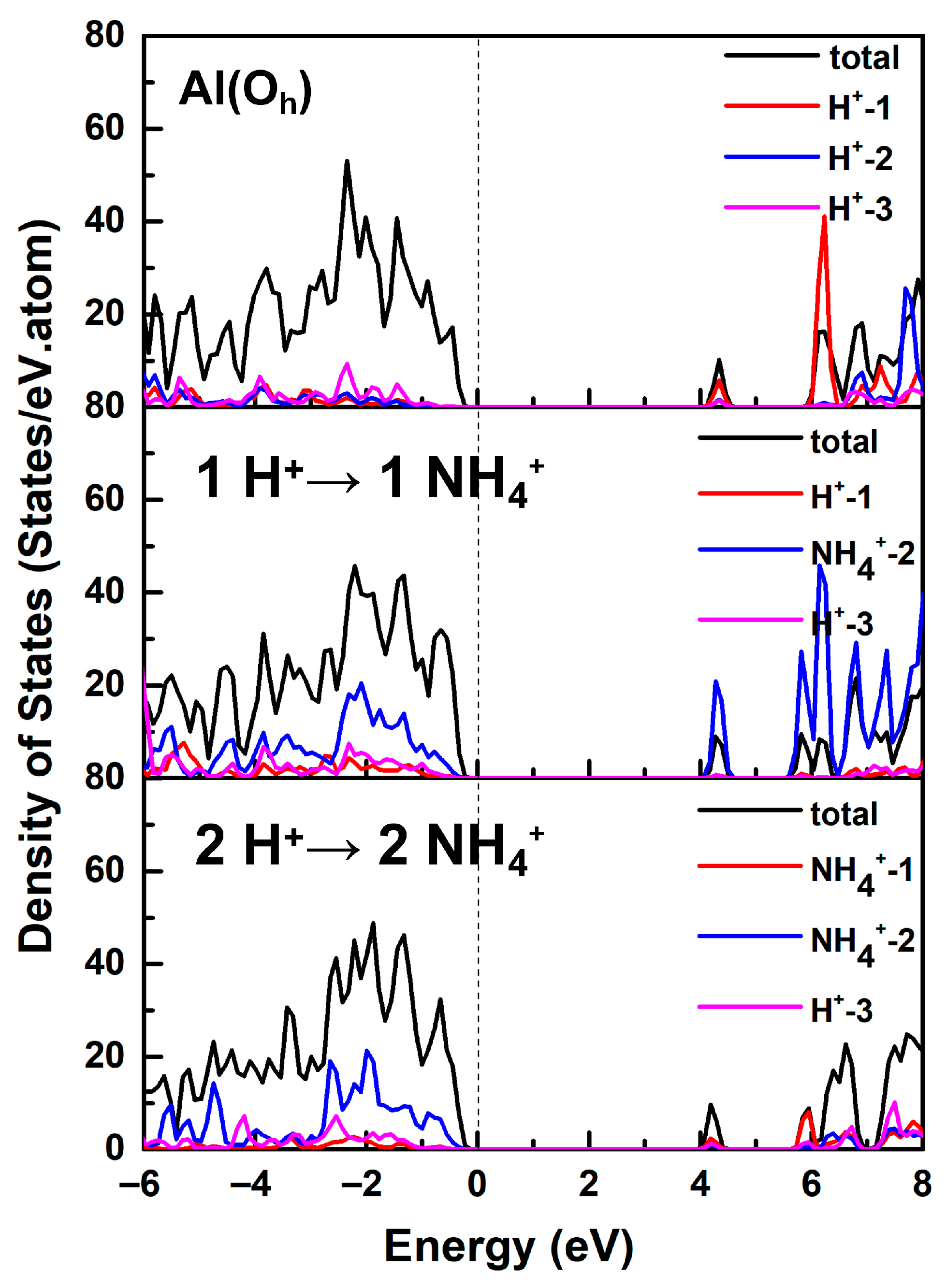
To elucidate the evolution of the electronic structure of Al(Oh) during the dynamic changes in its coordination environment induced by the progressive exchange of framework protons with cations, total and partial density of states (DOS/PDOS) analyses were performed, using NH4+ as a representative. The results are presented in Figure 6. The case of metal ion exchange is presented in the Supporting Information (see Figure S4). In the fully protonated structure (top panel), the protons H+-1 and H+-2 directly coordinated to Al(Oh) exhibit intense and sharp characteristic peaks in the conduction band region (~6–8 eV). This observation confirms that H+-1 and H+-2 serve as strong Brønsted acid sites with highly localized electron-accepting orbitals, which are favorable for proton transfer reactions. In contrast, the silanol group (H+-3), which is not directly bonded to Al(Oh), shows negligible contribution in this energy region, consistent with its intrinsic weak acidity. After the single exchange of H+-2 with NH4+ (middle panel), the Al center retains its octahedral coordination geometry. Meanwhile, the intense conduction band peak associated with H+-1 is significantly attenuated, demonstrating a pronounced electronic coupling effect between adjacent acid sites. Specifically, the exchange of H+-2 with NH4+-2 indirectly suppresses the electronic activity of the neighboring H+-1, leading to a moderate reduction in the overall acidity of the system. Upon the double exchange of both H+-1 and H+-2 with NH4+ (bottom panel), the direct Al-O-H bonding interactions are lost, which dismantles the octahedral coordination shell and reconstructs the Al center into a tetrahedral configuration. Consequently, the primary strong Brønsted acid sites in the system are completely eliminated, forming a stable Al(Td) framework supported by adsorbed NH4+ cations. Notably, the PDOS of the silanol proton (H+-3) remains almost unchanged across all three structural models. This confirms that H+-3 is electronically isolated from the Al(Oh) center and its local environment, and thus is not affected by the proton substitution process or the change in the Al coordination environment.

2.5. Generality

To assess the generality of our findings, we also considered the stability of framework-associated Al(Oh) species in a large-pore FAU model with Si/Al = 15 (containing one Al–O–Si–O–Al pair). The results are shown in Figure S5. Similar to the CHA case, our AIMD trajectories show that the FAU model is kinetically stable and that at least one proton bound to Al(Oh) is necessary for stabilizing the Al(Oh) species. When one of the H+ ions in the system was exchanged for one Na+, the system remained stable, with the Al(Oh) species persisting throughout the simulation and exhibiting almost no fluctuation in internal energy. When both H+ ions in the system were exchanged by Na+, the Al(Oh) spontaneously transformed to Al(Td), and this process was accompanied by a decrease in internal energy of 47 kJ·mol−1. These FAU results confirm the generality of our findings from the CHA system. The persistence of Al(Oh) upon single Na+ exchange demonstrates that one proton is sufficient to kinetically stabilize the octahedral moiety, regardless of zeolite topology. Conversely, double Na+ exchange triggers an irreversible transformation to Al(Td) indicating that the instability of fully deprotonated Al(Oh) is an intrinsic property, not a confinement effect specific to small-pore zeolites. This understanding provides a transferable framework for controlling Al coordination via ion exchange across different zeolite topologies.

3. Computational Details

3.1. Model

The model is a primitive cell of CHA zeolite, which contains 12 T sites, and the selected structure is sourced from our previously published paper [17], which is in excellent agreement with experimental results. The re-optimized unit cell parameters are: a = b = c = 9.286 Å and α = β = γ = 96.015°. The Si/Al ratio used in the calculation is 3, and the primitive cell contains 3 water molecules. We tested all possible proton sites, and the lowest energy configuration was chosen.

3.2. Methods

All theoretical calculations in this work were carried out on the basis of plane-wave density functional theory (DFT), as realized via the Vienna Ab initio Simulation Package (VASP 5.4.4) [35,36]. The generalized gradient approximation formulated by Perdew, Burke, and Ernzerhof (PBE) [37] was adopted to handle electron exchange-correlation interactions, while the D3 van der Waals dispersion correction coupled with the Becke-Johnson damping function was employed to describe weak intermolecular forces [38,39]. A plane-wave cutoff energy of 400 eV was set for the expansion of electronic wave functions. Only the gamma k-point was selected for sampling in electronic structure calculations. Structural optimization was completed through the conjugate gradient algorithm, with rigorous convergence criteria set at an energy threshold of 10−6 eV and a residual force limit of 0.01 eV/Å for all relaxed atoms. The stabilities of systems were determined based on ab initio molecular dynamics (AIMD) simulations of at least 20 ps. We extended the simulation time to 80 ps and found that once Al(Oh) spontaneously transforms into Al(Td), the structure of the system no longer changes, and the average internal energy exhibits only minor fluctuations, as shown in Figure S6. The extended simulation yields the same conclusion as the 20 ps simulation. Therefore, for the structural transition focused on in this study, a simulation time of 20 ps is sufficient. The timestep of all AIMD simulations was set to 0.75 fs with the atomic mass of hydrogen increased to three. All AIMD simulations were performed in the NVT ensemble; the target temperatures are 300 K (ambient temperature) and 450 K (experimental hydrolysis temperature of zeolites) [17]. The temperature value is controlled by the Nosé-Hoover thermostat [40].
The energy cost of removing one water molecule from the Al(Td)_2M+ species is calculated as follows:
E r e m = E A l T d _ 2 M + _ ( n 1 ) H 2 O + E H 2 O E A l T d _ 2 M +
where E A l T d _ 2 M + are the total energies of the Al(Td) species after the exchange of two cations with two protons and E H 2 O is the energy for a single isolated water molecule in the gas phase.

4. Conclusions

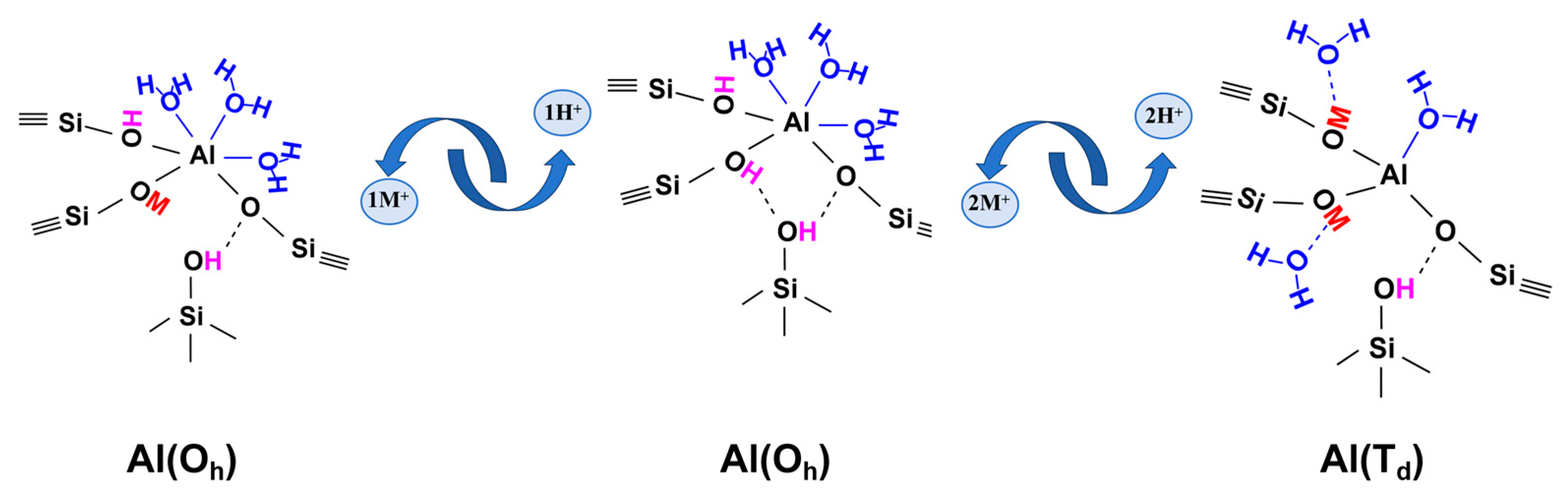
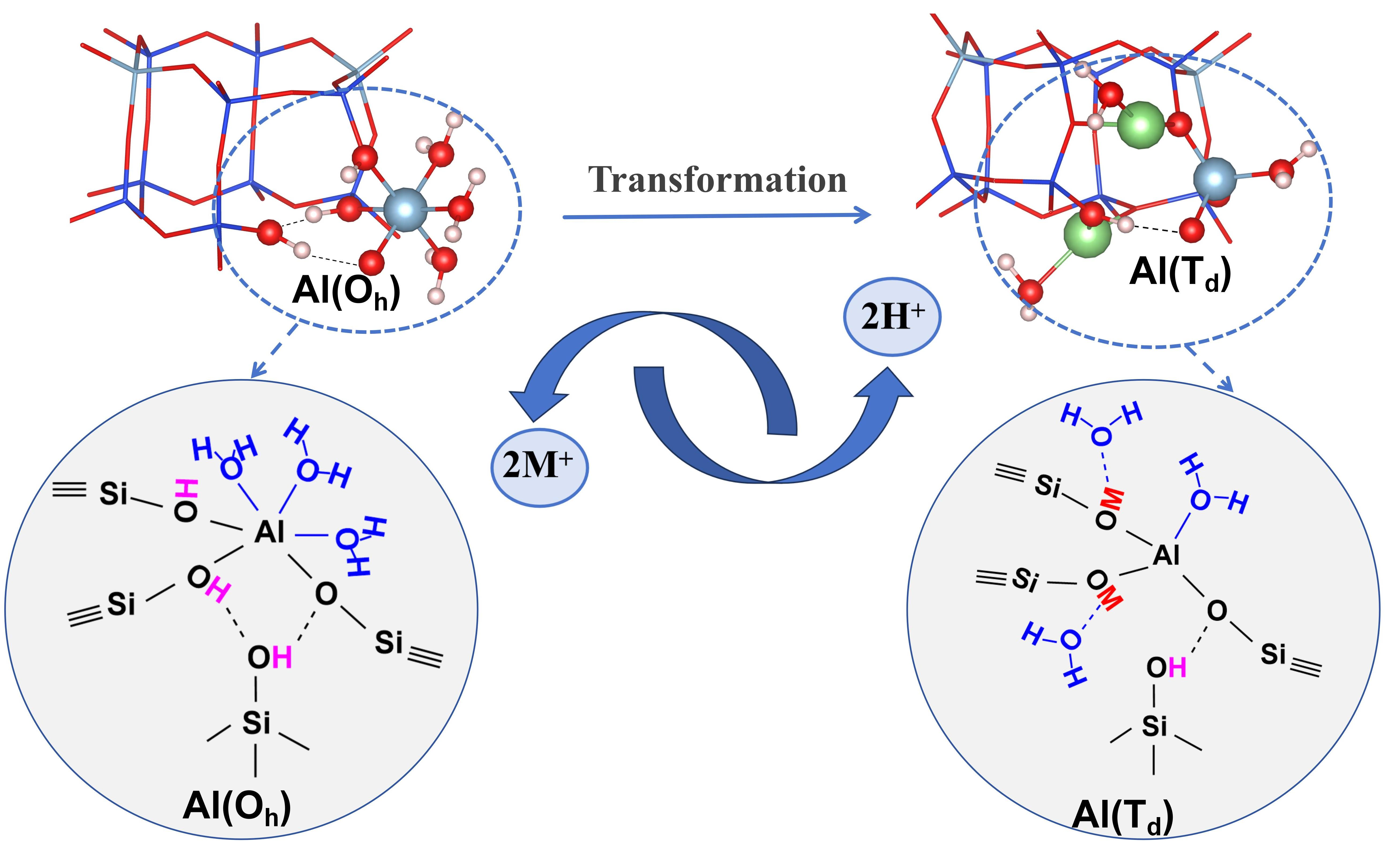
The dynamic evolution process of the transformation from Al(Oh) to Al(Td) induced by proton–cation (Cu+, Li+, Na+, NH4+) exchange in zeolites has been systematically investigated at the atomic level using first-principles calculations. It is found that in the six-coordinated Al(Oh) structure, the protons directly attached to Al(Oh) play a crucial role in maintaining structural stability. When one proton is exchanged with a cation, the Al(Oh) structure remains stable and retains its six-coordinate configuration. However, when two protons directly bonded to Al(Oh) are exchanged with cations, Al(Oh) spontaneously transforms into Al(Td), a schematic diagram of this process is presented in Figure 7. The cation–proton exchange results indicate that the number of exchanged protons is the core determining factor, and retaining at least one proton on the Al(Oh)-O-Si oxygen is essential for maintaining the structural stability of the six-coordinated aluminum species. The transformation from Al(Oh) to Al(Td) is accompanied by the stepwise detachment of two water molecules. Different cations exhibit distinct spatial occupation modes and water interaction characteristics. For inorganic metal cations, they share the same spatial occupation configuration, but the binding strength of water molecules with different metal cations follows the order Cu+ > Li+ > Na+, which is governed by the combined effects of ionic polarization, covalent contribution, and electrostatic interactions. In stark contrast, the spatial occupation mode of NH4+ is completely different from that of metal cations: NH4+ forms stable hydrogen bonds with the Of at the original H+ exchange sites. The coordination effect of metal cations and the hydrogen-bonding effect of NH4+ collectively dominate the topological reconstruction of the local zeolite framework. The electronic coupling modulates the acidity of the structure. Single exchange remotely suppresses the electronic activity of the adjacent proton, thereby reducing the acidity, whereas double exchange completely eliminates the Al-O-H bonds and converts Al to a stable Al(Td) framework. This work establishes a complete physical picture in which the cation species, the number of exchanged protons, the water binding strength, and electronic coupling effects cooperatively control the Al(Oh) to Al(Td) transformation. These findings not only provide a theoretical basis for the activation and reutilization of Al species in zeolites but also open up new routes for the rational design of Al active sites with tailored coordination environments via ion exchange.

Supplementary Materials

The following supporting information can be downloaded at: https://www.mdpi.com/article/10.3390/catal16050440/s1.

Author Contributions

Conceptualization, Investigation, and Writing—original, W.Y.; Date curation, Conceptualization and Methodology, X.J.; Writing—review and editing and Data curation, Y.T.; Project administration, Project administration and Writing—review and editing, N.J.; Data curation, Funding acquisition, Project administration, Data curation, Writing—review and editing, and Investigation, M.J.; All authors have read and agreed to the published version of the manuscript.

Funding

This research was funded by Yunnan Fundamental Research Projects (202401AU070005), Special Basic Cooperative Research Programs of Yunnan Provincial Undergraduate Universities’ Association (202401BA070001-152), Regional Program of National Natural Science Foundation of China (NSFC) (12564034), College Students’ Innovative Entrepreneurial Training Plan Program (202511390006), and Natural Science Foundation of Shandong Provincial Undergraduate Universities’ Association (ZR2023MA082).

Data Availability Statement

The original contributions presented in this study are included in the article/Supplementary Materials. Further inquiries can be directed to the corresponding authors.

Acknowledgments

The authors gratefully acknowledge the computing support provided by the JRT Science Data Center at Yuxi Normal University. We would like to thank Zhiwen Jin for his contribution to data organization and analysis.

Conflicts of Interest

The authors declare no conflicts of interest. The funders had no role in the design of the study; in the collection, analyses, or interpretation of data; in the writing of the manuscript; or in the decision to publish the results.

References

  1. Jesmin, F.; Mitu, J.F.; Khandaker, T.; Ibrahim, A.B.; Anik, M.A.A.M.; Anojaidi, K.I.; Al-Suwaylih, W.A.; Hasan, M.K.; Hossain, M.S. Recent advances in nanoparticle-modified zeolites: Functionalization strategies and diverse applications. RSC Adv. 2026, 16, 8828–8860. [Google Scholar] [CrossRef] [PubMed]
  2. Li, Y.; Yu, J. Emerging applications of zeolites in catalysis, separation and host–guest assembly. Nat. Rev. Mater. 2021, 6, 1156–1174. [Google Scholar] [CrossRef]
  3. Li, Y.; Li, L.; Yu, J. Applications of zeolites in sustainable chemistry. Chem 2017, 3, 928–949. [Google Scholar] [CrossRef]
  4. Asgar Pour, Z.; Abduljawad, M.M.; Alassmy, Y.A.; Alnafisah, M.S.; El Hariri El Nokab, M.; Van Steenberge, P.H.M.; Sebakhy, K.O. Synergistic catalytic effects of alloys of noble metal nanoparticles supported on two different supports: Crystalline zeolite sn-beta and carbon nanotubes for glycerol conversion to methyl lactate. Catalysts 2023, 13, 1486. [Google Scholar] [CrossRef]
  5. Sebakhy, K.O.; Vitale, G.; Pereira-Almao, P. Production of Highly Dispersed Ni within Nickel Silicate Materials with the MFI Structure for the Selective Hydrogenation of Olefins. Ind. Eng. Chem. Res. 2019, 58, 8597–8611. [Google Scholar] [CrossRef]
  6. van Bokhoven, J.A.; Lamberti, C. Structure of aluminum, iron, and other heteroatoms in zeolites by X-ray absorption spectroscopy. Coord. Chem. Rev. 2014, 277, 275–290. [Google Scholar] [CrossRef]
  7. Li, J.; Gao, M.; Yan, W.; Yu, J. Regulation of the Si/Al ratios and Al distributions of zeolites and their impact on properties. Chem. Sci. 2023, 14, 1935–1959. [Google Scholar] [CrossRef]
  8. Rzepka, P.; Huthwelker, T.; Dedecek, J.; Tabor, E.; Bernauer, M.; Sklenak, S.; Mlekodaj, K.; van Bokhoven, J.A. Aluminum distribution and active site locations in the structures of zeolite ZSM-5 catalysts. Science 2025, 388, 423–428. [Google Scholar] [CrossRef]
  9. Chen, J.; Liang, T.; Li, J.; Wang, S.; Qin, Z.; Wang, P.; Huang, L.; Fan, W.; Wang, J. Regulation of framework aluminum siting and acid distribution in H-MCM-22 by boron incorporation and its effect on the catalytic performance in methanol to hydrocarbons. ACS Catal. 2016, 6, 2299–2313. [Google Scholar] [CrossRef]
  10. Ravi, M.; Sushkevich, V.L.; van Bokhoven, J.A. On the location of Lewis acidic aluminum in zeolite mordenite and the role of framework-associated aluminum in mediating the switch between Brønsted and Lewis acidity. Chem. Sci. 2021, 12, 4094–4103. [Google Scholar] [CrossRef] [PubMed]
  11. Palčić, A.; Valtchev, V. Analysis and control of acid sites in zeolites. Appl. Catal. A Gen. 2020, 606, 117795. [Google Scholar] [CrossRef]
  12. van Bokhoven, J.A.; Van der Eerden, A.; Koningsberger, D. Flexible aluminium coordination of zeolites as function of temperature and water content, an in-situ method to determine aluminium coordinations. In Studies in Surface Science and Catalysis; Elsevier: Amsterdam, The Netherlands, 2002; Volume 142, pp. 1885–1890. [Google Scholar]
  13. Liu, R.; Fan, B.; Zhi, Y.; Liu, C.; Xu, S.; Yu, Z.; Liu, Z. Dynamic evolution of aluminum coordination environments in mordenite zeolite and their role in the dimethyl ether (DME) carbonylation reaction. Angew. Chem. Int. Ed. 2022, 134, e202210658. [Google Scholar]
  14. Zheng, M.; Wang, Q.; Chu, Y.; Tan, X.; Huang, W.; Xi, Y.; Wang, Y.; Qi, G.; Xu, J.; Hong, S.B.; et al. Revealing the bro̷nsted acidic nature of penta-coordinated aluminum species in dealuminated zeolite y with solid-state NMR spectroscopy. J. Am. Chem. Soc. 2024, 146, 29417–29428. [Google Scholar]
  15. Bourgeat-Lami, E.; Massiani, P.; Di Renzo, F.; Espiau, P.; Fajula, F.; Des Courières, T. Study of the state of aluminium in zeolite-β. Appl. Catal. 1991, 72, 139–152. [Google Scholar] [CrossRef]
  16. Wouters, B.; Chen, T.-H.; Grobet, P. Reversible tetrahedral− octahedral framework aluminum transformation in zeolite Y. J. Am. Chem. Soc. 1998, 120, 11419–11425. [Google Scholar] [CrossRef]
  17. Jin, M.; Ravi, M.; Lei, C.; Heard, C.J.; Brivio, F.; Tošner, Z.; Grajciar, L.; van Bokhoven, J.A.; Nachtigall, P. Dynamical Equilibrium between Brønsted and Lewis Sites in Zeolites: Framework-Associated Octahedral Aluminum. Angew. Chem. Int. Ed. 2023, 62, e202306183. [Google Scholar] [CrossRef] [PubMed]
  18. Ravi, M.; Sushkevich, V.L.; van Bokhoven, J.A. Towards a better understanding of Lewis acidic aluminium in zeolites. Nat. Mater. 2020, 19, 1047–1056. [Google Scholar] [CrossRef]
  19. Ong, L.H.; Dömök, M.; Olindo, R.; van Veen, A.C.; Lercher, J.A. Dealumination of HZSM-5 via steam-treatment. Micropor. Mesopor. Mater. 2012, 164, 9–20. [Google Scholar] [CrossRef]
  20. van Bokhoven, J.A.; Van der Eerden, A.M.; Koningsberger, D.C. Three-coordinate aluminum in zeolites observed with in situ X-ray absorption near-edge spectroscopy at the Al K-edge: Flexibility of aluminum coordinations in zeolites. J. Am. Chem. Soc. 2003, 125, 7435–7442. [Google Scholar]
  21. Xue, N.; Vjunov, A.; Schallmoser, S.; Fulton, J.L.; Sanchez-Sanchez, M.; Hu, J.Z.; Mei, D.; Lercher, J.A. Hydrolysis of zeolite framework aluminum and its impact on acid catalyzed alkane reactions. J. Catal. 2018, 365, 359–366. [Google Scholar] [CrossRef]
  22. Ravi, M.; Sushkevich, V.L.; van Bokhoven, J.A. Lewis acidity inherent to the framework of zeolite mordenite. J. Phys. Chem. C 2019, 123, 15139–15144. [Google Scholar] [CrossRef]
  23. Omegna, A.; Prins, R.; Van Bokhoven, J.A. Effect of temperature on aluminum coordination in zeolites H− Y and H− USY and amorphous Silica− Alumina: An in situ Al K edge XANES study. Phys. Chem. B 2005, 109, 9280–9283. [Google Scholar] [CrossRef]
  24. Woolery, G.; Kuehl, G.; Timken, H.; Chester, A.; Vartuli, J. On the nature of framework Brønsted and Lewis acid sites in ZSM-5. Zeolites 1997, 19, 288–296. [Google Scholar] [CrossRef]
  25. Huang, J.; Jiang, Y.; Marthala, V.R.; Thomas, B.; Romanova, E.; Hunger, M. Characterization and acidic properties of aluminum-exchanged zeolites X and Y. J. Phys. Chem. C 2008, 112, 3811–3818. [Google Scholar] [CrossRef]
  26. Lisboa, O.; Sánchez, M.; Ruette, F. Modeling extra framework aluminum (EFAL) formation in the zeolite ZSM-5 using parametric quantum and DFT methods. J. Mol. Catal. A Chem. 2008, 294, 93–101. [Google Scholar] [CrossRef]
  27. Di Iorio, J.R.; Li, S.; Jones, C.B.; Nimlos, C.T.; Wang, Y.; Kunkes, E.; Vattipalli, V.; Prasad, S.; Moini, A.; Schneider, W.F. Cooperative and competitive occlusion of organic and inorganic structure-directing agents within chabazite zeolites influences their aluminum arrangement. J. Am. Chem. Soc. 2020, 142, 4807–4819. [Google Scholar] [CrossRef] [PubMed]
  28. Sartbaeva, A.; Rees, N.H.; Edwards, P.P.; Ramirez-Cuesta, A.J.; Barney, E. Local probes show that framework modification in zeolites occurs on ammonium exchange without calcination. J. Mater. Chem. A 2013, 1, 7415–7421. [Google Scholar] [CrossRef]
  29. van Bokhoven, J.A.; Koningsberger, D.; Kunkeler, P.; Van Bekkum, H. Influence of steam activation on pore structure and acidity of zeolite Beta: An Al K edge XANES study of aluminum coordination. J. Catal. 2002, 211, 540–547. [Google Scholar] [CrossRef]
  30. Drake, I.J.; Zhang, Y.; Gilles, M.K.; Teris Liu, C.; Nachimuthu, P.; Perera, R.C.; Wakita, H.; Bell, A.T. An in situ Al K-edge XAS investigation of the local environment of H+-and Cu+-exchanged USY and ZSM-5 zeolites. Phys. Chem. B 2006, 110, 11665–11676. [Google Scholar] [CrossRef]
  31. Kim, H.; Lim, C.; Jin, T.; Kim, J.; Choi, J.; Lee, K.B. Cu- and Li-ion-exchanged ZSM-5 for nitrogen adsorption: Reduced Li usage and water vapor adsorption. Ind. Eng. Chem. Res. 2025, 142, 604–612. [Google Scholar] [CrossRef]
  32. dos Santos, L.L.; do Nascimento, R.M.; Pergher, S.B.C. One-pot strategies for lithium recovery from Beta-bpodumene and LTA-type zeolite synthesis. Crystals 2025, 15, 161. [Google Scholar] [CrossRef]
  33. Jin, M.; Liu, M.; Nachtigall, P.; Grajciar, L.; Heard, C.J. Mechanism of zeolite hydrolysis under basic conditions. Chem. Mater. 2021, 33, 9202–9212. [Google Scholar] [CrossRef]
  34. Wang, X.; Wang, Q.; Wang, C.; Chu, Y.; Hu, M.; Deng, F.; Yu, J.; Xu, J. Observation of water-induced synergistic acidic site from NMR-Invisible Al in zeolite via solid-state nmr spectroscopy. J. Am. Chem. Soc. 2025, 147, 17829–17838. [Google Scholar] [CrossRef]
  35. Kresse, G.; Hafner, J. Ab initio molecular dynamics for liquid metals. Phys. Rev. B 1993, 47, 558. [Google Scholar] [CrossRef]
  36. Kresse, G.; Hafner, J. Ab initio molecular-dynamics simulation of the liquid-metal–amorphous-semiconductor transition in germanium. Phys. Rev. B 1994, 49, 14251. [Google Scholar] [CrossRef] [PubMed]
  37. Perdew, J.P.; Burke, K.; Ernzerhof, M. Generalized gradient approximation made simple. Phys. Rev. Lett. 1996, 77, 3865. [Google Scholar] [CrossRef]
  38. Grimme, S.; Antony, J.; Ehrlich, S.; Krieg, H. A consistent and accurate ab initio parametrization of density functional dispersion correction (DFT-D) for the 94 elements H-Pu. J. Chem. Phys. 2010, 132, 154104. [Google Scholar] [CrossRef] [PubMed]
  39. Grimme, S.; Ehrlich, S.; Goerigk, L. Effect of the damping function in dispersion corrected density functional theory. J. Comput. Chem. 2011, 32, 1456–1465. [Google Scholar] [CrossRef]
  40. Braga, C.; Travis, K.P. A configurational temperature Nosé-Hoover thermostat. J. Chem. Phys. 2005, 123, 134101. [Google Scholar] [CrossRef]
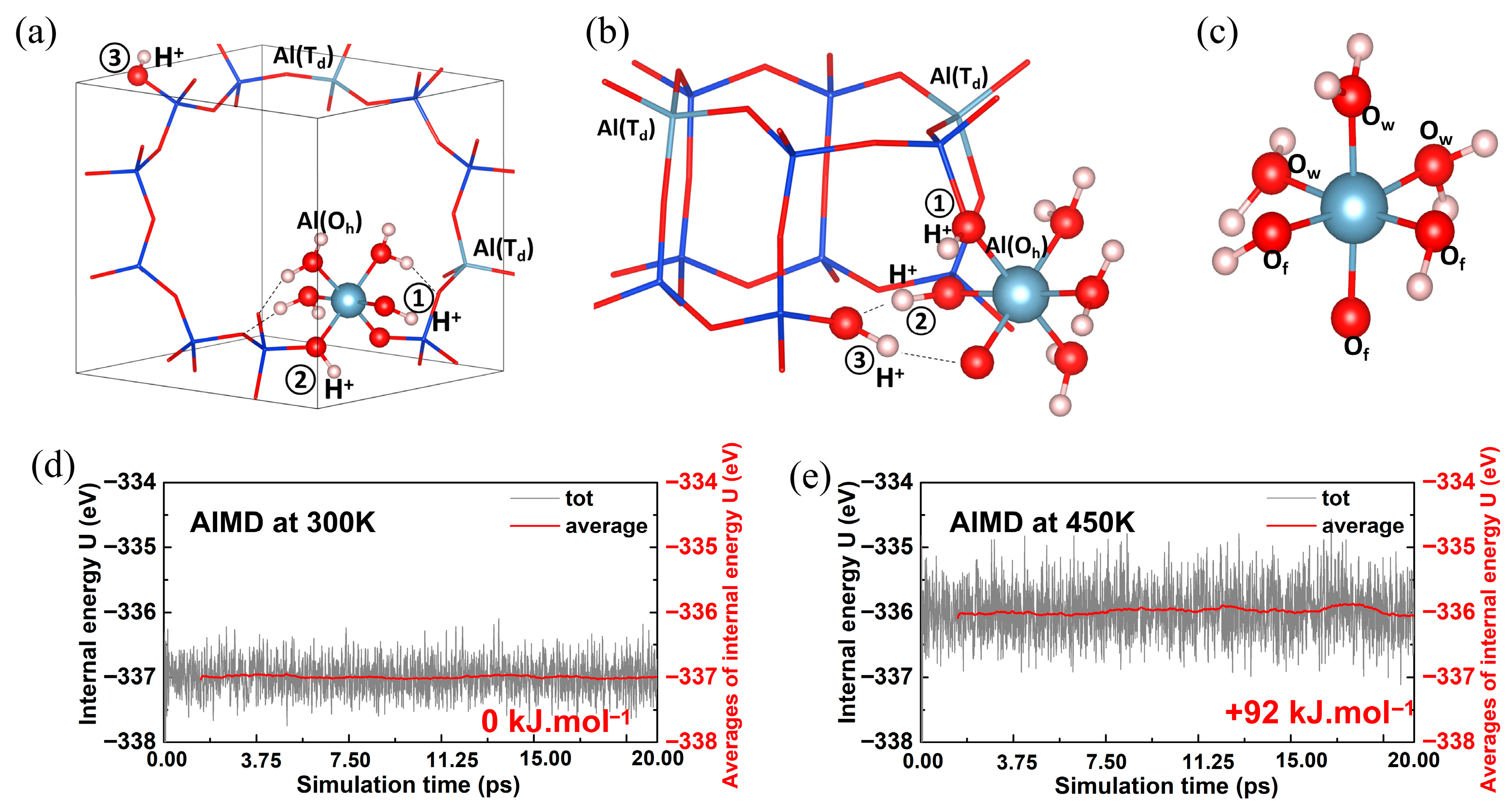
Figure 1. (a) The primitive cell of CHA and the structure of Al(Oh), in which the positions of all three protons are displayed and labeled as H+-1, H+-2, and H+-3. (b) The structure formed in the D6R in CHA zeolite, (c) The cluster showing the octahedral arrangement of the central Al atom. (Si: blue, Al: cyan, O: red, H: pink). (d,e) The AIMD trajectories with running averages for the Al(Oh) structure described at 300 K and 450 K, respectively. Energy averages from AIMD are in red color.
Catalysts 16 00440 g001
Figure 2. The AIMD energy trajectories with relative running averages for the structures of one Cu+ exchange with one H+. (a,b) The proton H+-1 and the proton H+-2, respectively.
Catalysts 16 00440 g002
Figure 3. (ad) The optimal configurations after single proton-cation exchange on the Al(Oh) for the cations Cu+, Li+, Na+, and NH4+, respectively.
Catalysts 16 00440 g003
Figure 4. (a) The AIMD trajectory with relative running averages of internal energy for the system involving the exchange of two Li+ with two H+. (b) The configurations at 7.5 ps and 15 ps, respectively.
Catalysts 16 00440 g004
Figure 5. (ad) The optimal configurations after the exchange of two cations with two protons on the Al(Oh) for the cations Cu+, Li+, Na+, and NH4+, respectively.
Catalysts 16 00440 g005
Figure 6. The total and partial density of states (DOS/PDOS) for the Al(Oh) (top panel), exchange of one H+ by one NH4+ ion (middle panel), and the exchange of two H+ by two NH4+ ions (bottom panel), respectively. The black line in each panel denotes the total DOS; the red, blue, and pink lines represent the H+-1, H+-2, and H+-3, respectively. All PDOS data are multiplied by 100 to improve visibility. When the NH4+ exchanges the H+ at the corresponding position, the original color scheme is retained.
Catalysts 16 00440 g006
Figure 7. Schematic overview of the proton-cation exchange in zeolite. The cation is displayed in red color, the proton in pink, the framework atoms in black, and the water in blue.
Catalysts 16 00440 g007
Table 1. Detachment energies of individual water molecules from the Al(Td)_2M+ structures. (see Equation (1)).
(kJ·mol−1)
Removal of
2H+ → 2Cu+
Catalysts 16 00440 i001
2H+ → 2Li+
Catalysts 16 00440 i002
2H+ → 2Na+
Catalysts 16 00440 i003
2H+ →2 NH4+
Catalysts 16 00440 i004
water no. 1108113108107
water no. 21248985104
water no. 3217140133121
Disclaimer/Publisher’s Note: The statements, opinions and data contained in all publications are solely those of the individual author(s) and contributor(s) and not of MDPI and/or the editor(s). MDPI and/or the editor(s) disclaim responsibility for any injury to people or property resulting from any ideas, methods, instructions or products referred to in the content.