Article

Enhanced Catalytic Performance of Red Mud for Toluene Oxidation via Acid Pretreatment-Induced Structural Modification


1
Key Laboratory of Beijing on Regional Air Pollution Control, College of Environmental Science and Engineering, Beijing University of Technology, Beijing 100124, China
2
College of Resources and Environmental Engineering, Guizhou Institute of Technology, Guiyang 550025, China
*
Author to whom correspondence should be addressed.
Catalysts 2026, 16(5), 425; https://doi.org/10.3390/catal16050425
Submission received: 5 April 2026 / Revised: 23 April 2026 / Accepted: 30 April 2026 / Published: 4 May 2026
(This article belongs to the Special Issue Heterogeneous Catalysis in China: New Horizons and Recent Advances)

Abstract

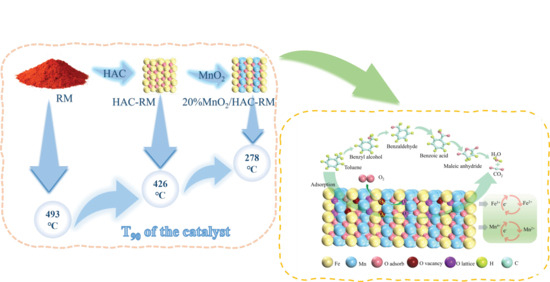
Red mud (RM), a metal oxide-rich solid waste, was subjected to three different acid treatments to evaluate its catalytic performance in toluene oxidation. The acetic acid-modified red mud (HAC-RM) demonstrated excellent catalytic activity, achieving complete toluene conversion at 450 °C. XRD, XRF, N2-BET and SEM results show acetic acid treatment can effectively remove pore-blocking inert components such as Na2O and CaO, thus increased the Fe2O3 content, and significantly enhanced both the specific surface area and pore size of the catalyst. Furthermore, this modification enhanced reducibility and generated additional oxygen vacancies, verified by H2-TPR and O2-TPD, thereby improving the overall catalytic performance. In contrast, oxalic acid treatment under ultraviolet irradiation led to the formation of calcium carbonate via reaction with Ca2+ ions in RM, which resulted in reduced catalytic activity. To further enhance performance, MnO2 was loaded onto the modified HAC-RM via an impregnation method to develop a low-cost and highly active catalyst. Among the prepared samples, 20%MnO2/HAC-RM exhibited the highest catalytic efficiency, achieving 100% toluene conversion at 300 °C. XPS, H2-TPR, and O2-TPD results indicate the synergistic interaction between Fe2O3 and MnO2 facilitated electron transfer and enhanced surface oxygen mobility. Additionally, the catalytic oxidation mechanism of 20% MnO2/HAC-RM was elucidated. A detailed reaction pathway for toluene degradation is proposed by in situ DRIFT, as follows: toluene → benzyl alcohol → benzaldehyde/benzoyl peroxide → benzoate → CO2 and H2O. These findings are expected to contribute to the development of efficient, sustainable, and cost-effective catalysts for volatile organic compound (VOC) abatement.

Graphical Abstract

1. Introduction

Volatile organic compounds (VOCs) are a group of organic chemical substances characterized by their pronounced vapor pressure at ordinary room temperature, resulting in significant emissions into the atmosphere and posing serious threats to health and the environment [1]. Toluene is a prevalent volatile organic compound, commonly generated from manufacturing processes, vehicle exhaust emissions, and consumer products, and is typically used as a solvent [2,3]. However, long-term inhalation may cause serious health effects, including nerve damage, respiratory problems, and carcinogenicity. Moreover, when toluene enters the atmosphere, it triggers photochemical reactions, destroys the ozone layer within the stratospheric layer, increases the quantity of UV light that arrives at the planet’s surface, and thereby gravely damages the skin, eyes, and immune function [4]. Therefore, effective removal of VOCs from the environment is crucial for public health and ecological integrity.
Compared with traditional treatment methods such as adsorption, thermal incineration, and biofiltration, catalytic oxidation now stands as an attractive technique for VOC abatement [5,6,7], owing to its ability to operate at lower temperatures and completely mineralize organic pollutants into non-toxic by-products, such as CO2 and H2O [6,8,9,10]. Up to now, most of the high-performance catalysts used in catalytic oxidation contain precious metals like platinum (Pt) and palladium (Pd), but the elevated expense and poor thermal stability of these metals restrict their broad applications [11]. Therefore, the development of highly active, low-cost, and good thermal stability catalysts, especially those made from abundant and inexpensive materials, has attracted increasing attention.
Red mud (RM), which acts as a strongly alkaline industrial solid waste during the process of aluminum oxide production [12,13], is difficult to utilize effectively. It is composed primarily of metal oxides including iron oxides (Fe2O3), aluminum oxides (Al2O3), titanium oxides (TiO2), and sodium oxides (Na2O). Due to its high iron oxide content, RM exhibits inherent catalytic potential, making it a prospective candidate for application as a catalyst or catalyst support in various chemical reactions, including pyrolysis [14], catalytic cracking of tar model compounds [15], hydrodeoxygenation [15], air [16] and steam [17] gasification, and other thermal biomass conversion processes where it functions as a basic catalyst, as well as in the catalytic oxidation of VOCs [18,19,20].
The challenges associated with using RM as a catalyst include its low specific surface area, excessive alkalinity, and high sodium content. These factors may lead to sintering phenomena and reduce the availability of active sites. To address these intrinsic drawbacks, ongoing studies aim to devise efficient pretreatment methods for RM to enable its utilization across diverse domains. In particular, acid treatment is a prevalent pretreatment method for RM, with demonstrated efficacy in driving performance enhancement. Many studies have shown that acid-pretreated RM possesses superior distribution as well as accumulation capacity for iron oxides, which is indispensable for the catalytic reaction course [21]. Because the acid treatment can effectively remove alkaline impurities, it can thereby reduce the alkalinity of the catalyst. Compared to inorganic acids, the treatment of RM with organic acids demonstrates significant advantages in terms of environmental sustainability and targeted extraction. The mild acidity and complexing capabilities of organic acids enable the selective leaching of valuable metals (such as iron, aluminum, and rare metals) while effectively inhibiting the formation of silica gel, thereby substantially improving the efficiency of subsequent solid–liquid separation. Furthermore, the biodegradable nature of organic acids reduces the risk of secondary pollution, and their low corrosiveness ensures safer operations, offering an environmentally friendly approach to the resource utilization of RM. Duan et al. [22] demonstrated that acetic acid can be used to modify RM and prepare catalysts for the catalytic hydrogenation and dehydrogenation of palmitic acid, achieving 81% selectivity for hexadecane and maintaining a high conversion rate for up to 400 h. Cai et al. [23] discovered that, after pretreatment with citric acid, the surface morphology of RM changed significantly, and the Na+ in RM was leached out, effectively reducing the alkalinity of the RM. Hence, different types of acid-modified catalysts can each enhance catalyst performance to varying degrees. However, the influence of different organic acid types on modified RM catalysts—particularly regarding specific surface area, synergistic metal site effects, and redox properties in toluene degradation—remains underexplored.
Therefore, this investigation explored the impact of various acid kinds on the catalytic performance of the treated RM catalysts. In particular, the impacts of various acid kinds on the structural, textural, and redox characteristics of the RM catalysts were systematically examined by many characterizations and by experiment analysis. After transition metal Mn was loaded on the optimal acid-modified RM, the synergistic effect was further elucidated by using the activity tests and characterization methods. The reaction mechanism for toluene oxidation over the Mn-loaded catalyst was elucidated through in situ DRIFTS analysis. The obtained results not only effectively realized the resource utilization of RM, but more importantly, they proposed a novel synthesis and modification method of RM, which is crucial for the development of advanced catalysts in VOC oxidation.

2. Results and Discussion

2.1. Toluene Catalytic Properties of Different RM Materials

The catalytic activity of acetic acid, citric acid, and ultraviolet-assisted oxalic acid-modified RM against toluene was tested in Figure 1a; the sequence is as follows: HAC-RM > CA-RM > OA-RM > RM. Compared with raw RM, the catalytic performance of three acid-treated RM catalysts toward toluene is greatly enhanced, and the toluene conversion rises as the reaction temperature elevates. The T50 and T90 of raw RM are 420 °C and 495 °C, while The T50 and T90 of HAC-RM are 360 °C and 425 °C, respectively. Compared to raw RM, the T90 of HAC-RM is reduced by 70 °C, and the conversion rates of toluene reach 57.7% and 100% over RM and HAC-RM at 450 °C, respectively, an increase of 42.3%. In addition, the catalytic performance of HAC-RM outperforms that of CA-RM and OA-RM, which arises from the fact that negative ions derived from citric acid are capable of interacting with metal ions in the liquid phase, which may generate solid precipitates including CaHCit, AlCit or NaH2Cit [24]. The presence of solid salts leads to an uneven distribution of Fe2O3 in the RM [22]. However, after oxalic acid modification of RM, a large quantity of calcium exists in the form of CaCO3 precipitation, which results in the decline of the catalytic performance of HAC-RM catalyst and CA-RM catalyst. In the previous research, the influence of calcium content on the performance of RM catalyst was simulated, and it was found that, when the content of Ca > 10%, it has a significant impact on the activity [25]. Hence, considering the catalytic activity and the effect of acid on RM comprehensively, HAC is the most suitable acid type.
The CO2 selectivity is shown in Figure 1b. The selectivity of CO2 on the OA-RM, CA-RM, HAC-RM is 75%, 80% and 83%, respectively. In contrast to the untreated RM without acid pretreatment, the selectivity of CO2 has increased. This is because, after strong acid treatment, the RM carrier becomes finer and more dispersed, the amount of pores in the catalyst increases, the pore structure becomes more abundant, and the connectivity between pores becomes smoother [26]. Weak acids can retain as much as possible the oxide components in RM, such as Al2O3, Fe2O3, etc. [22]. More alkaline earth species like Ca and Na are effectively eliminated. The constituents of RM are homogeneously distributed and there are ample and consistent micropores. Under the reaction thermal level of 450 °C and the toluene influent concentration of 1000 mg/m3, the stability of the catalyst was also conducted. As shown in Figure 1c, during the 48 h stability test at 450 °C, there was no phenomenon of deactivation or deterioration, indicating that the HAC-RM catalyst has excellent stability. When the conversion rate reaches 100%, the selectivity of CO2 is only 83%. It can be inferred that at this temperature, some intermediate products will enter the gas phase. Thus, it can be deduced that toluene adsorbed on oxygen vacancies can be oxidized into an intermediate product at low temperatures, and further oxidized into CO2 and H2O at high temperatures. Therefore, the best temperature for the catalyzed oxidation of toluene not only depends on the catalytic conversion performance of toluene but also on the CO2 selectivity.

2.2. The Influence of MnO2 Content on the Catalytic Oxidation Activity of Toluene by MnO2/HAC-RM Catalyst

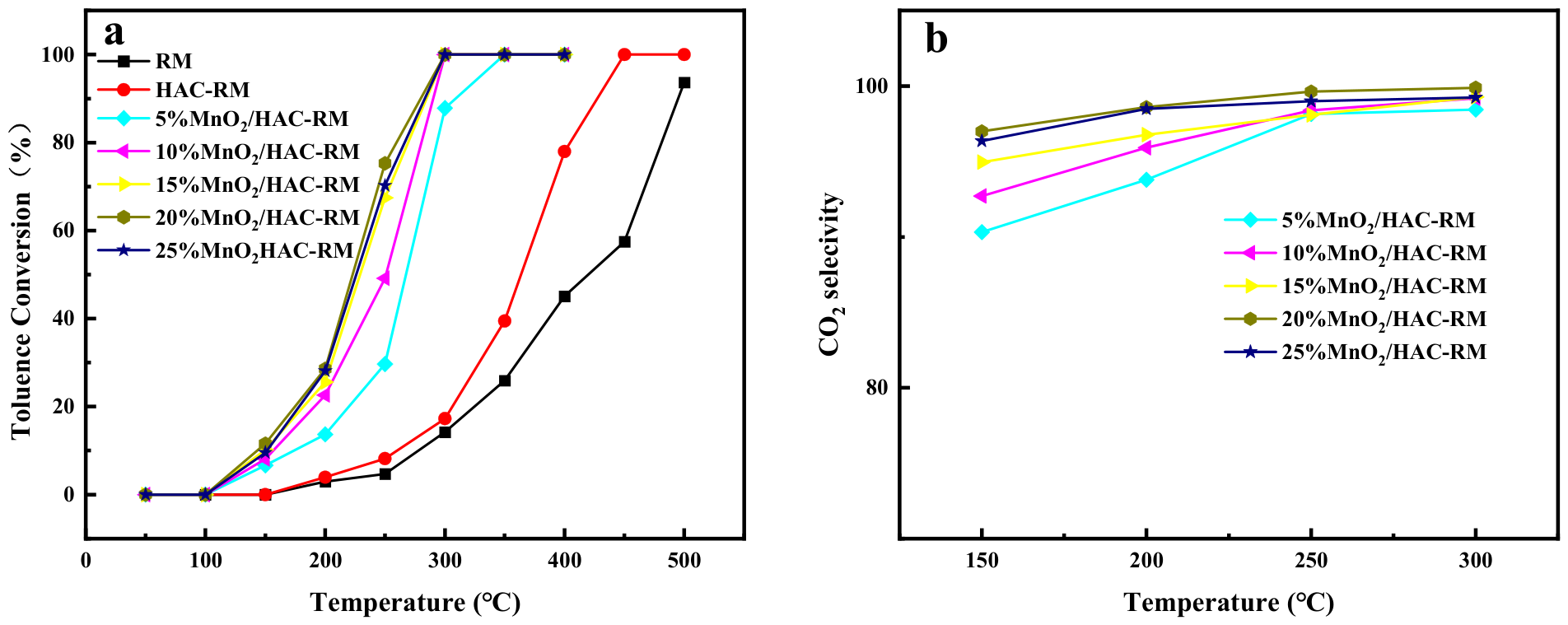
As shown in Figure 2a, the catalytic activity of the original RM is very poor. Under a thermal level of 500 °C, the catalytic efficiency is 94%. The RM, owing to its high basicity and intricate phase constitution, is unable to be straightforwardly employed as a catalytic agent. Therefore, it needs to undergo dealkalization treatment. After modifying the RM, the catalytic efficiency has significantly improved. At a temperature of 450 °C, the catalytic efficiency reaches 100% over HAC-RM. After loading MnO2 onto the modified HAC-RM, the catalytic activity of the x%MnO2/HAC-RM catalyst has significantly increased compared to the modified RM. The T10, T50, and T90 of the MnO2/HAC-RM catalyst are significantly lower than those of HAC-RM, and the catalytic efficiency has been significantly improved. The conversion rate of toluene in the HAC-RM catalyst is about 0% in the temperature range of less than 200 °C. However, after loading MnO2, the catalyst begins to convert toluene at 150 °C, and the toluene conversion rates of 5% MnO2/HAC-RM, 10% MnO2/HAC-RM, 15% MnO2/HAC-RM, 20% MnO2/HAC-RM, and 25% MnO2/HAC-RM are 29%, 49%, 67%, 75%, and 70% at 250 °C, respectively. The overall catalytic performance of catalysts exhibits the sequence of 20% MnO2/HAC-RM > 25% MnO2/HAC-RM > 15% MnO2/HAC-RM > 10% MnO2/HAC-RM > 5% MnO2/HAC-RM.
To investigate the correlation between the catalyst and CO2 selectivity, a further analysis was conducted on toluene and CO2 under reaction temperature, as illustrated in Figure 2b. The results show that the trend of CO2 selectivity aligns with the catalyst activity trend. The 20% MnO2/HAC-RM catalyst exhibited the highest CO2 selectivity, reaching 100% at 300 °C. These findings further indicate that the optimal temperature for catalytic oxidation of toluene is determined not only by the catalytic efficiency of toluene but also by the selectivity toward CO2.

2.3. The Influence of Operating Conditions on the Catalytic Oxidation Performance of Toluene by 20% MnO2/HAC-RM Catalyst

2.3.1. Influence of Reaction Velocity on the Activity of the Catalyst

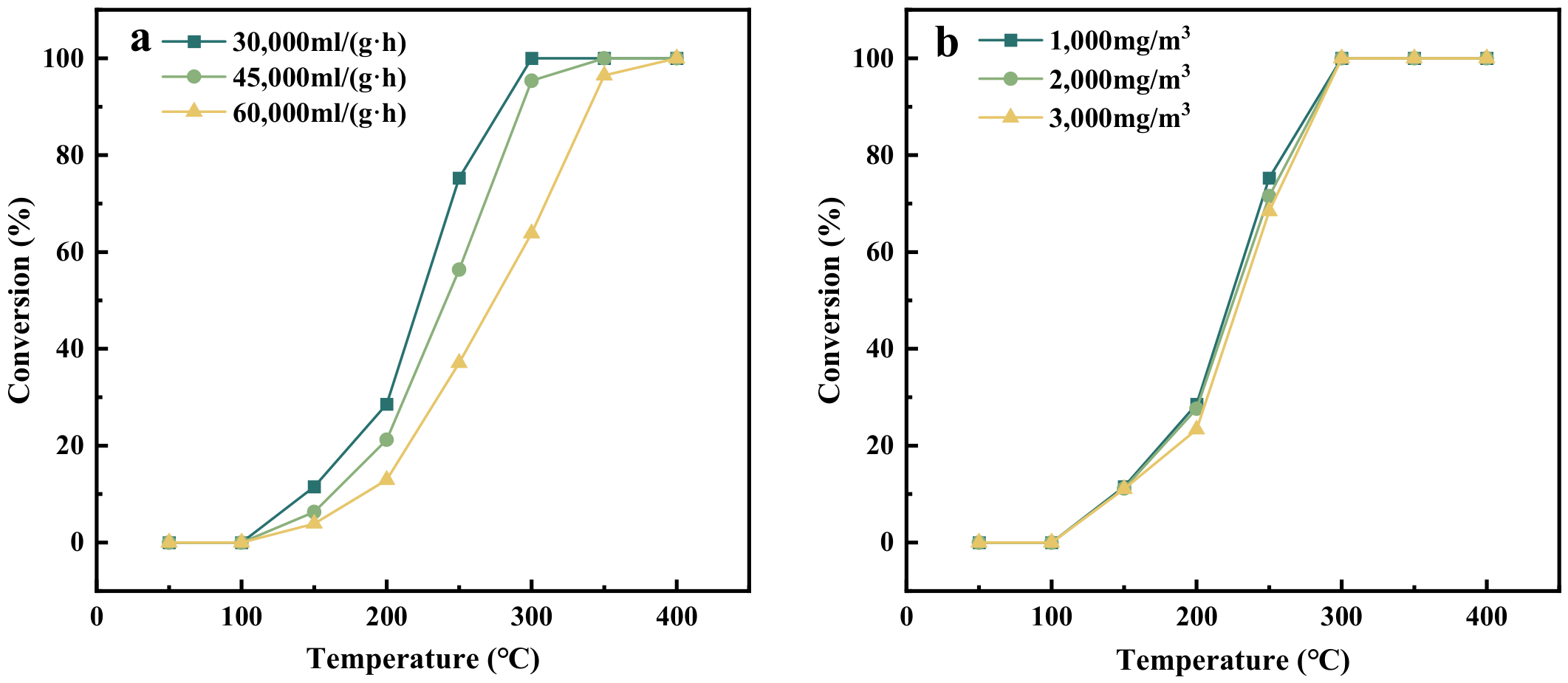
The influence of different reaction velocities on the catalytic activity was further investigated over the optimal 20% MnO2/HAC-RM catalyst, as shown in Figure 3a. It can be seen that the reaction velocity has a significant impact on the catalytic oxidation activity. Within the reaction velocity increasing from 30,000 to 60,000 mL/(g·h), the catalytic efficiency of 20% MnO2/HAC-RM gradually decreases. This is because the rise in reaction velocity reduces the residence time of pollutants in the reactor, resulting in a shorter interaction period of the pollutants with the catalyst. Some molecules do not have enough time to be retained onto the catalyst surface prior to leaving the reactor. From another perspective, the increase in reaction velocity indicates an increase in the number of pollutant molecules entering the catalytic reactor per unit time, which in turn leads to an increase in the load on the catalyst, resulting in a decrease in the conversion rate of toluene [27]. Although the increase in reaction velocity leads to a more significant decrease in the catalytic activity of the catalyst for toluene, when the reaction velocity reaches 60,000 mL/(g·h), toluene can still be almost completely degraded at 400 °C, indicating that the 20% MnO2/HAC-RM catalyst still maintains a relatively high catalytic activity at a higher reaction velocity.

2.3.2. Impact of Toluene Concentration on Catalyst Activity

The effects of various toluene concentrations levels on the catalytic performance of 20% MnO2/HAC-RM catalyst under an air velocity of 20,000 mL/(g·h) were also investigated. Figure 3b displays that the toluene conversion rate under different toluene concentrations all rose alongside the elevation of reaction temperature. However, at the same reaction temperature, as the toluene concentration rose starting at 1000 mg/m3 and reaching 3000 mg/m3, the catalytic activity of the catalyst for toluene gradually decreased. When the toluene concentration was 1000 mg/m3, 2000 mg/m3 and 3000 mg/m3, the toluene conversion rates were 75%, 71% and 68.0% at 250 °C, respectively. This is because, when the toluene concentration is high, the quantity of toluene molecules entering the catalytic reactor per unit time increases, while the count of active sites on catalyst remains constant, and the count of toluene molecules processed by the catalyst per unit time decreases, thereby reducing the catalytic performance of the catalyst slightly. Although the toluene concentration increased by three times from 1000 mg/m3 to 3000 mg/m3, the temperature required for complete toluene conversion was still 300 °C, indicating that the 20% MnO2/HAC-RM catalyst can still effectively oxidize toluene within a wide range of toluene concentrations and maintains a high catalytic activate.

2.4. Characterization Analysis

2.4.1. Structure and Morphology

The chemical compositions of RM and the acid-modified RM were performed using XRF analysis. The comprehensive findings are shown in Table 1. In the RM, the contents of five oxides, namely Al2O3, Fe2O3, SiO2, CaO and Na2O, amount to as high as 90.83%. Among them, the content of the active component, Fe2O3, in raw RM sample is 15.88%, while the Al2O3, SiO2, CaO and Na2O are 25.41%, 19.59%, 18.97% and 10.98%, respectively. After acid treatment, the content of Na significantly decreased, while the contents of Fe, Al, and Si significantly increased. Since the oxides of Na and Ca would cause the catalyst to sinter at high temperatures, blocking the pores of the catalyst and reduce its activity [28,29]. In previous studies, it was found that, when the content of Ca was greater than 10%, the activity of the catalyst would significantly decrease [30]. Particularly, in HAC-RM and CA-RM, the content of Ca was both less than 10%, so it can be considered that Ca has a relatively small influence on these two catalysts. During the acid washing process, citric acid forms some metal salt compounds through complexation, which can significantly erode the overall structure of RM, leading to the dissolution and washing away of other components (especially Al2O3 and SiO2, which serve as the carrier framework). In the HAC-RM catalyst, the content of SiO2 is relatively high, providing more structural support for Fe2O3, enabling Fe2O3 to be more evenly distributed on the support and forming more active sites. Although CA-RM possesses the highest Fe2O3 content among the acid-treated samples, its catalytic activity is not the highest. This is because the strong complexation of citric acid leads to Fe2O3 particle agglomeration and a less favorable pore structure, which limits reactant diffusion and active site accessibility. In contrast, HAC-RM exhibits a well-balanced composition: a moderate Fe2O3 content, a relatively high SiO2 content that serves as a structural support to disperse Fe2O3 evenly, and a CaO content below 10% to avoid sintering. HAC-RM achieves the best catalytic performance. Thus, the optimal activity of HAC-RM is attributed to the synergy between chemical composition and porous architecture, rather than Fe2O3 content alone. Therefore, the treatment of RM with acetic acid has a good effect on the catalytic oxidation of toluene.
Compared with pristine HAC-RM support, the XRF results of 20%MnO2/HAC-RM further reveal the variation in elemental composition after manganese oxide loading. The introduction of Mn species markedly raises the relative proportion of active components in the catalyst system. Meanwhile, the low residual contents of Ca and Na are still maintained, which effectively avoids high-temperature sintering and pore blockage caused by alkaline earth oxides. The abundant SiO2 skeleton derived from acid modification continuously provides stable structural support, realizing the high dispersion of both intrinsic Fe2O3 and loaded MnO2 active species. The synergistic effect between iron-based active sites and manganese-based active sites optimizes the overall surface active centers of the catalyst. Consequently, the reasonable elemental distribution, favorable component synergy and stable framework structure endow 20%MnO2/HAC-RM with superior catalytic performance among all samples, followed by pure HAC-RM.
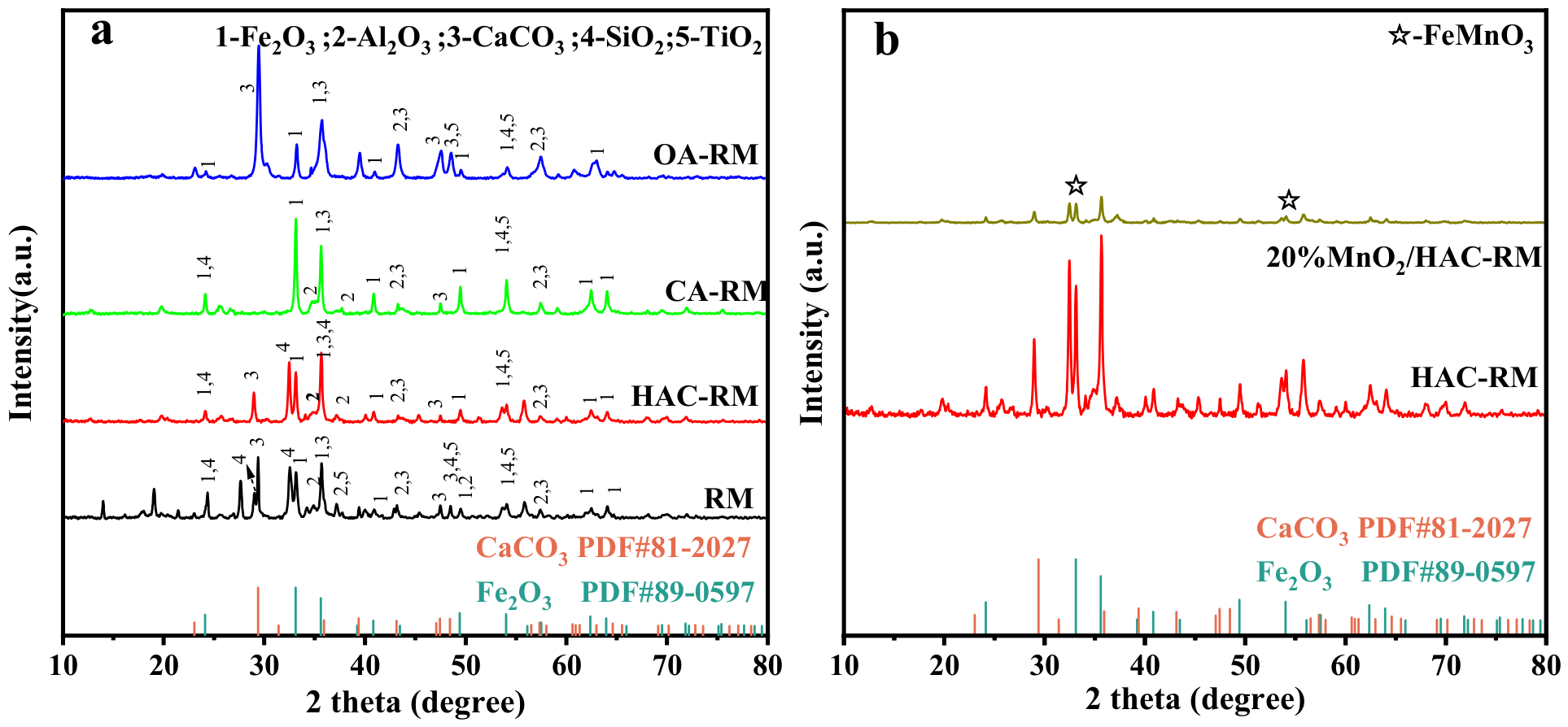
Figure 4a displays the XRD profiles of RM and various acid-pretreated RMs. The mineralogical constitution of RM corresponds to calcite (CaCO3), hematite (Fe2O3), sodium silicate (AlNa(SiO4)), water calcium aluminosilicate (Ca2.93Al1.97(Si0.64O2.56)(OH)9.44), tricalcium aluminate (Al(OH)3), anatase and rutile type (TiO2), quartz (SiO2), and goethite (FeO(OH)). This is consistent with the data obtained by XRF (X-ray fluorescence). Compared with the RM catalyst, no diffraction peaks of alkaline components were observed in the HAC-RM, CA-RM, and OA-RM catalysts. Clear diffraction peaks appeared at 24.1°, 33.1°, 35.6°, 39.2°, 49.4°, 54.0°, 57.5°, 62.3°, and 63.9°, and the peak positions were not shifted, which can be assigned to the reflection of α-Fe2O3, indexed to the (012), (104), (110), (006), (024), (116), (018), (214), and (300) lattice planes. This indicates that the dominant crystalline phase following clay treatment is α-Fe2O3. The acid-treated RM catalyst shows a stronger Fe2O3 peak, indicating that acid treatment improves the crystallinity of RM. Effective carrier components alumina (Al2O3), anatase (TiO2), and quartz (SiO2) display essentially unaltered diffraction maxima, revealing that the clay catalyst after acid treatment is fundamentally composed of active species and supports favorable carrier for catalytic oxidation processes, free from alkaline components constituents that are harmful to the catalytic reaction. This is desirable because it is found that the iron content in RM is beneficial in the catalytic reaction. The XRD pattern of the OA-RM catalyst reveals a more pronounced reflection for calcium carbonate, which agrees well with the XRF findings.
As shown in Figure 4b (based on the catalytic activity results, the 20%MnO2/HAC-RM catalyst showed the highest toluene conversion; thus, it was selected as the representative sample for further characterization to investigate the structure–activity relationship), after HAC-RM was loaded with 20% MnO2, the diffraction peak intensity of α-Fe2O3 weakened, and a new diffraction peak MnFe2O4 appeared. This is because parts of Fe2O3 entered the MnO2 lattice to form a solid solution, indicating that the introduction of Mn in 20% MnO2/HAC-RM catalyst led to the effective electron transfer between Mn and Fe species.
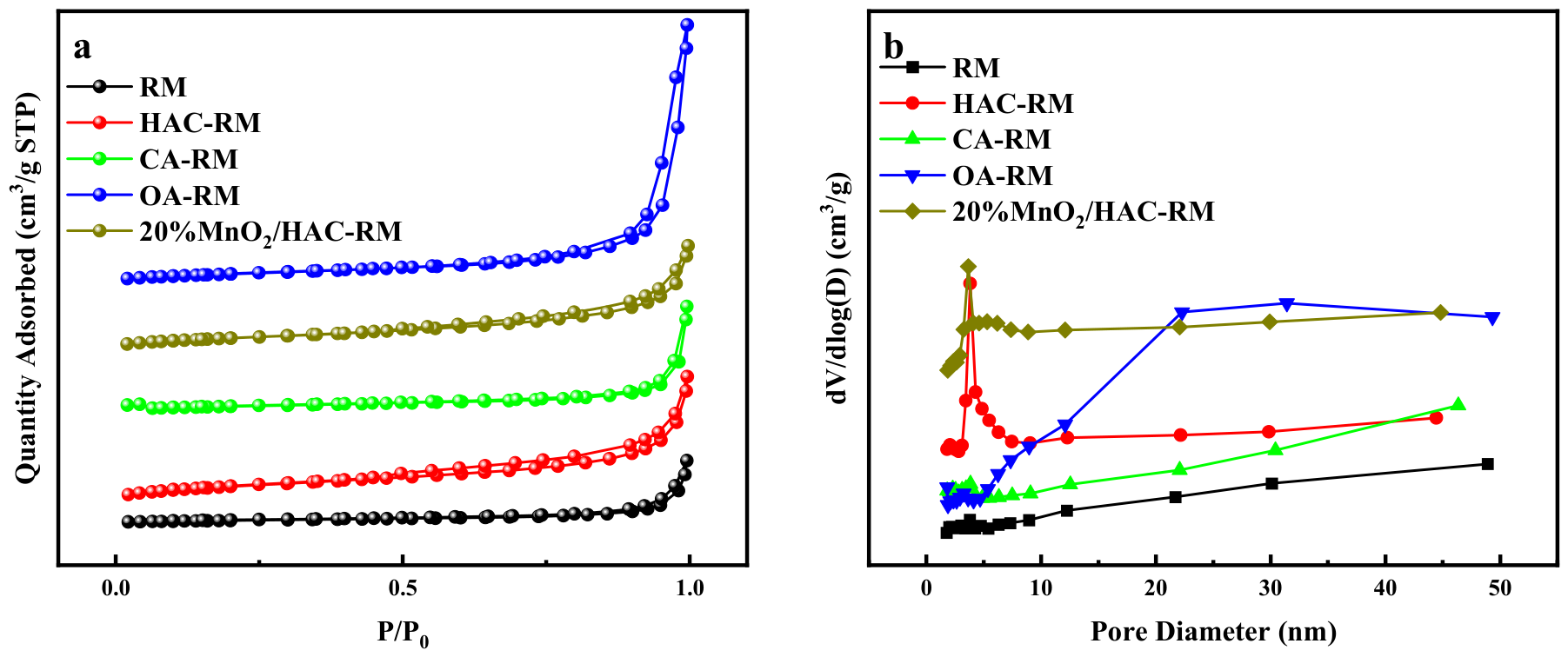
Figure 5a presents the N2 adsorption–desorption isotherms of RM, acid-modified RM, and 20%MnO2/HAC-RM, and their textural parameters are summarized in Table 2. All acid-modified specimens exhibit a similar characteristic type IV isotherm, with the hysteresis loop closing at a relative pressure (P/P0) of 0.4. The ring is closer to the H2-type hysteresis loop, suggesting that the acid-treated samples possess mesoporous structures [31]. The excellent pore structure can promote the adsorption and diffusion of toluene molecules, facilitating the catalytic reaction. This indicates that high catalytic performance is closely associated with a favorable pore structure. After acid pretreatment, the specific surface area and total pore volume of the catalysts increased, while the average pore diameter decreased slightly. This can be attributed to the acid pretreatment reducing certain metal ions that tend to promote particle agglomeration. Increasing the specific surface area of the catalyst can provide more active sites, thereby enhancing the catalyst’s activity. It is conducive to the contact between reactants and active sites. Additionally, the increase in pore volume and pore diameter can reduce the diffusion resistance within the pores, making it easier for reactants to infiltrate and fully utilize the active sites. This can enhance the catalyst’s activity.
Among the three acid-modified red muds, the HAC-RM catalyst has the largest specific surface area (57.94 m2/g). The OA-RM catalyst has the largest pore volume and pore diameter, due to the residual CaCO3. This also indicates that the HAC-RM catalyst can provide more reaction sites and contact areas, reduce the resistance in the diffusion-transport process, and facilitate the diffusion and catalytic oxidation of toluene molecules, thereby improving the catalytic activity of the catalyst, which is consistent with the following activity evaluation results of the toluene oxidation over RM catalysts. The adsorption capacity of the 20% MnO2/HAC-RM catalyst did not show any significant change, which also indicates that, after loading MnO2, the specific surface area and pore structure of the 20% MnO2/HAC-RM catalyst did not undergo significant changes.
Figure 5b shows the pore size distribution diagrams of the catalysts. The width of the peaks indicates that the pores are mainly distributed within the corresponding particle size range, and the narrower the peak shape, the more uniform the pore size; the peak value indicates that the proportion of pores with this size is the largest. Figure 2b reveals that the pore size distribution curve of CA-RM shows a relatively wide single peak within the range of approximately 10–50 nm, with the peak center located around 30 nm, indicating that its pore structure is mainly mesoporous, with a relatively concentrated but generally uniform pore size distribution. This pore structure may result from the dissolution and elution of alkaline components in RM by citric acid, forming channels mainly composed of mesopores within the particles. The pore size distribution of OA-RM shows a distinct bimodal feature: one peak is located in the micropore/small mesopore region smaller than 10 nm, and the other broader peak is in the meso-large mesopore range of 20–50 nm. This indicates that the oxalic acid treatment not only opens some micropores but also causes the formation of larger-sized channels, possibly due to the strong complexation ability and corrosive effect of oxalic acid, partially destroying the original framework of RM, resulting in a structure with coexisting multi-scale pores. In the catalytic oxidation reaction of toluene, the pore structure directly affects the mass transfer of reactants and the accessibility of active sites. Although CA-RM has a certain mesoporous structure, its pore size distribution is relatively single, which limits the diffusion efficiency of reactants in the pores; while OA-RM has multi-level pore characteristics, excessive acid treatment may lead to the loss or aggregation of some active groups, and too many micropores are prone to cause pore blockage due to carbon deposition during the reaction. The pore size distribution curve of 20% MnO2/HAC-RM is relatively close to that of HAC-RM, indicating that the loading of MnO2 has no significant effect on the pore structure of the catalyst. The 20% MnO2/HAC-RM catalyst still has abundant mesopores distributed in the 2–20 nm particle size range, and the particle size distribution of these mesopores is relatively uniform. These mesopore structures not only increase the specific surface area of the catalyst, but also reduce the mass transfer resistance of pollutant molecules through the catalyst, which benefits the enhancement of the catalyst’s catalytic performance.
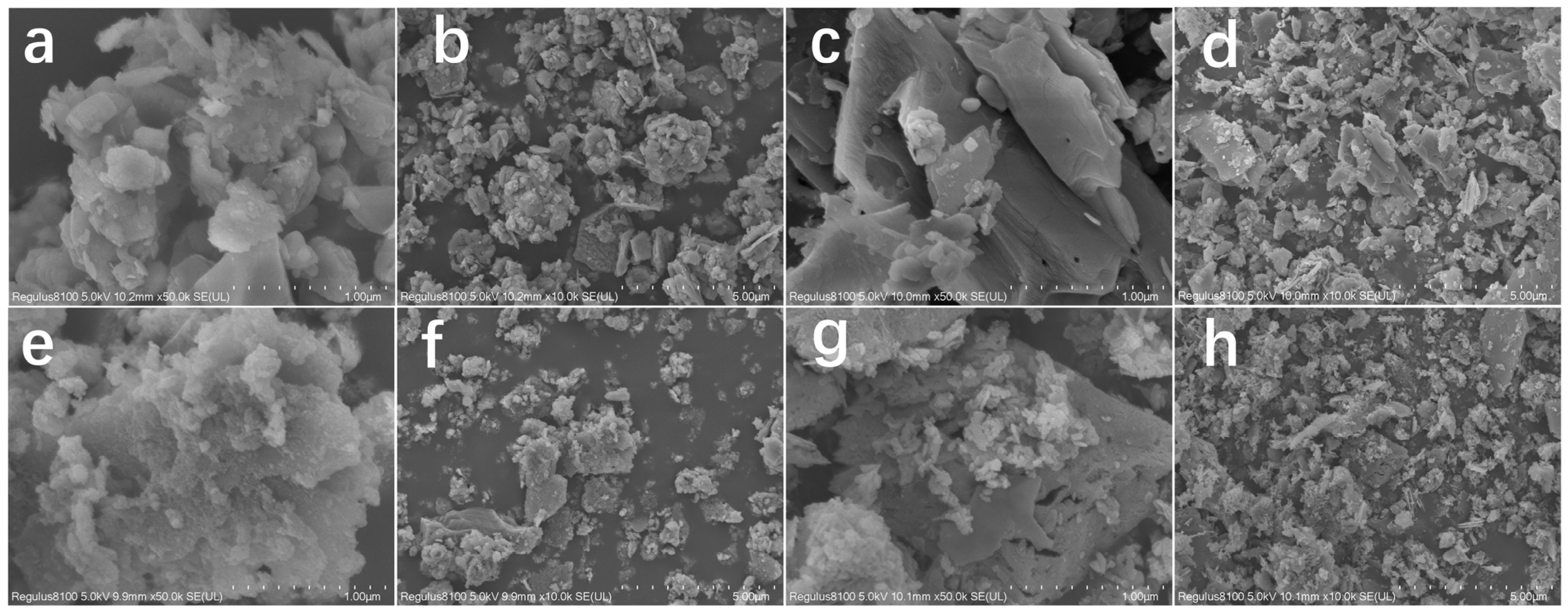
The morphological changes in the RM and acid-modified red mud samples were analyzed by SEM. Figure 6 shows the SEM images of RM (a,b), HAC-RM (c,d), CA-RM (e,f), and OA-RM (g,h) at 1 μm and 5 μm scales. The RM (Figure 6a,b) presented an irregular and agglomerated structure with a dense and compact surface, indicating a low porosity and limited accessibility of active sites. After acid treatment, significant morphological changes occurred. HAC-RM (Figure 6c,d) exhibited a relatively loose and porous morphology with well-dispersed particles and abundant inter-particle voids. This porous structure is conducive to reactant diffusion and provides a larger surface area for the dispersion of active components, which is consistent with its excellent catalytic performance. In contrast, CA-RM (Figure 6e,f) showed severe particle agglomeration and an uneven surface, which might be due to the strong chelating effect of citric acid promoting the sintering of Fe2O3 particles, resulting in an undesirable pore structure. The surface of OA-RM (Figure 6g,h) was partially covered by amorphous deposits, which might originate from residual organic species or re-precipitated phases. Overall, the SEM results indicated that acetic acid treatment (HAC-RM) could effectively disrupt the dense structure of the raw red mud, forming a porous and well-dispersed morphology, while citric acid (CA-RM) and oxalic acid (OA-RM) treatments led to varying degrees of agglomeration or surface coverage, further explaining the reason why HAC-RM had the best catalytic activity.

2.4.2. Chemical Properties of Catalysts

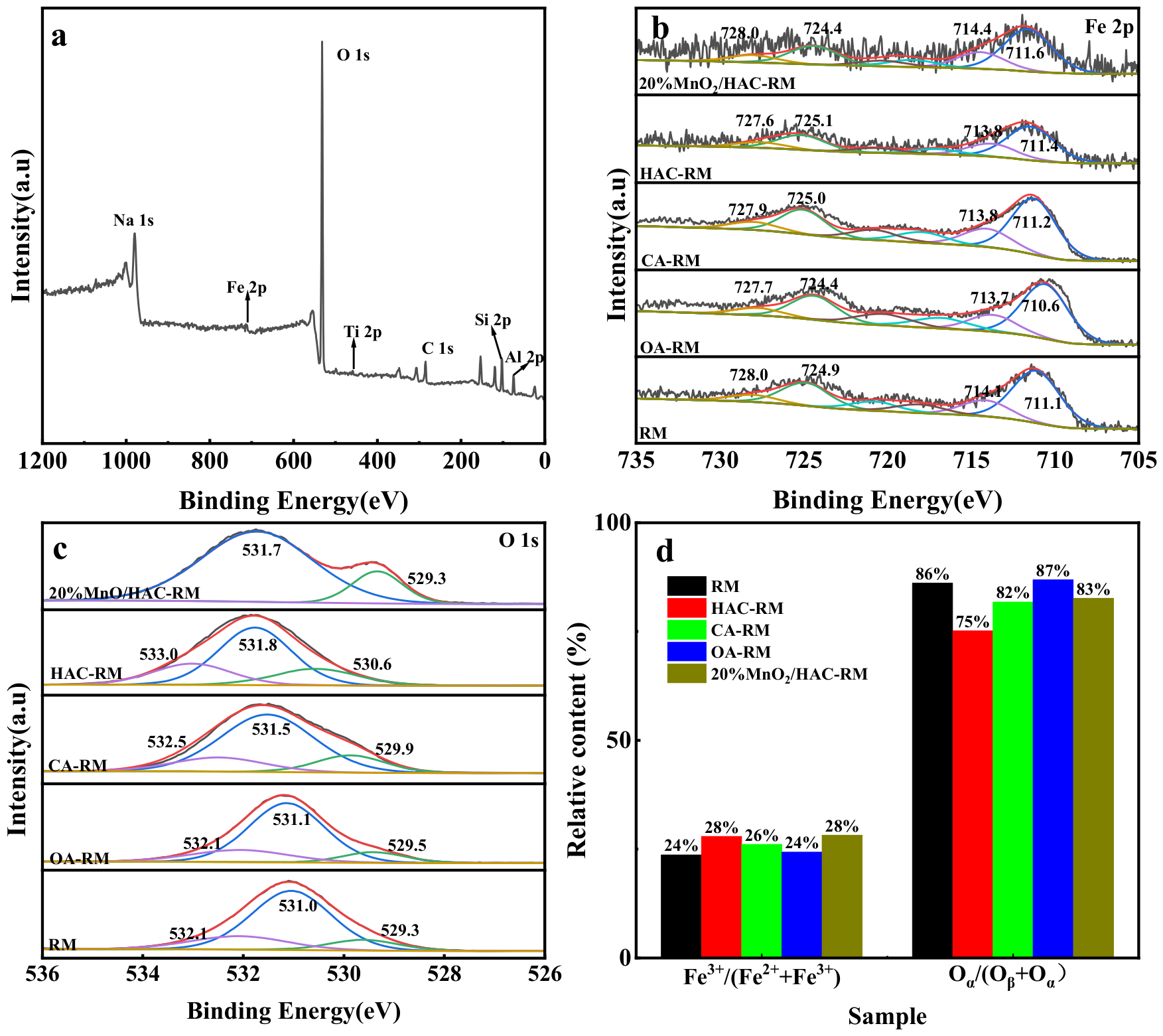
XPS was employed to investigate the content and oxidation state various of ions on the catalyst surface. Figure 7a presents the full spectrum of the HAC-RM sample, indicating that the catalyst surface contains elements such as C, Al, Fe, Si, Ti, and O, which is consistent with the XRF results. Figure 6b depicts the XPS spectrum of Fe 2p. The peaks at 711.1 eV and 724.9 eV are attributed to Fe2+ species, while the peaks at 714.1 eV and 728.0 eV are assigned to Fe3+ species [32,33]. Satellite peaks of Fe 2p3/2 and Fe 2p1/2 are observed in Figure 7b. The molar proportion of Fe3+ to Fe2+ exhibits the sequence: HAC-RM (0.39) > CA-RM (0.35) > OA-RM (0.32) > RM (0.31). As shown in Figure 7d, compared with RM, the HAC-RM surface has more Fe3+ species, and the increase in the surface Fe3+ concentration inhibits the adsorption of oxygen-containing compounds and the formation of carbonaceous deposits [34]. After loading 20% MnO2, there are more Fe3+ species, which is because the loaded metal facilitates the conversion of Fe2+ to Fe3+.
Figure 7c presents the O 1s spectra of the catalysts. In both the RM and acid-modified RM, the peaks observed at 529.3 eV, 529.5 eV, 529.9 eV, and 530.6 eV are attributed to surface lattice oxygen species (Oβ) in the catalyst [35]. The peaks located at 531.0 eV, 531.1 eV, 531.5 eV and 531.8 eV are assigned to adsorbed oxygen (Oα) [36]. The remaining signals are assigned to bound oxygen linked to hydroxyl groups, adsorbed water, and carbonate compounds. Adsorbed oxygen, featured by its coordinative undercoordination, represents one of the most active oxygen species participating in oxidation processes and makes a favorable contribution to catalytic activity [37]. As indicated in Figure 7d, the proportion of Oβ increased from 13.89% to 24.80%, suggesting that acid pretreatment led to an increase in oxygen vacancies. The presence of oxygen vacancies enhances the adsorption energy of reactants on the catalyst surface, thereby reducing the reaction energy barrier, facilitating molecular activation, and generating synergistic effects with adjacent active metal sites [38]. From Figure 7d, the Oα/(Oβ+ Oα) ratio in HAC-RM is 75%, indicating that the acetic acid treatment effectively removes alkaline impurities while maintaining the integrity of the iron oxide lattice structure and reducing the generation of surface disordered oxygen species. Additionally, the acetic acid treatment may lead to the removal or transformation of some surface hydroxyl groups, further reducing the relative content of Oα. The O 1s peak of the 20% MnO2/HAC-RM catalyst was decomposed into a 529.3 eV lattice oxygen peak and a 531.7 eV adsorbed oxygen peak (Oα). After loading MnO2, the Oα/Oβ ratio increased, which may be due to the introduction of MnO2 increasing surface defects and promoting oxygen adsorption.
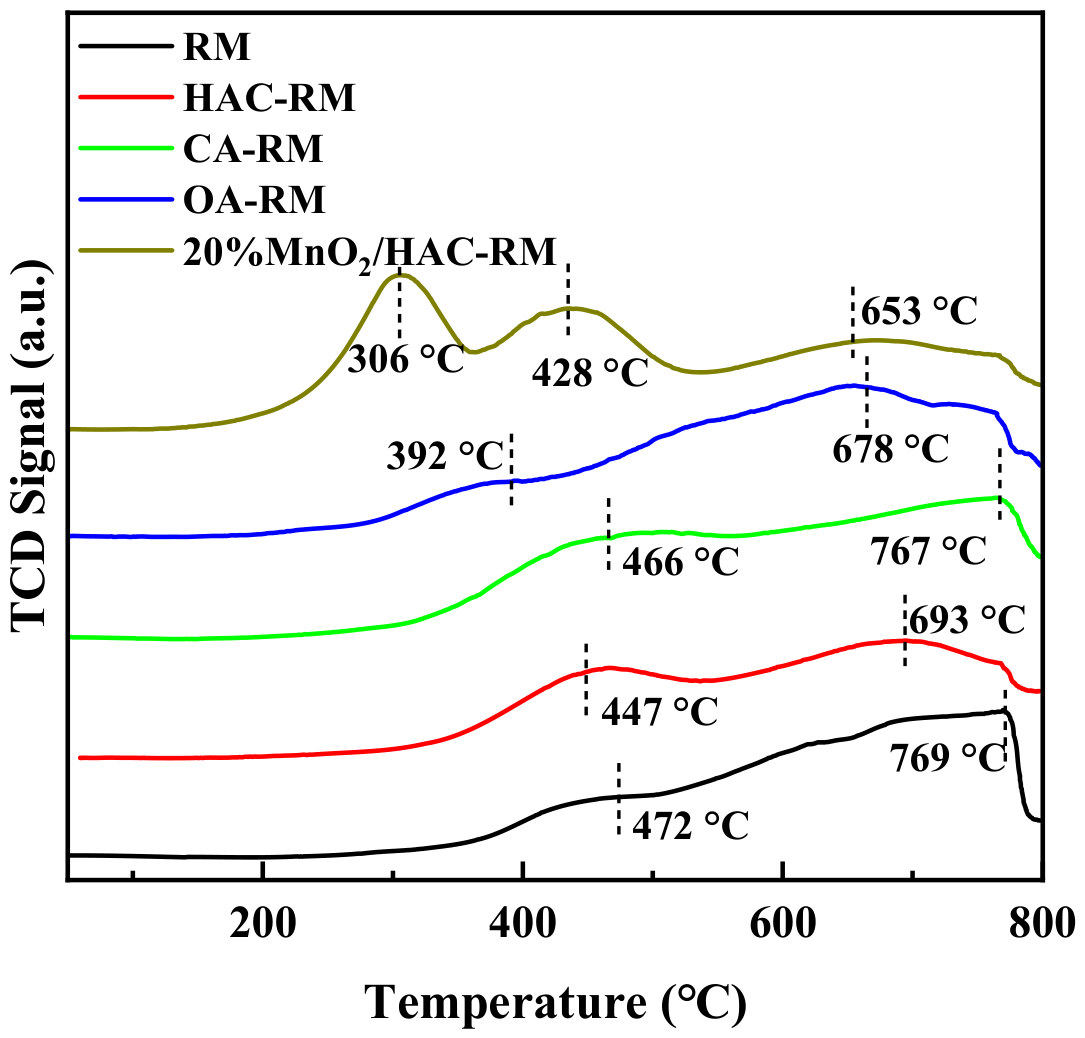
H2-TPR (H2-Temperature-Programmed Reduction) measurements were carried out to assess the redox behavior of the treated RM catalysts. Figure 8 displays the H2-TPR profiles of RM before and after modification. Two main hydrogen consumption peaks are observed for the unmodified RM. The first peak, located between 400 °C and 500 °C, can be attributed to the reduction in Fe3+ to Fe2+ in hematite (α-Fe2O3) present on the RM surface. The second peak at 769 °C corresponds to the further reduction in Fe3+ and Fe2+ to metallic iron [39]. Following modification, both reduction peaks shift to lower temperatures, and the peak areas increase, indicating enhanced reducibility and improved redox capability of the modified RM [40]. The temperature range of 300–500 °C is recognized as the primary region for catalytic activity associated with iron oxides in RM. The extent of hydrogen consumption in the low-temperature region varies among RM samples modified with different acids. HAC-RM exhibits the largest reduction peak area, suggesting a higher concentration of Fe3+ species. The Fe3+/Fe2+ ratio is a key factor influencing catalytic performance in toluene oxidation, with higher Fe3+ levels generally correlating with superior activity [40]. As shown in Table 2, the order of hydrogen consumption is: HAC-RM > CA-RM > OA-RM > RM. Compared to the unmodified RM, all modification RM samples demonstrate significantly greater hydrogen consumption, reflecting enhanced low-temperature reducibility and improved catalytic potential. Among the acid-modified catalysts, HAC-RM shows the highest initial hydrogen consumption of 3.59 mmol/g, indicative of its optimal catalytic efficiency.
Upon loading with MnO2, the catalytic activity is substantially enhanced. As illustrated in Figure 7, the 20%MnO2/HAC-RM sample exhibits the most pronounced low-temperature reduction capacity. This improvement is likely due to strong synergistic interactions between Fe and Mn species, as well as the high dispersion of MnO2 on the catalyst surface. The peak observed at 306 °C corresponds to the stepwise reduction in MnO2, proceeding through the sequential transformation of Mn4+ → Mn3+ → Mn2+ [41,42,43]. The total hydrogen consumption of the 20% MnO2/HAC-RM catalyst was 5.31 mmol/g, which was greater than that of the HAC-RM catalyst. This indicates that the loading of MnO2 indeed enhanced the reducibility of the catalyst.
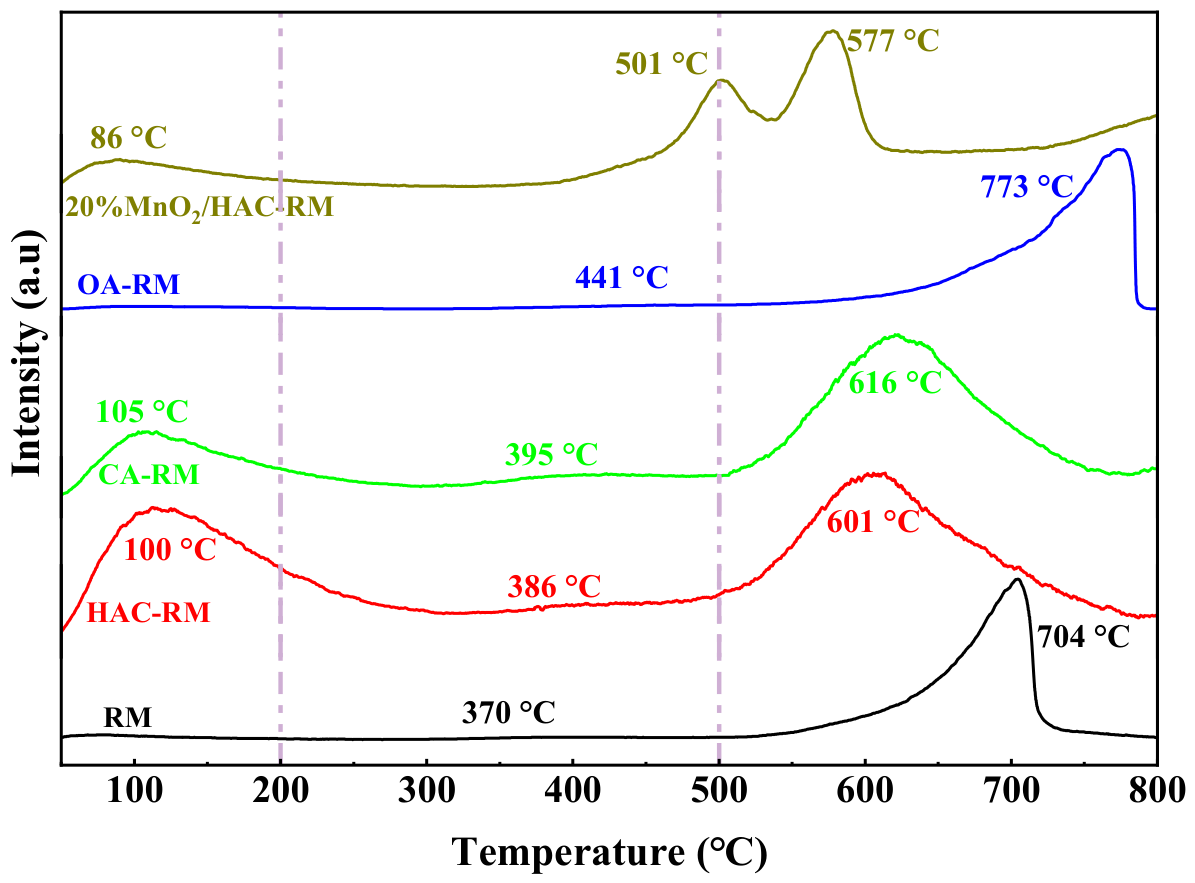
Figure 9 presents the O2-TPD (O2-Temperature-Programmed Desorption) profiles of RM before and after modification, exhibiting three oxygen desorption peaks within the temperature ranges of 100–200 °C, 300–500 °C, and 500–800 °C, respectively. The desorption peak observed between 100 and 200 °C is attributed to the release of molecular oxygen (O2) and chemisorbed oxygen (O), while the peak in the range of 300–500 °C corresponds to the desorption of lattice oxygen (O2−) [44,45]. The peak appearing between 500 and 800 °C is associated with bulk lattice oxygen [46]. In the RM catalyst, lattice oxygen specimens (O2−) produced from the dominant oxygen species. In the OA-RM sample, the signal observed at 773 °C arises from oxygen release due to the thermal decomposition of CaCO3 at elevated temperatures. Following the acetic acid modification of HAC-RM, both the chemisorbed and lattice oxygen desorption peaks shift toward lower temperatures, indicating enhanced oxygen mobility and facilitated migration of surface oxygen species, thereby promoting oxygen desorption. These findings are consistent with the XPS results. The introduction of MnO2 significantly intensifies the peak signals, suggesting that MnO2 loading induces Fe–Mn interactions, modifies the electronic structure of oxygen vacancies, generates surface defects, and provides additional adsorption sites. These changes collectively enhance the catalytic oxidation activity for toluene, which aligns well with the XPS and H2-TPR results.

2.5. Mechanism of Modified RM Oxidizing Toluene

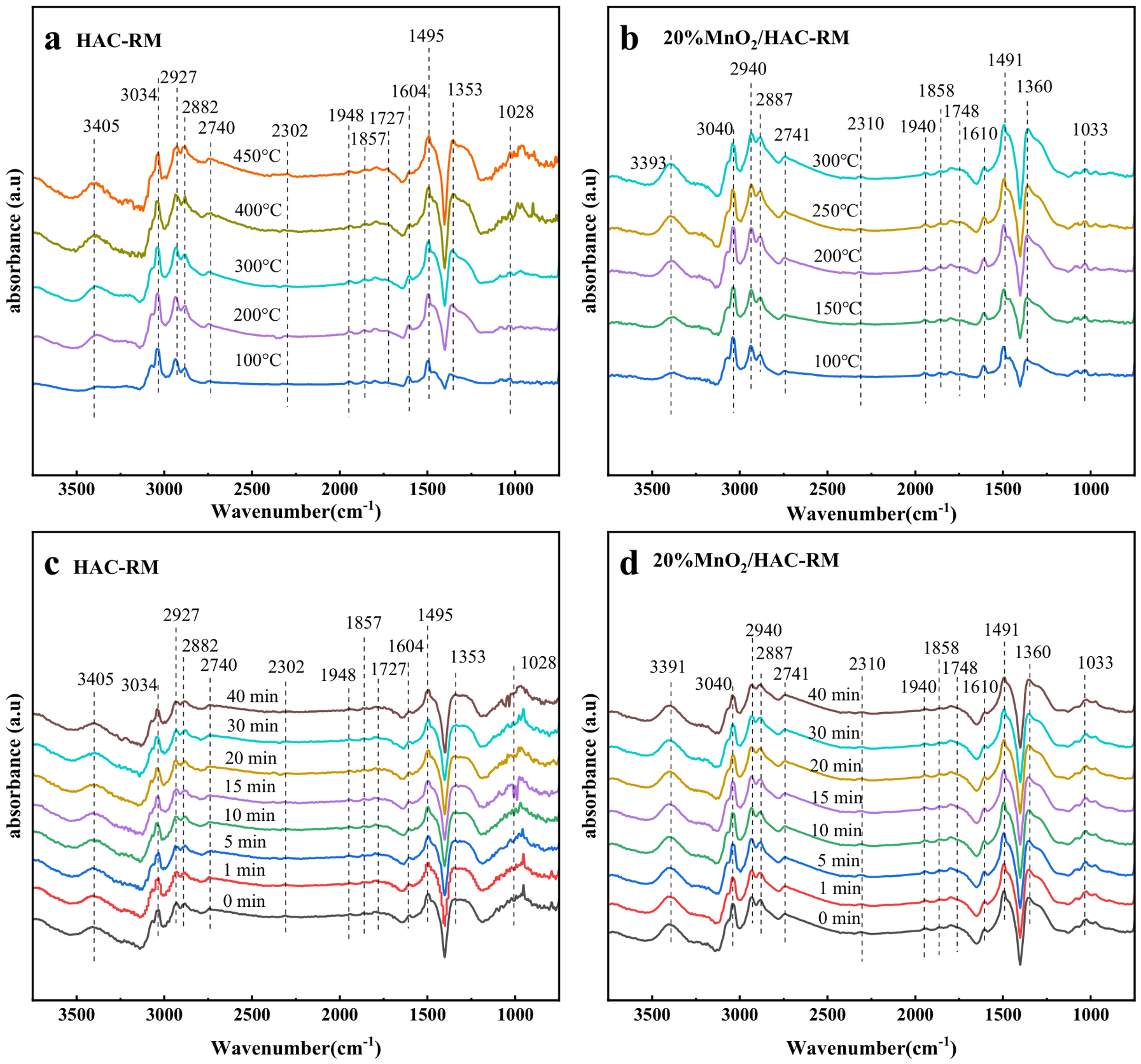
To elucidate the reaction pathway and investigate the catalytic mechanism, in situ DRIFT spectroscopy was employed to track the intermediate species formed during the catalytic combustion of toluene over HAC-RM and 20%MnO2/HAC-RM catalysts. The DRIFTS experiments regarding toluene adsorption were carried out under an air environment. It can be seen from Figure 10a that the heights of several peaks increase with the rise in temperature. The spectral findings reveal that the toluene oxidation over the HAC-RM catalyst proceed via a typical stepwise oxidation path: toluene (3034 cm−1, 2927 cm−1) is first oxidized to benzyl alcohol (C–O stretching vibration, 1028 cm−1), then converted to benzaldehyde (aldehyde C–H vibration, 2740 cm−1; C=O vibration, 1604 cm−1) and benzoic acid (carboxylic C=O vibration, 1727 cm−1), and subsequently benzoic acid undergoes ring-opening to form anhydride species (such as maleic anhydride, 1948 cm−1 and 1857 cm−1 double peaks), and is further deeply oxidized to small molecule carboxylic acids, ultimately generating CO2 (asymmetric stretching vibration, 2302 cm−1) and H2O (O–H stretching vibration, 3405 cm−1). As shown in Figure 10b, compared with the HAC-RM catalyst, the 20%MnO2/HAC-RM catalyst exhibits stronger oxidation ability under the same conditions: the characteristic peak of benzoic acid is significantly weakened, the signal of anhydride species appears earlier and is stronger, and the generation rate of CO2 is significantly increased, indicating that the introduction of MnO2 effectively promotes the further conversion of the benzoic acid intermediate and the ring-opening process of the benzene ring. The above results confirm that the loading of MnO2 enhances the oxygen activation ability on the catalyst surface and improves the migration efficiency of active oxygen species, thereby accelerating the deep oxidation process of toluene and reducing the accumulation of oxygen-containing intermediates. As shown in Figure 10c,d, the time-resolved spectra reveal that the characteristic peaks of toluene gradually diminish with reaction progress, while the signals of intermediate species first increase and then decrease, and the CO2 signal continuously strengthens, indicating that the reaction pathway exhibits distinct stepwise characteristics.
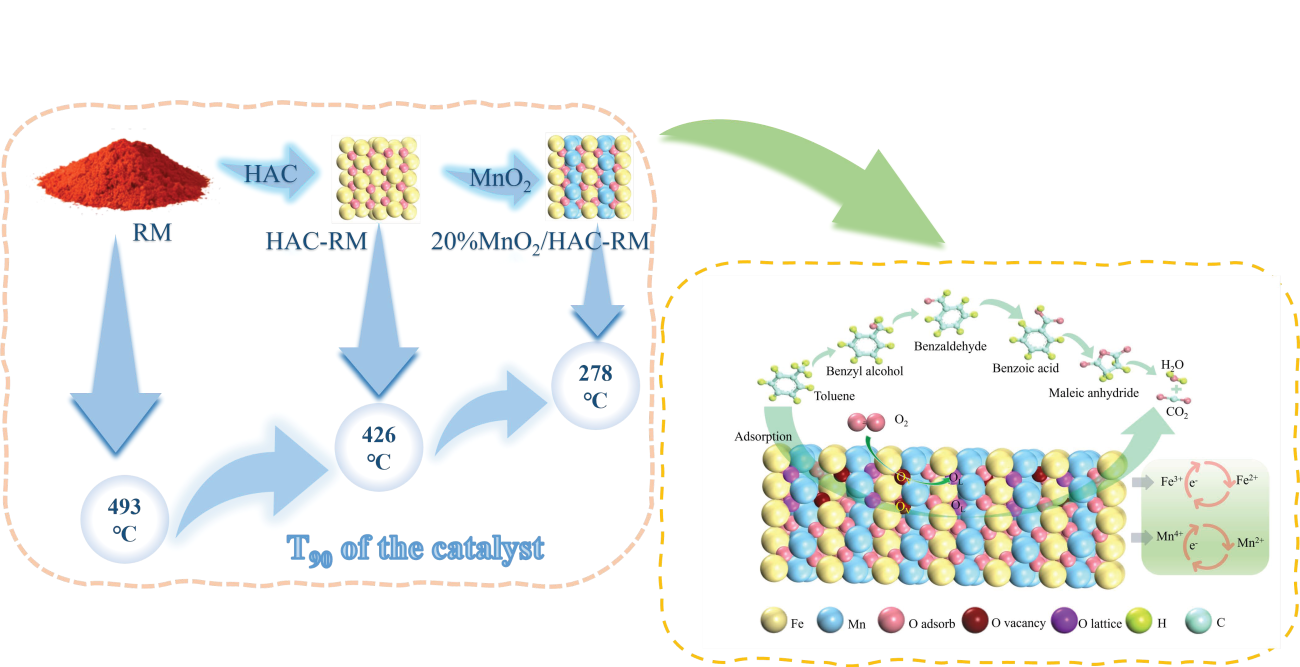
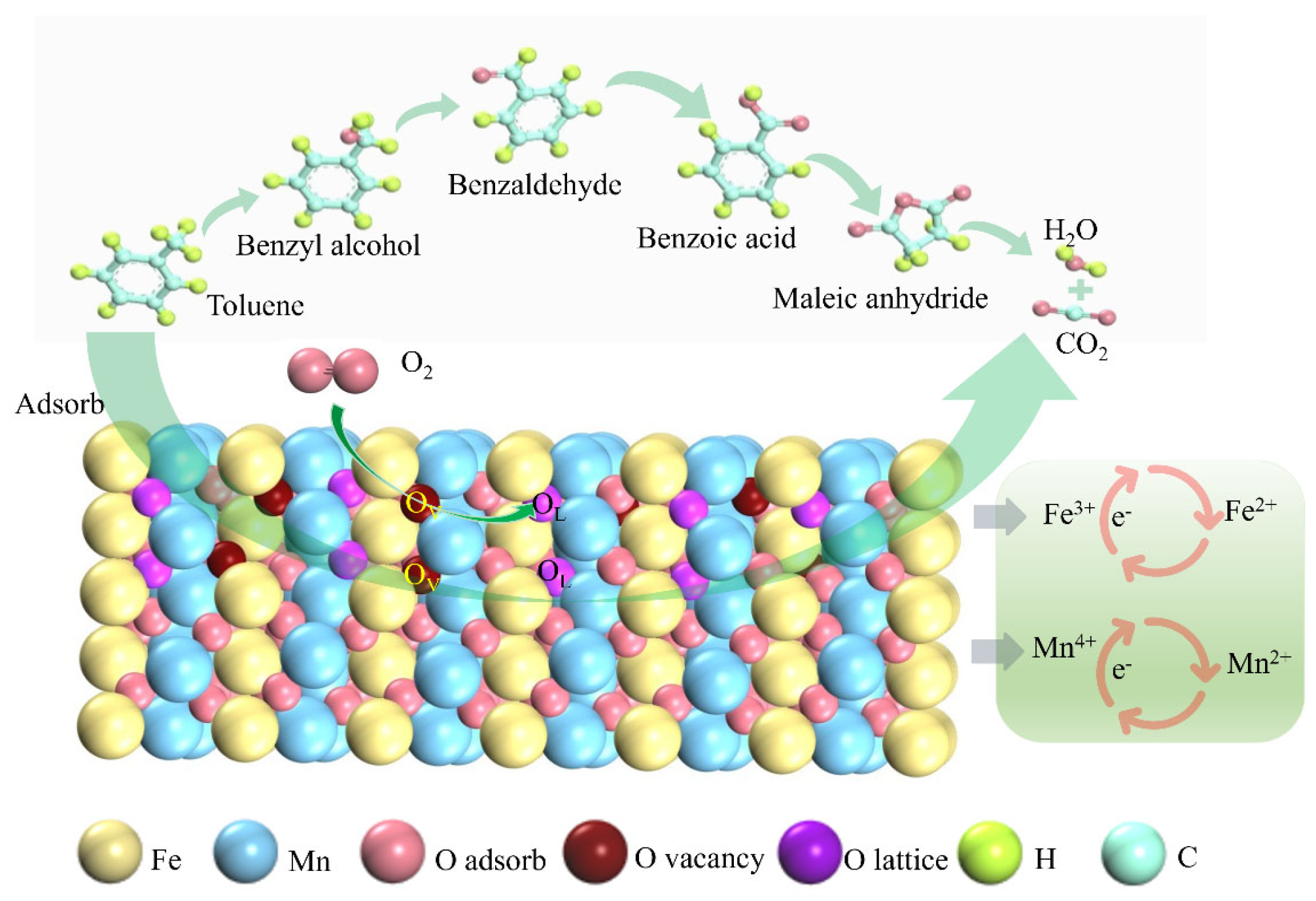
The study of the mechanism for toluene catalytic oxidation helps to understand the reaction path and further clarifies the performance improvement of the 20% MnO2/HAC-RM catalyst. The catalytic oxidation of toluene is commonly explained by the Mars–van Krevelen (MvK) mechanism, which assumes that VOC molecules react with lattice oxygen in the catalyst. From a series of characterization results such as H2-TPR and O2-TPD, it is confirmed that there are lattice oxygen and adsorbed oxygen in the 20%MnO2/HAC-RM catalyst. The catalytic mechanism of toluene on the 20%MnO2/HAC-RM catalyst is shown in Figure 11. Combined with the in situ DRIFT results, the toluene is initially attached on the catalyst surface, and subsequently lattice oxygen and/or surface-active oxygen participates in conversions forming benzyl alcohol → benzaldehyde or benzoyl peroxide → benzoate → CO2 and H2O as the reaction temperature rise. In the 20%MnO2/HAC-RM catalyst, the synergy between Mn and Fe encourages the generation of surface oxygen vacancies, accelerating the cleavage of the ring-opening intermediate to produce maleic anhydride [43]. Since lattice oxygen solely facilitates the transformation of toluene to benzoic acid ester intermediates, the complete conversion of toluene requires the participation of gaseous oxygen and a higher temperature. Thus, it may be deduced that, once the active adsorbed oxygen and lattice oxygen are exhausted, oxygen vacancies will form. Then, gaseous oxygen in the catalyst is activated into new active oxygen due to the interaction between Mn and Fe to form oxygen vacancies, and finally, these active oxygen species will oxidize the intermediate products to generate CO2 and H2O, which mainly follows the MvK mechanism.

3. Experimental Section

3.1. Catalyst Preparation

The RM samples used in the experiment were taken from certain aluminum company in Guizhou, China. The RM powder was dried to a constant weight in a 110 °C oven for 12 h, then sieved to obtain less than 100 mesh materials. A total of 10 g of the desiccated RM was placed in a high-temperature furnace and calcined at 500 °C for 3 h. The cooled RM particles were ground and sieved to obtain catalyst particles with a size of 40–60 mesh. Another 10 g of the dried RM was dissolved in 1 mol/L acetic acid (Beijing Jiashiteng Trading Co., Ltd., Beijing, China) solution (150 mL), and then ultrasonically stirred at 80 °C for 2 h (350 r/min). After filtration, the solid was rinsed until the resulting liquid became neutral. Then, it was desiccated at 110 °C for 10 h and calcined in the high-temperature furnace to 500 °C for 3 h. After cooling, the particles were ground and sieved to obtain 40–60 mesh particles, and the obtained catalyst was named HAC-RM. The modified RM with citric acid (Beijing Jiashiteng Trading Co., Ltd., Beijing, China) treatment in same synthesis condition was labeled as CA-RM. A total of 10 g of the dried RM was dissolved in 1 mol/L oxalic acid (Beijing Jiashiteng Trading Co., Ltd., Beijing, China) solution (150 mL), and then ultrasonically stirred at 80 °C for 2 h (350 r/min). The filtrate was placed under a UV lamp for 1 h, and the reaction temperature was maintained using a constant-temperature water bath. When orange precipitate appeared in the solution, the precipitate was subjected to cooling, vacuum-filtered and rinsed until the solution was neutral. Then, it was dried at 110 °C for 10 h and heated in the muffle furnace to 500 °C for 3 h. After cooling, the particles were ground and sieved to obtain 40–60 mesh particles, and the obtained catalyst was named OA-RM.
A certain amount of manganese nitrate solution was placed in deionized water. The modified HAC-RM powder was slowly added as the carrier to this solution. The solution was then ultrasonically stirred at 60 °C for 3 h. The stirred solution was placed in a drying oven for drying for 4 h, and then calcined at 500 °C in a muffle furnace for 3 h. After cooling, the particles were ground and sieved to obtain particles with a size of size 40–60 mesh. The obtained catalyst was named x%MnO2/HAC-RM.

3.2. Characterization of Catalysts

The RM catalyst was characterized to study its composition and changes before and after acid modification as well as after loading MnO2. X-ray diffraction (XRD) analysis was conducted using the Bruker D8 ADVANCE X-ray diffractometer (BRUKER-AXS, Karlsruhe, Germany) with Cu Kα radiation (35 kV, 35 mA). Elemental analysis of the modified samples before and after modification was carried out using the ARL PERFORM X X-ray fluorescence (XRF) spectrometer (Thermo Fisher Scientific, Waltham, MA, USA). N2 adsorption–desorption isotherm analysis was performed on the sample using Micromeritics ASAP 2050 automatic physical adsorption (Micromeritics Instrument, Norcross, GA, USA). The test conditions were as follows: 0.15 g of sample was weighed, pretreated at 90 °C for 1 h, and then purged with N2 at 250 °C for 1 h. The specific surface area was determined using the Brunauer–Emmet–Teller (BET) method, and the pore volume and pore size distribution were calculated by the Barrett–Joyner–Halenda (BJH) method. Scanning electron microscopy (SEM) analysis was performed using SU 8220 scanning electron microscope at 10 kV (Hitachi Company, Tokyo, Japan). This process involves fixing the sample on the sample platform using conductive adhesive, and then applying gold plating for 60 s for observation. X-ray photoelectron spectroscopy (XPS) analysis was carried out employing the Thermo Scientific Esca Lab 250 X-ray photoelectron spectrometer (Thermo Fisher Scientific, Waltham, MA, USA). This characterization comprised a monochromate Al Kα X-ray source, which encompassed high-resolution fine scans for the Fe 2p and O 1s regions, with an energy window of 20 eV and a step increment of 0.05 eV. The data was calibrated in an internal standard with C1s characteristic peak (284.8 eV). H2-Temperature-Programmed Reduction (H2-TPR) analysis was conducted with the (Quantachrome Company, Boynton Beach, FL, USA, Chem BET Pulsar TPR/TPD) chemical adsorption instrument. In the beginning, 0.1 g of the sample was pretreated in a helium environment (He) at 300 °C for 30 min, then cooled down to room temperature, and the carrier gas was changed to 20 vol% O2 (with He as the carrier gas) at room temperature for 1 h. Afterwards, the gas was changed back to helium and the sample was ramped in a helium atmosphere from 50 °C to 850 °C for measurement, while recording its TCD signal. The H2-TPR measurement was carried out with the Auto Chem II 2920 chemical adsorption analyzer (Micromeritics Instrument, USA). During this procedure, the specimen was first pretreated under air at a ramp rate of 10 °C per minute up to 300 °C, then held at 300 °C for 1 h, and then blown with helium (He) to cool to room temperature. Subsequently, the catalyst was reduced with a 10 vol% H2-He mixture at a heating rate of 10 °C/min from room temperature to 850 °C. O2-Temperature-Programmed Desorption (O2-TPD) tests are used to characterize the adsorption capacity and desorption behavior of oxygen species on the catalyst, thereby analyzing its surface oxidation chemical properties. The tests were conducted on a Tianjin Xianquan Industry and Trade TP-5080 fully automatic multi-functional adsorption apparatus. In situ diffuse reflectance infrared transform spectroscopy (in situ DRIFT) experiments were conducted using a FTIR spectrometer (Bruker Tensor II, Billerica, MA, USA) equipped with a BaF2 window.

3.3. Catalytic Activity Test

The catalytic activity assessment of the catalyst was carried out in a temperature-controlled tubular quartz packed-bed reactor with an inner diameter of 18 mm and an outer diameter of 20 mm. Under the prescribed experimental conditions, 3 g of catalyst (particle size 40–60 mesh) were loaded into the reactor. Temperature control was accomplished via a specialized temperature controller, and the reactor was heated by means of a tubular furnace at a heating rate of 5 °C/min. The feed introduced into the reactor was liquid toluene, transported by dry air (consisting of 21 vol% O2 + 79 vol% N2) under atmospheric pressure. The model gas composition was toluene at a mass concentration of 1000 mg/m3, with a reaction temperature range of 100~500 °C, and the gas total flow rate was kept constant at 1.5 L/min, which corresponded to a space velocity (WHSV) of 30,000 mL/g·h. To account for the possible effect of toluene adsorption on catalytic activity, the catalyst bed was preheated to 100 °C and maintained at this temperature for 1 h. The concentration of toluene entering and exiting the reactor was measured using gas chromatograph, and the difference in toluene concentration and catalytic efficiency were calculated using Equation (1).
η = C i n C o u t C i n × 100 %
where η is toluene degradation efficiency, %; Cin is the toluene concentration at the reactor inlet, mg/m3; and Cout is outlet gas toluene concentration at the reactor outlet, mg/m3.
The CO2 selectivity was calculated using Equation (2).
C O 2 s e l e c t i v i t y = C C O 2   a c t u a l   C c o 2   t h e o r e t i c a l × 100 %
where CO2 selectivity is the selectivity of CO2, %; CCO2 actual is the concentration of carbon dioxide in the outlet gas of the reactor, ppm; and CCO2 theoretical is the theoretical content of CO2 generated from toluene in the reaction at this temperature, ppm.

4. Conclusions

Acid pretreatment of RM using acetic acid, citric acid, and oxalic acid effectively enhances its catalytic performance in the oxidation of toluene. Among the treated samples, HAC-RM exhibits superior activity compared to CA-RM and OA-RM. Complete toluene conversion is achieved at 450 °C, with a CO2 selectivity of 86%, indicating that CO2 is the primary product of the catalytic oxidation process. The enhanced performance of HAC-RM can be attributed to its higher specific surface area, increased Fe3+/Fe2+ molar ratio, and greater lattice oxygen content relative to CA-RM and OA-RM. Building upon these improvements, MnO2 was loaded onto RM via an impregnation method to develop a low-cost, high-activity catalyst. Among the prepared samples, 20% MnO2/HAC-RM demonstrates the highest catalytic efficiency, achieving 100% toluene conversion at 300 °C. The synergistic interaction between Fe2O3, the intrinsic active component in RM, and the dispersed MnO2 species facilitates electron transfer and enhances the mobility of surface oxygen species. The proposed reaction pathway for toluene oxidation follows the sequence: toluene → benzyl alcohol → benzaldehyde or benzoyl peroxide → benzoate → CO2 and H2O. This study presents a novel strategy involving acid pretreatment of RM, enabling its application as an efficient catalyst for VOC abatement while simultaneously promoting the valorization of solid waste.

Author Contributions

W.L.: Conceptualization, investigation, supervision, funding acquisition; R.L.: data curation, formal analysis, visualization, writing—original draft; Q.T.: investigation, formal analysis; Y.Z.: methodology, investigation; R.K.: methodology, formal analysis, writing—review and editing; H.F.: methodology, funding acquisition, investigation. All authors have read and agreed to the published version of the manuscript.

Funding

This work was supported by the National Natural Science Foundation of China (No. 22378008).

Data Availability Statement

Data will be made available on request.

Conflicts of Interest

The authors declare that they have no known competing financial interests or personal relationships that could have appeared to influence the work reported in this paper.

References

  1. Soltan, W.B.; Sun, J.; Wang, W.; Song, Z.; Zhao, X.; Mao, Y.; Zhang, Z. Discovering the key role of MnO2 and CeO2 particles in the Fe2O3 catalysts for enhancing the catalytic oxidation of VOC: Synergistic effect of the lattice oxygen species and surface-adsorbed oxygen. Sci. Total Environ. 2022, 819, 152844. [Google Scholar] [CrossRef]
  2. Wei, T.; Ma, C.; Wen, Y.; Yue, H.; Yang, S.; Zhao, J.; Zhang, S.; Li, W.; Li, S.; Wang, X. An integrated biological system for air pollution control in WtE plants and interaction between NO reduction and toluene oxidation. J. Clean. Prod. 2022, 355, 131792. [Google Scholar] [CrossRef]
  3. Wang, X.; Wang, Y.; Li, J.; Peng, C.; Liu, Z. Recent advances in the catalytic oxidation of toluene on Mn-based catalysts. Catal. Rev. Sci. Eng. 2025, 67, 173–243. [Google Scholar] [CrossRef]
  4. Zhang, Z.; Jiang, Z.; Shangguan, W. Low-temperature catalysis for VOCs removal in technology and application: A state-of-the-art review. Catal. Today 2016, 264, 270–278. [Google Scholar] [CrossRef]
  5. Cui, B.C.; Yi, H.H.; Tang, X.L.; Wang, Y.E.; Li, Y.T. Status and progress of treatment technologies of toluene in industrial waste gas. Mod. Chem. Ind. 2016, 36, 30–33. [Google Scholar]
  6. Wang, X.; Wei, T.; Wen, Y. Catalytic ozonation of toluene and dichloromethane mixture at low temperatures over modified MnOx-based catalyst. Process Saf. Environ. Prot. 2023, 171, 447–458. [Google Scholar] [CrossRef]
  7. Hu, Z.; Yu, Y.F.; Zhao, H.Y.; Wu, Z.L.; Guo, R.; Zhou, J.L.; Zhou, X.Y.; Zhang, B.; Wu, Y.W.; Zhao, L. The promotional effect of MoO3 on the CeO2/TiO2 catalyst for simultaneous removal of NO and toluene: From the insights of experimental and DFT studies. J. Environ. Chem. Eng. 2025, 13, 115411. [Google Scholar] [CrossRef]
  8. He, C.; Cheng, J.; Zhang, X.; Douthwaite, M.; Hao, Z. Recent Advances in the Catalytic Oxidation of Volatile Organic Compounds: A Review Based on Pollutant Sorts and Sources. Chem. Rev. 2019, 119, 4471–4568. [Google Scholar] [CrossRef]
  9. Seo, B.; Ko, E.H.; Kim, B. Computational screening-based development in VOC removal catalyst: Methyl ethyl ketone oxidation over Pt/TiO2. Chem. Eng. J. 2023, 452, 139466. [Google Scholar] [CrossRef]
  10. Yi, X.; Wu, L.; Dou, B.; Liang, W.; Kang, R.; Bin, F.; Li, Y. High-efficiency toluene degradation by non-thermal plasma modified catalysts: Oxygen vacancy-induced reactive oxygen species cycling mechanism. Appl. Catal. B-Environ. 2026, 384, 126213. [Google Scholar] [CrossRef]
  11. Kim, H.; Kim, H.J.; Kim, J.H.; Kim, J.H.; Kang, S.H.; Ryu, J.H.; Park, N.; Yun, D.; Bae, J. Noble-Metal-Based Catalytic Oxidation Technology Trends for Volatile Organic Compound (VOC) Removal. Catalysts 2022, 12, 63. [Google Scholar] [CrossRef]
  12. Li, J.; Li, Q.; Chen, P.; Yao, K.; Wang, P.; Ming, Y.; Yi, J.; Zhi, L. The Effect of Bayer Red Mud Blending on the Mechanical Properties of Alkali-Activated Slag-Red Mud and the Mechanism. Appl. Sci. 2023, 13, 452. [Google Scholar] [CrossRef]
  13. Zhe, B.; Chang, H.; Shuai, Y.; Li, X. Separate recycling of iron and aluminum from iron-rich red mud by coal gangue reduction to realize solid waste utilization. Adv. Powder Technol. 2024, 35, 104506. [Google Scholar] [CrossRef]
  14. Zhou, X.; Cheng, S.; Li, Y.; Yang, C.; Zhang, L.; Xiao, X.; Wang, T. Characterization and mechanism of red-mud-catalyzed steam gasification of corn stover. Fuel 2024, 356, 129611. [Google Scholar] [CrossRef]
  15. Madadkhani, S.; Burhenne, L.; Bi, X.; Ellis, N.; Grace, J.R.; Lewis, T. Bauxite residue as an iron-based catalyst for catalytic cracking of naphthalene, a model compound for gasification tar. Can. J. Chem. Eng. 2021, 99, 1461–1474. [Google Scholar] [CrossRef]
  16. Yesilova, N.; Tezer, O.; Ongen, A.; Ayol, A. Enhancing biomass gasification: A comparative study of catalyst applications in updraft and modifiable-downdraft fixed bed reactors. Int. J. Hydrogen Energy 2024, 76, 290–303. [Google Scholar] [CrossRef]
  17. Wang, Y.; Hu, X.; Chen, X. Potential of metallurgical iron-containing solid waste-based catalysts as activator of persulfate for organic pollutants degradation. Chemosphere 2024, 359, 142276. [Google Scholar] [CrossRef]
  18. Yu, X.; Xu, J.; Wang, J.; Qiu, J.; An, X.; Wang, Z.; Lv, G.; Liao, L.; Ye, J. Mimicking Photosynthesis: A Natural Z-Scheme Photocatalyst Constructed from Red Mud Bauxite Waste for Overall Water Splitting. Angew. Chem.-Int. Ed. 2023, 62, e202302050. [Google Scholar]
  19. Jahromi, H.; Agblevor, F.A. Hydrodeoxygenation of pinyon-juniper catalytic pyrolysis oil using red mud-supported nickel catalysts. Appl. Catal. B Environ. 2018, 236, 1–12. [Google Scholar] [CrossRef]
  20. Das, B.; Mohanty, K. A green and facile production of catalysts from waste red mud for the one-pot synthesis of glycerol carbonate from glycerol. J. Environ. Chem. Eng. 2019, 7, 102888. [Google Scholar] [CrossRef]
  21. Pande, G.; Selvakumar, S.; Ciotonea, C.; Giraudon, J.M.; Lamonier, J.F.; Batra, V.S. Modified Red Mud Catalyst for Volatile Organic Compounds Oxidation. Catalysts 2021, 11, 838. [Google Scholar] [CrossRef]
  22. Duan, J.; Wu, Y.; Zheng, J. Enhancing catalytic performance of red mud for palmitic acid hydrodeoxygenation by acid pretreatment-induced structural modification. Fuel Process. Technol. 2023, 248, 107839. [Google Scholar] [CrossRef]
  23. Cai, T.; Yang, M.; Pan, R. Study on the effect of sodium removal from citric acid pretreated red mud on the physical properties of red mud. Environ. Sci. Pollut. Res. 2024, 31, 44191–44204. [Google Scholar] [CrossRef]
  24. Kalsen, T.B.S.A.; Karadağ, H.B.; Eker, Y.R.; Kerti, I.L. Chemical Composition Simplification of the Seydişehir (Konya, Turkey) Alumina Plant Waste. J. Sustain. Metall. 2019, 5, 482–496. [Google Scholar] [CrossRef]
  25. Fang, H.; Liang, W.; Ma, L.; Ma, C. Properties and characterization of red mud modified by hydrochloric, sulfuric, and nitric acid for the catalytic oxidation of toluene. J. Environ. Chem. Eng. 2023, 11, 110943. [Google Scholar] [CrossRef]
  26. Das, B.; Mohanty, K. Sulfonic acid-functionalized carbon coated red mud as an efficient catalyst for the direct production of 5-HMF from D-glucose under microwave irradiation. Appl. Catal. A General. 2021, 622, 118237. [Google Scholar] [CrossRef]
  27. Liu, Q.; Zhao, Q.; Luo, M.; Yang, Z.; Li, H. Dendritic mesoporous silica nanosphere supported highly dispersed Pd-CoOx catalysts for catalytic oxidation of toluene. Mol. Catal. 2022, 519, 112123. [Google Scholar] [CrossRef]
  28. Ouedraogo, A.S.; Bhoi, P.R. Recent progress of metals supported catalysts for hydrodeoxygenation of biomass derived pyrolysis oil. J. Clean. Prod. 2020, 253, 119957. [Google Scholar] [CrossRef]
  29. Chen, J.; Zhu, B.; Song, W.; Sun, Y. Catalytic performance of calcined Fe2O3/CA catalyst for NH3-SCR reaction: Role of activation temperature. J. Solid State Chem. 2022, 316, 123630. [Google Scholar] [CrossRef]
  30. Al-Fatesh, A.S.; Arafat, Y.; Ibrahim, A.A.; Atia, H.; Fakeeha, A.H.; Armbruster, U.; Abasaeed, A.E.; Frusteri, F. Evaluation of Co-Ni/Sc-SBA–15 as a novel coke resistant catalyst for syngas production via CO2 reforming of methane. Appl. Catal. A General. 2018, 567, 102–111. [Google Scholar] [CrossRef]
  31. Zeng, J.; Chen, S.; Fan, Z.; Wang, C.; Li, J. Simultaneous Selective Catalytic Reduction of NO and N2O by NH3 over Fe-Zeolite Catalysts. Ind. Eng. Chem. Res. 2020, 59, 19500–19509. [Google Scholar] [CrossRef]
  32. Li, Y.; Zhang, Q.; Yuan, S.; Yin, H. High-efficiency extraction of iron from early iron tailings via the suspension roasting-magnetic separation. Powder Technol. 2021, 379, 466–477. [Google Scholar] [CrossRef]
  33. Yfanti, V.L.; Vasiliadou, E.S.; Sklari, S.; Lemonidou, A.A. Hydrodeoxygenation of glycerol with in situH2 formation over Pt catalysts supported on Fe modified Al2O3: Effect of Fe loading. J. Chem. Technol. Biotechnol. 2017, 92, 2236–2245. [Google Scholar] [CrossRef]
  34. Dong, X.B.Z.C. Monodispersed CuFe2O4 nanoparticles anchored on natural kaolinite as highly efficient peroxymonosulfate catalyst for bisphenol A degradation. Appl. Catal. B Environ. Energy 2019, 253, 206–217. [Google Scholar] [CrossRef]
  35. Gong, P.; Xie, J.; Fang, D.; He, F.; Li, F.; Qi, K. Study on the relationship between physicochemical properties and catalytic activity of Mn2O3 nanorods. Mater. Res. Express 2017, 4, 115036. [Google Scholar] [CrossRef]
  36. Qi, L.; Sun, Z.; Tang, Q.; Wang, J.; Huang, T.; Sun, C.; Gao, F.; Tang, C.; Dong, L. Getting insight into the effect of CuO on red mud for the selective catalytic reduction of NO by NH3. J. Hazard. Mater. 2020, 396, 122459. [Google Scholar] [CrossRef]
  37. Wang; D.; Peng; Y.; Yang; Q.; Xiong; S.; Li, J. Performance of Modified LaxSr1-xMnO3 Perovskite Catalysts for NH3 Oxidation: TPD, DFT, and Kinetic Studies. Environ. Sci. Technol. 2018, 52, 7443–7449. [Google Scholar] [CrossRef] [PubMed]
  38. Hu, Z.P.; Zhu, Y.P.; Gao, Z.M.; Wang, G.; Liu, Y.; Liu, X.; Yuan, Z.Y. CuO catalysts supported on activated red mud for efficient catalytic carbon monoxide oxidation. Chem. Eng. J. 2016, 302, 23–32. [Google Scholar] [CrossRef]
  39. Rombi, E.; Ferino, I.; Monaci, R.; Picciau, C.; Buzzoni, R. Toluene ammoxidation on α-Fe2O3-based catalysts. Appl. Catal. A General. 2004, 266, 73–79. [Google Scholar] [CrossRef]
  40. Wang, Y.; Zhang, L.; Guo, L. Enhanced Toluene Combustion over Highly Homogeneous Iron Manganese Oxide Nanocatalysts. ACS Appl. Nano Mater. 2018, 3, 1066–1075. [Google Scholar] [CrossRef]
  41. Lin, B.; Guo, Z.; Tang, J.; Chen, P.; Ye, D.; Hu, Y. Modulating the Microstructure and Surface Acidity of MnO2 by Doping-Induced Phase Transition for Simultaneous Removal of Toluene and NOx at Low Temperature. Environ. Sci. Technol. 2024, 58, 10398–10408. [Google Scholar] [CrossRef] [PubMed]
  42. Lin, B.; Tang, J.; Yang, J.; Fu, M.; Ye, D.; Hu, Y. Insight to the cooperation between electronic unsaturated metal sites and hydroxyl species improves the SO2 resistance of Fe-MnO2@TiO2 for simultaneous removal of toluene and NO. Appl. Catal. B Environ. 2024, 361, 124619. [Google Scholar] [CrossRef]
  43. Ma, Y.; Si, C.; Yang, X.; Li, J.; Wang, Z.; Shi, X.; Ye, W.; Zhou, P.; Budzianowski, W.M. Clean synthesis of RGO/Mn3O4 nanocomposite with well-dispersed Pd nanoparticles as a high-performance catalyst for hydroquinone oxidation. J. Colloid Interface Sci. 2019, 552, 72–83. [Google Scholar] [CrossRef] [PubMed]
  44. Wang, X.; Zhang, Y.; Hao, Z.M.; Zhang, Y. High-efficiency palladium/halloysite nanotubes catalyst for toluene catalytic oxidation: Characterization, performance and reaction mechanism. Appl. Clay Sci. 2023, 234, 106842. [Google Scholar] [CrossRef]
  45. Xianglan, X.; Lin, L.; Jin, H.; Hua, J.; Xiuzhong, F.; Wenming, L.; Ning, Z.; Hongming, W.; Xiang, W. Engineering Ni3+ Cations in NiO Lattice at Atomic Level by Li+ Doping: The Roles of Ni3+ and Oxygen Species for CO Oxidation. ACS Catal. 2018, 8, 8033–8045. [Google Scholar]
  46. Leng, Y.; Cao, X.; Sun, X.; Zhang, C. Catalytic Oxidation Mechanism of Toluene on the Ce0.875Zr0.125O2 (110) Surface. Catalysts 2024, 14, 22. [Google Scholar] [CrossRef]
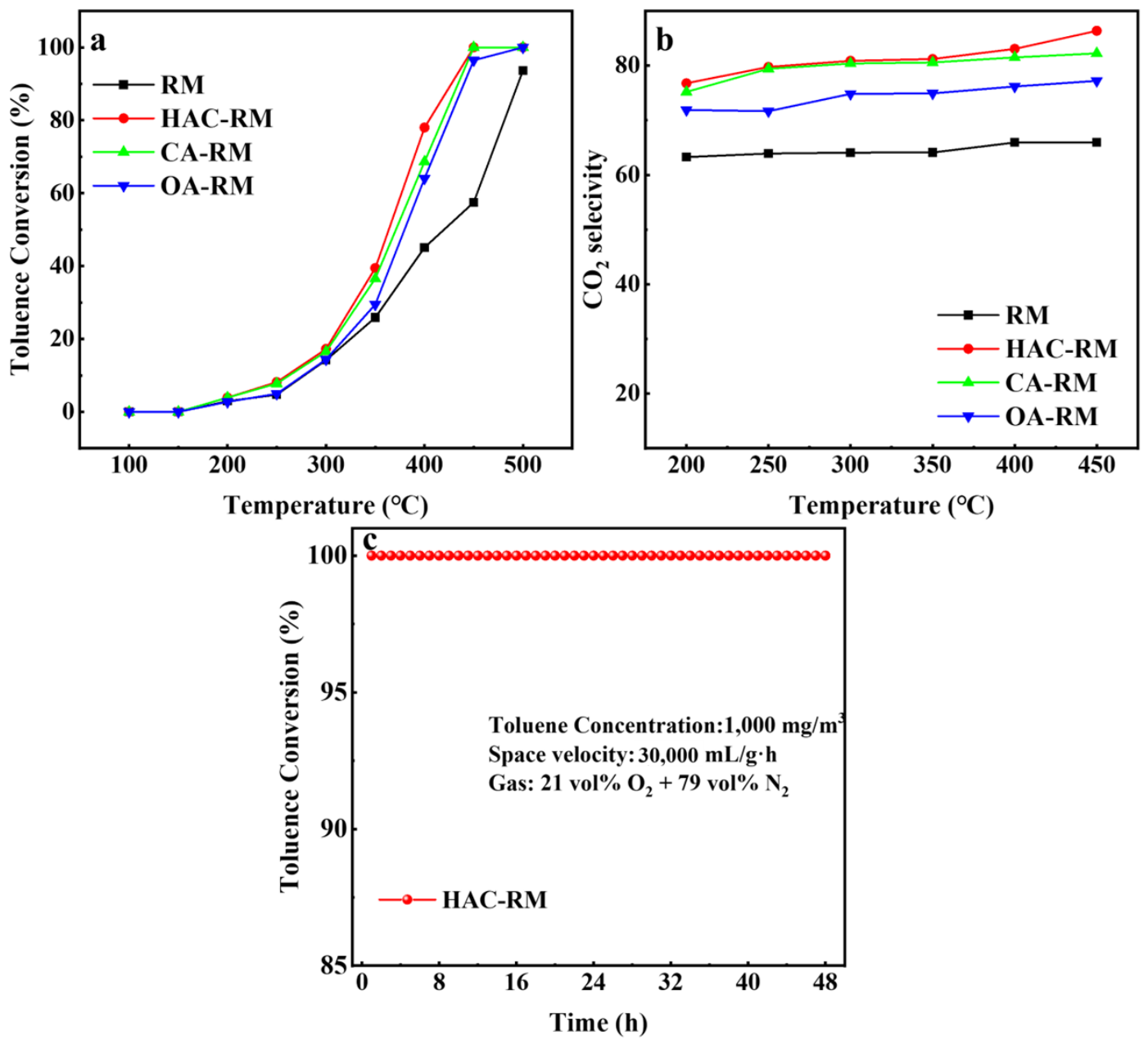
Figure 1. Performance evaluation of acid-modified RM catalysts for toluene catalytic oxidation: (a) catalytic activity, (b) CO2 selectivity, and (c) stability test of HAC-RM catalyst.
Catalysts 16 00425 g001
Figure 2. (a) Effect of MnO2 content on the catalytic activity of MnO2/HAC-RM catalyst for toluene oxidation; and (b) CO2 selectivity of 20% MnO2/HAC-RM catalyst.
Catalysts 16 00425 g002
Figure 3. 20% MnO2/HAC-RM catalyst activity influencing factors: (a) reaction space velocity; and (b) toluene concentration.
Catalysts 16 00425 g003
Figure 4. XRD pattern of (a) the acid-modified RM samples; and (b) 20%MnO2/HAC-RM sample.
Catalysts 16 00425 g004
Figure 5. (a) N2 adsorption–desorption isotherms of samples; (b) pore size distribution of samples.
Catalysts 16 00425 g005
Figure 6. SEM images of RM at 1 um (a) and 5 um (b); HAC-RM at 1 um (c) and 5 um (d); CA-RM at 1 um (e) and 5 um (f); and OA-RM at 1 um (g) and 5 um (h).
Catalysts 16 00425 g006
Figure 7. XPS Spectra of (a) full spectrum of HAC-RM catalyst; (b) Fe 2p; (c) O 1s; (d) relative content of Fe3+/(Fe2+ + Fe3+) and Oα/(Oβ + Oα) species.
Catalysts 16 00425 g007
Figure 8. H2-TPR profiles of the catalyst samples.
Catalysts 16 00425 g008
Figure 9. O2-TPD profiles of the catalyst samples.
Catalysts 16 00425 g009
Figure 10. In situ DRIFTS reflectance infrared spectroscopy of the catalysts: (a) HAC-RM catalyst at different temperatures; (b) 20% MnO2/HAC-RM catalyst at different temperatures; (c) HAC-RM catalyst at different times with 450 °C; and (d) 20% MnO2/HAC-RM catalyst at different times with 300 °C.
Catalysts 16 00425 g010
Figure 11. Mechanism of toluene oxidation catalyzed by 20%MnO2/HAC-RM.
Catalysts 16 00425 g011
Table 1. Concentration of primary metal oxides in RM subjected to various acid treatments.
Al2O3 (wt%)Fe2O3 (wt%)SiO2 (wt%)CaO (wt%)Na2O (wt%)MnO2 (wt%)Other (wt%)
RM25.4115.8819.5918.9710.98-9.17
HAC-RM27.6625.3825.579.591.05-10.75
CA-RM29.5035.3822.122.580.76-9.66
OA- RM8.2732.908.4243.221.17-6.02
20%MnO2/HAC-RM16.4927.1015.576.210.3315.0019.3
Table 2. The samples of specific surface area, pore structure parameters and H2 consumption.
Specific Surface Area
(m2/g)
Pore Volume (cm2/g)Average Pore Width (nm)H2 Consumption
(mmol/g)
CA-RM20.510.0610.593.13
HAC-RM57.940.116.713.59
OA-RM39.460.2422.922.85
RM10.760.0513.352.77
20% MnO2/HAC-RM38.920.108.235.31
Disclaimer/Publisher’s Note: The statements, opinions and data contained in all publications are solely those of the individual author(s) and contributor(s) and not of MDPI and/or the editor(s). MDPI and/or the editor(s) disclaim responsibility for any injury to people or property resulting from any ideas, methods, instructions or products referred to in the content.