Article

Chemoenzymatic Two-Step Synthesis of Albendazole–Cholic Acid Conjugates: Linker-Length-Controlled Biocatalytic Esterification

1
College of Life Science and Technology, Beijing University of Chemical Technology, Beijing 100029, China
2
State Key Laboratory of Green Biomanufacturing, National Energy R&D Center for Biorefinery, Beijing Key Laboratory of Green Chemicals Biomanufacturing, Beijing University of Chemical Technology, Beijing 100029, China
3
School of Pharmacy, Qinghai University, Xining 810001, China
*
Authors to whom correspondence should be addressed.
These authors contributed equally to this work.
Catalysts 2026, 16(5), 382; https://doi.org/10.3390/catal16050382
Submission received: 9 March 2026 / Revised: 20 April 2026 / Accepted: 22 April 2026 / Published: 27 April 2026

Abstract

Albendazole (ABZ) exhibits poor oral absorption; therefore, ABZ was conjugated to cholic acid to engage the apical sodium-dependent bile acid transporter (ASBT) and promote ileal uptake. ABZ–linker–CA conjugates bearing amino-alcohol linkers (C4–C8) were evaluated by integrating synthetic feasibility, purification selectivity, and ex vivo performance. Thermal aminolysis in DMF (95 °C) produced ABZ–linkers in ~50% reaction yields (HPLC-assayed), with a minor ABZ-amine by-product consistent with a workup-sensitive isocyanate route. Immobilized-lipase screening identified Lipozyme RM IM as the most effective catalyst for CA esterification in CHCl3, showing a pronounced linker-length dependence (31% yield for C4, 25% for C6, and C8 ≤ 2.6% yield). Docking and molecular dynamics supported this trend by indicating productive binding geometries for C4/C6 but not for C8. A polarity-guided workup and silica-gel protocol enabled retrieval of unreacted intermediates and CA recycling, with cleaner separation for the C6 series. Ex vivo transport studies confirmed ASBT-mediated, linerixibat-sensitive ileal uptake, and protoscolex assays showed improved antiparasitic efficacy versus ABZ. Overall, ABZ-C6-CA offered the best balance of uptake, near-maximal efficacy, enzymatic accessibility, and separability, supporting its prioritization for scalable biocatalytic manufacturing.

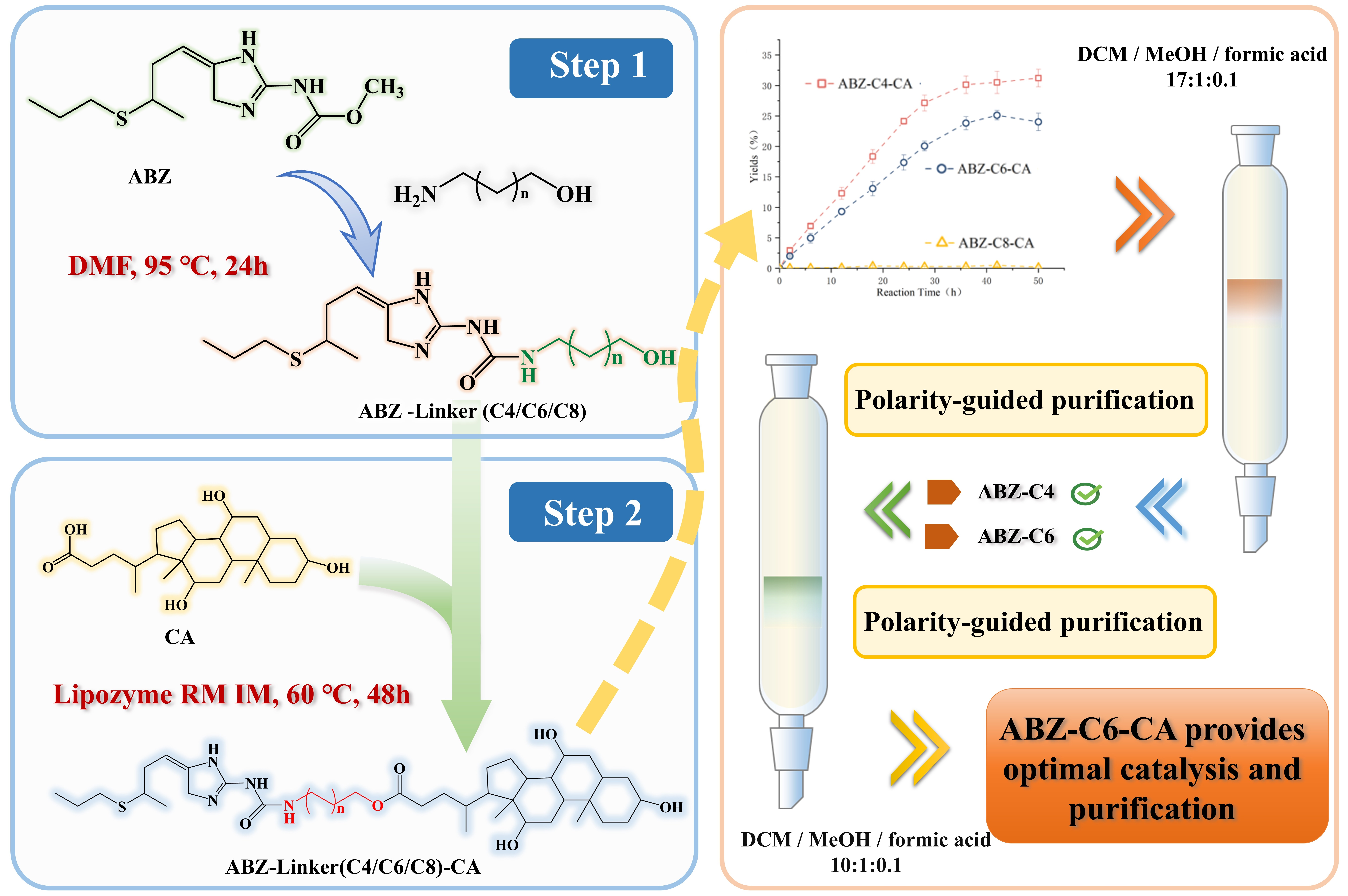
Graphical Abstract

1. Introduction

Albendazole (ABZ) is a broad-spectrum benzimidazole antiparasitic listed by the World Health Organization as an essential medicine [1,2]. Since its approval in 1982, ABZ has been used in more than 100 countries for echinococcosis, filariasis, tapeworm, and trichuriasis, among others [3]. In alveolar hydatid disease (AHD) caused by Echinococcus multilocularis, which is prevalent in the Northern Hemisphere and associated with high mortality, radical surgery is often required; however, complete resection is rarely achievable and prolonged postoperative ABZ therapy remains necessary [4,5].
The oral performance of ABZ is constrained by poor aqueous solubility and low intestinal permeability [6,7]. One strategy to overcome epithelial transport barriers is to exploit endogenous nutrient transport pathways, such as the apical sodium-dependent bile acid transporter (ASBT), which is highly expressed in the ileum [8]. Conjugation of small molecules to cholic acid (CA) can provide an ASBT-addressable handle, while the overall polarity and amphiphilicity of the conjugate can be tuned through a short amino-alcohol linker. In our prior work, ABZ–CA conjugates assembled via defined linkers (ABZ–linker–CAs) increased ABZ’s apparent solubility, transmembrane transport, and oral exposure [9,10]. Importantly, linker length acted as a key physicochemical determinant: when solubility, lipophilicity, and transport were considered together, medium-length spacers (C4–C8) delivered the most favorable overall oral performance across the ABZ derivatives.
From a manufacturing perspective, conventional carbodiimide coupling (e.g., EDC/DMAP) can furnish ABZ–linker–CAs, but it relies on stoichiometric activating reagents and generates urea by-products, which can complicate work-up and adversely impact green metrics [11]. In contrast, biocatalytic acylation using immobilized lipases offers a selective route to ester formation under mild and tunable conditions, often enabling simplified quenching and more benign waste streams [12], and this strategy has been widely applied in the synthesis of various ester derivatives due to its high chemoselectivity and industrial scalability [13,14]. Notably, the catalytic efficiency of immobilized lipases in organic media is highly dependent on solvent selection, substrate architecture and active-site compatibility [15,16], which is consistent with the structural characteristics of lipases that differ in active-site topology, pocket volume, and access channels surrounding the catalytic triad [17]. These structural features govern how an alcohol nucleophile approaches the acyl–enzyme intermediate, as well as the productive binding orientation required for catalysis. Consequently, bulky or conformationally restricted acceptors may suffer from limited accommodation within the active-site region, leading to reduced rates or poor conversions, whereas acceptors that present the nucleophilic hydroxyl with sufficient accessibility and flexibility tend to react more efficiently [18,19]. Meanwhile, linker length also modulates conjugate polarity, which directly impacts downstream purification. Differences in polarity and hydrophobicity can shift chromatographic retention and resolution between starting materials, side-products, and the desired ABZ–linker–CA ester, thereby coupling linker design to both biocatalytic performance and process separability.
Accordingly, linker length (C4, C6, and C8) was evaluated as a key variable in the synthesis of ABZ–linker–CA conjugates, with emphasis on how chain length simultaneously affects catalytic reactivity and downstream separability—two core parameters that determine the industrial feasibility of lipase-catalyzed esterification [20]. A two-step synthetic route was designed. Firstly, ABZ–linkers were generated by thermal aminolysis, and the linker scope and formation of ABZ-amine by-products were quantified. Then, esterification with cholic acid was performed using immobilized lipases; the catalyst was screened, and the reaction was optimized based on the classic parameter optimization strategy for Lipozyme RM IM-catalyzed esterification [21,22,23], and docking/molecular dynamics analyses were conducted to provide a structural interpretation of the experimentally observed chain-length dependence. In parallel, a polarity-guided workup and silica-gel workflow was developed to enable the retrieval of unreacted intermediates and the recycling of cholic acid, and chromatographic selectivity differences between the C4 and C6 series were compared. Finally, ex vivo intestinal transport and antiparasitic assays were performed to connect manufacturability-relevant outcomes with functional performance, enabling identification of a practically optimal ABZ–CA conjugate.

2. Results and Discussion

2.1. Synthetic Route Design of ABZ–Linker–CAs

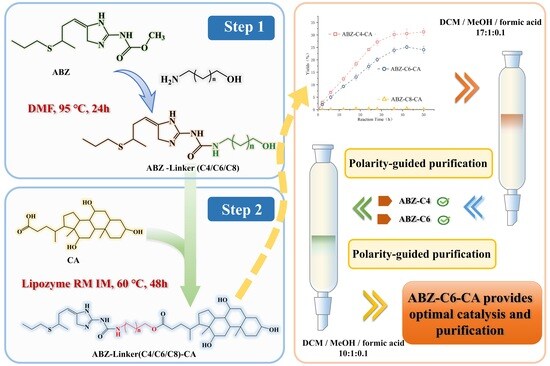
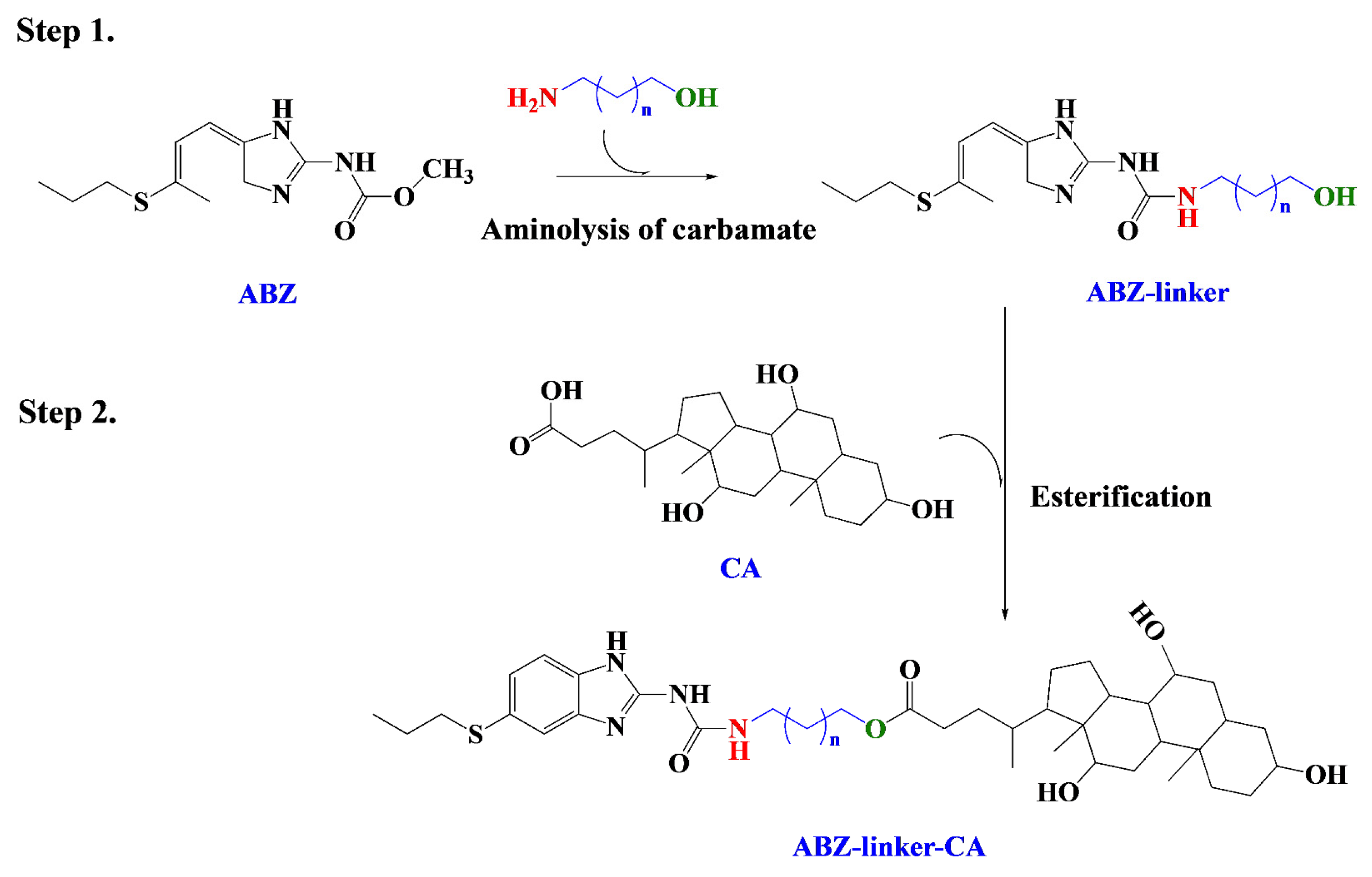
The synthesis of ABZ–linker–CA was designed as a two-step route (Scheme 1), comprising aminolysis of the ABZ carbamate by an amino-alcohol linker to form ABZ–linker, followed by esterification of ABZ–linker with CA. In principle, lipases could potentially catalyze both steps of the two-step synthesis. Therefore, their catalytic feasibility was systematically evaluated for each transformation in this work, with the aim of developing a greener and chemoselective acyl-transfer route that operates under mild conditions, avoids stoichiometric coupling reagents, minimizes by-product formation, simplifies purification, and enables catalyst reuse.

2.2. Aminolysis of ABZ

For the preparation of ABZ–linkers, the catalyst-free aminolysis in DMF at 95 °C afforded ABZ-C4, ABZ-C6, and ABZ-C8 in comparable reaction yields of 50.3 ± 2.4%, 49.9 ± 5.3%, and 52.2 ± 1.9%, respectively (Table 1). These moderate yields are mainly attributable to incomplete conversion of ABZ under the applied catalyst-free aminolysis conditions. HPLC analysis of the crude reaction mixtures showed the persistence of unreacted ABZ after the reaction, indicating that full conversion was not achieved. Meanwhile, a minor side reaction was also observed, leading to the formation of ABZ-amine as a detectable by-product (Figures S1A and S2A). Accordingly, the approximately 50% yields of the ABZ–linkers are interpreted as arising primarily from incomplete aminolysis, together with a limited extent of side-product formation. These results suggest that linker chain length had little influence on the overall aminolysis efficiency under the conditions employed.
Analytical data supported the assignments of both the main products and the by-product. TLC monitoring (DCM/MeOH/formic acid, 17:1:0.1, v/v/v) showed consumption of ABZ and formation of a less mobile, more polar band corresponding to ABZ–linker, accompanied by a faint UV-active band that was isolated and identified as ABZ-amine (Figure S1A). The by-product exhibited an [M + H]+ ion at m/z 208.0907 in HRMS, consistent with ABZ-amine (calculated for C10H14N3S+, 208.0903; Figure S2A). The purified ABZ-C4, ABZ-C6 and ABZ-C8 intermediates were confirmed by HRMS and 1H NMR (Figures S2 and S3). The 1H NMR spectra supported carbamate-to-urea conversion by showing loss of the carbamate methoxy resonance and the appearance of linker methylene signals. HRMS further corroborated the structures, with the observed [M + H]+ ions matching the calculated values.
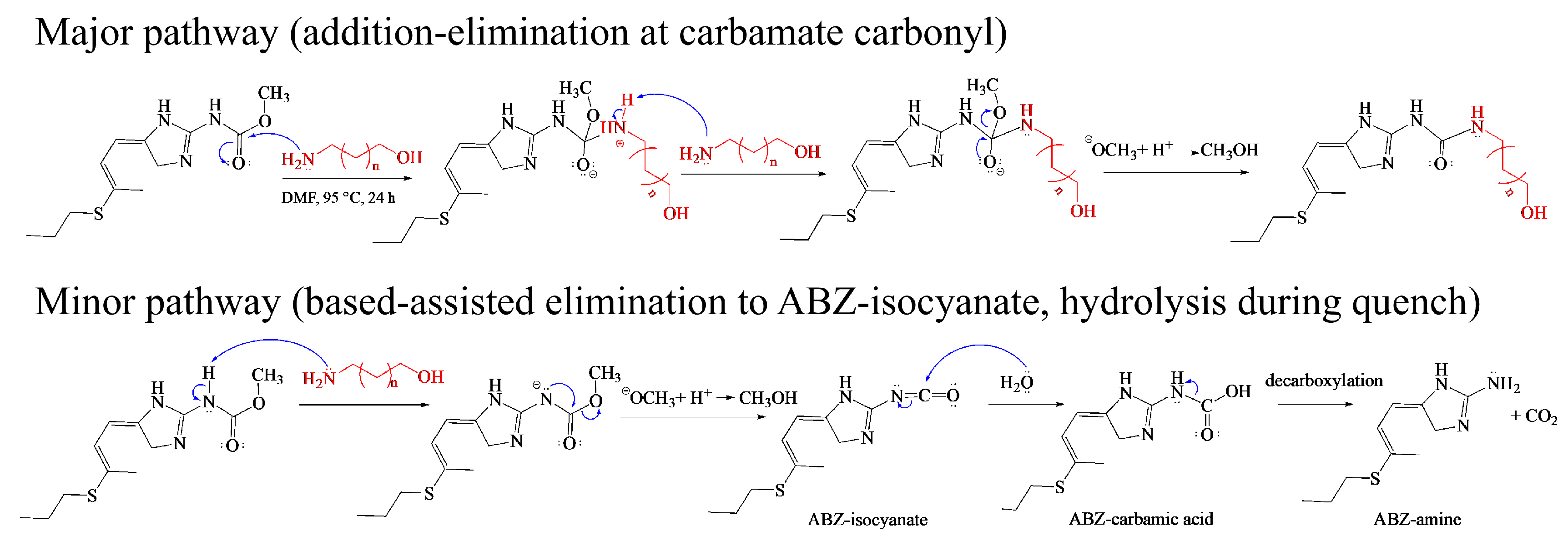
The observed chemoselectivity is consistent with nucleophilic addition–elimination at the methyl carbamate carbonyl. Under these neutral, catalyst-free conditions, the amino group of the amino alcohol is the dominant nucleophile, whereas the hydroxyl group remains weak because it is not converted to the corresponding alkoxide; accordingly, no O-carbamylated (ester-type) products were detected within the detection limit of TLC/HRMS. DMF likely promotes aminolysis by improving the solubility of both reaction partners and enhancing the effective nucleophilicity of the amine in a polar aprotic environment. Formation of ABZ-amine can be rationalized by a competing base-assisted pathway (Figure 1): deprotonation of the ABZ-linked carbamate N–H generates a conjugate base that collapses with expulsion of methoxide (ultimately methanol) to form an ABZ-isocyanate intermediate (ABZ–N=C=O). This electrophilic isocyanate is likely intercepted by the amino alcohol to afford the desired urea (ABZ–linker). Because rigorously anhydrous conditions were not established, hydrolysis of the putative ABZ-isocyanate intermediate may occur during the reaction or workup. Accordingly, the aqueous quenching step is better regarded as a likely amplification stage, rather than the exclusive stage, leading to ABZ-amine formation.
However, none of the tested lipases (Lipozyme RM IM, Lipozyme TL IM, and Novozym 435) produced a detectable ABZ–linker under lipase-compatible conditions (45 °C, DCM; Table 1). This failure likely reflects a combination of substrate- and catalyst-related constraints. First, ABZ exhibits limited solubility in common nonpolar solvents that preserve lipase activity, which restricts mass transfer and lowers the apparent reaction rate. Second, the ABZ carbamate is intrinsically less reactive than the activated esters typically used for lipase-catalyzed aminolysis [24], and the bulky benzimidazole-containing scaffold may be poorly accommodated within the acyl-binding pocket, reducing productive binding and acyl-enzyme formation. Third, many lipases show low efficiency toward aminolysis with highly hydrophilic amines or amino-alcohols, which are disfavored in the predominantly hydrophobic active-site environment [15]. In addition, ABZ may bind to the lipase in nonproductive poses (e.g., at the acyl pocket/active-site entrance), which could reduce the fraction of catalytically competent complexes and thereby further lower the apparent activity. Collectively, these results indicate that lipase catalysis is unsuitable for Step 1, and the thermal, catalyst-free aminolysis in DMF was therefore adopted for ABZ–linker synthesis. In addition, carbamate motifs are a well-established inhibitory chemotype for serine hydrolases [25], because they can react with the catalytic serine nucleophile to form relatively stable carbamoyl-enzyme adducts [25]. This behavior has also been demonstrated for lipase-related serine hydrolases, including monoacylglycerol lipase and lysosomal acid lipase [26,27]. Therefore, the benzimidazole carbamate moiety of ABZ may not act as a passive structural element in the present system, but may instead promote nonproductive binding and/or inhibitory engagement of the lipase active site, which could further disfavor lipase-mediated aminolysis.

2.3. Immobilized Lipase Selection for the Esterification of ABZ–Linkers with CA

Before lipase screening, the reaction medium for Step 2 was selected from preliminarily assessed low-nucleophilicity organic solvents, with emphasis on three practical considerations: sufficient substrate dissolution, acceptable compatibility with the immobilized lipase, and operational stability during heating. Because the esterification was conducted at an elevated temperature, solvent boiling point was also taken into account to minimize solvent loss and composition drift during prolonged incubation. Although dichloromethane provided somewhat higher ABZ solubility than chloroform, its lower boiling point made it less suitable for the 60 °C reaction system. By contrast, CHCl3 maintained adequate substrate dissolution while offering better operational stability under tightly capped conditions. Therefore, CHCl3 was adopted as the fixed reaction medium for the subsequent lipase-catalyzed esterification experiments. The preliminary solvent assessment is summarized in Table S2 in the Supplementary Materials. For the second-step synthesis of ABZ–linker–CA, a carbodiimide-mediated esterification using EDC/DMAP was performed as a chemical benchmark [11]. Under these conditions (DMF, 25 °C), the target conjugates were obtained in ~10–11% reaction yield, and no significant dependence on linker chain length was observed (p > 0.05; Table 2). The modest yields likely arise from a combination of steric congestion around the CA carboxyl group, limited substrate solubility that impairs mass transfer, and nonproductive consumption of activated intermediates inherent to carbodiimide chemistry. These limitations may be exacerbated by the polyhydroxylated scaffold of CA, which can promote aggregation and competing side processes, thereby lowering effective coupling efficiency.
Beyond its mild and environmentally benign character, biocatalysis can provide high chemoselectivity and regioselectivity through the confined three-dimensional architecture of enzyme active sites [19], which is particularly advantageous for polyhydroxylated substrates such as CA. Accordingly, three commercial immobilized lipases were evaluated for the esterification of ABZ–linker with CA (Step 2). In our system, 60 °C was selected for the lipase-catalyzed esterification because increasing the temperature improved the effective availability of the ABZ–linker substrate in the organic phase and enhanced the observed conversion up to 60 °C. Under identical conditions (60 °C, CHCl3), Novozym 435 did not yield detectable ABZ–linker–CA, whereas Lipozyme TL IM afforded low but measurable yields for ABZ-C4-CA and ABZ-C6-CA. Among the tested biocatalysts, Lipozyme RM IM was the most effective, with 18.5 ± 1.3% and 14.3 ± 1.6% yields for ABZ-C4-CA and ABZ-C6-CA, respectively, while the yield dropped markedly for ABZ-C8-CA (1.2 ± 0.3%; Table 2).
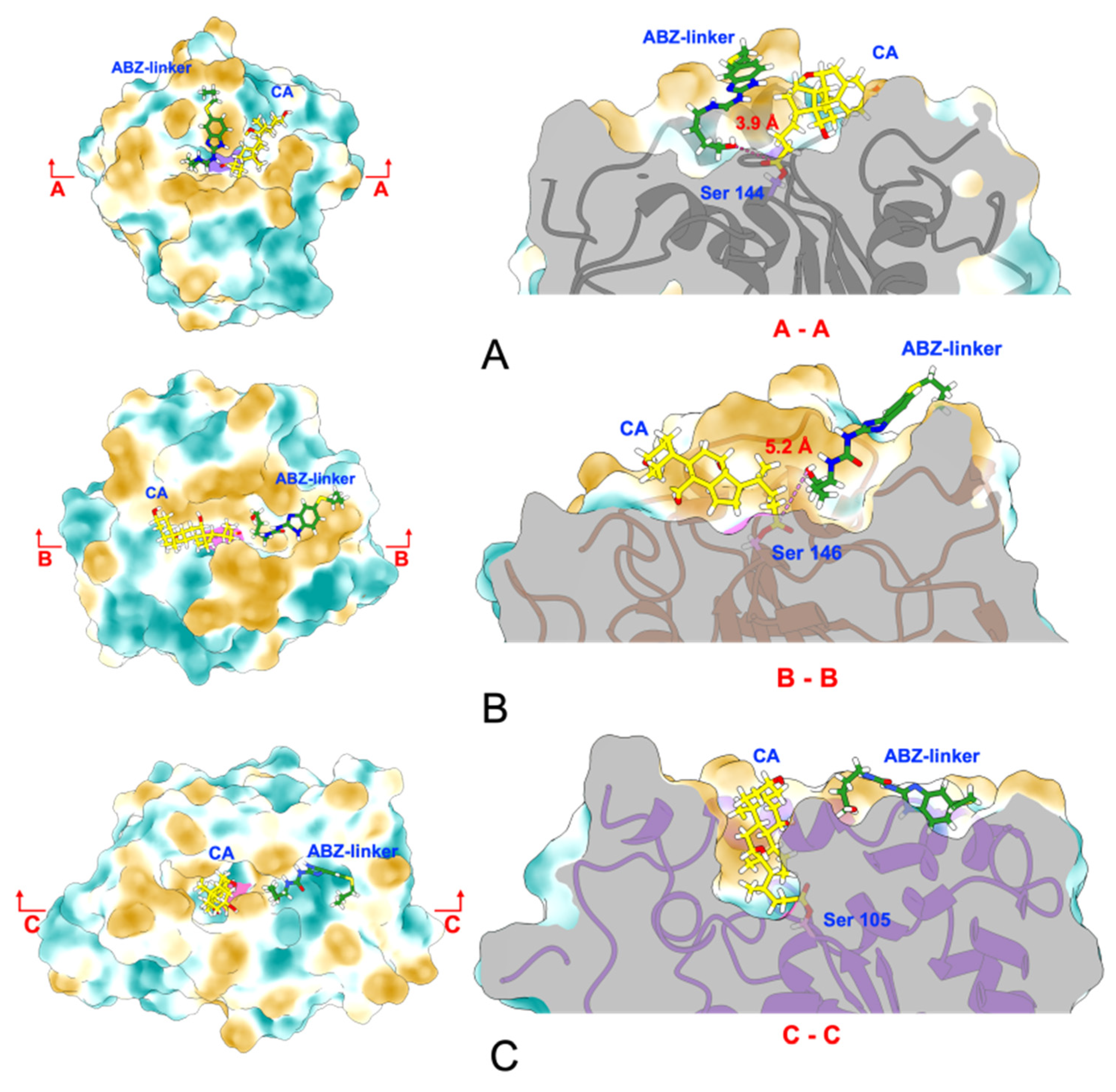
Molecular docking was performed to rationalize why only Lipozyme RM IM and, to a lesser extent, Lipozyme TL IM supported this esterification (Figure 2). Consistent with the canonical lipase mechanism, productive catalysis requires (i) positioning of CA near the catalytic serine in a pose compatible with acylation and (ii) a near-attack geometry that enables the linker hydroxyl group to approach the acyl-serine for deacylation. Docking suggested that all three lipases can accommodate CA in the vicinity of the catalytic serine. However, Candida antarctica lipase B (CALB; PDB: 5GV5; Novozym 435) features a narrow, deep binding pocket that restricts simultaneous accommodation of the bulky CA and ABZ–linker, disfavoring a productive approach of the linker hydroxyl group and consistent with the non-detectable conversion. In contrast, Rhizomucor miehei lipase (RML; PDB: 4TGL; Lipozyme RM IM) and Thermomyces lanuginosus lipase (TLL; PDB: 1EIN; Lipozyme TL IM) possess broader, more open pockets that can co-bind CA and ABZ–linker. Notably, the best-ranked pose in RML placed the linker hydroxyl group closer to the acyl-serine than in TLL (3.9 Å vs. 5.2 Å), suggesting a more favorable pre-reactive geometry for deacylation and aligning with the higher experimental yields observed for Lipozyme RM IM.

2.4. Process Condition Selection for Lipase-Catalyzed Esterification

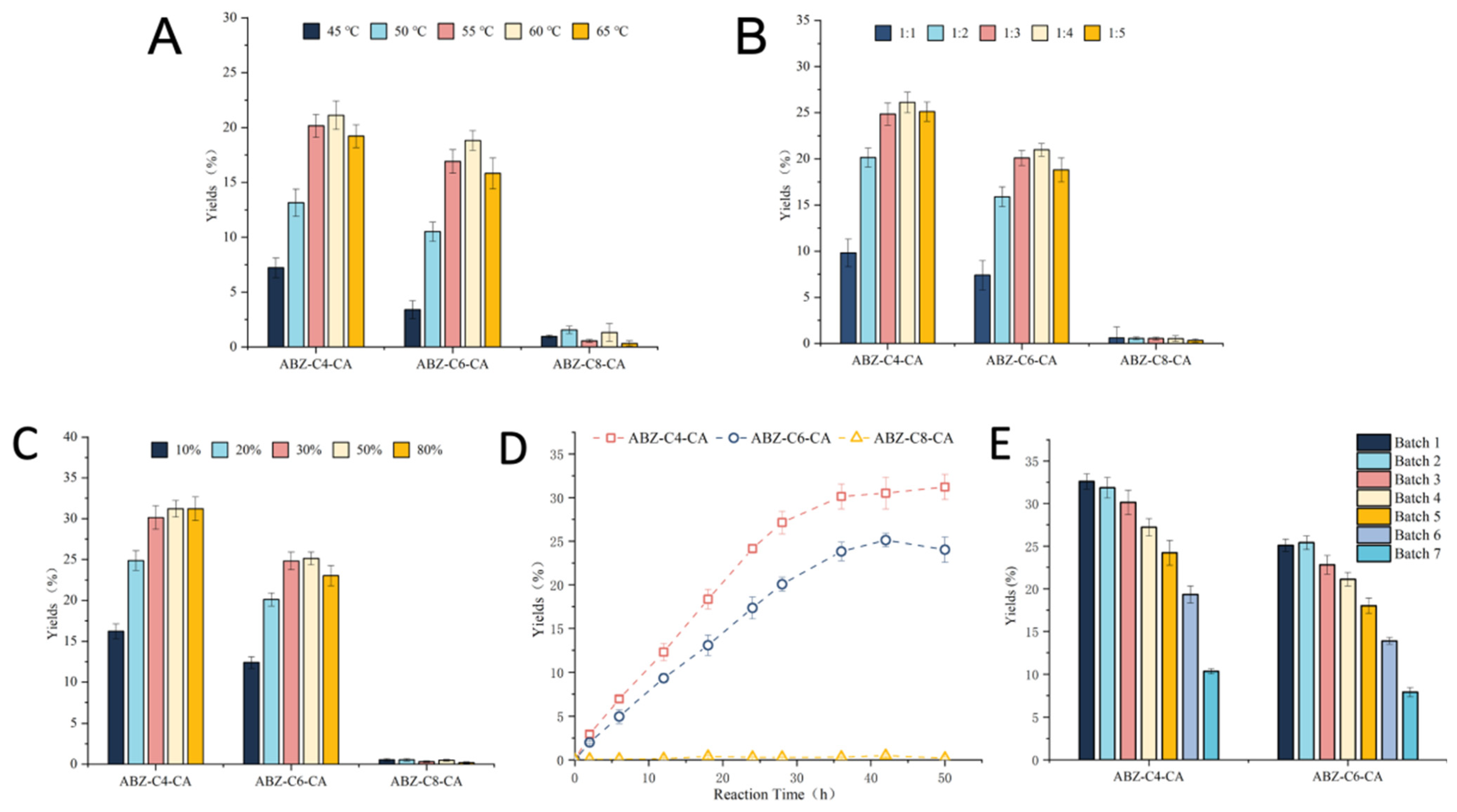
To define a practical operating window for Lipozyme RM IM-catalyzed esterification of ABZ–linker with cholic acid (CA), key parameters (temperature, ABZ–linker: CA ratio, enzyme loading, and reaction time) were screened sequentially via a one-factor-at-a-time (OFAT) strategy, which is a classic and effective method for rapidly locking the optimal parameter range in the exploratory stage of lipase-catalyzed esterification [28,29], considering the heterogeneous interfacial nature of the system and process practicality [20]. CHCl3 was used as a single fixed reaction medium for the enzymatic esterification in order to enable a controlled comparison of linker length, lipase identity, and process parameters within one consistent reaction environment. Consistent with the reported robustness of Lipozyme RM IM [28], increasing temperature improved yields up to 60 °C, whereas 65 °C lowered the final yields, suggesting partial deactivation during prolonged incubation (Figure 3A). The C8 substrate showed negligible yield across 45–65 °C, indicating a substrate-specific limitation that was not alleviated by temperature alone. Because CA is inexpensive relative to the synthetically prepared ABZ–linkers, CA was used in excess; the largest improvement for C4/C6 was observed when the ABZ–linker–CA ratio was increased from 1:1 to 1:3, with only marginal gains beyond 1:3 (Figure 3B). Increasing enzyme loading enhanced yield but plateaued above 30% (w/w, lipase/ABZ–linker) (Figure 3C), consistent with diminishing returns once interfacial accessibility becomes limiting. Time-course profiles showed that C4 and C6 approached a plateau by 36–48 h (Figure 3D). Based on these trends, 60 °C, ABZ–linker:CA = 1:3 (molar), 30% (w/w) enzyme loading, and 48 h were selected, giving HPLC-assayed product yields of 31% and 25% for ABZ-C4-CA and ABZ-C6-CA, respectively, whereas ABZ-C8-CA remained low yielding (≤2.6%). Normalized to the biocatalyst charge under the optimized setting (10 mg ABZ–linker; 30% w/w enzyme), product outputs corresponded to 2.29 gproduct∙genzyme−1 for ABZ-C4-CA and 1.76 g product g−1 enzyme for ABZ-C6-CA.
TLC monitoring of crude esterification mixtures revealed the desired ABZ–linker–CA together with residual ABZ–linker, and a minor UV-active component identified as ABZ-amine (Figure S1B). The presence of ABZ-amine is attributable in part to carryover from the aminolysis step; additionally, a low-level, workup-amplified decomposition of ABZ–linker to an isocyanate-derived species cannot be excluded, which would yield ABZ-amine upon aqueous processing (as discussed in Section 2.2). Notably, no evidence for non-selective acylation of CA at multiple hydroxyl sites (e.g., multi-esterification/crosslinking) was observed by TLC or HPLC (Figures S1B and S5), consistent with preferential O-acylation at the primary linker alcohol.
The isolated ABZ-C4-CA and ABZ-C6-CA products were confirmed by HRMS and 1H NMR (Figures S2E,F and S3D,E). In positive-ion mode (ESI+), ABZ-C4-CA gave m/z 713.4304 [M + H]+ and ABZ-C6-CA gave m/z 741.4622 [M + H]+, consistent with the expected linker-dependent mass difference. The 1H NMR spectra (DMSO-d6) showed characteristic downfield urea N–H resonances (~11–12 ppm), aromatic signals of the ABZ core (~7–8 ppm), a dense aliphatic envelope (0.6–2.0 ppm) attributable to the cholic-acid framework, and O–CH/O–CH2 resonances (3.3–4.5 ppm) consistent with ester formation.
The operational stability of Lipozyme RM IM was evaluated by consecutive-batch reuse (Figure 3E). Although the immobilized catalyst could be readily recovered, yields decreased progressively with cycle number, reaching approximately one-third of the first-cycle level by the seventh cycle. This loss is consistent with cumulative thermal/solvent stress, particle attrition, and/or fouling by substrates/products that reduces mass transfer and active-site accessibility.
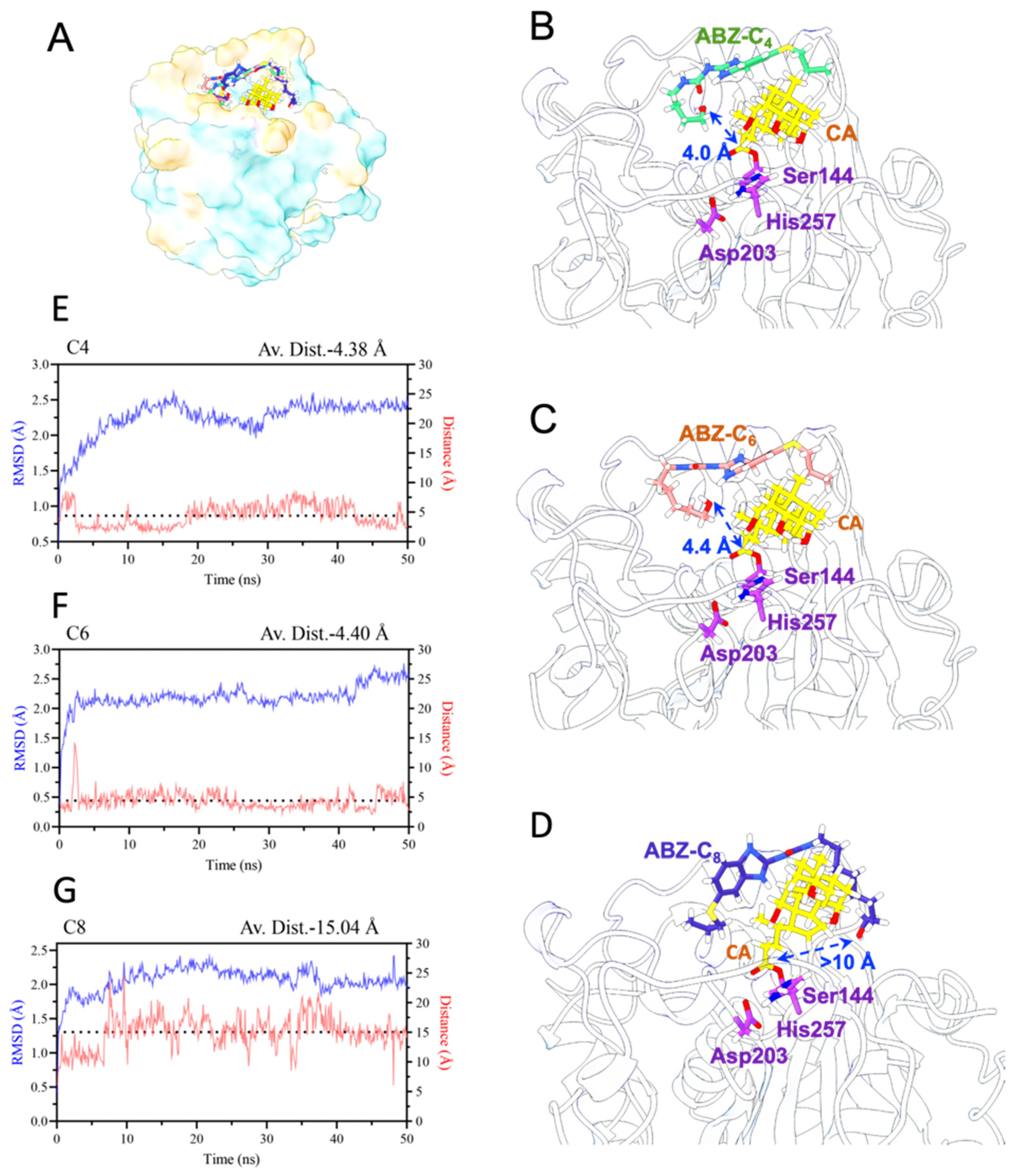
Structure-based simulations further supported the chain-length dependence observed experimentally. Lipozyme RM IM is an immobilized R. miehei lipase (RML) with a shallow hydrophobic pocket adjacent to the catalytic triad (Ser144-His257-Asp203). Docking suggested that both C4 and C6 acceptors can be accommodated alongside CA while maintaining a near-attack geometry, positioning the linker hydroxyl within approximately 4 Å of the catalytic serine during formation of the acyl-enzyme intermediate. In contrast, extending the linker to C8 imposed steric and torsional penalties that favored non-productive orientations, displacing the hydroxyl group from the reactive center (>10 Å in docking) (Figure 4B–D). Molecular dynamics trajectories were consistent with this picture: C4 and C6 maintained stable binding (substrate RMSD < 0.5 Å over 20–50 ns) and a persistent Ser-OH separation around 4.3–4.4 Å, whereas C8 showed a markedly larger and more fluctuating distance (mean ~15 Å), accounting for the negligible conversion that could not be rescued by temperature or stoichiometric driving force alone (Figure 4E–G). Taken together, the process optimization results revealed a clear linker-length dependence under the unified reaction conditions used in this study. The C4 and C6 linkers remained catalytically accessible, whereas the C8 linker showed negligible conversion even after adjustment of temperature, substrate ratio, and enzyme loading. To further interpret this experimentally observed reactivity trend, structure-based simulations were subsequently used to examine how linker length affects productive binding in the active site of Lipozyme RM IM.

2.5. Intermediate Retrieval and Product Separation During the Two-Step Synthesis

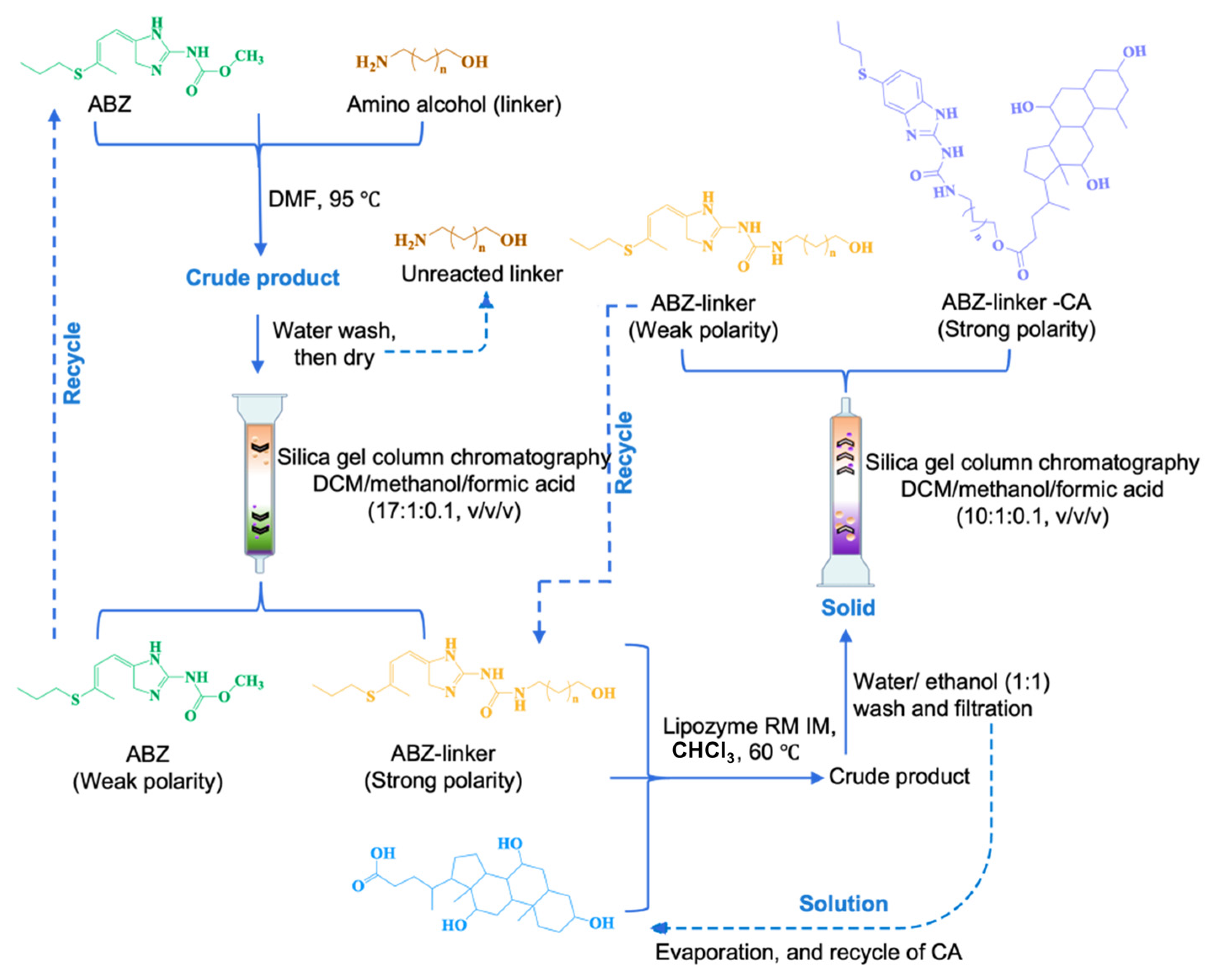
As shown in Scheme 2, purification was designed around polarity-driven partitioning to remove excess small-molecule reagents and enable retrieval of valuable intermediates. After Step 1, the addition of water dissolved the excess amino-alcohol linker while precipitating ABZ-derived species, allowing the solid to be loaded directly onto silica. Using DCM/MeOH/formic acid (17:1:0.1, v/v/v), unreacted ABZ eluted first, followed by the more polar ABZ–linker; the formic-acid modifier reduced streaking/tailing by weakening strong adsorption of the benzimidazole nitrogens on silica [30,31]. TLC indicated a larger ABZ/ABZ–linker spacing for the C6 series than for C4 (Figure S1A), consistent with improved chromatographic selectivity on silica and more efficient retrieval of unreacted ABZ. The isolated ABZ-C4 and ABZ-C6 fractions showed clean single-peak HPLC traces (Figure S4), supporting their direct use in the subsequent esterification.
After Step 2, the crude mixtures were precipitated and washed with aqueous ethanol (1:1, v/v), which removed dissolved CA into the filtrate for recycling and enriched ABZ-containing species in the solid (Scheme 2). TLC of the crude broths (Figure S1B; rightmost lanes) typically showed the desired ABZ–linker–CA together with residual ABZ–linker; the C6 series displayed clearer band separation than the C4 series. Final silica-gel purification required a stronger eluent, DCM/MeOH/formic acid (10:1:0.1, v/v/v), to elute the highly polar conjugates while retaining ABZ–linker, improving throughput. Under these conditions, ABZ-C6-CA was obtained with high chromatographic purity (Table S1) and showed a single dominant HPLC peak (Figure S5), indicating efficient separation from ABZ-C6. In contrast, ABZ-C4-CA showed partial co-elution (secondary/late-eluting features in HPLC; Figure S5), consistent with reduced selectivity when both intermediate and product are highly polar and strongly hydrogen-bonding on silica. Overall, precipitation followed with silica-gel workflow enables intermediate retrieval and CA recycling, with the C6 series offering more robust chromatographic separation; further gains for the C4 series may require alternative stationary phases or gradient tuning in the final step.

2.6. Functional Validation of ABZ–CA Conjugates

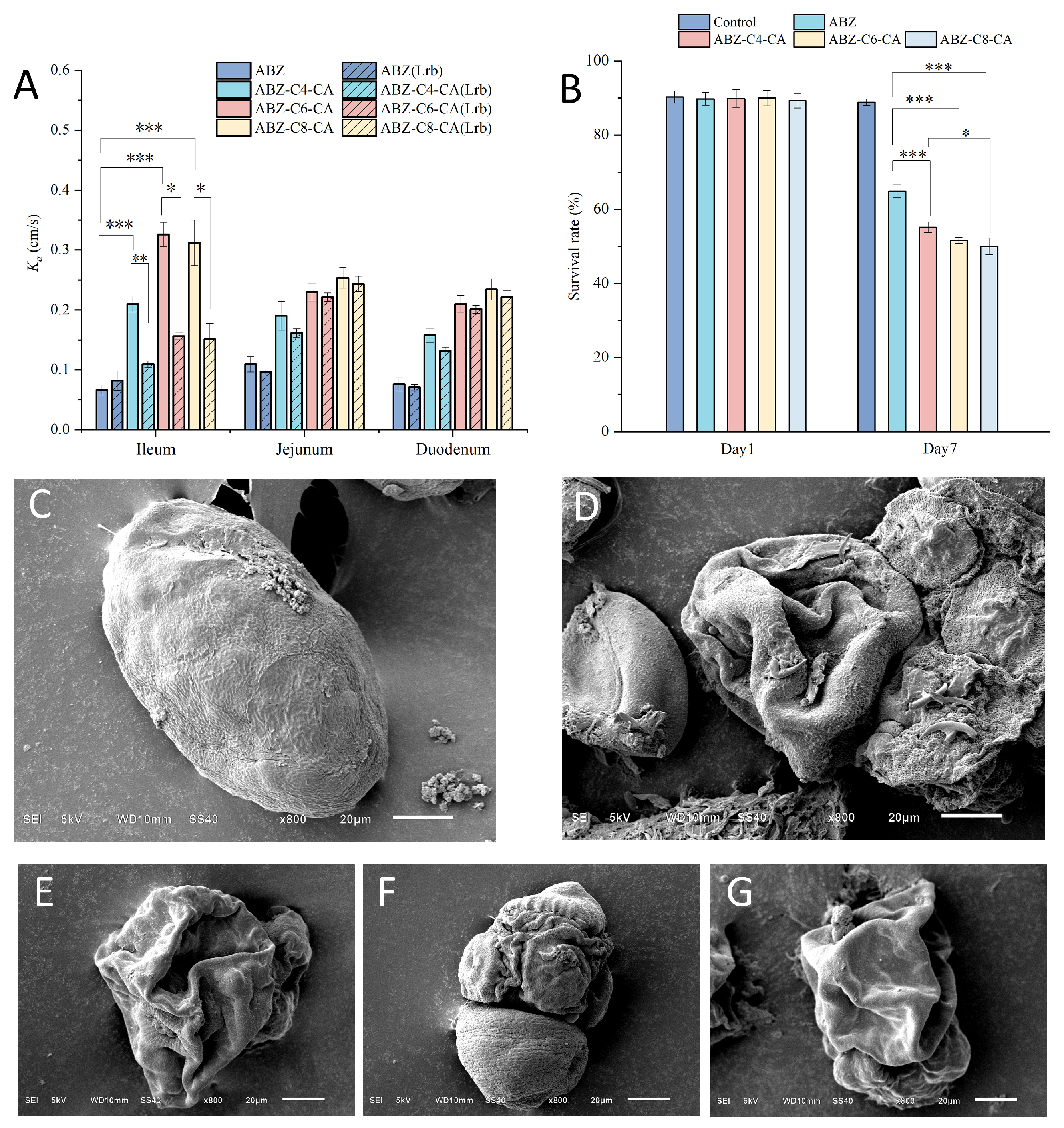
ABZ–CA conjugates bearing alkyl linkers (C4–C8) were examined as functional validation of the synthesized products by assessing regional intestinal uptake and antiparasitic performance. Free ABZ exhibited comparable absorption across the jejunum, duodenum, and ileum, consistent with passive diffusion (Ka = 0.10, 0.07, and 0.06 cm∙s−1, respectively; Figure 5A). In contrast, all conjugates displayed significantly higher uptake (p < 0.05) and a distinct shift in the primary absorption site to the ileum. Co-incubation with linerixibat (Lrb), a selective ASBT inhibitor, selectively suppressed ileal uptake (p < 0.05) with minimal effects in the duodenum or jejunum, supporting ASBT-mediated transport driven by the cholic-acid motif (Figure 5A) [32,33]. Ileal absorption increased from C4 to C6, but decreased for C8 (Figure 5A), consistent with improved membrane partitioning at moderate linker length and suboptimal ASBT fit at the longest chain length.
In the ex vivo protoscolex assay, untreated E. multilocularis protoscoleces (EmPS) maintained viability in liver homogenate, whereas ABZ and all conjugates significantly reduced survival after 7 days (p < 0.05; Figure 5B). The conjugates consistently outperformed ABZ, and ABZ-C6-CA and ABZ-C8-CA showed the lowest mean viability values. Although ABZ-C8-CA showed lower ASBT-mediated absorption than ABZ-C6-CA, its higher lipophilicity may facilitate partitioning into the parasite membrane, which could contribute to its pronounced activity in this setting. SEM imaging showed marked surface damage in the treated groups (Figure 5D–G), whereas the blank control maintained intact morphology (Figure 5C).
Considering both biological performance and manufacturability, ABZ-C6-CA represents the most practical candidate. It combines high ileal uptake with near-maximal efficacy and remains readily accessible through the enzymatic synthesis route. When the linker length was extended, C4 and C6 maintained appreciable conversion under identical biocatalytic conditions, while the C8 analogue showed a pronounced drop in yield. Moreover, ABZ-C6-CA afforded higher analytical purity after silica-gel purification than the C4 series, supporting a simpler downstream separation and improved scalability.

3. Materials and Methods

3.1. Materials

ABZ was obtained from Beijing Coupling Technology (Beijing, China). Cholic acid, dimethyl sulfoxide (DMSO), and the linker molecules 8-amino-1-octanol, 6-amino-1-hexanol, and 4-amino-1-butanol were purchased from McLean (Shanghai, China). Immobilized lipase of Lipozyme RM IM, Lipozyme TL IM, and Novozym 435 were purchased from Novozymes, Beijing, China. The ASBT inhibitor linerixibat (Lrb) was obtained from Shanghai Ruji Biotechnology Development (Shanghai, China). All other chemicals and solvents used were of analytical grade or higher.

3.2. Animals

Twenty healthy male rats (clean grade, 120–130 g) were purchased from Beijing Viton Leval Experimental Animal Technology Co., Ltd. (Beijing, China). All animal experiments were conducted in accordance with the guidelines of the Institutional Animal Care and Use Committee (IACUC) of Qinghai University, with approval number PJ-202302-18. The animals were housed under controlled conditions at 20–23 °C with 50–55% humidity, natural lighting, and ad libitum access to food and water.

3.3. Thin-Layer Chromatography (TLC)

TLC was used to monitor the reaction progress and to assess fraction purity during the purification workflow. Samples were dissolved in methanol (10 mg mL−1), spotted onto silica-gel TLC plates with a glass capillary, and developed in a sealed glass chamber. For ABZ–linker analysis (Step 1), the developing solvent was dichloromethane/methanol/formic acid (17:1:0.1, v/v/v). For ABZ–linker–CA analysis (Step 2), dichloromethane/methanol/formic acid (10:1:0.1, v/v/v) was used. After development, the plates were air-dried in a fume hood and visualized under UV light at 254 nm.

3.4. Preparation and Separation of ABZ–Linkers and ABZ–Linker–CAs

Step 1 (thermal aminolysis) was performed based on our previous report [9], with minor modifications. Amino alcohols with alkyl chain lengths of 4, 6, and 8 were used as linkers. Briefly, ABZ (5.0 g) was added to DMF (15 mL) in a 250 mL conical flask, and the amino alcohol was added at a molar ratio of 3:1 relative to ABZ. The reaction mixture was heated to 95 °C and maintained for 24 h. After reaction, the mixture was slowly poured into ice water under stirring (500 rpm) until no further precipitation formed. The suspension was then kept at 4 °C for 1 h and filtered through a Büchner funnel. The collected precipitate was freeze-dried for 24 h to afford the crude ABZ–linkers.
Crude ABZ-derived solids from Step 1 were purified by silica-gel column chromatography using a glass column (Ø 60 mm × 300 mm) packed with silica gel (particle size 0.045 mm). For each run, 1.0 g of crude material was loaded and eluted at 30 mL min−1 with dichloromethane/methanol/formic acid (17:1:0.1, v/v/v). Product-containing fractions were combined and concentrated by rotary evaporation.
For the enzymatic route in Step 2, CHCl3 was selected as the reaction medium after a preliminary assessment of low-nucleophilicity organic solvents, because it provided the most balanced overall performance in terms of substrate dissolution, acceptable compatibility with the immobilized lipase, and operational stability during heating. Purified ABZ–linkers were therefore dissolved in chloroform (CHCl3) to 1 mg·mL−1. Reactions were carried out in tightly capped 4 mL borosilicate glass vials equipped with PTFE-lined screw caps. CA was added at an ABZ–linker:CA molar ratio of 1:3, and immobilized lipase (Novozym 435, Lipozyme TL IM, or Lipozyme RM IM) was charged at 30 wt% relative to ABZ–linker (w/w). In addition, a color-indicating silica gel desiccant was added as a water scavenger at 1 wt% relative to the amount of ABZ–linker substrate. Initial lipase screening was conducted at 60 °C, and the effects of temperature, substrate ratio, enzyme loading, and reaction time were subsequently evaluated by varying the corresponding parameter while keeping the others constant. Unless otherwise stated, reactions were agitated at 800 rpm for up to 48 h. To minimize solvent loss during heating, the vials were kept tightly capped throughout the reaction. Aliquots (0.10 mL) were withdrawn at predefined time points (1, 4, 8, 12, 24, 36, and 48 h), membrane-filtered, and analyzed by HPLC.
After Step 2, the crude mixtures were precipitated and washed with aqueous ethanol (1:1, v/v) to remove dissolved CA into the filtrate and enrich ABZ-containing species in the solid fraction. The recovered solids were further purified by silica-gel column chromatography using dichloromethane/methanol/formic acid (10:1:0.1, v/v/v). Product-containing fractions were combined and concentrated by rotary evaporation.
For comparison only, a benchmark chemical esterification using EDC/DMAP was also performed in DMF at 25 °C for 24 h, as described in Table 2.

3.5. HPLC Analysis

Quantification of ABZ-derived species was performed by HPLC (Shimadzu LC-20A, Kyoto, Japan) on a C18 column (xp-C18, 250 mm × 4.6 mm, 5 µm) maintained at 30 °C with UV detection at 295 nm and an injection volume of 10 µL. ABZ–linkers were analyzed using acetonitrile/water (80:20, v/v) at 1.0 mL·min−1 with a 12 min run time. ABZ–linker–CA conjugates were analyzed using methanol/water (90:10, v/v) at 0.8 mL·min−1 with a 12 min run time.
Product yields were determined by HPLC using an external-standard calibration. Calibration curves were generated for each analyte by linear regression of peak area versus concentration (Figure S6). Peak areas of reaction samples were converted to concentrations using the corresponding calibration equation. Reported yields are reaction yields on a molar basis, calculated relative to the initial charge of ABZ (for Step 1) or ABZ–linker (for Step 2) as shown in Equations (1) and (2).
Yield % = n ABZ linker n 0 ABZ × 100
Yield % = n ABZ linker CA n 0 ABZ linker × 100

3.6. Structural Identification of ABZ–Linker–CAs

HRMS data were acquired on a Waters Xevo G2 QTof instrument (Milford, MA, USA) equipped with an electrospray ionization (ESI±) source. Samples were prepared in dichloromethane/methanol (5:1, v/v) and directly infused for analysis in positive-ion mode.
1H NMR was applied for the structure assay of each compound. The sample was dissolved in 1 mL of DMSO-d6 and sonicated for 5 min. The solution was filtered through a 0.22 μm organic-compatible membrane filter and transferred to a 5 mm NMR tube. 1H NMR spectra were acquired on a 600 MHz NMR spectrometer (Bruker, Billerica, MA, USA, AV600) at 298 K. Chemical shifts (δ) are reported in ppm.

3.7. Measurement of Transmembrane Efficiency of ABZ–Linker–CAs in Different Intestinal Segments

The establishment of an intestinal eversion model in vitro was performed by using Gurunath’s method with minor modifications according to Tang et al. [10]. The inhibitory experiment was carried out with Linerixibat (lrb) applied as ASBT inhibitor, and the concentration of added lrb was 5 µg·mL−1.
The absorption rate (Ka) was calculated across various intestinal segments using Equations (3) and (4).
K a = d Q / d t × 1 / A
Q = 1 n 1 P n × V s + P n × V
where dQ/dt represents the penetration rate of unit time; A was the area of experiential intestinal segment (cm2); Pn refers to the detected concentration of sample at each tested time (μg·mL−1); vs. is the volume of each sample (mL); and V is the volume of blank K-R solution added to the segment (mL).

3.8. Evaluation of ABZ–Linker–CAs Against Protoscolex from E. multilocularis

The protoscolex (PS) from E. multilocularis were aseptically collected from the abdominal cavity of Mongolian gerbils in Qinghai Provincial Research Key Laboratory for Echinococcosis. The cysts were first collected from E. multilocularis after dissection, followed by repeated washing, suspension, and filtration to remove residual tissue, blood, and other impurities under aseptic conditions. The viability of concentrated PS was verified before further use.
The negative control group was set as liver homogenate without any drugs in the culture medium. Positive control was set as the addition of ABZ (0.04 μM) in the culture medium. The treatment groups included ABZ-C4-CA, ABZ-C6-CA, and ABZ-C8-CA. Among the tested conjugates, ABZ-C8-CA was produced through the EDC/DMAP method. Each conjugate was administered at 0.04 μM on an ABZ-equivalent basis, with dosing corrected for analytical purity. The cultivation and evaluation procedures of PS were described in our previous work [10]. The cultivation was performed in RPMI 1640 medium with liver homogenate at 37 °C in a humidified atmosphere of 5% CO2, with an initial PS density of 1000–2000 PS mL−1. The survival rate was employed to evaluate the effect of ABZ–linker–CAs against PS.

3.9. In Silico Simulation

Two-stage docking was performed in YASARA (version 21.12.19) with R. miehei lipase (RML; PDB: 4TGL, open conformation) as the receptor. Catalytic residues were Ser144/His257/Asp203. In both docking stages, the search space was centered at the geometric center of the catalytic-triad reference atoms (Ser144 Oγ, His257 Nε2, and Asp203 Oδ2; chain A) and defined as a cubic box of 32 × 32 × 32 Å. In Stage I, cholic acid (CA) was docked to the active site to approximate the acylation step of lipase catalysis. The top-ranked CA pose was selected based on docking score and catalytic plausibility, with a near-attack geometry between Ser144 Oγ and the CA acyl carbonyl carbon. An acyl-enzyme-like intermediate was then constructed by forming an ester bond between Ser144 Oγ and the CA acyl carbonyl carbon. The resulting complex was subjected to structural relaxation by energy minimization to remove steric clashes and obtain a reasonable starting conformation for the second docking stage. In Stage II, ABZ–linkers (C4, C6, and C8) were docked into the relaxed acyl-enzyme-like complex using the same docking box and identical Vina settings, enabling direct comparison across linker lengths. The docking results were viewed and analyzed with PyMOL (version 2.5) package.
For molecular dynamics (MD) simulation, a representative docking-derived complex was selected for MD simulation. Topology files for dichloromethane (DCM) were generated using sobtop_1.0 (dev3.1) with GAFF atom types and parameters (http://sobereva.com/soft/Sobtop/, accessed on 5 July 2023). MD simulations were carried out using GROMACS (2022.3) with the AMBER99SB-ILDN protein, nucleic AMBER94 [34]. The system was placed in a cubic box with a 1.0 nm margin from the protein surface to the box boundary. Dichloromethane (DCM) molecules were added to fill the simulation box. Position restraints were applied to the protein (force constant 1000 kJ·mol−1·nm−2) during minimization and equilibration. Energy minimization (10,000 steps) was performed using steepest descent for the first 5000 steps followed by conjugate gradient for the last 5000 steps. The system was gradually heated to 333 K over 200 ps, followed by equilibration for 300 ps under constant volume with a temperature-coupling time constant of 0.2 ps. Production MD was subsequently performed in DCM at 333 K and 1 atm for 50 ns using a 0.5 fs time step. Trajectories were analyzed with GROMACS tools. RMSD relative to the initial structure was calculated after least-squares fitting, and the time evolution of the key reactive distance between the acyl carbon atom and the hydroxyl oxygen atom of ABZ–linker was monitored to assess how linker length (C4/C6/C8) affects catalytic fitness in the lipase active site.

3.10. Statistical Analysis

All biological experiments were performed at least in triplicate, and data are presented as the mean ± standard deviation (SD) from three independent experiments. Prior to parametric comparisons, homogeneity of variance was evaluated using Levene’s test. When the assumption of homogeneity of variance was satisfied, statistical comparisons among groups were performed by one-way analysis of variance (ANOVA). When this assumption was not met, the corresponding non-parametric test (Kruskal–Wallis test) was used instead. The source data and the corresponding results of homogeneity-of-variance testing for the biological datasets used for inferential statistical comparison in this study are provided in the Supplementary Materials (Tables S3–S7). Differences were considered statistically significant at p < 0.05 (*), highly significant at p < 0.01 (**), or very highly significant at p < 0.001 (***).

4. Conclusions

A two-step route combining thermal aminolysis and immobilized-lipase esterification was established to prepare ABZ–linker–CA conjugates and clarify how linker length governs catalytic feasibility, purification selectivity, and ex vivo performance. ABZ–linkers (C4–C8) were obtained in similar yields (~50%) from thermal aminolysis, whereas lipase-catalyzed esterification displayed strong chain-length dependence (C4/C6 reactive; C8 ≤ 2.6% yield), a trend supported by docking/MD analyses indicating loss of productive binding geometry at the longest chain length. The polarity-guided workup and silica-gel protocol enabled CA recycling and provided cleaner chromatographic separation for the C6 series than for C4, resulting in higher product purity and improved scalability. Ex vivo assays confirmed ASBT-mediated ileal uptake and enhanced antiparasitic activity versus ABZ. Overall, ABZ-C6-CA emerged as the most practical candidate by integrating reactivity (C4/C6 reactive; C8 poorly reactive), separability (C6 cleaner purification), and performance (highest ileal uptake with near-maximal efficacy), highlighting linker-length engineering as a transferable lever for aligning biocatalysis with downstream processing and delivery outcomes.

Supplementary Materials

The following supporting information can be downloaded at: https://www.mdpi.com/article/10.3390/catal16050382/s1, Figure S1: TLC assay for the crude reaction liquid; Figure S2: MS assay results for each compound; Figure S3: 1H-NMR (600 MHz, DMSO-d6) spectrum of each compound; Figure S4: HPLC chromatogram of ABZ–linker; Figure S5: HPLC chromatogram of ABZ–linker–CA; Figure S6: Standard curve for each compound; Table S1: HPLC purity of isolated compounds after silica-gel chromatography; Table S2: Preliminary assessment of low-nucleophilicity organic solvents for selection of the reaction medium used in the lipase-catalyzed esterification step; Table S3: Source data and homogeneity-of-variance test results for the Day 1 antiparasitic activity data shown in Figure 5B; Table S4: Source data and homogeneity-of-variance test results for the Day 7 antiparasitic activity data shown in Figure 5B; Table S5: Pairwise statistical comparisons for the Day 7 antiparasitic activity data shown in Figure 5B; Table S6: Source data for the intestinal absorption rate constants (Ka) shown in Figure 5A; Table S7: Representative pairwise statistical comparisons for the ileal absorption data shown in Figure 5A.

Author Contributions

Data curation, S.S. and J.L. (Jiahao Liu); Funding acquisition, K.N. and F.Z.; Investigation, S.S. and J.L. (Jiahao Liu); Methodology, Z.G. and C.H.; Software, J.L. (Jingshuai Liu); Supervision, K.N. and F.Z.; Writing—original draft, J.L. (Jiahao Liu) and S.J.; Writing—review and editing, F.Z. and K.N. All authors have read and agreed to the published version of the manuscript.

Funding

This work was funded by the Science and Technology Department of Qinghai Province (2024-QY-201).

Data Availability Statement

The original contributions presented in this study are included in the article and Supplementary Materials. Further inquiries can be directed to the corresponding authors.

Conflicts of Interest

The authors declare no conflicts of interest.

Abbreviations

The following abbreviations are used in this manuscript:
ABZAlbendazole
ASBTApical sodium-dependent bile acid transporter
CACholic Acid
DMFDimethylformamide
HPLCHigh-Performance Liquid Chromatography
DCMDichloromethane
MDMolecular Dynamics
LrbLinerixibat
EDC1-Ethyl-3-(3-dimethylaminopropyl) carbodiimide
DMAP4-Dimethylaminopyridine
TLCThin-Layer Chromatography
HRMSHigh-Resolution Mass Spectrometry
NMRNuclear Magnetic Resonance
CALBCandida antarctica lipase B
RMLRhizomucor miehei lipase
TLLThermomyces lanuginosus lipase
PDBProtein Data Bank
RMSDRoot-Mean-Square Deviation
EmPSEchinococcus multilocularis protoscoleces
DMSODimethyl sulfoxide
IACUCInstitutional Animal Care and Use Committee
ESIElectrospray ionization
SDStandard deviation

References

  1. Lin, Y.; Ong, Y.C.; Keller, S.; Karges, J.; Bouchene, R.; Manoury, E.; Blacque, O.; Müller, J.; Anghel, N.; Hemphill, A. Synthesis, characterization and antiparasitic activity of organometallic derivatives of the anthelmintic drug albendazole. Dalton Trans. 2020, 49, 6616–6626. [Google Scholar] [CrossRef]
  2. Horton, J. Albendazole: A review of anthelmintic efficacy and safety in humans. Parasitology 2000, 121, S113–S132. [Google Scholar] [CrossRef] [PubMed]
  3. Tamarozzi, F.; Horton, J.; Muhtarov, M.; Ramharter, M.; Siles-Lucas, M.; Gruener, B.; Vuitton, D.A.; Bresson-Hadni, S.; Manciulli, T.; Brunetti, E. A case for adoption of continuous albendazole treatment regimen for human echinococcal infections. PLoS Negl. Trop. Dis. 2020, 14, e0008566. [Google Scholar] [CrossRef] [PubMed]
  4. Abulaihaiti, M.; Wu, X.-W.; Qiao, L.; Lv, H.-L.; Zhang, H.-W.; Aduwayi, N.; Wang, Y.-J.; Wang, X.-C.; Peng, X.-Y. Efficacy of albendazole-chitosan microsphere-based treatment for alveolar echinococcosis in mice. PLoS Negl. Trop. Dis. 2015, 9, e0003950. [Google Scholar] [CrossRef]
  5. Malik, A.A.; Bari, S.u. Alveolar Hydatid Disease. In Human Abdominal Hydatidosis; Springer: Cham, Switzerland, 2019; pp. 63–72. [Google Scholar]
  6. Mansuri, S.; Kesharwani, P.; Tekade, R.K.; Jain, N.K. Lyophilized mucoadhesive-dendrimer enclosed matrix tablet for extended oral delivery of albendazole. Eur. J. Pharm. Biopharm. 2016, 102, 202–213. [Google Scholar] [CrossRef]
  7. Chassaing, C.; Berger, M.; Heckeroth, A.; Ilg, T.; Jaeger, M.; Kern, C.; Schmid, K.; Uphoff, M. Highly water-soluble prodrugs of anthelmintic benzimidazole carbamates: Synthesis, pharmacodynamics, and pharmacokinetics. J. Med. Chem. 2008, 51, 1111–1114. [Google Scholar] [CrossRef]
  8. Li, M.; Wang, Q.; Li, Y.; Cao, S.; Zhang, Y.; Wang, Z.; Liu, G.; Li, J.; Gu, B. Apical sodium-dependent bile acid transporter, drug target for bile acid related diseases and delivery target for prodrugs: Current and future challenges. Pharmacol. Ther. 2020, 212, 107539. [Google Scholar] [CrossRef] [PubMed]
  9. Hu, C.; Qin, M.; Zhang, F.; Gao, R.; Gan, X.; Du, T. Improvement of antialveolar echinococcosis efficacy of novel albendazole-bile acids derivatives with enhanced oral bioavailability. PLoS Negl. Trop. Dis. 2023, 17, e0011031. [Google Scholar] [CrossRef]
  10. Tang, S.; Guo, Z.; Liu, J.; Nie, K.; Hu, C. Albendazole oral drug delivery through ASBT-mediated cholic acid derivatives: A win-win for solubility and permeability. J. Mol. Liq. 2024, 406, 125142. [Google Scholar] [CrossRef]
  11. Lutjen, A.B.; Quirk, M.A.; Barbera, A.M.; Kolonko, E.M. Synthesis of (E)-cinnamyl ester derivatives via a greener Steglich esterification. Bioorg. Med. Chem. 2018, 26, 5291–5298. [Google Scholar] [CrossRef]
  12. Sheldon, R.A.; Woodley, J.M. Role of biocatalysis in sustainable chemistry. Chem. Rev. 2018, 118, 801–838. [Google Scholar] [CrossRef] [PubMed]
  13. Basso, A.; Serban, S. Industrial applications of immobilized enzymes—A review. Mol. Catal. 2019, 479, 110607. [Google Scholar] [CrossRef]
  14. Wu, S.; Snajdrova, R.; Moore, J.C.; Baldenius, K.; Bornscheuer, U.T. Biocatalysis: Enzymatic synthesis for industrial applications. Angew. Chem. Int. Ed. 2021, 60, 88–119. [Google Scholar] [CrossRef]
  15. Adlercreutz, P. Immobilisation and application of lipases in organic media. Chem. Soc. Rev. 2013, 42, 6406–6436. [Google Scholar] [CrossRef]
  16. Hou, H.; Zhang, S.; Zhao, B.; Mao, J.; Zhou, Q.; Deng, Q.; Zheng, L.; Shi, J. The mesoporous polydopamine-based bowl-like lipase nanoreactor for the biocatalytic synthesis of oleate sterol ester. ACS Food Sci. Technol. 2023, 3, 1353–1365. [Google Scholar] [CrossRef]
  17. Alejaldre, L.; Lemay-St-Denis, C.; Pelletier, J.N.; Quaglia, D. Tuning selectivity in CalA lipase: Beyond tunnel engineering. Biochemistry 2022, 62, 396–409. [Google Scholar] [CrossRef]
  18. Hernández-Rodríguez, B.; Navarro-Ocaña, A. Steric effects of alcohols on the lipase-catalyzed esterification of hydroxycinnamic acids. J. Mol. Catal. B Enzym. 2015, 115, 24–29. [Google Scholar] [CrossRef]
  19. Horino, S.; Wagner, K.; Hummel, A.; Kanomata, K.; Gröger, H.; Akai, S. Kinetic resolution of cyclic tertiary alcohols with lipase A from Candida antarctica. Eur. J. Org. Chem. 2024, 27, e202400242. [Google Scholar] [CrossRef]
  20. Chapman, J.; Ismail, A.; Dinu, C.Z. Industrial applications of enzymes: Recent advances, techniques, and outlooks. Catalysts 2018, 8, 238. [Google Scholar] [CrossRef]
  21. Sun, J.; Yu, M.; Yang, Z.; Jiang, L. Optimization of Lipozyme RM IM-catalyzed esterification of caffeic acid with hexanol. Food Chem. 2012, 132, 402–408. [Google Scholar] [CrossRef]
  22. Kadivar, S.; De Clercq, N.; Van de Walle, D.; Dewettinck, K. Optimisation of enzymatic synthesis of cocoa butter equivalent from high oleic sunflower oil. J. Sci. Food Agric. 2014, 94, 1325–1331. [Google Scholar] [CrossRef]
  23. Kuo, C.H.; Ju, H.Y.; Chu, S.W.; Chen, J.H.; Chang, C.M.J.; Liu, Y.C.; Shieh, C.J. Optimization of Lipase-Catalyzed Synthesis of Cetyl Octanoate in Supercritical Carbon Dioxide. J. Am. Oil Chem. Soc. 2012, 89, 103–110. [Google Scholar] [CrossRef]
  24. Manova, D.; Gallier, F.; Tak-Tak, L.; Yotava, L.; Lubin-Germain, N. Lipase-catalyzed amidation of carboxylic acid and amines. Tetrahedron Lett. 2018, 59, 2086–2090. [Google Scholar] [CrossRef]
  25. Niphakis, M.J.; Cognetta, A.B.; Chang, J.W.; Buczynski, M.W.; Parsons, L.H.; Byrne, F.; Burston, J.J.; Chapman, V.; Cravatt, B.F. Evaluation of NHS Carbamates as a Potent and Selective Class of Endocannabinoid Hydrolase Inhibitors. ACS Chem. Biol. 2013, 8, 917–923. [Google Scholar] [CrossRef] [PubMed]
  26. Long, J.Z.; Nomura, D.K.; Cravatt, B.F. Characterization of monoacylglycerol lipase inhibition reveals differences in central and peripheral endocannabinoid metabolism. Chem. Biol. 2009, 16, 744–753. [Google Scholar] [CrossRef]
  27. Rosenbaum, A.I.; Cosner, C.C.; Mariani, C.J.; Maxfield, F.R.; Wiest, O.; Helquist, P. Thiadiazole carbamates: Potent inhibitors of lysosomal acid lipase and potential Niemann–Pick type C disease therapeutics. J. Med. Chem. 2010, 53, 5281–5289. [Google Scholar] [CrossRef] [PubMed]
  28. Gou, X.G.; Hu, J.N.; Zhao, M.L.; Zhu, X.M.; Li, H.Y.; Liu, X.R.; Liu, R.; Deng, Z.Y. Lipozyme RM IM-Catalyzed Acidolysis of Cinnamomum camphora Seed Oil with Oleic Acid To Produce Human Milk Fat Substitutes Enriched in Medium-Chain Fatty Acids. J. Agric. Food Chem. 2014, 62, 10594–10603. [Google Scholar] [CrossRef]
  29. Ghazani, S.M.; Marangoni, A.G. Facile lipase-catalyzed synthesis of a chocolate fat mimetic. Sci. Rep. 2018, 8, 15271. [Google Scholar] [CrossRef]
  30. Ntorkou, M.; Zacharis, C.K. Applications of Hydrophilic Interaction Chromatography in pharmaceutical impurity profiling: A comprehensive review of two decades. Molecules 2025, 30, 3567. [Google Scholar] [CrossRef] [PubMed]
  31. Uçar, B.; Gholami, Z.; Svobodová, K.; Hradecká, I.; Hönig, V. A comprehensive study for determination of free fatty acids in selected biological materials: A review. Foods 2024, 13, 1891. [Google Scholar] [CrossRef]
  32. del Estal, J.; Villaverde, C.; Alvarez, A.; Prieto, J. Albendazole and mebendazole uptake by isolated enterocytes. Dev. Pharmacol. Ther. 1992, 19, 27–31. [Google Scholar] [CrossRef] [PubMed]
  33. Alam, M.A.; Al-Jenoobi, F.I.; Al-Mohizea, A.M. Everted gut sac model as a tool in pharmaceutical research: Limitations and applications. J. Pharm. Pharmacol. 2012, 64, 326–336. [Google Scholar] [CrossRef] [PubMed]
  34. Lindorff-Larsen, K.; Piana, S.; Palmo, K.; Maragakis, P.; Klepeis, J.L.; Dror, R.O.; Shaw, D.E. Improved side-chain torsion potentials for the Amber ff99SB protein force field. Proteins 2010, 78, 1950–1958. [Google Scholar] [CrossRef] [PubMed]
Scheme 1. Two-step synthetic route of ABZ–linker–CAs.
Catalysts 16 00382 sch001
Figure 1. Mechanism of main-product (ABZ–linker) and by-product (ABZ-amine) formation under catalyst-free aminolysis.
Catalysts 16 00382 g001
Figure 2. Structural comparison and substrate-docking poses of three candidate lipases for the ABZ–linker/CA esterification. (A) R. miehei lipase (RML; PDB: 4TGL), (B) T. lanuginosus lipase (TLL; PDB: 1EIN), and (C) C. antarctica lipase B (CALB; PDB: 5GV5). The left panels show global surface representations colored by residue polarity (hydrophilic, cyan; hydrophobic, earth yellow), with the docked substrates displayed as sticks (CA, yellow; ABZ–linker, green). Red arrows indicate the sectioning planes used for the enlarged pocket views. The right panels (A–A, B–B, and C–C) present cross-sectional close-ups of the active-site region, highlighting the catalytic serine (magenta; Ser144 in RML, Ser146 in TLL, and Ser105 in CALB) and the relative placement/orientation of CA and ABZ–linker in the binding pocket.
Catalysts 16 00382 g002
Figure 3. Effects of reaction parameters on the yield of ABZ–linker–CAs catalyzed by Lipozyme RM IM: (A) temperature, (B) ABZ–linker/CA molar ratio, (C) enzyme loading, (D) reaction time, and (E) catalyst reusability.
Catalysts 16 00382 g003
Figure 4. Docking and molecular dynamics (MD) analysis of chain-length effects for ABZ–linkers (C4, C6, and C8) in RML (PDB code: 4TGL, Lipozyme RM IM). (A) Global view of the substrate complex bound in the catalytic pocket; the enzyme surface is colored by polarity (hydrophilic, cyan; hydrophobic, earth yellow). (BD) Representative binding conformations of ABZ-C4, ABZ-C6, and ABZ-C8 (sticks) together with cholic acid (CA, yellow) in the active site. The catalytic triad residues Ser144, Asp203, and His257 are shown in purple. The near-attack (reactive) distance between the nucleophilic hydroxyl group of the ABZ–linker and the carbonyl center of the acyl-donor/transition-state intermediate is indicated (blue dashed line; representative distances of ~4.0 Å for ABZ-C4, ~4.4 Å for ABZ-C6, and ~10 Å for ABZ-C8). (EG) MD trajectories (50 ns) showing the protein backbone RMSD (blue, left axis) and the reactive distance (red, right axis) for each complex; the average reactive distance over the trajectory is reported above each plot (4.38 Å for ABZ-C4, 4.40 Å for ABZ-C6, and 15.04 Å for ABZ-C8).
Catalysts 16 00382 g004
Scheme 2. Workflow for the preparation, workup, and silica-gel purification of ABZ–linker and ABZ–linker–CA conjugates, highlighting intermediate retrieval and CA recycling.
Catalysts 16 00382 sch002
Figure 5. (A) Absorption rate constants (Ka) of ABZ and ABZ-CA conjugates across intestinal segments; Lrb indicates co-incubation with the ASBT inhibitor linerixibat. (B) Antiparasitic activity of ABZ and ABZ-CA conjugates against E. multilocularis protoscoleces (EmPS). (CG) Representative SEM images of EmPS following treatment with the indicated compounds; (C): blank; (D): ABZ; (E): ABZ-C4-CA; (F): ABZ-C6-CA; (G): ABZ-C8-CA. Data are presented as mean ± SD from three independent experiments. Statistical analysis was performed as described in Section 3.10; * p < 0.05, ** p < 0.01, *** p < 0.001.
Catalysts 16 00382 g005
Table 1. Yields of ABZ aminolysis with different amino-alcohol linkers.
MethodsYields (%)
ABZ-C4ABZ-C6ABZ-C8
Aminolysis at 95 °C, DMF as solvent50.3 ± 2.449.9 ± 5.352.2 ± 1.9
Lipase 1, 45 °C, DCM as solventN.D.N.D.N.D.
1 Lipase tested in this work include Lipozyme RM IM, Lipozyme TL IM, and Novozym 435. The intended product could not be detected (N.D.) with the enzymatic catalysis.
Table 2. Yield of ABZ–linker–CA synthesized by different catalysts.
MethodsYields (%)
ABZ-C4-CAABZ-C6-CAABZ-C8-CA
EDC and DMAP, 25 °C, DMF as solvent11.15 ± 0.610.52 ± 0.310.89 ± 2.3
lipase Novozym 435, 60 °C, CHCl3 as solventN.D.N.D.N.D.
lipase Lipozyme TL IM, 60 °C, CHCl3 as solvent6.5 ± 1.26.2 ± 0.7N.D.
lipase Lipozyme RM IM, 60 °C, CHCl3 as solvent18.5 ± 1.314.3 ± 1.61.2 ± 0.3
N.D., the intended product could not be detected.
Disclaimer/Publisher’s Note: The statements, opinions and data contained in all publications are solely those of the individual author(s) and contributor(s) and not of MDPI and/or the editor(s). MDPI and/or the editor(s) disclaim responsibility for any injury to people or property resulting from any ideas, methods, instructions or products referred to in the content.