Article

Electronic Coupling in Fe3C/Ni3ZnC0.7 Heterostructures Supported on Carbon Nanotube for Enhanced Alkaline Hydrogen Evolution


1
School of Material Science and Engineering, Shaanxi University of Science & Technology, Xi’an 710021, China
2
School of Electronic Information and Artificial Intelligence, Shaanxi University of Science & Technology, Xi’an 710021, China
3
State Key Laboratory of Inorganic Synthesis and Preparative Chemistry, College of Chemistry, Jilin University, Changchun 130012, China
*
Authors to whom correspondence should be addressed.
Catalysts 2026, 16(4), 315; https://doi.org/10.3390/catal16040315
Submission received: 26 February 2026 / Revised: 20 March 2026 / Accepted: 30 March 2026 / Published: 1 April 2026

Abstract

The development of high-efficiency and low-cost catalysts toward hydrogen evolution reaction (HER) is essential for promoting the industrial water electrolysis for hydrogen production. In this work, a novel Fe3C/Ni3ZnC0.7 heterostructured nanoparticle supported on carbon nanotube is synthesized by a two-step sintering method. It is found that the density of electron state of Ni sites in Ni3ZnC0.7 is optimized and the electrical conductivity of material is greatly enhanced by the interfacial electron coupling between Fe3C and Ni3ZnC0.7. In addition, the abundant interfacial active sites of Fe3C/Ni3ZnC0.7 are exposed due to the support effect of carbon nanotubes. The prepared Fe3C/Ni3ZnC0.7 material shows excellent HER performance, delivering a low overpotential of 187 mV at a current density of 10 mA cm−2 and retains continuous operation for at least 200 h in alkaline environment. This work provides a new perspective for the design of high-performance electrocatalysts for water electrolysis.

1. Introduction

Energy is the vital foundation for human survival and development. At present, humanity faces challenges such as diminishing energy reserves and environmental pollution caused by fossil fuel combustion [1]. Developing environmentally friendly, clean energy sources offers an effective solution to these problems [2]. Hydrogen gas is a green, zero-carbon energy carrier with advantages such as wide application, convenient transportation, high energy density and zero carbon emission at the point of use. It has been widely recognized as a key direction for future energy development [3,4,5,6]. Currently, hydrogen production globally relies primarily on three methods: steam reforming of natural gas, coal gasification, and utilization of chemical byproducts. However, these approaches generate substantial carbon emissions and pose environmental pollution risks, failing to meet national energy development requirements [7].
Electrolysis of water is characterized by high energy conversion efficiency, high product purity, and convenient energy supply, which is widely considered as the large-scale hydrogen production technology with the greatest potential [8,9]. The water electrolysis process consists of hydrogen evolution reaction (HER) at the cathode and oxygen evolution reaction (OER) at the anode. Because the water-splitting reaction involves a significant intrinsic energy barrier, a relatively high overpotential is required to achieve practical hydrogen production rates [10]. An appropriate catalyst can effectively decrease the overpotential required for the reaction, serving as the key to addressing the high overpotential issue. Extensive efforts have therefore been devoted to the development of various catalyst systems, including carbides, noble metals, nitrides, sulfides, and transition metal compounds [11,12,13,14,15,16]. Among them, precious metal Pt exhibits excellent performance in hydrogen production from electrolytic water. However, the high cost and scarcity make it unsuitable for large-scale hydrogen production [17,18,19]. Therefore, the hydrogen production industry urgently requires an efficient, low-cost, and durable non-precious metal-based catalyst to meet hydrogen production demands.
In recent years, transition metal carbides have attracted significant attention as promising candidates to replace noble metal catalysts owing to their Pt-like electronic structure. Among them, the Ni3ZnC material, as a typical transition bimetallic carbide, exhibits stable anti-perovskite crystal structure and rich elemental tunability, leading to its increasing application in the field of electrocatalytic hydrogen evolution. However, the synthesis of Ni3ZnC typically requires the calcination process at high temperatures, which leads to agglomeration of its nanoparticles and insufficient exposure of active sites. In addition, although the Ni3ZnC material has potential metal conductivity, the density of states at the Fermi level is low. This results in a low concentration of free carriers that can be used for conduction, making poor intrinsic conductivity, which is not conducive to the transfer of internal charges in the material [20]. Moreover, the Ni active site of the Ni3ZnC material has a weak adsorption capacity for hydrogen intermediates, resulting in slow reaction kinetics and high overpotential. Researchers have adopted various strategies to improve the catalytic activity of the Ni3ZnC material, and the strategy of constructing a heterogeneous interface has been proven to be effective until now. Li et al. developed a heterostructured Ni3ZnC0.7/NCNT material and tuned the electronic states of carbon atoms adjacent to Ni3ZnC0.7 in NCNT by leveraging the electron penetration effect. Consequently, the resulting Ni3ZnC0.7/NCNT exhibited remarkably improved catalytic activity, achieving the current density of 10 mA cm−2 at a low overpotential of 203 mV [21]. Feng et al. synthesized a Ni3ZnC0.7/VN heterostructure on CNTs and demonstrated that the electronic coupling at the hetero-interface induced interfacial charge redistribution, enabling the Ni3ZnC0.7/VN@CNTs to deliver 10 mA cm−2 at a quite low overpotential of 124 mV in alkaline media [22]. As a metal interstitial compound, Fe3C is an ideal hydrogen evolution catalyst due to its rich bonding system, high stability, high conductivity and suitable hydrogen adsorption energy [23,24]. The integration of Ni3ZnC and Fe3C is expected to greatly improve the hydrogen evolution performance of Ni3ZnC.
Based on the aforementioned approach, a heterostructured Fe3C/Ni3ZnC0.7 composite was prepared in this work through a two-step calcination protocol. The carbon-nanotube-supported Fe3C/Ni3ZnC0.7 material exhibits excellent electrocatalytic activity and long-term stability toward the HER. It delivers an overpotential of 187 mV at a current density of 10 mA cm−2 in alkaline media and maintains catalytic stability for at least 200 h without noticeable degradation. This work provides an effective approach for integrating carbon nanostructures with carbide catalysts and optimizing electrocatalytic performance through interfacial electronic coupling.

2. Results and Discussion

2.1. Synthesis of Fe3C/Ni3ZnC0.7

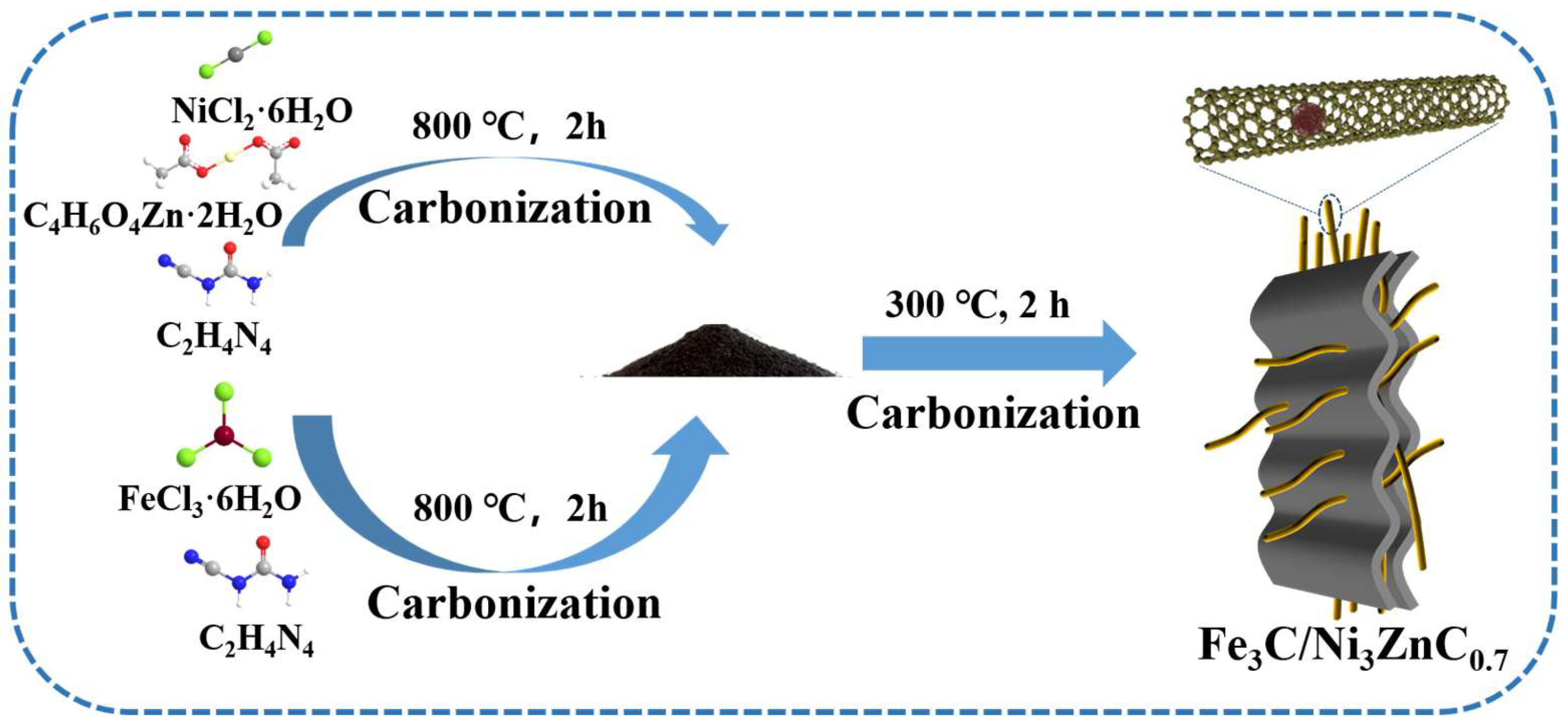
The Fe3C/Ni3ZnC0.7 material was synthesized through a two-step sintering process. Figure 1 shows the preparation of the Fe3C/Ni3ZnC0.7 material. Firstly, the Ni3ZnC0.7 material was synthesized at 800 °C under an inert atmosphere by using nickel trichloride hexahydrate as the nickel source, zinc acetate dihydrate as the zinc source, and an appropriate amount of dicyandiamide as the carbon source. Using the same synthesis process, Fe3C was synthesized in an inert atmosphere using ferric chloride hexahydrate as the iron source and dicyandiamide as the sole carbon source. Then, the prepared Ni3ZnC0.7 and Fe3C were ground and mixed with a mass ratio of 2:1, and calcined at 300 °C for 2 h to obtain the desired Fe3C/Ni3ZnC0.7 material, which had the best performance in the electrochemical performance test (Figure S1).

2.2. Structure Analysis of Fe3C/Ni3ZnC0.7

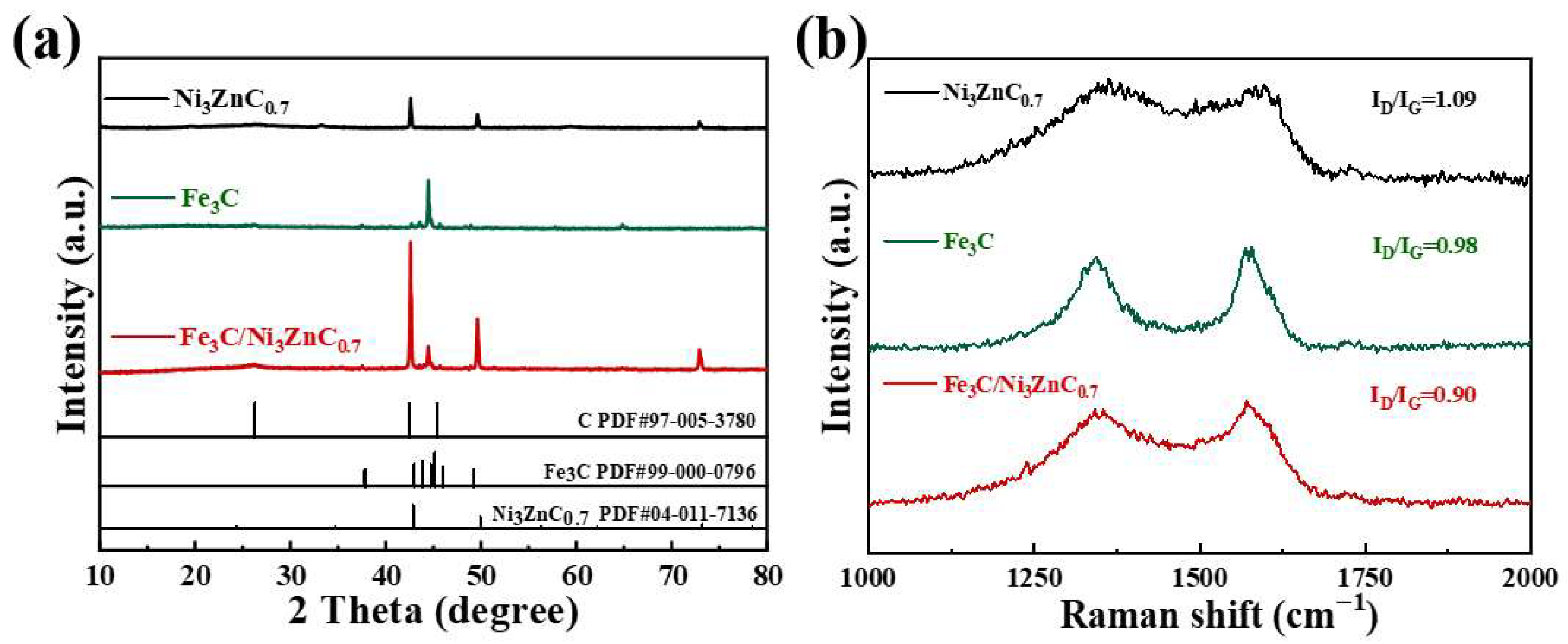
X-ray diffraction (XRD) is a crucial method for detecting the phase composition of a material. To clarify the phase composition of the Fe3C, Ni3ZnC0.7, and Fe3C/Ni3ZnC0.7 materials, XRD analysis was conducted. Figure 2a shows the XRD results for Fe3C, Ni3ZnC0.7, and Fe3C/Ni3ZnC0.7. Fe3C/Ni3ZnC0.7 has obvious diffraction peaks at 42.8°, 49.8° and 73.1°, corresponding to the (111), (200), and (220) crystal planes of Ni3ZnC0.7 (PDF#04-011-7136), respectively. The diffraction peaks at 42.9°, 43.7° and 44.9° belong to the (211), (102) and (031) crystal planes of Fe3C (PDF#99-000-0796). The XRD results show that the synthesized Fe3C/Ni3ZnC0.7 material is mainly composed of Fe3C and Ni3ZnC0.7. Moreover, a relatively prominent diffraction peak at 26.2° belongs to the (111) facet of carbon (PDF#97-005-3780), but it is overshadowed by the diffraction peaks with a stronger intensity of Fe3C and Ni3ZnC0.7. To further clarify the structural property of C, Raman spectroscopy was performed on the Fe3C, Ni3ZnC0.7 and Fe3C/Ni3ZnC0.7 materials (Figure 2b). All samples show two characteristic Raman peaks located near 1350 cm−1 and 1580 cm−1, corresponding to the D-band and G-band of carbon, which represent defective carbon and graphitic carbon, respectively [25,26]. The ID/IG intensity ratio is commonly used to evaluate the graphitization degree of carbon materials, where a lower ratio indicates a higher graphitization level [23]. Compared with Ni3ZnC0.7 and Fe3C, the ID/IG ratio of Fe3C/Ni3ZnC0.7 is the smallest (ID/IG = 0.90), indicating its highest degree of graphitization for carbon substrate and thus the highest electrical conductivity among the three materials.
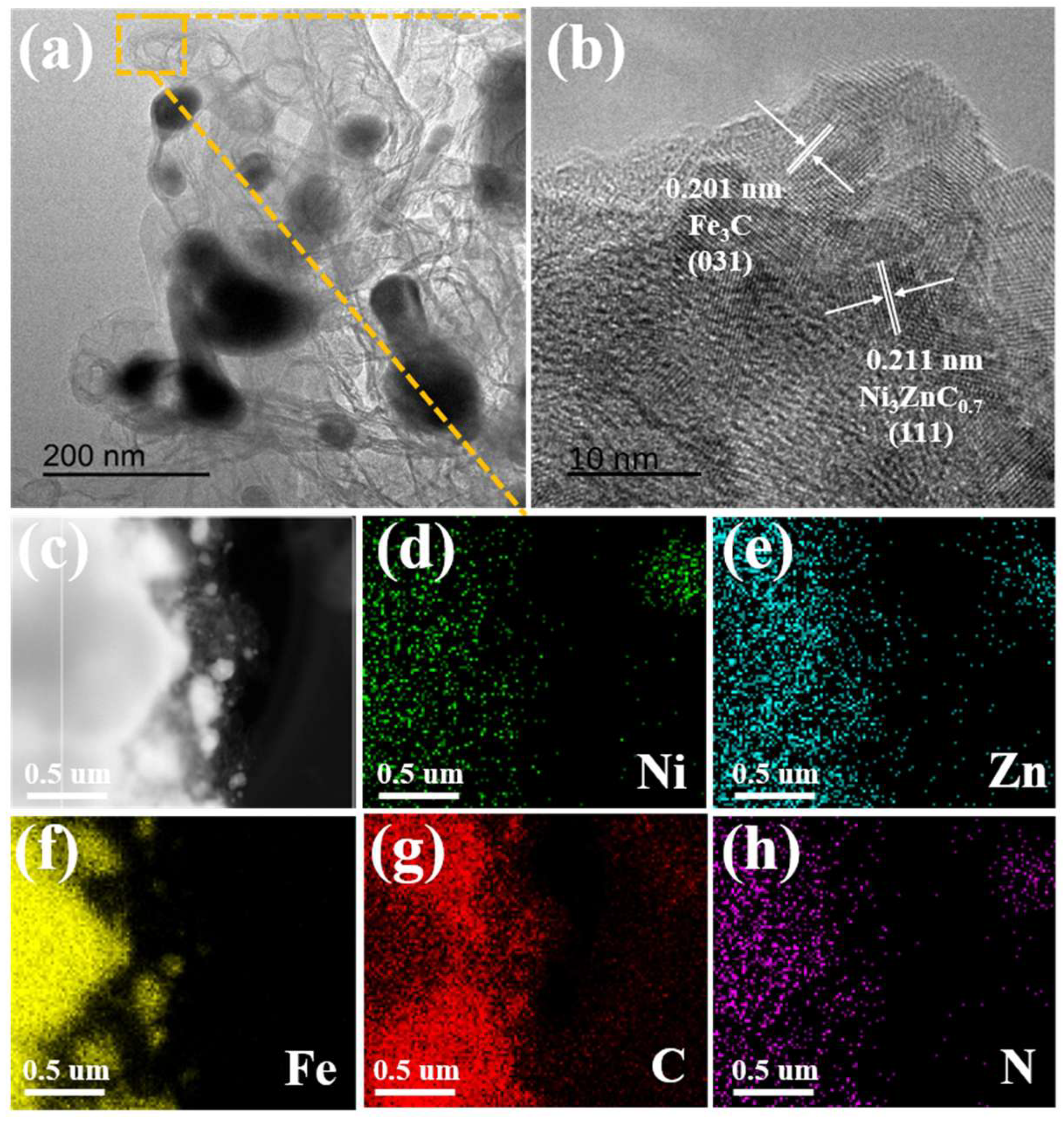
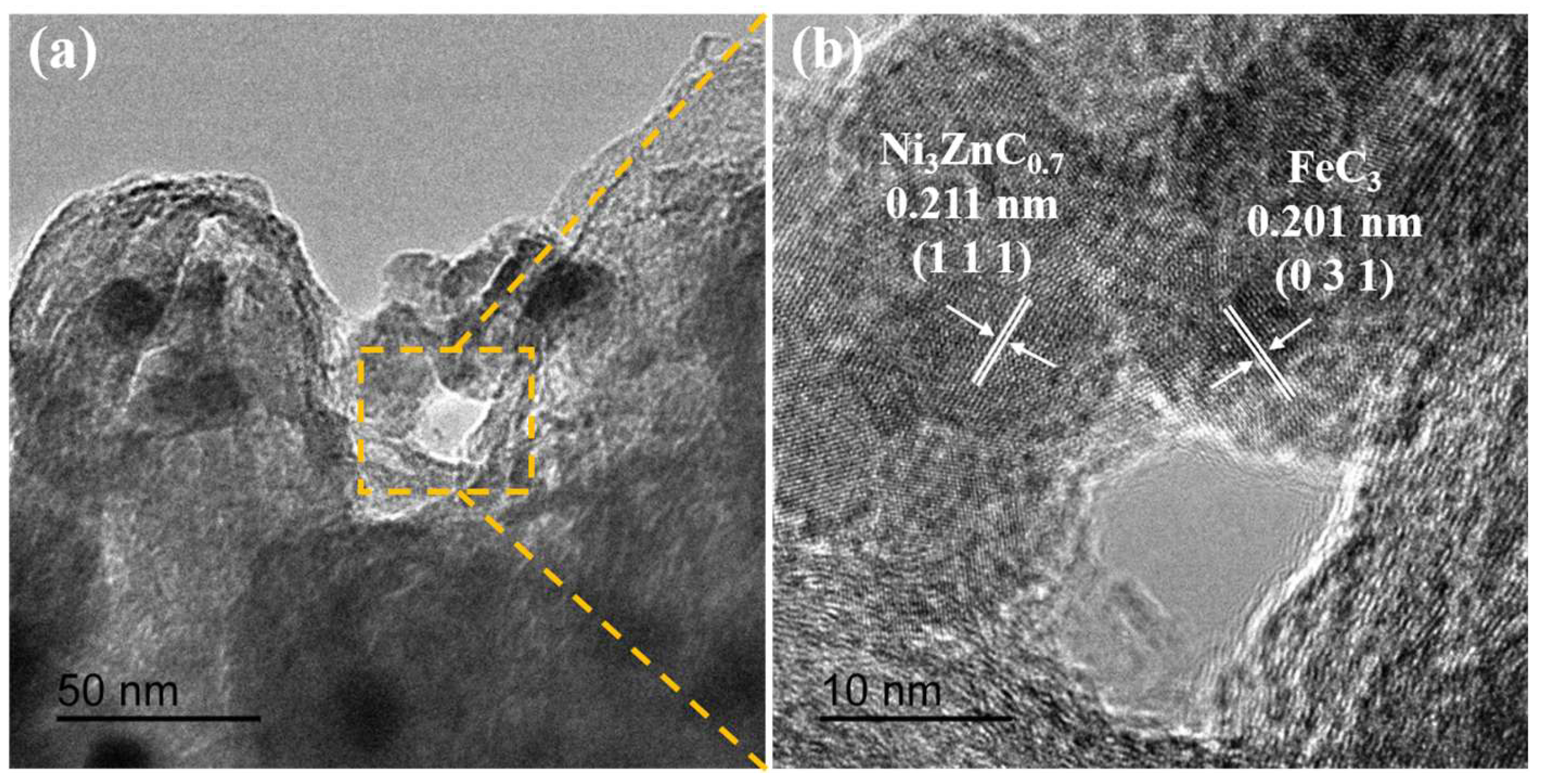
To further investigate the microstructure and crystal features of the Fe3C/Ni3ZnC0.7 composite, transmission electron microscopy (TEM) was used to further observe the Fe3C/Ni3ZnC0.7 material. Figure 3a is the TEM image of the Fe3C/Ni3ZnC0.7 material, revealing that carbon nanotube serves as the encapsulated substance to protect the material from the corrosion of electrolyte to a certain extent and enhance its catalytic durability. In Figure 3b, the high-resolution TEM images displayed that the lattice fringe with an interplanar spacing of 0.201 nm corresponds to the (031) crystal plane of Fe3C, while the fringe with a spacing of 0.211 nm belongs to the (111) plane of Ni3ZnC0.7. The close integration of these two distinct phases indicates the synthesis of the Fe3C/Ni3ZnC0.7 heterostructure. Additionally, the elemental distribution of the region shown in Figure 3c was analyzed. Observation of Figure 3d–h reveals the presence of five elements of Ni, Zn, Fe, C, and N in the Fe3C/Ni3ZnC0.7 material, with these elements uniformly distributed throughout the structure.
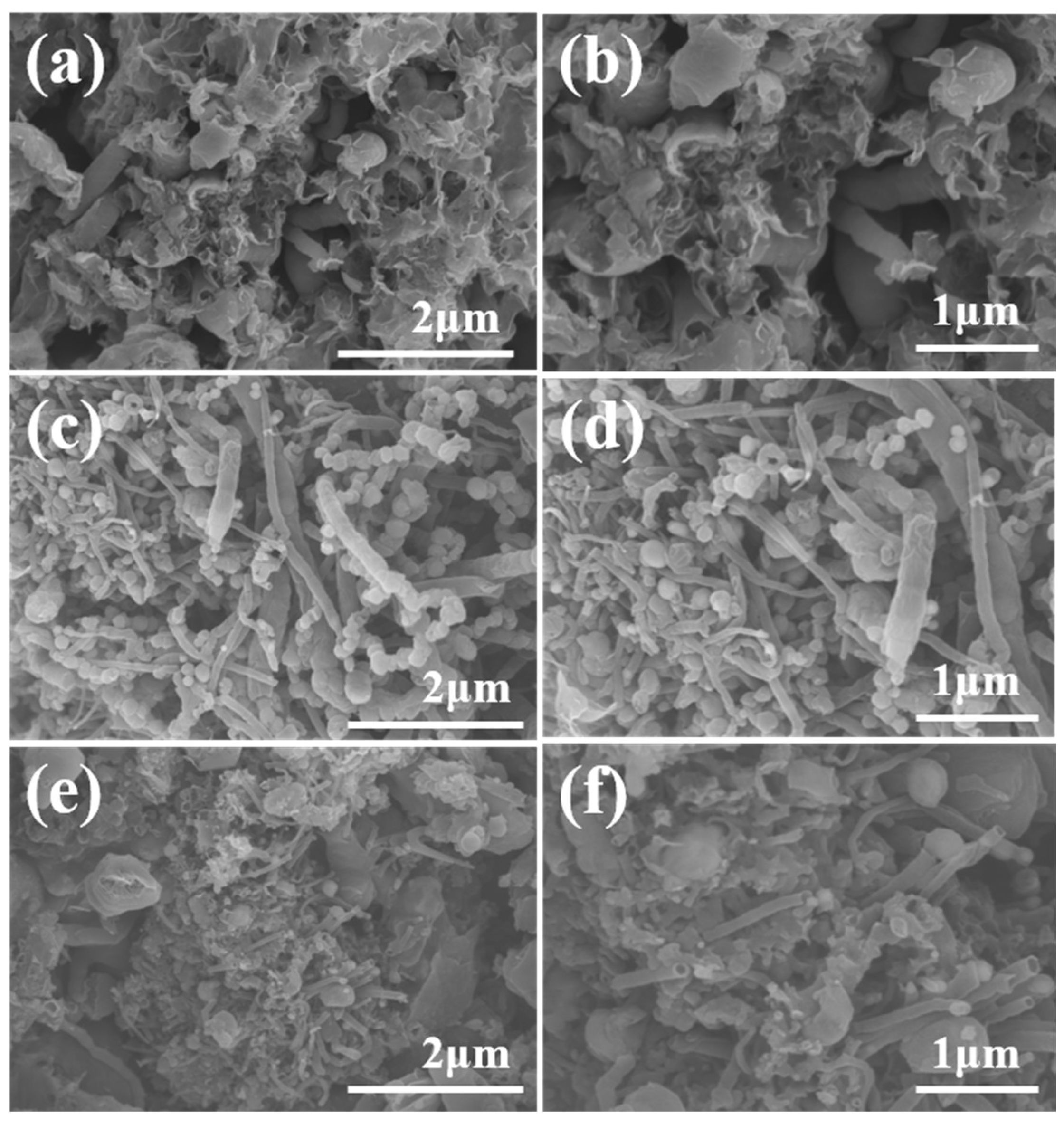
To clarify the overall morphology of Fe3C/Ni3ZnC0.7, Fe3C, and Ni3ZnC0.7 materials, scanning electron microscopy (SEM) was tested by us. Figure 4a,b are the microstructure of the Ni3ZnC0.7 material, which is mainly composed of nanosheet structure. Figure 4c,d depict the microstructure of the Fe3C material, primarily composed of nanoparticles and carbon nanotubes. SEM images reveal a significant presence of nanoparticles at the tips of the carbon nanotubes. Figure 4e,f show the mixed structure of nanotubes and nanosheets of the Fe3C/Ni3ZnC0.7 material. Due to the axial growth of carbon nanotubes, the coating of the Fe3C/Ni3ZnC0.7 material is also more complete, which also restricts the radial diffusion of the Ni3ZnC0.7 material nanosheets to a certain extent. This result is consistent with the TEM observation results.
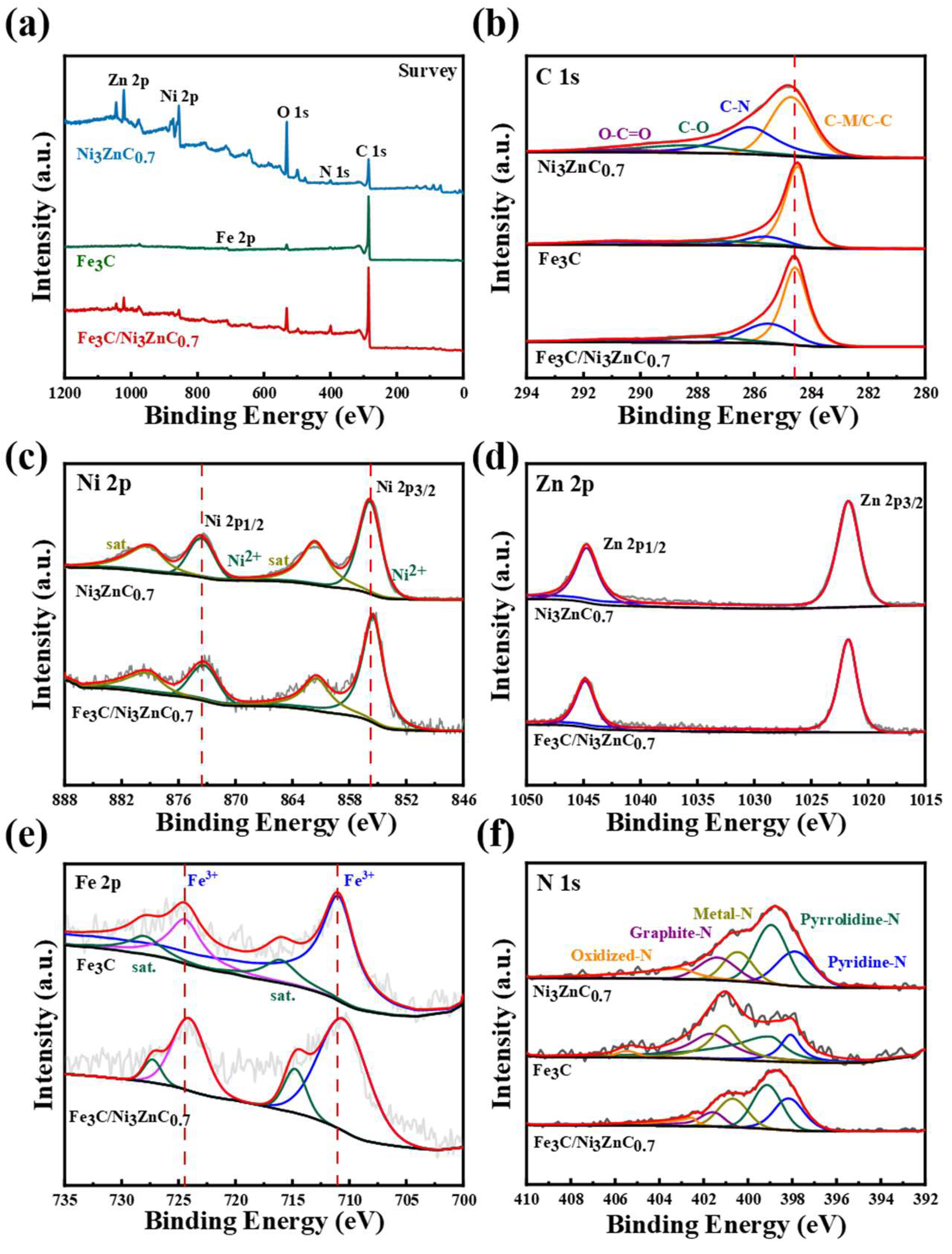
To further analyze the chemical state and electronic interactions of the materials, X-ray photoelectron spectroscopy (XPS) measurements were performed on Ni3ZnC0.7, Fe3C and Fe3C/Ni3ZnC0.7. The survey spectra in Figure 5a confirm the presence of Ni, Zn, Fe, C, and N in the composite. Figure 5b displays the C 1 s high-resolution spectra of Ni3ZnC0.7, Fe3C and Fe3C/Ni3ZnC0.7 materials. The four characteristic peaks at 284.6 eV, 285.53 eV, 287.71 eV, and 290.99 eV in the C 1 s spectrum are attributed to C–C, C–N, C–O, and O-C = O bonds, respectively [27]. Figure 5c shows the high-resolution Ni 2p spectra of Fe3C/Ni3ZnC0.7 and Ni3ZnC0.7. The peaks at 855.54 eV and 873.34 eV are assigned to Ni 2p3/2 and Ni 2p1/2, and there are two satellite peaks at 861.5 eV and 879.14 eV [28]. The high-resolution spectrum of Zn 2p (Figure 5d) can be decomposed into two peaks of 1021.75 eV for Zn 2p3/2 and 1044.86 eV for Zn 2p1/2 [29]. The high-resolution spectrum of Fe 2p is shown in Figure 5e, which can be decomposed into four characteristic peaks, belonging to the 710.66 eV peak of Fe 2p3/2 and the 724.49 eV peak of Fe 2p1/2. The peaks at 715.24 eV and 727.75 eV are satellite peaks [30].
Notably, the Ni 2p3/2 peak of Fe3C/Ni3ZnC0.7 exhibits a negative shift (~0.5 eV) compared to that of Ni3ZnC0.7, indicating an increased electron density at the Ni sites in the Fe3C/Ni3ZnC0.7 composite. Similarly, a comparison of the Fe 2p3/2 peaks between Fe3C/Ni3ZnC0.7 and pure Fe3C reveals a negative shift in binding energy (~1.0 eV), suggesting an enhanced electron density at the iron sites. Furthermore, the C 1s peak in Fe3C/Ni3ZnC0.7 shows a negative shift (~0.5 eV) relative to Ni3ZnC0.7, reflecting an increase in electron density at the C sites of Ni3ZnC0.7 after electronic coupling. In contrast, the C 1s peak of Fe3C/Ni3ZnC0.7 shifts toward higher binding energy (~0.3 eV) compared to Fe3C, indicating that C sites of Fe3C in heterostructured nanoparticles donate electrons to Ni/Fe sites due to the effect of electronic coupling. However, the C 1s peak in Fe3C/Ni3ZnC0.7 shows a negative shift (~0.5 eV) relative to Ni3ZnC0.7, reflecting an increase in electron density at the C sites of Ni3ZnC0.7 after electronic coupling. These shifts in binding energy indicate that the electronic coupling occurs at the heterointerface of Fe3C/Ni3ZnC0.7. The high-resolution N 1s spectrum (Figure 5f) of Fe3C/Ni3ZnC0.7 is fitted with five peaks at 398.05 eV (pyridine-N), 399.06 eV (Pyrrolidine-N), 400.62 eV (Metal–N), 401.5 eV (Graphite-N), and 402.45 eV (Oxidized-N) [31,32,33]. This confirms successful N-doping into the carbon nanotubes, which modulates the electronic structure and contributes to the enhanced HER performance [34].
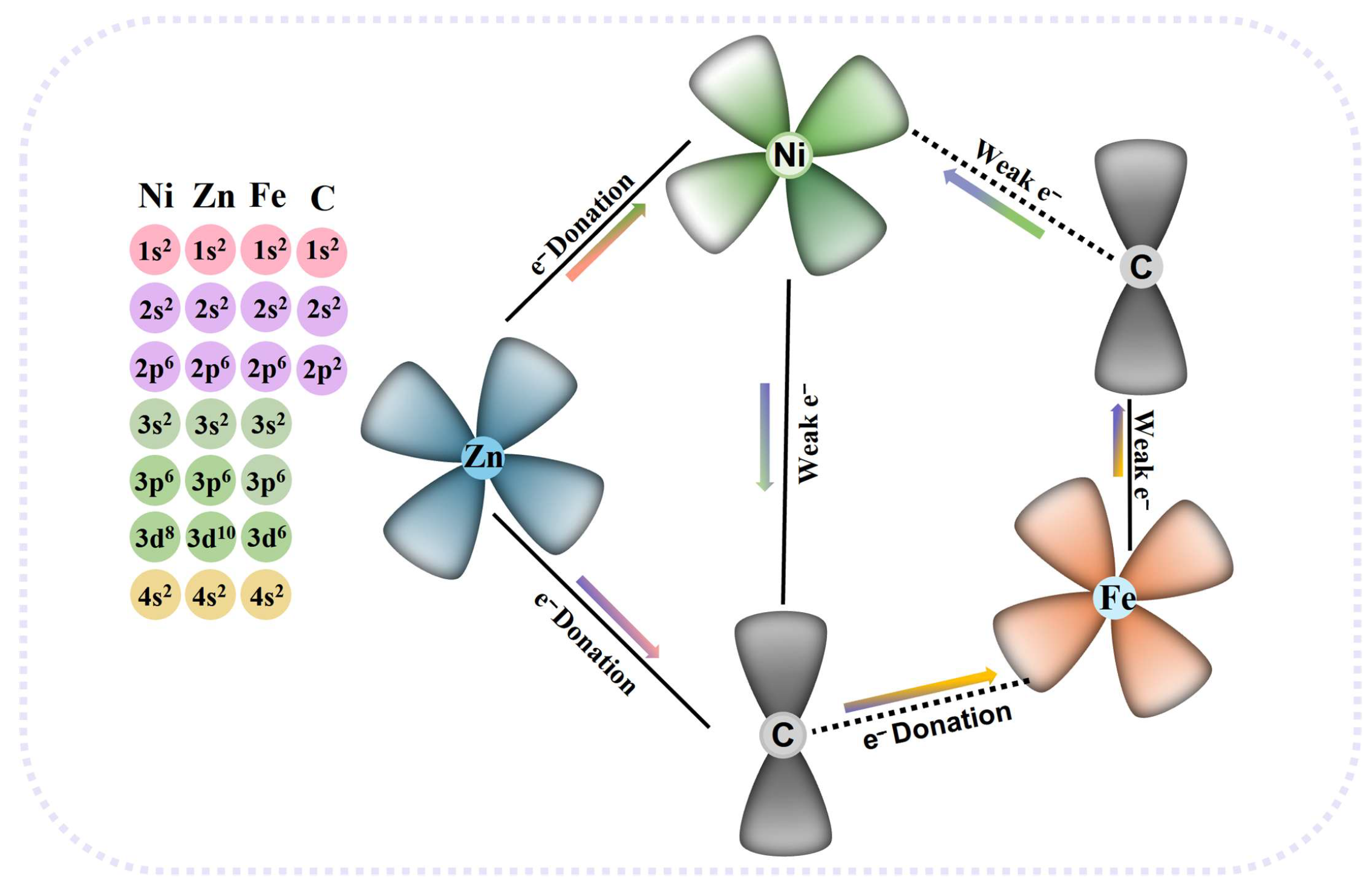
To further elucidate the electronic interactions among Ni, Zn, C, and Fe atoms in the Fe3C/Ni3ZnC0.7 composite, the electron transfer between atoms was hypothesized, and the electronic orbital hybridization diagram for the Fe3C/Ni3ZnC0.7 material was drawn (Figure 6). In Ni3ZnC0.7, the Zn atom possesses fully occupied d orbitals and thus exhibits weaker electronegativity, causing it to transfer electrons to both Ni and C atoms. Concurrently, the C atom, being more electronegative than Ni, attracts electrons from the Ni atom. Within the Fe3C, the more electronegative C atom attracts a portion of electrons from the Fe atom, transferring them to itself. XPS analysis of the Fe3C/Ni3ZnC0.7 material reveals that upon the combination of Fe3C and Ni3ZnC0.7, electron coupling occurs at the heterointerface. Specifically, electrons from the C sites in Ni3ZnC0.7 are transferred to the Fe sites in Fe3C, while electrons from the C sites in Fe3C are moved to the Ni atoms in Ni3ZnC0.7. This interfacial electron redistribution not only balances the electron density at the Ni and C sites of Ni3ZnC0.7 but also optimizes the overall electron density of the Fe3C/Ni3ZnC0.7 composite, resulting in a more balanced electronic state. Such an electronic configuration facilitates charge transfer across the interface, thereby accelerating the kinetics of the water dissociation process.

2.3. Electrocatalytic HER Evaluation of Fe3C/Ni3ZnC0.7

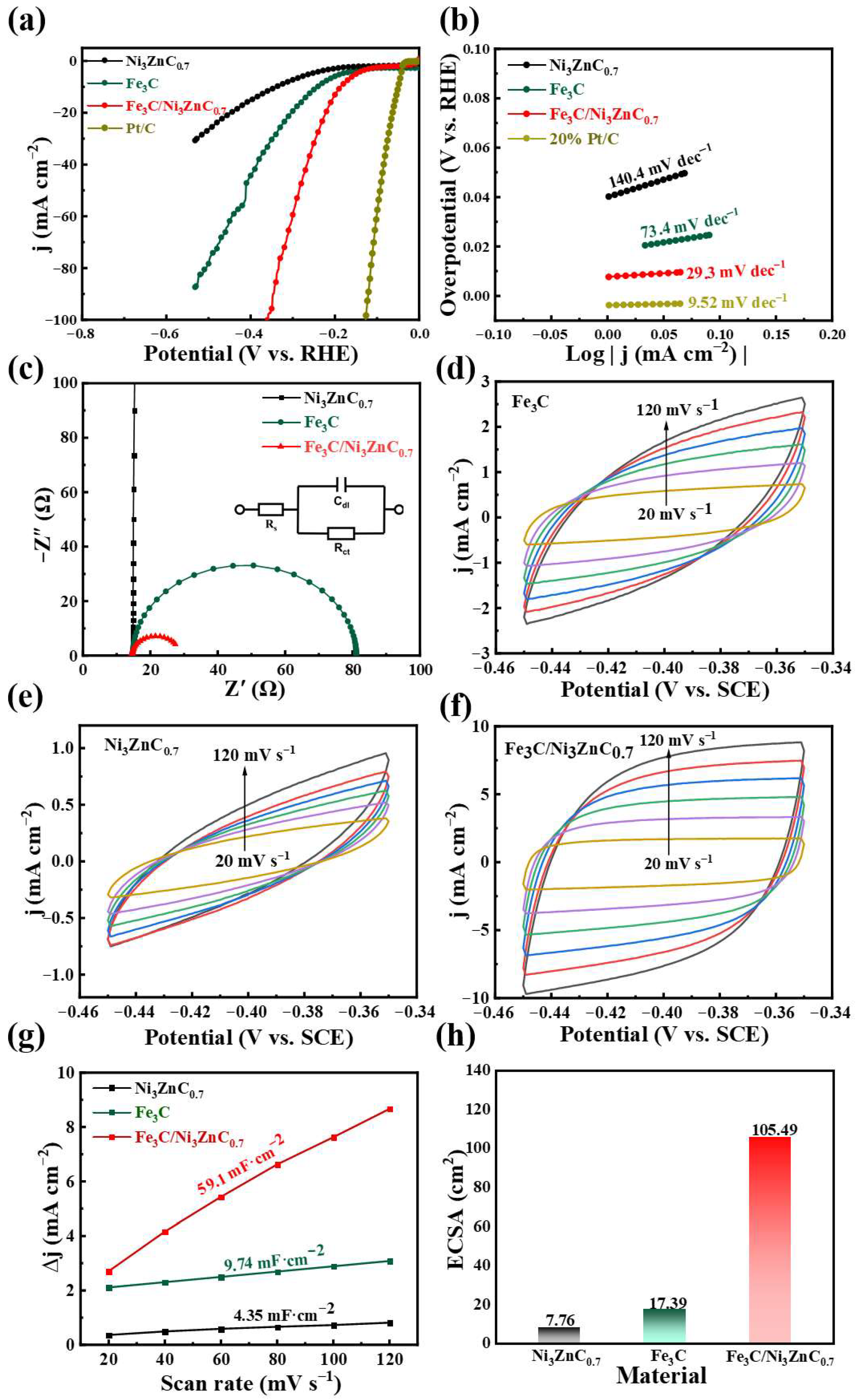
To evaluate the electrochemical performance of the prepared materials in alkaline media, Ni3ZnC0.7, Fe3C and Fe3C/Ni3ZnC0.7 were tested in a three-electrode system. Figure 7a displays the linear sweep voltammetry (LSV) curves for Ni3ZnC0.7, Fe3C, Fe3C/Ni3ZnC0.7 and 20% Pt/C. The 20% Pt/C reference material exhibits an overpotential of 48 mV at a current density of 10 mA cm−2. Compared to pure Ni3ZnC0.7 and Fe3C, the Fe3C/Ni3ZnC0.7 heterostructure exhibits superior HER activity, achieving an overpotential of 187 mV at 10 mA cm−2, which is better than the Ni3ZnC0.7 (339 mV) and Fe3C (242 mV) materials. This indicates that the synergistic interaction between Ni3ZnC0.7 and Fe3C enhances the hydrogen evolution performance of the composite material. The Tafel slope in Figure 7b is obtained from the LSV curves. The Tafel slope of the Fe3C/Ni3ZnC0.7 material is only 29.3 mV dec−1, which is lower than that of Ni3ZnC0.7 (140.4 mV dec−1) and Fe3C (73.4 mV dec−1). This indicates that the Fe3C/Ni3ZnC0.7 material exhibits favorable reaction kinetics. Additionally, electrochemical impedance spectroscopy (EIS) curves were measured for Fe3C, Ni3ZnC0.7 and Fe3C/Ni3ZnC0.7 to evaluate their charge transfer resistance (Figure 7c) [35,36]. In Figure 7c, the transfer resistances (Rct) of the Fe3C and Fe3C/Ni3ZnC0.7 materials are 66.39 Ω and 14.25 Ω, respectively. The Rct of the Ni3ZnC0.7 material is the largest, exceeding 100 Ω. This indicates that Fe3C/Ni3ZnC0.7 possesses rapid charge transfer capability, facilitating swift electron movement within the material during the HER process. Based on the above test results, it can be found that the reaction kinetics and charge transfer rate of the Fe3C/Ni3ZnC0.7 material are improved compared with Fe3C and Ni3ZnC0.7 materials.
Electrochemical active surface area (ECSA) is an important parameter to evaluate the reaction area of the material, which can indirectly reflect the electrochemical performance of the material. ECSA can generally be estimated by the double-layer capacitance (Cdl) of the non-Faradaic cyclic voltammetry (CV) curve [36]. Figure 7d–f are the CV curves for Ni3ZnC0.7, Fe3C and Fe3C/Ni3ZnC0.7 at different scan rates (20, 40, 60, 80, 100 and 120 mV s−1) in the range of −0.35 V to −0.45 V. Based on the CV curves of different materials, the current density difference between the cathode and anode of the electrode at different scanning speeds at a voltage of−0.4 V is selected, and the linear relationship between them is obtained (Figure 7g). The obtained lines are fitted, and the slope of the fitted line is the Cdl value of the material [37,38,39]. As revealed in Figure 7g, the Cdl value of the Fe3C/Ni3ZnC0.7 material is about 59.1 mF cm−2, which is larger than that of Ni3ZnC0.7 (9.42 mF cm−2) and Fe3C (9.74 mF cm−2). Further, the ECSA value of the Fe3C/Ni3ZnC0.7 material is about 105.49 cm2, which is much larger than that of Ni3ZnC0.7 (16.81 cm2) and Fe3C (17.39 cm2), indicating that the Fe3C/Ni3ZnC0.7 material has larger catalytically active area to contact with the electrolyte in the HER [40].
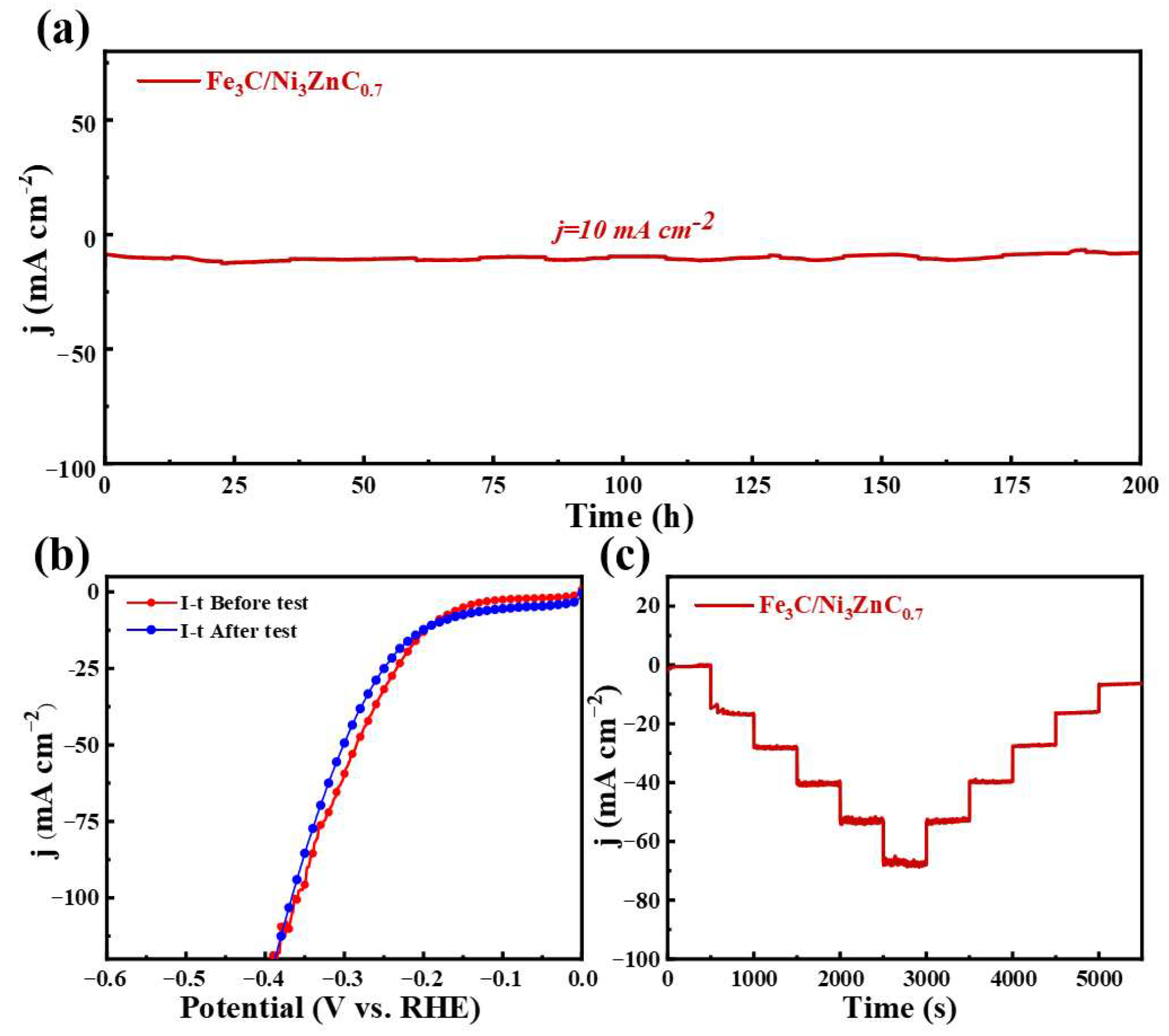
From the point of cost-effectiveness, the long-term stability of electrocatalyst is one of most critical indicators for prospective industrial application. Chronopotentiometry and multi-step time-current test were used to evaluate the catalytic durability of Fe3C/Ni3ZnC0.7. Figure 8a is the I-t curve of the Fe3C/Ni3ZnC0.7 material. It can be found that at the current density of 10 mA cm−2, the Fe3C/Ni3ZnC0.7 material can run stably for 200 h in 1 M KOH, and the fluctuation of LSV curves (Figure 8b) before and after I-t test are not obvious, which demonstrates the excellent durability of the Fe3C/Ni3ZnC0.7 material. To further clarify the operational behavior of Fe3C/Ni3ZnC0.7 materials under varying current conditions, Figure 8c presents the step curve of the Fe3C/Ni3ZnC0.7 material. It reveals that Fe3C/Ni3ZnC0.7 maintains stable performance throughout each stage, likely attributed to the synergistic effects of the interface coupling and carbon nanotube coating. The structural stability of Fe3C/Ni3ZnC0.7 makes it well-suited for prolonged operation under alkaline conditions. In summary, Fe3C/Ni3ZnC0.7 materials exhibit outstanding HER catalytic activity and high stability. In addition, the Fe3C/Ni3ZnC0.7 material demonstrated outstanding performance compared to previously reported materials (Table 1) [41,42,43,44,45,46]. This superior performance can be attributed to two key factors. First, the encapsulation of Fe3C/Ni3ZnC0.7 by carbon nanotubes (CNTs) prevents direct contact between the material and the electrolyte, preserving its structural integrity during the reaction and leading to exceptional durability. Second, the electronic coupling at the heterointerface of Fe3C/Ni3ZnC0.7 facilitates water dissociation, which enhances HER kinetics and enables the material to deliver superior HER performance.
To determine whether the structure and composition undergo changes, the Fe3C/Ni3ZnC0.7 after a long cycle test was characterized by TEM (Figure 9). It is observed that the (031) crystal plane of Fe3C and the (111) facet of Ni3ZnC0.7 still appear in the Fe3C/Ni3ZnC0.7 material, indicating that the Fe3C/Ni3ZnC0.7 material can maintain good stability during a long cycle of 200 h.

3. Materials and Methods

3.1. Materials

For more detailed information about the materials, please refer to the Supplementary Materials.

3.2. Synthesis of Fe3C

Firstly, ferric chloride hexahydrate (FeCl3·6H2O) and dicyandiamide (C2H4N4, DCD) were weighed according to the mass ratio of 1:4, and then grinded and mixed in the mortar. After the powder was fully mixed, it was put into the porcelain boat for high-temperature carbonization reaction in the tube furnace. The tube furnace was set to rise to 800 °C at a heating rate of 10 °C min−1 and kept in an Ar atmosphere for 2 h. After waiting to cool to room temperature, the obtained black powder material was recorded as Fe3C.

3.3. Synthesis of Ni3ZnC0.7

Weigh 0.356 g of nickel chloride hexahydrate (NiCl2·6H2O), 0.33 g of zinc acetate (C4H6O4Zn·2H2O), and 0.52 g of dicyandiamide (C2H4N4, DCD). Grind the powder mixture thoroughly and place it in a tube furnace for high-temperature carbonization. The tube furnace was heated up to 800 °C at 10 °C min−1, held at this temperature for 2 h under an Ar protective atmosphere. After reaction completion, the furnace was allowed to cool naturally before removing the porcelain boat, yielding a black powder. This black powder was then placed in 0.5 M H2SO4 solution, ensuring complete immersion, and soaked for 24 h. Finally, the powder was washed with ultrapure water, filtered, and air-dried at room temperature to yield the black target product Ni3ZnC0.7.

3.4. Synthesis of Fe3C/Ni3ZnC0.7

The Fe3C/Ni3ZnC0.7 material was synthesized by a two-step calcination method. Firstly, the Ni3ZnC0.7 and Fe3C materials were prepared by calcination method, then the prepared precursor materials were placed in a mortar with a mass ratio of Ni3ZnC0.7:Fe3C of 2:1 to fully grind to uniform mixing, and then the fully ground mixed powder was poured into the porcelain boat and placed in a vacuum tube furnace for high temperature calcination. The tube furnace maintains good air tightness, and the gas is set to Ar protective atmosphere. The program is set to rise to 300 °C at 10 °C min−1 and hold for 2 h. After the reaction procedure is completed, the tube furnace is naturally cooled to room temperature, and the black target product obtained in the porcelain boat is Fe3C/Ni3ZnC0.7.

4. Conclusions

In summary, a highly efficient and durable Fe3C/Ni3ZnC0.7 heterostructure catalyst supported on carbon nanotubes has been successfully synthesized via a two-step method. The formation of a heterointerface between Ni3ZnC0.7 and Fe3C induces strong interfacial electronic coupling and promotes charge redistribution, while the in situ grown carbon nanotube framework effectively suppresses particle agglomeration and enhances electrical conductivity. Benefiting from these structural and electronic advantages, the Fe3C/Ni3ZnC0.7 catalyst exhibits excellent hydrogen evolution performance in alkaline media, delivering a low overpotential at practical current density, fast reaction kinetics, and outstanding long-term durability over 200 h of continuous operation. Post-reaction structural characterization confirms the stability of the heterostructure. This work provides an effective strategy for designing high-performance, non-precious metal electrocatalysts for water splitting.

Supplementary Materials

The following supporting information can be downloaded at: https://www.mdpi.com/article/10.3390/catal16040315/s1, Figure S1: LSV curves of materials with different Fe3C/Ni3ZnC0.7 mass ratios.

Author Contributions

Conceptualization, writing—original draft preparation: L.F.; writing—review and editing: L.F., C.D., D.L. and G.L.; methodology: Y.S. and Z.S.; software: Y.S., J.W. and Z.S.; validation: Y.S., D.L., X.H. and G.L.; formal analysis: L.C., J.W. and D.L.; data curation: Y.S. and X.H.; funding acquisition: L.F., L.C. and J.H. All authors have read and agreed to the published version of the manuscript.

Funding

This research was funded by the National Natural Science Foundation of China (No. 22179074, 52572110, U22A20144), Scientific Research Program Funded by Shaanxi Provincial Education Department (Program No. 25JC014), the International S&T Cooperation Foundation of Shaanxi Province (2025GH-GHJD-002).

Data Availability Statement

The original contributions presented in this study are included in the article/Supplementary Materials. Further inquiries can be directed to the corresponding author(s).

Conflicts of Interest

The authors declare no conflicts of interest.

References

  1. Jung, M.-J.; Razazzadeh, A.; Khan, H.; Kwon, S.-H. Catalysts design and atomistic reaction modulation by atomic layer deposition for energy conversion and storage applications. Exploration 2025, 5, e20240010. [Google Scholar] [CrossRef]
  2. Liu, G.; Robertson, A.W.; Li, M.M.; Kuo, W.C.H.; Darby, M.T.; Muhieddine, M.H.; Lin, Y.C.; Suenaga, K.; Stamatakis, M.; Warner, J.H.; et al. MoS2 monolayer catalyst doped with isolated Co atoms for the hydrodeoxygenation reaction. Nat. Chem. 2017, 9, 810–816. [Google Scholar] [CrossRef] [PubMed]
  3. Men, L.; Shi, T.; Li, J.; Li, X.; Sun, B.; Pan, Q.; Su, Z. Bimetallic polyoxometalate derived Co/WN composite as electrocatalyst for high-efficiency hydrogen evolution. Int. J. Hydrog. Energy 2022, 47, 27452–27459. [Google Scholar] [CrossRef]
  4. Gou, W.; Sun, H.; Cheng, F. Dual active sites engineering of electrocatalysts for alkaline hydrogen evolution. Nano Res. Energy 2024, 3, e9120121. [Google Scholar] [CrossRef]
  5. Seh, Z.W.; Kibsgaard, J.; Dickens, C.F.; Chorkendorff, I.; Norskov, J.K.; Jaramillo, T.F. Combining theory and experiment in electrocatalysis: Insights into materials design. Science 2017, 355, eaad4998. [Google Scholar] [CrossRef]
  6. Sharma, S.; Ghoshal, S.K. Hydrogen, the future transportation fuel: From production to applications. Renew. Sustain. Energy Rev. 2015, 43, 1151–1158. [Google Scholar] [CrossRef]
  7. Zhou, X.; Yang, T.; Li, T.; Zi, Y.; Zhang, S.; Yang, L.; Liu, Y.; Yang, J.; Tang, J. In-situ fabrication of carbon compound NiFeMo-P anchored on nickel foam as bi-functional catalyst for boosting overall water splitting. Nano Res. Energy 2023, 2, e9120086. [Google Scholar] [CrossRef]
  8. Yang, F.; Xiong, T.; Huang, P.; Zhou, S.; Tan, Q.; Yang, H.; Huang, Y.; Balogun, M.S. Nanostructured transition metal compounds coated 3D porous core-shell carbon fiber as monolith water splitting electrocatalysts: A general strategy. Chem. Eng. J. 2021, 423, 130279. [Google Scholar] [CrossRef]
  9. Li, P.; Zhao, R.; Chen, H.; Wang, H.; Wei, P.; Huang, H.; Liu, Q.; Li, T.; Shi, X.; Zhang, Y.; et al. Recent advances in the development of water oxidation electrocatalysts at mild pH. Small 2019, 15, e1805103. [Google Scholar] [CrossRef]
  10. Zhang, F.; He, L.; Pan, H.; Lian, S.; Wang, M.; Yin, J.; Chen, X.; Ren, J.; Chen, M. Revealing the catalytic micro-mechanism of MoN, WN and WC on hydrogen evolution reaction. Int. J. Hydrog. Energy 2021, 46, 23615–23628. [Google Scholar] [CrossRef]
  11. Bhat, M.A.; Ul Islam, S.; Majid, K. Interfacial electronic structure engineering of NiCo2Se4 and NiTe2 nanorods for enhanced hydrogen evolution reaction. ChemPhysChem 2024, 25, e202400454. [Google Scholar] [CrossRef]
  12. Muhyuddin, M.; Tseberlidis, G.; Acciarri, M.; Lori, O.; D’Arienzo, M.; Cavallini, M.; Atanassov, P.; Elbaz, L.; Lavacchi, A.; Santoro, C. Molybdenum disulfide as hydrogen evolution catalyst: From atomistic to materials structure and electrocatalytic performance. J. Energy Chem. 2023, 87, 256–285. [Google Scholar] [CrossRef]
  13. Cao, X.; Xing, S.; Ma, D.; Tan, Y.; Zhu, Y.; Hu, J.; Wang, Y.; Chen, X.; Chen, Z. Design of high-performance ion-doped CoP systems for hydrogen evolution: From multi-level screening calculations to experiment. J. Energy Chem. 2023, 82, 307–316. [Google Scholar] [CrossRef]
  14. Bhat, M.A.; Majid, K. Metal-organic framework-derived FeCo2S4/Co3O4 heterostructure with enhanced electrocatalytic performance for oxygen evolution and hydrogen evolution reactions. Langmuir 2023, 39, 8224–8233. [Google Scholar] [CrossRef] [PubMed]
  15. Yan, X.; Tian, L.; He, M.; Chen, X. Three-dimensional crystalline/amorphous Co/Co3O4 core/shell nanosheets as efficient electrocatalysts for the hydrogen evolution reaction. Nano Lett. 2015, 15, 6015–6021. [Google Scholar] [CrossRef] [PubMed]
  16. Rajeshkhanna, G.; Singh, T.I.; Kim, N.H.; Lee, J.H. Remarkable bifunctional oxygen and hydrogen evolution electrocatalytic activities with trace-level Fe doping in Ni- and Co-layered double hydroxides for overall water-splitting. ACS Appl. Mater. Interfaces 2018, 10, 42453–42468. [Google Scholar] [CrossRef] [PubMed]
  17. Cao, Z.; Li, H.; Zhan, C.; Zhang, J.; Wang, W.; Xu, B.; Lu, F.; Jiang, Y.; Xie, Z.; Zheng, L. Monocrystalline platinum-nickel branched nanocages with enhanced catalytic performance towards the hydrogen evolution reaction. Nanoscale 2018, 10, 5072–5077. [Google Scholar] [CrossRef]
  18. Tan, Z.W.; Agesta, N.F.; Yeo, R.Y.Z.; Foo, J.J.; Ong, W.-J. Unlocking the potential of carbon nitride (CxNy) electrocatalysts in hydrogen evolution, oxygen evolution and overall water splitting. Exploration 2026, 6, 20240008. [Google Scholar] [CrossRef]
  19. McCrory, C.C.; Jung, S.; Ferrer, I.M.; Chatman, S.M.; Peters, J.C.; Jaramillo, T.F. Benchmarking hydrogen evolving reaction and oxygen evolving reaction electrocatalysts for solar water splitting devices. J. Am. Chem. Soc. 2015, 137, 4347–4357. [Google Scholar] [CrossRef]
  20. Mouchou, S.; Toual, Y.; Azouaoui, A.; Benzakour, N.; Hourmatallah, A.; Bouslykhane, K. First-principles calculations of structural, electronic, elastic and thermodynamic properties of ZnNi3X (X=N and C). Comput. Condens. Matter 2022, 31, e00676. [Google Scholar] [CrossRef]
  21. Li, R.; Li, X.; Yu, D.; Li, L.; Yang, G.; Zhang, K.; Ramakrishna, S.; Xie, L.; Peng, S. Ni3ZnC0.7 nanodots decorating nitrogen-doped carbon nanotube arrays as a self-standing bifunctional electrocatalyst for water splitting. Carbon 2019, 148, 496–503. [Google Scholar] [CrossRef]
  22. Feng, L.; Zhao, K.; Dai, L.; He, D.; Yin, H.; Zhang, Y.; Chen, J.; Cao, L.; Huang, J. Interfacial engineering of a Ni3ZnC0.7/VN heterostructure with optimized dual metal sites for alkaline electrocatalytic hydrogen evolution. Mater. Chem. Front. 2025, 9, 1596–1608. [Google Scholar] [CrossRef]
  23. Zhang, H.-J.; Jia, L.; Zhang, Y.; Ma, Z.-F.; Xue, Y.; Zheng, S.; Zhang, J. A highly active oxygen reduction composite electrocatalyst of Fe3C with a N, F dual-doped carbon layer hide. J. Electrochem. Soc. 2021, 168, 054511. [Google Scholar] [CrossRef]
  24. Feng, T.; Cui, Z.; Guo, P.; Wang, X.; Li, J.; Liu, X.; Wang, W.; Li, Z. Engineering Ru nanoparticles embedded in 2D N-doped carbon nanosheets decorated with 2D Fe3O4–Fe3C heterostructures for efficient hydrogen evolution in alkaline and acidic media. Int. J. Hydrog. Energy 2023, 48, 15522–15532. [Google Scholar] [CrossRef]
  25. Liang, W.; Le, Z.; Dong, P.; Dan, Z.; Chen, J.; Zhang, H.; Chen, J.; Xie, F.; Wang, N.; Jin, Y.; et al. Janus bimetallic materials as efficient electrocatalysts for hydrogen oxidation and evolution reactions. J. Colloid Interface Sci. 2022, 625, 128–135. [Google Scholar] [CrossRef]
  26. Tang, J.; Niu, J.; Yang, C.; Rajendran, S.; Lei, Y.; Sawangphruk, M.; Zhang, X.; Qin, J. Twin boundaries boost the hydrogen evolution reaction on the solid solution of nickel and tungsten. Fuel 2022, 330, 125510. [Google Scholar] [CrossRef]
  27. Feng, L.; Chen, J.; Liu, Q.; Liu, Y.; Zhou, M.; Hu, X.; Cao, L.; Li, G.; Zhao, Y.; Huang, J. Interfacial Ni-W bridge bond enabling Ni3ZnC0.7/WC heterostructure with enhanced hydrogen evolution activity and stability. J. Energy Chem. 2026, 116, 390–398. [Google Scholar] [CrossRef]
  28. Zhang, J.; Zhang, L.; Du, L.; Xin, H.L.; Goodenough, J.B.; Cui, Z. Composition-tunable antiperovskite CuxIn1−xNNi3 as superior electrocatalysts for hydrogen evolution reaction. Angew. Chem. Int. Ed. 2020, 59, 17488–17493. [Google Scholar] [CrossRef]
  29. Chen, Q.; Huang, J.; Chu, D.; Kong, X.; Cao, L.; Li, X.; Zhao, K.; Zhao, Y.; Liu, Y.; Dong, J.; et al. Work function engineering of carbon-coated antiperovskite Ni3ZnC0.7/g-C3N4 Mott–Schottky heterojunctions for accelerating photocatalytic hydrogen evolution. ACS Sustain. Chem. Eng. 2025, 13, 17298–17308. [Google Scholar] [CrossRef]
  30. Hu, H.; Yan, X.; Wang, X.; Yin, C.; Attfield, J.P.; Yang, M. Magnetic properties and electrocatalytic oxygen evolution performance of a medium-entropy metal nitride. Chem. Mater. 2024, 36, 11432–11439. [Google Scholar] [CrossRef]
  31. Liu, H.; Wu, Z.-S.; Huang, L.; Zhang, B.-W.; Yin, L.-C.; Xu, C.-Y.; Zhen, L. Mechanistic insights into interfaces and nitrogen vacancies in cobalt hydroxide/tungsten nitride catalysts to enhance alkaline hydrogen evolution. J. Mater. Chem. A 2021, 9, 11323–11330. [Google Scholar] [CrossRef]
  32. Kong, X.; Hao, T.; Lv, C.; Li, Z.; Zhao, F.; Ning, S.; Ye, J. Molybdenum-doped tungsten nitride coated with carbon shell and cobalt hydroxide nanosheets for efficient alkaline hydrogen evolution reaction. Appl. Surf. Sci. 2024, 664, 160261. [Google Scholar] [CrossRef]
  33. Wu, A.; Gu, Y.; Yang, B.; Wu, H.; Yan, H.; Jiao, Y.; Wang, D.; Tian, C.; Fu, H. Porous cobalt/tungsten nitride polyhedra as efficient bifunctional electrocatalysts for overall water splitting. J. Mater. Chem. A 2020, 8, 22938–22946. [Google Scholar] [CrossRef]
  34. Yang, C.C.; Zai, S.F.; Zhou, Y.T.; Du, L.; Jiang, Q. Fe3C-Co nanoparticles encapsulated in a hierarchical structure of N-doped carbon as a multifunctional electrocatalyst for ORR, OER, and HER. Adv. Funct. Mater. 2019, 29, 1901949. [Google Scholar] [CrossRef]
  35. Boakye, F.O.; Li, Y.; Owusu, K.A.; Amiinu, I.S.; Cheng, Y.; Zhang, H. One-step synthesis of heterostructure cobalt-iron selenide as bifunctional catalyst for overall water splitting. Mater. Chem. Phys. 2022, 275, 125201. [Google Scholar] [CrossRef]
  36. Wang, J.; Xu, F.; Jin, H.; Chen, Y.; Wang, Y. Non-noble metal-based carbon composites in hydrogen evolution reaction: Fundamentals to applications. Adv. Mater. 2017, 29, 1605838. [Google Scholar] [CrossRef] [PubMed]
  37. Ye, M.; Hu, F.; Yu, D.; Han, S.; Li, L.; Peng, S. Hierarchical FeC/MnO2 composite with in-situ grown CNTs as an advanced trifunctional catalyst for water splitting and metal-air batteries. Ceram. Int. 2021, 47, 18424–18432. [Google Scholar] [CrossRef]
  38. Dong, J.; Jiao, Q.; Wang, H.; Wang, H.; Ren, Y.K. Encapsulated Fe3C boosted electrocatalytic performance for oxygen reduction reaction of N-doped carbon nanotube. Heliyon 2025, 11, e40862. [Google Scholar] [CrossRef]
  39. Yan, H.; Tian, C.; Wang, L.; Wu, A.; Meng, M.; Zhao, L.; Fu, H. Phosphorus-modified tungsten nitride/reduced graphene oxide as a high-performance, non-noble-metal electrocatalyst for the hydrogen evolution reaction. Angew. Chem. Int. Ed. 2015, 54, 6325–6329. [Google Scholar] [CrossRef]
  40. Li, J.-S.; Tang, Y.-J.; Liu, C.-H.; Li, S.-L.; Li, R.-H.; Dong, L.-Z.; Dai, Z.-H.; Bao, J.-C.; Lan, Y.-Q. Polyoxometalate-based metal-organic framework-derived hybrid electrocatalysts for highly efficient hydrogen evolution reaction. J. Mater. Chem. A 2016, 4, 1202–1207. [Google Scholar] [CrossRef]
  41. Al Mahmud, A.; Thalji, M.R.; Dhakal, G.; Haldorai, Y.; Kim, W.K.; Shim, J.-J. Bifunctional MoC/NiC@N-doped reduced graphene oxide nano electrocatalyst for simultaneous production of hydrogen and oxygen through efficient overall electrochemical water splitting. Mater. Today Nano 2024, 27, 100489. [Google Scholar] [CrossRef]
  42. Fan, F.; Hui, Y.; Devasenathipathy, R.; Peng, X.; Huang, Q.; Xu, W.; Yang, F.; Liu, X.; Wang, L.; Chen, D.H.; et al. Composition-adjustable Mo6Co6C2/Co@carbon nanocage for enhanced oxygen reduction and evolution reactions. J. Colloid Interface Sci. 2023, 636, 450–458. [Google Scholar] [CrossRef]
  43. Mazhar, E.; Ali, I.; Awan, S.U.; Rizwan, S. Efficient hydrogen and oxygen evolution reactions by using the V2CTx@Sm nanocomposite. Energy Fuels 2024, 38, 10087–10095. [Google Scholar] [CrossRef]
  44. Li, Y.; Pan, K.; Li, H.; Wang, C.; Zhao, L.; Li, X.; Ren, Y.; Wei, S. FeP nanoparticles embedded in Co/Co3ZnC@CN: Pore confinement synthesis and OER/HER applications. Int. J. Hydrog. Energy 2024, 110, 646–655. [Google Scholar] [CrossRef]
  45. Ding, Y.; Zhu, C.; Xu, Z.; Lu, H.; Hu, K.; Chen, P.; Yang, W.; Xie, J. Interlocking Fe3C-Mo2C interface engineering in carbon nanofibers for high-efficiency oxygen evolution catalysis under simulated seawater conditions. J. Alloys Compd. 2025, 1026, 180297. [Google Scholar] [CrossRef]
  46. Gao, S.; Chen, H.; Liu, Y.; Li, G.-D.; Gao, R.; Zou, X. Surface-clean, phase-pure multi-metallic carbides for efficient electrocatalytic hydrogen evolution reaction. Inorg. Chem. Front. 2019, 6, 940–947. [Google Scholar] [CrossRef]
Figure 1. The synthesis illustration of Fe3C/Ni3ZnC0.7.
Catalysts 16 00315 g001
Figure 2. (a) XRD patterns and (b) Raman spectra of Fe3C, Ni3ZnC0.7, and Fe3C/Ni3ZnC0.7.
Catalysts 16 00315 g002
Figure 3. (a) TEM image and (b) HRTEM image of Fe3C/Ni3ZnC0.7. (c) STEM image of Fe3C/Ni3ZnC0.7 and (dh) the corresponding EDX mapping images of Ni, Zn, Fe, C and N elements.
Catalysts 16 00315 g003
Figure 4. SEM images of (a,b) Ni3ZnC0.7, (c,d) Fe3C and (e,f) Fe3C/Ni3ZnC0.7.
Catalysts 16 00315 g004
Figure 5. (a) The survey, (b) C 1s, (c) Ni 2p, (d) Zn 2p, (e) Fe 2p and (f) N 1s XPS spectra of Ni3ZnC0.7, Fe3C and Fe3C/Ni3ZnC0.7.
Catalysts 16 00315 g005
Figure 6. Schematic representation of the electronic interaction among Ni, Zn, C, and Fe in Fe3C/Ni3ZnC0.7.
Catalysts 16 00315 g006
Figure 7. Electrocatalytic HER performance of Fe3C/Ni3ZnC0.7, Ni3ZnC0.7, and Fe3C materials in 1.0 M KOH. (a) LSV curves with a scan rate of 5 mV s−1, (b) Tafel plots, (c) Nyquist plots, (df) CV curves at different scan rates from 20 to 120 mV s−1, (g) Cdl values and (h) ECSA values.
Catalysts 16 00315 g007
Figure 8. (a) I-t curve of Fe3C/Ni3ZnC0.7, (b) the LSV curves of Fe3C/Ni3ZnC0.7 before and after the recycling process, (c) multi-step chronoamperometric curve at diverse overpotentials of Fe3C/Ni3ZnC0.7.
Catalysts 16 00315 g008
Figure 9. (a,b) TEM images of Fe3C/Ni3ZnC0.7 after 200 h of HER.
Catalysts 16 00315 g009
Table 1. Comparison of the Fe3C/Ni3ZnC0.7 with other currently reported HER electrocatalysts in alkaline media.
MaterialsOverpotential (mV)DurabilityReferences
MoC/NiC@N-rGO18533 h[41]
Mo6Co6C2/Co/HNC-122820 h[42]
Sm@V2CTx23614 h[43]
FeP-Co/Co3ZnC@CN29322 h[44]
Fe3C-Mo2C@CNFs22848 h[45]
Co3Mo3C16915 h[46]
Fe3C/Ni3ZnC0.7187200 hThis work
Disclaimer/Publisher’s Note: The statements, opinions and data contained in all publications are solely those of the individual author(s) and contributor(s) and not of MDPI and/or the editor(s). MDPI and/or the editor(s) disclaim responsibility for any injury to people or property resulting from any ideas, methods, instructions or products referred to in the content.