Article

New Mechanism for the Enhancement of the Oxygen Reduction Reaction on Stepped Platinum and Platinum–Iron Surfaces


Hydrogen and Fuel Cell Nanomaterials Center, University of Yamanashi, 6-43 Miyamae-cho, Kofu 400-0021, Japan
Catalysts 2026, 16(4), 311; https://doi.org/10.3390/catal16040311
Submission received: 31 December 2025 / Revised: 13 March 2026 / Accepted: 19 March 2026 / Published: 1 April 2026
(This article belongs to the Special Issue 15th Anniversary of Catalysts: Feature Papers in Electrocatalysis)

Abstract

It has long been recognized that the oxygen reduction reaction occurs more readily on Pt(111) surfaces that include steps, both (111) and (100), than on near-perfect Pt(111). Theoretical models were developed involving the water structure in the electric double layer and its interactions with adsorbed OH, with the actual O2 reduction occurring on the (111) terraces adjacent to the steps. However, the present density functional theory (DFT) calculations confirms that O2 adsorbs strongly at the steps and can undergo dissociation aided by adjacent water molecules to produce adsorbed OH. OH produced at the steps can move to the (111) terraces, where it can be more readily reduced to H2O and desorbed. This model avoids the scaling relation, which predicts that all oxygen-containing reactants and intermediates are proportional to each other on any given surface, i.e., strong O2 adsorption at steps compared with water ensures that the reaction can proceed. Efforts to develop new O2 reduction catalysts have been hampered by the assumption that the reaction rate can be increased by decreasing OH adsorption strength, even though decreased OH adsorption strength is accompanied by decreased O2 adsorption strength on any given crystallographic facet. This proposed model can explain the experimental results on stepped surfaces as well as nanoparticle catalysts, particularly the higher ORR activity on alloys such as PtFe, but with the obligatory presence of steps. The results may also be important for the development of Pt nanoparticle catalysts.

1. Introduction

There has been an intensive search for ways to increase the activity of catalysts for the oxygen reduction reaction (ORR) in order to decrease the catalyst cost in H2-O2 fuel cells, which are an integral component of the much-anticipated hydrogen energy economy. Much research has been devoted to fine-tuning the adsorption of reactants and intermediates in order to reach the summit of the famed volcano plot, in which reaction rate is plotted versus the adsorption strength of oxygenated species, OH for example. The adsorption strength of most oxygenated species, including O2, O, OH, and HO2 all appear to be proportional to each other, the so-called scaling relationship [1,2]. Thus, if it is assumed that OH adsorption should be weakened, O2 adsorption would also be weakened. This is a dilemma that has been largely ignored thus far. Nevertheless, it has been found experimentally that the use of Pt alloys such as Pt-Fe, Pt-Co and Pt-Ni with decreased OH adsorption strength has resulted in increased ORR rates [3]. Initially, it was proposed, based on the work of Yeager and coworkers on the dissociative adsorption mechanism for the ORR on Pt [4], that O2 must be strongly adsorbed on Pt alloys [5]. In fact, Xu et al. found that O2 is adsorbed more strongly on Pt alloys such as PtFe and PtCo due to the oxophilic nature of the alloying metal, based on their density functional theory (DFT) calculations [6]. However, this effect is reversed when there is a surface Pt layer, as is the case for practical catalysts in an acidic aqueous environment [7]. Further studies have confirmed that O2 adsorption on several Pt alloys is weakened [2,8,9,10,11] Interestingly, however, no Pt alloys have been reported for which O2 adsorption is considered to be too weak, even though the theoretical results show that adsorption on Pt-covered Pt-Fe should be very weak indeed, on the order of −0.15 to −0.20 eV, which should in principle have a detrimental impact upon O2 capture [2,9,10]. At this point, O2 must compete with water for adsorption sites, as shown later. Clearly, the anti-oxophilic approach has its limits, since eventually O2 adsorption would be impaired.
One key to this puzzle has been the recognition that platinum surfaces based on Pt(111) that include steps, either (110) or (100), can have increased ORR activity based on area, usually with a maximum activity being observed at intermediate terrace widths [12,13,14,15]. Early theoretical work predicted that stepped surfaces would be less active than Pt(111), based on the strong adsorption of OH at steps [16]. Bandarenka et al. proposed that the maximum in ORR activity at intermediate step density is due to a trade-off between OH removal and OH formation rates, based on H-bonded water network stabilization of OH [17]. Subsequently, Jinnouchi et al. have similarly explained the presence of a maximum in the ORR activity at intermediate step widths based on the trade-off between the destabilization of OH and the stabilization of HO2 adsorbed on (111) terraces by water molecules [18]. In contrast, Hoshi and coworkers have argued that, since the step structures differ between the (110) and (100) steps, with the activities being similar, the steps themselves cannot be the active sites, which are proposed to be the (111) terraces immediately adjacent to the steps [15]. Subsequently, Kodama et al. reported that a variety of Pt stepped surfaces in which the steps are capped with gold are still active for the ORR [19]. This result seems to strongly suggest that the steps themselves are not the active sites, based on the assumption that gold is inactive for the ORR, at least in acid electrolytes, although high activity can be observed in alkaline electrolytes [20,21].
The present work aims to take into account the clearly observed experimental results that the ORR activity in acid electrolyte mainly increases with the step density, both (110) and (100) steps on Pt(111) surfaces except for very narrow (111) terraces. The simplest assumption is that the steps have an increased adsorption strength for O2 so that the ORR current is proportional to the O2 coverage at the step. Using DFT calculations, we have found that indeed the O2 adsorption strength is significantly higher at steps compared with the terraces. In addition, we have found that water molecules adsorbed on either side of the bridging O2 can assist in its dissociation, creating 4 OH, and the activation energies are much smaller at both types of steps than on the (111) terrace. Thus, water is being used as a proton donor, which has been shown to be important for alkaline electrolytes but not thus far for acid [20].
In principle, these results can help to escape the scaling relation dilemma by the use of Pt alloys on which OH adsorption on (111) terraces is weak, but the O2 adsorption at steps is still strong enough so that the overall reaction rate is enhanced. More specifically, O2 is initially strongly adsorbed at either the (100) or (110) steps, where it is dissociated with the help of water molecules, and the resulting adsorbed 4OH, even though they are also somewhat strongly adsorbed, can then move to the adjacent (111) terraces, where they are comparatively less strongly adsorbed, are reduced to H2O, and then desorb. This is an example of bifunctional or dual-site catalysis [22,23,24]. The dual site or multisite approach may be useful, in principle, for any multistep reaction, so that the catalysis of each step can be optimized.
The overall pathway for the ORR can be summarized as follows:
2H2O(aq) → 2H2O(ads, step)
2H2O(ads, step) + O2(aq) → 2H2O(ads, step) + O2(ads, step)
2H2O(ads, step) + O2(ads, step) → 4OH(ads, step)
4OH(ads, step) → 4OH(ads, terrace)
4OH(ads, terrace) + 4H2O(aq) + 4e → 4H2O(ads, terrace) + 4OH(aq)
4H2O(ads, terr) → 4H2O(aq)
4OH(aq) + 4H+(aq) → 4H2O(aq)
To simplify the DFT calculations, we have used the product of reaction (2) as the charge-neutral reference state and have maintained the same numbers of atoms throughout the reaction in what can be called an isoatomic reaction path (reactions (2)–(4)), which avoids the need for considering electrons explicitly, since they are extracted from the metallic phase during the calculation, resulting in a lowering of the Fermi level, as discussed later. Reactions (5)–(7) would be required to complete the overall reaction.
Rurigaki et al. have studied PtNi alloy stepped surfaces experimentally and have found some deviations from the trends observed for pure Pt surfaces, however [25]. In the present work, pure Pt surfaces and Pt/Fe/Pt sandwich alloys are considered, and indeed some differences in behavior are observed. Pt(111) is compared with the two stepped surfaces, Pt(533), which includes (100) steps and three rows of (111) terrace, and Pt(553), which includes (110) steps and four rows of (111) terrace. It is believed that the present model may be useful in the search for more active ORR catalysts.

2. Results

2.1. Initial Reaction on Pure Pt Surfaces

O2 has been found to be relatively stable on Pt(111) and has been observed directly with STM [26,27]. Depending on the temperature, it was found to adsorb in various configurations, including bridged and fcc three-fold hollows, and to be particularly stable at (111) steps, also known as (110) steps and referred to as such herein. Gambardella et al. found that the calculated dissociation energies for (100) and (110) steps were quite similar [27]. O2 adsorption energies, experimental and calculated, are compared on various surfaces in Table 1. The adsorption energies calculated for O2 adsorption on the (100) step edge of Pt(533) and the (110) step edge are quite similar, −1.96 and −1.86 eV, respectively, far larger than that on Pt(111), −0.89 eV. The presence of water stabilizes O2 on both steps slightly but destabilizes that on Pt(111), −2.05, −2.13 and −0.81 eV, respectively. The adsorption energy of O2 on the (111) terrace of Pt(221), which includes a (110) step, calculated in previous work (−0.45 eV), was somewhat weaker than that on Pt(111) itself from previous work (−0.73 eV) [9] and present work (−0.89 eV), due to differences in the constraints applied to the Pt atomic coordinates. Due to the stronger bonding, O2 is expected to adsorb at the steps rather than on the terraces, as long as the latter are not covered with OH, which adsorbs strongly. However, it must be kept in mind that the adsorption energy for OH is referred to gas-phase OH and thus is misleadingly large.
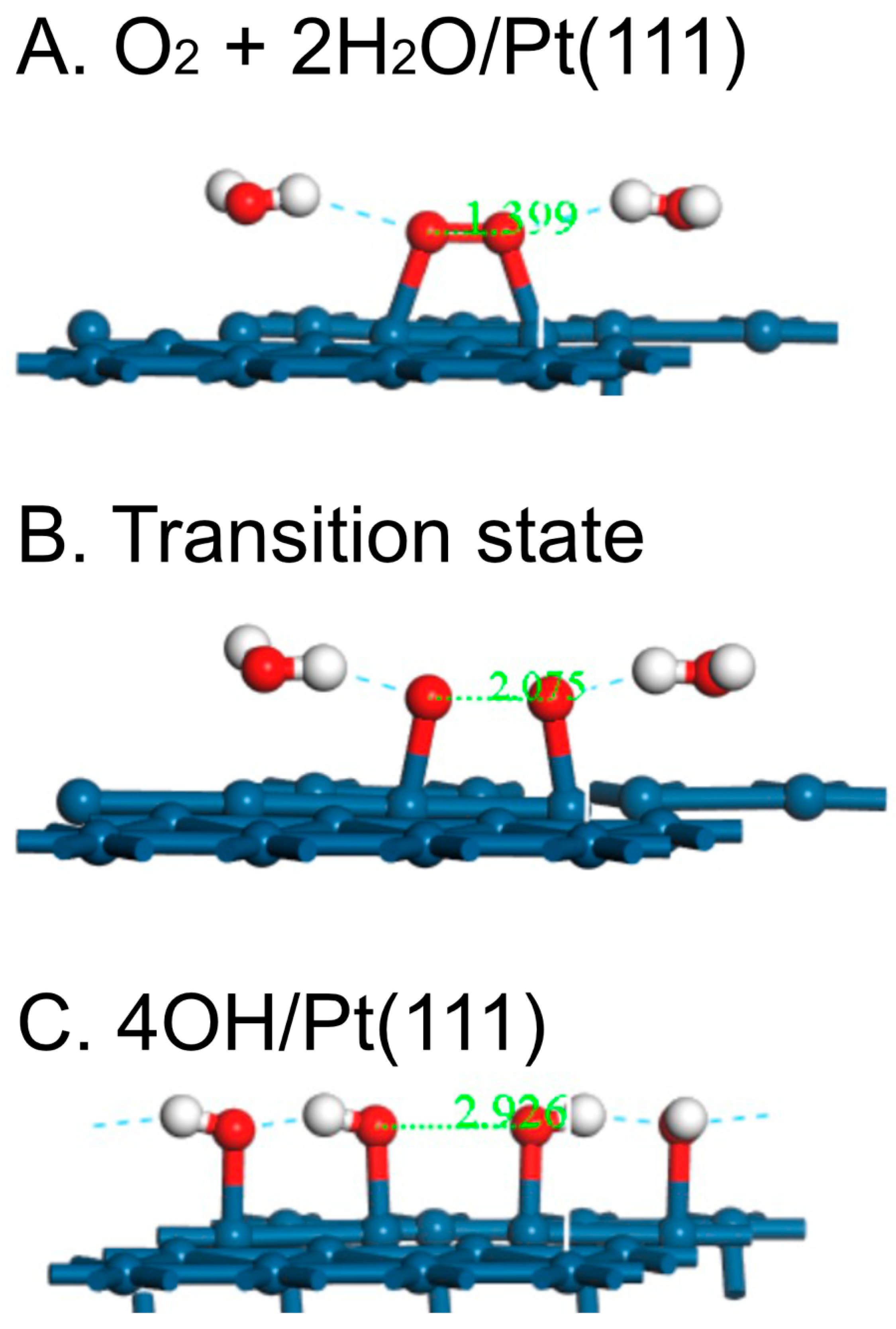
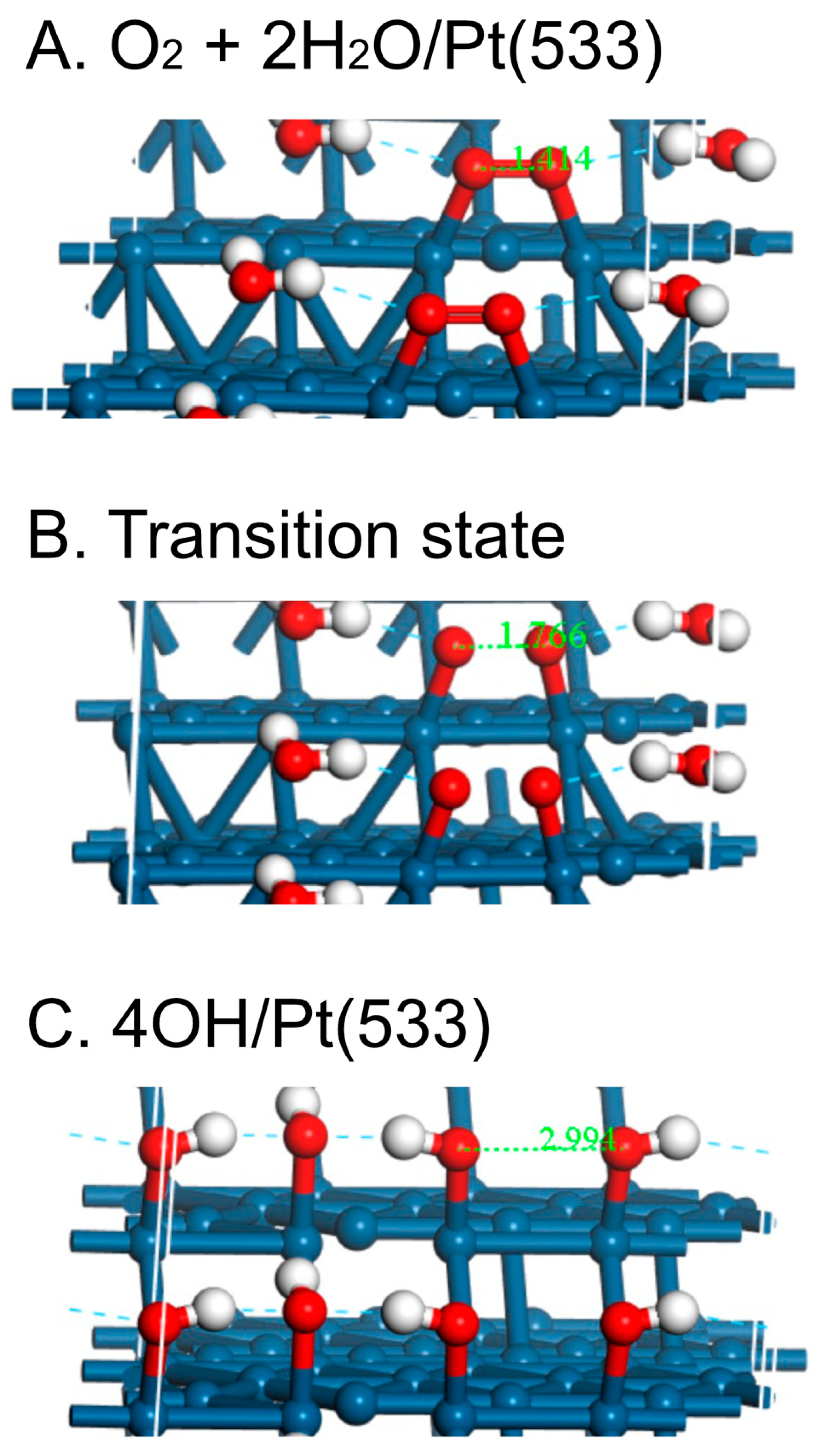
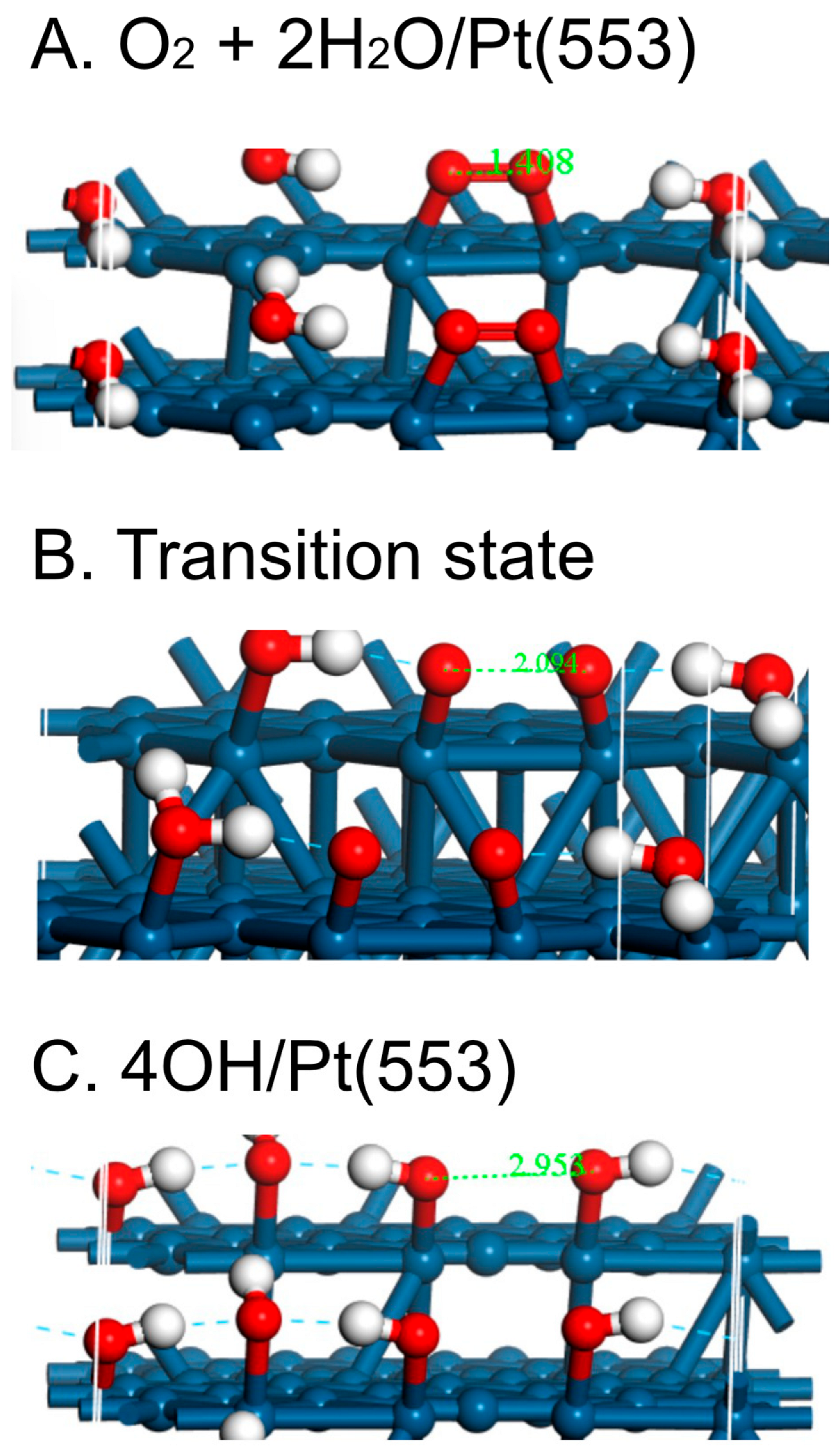
To get a more realistic idea of the first steps in the ORR, the initial state, with O2 bonded to the surface in the bridging configuration, flanked by two water molecules, the transition state (TS), with the O-O bond severed, and the final state, with 4OH in a line, are depicted for Pt(111) (Figure 1), Pt(533) (Figure 2) and Pt(553) (Figure 3). The effect of the water molecules can be seen as stabilizing the TS via H-bonding.
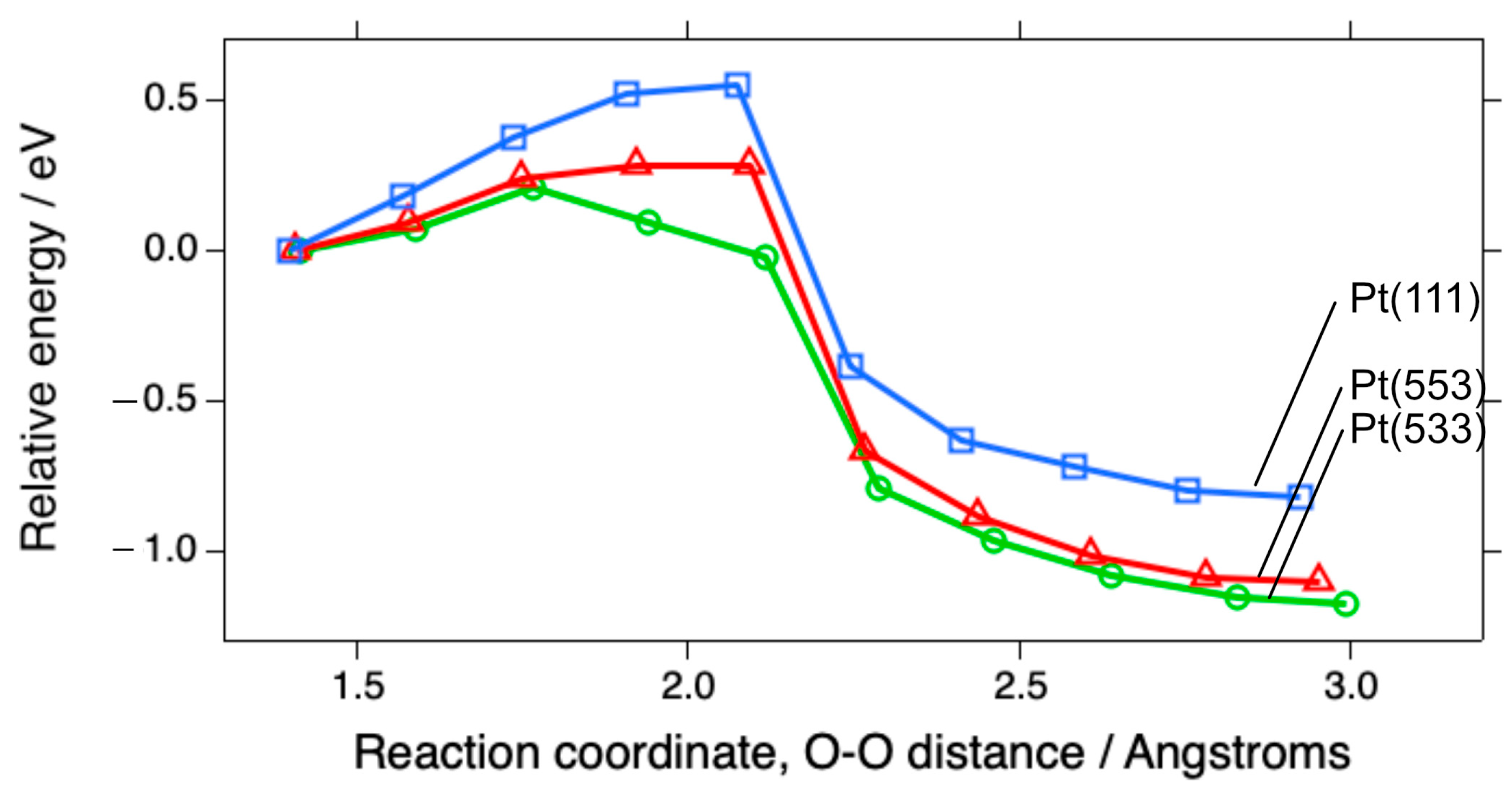
The energies of the O2-2H2O system have been plotted as the O-O bond is stretched in circa 0.2 Å increments on Pt(533), Pt(553) and Pt(111) (Figure 4), in much the same way as was done for O2 dissociation on Pt(111), Pt(211) and Pt(221) in the UHV study by Gambardella et al. [27]. As with the latter study, the behavior on the two stepped surfaces is somewhat similar, but the activation energy Eact is somewhat smaller on Pt(533), 0.21 vs. 0.28 eV (Table 2). Both energies are far smaller than that on Pt(111), 0.55 eV. In contrast, Gambardella calculated values of 0.9 eV for O2 dissociation energies on three surfaces, Pt(111), Pt(211) and Pt(221) with no water present, using DFT. However, Gee and Hayden found O2 to be dissociated more readily on Pt(533) than Pt(111) in UHV [28].
Table 1. Experimental and calculated adsorption energies for O2, H2O, and OH on Pt surfaces.
SurfaceO2O-O, ÅOHH2OReference
Pt(111) exp.−0.35~−0.38 [29,30]
Pt(111) calc.−045~−0.81 [2,9,10,31,32,33]
Pt(111) calc. −0.46[34]
Pt(111) calc.−0.891.370−2.75−0.45pw
Pt(111)/H2O calc.−0.891.399 pw
Pt(533) calc.−2.051.375−3.25−0.73pw
Pt(533)/H2O calc.−2.001.414 pw
Pt(553) calc.−1.851.378−3.29−0.80pw
Pt(553)/H2O calc.−2.201.408 pw
Note—pw denotes “present work”.
Table 2. Calculated kinetic parameters for water-assisted O2 dissociation.
SurfaceEact, eVO-O, TS, ÅΔE, eV
Pt(111)0.552.075−0.82
Pt(533)0.211.766−1.17
Pt(553)0.281.923~2.094−1.11
The reasons for the large differences in Eact are proposed to involve both the stronger adsorption of O2 but also that of H2O, which is 0.28~0.35 eV stronger at the steps than on the (111) terrace. Thus, the reactants are held in place firmly during the overall reaction. Even more importantly, O2 adsorbs much more strongly at the steps than does water, by differences of 1.23 eV for Pt(533) and 1.06 eV for Pt(553), than the 0.44 eV difference on Pt(111), which could lead to an impairment in the ORR activity on the latter surface. It should also be noted that water adsorption does not follow the usual scaling relations for oxygenated species, varying much less than values for O2 and OH.
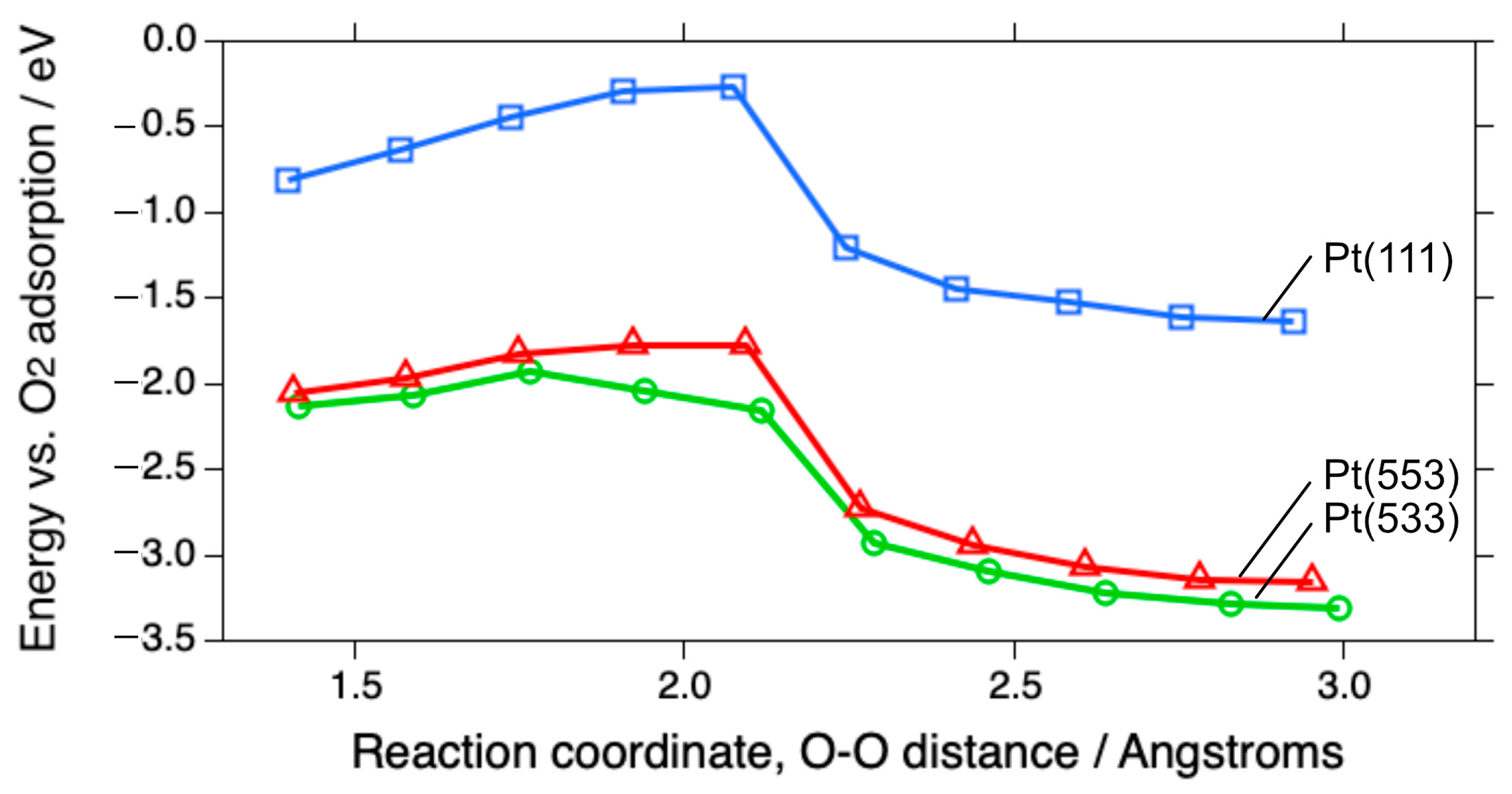
The overall first stage of the reaction can also be plotted to show the differences in the initial O2 adsorption energies (Figure 5). This representation emphasizes the strong advantage of the stepped surfaces in terms of capturing O2 from solution. These reaction profiles follow the well-known BEP relation, which predicts that, for dissociation reactions, the activation energy should decrease as the energy of the products is decreased, as long as the activated state is similar to the product state [35].
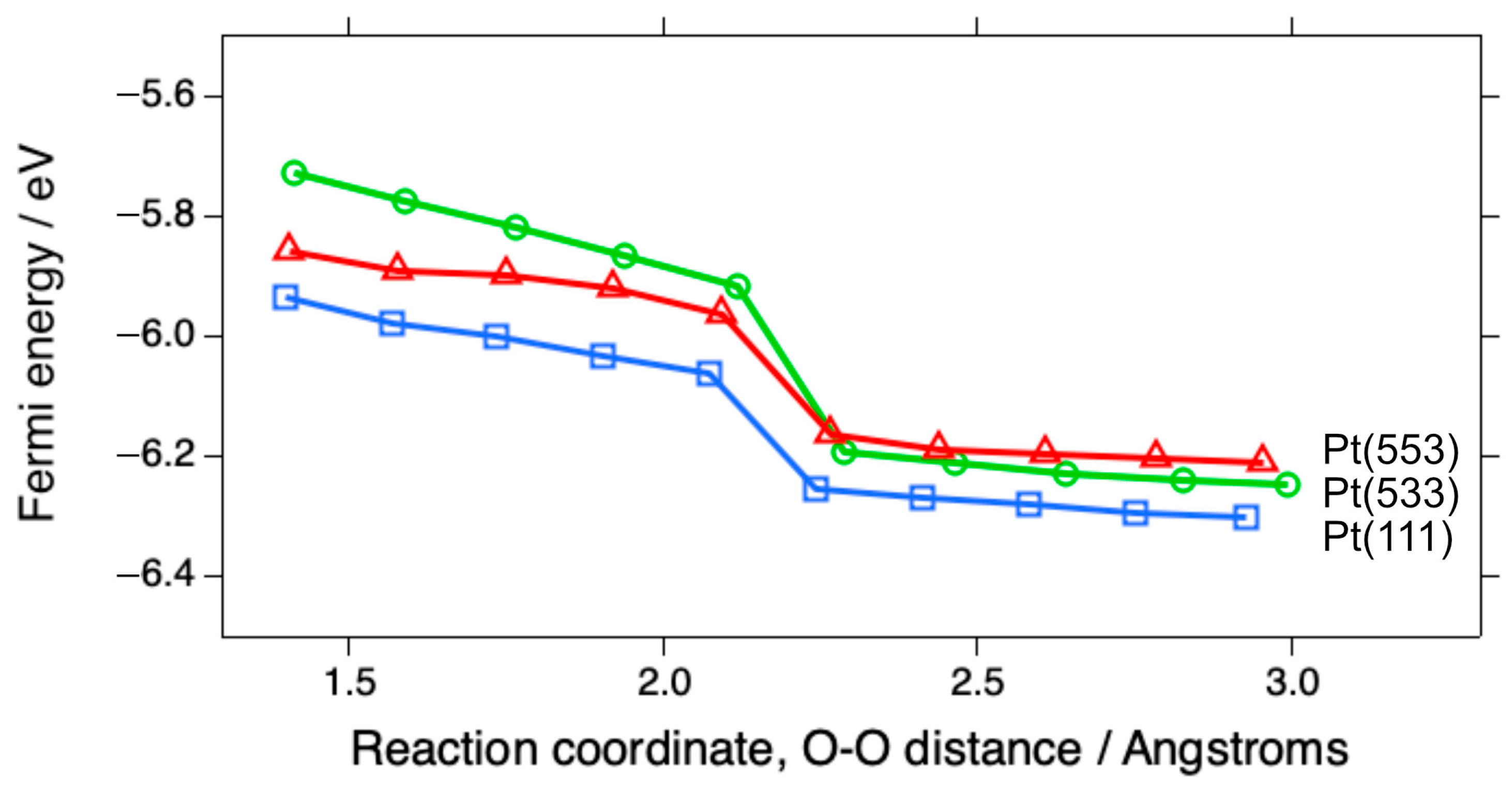
In contrast to most recent DFT studies, we have elected to plot the results in terms of the directly calculated DFT energies of the systems as the O-O bond is stretched, with the numbers of atoms necessarily remaining constant. The approach is essentially that which would be used in a purely chemical reaction in a closed system, so that, as the reaction proceeds, a reverse driving force builds up. The way this occurs in the present approach is that the effective electrochemical potential U becomes more positive during the reaction, which would cause the rate of a reduction reaction such as the ORR to slow down.
U can be thought of as a linear function of the Fermi energy EF, which can be plotted versus the reaction coordinate (Figure 6). In order to produce a reaction profile in which U is constant, it will be necessary to perform calculations on a series of similar systems in which the initial EF is varied and then curve-fit the energy surface, i.e., the energy vs. EF vs. reaction coordinate.

2.2. Initial Reaction on PtFePt Surfaces

The pure Pt surfaces will now be compared with Pt/Fe/Pt sandwich surfaces, on which the adsorption strengths of all reactants are significantly weaker. The values are summarized in Table 3.
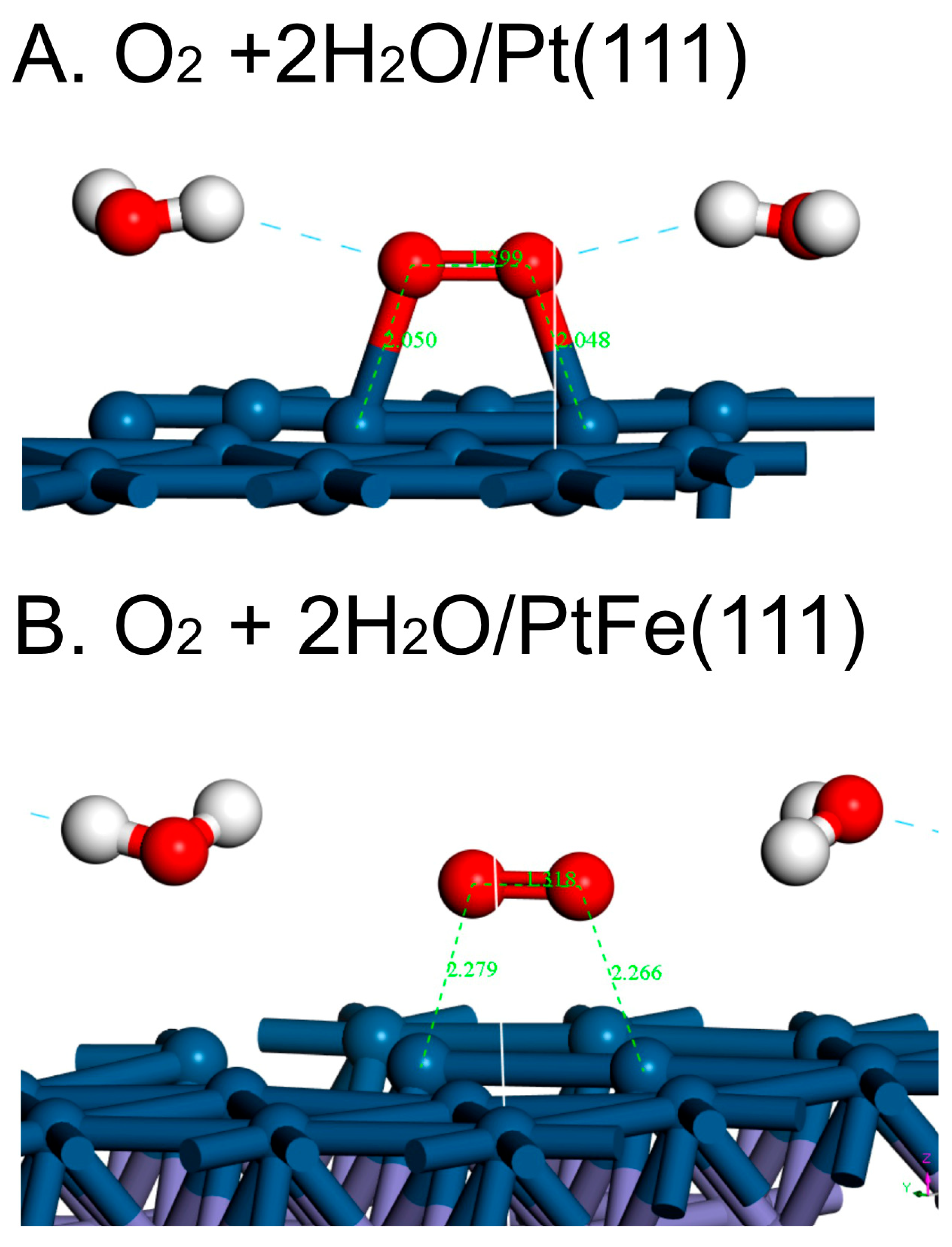
As expected, based on the extensive literature, the adsorption energies are significantly lower than those on the corresponding pure Pt surfaces. However, now, water adsorbs more strongly on PtFePt(111) than does O2 (−0.40 eV vs. −0.33 eV). Even more noteworthy is the repulsion of O2 from the same surface when it is flanked by two water molecules (Figure 7). The Pt-O distances are now 2.279 and 2.266 Å for PtFePt(111) vs. 2.050 and 2.048 Å for Pt(111). However, it must be noted that a similar calculation for PtNiPt(111) resulted in exothermic adsorption (−0.57 eV). Further calculations with other PtM(111) surfaces, where M is a first-row transition metal, are in progress.
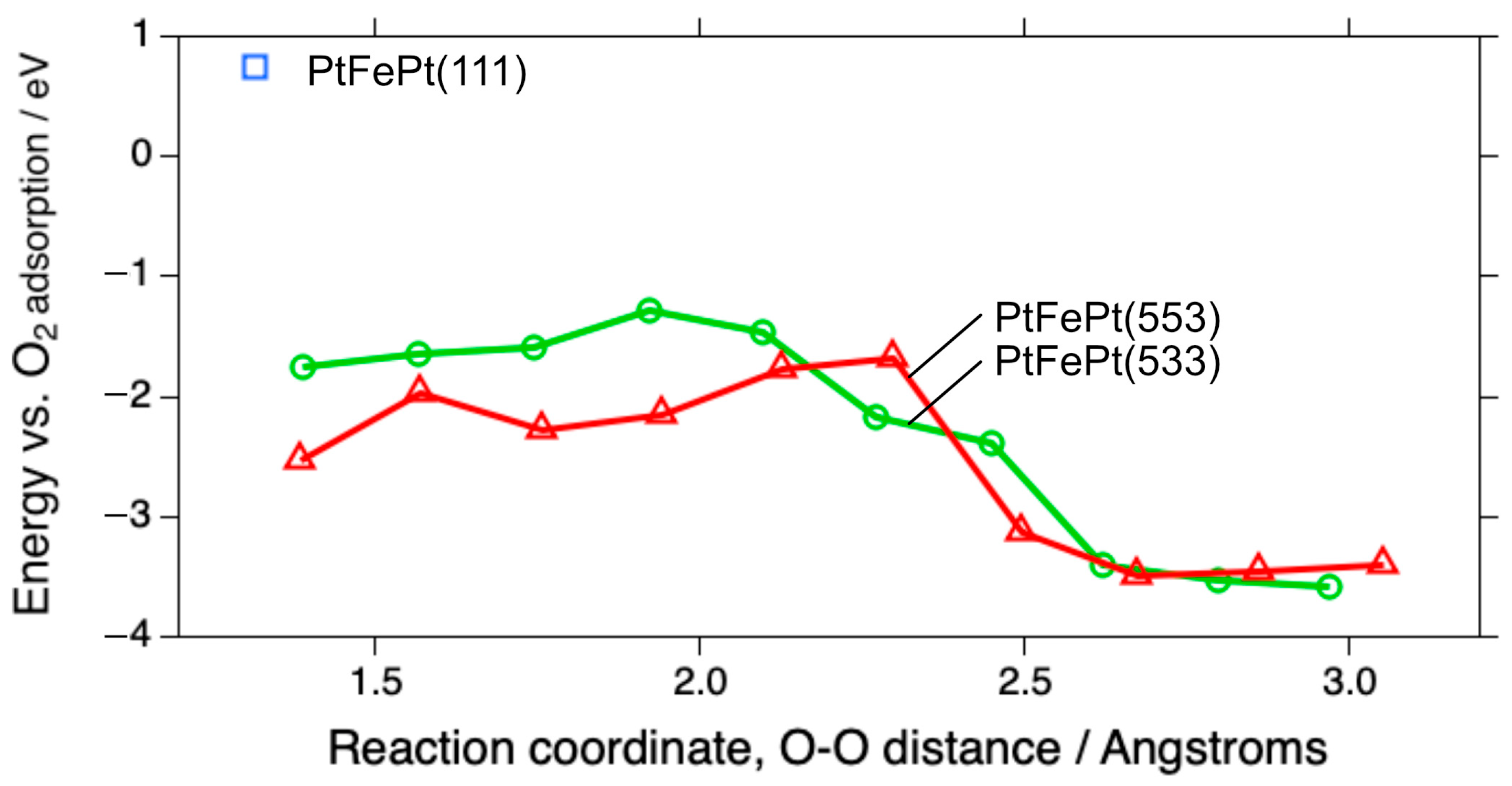
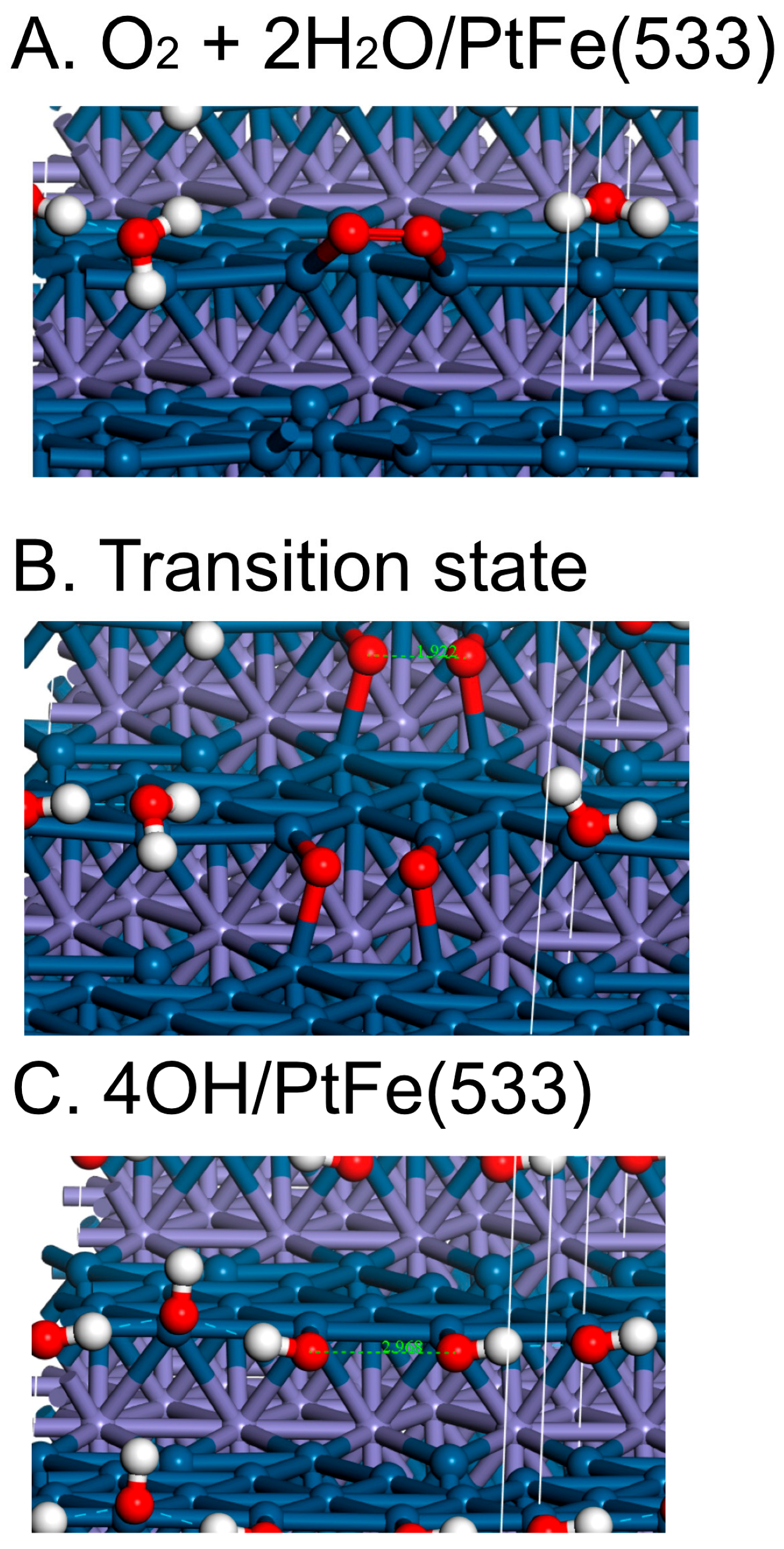
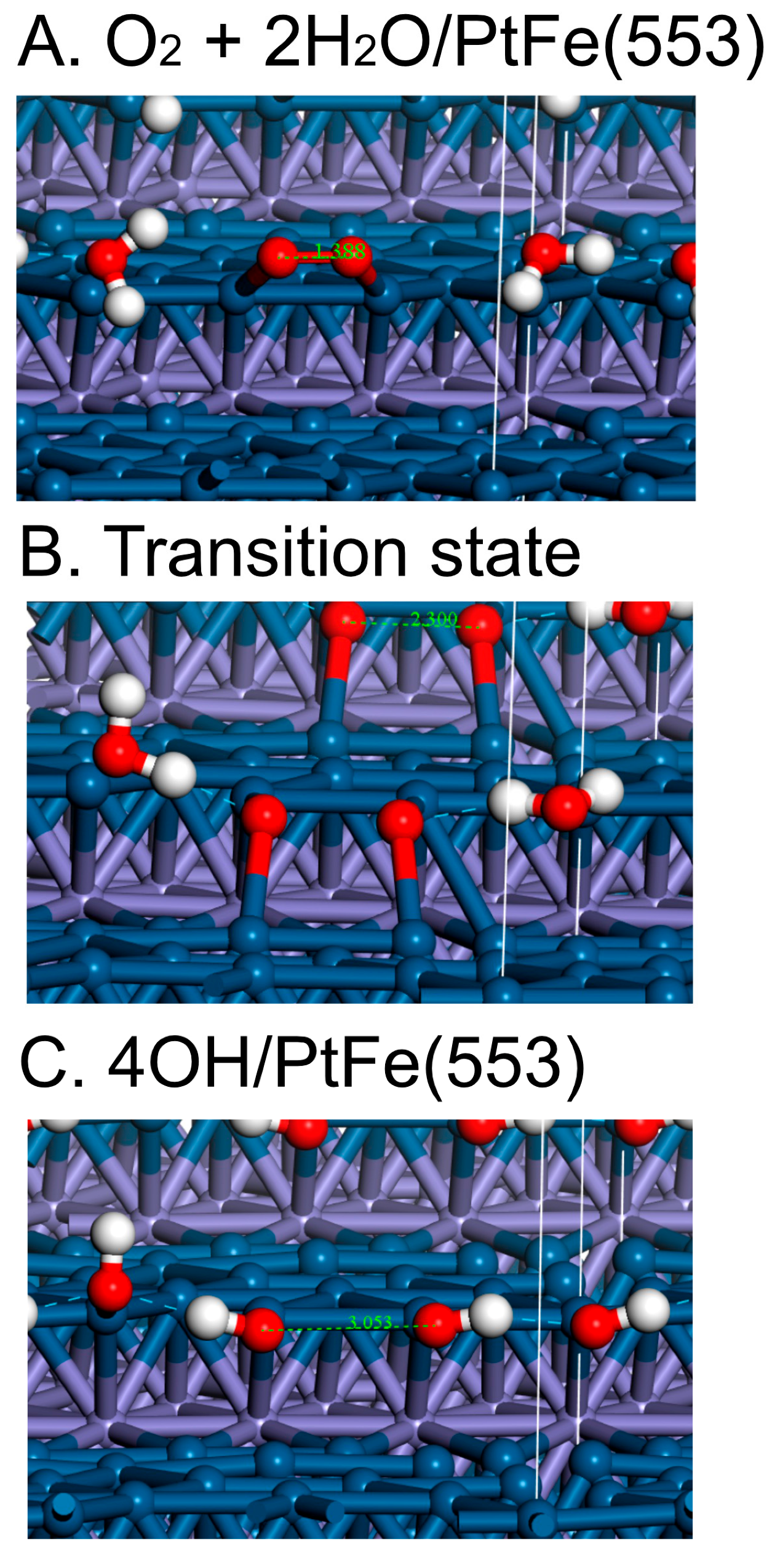
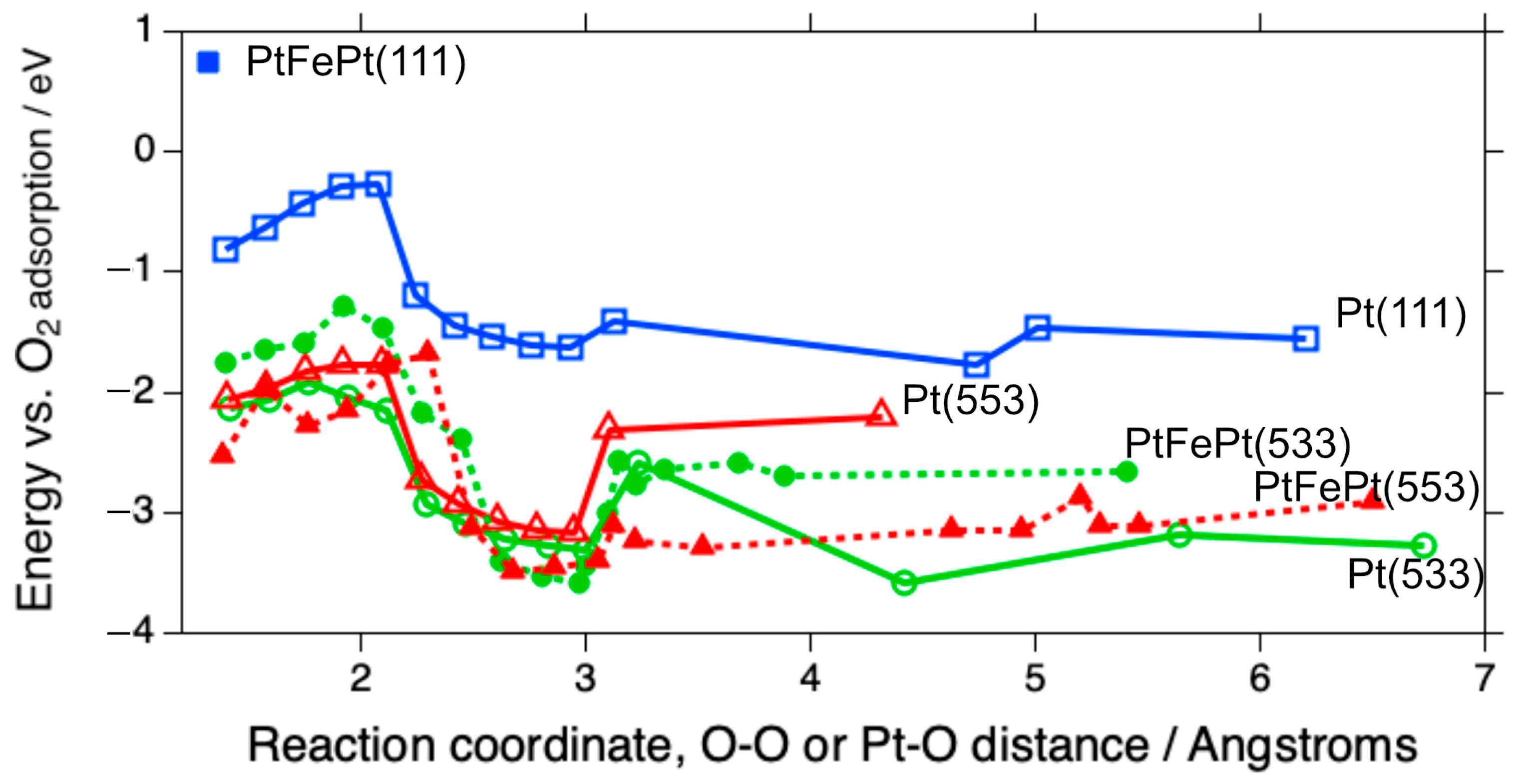
Atomic models for the conversion of O2 + 2H2O to 4OH on PtFePt(533) and PtFePt(553) (Figure 8 and Figure 9) and the corresponding reaction profiles (Figure 10) are surprisingly similar to those on the corresponding Pt stepped surfaces. This suggests that the enhancement effect for the ORR on the alloy surface does not stem from differences in this initial stage of the reaction. However, the (553) surface has a lower activation energy than the (533) surface in the case of PtFePt, the reverse of the situation for the pure Pt counterparts.

2.3. OH Transport from Step to Terrace on Pt and PtFePt Surfaces

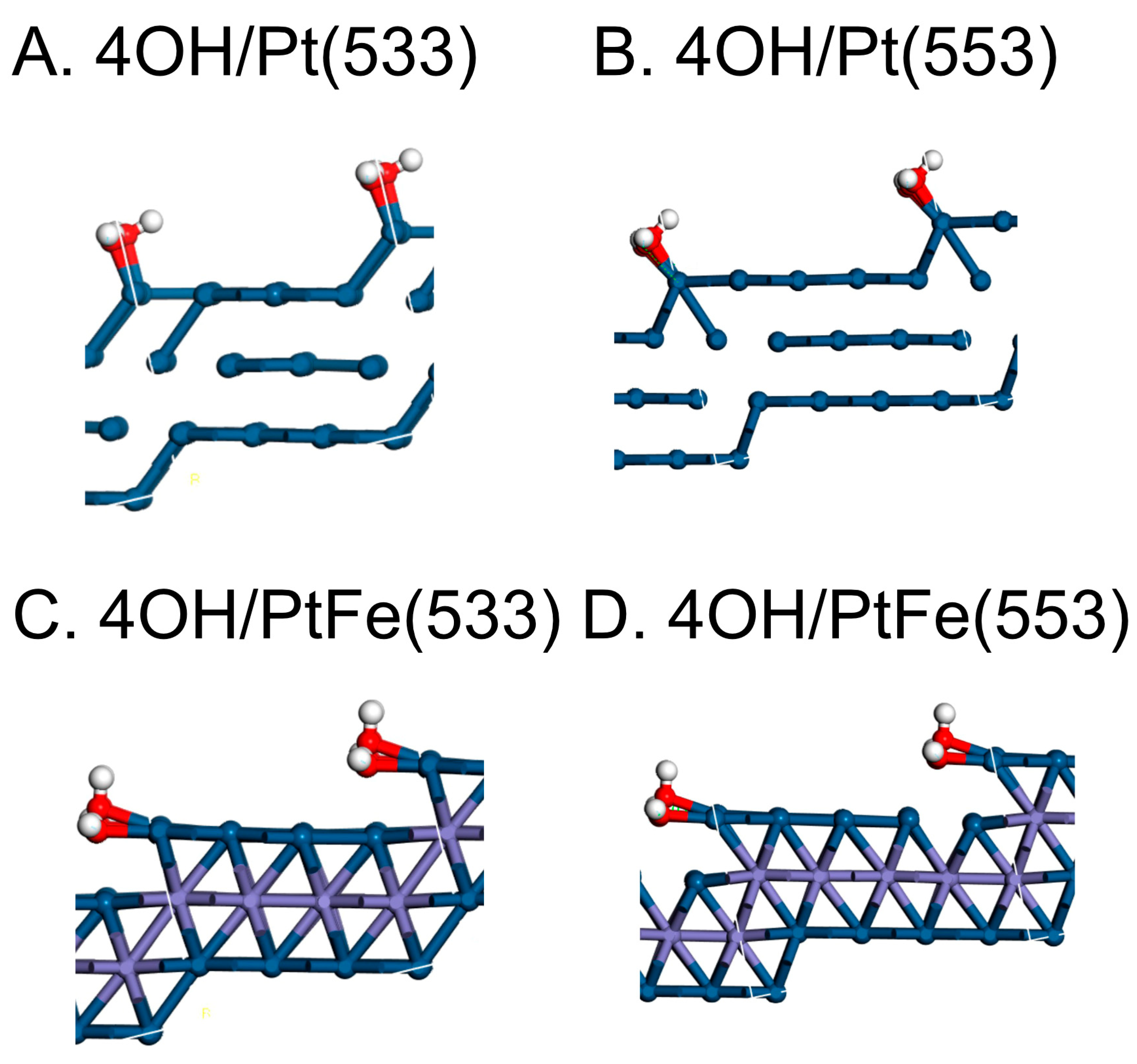
Larger differences start to be seen, however, when the movement of OH from the step to the terrace is considered. The configurations of OH on the various stepped surfaces are depicted in Figure 11. On both Pt(533) and Pt(553), the OH groups point away from the step, with the angle being approximately 113° for Pt(533) and 130° for Pt(553), vs. the plane of the upper terrace. In contrast, at both of the corresponding PtFePt surfaces, the angles are approximately 180°. These differences can be rationalized by considering the highly directional nature of the dz2 orbital of Pt [36]. The Pt atoms below the surface for Pt(533) and Pt(553) control the angle of the OH so that the Pt-Pt-O angle is near 180°. In contrast, since there are no corresponding subsurface Pt atoms in the case of the PtFePt stepped surfaces, the control of the angle is exerted by the top layer of Pt atoms.
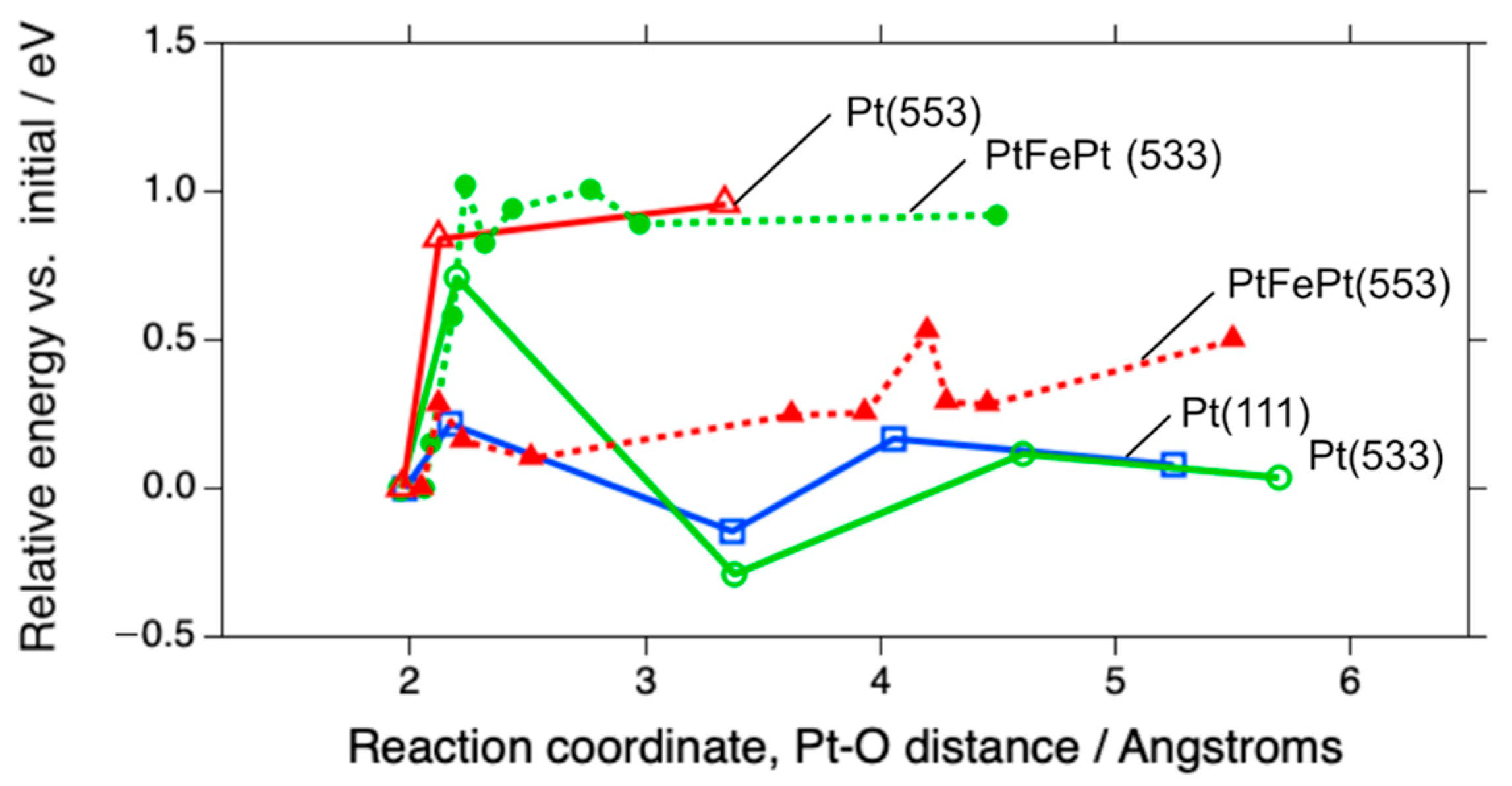
This difference has a decisive impact on the subsequent movement of OH away from the steps. For the pure Pt surfaces, it is more favorable for OH to move onto the upper terrace, while for the PtFePt surfaces, the lower terrace is more favorable, since the OH is already nearly in contact with it. The reaction profiles for OH movement are plotted in Figure 12 for a single OH to move from step to terrace to a point far enough away that it is not H-bonded to any other OH. At this point, the OH(terr) can be relatively readily reduced to water in the so-called double layer potential region (0.4~0.5 V vs. the reversible hydrogen electrode, RHE).
Differences in the details of the step geometries lead to wide differences in the energetic behavior for OH movement. The most interesting surface is PtFePt(553), on which OH has the easiest path to escape from the step, in contrast to the Pt(553) surface, for which the large Pt-Pt-O angle plays a major role.
The overall reaction profiles for both stages (Figure 13) show how similar all of the stepped surfaces are during O2 dissociation, although the activation energies are significantly higher on the PtFePt surfaces (Table 4). Major differences can then be seen in the OH movement stage, as already mentioned. PtFePt(553) has the lower O2 dissociation energy, although not as low as Pt(533), plus the easiest path for the escape of OH from step to terrace. It should also be kept in mind that OH is intrinsically more easily reduced from the Pt alloy (111) terraces, specifically, at higher electrode potentials, based on single crystal studies [37,38].

3. Discussion

The present work attempts to shed light on the reasons for the increased ORR rate in acid electrolytes on stepped Pt surfaces with increasing step density, based on the simplest possible assumption, which is that the O2 adsorbs more strongly at the steps than on the terraces. Maciá et al. pointed out that the variation in ORR rates at stepped Pt surfaces similar to Pt(533) is much less than is expected on the basis of UHV studies, in which there is a marked effect of the steps on O2 adsorption [12]. They ascribed this difference to the competition for sites in the aqueous electrochemical environment. For example, sulfate and bisulfate can adsorb on the (111) terraces, and this layer blocks O2 adsorption. They found that the ORR activity increased with increasing (100) step density. Kuzume et al. also found increasing ORR activity with increasing (110) step density [13] on surfaces similar to Pt(553). They concluded that there was also a strong effect of sulfate and bisulfate blocking, but there was a remaining effect in the weakly adsorbing perchloric acid electrolyte. They ascribed this effect to a difference in OH adsorption. This aspect cannot be rationalized by the present results, which predict that OH formed on the (111) surface encounters only a small activation barrier to move away from the reaction site Hoshi et al. studied both types of stepped surfaces and found very similar ORR behavior at similar step densities, consistent with the present results for the O2 dissociation stage. This result is surprising, given the difference in structure. However, the transition states are stabilized in both cases by subsurface Pt-Pt bonding.
This paradigm becomes more crucial for a typical alloy, PtFe, although less so for PtNi. On Pt(111), water adsorption is relatively close in strength to that of O2, and, on certain alloys, particularly PtFe, O2 adsorption can be significantly weaker than that of water. Therefore, steps are necessary in order to ensure that O2 can be captured effectively from the electrolyte. It has been proposed by various groups that the effect of the step is to modulate the water structure close to the catalyst surface and thus stabilize or destabilize intermediates in the ORR. However, this model does not take into account the competition between O2 and water for adsorption sites on the (111) terrace.
Since the activation energies found for the PtFePt(533) and PtFePt(553) for water-assisted dissociation are actually larger than the corresponding values for Pt(533) and Pt(553), the reasons for enhanced ORR activity must involve successive steps in the overall reaction, specifically, OH movement from the steps to the (111) terraces and OH reduction to water. In this regard, PtFePt(553) provides the easiest path for OH movement. Comparing the OH adsorption energies, the PtFePt(111) terrace has a considerable advantage in having a much smaller value, −2.21 eV, than Pt(111), −2.75 eV.
Of course, all of the adsorption energies presented in this work are potential-dependent, and this dependence is being studied in ongoing work by varying the number of OH adsorbed on the (111) terraces. It is to be expected that O2 dissociation will be more difficult at higher potentials, since there will be less electron density transferred from the metal phase to the π* anti-bonding orbitals of O2 [26]. OH adsorption is also expected to be stronger at higher potentials.
In addition, the activation energies Eact are also potential-dependent, following the trends of the adsorption energies, according to the BEP model [35]. For both O2 dissociation and OH removal stages, Eact increases, although at different rates, which could lead to the well-known Tafel slope doubling effect [39,40,41,42]. However, most ORR kinetic models include H+ as a participant in the rate-limiting step in the reaction. Interestingly, both a unit KIE on polycrystalline Pt and Pt/C [4,43] and a negative unit KIE on Pt(111) [44] have been found, the latter being based on the weaker adsorption of OD. Either scenario could be rationalized with the present model, but it is clear that further experimental and theoretical work is required for a complete clarification of the role of H+.
The present discussion would not be complete without discussing the effect of pH. Rizo et al. found that the ORR activity on Pt stepped surfaces of both (110) and (100) types was actually less than that on Pt(111) [45]. This result was proposed to be associated with OH coverage. The present results are consistent with Pt(111) having the lowest barrier to movement of OH away from the reaction site. This difference between acid and alkaline electrolyte therefore suggests that OH removal is a limiting factor in the latter. However, the present results do not address the effect of pH, but this will be addressed in future work.
The present approach of examining catalysts for a multistep electrochemical reaction in terms of dual sites has already been used on other reactions, for example, CO2 reduction [24] and water electrolysis [46,47], to name just two. Many more already exist, and even more will be found in the near future.

4. Materials and Methods

DFT calculations were carried out with the use of the DMol3 program (BIOVIA, Dassault Systemes, v. 2023, Vélizy-Villacoublay, France) with periodic boundary conditions for Pt(533), Pt(553) and Pt(111). The first steps in the ORR have been modeled starting with one O2 molecule and two H2O molecules. Further details can be found in the Supplementary Materials.

5. Conclusions

An attempt has been made to explain the ORR activity of stepped platinum surfaces that include either (A) (111) terraces and (111) [or (110)] steps, here Pt(553) or [5(111) × (111)], and (B) (111) terraces and (100) steps, here Pt(533) or [5(111) × (100)] as examples of dual-site catalysis, using DFT calculations. The hypothesis is that O2 adsorbs at the steps and is dissociated, with the help of two adjacent water molecules, to produce 4OH adsorbed at the step. The activation energies for this process were calculated to be 0.21 eV for the (100) step and 0.28 eV for the (111) step at an effective electrode potential at which there is no OH initially adsorbed on the terrace, i.e., in the double-layer region, or 0.4 to 0.5 V vs. SHE in acid electrolyte. Then, the OH must escape the step and move onto the (111) terrace, where it can be more easily reduced to water, which was found to be more difficult, with an activation barrier of ca. 0.65 eV for the (100) step and 0.8 eV for the (110) step. Thus, at this relatively low potential, the reaction appears to be limited by the removal of OH, which is consistent with the conclusions of several other researchers. There is still an advantage of the step, however, in that the O2 adsorption energy is much greater at the steps it is than for water, which can compete for sites (differences of 1.32 eV for Pt(533) and 1.05 eV for Pt(553)), than is the case for the (111) terrace (0.44 eV).
In contrast, for an alloy surface such as PtFePt, in which the alloying metal exists as a highly enriched layer just below the Pt surface, the usefulness of the steps was found to be much larger. On the PtFePt(111) surface, O2 adsorption was very weak (−0.33 eV in the absence of water and +0.75 (repulsive) in the presence of water, while water itself was slightly more strongly adsorbed than O2 (−0.40 vs. −0.33 eV). Therefore, the ORR is not expected to proceed at the PtFePt(111) surface. At the steps, O2 was found to adsorb much more strongly, only ca. 0.6 to 0.8 eV less than that on the pure Pt steps. Thus, it appears that steps are obligatory for the reaction to occur on this type of alloy surface. Regarding the OH removal stage, there is still a significant activation barrier for the (100) step, but, for the (110) step, there are two small barriers of ca. 0.25 eV, which are less than the ca. 0.6 eV barrier for the O2 dissociation stage, so that, even though this first stage is less facile than that on the pure Pt stepped surfaces, OH removal is significantly more facile. Although not in direct conflict with the present consensus, this analysis presents a more detailed picture regarding the ORR on one particular Pt alloy surface, particularly, the need for steps. Other alloys will also be examined in continuing work. Moreover, the effects of electrode potential, pH and counter-ions need to be examined.

Supplementary Materials

The following supporting information can be downloaded at https://www.mdpi.com/article/10.3390/catal16040311/s1, File S1: Density Functional Theory Methods.

Funding

The author gratefully acknowledges support from the “Electrolytes, Catalysts and Catalyst Layers with Extraordinary Efficiency, Power and Durability for PEFCs (ECCEED’30-FC)” project from the New Energy and Industrial Technology Development Organization (NEDO) of Japan.

Data Availability Statement

The author will supply necessary data upon request.

Conflicts of Interest

The author declares no conflicts of interest.

References

  1. Stephens, I.E.L.; Bondarenko, A.S.; Perez-Alonso, F.J.; Calle-Vallejo, F.; Bech, L.; Johansson, T.P.; Jepsen, A.K.; Frydendal, R.; Knudsen, B.P.; Rossmeisl, J.; et al. Tuning the Activity of Pt(111) for Oxygen Electroreduction by Subsurface Alloying. J. Am. Chem. Soc. 2011, 133, 5485–5491. [Google Scholar] [CrossRef]
  2. Hyman, M.P.; Medlin, J.W. Effects of Electronic Structure Modifications on the Adsorption of Oxygen Reduction Reaction Intermediates on Model Pt(111)-Alloy Surfaces. J. Phys. Chem. C 2007, 111, 17052–17060. [Google Scholar] [CrossRef]
  3. Toda, T.; Igarashi, H.; Uchida, H.; Watanabe, M. Enhancement of the Electroreduction of Oxygen on Pt Alloys with Fe, Ni, and Co. J. Electrochem. Soc. 1999, 146, 3750–3756. [Google Scholar] [CrossRef]
  4. Ghoneim, M.M.; Clouser, S.; Yeager, E. Oxygen Reduction Kinetics in Deuterated Phosphoric Acid. J. Electrochem. Soc. 1985, 132, 1160. [Google Scholar] [CrossRef]
  5. Toda, T.; Igarashi, H.; Watanabe, M. Role of Electronic Property of Pt and Pt Alloys on Electrocatalytic Reduction of Oxygen. J. Electrochem. Soc. 1998, 145, 4185–4188. [Google Scholar] [CrossRef]
  6. Xu, Y.; Ruban, A.V.; Mavrikakis, M. Adsorption and Dissociation of O2 on Pt-Co and Pt-Fe Alloys. J. Am. Chem. Soc. 2004, 126, 4717–4725. [Google Scholar] [CrossRef]
  7. Watanabe, M.; Tsurumi, K.; Mizukami, T.; Nakamura, T.; Stonehart, P. Activity and Stability of Ordered and Disordered Co-Pt Alloys for Phosphoric Acid Fuel Cells. J. Electrochem. Soc. 1994, 141, 2659–2668. [Google Scholar] [CrossRef]
  8. Kitchin, J.R.; Norskov, J.K.; Barteau, M.A.; Chen, J.G. Modification of the surface electronic and chemical properties of Pt(111) by subsurface 3d transition metals. J. Chem. Phys. 2004, 120, 10240–10246. [Google Scholar] [CrossRef]
  9. Shi, G.; Yano, H.; Tryk, D.A.; Nohara, S.; Uchida, H. High hydrogen evolution activity and suppressed H2O2 production on Pt-skin/PtFe alloy nanocatalysts for proton exchange membrane water electrolysis. Phys. Chem. Chem. Phys. 2019, 21, 2861–2865. [Google Scholar] [CrossRef]
  10. Tryk, D.A.; Shi, G.; Kakinuma, K.; Uchida, M.; Iiyama, A. Mechanisms for the Production and Suppression of Hydrogen Peroxide at the Hydrogen Electrode in Proton Exchange Membrane Fuel Cells and Water Electrolyzers: Theoretical Considerations. Catalysts 2024, 14, 890. [Google Scholar] [CrossRef]
  11. Yu, Y.; Gu, H.; Fu, M.; Wang, Y.; Fan, X.; Zhang, M.; Wu, G. First Principles Study of O2 Dissociative Adsorption on Pt-Skin Pt3Cu(111) Surface. Catalysts 2024, 14, 382. [Google Scholar] [CrossRef]
  12. Maciá, M.D.; Campiña, J.M.; Herrero, E.; Feliu, J.M. On the kinetics of oxygen reduction on platinum stepped surfaces in acidic media. J. Electroanal. Chem. 2004, 564, 141–150. [Google Scholar] [CrossRef]
  13. Kuzume, A.; Herrero, E.; Feliu, J.M. Oxygen reduction on stepped platinum surfaces in acidic media. J. Electroanal. Chem. 2007, 599, 333–343. [Google Scholar] [CrossRef]
  14. Hitotsuyanagi, A.; Nakamura, M.; Hoshi, N. Structural effects on the activity for the oxygen reduction reaction on n(111)-(100) series of Pt: Correlation with the oxide film formation. Electrochim. Acta 2012, 82, 512–516. [Google Scholar] [CrossRef]
  15. Hoshi, N.; Nakamura, M.; Hitotsuyanagi, A. Active sites for the oxygen reduction reaction on the high index planes of Pt. Electrochim. Acta 2013, 112, 899–904. [Google Scholar] [CrossRef]
  16. Greeley, J.; Rossmeisl, J.; Hellmann, A.; Norskov, J.K. Theoretical Trends in Particle Size Effects for the Oxygen Reduction Reaction. Z. Phys. Chem. 2007, 221, 1209–1220. [Google Scholar] [CrossRef]
  17. Bandarenka, A.S.; Hansen, H.A.; Rossmeisl, J.; Stephens, I.E.L. Elucidating the activity of stepped Pt single crystals for oxygen reduction. Phys. Chem. Chem. Phys. 2014, 16, 13625–13629. [Google Scholar] [CrossRef]
  18. Jinnouchi, R.; Kodama, K.; Nagoya, A.; Morimoto, Y. Simulated Volcano Plot of Oxygen Reduction Reaction on Stepped Pt Surfaces. Electrochim. Acta 2017, 230, 470–478. [Google Scholar] [CrossRef]
  19. Kodama, K.; Jinnouchi, R.; Takahashi, N.; Murata, H.; Morimoto, Y. Activities and Stabilities of Au-Modified Stepped-Pt Single-Crystal Electrodes as Model Cathode Catalysts in Polymer Electrolyte Fuel Cells. J. Am. Chem. Soc. 2016, 138, 4194–4200. [Google Scholar] [CrossRef]
  20. Staszak-Jirkovský, J.; Subbaraman, R.; Strmcnik, D.; Harrison, K.L.; Diesendruck, C.E.; Assary, R.; Frank, O.; Kobr, L.; Wiberg, G.K.H.; Genorio, B.; et al. Water as a Promoter and Catalyst for Dioxygen Electrochemistry in Aqueous and Organic Media. ACS Catal. 2015, 5, 6600–6607. [Google Scholar] [CrossRef]
  21. Lu, F.; Zhang, Y.; Liu, S.; Lu, D.; Su, D.; Liu, M.; Zhang, Y.; Liu, P.; Wang, J.X.; Adzic, R.R.; et al. Surface Proton Transfer Promotes Four-Electron Oxygen Reduction on Gold Nanocrystal Surfaces in Alkaline Solution. J. Am. Chem. Soc. 2017, 139, 7310–7317. [Google Scholar] [CrossRef]
  22. Watanabe, M.; Motoo, S. Electrocatalysis by ad-atoms: Part III. Enhancement of the oxidation of carbon monoxide on platinum by ruthenium ad-atoms. J. Electroanal. Chem. 1975, 60, 275–283. [Google Scholar] [CrossRef]
  23. Zhou, M.; Kong, W.; Xue, M.; Li, H.; Khan, M.A.; Liu, B.; Lu, F.; Zeng, X. Recent progress of dual-site catalysts in emerging electrocatalysis: A review. Catal. Sci. Technol. 2023, 13, 4615–4634. [Google Scholar] [CrossRef]
  24. Huang, A.; Zhou, T.; Zhang, J.; Zhang, Y.; Wu, Y.; Wang, Y.; Luo, W. Competing CO and HCOOH Pathways in CO2 Electroreduction. ChemCatChem 2024, 16, e202400504. [Google Scholar] [CrossRef]
  25. Rurigaki, T.; Hitotsuyanagi, A.; Nakamura, M.; Sakai, N.; Hoshi, N. Structural effects on the oxygen reduction reaction on the high index planes of Pt3Ni: n(111)-(111) and n(111)-(100) surfaces. J. Electroanal. Chem. 2014, 716, 58–62. [Google Scholar] [CrossRef]
  26. Stipe, B.C.; Rezaei, M.A.; Ho, W.; Gao, S.; Persson, M.; Lundqvist, B.I. Single-Molecule Dissociation by Tunneling Electrons. Phys. Rev. Lett. 1997, 78, 4410. [Google Scholar] [CrossRef]
  27. Gambardella, P.; Sljivancanin, Z.; Hammer, B.; Blanc, M.; Kuhnke, K.; Kern, K. Oxygen dissociation at Pt steps. Phys. Rev. Lett. 2001, 87, 4. [Google Scholar] [CrossRef]
  28. Gee, A.T.; Hayden, B.E. The dynamics of O2 adsorption on Pt(533): Step mediated molecular chemisorption and dissociation. J. Chem. Phys. 2000, 113, 10333–10343. [Google Scholar] [CrossRef]
  29. Gland, J.L.; Sexton, B.A.; Fisher, G.B. Oxygen interactions with the Pt(111) surface. Surf. Sci. 1980, 95, 587–602. [Google Scholar] [CrossRef]
  30. Gland, J.L. Molecular and atomic adsorption of oxygen on the Pt(111) and Pt(S)-12(111) × (111) surfaces. Surf. Sci. 1980, 93, 487–514. [Google Scholar] [CrossRef]
  31. Eichler, A.; Hafner, J. Molecular Precursors in the Dissociative Adsorption of O2 on Pt(111). Phys. Rev. Lett. 1997, 79, 4481–4484. [Google Scholar] [CrossRef]
  32. Ou, L.; Yang, F.; Liu, Y.; Chen, S. First-Principle Study of the Adsorption and Dissociation of O2 on Pt(111) in Acidic Media. J. Phys. Chem. C 2009, 113, 20657–20665. [Google Scholar] [CrossRef]
  33. Li, R.; Li, H.; Liu, J. First principles study of O2 dissociation on Pt(111) surface: Stepwise mechanism. Int. J. Quantum Chem. 2016, 116, 908–914. [Google Scholar] [CrossRef]
  34. Ungerer, M.J.; Santos-Carballal, D.; Cadi-Essadek, A.; van Sittert, C.G.C.E.; de Leeuw, N.H. Interaction of H2O with the Platinum Pt (001), (011), and (111) Surfaces: A Density Functional Theory Study with Long-Range Dispersion Corrections. J. Phys. Chem. C 2019, 123, 27465–27476. [Google Scholar] [CrossRef]
  35. Hammer, B. Special sites at noble and late transition metal catalysts. Top. Catal. 2006, 37, 3–16. [Google Scholar] [CrossRef]
  36. Schmid, M.; Garhofer, A.; Redinger, J.; Wimmer, F.; Scheiber, P.; Varga, P. Unusual Cluster Shapes and Directional Bonding of an fcc Metal: Pt/Pt(111). Phys. Rev. Lett. 2011, 107, 016102. [Google Scholar] [CrossRef]
  37. Stamenkovic, V.R.; Fowler, B.; Mun, B.S.; Wang, G.F.; Ross, P.N.; Lucas, C.A.; Markovic, N.M. Improved oxygen reduction activity on Pt3Ni(111) via increased surface site availability. Science 2007, 315, 493–497. [Google Scholar] [CrossRef]
  38. Wakisaka, M.; Kobayashi, S.; Morishima, S.; Hyuga, Y.; Tryk, D.A.; Watanabe, M.; Iiyama, A.; Uchida, H. Unprecedented dependence of the oxygen reduction activity on Co content at Pt skin/Pt-Co(111) single crystal electrodes. Electrochem. Commun. 2016, 67, 47–50. [Google Scholar] [CrossRef]
  39. Wang, J.X.; Zhang, J.; Adzic, R.R. Double-Trap Kinetic Equation for the Oxygen Reduction Reaction on Pt(111) in Acidic Media. J. Phys. Chem. A 2007, 111, 12702–12710. [Google Scholar] [CrossRef]
  40. Holewinski, A.; Linic, S. Elementary Mechanisms in Electrocatalysis: Revisiting the ORR Tafel Slope. J. Electrochem. Soc. 2012, 159, H864–H870. [Google Scholar] [CrossRef]
  41. Huang, J.; Eikerling, M. Modeling the oxygen reduction reaction at platinum-based catalysts: A brief review of recent developments. Curr. Opin. Electrochem. 2019, 13, 157–165. [Google Scholar] [CrossRef]
  42. van der Heijden, O.; Park, S.; Vos, R.E.; Eggebeen, J.J.J.; Koper, M.T.M. Tafel Slope Plot as a Tool to Analyze Electrocatalytic Reactions. ACS Energy Lett. 2024, 9, 1871–1879. [Google Scholar] [CrossRef]
  43. Tse, E.C.M.; Varnell, J.A.; Hoang, T.T.H.; Gewirth, A.A. Elucidating Proton Involvement in the Rate-Determining Step for Pt/Pd-Based and Non-Precious-Metal Oxygen Reduction Reaction Catalysts Using the Kinetic Isotope Effect. J. Phys. Chem. Lett. 2016, 7, 3542–3547. [Google Scholar] [CrossRef]
  44. Yang, Y.; Agarwal, R.G.; Hutchison, P.; Rizo, R.; Soudackov, A.V.; Lu, X.; Herrero, E.; Feliu, J.M.; Hammes-Schiffer, S.; Mayer, J.M.; et al. Inverse kinetic isotope effects in the oxygen reduction reaction at platinum single crystals. Nat. Chem. 2023, 15, 271–277. [Google Scholar] [CrossRef]
  45. Rizo, R.; Herrero, E.; Feliu, J.M. Oxygen reduction reaction on stepped platinum surfaces in alkaline media. Phys. Chem. Chem. Phys. 2013, 15, 15416–15425. [Google Scholar] [CrossRef]
  46. Shi, G.; Arata, C.; Tryk, D.A.; Tano, T.; Yamaguchi, M.; Iiyama, A.; Uchida, M.; Iida, K.; Watanabe, S.; Kakinuma, K. NiFe Alloy Integrated with Amorphous/Crystalline NiFe Oxide as an Electrocatalyst for Alkaline Hydrogen and Oxygen Evolution Reactions. ACS Omega 2023, 8, 13068–13077. [Google Scholar] [CrossRef]
  47. Xia, L.; Gomes, B.F.; Jiang, W.; Escalera-López, D.; Wang, Y.; Hu, Y.; Faid, A.Y.; Wang, K.; Chen, T.; Zhao, K.; et al. Operando-informed precatalyst programming towards reliable high-current-density electrolysis. Nat. Mater. 2025, 24, 753–761. [Google Scholar] [CrossRef]
Figure 1. (A) Initial state, (B) transition state and (C) final state for the reaction O2 + 2H2O → 4OH on Pt(111). Color code: Pt (blue), O (red), H (white). O-O distances (Å) are shown in light green: (A) 1.399 Å, (B) 2.075 Å and (C) 2.926 Å.
Catalysts 16 00311 g001
Figure 2. Initial state, transition state and final state for the reaction O2 + 2H2O → 4OH on Pt(533). Color code: Pt (blue), O (red), H (white). O-O distances (Å) are shown in light green. (A) 1.414 Å, (B) 1.766 Å and (C) 2.994 Å.
Catalysts 16 00311 g002
Figure 3. Initial state, transition state and final state for the reaction O2 + 2H2O → 4OH on Pt(553). Color code: Pt (blue), O (red), H (white). O-O distances (Å) are shown in light green. O-O distances (Å) are shown in light green. (A) 1.408 Å, (B) 2.094 Å and (C) 2.953 Å.
Catalysts 16 00311 g003
Figure 4. Reaction profiles for the first steps in the ORR involving O2 adsorbed in the bridging configuration at (100) steps on Pt(533) (green circles), at (110) steps on Pt(553) (red triangles), and on Pt(111) (blue squares).
Catalysts 16 00311 g004
Figure 5. Reaction profiles for the first steps in the ORR involving O2 adsorbed in the bridging configuration at (100) steps on Pt(533) (green circles), at (110) steps on Pt(553) (red triangles), and on Pt(111) (blue squares), as in Figure 4 but with the energies referred to the adsorption energy of O2 on the surface with two water molecules present.
Catalysts 16 00311 g005
Figure 6. Variation in EF during the first stages of the ORR involving O2 adsorbed in the bridging configuration at (100) steps on Pt(533) (green circles), at (110) steps on Pt(553) (red triangles), and on Pt(111) (blue squares).
Catalysts 16 00311 g006
Figure 7. Initial states for O2 + 2H2O on (A) Pt(111) and (B) PtFePt(111), showing the absence of an adsorptive bond in the latter case. Color code: Pt (blue), Fe (purple), O (red), H (white). O-O distances (Å) are shown in light green. (A) 1.399 Å and (B) 1.318 Å. Pt-O distances are also shown: (A) 2.050, 2.048 and (B) 2.279, 2.266 Å.
Catalysts 16 00311 g007
Figure 8. Initial state, transition state and final state for the reaction O2 + 2H2O → 4OH on PtFePt(533). Color code: Pt (blue), Fe (purple), O (red), H (white). O-O distances (Å) are shown in light green. (A) 1.392 Å, (B) 1.922 Å and (C) 2.968 Å.
Catalysts 16 00311 g008
Figure 9. Initial state, transition state and final state for the reaction O2 + 2H2O → 4OH on PtFePt(553). Color code: Pt (blue), Fe (purple), O (red), H (white). O-O distances (Å) are shown in light green. (A) 1.388 Å, (B) 2.300 Å and (C) 3.053 Å.
Catalysts 16 00311 g009
Figure 10. Reaction profiles for the first steps in the ORR involving O2 adsorbed in the bridging configuration at (100) steps on PtFePt(533) (green circles), and at (110) steps on PtFePt(553) (red triangles), with the energies referred to the adsorption energy of O2 on the surface with two water molecules present. The repulsive energy for O2 + 2H2O over PtFePt(111) is shown as a blue square in the upper left corner.
Catalysts 16 00311 g010
Figure 11. Side view of the final configurations of the 4OH produced at (A) Pt(533), (B) Pt(553), (C) PtFePt(533), and (D) PtFePt(553). Color code: Pt (blue), Fe (purple), O (red), H (white).
Catalysts 16 00311 g011
Figure 12. Reaction profiles for the subsequent step in the ORR, i.e., 4OH → 3OH + OH at Pt(111) (open blue squares), (100) steps on Pt(533) (open green circles), at (110) steps on Pt(553) (open red triangles), (100) steps on PtFe(533) (solid green circles), and (110) steps on PfFe(553) (solid red triangles), with the energies referred to the initial energies in each case. For the latter two surfaces, the Pt-O distance was incremented and constrained. For the pure Pt surfaces, discrete adsorption sites were used to indicate the reaction profile, but without true activation energies.
Catalysts 16 00311 g012
Figure 13. Overall reaction profiles involving O2 adsorbed in the bridging configuration, followed by OH movement to the (111) terrace, at Pt(111) (open blue squares), PtFePt(111) (solid blue square), (100) steps on Pt(533) (open green circles), at (110) steps on Pt(553) (open red triangles), (100) steps on PtFePt(533) (solid green circles), and (110) steps on PfFe(553) (solid red triangles), with the energies referred to the adsorption energy of O2 on the surface with two water molecules present.
Catalysts 16 00311 g013
Table 3. Experimental and calculated adsorption energies for O2, H2O, and OH on Pt/Fe/Pt surfaces.
SurfaceO2O-O, ÅOHH2OReference
PtFe(111), calc.−0.31 [2]
PtFe(221) terr., calc.−0.20 [9]
PtFePt(111), calc.−0.33 −2.21−0.40pw
PtFePt(111), 2H2O, calc.+0.751.318 pw
PtFePt(533), calc.−1.37 −2.74−0.33pw
PtFePt(533), 2H2O, calc.−1.481.392 pw
PtFePt(553), calc.−1.35 −2.92−0.61pw
PtFePt(553), 2H2O, calc.−1.211.388 pw
Note—pw denotes “present work”.
Table 4. Calculated kinetic parameters for water-assisted O2 dissociation on PtFePt sandwich structures.
SurfaceEact, eVO-O, TS, ÅΔE, eV
PtFePt(111)No reactionNANA
PtFePt(533)0.461.922−1.84
PtFePt(553)0.852.300−0.88
Disclaimer/Publisher’s Note: The statements, opinions and data contained in all publications are solely those of the individual author(s) and contributor(s) and not of MDPI and/or the editor(s). MDPI and/or the editor(s) disclaim responsibility for any injury to people or property resulting from any ideas, methods, instructions or products referred to in the content.