Review

Direct Chemical Conversion of Methane into Acetic Acid

1
Department of Energy Systems Research, Ajou University, 206 World Cup-ro, Yeongtong-Gu, Suwon-si 16499, Republic of Korea
2
Department of Chemical Engineering, Ajou University, 206 World Cup-ro, Yeongtong-Gu, Suwon-si 16499, Republic of Korea
Catalysts 2026, 16(4), 310; https://doi.org/10.3390/catal16040310
Submission received: 28 February 2026 / Revised: 15 March 2026 / Accepted: 27 March 2026 / Published: 1 April 2026

Abstract

Methane, as an abundant and relatively clean resource, has primarily been converted into various chemical products via indirect conversion through synthesis gas, a mixture of CO and H2. Recently, interest in direct methane conversion technologies with lower energy consumption has increased. Compared to research on methanol production via selective oxidation of methane, studies on the direct conversion of methane to acetic acid have been relatively scarce, but significant research progress has been made recently. This review classifies reports on the direct conversion of methane into acetic acid according to catalyst type (homogeneous vs. heterogeneous catalysts) and reaction conditions, and discusses the advantages and disadvantages of each approach. A relatively high yield of acetic acid can be achieved using CO as a carbonylating agent. However, the direct conversion of methane and CO2 into acetic acid is more attractive from an environmental perspective. Recent advances in the field of electrocatalysis for this purpose are noteworthy. Other non-thermal catalytic methods, including photocatalysis, photoelectrocatalysis, and plasma processes, are also included. Based on the current state-of-the-art research trends in this field, future research directions are proposed.

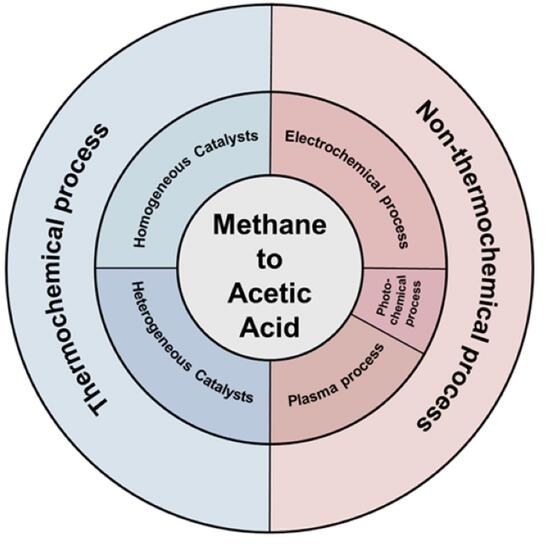
Graphical Abstract

1. Introduction

Methane is the main component of conventional [1] and unconventional natural gas (e.g., shale gas, coalbed methane, associated gases, and gas hydrates) [2] and has been used as a fuel and chemical feedstock. Methane possesses highly inert chemical properties due to its exceptionally high C–H bond dissociation energy of 439 kJ/mol [3]. Therefore, it is typically first converted into synthesis gas—a mixture of CO and H2—via the energy-intensive steam reforming (CH4 + H2O ⇌ CO + 3H2, ∆G0298K = 142 kJ/mol, ∆H0298K = 206 kJ/mol) process before being transformed into various chemical products [3]. To overcome the limitations of these indirect methane conversion technologies, various approaches have been studied to directly activate or functionalize methane [4,5]. In particular, numerous studies on the direct conversion of methane into methanol or methanol derivatives, or into methane oxygenates (e.g., formaldehyde and formic acid), have been reported [4,5,6,7,8,9,10,11,12,13,14,15,16,17,18,19]. Meanwhile, although it is a completely different pathway from that of producing methanol from methane, research on directly converting methane into acetic acid has also attracted attention.
Acetic acid is a versatile platform chemical primarily used in the production of polymers and solvents (vinyl acetate monomer, esters, anhydrides), and is also widely utilized in diverse fields such as food preservation, pharmaceuticals, textiles, detergents, and agriculture; its global demand has steadily increased over the past few years, rising from approximately 14 million tons in 2015 to about 18 million tons in 2022 [20], and is expected to continue its upward trend. Acetic acid is currently produced commercially via liquid-phase carbonylation reactions using Rh- or Ir-based homogeneous catalyst systems in the Monsanto process, Cativa process, and Acetica process, or via direct oxidation or indirect carbonylation of dimethyl ether in the gas phase using heterogeneous catalysts such as zeolites in the BP–SaaBre process [21,22,23,24]. BP announced that the BP–SaaBre process offered advantages over the conventional Monsanto process, Cativa process, and Acetica process by eliminating the challenge of separating homogeneous precious metal complexes from corrosive liquid products containing expensive rare halides [23]. Since the current acetic acid synthesis process begins with methanol and CO, a reaction that directly converts methane to acetic acid could be competitive with these existing processes if it can be carried out under mild conditions with relatively high yields.
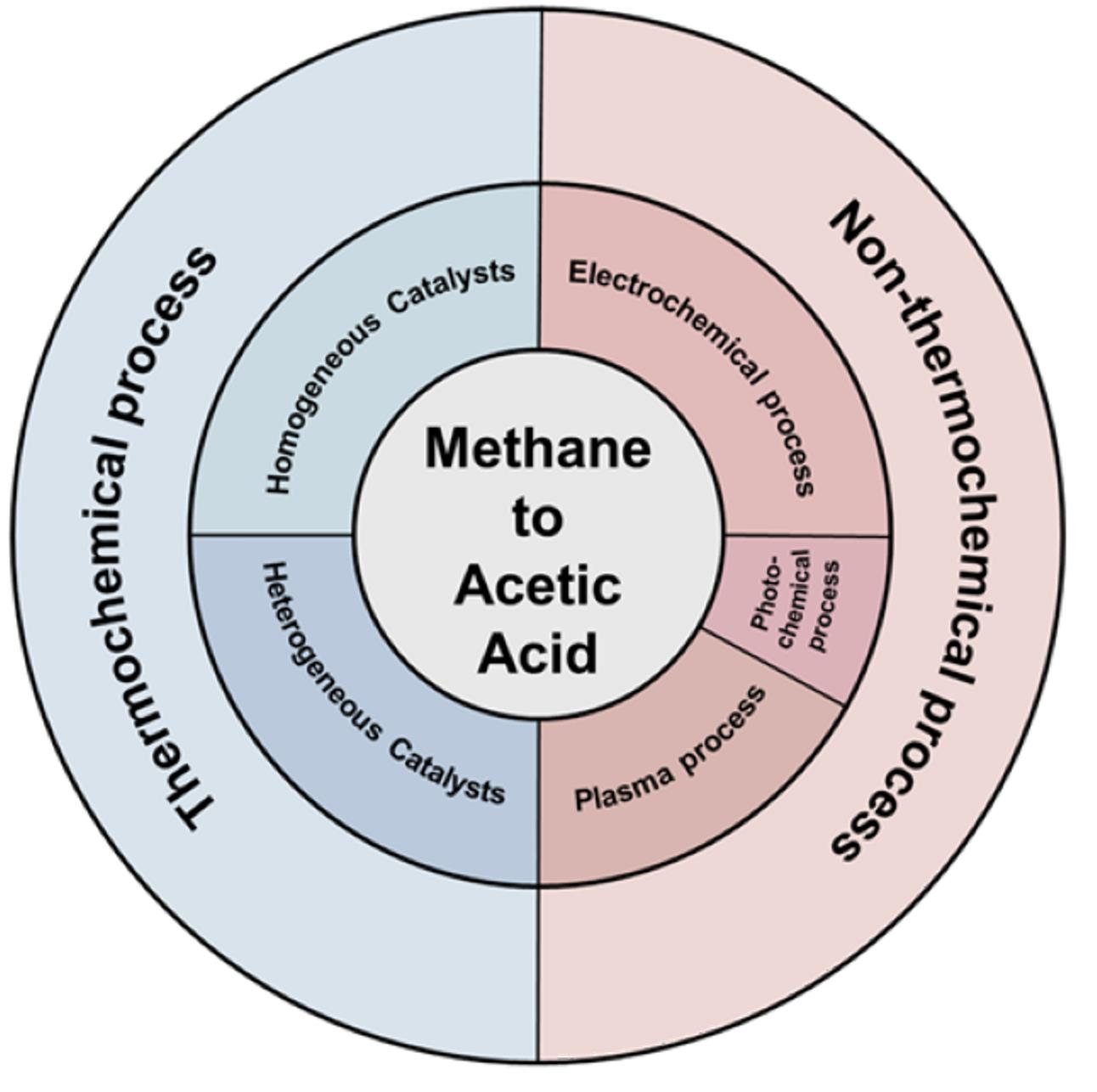
The chemical processes for directly converting methane into acetic acid can be broadly classified into thermochemical and non-thermochemical ones (Figure 1) [25]. The thermochemical process utilizes homogeneous or heterogeneous catalysts. In this process, methane itself is directly converted to acetic acid, or additional CO or CO2 may be required as a carbonylating agent. On the other hand, the non-thermochemical processes include electrochemical, photochemical, and plasma processes. This review summarizes recent advances in each process, discusses their advantages and disadvantages, and finally proposes future research directions.

2. Thermochemical Processes

Reactions directly converting methane to acetic acid can proceed thermochemically in the presence of homogeneous or heterogeneous catalysts. Two methane molecules can be converted into a methyl radical and CO, which can then combine to form acetic acid. To promote acetic acid production in such reactions, CO or CO2 can be additionally supplied as a carbonylating agent. Activating the C–H bond in methane is essential for these reactions; at relatively low temperatures, strong oxidants (e.g., K2S2O8 and H2O2) are required. To achieve the same goal, utilizing the CO/H2O/O2 system at elevated temperatures allows for the use of in situ generated H2O2. Additionally, direct activation of methane’s C–H bond using O2 or direct carboxylation of methane using CO2 must proceed at high temperatures.
In this section, the thermochemical processes for the direct conversion of methane into acetic acid are classified into homogeneous and heterogeneous catalyst systems, and different reactions using each catalyst type are systematically introduced and discussed.

2.1. Homogeneous Catalyst Systems

2.1.1. Liquid-Phase Direct Conversion of Methane to Acetic Acid

The liquid-phase direct conversion of methane into acetic acid can be described as follows.
2CH4 + 2H2O → CH3COOH + 8H+ + 8e
Table 1 summarizes some homogeneous catalysts for the liquid-phase direct conversion of methane into acetic acid [26,27,28,29,30].
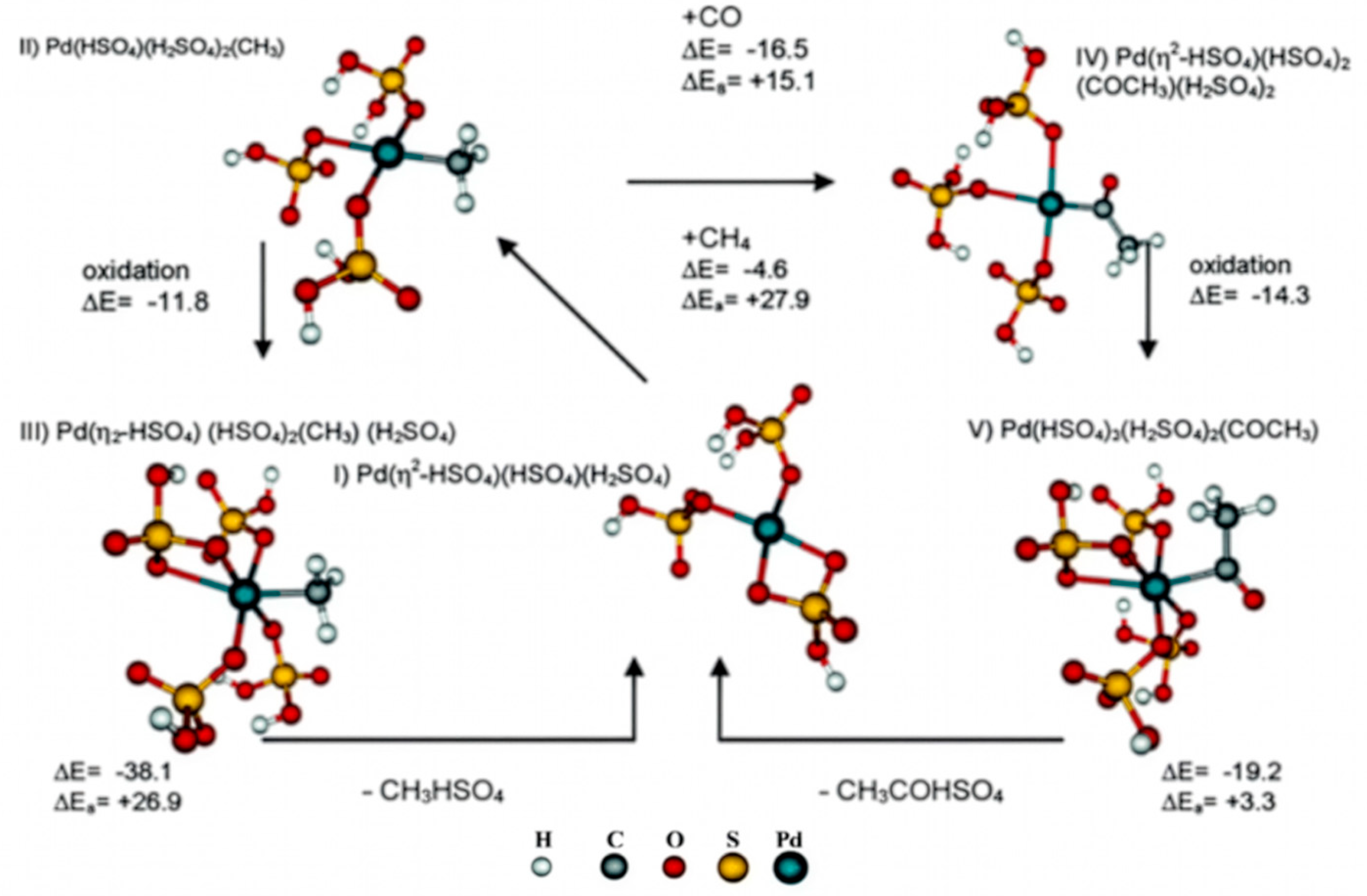
Periana et al. [26] reported a tandem catalytic reaction (2CH4 + 4H2SO4 → CH3COOH + 4SO2 + 6H2O) to synthesize acetic acid directly from methane in liquid sulfuric acid at 180 °C. This reaction involves the activation of methane’s C–H bond by PdSO4 (entry 1 in Table 1) to form a Pd–CH3 species, followed by an efficient oxidative carbonylation reaction with methanol generated in situ from methane to produce acetic acid. Zerella et al. [27] observed the promoting effect of CO in the synthesis of acetic acid from methane using PdSO4 in sulfuric acid under oxygen-free conditions at very low partial pressure ranges (entries 2 and 3 in Table 1) and reported that the acetic acid yield (14.2 turnover number (TON) of Pd2+) and the highest retention of Pd2+ in solution (96%) reached maximum values under a high O2/CH4 ratio and high total pressure conditions (entry 4 in Table 1). Although sulfur-containing compounds (especially methyl bisulfate) and COx were produced as byproducts, the study reported that lowering the reaction temperature maximized acetic acid selectivity (82%) (entry 5 in Table 1). Methane is activated by Pd(OSO3H)2 to form (CH3)Pd(OSO3H). CO generated from the oxidation of methyl bisulfate inserts into the Pd–CH3 bond, creating the (CH3CO)Pd(OSO3H) species. This complex then reacts with H2SO4 to produce acetic acid. In this system, Pd2+ is reduced to Pd0 during the oxidation of methyl bisulfate or CO, and Pd0 is reoxidized to Pd2+ by H2SO4 and O2. Chempath and Bell [31] utilized density functional theory (DFT) to study the direct oxidation of methane to acetic acid catalyzed by Pd2+ cations in concentrated sulfuric acid. Methane oxidation initiates when CH4 adds to one of the Pd–O bonds of the disulfate ligand, forming Pd(HSO4)(CH3)(H2SO4)2. As shown in Figure 2, this intermediate subsequently reacts with CO to generate Pd(HSO4)(CH3CO)(H2SO4)2. The most probable pathways leading to the final products were identified as the oxidation of Pd(HSO4)(CH3)(H2SO4)2 and Pd(HSO4)(CH3CO)(H2SO4)2 to yield Pd(η2-HSO4)(HSO4)2(CH3)(H2SO4) and Pd(η2-HSO4)(HSO4)2(CH3CO)(H2SO4), respectively. Subsequently, reductive elimination yields CH3HSO4 or CH3COHSO4, and hydrolysis of CH3COHSO4 forms CH3COOH.
Zerella et al. [28] reported that methane could be primarily converted to acetic acid in concentrated sulfuric acid at 180 °C using a combination of Pd2+ and Cu2+ in the presence of oxygen. Yuan et al. [29] reported that methane can be oxidized to CH3COOH and CF3COOCH3 using molecular oxygen as an oxidant in the presence of K2PdCl4 and H5PMo10V2O40 in a trifluoroacetic acid (TFA, CF3COOH) solution at low temperatures. They proposed that H5PMo10V2O40 acts as a reversible oxidant, maintaining Pd(II) in TFA, enabling the catalytic oxidation of methane to CH3COOH and CF3COOCH3 by molecular oxygen.
Reis et al. [30] reported that vanadium catalysts such as Amavadine (including other VIV and VV complexes with N,O and O,O ligands) could catalyze the direct conversion of methane to acetic acid with high yield under very mild conditions, without requiring CO in the process.
A liquid-phase reaction that directly converts methane to acetic acid without the use of additional carbonylating agents has been demonstrated in the presence of various homogeneous catalysts. However, all such reactions require the use of strong acids (e.g., H2SO4 and TFA), and the current turnover frequencies (TOFs) are too low to be considered a promising route for acetic acid synthesis.

2.1.2. Liquid-Phase Direct Conversion of Methane and CO (Or CO2) to Acetic Acid

The presence of CO in the direct conversion of methane into acetic acid was reported to be beneficial for obtaining high yields of acetic acid [27]. Table 2 summarizes some homogeneous catalyst systems for the liquid-phase direct conversion of methane into acetic acid in the presence of CO as a carbonylating agent [32,33,34,35,36,37,38,39,40].
Lin and Sen [41] reported that SO4˙ generated from S2O82− could abstract a hydrogen atom from methane to form methyl radicals that could be trapped by CO, and that this acyl radical was finally converted into acetic acid in an aqueous medium at 105–115 °C.
Nishiguchi et al. [32] discovered that Pd(OAc)2 and/or Cu(OAc)2 catalyzed the direct conversion of methane to acetic acid using K2S2O8 as an oxidant in the presence of CO (entries 1–3 in Table 2). Kurioka et al. [33] reported that methane could react with CO and O2 to produce acetic acid in TFA by using the catalyst system composed of CuSO4 and Pd(OCOC2H5)2, indicating that O2 can replace K2S2O8 (entries 4 and 5 in Table 2). Furthermore, they also achieved the direct carboxylation of methane with CO2 using K2S2O8 as an oxidant and the same catalyst system in TFA (entry 6 in Table 2).
Lin and Sen [34] reported a process that used rhodium trichloride as a catalyst to produce high-yield acetic acid via the carbonylation reaction of methane in an aqueous medium at 95 °C (entries 7 and 8 in Table 2). Chepaikin et al. [35] reported that methane, oxygen, and carbon monoxide react to produce methanol, formic acid, and acetic acid using the RhCl3–NaCl–KI system as a catalyst. According to their findings, the activity of this system varied with changes in the reaction medium, increasing when switched from water to organic acid solutions, with TFA proving most efficient. Furthermore, the yields of reaction products strongly depended on the molar fraction of water in the solution, CO pressure, and iodide ion concentration. As the chloride ion concentration increased, the acetic acid yield passed its maximum point, while the yields of methanol, formic acid, and methyl trifluoroacetate decreased. They proposed that hypoiodic acid and/or hydrogen peroxide participated as intermediate oxidizing agents during the reaction process.
Taniguchi et al. [36] confirmed that the VO(acac)2 (acac = 2,4-pentanedionato) catalyst efficiently converted methane and CO selectively to acetic acid in the presence of K2S2O8 and TFA. They demonstrated that reacting methane (5 atm) and CO (20 atm) at 80 °C for 20 h yielded 93% acetic acid based on methane. They also reported that other vanadium compounds such as V2O3, V2O5, and NaVO3, as well as various vanadium-containing heteropolyacids like H5PV2Mo10O40, H4PVW11O40, and H5SiVW11O40, could act as catalysts (entries 10–12 in Table 2). Silva et al. [37] prepared various vanadium complexes.
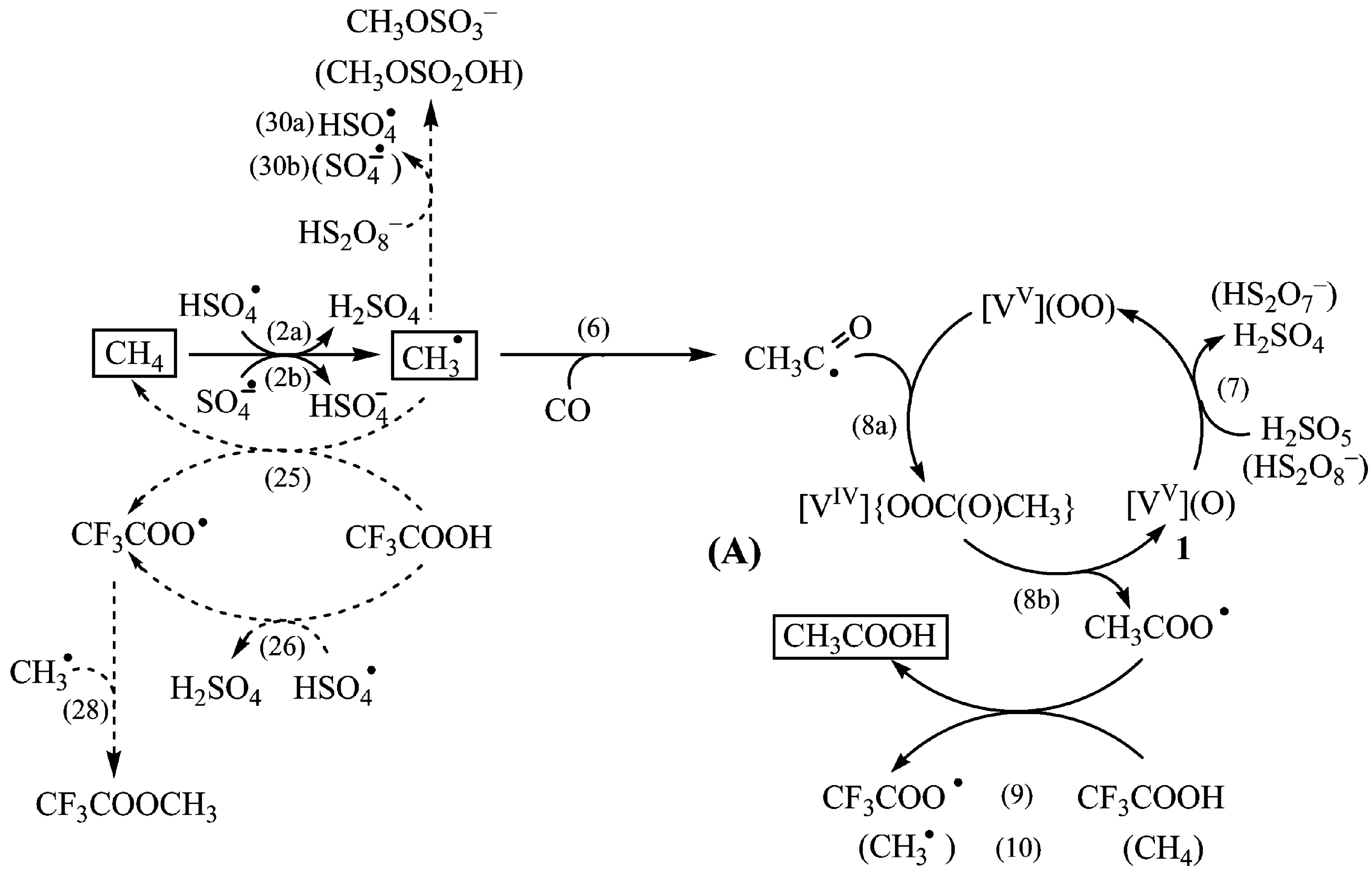
These included dioxovanadium(V) complexes (e.g., [VO2(3,5-Me2Hpz)3][BF4] (pz = pyrazolyl), [VO2{SO3C(pz)3}] (entry 13 in Table 2), [VO2{HB(3,5-Me2pz)3}] and [VO2{HC(pz)3}][BF4]), bearing pyrazole or scorpionate ligands, and the η2-bis(pyrazolyl)borate oxovanadium(IV) complex ([VO{HB(pz)3}{H2B(pz)2}]). They demonstrated that all these complexes exhibited catalytic activity in the carboxylation of methane in TFA/K2S2O8 to acetic acid (yields up to 40%, TONs up to 157) under mild conditions. Kirillova et al. [38] found that the most effective catalyst (as Amavadine) contained triethanolaminate or (hydroxyimino)dicarboxylates, achieving a CH3COOH yield of over 50% based on CH4 or a very high TON of up to 5.6 × 10³ in a single batch, while maintaining activity even after multiple reuses. As shown in Figure 3, they proposed that carboxylation proceeds via a free radical mechanism, with theoretical calculations showing that CH3•, CH3CO•, and CH3COO• are sequentially formed from methane, ultimately yielding acetic acid through H-extraction (from TFA or CH4). The CH3COO• radical is generated when the peroxo-V complex oxidizes CH3CO• via the V{η1-OOC (O)CH3} intermediate. It is noteworthy that TFA contributes to the formation of CH3COOH through its role in the carbonylation of CH3, its function as a hydrogen donor for CH3COO•, and its promotion of protonation of the oxidizing power of a peroxo-VV complex.
Asadullah et al. [39] achieved a 93.8% methane conversion into acetic acid with 100% selectivity in the calcium-catalyzed carboxylation of methane. Here, CaCl2 ultimately converts to CaO while extracting hydrogen atoms from methane. The CH3 radical generated in this process is captured by CO, and CH3CO• is ultimately converted to acetic acid in TFA. Kitamura et al. [40] reported that methane and CO could be converted to acetic acid by the Mo/CaCl2/K2S2O8 catalyst system in TFA. The best result (89.4% acetic acid) was obtained in a reaction using the catalyst system (methane 20 atm, CO 50 atm) at 85 °C for 20 h.
A liquid-phase reaction for the direct conversion of methane to acetic acid in the presence of CO (or CO2) as a carbonylating agent has been achieved in the presence of various homogeneous catalysts at relatively low temperatures below 100 °C. However, most of these reactions were carried out in strong acids (e.g., TFA) and required the use of strong oxidizing agents (e.g., K2S2O8), and the reported TOFs were too low to be considered a competitive route for acetic acid synthesis.

2.2. Heterogeneous Catalyst Systems

2.2.1. Liquid-Phase Direct Conversion of Methane to Acetic Acid

Table 3 summarizes some heterogeneous catalysts for the liquid-phase direct conversion of methane into acetic acid [42,43,44,45].
Phan et al. [42] reported that MIL-47 and MOF-48, metal–organic frameworks (MOFs) containing vanadium, selectively converted methane to acetic acid using K2S2O8 as an oxidant, achieving a 70% yield (490 TON) (entry 1 in Table 3). These catalysts demonstrated multiple reusability while maintaining their crystal structure and catalytic activity. Bu et al. [43] selectively immobilized one, two, and three zero-valent ruthenium atoms at the electron-rich 18-carbon cavity of graphdiyne (GDY), synthesizing C2 liquid oxygen compounds from methane via C–C coupling (entry 2 in Table 3). They demonstrated that using H2O2 as an oxidant, Ru atoms within the GDY selectively activate CH4 to generate key intermediates •CH3 and •CH2OH, thereby enabling the formation of C2–liquid oxygen compounds.
Antil et al. [44] achieved a direct single-step conversion of methane to acetic acid using molecular oxygen (O2) as the oxidant over a mono-copper hydroxyl site confined in a porous cerium MOF, Ce–UiO–Cu(OH) (entry 3 in Table 3). They proposed the reaction mechanism in which methane was first activated at the copper hydroxyl site via σ-bond metathesis to form Cu–methyl species, followed by carbonylation with in situ-generated CO and subsequent hydrolysis by water.
Qi et al. [45] demonstrated the oxidation of methane into methanol and acetic acid in water at temperatures between 120 and 240 °C using molecular oxygen in the absence of any added co-reductant in the presence of gold nanoparticles supported on the zeolite ZSM-5 (entry 4 in Table 3).
A liquid-phase reaction that directly converts methane to acetic acid without the use of additional carbonylating agents has been demonstrated in the presence of various heterogeneous catalysts. It is noteworthy that some of these were carried out without the use of strong acids and strong oxidizing agents. However, the current reaction rates are too low to be considered a promising route for acetic acid synthesis.

2.2.2. Liquid-Phase Direct Conversion of Methane and CO to Acetic Acid

Table 4 summarizes some heterogeneous catalysts for the liquid-phase direct conversion of methane and CO into acetic acid [42,46,47,48,49,50,51,52,53,54,55,56,57,58,59,60].
Phan et al. [42] reported the promotional effect of CO on the direct conversion of methane into acetic acid using K2S2O8 as an oxidant and MIL-47 and MOF-48 as catalysts (entry 1 in Table 3 vs. entry 1 in Table 4).
Liu et al. [46] investigated the conversion of methane to acetic acid and other methyl oxygenates in the presence of CO over the Ir/ZSM-5 catalyst (entry 2 in Table 4) using H2O2 as an oxidant. The influence of CO on methane conversion was investigated across various transition metals. Ir, Fe, Rh, and Pd showed promotion towards oxygenated compound formation, while Cu and Cr exhibited inhibition. Sequential charging of CH4 and CO experiments revealed the critical role of CO in acetic acid production. Xu et al. [47] reported that in situ decoration of the Pd1–ZSM-5 single-atom catalyst (SAC) (entry 3 in Table 4) by CO significantly enhanced the direct carboxylation reaction of methane, achieving a turnover frequency of 207 h−1 at ambient temperature when using H2O2 as the oxidant along with approximately 100% oxygenate selectivity. According to DFT calculations, the C atom of CO preferentially coordinates with Pd1, which donates electrons to the Pd1–O active site (L–Pd1–O, L=CO) formed by H2O2 oxidation. This enhances the electron density on the Pd–O pair, favoring C–H bond isomerization with a low energy barrier of 0.48 eV. They reported that applying CO decoration strategies to M1–ZSM-5 (M=Pd, Rh, Ru, Fe) could enhance oxygenate productivity by 3.2 to 11.3 times.
Zhao et al. [50] reported that Fe/Na(H)-ZSM-5 (entry 7 in Table 4) with abundant Si-ONa-Al moieties outperformed Fe/ZSM-5 (rich in Brønsted acid sites) (entry 6 in Table 4) in the conversion of methane to acetic acid using H2O2 in the presence of CO. This was explained by the Si-ONa-Al moiety within Fe/Na(H)–ZSM-5 promoting electron donation to iron species, forming electron-rich active sites on iron. This facilitated CO insertion, enhancing the production of acetic acid through the carbon–carbon bond formation between methane and CO. On the other hand, Wu et al. [48] succeeded in converting methane to CH3COOH with 100% selectivity from oxygen-containing products via direct coupling of CH4, CO, and H2O2 on the Fe-based dual-site reaction center supported on ZSM-5 (entry 4 in Table 4) at 30 °C. Isotope labeling experiments and DFT calculations revealed that the radical mediator (•CH3) favorably binds to adsorbed CO* and OH* species with a low energy barrier, leading to the highly selective formation of CH3COOH. Wang et al. [49] studied the direct simultaneous conversion of methane, carbon monoxide, and hydrogen peroxide to acetic acid over Fe/ZSM-5 (0.25) zeolite (entry 5 in Table 4) under mild conditions, achieving a maximum acetic acid space-time yield of approximately 12.01 mmol·gcat.−1·h−1 with an optimal selectivity of 63.2% at 50 °C. This was attributed to the monomeric Fe3+ species. It was confirmed that the methyl and carbonyl groups of acetic acid originated from methane and carbon monoxide, respectively. •OH and •CH3 radicals were found to participate in the reaction, and the –Fe–OCH3 species was proposed as a possible intermediate.
Cheng et al. [51] reported that a Cu/Fe-H-ZSM-5 catalyst (entry 9 in Table 4) comprising mononuclear Fe and Cu anchored in the ZSM-5 channels could accomplish the conversion of methane into acetic acid. They claimed that homogeneous mononuclear Fe sites were responsible for methane activation and oxidation, while adjacent Cu sites played a key role in delaying the oxidation process and promoting C–C bond formation for effective acetic acid synthesis. Furthermore, they confirmed that the methyl carbon in acetic acid originated exclusively from methane, while the carbonyl carbon derived solely from CO, not from the conversion of other C1 oxygen compounds. Liu et al. [52] reported that 1.2Ni–ZSM-5 (entry 10 in Table 4) with 88.9% isolated Ni sites achieved a high acetic acid yield of 2.92 mmol·gcat.−1 and a maximum selectivity of 82.3% in the methane oxidative carbonylation reaction. Isolated Ni species with Ni-O6 moieties immobilized in ZSM-5 micropores were proposed as the active sites, and CH3COOH was confirmed to be generated through direct coupling of methyl radicals and carbon monoxide molecules.
Shan et al. [53] directly converted methane to acetic acid using O2 and CO under mild conditions, employing a monomeric rhodium species immobilized on a zeolite (entry 11 in Table 4) or titanium dioxide support in an aqueous solution. At 150 °C, they achieved an acetic acid production rate of 7.33 mol·gcat.−1·h−1 with a selectivity of 60–100%. Tang et al. [54] also performed the same reaction on a single Rh1O5 site immobilized on a microporous aluminosilicate (entry 12 in Table 4) in solution at ≤150 °C. The TOF of this single-dispersed noble metal site reached approximately 0.10 s−1 at 150 °C, with an acetic acid production selectivity of about 70%. This is over 1000 times higher than the activity of free Rh cations. Computational studies indicated that the first C–H bond of CH4 is activated by Rh1O5 immobilized on the micropore walls of ZSM-5, and the resulting •CH3 combines with CO and •OH to form acetic acid via a low activation barrier. Golubev et al. [56] studied the oxidation conversion of methane to acetic acid using rhodium-modified ZSM-5 zeolite (entry 14 in Table 4) in the presence of carbon monoxide at 150 °C and 6.5 MPa pressure. They observed a 2.7-fold increase in acetic acid yield as the SiO2/Al2O3 ratio decreased from 300 to 30. They reported that the behavior of this catalyst system correlates with increased acidity, particularly an increase in the density of Brønsted acid sites on the zeolite surface. The introduction of 0.1–0.5 wt% rhodium into the zeolite increased the acetic acid yield by more than threefold, with the highest acetic acid yield (0.53 mmol·gcat.−1) achieved when 0.5 wt% Rh was modified onto the zeolite with SiO2/Al2O3 = 33. Oda et al. [57] synthesized a highly active Rh-containing zeolite (entry 15 in Table 4) using a RhCl3 molten salt. This encapsulated RhCl3 species was efficiently dispersed, forming the active site RhI single-atom species in the catalytic reaction, achieving a record conversion frequency (0.164 s−1), yield (14.6 mmol·gcat.−1·h−1), and high selectivity (76.9%) in the direct conversion of methane to acetic acid.
Li et al. [58] also performed the same reaction in aqueous solution using a Cu species-promoted Rh mononuclear complex catalyst immobilized on a porous organic polymer (Rh1–Cu/POPs) (entry 16 in Table 4), where the (CH3)RhX(CO)(PPh3)2 mononuclear complex was considered the stable species, with X representing Cl or I. The iodine species participated in the coordination of the Rh mononuclear carbonyl complex, promoting the conversion of CH3 and accelerating the production of more oxygenated products, particularly acetic acid. The production rate of total oxygenated products, including CH3OH, HCOOH, HOCH2OH, and CH3COOH, reached 0.289 g·gcat.−1·h−1 on the Rh1–Cu/POPs catalyst with the iodine species as a promoter and was maintained without significant decay even after five recycling cycles.
Li et al. [59] immobilized Ir complexes on oxide supports (entry 17 in Table 4) to convert methane into acetic acid via oxidative carbonylation. They demonstrated that methyl migration, the key step forming the C–C bond, is sensitive to the electrophilicity of the carbonyl group, which can be controlled through mild reduction of the Ir center. The as-prepared catalyst characterized primarily by Ir(IV) favored CH3COOH production, whereas the reduced catalyst characterized primarily by Ir(III) significantly increased CH3OH production instead of decreasing the CH3COOH yield.
Qi et al. [45] reported the promotional effect of CO for the oxidation of methane into methanol and acetic acid in water using molecular oxygen in the presence of gold nanoparticles supported on the zeolite ZSM-5 (entry 18 in Table 4) compared with the case without CO. However, the TOF was very low even at high temperatures. On the other hand, Wu et al. [60] reported that Au–Fe/ZSM-5 (entry 19 in Table 4) could convert methane to acetic acid with molecular oxygen as an oxidant in the presence of CO. They proposed that gold nanoparticles promoted the formation of hydroxyl species from the reaction of CO, O2, and H2O, and that atomically dispersed Fe species on the ZSM-5 support combined CH4 and CO via hydroxyl mediation to produce acetic acid.
A liquid-phase reaction for the direct conversion of methane to acetic acid using CO as a carbonylating agent was successfully carried out using a heterogeneous catalyst. In particular, it was demonstrated that acetic acid can be produced in an aqueous solution at low temperatures below 100 °C using H2O2. Furthermore, it was shown that acetic acid can be produced by utilizing hydrogen peroxide generated in situ from a CO/H2O/O2 system instead of using pre-prepared hydrogen peroxide. This method can be considered the most competitive approach among liquid-phase reactions using thermochemical catalysts reported to date. However, for commercial application, it is necessary not only to improve the acetic acid production rate but also to enhance the selectivity of acetic acid and to ensure the efficient utilization of CO, which serves as a carbonylating agent, as well as in situ generation of H2O2.

2.2.3. Gas-Phase Direct Conversion of Methane and CO (Or CO2) to Acetic Acid

Similar to the direct conversion of methane to acetic acid in the liquid phase, both CO and CO2 can be used as carbonylating agents in the gas phase. However, most research has focused on the carboxylation reactions of methane and carbon dioxide [61,62]. This is because the significant difference in chemical reactivity between CO and CH4 makes it difficult to activate both molecules under identical or similar reaction conditions and convert them into acetic acid. Table 5 summarizes some examples of gas-phase direct conversion of methane into acetic acid using CO or CO2 as a carbonylating agent [63,64,65,66,67,68,69,70,71,72,73,74,75,76].
Yuan et al. [63] studied the production of methyl acetate during the conversion of CH4, N2O, and CO on a heterogeneous catalyst containing both rhodium and iron phosphate (entry 1 in Table 5), demonstrating that the optimal Rh/Fe atomic ratio for methyl acetate production is 1:600–1:400. The Rh–FePO4 catalyst prepared from a mixed aqueous solution exhibited higher methyl acetate production rates than Rh/FePO4 prepared by impregnation. This was interpreted as the Rh3+ ions being primarily incorporated into the FePO4 lattice in the former case, whereas the Rh(III) species existed on the FePO4 surface in the latter. Interestingly, while the Rh(III) species supported on MCM-41 via the co-impregnation method and the FePO4 support significantly increased the production rate of methyl acetate, the two-step impregnation method produced a catalyst that did not generate methyl acetate. This suggests that a dual site where the Rh(III) species and FePO4 are in close proximity explains the methyl acetate production.
Wilcox et al. [65] demonstrated the formation of adsorbed acetate on both 5% Pd/carbon and 5% Pt/alumina (entry 3 in Table 5) using diffuse reflectance infrared Fourier transform spectroscopy (DRIFTS) when the catalysts were exposed to a methane and carbon dioxide mixture at approximately 400 °C. Furthermore, temperature-programmed reaction (TPR) experiments confirmed the generation of gas-phase acetic acid from CO2 and CH4 on the 5% Pt/alumina catalyst at approximately 400 °C. Huang et al. [66] reported the formation of acetic acid during the temperature-programmed desorption (TPD) of H2O (H2O-TPD) process after exposing the V2O5-PdCl2/Al2O3 catalyst (entry 4 in Table 5) to a feed gas composed of CH4, CO2, and O2 within the temperature range of 250–450 °C.
Ding et al. [67] directly converted CH4 and CO2 into acetic acid via an isothermal stepwise pathway using Rh/SiO2 (entry 5 in Table 5) and Pd/SiO2 (entry 6 in Table 5), considering methyl radical generation from CH4 decomposition and CO2 insertion into the intermediate as the two rate-limiting steps. The stepwise pathway can circumvent the thermodynamic limitations of this direct synthesis at low temperatures. The Pd catalyst exhibited higher activity than the Rh catalyst at 170 °C and 200 °C. No significant deactivation due to carbon deposition on the catalyst was observed during consecutive reaction cycles. Huang et al. [68] reported the synthesis of C2-oxygenates such as ethanol and acetic acid through CH4 decomposition and subsequent CO2 insertion into methyl radicals, naming this a stepwise reaction technology. They described a dual-reactor system that ensures both feed gases flow continuously into the reactors without interruption and remain unmixed after the reaction. According to their proposed mechanism, acetic acid is formed by CO2 insertion into M–CHx.
Narsimhan et al. [69] compared Cu-MOR and Cu-ZSM-5 for the production of acetic acid via the oxidative carbonylation of methane and found that Cu-MOR produced significantly higher amounts of acetic acid compared to Cu-ZSM-5 (22 vs. 4 μmol·gcat.−1). Selective titration with sodium demonstrated a direct correlation between the number of acidic sites within the 8MR pocket of MOR and the acetic acid yield (entries 8 and 9 in Table 5), suggesting that the methoxy species present in the MOR side pocket undergoes carbonylation. Furthermore, it was discovered that the CuII–O–CuII sites associated with methane oxidation in both Cu-MOR and Cu-ZSM-5 were oxidation active but inactive for carbonylation. Conversely, under Cu/Al < 0.2 conditions in MOR, new Cu2+ sites formed, and these sites were reported to oxidize methane and promote the migration of the product to a Brønsted acid site within the 8MR for carbonylation. Rabie et al. [70] achieved acetic acid formation under a continuous flow microreactor system by simultaneously supplying methane and carbon dioxide onto Cu-loaded M+–ZSM-5 catalysts (M = Li+, Na+, K+ and Ca2+) within a temperature range of 425–525 °C. Compared to Cu0–H–ZSM-5, the M+–ZSM-5 catalyst exhibited a significantly increased acetic acid production rate, with catalytic efficiency following the order K > Na > Ca > Li. The results suggest that M+ aids in concentrating surface-active CO2 in carbonate form, which subsequently reacts with the Cu0–H–ZSM-5-activated C–H bond. The Cu0–K–ZSM-5 catalyst (entry 10 in Table 5), combining Cu0 and M+, exhibited the highest acetic acid production rate (395 μmol·gcat.−1·h−1) at 500 °C under steady-state conditions.
Wang et al. [77] studied the catalytic conversion of carbon dioxide and methane to acetic acid using Cu-modified BEA, MFI, MOR, and TON zeolites via periodic DFT calculations. The results indicated that the catalytic activity of Cu-modified zeolites is closely related to both the active copper species and the zeolite pore channel structure. The dinuclear copper-oxo cluster ([CuOCu]2+) within three-dimensional BEA and MFI zeolites and the trinuclear copper-oxo cluster ([Cu3(μ-O)3]2+) in one-dimensional MOR and TON zeolites exhibit catalytic activity in the direct conversion of carbon dioxide and methane to acetic acid compared to mononuclear copper ([Cu]2+) species. In particular, MOR zeolite containing the [Cu3(μ-O)3]2+ clusters ([Cu3(μ-O)3]-MOR) exhibits excellent catalytic activity for acetic acid production with a low apparent activation energy (57 kJ·mol−1).
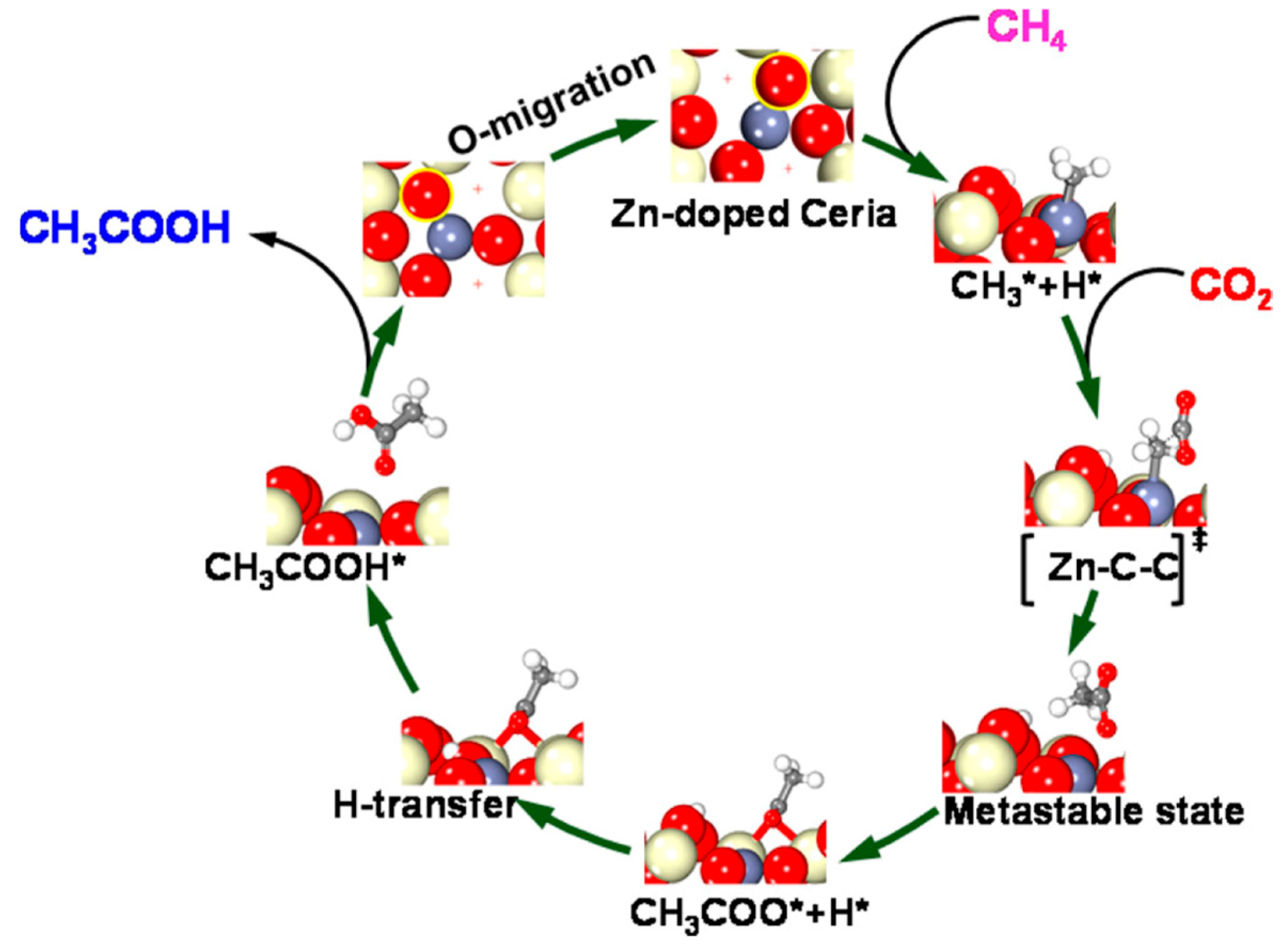
Wu et al. [78] discovered that methane and carbon dioxide can undergo co-conversion on zinc-modified H–ZSM-5 zeolite (denoted as Zn/H–ZSM-5) to form acetic acid within the low-temperature range of 250–500 °C. Zinc sites efficiently activate CH4 to form a zinc methyl species (-Zn–CH3). This Zn–C bond subsequently accepts CO2 insertion to generate a surface acetic acid species (-Zn–OOCCH3). Brønsted acid sites were reported to play a crucial role in the final acetic acid formation through proton transfer to the surface acetic acid species. Zhao et al. [79] demonstrated that C–C coupling reactions readily occurred on zinc-doped ceria catalysts. As shown in Figure 4, the DFT calculations revealed that the Zn dopant stabilized the methyl group by forming a Zn–C bond, thereby hindering the subsequent dehydrogenation of CH4. CO2 can be inserted into the Zn–C bond via an activated bent configuration, with the transition state being a three-center Zn–C–C moiety ([Zn–C–C]) with an activation barrier of 0.51 eV. The C–C coupling reaction produced acetate species, which could desorb as acetic acid by binding to surface protons. Zhang et al. [80] investigated the influence of the local structure of active sites on the conversion of CH4 and CO2 over Zn-modified H-ZSM-5 zeolite using DFT calculations, and proposed that the Zn2+ cations located in the five-membered rings of sinusoidal and linear channels exhibited superior catalytic activity compared to other isolated Zn2+ sites and small ZnO clusters due to favorable adsorption characteristics and activation energy of the reactants. For isolated five-atom Zn2+ in sinusoidal channels, the rate-determining step for the entire process is CO2 insertion into the Zn–CH3 bond, whereas for isolated five-atom Zn2+ in linear channels, acetate desorption is the rate-determining step.
Shavi et al. [71] synthesized single- and dual-component catalysts using various combinations of ZnO-, CeO2-, and MnO2-supported montmorillonite (MMT). They discovered that the dual active sites of ZnO and CeO2 selectively adsorb CH4 and CO2, respectively, thereby avoiding surface adsorption competition. The acetic acid production rate was maximized when these active sites were present at appropriate concentrations (Ce: 0.44 wt%, Zn: 2.20 wt%) (entry 11 in Table 5). DFT calculations revealed that acetic acid production was significantly enhanced on the ZnO catalyst, where the transfer of CO2 adsorbed from CeO2 to the ZnO side was facilitated. Li et al. [72] reported that enhancing the Lewis acidity of ZrO2-containing catalysts enables increased production of acetic acid from CH4 and CO2. They explained the reaction mechanism through DFT calculations: CH4 is activated at the Lewis acid active site to form Zr–CH3 and O–H species. Subsequently, the O–H species readily hydrogenates the CO3 species generated from CO2 activation at the Lewis acid active site to produce HCO3. This is followed by an easy coupling with Zr–CH3 to form acetic acid via a low energy barrier. Li et al. [73] reported that the Pd–ZrO2 catalyst (entry 13 in Table 5) demonstrated approximately five times higher performance than pure ZrO2 in acetic acid production. They elucidated a synergistic catalytic mechanism between Pd and hydrogen-reduced ZrO2, which not only promotes CO2 adsorption and activation by generating more oxygen vacancies (Ov), but also facilitates CH4 activation by resulting in larger Pd metal particles. DFT calculations revealed that the C–C bond formation between CH3* and COOH* exhibits a lower barrier, indicating a favorable pathway for acetic acid formation.
Na’s group [74] applied sequential CO2/CH4 activation to produce CH3COOH with nearly 100% selectivity. Notably, Co3O4 nanoparticles encapsulated within a mesoporous silica shell (entry 14 in Table 5) exhibited the highest CH3COOH productivity of 0.7 μmol CH3COOH gCo3O4−1 at 250 °C, enabling sustained and progressive CH3COOH production without productivity decline over 15 repeated cycles. Later, they elucidated the activation process in Co3O4 nanoparticles encapsulated within a mesoporous silica shell (nCo3O4@mSiO2) [75]. In standalone activation experiments, CO2 adsorbs onto the metal oxide to form a carbonate structure, which desorbs reversibly with temperature. Furthermore, nCo3O4@mSiO2 activates CH4 via C–H bond cleavage, stabilizing it as the Co–CH3* species alongside the O–H* species on the oxide framework. The sequential activation process using nCo3O4@mSiO2 induces the carboxylation or carbonylation of CH4 with CO2 or CO released from the metal carbonate surface, yielding CH3COOH or CH3CHO, respectively. After extraction, adsorbed oxygenated products can be collected, allowing reuse of nCo3O4@mSiO2 without altering product yield. Tian et al. [76] developed a reaction that directly combines CH4 and CO2 with H2O via a NiO/Fe2O3 catalyst (entry 16 in Table 5) at 150 °C and atmospheric pressure to produce C2 oxygen compounds (acetic acid and ethanol). Performance results showed the highest production rate of C2 oxygenated compounds (3.1 μmol·gcat.−1·h−1 at 150 °C) on the NiO/Fe2O3 catalyst compared to pure NiO and Fe2O3 catalysts. The active acid-base sites in NiFe2O4 and the oxygen vacancies in the NiO/Fe2O3 catalyst ensured the activation of CH4 and CO2, enabling the coupling rate of intermediates to reach its maximum. In situ diffuse reflectance FTIR analysis revealed that *OH and *H derived from H2O activated the cleavage of C–H and C=O bonds. Bonds between *CH2OH and *COOH and *CH3 produced C2 oxygenated compounds acetic acid and ethanol.
Al-Shafei et al. [81] demonstrated that the Langmuir–Hinshelwood mechanism best describes the direct reaction between carbon dioxide and methane on a 5% Zr/Ti oxide-impregnated catalyst. In the absence of carbon dioxide, methyl species dimerized from methane to produce ethane gas. However, when carbon dioxide was present in the reaction, adsorbed CO2 inserted into the methyl surface species, favoring the hydrogenation reaction over the dimerization reaction that produces ethane and ethylene, resulting in the formation of more acetic acid.
Zhao et al. [82] investigated three oxide-oxide model catalysts capable of realizing direct C–C bond formation based on the simultaneous activation of CH4 and CO2 using DFT calculations. The formation of oxide-oxide interface sites between the substrate (In2O3) and dispersed oxides [(ZnO)3, (ZrO2)3, or Ga2O3] enables CO2 activation at defect sites in In2O3 and CH4 activation at supported metal oxide M–O pairs. In contrast to the Eley–Rideal mechanism in Zn-doped ceria, where CO2 stabilization is followed by C–C bond formation with CH3, the formation of a Zn–C–C–O transition state at the active site originates from the Langmuir–Hinshelwood mechanism, where activated CO2 also enhances the dissociative adsorption of CH4. Microkinetic analysis indicates that dissociative adsorption of CH4 on the C–C bond plays a dominant role, while adsorption and activation of CO2 are relatively less significant. DFT calculations of the conversion of CH4 and CO2 to acetic acid on the (ZnO)3/In2O3 catalyst surface indicate that the C–C bond-forming step is the most kinetically critical step. Compared to Ga2O3/In2O3 and (ZrO2)3/In2O3 catalyst surfaces, (ZnO)3/In2O3(110) is more active for acetic acid production.
Ban et al. [83] designed a “single-atom”-“frustrated Lewis pair” (SA-FLP) dual active site catalyst for the co-conversion of CH4 and CO2 into acetic acid based on DFT calculations. The SA site was introduced by doping transition metal (TM) atoms (TM = Fe, Co, Ni, Cu; Ru, Rh, Pd, Ag; Os, Ir, Pt, Au) onto the CeO2(1 1 0) surface, while the FLP site was constructed by controlling surface oxygen vacancies. They demonstrated that introducing SA onto the CeO2 surface promotes the formation of oxygen vacancies, thereby facilitating the formation of FLP sites. The SA-FLP dual active site can simultaneously activate CH4 and CO2, with CH4 preferentially activated at the SA site and CO2 preferentially activated at the FLP site. Among the 12 SA-FLP catalysts, the Ag1-FLP catalyst exhibited the best performance in the reaction converting CH4 and CO2 to acetic acid at 573 K and 2 bar, showing a rate-determining barrier of 1.12 eV and a conversion frequency of 2.52 × 10⁻³ s−1.
Yang et al. [84] achieved the sequential C–C bond formation of CH4 and CO2 using the heteronuclear metal cation CuTa+, confirming that Cu can regulate charge distribution and reduce the energy difference between key orbitals involved in the C–C bond formation of the CH2 and CO units derived from the activation of CH4 and CO2, respectively.
Research on heterogeneous catalysts for the production of acetic acid via the reaction between CH4 and CO2 in the gas phase is actively underway, and studies are also being conducted on the effects of operating conditions—such as stepwise reactions—to improve the efficiency of acetic acid production. Since the catalysts and reaction conditions required to activate CH4 and CO2 differ, further research is needed to optimize these parameters. In particular, it is crucial to select catalyst combinations that allow the reaction to proceed at low temperatures with minimal energy consumption and where the activation conditions for CH4 and CO2 are closely aligned. Since this reaction involves repeated cyclic operation under varying operating conditions, it is essential to conduct long-term stability studies on the developed catalyst.

3. Non-Thermochemical Conversion of Methane into Acetic Acid

Thermochemical processes generally require external heat generated by fuel combustion or electricity, as they proceed only at elevated temperatures except when using strong oxidizing agents (e.g., K2S2O8 and H2O2). In contrast, non-thermochemical processes (e.g., electrochemical, photochemical, photoelectrochemical, and plasma processes) directly utilize electricity and mostly proceed at room temperature.

3.1. Electrochemical Process

As Spinner and Mustain [85] mentioned previously, electrochemical processes can offer distinct advantages over thermochemical processes: (i) reduced activation energy barriers; (ii) precise control of product formation through surface free energy regulation via electrode potential; (iii) separation of oxidation and reduction processes and the possibility of independent catalyst design. Therefore, electrochemical methane conversion can be considered an attractive alternative for low-temperature CH4 activation, and the concept that these methane oxygenates and other hydrocarbon products can be synthesized at low temperatures using electrochemical techniques was first reported by them. They electrochemically activated methane at room temperature on a NiO–ZrO2 bifunctional electrocatalyst, using CO32− as an oxygen donor species to generate low-molecular-weight oxygen compounds such as CH3OH, HCHO, CO and HCOO [85]. O2 and CO2 were also observed as products resulting from carbonate electrolysis and/or oxygen evolution reactions. Methane was adsorbed and activated on NiO, while CO32− was adsorbed on the non-conductive ZrO2. Subsequently, oxygen was extracted from CO32− and transferred to the electrocatalyst active site, where it formed new C–O or O–H bonds. Table 6 summarizes some electrocatalyst systems for the direct conversion of methane into acetic acid [86,87,88,89].
Ma et al. [86] employed a ZrO2:NiCo2O4 quasi-solid solution catalyst (entry 1 in Table 6) as the electrochemical anode for partial methane oxidation into propionic acid, acetic acid and acetone via 1-propanol, acetaldehyde and 2-propanol, respectively.
Ponticorvo et al. [87] designed an electrocatalyst featuring Rh and Cu single atoms dispersed on Al2O3 nanoparticles modified with NH4BF4 (entries 2 and 3 in Table 6), which contain abundant Brønsted acid sites. Here, the Brønsted acid sites play a crucial role in the final formation process by enabling direct insertion of CO into the reaction intermediate. The Rh-based electrocatalyst (entry 2 in Table 6) achieved a high acetic acid production rate of 34 μmol AA·cm−2·h−1. In contrast, the copper-based catalyst (entry 3 in Table 6) attained a selective ethanol production rate of 37 μmol AA·cm−2·h−1, owing to the tendency for acetyl species formation over the copper single atoms. Catalytic activity was stably maintained at 2 V and room temperature for at least 120 min.
Luo et al. [88] reported the electrocatalytic conversion of CH4 to CH3COOH in an electrolyte containing HCO3. By optimizing the active sites through defect engineering, the optimal catalyst (ZnO nanosheets rich in atomic defects, entry 4 in Table 6) achieved a high CH3COOH yield of 0.35 mol AA·gcat.−1·h−1 at 85.4% CH3COOH selectivity versus RHE at 1.3 V. This study emphasized the importance of abundant surface Zn/O defects.
Liu et al. [89] developed a CuOx–ZrO2–TiOx composite catalyst (entry 5 in Table 6) for the selective electrooxidation of CH4 to CH3COOH. The fabricated electrode achieved a Faradaic efficiency (FE) of 60.1% for CH3COOH at a current density of 10.8 mA cm−2, corresponding to a production rate of 3.3 mmol AA·gcat.−1·h−1. Mechanistic studies confirmed that the synergistic effect at the CuOx/ZrO2–TiOx interface enhanced the catalytic efficiency. CuOx oxidizes H2O to generate hydroxyl radicals (*OH), while the ZrO2–TiOx interface, possessing strong Lewis acid activity, adsorbs and activates CH4. The CuOx and ZrO2–TiOx interfaces synergistically oxidize CH4 to generate a series of intermediates (*CH3, *CH3O, *CH2O, *COOH) and promote C–C bond formation to produce CH3COOH.
Yuan et al. [90] proposed an integrated pathway enabling acetic acid synthesis from CH4 and CO2. First, CO2 is reduced to CO via electrochemical CO2 reduction and to oxygen via water oxidation. Subsequently, the oxidative carbonylation of methane, catalyzed by a rhodium single-atom catalyst supported on zeolite, proceeds. As a result, CH3COOH is obtained with high selectivity (>80%) and excellent yield (approximately 3.2 mol AA·gcat.−1 within 3 h).
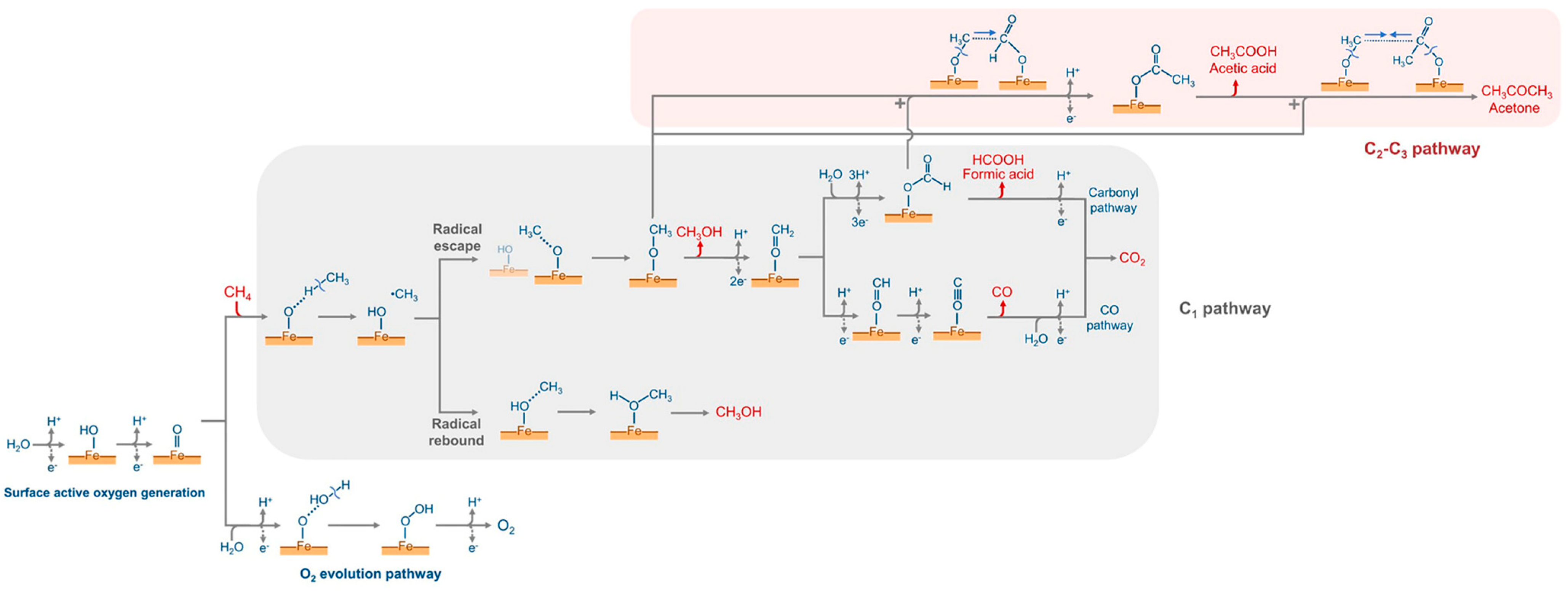
Al-Attas et al. [91] studied α-Fe2O3 as a model catalyst to gain mechanistic understanding of the electrochemical CH4 oxidation reaction. During chronoamperometric experiments, liquid products (formic acid, acetic acid, acetone) were obtained at approximately 6.5% total Faradaic efficiency at 2.3 V vs. a reversible hydrogen electrode (VRHE). As shown in Figure 5, non-Faradaic CH4 adsorption occurred at potentials below 2.0 VRHE. CH4 oxidation initiates via •OCH3 species formation through H extraction, followed by additional oxidation steps to produce formate. The coupling of •OCH3 and formate generates •OCOCH3 species. Furthermore, C–C bond formation between –COCH3 and –CH3 led to acetone formation.
Various electrode catalysts for the direct electrochemical production of acetic acid from methane in electrolytes containing CO32− or HCO3 at room temperature have been reported, including cases demonstrating high current efficiency and selectivity for acetic acid. However, there is a need to develop low-cost, non-precious metal electrode catalysts that offer both high current efficiency and high selectivity for acetic acid, as well as electrochemical reaction systems capable of directly utilizing CO2 while increasing methane conversion.

3.2. Photochemical and Photoelectrochemical Processes

The photochemical conversion of methane to acetic acid requires efficient activation of the methane C–H bond alongside balanced regulation of the adsorption and desorption of various free radicals and C1 intermediates to promote efficient C–C bond formation. To this end, the effects of catalyst design—including active site assembly, crystal surface, and atomic rearrangement—and auxiliary reactants such as CO and CO2 on this reaction were examined [92]. Table 7 summarizes some photocatalyst systems for the direct conversion of methane into acetic acid [93,94,95,96,97,98,99].
Li et al. [93] utilized a MOF built with porphyrin as the linker (entry 1 in Table 7) to provide high concentrations of binding sites to support atomically dispersed rhodium and achieved up to 5 wt% rhodium loading. Interestingly, this catalyst exhibited a unique sensitivity to light, producing acetic acid with a maximum selectivity of 66.4% under the same reaction conditions when illuminated, and methanol with a maximum selectivity of 65.0% in the dark.
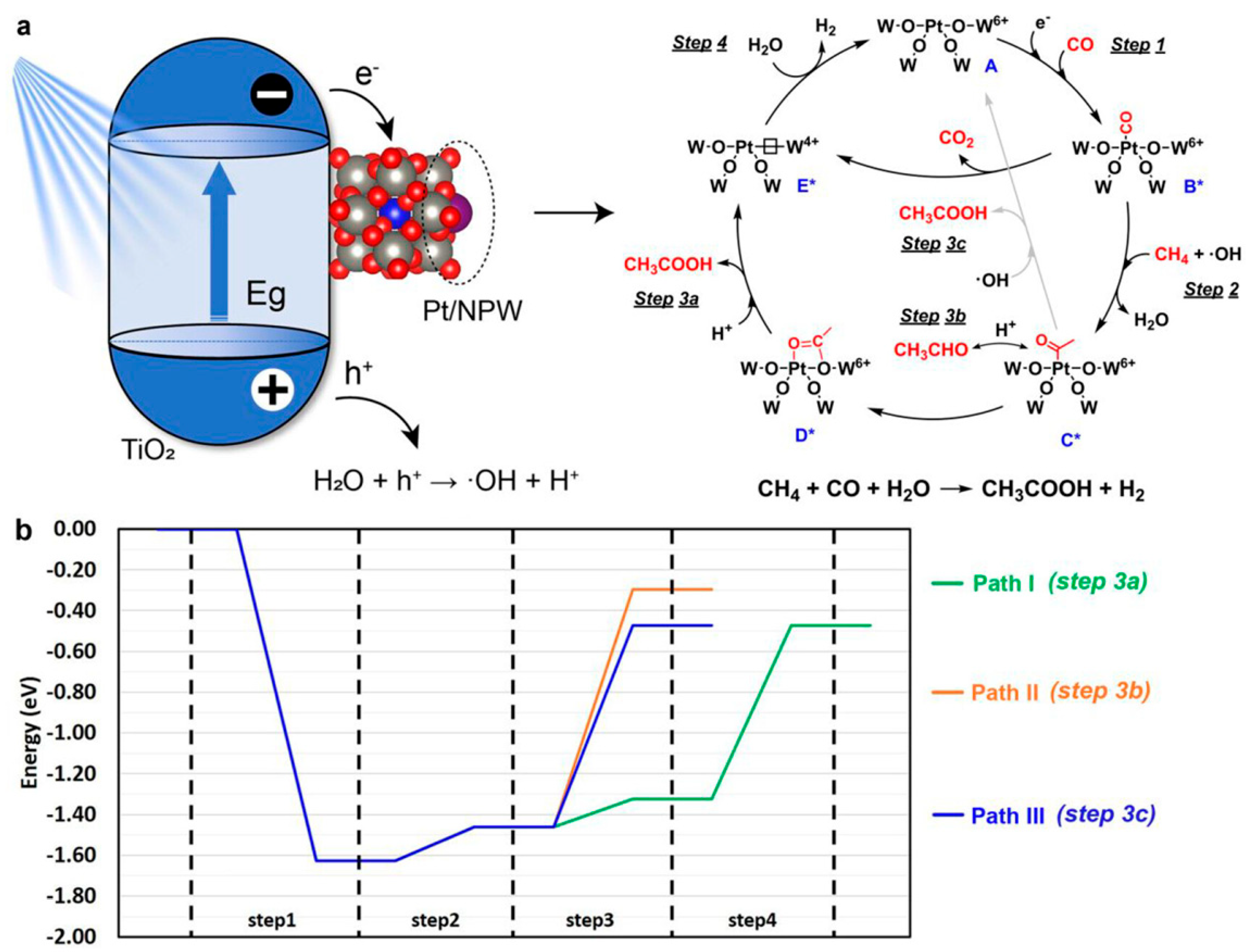
Dong et al. [94] demonstrated a photocatalytic synthesis of acetic acid from CH4, CO, and water at room temperature by using TiO2-supported ammonium phosphotungstic polyoxometalate (NPW) clusters anchored with isolated Pt single atoms (Pt1) (entry 2 in Table 7). They proposed that acetic acid synthesis proceeds via photocatalytic oxidative carbonylation of methane on the Pt1 sites, with methane activation being promoted by water-derived hydroxyl radicals during this process (Figure 6). This enabled the synthesis of a stable 5.7 mmol·L−1 acetic acid solution within 60 h with a selectivity of 90% for liquid and 66% for carbon standards, yielding 99 moles of acetic acid per mole of platinum.
Liu et al. [97] successfully catalyzed the conversion of CH4 and CO2 into acetic acid at room temperature using a Cu/ZnO catalyst (entry 5 in Table 7) activated by photons. Under optimal conditions (irradiance 100 mWcm−2, 25 ± 2 °C, pressure 2 MPa, CH4:CO2 volume ratio 1:1), the acetic acid yield reached 41 μmol AA·gcat.−1·h−1, with a selectivity of 89.5%. Improved CH4 dissolution in water under increased pressure and temperature was observed, leading to enhanced acetic acid production. Furthermore, surface chemical adsorption of CH4 and CO2 promoted by ZnO and Cu within the catalyst was involved in the catalytic mechanism, enabling photogenerated charge transfer to form C–C bonds and subsequently acetic acid. Fei et al. [98] achieved the synthesis of acetone (CH3COCH3) through the direct coupling of two CH4 and one CO using a combined photothermocatalytic approach by using TiO2 as a light absorber and Pd nanoparticles as a cocatalyst. They proposed that the suitable binding strength between Pd and the reactive intermediates was responsible for the high selectivity toward C3 products.
Zhang et al. [96] achieved the direct synthesis of CH3COOH from CH4 alone via photochemical conversion without additional reagents. This was made possible by constructing a PdO/Pd–WO3 heterointerfacial nanocomposite (entry 4 in Table 7) containing active sites for CH4 activation and C–C bond reaction. It was revealed that while CH4 decomposed into methyl groups at the Pd site, the oxygen in PdO served as the carbonyl-forming agent. A chain reaction between the methyl and carbonyl groups generates an acetyl precursor, which subsequently converts to acetic acid. Notably, a production rate of 1.5 mmol·gPd−1·h−1 and a selectivity of 91.6% for acetic acid were achieved in a photochemical flow reactor.
Wang et al. [95] constructed a composite photocatalyst (Ag/AgCl–WO3−x) (entry 3 in Table 7) and successfully achieved a single-step photocatalytic conversion of CH4 to CH3COOH without adding carbonyl species. Under irradiation on the Ag/AgCl surface, chlorine radicals and hydroxyl radicals could be generated simultaneously. Specifically, CH4 can generate methyl species through a transition reaction with chlorine radicals and hydrogen atoms, while hydroxyl radicals can photodecompose CH4 to produce carbonyl species. Subsequently, the addition of WO3−x enables a carbon–carbon bond reaction between the carbonyl species and the methyl species, effectively generating acetic acid (188.5 μmol·gcat.−1·h−1).
Li et al. [99] achieved highly efficient photo-driven carbonylation of CH4 to CH3COOH by reacting CH4 with CO and O2 over Rh–Zn atom pairs confined to MoS2 coupled with TiO2 (entry 11 in Table 7). They discovered the synergistic effect between Rh–Zn and photo-excited electrons from TiO2 in CH3COOH formation. Specifically, they explained that the active OH species generated via the O2 photo-reduction reaction through proton-coupled electron transfer at the Zn site promoted the decomposition of CH4 to produce CH3 species. This CH3 species readily combines with CO adsorbed on the adjacent Rh site to form CH3CO, the key intermediate for CH3COOH formation.
Various photocatalysts have been reported that use CO as a carbonylating agent to produce acetic acid from methane at room temperature or at low temperatures below 200 °C, and cases with high selectivity for acetic acid have also been reported. However, there is a need to develop low-cost, non-precious-metal photocatalysts that offer high photoconversion efficiency, high selectivity for acetic acid, high acetic acid production rates, and high CO utilization efficiency, as well as photocatalytic reactors capable of increasing the acetic acid yield per unit volume of the reactor.
Table 8 summarizes reported photoelectrochemical systems for the direct conversion of methane into acetic acid [100,101]. Compared with the photocatalyst systems, a rather limited number of examples can be found for the photoelectrochemical systems. Silva et al. [100] investigated a thin-film TiO2:SnO2 semiconductor heterojunction catalyst for methane oxidation via the photoelectrocatalytic process. When using the TiO2:SnO2 heterojunction (entry 1 in Table 8), the production rates of methanol and acetic acid were 30 and 8 µmol·cm−2·h−1, respectively. The superior performance of the TiO2:SnO2 heterojunction compared to single materials stems from the formation of a type-II heterostructure, which enhances interband transition efficiency and facilitates the separation of e/h+ pairs generated under UV-visible irradiation. Nie et al. [101] reported that high-entropy LaMnO3–polyoxometalate subnanowires (entry 2 in Table 8) exhibited high catalytic activity (up to 4.45 mmol AA·gcat.−1·h−1 with >99% selectivity) for the photocatalytic conversion of methane to acetic acid under mild conditions (1 bar, 25 °C). They explained that this is due to the continuous active sites of high-entropy LaMnO3 and polyoxometalate within the heterogeneous structure, which efficiently activate the C–H bond and stabilize the generated *COOH intermediate. This allows *CH3 and *COOH to act favorably for the in situ coupling to form acetic acid, driven by the electron delocalization effect at the subnanometer scale.
Although there have been relatively few reports on the production of acetic acid from methane using photoelectrochemical catalysts compared to electrochemical or photocatalysts, studies have shown that the reaction rate and selectivity for acetic acid are often higher. For photoelectrochemical catalysts, research is needed on methods to enhance the stability of the photoelectrode and increase methane conversion, as well as on approaches to implement continuous reactions by directly utilizing CO2 and maintaining high selectivity for acetic acid even at high methane conversion.

3.3. Plasma Process

The plasma process enables the selective activation of target chemicals directly using electricity even at room temperature, thereby providing an energy-efficient process that does not require heating all raw materials. While this process can proceed without a catalyst, an appropriate catalyst can be selected and used to enhance the conversion of reactants and the selectivity of target products, and the temperature can also be controlled for the same purpose [102,103,104]. Table 9 summarizes some plasma processes for the direct conversion of methane and CO2 into acetic acid [105,106,107,108,109,110,111,112,113]. When compared to the reaction activity data in the preceding sections, it can be confirmed that significantly higher methane conversions have been reported in the plasma processes. However, examining the acetic acid selectivities in Table 9 also reveals that these values are considerably lower than those for the catalyst systems discussed in the preceding sections. This is because the plasma process fundamentally operates as a radical-based process [114]. In radical reactions, when different radicals combine and multiple products are possible, selectivity for a specific product inevitably becomes low.

4. Summary and Outlook

This review broadly categorizes direct chemical conversion technologies from methane to acetic acid into thermochemical and non-thermochemical approaches. The former generally requires homogeneous or heterogeneous catalysts to achieve significant acetic acid yields under mild conditions. Although two methane molecules can be directly converted to acetic acid via methyl radicals and CO (or CO2) derived from methane, this approach suffers from low acetic acid yield. To overcome this, additional carbonylating agents such as CO and CO2 are introduced. In the presence of strong oxidants like K2S2O8 and H2O2, the direct conversion of methane to acetic acid can proceed even under mild conditions, particularly in strongly acidic solvents (e.g., CF3COOH and H2SO4). However, such systems are not attractive from a practical standpoint. To address this, research has frequently focused on introducing a CO/H2O/O2 system to enable in situ generation of H2O2, which is then utilized to directly convert methane to acetic acid. This is because CO not only acts as a carbonylating agent but can also be employed for the in situ generation of H2O2. Significant progress has been made in research on heterogeneous catalyst systems that directly convert methane into acetic acid using a CO/H2O/O2 system in the liquid phase. In this system, catalyst design should be pursued to efficiently utilize CO both for carbonylation and in situ generation of hydrogen peroxide. Until now, catalytic activity data based on batch reactions have been primarily reported. However, by conducting continuous reactions to determine methane conversion rates, acetic acid selectivity and yield, and acetic acid production rates under various operating conditions, it may be possible to evaluate economic competitiveness against existing commercial processes.
From a more ideal perspective, the direct carboxylation reaction of CH4 and CO2 is gaining increasing attention, even though it must be performed at high temperatures to simultaneously activate two chemically stable simple molecules. Various process technologies, including stepwise activation and extraction, are also being explored to overcome thermodynamic and kinetic limitations. When all these thermochemical processes are considered collectively, the current technological level remains far below industrialization standards when compared to existing industrial processes for acetic acid synthesis (e.g., the Monsanto process, the Cativa process, the Acetica process, and the BP–Sabre process). Once a catalytic process is developed that significantly improves the overall yield (or production rate) of acetic acid, it will be possible to conduct a techno-economic evaluation by comparing it with existing processes after reviewing factors such as mass transfer, reactor design, and process energy balance.
Even in non-thermochemical processes, photocatalytic and plasma processes rely on radical-based chemistry. Specifically, while plasma processes can achieve high methane conversions, their selectivity for acetic acid is relatively low. Therefore, synthesizing currently known technologies, the most promising non-thermochemical process for directly converting methane to acetic acid appears to be based on electrochemical reactions. Here, methane dissolved in water can be functionalized by carbonate species generated from CO2 dissolved in water at a controlled applied voltage on a suitably selected electrode to produce acetic acid. Since this electrochemical conversion of methane occurs at the anode, hydrogen is typically produced at the cathode during this process, significantly contributing to improving the process’s economic viability. Although currently confined to laboratory scale, this electrochemical process could be scaled up, drawing on demo-plant-scale CO2 electro-reduction processes and commercialized examples like chlor-alkali and water electrolysis processes.
A notable aspect of electrochemical acetic acid production technologies is that acetic acid can be directly synthesized from CO2 itself without requiring CH4 [115,116,117,118,119,120]. Of course, in this case, oxygen (O2) is produced at the anode. Therefore, from the perspective of electrochemical acetic acid production, the electrochemical oxidation of methane and the electrochemical reduction of CO2 can be viewed as competing technologies.
Regarding electrode materials, high overpotentials, slow reaction rates, low stability, and low selectivity toward acetic acid remain challenges to be addressed. New electrochemical catalyst systems, including single-atom catalysts [121,122], MXenes [123,124], boron-doped diamond [125], and polyoxometalates [126,127,128], can be further developed to design electrode materials with enhanced stability, selectivity, and current efficiency. Alongside experimental results, modern tools such as computational simulation analysis and machine learning can contribute to industrial catalyst optimization by considering various performance and techno-economic parameters.
The electrochemical synthesis of acetic acid from methane or carbon dioxide is a complex multi-intermediate reaction heavily dependent on factors such as electrolyte, cation, pH, and operating current density. Therefore, optimization of these factors must proceed concurrently with the design of electrode materials. Research on various electrolyzer designs, such as H-cells, flow cells with gas diffusion electrodes (GDEs), and membrane electrode assemblies (MEAs), is also crucial for enhancing the technology readiness level of this process. Criteria proposed for industrial application, such as current densities (e.g., ≥300 mA·cm−2) and operational stability (e.g., ≥80,000 h), are also key items that must be considered during technology development [119].
Finally, high selectivity for acetic acid in all processes is a key factor determining the overall economic viability of the process, and, particularly in liquid-phase reactions, high selectivity for acetic acid is extremely important. This is because the process of separating acetic acid from the liquid mixture in water is energy-intensive, and obtaining high-purity acetic acid is difficult when various mixtures coexist.

Funding

This research was supported by the International Energy Joint Research (R&D) Program through the Korea Institute of Energy Technology Evaluation and Planning (KETEP), funded by the Ministry of Trade, Industry and Energy (RS-2025-22342978).

Data Availability Statement

The original contributions presented in the study are included in the article; further inquiries can be directed to the corresponding author.

Acknowledgments

E.D.P. would like to thank Bohyeon Hwang for his editorial assistance.

Conflicts of Interest

The author declares no conflicts of interest.

References

  1. Dou, L.; Wen, Z.; Wang, Z. History and Outlook of Evaluation on Global Oil and Gas Resources. In Global Oil and Gas Resources: Potential and Distribution; Springer Nature: Singapore, 2024; pp. 1–27. [Google Scholar] [CrossRef]
  2. Qiu, L.; Wang, S.; Hu, B.; Yan, J.; Deng, S.; Shen, J.; Shi, C.; Ge, X.; Chen, B. A review on high-value development and utilization of unconventional methane-containing gaseous fuel resources. Energy Convers. Manag. 2024, 319, 118980. [Google Scholar] [CrossRef]
  3. Bao, J.; Yang, G.; Yoneyama, Y.; Tsubaki, N. Significant advances in C1 catalysis: Highly efficient catalysts and catalytic reactions. ACS Catal. 2019, 9, 3026–3053. [Google Scholar] [CrossRef]
  4. Schwach, P.; Pan, X.; Bao, X. Direct conversion of methane to value-added chemicals over heterogeneous catalysts: Challenges and prospects. Chem. Rev. 2017, 117, 8497–8520. [Google Scholar] [CrossRef]
  5. Gunsalus, N.J.; Koppaka, A.; Park, S.H.; Bischof, S.M.; Hashiguchi, B.G.; Periana, R.A. Homogeneous functionalization of methane. Chem. Rev. 2017, 117, 8521–8573. [Google Scholar] [CrossRef]
  6. Xu, Z.C.; Park, E.D. Gas-phase selective oxidation of methane into methane oxygenates. Catalysts 2022, 12, 314. [Google Scholar] [CrossRef]
  7. Ravi, M.; Ranocchiari, M.; van Bokhoven, J.A. The direct catalytic oxidation of methane to methanol—A critical assessment. Angew. Chem. Int. Ed. Engl. 2017, 56, 16464–16483. [Google Scholar] [CrossRef] [PubMed]
  8. Dummer, N.F.; Willock, D.J.; He, Q.; Howard, M.J.; Lewis, R.J.; Qi, G.; Taylor, S.H.; Xu, J.; Bethell, D.; Kiely, C.J.; et al. Methane oxidation to methanol. Chem. Rev. 2022, 123, 6359–6411. [Google Scholar] [CrossRef]
  9. Latimer, A.A.; Kakekhani, A.; Kulkarni, A.R.; Nørskov, J.K. Direct methane to methanol: The selectivity–conversion limit and design strategies. ACS Catal. 2018, 8, 6894–6907. [Google Scholar] [CrossRef]
  10. Meng, X.; Cui, X.; Rajan, N.P.; Yu, L.; Deng, D.; Bao, X. Direct methane conversion under mild condition by thermo-, electro-, or photocatalysis. Chem 2019, 5, 2296–2325. [Google Scholar] [CrossRef]
  11. Freakley, S.J.; Dimitratos, N.; Willock, D.J.; Taylor, S.H.; Kiely, C.J.; Hutchings, G.J. Methane oxidation to methanol in water. Acc. Chem. Res. 2021, 54, 2614–2623. [Google Scholar] [CrossRef]
  12. Kang, J.; Park, E.D. Liquid-Phase Selective Oxidation of Methane to Methane Oxygenates. Catalysts 2024, 14, 167. [Google Scholar] [CrossRef]
  13. Richard, D.; Huang, Y.C.; Morales-Guio, C.G. Recent advances in the electrochemical production of chemicals from methane. Curr. Opin. Electrochem. 2021, 30, 100793. [Google Scholar] [CrossRef]
  14. Liu, F.; Yan, Y.; Chen, G.; Wang, D. Recent advances in ambient electrochemical methane conversion to oxygenates using metal oxide electrocatalysts. Green Chem. 2024, 26, 655–677. [Google Scholar] [CrossRef]
  15. Kishore, M.A.; Lee, S.; Yoo, J.S. Fundamental limitation in electrochemical methane oxidation to alcohol: A review and theoretical perspective on overcoming it. Adv. Sci. 2023, 10, 2301912. [Google Scholar] [CrossRef]
  16. Mehmood, A.; Chae, S.Y.; Park, E.D. Low-temperature electrochemical oxidation of methane into alcohols. Catalysts 2024, 14, 58. [Google Scholar] [CrossRef]
  17. Suo, Z.; Sun, Y.; Lai, J.; Wang, L. Research progress in C2+ products in electrocatalytic methane valorization. Green Chem. 2025, 27, 13632–13643. [Google Scholar] [CrossRef]
  18. Mehmood, A.; Chae, S.Y.; Park, E.D. Photoelectrochemical conversion of methane into value-added products. Catalysts 2021, 11, 1387. [Google Scholar] [CrossRef]
  19. Huang, Y.; Zou, L.; Huang, Y.B.; Cao, R. Photocatalytic, electrocatalytic and photoelectrocatalytic conversion of methane to alcohol. Chin. J. Catal. 2025, 70, 207–229. [Google Scholar] [CrossRef]
  20. Pacheco, M.; Brac de la Perrière, A.; Moura, P.; Silva, C. Industrial Off-Gas Fermentation for Acetic Acid Production: A Carbon Footprint Assessment in the Context of Energy Transition. C 2025, 11, 54. [Google Scholar] [CrossRef]
  21. Kalck, P.; Le Berre, C.; Serp, P. Recent advances in the methanol carbonylation reaction into acetic acid. Coord. Chem. Rev. 2020, 402, 213078. [Google Scholar] [CrossRef]
  22. Yan, Q. A review of process of methanol carbonylation to produce acetic acid. Appl. Comput. Eng. 2024, 61, 216–221. [Google Scholar] [CrossRef]
  23. Budiman, A.W.; Nam, J.S.; Park, J.H.; Mukti, R.I.; Chang, T.S.; Bae, J.W.; Choi, M.J. Review of acetic acid synthesis from various feedstocks through different catalytic processes. Catal. Surv. Asia 2016, 20, 173–193. [Google Scholar] [CrossRef]
  24. Ezhova, N.N.; Kolesnichenko, N.V.; Maximov, A.L. Modern methods for producing acetic acid from methane: New trends (a review). Pet. Chem. 2022, 62, 40–61. [Google Scholar] [CrossRef]
  25. Xu, W.; Wang, Z.; Huang, C.; Wang, X. Direct Methane Conversion to Acetic Acid: From Homogeneous Catalysis to Heterogeneous Catalysis. ChemCatChem 2024, 16, e202400692. [Google Scholar] [CrossRef]
  26. Periana, R.A.; Mironov, O.; Taube, D.; Bhalla, G.; Jones, C.J. Catalytic, oxidative condensation of CH4 to CH3COOH in one step via CH activation. Science 2003, 301, 814–818. [Google Scholar] [CrossRef]
  27. Zerella, M.; Kahros, A.; Bell, A.T. Methane oxidation to acetic acid catalyzed by Pd2+ cations in the presence of oxygen. J. Catal. 2006, 237, 111–117. [Google Scholar] [CrossRef]
  28. Zerella, M.; Mukhopadhyay, S.; Bell, A.T. Direct oxidation of methane to acetic acid catalyzed by Pd 2+ and Cu 2+ in the presence of molecular oxygen. Chem. Commun. 2004, 1948–1949. [Google Scholar] [CrossRef]
  29. Yuan, J.; Liu, L.; Wang, L.; Hao, C. Partial oxidation of methane with the catalysis of palladium (II) and molybdovanadophosphoric acid using molecular oxygen as the oxidant. Catal. Lett. 2013, 143, 126–129. [Google Scholar] [CrossRef]
  30. Reis, P.M.; Silva, J.A.; Palavra, A.F.; da Silva, J.J.F.; Kitamura, T.; Fujiwara, Y.; Pombeiro, A.J. Single-pot conversion of methane into acetic acid in the absence of CO and with vanadium catalysts such as amavadine. Angew. Chem. Int. Ed. Engl. 2003, 42, 821–823. [Google Scholar] [CrossRef] [PubMed]
  31. Chempath, S.; Bell, A.T. Density functional theory analysis of the reaction pathway for methane oxidation to acetic acid catalyzed by Pd2+ in sulfuric acid. J. Am. Chem. Soc. 2006, 128, 4650–4657. [Google Scholar] [CrossRef]
  32. Nishiguchi, T.; Nakata, K.; Takaki, K.; Fujiwara, Y. Transition metal catalyzed acetic acid synthesis from methane and CO. Chem. Lett. 1992, 21, 1141–1142. [Google Scholar] [CrossRef]
  33. Kurioka, M.; Nakata, K.; Jintoku, T.; Taniguchi, Y.; Takaki, K.; Fujiwara, Y. Palladium-catalyzed acetic acid synthesis from methane and carbon monoxide or dioxide. Chem. Lett. 1995, 24, 244. [Google Scholar] [CrossRef]
  34. Lin, M.; Sen, A. Direct catalytic conversion of methane to acetic acid in an aqueous medium. Nature 1994, 368, 613–615. [Google Scholar] [CrossRef]
  35. Chepaikin, E.G.; Bezruchenko, A.P.; Leshcheva, A.A.; Boyko, G.N.; Kuzmenkov, I.V.; Grigoryan, E.H.; Shilov, A.E. Functionalisation of methane under dioxygen and carbon monoxide catalyzed by rhodium complexes: Oxidation and oxidative carbonylation. J. Mol. Catal. A Chem. 2001, 169, 89–98. [Google Scholar] [CrossRef]
  36. Taniguchi, Y.; Hayashida, T.; Shibasaki, H.; Piao, D.; Kitamura, T.; Yamaji, T.; Fujiwara, Y. Highly efficient vanadium-catalyzed transformation of CH4 and CO to acetic acid. Org. Lett. 1999, 1, 557–560. [Google Scholar] [CrossRef]
  37. Silva, T.F.; Luzyanin, K.V.; Kirillova, M.V.; Da Silva, M.F.G.; Martins, L.M.; Pombeiro, A.J. Novel scorpionate and pyrazole dioxovanadium complexes, catalysts for carboxylation and peroxidative oxidation of alkanes. Adv. Synth. Catal. 2010, 352, 171–187. [Google Scholar] [CrossRef]
  38. Kirillova, M.V.; Kuznetsov, M.L.; Reis, P.M.; Da Silva, J.A.; Fraústo da Silva, J.J.; Pombeiro, A.J. Direct and remarkably efficient conversion of methane into acetic acid catalyzed by amavadine and related vanadium complexes. A synthetic and a theoretical DFT mechanistic study. J. Am. Chem. Soc. 2007, 129, 10531–10545. [Google Scholar] [CrossRef]
  39. Asadullah, M.; Kitamura, T.; Fujiwara, Y. Calcium-Catalyzed Selective and Quantitative Transformation of CH4 and CO into Acetic Acid. Angew. Chem. Int. Ed. Engl. 2000, 39, 2475–2478. [Google Scholar] [CrossRef] [PubMed]
  40. Kitamura, T.; Ishida, Y.; Yamaji, T.; Fujiwara, Y. A new catalytic system consisting of Mo for acetic acid synthesis from methane and CO. Bull. Chem. Soc. Jpn. 2003, 76, 1677–1678. [Google Scholar] [CrossRef]
  41. Lin, M.; Sen, A. Oxidation and oxidative carbonylation of methane and ethane by hexaoxo-µ-peroxodisulfate (2–) ion in aqueous medium. A model for alkane oxidation through the hydrogen-atom abstraction pathway. J. Chem. Soc. Chem. Commun. 1992, 892–893. [Google Scholar] [CrossRef]
  42. Phan, A.; Czaja, A.U.; Gándara, F.; Knobler, C.B.; Yaghi, O.M. Metal–organic frameworks of vanadium as catalysts for conversion of methane to acetic acid. Inorg. Chem. 2011, 50, 7388–7390. [Google Scholar] [CrossRef] [PubMed]
  43. Bu, F.; Xue, Y.; Sun, M.; Huang, B.; Yan, J.; Qi, L.; Zhao, S.; Li, Y. Conversion of methane to C2 liquid oxygenates by Ru atom arrays. Nat. Commun. 2025, 6, 7466. [Google Scholar] [CrossRef] [PubMed]
  44. Antil, N.; Chauhan, M.; Akhtar, N.; Kalita, R.; Manna, K. Selective methane oxidation to acetic acid using molecular oxygen over a mono-copper hydroxyl catalyst. J. Am. Chem. Soc. 2023, 145, 6156–6165. [Google Scholar] [CrossRef]
  45. Qi, G.; Davies, T.E.; Nasrallah, A.; Sainna, M.A.; Howe, A.G.; Lewis, R.J.; Quesne, M.; Catlow, C.R.A.; Willock, D.J.; He, Q.; et al. Au-ZSM-5 catalyses the selective oxidation of CH4 to CH3OH and CH3COOH using O2. Nat. Catal. 2022, 5, 45–54. [Google Scholar] [CrossRef]
  46. Liu, B.; Xiang, C.; Yang, J.; Sun, P.; Yang, Y.; Xu, Y.; Tang, Y. The promoting role of carbon monoxide in mild conversion of methane to acetic acid on atomically dispersed Ir catalyst anchored in ZSM-5. J. Catal. 2024, 438, 115683. [Google Scholar] [CrossRef]
  47. Xu, W.; Liu, H.X.; Hu, Y.; Wang, Z.; Huang, Z.Q.; Huang, C.; Lin, J.; Chang, C.R.; Wang, A.; Wang, X.; et al. Metal-Oxo Electronic Tuning via In Situ CO Decoration for Promoting Methane Conversion to Oxygenates over Single-Atom Catalysts. Angew. Chem. 2024, 136, e202315343. [Google Scholar] [CrossRef]
  48. Wu, B.; Lin, T.; Lu, Z.; Yu, X.; Huang, M.; Yang, R.; Wang, C.; Tian, C.; Li, J.; Sun, Y.; et al. Fe binuclear sites convert methane to acetic acid with ultrahigh selectivity. Chem 2022, 8, 1658–1672. [Google Scholar] [CrossRef]
  49. Wang, C.W.; Sun, Y.; Wang, L.J.; Feng, W.H.; Miao, Y.T.; Yu, M.M.; Wang, Y.X.; Gao, X.D.; Zhao, Q.; Ding, Z.; et al. Oxidative carbonylation of methane to acetic acid on an Fe-modified ZSM-5 zeolite. Appl. Catal. B 2023, 329, 122549. [Google Scholar] [CrossRef]
  50. Zhao, X.; Yin, H.; Lin, H.; Dai, Z.; Chen, X.; Wu, W.; Li, H.; Wu, B.; Zeng, J. The Importance of SiONaAl Moieties in Fe/ZSM-5 Zeolite Catalysts for Selective Oxidation of Methane to Acetic Acid. Angew. Chem. Int. Ed. Engl. 2025, 64, e202511056. [Google Scholar] [CrossRef] [PubMed]
  51. Cheng, Q.; Yao, X.; Li, G.; Li, G.; Zheng, L.; Yang, K.; Emwas, A.H.; Li, X.; Han, Y.; Gascon, J. Atomically Dispersed Iron-Copper Dual-Metal Sites Synergistically Boost Carbonylation of Methane. Angew. Chem. Int. Ed. Engl. 2024, 63, e202411048. [Google Scholar] [CrossRef]
  52. Liu, J.; Wei, Y.; Li, R.; Liu, Y.; Yu, H.; Zhou, X.; Wu, B.; Lin, T.; Zhong, L. Isolated Ni sites anchored on zeolites for direct synthesis of acetic acid from methane oxidative carbonylation. Appl. Catal. B 2024, 350, 123951. [Google Scholar] [CrossRef]
  53. Shan, J.; Li, M.; Allard, L.F.; Lee, S.; Flytzani-Stephanopoulos, M. Mild oxidation of methane to methanol or acetic acid on supported isolated rhodium catalysts. Nature 2017, 551, 605–608. [Google Scholar] [CrossRef]
  54. Tang, Y.; Li, Y.; Fung, V.; Jiang, D.E.; Huang, W.; Zhang, S.; Iwasawa, Y.; Sakata, T.; Nguyen, L.; Zhang, X.; et al. Single rhodium atoms anchored in micropores for efficient transformation of methane under mild conditions. Nat. Commun. 2018, 9, 1231. [Google Scholar] [CrossRef]
  55. Moteki, T.; Tominaga, N.; Ogura, M. CO-Assisted Direct Methane Conversion into C1 and C2 Oxygenates over ZSM-5 Supported Transition and Platinum Group Metal Catalysts Using Oxygen as an Oxidant. ChemCatChem 2020, 12, 2957–2961. [Google Scholar] [CrossRef]
  56. Golubev, K.B.; Yashina, O.V.; Batova, T.I.; Kolesnichenko, N.V.; Ezhova, N.N. Direct low-temperature oxidative conversion of methane to acetic acid on rhodium-modified zeolites. Pet. Chem. 2021, 61, 663–669. [Google Scholar] [CrossRef]
  57. Oda, A.; Horie, M.; Murata, N.; Sawabe, K.; Satsuma, A. Highly efficient CO-assisted conversion of methane to acetic acid over Rh-encapsulated MFI zeolite prepared using RhCl3 molten salt. Catal. Sci. Technol. 2022, 12, 5488–5494. [Google Scholar] [CrossRef]
  58. Li, B.; Song, X.; Feng, S.; Yuan, Q.; Jiang, M.; Yan, L.; Ding, Y. Direct conversion of methane to oxygenates on porous organic polymers supported Rh mononuclear complex catalyst under mild conditions. Appl. Catal. B 2021, 293, 120208. [Google Scholar] [CrossRef]
  59. Li, H.; Fei, M.; Troiano, J.L.; Ma, L.; Yan, X.; Tieu, P.; Yuan, Y.; Zhang, Y.; Liu, T.; Pan, X.; et al. Selective methane oxidation by heterogenized iridium catalysts. J. Am. Chem. Soc. 2023, 145, 769–773. [Google Scholar] [CrossRef]
  60. Wu, B.; Yin, H.; Ma, X.; Liu, R.; He, B.; Li, H.; Zeng, J. Highly Selective Synthesis of Acetic Acid from Hydroxyl-Mediated Oxidation of Methane at Low Temperatures. Angew. Chem. 2025, 137, e202412995. [Google Scholar] [CrossRef]
  61. Tu, C.; Nie, X.; Chen, J.G. Insight into acetic acid synthesis from the reaction of CH4 and CO2. Acs Catal. 2021, 11, 3384–3401. [Google Scholar] [CrossRef]
  62. Li, R.; Wu, J.; Zhao, X.; Song, S.; Jiang, C.; Xiong, C.; Ding, J.; Wan, H.; Guan, G. Progress and challenges of direct conversion of methane and carbon dioxide into C2+ oxygenates under mild conditions. Chem. Eng. J. 2024, 490, 151528. [Google Scholar] [CrossRef]
  63. Yuan, Q.; Zhang, Q.; Wang, Y. Direct conversion of methane to methyl acetate with nitrous oxide and carbon monoxide over heterogeneous catalysts containing both rhodium and iron phosphate. J. Catal. 2005, 233, 221–233. [Google Scholar] [CrossRef]
  64. Huang, W.; Xie, K.-C.; Wang, J.-P.; Gao, Z.-H.; Yin, L.-H.; Zhu, Q.-M. Possibility of Direct Conversion of CH4 and CO2 to High-Value Products. J. Catal. 2001, 201, 100–104. [Google Scholar] [CrossRef]
  65. Wilcox, E.M.; Roberts, G.W.; Spivey, J.J. Direct catalytic formation of acetic acid from CO2 and methane. Catal. Today 2003, 88, 83–90. [Google Scholar] [CrossRef]
  66. Huang, W.; Zhang, C.; Yin, L.; Xie, K. Direct Synthesis of Acetic Acid from CH4 and CO2 in the Presence of O2 over a V2O5-PdCl2/Al2O3 Catalyst. J. Nat. Gas Chem. 2004, 13, 113–115. Available online: https://www.sciengine.com/doi/pdf/0D02DE66A0B6411EA6BEDE82240A2CEB (accessed on 1 January 2026).
  67. Ding, Y.H.; Huang, W.; Wang, Y.G. Direct synthesis of acetic acid from CH4 and CO2 by a step-wise route over Pd/SiO2 and Rh/SiO2 catalysts. Fuel Process. Technol. 2007, 88, 319–324. [Google Scholar] [CrossRef]
  68. Huang, W.; Sun, W.Z.; Li, F. Efficient synthesis of ethanol and acetic acid from methane and carbon dioxide with a continuous, stepwise reactor. AIChE J. 2010, 56, 1279–1284. [Google Scholar] [CrossRef]
  69. Narsimhan, K.; Michaelis, V.K.; Mathies, G.; Gunther, W.R.; Griffin, R.G.; Roman-Leshkov, Y. Methane to acetic acid over Cu-exchanged zeolites: Mechanistic insights from a site-specific carbonylation reaction. J. Am. Chem. Soc. 2015, 137, 1825–1832. [Google Scholar] [CrossRef] [PubMed]
  70. Rabie, A.M.; Betiha, M.A.; Park, S.E. Direct synthesis of acetic acid by simultaneous co-activation of methane and CO2 over Cu-exchanged ZSM-5 catalysts. Appl. Catal. B 2017, 215, 50–59. [Google Scholar] [CrossRef]
  71. Shavi, R.; Ko, J.; Cho, A.; Han, J.W.; Seo, J.G. Mechanistic insight into the quantitative synthesis of acetic acid by direct conversion of CH4 and CO2: An experimental and theoretical approach. Appl. Catal. B 2018, 229, 237–248. [Google Scholar] [CrossRef]
  72. Li, Y.; Liu, B.; Liu, J.; Wang, T.; Shen, Y.; Zheng, K.; Jiang, F.; Xu, Y.; Liu, X. Tuning the Lewis acidity of ZrO2 for efficient conversion of CH4 and CO2 into acetic acid. New J. Chem. 2021, 45, 8978–8985. [Google Scholar] [CrossRef]
  73. Li, Y.; Zheng, K.; Shen, Y.; Huang, M.; Liu, B.; Xu, Y.; Liu, X. Acetic acid production from CH4 and CO2 via synergistic catalysis between Pd particles and oxygen vacancies generated in ZrO2. J. Phys. Chem. C 2023, 127, 5841–5854. [Google Scholar] [CrossRef]
  74. Kwon, S.; Yang, H.; Yu, Y.; Choi, Y.; Kim, N.; Kim, G.H.; Ko, K.C.; Na, K. A sustainable carbon-consuming cycle based on sequential activation of CO2 and CH4 using metal oxides. Appl. Catal. B 2023, 339, 123120. [Google Scholar] [CrossRef]
  75. Yang, H.; Kwon, S.; Choi, Y.; Jang, H.; Leem, W.; Heo, J.H.; Kim, C.; Song, T.; Na, K. Unveiling the sequential CO2/CH4 activation process on Co3O4 nanoparticles encapsulated by mesoporous silica shell. Appl. Catal. B 2024, 357, 124304. [Google Scholar] [CrossRef]
  76. Tian, X.; Shi, Y.; Wang, F.; Shi, W. Direct Coupling of CH4 and CO2 to C2 Oxygenates over a NiO/Fe2O3 Catalyst under Mild Conditions. Energy Fuels 2025, 39, 8578–8588. [Google Scholar] [CrossRef]
  77. Wang, S.; Guo, S.; Luo, Y.; Qin, Z.; Chen, Y.; Dong, M.; Li, J.; Fan, W.; Wang, J. Direct synthesis of acetic acid from carbon dioxide and methane over Cu-modulated BEA, MFI, MOR and TON zeolites: A density functional theory study. Catal. Sci. Technol. 2019, 9, 6613–6626. [Google Scholar] [CrossRef]
  78. Wu, J.F.; Yu, S.M.; Wang, W.D.; Fan, Y.X.; Bai, S.; Zhang, C.W.; Gao, Q.; Huang, J.; Wang, W. Mechanistic insight into the formation of acetic acid from the direct conversion of methane and carbon dioxide on zinc-modified H–ZSM-5 zeolite. J. Am. Chem. Soc. 2013, 135, 13567–13573. [Google Scholar] [CrossRef] [PubMed]
  79. Zhao, Y.; Cui, C.; Han, J.; Wang, H.; Zhu, X.; Ge, Q. Direct C–C coupling of CO2 and the methyl group from CH4 activation through facile insertion of CO2 into Zn–CH3 σ-bond. J Am. Chem. Soc. 2016, 138, 10191–10198. [Google Scholar] [CrossRef]
  80. Zhang, P.; Yang, X.; Hou, X.; Mi, J.; Yuan, Z.; Huang, J.; Stampfl, C. Active sites and mechanism of the direct conversion of methane and carbon dioxide to acetic acid over the zinc-modified H-ZSM-5 zeolite. Catal. Sci. Technol. 2019, 9, 6297–6307. [Google Scholar] [CrossRef]
  81. Al-Shafei, E.N.; Brown, D.R.; Katikaneni, S.P.; Aljama, H.; Al-Badairy, H.H. Direct conversion of CO2 with methane into chemicals over ZrO2/TiO2 catalysts. Chem. Eng. J. 2021, 419, 129416. [Google Scholar] [CrossRef]
  82. Zhao, Y.; Wang, H.; Han, J.; Zhu, X.; Mei, D.; Ge, Q. Simultaneous activation of CH4 and CO2 for concerted C–C coupling at oxide–oxide interfaces. ACS Catal. 2019, 9, 3187–3197. [Google Scholar] [CrossRef]
  83. Ban, T.; Yu, X.Y.; Kang, H.Z.; Zhang, H.X.; Gao, X.; Huang, Z.Q.; Chang, C.R. Design of Single-Atom and Frustrated-Lewis-Pair dual active sites for direct conversion of CH4 and CO2 to acetic acid. J. Catal. 2022, 408, 206–215. [Google Scholar] [CrossRef]
  84. Yang, Y.; Zhang, L.J.; Wang, X.L.; Wang, R.; Zhao, Y.X.; He, S.G.; Zang, S.Q. Consecutive C–C coupling of CH4 and CO2 mediated by heteronuclear metal cations CuTa+. J. Am. Chem. Soc. 2024, 147, 362–371. [Google Scholar] [CrossRef]
  85. Spinner, N.; Mustain, W.E. Electrochemical methane activation and conversion to oxygenates at room temperature. J. Electrochem. Soc. 2013, 160, F1275. [Google Scholar] [CrossRef]
  86. Ma, M.; Oh, C.; Kim, J.; Moon, J.H.; Park, J.H. Electrochemical CH4 oxidation into acids and ketones on ZrO2: NiCo2O4 quasi-solid solution nanowire catalyst. Appl. Catal. B 2019, 259, 118095. [Google Scholar] [CrossRef]
  87. Ponticorvo, E.; Iuliano, M.; Cirillo, C.; Sarno, M. Selective C2 electrochemical synthesis from methane on modified alumina supporting single atom catalysts. Chem. Eng. J. 2023, 451, 139074. [Google Scholar] [CrossRef]
  88. Luo, M.; Li, J.; Wang, M.; Ma, Y.; Zheng, G.; Wang, M.; Zhou, Y. Electrooxidation of methane to acetic acid over ZnO nanosheets: Defect-sites engineering. J. Environ. Chem. Eng. 2023, 11, 109539. [Google Scholar] [CrossRef]
  89. Liu, S.B.; Bai, Y.; Tian, H.; Liu, S.Z.; Gao, Z.F.; Zhang, S.H.; Ma, Z.; Wang, Z.L. CuOx-ZrO2-TiOx Composite Interfaces with Strong Lewis Acid Activity for Electrooxidation of Methane to Acetic Acid. Chemistry 2025, 31, e202500925. [Google Scholar] [CrossRef]
  90. Yuan, Y.; Zhang, Y.; Li, H.; Fei, M.; Zhang, H.; Santoro, J.; Wang, D. Methane carboxylation using electrochemically activated carbon dioxide. Angew. Chem. 2023, 135, e202305568. [Google Scholar] [CrossRef]
  91. Al-Attas, T.; Kannimuthu, K.; Khan, M.A.; Kibria, M.G. Uncovering electrochemical methane oxidation mechanism through the in situ detection of reaction intermediates. ACS Catal. 2024, 14, 10614–10623. [Google Scholar] [CrossRef]
  92. Hao, S.; Han, Q.; Zheng, G. Photocatalytic CH4 Upgrading to Multicarbon Products. ACS Catal. 2024, 14, 16673–16686. [Google Scholar] [CrossRef]
  93. Li, H.; Xiong, C.; Fei, M.; Ma, L.; Zhang, H.; Yan, X.; Tieu, P.; Yuan, Y.; Zhang, Y.; Nyakuchena, J.; et al. Selective formation of acetic acid and methanol by direct methane oxidation using rhodium single-atom catalysts. J. Am. Chem. Soc. 2023, 145, 11415–11419. [Google Scholar] [CrossRef]
  94. Dong, C.; Marinova, M.; Tayeb, K.B.; Safonova, O.V.; Zhou, Y.; Hu, D.; Chernyak, S.; Corda, M.; Zaffran, J.; Khodakov, A.Y.; et al. Direct photocatalytic synthesis of acetic acid from methane and CO at ambient temperature using water as oxidant. J. Am. Chem. Soc. 2023, 145, 1185–1193. [Google Scholar] [CrossRef]
  95. Wang, J.; Zhang, L.; Zeng, D.; Wang, W.; Li, R.; Jia, T.; Cui, B.; Chu, H.; Wang, W. Multi-radicals mediated one-step conversion of methane to acetic acid via photocatalysis. Appl. Catal. B 2023, 337, 122983, Corrigendum in Appl. Catal. B 2023, 338, 123062. https://doi.org/10.1016/j.apcatb.2023.123062. [Google Scholar] [CrossRef]
  96. Zhang, W.; Xi, D.; Chen, Y.; Chen, A.; Jiang, Y.; Liu, H.; Zhou, Z.; Zhang, H.; Liu, Z.; Long, R.; et al. Light-driven flow synthesis of acetic acid from methane with chemical looping. Nat. Commun. 2023, 14, 3047. [Google Scholar] [CrossRef] [PubMed]
  97. Liu, N.; Lu, N.; Zhao, K.; Liu, P.; Sun, Z.; Lu, J. Photocatalytic conversion of CH4 and CO2 to acetic acid over Cu/ZnO catalysts under mild conditions. Chem. Eng. J. 2024, 487, 150690. [Google Scholar] [CrossRef]
  98. Fei, M.; Chen, B.; Sakamoto, Y.; Wang, L.; Mu, Y.; Zhang, J.; Wilkes, J.R.; Gallenstein, R.; Huang, J.; Bao, J.L.; et al. Direct Formation of C3 Oxygenates through Photocatalytic CH4–CO Coupling. J. Am. Chem. Soc. 2025, 147, 25834–25840. [Google Scholar] [CrossRef]
  99. Li, Y.; Liu, H.; Mao, J.; Gao, M.; Zhang, Y.; Zhao, Q.; Liu, M.; Song, Y.; Hu, J.; Zhang, W.; et al. MoS2-confined Rh-Zn atomic pair boosts photo-driven methane carbonylation to acetic acid. Nat. Commun. 2025, 16, 487. [Google Scholar] [CrossRef] [PubMed]
  100. e Silva, R.M.; de Lourdes Souza, F.; Dias, E.; Durán, F.E.; Rego, A.; Higgins, D.; Ribeiro, C. The role of TiO2: SnO2 heterojunction for partial oxidation of methane by photoelectrocatalytic process at room temperature. J. Alloy. Compd. 2023, 968, 172090. [Google Scholar] [CrossRef]
  101. Nie, S.; Wu, L.; Zhang, Q.; Huang, Y.; Liu, Q.; Wang, X. High-entropy-perovskite subnanowires for photoelectrocatalytic coupling of methane to acetic acid. Nat. Commun. 2024, 15, 6669. [Google Scholar] [CrossRef]
  102. Puliyalil, H.; Jurković, D.L.; Dasireddy, V.D.; Likozar, B. A review of plasma-assisted catalytic conversion of gaseous carbon dioxide and methane into value-added platform chemicals and fuels. RSC Adv. 2018, 8, 27481–27508. [Google Scholar] [CrossRef] [PubMed]
  103. Liu, S.; Winter, L.R.; Chen, J.G. Review of plasma-assisted catalysis for selective generation of oxygenates from CO2 and CH4. ACS Catal. 2020, 10, 2855–2871. [Google Scholar] [CrossRef]
  104. Baig, S.; Sajjadi, B. Non-thermal plasma enhanced catalytic conversion of methane into value added chemicals and fuels. J. Energy Chem. 2024, 97, 265–301. [Google Scholar] [CrossRef]
  105. Liu, C.J.; Li, Y.; Zhang, Y.P.; Wang, Y.; Zou, J.; Eliasson, B.; Xue, B. Production of acetic acid directly from methane and carbon dioxide using dielectric-barrier discharges. Chem. Lett. 2001, 30, 1304–1305. [Google Scholar] [CrossRef]
  106. Zhang, Y.P.; Li, Y.; Wang, Y.; Liu, C.J.; Eliasson, B. Plasma methane conversion in the presence of carbon dioxide using dielectric-barrier discharges. Fuel Process. Technol. 2003, 83, 101–109. [Google Scholar] [CrossRef]
  107. Wang, Y.; Chen, Y.; Harding, J.; He, H.; Bogaerts, A.; Tu, X. Catalyst-free single-step plasma reforming of CH4 and CO2 to higher value oxygenates under ambient conditions. J. Chem. Eng. 2022, 450, 137860. [Google Scholar] [CrossRef]
  108. Nishimura, N.; Akaogi, T.; Onishi, K.; Tojo, M. Acetic acid formation from methane and carbon dioxide via non-thermal plasma reactions towards an effective carbon fixation. New J. Chem. 2022, 46, 7855–7858. [Google Scholar] [CrossRef]
  109. Li, D.; Rohani, V.; Fabry, F.; Ramaswamy, A.P.; Sennour, M.; Fulcheri, L. Direct conversion of CO2 and CH4 into liquid chemicals by plasma-catalysis. Appl. Catal. B 2020, 261, 118228. [Google Scholar] [CrossRef]
  110. Li, J.; Dou, L.; Liu, Y.; Gao, Y.; Hu, X.; Yu, F.; Li, J.; Zhang, S.; Shao, T. One-step plasma reforming of CO2-CH4 into hydrogen and liquid fuels: The roles of Cu and Fe sites on products distribution. Fuel Process. Technol. 2023, 242, 107648. [Google Scholar] [CrossRef]
  111. Wang, L.; Yi, Y.; Wu, C.; Guo, H.; Tu, X. One-step reforming of CO2 and CH4 into high-value liquid chemicals and fuels at room temperature by plasma-driven catalysis. Angew. Chem. 2017, 129, 13867–13871. [Google Scholar] [CrossRef]
  112. Wang, Y.; Fan, L.; Xu, H.; Du, X.; Xiao, H.; Qian, J.; Zhu, Y.; Tu, X.; Wang, L. Insight into the synthesis of alcohols and acids in plasma-driven conversion of CO2 and CH4 over copper-based catalysts. Appl. Catal. B 2022, 315, 121583. [Google Scholar] [CrossRef]
  113. Li, J.; Dou, L.; Gao, Y.; Hei, X.; Yu, F.; Shao, T. Revealing the active sites of the structured Ni-based catalysts for one-step CO2/CH4 conversion into oxygenates by plasma-catalysis. J. CO2 Util. 2021, 52, 101675. [Google Scholar] [CrossRef]
  114. Wang, J.G.; Liu, C.J.; Zhang, Y.P.; Eliasson, B. A DFT study of synthesis of acetic acid from methane and carbon dioxide. Chem. Phys. Lett. 2003, 368, 313–318. [Google Scholar] [CrossRef]
  115. Li, J.; Kuang, Y.; Zhang, X.; Hung, W.H.; Chiang, C.Y.; Zhu, G.; Chen, G.; Wang, F.; Liang, P.; Dai, H. Electrochemical acetate production from high-pressure gaseous and liquid CO2. Nat. Catal. 2023, 6, 1151–1163. [Google Scholar] [CrossRef]
  116. Wang, H.; Xue, J.; Liu, C.; Chen, Z.; Li, C.; Li, X.; Zheng, T.; Jiang, Q.; Xia, C. CO2 electrolysis toward acetate: A review. Curr. Opin. Electrochem. 2023, 39, 101253. [Google Scholar] [CrossRef]
  117. Yan, T.; Chen, X.; Kumari, L.; Lin, J.; Li, M.; Fan, Q.; Chi, H.; Meyer, T.J.; Zhang, S.; Ma, X. Multiscale CO2 electrocatalysis to C2+ products: Reaction mechanisms, catalyst design, and device fabrication. Chem. Rev. 2023, 123, 10530–10583. [Google Scholar] [CrossRef]
  118. Orlić, M.; Hochenauer, C.; Nagpal, R.; Subotić, V. Electrochemical reduction of CO2: A roadmap to formic and acetic acid synthesis for efficient hydrogen storage. Energy Convers. Manag. 2024, 314, 118601. [Google Scholar] [CrossRef]
  119. Mundada, V.V.; Devi, M.; Das, B.; Thangavel, V.; Thangavel, R. Review on Electrocatalytic CO2 Reduction: From Molecular Mechanisms to Scalable Systems. Energy Fuels 2025, 39, 17192–17233. [Google Scholar] [CrossRef]
  120. Ji, J.; Chen, J.; Xiong, J.; Zhang, X.; Cheng, H.M. Electrocatalytic CO2 reduction for the selective production of liquid oxygenates. J. Energy Chem. 2025, 103, 568–600. [Google Scholar] [CrossRef]
  121. Zhang, Q.; Guan, J. Single-atom catalysts for electrocatalytic applications. Adv. Funct. Mater. 2020, 30, 2000768. [Google Scholar] [CrossRef]
  122. Wang, S.; Wang, L.; Wang, D.; Li, Y. Recent advances of single-atom catalysts in CO2 conversion. Energy Environ. Sci. 2023, 16, 2759–2803. [Google Scholar] [CrossRef]
  123. Liu, A.; Liang, X.; Ren, X.; Guan, W.; Gao, M.; Yang, Y.; Yang, Q.; Gao, L.; Li, Y.; Ma, T. Recent progress in MXene-based materials: Potential high-performance electrocatalysts. Adv. Funct. Mater. 2020, 30, 2003437. [Google Scholar] [CrossRef]
  124. Talas, S.A.; Kolubah, P.D.; Khairova, R.; Alqahtani, M.; El-Hout, S.I.; Alissa, F.M.; El-Demellawi, J.K.; Castaño, P.; Mohamed, H.O. MXene-based electrocatalysts for CO2 reduction: Advances, challenges, and perspectives. Mater. Horizons 2025, 12, 7648–7682. [Google Scholar] [CrossRef] [PubMed]
  125. Tariq, A.; Akram, M.Z.; Ghouri, M.D.; Hussain, S.; Kanade, S.; Kale, B.B.; Gautam, M. Recent Progress on Boron-Doped Diamond Electrodes for Electrochemical CO2 Reduction: A Mini-review. Energy Fuels 2024, 38, 10445–10455. [Google Scholar] [CrossRef]
  126. Li, N.; Liu, J.; Dong, B.X.; Lan, Y.Q. Polyoxometalate-based compounds for photo-and electrocatalytic applications. Angew. Chem. Int. Ed. Engl. 2020, 59, 20779–20793. [Google Scholar] [CrossRef]
  127. Fabre, B.; Falaise, C.; Cadot, E. Polyoxometalates-functionalized electrodes for (photo) electrocatalytic applications: Recent advances and prospects. ACS Catal. 2022, 12, 12055–12091. [Google Scholar] [CrossRef]
  128. Li, G.; Wei, Z.; Shi, Y.; Zhang, R.; Kong, X.; Ren, R.; Wang, Y.; Li, S.; Wei, Y.; Zhang, J. Recent advances in polyoxometalates for photocatalytic carbon dioxide reduction. EES Sol. 2025, 1, 482–501. [Google Scholar] [CrossRef]
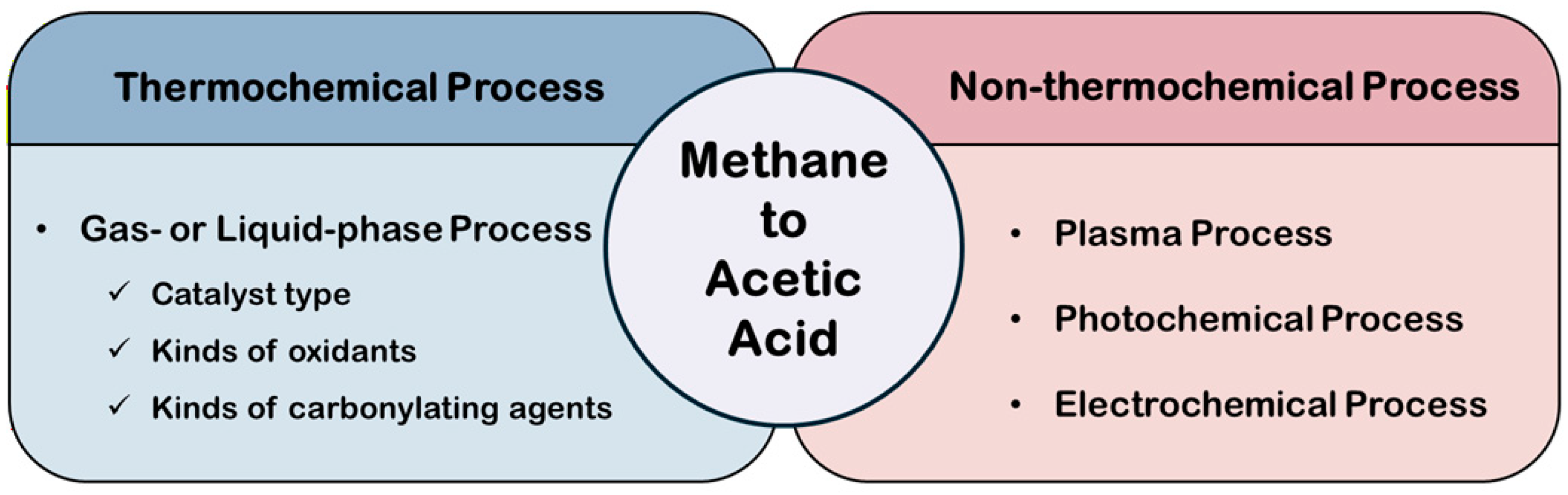
Figure 1. Various chemical processes for the direct conversion of methane into acetic acid.
Catalysts 16 00310 g001
Figure 2. Schematic diagram for the overall reaction pathway for the formation of CH3HSO4 and CH3COHSO4 from Pd(HSO4)(CH3)(H2SO4)2 [31]. Copyright 2006 American Chemical Society.
Catalysts 16 00310 g002
Figure 3. Schematic diagram for the proposed mechanisms for radical formation and carboxylation of methane to acetic acid [route (A)] and side reactions (dotted lines) [38]. Copyright 2007 American Chemical Society.
Catalysts 16 00310 g003
Figure 4. Schematic diagram of the catalytic cycle of production of CH3COOH from CH4 and CO2 through Zn-doped ceria-catalyzed C–C coupling [79]. Copyright 2016 American Chemical Society.
Catalysts 16 00310 g004
Figure 5. Schematic diagram of the proposed reaction pathways of the electrochemical methane oxidation reaction [91]. Copyright 2024 American Chemical Society.
Catalysts 16 00310 g005
Figure 6. Schematic of photocatalytic conversion of methane to acetic acid using isolated platinum single atoms (Pt1) anchored on TiO2-supported ammonium polyoxometalate (NPW) clusters. (a) Process of photoexcited charge carrier generation at the 4-fold oxygen-coordinated Pt1 site and proposed photocatalytic acetic acid generation mechanism. * symbol indicates the reduced state of NPW after accepting a photoexcited electron from TiO2 during the transition from state B to E. (b) Stepwise reaction energies (eV) for the gas-phase reaction for acetic acid synthesis over Pt1/NPW moiety [94]. Copyright 2023 American Chemical Society.
Catalysts 16 00310 g006
Table 1. Direct catalytic conversion of methane into acetic acid (AA) using homogeneous catalysts.
EntryCatalystsReaction ConditionsTurnover Number for AATurnover Frequency for AA (h−1)Selectivity to AA (%)Ref.
SolventOxidantPressureTemperature
1PdSO42 mL 96% H2SO4-2.76 MPa180 °C4.10.5972[26]
2PdSO43 mL 96% H2SO4 2.76 MPa CH4180 °C3.90.9851[27]
3PdSO43 mL 96% H2SO4 2.76 MPa CH4, 2 × 10 3 MPa CO180 °C5.45--[27]
4PdSO43 mL 96% H2SO4O22.76 MPa CH4, 1.03 MPa O2180 °C14.23.644[27]
5PdSO43 mL 96% H2SO4O22.76 MPa CH4, 1.03 MPa O2160 °C13.33.382[27]
6PdSO4 + CuCl23 mL 96% H2SO4O22.76 MPa CH4, 0.21 MPa O2180 °C2.45 a0.61 a-[28]
7K2PdCl410 mL CF3COOHO23 MPa CH4, 0.5 MPa O2,80 °C1.00.13-[29]
8H5PMo10V2O4010 mL CF3COOHO23 MPa CH4, 0.5 MPa O2,80 °C3.20.40-[29]
9K2PdCl4 + H5PMo10V2O4010 mL CF3COOHO23 MPa CH4, 0.5 MPa O2,80 °C67.6 a8.45 a-[29]
10[VO(N(CH2CH2O)3)]23 mL CF3COOHK2S2O80.51 MPa CH480 °C9.24.6[30]
a Turnover number and turnover frequency were calculated only based on the amount of main catalyst (Pd).
Table 2. Direct catalytic conversion of methane and CO into acetic acid (AA) using homogeneous catalysts.
EntryCatalystsReaction ConditionsTurnover Number for AATurnover Frequency for AA (h−1)Selectivity to AA (%)Ref.
SolventOxidantPressureTemperature
1CuSO4CF3COOHK2S2O84.1MPa CH4, 2.0 MPa CO80 °C39.40.88-[32]
2Pd(OCOEt)2CF3COOHK2S2O84.1 MPa CH4, 2.0 MPa CO80 °C1.523.4   × 10 2 -[32]
3Pd(OCOEt)2 + CuSO4CF3COOHK2S2O84.1 MPa CH4, 2.0 MPa CO80 °C1.21 a6.1   × 10 2  a-[32]
4Pd(OAc)2 + Cu(OAc)2CF3COOHO22.0 MPa CH4, 1.5 MPa CO, 1.5 MPa O280 °C2.4 a0.12 a-[33]
5Pd(OAc)2 + Cu(OAc)2CF3COOHK2S2O82.0 MPa CH4, 1.5 MPa CO80 °C1. 2 a0.06 a-[33]
6Pd(OAc)2 + Cu(OAc)2CF3COOHK2S2O84.1 MPa CH4, 2.0 MPa CO280 °C16.5 a0.83 a-[33]
7RhCl30.1 M HCl, D2O, 0.025 M HIO26.9 MPa CH4, 1.0 MPa CO, 0.34 MPa O295 °C6.47.3   × 10 2 -[34]
8RhCl30.5 mM HCl, D2O, 0.025 M KI, 0.13 M NaClO26.9 MPa CH4, 1.0 MPa CO, 0.34 MPa O295 °C7.08.0   × 10 2 81[34]
9RhCl3–NaCl–KI1.8 mL CF3COOH, 0.7 mL H2O,O26 MPa CH4, 1.84 MPa CO, 0.56 MPa O295 °C-9.00.6[35]
10VO(2,4-pentanedionato)2CF3COOHK2S2O84.1 MPa CH4, 2.0 MPa CO80 °C27.51.38[36]
11H7PV4Mo8O40·30H2OCF3COOHK2S2O84.1 MPa CH4, 2.0 MPa CO80 °C29.21.46[36]
12NaVO3CF3COOHK2S2O84.1 MPa CH4, 2.0 MPa CO80 °C28.21.41[36]
13Dioxovanadium complexesCF3COOHK2S2O80.51 MPa CH4, 0.51 MPa CO80 °C221.10[37]
14[VO{N(CH2CH2O)3}]CF3COOHK2S2O80.51 MPa CH4, 0.51 MPa CO80 °C13.60.68-[38]
15CaCl2 · 2H2OCF3COOHK2S2O82.0 MPa CH4, 3.0 MPa CO85 °C2.10.14[39]
16Mo + CaCl2CF3COOHK2S2O82.0 MPa CH4, 5.1 MPa CO85 °C1.840.09[40]
a Turnover number and turnover frequency were calculated only based on the amount of main catalyst (Pd).
Table 3. Direct catalytic conversion of methane into acetic acid (AA) using heterogeneous catalysts.
EntryCatalystsReaction ConditionsTurnover Number of AAProduction Rate of AASelectivity to AA (%)Ref.
SolventOxidantPressureTemperature
1Vanadium-based MOFs(MOF–48/MIL–47)CF3COOHK2S2O81.0 MPa CH480 °C1758.75 h−191 a[42]
2Ru3-graphdiyne (GDY)H2OH2O21.5 MPa CH460 °C-0.70 mmol AA·gcat.−1·h−112 a[43]
3Ce–UiO–Cu(OH)H2OO23.0 MPa CH4, 0.6 MPa O2115 °C40010 h−196[44]
4Au–ZSM-5H2OO22.1 MPa CH4, 0.35 MPa O2240 °C0.28 mol AA/mol Au6.98 μmol AA·gcat.−1·h−125[45]
a The selectivity to AA was calculated only based on the liquid products.
Table 4. Direct liquid-phase catalytic conversion of methane and CO into acetic acid (AA) using heterogeneous catalysts.
EntryCatalystsReaction ConditionsProduction Rate of AASelectivity to AA (%)Ref.
SolventOxidantPressureTemperature
1Vanadium-based MOFs(MOF–48/MIL–47)CF3COOHK2S2O81.0 MPa CH4, 1.0 MPa CO80 °C24.5 h−1100[42]
2Ir/ZSM-5H2OH2O22.5 MPa CH4, 2.5 MPa CO80 °C7.4 mmol AA·gcat.−1·h−152[46]
3Pd1–ZSM-5H2OH2O23.0 MPa CH4, 2.0 MPa CO25 °C964 mmol AA·gmetal−1·h−178[47]
4Fe/ZSM-5H2OH2O20.5 MPa 97% CO/N2, 2.5 MPa 95% CH4/Ar50 °C0.13 mmol AA·gcat.−1·h−134[48]
5Fe/ZSM-5H2OH2O24.0 MPa CH4, 4.0 MPa CO50 °C12.0 mmol AA·gcat.−1·h−163.6 a[49]
6Fe/ZSM-5H2OH2O22.0 MPa CH4, 2.0 MPa CO50 °C1.28 mmol AA·gcat.−1·h−158.4 a[50]
7Fe/ZSM-5–0.25NaH2OH2O22.0 MPa CH4, 2.0 MPa CO50 °C1.97 mmol AA·gcat.−1·h−181.8 a[50]
8Fe–HZSM-5H2OH2O24.0 MPa CH4, 4.0 MPa CO50 °C26.4 mmol AA·gcat.−1·h−139[51]
90.1Cu/Fe–HZSM-5H2OH2O24.0 MPa CH4, 4.0 MPa CO50 °C40.5 mmol AA·gcat.−1·h−143[51]
101.2Ni–ZSM-5H2OH2O22.5 MPa CH4, 0.5 MPa CO50 °C0.29 mmol AA·gcat.−1·h−182 a[52]
11Rh–ZSM-5H2OO22.0 MPa CH4, 0.5 MPa CO, 0.2 MPa O2150 °C7.1 mmol AA·gcat.−1·h−160[53]
12Rh/ZSM-5H2OO25.0 MPa CH4, 1.0 MPa CO, 0.8 MPa O2150 °C~2.5 mmol AA·gcat.−1·h−1~41 a[54]
13Rh/ZSM-5H2OO22.0 MPa CH4, 0.5 MPa CO, 0.2 MPa O2150 °C~1.65 mmol AA·gcat.−1·h−1-[55]
14Rh/ZSM-5H2OO24.23 MPa CH4, 1.03 MPa CO, 0.26 MPa O2, 0.99 MPa N2150 °C0.019 mmol AA·gcat.−1·h−1-[56]
15RhCl3@H+–MFIH2OO25.0 MPa CH4, 0.5 MPa CO, 0.2 MPa O2150 °C592 h−1
(14.6 mmol AA·gcat.−1·h−1)
76.9 a[57]
16Rh1–Cu/POPsH2OO23.0 MPa CH4, 1.0 MPa CO, 0.5 MPa O2150 °C0.103 mmol AA·gcat.−1·h−14 a[58]
17Heterogenized iridium catalystH2OO21.9 MPa CH4, 0.40 MPa O2, 0.50 MPa CO150 °C3.39 mmol AA·gcat.−1·h−166 a[59]
18Au–ZSM-5H2OO22.1 MPa CH4, 0.10 MPa O2, 0.25 MPa CO240 °C0.020 mmol AA·gcat.−1·h−1-[45]
19Au–Fe/ZSM-5H2OO22.8 MPa CH4, 0.60 MPa O2, 2.8 MPa CO120 °C1.9 mmol AA·gcat.−1·h−192[60]
a The selectivity to AA was calculated only based on the liquid products.
Table 5. Direct gas-phase catalytic conversion of methane and CO (or CO2) into acetic acid (AA) using heterogeneous catalysts.
EntryCatalystsReaction Conditions Production Rate of AASelectivity to AA (%)Ref.
OxidantCo-ReactantTotal PressureTemperatureComments
1 a0.11% Rh–9.1% FePO4/MCM-41N2OCO0.1 MPa450 °CContinuous co-feeding of all reactants and on-line analysis of products696 μmol·gcat.−1·h−154[63]
2Cu-Co/ZrO2 (Cu/Co = 5)-CO20.1 MPa250 °CStep-wise feeding of each reactant and collection of all products in a cold trap~45 μmol·gcat.−1·h−1-[64]
35% Pt/aluminaH2OCO20.1 MPa400 °CContinuous co-feeding of CH4 and CO2 and IR measurement of surface species--[65]
4V2O5–PdCl2/Al2O3O2/H2OCO20.1 MPa250 °CContinuously co-feeding of all reactants and collection of all products in a cold trap0.52 μmol AA·gcat.−1·h−1-[66]
52% Rh/SiO2-CO2 170 °CStep-wise feeding of each reactant and collection of all products in a cold trap~4 μmol AA·gcat.−1·h−1[67]
62% Pd/SiO2-CO2 170 °CStep-wise feeding of each reactant and collection of all products in a cold trap~38 μmol AA·gcat.−1·h−1[67]
7CoPd–TiO2-CO2, H2, H2O2.0 MPa150 °CStep-wise feeding of each reactant and on-line analysis of products1.28 mmol AA·gcat.−1·h−1 47[68]
8Cu-H-MOR
(Cu/Al = 0.17, Na/Al = 0.02)
O2CO1.0 MPa200 °CContinuous co-feeding of all reactants and extraction of all products after a reaction22.6 μmol AA·gcat.−146.5[69]
9Cu-Na-MOR
(Cu/Al = 0.22, Na/Al = 0.55)
O2CO1.0 MPa200 °CContinuous co-feeding of all reactants and extraction of all products after a reaction5.0 μmol AA·gcat.−132.2[69]
10Cu–K–ZSM–5-CO2 500 °CContinuous co-feeding of all reactants and on-line analysis of products395 μmol AA·gcat.−1·h−1~100[70]
11CeO2–ZnO/montmorillonite CO20.2 MPa300 °CStep-wise feeding of each reactant in a batch reactor and extraction of all products after a reaction0.625 mmol AA·gcat.−1·h−1-[71]
12Sulfated zirconia CO20.1 MPa500 °CContinuous co-feeding of all reactants and collection of all products in a cold trap0.75   × 10 3 μmol AA·gcat.−1·h−1~81[72]
132% Pd/ZrO2 CO20.1 MPa300 °CContinuous co-feeding of all reactants and collection of all products in a cold trap5.8   × 10 6 mol AA·molsurface Pd−1·h−1~68[73]
14nCo3O4@mSiO2 CO22 MPa/2 MPa250 °C/250 °CStep-wise feeding of each reactant and collection of all products in a cold trap0.71 μmol AA·gCo3O4−1-[74]
15nCo3O4@mSiO2 CO22 MPa/2 MPa200 °C/250 °CStep-wise feeding of each reactant and extraction of all products after a reaction25.1 μmol AA·gCo3O4−199.9[75]
16NiO/Fe2O3 CO20.1 MPa150 °CContinuous co-feeding of all reactants and collection of all products in a cold trap1.4 μmol AA·gcat.−1·h−1~45[76]
a Productivity of AA and selectivity to AA refers to those of CH3COOCH3.
Table 6. Electrocatalyst systems for the direct conversion of methane into acetic acid (AA).
EntryCatalystsReaction ConditionsProduction Rate of AASelectivity to AA (%)Current Efficiency (%)Ref.
Working ElectrodeCounter ElectrodeElectrolyteApplied PotentialTemperature
1ZrO2:NiCo2O4 quasi-solid solution catalystgraphite foilPt foil0.5 M Na2CO32.0 V vs. Pt25 °C27 μmol AA·gcat.−1·h−11.4-[86]
2Rh/Al2O3@NH4BF4graphite foil (area = 10 cm2)Pt foil (area = 10 cm2)0.5 M KHCO32.0 V vs. Pt25 °C34 μmol AA·cm−2·h−1~100 a95[87]
3Cu/Al2O3@NH4BF4graphite foil (area = 10 cm2)Pt foil (area = 10 cm2)0.5 M KHCO32.0 V vs. Pt25 °C21 μmol AA·cm−2·h−1~38 a38[87]
4Defected ZnO0.5 cm × 0.5 cm carbon clothgraphiteNaHCO3 solution (pH = 9)1.3 V vs. RHE25 °C0.35 mol AA·gcat.−1·h−185.4~72[88]
5CuOx–ZrO2–TiOxTi substratePt foil0.5 M Na2CO32.7 V vs. RHE25 °C3.3 mmol AA·gcat.−1·h−1~84 a60[89]
a The selectivity to AA was calculated only based on the liquid products.
Table 7. Photocatalyst systems for the direct conversion of methane into acetic acid (AA).
EntryCatalystsReaction conditionsProduction Rate of AASelectivity to AA (%)Ref.
SolventOxidantLight SourcePressureTemperature
15%Rh1/pMOFH2OO2100 mW·cm−21.5 MPa CH4, 0.4 MPa O2, 0.5 MPa CO150 °C23.62 mmol AA·gcat.−1·h−186 a, 66.4[93]
2(0.2%Pt/NPW)/TiO2(3:10)H2O-400 W Hg–Xe lamp1.0 MPa CH4, 0.1 MPa CO,20 °C1.65 mol AA·molPt−1·h−190 a, 66[94]
3Ag/AgCl–WO3−XH2OO2500 W Xe lamp0.1 MPa (CH4:N2:O2 = 1:9:1)RT0.1885 mmol AA·gcat.−1·h−162.7[95]
4PdO/Pd–WO3H2O-300 W Xe lamp0.1 MPa CH4RT0.063 mmol AA·gcat.−1·h−1~60[96]
5Cu/ZnOH2O 100 mW·cm−2 (400 < λ < 800 nm)1 MPa CH4, 1 MPa CO2RT0.041 mmol AA·gcat.−1·h−189.5 a[97]
6TiO2H2O 100 W UV LED (365 nm)0.9 MPa CH4, 0.1 MPa CO150 °C~0.25 mmol AA·gcat.−1·h−1~90 a[98]
7Pt/TiO2H2O 100 W UV LED (365 nm)0.9 MPa CH4, 0.1 MPa CO150 °C~0.25 mmol AA·gcat.−1·h−1~75 a[98]
8Rh/TiO2H2O 100 W UV LED (365 nm)0.9 MPa CH4, 0.1 MPa CO150 °C0.30 mmol AA·gcat.−1·h−1~73 a[98]
9Au/TiO2H2O 100 W UV LED (365 nm)0.9 MPa CH4, 0.1 MPa CO150 °C~0.080 mmol AA·gcat.−1·h−1~41 a[98]
10Pd/TiO2H2O 100 W UV LED (365 nm)0.9 MPa CH4, 0.1 MPa CO150 °C~0.14 mmol AA·gcat.−1·h−1~17 a[98]
11RhZn–MoS2/TiO2H2OO2300 W Xe lamp (1500 mW·cm−2, 200 < λ < 800 nm)3.0 MPa CH4, 0.2 MPa O2, 2.5 MPa CO130 °C0.24 mol AA·gRh−1·h−188 a[99]
a The selectivity to AA was calculated based only on the liquid products.
Table 8. Photoelectrocatalyst systems for the direct conversion of methane into acetic acid (AA).
EntryElectrodesReaction ConditionsProduction Rate of AASelectivity to AA
(%)
Ref.
Working ElectrodeReference ElectrodeCounter ElectrodeLightElectrolytePressureVoltageTemperature
1TiO2:SnO2Ag/AgCl 3.0 M KClSAE 304 stainless steel100 W halogen lamp0.5 M Na2CO30.1 MPa CH41.3 VRT8 μmol AA·cm−2·h−121 a[100]
2high-entropy LaMnO3−polyoxometalate subnanowiresAg/AgCl electrodePt foil300 W Xenon lamp (320–780 nm, 100 mW cm−2)0.5 M Na2CO30.1 MPa CH41.2VRT4.45 mmol AA·gcat.−1·h−1>99[101]
a The selectivity to AA was calculated only based on the liquid products.
Table 9. Plasma systems for the direct conversion of methane and CO2 into acetic acid.
EntryCatalystsReaction ConditionsMethane Conversion
(%)
Selectivity to AA (%)Ref.
Voltage or Discharge PowerFrequencyFeed RateFeed CompositionTemperature
1-100 W25 kHz40 mL/min67.4% CH4 + 32.6% CO265 °C~535.3[105]
2-10 kV, 100 W25 kHz60 mL/min66.8% CH4 + 33.2% CO2RT~635.2[106]
3-10 W 40 mL/min50% CH4 + 50% CO220 °C~24~24[107]
4-3.6 kV 77 mL/min8.4% CH4 + 28% CO2 + 63.6% Ar100 °C- a67[108]
510%Co/SiO25.5 kV3 kHz30 mL/minCO2/CH4 = 2RT~5017.9[109]
610%Fe/SiO25.5 kV3 kHz30 mL/minCO2/CH4 = 2RT~4612.4[109]
710%Fe/5A13 kV7 kHz30 mL/minCO2/CH4/Ar = 1/1/1RT~517.9[110]
8-30 kV, 10 W9 kHz40 mL/minCO2/CH4 = 130 °C~1833.7[111]
915%Cu/γ-Al2O330 kV, 10 W9 kHz40 mL/minCO2/CH4 = 130 °C~1640.2[111]
10-12 W9 kHz40 mL/minCO2/CH4 = 1:160 °C~16~6[112]
11H-ZSM-512 W9 kHz40 mL/minCO2/CH4 = 1:160 °C~18~16[112]
12Cu/H-ZSM-512 W9 kHz40 mL/minCO2/CH4 = 1:160 °C~18~11[112]
13nickel foam13 kV4 kHz30 mL/minCO2/CH4 = 1RT~1713.4[113]
14NiO/nickel foam13 kV4 kHz30 mL/minCO2/CH4 = 1RT~189.6[113]
15Ni/nickel foam13 kV4 kHz30 mL/minCO2/CH4 = 1RT~1615.1[113]
16NiGa/nickel foam13 kV4 kHz30 mL/minCO2/CH4 = 1RT~1617.8[113]
a Productivity of acetic acid was reported to be 5.0 mmol AA·h−1.
Disclaimer/Publisher’s Note: The statements, opinions and data contained in all publications are solely those of the individual author(s) and contributor(s) and not of MDPI and/or the editor(s). MDPI and/or the editor(s) disclaim responsibility for any injury to people or property resulting from any ideas, methods, instructions or products referred to in the content.