Article

Nd2O3/TiO2 Nanotube Array Heterojunctions: Rare Earth Modification Driven Efficient Photoelectrochemical Water Splitting for Hydrogen Production


1
College of Chemistry, Fuzhou University, Fuzhou 350116, China
2
State Key Laboratory of Structural Chemistry, Fujian Institute of Research on the Structure of Matter, Chinese Academy of Sciences, Fuzhou 350002, China
3
Xiamen Key Laboratory of Rare Earth Photoelectric Functional Materials, Xiamen Institute of Rare-Earth Materials, Xiamen 361021, China
4
Fujian College, University of Chinese Academy of Sciences, Fuzhou 350002, China
5
Fujian Science & Technology Innovation Laboratory for Optoelectronic Information of China, Fuzhou 350108, China
*
Authors to whom correspondence should be addressed.
Catalysts 2026, 16(4), 307; https://doi.org/10.3390/catal16040307
Submission received: 10 February 2026 / Revised: 14 March 2026 / Accepted: 18 March 2026 / Published: 1 April 2026
(This article belongs to the Special Issue Catalytic Strategies for Sustainable Water Splitting)

Abstract

The photoelectrochemical water-splitting process for hydrogen production is limited by the large bandgap of semiconductor titanium dioxide (TiO2) and by interfacial recombination at particle interfaces. The technique used in this paper is that of electrochemical anodization to produce robust, ordered TiO2 nanotube arrays (TiO2 nanorod arrays denoted as TNTAs). Using the immersion-annealing method, Nd2O3 nanoparticles can be immobilized in situ, and Nd2O3/TNTAs composite photoanodes are fabricated. The heterointerface caused between the Nd2O3 nanoparticles and TiO2 results in the alignment of the Fermi levels and the formation of band bending and an internal electric field at the interface. It allows rapid photo-generated electron-hole (e/h+) separation at the interface and, simultaneously, introduces novel localized electron states of Nd3+ within the TiO2 bandgap. This triggers hybridisation between the 3d orbitals of Ti and the 2p orbitals of O, thereby altering the band structure of TiO2. The best-performing Nd2O3/TNTAs photoelectrode outperforms pure TNTAs, with a photocurrent density of 1.59 mA·cm−2 at 1.23 V vs. RHE. It produces 162.6 μmol·cm−2 of hydrogen in a 3 h photocatalytic hydrogen production experiment, which is about 12.2 times that of pure TNTAs. This approach highlights the unique benefits and creative opportunities of applying rare-earth elements to address the critical issues of photocatalysts, such as significant band gaps and rapid recombination.

1. Introduction

Photoelectrochemical (PEC) water-splitting technology enables the production of clean, renewable hydrogen via solar-driven water splitting. It is regarded as one of the most effective pathways for converting solar energy to hydrogen [1]. Among these, the oxygen evolution reaction (OER) occurring at the anode requires a higher overpotential due to its complex four-electron transfer process, making it the rate-determining step of the entire water-splitting reaction. Therefore, the key to achieving outstanding PEC water splitting efficiency lies in developing highly efficient novel photoanodes. Among numerous semiconductor photoanode materials, TiO2 is a desirable candidate due to its high photocatalytic activity, excellent chemical stability, non-toxicity, low cost, and a suitable conduction band position that supports hydrogen evolution-related reduction processes [2,3,4,5]. Furthermore, its controllable nanostructures (such as nanotubes and nanorod arrays) facilitate a high specific surface area and directional charge transport [6]. Nevertheless, TiO2, with all its benefits, still has limitations in practice. They are its large bandgap, which limits its sensitivity to ultraviolet radiation and its use of sunlight, as well as its fast photo-carrier recombination at interfaces, which limit its photovoltaic conversion rate [7,8]. The primary focus in improving the performance of TiO2-based photocatalysts for photoelectrochemical (PEC) applications is on expanding the visible response spectrum and suppressing carrier recombination.
To date, researchers have proposed various modification strategies to enhance the photocatalytic water-oxidation performance of TiO2, including surface functionalization, heterojunction formation, band-structure engineering, and morphology design, achieving considerable progress [9]. Surface functionality modification is an easy and efficient method for developing PEC photoanodes. The main concept relies on altering the reaction interface, building functional layers on the semiconductor substrate, or adding active sites. This strategy improves the light absorption at the interface between the semiconductor and the electrolyte. Consequently, charge separation becomes faster, and the reaction kinetics are controlled. One common way to surface-functionalize TiO2 photoanodes is to load metal oxide nanoparticles onto the surface. By forming heterojunctions between the metal oxides and TiO2, this approach enhances visible-light response and suppresses carrier recombination at the interface, thereby improving the efficiency of photocatalytic water splitting. Currently, a series of transition-metal oxides are widely employed, including Fe2O3, Co2O3, WO3, ZnO, and CuO [10]. Unlike traditional transition metal oxides, lanthanide oxides have a specific 4f electron structure that belongs to the rare-earth ions (RE3+) [11]. Adding lanthanide oxides to TiO2 introduces specific energy levels into the band gap, enabling control of the surface band gap by the host semiconductor. It increases the absorption properties of TiO2 and leads to maximal photocatalytic activity [12,13]. The current literature reports evidence of modifying TiO2/Fe2O3-based photocatalysts with lanthanide oxides such as La2O3, CeO2, and Nd2O3 [14,15,16,17]. Nevertheless, articles on the application of Nd2O3 as a catalytic material remain quite limited, indicating room for further study.
Neodymium (Nd) is one of the minor rare earths. It is more plentiful in the world and less expensive than heavy rare earths (including Dy, Tb, Ho, etc.) [15]. Nd is most commonly found in the form of Nd3+, which forms a stable Nd2O3. Nd2O3 can be used for various functions, including acting as a photocatalyst, coloring glass, serving as an ultraviolet absorber, a high-k gate dielectric, and a protective coating [16,17]. As an interface-regulating material in semiconductors, Nd2O3 facilitates the formation of heterojunctions and charge separation. At the same time, it stabilizes the semiconductor phase and preserves its most active crystalline phase, thereby increasing the adsorption and activation rates of reaction intermediates [18]. The bandgap of TiO2 can be modified by introducing Nd3+ ions, which introduce “energy levels” or “localized states” within the TiO2 bandgap, thereby broadening the absorption range of the material in the visible spectrum and improving the separation efficiency of photogenerated charge carriers [19,20]. Therefore, TiO2 substrate modification with Nd3+ ions increases the utilization of sunlight, reduces carrier recombination, and enhances photocatalytic activity. Based on these findings, we produced relatively long TiO2 nanotubes (TNTAs) with regularly arranged, porous structures via a sequential electrochemical anodization technique. Thereafter, the surface of TNTAs was impregnated and annealed with Nd2O3 nanoparticles to produce Nd2O3/TNTAs, which served as a photoanode material. Surface-bound nanoparticles of Nd2O3 can modify the band structure of TNTAs by introducing localized energy levels, thereby extending the visible-light response regime of the TNTAs. Simultaneously, they induce heterostructure formation, leading to band bending and an internal electric field at the interface. This facilitates directed carrier migration and suppresses the recombination of photo-generated electron-hole pairs (e/h+), significantly enhancing the photocatalytic performance. To further elucidate the intrinsic mechanism by which Nd2O3 modification enhances the hydrogen production performance of TNTAs arrays in photocatalytic water splitting, systematic structural characterization and optoelectronic performance testing were conducted on both TNTAs and Nd2O3/TNTAs [21,22].

2. Results and Discussion

2.1. Structure and Morphology

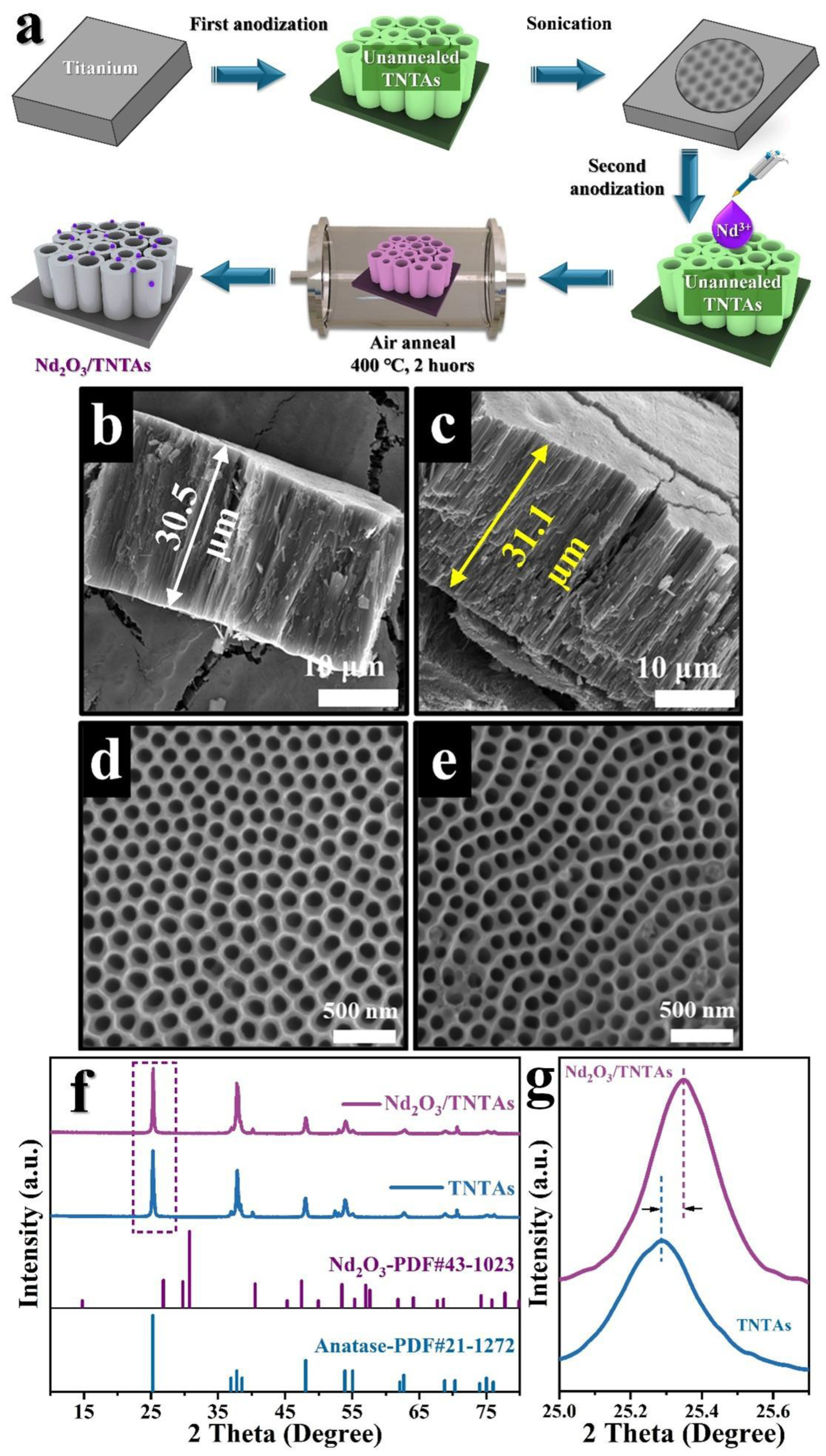
The detailed preparation process of Nd2O3/TNTAs is illustrated in Figure 1a. First, amorphous titanium dioxide nanotubes (TNTAs) were synthesized via a two-step electrochemical anodization process. Subsequently, Nd2O3 nanoparticles were in situ loaded onto the TNTAs surface via impregnation with Nd3+ precursor solutions of varying concentrations, followed by annealing, yielding a series of Nd2O3/TNTAs composite photoanodes with different Nd2O3 loading levels. Subsequent testing confirmed that the sample with 1 wt% loading exhibited the best performance (Figure S1). All subsequent relevant tests were reported for the 1 wt% Nd2O3/TNTAs sample. The 1 wt% Nd2O3/TNTAs sample was subsequently replaced with Nd2O3/TNTAs. Figure 1b–e displays scanning electron microscopy (SEM) images of pure TNTAs and Nd2O3/TNTAs, facilitating analysis of the morphological structures of the samples. Figure 1b,c shows cross-sectional SEM images of pure TNTAs and Nd2O3/TNTAs, respectively. The anodically synthesized titanium dioxide exhibits a uniform distribution of nanotube-like porous structures, with tube lengths of 30.50 µm and 31.1 µm for pure TNTAs and Nd2O3/TNTAs, respectively. As shown in Figure 1d,e, both pure TNTAs and Nd2O3/TNTAs exhibit a dense, uniform nanotube morphology with diameters of approximately 101.34 nm and 103.76 nm, respectively. Furthermore, SEM images of the composite material clearly reveal Nd2O3 nanoparticles adhering to the surface of the TNTAs. Under elevated temperatures, the Nd2O3 particles generated from the decomposition of Nd(NO3)3 successfully adhered to the surface of TNTAs without altering their overall structure, thereby preserving the highly porous nanostructure with a large specific surface area. This may provide additional active sites for subsequent OER, thereby promoting charge transfer at the photoanode. The high specific surface area of TNTAs offers abundant anchoring sites for the uniform loading of Nd2O3 nanoparticles, facilitating the close integration of Nd2O3 with TNTAs.
In this study, Nd3+ ions have diffused to the surface of TiO2 nanotubes, forming smaller nanocrystalline Nd2O3 particles and bonding to the TiO2 nanotube surface. As shown in Figure 1f, the crystal structures of TNTAs and Nd2O3/TNTAs photocatalysts were characterized by X-ray diffraction (XRD). The XRD pattern of pure TNTAs exhibits diffraction peaks at 2θ values of 25.28°, 37.80°, 48.05°, and 53.89°, corresponding to the (101), (004), (200), and (105) crystal planes of the anatase phase (JCPDS: 21-1272) [23]. It is noteworthy that no diffraction peaks characteristic of the rutile or brookite phases of TiO2 were detected. The XRD pattern of the Nd2O3/TiO2 nanocomposite showed diffraction peaks characteristic of the anatase phase of TiO2. No diffraction peaks corresponding to Nd2O3 were detected in the synthesized samples. This phenomenon may be attributed to the extremely low concentration of Nd3+ ions, which hinders the observation of discernible diffraction peaks. The differing lattice constants of the two materials induce lattice distortion upon combination. Consequently, the diffraction peak of the Nd2O3/TiO2 nanocomposite shifts to the right near 25.28° [Figure 1f], while the peak near 70.6° also shifts to the right (Figure S2). This is attributed to lattice contraction induced by high vacancy concentration [24]. Therefore, XRD analysis does not provide direct evidence for the successful incorporation of neodymium oxide into the titanium dioxide nanotube array.
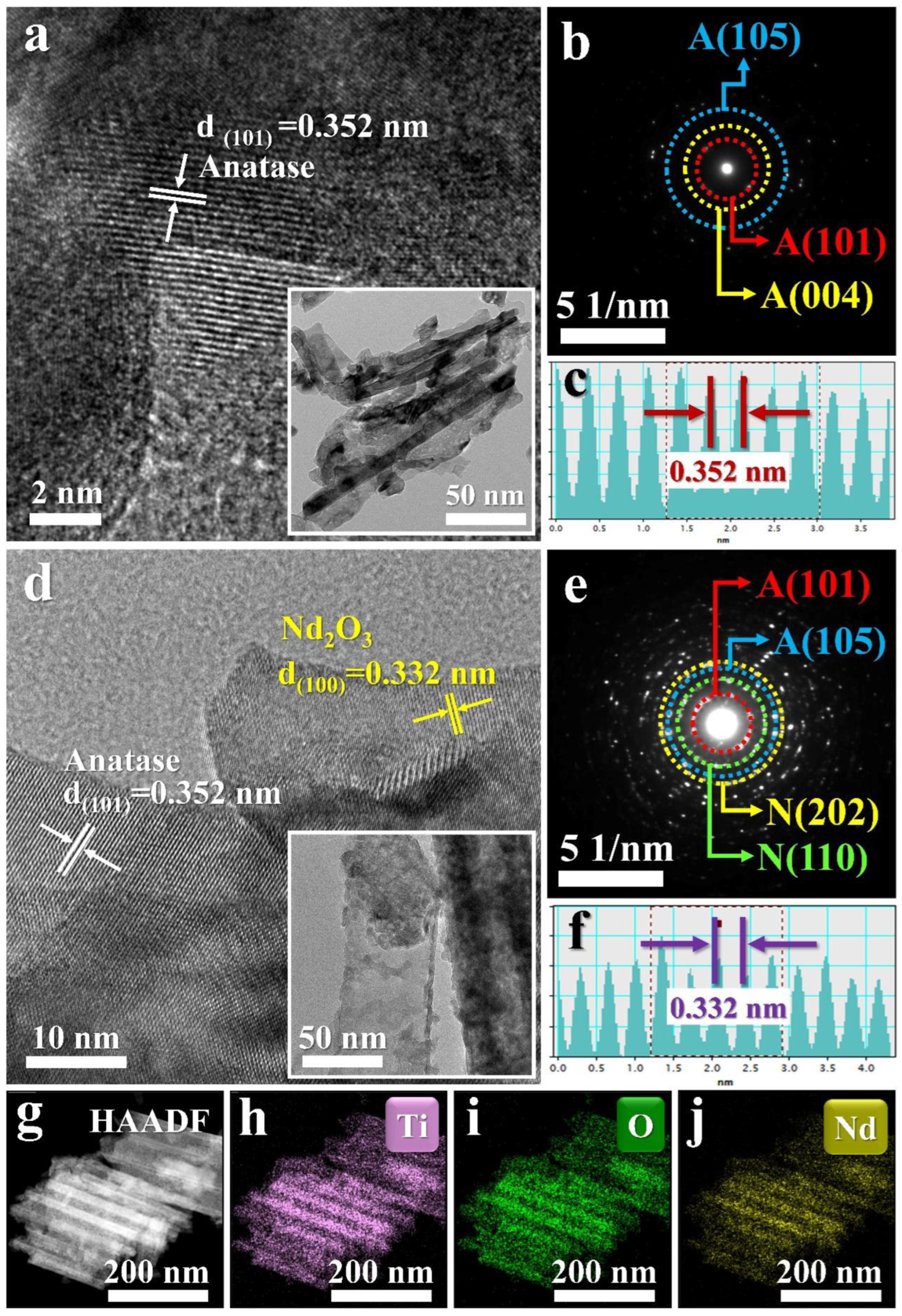
Scanning electron microscopy (SEM) revealed nanoparticles adhering to the surface of titanium dioxide nanotubes. To further confirm the successful synthesis of Nd2O3/TNTAs, transmission electron microscopy (TEM) was employed to analyze the structure of the samples before and after modification. Figure 2 displays TEM and HRTEM images, along with their corresponding selected-area electron diffraction (SAED) patterns. Figure 2a,d reveal that both pure TNTAs and Nd2O3/TNTAs exhibit tubular morphologies. The Nd2O3/TNTAs nanoparticles adhere to the TNTAs surface, consistent with SEM findings. Figure 2a shows that the 0.352 nm lattice stripes correspond to the (101) crystal plane of the anatase phase of TiO2. As shown in Figure 2d, the 0.352 nm and 0.332 nm lattice fringes in the TEM image of Nd2O3/TNTAs are associated with the (100) plane of Nd2O3 and the (101) plane of anatase TiO2, respectively. Additionally, the polycrystalline character of both pure TNTAs and Nd2O3/TNTAs is confirmed by the chosen area electron diffraction (SAED) patterns given in Figure 2b,e wherein only the anatase phase is present in the TNTAs. The SAED pattern of pure TNTAs is made up of (101), (004), and (105) hkl crystal planes, where Nd2O3 can be seen through the (110) and (202) hkl crystal planes observed in Figure 2e. To verify these characteristics, Figure 2g–j displays energy-dispersive X-ray spectroscopy (EDS) elemental mapping of Nd2O3/TNTAs. The elemental maps indicate that the Ti, O, and Nd elements are evenly distributed within the Nd2O3/TNTAs, indicating that Nd2O3 nanoparticles are evenly spread over the TNTAs surface. This also demonstrates the successful incorporation of Nd2O3 nanoparticles into the TNTAs array, thereby forming the Nd2O3/TNTAs composite. To further demonstrate the successful incorporation of Nd2O3 nanoparticles into the TNTAs array, ICP testing was performed on the Nd2O3/TNTAs composite material (Table S1). This confirmed that Nd elements were successfully embedded within the TNTAs array. Due to the addition of a 1 wt% precursor solution, partial loss occurred during annealing, resulting in an atomic content below one percent. XPS testing was conducted to verify the successful synthesis of Nd2O3 nanoparticles.
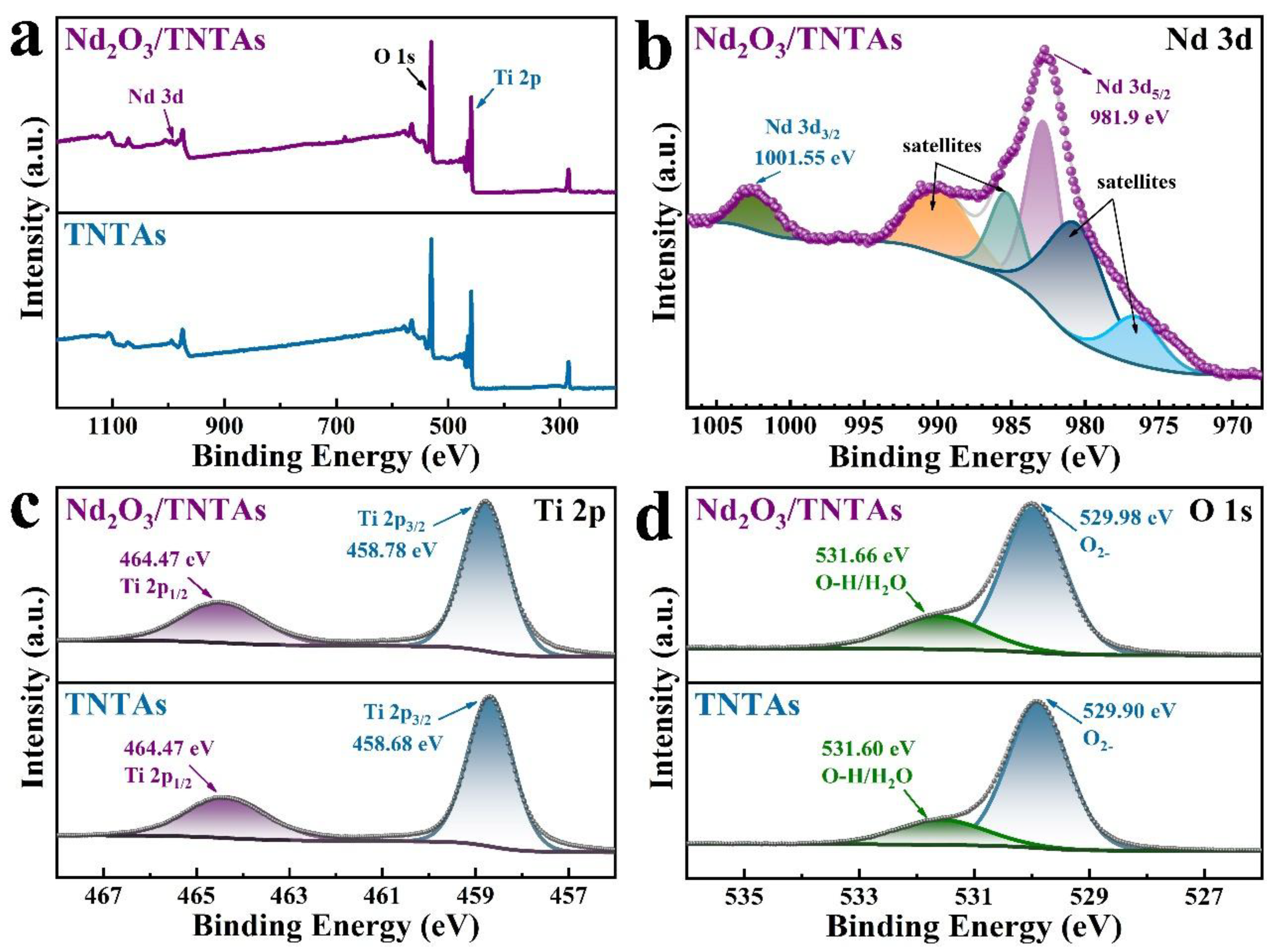
To analyze the surface composition and chemical state of the material and elucidate the influence of Nd2O3 on the electronic structure of TNTAs, X-ray photoelectron spectroscopy (XPS) was conducted in this work. Figure 3a presents the full-spectrum XPS analysis results for Nd2O3/TNTAs and pure TNTAs. As seen in the full spectra, the Nd2O3/TNTAs composite spectrum exhibits distinct Nd 3d peaks, along with Ti 2p and O 2d peaks, whereas TNTAs display only characteristic Ti and O peaks. This provides strong evidence for the successful incorporation of Nd2O3. Figure 3b shows the Nd 3d energy spectrum. The two peaks at 981.90 eV and 1001.55 eV correspond to characteristic signals for Nd 3d5/2 and Nd 3d3/2, respectively, indicating that the Nd element primarily exists in the sample as Nd3+ ions [13]. Figure 3d represents the high-resolution XPS spectrum of the O 1s state. The peaks at 529.90 eV and 531.60 eV in the TNTA scan spectrum correspond to the lattice oxygen (O2−) and oxygen vacancy (O-H/H2O) states, respectively. The binding energies of both O2− and O-H/H2O in TNTAs containing Nd2O3 undergo small changes. At the same time, the increased peak intensity at the O vacancy site in the composite material means that the addition of Nd2O3 leads to an increase in oxygen vacancy defects on its surface [25]. These oxygen vacancies facilitate an increase in the number of active sites on the surface that provide electrons, thereby enhancing the conductivity of the material. This leads to increased efficiency in photo-generated carrier transport. Figure 3c gives the high-resolution XPS spectrum of Ti 2p. The Ti 2p3/2 and Ti 2p1/2 peaks in TNTAs are observed at 458.68 eV and 464.35 eV, respectively, with an energy difference of 5.67 eV.
Meanwhile, the Ti 2p3/2 and Ti 2p1/2 of Nd2O3/TNTAs are positioned at 458.78 eV and 464.47 eV, respectively, with an energy separation of 5.67 eV. The peak positions and energy separation values of both components align with the characteristic Ti4+ peak reported in the literature for TiO2-based materials, confirming that Ti4+ remains the predominant species within the composite material and has not undergone significant reduction [26]. Compared to TNTAs, the binding energy of Ti 2p3/2 in Nd2O3/TNTAs shifts slightly towards higher binding energies. This shift may be due to bonding at the Nd-O-Ti interface and electronic interactions between TNTAs and Nd2O3.
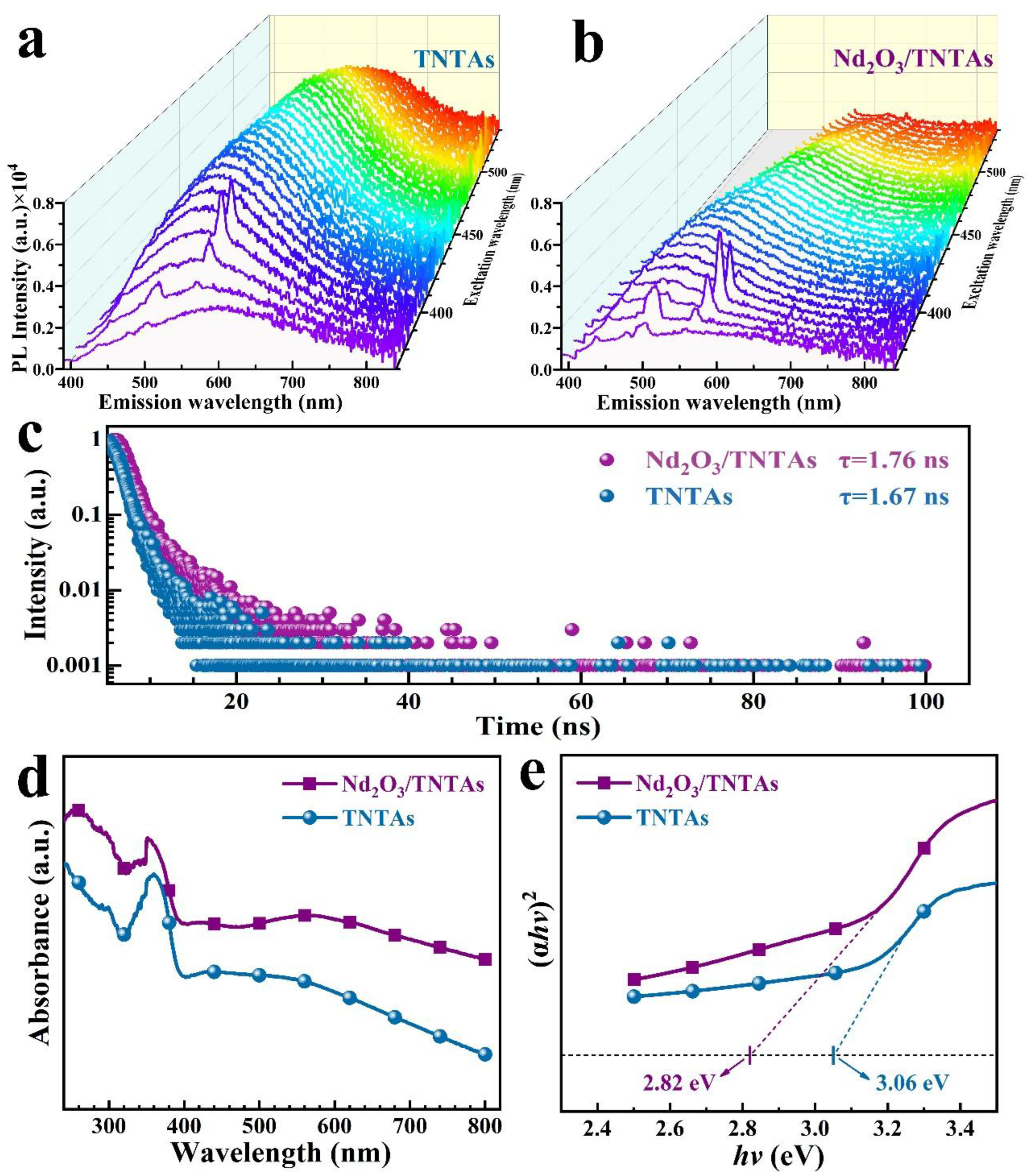
Steady-state photoluminescence (PL) spectra were used to investigate the charge-transfer and charge-separation capabilities of TNTAs and Nd2O3/TNTAs photocatalysts, as shown in Figure 4a,b. The fluorescence intensity of Nd2O3/TNTAs is markedly lower than that of TNTAs, likely due to the effective suppression of photo-generated electron-hole pair (e/h+) recombination following Nd2O3 incorporation into TNTAs, which enables more charge carriers to participate in the reaction. The emission peak observed at 550 nm is attributed to oxygen vacancies in the TiO2 lattice, which form donor levels within the bandgap (approximately 0.75–1.1 eV) [27,28]. When electrons transition back to the valence band from this level, they release photons at 550 nm (approximately 2.25 eV). Time-resolved photoluminescence (TR-PL) spectroscopy provides a more direct measure of photo-generated carrier lifetimes, as shown in Figure 4c. The fluorescence lifetime data reveal average lifetimes of 1.76 ns and 1.67 ns for Nd2O3/TNTAs and TNTAs, respectively, indicating a prolonged carrier lifetime in /TNTAs. This suggests that carrier recombination is effectively suppressed, allowing carriers to participate in photocatalytic reactions for longer, enhancing PEC performance [29]. Ultraviolet-visible diffuse reflectance spectroscopy (UV-Vis) was applied to evaluate the optical absorption and bandgap shifting properties of Nd2O3/TNTAs composites, confirming the high potential of Nd2O3 as a photocatalyst [30]. As seen in Figure 4d, the visible spectrum absorbance of TNTAs is significantly increased after incorporating Nd2O3, especially between 400 and 600 nm, and it indicates that adding Nd2O3 will improve the ability to use solar radiation by the materials and enhance their solar energy consumption rate. The band gap of pure TNTAs is also shown in Figure 4e and is 3.06 eV. The band gap of the composite material is found to be 2.82 eV as opposed to 3.06 eV of the pure TNTAs, indicating that Nd2O3 nanoparticles regulate the TNTAs band gap, and the absorption range of the composite material extends into the visible region [31,32].

2.2. Photoelectrochemical Performance

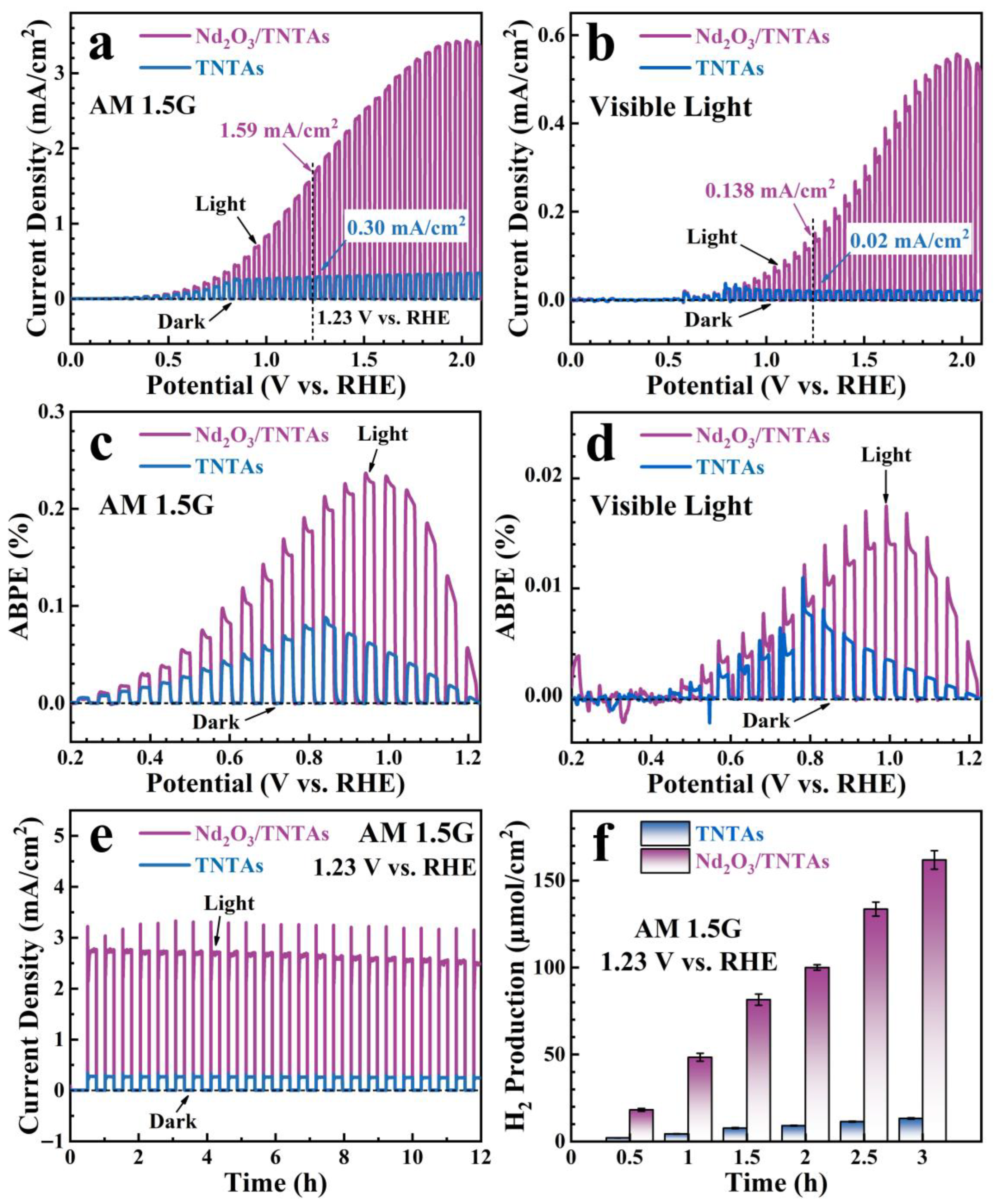
To investigate the performance of TNTAs and Nd2O3/TNTAs photoanodes in photocatalytic reactions, linear sweep voltammetry (LSV) was employed to measure the photocatalytic properties of the materials under simulated sunlight (AM 1.5 G, 100 mW·cm−2) at a scan rate of 10 mV·s−1 [33]. The electrolyte was 0.1 M Na2SO4. Figure 5a shows that the photocurrent density of Nd2O3/TNTAs is significantly higher than that of pure TNTAs across the entire voltage range (−0.05 V to 2.15 V, vs. RHE). At 1.23 V (vs. RHE), the photocurrent density is 1.59 mA·cm−2, about 5.3 times that of pure TNTAs. The swift response of the photocurrent indicates that the Nd2O3 load will significantly increase carrier separation and transport efficiency. The photocurrent density of Nd2O3/TNTAs was also measured under visible light irradiation (λ > 420 nm) and found to be significantly higher than that of pure TNTAs at all potentials, with a value of 0.138 mA·cm−2 at 1.23 V (vs. RHE), i.e., it was about 6.9-fold higher than that of pure TNTAs. These findings indicate that adding Nd2O3 is an effective way to improve the photoelectrochemical activity of the material processes driven by visible light.
Moreover, the applied bias photoelectric conversion efficiency (ABPE) was measured using LSV curves to assess the photocatalytic water-splitting activity of the material. With reference to Figure 5c,d, the highest photoconversion efficiency of Nd2O3/TNTAs was found to be 0.24% (0.94 V vs. RHE), which is significantly greater than 0.06% of pure TNTAs. The ABPE of the Nd2O3/TNTAs at the same bias voltages was also considerably higher under visible light illumination compared to the pure TNTAs. These results show that Nd2O3 modification has a strong positive effect on the photoconversion efficiency of TNTAs, likely due to increased conductivity that enhances charge conversion efficiency.
To measure the stability of the photoanode, the material I-t curve was also measured at 1.23 V (vs. RHE). The photocurrent density of Nd2O3/TNTAs remained steady over the 12 h test period, as shown in Figure 5e, indicating high corrosion resistance and stability. After testing, SEM observation revealed that the sample morphology remained stable (Figure S3). Additionally, to explore the photocatalytic hydrogen generation behavior of Nd2O3/TNTAs in photocatalytic water splitting, the photoanode was tested for hydrogen evolution at 1.23 V (vs. RHE) for 3 h. The hydrogen and oxygen evolution results for Nd2O3/TNTAs and TNTAs are shown in Figure S4.
As shown in Figure 5d, the cumulative hydrogen yield of Nd2O3/TNTAs was measured as high as 162.6 µmol·cm−2, which is about 12.2 times higher than 13.25 µmol·cm−2 with bare TNTAs. Compared with similar systems developed in recent years, the hydrogen production remains advantageous (Table S2). These results emphasize the importance of the rare-earth Nd2O3 transformation in driving effective photocatalytic decomposition of water to produce hydrogen.
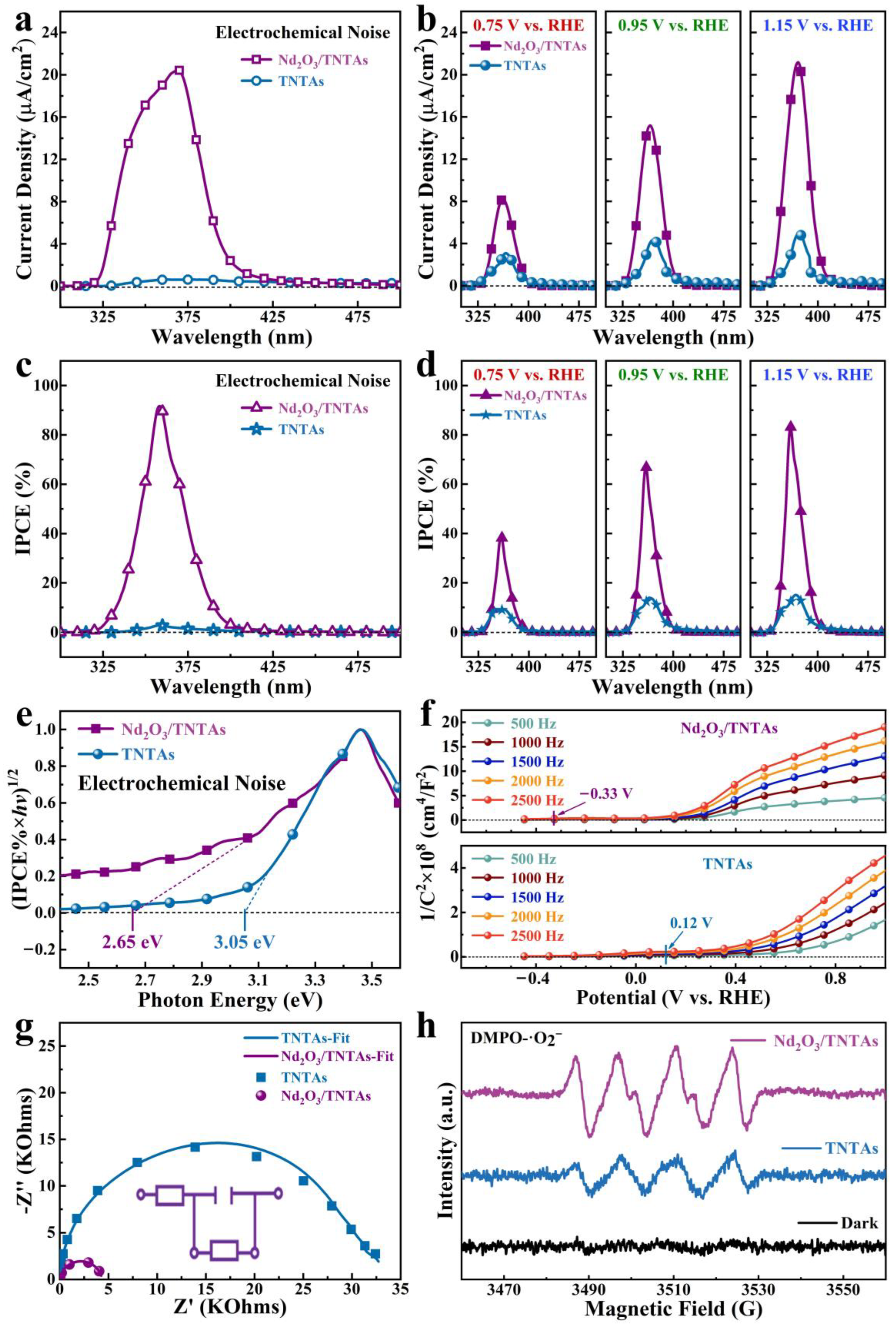
To elucidate the influence of Nd2O3 on the photoelectric properties and light absorption range of TNTAs, IPCE measurements were conducted on both TNTAs and Nd2O3/TNTAs photoanodes. The synthesized photocatalyst was used as the working electrode, with the test sample placed in a three-electrode reaction cell, and the incident light wavelength controlled by a monochromator. Figure 6a shows that the modified TNTAs photoanode exhibits an expanded photocurrent response range extending into the visible spectrum, consistent with UV-Vis spectroscopy. Furthermore, the photocurrent density of the Nd2O3/TNTAs photoanode shows significant enhancement, confirming effective modification by Nd2O3. Subsequently, the photovoltaic performance of the material under monochromatic illumination was tested by applying different bias voltages [Figure 6b]. With bias externally applied at 1.15 V (vs. RHE), the photocurrent density of Nd2O3/TNTAs was 21.2 μA/cm2, four times higher than TNTAs (4.9 μA/cm2). As shown in Figure 6b, the photocurrent density of Nd2O3/TNTAs increases with the bias voltage, indicating that the bias facilitates the movement of electrons and holes, thereby promoting the further advancement of the photochemical reaction. Figure 6c shows that without additional bias, the Nd2O3/TNTAs photoanode achieves 91.8% at 358 nm. On the other hand, pure TNTAs exhibit an IPCE of 2.8 per cent at 358 nm, indicating that Nd2O3/TNTAs have much higher photocatalytic efficiency. Stable repeatability experiments are shown in Figures S5–S7.
Next, IPCE measurements of both modified and unmodified samples were done using various bias voltages [see Figure 6d]. The findings indicate that Nd2O3/TNTAs had the highest IPCE of 83.5% at 1.15 V (vs. RHE), being 5.64 times greater than TNTAs (14.8%). In addition, the IPCE shows significant growth with increasing bias voltage, confirming that the bias voltage can inhibit carrier recombination. Light absorption is extended into the visible region by adding Nd2O3, thereby increasing the efficiency of light utilization. The higher Fermi level and increased bias voltage both contribute to this increase. The heterojunction formed between Nd2O3 and TiO2 nanotube arrays is found to be a fast channel for electron transfer, as indicated by IPCE results, thereby enhancing charge flow. Photo-generated electrons are transported faster across the interfacial electric field, while holes move in the opposite direction, leading to a decrease in recombination losses.
To confirm that the narrowing of the bandgap in the Nd2O3/TNTAs heterojunction enhances photocurrent performance and broadens the light absorption range, the band gaps of TNTAs and Nd2O3/TNTAs were approximated by normalizing the IPCE curves [Figure 6e]. The results indicate that the band gaps of TNTAs and Nd2O3/TNTAs are 3.05 eV and 2.65 eV, confirming that Nd2O3 doping significantly narrows the band gap. Figure 6f shows the Mott–Schottky (M-S) curves for unilluminated TNTAs and Nd2O3/TNTAs photoanodes at frequencies of 500, 1000, 1500, 2000, and 2500 Hz. The positive slope of the M-S curve indicates that both are n-type semiconductors. The slope of the linear relationship between 1/C2 and voltage enables precise calculation of the flat-band potentials for TNTAs and Nd2O3/TNTAs, which are 0.12 V and −0.33 V (vs. RHE), respectively [34]. The more negative flat-band potential of Nd2O3/TNTAs indicates enhanced electron-reduction capability, corresponding to improved photocatalytic hydrogen production. Electrochemical impedance spectroscopy (EIS) curves, as illustrated in Figure 6g, indicate that the semicircular radius of the pure TNTAs is higher than that of the Nyquist plot of Nd2O3/TNTAs. On the other hand, the semicircular radius of the Nd2O3/TNTAs is greatly reduced. This verifies that heterojunction formation is optimal for charge transport, thereby minimizing charge-transfer resistance and improving photoelectrochemical performance [35]. Quantitative comparison of carrier concentrations calculated via M-S analysis (Figure S8) and charge transfer resistance (Rct) values fitted from EIS measurements (Table S3). This demonstrates that the composite material exhibits an enhanced carrier concentration and reduced charge-transfer resistance.
To study the photoelectrochemical reaction mechanism of Nd2O3/TNTAs and to explore the underlying causes of the improved photocatalytic hydrogen production behavior, photoreactive superoxide radicals (O2−) were detected in the reaction system using electron paramagnetic resonance (EPR) spectroscopy. The absence of an EPR signal in dark conditions, as depicted in Figure 6h, is a demonstration of how there is no production of electron-hole pairs during darkness, as predicted by the basic principle of photocatalysis. Following five minutes of visible light irradiation, EPR signal peaks emerged, with the EPR signal of DMPO·O2 markedly enhanced in the Nd2O3/TNTAs sample. Compared to pure TNTAs, this enhancement is attributed to the hybridization of Nd3+ 4f orbitals, which improves oxygen adsorption and activation, thereby promoting the generation of ·O2. The enhanced ·O2 signal confirms that the Nd2O3/TNTA heterostructure effectively increases the generation of ·O2, thereby validating the beneficial role of Nd2O3 in optimizing the band structure, boosting the reduction capacity of photogenerated electrons, and improving charge transfer dynamics.

2.3. Photoelectrochemical Mechanism for Water Splitting Under Solar Light

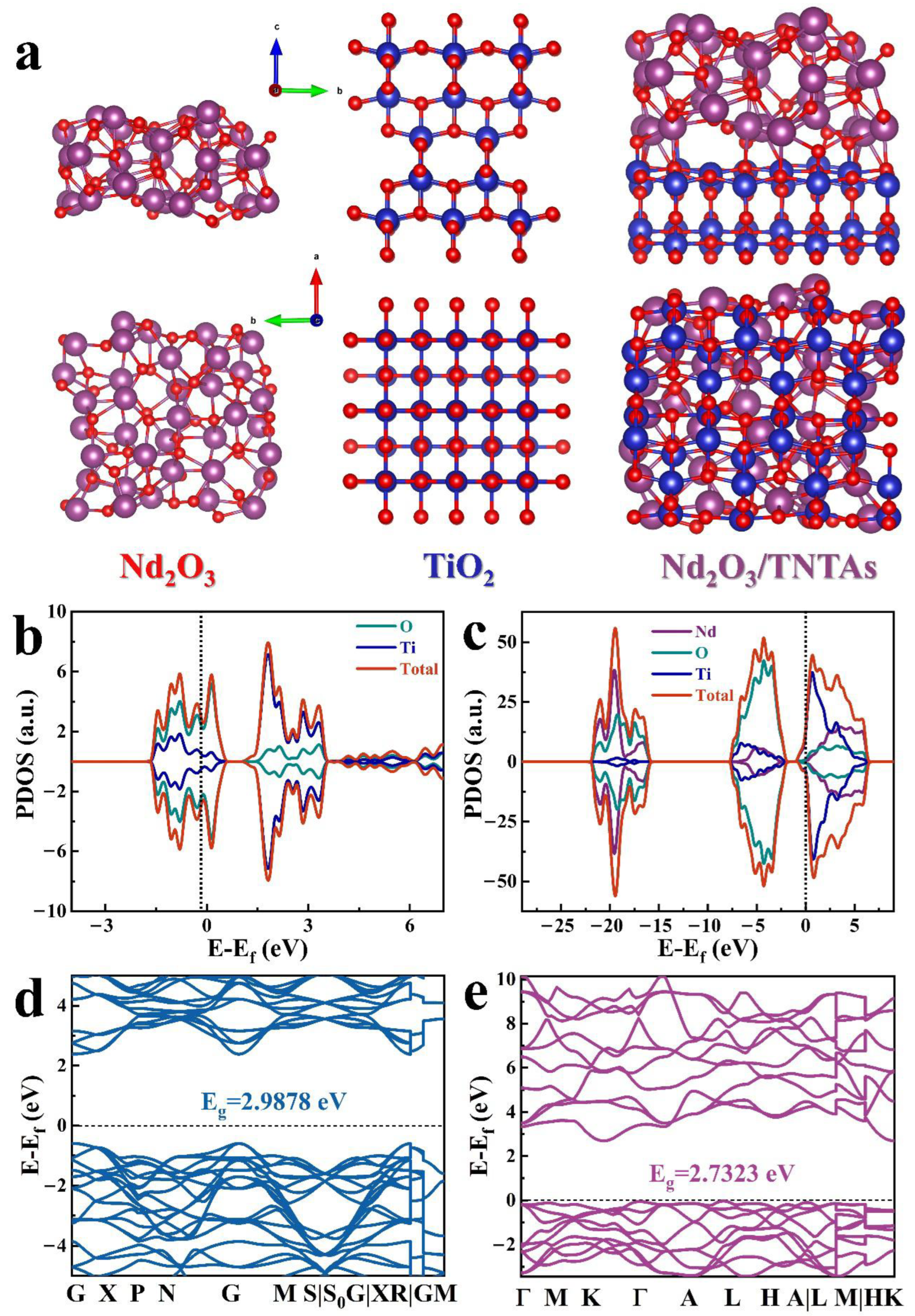
To gain deeper insight into the mechanism by which Nd2O3 enhances the photoelectrocatalytic performance of TiO2, this study employed density functional theory (DFT) to investigate the electronic structure and interfacial charge transfer behavior of the materials. Based on the crystal structure derived from XRD and TEM data [as shown in Figure 7a], atomic structures of Nd2O3, TiO2, and Nd2O3/TNTAs were constructed. The density of states for TiO2 and Nd2O3/TNTAs were calculated using first-principles methods with VASP (5.4.4) software, with results presented in Figure 7b,c. The calculation results reveal that in the DOS diagram of TiO2, the electronic states at the top of the valence band primarily originate from the O 2p orbitals. In contrast, the Ti 3d orbitals mainly contribute to those at the bottom of the conduction band. As a wide-bandgap semiconductor, TiO2 exhibits limited visible-light absorption and facilitates electron recombination, thereby reducing its photocatalytic efficiency. The DOS diagram of Nd2O3/TNTAs exhibits similar phenomena to that of TiO2. Still, near the Fermi level (Ef), the DOS values of Nd2O3/TNTAs are significantly higher than those of TiO2, indicating better conductivity in Nd2O3/TNTAs, which is conducive to electron transfer. Figure 7c reveals hybridization between the Nd 4f and Ti 3d/O 2p orbitals, introducing localized states that narrow the bandgap.
In addition, the band gaps of TiO2 and Nd2O3/TNTAs were computed using first-principles methods, and the results are displayed in Figure 7d,e. Figure 7d indicates that the predicted energy gap of TiO2 is 2.9878 eV; thus, it is of a wide-gap nature. This implies that its responses to light are mostly in the ultraviolet region, with little response in the visible region. Figure 7e shows that the energy gap between Nd2O3 and TNTAs is 2.7323 eV, which is significantly lower than that of TiO2. The presence of Nd 4f levels causes such a decrease in the energy gap. The formation of localized states reduces the energy required for electronic transitions, enabling TiO2 to absorb a greater portion of sunlight, including visible light. To sum up, density functional theory computations also shed further light on the impact of Nd2O3 loading on the photocatalytic properties of TiO2. Specifically, this is achieved by tuning the bandgap structure to improve the electrical conductivity of the material, thereby facilitating charge separation and transport and ultimately enhancing the photocatalytic performance of TiO2-based materials [32].
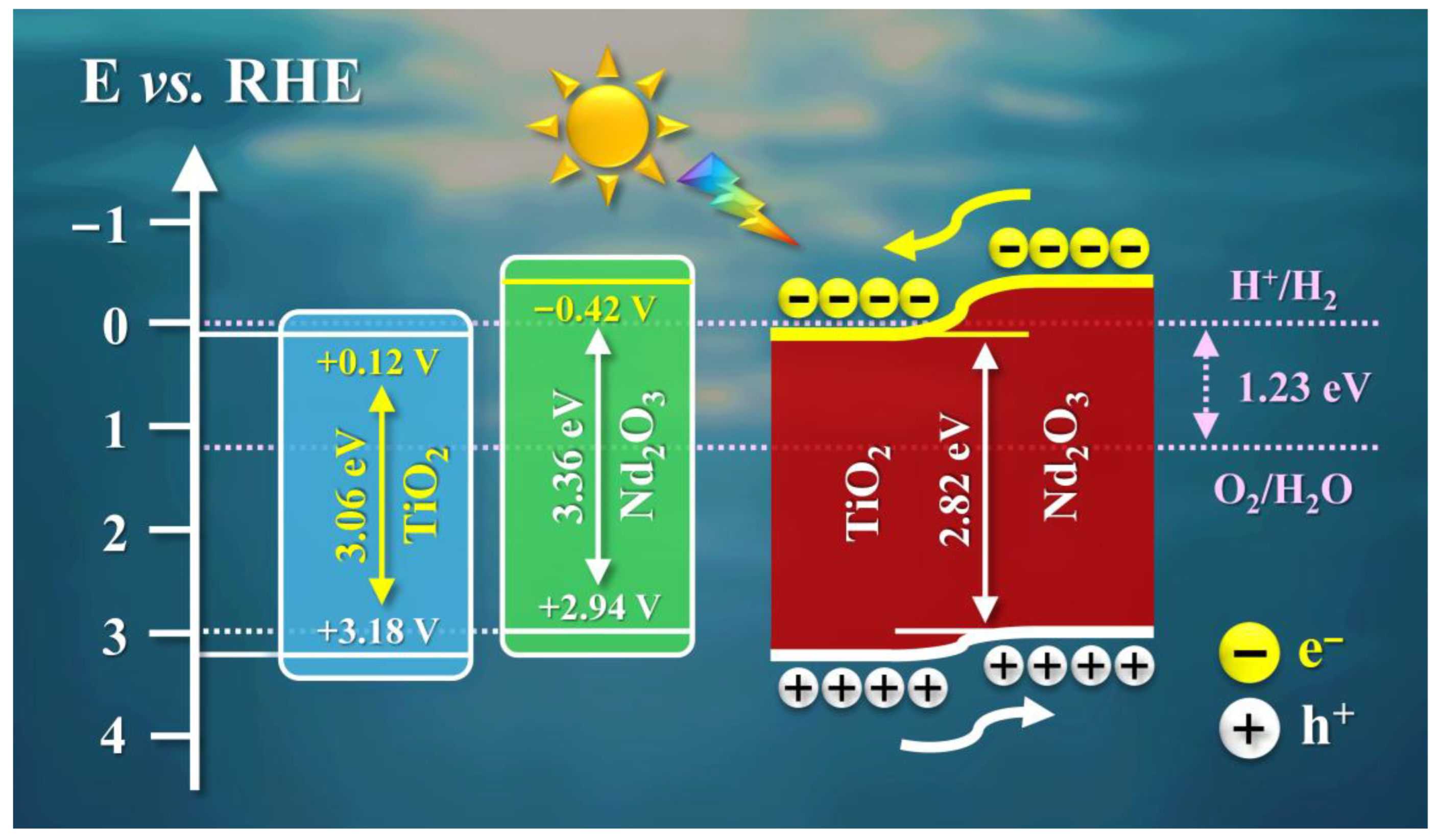
According to the above results, it is possible to propose a photocatalytic hydrogen-splitting reaction mechanism of water by Nd2O3/TNTAs photoanode, as presented in Figure 8. Rare-earth modification of Nd2O3 can be used to effectively adjust the bandgap structure of TiO2, allowing the compound to absorb visible light and facilitate efficient carrier separation. As they are both n-type semiconductors, the formed heterostructure is an n-n heterojunction. The figure shows that when thermodynamic equilibrium is established, electrons flow from the conduction band of Nd2O3 to that of TiO2, making the Nd2O3 side positive and the TiO2 side negative [25]. Such a charge distribution leads to the formation of an inbuilt electric field pointing from Nd2O3 to TiO2 across the interface. Hence, upon exposure to light, electrons at the interface move under the built-in electric field. This migration helps separate the photo-generated electrons and holes, increasing the carrier lifetimes and the performance of photocatalytic water splitting [24].

3. Experimental

3.1. Materials

Both the anode and cathode are high-purity titanium sheets (0.5 mm thick, 99.99% purity). The reagents employed in the experiment comprised analytical-grade anhydrous ammonium fluoride (NH4), ethylene glycol solution (EG, C2H6O2, AR, ≥99.5%), neodymium nitrate hexahydrate (Nd(NO3)3·6H2O, 99.9%), acetone (C3H6O, AR), and anhydrous ethanol (C2H6O, AR). These reagents are opened and used immediately upon purchase, requiring no further purification. All solutions are prepared using deionized water (DI).

3.2. Preparation of TNTAs and Nd2O3/TNTAs

3.2.1. Synthesis of TiO2 Nanotube Arrays (TNTAs)

Highly ordered titanium nanotubular anodes (TNTAs) were fabricated using a two-step electrochemical anodization process with a dual-electrode system (anode: the titanium substrate to be etched; cathode: a high-purity titanium counter-electrode). A direct current power supply (eTM-1502P) was used throughout the experiment. The preparation method is as follows. First, the custom titanium sheet was polished with sandpaper of varying grits (300, 800, 2000) until the surface was smooth and translucent. The polished titanium sheets were then ultrasonically cleaned in the following sequence: acetone, ethanol, and deionized water, each for 30 min. The sheets were then dried and set aside for later use. After drying, adhesive tape and a wafer dicing machine were used to cut a 3 × 3 grid of 1 cm2 exposed areas on the titanium sheet, which served as the etching zones. The pretreated titanium sheets were initially anodized in a homogeneous solution of fluorinated ethylene glycol containing 0.36 wt% NH4F and 1.8 vol% H2O. The treatment was performed at a constant potential of 60 V for 1 h at 26 °C. In the next step, the etched titanium sheets were ultrasonically cleaned to remove the thin film deposited on their surfaces. The amorphous TNTAs were obtained after secondary anodization for 2 h at 60 V.

3.2.2. Synthesis of Nd2O3/TNTAs

After the second etching, the test is soaked in a mixture of neodymium nitrate and ethylene glycol for over 12 h. In the course of the reaction, the Nd3+ ions in the solution displace the fluoride ions (F) of the nanotubes so that the full replacement of F with Nd3+ occurs, and its distribution in the nanotubes becomes uniform. Post-impregnation, the sample was thermally treated in an ambient atmosphere at 400 °C with a heating rate of 0.8 °C/min. On high-temperature treatment, the Nd(NO3)3 deposited in the nanotubes decomposes and forms Nd2O3 nanoparticles that are strongly attached to the walls and aperture of the nanotubes. The nanotube arrays developed in this way were labeled as Nd2O3/TNTAs. The best sample was selected by varying the concentration of Nd(NO3)3 in the immersion solution (0.5 wt%, 1 wt%, and 2 wt%). As shown in Figure S1, the LSV curves of 0.5 wt% Nd2O3/TNTAs, 1 wt% Nd2O3/TNTAs, and 2 wt% Nd2O3/TNTAs under AM 1.5 G illumination and visible light are presented. The 1 wt% Nd2O3/TNTAs exhibits the highest photocurrent density, followed by 2 wt% Nd2O3/TNTAs, with 0.5 wt% Nd2O3/TNTAs showing the lowest. As shown in Table S1, the best-performing sample (1 wt% Nd2O3/TNTAs) was used for inductively coupled plasma mass spectrometry (ICP-MS) analysis to determine the Nd2O3 loading.

3.3. PEC and EC Measurements

Performance testing of the materials includes both photoelectrochemical and electrochemical properties. The synthesized TNTAs and Nd2O3 were evaluated in a three-electrode system using 0.1 M Na2SO4 as the electrolyte. The system was previously flushed with high-purity argon gas to eliminate any remaining oxygen before any test. The prefabricated photoanode serves as the working electrode in the three-electrode system and has an exposed surface area of 1 cm2 in the electrolyte, which is also called the reaction zone. As the counter electrode, a platinum foil is used, whereas the reference electrode is Ag/AgCl (saturated potassium chloride). The main instruments used for performance testing are a 300-watt xenon lamp (PLS-FX300HU, Beijing Perfectlight, Beijing, China), a photoelectrochemical testing system (PEC2000, Beijing Perfectlight), a monochromatic light incident photon-electron conversion efficiency testing system (IPCE1000, Beijing Perfectlight), and a CHI760e electrochemical workstation. To conduct PEC tests, an AM 1.5 G filter was used, with the light source intensity fixed at 100 mW cm−2. Linear sweep voltammetry (LSV) and chronoamperometry (I-t) curves were registered with the help of the PEC2000. At a scan rate of 10 mV s−1 and a frequency of switching the light source of 5 Hz, the LSV curve was measured within the potential range of −0.6 V to 1.6 V (vs. Ag/AgCl). Chronoamperometric curve was obtained at 0.68 V (vs. Ag/AgCl).
The Nernst equation (Equation (1)) was used to convert all test potentials to the standard potential of the reversible hydrogen electrode (RHE) [36]:
E R H E = E A g / A g C l + 0.0592 × p H + E A g / A g C l 0
With an ambient temperature of 25 °C. Applied Bias Photoelectric Conversion Efficiency (ABPE) is one parameter in photocatalysis that is significant, and it is calculated based on Equation (2) [37]:
A B P E % = J × 1.23 V I 0 × 100 %
Equation (2) contains J, which denotes photocurrent density (mA/cm−2), V, denoting applied bias potential (V versus RHE), and I0 as the incident light intensity (I0 = 100 mW·cm−2).
The incident photon-to-electron conversion efficiency (IPCE) is essential for photovoltaic performance testing. This testing system consists of a monochromatic light source (a xenon lamp and a grating monochromator), a phase-locked amplifier, and an electrochemical workstation. Equation (3) gives the formula to calculate IPCE [38]:
I P C E ( % ) = 1240 × J λ × I 0 × 100 %
J stands in Equation (3) as the photocurrent density (mA/cm−2) under monochromatic light, where λ is the wavelength of the illuminating beam, and I0 stands in Equation (3) as the incident light intensity. Also, electrochemical impedance spectroscopy (EIS) and Mott–Schottky plots were obtained with the CHI760e.
The measured frequency range of EIS measurement is 100 kHz–0.1 Hz, and the signal has an AC amplitude of 5 mV and a voltage of 0 V (vs. RHE). Measurement of Mott–Schottky curves is performed over a frequency range of 500–2500 Hz.

3.4. Materials Characterizations

The present paper offers a systematic characterization of the material. The specific structural characterization methods used are X-ray diffraction (XRD, Miniflex 600, Rigaku, Tokyo, Japan), X-ray photoelectron spectroscopy (XPS, Thermo Fisher Scientific, Waltham, MA, USA), field emission scanning electron microscopy (FE-SEM, Apreo S Lo Vac, Thermo Fisher, Brno, Czech Republic), high-resolution transmission electron microscopy (HR-TEM, FEI-TALOS-F200X, Hillsboro, OR, USA), energy-dispersive X-ray spectroscopy mapping (EDS-mapping), and selected-area electron diffraction (SAED). All measurements were carried out in the same HR-TEM mode, using a 200 kV voltage. Moreover, spectroscopic analyses, including ultraviolet-visible diffuse reflectance spectroscopy (UV-Vis DRS, Cary 5000, Agilent, Santa Clara, CA, USA), steady-state fluorescence spectroscopy (PL), and time-resolved fluorescence spectroscopy (TR-PL, FLS980, Edinburgh Instruments Ltd., Livingston, UK), were performed.

4. Conclusions

To summarize, the current research has developed an Nd2O3-based composite for photoelectrochemical water splitting by loading Nd2O3 nanoparticles onto TiO2 nanotube arrays (TNTAs) via electrochemical anodization. It was used as a photoelectrode to perform photoelectrochemical water splitting. Heterojunction structure between Nd2O3 nanoparticles-TNTAs levels the Fermi levels at the interface, causing band bending and an internal electric field. It ensures the rapid separation of electrons and holes (e/h+) generated by phot at the interface. Simultaneously, the addition of unique electronic states of Nd3+ 4f localized within the TiO2 bandgap allows hybridization with Ti 3d and O 2p orbitals, thereby altering the band structure of TiO2 and expanding its ability to respond to visible light. Also, Nd2O3 inclusion extends the lifetime of photo-generated carriers, enabling them to participate in water-splitting reactions for a more extended period. At the same time, it decreases the interfacial charge-transfer resistance, thereby increasing the efficiency of carrier transport. Pure TNTAs also performed poorly in comparison to the optimum Nd2O3/TNTAs photoelectrode that achieved a photocurrent density of 1.59 mA cm−2 at 1.23V vs. RHE. Over the three hours of photocatalytic hydrogen production, it yielded a cumulative hydrogen yield of 162.6 µmol cm−2, approximately 12.2 times that of pure TNTAs. To sum up, the present work has demonstrated highly effective photocatalytic water splitting for hydrogen production by engineering TiO2-based materials containing the rare-earth Nd2O3. Such an approach will form the basis of designing and utilizing rare earths in new photocatalytic materials.

Supplementary Materials

The following supporting information can be downloaded at: https://www.mdpi.com/article/10.3390/catal16040307/s1. Figure S1: PEC performance of 0.5 wt% Nd2O3/TNTAs, 1 wt% Nd2O3/TNTAs and 2 wt% Nd2O3/TNTAs. Figure S2. fine XRD spectrum at 70.3–71.0°. Figure S3. The SEM and EDS of the sample (1 wt% Nd2O3/TNTAs) after long-term testing. Figure S4. Hydrogen evolution results (a) and oxygen evolution results (b) of 1 wt% Nd2O3/TNTAs and TNTAs. Figure S5. Relationship between photocurrent density and monochromatic light wavelength for three independent (1 wt% Nd2O3/TNTAs) samples under a bias voltage of 1.15 V vs. RHE. Figure S6. Photovoltaic conversion efficiency (IPCE) versus monochromatic wavelength curves for three independent (1 wt% Nd2O3/TNTAs) samples under a bias voltage of 1.15 V vs. RHE. Figure S7. Linear sweep voltammetry curves comparing the performance of three independent samples of 1 wt% Nd2O3/TNTAs under AM 1.5 G irradiation. Figure S8. Comparison of carrier concentrations between 1 wt% Nd2O3/TNTAs and TNTAs. Figure S9. The TOF curve of 1 wt% Nd2O3/TNTAs. Figure S10. SEM image of TiO2 nanotubes doped with high-concentration Nd2O3 (3 wt% Nd2O3/TNTAs). Table S1. Nd2O3/TNTAs-1 measured by ICP-MS. Table S2. Some recent TiO2-based photocatalysts for photoelectrochemical water splitting. Table S3. The fitting results of the EIS measurement. Refs. [39,40,41,42,43] are cited in the Supplementary Materials.

Author Contributions

Conceptualization, Y.-X.C. and C.-Z.L.; methodology, W.W., W.-Y.Z. and Y.Y.; investigation, K.-X.L.; validation, B.-R.C.; formal analysis, C.X. and H.-L.W.; data curation, X.-Z.T. and X.-W.W.; writing—original draft preparation, W.W., Y.Y. and W.-Y.Z.; writing, reviewing, and editing, Y.-X.C. and C.-Z.L.; supervision, Y.-X.C. and C.-Z.L.; project administration, Y.-X.C. and C.-Z.L.; funding acquisition, Y.-X.C. and C.-Z.L. All authors have read and agreed to the published version of the manuscript.

Funding

This research was funded by the Science and Technology Service Network Initiative from the Chinese Academy of Science (STS2024T3071), the Natural Science Foundation of Fujian Province (2023H0046), the XMIREM autonomously deployment project (2023GG01), the National Natural Science Foundation of China (22275185), and the Major Research Project of Xiamen (3502Z20191015).

Data Availability Statement

The original contributions presented in this study are included in this article/Supplementary Materials; further inquiries can be directed to the corresponding author.

Conflicts of Interest

The authors declare no conflicts of interest.

References

  1. Yang, Y.; Niu, S.; Han, D.; Liu, T.; Wang, G.; Li, Y. Progress in Developing Metal Oxide Nanomaterials for Photoelectrochemical Water Splitting. Adv. Energy Mater. 2017, 7, 1700555–1700581. [Google Scholar] [CrossRef]
  2. Huang, J.; Hu, X.; Wang, J.; Lin, K.; He, B.; Yang, Y.; Wang, Y.; Li, Z.; Liu, X. Unraveling Photothermal-Enhanced bulk charge transport and surface oxygen reactions in TiO2 photoanodes for highly efficient photoelectrochemical water oxidation. Chem. Eng. J. 2023, 462, 142246–142254. [Google Scholar] [CrossRef]
  3. Zhang, T.; Han, X.; Nguyen, N.T.; Yang, L.; Zhou, X. TiO2-based photocatalysts for CO2 reduction and solar fuel generation. Chin. J. Catal. 2022, 43, 2500–2529. [Google Scholar] [CrossRef]
  4. Li, R.; Yang, J.; Xu, S.; Zhou, Y.; Wang, X.; Peng, H.; Du, J. Preparation of Gd-Doped TiO2 Nanotube Arrays by Anodization Method and Its Photocatalytic Activity for Methyl Orange Degradation. Catalysts 2020, 10, 298–313. [Google Scholar] [CrossRef]
  5. Pinna, M.; Binda, G.; Altomare, M.; Marelli, M.; Dossi, C.; Monticelli, D.; Spanu, D.; Recchia, S. Biochar Nanoparticles over TiO2 Nanotube Arrays: A Green Co-Catalyst to Boost the Photocatalytic Degradation of Organic Pollutants. Catalysts 2021, 11, 1048–1064. [Google Scholar] [CrossRef]
  6. Zakir, O.; Ait-Karra, A.; Idouhli, R.; Khadiri, M.; Dikici, B.; Aityoub, A.; Abouelfida, A.; Outzourhit, A. A review on TiO2 nanotubes: Synthesis strategies, modifications, and applications. J. Solid State Electrochem. 2023, 27, 2289–2307. [Google Scholar] [CrossRef]
  7. Lei, W.; Yu, Y.; Zhang, H.; Jia, Q.; Zhang, S. Defect engineering of nanostructures: Insights into photoelectrochemical water splitting. Mater. Today 2022, 52, 133–160. [Google Scholar] [CrossRef]
  8. Li, D.; Yang, K.; Lian, J.; Yan, J.; Liu, S. Powering the World with Solar Fuels from Photoelectrochemical CO2 Reduction: Basic Principles and Recent Advances. Adv. Energy Mater. 2022, 12, 2201070–2201089. [Google Scholar] [CrossRef]
  9. Talasila, G.; Sachdev, S.; Bera, T.; Badhe, R.M.; Srivastva, U.; Sharma, A. Experimental study on critical role of heterostructures for efficient water splitting activity. Chem. Eng. J. 2025, 508, 160868. [Google Scholar] [CrossRef]
  10. Mao, G.; Wu, H.; Qiu, T.; Bao, D.; Lai, L.; Tu, W.; Liu, Q. WO3@Fe2O3 core-shell heterojunction photoanodes for efficient photoelectrochemical watersplitting. Chin. J. Struct. Chem. 2022, 41, 2208025–2208030. [Google Scholar] [CrossRef]
  11. Jiang, Y.; Fu, H.; Liang, Z.; Zhang, Q.; Du, Y. Rare earth oxide based electrocatalysts: Synthesis, properties and applications. Chem. Soc. Rev. 2024, 53, 714–763. [Google Scholar] [CrossRef]
  12. Jiang, Y.; Liang, Z.; Fu, H.; Sun, M.; Wang, S.; Huang, B.; Du, Y. Pt-Modified High Entropy Rare Earth Oxide for Efficient Hydrogen Evolution in pH-Universal Environments. J. Am. Chem. Soc. 2024, 146, 9012–9025. [Google Scholar] [CrossRef]
  13. Li, J.; Jia, S.; Sui, G.; Du, L.; Li, B. Preparation of hollow Nd/TiO2 sub-microspheres with enhanced visible-light photocatalytic activity. RSC Adv. 2017, 7, 34857–34865. [Google Scholar] [CrossRef]
  14. Boudraa, R.; Talantikite-Touati, D.; Souici, A.; Djermoune, A.; Saidani, A.; Fendi, K.; Amrane, A.; Bollinger, J.-C.; Tran, H.N.; Mouni, L. Breaking new grounds: Solid-state synthesis of TiO2–La2O3–CuO nanocomposites for degrading brilliant green dye under visible light. J. Clean. Prod. 2024, 481, 144126–144144. [Google Scholar] [CrossRef]
  15. Zhao, H.P.; Zhu, M.L.; Shi, H.Y.; Zhou, Q.Q.; Chen, R.; Lin, S.W.; Tong, M.H.; Ji, M.H.; Jiang, X.; Liao, X.C.; et al. Cerium-Doped Iron Oxide Nanorod Arrays for Photoelectrochemical Water Splitting. Molecules 2022, 27, 9050. [Google Scholar] [CrossRef]
  16. Lin, S.W.; Tong, M.H.; Chen, Y.X.; Chen, R.; Zhao, H.P.; Jiang, X.; Yang, K.; Lu, C.Z. CeO2/TiO2 Heterojunction Nanotube Arrays for Highly Efficient Visible-light Photoelectrochemical Water Splitting. ACS Appl. Energy Mater. 2023, 6, 1093–1102. [Google Scholar] [CrossRef]
  17. Tan, J.; He, X.; Yin, F.; Chen, B.; Li, G.; Liang, X.; Yin, H. Incorporating inactive Nd2O3 into Co/N-doped carbon as bifunctional oxygen electrocatalyst for rechargeable Zn-air battery. Catal. Today 2021, 364, 67–79. [Google Scholar] [CrossRef]
  18. Saqib, N.U.; Adnan, R.; Shah, I. A mini-review on rare earth metal-doped TiO2 for photocatalytic remediation of wastewater. Environ. Sci. Pollut. Res. 2016, 23, 15941–15951. [Google Scholar] [CrossRef]
  19. Kralchevska, R.; Milanova, M.; Hristov, D.; Pintar, A.; Todorovsky, D. Synthesis, characterization and photocatalytic activity of neodymium, nitrogen and neodymium–nitrogen doped TiO2. Mater. Res. Bull. 2012, 47, 2165–2177. [Google Scholar] [CrossRef]
  20. Mohamed, R.M.; Ismail, A.A.; Kadi, M.W.; Alresheedi, A.S.; Mkhalid, I.A. Photocatalytic performance mesoporous Nd2O3 modified ZnO nanoparticles with enhanced degradation of tetracycline. Catal. Today 2021, 380, 259–267. [Google Scholar] [CrossRef]
  21. Borlaf, M.; Colomer, M.T.; Moreno, R.; Ortiz, A.L. Rare earth-doped TiO2 nanocrystalline thin films: Preparation and thermal stability. J. Eur. Ceram. Soc. 2014, 34, 4457–4462. [Google Scholar] [CrossRef]
  22. Gomez, V.; Balu, A.M.; Serrano-Ruiz, J.C.; Irusta, S.; Dionysiou, D.D.; Luque, R.; Santamaría, J. Microwave-assisted mild-temperature preparation of neodymium-doped titania for the improved photodegradation of water contaminants. Appl. Catal. A 2012, 441–442, 47–53. [Google Scholar] [CrossRef]
  23. Li, L.; Zhou, Z.; Lei, J.; He, J.; Liu, P.; Pan, F. Nd2O3-decorated TiO2 nanotube arrays with high photoelectrocatalytic activity. Mater. Lett. 2012, 79, 252–255. [Google Scholar] [CrossRef]
  24. Liu, G.; Mamat, M.; Baikeli, Y.; Dong, X. Photocatalytic degradation of methylene blue by TiO2/Nd2O3 composite thin films. Heliyon 2024, 10, e29894–e29910. [Google Scholar] [CrossRef]
  25. Alhaddad, M.; Ismail, A.A.; Alghamdi, Y.G.; Al-Khathami, N.D.; Mohamed, R.M. Fabrication of novel neodymium oxide coupled mesoporous titania for effective visible light-induced photocatalyst for decomposition of Ciprofloxacin. Opt. Mater. 2022, 131, 112579–112589. [Google Scholar] [CrossRef]
  26. Tong, M.-H.; Chen, Y.-X.; Lin, S.-W.; Zhao, H.-P.; Chen, R.; Jiang, X.; Shi, H.-Y.; Zhu, M.-L.; Zhou, Q.-Q.; Lu, C.-Z. Synchronous electrochemical anodization: A novel strategy for preparing cerium doped TiO2 nanotube arrays toward visible-light PEC water splitting. Electrochim. Acta 2023, 463, 142793–142805. [Google Scholar] [CrossRef]
  27. Meroni, D.; Cionti, C.; Silvestrini, L.; Gal, N.; Cazzaniga, M.; Ceotto, M.; Buccella, G.; Lo Presti, L.; Cappelletti, G. Oxygen vacancies in the Spotlight: On the engineering of intrinsic defects in highly defective TiO2 photocatalysts. J. Photochem. Photobiol. A 2023, 444, 114916–114927. [Google Scholar] [CrossRef]
  28. Nguyen, T.T.; Tung, T.T.; Losic, D.; Lan Anh, L.T.; Phuc, L.H.; Nguyen, X.S. Electromigration with enhanced green emission in the titanium dioxide nanotube/graphene composite. Curr. Appl. Phys. 2019, 19, 1082–1087. [Google Scholar] [CrossRef]
  29. Li, X.; Wu, J.; Dong, C.; Kou, Y.; Hu, C.; Zang, J.; Zhu, J.; Ma, B.; Li, Y.; Ding, Y. Boosting photoelectrocatalytic oxygen evolution activity of BiVO4 photoanodes via caffeic acid bridged to NiFeOOH. Appl. Catal. B Environ. Energy 2024, 353, 124096–124106. [Google Scholar] [CrossRef]
  30. Vellampatti, S.; Reddeppa, M.; Dugasani, S.R.; Mitta, S.B.; Gnapareddy, B.; Kim, M.-D.; Park, S.H. High performance UV photodetectors using Nd3+ and Er3+ single- and co-doped DNA thin films. Biosens. Bioelectron. 2019, 126, 44–50. [Google Scholar] [CrossRef]
  31. Rengaraj, S.; Venkataraj, S.; Yeon, J.-W.; Kim, Y.; Li, X.Z.; Pang, G.K.H. Preparation, characterization and application of Nd–TiO2 photocatalyst for the reduction of Cr(VI) under UV light illumination. Appl. Catal. B 2007, 77, 157–165. [Google Scholar] [CrossRef]
  32. Yuan, M.; Zhang, J.; Yan, S.; Luo, G.; Xu, Q.; Wang, X.; Li, C. Effect of Nd2O3 addition on the surface phase of TiO2 and photocatalytic activity studied by UV Raman spectroscopy. J. Alloys Compd. 2011, 509, 6227–6235. [Google Scholar] [CrossRef]
  33. Liu, J.; Dai, M.; Wu, J.; Hu, Y.; Zhang, Q.; Cui, J.; Wang, Y.; Tan, H.H.; Wu, Y. Electrochemical hydrogenation of mixed-phase TiO2 nanotube arrays enables remarkably enhanced photoelectrochemical water splitting performance. Sci. Bull. 2018, 63, 194–202. [Google Scholar] [CrossRef]
  34. Shi, H.-Y.; Chen, Y.-X.; Pu, Y.-H.; Wang, H.-L.; Xie, Y.-Z.; Tian, X.-Z.; Yang, Y.; She, A.-S.; Chen, W.; Yang, W.-H.; et al. Regulation of electrode surface microenvironment by porous ion transport layer for High-Efficiency CO2 electrochemical reduction to ethylene. Chem. Eng. J. 2025, 515, 163490–163500. [Google Scholar] [CrossRef]
  35. Arul, P.; Balraj, B.; Sankaran, A.; Dhayalini, K. Enhancing the energy storage performance of titanium dioxide electrode material by green doping of Nd2O3 nanoparticles for electrochemical supercapacitors. J. Indian Chem. Soc. 2024, 101, 101177–101186. [Google Scholar] [CrossRef]
  36. Li, S.; Xu, J.; Shi, S.; Kong, L.; Zhang, X.; Li, L. Self-Powered Ultraviolet–Visible-Near infrared broad spectrum Sb2S3/TiO2 photodetectors and The application in emotion detection. Chem. Eng. J. 2025, 511, 161890. [Google Scholar] [CrossRef]
  37. Wijerathna, C.N.; Tan, H.-Y.; Yan, C.-F.; Bandara, J. Improving light harvesting and charge carrier separation enabling enhanced photoelectrochemical hydrogen production by Sb2S3-decorated TiO2 nanotube arrays on porous Ti-photoanodes. Int. J. Hydrogen Energy 2024, 82, 53–63. [Google Scholar] [CrossRef]
  38. Yang, Y.; Chen, Y.-X.; She, A.-S.; Shi, H.-Y.; Chen, W.; Wang, W.; Wang, H.-L.; Li, K.-X.; Pu, Y.-H.; Yang, W.-H.; et al. Nickel phosphide modified TiO2 nanotube arrays for efficient PEC water splitting H2 generation. Chin. J. Struct. Chem. 2025, 44, 100623. [Google Scholar] [CrossRef]
  39. Li, F.; Dong, B.; Feng, S. Bi shell-BiOI core microspheres modified TiO2 nanotube arrays photoanode: Improved effect of Bi shell on photoelectrochemical hydrogen evolution in seawater. Int. J. Hydrog. Energy 2019, 44, 29986–29999. [Google Scholar] [CrossRef]
  40. Su, J.; Zhu, L.; Chen, G. Ultrasmall graphitic carbon nitride quantum dots decorated self-organized TiO2 nanotube arrays with highly efficient photoelectrochemical activity. Appl. Catal. B Environ. 2016, 186, 127–135. [Google Scholar] [CrossRef]
  41. Wang, Q.; Huang, J.; Sun, H.; Ng, Y.H.; Zhang, K.Q.; Lai, Y. MoS2 Quantum Dots@TiO2 Nanotube Arrays: An Extended-Spectrum-Driven Photocatalyst for Solar Hydrogen Evolution. ChemSusChem 2018, 11, 1708–1721. [Google Scholar] [CrossRef] [PubMed]
  42. Wang, Q.; Cai, J.; Biesold-McGee, G.V.; Huang, J.; Ng, Y.H.; Sun, H.; Wang, J.; Lai, Y.; Lin, Z. Silk fibroin-derived nitrogen-doped carbon quantum dots anchored on TiO2 nanotube arrays for heterogeneous photocatalytic degradation and water splitting. Nano Energy 2020, 78, 105313. [Google Scholar] [CrossRef]
  43. Zhou, Z.-E.; Lu, Y.; Liu, Y.-X.; Cao, S.; Tian, G.; Hu, Z.-Y.; Shen, L.; Wu, S.-M.; Ying, J.; Geng, W.; et al. Magnetic field-enhanced photoelectrochemical water splitting of Co3O4/TiO2 for efficient oxygen evolution. Sci. China Mater. 2024, 67, 3167–3175. [Google Scholar] [CrossRef]
Figure 1. (a) Schematic illustration of the step-by-step fabrication of the Nd2O3/TNTAs photoanode; (b,c) SEM image of TNTAs photoanode; (d,e) SEM image of Nd2O3/TNTAs photoanode; (f) XRD patterns of TNTAs and 1 wt% Nd2O3/TNTAs; (g) fine XRD spectrum at 25.0–26.0°.
Catalysts 16 00307 g001
Figure 2. (ac) TEM, HRTEM, and SAED spectra of TNTAs; (df) TEM, HRTEM, and SAED spectra of 1 wt% Nd2O3/TNTAs; (gj) elemental mapping of Nd2O3/TNTAs.
Catalysts 16 00307 g002
Figure 3. (a) XPS full spectra of TNTAs and 1 wt% Nd2O3/TNTAs photoanode; (b) Nd 4f spectrum; (c) Ti 2p spectrum; (d) O 1s spectrum.
Catalysts 16 00307 g003
Figure 4. (a) Photoluminescence spectra of TNTAs; (b) corresponding emission spectra of the 1 wt% Nd2O3/TNTAs composite; (c) time-resolved fluorescence decay profile of the sample; (d) UV-Vis absorption spectra of TNTAs and 1 wt% Nd2O3/TNTAs photoanode; (e) the Tauc diagram of TNTAs and 1 wt% Nd2O3/TNTAs photoanode.
Catalysts 16 00307 g004
Figure 5. The photoelectrochemical performance (PEC) of TNTAs and 1 wt% Nd2O3/TNTAs samples was evaluated using a 0.1 M Na2SO4 solution as the electrolyte under AM 1.5G simulated sunlight. (a) LSV curve under AM 1.5 G illumination; (b) LSV curve under visible light illumination obtained by filtering AM 1.5 G light through a visible light filter; (c) ABPE curve from LSV data under AM 1.5 G illumination; (d) ABPE curve from LSV data under visible light irradiation; (e) I-t curve under AM 1.5 G illumination; (f) cumulative hydrogen production test over 3 h under AM 1.5 G illumination.
Catalysts 16 00307 g005
Figure 6. A 0.1 M Na2SO4 solution was used as the electrolyte. (a) Photocurrent density versus monochromatic light wavelength under electrochemical noise (ECN). (b) Photocurrent density versus monochromatic light wavelength under different applied bias voltages. (c) In-plane conversion efficiency (IPCE) versus monochromatic light wavelength under electrochemical noise (ECN). (d) Photoconversion efficiency (IPCE) versus monochromatic light wavelength for the sample at different bias voltages. (e) Bandgap width (ECN) of the sample derived from photoconversion efficiency. (f) Mott–Schottky (M-S) data plots for 1 wt% Nd2O3/TNTAs and TNTAs samples. (g) Electrochemical impedance spectra and equivalent circuit diagrams for 1 wt% Nd2O3/TNTAs and TNTAs samples. (h) Electron paramagnetic resonance (EPR) spectra of 1 wt% Nd2O3/TNTAs and TNTAs samples detecting superoxide radical (O2) under dark conditions and after 5 min of visible light irradiation.
Catalysts 16 00307 g006
Figure 7. (a) Schematic atomic structures of Nd2O3, TiO2, and 1 wt% Nd2O3/TNTAs; (b,c) total and partial density of states (DOS) of TiO2 and 1 wt% Nd2O3/TNTAs; (d,e) calculated electronic band structures of TiO2 and Nd2O3/TNTAs.
Catalysts 16 00307 g007
Figure 8. Charge transfer mechanism of PEC water splitting using Nd2O3/TNTAs.
Catalysts 16 00307 g008
Disclaimer/Publisher’s Note: The statements, opinions and data contained in all publications are solely those of the individual author(s) and contributor(s) and not of MDPI and/or the editor(s). MDPI and/or the editor(s) disclaim responsibility for any injury to people or property resulting from any ideas, methods, instructions or products referred to in the content.