Review

Tunable Catalytic Platforms: Metal–Organic Frameworks for Electrocatalytic Carbon Dioxide Reduction Toward Value-Added Chemicals


1
Department of Biological and Chemical Engineering, Shandong Vocational College of Science and Technology, Weifang 261053, China
2
Qingdao Innovation Center for Carbon Capture, Storage and Marine Resource Utilization (Qi-CCSU), College of Chemical Engineering, Qingdao University of Science and Technology, Qingdao 266042, China
3
Research and Development and Technology Center, Qingdao Runnong Chemical Co., Ltd., Qingdao 266000, China
*
Authors to whom correspondence should be addressed.
Catalysts 2026, 16(4), 303; https://doi.org/10.3390/catal16040303
Submission received: 12 February 2026 / Revised: 23 March 2026 / Accepted: 30 March 2026 / Published: 31 March 2026
(This article belongs to the Section Catalytic Materials)

Abstract

The electrochemical reduction of carbon dioxide (CO2RR) into value-added chemicals using renewable electricity is a pivotal strategy for achieving a sustainable carbon cycle. However, this process is plagued by intrinsic challenges, including poor product selectivity, competing hydrogen evolution, and catalyst instability. Metal–organic frameworks (MOFs), with their highly designable periodic structures, atomically dispersed active sites, and tunable pore microenvironments, have emerged as a uniquely versatile platform to address these issues. This review articulates a multi-scale design philosophy that enables precise steering of the CO2RR pathway. We systematically elaborate on hierarchical tuning strategies, beginning with molecular-scale engineering of active sites (metal nodes and organic ligands) to define intrinsic activity and intermediate binding. This is synergistically integrated with the optimization of electronic structure and charge transport to overcome conductivity bottlenecks, meso-scale modulation of crystal morphology and defects to enhance mass transport and site accessibility, and the construction of heterogeneous interfaces for tandem catalysis and synergistic effects. Through this coherent, cross-scale design framework, MOF-based catalysts demonstrate exceptional capability in the precise control of reaction pathways, leading to remarkably selective synthesis of target high-value products, from C1 compounds (CO, HCOOH, CH4, CH3OH) to C2+ species (C2H4, C2H5OH) and urea. Finally, we outline future directions centered on dynamic mechanistic understanding, electrode engineering for industrial current densities, and stability enhancement, thereby providing a comprehensive material design guideline to advance CO2RR technology. This work positions MOFs as a quintessential tunable catalytic platform for the sustainable conversion of CO2.

1. Introduction

Since the Industrial Revolution, the continuous consumption of fossil fuels such as coal, oil, and natural gas has supported global economic and population growth, but has also led to a sharp increase in atmospheric carbon dioxide (CO2) concentrations, triggering a series of climate change and environmental issues [1,2,3,4]. There is a broad international consensus that annual CO2 emissions must be drastically reduced to near-zero levels by 2050, making carbon reduction an urgent imperative [5,6]. Achieving this systemic goal relies on a multi-level carbon emission reduction technology framework, primarily including low-carbon technologies (e.g., energy efficiency improvements and energy substitution), zero-carbon technologies (e.g., wind, solar photovoltaic and nuclear power), and negative-emission technologies (e.g., carbon capture and utilization) [7,8,9,10]. Among these, carbon capture, utilization, and storage (CCUS) technology not only enables CO2 sequestration but also converts it into high-value fuels and chemicals, thereby synergistically alleviating energy and environmental pressures. It is regarded as one of the most promising negative-emission pathways [11,12]. The main conversion routes for CO2 into valuable products include:
(1)
Thermocatalytic conversion, which utilizes heat and catalysts to drive reactions such as methanation and reverse water–gas shift, offering high reaction rates but often requiring high temperatures and pressures [13,14];
(2)
Photocatalytic conversion, which harnesses solar energy to drive CO2 reduction, providing a sustainable approach; however, it is currently limited by low efficiency and selectivity [15,16];
(3)
Electrocatalytic conversion (CO2RR), the focus of this review, which uses renewable electricity to drive reduction at ambient conditions, offering excellent controllability and compatibility with intermittent renewable energy sources [17,18];
(4)
Biological conversion, which employs microorganisms or enzymes for CO2 fixation, offering high selectivity but facing challenges in reaction rates and scalability [19,20,21];
Each approach has distinct advantages and limitations, and the choice of technology depends on factors including energy source availability, desired products, and scale of operation.
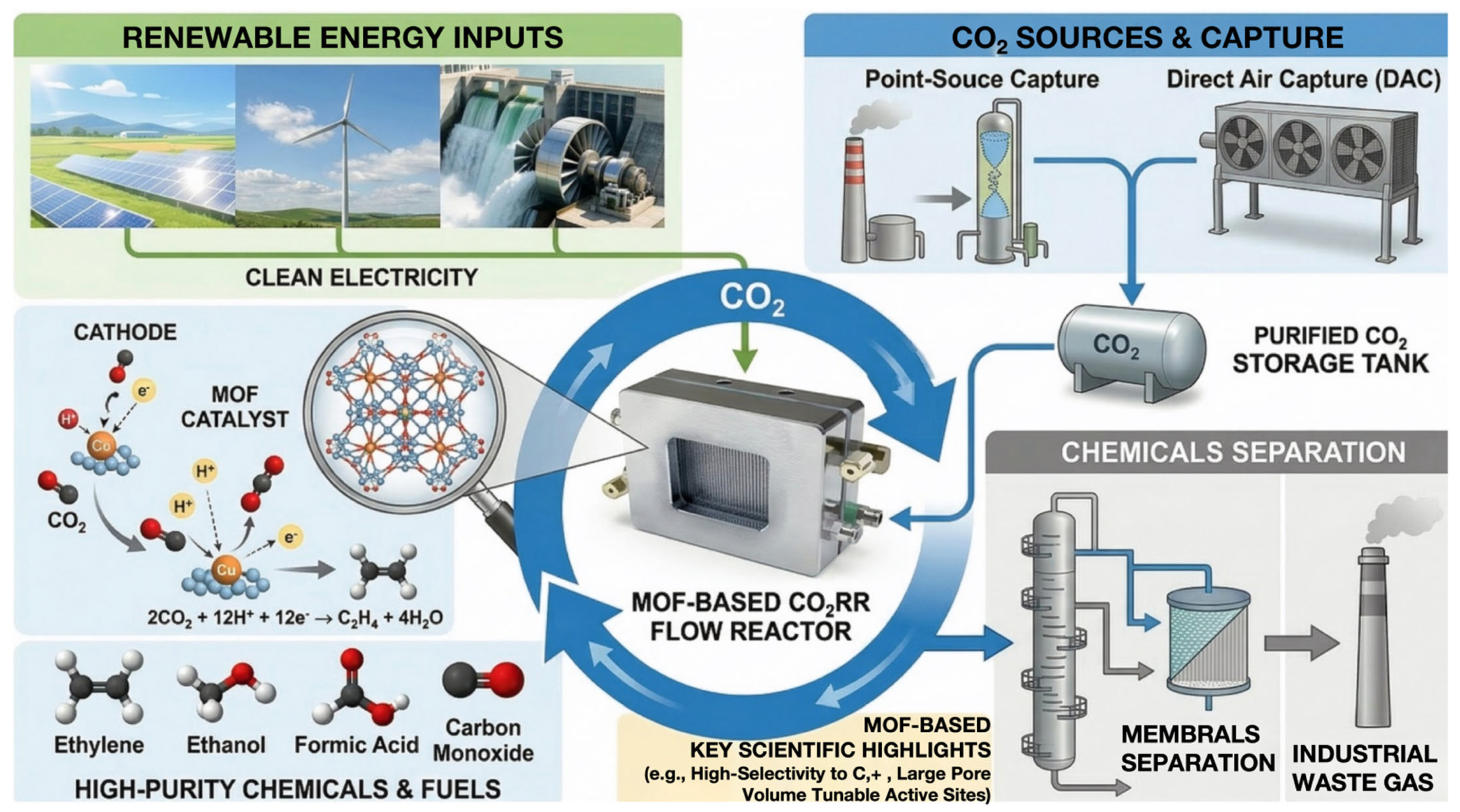
Among various CO2 conversion technologies, the CO2RR reduction reaction has become a leading research focus in energy and catalysis due to its distinct advantages [22,23]. CO2RR utilizes renewable electricity to directly convert CO2 into target products, offering a clean process, controllable product distribution, and compatibility with renewable energy sources. Key features include operation under mild conditions, which reduces equipment demands and enhances operational safety; the ability to tune product selectivity by adjusting applied potential and catalyst structure; and the potential for direct integration with intermittent renewable power sources like solar and wind, enabling the transformation of “green electricity” into “green chemicals” [24,25,26]. The macroscopic concept of this sustainable process is illustrated in the electrocatalytic CO2 reduction cycle (Figure 1).
At the microscopic level, the electroreduction process is highly complex. It mainly includes the adsorption of CO2 on the catalyst surface, the multistep electron–proton transfer and reduction at the interface, and the desorption of final products. The intricacies of optimizing these pathways, particularly for C1 products, have been systematically reviewed by Ahmed et al. [27], who emphasized structure–activity relationships and the critical challenges of high overpotential, competing hydrogen evolution, and limited selectivity. Indeed, these significant challenges remain broadly applicable across current CO2RR systems:
(1)
Product selectivity: The similar reduction potentials for many CO2RR products, combined with the competing hydrogen evolution reaction (HER), make it difficult to achieve high selectivity toward a single desired product. This is particularly challenging for deep reduction products requiring multiple electron transfers.
(2)
Activity and overpotential: The high thermodynamic barrier for initial CO2 activation (forming CO2 at −1.9 V vs. SHE) necessitates substantial overpotentials, reducing energy efficiency. Even state-of-the-art catalysts often require 300–500 mV overpotential to achieve appreciable current densities.
(3)
Catalyst stability: Many catalysts undergo structural degradation under reducing conditions, leading to performance decay over time. This includes metal leaching, ligand decomposition, and active site agglomeration.
(4)
Mass transport limitations: At high current densities, CO2 supply to the catalyst surface becomes rate-limiting due to its limited solubility in aqueous electrolytes, necessitating advanced electrode designs such as gas diffusion electrodes. To address this, high-pressure CO2RR (conducted usually above 1 atm) is an effective strategy to bridge the gap between lab-scale CO2 electrolysis and industrial applications, as elevating the pressure significantly increases the solubility and surface concentration of CO2, boosting reaction kinetics, current density, and selectivity toward multi-carbon products (C2+) [28,29].
(5)
Electrolyte effects: The choice of electrolyte (pH, cation identity, buffer capacity) profoundly affects reaction kinetics and selectivity, adding another layer of complexity to system optimization [30,31,32]. Therefore, the development of electrocatalysts that simultaneously offer high activity, selectivity, and stability is paramount for achieving efficient and sustainable CO2 conversion.
To overcome these intrinsic catalytic challenges, metal–organic frameworks (MOFs) have emerged as a frontier catalytic platform for CO2RR [33]. While traditional heterogeneous catalysts (such as metallic Cu, Ag, and Au) face inherent limitations including limited tunability and ill-defined active sites, MOFs uniquely bridge the gap between homogeneous and heterogeneous catalysis through their highly programmable structural nature [34]. Composed of metal nodes and organic ligands, their exceptional tunability allows for rational design at the atomic scale, enabling precise control over the coordination environment and spatial geometry [35]. By systematically tuning ligand size and functional groups, researchers can precisely modulate pore microenvironments to enhance CO2 adsorption and steer reaction pathways toward specific products (e.g., C1 or C2+ compounds) [36,37]. Furthermore, MOFs typically possess exceptionally high specific surface areas [38] and hierarchical pore structures that facilitate rapid mass transport, mitigating a common limitation in conventional carbon-based materials [39]. Beyond structural precision, MOFs offer multifunctional capabilities by integrating catalytic centers and proton relays within a single framework, while their stability in demanding environments can be engineered through strengthened metal–ligand bonds [40,41,42]. Even when transforming under reaction conditions, ordered MOF structures serve as excellent precursor templates for generating highly dispersed, stable active phases [43,44]. Finally, their well-defined, crystalline structures provide an ideal model system for combining advanced in situ spectroscopy with theoretical calculations to establish clear structure–performance correlations [45,46]. Compared with conventional catalysts, MOFs exhibit outstanding advantages including precise structure, excellent tunability, multifunctional synergy, clear mechanism, and high-quality precursor template potential, making them superior to traditional metal and carbon-based catalysts for CO2 electroreduction and serving as tunable platforms bridging homogeneous and heterogeneous catalysis.
A systematic search of Web of Science and Scopus (2015–2026) using keywords related to MOF-based CO2 reduction (e.g., “active site engineering,” “C2+ products”) yielded 135 key references. We prioritized studies with clear structure–performance relationships, mechanistic insights, and representative metrics. In addition to a thorough analysis of original research articles, this review also provides a detailed discussion of the most up-to-date reviews, offering readers a comprehensive entry point into the field. This review aims to systematically present recent advances in the rational design, advanced characterization, and performance optimization of MOF-based materials for CO2RR. Following an overview of the fundamental mechanisms and pathways of CO2RR, the discussion is structured around four key design dimensions: (1) molecular-scale engineering of active sites (including mono-/bimetallic nodes and ligand modulation); (2) optimization of electronic structure and strategies for charge transport enhancement; (3) mesoscale control of crystal morphology, dimensionality, and defect structures; and (4) heterogeneous interface synergy and tandem catalysis mechanisms. By examining selected representative studies, we highlight the excellent performance of MOFs in the efficient and selective production of high-value chemicals such as CO, CH4, CH3OH, HCOOH, C2H4, C2H5OH, urea, and multi-carbon (C2+) products. Finally, we outline current challenges and future research directions, including electrode engineering for industrial-scale current densities, dynamic mechanistic understanding of active sites, and strategies for long-term stability.
The primary contribution and highlight of this review lies in its articulation of a coherent, cross-scale design philosophy—from atomic-level engineering to device-level integration. By systematically elaborating on the multi-level structure–activity relationships, we position MOFs not merely as alternative catalysts, but as a uniquely “tunable catalytic platform”. Ultimately, this work provides a comprehensive theoretical framework and actionable material design guidelines to inform the rational development of next-generation CO2 electroreduction catalysts toward the goal of global carbon neutrality.

2. CO2RR Reaction Mechanisms and Pathways

Carbon dioxide is a thermodynamically stable and chemically inert molecule, presenting significant kinetic and thermodynamic challenges for its electrocatalytic reduction [47,48,49]. CO2RR involves the transfer of multiple protons and electrons, driven by an applied potential and facilitated by a catalyst surface, to convert CO2 into various carbon-containing products [50,51]. The CO2RR mechanism involves multiple steps. Different pathways and numbers of transferred electrons produce different products, depending on the catalyst’s ability to stabilize key intermediates [52,53,54].
CO2RR is typically carried out in an electrochemical cell where the applied potential between the anode and cathode provides the driving force. Depending on the catalyst and specific reaction conditions (e.g., electrolyte, pH), the process can proceed via different mechanistic pathways [55,56]. The overall stoichiometry for CO2 reduction can be represented as a xCO2 + yH2O → product + zO2 CO2 recycling reaction [57].
Although mechanistic details continue to be refined, a general framework for CO2RR has been established through combined experimental and theoretical efforts.
Table 1 [58] shows the equations for different reduction products and their corresponding standard potentials versus the standard hydrogen electrode (SHE) under various conditions. The extremely high stability of the CO2 molecule, which makes its chemical bonds difficult to break, is determined by its linear symmetric structure (O=C=O) and its three-center four-electron delocalized π bond (π34) [59]. In CO2RR, this characteristic is directly reflected in the high thermodynamic barrier for the initial one-electron reduction step (forming the CO2· radical anion) [60]. Theoretical calculations indicate that the standard potential for this step is approximately −1.9 V (vs. SHE), which often acts as the rate-determining step, necessitating a high overpotential for the overall process [61,62]. Therefore, designing catalysts to stabilize the CO2 intermediate and lower this initial energy barrier is key to improving CO2RR efficiency. Across the entire potential window, the hydrogen evolution reaction (HER) consistently competes with CO2RR for protons (H+) and electrons (e). The electrolyte composition, local pH, proton supply rate, and the catalyst’s adsorption strength for H* collectively determine the competitive selectivity between HER and CO2RR [63,64]. Understanding the complex mechanism of product formation during CO2RR, especially the key selectivity-determining steps and descriptors, is crucial for the rational design of catalysts with satisfactory performance for target products.
CO2RR is a complex multi-step process typically involving three fundamental stages: the adsorption of CO2 onto the catalyst surface, multi-step electron–proton transfer and reduction at the interface, and the desorption of the final product [65]. The reaction pathway and product distribution are strongly governed by the interaction strength between the catalyst surface and key reaction intermediates (e.g., *COOH, *OCHO, *CO). An efficient catalyst effectively lowers the activation energy barriers for these interactions [66]. In the adsorption stage, the CO2 molecule is activated at the electrode interface to form the *CO2 radical anion intermediate. The subsequent reaction and activation of adsorbed *CO2 can proceed via two primary mechanisms: the first is activation induced by the concerted proton–electron transfer (CPET) mechanism, where a proton and an electron are transferred synchronously to the CO2 molecule. This pathway often effectively lowers the activation barrier and promotes C–O bond scission. The second is the stepwise proton-electron transfer (SPET) mechanism, which involves initial electron transfer to form an intermediate, followed by protonation. The energy barrier in SPET is highly dependent on the catalyst’s adsorption strength for the intermediate [53,67,68,69]. The competition and balance between these two mechanisms fundamentally dictate the overall reaction rate, selectivity, and energy efficiency. The distinct activation routes lead to the generation of various intermediates (e.g., *CO, *COOH, *OCCO), ultimately yielding a diverse array of carbon-containing products ranging from C1 to C3 species. These include carbon monoxide (CO), formic acid (HCOOH), methanol (CH3OH), methane (CH4), ethylene (C2H4), acetic acid (CH3COOH), ethanol (CH3CH2OH), n-propanol (CH3CH2CH2OH), and acetone (CH3COCH3), among others [70,71,72,73,74,75,76,77,78,79].
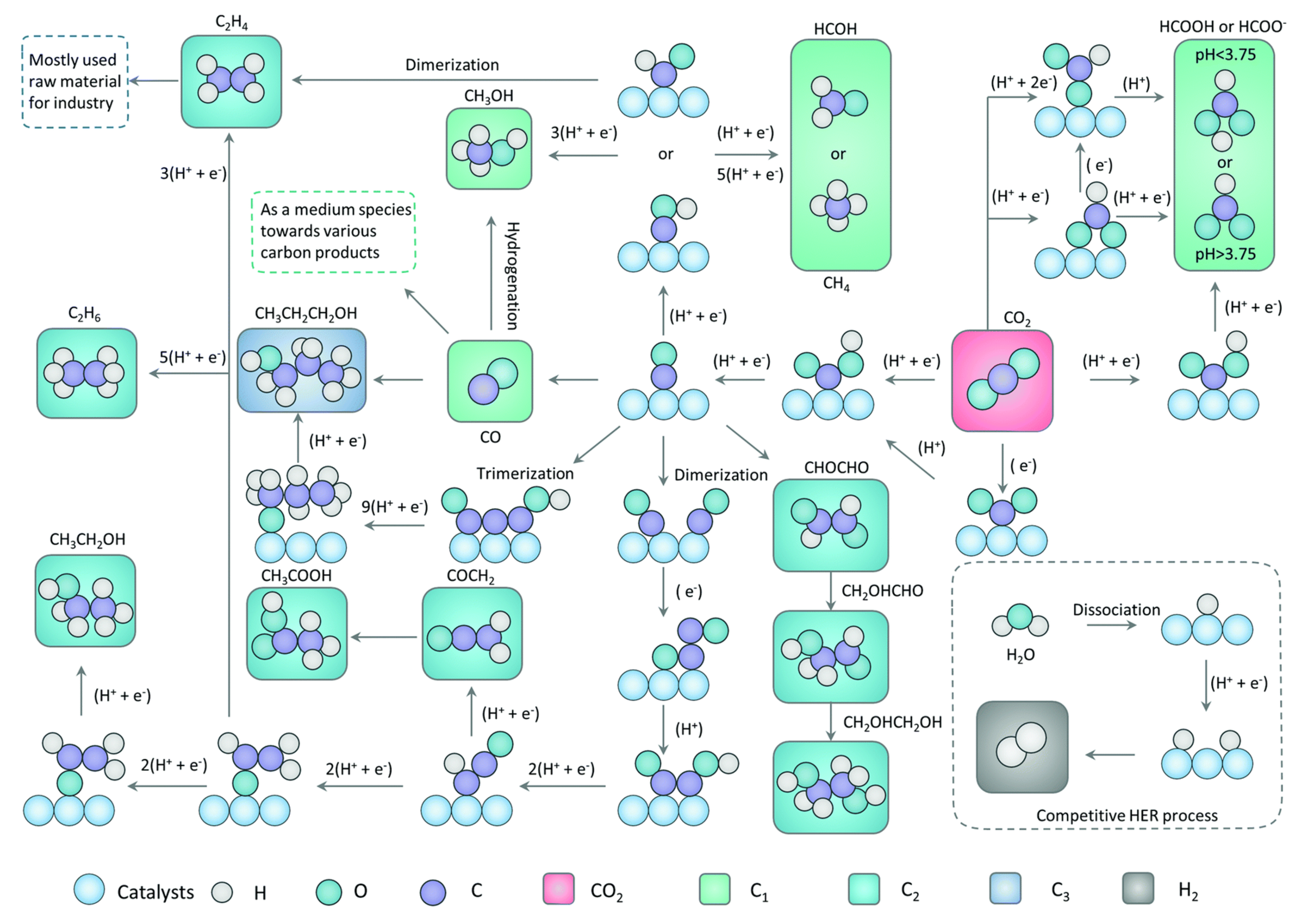
To date, the efficient and rapid synthesis of C1 and C2 products has been demonstrated, but achieving high conversion rates for higher-carbon (C3+) products remains challenging [80]. A schematic representation of the possible reaction pathways is illustrated in the figure [81].
The formation pathway for C1 products is highly dependent on the initial activation mode of CO2 [82,83]. As shown in Figure 2, on catalyst surfaces that favor adsorption via the oxygen atom (e.g., p-block metals), CO2 tends to form the *OCHO intermediate, which subsequently protonates to generate formic acid. Conversely, on transition metal surfaces that favor carbon-atom adsorption, CO2 proceeds via the formation of the *COOH intermediate followed by deoxygenation, yielding the pivotal *CO intermediate. The binding energy of *CO on the catalyst serves as a “watershed” for subsequent pathways: weakly adsorbed *CO tends to desorb directly, producing gaseous CO, while strongly adsorbed *CO can undergo further hydrogenation. Subsequent pathways involve hydrogenated intermediates such as *COH or *CHO, and subtle differences in protonation sites ultimately steer the product distribution toward different C1 molecules like methane or methanol. As this path involves multiple steps with comparable energy barriers, achieving high selectivity toward a single C1 oxygenate (e.g., methanol) remains a significant challenge [84].
The generation of C2+ products begins with carbon–carbon (C–C) coupling between two C1 intermediates [85,86]. It is widely accepted that the dimerization of CO to form *OCCO is a critical, high-barrier initial step, which directly limits the total current density for C2+ products. The dominance of one pathway over the other depends strongly on the local reaction microenvironment, including pH, potential, and *CO surface coverage. Recent theoretical and experimental studies have provided deeper insights into the C–C coupling mechanism. Two primary pathways have been proposed: (i) direct dimerization of two *CO species to form *OCCO, and (ii) coupling between *CO and *CHO to form *OCCHO. The preferred pathway depends on the applied potential and local reaction conditions. At low overpotentials where *CO coverage is high, direct *CO dimerization dominates. At higher overpotentials where hydrogenation becomes more favorable, the CO–CHO coupling pathway may contribute significantly.
The coupling barrier is highly sensitive to the local coordination environment. Density functional theory (DFT) calculations reveal that undercoordinated sites—such as steps, edges, and grain boundaries—can substantially lower the activation energy for C–C coupling by stabilizing the transition state. For example, Cu(100) facets exhibit significantly lower *CO dimerization barriers compared to Cu(111) due to their square atomic arrangement, which facilitates lateral interactions between adsorbed *CO molecules [18]. This facet-dependent behavior explains the experimentally observed higher C2+ selectivity on Cu(100)-dominant surfaces.
Beyond the catalyst surface, the local reaction microenvironment plays a crucial role. High local *CO concentration, achieved through tandem catalyst design or confinement effects, increases the probability of two *CO species encountering each other. Additionally, alkali metal cations (e.g., K+, Cs+) in the electrolyte have been shown to stabilize the *OCCO transition state through electrostatic interactions, further lowering the coupling barrier [64].
After successful C–C bond formation, subsequent multi-step proton–electron transfer processes finely tune the final product distribution, selecting among different C2 products like ethylene, ethanol, and acetate. It must be emphasized that the C–C coupling step imposes extremely high demands on the spatial proximity and local concentration of the two reaction intermediates [87]. This characteristic provides a crucial design rationale for catalysts with well-defined active site arrangements and adsorption properties, such as metal–organic frameworks. C1 and C2+ reaction pathways are shown in Figure 2 [81].
The mechanistic framework outlined above provides crucial design principles for MOF-based CO2RR catalysts. First, the identification of *CO as the central branching point implies that precise control over *CO binding strength is key to steering product selectivity. MOFs offer unparalleled opportunities in this regard through atomic-level engineering of metal nodes—tuning their composition, oxidation state, and coordination environment can systematically modulate *CO adsorption energy, enabling selective promotion of CO, C1, or C2+ pathways.
Second, the high energy barrier for C–C coupling via *OCCO formation demands reaction microenvironments that enhance local *CO concentration and stabilize the coupling transition state. The confined nanospaces within MOF pores can effectively concentrate *CO intermediates and restrict their spatial orientation, lowering the entropic barrier for dimerization. This confinement effect is particularly pronounced in MOFs with pore dimensions comparable to the molecular size of reaction intermediates.
Third, the complex, multi-step nature of CO2RR, especially for C2+ products, calls for multifunctional catalytic systems. MOFs can integrate spatially organized tandem active sites within a single framework—for example, CO-generating sites adjacent to C–C coupling sites—to facilitate directional intermediate migration and sequential conversion, mimicking the efficiency of enzymatic cascades.
These mechanistic insights directly inform the design strategies elaborated in Section 3, where we discuss how molecular-scale engineering, electronic structure modulation, morphology control, and interfacial synergy in MOFs translate into precise control over CO2RR pathways.
In summary, the CO2RR mechanism is a cascade process starting from the formation of the CO2 radical anion, branching via the *CO hub intermediate. The fundamental role of the catalyst is to steer the reaction flux toward specific product channels by modulating the adsorption energies of these key intermediates (especially the initial CO2 and the branching point *CO) and their subsequent protonation rates on its surface. An atomic-level understanding of the above mechanisms forms the theoretical cornerstone for designing efficient catalysts.

3. Design Strategies for MOF-Based Electrocatalysts

Metal–organic frameworks (MOFs) exhibit unique catalytic potential for the electrochemical CO2 reduction reaction (CO2RR). Their precisely tailorable periodic structures, high surface areas, and atomically dispersed metal sites enable systematic tuning of the electronic structure of active sites and their surrounding chemical microenvironment at the molecular level, providing an ideal platform for establishing clear structure–performance relationships [88]. Compared to conventional solid catalysts, MOFs allow for the systematic tuning of the electronic structure of active sites and their surrounding chemical microenvironment at the molecular level, thereby providing an ideal platform for establishing clear structure–performance relationships.

3.1. Molecular-Scale Active Site Engineering

Molecular-scale active site engineering directly controls the adsorption behavior of key reaction intermediates (e.g., *COOH, *CO, *OCCO) by precisely modifying metal nodes and organic ligands, thereby governing the reaction pathway and product selectivity [89].

3.1.1. Metal Node Engineering: From Single Atoms to Bimetallic Synergy

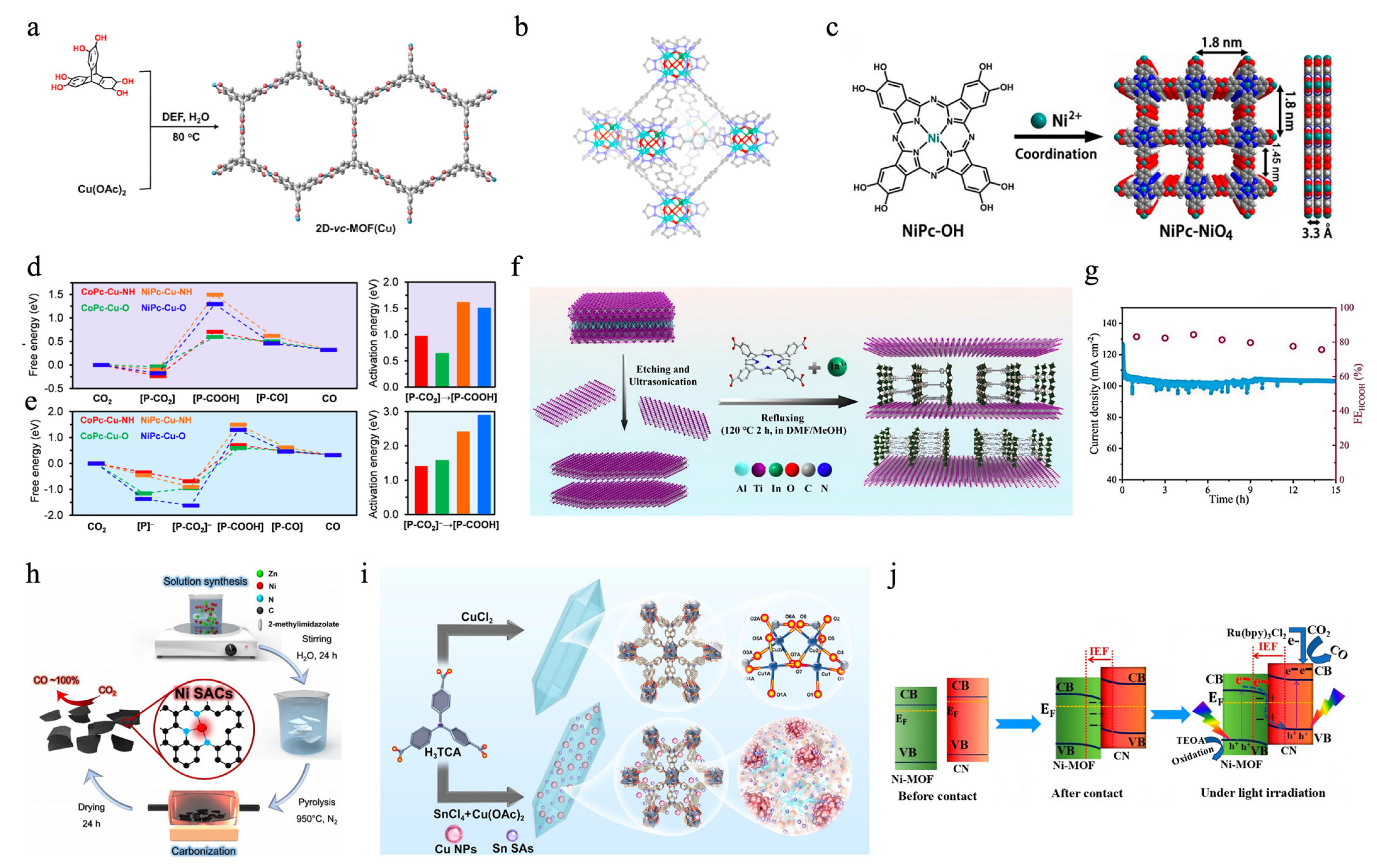
The type, oxidation state, and coordination environment of metal nodes directly determine the adsorption energy of intermediates and the overall reaction pathway in CO2RR [90]. Their type, oxidation state, and coordination environment directly influence the binding energy of intermediates and reaction barriers. Lv et al. [91] synthesized a two-dimensional conductive MOF (2D-vc-MOF(Cu)) with a vertically extended structure by coordinating Cu2+ ions with a vertically oriented triphenylene-based ligand (HHTC) (Figure 3a). Experimental data reveal that the unique vertically extended architecture maximally exposes Cu active sites, endowing the catalyst with outstanding CO2 reduction performance. In flow cell tests, 2D-vc-MOF(Cu) achieved a high Faradaic efficiency of 73.4% for methane (CH4) at −1.4 V (vs. Ag/AgCl), with a partial current density of 13.4 mA cm−2 for CH4, significantly outperforming its planar counterpart, 2D-c-MOF(Cu).
However, single-metal sites are often constrained by linear scaling relationships between the adsorption energies of different intermediates, making it difficult to optimize multiple steps simultaneously. A multi-metal strategy, by introducing other metal components, can break this limitation through electronic synergy [92]. For instance, Huang et al. [93] constructed an asymmetric Ni–Cu hybrid-site catalyst (Cu1Ni-BDP) stabilized by pyrazolate groups, by introducing Cu atoms into a Ni-based MOF (Figure 3b). This unique asymmetric bimetallic site structure effectively modulates the electronic structure of the active center. Electrochemical tests demonstrated its exceptional performance for CO2 reduction to ethylene (C2H4). At a cathodic potential of −1.3 V (vs. RHE), Cu1Ni-BDP achieved a high ethylene Faradaic efficiency (FE) of 52.7% with a total current density of 0.53 A cm−2. Moreover, the catalyst exhibited high stability during 25 h of continuous electrolysis, with only a 4.5% decrease in FE, significantly surpassing conventional copper-based catalysts.

3.1.2. Ligand Engineering: Electronic Tuning and Microenvironment Design

Organic ligands serve not only as structural supports in MOFs but also as effective tools for modulating the electron density and spatial environment of metal centers. By modifying ligands with different functional groups, catalytic activity and selectivity can be significantly influenced [94,95].
Metalloporphyrins and phthalocyanines are classical ligands for constructing conductive MOFs and biomimetic catalysts. Kornienko et al. [96] selected a catalytically active cobalt-metalated porphyrin derivative (Co-TCPP) as the organic ligand and assembled it with aluminum-based inorganic nodes to form an Al2(OH)2TCPP-Co thin-film catalyst with nanoporous channels. This design successfully integrated the homogeneous high activity of molecular porphyrin catalysts with the heterogeneous stability conferred by the MOF framework. Experimental data showed that, benefiting from the well-defined metalloporphyrin units as active sites, this MOF catalyst achieved a high CO Faradaic efficiency (FE) of 76% at −0.7 V (vs. RHE), maintained stability for over 7 h, and reached a turnover number (TON) of 1400 per active site.
Leveraging this concept, Yi et al. [97] coordinated nickel phthalocyanine (NiPc) with nickel-catecholate to successfully prepare 2D conductive MOF nanosheets (NiPc-NiO4) featuring a fully π-conjugated structure (Figure 3c). Electrochemical tests demonstrated that at −1.0 V (vs. RHE), NiPc-NiO4 achieved a CO Faradaic efficiency (FE) as high as 98.4% for CO2 reduction to carbon monoxide (CO), with a corresponding CO partial current density of 34.5 mA cm−2. Its performance significantly surpassed that of traditional MOF catalysts and molecular phthalocyanine counterparts, while also exhibiting long-term stability exceeding 10 h.
Furthermore, ligand engineering can modulate the physicochemical microenvironment of the material; for example, modifying alkyl chains can adjust pore hydrophobicity, thereby influencing the diffusion and enrichment behavior of reactants and intermediates, providing an additional dimension for selective catalysis [98].
Molecular-scale active site engineering achieves deep control over the intrinsic activity and selectivity of catalysis through precise design of metal nodes and organic ligands. Future research should further combine in situ spectroscopic characterization and theoretical calculations to reveal the dynamic evolution mechanism of active sites under real reaction conditions, and explore the synergistic design of multi-metal and multifunctional ligands to break current performance limitations and advance MOF-based CO2RR catalysts toward higher activity, selectivity, and stability.

3.2. Optimization of Electronic Structure and Charge Transport Enhancement

The intrinsically low electrical conductivity of most metal–organic frameworks (MOFs) is a key bottleneck limiting their electrocatalytic performance, severely hindering efficient electron transport from the current collector to active sites, resulting in low utilization of intrinsic active sites and limited overall current density. Enhancing charge conduction hinges on constructing efficient, continuous electron transport pathways [99,100,101]. Current strategies mainly revolve around two approaches: (i) achieving intrinsic charge delocalization through molecular design of the framework, and (ii) constructing rapid interfacial charge transfer channels by compositing with highly conductive materials [102,103].

3.2.1. Molecular Design of Intrinsic Charge Transport Paths

Achieving intrinsic high conductivity in MOFs is a fundamental solution to their charge transport problem. This typically relies on constructing extended π-conjugated systems or metal–ligand orbital hybridization within the framework, forming delocalized electronic bands, thereby enabling a “band-like transport” mechanism akin to metals or semiconductors [104,105]. For instance, Meng et al. [106] constructed a series of two-dimensional conductive MOFs based on metallophthalocyanine (MPc) units connected by copper (Cu) nodes, whose electrical conductivity can be tuned within the range of 2.73 × 10⁻³ to 1.04 × 10⁻¹ S cm−1. This high conductivity originates from the delocalized energy bands formed by strong hybridization between metal d-orbitals and ligand π-orbitals within the 2D plane, coupled with efficient interlayer charge-hopping pathways provided by close π-π stacking. Furthermore, studies indicate that an analog based on cobalt phthalocyanine with oxygen bridges (CoPc-Cu-O) exhibits optimal CO selectivity, which is attributed to a lower energy barrier in the crucial *COOH intermediate formation step (Figure 3d,e), thereby effectively promoting CO2 activation and conversion.

3.2.2. Charge Transport Engineering in Heterogeneous Composite Interfaces

For the vast majority of classical MOFs lacking intrinsic high conductivity, compositing them with highly conductive materials (e.g., carbon materials, MXenes, conductive polymers) is an effective strategy to enhance overall charge transport capability [107,108]. For instance, Zhu et al. [109] successfully constructed an MXene/In-TCPP (denoted as In@M) heterostructure (Figure 3f) via in situ hybridization of highly conductive 2D MXene with an indium-based MOF (In-TCPP) that exhibits intrinsic selectivity toward the formate pathway. In this composite system, MXene not only serves as a three-dimensional conductive framework ensuring rapid electron transport but also induces significant electronic interactions through intimate interfacial contact with the MOF. These interactions optimize the electronic density of states of the In active centers and stabilize the key intermediate *OCHO for formate generation, thereby synergistically enhancing both reaction kinetics and selectivity. The composite catalyst demonstrated stable operation in a membrane electrode assembly (MEA) at a current density of approximately 160 mA cm−2 (Figure 3g) and could continuously produce a pure formic acid solution with a concentration of 0.22 M, fully showcasing its potential for practical application.
Enhancing the charge transport capability of MOF electrocatalysts requires a synergistic approach combining molecular-scale electronic structure design and mesoscale interface engineering. Intrinsically conductive MOFs achieve efficient intrinsic charge transport through band engineering, representing an ideal model for pursuing ultimate catalytic performance, whereas the heterogeneous composite strategy endows a wide range of MOF materials with practicality by constructing functionalized conductive interfaces. Future research directions should focus on deeply understanding and precisely regulating the charge transfer mechanism and band alignment at heterogeneous interfaces; developing novel composite systems with both high conductivity and excellent catalytic activity; and evaluating the long-term operational stability and energy cost economics of these materials in practical electrolysis devices. Through cross-scale charge transport engineering, it is promising to ultimately solve the conductivity bottleneck of MOF catalysts in CO2RR applications.

3.3. Crystal-Scale Morphology and Structure Modulation

Achieving designable morphology and predictable properties is a challenging goal in materials engineering. Precise control over the morphology, dimensionality, crystal facets, and defect structures of MOFs is a key strategy for optimizing their mass transport, active site accessibility, electron conduction, and structural stability [104,110,111]. Applying these engineering approaches at meso- and macro-scales can significantly influence the final performance of MOFs (e.g., directly affecting CO2 diffusion, local concentration and residence time of intermediates, and surface reaction pathways), thereby systematically enhancing the catalytic efficiency and product selectivity of CO2RR.

3.3.1. Morphology and Dimensionality Engineering

Controlling the physical dimensionality and macroscopic morphology of MOFs can significantly alter their mass transfer kinetics and charge transport behavior. Two-dimensional nanomaterials possess unique properties due to their ultrathin thickness and large lateral dimensions. Fabricating MOFs into 2D nanosheets maximizes the exposure of surface metal nodes and greatly shortens ion/electron transport distances, whereas constructing 3D hierarchical or porous structures can utilize their inherent confinement effects to enrich reactant CO2 and stabilize key intermediates (e.g., *CO), promoting deep reduction processes like C–C coupling by increasing local concentration. For example, Cho et al. [110] successfully prepared a nickel single-atom catalyst (Ni SAC, denoted as Ni-NC-NS) based on two-dimensional nanosheet metal–organic frameworks (MOFs) via a combined strategy of solvent exchange, vacancy engineering, and morphology reconstruction. As shown in Figure 3h, this 2D morphology not only endowed the material with a high specific surface area and abundant edge active sites but also, due to its corresponding metastable crystalline structure, facilitated the evaporation of zinc species during subsequent pyrolysis. This process created numerous homogeneous nitrogen vacancies in the derived nitrogen-doped carbon material. Combined analysis from EXAFS fitting and DFT calculations revealed that these vacancies played a decisive role in stabilizing the highly active Ni–N2–V2 sites and lowering the reaction energy barrier, thereby significantly enhancing the CO2 reduction performance. The catalyst exhibited a CO Faradaic efficiency approaching 100% in the tests.

3.3.2. Crystal Facet Engineering

For crystalline MOFs, the exposed crystal facets determine surface atomic arrangement, coordinative unsaturation, and electronic structure, profoundly affecting intrinsic catalytic activity. Crystal facet engineering, by controlling the crystallization process to selectively expose specific facets with higher reactivity, is an effective route for optimizing anisotropic catalytic performance. For example, Zhang et al. [112] successfully prepared a ZIF-8-5% catalyst by performing surface post-synthetic modification (introducing DOBDC ligands) on the zeolitic imidazolate framework ZIF-8 without compromising its primary structure. Combined experimental and theoretical studies indicate that the modified material exposes a greater number of coordinatively unsaturated sites, and its surface chemical microenvironment and electronic structure are optimized, thereby significantly enhancing CO2 adsorption and activation capabilities. DFT calculations further confirm that this strategy reduces the Gibbs free energy barrier for the formation of the key intermediate *COOH by approximately 0.4 eV, effectively suppressing the competing hydrogen evolution reaction. Consequently, this catalyst achieved simultaneous improvement in CO selectivity and current density over a broad potential window. At −1.1 V vs. RHE, the CO Faradaic efficiency increased from 56% to 79%, and the partial current density was enhanced from −4 mA cm−2 to −10 mA cm−2.

3.3.3. Defect Engineering

Deliberately introducing structural defects into the MOF skeleton (e.g., coordinatively unsaturated metal sites, missing ligands, grain boundaries) is a powerful strategy for creating highly active catalytic centers and tuning their electronic properties. Defects can not only serve as active sites to participate directly in reactions, but can also optimize intermediate adsorption behavior by altering local charge distribution and band structure, while forming secondary pores beneficial for mass transport. For instance, by controlling synthesis kinetics, a series of size-uniform copper-based MOF (CuTrz) nanocrystals rich in grain boundaries were prepared. These grain boundaries, acting as highly active “line defects”, not only significantly increase the material’s specific surface area, but also induce surface electronic structure rearrangement, optimizing the adsorption of intermediates like *CO, thereby promoting C–C coupling. The grain-boundary-rich sample exhibited a high Faradaic efficiency of 55.4% for C2H4 and a total selectivity of 81.8% for all multi-carbon products in electrocatalytic tests, significantly outperforming perfect crystals [113].
Morphology, crystal facet, and defect engineering reconstruct the mesostructure and surface properties of MOF catalysts from different dimensions, providing multi-level tools for tuning CO2RR performance. Future research needs to pay more attention to the synergistic application of these strategies and, with the aid of advanced in situ characterization techniques, reveal the intrinsic link between structural evolution and the dynamic behavior of active sites under real reaction conditions, thereby guiding the rational design and controllable preparation of MOF materials with directed catalytic functions.

3.4. Interfacial Synergistic Effects: From Functional Composites to Electronic Coupling

Compositing metal–organic frameworks with other functional materials (e.g., conductive carbons, metal nanoparticles, semiconductors) to construct multicomponent heterostructures is a key strategy for synergistically addressing the intrinsic limitations of MOFs and achieving performance multiplication. Such synergistic effects originate from unique physicochemical interactions at the heterogeneous interface (e.g., charge transfer, band rearrangement, chemical bonding), enabling the integration of advantages from different components to precisely control reaction pathways while enhancing conductivity and stability, thereby improving energy conversion efficiency.

3.4.1. Tandem Catalysis and Interfacial Electronic Modulation

Tandem catalysis decouples and optimizes the multi-step CO2 reduction reaction by spatially coupling active components with distinct functional specificities, forming an efficient “relay” pathway. For example, Ren et al. constructed a tandem catalyst (CuSn-TCA-1) comprising coexisting copper nanoparticles (Cu NPs) and tin single atoms (Sn SAs) within a MOF (TCA) via an in situ encapsulation strategy; its unique architecture is shown in Figure 3i. In this design, Sn SAs function as CO-generating sites that preferentially and selectively reduce CO2 to CO. The generated CO intermediates subsequently migrate to the surfaces of neighboring Cu NPs for C–C coupling, ultimately yielding ethylene. This spatially separated yet functionally linked mechanism effectively increases the local CO coverage on Cu surfaces, thereby significantly enhancing the selectivity towards C2 products. The high-performance catalyst achieved a C2H4 Faradaic efficiency of 64% at −1.5 V vs. RHE, demonstrating exceptional electrocatalytic capability for ethylene synthesis [114].

3.4.2. Inspiration from Band Engineering in Heterojunctions

Although the concepts of S-scheme or Z-scheme heterojunctions originate from the field of photocatalysis, their core principle—constructing a built-in electric field at the interface via band alignment to drive directional charge separation—provides profound inspiration for understanding and designing electrocatalytic heterojunctions. For example, In the Ni-MOF/g-C3N4 S-scheme heterojunction, the difference in the Fermi levels of the two materials leads to the formation of a built-in electric field directed from g-C3N4 to Ni-MOF upon contact. This field directs the recombination of photogenerated electrons and holes along an S-scheme pathway, thereby concentrating highly reductive electrons in the conduction band of g-C3N4 while retaining highly oxidative holes in the valence band of Ni-MOF. This mechanism suppresses charge recombination and simultaneously maximizes the redox capacity of the system. Ultimately, the optimized charge-separation behavior significantly enhances the photocatalytic performance. According to the test data presented in Figure 3j, the CO production rate reaches 3.7 times that of pure Ni-MOF [115].
This principle is also crucial in electrocatalytic systems. In MOF-based composite electrocatalysts, when different components (e.g., two MOFs, MOF and semiconductor) come into contact, differences in their band structures can also lead to interfacial charge rearrangement and band bending. The resulting built-in electric field or dipole layer can modulate the local electron density at active sites, optimizing their adsorption energy for key intermediates, thereby guiding the reaction pathway and enhancing selectivity. Therefore, drawing on and developing band engineering concepts provides an important theoretical framework for rationally designing heterojunction catalysts with efficient interfacial electronic synergy in electrocatalytic systems.
Constructing MOF-based heterostructures is an effective route to achieve synergistic catalysis. Tandem catalysis focuses on optimizing the reaction sequence through spatial organization, with its efficiency deeply regulated by interfacial EMSI, whereas band engineering in heterojunctions provides a universal physical picture for understanding and designing interfacial charge behavior. Future research needs to comprehensively utilize in situ interfacial characterization and theoretical simulations to precisely analyze the dynamic interfacial structure and charge transfer processes of composite catalysts under working conditions, and explore band-matching rules across material systems, thereby guiding the design of next-generation CO2 reduction electrocatalysts with high activity, selectivity, and stability.
Figure 3. (a) The synthesis and structural model of 2D-vcMOF(Cu). Gray, red, blue, and white spheres represent C, O, Cu, and H atoms, respectively. Reproduced with permission [91]. Copyright 2023, National Library of Medicine. (b) Structural model of the cage structure in the Cu1Ni-BDP MOF. Reproduced with permission [93]. Copyright 2023, National Library of Medicine. (c) Illustration of the preparation of NiPc-NiO4. Top and side view of their structures with 2 × 2 square grids in AA-stacking mode. Reproduced with permission [96]. Copyright 2015, ACS Publications. Free energy profiles for electrochemical reduction of CO2 to CO catalyzed by CoPc-Cu-NH (red), CoPc-Cu-O (green), NiPc-Cu-NH (orange), and NiPc-Cu-O (blue) under the standard condition and electrode potential of 0 V (vs standard hydrogen electrode) through the reaction pathway of (d) route I and (e) route II. Reproduced with permission [97]. Copyright 2021, Wiley. (f) Schematic illustrating the synthesis process of In-TCPP@ MXene. (g) Stability test of In@M-2 in MEA-SSE. Reproduced with permission [109]. Copyright 2025, ACS Publications. (h) Schematic of the synthesis method and proposed vacancy-manipulated Ni–Nx active site architecture of Ni–NC–NS. Reproduced with permission [110]. Copyright 2023, Wiley. (i) Schematic illustration of the designed in situ generation of Sn SAs and Cu NPs-engineered MOF. Reproduced with permission [114]. Copyright 2026, ACS Publications. (j) Schematic of work function alignment before and after contact and the S-scheme charge transfer mechanism in the Ni-MOF/CN heterojunction under light irradiation. Reproduced with permission [116]. Copyright 2025, MDPI.
Catalysts 16 00303 g003

4. Product-Oriented Catalysis of CO2RR Using MOFs

Leveraging their atomically tunable active sites, designable pore microenvironments, and functionalizable interfaces, metal–organic frameworks (MOFs) provide an ideal platform for precisely steering the CO2RR pathway toward specific high-value products. Through rational design of metal nodes, organic ligands, dimensionality/morphology, and composite interfaces, the adsorption energies of key intermediates and reaction barriers can be systematically modulated to achieve highly selective synthesis of products ranging from C1 to C2+ species. This chapter focuses on CO, CH4, CH3OH, HCOOH, C2H4, C2H5OH, urea, and multi-carbon (C2+) products, reviewing recent advances in the design strategies and performance of MOF-based catalysts for these transformations, while analyzing the underlying structure–performance relationships.

4.1. Carbon Monoxide (CO)

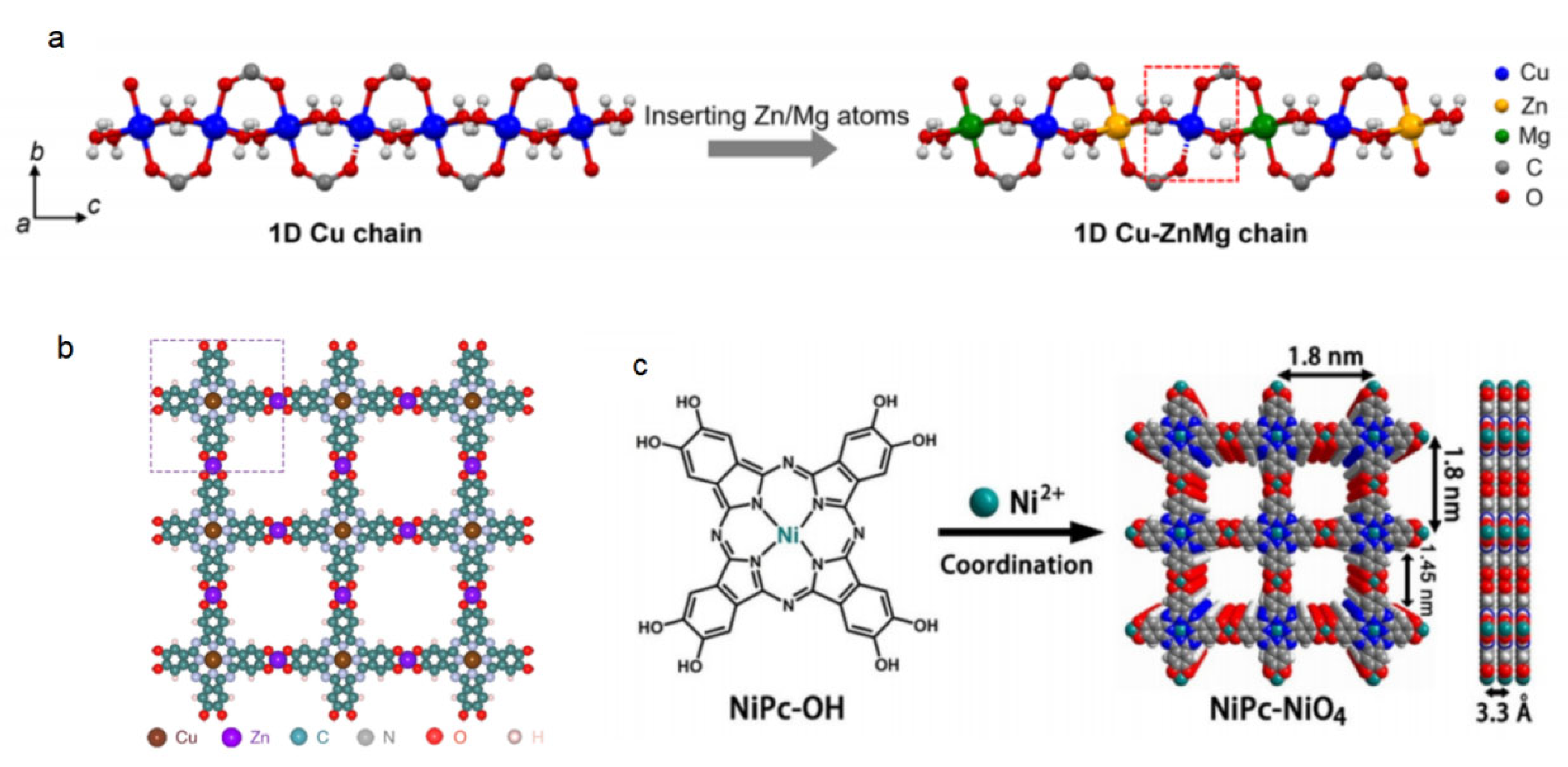
The selective electrosynthesis of CO requires a catalyst that effectively lowers the energy barrier for the initial COOH formation while promoting the subsequent desorption of the CO intermediate to prevent its further reduction. MOFs demonstrate significant advantages in addressing this dual requirement through precise electronic structure and microenvironment design. Magnetic field coupling and multi-metal synergy offer a novel approach. Yin et al. [116] reported a one-dimensional Cu-ZnMg trimetal MOF, as shown in Figure 4a, where introducing non-magnetic Zn2+/Mg2+ ions achieves “magnetic dilution” of Cu2+ sites, converting them into isolated paramagnetic centers. This design enables effective coupling with an alternating magnetic field, facilitating energy transfer via spin-lattice relaxation, while Zn and Mg synergistically optimize *CO desorption and CO2 adsorption, respectively. This catalyst achieved ~95% CO Faradaic efficiency (FE) at an ultralow overpotential of −0.2 V (vs. RHE), revealing the potential of external field stimulation and multi-metal synergy to overcome thermodynamic limitations. For more complex syngas precursors, a bimetallic site division of labor strategy shows unique value. Zhong et al. [117] reported a 2D conjugated MOF, PcCu-O8-Zn, as shown in Figure 4b, where ZnO4 nodes are responsible for CO2 adsorption and reduction, while adjacent CuN4 units act as efficient proton transfer mediators. This synergistic mechanism not only achieved 88% CO FE but also allowed precise tuning of the H2/CO ratio between 1:7 and 4:1 by varying the potential or metal center, catering to different downstream Fischer-Tropsch synthesis processes. Addressing the intrinsic charge transport bottleneck of MOFs is key to achieving industrial-level current density. Constructing intrinsically conductive MOFs is a fundamental strategy. Yi et al. [97] developed nickel phthalocyanine-based 2D MOF (NiPc-NiO4) nanosheets, as shown in Figure 4c, where strong hybridization between metal d-orbitals and ligand π-orbitals forms a highly delocalized band structure, granting significantly enhanced intrinsic conductivity. Benefiting from rapid electron transport and fully exposed Ni-N4 active sites, this catalyst achieved a high CO partial current density of 34.5 mA·cm−2 at −1.2 V while maintaining 98.4% FE.
Efficient CO generation using MOFs primarily relies on multi-metal synergy to optimize reactant adsorption/product desorption and band engineering to construct intrinsic fast charge channels. Future research should further explore the universality of external field coupling and strive to develop novel MOF systems combining ultra-high conductivity with excellent stability to meet the demands of industrial electrolyzers for high current density and long operational lifetime.

4.2. Methane (CH4)

Achieving high selectivity towards CH4, an eight-electron reduction product, necessitates a catalyst that can drive the deep hydrogenation and C–O bond cleavage of the CO intermediate while effectively suppressing the competing C–C coupling pathway. The core of MOF catalyst design for this purpose lies in stabilizing an appropriate Cu valence state to promote hydrogenation while constructing a spatial synergy mechanism to enrich and convert *CO. A dual-site design with intermediate directional migration strategy effectively addresses. Zhao et al. [118] constructed CuN2–MgN2 dual single-atom catalysts anchored on N-doped carbon. Theoretical and experimental evidence confirmed that Mg sites are responsible for efficient CO generation, while adjacent Cu sites exhibit strong adsorption for CO. Crucially, the migration of *CO from Mg to Cu sites is thermodynamically spontaneous (barrier: −0.95 eV), far more favorable than its gaseous desorption. This “generation–utilization separation” tandem mechanism achieved 78.3% CH4 FE and a partial current density of 228.7 mA·cm−2 at −1.1 V.
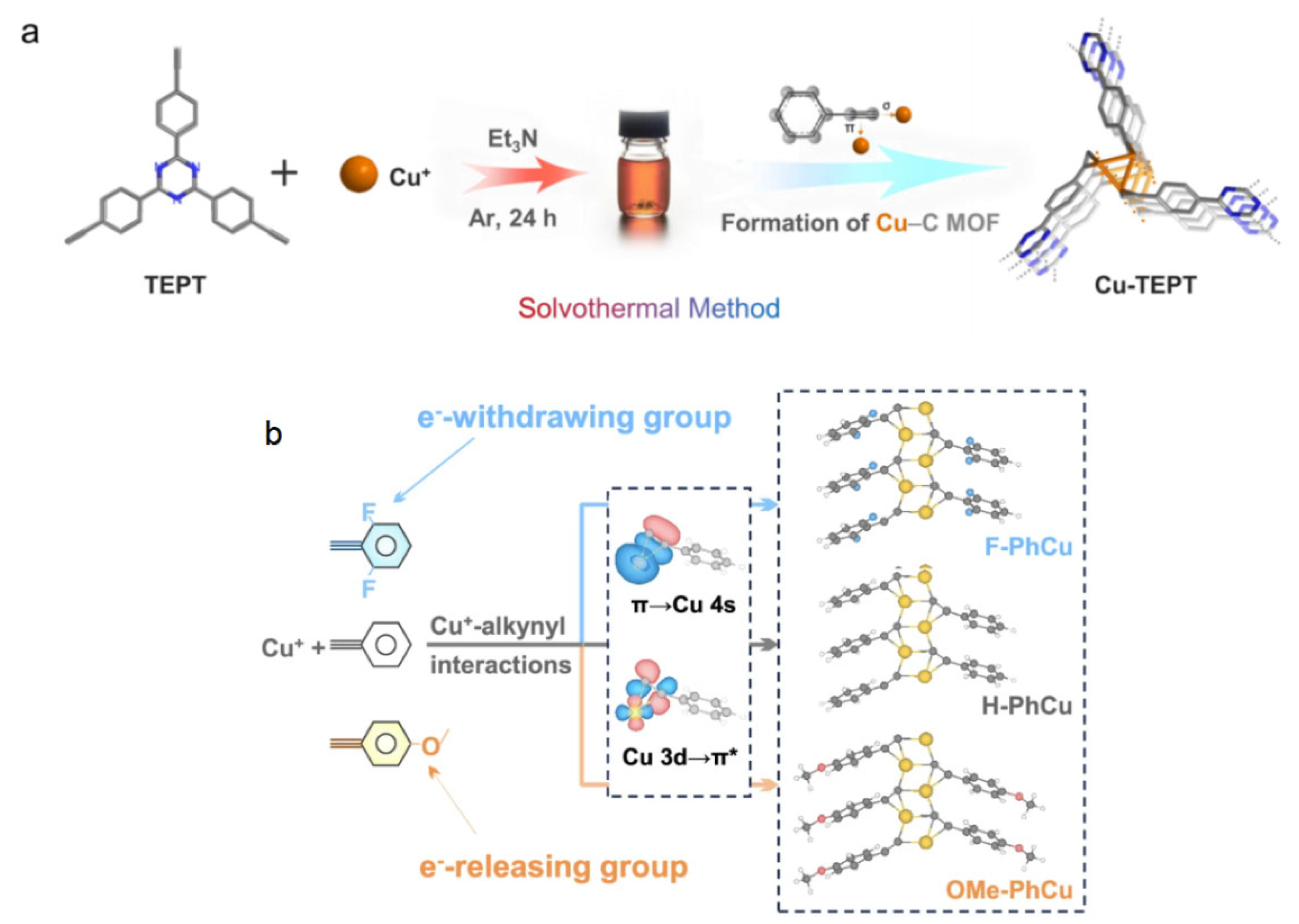
Another key to achieving high selectivity is stabilizing the active Cu(I) valence state, preventing its over-reduction to Cu(0), which is unfavorable for CH4 formation. Jia et al. [119] successfully synthesized a Cu–C strong σ-bond-based MOF (Cu-TEPT) by selecting terminal alkynyl ligands, as shown in Figure 5a. This strong bonding effectively inhibits the reduction of Cu+ under cathodic potentials, maintaining the stability of the active center, and achieved 83.6% CH4 FE at −1.5 V. Qian et al. [120] further utilized σ-π coordination between phenylacetylene and Cu+, as shown in Figure 5b, achieving 68.8% CH4 FE even in a strongly acidic electrolyte (pH = 3), demonstrating the robustness of this strategy under harsh conditions.
High-selectivity CH4 generation relies on atomic-scale spatial synergy for targeted intermediate transfer/conversion and strong chemical bonding to stabilize key active species. Future catalyst design needs to pay more attention to the dynamic stability of dual-site structures and the persistence of synergistic effects under real electrolysis conditions, especially at high current densities and during long-term operation.

4.3. Methanol (CH3OH)

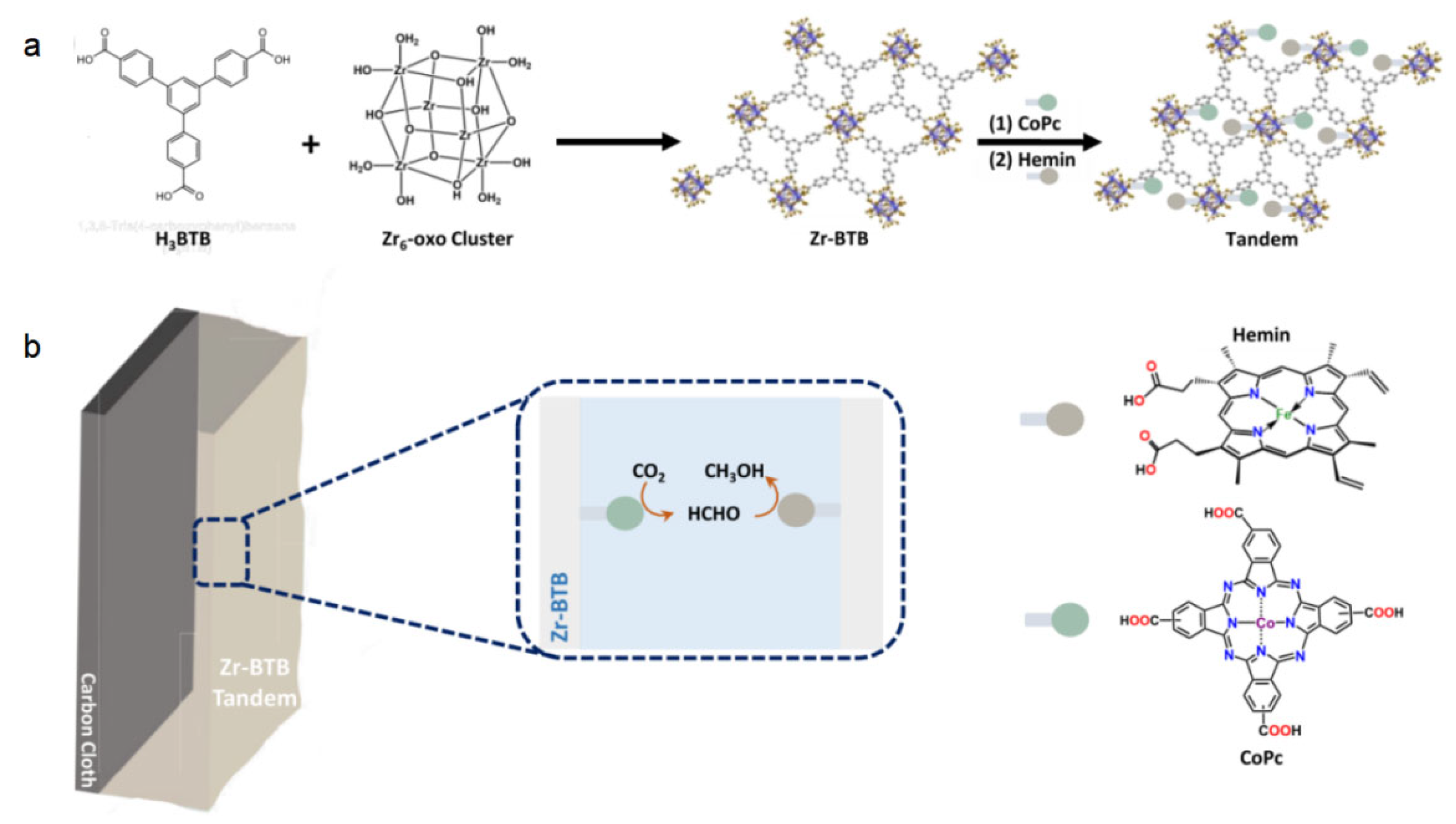
The efficient conversion of CO2 to CH3OH faces the complex challenge of guiding CO through multi-step protonation while selectively retaining the C–O bond, demanding exquisite control over the intermediate’s hydrogenation pathway. MOFs effectively steer the reaction toward methanol generation by constructing multifunctional active interfaces, tandem catalytic systems, and leveraging unique ionic environments. Constructing Metal/Metal Oxide Heterojunctions is an effective means. Yang et al. [121] used the classic Cu-BTC MOF as a precursor to derive core–shell Cu@Cu2O nanoparticles coated with an N-doped carbon layer via controlled pyrolysis. The abundant Cu0/Cu+ interfaces in this catalyst provide moderate *CO adsorption strength, inhibiting CO desorption while avoiding catalyst poisoning from overly strong adsorption, thereby achieving 45% CH3OH FE at −0.7 V. For more complex multi-step conversions, integrating molecular tandem catalysts within MOFs shows great potential. Ghatak et al. [122] covalently anchored cobalt phthalocyanine (CoPc) and iron protoporphyrin (hemin) on the nodes of a 2D Zr-BTB MOF, as shown in Figure 6a,b. They discovered a non-classical tandem pathway: CoPc reduces CO2 to a formaldehyde (HCHO) intermediate, which is then hydrogenated to CH3OH by hemin. This bimolecular synergistic system achieved 18% methanol FE and a current density of 25.4 mA·cm−2 in a gas diffusion electrode. Furthermore, utilizing the ionic character of MOFs can create unique reaction microenvironments. Zhang et al. [123] reported a trinuclear Cu(I) ionic MOF (CuTz-1-300), where a powerful “electrostatic tension” field generated between the free BF4 anions and the cationic framework significantly enhances CO2 adsorption and activation, leading to 56.4% CH3OH FE at −0.97 V.
Efficient methanol synthesis requires catalysts capable of finely tuning the subsequent hydrogenation path of *CO. MOFs provide multi-level solutions to this challenge through derivative construction of multifunctional heterojunctions, integration of molecular catalytic units, and utilization of their intrinsic ionic properties. Future directions lie in deeply understanding the charge and mass transfer mechanisms at hetero-interfaces or between tandem sites and designing intelligent MOF catalytic systems with adaptive regulation capabilities.

4.4. Formic Acid (HCOOH)

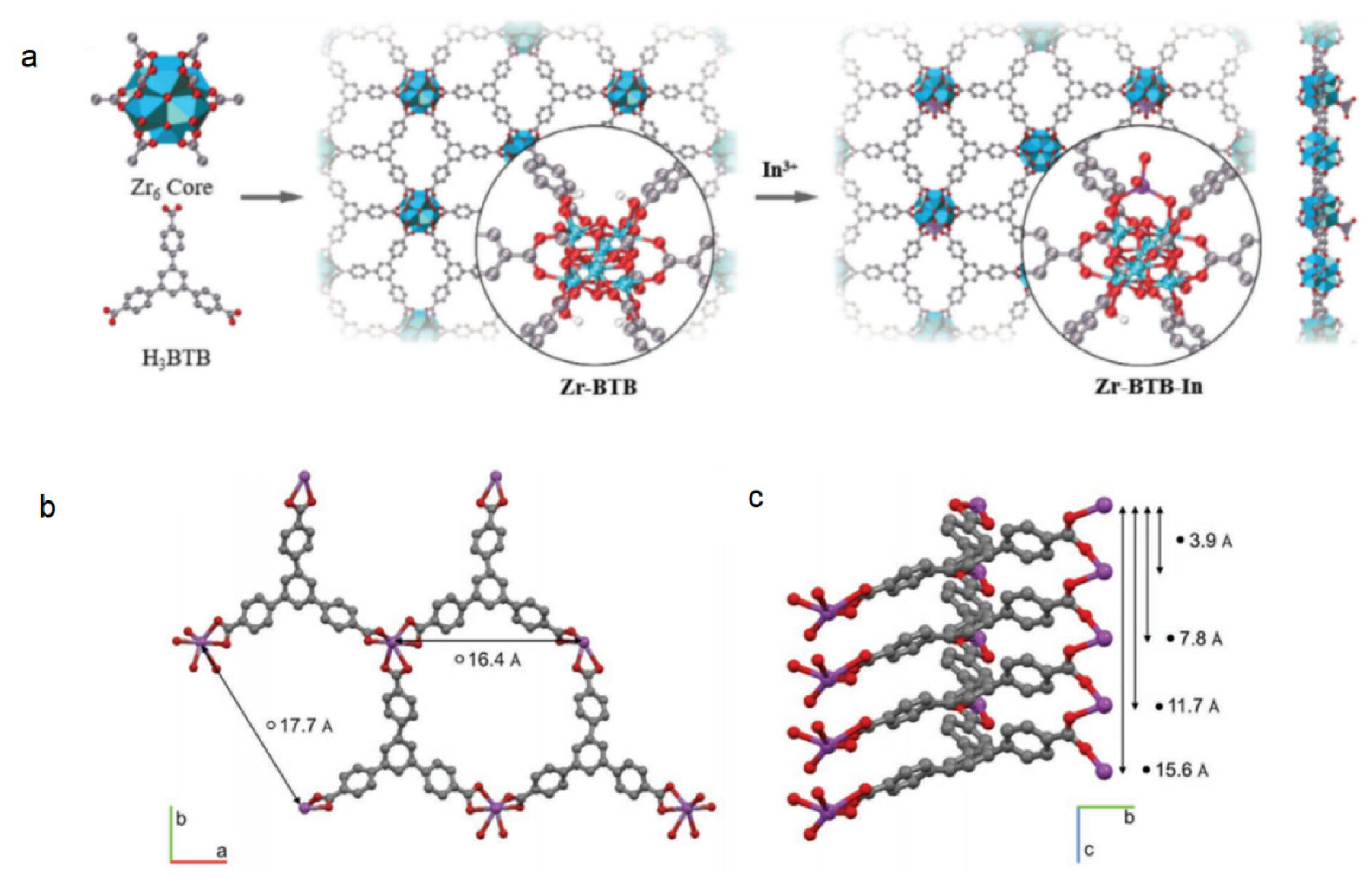
The two-electron reduction of CO2 to formic acid via the OCHO pathway is particularly favored on p-block metals (e.g., In, Bi), where the key challenge lies in optimizing the binding strength of this intermediate and ensuring catalyst durability under operating conditions. MOF catalyst design focuses on creating highly active, low-coordination single-atom sites and addressing material stability issues in electrochemical environments. Constructing low-coordination single-atom centers can break. Li et al. [124] anchored atomically dispersed In(III) sites on an ultra-thin 2D Zr-BTB MOF monolayer via post-synthetic modification, as shown in Figure 7a. X-ray absorption fine structure spectroscopy confirmed a rare low-coordination tetrahedral geometry for the In site. This unique geometry allows it to simultaneously stabilize two *HCOO key intermediates, triggering a bimolecular cooperative reduction pathway that significantly lowers the rate-determining step barrier from 0.89 eV (unimolecular path) to 0.49 eV. This catalyst achieved 95.7% formic acid FE and a current density of 213.3 mA·cm−2 in a strongly acidic electrolyte (pH = 1.67). For MOFs with poor conductivity, employing them as pre-catalysts for electrochemical in situ reconstruction is an effective strategy. Lamagni et al. [125] used a porous Bi(btb) MOF as a precursor. Upon applying a reductive potential, Bi3+ in the framework was reduced and nucleated relying on a partially carbonized organic matrix, ultimately forming a composite of highly dispersed metallic Bi nanoparticles embedded in porous carbon, as shown in Figure 7b,c. This reconstruction process endowed the material with excellent conductivity and abundant active sites, achieving 95% formate FE at an overpotential of −0.97 V.
The application of MOFs in formic acid electrosynthesis highlights the importance of coordination environment engineering for enhancing intrinsic activity and the feasibility of dynamic structural evolution strategies for achieving practical performance. Future research should utilize advanced in situ characterization techniques to track the dynamic changes in low-coordination single-atom sites under reaction conditions in real-time and explore the reconstruction patterns of more p-block metal MOF pre-catalysts to build high-performance, long-lived catalytic systems.

4.5. Urea

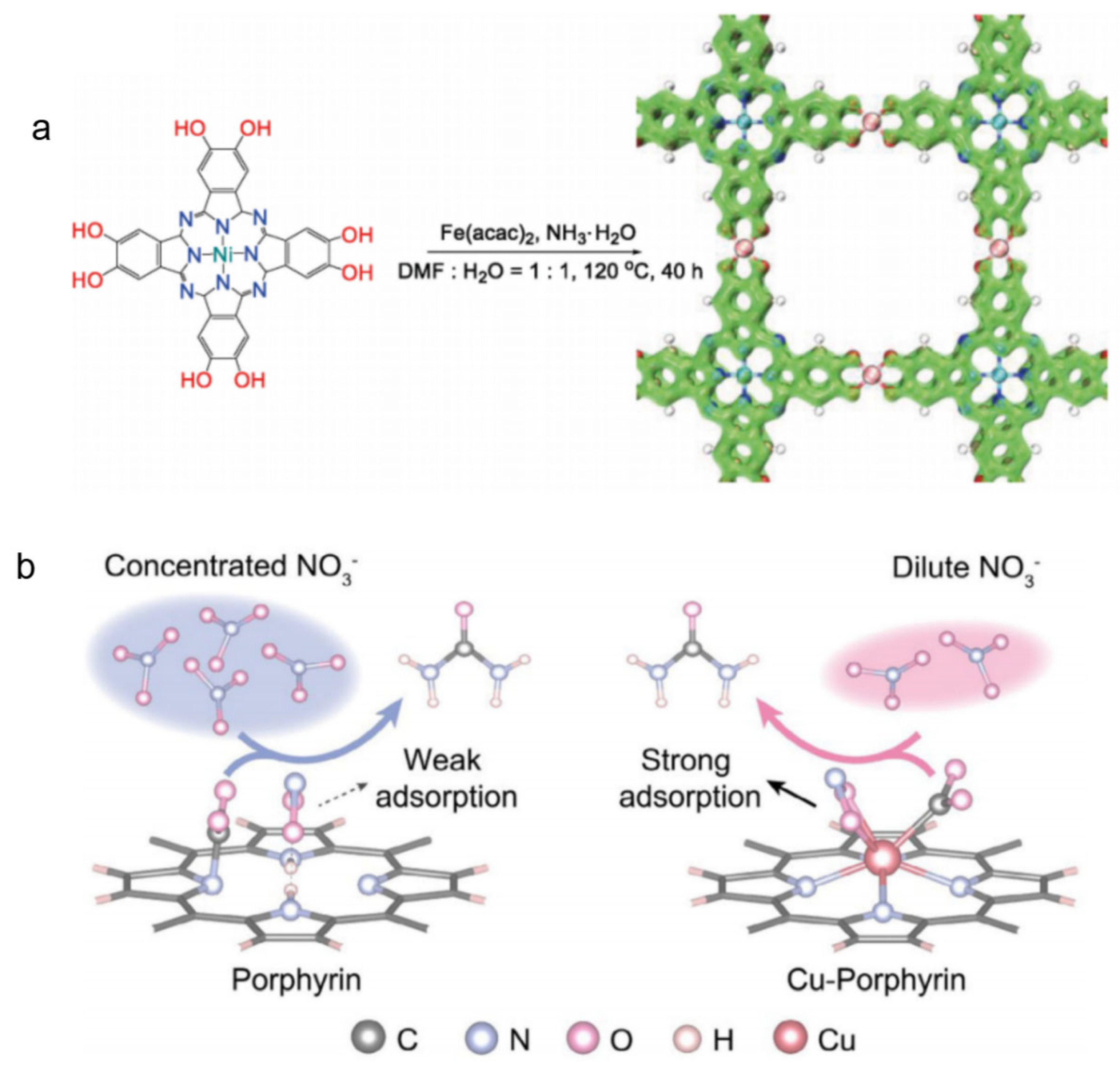
Urea electrosynthesis represents a formidable challenge as it requires the simultaneous coupling of two distinct half-reactions—CO2 reduction and nitrate reduction—involving multi-electron transfers and the critical formation of a C–N bond. The well-defined and spatially organizable multiple active sites in MOFs provide an ideal platform for integrating and synergistically catalyzing this complex reaction at the atomic scale. Constructing dual-functional active centers within a single MOF skeleton is a direct approach. Qiu et al. [126] designed a 2D conductive MOF (PcNi-Fe-O), where FeO4 nodes preferentially catalyze NO3 reduction to NH3, while adjacent NiPc centers are responsible for activating CO2 and catalyzing subsequent C–N coupling, as shown in Figure 8a. This spatially proximate dual-site design allows rapid transfer of reaction intermediates, significantly lowering the reaction barrier, achieving 54.1% urea FE and a high production rate of 2.1 g h−1 gcat−1 under neutral conditions. Given the fluctuating nitrate concentration in actual wastewater, developing concentration-adaptive catalysts is of great practical significance. Tan et al. [127] revealed different adaptation mechanisms by comparing non-metallated porphyrin MOF (PMOF) with copper porphyrin MOF (Cu-PMOF): the porphyrin center in PMOF has weak adsorption for NO2, suitable for stepwise coupling under high NO3 concentration, whereas the Cu site in Cu-PMOF exhibits strong adsorption for NO2, promoting continuous NO and CO coupling reactions under low concentration, as shown in Figure 8b. Catalysts designed based on this principle maintained efficient urea synthesis over a wide concentration range (FE up to 52.7%).
The use of MOFs for urea synthesis successfully demonstrates their unique ability to integrate multifunctional catalytic centers at the molecular level. Precise control over the spatial arrangement and electronic properties of active sites enables accurate control of complex tandem reaction pathways. The future challenge lies in how to integrate such high-performance powder catalysts on a large scale into flow electrolysis cells and conduct economic assessments of the selectivity and energy consumption for urea synthesis from actual impurity-containing wastewater.

4.6. Ethylene (C2H4)

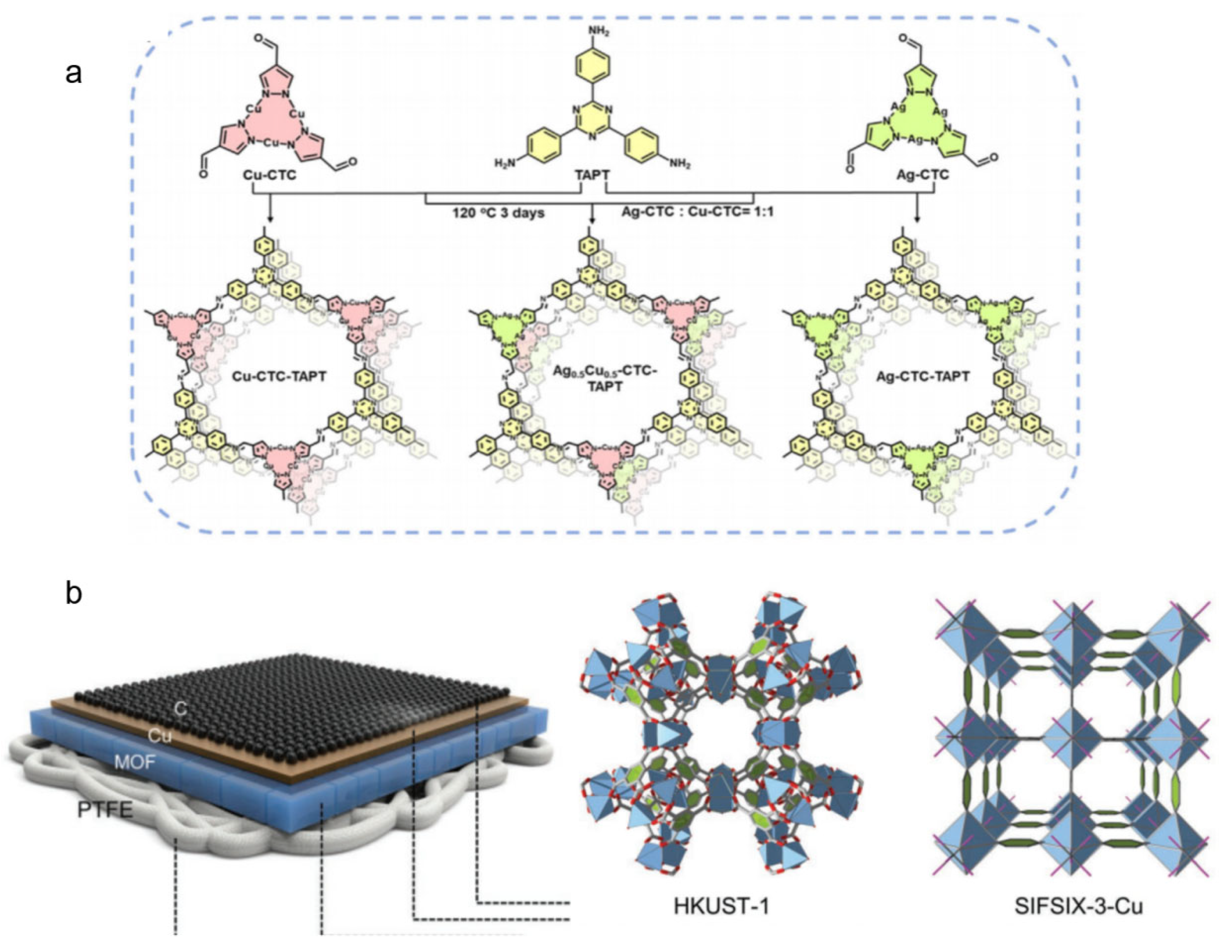
The generation of ethylene is fundamentally governed by the efficiency of the C–C coupling step between two adsorbed CO intermediates, a process demanding high local CO coverage and specific geometric configurations on the catalyst surface. MOF catalysts systematically enhance ethylene selectivity by constructing tandem systems to enrich *CO, modifying electrodes to enhance mass transfer, and tuning substrate crystal facets. Designing a tandem catalytic system for site-specific generation and enrichment of CO is an effective strategy. Xu et al. [128] constructed a copper–silver bimetallic covalent organic framework (MCOF), where Ag sites preferentially generate CO due to their high affinity for CO2, as shown in Figure 9a. The generated CO then spontaneously migrates to adjacent Cu sites with stronger adsorption capability for CO. This thermodynamically driven “intermediate interlayer transfer” mechanism creates high local *CO coverage on Cu site surfaces, significantly promoting C–C coupling, achieving 51.5% C2H4 FE at −1.774 V. Yan et al. [129] grew an in situ layer of MOF with single Cu sites on copper foil, forming an MOF/Cu tandem electrode. The MOF layer acts as an efficient CO2-to-CO converter, and the produced CO migrates to the underlying Cu foil surface for coupling. Simultaneously, the coverage of the MOF layer induced the exposure of more Cu(200) facets conducive to C2 product formation on the Cu foil and completely suppressed the CH4 pathway, achieving 48.6% C2H4 FE at −1.11 V. To achieve industrial-level current density, utilizing MOFs to optimize electrode gas-phase mass transfer is crucial. Nam et al. [130] integrated MOFs with high CO2 adsorption capacity (e.g., HKUST-1) as a functional layer into a gas diffusion electrode (GDE), as shown in Figure 9b. This MOF layer acts as a local CO2 “concentrator,” significantly increasing the gaseous reactant concentration near the Cu catalytic layer, thus maintaining 49% C2H4 FE even at an ultra-high current density of 1 A cm−2.
Efficient ethylene synthesis at high current density is a systems engineering task requiring tandem catalytic design to enrich key intermediates, electrode microenvironment engineering to ensure reactant supply, and substrate surface engineering to expose favorable crystal facets. MOFs play multiple roles as active site designers, intermediate modulators, and mass transfer promoters. The future research focus is to integrate these lab-scale optimization strategies into scalable membrane electrode assemblies and investigate their performance degradation mechanisms over hundreds of hours of operation.

4.7. Ethanol (C2H5OH)

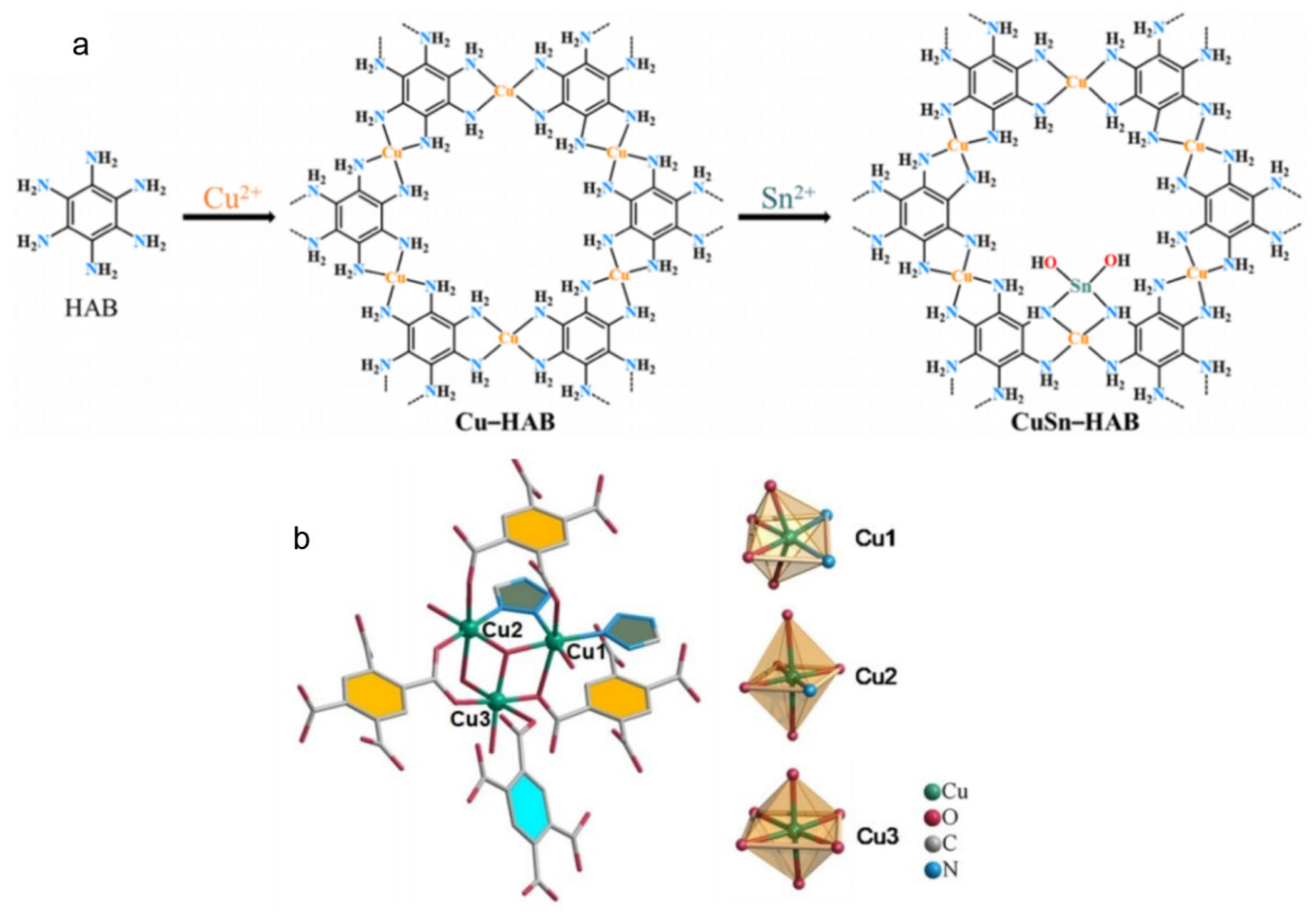
Selective ethanol production imposes even more stringent demands than ethylene, requiring not only successful C–C coupling, but also the subsequent retention and hydrogenation of the C–O bond, which calls for an active site with asymmetric electronic and geometric properties. MOFs achieve precise guidance of this complex pathway by constructing hetero-bimetallic sites and confining special cluster structures. Constructing hetero-bimetallic active sites can break the symmetry limitations. Zhao et al. [131] introduced Sn single atoms into a conductive Cu-HAB MOF via post-synthetic modification, forming a μ-N-bridged Sn···Cu hetero-bimetallic pair, as shown in Figure 10a. Theoretical calculations show that Sn sites strongly adsorb the oxygen-containing intermediate *OCH2, while Cu sites adsorb *CO. Their combination enables the asymmetric coupling of *CO and *OCH2. The barrier for this pathway (0.26 eV) is much lower than that for the C–O cleavage path leading to ethylene (2.72 eV), resulting in 56% ethanol FE at −0.57 V. Utilizing MOF channels to confine electrochemically reconstituted low-nuclearity clusters is another effective way to create highly active catalytic centers. Shao et al. [132] electrochemically reduced a 3D Cu-MOF, as shown in Figure 10b. Under conditions that preserved the main framework, some unstable Cu2+ ions migrated, reduced, and aggregated within the pores, forming atomically dispersed single atoms and low-nuclearity Cu clusters (2–10 atoms). These MOF-channel-confined low-nuclearity clusters were confirmed to be the primary active species catalyzing CO2 to ethanol conversion, achieving 82.5% ethanol FE at −1.0 V.
The highly selective synthesis of ethanol signifies a higher level of control over the CO2RR pathway. Its success relies on creating an active environment with asymmetric electron distribution at the atomic scale. The precise pore structure and modifiable sites of MOFs make it possible to customize such complex active centers. Future challenges lie in deeply understanding the electronic communication mechanism between hetero-bimetallic sites and how to controllably and scalably prepare metal-cluster@MOF composites with uniform nuclearity distribution.

4.8. Multi-Carbon (C2+) Products

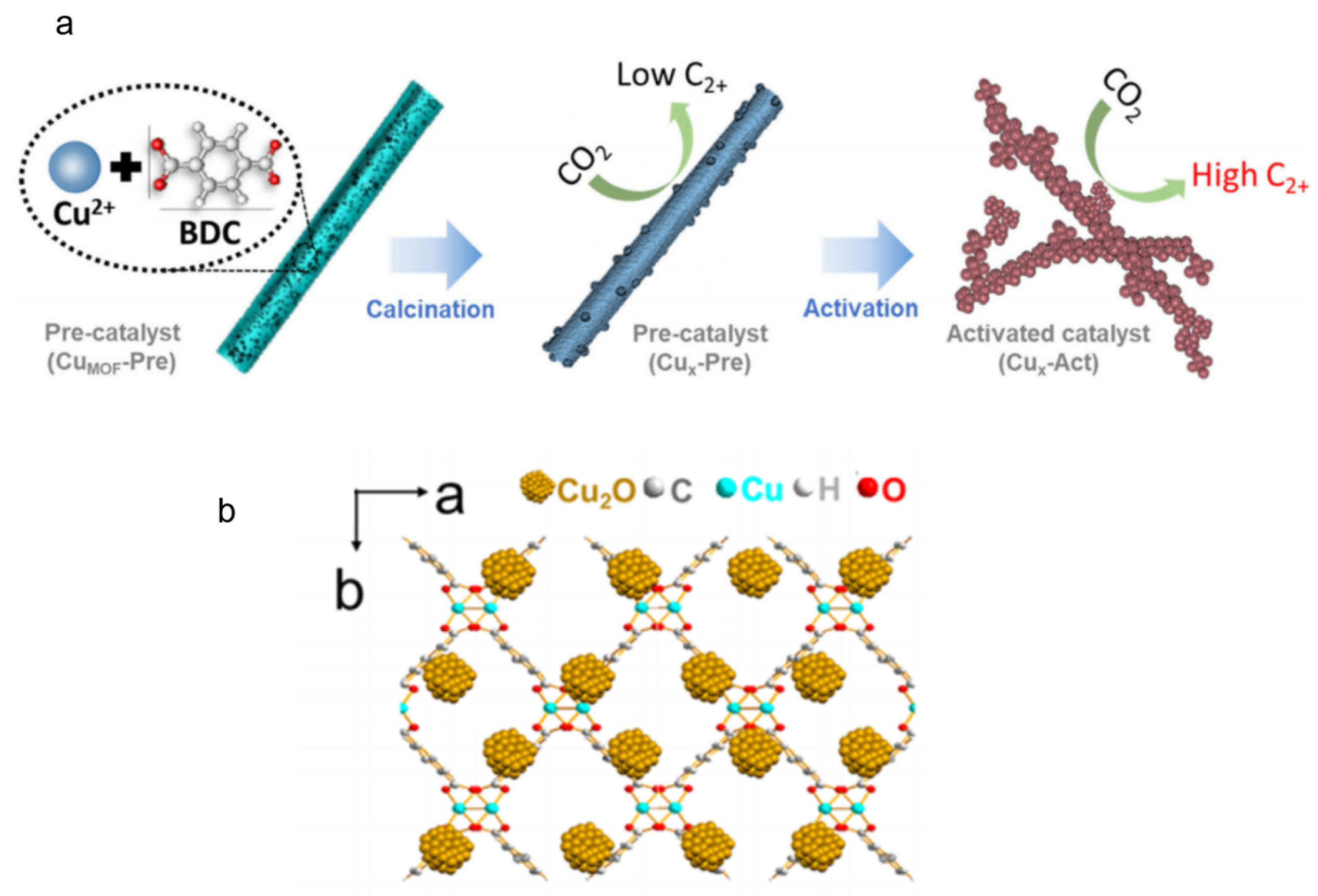
From an application perspective, the overarching challenge for C2+ product generation is to maximize the total yield and energy efficiency at industrially relevant current densities, which requires catalysts that maintain high activity and structural stability under harsh reduction potentials. MOFs strive to meet this challenge through strategies like surface engineering to stabilize high-activity valence states and constructing heterojunctions to optimize overall reaction pathways. Stabilizing high-valence copper species (Cuδ+, 0 < δ < 2) is considered crucial. Jang et al. [133] used Cu-BDC MOF as a precursor, as shown in Figure 11a. Through a two-step method combining air thermal annealing and electrochemical activation, they constructed and stabilized enriched Cuδ+ species on the material surface. Quasi-in situ XPS and theoretical calculations indicated that these Cuδ+ sites effectively enhance *CO adsorption and lower its dimerization barrier. The optimized catalyst achieved a total C2+ product FE of 78% at −1.06 V. Constructing metal oxide/MOF heterojunctions can synergistically regulate multiple reaction steps. Liu et al. [134] grew Cu2O nanoparticles in situ on 2D Cu-BDC nanosheets, forming abundant Cu2O/Cu-BDC hetero-interfaces, as shown in Figure 11b. This interface not only stabilizes active Cu+ species but its unique electronic structure also synergistically optimizes the adsorption strength of key intermediates like *CO and *CHO, placing them within the most favorable range for subsequent C–C coupling, thereby achieving 58.2% C2+ FE at a high current density of 300 mA·cm−2.
C2+ product generation for industrial applications demands that catalysts maintain structural stability and high-activity valence states under high overpotentials and strongly reducing environments. MOFs and their derived materials provide feasible solutions to this challenge through surface reconstruction and interface engineering design. Future research needs to proceed from a device-level perspective, systematically evaluating the mechanical stability, anti-poisoning ability, and product separation economics of such catalysts in membrane electrode assemblies during long-term operation, to propel them from basic research toward practical application.
Herein, we summarize the design strategies and representative electrocatalytic performance of metal–organic framework (MOF)-based catalysts for electrochemical CO2 reduction (CO2RR) toward diverse target products, as presented in Table 2.

5. Prospects and Outlook

Owing to their highly programmable structures and tunable functionalities, metal–organic frameworks (MOFs) have emerged as a promising platform for CO2RR. Through atomic-level design of active sites and cross-scale optimization of charge transport and reaction microenvironments, MOFs enable precise control over reaction pathways, offering unprecedented opportunities for converting CO2 into specific high-value chemicals. However, translating this potential from laboratory breakthroughs to practical applications requires addressing several critical challenges. Future research should focus on the following directions:
(1)
Rational design integrated with dynamic mechanistic understanding.
A closed-loop paradigm of “theoretical prediction–precise synthesis–in situ characterization” is essential. Machine learning and high-throughput computation can accelerate the screening of optimal metal nodes, organic ligands, and topologies. Concurrently, advancing in situ/operando techniques with high spatiotemporal resolution (e.g., time-resolved XAS, operando electrochemical microscopy) is imperative for real-time monitoring of framework evolution, metal valence states, coordination environments, and key intermediates under operating conditions. Such insights will clarify the true identity of active sites and their dynamic reconstruction mechanisms, guiding the design of more stable and active catalysts.
(2)
Electrode and device engineering for industrial-level performance.
Most MOF-based catalysts currently operate at relatively low current densities (<50 mA cm−2), far below industrial requirements (>200 mA cm−2). Achieving practical viability requires synergistic advances at both material and device levels:
Material design: Develop novel MOFs combining high intrinsic activity with excellent conductivity (e.g., extended 2D π-conjugated MOFs).
Architectural design: Construct three-dimensional hierarchical porous structures or macroscopic monolithic electrodes to maximize active site exposure and eliminate mass transport limitations.
Device integration: Optimize the integration of catalyst layers with gas diffusion electrodes and ion-exchange membranes to fabricate low-impedance, highly stable membrane electrode assemblies for efficient operation at high current densities.
(3)
Precise pathway control through multifunctional integration.
For multi-step reactions yielding C2+ products or urea, single active sites are insufficient. Future efforts should focus on designing spatially ordered, multifunctional active centers within MOFs, such as tandem catalytic sites or hetero-bimetallic sites. By precisely tuning the distance, orientation, and electronic interaction between these sites, directional migration and relay conversion of intermediates can be achieved. Additionally, leveraging the confinement effect of MOF pores to tailor the local microenvironment (e.g., pH, water activity, ion concentration) can further suppress side reactions and enhance selectivity toward target products.
(4)
Long-term operational stability enhancement.
The structural stability of MOFs under electrochemical conditions remains a core bottleneck for practical application. Promising strategies include:
Designing MOFs with strong covalent metal–ligand bonds and high redox stability.
Developing dynamically stable frameworks with self-healing capabilities.
Using MOFs as precursors or protective shells to construct core–shell structures or composite interfaces, where their ordered nature serves as a template to generate highly active derived phases while inhibiting aggregation, leaching, or over-reduction of active components.
In summary, with their unparalleled structural tailorability, MOFs offer a promising platform to simultaneously address the intertwined challenges of activity, selectivity, and stability in CO2RR. Through the deep integration of materials science, electrochemistry, theoretical computation, and chemical engineering, the rational design of next-generation, high-performance, and durable “intelligent” MOF electrocatalysts is within reach. Such advancements will be instrumental in propelling CO2RR technology toward scalable applications and contributing to global carbon neutrality goals.

Author Contributions

Conceptualization, H.F. and S.Y.; methodology, H.F. and S.Y.; validation, H.F., S.Y. and B.L.; formal analysis, H.F. and H.L.; investigation, H.F., S.Y. and B.L.; resources, S.Y. and B.L.; data curation, H.L. and M.L.; writing—original draft preparation, H.F. and H.L.; writing—review and editing, H.F., H.L. and Y.D.; visualization, H.F. and S.Y.; supervision, B.L. and S.Y.; project administration, B.L. and S.Y.; funding acquisition, H.F. and S.Y. All authors have read and agreed to the published version of the manuscript.

Funding

This work is supported by the Vocational Education Research Foundation of Shandong (No. 2023412).

Data Availability Statement

All data generated or analyzed during this study are included in this published article. No new raw data were created.

Acknowledgments

The authors thank the editors and reviewers for their helpful comments.

Conflicts of Interest

Author Youchun Duan was employed by the company Qingdao Runnong Chemical Co., Ltd. The remaining authors declare that the research was conducted in the absence of any commercial or financial relationships that could be construed as a potential conflict of interest.

References

  1. Liang, H.; Zhao, C.; Wang, R.; Fang, B.; Li, M.; Mo, R. Progress in reaction mechanisms and catalyst development of carbon dioxide methanation. J. CO2 Util. 2024, 84, 102845. [Google Scholar] [CrossRef]
  2. Kan, F.; Xu, H.; Tang, S.; Peñuelas, J.; Lian, X.; Roebroek, C.T.J.; Anniwaer, N.; Wang, K.; Piao, S. Diminished biophysical cooling benefits of global forestation under rising atmospheric CO2. Nat. Commun. 2025, 16, 4410. [Google Scholar] [CrossRef] [PubMed]
  3. Zhao, B.; Wang, X.; Wang, Y.; Sun, Y.; Gao, D.; Ge, Q.; Gao, Y.; Zhang, J.; Zhang, Y.; Shindell, D.; et al. Air quality improvement masks global cooling from CO2 reductions under China’s carbon neutrality policies for half a century. Nat. Commun. 2026, 17, 1914. [Google Scholar] [CrossRef] [PubMed]
  4. Boubaker, S.; Liu, Z.; Mu, Y.; Zhan, Y. Carbon dioxide emissions and environmental risks: Long term and short term. Risk Anal. 2025, 45, 523–543. [Google Scholar] [CrossRef]
  5. White, S.; Montgomery, H. The need for radical climate interventions: Six years to secure humanity’s ‘liveable future’. Anaesthesia 2024, 79, 232–236. [Google Scholar] [CrossRef]
  6. Edelenbosch, O.Y.; Hof, A.F.; van den Berg, M.; de Boer, H.S.; Chen, H.-H.; Daioglou, V.; Dekker, M.M.; Doelman, J.C.; den Elzen, M.G.J.; Harmsen, M.; et al. Reducing sectoral hard-to-abate emissions to limit reliance on carbon dioxide removal. Nat. Clim. Change 2024, 14, 715–722. [Google Scholar] [CrossRef]
  7. Wang, R.; Wen, X.; Wang, X.; Fu, Y.; Zhang, Y. Low carbon optimal operation of integrated energy system based on carbon capture technology, LCA carbon emissions and ladder-type carbon trading. Appl. Energy 2022, 311, 118664. [Google Scholar] [CrossRef]
  8. Liu, X.; Wang, X.; Chuang, E.; Huang, K.; Feng, G.; Li, X.; Cui, Y. Research on solar-air source heat pump coupled heating system based on heat network in severe cold regions of China. Energy Built Environ. 2024, 7, 191–205. [Google Scholar] [CrossRef]
  9. Wang, Y.; Wang, R.; Tanaka, K.; Ciais, P.; Penuelas, J.; Balkanski, Y.; Sardans, J.; Hauglustaine, D.; Liu, W.; Xing, X.; et al. Accelerating the energy transition towards photovoltaic and wind in China. Nature 2023, 619, 761–767. [Google Scholar] [CrossRef]
  10. Fu, J.; Li, P.; Lin, Y.; Du, H.; Liu, H.; Zhu, W.; Ren, H. Fight for carbon neutrality with state-of-the-art negative carbon emission technologies. Eco-Environ. Health 2022, 1, 259–279. [Google Scholar] [CrossRef]
  11. Liu, Z.; Chen, Y.; Wei, X.; Zhao, C.; Zhang, Y.; Luo, H.; Dong, K.; Rui, Z.; Xu, H.; Yang, L.; et al. Carbon capture utilization and storage promotes poverty alleviation and sustainable development in China. Commun. Earth Environ. 2025, 6, 539. [Google Scholar] [CrossRef]
  12. Okatenko, V.; Elgazzar, A.; Loiudice, A.; Buonsanti, R.; Wang, H. Energy-efficient indirect (bi)carbonate electroreduction in a porous solid electrolyte reactor. Nat. Sustain. 2026, 9, 439–449. [Google Scholar] [CrossRef]
  13. Kim, K.-M.; Mun, J.; Yun, G.-N.; You, Y.-W.; Park, J.H.; Lee, J.H.; So, J.; Shin, H.; Kwon, J.; Kim, S.; et al. Rational synthesis of dual-atom catalysts for optimized thermochemical CO2 reduction. Nat. Commun. 2025, 16, 11617. [Google Scholar] [CrossRef] [PubMed]
  14. Duan, D.; Wu, D.; Shou, H.; Hu, C.; Hu, C.; Zhou, M.; Long, R.; Bi, Y.; Xiong, Y. Thermal Management Approach to Stabilization of Disordered Active Sites for Sabatier Reaction. Adv. Sci. 2025, 12, 2409048. [Google Scholar] [CrossRef]
  15. Wang, K.; Li, Q.; Chen, X.; Li, Z.; Yang, Y.-F.; Zhang, T.-S.; Shen, H.-M.; Wang, Q.; Wang, B.; Zhang, Y.; et al. Porous organic polymers with shiftable active Co(II) sites for photocatalytic reduction of CO2 to C2H4. Appl. Catal. B Environ. Energy 2025, 362, 124765. [Google Scholar] [CrossRef]
  16. Wang, Z.; Yuan, H.; Jia, Y.; Guo, L.; Wang, H.; Dai, W. Highly efficient photoreduction of CO2 to CO: Synergistic optimisation of progressive electron transfer via Fe2+ and oxygen vacancies. Sep. Purif. Technol. 2025, 353, 128392. [Google Scholar] [CrossRef]
  17. Chen, G.; Ma, B.; Kuang, Y.; Rabiee, H.; Dorosti, F.; Nanjundan, A.K.; Zhu, Z.; Wang, H.; Ge, L. Flow-Through Hollow Fiber Gas Diffusion Electrodes with Morphology-Controlled In Situ Galvanic Grown Silver Catalysts for Enhanced CO Selectivity in CO2 Electroreduction. Energy Environ. Mater. 2026, e70205. [Google Scholar] [CrossRef]
  18. Huang, X.; Li, X.; Yan, S.; Wang, D.; Long, C.; Ying, Y.; An, P.; Guo, Z.; Li, Q.; Yang, C.; et al. Strain-optimized copper dual-atom sites for selective electroreduction of carbon dioxide to ethylene. Sci. Adv. 2025, 11, eads0609. [Google Scholar] [CrossRef]
  19. Li, J.; Zhao, S.; Guo, F.; Zhang, W.; Chen, M.; den Haan, R.; Xin, F.; Jiang, Y.; Jiang, M. Strategies to Improve the Efficiency of Enzymatic Carbon Dioxide Conversion In Vitro. ACS Synth. Biol. 2025, 14, 4285–4303. [Google Scholar] [CrossRef]
  20. Wichmann, P.; Cox-Fermandois, A.; Küffner, A.; Linne, U.; Erb, T.; Nattermann, M. Engineering a Formic Acid Reductase. ACS Catal. 2025, 15, 20485–20495. [Google Scholar] [CrossRef]
  21. Yang, B.; Dong, Z.; Tan, Z.; Cai, Y.; Xie, S. Roles of carbon dioxide in the conversion of biomass or waste plastics. Sci. Total Environ. 2024, 955, 176882. [Google Scholar] [CrossRef]
  22. Tian, J.; Sun, Y.; Wu, Y.; Wang, F.; Zhang, Y.; Fu, D.; Chen, Z.; Wang, X. Recent progress in metal–organic framework-based materials for electrocatalytic carbon dioxide reduction. J. Mater. Chem. A 2025, 13, 21268–21291. [Google Scholar] [CrossRef]
  23. Feng, J.; Zeng, S.; Feng, J.; Dong, H.; Zhang, X. CO2 Electroreduction in Ionic Liquids: A Review. Chin. J. Chem. 2018, 36, 961–970. [Google Scholar] [CrossRef]
  24. Moriuchi, T.; Sakuramoto, T.; Matsutani, T.; Kawai, R.; Donaka, Y.; Tobisu, M.; Hirao, T. Oxovanadium(v)-catalyzed amination of carbon dioxide under ambient pressure for the synthesis of ureas. RSC Adv. 2021, 11, 27121–27125. [Google Scholar] [CrossRef] [PubMed]
  25. Chen, R.; Wu, Q.; Luo, J.; Zu, X.; Zhu, S.; Sun, Y. Defective ultrathin two-dimensional materials for photo-/electrocatalytic CO2 reduction: Fundamentals and perspectives. Acta Phys.-Chim. Sin. 2025, 41, 100019. [Google Scholar] [CrossRef]
  26. Song, J.; Dai, X.; He, M.; Song, Y.; Yang, J. A review of recent advances in carbon nitride photocatalysts for CO2 reduction. Coord. Chem. Rev. 2026, 554, 217613. [Google Scholar] [CrossRef]
  27. Ahmed, S.; Hussain, M.S.; Khan, M.K.; Kim, J. Innovations in catalysis towards efficient electrochemical reduction of CO2 to C1 chemicals. J. Energy Chem. 2025, 107, 622–649. [Google Scholar] [CrossRef]
  28. Vos, R.E.; Sun, P.; Schauermann, D.; Javed, H.; Hanselman, S.R.; Fu, G.; Koper, M.T.M. CO2 electroreduction on Cu operates via an alternative chain growth mechanism to form C–C bonds at elevated temperature and pressure. Nat. Catal. 2025, 8, 1338–1347. [Google Scholar] [CrossRef]
  29. Li, J.; Kuang, Y.; Zhang, X.; Hung, W.-H.; Chiang, C.-Y.; Zhu, G.; Chen, G.; Wang, F.; Liang, P.; Dai, H. Electrochemical acetate production from high-pressure gaseous and liquid CO2. Nat. Catal. 2023, 6, 1151–1163. [Google Scholar] [CrossRef]
  30. Zhang, R.; Wang, H.; Ji, Y.; Jiang, Q.; Zheng, T.; Xia, C. Electrifying the future: The advances and opportunities of electrocatalytic carbon dioxide reduction in acid. Sci. China Chem. 2023, 66, 3426–3442. [Google Scholar] [CrossRef]
  31. Khairurrozi, M.; Alharissa, E.Z.; Kadja, G.T.M. MXenes-based electrocatalysts for promoting CO2RR against HER. Fuel 2026, 414, 138398. [Google Scholar] [CrossRef]
  32. Mamaghani, A.H.; Liu, J.; Zhang, Z.; Gao, R.; Wu, Y.; Li, H.; Feng, M.; Chen, Z. Promises of MOF-Based and MOF-Derived Materials for Electrocatalytic CO2 Reduction. Adv. Energy Mater. 2024, 14, 2402278. [Google Scholar] [CrossRef]
  33. Ahmed, S.; Khan, M.K.; Kim, J. Revolutionary advancements in carbon dioxide valorization via metal-organic framework-based strategies. Carbon Capture Sci. Technol. 2025, 15, 100405. [Google Scholar] [CrossRef]
  34. Wuttke, S. Toward the Nobel Prize: Dissecting Fundamental Principles and Applications of MOF and COF Materials. Adv. Mater. 2025, 37, e71859. [Google Scholar] [CrossRef]
  35. Zhu, Z.; Li, W.; Tu, M. The evolution of metal—Organic frameworks for electronic devices and chemical sensors. Device 2026, 4, 101043. [Google Scholar] [CrossRef]
  36. Liu, Y.-Y.; Wang, X.; Liang, Y.-Z.; Ma, Y.; Cai, B.-Z.; Zhou, Y.-B.; Han, Z.-G.; Zhao, X.-J. Regulation of the D-Band Center Through Ligand Engineering in Silver Cluster-Based MOFs Enhances Acidic CO2 Electroreduction. Angew. Chem. Int. Ed. 2026, 65, e18779. [Google Scholar] [CrossRef]
  37. Dai, W.; Qiao, T.; Zhou, K.; Peng, L.; Peng, Y.; Kuang, J.; Yang, X.; Cui, L.; Wu, B.; Xue, T.; et al. Precise ligand engineering in Cu8 nanoclusters promotes electrochemical CO2 reduction to C2+ products. Appl. Catal. B Environ. Energy 2026, 384, 126154. [Google Scholar] [CrossRef]
  38. Jiao, L.; Seow, J.Y.R.; Skinner, W.S.; Wang, Z.U.; Jiang, H.-L. Metal–organic frameworks: Structures and functional applications. Mater. Today 2019, 27, 43–68. [Google Scholar] [CrossRef]
  39. Che, Y.; Wang, C.; Cai, Y.; Wang, X.; Zhao, T.; Ibragimov, A.B.; Gao, J. Hierarchically structured MOF aerogels with tandem pores for high-performance CO2 capture and separation. Chem. Eng. J. 2025, 515, 163538. [Google Scholar] [CrossRef]
  40. Husile, A.; Wang, Z.; Guan, J. Bimetallic effects in carbon dioxide electroreduction. Chem. Sci. 2025, 16, 5413–5446. [Google Scholar] [CrossRef]
  41. Junaid, M.; Alomar, T.S.; Nadeem, M.; AlMasoud, N.; Al-wallan, A.A.; El-Bahy, Z.M.; Asif, H.M. Al-Based Porphyrin Metal-Organic Framework for the Reduction of Carbon Dioxide to Formic Acid. ChemistrySelect 2025, 10, e00408. [Google Scholar] [CrossRef]
  42. Zhang, Y.; Sun, W.-Y. Rational design of organic ligands for metal–organic frameworks as electrocatalysts for CO2 reduction. Chem. Commun. 2024, 60, 8824–8839. [Google Scholar] [CrossRef] [PubMed]
  43. Dang, S.; Zhu, Q.-L.; Xu, Q. Nanomaterials derived from metal–organic frameworks. Nat. Rev. Mater. 2017, 3, 17075. [Google Scholar] [CrossRef]
  44. Wang, H.-F.; Chen, L.; Pang, H.; Kaskel, S.; Xu, Q. MOF-derived electrocatalysts for oxygen reduction, oxygen evolution and hydrogen evolution reactions. Chem. Soc. Rev. 2020, 49, 1414–1448. [Google Scholar] [CrossRef] [PubMed]
  45. Elhenawy, S.E.; Khraisheh, M.; AlMomani, F.; Walker, G. Metal-Organic Frameworks as a Platform for CO2 Capture and Chemical Processes: Adsorption, Membrane Separation, Catalytic-Conversion, and Electrochemical Reduction of CO2. Catalysts 2020, 10, 1293. [Google Scholar] [CrossRef]
  46. Chai, L.; Li, R.; Sun, Y.; Zhou, K.; Pan, J. MOF-derived Carbon-Based Materials for Energy-Related Applications. Adv. Mater. 2025, 37, 2413658. [Google Scholar] [CrossRef]
  47. Han, J.; Bai, X.; Xu, X.; Bai, X.; Husile, A.; Zhang, S.; Qi, L.; Guan, J. Advances and challenges in the electrochemical reduction of carbon dioxide. Chem. Sci. 2024, 15, 7870–7907. [Google Scholar] [CrossRef]
  48. Yin, Z.; Zhang, M.; Long, Y.; Lei, H.; Li, X.; Zhang, X.-P.; Zhang, W.; Apfel, U.-P.; Cao, R. Improving Electrocatalytic CO2 Reduction over Iron Tetraphenylporphyrin with Triethanolamine as a CO2 Shuttle. Angew. Chem. Int. Ed. 2025, 64, e202500154. [Google Scholar] [CrossRef]
  49. Shi, X.; Liang, X.; Liu, L.; Hu, F.; Liu, Y.; Jin, Y.; Yu, Y.; Zhao, T.; Wang, P.; Ding, J.; et al. Integrative Ni1–Px Catalytic Pairs for Low-Concentration CO2 Electroreduction. Angew. Chem. Int. Ed. 2025, 64, e202518003. [Google Scholar] [CrossRef]
  50. Xue, L.; Qi, Y.; Li, Z.; Yang, H.; Liu, R.; Zhang, B. Rational design of copper alloy electrocatalysts for electrocatalytic CO2 reduction. J. Energy Chem. 2025, 110, 88–108. [Google Scholar] [CrossRef]
  51. Liu, L.; Ahmadi, Y.; Kim, Y.-H.; Kim, K.-H. Advances in morphological and interfacial tuning of metal oxides for electrochemical CO2 conversion. Prog. Mater. Sci. 2026, 155, 101522. [Google Scholar] [CrossRef]
  52. Yang, X.; Xiang, X.; Zhou, L.; Fan, J.; Chen, J.; Liu, Y.; Zhou, C.; Fan, W.; Han, M.; Pu, Z.; et al. Catalyst design strategies for highly efficient CO2 electroreduction. Coord. Chem. Rev. 2025, 536, 216650. [Google Scholar] [CrossRef]
  53. Wu, M.; Yang, S.; Gao, Y.; Chen, Z.; Dong, F.; Lei, H.; Yang, Y.; Chen, N.; Omanovic, S.; Regier, T.; et al. Steering CO2 Electroreduction Pathway via Tuning Microenvironment of Cobalt Center in Molecular Catalysts. ACS Nano 2025, 19, 32507–32517. [Google Scholar] [CrossRef] [PubMed]
  54. Yin, Y.; Sun, Z.; Wang, M.; Liao, B.; Cao, S.; Chen, H.; Liu, S.; Wang, Z.; Wei, S.; Wei, B.; et al. Rational Design of MXene-Supported Single-Atom Catalysts for Electrochemical CO2 Reduction with Tunable Activity and Product Selectivity. ACS Sustain. Chem. Eng. 2026, 14, 1732–1745. [Google Scholar] [CrossRef]
  55. Li, C.; Ji, Y.; Wang, Y.; Liu, C.; Chen, Z.; Tang, J.; Hong, Y.; Li, X.; Zheng, T.; Jiang, Q.; et al. Applications of Metal–Organic Frameworks and Their Derivatives in Electrochemical CO2 Reduction. Nano-Micro Lett. 2023, 15, 113. [Google Scholar] [CrossRef]
  56. Ewis, D.; Arsalan, M.; Khaled, M.; Pant, D.; Ba-Abbad, M.M.; Amhamed, A.; El-Naas, M.H. Electrochemical reduction of CO2 into formate/formic acid: A review of cell design and operation. Sep. Purif. Technol. 2023, 316, 123811. [Google Scholar] [CrossRef]
  57. Nitopi, S.; Bertheussen, E.; Scott, S.B.; Liu, X.; Engstfeld, A.K.; Horch, S.; Seger, B.; Stephens, I.E.L.; Chan, K.; Hahn, C.; et al. Progress and Perspectives of Electrochemical CO2 Reduction on Copper in Aqueous Electrolyte. Chem. Rev. 2019, 119, 7610–7672. [Google Scholar] [CrossRef]
  58. Xie, H.; Wang, T.; Liang, J.; Li, Q.; Sun, S. Cu-based nanocatalysts for electrochemical reduction of CO2. Nano Today 2018, 21, 41–54. [Google Scholar] [CrossRef]
  59. Huang, J.; Zhang, X.; Yang, J.; Yu, J.; Chen, Q.; Peng, L. Recent Progress on Copper-Based Bimetallic Heterojunction Catalysts for CO2 Electrocatalysis: Unlocking the Mystery of Product Selectivity. Adv. Sci. 2024, 11, 2309865. [Google Scholar] [CrossRef]
  60. Xiao, W.; Zhang, J.; Wu, J. Recent Advances in Reactions Involving Carbon Dioxide Radical Anion. ACS Catal. 2023, 13, 15991–16011. [Google Scholar] [CrossRef]
  61. Wu, D.; Zhao, R.; Li, L.; Cui, C. Hydrated Electrons Bypass the −1.9 V Activation Barrier in Electrochemical CO2 Reduction. J. Am. Chem. Soc. 2025, 147, 48087–48094. [Google Scholar] [CrossRef] [PubMed]
  62. Kortlever, R.; Shen, J.; Schouten, K.J.P.; Calle-Vallejo, F.; Koper, M.T.M. Catalysts and Reaction Pathways for the Electrochemical Reduction of Carbon Dioxide. J. Phys. Chem. Lett. 2015, 6, 4073–4082. [Google Scholar] [CrossRef] [PubMed]
  63. Yao, Y.; Xu, S.; Bu, H.; Yan, W.; Zheng, Z.; Ren, D.; Ma, M. Unraveling the Impact of Common-Ion Effect on Acidic CO2 Electroreduction via Exploring Local pH Variation. ACS Catal. 2025, 15, 12114–12122. [Google Scholar] [CrossRef]
  64. Meng, K.-K.; Wu, J.-D.; Wu, T.-R.; Zheng, A.-N.; Fang, J.-H.; Zhou, J.-Z.; Sun, L.; Wu, D.-Y.; Mao, B.-W.; Yan, J.-W. Mechanistic Insights into the Roles of Electrolyte Additives in Enhancing CO2 Electroreduction Efficiency. J. Am. Chem. Soc. 2026, 148, 2139–2147. [Google Scholar] [CrossRef]
  65. Chen, J.; Peng, X.; Li, Z.; Yang, B.; Zhang, Q.; Lu, J.; Lei, L.; Hou, Y. Rational Modulation of Interface Microenvironment and Design of the Flow Electrolyzer for COx Electroreduction to Alcohol. Adv. Mater. 2025, 37, 2409106. [Google Scholar] [CrossRef]
  66. Chernyshova, I.V.; Somasundaran, P.; Ponnurangam, S. On the origin of the elusive first intermediate of CO2 electroreduction. Proc. Natl. Acad. Sci. USA 2018, 115, E9261–E9270. [Google Scholar] [CrossRef]
  67. Xiang, S.-Q.; Gao, S.-T.; Shi, J.-L.; Zhang, W.; Zhao, L.-B. Developing micro-kinetic model for electrocatalytic reduction of carbon dioxide on copper electrode. J. Catal. 2021, 393, 11–19. [Google Scholar] [CrossRef]
  68. Dey, S.; Masero, F.; Brack, E.; Fontecave, M.; Mougel, V. Electrocatalytic metal hydride generation using CPET mediators. Nature 2022, 607, 499–506. [Google Scholar] [CrossRef]
  69. Su, D.-J.; Xiang, S.-Q.; Gao, S.-T.; Jiang, Y.; Liu, X.; Zhang, W.; Zhao, L.-B.; Tian, Z.-Q. Kinetic Understanding of Catalytic Selectivity and Product Distribution of Electrochemical Carbon Dioxide Reduction Reaction. JACS Au 2023, 3, 905–918. [Google Scholar] [CrossRef]
  70. Chen, G.; Rabiee, H.; Li, M.; Ma, B.; Kuang, Y.; Dorosti, F.; Zhu, Z.; Wang, H.; Ge, L. Engineering Flow-Through Hollow Fiber Gas-Diffusion Electrodes for Unlocking High-Rate Gas-Phase Electrochemical Conversion. Adv. Mater. 2025, 37, 2420391. [Google Scholar] [CrossRef]
  71. Ma, Y.; Xiao, T.; Zhu, K.; Zhang, W.; Yin, Z.; Dong, A.; Sun, Z.; Zhao, D.; Li, W. Industry-Level Electrocatalytic CO2 to CO Enabled by 2D Mesoporous Ni Single Atom Catalysts. Angew. Chem. Int. Ed. 2025, 64, e202416629. [Google Scholar] [CrossRef]
  72. Yu, Y.; Wang, Z.; Wang, W.; Han, J.; Dong, T.; Jin, G.; Li, H.; Lv, Q.; Kutchin, A.V.; Lai, J.; et al. Small PdCx interstitial compound for efficient acidic CO2 electroreduction to formic acid. Nat. Commun. 2025, 17, 1181. [Google Scholar] [CrossRef] [PubMed]
  73. Kim, H.; Lee, J.; Lee, S.; Park, S.; Lee, Y.; Lee, G.; Jeon, H.S.; Han, M.H.; Jin, S.; Lee, H.-W.; et al. Selective Electrosynthesis of Methanol from CO2 Over Cu/Cu2P2O7 Via the Formate Pathway. Adv. Mater. 2025, 37, 2501021. [Google Scholar] [CrossRef] [PubMed]
  74. Fang, M.; Huang, Z.; Wang, M.; Wang, Z.; Feng, X.; Ma, J.; Dai, L.; Zhu, Y.; Jiang, L. Thousand-hour salt precipitation-free CO2-to-ethylene electrosynthesis at high current densities. Nat. Commun. 2025, 17, 984. [Google Scholar] [CrossRef]
  75. Wang, C.; Zhang, G.; Luo, R.; Wang, Y.; Ma, X.; Zhang, M.; Chang, X.; Zhao, Z.-J.; Wang, T.; Gong, J. Selective CO2 reduction to acetate via controlled sp2/sp3 carbon hybridization. Nat. Commun. 2025, 16, 10506. [Google Scholar] [CrossRef]
  76. Zhu, S.; Xu, J.; Wu, M.; Yang, R.; Duan, J.; Yang, S.; Liu, Y.; Gao, J.; Pang, Y.; Li, H.; et al. Pre-Protonation Reaction Pathway for CO2 Electrolysis to n-Propanol. J. Am. Chem. Soc. 2026, 148, 1901–1910. [Google Scholar] [CrossRef]
  77. Tan, Y.; Sun, C.; Han, G.; Qian, Z.; Gu, Y.; Ye, N.; Lin, Z.; Huang, Q.; Liu, F.; Wei, C.; et al. Neutral Electrosynthesis of Methane from Diluted CO2 on Dense Cu Sites Embedded Covalent Organic Frameworks. J. Am. Chem. Soc. 2026, 148, 3327–3335. [Google Scholar] [CrossRef]
  78. Zhao, K.; Nie, X.; Wang, H.; Chen, S.; Quan, X.; Yu, H.; Choi, W.; Zhang, G.; Kim, B.; Chen, J.G. Selective electroreduction of CO2 to acetone by single copper atoms anchored on N-doped porous carbon. Nat. Commun. 2020, 11, 2455. [Google Scholar] [CrossRef]
  79. Vafaie, M.; Dorakhan, R.; Morteza Najarian, A.; Teimouri, Z.; Pofelski, A.; Barati, N.; Chou, C.-H.; Chang, Y.-C.; Hung, S.-F.; Sun, Q.; et al. Direct Electrosynthesis of C3+ Hydrocarbons from CO2 via Size-Controlled Nickel Nanoislands on a Carbon Support. J. Am. Chem. Soc. 2025, 147, 40454–40465. [Google Scholar] [CrossRef]
  80. Luo, Y.; Hu, S.; Liu, B. Steering electroreduction of carbon dioxide to valuable C3+ products. Sci. China Mater. 2024, 67, 1780–1790. [Google Scholar] [CrossRef]
  81. Li, L.; Li, X.; Sun, Y.; Xie, Y. Rational design of electrocatalytic carbon dioxide reduction for a zero-carbon network. Chem. Soc. Rev. 2022, 51, 1234–1252. [Google Scholar] [CrossRef] [PubMed]
  82. Wang, D.; Mao, J.; Zhang, C.; Zhang, J.; Li, J.; Zhang, Y.; Zhu, Y. Modulating microenvironments to enhance CO2 electroreduction performance. eScience 2023, 3, 100119. [Google Scholar] [CrossRef]
  83. Guo, Z.; Wang, T.; Liu, H.; Jia, X.; Zhang, D.; Wei, L.; Xu, J.; Li, H. Electrochemical CO2 Reduction on SnO: Insights into C1 Product Dynamic Distribution and Reaction Mechanisms. ACS Catal. 2025, 15, 3173–3183. [Google Scholar] [CrossRef]
  84. Hu, J.; Cai, Y.; Xie, J.; Hou, D.; Yu, L.; Deng, D. Selectivity control in CO2 hydrogenation to one-carbon products. Chem 2024, 10, 1084–1117. [Google Scholar] [CrossRef]
  85. Ma, W.; He, X.; Wang, W.; Xie, S.; Zhang, Q.; Wang, Y. Electrocatalytic reduction of CO2 and CO to multi-carbon compounds over Cu-based catalysts. Chem. Soc. Rev. 2021, 50, 12897–12914. [Google Scholar] [CrossRef]
  86. Zhan, C.; Dattila, F.; Rettenmaier, C.; Bergmann, A.; Kühl, S.; García-Muelas, R.; López, N.; Cuenya, B.R. Revealing the CO Coverage-Driven C-C Coupling Mechanism for Electrochemical CO2 Reduction on Cu2O Nanocubes via Operando Raman Spectroscopy. ACS Catal. 2021, 11, 7694–7701. [Google Scholar] [CrossRef]
  87. Zhang, C.; Fan, W.; Li, P.; Wang, C.; Li, M.; Han, Z.; Chen, Q.; Jiao, X. Spatial confinement boosts C–C coupling in brushed Cu/Ag@CuO NWs for CO2 electroreduction into C2H4. Chem. Commun. 2025, 61, 11653–11656. [Google Scholar] [CrossRef]
  88. Yang, X.; Zhao, J.; Ye, J.; Zhou, D.; Di, T.; Zhang, J. Modulating the d-band center of NNU-55(Fe) for enhanced CO2 adsorption and photocatalytic activity. Acta Phys.-Chim. Sin. 2025, 41, 100074. [Google Scholar] [CrossRef]
  89. Wu, Y.; Zhao, L.; Shen, J.; Gu, T.; Yang, Y.; Ji, S.; Zhu, M.; Liu, J. Raising the Redox Potential in a Quinone-Based Positive Organic Cathode via Space Charge Modulation. ACS Energy Lett. 2025, 10, 1107–1116. [Google Scholar] [CrossRef]
  90. Sikdar, N.; Junqueira, J.R.C.; Dieckhöfer, S.; Quast, T.; Braun, M.; Song, Y.; Aiyappa, H.B.; Seisel, S.; Weidner, J.; Öhl, D.; et al. A Metal–Organic Framework derived CuxOyCz Catalyst for Electrochemical CO2 Reduction and Impact of Local pH Change. Angew. Chem. Int. Ed. 2021, 60, 23427–23434. [Google Scholar] [CrossRef]
  91. Lv, J.; Li, W.; Li, J.; Zhu, Z.; Dong, A.; Lv, H.; Li, P.; Wang, B. A Triptycene-Based 2D MOF with Vertically Extended Structure for Improving the Electrocatalytic Performance of CO2 to Methane. Angew. Chem. Int. Ed. 2023, 62, e202217958. [Google Scholar] [CrossRef] [PubMed]
  92. Zhu, H.-L.; Liao, P.-Q.; Chen, X.-M. Precise Engineering of Multimetal Sites in Metal–Organic Frameworks for Efficient and Selective Electrochemical Reduction of CO2 to C2 and Urea Products. Acc. Chem. Res. 2025, 58, 3530–3542. [Google Scholar] [CrossRef] [PubMed]
  93. Huang, L.; Liu, Z.; Gao, G.; Chen, C.; Xue, Y.; Zhao, J.; Lei, Q.; Jin, M.; Zhu, C.; Han, Y.; et al. Enhanced CO2 Electroreduction Selectivity toward Ethylene on Pyrazolate-Stabilized Asymmetric Ni–Cu Hybrid Sites. J. Am. Chem. Soc. 2023, 145, 26444–26451. [Google Scholar] [CrossRef] [PubMed]
  94. Deng, S.; Xiong, Y.-Y.; Chen, C.-X.; Dai, Q.-H.; Chen, Y.-X.; Geng, W.; Liang, Z.-Y.; Ruan, W.-L.; Wei, Z.-W.; Barboiu, M.; et al. Achieving Diverse CO2 Conversions through On-Demand Installation of Multivariate Catalytic Sites into One Prototypical Metal–Organic Framework. J. Am. Chem. Soc. 2025, 147, 19996–20007. [Google Scholar] [CrossRef]
  95. Fan, S.-C.; Li, Y.-P.; Wang, J.-W.; Xing, C.-C.; Liu, Z.-Y.; Yuan, W.; Wang, Y.; Zhai, Q.-G. Local-Global Synergistic Pore Space Partition in Metal–Organic Frameworks for Boosting CO2 Capture and Conversion. J. Am. Chem. Soc. 2025, 147, 39379–39390. [Google Scholar] [CrossRef]
  96. Kornienko, N.; Zhao, Y.; Kley, C.S.; Zhu, C.; Kim, D.; Lin, S.; Chang, C.J.; Yaghi, O.M.; Yang, P. Metal–Organic Frameworks for Electrocatalytic Reduction of Carbon Dioxide. J. Am. Chem. Soc. 2015, 137, 14129–14135. [Google Scholar] [CrossRef]
  97. Yi, J.-D.; Si, D.-H.; Xie, R.; Yin, Q.; Zhang, M.-D.; Wu, Q.; Chai, G.-L.; Huang, Y.-B.; Cao, R. Conductive Two-Dimensional Phthalocyanine-based Metal–Organic Framework Nanosheets for Efficient Electroreduction of CO2. Angew. Chem. Int. Ed. 2021, 60, 17108–17114. [Google Scholar] [CrossRef]
  98. Wen, G.; Ren, B.; Wang, X.; Luo, D.; Dou, H.; Zheng, Y.; Gao, R.; Gostick, J.; Yu, A.; Chen, Z. Continuous CO2 electrolysis using a CO2 exsolution-induced flow cell. Nat. Energy 2022, 7, 978–988. [Google Scholar] [CrossRef]
  99. Xin, Z.; Liu, J.; Wang, X.; Shen, K.; Yuan, Z.; Chen, Y.; Lan, Y.-Q. Implanting Polypyrrole in Metal-Porphyrin MOFs: Enhanced Electrocatalytic Performance for CO2RR. ACS Appl. Mater. Interfaces 2021, 13, 54959–54966. [Google Scholar] [CrossRef]
  100. Liu, M.; Jiang, D.; Fu, Y.; Zheng Chen, G.; Bi, S.; Ding, X.; He, J.; Han, B.-H.; Xu, Q.; Zeng, G. Modulating Skeletons of Covalent Organic Framework for High-Efficiency Gold Recovery. Angew. Chem. Int. Ed. 2024, 63, e202317015. [Google Scholar] [CrossRef]
  101. Zhang, Y.; Xu, H.; Li, H.; Jiao, J.; Wen, X.; Meng, Q.; Lan, X. Tuning charge-carrier transport in isostructural covalent organic frameworks for enhanced photocatalytic CO2 reduction. Green Chem. 2025, 27, 7631–7641. [Google Scholar] [CrossRef]
  102. Nam, D.-H.; Bushuyev, O.S.; Li, J.; De Luna, P.; Seifitokaldani, A.; Dinh, C.-T.; García de Arquer, F.P.; Wang, Y.; Liang, Z.; Proppe, A.H.; et al. Metal–Organic Frameworks Mediate Cu Coordination for Selective CO2 Electroreduction. J. Am. Chem. Soc. 2018, 140, 11378–11386. [Google Scholar] [CrossRef] [PubMed]
  103. Shekhawat, A.; Das, D.; Zerdoumi, R.; Mahbub, M.A.A.; Eid, B.; Chandra, S.; Seisel, S.; Schuhmann, W. Defect-Induced Selectivity Modulation Using Copper Triazole Molecular Frameworks for Electrochemical CO2 Reduction. Adv. Funct. Mater. 2025, 35, 2506172. [Google Scholar] [CrossRef]
  104. Wang, Y.; Liu, Z.; Zhao, Z.; Fei, M.; Xie, Y.; Guo, H.; Zhao, P.; Fei, J. Modulation of metal centers of MOF in-situ grown on lignin-derived carbon to enhance adsorption capacity and electrochemical sensing performance for bisphenol A. Chem. Eng. J. 2024, 499, 156279. [Google Scholar] [CrossRef]
  105. Jiang, S.; Wang, J.; Yang, G.; Chen, J.; Li, R.; Fan, X.; Li, Z. Tailoring Lithium-Ion Coordination in Metal–Organic Frameworks via d-Orbital Control for Fast Ion Conduction. J. Am. Chem. Soc. 2026, 148, 2481–2490. [Google Scholar] [CrossRef]
  106. Meng, Z.; Luo, J.; Li, W.; Mirica, K.A. Hierarchical Tuning of the Performance of Electrochemical Carbon Dioxide Reduction Using Conductive Two-Dimensional Metallophthalocyanine Based Metal–Organic Frameworks. J. Am. Chem. Soc. 2020, 142, 21656–21669. [Google Scholar] [CrossRef]
  107. Wu, M.; Zheng, Q.; Sun, T.; Zhang, X. Analysis of heat conducting enhancement measures on the composite for hydrogen storage by incorporation of activated carbon with MOFs. Int. J. Hydrogen Energy 2023, 48, 3994–4005. [Google Scholar] [CrossRef]
  108. Zhou, F.; Fu, L.; Wu, Q.; Ding, C.; Yu, L.; Zhou, W.; Cao, F.; Liu, H.; Xu, J. Single-ion conductor covalently grafted onto MOFs to realize solid polymer electrolyte tripartite conducting channels in lithium metal batteries. Chem. Eng. J. 2025, 525, 170705. [Google Scholar] [CrossRef]
  109. Zhu, Z.-H.; Wu, X.-Y.; Lu, J.-F.; Xu, H.; Hou, S.-L.; Zhao, J.; Liu, S.-J.; Wen, H.-R. MXene-Regulated Indium-Based Metal–Organic Framework Material for Electrochemical Reduction of CO2 into Pure Formic Acid Aqueous Solution. Inorg. Chem. 2025, 64, 8261–8269. [Google Scholar] [CrossRef]
  110. Cho, J.H.; Ma, J.; Lee, C.; Lim, J.W.; Kim, Y.; Jang, H.Y.; Kim, J.; Seo, M.-G.; Choi, Y.; Jang, Y.J.; et al. Crystallographically vacancy-induced MOF nanosheet as rational single-atom support for accelerating CO2 electroreduction to CO. Carbon Energy 2024, 6, e510. [Google Scholar] [CrossRef]
  111. Koley, P.; Shit, S.C.; Yoshida, T.; Jampaiah, D.; Ariga-Miwa, H.; Uruga, T.; Kaishyop, J.; Hosseinnejad, T.; Periasamy, S.; Gudi, R.D.; et al. Metal organic framework derived In2O3/ZrO2 heterojunctions with interfacial oxygen vacancies for highly selective CO2-to-methanol hydrogenation. Nat. Commun. 2025, 16, 8903. [Google Scholar] [CrossRef] [PubMed]
  112. Zhang, T.; Liu, H.; Han, X.; Biset-Peiró, M.; Yang, Y.; Imaz, I.; Maspoch, D.; Yang, B.; Morante, J.R.; Arbiol, J. Improvement of carbon dioxide electroreduction by crystal surface modification of ZIF-8. Dalton Trans. 2023, 52, 5234–5242. [Google Scholar] [CrossRef] [PubMed]
  113. Wang, J.; Liu, J.; Song, Y.; Geng, S.; Peng, Z.; Yu, J.; Liu, F.; Wang, Y.; Xi, S.; Zhang, Z.; et al. Simultaneous Defect and Size Control of Metal–Organic Framework Nanostructures for Highly Efficient Carbon Dioxide Electroreduction to Multicarbon Products. ACS Mater. Lett. 2023, 5, 2121–2130. [Google Scholar] [CrossRef]
  114. Ren, F.-Y.; Meng, Y.-Z.; Sun, H.; Jiao, P.; Hou, M.-C.; Duan, L.-H.; Fang, Z.; Wang, L.-Q.; Li, L.-Y.; Yang, Z.-W.; et al. Nanoparticle-Single-Atom Tandem Catalyst within a Metal–Organic Framework for Efficient Ethylene Electrosynthesis. J. Am. Chem. Soc. 2026, 148, 7312–7321. [Google Scholar] [CrossRef]
  115. Sabir, M.; Sayed, M.; Riaz, I.; Qiu, G.; Tahir, M.; Alibrahim, K.A.; Wang, W. Ni-MOF/g-C3N4 S-Scheme Heterojunction for Efficient Photocatalytic CO2 Reduction. Materials 2025, 18, 3419. [Google Scholar] [CrossRef]
  116. Yin, B.; Wang, C.; Yang, Y.; Li, Y.; Xu, L.; Gu, J.; Zhang, C. Alternating Magnetic Field Induced Ultra-Active Cu Sites in Trimetal-Organic Frameworks for Low-Overpotential CO2 Electroreduction. Angew. Chem. Int. Ed. 2025, 64, e202514255. [Google Scholar] [CrossRef]
  117. Zhong, H.; Ghorbani-Asl, M.; Ly, K.H.; Zhang, J.; Ge, J.; Wang, M.; Liao, Z.; Makarov, D.; Zschech, E.; Brunner, E.; et al. Synergistic electroreduction of carbon dioxide to carbon monoxide on bimetallic layered conjugated metal-organic frameworks. Nat. Commun. 2020, 11, 1409. [Google Scholar] [CrossRef]
  118. Zhao, P.; Ai, J.; Hao, J.; Shaowei, Y.; Shen, H.; Zhang, J.; Guo, Y.; Zhang, Q.; Zhang, H. Cu–Mg Dual Single-Atom Catalysts with CO Spillover for Efficient CO2 Electroreduction to CH4. Angew. Chem. 2025, 137, e202516184. [Google Scholar] [CrossRef]
  119. Jia, S.; Zhu, Q.; Chen, X.; Xue, C.; Dong, M.; Deng, T.; Cheng, H.; Yao, T.; Jiao, J.; Xia, Z.; et al. Copper–Carbon Bond Metal–Organic Frameworks for Highly Efficient and Stable CO2 Electrochemical Methanation. J. Am. Chem. Soc. 2025, 147, 22580–22588. [Google Scholar] [CrossRef]
  120. Qian, Z.; Han, G.; Tan, Y.; Ye, N.; Wang, S.; Lin, Z.; Huang, Q.; Gu, Y.; Guo, H.; Liu, F.; et al. σ-π dative bond stabilizing copper active site drives CO2 electrocatalysis to hydrocarbon. Nat. Commun. 2025, 16, 11265. [Google Scholar] [CrossRef]
  121. Yang, X.; Cheng, J.; Yang, X.; Xu, Y.; Sun, W.; Zhou, J. MOF-derived Cu@Cu2O heterogeneous electrocatalyst with moderate intermediates adsorption for highly selective reduction of CO2 to methanol. Chem. Eng. J. 2022, 431, 134171. [Google Scholar] [CrossRef]
  122. Ghatak, A.; Shanker, G.S.; Pearlmutter, Y.; Fryder, A.; Shimoni, R.; Hod, I. Dual Molecular Catalyst-Based Tandem That Enables Electrocatalytic CO2−Formaldehyde−Methanol Cascade Conversion. J. Am. Chem. Soc. 2025, 147, 20329–20337. [Google Scholar] [CrossRef] [PubMed]
  123. Zhang, Y.; Zhang, L.; Feng, X.; Zhang, G.; Zhang, Y. Trinuclear Cu(I) Metal–Organic Framework Inspires the Activation of *CO2 Via Electrostatic Tension to Boost the Electrochemical Conversion of CO2-to-Methanol. Small 2025, 21, e05892. [Google Scholar] [CrossRef] [PubMed]
  124. Li, J.-Y.; Huang, J.-R.; Zhao, Z.-H.; Zhu, H.-L.; Liao, P.-Q.; Chen, X.-M. Low-Coordination Indium Single-Atom Sites Anchored on a Metal-Organic Framework Single-Layer Boosts Electroreduction of CO2 Into Formic Acid. Angew. Chem. Int. Ed. 2025, 64, e202511132. [Google Scholar] [CrossRef]
  125. Lamagni, P.; Miola, M.; Catalano, J.; Hvid, M.S.; Mamakhel, M.A.H.; Christensen, M.; Madsen, M.R.; Jeppesen, H.S.; Hu, X.-M.; Daasbjerg, K.; et al. Restructuring Metal–Organic Frameworks to Nanoscale Bismuth Electrocatalysts for Highly Active and Selective CO2 Reduction to Formate. Adv. Funct. Mater. 2020, 30, 1910408. [Google Scholar] [CrossRef]
  126. Qiu, X.-F.; Huang, J.-R.; Yu, C.; Chen, X.-M.; Liao, P.-Q. Highly Efficient Electrosynthesis of Urea from CO2 and Nitrate by a Metal–Organic Framework with Dual Active Sites. Angew. Chem. Int. Ed. 2024, 63, e202410625. [Google Scholar] [CrossRef]
  127. Tan, Y.; Chen, X.; Yuan, J.; Sheng, G.; Deng, W.-Q.; Wu, H. Concentration-Adaptive Electrocatalytic Urea Synthesis from CO2 and Nitrate via Porphyrin and Metalloporphyrin MOFs. Angew. Chem. Int. Ed. 2025, 64, e202513441. [Google Scholar] [CrossRef]
  128. Xu, M.; Huang, L.; Zhang, F.; Li, J.; Kou, J.; Zhou, P.; Zhang, P.; Dong, Z.; Zhang, Z. Copper-Silver Bimetallic Metal-Covalent Organic Frameworks with Unique Intermediate Interlayer Transfer Effects for Enhanced Electrocatalytic CO2 to Ethylene Conversion. Angew. Chem. Int. Ed. 2026, 65, e20496. [Google Scholar] [CrossRef]
  129. Yan, T.; Wang, P.; Sun, W.-Y. Single-Site Metal–Organic Framework and Copper Foil Tandem Catalyst for Highly Selective CO2 Electroreduction to C2H4. Small 2023, 19, 2206070. [Google Scholar] [CrossRef]
  130. Nam, D.-H.; Shekhah, O.; Ozden, A.; McCallum, C.; Li, F.; Wang, X.; Lum, Y.; Lee, T.; Li, J.; Wicks, J.; et al. High-Rate and Selective CO2 Electrolysis to Ethylene via Metal–Organic-Framework-Augmented CO2 Availability. Adv. Mater. 2022, 34, 2207088. [Google Scholar] [CrossRef]
  131. Zhao, Z.-H.; Huang, J.-R.; Liao, P.-Q.; Chen, X.-M. Highly Efficient Electroreduction of CO2 to Ethanol via Asymmetric C–C Coupling by a Metal–Organic Framework with Heterodimetal Dual Sites. J. Am. Chem. Soc. 2023, 145, 26783–26790. [Google Scholar] [CrossRef]
  132. Shao, B.; Huang, D.; Huang, R.-K.; He, X.-L.; Luo, Y.; Xiang, Y.-L.; Jiang, L.-B.; Dong, M.; Li, S.; Zhang, Z.; et al. Metal–Organic Framework Supported Low-Nuclearity Cluster Catalysts for Highly Selective Carbon Dioxide Electroreduction to Ethanol. Angew. Chem. Int. Ed. 2024, 63, e202409270. [Google Scholar] [CrossRef]
  133. Jang, J.; Delmo, E.P.; Chen, W.; Sun, Z.; Wan, D.H.C.; Liu, Y.; Zhu, S.; Wang, Y.; Li, T.; Huang, H.; et al. Metal-Organic Framework-Derived Partially Oxidized Cu Electrocatalysts for Efficient CO2 Reduction Reaction Toward C2+ Products. Carbon Energy 2025, 7, e70019. [Google Scholar] [CrossRef]
  134. Liu, C.; Wang, M.; Ye, J.; Liu, L.; Li, L.; Li, Y.; Huang, X. Highly Selective CO2 Electroreduction to C2+ Products over Cu2O-Decorated 2D Metal–Organic Frameworks with Rich Heterogeneous Interfaces. Nano Lett. 2023, 23, 1474–1480. [Google Scholar] [CrossRef]
Figure 1. Schematic illustration of the electrocatalytic CO2 reduction reaction cycle.
Catalysts 16 00303 g001
Figure 2. Possible roadmaps of ECO2RR towards various value-added products. CO2 is depicted as the initial reactant, and CO acts as the intermediate to form C1 and C2+ products via proton coupled electron transfer processes. The products are wisely classified according to the number of proton and electron pairs transferred. The arrows indicate the transfer of protons and electrons to either oxygen or carbon sites. Typically, the competitive hydrogen evolution reaction (HER) is independently listed. Reproduced with permission [81]. Copyright 2022, Royal Society of Chemistry.
Catalysts 16 00303 g002
Figure 4. (a) Schematic illustration of the formation of the 1D Cu-ZnMg chain by inserting nonmagnetic Zn/Mg atoms into the 1D Cu chain. The red dashed box indicates the resulting isolated [CuO4] units. Reproduced with permission [116]. Copyright 2025 Wiley-VCH GmbH. (b) Schematic structure of PcCu-O8-Zn (the dashed rectangle indicates the unit cell). Reproduced with permission [117]. Copyright 2020, Springer Nature Limited. (c) Illustration of the preparation of NiPc-NiO4. Top and side views of their structures with 2 × 2 square grids in AA-stacking mode. Reproduced with permission [97]. Copyright 2021, Wiley-VCH GmbH.
Catalysts 16 00303 g004
Figure 5. (a) Schematic illustration of the synthesis procedure of Cu-TEPT (silver gray, blue, red and brown colors denote C, N, O, and Cu atoms, respectively). Reproduced with permission [119]. Copyright 2025, American Chemical Society. (b) Formation processes of phenylacetylene-based copper polymer with different functional groups. Reproduced with permission [120]. Copyright 2026, Springer Nature Limited.
Catalysts 16 00303 g005
Figure 6. (a) llustration of Zr-MOF’s structure and its subsequent post-synthetic modification with CoPc and hemin to construct the tandem catalyst. (b) Schematic representation of the tandem’s sequential electrochemical CO2 To-CH,OHI conversion principles, indicating the specific role of each catalyst. Reproduced with permission [122]. Copyright 2025, American Chemical Society.
Catalysts 16 00303 g006
Figure 7. (a) llustration of the synthesis of Zr-BTBIn. Reproduced with permission [124]. Copyright 2025, Wiley-VCH GmbH. (b) Along the crystallographic c-axis and (c) along the a-axis, where Bi is shown in purple, in red, and C in gray. H atoms are not shown for simplicity. Reproduced with permission [125]. Copyright 2020, WILEY-VCH Verlag GmbH & Co. KGaA, Weinheim.
Catalysts 16 00303 g007
Figure 8. (a) llustration of the synthesis and structure of PcNi-Fe-O. The green isosurfaces represent the conjugated electron density. Reproduced with permission [126]. Copyright 2024, Wiley-VCH GmbH. (b) Schematic illustration of porphyrin and Cu-porphyrin for NO3 concentration-adaptive urea synthesis. The porphyrin center showing relatively weak adsorption to *NO2 necessitates concentrated NO3 for C-N coupling, while Cu-porphyrin with a stronger *NO2 adsorption capability facilitates more C-N coupling in dilute NO3 conditions. Reproduced with permission [127]. Copyright 2025, Wiley-VCH GmbH.
Catalysts 16 00303 g008
Figure 9. (a) Synthesis schemes of Cu-CTC-TAPT, Ag0.5Cu0.5-CTC-TAPT, and Ag-CTC-TAPT; Reproduced with permission [128]. Copyright 2025, Wiley-VCH GmbH. (b) Schematic of MOF-augmented GDE components (C/Cu/MOF/PTFE) and structures of HKUST-1 and SIFSIX-3-Cu MOFs. Reproduced with permission [130]. Copyright 2022, Wiley-VCH GmbH.
Catalysts 16 00303 g009
Figure 10. (a). Electron microscopy analysis of the as-prepared CuSn-HAB:SEM image. Reproduced with permission [131]. Copyright 2023, American Chemical Society. (b) Molecular diagram of the Cu-MOF (hydrogen atoms are omitted for clarity) and the coordination mode diagram of Cu coordination center. Reproduced with permission [132]. Copyright 2024, Wiley-VCH GmbH.
Catalysts 16 00303 g010
Figure 11. (a) Illustration outlining the fabrication process of pre-catalysts (Cux-Pre) and activated catalysts (Cux-Act) (x = MOF, 100, 300, and 600). Reproduced with permission [133]. Copyright 2025, John Wiley & Sons. (b) Structural schematic diagram of Cu2O@Cu-BDC. Reproduced with permission [134]. Copyright 2023, American Chemical Society.
Catalysts 16 00303 g011
Table 1. Standard electrochemical potential (E0 vs. RHE) for CO2 reduction reactions under standard conditions (1 atm, 25 °C).
ReactionE0 vs. SHE(V)
Half-electrochemical
thermodynamic reactions
Electrode potentials (V vs. SHE) under standard conditions
CO2 (g) + e → CO2 (aq)−1.900
CO2 (g) +2 H+ + 2 e → HCOOH (l)−0.250
2CO2 (g) + 2 H+ + 2 e → H2C2O4 (aq)−0.500
CO2 (g) +2 H2O (l) + 2 e → HCOO-(aq) + OH−1.078
2 CO2 (g) + 2 e → C2O42− (aq)−0.590
CO2 (g) + 2 H+ + 2 e → CO (g) + H2O (l)−0.106
CO2 (g) + 2 H2O (l) + 2 e → CO (g) + 2 OH−0.934
CO2 (g) + 4 H + + 4 e → C (s) + 2 H2O (l)0.210
CO2 (g) + 2 H2O (l) + 4 e → C (s) + 4 OH−0.627
CO2 (g) + 3 H2O (l) + 4 e → CH2O (l) + 4 OH−0.898
CO2 (g) + 6 H + + 6 e → CH3OH (l) + H2O (l)0.016
CO2 (g) + 5 H2O (l) + 6 e → CH3OH (l) + 6 OH−0.812
CO2 (g) + 8 H+ + 8 e → CH4 (g) + 2 H2O (l)0.169
CO2 (g) + 6 H2O (l) + 8 e → CH4 (g) + 8 OH−0.659
2 CO2 (g) + 12 H+ + 12 e → CH2CH2 (g) + 4 H2O (l)0.064
2 CO2 (g) + 12 H+ + 12 e → CH3CH2OH (l) + 3 H2O (l)0.084
2 CO2 (g) + 9 H2O (l) + 12 e → CH3CH2OH (l) + 12 OH−0.744
Table 2. Design strategies and representative performance of MOF-based CO2RR catalysts for target products.
Representative CatalystCore Design StrategyKey Performance (Faradaic Efficiency, FE)Target ProductRef.
Cu-ZnMg MOFMagnetic field coupling and trimetallic synergy; magnetic dilution to lower overpotential~95% FE @ −0.2 V vs. RHECO[116]
PcCu-O8-ZnBimetallic site division of labor (ZnO4 for CO2 reduction, CuN4 for proton transfer); tunable syngas ratio88% FECO/H2[117]
NiPc-NiO4Constructing intrinsically conductive 2D π-conjugated framework; optimizing charge transfer and *COOH formation barrier98.4% FE @ −0.85 V vs. RHECO[97]
CuN2-MgN2Dual-site tandem catalysis; CO generation on Mg sites and spillover to Cu sites for hydrogenation78.3% FE @ −1.1 V vs. RHECH4[118]
Cu-TEPTLigand engineering; strong σ-bond from alkynyl groups stabilizes Cu+ active sites83.6% FE @ −1.5 V vs. RHECH4[119]
OMe-PhCu MOPσ-π dative bonding stabilizes Cuδ+ sites; suitable for acidic environments68.8% FE (pH = 3)CH4[120]
Cu@Cu2O/NCMOF-derived core–shell heterojunction; abundant Cu0/Cu+ interfaces with moderate *CO adsorption45% FE @ −0.7 V vs. RHECH3OH[121]
CoPc/Hemin@Zr-BTBDual-molecular tandem catalysis; non-CO pathway (CO2 → formaldehyde → methanol)18% FE (flow cell)CH3OH[122]
CuTz-1-300Ionic framework creates an electrostatic tension field to enhance CO2 adsorption; low-temperature activation preserves Cu+ sites and conductivity56.4% FE @ −0.97 V vs. RHECH3OH[123]
Zr-BTB-In(monolayer)Low-coordination In single atom enables dual *HCOO intermediate synergistic pathway95.7% FE @ −1.8 V vs. RHE (pH = 1.67)HCOOH[124]
Bi(btb)-derivedMOF precatalyst in situ reconstructs into highly dispersed Bi nanoparticles/carbon composite95% FE @ −0.97 V vs. RHEHCOO[125]
PcNi–Fe–O 2D c-MOFDual active sites (FeO4 reduces NO3, NiPc activates CO2 and couples); synergy lowers C–N bond formation barrier54.1% FE @ −0.6 V vs. RHEUrea[126]
PMOF/Cu-PMOFConcentration-adaptive design; porphyrin/metalloporphyrin centers match coupling mechanisms at different NO3 concentrationsUp to 52.7% FEUrea[127]
Ag0.5Cu0.5-CTC-TAPTAlternating heterometallic layers enable directional CO migration from Ag to Cu sites, enriching *CO for dimerization51.5% FE @ −1.774 V vs. RHEC2H4[128]
Cu-MOF-CFMOF layer acts as CO generator; modulates Cu foil facets and completely suppresses CH448.6% FE @ −1.11 V vs. RHEC2H4[129]
MOF/GDE (HKUST-1)MOF functional layer enriches local CO2 concentration at the electrode, overcoming mass-transfer limitations49% FE @ 1 A cm−2 (flow cell)C2H4[130]
CuSn-HABSn···Cu heterobimetallic sites guide asymmetric C–C coupling (CO + OCH2), preserving the C–O bond56% FE @ −0.57 V vs. RHEC2H5OH[131]
Cu-MOF-20 (LNCCs)Electrochemical reconstruction of MOF precursor yields confined Cu low-nuclearity clusters (2–10 atoms), enhancing C–C coupling82.5% FE @ −1.0 V vs. RHEC2H5OH[132]
Cux-Act (Cu-BDC derived)Combined thermal annealing and electrochemical activation stabilizes partially oxidized Cuδ+ species, promoting *CO dimerization78% total C2+ FE @ −1.06 V vs. RHEC2+[133]
Cu2O@Cu-BDCRich heterointerfaces between MOF nanosheets and Cu2O nanoparticles synergistically stabilize intermediates and active sites72.1% total C2+ FE @ −1.19 V vs. RHE (H-cell)C2+[134]
“*” denotes the adsorbed state.
Disclaimer/Publisher’s Note: The statements, opinions and data contained in all publications are solely those of the individual author(s) and contributor(s) and not of MDPI and/or the editor(s). MDPI and/or the editor(s) disclaim responsibility for any injury to people or property resulting from any ideas, methods, instructions or products referred to in the content.