1. Introduction
Capture of carbon dioxide in aqueous solvents is a key technology for mitigating GHG emissions from point sources such as power plants and the cement industry. Much recent work has indicated that biocatalysis, particularly the enzyme carbonic anhydrase (CA), can accelerate both the absorption of CO
2 from a gas mixture and the subsequent release of pure CO
2 for storage or utilization [
1,
2,
3,
4,
5,
6,
7]. This promising effect of CA has been documented for a range of solvents, including solutions of methyldiethanolamine (MDEA), amino acids, and potassium carbonate [
8,
9,
10,
11], and enzyme-assisted carbon capture is nearing full-scale industrial implementation [
12].
CA catalyzes the equilibration of aqueous CO
2 and bicarbonate
with very high enzymatic efficacy. Thus, the specificity constant in the forward direction, η = k
cat/K
M, for many CAs [
13,
14,
15], including the one used here [
16], is on the order of 10
7–10
8 M
−1s
−1, and this is close to the so-called diffusion limit. As mentioned above, empirical evidence for CA-induced acceleration of carbon capture is plentiful on both lab-scale and pilot plant levels. However, compared to the direct catalytic acceleration of Equation (1), the enhancement achieved by CA on gaseous CO
2 absorption is moderate. This raises the question of the quantitative linkage between enzyme conversion on one hand and capture rates on the other. The basic linkage between this efficient catalysis and the rate of carbon capture was discussed in early works on CO
2 transport through water-filled membranes [
17,
18,
19,
20]. One key interpretation emerging from this work was that the acceleration of Equation (1) near the gas–liquid interface steepened local CO
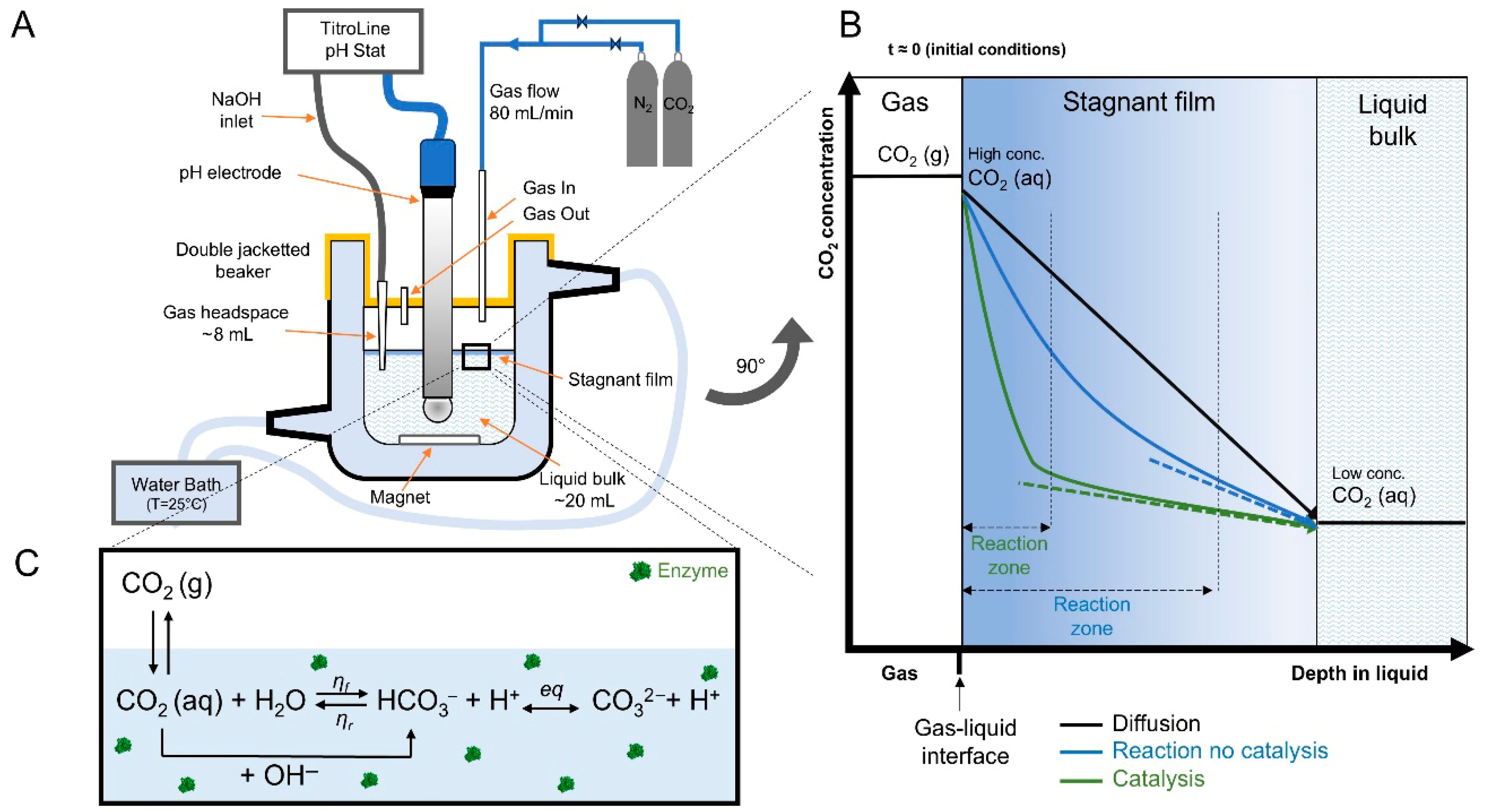
2 concentration gradients, thereby accelerating transport through the membrane. This is illustrated in
Figure 1B. The cartoon here corroborates that, according to Fick’s law, a non-reacting absorbate has a linear concentration gradient (black line) near the surface. For CO
2, on the other hand, transport relies on a reaction-diffusion mechanism, which generates a nonlinear gradient (blue), and this nonlinearity becomes more pronounced when the reaction is accelerated by a catalyst (green). Several important studies have proposed models based on these principles and hence rationalized mass transfer rates during carbon capture [
10,
21,
22]. This type of work typically uses experimental data from lab- or pilot-scale equipment that mimics the properties of industrial air-liquid contactors. The resulting model descriptions will be of crucial importance for the design, evaluation, and optimization of future CO
2 scrubbing systems. In the current work, we have taken an alternative avenue and designed an experimental configuration that enables a detailed comparison of enzyme kinetics and absorption rates. The experiments were designed to provide a well-defined surface area exposed to a controlled, uniform CO
2 partial pressure; see
Figure 1A. The recorded gas absorption rates were directly compared with enzyme kinetic parameters derived from stopped-flow measurements. We implemented a steady-state kinetic interpretation that considered initial rates at variable concentrations of either enzyme or substrate, thereby extending the Michaelis–Menten framework to the special case of a gaseous substrate. We found that the enzymatic reaction was essentially confined to a 20 µm deep film at the liquid surface and that the overall rate of gas absorption was equal to the enzymatic reaction turnover within this zone.
2. Results
CO
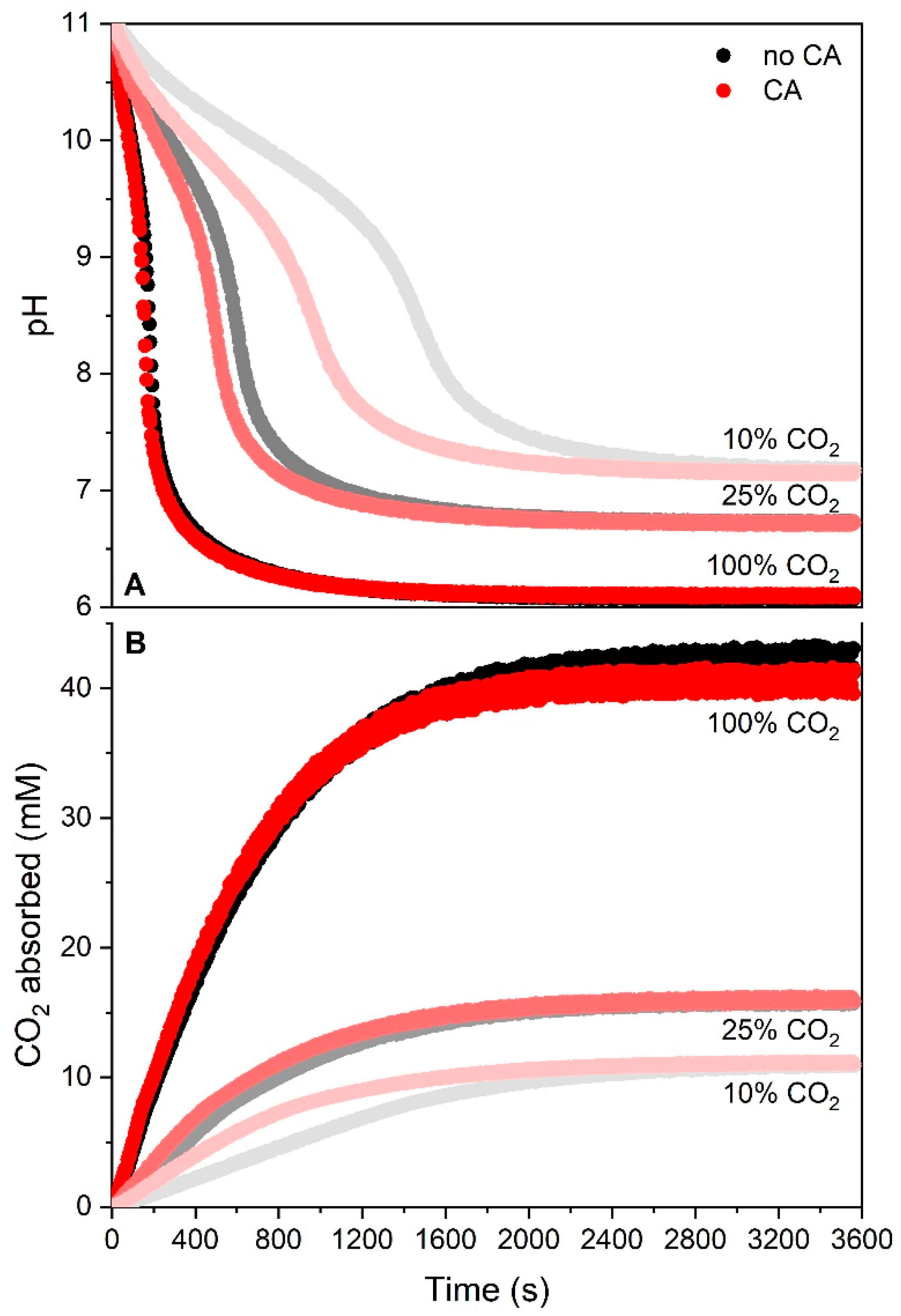
2 absorption rates were determined from pH measurements or pH stat measurements.
Figure 2 shows representative data from the pH measurement mode.
Figure 2A shows raw data for a K
2CO
3 absorbent purged with 80 mL/min of a gas with different P
CO2. It appeared that CO
2 gradually reduced the pH to an equilibrium level that depended on the partial pressure. In
Figure 2B, these pH changes have been converted to the amount of CO
2 absorbed, expressed in mmol per liter of absorbent, using
Equation (S6) in the Supplementary Materials. The progress curves in
Figure 2B showed gradual growth toward apparent equilibrium with an initial, near-linear region indicating a period of constant absorption rate.
We conducted several experimental series in which either the enzyme concentration (E
0) or the CO
2 partial pressure (P
CO2) was systematically varied. We converted the raw data into progress curves and used the slope over the first 50 s to specify the initial, steady-state rate of CO
2 absorption, v
0. Over this time frame, pH decreased by only a few tenths of a unit, and since all these experiments started at pH 11, the v
0 values are representative of this pH.
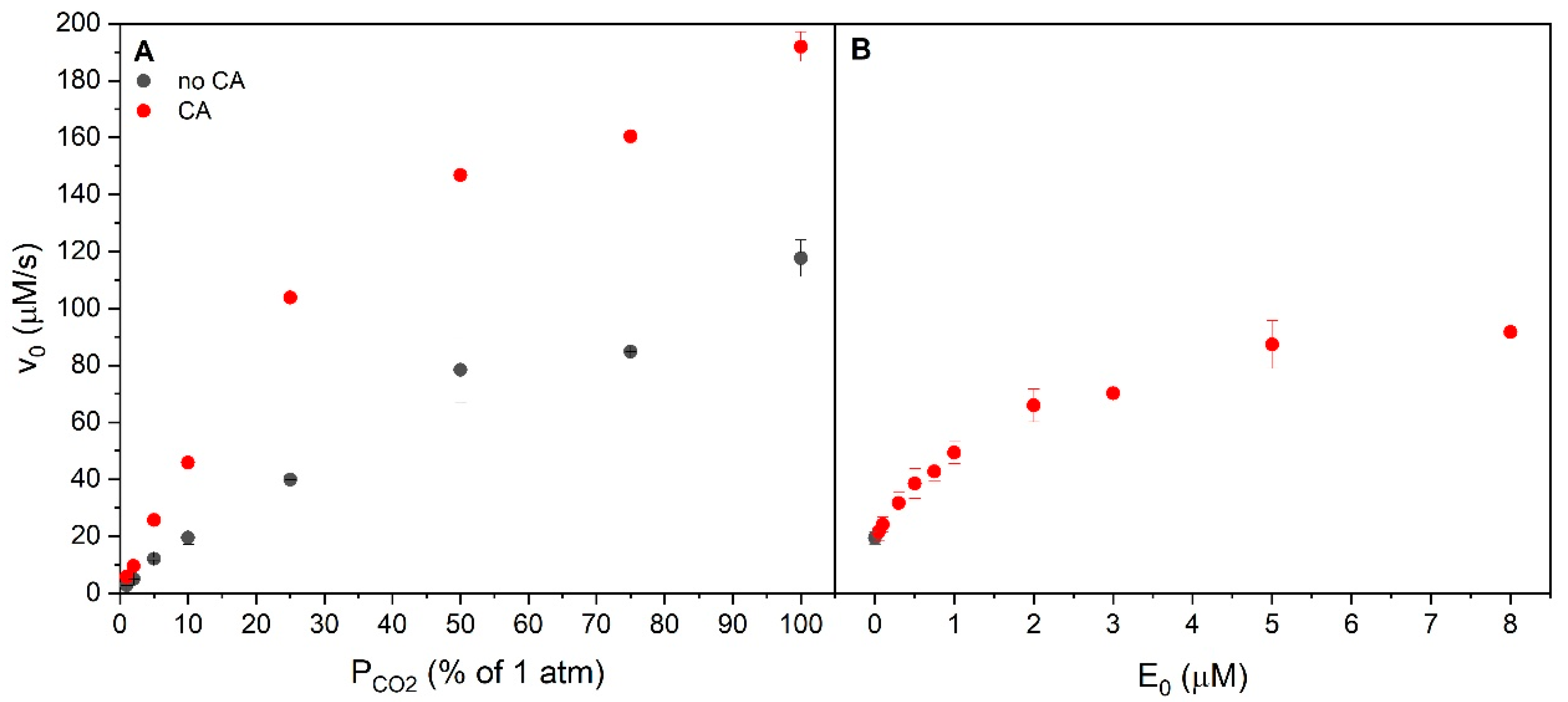
Figure 3 shows initial absorption rates as a function of either P
CO2 (
Figure 3A) or E
0 (
Figure 3B) for experiments with 100 mM K
2CO
3 as absorbent. Both series revealed a significant acceleration in CO
2 capture by the enzyme. In
Figure 3B, for example, we found that 5 µM
PmCA increased the rate by approximately 4.5-fold compared to the enzyme-free absorbent.
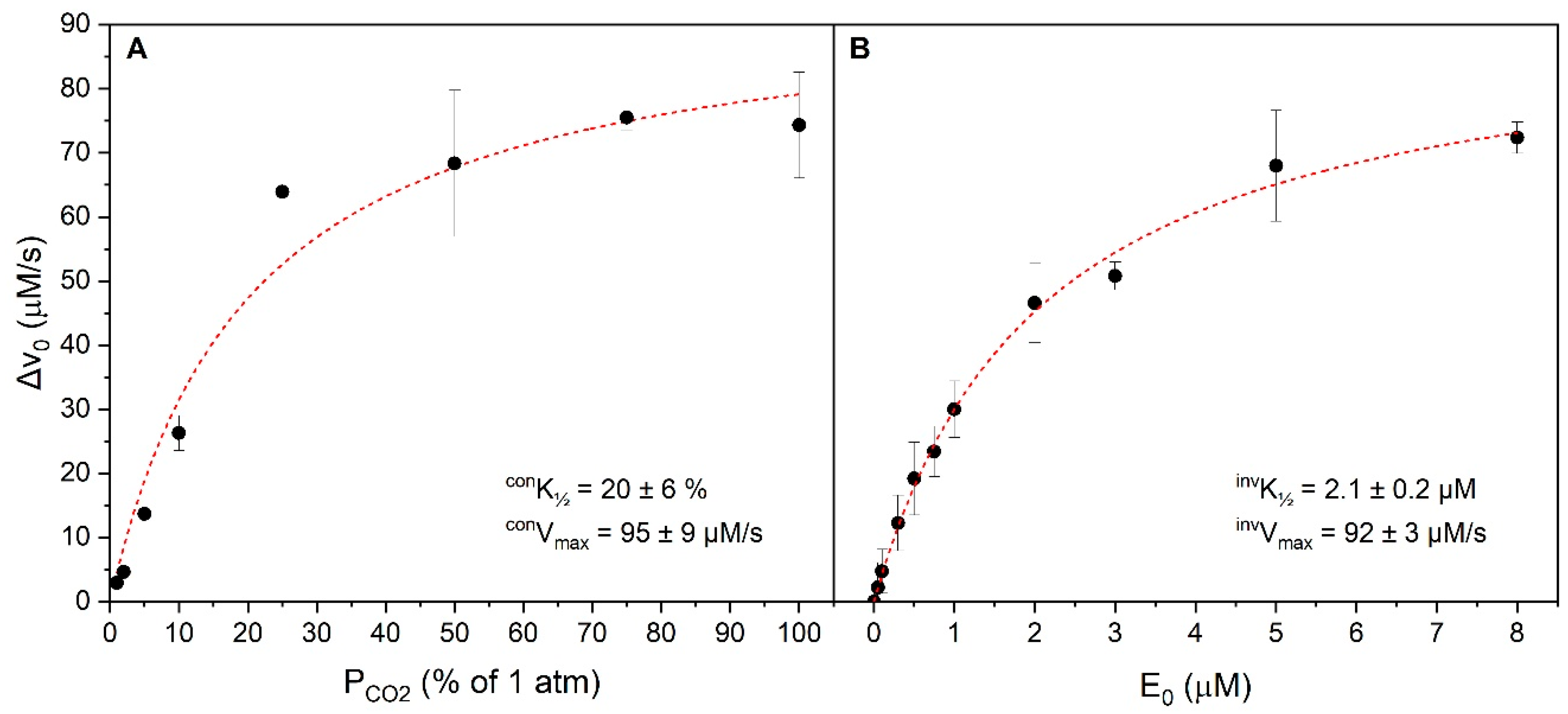
To further illustrate the enzyme’s contribution, we calculated the difference in initial rates, Δv
0, with and without
PmCA under otherwise identical conditions. Plots of Δv
0 in
Figure 4 showed an apparent saturation behavior for high concentrations of both substrate (
Figure 4A) and enzyme (
Figure 4B).
Figure 4A shows initial rates as a function of substrate concentration (specified by P
CO2) under quasi-steady-state conditions (near-linear progress curves for t < 50 s,
Figure S1). These characteristics are similar to those used in a conventional Michaelis–Menten (MM) plot, and we therefore analyzed
Figure 4A using the MM equation. We will henceforth refer to Equation (2) as the conventional MM equation.
In Equation (2),
convK
½ is an apparent Michaelis–Menten constant, which represents the CO
2 partial pressure that furnishes half-saturation of Δv
0. The apparent maximal rate,
convV
max, is the CA-induced rate increment at high P
CO2, when the enzyme near the interface becomes saturated with substrate. These two kinetic parameters are listed in
Figure 4A.
Figure 4B illustrates results in the opposite limit, where gradual increments in enzyme concentration at a fixed P
CO2 led to apparent saturation of the absorption rate. In usual bulk enzyme reactions, this limit is inadequate for steady-state analysis, because an excess of enzyme immediately depletes the substrate. However, in the current case, with a rapid and excessive supply of substrate in the purge gas, a steady state may occur, as evidenced by near-linear progress curves in
Figure S1. Steady-state kinetics under enzyme excess and a continuous supply of substrate have been discussed earlier for different systems [
25] and may be rationalized by the so-called inverse MM equation.
In Equation (3),
invK
½ is an apparent Michaelis–Menten constant, which specifies the enzyme concentration that gives half saturation of Δv
0 at a fixed P
CO2, while
invV
max is the enzymatic absorption rate at saturation. Parameters from this analysis are listed in
Figure 4B.
In addition to the data in
Figure 3 and
Figure 4, which represent pH 11, we studied the effect of pH using the pH-stat mode. During CO
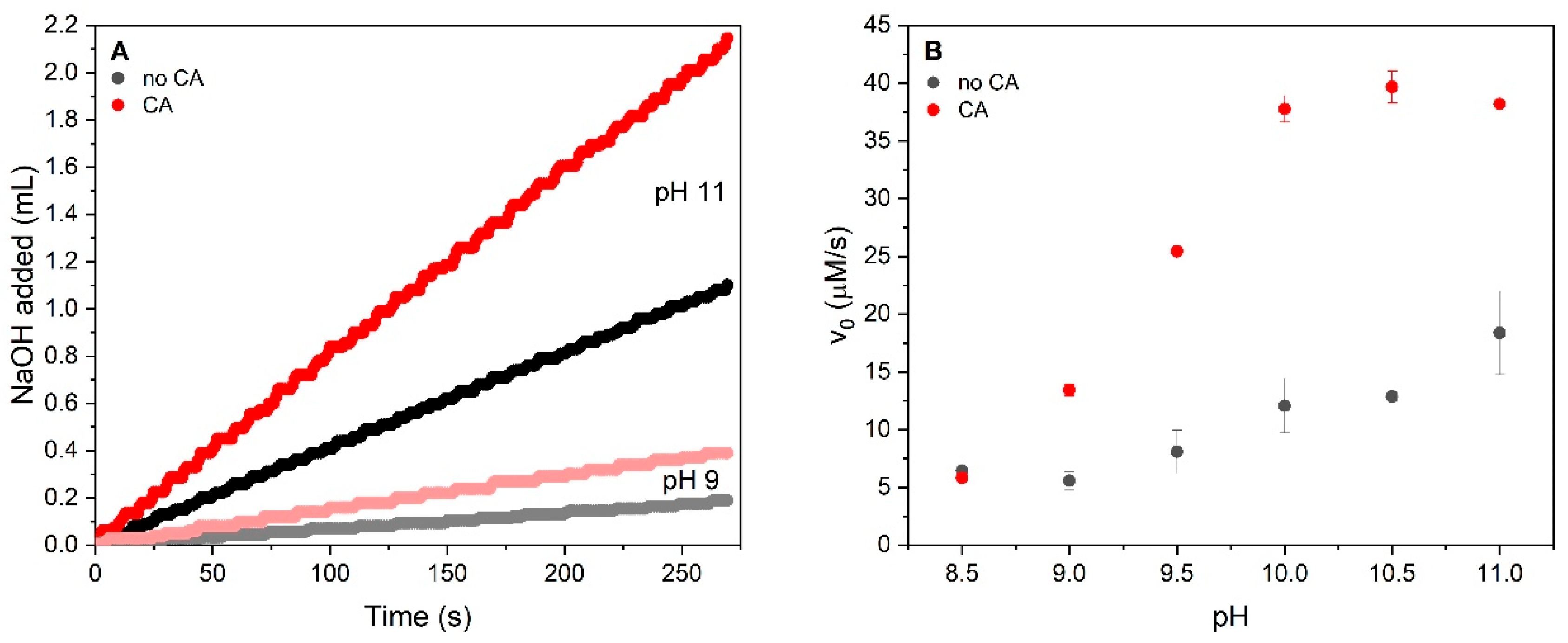
2 absorption at fixed pH values, we found that the total volume of NaOH solution increased linearly with time, as illustrated by examples in
Figure 5A. The initial rate of CO
2 absorption was derived from the slope of these plots (see
Section S3 in Supplementary Materials) and plotted against pH in
Figure 5B. Unsurprisingly, the results showed that uncatalyzed absorption grew steadily with pH (black symbols in
Figure 5B). More importantly, we found that the extent of enzyme acceleration followed the same trend. Thus, at pH 8.5,
PmCA had no measurable effect on the capture rate, but in more alkaline absorbents, this changed rapidly, and around pH 10, the addition of 1 µM
PmCA accelerated capture by about 3.5-fold.
In addition to the kinetic experiments with gaseous CO
2, we studied the steady-state kinetics of the
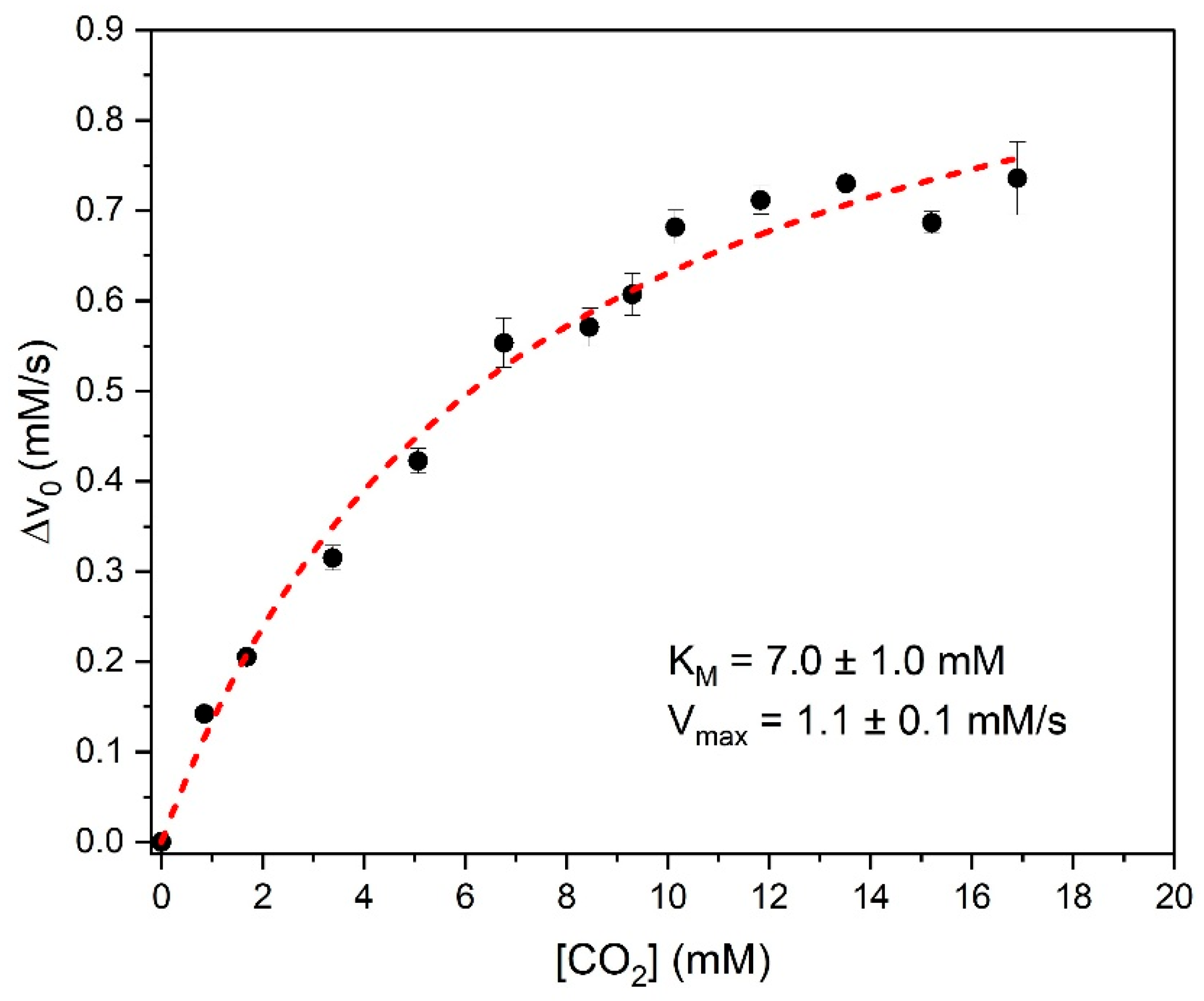
PmCA bulk reaction by stopped-flow spectrophotometry. Here, reaction rates at various loads of aqueous CO
2 were determined with and without the enzyme.
Figure 6 shows the difference in initial rates, Δv
0, as a function of CO
2 concentration. The best fit of the (conventional) Michaelis–Menten equation to the enzymatic rate of CO
2 hydration is shown.
3. Discussion
Steady-state kinetics provides a simple yet effective approach to basic and comparative analyses of enzyme reactions, and this is indeed the foundation of its tremendous success in biochemistry [
26]. If the principles and practices of steady-state kinetics could be adapted to the special case of a gaseous substrate, it could become a useful supplement to more comprehensive mass-transfer modeling approaches [
27,
28]. Here, we have suggested one approach to a steady-state kinetic analysis, and below, we discuss how it can be used to elucidate molecular aspects of enzyme-assisted CO
2 capture.
Capture rate vs.
substrate concentration (PCO2). Absorption rates for constant E
0 showed an apparent saturation behavior at high P
CO2 (
Figure 4A), and we propose that this has the same molecular origin as in standard enzymology. Thus, when substrate is abundant (P
CO2 >>
convK
½), essentially all enzymes close to the surface will be in complex with CO
2. This specifies saturation of the enzyme with substrate, and as a result, further increment of P
CO2 has little or no effect on the absorption rate, as observed in
Figure 4A. It is of particular interest to compare the kinetic parameters for absorption (
Figure 4) with kinetic constants for the bulk reaction (
Figure 6). We found the bulk kinetic parameters k
cat = (1.1 ± 0.1) × 10
5 s
−1 and K
M = 7 ± 1 mM, which compared favorably with literature values for the same enzyme [
16]. If we first focus on the maximal rate,
Figure 4A shows
convV
max = 0.1 mM/s for capture with E
0 = 1 µM. Using the parameters from the stopped-flow measurements, the maximal rate for CO
2 hydration in the bulk at this enzyme concentration was k
catE
0 = 100 mM/s. This is 1000-fold faster than the maximal capture rate in
Figure 4A, and this ratio provided information on the thickness of the “reaction zone”, i.e., the region near the interface where the enzyme reaction primarily occurred (see
Figure 1B). As the liquid height in the measuring vessel (
Figure 1A) was 20 mm, the measured
convV
max corresponded to a reaction zone of only 20 mm/1000, or about 20 µm. In other words, the kinetic data suggested that captured CO
2 penetrated only about 20 µm into the liquid before equilibrating with bicarbonate (Equation (1)). This implied that enzymes at deeper locations had little or no influence on absorption kinetics. It is also interesting to note that 20 µm is well below the thickness of the stagnant liquid layer for CO
2 absorption at a still surface defined by two-film theory [
29]. It follows that transport within the reaction zone will be diffusive. Now turning to the Michaelis constants, we found
convK
½ = 0.2 atm CO
2 during gas absorption (
Figure 4) and K
M = 7 mM for the bulk reaction (
Figure 6). To bring these two parameters on equal footing, we first note that at the interface, the concentration of CO
2 will be governed by Henry’s law. Using the Henry’s law constant K
H = 36 mM/atm [
30], it appeared that for P
CO2 = 0.2 atm (the value of
convK
½), the CO
2 concentration at the interface would be 7 mM. This value was in excellent agreement with the independently measured bulk K
M (
Figure 6), thus suggesting the rate of gas absorption can be directly linked to simple Michaelis–Menten kinetics measured for the bulk reaction. This linkage could be useful, for example, in analyses of dose–response curves for enzymatic carbon capture. We note that the CO
2 concentration estimated by Henry’s law is only valid at the interface. We will return to estimates of concentrations deeper into the solution below. We conclude that the kinetics of gas absorption in
Figure 4A exhibited Michaelis–Menten-like behavior with the same K
M and a 1000-fold lower V
max compared to the bulk enzyme reaction. Overall, these observations supported the interpretation that only enzymes within a few tens of µm from the surface contributed to mass transfer, and that the local enzyme kinetics in this zone matched the observed gas absorption rates.
Capture rates vs.
enzyme concentration (E0). The effect of
PmCA on the initial absorption rate, Δv
0, at fixed P
CO2 = 10% increased hyperbolically with the enzyme concentration, E
0 (
Figure 4B). This behavior resembled earlier observations of CA-assisted capture under different experimental conditions [
10,
31]. We propose that the apparent saturation at high E
0 reflected the limiting case, where the catalyzed reaction (Equation (1)) was much faster than diffusion through the stagnant layer. This situation has been rigorously analyzed for reactive absorption in water-filled membranes [
17,
18,
19,
20], and it was concluded that at high CA concentrations, the CO
2/HCO
3− system reached equilibrium very close to the surface. This had the interesting corollary that transport through the membrane core was entirely driven by diffusion, with no net reaction occurring in the equilibrated system. We propose an analogous interpretation, as illustrated by the green trace in
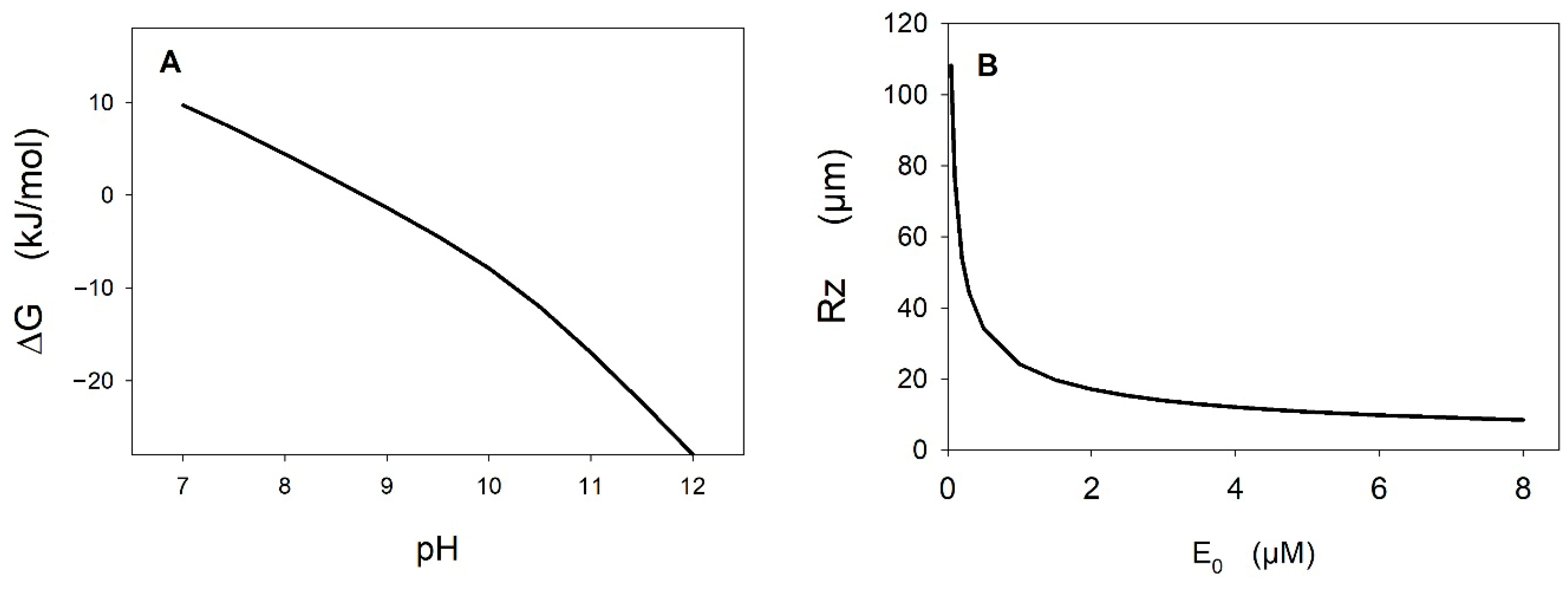
Figure 1B, and this provides a way to estimate the thickness of the reaction zone, r
z. To make this estimate, we introduce the operational criterion that r
z denotes the depth where 90% of the absorbed CO
2 has been converted to bicarbonate. As detailed in
Section S5 of the Supplementary Materials, this depth can be estimated if we assume that Henry’s law is valid at the interface and we equate the diffusion and reaction times, which led to the following correlation of r
z and E
0:
Here,
D is the diffusion coefficient for CO
2 in water, while
kcat and
KM are the kinetic parameters for
PmCA’s bulk reaction (
Figure 6). A plot of
rz vs.
E0 (
Figure 7B) showed that for the lowest enzyme concentrations used here (0.05–0.1 µM,
Figure 4B), CO
2 would diffuse about 100 µm into the liquid before reaching 90% conversion to bicarbonate. At the highest E
0 (4–8 µM), conversion was much faster, and the 90% boundary was at a depth of only 9–12 µm (
Figure 7B). Hence, we propose that the apparent saturation in
Figure 4B represents near-equilibration of Equation (1) within a reaction zone of that thickness. As illustrated in
Figure 7B, an increment of E
0 beyond this level has almost no effect on the absorption rate. The 90% cut-off represents an operational definition, but other reasonable levels only made minor changes to r
z. Insertion in Equation (4) of a 99% cut-off, for example, led to r
z values of 12–15 µm for the highest investigated
E0. It is notable that the estimates of r
z based on
Figure 4A and
Figure 4B, respectively, yielded similar results (10–20 µm), although they were independent with respect to both experimental data and principles of analysis. This obviously supported the interpretation that enzyme enhancement of carbon capture is limited to a reaction zone of this dimension.
Capture rates vs.
pH. High absorption rates in very alkaline solutions are typically ascribed to the direct reaction of CO
2 and hydroxide ions
At room temperature, the (second-order) rate constant for this reaction is about 8500 M
−1s
−1, while the (first-order) rate constant for the uncatalyzed formation of bicarbonate according to Equation (1) is about 0.03 s
−1 [
32,
33]. In practice, this means that, in the absence of a catalyst, Equation (1) is the dominant pathway for producing bicarbonate at pH 8–9 or lower. This dominance occurs because [OH
−] is extremely low in this pH range, and this limits the flux through Equation (5) despite the high rate constant. At higher pH, where the hydroxide concentration is appreciable, Equation (5) becomes the main pathway towards bicarbonate. This gradual dominance of Equation (5) explains the increasing absorption rates observed at high pH for the uncatalyzed experiments in
Figure 5 (black symbols). Based on the same kinetic reasoning, one might expect that rapid conversion of CO
2 via Equation (5) could render enzyme catalysis unnecessary in highly alkaline solutions (
PmCA only catalyzes Equation (1), not Equation (5)). However, results in
Figure 5B showed the opposite trend, with the most pronounced enzyme acceleration (red symbols) at pH 10–11. We suggest that this reflected a thermodynamic, rather than a kinetic, effect. To illustrate this, we calculated the free energy change in the reaction in Equation (1), ΔG, as a function of pH. We were interested in ΔG at the interface, and we again use that the local concentration of aqueous CO
2 can be estimated by Henry’s law. As detailed in
Section S4 of the Supplementary Materials, this led to the expression
The constants K
1 and K
H are the first dissociation constant for carbonic acid and Henry’s law constant for CO
2, respectively. The experimental pH and P
CO2 are known, and [HCO
3−] can be readily calculated using the Bjerrum equations [
1]. It follows that we can estimate ΔG for the reaction as a function of pH using Equation (6).
Figure 7A shows an example for a K
2CO
3 concentration of 100 mM, which parallels the experiments in
Figure 5. At high pH, ΔG was large and negative. This implied that Equation (1) is spontaneous in the forward direction and hence prone to enzyme acceleration. At lower pH, on the other hand, the driving force of Equation (1) decreased, and around pH 8–9, ΔG was close to zero. It follows that Equation (1) becomes nearly equilibrated in the reaction zone and hence insensitive to enzyme catalysis, as indeed observed in
Figure 5B.
In conclusion, we have proposed a steady-state kinetic framework that provides insights into fundamental and mechanistic aspects of enzyme-assisted CO
2 capture. However, the approach was not intended for the technical analysis of actual air-liquid contactors. The key experimental inputs were kinetic parameters from conventional and inverse Michaelis–Menten measurements, obtained in an experimental setup that provided a still liquid interface of known area and a constant, uniform partial pressure of CO
2 during absorption. By combining steady-state kinetic parameters for gas absorption (
Figure 3 and
Figure 4) with the parameters measured for the bulk enzymatic reaction (
Figure 6), we were able to estimate the thickness of an operationally defined reaction zone and how this depended on the enzyme concentration (
Figure 7B). Two independent approaches to this indicated that the reaction zone was approximately 10–20 µm deep when the enzyme concentration exceeded 1 µM. This depth is lower than literature values for the stagnant liquid layer in this type of setup, as defined by two-film theory [
29,
34]. It followed that enzyme effects were limited to the outer part of the stagnant layer, while further transport towards the homogeneous bulk was purely diffusive (c.f.
Figure 1B). Interestingly, we found a direct linkage between gas absorption rates and enzyme kinetics in the reaction zone, estimated from parameters obtained from stopped-flow measurements. This implied that the enzyme’s full effect was exerted within the gas–liquid interface and hence that the local enzyme concentration there was crucial for capture efficacy. Since only enzymes located in this reaction zone actively improve mass transfer, we speculate that the potential of enzyme-assisted carbon capture could be notably enhanced by partitioning of the enzymes to the interface. This suggested that strategies for designing and engineering interfacially active enzyme variants could be of interest. The idea of describing local enzyme kinetics in the reaction zone also allowed us to rationalize the pH dependence of enzyme-accelerated CO
2 capture. All in all, we propose that steady-state kinetics could provide a simple and useful supplement to more complex mass-transfer models, thereby helping elucidate mechanisms and bottlenecks in enzyme-assisted carbon capture.
4. Materials and Methods
Experimental procedures. CO
2 absorption rates were measured in a setup illustrated in
Figure 1A. Absorption occurred in a closed, cylindrical, jacketed glass cell, with a diameter and volume of 35 mm and 28 mL, respectively. The headspace had inlets and outlets for gas perfusion, and the jacket was purged with water at 25 ± 0.1 °C. The gas passed over the still surface without bubbling or sparging, and the cell contained 20 mL of aqueous potassium carbonate solution, which was stirred continuously at 800 rpm using a magnetic stirrer. In this way, the exact area of the still gas–liquid interface could be determined (9.6 cm
2) and kept constant in all measurements. The solution was prepared using potassium carbonate (≥99.0% purity, Merck, Germany) and deionized water. The purge gas was a mixture of N
2 (≥99.8 vol. % purity) and CO
2 (≥99.9 vol. % purity) with a predefined partial pressure of CO
2, P
CO2, controlled by two mass flow valves (CMOSens® SFC5500 mass flow controller, Sensirion, Switzerland). The total pressure was 1 atm, and throughout this work, we report P
CO2 in % of 1 atm. A total gas flow rate of 80 mL/min was found adequate and used throughout. Higher flow rates disrupted the liquid surface’s stillness, while lower flow rates were insufficient to maintain a constant gas composition in the 8 mL headspace. The measuring cell was equipped with a pH electrode (A 162 2M-DIN-ID, SI Analytics, Mainz, Germany), which was connected to a titration system (TitroLine 7000, SI Analytics, Mainz, Germany). The setup was used in two separate modes: pH measurement mode and pH-stat mode, as detailed below. Measurements were conducted either with or without the enzyme, which was added to the desired final concentration 30 s before the gas flow was started. The starting point (t = 0) for kinetic analysis was defined by the onset of the gas flow. All measurements were done in replicates as specified, and the mean and standard deviation were calculated. The enzyme was the thermostable carbonic anhydrase from
Persephonella marina (
PmCA) [
16,
35], which was produced and purified as described elsewhere [
36].
In the pH measurement mode, we studied the effect of either enzyme or substrate concentration (E0 or PCO2) on the rate of CO2 absorption. The initial liquid phase was 10 mM or 100 mM K2CO3, and the change in pH was recorded during headspace purging in trials with either fixed E0 and variable PCO2 or, conversely, multiple E0 values at a fixed PCO2. Each individual measurement used a fresh K2CO3 solution with pH adjusted to 11.0.
The pH-stat mode was used to study the effects of pH on the CO2 absorption rate. We initially loaded 20 mL of 100 mM K2CO3 (with or without 1 µM CA) into the cell for thermal equilibration. We lowered the pH of this solution to a value about 0.05 units above the desired (fixed) value using 6 M HCl. The airflow was then started, and after the pH had fallen to the titrator’s set point, we recorded the volume of 200 mM NaOH delivered to maintain a constant pH as CO2 was continuously absorbed. We conducted experiments with pH set points between 8.5 and 11.0, and at a fixed PCO2 of 10%.
Data analysis. The primary observables in this work were either pH (pH measurement mode) or the volume of 200 mM NaOH added continuously to maintain a constant pH (pH-stat mode). To conduct kinetic analyses, these parameters must be converted to CO
2 capture rates expressed as concentration per unit time. To do so, we used the reaction for CO
2 capture in carbonate solutions
The relative population of the species in Equation (7) can be readily calculated from the recorded pH values using the Bjerrum equations [
37]. Combining this and mass conservation allowed conversion of pH changes into absorption rates as detailed in
Section S2 of the Supplementary Materials. Representative examples of this conversion are shown in
Figure 2. The analysis of pH-stat data also relied on the Bjerrum equations, as described in
Section S3 of the Supplementary Materials. Representative examples of converting raw pH-stat data to absorption rates are shown in
Figure 5.
We studied the bulk kinetics of PmCA by stopped-flow spectrometry. The experiments were performed on an SFM-4000 instrument from BioLogic (Seyssinet-Pariset, France). We monitored absorption at 590 nm, and all reaction mixtures contained 1 mM K2CO3 and 0.100 mM Thymol Blue (Merck Life Science A/S, Darmstadt, Germany), with an initial pH of 9.6. We conducted experiments either without PmCA or with 10 nM of the enzyme at different CO2 concentrations ranging from 0 to 17 mM. The aqueous CO2 solution was prepared by saturating MQ water with 100% CO2. To retrieve reaction rates, we made a calibration curve by mixing known amounts of HCl with the carbonate/thymol blue solvent. This gave a linear correlation between the number of protons and the absorbance changes over the range used in the kinetic measurements. To find the initial rates, we determined the slope of the stopped-flow absorbance trace between 10 ms and 40 ms for samples with and without enzyme. The differences in slopes were assigned to the enzyme reaction and converted into reaction rates using the calibration curve.



 ,
,