Article

Crystalline Carbon Nitride Embedded with Pt Nanoparticles for Boosting Photothermal Degradation of Toluene

1
College of Environment & Safety Engineering, Fuzhou University, Fuzhou 350108, China
2
Institute of Innovation and Application, National Engineering Research Center for Marine Aquaculture, Zhejiang Ocean University, Zhoushan 316022, China
3
State Key Laboratory of Chemistry for NBC Hazards Protection, State Key Laboratory of Photocatalysis on Energy and Environment, College of Chemistry, Fuzhou University, Fuzhou 350108, China
*
Authors to whom correspondence should be addressed.
Catalysts 2026, 16(4), 295; https://doi.org/10.3390/catal16040295 (registering DOI)
Submission received: 19 February 2026 / Revised: 18 March 2026 / Accepted: 27 March 2026 / Published: 29 March 2026
(This article belongs to the Section Photocatalysis)

Abstract

Degradation of volatile organic compounds (VOCs) by environmentally friendly methods remains a challenging issue. Photothermal catalysis, as an emerging green catalytic technology, merges the benefits of both thermal catalysis and photocatalysis, presenting itself as a viable strategy for VOC degradation. However, achieving higher catalytic performance by reasonably designing the synthetic route of catalyst carriers remains difficult. In this study, crystalline carbon nitride material, poly(triazine imide) (PTI), was prepared using a unique molten salt synthesis method and employed as a support for Pt to construct an exceptional photothermal catalyst. In a continuous-flow system under Xe lamp irradiation with external temperature control, toluene was efficiently degraded at a high rate of nearly 100% under low Pt content (0.31 wt%) and a relatively low operational temperature condition (143 °C). As a carrier of noble metals, PTI material exhibited a larger specific surface area and fewer structural defects, resulting in more efficient toluene conversion and mineralization. The joint action of photocatalysis and thermocatalysis synergistically facilitated the efficient generation of active species and accelerated charge transfer, thereby significantly boosting toluene catalytic oxidation. These findings provide valuable guidance for designing and optimizing photothermal catalysts for the removal of VOCs.

1. Introduction

The considerable amount of emissions produced by volatile organic compounds (VOCs) presents a critical hazard to human well-being and the ecological environment [1]. Consequently, exploring efficient and stable technologies of VOC removal has become a significant challenge. In general, the degradation of VOCs can be achieved by photocatalytic (PC) or thermocatalytic (TC) reactions. However, the single operation of PC or TC has some limits. PC often exhibits relatively low reaction efficiency and inadequate oxidation capacity, while TC generally requires high energy consumption and may experience catalyst deactivation, which constrains the potential application scenarios of catalysts [2,3]. Photothermal catalysis (PTC), integrating the attributes of PC and TC, demonstrates enhanced efficiency in catalytic performance [4]. In PTC reactions, thermal energy can effectively facilitate the movement and isolation of photogenerated charges, while the light-induced thermal effect accelerates TC reaction kinetics [5,6]. Moreover, reactive oxygen species generated during photocatalysis play a pivotal role in driving the complete oxidation of pollutants [7,8]. Therefore, PTC is considered an effective approach in tackling low degradation efficiency and high external energy requirements [9].
Currently, two categories of PTC materials are employed for the elimination of VOCs: catalysts modified by noble metals and catalysts based on metal oxides [10]. Compared with catalysts based on metal oxides, noble metal-modified catalysts have attracted extensive attention due to their superior catalytic performance, enhanced selectivity, and greater stability [11,12,13], such as Pt/TiO2 [14], Pt/γ-Al2O3 [15], and Pd-Ag@CeO2 [16]. Optimizing noble metal-supported catalysts heavily relies on the inherent characteristics of carrier materials, which significantly impact electron transport efficiency and dispersion of active sites [17,18,19,20,21]. Recently, polymerized carbon nitride (PCN) has emerged as a superior catalyst support, recognized for its environmental nontoxicity, exceptional thermal stability, facile tunability and customization, as well as its diverse surface chemistry [22,23,24]. PCN is a polymer material connected by the bridge amino linkage of the heptazine structure unit with a π-conjugated system via sp2 hybridization [25]. The –NH2, –NH groups on the surface of PCN facilitate the dispersion and stabilization of noble metal nanoparticles through the formation of a strong coordination interaction [26]. PCN could be recognized as a distinguished catalyst in catalytic oxidation reactions [27]. However, owing to the inherently sluggish mass transport in a solid-phase system, the polycondensation reaction during traditional thermal polymerization is often incomplete, leading to many unnecessary structural defects becoming the recombination center of photogenerated carriers, seriously limiting its catalytic efficiency [28,29]. Fortunately, molten salt synthesis provides a better mass transfer rate and reaction environment for more complete polycondensation reactions, thus expanding the π-conjugated system [30,31]. Recent studies have demonstrated that molten-salt-assisted synthesis can promote the formation of more ordered frameworks and tunable microstructures, which effectively regulate the crystallinity, morphology, and surface properties of PCN materials, improving their catalytic performance [32,33,34]. Compared with the amorphous PCN, the crystalline carbon nitride prepared by the molten salt synthesis method has the advantages of higher crystallinity, more regular morphology, and a larger specific surface area. Its fundamental framework is additionally condensed into a triazine ring structural unit, forming the poly(triazine imide) (PTI) structure [35]. Due to its highly ordered framework and improved structural stability, PTI is expected to exhibit superior catalytic performance compared to conventional amorphous g-C3N4-based materials. Although Pt/g-C3N4 catalysts have been widely reported for oxidation of VOC [27], the application of crystalline PTI-based catalysts in photothermal VOC degradation remains rarely explored.
In this paper, binary alkali metal chloride LiCl/KCl (Tm = 352 °C, 45:55 wt%) was selected as the medium for the molten salt synthesis. A series of PTIs with different grain sizes were successfully synthesized through manipulation of the precursor to the molten salt mass ratio, which was used as the carrier for anchoring Pt nanoparticles. Compared with PCN, a superior toluene conversion efficiency was demonstrated by PTIs with higher crystallinity during PTC degradation under continuous-flow conditions. Based on the characterization of PTI crystals, the optimal amount of molten salt medium for the synthesis of PTI with better PTC performance was determined. Furthermore, an investigation into the mechanism underlying this activity enhancement was conducted.

2. Results and Discussion

2.1. Structure and Composition of the Catalysts

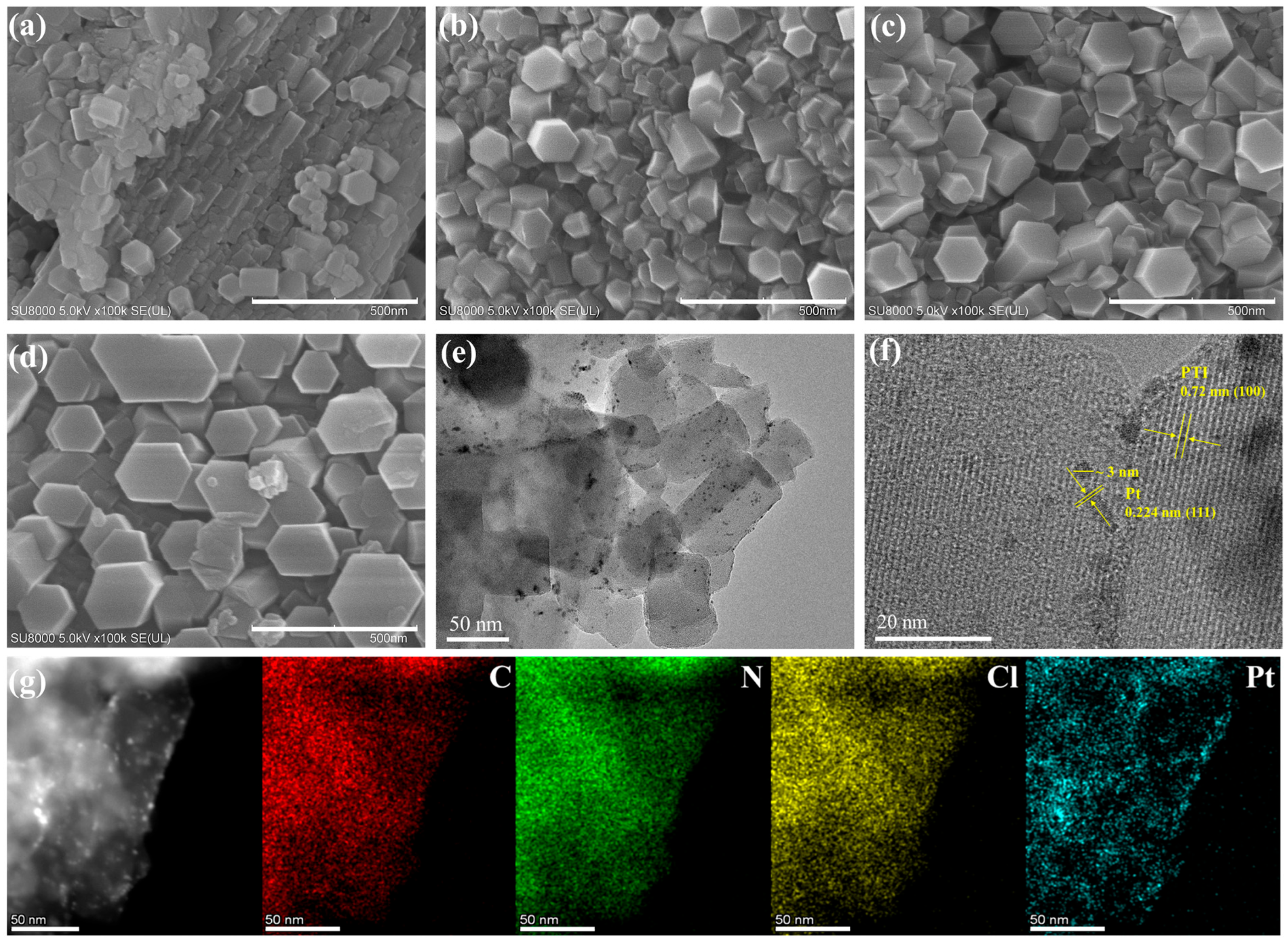
The microscopic morphologies of Pt-PTIX and Pt-PCN samples were determined by SEM and TEM. Figures S2 and S3 display the SEM and TEM images of Pt-PCN samples, which exhibit a typical bulk accumulation morphology [27]. All Pt-PTIX samples showed similar hexagonal prisms in Figure 1a–d and Figure S4 [28], but their crystal packing arrangements and particle dimensions varied. As shown in Figure 1a, when the amount of molten salt was 1:1, PTI1 crystals exhibited extensive disordered aggregation and poor dispersion. This phenomenon occurs because the precursor cannot be completely dissolved in an inadequate molten salt environment, and the inadequate amount of molten salt fails to provide sufficient template space for crystal formation and growth. This has a negative effect on the uniform dispersion of reaction points [36]. As depicted in Figure 1b–d, the increase in molten salt dosage is observed to alleviate the aggregation of PTI crystals, resulting in improved crystal dispersion and a gradual increase in the size of hexagonal prism crystals. The increased molten salt content facilitates a more favorable melting environment and template space for crystal growth, thereby enhancing the dissolution of precursors in the molten salt environment and providing sufficient space for PTI crystal growth. The specific surface area of Pt-PTI1, Pt-PTI3, Pt-PTI5, and Pt-PTI10 in Figure S5a shows an initial rise followed by a subsequent decline, with corresponding values of 39, 54, 28 and 19 m2/g, respectively. Among them, Pt-PTI3 possesses the highest specific surface area, which could be ascribed to its improved dispersion and relatively smaller apparent particle size. Therefore, adding an appropriate amount of molten salt can affect crystal size and dispersion [37]. In addition, PTI exhibits a markedly higher specific surface area compared to the conventional Pt-PCN (only 9 m2/g), implying greater exposure of active sites. As a porous material, the Pt-PTI3 sample has the largest pore volume and pore size (Table S2, Figure S5), which can facilitate the adsorption and degradation of reactants in favor of catalytic reaction. The TEM and HRTEM images in Figure 1e,f exhibit a crystal spacing of 0.72 nm for PTI3, which can be attributed to the (100) crystal plane relative to the in-plane repeating unit, indicating its good crystallinity. In addition, lattice fringes with a spacing of 0.224 nm are observed, corresponding to the Pt (111) plane, confirming the successful deposition of crystalline Pt species. The Pt nanoparticles are estimated to be on the order of ~3 nm in size and are well dispersed on the PTI3 surface. HAADF-STEM analysis, along with EDX elemental mapping (Figure 1g), demonstrates a homogeneous arrangement of N, C, Cl and Pt elements within the Pt-PTI3. The relatively small particle size and uniform dispersion of Pt, together with the extremely low Pt loading (0.31 wt%), suggest minimal aggregation, which is favorable for the PTC reaction [38].
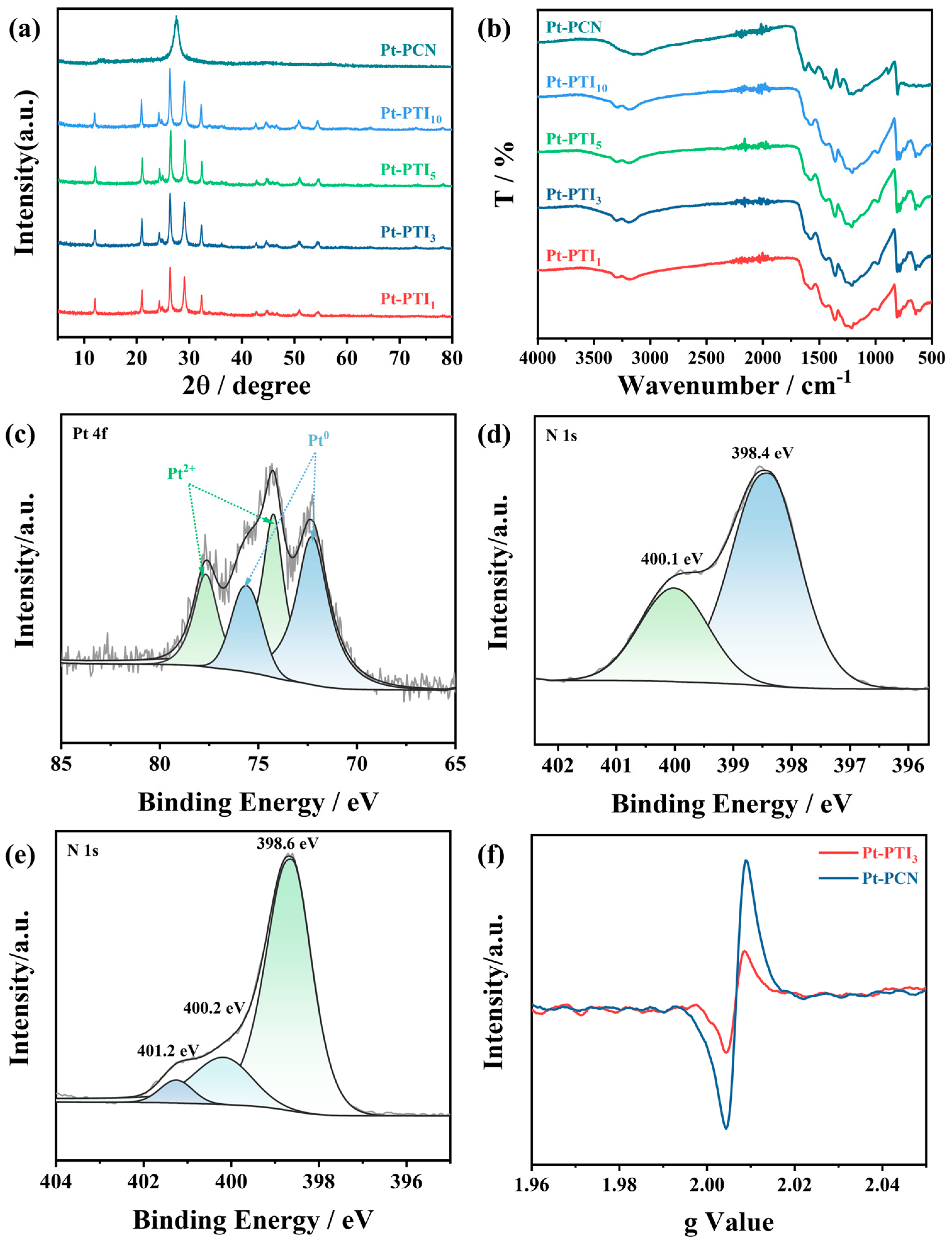
The powder XRD technique was utilized to investigate the crystal structures of the Pt-PCN and Pt-PTIX samples. The crystal diffraction structures viewed in Figure 2a for all Pt-PTIX show remarkable similarity, which can be attributed to the characteristic diffraction pattern of PTI [31,39]. The peak of diffraction at 12.0° can be attributed to the in-plane periodic arrangement of triazine units, corresponding to the (100) crystal plane with an interplanar spacing of around 0.72 nm. This value is in good agreement with the lattice spacing observed in the HRTEM images, further confirming the ordered in-plane structure of the PTI. Meanwhile, the strongest diffraction peak observed from 26.4° corresponds to the (002) crystal plane with a crystal plane distance of 0.32 nm, representing the stacking of conjugated aromatic rings [40]. In the Pt-PCN sample, the periodic arrangement of heptazine basic structural units and the stacking of graphene layered structures correspond to the two typical diffraction peaks at 13.0° and 27.5°, respectively [41]. The lack of Pt diffraction peaks in the XRD patterns of all samples may be explained by the limited quantity, comparatively tiny particle size, and homogeneous distribution of Pt nanoparticles [27,42]. The diffraction peaks of Pt-PTIX exhibit a more pronounced sharpness compared to that of Pt-PCN, indicating the significantly enhanced crystallinity of the PTI sample. This improvement in crystallinity is expected to alleviate structural defects of PTI and promote the effective transfer of photogenerated charge.
To investigate the chemical constituents and surface properties of the sample, we conducted FT-IR, solid-state 13C NMR, Raman spectroscopy, and XPS analysis. In Figure 2b, the FT-IR spectrum reveals that the prepared Pt-PTIX samples exhibit nearly identical functional groups. The vibrations at 3200 cm−1, 1200–1600 cm−1, and 800 cm−1 originate from the stretching vibrations of bridging amino groups and the characteristic vibrational modes of triazine rings, including the out-of-plane bending vibration of the triazine units [43]. The FT-IR spectra of Pt-PCN display similarities to the typical g-C3N4 pattern [44]. The triazine-based framework of PTI3 is further supported by the solid-state 13C NMR spectrum (Figure S6). The resonance signals at approximately 162 and 158 ppm are attributed to the carbon atoms within the triazine rings, while the splitting of these peaks arises from differences in the local chemical environment caused by proton coordination. In addition, the signal located at 168 ppm is assigned to the carbon atoms of triazine units without proton coordination [45,46]. These results indicate that the fundamental structural units of the PTI3 material are composed of triazine rings rather than heptazine rings. Meanwhile, the chemical states of Pt were analyzed by XPS. The high-resolution Pt 4f spectrum (Figure 2c) displays two sets of peaks, which can be ascribed to the coexistence of both metallic (Pt0) and oxidized (Pt2+) platinum states due to spin–orbit coupling of Pt 4f electrons. The presence of these species is consistent with previous reports [27,47]. Based on the peak fitting results, the proportion of metallic Pt0 is calculated to be approximately 76.8%, indicating that Pt mainly exists in a metallic state on the catalyst surface. Pt species have been proven to be active sites in PTC reactions, which can promote electron transfer, oxygen adsorption, and the generation of reactive oxygen species in toluene degradation [38,48,49]. In the PTI sample, the N 1s spectrum (Figure 2d) was deconvoluted into two peaks at 398.4 eV and 400.1 eV, with the former assigned to sp2 hybridization nitrogen (C–N=C) in the triazine ring and the second one assigned to the sp3 hybridization of the bridge N atom (C–NH–C) within its structure [50]. In contrast, the Pt-PCN sample exhibited the deconvolution of the N 1s spectrum (Figure 2e), which revealed three distinct nitrogen species. The peak at 398.6 eV was characteristic of the sp2-hybridized N atom presented within the heptazine ring (C–N=C). Additionally, another peak appeared at 400.2 eV, which originated from the N atom forming the bridging units in the heptazine ring (N–C3). The peak at 398.6 eV is characteristic of the two-coordinated sp2 nitrogen (N2C) within the triazine ring, while the peak at 400.2 eV originates from the three-coordinated nitrogen (N3C) that links the triazine rings. Lastly, a third peak emerged at 401.2 eV originating from an incompletely polymerized amino group located on the surface of the sample (–NHX) [44,51]. The XPS results confirm that PTI has a more complete polycondensation structure and its π-conjugated system is more extensive, which reduces unnecessary structural defects and provides a more efficient channel for charge migration. For the LiCl/KCl eutectic mixture used in the synthesis process, the PTI samples were scanned by a high-resolution spectrum of Li and Cl elements (Figure S7b,c). The results show that the presence of Li and Cl species is associated with the PTI framework, which is attributed to the residual molten-salt components remaining after the polymerization procedure at high temperature. Such species are reported to significantly contribute to the stability of the triazine structure [31].
To examine the electronic properties of the samples, EPR tests were used for characterization. As shown in Figure 2f, a significant Lorentz curve is observed in the samples with a g-factor value of 2.005, typically correlated with the existence of N defects within the carbon nitride structure. The EPR intensity of the Pt-PTI3 sample exhibits a noticeable decrease in comparison to that observed for the Pt-PCN, suggesting a lower density of unpaired electrons. This result implies fewer structural defects and a more complete π-conjugated system, which facilitates the isolation and migration of the electric charges [39]. Furthermore, the thermal stability of the sample in an oxygen environment was examined using TGA, and the findings are illustrated in Figure S8. The decomposition of PCN and PTI samples occurred at 600 °C, indicating good thermal stability, which ensures their stability during PTC reaction.

2.2. Photoelectrochemical Properties of Catalysts

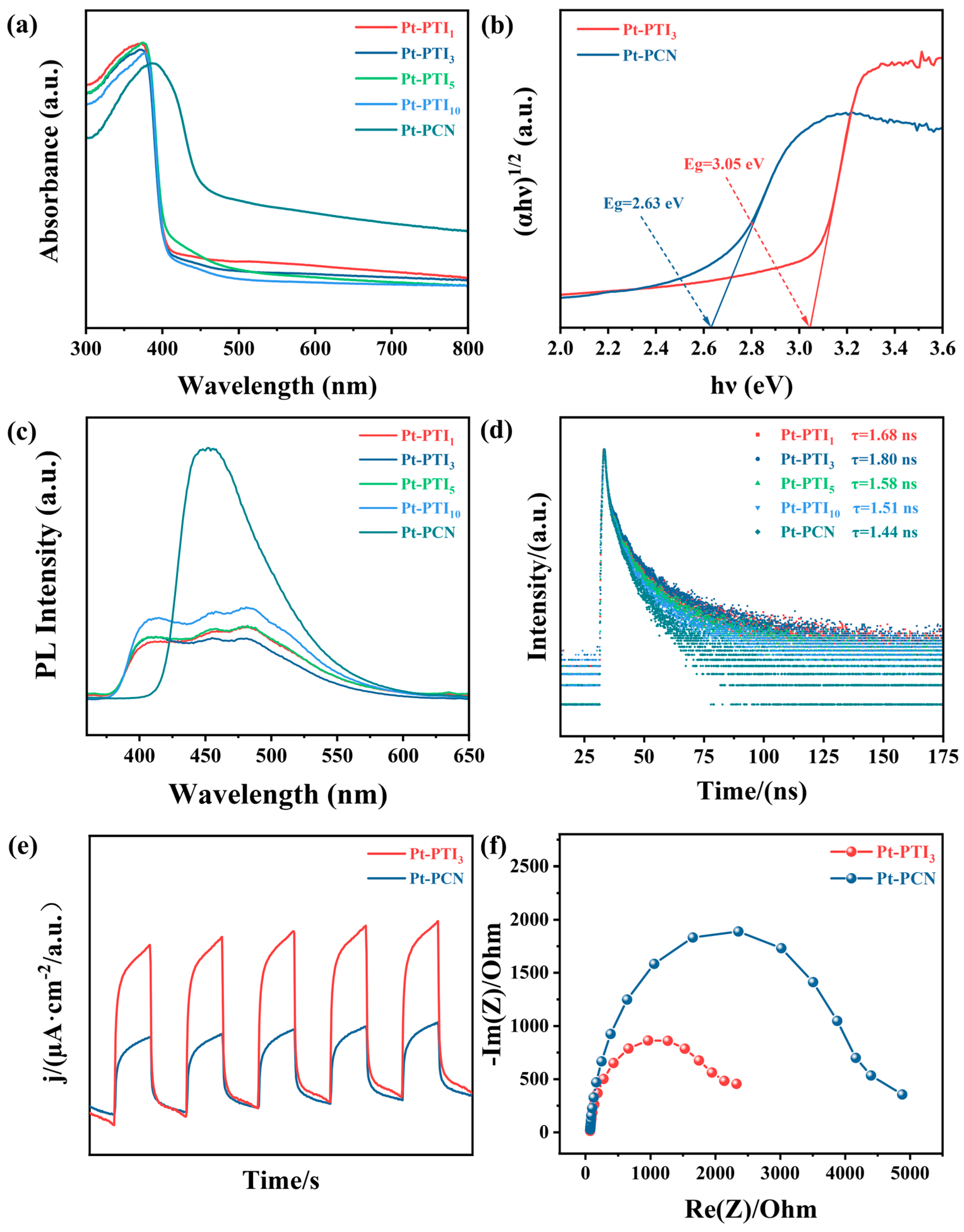
As depicted in Figure 3a, the optical absorption properties of Pt-PTIX and Pt-PCN samples were characterized by UV–vis diffuse reflectance spectroscopy (UV–vis DRS). The absorption band edge of Pt-PTIX appeared at approximately 400 nm, whereas that of Pt-PCN appeared at ~510 nm [31]. The increased light absorption tail of Pt-PCN in the visible spectrum could potentially be ascribed to the presence of more abundant structural defects, which further confirms the higher degree of structural polycondensation in PTI samples [52]. The bandgap energies were estimated using the Tauc method based on the plots of (αhν)1/2 versus hν (Figure 3b). The bandgap values for Pt-PTI3 and Pt-PCN were calculated to be 3.05 eV and 2.63 eV, respectively. The relatively larger bandgap of Pt-PTI3 indicates a more ordered electronic structure with fewer defect states, which is beneficial for efficient charge transfer and contributes to the enhanced photothermal catalytic performance of the Pt-PTI3. These results are consistent with previously reported values in the existing literature [53]. The photoelectron–hole separation ability of the catalyst was characterized by room temperature PL and TRPL. The spectrum of PL depicted in Figure 3c indicates that the fluorescence strength of Pt-PTIX is significantly weakened compared with Pt-PCN, among which Pt-PTI3 is the best, which indicates that the photogenerated carrier recombination of PTI is effectively suppressed. The TRPL spectrum in Figure 3d shows that the fluorescence lifetime of Pt-PTI3 (1.80 ns) is significantly longer than that of Pt-PCN (1.44 ns), indicating a longer lifetime and more efficient separation and migration of photogenerated carriers within Pt-PTI3. The photocurrent response and impedance spectrum can directly reveal the photoelectric response ability of the samples. The photocurrent response signal of Pt-PTI3 in Figure 3e exhibits a significantly enhanced intensity compared to Pt-PCN, suggesting that the molten-salt-treated Pt-PTI3 sample possesses superior conductivity. This implies efficient transmission of photogenerated carriers within the structure of Pt-PTI3. The significantly smaller Nernst curve-ring radius of Pt-PTI3 in Figure 3f also verifies this conclusion.
The redox capacity of a catalyst and the generation of active species are closely related to its energy-band location. To comprehend the band structure of the catalyst, the conduction band (CB) location was obtained from the Mott–Schottky curves (Figure S9). The measurements were carried out using an Ag/AgCl reference electrode, and the potentials were converted to the NHE scale according to ENHE = EAg/AgCl + 0.197 V. The positive slopes of the Mott–Schottky curves indicate that both PTI3 and PCN have typical n-type semiconductors. The test results show that the CB positions of PTI3 and PCN are −0.67 V and −1.20 V (vs. NHE), respectively. Based on the bandgap value in Figure 3b, the PTI3 and PCN samples exhibit valence band (VB) positions of 2.38 V and 1.43 V (vs. NHE), respectively. The results indicate that the oxidation of PTI was significantly stronger than that of PCN, thereby promoting the oxidative degradation of VOCs.
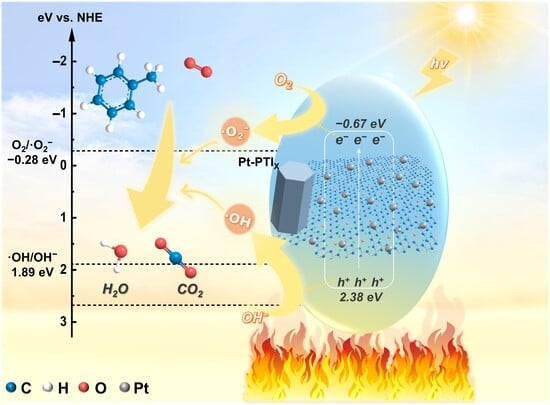
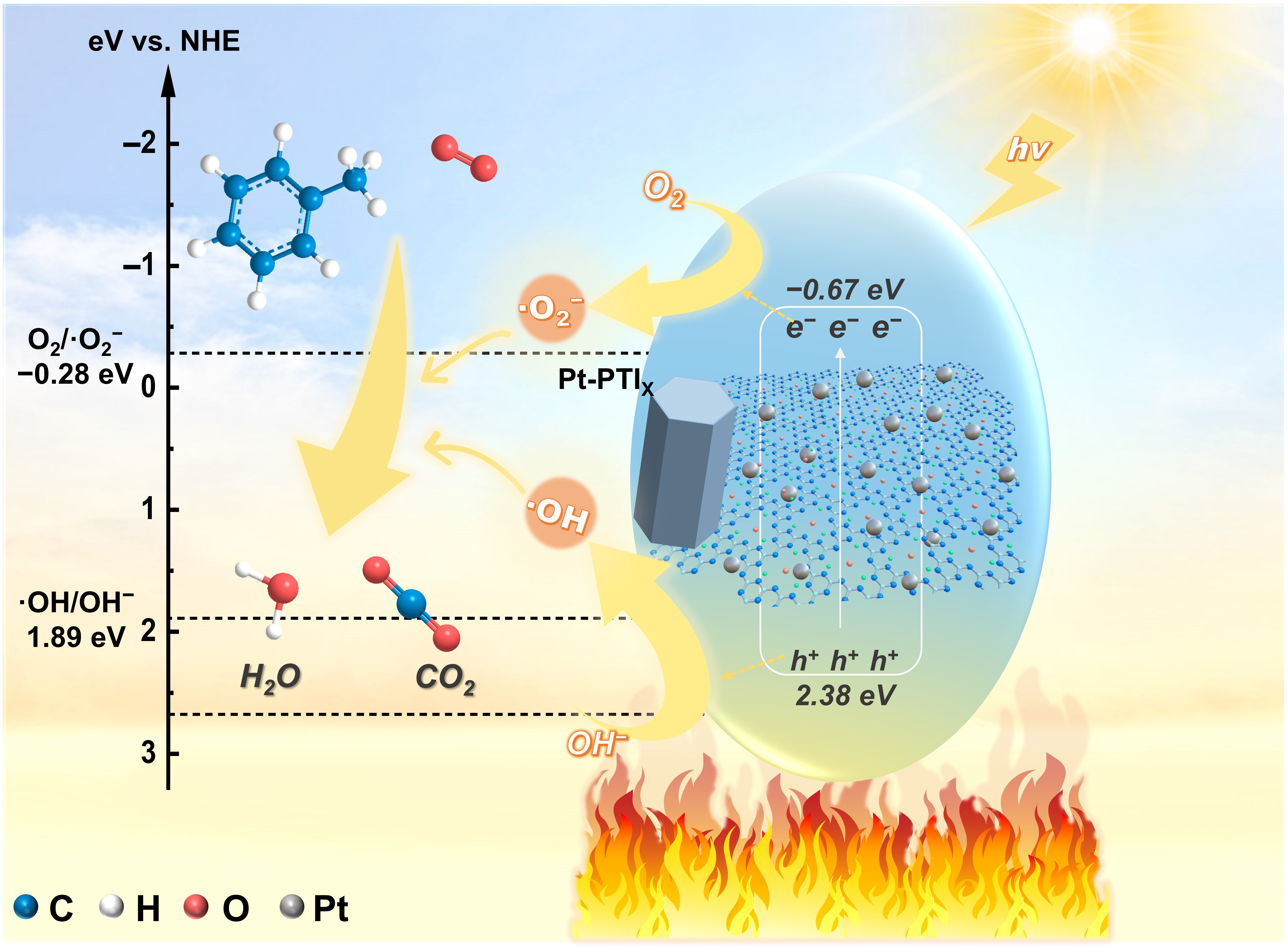
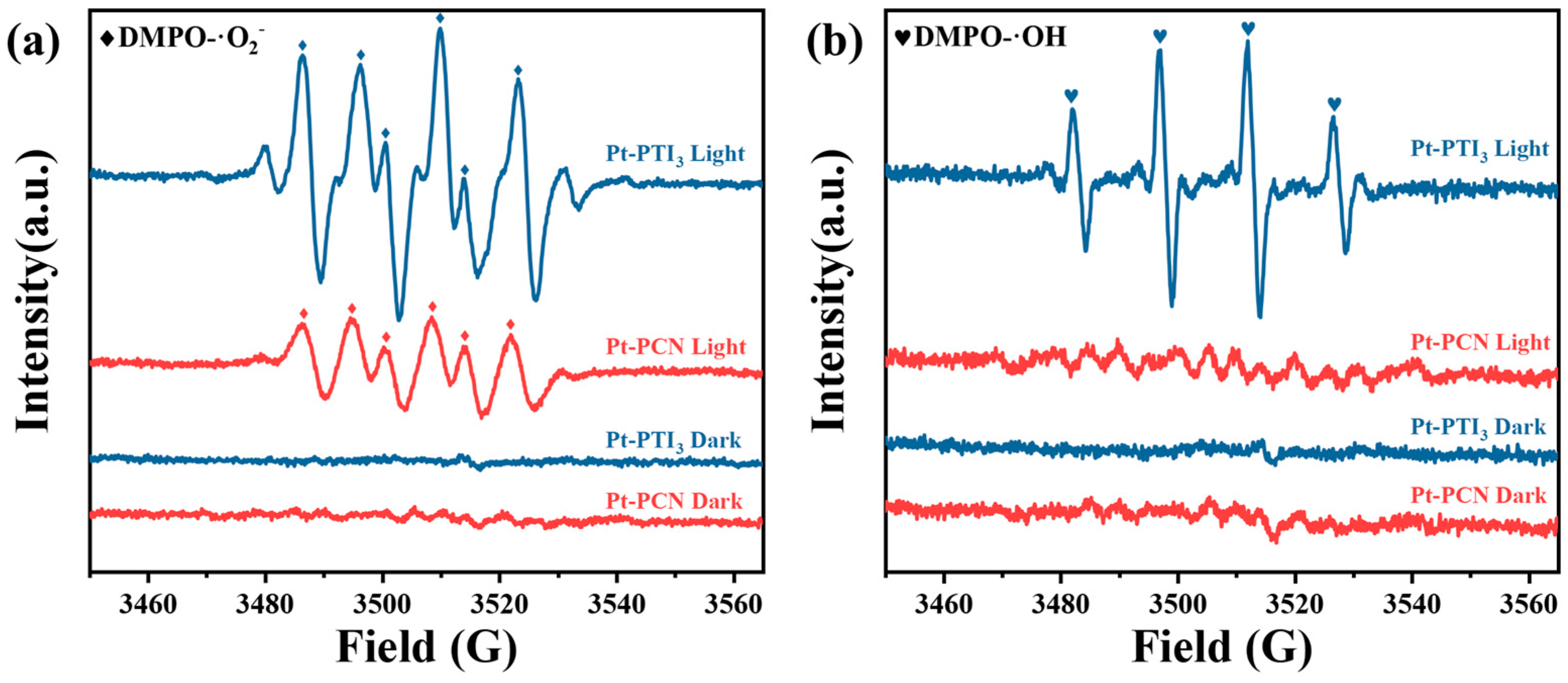
During the catalytic oxidation process, the presence of electrons (e) and photogenerated holes (h+) with oxidizing and reducing capabilities facilitates the conversion of adsorbed H2O and O2 on the catalyst surface into ·OH and ·O2 radicals, respectively. According to the above information, the VB position (2.38 eV) of Pt-PTI3 exhibits a higher energy level compared to the hydroxyl group redox position (·OH/OH, 1.89 V vs. NHE), while its CB position (−0.67 eV) demonstrates a lower energy level than the oxygen redox position (O2/·O2, −0.28 V vs. NHE). Theoretically, the PC process of Pt-PTI3 materials has the potential to produce both of these active species, whereas ·OH cannot be generated on PCN due to its lower VB position [54,55]. For this purpose, 5,5–Dimethyl–1–pyrroline–N–oxide (DMPO) was applied as the trapping agent in EPR techniques to confirm the generation of ·O2 and ·OH species from Pt-PTI3 and Pt-PCN samples. According to Figure 4a,b, no corresponding EPR signals were detected from either of the samples under conditions of darkness. After 10 min of illumination, the Pt-PTI3 catalyst exhibited the characteristic EPR signals corresponding to DMPO–·O2 and DMPO–·OH, while only the DMPO–·O2 signal was observed in Pt-PCN, and its intensity was significantly weaker than that of Pt-PTI3, which is consistent with the band structure analysis. This may be due to the more efficient photogenic charge transfer capability of PTI samples [56].

2.3. Photothermal Catalytic Performance on Toluene Oxidation

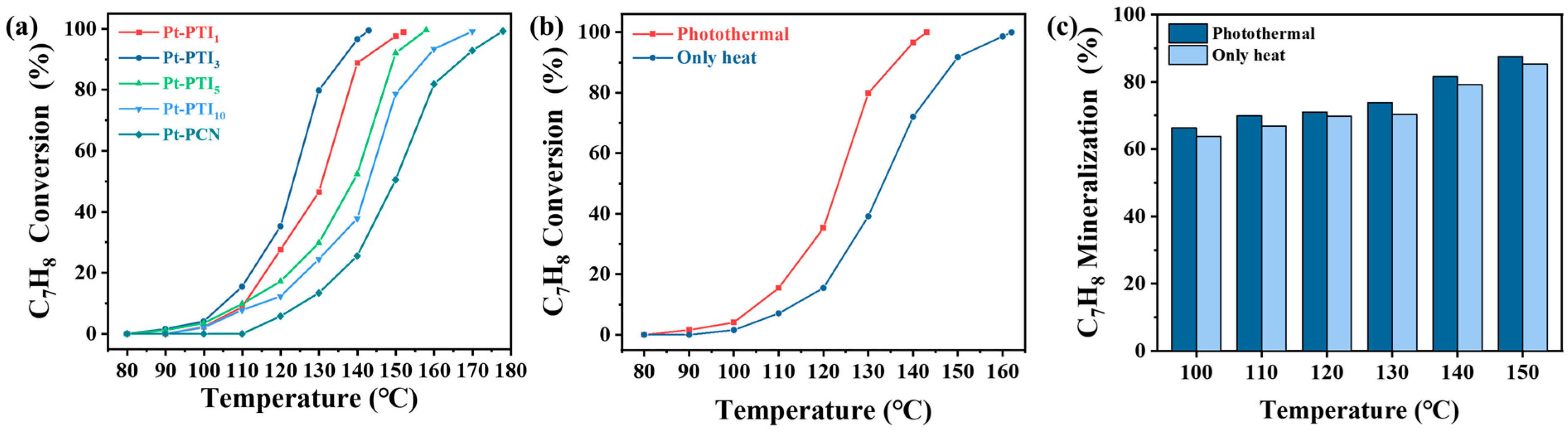
The PTC performance was assessed in a sequential flow system with toluene (250 ppm). The effect of temperature on the PTC efficiency of the catalyst in illumination conditions is illustrated in Figure 5a. Apparently, the PTC performance of all Pt-PTIX samples surpasses that of Pt-PCN, which can realize the oxidative decomposition of toluene under milder conditions. Among them, Pt-PTI3 exhibits the highest level of activity, enabling complete toluene degradation at a temperature of 143 °C, while Pt-PCN requires 178 °C under the same conditions. It can be noticed that at 120, 130 and 140 °C, the conversion rate of Pt-PTI3 reached 35.3%, 79.9% and 96.6%, respectively, while at the same temperature, that of Pt-PCN only increased 5.8%, 13.4% and 25.6%, with 5.09, 4.96 and 2.77 times, respectively. To assess the synergistic effect of PTC, we conducted additional investigations on the conversion rate and mineralization rate of the Pt-PTI3 sample under both photothermal and thermal conditions. The rates of conversion and mineralization were found to be higher under photothermal conditions compared to thermal-only conditions at the same reaction temperature in Figure 5b,c, in which the fully converted temperature was at 143 °C in the photothermal conditions and 162 °C for the thermal-only condition. The degree of mineralization of toluene degraded by Pt-PTI3 is remarkable, reaching 87.5% at 150 °C based on the production of CO2 during the reaction, indicating a high degree of oxidation of toluene. Clearly, the photothermal effect of light makes the catalysts behave better in the PTC reaction [8].
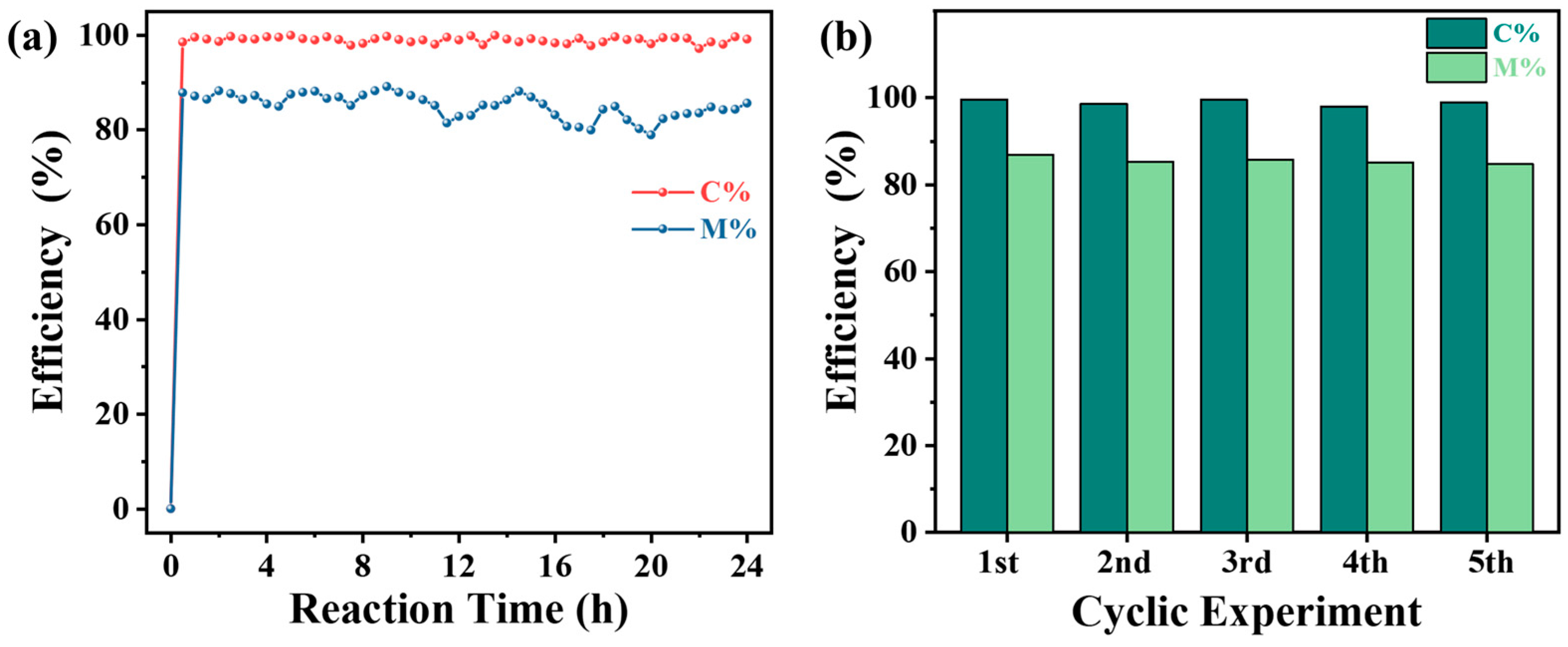
In addition, the stability of Pt-PTI3 in continuous PTC degradation of toluene, as well as cycling tests was also investigated. As shown in Figure 6a, Pt-PTI3 can achieve almost complete degradation of toluene within 1 h in the continuous 24 h degradation test, and no deactivation of the catalyst occurs during the 24 h test. The conversion rate is still maintained at 98–100%, and the mineralization rate is stable between 79 and 88 cyclic test shown in Figure 6b indicates that Pt-PTI3 exhibits no significant deactivation after five cycles. As depicted in Figure S10, the XRD and FT-IR spectra of the samples before and after the cyclic test showed comparable patterns, which proved that the crystal structure and chemical composition of Pt-PTI3 did not change, and the structural and morphological stability before and after the reaction was excellent. In practical industrial applications, the concentration of VOCs is not limited to a fixed concentration or type. Therefore, we also investigated the degradation performance of Pt-PTI3 samples against a series of gradient concentrations (250, 500, 750, and 1000 ppm) of toluene (Figure S11). The results showed that Pt-PTI3 demonstrates excellent PTC performance over a wide range of toluene concentrations. According to Figure S12, Pt-PTI3 material also has excellent PTC degradation performance for other aromatic VOCs (such as benzene).

2.4. Photothermal Reaction Mechanism and Synergistic Effect

Combined with the findings of the above characterization and analysis, we suggest a possible PTC reaction mechanism. VOCs are oxidized by redox reactions with holes (h+) and electrons (e) generated by the photoexcitation process, and can also react with the ·OH and ·O2 free radicals [57]. The ·OH and ·O2 generated by the PC reaction promote effective activation and deep oxidation of toluene. The sustained supply of energy for the TC process is supported by the light-induced photothermal effect and the addition of thermal energy, which promotes the effective migration and separation of photogenerated charges. Specifically, upon exposure to light and heat, photogenerated electrons (e) originating from semiconductor carriers are rapidly transferred to Pt nanoparticles, which act as electron sinks and promote charge separation. According to the XPS analysis, Pt mainly exists in the metallic state (Pt0), which is beneficial for electron transfer and oxygen activation on the catalyst surface. The adsorbed O2 on the Pt surface captures these electrons and produces ·O2 radicals. With the increase in temperature, ·O2 further dissociates into [O22−]ads and [O]ads [57,58,59]. Subsequently, they engage in the oxidation of toluene. Therefore, the elevation of temperature within the catalytic system progressively enhances the consumption of photoinduced charges, thus improving the efficiency of separation and utilization of the photogenerated charges. At the same time, the oxidizing h+ generated by photoexcitation reacts with the adsorbed H2O to form ·OH radical. These active species, together with h+, contribute to the activation and degradation of toluene molecules into CO2 and H2O.

3. Materials and Methods

3.1. Materials

Melamine (C3H6N6, ≥99.0%), lithium chloride (LiCl, ≥95.0%), potassium chloride (KCl, ≥99.8%), and chloroplatinic acid, hexahydrate (H2PtCl6·6H2O) were obtained from Sinopharm Chemical Reagent Co., Ltd., Shanghai, China, and used in their original state without the need for additional purification.

3.2. Catalysts Synthesis

3.2.1. Synthesis of PCN

The PCN material is synthesized through a direct thermal polymerization process. The melamine (1.0 g) was placed in an alumina crucible with a lid and heated to 550 °C in an air muffle furnace at a heating rate of 5 °C/min for 4 h. After natural cooling, PCN powder was obtained by grinding.

3.2.2. Synthesis of PTI and Pt-PTI

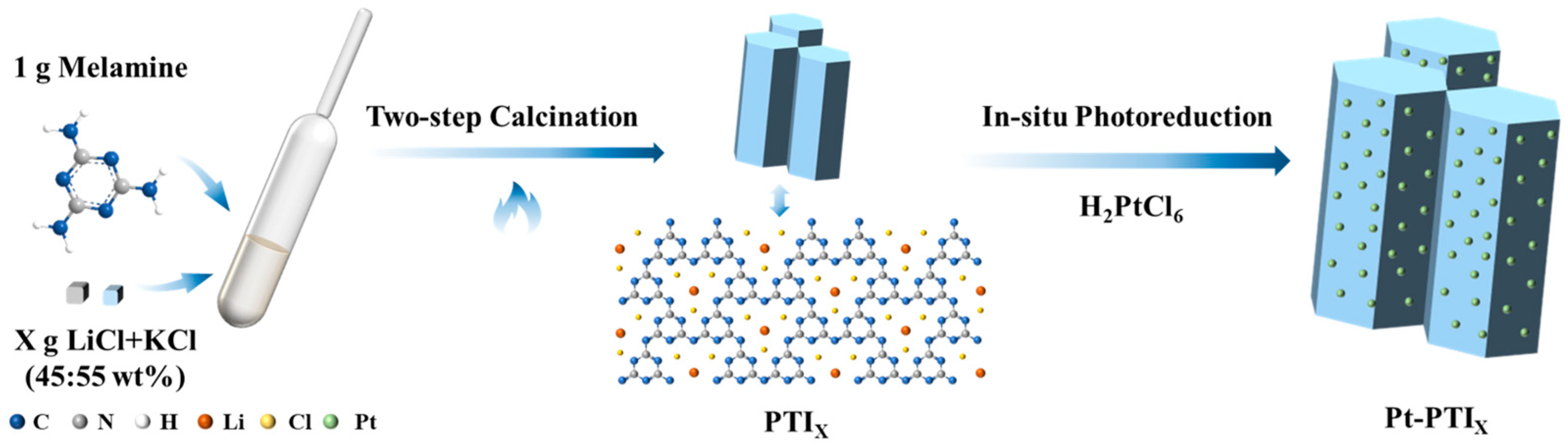
As shown in Scheme 1, PTI material was synthesized using the two-step calcination method. In total, 1.0 g of melamine and X g (X = 1, 3, 5, 10) of a mixture of lithium chloride and potassium chloride (45:55 wt%) were thoroughly ground and filled into ampoules and calcined in a Muffle furnace at 400 °C for 6 h. After natural cooling to room temperature, the ampoule bottle was placed in a vacuum and sealed and then calcined in a Muffle furnace at 550 °C for 24 h. After cooling, the sample was carefully removed from the ampoule and ultrasonic dispersion with deionized water was added and washed several times to remove the residual salt in the sample. Finally, the sample was dried in a vacuum oven at 60 °C for 12 h. The sample obtained was named PTIX (where X is the mass of the binary salt mixture used).
Pt nanoparticles were loaded via the in situ photoreduction method. In total, 100 mg of the PTIX sample was ultrasonically dispersed in 100 mL of deionized water, and a certain amount of H2PtCl6 solution (based on the content of Pt) was added to the reactor. Under the condition of continuous agitation, the gas in the reactor was removed by repeated vacuuming, and then the sample was illuminated by a 300 W xenon lamp for 1 h. At the end of the reaction, the sample was taken out and pumped, filtered, washed and dried, and the obtained sample was named Pt-PTIX. The preparation method of the Pt-PCN sample is consistent with the above steps.
The sample was subjected to ICP-OES analysis to determine the precise quantity of Pt present. Approximately 10 mg of the catalyst was digested in 1 mL of concentrated H2SO4 at 150 °C, followed by tenfold dilution with deionized water and filtration through a 0.45 μm membrane prior to analysis. The corresponding data can be found in Table S1.

3.3. Catalysts Characterization

A range of characterization techniques can be employed to assess the physical and chemical properties of catalysts. For detailed instrument models and parameters, please refer to the Supporting Information.

3.4. Catalytic Performance Evaluation

The catalytic efficiency of the samples was tested in a continuous flow PTC experimental apparatus, as shown in Figure S1, and specific details regarding the experimental conditions and methods of evaluation can be found in the accompanying Supporting Information.

4. Conclusions

In summary, the synthesis of PTI materials with enhanced crystallinity was successfully achieved through a distinctive molten salt method, employing varying ratios. The optimal ratio of the precursor to molten salt was 1:3; using the appropriate amount of molten salt can lead to the development of PTI materials with relatively smaller particle size, better dispersion, and a larger specific surface area. In addition, low-content (0.31 wt%) Pt nanoparticles were loaded using in situ photoreduction technology. The material exhibited excellent performance during the PTC oxidation of toluene at a mild temperature of 143 °C, achieving nearly 100% conversion of toluene at 143 °C, which is 35 °C lower than that required for traditional PCN. Furthermore, the optimal mineralization rate of toluene by Pt-PTI reached 87%. According to the characterization analysis, the improved activity of the PTI material was due to the presence of more active sites, fewer structural defects, better charge transfer ability and stronger redox ability. During open-loop degradation of toluene e, h+ and reactive oxygen species (·OH and ·O2) produced during photocatalysis become involved, forming synergistic effects with the thermal catalytic reaction. This work deeply analyzes the structures and properties of the PCN catalyst, reveals the key factors of the PTC reaction, and opens up new paths for utilizing polymeric semiconductors in energy conversion and environmental governance.

Supplementary Materials

The following supporting information can be downloaded at https://www.mdpi.com/article/10.3390/catal16040295/s1. Figure S1: Schematic diagram of catalysts performance evaluation. Figure S2: SEM image of Pt-PCN. Figure S3: (a,b) TEM image of Pt-PCN (c) HAADF-STEM image and EDX elemental mapping of Pt-PCN sample. Figure S4: SEM image of (a) Pt-PTI1 (b) Pt-PTI3 (c) Pt-PTI5 (d) Pt-PTI10. Figure S5: (a) N2 adsorption–desorption isotherms of Pt-PTIX and Pt-PCN; (b) Pore size distribution diagram of Pt-PTIx and Pt-PCN. Figure S6: Solid-state 13C NMR spectrum of PTI3. Figure S7: (a) Raman spectra of Pt-PTIx and Pt-PCN; XPS spectra of (b) Li 1s and (c) Cl 2p of the Pt-PTI3 sample. Figure S8: TGA spectra of Pt-PTI3 and Pt-PCN. Figure S9: (a) Mott–Schottky curve of the PTI3 sample measured using an Ag/AgCl reference electrode; (b) Mott–Schottky curve of the PCN sample. The calculated conduction band (CB) positions are −0.67 V and −1.20 V (vs. NHE), respectively. Figure S10: (a) XRD patterns of Pt-PTI3 before and after reaction; (b) FTIR spectra of Pt-PTI3 before and after reaction. Figure S11: Photothermal catalytic performance of Pt-PTI3 for toluene at different concentrations. Figure S12: Photothermal catalytic performance on benzene conversion at different temperatures (250 ppm benzene, 300 mW/cm2 Xe lamp, WHSV = 12,000 mL/(g∙h)) of Pt-PTIx and Pt-PCN. Table S1: Chemical compositions of the samples obtained from ICP; Table S2: Specific surface area, pore volume and pore size of Pt-PTIx and Pt-PCN.

Author Contributions

Conceptualization and writing—original draft preparation, F.J.; investigation, formal analysis and writing—review and editing, S.Z.; methodology, F.J., D.Z. and S.Z.; funding acquisition, D.Z. All authors have read and agreed to the published version of the manuscript.

Funding

This work was co-funded by the National Natural Science Foundation of China (U1905214, U21A20326, 22272027, 22002016, 22032002 and 2022HZ027004) and the 111 Project (D16008). C.Y. also gives thanks to the support received from the Eyas Program of Fujian Province.

Data Availability Statement

The data that support the findings of this study are available from the corresponding author upon reasonable request.

Conflicts of Interest

The authors declare no conflicts of interest.

References

  1. Cheng, Y.; Zhu, J.; Wang, Z.; Zhang, J.; Yue, Y.; Liu, Q.; Qian, G. Revealing oxygen transfer between Mn3O4 and CuMn2O4 and its effect on enhanced catalytic oxidization of VOCs. Surf. Interfaces 2023, 41, 103242. [Google Scholar] [CrossRef]
  2. Li, Y.; Wu, S.; Wu, J.; Hu, Q.; Zhou, C. Photothermocatalysis for efficient abatement of CO and VOCs. J. Mater. Chem. A 2020, 8, 8171–8194. [Google Scholar] [CrossRef]
  3. Wu, P.; Jin, X.; Qiu, Y.; Ye, D. Recent Progress of Thermocatalytic and Photo/Thermocatalytic Oxidation for VOCs Purification over Manganese-based Oxide Catalysts. Environ. Sci. Technol. 2021, 55, 4268–4286. [Google Scholar] [CrossRef]
  4. Yang, Y.; Zhao, S.; Bi, F.; Chen, J.; Wang, Y.; Cui, L.; Xu, J.; Zhang, X. Highly efficient photothermal catalysis of toluene over Co3O4/TiO2 p-n heterojunction: The crucial roles of interface defects and band structure. Appl. Catal. B 2022, 315, 121550. [Google Scholar] [CrossRef]
  5. Han, X.; Li, M.; Ma, Y.; Li, Y.; Ma, H.; Wang, C. Thermal coupled photocatalysis to enhance CO2 reduction activities on Ag loaded g-C3N4 catalysts. Surf. Interfaces 2021, 23, 101006. [Google Scholar] [CrossRef]
  6. Wang, Y.; Dai, J.; Wang, M.; Qi, F.; Jin, X.; Zhang, L. Enhanced toluene oxidation by photothermal synergetic catalysis on manganese oxide embedded with Pt single-atoms. J. Colloid Interface Sci. 2023, 636, 577–587. [Google Scholar] [CrossRef]
  7. Sun, Y.; Guo, S.-Q.; Fan, L.; Cai, J.; Han, W.; Zhang, F. Molecular oxygen activation in photocatalysis: Generation, detection and application. Surf. Interfaces 2024, 46, 104033. [Google Scholar] [CrossRef]
  8. Zhang, M.; Li, G.; Li, Q.; Chen, J.; Elimian, E.A.; Jia, H.; He, H. In Situ Construction of Manganese Oxide Photothermocatalysts for the Deep Removal of Toluene by Highly Utilizing Sunlight Energy. Environ. Sci. Technol. 2023, 57, 4286–4297. [Google Scholar] [CrossRef] [PubMed]
  9. Luo, Y.; Chi, Z.; Zhang, J.; Tian, B. Photothermocatalytic System Designed by Facet-heterojunction to Enhance the Synergistic Effect of Toluene Oxidation. ChemCatChem 2022, 14, e202101958. [Google Scholar] [CrossRef]
  10. Chen, J.; He, Z.; Li, G.; An, T.; Shi, H.; Li, Y. Visible-light-enhanced photothermocatalytic activity of ABO3-type perovskites for the decontamination of gaseous styrene. Appl. Catal. B 2017, 209, 146–154. [Google Scholar] [CrossRef]
  11. Bi, F.; Zhang, X.; Chen, J.; Yang, Y.; Wang, Y. Excellent catalytic activity and water resistance of UiO-66-supported highly dispersed Pd nanoparticles for toluene catalytic oxidation. Appl. Catal. B 2020, 269, 118767. [Google Scholar] [CrossRef]
  12. Bi, F.; Zhao, Z.; Yang, Y.; Gao, W.; Liu, N.; Huang, Y.; Zhang, X. Chlorine-Coordinated Pd Single Atom Enhanced the Chlorine Resistance for Volatile Organic Compound Degradation: Mechanism Study. Environ. Sci. Technol. 2022, 56, 17321–17330. [Google Scholar] [CrossRef]
  13. He, C.; Cheng, J.; Zhang, X.; Douthwaite, M.; Pattisson, S.; Hao, Z. Recent Advances in the Catalytic Oxidation of Volatile Organic Compounds: A Review Based on Pollutant Sorts and Sources. Chem. Rev. 2019, 119, 4471–4568. [Google Scholar] [CrossRef]
  14. Li, Y.; Huang, J.; Peng, T.; Xu, J.; Zhao, X. Photothermocatalytic Synergetic Effect Leads to High Efficient Detoxification of Benzene on TiO2 and Pt/TiO2 Nanocomposite. ChemCatChem 2010, 2, 1082–1087. [Google Scholar] [CrossRef]
  15. Cai, S.-C.; Li, J.-J.; Yu, E.-Q.; Chen, X.; Chen, J.; Jia, H.-P. Strong Photothermal Effect of Plasmonic Pt Nanoparticles for Efficient Degradation of Volatile Organic Compounds under Solar Light Irradiation. ACS Appl. Nano Mater. 2018, 1, 6368–6377. [Google Scholar] [CrossRef]
  16. Gao, J.; Si, Z.; Xu, Y.; Liu, L.; Zhang, Y.; Wu, X.; Ran, R.; Weng, D. Pd–Ag@CeO2 Catalyst of Core–Shell Structure for Low Temperature Oxidation of Toluene Under Visible Light Irradiation. J. Phys. Chem. C 2019, 123, 1761–1769. [Google Scholar] [CrossRef]
  17. Okumura, K.; Kobayashi, T.; Tanaka, H.; Niwa, M. Toluene combustion over palladium supported on various metal oxide supports. Appl. Catal. B 2003, 44, 325–331. [Google Scholar] [CrossRef]
  18. Xu, Z.; Mo, S.; Li, Y.; Zhang, Y.; Wu, J.; Fu, M.; Niu, X.; Hu, Y.; Ye, D. Pt/MnOx for toluene mineralization via ozonation catalysis at low temperature: SMSI optimization of surface oxygen species. Chemosphere 2022, 286, 131754. [Google Scholar] [CrossRef]
  19. Yang, C.; Miao, G.; Pi, Y.; Xia, Q.; Wu, J.; Li, Z.; Xiao, J. Abatement of various types of VOCs by adsorption/catalytic oxidation: A review. Chem. Eng. J. 2019, 370, 1128–1153. [Google Scholar] [CrossRef]
  20. Yang, X.; Ma, X.; Yu, X.; Ge, M. Exploration of strong metal-support interaction in zirconia supported catalysts for toluene oxidation. Appl. Catal. B 2020, 263, 118355. [Google Scholar] [CrossRef]
  21. Zhang, L.; Zhu, Z.; Tan, W.; Ji, J.; Cai, Y.; Tong, Q.; Xiong, Y.; Wan, H.; Dong, L. Thermal-Driven Optimization of the Strong Metal–Support Interaction of a Platinum–Manganese Oxide Octahedral Molecular Sieve to Promote Toluene Oxidation: Effect of the Interface Pt2+–Ov–Mnδ+. ACS Appl. Mater. Interfaces 2022, 14, 56790–56800. [Google Scholar] [CrossRef]
  22. Pan, Z.; Zheng, Y.; Guo, F.; Niu, P.; Wang, X. Decorating CoP and Pt Nanoparticles on Graphitic Carbon Nitride Nanosheets to Promote Overall Water Splitting by Conjugated Polymers. ChemSusChem 2017, 10, 87–90. [Google Scholar] [CrossRef] [PubMed]
  23. Wang, Y.; Wang, X.; Antonietti, M. Polymeric Graphitic Carbon Nitride as a Heterogeneous Organocatalyst: From Photochemistry to Multipurpose Catalysis to Sustainable Chemistry. Angew. Chem. Int. Ed. 2012, 51, 68–89. [Google Scholar] [CrossRef] [PubMed]
  24. Zhang, J.; Zhang, M.; Yang, C.; Wang, X. Nanospherical Carbon Nitride Frameworks with Sharp Edges Accelerating Charge Collection and Separation at a Soft Photocatalytic Interface. Adv. Mater. 2014, 26, 4121–4126. [Google Scholar] [CrossRef]
  25. Luo, D.; Liu, S.; Liu, J.; Zhao, J.; Miao, C.; Ren, J. Catalytic Combustion of Toluene over Cobalt Oxides Supported on Graphitic Carbon Nitride (CoOx/g-C3N4) Catalyst. Ind. Eng. Chem. Res. 2018, 57, 11920–11928. [Google Scholar] [CrossRef]
  26. Lin, X.; Zhao, S.; Chen, Y.; Fu, L.; Zhu, R.; Liu, Z. Nitrogen-doped carbon cobalt grafted on graphitic carbon nitride catalysts with enhanced catalytic performance for ethylbenzene oxidation. J. Mol. Catal. A Chem. 2016, 420, 11–17. [Google Scholar] [CrossRef]
  27. Huang, Z.; Cai, X.; Zang, S.; Li, Y.; Zheng, D.; Li, F. Strong Metal Support Effect of Pt/g-C3N4 Photocatalysts for Boosting Photothermal Synergistic Degradation of Benzene. Int. J. Mol. Sci. 2023, 24, 6872. [Google Scholar] [CrossRef] [PubMed]
  28. Lin, L.; Ou, H.; Zhang, Y.; Wang, X. Tri-s-triazine-Based Crystalline Graphitic Carbon Nitrides for Highly Efficient Hydrogen Evolution Photocatalysis. ACS Catal. 2016, 6, 3921–3931. [Google Scholar] [CrossRef]
  29. Mohamed, N.A.; Ismail, A.F.; Kiong, T.S. g-C3N4/La2O3 nanocomposite as a photo-electrocatalyst in solar water splitting. Surf. Interfaces 2024, 44, 103639. [Google Scholar] [CrossRef]
  30. Schwinghammer, K.; Mesch, M.B.; Duppel, V.; Ziegler, C.; Senker, J.; Lotsch, B.V. Crystalline Carbon Nitride Nanosheets for Improved Visible-Light Hydrogen Evolution. J. Am. Chem. Soc. 2014, 136, 1730–1733. [Google Scholar] [CrossRef]
  31. Wang, Q.; Zhang, G.; Xing, W.; Pan, Z.; Zheng, D.; Wang, S.; Hou, Y.; Wang, X. Bottom-up Synthesis of Single-Crystalline Poly (Triazine Imide) Nanosheets for Photocatalytic Overall Water Splitting. Angew. Chem. Int. Ed. 2023, 62, e202307930. [Google Scholar] [CrossRef]
  32. Li, Y.; Zhang, D.; Fan, J.; Xiang, Q. Highly crystalline carbon nitride hollow spheres with enhanced photocatalytic performance. Chin. J. Catal. 2021, 42, 627–636. [Google Scholar] [CrossRef]
  33. Han, R.; Wang, Y.; Liu, Z.; Wang, J. Synthesis of Crystalline Heptazine-Based Carbon Nitride Microtubes for Highly Efficient Hydrogen Evolution Photocatalysis. ACS Appl. Energy Mater. 2025, 8, 883–893. [Google Scholar] [CrossRef]
  34. Liu, J.; Fang, W.; Wei, Z.; Qin, Z.; Jiang, Z.; Shangguan, W. Efficient photocatalytic hydrogen evolution on N-deficient g-C3N4 achieved by a molten salt post-treatment approach. Appl. Catal. B 2018, 238, 465–470. [Google Scholar] [CrossRef]
  35. Mesch, M.B.; Bärwinkel, K.; Krysiak, Y.; Martineau, C.; Taulelle, F.; Neder, R.B.; Kolb, U.; Senker, J. Solving the Hydrogen and Lithium Substructure of Poly(triazine imide)/LiCl Using NMR Crystallography. Chem.—A Eur. J. 2016, 22, 16878–16890. [Google Scholar] [CrossRef]
  36. Liang, X.; Xue, S.; Yang, C.; Ye, X.; Wang, Y.; Chen, Q.; Lin, W.; Hou, Y.; Zhang, G.; Shalom, M.; et al. The Directional Crystallization Process of Poly (triazine imide) Single Crystals in Molten Salts. Angew. Chem. Int. Ed. 2023, 62, e202216434. [Google Scholar] [CrossRef]
  37. Liu, M.; Zhang, G.; Liang, X.; Pan, Z.; Zheng, D.; Wang, S.; Yu, Z.; Hou, Y.; Wang, X. Rh/Cr2O3 and CoOx Cocatalysts for Efficient Photocatalytic Water Splitting by Poly (Triazine Imide) Crystals. Angew. Chem. Int. Ed. 2023, 62, e202304694. [Google Scholar] [CrossRef] [PubMed]
  38. Peng, R.; Li, S.; Sun, X.; Ren, Q.; Chen, L.; Fu, M.; Wu, J.; Ye, D. Size effect of Pt nanoparticles on the catalytic oxidation of toluene over Pt/CeO2 catalysts. Appl. Catal. B 2018, 220, 462–470. [Google Scholar] [CrossRef]
  39. Liu, M.; Wei, C.; Zhuzhang, H.; Zhou, J.; Pan, Z.; Lin, W.; Yu, Z.; Zhang, G.; Wang, X. Fully Condensed Poly (Triazine Imide) Crystals: Extended π-Conjugation and Structural Defects for Overall Water Splitting. Angew. Chem. 2022, 134, e202113389. [Google Scholar] [CrossRef]
  40. Noda, Y.; Merschjann, C.; Tarábek, J.; Amsalem, P.; Koch, N.; Bojdys, M.J. Directional Charge Transport in Layered Two-Dimensional Triazine-Based Graphitic Carbon Nitride. Angew. Chem. Int. Ed. 2019, 58, 9394–9398. [Google Scholar] [CrossRef]
  41. Zhang, G.; Zhang, M.; Ye, X.; Qiu, X.; Lin, S.; Wang, X. Iodine Modified Carbon Nitride Semiconductors as Visible Light Photocatalysts for Hydrogen Evolution. Adv. Mater. 2014, 26, 805–809. [Google Scholar] [CrossRef] [PubMed]
  42. Chen, D.; Zhang, G.; Wang, M.; Li, N.; Xu, Q.; Li, H.; He, J.; Lu, J. Pt/MnO2 Nanoflowers Anchored to Boron Nitride Aerogels for Highly Efficient Enrichment and Catalytic Oxidation of Formaldehyde at Room Temperature. Angew. Chem. Int. Ed. 2021, 60, 6377–6381. [Google Scholar] [CrossRef] [PubMed]
  43. Zhang, J.; Liang, X.; Zhang, C.; Lin, L.; Xing, W.; Yu, Z.; Zhang, G.; Wang, X. Improved Charge Separation in Poly(heptazine-triazine) Imides with Semi-coherent Interfaces for Photocatalytic Hydrogen Evolution. Angew. Chem. Int. Ed. 2022, 61, e202210849. [Google Scholar] [CrossRef]
  44. Zhang, J.; Zhang, M.; Zhang, G.; Wang, X. Synthesis of Carbon Nitride Semiconductors in Sulfur Flux for Water Photoredox Catalysis. ACS Catal. 2012, 2, 940–948. [Google Scholar] [CrossRef]
  45. Wirnhier, E.; Döblinger, M.; Gunzelmann, D.; Senker, J.; Lotsch, B.V.; Schnick, W. Poly(triazine imide) with Intercalation of Lithium and Chloride Ions [(C3N3)2(NHxLi1−x)3⋅LiCl]: A Crystalline 2D Carbon Nitride Network. Chem.—A Eur. J. 2011, 17, 3213–3221. [Google Scholar] [CrossRef]
  46. Zheng, D.; Wang, Q.; Pan, Z.; Wang, S.; Hou, Y.; Zhang, G. Poly(triazine imide) nanospheres with spatially exposed prismatic facets for photocatalytic overall water splitting. Sci. China Mater. 2024, 67, 1900–1906. [Google Scholar] [CrossRef]
  47. Xie, Y.; Cai, J.; Wu, Y.; Zang, Y.; Zheng, X.; Ye, J.; Cui, P.; Niu, S.; Liu, Y.; Zhu, J.; et al. Boosting Water Dissociation Kinetics on Pt–Ni Nanowires by N-Induced Orbital Tuning. Adv. Mater. 2019, 31, 1807780. [Google Scholar] [CrossRef]
  48. Lu, Y.; Deng, H.; Pan, T.; Wang, L.; Zhang, C.; He, H. Interaction between noble metals (Pt, Pd, Rh, Ir, Ag) and defect-enriched TiO2 and its application in toluene and propene catalytic oxidation. Appl. Surf. Sci. 2022, 606, 154834. [Google Scholar] [CrossRef]
  49. Zhang, G.; Lan, Z.-A.; Lin, L.; Lin, S.; Wang, X. Overall water splitting by Pt/g-C3N4 photocatalysts without using sacrificial agents. Chem. Sci. 2016, 7, 3062–3066. [Google Scholar] [CrossRef]
  50. Zhang, G.; Lin, L.; Li, G.; Zhang, Y.; Savateev, A.; Zafeiratos, S.; Wang, X.; Antonietti, M. Ionothermal Synthesis of Triazine–Heptazine-Based Copolymers with Apparent Quantum Yields of 60 % at 420 nm for Solar Hydrogen Production from “Sea Water”. Angew. Chem. Int. Ed. 2018, 57, 9372–9376. [Google Scholar] [CrossRef]
  51. Wang, Y.; Zhang, Y.; Zhao, S.; Huang, Z.; Chen, W.; Zhou, Y.; Lv, X.; Yuan, S. Bio-template synthesis of Mo-doped polymer carbon nitride for photocatalytic hydrogen evolution. Appl. Catal. B 2019, 248, 44–53. [Google Scholar] [CrossRef]
  52. Zhao, D.; Dong, C.-L.; Wang, B.; Chen, C.; Huang, Y.-C.; Diao, Z.; Li, S.; Guo, L.; Shen, S. Synergy of Dopants and Defects in Graphitic Carbon Nitride with Exceptionally Modulated Band Structures for Efficient Photocatalytic Oxygen Evolution. Adv. Mater. 2019, 31, 1903545. [Google Scholar] [CrossRef]
  53. Lin, L.; Wang, C.; Ren, W.; Ou, H.; Zhang, Y.; Wang, X. Photocatalytic overall water splitting by conjugated semiconductors with crystalline poly(triazine imide) frameworks. Chem. Sci. 2017, 8, 5506–5511. [Google Scholar] [CrossRef]
  54. Asokan, C.; DeRita, L.; Christopher, P. Using probe molecule FTIR spectroscopy to identify and characterize Pt-group metal based single atom catalysts. Chin. J. Catal. 2017, 38, 1473–1480. [Google Scholar] [CrossRef]
  55. Zhou, P.; Chao, Y.; Lv, F.; Wang, K.; Zhang, W.; Zhou, J.; Chen, H.; Wang, L.; Li, Y.; Zhang, Q.; et al. Metal Single Atom Strategy Greatly Boosts Photocatalytic Methyl Activation and C–C Coupling for the Coproduction of High-Value-Added Multicarbon Compounds and Hydrogen. ACS Catal. 2020, 10, 9109–9114. [Google Scholar] [CrossRef]
  56. Feng, Y.; Dai, L.; Wang, Z.; Peng, Y.; Duan, E.; Liu, Y.; Jing, L.; Wang, X.; Rastegarpanah, A.; Dai, H.; et al. Photothermal Synergistic Effect of Pt1/CuO-CeO2 Single-Atom Catalysts Significantly Improving Toluene Removal. Environ. Sci. Technol. 2022, 56, 8722–8732. [Google Scholar] [CrossRef] [PubMed]
  57. Feng, Y.; Ma, P.; Wang, Z.; Shi, Y.; Wang, Z.; Peng, Y.; Jing, L.; Liu, Y.; Yu, X.; Wang, X.; et al. Synergistic Effect of Reactive Oxygen Species in Photothermocatalytic Removal of VOCs from Cooking Oil Fumes over Pt/CeO2/TiO2. Environ. Sci. Technol. 2022, 56, 17341–17351. [Google Scholar] [CrossRef] [PubMed]
  58. Feng, Y.; Wei, L.; Wang, Z.; Liu, Y.; Dai, H.; Wang, C.; Hsi, H.-C.; Duan, E.; Peng, Y.; Deng, J. Boosting catalytic stability for VOCs removal by constructing PtCu alloy structure with superior oxygen activation behavior. J. Hazard. Mater. 2022, 439, 129612. [Google Scholar] [CrossRef]
  59. Li, Q.; Wang, K.; Zhang, S.; Zhang, M.; Yang, J.; Jin, Z. Effect of photocatalytic activity of CO oxidation on Pt/TiO2 by strong interaction between Pt and TiO2 under oxidizing atmosphere. J. Mol. Catal. A Chem. 2006, 258, 83–88. [Google Scholar] [CrossRef]
Figure 1. SEM image of (a) Pt-PTI1, (b) Pt-PTI3, (c) Pt-PTI5, and (d) Pt-PTI10 (scale bars: 500 nm); (e,f) TEM image of Pt-PTI3; and (g) HAADF-STEM and EDX mapping image of Pt-PTI3 sample (scale bars: 50 nm).
Catalysts 16 00295 g001
Figure 2. (a) XRD patterns; (b) FT-IR spectrum of Pt-PTIX and Pt-PCN; XPS spectrum of (c) Pt 4f; (d) N 1s of the Pt-PTI3; (e) N 1s of Pt-PCN; and (f) EPR spectra of Pt-PTI3 and Pt-PCN.
Catalysts 16 00295 g002
Figure 3. (a) UV–vis diffuse reflectance spectroscopy spectrum of Pt-PTIX and Pt-PCN; (b) bandgap of Pt-PTI3 and Pt-PCN determined by Tauc plots; (c) PL spectrum; (d) time-resolved PL spectrum of Pt-PTIX and Pt-PCN; (e) photocurrent response; and (f) EIS Nyquist plots of Pt-PTI3 and Pt-PCN.
Catalysts 16 00295 g003
Figure 4. (a) DMPO–·OH and (b) DMPO–·O2 EPR spectrum of Pt-PTI3 and Pt-PCN in the dark or under illumination.
Catalysts 16 00295 g004
Figure 5. (a) Photothermal catalytic efficiency on toluene conversion at different temperatures of Pt-PTIx and Pt-PCN; (b) photothermal catalytic/thermocatalytic efficiency on toluene conversion; and (c) photothermal catalytic/thermocatalytic efficiency on toluene mineralization of Pt-PTI3.
Catalysts 16 00295 g005
Figure 6. Photothermal catalytic performance on toluene conversion and mineralization of Pt-PTI3: (a) long-time (24 h) tests; (b) five-cycle tests. Here, C represents the toluene conversion, and M represents the mineralization rate calculated based on the CO2 production during the reaction.
Catalysts 16 00295 g006
Scheme 1. Synthesis method of Pt-PTIX catalysts.
Catalysts 16 00295 sch001
Disclaimer/Publisher’s Note: The statements, opinions and data contained in all publications are solely those of the individual author(s) and contributor(s) and not of MDPI and/or the editor(s). MDPI and/or the editor(s) disclaim responsibility for any injury to people or property resulting from any ideas, methods, instructions or products referred to in the content.