1. Introduction
Water pollution has become one of the most serious environmental problems of our time. Industrial, agricultural, and household activities continue to release a wide variety of harmful substances into rivers, lakes, and groundwater [
1]. Conventional treatment methods are often unable to completely remove these pollutants, leading to further contamination and risks to human and ecosystem health [
2]. In recent years, catalytic degradation technologies have drawn growing attention as an effective way to break down stubborn pollutants into harmless substances like carbon dioxide and water [
3]. These include processes such as photocatalysis, Fenton and Fenton-like reactions [
4], and catalytic oxidation [
5], all of which are being explored as promising tools for cleaner and more sustainable water treatment.
Research in this area has expanded rapidly over the past fifteen years. Scientists have developed many types of catalysts such as metal oxides, semiconductor materials, metal–organic frameworks, and nanocomposites to improve efficiency, selectivity, and stability during treatment [
6,
7,
8]. This surge in research reflects global efforts to address water pollution and supports international goals like the United Nations’ Sustainable Development Goal 6, which calls for clean water and sanitation for all [
9]. However, because so many studies have been published in different directions, it has become difficult to see the big picture of how the field is evolving, which countries and institutions are leading, and what emerging areas deserve more attention. Without such a broad overview, it is easy for researchers to repeat work that has already been done or to miss out on new opportunities for collaboration.
Previous studies that analyzed publication trends in this field have provided useful information, but only in limited ways. Most have focused on specific topics such as photocatalysis [
10,
11,
12,
13], TiO
2-based materials, or Fenton chemistry [
14,
15,
16], and often over shorter time periods. While these studies shed light on certain aspects, they do not capture how all catalytic processes together contribute to water and wastewater treatment research globally. Few have explored how topics, keywords, or research partnerships have changed over time. This leaves a clear gap: there is a need for a complete and up-to-date assessment that connects these different areas and shows how the field has developed up to 2025.
Recent investigations have also introduced new perspectives on the future of catalytic degradation. Recent studies demonstrate that coupling photocatalysis with Fenton-based processes can significantly improve the degradation of pharmaceutical contaminants in water. For instance, Liu et al. (2024) showed that a Z-scheme MIL-88B(Fe)/BiOBr photocatalytic–Fenton-like system achieved rapid and efficient removal of the antibiotic ciprofloxacin under visible light, while also exhibiting strong cycling stability and catalyst reusability [
17]. In parallel, research on hybrid and composite photocatalysts indicates that integrating carbon-based materials or metal oxides enhances light absorption, charge separation, and pollutant removal in complex water matrices. Reviews and experimental studies consistently report that such composite systems outperform single-component catalysts, particularly in real or near-real wastewater conditions [
18,
19]. Together, these findings underscore the rapid evolution of hybrid photocatalytic materials and highlight the importance of systematically tracking emerging research themes through bibliometric analysis.
For these reasons, this study aims to present a thorough bibliometric analysis of global research trends in catalytic degradation for water and wastewater treatment from 2010 to 2025, based on data from the Scopus database. It explores publication patterns, major contributors, collaboration networks, and how research topics have evolved over time. In addition, it includes a literature review on the latest developments in hybrid catalytic systems, showing how new ideas and technologies are shaping the future of water treatment. Together, these efforts aim to close existing knowledge gaps and provide a clear and comprehensive picture of the progress and direction of catalytic degradation research worldwide.
2. Methodology
2.1. Study Design
This study employed a bibliometric research design to quantitatively and qualitatively assess global research trends in catalytic degradation for water and wastewater treatment between 2010 and 2025. The methodology was developed following the principles of the Preferred Reporting Items for Systematic Reviews and Meta-Analyses (PRISMA) framework to ensure transparency, reproducibility, and accuracy. The analysis focused on mapping publication output, citation patterns, collaborative networks, and thematic evolution in this domain. Bibliometric methods were chosen because they provide a systematic approach to measuring research performance and intellectual structure through statistical and network-based techniques.
2.2. Data Source and Search Strategy
The Scopus database was selected as the primary data source because of its comprehensive coverage of peer-reviewed journals, robust citation metrics, and suitability for bibliometric studies. Scopus indexes a vast number of journals in environmental science, chemistry, materials science, and engineering making it ideal for analysing catalytic degradation research.
A comprehensive search strategy was developed to capture all relevant literature related to catalytic degradation in water and wastewater treatment. Boolean operators and wildcard symbols were used to ensure inclusiveness and precision. The final search query was as follows:
Catalytic degradation “OR” photocatalytic degradation “OR” advanced oxidation process * “OR” catalytic oxidation “AND” water treatment “AND” wastewater treatment “ AND “ water remediation AND PUBYEAR > 2010 AND PUBYEAR < 2025 AND (LIMIT-TO (DOCTYPE, “ar”) OR LIMIT-TO (DOCTYPE, “re”)) AND (LIMIT-TO (LANGUAGE, “English”)) AND (EXCLUDE (SUBJAREA, “DECI”) OR EXCLUDE (SUBJAREA, “DENT”) OR EXCLUDE (SUBJAREA, “NEUR”) OR EXCLUDE (SUBJAREA, “NURS”) OR EXCLUDE (SUBJAREA, “PSYC”) OR EXCLUDE (SUBJAREA, “HEAL”) OR EXCLUDE (SUBJAREA, “ECON”) OR EXCLUDE (SUBJAREA, “MATH”) OR EXCLUDE (SUBJAREA, “IMMU”) OR EXCLUDE (SUBJAREA, “EART”) OR EXCLUDE (SUBJAREA, “COMP”) OR EXCLUDE (SUBJAREA, “MULT”) OR EXCLUDE (SUBJAREA, “BUSI”) OR EXCLUDE (SUBJAREA, “SOCI”) OR EXCLUDE (SUBJAREA, “PHAR”)
The search was conducted in January 2026, covering publications from January 2010 to December 2025. Only documents published in English and categorized as articles or reviews were included to ensure quality and consistency.
2.3. Data Extraction and Screening (PRISMA Approach)
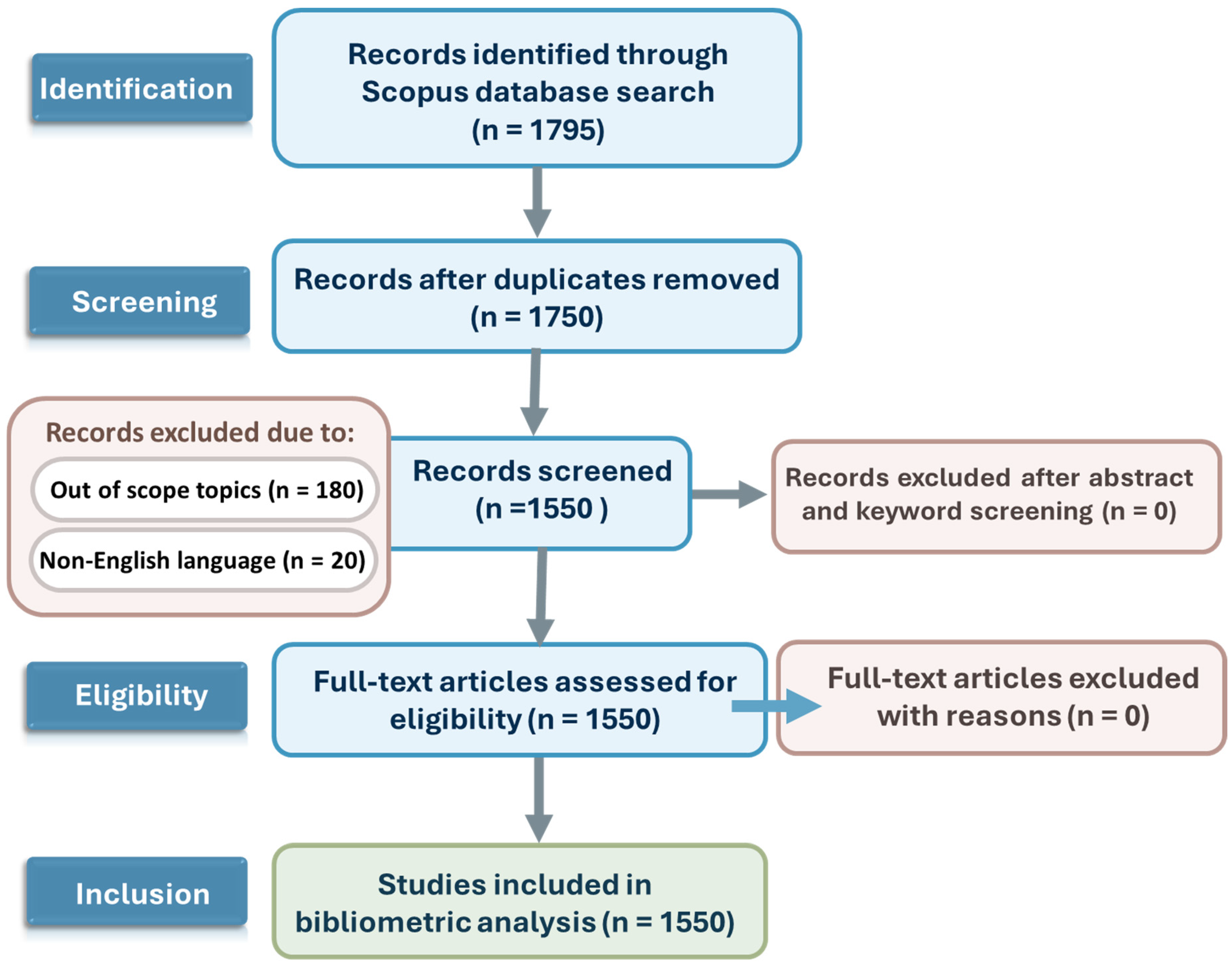
This study followed the PRISMA four-phase model identification, screening, eligibility, and inclusion to ensure systematic document selection [
20,
21]. The overall screening and selection process is summarized in
Figure 1, while a detailed breakdown of records at each stage is presented in
Table 1.
2.3.1. Identification Stage
Identification of the relevant literature was conducted through a comprehensive search of the Scopus database. A structured query was applied to the TITLE, ABSTRACT, and KEYWORD fields, targeting studies related to catalytic degradation and advanced oxidation processes in water and wastewater treatment. The search string combined terms related to catalytic and photocatalytic degradation with water and wastewater remediation concepts and was restricted to publications published between 2010 and 2025. This search was executed in January 2026 and yielded a total of 1795 records. To ensure completeness, additional cross-checking was performed using keywords from related review articles and bibliometric studies; however, this supplementary step did not result in the identification of additional records. Consequently, the total number of records identified for further processing remained at 1795.
2.3.2. Screening Stage
Following identification, all retrieved records were exported and screened for duplication using Digital Object Identifiers (DOIs) and matching bibliographic metadata. This process led to the removal of 45 duplicate records. The remaining records were then subjected to an initial screening based on titles and abstracts to assess relevance to the scope of catalytic degradation processes applied specifically to water and wastewater treatment. During this stage, studies focusing on unrelated domains, such as air catalysis, combustion processes, or non-aqueous systems, were excluded. In addition, publications not written in English were removed to maintain consistency in bibliometric analysis and data interpretation. In total, 200 records were excluded at this stage, comprising 180 non-relevant studies and 20 non-English publications.
2.3.3. Eligibility Stage
The eligibility assessment involved a full-text evaluation of the remaining 1550 articles. At this stage, studies were examined to confirm their explicit focus on catalytic, photocatalytic, or advanced oxidation processes applied to water or wastewater treatment. Attention was given to the availability and completeness of bibliometric metadata, including authorship, affiliations, keywords, citations, and publication type. Articles with incomplete metadata, missing bibliometric information, or a tangential focus such as studies primarily addressing catalytic hydrogen production or unrelated chemical processes were considered for exclusion. However, no records met the exclusion criteria at this stage, and all 1550 full-text articles were deemed eligible for inclusion. It should be noted that this bibliometric approach is subject to certain limitations, including potential database bias inherent to Scopus, the exclusion of non-English publications, and the reliance on the accuracy and completeness of the bibliometric metadata. These factors may have resulted in the underrepresentation of some regional research outputs or studies published in languages other than English. Specifically, studies addressing the removal of pollutants including organic compounds, dyes, pharmaceuticals, and heavy metals were included, ensuring that the review captured key targets of catalytic water and wastewater treatment research.
2.3.4. Included Studies
The final dataset comprised 1550 publications that satisfied all inclusion criteria and were subsequently used for bibliometric and trend analyses. This final corpus included 1265 research articles and 285 review papers, reflecting both foundational research and synthesized knowledge in the field of catalytic degradation for water and wastewater treatment. The final number of included studies and their distribution by document type are presented in
Table 1, while the complete selection workflow is visually summarized in
Figure 1. with Scopus’s terms of use and citation policies. These included studies provide a comprehensive overview of the field; however, the inherent limitations of using a single database and excluding non-English publications should be considered when interpreting the results. Despite these limitations, the dataset captures the major global trends and research directions in catalytic water and wastewater treatment.
2.4. Data Processing and Analysis Tools
Data preprocessing and cleaning were performed in Microsoft Excel and OriginPro (version 2023, OriginLab Corporation, USA) to remove inconsistencies, unify author and institution names, and standardize keywords. This ensured that variant spellings and merged records did not distort the analysis. Bibliometric analyses were then carried out using three specialized software tools: VOSviewer (v1.6.20) was used for constructing and visualizing bibliometric networks, including co-authorship, co-occurrence of keywords, and citation relationships. The main steps for reproducing the VOSviewer analysis are as follows: the cleaned bibliometric dataset of 1550 publications was first exported from Scopus in CSV format, including all relevant fields such as authors, affiliations, keywords, citations, and publication type. The dataset was then imported into VOSviewer using the “Create a map based on bibliographic data” option. For each analysis type, the relevant network was selected, such as co-authorship (authors or countries), keyword co-occurrence, or citation networks. Minimum occurrence thresholds were applied (e.g., authors with ≥5 publications, keywords with ≥10 occurrences) to focus on the most significant nodes. VOSviewer then calculated link strengths between nodes based on co-occurrence or citation relationships, and networks were visualized using the default layout, with node size reflecting the number of publications or citations, link thickness representing relationship strength, and colors indicating clusters of related items. Finally, maps were exported as high-resolution images for figures, and network data were saved for further quantitative analysis. These steps are also summarized in the supplementary note to facilitate reproducibility and training for other researchers interested in bibliometric mapping. Descriptive indicators such as annual publication growth, citation counts, and h-index were calculated to assess scientific output. Relational indicators, including co-authorship strength, co-citation frequency, and keyword co-occurrence density, were used to identify collaboration patterns and conceptual linkages [
22,
23]. Author name disambiguation may also present minor inaccuracies in bibliometric analyses, particularly for common surnames (e.g., Chinese surnames in Pinyin format), as variations in author records within bibliographic databases may affect precise attribution of publications. Also, this study used traditional bibliometric indicators and did not distinguish between supporting and contrasting citations; citation-intelligence tools such as scite.ai could provide such contextual insights, which is acknowledged as a limitation. Moreso, while this study relied on traditional bibliometric tools (VOSviewer, OriginPro version 2023), AI-assisted platforms such as scite.ai can enhance bibliometric workflows by providing citation context, identifying supporting versus contrasting evidence, and uncovering emerging trends, offering complementary insights for future analyses.
2.5. Normalization, Validation, and Visualization
To enhance data reliability, normalization procedures were applied to correct inconsistencies in author names, institutional affiliations, and keywords. Citation data were standardized to ensure comparability across publication years. Thresholds for minimum occurrences of authors, countries, and keywords were defined in VOSviewer to filter out low-impact items and highlight significant trends. Network maps and visualization outputs were generated to display the relationships among authors, and keywords. Cluster density visualization and thematic maps were produced to depict major research themes and their evolution over time. Validation was achieved through repeated cross-checking of datasets and replication of analyses using different software tools to ensure consistency in results.
2.6. Ethical Considerations
As this study relied exclusively on secondary data obtained from the Scopus database, no human participants were involved, and ethical approval was not required. All data were used in accordance.
3. Results and Discussion
3.1. Temporal Evolution of Scientific Output in Catalytic Degradation Research (2010–2025)
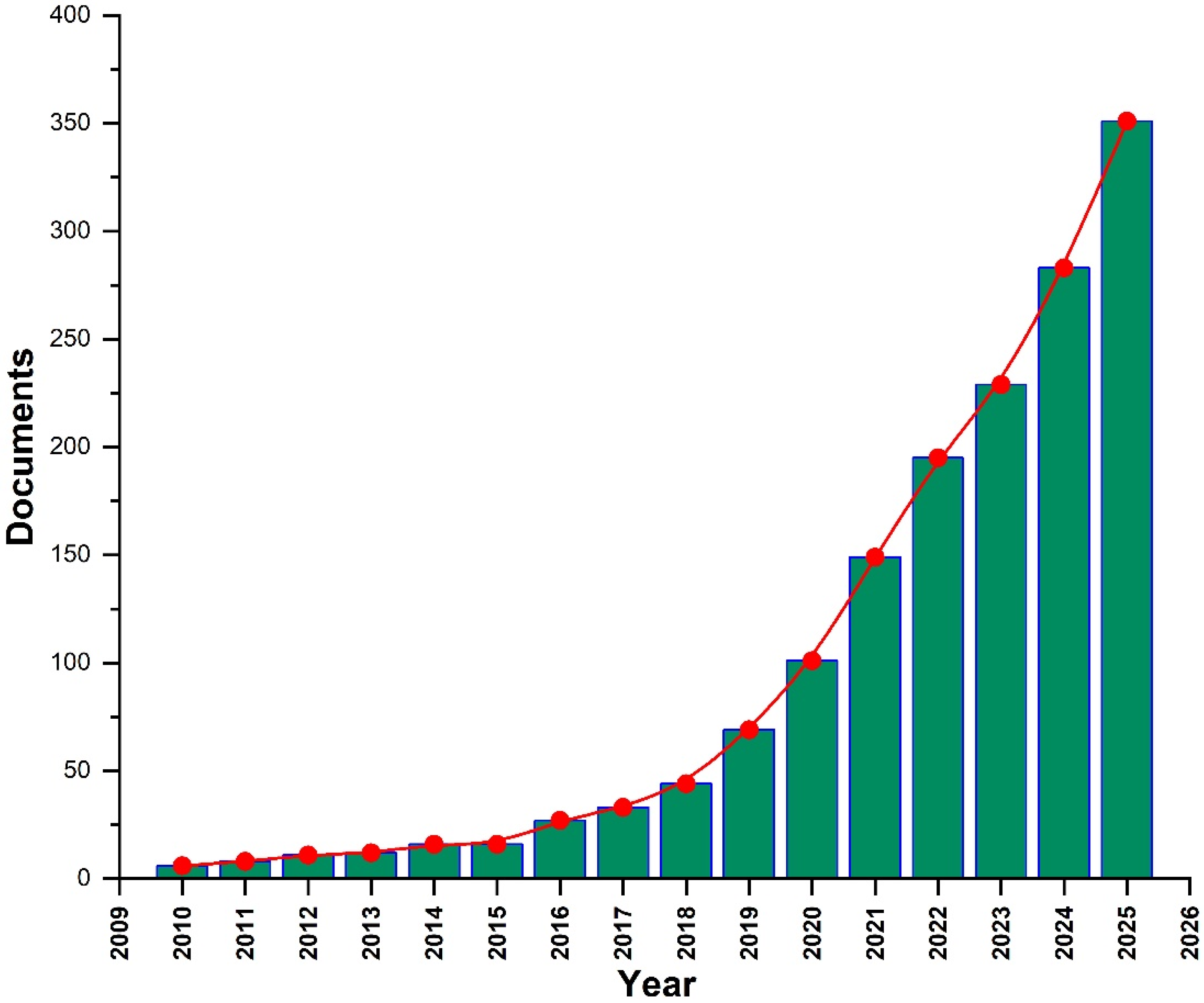
The document distribution by year reveals a strongly accelerating growth trajectory in global research on catalytic degradation for water and wastewater treatment between 2010 and 2025, characteristic of a rapidly maturing and strategically important research domain. From 2010 to 2014, publication output remains very low (6–16 documents per year), indicating an exploratory phase dominated by foundational studies on heterogeneous catalysis, early advanced oxidation processes (AOPs), and proof-of-concept demonstrations. The period 2015–2018 shows a modest but clear uptick (16 to 44 documents), suggesting consolidation of experimental methodologies, increased availability of nanostructured catalysts, and growing recognition of catalytic degradation as a viable solution for recalcitrant pollutants. A clear inflection point emerges around 2019–2020, where annual publications rise sharply from 69 to 101 documents, marking the transition from niche research to broader adoption. This phase reflects intensified global attention to water reuse, emerging contaminants, and the integration of catalysis with photocatalytic, electrocatalytic, and persulfate-based systems, which collectively expanded the thematic and application scope of the field.
The post-2020 period exhibits near-exponential growth, with publications increasing from 149 in 2021 to a peak of 351 in 2025, as shown in
Figure 2, indicating a high compound annual growth rate and strong research momentum. This surge is symptomatic of a mature, innovation-driven stage where research emphasis shifts toward catalyst optimization, reaction mechanism elucidation, scalability, and real wastewater matrices. The pronounced rise from 2022 onward (195 → 229 → 283 → 351) suggests intensified interdisciplinary convergence involving materials science, environmental engineering, and chemical process modelling, alongside increased contributions from emerging economies. Additionally, the sustained year-on-year increase implies that catalytic degradation has moved beyond laboratory curiosity toward pre-industrial relevance, supported by global sustainability agendas, stricter discharge regulations, and advances in catalyst stability and recyclability. The temporal distribution reflects a classic S-curve evolution transitioning into a steep growth phase, underscoring catalytic degradation as a central and expanding pillar of modern water and wastewater treatment research.
3.2. Top Ten Authors and Co-Authorship Network
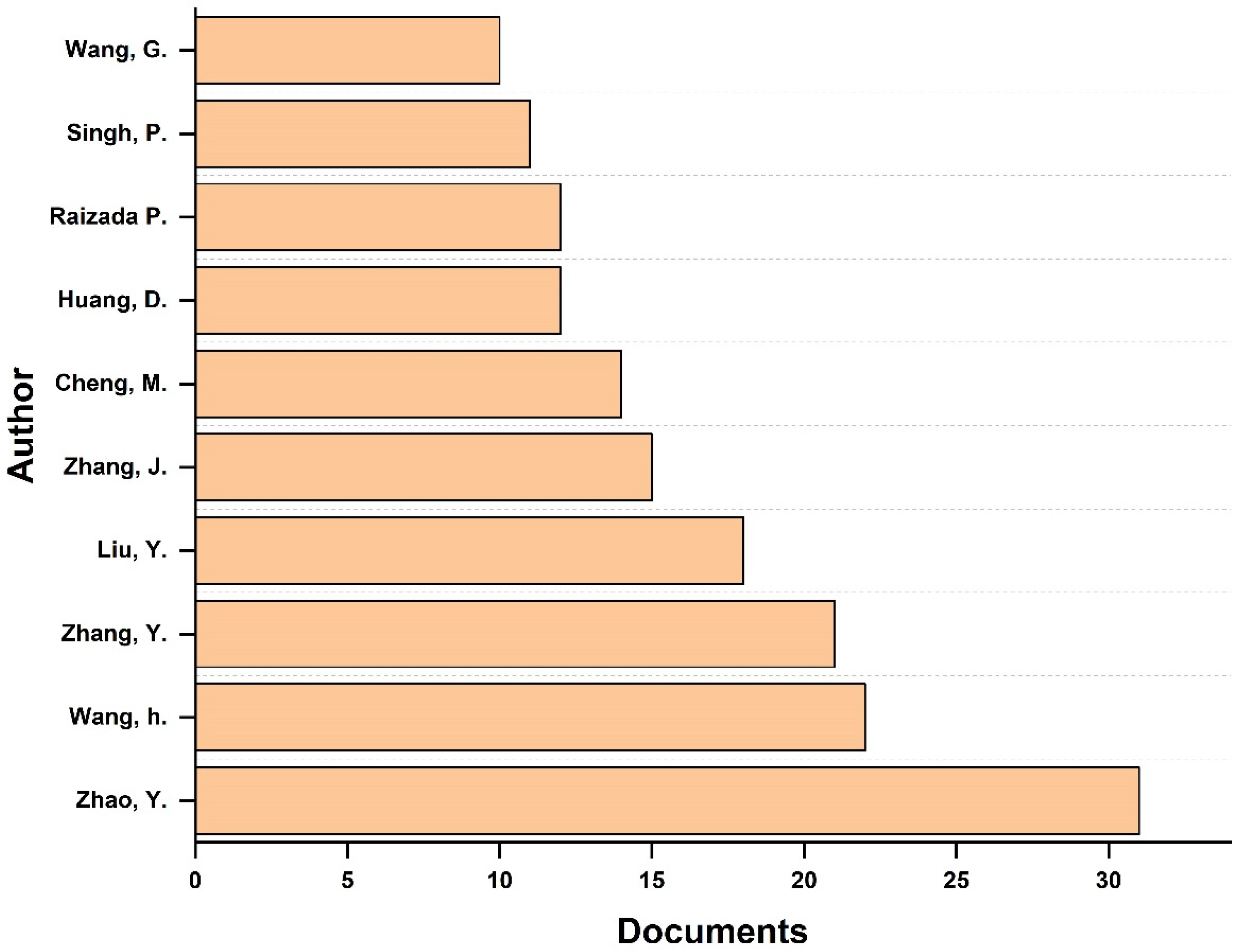
The analysis of the most productive authors highlights a highly skewed authorship structure, consistent with Lotka’s law, where a small cohort of researchers contributes a disproportionate share of publications in catalytic degradation for water and wastewater treatment. As shown in the top-author distribution, Zhao, Y. (31 documents) and Wang, H. (28 documents) emerge as the most prolific contributors, followed by Zhang Y., X. (21 documents) and Liu, Y. (18 documents). The dominance of these authors reflects sustained research engagement rather than sporadic contributions, indicating the presence of established research programs centred on catalyst synthesis, advanced oxidation processes, and mechanistic degradation pathways. The recurrence of common surnames such as Wang and Zhang distinguished by initials also suggests strong representation from large research ecosystems, particularly in East Asia, where institutional capacity and funding for environmental catalysis are well developed. Collectively, the top ten authors as shown in
Figure 3 account for a substantial fraction of the total output, underscoring their role as intellectual drivers shaping research directions, methodological standards, and thematic priorities in the field.
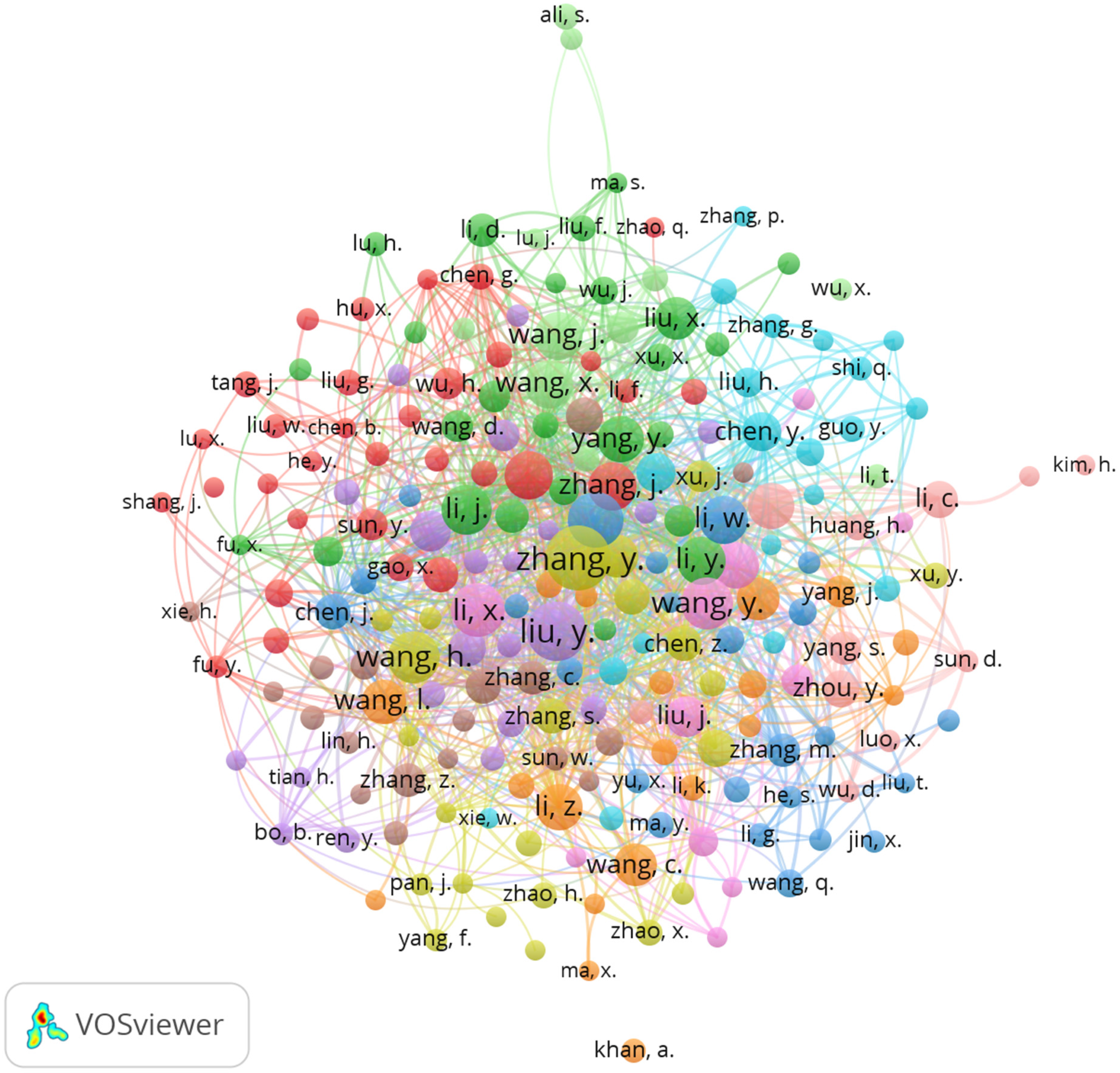
The VOSviewer-based co-authorship network, as shown in
Figure 4, further elucidates the collaborative structure underpinning this productivity. The visualization reveals a modular network composed of several dense clusters centred around the most prolific authors, indicating stable, long-term collaboration groups rather than isolated individual efforts. Highly productive authors such as Zhao, Y., Wang, H., and Zhang J. occupy central positions with high link strength, reflecting their roles as collaboration hubs that connect multiple co-authors and research teams. The presence of inter-cluster links suggests increasing cross-institutional and international collaboration, which is critical for multidisciplinary advancements involving materials science, chemical engineering, and environmental systems analysis. Meanwhile, authors such as Raizada, P. and Singh, P., though slightly lower in document count, display notable connectivity, implying strategic collaborative influence beyond sheer productivity. The co-authorship network indicates a mature and collaborative research landscape, where knowledge diffusion is facilitated through tightly knit author clusters interconnected by key bridging researchers.
3.3. Leading Countries/Territories and International Collaboration Network
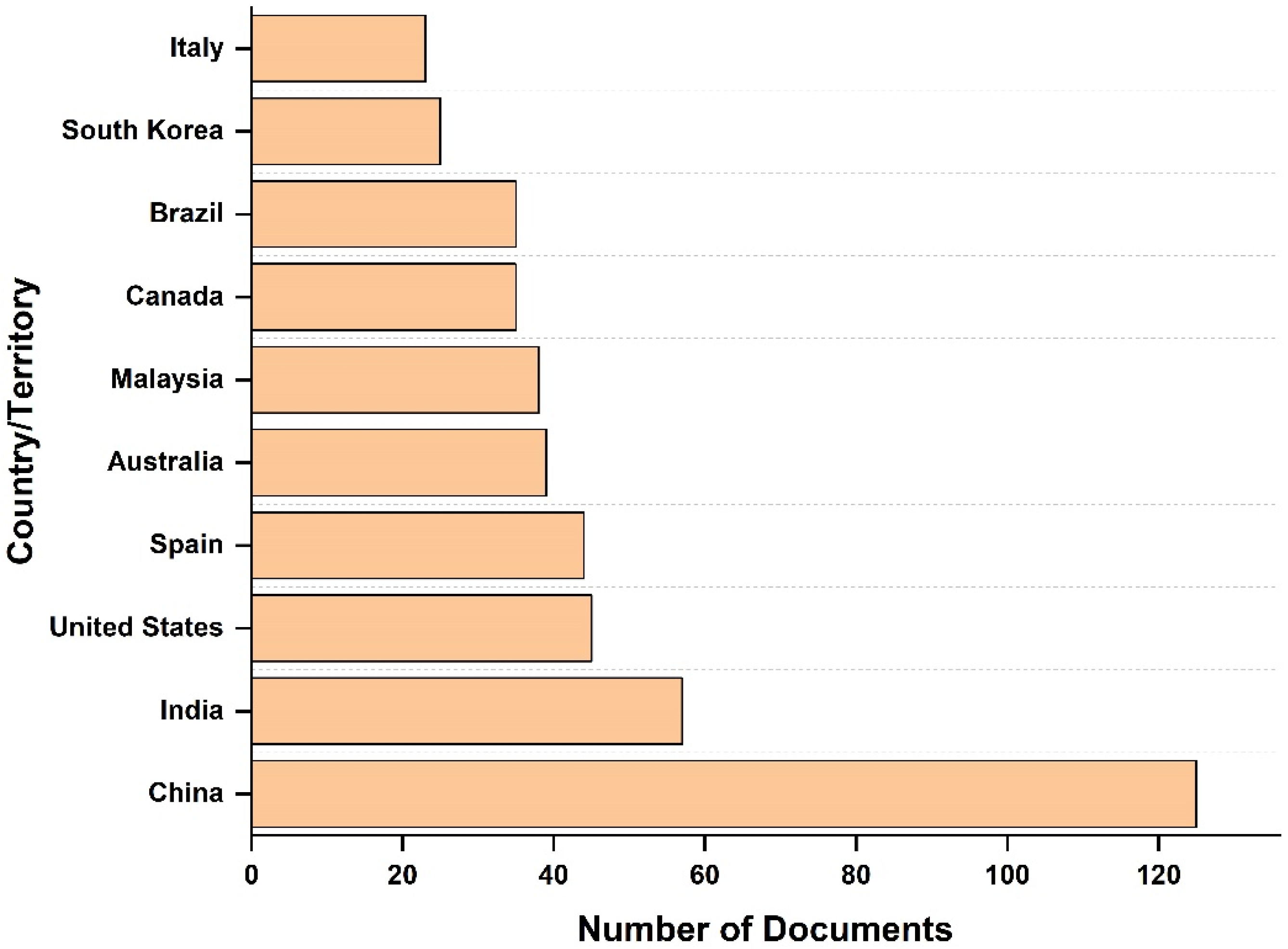
The country-level distribution of publications, as shown in
Figure 5, reveals a pronounced geographical concentration of research output in catalytic degradation for water and wastewater treatment, with China dominating the field at 125 documents. Although this number represents a modest proportion of the total dataset (1550 publications), it remains the highest contribution among individual countries, indicating China’s leading role in this research area within a globally distributed publication landscape. This substantial lead reflects China’s long-term strategic investment in environmental remediation technologies, advanced catalytic materials, and large-scale wastewater treatment infrastructure. This dominance also indicates the country’s strong integration of academic research with national environmental policies aimed at mitigating industrial water pollution and improving water security. India follows with 57 publications, indicating rapidly expanding research capacity driven by acute water pollution challenges and growing academic focus on low-cost and scalable catalytic solutions. The increasing contribution from India further suggests a growing emphasis on developing cost-effective catalytic systems suitable for deployment in resource-constrained regions. The United States (45) and Spain (44) exhibit comparable output levels, underscoring their strong engagement in fundamental catalyst design, reaction kinetics, and advanced oxidation process optimization. These contributions highlight the important role of these countries in advancing the fundamental scientific understanding that underpins next-generation catalytic technologies. The presence of Australia (39), Malaysia (38), Brazil (36), and Canada (35) highlights a diversified global research landscape, where both developed and emerging economies contribute meaningfully to methodological innovation and applied studies. This broader participation reflects the increasing global recognition that sustainable water treatment technologies require collaborative scientific efforts across different climatic, economic, and regulatory contexts. The distribution demonstrates a clear core periphery structure, with a small number of countries generating a large share of publications, consistent with Bradford’s law of scientific productivity. Such a concentration of research activity suggests that international collaboration and knowledge transfer from leading research hubs may play a critical role in accelerating technological adoption and innovation in regions with emerging research capacity.
3.4. Leading Source Journals and Publication Concentration
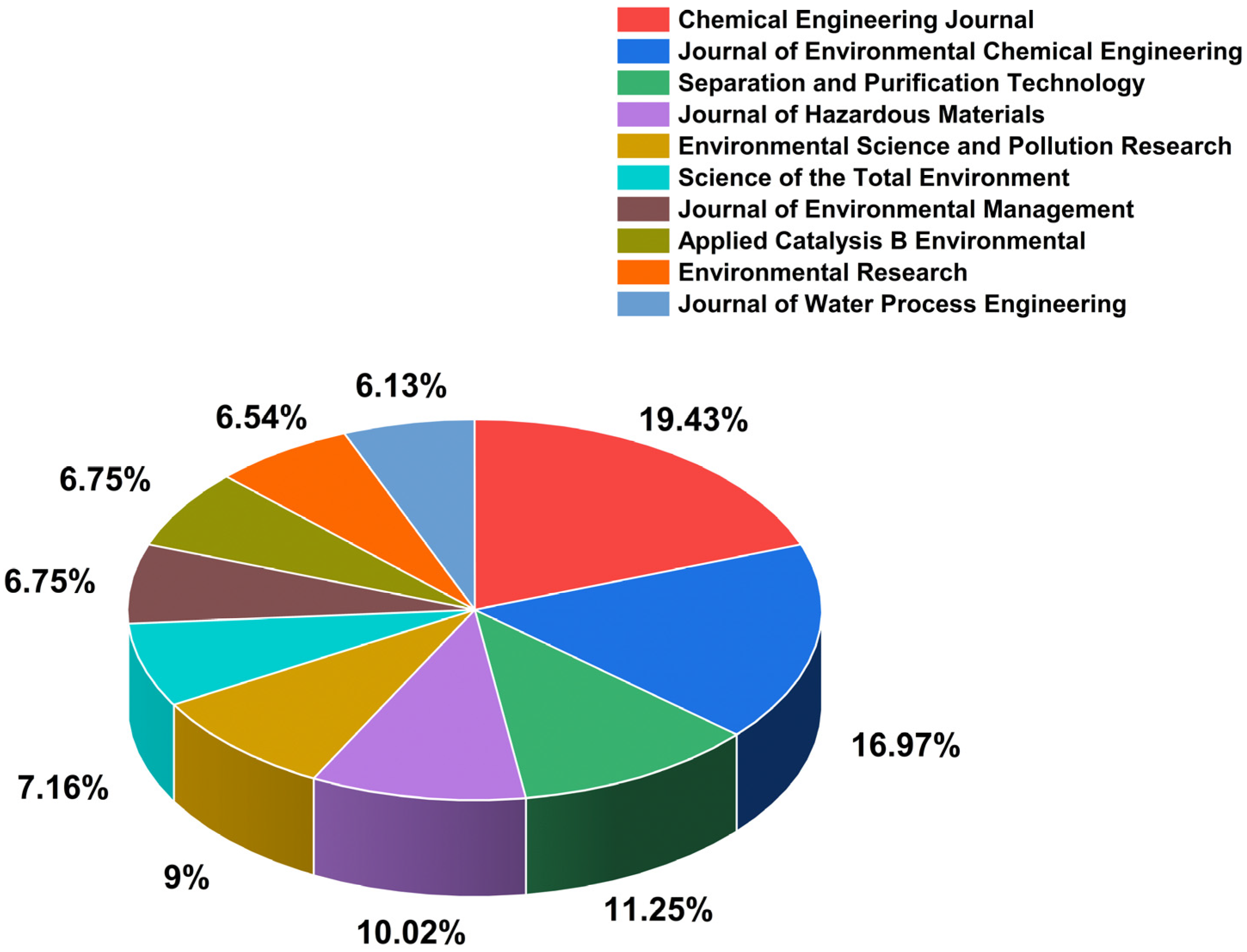
The analysis of source journals reveals a strong concentration of research output within a limited set of high-impact, multidisciplinary environmental and chemical engineering journals, reflecting the applied and cross-cutting nature of catalytic degradation research as shown in
Figure 6. Chemical Engineering Journal emerges as the most dominant outlet with 95 publications, underscoring its central role in disseminating studies on catalyst design, reaction engineering, and process optimization for water and wastewater treatment. Closely following is the Journal of Environmental Chemical Engineering (83 documents), which emphasizes applied catalytic systems and pollutant degradation mechanisms at the interface of chemistry and environmental engineering. Journals such as Separation and Purification Technology (55) and Journal of Hazardous Materials (49) further indicate strong research emphasis on contaminant removal efficiency, process intensification, and treatment of toxic and refractory compounds. Collectively, the leading journals account for a substantial proportion of total publications, demonstrating a clear core set of outlets consistent with Bradford’s law, where a small number of journals serve as primary dissemination channels for the field.
Beyond the top-tier outlets, the presence of journals such as Environmental Science and Pollution Research (44), Science of the Total Environment (35), and Journal of Environmental Management (33) highlights the growing integration of catalytic degradation research with environmental risk assessment, sustainability, and policy-relevant applications. Notably, Applied Catalysis B: Environmental (33) serves as a key platform for fundamental studies on catalytic mechanisms and advanced oxidation pathways, bridging basic catalysis science with environmental implementation. The inclusion of Environmental Research (32) and Journal of Water Process Engineering (30) reflects increasing attention to real-water matrices, process scalability, and engineering feasibility. The source distribution illustrates a mature and interdisciplinary publication ecosystem, where advances in catalytic degradation are disseminated through journals spanning catalysis, environmental chemistry, and water engineering, thereby facilitating broad scientific visibility and cross-disciplinary knowledge transfer.
3.5. Keyword Co-Occurrence and Thematic Evolution
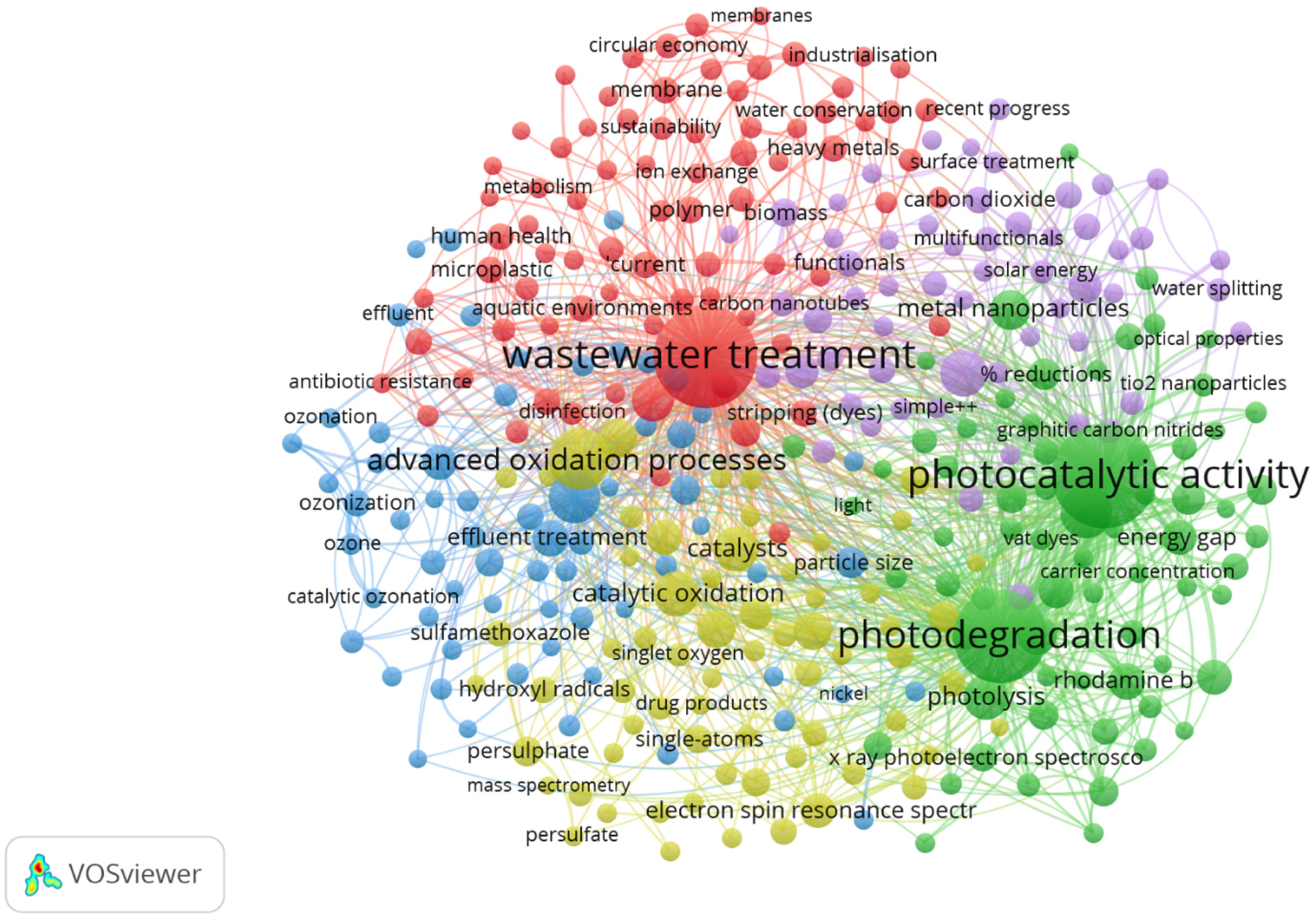
Keyword co-occurrence analysis provides a powerful visualization of the conceptual structure and evolving focus areas in catalytic degradation research. As presented in
Figure 7, the VOSviewer-generated network map reveals three dominant thematic clusters, each representing a major line of inquiry in the field. The first and most prominent cluster (red nodes) centers around photocatalytic degradation, TiO
2, semiconductors, and visible light, reflecting early research efforts focused on material modification and light-driven oxidation. The second cluster (blue nodes) represents the Fenton and advanced oxidation process (AOP) domain, characterized by keywords such as hydroxyl radicals, H
2O
2, photo-Fenton, and reaction kinetics. This cluster underscores the chemical engineering aspect of catalytic oxidation, emphasizing process mechanisms and efficiency optimization. The third cluster (green nodes) has emerged more recently, comprising terms such as hybrid catalysts, metal nanoparticles, biochar, nanocomposites, and heterojunctions. Its growth since 2018 signals a research shift toward multifunctional materials and sustainable hybrid systems that integrate multiple catalytic mechanisms—photocatalysis, Fenton-like oxidation, and electrocatalysis into unified treatment platforms.
Temporal overlay visualization further highlights the field’s chronological progression. Between 2010 and 2025, keywords were dominated by TiO2, UV irradiation, and dye degradation, indicating the initial focus on conventional photocatalytic pathways. From 2011 to 2017, the vocabulary evolved toward visible-light activation, nanostructured semiconductors, and heterojunction design, reflecting the drive for higher efficiency and solar energy utilization. Post-2018, the emphasis has shifted decisively toward hybrid catalytic systems, MOF-based nano materials, and sustainable water remediation. This progression demonstrates the field’s rapid adaptation to global environmental goals and the incorporation of green chemistry and nanotechnology principles. The rising prominence of keywords such as machine learning, carbon neutrality, and circular economy also indicates an emerging convergence between catalysis research and sustainability science. These thematic trends collectively affirm that catalytic degradation research is transitioning from purely chemical optimization toward a data-driven, system-integrated approach capable of addressing complex pollution and resource recovery challenges.
3.6. Top Ten Most Cited Documents
The top ten most cited publications in catalytic degradation for water and wastewater treatment, as presented in
Table 2, are overwhelmingly dominated by critical reviews and foundational perspective articles, highlighting the field’s reliance on conceptual frameworks, mechanistic clarification, and technology benchmarking. Citation counts range from approximately 2400 to over 3800, reflecting their seminal influence across multiple sub-disciplines. The most cited work by Nosaka and Nosaka (2017) on reactive oxygen species (ROS) generation and detection in photocatalysis establishes a mechanistic cornerstone for understanding oxidation pathways, which underpins both photocatalytic and catalytic degradation studies [
24]. Similarly, highly cited reviews by Tong et al. (2012) and Pelaez et al. (2012) provide foundational insights into nanophotocatalytic materials and visible-light-active TiO
2 systems, respectively, which continue to inform catalyst design strategies more than a decade after publication [
25,
26]. The sustained citation impact of these early works underscores their role in shaping long-term research trajectories rather than addressing short-lived technological trends.
A second dominant thematic cluster among the top-cited articles centers on sulfate radical-based advanced oxidation processes (SR-AOPs) and persulfate/peroxymonosulfate activation, reflecting their strategic importance in modern catalytic degradation research. Landmark reviews by Wang and Wang (2018) and Lee et al. (2020) critically examine activation mechanisms, oxidant speciation, and practical limitations, thereby guiding both experimental design and interpretation across hundreds of subsequent studies [
27,
28]. In parallel, the exceptional citation performance of nanozyme-focused reviews (Huang et al., 2019; Wu et al., 2019) signals the rapid convergence of nanotechnology, catalysis, and biomimetic chemistry into environmental applications [
29,
30]. Importantly, nearly all top-cited documents are published in high-impact, cross-disciplinary journals (Chemical Reviews, Environmental Science & Technology, Chemical Engineering Journal, Applied Catalysis B), reinforcing their broad visibility and cross-field relevance. Collectively, this citation landscape demonstrates that the intellectual backbone of catalytic degradation research is built upon integrative, mechanism-driven reviews that unify materials science, radical chemistry, and water treatment engineering.
Table 2.
Top 10 Most Cited Publications in Catalytic Degradation Research for Water and Wastewater Treatment.
Table 2.
Top 10 Most Cited Publications in Catalytic Degradation Research for Water and Wastewater Treatment.
| Rank | Reference | Title | Source Journal | Document Type | Citations |
|---|
| 1 | [24] | Generation and Detection of Reactive Oxygen Species in Photocatalysis | Chemical Reviews | Review | 3811 |
| 2 | [25] | Nano-photocatalytic materials: Possibilities and challenges | Advanced Materials | Review | 3747 |
| 3 | [26] | A review on the visible light active titanium dioxide photocatalysts for environmental applications | Applied Catalysis B: Environmental | Review | 3714 |
| 4 | [27] | Activation of persulfate (PS) and peroxymonosulfate (PMS) and application for the degradation of emerging contaminants | Chemical Engineering Journal | Review | 3604 |
| 5 | [29] | Nanomaterials with enzyme-like characteristics (nanozymes): Next-generation artificial enzymes (II) | Chemical Society Reviews | Review | 3562 |
| 6 | [30] | Nanozymes: Classification, Catalytic Mechanisms, Activity Regulation, and Applications | Chemical Reviews | Review | 2947 |
| 7 | [28] | Persulfate-Based Advanced Oxidation: Critical Assessment of Opportunities and Roadblocks | Environmental Science & Technology | Review | 2930 |
| 8 | [31] | A review on g-C3N4-based photocatalysts | Applied Surface Science | Review | 2822 |
| 9 | [32] | Evaluation of advanced oxidation processes for water and wastewater treatment—A critical review | Water Research | Review | 2611 |
| 10 | [33] | Generation of sulfate radical through heterogeneous catalysis for organic contaminants removal: Current development, challenges and prospects | Applied Catalysis B: Environmental | Review | 2454 |
4. Research Hotspots and Emerging Trends
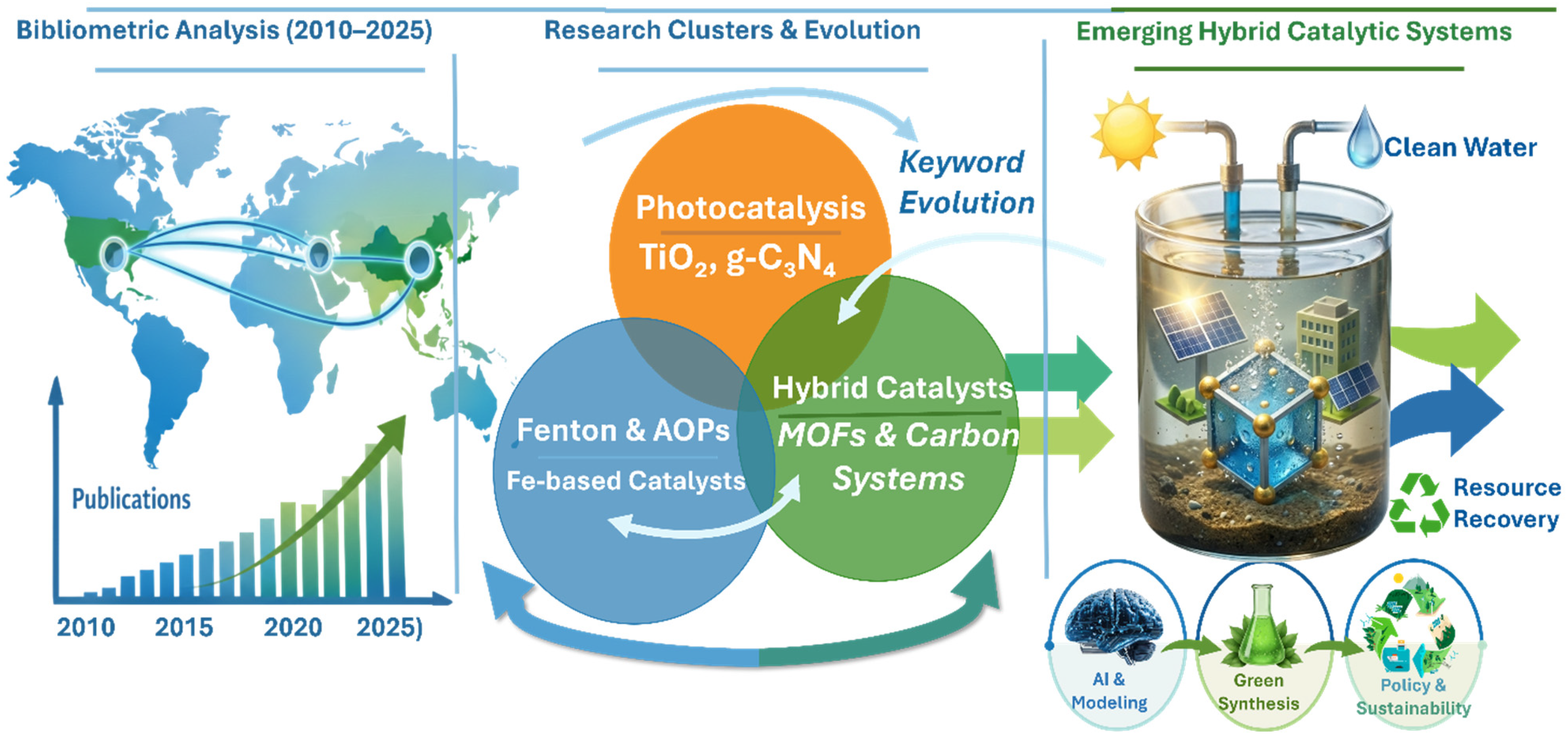
Keyword co-occurrence mapping reveals that research on catalytic degradation for water and wastewater treatment has evolved into a structured, multi-theme knowledge landscape, reflecting both methodological maturity and technological diversification. As shown in
Figure 8, three dominant research clusters emerge: (i) photocatalytic degradation, (ii) Fenton and advanced oxidation processes (AOPs), and (iii) emerging hybrid catalytic systems integrating carbon-based materials and metal–organic frameworks (MOFs). These clusters collectively capture the progression of the field from light-driven semiconductor systems, through chemically activated radical processes, toward highly integrated multifunctional catalytic platforms. Beyond bibliometric structure, these themes correspond to increasing demands for higher degradation efficiency, operational robustness, and applicability to real wastewater matrices. Notably, the most recent research emphasis shifts toward hybrid systems that synergistically combine multiple oxidation pathways, achieving superior pollutant removal efficiencies (>90%) and enhanced catalyst stability.
Analysis of the included studies revealed that certain experimental parameters were consistently reported across publications. The most frequently documented conditions included reaction pH, temperature, catalyst dosage, reaction time, and initial pollutant concentration. Most studies reported neutral to slightly acidic pH values, temperatures ranging from ambient to 60 °C, catalyst dosages between 0.1 and 2 g/L, and reaction times varying from 30 min to 6 h, depending on the target pollutant and catalytic system. These patterns indicate a general experimental consensus on conditions that balance catalytic efficiency with practical applicability. Reporting of other parameters, such as light intensity for photocatalytic processes or oxidant concentration in Fenton-like systems, was less consistent, but still noted in a substantial subset of studies. Highlighting these statistically common conditions provides insight into typical experimental frameworks and may guide future experimental design in catalytic water and wastewater treatment research [
34,
35].
4.1. Photocatalytic Degradation Systems
Photocatalytic degradation represents the foundational research theme in catalytic water treatment, rooted in semiconductor-mediated light activation. In these systems, irradiation of photocatalysts such as TiO
2, g-C
3N
4, ZnO, or their composites induces the formation of electron–hole pairs, which subsequently react with water and dissolved oxygen to generate reactive oxygen species (ROS), including hydroxyl radicals (•OH), superoxide radicals (•O
2−), and singlet oxygen (
1O
2) [
36]. Early studies focused predominantly on UV-driven TiO
2 for dye degradation and model pollutants, while subsequent research emphasized visible-light-responsive materials to improve solar utilization. Advanced strategies such as band-gap engineering, elemental doping, defect modulation, and heterojunction construction have been extensively explored to suppress charge recombination and enhance redox efficiency. Despite their environmental compatibility and low chemical input, photocatalytic systems are often limited by low quantum efficiency and reduced performance in complex wastewater, motivating integration with complementary processes. For instance, Kane et al. (2022) engineered an S-scheme g-C
3N
4/TiO
2 heterojunction that maintained strong redox potentials while suppressing electron–hole recombination, thereby significantly enhancing carbamazepine degradation under visible light [
37]. Building on this heterojunction strategy, Liu et al. (2024) incorporated magnetic Fe
3O
4 into a TiO
2/g-C
3N
4 composite, achieving up to 98% tetracycline removal while enabling catalyst recovery and reuse, thus addressing a key limitation of conventional photocatalysts [
38]. Furthermore, Bai et al. (2023) introduced MXene (Ti
3C
2) as an electron mediator in a ternary photocatalyst, which further accelerated interfacial charge transport and adsorption, resulting in superior degradation of aromatic pollutants [
39]. Collectively, these studies demonstrate that modern photocatalytic research is shifting toward structurally engineered systems that maximize charge separation and operational practicality.
4.2. Fenton and Advanced Oxidation Processes (AOPs)
The second major research theme encompasses Fenton and AOP-based catalytic systems, which rely on chemical activation of oxidants to generate highly reactive radical species. Conventional homogeneous Fenton chemistry, based on Fe
2+-activated hydrogen peroxide, has progressively evolved toward heterogeneous Fenton-like processes using solid catalysts, transition metal oxides, and carbon-supported active sites. In parallel, sulfate radical-based AOPs employing persulfate (PS) and peroxymonosulfate (PMS) have gained prominence due to their higher oxidation potential, wider effective pH range, and greater selectivity toward aromatic and unsaturated compounds. Mechanistic investigations reveal the coexistence of radical (•OH, SO
4•
−) and non-radical pathways, including surface-mediated electron transfer and singlet oxygen generation, which enhance degradation efficiency while reducing scavenging effects. This research cluster is particularly relevant for treating recalcitrant and emerging contaminants, where conventional photocatalysis alone is insufficient. In this context, Su et al., (2023) systematically demonstrated that persulfate and peroxymonosulfate activation via heterogeneous catalysts enables efficient sulfate radical production with broader pH tolerance and improved selectivity for emerging contaminants [
40]. Subsequently, Zhang et al. (2025) critically evaluated persulfate-based AOPs and highlighted that mechanistic ambiguities and oxidant inefficiencies remain major bottlenecks, thereby underscoring the necessity of catalyst-driven heterogeneous systems for scalability [
41]. Consistent with this perspective, Yin et al. (2025) demonstrated that solid catalysts can generate sulfate radicals efficiently while minimizing metal leaching, thereby improving long-term stability and environmental safety [
42]. Together, these studies confirm that heterogeneous AOPs provide a robust and chemically powerful pathway for treating recalcitrant pollutants beyond the capacity of standalone photocatalysis.
4.3. Hybrid Catalytic Systems and Emerging Multifunctional Platforms
The most rapidly expanding research theme involves hybrid catalytic systems that integrate photocatalysis, AOPs, and advanced material architectures into unified platforms. These systems include photocatalyst-Fenton composites, MOF-derived catalysts, biochar- or graphene-supported active phases, heterojunction semiconductors, and electro-photoactive catalytic configurations [
35,
43,
44]. The key advantage of hybrid systems lies in their ability to exploit synergistic mechanisms, such as coupling light-induced charge separation with in situ oxidant activation, enhanced interfacial electron transfer, and improved pollutant adsorption. Carbon-based nanomaterials and MOFs play multifunctional roles as electron mediators, structural scaffolds, and catalytic centers, significantly improving reaction kinetics and catalyst durability. Bibliometric trends indicate that these hybrid systems consistently achieve degradation efficiencies exceeding 90% for complex pollutants and demonstrate improved resistance to deactivation and metal leaching. This cluster reflects a paradigm shift toward integrated, scalable, and sustainability-oriented catalytic technologies tailored for real wastewater treatment. Notably, Wang et al. (2025) demonstrated that nanozyme-based hybrids possess enzyme-like redox activity combined with high chemical stability, enabling efficient oxidant activation with minimal metal dissolution [
45]. Expanding on this concept, Shukla et al. (2025) showed that carbon-based nanozyme hybrids can mediate both radical and non-radical oxidation pathways, resulting in superior degradation efficiencies and long-term operational stability [
46]. More recently, Ahmadi et al. (2025) integrated MOF-derived TiO
2/g-C
3N
4 with porous mineral supports, achieving nearly complete dye degradation while enhancing mass transfer and recyclability [
34]. These findings collectively indicate that hybrid systems represent the most advanced and application-ready research frontier.
5. Future Directions and Research Outlook
The future of catalytic degradation research for water and wastewater treatment lies in the development of integrated, intelligent, and sustainable hybrid systems that can operate efficiently under real-world conditions. As environmental challenges become more complex, the demand for multifunctional catalysts capable of addressing diverse contaminants while maintaining high energy efficiency is expected to grow. To achieve this, researchers are increasingly focusing on the integration of multiple catalytic processes such as photocatalysis, electrocatalysis, and Fenton-like oxidation into unified systems. These multi-modal reactors exploit synergistic effects between light, electricity, and reactive species generation, providing improved degradation rates and selectivity compared to single-mode systems. The transition toward such integrated frameworks reflects the broader shift in environmental engineering from single-process optimization to holistic system design.
Another promising research avenue is the adoption of green synthesis routes and circular chemistry principles in catalyst development. Current preparation methods for advanced catalysts often rely on expensive and toxic precursors or energy-intensive processes, which contradict the sustainability goals of wastewater treatment. Future work should therefore emphasize the use of bio-based materials, waste-derived supports, and low-temperature fabrication techniques to reduce the environmental footprint of catalyst production. The valorisation of agricultural residues, industrial by-products, and biomass for the synthesis of carbonaceous supports (such as biochar and activated carbon) represents a cost-effective and sustainable strategy. These materials not only enhance catalytic performance through improved adsorption and conductivity but also align with global efforts to promote resource recovery and waste minimization.
The rise of artificial intelligence (AI) and data-driven modelling is poised to revolutionize the design and optimization of hybrid catalytic systems. By combining computational chemistry, machine learning, and process simulation, researchers can now predict structure–activity relationships, identify optimal operating parameters, and accelerate the discovery of high-performance catalysts. For instance, AI algorithms can analyse large bibliometric and experimental datasets to identify underexplored material combinations or reaction pathways with high potential for industrial translation. This digital transformation in catalysis research promises to shorten development cycles, reduce experimental costs, and enable precision-guided synthesis, ultimately bridging the gap between laboratory innovation and practical application.
Another critical frontier involves scaling up catalytic technologies from bench-scale experiments to pilot and full-scale reactors suitable for municipal and industrial wastewater treatment. Although laboratory studies have reported impressive degradation efficiencies, real wastewater contains complex matrices and coexisting ions that can suppress catalytic activity. Future investigations must therefore focus on long-term stability, reusability, and process integration under realistic operating conditions. Pilot-scale demonstrations, coupled with techno-economic and life-cycle assessments, will be essential to validate the feasibility and sustainability of hybrid catalytic systems. Moreover, interdisciplinary collaboration between material scientists, environmental engineers, and policymakers will be vital in translating these technologies into viable water treatment infrastructure.
Finally, the future of catalytic degradation research should embrace a resource recovery and energy coupling perspective. Instead of focusing solely on pollutant removal, emerging systems should aim to simultaneously recover valuable resources such as nutrients, metals, and organic intermediates while generating renewable energy. Integrating catalytic processes with bioelectrochemical systems, solar-assisted reactors, or membrane technologies can create circular treatment pathways that not only clean water, but also contribute to energy efficiency and carbon neutrality. Such developments would position hybrid catalytic systems as pivotal components in the transition toward sustainable, low-carbon, and resilient water management frameworks.
In essence, the coming years will witness a transformation of catalytic degradation research from isolated process optimization to the integration of advanced materials, smart digital tools, and circular economy concepts. This evolution will not only enhance the environmental performance of water treatment systems, but also ensure their alignment with global sustainability objectives, particularly those articulated under the United Nations Sustainable Development Goals (SDGs). Through continued innovation and interdisciplinary collaboration, hybrid catalytic systems are expected to redefine the scientific and practical frontiers of water purification in the decades ahead.
6. Conclusions and Policy Implications
This bibliometric analysis provides a comprehensive overview of global research developments in catalytic degradation for water and wastewater treatment over the period 2010–2025, revealing a rapidly evolving and increasingly interdisciplinary field. Using a PRISMA-guided selection process applied to the Scopus database, a total of 1550 publications were included in the final dataset, consisting of 1265 research articles and 285 review papers. The steady and accelerated growth in annual publications particularly after 2015 reflects heightened global attention to water sustainability challenges and the parallel advancement of catalytic materials and advanced oxidation technologies. Collaboration and network analyses indicate a highly internationalized research landscape. China, the United States, and India emerged as the most productive contributors, together accounting for a substantial share of total publications, while leading institutions such as Tsinghua University, the Indian Institutes of Technology, and the University of California system formed dense and influential collaboration networks. These patterns highlight the central role of cross-border cooperation in driving innovation in catalytic water treatment research.
Keyword co-occurrence and thematic mapping revealed three dominant and interrelated research fronts: (i) photocatalytic degradation and semiconductor engineering, (ii) advanced oxidation processes, particularly Fenton and Fenton-like systems, and (iii) emerging hybrid catalytic systems incorporating carbon-based materials, metal oxides, and metal–organic frameworks. The prominence of these clusters confirms a clear transition from conventional single-component catalysts toward multifunctional hybrid systems designed to enhance light utilization, charge transfer efficiency, and operational stability.
Policy Implications
From a policy perspective, the advancement of catalytic degradation technologies strongly supports global water sustainability goals, particularly UN SDG 6 (Clean Water and Sanitation) and SDG 12 (Responsible Consumption and Production). Effective translation to practice requires policymakers to integrate hybrid catalytic systems into national wastewater treatment strategies, especially in pollution-intensive industries such as pharmaceuticals, textiles, and agrochemicals, while supporting pilot-scale deployment through incentives, public–private partnerships, and international knowledge exchange. Establishing standardized performance metrics, safety guidelines, and life-cycle assessment requirements is critical to minimizing secondary environmental risks associated with catalytic and nanomaterial-based systems. Ultimately, the successful implementation of next-generation catalytic wastewater technologies will depend on coordinated collaboration across science, industry, and policy, enabling laboratory-scale innovations particularly hybrid catalytic systems to evolve into scalable, cost-effective, and environmentally sustainable solutions for global water security.
Author Contributions
Conceptualization, M.Y.D.A.; methodology, A.A.B.M.; validation, M.Y.D.A.; formal analysis, A.A.B.M.; investigation, M.Y.D.A. and A.A.B.M.; resources, M.Y.D.A.; data curation, M.Y.D.A. and A.A.B.M.; writing—original draft preparation, M.Y.D.A.; writing—review and editing, A.A.B.M., M.R.A., A.F.A.-M., D.E.N., M.A.L. and M.F.M.A. All authors have read and agreed to the published version of the manuscript.
Funding
This research received no external funding.
Data Availability Statement
No new data were created or analyzed in this study. Data sharing is not applicable to this article.
Acknowledgments
The authors would like to thank the A’Sharqiyah University (ASU) for supporting this research.
Conflicts of Interest
The authors declare no conflicts of interest.
References
- Mishra, R.K.; Mentha, S.S.; Misra, Y.; Dwivedi, N. Emerging pollutants of severe environmental concern in water and wastewater: A comprehensive review on current developments and future research. Water-Energy Nexus 2023, 6, 74–95. [Google Scholar] [CrossRef]
- Jeevanantham, S.; Saravanan, A.; Hemavathy, R.V.; Kumar, P.S.; Yaashikaa, P.R.; Yuvaraj, D. Removal of toxic pollutants from water environment by phytoremediation: A survey on application and future prospects. Environ. Technol. Innov. 2019, 13, 264–276. [Google Scholar] [CrossRef]
- Mahlambi, M.M.; Ngila, C.J.; Mamba, B.B. Recent Developments in Environmental Photocatalytic Degradation of Organic Pollutants: The Case of Titanium Dioxide Nanoparticles—A Review. J. Nanomater. 2015, 2015, 790173. [Google Scholar] [CrossRef]
- Jiang, C.; Pang, S.; Ouyang, F.; Ma, J.; Jiang, J. A new insight into Fenton and Fenton-like processes for water treatment. J. Hazard. Mater. 2010, 174, 813–817. [Google Scholar] [CrossRef] [PubMed]
- Shahidi, D.; Roy, R.; Azzouz, A. Advances in catalytic oxidation of organic pollutants—Prospects for thorough mineralization by natural clay catalysts. Appl. Catal. B Environ. Energy 2015, 174–175, 277–292. [Google Scholar] [CrossRef]
- Zheng, J.; Wu, Z. Innovative microchannel-structured beads for microscale process intensification: A case study on water treatment for sulfamethoxazole abatement. Chem. Eng. J. 2025, 504, 158527. [Google Scholar] [CrossRef]
- Herney-Ramirez, J.; Vicente, M.A.; Madeira, L.M. Heterogeneous photo-Fenton oxidation with pillared clay-based catalysts for wastewater treatment: A review. Appl. Catal. B 2010, 98, 10–26. [Google Scholar] [CrossRef]
- Vakros, J. Catalytic Processes for Water and Wastewater Treatment. Catalysts 2023, 13, 677. [Google Scholar] [CrossRef]
- Tufail, M.; Nasir, M.J.; Tariq, A.; Ali, Z.; Alarifi, S.S. Assessing access to safe drinking water in flood-affected areas of District Nowshera, Pakistan: A case study towards achieving sustainable development goal 6.1. Ecohydrol. Hydrobiol. 2025, 25, 422–437. [Google Scholar] [CrossRef]
- Hong, J.; Cho, K.-H.; Presser, V.; Su, X. Recent advances in wastewater treatment using semiconductor photocatalysts. Curr. Opin. Green Sustain. Chem. 2022, 36, 100644. [Google Scholar] [CrossRef]
- Lee, D.-E.; Kim, M.-K.; Danish, M.; Jo, W.-K. State-of-the-art review on photocatalysis for efficient wastewater treatment: Attractive approach in photocatalyst design and parameters affecting the photocatalytic degradation. Catal. Commun. 2023, 183, 106764. [Google Scholar] [CrossRef]
- Iqbal, M.A.; Akram, S.; Khalid, S.; Lal, B.; Hassan, S.U.; Ashraf, R.; Kezembayeva, G.; Mushtaq, M.; Chinibayeva, N.; Hosseini-Bandegharaei, A. Advanced photocatalysis as a viable and sustainable wastewater treatment process: A comprehensive review. Environ. Res. 2024, 253, 118947. [Google Scholar] [CrossRef] [PubMed]
- Mishra, S.; Sundaram, B. A review of the photocatalysis process used for wastewater treatment. Mater. Today Proc. 2024, 102, 393–409. [Google Scholar] [CrossRef]
- Tsaffo Mbognou, M.H.; Lambert, S.D.; Farcy, A.; Rekik, H.; Wouamba, S.C.; Woumfo, E.D.; Mahy, J.G. Dual-function Cameroonian clay-supported ZnO and TiO2 photocatalysts for ibuprofen mineralization and bacterial inactivation. Next Mater. 2025, 9, 101290. [Google Scholar] [CrossRef]
- Bharathi, A.M.; Neppolian, B.; Krishnamurthi, T. Exploring Photocatalytic Techniques for Wastewater Treatment: Strategic Sustainability Initiatives for Future Prosperity. Water Air Soil Pollut. 2026, 237, 283. [Google Scholar] [CrossRef]
- Sharma, B.; Mohan, C.; Kumar, R.; Varma, R.S. Chemical degradation of remazol dye by using Tb-doped TiO2 catalyst and Photo-Fenton’s process under UV light. Sci. Rep. 2025, 15, 36930. [Google Scholar] [CrossRef]
- Liu, T.; Hu, K.; Li, Y.; Wang, Y.; Han, D.; Wang, Z.; Gu, F. The Z-Scheme MIL-88B(Fe)/BiOBr Heterojunction Promotes Fe(III)/Fe(II) Cycling and Photocatalytic-Fenton-Like Synergistically Enhances the Degradation of Ciprofloxacin. Small 2024, 20, 2309541. [Google Scholar] [CrossRef]
- Fazli, A.; Brigante, M.; Khataee, A.; Mailhot, G. Fe2.5Co0.3Zn0.2O4/CuCr-LDH as a visible-light-responsive photocatalyst for the degradation of caffeine, bisphenol A, and simazine in pure water and real wastewater under photo-Fenton-like degradation process. Chemosphere 2022, 291, 132920. [Google Scholar] [CrossRef]
- Rokesh, K.; Sakar, M.; Do, T.-O. Emerging Hybrid Nanocomposite Photocatalysts for the Degradation of Antibiotics: Insights into Their Designs and Mechanisms. Nanomaterials 2021, 11, 572. [Google Scholar] [CrossRef]
- Bin Mokaizh, A.A.; Nour, A.H.; Alara, O.R.; Baarimah, A.O. Bioactive Components of Commiphora Gileadensis Plant for Various Medicinal Applications: A Bibliometric Analysis. In Proceedings of the 2022 International Conference on Data Analytics for Business and Industry (ICDABI), Virtual, 25–26 October 2022; IEEE: New York, NY, USA, 2022; pp. 21–27. [Google Scholar] [CrossRef]
- Baarimah, A.O.; Bin Mokaizh, A.A.; Alazaiza, M.Y.D.; Al-Zghoul, T. Visualization and networking analysis of processing seafood towards future trends: A bibliometric analysis from 2010 to 2024. Results Eng. 2024, 24, 103640. [Google Scholar] [CrossRef]
- Baarimah, A.O.; Alaloul, W.S.; Liew, M.S.; Baarimah, S.O.; Musarat, M.A.; Bin Mokaizh, A.A. A Bibliometric Review of Research Trends on Kenaf Fiber Reinforced Concrete. Constr. Technol. Archit. 2023, 4, 57–65. [Google Scholar] [CrossRef]
- Shukla, K.A.; Bin Abu Sofian, A.D.A.; Singh, A.; Chen, W.H.; Show, P.L.; Chan, Y.J. Food waste management and sustainable waste to energy: Current efforts, anaerobic digestion, incinerator and hydrothermal carbonization with a focus in Malaysia. J. Clean. Prod. 2024, 448, 141457. [Google Scholar] [CrossRef]
- Nosaka, Y.; Nosaka, A.Y. Generation and Detection of Reactive Oxygen Species in Photocatalysis. Chem. Rev. 2017, 117, 11302–11336. [Google Scholar] [CrossRef] [PubMed]
- Tong, H.; Ouyang, S.; Bi, Y.; Umezawa, N.; Oshikiri, M.; Ye, J. Nano-photocatalytic Materials: Possibilities and Challenges. Adv. Mater. 2012, 24, 229–251. [Google Scholar] [CrossRef]
- Pelaez, M.; Nolan, N.T.; Pillai, S.C.; Seery, M.K.; Falaras, P.; Kontos, A.G.; Dunlop, P.S.M.; Hamilton, J.W.J.; Byrne, J.A.; O’Shea, K.; et al. A review on the visible light active titanium dioxide photocatalysts for environmental applications. Appl. Catal. B 2012, 125, 331–349. [Google Scholar] [CrossRef]
- Wang, J.; Wang, S. Activation of persulfate (PS) and peroxymonosulfate (PMS) and application for the degradation of emerging contaminants. Chem. Eng. J. 2018, 334, 1502–1517. [Google Scholar] [CrossRef]
- Lee, J.; von Gunten, U.; Kim, J.-H. Persulfate-Based Advanced Oxidation: Critical Assessment of Opportunities and Roadblocks. Environ. Sci. Technol. 2020, 54, 3064–3081. [Google Scholar] [CrossRef]
- Wu, J.; Wang, X.; Wang, Q.; Lou, Z.; Li, S.; Zhu, Y.; Qin, L.; Wei, H. Nanomaterials with enzyme-like characteristics (nanozymes): Next-generation artificial enzymes (II). Chem. Soc. Rev. 2019, 48, 1004–1076. [Google Scholar] [CrossRef]
- Huang, Y.; Ren, J.; Qu, X. Nanozymes: Classification, Catalytic Mechanisms, Activity Regulation, and Applications. Chem. Rev. 2019, 119, 4357–4412. [Google Scholar] [CrossRef]
- Wen, J.; Xie, J.; Chen, X.; Li, X. A review on g-C 3 N 4-based photocatalysts. Appl. Surf. Sci. 2017, 391, 72–123. [Google Scholar] [CrossRef]
- Miklos, D.B.; Remy, C.; Jekel, M.; Linden, K.G.; Drewes, J.E.; Hübner, U. Evaluation of advanced oxidation processes for water and wastewater treatment—A critical review. Water Res. 2018, 139, 118–131. [Google Scholar] [CrossRef] [PubMed]
- Oh, W.-D.; Dong, Z.; Lim, T.-T. Generation of sulfate radical through heterogeneous catalysis for organic contaminants removal: Current development, challenges and prospects. Appl. Catal. B 2016, 194, 169–201. [Google Scholar] [CrossRef]
- Ahmadi, B.; Fallah, A.; Ghamarpoor, R.; Jamshidi, M. Methylene blue beyond the dye: A critical review on its role as a benchmark pollutant in photocatalyst design. Results Chem. 2025, 18, 102910. [Google Scholar] [CrossRef]
- Dai, Y.; Liu, G.; Sun, X.; Ma, J.; Xian, T.; Yang, H. Mn doping and ZnS nanoparticles modification on Bi2MoO6 to achieve an highly-efficient photocatalyst for TC degradation. Appl. Surf. Sci. 2025, 681, 161611. [Google Scholar] [CrossRef]
- Harun-Ur-Rashid, M.; Pal, K.; Imran, A.B. Hybrid Nanocomposite Fabrication of Nanocatalyst with Enhanced and Stable Photocatalytic Activity. Top. Catal. 2024, 67, 17–45. [Google Scholar] [CrossRef]
- Kane, A.; Chafiq, L.; Dalhatou, S.; Bonnet, P.; Nasr, M.; Gaillard, N.; Dikdim, J.M.D.; Monier, G.; Assadi, A.A.; Zeghioud, H. g-C3N4/TiO2 S-scheme heterojunction photocatalyst with enhanced photocatalytic Carbamazepine degradation and mineralization. J. Photochem. Photobiol. A Chem. 2022, 430, 113971. [Google Scholar] [CrossRef]
- Liu, R.; Li, M.; Chen, J.; Yin, Y.; Zhao, W.; Gong, Z.; Jin, H.; Liu, Z. Enhanced Photocatalytic Degradation of Tetracycline by Magnetically Separable g-C3N4-Doped Magnetite@Titanium Dioxide Heterostructured Photocatalyst. Water 2024, 16, 1372. [Google Scholar] [CrossRef]
- Bai, Y.; Xu, S.; Chen, J.; Sun, X.; Zhao, S.; Chang, J.; He, Z. Ti3C2@g-C3N4/TiO2 Ternary Heterogeneous Photocatalyst for Promoted Photocatalytic Degradation Activities. Coatings 2023, 13, 655. [Google Scholar] [CrossRef]
- Su, R.; Li, Z.; Cheng, F.; Dai, X.; Wang, H.; Luo, Y.; Huang, L. Advances in the Degradation of Emerging Contaminants by Persulfate Oxidation Technology. Water Air Soil Pollut. 2023, 234, 754. [Google Scholar] [CrossRef]
- Zhang, Z.; Du, F.; Shi, H.; Du, H.; Xiao, P. Iron Redox Cycling in Persulfate Activation: Strategic Enhancements, Mechanistic Insights, and Environmental Applications—A Review. Nanomaterials 2025, 15, 1712. [Google Scholar] [CrossRef]
- Yin, H.; Li, H.; Wang, J.; Shu, M.; Zhu, X. Enhancing vanadium leaching from landfilled metallurgical residues through hydroxyl radical-based AOPs for sustainable production. Chem. Eng. Sci. 2025, 315, 121821. [Google Scholar] [CrossRef]
- Guo, Z.; Zhang, Z.; Liu, G.; Yang, H.; Sun, J. Enhanced oxidation resistance of graphene through strain-electric coupling. Comput. Mater. Sci. 2026, 262, 114406. [Google Scholar] [CrossRef]
- Wang, C.; Liu, G.R.; Sun, X.F.; Ma, J.Y.; Xian, T.; Yang, H. NaBH4 induces strong ferromagnetism of Bi2Fe4O9 at room temperature. Chin. Phys. B 2025, 34, 127503. [Google Scholar] [CrossRef]
- Wang, X.; Li, Q.-Z.; Zhao, Y.; Gao, X. Recent Advances in Oxidase-like Nanozymes: Mechanisms, Prediction Models, and Applications. ACS Appl. Mater. Interfaces 2025, 17, 66110–66150. [Google Scholar] [CrossRef]
- Shukla, A.K.; Bathla, M.; Nisha, A.; Yadav, S.K.; Acharya, A. Carbon nanomaterials as functional biomimetics: Unveiling synthesis, and factors affecting their nanozyme potential. Proc. Indian Natl. Sci. Acad. 2025. [Google Scholar] [CrossRef]
| Disclaimer/Publisher’s Note: The statements, opinions and data contained in all publications are solely those of the individual author(s) and contributor(s) and not of MDPI and/or the editor(s). MDPI and/or the editor(s) disclaim responsibility for any injury to people or property resulting from any ideas, methods, instructions or products referred to in the content. |




 ,
,