Communication

Synthesis of 3,3-Difluoro-quinoline-2,4-diones via Nickel-Catalyzed Cyclization of N-(2-Cyanoaryl)bromodifluoroacetamides


1
Jiangxi Provincial Key Laboratory of Functional Crystalline Materials Chemistry, School of Chemistry and Chemical Engineering, Jiangxi University of Science and Technology, Ganzhou 341000, China
2
Graduate School, Gannan Normal University, Ganzhou 341000, China
*
Authors to whom correspondence should be addressed.
These authors contributed equally to this work.
Catalysts 2026, 16(3), 279; https://doi.org/10.3390/catal16030279
Submission received: 4 March 2026 / Revised: 16 March 2026 / Accepted: 19 March 2026 / Published: 20 March 2026
(This article belongs to the Section Catalysis in Organic and Polymer Chemistry)

Abstract

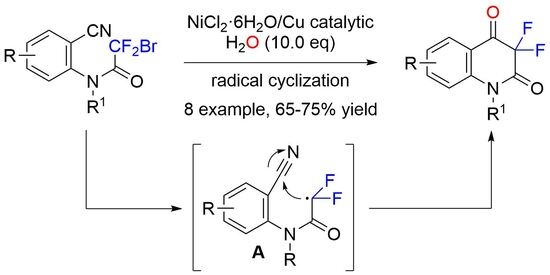
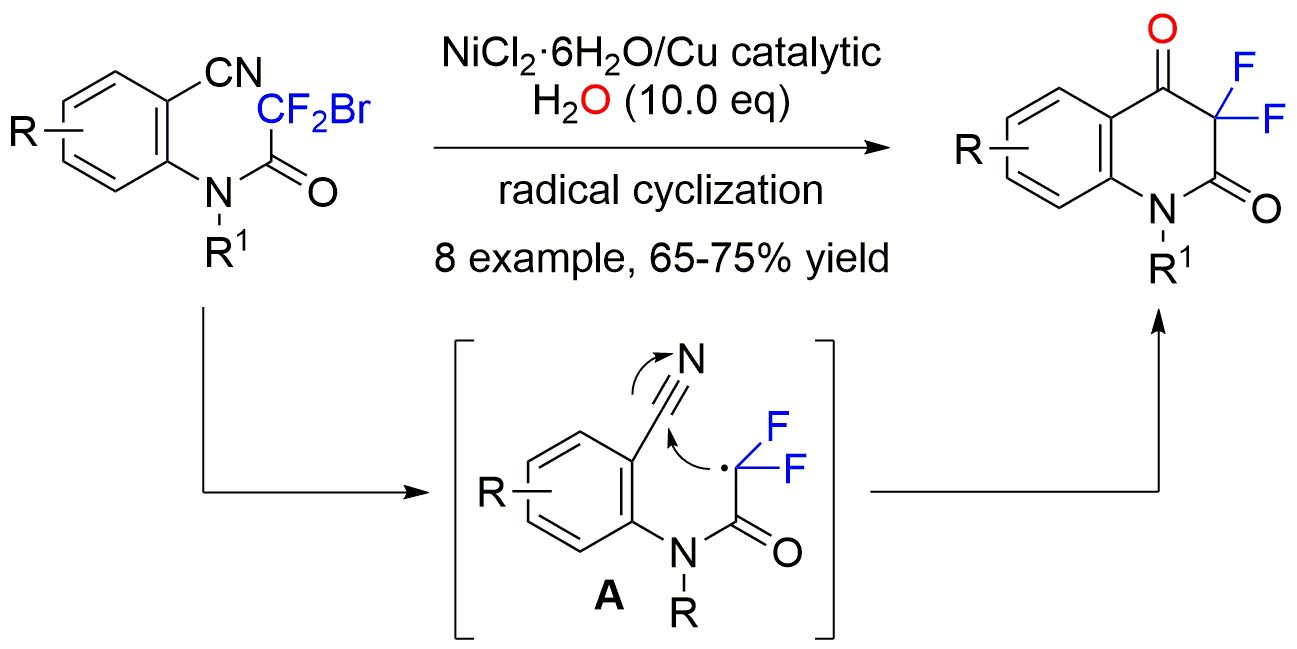
Quinoline-2,4-dione derivatives represent an essential class of heterocycle scaffolds that have demonstrated wide applications in modern drug discovery. However, the efficient construction of 3,3-difluoro-quinoline-2,4-diones with broad substrate generality remains a significant challenge and has not yet been reported. Herein, we developed the nickel-catalyzed intramolecular radical cyclization of 2-bromo-2,2-difluoro-N-(2-cyanoaryl)acetamides to achieve various 3,3-difluoro-quinoline-2,4-diones in good yields. The scalability and practical applicability of this method were demonstrated through large-scale reactions.

Graphical Abstract

1. Introduction

Because the CF2 group can act as a bioisostere of an ether oxygen, the selective introduction of the CF2 group has become an important strategy in the field of drug discovery and development [1,2,3,4,5,6,7]. For instance, eflornithine [8], gemcitabine [9], difluoromethylene analogs of both Vitamin D [10] and docetaxel [11] all contain a CF2 group, which shows improved properties. The development of methods for selective gem-difluoroalkylation is still highly desirable [12,13,14,15,16,17].
Functionalized quinoline-2,4-dione derivatives are important heterocycles and widely exist in natural products, pharmaceuticals, and agrochemicals. Moreover, they are also well-known and important building blocks for the synthesis of novel heterocyclic compounds and natural products such as pyranoquinoline alkaloids. Two classical methods were commonly used for the preparation of functionalized quinoline-2,4-diones, the oxidation of 4-hydroxyquinolin-2-ones and the intramolecular cyclization of N-acylanthranilates [18,19,20,21]. However, these methods always have some drawbacks, such as multiple synthetic steps and complex substrates, resulting in methodological limitations. Therefore, it is still highly necessary to develop a simple, efficient and straightforward method for the construction of quinoline-2,4-diones. The nitrile group is widely used in synthetic organic chemistry. The radical addition reactions of cyano groups provide great opportunities for the synthesis of ketones [22,23]. Recently, Li and Wang developed several radical addition/cyclization cascade reactions of 2-cyanoarylacrylamides to synthesize functionalized quinoline-2,4(1H,3H)-diones [24,25,26,27,28].
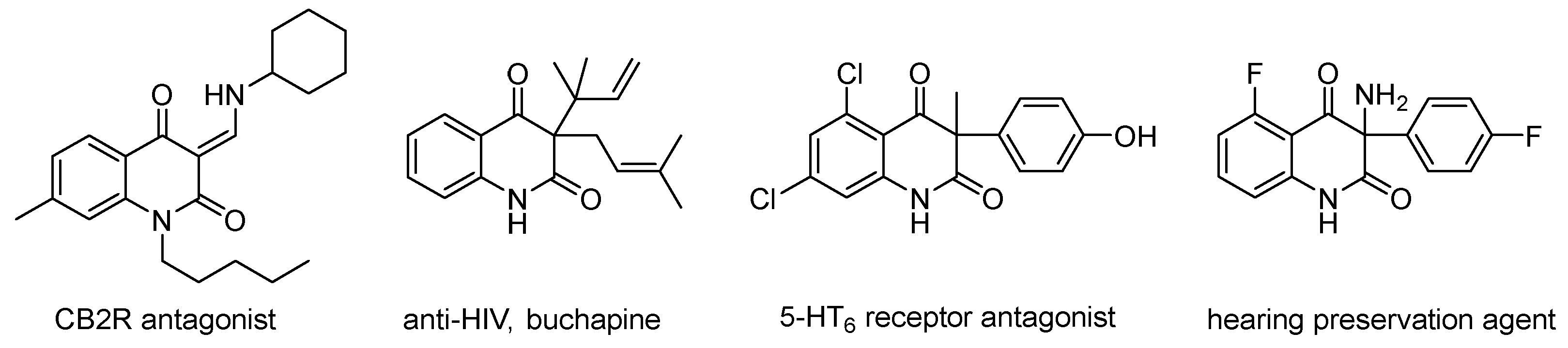
Recently, 3,3-Disubstituted quinoline-2,4-dione systems sparked interest because of their biological activity (Scheme 1) [18,29,30]. Therefore, 3-haloquinoline-2,4-diones with 3-alkyl- or 3-aryl substituents, which show similar structural properties in their active methylene group, have been synthesized in order to investigate their chemical and biological properties. As a continuation of our interest in selective fluoroalkylation reactions [31,32,33,34,35], we report a intramolecular radical cyclization of 2-bromo-2,2-difluoro-N-(2-cyanoaryl)acetamides with Nickel(II) chloride hexahydrate to construct gem-difluoroalkylated 3,4-dihydroquinoline-2,4-diones.

2. Results

2.1. Studies on Various Nickel Catalysts and Metal

Firstly, we chose 2-bromo-N-(2-cyanophenyl)-2,2-difluoro-N-methylacetamide 1a as the model substrate to optimize the reaction conditions. As outlined in Table 1, by using Mn powder as reductant, different nickel catalysts were examined and NiCl2·6H2O displayed better catalytic activity than other nickel catalysts (51% yield, Table 1, entry 5 vs. entry 1–4). Then, using copper powder instead of Mn powder as reductant, the yield of 2a was increased to 75% (Table 1, entry 7). When we reduced the amount of Cu powder, the yield of 2a dropped sharply to 12% (Table 1, entry 8 vs. entry 7). Only using NiCl2·6H2O or Cu powder as catalyst, the yield of 2a was diminished (Table 1, entry 9–10).

2.2. Screening of Different Solvents and Water Consumption

We then chose NiCl2·6H2O as the catalyst and Cu powder as the reductant to screen different solvents and water consumption (Table 2). After extensive screening of various solvents, DMF proved to be better than other solvents, such as N,N-dimethylacetamide (DMAc), N-methyl-2-pyrrolidone (NMP), dimethyl sulfoxide (DMSO), toluene, acetonitrile and tetrahydrofuran (Table 2, entry 1). Whether the amount of water was increased or decreased, the yield of reaction product 2a always decreases (Table 2, entry 1 vs. 6–8).

2.3. Substrate Scope

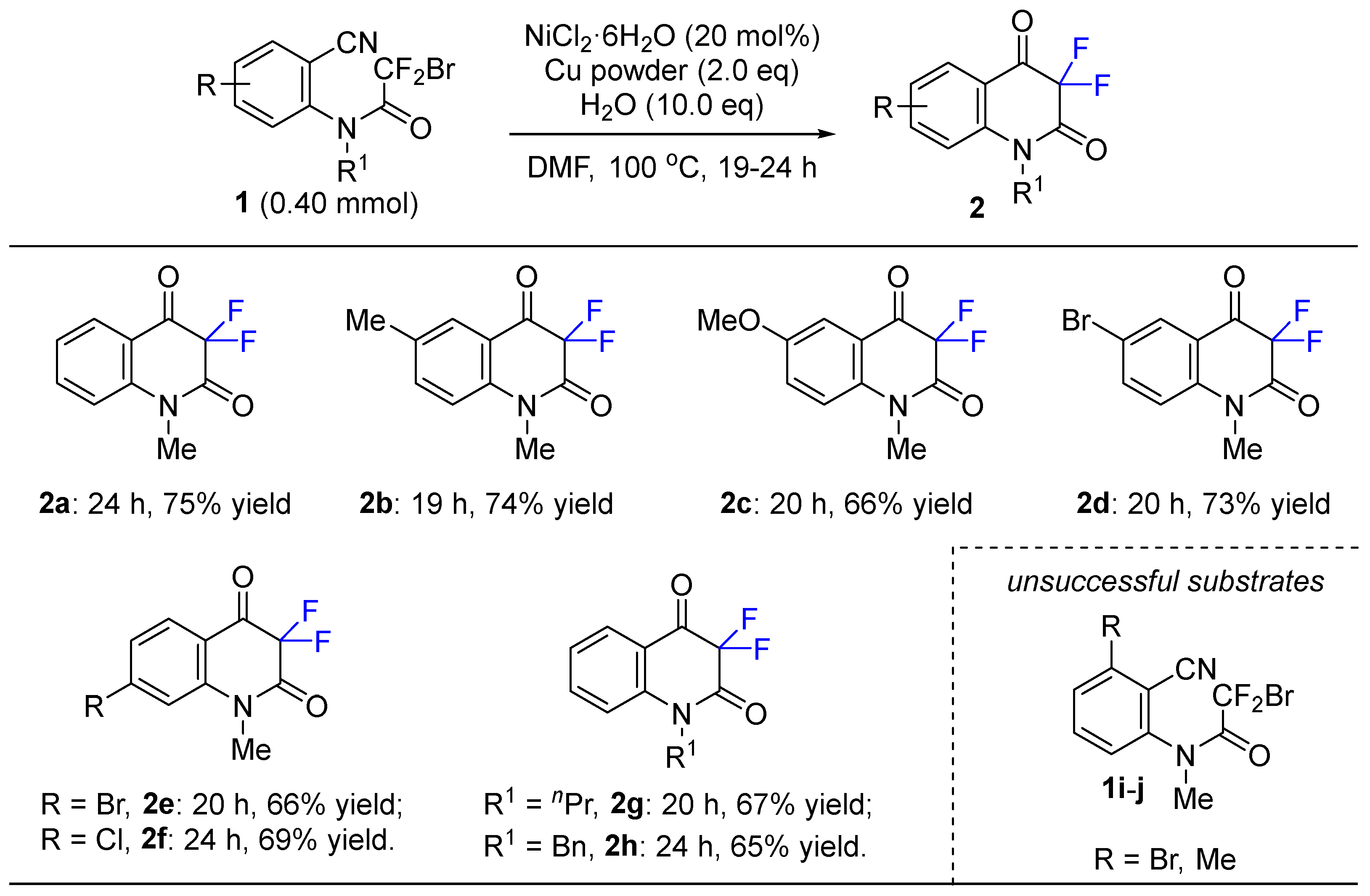
With the optimized condition in hand, we examined the substrate scopes of the reaction as shown in Figure 1.
The reaction substrates in 1 with a different nature on the aromatic ring and in meta/para to the CN group all reacted well, giving rise to the corresponding ones in 2a2f in 66–75% yields. The 2-bromo-N-(2-cyanoaryl)-2,2-difluoroacetamides bearing n-propyl and benzyl on the nitrogen atom were also found to be suitable substrates for the reaction (2g, 2h). Unfortunately, the substrates with Br (1i) and Me (1j) substituent in ortho to the CN group were not applicable in this reaction.

2.4. Gram-Scale Synthesis

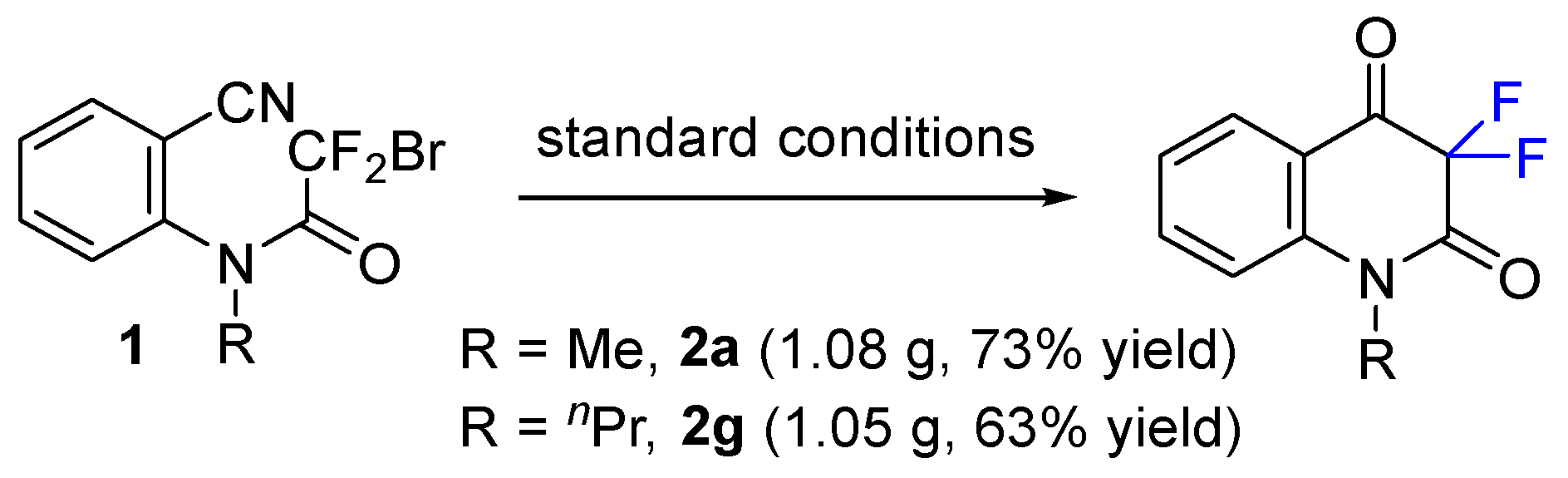
To demonstrate the synthetic potential of this novel developed method, the gram-scale reaction was conducted. To our delight, when using 7.0 mmol 1 as substrates, the desired product 2a was obtained in 73% yield (1.08 g) and the 2g was furnished in 63% yield (1.05 g) (Scheme 2).

2.5. The Suggested Catalytic Mechanism

Considering that the nickel catalyst can initiate the generation of radicals from difluoroalkyl halides through single electron transfer in the previous work, a control experiment was performed to probe the mechanism. When the reactions were conducted in the presence of 2.0 eq of TEMPO, the product 2a was not obtained. These results indicate that the transformation should occur through a radical pathway, and difluoroalkyl radical was likely to be involved in this reaction. We have tried to obtain some information about active intermediates; unfortunately, this hypothesis could not be confirmed.
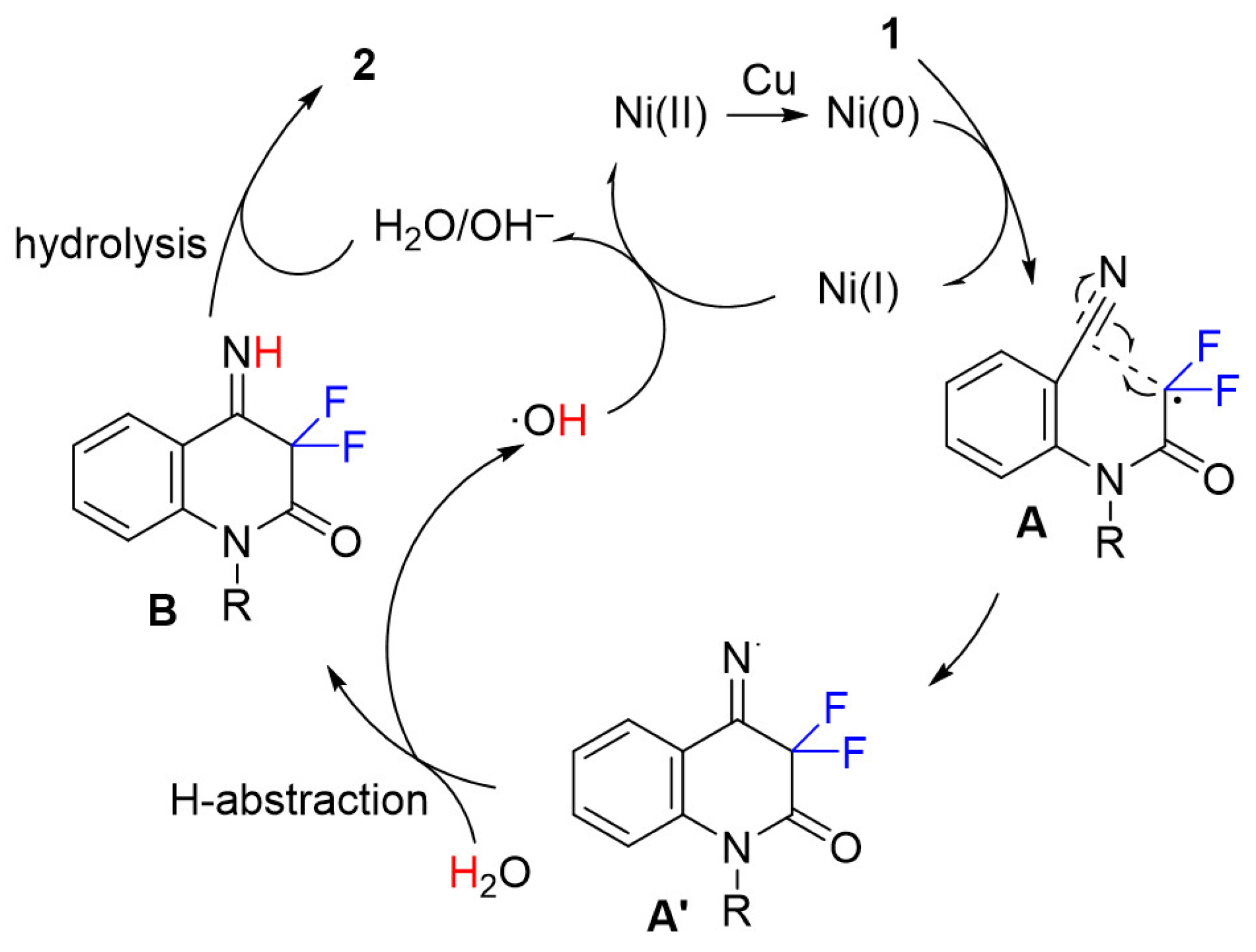
A possible mechanism for the reaction was proposed in Scheme 3. Firstly, copper powder reduces Ni(II) to generate Ni(0) intermediately, which then provides a single electron to 1, thereby generating the difluoroalkyl radical A. Subsequently, intramolecular addition of the difluoroalkyl radical with the nitrile generates A’, which then undergoes H-abstraction from H2O to give the imine B and OH radical. Then, the OH radical could convert Ni(I) into Ni(II). Finally, imine was hydrolyzed by H2O to provide the desired product 2.

3. Materials and Methods

All reactions were carried out under nitrogen. Anhydrous solvent was purchased from the Energy Chemical company (Shanghai, China). Reactions were monitored by thin layer chromatography using UV light to visualize the course of reaction. Chemical yields refer to pure isolated substances. NMR spectra were recorded on a Bruker Avance AV400 (400/101/376 MHz 1H/13C/19F) spectrometer (Bruker, Billerica, MA, USA) at room temperature in CDCl3 using TMS as internal standard. The following abbreviations were used to designate chemical shift multiplicities: s = singlet, d = doublet, t = triplet, q = quartet, h = heptet, m = multiplet, and br = broad. HRMS data were obtained using a Thermo Scientific Q Exactive Orbitrap Mass Spectrometer (Waltham, MA, USA). Purification of reaction products was carried out by flash chromatography on silica gel. Silica gel (200–300 mesh) was used for the chromatographic separations.
General Procedure: All the catalytic reactions were performed in a 10 mL Schlenk tube under N2. Mixture of 2-bromo-N-(2-cyanoaryl)-2,2-difluoro-N-alkylacetamide 1 (0.40 mmol), NiCl2·6H2O (0.08 mmol) and Cu (0.80 mmol), following the addition of 4.0 mL DMF and H2O (4.0 mmol) as solvents. The reaction mixture was stirred at 100 °C till the full consumption of 1 by TLC analysis (19–24 h), and then it was purified by flash column chromatography (petroleum ether:ethyl acetate = 3:1, v/v), resulting in the corresponding product 3,3-difluoro-1-alkylquinoline-2,4(1H,3H)-diones 2.
Analytical data for compound 2 (available in the Supplementary Materials):
3,3-difluoro-1-methylquinoline-2,4(1H,3H)-dione (2a): Prepared according to the general procedure as described above in 75% yield (64 mg) as yellow solid. Mp. 132–134 °C. 1H NMR (400 MHz, CDCl3) δ 8.05 (d, J = 8.0 Hz, 1H), 7.75 (t, J = 8.0 Hz, 1H), 7.30 (t, J = 8.0 Hz, 1H), 7.22 (d, J = 8.0 Hz, 1H), 3.52 (s, 3H) ppm. 13C NMR (101 MHz, CDCl3) δ 182.74 (t, J = 23.7 Hz, 1C), 161.28 (t, J = 27.8 Hz, 1C), 142.35, 138.07, 129.24, 124.61, 119.32, 115.95, 101.86 (t, J = 252.5 Hz, 1C), 30.22 ppm. 19F NMR (376 MHz, CDCl3) δ −113.37 (s, 2F) ppm. HRMS (ESI): exact mass calculated for C10H7F2NNaO2 [M+Na]+, 234.0337; found, 234.0340.
3,3-difluoro-1,6-dimethylquinoline-2,4(1H,3H)-dione (2b): Prepared according to the general procedure as described above in 74% yield (67 mg) as yellow solid. Mp. 127–129 °C. 1H NMR (400 MHz, CDCl3) δ 7.84 (s, 1H), 7.54 (d, J = 8.0 Hz, 1H), 7.10 (d, J = 8.0 Hz, 1H), 3.49 (s, 3H), 2.39 (s, 3H) ppm. 13C NMR (101 MHz, CDCl3) δ 182.92 (t, J = 23.7 Hz, 1C), 152.14 (t, J = 28.3 Hz, 1C), 140.15, 138.82, 134.70, 129.17, 119.12, 115.91, 101.84 (t, J = 252.5 Hz, 1C), 30.17, 20.22 ppm. 19F NMR (376 MHz, CDCl3) δ −113.39 (S, 2F) ppm. HRMS (ESI): exact mass calculated for C11H9F2NNaO2[M+Na]+, 248.0494; found, 248.0489.
3,3-difluoro-6-methoxy-1-methylquinoline-2,4(1H,3H)-dione (2c): Prepared according to the general procedure as described above in 66% yield (64 mg) as yellow solid. Mp. 128–130 °C. 1H NMR (400 MHz, CDCl3) δ 7.49 (d, J = 4.0 Hz, 1H), 7.30 (dd, J = 8.0, 4.0 Hz, 1H), 7.15 (d, J = 8.0 Hz, 1H), 3.87 (s, 3H), 3.49 (s, 3H) ppm. 13C NMR (101 MHz, CDCl3) δ 182.87 (t, J = 24.2 Hz, 1C), 160.84 (t, J = 27.8 Hz, 1C), 156.33, 136.31, 125.63, 119.91, 117.50, 111.02, 101.70 (t, J = 252.5 Hz, 1C), 55.91, 30.29 ppm. 19F NMR (376 MHz, CDCl3) δ −113.28 (s, 2F) ppm. HRMS (ESI): Exact mass calculated for C11H9F2NNaO3 [M+Na]+, 264.0443; found, 264.0440.
6-bromo-3,3-difluoro-1-methylquinoline-2,4(1H,3H)-dione (2d): Prepared according to the general procedure as described above in 73% yield (85 mg) as yellow solid. Mp. 150–152 °C. 1H NMR (400 MHz, CDCl3) δ 8.13 (s, 1H), 7.84 (d, J = 12.0 Hz, 1H), 7.12 (d, J = 12.0 Hz, 1H), 3.50 (s, 3H) ppm. 13C NMR (101 MHz, CDCl3) δ 181.75 (t, J = 24.8 Hz, 1C), 160.94 (t, J = 27.8 Hz, 1C), 141.31, 140.46, 131.55, 120.56, 117.76, 117.71, 101.67 (t, J = 253.0 Hz, 1C), 30.43 ppm. 19F NMR (376 MHz, CDCl3) δ −113.30 (s, 2F) ppm. HRMS (ESI): exact mass calculated for C10H679BrF2NO2[M]+, 288.9550; found, 288.9546.
3,3-difluoro-1,7-dimethylquinoline-2,4(1H,3H)-dione (2e): Prepared according to the general procedure as described above in 66% yield (59 mg) as yellow solid. Mp. 143–145 °C. 1H NMR (400 MHz, CDCl3) δ 7.95 (d, J = 8.0 Hz, 1H), 7.10 (d, J = 4.0 Hz, 1H), 7.00 (s, 1H), 3.51 (s, 3H), 2.50 (s, 3H) ppm. 13C NMR (101 MHz, CDCl3) δ 182.18 (t, J = 24.8 Hz, 1C), 161.57 (t, J = 27.8 Hz, 1C), 150.23, 140.42, 129.34, 125.60, 117.08, 116.45, 127.28, 101.75 (t, J = 252.0 Hz, 1C), 30.14, 22.64 ppm. 19F NMR (376 MHz, CDCl3) δ −113.03 (s, 2F) ppm. HRMS (ESI): exact mass calculated for C11H9F2NNaO2 [M+Na]+, 248.0494; found, 248.0494.
7-chloro-3,3-difluoro-1-methylquinoline-2,4(1H,3H)-dione (2f): Prepared according to the general procedure as described above in 69% yield (67 mg) as yellow solid. Mp. 159–161 °C. 1H NMR (400 MHz, CDCl3) δ 8.00 (d, J = 4.0 Hz, 1H), 7.27 (d, J = 8.0 Hz, 1H), 7.22 (s, 1H), 3.51 (s, 3H) ppm. 13C NMR (101 MHz, CDCl3) δ 181.63 (t, J = 24.2 Hz, 1C), 161.30 (t, J = 28.3 Hz, 1C), 144.77, 143.30, 130.58, 124.95, 117.68, 116.39, 101.73 (t, J = 253.0 Hz, 1C), 30.40 ppm. 19F NMR (376 MHz, CDCl3) δ −112.98 (s, 2F) ppm. HRMS (ESI): exact mass calculated for C10H735ClF2NO2 [M]+, 245.0055; found, 245.0052.
3,3-difluoro-1-propylquinoline-2,4(1H,3H)-dione (2g): Prepared according to the general procedure as described above in 67% yield (63 mg) as white solid. Mp. 108–110 °C. 1H NMR (400 MHz, CDCl3) δ 8.05 (d, J = 8.0 Hz, 1H), 7.73 (t, J = 4.0 Hz, 1H), 7.28–7.25 (m, 1H), 4.115 (t, J = 6.0 Hz, 1H), 1.71–1.81 (m, 2H), 1.035 (t, J = 6.0 Hz, 2H) ppm. 13C NMR (101 MHz, CDCl3) δ 182.92 (t, J = 24.2 Hz, 1C), 161.26 (t, J = 27.8 Hz, 1C), 141.59, 137.97, 129.53, 124.41, 119.61, 115.96, 102.00 (t, J = 252.5 Hz, 1C), 44.63, 20.09, 11.00 ppm. 19F NMR (376 MHz, CDCl3) δ −113.76 (s, 2F) ppm. HRMS (ESI): exact mass calculated for C12H11F2NNaO2 [M+Na]+, 260.0650; found, 262.0644.
1-benzyl-3,3-difluoroquinoline-2,4(1H,3H)-dione (2h): Prepared according to the general procedure as described above in 65% yield (75 mg) as yellow solid. Mp. 105–106 °C. 1H NMR (400 MHz, CDCl3) δ 8.04 (d, J = 8.0 Hz, 1H), 7.58 (t, J = 8.0 Hz, 1H), 7.37 (t, J = 8.0 Hz, 2H), 7.31 (d, J = 8.0 Hz, 1H), 7.28 (d, J = 8.0 Hz, 1H), 7.23 (t, J = 8.0 Hz, 2H), 7.10 (d, J = 8.0 Hz, 1H), 5.29 (s, 2H) ppm. 13C NMR (101 MHz, CDCl3) δ 182.66 (t, J = 24.2 Hz, 1C), 161.80 (t, J = 28.3 Hz, 1C), 141.67, 137.90, 134.24, 129.34, 129.20, 128.00, 126.22, 124.67, 119.63, 116.85, 102.36 (t, J = 253.0 Hz, 1C), 46.83 ppm. 19F NMR (376 MHz, CDCl3) δ −113.46 (s, 2F) ppm. HRMS (ESI): exact mass calculated for C16H11F2NNaO2 [M+Na]+,310.0650; found, 310.0642.

4. Conclusions

In summary, we have developed a nickel-catalyzed intramolecular radical difluoroalkylation of 2-cyanoarylacetamides using Cu powder as a reductant to the synthesis of 3,3-difluoro-quinoline-2,4(1H,3H)-diones in good yields. The more catalytic reactions involving 2-bromo-2,2-difluoro-N-alkyl-N-arylacetamides are ongoing in our laboratory, and will be reported on in due course.

Supplementary Materials

The following supporting information can be downloaded at: https://www.mdpi.com/article/10.3390/catal16030279/s1, Figure S1: 1H-NMR spectrum of the reaction product of 2a; Figure S2: 13C-NMR spectrum of the reaction product of 2a; Figure S3: 19F-NMR spectrum of the reaction product of 2a; Figure S4: 1H-NMR spectrum of the reaction product of 2b; Figure S5: 13C-NMR spectrum of the reaction product of 2b; Figure S6: 19F-NMR spectrum of the reaction product of 2b; Figure S7: 1H-NMR spectrum of the reaction product of 2c; Figure S8: 13C-NMR spectrum of the reaction product of 2c; Figure S9: 19F-NMR spectrum of the reaction product of 2c; Figure S10: 1H-NMR spectrum of the reaction product of 2d; Figure S11: 13C-NMR spectrum of the reaction product of 2d; Figure S12: 19F-NMR spectrum of the reaction product of 2d; Figure S13: 1H-NMR spectrum of the reaction product of 2e; Figure S14: 13C-NMR spectrum of the reaction product of 2e; Figure S15: 19F-NMR spectrum of the reaction product of 2e; Figure S16: 1H-NMR spectrum of the reaction product of 2f; Figure S17: 13C-NMR spectrum of the reaction product of 2f; Figure S18: 19F-NMR spectrum of the reaction product of 2f; Figure S19: 1H-NMR spectrum of the reaction product of 2g; Figure S20: 13C-NMR spectrum of the reaction product of 2g; Figure S21: 19F-NMR spectrum of the reaction product of 2g; Figure S22: 1H-NMR spectrum of the reaction product of 2h; Figure S23: 13C-NMR spectrum of the reaction product of 2h; Figure S24: 19F-NMR spectrum of the reaction product of 2h.

Author Contributions

J.X., J.P. and Y.H. prepared the compound and ran the spectra; F.L. designed the study, analyzed the data, and wrote the paper; J.L. helped to discuss the experimental results and process. All authors have read and agreed to the published version of the manuscript.

Funding

We are grateful for financial support from Jiangxi University of Science and Technology Doctoral Scientific Research Foundation (No. jxxjbs18050), Jiangxi Provincial Key Laboratory of Functional Crystalline Materials Chemistry (2024SSY05161).

Data Availability Statement

Data are contained within the article and Supplementary Materials.

Conflicts of Interest

The authors declare no conflicts of interest.

References

  1. Ojima, I. Fluorine in Medicinal Chemistry and Chemical Biology; Wiley: Weinheim, Germany, 2009. [Google Scholar]
  2. Ma, J.-A.; Cahard, D. Asymmetric fluorination, trifluoromethylation, and perfluoroalkylation reactions. Chem. Rev. 2004, 104, 6119–6146. [Google Scholar] [CrossRef] [PubMed]
  3. O’Hagan, D. Understanding organofluorine chemistry. An introduction to the C-F bond. Chem. Soc. Rev. 2008, 37, 308–319. [Google Scholar] [CrossRef] [PubMed]
  4. Zhang, C.-P.; Chen, Q.-Y.; Guo, Y.; Xiao, J.-C.; Gu, Y.-C. Progress in fluoroalkylation of organic compounds via sulfinatodehalogenation initiation system. Chem. Soc. Rev. 2012, 41, 4536–4559. [Google Scholar] [CrossRef] [PubMed]
  5. Wang, J.; Sánchez-Roselló, M.; Aceña, J.L.; del Pozo, C.; Sorochinsky, A.E.; Fustero, S.; Soloshonok, V.A.; Liu, H. Fluorine in pharmaceutical industry: Fluorine-containing drugs introduced to the market in the last decade (2001–2011). Chem. Rev. 2014, 114, 2432–2506. [Google Scholar] [CrossRef]
  6. Yang, X.; Wu, T.; Phipp, R.J.; Toste, F.D. Advances in catalytic enantioselective fluorination, mono-, di-, and trifluoromethylation, and trifluoromethylthiolation reactions. Chem. Rev. 2015, 115, 826–870. [Google Scholar] [CrossRef]
  7. Dong, D.-Q.; Yang, H.; Shi, J.-L.; Si, W.-J.; Wang, Z.-L.; Xu, X.-M. Promising reagents for difluoroalkylation. Org. Chem. Front. 2020, 7, 2538–2575. [Google Scholar] [CrossRef]
  8. Bey, P.; Gerhart, F.; Dorsselaer, V.V.; Danzin, C. α-(Fluorornet hy1)dehydroornit hine and α-(Fluorornet hy1)dehydroputre an alogues as irreversible inhibitors of ornithine decarboxylase. J. Med. Chem. 1983, 26, 1551–1556. [Google Scholar] [CrossRef]
  9. Pourquier, P.; Gioffre, C.; Kohlhagen, G.; Urasaki, Y.; Goldwasser, F.; Hertel, L.W.; Yu, S.; Pon, R.T.; Gmeiner, W.H.; Pommier, Y. Gemcitabine (2′,2′-difluoro-2′-deoxycytidine), an antimetabolite that poisons topoisomerase I. Clin. Cancer Res. 2002, 8, 2499–2504. [Google Scholar]
  10. Ando, K.; Koike, F.; Kondo, F.; Takayama, H. An improved synthesis of 24,24-difluoro-1α,25-dihydroxyvitamin D3 from readily available vitamin D2. Chem. Pharm. Bull. 1995, 43, 189–192. [Google Scholar] [CrossRef]
  11. Uoto, K.; Ohsuki, S.; Takenoshita, H.; Ishiyama, T.; Iimura, S.; Hirota, Y.; Mitsui, I.; Terasawa, H.; Soga, T. Synthesis and structure-activity relationships of novel 2′,2′-difluoro analogues of docetaxel. Chem. Pharm. Bull. 1997, 45, 1793–1804. [Google Scholar] [CrossRef]
  12. Tang, L.-J.; Wen, Y.; Jin, H.-X.; Luo, W.; Long, L.; Shen, J.; Luo, H.; Yu, D. Progress in the catalytic enantioselective construction of difluoroalkylated stereogenic centers. Org. Chem. Front. 2025, 12, 2052–2075. [Google Scholar] [CrossRef]
  13. Hu, J.; Zhang, W.; Wang, F. Selective difluoromethylation and monofluoromethylation reactions. Chem. Commun. 2009, 2009, 7465–7478. [Google Scholar] [CrossRef] [PubMed]
  14. Liu, Y.-L.; Yu, J.-S.; Zhou, J. Catalytic asymmetric construction of stereogenic carbon centers that feature a gem-difluoroalkyl group. Asian J. Org. Chem. 2013, 2, 194–206. [Google Scholar] [CrossRef]
  15. Lin, J.-H.; Xiao, J.-C. Recent advances in asymmetric fluorination and fluoroalkylation reactions via organocatalysis. Tetrahedron Lett. 2014, 55, 6147–6155. [Google Scholar] [CrossRef]
  16. Ni, C.; Zhu, L.; Hu, J. Advances in transition-metal-mediated di- and monofluoroalkylations. Acta Chim. Sin. 2015, 73, 90–115. [Google Scholar] [CrossRef]
  17. Qing, F.-L.; Liu, X.-Y.; Ma, J.-A.; Shen, Q.; Song, Q.; Tang, P. A fruitful decade of organofluorine chemistry: New reagents and reactions. CCS Chem. 2022, 4, 2518–2549. [Google Scholar] [CrossRef]
  18. Hamama, W.S.; El-Din, A.; Hassanien, E.; Zoorob, H.H. Studies on quinolinedione: Synthesis, reactions, and applications. Synth. Commun. 2014, 44, 1833–1858. [Google Scholar] [CrossRef]
  19. Kumabe, R.; Nishino, H. A unique peroxide formation based on the Mn(III)-catalyzed aerobic oxidation. Tetrahedron Lett. 2004, 45, 703–706. [Google Scholar] [CrossRef]
  20. Kafka, S.; Proisl, K.; Kašpárková, V.; Urankar, D.; Kimmel, R.; Košmrlj, J. Oxidative ring opening of 3-hydroxyquinoline-2,4(1H,3H)-diones into N-(α-ketoacyl)anthranilic acids. Tetrahedron 2013, 69, 10826–10835. [Google Scholar] [CrossRef]
  21. Antolak, S.A.; Yao, Z.-K.; Richoux, G.M.; Slebodnick, C.; Carlier, P.R. Enantioselective deprotonative ring contraction of N1-methyl-N4-Boc-benzo[e][1,4]diazepine-2,5-diones. Org. Lett. 2014, 16, 5204–5207. [Google Scholar] [CrossRef]
  22. Huang, W.; He, D.; Jiang, H.; Wu, W. Recent advances in the transformation of nitriles into diverse N-heterocycles. Chem. Soc. Rev. 2025, 54, 10724–10795. [Google Scholar] [CrossRef]
  23. Sun, K.; Lv, Q.-Y.; Lin, Y.-W.; Yu, B.; He, W.-M. Nitriles as radical acceptors in radical cascade reactions. Org. Chem. Front. 2021, 8, 445–465. [Google Scholar] [CrossRef]
  24. Li, Y.-M.; Wang, S.-S.; Yu, F.-C.; Shen, Y.; Chang, K.-J. Copper-catalyzed cascade addition/cyclization: Highly efficient access to phosphonylated quinoline-2,4(1H,3H)-diones. Org. Biomol. Chem. 2015, 13, 5376–5380. [Google Scholar] [CrossRef] [PubMed]
  25. Wang, S.; Huang, X.; Wang, Q.; Ge, Z.; Wang, X.; Li, R. An efficient synthesis of sulfonated quinoline diones by copper catalyzed sulfonylation of activated alkenes with sulfonylhydrazides. RSC Adv. 2016, 6, 11754–11757. [Google Scholar] [CrossRef]
  26. Fu, H.; Wang, S.-S.; Li, Y.-M. Copper-mediated oxidative radical addition/cyclization cascade: Synthesis of trifluoromethylated and sulfonated quinoline-2,4(1H,3H)-diones. Adv. Synth. Catal. 2016, 358, 3616–3626. [Google Scholar] [CrossRef]
  27. Yin, Z.; Yu, Y.; Li, C.; Mei, H.; Zhu, K.; Han, J. Sulfuration-triggered radical cyclization of o-cyanoarylacrylamides to 3-thiomethylated quinoline-2,4-dione. ChemistrySelect 2020, 5, 14534–14537. [Google Scholar] [CrossRef]
  28. Zhang, C.; Xia, W.-J.; Fan, T.-G.; Ding, X.-L.; Li, Y.-M. Decarbonylative cascade cyclization of ortho-cyanoarylacrylamides with pivaldehyde: Access to tert-butyl containing quinolone-2,4(1H,3H)-diones. Tetrahedron 2022, 103, 132547. [Google Scholar] [CrossRef]
  29. Han, S.; Zhang, F.-F.; Qian, H.-Y.; Chen, L.-L.; Pu, J.-B.; Xie, X.; Chen, J.-Z. Development of quinoline-2,4(1H,3H)-diones as potent and selective ligands of the cannabinoid Type 2 receptor. J. Med. Chem. 2015, 58, 5751–5769. [Google Scholar] [CrossRef]
  30. Ahmed, N.; Brahmbhatt, K.G.; Sabde, S.; Mitra, D.; Singh, I.P.; Bhutani, K.K. Synthesis and anti-HIV activity of alkylated quinoline 2,4-diols. Bioorg. Med. Chem. 2010, 18, 2872–2879. [Google Scholar] [CrossRef]
  31. Stadlbauer, W.; Laschober, R.; Lutschounig, H.; Schindler, G.; Kappe, T. Halogenation reactions in position 3 of quinoline-2,4-dione systems by electrophilic substitution and halogen exchange. Monatsh. Chem. 1992, 123, 617–636. [Google Scholar] [CrossRef]
  32. Xu, R.; Liao, F.; Cai, Y.; Liu, J. A convenient synthesis of 2-bromodifluoromethyl benzo-1,3-thiazoles. Chin. J. Syn. Chem. 2020, 30, 588–592. [Google Scholar]
  33. Xu, R.; Cai, Y.; Liao, F.; Liu, J. 2-[Difluoro(phenylselenyl)methyl]benzo-1,3-thiazole. Molbank 2022, 2022, M1450. [Google Scholar] [CrossRef]
  34. Xu, R.; Liao, F.; Cai, Y.; Liu, J. Copper-catalyzed aryl selenylation of 2-bromodifluoromethylbenzo-1,3-thi(x)azoles with diaryl diselenides. Tetrahedron 2022, 128, 133118. [Google Scholar] [CrossRef]
  35. Xiao, J.; Cai, Y.; Xu, R.; Liao, F.; Liu, J. Copper-catalyzed benzothiazolyldifluoroalkylation of arylidenemalonitriles or para-quinone methides. Catalysts 2024, 14, 777. [Google Scholar] [CrossRef]
Scheme 1. Some bioactive quinoline-2,4-diones.
Catalysts 16 00279 sch001
Figure 1. Substrate scopes.
Catalysts 16 00279 g001
Scheme 2. Gram-scale synthesis.
Catalysts 16 00279 sch002
Scheme 3. Proposed mechanism for intramolecular difluoroalkylation.
Catalysts 16 00279 sch003
Table 1. Optimization of the nickel catalysts and metal a.
Catalysts 16 00279 i001
Entry[Ni]MetalTime (h)Yield (%) b
1NiCl2·DMEMn2438
2NiBr2·DMEMn24trace
3NiCl2·(PPh3)2Mn24trace
4NiCl2·DPPMMn24trace
5NiCl2·6H2OMn2451
6NiCl2Mn2446
7NiCl2·6H2OCu2475
8NiCl2·6H2OCu (1.0 eq)2412
9NiCl2·6H2O-24nr
10-Cu2429
a Unless otherwise noted, the reaction of 1a (0.20 mmol), [Ni] (20 mol%), metal (2.0 eq), and H2O (10.0 eq) was performed at 100 °C in 2.0 mL of DMF. b Isolated yield.
Table 2. Optimization of the solvents and water consumption a.
Catalysts 16 00279 i002
EntrySolventsXTime (h)Yield (%) b
1DMF102475
2DMA102441
3NMP102442
4DMSO10459
5toluene1024trace
6DMF02426
7DMF52430
8DMF202450
a Unless otherwise noted, 1a (0.20 mmol), NiCl2·6H2O (20 mol%), Cu powder (2.0 eq), and H2O (X eq) was performed at 100 °C in 2.0 mL solvent. b Isolated yield.
Disclaimer/Publisher’s Note: The statements, opinions and data contained in all publications are solely those of the individual author(s) and contributor(s) and not of MDPI and/or the editor(s). MDPI and/or the editor(s) disclaim responsibility for any injury to people or property resulting from any ideas, methods, instructions or products referred to in the content.