Article

Enhanced Hydrogen Concurrent Production via Urea Solution Electrolysis Using Mesoporous Nickel Tungstate Precipitated from a Surfactant Template


1
Department of Chemistry, College of Sciences, King Saud University, P.O. Box 2455, Riyadh 11451, Saudi Arabia
2
Department of Chemistry, University College London (UCL), London WC1H 0AJ, UK
*
Author to whom correspondence should be addressed.
Catalysts 2026, 16(3), 258; https://doi.org/10.3390/catal16030258
Submission received: 3 February 2026 / Revised: 28 February 2026 / Accepted: 6 March 2026 / Published: 11 March 2026
(This article belongs to the Special Issue 15th Anniversary of Catalysts: Feature Papers in Electrocatalysis)

Abstract

The manipulation of the electrocatalyst nanoarchitecture, particularly transition metal compounds, regarding size, shape, facets, and composition, significantly enhances the electrocatalytic activity in energy transformations. This study introduces a novel methodology for the precipitation of mesoporous nanoparticles of nickel tungstate (meso-NiWO4) using direct chemical deposition from a template of Brij®78 surfactant liquid crystal. Physicochemical analyses revealed the formation of amorphous meso-NiWO4 nanoparticles with dual sizes of 10 ± 3 and 120 ± 8 nm and a specific surface area of 34.2 m2/g, exceeding that of nickel tungstate deposited in the absence of surfactant (bare-NiWO4, 4.0 m2/g). The meso-NiWO4 nanoparticles exhibit improved electrocatalytic stability, reduced charge-transfer resistance (Rct = 1.11 ohm), and a current mass activity of ~365 mA/cm2 mg at 1.6 V vs. RHE during the electrolysis of urea in alkaline solution. Furthermore, by employing meso-NiWO4 in a two-electrode urea electrolyzer, a remarkable 4.8-fold increase in the cathodic hydrogen concurrent production rate was achieved (373.40 µmol/h at a bias potential of 2.0 V), compared to that of the bare-NiWO4 catalyst. The exceptional urea oxidation electroactivity and the enhanced hydrogen evolution rate arise from substantial specific surface area and mesoporous structure, facilitating effective charge transfer and mass transport through the meso-NiWO4 catalyst. Using the surfactant liquid crystal template for electrocatalyst synthesis enables a one-pot deposition of diverse nanoarchitectures and compositions with high surface area at ambient conditions for an improved electrocatalytic and hydrogen green production process.

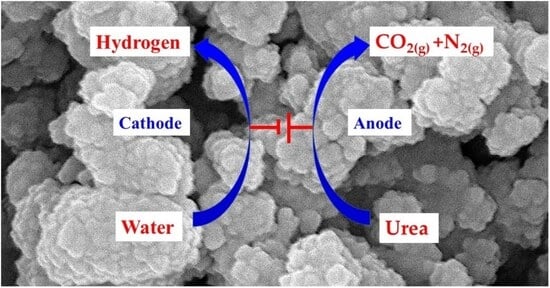
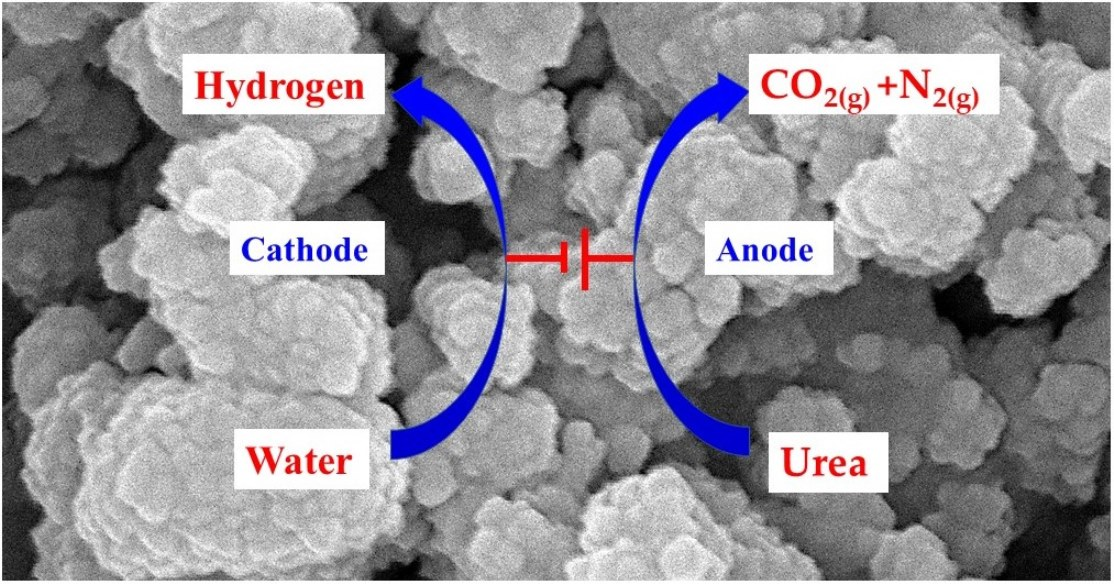
Graphical Abstract

1. Introduction

In recent years, the increased emphasis on renewable energy sources has prompted exploration of alternatives to fossil fuels [1,2,3,4]. Current investigations have predominantly focused on utilizing electrolysis of alkaline urea solution and urinated wastewater to environmentally sustainably produce hydrogen fuel (H2) while addressing associated environmental concerns [5,6,7,8]. Various methodologies and electrode materials have been proposed for the electrolysis of urea solution, aiming to generate hydrogen fuel and facilitate the denitrification of wastewater. However, these approaches are hampered by high expenses, limited efficiency, and the inefficiency of electrode materials [5,6,7,8]. The alkaline urea electrooxidation reaction (UOR) presents a viable, eco-friendly technology for hydrogen concurrent generation at the cathode, along with nitrogen (N2) and carbon dioxide (CO2) evolution at the anode, offering economic and environmental benefits [9,10,11]. Under typical conditions, hydrogen synthesis through electrolysis of urea solution requires 0.37 V overpotential, which is significantly smaller than 1.23 V, the thermodynamic potential desirable for water oxidation reaction, and yields hydrogen fuel almost 70% less expensive [12,13,14]. However, the kinetics of urea-to-hydrogen conversion in UOR exhibit sluggishness, hindering the widespread use for large-scale and industrial hydrogen (H2) production. Researchers have explored various electrode materials, including noble and earth-abundant materials, to address slow reaction rates and low efficiency in urea electrooxidation [15,16,17,18]. Nickel-based compounds show a promising and efficient alternative for precious-metal electrocatalysts for urea electrooxidation in alkaline solution because of nickel’s high electrical conductivity, wide range of oxidation states, and stability with low overpotential and high catalytic efficiency [19,20,21].
For instance, inexpensive nickel tungstate electrocatalysts with diverse heterostructure designs and morphologies have been successfully demonstrated in various energy conversion applications [22,23,24,25]. For example, Meng et al. [26] employed theoretical calculations to demonstrate that the heterostructure interfaces between amorphous Ni3S2 and NiWO4 nanoparticle electrocatalysts significantly enhanced the hydrogen evolution reaction performance from alkaline media. The electronically and strongly interacting NiWO4 and Ni3S2 heterostructures facilitate better adsorption of water molecules on nickel sites, improve hydrogen atom adsorption and desorption on adjacent sulfur sites, and reduce the local electron density around both Ni and S atoms [26].
Recently, the density functional theory (DFT) calculation proved that the integration of tungstate anions lowers the energy level of Ni(OH)2 for water splitting while maintaining nickel’s moderate hydrogen adsorption, thereby enhancing the hydrogen evolution reaction (HER) kinetics in alkaline media [27]. Additionally, Du et al. [28] reported remarkable catalytic oxygen production (OER) efficiency using amorphous NiCo2O4@NiWO4/NF in alkaline media, with long-term stability reaching 12 h. Furthermore, Yang et al. [29] synthesized nickel–tungsten carbide (Ni-WC/C) nanocluster electrocatalysts, achieving a maximum anode current of 700 mA/cm2 mg, higher than Ni/C catalysts, highlighting the structure and electron effects between tungsten carbide and nickel for boosting UOR performance in alkaline conditions. Moreover, Wang and Liu [24] demonstrated NiWO4 NPs/rGO composites for UOR in alkaline conditions, displaying good stability after a prolonged cycle (1000 cycles) with a retention of 94% and 218 mA/cm2 current density superior to NiO, rGO, and NiO/WO3. The augmentation of UOR catalytic activity was due to the synergistic action of rGO and NiWO4 NPs. Notably, the electrocatalytic performance of NiWO4 with nanoarchitectures for UOR is seldom examined. Interestingly, Du et al. [30] grew various nanoarchitectures of Cu, Ni, Co, and Zn tungstate directly on a substrate of nickel foam employing a hydrothermal process, with NiWO4 exhibiting UOR outstanding performance compared to the studied catalysts at a working potential of 1.36 V vs. RHE. Very recently, N. K. Shrestha et al. [31] reported the doping of Ni-MOF catalyst with electropositive Zn-atoms that modulated the electronic structure and facilitated the charge transport and formation of Ni-OOH catalytic sites. Consequently, the doped Zn@Ni-MOF reduced the OER and significantly enhanced the UOR current density up to 1500, 1780, and 1000 mA/cm2 at potential of 1.44, 1.50, and 1.52 V vs. RHE, respectively, superior to pristine Ni-MOF and IrO2 catalysts. In a related study, 3D disordered nanosheets of MOF nickel terephthalate were assembled via a hydrothermal approach and tested for urea electrolysis. The MOF nickel terephthalate nanosheets revealed urea oxidation overpotential of 1.381 V at 10 mA/cm2 current density and overall urea electrolysis potential of 1.52 V, in addition of outstanding long-term stability [32].
However, many of these materials are acquired in a crystalline state, prone to aggregation after hydrothermal or annealing procedures, which diminishes the catalytic activity [26,27]. In contrast, amorphization presents a novel and effective approach to activate the materials due to the presence of numerous defect sites and disordered structure, which enhances the electrocatalytic performance and enhances the charge and mass transport for a wide range of electrochemical reactions [28,29,30]. In particular, amorphous NiWO4 nanostructures provide more active sites and a higher electrochemical surface area (ECSA), and enhance the formation of active NiOOH heterojunctions upon oxidation, which are responsible for superior intrinsic activity, stability, and improved UOR performance [31,32,33,34]. The amorphous NiWO4 nanomaterial achieved about two orders of magnitude larger UOR current compared to the crystalline form. The enhanced activity of amorphous NiWO4 is ascribed to both the increased density of electrochemically active sites and the optimized binding energies for the urea reactant and CO2, as demonstrated by in situ infrared spectroscopy and theoretical calculations [31].
The surfactant liquid crystal template is an important approach that produces mesoporous nanostructured materials having high surface area and ordered meso-structure, tailorable pore size, and long-range porosity [35,36]. The method comprises self-assembly of inorganic precursors and surfactants or block copolymers in the presence of water to produce a template that produces a wide range of mesoporous inorganic materials such as silica, metal oxides, or hybrids after calcination or removing the surfactant [35]. Recently, our research team presented an innovative and economical method for synthesizing mesoporous nanostructured inorganic compounds such as nickel hydroxide, phosphate, and copper oxide through chemical direct deposition using a surfactant liquid crystal template and reducing agent under ambient conditions [37,38,39,40]. The produced inorganic catalysts exhibit an amorphous mesoporous nanoarchitecture and a high surface area, with exceptional performance for the oxidation of hydrazine, methanol, and glucose [39,40,41,42]. In particular, an amorphous mesoporous nickel phosphate electrocatalyst exhibits enhanced urea electrooxidation in an alkaline solution, evidenced by a reduced oxidation onset potential of 0.30 V vs. Ag/AgCl, a charge-transfer resistance of 3.35 ohms, and a mass activity of about 700 mA/cm2·g [37]. Furthermore, the meso-NiPO displayed remarkable long-term stability, maintaining 97.5% of the oxidation current, with a coupled cathodic hydrogen production rate of 415 µmol/h.
This work introduces the deposition of an amorphous mesoporous nickel tungstate (meso-NiWO4) nanoparticle via a direct chemical reaction between a nickel nitrate surfactant template and a solution of sodium tungstate in ambient conditions. A range of analytical techniques, including FT-IR, XRD, BET, SEM, EDX, and TEM, were utilized to examine the mesoporous and nanostructure features of the meso-NiWO4 catalyst. The electrocatalytic performance of the synthesized meso-NiWO4 nanoparticles for the urea oxidation reaction (UOR) in alkaline media was assessed using cyclic voltammetry profiles, current–time transients, and electrochemical impedance spectroscopy (EIS) techniques. Additionally, the volumetric rate of hydrogen concurrent evolution (HER) at the cathode during urea electrolysis was investigated using an H-type electrolyzer equipped with a meso-NiWO4 anode and a bare nickel foam cathode, operating in a solution of 0.33 M urea dissolved in 2.0 M potassium hydroxide.

2. Results and Discussion

2.1. Meso-NiWO4 Catalyst Synthesis and Characterization

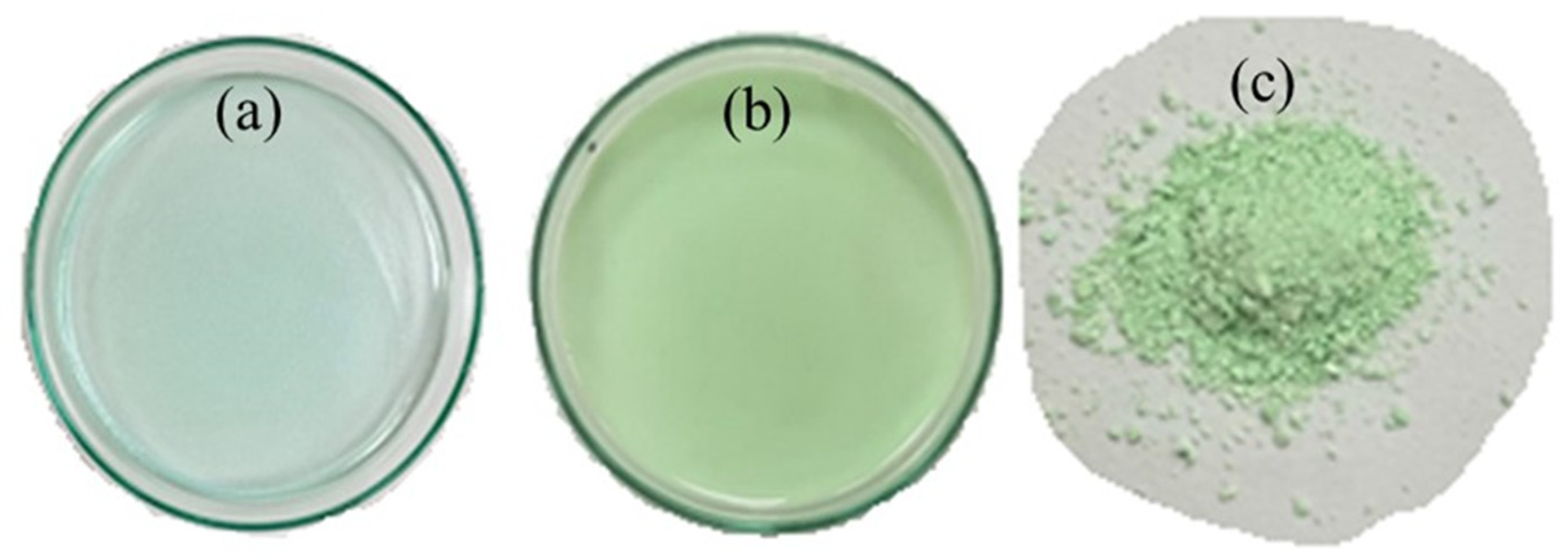
The chemical precipitation of hydrated mesoporous nickel tungstate nanoparticles (meso-NiWO4) was conducted following the procedure outlined in Figure 1. This involved a direct chemical precipitation of the assembled nickel ions in the interstitial aqueous region of the self-assembled Brij®78 surfactant hexagonal template using a tungstate anion solution (Na2WO4) as a precipitating agent at room temperature. The reaction, as described in Equation (1), resulted in the precipitation of mesoporous hydrated nickel tungstate, NiWO4·H2O [41].
Ni(NO3)2 (liq. cry.) + Na2WO4 (aq.) → NiWO4(s) + 2NaNO3 (aq.)
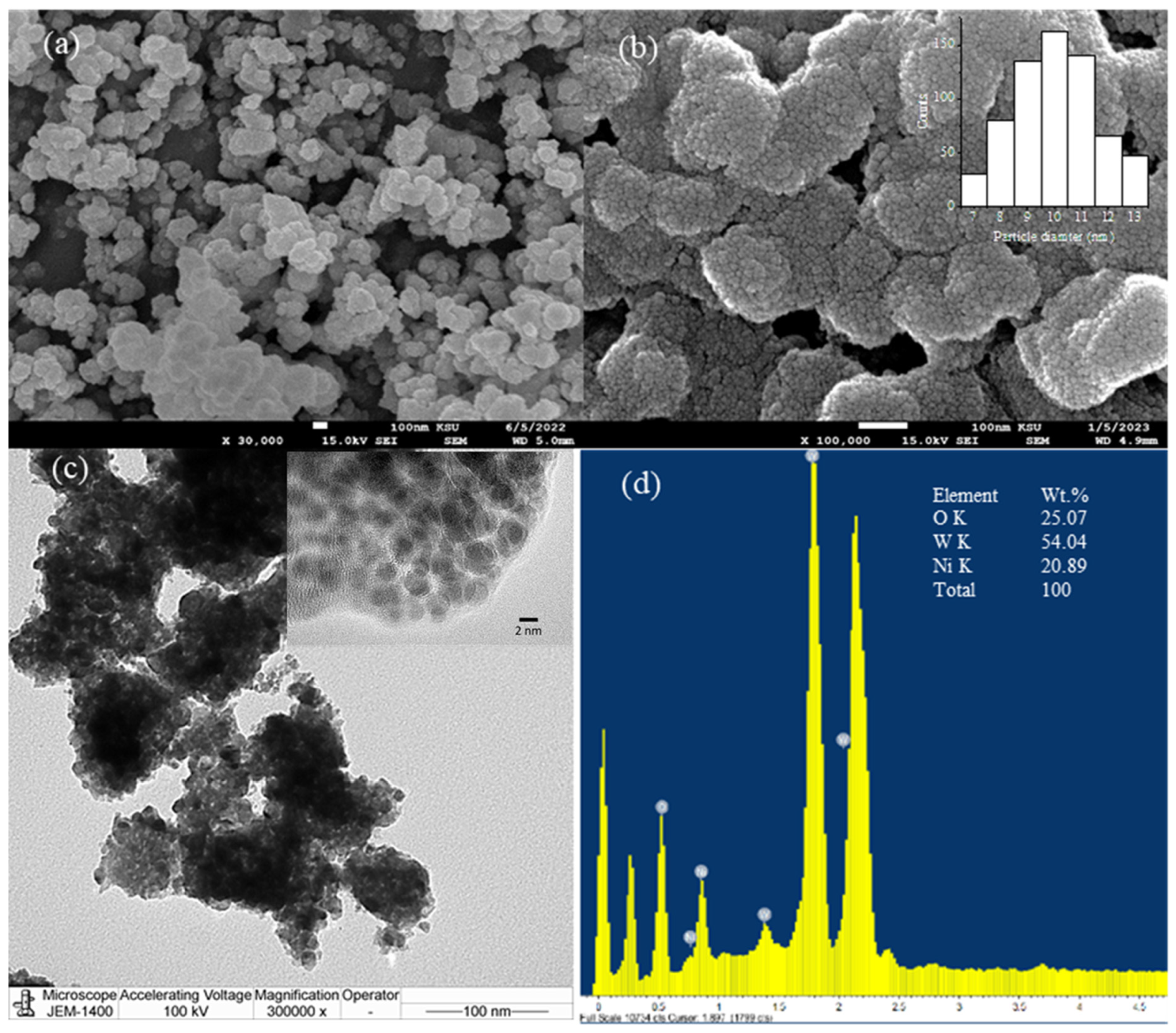
The surface nanoarchitecture of the meso-NiWO4 was recognized by SEM and TEM microscopic equipment, as illustrated in Figure 2a,b. The mesoporous NiWO4 catalyst microstructure surface morphology exhibits a berry-like morphology with porous irregular channels and semispherical microparticles having 120 ± 10 nm average size (Figure 2a). The SEM image at higher resolution (Figure 2b) reveals that the meso-NiWO4 semispherical microparticles are formed from the assembly of nanoparticles having a 10 nm average diameter (see inset histogram).
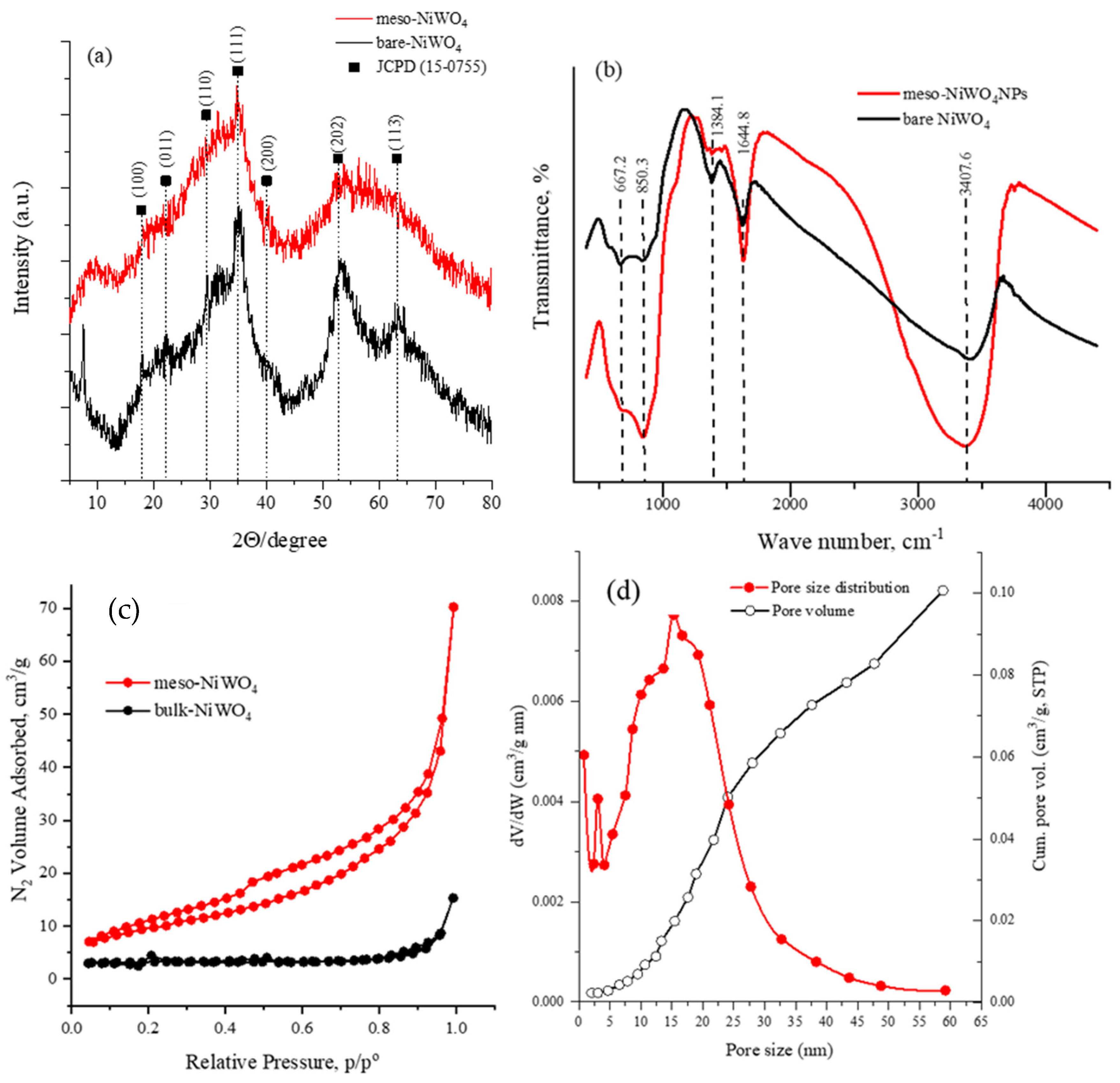
The TEM image (Figure 2c) revealed the presence of a disordered interstitial mesoporous network running through the meso-NiWO4 nanoparticle assembly. Moreover, the inset of a high-resolution TEM image in Figure 2c shows that the nanoparticles of the meso-NiWO4 have few lattice fringes and a small size in the range of 2–5 nm. These results confirm the amorphous mesostructured and nanoscale crystallite size of meso-NiWO4, which is consistent with the broadened XRD peaks. The formation of meso-NiWO4 nanoparticles can be related to the surfactant-templated directed growth and reduced surface energy of the deposited particles. The chemical composition analysis of EDX in Figure 2d reveals the predominant existence of Ni, W, and O elements at wt.% of 20.89, 54.04, and 25.07, respectively. The composition is close to the 1:1:5 mole ratio, confirming the formation of the hydrated NiWO4 compound. The analysis demonstrated the formation of micro- and nanoparticles with an interstitial mesoporous network within the NiWO4 catalyst. To clarify the crystal structure and surface features of the meso-NiWO4 nanoparticles, XRD patterns and FT-IR spectroscopy were employed. The powder XRD pattern of meso-NiWO4 compared with bare-NiWO4 in Figure 3a revealed low-intensity diffraction peaks at 2Θ values of approximately 17.83, 21.90, 29.33, 35.14, 40.03, 53.46, and 63.22°, corresponding to Miller indices (100), (011), (110), (111), (200), (202), and (113) that indexed to NiWO4 monoclinic phase respectively. The less defined XRD peak of meso-NiWO4 indicates a highly amorphous state of the obtained mesoporous NiWO4 catalyst, consistent with previous works on the structure of hydrate NiWO4·H2O (JCPD card No. 15-0755) [22,23,25].
Further characterization of hydrated meso-NiWO4 nanoparticles compared to bare-NiWO4 catalysts was conducted using FT-IR, as shown in Figure 3b. The FT-IR profile of meso-NiWO4 exhibited typical absorption peaks around 3407.6, 1644.8, and 1383.1 cm−1, which can be allocated to the −OH bond and the deformation and stretching vibration of hydrated NiWO4, respectively [23,25,41,42,43]. The strong visibility of the band at 3407.6 cm−1, attributed to −OH stretching compared to the bare-NiWO4 catalyst, confirms the presence of more active sites in the hydrated NiWO4 nanoparticles.
Additionally, absorption bands at 667.2 and 850.3 cm−1 appear, and can be related to the O−W−O vibrations and W−O stretching, respectively. Moreover, to gain further information about the mesoporous texture and surface area properties, Figure 3c shows the adsorption/desorption of N2 isotherms of the amorphous mesoporous NiWO4 nanoparticles compared to bare-NiWO4 catalysts. The amorphous mesoporous NiWO4 nanoparticles revealed a hysteresis loop isotherm with a type-IV profile appearing at a range of 0.45–0.65 relative pressure, characteristic of the mesoporous catalyst architecture [25,44]. In contrast, the bare-NiWO4 catalyst deposited without surfactant (black line) shows Type II isotherms of reversible N2 physisorption of a solid adsorbent. The corresponding surface area derived from BET analysis for mesoporous NiWO4 nanoparticles and bare-NiWO4 catalysts was found to be 34.20 and 4.20 m2/g, respectively, showing that the mesoporous NiWO4 nanoparticles have a specific surface area eight times higher than the bare-NiWO4 catalyst. In addition, Figure 3d shows that the mesoporous NiWO4 pore size falls within the range of 10 to 25 nm, and the adsorption cumulative volume is 0.104 cm3/g. The N2 adsorption/desorption data are in good agreement with the TEM characterization and confirm the disordered and irregular mesopores’ formation within the NiWO4 nanoparticles that were deposited from a liquid crystal template.

2.2. Electrochemical Characterizations of the Mesoporous NiWO4 Nanoparticles

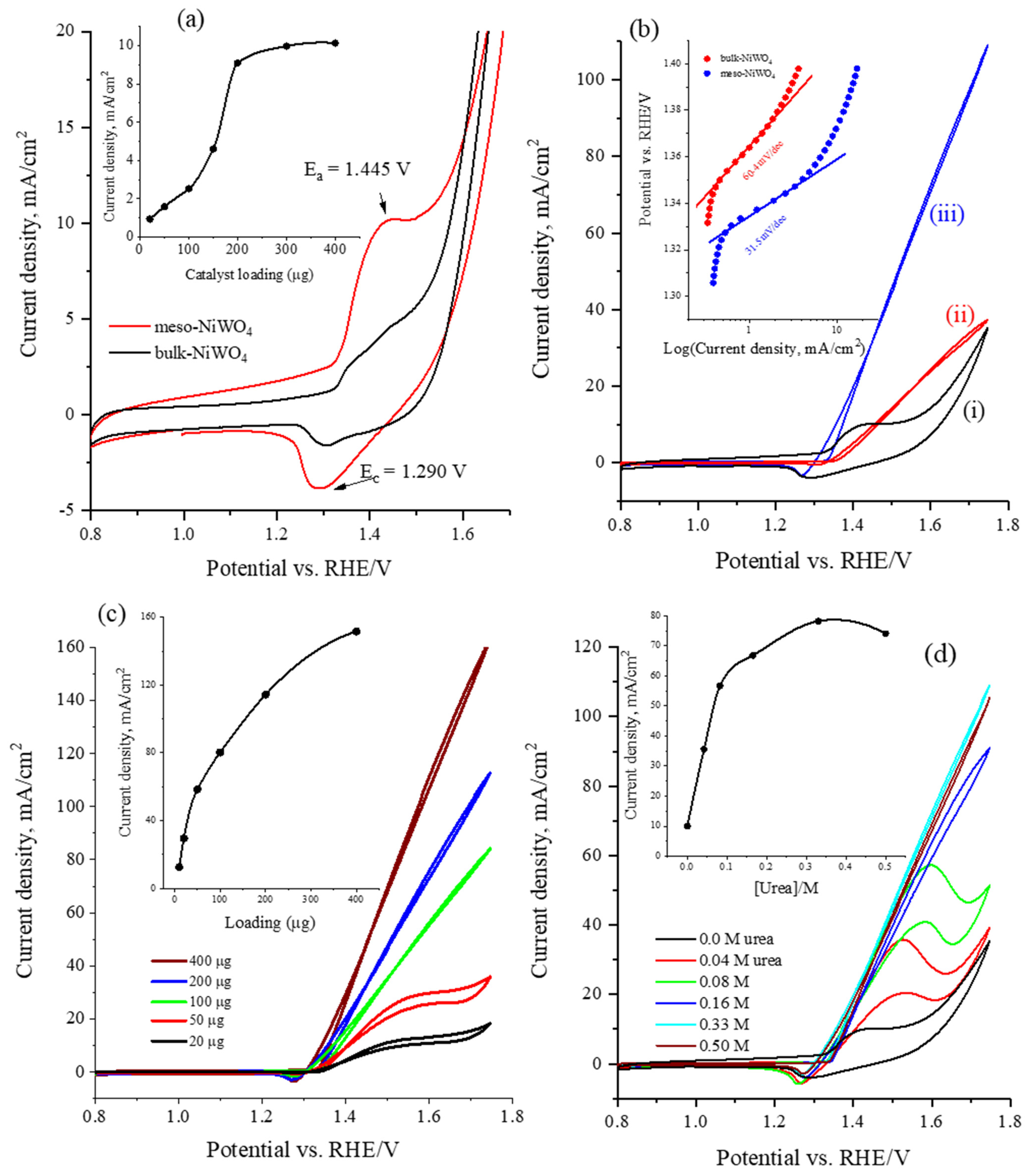
The electrocatalytic performance of mesoporous NiWO4 (meso-NiWO4) nanoparticles towards the activation of the urea oxidation reaction (UOR) in 2.0 M KOH was evaluated and contrasted against the bare-NiWO4 catalyst, as shown in Figure 4. The concentration of KOH was optimized at 2 M to achieve a maximum accessibility of meso-NiWO4 nanopores and NiOOH active phase formation. Inadequate OH limits NiOOH formation, while excessive OH promotes competitive adsorption and oxygen evolution, resulting in a volcano-type dependence of activity on the OH/urea ratio. Figure 4a presents the CV profiles of meso-NiWO4 and bare-NiWO4 catalysts, each loaded onto carbon paper (200 µg/cm2), recorded at a scan rate of 50 mV/s within the potential window of 0.8–1.80 V vs. RHE in 2.0 M KOH solution. The meso-NiWO4 nanoparticles displayed distinct anodic/cathodic bands 1.445/1.290 V vs. RHE. These redox features are linked with the redox reversible transition of the Ni(II)/Ni(III) couple, facilitated by the interaction with hydroxide ions (OH) during the potential sweep. Compared to bare-NiWO4, the mesoporous variant exhibited significantly enhanced redox currents and a greater electrochemically active surface area (ECSA), attributed to its porous network structure that provides more active and accessible sites. The electroactive surface area (ECSA) of meso-NiWO4 can be estimated using the equation of ECSA = Q/(mq), where Q is the charge under reduction peak of Ni(II)/Ni(III) redox reaction in alkaline solution, m is the loading mass, and q is the charge of Ni(OH)2 monolayer formation equivalent to 257 μC/cm2 [39]. The obtained ECSA of meso- and bare-NiWO4 catalysts was equal about 24.30 and 3.14 m2/g, respectively. This shows approximately 8 times higher ECSA of meso-NiWO4 compared to bare-NiWO4, which is in good agreement with BET surface area results and confirms the formation of a mesoporous NiWO4 framework.
In addition, the impact of catalyst loading on the redox peak current was explored, as seen in the inset in Figure 4a. An upsurge in anodic current was observed with more catalyst addition, reaching an optimal value at 200 µg, beyond which no further enhancement occurred. At higher loadings, the current plateaued around 10 mA/cm2, likely due to increased film thickness, which hinders the diffusion of hydroxide ions and limits further redox activity. Figure 4b presents the CV profiles measured with a 50 mV/s sweeping rate of mesoporous NiWO4 nanoparticles (200 µg/cm2) in (i) pure 2.0 M KOH, and (iii) after adding 0.33 M urea solution. For comparison, the voltammogram of the bare-NiWO4 electrode in 2.0 M KOH/0.33 M urea is also shown (ii). In pure 2.0 M KOH, the CV profile analysis of the meso-NiWO4 nanoparticles (i) reveals that the redox peaks correspond to the reaction and intercalation of hydroxide ions with Ni(II)/Ni(III) tungstate active sites [44,45,46,47]. As shown in Figure 4b, the CV results of the meso-NiWO4 electrode in urea solution demonstrate a significant enhancement in current density associated with urea oxidation and coexist around 1.33 V vs. Ag/AgCl, the onset potential of the Ni(II)/Ni(III) redox couple. These behaviors suggest that meso-NiWO4 nanoparticles effectively catalyze the urea oxidation reaction (UOR). The mesoporous NiWO4 electrode demonstrates a substantial UOR electrocatalytic performance compared to the bare-NiWO4 electrode. Specifically, at a potential of 1.60 V vs. Ag/AgCl, it achieves a specific activity of 73.3 A/cm2, corresponding to ~365 mA/cm2 mg. The meso-NiWO4 electrode activity value is about 2.5 times higher compared to the bare-NiWO4 electrode (29.6 mA/cm2).
Additionally, a lower UOR onset potential of 1.33 V was achieved at meso-NiWO4 compared to the bare-NiWO4 catalyst (1.35 V) vs. RHE, suggesting enhanced thermodynamic favorability of the UOR in the mesoporous structure. Moreover, the inserted plot in Figure 4b shows that the Tafel slope of the meso-NiWO4 electrode equals 31.5 mV/dec (blue line), significantly less than 60.4 mV/dec (red line) for the bare-NiWO4 electrode. This smaller Tafel slope value suggests the meso-NiWO4 catalyst promotes faster reaction kinetics and more efficient urea oxidation charge transfer in comparison to the bare-NiWO4 catalyst. Additionally, Figure 4c presents the CV responses at 50 mV/s scan rate in alkaline urea solution (0.33 M) with varying meso-NiWO4 catalyst loadings ranging from 10 to 400 µg. The current density progressively enhanced at 1.8 V vs. RHE upon catalyst loading increases, suggesting enhanced availability of redox-active sites (Ni(II)/Ni(III)) that facilitate the urea oxidation reaction. Nevertheless, beyond 400 µg catalyst loading, the current tends to plateau, likely due to increased film thickness, which hinders the diffusion of electroactive species and limits further catalytic current enhancement.
To further investigate the meso-NiWO4 nanoparticles’ electroactivity for urea oxidation, Figure 4d presents CVs measured at 50 mV/s of the meso-NiWO4 (200 µg) electrode in a 2.0 M KOH solution containing urea at different concentrations. The results show a notable increase in urea oxidation current as the concentration rises from 0.0 M to 0.33 M. However, at higher concentrations of urea (0.5 M), a slight decrease in anodic current was notable, suggesting that a diffusion-controlled reaction is predominant at lower urea concentrations (below 0.33 M). Moreover, at 1.6 V vs. RHE, the correlation between oxidation current and urea concentration becomes independent for concentrations greater than 0.33 M urea (as shown in the inset of Figure 4d). This behavior can be attributed to kinetic limitations, the competitive adsorption of hydroxide/urea molecules, and the dynamic change in Ni active sites during anodic oxidation of the meso-NiWO4 surface [45,46,47,48].
The electrocatalytic (EC) mechanism of urea catalytic oxidation at nickel-containing catalysts is well documented in the literature [9,27,47,48], where the process follows an indirect electrochemical–chemical (EC) route in alkaline conditions. As described in Equations (2)–(4), the sequence of the mechanism begins with the intercalation of hydroxide ions with meso-NiWO4 matrices and formation of Ni(II)/Ni(III) redox sites (Equation (2)). This is followed by the reaction of urea and Ni(III)(OH)3 active sites and regenerating Ni(II) species (Equation (3)). In the final step, the urea undergoes complete oxidation (Equation (3)), and the overall oxidation reaction is represented in Equation (4) [45,46,47,48].
Anodic reaction: 6OH + 2Ni(II) ↔ 2Ni(III)(OH)3 + 6e
2Ni(III)(OH)3 + CO(NH2)2(aq) → 2Ni(II) + CO2(g) + N2(g) + 5H2O(l)
Net anodic reaction: CO(NH2)2(aq) + 6OH → 5H2O(l) +CO2(g) +N2(g) + 6e
The urea oxidation electrocatalytic performance at meso-NiWO4 NPs was equated with the literature-reported nickel catalysts, as shown in Table 1. As indicated in the table, the UOR oxidation activity of meso-NiWO4 NPs catalyst is superior or comparable to the activity of the state-of-the-art catalysts previously reported in the literature. This improvement can be attributed to the intercalated tungstate anion synergistic effect, accompanied by the mesoporous structure, which provides a high surface area and enhanced ion mass transport within the nickel tungstate framework.
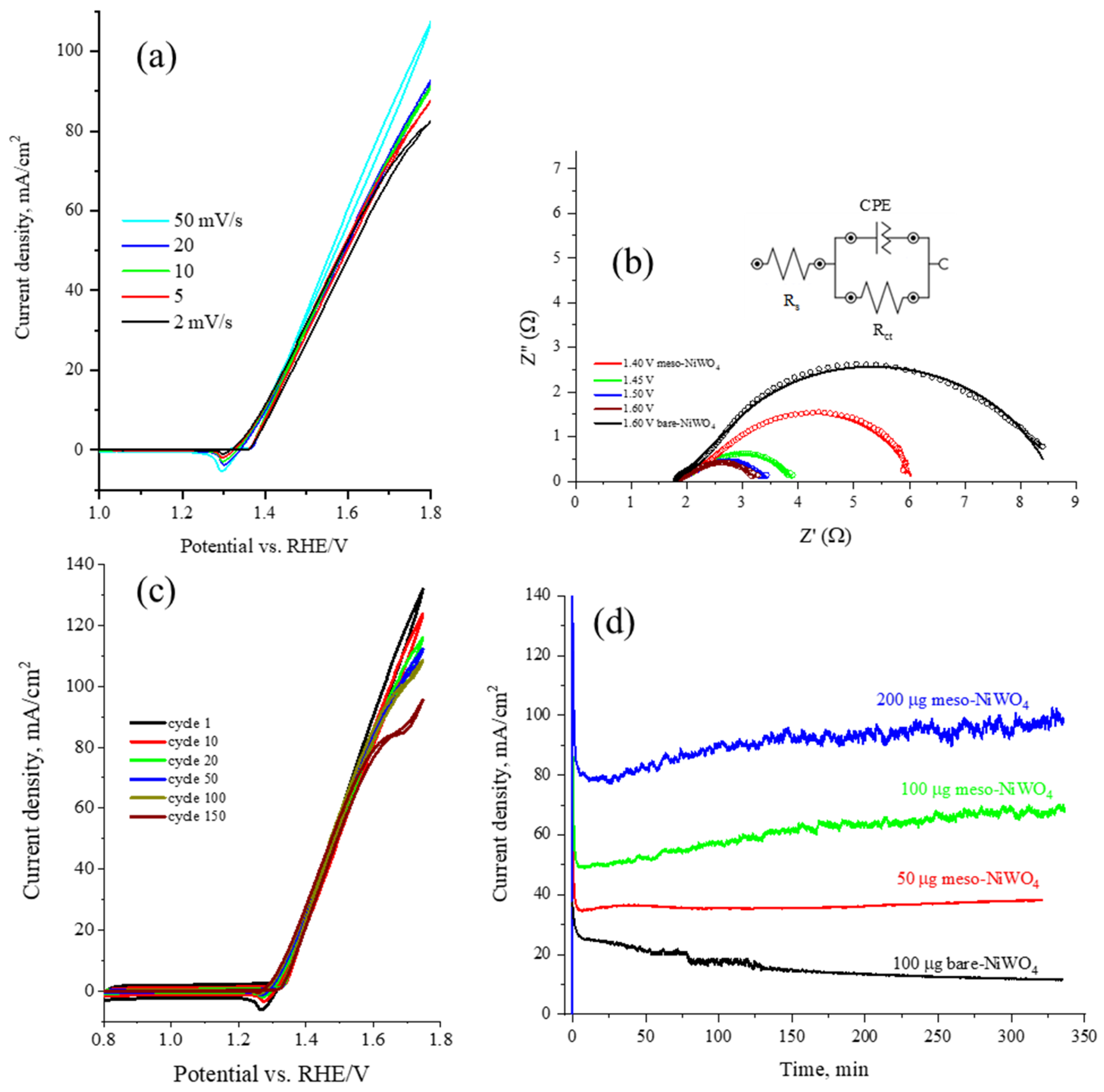
In addition, the oxidation of urea at the meso-NiWO4 NP electrode was investigated at different potential scan rates from 2.0 to 50 mV/s, as shown in Figure 5a. The CV analysis reveals that the scan rate has no effect on urea oxidation overpotential, and a small increase in current density at potentials higher than 1.6 V vs. RHE was observed. This can be attributed to the UOR oxidation at the meso-NiWO4 NP electrode, which is mainly controlled by the kinetics of charge transfer.
The resistance of the meso-NiWO4 electrode to the charge transfer associated with the alkaline urea oxidation reaction is evaluated by impedance electrochemical spectroscopy (EIS). Figure 5b illustrates the Nyquist curves across different applied potentials (1.40–1.60 V vs. RHE) of meso-NiWO4 nanoparticles (200 µg) in comparison to the bare-NiWO4 catalyst in a 0.33 M urea/2.0 M KOH environment.
As depicted in Figure 5b, the observed decrease in arc radii in the Nyquist plots for the meso-NiWO4 NP electrode, as the oxidation potential shifts to a higher potential (from 1.40 V to 1.60 V vs. RHE), suggests charge transfer kinetic enhancement during the alkaline urea oxidation reaction.
Moreover, Table 2 provides the EIS parameters derived from impedance data fitting for both meso-NiWO4 NPs and bare-NiWO4 catalysts, using an appropriate equivalent circuit model (shown in the inset of Figure 5b). This model represents, at higher frequencies, a parallel combination of the constant phase element (CPE) and resistance for charge transfer (Rct), which are connected to the solution resistance (Rs) in series. Considering the surface characteristics of the meso-NiWO4 NPs, the element of constant phase (CPE) was utilized to fit the EIS results. The (Rct//CPE) combination group is responsible for indirect urea oxidation with surface Ni(OH)2/NiOOH redox at a higher frequency. Findings in Table 2 indicate that the electrolyte resistance (Rs) remains unchanged at 1.83 ohms, as an average value. Conversely, the meso-NiWO4 NP catalysts demonstrate a lower charge transfer resistance (Rct = 3.79 ohms) when measured at 1.40 V vs. RHE. With increasing oxidation potentials (1.40 to 1.60 V vs. RHE), Rct values of the meso-NiWO4 electrode significantly decreased to 1.11 ohms, compared to the reported value for the bare-NiWO4 catalyst (6.64 ohms), confirming the considerable enhancement of the urea electrooxidation process at higher potential, aligning with the results from cyclic voltammetry (CV).
Long-term stability was performed by chronoamperometry (CA) and cyclic voltammetry analysis to assess the meso-NiWO4 electrode’s electrocatalytic stability under the extended urea electrolysis process. Figure 5c shows the repetitive CV for up to 150 cycles of 200 µg meso-NiWO4 catalyst in a 2.0 M KOH/0.33 M urea solution in the potential range 0.80–1.80 V vs. RHE and at 50 mV/s. The CVs of the meso-NiWO4 electrode at a potential up to 1.6 V vs. RHE exhibit very stable urea electrolysis current (about 85 mA/cm2) during the 150 cycles, suggesting very limited catalyst degradation. However, at applied potentials above 1.6 V vs. RHE, the current density slightly decreased over cycling, and aggressive gas bubble evolution was observed, which possibly caused the catalyst’s mechanical instability. Figure 5d shows the time-dependent stability (chronoamperometry) at 1.6 V vs. RHE of meso-NiWO4 NPs with various loadings compared to the bulk catalyst under steady-state conditions of urea electrolysis in 2.0 M KOH. During more than 5 h of urea electrolysis, the chronoamperograms of the meso-NiWO4 catalyst revealed a substantial increase in steady-state currents about 6 times higher than the to bare-NiWO4 catalyst for urea oxidation reaction (UOR) with higher catalyst loading, where about 60 and 90 mA/cm2 was achieved at 100 and 200 μg, respectively, due to the presence of more active sites. Notably, at 200 μg, the meso-NiWO4 NPs catalyst achieves a higher current density (90 mA/cm2), indicating superior active site accessibility for UOR in basic solution.
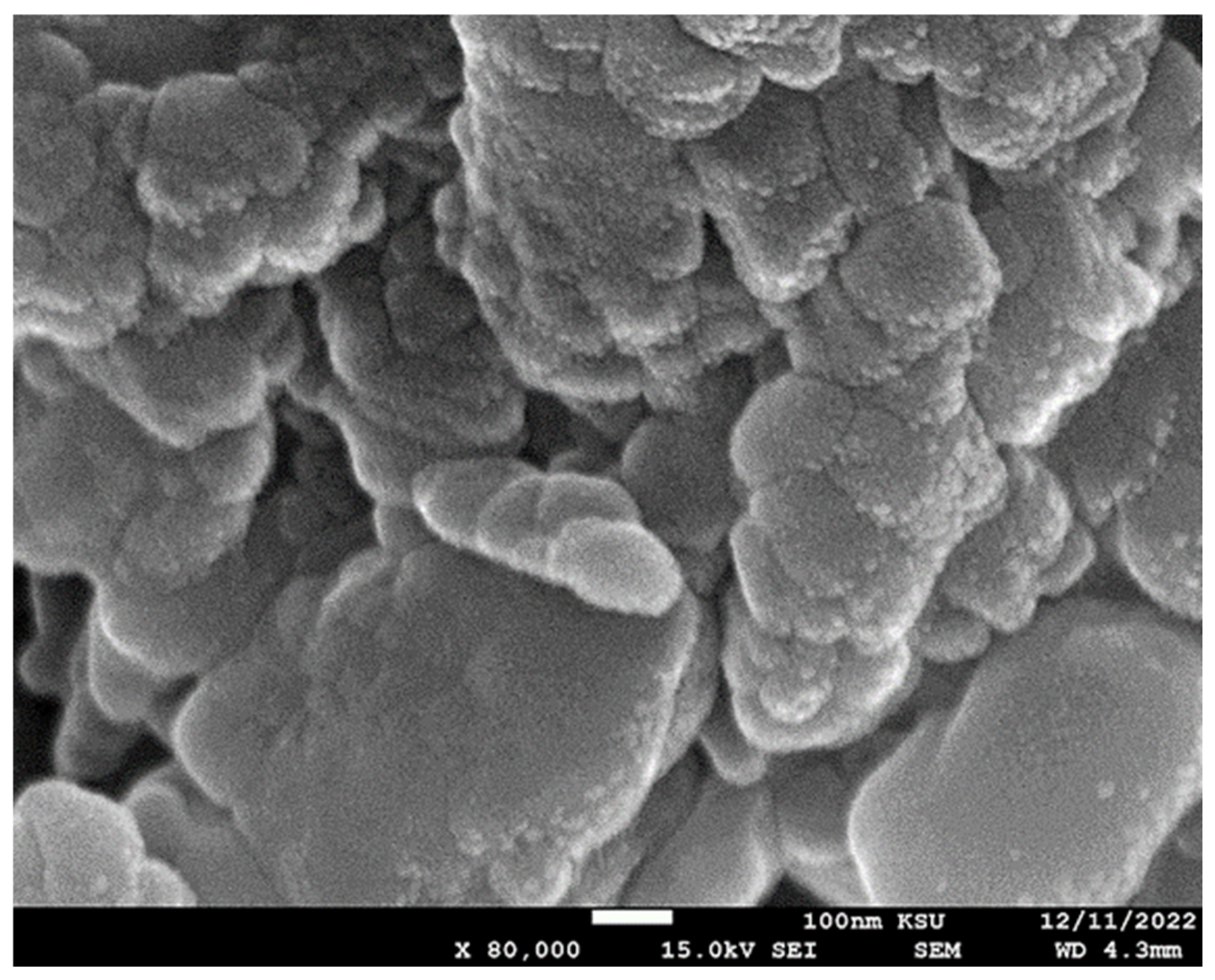
Figure 6 shows the SEM of the spent meso-NiWO4 catalyst after being subjected to the urea electrolysis process for 3 h at 1.60 V vs. RHE in a 0.33 M urea/2.0 M KOH solution. The SEM image provides convincing evidence of significant changes in the nanoparticle morphology, with noticeable swelling, self-reconstruction, and coalescence forming irregular overlapped microparticles. The EDX analysis shows the spent meso-NiWO4 composed of 22.82 wt.% Ni, 34.72 wt.% W, and 42.46 wt.% O. The elemental composition of the meso-NiWO4 catalyst has significantly changed; in particular, the oxygen concentration increased from 25.07 to 42.46 wt.% because of the electrochemical oxidation in alkaline urea solution and the formation of surface NiOOH/Ni(OH)2 redox species. Moreover, W wt.% was notably decreased from 54.04 to 34.72 wt. %, suggesting leaching of surface tungsten structure after the catalyst had been used in the electrolysis process. This suggests the spent meso-NiWO4 after exposure to urea electrolysis experiences surface reconstruction involving Ni2+/Ni3+ oxidation accompayned by partial leaching of W6+ species, leading to a more active NiOOH catalyst layer while preserving the NiWO4 bulk structure [33]. The in situ-produced NiOOH phase is responsible for the enhanced urea oxidation current and stable activity retention of 105% from the original values, as depicted in the current–time transient in Figure 5d.

2.3. Hydrogen Production Volumetric Determination

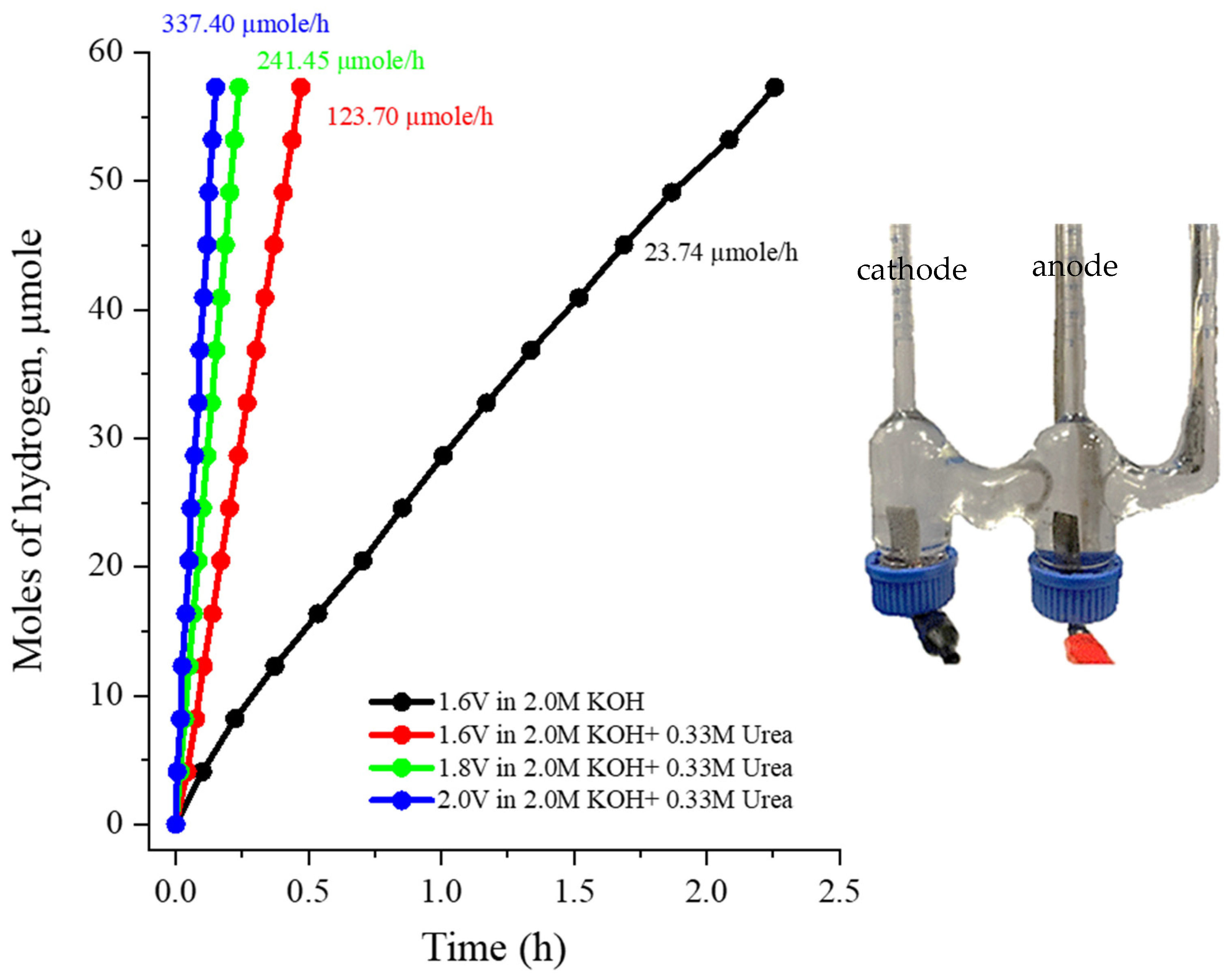
A volumetric method was implemented to assess the hydrogen concurrent evolution at the cathode during urea electrolysis using the meso-NiWO4 catalyst anode. The experimental setup involved an H-shaped electrolyzer (the inset in Figure 7), and the rate of hydrogen simultaneous evolution (HER) during urea electrolysis was scrutinized using a meso-NiWO4 anode (loading 0.50 mg/cm2 on carbon paper) and a nickel foam as a cathode. As shown in Figure 7, the rate of cathodic hydrogen production was investigated under various applied bias potentials (1.6, 1.8, and 2.0 V) using pure 2.0 M KOH solution and in the presence of dissolved 0.33 M urea. In pure 2.0 M KOH solution, the results, as shown in Figure 6, revealed that the hydrogen concurrent evolution rate at the meso-NiWO4 electrode was approximately 24.74 µmol/h at 1.6 V applied potential. Interestingly, with the introduction of 0.33 M urea and at an applied potential of 1.60 V, the rate of hydrogen production substantially surged to around 123.70 µmol/h, showcasing a remarkable 4.8-fold increase in the cathodic hydrogen production rate. As the applied potential at the meso-NiWO4 electrode progressively rose to 1.8 and then 2.0 V, the hydrogen evolution rate enhanced to 240.45 and 373.40 µmol/h, respectively, demonstrating the efficiency and durability of the meso-NiWO4 catalyst toward hydrogen concurrent cathodic production via urea alkaline electrolysis.

3. Materials and Methods

3.1. Chemicals and Materials

The precursor of nickel nitrate (Ni(NO3)2·6H2O, 98.0%) was purchased from LOBA Chemie (Mumbai, India). Sodium tungstate (NaWO4·2H2O, 99%) was acquired from AnalaR. Granule urea was supplied by AVONCHEM Corp. (Cheshire, UK) Potassium hydroxide (KOH, 85.0%) and the nonionic surfactant of polyethylene glycol octadecyl ether (Brij®78 (Sigma-Aldrich, Saint Louis, MO, USA), C18H37(OCH2CH2)20OH, 97.0%) were supplied by Sigma-Aldrich. All chemicals were analytical-grade and used directly with no additional purification. For all solution preparations, deionized water with 18.2 MΩ cm resistivity was obtained from a water distillation system (PURELAB® Flex (High Wycombe, UK)). Nafion™ (Wilmington, DE, USA) 5 wt.% solution mixed with 45% water/aliphatic alcohols was supplied by Merck (Darmstadt, Germany). VECK company (Tianjin, China) provided the hydrophilic carbon paper (HCP030), which was employed as a substrate, and the (XC-72R) Vulcan carbon was purchased from Fuel store.

3.2. Nickel Tungstate (NiWO4) Nanoparticles’ Synthesis

The mesoporous nickel tungstate (meso-NiWO4) catalyst nanoparticles were prepared following the procedure outlined in Figure 1. This involved a chemical precipitation method utilizing the liquid crystal of Brij®78 surfactant template combined with solutions of nickel and tungstate salt. The template mixture was optimized via a set of experiments of varying the nickel nitrate concentration and surfactant/water ratio. The optimum condition was chosen based on the highest redox current density obtained by the catalyst using cyclic voltammetry. For the optimum condition, a 5.0 mL solution of nickel nitrate (0.5 M) was combined with 1.0 g of melted Brij®78 surfactant and subjected to ultrasonic treatment for 15 min. The resulting mixture was poured into a Petri dish and left to dry naturally at 30 °C, facilitating gelation and achieving a surfactant/water ratio of 40%. A 3 mL solution of sodium tungstate (1.0 M) was then applied, initiating chemical deposition. After an overnight rest, the catalyst was washed with deionized water and acetone, eliminating surfactant traces. The final product was obtained through centrifugation and drying at 60 °C. A control material, referred to as bare-NiWO4, was prepared under identical conditions, but without Brij®78 surfactant.

3.3. Nickel Tungstate (NiWO4) Catalyst Characterizations

The produced mesoporous nickel tungstate (meso-NiWO4) was examined through X-ray diffraction (XRD) and Fourier Transform Infrared (FT-IR) spectroscopy to analyze its crystal structure and surface chemical nature. The XRD analysis was conducted using a MiniFlex-600 (Rigaku (Tokyo, Japan)) XRD with a Cu Kα1 radiation tube operating at 40 kV and 15 mA, while the FT-IR spectroscopy was performed with a Bruker TENSOR 27 (Bruker Corporation, Billerica, MA, USA). The meso-NiWO4 specific surface area was measured using the V-Sorb 2800 Porosimetry analyzer (Gold APP Instruments Co., Ltd., Beijing, China), employing the Brunauer–Emmett–Teller (BET) method. For the surface morphology and elemental composition investigation, a JSM-7600F scanning electron microscope (SEM) (JEOL Ltd., Tokyo, Japan) operating at 15 kV and equipped with an energy-dispersive X-ray spectroscopy (EDX) system was utilized. The nanoparticle’s mesoporous structure was further examined using a JEM 2100F transmission electron microscope (TEM) (JEOL Ltd.).
The electrocatalytic activity of urea alkaline oxidation at the meso-NiWO4 electrode was assessed using the current–voltage curves (cyclic voltammetry, CV), current–time transient (chronoamperometry, CA), and spectroscopy of electrochemical impedance (EIS), all conducted using a BIOLOGIC–VSP-300 electrochemical Potentiostat (BioLogic Science Instruments, Seyssinet-Pariset, France). A conventional 3-electrode glass cell configuration was fitted with a graphite counter electrode (1 × 1 cm2), an Ag/AgCl (saturated KCl) reference electrode, and a carbon paper working substrate (1.0 × 1.0 cm2) that was coated with a different loading of meso-NiWO4 catalyst ink. All electrochemical potentials have been converted to the reversible hydrogen electrode (RHE) scale using the standard conversion equation: ERHE = EAg/AgCl + 0.199 + 0.059 pH.
The ink of the catalyst was formulated by mixing 10 mg of meso-NiWO4 powder with 20 mg Vulcan black carbon (XC 72R) and dispersing it in 10 mL of a deionized water/isopropanol mixture, along with Nafion (10 μL, 5 wt%) solution. This mixture vial was ultrasonicated for 60 min; then, different amounts were applied onto carbon paper and dried using hot air for further electrochemical testing.

3.4. Setup of Volumetric Determination of Hydrogen Production

Volumetric determination of the produced hydrogen during urea electrooxidation is achieved using a home-made H-shaped electrolyzer configuration (inset in Figure 6). This setup entails employing a modified nickel foam as the anode and a bare nickel foam cathode. The nickel foam was employed due to its high conductivity, porous 3D structure, and superior mechanical stability, which are advantageous for large-current electrolysis and gas evolution process. The electrolyzer, featuring two compartments linked by a central channel, facilitates the measurement of hydrogen gas volume generated during the electrochemical reaction associated with urea electrooxidation. To measure hydrogen volume, the electrooxidation of urea is initiated by applying a suitable voltage or current, and the volume of hydrogen gas at the cathode is monitored and measured at regular intervals or until the desired reaction time. This collected data is then used to calculate the apparent rate of hydrogen gas production.

4. Conclusions

This work reports the successful preparation of amorphous mesoporous nickel tungstate nanoparticles via a chemical direct precipitation from the Brij®78 surfactant hexagonal liquid crystal template. The resulting nanoparticles exhibited mesoporous nanoarchitecture with enhanced surface area (34.2 m2 g−1) and superior performance of electrocatalytic alkaline urea electrolysis. With an amorphous and defective structure, the meso-NiWO4 NPs revealed about 365 mA/cm2 mg current mass activity and low charge transfer resistance (1.11 ohm) during urea anodic oxidation reaction at a potential of 1.60 V vs. RHE. By employing meso-NiWO4 in a two-electrode urea electrolyzer, a remarkable 4.8-fold increase in the cathodic hydrogen concurrent production rate was achieved (373.40 µmol/h at an applied potential of 2.0 V) compared to the bare-NiWO4 catalyst. The results highlighted the effectiveness and durability of the meso-NiWO4 catalyst toward hydrogen concurrent cathodic production via urea alkaline electrolysis. The liquid crystal surfactant template presents a one-pot synthesis approach for a wide range of mesoporous compounds with potential applications in electrochemical energy catalytic reactions.

Author Contributions

Conceptualization, project administration, validation, writing—review and editing, funding acquisition, M.A.G.; data curation, investigation, formal analysis, writing—original draft preparation, W.A.-S.; project administration, methodology, resources, A.M.A.-M.; formal analysis, visualization, validation, supervision, N.H.A.; conceptualization, validation, writing—review and editing, I.P.P. All authors have read and agreed to the published version of the manuscript.

Funding

This research was funded by the Deanship of Scientific Research, King Saud University, Riyadh, Saudi Arabia, through the ISPP program (ISPP25-2).

Data Availability Statement

Data are available on request.

Acknowledgments

The authors would like to extend their appreciation to the Deanship of Scientific Research at King Saud University, Riyadh, Saudi Arabia, for funding this work through the ISPP program (ISPP25-2). During the preparation of this work, the authors used Aithor.com in order to write the manuscript. After using Aithor.com, the authors reviewed and edited the content as needed and take full responsibility for the content of the published article.

Conflicts of Interest

The authors declare no conflicts of interest. The funders had no role in the design of the study; in the collection, analyses, or interpretation of data; in the writing of the manuscript; or in the decision to publish the results.

References

  1. Xiong, H.; Dong, Y.; Liu, D.; Long, R.; Kong, T.; Xiong, Y. Recent Advances in Porous Materials for Photocatalytic CO2 Reduction. J. Phys. Chem. Lett. 2022, 2022, 1272–1282. [Google Scholar] [CrossRef]
  2. Zhang, W.; Lai, W.; Cao, R. Energy-Related Small Molecule Activation Reactions: Oxygen Reduction and Hydrogen and Oxygen Evolution Reactions Catalyzed by Porphyrin- and Corrole-Based Systems. Chem. Rev. 2017, 117, 3717–3797. [Google Scholar] [CrossRef] [PubMed]
  3. Zhu, X.; Dou, X.; Dai, J.; An, X.; Guo, Y.; Zhang, L.; Tao, S.; Zhao, J.; Chu, W.; Zeng, X.C.; et al. Metallic Nickel Hydroxide Nanosheets Give Superior Electrocatalytic Oxidation of Urea for Fuel Cells. Angew. Chem. Int. Ed. 2016, 55, 12465–12469. [Google Scholar] [CrossRef] [PubMed]
  4. Xiong, Z.; Lei, Z.; Kuang, C.C.; Chen, X.; Gong, B.; Zhao, Y.; Zhang, J.; Zheng, C.; Wu, J.C.S. Selective photocatalytic reduction of CO2 into CH4 over Pt-Cu2O TiO2 nanocrystals: The interaction between Pt and Cu2O cocatalysts. Appl. Catal. B Environ. 2017, 202, 695–703. [Google Scholar] [CrossRef]
  5. Meng, J.; Chernev, P.; Mohammadi, M.R.; Klingan, K.; Loos, S.; Pasquini, C.; Kubella, P.; Jiang, S.; Yang, X.; Cui, Z.; et al. Self-supported Ni(OH)2/MnO2 on CFP as a flexible anode towards electrocatalytic urea conversion: The role of composition on activity, redox states and reaction dynamics. Electrochim. Acta 2019, 318, 32–41. [Google Scholar] [CrossRef]
  6. Xie, L.; Liu, Q.; Luo, Y.; Liu, Z.; Xu, Y.; Asiri, A.M.; Sun, X.; Xie, F. Bimetallic NiCoP Nanosheets Array for High-Performance Urea Electro-Oxidation and Less Energy-Intensive Electrolytic Hydrogen Production. Chem. Sel. 2017, 2, 10285–10289. [Google Scholar] [CrossRef]
  7. Qian, G.; Chen, J.; Luo, L.; Zhang, H.; Chen, W.; Gao, Z.; Yin, S.; Tsiakaras, P. Novel Bifunctional V2O3Nanosheets Coupled with N-Doped-Carbon Encapsulated Ni Heterostructure for Enhanced Electrocatalytic Oxidation of Urea-Rich Wastewater. ACS Appl. Mater. Interfaces 2020, 12, 38061–38069. [Google Scholar] [CrossRef]
  8. Ding, R.; Li, X.; Shi, W.; Xu, Q.; Wang, L.; Jiang, H.; Yang, Z.; Liu, E. Mesoporous Ni-P nanocatalysts for alkaline urea electrooxidation. Electrochim. Acta 2016, 222, 455–462. [Google Scholar] [CrossRef]
  9. Ding, Y.; Li, Y.; Xue, Y.; Miao, B.; Li, S.; Jiang, Y.; Liu, X.; Chen, Y. Atomically thick Ni(OH)2 nanomeshes for urea electrooxidation. Nanoscale 2019, 11, 1058–1064. [Google Scholar] [CrossRef]
  10. Zhu, B.; Liang, Z.; Zou, R. Designing Advanced Catalysts for Energy Conversion Based on Urea Oxidation Reaction. Small 2020, 16, 1906133. [Google Scholar] [CrossRef]
  11. Li, J.; Yao, C.; Kong, X.; Li, Z.; Jiang, M.; Zhang, F.; Lei, X. Boosting hydrogen production by electrooxidation of urea over 3D hierarchical Ni4N/Cu3N nanotube arrays. ACS Sustain. Chem. Eng. 2019, 7, 13278–13285. [Google Scholar] [CrossRef]
  12. Wang, D.; Yan, W.; Vijapur, S.H.; Botte, G.G. Enhanced electrocatalytic oxidation of urea based on nickel hydroxide nanoribbons. J. Power Sources 2012, 217, 498–502. [Google Scholar] [CrossRef]
  13. Vedharathinam, V.; Botte, G.G. Direct evidence of the mechanism for the electro-oxidation of urea on Ni(OH)2 catalyst in alkaline medium. Electrochim. Acta 2013, 108, 660–665. [Google Scholar] [CrossRef]
  14. Yan, W.; Wang, D.; Botte, G.G. Electrochemical decomposition of urea with Ni-based catalysts. Appl. Catal. B Environ. 2012, 127, 221–226. [Google Scholar] [CrossRef]
  15. Boggs, B.K.; King, R.L.; Botte, G.G. Urea electrolysis: Direct hydrogen production from urine. Chem. Commun. 2009, 2009, 4859–4861. [Google Scholar] [CrossRef]
  16. Li, S.; Sirisomboonchai, S.; Yoshida, A.; An, X.; Hao, X.; Abudula, A.; Guan, G. Bifunctional CoNi/CoFe2O4/Ni foam electrodes for efficient overall water splitting at a high current density. J. Mater. Chem. A 2018, 6, 19221–19230. [Google Scholar] [CrossRef]
  17. Wang, J.; Yue, X.; Yang, Y.; Sirisomboonchai, S.; Wang, P.; Ma, X.; Abudula, A.; Guan, G. Earth-abundant transition-metal-based bifunctional catalysts for overall electrochemical water splitting: A review. J. Alloys Compd. 2020, 819, 153346. [Google Scholar] [CrossRef]
  18. Deng, C.; Toe, C.Y.; Li, X.; Tan, J.; Yang, H.; Hu, Q.; He, C. Earth-Abundant Metal-Based Electrocatalysts Promoted Anodic Reaction in Hybrid Water Electrolysis for Efficient Hydrogen Production: Recent Progress and Perspectives. Adv. Energy Mater. 2022, 12, 2201047. [Google Scholar] [CrossRef]
  19. Singh, R.K.; Schechter, A. Electrochemical investigation of urea oxidation reaction on β Ni(OH)2 and Ni/Ni(OH)2. Electrochim. Acta 2018, 278, 405–411. [Google Scholar] [CrossRef]
  20. Hu, X.; Zhu, J.; Li, J.; Wu, Q. Urea Electrooxidation: Current Development and Understanding of Ni-Based Catalysts. ChemElectroChem 2020, 7, 3211–3228. [Google Scholar] [CrossRef]
  21. Singh, R.K.; Schechter, A. Electroactivity of NiCr Catalysts for Urea Oxidation in Alkaline Electrolyte. ChemCatChem 2017, 9, 3374–3379. [Google Scholar] [CrossRef]
  22. Niu, L.; Li, Z.; Xu, Y.; Sun, J.; Hong, W.; Liu, X.; Wang, J.; Yang, S. Simple synthesis of amorphous NiWO4 nanostructure and its application as a novel cathode material for asymmetric supercapacitors. ACS Appl. Mater. Interfaces 2013, 5, 8044–8052. [Google Scholar] [CrossRef]
  23. Masteri-Farahani, M.; Saemi, M. Microemulsion-mediated synthesis, characterization and optical properties of spherical nickel tungstate nanocrystals. J. Mater. Sci. Mater. Electron. 2017, 28, 1328–1335. [Google Scholar] [CrossRef]
  24. Wang, Y.; Liu, G. Reduced graphene oxide supported nickel tungstate nano-composite electrocatalyst for anodic urea oxidation reaction in direct urea fuel cell. Int. J. Hydrogen Energy 2020, 45, 33500–33511. [Google Scholar] [CrossRef]
  25. Mani, S.; Vediyappan, V.; Chen, S.M.; Madhu, R.; Pitchaimani, V.; Chang, J.Y.; Liu, S.B. Hydrothermal synthesis of NiWO4 crystals for high performance non-enzymatic glucose biosensors. Sci. Rep. 2016, 6, 2–9. [Google Scholar] [CrossRef]
  26. Huang, S.; Meng, Y.; Cao, Y.; Yao, F.; He, Z.; Wang, X.; Pan, H.; Wu, M. Amorphous NiWO4 nanoparticles boosting the alkaline hydrogen evolution performance of Ni3S2 electrocatalysts. Appl. Catal. B Environ. 2020, 274, 119120. [Google Scholar] [CrossRef]
  27. Tang, Y.; Dong, L.; Wu, H.B.; Yu, X.-Y. Tungstate-modulated Ni/Ni(OH)2 interface for efficient hydrogen evolution reaction in neutral media. J. Mater. Chem. A 2021, 9, 1456–1462. [Google Scholar] [CrossRef]
  28. Du, X.; Shao, Q.; Zhang, X. Metal tungstate dominated NiCo 2O4@NiWO4 nanorods arrays as an efficient electrocatalyst for water splitting. Int. J. Hydrogen Energy 2019, 44, 2883–2888. [Google Scholar] [CrossRef]
  29. Wang, L.; Li, M.; Huang, Z.; Li, Y.; Qi, S.; Yi, C.; Yang, B. Ni-WC/C nanocluster catalysts for urea electrooxidation. J. Power Sources 2014, 264, 282–289. [Google Scholar] [CrossRef]
  30. Du, X.; Dai, Z.; Wang, Y.; Han, X.; Zhang, X. Facile synthesis of MWO4 (M=Co, Ni, Zn, and Cu) nanoarrays for efficient urea oxidation. Int. J. Hydrogen Energy 2022, 47, 8875–8882. [Google Scholar] [CrossRef]
  31. Shrestha, N.K.; Patil, S.A.; Salunke, A.S.; Inamdar, A.I.; Im, H. Unprecedented urea oxidation on Zn@Ni-MOF with an ultra-high current density: Understanding the competition between UOR and OER, catalytic activity limitation and reaction selectivity. J. Mater. Chem. A 2023, 11, 14870–14877. [Google Scholar] [CrossRef]
  32. Zheng, S.; Zheng, Y.; Xue, H.; Pang, H. Ultrathin nickel terephthalate nanosheet three-dimensional aggregates with disordered layers for highly efficient overall urea electrolysis. Chem. Eng. J. 2020, 395, 125166. [Google Scholar] [CrossRef]
  33. Wang, L.; Zhu, S.; Wang, Y.; Liu, Z.; Liu, Y.; Wang, Q.; Gu, M.; Li, K.; Sun, X.; Yang, L.; et al. Amorphous nickel tungstate nanocatalyst boosts urea electrooxidation. Chem. Eng. J. 2023, 460, 141826. [Google Scholar] [CrossRef]
  34. Gao, X.; Bai, X.; Wang, P.; Jiao, Y.; Davey, K.; Zheng, Y.; Qiao, S.-Z. Boosting urea electrooxidation on oxyanion-engineered nickel sites via inhibited water oxidation. Nat. Commun. 2023, 14, 5842. [Google Scholar] [CrossRef]
  35. Kausar, S.; Yousaf, M.; Mir, S.; Awwad, N.S.; Alturaifi, H.A.; Riaz, F. Mesoporous Materials: Synthesis and electrochemical applications. Electrochem. Communs 2024, 169, 107836. [Google Scholar] [CrossRef]
  36. Poolakkandy, R.R.; Menamparambath, M.M. Soft-template-assisted synthesis: A promising approach for the fabrication of transition metal oxides. Nanoscale Adv. 2020, 2, 5015–5045. [Google Scholar] [CrossRef]
  37. Al-Sulmi, W.A.; Ghanem, M.A.; Aladeemy, S.A.; Al-Mayouf, A.M.; Alotaibi, N.H. Chemical deposition from a liquid crystal template: A highly active mesoporous nickel phosphate electrocatalyst for hydrogen green production via urea electro-oxidation in an alkaline solution. Arab. J. Chem. 2023, 16, 105266. [Google Scholar] [CrossRef]
  38. Bamuqaddam, A.M.; Aladeemy, S.A.; Ghanem, M.A.; Al-Mayouf, A.M. Foam Synthesis of Nickel/Nickel (II) Hydroxide Nanoflakes Using Double Templates of Surfactant Liquid Crystal and Hydrogen Bubbles: A High-Performance Catalyst for Methanol Electrooxidation in Alkaline Solution. Nanomaterials 2022, 12, 879. [Google Scholar] [CrossRef]
  39. Almutairi, E.M.; Ghanem, M.A.; Al-Warthan, A.; Shaik, M.R.; Adil, S.F.; Almutairi, A.M. Chemical deposition and exfoliation from liquid crystal template: Nickel/nickel (II) hydroxide nanoflakes electrocatalyst for a non-enzymatic glucose oxidation reaction. Arab. J. Chem. 2022, 15, 103467. [Google Scholar] [CrossRef]
  40. Almutairi, E.M.; Ghanem, M.A.; Al-Warthan, A.; Kuniyil, M.; Adil, S.F. Hydrazine High-Performance Oxidation and Sensing Using a Copper Oxide Nanosheet Electrocatalyst Prepared via a Foam-Surfactant Dual Template. Nanomaterials 2022, 13, 129. [Google Scholar] [CrossRef]
  41. Pourmortazavi, S.M.; Rahimi-Nasrabadi, M.; Khalilian-Shalamzari, M.; Zahedi, M.M.; Hajimirsadeghi, S.S.; Omrani, I. Synthesis, structure characterization and catalytic activity of nickel tungstate nanoparticles. Appl. Surf. Sci. 2012, 263, 745–752. [Google Scholar] [CrossRef]
  42. Daemi, S.; Moalem-Banhangi, M.; Ghasemi, S.; Ashkarran, A.A. An efficient platform for the electrooxidation of formaldehyde based on amorphous NiWO4 nanoparticles modified electrode for fuel cells. J. Electroanal. Chem. 2019, 848, 113270. [Google Scholar] [CrossRef]
  43. Eranjaneya, H.; Shivappa, P.; Ashoka, A. Nickel tungstate nanoparticles: Synthesis, characterization and electrochemical sensing of mercury (II) ions. J. Mater. Sci. Mater. Electron. 2019, 30, 3574–3584. [Google Scholar] [CrossRef]
  44. Vedharathinam, V.; Botte, G.G. Understanding the electro-catalytic oxidation mechanism of urea on nickel electrodes in alkaline medium. Electrochim. Acta 2012, 81, 292–300. [Google Scholar] [CrossRef]
  45. Al-Omair, M.A.; Touny, A.H.; Saleh, M.M. Reflux-based synthesis and electrocatalytic characteristics of nickel phosphate nanoparticles. J. Power Sources 2017, 342, 1032–1039. [Google Scholar] [CrossRef]
  46. Wang, D.; Botte, G.G. In situ X-ray diffraction study of urea electrolysis on nickel catalysts. ECS Electrochem. Lett. 2014, 3, 29–32. [Google Scholar] [CrossRef]
  47. Wang, D.; Yan, W.; Botte, G.G. Exfoliated nickel hydroxide nanosheets for urea electrolysis. Electrochem. Commun. 2011, 13, 1135–1138. [Google Scholar] [CrossRef]
  48. Daramola, D.A.; Singh, D.; Botte, G.G. Dissociation rates of urea in the presence of NiOOH catalyst: A DFT analysis. J. Phys. Chem. A 2010, 114, 11513–11521. [Google Scholar] [CrossRef]
  49. Zhang, Q.; Kazim, F.M.; Ma, S.; Qu, K.; Li, M.; Wang, Y.; Hu, H.; Cai, W.; Yang, Z. Nitrogen dopants in nickel nanoparticles embedded carbon nanotubes promote overall urea oxidation. Appl. Catal. B Environ. 2021, 280, 119436. [Google Scholar] [CrossRef]
  50. Ge, J.; Lai, Y.; Guan, M.; Xiao, Y.; Kuang, J.; Yang, C. Nickel-Borate with 3D Hierarchical Structure as a Robust and Efficient Electrocatalyst for Urea Oxidation. Environ. Sci. Nano 2021, 8, 1326–1335. [Google Scholar] [CrossRef]
  51. Yang, J.-H.; Song, X.; Zhao, X.; Wang, Y.; Yang, Y.; Gao, L. Nickel phosphate materials regulated by doping cobalt for urea and methanol electro-oxidation. Int. J. Hydrogen Energy 2019, 44, 16305–16314. [Google Scholar] [CrossRef]
  52. Zaher, A.; El Rouby, W.M.; Barakat, N.A. Influences of tungsten incorporation, morphology, and calcination temperature on the electrocatalytic activity of Ni/C nanostructures toward urea elimination from wastewaters. Int. J. Hydrogen Energy 2020, 45, 8082–8093. [Google Scholar] [CrossRef]
  53. Wang, L.; Du, T.; Cheng, J.; Xie, X.; Yang, B.; Li, M. Enhanced activity of urea electrooxidation on nickel catalysts supported on tungsten carbides/carbon nanotubes. J. Power Sources 2015, 280, 550–554. [Google Scholar] [CrossRef]
  54. Sha, L.; Ye, K.; Yin, J.; Zhu, K.; Cheng, K.; Yan, J.; Wang, G.; Cao, D. In situ grown 3D hierarchical MnCo2O4.5@Ni(OH)2 nanosheet arrays on Ni foam for efficient electrocatalytic urea oxidation. Chem. Eng. J. 2020, 381, 122603. [Google Scholar] [CrossRef]
Figure 1. Optical image of direct chemical precipitation of hydrated mesoporous nickel tungstate nanoparticles (meso-NiWO4) from hexagonal liquid crystal of Brij®78 surfactant template, (a) surfactant liquid crystal of Brij®78 gel with dissolved nickel nitrate ions, (b) the template gel mixture after adding Na2WO4 solution, and (c) the meso-NiWO4 solid after removing the surfactant and drying.
Catalysts 16 00258 g001
Figure 2. (a,b) Different magnifications (x = 30,000 and 100,000) of SEM morphology images; (c) image of TEM microstructure, where the inset shows a high-resolution TEM image of the meso-NiWO4 nanoparticles; (d) the elemental EDX analysis of the mesoporous NiWO4 nanoparticles.
Catalysts 16 00258 g002
Figure 3. (a) The XRD patterns of meso- and bare-NiWO4 catalysts, (b) the spectra of FT-IR, (c) N2 gas adsorption–desorption isotherm of as-made mesoporous NiWO4 nanoparticles compared to bare-NiWO4 catalysts, and (d) BJH adsorption pore distribution and adsorption cumulative volume of mesoporous NiWO4 nanoparticles compared to bulk NiWO4.
Catalysts 16 00258 g003
Figure 4. (a) CV behavior of meso-NiWO4 compared to bare-NiWO4 electrode (200 µg/cm2) recorded in 2.0 M KOH at a 50 mV/s sweep rate. The insert curve illustrates the effect of meso-NiWO4 loading on the redox peak currents. (b) CV profiles of meso-NiWO4 electrode (200 µg/cm2) at 50 mV/s recorded in pure 2.0 M KOH solution (i) and with added 0.33 M urea (iii) and compared to bare-NiWO4 electrode (ii). The inserted curve shows the Tafel slope comparison between meso-NiWO4 and bare-NiWO4 electrodes. (c) CV curves for different loadings of meso-NiWO4 nanoparticles at 50 mV/s in 0.33 M urea/2.0 M KOH solution. The inserted plot depicts the dependence of urea oxidation current at 1.6 V vs. RHE on the catalyst loading, and (d) CVs at 50 mV/s for 200 µg of catalyst in 2.0 M KOH with varying concentration of urea. The inset figure shows the oxidation current at 1.6 V vs. RHE plotted against urea concentration.
Catalysts 16 00258 g004
Figure 5. (a) Cyclic voltammetry for 200 µg/cm2 of meso-NiWO4 NP electrode at in 2.0 M KOH containing 0.33 M urea at different scan rates; (b) the meso-NiWO4 electrode Nyquist profiles obtained at the shown applied potential compared to bare-NiWO4 catalysts at 1.60 V vs. RHE, with catalyst loading of 200 µg/cm2 each, where the inset shows the data-fitted equavalent circuit; (c) cyclic voltammetry stability test (150 cycles) of meso-NiWO4 catalyst (for 200 µg/cm2) at 50 mV/s in 2.0 M KOH/0.33 M urea solution; (d) the meso-NiWO4 catalyst’s current–time stability at a potential of 1.60 V vs. RHE and different catalyst loadings, and (c).
Catalysts 16 00258 g005
Figure 6. The SEM of the spent meso-NiWO4 catalyst after being subjected to the urea electrolysis process for 3 h at 1.60 V vs. RHE in a 0.33 M urea/2.0 M KOH solution.
Catalysts 16 00258 g006
Figure 7. The hydrogen concurrent cathodic evolution rate obtained at the meso-NiWO4 anode (loading 0.50 mg/cm2) at bias potential of 1.60, 1.80, and 2.0 V using pure 2.0 M KOH and with added 0.33 M urea solution, the inset shows the H-shape electrolyzer used in the experimental measurements.
Catalysts 16 00258 g007
Table 1. The alkaline urea oxidation electrochemical performance at meso-NiWO4 NP catalyst compared to nickel-compound electrocatalysts reported in the literature and derived from cyclic voltammetry measurements.
Nickel-Based CatalystsUrea Onset Potential (V) vs. RHEStability (Hour)Current Density@1.6 V
(mA/cm2)
ElectrolyteTafel Slope, mV/decRef.
Zn@Ni-MOF/NF1.315017800.33 M urea/1.0 M KOH--[31]
Ni@NCNT1.50 1045.8 0.5 M urea/
1.0 KOH
76.3[49]
Ni-Bi1.42 1050.0 0.33 M urea/
1.0 KOH
29[50]
NiCoPO 1.25 0.565.4 0.1 M urea/
1.0 KOH
-[51]
NiW-incorporated carbon nanofiber1.38 1.0 37.75 1.0 M urea/
1.0 KOH
-[52]
Mesoporous Ni-P1.37 0.370.0 0.33 M urea/
1.0 KOH
81 and 98[8]
MWCNT/Ni-WC1.35 -46.6 0.33 M urea/1.0 M KOH-[53]
MnCo2O4.5@Ni(OH)2/NF1.24 V 1.0650 0.33 M urea/5.0 M KOH-[54]
meso-NiWO4 NPs1.33 V 6.073.05 0.33 M urea/2.0 M KOH31.50This work
Table 2. The parameters obtained from fitting the EIS data to the equivalent circuit (inset Figure 5c) of meso-NiWO4 compared to bare-NiWO4 electrode at different potentials in 2.0 M KOH/0.33 M urea solution.
Potential (vs. RHE/V)Parameters of EIS
R1 (ohm)CPE (F.S(α −1))Rct (ohm)
meso-NiWO4 NPs, 1.60 V1.810.03631.11
meso-NiWO4 NPs, 1.50 V1.830.03061.10
meso-NiWO4 NPs, 1.45 V1.830.02241.51
meso-NiWO4 NPs, 1.4 V1.840.00753.79
bare-NiWO4 NPs, 1.60 V1.580.00576.64
Disclaimer/Publisher’s Note: The statements, opinions and data contained in all publications are solely those of the individual author(s) and contributor(s) and not of MDPI and/or the editor(s). MDPI and/or the editor(s) disclaim responsibility for any injury to people or property resulting from any ideas, methods, instructions or products referred to in the content.