


Abstract
Catalytic ozonation often suffers from a low ozone utilization rate and incomplete mineralization of organic pollutants. To address these challenges, we designed and prepared a novel catalyst via a one-step thermal polymerization method, anchoring single-atom manganese on a glucose-derived carbon network-modified C3N5 framework (Mn/C-C3N5). Aberration-corrected high-angle annular dark-field scanning transmission electron microscopy (AC-HAADF-STEM) on an FEI Titan Themis Z microscope confirmed the atomic dispersion of Mn sites, while Raman spectroscopy using a Renishaw inVia Reflex laser micro-Raman spectrometer verified the successful incorporation of a graphitic carbon network within the C3N5 matrix. Moreover, electrochemical analyses, including electrochemical impedance spectroscopy (EIS) and cyclic voltammetry (CV) performed on a Bio-Logic SP-150 electrochemical workstation, demonstrated that the integration of the conductive carbon matrix substantially enhanced the interfacial charge transfer capability. The optimized Mn/C-C3N5 catalyst demonstrated exceptional performance in phenol mineralization, achieving a 97% total organic carbon (TOC) removal within 60 min, a remarkable improvement compared to pristine C3N5 (30%). Furthermore, the catalyst exhibited excellent operational stability, preserving more than 95% of its original activity over five repeated runs. Mechanistic investigations, including electron paramagnetic resonance (EPR) spectroscopy and radical quenching experiments, revealed that the Mn/C-C3N5 system accelerated the generation of multiple oxidizing radicals (•O2−, 1O2, and •OH), with •OH identified as the predominant reactive species responsible for complete mineralization. This work establishes an integrated catalytic platform and provides fundamental insights into electronic structure modulation for designing advanced oxidation catalysts.
1. Introduction
The continuous discharge of resistant organic pollutants poses a severe threat to global water security, necessitating the development of advanced water purification technologies [1,2,3]. Ozonation has emerged as a widely applied advanced oxidation process (AOP) due to the potent oxidizing power of ozone (O3), which can degrade a broad spectrum of organic compounds [4,5,6]. However, intrinsic limitations pose significant challenges to the practical deployment of ozonation. The sluggish activation kinetics and selective reactivity of ozone in aqueous solutions often hinder the complete mineralization of target pollutants [7,8,9]. This inefficiency results in the transformation of parent contaminants into intermediate by-products, which can be more toxic and persistent than the original compound [10,11,12]. Consequently, enhancing O3 utilization efficiency and achieving deep mineralization are critical objectives in the field of water treatment [13,14].
To address these challenges, catalytic ozonation has been developed as a highly promising strategy. This process utilizes solid catalysts to accelerate ozone decomposition and generate more potent reactive oxygen species (ROS), thus driving the full conversion of organic pollutants to CO2 and H2O. The core of this technology centers on developing high-performance, stable, and economical catalysts. In recent years, metal-free, nitrogen-rich carbon-based materials have generated substantial interest due to their modifiable electronic structures, rich surface functional groups, and environmental benignity. Among them, C3N5, an emerging member of the carbon nitride family, provides a great density of Lewis basic sites and electron-donor capabilities, thereby facilitating enhanced ozone adsorption and activation [15,16,17,18]. Nonetheless, pristine C3N5 suffers from inherent limitations, including restricted surface reactivity and inefficient electron transfer, which hinder its practical application.
The anchoring of single-atom catalysts (SACs) on carbon nitride enables precise electronic structure modulation, effectively circumventing the intrinsic constraint of the unmodified semiconductor. [19,20]. SACs achieve maximum atomic utilization efficiency, while robust metal-support interactions are pivotal for superior catalytic performance and durability [21,22,23,24]. Notably, M-N-C SACs, where transition metal-NX sites (M = Fe, Mn, Co, Ni) were dispersed within a carbon matrix, exhibited exceptional catalytic performance [25]. Recent studies demonstrated that anchoring transition metals (e.g., Fe, Co, Mn) within the C3N5 framework effectively modulates its electronic structure and creates optimized pathways for ozone activation [26,27]. Among these metals, Mn is particularly attractive due to its versatile redox chemistry, characterized by reversible multi-valent transitions that are highly efficient in activating O3 and generating a diverse range of ROS [28,29]. A persistent challenge, however, is the inherently limited electrical conductivity of the C3N5 support, which impedes rapid electron transfer and ultimately restricts catalytic performance [30]. A compelling solution is the construction of a hybrid material incorporating a conductive carbon network. The introduction of a graphitic carbon matrix simultaneously addresses multiple limitations by enhancing electrical conductivity and increasing specific surface area to enhance the accessibility of active sites. For instance, carbon-modified graphitic carbon nitride exhibited substantially reduced charge transfer resistance compared to its pristine counterpart [31].
Inspired by these considerations, we designed and synthesized a novel composite, denoted as Mn/C-C3N5, for catalytic ozonation by integrating atomically dispersed Mn sites, a conductive graphitic carbon network, and a nitrogen-rich C3N5 framework. Its catalytic performance, stability, and reusability were systematically investigated in the ozonation of organic pollutants. Through comprehensive characterization (including AC-STEM, XPS, and EPR) and mechanistic probes (such as electrochemical analysis and in situ DRIFTS), we elucidated the combined effects of the atomically dispersed Mn and the conductive carbon network in promoting ozone adsorption, accelerating charge transfer, and governing the generation of dominant ROS. This work establishes an integrated catalytic system and provides fundamental insights for the rational design of highly efficient and stable catalysts for advanced oxidation processes.
2. Results and Discussion
2.1. Structural and Electronic Analysis
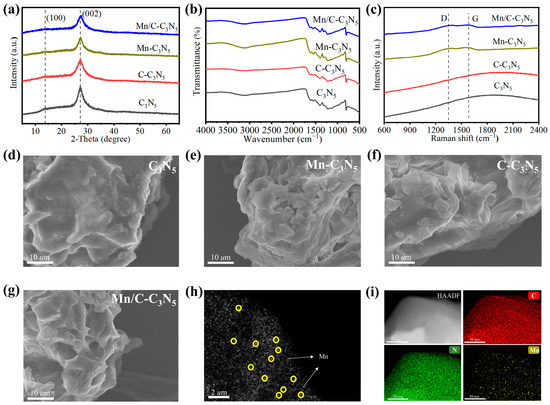
The XRD spectra of the catalysts exhibit two characteristic diffraction peaks at 13.6° and 27.4° (Figure 1a), corresponding to the (100) and (002) crystal planes, respectively [32]. These peaks arise from the intra-planar stacking of heptazine units and the interlayer π-conjugated structure of the graphitic carbon nitride framework [33]. Notably, no additional diffraction peaks emerge upon incorporation of Mn and C species, indicating that the C3N5 matrix retains its structural integrity and that the loaded Mn species are highly dispersed without forming detectable crystalline phases. However, the intensity of the (002) diffraction peak decreases significantly in Mn-C3N5, C-C3N5, and Mn/C-C3N5, suggesting that the interlayer stacking of C3N5 is disrupted due to Mn incorporation and the formation of graphitized carbon [34]. Concurrently, the reduced intensity of the (100) peak implies a distortion in the in-plane stacking arrangement of C3N5 [35].
Figure 1.
(a) XRD patterns, (b) FT-IR spectra, (c) Raman spectra, and (d–g) SEM images of the as-prepared samples; (h) AC-STEM of Mn/C-C3N5 and (i) corresponding EDS elemental mapping.
Fourier-transform infrared (FTIR) spectroscopy (Figure 1b) confirms the preservation of the fundamental chemical structure of C3N5. The broad absorption band at 3000–3400 cm−1 corresponds to N-H stretching vibrations, while the peaks in the 1100–1600 cm−1 range are assigned to the stretching modes of C-N heterocycles [36]. The characteristic peak at 850 cm−1 originates from the out-of-plane bending vibrations of heptazine rings [37]. Elemental analysis results (Table S1) reveal that the C/N molar ratio of Mn/C-C3N5 (0.760) is notably higher than those of C3N5 (0.666) and Mn-C3N5 (0.668), confirming the successful incorporation of carbon species into the Mn/C-C3N5 composite. Furthermore, the Raman spectrum of Mn/C-C3N5 (Figure 1c) displays distinct D and G bands at ~1350 cm−1 and ~1580 cm−1 [38], providing additional evidence for the effective integration of a graphitic carbon network derived from glucose pyrolysis.
The morphological and textural properties of the catalysts were examined by scanning electron microscopy (SEM). As shown in Figure 1d–g, SEM images reveal block-like morphologies for all samples. Compared to pristine C3N5, both C-C3N5 and Mn/C-C3N5 exhibit significantly enhanced porosity. Nitrogen adsorption–desorption isotherm measurements (Figure S1) show that the specific surface areas of C-C3N5 and Mn/C-C3N5 were 3.7 and 4.2 times greater than that of pristine C3N5, respectively. This substantial increase is primarily attributed to the formation of micropores and mesopores generated by gaseous byproduct evolution during glucose pyrolysis [39]. Aberration-corrected Scanning Transmission Electron Microscopy (AC-STEM) (Figure 1h) analysis confirms the presence of isolated Mn single atoms within the C3N5 matrix. Energy-dispersive X-ray spectroscopy (EDS) elemental mapping (Figure 1i) reveals the homogeneous distribution of C, N, and Mn throughout the material, further corroborating the atomic-level dispersion of Mn within the C3N5 framework.
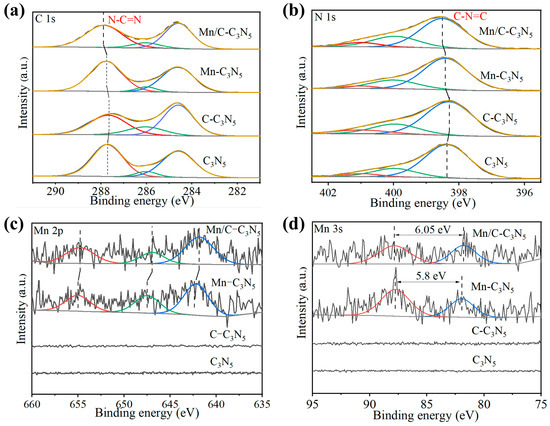
The surface composition and chemical states of the catalysts were characterized by XPS analysis. As shown in Figure 2a, the C 1s spectrum of pristine C3N5 can be deconvoluted into three characteristic peaks at 284.6, 286.0, and 287.7 eV, corresponding to C-C/C=C (adventitious carbon), C-O, and N-C=N species, respectively [40]. Notably, compared to pristine C3N5, the N-C=N peak in the C-C3N5 composite exhibits a pronounced negative shift in its binding energy, which is attributed to the electron-donating effect of the graphitic carbon network formed in C3N5. Due to the π-electron-rich nature of graphitic carbon and the lower electronegativity of carbon compared to nitrogen, the π-conjugated carbon network increases the electron density around the N-C=N moiety, thereby reducing its binding energy [41]. In contrast, both Mn-C3N5 and Mn/C-C3N5 display positive shifts in the N-C=N binding energy compared to C3N5. This phenomenon results from the formation of Mn-N coordination bonds, where sp2-hybridized nitrogen atoms donate lone pair electrons to the vacant d-orbitals of Mn [42]. The electron transfer from nitrogen to Mn decreases the electron density of the N-C=N coordination, resulting in a higher binding energy. The N 1s spectra (Figure 2b) further corroborate these observations, showing three distinct components at 398.4, 400.0, and 401.0 eV that are assigned to N-C=N, pyrrolic N, and graphitic N, respectively [43]. Consistent with the C 1s results, the N-C=N peak in C-C3N5 shifts to lower binding energy, while those in Mn-C3N5 and Mn/C-C3N5 shift to higher binding energies, with the most significant shift occurring in Mn/C-C3N5. These results provide compelling evidence that Mn-N coordination reduces the electron density of the N-C=N bond. Concurrently, the graphitic carbon network in Mn/C-C3N5 facilitates stronger orbital hybridization between nitrogen and Mn, resulting in enhanced Mn-N coordination strength.
Figure 2.
XPS spectra of the catalysts: (a) C 1s, (b) N 1s, (c) Mn 2p, and (d) Mn 3s.
Figure 2c displays the Mn 2p XPS spectra of Mn-C3N5, featuring two characteristic peaks at 641.3 eV (Mn 2p3/2) and 653.4 eV (Mn 2p1/2), along with a satellite peak at 646.5 eV [44]. For Mn/C-C3N5, these peaks persist but shift to lower values compared to Mn-C3N5, indicating a higher electron density around Mn in Mn/C-C3N5. This enhanced electron density originates from sp2-hybridized N atoms in the Mn-NX coordination structure, suggesting stronger Mn-NX bonding and a reduction in the Mn oxidation state. To further substantiate this observation, Figure 2d presents an analysis of the Mn 3s spectrum, where the energy splitting (ΔE) between the two peaks is correlated with the average oxidation state (AOS) of Mn, as defined by the equation (AOS = 8.956−1.126ΔE) [45]. The calculated AOS values are 2.4 for Mn-C3N5 and 2.1 for Mn/C-C3N5, confirming that the graphitic carbon network doping promotes electron delocalization to Mn, thereby stabilizing its lower oxidation state. This electronic modulation is expected to enhance the electron-donating capability of the catalyst, facilitating ozone activation during catalytic reactions.
2.2. Catalytic Performance Evaluation
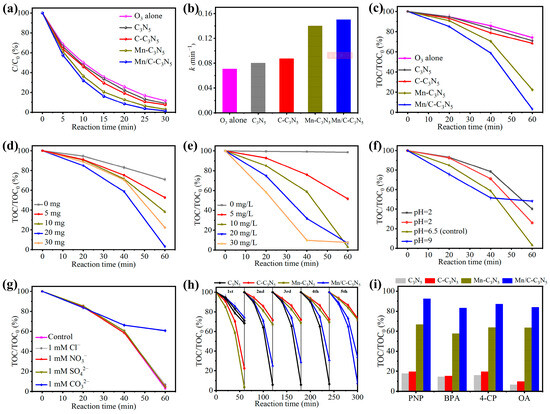
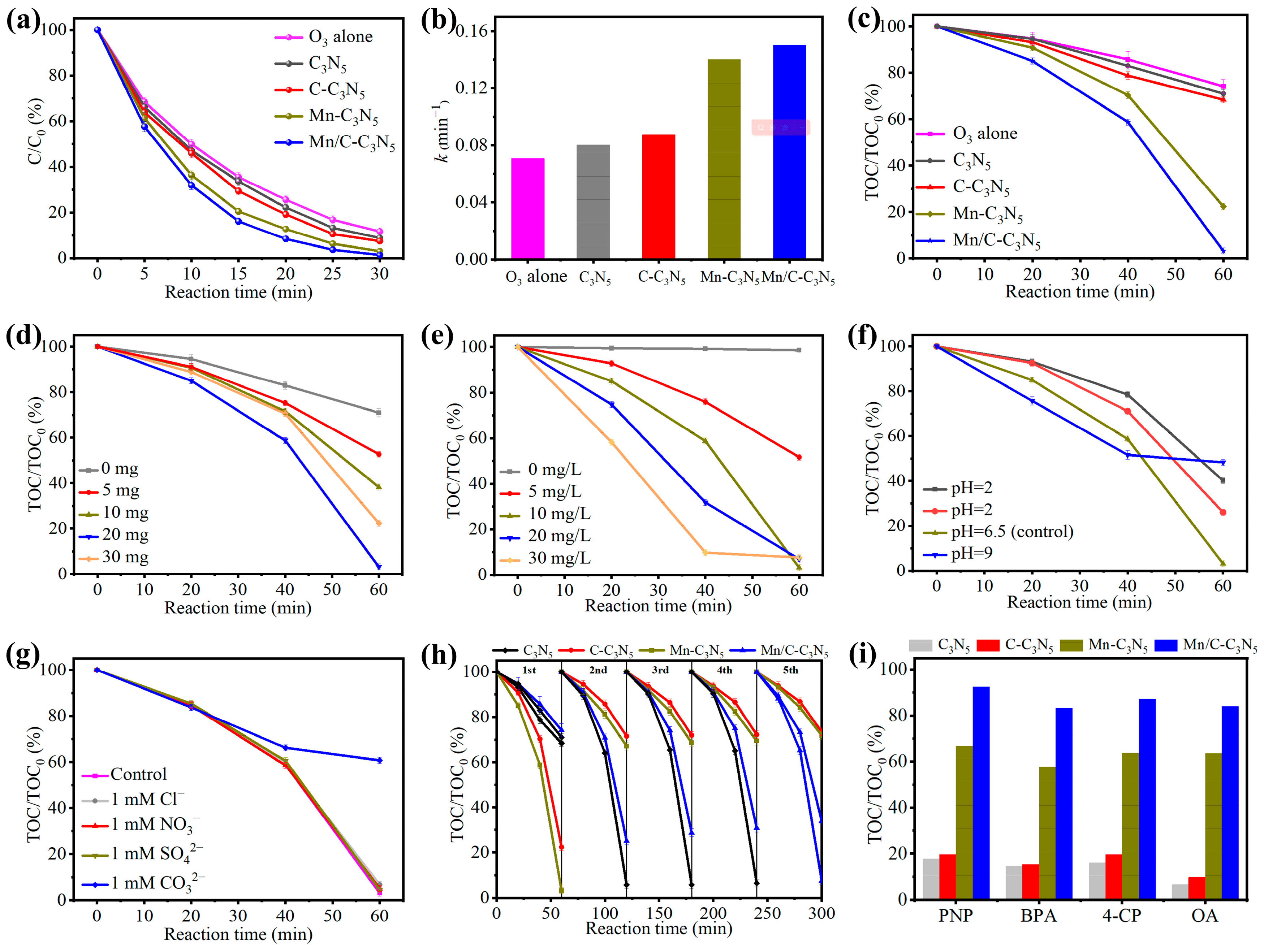
Phenol served as a representative model compound to systematically assess the catalytic performance of the synthesized materials. Preliminary adsorption experiments (Figure S2) confirm negligible phenol adsorption (<2%) on all catalysts (C3N5, C-C3N5, Mn-C3N5, and Mn/C-C3N5) after 60 min of equilibration, ruling out the dominant contribution of adsorption for pollutant removal. As shown in Figure 3a, all catalysts exhibit rapid phenol degradation, achieving removal efficiencies of 92%, 93%, 97%, and 99% within 30 min for C3N5, C-C3N5, Mn-C3N5, and Mn/C-C3N5, respectively. Kinetic analysis (Figure 3b) further confirms the superior performance of Mn/C-C3N5, which displays the highest pseudo-first-order rate constant (k = 0.15 min−1), significantly outperforming C3N5. Analysis of the synthesis parameters shows that adding glucose only moderately improves the activity of C3N5, yielding a maximum TOC removal of 33% with a 0.3 g loading (Figure S3a). In contrast, doping with MnCl2·4H2O results in a significantly higher mineralization rate of 68% using 70 mg of the dopant (Figure S3b). Remarkably, the synergistic combination of both modifiers (0.3 g glucose and 70 mg MnCl2·4H2O) boosts the TOC removal to 97%, representing the highest activity among the tested conditions (Figure S3c). This structure–activity trend is clearly summarized in the comparative TOC removal profiles shown in Figure 3c. A comparison of Mn/C-C3N5 with state-of-the-art Mn-based catalysts for catalytic ozonation is presented in Table S2. Mn/C-C3N5 achieves a higher TOC removal efficiency with lower catalyst dosage and lower ozone concentration than other catalysts, highlighting its excellent catalytic activity. These results collectively demonstrate a pronounced combined effect between atomically dispersed Mn sites and the conductive carbon network, confirming that their integration is essential for achieving superior mineralization efficiency.
Figure 3.
(a) Phenol degradation and (b) its Pseudo-first-order rate constants by catalytic ozonation with various catalysts, (c) TOC removal efficiency during ozonation; Effects of (d) catalyst dosage, (e) ozone concentration, (f) initial solution pH, and (g) cations on the TOC removal in phenol degradation, (h) TOC removal over consecutive cyclic runs; (i) catalytic ozonation efficiency for different organic pollutants. (Reaction conditions: [O3] = 10 mg/L 50 mL/min, catalyst dosage: 133 mg/L, reaction temperature: 25 °C, [phenol] = [PNP] = [BPA] = [4-CP] = 30 mg/L, [OA] = 180 mg/L).
The effects of various operational parameters on the TOC removal efficiency in the catalytic ozonation of phenol were systematically investigated. In Figure 3d, catalyst dosage significantly influences TOC removal efficiency. The removal efficiency reaches a maximum of 97% at an optimal catalyst dosage of 20 mg, attributed to increased availability of active sites for ozone activation. However, further increasing the dosage to 30 mg results in decreased TOC removal to 78%, likely due to catalyst particle aggregation, which impedes effective contact between the catalyst surface and ozone molecules. As shown in Figure 3e, TOC removal efficiency increases markedly with ozone concentration. This improvement is driven by greater ozone availability, which enhances ROS generation and accelerates phenol mineralization. The pH dependence of the reaction system is illustrated in Figure 3f. At the initial pH of 6.5, a TOC removal efficiency of 97% is achieved. Under acidic conditions (pH 2 and 4), the removal efficiency increases progressively with pH, reaching 78% and 88%, respectively. This trend reflects the fact that higher pH facilitates ozone decomposition and ROS generation. At pH 9, however, the final TOC removal declined to 52% despite a faster initial reaction rate. This is because CO2 produced during mineralization forms HCO3−/CO32− in alkaline solution, and the accumulation of these carbonate species scavenges ROS, inhibiting the mineralization process. Given the prevalence of inorganic ions in real wastewater and their potential interference with catalytic processes, their influence on system performance was also examined (Figure 3g). The presence of common anions such as SO42−, NO3−, and Cl− exhibits negligible effects on TOC removal, with efficiencies remaining above 94%. In contrast, the addition of CO32− has an obvious inhibitory effect, with TOC removal decreasing to 40%. This strong inhibitory effect of carbonate ions is attributed to their well-established role as a potent •OH scavenger. In aqueous solution, carbonate (CO32−) rapidly reacts with hydroxyl radicals via the following reactions [46]:
•OH + CO32− → OH− + •CO3− (k = 3.9 × 10⁸ M−1 s−1)
The catalytic stability was systematically evaluated through multiple recycling tests. Following each cycle, the catalyst was separated via filtration. The recovered solid was then sequentially washed with deionized water and ethanol to eliminate adsorbed species, and finally dried at 60 °C for the next run. As demonstrated in Figure 3h, Mn/C-C3N5 exhibited remarkable stability over five consecutive cycles, maintaining 95% of its initial activity (TOC removal decreasing from 97% to 92%). To further elucidate the superior stability, metal leaching was investigated. Notably, the mass fractions of Mn in Mn-C3N5 and Mn/C-C3N5 are 0.928% and 0.637%, respectively. Inductively coupled plasma mass spectrometry (Table S3) reveals excellent metal retention by Mn/C-C3N5 after reaction, with Mn leaching of only 0.04 mg/L in the first cycle and 0.008 mg/L in the fifth cycle. Furthermore, comprehensive post-reaction characterizations via SEM (Figure S4), XRD, and FTIR spectroscopy (Figure S5) confirm the structural integrity of the catalyst, with no observable morphological or crystallographic changes, further validating its exceptional stability.
To evaluate the broad applicability of Mn/C-C3N5, its mineralization performance was tested against several recalcitrant organic pollutants: p-nitrophenol (PNP), bisphenol A (BPA), 4-chlorophenol (4-CP), and oxalic acid (OA). As presented in Figure 3i, Mn/C-C3N5 achieves a superior TOC removal after 60 min of catalytic ozonation: 94% for PNP, 92% for BPA, 90% for 4-CP, and 87% for OA. These significantly exceed those of Mn-C3N5 (79%, 76%, 73%, and 71%) and pristine C3N5 (45%, 43%, 40%, and 38%), demonstrating the exceptional versatility of Mn/C-C3N5 and its promising potential for practical wastewater treatment applications.
2.3. Reactive Oxidation Species Analysis
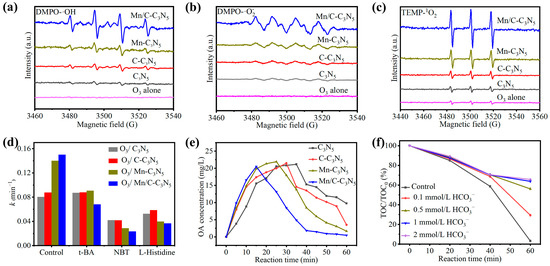
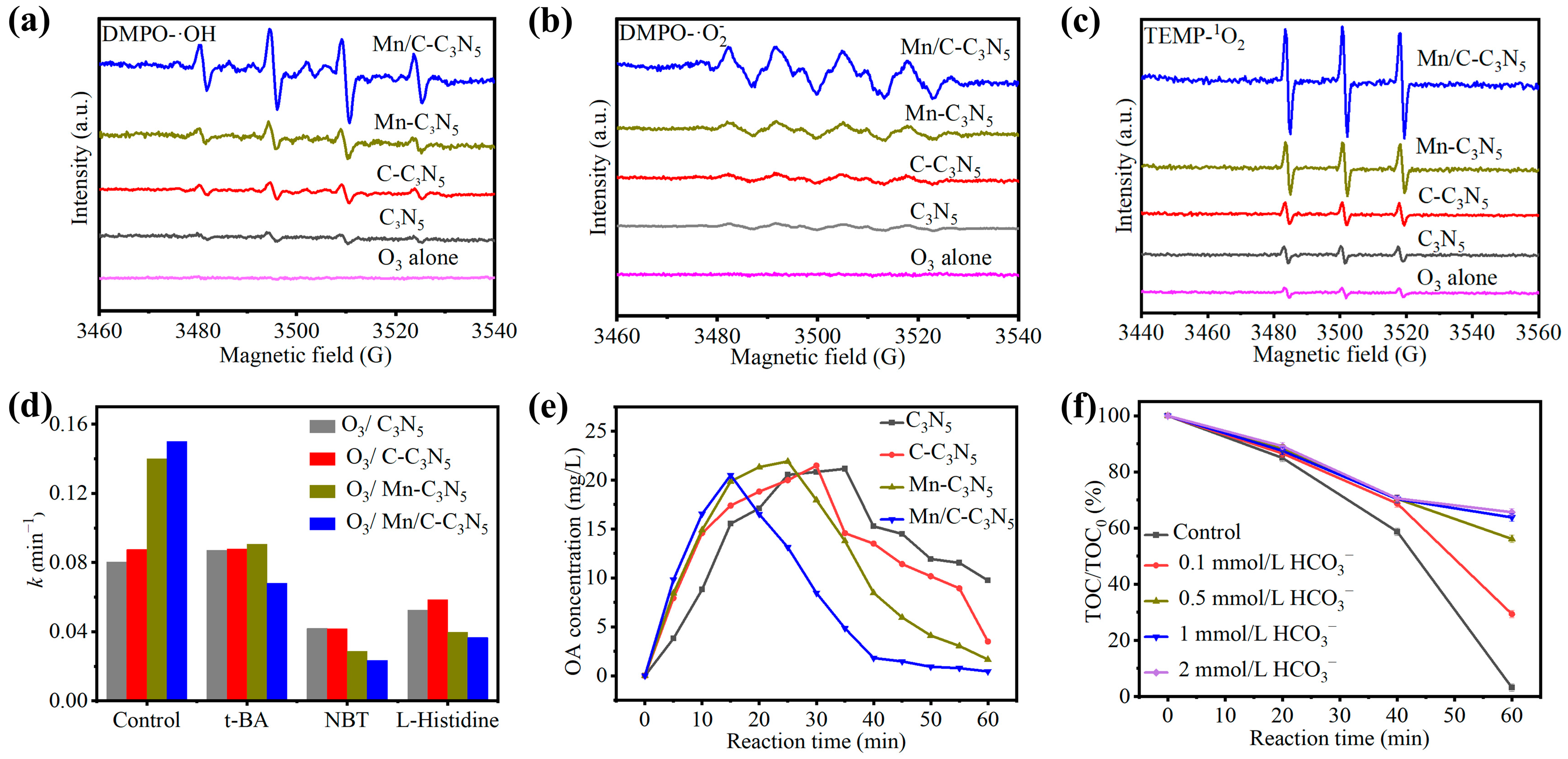
The reactive oxygen species (ROS) generated in the different systems were systematically investigated using in situ EPR spectroscopy. For hydroxyl radical (•OH) detection in aqueous solution, DMPO was employed as the spin trap agent, yielding the characteristic 1:2:2:1 quartet signal. Although ozone can undergo decomposition via radical chain reactions in water to generate •OH [47], the steady-state concentration of •OH under our experimental conditions was below the detection limit of EPR spectroscopy, as evidenced by the absence of a characteristic signal in Figure 4a. In contrast, the introduction of catalysts resulted in distinct and intense •OH signals, with Mn/C-C3N5 exhibiting significantly stronger signal intensity compared to Mn-C3N5, C-C3N5, and C3N5. This confirms the superior catalytic ability of Mn/C-C3N5 to activate ozone and generate a high flux of hydroxyl radicals. Superoxide radicals (•O2−) were trapped using DMPO in methanol solvent, showing a 1:1:1:1 intensity ratio. The Mn/C-C3N5 system demonstrates the most intense •O2− signal, suggesting its exceptional efficiency in converting O3 to •O2− (Figure 4b). For singlet oxygen (1O2) detection, TEMP was utilized in aqueous solution, revealing a characteristic 1:1:1 triplet signal. Again, Mn/C-C3N5 exhibits the strongest signal intensity (Figure 4c), confirming enhanced 1O2 production through ozone activation. These EPR results collectively demonstrate that Mn/C-C3N5 produces the greatest quantity of all three major ROS, which explains its superior catalytic performance.
Figure 4.
EPR spectra of (a) •OH, (b) •O2–, and (c) 1O2; (d) Comparison of pseudo-first-order kinetic constants across different catalysts and quenching agents; (e) Evolution of OA concentration under various oxidation processes; (f) Influence of HCO3− concentration on the catalytic performance of Mn/C-C3N5.
To determine the role of different ROS in the catalytic ozonation process, radical scavenging experiments were conducted using selective quenchers: tert-butanol (TBA) for •OH, nitroblue tetrazolium (NBT) for •O2−, and L-histidine for 1O2. As shown in Figure S6a–d, TBA addition had a negligible effect on phenol degradation in the C3N5 system and caused only minor suppression in C-C3N5, Mn-C3N5, and Mn/C-C3N5 systems. Quantitative analysis in Figure 4d reveals that the Mn/C-C3N5 system experiences the most significant reductions in pseudo-first-order kinetic constant upon addition of NBT and L-histidine, indicating that superoxide radicals and singlet oxygen play the most prominent roles in the initial degradation of phenol. These findings reveal a two-stage degradation mechanism. In Stage I (initial degradation), •O2− and 1O2 serve as the primary reactive species responsible for rapid phenol ring-opening and conversion to intermediates, as evidenced by the strong suppression observed with NBT and L-histidine in Figure 4d. However, typical phenol degradation intermediates, particularly short-chain carboxylic acids such as oxalic acid, are known to be resistant to oxidation by •O2− and 1O2 but can be efficiently degraded by •OH. To verify the transition to Stage II (deep mineralization), the temporal evolution of oxalic acid concentration was monitored across different catalytic systems. As shown in Figure 4e, the Mn/C-C3N5 system exhibits both the fastest accumulation of oxalic acid during Stage I and the most rapid degradation of oxalic acid during Stage II, highlighting its exceptional efficiency in generating •OH for subsequent oxidation of this recalcitrant intermediate. To further quantify the contribution of •OH to phenol mineralization, HCO3− was employed as a selective •OH scavenger. At a concentration of 2 mM HCO3−, the mineralization efficiency in the Mn/C-C3N5 system decreased dramatically by 62% in Figure 4f, confirming that •OH is the dominant species driving complete mineralization in Stage II. This coherent two-stage mechanism explains the apparent distinction between the radical quenching results, where •O2− and 1O2 appear dominant for initial degradation, and the mineralization data, where •OH is essential for complete mineralization. The superior performance of Mn/C-C3N5 arises from its ability to efficiently generate all three reactive oxygen species in a coordinated manner—sustaining rapid initial degradation via •O2− and 1O2 while simultaneously producing sufficient •OH for deep mineralization of intermediates.
2.4. Reaction Mechanism Analysis
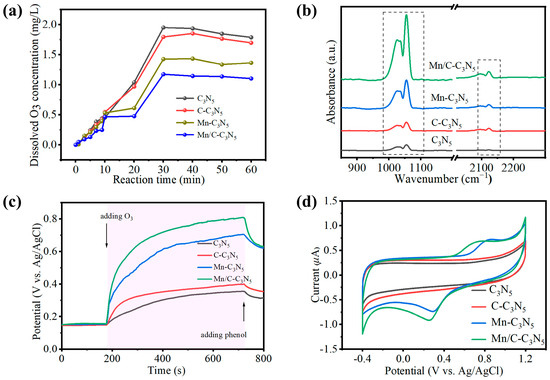
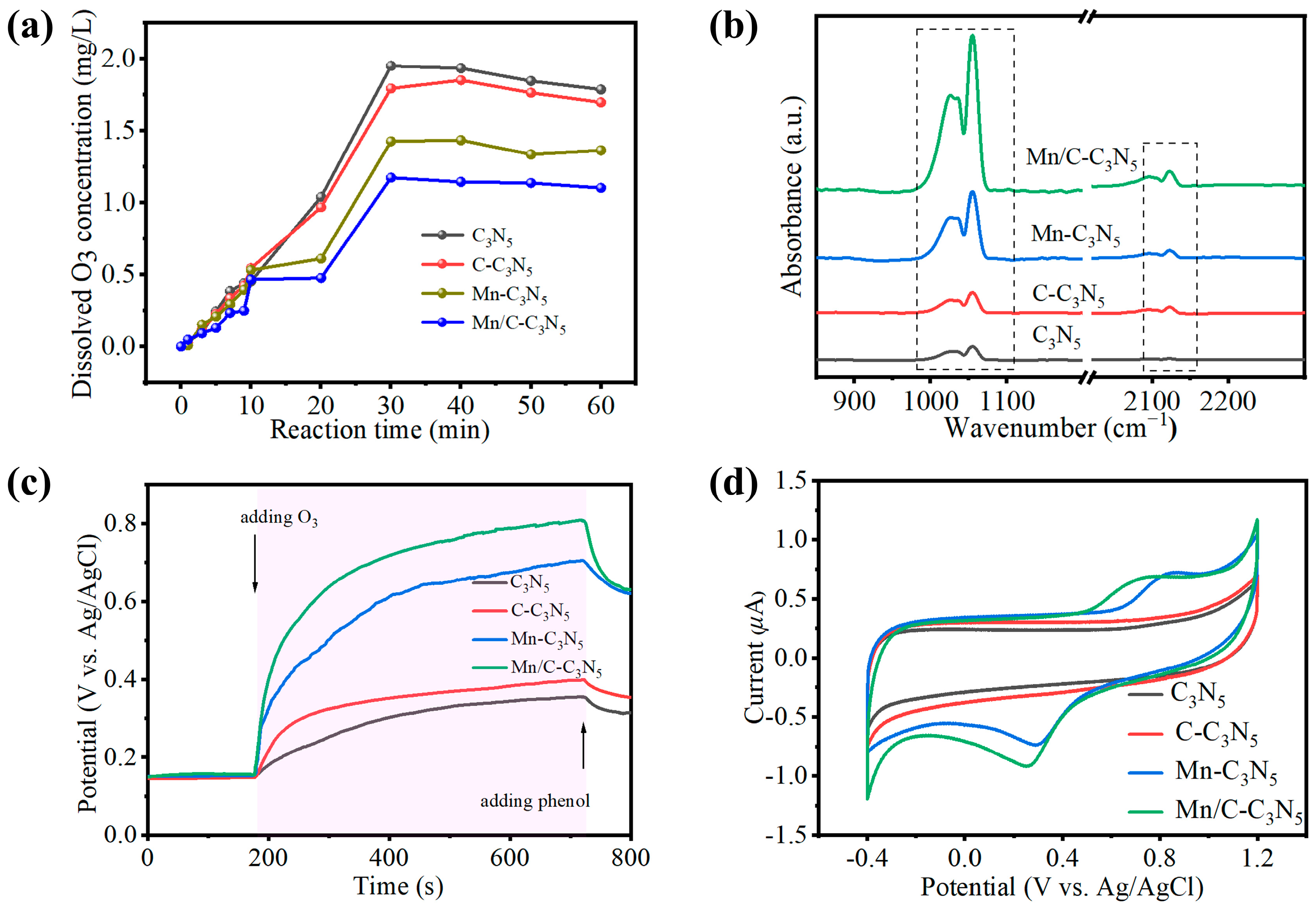
A comprehensive investigation combining ozone consumption kinetics, in situ spectroscopy, and electrochemical measurement was conducted to elucidate the mechanism behind the superior performance of Mn/C-C3N5. Analysis of dissolved O3 concentration in the reaction solution via iodometric titration (detailed procedure in Text S1) reveals that Mn/C-C3N5 exhibits the highest O3 consumption rate among all catalysts (Figure 5a), confirming its exceptional ozone activation capability. In situ DRIFTS analysis provided molecular-level insight. Upon O3 introduction, characteristic peaks emerge at 1026–1054 cm−1 and 2095–2122 cm−1, corresponding to chemisorbed and physisorbed O3, respectively (Figure 5b). Notably, Mn/C-C3N5 exhibits the strongest signal intensities, indicating that O3 molecules are preferentially adsorbed on Mn active sites to form surface Mn–O3* coordination complexes. Furthermore, a distinct signal at 1124 cm−1 attributable to •O2− is also detected, suggesting that the adsorbed O3* undergoes rapid electron transfer to generate reactive intermediates [48].
Figure 5.
(a) Ozone concentration profiles in different catalytic systems; (b) In situ DRIFTS spectra of various catalysts under ozone exposure; (c) Open-circuit potential measurements and (d) CV curves of the prepared electrodes.
Electrochemical measurements were performed on a Bio-Logic SP-150 electrochemical workstation using a standard three-electrode configuration. Detailed experimental conditions are provided in the Supplementary Material (Text S2).
In situ open-circuit potential (OCP) measurements provided direct evidence for the electron transfer pathway. For Mn/C-C3N5, introducing O3 induced a sharp positive potential shift of +0.66 V (from 0.12 V to 0.78 V vs. Ag/AgCl) (Figure 5c), which was promptly reversed by a negative shift of −0.18 V upon phenol addition. This bidirectional fluctuation of 0.84 V confirms that the Mn sites function as efficient electron relay centers, with the magnitude of potential change directly reflecting the electron transfer capacity of the material. Corroborating this, electrochemical impedance spectroscopy reveals that Mn/C-C3N5 exhibits the smallest arc radius in Nyquist plots (Figure S7), evidencing superior charge-transfer capability. The significantly reduced arc diameter, compared to the control samples, indicates a substantially lower charge transfer resistance, quantitatively confirming the enhanced interfacial charge transfer kinetics imparted by the conductive carbon network. This enhanced conductivity is attributed to the synergistic interaction between atomically dispersed Mn–Nₓ sites and the conductive carbon network, which facilitates rapid electron redistribution. Consequently, this structure accelerates the critical manganese redox cycles required for ozone activation, enabling efficient radical generation and enhanced catalytic performance. Cyclic voltammetry (CV) further supports this conclusion, with Mn/C-C3N5 exhibiting a greater current response and more pronounced redox features than the control samples (Figure 5d), indicating facile Mn(II)/Mn(III) interconversion. Finally, the redox evolution of manganese was tracked by Mn 3s XPS analysis. After ozone exposure, the splitting energy decreases from 6.05 eV to 5.63 eV, corresponding to an increase in the average oxidation state of Mn from 2.144 to 2.617 (Figure S8). These electrochemical results collectively demonstrate that the integration of atomically dispersed Mn sites with a conductive carbon network significantly enhances charge transfer kinetics, which is essential for efficient ozone activation and pollutant mineralization.
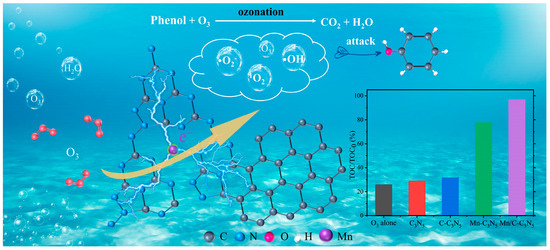
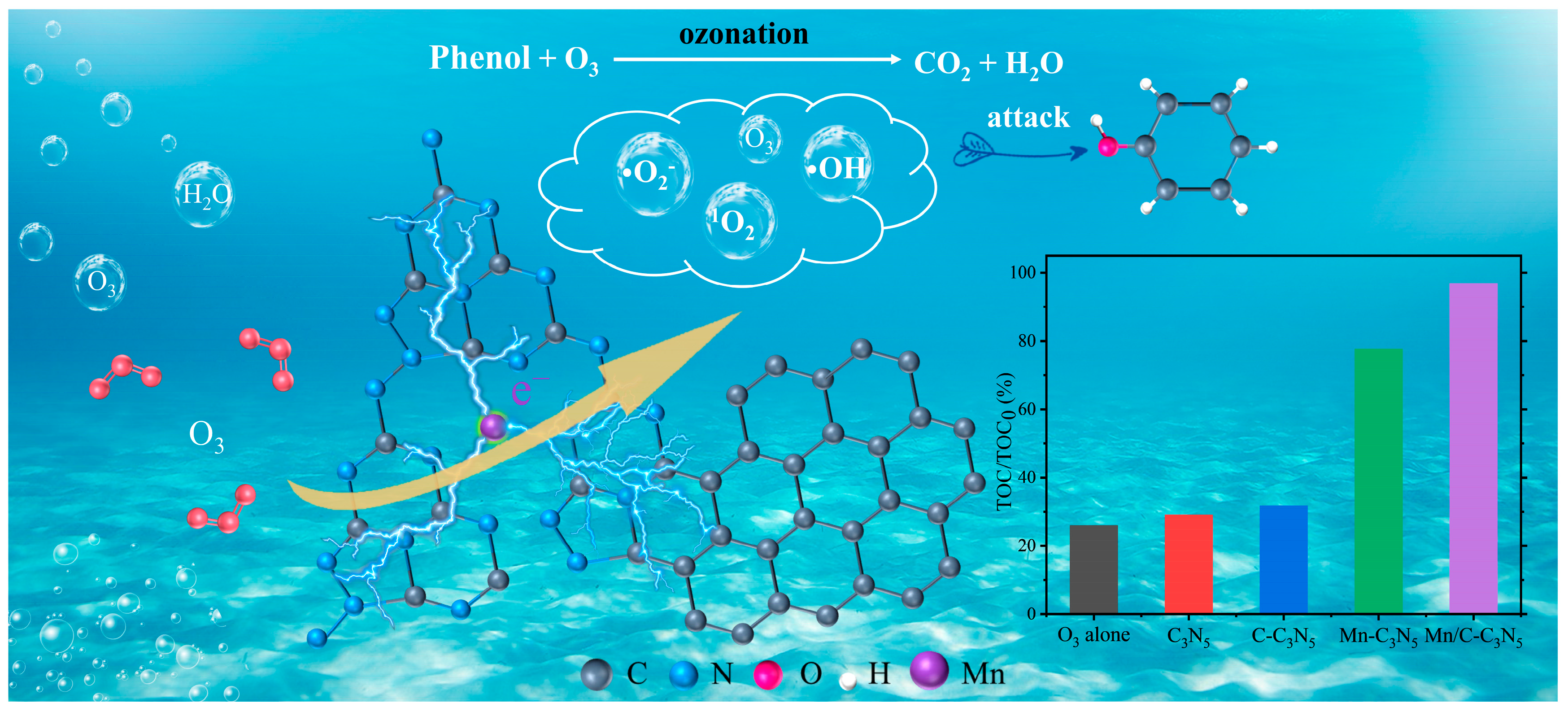
Based on the above experimental evidence, we propose a plausible reaction mechanism for catalytic ozonation of phenol over Mn/C-C3N5 is proposed: O3 initially adsorbs onto the Mn active sites on the catalyst surface, forming metastable Mn–O3* coordination complexes (Equation (1)). Within the Mn–O3* complex, O3* accepts electrons from Mn2+, forming ozonide radicals (•O3−) and oxidizing Mn2+ to Mn3+ (Equation (2)). Under aqueous condition, •O3− undergoes rapid protonation to yield •HO3 (Equation (3)), which decomposes into O2 and highly reactive •OH (Equation (4)); OH− can also react with O3 producing hydroperoxyl radicals (•HO2), which equilibrate with •O2− (Equation (5)). The catalytic cycle is completed when •O2− reduces Mn3+ back to Mn2+, releasing singlet oxygen (1O2) and regenerating the active site. To provide a visual overview of this reaction pathway, a schematic illustration of the proposed catalytic mechanism is presented in Figure 6.
Mn/C-C3N5 + O3 → Mn–O3* complexes
Mn (ΙΙ) + O3* → Mn (ΙΙΙ) + •O3−
•O3− + H+ → •HO3
•HO3 → O2 + •OH
OH− + O3 → •HO2 + •O2−
•O2− + Mn (ΙΙΙ) → 1O2 + Mn (ΙΙ)
Figure 6.
Ozone-driven catalytic system with Mn/C-C3N5 enables efficient and complete mineralization of phenol.
3. Experimental
3.1. Materials
All chemicals, procured from commercial suppliers, were analytical-grade reagents and used without further treatment. Their detailed specifications are listed in the Supplementary Material (Text S3).
3.2. Synthesis of Catalysts
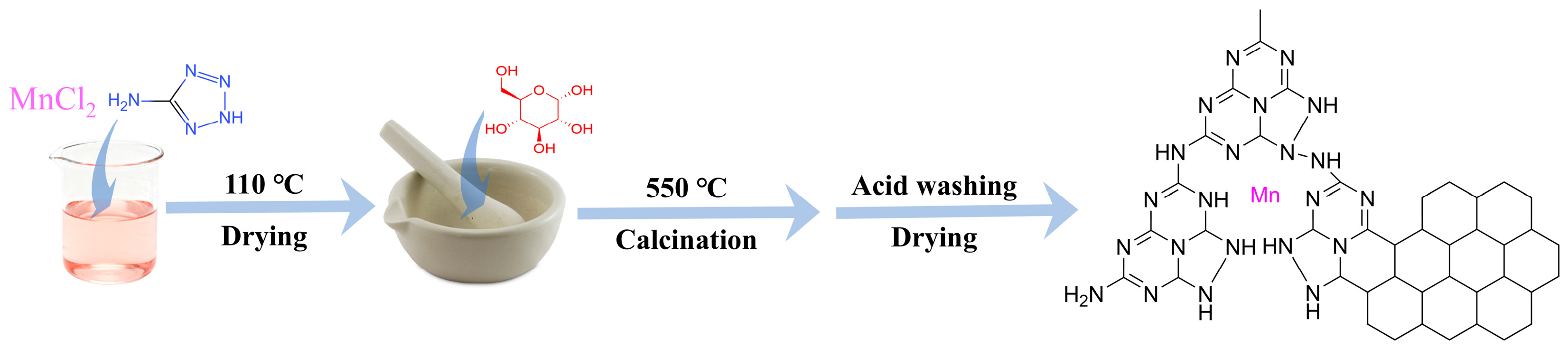
As illustrated in Figure 7, 5.0 g of 5-amino-1H-tetrazole and 70 mg of MnCl2·4H2O were dissolved in 30 mL of deionized water. The resulting mixture was stirred at 70 °C for 1 h, followed by continued stirring at 110 °C until complete water evaporation. The resulting solid was mixed with 0.3 g of C6H12O6⋅H2O and ground into a uniform powder to obtain the precursor. The precursor was then transferred into a covered ceramic crucible and calcined at 550 °C for 3 h in a muffle furnace with under ambient atmosphere, with a heating rate of 5 °C min−1. After natural cooling to room temperature, the calcined product was immersed in 1.0 mol/L H2SO4 for 12 h to remove residual metal particles, successively washed with deionized water and ethanol, and then dried overnight at 60 °C. The resulting black powder was denoted as Mn/C-C3N5. For comparison, three control samples were prepared using an identical protocol: (1) pristine C3N5 (without MnCl2⋅4H2O and C6H12O6⋅H2O), (2) Mn-C3N5 (with MnCl2⋅4H2O), and (3) C-C3N5 (with C6H12O6⋅H2O). Detailed characterization methods are described in Text S4.
Figure 7.
Schematic of Mn/C-C3N5 synthesis process.
3.3. Activity Test
Catalytic ozonation experiments were conducted in a 200 mL cylindrical glass reactor maintained at 25 °C by a circulating water bath integrated with a reflux condenser, which ensured precise temperature control throughout the reaction (Figure S9).
The reaction mixture consisted of 150 mL of phenol solution (30 mg/L) and catalyst (0.133 g/L). Prior to ozonation, adsorption–desorption equilibrium was ensured by stirring the mixture magnetically for 30 min. The reactor was bubbled into a continuous stream of ozone (10 mg/L) at 50 mL/min, samples (2 mL) were withdrawn at designated time intervals (5 min intervals for the first 30 min, then 20 min intervals), immediately filtered through a 0.22 μm polytetrafluoroethylene membrane, and quenched with excess Na2S2O3 solution to eliminate residual ozone. The concentration of phenol was determined by high-performance liquid chromatography (Agilent 1260 Infinity II) equipped with a diode array detector and a C18 column (5 μm, 4.6 mm × 150 mm). The mobile phase consisted of acetonitrile and water (30:70, v/v) at a flow rate of 1.0 mL/min, with an injection volume of 10 μL and detection wavelength of 270 nm. Total organic carbon (TOC) concentrations were measured using a Shimadzu TOC-VCPH analyzer to evaluate the mineralization efficiency.
4. Conclusions
In this study, we successfully developed a novel Mn/C-C3N5 catalyst through a facile calcination approach that effectively integrates atomically dispersed Mn sites with a conductive graphitic carbon network within the C3N5 matrix. The incorporation of a glucose-derived carbon network simultaneously enhanced the specific surface area and charge transfer capability of C3N5, while Mn single atoms anchored via strong Mn–Nₓ coordination provided highly active catalytic sites. The optimized Mn/C-C3N5 catalyst exhibited exceptional catalytic ozonation performance, achieving 99% phenol degradation within 30 min and 97% mineralization within 60 min, representing a three-fold improvement over pristine C3N5. Mechanistic studies revealed that the synergistic interaction between Mn sites and the carbon network facilitates O3 activation via Mn–O3* complex formation, generating multiple ROS (•OH, •O2−, and 1O2). The catalyst showed excellent stability with only 5% activity loss after five cycles, attributed to the strong Mn–Nx anchoring that minimizes metal leaching. Moreover, Mn/C-C3N5 demonstrated broad applicability, mineralizing recalcitrant pollutants such as bisphenol A, 4-chlorophenol, and oxalic acid, highlighting its potential for practical wastewater treatment. This work establishes a synergistic catalytic platform coupling single-atom sites with conductive networks for deep pollutant mineralization, providing fundamental insights and a design strategy for high-performance single-atom catalysts in advanced oxidation processes.
Supplementary Materials
The following supporting information can be downloaded at https://www.mdpi.com/article/10.3390/catal16030247/s1. Refs. [49,50,51,52,53,54,55] are cited in Supplementary Materials.
Author Contributions
G.S.: Methodology, Investigation, Writing—original draft. Z.Y.: Investigation, Data curation, Validation. J.G.: Investigation, Data curation, Y.Y.: Supervision, Writing—review and editing. Y.H.: Conceptualization, Resources, Project administration, Supervision, Writing—review and editing. All authors have read and agreed to the published version of the manuscript.
Funding
The present work was supported by NSFC (22072021) and the Natural Science Foundation of Fujian Province (2025J01431).
Data Availability Statement
Data will be made available on request.
Conflicts of Interest
The authors declare that they have no known competing financial interests or personal relationships that could have appeared to influence the work reported in this paper.
References
- Weng, H.; Yang, Y.; Zhang, C.; Cheng, M.; Wang, W.; Song, B.; Luo, H.; Qin, D.; Huang, C.; Qin, F.; et al. Insight into FeOOH-mediated advanced oxidation processes for the treatment of organic polluted wastewater. Chem. Eng. J. 2024, 453, 139812. [Google Scholar] [CrossRef] [Scilit]
- Lu, T.; Zhang, Y.; Wang, Z.; Li, S.; Zheng, L.; Li, H. Self-powered organic pollutants degradation in wastewater by photocatalytic ozonation based on triboelectric nanogenerator. Nano Energy 2024, 127, 109712. [Google Scholar] [CrossRef] [Scilit]
- Lu, S.; Peng, J.; Shang, C.; Yin, R. Dissolved Organic Matter-Mediated Photosensitized Activation of Monochloramine for Micropollutant Abatement in Wastewater Effluent. Environ. Sci. Technol. 2024, 58, 9370–9380. [Google Scholar] [CrossRef] [Scilit]
- Song, Z.; Wang, M.; Wang, Z.; Wang, Y.; Li, R.; Zhang, Y.; Liu, C.; Liu, Y.; Xu, B.; Qi, F. Insights into Heteroatom-Doped Graphene for Catalytic Ozonation: Active Centers, Reactive Oxygen Species Evolution, and Catalytic Mechanism. Environ. Sci. Technol. 2019, 53, 5337–5348. [Google Scholar] [CrossRef] [Scilit]
- Lu, Y.; Deng, H.; Pan, T.; Liao, X.; Zhang, C.; He, H. Effective Toluene Ozonation over δ-MnO2: Oxygen Vacancy-Induced Reactive Oxygen Species. Environ. Sci. Technol. 2023, 57, 2918–2927. [Google Scholar] [CrossRef] [Scilit]
- Liu, L.; Wu, N.; Ouyang, M.; Xing, Y.; Tian, J.; Chen, P.; Wu, J.; Hu, Y.; Niu, X.; Fu, M.; et al. Enhancement Effect Induced by the Second Metal to Promote Ozone Catalytic Oxidation of VOCs. Environ. Sci. Technol. 2024, 58, 6725–6735. [Google Scholar] [CrossRef] [Scilit]
- Zhu, Y.; Luo, H.; Wang, T.; Zhou, J.; Zhu, Y.; Hou, J. Advanced treatment of landfill leachate by catalytic ozonation with MnCeOx/γ-Al2O3 catalyst. Surf. Interfaces 2024, 46, 104113. [Google Scholar] [CrossRef] [Scilit]
- Utama, A.D.; Saputera, W.H.; Mukti, R.R.; Putrie, A.S.; Sasongko, D. Advanced synthesis of ZSM-5 zeolite in tubular reactor: Eliminating seeds and aging for phenol degradation via catalytic ozonation. Surf. Interfaces 2025, 76, 107872. [Google Scholar] [CrossRef] [Scilit]
- Li, L.; Wang, Y.; Gao, Y.; Huang, Y.; Liang, Y. Theoretical evidence of enhanced interaction between H2O and O3 leads to improved performance of catalytic ozonation with copper doping α-FeOOH. Surf. Interfaces 2024, 44, 103772. [Google Scholar] [CrossRef] [Scilit]
- Simić, M.D.; Brdarić, T.P.; Rosić, B.G.S.; Švorc, Ľ.; Relić, D.J.; Aćimović, D.D. Degradation of bisphenol A via the electro–Fenton process using nanostructured carbon-metal oxide anodes: Intermediates and reaction mechanisms study. J. Environ. Chem. Eng. 2024, 12, 113369. [Google Scholar] [CrossRef] [Scilit]
- Sánchez-Montes, I.; Wachter, N.; Silva, B.F.; Aquino, J.M. Comparison of UVC-based advanced oxidation processes in the mineralization of bisphenol A: Identification of oxidation by products and toxicity evaluation. Chem. Eng. J. 2020, 386, 123986. [Google Scholar] [CrossRef] [Scilit]
- Veerakumar, P.; Sangili, A.; Chen, S.-M.; Kumar, R.S.; Arivalagan, G.; Firdhouse, M.J.; Hameed, K.S.; Sivakumar, S. Photocatalytic degradation of phenolic pollutants over palladium-tungsten trioxide nanocomposite. Chem. Eng. J. 2024, 489, 151127. [Google Scholar] [CrossRef] [Scilit]
- Qi, H.; Gao, B.; Liu, J.; Wang, Z.; Sillanpää, M. Enhanced ozone catalytic treatment of mature landfill leachate with low C/N ratio using transition metal-modified biochar. J. Environ. Chem. Eng. 2025, 13, 118000. [Google Scholar] [CrossRef] [Scilit]
- Xia, T.; Zhao, F.; Zhang, X.; Xia, S.; Zhang, R.; Yue, M.; Zhang, Z.; Wang, R. Mechanistic study of steel slag synergistic ozone catalytic oxidation for enhancing sludge dewatering performance. J. Environ. Chem. Eng. 2025, 13, 117786. [Google Scholar] [CrossRef] [Scilit]
- Sadanandan, A.M.; Fawaz, M.; Dharmarajan, N.P.; Huš, M.; Singh, G.; Sathish, C.I.; Likozar, B.; Li, Z.; Ruban, A.M.; Jeon, C.-H.; et al. Mesoporous C-doped C3N5 as a superior photocatalyst for CO2 reduction. Appl. Catal. B-Environ. Energy 2025, 362, 124701. [Google Scholar] [CrossRef] [Scilit]
- Xiao, X.; Ye, X.; Wu, Z.; Tan, Y.; Wu, X.; Liu, S. The rise of two-dimensional covalent C3N5: A molecular perspective. J. Mater. Chem. A 2025, 13, 5498–5529. [Google Scholar] [CrossRef] [Scilit]
- Li, B.; Zhou, L.; Bo, X.; Wei, H.; Li, J.; Wang, S.; Liu, C.; Xu, Q.; Yang, C.; Huang, H.; et al. Ion intercalation engineering in crystalline C3N5 for efficient photosynthesis of H2O2. J. Environ. Chem. Eng. 2025, 13, 117794. [Google Scholar] [CrossRef] [Scilit]
- Fu, C.; Zhao, M.; Chen, X.; Sun, G.; Wang, C.; Song, Q. Unraveling the dual defect effects in C3N5 for piezo-photocatalytic degradation and H2O2 generation. Appl. Catal. B-Environ. 2023, 332, 122752. [Google Scholar] [CrossRef] [Scilit]
- Liu, Y.; Yang, J.; Wang, Y.; Zhu, W.; Hu, K.; Liu, Z.; Yeung, K.; Zhu, Z.-S.; Chen, C.; Duan, X.; et al. Intrinsic nanoparticle-single-atom interplays steering radical versus nonradical pathways in catalytic ozonation. Nat. Commun. 2025, 16, 8790. [Google Scholar] [CrossRef] [Scilit]
- Wan, W.; Zhao, Y.; Wei, S.; Triana, C.A.; Li, J.; Arcifa, A.; Allen, C.S.; Cao, R.; Patzke, G.R. Mechanistic insight into the active centers of single/dual-atom Ni/Fe-based oxygen electrocatalysts. Nat. Commun. 2021, 12, 5589. [Google Scholar] [CrossRef] [Scilit] [PubMed]
- Zhang, M.; Xu, K.; Sun, N.; Zhuang, Y.; Wang, L.; Yan, D. Bimetallic Single-Atom Catalysts for Electrocatalytic and Photocatalytic Hydrogen Production. Catalysts 2023, 13, 1409. [Google Scholar] [CrossRef] [Scilit]
- Yu, X.; Deng, J.; Liu, Y.; Jing, L.; Hou, Z.; Pei, W.; Dai, H. Single-Atom Catalysts: Preparation and Applications in Environmental Catalysis. Catalysts 2022, 12, 1239. [Google Scholar] [CrossRef] [Scilit]
- Wang, Z.; Abdelsalam, H.; Teleb, N.H.; Abd-Elkader, O.H.; Sakr, M.A.S.; Liu, Y.; Zhang, Q. Single-Atom catalysts supported by nanographene networks for efficient CO2 electroreduction: A first-principles study. Surf. Interfaces 2024, 55, 105462. [Google Scholar] [CrossRef] [Scilit]
- Liu, H.; Wang, C.; Ai, X.; Wang, B.; Bian, Y.; Wang, Y.; Hu, Z.; Zhang, Z. Single atom catalysts for organic pollutant degradation. J. Environ. Chem. Eng. 2023, 11, 110573. [Google Scholar] [CrossRef] [Scilit]
- Yu, G.; Wang, J.; Xu, Z.; Cao, H.; Dai, Q.; Wu, Y.; Xie, Y. Synergetic Manipulation Mechanism of Single-Atom M–N4 and M–OH (M = Mn, Fe, Co, Ni) Sites for Ozone Activation: Theoretical Prediction and Experimental Verification. Environ. Sci. Technol. 2024, 58, 9393–9403. [Google Scholar] [CrossRef] [Scilit]
- Yang, Z.; Lai, Z.; Song, G.; Yang, Y.; Wang, K.; Yang, C.; Zhang, J.; Hou, Y. Single-atom manganese anchored on C3N5 drives efficient and stable photocatalytic ozonation for water decontamination. Sep. Purif. Technol. 2025, 387, 136653. [Google Scholar] [CrossRef] [Scilit]
- Li, T.; Cui, P.; Wang, X.; Liu, C.; Zeng, Y.; Fang, G.; Zhao, Y.; Gao, J.; Wang, Y.; Zhou, D. Efficient activation of peroxymonosulfate by C3N5 doped with cobalt for organic contaminant degradation. Environ. Sci.-Nano 2022, 9, 2534–2547. [Google Scholar] [CrossRef] [Scilit]
- Wang, J.; Xu, Z.; Xu, Y.; Liu, S.; Qiu, J.; Wang, Z.; Wang, Y.; Weng, Y.; Cao, H.; Wang, S.; et al. Mn single atoms for one-electron photoozonation of aqueous organics. Appl. Catal. B-Environ. Energy 2024, 349, 123900. [Google Scholar] [CrossRef] [Scilit]
- Liang, X.; Fu, N.; Yao, S.; Li, Z.; Li, Y. The Progress and Outlook of Metal Single-Atom-Site Catalysis. J. Am. Chem. Soc. 2022, 144, 18155–18174. [Google Scholar] [CrossRef] [Scilit] [PubMed]
- Li, X.; Zhan, H.; Xu, W.; Wen, J.; Wang, G.; Guo, Q.; Li, H.; Liang, L.; Liu, W. Effective strategy for C3N5 with improved photodegradation performance: The key role of the robust built-in electric field and enhanced oxygen adsorption capacity. J. Environ. Chem. Eng. 2024, 12, 114526. [Google Scholar] [CrossRef] [Scilit]
- Zhang, L.; Jin, Z.; Huang, S.; Huang, X.; Xu, B.; Hu, L.; Cui, H.; Ruan, S.; Zeng, Y.-J. Bio-inspired carbon doped graphitic carbon nitride with booming photocatalytic hydrogen evolution. Appl. Catal. B-Environ. 2019, 246, 61–71. [Google Scholar] [CrossRef] [Scilit]
- Su, P.; Zhang, C.; Liu, Y.; Zhang, J.; Djellabi, R.; Wang, R.; Guo, J.; Zhang, R.; Guo, H.; Ding, X.; et al. Boosting PFOA photocatalytic removal from water using highly adsorptive and sunlight-responsive ZIF67/MIL-100(Fe) modified C3N4. J. Environ. Chem. Eng. 2023, 11, 110765. [Google Scholar] [CrossRef] [Scilit]
- Huang, Q.-S.; Li, Q.; Chu, C.; Liu, Q.; Li, Z.; Mao, S. Synergetic regulation of electronic structure of graphitic carbon nitride through phosphorus and carbon co-doping for enhanced photocatalytic CO2 reduction. Chem. Eng. J. 2024, 482, 149155. [Google Scholar] [CrossRef] [Scilit]
- Sahoo, P.K.; Maiti, R.; Ren, P.; Jaén, J.J.D.; Dai, X.; Barcaro, G.; Monti, S.; Skorynina, A.; Rokicińska, A.; Jaworski, A.; et al. An Atomically Dispersed Mn Photocatalyst for Vicinal Dichlorination of Nonactivated Alkenes. J. Am. Chem. Soc. 2025, 147, 11829–11840. [Google Scholar] [CrossRef] [Scilit]
- Wang, X.; Huang, Y.; Zhang, R.; Zhang, Y.; Chen, L. Photocatalytic oxidation degradability of ammonia–nitrogen and Ni/Co ammonia complexes in ternary precursor wastewater by constructing MoS2/g-C3N4 heterojunction: Performance and mechanism. Sep. Purif. Technol. 2024, 344, 127162. [Google Scholar] [CrossRef] [Scilit]
- Liao, H.; Huang, K.; Hou, W.; Guo, H.; Lian, C.; Zhang, J.; Liu, Z.; Wang, L. Atmosphere engineering of metal-free Te/C3N4 p-n heterojunction for nearly 100% photocatalytic converting CO2 to CO. Adv. Powder Mater. 2024, 3, 100243. [Google Scholar] [CrossRef] [Scilit]
- Huo, T.; Ba, G.; Deng, Q.; Yu, F.; Wang, G.; Li, H.; Hou, W. A dual strategy for synthesizing carbon/defect comodified polymeric carbon nitride porous nanotubes with boosted photocatalytic hydrogen evolution and synchronous contaminant degradation. Appl. Catal. B-Environ. 2021, 287, 119995. [Google Scholar] [CrossRef] [Scilit]
- Zhang, H.; Qiu, J.; Pang, J.; Cao, G.; Zhang, B.; Wang, L.; He, X.; Feng, X.; Ma, S.; Zhang, X.; et al. Sub-millisecond lithiothermal synthesis ofgraphitic meso–microporous carbon. Nat. Commun. 2024, 15, 3491. [Google Scholar] [CrossRef] [Scilit]
- Miao, L.; Gao, M.; Li, R.; Li, K.; Xiao, W.; Li, R.; Ao, T.; Ling, Y.; Mou, H.; Chen, W. “One stone, two birds”: A one-step sustainable dual-salt template route to synthesize glucose-derived porous carbon towards ammonium ion removal via capacitive deionization. Desalination 2025, 614, 119212. [Google Scholar] [CrossRef] [Scilit]
- Fu, C.; Wu, T.; Sun, G.; Yin, G.; Wang, C.; Ran, G.; Song, Q. Dual-defect enhanced piezocatalytic performance of C3N5 for multifunctional applications. Appl. Catal. B-Environ. 2023, 323, 122196. [Google Scholar] [CrossRef] [Scilit]
- Qin, L.; Meng, J.; Yang, G.; Pan, Y.; Gao, X.; Yang, Y.; Guo, Y. Interlayer single-atomic Fe−N4 sites on carbon-rich graphitic carbon nitride for notably enhanced photo-Fenton-like catalytic oxidation processes towards recalcitrant organic micropollutants. Appl. Catal. B-Environ. Energy 2024, 345, 123695. [Google Scholar] [CrossRef] [Scilit]
- Biswas, S.; Zhou, J.; Chen, X.-L.; Zhang, Q.-Y.; Li, Y.-R.; Cui, P.; Liu, C.; Xia, X.-H. Asymmetric Electronic Distribution at Mn–Cu Dual Atomic Sites Promoting Electrochemical Conversion of N2 to NH3. Angew. Chem.-Int. Ed. 2025, 64, e202507947. [Google Scholar] [CrossRef] [Scilit]
- Kim, I.Y.; Kim, S.; Jin, X.; Premkumar, S.; Chandra, G.; Lee, N.-S.; Mane, G.P.; Hwang, S.-J.; Umapathy, S.; Vinu, A. Ordered Mesoporous C3N5 with a Combined Triazole and Triazine Framework and Its Graphene Hybrids for the Oxygen Reduction Reaction (ORR). Angew. Chem.-Int. Ed. 2018, 57, 17135–17140. [Google Scholar] [CrossRef] [Scilit] [PubMed]
- Wang, Z.; Zhang, Y.; Yu, Y.; Jia, M.; Tao, X. Promoting photocatalytic degradation of tetracycline over in-situ grown single manganese atoms on polymeric carbon nitride. Appl. Surf. Sci. 2022, 593, 153458. [Google Scholar] [CrossRef] [Scilit]
- Wang, F.; Deng, J.; Impeng, S.; Shen, Y.; Yan, T.; Chen, G.; Shi, L.; Zhang, D. Unraveling the effects of the coordination number of Mn over α-MnO2 catalysts for toluene oxidation. Chem. Eng. J. 2020, 396, 125192. [Google Scholar] [CrossRef] [Scilit]
- Vione, D.; Khanra, S.; Man, S.C.; Maddigapu, P.R.; Das, R.; Arsene, C.; Olariu, R.-I.; Maurino, V.; Minero, C. Inhibition vs. enhancement of the nitrate-induced phototransformation of organic substrates by the •OH scavengers bicarbonate and carbonate. Water Res. 2009, 43, 4718–4728. [Google Scholar] [CrossRef] [Scilit] [PubMed]
- Han, D.; Cao, H.; Zhang, F. Effect of pH on the ozonolysis degradation of p-nitrophenol in aquatic environment and the synergistic effect of hydroxy radical. Environ. Geochem. Health 2024, 46, 169. [Google Scholar] [CrossRef] [Scilit]
- Tian, T.; Zhu, P.; He, C.; Xiong, Y.; Fang, J.; Tian, S. Surface Mn-O3* complex-mediated nonradical electron transfer for boosting catalytic ozonation of organic pollutants. Appl. Catal. B-Environ. Energy 2024, 359, 124463. [Google Scholar] [CrossRef] [Scilit]
- Yang, X.; Chen, L.; Oshita, S.; Fan, W.; Liu, S. Mechanism for Enhancing the Ozonation Process of Micro- And Nanobubbles: Bubble Behavior and Interface Reaction. ACS ES&T Wat. 2023, 3, 3835–3847. [Google Scholar]
- Baran, K.; Walkowiak, A.; Frankowski, M.; Nowaczyk, G.; Zieliński, M.; Zioła-Frankowska, A.; Wolski, L. Unraveling the origin of enhanced activity of Mn species in Nb2MnO6 mixed oxide during mineralization of tetracycline via catalytic ozonation. Appl. Surf. Sci. Adv. 2026, 32, 100944. [Google Scholar] [CrossRef] [Scilit]
- Hu, J.; Li, Y.; Nan, S.; Yoza, B.A.; Li, Y.; Zhan, Y.; Wang, Q.; Li, Q.X.; Guo, S.; Chen, C. Catalytic Ozonation of Nitrobenzene by Manganese-Based Y Zeolites. Front. Chem. 2020, 8, 2020. [Google Scholar] [CrossRef] [Scilit]
- Zhao, K.-H.; Ma, Y.-L.; Lin, F.; Ge, S.-Y.; Zhu, L. Refractory organic compounds in coal chemical wastewater treatment by catalytic ozonation using Mn-Cu-Ce/Al2O3. Environ. Sci. Pollut. Res. 2021, 28, 41504–41515. [Google Scholar] [CrossRef] [Scilit] [PubMed]
- Wang, Q.; He, C.; Shan, Y.; Zhang, Z.; Li, J. Catalytic ozonation of atenolol by Mn-Ce@Al2O3 catalysts: Efficiency, mechanism and degradation pathways. J. Environ. Chem. Eng. 2023, 11, 109444. [Google Scholar] [CrossRef] [Scilit]
- Yan, P.; Shen, J.; Zhou, Y.; Yuan, L.; Kang, J.; Wang, S.; Chen, Z. Interface mechanism of catalytic ozonation in an α-Fe0.9Mn0.1OOH aqueous suspension for the removal of iohexol. Appl. Catal. B-Environ. 2020, 277, 119055. [Google Scholar] [CrossRef] [Scilit]
- Huang, Y.; Sun, Y.; Xu, Z.; Luo, M.; Zhu, C.; Li, L. Removal of aqueous oxalic acid by heterogeneous catalytic ozonation with MnOx/sewage sludge-derived activated carbon as catalysts. Sci. Total Environ. 2017, 575, 50–57. [Google Scholar] [CrossRef] [Scilit]
Disclaimer/Publisher’s Note: The statements, opinions and data contained in all publications are solely those of the individual author(s) and contributor(s) and not of MDPI and/or the editor(s). MDPI and/or the editor(s) disclaim responsibility for any injury to people or property resulting from any ideas, methods, instructions or products referred to in the content. |
© 2026 by the authors. Licensee MDPI, Basel, Switzerland. This article is an open access article distributed under the terms and conditions of the Creative Commons Attribution (CC BY) license.