1. Introduction
Microplastics, especially polystyrene (PS) particles, have become widespread and highly persistent pollutants in both terrestrial and atmospheric environments [
1,
2]. Specifically, microplastics have raised concerns due to their long-term outcome and transformation pathways [
3]. PS microplastics are prevalent due to their widespread use in packaging, insulation, and consumer goods, as well as high resistance to natural degradation [
2,
4].
While physical processes like mechanical fragmentation and weathering can change particle size distributions, the chemical degradation of the polymer backbone under environmentally relevant conditions remains unclear [
5,
6].
Photocatalysis has gained attention as a potential method to speed up microplastic degradation, most often using semiconductor materials such as titanium dioxide (TiO
2) [
7,
8,
9]. Under UV light, TiO
2 produces reactive oxygen species (ROS) that can oxidize organic compounds [
10,
11]. Many studies have reported increased oxygen-containing functional groups, higher carbonyl indices, and other signs of surface oxidation in systems combining photocatalysts with plastics [
12,
13,
14,
15]. These studies often interpret the signs as proof of successful polymer breakdown. However, the findings are typically based on aqueous or slurry-based experiments where radical lifetimes, diffusion distances, and polymer swelling behave differently compared to dry or solid-state conditions.
Emerging evidence further indicates that relying only on oxidation indicators may overestimate actual polymer degradation, especially when surface-sensitive techniques are applied without confirming bulk chain scission [
16,
17,
18]. In solid-state environments—where polymer chain mobility is limited and radical diffusion is restricted—photocatalytic reactions could mainly affect the outermost surface layers [
18]. This possibility raises a key, yet understudied question: Does stronger photocatalytic oxidation always lead to substantial microplastic degradation or mostly cause surface-limited chemical aging?
Another major gap in existing research is the common use of a single, arbitrarily selected photocatalyst loading. While higher catalyst concentrations are often assumed to increase degradation proportionally, this assumption overlooks critical factors such as surface coverage, light scattering, charge recombination, and radical transport limitations [
7,
8,
12]. As a result, the concentration-dependent performance of photocatalytic systems—particularly in solid-state setups—remains poorly characterized.
TiO
2-coated hollow glass microspheres (HGMs) provide a unique model system to investigate these phenomena [
19,
20]. Unlike conventional nanoparticle suspensions, these coated HGMs offer a well-defined, surface-bound photocatalyst structure with discrete contact points to the polymer [
19,
21]. The HGMs’ hollow design promotes enhanced light scattering and local photon intensity while avoiding extensive continuous catalyst–polymer interfaces [
21,
22]. Compared to traditional TiO
2 nanoparticles, which often aggregate and lead to uneven radical distribution or reduced efficiency in solid matrices (as seen in aqueous-based degradation studies [
22]), HGMs minimize such issues promoting reactions primarily at discrete catalyst–polymer interfaces, making them ideal for probing surface-dominated effects under dry conditions [
19,
20]. This choice allows for more controlled testing of whether higher loadings deepen modification or merely saturate surface oxidation, addressing limitations in prior work that overlooked catalyst geometry [
21].
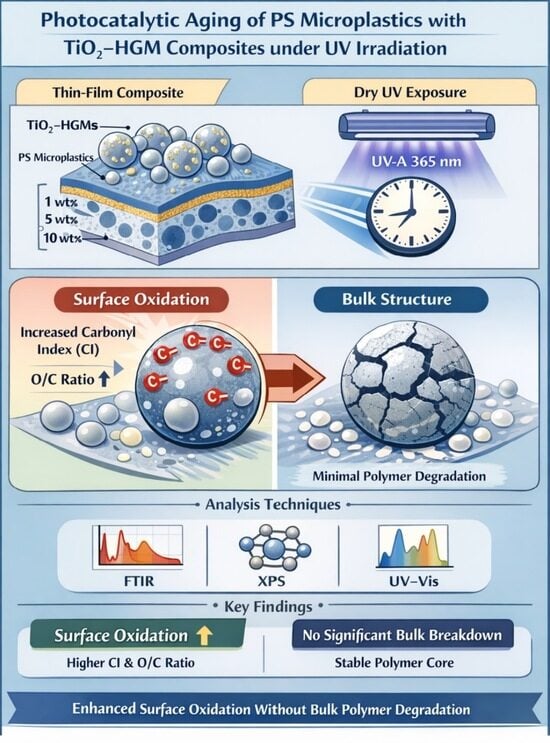
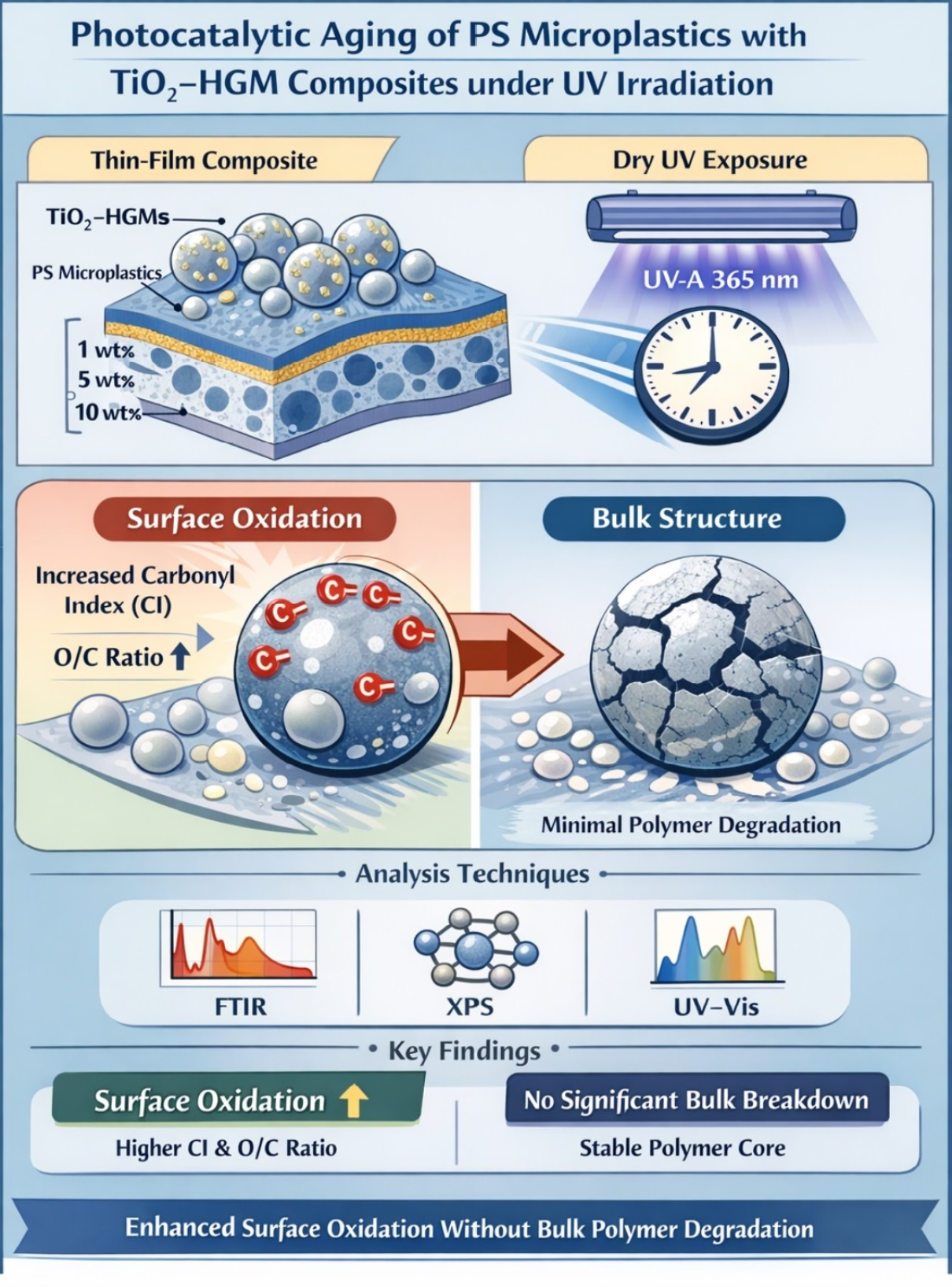
In this study, PS microplastics were mixed with TiO2-coated HGMs and subjected to UV irradiation under dry, solid-state conditions. Instead of using pristine polymer as a baseline, the study focused on relative concentration-dependent effects within a consistent composite system, testing TiO2–HGM loadings of 1 wt%, 5 wt%, and 10 wt%.
Changes in chemistry and surface properties were assessed using Fourier transform infrared spectroscopy (FTIR), X-ray photoelectron spectroscopy (XPS), and UV–visible spectroscopy (UV–Vis) to distinguish between surface oxidation and true bulk polymer degradation.
The primary goal was to evaluate whether increasing photocatalyst concentration causes proportional degradation or leads to saturation and predominantly surface-limited aging. By clearly separating surface oxidation effects from bulk structural integrity, this work challenges the widespread assumption that stronger oxidation signals equate to effective microplastic breakdown. The results offer valuable mechanistic insights into photocatalyst–microplastic interactions under environmentally realistic solid-state conditions and underscore why more comprehensive metrics are needed when assessing photocatalytic strategies for microplastic mitigation.
2. Results
2.1. FTIR Analysis of Concentration-Dependent Chemical Modification
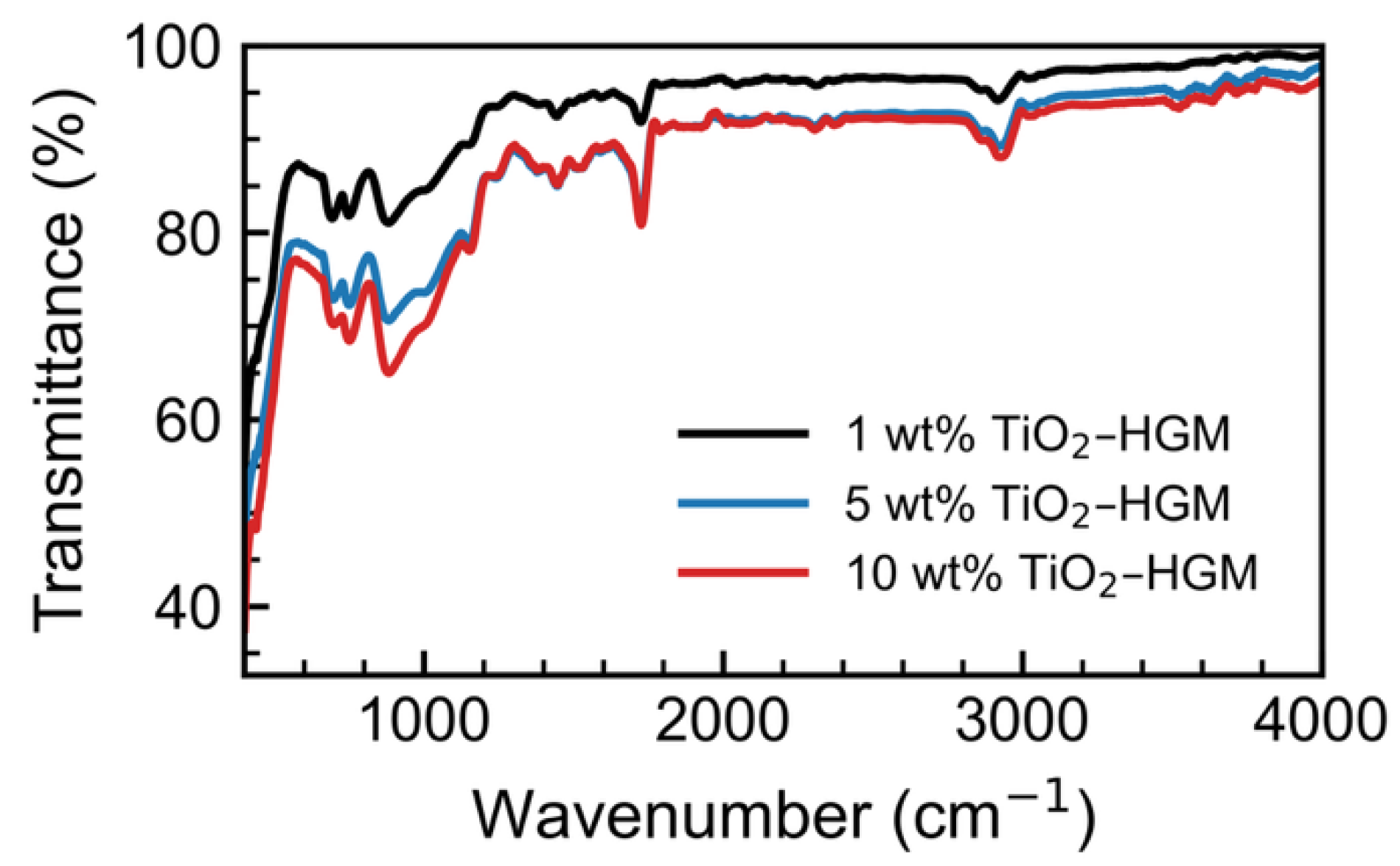
To track chemical changes in PS microplastics as a function of TiO2–HGMs loading under UV irradiation, FTIR was employed. Composites prepared with 1 wt%, 5 wt%, and 10 wt% TiO2–HGMs exhibited clear, concentration-dependent evolution of their infrared spectra.
Unirradiated pristine PS displayed all expected characteristic absorption bands, including aromatic and aliphatic C–H stretching vibrations (3025–2850 cm
−1), aromatic C=C stretching modes (≈1600 and 1490 cm
−1), and out-of-plane aromatic C–H bending vibrations (≈700–760 cm
−1) [
23].
Irradiated PS in the presence of TiO
2–HGMs (in different concentration) to UV, leading to increased absorption intensity in the carbonyl region (≈1700–1750 cm
−1) with concentration. The strength of these carbonyl-related bands grew systematically with higher TiO
2–HGM content, indicating enhanced photo-induced surface oxidation as photocatalyst loading increased
Figure 1.
The CI was quantified using baseline-corrected integrated absorbance areas, calculated as the ratio of the carbonyl band (1710–1750 cm
−1) to the invariant aromatic reference band at ~1028 cm
−1 (1010–1045 cm
−1 window) [
24]. This reference band was selected due to its structural stability and minimal sensitivity to oxidative modification under the examined conditions. The resulting CI values were 0.483 for 1 wt% TiO
2–HGM, 0.702 for 5 wt% TiO
2–HGM, and 0.645 for 10 wt% TiO
2–HGM.
A clear increase in CI was observed from 1 wt% to 5 wt%, indicating enhanced surface oxidation with increasing photocatalyst loading. However, at 10 wt%, the CI showed a slight decrease rather than a continued proportional increase. This non-linear trend suggests that surface oxidation approaches a saturation regime at higher photocatalyst concentrations. The slight reduction at 10 wt% may have arisen from partial light shielding, TiO2 aggregation effects, or increased charge carrier recombination, which can limit further oxidation despite higher catalyst abundance.
Importantly, although carbonyl formation increased significantly between 1 wt% and 5 wt%, the CI variation remained moderate relative to the large increase in photocatalyst concentration. This behavior supports a surface-dominated oxidation mechanism under solid-state conditions where oxidative reactions are confined to polymer chains accessible at catalyst–polymer interfaces rather than propagating deeply into the polymer matrix.
2.2. Surface Chemical Evolution Probed by XPS
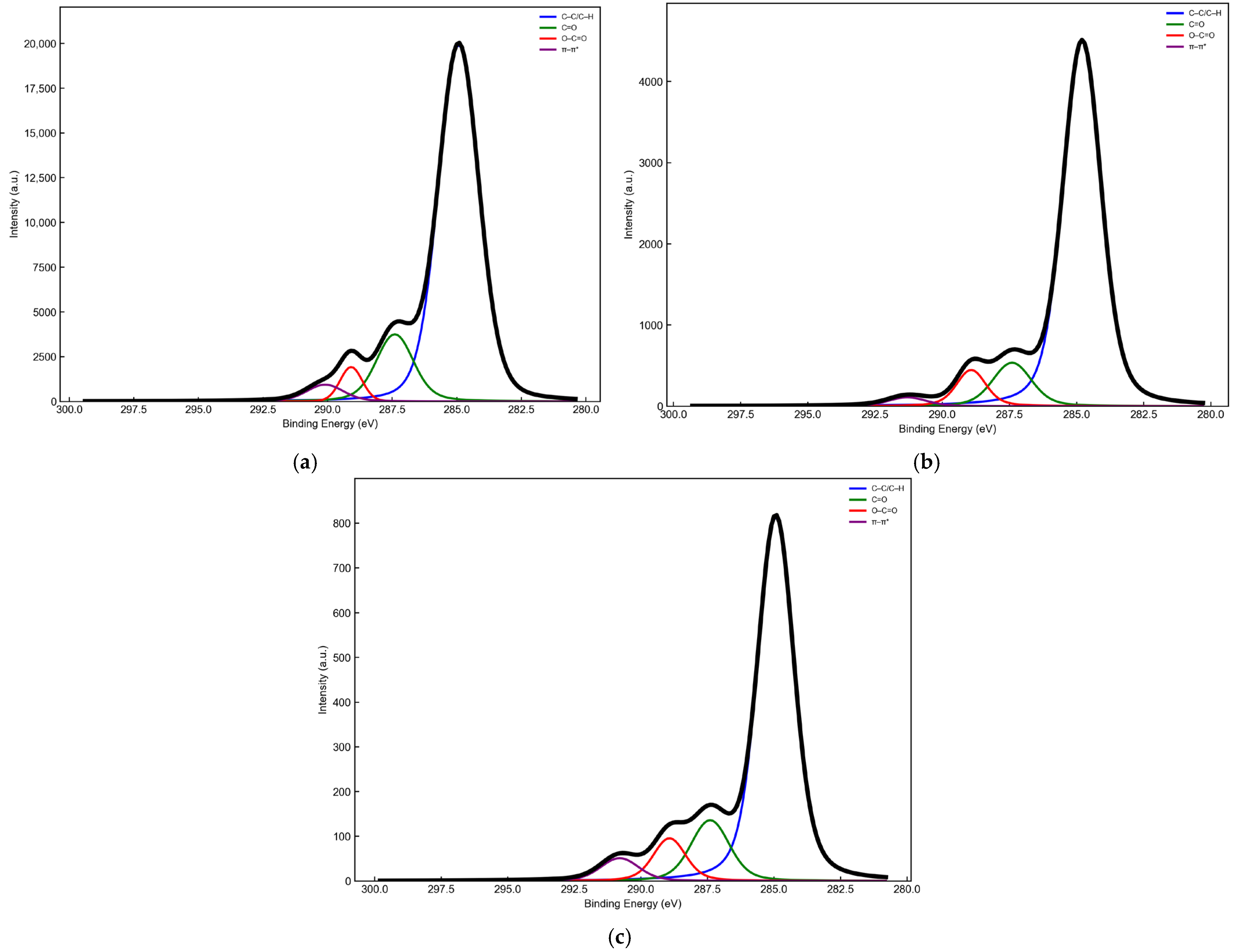
To quantitatively assess concentration-dependent surface chemical modifications induced by UV irradiation in the TiO2–HGM/PS composites, XPS was employed. High-resolution C 1s spectra revealed a systematic evolution of oxygen-containing carbon species with increasing photocatalyst loading, while the primary hydrocarbon backbone (C–C/C–H at ~284.8 eV) remained clearly detectable across all samples. This finding confirms that, although surface oxidation intensifies, the fundamental carbon framework of the polymer persists.
Deconvolution of the C 1s spectra (
Figure 2) provides further insight into these surface changes. At 1 wt% TiO
2–HGM, the spectrum was dominated by the C–C/C–H component, with relatively minor contributions from oxidized carbon species (
Figure 2a). Increasing the photocatalyst loading to 5 wt% noticeably enhanced the carbonyl (C=O) and carboxyl/ester (O–C=O) components, indicating more pronounced oxidative surface modification (
Figure 2b). At 10 wt%, these oxygenated components further intensified, confirming enhanced photo-induced surface oxidation at higher catalyst concentrations (
Figure 2c).
The quantitative XPS survey analysis supports this trend. In
Table 1, the atomic surface compositions and corresponding O/C ratios are summarized:
The O/C atomic ratio increased from 0.42 at 1 wt% to 0.44 at 5 wt% and increased further to 0.51 at 10 wt%, demonstrating enhanced incorporation of oxygen-containing functionalities with increasing TiO2–HGM concentrations. However, the incremental change between 1 wt% and 5 wt% was modest compared to the larger shift observed at 10 wt%, indicating a non-linear oxidation response.
Importantly, although surface oxygen content increased with catalyst loading, the persistent presence of the dominant C–C/C–H peak across all concentrations suggests that oxidation remains confined primarily to surface-accessible regions rather than causing complete surface carbon conversion. This behavior supports a surface-dominated oxidation mechanism in which photocatalytic reactions progressively modify outer polymer layers without eliminating the underlying hydrocarbon framework.
Overall, the XPS results corroborated the FTIR findings, confirming that increasing TiO2–HGM loading enhances surface oxidation, but in a non-proportional manner consistent with interfacial limitations and saturation-controlled photocatalytic activity under solid-state conditions.
2.3. UV–Visible Spectroscopic Response
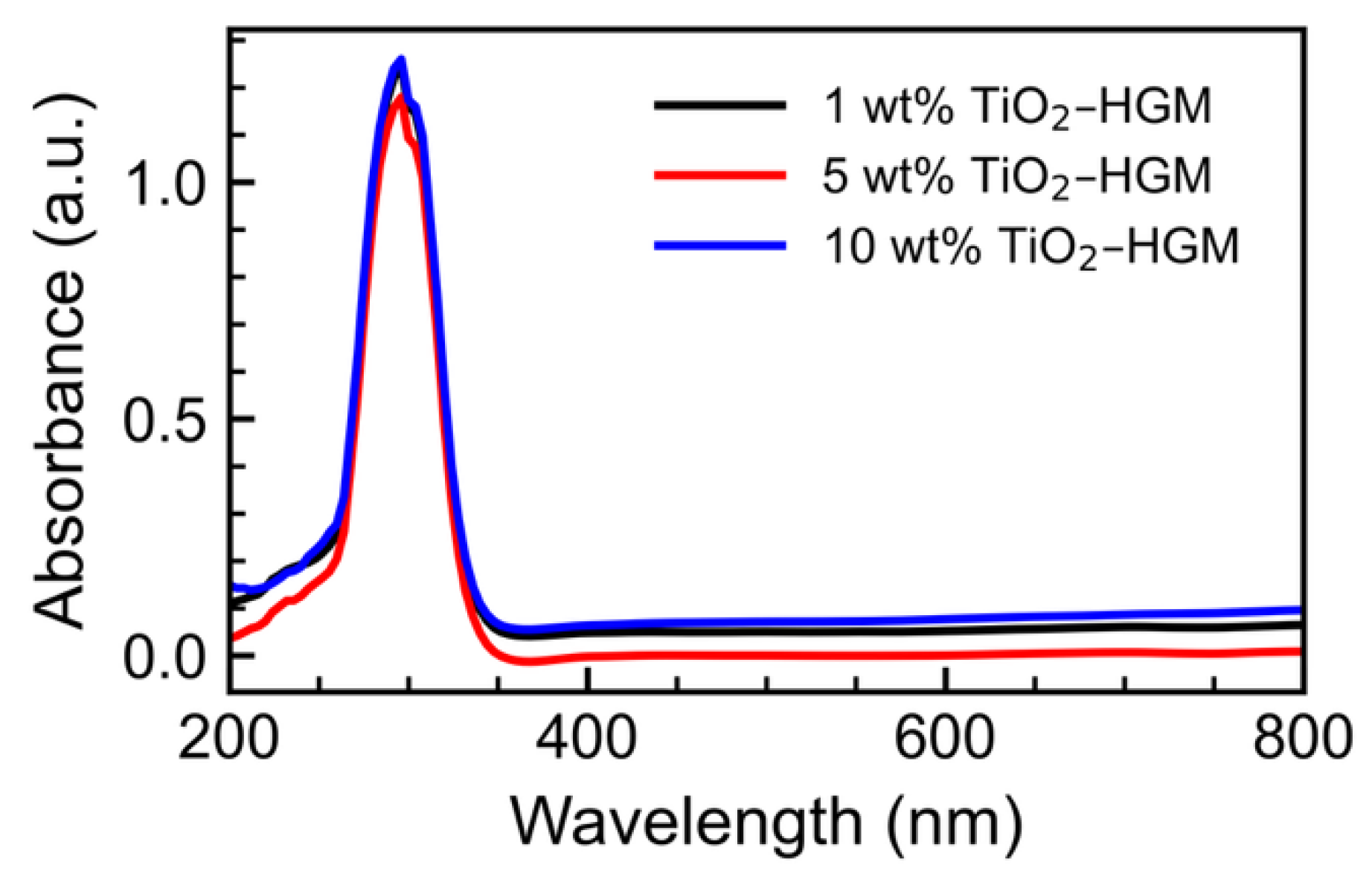
UV–Vis was employed to assess whether surface oxidation is accompanied by significant bulk optical changes. Across the TiO
2–HGM concentration range, only modest variations in absorbance intensity were observed in the characteristic aromatic absorption region of PS (
Figure 3). The overall spectral shape remained largely unchanged, even at the highest photocatalyst loading.
The limited magnitude of UV–Vis changes contrasted the pronounced surface oxidation detected by FTIR and XPS, indicating that bulk polymer optical properties are largely preserved under the examined solid-state UV exposure conditions.
3. Discussion
The combined FTIR, XPS, and UV–visible spectroscopic results show a clear decoupling between surface chemical modification and bulk polymer response within TiO2–HGM/PS composites exposed to UV irradiation. FTIR and XPS consistently demonstrated an increase in oxygen-containing functional groups with increasing photocatalyst concentration, indicating progressive photo-induced oxidation at the polymer surface. In contrast, UV–Vis spectra exhibited only minor variations in aromatic absorbance across the concentration series. The latter suggests that extensive backbone scission or aromatic ring disruption does not occur under the examined solid-state conditions.
This divergence highlights a fundamental limitation of relying only on oxidation-based indicators to infer effective microplastic degradation. While surface-sensitive techniques readily capture chemical aging at the outermost polymer layers, bulk-sensitive optical signatures indicate that the polymer core remains largely intact. Such behavior is particularly relevant under solid-state conditions, where polymer chain mobility is restricted and the diffusion length of reactive oxygen species is inherently limited.
The concentration-dependent evolution of surface chemistry further reveals a non-linear response to increasing TiO2–HGM loading. Based on the XPS analysis, the O/C atomic ratio increases progressively from 1 wt% to 10 wt% TiO2–HGMs, but the incremental increase diminishes at higher loadings, indicating an approach toward surface oxidation saturation. This behavior suggests that, beyond a certain photocatalyst concentration, the density of accessible oxidizable surface sites becomes the limiting factor rather than photocatalyst availability. Consequently, increasing photocatalyst loading does not translate into proportional increases in surface oxidation. This finding challenges the common assumption that higher catalyst concentrations always enhance degradation efficiency.
The observed surface-limited oxidation behavior is intrinsically linked to the physical architecture of the TiO
2–HGMs. Unlike slurry-based or aqueous photocatalytic systems, the discrete and localized nature of TiO
2–HGM–polymer contact restricts photocatalytic reactions to well-defined interfacial regions. In contrast to nanoparticle-based systems, where aggregation can cause inefficient light utilization and non-specific oxidation (e.g., as critiqued in general TiO
2 applications [
22] and specific pollutant degradation [
19]), HGMs leverage their hollow structure for better photon scattering and reduced recombination, yet still confine ROS to short diffusion paths [
20,
21]. This results in intensified surface aging without proportional bulk penetration, highlighting how catalyst form influences outcomes in solid-state setups—a nuance not critically examined in many prior microplastic studies. Thus, oxidation reactions are spatially confined, favoring surface chemical aging over deep polymer modification. This distinction underscores the importance of considering catalyst geometry and contact mode when interpreting photocatalytic microplastic aging under environmentally relevant conditions.
From an environmental perspective, surface oxidation without substantial bulk degradation may significantly alter microplastic behavior while preserving long-term persistence. Oxidized microplastic surfaces are known to exhibit increased polarity and enhanced affinity for metals, organic contaminants, and biological interfaces, potentially modifying transport pathways, aggregation behavior, and exposure risks. Overall, the present findings demonstrate that increasing photocatalyst concentration under solid-state conditions primarily enhances surface chemical aging rather than true polymer breakdown. The findings emphasize the need for caution when evaluating photocatalytic mitigation strategies based solely on oxidation metrics and highlight the importance of distinguishing chemical aging from effective degradation in environmental risk assessments.
3.1. Proposed Photocatalytic Mechanism
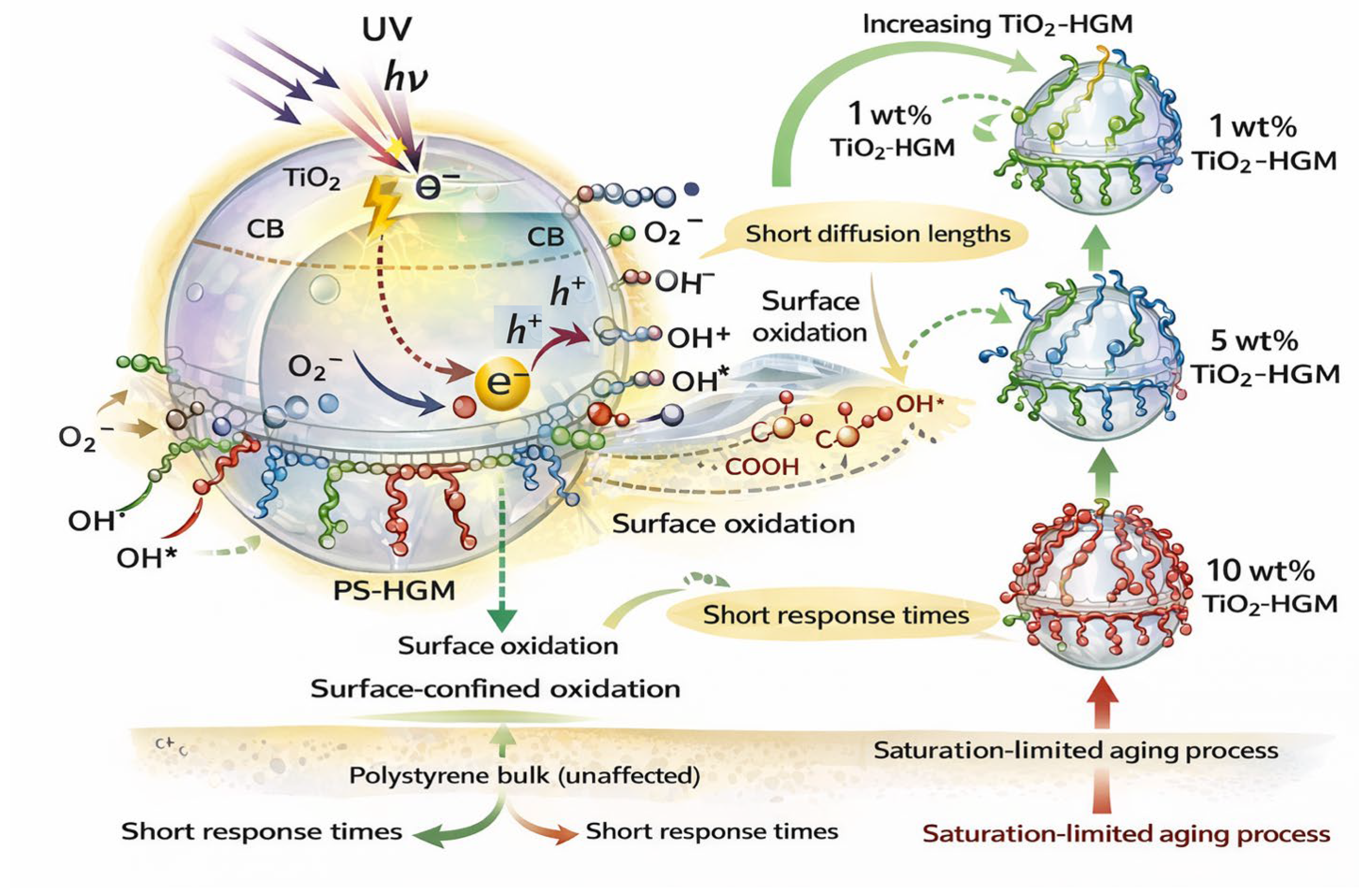
Upon UV irradiation, TiO2 coated on the surface of HGMs becomes photo-excited, generating electron–hole pairs that initiate the formation of reactive oxygen species, including hydroxyl and superoxide radicals. The solid-state configuration of the composite means these reactive species are generated at localized catalyst–polymer interfaces and act over short diffusion lengths.
The discrete nature of TiO
2–HGM contact with PS microplastics restricts oxidative reactions to surface-accessible polymer chains. At the polymer surface, reactive oxygen species preferentially attack exposed C–H and aromatic sites, leading to the formation of oxygen-containing functional groups detected by FTIR and XPS. However, limited polymer mobility and restricted radical penetration prevent oxidative species from propagating into the polymer interior. This effect preserves the bulk polymer backbone, as evidenced by minimal changes in UV–Vis spectra (
Figure 4).
As TiO2–HGM concentration increases, the number of active photocatalytic sites at the composite surface increases, amplifying surface oxidation. Nevertheless, further increases in photocatalyst loading yield diminishing returns once a substantial fraction of surface-accessible polymer chains has been modified. This effect results in the observed saturation behavior in surface oxidation, where photocatalytic activity becomes constrained by surface accessibility rather than catalyst abundance.
Overall, the proposed mechanism describes a surface-dominated, photocatalytic aging governed by surface saturation in which TiO2–HGM composites promote chemical modification of microplastic surfaces without inducing extensive bulk degradation. This mechanism provides a conceptual framework for interpreting photocatalytic microplastic aging under solid-state conditions and reinforces the need to distinguish between surface oxidation and true polymer breakdown when assessing photocatalytic remediation strategies.
Although spectroscopic evidence consistently supports surface-dominated oxidation under the examined solid-state conditions, complementary molecular-weight analysis (e.g., GPC/SEC) would provide direct quantification of potential chain scission. However, given the restricted radical diffusion and preserved bulk optical signatures observed here, extensive bulk degradation is unlikely within the investigated irradiation timeframe.
3.2. Limitations and Outlook
While this study provides clear mechanistic insight into concentration-dependent, surface-limited photocatalytic aging of PS microplastics under solid-state conditions, several limitations should be considered. The conclusions are primarily based on complementary spectroscopic evidence (FTIR, XPS, and UV–Vis), which effectively distinguishes surface oxidation from bulk polymer preservation, while complementary spectroscopic techniques effectively distinguish surface oxidation from bulk structural preservation, direct molecular-weight characterization (e.g., GPC/SEC) was not performed in this study. Future work integrating optimized polymer recovery and molecular-weight analysis will further quantify bulk chain stability under extended irradiation or modified environmental conditions.
In addition, the experiments were conducted under controlled dry UV conditions to isolate solid-state photocatalytic effects. Although environmentally relevant for terrestrial exposure, natural systems involve humidity, mechanical stress, and biological activity that may influence long-term aging behavior. Furthermore, the investigated concentration range (1–10 wt% TiO2–HGMs) captures oxidation onset and saturation but does not address alternative catalyst architectures or extreme loadings.
Although formal replicate-based statistical analysis was not performed, the present study was designed to identify mechanistic concentration-dependent trends under strictly controlled preparation conditions. Expanded concentration sets and statistical evaluation will be incorporated in future work to further strengthen quantitative assessment.
Future work integrating molecular-weight characterization, controlled humidity exposure, and extended irradiation times will further clarify the transition from surface chemical aging to irreversible polymer breakdown. In addition, expanding this approach to other polymer systems and coupling chemical aging with environmental impact assessments will strengthen evaluation of photocatalytic strategies beyond oxidation metrics alone.
4. Material and Methods
4.1. Materials
Monodisperse PS microspheres were obtained from Cospheric LLC (Goleta, CA, USA). Supplied as dry powder (200 mg), the particles had a nominal diameter of 4.8–5.8 µm and a density of 1.07 g/cm3. TiO2–HGMs were also purchased from Cospheric LLC. The particles (Photospheres®) had a particle size range of 10–85 µm, a bulk density of approximately 0.22 g/cm3. were also purchased from Cospheric LLC. For the preparation of all suspensions, deionized (DI) water was used.
4.2. Preparation of Stock Solution
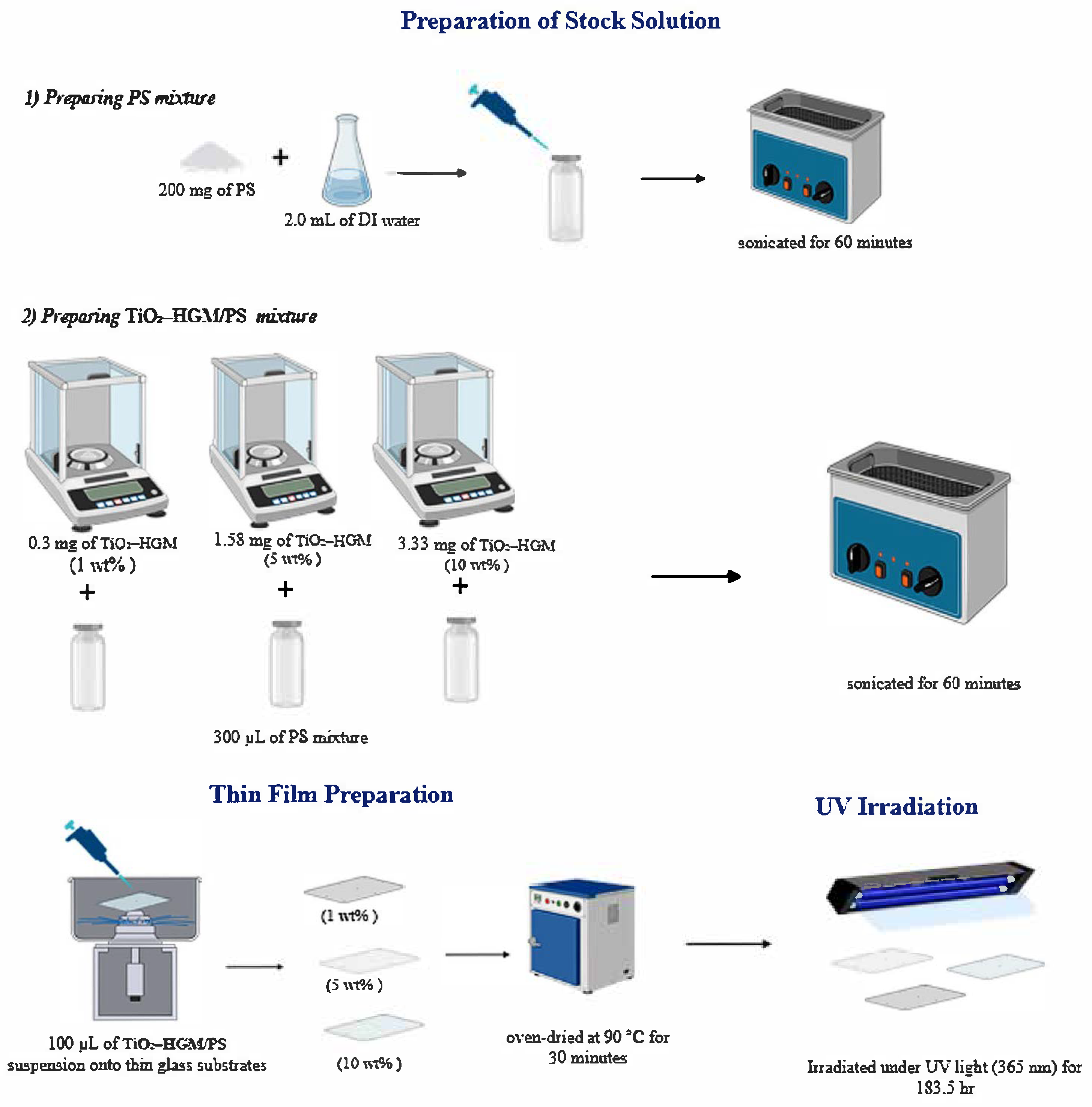
Three TiO2–HGM composite suspensions with different loadings were prepared. For the first formulation, 300 µL of the PS stock suspension was mixed with 0.3 mg of TiO2–HGM, corresponding to a final concentration of 1 wt%. For the second formulation, 300 µL of PS suspension was combined with 1.58 mg of TiO2–HGM to obtain a 5 wt% composite. For the third formulation, 300 µL of PS suspension was mixed with 3.33 mg of TiO2–HGM, resulting in a 10 wt% composition. All prepared samples were further sonicated for 60 min to prevent agglomeration and promote intimate interfacial contact between PS microplastics and the oxide components.
4.3. Thin Film Preparation
Thin films were fabricated by depositing 100 µL of each sonicated suspension onto pre-cleaned glass substrates, with each formulation cast as an individual film. Using a spin-coating technique, the deposited suspensions were uniformly distributed under identical processing parameters to ensure reproducibility and comparable film thickness.
Spin-coating was performed using a two-step procedure to ensure uniform film formation. In the first step, samples were spun at 5000 rpm for 60 s to promote rapid solvent thinning and uniform spreading. This was followed by a second step at 1000 rpm for 30 s to stabilize the deposited layer and reduce residual surface stress. All films were prepared under identical processing conditions to ensure reproducibility.
After deposition, the coated substrates were dried in an oven at 90 °C for 30 min to remove residual moisture and enhance film stabilization. Upon drying, all samples were allowed to cool naturally to room temperature and then stored in the dark prior to irradiation and characterization to prevent any unintended photo-induced reactions.
Although direct film thickness measurement was not performed, all samples were prepared using identical deposited volumes (100 µL) and identical spin-coating parameters to ensure comparable film formation across all concentrations. Therefore, relative differences observed between samples are attributed primarily to photocatalyst loading rather than thickness variation.
4.4. UV Irradiation
The prepared thin-film samples were subjected to ultraviolet (UV-A) irradiation at a wavelength of 365 nm using a Uvitec UV irradiation chamber (model CV-415.LL, Uvitec, Cambridge, UK) equipped with two low-pressure UV lamps (15 W each; total output power 30 W). Under controlled conditions, the films were continuously exposed to UV light for 183.5 h. This duration was selected to achieve substantial photocatalytic surface oxidation while remaining within a practical laboratory timeframe for observable concentration-dependent effects, without inducing excessive saturation or secondary artifacts (e.g., from prolonged heat buildup in the chamber). It corresponds to an accelerated exposure equivalent to approximately several months to ~1 year of natural terrestrial/atmospheric UV-A flux in a mid-latitude or arid environment, based on typical global UV-A daily doses of 20–40 kJ/m
2/day and lab lamp intensities (~10–30 W/m
2 at sample distance, depending on geometry). Comparable studies on PS microplastics under UV-A (365 nm) or simulated sunlight often use 100–500+ hours for detectable oxidation without full mineralization, as shorter times (<100 h) yield minimal changes in solid-state systems, while much longer exposures (>500 h) risk over-oxidation or equipment limitations [
12,
14,
15]. The precise value (183.5 h) reflects cumulative exposure across multiple experimental runs to ensure consistent total photon dose, accounting for minor interruptions or calibration checks.
The UV lamps were positioned above the sample plane at a fixed vertical distance of 20 cm inside a closed irradiation chamber (dark box configuration). All films were placed horizontally and irradiated under identical geometric conditions to ensure uniform exposure. Based on the lamp specifications (two 15 W UV-A lamps, 365 nm) and the 20 cm lamp-to-sample distance, the irradiance at the sample plane is estimated to be in the range of approximately 10–25 W/m2. The chamber remained closed during irradiation to minimize external light interference and maintain consistent exposure conditions.
A schematic representation of the thin-film preparation and subsequent UV irradiation procedure is presented in
Figure 5.
4.5. Characterization Techniques
The samples were characterized using complementary analytical techniques to investigate surface-dominated optical, structural, and chemical changes within the films and their composite systems. UV–visible spectra were measured using a Thermo Evolution 201 UV–Vis spectrophotometer (Thermo Fisher Scientific, Waltham, MA, USA) to monitor optical absorption variations associated with photo-oxidation. The measurements were used primarily as a qualitative indicator of preserved aromatic absorption features within the polymer matrix rather than as a thickness-dependent quantitative metric. All films were prepared using identical deposited volumes and identical spin-coating parameters to ensure comparable optical path conditions. Therefore, relative spectral comparisons between concentrations reflect concentration-dependent photocatalytic effects rather than systematic thickness variation.
FTIR was employed to identify UV-induced modifications in surface functional groups. For measurements, FTIR spectra were recorded using an IRSpirit Fourier transform infrared spectrometer (Shimadzu Corporation, Kyoto, Japan). equipped with a single-reflection ATR accessory (QATR-S) was used. Spectra were collected over the 4000–400 cm−1 range at a resolution of 4 cm−1, with 32 accumulated scans per sample.
The use of ATR-FTIR ensures surface-sensitive analysis due to its limited penetration depth, making it suitable for probing oxidation at the catalyst–polymer interface.
The carbonyl index (CI) was determined from the FTIR spectra by calculating the relative variation in the intensity of the carbonyl absorption band with respect to an invariant reference band of the low-concentration sample matrix. With this approach, the progress of photo-oxidation could be quantitatively evaluated.
X-ray photoelectron spectroscopy (XPS) measurements were performed using a Thermo Scientific ESCALAB Xi+ XPS system (Thermo Fisher Scientific, Waltham, MA, USA) to analyze the surface elemental composition and chemical states, providing detailed information on UV-induced surface and interfacial chemical transformations.
All measurements were conducted using calibrated instruments under standard laboratory operating conditions. The XPS, UV–Vis, and FTIR analyses were carried out at the Research Laboratories Building, College of Science, Umm Al-Qura University, Makkah, Saudi Arabia.
5. Conclusions
This study systematically demonstrates that photocatalyst concentration governs the extent of surface chemical aging—but not proportional bulk degradation—of PS microplastics in TiO2-coated HGM composites under solid-state UV irradiation. By examining TiO2–HGM loadings of 1 wt%, 5 wt%, and 10 wt%, a non-linear relationship between photocatalyst concentration and oxidation intensity was identified, with spectroscopic evidence indicating an approach toward surface oxidation saturation at higher loadings.
Surface-sensitive analyses using FTIR and XPS revealed progressive incorporation of oxygen-containing functional groups with increasing photocatalyst concentration. This finding confirmed enhanced photo-induced surface oxidation. In contrast, UV–visible spectroscopy showed only limited changes in aromatic absorbance, indicating preservation of the polymer backbone and minimal bulk chain scission under the examined conditions. These combined results provide clear evidence of a decoupling between surface oxidation and bulk polymer response in solid-state photocatalytic systems.
The findings further highlight the critical role of composite architecture in governing photocatalytic behavior. The discrete and localized contact between TiO2–HGMs and PS microplastics confined reactive oxygen species to short diffusion lengths, favoring surface-limited chemical aging rather than deep polymer modification. As a result, increasing photocatalyst concentration amplified surface oxidation without yielding proportional improvements in degradation efficiency.
From an environmental standpoint, this work challenges the widespread assumption that enhanced photocatalytic oxidation necessarily equates to effective microplastic degradation. The findings instead emphasize that photocatalytic treatments under dry conditions may primarily generate chemically aged yet persistent microplastics with altered surface properties. Therefore, distinguishing surface chemical aging from true polymer breakdown is essential for realistic assessments of photocatalytic mitigation strategies and their environmental implications.