Article

Electromagnetic Interference Shielding Material from Grape Seeds: A Sustainable Pyrolysis Route

by
Stefano Dicorato
1,
Chiara Ingrosso
2,
Pasquale Crupi
3,
Giovanni Bruno
1,
Angela Dibenedetto
4,5,
Antonella D’Orazio
6,
Giovanni Magno
1,6,
Giuseppe Valerio Bianco
1,* and
Francesco Nocito
4,5
1
Institute of Nanotechnology, CNR-NANOTEC, Chemistry Department, University of Bari, Via E. Orabona 4, 70126 Bari, Italy
2
Institute for Chemical and Physical Processes, CNR-IPCF Bari Division, Chemistry Department, University of Bari, Via E. Orabona 4, 70126 Bari, Italy
3
Department of Agricultural, Food and Forest Science, University of Palermo, Viale delle Scienze, 90128 Palermo, Italy
4
Department of Chemistry, University of Bari Aldo Moro, Via E. Orabona 4, 70125 Bari, Italy
5
CIRCC, Interuniversity Consortium on Chemical Reactivity and Catalysis, Bari Unit, METEA Center, Via C. Ulpiani, 70126 Bari, Italy
6
Department of Electrical and Information Engineering, Politecnico di Bari, 70126 Bari, Italy
*
Author to whom correspondence should be addressed.
Catalysts 2026, 16(3), 226; https://doi.org/10.3390/catal16030226
Submission received: 16 December 2025 / Revised: 29 January 2026 / Accepted: 24 February 2026 / Published: 2 March 2026
(This article belongs to the Section Biomass Catalysis)

Abstract

Grape marcs represent one of the most effectively exploited biowaste resources through cascade valorization approaches, in which byproducts are processed via multiple sequential steps such as extraction, bio-treatment, and pyrolysis. In this study, we present a novel route for producing graphitic carbon (GC) from grape seeds derived from exhausted marc via pyrolysis. We integrate hydropyrolysis and CO2 methanation in a one-pot methodology to valorize both bio-oil and gaseous pyrolysis byproducts. The GC obtained through pyrolysis is evaluated in GC/Polytetrafluoroethylene (PTFE) composites as an electromagnetic interference (EMI) shielding material across the X-band frequency range (8–12 GHz). This work demonstrates a viable and eco-friendly pathway to upcycle abundant biomass into a lightweight, sustainable, and highly tunable material, which represents a promising candidate for effective EMI shielding while simultaneously mitigating process emissions.

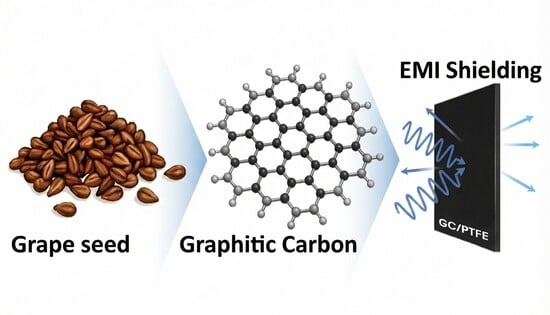
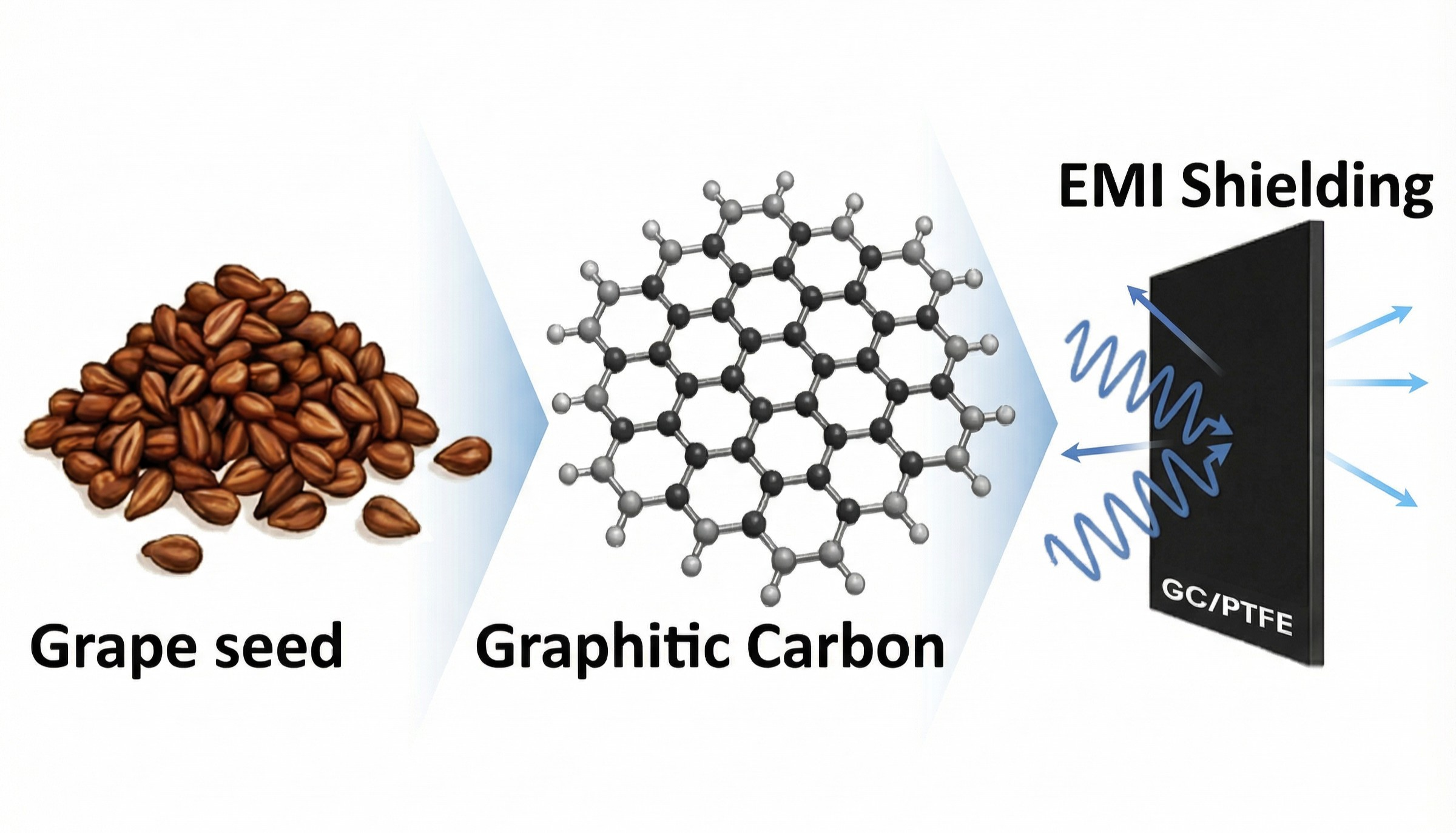
Graphical Abstract

1. Introduction

In recent years, biowaste management for the production of high-value carbonaceous materials has attracted significant attention due to the high carbon content and renewable nature of biomass. Organic residues from the wine industry represent a well-established example of circular valorization, in which wastes are converted into industrial and energy products through integrated processes [1]. Specifically, grape pomace and wine lees are processed via distillation and extraction to obtain bioethanol, tartaric acid, and polyphenolic compounds, which find applications in food, pharmaceutical, and chemical industries. The remaining byproducts, particularly exhausted grape marcs, can serve as feedstock for anaerobic digestion to produce biogas and biomethane, as well as for composting, thereby contributing to sustainable soil management and carbon cycling. Pyrolysis, a thermochemical conversion process carried out in an oxygen-free environment, represents an alternative valorization pathway for exhausted grape marc, enabling the recovery of syngas, bio-oil, and high-value solid carbonaceous materials, namely graphitic carbon (GC) [2,3]. Pyrolysis parameters (such as temperature, heating rate, additives, etc.) play a crucial role in tailoring the degree of graphitization, porosity, and electrical conductivity of biomass-derived GC suitable as electrode materials in supercapacitors and batteries, adsorption and catalytic applications [4]. In parallel, the process parameters strongly influence both the yield and the quality of gaseous and liquid bioproducts. In particular, pyrolysis under a high-pressure hydrogen atmosphere, namely hydropyrolysis, has been demonstrated to promote calorific value, chemical stability, and miscibility with conventional fossil fuels of pyrolysis bio-oils by reducing their oxygen-to-carbon ratio (O/C) [5].
Recently, there has been growing emphasis on developing electromagnetic interference (EMI) shielding materials using graphitic carbon (GC) produced via the pyrolysis of waste biomass [6,7,8,9,10]. Implementing large-scale EMI shielding solutions within urban environments is essential not only to reduce electrosmog exposure but also to strengthen cybersecurity by preventing electromagnetic interference from compromising sensitive electronic systems. Although traditional metals are successfully used in this application field, they are often associated with drawbacks such as high density, high cost, limited flexibility, and poor corrosion resistance [7]. Thus, conductive polymer composites incorporating micro- and nanoscale conductive fillers such as GC are increasingly explored as sustainable, lightweight alternatives exhibiting strong chemical resistance. The efficacy of GC as EMI shielding fillers is primarily attributable to its conductive properties [10]. When incorporated into polymer matrices (films and 3-D porous scaffolds [6]), these conductive carbon fillers establish networks that attenuate electromagnetic waves mainly through two mechanisms: (i) reflection loss (SER) caused by the interaction with mobile charge carriers (free electrons) on the material’s surface; and (ii) absorption loss (SEA) resulting from dielectric and ohmic losses within the material [10].
We present a sustainable strategy to convert grape seed from exhausted marc waste into GC suitable for EMI shielding applications. Grape seeds from exhausted marc are suitable for enhanced graphitization due to their higher content of aromatic lignin compounds [11], which promote the ordering of C-sp2 atoms into graphitic clusters [12]. The promoted development of graphitic domains in biomass-derived carbon significantly enhances electrical conductivity and interfacial polarization, leading to improved EMI shielding effectiveness [9]. Although the primary objective is the synthesis of high-quality GC, a distinctive feature of our biomass pyrolysis route is the one-pot combination of experimental approaches typically applied to the valorization of bio-oil and gaseous pyrolysis byproducts: the use of (i) hydropyrolysis conditions [5] and (ii) a methanation catalyst [13]. Indeed, molecular hydrogen can be exploited in methanation reaction, also known as the Sabatier reaction, to reduce the CO2 footprint of biomass pyrolysis [13].
We provide experimental results on quantitative and qualitative characterizations of GC, as well as of gaseous and liquid byproducts obtained by this sustainable strategy. Moreover, GC is validated as a sustainable and cost-effective filler for polymer composites for electromagnetic interference shielding applications. Polytetrafluoroethylene (PTFE, or Teflon) is specifically selected as the polymer matrix due to its easy processability, low density, and crucial chemical stability and corrosion resistance, which are highly sought after for robust and reliable EMI shielding applications. Measurements are conducted across the X-band frequency range (8–12 GHz), utilizing two distinct GC loadings across a range of thicknesses from 0.2 mm to 1.8 mm.

2. Results and Discussion

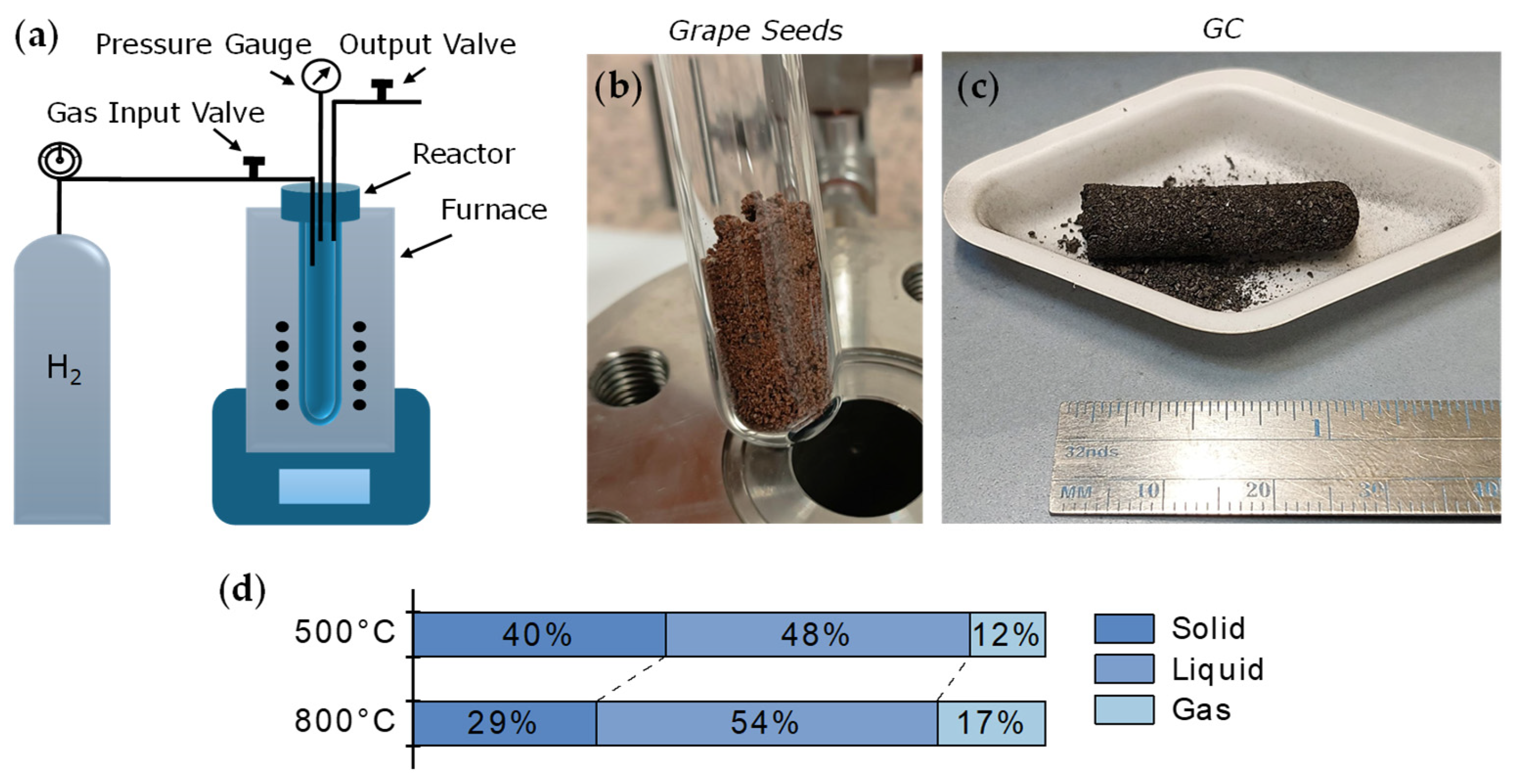
Figure 1 shows the autoclave reactor setup and the picture of crushed grape seeds before and after pyrolysis treatment. According to several experimental protocols on biomass pyrolysis reported in the literature [3], grape seeds were thermally treated by a preliminary carbonization step at 500 °C, followed by graphitization at a higher temperature (800 °C). Both stages were tested in H2 ambient with and without the methanation catalyst. The catalyst was loaded into the autoclave using dedicated crucibles to avoid direct contact with biomass feedstock. Specifically, we use a catalyst based on non-noble metal, Ni(0)/CexOy/MK10 [14] to activate both H2 and CO2 reactants for promoting methanation process at relative low temperature with high yield and selectivity.
Figure 1d shows the weight percentages (wt.%) of biomass conversion into solid, liquid and gas products after carbonization and subsequent graphitization pyrolysis processes. Thermal treatment at 500 °C induces significant degradation of the intrinsic oils in grape seeds and promotes bond cleavage and structural rearrangement in their lignocellulosic fraction, with lignin undergoing partial aromatization and cellulose and hemicellulose largely decomposed [15,16]. Grape seed pyrolysis mainly gives rise to liquid products with an important percentage of solids that decreases from 40% to 29% after the higher-temperature pyrolysis stage. No substantial changes are observed in solid, gaseous and liquid product yields when pyrolysis is carried out with or without a catalyst.
The main products detected in the extracted organic phase of liquid byproducts are long-chain hydrocarbons and carboxylic acids (C > 9), derived from the seeds’ lipid fractions and phenols present in the lignin portion. Table 1 reports the comparison (measured as relative area) between the main families of products in the organic fraction obtained at 500 and 800 °C, in the presence or absence of a catalyst. Interestingly, the presence of the catalyst is reflected in an important decrease in carboxylic acid fractions both at 500 and 800 °C. This indicates an important role of the catalyst in the deoxygenation reaction of uncondensed products reaching its surface during annealing.
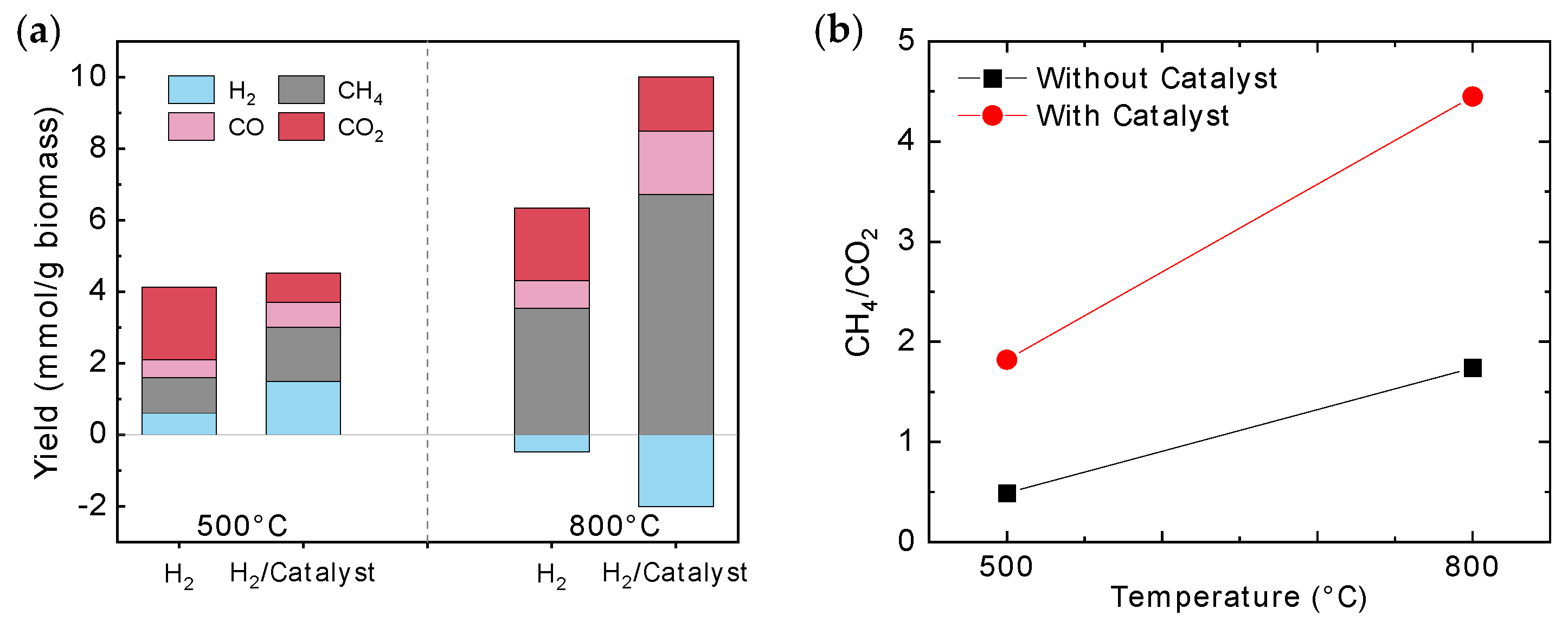
Histograms in Figure 2a indicate the moles of the four main gaseous species (H2, CH4, CO2, CO) produced after pyrolysis at 500 °C and 800 °C, normalized per gram of biomass feedstock. In the absence of catalyst, CO2 is the most abundant gaseous species produced at 500 °C. Indeed, CO2 is a common product in lignocellulosic biomass pyrolysis [17], and oxidation reactions cannot be excluded due to molecular oxygen adsorbed on the feedstock. When the catalyst is introduced into the autoclave, a slight increase in the total moles of gaseous species is observed, as indicated by pressure measurements. This effect can be ascribed to a secondary catalyzed pyrolysis stage of uncondensed products reaching the catalyst surface. The graph in Figure 2b shows that the CH4/CO2 ratio exhibits a nearly fourfold increase when the catalyst is used (from 0.5 to 1.8). According to ref. [14], this experimental evidence supports the occurrence of the catalyzed Sabatier reaction, where the high concentration of molecular hydrogen shifts the equilibrium toward CH4 and H2O formation (Equation (1)):
C O 2 + 4 H 2 C H 4 + 2 H 2 O
Despite the H2 consumption to promote CO2 conversion, the overall hydrogen balance (the difference between the number of H2 moles in the autoclave before and after pyrolysis) is positive after pyrolysis at 500 °C. Indeed, hydrogen is one of the main products of steam and dry reforming of bio-oil and hydrocarbons during thermal treatment, and these processes can be further enhanced by the presence of a catalyst [17].
Conversely, the second pyrolysis step at 800 °C (graphitization) leads to a negative hydrogen balance since higher temperatures promote H2 consumption by hydrodeoxygenation reactions of bio-oils, as expected for hydropyrolysis processes [18].
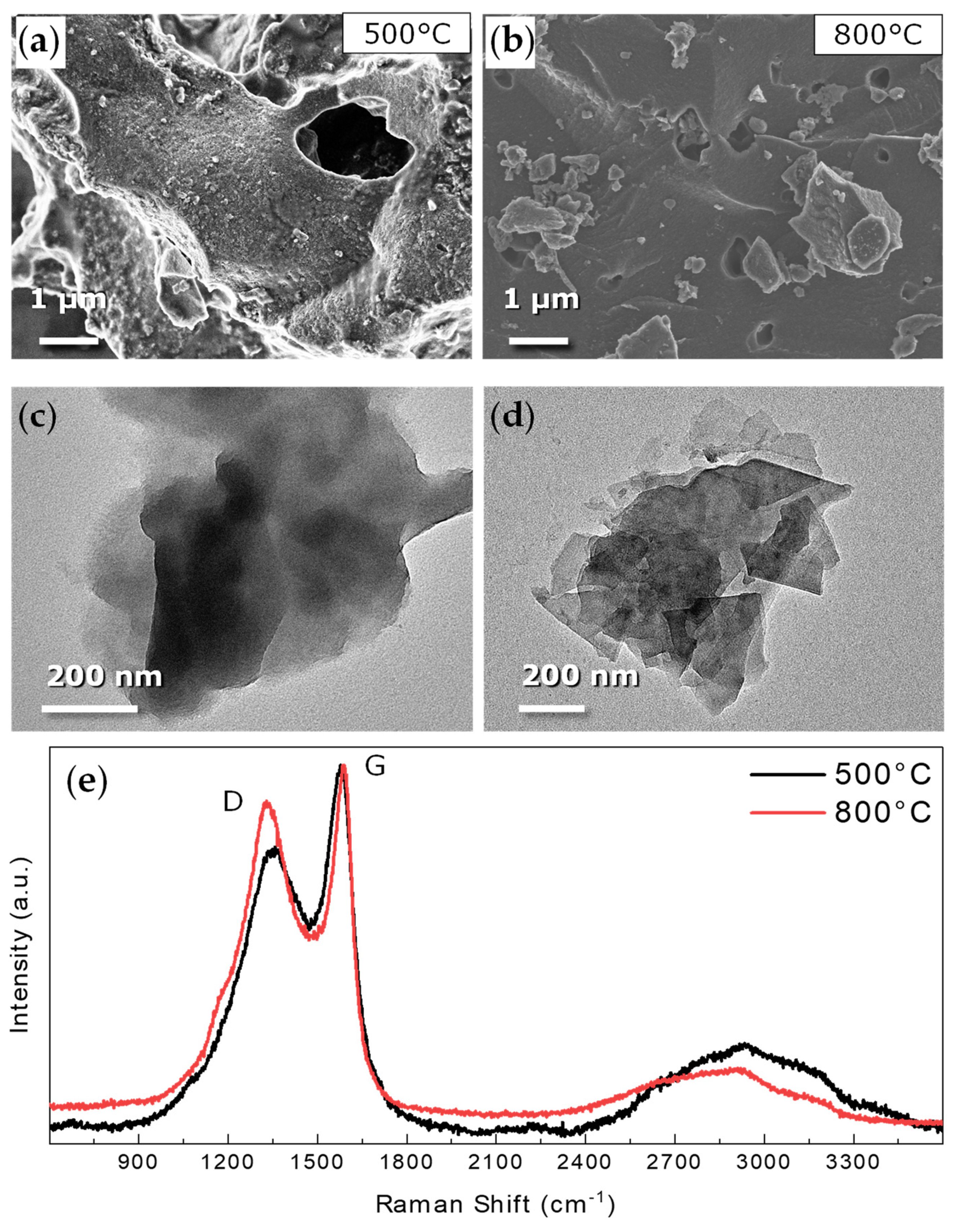
Figure 3 reports the morphological, structural and Raman characterizations of the solid product of pyrolysis at 500 °C and 800 °C with catalyst. SEM images show the presence of charging effects in the sample after carbonization at 500 °C (Figure 3a), which are not observed after pyrolysis at 800 °C (Figure 3b). This evidence can be correlated to improved conductive properties of the solid product after thermal treatment at higher temperature. A comparison of the TEM images of GC after carbonization (Figure 3c) and graphitization (Figure 3d) reveals the formation of characteristic layered structures typical of graphitic materials following the second pyrolysis step at elevated temperature. Figure 3d shows areas of the sample with higher and lower contrast images corresponding to, respectively, thicker and thinner layers of stacked graphene foils.
Direct evidence of graphitic phase evolution during the two pyrolysis stages is provided by the Raman analysis [19]. Raman spectra in Figure 3e are mainly characterized by the first-order D and G modes of graphite around, respectively, 1350 cm−1 and 1580 cm−1. The D band is associated with the breathing modes of C-sp2 rings. This mode is Raman inactive in perfect graphite since it requires a double-resonance process involving an elastic scattering with structural defects. The G mode involves the in-plane bond-stretching of two sp2 atoms, and it can also be found in aromatic and olefinic chains since, in contrast to D mode, it does not require the presence of sixfold aromatic rings. This forms the basis of the phenomenological three-stage model, defined as the “amorphization trajectory”, developed by Ferrari and Robertson, which correlates the evolution of the ratio between intensities of the D and G peaks with the transition from an amorphous carbon material to a graphitic one [20,21]. Thermal treatment at 800 °C favors clustering of the sp2 phase into ordered rings, thus increasing the relative intensity of the D peak [22]. In parallel, the increasing graphitic structural order leads to a stiffening of the G phonon mode, evidenced by a shift in its peak position from 1578 cm−1 to 1587 cm−1 [20,21,22].
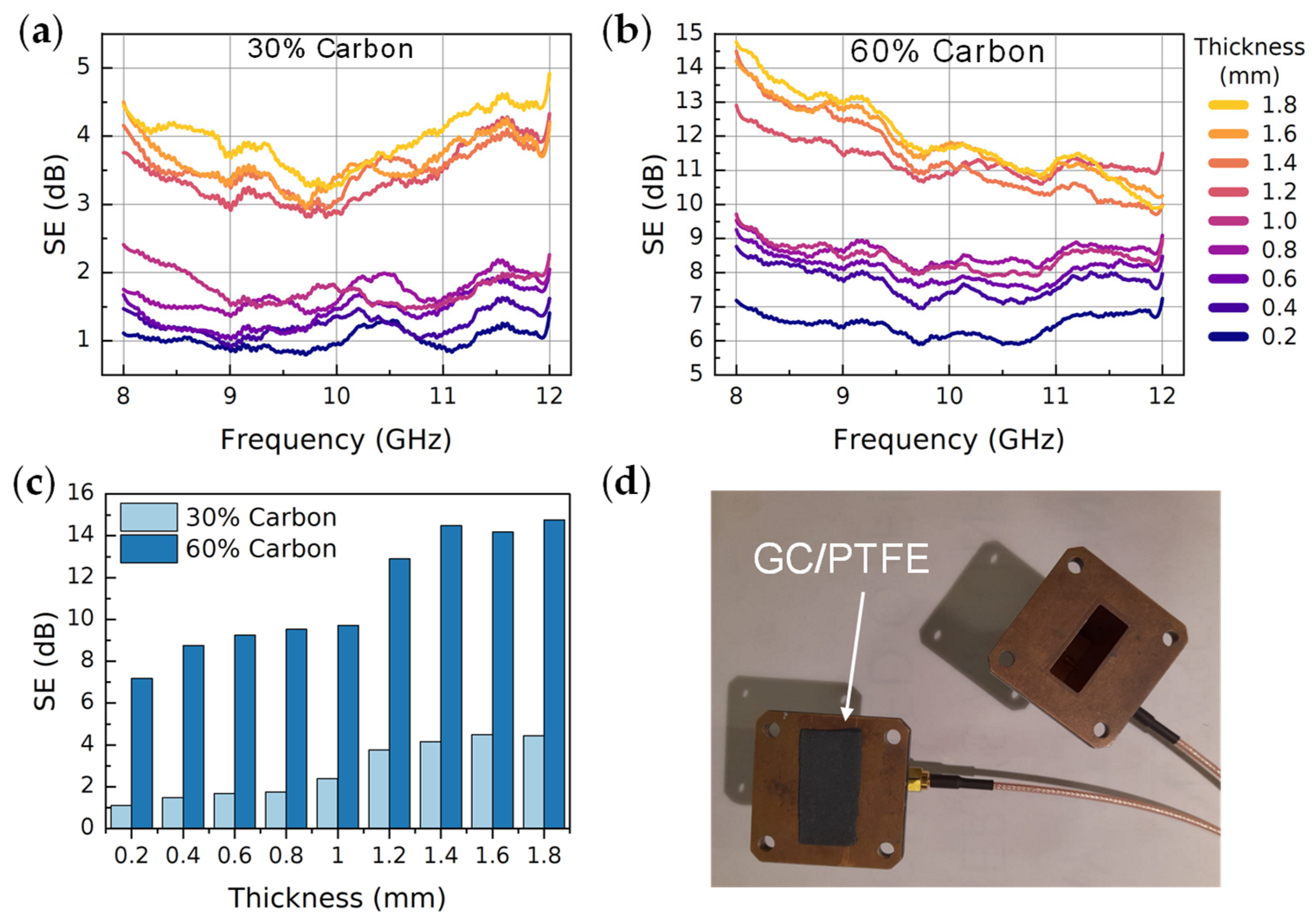
We evaluated the EMI shielding effectiveness (SE) of GC composites fabricated using PTFE as the polymer binder, a material that has been successfully used with biochar in related studies [23]. Figure 4a,b respectively show the total shielding effectiveness (SEtot) in the 8–12 GHz frequency range for the GC/PTFE composites with 30 and 60 wt.% GC loading level, and with thicknesses in the range of 0.2 to 1.8 mm. The lower-loaded composites (30 wt.%) exhibited SE values ranging from 1 dB to 5 dB, whereas doubling the filler concentration to 60 wt.% significantly enhanced performance, yielding SE values from 8 dB to 14 dB across the same thickness range (Figure 4c). Table S1 of the Supplementary Materials provides a comparison between the performance measured in this work and data reported in the literature for EMI shielding composites based on both biomass-derived and fossil-derived graphitic carbon [6,8,10,24,25,26,27,28,29,30].
In highly conductive materials, the dominant attenuation mechanism is typically reflection loss, which arises from the strong impedance mismatch [9,24]. According to electromagnetic theory regarding EMI mechanisms, this is generally independent of material thickness, since it depends on the material’s reflectance [6]. Regarding our composite, the clear dependence of SEtot on thickness indicates that absorption loss is also a critical contributing factor for overall performance increase. Indeed, the absorbance increases directly with thickness, as the wave travels a longer path length within the material, providing more opportunities for energy dissipation. This absorption capability is facilitated by the porous graphitic structure of the GC, which provides internal interfaces for wave scattering, interfacial polarization (due to conductivity mismatch between GC and PTFE), and ohmic losses [9,25].

3. Materials and Methods

Grape seeds, already separated from the exhausted grape marc and dust, were supplied by a local distillery as byproduct of bioethanol production. They were used without drying treatment, with a moisture content of 10% w/w, and were mechanically milled to reduce particle size (100–500 µm) for optimal pyrolysis. Methanation catalyst was prepared as reported in reference [14].
GC production by pyrolysis
Grape seeds pyrolysis was carried out in a 100 mL stainless steel autoclave employing a two-step carbonization/graphitization thermal process at a pressure of 2.5 bar in H2 atmosphere. The Carbonization process was performed for 6 h after reaching a temperature of 500 °C with a 1 °C/min heating rate. After cooling, the graphitization step was carried out at 800 °C (heating rate of 3 °C/min) for 3 h of graphitization. Thermal treatment times were set to ensure both efficient biomass conversion to GC and catalyst-mediated CO2 conversion. The biomass and catalyst were spatially segregated within the autoclave by placement in ceramic crucibles. This setup effectively minimized cross-contamination of the solid products and catalyst in the crucibles with the liquid products that condensed on the cooler areas of the autoclave walls.
Preparation of the GC/PTFE composites
Composites were prepared using GC, as the conductive filler, and a 60 wt.% dispersion in H2O of Polytetrafluoroethylene (PTFE) as the polymer matrix. Composite samples were prepared by mixing the GC powder with the PTFE emulsion to achieve two commonly used filler loadings based on the weight percentage (wt.%): 30 wt.% and 60 wt.% GC relative to the mass of PTFE [9]. The mixtures were mechanically processed and rolled into thin sheets with targeted thicknesses ranging from 0.2 mm to 1.8 mm. The prepared sheets were dried at room temperature for 24 h. The resulting plates were cut to the final dimensions of 40 × 20 mm.
Characterization
Solid, liquid and gaseous products were sampled after cooling to room temperature. The solid product yield (wt.%) was estimated from the weight difference between the initial biomass feedstock and the final solid product. Gaseous product yield has been estimated by multiplying the molecular weight of each gaseous species by the respective number of moles produced. The latter were determined by knowing the final pressure (at room temperature) of the gaseous phase, the autoclave volume, and the molar percentages (derived by gas chromatography). As for the moles of H2 produced or consumed during thermal treatment in a hydrogen ambience, it has been estimated as the difference between the number of H2 moles estimated before and after the thermal process. The liquid yield was calculated as the difference between the weight of the initial biomass and the combined weights of the solid and gaseous phases.
Raman measurements were performed using a LabRam HR (Horiba JY, HORIBA FRANCE SAS, Palaiseau, France) system with 532 nm laser excitation and by using a long working distance 50× objective lens (focusing laser spot of 1.2 µm). The laser power was kept at 10 mW to avoid thermal damage to the biochar and GC samples.
Quantitative analysis on the gaseous mixture was performed using a Thermo-Fisher gas-chromatograph (TCD-GC) equipped with a Supelco Carboxen 1010 Plot capillary column (Thermo Fisher Scientific, Waltham, MA, USA).
The oil phase was recovered with 2 × 3 mL of hexane in order to solubilize the organics to be analyzed with GC-MS for a semi-quantitative identification of compounds.
Field Emission Scanning Electron Microscopy (FE-SEM) was performed by a Zeiss Sigma microscope (Jena, Germany) operating in the range of 0–10 kV and equipped with both an in-lens secondary electron detector and an INCA Energy Dispersive Spectroscopy (EDS) detector. Samples were mounted onto stainless-steel sample holders using double-sided conductive carbon tape and grounded with silver paste.
TEM analyses were performed by using a JEOL JEM-1011 microscope (Akishima, Japan) operating at 100 kV and equipped with a high-contrast objective lens, a W filament as electron source, with an ultimate point resolution of 0.34 nm. Images were acquired by a Quemesa Olympus CCD 11 Mp Camera (Hachioji, Japan). Samples were prepared by dipping 300 mesh amorphous carbon-coated Cu grids in GC aqueous dispersions.
The experimental characterization of the samples SE was performed using a VNA Keysight FieldFox N9917A (Santa Rosa, CA, USA) connected to two X-band (8.2–12.4 GHz) aluminum coaxial-WR90 waveguide transitions. The samples were mounted between the transitions, carefully aligned, and their S-parameters were recorded over the operating band. All measured S-parameters were first corrected using a full TRL de-embedding procedure [31], employing standard THRU, REFLECT/SHORT, and LINE calibration structures. This step removes the influence of the fixtures and waveguide transitions, yielding the intrinsic transmission and reflection response of the material sample, which forms the basis for the extraction of its shielding efficiency. After de-embedding, the complex S-parameters were regularized by applying a Savitzky–Golay smoothing filter [32] of polynomial order 3 along the frequency axis. The filter performs a local least-squares polynomial fit to each S-parameter component, effectively suppressing high-frequency noise while preserving the underlying spectral features. Finally, passivity was enforced using the built-in passivity–projection routine of the scikit-rf library [33,34], ensuring that each S-parameter matrix satisfies the physical requirement of power conservation. This three-stage pipeline ensures that the resulting S-parameters are both noise-reduced, physically compliant, and representative of the true electromagnetic behavior of the measured material samples.

4. Conclusions

We presented a novel experimental protocol designed for efficient valorization of wine waste using a cascade strategy. Grape seeds from exhausted grape marc, as residual solid byproducts of bioethanol production, have been used as feedstock for GC synthesis by pyrolysis. Hydropyrolysis and CO2 methanation methodologies have been combined in a one-pot route to valorize pyrolysis byproducts. In particular, the Ni(0)/CeₓOᵧ/MK10 catalyst has been demonstrated to enhance both CO2 footprint mitigation and deoxygenation pathways in bio-oil, effectively reducing the concentration of long-chain carboxylic acids. GC derived by grape seeds has been validated in GC/PTFE composite as an EMI shielding material with a performance comparable to previously reported biochar materials [25]. Moreover, producing graphitic carbon from grape seeds offers economic advantages by valorizing a low-cost, locally available waste stream while simultaneously generating marketable byproducts (such as BTX compounds [18]), bio-oils, and syngas. When integrated into a multiproduct or cascade valorization framework, this approach further improves overall process profitability.

Supplementary Materials

The following supporting information can be downloaded at: https://www.mdpi.com/article/10.3390/catal16030226/s1, Figure S1: Fourier Transform Infrared–Attenuated Total Reflectance (FTIR-ATR) spectra of graphitic carbon (GC) obtained after two-step pyrolysis (carbonization at 500 °C, and graphitization 800 °C) of grape seeds. Table S1: Shielding effectiveness of graphitic carbon-filled composites.

Author Contributions

Conceptualization, S.D., G.V.B., G.M. and F.N.; methodology, S.D., C.I., G.M., P.C. and F.N.; validation, G.M.; investigation, S.D.; resources A.D. (Angela Dibenedetto), G.B., and A.D. (Antonella D’Orazio); data curation, S.D.; writing—original draft preparation, S.D.; writing—review and editing, visualization, all authors; supervision, G.V.B. and F.N. All authors have read and agreed to the published version of the manuscript.

Funding

This research was supported by PRIN 2022 PNRR “Life Cycle Assessment-driven GRAphene production for energy storage applications: sustainable management of reFORestation actions and VITiculture wAste” (GRAforVITA) project, code P20229P3JF (CUP Master B53D23027500001), funded by the European Union—Next generation EU.

Data Availability Statement

Data are contained within the article and Supplementary Materials.

Acknowledgments

A.D. (Angela Dibenedetto) and F.N. thank MIUR, Competitive project CMPT231981 for financial support.

Conflicts of Interest

The authors declare no conflicts of interest.

References

  1. Taifouris, M.; El-Halwagi, M.; Martin, M. Evaluation of the Economic, Environmental, and Social Impact of the Valorization of Grape Pomace from the Wine Industry. ACS Sustain. Chem. Eng. 2023, 11, 13718–13728. [Google Scholar] [CrossRef]
  2. Casazza, A.A.; Aliakbarian, B.; Lagazzo, A.; Garbarino, G.; Carnasciali, M.M.; Perego, P.; Busca, G. Pyrolysis of grape marc before and after the recovery of polyphenol fraction. Fuel Process. Technol. 2016, 153, 121–128. [Google Scholar] [CrossRef]
  3. Ureña-Torres, V.; Moreno-Fernández, G.; Gómez-Urbano, J.L.; Granados-Moreno, M.; Carriazo, D. Graphene-Wine Waste Derived Carbon Composites for Advanced Supercapacitors. ChemEngineering 2022, 6, 49. [Google Scholar] [CrossRef]
  4. Zhang, B.; Jiang, Y.; Balasubramanian, R. Synthesis, formation mechanisms and applications of biomass-derived carbonaceous materials: A critical review. J. Mater. Chem. A 2021, 9, 24759. [Google Scholar] [CrossRef]
  5. Venkatesan, K.; Prashanth, F.; Kaushik, V.; Choudhari, H.; Mehta, D.; Vinu, R. Evaluation of pressure and temperature effects on hydropyrolysis of pine sawdust: Pyrolysate composition and kinetics studies. React. Chem. Eng. 2020, 5, 1484–1500. [Google Scholar] [CrossRef]
  6. Tolvanen, J.; Hannu, J.; Hietala, M.; Kordas, K.; Jantunen, H. Biodegradable multiphase poly(lactic acid)/biochar/graphite composites for electromagnetic interference shielding. Compos. Sci. Technol. 2019, 181, 107704. [Google Scholar] [CrossRef]
  7. Gokce, E.C.; Calisir, M.D.; Selcuk, S.; Gungor, E.; Ercan Acma, M. Electromagnetic interference shielding using biomass-derived carbon materials. Mater. Chem. Phys. 2024, 317, 129165. [Google Scholar] [CrossRef]
  8. Li, S.; Huang, A.; Chen, Y.; Li, D.; Turng, L. Highly filled biochar/ultra-high molecular weight polyethylene/linear low density polyethylene composites for high-performance electromagnetic interference shielding. Compos. Part B Eng. 2018, 153, 277–284. [Google Scholar] [CrossRef]
  9. Sharma, G.K.; Raji, S.; Suresh, R.; Rahees, M.; Pilla, S.; James, N.R.; Prabhakaran, K. Carbon composites for electromagnetic interference shielding: Progress, challenges and perspective. Carbon 2026, 246, 120874. [Google Scholar] [CrossRef]
  10. Perumal, R.S.; Muralidharan, B. Valorization of Ricinus communis outer shell biomass to biochar: Impact of thermal decomposition temperature on physicochemical properties and EMI shielding performance. Results Eng. 2024, 24, 103097. [Google Scholar] [CrossRef]
  11. Vostrejs, P.; Adamcová, D.; Vaverková, M.D.; Enev, V.; Kalina, M.; Machovsky, M.; Šourková, M.; Marova, I.; Kovalcik, A. Active biodegradable packaging films modified with grape seeds lignin. RSC Adv. 2020, 10, 29202–29213. [Google Scholar] [CrossRef]
  12. Mahmood, F.; Zhang, C.; Xie, Y.; Stalla, D.; Lin, J.; Wan, C. Transforming lignin into porous graphene via direct laser writing for solid-state supercapacitors. RSC Adv. 2019, 9, 22713–22720. [Google Scholar] [CrossRef]
  13. Ren, J.; Liu, Y.L.; Zhao, X.Y.; Cao, J.P. Methanation of syngas from biomass gasification: An overview. Int. J. Hydrogen Energy 2020, 45, 4223–4243. [Google Scholar] [CrossRef]
  14. Nocito, F.; Ditaranto, N.; Dibenedetto, A. Highly dispersed Ni-Ce catalyst over clay montmorillonite K10 in low-temperature CO2 methanation. J. CO2 Util. 2024, 89, 102962. [Google Scholar] [CrossRef]
  15. De Souza, R.; Souza Machado, B.A.; de Abreu Barreto, G.; Lessa Leal, I.; Pereira dos Anjos, J.; Umsza-Guez, M.A. Effect of Experimental Parameters on the Extraction of Grape Seed Oil Obtained by Low Pressure and Supercritical Fluid Extraction. Molecules 2020, 25, 1634. [Google Scholar] [CrossRef] [PubMed]
  16. Yap, Y.W.; Mahmed, N.; Norizan, M.N.; Rahim, S.Z.A.; Ahmad Salimi, M.N.; Razak, K.A.; Mohamad, I.S.; Al-Bakri, M.; Yunus, M.Y.M. Recent Advances in Synthesis of Graphite from Agricultura Bio-Waste Material: A Review. Materials 2023, 16, 3601. [Google Scholar] [CrossRef]
  17. Abou Rjeily, M.; Chaghouri, M.; Gennequin, C.; Abi Aad, E.; Randrianalisoa, J.H. Investigating co-production of syngas, biochar, and bio-oil from flax shives biomass by pyrolysis and in-line catalytic hybrid reforming. Biomass Convers. Biorefin. 2024, 14, 25599–25625. [Google Scholar] [CrossRef]
  18. Bagnato, G.; Horgan, J.; Sanna, A. Techno-economic assessment of two-stage hydropyrolysis of lignin for BTX production using iron-based catalysts. RSC Sustain. 2025, 3, 1448–1460. [Google Scholar] [CrossRef]
  19. Ferrari, A.C.; Basko, D.M. Raman spectroscopy as a versatile tool for studying the properties of graphene. Nat. Nanotechnol. 2013, 8, 235–246. [Google Scholar] [CrossRef]
  20. Ferrari, A.C.; Robertson, J. Interpretation of Raman spectra of disordered and amorphous carbon. Phys. Rev. B 2000, 61, 14095–14107. [Google Scholar] [CrossRef]
  21. Ferrari, A.C.; Robertson, J. Resonant Raman spectroscopy of disordered, amorphous, and diamondlike carbon. Phys. Rev. B 2001, 64, 075414. [Google Scholar] [CrossRef]
  22. Chhowalla, M.; Ferrari, A.C.; Robertson, J.; Amaratunga, G.A.J. Evolution of sp2 bonding with deposition temperature in tetrahedral amorphous carbon studied by Raman spectroscopy. Appl. Phys. Lett. 2000, 76, 1419–1421. [Google Scholar] [CrossRef]
  23. Wei, Q.; Li, L.; Deng, Z.; Wan, G.; Zhang, Y.; Du, C.; Su, Y.; Wang, G. Scalable Fabrication of Nacre-Structured Graphene/Polytetrafluoroethylene Films for Outstanding EMI Shielding Under Extreme Environment. Small 2023, 19, 2302082. [Google Scholar] [CrossRef] [PubMed]
  24. Valentini, M.; Piana, F.; Pionteck, J.; Lamastra, F.R.; Nanni, F. Electromagnetic properties and performance of exfoliated graphite (EG)—Thermoplastic polyurethane (TPU) nanocomposites at microwaves. Compos. Sci. Technol. 2015, 114, 26–33. [Google Scholar] [CrossRef]
  25. Nikolopoulos, C.D.; Baklezos, A.T.; Kapetanakis, T.N.; Vardiambasis, J.O.; Tsubota, T.; Kalderis, A.D. Characterization of the Electromagnetic Shielding Effectiveness of Biochar-Based Materials. IEEE Access 2023, 11, 6413–6420. [Google Scholar] [CrossRef]
  26. Halder, K.K.; Tomar, M.; Sachdev, V.K.; Gupta, V. Development of polyvinylidene fluoride–graphite composites as an alternate material for electromagnetic shielding applications. Mater. Res. Express 2019, 6, 075324. [Google Scholar] [CrossRef]
  27. Al-Saleh, M.H.; Saadeh, W.H.; Sundararaj, U. EMI shielding effectiveness of carbon based nanostructured polymeric materials: A comparative study. Carbon 2013, 60, 146–156. [Google Scholar] [CrossRef]
  28. Balajikrishnabharathi, A.; Jayabalakrishnan, D. Characterization of mechanical, dielectric, EMI shielding properties of abaca bract biocarbon and pineapple fiber reinforced rigid vinyl ester composite. Polym. Bull. 2024, 81, 12267–12285. [Google Scholar] [CrossRef]
  29. Savi, P.; Yasir, M.; Bartoli, M.; Giorcelli, M.; Longo, M. Electrical and microwave characterization of thermal annealed sewage sludge derived biochar composites. Appl. Sci. 2020, 10, 1334. [Google Scholar] [CrossRef]
  30. Yasir, M.; Di Summa, D.; Ruscica, G.; Natali Sora, I.; Savi, P. Shielding properties of cement composites filled with commercial biochar. Electronics 2020, 9, 819. [Google Scholar] [CrossRef]
  31. Engen, G.F.; Hoer, C.A. Thru-Reflect-Line: An Improved Technique for Calibrating the Dual Six-Port Automatic Network Analyzer. IEEE Trans. Microw. Theory Tech. 1979, 27, 987–993. [Google Scholar] [CrossRef]
  32. Savitzky, A.; Golay, M.J.E. Smoothing and differentiation of data by simplified least squares procedures. Anal. Chem. 1964, 36, 1627–1639. [Google Scholar] [CrossRef]
  33. Arsenovic, A.; Hillairet, J.; Anderson, J.; Forsten, H.; Rieß, V.; Eller, M.; Sauber, N.; Weikle, R.; Barnhart, W.; Forstmayr, F. Scikit-rf: An Open Source Python Package for Microwave Network Creation, Analysis, and Calibration. IEEE Microw. Mag. 2022, 23, 98–105. [Google Scholar] [CrossRef]
  34. Gustavsen, B. Fast Passivity Enforcement for S-Parameter Models by Perturbation of Residue Matrix Eigenvalues. IEEE Trans. Adv. Packag. 2010, 33, 257–265. [Google Scholar] [CrossRef]
Figure 1. (a) Sketch illustrating the autoclave reactor setup. (b) Digital photographs of the exhausted grape seed feedstock and (c) GC after graphitization. (d) Biomass yields conversion (wt.%) to solid, liquid and gas products resulting from the two-step pyrolysis at 500 °C (carbonization) and 800 °C (graphitization) in H2 atmosphere.
Catalysts 16 00226 g001
Figure 2. (a) Histograms of the moles of the main gaseous species produced during the pyrolysis process per gram of biomass during the carbonization step at 500 °C and the graphitization step at 800 °C in a H2 atmosphere with and without the methanation catalyst. (b) Ratio between the CH4 and CO2 moles produced during pyrolysis at different temperature of 500 °C and 800 °C, with and without catalyst.
Catalysts 16 00226 g002
Figure 3. (a,b) SEM Image of GC after carbonization at 500 °C (a) and after graphitization at 800 °C (b). (c,d) TEM of GC after carbonization at 500 °C (c) and after graphitization at 800 °C (d). (e) Raman spectra of solid products obtained at 500 °C and subsequent graphitization at 800 °C.
Catalysts 16 00226 g003
Figure 4. Total shielding effectiveness (SE) for the GC/PTFE composites with (a) 30 wt.% and (b) 60 wt.% GC loading, showing the effect of shielding material thickness (0.2–1.8 mm) across the X-band frequency range (8–12 GHz). (c) SE at 8 GHz of GC/PTFE composites for various compositions and thicknesses. (d) Picture of the Vector network analyzer (VNA) ports used for measuring the S-parameter holding the GC/PTFE sample.
Catalysts 16 00226 g004
Table 1. Comparison between the relative amount of the main families in the oil obtained under different pyrolysis experimental parameters.
EntryTemp. [°C]GasCatalystLinear and Cyclic Long Chain HydrocarbonsLong Chain Carboxylic
Acids
PhenolsOthers
1500H2No24.4%32.1%20.7%22.8%
2500H2Yes29.8%22.3%21.6%26.3%
3800H2No27.3%17.3%25.6%29.8%
4800H2Yes29.6%13.2%26.1%31.1%
Disclaimer/Publisher’s Note: The statements, opinions and data contained in all publications are solely those of the individual author(s) and contributor(s) and not of MDPI and/or the editor(s). MDPI and/or the editor(s) disclaim responsibility for any injury to people or property resulting from any ideas, methods, instructions or products referred to in the content.