Review

Organic Framework-Based Nanozymes: Design, Property, and Application

1
School of Food and Biological Engineering, Jiangsu University, Zhenjiang 212013, China
2
Research Center for Eco-Environmental Sciences, Chinese Academy of Sciences, Beijing 100085, China
3
University of Chinese Academy of Sciences, Beijing 100049, China
*
Author to whom correspondence should be addressed.
Catalysts 2026, 16(3), 223; https://doi.org/10.3390/catal16030223
Submission received: 30 December 2025 / Revised: 14 January 2026 / Accepted: 16 January 2026 / Published: 2 March 2026
(This article belongs to the Special Issue Catalysis and Sustainable Green Chemistry)

Abstract

Although natural enzymes have a high catalytic activity as biocatalysts, they still face many limitations in practical applications, including high preparation and purification costs, poor environmental stability, and difficulties in recovery and reuse. Nanozymes are a class of synthetic nanomaterials with enzymatic catalytic properties. They are regarded as promising alternatives to natural enzymes due to their low cost, good stability, adjustable catalytic activity, and easy surface modification. Among many nanozyme materials, metal–organic frameworks (MOFs) and covalent organic frameworks (COFs) have attracted much attention due to their high specific surface area, adjustable porosity, and stable framework structure. This review summarizes the latest research progress of nanozymes based on MOFs and COFs and reveals the catalytic properties of different enzymes (oxidase, peroxidase, catalase, glucose oxidase, superoxide dismutase, hydrolase) simulated by them. In addition, their potential applications in sensors and medical fields are discussed. Finally, this review discusses the current challenges and developments of organic framework-based nanozymes and provides suggestions for future research directions.

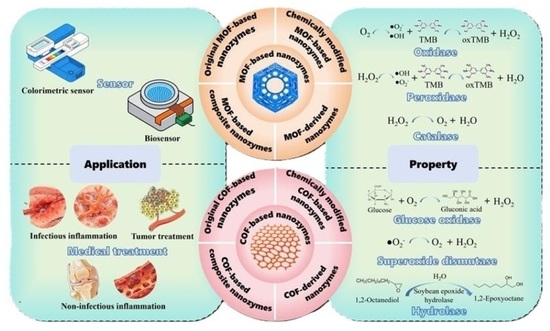
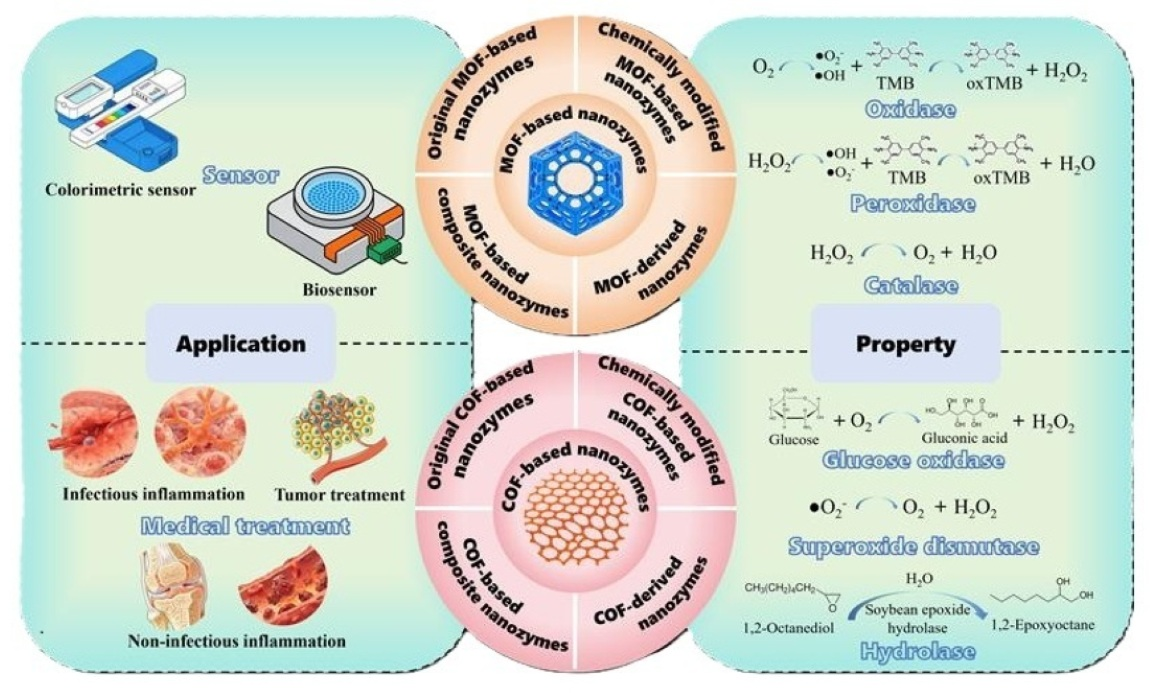
Graphical Abstract

1. Introduction

As a class of highly efficient biocatalysts, natural enzymes are involved in almost all biological reactions due to their excellent substrate specificity and catalytic efficiency, and have been widely used in food processing, biomedicine, chemical synthesis, and environmental remediation [1,2,3]. However, natural enzymes have poor stability and tolerance under harsh environmental conditions, and they have inherent defects such as high preparation and purification costs, as well as difficulties in recovery and reuse, which limit their subsequent applications [4,5,6,7,8,9]. The emergence of nanozymes can address the shortcomings of natural enzymes [10]. Nanozymes are a type of nanomaterials with enzyme-like catalytic activity, offering advantages such as low preparation costs, high stability, adjustable catalytic activity, and easy surface modification [3,11,12,13]. They can not only be designed and customized for specific reactions but also overcome the limitations of natural enzymes, such as sensitivity to reaction conditions and complex manufacturing processes [1,14,15,16]. With the continuous development and improvement of nanobiotechnology, nanozymes have shown broad application prospects in the frontier fields of biosensors, antiviral agents, bioimaging technology, and water pollution control [1,2,17,18,19,20,21,22,23].
Metal–organic frameworks (MOFs) and covalent organic frameworks (COFs) are two kinds of emerging porous crystal materials that have attracted much attention in recent years. MOFs are formed via the self-assembly of metal ions or metal clusters and organic ligands through coordination bonds; COFs are composed of a mechanism-building unit connected by a dynamic covalent bond [1,24,25]. Both MOFs and COFs have a high surface area, high porosity, adjustable pore structure, variable skeleton structure, and fixed functional sites. The controllable cavities and channels in their structures can simulate the hydrophobic coordination environment of natural enzymes, providing an ideal place for substrate binding and catalytic reactions [26,27,28]. Because of these structural advantages, MOFs and COFs have shown significant potential in the field of nanozymes, especially in simulating biocatalysis and enzymatic reactions. Studies have confirmed that they can effectively simulate oxidoreductases and hydrolases, which is mainly due to the good adaptability of their structural characteristics to the catalytic mechanisms of the two types of enzymes [1,27,29]. For oxidoreductases, the metal nodes (such as Fe, Cu) in MOF have redox activity, which can directly simulate the metal active center of natural enzymes [11,12]. COF can also achieve similar functions by introducing metal ions or redox active groups (such as quinones, nitrogen heterocycles) [25,30,31]. For hydrolases, the metal nodes of MOF can be used as Lewis acids, and the hydroxyl, carboxyl, and other groups on the ligand can be used as bases or nucleophilic sites to synergistically promote the hydrolysis reaction [11,12]. COF can also simulate hydrolysis activity by designing ligands containing nucleophilic groups [25,30]. In addition, the high specific surface area and ordered pore structure of MOF/COF are conducive to substrate diffusion and contact with active sites, further improving the catalytic efficiency, especially for redox processes involving gas (such as O2) transfer [11,12,32]. However, MOF/COF-based nanozymes have not been widely used in the simulation of transferase, lyase, isomerase, ligase, and translocase. The core limitation of MOF/COF-based nanozymes is the catalytic mechanism and rigid skeleton structure of these materials, which is difficult to meet the complex catalytic functional requirements of the above five enzymes [11,12,30]. The catalytic process of transferase and ligase depends on coenzyme-mediated energy coupling and the synergistic binding ability of dual substrates, while MOF/COF materials lack corresponding energy transfer units and cannot achieve precise directional binding of dual substrates [12,25,32]. The catalytic process of lyase and isomerase requires flexible conformational changes in the active center to induce high-energy chemical bond cleavage or intramolecular group rearrangement in the substrate molecule, such as C-C, C-N, etc., while the rigid skeleton structure of MOF/COF material is difficult to complete such dynamic conformational regulation [11,25,31]. The translocase requires the active center to realize the directional migration of the group through dynamic conformation switching, and the fixed structure of MOF/COF is difficult to support the step-by-step catalytic process [11,12]. Overall, the stringent requirements of these enzymes for dynamic recognition, energy coupling, and conformational regulation are beyond the structural and functional design scope of current MOF/COF materials. Based on this, this review will focus on the research of MOF/COF-based nanozymes in simulating oxidoreductases and hydrolases.
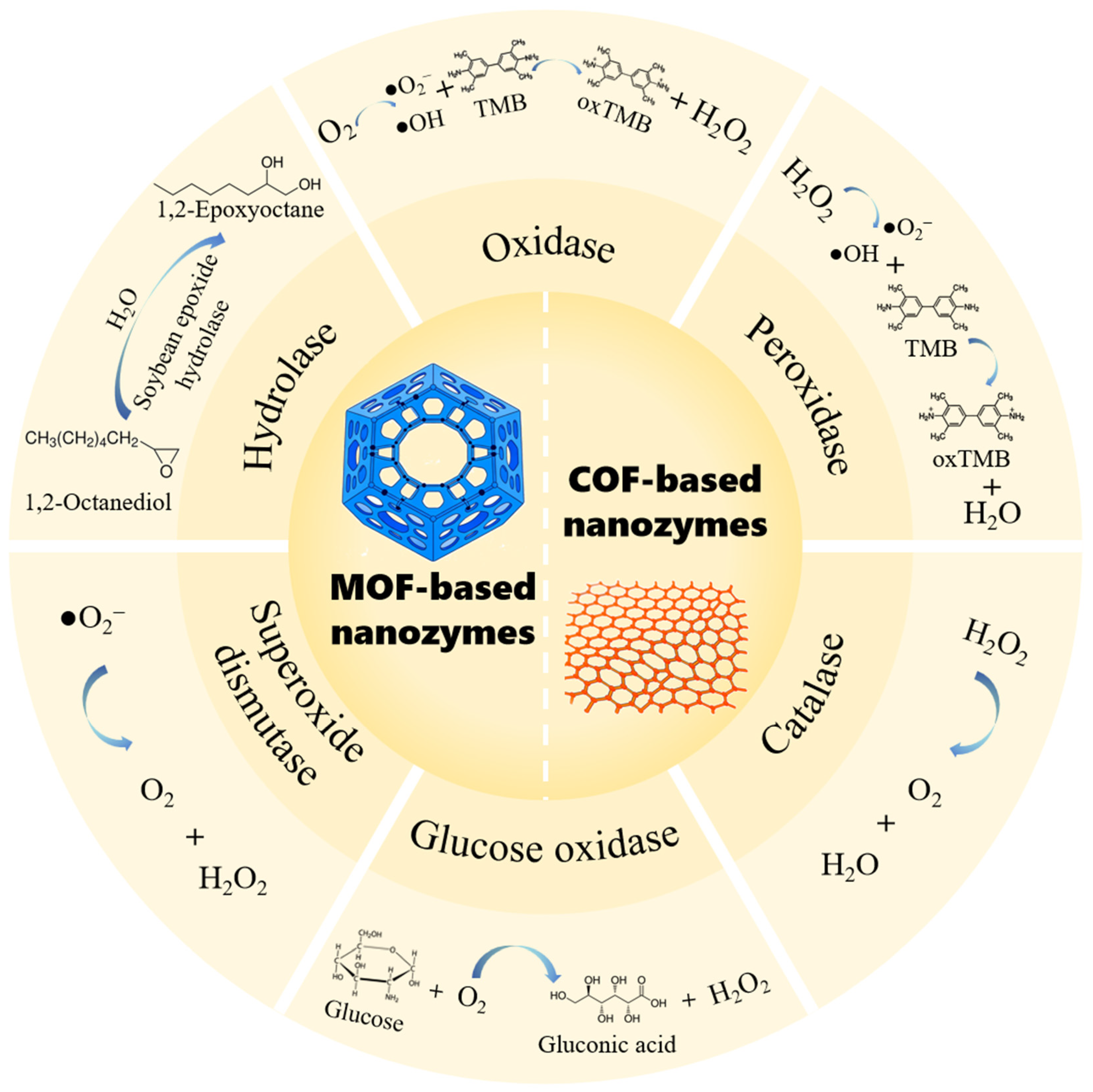
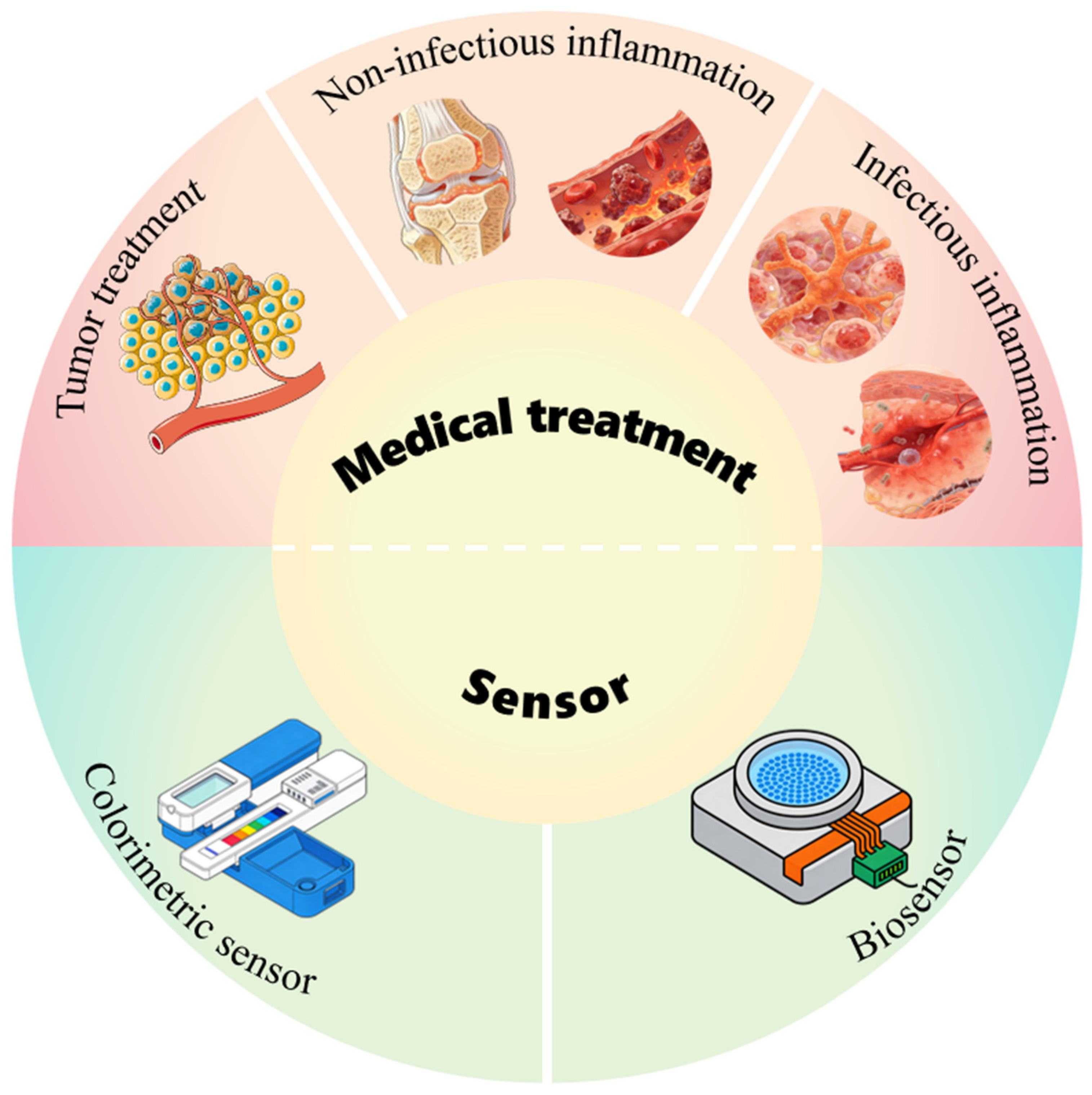
So far, a large number of reviews have focused on the application of porous organic framework materials in the field of nanozymes. However, these reviews mostly focus on the design and application of a specific type of MOF-based nanozymes or covalent organic frameworks-based nanozymes, and the discussion on COF-based nanozymes is relatively scarce [30,33,34,35,36]. In addition, there are few literatures to sort out and compare the catalytic properties of different enzymes simulated by these nanozymes. In view of this, this review summarizes the latest research progress of four MOF-based nanozymes and COF-based nanozymes (primitive, modified, complex, derivative) in the past six years (Table 1 and Table 2), focusing on the catalytic mechanisms of different enzymes (oxidase, peroxidase, catalase, glucose oxidase, superoxide dismutase, hydrolase) they mimic (Figure 1). This review also introduces the latest applications of these kinds of nanozymes in the fields of sensors and medical treatment (Table 3 and Table 4 and Figure 2). Finally, we deeply discuss the key challenges faced by the current research on organic framework-based nanozymes and propose future development directions, which will provide a valuable reference for further research in related fields.

2. Nanozymes Based on Metal–Organic Frameworks

MOF-based nanozymes utilize metal ions or metal clusters as catalytically active centers, which enables the selective enrichment of substrates through their adjustable pore structures and improves mass transfer efficiency via confinement effects. These materials can not only fix the active sites and regulate the catalytic microenvironment through the skeleton structure but also achieve efficient and stable enzyme-like catalytic performance by forming a binic protective barrier [5,28]. At present, nanozymes based on metal–organic frameworks can be divided into four categories: original MOF-based nanozymes, chemically modified MOF-based nanozymes, MOF-based composite nanozymes, and MOF-derived nanozymes. Table 1 summarizes the latest research progress of the above four types of nanozymes, which simulate different types of enzymes. The following sections will introduce these four types in detail.

2.1. Original MOF-Based Nanozymes

An original MOF-based nanozyme is an MOF material formed via direct self-assembly of metal ions or metal clusters and organic ligands through coordination bonds, without any chemical modification or composite treatment [11]. Its enzyme activity is derived from its own periodic structure, high specific surface area, and metal active center [11]. Such nanozymes use redox-active metal ions/clusters such as Fe and Co and mimetic enzyme ligands to construct active centers. By optimizing 2D structure or regulating 3D pore size, the exposure of active sites and substrate diffusion efficiency are improved. Electron transfer is achieved by relying on metal valence changes or bimetallic potential differences, and the specific binding of substrates to active centers is enhanced by the confined environment formed by their own pores.
Researchers have successfully endowed nanozymes with catalytic activity by constructing a ‘single metal center–organic ligand framework’ structure. Shan et al. [27] constructed the Ce-UiO-66 crystal structure using the solvothermal method (80 °C reaction) with Ce4+ as the metal center and terephthalic acid as the ligand. The synthesized material can simulate catalase and catalyze the decomposition of hydrogen peroxide into oxygen and water (Figure 1). Yan et al. [37] prepared a typical ZIF-67 octahedral crystal structure via a one-step method of room-temperature stirring combined with static aging, using Co2+ as the metal center and 2-methylimidazole as the ligand. The synthesized material exhibits both oxidase and peroxidase catalytic properties. Its oxidase activity is mainly derived from the redox ability of cobalt ions (Co2+/Co3+). Cobalt ions catalyze the reduction of oxygen (O2) to hydrogen peroxide (H2O2) or hydroxyl radical (·OH) through valence change, and electron transfer is achieved through metal-ligand bonds or skeleton conduction (Figure 1). For peroxidases, MOF-based nanozymes catalyze the Fenton-like reaction of hydrogen peroxide (H2O2) through metal nodes (Co2+/Co3+) to generate highly active hydroxyl radicals (·OH) (Figure 1). Electron transfer is achieved through the metal valence cycle, and its pore structure can enrich the substrate and enhance the catalytic efficiency. Through Table 1, we can find that MOFs containing transition metals such as Fe, Cu, and Co show significant advantages in simulating oxidoreductases (such as peroxidases and oxidases). In particular, Fe-based MOFs have a wide range of applicability in peroxidase simulation. In addition, researchers have developed bimetallic organic framework nanozymes. The bimetallic center can significantly improve the catalytic efficiency through a synergistic effect, making its performance closer to that of natural enzymes. Compared with the single-metal system, the bimetallic system can provide more active sites, thereby achieving the integration of multiple enzyme simulation functions. When simulating peroxidase, the Km value of Fe-Cu bimetallic MOF is about 50% lower than that of single metal Fe-MOF, and the Vmax is increased by about 3 times (Table 1), indicating that the bimetallic synergy not only enhances the substrate affinity but also improves the catalytic conversion rate. This may be due to the electron transfer between the two metals and the synergistic effect of Lewis acid, which optimizes the adsorption and activation path of H2O2. At present, the reported bimetallic active centers include Fe-Cu, Fe-Ni, and Cu-Mo [4,29,38,39,40].
Figure 1. The catalytic mechanisms of six enzymes are mainly simulated by MOF-based nanozymes and COF-based nanozymes.
Catalysts 16 00223 g001

2.2. Chemically Modified MOF-Based Nanozymes

Chemically modified MOF-based nanozymes are nanozymes that optimize catalytic activity, stability, or substrate affinity via chemical modification of the metal active center or the surface of the original MOF [11]. Such nanozymes optimize the active center by introducing functional groups or additional metal ions at unsaturated metal sites, increase the density of active sites by defect engineering, and reduce the electron transfer energy barrier by electrostatic interaction or electron relay function of the modified groups. The modified pore structure enhances the enrichment and adaptation of specific substrates and amplifies the confined catalytic effect.
Cao et al. [41] successfully immobilized soybean epoxide hydrolase (SEH) on an amino-functionalized UiO-66-NH2 MOF to construct an efficient nano/microbial catalyst SEH@UiO-66-NH2. Its mechanism of mimicking hydrolase is mainly manifested in that SEH is covalently immobilized on the surface of MOF through glutaraldehyde crosslinking, and the high specific surface area and ordered pore structure of MOF are used to enhance the local enrichment and mass transfer efficiency of the enzyme and substrate. The immobilization process significantly improved the conformational rigidity of the enzyme (the α-helix content increased from 19.4% to 34.4%), allowing the catalytic center to maintain a stable active conformation in the reaction system, thereby asymmetrically hydrolyzing 1,2-epoxy (Figure 1). In the process of generating (R)-1,2-octanediol, it showed better catalytic efficiency, substrate affinity (Km decreased from 19.2 mM to 6.5 mM) and environmental stability (pH, temperature, organic solvent and storage stability were significantly improved) than free enzymes. Cheng et al. [42] used an Fe-based MOF (MIL-53(Fe)) as the original skeleton to precisely regulate its metal nodes through the chemical modification strategy of ‘Ni doping + low-temperature H2 reduction’. In the modified sub-nanochannels, Ni2+ is used as the H2O2 adsorption site and Fe2+/Fe3+ is used as the reversible catalytic site, which synergistically improves the substrate transport efficiency and catalytic activity. The results show that the modified materials have a lower Michaelis constant (Km) and a higher maximum reaction rate for H2O2, and the catalytic activity is significantly better than that of unmodified MOF and traditional Fe-based nanozymes. Using a similar heterogeneous metal doping strategy, Yao et al. [43] introduced Eu3+ into the MOF to modify metal nodes and also observed an optimization of catalytic performance. Wu et al. and Xu et al. [44,45] indirectly regulated the metal active center by introducing different substituents into the organic ligand for chemical modification. In addition, Li et al. and Chen et al. [46,47] used the post-synthetic modification method to coordinate Cu2+ to the bipyridine ligand of the framework, thus successfully introducing a new catalytically active center. Through the relevant data in Table 1 and Table 3, we can find that metal node doping (Ni-doped Fe-MOF) and ligand functionalization (-NH2 modified MIL-101 (Fe)) can significantly reduce the Km value (increase the substrate affinity). Among them, the LOD of Ni-Fe-MOF to H2O2 is as low as 0.31 μM, which is better than that of unmodified Fe-MOF (LOD = 18.04 nM) and traditional Fe-based nanozyme.

2.3. MOF-Based Composite Nanozymes

MOF-based composite nanozymes encapsulate active guests such as nanoparticles, biomolecules, and metal complexes in the MOF pores or are loaded on the surface of the MOF to form a composite material with a synergistic catalytic effect, which combines the functions of the host MOF and the guest material [11]. Such nanozymes combine metal nanoparticles, heme, and other guest components with MOF to form a bifunctional active center. Relying on MOF pores to limit the agglomeration of guests to ensure the uniform dispersion of active sites, the cross-interface electron transfer path is constructed through the interface interaction between components, and the micro-reaction zone formed by pore encapsulation is used to synergistically improve catalytic efficiency, stability and anti-interference ability.
A common construction strategy is to construct a ‘core–shell’ composite structure with catalytically active nanoparticles as the core and an MOF as the shell. This structure not only retains a variety of enzyme catalytic properties but also improves the stability of the system through the confinement and protection of the MOF [48,49,50,51,52,53]. On this basis, Xue et al. [51] further coated SiO2, which significantly improved the stability and biocompatibility of nanozymes. In recent years, an increasing number of studies have focused on the use of one or two MOFs as the main skeleton, and the active components, such as natural enzymes and metal nanoparticles, are single components or co-embedded in the MOF pores or loaded on the MOF surface by means of in situ encapsulation, post-fixation, or biomineralization to construct a multifunctional composite catalytic system [54,55,56,57,58,59,60,61]. For example, Huang et al. [62] used electrostatic adsorption to load choline oxidase on the surface of a Cu-based MOF, in which Cu-MOF provided peroxidase-like activity, while choline oxidase played its own catalytic function. The two formed a cascade catalytic system, which significantly improved the detection and catalytic efficiency. To further expand the application of MOF-based composite nanozymes, researchers have also combined functional materials such as drugs and molecularly imprinted polymers with MOFs to develop multifunctional composite materials for biomedical, sensing, and other fields [63,64,65]. As shown in Table 3, the cascade system constructed by ‘MOF-natural enzyme’ (such as ChOx@Cu-MOF) or ‘MOF-precious metal nanoparticles’ (such as Fe3O4-MOF-Pt) can broaden the detection linear range of glucose, choline, and other targets to 1–500 μM, and the LOD is generally lower than 1 μM, which is suitable for trace detection of complex samples.

2.4. MOF-Derived Nanozymes

MOF-derived nanozymes are based on the use of MOFs as the precursor, which are then converted into porous derivatives such as metal/carbon, metal oxide/carbon, and single atoms through methods such as high-temperature pyrolysis and vulcanization; this allows the high specific surface area characteristics of MOFs to be retained while enhancing the electron transfer efficiency and catalytic stability. Such nanozymes convert metal nodes into high-efficiency active structures such as metal/carbon and single atoms through pyrolysis and other processes, inherit the porous characteristics of MOF and use pyrolysis defects to enhance activity, accelerate electron transfer with the help of high conductivity of carbon matrix or bimetallic alloying, and realize the stability of active components and the optimization of substrate diffusion through the porous structure of carbon matrix, to strengthen the confined catalytic effect.
Among these methods, high-temperature pyrolysis is the most commonly used [11]. Han et al. [66] used a Zn/Fe bimetallic MOF as a precursor, which was mixed with g-C3N4 and pyrolyzed at 800 °C in a N2 atmosphere. After leaching metal impurities with nitric acid, two-dimensional iron-doped, carbon-based nanosheets were formed. The organic ligand of MOF is converted into a nitrogen-doped carbon matrix during pyrolysis, and coordinates Fe3+ with the additional nitrogen source provided by g-C3N4 to form a high-density and stable Fe-Nx active site. At the same time, the two together construct a two-dimensional structure with a high specific surface area, which can effectively enrich the substrate and improve the mass transfer efficiency. In addition, the conjugated carbon matrix and g-C3N4 can accelerate electron transfer and assist the valence cycle of Fe ions, thereby reducing the reaction activation energy [66]. It is worth noting that the improvement of catalytic performance of nanozymes often involves both the optimization of mass transfer process and the enhancement of intrinsic catalytic activity. Among them, the mass transfer effect refers to the efficient enrichment, directional transport and significant improvement of local concentration of reaction substrates and products by means of the porous structure, surface hydrophobicity or confined microenvironment of the material. The intrinsic active site effect refers to changing the electronic configuration, coordination environment and redox characteristics of the active center through precise material structure design, thereby effectively increasing the catalytic conversion frequency or reducing the reaction kinetic energy barrier. Specifically, the high specific surface area and ordered pore structure of the material can significantly accelerate the diffusion process of the substrate molecules, which is a typical mass transfer regulation mechanism. The construction of active centers such as Fe-Nx can directly regulate the reaction energy barrier, which is essentially an enhancement of intrinsic catalytic activity. Future research work needs to combine control experiment design (such as comparing the catalytic conversion number when the same active center is loaded on different carriers) and in-situ spectroscopic characterization techniques to quantitatively analyze the contribution ratio of mass transfer effect and intrinsic activity effect, and finally achieve precise regulation of nanozyme catalytic performance. The active sites of Fe-Nx and Co-Nx have been proven to be the key structures to endow nanozymes with high catalytic performance. For example, the detection limit of Fe-N800 CS (iron-doped carbon-based nanosheets) for alkaline phosphatase can reach 0.12 U/L, showing excellent sensing sensitivity. D-Co(OH)2 (cobalt-based MOF-derived material) has both oxidase and peroxidase bifunctional activities and exhibits efficient catalytic ability in both organic pollutant degradation and antibacterial applications. In addition, plasma etching is also an important method. Hu et al. [67] used a metal–organic framework (Co-MOF) as a precursor and performed post-treatment with dielectric barrier discharge (DBD) microplasma chemical etching to remove nitrogen-containing organic ligands in the MOF so that the metal nodes (Co2+) were in situ converted into defect-enriched cobalt hydroxide (D-Co(OH)2). The results showed that many oxygen vacancies and surface defects were introduced during the etching process, forming an ultra-thin nanosheet structure with a thickness of about 20 nm. The electrochemically active surface area was significantly higher than that of the original Co-MOF/CC, reflecting the advantages of MOF-derived materials in improving activity through structural reconstruction.
The catalytic performance of MOF-derived nanozymes is highly dependent on the microstructure defects and metal coordination environment formed during pyrolysis or post-treatment. By precisely controlling the pyrolysis temperature, atmosphere, and precursor composition, oxygen vacancies, nitrogen-doped carbon matrix, and specific metal-nitrogen coordination structures (such as Fe-Nx, Co-Nx) can be introduced to simulate the catalytic mechanism of different natural enzymes. For example, oxygen vacancies are often used as electron capture and transport centers, which significantly enhance the electron transfer ability of oxidoreductases and increase the activity of oxidases and peroxidases. The Fe-Nx/Co-Nx site exhibits excellent performance in simulating peroxidase, oxidase, and catalase due to its coordination structure similar to the heme or metal enzyme active center. The nitrogen-doped carbon matrix not only provides a high conductive network, but also enhances substrate adsorption and activation through surface functional groups. The clarification of these structure–activity relationships provides key guidance for the rational design of efficient MOF-derived nanozymes.
Table 1. Four types of MOF-based nanozymes and their corresponding mimetic enzymes.
CategoryNanozymeMimic EnzymeKmVmaxRef.
Original MOF-based nanozymesZIF-67Oxidase---- [37]
Peroxidase----
Ce-UiO-66Catalase---- [27]
MIL-101(FeII)Peroxidase0.031 mM6.54 × 10−8 M/s [68]
FCMP@CQ/PFHOxidase
Peroxidase
--
--
--
--
[39]
Cu-hemin MOFOxidase
Peroxidase
--
--
--
--
[29]
MIL-88BPeroxidase0.6950 mM-- [38]
2D MOFsCatalase---- [4]
Chemically modified MOF-based nanozymesNixFe-MOFPeroxidase0.068 mM2.92 × 10−7 M/s [42]
CeOx@fMILCatalase---- [69]
BCL@MTV-ZIF-8
BCL@HZIF-8
Lipase--
--
--
--
[70]
CAT/mNMZIF-8Catalase0.059 ± 0.0003 M0.012 ± 0.0006 M/min [71]
MIL-53(Fe)-X
MIL-101(Fe)
MIL-53(Cr)-X
Laccase--
--
--
--
--
--
[44]
Cu2+-NMOFsPeroxidase---- [46]
NO2-MIL-101(Fe)
NH2-MIL-101(Fe)
Peroxidase0.85 × 10−3 M
1.8 × 10⁻³ M
3.2 × 10⁻⁸ M/s
0.8 × 10⁻⁸ M/s
[45]
SEH@UiO-66-NH2Hydrolase6.5 mM5.2 × 10−2 mM/min [41]
MOF-based composite nanozymesCu2O/Cu-MOF/Fe-MIL-88BPeroxidase0.096 mmol/L-- [54]
Cu-DPATZ-POM/g-C3N4(1)Peroxidase0.167 mM10.01 × 10−8 M/s [72]
CeOx@fZIFPeroxidase0.322 mM19.9 × 10−8 M/s [48]
NR@H-ZIF-8@PtPeroxidase---- [49]
Fe3O4-MOF-PtPeroxidase---- [50]
SiO2@PB-IR1061Catalase
Peroxidase
Superoxide dismutase
--
--
--
--
--
--
[51]
BSA@HRP@TMB@ZIF-8Peroxidase---- [5]
NH2-MIL-101(Fe)@Au@MIPPeroxidase---- [65]
ADA@ZIF-67Peroxidase0.26 mM1.61 × 10−8 M/s [73]
UiO-66@GOx@AuGlucose oxidase---- [74]
UiO-66-NH2/CeO2/Cel@HACatalase
Superoxide dismutase
---- [63]
HA-MIL-100@Pt@CyICatalase---- [75]
CuAuPt/Cu-TCPP(Fe)Peroxidase42.3 μM1.86 × 10−8 M/s [76]
FA-EM@MnO2/ZIF-8/ICGCatalase---- [77]
DOX@COD-MOF@CCMPeroxidase---- [64]
GOx/MNP@aZIF-90Peroxidase---- [78]
ChOx@MOFPeroxidase---- [62]
GOx/Hemin@NC-ZIFPeroxidase--26.4 × 10−8 M/s [79]
Hemin@BSA@ZIF-8Peroxidase0.105 mM-- [80]
GOx@HP-PCN-222(Fe)Peroxidase---- [60]
ZIF-67-Au@PtPeroxidase---- [52]
GOx&PVI-hemin@ZIF-8Peroxidase---- [55]
Tb-OBBA-HeminPeroxidase0.048 mM0.26 Μm/s [81]
ΜFe2O4@MOFCatalase
Glutathione peroxidase
---- [53]
PtNPs/Cu-TCPP(Fe)Peroxidase---- [82]
silica@CAT/ZIF-8Catalase0.58 mM0.0024 Mm/min [83]
Cyt c-CuBDCPeroxidase6.4 mM1650.3 nM/s [59]
MOF-derived nanozymesCo-NC/Cu95Oxidase0.291 mM-- [3]
Fe–N800 CSCatalase---- [66]
Co8FeS8@Co1-xSPeroxidase---- [84]
Glutathione oxidase0.254 mM--
CA-CoNiMn-CLDHsPeroxidase0.21 mM0.83 × 10−8 M/s [85]
D-Co(OH)2Oxidase---- [67]
Peroxidase3.26 mM--
Mn3O4-PEG@C&ACatalase---- [86]
MnCoO-PDA-PEGCatalase---- [87]

3. Nanozymes Based on Covalent Organic Frameworks

The metal ions/metal clusters in the structure of MOF-based nanozymes are the necessary components to form the framework nodes, and the metal nodes themselves are mostly potentially toxic ions, such as transition metals, resulting in the risk of leakage of toxic metal ions [31]. Secondly, most MOFs containing low-valent metal ions (such as Zn2+, Co2+) and weak ligand coordination ability (such as some non-ZIF series zinc-based MOFs) are easily replaced by water molecules, protons, or hydroxide ions due to the low strength of metal-ligand bonds, resulting in structural disintegration, poor long-term chemical stability, and water stability, which limits their long-term recycling [31]. In contrast, COF-based nanozymes are composed of pure organic units connected by strong covalent bonds to form their main framework, which effectively avoids the inherent leakage risk caused by metal ions as structural nodes in MOFs [31,88]. Although metal ions are sometimes introduced by post-modification or doping to construct an enzyme-like active center, these metals are not necessary to maintain the framework structure, and their loading is usually achieved through more stable coordination or confinement within the pores [31,89]. The potential risk of leakage is much smaller than that of MOF-based nanozymes and is usually more controllable. These nanozymes are constructed with an enzyme-like center through the carbon and nitrogen active sites of their own skeleton or doped metal ions; they stabilize the loaded enzyme with a high specific surface area and porous structure, optimize the catalytic microenvironment, and then enhance electron transfer and reaction efficiency with the help of the conjugated structure, charge transport capacity, or cascade design, thus achieving efficient enzyme catalysis [26]. At present, nanozymes based on covalent organic frameworks are mainly divided into four categories: original COF-based nanozymes, chemically modified COF-based nanozymes, COF-based composite nanozymes and COF-derived nanozymes. Table 2 summarizes the latest research progress of the above four types of nanozymes which simulate different types of enzymes, and further details are provided below.

3.1. Original COF-Based Nanozymes

An original COF-based nanozyme is a covalent organic framework material constructed directly via reversible covalent bonds between organic units only, without any post-modification, and its enzymatic activity is derived from its own skeleton structure and functional group characteristics [26]. Such nanozymes are covalently linked by organic units containing nitrogen, oxygen and other enzyme-like functional groups (such as triazine, quinone structure) to form an ordered skeleton, forming an enzyme-like active pocket through π-π stacking and hydrogen bond network, relying on high-density and regular arrangement of functional groups to achieve efficient electron transfer and substrate recognition, and providing a confined catalytic environment with the permanent pores of the framework to simulate the catalytic function of natural enzymes. [26]. The skeleton containing triazine, quinone structure, or sulfonyl group is an efficient structural motif simulated by oxidase. The π-conjugated length and stacking mode can quantitatively regulate the electron transfer rate and catalytic efficiency from the aspects of electron transport efficiency and active site efficiency. The extension of the π-conjugated length can enhance the continuity of the framework conjugated system, shorten the electron transport path in the skeleton and reduce the transfer energy barrier, thereby significantly improving the electron transfer rate. The shorter π-conjugated length will lead to the breakage of the conjugated system, increase the electron transport resistance, and cause the electron transfer rate to decrease. At the same time, the ordered and close packing mode can promote the formation of high-density and regularly arranged enzyme-like active pockets by the synergistic effect of π-π stacking and hydrogen bond network, and strengthen the substrate recognition and binding ability by combining with the confined catalytic environment of the permanent pores of the framework, so as to facilitate the efficient electron transfer and catalytic reaction. Loose and disordered stacking will destroy the uniform distribution of active sites, weaken the spatial matching of active pockets and substrate enrichment effect, not only hinder the effective transfer of electrons, but also reduce the overall catalytic efficiency.
Liu et al. [90] used porphyrin ligand (5,10,15,20-tetra (4-aminophenyl) porphyrin, TAPP) and terephthalaldehyde to prepare a porphyrin-based covalent organic framework nanozyme (p-COF) through nucleophilic addition–elimination reaction. The material not only has a high specific surface area (153.1 m2·g−1) but also exhibits good catalytic activity; it can directly catalyze the oxidation of chromogenic substrates such as 3,3′,5,5′-tetramethylbenzidine (TMB) in the absence of H2O2. In addition, it showed better catalytic stability than horseradish peroxidase (HRP) in the temperature range of 4–80 °C and pH range of 3–13. Xu et al. [89] used C-symmetric 2,4,6-trialdehyde phloroglucinol (Tp) and C-symmetric 3,7-diaminodibenzo [b, d] thiophene sulfone (DAS) as building blocks to synthesize a covalent organic framework nanozyme (TAS-COF) containing a sulfone group via Schiff base reaction. The nanozyme is composed of C, N, O, S, and other elements. It has a flower-like nanosheet structure and good crystallinity. The sulfone group also bestows it with visible light response characteristics.

3.2. Chemically Modified COF-Based Nanozymes

Functional units (such as metal ions and functional groups) are introduced to construct modified COF-based nanozymes through chemical modification strategies to optimize the active sites, electron transfer efficiency, or dispersion of COFs and improve the performance of mimetic enzymes [26]. These nanozymes retain the skeletal advantages of COFs, while the problem of insufficient activity or poor dispersibility of COFs is solved by modifying the precise regulation of enzymatic activity (such as by enhancing catalytic efficiency and substrate specificity) [26]. By post-synthetic modification or precursor modification of the COF skeleton, such nanozymes introduce metal ions, chiral units or photosensitive groups to accurately regulate the microenvironment and electronic structure of the active center. With the help of the steric hindrance and coordination of functional groups, the substrate selectivity is enhanced, and the photo/electro/thermo-assisted enzyme-like catalytic enhancement and reaction path regulation are realized by using the modification-induced charge separation or energy transfer effect [26].
To date, researchers have successfully loaded metal nanoparticles or functional molecules into COFs, which significantly enhanced the catalytic activity and stability of the material [91,92]. Through Table 2, we can find that the modification of metal nanoparticles, such as Pt and Au, can significantly enhance the peroxidase activity of COF. A variety of ‘metal nanozyme + functional molecule’ double-modified or even multiple-modified COF nanozymes have been constructed to further expand the function of COFs. Zhang et al. [93] used an alkynyl-functionalized nanoscale COF (COF-Alkynyl) as a carrier to prepare Pt@COF composites through in situ loading of platinum nanoparticles (Pt NPs), and then the photosensitizer boron-dipyrromethene (BODIPY) was covalently bonded to the surface of the framework via Schiff base condensation reaction to finally construct the Pt @ COF-BDP composite nanozyme. Pt NPs endow the material with peroxidase-like activity, and BODIPY provides photosensitive properties. The synergistic effect of the two can alleviate the hypoxic microenvironment of tumor tissue and enhance the effect of photodynamic therapy (PDT). In a study by Zhang et al. [88], PR-COF was used as the substrate to load gold nanoparticles (Au NPs), which was then combined with sodium alginate hydrogel to optimize the sensing performance of the material through adsorption and hydrogen bonding. The results showed that the introduction of Au NPs significantly enhanced the peroxidase mimic activity of the COF, and its catalytic efficiency was much higher than that of the unmodified PR-COF, while the rigid skeleton of the COF played a role in stabilizing the Au NPs and inhibiting their agglomeration. In addition, Sun et al. [94] designed a ‘palladium nanozyme–carboxymethyl cellulose–folic acid’ triple-modified COF-based nanozyme. In this system, the modification of carboxymethyl cellulose improves the dispersion of the COF in aqueous solution, palladium nanoparticles (Pd NPs) provide core catalytic activity for the material, and folic acid endows it with targeted recognition ability for folate receptor-positive cancer cells. These three components synergistically bestow the nanozyme with excellent stability, catalytic activity, and targeting.

3.3. COF-Based Composite Nanozymes

Leveraging the porous structure and high stability of COFs, COF–enzyme complexes are a kind of synergistic catalytic systems constructed by encapsulating natural enzymes or nano-enzymes on the skeleton of COFs through encapsulation or surface binding [26]. In these complexes, COFs have the dual functions of a carrier and an auxiliary catalyst; this not only provides a barrier to protect the enzyme molecules from the interference of external environmental factors, such as pH and temperature, but also enriches the reaction substrate through the pore confinement effect, thereby significantly improving the catalytic efficiency and cycle stability [26]. Such nanozymes combine metal nanoparticles, biological enzymes or carbon materials with COF to construct a multi-component synergistic catalytic interface. Relying on the ordered pores of COF, the size confinement and uniform dispersion of the guest components are realized. A cross-scale electron transfer channel is established through interfacial chemical bonds or π-π interactions. The chemical stability of the COF skeleton is used to protect the active components, and the synergistic enhancement of substrate enrichment, multi-step catalysis, and product mass transfer is realized in the hierarchical pores [26].
Lu et al. [95] successfully prepared Fe-COF@GOx composites by covalently anchoring glucose oxidase to the COF framework through Schiff base reaction using an Fe-coordinated COF as a carrier. The COF carrier not only has a high specific surface area and a stable skeleton structure but it also endows the composite with peroxidase-like activity through the coordination of Fe ions. At the same time, the nanozyme also serves as a carrier to immobilize natural glucose oxidase. Furthermore, COF-based nanozymes achieve selective oxidation of glucose in ordered pore channels by loading metal nanoparticles (such as Au, Pt) or modifying redox-active groups, and their conjugated structures promote electron transfer and improve catalytic stability. The composite system expands the detection range (1–500 μM) by cascade catalysis, and the detection limit is mostly lower than 1 μM, which is suitable for trace analysis. Paul et al. [96] innovatively used in situ CO2 gas foaming technology to synthesize TpAzo COF-foam with a micro–meso–macroporous hierarchical structure using 1,3,5-trialdehyde phloroglucinol (Tp) and 4,4,4′-azodiphenylamine (Azo) as the building blocks, and achieved efficient immobilization of enzymes through weak non-covalent interactions. In addition, COF-based nanozymes with various topologies, such as imine linkage, hydrazone linkage, and azine linkage, have also been developed, illustrating their broad application prospects in the field of efficient biocatalysis [24,97,98,99]. Studies have shown that the three linkage types of imine, hydrazone, and azine quantitatively affect the electron transfer rate and catalytic efficiency by regulating the π-electron delocalization ability of the COF skeleton, the interaction strength of the enzyme-COF interface, and the pore characteristics. Specifically, imine linkages exhibit the lowest electron transfer resistance and the highest catalytic efficiency (kcat/Km up to 6.99 μM−1s−1) due to moderate π electron delocalization, the weakest enzyme-COF interaction, and pores that are more conducive to substrate diffusion [97]. Hydrazone linkage relies on its stable skeleton structure and moderate enzyme-COF covalent interaction, taking into account both electron transfer stability and catalytic activity [98]. Its catalytic efficiency is equivalent to that of free enzyme, and its cycle stability is excellent. The concentration of π conjugation leads to the strongest enzyme-COF interaction and the smallest pore channels, which increases the electron transfer energy barrier, hinders the substrate diffusion, and has the lowest catalytic efficiency (kcat/Km only 1.46 μM−1s−1) [97,98].

3.4. COF-Derived Nanozymes

COF-derived nanozymes are carbon-based nanomaterials prepared by high-temperature pyrolysis of covalent organic frameworks. They have multi-enzyme mimic activity and can exhibit adjustable enzyme activity in different environments (such as tumor microenvironment and normal physiological environment) to achieve the dual functions of ROS generation and scavenging. These materials possess characteristics such as a high specific surface area, an ordered pore structure, and nitrogen-doped active sites, which can be utilized for drug loading, targeted delivery, enhanced chemotherapy and immunotherapy, and reduced side effects [100]. These nanozymes utilize covalent organic frameworks as the structural substrate, accurately simulating the active center structure of natural enzymes by introducing metal single atoms/clusters (such as Fe, Au, and Pd) or constructing non-metallic active sites (such as pyridine nitrogen and sulfur heterocycles). The selective adsorption and mass transfer efficiency of the substrate can be optimized by means of pyrolysis, etching, and other processes to regulate the framework defects and pore structure. Its efficient electron transfer ability benefits from the conjugated skeleton of COF itself or the synergy between metal-ligands, which significantly improves the charge transfer rate in the catalytic reaction. Through skeleton functionalization or composite modification, the hydrophilic and hydrophobic microenvironment on the surface of the material can be further regulated, and the reaction intermediates can be stabilized, and the reaction activation energy can be reduced by combining the pore confinement effect. In addition, modifying biomolecules (such as aptamers and cell membranes) or employing multi-level structural design can effectively enhance the biocompatibility and targeted recognition ability of materials, thus allowing them to flexibly adapt to various application scenarios, including biosensing and tumor therapy [101].
Currently, compared to the previous three COF-based nanozymes, there are few studies on COF-derived nanozymes; however, their unique structural designability is beginning to show advantages. Zhan et al. [102] constructed a COF-derived nanozyme with a bi-coordinated spherical structure by introducing iron ions through a post-synthetic metallization strategy using porphyrin-based COF as a precursor. The material exhibits excellent peroxidase-like activity, and its Fe-porphyrin center can efficiently catalyze the decomposition of H2O2 to generate hydroxyl radicals (·OH). The study further reveals that the sulfur atoms in the second coordination sphere not only stabilize the key catalytic intermediates through the electronic effect but also realize the selective recognition and adsorption of the substrate by the spatial confinement of the hydrophobic interface, thus synergistically improving the catalytic efficiency. On the other hand, Li’s [103] team successfully prepared Fe/N co-doped carbon-based nanozymes by pyrolysis of COF nanospheres containing iron phthalocyanine at high temperature. The active center of the material is composed of Fe-N/O single atoms and Fe4 clusters, which not only retains the high stability of COF-derived materials but also realizes the integrated regulation of various enzyme activities. The nanozyme mainly mimics superoxide dismutase (SOD) and catalase (CAT), and exhibits weak peroxidase and oxidase activities under acidic conditions. The nanozyme mimics the mechanism of superoxide dismutase through the active center composed of Fe-N/O single atoms and Fe4 clusters in the carbon skeleton to strongly adsorb the substrate superoxide anion free radicals (·O2). With the help of efficient electron transfer from the active center to·O2 converts·O2 into hydrogen peroxide (H2O2) to achieve the scavenging of superoxide anions (Figure 1). When simulating the function of catalase, the active center composed of Fe single atoms and Fe4 clusters continues to catalyze and decompose the H2O2 generated by SOD catalysis into water (H2O) and oxygen (O2). At the same time, by inhibiting the desorption of hydroxyl radicals (·OH) reduces the risk of oxidative stress, and the porous structure of the carbon-based skeleton and the synergistic doping characteristics of Fe/N ensure the efficient and sustainable substrate transport and catalytic cycle. After embedding it into the polyacrylamide-polyacrylic acid self-gel system, the material can synergistically remove ROS and alleviate tissue hypoxia while efficiently antibacterial through photothermal effect and cascade catalysis (SOD/CAT), thereby significantly promoting the healing of infected wounds and angiogenesis.
COF-derived nanozymes can be converted into carbon-based materials with rich defects and ordered doping by high-temperature pyrolysis or chemical etching. The catalytic activity is closely related to structural defects, heteroatom doping, and metal coordination environment. The nitrogen-doped carbon skeleton not only provides good conductivity and stability, but also acts as an anchoring site to stabilize metal single atoms or clusters, thereby simulating oxidoreductase activities such as peroxidase and oxidase. The introduction of oxygen or sulfur vacancies can adjust the surface electronic state of the material and enhance the activation ability of oxygen species or sulfur-containing substrates. For example, the Fe-Nx site can efficiently catalyze the decomposition of H2O2 to produce ·OH, while the sulfur-doped carbon layer is beneficial to the simulated activity of glutathione peroxidase. In addition, the ordered pore structure of the COF precursor is partially retained after pyrolysis, forming a hierarchical pore system, which is conducive to substrate mass transfer and active site exposure. Through post-synthesis metallization or heteroatom doping, the coordination microenvironment of the active center can be further optimized to achieve precise regulation of enzyme activity. The structure–activity relationship between these structural features and catalytic performance lays a foundation for the design of multifunctional and highly stable COF-derived nanozymes.
Table 2. Three types of COF-based nanozymes and their corresponding mimetic enzymes.
CategoryNanozymeMimic EnzymeKmVmaxRef.
Original COF-based nanozymesp-COFPeroxidase0.39 mM20 × 10−8 M/s [90]
TAS-COFOxidase4.88 mM1.8 × 10−4 M/min [89]
Chemically modified COF-based nanozymesCOFtp80–SSReductase---- [91]
Pt@COF-BDPPeroxidase---- [93]
Au/PR-COFPeroxidase---- [88]
Pt NPs/COF-300-AROxidase---- [92]
Pd NPs/CMC-COF-LZU1Hydrolase---- [94]
CFSuperoxide dismutase0.13 mM0.45 × 10−8 M/s [100]
Fe3O4@COF@OsCatalase1.09 mM1.10 × 10−6 M/s [104]
COF-based composite nanozymesFe-COF@GOxPeroxidase--1.3976 mM/s [95]
TpAzo COF-foamCellulolytic enzyme18.3 ± 4.0 mg/mL85.2 ± 9.6 mM/min [96]
GOx@COFGlutathione oxidase4.10 mM-- [24]
enzymes@COFGlutathione oxidase
Horseradish peroxidase
Acetylcholinesterase
--
2.04 mΜ
--
--
20.4 × 10⁻⁸ M/s
--
[99]
GOD@COFGlucose oxidase4.74 mM-- [105]
Fe3O4@COF-Apt-Au NCsPeroxidase0.85 mM8.52 × 10−8 M/s [106]
COF-derived nanozymesFe-TAPP-TTPeroxidase0.2 mM21.6 nM/s [102]
CCOF-Fe3Superoxide dismutase
Catalase
--
--
--
2.2 mg·L−1·min−1
[103]
CN-PEGOxidase
Peroxidase
Catalase
0.074 mM
116.4 mM
66.9 mM
1.65 × 10⁻⁸ M/s
4.12 × 10⁻⁷ M/s
3.38 × 10⁻⁷ M/s
[107]

4. Application

MOF- and COF-based nanozymes are two kinds of representative crystalline porous organic framework-based artificial enzyme materials. Through the synergistic advantages of designability, porosity, high stability of the framework structure, and catalytic activity of nanozymes, they break through the bottleneck associated with the easy inactivation of natural enzymes and poor specificity of traditional inorganic nanozymes, showing great potential in sensor and medical applications [25,28]. The metal nodes of MOFs can be directly used as catalytically active centers, and the adjustability of their pore size and morphology enables them to efficiently enrich substrates [1]. COFs accomplish the directional arrangement of active sites through the precise modification of organic monomers and have excellent chemical stability and biocompatibility [28]. Both of them can adapt to complex biological fluids and lesion microenvironments and have been widely developed as high-performance sensing probes and multifunctional medical platforms, providing new solutions for early diagnosis, targeted therapy, and prognosis monitoring of diseases. The specific application progress of these two types of nanozymes in the fields of sensors and medical treatment will be systematically described below.

4.1. Sensors

To date, MOF- and COF-based nanozymes have been proven to have rich and significant enzyme-like activities, mimicking natural enzymes such as oxidase, peroxidase, catalase, superoxide dismutase, and hydrolase [51,67,94,108]. As such, they have been widely developed and utilized in various sensing application scenarios [109,110,111]. To systematically review the latest research progress of these two types of nanozymes in the field of colorimetric sensors and biosensors, the linear range and detection limit of sensors constructed by different nanozymes for various target analytes are briefly listed in Table 3. The schematic structure of the two sensors is briefly presented in Figure 2. In general, nanozymes based on organic framework materials have been successfully constructed as sensing platforms with excellent performance, enabling high-sensitivity and high-specificity detection of biological macromolecules, including small-molecule compounds, inorganic ions, environmental pollutants, and proteins [28,37,78,89,112,113,114,115,116].
Figure 2. Overview of the applications of MOF/COF-based nanozymes in sensors and medical fields.
Catalysts 16 00223 g002

4.1.1. Colorimetric Sensors

A colorimetric sensor is a sensor that analyzes the concentration or presence of a target by detecting color changes [117,118,119,120,121]. When MOF/COF-based nanozymes are used to construct colorimetric sensors, MOF/COF-based nanozymes catalyze the oxidation reaction of chromogenic substrates (such as TMB, ABTS, and OPD), resulting in obvious color changes to the substrates [26,122,123]. The target analyte changes the color of the solution by promoting (such as glucose being oxidized by glucose oxidase (Gox) to produce H2O2, activating peroxidase to catalyze TMB coloration) or inhibiting (such as glutathione (GSH) reducing the oxidized TMB to make the color lighter) the catalytic reaction [26,124]. Qualitative judgment or quantitative analysis of the target is conducted by observing the color change with the naked eye or detecting the absorbance with a spectrophotometer [26,125,126]. This method has the core advantages of simple operation, no need for complex instruments, visual reading, and adaptive point-of-care testing (POCT) [26,127,128,129].
To date, colorimetric sensors constructed by MOF/COF-based nanozymes have been widely used in the detection of small molecular compounds such as dopamine, glucose, hydrogen peroxide, glutathione, uric acid, ascorbic acid, and tannic acid [123,130,131,132]. From Table 3, it can be seen that among the MOF/COF-based colorimetric sensors for the detection of small molecules such as glucose and H2O2, the composite structure containing Fe and Cu-based MOF coupled with glucose oxidase (GOx) is the most prominent, and its detection limit is generally better than 1 μM. Huang et al. [68] constructed a sensing system based on MIL-101(FeII) nanozyme and performed colorimetric analysis of H2O2 and glucose. The nanozyme was found to catalyze the decomposition of H2O2 to produce hydroxyl radical (·OH) and then oxidize colorless diethyl p-phenylenediamine (DPD) to pink oxDPD. The quantitative and qualitative detection of the target was completed by measuring the absorbance at 550 nm or directly observing the color change with the naked eye. For the detection of glucose, an indirect strategy was adopted: GOx was used to catalyze the oxidation of glucose to produce H2O2, and then the indirect determination of glucose was conducted based on the above color reaction. The sensor was successfully used for the detection of H2O2 in milk samples, and the recovery rate was in the range of 98.0–99.5%. At the same time, the glucose content in human serum were accurately detected, and the detection results were highly consistent with the measured values of the blood glucose meter, showing a good application prospect in the field of food safety screening and clinical diagnosis. The MIL-101(FeII) nanozyme sensor (Table 3) showed significant advantages in the detection of trace glucose. Its detection limit was lower than that of ELISA (LOD = 5 μM), the traditional colorimetric method (LOD = 5 μM), and the conventional enzymatic electrochemical sensor (LOD = 0.1 mM). Although there was a gap compared with some top non-enzymatic electrochemical sensors (LOD = 0.1 μM), the synthesis and operation costs were lower, and the anti-interference ability was stronger. However, its narrow upper limit of linear range (1.2–300 μM) makes it difficult to adapt to high-concentration blood glucose detection scenarios, and it relies on the two-step reaction process of GOx and H2O2. Compared with the direct detection of electrochemical technology, the detection steps are slightly cumbersome [133]. MOF/COF-based nanozyme colorimetric sensors also have significant advantages in the detection of environmental pollutants, as they can effectively detect doxycycline, organophosphorus pesticides, p-aminophenol, and chloropyrine. Liu et al. [90] used p-COF nanozyme to construct a label-free colorimetric sensor, and used fipronil as a model analyte to carry out pesticide residue detection research. The results showed that the linear detection range of the sensor for fipronil was as wide as 5~500,000 ng/mL, and the detection limit was as low as 2.7 ng/mL. The detection performance was better than that of traditional detection methods such as immunoassay (30–1000 ng/mL, LOD = 10 ng/mL) and fluorescence sensing (25–300 ng/mL, LOD = 53.8 ng/mL). The sensor was applied to detect fipronil in peach samples, and the recovery rate was 80.00–82.41%, which was suitable for rapid on-site monitoring of pesticide residues in agricultural products. In addition, Xu et al. [89] designed and synthesized a TAS-COF nanozyme and constructed a colorimetric sensor with oxidase mimic activity, which achieved highly sensitive detection of UO22+. The sensor showed excellent performance in the detection of UO22+ in tap water and lake water samples, and the recovery rate was 90.00–100.8%. The research team further built a paper-based visual sensing platform. By observing the color change of the test strip with the naked eye, the on-site rapid qualitative and semi-quantitative analysis of UO22+ was achieved, which provides a feasible solution for the real-time monitoring of radionuclides in environmental water samples.

4.1.2. Biosensors

The core principle of a biosensor is to convert a biological reaction into quantifiable signals such as electricity, light, and heat through the transducer by combining the biological recognition element and the target to be measured [1,134,135]. When MOF/COF-based nanozymes are used for biosensor construction, these materials show dual application value: on the one hand, they can directly react with the target analyte by simulating the enzyme-like activity of peroxidase and oxidase; on the other hand, they can be used as a functional carrier to combine with biological recognition elements such as antibodies and aptamers to construct a composite sensing interface. The abovementioned reaction or binding process will cause changes in the physical and chemical properties of signal carriers such as electrons, fluorescent molecules, and chromogenic substrates. By measuring parameters such as current intensity, fluorescence value, and absorbance using the detection system, the quantitative correlation between signal intensity and target concentration can be established to achieve high-precision analysis of the target analyte [26,136].
Many studies have verified the practical value of MOF/COF-based nanozyme biosensors. Among them, Fe-doped carbon-based nanozymes and peptide-functionalized COFs have outstanding performance in ultra-trace detection of enzymes and heavy metal ions (LOD as low as 0.012 nmol/L), and have strong anti-interference ability. Li et al. [91] synthesized covalent organic frameworks loaded with a soluble starch nanozyme (COFtp80–SS) to construct SERS/absorption dual-mode biosensors for ultra-trace detection of cadmium ions (Cd2+) in rice. The mechanism involves COFtp80–SS catalyzing the reaction of HAuCl4 with sodium formate to form gold nanoparticles (AuNPs). AuNPs not only enhance the SERS signal at 1615 cm−1, but they also have a characteristic absorption peak at 535 nm. When a specific peptide (PT) is adsorbed on the surface of the nanozyme, its catalytic activity will be inhibited, and the nanozyme will be released after the specific binding of Cd2+ to PT. The number of AuNPs increases with an increase in Cd2+ concentration, and the dual-mode signal is simultaneously enhanced to enable quantitative analysis. Zeng et al. [73] constructed an ADA@ZIF-67 biomimetic enzyme biosensor to achieve colorimetric and SERS dual-mode detection of nitrite. The sensor has dual characteristics by virtue of the mixed valence state of Co element: it not only catalyzes H2O2 to produce free radicals to oxidize TMB color but also selectively captures nitrite; after the conversion of nitrite to NO3, the intensity of the SERS characteristic peak at 1038 cm−1 changed with the concentration, and the quantification was completed in combination with the colorimetric signal. In addition, they found that the detection limit (1.67 nM) of the ADA@ZIF-67 nanozyme sensor was lower than that of several other traditional technologies, including the traditional SERS method (1000 nM), ECL method (2390 nM), and fluorescence method (47.2 nM). Moreover, the nanozyme sensor (1.0 × 10⁻⁷–1.0 mol/L) covers a very wide range and can not only detect ultra-trace nitrite (such as in biological fluids), but also adapt to high-concentration samples (such as contaminated food/water), while other technologies can only cover a single concentration range. The sensor has been successfully applied for the detection of nitrite in saliva, oranges, tea eggs, spicy strips, and other samples. It can also monitor the level of nitrite in saliva after various activities such as work, diet, exercise, and sleep, making it suitable for bedside detection and rapid on-site monitoring of food safety. Han et al. [66] synthesized two-dimensional iron-doped, carbon-based nanozyme (Fe–N800 CS) to construct a ratiometric fluorescent biosensor for highly sensitive detection of alkaline phosphatase (ALP) and ascorbic acid oxidase (AAO). The sensor has excellent selectivity and weak response to coexisting interfering substances such as biological enzymes, small molecules, amino acids, and common ions, and it can accurately detect the target enzyme in a complex serum matrix. The sensor was successfully applied for the detection of human serum samples. The recovery rate of ALP was 95.00–108.9%, and the recovery rate of AAO was 93.23–105.9%. Thus, the sensor provides a simple and sensitive tool for clinical screening of ALP/AAO-related diseases, such as liver function damage and bone diseases.
Table 3. The linear range and detection limit of sensors constructed by MOF/COF-based nanozymes for various target analytes.
CategoryMOF/COFNanozymeTargetLinear RangeLODAssay Conditions (Temperature, pH, Substrate)Detection SystemsRef.
Colorimetric sensorsMOFZIF-67Dopamine10–1000 μM2.75 μM25 °C, pH 7.8, 4-aminoantipyrine (4-AP)Buffer solution system [37]
MIL-101(FeII)Glucose1.2–300 μM0.87 μM37 °C/30 °C, pH 7.0/pH 6.0, Diethyl p-phenylenediamine (DPD) [68]
GOx/MNP@aZIF-900.038–34 μM0.319 μM37 °C, pH 3.0, TMB [78]
CuAuPt/Cu-TCPP(Fe)10–500 μM4.0 μMRoom temperature, pH 4.0, TMB [76]
GOx/Hemin@NC-ZIF1–20 μM10 μM50 °C, pH 4.0, TMB [79]
GOx@HP-PCN-222(Fe)0–200 μM0.237 μM30 °C, pH 4.0, TMB [60]
GOx&PVI-hemin@ZIF-80–200 μM0.4 μM37 °C, pH 6.0, ABTS [55]
GOx&HRP@DNA/ZIF-81.10–140 μM0.4 μM37 °C, pH 7.0, ABTS [81]
PtNPs/Cu-TCPP(Fe)2–200 μM0.994 μM40 °C, pH 4.0, TMB [82]
GOx@HP-PCN-224(Fe)5–300 μM0.87 μM37 °C, pH 5.5–6.5, ABTS [57]
MIL-101(FeII)H2O240–5000 nm18.04 nM30 °C, pH 6.0, DPD [68]
NixFe-MOF1–80 μM0.31 μMRoom temperature, pH 3.6, TMB [42]
CuAuPt/Cu-TCPP(Fe)10–800 μM9.3 μMRoom temperature, pH near neutral, TMB [76]
PtNPs/Cu-TCPP(Fe)2–100 μM0.357 μM40 °C, pH 4.0, TMB [82]
MIL-88BDoxycycline
Hydrochloride
5–135 μM1.0553 μM45 °C, pH 3.5, 3,3′,5,5′-tetramethylbenzidine (TMB) [38]
Methyloxytetracycline hydrochloride5–135 μM0.8524 μM
NixFe-MOFGlutathione10–400 μM1.88 μMRoom temperature, pH 3.6, TMB [42]
Cu-DPATZ-POM/g-C3N4(1)0.1–20 μM0.57 μM40 °C, pH 3.0, TMB + H2O2 [72]
NH2-MIL-101(Fe)@Au@MIP1–50 μM0.231 μMRoom temperature, pH 4.0, TMB + H2O2 [65]
NO2-MIL-101(Fe)
NH2-MIL-101(Fe)
Acetylcholinesterase0.2–50 mU/mL0.14 mU/mLRoom temperature, pH 3.0, TMB + H2O2 [45]
Organophosphorus pesticides8–800 ng/mL1 ng/mL
Cu2O/Cu-MOF/Fe-MIL-88Bp-Aminophenol25–75 μM0.51 μM25 °C, pH 4.0, TMB + H2O2 [54]
Barbituric acid5–45 μM0.46 μM
CeOx@fZIFChlorpyrifos0.01–4 μg/mL15 ng/mLRoom temperature, pH 4.0, TMB + H2O2 [48]
Fe3O4-MOF-PtCarbofuran0.25–50 ng/mL0.15 ng/mLRoom temperature, pH 7.0, alcohol ether carboxylate (AEC) + H2O2 [50]
ChOx@MOFCholine6–300 μM2 μM30 °C, pH 7.0, ABTS [62]
uricase@HP-PCN-224(Fe)Uric acid5–100 μM1.8 μM37 °C, pH unknown, 4-AP + Sodium 2,4-dichlorobenzenesulfonate (DCPS) [57]
Co-NC/Cu95Ascorbic acid5–90 μM2.37 μM25 °C, pH 3.0, TMB [3]
CA-CoNiMn-CLDHsPhenol1–100 μM0.163 μM30 °C, pH 5.0, 4-AP + H2O2 [85]
COFsp-COFFipronil5–5 × 10⁵ ng/mL2.7 ng/mLRoom temperature, pH 5.0, TMB [90]
TAS-COFUO22+0.25–25 μmol/L0.07 μmol/LRoom temperature, pH 3.5, TMB [89]
Au/PR-COFTannic acid5.0–130 μM0.091 μM25 °C, pH 3.0, TMB + H2O2 [88]
Pt NPs/COF-300-ARGlutathione0.4–4.0 μM0.4 μM45 °C, pH 3.0, TMB [92]
Fe-COF@GOxGlucose10–1000 μM1.4 μM50 °C, pH 4.0, TMB [95]
enzymes@COF2.83 pM–8.0 mM0.85 pMRoom temperature, pH 7.0 [99]
enzymes@COFH2029.53 nM-7.0 M2.81 nMRoom temperature, pH 7.0 [99]
Malathion10−12 g/L–10−8 g/L3.0 × 10−13 g/LRoom temperature, pH 7.0, Acetylthiocholine (ATCh) [99]
BiosensorsMOFsADA@ZIF-67Nitrite1 M–100 nM1.67 nM25 °C, pH 7.0, TMB + H2O2 [73]
Fe–N800 CSAlkaline phosphatase0.2–10 U/L0.12 U/L37 °C, pH 9.0, o-phenylenediamine (OPD) + H2O2 [66]
Ascorbic acid oxidase1–60 U/L0.59 U/L
COFsCOFtp80–SSCd2+0.025–095 nmol/L0.012 nmol/L80 °C, pH unknown, HAuCI4 + HCOONa [91]
HRP-DNA-COFExosomes104 pieces/L–107 pieces/L7668 pieces/LRoom temperature, pH unknown, TMB + H2O2 [137]
MB@Apt@WP5A@Au@COF@Fe3O4HuNOV100.4 copies/mL–105.4 copies/mL0.84 copies/mLRoom temperature, pH 7.2 [138]
AChE/COFThi-TFPB/GCECarbaryl2.2–60 μM0.22 μMRoom temperature, pH 7.0, ATCh [139]

4.2. Medical Treatment

As indispensable core functional molecules in human life activities, natural enzymes play crucial roles in regulating various key physiological processes, including metabolism and signal transduction [26,140,141]. However, the protein nature of natural enzymes makes them prone to immune rejection in allogeneic applications, which greatly limits their application in the field of biotherapy [26,142,143,144]. In contrast, nanozymes that exhibit both enzymatic activity and structural stability offer a promising solution to overcome the aforementioned bottlenecks [26,145,146]. MOFs and COFs have garnered significant attention in the field of nanozymes in recent years due to their excellent biocompatibility, and their potential application in disease diagnosis and treatment has also been highlighted [26,147,148,149]. Table 4 systematically reviews the latest research progress of nanozymes based on MOFs and COFs in the medical field.
To date, MOF/COF-based nanozymes are increasingly widely used in the two fields of tumor therapy and inflammation therapy due to their multi-functional integration characteristics, providing innovative solutions for the precise intervention of complex diseases [150,151,152].
Concerning tumor therapy, Xue et al. [51] developed an integrated nanoplatform SPI (SiO2@PB-IR1061), which uses an SiO2 core coated with IR1061 as the core and catalyzes the overexpressed H2O2 in the tumor microenvironment to produce oxygen, effectively alleviating tumor hypoxia. This process can not only inhibit tumor cell migration and downregulate the expression of heat shock protein 70 (HSP70) to reduce tumor thermal tolerance but it also cooperates with the efficient photothermal conversion ability of IR1061 in the NIR-II region to achieve accurate photothermal ablation under the guidance of photoacoustic imaging. The system combines catalytic oxygenation, photothermal therapy, and multispectral photoacoustic monitoring to form a ‘diagnosis–treatment–monitoring’ integrated synergistic anti-tumor strategy [6]. The Pt@COF-BDP multifunctional nanoplatform constructed by Zhang et al. [93] catalyzes the decomposition of H2O2 to produce oxygen by Pt nanozymes, alleviates hypoxia in the tumor microenvironment, and enhances the production of singlet oxygen by the photosensitizer BODIPY under 520 nm laser irradiation, achieving the synergistic effect of nanozymes and photodynamic therapy.
In the treatment of non-infectious inflammation, the Ce-UiO-CM nanozyme developed by Shan et al. [27] is encapsulated by the mesenchymal stem cell membrane. The CD18 protein on the membrane surface can specifically bind to the ICAM-1 molecule overexpressed in the vascular endothelium of the thrombus area, thereby achieving active targeting of the inflammatory thrombus site. The Ce3+/Ce4+ redox pair in its core Ce-UiO-66 has catalase activity, which can catalyze the removal of excessive H2O2 and reduce oxidative stress and inflammatory damage. At the same time, the generated oxygen can enhance the ultrasonic cavitation effect, realize the synergy of mechanical thrombolysis and anti-inflammation, and provide a new, accurate, and low-risk treatment for thrombosis-related inflammation. The UCCH (UiO-66-NH2/CeO2/Cel@HA) platform constructed by Li et al. [49] integrates nanozymes, microwave therapy, and chemotherapy. Under microwave irradiation, UCCH removes excessive inflammatory cells through the thermal effect of UiO-66-NH2, and microwave non-thermal effect cooperates with CeO2 nanozyme to remove ROS and alleviate hypoxia to promote the polarization of M1 macrophages to M2 type, while promoting the release of curcumin to play a role in chemotherapy. Multi-mechanisms can synergistically improve the inflammatory microenvironment of rheumatoid arthritis.
In the treatment of infectious inflammation, the CuSA-COF nanozyme prepared by Wu et al. [153] enhanced its peroxidase-like activity by generating an acidic microenvironment through a metal protonation strategy under 635 nm laser irradiation, catalyzed H2O2 to produce a large amount of ROS, depleted glutathione in bacteria, inhibited glutathione oxidase 4 (GPX4) and thioredoxin reductase (TrxR) activity, induced lipid peroxidation accumulation, and finally effectively killed drug-resistant bacteria and destroyed their biofilm through a ferroptosis mechanism [154]. The NH2-MIL-88B@TP-TA@CuS composite nanozyme developed by Lou et al. [155] leveraged the hydrophobicity and positive potential surface of the COF material to enhance bacterial capture. Under irradiation of 808 nm near-infrared light, the mild photothermal effect produced by CuS destroyed the permeability of bacterial membranes and enhanced the nanozyme’s catalytic activity, which synergistically catalyzed hydrogen peroxide to produce a large number of hydroxyl radicals and achieved photothermal–catalytic synergistic antibacterial effects.
Table 4. The latest applications of MOF/COF-based nanozymes in the medical field.
MOF/COFNanozymeApplicationRef.
MOFsCe-UiO-66Thrombolytic therapy [27]
UiO-66-NH2/CeO2/Cel@HASynergistic treatment of rheumatoid arthritis [63]
NR@H-ZIF-8@PtAntibacterial treatment material [49]
FCMP@CQ/PFHOncotherapy [39]
SiO2@PB-IR1061 [51]
ΜFe2O4@MOF [53]
Co8FeS8@Co1−xS [84]
Mn3O4-PEG@C&A [86]
MnCoO-PDA-PEG [87]
UiO-66@GOx@Au [74]
HA-MIL-100@Pt@CyI [75]
FA-EM@MnO2/ZIF-8/ICG [77]
COFsPt@COF-BDPOncotherapy [93]
ABTS@Fe-DhaTph [156]
TADI-COF-Fc [157]
CF [100]
HF-900 [158]
NH2-MIL-88B@TP-TA@CuSxAntibacterial treatment [155]
CuSA-COFEliminate drug-resistant bacterial infection [153]
Fe-COFDiabetic infection skin wound healing [159]
CCOF-Fe3Bacterial infection wound healing [103]

5. Conclusions and Future

In this paper, the research progress of nanozymes based on MOFs and COFs is systematically reviewed, focusing on the core contents of these two types of materials in structure construction, catalytic function simulation, and practical application. MOF-based nanozymes can be divided into four types: original, chemically modified, complex, and derived. With metal ions/clusters as the active centers and tunable pore structures, among other characteristics, MOF-based nanozymes can be used to enrich the substrates and can efficiently mimic the catalysis of various enzymes, such as oxidase and peroxidase. COF-based nanozymes avoid the leakage of metal ions by virtue of a pure organic structure linked by covalent bonds. In the form of primitive, chemically modified, enzyme complexes, and derived, they exhibit unique advantages in biocompatibility and catalytic stability. Both types of nanozymes break through the bottlenecks of poor stability and high cost of natural enzymes and the lack of specificity of traditional inorganic nanozymes; they have been widely applied in the field of sensors (colorimetric sensors and biosensors) for the highly sensitive detection of small molecular compounds, environmental pollutants, biological enzymes, and other targets; in the medical field, they provide novel multifunctional diagnosis and treatment platforms for tumors and inflammation. In the MOF/COF-based nanozyme medical platform, catalytic activity (such as ROS generation, hypoxia relief) and targeted delivery are core functions that directly affect the therapeutic effect, and have been proven to be an indispensable therapeutic mechanism in a variety of disease models. The functions of multiple imaging, photothermal/photodynamic synergy, and excessive loading of drugs or biomolecules enhance the versatility of the platform in the laboratory environment, but often significantly increase material complexity, preparation difficulty, and in vivo metabolic uncertainty [51,93].
Although organic framework-based nanozymes have shown broad application prospects in many fields, the following key challenges remain: First, there is still a gap between the catalytic activity and substrate specificity of most nanozymes and natural enzymes, and the catalytic mechanism is still unclear, which limits their targeted application in scenarios such as precise detection and directed catalysis [28,160]. Second, the existing research mainly focuses on the simulation of oxidoreductase and hydrolytic enzymes, and the simulation exploration of other types of enzymes (isomerase, ligase, etc.) is relatively scarce, making it difficult to meet the diversified catalytic needs in many fields. Third, although most of the current studies have used Km and Vmax as the core activity evaluation parameters of different nanozymes, a unified and standardized activity evaluation system has not yet been formed in the field, resulting in the lack of comparability and reference value of catalytic performance data between different studies. In addition, the practical application scenarios of nanozymes are still limited. In sensing detection, the anti-interference ability of some systems in complex real-life samples (such as biological fluids and environmental water samples) is insufficient, and the detection accuracy is significantly affected by the matrix effect. In biomedical applications, the in vivo targeted delivery efficiency, metabolic clearance mechanism, and long-term biocompatibility and safety of nanozymes still need to be systematically evaluated and verified. In terms of biodistribution, most nanozymes tend to accumulate in the liver (28–35% ID/g) and spleen (8–15% ID/g) within 24–48 h [27,42,63,95,155]. The excretion pathways were dominated by hepatobiliary excretion (36–58%) and renal excretion (15–42%), and the renal excretion efficiency of COF-based nanozymes (such as Pt@COF-BDP, CCOF-Fe3) was overall higher than that of MOF-based nanozymes [93,103]. In terms of safety, the MTD of MOF/COF-based nanozymes is generally 10–20 mg/kg, and the tolerated dose of COF-based nanozymes (such as CCOF-Fe3, 20 mg/kg) is overall higher than that of MOF-based, which may be attributed to COF avoiding the toxicity risk caused by metal node leakage [103]. However, the existing quantitative data still have obvious limitations. Long-term residue data are insufficient. Existing studies mostly focus on excretion and residue within 7–14 days, while the cumulative data in vivo over 30 days is limited, making it difficult to assess long-term biosafety. Secondly, there is a lack of quantitative comparison of differences between species. The existing data are mainly from mice and rats, and the toxicity and excretion data of primates are completely blank, which restricts the reference value of clinical transformation. In addition, the conversion of MOF/COF-based nanozymes in the field of sensing and medical treatment faces multiple regulatory and technical obstacles. The batch-to-batch stability of its porous structure and the biocompatibility of in vivo degradation products have not been standardized and verified. However, the existing regulatory framework lacks specific provisions on the toxicity assessment and quality control standards of such new nanomaterials, resulting in a complex and long clinical reporting process. Nevertheless, a series of measures to promote MOF/COF-based nanozymes to commercial or clinical applications still has significant positive value. These measures can not only promote the transformation of nanozymes from laboratory basic research to practical application scenarios, but also fill the gap in the industrialization of new biocatalytic materials. It can also solve the key bottlenecks of stability, biocompatibility, and large-scale production of such materials through a standardized preparation process, safety evaluation system, and clinical verification process, and provide high-performance and cost-controllable new tools for disease diagnosis, targeted therapy, environmental monitoring, and other fields.
Based on the current research bottlenecks and challenges, we believe that the future development of nanozymes should focus on the following key directions:
(1) At present, non-classical and multi-enzyme systems are developing rapidly. For example, nanozymes with cascade catalytic function, intelligent nanozymes that can respond to external stimuli, and multifunctional nanozyme systems that integrate multiple enzyme activities. Although these emerging systems are not systematically covered in this paper, they represent a promising frontier in nanozyme research. The design of such systems fully relies on the modular structure and tunable properties of MOF and COF materials. By realizing the synergistic effect and programmed regulation of catalytic functions, the application potential of nanozymes in complex biological systems and actual environments is further expanded.
(2) With the help of computational chemistry, machine learning, and artificial intelligence methods, the accurate design and performance prediction of active sites can be realized, which will promote the construction of multi-enzyme collaboration and multi-functional integration systems. At present, studies have confirmed that artificial intelligence, such as ChatGPT 4.0, can efficiently assist in the data collection of nanozyme-related literature, and the data-driven model constructed by machine learning can accurately predict the catalytic type and activity of nanozymes [161,162,163]. The integrated platform represented by ‘AI-ZYMES’ integrates the functions of data query, performance prediction, and synthesis optimization, accelerates the transformation of nanozymes from basic research to practical application, and provides a powerful boost for the innovation and development of biomedicine, environmental science, and other fields [161].
(3) Develop environmentally friendly and easy-to-operate synthesis strategies, reduce the dependence on precious metals and complex processes, and promote the low-cost, large-scale production and practical application of nanozymes.
(4) Combining cutting-edge technologies such as biotechnology, medical imaging, flexible electronics, and microfluidics, intelligent responsive nanozyme systems are developed to expand their application scenarios in the fields of precision medicine, real-time detection, and environmental governance.
(5) It is necessary to systematically carry out research on in vitro and in vivo toxicity, metabolic behavior and long-term biocompatibility of nanozymes to promote their clinical safe application.
(6) It is urgent to establish a unified activity evaluation standard covering test conditions (such as temperature, pH, substrate concentration) and parameter calculation methods to improve the comparability of data and the repeatability of research.

Author Contributions

Writing—review and editing, F.W., B.L., M.W., G.Z. and L.X.; writing—original draft preparation, F.W., B.L. and M.W.; validation, S.H. and A.M.; visualization, B.Z.; funding acquisition, S.H.; supervision, L.X.; conceptualization, L.X. All authors have read and agreed to the published version of the manuscript.

Funding

This work was supported by the National Natural Science Foundation of China (32370387, 32361143786).

Data Availability Statement

No new data were created or analyzed in this study. Data sharing is not applicable to this article.

Conflicts of Interest

The authors declare no conflicts of interest.

References

  1. Ameen, S.S.M.; Bedair, A.; Hamed, M.; Mansour, F.R.; Omer, K.M. Recent Advances in Metal-Organic Frameworks as Oxidase Mimics: A Comprehensive Review on Rational Design and Modification for Enhanced Sensing Applications. ACS Appl. Mater. Interfaces 2024, 17, 110–129. [Google Scholar] [CrossRef]
  2. Baranwal, A.; Polash, S.A.; Aralappanavar, V.K.; Behera, B.K.; Bansal, V.; Shukla, R. Recent Progress and Prospect of Metal-Organic Framework-Based Nanozymes in Biomedical Application. Nanomaterials 2024, 14, 244. [Google Scholar] [CrossRef] [PubMed]
  3. Qin, H.W.; Zheng, H.H.M.; He, X.H.; Peng, D.N.; Wu, Y.; Xiao, J.; Zhang, Y. Functional metal-organic frameworks derived-nanozyme integrated sodium alginate hydrogel microspheres for visual total antioxidant capacity detection in foods. Chem. Eng. J. 2025, 513, 162756. [Google Scholar] [CrossRef]
  4. Zhang, R.Z.; Yang, J.; Cao, Y.G.; Zhang, Q.Y.; Xie, C.F.; Xiong, W.Y.; Luo, X.J.; He, Y. Efficient 2D MOFs nanozyme combining with magnetic SERS substrate for ultrasensitive detection of Hg2+. Spectrochim. Acta Part A Mol. Biomol. Spectrosc. 2024, 312, 124062. [Google Scholar] [CrossRef]
  5. Huang, W.F.; Wang, S.L.; Wu, M.; Huang, X.P.; Mo, Q.F.; Xu, J.Y.; Wang, R.; Wei, Q.M. Rational design of biomimetic-inspired nanoenzyme probes based on metal-organic frameworks (MOFs) for NIR-II window photoacoustic imaging of ultra-trace H2O2 activation in vivo. Microchem. J. 2024, 207, 112261. [Google Scholar] [CrossRef]
  6. Lu, L.; Chen, J.; Tang, H.; Bai, L.; Lu, C.; Wang, K.H.; Li, M.L.; Yan, Y.M.; Tang, L.; Wu, R.; et al. EGCG Suppresses ERK5 Activation to Reverse Tobacco Smoke-Triggered Gastric Epithelial-Mesenchymal Transition in BALB/c Mice. Nutrients 2016, 8, 380. [Google Scholar] [CrossRef] [PubMed]
  7. Wang, B.; Zhang, Y.Y.; Venkitasamy, C.; Wu, B.G.; Pan, Z.L.; Ma, H.L. Effect of pulsed light on activity and structural changes of horseradish peroxidase. Food Chem. 2017, 234, 20–25. [Google Scholar] [CrossRef]
  8. Ren, X.F.; Zhang, X.; Liang, Q.F.; Hou, T.; Zhou, H.J. Effects of Different Working Modes of Ultrasound on Structural Characteristics of Zein and ACE Inhibitory Activity of Hydrolysates. J. Food Qual. 2017, 2017, 7896037. [Google Scholar] [CrossRef]
  9. Wang, L.; Li, W.X.; Liu, Y.Y.; Zhi, W.J.; Han, J.; Wang, Y.; Ni, L. Green separation of bromelain in food sample with high retention of enzyme activity using recyclable aqueous two-phase system containing a new synthesized thermo-responsive copolymer and salt. Food Chem. 2019, 282, 48–57. [Google Scholar] [CrossRef]
  10. Han, J.; Wang, L.; Wang, L.; Li, C.M.; Mao, Y.L.; Wang, Y. Fabrication of a core-shell-shell magnetic polymeric microsphere with excellent performance for separation and purification of bromelain. Food Chem. 2019, 283, 1–10. [Google Scholar] [CrossRef]
  11. Chi, Z.M.; Gu, J.L.; Li, H.; Wang, Q. Recent progress of metal-organic framework-based nanozymes with oxidoreductase-like activity. Analyst 2024, 149, 1416–1435. [Google Scholar] [CrossRef]
  12. Kayani, K.F. Nanozyme based on bimetallic metal-organic frameworks and their applications: A review. Microchem. J. 2025, 208, 112363. [Google Scholar] [CrossRef]
  13. Deng, W.W.; Cao, X.; Wang, Y.; Yu, Q.T.; Zhang, Z.J.; Qu, R.; Chen, J.J.; Shao, G.B.; Gao, X.D.; Xu, X.M.; et al. Pleurotus eryngii Polysaccharide Promotes Pluripotent Reprogramming via Facilitating Epigenetic Modification. J. Agric. Food Chem. 2016, 64, 1264–1273. [Google Scholar] [CrossRef] [PubMed]
  14. Yan, J.K.; Qiu, W.Y.; Wang, Y.Y.; Wu, J.Y. Biocompatible Polyelectrolyte Complex Nanoparticles from Lactoferrin and Pectin as Potential Vehicles for Antioxidative Curcumin. J. Agric. Food Chem. 2017, 65, 5720–5730. [Google Scholar] [CrossRef] [PubMed]
  15. Rong, J.H.; Zhou, Z.J.; Wang, Y.; Han, J.; Li, C.M.; Zhang, W.L.; Ni, L. Immobilization of Horseradish Peroxidase on Multi-Armed Magnetic Graphene Oxide Composite: Improvement of Loading Amount and Catalytic Activity. Food Technol. Biotechnol. 2019, 57, 260–271. [Google Scholar] [CrossRef]
  16. Han, J.; Wang, L.; Wang, Y.; Cai, Y.F.; Mao, Y.L.; Ni, L.; Xie, X.Q. Preparation of temperature-sensitive magnetic microspheres for separation and purification of bromelain. Food Bioprod. Process. 2019, 114, 253–262. [Google Scholar] [CrossRef]
  17. Hong, C.Y.; Meng, X.Q.; He, J.Y.; Fan, K.L.; Yan, X.Y. Nanozyme: A promising tool from clinical diagnosis and environmental monitoring to wastewater treatment. Particuology 2022, 71, 90–107. [Google Scholar] [CrossRef]
  18. Li, H.P.; Cao, X.Y.; Fei, X.Y.; Zhang, S.M.; Xian, Y.Z. Nanoscaled luminescent terbium metal-organic frameworks for measuring and scavenging reactive oxygen species in living cells. J. Mater. Chem. B 2019, 7, 3027–3033. [Google Scholar] [CrossRef]
  19. Wang, X.; Fang, Y.T.; Yang, Y.W. Nanozymes for biomedical applications. APL Mater. 2024, 12, 100401. [Google Scholar] [CrossRef]
  20. Zhang, C.; Zhang, L.; Wu, W.; Gao, F.; Li, R.Q.; Song, W.; Zhuang, Z.N.; Liu, C.J.; Zhang, X.Z. Artificial Super Neutrophils for Inflammation Targeting and HClO Generation against Tumors and Infections. Adv. Mater. 2019, 31, e1901179. [Google Scholar] [CrossRef]
  21. Zhang, Y.A.; Jin, Y.L.; Cui, H.X.; Yan, X.Y.; Fan, K.L. Nanozyme-based catalytic theranostics. RSC Adv. 2020, 10, 10–20. [Google Scholar] [CrossRef]
  22. Mu, R.J.; Hong, X.; Ni, Y.S.; Li, Y.Z.; Pang, J.; Wang, Q.; Xiao, J.B.; Zheng, Y.F. Recent trends and applications of cellulose nanocrystals in food industry. Trends Food Sci. Technol. 2019, 93, 136–144. [Google Scholar] [CrossRef]
  23. Lin, L.; Gu, Y.L.; Cui, H.Y. Moringa oil/chitosan nanoparticles embedded gelatin nanofibers for food packaging against Listeria monocytogenes and Staphylococcus aureus on cheese. Food Packag. Shelf Life 2019, 19, 86–93. [Google Scholar] [CrossRef]
  24. Zhang, Y.F.; Xing, C.Y.; Mu, Z.J.; Niu, Z.R.; Feng, X.; Zhang, Y.Y.; Wang, B. Harnessing Self-Repairing and Crystallization Processes for Effective Enzyme Encapsulation in Covalent Organic Frameworks. J. Am. Chem. Soc. 2023, 145, 13469–13475. [Google Scholar] [CrossRef] [PubMed]
  25. Feng, Y.M.; Xu, Y.; Liu, S.C.; Wu, D.; Su, Z.Q.; Chen, G.; Liu, J.H.; Li, G.L. Recent advances in enzyme immobilization based on novel porous framework materials and its applications in biosensing. Coord. Chem. Rev. 2022, 459, 214414. [Google Scholar] [CrossRef]
  26. Zheng, L.M.; Wang, F.Q.; Jiang, C.R.; Ye, S.J.; Tong, J.Z.; Dramou, P.; He, H. Recent progress in the construction and applications of metal-organic frameworks and covalent-organic frameworks-based nanozymes. Coord. Chem. Rev. 2022, 471, 214760. [Google Scholar] [CrossRef]
  27. Shan, J.G.; Du, L.; Wang, X.G.; Zhang, S.D.; Li, Y.P.; Xue, S.; Tang, Q.Y.; Liu, P.F. Ultrasound Trigger Ce-Based MOF Nanoenzyme for Efficient Thrombolytic Therapy. Adv. Sci. 2024, 11, 2304441. [Google Scholar] [CrossRef]
  28. Jiang, Z.W.; Gong, X.; Wang, Y.; Li, Y.F.; Huang, C.Z. Engineering metal-organic frameworks-based nanozymes for enhanced biomimetic catalytic sensing. TrAC Trends Anal. Chem. 2024, 178, 117862. [Google Scholar] [CrossRef]
  29. Liu, M.L.; Wang, Y.; Xiao, J.Y.; Liu, Y.Y.; Ren, Y.; Gao, X. Colorimetric immunoassay of furazolidone metabolites based on iron-copper bimetallic organic framework nanoenzyme. Microchim. Acta 2024, 191, 575. [Google Scholar] [CrossRef]
  30. Wang, C.E.; Liao, K.M. Recent Advances in Emerging Metal- and Covalent-Organic Frameworks for Enzyme Encapsulation. ACS Appl. Mater. Interfaces 2021, 13, 56752–56776. [Google Scholar] [CrossRef]
  31. Fan, X.Y.; Zhai, S.B.; Xue, S.; Zhi, L.J. Enzyme Immobilization using Covalent Organic Frameworks: From Synthetic Strategy to COFs Functional Role. ACS Appl. Mater. Interfaces 2024, 16, 40371–40390. [Google Scholar] [CrossRef]
  32. Yin, B.F.; Jiang, Z.; Muhammad, R.; Liu, J.; Wang, J.J. Nanozyme-Powered Multimodal Sensing for Pesticide Detection. Foods 2025, 14, 1957. [Google Scholar] [CrossRef]
  33. Lian, X.Z.; Fang, Y.; Joseph, E.; Wang, Q.; Li, J.L.; Banerjee, S.; Lollar, C.; Wang, X.; Zhou, H.C. Enzyme-MOF (metal-organic framework) composites. Chem. Soc. Rev. 2017, 46, 3386–3401. [Google Scholar] [CrossRef] [PubMed]
  34. Majewski, M.B.; Howarth, A.J.; Li, P.; Wasielewski, M.R.; Hupp, J.T.; Farha, O.K. Enzyme encapsulation in metal-organic frameworks for applications in catalysis. CrystEngComm 2017, 19, 4082–4091. [Google Scholar] [CrossRef]
  35. Hu, Y.L.; Dai, L.M.; Liu, D.H.; Du, W.; Wang, Y.J. Progress & prospect of metal-organic frameworks (MOFs) for enzyme immobilization (enzyme/MOFs). Renew. Sustain. Energy Rev. 2018, 91, 793–801. [Google Scholar] [CrossRef]
  36. Drout, R.J.; Robison, L.; Farha, O.K. Catalytic applications of enzymes encapsulated in metal-organic frameworks. Coord. Chem. Rev. 2019, 381, 151–160. [Google Scholar] [CrossRef]
  37. Yan, Y.K.; Huang, X.E.; Yuan, L.L.; Tang, Y.Y.; Zhu, W.L.; Du, H.C.; Nie, J.F.; Zhang, L.; Liao, S.; Tang, X.H.; et al. Single-step batch fabrication of microfluidic paper-based analytical devices with a 3D printer and their applications in nanoenzyme-enhanced visual detection of dopamine. Anal. Bioanal. Chem. 2024, 416, 4131–4141. [Google Scholar] [CrossRef]
  38. Sun, M.M.; Pu, K.X.; Hao, X.R.; Liu, T.; Lu, Z.W.; Su, G.H.; Wu, C.; Wang, Y.Y.; Cai, S.; Zhao, X.Q.; et al. Reasonable construction of a bimetallic organic framework MIL-88B (Fe, Ni) nanoenzyme based on deep learning assisted doxycycline hydrochloride and methyloxytetracycline hydrochloride. J. Mater. Chem. C 2023, 12, 221–231. [Google Scholar] [CrossRef]
  39. Yan, L.; Chen, C.; Liang, Y.; Huang, X.W.; Qian, J.Y.; Zhang, H.; Zhang, L.; Li, Y.J.; Zhang, Y.J. Autophagy-Targeting Fe-Cu Nanozyme for Tumor Immune Microenvironment Remodeling and Image-Guided Cancer Immunotherapy. Adv. Sci. 2025, 12, e12575. [Google Scholar] [CrossRef]
  40. Sun, L.J.; Liu, C.; Sun, J.W. Penguin with bow tie-like bimetallic metal organic framework as colorimetric biosensing for H2O2 and L-cysteine. J. Coord. Chem. 2021, 74, 1891–1906. [Google Scholar] [CrossRef]
  41. Cao, S.L.; Yue, D.M.; Li, X.H.; Smith, T.J.; Li, N.; Zong, M.H.; Wu, H.; Ma, Y.Z.; Lou, W.Y. Novel Nano-/Micro-Biocatalyst: Soybean Epoxide Hydrolase Immobilized on UiO-66-NH2 MOF for Efficient Biosynthesis of Enantiopure (R)-1, 2-Octanediol in Deep Eutectic Solvents. ACS Sustain. Chem. Eng. 2016, 4, 3586–3595. [Google Scholar] [CrossRef]
  42. Cheng, X.Q.; Zhou, X.R.; Zheng, Z.P.; Kuang, Q. Construct efficient substrate transport and catalytic sub-nanochannels in metal-organic framework-based nanozymes for boosting peroxidase-like catalytic activity. Chem. Eng. J. 2022, 430, 133079. [Google Scholar] [CrossRef]
  43. Yao, J.; Xie, Z.; Zeng, X.; Wang, L.; Yue, T.T. Bimetallic Eu/Fe-MOFs ratiometric fluorescent nanoenzyme for selective cholesterol detection in biological serum: Synthesis, characterization, mechanism and DFT calculations. Sens. Actuators B-Chem. 2022, 354, 130760. [Google Scholar] [CrossRef]
  44. Wu, J.J.; Wang, Z.Z.; Jin, X.; Zhang, S.; Li, T.; Zhang, Y.H.; Xing, H.; Yu, Y.; Zhang, H.G.; Gao, X.F.; et al. Hammett Relationship in Oxidase-Mimicking Metal-Organic Frameworks Revealed through a Protein-Engineering-Inspired Strategy. Adv. Mater. 2021, 33, 2005024. [Google Scholar] [CrossRef] [PubMed]
  45. Xu, W.Q.; Kang, Y.K.; Jiao, L.; Wu, Y.; Yan, H.Y.; Li, J.L.; Gu, W.L.; Song, W.Y.; Zhu, C.Z. Tuning Atomically Dispersed Fe Sites in Metal-Organic Frameworks Boosts Peroxidase-Like Activity for Sensitive Biosensing. Nano-Micro Lett. 2020, 12, 184. [Google Scholar] [CrossRef] [PubMed]
  46. Li, Z.; Dai, G.; Luo, F.F.; Lu, Y.Q.; Zhang, J.W.; Chu, Z.H.; He, P.G.; Zhang, F.; Wang, Q.J. An electrochemical sensor for bacterial lipopolysaccharide detection based on dual functional Cu2+-modified metal-organic framework nanoparticles. Microchim. Acta 2020, 187, 415. [Google Scholar] [CrossRef]
  47. Chen, W.H.; Vázquez-González, M.; Kozell, A.; Cecconello, A.; Willner, I. Cu2+-Modified Metal-Organic Framework Nanoparticles: A Peroxidase-Mimicking Nanoenzyme. Small 2018, 14, 1703149. [Google Scholar] [CrossRef]
  48. Liu, J.T.; Tang, J.; Mo, Y.Y.; Zhou, L.; Cai, T.T.; Yang, H. Metal-organic framework-sealed heterogeneous nanoenzyme: A dual-mode core-shell sensor for sensitive determination of the chlorpyrifos residue in environment and bioaccumulation in food. Chem. Eng. J. 2024, 501, 157693. [Google Scholar] [CrossRef]
  49. Li, R.; Chen, S.S.; Zhang, X.G.; Zeng, F.; Song, X.Y.; Yin, J.; Jiang, C.Z. Synergistic photothermal effect and nanoenzyme for efficient antibacterial activity. Sci. China-Mater. 2024, 67, 2985–2994. [Google Scholar] [CrossRef]
  50. Zhai, S.X.; Dong, H.W.; Wang, H.F.; Huang, J.C.; Li, D.H.; Li, Z.T.; Li, Z.P.; Li, P.S.; Zhang, P.W.; Zhao, M.X.; et al. Multifunctional nanoenzyme lateral flow immunoassay strip for rapid and ultrasensitive detection of carbofuran in vegetables. J. Hazard. Mater. 2024, 477, 135296. [Google Scholar] [CrossRef]
  51. Xue, Q.; Zeng, S.L.; Ren, Y.G.; Pan, Y.Y.; Chen, J.H.; Chen, N.B.; Wong, K.K.Y.; Song, L.; Fang, C.H.; Guo, J.H.; et al. Relief of tumor hypoxia using a nanoenzyme amplifies NIR-II photoacoustic-guided photothermal therapy. Biomed. Opt. Express 2024, 15, 59–76. [Google Scholar] [CrossRef] [PubMed]
  52. Wang, H.F.; Chen, W.X.; Chen, Q.Y.; Liu, N.; Cheng, H.J.; Li, T. Metal-organic framework (MOF)-Au@Pt nanoflowers composite material for electrochemical sensing of H2O2 in living cells. J. Electroanal. Chem. 2021, 897, 115603. [Google Scholar] [CrossRef]
  53. Yin, S.Y.; Song, G.S.; Yang, Y.; Zhao, Y.; Wang, P.; Zhu, L.M.; Yin, X.; Zhang, X.B. Persistent Regulation of Tumor Microenvironment via Circulating Catalysis of MnFe2O4@Metal-Organic Frameworks for Enhanced Photodynamic Therapy. Adv. Funct. Mater. 2019, 29, 1901417. [Google Scholar] [CrossRef]
  54. Song, C.; Qian, J.L.; Pu, Y.; Sun, M.M.; Zhang, X.; He, M.X. Cu2O/Cu-MOF/Fe-MIL-88B with peroxidase activity for intelligent detection of p-aminophenol and barbituric acid and virtual reality display for detection mechanism. Colloids Surf. A Physicochem. Eng. Asp. 2025, 704, 135499. [Google Scholar] [CrossRef]
  55. Zhang, X.L.; Zhang, F.; Lu, Z.; Xu, Q.; Hou, C.T.; Wang, Z.H. Coupling Two Sequential Biocatalysts with Close Proximity into Metal-Organic Frameworks for Enhanced Cascade Catalysis. ACS Appl. Mater. Interfaces 2020, 12, 25565–25571. [Google Scholar] [CrossRef]
  56. Song, J.Y.; He, W.T.; Shen, H.; Zhou, Z.X.; Li, M.Q.; Su, P.; Yang, Y. Construction of multiple enzyme metal-organic frameworks biocatalyst via DNA scaffold: A promising strategy for enzyme encapsulation. Chem. Eng. J. 2019, 363, 174–182. [Google Scholar] [CrossRef]
  57. Liu, X.; Qi, W.; Wang, Y.F.; Lin, D.W.; Yang, X.J.; Su, R.X.; He, Z.M. Rational Design of Mimic Multienzyme Systems in Hierarchically Porous Biomimetic Metal-Organic Frameworks. ACS Appl. Mater. Interfaces 2018, 10, 33407–33415. [Google Scholar] [CrossRef]
  58. Chen, S.J.; Wen, L.Y.; Svec, F.; Tan, T.W.; Lv, Y.Q. Magnetic metal-organic frameworks as scaffolds for spatial co-location and positional assembly of multi-enzyme systems enabling enhanced cascade biocatalysis. RSC Adv. 2017, 7, 21205–21213. [Google Scholar] [CrossRef]
  59. Li, Z.X.; Xia, H.; Li, S.M.; Pang, J.F.; Zhu, W.; Jiang, Y.B. In situ hybridization of enzymes and their metal-organic framework analogues with enhanced activity and stability by biomimetic mineralisation. Nanoscale 2017, 9, 15298–15302. [Google Scholar] [CrossRef]
  60. Li, S.F.; Chen, Y.; Wang, Y.S.; Mo, H.L.; Zang, S.Q. Integration of enzyme immobilization and biomimetic catalysis in hierarchically porous metal-organic frameworks for multi-enzymatic cascade reactions. Sci. China Chem. 2022, 65, 1122–1128. [Google Scholar] [CrossRef]
  61. Jordahl, D.; Armstrong, Z.; Li, Q.B.; Gao, R.X.; Liu, W.; Johnson, K.; Brown, W.; Scheiwiller, A.; Feng, L.; Ugrinov, A.; et al. Expanding the “Library” of Metal-Organic Frameworks for Enzyme Biomineralization. ACS Appl. Mater. Interfaces 2022, 14, 51619–51629. [Google Scholar] [CrossRef] [PubMed]
  62. Huang, H.; Song, D.H.; Zhang, W.J.; Fang, S.Z.; Zhou, Q.X.; Zhang, H.Y.; Liang, Z.; Li, Y.X. Choline Oxidase-Integrated Copper Metal-Organic Frameworks as Cascade Nanozymes for One-Step Colorimetric Choline Detection. J. Agric. Food Chem. 2022, 70, 5228–5236. [Google Scholar] [CrossRef] [PubMed]
  63. Zhang, L.Y.; Meng, W.; Chen, X.T.; Wu, L.B.; Chen, M.W.; Zhou, Z.X.; Chen, Y.J.; Yuan, L.X.; Chen, M.; Chen, J.X.; et al. Multifunctional Nanoplatform for Mild Microwave-Enhanced Thermal, Antioxidative, and Chemotherapeutic Treatment of Rheumatoid Arthritis. ACS Appl. Mater. Interfaces 2023, 15, 10341–10355. [Google Scholar] [CrossRef] [PubMed]
  64. Guo, J.L.; Du, X.M.; Huang, J.S.; Liu, C.X.; Zhou, Y.Y.; Li, Y.; Du, B. Robust Dual Enzyme Cascade-Catalytic Cholesterol Depletion for Reverse Tumor Multidrug Resistance. Adv. Healthc. Mater. 2022, 11, 2200859. [Google Scholar] [CrossRef]
  65. Lu, X.L.; Yan, L.Q.; Zhou, X.X.; Qu, T.L. Highly selective colorimetric determination of glutathione based on sandwich-structured nanoenzymes composed of gold nanoparticle-coated molecular imprinted metal-organic frameworks. Microchim. Acta 2024, 191, 140. [Google Scholar] [CrossRef]
  66. Han, Z.X.; Fu, Q.J.; Lv, Y.T.; Wang, N.; Su, X.G. A two-dimensional iron-doped carbon-based nanoenzyme with catalase-like activity for the detection of alkaline phosphatase and ascorbate oxidase. Talanta 2024, 272, 125704. [Google Scholar] [CrossRef]
  67. Hu, P.Y.; Qin, H.C.; Hu, K.L.; Dai, R.; Wang, Z.P.; Huang, K. Constructing a defect-rich hydroxide nanoenzyme sensor based on dielectric barrier discharge microplasma etching for sensitive detection of thiamine hydrochloride and hydrogen peroxide. J. Colloid Interface Sci. 2022, 628, 597–606. [Google Scholar] [CrossRef]
  68. Huang, P.P.; Chang, Q.; Jiang, G.D.; Wang, X.; Zhu, H.P.; Liu, Q.Q. Rapidly and ultra-sensitive colorimetric detection of H2O2 and glucose based on ferrous-metal organic framework with enhanced peroxidase-mimicking activity. Spectrochim. Acta Part A Mol. Biomol. Spectrosc. 2023, 285, 121943. [Google Scholar] [CrossRef]
  69. Liu, J.T.; Ye, L.Y.; Xiong, W.H.; Liu, T.R.; Yang, H.; Lei, J.P. A cerium oxide@metal-organic framework nanoenzyme as a tandem catalyst for enhanced photodynamic therapy. Chem. Commun. 2021, 57, 2820–2823. [Google Scholar] [CrossRef]
  70. Li, Y.M.; Yuan, J.; Ren, H.; Ji, C.Y.; Tao, Y.; Wu, Y.H.; Chou, L.Y.; Zhang, Y.B.; Cheng, L. Fine-Tuning the Micro-Environment to Optimize the Catalytic Activity of Enzymes Immobilized in Multivariate Metal-Organic Frameworks. J. Am. Chem. Soc. 2021, 143, 15378–15390. [Google Scholar] [CrossRef]
  71. Feng, Y.X.; Hu, H.T.; Wang, Z.C.; Du, Y.J.; Zhong, L.; Zhang, C.X.; Jiang, Y.J.; Jia, S.R.; Cui, J.D. Three-dimensional ordered magnetic macroporous metal-organic frameworks for enzyme immobilization. J. Colloid Interface Sci. 2021, 590, 436–445. [Google Scholar] [CrossRef]
  72. Liu, Y.X.; Liang, Q.M.; Yang, H.; Xiao, S.Q.; Wang, H.J.; Bu, M.; Zhang, H.Y.; Sun, J.W. Preparation of POMOF/g-C3N4 peroxidase-like artificial enzyme and its colorimetric sensing towards H2O2 and glutathione. Inorg. Chem. Commun. 2025, 173, 113833. [Google Scholar] [CrossRef]
  73. Zeng, M.H.; Zhang, C.; Yao, Q.H.; Jin, J.W.; Ye, T.X.; Chen, X.M.; Guo, Z.Y.; Chen, X. Multifunction nanoenzyme-assisted ion-selective and oxidation catalysis SERS biosensors for point-of-care nitrite testing. Sens. Actuators B Chem. 2024, 405, 135352. [Google Scholar] [CrossRef]
  74. Gong, P.W.; Cui, H.Y.; Li, C.; Song, S.H.; Gong, Y.W.; Li, J.Y.; Wang, B.R.; Liu, F.X.; Wang, D.D.; Liu, Z. Self-stablized monodispersing nano-MOFs for controlled enzyme delivery. Chem. Eng. J. 2024, 489, 150941. [Google Scholar] [CrossRef]
  75. Ye, Y.Y.; Yu, H.L.; Chen, B.H.; Zhao, Y.F.; Lv, B.; Xue, G.H.; Sun, Y.; Cao, J. Engineering nanoenzymes integrating Iron-based metal organic frameworks with Pt nanoparticles for enhanced Photodynamic-Ferroptosis therapy. J. Colloid Interface Sci. 2023, 645, 882–894. [Google Scholar] [CrossRef] [PubMed]
  76. Wu, P.; Gong, F.J.; Feng, X.L.; Xia, Y.; Xia, L.H.; Kai, T.H.; Ding, P. Multimetallic nanoparticles decorated metalorganic framework for boosting peroxidaselike catalytic activity and its application in point-of-care testing. J. Nanobiotechnol. 2023, 21, 185. [Google Scholar] [CrossRef]
  77. Li, X.Y.; Ji, Q.; Yan, C.; Zhu, Z.Y.; Yan, Z.H.; Chen, P.; Wang, Y.S.; Song, L. H2O2/pH Dual-Responsive Biomimetic Nanoenzyme Drugs Delivery System for Enhanced Tumor Photodynamic Therapy. Nanoscale Res. Lett. 2022, 17, 103. [Google Scholar] [CrossRef]
  78. Ji, Y.; Gao, W.N.; Zhang, S.L.; Li, B.Z.; Huang, H.; Zhang, X. Confining Natural/Mimetic Enzyme Cascade in an Amorphous Metal-Organic Framework for the Construction of Recyclable Biomaterials with Catalytic Activity. Langmuir 2022, 38, 927–936. [Google Scholar] [CrossRef]
  79. Wang, Q.P.; Chen, M.; Xiong, C.; Zhu, X.F.; Chen, C.; Zhou, F.Y.; Dong, Y.; Wang, Y.; Xu, J.; Li, Y.M.; et al. Dual confinement of high-loading enzymes within metal-organic frameworks for glucose sensor with enhanced cascade biocatalysis. Biosens. Bioelectron. 2022, 196, 113695. [Google Scholar] [CrossRef]
  80. Zhu, N.F.; Liu, C.B.; Liu, R.; Niu, X.H.; Xiong, D.H.; Wang, K.; Yin, D.Q.; Zhang, Z. Biomimic Nanozymes with Tunable Peroxidase-like Activity Based on the Confinement Effect of Metal-Organic Frameworks (MOFs) for Biosensing. Anal. Chem. 2022, 94, 4821–4830. [Google Scholar] [CrossRef]
  81. Wang, L.; Chen, Y. Luminescence-Sensing Tb-MOF Nanozyme for the Detection and Degradation of Estrogen Endocrine Disruptors. ACS Appl. Mater. Interfaces 2020, 12, 8351–8358. [Google Scholar] [CrossRef] [PubMed]
  82. Chen, H.Y.; Qiu, Q.M.; Sharif, S.; Ying, S.N.; Wang, Y.X.; Ying, Y.B. Solution-Phase Synthesis of Platinum Nanoparticle-Decorated Metal-Organic Framework Hybrid Nanomaterials as Biomimetic Nanoenzymes for Biosensing Applications. ACS Appl. Mater. Interfaces 2018, 10, 24108–24115. [Google Scholar] [CrossRef] [PubMed]
  83. Cui, J.D.; Feng, Y.X.; Jia, S.R. Silica encapsulated catalase@metal-organic framework composite: A highly stable and recyclable biocatalyst. Chem. Eng. J. 2018, 351, 506–514. [Google Scholar] [CrossRef]
  84. Wang, L.L.; Wang, T.; Zhuo, Y.; Xu, S.Y.; Liu, H.H.; Jiang, X.M.; Lu, Z.W.; Wang, X.X.; Rao, H.B.; Wu, D.; et al. Cascade Co8FeS8@Co1-xS nano-enzymes trigger efficiently apoptosis-ferroptosis combination tumor therapy. J. Colloid Interface Sci. 2024, 662, 962–975. [Google Scholar] [CrossRef]
  85. Tan, W.J.; Xin, R.; Zhang, J.R.; Yang, L.L.; Jing, M.; Ma, F.K.; Yang, J. Co(II)-Based Metal-Organic Framework Derived CA-CoNiMn-CLDHs with Peroxidase-like Activity for Colorimetric Detection of Phenol. Materials 2023, 16, 6212. [Google Scholar] [CrossRef]
  86. Zeng, X.M.; Yan, S.Q.; Chen, P.; Du, W.; Liu, B.F. Modulation of tumor microenvironment by metal-organic-framework-derived nanoenzyme for enhancing nucleus-targeted photodynamic therapy. Nano Res. 2020, 13, 1527–1535. [Google Scholar] [CrossRef]
  87. Wang, D.D.; Wu, H.H.; Lim, W.Q.; Phua, S.Z.F.; Xu, P.P.; Chen, Q.W.; Guo, Z.; Zhao, Y.L. A Mesoporous Nanoenzyme Derived from Metal-Organic Frameworks with Endogenous Oxygen Generation to Alleviate Tumor Hypoxia for Significantly Enhanced Photodynamic Therapy. Adv. Mater. 2019, 31, 1901893. [Google Scholar] [CrossRef]
  88. Zhang, Y.; Qin, H.W.; Peng, D.N.; Han, M.H.; Xiao, J.; Wu, Y.; Yang, N. Au confined covalent organic frameworks nanoenzyme integrated with sodium alginate microsphere for portable colorimetric tannic acid detection. Int. J. Biol. Macromol. 2025, 308, 142556. [Google Scholar] [CrossRef]
  89. Xu, Y.L.; Wei, J.H.; Chen, X.W. Visible Light-Responsive Sulfone-Based Covalent Organic Framework as Metal-Free Nanoenzyme for Visual Colorimetric Determination of Uranium. Chemosensors 2022, 10, 248. [Google Scholar] [CrossRef]
  90. Liu, Q.J.; Zhu, J.Y.; Wang, H.; Luan, Y.X.; Zhang, Z.K. Porphyrin-based covalent organic framework as oxidase mimic for highly sensitive colorimetric detection of pesticides. Microchim. Acta 2024, 191, 296. [Google Scholar] [CrossRef]
  91. Li, J.J.; Shu, Y.Y.; Li, C.N.; Jiang, Z.L. Highly catalytic nanoenzyme of covalent organic framework loaded starch- surface-enhanced Raman scattering/absorption bi-mode peptide as biosensor for ultratrace determination of cadmium. Front. Nutr. 2023, 9, 1075296. [Google Scholar] [CrossRef] [PubMed]
  92. Jin, P.; Niu, X.Y.; Gao, Z.X.; Xue, X.Q.; Zhang, F.; Cheng, W.; Ren, C.L.; Du, H.Y.; Manyande, A.; Chen, H.L. Ultrafine Platinum Nanoparticles Supported on Covalent Organic Frameworks as Stable and Reusable Oxidase-Like Catalysts for Cellular Glutathione Detection. ACS Appl. Nano Mater. 2021, 4, 5834–5841. [Google Scholar] [CrossRef]
  93. Zhang, K.X.; Wang, B.; Li, W.Y.; Song, Y.; Song, T.; Li, Y.A.; Dong, Y.B. A Pt nanoenzyme- and BODIPY-loaded nanoscale covalent organic framework for relieving intratumoural hypoxia to enhance photodynamic therapy. Dalton Trans. 2024, 53, 11242–11246. [Google Scholar] [CrossRef] [PubMed]
  94. Sun, P.P.; Hai, J.; Sun, S.H.; Lu, S.Y.; Liu, S.; Liu, H.W.; Chen, F.J.; Wang, B.D. Aqueous stable Pd nanoparticles/covalent organic framework nanocomposite: An efficient nanoenzyme for colorimetric detection and multicolor imaging of cancer cells. Nanoscale 2020, 12, 825–831. [Google Scholar] [CrossRef]
  95. Lu, T.; Lu, S.L.; Yao, H.Z.; Sun, H.M.; Hu, H.Y.; Song, J.S.; Duan, F.; Du, M.L. Biological Cascade Catalysts Based on Structurally Regulated Covalent Organic Framework for Intuitive Glucose Colorimetric Sensing. ACS Appl. Mater. Interfaces 2025, 17, 30664–30672. [Google Scholar] [CrossRef]
  96. Paul, S.; Gupta, M.; Dey, K.; Mahato, A.K.; Bag, S.; Torris, A.; Gowd, E.B.; Sajid, H.; Addicoat, M.A.; Datta, S.; et al. Hierarchical covalent organic framework-foam for multi-enzyme tandem catalysis. Chem. Sci. 2023, 14, 6643–6653. [Google Scholar] [CrossRef]
  97. Liang, J.Y.; Ruan, J.F.; Njegic, B.; Rawal, A.; Scott, J.; Xu, J.T.; Boyer, C.; Liang, K. Insight into Bioactivity of In-situ Trapped Enzyme-Covalent-Organic Frameworks. Angew. Chem. Int. Ed. 2023, 62, e202303001. [Google Scholar] [CrossRef]
  98. Sicard, C. In Situ Enzyme Immobilization by Covalent Organic Frameworks. Angew. Chem. Int. Ed. 2023, 62, e202213405. [Google Scholar] [CrossRef]
  99. Liang, H.H.; Wang, L.Y.; Yang, Y.X.; Song, Y.H.; Wang, L. A novel biosensor based on multienzyme microcapsules constructed from covalent-organic framework. Biosens. Bioelectron. 2021, 193, 113553. [Google Scholar] [CrossRef]
  100. Lv, W.X.; Jiang, G.W.; Lin, X.J.; Qian, M.; Huang, R.; Li, Z.C.; Liu, H.; Lin, D.; Wang, Y. An Unusual Application of Multifunctional Nanozyme Derived from COF: Augmenting Chemoimmunotherapy while Attenuating Cardiotoxicity. Adv. Funct. Mater. 2025, 35, 113553. [Google Scholar] [CrossRef]
  101. Zhou, S.N.; Tian, T.; Meng, T.; Wu, J.; Hu, D.Y.; Liao, Q.B.; Zhuang, J.L.; Wang, H.; Zhang, G.Y. Tumor-derived covalent organic framework nanozymes for targeted chemo-photothermal combination therapy. Iscience 2023, 26, 107348. [Google Scholar] [CrossRef] [PubMed]
  102. Zhan, J.M.; Wu, X.L.; Qiu, X.Q.; Li, Z.X. Biomimetic Dual-Coordination-Sphere Porphyrin-Based Covalent Organic Frameworks Enable Efficient and Selective Furfural Oxidation. ACS Appl. Mater. Interfaces 2025, 17, 51043–51052. [Google Scholar] [CrossRef] [PubMed]
  103. Li, J.; Zhang, M.; Wang, Y.Y.; Lv, W.X.; Xu, Z.R.; Wang, B.B.; Huang, R.Q.; Mei, B.B.; Wang, Y. Regulating the Atomic Active Center by Covalent Organic Framework-Derived Photothermal Nanozyme to Arm Self-Gelling Powder for Bacterial Wound Healing. ACS Nano 2024, 18, 35606–35619. [Google Scholar] [CrossRef] [PubMed]
  104. Zhou, P.Y.; Dai, Y.W.; Lin, X.R.; Song, Y.X.; Pang, Y.F.; Chen, R.; Xiao, R. Specific and Magnetic Covalent Organic Framework Confined Os Nanoclusterzyme for Interference-Free and Ultrasensitive Biosensing. Adv. Funct. Mater. 2024, 34, 2400875. [Google Scholar] [CrossRef]
  105. Li, T.T.; Deng, D.L.; Tan, D.D.; Chen, S.Q.; Ji, Y.B.; Li, R.J. Immobilized glucose oxidase on hierarchically porous COFs and integrated nanozymes: A cascade reaction strategy for ratiometric fluorescence sensors. Anal. Bioanal. Chem. 2022, 414, 6247–6257. [Google Scholar] [CrossRef]
  106. Sun, P.; Yang, J.; Gao, C.L.; Wang, S.Y.; Zhang, Y.J.; Wang, N.X.; Luan, M.M.; Zhou, M.Y. A triple-mode (fluorescence/colorimetric/smartphone) sensor for efficient detection of enrofloxacin based on aptamers modified Fe3O4@COF NPs. Microchem. J. 2025, 216, 114647. [Google Scholar] [CrossRef]
  107. Wan, X.Y.; Ge, Y.L.; Zhang, J.; Pan, W.; Li, N.; Tang, B. A Covalent Organic Framework Derived N-doped Carbon Nanozyme as the All-rounder for Targeted Catalytic Therapy and NIR-II Photothermal Therapy of Cancer. ACS Appl. Mater. Interfaces 2023, 15, 44763–44772. [Google Scholar] [CrossRef]
  108. Zhou, C.S.; Yu, X.J.; Qin, X.P.; Ma, H.L.; Yagoub, A.E.; Hu, J.L. Hydrolysis of rapeseed meal protein under simulated duodenum digestion: Kinetic modeling and antioxidant activity. LWT Food Sci. Technol. 2016, 68, 523–531. [Google Scholar] [CrossRef]
  109. Liu, H.; Zhu, H. Evaluation of a Laser Scanning Sensor in Detection of Complex-Shaped Targets for Variable-Rate Sprayer Development. Trans. Asabe 2016, 59, 1181–1192. [Google Scholar] [CrossRef]
  110. Wu, S.J.; Liu, L.H.; Duan, N.; Li, Q.; Zhou, Y.; Wang, Z.P. Aptamer-Based Lateral Flow Test Strip for Rapid Detection of Zearalenone in Corn Samples. J. Agric. Food Chem. 2018, 66, 1949–1954. [Google Scholar] [CrossRef]
  111. Li, Y.; Ouyang, Q.; Li, H.H.; Chen, M.; Zhan, Z.Z.; Chen, Q.S. Turn-On Fluoresence Sensor for Hg2+ in Food Based on FRET between Aptamers-Functionalized Upconversion Nanoparticles and Gold Nanoparticles. J. Agric. Food Chem. 2018, 66, 6188–6195. [Google Scholar] [CrossRef]
  112. Duan, N.; Chang, B.Y.; Zhang, H.; Wang, Z.P.; Wu, S.J. Salmonella typhimurium detection using a surface-enhanced Raman scattering-based aptasensor. Int. J. Food Microbiol. 2016, 218, 38–43. [Google Scholar] [CrossRef] [PubMed]
  113. Xiao-Wei, H.; Zhi-Hua, L.; Xiao-Bo, Z.; Ji-Yong, S.; Han-Ping, M.; Jie-Wen, Z.; Li-Min, H.; Holmes, M. Detection of meat-borne trimethylamine based on nanoporous colorimetric sensor arrays. Food Chem. 2016, 197, 930–936. [Google Scholar] [CrossRef] [PubMed]
  114. Zeng, K.; Wei, W.; Jiang, L.; Zhu, F.; Du, D.L. Use of Carbon Nanotubes as a Solid Support to Establish Quantitative (Centrifugation) and Qualitative (Filtration) Immunoassays to Detect Gentamicin Contamination in Commercial Milk. J. Agric. Food Chem. 2016, 64, 7874–7881. [Google Scholar] [CrossRef] [PubMed]
  115. Qin, C.C.; Guo, W.L.; Liu, Y.; Liu, Z.C.; Qiu, J.; Peng, J.B. A Novel Electrochemical Sensor Based on Graphene Oxide Decorated with Silver Nanoparticles-Molecular Imprinted Polymers for Determination of Sunset Yellow in Soft Drinks. Food Anal. Methods 2017, 10, 2293–2301. [Google Scholar] [CrossRef]
  116. Xie, G.; Zhu, M.; Liu, Z.J.; Zhang, B.; Shi, M.J.; Wang, S. Development and evaluation of the magnetic particle-based chemiluminescence immunoassay for rapid and quantitative detection of Aflatoxin B1 in foodstuff. Food Agric. Immunol. 2018, 29, 564–576. [Google Scholar] [CrossRef]
  117. Tahir, H.E.; Zou, X.B.; Huang, X.W.; Shi, J.Y.; Mariod, A.A. Discrimination of honeys using colorimetric sensor arrays, sensory analysis and gas chromatography techniques. Food Chem. 2016, 206, 37–43. [Google Scholar] [CrossRef]
  118. Chen, Q.S.; Hu, W.W.; Su, J.; Li, H.H.; Ouyang, Q.; Zhao, J.W. Nondestructively sensing of total viable count (TVC) in chicken using an artificial olfaction system based colorimetric sensor array. J. Food Eng. 2016, 168, 259–266. [Google Scholar] [CrossRef]
  119. Li, H.H.; Kutsanedzie, F.; Zhao, J.W.; Chen, Q.S. Quantifying Total Viable Count in Pork Meat Using Combined Hyperspectral Imaging and Artificial Olfaction Techniques. Food Anal. Methods 2016, 9, 3015–3024. [Google Scholar] [CrossRef]
  120. Li, L.Q.; Xie, S.M.; Zhu, F.Y.; Ning, J.M.; Chen, Q.S.; Zhang, Z.Z. Colorimetric sensor array-based artificial olfactory system for sensing Chinese green tea’s quality: A method of fabrication. Int. J. Food Prop. 2017, 20, 1762–1773. [Google Scholar] [CrossRef]
  121. Huang, X.Y.; Lv, R.Q.; Wang, S.; Aheto, J.H.; Dai, C.X. Integration of computer vision and colorimetric sensor array for nondestructive detection of mango quality. J. Food Process Eng. 2018, 41, e12873. [Google Scholar] [CrossRef]
  122. Huang, X.W.; Zou, X.B.; Shi, J.Y.; Li, Z.H.; Zhao, J.W. Colorimetric sensor arrays based on chemo-responsive dyes for food odor visualization. Trends Food Sci. Technol. 2018, 81, 90–107. [Google Scholar] [CrossRef]
  123. Zhang, X.A.; Huang, C.; Jiang, Y.; Jiang, Y.; Shen, J.; Han, E. Structure-Switching Electrochemical Aptasensor for Single-Step and Specific Detection of Trace Mercury in Dairy Products. J. Agric. Food Chem. 2018, 66, 10106–10112. [Google Scholar] [CrossRef] [PubMed]
  124. Wu, S.J.; Duan, N.; Qiu, Y.T.; Li, J.H.; Wang, Z.P. Colorimetric aptasensor for the detection of Salmonella enterica serovar typhimurium using ZnFe2O4-reduced graphene oxide nanostructures as an effective peroxidase mimetics. Int. J. Food Microbiol. 2017, 261, 42–48. [Google Scholar] [CrossRef] [PubMed]
  125. Zhang, C.; Yu, X.X.; Shi, X.M.; Han, Y.F.; Guo, Z.M.; Liu, Y. Development of Carbon Quantum Dot-Labeled Antibody Fluorescence Immunoassays for the Detection of Morphine in Hot Pot Soup Base. Food Anal. Methods 2020, 13, 1042–1049. [Google Scholar] [CrossRef]
  126. Lin, H.; Man, Z.X.; Kang, W.C.; Guan, B.B.; Chen, Q.S.; Xue, Z.L. A novel colorimetric sensor array based on boron-dipyrromethene dyes for monitoring the storage time of rice. Food Chem. 2018, 268, 300–306. [Google Scholar] [CrossRef]
  127. Zhai, X.D.; Shi, J.Y.; Zou, X.B.; Wang, S.; Jiang, C.P.; Zhang, J.J.; Huang, X.W.; Zhang, W.; Holmes, M. Novel colorimetric films based on starch/polyvinyl alcohol incorporated with roselle anthocyanins for fish freshness monitoring. Food Hydrocoll. 2017, 69, 308–317. [Google Scholar] [CrossRef]
  128. Li, H.H.; Zhang, B.; Hu, W.W.; Liu, Y.; Dong, C.W.; Chen, Q.S. Monitoring black tea fermentation using a colorimetric sensor array-based artificial olfaction system. J. Food Process. Preserv. 2018, 42, e13348. [Google Scholar] [CrossRef]
  129. Lv, R.Q.; Huang, X.Y.; Aheto, J.H.; Mu, L.J.; Tian, X.Y. Analysis of fish spoilage by gas chromatography-mass spectrometry and electronic olfaction bionic system. J. Food Saf. 2018, 38, e12557. [Google Scholar] [CrossRef]
  130. Zhang, Z.; Zhu, N.F.; Dong, S.B.; Huang, M.L.; Yang, L.Q.; Wu, X.Y.; Liu, Z.J.; Jiang, J.H.; Zou, Y.M. Plasmonic ELISA Based on Nanospherical Brush-Induced Signal Amplification for the Ultrasensitive Naked-Eye Simultaneous Detection of the Typical Tetrabromobisphenol A Derivative and Byproduct. J. Agric. Food Chem. 2018, 66, 2996–3002. [Google Scholar] [CrossRef]
  131. Sun, J.; Xu, B.; Mu, Y.Y.; Ma, H.L.; Qu, W.J. Functional Magnetic Nanoparticles for Highly Efficient Cholesterol Removal. J. Food Sci. 2018, 83, 122–128. [Google Scholar] [CrossRef] [PubMed]
  132. Zhai, X.D.; Li, Z.H.; Shi, J.Y.; Huang, X.W.; Sun, Z.B.; Zhang, D.; Zou, X.B.; Sun, Y.; Zhang, J.J.; Holmes, M.; et al. A colorimetric hydrogen sulfide sensor based on gellan gum-silver nanoparticles bionanocomposite for monitoring of meat spoilage in intelligent packaging. Food Chem. 2019, 290, 135–143. [Google Scholar] [CrossRef]
  133. Cardoso, A.R.A.; Barquinha, P.M.C.; Sales, M.G.F. Enzyme-Free Monitoring of Glucose Using Molecularly Imprinted Polymers and Gold Nanoparticles. Biosensors 2025, 15, 537. [Google Scholar] [CrossRef] [PubMed]
  134. Ouyang, Q.; Liu, Y.; Chen, Q.S.; Guo, Z.M.; Zhao, J.W.; Li, H.H.; Hu, W.W. Rapid and specific sensing of tetracycline in food using a novel upconversion aptasensor. Food Control 2017, 81, 156–163. [Google Scholar] [CrossRef]
  135. Zhang, B.; Li, H.H.; Pan, W.X.; Chen, Q.S.; Ouyang, Q.; Zhao, J.W. Dual-Color Upconversion Nanoparticles (UCNPs)-Based Fluorescent Immunoassay Probes for Sensitive Sensing Foodborne Pathogens. Food Anal. Methods 2017, 10, 2036–2045. [Google Scholar] [CrossRef]
  136. Wang, P.Y.; Li, H.H.; Hassan, M.M.; Guo, Z.M.; Zhang, Z.Z.; Chen, Q.S. Fabricating an Acetylcholinesterase Modulated UCNPs-Cu2+ Fluorescence Biosensor for Ultrasensitive Detection of Organophosphorus Pesticides-Diazinon in Food. J. Agric. Food Chem. 2019, 67, 4071–4079. [Google Scholar] [CrossRef]
  137. Han, Y.W.; Lu, J.Y.; Wang, M.H.; Sun, C.X.; Yang, J.; Li, G.X. An electrochemical biosensor for exosome detection based on covalent organic frameworks conjugated with DNA and horseradish peroxidase. J. Electroanal. Chem. 2022, 920, 116576. [Google Scholar] [CrossRef]
  138. Zhao, H.; Xie, W.; Zhang, R.L.; Wang, X.D.; Liu, H.F.; Li, J.; Sha, T.; Guo, X.S.; Li, J.; Sun, Q.M.; et al. Electrochemical sensor for human norovirus based on covalent organic framework/pillararene heterosupramolecular nanocomposites. Talanta 2022, 237, 122896. [Google Scholar] [CrossRef]
  139. Luo, Y.; Wu, N.; Wang, L.Y.; Song, Y.H.; Du, Y.; Ma, G.R. Biosensor Based on Covalent Organic Framework Immobilized Acetylcholinesterase for Ratiometric Detection of Carbaryl. Biosensors 2022, 12, 625. [Google Scholar] [CrossRef]
  140. Jin, J.; Ma, H.L.; Wang, W.W.; Luo, M.; Wang, B.; Qu, W.J.; He, R.H.; Owusu, J.; Li, Y.L. Effects and mechanism of ultrasound pretreatment on rapeseed protein enzymolysis. J. Sci. Food Agric. 2016, 96, 1159–1166. [Google Scholar] [CrossRef]
  141. Dai, C.H.; Zhang, W.W.; He, R.H.; Xiong, F.; Ma, H.L. Protein breakdown and release of antioxidant peptides during simulated gastrointestinal digestion and the absorption by everted intestinal sac of rapeseed proteins. LWT Food Sci. Technol. 2017, 86, 424–429. [Google Scholar] [CrossRef]
  142. Zhang, H.; Zhou, J.; Zheng, X.; Zhang, Z.; Wang, Z.; Tan, X. Characterization of a Desiccation Stress Induced Lipase Gene from Brassica napus L. J. Agric. Sci. Technol. 2016, 18, 1129–1141. [Google Scholar]
  143. Hou, F.R.; Ding, W.H.; Qu, W.J.; Oladejo, A.O.; Xiong, F.; Zhang, W.W.; He, R.H.; Ma, H.L. Alkali solution extraction of rice residue protein isolates: Influence of alkali concentration on protein functional, structural properties and lysinoalanine formation. Food Chem. 2017, 218, 207–215. [Google Scholar] [CrossRef] [PubMed]
  144. Gao, R.C.; Shi, T.; Liu, X.D.; Zhao, M.Q.; Cui, H.L.; Yuan, L. Purification and characterisation of a salt-stable protease fromthe halophilic archaeon Halogranum rubrum. J. Sci. Food Agric. 2017, 97, 1412–1419. [Google Scholar] [CrossRef] [PubMed]
  145. He, W.S.; Hu, D.; Wang, Y.; Chen, X.Y.; Jia, C.S.; Ma, H.L.; Feng, B.A. A novel chemo-enzymatic synthesis of hydrophilic phytosterol derivatives. Food Chem. 2016, 192, 557–565. [Google Scholar] [CrossRef]
  146. Hu, W.W.; He, R.H.; Hou, F.R.; Ouyang, Q.; Chen, Q.S. Real-time monitoring of alcalase hydrolysis of egg white protein using near infrared spectroscopy technique combined with efficient modeling algorithm. Int. J. Food Prop. 2017, 20, 1488–1499. [Google Scholar] [CrossRef]
  147. Cui, H.Y.; Li, W.; Lin, L. Antibacterial activity of liposome containing curry plant essential oil against Bacillus cereusin rice. J. Food Saf. 2017, 37, e12302. [Google Scholar] [CrossRef]
  148. Lin, L.; Liao, X.; Surendhiran, D.; Cui, H.Y. Preparation of ε-polylysine/chitosan nanofibers for food packaging against Salmonella on chicken. Food Packag. Shelf Life 2018, 17, 134–141. [Google Scholar] [CrossRef]
  149. Cui, H.Y.; Dai, Y.J.; Lin, L. Enhancing antibacterial efficacy of nisin in pork by poly-γ-glutamic acid/poly-l-lysine nanoparticles encapsulation. J. Food Saf. 2018, 38, e12475. [Google Scholar] [CrossRef]
  150. Wang, D.X.; Gao, Q.; Wang, T.T.; Zhao, G.S.; Qian, F.; Huang, J.B.; Wang, H.S.; Zhang, X.; Wang, Y.J. Green tea infusion protects against alcoholic liver injury by attenuating inflammation and regulating the PI3K/Akt/eNOS pathway in C57BL/6 mice. Food Funct. 2017, 8, 3165–3177. [Google Scholar] [CrossRef]
  151. Cui, H.Y.; Zhao, C.T.; Li, C.Z.; Lin, L. Essential Oils-Based Antibacterial Agent Against Escherichia coli O157:H7 Biofilm on Cucumber. J. Food Process. Preserv. 2017, 41, e13140. [Google Scholar] [CrossRef]
  152. Cui, H.Y.; Bai, M.; Rashed, M.M.A.; Lin, L. The antibacterial activity of clove oil/chitosan nanoparticles embedded gelatin nanofibers against Escherichia coli O157:H7 biofilms on cucumber. Int. J. Food Microbiol. 2018, 266, 69–78. [Google Scholar] [CrossRef] [PubMed]
  153. Wu, T.J.; Han, F.; Mei, J.P.; Chen, J.; Li, P.P.; Li, M.Y.; Shen, J.X.; Han, X.; Song, R.T.; Hou, S.N.; et al. Photoactive metal-covalent organic framework nanozymes with enhanced peroxidase-mimicking activity for eliminating drug-resistant bacterial infections. J. Colloid Interface Sci. 2025, 699, 138178. [Google Scholar] [CrossRef] [PubMed]
  154. Cui, H.Y.; Li, W.; Li, C.Z.; Lin, L. Intelligent release of cinnamon oil from engineered proteoliposome via stimulation of Bacillus cereus protease. Food Control 2016, 67, 68–74. [Google Scholar] [CrossRef]
  155. Lou, C.C.; Zhu, L.Q.; Yang, F. NH2-MIL-88B@TP-TA@CuS for photothermal catalytic synergistic antibacterial activity. Colloids Surf. B Biointerfaces 2024, 242, 114094. [Google Scholar] [CrossRef]
  156. Feng, J.; Kong, F.; Yue, W.S.; Yu, H.; He, Z.L.; Zhai, Y.N.; Dong, Y.B. Covalent organic framework-based nanozyme for cascade-amplified synergistic cancer therapy. Sci. China-Mater. 2023, 66, 4079–4089. [Google Scholar] [CrossRef]
  157. Zhou, L.L.; Guan, Q.; Zhou, W.; Kan, J.L.; Teng, K.; Hu, M.; Dong, Y.B. A Multifunctional Covalent Organic Framework Nanozyme for Promoting Ferroptotic Radiotherapy against Esophageal Cancer. ACS Nano 2023, 17, 20445–20461. [Google Scholar] [CrossRef]
  158. Xu, Z.L.; Wang, T.; Li, J.; Zhang, F.; Lou, H.; Zhang, J.; Zhang, W.H.; Zhang, W.F.; Zhou, B.L. Nanosized porous artificial enzyme as a pH-sensitive doxorubicin delivery system for joint enzymatic and chemotherapy towards tumor treatment. New J. Chem. 2022, 46, 14565–14577. [Google Scholar] [CrossRef]
  159. Chen, Y.D.; Feng, T.T.; Zhu, X.H.; Tang, Y.T.; Xiao, Y.; Zhang, X.H.; Wang, S.F.; Wang, D.; Wen, W.; Liang, J.C.; et al. Ambient Synthesis of Porphyrin-Based Fe-Covalent Organic Frameworks for Efficient Infected Skin Wound Healing. Biomacromolecules 2024, 25, 3671–3684. [Google Scholar] [CrossRef]
  160. Niu, X.H.; Li, X.; Lyu, Z.Y.; Pan, J.M.; Ding, S.C.; Ruan, X.F.; Zhu, W.L.; Du, D.; Lin, Y.H. Metal-organic framework based nanozymes: Promising materials for biochemical analysis. Chem. Commun. 2020, 56, 11338–11353. [Google Scholar] [CrossRef]
  161. Sun, L.P.; Hu, J.L.; Yang, Y.F.; Wang, Y.K.; Wang, Z.J.; Gao, Y.; Nie, Y.Q.; Liu, C.; Kan, H.X. ChatGPT Combining Machine Learning for the Prediction of Nanozyme Catalytic Types and Activities. J. Chem. Inf. Model. 2024, 64, 6736–6744. [Google Scholar] [CrossRef]
  162. Xuan, W.J.; Li, X.F.; Gao, H.L.; Zhang, L.Y.; Hu, J.L.; Sun, L.P.; Kan, H.X. Artificial intelligence driven platform for rapid catalytic performance assessment of nanozymes. Sci. Rep. 2025, 15, 13305. [Google Scholar] [CrossRef]
  163. Chen, D.Y.; Zheng, W.; Zhang, Z.H.; Yu, S.P.; Hang, X.X.; Wu, H.; Xiang, X.W.; Mu, W.; Jiao, Y.L.; Dong, Z.Z.; et al. Nanozymes Integrated Biochips Toward Smart Detection System. Adv. Sci. 2025, e19136. [Google Scholar] [CrossRef]
Disclaimer/Publisher’s Note: The statements, opinions and data contained in all publications are solely those of the individual author(s) and contributor(s) and not of MDPI and/or the editor(s). MDPI and/or the editor(s) disclaim responsibility for any injury to people or property resulting from any ideas, methods, instructions or products referred to in the content.