Article

From Antibiotic Remediation to Energy Conversion: A Ni–Co–Zn–Al LDH/Activated Carbon Hybrid with Electrocatalytic Activity Toward Urea Oxidation

1
Materials Science and Nanotechnology Department, Faculty of Postgraduate Studies for Advanced Sciences, Beni-Suef University, Beni-Suef 62511, Egypt
2
Department of Biology, College of Science, Imam Mohammad Ibn Saud Islamic University (IMSIU), Riyadh 11623, Saudi Arabia
3
Renewable Energy Science and Engineering Department, Faculty of Postgraduate Studies for Advanced Sciences (PSAS), Beni-Suef University, Beni-Suef 62511, Egypt
4
Department of Chemistry, Faculty of Science, Beni-Suef University, Beni-Suef 62528, Egypt
*
Author to whom correspondence should be addressed.
Catalysts 2026, 16(2), 197; https://doi.org/10.3390/catal16020197
Submission received: 20 January 2026 / Accepted: 13 February 2026 / Published: 21 February 2026

Abstract

Colistin sulfate (COL), a critical last-line antibiotic, poses a severe environmental threat due to its persistence and role in spreading mobile resistance genes. This study introduces a novel quaternary Ni-Co-Zn-Al layered double-hydroxide/activated carbon composite (Q-LDH/AC) for highly efficient COL remediation. The composite’s unique architecture, revealed through comprehensive characterization, enables an exceptional adsorption capacity of 952.52 mg·g1 under optimal conditions (pH 7, 55 °C), a value that significantly surpasses those reported for most previous adsorbents. The process was spontaneous and endothermic, with kinetics and isotherms best described by the pseudo-second-order and Langmuir–Freundlich models, respectively, indicating a complex mechanism dominated by chemisorption on both homogeneous and heterogeneous sites. A key innovative feature is the successful regeneration and reusability of the composite, which retained over 70% efficiency after five cycles, enhancing its potential for practical, cost-effective water treatment applications. The thermodynamic parameters (ΔG° = −8140.68 kJ/mol, ΔH° = +61.22 kJ/mol) indicate that the reaction is spontaneous and endothermic. The interaction mechanism of COL on Q-LDH/AC can be deduced by FT-IR including hydrogen bonding, π-π bonding, electrostatic interactions, and surface complexation. Beyond mere regeneration, this work demonstrates a pioneering circular economy strategy by repurposing the spent COL-laden adsorbent not as waste, but as a high-performance electrocatalyst. In direct urea fuel cell tests, this electrode achieved a superior and stable current density of 45.63 mA/cm2 for Q-LDL/AC, substantially outperforming the pristine Q-LDH/AC/COL (206.63 mA/cm2) and highlighting how the captured pollutant enhances functionality. This dual-purpose approach successfully closes the loop, transforming the environmental liability of antibiotic-laden waste into a valuable resource for energy applications. With a production cost of 2.755 USD/g, this work presents not only a highly effective adsorbent but also a transformative, circular strategy that simultaneously addresses water pollution and energy recovery. These findings offer a promising dual-purpose solution for mitigating the environmental spread of antibiotic resistance through a sustainable cycle that enables efficient antibiotic removal from wastewater while simultaneously converting the captured pollutant into a useful energy resource.

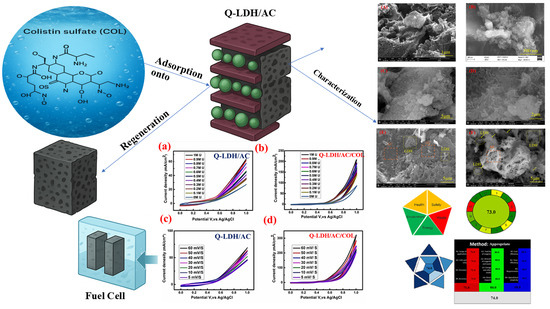
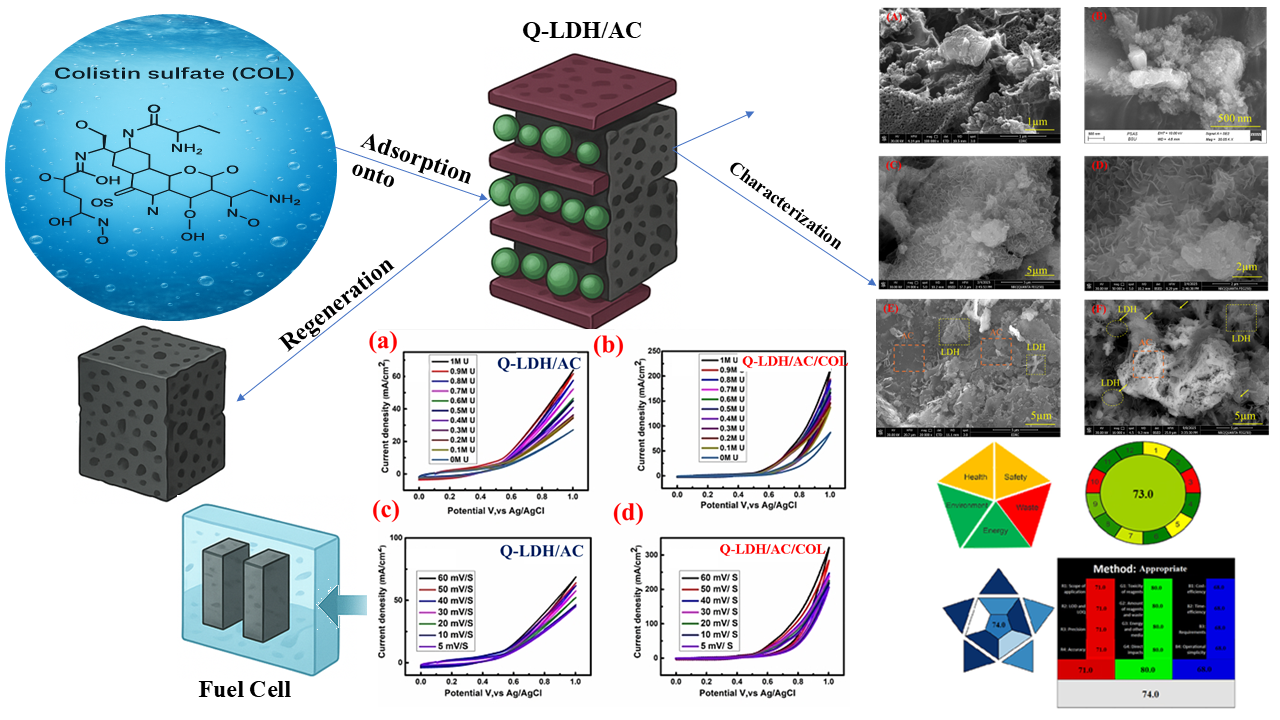
Graphical Abstract

1. Introduction

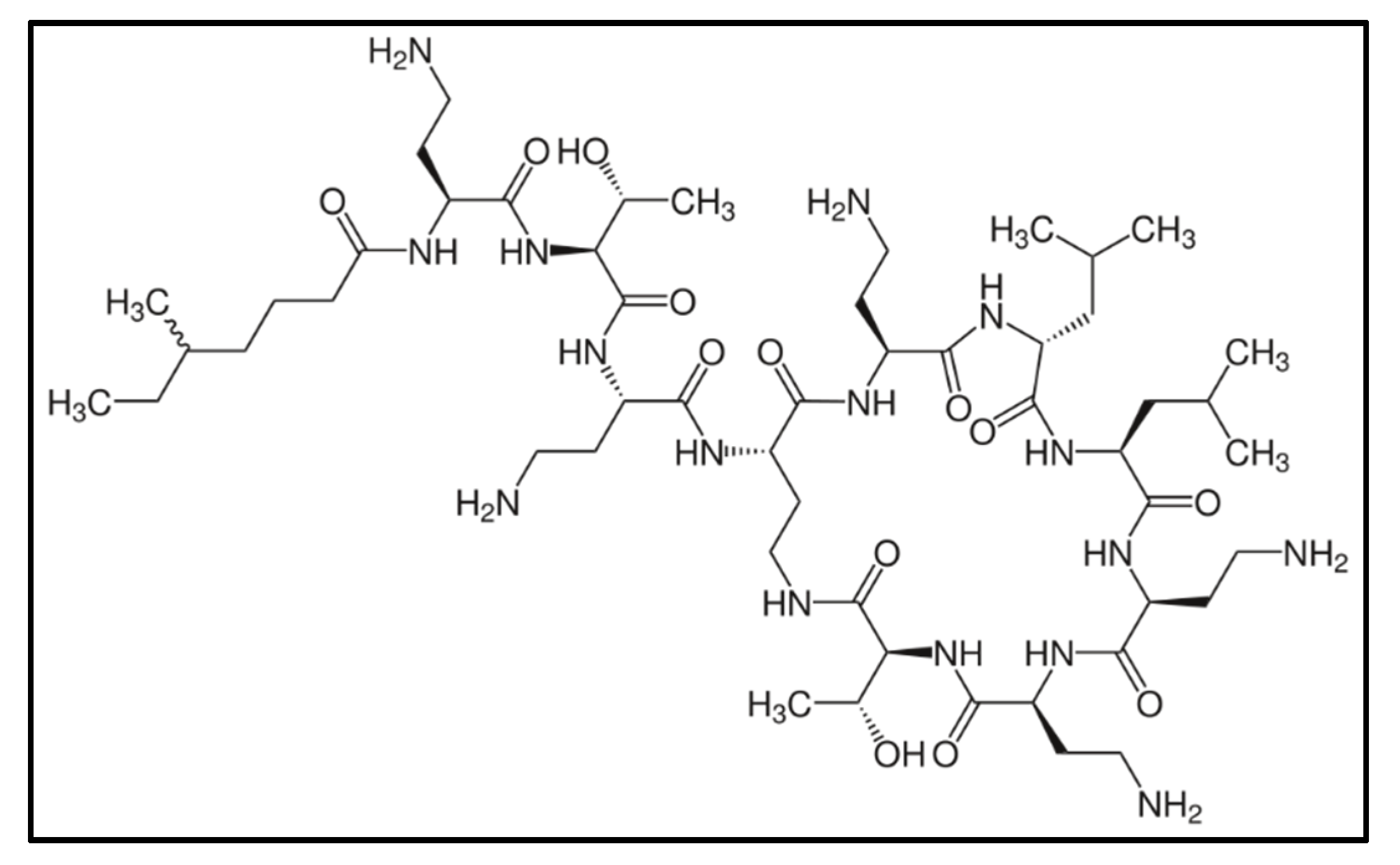
Colistin (polymyxin E), a cationic lipopeptide antibiotic, represents one of the most critical last-resort therapeutic agents against multidrug-resistant (MDR) Gram-negative bacterial infections, particularly those caused by carbapenem-resistant Enterobacteriaceae and Acinetobacter baumannii (Figure 1) [1]. The unprecedented surge in colistin usage across clinical and veterinary settings has inadvertently accelerated the emergence of colistin-resistant bacterial strains. Of particular concern are those harboring mobilized colistin resistance genes, which pose an imminent threat to global public health security [2]. The environmental persistence of colistin in aquatic ecosystems is a growing concern, driven by its continuous discharge via multiple pathways, including pharmaceutical manufacturing effluents, hospital wastewater, livestock operations, and agricultural runoff [3]. The identification of the mobile colistin resistance gene in E. coli in China in 2016 underscored how swiftly resistance mechanisms can emerge and spread within environmental contexts [4]. This environmental contamination creates a persistent selective pressure in wastewater systems and receiving waters that actively promotes the proliferation of antibiotic-resistant bacteria and facilitates the horizontal transfer of colistin-resistant bacterial strain genes, effectively making wastewater treatment systems key contributors to the global dissemination of pan-drug resistance [5].
Conventional wastewater treatment plants (WWTPs) demonstrate insufficient efficacy in removing COL due to its chemical stability, high water solubility 50 mg·mL−1, and resistance to biodegradation [6]. Most critically, conventional treatment failures allow biologically active colistin to persist throughout the treatment train and be discharged into receiving waters, where it continues to drive resistance selection. Several advanced treatment technologies have been investigated with several limitations, including biological treatment systems, which suffer from inherent limitations, as the antimicrobial properties of COL inhibit the growth of beneficial microorganisms essential for biodegradation processes. The complex cyclic structure and amphiphilic nature of COL render it recalcitrant to microbial degradation, resulting in incomplete removal and potential accumulation in biological sludge [7].
Advanced oxidation processes (AOPs), including Fenton oxidation, ozonation, and photocatalytic degradation, can achieve substantial colistin degradation but are associated with significant drawbacks, including high energy consumption, the formation of potentially toxic intermediate products, operational complexity, and substantial capital investment requirements [8]. Additionally, the complete mineralization of COL often requires extended treatment times and optimized reaction conditions. Membrane-based technologies such as reverse osmosis and nanofiltration have high rejection rates for colistin but face operational challenges, including membrane fouling, high operational costs, concentrated disposal issues, and the generation of secondary waste streams requiring further treatment [9]. Notably, to the best of our current knowledge, no dedicated studies have investigated colistin removal via membrane filtration or AOPs, highlighting a significant research gap in the field.
In this study, adsorption technology emerges as a particularly promising solution, and our proposed quaternary Ni-Co-Zn-Al LDH/activated carbon composite (Q-LDH/AC) demonstrates distinct advantages over these competing approaches. Unlike biological systems that are inhibited by colistin’s antimicrobial properties, adsorption operates independently of microbial activity. Compared to AOPs that may generate toxic intermediates, adsorption physically sequesters the intact antibiotic molecule, eliminating both the parent compound and its selective pressure without creating transformation products. Furthermore, unlike membrane processes that produce concentrated waste streams containing active colistin, the adsorbent can be regenerated and reused, significantly reducing secondary waste generation.
Recent developments in wastewater treatment technologies have achieved significant improvements in the removal efficiency of numerous hazardous contaminants. Adsorption has emerged as a particularly attractive option because of its cost-effectiveness, operational simplicity, high removal efficiency, and absence of harmful byproduct formation [10]. The success of adsorption technology depends critically on the development of high-performance adsorbent materials with enhanced capacity, selectivity, and regenerability. The adsorption mechanism is governed by the interplay between the adsorbent’s surface properties and the adsorbate’s physicochemical characteristics, primarily involving interactions such as electrostatic attraction, surface complexation, hydrogen bonding, π-π interactions, and pore-filling [10,11]. Different classes of adsorbents leverage these mechanisms to varying degrees. For instance, activated carbon (AC) relies heavily on its extensive microporous network for physical adsorption and van der Waals forces, but its performance for polar or ionic contaminants can be limited without specific surface functionalization [12]. Carbon nanotubes (CNTs) offer high surface area and potential for π-π stacking with aromatic compounds, yet they often suffer from aggregation and high production costs [13]. Metal–organic frameworks (MOFs) possess ultra-high surface areas and tunable porosity but can exhibit poor hydrostability and complex synthesis [14]. In contrast, layered double hydroxides (LDHs) are 2D anionic clay materials with tunable compositions and interlayer spacings, high surface areas, and strong anion exchange capacity [15] and possessing relatively high surface areas (80–250 m2 g1) depending on their metal composition and synthesis route. Their structure supports adsorption via anion exchange, electrostatic forces, surface complexation, and reconstruction [11,16]. However, LDHs alone can face limitations, including a tendency for layer stacking which reduces accessible surface area, moderate specific surface area compared to advanced carbons or MOFs, and challenges in separation and regeneration post-adsorption due to their fine powder nature [17]. To overcome these limitations and create superior adsorbents, the integration of LDHs with other materials, particularly activated carbon, has been pursued.
Quaternary LDH systems, which incorporate four different metal cations, offer significant advantages over binary and ternary LDH systems through synergistic effects that increase structural stability, expand the range of adsorption mechanisms, and improve overall adsorption capacity [13]. The incorporation of transition metals such as Ni, Co, and Zn alongside Al creates a heterogeneous surface with various Lewis acid sites, enhanced electron transfer properties, and increased surface reactivity. The integration of LDH with AC creates hybrid materials that combine the unique advantages of both components [18]. Activated carbon contributes to extensive microporosity, a high specific surface area, and diverse surface functional groups, whereas LDH provides anion-exchange capacity and surface complexation sites [14]. This synergistic combination not only mitigates the individual drawbacks such as preventing LDH layer stacking and enhancing overall surface area and mechanical stability but also results in enhanced adsorption capacity through multiple concurrent mechanisms, including physical adsorption within AC pores, electrostatic interactions with LDH layers, hydrogen bonding, and π-π interactions with aromatic compounds.
To firmly establish the novelty and superior performance of the Q-LDH/AC composite, its performance can be benchmarked against other advanced adsorbents reported for antibiotic removal. The Q-LDH/AC composite achieves an exceptional adsorption capacity of 952.52 mg·g1 for colistin. This performance significantly surpasses that of many tailored composites used for other antibiotics, such as a Mg-Al-LDH/AC nanocomposite for tetracycline (106.4 mg·g1) [16], a graphene oxide/LDH composite for ciprofloxacin (106.97 mg·g1) [17], and a La-doped Zn-Fe-LDH for tetracycline (170.39 mg·g1) [19]. Furthermore, it vastly outperforms functionalized materials like nitrilotriacetic acid-functionalized magnetic graphene oxide for tetracycline (212 mg·g1) [20]. While these comparisons across different antibiotic molecules must be interpreted with caution, they strongly indicate that the quaternary LDH/AC architecture possesses a fundamentally superior adsorption potential [21,22]. Crucially, this high performance is achieved at a neutral pH of 7.0, enhancing its practicality for real wastewater treatment without costly pH adjustment. Therefore, this composite not only sets a new benchmark for the challenging removal of the critical last-resort antibiotic colistin that is for which no prior Q-LDH/AC adsorbents have been reported but also positions itself as a top-tier material in the broader field of antibiotic remediation.
Despite extensive research on various adsorbent materials for antibiotic removal, a comprehensive analysis of the existing literature confirms that no previous studies have investigated the application of quaternary LDH/AC composites specifically for the removal of colistin from aquatic systems. This gap is compounded by a broader challenge in the field: the rapid development of complex material chemistries has often led to inconsistent terminology and a lack of standardized frameworks for describing next-generation adsorbent functionalities, creating ambiguity that hinders the clear translation of fundamental research into practical engineering solutions [23]. The unique physicochemical properties of COL, including its cationic nature at physiological pH, amphiphilic structure, and multiple functional groups, suggest that Q-LDH/AC composites could provide superior adsorption performance through complementary interaction mechanisms.
However, a critical and often overlooked research gap exists not only in the application of these advanced composites for colistin remediation but also in developing a sustainable end-of-life strategy for the spent adsorbent. A fundamental limitation of conventional adsorption technologies is that they merely transfer the pollutant from the aqueous phase to a solid phase, creating a concentrated, hazardous solid waste that requires disposal, often by incineration or landfilling. This “transfer-and-dispose” paradigm simply shifts the environmental burden and fails to align with the principles of a circular economy. To truly advance sustainable water treatment, innovative strategies are needed to valorize spent adsorbents, transforming them from a liability into a valuable resource [24,25]. The purpose of this work was to address these critical gaps by creating and characterizing a novel Q-LDH/AC composite for the efficient removal of COL from contaminated water systems and, crucially, to pioneer a circular economy pathway for the spent material. This study is the first to use Q-LDH/AC composite materials to remove COL, and a comparative performance analysis demonstrated that it achieved an excellent adsorption capacity that greatly exceeded previously reported values for COL removal from aqueous systems. Furthermore, this study introduces a pioneering circular economy approach by demonstrating that the spent COL-laden adsorbent is not a waste product but can be valorized as an effective electrocatalyst. Specifically, we propose that the unique composition of the spent adsorbent—a carbon–metal matrix functionalized with nitrogen and sulfur-rich organic molecules from colistin—makes it an ideal precursor for a high-performance electrocatalyst [26,27]. We demonstrate its application in direct urea fuel cells (DUFCs), a technology that simultaneously treats urea-rich wastewater and generates energy. This dual functionality (first removing a critical antibiotic and then repurposing the captured pollutant to aid in energy generation from another wastewater contaminant) represents a transformative step towards closing the loop in water treatment processes.
Urea electrooxidation is becoming prominent as a treatment option for electrocatalysts. Electro-oxidation is based on the exchange of electrons from urea to the anode, and electrocatalysts aid in accelerating the reaction while minimizing the needed overvoltage. Electrooxidation offers several advantages, such as high pollutant removal efficiency, energy recovery capability, and the elimination of secondary pollutant formation. In addition, the process operates under mild conditions, making it a more eco-friendly option compared to conventional treatment methods [28]. Researchers are striving to develop novel electrocatalysts with low starting voltages and strong catalytic activity. In this study, we propose and validate that COL-contaminated materials are excellent electrocatalyst electrodes for DUFCs, thereby closing the loop and creating a sustainable lifecycle for the adsorbent material from pollutant removal to energy generation.

2. Results and Discussion

2.1. Characterization of the Q-LDH/AC Material

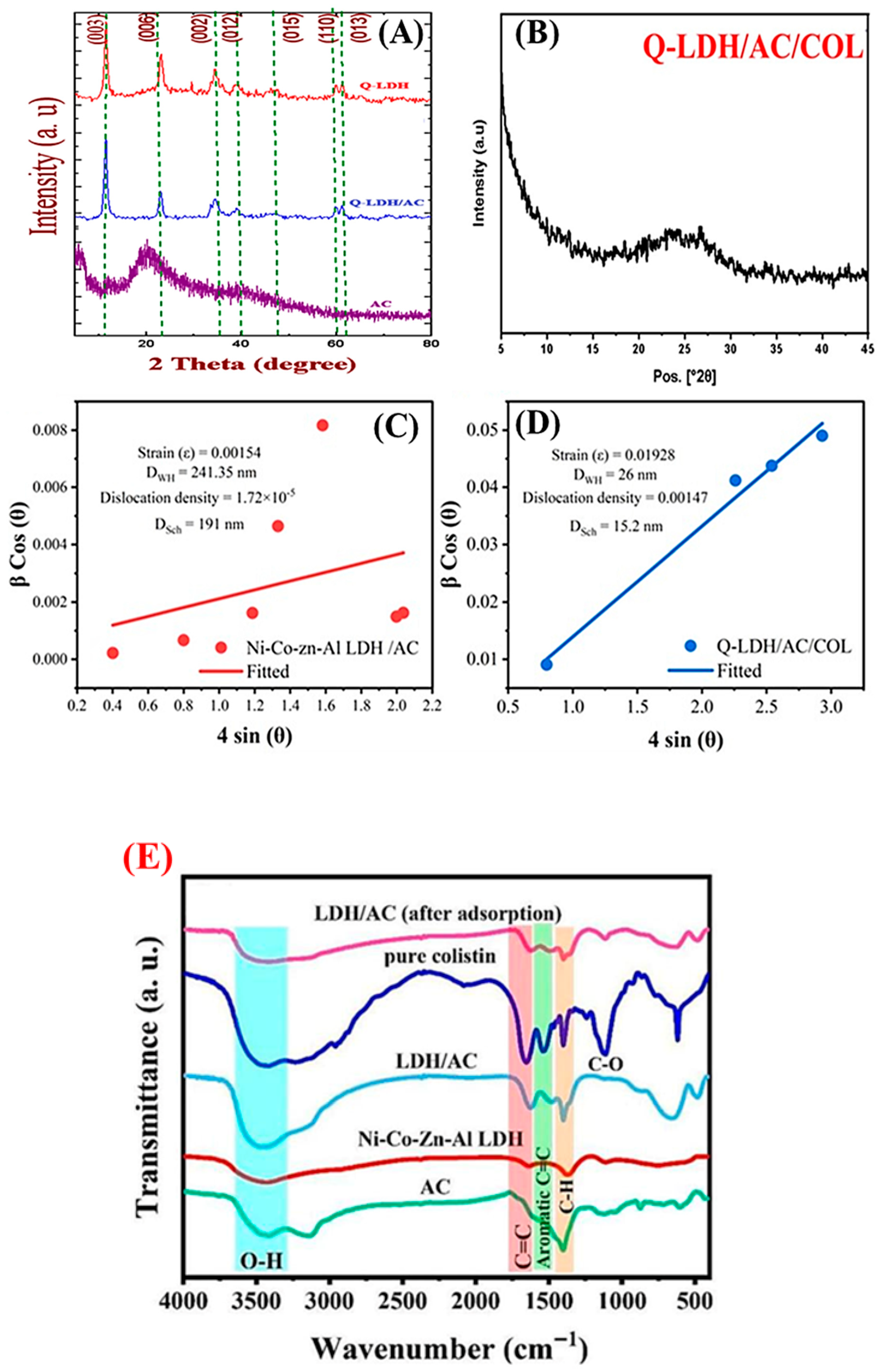
The crystallinity and phase purity of the synthesized AC, Q-LDH and Q-LDH/AC were evaluated via powder X-ray diffraction (XRD). As shown in Figure 2A, the X-ray diffractograms of AC show two broad, amorphous halo peaks centered at 24.8° and 43.7°, which are assigned to the (002) diffraction plane, which indicates a disordered aromatic carbon matrix, and the (100) reflection plane, which is associated with graphitic domains [29,30]. Furthermore, the XRD pattern of the Q-LDH and Q-LDH supported on AC (Q-LDH/AC) closely matches the standard JCPDS card (No. 38-0487), indicating the production of a hydrotalcite-like structure with a rhombohedral crystal system. X-ray diffraction of the synthesized Q-LDH and Q-LDH/AC composite revealed distinctive reflections at 2θ = 11.49°, 23.17°, 35.27°, 38.99°, 47.87°, 60.44°, and 63.05°, which were indexed to the (003), (006), (012), (015), (018), (110), and (113) crystallographic planes, respectively. The Q-LDH/AC compound exhibits patterns indexed to the (003) and (006) levels compared to LDH. We note that the intensity of the (006), (002) and (012) plans decreased, which confirms the preparation of the composite material, reflecting the structure of LDH, the phase structure, and the effect of adding activated carbon [31,32]. This diffraction pattern demonstrated the successful creation of a well-ordered hydrotalcite-type phase via the hydrothermal synthesis process [33]. The observed peak positions and relative intensities demonstrate the high phase purity and crystallinity of the as-prepared LDH material. The emergence of well-defined, narrow diffraction peaks in the X-ray diffraction pattern provides clear evidence of the high degree of crystallinity of the material, demonstrating long-range atomic ordering within the crystal lattice. Additionally, the XRD pattern of the Q-LDH/AC composite exhibited a characteristic diffraction peak at 2θ = 26.35°, which corresponds to the (002) crystallographic plane of graphitic carbon, confirming the presence of the AC component in the composite structure [34].
Figure 2C shows a peculiar diffraction peak at approximately 2θ= 25° for COL. The characteristic diffraction peak of Q-LDH/AC decreases in strength and nearly disappears in Q-LDH/AC/COL. This suggests that the addition of COL influences the crystallization properties of Q-LDH/AC, which may be attributed to hydrogen bonding and electrostatic interactions between positively and negatively charged ions in the Q-LDH. Furthermore, the intensity of the diffraction peaks decreased. These unique diffraction peaks all changed and weakened, indicating that electrostatic interactions entirely involved the intercalation of COL into Q-LDH/AC and that Q-LDH/AC/COL was successfully prepared through crosslinking and electrostatic interactions [35]. The basal spacing of only 0.81 nm is consistent with nitrate-intercalated LDHs [36]. It is noteworthy that the apparent degree of crystallinity, estimated from the XRD peak area analysis, increased from 23.7% for AC to 25.33% for Q-LDH/AC. This increase (Q-LDH/AC) can be attributed to the improved ordering of the LDH layers, which enhances the intensity and sharpness of the characteristic LDH reflections. Upon colistin sulfate loading, the crystallinity decreased to 17.5% for Q-LDH/AC/COL, which can be attributed to the introduction of the amorphous drug and the partial disruption of the LDH layer ordering. Moreover, the crystallite size was calculated using the Williamson–Hall method and the results were compared with those obtained from the Scherrer equation to evaluate the effect of lattice strain (Figure 2C,D). The close agreement between the Scherrer and Williamson–Hall crystallite sizes indicate negligible lattice strain.
Figure 2B shows the FTIR spectra of AC, Q-LDH, the synthesized Q-LDH/AC composite, pure COL, and the Q-LDH/AC composite after COL adsorption. The FT-IR spectrum of AC confirmed the presence of multiple functional groups associated with its complex structure. The broad absorption band observed at 3431 cm1 corresponds to O-H stretching vibrations, which typically originate from hydroxyl groups within cellulose, hemicellulose, and lignin frameworks. The peak at 1400 cm1 is due to C–H bending vibrations of -CH3 alkyl groups, which are typically found in carbon-rich materials. The band at 869 cm1 corresponds to the out-of-plane bending vibrations of C–H bonds in aromatic ring structures [37,38].
In the FT-IR spectrum of the Q-LDH, a broad absorption band centered at approximately 3435 cm1, is attributed to the stretching vibrations of hydroxyl groups within the LDH layers, as well as associated interlayer water molecules [39]. Additionally, a distinct peak observed at 1635 cm1 corresponds to the symmetric and asymmetric bending vibrations of water molecules residing in the interlayer spaces of the Q-LDH structure [40,41]. Furthermore, a prominent absorption band at 1371 cm1 corresponds to the characteristic ν3 and ν2 stretching vibrations of interlayer nitrate (NO3) ions within the LDH structure [42]. The absorption features detected below 1000 cm1, specifically at 780, 632, and 570 cm1, are ascribed to lattice vibrational modes associated with metal–oxygen bonds, including Ni–O, Co–O, Zn–O, and Al–O, which are indicative of the hydrotalcite-like framework of the Q-LDH material [43]. The FT-IR spectrum of the Q-LDH/AC composite reveals distinct absorption bands corresponding to both the Q-LDH and the AC components. Notably, several characteristic peaks of the individual constituents exhibit significant overlap, indicating successful integration of the Q-LDH into the AC matrix. The hydroxyl moieties present in the Q-LDH framework can engage in hydrogen bonding with diverse functional groups inherent to AC compounds, such as phenolic, carboxyl, and hydroxyl functionalities [44,45]. Furthermore, owing to the inherent surface charge of LDH lamellae, the potential for electrostatic interactions remains substantial.
COL has a distinct structure (Figure 1), as well as the FTIR spectral peaks, which serve as key identifying features. Notably, a distinct absorption band at 3427.9 cm1 corresponds to the O–H stretching vibration of the carboxylic acid functional group; the amide I carbonyl (C=O) stretching vibration appears at 1645.0 cm−1, whereas the amide II N–H bending mode is observed at 1525.4 cm−1. Additionally, a characteristic peak at 1109.4 cm−1 corresponds to C–N stretching vibrations [46]. These spectral signatures collectively provide a unique fingerprint for colistin identification. Following colistin adsorption, substantial alterations in the characteristic FTIR spectral bands were detected. Prominent intensity variations occurred in the vibrational bands associated with both chemically and physically bound O–H groups, along with discernible shifts in the wavenumbers of the C–H, Ni–O, Co–O, Zn–O, and Al–O vibrational modes. These spectral alterations confirmed the adsorption processes and highlighted the crucial role of these functional groups in colistin uptake. The conclusions of the FTIR study were corroborated via SEM analysis data, which demonstrated the passivation of colistin residues on the Q-LDH/AC/COL composite surface.
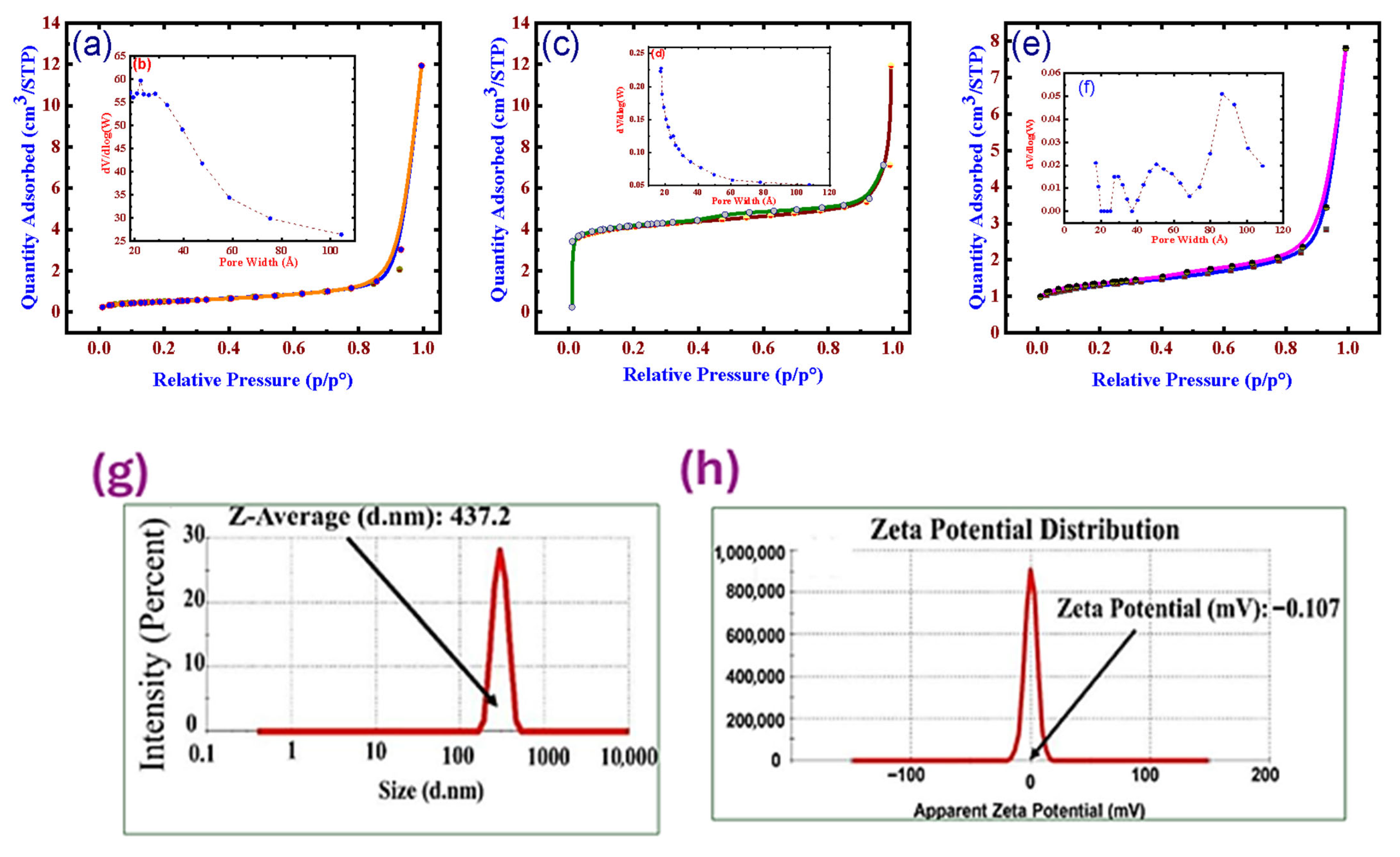
The nitrogen adsorption–desorption isotherms of Q-LDH, AC, and the Q-LDH/AC composite (Figure 3a) all exhibited IUPAC Type IV patterns with H3-type hysteresis loops, characteristic of slit-shaped pores commonly found in layered and carbonaceous materials. The BET surface area of the Q-LDH/AC composite was determined to be 45.4 m2 g1, which is intermediate between that of AC alone (58.9 m2 g1) and Q-LDH alone (28.7 m2 g1). This suggests that the composite integrates the high surface area of AC with the layered structure of LDH, without pore blocking. The average pore diameter (18.6 nm) and pore volume (0.39 cc g1) of the composite indicate a mesoporous structure that facilitates efficient contaminant diffusion, thereby enhancing adsorption capacity. The synergistic combination in Q-LDH/AC results in balanced porosity and accessible active sites, which are critical for the high adsorption performance observed (Table S1).
These textural qualities are beneficial for improving the adsorption performance because they promote active site accessibility and allow for efficient mass transport of COL. Figure 3b depicts the particle size distribution, which includes a thin, monodisperse peak centered at approximately 400–500 nm, indicating a homogenous submicron particle population. The zeta potential measurement (Figure 3c) revealed a very negative surface charge of approximately −45 mV, indicating exceptional colloidal stability and significant electrostatic repulsion between particles. This negative zeta potential is due to the presence of hydroxyl groups and negatively charged surface sites on the composite material, which is especially beneficial for cationic species adsorption and increases the dispersibility of the material in aqueous solutions.
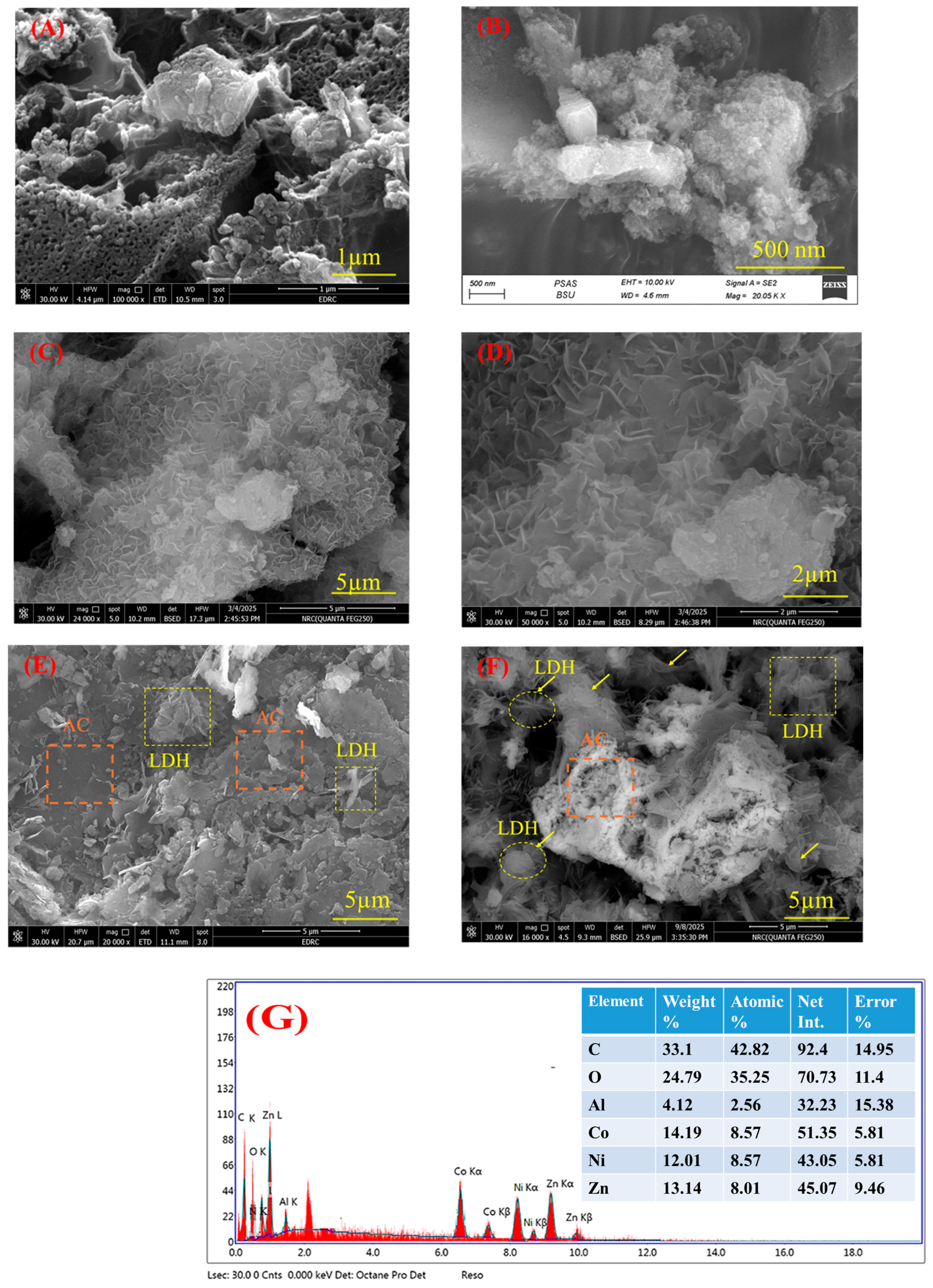
The morphological characteristics and surface topography of pristine AC, Q-LDH, and the Q-LDH/AC composite were systematically examined by scanning electron microscopy (SEM), with a particular emphasis on particle morphology, size distribution, and spatial arrangement. The representative scanning electron micrographs displayed in Figure 4A–F offer comprehensive morphological characterization of the investigated materials. As shown in Figure 4A, the activated carbon microstructure has an extensively developed porous architecture featuring a complex three-dimensional network of interconnected cavities and void spaces. This distinctive porous morphology, characteristic of high-surface-area activated carbon, significantly contributes to enhanced adsorption performance through substantial surface area availability. Furthermore, the well-defined porous network facilitates optimal molecular transport phenomena and effective adsorbate retention within the carbon matrix. In addition, the SEM images of the Q-LDH (Figure 4C,D) clearly revealed a morphological transformation upon Q-LDH incorporation. Plate-like or flake-like Q-LDH crystallites are visibly dispersed. From Figure 4E,F we can see the growth of Q-LDH over the AC surface, indicating successful deposition of the layered double hydroxide onto the porous carbon substrate. Compared with pristine AC, the composite structure has a more compact and textured surface, with Q-LDH nanosheets appearing as aggregated or stacked lamellar structures. The chemical composition of the prepared Q-LDH/AC composite was confirmed by energy-dispersive X-ray (EDX) analysis (Figure 4G). The EDX spectrum revealed the presence of C (33.31 wt%), O (24.79 wt%), Al (4.12 wt%), Co (14.19 wt%), Ni (12.01 wt%), and Zn (13.14 wt%), verifying the successful incorporation of AC and the formation of the quaternary Ni–Co–Zn–Al LDH structure with the intended stoichiometric proportions.
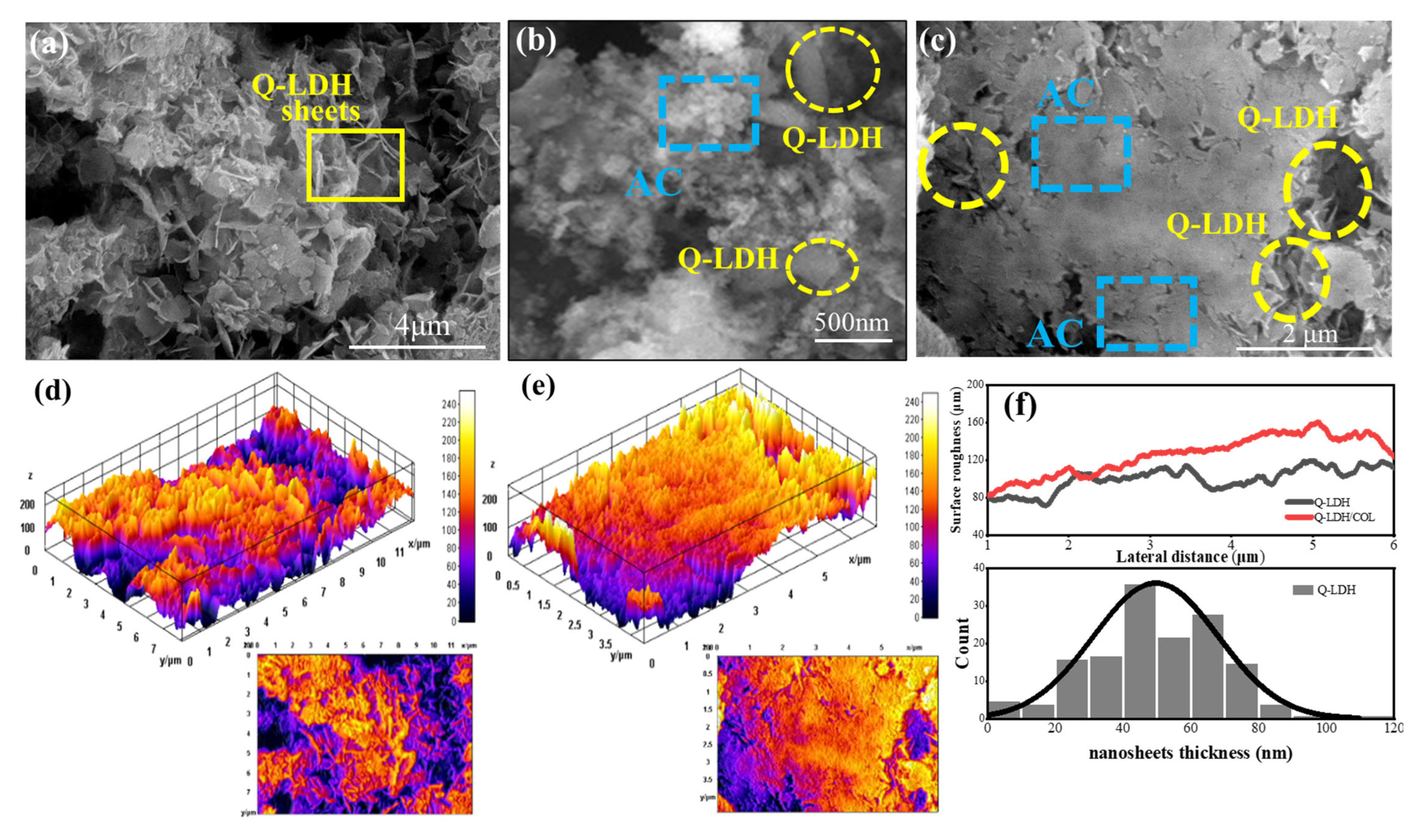
The COL was applied via an adsorption method, where the substrate was immersed in the COL solution and then assembled (as red rectangle), with partial overlap of the 2D material (Figure 5). A geometric veil of treatment above the composite was observed in the SEM and topography images (Figure 5d,e), including wrinkles or cracks with inactive areas amenable to further treatment. Figure 5f shows both the surface roughness profile and the average nanosheet thickness distribution. In particular, the results show an increase in height and relative uniformity of surface roughness with a decrease in average hole thickness from 210–95 nm to 137–53 nm. The average Q-LDH thickness distribution was measured at 49.5 nm. Accordingly, a consolidation that improved the internal surface areas of the composite with layer convergence and stronger electron transfer was observed.
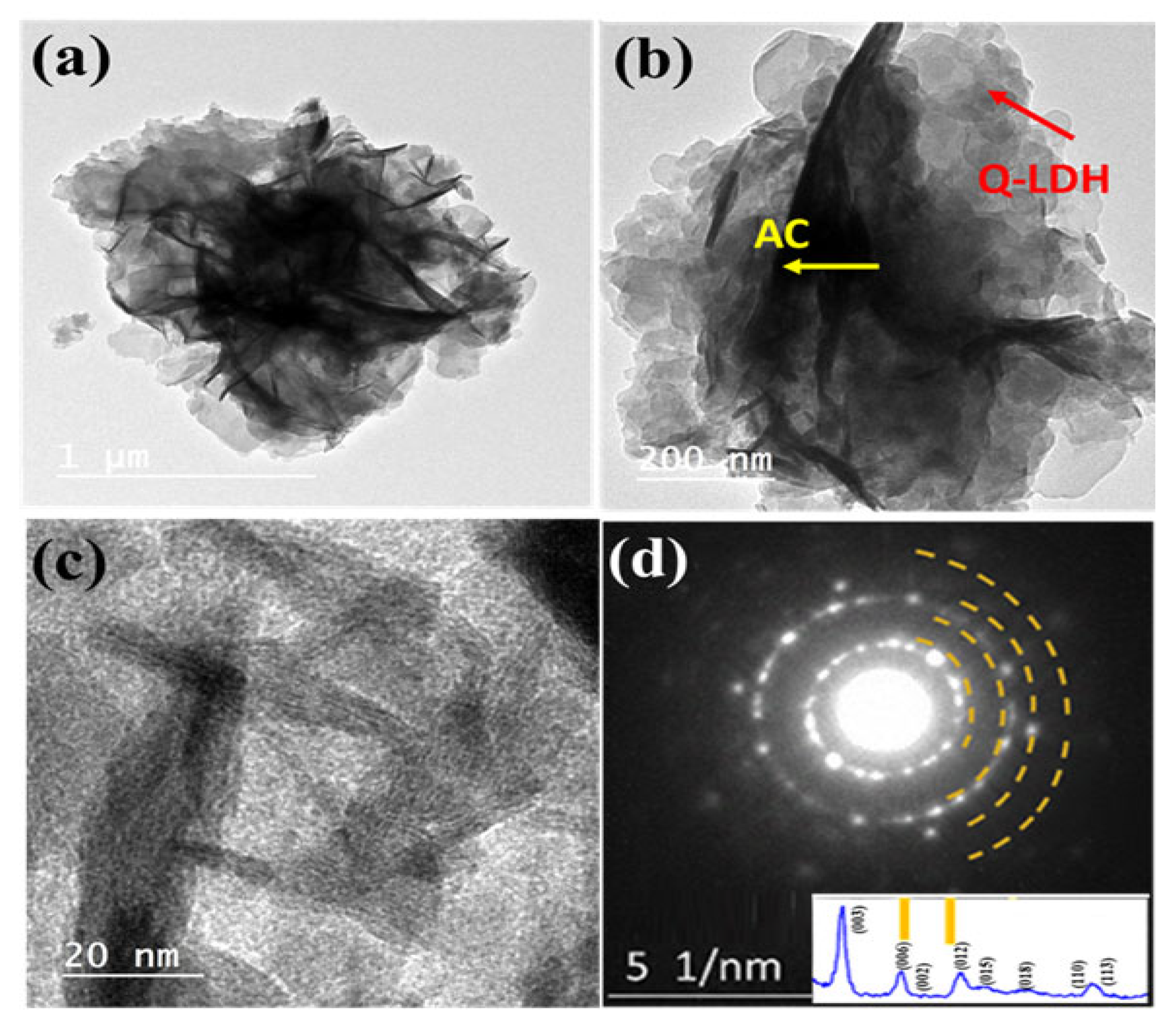
Transmission electron microscopy (TEM) analysis revealed that the AC particles in the Q-LDH composite have different thicknesses (39–60 nm) on the surface (Figure 6a–c). The TEM image of the fabricated LDH electrode shows that the surface nanolayers are doped with carbon (average diameters between 39 and 60 nm), indicating the homogeneity of the interpenetration of the composite materials. The selected area electron diffraction (SAED) pattern exhibited distinct features reflecting the nanostructure and hybrid structure of the material in Q-LDH/AC, as shown in Figure 6d. Overall, the low intensity with a broad diffraction halo is attributed to the presence of carbon in the yellow region. In parallel, sharp diffraction, spots and discontinuous rings resulting from nano crystallinity appears within the LDH layers with common crystal planes such as (003), (006), (012), (110), and (113). The variation in the intensity and distribution of these spots is related to the distribution of cations (Ni2+, Co2+, Zn2+, and Al3+) within the layers and their effect on lattice distortion. This pattern is clear evidence of the formation of a crystalline, nanostructured, and hybrid composite.

2.2. Optimization Adsorption Studies

2.2.1. Effect of pH

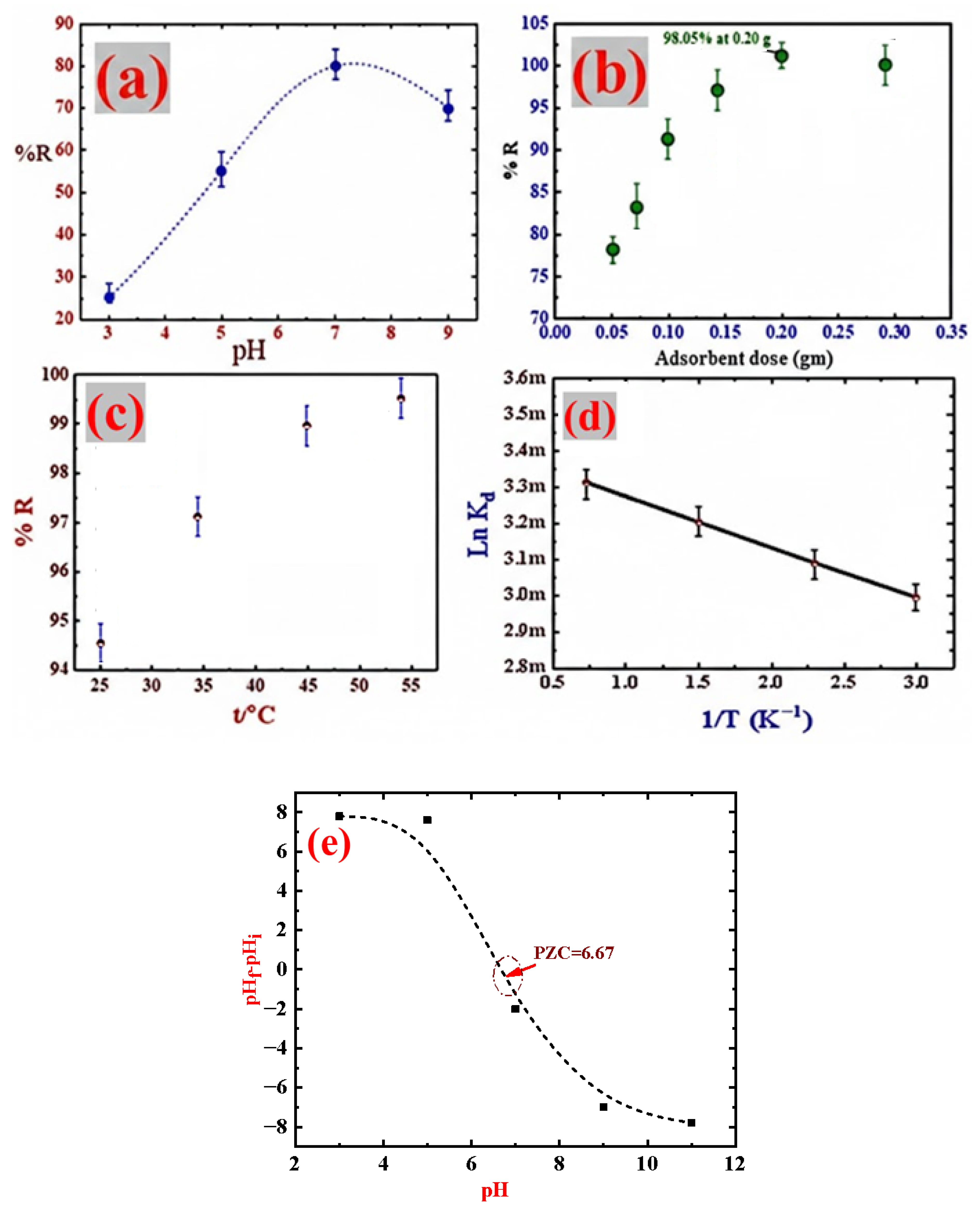
The pH of the aqueous solution has a substantial effect on the adsorption of COL onto the Q-LDH/AC composite because it affects both the surface charge of the adsorbent and the speciation of colistin molecules (Figure 7). Adsorption studies were carried out over a pH range of 3–10 to assess the pH-dependent adsorption behavior. The results showed that the adsorption capacity increased gradually from pH 3 to pH 7, with the highest removal effectiveness occurring at pH 7, followed by a gradual reduction at higher pH values (pH 9 and 10). This observed trend, where adsorption capacity increases from acidic to a neutral pH optimum, is consistent with findings from previous studies on the adsorption of other cationic and amphoteric antibiotics. For example, similar pH-dependent behavior has been reported for the adsorption of tetracycline onto layered double hydroxide-based adsorbents [47] and functionalized graphene oxide [20]. This consensus supports the proposed mechanism that a pH near neutrality minimizes electrostatic repulsion between the cationic antibiotic and the adsorbent surface.
The adsorption capacity was rather low under strongly acidic conditions (pH 3) owing to the protonation of surface functional groups on the Q-LDH/AC composite, which resulted in a positively charged surface that electrostatically repelled the cationic COL species. This is consistent with the known behavior of colistin, a cationic antibiotic whose adsorption is highly influenced by electrostatic interactions [48]. As the pH increased to 7, the adsorption capacity increased significantly, reaching its maximum. This optimal pH aligns with the point of zero charge (PZC) of the composite (~6.67), creating a favorable electrostatic environment for attracting the positively charged colistin molecules (Figure 7). The effectiveness of neutral pH for colistin adsorption and interaction is also corroborated by studies on its environmental fate and analytical detection [49,50].
At pH 7, which roughly approximates physiological pH values, the adsorbent surface charge is near neutral (close to pHpzc = 6.67) (Figure 7e). COL occurs as a mixture of H55+ (~40%) and H44+ (~35%) species at this pH, maintaining a moderate positive charge that is optimal for interactions with the slightly negatively charged surface sites without excessive electrostatic repulsion. Furthermore, this pH replicates typical environmental circumstances, and the surface functional groups on both Q-LDH layers and AC are well positioned for hydrogen bonding and surface complexation.
The adsorption capacity gradually decreased with increasing pH (pH 9 and 11), as illustrated in Figure 7a. Although the adsorbent surface becomes more negatively charged, the total adsorption effectiveness is reduced due to (i) partial deprotonation of COL (pKa < 10) [51], leading to reduced positive charge density and weaker electrostatic interactions; (ii) increased competition from hydroxide ions (OH) for adsorption sites; and (iii) potential structural changes in the Q-LDH layers under highly alkaline conditions that may reduce surface accessibility. The pH-dependent adsorption behavior confirms that electrostatic interactions play a crucial role in the adsorption mechanism while also demonstrating the importance of surface complexation and hydrogen bonding interactions at the optimum pH. The identification of pH 7 as optimal is particularly important for practical applications, as it eliminates the need for extensive pH adjustment in real wastewater treatment scenarios, thereby reducing operational costs and chemical consumption.

2.2.2. Effect of Adsorbent Dose

The removal effectiveness of COL by the Q-LDH/AC composite was studied by changing the adsorbent mass from 0.05 g to 0.30 g at a fixed COL concentration (50 µg/mL) and pH 7. As shown in Figure 7b, the removal efficiency increased sharply with increasing adsorbent dose up to 0.20 g, with a maximum removal efficiency of over 98% achieved. This can be attributed to the greater availability of active sites and increased surface area for COL binding as the adsorbent dose increases, facilitating more effective adsorption of COL molecules from solution [52]. At low doses (<0.2 g), the restricted number of adsorption sites compared with the amount of COL present results in inadequate elimination. Increasing the adsorbent dose beyond 0.20 g resulted in very modest gains in removal efficiency, indicating that the adsorption process has reached equilibrium and that most COL molecules have already been collected [53,54]. The observed plateau in removal effectiveness at higher adsorbent dosages is due to an oversupply of adsorbent, which can cause particle aggregation, limiting the effective surface area and creating overlapping or blocking of active sites. Furthermore, with increasing dose, the concentration gradient between the solution and the adsorbent surface decreases, thus limiting the driving force for mass transfer. The optimal adsorbent dose for subsequent studies was 0.20 g, which combines excellent removal effectiveness with material economy and operational practicality.

2.2.3. Effect of Temperature and Thermodynamic Study

The effects of temperature on COL adsorption on the Q-LDH/AC composite were studied at 25, 35, 45, and 55 °C, pH 7, and an adsorbent dosage of 0.20 g (Figure 7c). The study revealed that increasing the temperature significantly improved both the adsorption capacity and removal efficiency, peaking at 55 °C. The removal efficiency increased from 82.4% at 25 °C to 98.7% at 55 °C, suggesting that higher temperatures improve the adsorption process [55]. A variety of mechanisms contribute to this temperature-dependent rise. First, increasing the temperature increases the kinetic energy of COL molecules, which increases their mobility and diffusion rate toward the adsorbent surface, allowing for more effective contact and penetration into the porous structure of the Q-LDH/AC composite [56]. The observed endothermic character of the adsorption process, as confirmed by the positive value of ΔH° obtained from thermodynamic analysis, shows that high temperature promotes the breaking of intermolecular interactions between COL and water, hence favoring adsorption onto the solid phase [57]. Third, increasing the temperature may improve the flexibility of functional groups on the adsorbent surface, increasing the accessibility and availability of active sites for COL binding [58]. This temperature range was carefully selected to reflect environmentally and industrially relevant conditions commonly encountered in wastewater treatment processes. It simulates typical ambient temperatures as well as moderate elevations found in some industrial effluents, thereby ensuring that the adsorption performance and thermodynamic parameters obtained are applicable to real-world scenarios. Such a range enables accurate characterization of the spontaneous and endothermic nature of the adsorption process, validating the practical feasibility of the composite under fluctuating temperature conditions [59]. Studies by Kiari et al. (2024) [60] and Ibrahim et al. (2022) [61] similarly adopted temperature ranges from 25 to 55 °C to comprehensively assess adsorption thermodynamics and potential application temperature variance [62,63]. A thermodynamic investigation was conducted to better understand the nature and mechanism of the adsorption process. The thermodynamic parameters (ΔG°, ΔH°, and ΔS°) were calculated using adsorption data obtained at different temperatures (Table 1).
The distribution coefficient (Kd = qe/ce) was computed at each temperature, and the adsorption mechanism was evaluated via the van’t Hoff equation:
ln Kd = ΔS°/R – ΔH°/RT
where Kd is the equilibrium constant (L/mg), R is the universal gas constant (8.314 J/mol. K), T is the temperature in Kelvin, and ΔH° and ΔS° are obtained from the slope and intercept of the linear plot of ln Kd vs. 1/T.
The following relationships were used to compute the Gibbs free energy change (ΔG°):
∆G° = RT ln Kd = ΔHo TΔSo
ln Kd = −ΔHo/R (1/T) + ΔSo/R
Both adsorbents showed a straight line when ln Kd was plotted versus 1/T, validating the validity of the van’t Hoff model. The slope and intercept were used to calculate ΔH° and ΔS°, as well as ΔG° at each temperature. The process’s endothermic character is supported by a positive ΔH° value, but its spontaneity is confirmed by negative ΔG° values at all temperatures. Furthermore, the positive ΔS° suggests increased randomness at the solid–solution interface, possibly due to solvent leakage and heightened disorder during COL adsorption. The optimal temperature for COL adsorption onto Q-LDH/AC at pH 7 was found to be 55 °C, which provided the highest removal efficiency and adsorption capacity, consistent with the thermodynamically favorable nature of the process. To correct the standard adsorption parameters for aqueous systems, the equilibrium constant (Kc) was multiplied by the molarity of water (55.5 mol L1). This adjustment accounts for the solute’s standard state (1 M) and the displacement of water molecules from the sorbent surface. After applying this correction, the ΔG° values shifted to a more realistic range (–27.85 to –91.51 kJ mol1), indicating a spontaneous chemisorption process.

2.2.4. Adsorption Kinetics

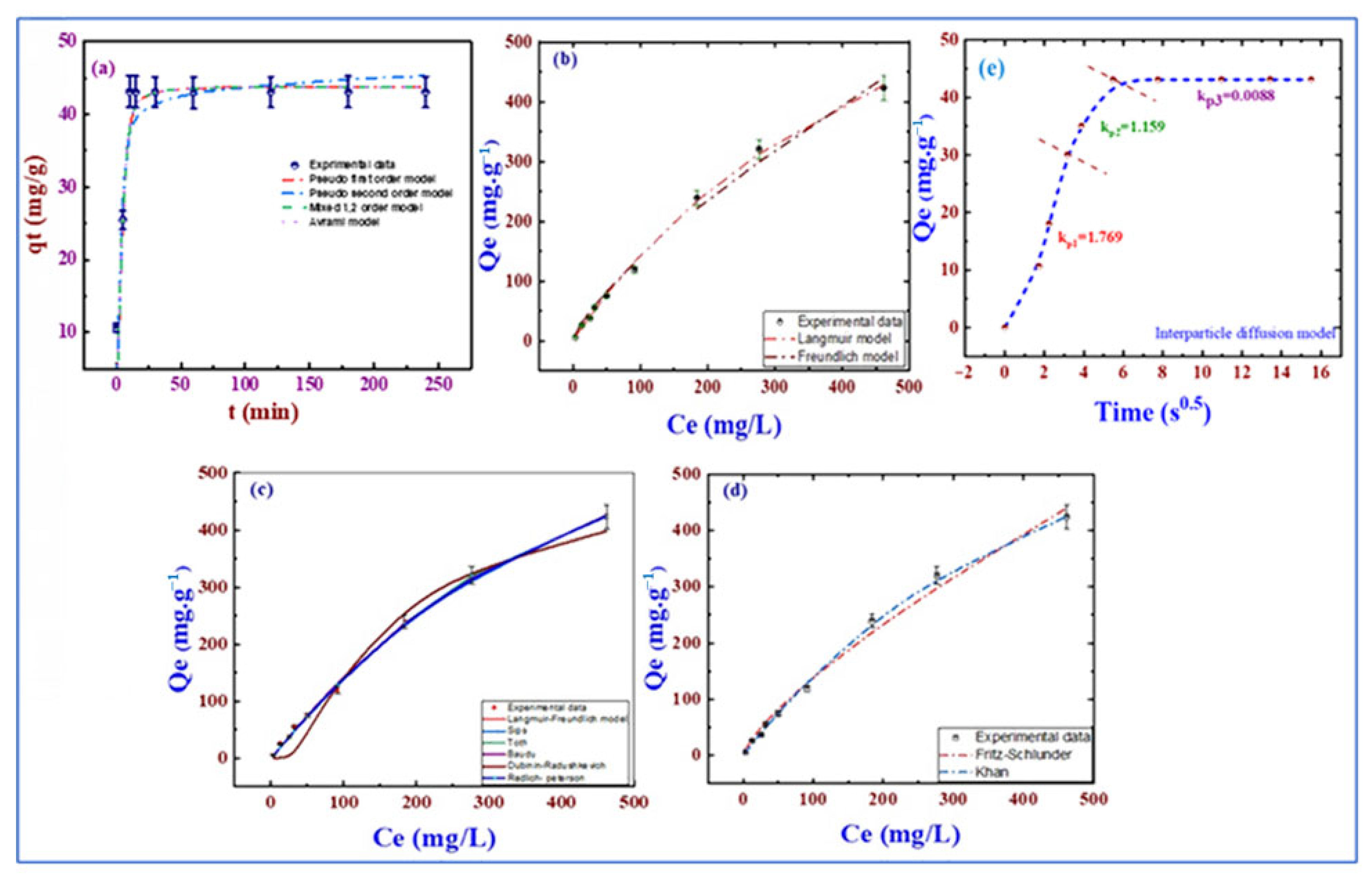
According to the experimental data, COL adsorption onto the Q-LDH/AC composite resulted in a rapid improvement in removal effectiveness during the initial stages, especially within the first 30 min. This could be due to the abundance of active sites on the adsorbent surface. Following this interval, the system achieved adsorption equilibrium. The adsorption process was best represented by the pseudo-first-order, pseudo-second-order, mixed first- and second-order, and Avrami models, all with strong correlation coefficients (R2), as documented in Table 2 and depicted in Figure 8a and Figure S1. The intraparticle diffusion model had a poor correlation (R2 = 0.57), indicating that it was not the key rate-limiting step. In these models, qt represents the adsorption capacity at time t (mg·g1), qe represents the equilibrium adsorption capacity (mg·g1), k1 and k2 are the rate constants for the pseudo-first-order and pseudo-second-order models (min1), respectively, f2 is the mixed-order coefficient (dimensionless), k is the general rate constant (mg·g1·min1), and kip and cip represent the diffusion rate constant and intraparticle diffusion constant (mg·g1), respectively.
The R2 values (PFO = 0.980, PSO = 0.995, Avrami = 0.980, mixed 1,2-order = 0.980, and intraparticle diffusion = 0.570) indicate that the pseudo-second-order (PSO) kinetic model best describes the adsorption of COL onto Q-LDH/AC from aqueous solutions. This shows that the adsorption process is predominantly controlled by chemical interactions between COL molecules and active sites on the adsorbent. Furthermore, the presence of active surface sites has a significant effect on the adsorption capacity. However, the high R2 value and computed qₘₐₓ of the pseudo-first-order (PFO) model suggest a significant contribution from physical adsorption processes.
Kinetic Models: A Statistical Comparison Using Akaike Weights
Akaike weights provide a statistical basis for comparing kinetic models by assigning each model a probability of being the best among a set, while accounting for both goodness-of-fit and model complexity. These weights are derived from the Akaike Information Criterion (AIC) values of the competing models. The weight of model i (Wi) is calculated as follows:
W i = e i 1 2 Δ i r = 1 R e i 1 2 Δ r
where Δi represents the difference between the AIC value of model i and that of the best-fitting model.
The AIC provides a statistically rigorous approach to model selection by penalizing unnecessary complexity and reducing the risk of overfitting, complementing the correlation coefficient (R2), which alone only reflects the goodness of fit [64]. Using the AIC values summarized in Table 2, Akaike weights were calculated to quantitatively assess which kinetic model best represents the experimental data. The results indicate that, among the models tested, the pseudo-first-order (PFO) model—having the lowest AIC value (18.16)—exhibited the highest Akaike weight, confirming it as the most appropriate model for describing the adsorption kinetics of the prepared material.
According to the statistical evaluation, the pseudo-first-order (PFO) model provided the best fit for COL removal by the composite material (Table 3). This conclusion is supported by the lowest error function values and the highest correlation coefficients (R2) approaching unity. Among the five kinetic models tested, the HYBRID model and χ2 test were also identified as the most reliable statistical tools for describing the kinetic behavior, offering the most accurate representation of the experimental data. Minor variations among the results obtained from different statistical criteria may stem from factors such as the number of experimental data points, model parameters, and applied concentration or pressure ranges. Validation using multiple statistical methods confirmed the robustness and consistency of the kinetic interpretation [65].
The linearized plots of the COL adsorption amount versus the square root of time (qt vs. t0.5) are shown in Figure 8, displaying a characteristic triphasic pattern. Three distinct linear regions were required to accurately describe the data, indicating the coexistence of multiple diffusion mechanisms governing the rate-limiting steps of adsorption. The lines do not intersect the origin, suggesting that both film diffusion and intraparticle diffusion contribute to the overall adsorption process [66]. As shown in Table 2, the intraparticle diffusion rate constants follow the order kp1 > kp2 > kp3. The steep initial slope (kp1) corresponds to the rapid external adsorption stage dominated by film diffusion, where COL molecules are quickly transferred to the adsorbent surface. The second, less steep region (kp2) represents the gradual diffusion of COL molecules into the internal pores of the adsorbent. Finally, the nearly flat region (kp3) corresponds to the equilibrium phase, where adsorption slows significantly due to reduced solute concentration and limited micropore diffusion. Overall, based on the Weber–Morris model [67], both film and intraparticle diffusion are key mechanisms controlling the overall adsorption kinetics of COL.

2.2.5. Adsorption Isotherms

To analyze the adsorption behavior of COL on the Q-LDH/AC surface, nine nonlinear equilibrium isotherm models were applied to fit the experimental data. Among these, three are two-parameter models: Langmuir [68], Freundlich [69], and Dubinin–Radushkevich (D-R) [70]. Four models fall under the three-parameter category: Langmuir–Freundlich [71], Sips [72], Redlich-Peterson [73], and Toth [74]. Additionally, one four-parameter model, Baudu [75], and one five-parameter model, Fritz–Schlunder [76], were also employed. Table 4 shows that the Langmuir and Freundlich models best fit the experimental data, with strong correlation coefficients (R2 = 0.99) and superior adsorption capacities. These data indicate that the LDH/AC composite is an efficient and reliable adsorbent for the removal of COL from aqueous solutions, with a maximum adsorption capacity of 952.52 mg·g1, as shown in Figure 8b.
The statistical analysis revealed that the Langmuir isotherm model had the greatest agreement with the experimental data across all the concentration ranges. The statistical evaluation supports this fact, as it shows the highest coefficient of determination (R2), approximately equal to one, and the lowest error values. The chi-square test (χ2) and HYBRID model were most compatible with classical modeling results across eight removal experiments. Other statistical measures’ results may have been influenced by variables such as the quantity of data points, model parameters, and pressure range used. Table 5 summarizes the statistical validation of the classical models, which confirms their reliability.

2.2.6. Mechanism of Adsorption

The adsorption mechanism of COL onto the Q-LDH/AC composite involves multiple synergistic interactions that contribute to its high removal efficiency and exceptional adsorption capacity of 952.52 mg·g1, as shown in Figure 9. Electrostatic attraction serves as the primary mechanism, where the cationic species of COL (H55+ and H44+ at pH 7) interact with the composite surface near its point of zero charge (pHpzc = 6.2), minimizing repulsion and optimizing binding. Surface complexation further enhances adsorption through coordination between the functional groups of COL and the Lewis acid sites formed by the quaternary metal ions (Ni2+, Co2+, Zn2+), whereas hydrogen bonding occurs between the amino and hydroxyl groups of COL and the hydroxyl functionalities on both the Q-LDH layers and AC. Physical adsorption is facilitated by the extensive microporous network of activated carbon, which accommodates the large lipopeptide structure of COL (MW = 1748.2 g/mol), enabling size-selective entrapment. Additionally, anion exchange occurs as the Q-LDH layers intercalate the sulfate moiety of COL within their expandable interlayer spaces. Thermodynamic analysis indicating a positive ΔH° confirms the endothermic nature of the process, where elevated temperatures enhance molecular mobility and diffusion. Kinetic modeling aligns with pseudo-first-order, pseudo-second-order, and Avrami equations, suggesting a multistep mechanism involving initial rapid surface binding followed by slower intraparticle diffusion. Isotherm fitting to Langmuir models (lower chi error function) reveals the presence of both homogeneous and heterogeneous adsorption sites.

2.2.7. Regeneration Research

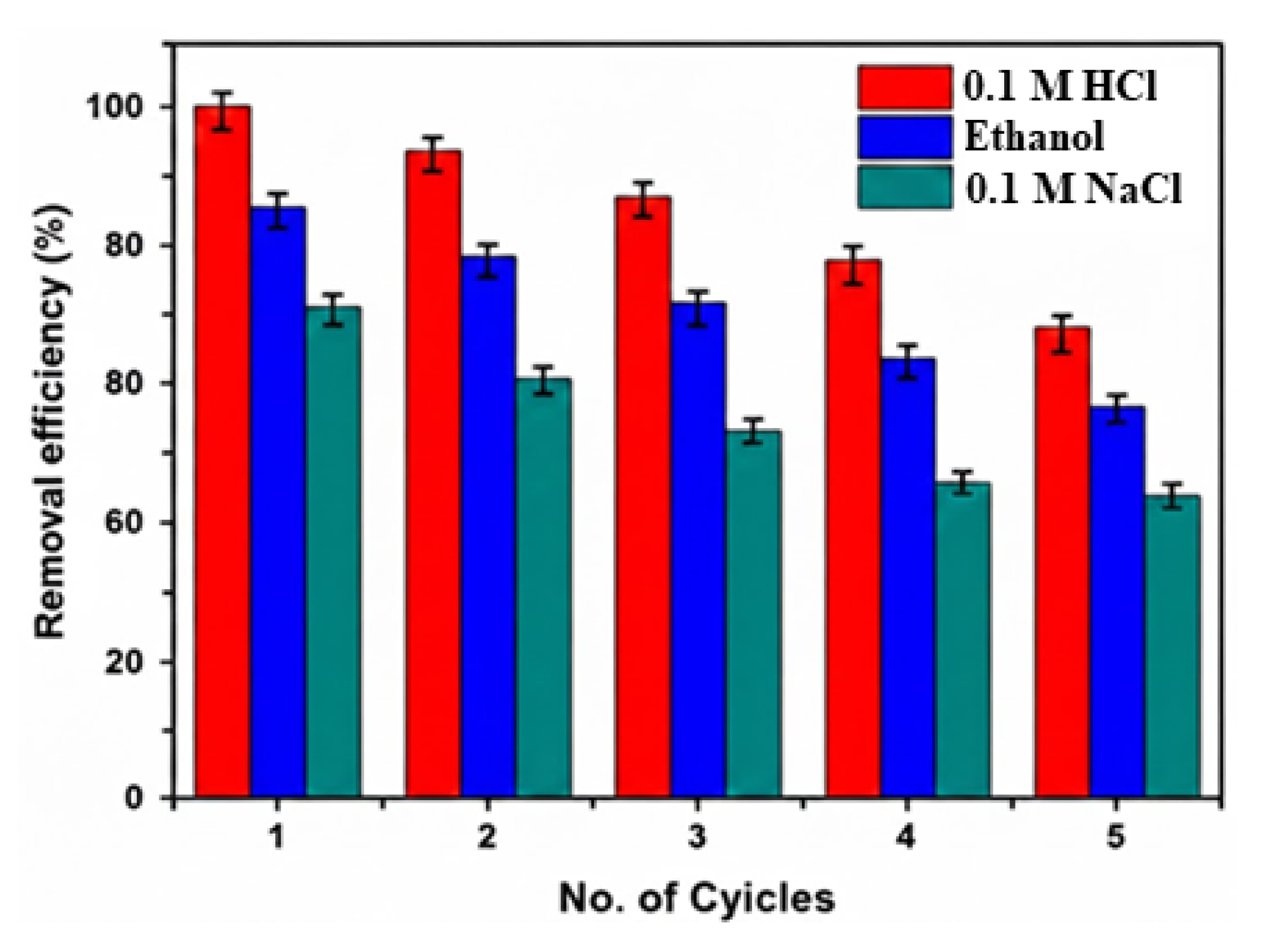
The regeneration of the Q-LDH/AC composite was systematically assessed through multiple desorption cycles using three different eluents, 0.1 M HCl, 0.1 M NaCl, and ethanol (99.8%), to identify the most efficient desorbing agent, as shown in Figure 9. Among them, 0.1 M HCl exhibited the highest desorption efficiency, reaching approximately 85.2%, likely due to the protonation of active adsorption sites and the electrostatic repulsion between H+ ions and the positively charged COL molecules [77,78]. Ethanol achieved moderate desorption (68.5%), possibly via disruption of hydrophobic interactions and hydrogen bonding [79,80]; however, NaCl (0.1 M) displayed the lowest efficiency (44.7%), which was attributed to weaker ionic exchange mechanisms [78,81]. Over five consecutive adsorption–desorption cycles, the Q-LDH/AC composite retained more than 70% of its initial adsorption capacity, demonstrating satisfactory structural integrity and chemical resilience. This decline in performance is commonly attributed to the partial blockage or deterioration of active sites, as reported in previous LDH-based adsorption systems [77,82].

2.3. Comparative Analysis with Existing Colistin Remediation Techniques

A comparative overview of colistin removal techniques reveals diverse approaches with varying adsorption capacities and conditions, as shown in Table 6. The quaternary LDH/AC adsorbent in this study achieved a notably high adsorption capacity of 952.52 mg/g at pH 7, 0.2 g adsorbent dose, 55 °C, and a current density of 206.63 mA/cm2, indicating strong performance under these conditions. In contrast, natural clinoptilolite adsorbents have been used for colistin removal, achieving over 90% removal efficiency for colistin within 120 min with adsorbent doses of g/L [83]. Synthetic zeolites and zeolite–carbon composites derived from fly ash showed over 90% removal efficiency for colistin within 2 min at acidic pH (2–2.5) with adsorbent doses of 1–2 g/L, but their adsorption capacities were not quantified in mg/g, and optimal pH differs from the neutral pH condition [84]. Ferrate (VI) oxidation achieved over 95% colistin degradation at pH 7 and 25 °C within 60 min, focusing on oxidative degradation rather than adsorption capacity [85]. Coagulation with aluminum chlorohydrate reduced colistin concentrations by about 25.5% under mild conditions (pH 6.5, 0.35 mL/L coagulant dose, 30 min), showing lower removal efficiency compared to adsorption methods [86]. Molecularly imprinted polymers demonstrated good affinity for polymyxins with recoveries between 65.9% and 90.1%, but quantitative adsorption capacity data were not provided [87]. Overall, the quaternary LDH/AC adsorbent shows superior adsorption capacity and operates effectively at neutral pH and elevated temperature, which may offer advantages over other methods that require acidic conditions, longer times, or achieve lower removal efficiencies.

2.4. Direct Urea Fuel Cell and Urea Electrolysis

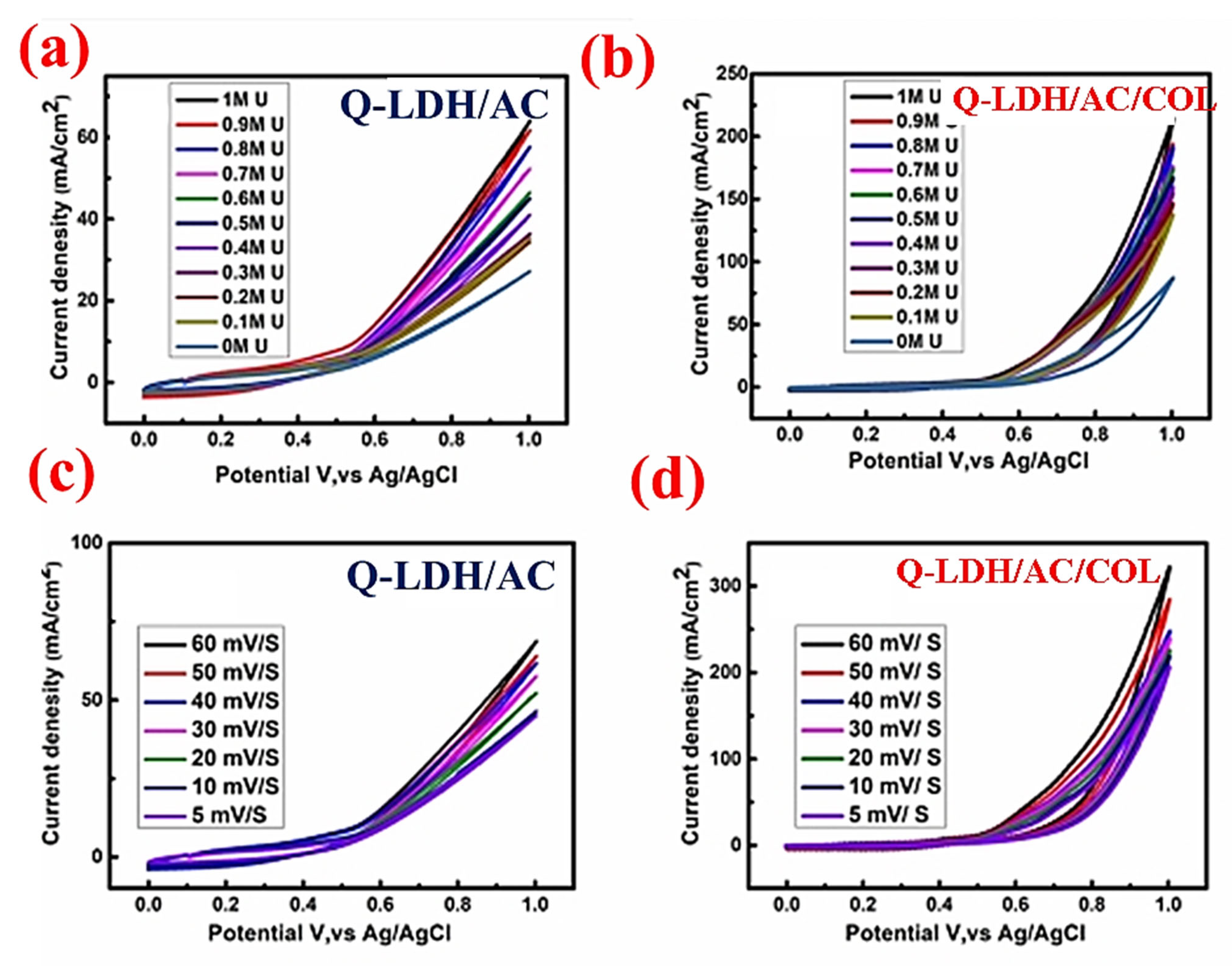
To validate the circular economy potential of our approach and provide a sustainable solution for the end-of-life of the spent adsorbent, the COL-laden Q-LDH/AC composite (hereafter referred to as Q-LDH/AC/COL) was evaluated as an electrocatalyst for urea oxidation. This application was strategically selected because urea is a common pollutant in wastewater (e.g., from agricultural and municipal sources), and its electro-oxidation in systems like direct urea fuel cells (DUFCs) allows for simultaneous wastewater treatment and energy generation, creating a synergistic remediation-to-energy pathway. Figure 10a,b show the cyclic voltammetry (CV) results for the catalysts Q-LDH (Ni-Co-Zn-Al LDH/AC) and the Q-LDH/AC/COL composite at urea concentrations ranging from 0.0 to 1.0 M. The electrochemical response of the catalyst in a urea-free solution (0.0 M) was used as the baseline. The greatest current recorded for the Q-LDH/AC catalyst was 45.03 mA/cm2; however, the addition of the Q-LDH/AC/COL composite resulted in a current of 206.63 mA/cm2, representing a dramatic ~4.6-fold enhancement in current density. This powerfully demonstrates that the adsorbed COL serves not as a poison but as a highly effective surface structure modifier, enhancing the interfacial conductivity and catalytic activity of the LDH structure. Passable peaks were detected in the absence of urea, indicating a lack of electrochemical activity associated with urea oxidation. This demonstrates that the catalyst interacts weakly with the surrounding electrolyte, resulting in substantial current densities under the supplied voltage, clearing away any actual background processes unrelated to urea. Hence, a unique oxidation peak arises because urea electro-oxidation corresponds to both the Q-LDH/AC and the Q-LDH/AC/COL composite when urea is released. The strength of the peak increases to 1.0 M, indicating that both chemicals have catalytic activity for urea oxidation, with the Q-LDH/AC/COL composite having a greater current intensity. The voltages also show that currents converge at the urea oxidation peak as concentrations increase, which is typical in such catalytic systems. Moreover, this might be attributed to variations in urea mass transfer to the electrode surface and the buildup of reaction intermediates. The CV results reveal that the Q-LDH/AC/COL composite has higher electrocatalytic activity than the Q-LDH/AC material. The much greater current density of the Q-LDH/AC/COL catalyst is the result of a synergistic interaction that enhances adsorption and charge transfer, accelerates urea oxidation, and reduces resistance. This superior performance is likely due to the functionalization of the composite with nitrogen and carbonaceous species from the adsorbed colistin molecule, which can improve electron transfer and provide additional active sites. This discovery emphasizes the importance of including COL in LDH-based catalysts for urea electrooxidation applications, a strategy backed by previous studies on metal and composite catalysts. More significantly, it confirms that the spent adsorbent possesses intrinsic value as a high-performance functional material (Table 7). The performance of the Q-LDH/AC/COL composite was benchmarked against recently reported urea oxidation electrocatalysts, as summarized in Table 7. Our composite demonstrates exceptional activity, achieving a current density of 206.63 mA cm2 at 1.0 M urea concentration. This value significantly surpasses the performance of other advanced materials tested under comparable conditions, including Mo2C-Ni-CNFs (87.9 mA cm2 at 0.33 M) [83], C-Ni-Fe/NF (100 mA cm2 at 0.33 M) [87], and NiCr-CNFs (45.30 mA cm2 at 0.5 M) [84]. Notably, even the unloaded Q-LDH/AC catalyst (45.63 mA cm2) performs competitively with several cited benchmarks. The dramatic ~4.6-fold enhancement in current density for the spent adsorbent-derived catalyst (Q-LDH/AC/COL) underscores the transformative role of the adsorbed colistin molecules. This comparison solidifies our conclusion that the valorization of spent adsorbent into an electrocatalyst is not merely a proof-of-concept but yields a material with state-of-the-art performance for DUFC applications. The superior metrics highlight the practical viability and circular economy advantage of our remediation-to-energy strategy.
Figure 10c,d show the performance of LDH/AC and LDH/AC/COL at different scan speeds. Changes in the scan rate altered both samples’ current densities, revealing that LDH and LDH/AC/COL have superior mass transfer characteristics. The peak reduction was visible at a scan rate of 5 mV/s, but it increased with increasing scan rate, indicating layer capacitance, reaction processes, and charge transfer. Furthermore, the low scan rates allow for longer contact times between the electrolyte ions and the active species in the catalyst, which increases the possibility of reactions. However, the shorter dwell time restricts these interactions at high scan rates. As a result, the charging current increases with increasing scan rate, whereas the capacitance of the material remains constant. This allows more current to pass through the electrode, resulting in a higher peak current. Furthermore, the scan rate-independent current densities demonstrate that the electrolyte ions have better access to the active sites, because the LDH/AC/COL composite clearly outperforms the LDH/AC. In conclusion, these results robustly demonstrate that the spent COL-laden adsorbent, rather than being a hazardous waste, is a superior electrocatalyst compared to its pristine counterpart. This successful valorization closes the material lifecycle, transforming the process from a linear “adsorb-and-dispose” model into a circular “adsorb-and-repurpose” paradigm, which significantly enhances the sustainability and economic appeal of the proposed remediation technology.
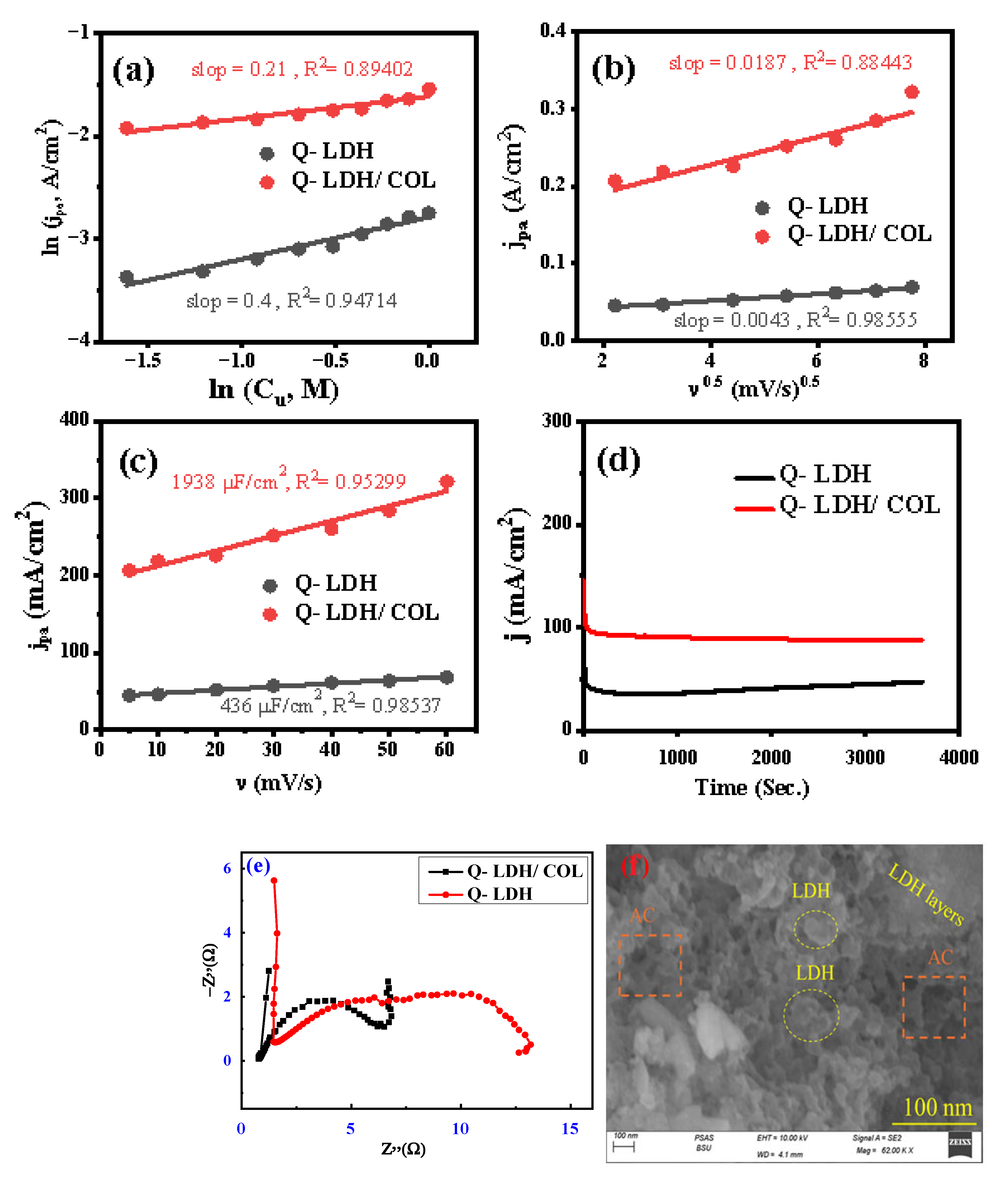
The electrochemical oxidation behavior of urea was studied via cyclic voltammetry (CV) techniques to fit multiple relationships. There is clearly a linear relationship between ln jpa and ln Cu, and the slope of the fitted straight line is the reaction order (β) in Figure 11a. The β value of Q-LDH/AC/COL was 0.4 higher than the β value of 0.2. This indicates that the relative sensitivity of the reaction rate to changes in the urea concentration is greater in the matrix, meaning that the reaction rate is more affected by increasing the urea concentration. However, the higher current of the composite reflects greater overall catalytic activity and efficiency with improved surface properties of the composite structure, such as increased effective surface area and improved electrical conductivity. Consequently, the overall ability of the material to accelerate the reaction improved, regardless of the sensitivity of the reaction to the reactant concentration. Therefore, β expresses only the extent to which the urea concentration affects the reaction rate. The results revealed a linear relationship between the oxidation current density (jPa) and the root scan rate, indicating that the oxidation process is a diffusion-controlled process, as shown in Figure 11b. The slope of the straight line in this plot was 0.018 for the Q-LDH/AC/COL composite and 0.004 for the Q-LDH/AC. A higher slope for the Q-LDH/AC/COL composite indicates a faster transfer rate of urea molecules toward the electrode surface, reflecting a higher diffusion coefficient (D (urea)) and better efficiency in facilitating the electrochemical reaction. In contrast, a lower slope for the Q-LDH/AC indicates a lower efficiency in transporting reactants to the active surface, which could lead to poorer catalytic performance. These results reinforce the role of the composite in improving mass transport properties and thus enhancing the performance of urea oxidation. On the other hand, the electrochemical capacities of the Q-LDH/AC and the Q-LDH/AC/COL composite are evaluated with the slope of the fitted straight line in Figure 10c. As the scanning rate of each electrode increased, the current density and adsorption control improved, with the electrochemical capacities of the fitted linear line standing at 436 and 1938 μF/cm2 for both the Q-LDH/AC and the Q-LDH/AC/COL composite, respectively. The presented results show that the surface area of the Q-LDH/AC/COL composite is 4.7 times larger than that of the Q-LDH/AC electrode, indicating that the composite has a large surface area due to the unique microstructure of the electrode, which enhances the catalytic activity and provides more sites for loading catalytically active metals.
Electrochemical investigations utilizing chronoamperometry (CA) measurements were performed for the Q-LDH/AC and Q-LDH/AC/COL samples, as shown in Figure 11d. The CA measurements revealed an acceleration in the current reduction in the Q-LDH/AC/COL composite, followed by a significant slowing in the rate of decline up to 100 s at 95 mA/cm2. Accordingly, carboxylic or nitrogenous intermediates, which contain nitrogenous and carboxylic groups, are generated on the catalyst surface at the start of the process as a result of urea oxidation. The intermediates may react quickly with the catalyst surface, resulting in a current drop in the early phases of the reaction. Then, the current drop decreases due to a shift to the reaction plateau phase after 100 s, which consumes the majority of the intermediates or builds a protective surface layer on the catalyst. A decrease in the current was observed over time in the Q-LDH/AC sample from 51.4 to 36.1 after 400 s, followed by a significant increase. The decrease is due to the reactions explained above, but the increase indicates the activation of the added carbon over time at 47.2 mA/cm2. As shown in Figure 11e, both samples show a small Rct (smaller charge transfer resistance), indicating good ionic conductivity of the electrolyte and proper electrode contact. The Q-LDH/AC/COL electrode exhibits a slightly lower Rs, reflecting improved electrical conductivity after COL incorporation and indicating the decrease energy barrier of charge transfer at the electrode/electrolyte interface. For measuring the stability of the tested material after urea oxidation, we examined SEM analysis for Q-LDH/AC (Figure 11f). We found that Q-LDH is uniformly deposited on the surface of AC.

2.5. Cost Analysis for Material Used During the Adsorption Study

Estimating the cost of prepared adsorbents is an important part of performance analysis since low-priced adsorbents offer various advantages in practical applications. We conducted a cost estimate for the Q-LDH support. According to Table 8, the total cost, including material and energy charges, is estimated to be 1.387 USD/g. Table 9 shows the expected cost of producing one gram of the Ni-Co-Zn-Al LDH/AC composite, which is 2.755 USD.
Total production cost amounts to 16.53 USD, resulting in an overall cost of 2.755 USD per gram of the composite. This comprehensive cost analysis highlights that the Q-LDH/AC composite is economically feasible for practical wastewater treatment applications. Despite including energy-intensive steps such as sonication and drying, the overall cost remains competitive due to relatively low raw material costs and moderate energy consumption. The ability of the composite to be regenerated and reused further amplifies its cost-effectiveness by reducing the need for frequent material replacement, ultimately lowering operational expenses and environmental impact. These findings support the composite’s suitability for scale-up and industrial deployment as a cost-efficient, high-performance adsorbent for antibiotic removal from water.

3. Experimental Section

3.1. Materials

Colistin sulfate (COL) (98.89% purity; molecular formula: C53H102N16O17S; CAS No. 1264-72-8; molecular weight: 1748.2 g/mol) was purchased from Zhejiang Qianjiang Biochemical Co. Ltd., Zhejiang, China. Nickel nitrate (Ni(NO3)2·6H2O), cobalt nitrate (Co(NO3)2·6H2O), zinc nitrate (Zn(NO3)2·6H2O), aluminum nitrate (Al(NO3)3·9H2O), sodium hydroxide (NaOH), hydrochloric acid (37% HCl), tribasic sodium phosphate, acetonitrile, and ethanol (99.8% purity) were obtained from Merck KGaA, Darmstadt, Germany. Deionized water (DI) was used throughout the experiments.

3.2. Synthesis of Quaternary Ni-Co-Zn-Al LDH/AC

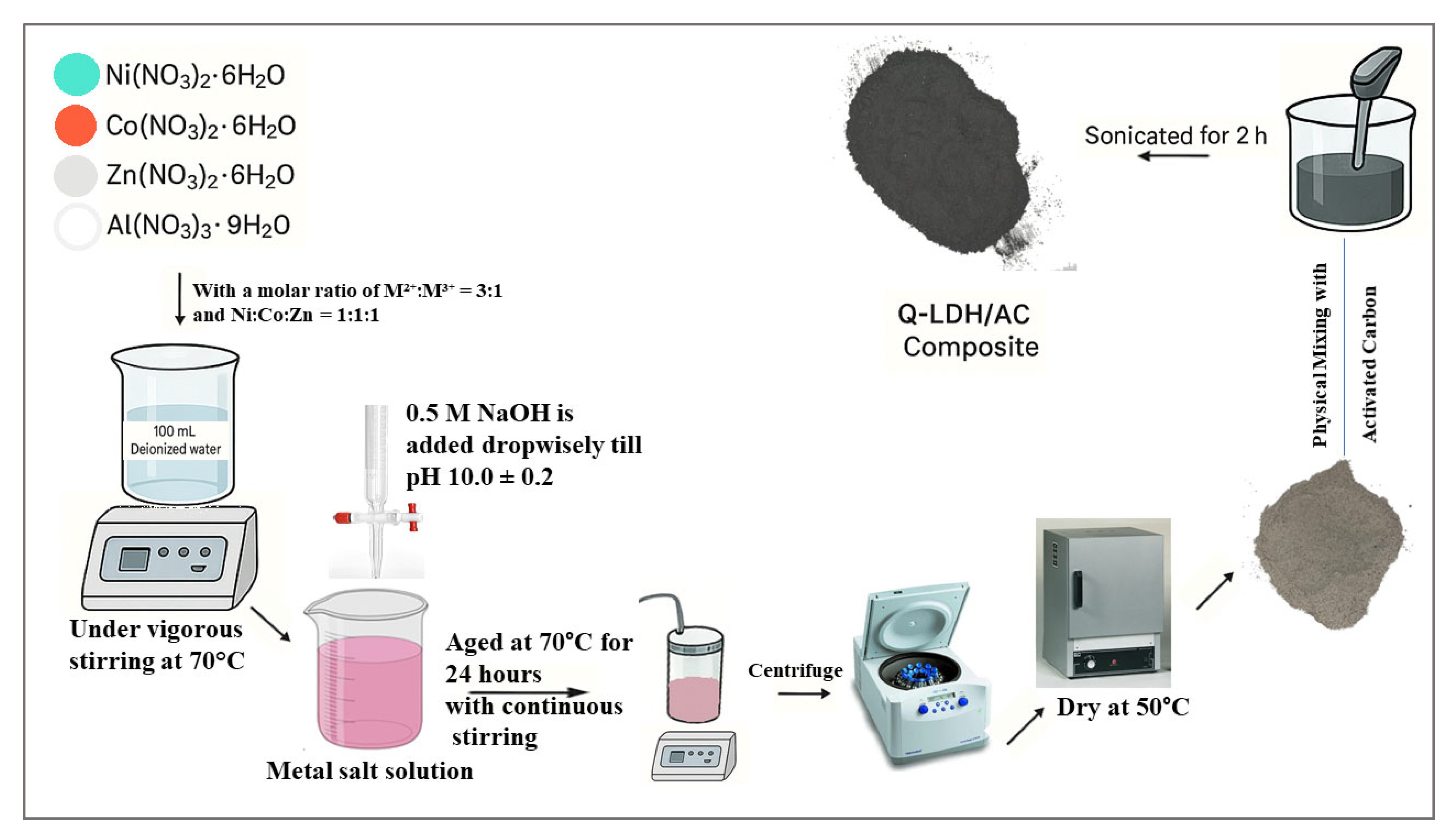
Firstly, the commercial activated carbon (AC) was pretreated to enhance its surface functionality. The activated carbon (AC) was treated with a 1:1 mixture of nitric and sulfuric acids for 2 h, followed by thorough rinsing with ultrapure water until a neutral pH was achieved. The purified AC was then oven-dried for 24 h. This acid treatment effectively removed surface impurities and introduced acidic functional groups, enhancing the material’s hydrophilicity. Then, the Q-LDH/AC composite was synthesized via a two-step co-precipitation and physical mixing method, as illustrated in Scheme 1. First, the quaternary LDH (Q-LDH) was prepared. Stoichiometric amounts of Ni(NO3)2·6H2O, Co(NO3)2·6H2O, Zn(NO3)2·6H2O, and Al(NO3)3·9H2O (with a molar ratio of M2+:M3+ = 3:1 and Ni:Co:Zn = 1:1:1) were dissolved in 100 mL of deionized water under vigorous stirring at 70 °C to form a clear metal salt solution. Simultaneously, a 0.5 M NaOH solution was titrated into the mixture to maintain the pH at 10.0 ± 0.2. The resulting slurry was aged at 70 °C for 24 h with continuous stirring. The precipitate was collected via centrifugation, washed several times with deionized water and finally with ethanol until the supernatant reached a neutral pH (pH 7). The resulting Q-LDH was dried in an oven at 50 °C for 24 h, yielding a fine grayish beige tone powder.
Subsequently, the Q-LDH powder was combined with the pretreated activated carbon in a 2:1 weight ratio (equivalent to 66.7 wt% Q-LDH and 33.3 wt% AC) in ethanol medium. This specific ratio was selected to optimize the synergy between the LDH’s anion-exchange capacity and the AC’s high surface area and porosity. The mixture was sonicated for 2 h to ensure homogeneous dispersion and exfoliation, followed by drying at 100 °C to remove the solvent. The final product, denoted as Q-LDH/AC composite, appeared as a dark gray-to-black fine powder and was stored in a desiccator for further use. The textural properties of the pristine AC (BET surface area: 58.9 m2 g1, pore volume: 0.48 cc g1, average pore diameter: 22.4 nm) and the resulting composite are summarized in Table S1.

3.3. Batch Adsorption Study

Batch experiments were conducted to systematically examine the effects of critical parameters on adsorption efficiency and to identify the optimal conditions for effective colistin removal.
To obtain the optimum calibration curve at room temperature, a series of dilutions (5–500 µg/mL) were created from a 1000 µg/mL standard solution. To investigate the impact of pH on the adsorption process (addressing Research Question 2), six 50 mL Falcon tubes were prepared with 0.05 g of synthetic adsorbent (Q-LDH/AC) and 50 µg/mL COL. The pH range of 3–11 was selected to comprehensively examine adsorption behavior across acidic, neutral, and alkaline conditions, which directly affect both the surface charge of the adsorbent (through protonation/deprotonation of functional groups) and the ionization state/speciation of colistin molecules (pKa ~10), thereby enabling the identification of optimal electrostatic conditions for adsorption. The pH of the prepared solutions was adjusted to the desired values (3, 5, 7, 9, and 11) using 0.1 N NaOH or 0.1 N HCl, and monitored with a pH meter (751 GPD Titrino-Metrohm, Herisau, Switzerland). The samples were subsequently agitated on an orbital shaker (SO330-Pro, DLAB Scientific Co., Ltd, Beijing, China ) at 250 rpm for 24 h to ensure equilibrium was attained.
The previous steps were repeated in six separate tubes, but without the adsorbent. The pH drift method was used to determine the synthetic Q-LDH point of zero charge (PZC). In this process, 0.05 g of Q-LDH/AC was dispersed in 25 mL of deionized water, and the pH was changed to various values ranging from 2 to 12 via the use of dilute HCl or NaOH. The suspensions were agitated and left to equilibrate for 24 h at room temperature. Following equilibration, each solution’s final pH was recorded. The PZC is defined as the point where the difference between the final and initial pH values (ΔpH = pHfinal − pHinitial) is zero, indicating a neutral surface charge.
The effect of adsorbent dosage on the adsorption process was investigated (addressing Research Question 2) at a constant COL concentration (50 µg/mL) at pH 7 with various doses ranging from 0.05 g to 0.30 g. This range was chosen to determine the minimum effective dose required to achieve maximum removal efficiency, thereby optimizing the process for both efficacy and economic practicality, while also identifying potential site saturation or aggregation effects at higher dosages. The impact of the COL concentration was investigated using COL concentrations ranging from 5 µg/mL to 500 µg/mL at 0.05 g adsorbent and pH 7. This broad concentration range was selected to simulate different real-world pollution scenarios (from trace environmental levels to highly contaminated pharmaceutical waste streams) and to provide sufficient data density for robust construction of adsorption isotherm models (addressing Research Question 3). Finally, the thermal effect was investigated at several temperatures: 25, 35, 45, and 55 °C at a constant COL concentration (50 µg/mL), pH 7, and 0.05g dose of adsorbent. This temperature range was chosen to understand the thermodynamic nature (endothermic/exothermic) of the adsorption process, to determine its spontaneity through Gibbs free energy calculations, and to simulate potential variations in industrial wastewater temperatures (addressing Research Question 3).
Before performing our measurements, we filtered the prepared solutions via a Millipore nylon syringe filter with a pore size of 0.22 µm.
The residual COL concentrations were determined via an Agilent 1200 HPLC system under isocratic conditions. The stationary phase was a 4.6 mm ×25 cm × 5 µm column with a flow rate of 1 mL/min and a 212 nm wavelength. The mobile phase was a mixture of 0.1 M tribasic sodium phosphate and acetonitrile at a 77:23 ratio, with the pH adjusted to 3. The mixture was then filtered and degassed.
The amount of adsorbed COL per gram and the removal percentage of Q-LDH/AC (Qe) were determined via the following equations:
Q e   =   ( C o   C t ) V W  
Removal   percent = C o   C t C o   × 100
where Qe is the quantity per gram of adsorbed COL, Co and Ct are the initial and post adsorption concentrations, respectively, of COL (mg/L) at time T, V is the volume of COL, and W is the adsorbent mass in grams. Then, isotherm models with two, three, and four parameters were used. The thermodynamic parameters were estimated. Various kinetic models, including pseudo-first-order kinetics, pseudo-second-order kinetics, intraparticle diffusion and Avrami, were used to examine the kinetics of COL adsorption on Q-LDH/AC at various time points ranging from 0 to 240 min. Kinetic experiments were conducted where samples containing 0.05 g adsorbent and 50 µg/mL COL at pH 7 were analyzed at intervals from 0 to 240 min. The equilibrium contact time was identified as the point where colistin concentration in solution stabilized and was subsequently used in all equilibrium experiments. As shown in Figure 7e, the variation between the initial (pHi) and final (pHf) pH values was plotted against the initial pH (pHi). The point of zero charge (PZC) was determined from the plot as the pH value corresponding to zero on the y-axis. The calculated PZC was 6.67. All experiments were performed in triplicate (n = 3) unless otherwise specified.

3.4. Material Characterization

To address Research Question 1 regarding material synthesis and characterization, several analytical techniques were employed. X-ray diffraction (XRD) was performed via a PANalytical Empyrean apparatus (Almelo, Netherlands) with Cu-Kα radiation, which was scanned from 5° to 80° at a rate of 8° min1 to assess sample crystallinity. Fourier transform infrared spectroscopy (FTIR) was conducted using a Bruker Vertex 70 spectrometer (Karlsruhe, Germany) with the KBr pellet method, covering a range of 400–4000 cm1.
Scanning electron microscopy (SEM) was also utilized to examine the surface morphology. SEM analysis was performed after coating the samples with a thin conductive layer of gold using a Quorum Q150R S sputter coater (Quorum Technologies, Lewes, UK) to minimize surface charging. The coating thickness was approximately 5–10 nm. Colistin concentrations were determined via an Agilent 1200 HPLC system (Agilent Technologies Inc., Santa Clara, CA, USA).
Nitrogen adsorption–desorption isotherms were recorded at 77 K using a Micromeritics TriStar 3020 instrument (Norcross, GA, USA). Prior to analysis, approximately 100–150 mg of each sample was degassed under vacuum at 120 °C for 12 h to remove physically adsorbed moisture and contaminants. The Brunauer–Emmett–Teller (BET) surface area was calculated from the adsorption data within the relative pressure range of p/p0 = 0.05–0.30, in accordance with the IUPAC 2015 recommendations for microporous and mesoporous materials [28]. The total pore volume was estimated from the amount adsorbed at p/p0 ≈ 0.99, and the pore size distribution was derived from the adsorption branch using the Barrett–Joyner–Halenda (BJH) method. pH measurements were carried out with an Adwa AD1030 automatic surface pH meter (Hungary, Romania).

3.5. Regeneration Study

To address Research Question 4 regarding regeneration and valorization, the regeneration of the Q-LDH/AC composite upon COL adsorption was assessed through a comparative desorption experiment with three different desorbing agents: 0.1 M HCl, 0.1 M NaCl, and ethanol (99.8%). After adsorption, the COL-loaded Q-LDH/AC was centrifuged at 5000 rpm for 10 min and gently rinsed with deionized water to eliminate any remaining colistin. For regeneration, 0.1 g of the COL-loaded adsorbent was added to a 100 mL Erlenmeyer flask containing 50 mL of one of the desorbing agents. To enhance desorption, the mixture was shaken on an orbital shaker at 250 rpm for 24 h at 25 °C. Following desorption, the adsorbent was centrifuged, thoroughly rinsed with deionized water until a neutral pH was reached, and then it was washed with ethanol to eliminate any remaining organic residue. The regenerated adsorbent was dried at 50 °C for 12 h before being stored in a desiccator. The desorption effectiveness of each agent was assessed by measuring the amount of COL released into the supernatant via the HPLC method described in Section 3.3. The most effective desorbing agent was chosen on the basis of its desorption efficiency.

4. Limitations and Future Prospective

This study primarily utilized synthetic colistin solutions under controlled laboratory conditions, which may not fully represent the complexities of real wastewater containing diverse competing ions and organic matter that could affect adsorption efficiency. The fine powder nature of the Q-LDH/AC composite presents challenges in solid–liquid separation and reuse, suggesting the need for immobilized or magnetically separable forms for practical application. The synthesis involves energy-intensive steps like prolonged stirring and sonication, which require optimization for larger-scale economic sustainability. Material aggregation at higher dosages may reduce available active sites, limiting adsorption capacity. Although regeneration studies showed a retention of over 70% adsorption capacity after five cycles, further long-term stability and performance evaluations are necessary to confirm durability. Future work should focus on validating the Q-LDH/AC composite’s performance in real wastewater matrices to assess matrix effects and interferences. Developing engineered configurations for continuous flow treatment and easier adsorbent recovery is crucial for practical deployment. Process optimization aimed at greener and energy-efficient synthesis routes will enhance sustainability. Surface modification to prevent aggregation and improve site accessibility should be explored. Long-term regeneration and pilot-scale studies will be important to establish operational feasibility. Additionally, expanding the valorization of spent adsorbents beyond electrocatalysis to other functional applications can advance circular economy strategies and sustainable wastewater treatment solutions.

5. Conclusions

This study highlights the efficiency of a quaternary Ni-Co-Zn-Al LDH/AC composite for colistin removal from water. The synergy between multiple metals and activated carbon enables electrostatic attraction, surface complexation, hydrogen bonding, and micropore confinement. The composite shows excellent reusability and performance at near-neutral pH. Cyclic voltammetry confirmed its electrochemical activity for urea oxidation, and green assessment tools (AGP, AGREE, BAGI, RGB12) verified its strong alignment with green chemistry principles. The Q-LDH/AC composite exhibits an exceptional adsorption capacity (952.52 mg·g1) and stable regeneration over five cycles, greatly reducing material use and long-term treatment costs. Its valorization as a high-performance electrocatalyst for direct urea fuel cells adds economic value by transforming waste into a resource. With a production cost of 2.755 USD/g and high removal efficiency, the composite offers a cost-effective and sustainable alternative to energy-intensive methods such as advanced oxidation and membrane filtration. The straightforward synthesis method and demonstrated electrocatalytic functionality represent a promising step toward integrated water treatment and energy recovery applications.

Supplementary Materials

The following supporting information can be downloaded at: https://www.mdpi.com/article/10.3390/catal16020197/s1, Figure S1: Adsorption kinetics of COL onto the Q-LDH/AC composite over the time range of 0–50 min, fitted with different kinetic models; Table S1: Comparative physicochemical properties of Q-LDH, AC, and Q-LDH/AC.

Author Contributions

Writing - original draft and methodology, S.M.M.; writing - review & editing, funding acquisition, H.A.R.; data curation and investigation, H.M.; resources and investigation, A.A.A.; software and methodology, E.A.M.; project administration, visualization and supervision, R.M. All authors have read and agreed to the published version of the manuscript.

Funding

This work was supported and funded by the Deanship of Scientific Research at Imam Mohammad Ibn Saud Islamic University (IMSIU) (grant number IMSIU-DDRSP2601).

Data Availability Statement

The datasets generated and/or analyzed during this study are available from the corresponding author upon reasonable request.

Conflicts of Interest

The authors declare no conflicts of interest.

References

  1. Ayoub Moubareck, C.; Hammoudi Halat, D. Insights into Acinetobacter baumannii: A review of microbiological, virulence, and resistance traits in a threatening nosocomial pathogen. Antibiotics 2020, 9, 119. [Google Scholar] [CrossRef]
  2. Wang, R.; Van Dorp, L.; Shaw, L.P.; Bradley, P.; Wang, Q.; Wang, X.; Jin, L.; Zhang, Q.; Liu, Y.; Rieux, A.; et al. The global distribution and spread of the mobilized colistin resistance gene mcr-1. Nat. Commun. 2018, 9, 1179. [Google Scholar] [CrossRef]
  3. Kieffer, N.; Royer, G.; Decousser, J.-W.; Bourrel, A.-S.; Palmieri, M.; Ortiz De La Rosa, J.-M.; Jacquier, H.; Denamur, E.; Nordmann, P.; Poirel, L. mcr-9, an inducible gene encoding an acquired phosphoethanolamine transferase in Escherichia coli, and its origin. Antimicrob. Agents Chemother. 2019, 63, 10-1128. [Google Scholar] [CrossRef] [PubMed]
  4. Nguyen, N.T.; Nguyen, H.M.; Nguyen, C.V.; Nguyen, T.V.; Nguyen, M.T.; Thai, H.Q.; Ho, M.H.; Thwaites, G.; Ngo, H.T.; Baker, S.; et al. Use of colistin and other critical antimicrobials on pig and chicken farms in southern Vietnam and its association with resistance in commensal Escherichia coli bacteria. Appl. Environ. Microbiol. 2016, 82, 3727–3735. [Google Scholar] [CrossRef] [PubMed]
  5. Catry, B.; Cavaleri, M.; Baptiste, K.; Grave, K.; Grein, K.; Holm, A.; Jukes, H.; Liebana, E.; Navas, A.L.; Mackay, D.; et al. Use of colistin-containing products within the European Union and European Economic Area (EU/EEA): Development of resistance in animals and possible impact on human and animal health. Int. J. Antimicrob. Agents 2015, 46, 297–306. [Google Scholar] [CrossRef] [PubMed]
  6. Li, J.; Nation, R.L.; Turnidge, J.D.; Milne, R.W.; Coulthard, K.; Rayner, C.R.; Paterson, D.L. Colistin: The re-emerging antibiotic for multidrug-resistant Gram-negative bacterial infections. Lancet Infect. Dis. 2006, 6, 589–601. [Google Scholar] [CrossRef] [PubMed]
  7. Poirel, L.; Jayol, A.; Nordmann, P. Polymyxins: Antibacterial activity, susceptibility testing, and resistance mechanisms encoded by plasmids or chromosomes. Clin. Microbiol. Rev. 2017, 30, 557–596. [Google Scholar] [CrossRef]
  8. Michael, I.; Rizzo, L.; McArdell, C.S.; Manaia, C.M.; Merlin, C.; Schwartz, T.; Dagot, C.; Fatta-Kassinos, D. Urban wastewater treatment plants as hotspots for the release of antibiotics in the environment: A review. Water Res. 2013, 47, 957–995. [Google Scholar] [CrossRef]
  9. Verlicchi, P.; Al Aukidy, M.; Zambello, E. Occurrence of pharmaceutical compounds in urban wastewater: Removal, mass load and environmental risk after a secondary treatment—A review. Sci. Total Environ. 2012, 429, 123–155. [Google Scholar] [CrossRef]
  10. Homem, V.; Santos, L. Degradation and removal methods of antibiotics from aqueous matrices—A review. J. Environ. Manag. 2011, 92, 2304–2347. [Google Scholar] [CrossRef]
  11. Cavani, F.; Trifirb, F.; Vaccari, A. Hydrotalcite-type anlonlc clays: Preparation, properties and applications. Catal. Today 1991, 11, 173–301. [Google Scholar] [CrossRef]
  12. Goh, K.-H.; Lim, T.-T.; Dong, Z. Application of layered double hydroxides for removal of oxyanions: A review. Water Res. 2008, 42, 1343–1368. [Google Scholar] [CrossRef]
  13. Benício, L.P.F.; Constantino, V.R.L.; Pinto, F.G.; Vergütz, L.; Tronto, J.; da Costa, L.M. Layered double hydroxides: New technology in phosphate fertilizers based on nanostructured materials. ACS Sustain. Chem. Eng. 2017, 5, 399–409. [Google Scholar] [CrossRef]
  14. Seida, Y.; Nakano, Y. Removal of phosphate by layered double hydroxides containing iron. Water Res. 2002, 36, 1306–1312. [Google Scholar] [CrossRef]
  15. Zhang, T.; Li, Y.; Zheng, W. Morphological control synthesis of layered double hydroxides for energy applications. Discov. Mater. 2025, 5, 191. [Google Scholar] [CrossRef]
  16. Asadpour, S.; Sarmast, N.; Aramesh-Boroujeni, Z.; Sadegh, N. Enhanced adsorption performance of tetracycline in aqueous solutions using Mg-Al-LDH/AC nanocomposite. Arab. J. Chem. 2023, 16, 105301. [Google Scholar]
  17. Sikri, N.; Kumar, S.; Behera, B.; Mehta, J. Graphene oxide/layered double hydroxide composite as highly efficient and recyclable adsorbent for removal of ciprofloxacin from aqueous phase. Front. Nanotechnol. 2025, 7, 1578620. [Google Scholar] [CrossRef]
  18. Mahgoub, S.M.; Shehata, M.R.; Zaher, A.; El-Ela, F.I.A.; Farghali, A.; Amin, R.M.; Mahmoud, R. Cellulose-based activated carbon/layered double hydroxide for efficient removal of Clarithromycin residues and efficient role in the treatment of stomach ulcers and acidity problems. Int. J. Biol. Macromol. 2022, 215, 705–728. [Google Scholar] [CrossRef] [PubMed]
  19. Zaher, A.; Taha, M.; Mahmoud, R.K. Possible adsorption mechanisms of the removal of tetracycline from water by La-doped Zn-Fe-layered double hydroxide. J. Mol. Liq. 2021, 322, 114546. [Google Scholar] [CrossRef]
  20. Li, M.; Liu, Y.; Zeng, G.; Liu, S.; Hu, X.; Shu, D.; Jiang, L.; Tan, X.; Cai, X.; Yan, Z. Tetracycline absorbed onto nitrilotriacetic acid-functionalized magnetic graphene oxide: Influencing factors and uptake mechanism. J. Colloid Interface Sci. 2017, 485, 269–279. [Google Scholar] [CrossRef]
  21. Mahgoub, S.M.; Shehata, M.R.; Abo El-Ela, F.L.; Farghali, A.; Zaher, A.; Mahmoud, R.K. Sustainable waste management and recycling of Zn–Al layered double hydroxide after adsorption of levofloxacin as a safe anti-inflammatory nanomaterial. RSC Adv. 2020, 10, 27633–27651. [Google Scholar] [CrossRef]
  22. Aldawsari, A.M.; Alsohaimi, I.; Hassan, H.M.A.; Abdalla, Z.E.A.; Hassan, I.; Berber, M.R. Tailoring an efficient nanocomposite of activated carbon-layered double hydroxide for elimination of water-soluble dyes. J. Alloys Compd. 2021, 857, 157551. [Google Scholar] [CrossRef]
  23. Umdor, R.S.; Sharma, S.; Longchar, I.T.; Sinha, D. Enhanced adsorption of ciprofloxacin antibiotic using novel Rubus alceifolius activated carbon/MgAl LDH composite: Mechanistic insight. Chem. Eng. Sci. 2025, 313, 121723. [Google Scholar] [CrossRef]
  24. Gkika, D.A.; Kyzas, G.Z. Reusability of spent adsorbents for a circular materials economy in the sustainable chemical industry. RSC Sustain. 2026, 4, 1023–1048. [Google Scholar] [CrossRef]
  25. Baskar, A.V.; Bolan, N.; Hoang, S.A.; Sooriyakumar, P.; Kumar, M.; Singh, L.; Jasemizad, T.; Padhye, L.P.; Singh, G.; Vinu, A.; et al. Recovery, regeneration and sustainable management of spent adsorbents from wastewater treatment streams: A review. Sci. Total Environ. 2022, 822, 153555. [Google Scholar] [CrossRef]
  26. Mahmoud, R.; Mohamed, H.F.M.; Hafez, S.H.M.; Gadelhak, Y.M.; Abdel-Hady, E.E. Valorization of spent double substituted Co–Ni–Zn–Fe LDH wastewater nanoadsorbent as methanol electro-oxidation catalyst. Sci. Rep. 2022, 12, 19354. [Google Scholar] [CrossRef]
  27. Alex, C.; Naduvil Kovilakath, M.S.; Rao, N.N.; Sathiskumar, C.; Tayal, A.; Meesala, L.; Kumar, P.; John, N.S. In-situ generated Ni(OH)2 on chemically activated spent catalyst sustains urea electro-oxidation in extensive alkaline conditions. Int. J. Hydrogen. Energy 2024, 59, 390–399. [Google Scholar] [CrossRef]
  28. Goswami, S.; Phukan, S.J.; Gupta, G.; Pai, R.K.; Rana, S.; Roy, M.; Kumar, P.; Garai, S. Direct urea fuel cells: A review on roadmap, mechanism, bottleneck, and future perspective. Energy Fuels 2025, 39, 6709–6727. [Google Scholar] [CrossRef]
  29. Cazetta, A.L.; Martins, A.C.; Pezoti, O.; Bedin, K.C.; Beltrame, K.K.; Asefa, T.; Almeida, V.C. Synthesis and application of N–S-doped mesoporous carbon obtained from nanocasting method using bone char as heteroatom precursor and template. Chem. Eng. J. 2016, 300, 54–63. [Google Scholar] [CrossRef]
  30. Ahmed, J.; Farouk, M.; El-Aassar, M.R.; Omran, K.A.; Mohamed, F.M. Fabricating a pistachio nut shells activated carbon+ CNTs@ Chitosan (PAC-CNTs@ Cs) composite for pesticides attenuation from agricultural wastewater. Desalin. Water Treat. 2024, 320, 100899. [Google Scholar] [CrossRef]
  31. Zhang, Y.; Wen, H.; Bu, W.; Liu, B.; Xu, Z.; Li, K.; Zhao, M.; Huang, X.; Wang, Y.; Yan, K. Electrocatalytic upcycling of polyethylene terephthalate plastic wastes with hydrogen generation over tremella-like oxygen-deficient NiAl-LDHs microflowers. Chem. Eng. J. 2025, 171748. [Google Scholar] [CrossRef]
  32. Hariprasath, K.R.; Priyadharshini, M.; Balaji, P.; Thangappan, R.; Pazhanivel, T. Electrode engineering strategies for boosting the performance of Ni Co Al− LDH in supercapacitor application. Chem. Phys. Lett. 2024, 856, 141584. [Google Scholar] [CrossRef]
  33. Busca, G.; Costantino, U.; Montanari, T.; Ramis, G.; Resini, C.; Sisani, M. Nickel versus cobalt catalysts for hydrogen production by ethanol steam reforming: Ni–Co–Zn–Al catalysts from hydrotalcite-like precursors. Int. J. Hydrogen Energy 2010, 35, 5356–5366. [Google Scholar] [CrossRef]
  34. Hou, L.; Zhou, X.; Kong, L.; Ma, Z.; Su, L.; Liu, Z.; Shao, G. Alkali-etched NiCoAl-LDH with improved electrochemical performance for asymmetric supercapacitors. Nanomaterials 2023, 13, 1192. [Google Scholar] [CrossRef] [PubMed]
  35. Shetty, N.; Ahn, P.; Park, H.; Bhujbal, S.; Zemlyanov, D.; Cavallaro, A.; Mangal, S.; Li, J.; Zhou, Q.T. Improved physical stability and aerosolization of inhalable amorphous ciprofloxacin powder formulations by incorporating synergistic colistin. Mol. Pharm. 2018, 15, 4004–4020. [Google Scholar] [CrossRef]
  36. Mahgoub, S.M.; Alawam, A.S.; Rudayni, H.A.; Allam, A.A.; Abdel Aziz, S.A.A.; Eweis, A.A.; Khaled, E.; Shafei, R.; Mohamed, F.; Mahmoud, R. Lysozyme-dequalinium encapsulation in a Zn-Fe LDH-chia seed matrix for enhanced antimicrobial dental therapeutics. RSC Adv. 2025, 15, 30872–30899. [Google Scholar] [CrossRef] [PubMed]
  37. He, X.; Zhou, C.; Meng, Y.; Xiao, W.; Yang, P. Preparation of acid-modified waste mask-based activated carbon grafted chitosan composites and their efficient removal of uranyl ions. Int. J. Biol. Macromol. 2025, 310, 143431. [Google Scholar] [CrossRef]
  38. Surender; Mohan, C.; Kumar, R.; Varma, R.S. Hybrid nanomaterials for efficient hexavalent chromium removal from waste water: Activated charcoal sheet modification through polypyrrole and silver nanoparticles. Nanotechnol. Environ. Eng. 2024, 9, 347–358. [Google Scholar] [CrossRef]
  39. Zaher, A.; Kamal, W.; Essam, D.; Yousry, E.M.; Mahmoud, R. Repurposing Co-Fe LDH and Co-Fe LDH/Cellulose micro-adsorbents for sustainable energy generation in direct methanol fuel cells. J. Water Process Eng. 2024, 62, 105317. [Google Scholar] [CrossRef]
  40. Karami, Z.; Aghazadeh, M.; Jouyandeh, M.; Zarrintaj, P.; Vahabi, H.; Ganjali, M.R.; Torre, L.; Puglia, D.; Saeb, M.R. Epoxy/Zn-Al-CO3 LDH nanocomposites: Curability assessment. Prog. Org. Coatings 2020, 138, 105355. [Google Scholar] [CrossRef]
  41. Ajam, M.; Ehteshami, M.; Boudaghpour, S.; Mirbagheri, S.A.; Kafil, M. Enhanced photocatalytic degradation of Congo red under visible light illumination by using Zn-Al-Co-LDH@ g-C3N4 nanocomposite. Desalin. Water Treat. 2021, 230, 318–330. [Google Scholar] [CrossRef]
  42. Abdelazeem, R.; Kamal, W.; Eldin, Z.E.; Roshdy, M.A.; Allam, A.A.; Saeed, S.; Tawab, D.A.; Othman, S.I.; Allah, A.E.; Radalla, A.M.; et al. Exploring the potential of waste biomass of olive as an additive for layered double hydroxide/polyurethane as an effective and safe agent for the adsorption of drug residues: A bioremediation approach. Mater. Adv. 2024, 5, 9092–9106. [Google Scholar] [CrossRef]
  43. Wang, R.; Qiu, Z.; Wan, S.; Wang, Y.; Liu, Q.; Ding, J.; Zhong, Q. Insight into mechanism of divalent metal cations with different d-bands classification in layered double hydroxides for light-driven CO2 reduction. Chem. Eng. J. 2022, 427, 130863. [Google Scholar] [CrossRef]
  44. Bagherzadeh, M.; Salehi, G.; Rabiee, N. Rapid and efficient removal of methylene blue dye from aqueous solutions using extract-modified Zn–Al LDH. Chemosphere 2024, 350, 141011. [Google Scholar] [CrossRef]
  45. Khan, A.A.; Tahir, M.; Khan, N. LDH-based nanomaterials for photocatalytic applications: A comprehensive review on the role of bi/trivalent cations, anions, morphology, defect engineering, memory effect, and heterojunction formation. J. Energy Chem. 2023, 84, 242–276. [Google Scholar] [CrossRef]
  46. Mangal, S.; Park, H.; Zeng, L.; Yu, H.H.; Lin, Y.; Velkov, T.; Denman, J.A.; Zemlyanov, D.; Li, J.; Zhou, Q.T. Composite particle formulations of colistin and meropenem with improved in-vitro bacterial killing and aerosolization for inhalation. Int. J. Pharm. 2018, 548, 443–453. [Google Scholar] [CrossRef] [PubMed]
  47. Mutahir, S.; Akram, S.; Asim Khan, M.; Deng, H.; Naglah, A.M.; Almehizia, A.A.; Al-Omar, M.A.; Ibrahim Alrayes, F.; Refat, M.S. Facile synthesis of Zn/Co LDH for the removal of oxytetracycline from wastewater: Experimental and DFT-Based analysis. Chem. Eng. Sci. 2024, 283, 119399. [Google Scholar] [CrossRef]
  48. Főldes, A.; Székely, E.; Voidăzan, S.T.; Dobreanu, M. Comparison of Six Phenotypic Assays with Reference Methods for Assessing Colistin Resistance in Clinical Isolates of Carbapenemase-Producing Enterobacterales: Challenges and Opportunities. Antibiotics 2022, 11, 377. [Google Scholar] [CrossRef]
  49. Peng, L.; Peng, C.; Fu, S.; Qiu, Y. Adsorption-desorption and degradation of colistin in soils under aerobic conditions. Ecotoxicol. Environ. Saf. 2022, 243, 113989. [Google Scholar] [CrossRef]
  50. Sharma, E.; Chen, Y.; Kelso, C.; Sivakumar, M.; Jiang, G. Navigating the environmental impacts and analytical methods of last-resort antibiotics: Colistin and carbapenems. Soil Environ. Health 2024, 2, 100058. [Google Scholar] [CrossRef]
  51. Kwa, A.L.; Tam, V.H.; Falagas, M.E. Polymyxins: A review of the current status including recent developments. Ann. Acad. Med. Singap. 2008, 37, 870–883. [Google Scholar] [CrossRef] [PubMed]
  52. Padmavathy, K.S.; Madhu, G.; Haseena, P.V. A study on Effects of pH, Adsorbent Dosage, Time, Initial Concentration and Adsorption Isotherm Study for the Removal of Hexavalent Chromium (Cr (VI)) from Wastewater by Magnetite Nanoparticles. Procedia Technol. 2016, 24, 585–594. [Google Scholar] [CrossRef]
  53. Zhang, J.-W.; Nur’aini, A.D.; Wang, Y.-C.; Hai, N.D.; Van Minh, D.; Chao, H.-P. Multiple pollutants removal by carbon sphere and layered double hydroxide composites: Adsorption behavior and mechanisms. J. Environ. Chem. Eng. 2022, 10, 108014. [Google Scholar] [CrossRef]
  54. Tran, H.N.; Nguyen, D.T.; Le, G.T.; Tomul, F.; Lima, E.C.; Woo, S.H.; Sarmah, A.K.; Nguyen, H.Q.; Nguyen, P.T.; Nguyen, D.D.; et al. Adsorption mechanism of hexavalent chromium onto layered double hydroxides-based adsorbents: A systematic in-depth review. J. Hazard. Mater. 2019, 373, 258–270. [Google Scholar] [CrossRef]
  55. Ara, M.; Ghafuri, H. Design and preparation of a novel Mg-Al LDH@EDTA-Melamine nanocomposite for effective adsorptive removal of methylene blue and rhodamine B dyes from water. Heliyon 2024, 10, e32447. [Google Scholar] [CrossRef]
  56. Długosz, O.; Banach, M. Ecological synthesis of nickel–zinc–aluminium layered double hydroxides (Ni–Zn–Al LDH) in flow infrared radiated agitated tubular reactor (flow-IR-ATR). J. Nanoparticle Res. 2022, 24, 250. [Google Scholar] [CrossRef]
  57. Li, A.; Deng, H.; Ye, C.; Jiang, Y. Fabrication and Characterization of Novel ZnAl-Layered Double Hydroxide for the Superadsorption of Organic Contaminants from Wastewater. ACS Omega 2020, 5, 15152–15161. [Google Scholar] [CrossRef]
  58. Abdel-Hady, E.E.; Hafez, S.H.M.; Mohamed, H.F.M.; Elsharkawy, M.R.M. Characterization and application of LDH with chitosan composites investigated by positron annihilation lifetime spectroscopy and surface texture for the adsorption of methyl orange. Sci. Rep. 2024, 14, 16501. [Google Scholar] [CrossRef]
  59. Budnyak, T.M.; Błachnio, M.; Slabon, A.; Jaworski, A.; Tertykh, V.A.; Deryło-Marczewska, A.; Marczewski, A.W. Chitosan Deposited onto Fumed Silica Surface as Sustainable Hybrid Biosorbent for Acid Orange 8 Dye Capture: Effect of Temperature in Adsorption Equilibrium and Kinetics. J. Phys. Chem. C. Nanomater. Interfaces 2020, 124, 15312–15323. [Google Scholar] [CrossRef]
  60. Amadou Kiari, M.N.; Konan, A.T.S.; Sanda Mamane, O.; Ouattara, L.Y.; Ibrahim Grema, M.H.; Siragi Dounounou Boukari, M.; Adamou Ibro, A.; Malam Alma, M.M.; Yao, K.B. Adsorption kinetics, thermodynamics, modeling and optimization of bisphenol A on activated carbon based on Hyphaene Thebaica shells. Case Stud. Chem. Environ. Eng. 2024, 10, 100903. [Google Scholar] [CrossRef]
  61. Ibrahim, S.S.; El Bouraie, M. Enhancement Adsorption of Crystal Violet From Wastewater Using Chemically Modified Sugarcane Bagasse by Bentonite and Polyurethane. Egypt. J. Chem. 2022, 65, 489–499. [Google Scholar] [CrossRef]
  62. Al-Ghouti, M.A.; Al-Absi, R.S. Mechanistic understanding of the adsorption and thermodynamic aspects of cationic methylene blue dye onto cellulosic olive stones biomass from wastewater. Sci. Rep. 2020, 10, 15928. [Google Scholar] [CrossRef]
  63. Cetina, M.; Mihovilović, P.; Pešić, A.; Vojnović, B. Influence of Ionic Strength and Temperature on the Adsorption of Reactive Black 5 Dye by Activated Carbon: Kinetics, Mechanisms and Thermodynamics. Molecules 2025, 30, 2593. [Google Scholar] [CrossRef]
  64. Akaike, H. A new look at the statistical model identification. IEEE Trans. Autom. Control 2003, 19, 716–723. [Google Scholar] [CrossRef]
  65. Allam, A.A.; Alaa, A.; Mahmoud, R. Green chemistry approach for the removal of delafloxacin from aqueous solutions using calcinated layered double hydroxide: Adsorption mechanism and material characterization. Sci. Afr. 2025, 27, e02535. [Google Scholar] [CrossRef]
  66. Qiu, H.; Lv, L.; Pan, B.; Zhang, Q.; Zhang, W.; Zhang, Q. Critical review in adsorption kinetic models. J. Zhejiang Univ. A 2009, 10, 716–724. [Google Scholar] [CrossRef]
  67. Boparai, H.K.; Joseph, M.; O’Carroll, D.M. Kinetics and thermodynamics of cadmium ion removal by adsorption onto nano zerovalent iron particles. J. Hazard. Mater. 2011, 186, 458–465. [Google Scholar] [CrossRef]
  68. Langmuir, I. The adsorption of gases on plane surfaces of glass, mica and platinum. J. Am. Chem. Soc. 1918, 40, 1361–1403. [Google Scholar] [CrossRef]
  69. Appel, J. Freundlich’s adsorption isotherm. Surf. Sci. 1973, 39, 237–244. [Google Scholar] [CrossRef]
  70. Dubinin, M.M. The Potential Theory of Adsorption of Gases and Vapors for Adsorbents with Energetically Nonuniform Surfaces. Chem. Rev. 1960, 60, 235–241. [Google Scholar] [CrossRef]
  71. Jeppu, G.P.; Clement, T.P. A modified Langmuir-Freundlich isotherm model for simulating pH-dependent adsorption effects. J. Contam. Hydrol. 2012, 129, 46–53. [Google Scholar] [CrossRef] [PubMed]
  72. Sips, R. Combined form of Langmuir and Freundlich equations. J. Chem. Phys 1948, 16, 490–495. [Google Scholar] [CrossRef]
  73. Redlich, O.; Peterson, D.L. A Useful Adsorption Isotherm. J. Phys. Chem. 1959, 63, 1024. [Google Scholar] [CrossRef]
  74. Toth, J. State equation of the solid-gas interface layers. Acta Chim. Hung. 1971, 69, 311–328. [Google Scholar]
  75. Baudu, M. Etude des Interactions Solutes-Fibres de Charbon Actif: Applications et Regeneration. Ph.D. Thesis, Université de Rennes 1, Rennes, France, 1990. [Google Scholar]
  76. Fritz, W.; Schluender, E.U. Simultaneous adsorption equilibria of organic solutes in dilute aqueous solutions on activated carbon. Chem. Eng. Sci. 1974, 29, 1279–1282. [Google Scholar] [CrossRef]
  77. Guo, X.; Ruan, Y.; Diao, Z.; Shih, K.; Su, M.; Song, G.; Chen, D.; Wang, S.; Kong, L. Environmental-friendly preparation of Ni–Co layered double hydroxide (LDH) hierarchical nanoarrays for efficient removing uranium (VI). J. Clean. Prod. 2021, 308, 127384. [Google Scholar] [CrossRef]
  78. Li, Y.; Narducci, R.; Varone, A.; Kaciulis, S.; Bolli, E.; Pizzoferrato, R. Zn–Al Layered Double Hydroxides Synthesized on Aluminum Foams for Fluoride Removal from Water. Processes 2021, 9, 2109. [Google Scholar] [CrossRef]
  79. Grover, A.; Kaur, R.; Mohiuddin, I.; Malik, A.K.; Aulakh, J.S.; Tsang, Y.F.; Kim, K.-H. Surfactant-modified Zn/Al-layered double hydroxides for efficient extraction of alkyl phenols from aqueous samples. Environ. Res. 2019, 177, 108605. [Google Scholar] [CrossRef]
  80. Ghanbari, N.; Ghafuri, H. Preparation of novel Zn–Al layered double hydroxide composite as adsorbent for removal of organophosphorus insecticides from water. Sci. Rep. 2023, 13, 10215. [Google Scholar] [CrossRef]
  81. Guaya, D.; Cobos, H.; Valderrama, C.; Cortina, J.L. Effect of Mn2+/Zn2+/Fe3+ Oxy(Hydroxide) Nanoparticles Doping onto Mg-Al-LDH on the Phosphate Removal Capacity from Simulated Wastewater. Nanomaterials 2022, 12, 3680. [Google Scholar] [CrossRef]
  82. Huang, Y.; Liu, C.; Rad, S.; He, H.; Qin, L. A Comprehensive Review of Layered Double Hydroxide-Based Carbon Composites as an Environmental Multifunctional Material for Wastewater Treatment. Processes 2022, 10, 617. [Google Scholar] [CrossRef]
  83. Olearczyk, M.; Kwaśny, J. Zastosowanie klinoptylolitu do usuwania kolistyny z wody. Gaz Woda i Tech. Sanit. 2025, 1, 10–20. [Google Scholar] [CrossRef]
  84. Bajda, T.; Grela, A.; Pamuła, J.; Kuc, J.; Klimek, A.; Matusik, J.; Franus, W.; Alagarsamy, S.K.K.; Danek, T.; Gara, P. Using Zeolite Materials to Remove Pharmaceuticals from Water. Materials 2024, 17, 3848. [Google Scholar] [CrossRef] [PubMed]
  85. Wang, L.; Lv, S.; Wang, X.; Liu, B.; Wang, Z. Ferrate (VI) oxidation is an effective and safe way to degrade residual colistin-a last resort antibiotic-in wastewater. Front. Vet. Sci. 2021, 8, 773089. [Google Scholar] [CrossRef]
  86. Kuc, J.; Thomas, M.; Grochowalska, I.; Kulczyk, R.; Mikosz, G.; Mrózek, F.; Janik, D.; Korta, J.; Cwynar, K. Determination and removal of selected pharmaceuticals and total organic carbon from surface water by aluminum chlorohydrate coagulant. Molecules 2022, 27, 5740. [Google Scholar] [CrossRef]
  87. Song, X.; Turiel, E.; He, L.; Martín-Esteban, A. Synthesis of molecularly imprinted polymers for the selective extraction of polymyxins from environmental water samples. Polymers 2020, 12, 131. [Google Scholar] [CrossRef]
  88. Barakat, N.A.M.; Ali, M.A. Molybdenum carbide/Ni nanoparticles-incorporated carbon nanofibers as effective non-precious catalyst for urea electrooxidation reaction. Sci. Rep. 2022, 12, 22574. [Google Scholar] [CrossRef]
  89. Barakat, N.A.M.; Mustafa, I.; Alhumade, H. NiCr NPs-decorated carbon nanofibers for efficient nitrogenous pollutants electro oxidation. Mater. Lett. 2025, 396, 138755. [Google Scholar] [CrossRef]
  90. Barakat, N.A.M.; Amen, M.T.; Al-Mubaddel, F.S.; Karim, M.R.; Alrashed, M. NiSn nanoparticle-incorporated carbon nanofibers as efficient electrocatalysts for urea oxidation and working anodes in direct urea fuel cells. J. Adv. Res. 2019, 16, 43–53. [Google Scholar] [CrossRef]
  91. Yan, W.; Wang, D.; Botte, G.G. Electrochemical decomposition of urea with Ni-based catalysts. Appl. Catal. B Environ. 2012, 127, 221–226. [Google Scholar] [CrossRef]
  92. Wu, M.-S.; Jao, C.-Y.; Chuang, F.-Y.; Chen, F.-Y. Carbon-encapsulated nickel-iron nanoparticles supported on nickel foam as a catalyst electrode for urea electrolysis. Electrochim. Acta 2017, 227, 210–216. [Google Scholar] [CrossRef]
  93. Singh, R.K.; Schechter, A. Electroactivity of NiCr catalysts for urea oxidation in alkaline electrolyte. ChemCatChem 2017, 9, 3374–3379. [Google Scholar] [CrossRef]
Figure 1. Chemical structure of COL.
Catalysts 16 00197 g001
Figure 2. (A) XRD patterns of AC, Q-LDH, and Q-LDH/AC composite; (B) XRD pattern of Q-LDH/AC/COL after colistin adsorption; Williamson-Hall plots for crystallite size determination of (C) Q-LDH/AC and (D) Q-LDH/AC/COL; (E) FTIR spectra of AC, Ni-Co-Zn-Al LDH (Q-LDH), Q-LDH/AC composite, pure colistin (COL), and Q-LDH/AC after colistin adsorption (LDH/AC after adsorption).
Catalysts 16 00197 g002
Figure 3. Nitrogen adsorption–desorption isotherm and pore width for the Q-LDH (a,b), AC (c,d) and Q-LDH/AC (e,f) composite displaying a Type II isotherm with a H3 hysteresis loop, indicating slit-shaped mesopores; (g) a hydrodynamic size distribution curve showing a narrow peak between 437.20 nm for composite material, indicative of uniform submicron-sized particles. (h) Zeta potential of the Q-LDH/AC composite, which has a highly negative surface charge (–45 mV), confirming its colloidal stability and suitability for cationic adsorption.
Catalysts 16 00197 g003
Figure 4. (A,B) SEM images of AC, (C,D) Q-LDH showing a uniform distribution of Q-LDH particles and (E,F) the Q-LDH/AC composite where you can see the growth of Q-LDH platelets and irregular porous surfaces enhancing surface roughness and available adsorption sites; (G) EDX of the Q-LDH/AC composite.
Catalysts 16 00197 g004
Figure 5. (a) SEM images of Q-LDH, (b) Q-LDH/AC, and (c) the Q-LDH/COL composite. Surface 3D topography of (d) Q-LDH and (e) the Q-LDH/COL composite. (f) Surface roughness.
Catalysts 16 00197 g005
Figure 6. (ac) HRTEM image and (d) SAED patterns of Q-LDH/AC.
Catalysts 16 00197 g006
Figure 7. (a) Effect of pH on COL removal efficiency of Q-LDH, (b) effect of adsorbent dose on removal efficiency of COL, and (c) removal efficiency at various temperatures; (d) thermodynamic study of adsorption of COL onto Q-LDH showing significant differences (p < 0.05) and PZC curve of prepared material; (e) pHPZC plot.
Catalysts 16 00197 g007
Figure 8. (a) Adsorption kinetics of COL onto the Q-LDH/AC composite fitted with different kinetic models and (be) adsorption isotherms of COL onto the Q-LDH/AC composite fitted with different isotherm models.
Catalysts 16 00197 g008
Figure 9. Desorption of COL using different eluents and the reusability performance of Q-LDH/AC.
Catalysts 16 00197 g009
Figure 10. Cyclic voltammetry profiles of (a) Q-LDH/AC and (b) LDH/AC/COL materials with and without urea and (c,d) comparison of the electrocatalytic activity of the Q-LDH/AC and Q-LDH/AC/COL materials in 1M urea at different scan rates (vs. Ag/AgCl).
Catalysts 16 00197 g010
Figure 11. Fitting curves of (a) lnj vs. lnCu, (b) Randles–Ševčík curve, and (c) electrochemical capacity of different electrodes. (d) CA of the Q-LDH/AC and the Q-LDH/AC/COL composite; (e) Nyquist plots of the corresponding catalysts measured and (f) SEM image of Q-LDH/AC after oxidation process.
Catalysts 16 00197 g011
Scheme 1. A schematic illustration of the synthesis process for the quaternary Ni-Co-Zn-Al layered double-hydroxide/activated carbon (Q-LDH/AC) composite.
Catalysts 16 00197 sch001
Table 1. The thermodynamic parameters for the COL adsorption process onto Q-LDH/AC.
MaterialT (K)ΔG°(kJ/mol)ΔG°(kJ/mol) (Corrected)ΔH°(kJ/mol)ΔS° (J/mol. K)
Q-LDH/AC298−17.7469−27.846961.77211.21
308−37.9228−48.0100
318−58.5009−68.6009
328−81.4068−91.5068
R20.9989
Adj R20.9984
Table 2. The kinetic model parameters.
Kinetic ModelsEquationParametersQ-LDH/AC
Pseudo-first-orderqt = qe (1−e−k1t)K10.07
Qe43.76
R20.98
AIC18.16
Pseudo-second-orderqt = qe2k2t
   1 + qek2t
K20.02 × 10−2
Qe46.75
R20.99
AIC39.04
Mixed-order (1 and 2)qt = qe (1 − exp(−kt)
1 − f2exp(−kt)
K0.07
Qe43.73
F20.01 × 10−2
R20.98
AIC39.13
Avramiqt = qe [1 − exp(−kavt) nav]Qe43.75
Kav0.54
nav0.13
R20.98
AIC43.20
Intraparticle diffusionqt = Kip√t + CipKip1.82
Cip22.68
R20.57
AIC31.93
Linearized Interparticle diffusion model
Step 1Step2Step3
AdsorbentkP1C1R2kP2C2R2kP3C3R2
Q-LDH/AC composite1.769−0.8290.9991.1590.2050.9980.008842.980.999
Table 3. Error function calculation for investigated kinetic models for COL adsorption process.
Function ErrorPFOPSO1,2-MOAvramiIPD
X21.0713.4810.1911.6315.00
R20.970.890.920.940.83
Adjusted R20.920.720.810.830.59
MAE1.413.393.392.505.94
MAPE/ARE3.8216.3815.9414.7821.75
RMSE1.954.584.394.056.54
RMSE_22.325.484.974.607.42
NRMSE0.060.160.170.160.25
HYBRID5.4623.4020.4919.0127.96
HYBRID_215.22192.52145.58166.19214.25
HYBRID_31.0713.4810.1911.6315.00
MPSD6.7739.4433.4838.3735.69
MPSD_20.031.090.781.030.89
SAE/EABS14.1233.9530.5322.5153.47
RMS5.6633.0029.5333.8431.48
NSD0.060.330.300.340.31
ARE_20.3612.108.7211.459.91
ARE_31.9911.599.8411.2810.49
Table 4. Nonlinear adsorption isotherm models using Q-LDH/AC, Q-LDH and AC as adsorbents.
Isotherm ModelsExpressionAdjustable Model ParametersValues
Q-LDH/ACQ-LDHAC
Two-parameter isotherm
Langmuir q e = q max ( k L C e 1 + k L C e ) qmax (mg·g−1)952.52423.18182.45
KL
R2
0.001
0.99
0.0012
0.98
0.0008
0.97
Freundlichqe = Kf Ce1/nfKf4.403.151.82
1/nf
R2
0.75
0.99
0.71
0.97
0.68
0.96
Dubinin–Radushkevich (D-R)qe = (qm) exp(−KDRε2)qm (mg·g−1)521.70387.62198.35
Kad
R2
0.025
0.98
0.028
0.95
0.032
0.94
Three-parameter isotherm
Langmuir–Freundlich q e = q max ( k LF   C e ) M LF 1 + ( k LF   C e ) M LF qmax (mg·g−1)814.10398.45175.28
KLF0.00230.00210.0018
βLF
R2
1.07
0.99
0.95
0.98
0.89
0.97
Sips q e = ( q max k s   C e ) 1 / n ( 1 + k s   C e ) 1 / n qmax (mg·g−1)814.50399.15175.82
KS0.00150.00130.0010
ns
R2
1.07
0.99
0.97
0.98
0.91
0.97
Redlich-Peterson q e = k R   C e 1 + a R   C e KR
aR
β
R2
1.48
0.0004
1.02
0.99
1.12
0.0005
0.94
0.97
0.85
0.0006
0.88
0.96
Toth q e = k e   C e ( 1 + ( k L   C e ) n ) 1 n Ke
Kl
N
R2
2.27
0.0004
1.53
0.99
1.68
0.0005
1.42
0.97
1.15
0.0007
1.28
0.96
four-parameter isotherm
Baudu q e = q max   b 0   C e 1 + X + Y 1 + b 0   C e 1 + X qmax (mg·g−1)813.97401.23176.45
bo0.00150.00130.0011
X0.00010.000090.00008
Y
R2
0.071
0.99
0.063
0.98
0.052
0.97
five-parameter isotherm
Fritz–Schlunder q e = q max Fss k 1 C e m 1 1 + k 2 C e m 2 qmFSS17.2012.888.45
K10.270.230.18
K20.0600.0510.042
m10.750.700.65
m2
R2
0.0001
0.99
0.00009
0.97
0.00008
0.96
Table 5. A comprehensive overview of the error corrections identified for the COL nonlinear classical equations that incorporate the Q-LDH/AC composite.
FunctionFreundlichLangmuirDubinin Lang–FreundSipsRedlich-PetersonKhanBauduFritzToth
SSE/ERRSQ1489.13345.636317.75297.15297.15213.16231.49297.151489.13213.20
X216.193.39115.284.424.423.923.704.4316.193.90
R20.990.990.970990.990.991.001.000.991.00
Adjusted R20.980.9950.911.001.001.001.000.990.961.00
MAE11.355.14723.924.324.323.363.804.3211.353.38
MAPE /ARE21.806.48349.178.108.096.965.888.1121.806.95
RMSE12.866.19726.495.755.754.875.075.7512.864.87
RMSE _214.597.02730.047.047.045.966.217.7119.295.96
NRMSE0.130.0620.260.060.060.050.050.060.130.05
HYBRID28.038.33563.2112.1512.1410.448.8214.5949.0410.42
HYBRID_2231.2948.4301646.7973.7573.6465.2752.5788.54404.6764.99
HYBRID_316.193.390115.284.424.423.923.154.4316.193.90
MPSD41.069.46072.0914.7914.7713.4010.8516.2154.3213.36
MPSD_21.180.0633.640.130.130.110.070.131.180.11
SAE/EABS102.1246.322215.2538.8638.8730.2034.2338.85102.1130.44
RMS36.228.34363.5812.0712.0610.948.8612.0836.2110.91
NSD0.360.0830.640.120.120.110.090.120.360.11
ARE_213.120.69640.421.461.451.200.781.4613.111.19
ARE_312.072.78121.194.024.023.652.954.0312.073.64
Table 6. Comparative analysis of techniques for colistin sulfate (COL) removal from aqueous systems.
TechniqueAdsorbent/MethodDose of Material UsedAdsorption Capacity (mg/g) or Removal EfficiencypHTime (min)Removal Efficiency/Notes
Quaternary LDH/AC
(This study)
Adsorption0.2 g/L952.52 mg/g (98.7%)730High adsorption capacity; current density 206.63 mA cm−2
Clinoptilolite [83]Adsorption2 g/L>90%Not specified120Adsorption behavior studied; capacity not quantified
Synthetic Zeolite/Zeolite-Carbon [84]Adsorption2 g/L92% 2–2.52>90% removal within 2 min; acidic pH favored
Ferrate (VI) Oxidation
[85]
Oxidative degradationNot specified>95% colistin degradation760>95% colistin degradation within 60 min
Aluminum Chlorohydrate [86]CoagulationNot reported25.5%6.5Not specified~25.5% colistin removal efficiency
Molecularly Imprinted Polymers (MIPs) [87]Selective adsorption/extraction100 mg MIP per 6 mL cartridge65.9–90.1%Acidic3Recoveries of 65.9–90.1%; adsorption capacity not reported
Table 7. Comparative electrochemical performance of urea oxidation catalysts for direct urea fuel cell applications in alkaline medium (derived from CV analysis).
ElectrocatalystUrea Conc (M)Current Density (mA/cm2)Ref.
Mo2C-Ni-CNFs0.3387.9[88]
NiCr-CNFs0.5045.30[89]
NiSn-CNFs1.0043.00[90]
Ni-Zn 0.3367.00[91]
C-Ni-Fe/NF0.33100[92]
Ni60Cr40/C0.3390[93]
Q-LDH/AC1.0045.63This work
Q-LDH/AC/COL1.00206.63This work
Table 8. Cost estimation details for Q-LDH.
MaterialPurchased Quantity (g)Total Purchase Cost (USD)Purchasing Cost (USD/g)Used Quantity (g or mL)Cost of Used Quantity (USD)
Nickle salt25085.800.34320.686
cobalt salt500337.850.67621.352
Zinc salt50089.280.17920.358
Aluminum salt500125.200.25020.500
NaOH50041.670.08320.166
EquipmentTime (h)Max. power (kW)unit cost of powerEnergy cost (USD)
Hot plate2410.184.32
dry2410.184.32
centrifuge0.510.180.09
total11.792USD
total8.5g
cost1.387USD/g
Table 9. Cost estimation details for the Q-LDH/AC composite.
CategoryItemUsed AmountUnit Cost (USD)Total Cost (USD)
MaterialsQ-LDH4 g1.387/g5.548
Activated Carbon2 g0.022/g0.044
Ethanol20 mL0.313/mL6.26
EnergySonicator2 h × 1 kW0.18 USD/KWh0.36
Drying oven24 h × 1 kW0.18 USD/KWh4.32
Total 16.53
Total cost/g 2.755
Disclaimer/Publisher’s Note: The statements, opinions and data contained in all publications are solely those of the individual author(s) and contributor(s) and not of MDPI and/or the editor(s). MDPI and/or the editor(s) disclaim responsibility for any injury to people or property resulting from any ideas, methods, instructions or products referred to in the content.