Article

ZnFe2O4-N-BC Bifunctional Catalyst in Visible Light−Peroxydisulfate Coupled System in Norfloxacin Degradation

1
Henan Key Laboratory of Water Pollution Control and Rehabilitation, Henan University of Urban Construction, Pingdingshan 467000, China
2
College of Ecology and Environment, North China University of Water Resources and Electric Power, Zhengzhou 450046, China
*
Authors to whom correspondence should be addressed.
Catalysts 2026, 16(2), 196; https://doi.org/10.3390/catal16020196
Submission received: 19 January 2026 / Revised: 4 February 2026 / Accepted: 18 February 2026 / Published: 20 February 2026

Abstract

Using norfloxacin (NOR) as the target pollutant, the synergism and degradation mechanism of ZnFe2O4-N-BC (MNBC), a nitrogen (N) and zinc ferrite (ZnFe2O4) co-doped biochar bifunctional catalyst (BC), in visible light (VIS)−peroxydisulfate (PDS) coupled system, were elucidated, and the synergistic mechanism was further supported by optical absorption and photo-induced charge transfer analyses. The results indicate that the degradation rate constant of the ZnFe2O4-N-BC/Vis-PDS system is 22.7 and 17.4 times higher than that of the ZnFe2O4-N-BC/Vis and ZnFe2O4-N-BC/PDS systems, respectively. More importantly, an apparent enhancement factor of 26.3% was obtained relative to the internal control systems. In addition, the coupled system showed a wider pH adaptation range. Furthermore, the radical quenching experiment and EPR analysis further revealed that multiple reactive species (including SO4, O2·, ·OH, h+, and 1O2) were involved in the degradation of NOR, and their relative contributions followed the order: 1O2 > SO4 > O2·> ·OH > h+. Finally, HPLC-MS analysis was performed to identify the key degradation intermediates of NOR, and thus to propose its possible transformation pathways.

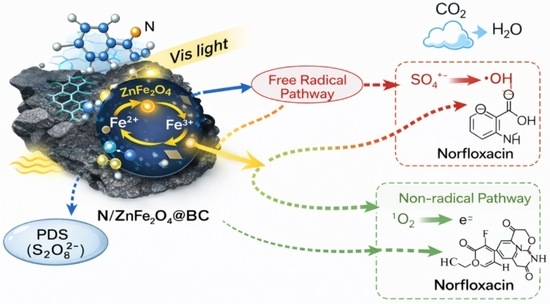
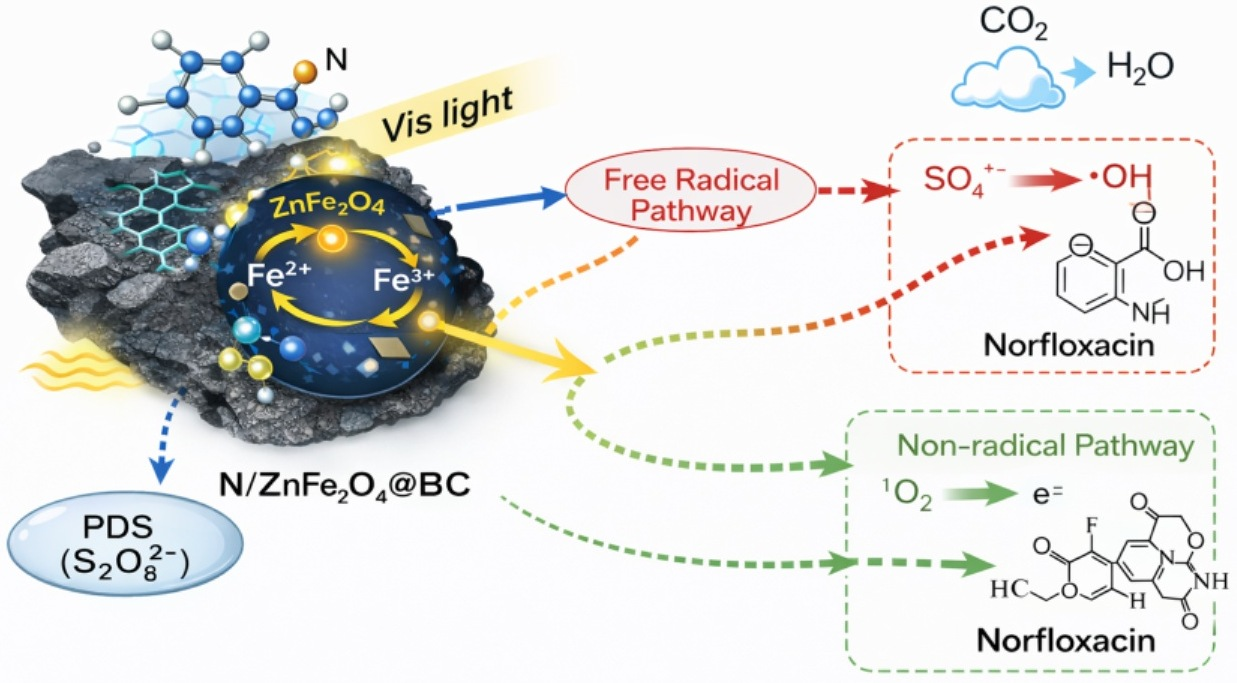
Graphical Abstract

1. Introduction

Nowadays, antibiotics represented by sulfonamides, tetracyclines, chloramphenicol, and quinolone macrolides have become the means for animal growth and protection of human health from infectious diseases. However, the extensive and even residues into the environment, thereby continuously threatening ecological balance and public health. Because antibiotic molecules are stable in structure and are not easily decomposed by microorganisms or chemical processes in the natural environment, such pollutants are often persistent, further exacerbating their potential risks. In addition, as one of the most commonly used quinolone antibiotics, norfloxacin (NOR) finds extensive application in human medicine and animal husbandry for preventive purposes, owing to its broad-spectrum antibacterial activity and high efficiency [1]. Various excessive use of these drugs results in the persistent release of their technologies have been applied to remove antibiotics from the aqueous environment, such as hybrid constructed wetland [2], including physical adsorption [3], microbial electrolysis cell systems [4], and advanced oxidation processes [5]. Advanced oxidation processes (AOPs) represent an efficient and environmentally friendly approach for degrading organic pollutants in wastewater [6,7]. Among them, persulfate, represented by peroxydisulfate (S2O82−, PDS) and peroxymonosulfate (HSO5, PMS), has attracted considerable attention in this field owing to its ability to activate and generate highly oxidative sulfate radicals (SO4) [8]. In contrast to ·OH, SO4 has multiple advantages: higher redox potential (E = 2.5–3.1 V; while ·OH is E = 1.9–2.7 V), more selectivity to pollutants, longer half-life (30–40 μs, while ·OH is usually < 1 μs), and higher activity in a wide pH range (pH = 2.0–8.0) [8].
However, the oxidation ability of PDS itself is limited, and it requires activation via various methods, including transition metal catalysis [9], UV-light [10], carbon materials [11], heating [12], microwave radiation [13], and ultrasound [14]. Traditional activation methods often face problems like high energy demand and the risk of metal ion leaching, leading to secondary pollution.
In recent years, the coupling system combining photocatalysis and PDS activation has received extensive attention from scholars. Shang et al. [15] synthesized a CuO/g-C3N4 composite catalyst via a one-step hydrothermal−calcination method. The composite demonstrated significant catalytic activity in a system coupling visible light with persulfate for phenol degradation, achieving a removal efficiency of 83.52% within 60 min. Similarly, Gao et al. [16] designed a graphene quantum dot (GQD)-modified, Fe-doped NH2-MIL-125(Ti) composite, denoted as GₓNM(Fe0.2Ti0.8), through a combined strategy of photosensitizer loading and metal ion doping. The synergistic effect of Fe doping and GQD loading accelerated electron transfer, thereby enhancing the catalytic performance. This composite achieved an 80.1% removal rate for NOR within 120 min. Moreover, employing an in situ wet chemical method, Li et al. [17] anchored Mn-doped FeOOH (Mn-FeOOH) nanoclusters onto graphitic carbon nitride nanosheets (CNNS). The Mn-Fe synergy within this composite significantly boosted the adsorption and activation of PDS, consequently enabling a 99.7% removal of tetracycline (TC) within 50 min. The high cycling stability and low iron leaching observed for Mn-FeOOH/CNNS are attributed to the strong interaction between the metal clusters and the carbon support.
However, current research predominantly focuses on reporting the performance enhancement of photocatalysis−PDS coupled systems. A comprehensive understanding remains lacking, specifically in the quantitative description of synergy, the precise discrimination of reactive species’ contributions, and the elucidation of underlying mechanisms.
ZnFe2O4 is a noteworthy multifunctional spinel ferrite, demonstrating application potential in fields such as high-temperature processes, magnetism, and energy storage, as well as photocatalysis- and peroxydisulfate-based advanced oxidation processes [18]. Its narrow band gap enables efficient visible-light absorption, while its intrinsic ferromagnetism facilitates convenient catalyst recovery via magnetic separation. Furthermore, compared with other spinel oxides such as ZnAl2O4 and ZnGa2O4 [19,20], ZnFe2O4 offers the distinctive advantage of being iron-based, as an earth-abundant element. This not only reduces material costs but, more importantly, introduces reversible Fe3+/Fe2+ redox couples. These play a critical role in driving catalytic cycles, particularly in the process of activating PDS to generate radical species. Given these combined advantages, ZnFe2O4 presents itself as an ideal model material to address the aforementioned mechanistic questions. Therefore, based on the screening and characterization of a series of materials in the previous study, the nitrogen-doped biochar-supported ZnFe2O4 composite (ZnFe2O4-N-BC, MNBC) was thus chosen as the model catalyst for this mechanistic study due to its dual functionality in charge separation and PDS activation. The material has been confirmed in previous studies to have the dual functional potential of effective visible-light catalysis and PDS activation, which provides an ideal carrier for subsequent mechanism research.
It should be noted that norfloxacin was selected as the representative contaminant because its fluoroquinolone structure, ionization behavior, and coordination characteristics differ substantially from tetracycline-type antibiotics. Such structural and physicochemical differences may lead to distinct adsorption configurations, interfacial electron-transfer pathways, and reactive species selectivity. Therefore, the present work aims to explore the response characteristics of fluoroquinolone antibiotics in a coupled photocatalytic–oxidative system rather than performing a simple substitution of pollutants.
In this study, taking NOR as the target pollutant, the synergistic effect and mechanism of MNBC catalyst in the Vis-PDS coupling system were studied in depth: (1) The synergistic effect of MNBC on the degradation of NOR in the coupling system (MNBC + Vis-PDS), PDS catalytic system (MNBC + PDS), visible-light catalytic system (MNBC + Vis), control experiment 1 (Vis + PDS), control experiment 2 (Vis), and control experiment 3 (PDS) was compared and studied; (2) the effects of reaction parameters such as catalyst dosage, PDS concentration, initial pH, and initial NOR concentration on the degradation efficiency of NOR were studied; (3) based on the quenching experiment and EPR test results, the roles of active groups such as SO4, O2·. ·OH, h+, and 1O2 in the degradation of antibiotics in the Vis-PDS system were investigated. Based on this, the synergistic mechanism of the coupling system is explained in detail in terms of semiconductor type, separation degree of photogenerated electron−hole pairs, and other aspects; (4) reasonably speculate on the degradation pathway of NOR based on the detection results of liquid chromatography mass spectrometry (HPLC-MS); and (5) the reusability of MNBC in the Vis-PDS coupling system was tested through repetitive experiments. In this study, the coupling effect of the Vis–PDS system was comprehensively investigated. Rather than focusing on semiconductor band engineering, the present work emphasizes interaction pathways, aiming to provide insights and strategies for the efficient removal of refractory pollutants through the combined application of these two technologies.

2. Materials and Methods

2.1. Chemicals

Zinc sulfate (ZnSO4·7H2O, ≥99.5%), sodium hydroxide (NaOH, ≥96.0%), and hydrochloric acid (HCl, 36.0~38.0 ω %) were obtained from Luoyang Chemical Reagent Factory (Tianjin, China). Oxalic acid (C2H2O4, ≥98.0%) and norfloxacin (C16H18FN3O3, ≥98.0%) were supplied by Shanghai Macklin Biochemical Co., Ltd. (Shanghai, China). Ferrous sulfate (FeSO4·7H2O, ≥99.0%), urea (CH4N2O, ≥99.0%), potassium persulfate (K2S2O8, ≥99.5%), acetonitrile (CH3CN, ≥99.9%, HPLC), L-Ascorbic acid (C6H8O6, ≥99.7%), tertiary butanol (C4H10O, ≥99.0%), methanol (CH3OH, ≥99.9%, HPLC), and methanol (CH3OH, ≥99.9%, HPLC) were obtained from Sinopharm Chemical Reagents (Shanghai, China). All commercial chemicals were analytical reagent grade and utilized without further purification. Deionized water was employed for the preparation of all aqueous solutions.

2.2. Material Preparation Characterization and NOR Removal Experiment

Optical and photoelectrochemical properties were characterized as follows. Optical absorption and band gap analysis were performed using a UV-Vis spectrophotometer (UV-3600, Shimadzu, Kyoto, Japan) with BaSO4 as the reflectance standard. Photoluminescence (PL) spectra were acquired on a fluorescence spectrometer (Fluoromax-4, HORIBA, Kyoto, Japan) to assess charge carrier recombination. Transient photocurrent measurements were carried out with an electrochemical workstation (CHI 660E, CH Instruments, Austin, TX, USA) under visible-light irradiation (λ > 420 nm) to evaluate photo-induced charge separation.
The preparation and other characterizations of materials have been mentioned in previous studies [21]. Therefore, the catalyst used in this work was synthesized independently following the same protocol, with specific synthesis parameters provided in the Supporting Material Text S1.
A total of 50 mL of NOR solution with a concentration of 50 mg/L was taken, and then a certain amount of biochar composite material was fully dispersed into the solution. Adsorb under dark conditions for 30 min. At this point, start sampling, record the sample time as 0 min, and set the NOR concentration of this sample as the initial concentration. Then, add a certain amount of PDS while using a 500 W xenon lamp (λ ≥ 420 nm) as a light source to continuously irradiate the reaction, positioned 10 cm above the solution surface. The reaction temperature was maintained at 25 ± 1 °C with a cooling-water circulation system under ambient air (open system). At predetermined time intervals, 1 mL of the sample at a predetermined time node, and an equal volume of methanol is added to quench and terminate the reaction. The obtained sample was subjected to 0.22 μm after filtration with a nylon membrane, and the remaining NOR concentration was determined by high-performance liquid chromatography (HPLC). To identify the dominant reactive oxygen species involved in the catalytic process, radical quenching experiments were conducted. Specifically, different scavengers were introduced into the system prior to irradiation. The dosage of each scavenger was determined based on a scavenger-to-PDS molar ratio of 50:1 [22] to ensure effective quenching of the target reactive species while minimizing interference with the overall reaction system. The concentration of residual NOR in the solution was quantified using high-performance liquid chromatography (HPLC, Thermo Fisher-UltiMate 3000, Waltham, MA, USA). The analysis was performed on a Shim-Pack VP-ODS C18 column maintained at 40 °C. An isocratic mobile phase, composed of acetonitrile and 0.5% phosphoric acid (pH adjusted to 3.0 ± 0.1 with triethylamine) in a volume ratio of 2:8, was delivered at a constant flow rate of 1.0 mL/min. Detection was carried out at a wavelength of 276 nm with an injection volume of 20 μL. Quantification was based on a five-point external standard calibration curve over a concentration range of 0.5–20 mg/L (R2 > 0.999). The limit of detection (LOD) and limit of quantification (LOQ) for this method were determined to be 0.1 mg/L and 0.3 mg/L, respectively.
All experiments were conducted three times, and the average value was taken.

2.3. Evaluation Method of Apparent Enhancement Effect

According to the relevant literature, the apparent enhancement factor was calculated by Formula (1) to objectively evaluate the synergistic effect of the coupling system in the degradation of NOR [23,24]:
η syn = DE Coupled DE Vis + DE PDS DE Vis + DE PDS × 100 %
where ηsyn represents the apparent enhancement factor (%) compared with internal control systems, DECoupled is the degradation rate (%) of the pollutant in the coupling system, DEVis is the degradation rate (%) of the pollutant in the photocatalytic system, and DEPDS is the degradation rate (%) of the pollutant in the persulfate catalytic system.
All degradation efficiencies used for apparent enhancement factor calculation were obtained at the same reaction time (90 min). The Vis/PDS system without a catalyst was considered as background and discussed separately.

2.4. High Performance Liquid Chromatography Detection Method

The degradation kinetics of NOR were simulated using a pseudo-first-order model, with the apparent rate constant kobs determined by Equation (2):
ln C t C 0 = k obs × t
where C0 is the initial NOR concentration; Ct: concentration at time t; kobs: apparent rate constant.

2.5. Cyclic Test Method

To assess the reusability of MNBC in this study, three consecutive NOR degradation cycle experiments were performed. After the completion of the degradation experiments, an external magnetic source was used for magnetic separation and recovery. Keep the other reaction conditions unchanged and repeat the cycle test to evaluate its reusability.

3. Results and Discussion

3.1. Analysis of Light Response Performance

UV-Vis diffuse reflectance spectroscopy was used to characterize the light absorption behavior of the material. As shown in Figure S1a, MNBC exhibited strong absorption across the visible-light region (200–800 nm), confirming its ability to generate photoinduced charge carriers under visible-light irradiation [25]. The optical band gap of MNBC, calculated via the Tauc plot method (Figure S1b), was determined to be 2.03 eV. This relatively narrow band gap indicates that the N co-doping with ZnFe2O4 effectively enhances the visible-light response of the material, which is conducive to improving its photocatalytic activity.
Photoluminescence (PL) spectroscopy was employed to evaluate the separation and recombination behaviors of photogenerated charge carriers. In general, the lower PL intensity means that the photogenerated electron−hole pairs have higher separation efficiency. In this study, the PL spectrum of the MNBC sample was measured at the excitation wavelength of 340 nm, and the result is shown in Figure S1c. The recombination of electrons and holes leads to an obvious emission peak near 370 nm. It is worth noting that the observed PL intensity of MNBC is relatively low, which indicates that the co-doping of ZnFe2O4 and N can effectively inhibit carrier recombination and improve charge separation efficiency, thereby enhancing the photocatalytic degradation performance of the material [26].
The transient photocurrent response intensity can effectively reflect the transmission and separation efficiency of photogenerated carriers. As displayed in Figure S1d, the MNBC catalyst exhibits a strong photocurrent response under periodic light on/off cycles. The photocurrent signal of MNBC remains stable over four consecutive cycles, indicating that the material possesses good photostability. These results demonstrate that MNBC has a high separation efficiency of photogenerated electron−hole pairs, which contributes to its enhanced photocatalytic performance. In addition, the photocurrent results are consistent with the analysis from the photoluminescence spectra, further confirming that the co-doping of ZnFe2O4 and N can promote the migration and separation of photogenerated carriers [27].

3.2. Synergistic Effect and Evaluation of ZnFe2O4-N-BC in Coupled Systems

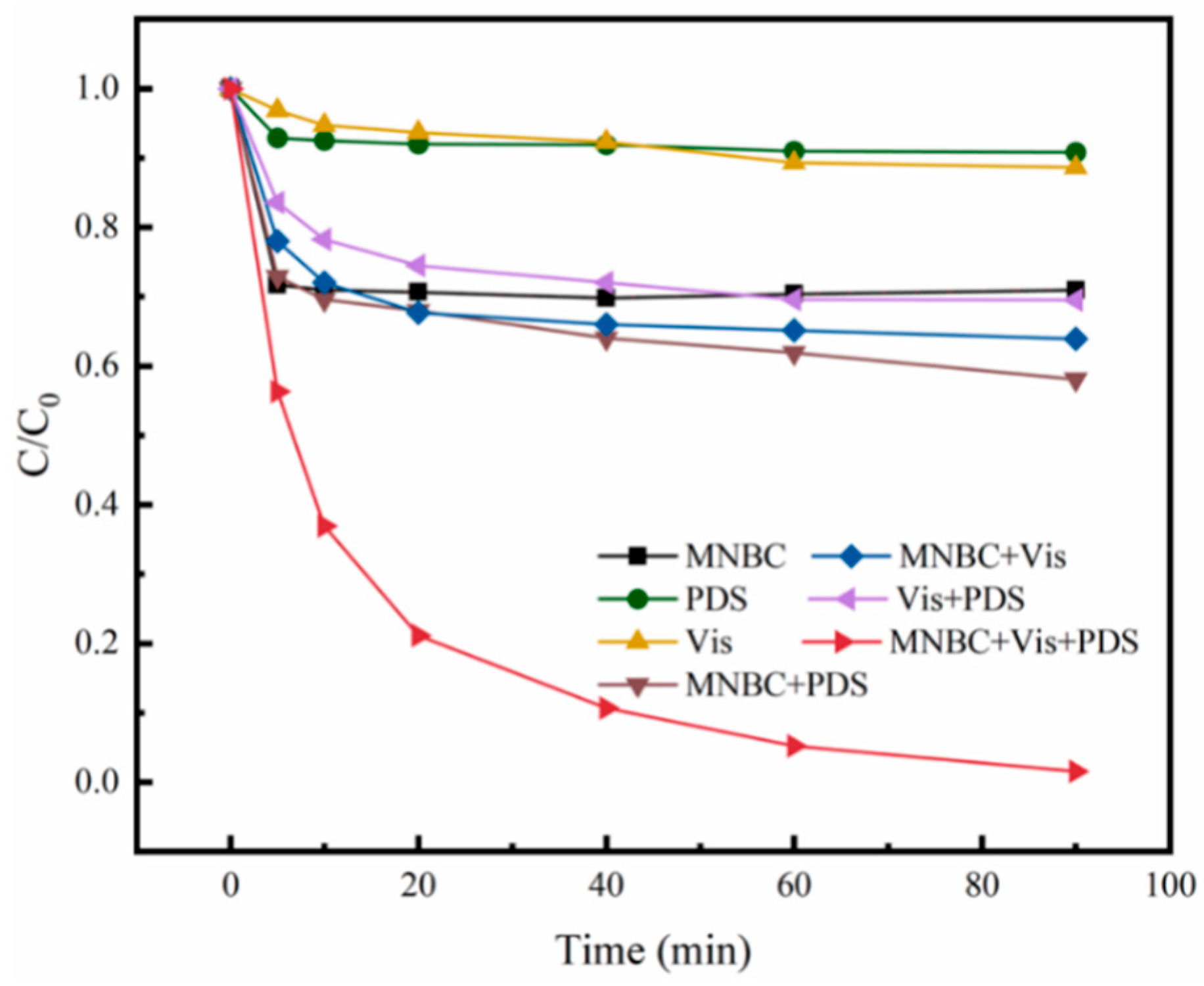
Using NOR as the target pollutant, different treatment processes, such as adsorption, vis catalysis, catalytic PDS, and catalytic Vis-PDS performance of MNBC, were tested, and the results are shown in Figure 1. Within 90 min, the NOR adsorption efficiency of MNBC was only 29.1%. Without adding MNBC, only Vis or PDS can hardly remove NOR. In addition, the degradation efficiency of the Vis/PDS system for NOR was also very low, only 30.5%. MNBC/Vis can remove 36.1% NOR within 90 min. Active groups, such as h+, O2·, and ·OH generated by the system reaction mainly played a strong oxidation role in the NOR degradation. The NOR degradation efficiency by the MNBC/PDS system was slightly better than that of the MNBC/Vis system, with a degradation efficiency of 41.9% in 90 min. In the PDS catalytic system, the degradation of NOR is mainly by 1O2 and supplemented by active groups such as SO4·, ·OH, and O2·. However, after adding MNBC to the coupled system, the NOR removal efficiency reached 98.5%, and the apparent rate constant kobs was 0.04322 min−1 according to Formula 2, which was 22.7 and 17.4 times higher than those of MNBC/Vis (0.00190 min−1) and MNBC/PDS (0.00249 min−1), respectively. From these results, it was indicated that the coupled system has a higher catalytic performance than the single system. The apparent synergistic enhancement between photocatalysis and PDS activation proved crucial for the enhanced degradation performance in this coupled system.
For evaluation of the synergy in the coupled system, the apparent enhancement factor was calculated according to Formula (1). As demonstrated in Figure 1, the coupled system achieved a significantly higher degradation efficiency within 90 min compared to the individual systems (Table 1). The apparent enhancement factor ηsyn was 26.3%, indicating a notable relative enhancement effect among Vis, PDS, and MNBC.

3.3. Effect of Reaction Parameters on Catalytic Performance of Coupled Systems

3.3.1. Effect of MNBC Dosage

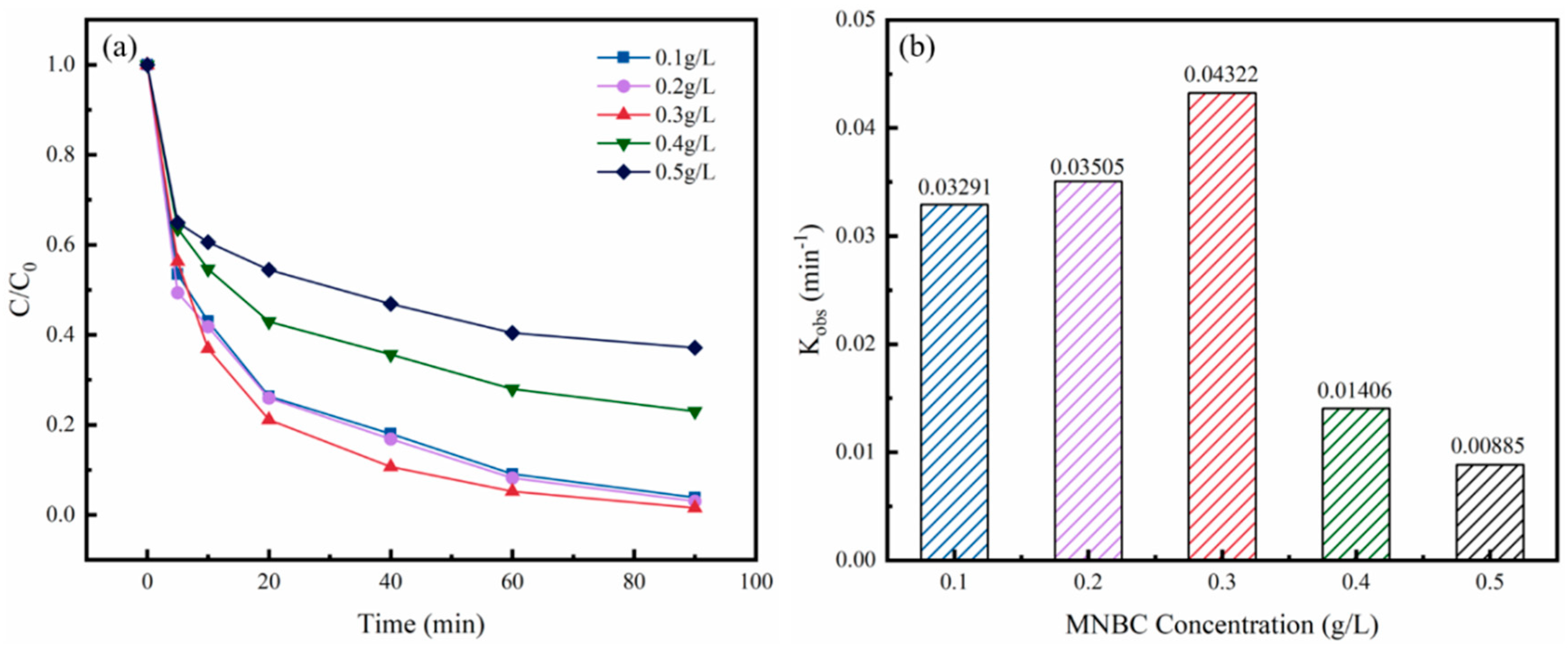
As shown in Figure 2a, the NOR removal efficiency reached 96.2% within 90 min with the MNBC dosage of 0.1 g/L and the PDS concentration of 0.5 mM, which indicated that marked synergy between the two components greatly enhanced the degradation efficiency for organic pollutants. As the MNBC dosage increased to 0.3 g/L, the NOR removal rate also increased to 98.5%, and the kobs reached 0.04322 min−1 (Figure 2b). Nevertheless, the NOR removal rate decreased as the MNBC dosage continued to increase from 0.3 g/L to 0.4 g/L, and the kobs ultimately decreased from 0.04322 min−1 to 0.01406 min−1. The experimental results showed that increasing the MNBC dosage rendered more active sites available to the Vis-PDS coupled system. However, excessive addition of MNBC will reduce the removal rate of NOR and inhibit its degradation rate, which may be due to excessive MNBC blocking light transmission and reducing the contact area between light and catalytic materials [28]. In addition, excessive MNBC was more likely to agglomerate in water, resulting in a significant reduction in active sites, thereby reducing removal efficiency. To sum up, in the subsequent experiment, the MNBC dosage was set at 0.3 g/L.

3.3.2. Effect of PDS Concentration

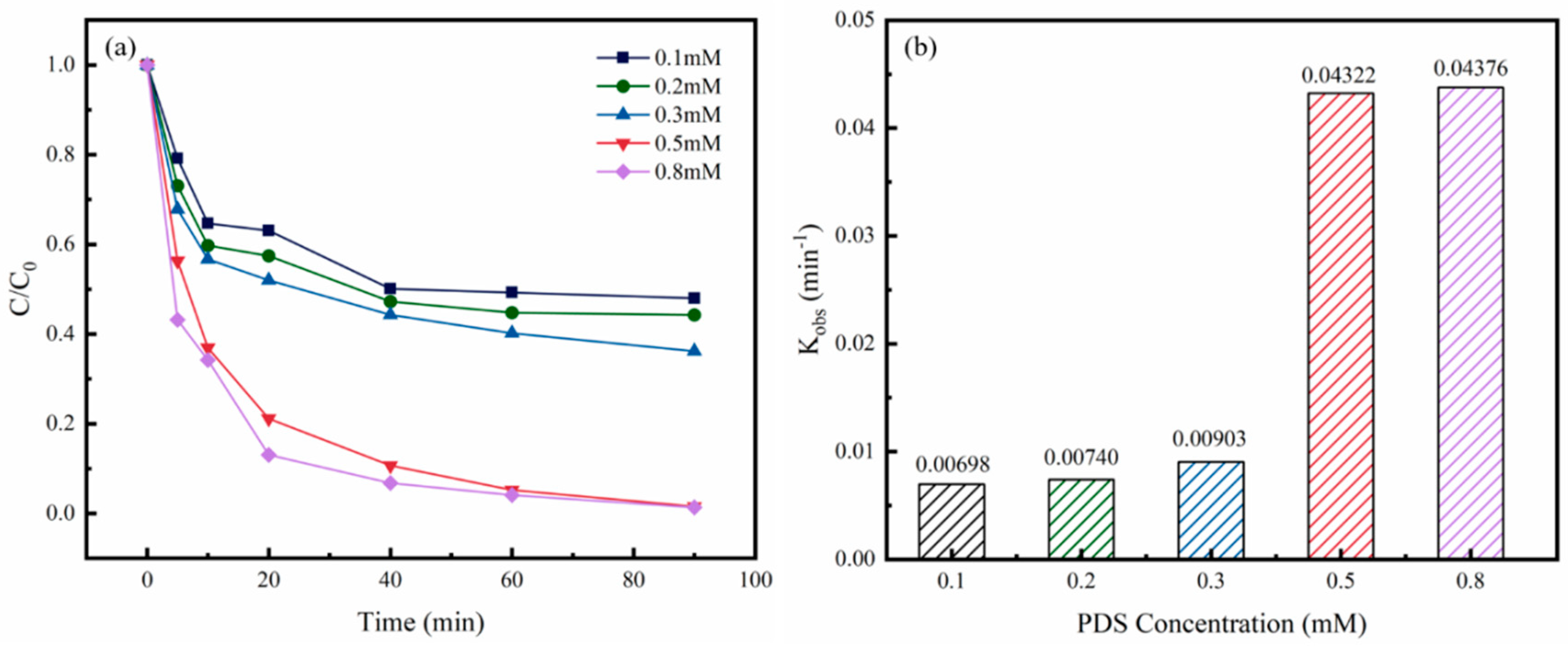
Figure 3 illustrates the influence of PDS concentration on system performance. The degradation efficiency was enhanced from 52.0% to 98.5%, and the kobs value increased concomitantly from 0.00698 to 0.04322 min−1 as the PDS concentration increased from 0.1 to 0.5 mM. At a higher concentration of 0.8 mM, the system performance approached a plateau, with the removal efficiency and kobs reaching 98.7% and 0.04376 min−1, respectively. For a free radical degradation process, however, the addition of excessive PDS can induce a self-scavenging reaction among the radicals, as described in Equations (3) and (4) [29,30]. With the excessive addition of PDS, the Vis-PDS coupled system significantly inhibited the removal performance of NOR. These results suggest the coexistence of radical and non-radical reaction pathways. At the same time, in the coupling system of photocatalysis and PDS, the electron−hole pairs generated by visible-light excitation are also involved in the degradation of NOR. With the increase in PDS concentration, the system can generate more active species, thus enhancing the attack efficiency of target pollutants [31]. In addition, it may also be due to the limited surface functional groups and defect structures of MNBC itself, which did not provide sufficient active sites for PDS:
SO4 + ·SO4· → S2O82−
SO4· + S2O82− → S2O8· + SO42−

3.3.3. Effect of pH

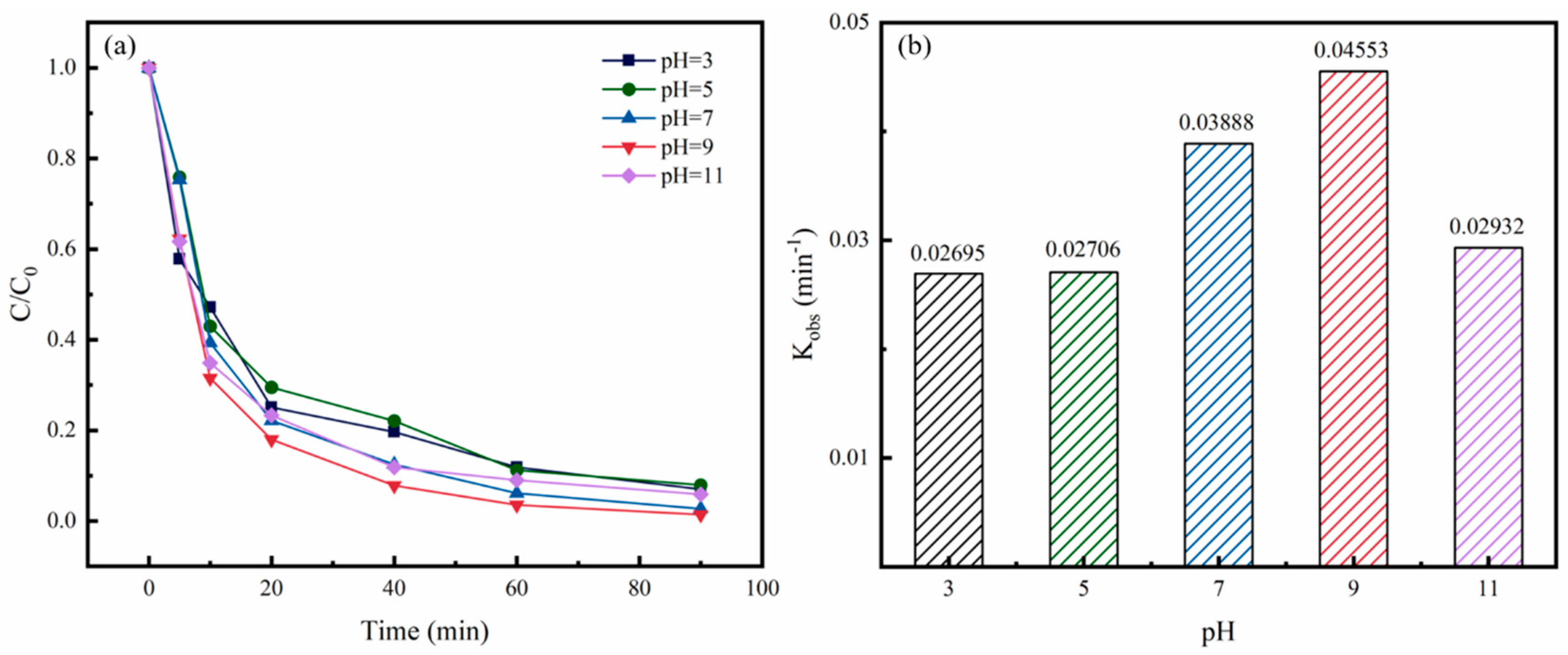
We evaluated the application potential of MNBC by investigating the effect of initial pH on NOR degradation. As presented in Figure 4, as the pH value of the MNBC/Vis-PDS system increases, the NOR removal efficiency also increases. At the initial pH of 9.0, the NOR removal efficiency and the kobs reached 98.6% and 0.04553 min−1, respectively. However, the NOR degradation rate decreased to 94.1%, and the kobs also decreased to 0.02932 min−1 at the initial pH of 11. A possible explanation is that within the pH range of 4.0 to 9.0, PDS predominantly exists as S2O82−, which can react with H+ and e to generate SO4·, as described by Equations (5) and (6) [32]. Nevertheless, PDS was easily converted to SO52−, and its oxidation ability was weak when the pH value was greater than 9.4. At the same time, excessive OH leads to negative charges on the surface of MNBC, resulting in a repulsive reaction with negatively charged PDS, making it difficult for PDS to be activated [33]. Through the analysis of the above results, the degradation efficiency of the MNBC/Vis-PDS system can be maintained above 92.1% within a large initial pH range, and it has good applicability:
H+ + S2O82− → HS2O8
HS2O8 + e → SO42− + SO4· + H+

3.3.4. Effect of NOR Concentration

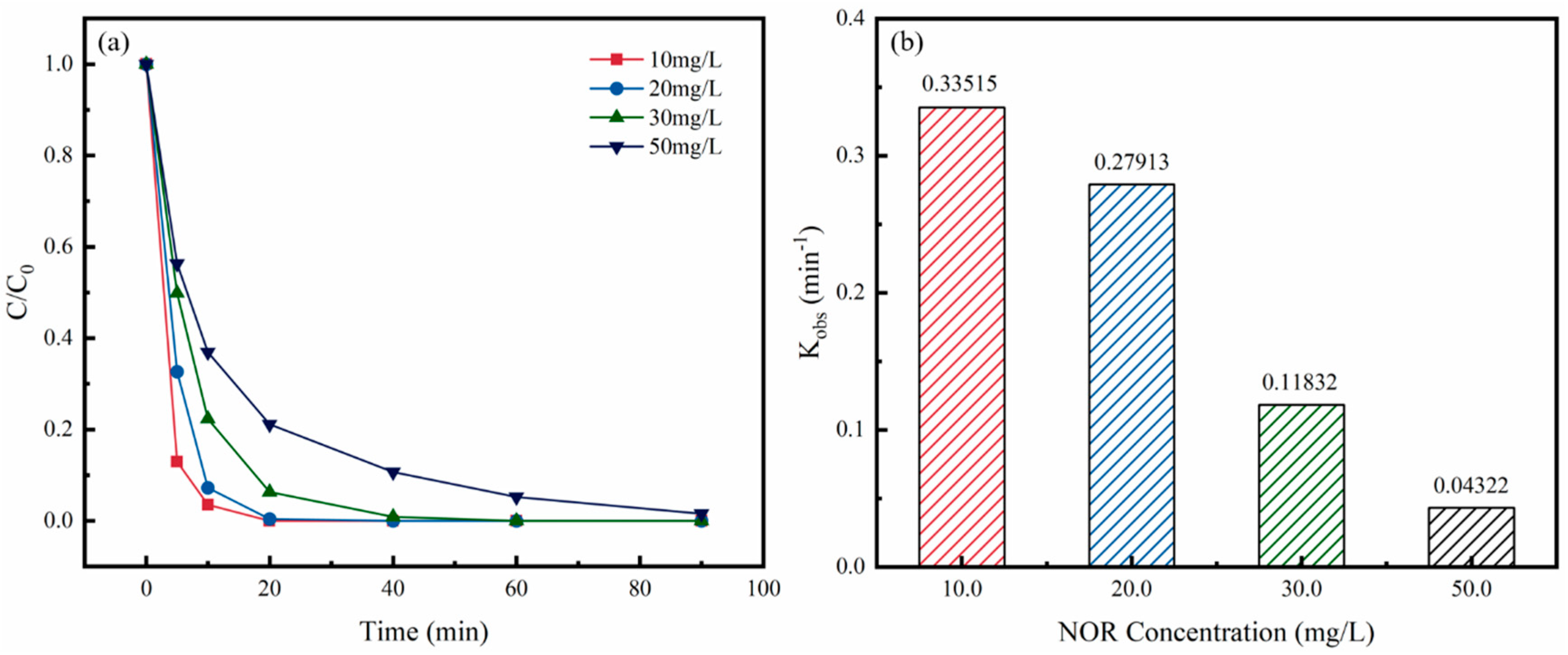
The effect of the initial NOR concentration is summarized in Figure 5. The MNBC/Vis-PDS system demonstrated rapid and near-complete degradation when the initial NOR concentration was below 50 mg/L. In addition, with initial NOR concentrations of 10, 20, 30, and 50 mg/L, the observed rate constants kobs were 0.33515, 0.27913, 0.11832, and 0.04322 min−1, respectively. The above results indicated that the MNBC/Vis-PDS system maintained high removal efficiency for NOR across a large concentration range, indicating that the system has a strong ability to resist fluctuations in pollutant concentration.

3.4. Analysis of Synergistic Mechanism and Degradation Pathway of Coupling System

3.4.1. Free Radical Mechanism

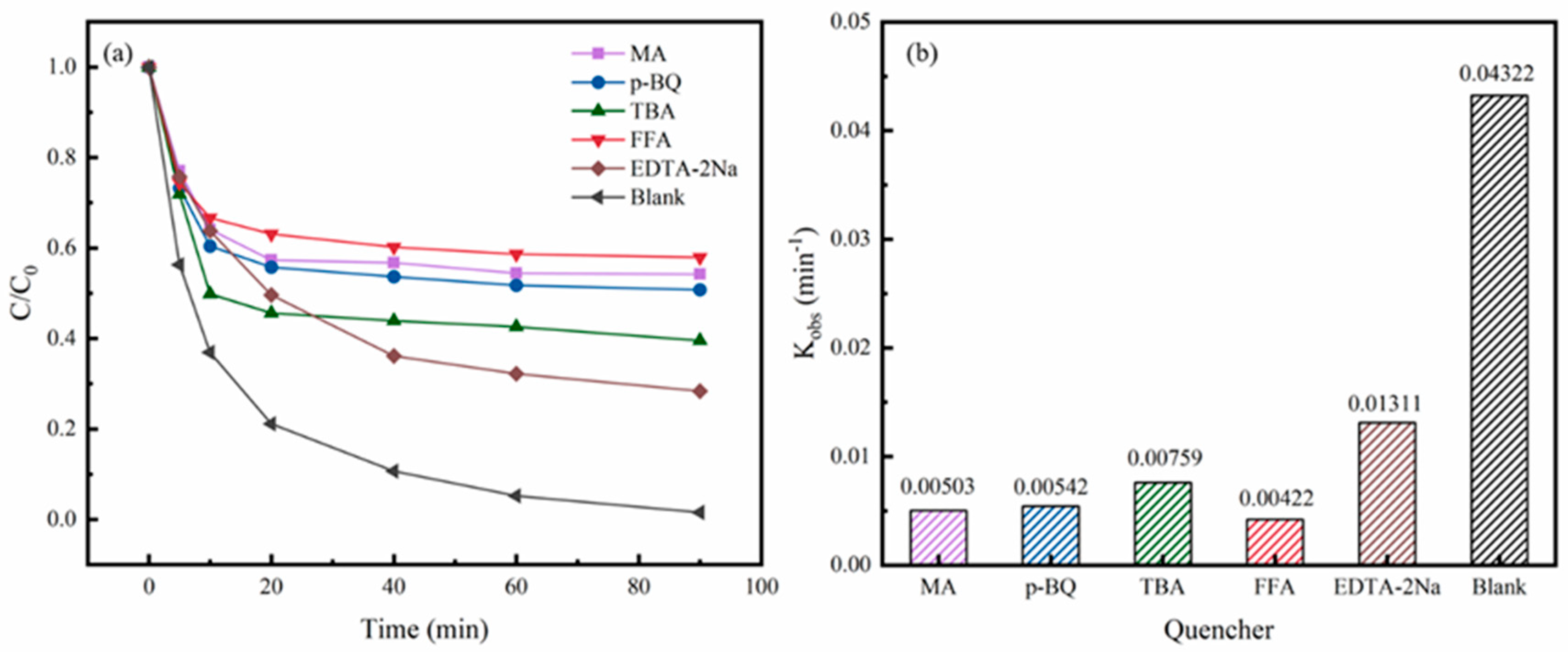
The mechanism of free radical production and degradation of NOR in the MNBC/Vis-PDS coupling system was investigated by quenching experiments [34,35,36]. It should be noted that the quenching experiments presented here are intended to provide comparative and semi-quantitative mechanistic evidence rather than absolute determination of radical concentrations. In addition, the optical absorption and transient photocurrent analyses indicate that visible-light irradiation can induce photo-generated charge carriers and facilitate interfacial electron transfer, which may subsequently influence the generation pathways and distribution of reactive oxygen species in the coupled system. Methanol (MA) served as the quencher for both SO4· and ·OH, and tertiary butyl alcohol (TBA) was used as the ·OH quenching agent, and a typical O2· quenching agent, with p-benzoquinone (p-BQ) serving to identify O2. Disodium ethylenediaminetetraacetic acid (EDTA-2Na) was used to remove h+. In this experiment, the dosage of each scavenger was 1.25 mmol. As shown in Figure 6a,b, in the presence of these quenchers, the NOR degradation efficiency declined markedly. After the addition of MA and TBA, the NOR degradation efficiency dropped from 98.5% to 45.8% and 60.5%, respectively. Moreover, the NOR degradation efficiency decreased to 49.2% after adding p-BQ. In addition, after adding EDTA-2Na quenching agent, the NOR degradation efficiency decreased to 71.6%, which is higher than the first three quenching agents. According to the above results, in the radical mechanism, SO4, ·OH, O2, and h+ were generated simultaneously during the degradation process, and SO4· played a leading role.
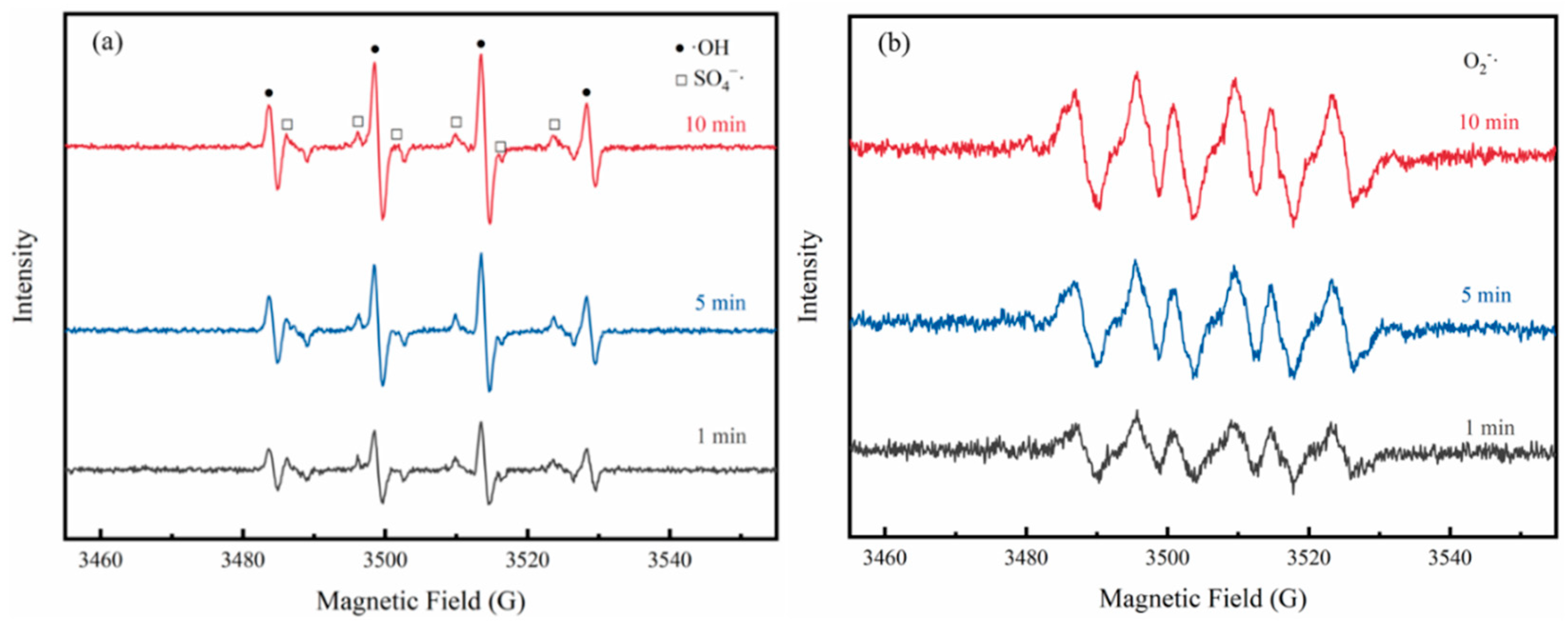
Electron paramagnetic resonance (EPR) was employed to characterize the radical species. As illustrated in Figure 7a, using a DMPO probe for EPR detection, the characteristic signals of ·OH (1:2:2:1 quarter signal) and SO4· (weak sixth signal) were captured, and the intensity got stronger and stronger as the time increased from 1 min to 10 min. In addition, the MNBC/Vis-PDS coupled system exhibited significant SO4· characteristic signals, demonstrating that the system can stably generate SO4· during degradation, significantly improving degradation performance. At the same time, the EPR detection results of O2· were shown in Figure 7b. From 1 min to 10 min, four groups of characteristic EPR signals were observed, which can be summarized as DMPO- O2· signals. It should be emphasized that the EPR analysis herein is primarily used to provide qualitative and semi-quantitative evidence of reactive species evolution and temporal trends, instead of absolute radical concentration determination.
Taken together, we suggest the following mechanism for the radical pathway degradation of NOR. Firstly, thanks to the co-doping of ZnFe2O4 and N, MNBC exhibited a strong visible-light trapping ability and generated more photogenerated carriers (Equation (7)). Afterwards, e was transferred to the conduction band, while h+ were left in the latter. At the same time, BC enhanced the separation efficiency of the e-h+ pair [37]. Secondly, Fe (III) captured the released e, thereby stably converting it to Fe (II) (Equation (8)) [38]. After being coupled with PDS, Fe (II) acted as an active center to activate PDS to produce SO4· and ·OH (Equations (9) and (10)) [39]. The photogenerated e on the conduction band of MNBC can be captured by S2O82− to generate SO4·, while the O2 in water was reduced to O2· (Formulas (11) and (12)) by free electrons. In summary, SO4·plays a leading role in the radical pathway during NOR degradation in the MNBC/Vis-PDS system. It is activated by either Fe (II) or photogenerated electrons, a conclusion supported by the quenching experiments. Collectively, the action of ·OH, SO4·, O2·, and h+ led to the effective removal of NOR (Formula (13)):
MNBC + hv → h+ + e
Fe3+ + e → Fe2+
S2O82− + Fe2+ → Fe3+ +SO42− + SO4·
SO4·+ OH → SO42− + OH
e + S2O82− → 2 SO4·
e + O2 → O2·
SO4/OH/O2/hvB+ +NOR → products

3.4.2. Non-Radical Mechanism

The non-radical degradation mechanism of NOR in the MNBC/Vis-PDS system was investigated. For this purpose, furfuryl alcohol (FFA) was selected to identify the role of 1O2. The results are illustrated in Figure 6a,b. After adding excessive FFA, the degradation rate of NOR sharply decreased from 98.5% to 42.0%, and the kobs also directly decreased to 0.00422 min−1. This indicated that 1O2 also played a leading role in NOR degradation, promoting NOR degradation together with the free radicals. At the same time, the EPR detection results of O2 showed that the O2 characteristic peak intensity increased significantly from 1 min to 5 min, while the O2 characteristic peak intensity changed little from 5 min to 10 min. It can be inferred that a large amount of O2·was converted to 1O2 during the reaction process (Equations (14)–(16)):
2S2O82− +2H2O +e → 4SO42− + O2·+4H+
2O2·+ 2H+ → H2O2 + 1O2
H2O2 + O2 → OH + 1O2 +·OH
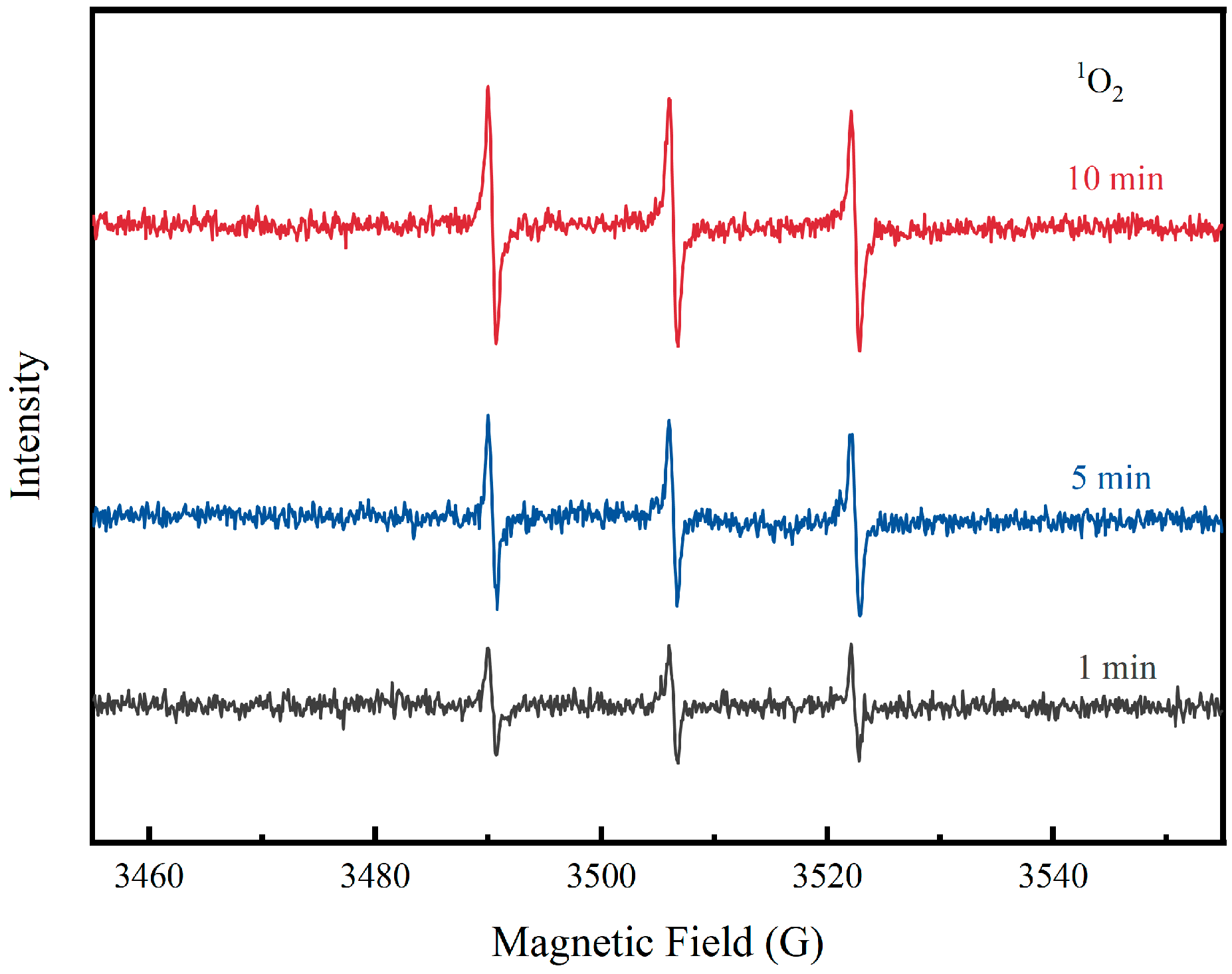
This result is consistent with our previous findings. The graphite N and C=O groups in MNBC can facilitate PDS activation to generate a portion of 1O2 [21]. These findings indicate that the non-radical pathway played a major role in NOR degradation by the MNBC/Vis-PDS system. Therefore, EPR was employed to verify the contribution of 1O2. As evidenced in Figure 8, the characteristic 1:1:1 triad signal of TEMP-1O2 was detected by EPR, and its intensity grew steadily over a 10 min period, confirming the continuous generation of 1O2. More significantly, the EPR characteristic peak changing trends of 1O2 in the system coincided with that of the O2 characteristic peak. The above results confirmed that O2·significantly promotes the formation of 1O2 and plays a major role in NOR degradation, which is consistent with the quenching experiments.
Based on the quenching and EPR evidence, a possible non-radical mechanism is proposed as follows. First, MNBC was irradiated by visible light to produce an e-h+ pair. Secondly, O2 in water was reduced by free electrons to O2 (Formula (17)), while the surface defect structure of MNBC promotes the hydrolysis reaction of PDS, effectively activating PDS to produce O2·(Formulas (18) and (19)) [40]. During the reaction process, most of 1O2 was produced by O2, and a small portion was produced by graphite N and C=O (Formulas (20) and (21)) [41]. Finally, NOR was degraded by 1O2 (Formula (22)):
e + O2 → O2·
2S2O82− + 2H2O → 2SO42− + HO2 + 3H+
S2O82− + HO2 → O2· + SO4· + SO42− + H+
2H+ + 2O2· → H2O2 + 1O2
H2O2 + O2· → 1O2 + OH + ·OH
1O2 + NOR → Products
Although the present study focuses on norfloxacin as a model compound, the observed pathway modulation indicates that antibiotic molecular structure plays a critical role in determining activation behavior and reactive species distribution. Future investigations will extend this coupled activation strategy to additional antibiotic classes to evaluate its applicability range and boundary conditions.

3.5. Exploration of Degradation Pathway

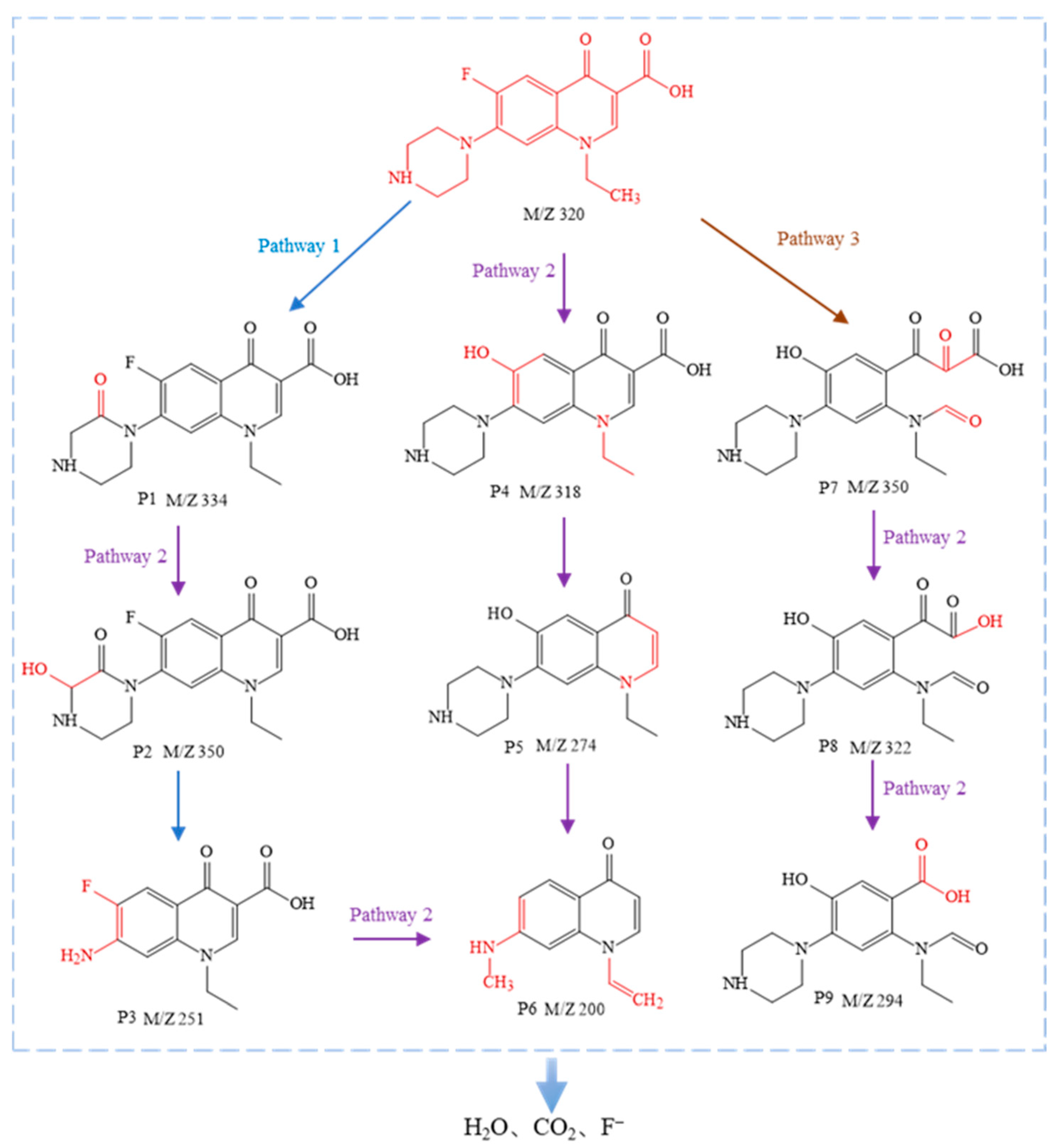
Based on the intermediate products identified by HPLC-MS, this study proposed a possible degradation pathway of NOR. The core structure of the NOR molecule contains a piperazine ring, a benzene ring, and a naphthyridine ring, and its side chain is composed of functional groups such as a carboxyl group, a ketone carbonyl group, and a fluorine atom.
It was speculated that the degradation mainly depended on three pathways, which can be summarized as pathway one: Piperazine ring conversion; pathway two: Defluorination, hydroxylation, decarboxylation, etc; and pathway three: Quinolone group conversion [42]. As shown in Figure 9, during pathway one, piperazine epoxidation of NOR (M/Z 320) formed C=O (P1, M/Z 334), which was hydroxylated and converted to P2 (M/Z 350). After that, piperazine ring conversion further led to C-N cleavage to form P3 (M/Z 251) [43]. In pathway two, the -F group and the -OH group on NOR were attacked and separated by active free radicals, and the—F group can also be replaced by the -OH group through the hydrolysis reactions [44]. P4 (M/Z 318) was converted to P5 (M/Z 274), followed by the decarboxylation reaction of P5 to P6 (M/Z 200) [45]. In addition, in pathway three, C=C, which was adjacent to the carboxylic acid group, can be partially attacked by active free radicals to convert to P7 (M/Z 350), and then P7 was further degraded to P8 (M/Z 322) and P9 (M/Z 294) [46].

3.6. Recycling and Reusability Exploration

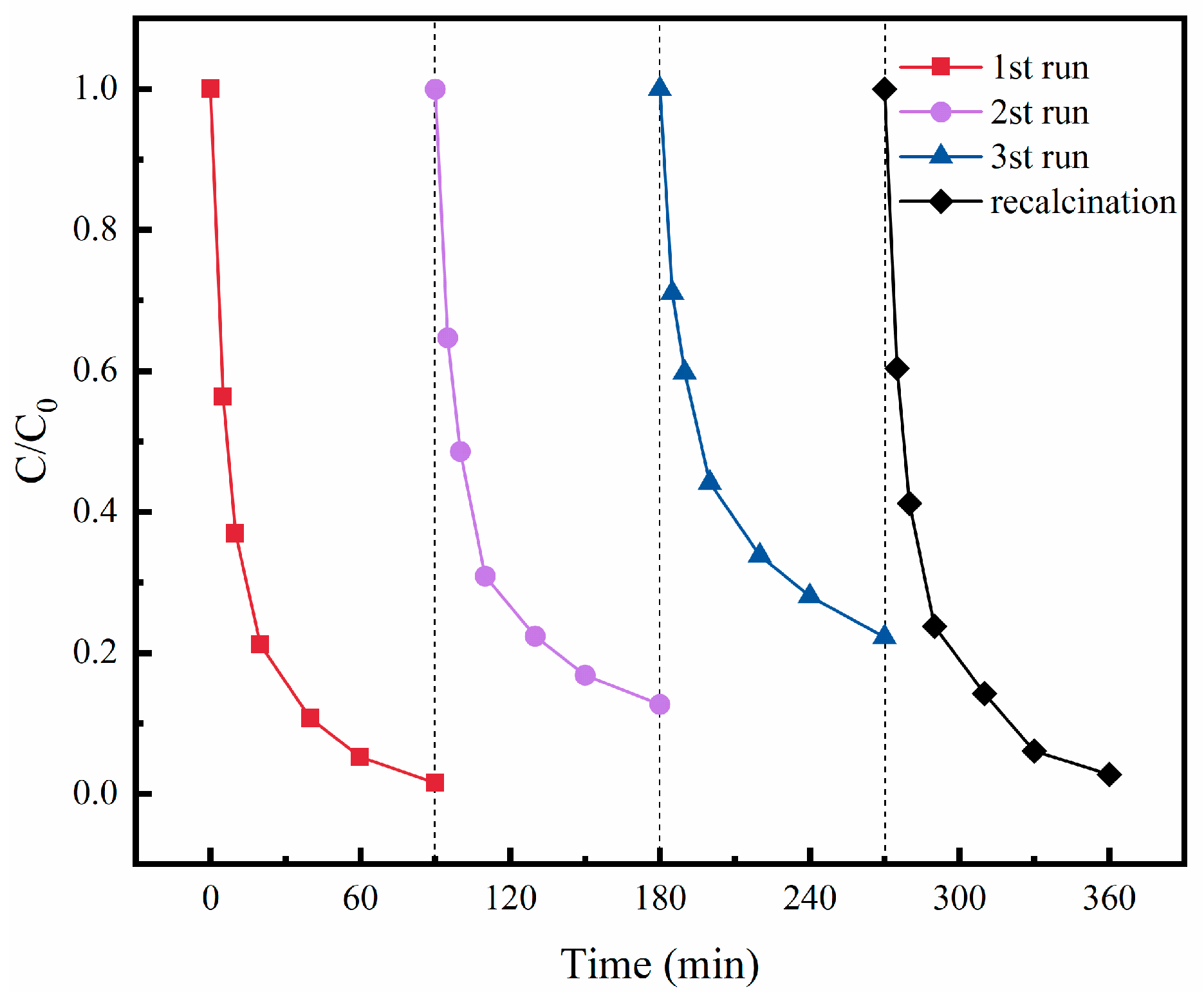
The circulation and reusability of catalysts are important indicators for evaluating their practical application. Three consecutive cyclic degradation experiments were conducted for this purpose. The NOR degradation efficiency declined sequentially to 98.5%, 87.3%, and 77.8% upon the first, second, and third reuse of the catalyst (Figure 10). The slight decrease in degradation efficiency can be attributed to several factors: the adsorption of NOR and its intermediates on the MNBC surface, a process that, as shown for analogous materials, can foul pores and reduce accessible surface area without altering the bulk structure [35,47]; the loss of active sites, which has been identified as a key factor in activity decay through dedicated characterization studies [48]; and the consequent reduction in specific surface area and total pore volume. In addition, studies have shown that pyrolysis can remove organic pollutants or intermediates adsorbed on the surface of the catalyst, thereby restoring the activation performance of carbon-based catalysts to a certain extent [49]. Figure 10 showed that the catalytic activity of MNBC was restored after re-pyrolysis (500 °C, 0.5 h), confirming that simple thermal treatment can regenerate its activity. The above experimental results showed that MNBC has good recycling and recyclability.
In addition to cycling stability, the chemical stability of the catalyst, particularly its metal leaching behavior, is also critical for assessing its environmental applicability and safety. The literature shows that similar catalysts, such as ZnFe2O4 and biochar-supported catalysts, generally exhibit low metal leaching rates during advanced oxidation processes, with their leaching concentrations complying with relevant standard limits [47,50,51]. Combined with the stable cycling performance observed in this study, it can be inferred that MNBC carries a low risk of significant metal leaching in this system.

4. Conclusions

In this research, an MNBC/Vis-PDS coupled system was used to explore the catalytic performance in NOR degradation, and this study focuses on mechanistic elucidation rather than catalyst development. Optical absorption and transient photocurrent analyses further provided complementary evidence for light-induced charge carrier participation and interfacial electron transfer in the coupled system.
The results indicated that the MNBC/Vis-PDS coupled system exhibited higher degradation efficiency. Compared with MNBC/Vis and MNBC/PDS alone, the degradation rate constants of the MNBC/Vis-PDS coupled system for NOR were 22.7 and 17.4 times that of the two single systems. In addition, the apparent enhancement factor ηsyn was 26.3%, indicating a significant relative enhancement compared with the individual control systems.
At optimal conditions, an initial norfloxacin concentration of 50 mg/L was degraded by 98.5% in 90 min. Quenching experiments and EPR analysis identified 1O2 and SO4· as the primary reactive species for NOR degradation in the MNBC/Vis–PDS system, with 1O2 being the dominant contributor, which is indicative of a prominent non-radical pathway. The overall contribution followed the order: 1O2 > SO4·> O2 >·OH > h+. Based on HPLC-MS analysis, possible degradation intermediates for NOR were identified, and possible conversion pathways were proposed. The work showed that ZnFe2O4-N-BC dual effect composite catalyst was expected to become a new and efficient catalytic material in environmental treatment applications.

Supplementary Materials

The following supporting information can be downloaded at: https://www.mdpi.com/article/10.3390/catal16020196/s1; Figure S1. (a) UV–vis spectra of MNBC; (b) Tauc-plot fitting curves of (a); (c) PL spectra of MNBC; (d) Transient photocurrent responses of MNBC.

Author Contributions

Conceptualization, X.H. and X.L.; methodology, X.H.; software, D.Z.; validation, X.L. and D.Z.; formal analysis, J.W.; investigation, D.Z. and J.W.; resources, X.H.; data curation, X.L.; writing—original draft preparation, D.Z.; writing—review and editing, X.H. and J.W.; visualization, X.H.; supervision, X.L.; project administration, X.L. All authors have read and agreed to the published version of the manuscript.

Funding

This research received no external funding.

Data Availability Statement

The original contributions presented in this study are included in the article/Supplementary Material. Further inquiries can be directed to the corresponding authors.

Acknowledgments

All individuals included in this article have consented to their acknowledgment. We also thank the anonymous reviewers for their constructive comments and suggestions.

Conflicts of Interest

The authors declare no conflicts of interest.

References

  1. Li, P.; Zhao, Z.; Zhang, M.; Su, H.; Zhao, T.; Feng, W.; Zhang, Z. Exploring the Potential of Biochar Derived from Chinese Herbal Medicine Residue for Efficient Removal of Norfloxacin. Molecules 2024, 29, 2063. [Google Scholar] [CrossRef]
  2. Dan, A.; Chen, C.-X.; Zou, M.-Y.; Deng, Y.-Y.; Zhang, X.-M.; Du, J.-J.; Yang, Y. Removal efficiency, kinetic, and behavior of antibiotics from sewage treatment plant effluent in a hybrid constructed wetland and a layered biological filter. J. Environ. Manag. 2021, 288, 112435. [Google Scholar] [CrossRef]
  3. Marinos, S.; Anastasis, C.; Costas, M.; Agapios, A.; Panos, P.; Despo, F.-K. Adsorption and removal of seven antibiotic compounds present in water with the use of biochar derived from the pyrolysis of organic waste feedstocks. J. Environ. Chem. Eng. 2021, 9, 105868. [Google Scholar] [CrossRef]
  4. Liu, S.; Zhang, Z.; Gu, P.; Yang, K.; Jia, Y.; Miao, H. The effect of extracellular polymeric substances on the distribution and transmission of antibiotic resistance genes treating antibiotic wastewater via microbial electrolysis cells. Chemosphere 2024, 364, 143284. [Google Scholar] [CrossRef]
  5. Wang, Y.; Zhang, X.; Yang, Z. Advanced oxidative degradation of norfloxacin based on peroxomonosulfate activated by the Co/Fe@Eggshell. J. Environ. Chem. Eng. 2024, 12, 114513. [Google Scholar] [CrossRef]
  6. Su, H.; Nilghaz, A.; Liu, D.; Mehmood, R.; Sorrell, C.C.; Li, J. Degradation of phenolic pollutants by persulfate-based advanced oxidation processes: Metal and carbon-based catalysis. Rev. Chem. Eng. 2022, 39, 1269–1298. [Google Scholar] [CrossRef]
  7. Babu Ponnusami, A.; Sinha, S.; Ashokan, H.; Paul, M.V.; Hariharan, S.P.; Arun, J.; Gopinath, K.P.; Le, Q.H.; Pugazhendhi, A. Advanced oxidation process (AOP) combined biological process for wastewater treatment: A review on advancements, feasibility and practicability of combined techniques. Environ. Res. 2023, 237, 116944. [Google Scholar] [CrossRef] [PubMed]
  8. Li, J.; Peng, X.; Zeng, P.; Shen, L.; Li, M.; Guo, Y. Removal of Sulfonamides by Persulfate-Based Advanced Oxidation: A Mini Review. Chemosphere 2024, 370, 143874. [Google Scholar] [CrossRef] [PubMed]
  9. Al-Anazi, A.; Abdelraheem, W.H.; Han, C.; Nadagouda, M.N.; Sygellou, L.; Arfanis, M.K.; Falaras, P.; Sharma, V.K.; Dionysiou, D.D. Cobalt ferrite nanoparticles with controlled composition-peroxymonosulfate mediated degradation of 2-phenylbenzimidazole-5-sulfonic acid. Appl. Catal. B Environ. 2018, 221, 266–279. [Google Scholar] [CrossRef]
  10. Huang, N.; Shao, W.T.; Wang, Q.; Wang, W.L.; Wu, Q.Y.; Hu, H.Y. Degradation of chloromethylisothiazolinone antimicrobial by Vacuum-Ultraviolet/Ultraviolet irradiation: Reactive species, degradation pathway and toxicity evaluation. Chemosphere 2022, 302, 134821. [Google Scholar] [CrossRef]
  11. Wang, W.; Chen, M. Catalytic degradation of sulfamethoxazole by peroxymonosulfate activation system composed of nitrogen-doped biochar from pomelo peel: Important roles of defects and nitrogen, and detoxification of intermediates. J. Colloid Interface Sci. 2022, 613, 57–70. [Google Scholar] [CrossRef] [PubMed]
  12. Qi, Y.; Wei, J.; Qu, R.; Al-Basher, G.; Pan, X.; Dar, A.A.; Shad, A.; Zhou, D.; Wang, Z. Mixed oxidation of aqueous nonylphenol and triclosan by thermally activated persulfate: Reaction kinetics and formation of co-oligomerization products. Chem. Eng. J. 2021, 403, 126396. [Google Scholar] [CrossRef]
  13. Miao, D.; Zhao, S.; Zhu, K.; Zhang, P.; Wang, T.; Jia, H.; Sun, H. Activation of persulfate and removal of ethyl-parathion from soil: Effect of microwave irradiation. Chemosphere 2020, 253, 126679. [Google Scholar] [CrossRef]
  14. Diao, Z.-H.; Dong, F.-X.; Yan, L.; Chen, Z.-L.; Qian, W.; Kong, L.-J.; Zhang, Z.-W.; Zhang, T.; Tao, X.-Q.; Du, J.-J.; et al. Synergistic oxidation of Bisphenol A in a heterogeneous ultrasound-enhanced sludge biochar catalyst/persulfate process: Reactivity and mechanism. J. Hazard. Mater. 2020, 384, 121385. [Google Scholar] [CrossRef]
  15. Shang, Y.; Chao, L.; Sun, F.; Chen, S. CuO/g-C3N4 Photocatalytic Synergistic Persulfate Activation for Degradation of Phenol Wastewater. Catal. Lett. 2025, 155, 312. [Google Scholar] [CrossRef]
  16. Gao, Y.; Zhou, X.; Liu, L.; Hao, W.; Zhou, S.; Zhao, W.; Zhang, Z.; Zeng, L.; Ke, J. Synergistic enhancement of electron transfer in the photocatalysis/persulfate-oxidation system for highly efficient norfloxacin degradation. Process Saf. Environ. Prot. 2025, 201, 107524. [Google Scholar] [CrossRef]
  17. Li, Y.; Qu, C.; Ye, Q.; Meng, F.; Yang, D.; Wang, L. Enhanced tetracycline degradation by novel Mn-FeOOH/CNNS photocatalysts in a visible-light-driven photocatalysis coupled peroxydisulfate system. Environ. Res. 2024, 257, 119293. [Google Scholar] [CrossRef] [PubMed]
  18. Bohra, M.; Alman, V.; Arras, R. Nanostructured ZnFe2O4: An Exotic Energy Material. Nanomaterials 2021, 11, 1286. [Google Scholar] [CrossRef] [PubMed]
  19. Luchechko, A.; Zhydachevskyy, Y.; Ubizskii, S.; Kravets, O.; Popov, A.I.; Rogulis, U.; Elsts, E.; Bulur, E.; Suchocki, A. Afterglow, TL and OSL properties of Mn2+-doped ZnGa2O4 phosphor. Sci. Rep. 2019, 9, 9544. [Google Scholar] [CrossRef]
  20. Spiridigliozzi, H.; Rouleau, O.; Kanaev, A.; Schoenstein, F. Synthesis of MAl2O4(M = Mg, Co, Ni, Zn, Ba) Nanopowders by Liquid Impregnation of Nanofibrous Alumina. Ind. Eng. Chem. Res. 2023, 62, 9393–9407. [Google Scholar] [CrossRef]
  21. Wu, J.; Su, H.; Wang, Z.; Hou, B.; Cheng, X.; Yury, V.S.; Wang, X.; Liu, B.; Zhu, X.; Mao, Y.; et al. N/ZnFe2O4 codoped biochar as an activator for peroxydisulfate to degrade oxytetracycline: Synthesis, property and mechanism. Sep. Purif. Technol. 2022, 297, 121487. [Google Scholar] [CrossRef]
  22. Li, X.; Min, X.; Hu, X.; Jiang, Z.; Li, C.; Yang, W.; Zhao, F. In-situ synthesis of highly dispersed Cu-CuxO nanoparticles on porous carbon for the enhanced persulfate activation for phenol degradation. Sep. Purif. Technol. 2021, 276, 119260. [Google Scholar] [CrossRef]
  23. Bansal, P.; Verma, A. In-situ dual effect studies using novel Fe-TiO2 composite for the pilot-plant degradation of pentoxifylline. Chem. Eng. J. 2018, 332, 682–694. [Google Scholar] [CrossRef]
  24. Kakavandi, B.; Takdastan, A.; Pourfadakari, S.; Ahmadmoazzam, M.; Jorfi, S. Heterogeneous catalytic degradation of organic compounds using nanoscale zero-valent iron supported on kaolinite: Mechanism, kinetic and feasibility studies. J. Taiwan Inst. Chem. Eng. 2019, 96, 329–340. [Google Scholar] [CrossRef]
  25. Wang, W.; Zeng, Z.; Zeng, G.; Zhang, C.; Xiao, R.; Zhou, C.; Xiong, W.; Yang, Y.; Lei, L.; Liu, Y.; et al. Sulfur doped carbon quantum dots loaded hollow tubular g-C3N4 as novel photocatalyst for destruction of Escherichia coli and tetracycline degradation under visible light. Chem. Eng. J. 2019, 378, 122132. [Google Scholar] [CrossRef]
  26. Patar, S.; Mittal, R.; Yasmin, F.; Bhuyan, B.K.; Borthakur, L.J. Photocatalytic degradation of antibiotics by N-doped carbon nanoflakes-nickel ferrite composite derived from algal biomass. Chemosphere 2024, 363, 142908. [Google Scholar] [CrossRef]
  27. Jiang, H.; Liu, J.; Li, M.; Tian, L.; Ding, G.; Chen, P.; Luo, X. Facile synthesis of C-decorated Fe, N co-doped TiO2 with enhanced visible-light photocatalytic activity by a novel co-precursor method. Chin. J. Catal. 2018, 39, 747–759. [Google Scholar] [CrossRef]
  28. Yu, C.; Tang, J.; Liu, F.; Chen, Y. Green synthesized nanosilver-biochar photocatalyst for persulfate activation under visible-light illumination. Chemosphere 2021, 284, 131237. [Google Scholar] [CrossRef]
  29. Zhao, C.; Shao, B.; Yan, M.; Liu, Z.; Liang, Q.; He, Q.; Wu, T.; Liu, Y.; Pan, Y.; Huang, J.; et al. Activation of peroxymonosulfate by biochar-based catalysts and applications in the degradation of organic contaminants: A review. Chem. Eng. J. 2021, 416, 128829. [Google Scholar] [CrossRef]
  30. Zhong, Q.; Lin, Q.; Huang, R.; Fu, H.; Zhang, X.; Luo, H.; Xiao, R. Oxidative degradation of tetracycline using persulfate activated by N and Cu codoped biochar. Chem. Eng. J. 2020, 380, 122608. [Google Scholar] [CrossRef]
  31. Li, M.; Li, P.; Zhang, L.; Chen, M.; Tang, J.; Qin, C.; Lee, S.L.J.; Lin, S. Facile fabrication of ZnO decorated ZnFe-layered double hydroxides @ biochar nanocomposites for synergistic photodegradation of tetracycline under visible light. Chem. Eng. J. 2022, 434, 134772. [Google Scholar] [CrossRef]
  32. Yu, R.; Ma, R.; Wang, L.; Bai, L.; Yang, S.; Qian, J. Activation of peroxydisulfate (PDS) by Bi5O7I@MIL-100(Fe) for catalytic degradation of aqueous doxycycline (DOX) under UV light irradiation: Characteristic, performance and mechanism. J. Water Process Eng. 2022, 48, 102903. [Google Scholar] [CrossRef]
  33. Zhang, L.; Fan, L.; Fan, J.; Li, Y.; Sun, P.; Han, J.; Fan, Z. Synergistic effects of Vis/H2O2/LaFe1−xCuxO3 and Vis/PDS/LaFe1−xCuxO3 for quinoline degradation: Performance and mechanism. J. Environ. Chem. Eng. 2022, 10, 108322. [Google Scholar] [CrossRef]
  34. Liu, Z.; Zhao, L.; Lu, S.; Hou, X.; Hou, D.; Sun, B.; Zhao, M.; Li, X.; Ma, J. Mushroom biochar-based catalysts for high-efficient activated peroxymonosulfate to degrade ketoprofen in the water. J. Environ. Chem. Eng. 2025, 13, 116483. [Google Scholar] [CrossRef]
  35. Liu, Y.; Ren, K.; Wang, J.; Peyravi, A.; Hashisho, Z.; Tong, Y.; Wang, X.; Chen, X.; Shao, J.; Wu, J.; et al. CoFe2O4 nanoparticles supported on MCM-41 as highly efficient peroxymonosulfate catalyst for tetracycline degradation. Microporous Mesoporous Mater. 2026, 403, 114027. [Google Scholar] [CrossRef]
  36. Jing, S.; Li, H.; Liang, H.; Cheng, R.; Brouzgou, A.; Tsiakaras, P. Boosting photocatalytic degradation of antibiotics: The role of alcohol solvent on the morphology and bandgap structure of FeWO4 used for peroxymonosulfate activation. Chem. Eng. J. 2025, 516, 163118. [Google Scholar] [CrossRef]
  37. Bang, T.H.; The, H.B.; Kumar, R.S.; Gobinda, G.; Yong-Ill, L.; Jinwoo, C.; Jin, H. Magnetic visible-light activated photocatalyst ZnFe2O4/BiVO4/g-C3N4 for decomposition of antibiotic lomefloxacin: Photocatalytic mechanism, degradation pathway, and toxicity assessment. Chemosphere 2022, 299, 134320. [Google Scholar] [CrossRef]
  38. Mady, A.H.; Baynosa, M.L.; Tuma, D.; Shim, J.-J. Heterogeneous activation of peroxymonosulfate by a novel magnetic 3D γ-MnO2@ZnFe2O4/rGO nanohybrid as a robust catalyst for phenol degradation. Appl. Catal. B Environ. 2018, 244, 946–956. [Google Scholar] [CrossRef]
  39. Liu, D.; Li, M.; Li, X.; Ren, F.; Sun, P.; Zhou, L. Core-shell Zn/Co MOFs derived Co3O4/CNTs as an efficient magnetic heterogeneous catalyst for persulfate activation and oxytetracycline degradation. Chem. Eng. J. 2020, 387, 124008. [Google Scholar] [CrossRef]
  40. Li, W.; Liu, B.; Wang, Z.; Wang, K.; Lan, Y.; Zhou, L. Efficient activation of peroxydisulfate (PDS) by rice straw biochar modified by copper oxide (RSBC-CuO) for the degradation of phenacetin (PNT). Chem. Eng. J. 2020, 395, 125094. [Google Scholar] [CrossRef]
  41. Miao, J.; Duan, X.; Li, J.; Dai, J.; Liu, B.; Wang, S.; Zhou, W.; Shao, Z. Boosting performance of lanthanide magnetism perovskite for advanced oxidation through lattice doping with catalytically inert element. Chem. Eng. J. 2019, 355, 721–730. [Google Scholar] [CrossRef]
  42. Huang, Q.; Fang, C.; Muhammad, M.; Yao, G. Assessment of norfloxacin degradation induced by plasma-produced ozone using surface-enhanced Raman spectroscopy. Chemosphere 2020, 238, 124618. [Google Scholar] [CrossRef]
  43. Deng, Y.; Liu, S.; Liu, Y.; Tang, Y.; Dai, M.; Chen, Q.; Wang, H. Efficient degradation of norfloxacin by carbonized polydopamine-decorated g-C3N4 activated peroxymonosulfate: Performance and mechanism. Chemosphere 2022, 306, 135439. [Google Scholar] [CrossRef]
  44. Wang, C.; Yu, G.; Chen, H.; Wang, J. Degradation of norfloxacin by hydroxylamine enhanced fenton system: Kinetics, mechanism and degradation pathway. Chemosphere 2021, 270, 129408. [Google Scholar] [CrossRef] [PubMed]
  45. Xi, M.; Cui, K.; Cui, M.; Ding, Y.; Guo, Z.; Chen, Y.; Li, C.; Li, X. Enhanced norfloxacin degradation by iron and nitrogen co-doped biochar: Revealing the radical and nonradical co-dominant mechanism of persulfate activation. Chem. Eng. J. 2021, 420, 129902. [Google Scholar] [CrossRef]
  46. Harshavardhan, M.; Mohankandhasamy, R.; Vaikundamoorthy, R.; Karthi, N.; Maruthamani, D.; Janaki, V.; Taeho, S.; Kamala-Kannan, S. Enhanced visible light-driven photocatalysis of iron-oxide/titania composite: Norfloxacin degradation mechanism and toxicity study. J. Hazard. Mater. 2021, 412, 125330. [Google Scholar] [CrossRef]
  47. Jing, H.; Zhu, H.; Pei, Y.; Zheng, D.; Zhang, K. Ulva biochar-anchored ZnO/ZnFe2O4 heterojunctions for enhanced piezoelectric degradation of PFOA for water remediation. Sep. Purif. Technol. 2026, 386, 136548. [Google Scholar] [CrossRef]
  48. Luo, J.; Bo, S.; Qin, Y.; An, Q.; Xiao, Z.; Zhai, S. Transforming goat manure into surface-loaded cobalt/biochar as PMS activator for highly efficient ciprofloxacin degradation. Chem. Eng. J. 2020, 395, 125063. [Google Scholar] [CrossRef]
  49. Dou, J.; Cheng, J.; Lu, Z.; Tian, Z.; Xu, J.; He, Y. Biochar co-doped with nitrogen and boron switching the free radical based peroxydisulfate activation into the electron-transfer dominated nonradical process. Appl. Catal. B Environ. 2022, 301, 120832. [Google Scholar] [CrossRef]
  50. Gao, J.; Zhao, X.; Li, C.; Luo, Z.; Zhang, L.; Xiao, Z.; Mu, T.; Liu, F.; Gao, R.; Zhang, J.; et al. Efficient atrazine degradation through ZnFe2O4-catalyzed peroxymonosulphate activation. Sci. Rep. 2025, 15, 15184. [Google Scholar] [CrossRef]
  51. Jandira, L.; Nicoly, W.; Yasmin, V.; Rosso, S.T.; Bárbara, C.; Siara, S.; Elvis, C. Use of a new ZnFe2O4/biochar composite for degradation and ecotoxicity assessment of effluent containing methylene blue dye. J. Photochem. Photobiol. A Chem. 2023, 440, 114676. [Google Scholar] [CrossRef]
Figure 1. The degradation effect of NOR with different systems.
Catalysts 16 00196 g001
Figure 2. (a) Effect of different MNBC dosage on NOR degradation; (b) the kobs of (a).
Catalysts 16 00196 g002
Figure 3. (a) Effect of different PDS concentrations on NOR degradation; (b) the kobs of (a).
Catalysts 16 00196 g003
Figure 4. (a) Effect of different pH on NOR degradation; (b) the kobs of (a).
Catalysts 16 00196 g004
Figure 5. (a) Effect of different NOR concentrations on NOR degradation; (b) the kobs of (a).
Catalysts 16 00196 g005
Figure 6. (a) Effects of different scavengers on NOR removal; (b) the kobs of (a).
Catalysts 16 00196 g006
Figure 7. EPR spectra of (a) ·OH, SO4·, and (b) O2·at varied reaction time.
Catalysts 16 00196 g007
Figure 8. EPR spectra of 1O2 at varied reaction times.
Catalysts 16 00196 g008
Figure 9. NOR possible degradation mechanism in MNBC/Vis-PDS system.
Catalysts 16 00196 g009
Figure 10. Recycle experiments: Degradation of NOR by the MNBC/Vis-PDS System.
Catalysts 16 00196 g010
Table 1. Relative enhancement evaluation table.
Catalytic SystemNOR Removal Efficiency (%)Apparent Enhancement Factor (%)
MNBC/Vis36.126.3
MNBC/PDS41.9
MNBC/Vis-PDS98.5
Caption: Apparent enhancement factor calculated based on removal efficiencies at 90 min using MNBC/Vis and MNBC/PDS systems.
Disclaimer/Publisher’s Note: The statements, opinions and data contained in all publications are solely those of the individual author(s) and contributor(s) and not of MDPI and/or the editor(s). MDPI and/or the editor(s) disclaim responsibility for any injury to people or property resulting from any ideas, methods, instructions or products referred to in the content.