Article

A Two-Enzyme Entry Module Triggers an Endogenous Biocatalytic Cascade for Green Biosynthesis of Pyridoxal 5′-Phosphate in Corynebacterium glutamicum


1
National Energy R&D Center for Biorefinery, College of Life Science and Technology, Beijing University of Chemical Technology, Beijing 100029, China
2
Beijing Key Laboratory of Bioprocess, College of Life Science and Technology, Beijing University of Chemical Technology, Beijing 100029, China
3
Petrochemical Research Institute of Petrochina Co., Ltd., Beijing 102206, China
*
Author to whom correspondence should be addressed.
Catalysts 2026, 16(2), 195; https://doi.org/10.3390/catal16020195
Submission received: 12 January 2026 / Revised: 3 February 2026 / Accepted: 17 February 2026 / Published: 20 February 2026

Abstract

Pyridoxal 5′-phosphate (PLP), the active form of vitamin B6, is an essential cofactor, yet its industrial supply still relies largely on multi-step chemical synthesis. Here, using the industrial chassis Corynebacterium glutamicum ATCC 13032, we proposed and validated a strategy based on a minimal heterologous entry coupled to endogenous pathway continuation, resulting in a distinct PLP-producing route. Three engineered strains were constructed and compared: S1 expressing ecepd from Escherichia coli; S2 co-expressing ecepd plus ecpdxB from Escherichia coli (a minimal two-gene module); and S3 carrying an additional ecpdxA from Escherichia coli and smpdxJ from Sinorhizobium meliloti to form a four-gene module as a benchmark for heterologous reconstruction. The wild-type (WT) strain produced a basal PLP level of 10.6 mg/L. Overexpressing ecepd alone increased the titer to 40.4 mg/L (3.8-fold vs WT), whereas the minimal two-gene module in S2 yielded the highest PLP titer of 95.5 mg/L (9.0-fold vs WT; 136.0% higher than S1). Notably, the four-gene module (S3) reached 70.0 mg/L, which was 36.3% lower than S2 under matched conditions. These results indicated that introducing only a minimal two-gene entry could cooperate with the endogenous metabolic network of Corynebacterium glutamicum to establish a new and highly effective PLP biosynthetic route, with production performance exceeding that of a multi-gene heterologous reconstruction in the tested window. This work provides a low-burden and scalable framework for sustainable PLP biomanufacturing and motivates further optimization targeting the endogenous continuation steps and regulatory constraints.

1. Introduction

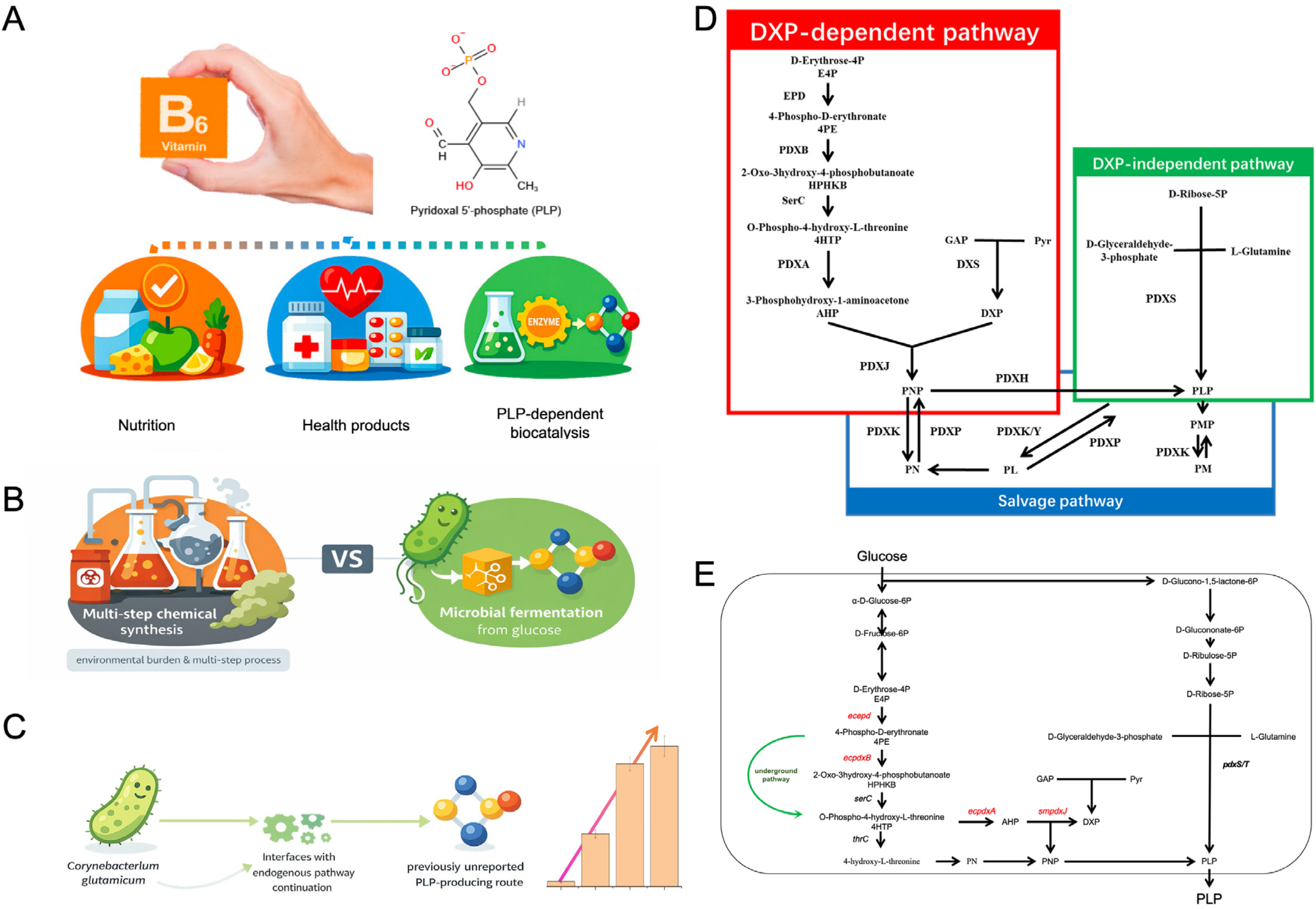
Vitamin B6 refers to a family of interconvertible pyridine vitamers, mainly pyridoxine (PN), pyridoxal (PL), pyridoxamine (PM), and their phosphorylated derivatives [1]. This vitamer system plays fundamental roles in cellular physiology, with particularly close links to amino-acid metabolism and diverse biosynthetic transformations [2]. After uptake, vitamin B6 molecules are typically converted into phosphorylated forms, among which pyridoxal 5′-phosphate (PLP) serves as the predominant catalytically active coenzyme [3], constituting the cofactor pool required for a broad spectrum of PLP-dependent enzymatic reactions [4]. Because humans cannot synthesize vitamin B6 de novo and must obtain it from the diet [5], stable demand persists in nutrition and health-related products. In parallel, PLP has become increasingly valuable as a platform cofactor in industrial biocatalysis [6], supporting PLP-dependent biotransformations and process formulations (Figure 1A).
Despite growing demand, scalable and sustainable PLP supply remains challenging. Industrial production has traditionally relied on multi-step chemical synthesis, which often involves complex reaction sequences, long process chains, and stringent control requirements, and may impose substantial environmental management and operational burdens at scale [7,8]. For example, a representative “oxazole” route to pyridoxine hydrochloride (a major commercial vitamin B6 form) achieves an overall yield of 56% but has been reported to involve environmentally and occupationally undesirable inputs such as toxic aromatic solvents (e.g., benzene) and corrosive reagents (e.g., HCl and POCl3), thereby increasing safety and waste-treatment demands [9]. Extraction from natural sources, while conceptually straightforward, is frequently constrained by feedstock variability and high downstream purification costs, limiting reliable expansion [10]. By contrast, microbial fermentation offers a greener alternative in principle [11], enabling conversion of inexpensive renewable carbon sources such as glucose into target molecules under mild conditions (Figure 1B). However, the environmental footprint of biomanufacturing is strongly conditioned by volumetric titer and productivity: when titers remain low (e.g., <100 mg/L), disproportionately large broth volumes must be processed per unit product, and downstream concentration can dominate energy use, solvent demand, and wastewater generation [12]. Accordingly, “green” claims should be interpreted in a titer-aware manner rather than assumed a priori [12]. From a biological perspective, microbial PLP formation is supported by established de novo and salvage networks: de novo biosynthesis occurs through two canonical routes, 1-deoxy-d-xylulose-5-phosphate (DXP)-dependent and DXP-independent pathways, while salvage metabolism interconverts and recycles B6 vitamers [13,14,15,16,17,18], collectively providing a metabolic foundation for fermentative production (Figure 1D). Recent studies published in 2024–2026 further demonstrate the feasibility of improving microbial vitamin B6 performance, including fed-batch pyridoxine production at 174.6 mg/L in Bacillus subtilis via pathway optimization [19] and 2120.1 ± 7.8 mg/L in engineered Escherichia coli. Complementarily, ATP-autonomous phosphorylation cascades have been explored for PLP synthesis, highlighting both the opportunity and practical constraints (e.g., mass transfer and intracellular PLP degradation in whole-cell settings) [11]. Nevertheless, compared with PN, robust whole-cell accumulation especially extracellular availability of PLP remains less mature, plausibly linked to tight PLP homeostasis and interconversion constraints. For transparency, a benchmark comparison of representative recent reports (2024–2026) and the strains constructed in this study is summarized in Table 1.
However, achieving robust and scalable PLP biosynthesis in engineered hosts is not straightforward [17]; the key obstacle is often not the mere presence of a pathway, but whether it can operate stably in an engineered context and effectively channel flux toward product. Three recurring engineering challenges are frequently encountered. First, canonical de novo routes are typically multi-gene and multi-node systems under tight regulation, making flux balancing difficult and increasing genetic and regulatory burden [21]. Second, certain pathway intermediates may accumulate and impose toxicity or growth burden, compromising compatibility between growth and production. Third, end-product–associated feedback regulation and homeostatic constraints can limit further titer improvement. These barriers are particularly pronounced when attempting to reconstruct or intensify canonical vitamin B6 routes [22]. Accordingly, “lightweight” strategies have attracted increasing attention: rather than fully rebuilding a heavy canonical pathway, one can introduce a minimal metabolic entry point to reduce heterologous burden and regulatory complexity [21], while leveraging endogenous network extension and potential bypass functions to complete downstream conversions and direct central metabolic flux toward PLP (Figure 1C,E).
Against this backdrop, we selected the industrial chassis Corynebacterium glutamicum ATCC 13032 as the host. This organism benefits from well-established fermentation practice, strong genetic accessibility, efficient sugar utilization, and a proven track record as a microbial cell factory for diverse value-added chemicals (Figure 1C). In light of prior reports achieving titers above 100 mg/L [11], our goal is not solely to chase the highest titer in a single iteration, but to establish a minimal-burden genetic “entry module” that can trigger endogenous pathway continuation toward PLP formation in an industrial chassis. Here, we present and validate a minimal two-gene engineering strategy: introduction of a heterologous module composed of ecepd and ecpdxB provides a functional entry point for de novo PLP formation from glucose and couples with endogenous metabolism to establish an effective PLP-producing route. Moreover, direct PLP accumulation faces additional biological constraints (e.g., homeostatic regulation and vitamer interconversion), which makes it particularly valuable to develop modular, low-burden designs that are compatible with the host network and scalable for subsequent intensification. Product formation and identity were supported by a “quantification–structure confirmation” evidence loop, and we further discuss, at the network level, how such a minimal intervention can enable PLP flux without reconstructing the full canonical pathway. Overall, this work provides a low-burden, iterative framework for greener PLP manufacturing and points to actionable directions for subsequent improvement, including addressing intermediate-associated constraints and product-linked regulatory limitations (Figure 1E).

2. Results

To test the feasibility of a “minimal engineering” strategy that may trigger an endogenous metabolic continuation route and create a new entry route for PLP biosynthesis, and to benchmark it against a canonical heterologous-pathway reconstruction approach, we designed two engineering schemes in Corynebacterium glutamicum [22,23]. The first scheme is a minimal two-gene module (overexpressing ecepd alone or co-expressing ecepd and ecpdxB), which is intended to introduce a new metabolic entry point that could recruit endogenous enzymes and interface with an “endogenous pathway continuation” to enhance PLP formation. The second scheme is a four-gene heterologous module, representing a conventional strategy to reconstruct a vitamin B6 biosynthetic route, and was included as a benchmark control. Importantly, the primary goal of this study is to highlight the potential novelty of a previously unreported PLP-producing route that emerges from the two-gene module coupled with underground metabolism; the four-gene heterologous module is used mainly to demonstrate that, under the same host background and comparable conditions, the minimal two-gene strategy can still achieve superior titers, underscoring the engineering potential of the newly identified route.

2.1. Pathway Context and Engineering Design

To evaluate whether a minimal genetic intervention could enable de novo PLP production in Corynebacterium glutamicum, we positioned our strategy within the established PLP network and summarized representative canonical routes. We then mapped an engineered scheme in which a two-gene module (ecepd and ecpdxB) is introduced to provide a metabolic entry node that can be extended by an endogenous continuation network to complete PLP formation, while a four-gene module serves as a conventional heterologous-pathway reconstruction reference.

2.2. Construction and Verification of Engineered Strains

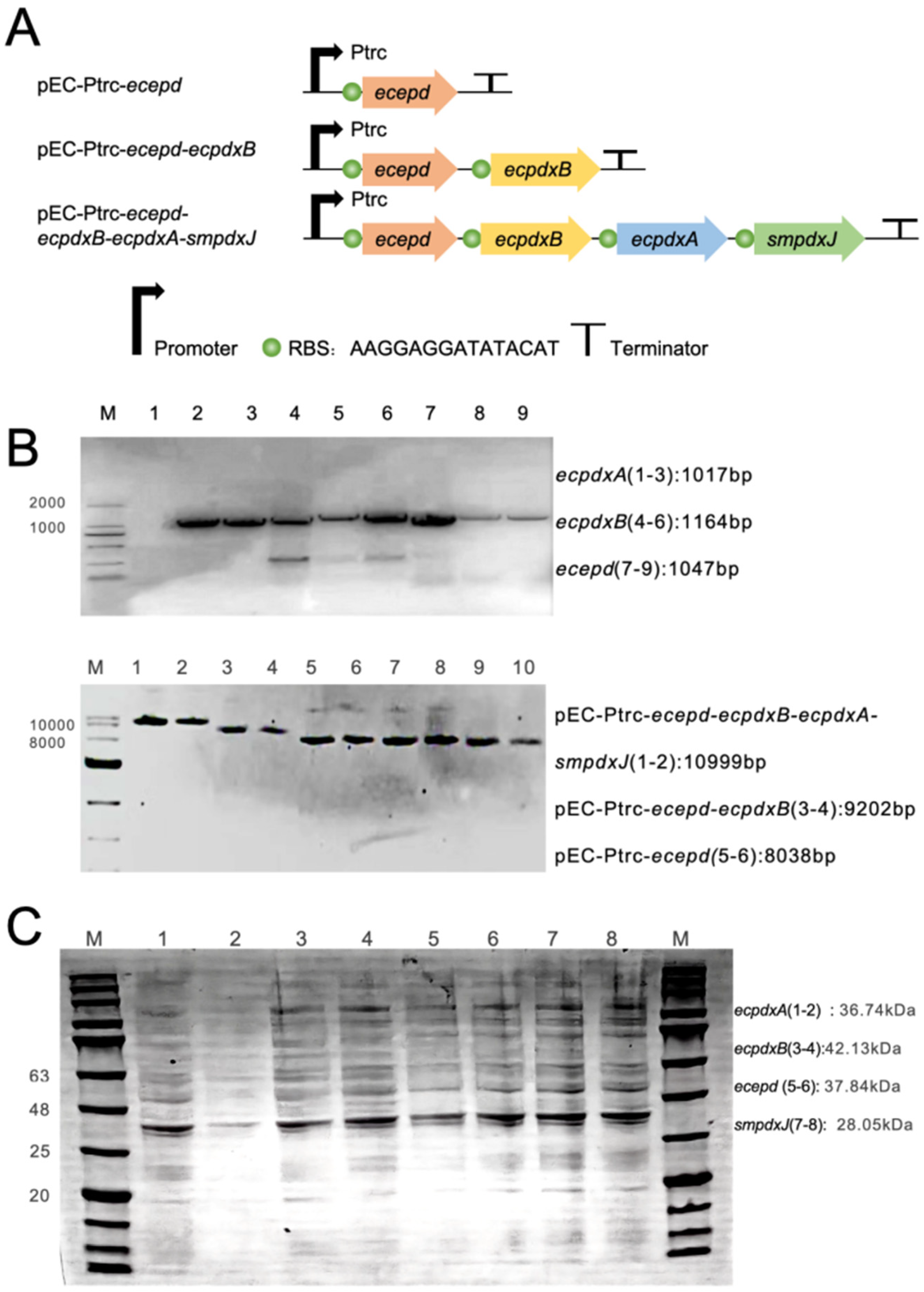
To compare a minimal two-gene strategy proposed to interface with an endogenous metabolic continuation route with a conventional heterologous pathway reconstruction approach, we used the same host background, wild-type Corynebacterium glutamicum ATCC 13032 (WT), and constructed three engineered strains (Figure 2A). Specifically, S1 harbored ecepd from Escherichia coli; S2 co-expressed ecepd and ecpdxB (the minimal two-gene module); and S3 further introduced ecpdxA (from Escherichia coli) and smpdxJ (from Sinorhizobium meliloti), yielding the four-gene module as a benchmark for heterologous pathway reconstruction. All constructs shared an identical expression framework and were maintained under kanamycin (Kan) selection to minimize vector-related variability (Figure 2A).
Correct assembly of the recombinant plasmids was first verified by PCR and sequencing. Gene-specific PCR produced amplicons consistent with the expected sizes (Figure 2B, upper panel). Plasmid PCR further confirmed the assembled cassettes, generating products of the expected lengths (Figure 2B, lower panel). All constructs were subsequently confirmed by sequencing covering the full ORF and junction regions, indicating that both the inserted sequences and assembly boundaries were correct (Figure 2B).
To assess heterologous protein expression in the host, cultures were induced at OD600 = 2.5 by adding 184 μL of IPTG (50 mg/mL) to 50 mL cultures, followed by SDS-PAGE analysis. Bands corresponding to the predicted molecular weights were observed in the respective lanes(Figure 2C), indicating successful expression of the heterologous proteins in Corynebacterium glutamicum. Because the WT and engineered strains share the same host background and were constructed using an identical expression framework and selection marker [24], these validations provide a solid basis for subsequent comparable evaluation of PLP production phenotypes across different modules (Figure 2C).

2.3. Shake-Flask PLP Production Performance

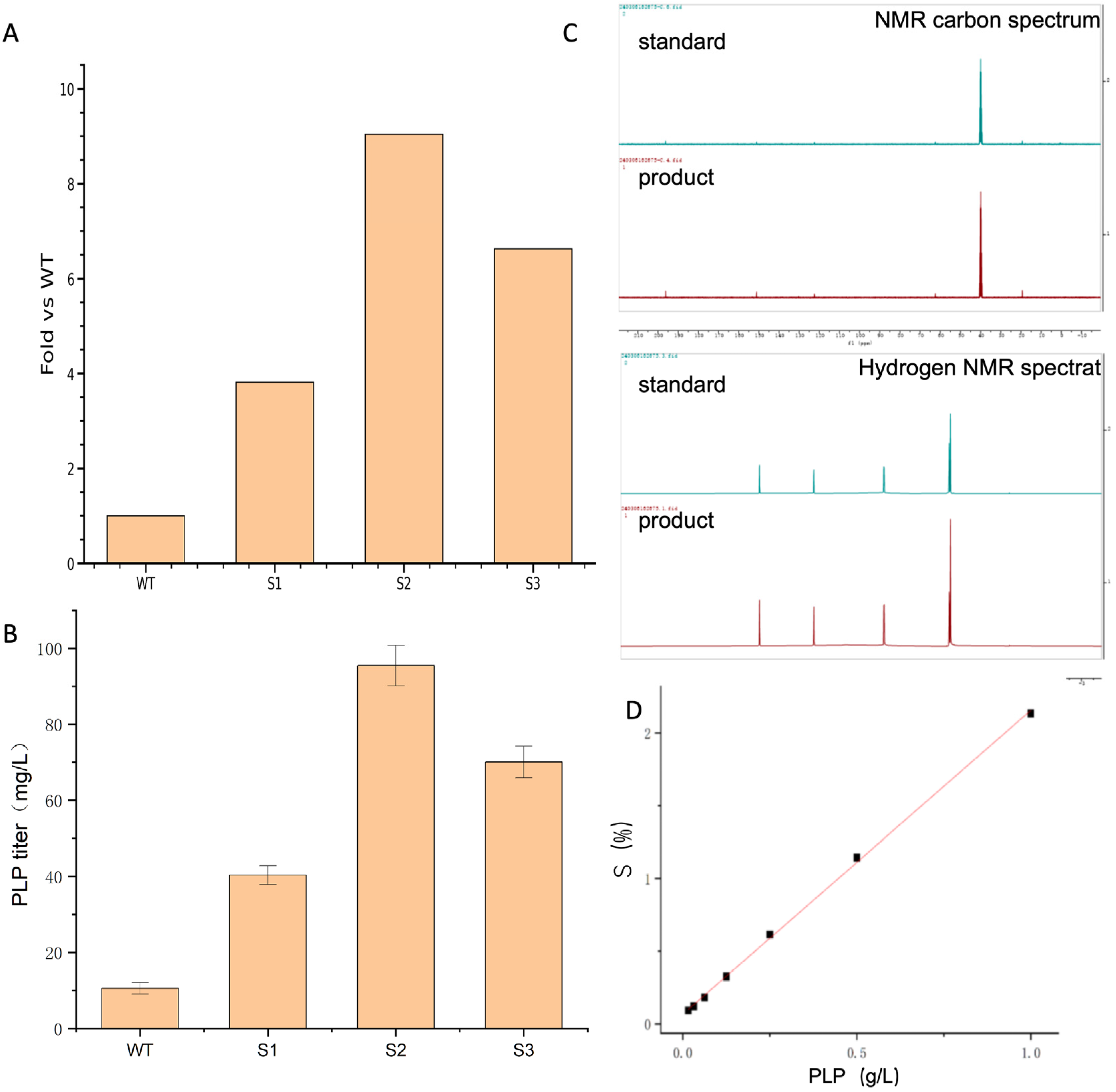
Under identical cultivation and induction conditions, we compared final PLP titers among WT and engineered strains in shake flasks (Figure 3B). Relative to WT (10.6 mg/L), S1 expressing ecepd increased PLP to 40.4 mg/L, whereas the two-gene module in S2 further improved the titer to 95.5 mg/L. Notably, the four-gene module (S3) reached 70.0 mg/L, which did not exceed S2, indicating that the minimal module coupled with endogenous pathway continuation can provide a highly effective route. Data are presented as mean ± SD of three technical replicates. Fold changes versus WT were calculated from the mean titers (Figure 3A).

2.4. Calibration-Based Quantification and NMR-Supported Product Assignment

To enable traceable quantification, PLP concentrations were determined by HPLC using an external calibration curve constructed from serial standard solutions (Figure 3D). The regression equation (y = 2.0902x + 0.0656, R2 = 0.9992) was used to convert normalized peak areas into PLP concentrations. To support product assignment, the purified product from S2 fermentation was analyzed by ^1H NMR (400 MHz, DMSO-d6) and ^13C NMR (100 MHz, DMSO-d6), and the spectral profiles were consistent with the PLP standard (Figure 3C).

3. Discussion

Using the industrial workhorse Corynebacterium glutamicum ATCC 13032 as the chassis, this study supports a methodological conclusion of practical value for PLP engineering: compared with fully reconstructing canonical natural pathways in a non-native host, a strategy based on a “minimal heterologous entry point coupled to endogenous pathway continuation” is more likely to yield a system-compatible phenotype with lower genetic burden and superior production potential [25,26]. Under matched cultivation conditions, the two-gene module S2 (ecepd + ecpdxB) achieved the highest PLP accumulation, whereas multi-gene reconstruction did not deliver additive gains and even resulted in a reduced endpoint titer. This observation highlights that for PLP—an essential cofactor tightly coupled to central metabolism—“a longer pathway” or “more heterologous genes” does not necessarily translate into higher flux or higher final accumulation [16,27,28]; instead, system-level compatibility and the burden–benefit tradeoff often dominate the production outcome.
To position our minimal-burden PLP “entry-module” strategy in the context of recent progress, we summarized representative 2024–2026 microbial PN/PLP production studies in Table 1.Recent studies have demonstrated that PN titers can be substantially increased through the combination of pathway tuning and process intensification. For example, an omics-guided strategy in E. coli achieved approximately 1.95 g/L PN in fed-batch fermentation [20], In B. subtilis, pathway and medium/process optimization reached 174.6 mg/L PN in fed-batch [12]. These advances primarily target PN, a stable commercial vitamer, whereas endpoint PLP production is additionally constrained by tight intracellular homeostasis and rapid vitamer interconversion. In this context, our work emphasizes a minimal genetic-burden “entry module” in an industrial chassis, enabling 95.5 mg/L extracellular PLP in shake flasks while keeping heterologous intervention limited, thereby providing a modular and scalable starting point for subsequent intensification.
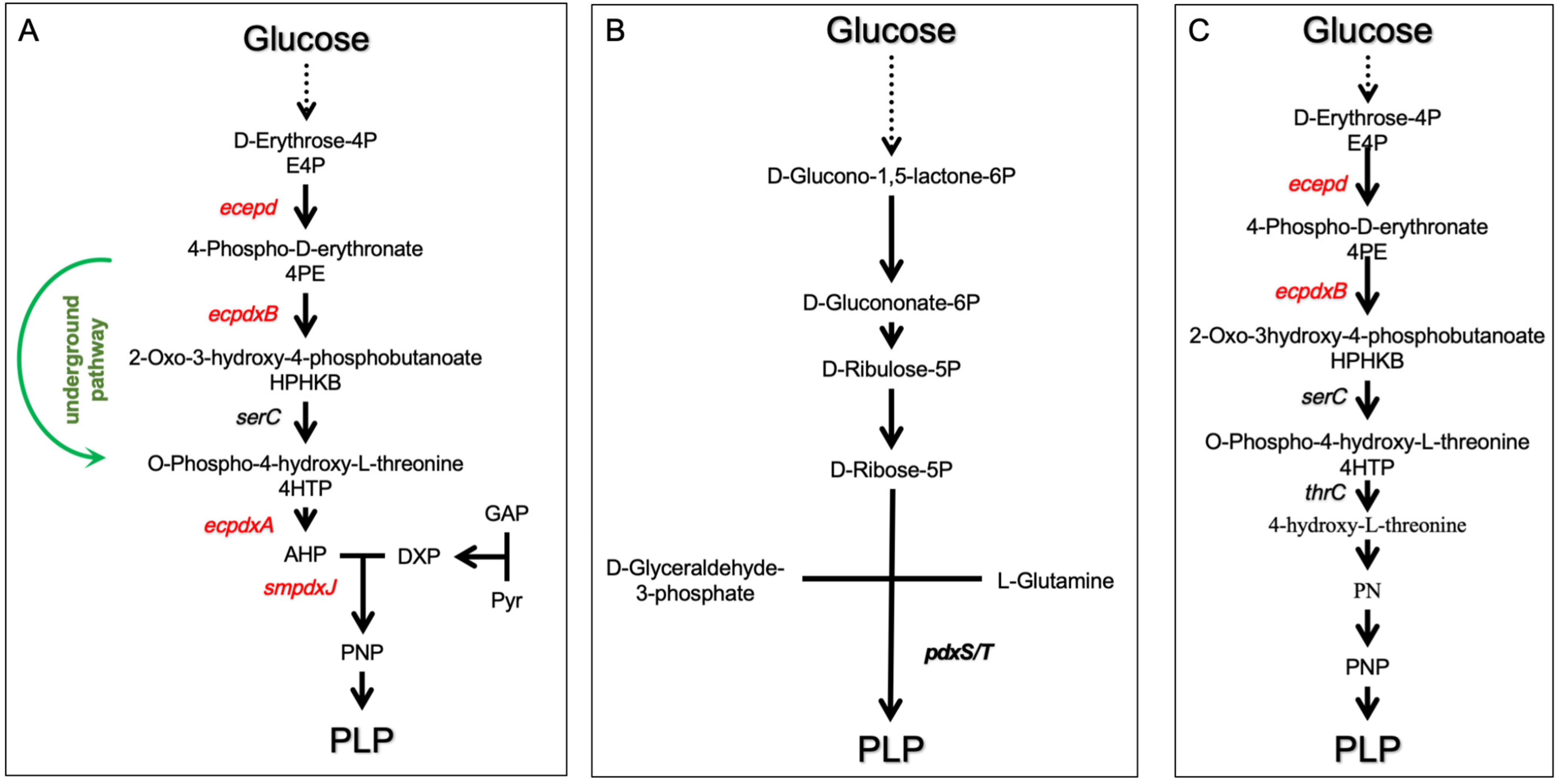
As depicted in Figure 4A, the DXP-dependent route proceeds from E4P through multiple enzymatic steps (including Epd, PdxB and SerC) to the key intermediate 4HTP, and then requires additional nodes (PdxA and PdxJ) together with coupling to the DXP-supplying branch to form PNP/PLP, with final oxidation by PdxH [29]. The engineering challenges of such a route are largely attributable to: (i) serial multi-node catalysis that disperses flux and amplifies bottlenecks, where any insufficient activity at a single step can create a “push–pull mismatch”; (ii) strong entanglement with central carbon metabolism (E4P, GAP, Pyr and DXP), increasing precursor competition and growth penalties [30]; and (iii) elevated risk of intermediate accumulation. In line with the supplementary evidence and prior knowledge, 4HTP and related intermediates can impose an antimetabolite/toxic burden: when upstream driving force exceeds downstream consumption capacity, intracellular residence and accumulation of 4HTP may interfere with amino-acid biosynthesis [20] (e.g., threonine and isoleucine pathways), creating selection pressure that manifests as impaired growth or reduced final PLP accumulation. Meanwhile, Figure 4B illustrates the DXP-independent PdxS/T route, which appears shorter in terms of nominal step count [31]; however, it is often constrained by more fundamental limitations when considered as a primary engineering target. Its effective throughput is highly dependent on PPP flux and nitrogen status [32], complex multicomponent functionality, and substrate supply, and the fact that it is “gene-lean but functionally complex” (e.g., multimeric coordination and ammonia generation) makes mutational or rational engineering outcomes difficult to predict, frequently risking loss of activity or mis-assembly imbalance. In addition, PLP is subject to host homeostasis and feedback (interconversion cycles, dephosphorylation, and export), which can counteract net accumulation and reduce the benefit of simply “pushing” the biosynthetic side [33]. Taken together, both the long, multi-branch, DXP-dependent route in Figure 4A and the DXP-independent system in Figure 4B can face the same system-level barriers in a production chassis—multi-node coupling [34], regulatory uncertainty, and homeostatic back-pulling—thereby explaining why adding more heterologous steps does not necessarily yield a higher endpoint PLP titer [35].
From a process perspective, the modest titers achieved in this proof-of-concept study imply that substantially larger fermentation volumes would be required to obtain a given mass of PLP, thereby increasing downstream consumables usage (e.g., solvents, adsorbents, and utilities) and waste generation per unit product [36]. Biologically, we propose that a major constraint at the current stage is the limited endogenous continuation capacity toward net PLP accumulation. In particular, for the DXP-independent PLP synthase system (PdxS/T), in vitro characterization has reported a very low turnover number for the PLP-forming reaction (kcat ≈ 0.02 min−1) [4], suggesting a strong kinetic ceiling that can become rate-limiting even when upstream precursor supply is increased [19]. Accordingly, industrial translation will require substantial titer intensification; we therefore highlight that relieving the endogenous bottleneck—e.g., improving PdxS/T capacity (expression, assembly and enzyme performance) and coordinating precursor and nitrogen supply—together with process intensification (fed-batch operation, oxygen/carbon feeding control, and staged strategies) are key next steps to increase volumetric productivity and thereby proportionally reduce waste generation per unit PLP during downstream processing.
Bottlenecks and future directions: The cross-study comparison highlights several recurring constraints that are particularly acute for PLP as a reactive cofactor. First, tight PLP homeostasis and rapid interconversion among vitamers (PNP/PMP/PLP) can dissipate net flux away from extracellular PLP, suggesting that future improvements should prioritize reinforcing end-conversion while limiting dephosphorylation or back-conversion [27]. Second, precursor competition for E4P and DXP tightly couples PLP formation to central carbon flux as well as aromatic amino-acid biosynthesis and other cofactor-demanding pathways, implying that strategies increasing E4P availability, balancing redox, and reducing competing sinks may raise the ceiling titer [37]. Third, process intensification is a major lever for translating pathway capacity into higher volumetric productivity, as evidenced by recent PN fermentation advances. Looking forward, integrating minimal entry modules with dynamic pathway balancing, improved PLP export/stability, and intensified bioreactor operation should enable higher extracellular PLP titers and productivities while improving downstream practicality [11,12].

4. Materials and Methods

4.1. Strains, Plasmids and Media

Corynebacterium glutamicum ATCC 13032 was used as the parental strain (WT) for construction of engineered strains S1, S2, and S3. Recombinant plasmids were selected using kanamycin resistance. LBHIS medium was used for recovery and routine cultivation during strain construction [38]. LBHIS and LBG media were used for pre-culture/seed culture and shake-flask fermentation, respectively (medium compositions are provided in the Supplementary Material).

4.2. Plasmid Construction and Strain Generation

Expression plasmids were built using a unified expression architecture, consisting of the Ptrc promoter, a unified RBS, and a transcription terminator, to generate single-gene, two-gene, and four-gene modules. Correct assembly of recombinant plasmids was verified by PCR and sequencing. Sequencing covered the full ORFs and junction regions.

4.3. Electroporation and Post-Pulse Recovery

Electroporation of Corynebacterium glutamicum was performed using a 2 mm gap electroporation cuvette. The electroporation parameters were set to 1.8 kV using the “Bacteria” program with a pulse duration of 5 ms. Immediately after pulsing, 800 μL of LBHIS recovery medium pre-warmed to 46 °C was added to the cuvette [39]. Cells were incubated at 46 °C for 6 min and then transferred to 30 °C for recovery culture for 2–3 h. After recovery, the suspension was centrifuged at 8000 rpm for 90 s, and the pellet was resuspended in approximately 100–200 μL of residual supernatant. The resuspension was spread onto LBHIS agar plates containing kanamycin and incubated at 30 °C for 24–36 h to obtain transformant colonies [40].

4.4. Pre-Culture, Seed Culture and Shake-Flask Fermentation

For pre-culture, single colonies were picked from plates and inoculated into 4 mL LBHIS containing kanamycin in test tubes and cultivated overnight. For seed culture, 400 μL of the overnight pre-culture was transferred into 20 mL LBG in a 100 mL shake flask and cultivated at 30 °C and 200 rpm for 12–14 h. For shake-flask fermentation, the seed culture was inoculated at 2% (v/v) into the fermentation medium (inoculation volume: 2.5 mL) and cultivated at 30 °C and 200 rpm. Induction was triggered by cell density: IPTG was added at OD600 ≈ 2.5 to a final concentration of 0.8 mM, after which cultures entered the production phase [41].

4.5. Sample Collection and Preparation

Fermentation samples were centrifuged at 9000 rpm and 4 °C for 10 min to collect supernatants. Supernatants were filtered through a 0.22 μm membrane and transferred to HPLC vials (approximately 1 mL) for subsequent analysis [42].

4.6. HPLC Quantification and Calibration Curve

PLP was quantified by HPLC using a C18 column with UV detection at 388 nm. The column temperature was set to 30 °C, with an injection volume of 10 μL and a flow rate of 1 mL/min. The mobile-phase system included solvent A (methanol), solvent C (ultrapure water), and solvent D (acetonitrile/water = 30:70, pH 6 adjusted with KH2PO4). Prior to analysis, the column was equilibrated with methanol:water (30:70) at 1 mL/min for 20 min, followed by an additional 30 min equilibration after switching to the mobile-phase system. PLP standards were prepared as a concentration series, filtered through a 0.22-μm organic membrane, and analyzed to obtain peak areas for linear regression. The resulting regression equation was used to convert sample peak areas into PLP concentrations [29].

4.7. NMR Analysis

To confirm product identity, the fermentation supernatant of strain S2 was processed by centrifugation and filtration to obtain NMR samples. Samples were dissolved in DMSO-d6. 1H NMR and 13C NMR spectra were acquired and compared with those of the PLP standard to assess structural consistency [43,44,45,46].

4.8. Data Analysis and Figure Preparation

Experimental data from replicate measurements were summarized and presented in figures. Graphs were prepared using Origin 2022.

5. Conclusions

This study establishes a minimal heterologous entry coupled to endogenous pathway continuation for PLP biosynthesis in Corynebacterium glutamicum ATCC 13032. In shake flasks, expression of ecepd increased PLP compared with WT, and the minimal two-gene module (ecepd + ecpdxB) delivered the highest titer (S2: 95.5 mg/L), whereas a four-gene reconstruction (S3) did not outperform this minimal design. These results suggest that, for tightly homeostasis-regulated cofactors, a low-burden entry module cooperating with the host’s endogenous network can be more effective than extending heterologous pathways. Further improvements should target matching precursor supply with downstream conversion and relieving PLP homeostasis constraints to enhance titer and process robustness.

Supplementary Materials

The following supporting information can be downloaded at: https://www.mdpi.com/article/10.3390/catal16020195/s1, Table S1: Strains and plasmids used in this study; Table S2: Primers used in this study (5′→3′); Table S3: Media compositions used in this study.

Author Contributions

L.Q.: Data curation, Conceptualization, Methodology, Formal analysis, Writing—original draft, Writing—review and editing. H.H.: Project administration, Supervision, Writing—review and editing. S.X.: Project administration, Supervision, Writing—review and editing. H.C.: Resources, Funding acquisition, Investigation, Methodology, Supervision, Project administration, Writing—review and editing. All authors contributed to the article and approved the submitted version. All authors have read and agreed to the published version of the manuscript.

Funding

This work was supported by the Innovation Consortium Project (Contract No. PRIKY23108).

Data Availability Statement

The datasets generated in this study are available from the authors upon reasonable request, and will be provided to support the findings reported in this article.

Acknowledgments

We are grateful to Hui Cao for constructive advice and assistance throughout the project, particularly in study design, data processing/analysis, and refinement of the manuscript.

Conflicts of Interest

Authors Hao He and Shihao Xiang were employed by the company Petrochemical Research Institute of Petrochina Co., Ltd. The remaining authors declare that the research was conducted in the absence of any commercial or financial relationships that could be construed as a potential conflict of interest.

Abbreviations

The following abbreviations are used in this manuscript:
AbbreviationMeaning
4HTP4-hydroxythreonine phosphate
ATCCAmerican Type Culture Collection
C18C18 (octadecylsilane) reversed-phase column
DMSO-d6Deuterated dimethyl sulfoxide
DNADeoxyribonucleic acid
DXP1-deoxy-D-xylulose 5-phosphate
DXP-dependentDXP-dependent pathway
DXP-independentDXP-independent pathway
E4PErythrose 4-phosphate
G3PGlyceraldehyde-3-phosphate
GAPGlyceraldehyde-3-phosphate
HPHKBHPHKB (intermediate)
HPLCHigh-performance liquid chromatography
IPTGIsopropyl β-D-1-thiogalactopyranoside
KanKanamycin
kDaKilodalton
kVKilovolt
LBHISLBHIS medium
LBGLBG medium
msMillisecond
NMRNuclear magnetic resonance
OD600Optical density at 600 nm
ORF/ORFsOpen reading frame(s)
PCRPolymerase chain reaction
PLPyridoxal
PLPPyridoxal 5′-phosphate
PMPyridoxamine
PNPyridoxine
PNPPyridoxine 5′-phosphate
PPPPentose phosphate pathway
Ptrctrc promoter
PyrPyruvate
R2Coefficient of determination (R-squared)
RBSRibosome binding site
rpmRevolutions per minute
SDStandard deviation
SDS-PAGESodium dodecyl sulfate–polyacrylamide gel electrophoresis
S1Engineered strain expressing ecepd
S2Engineered strain co-expressing ecepd + ecpdxB
S3Engineered strain expressing ecepd + ecpdxB + ecpdxA + smpdxJ
UVUltraviolet
WTWild type (C. glutamicum ATCC 13032)

References

  1. Abdou, H.M.; Wahby, M.M. Neuroprotection of Grape Seed Extract and Pyridoxine against Triton-Induced Neurotoxicity. Oxidative Med. Cell. Longev. 2016, 2016, 8679506. [Google Scholar] [CrossRef]
  2. Mayengbam, S.; Chleilat, F.; Reimer, R.A. Dietary Vitamin B6 Deficiency Impairs Gut Microbiota and Host and Microbial Metabolites in Rats. Biomedicines 2020, 8, 469. [Google Scholar] [CrossRef]
  3. Kim, G.; Jang, S.; Yoon, E.K.; Lee, S.A.; Dhar, S.; Kim, J.; Lee, M.M.; Lim, J. Involvement of Pyridoxine/Pyridoxamine 5′-Phosphate Oxidase (PDX3) in Ethylene-Induced Auxin Biosynthesis in the Arabidopsis Root. Mol. Cells 2018, 41, 1033–1044. [Google Scholar] [CrossRef]
  4. Xie, F.; Li, G.; Wang, Y.; Zhang, Y.; Zhou, L.; Wang, C.; Liu, S.; Liu, S.; Wang, C. Pyridoxal phosphate synthases PdxS/PdxT are required for Actinobacillus pleuropneumoniae viability, stress tolerance and virulence. PLoS ONE 2017, 12, e0176374. [Google Scholar] [CrossRef] [PubMed]
  5. Rivero, M.; Novo, N.; Medina, M. Pyridoxal 5′-Phosphate Biosynthesis by Pyridox-(am)-ine 5′-Phosphate Oxidase: Species-Specific Features. Int. J. Mol. Sci. 2024, 25, 3174. [Google Scholar] [CrossRef]
  6. Velasco-Lozano, S.; Benitez-Mateos, A.I.; Lopez-Gallego, F. Co-immobilized Phosphorylated Cofactors and Enzymes as Self-Sufficient Heterogeneous Biocatalysts for Chemical Processes. Angew. Chem. Int. Ed. Engl. 2017, 56, 771–775. [Google Scholar] [CrossRef] [PubMed]
  7. Zhang, X.; Xu, S.; Li, Q.; Zhou, G.; Xia, H. Recent advances in the conversion of furfural into bio-chemicals through chemo- and bio-catalysis. RSC Adv. 2021, 11, 27042–27058. [Google Scholar] [CrossRef]
  8. Saccullo, E.; Patamia, V.; Zagni, C.; Rescifina, A.; Floresta, G. Learning Strategies from Nature’s Blueprint to Cyclic Carbonate Synthesis. ChemSusChem 2025, 18, e202402061. [Google Scholar] [CrossRef]
  9. Eras-Munoz, E.; Farre, A.; Sanchez, A.; Font, X.; Gea, T. Microbial biosurfactants: A review of recent environmental applications. Bioengineered 2022, 13, 12365–12391. [Google Scholar] [CrossRef] [PubMed]
  10. Ren, X.; Wei, Y.; Zhao, H.; Shao, J.; Zeng, F.; Wang, Z.; Li, L. A comprehensive review and comparison of L-tryptophan biosynthesis in Saccharomyces cerevisiae and Escherichia coli. Front. Bioeng. Biotechnol. 2023, 11, 1261832. [Google Scholar] [CrossRef]
  11. Xu, X.; Chen, Z.; Sun, H.; Zhang, X.; Lin, Z.; Li, N. Combinatorial Metabolic Engineering of Escherichia coli MG1655 Enables Efficient Biosynthesis of Vitamin B(6). J. Agric. Food Chem. 2025, 73, 14504–14510. [Google Scholar] [CrossRef]
  12. Jiang, A.T.; Du, G.Q.; Huang, X.Y.; Ji, Z.Z.; Qian, S.R.; Liu, L.X.; Zhang, D.W. Enhanced microbial production of pyridoxine (Vitamin B(6)) in Bacillus subtilis via pathway and process optimization. Synth. Syst. Biotechnol. 2026, 11, 216–225. [Google Scholar] [CrossRef] [PubMed]
  13. Wang, Y.H.; Wei, K.Y.; Smolke, C.D. Synthetic biology: Advancing the design of diverse genetic systems. Annu. Rev. Chem. Biomol. Eng. 2013, 4, 69–102. [Google Scholar] [CrossRef]
  14. Ankisettypalli, K.; Cheng, J.J.; Baker, E.N.; Bashiri, G. PdxH proteins of mycobacteria are typical members of the classical pyridoxine/pyridoxamine 5′-phosphate oxidase family. FEBS Lett. 2016, 590, 453–460. [Google Scholar] [CrossRef] [PubMed]
  15. Liao, S.; Bitoun, J.P.; Nguyen, A.H.; Bozner, D.; Yao, X.; Wen, Z.T. Deficiency of PdxR in Streptococcus mutans affects vitamin B6 metabolism, acid tolerance response and biofilm formation. Mol. Oral Microbiol. 2015, 30, 255–268. [Google Scholar] [CrossRef] [PubMed]
  16. Richts, B.; Commichau, F.M. Underground metabolism facilitates the evolution of novel pathways for vitamin B6 biosynthesis. Appl. Microbiol. Biotechnol. 2021, 105, 2297–2305. [Google Scholar] [CrossRef]
  17. Vanderschuren, H.; Boycheva, S.; Li, K.T.; Szydlowski, N.; Gruissem, W.; Fitzpatrick, T.B. Strategies for vitamin B6 biofortification of plants: A dual role as a micronutrient and a stress protectant. Front. Plant Sci. 2013, 4, 143. [Google Scholar] [CrossRef]
  18. Richts, B.; Rosenberg, J.; Commichau, F.M. A Survey of Pyridoxal 5′-Phosphate-Dependent Proteins in the Gram-Positive Model Bacterium Bacillus subtilis. Front. Mol. Biosci. 2019, 6, 32. [Google Scholar] [CrossRef]
  19. Wang, J.; Zhao, H.; Tong, S.; Zhang, X.; Ding, S.; Zhang, H.; Yang, Z.H. Cascade biocatalysis for pyridoxal 5′-phosphate synthesis with ATP autonomy via polyphosphate kinase. Bioorganic Chem. 2026, 170, 109518. [Google Scholar] [CrossRef]
  20. Tian, Z.; Liu, L.; Wu, L.; Yang, Z.; Zhang, Y.; Du, L.; Zhang, D. Correction: Enhancement of vitamin B6 production driven by omics analysis combined with fermentation optimization. Microb. Cell Factories 2024, 23, 257. [Google Scholar] [CrossRef]
  21. Yuan, S.F.; Yi, X.; Johnston, T.G.; Alper, H.S. De novo resveratrol production through modular engineering of an Escherichia coli-Saccharomyces cerevisiae co-culture. Microb. Cell Factories 2020, 19, 143. [Google Scholar] [CrossRef]
  22. Ma, Q.; Zhang, Q.; Xu, Q.; Zhang, C.; Li, Y.; Fan, X.; Xie, X.; Chen, N. Systems metabolic engineering strategies for the production of amino acids. Synth. Syst. Biotechnol. 2017, 2, 87–96. [Google Scholar] [CrossRef]
  23. Yao, C.; Hu, X.; Wang, X. Construction and application of a CRISPR/Cas9-assisted genomic editing system for Corynebacterium glutamicum. AMB Express 2021, 11, 70. [Google Scholar] [CrossRef]
  24. Wang, Y.; Liu, L.; Jin, Z.; Zhang, D. [Advances in metabolic engineering for vitamins production]. Sheng Wu Gong Cheng Xue Bao 2021, 37, 1748–1770. [Google Scholar] [CrossRef] [PubMed]
  25. Commichau, F.M.; Alzinger, A.; Sande, R.; Bretzel, W.; Meyer, F.M.; Chevreux, B.; Wyss, M.; Hohmann, H.P.; Pragai, Z. Overexpression of a non-native deoxyxylulose-dependent vitamin B6 pathway in Bacillus subtilis for the production of pyridoxine. Metab. Eng. 2014, 25, 38–49. [Google Scholar] [CrossRef] [PubMed]
  26. Tramonti, A.; Nardella, C.; di Salvo, M.L.; Barile, A.; D’Alessio, F.; de Crecy-Lagard, V.; Contestabile, R. Knowns and Unknowns of Vitamin B(6) Metabolism in Escherichia coli. EcoSal Plus 2021, 9, eESP-0004–2021. [Google Scholar] [CrossRef]
  27. Sugimoto, R.; Saito, N.; Shimada, T.; Tanaka, K. Identification of YbhA as the pyridoxal 5′-phosphate (PLP) phosphatase in Escherichia coli: Importance of PLP homeostasis on the bacterial growth. J. Gen. Appl. Microbiol. 2018, 63, 362–368. [Google Scholar] [CrossRef] [PubMed]
  28. He, M.; Ma, J.; Chen, Q.; Zhang, Q.; Yu, P. Engineered production of pyridoxal 5′-phosphate in Escherichia coli BL21. Prep. Biochem. Biotechnol. 2022, 52, 498–507. [Google Scholar] [CrossRef]
  29. Denise, R.; Babor, J.; Gerlt, J.A.; de Crecy-Lagard, V. Pyridoxal 5′-phosphate synthesis and salvage in Bacteria and Archaea: Predicting pathway variant distributions and holes. Microb. Genom. 2023, 9, mgen000926. [Google Scholar] [CrossRef]
  30. Jahan, N.; Maeda, K.; Matsuoka, Y.; Sugimoto, Y.; Kurata, H. Development of an accurate kinetic model for the central carbon metabolism of Escherichia coli. Microb. Cell Factories 2016, 15, 112. [Google Scholar] [CrossRef]
  31. Magnusdottir, S.; Ravcheev, D.; de Crecy-Lagard, V.; Thiele, I. Systematic genome assessment of B-vitamin biosynthesis suggests co-operation among gut microbes. Front. Genet. 2015, 6, 148. [Google Scholar] [CrossRef]
  32. Liu, L.; Li, J.; Gai, Y.; Tian, Z.; Wang, Y.; Wang, T.; Liu, P.; Yuan, Q.; Ma, H.; Lee, S.Y.; et al. Protein engineering and iterative multimodule optimization for vitamin B(6) production in Escherichia coli. Nat. Commun. 2023, 14, 5304. [Google Scholar] [CrossRef]
  33. Gregory, J.F., 3rd; Park, Y.; Lamers, Y.; Bandyopadhyay, N.; Chi, Y.Y.; Lee, K.; Kim, S.; da Silva, V.; Hove, N.; Ranka, S.; et al. Metabolomic analysis reveals extended metabolic consequences of marginal vitamin B-6 deficiency in healthy human subjects. PLoS ONE 2013, 8, e63544. [Google Scholar] [CrossRef]
  34. Cellini, B.; Montioli, R.; Oppici, E.; Astegno, A.; Voltattorni, C.B. The chaperone role of the pyridoxal 5′-phosphate and its implications for rare diseases involving B6-dependent enzymes. Clin. Biochem. 2014, 47, 158–165. [Google Scholar] [CrossRef] [PubMed]
  35. Liu, H.L.; Wang, C.H.; Chiang, E.I.; Huang, C.C.; Li, W.H. Tryptophan plays an important role in yeast’s tolerance to isobutanol. Biotechnol. Biofuels 2021, 14, 200. [Google Scholar] [CrossRef] [PubMed]
  36. Dominguez de Maria, P. (Re)visiting the Sustainability Thresholds: Are Product Titers of 1 g L(-1) Enough for (Bio)chemical Processes? ChemSusChem 2025, 18, e202501831. [Google Scholar] [CrossRef]
  37. Bartee, D.; Freel Meyers, C.L. Toward Understanding the Chemistry and Biology of 1-Deoxy-d-xylulose 5-Phosphate (DXP) Synthase: A Unique Antimicrobial Target at the Heart of Bacterial Metabolism. Acc. Chem. Res. 2018, 51, 2546–2555. [Google Scholar] [CrossRef]
  38. Chen, C.; Pan, J.; Yang, X.; Guo, C.; Ding, W.; Si, M.; Zhang, Y.; Shen, X.; Wang, Y. Global Transcriptomic Analysis of the Response of Corynebacterium glutamicum to Vanillin. PLoS ONE 2016, 11, e0164955. [Google Scholar] [CrossRef]
  39. Ballmann, R.; Hotop, S.K.; Bertoglio, F.; Steinke, S.; Heine, P.A.; Chaudhry, M.Z.; Jahn, D.; Pucker, B.; Baldanti, F.; Piralla, A.; et al. ORFeome Phage Display Reveals a Major Immunogenic Epitope on the S2 Subdomain of SARS-CoV-2 Spike Protein. Viruses 2022, 14, 1326. [Google Scholar] [CrossRef] [PubMed]
  40. Bakkes, P.J.; Lenz, P.; Muller, C.; Bida, A.; Dohmen-Olma, D.; Knapp, A.; Oldiges, M.; Jaeger, K.E.; Freudl, R. Biosensor-Based Optimization of Cutinase Secretion by Corynebacterium glutamicum. Front. Microbiol. 2021, 12, 750150. [Google Scholar] [CrossRef]
  41. Du, Y.; Wang, M.; Chen Sun, C.; Yu, H. Construction of an ultra-strong PtacM promoter via engineering the core-element spacer and 5′ untranslated region for versatile applications in Corynebacterium glutamicum. Biotechnol. Notes 2022, 3, 88–96. [Google Scholar] [CrossRef]
  42. Babu, A.F.; Koistinen, V.M.; Turunen, S.; Solano-Aguilar, G.; Urban, J.F., Jr.; Zarei, I.; Hanhineva, K. Identification and Distribution of Sterols, Bile Acids, and Acylcarnitines by LC-MS/MS in Humans, Mice, and Pigs-A Qualitative Analysis. Metabolites 2022, 12, 49. [Google Scholar] [CrossRef] [PubMed]
  43. O’Leary, M.H.; Payne, J.R. 13C NMR spectroscopy of labeled pyridoxal 5′-phosphate. Model studies, D-serine dehydratase, and L-glutamate decarboxylase. J. Biol. Chem. 1976, 251, 2248–2254. [Google Scholar] [CrossRef]
  44. Chan-Huot, M.; Sharif, S.; Tolstoy, P.M.; Toney, M.D.; Limbach, H.H. NMR studies of the stability, protonation States, and tautomerism of (13)C- AND (15)N-labeled aldimines of the coenzyme pyridoxal 5′-phosphate in water. Biochemistry 2010, 49, 10818–10830. [Google Scholar] [CrossRef]
  45. Sharif, S.; Denisov, G.S.; Toney, M.D.; Limbach, H.H. NMR studies of coupled low- and high-barrier hydrogen bonds in pyridoxal-5′-phosphate model systems in polar solution. J. Am. Chem. Soc. 2007, 129, 6313–6327. [Google Scholar] [CrossRef] [PubMed]
  46. Schnackerz, K.D.; Andi, B.; Cook, P.F. (31)P NMR spectroscopy senses the microenvironment of the 5′-phosphate group of enzyme-bound pyridoxal 5′-phosphate. Biochim. Biophys. Acta 2011, 1814, 1447–1458. [Google Scholar] [CrossRef] [PubMed]
Figure 1. Demand drivers, canonical biosynthetic networks, and the minimal engineering concept for PLP production described in this study. (A) Representative application landscape highlighting PLP as the catalytically active form of vitamin B6 in nutrition/health products and PLP-dependent biocatalysis. (B) Conceptual comparison between conventional multi-step chemical synthesis and glucose-based microbial fermentation for PLP supply. (C) Minimal two-gene intervention in Corynebacterium glutamicum: introduction of the ecepd + ecpdxB module provides a metabolic entry point and interfaces with endogenous network extension to support PLP formation. (D) Overview of canonical PLP metabolism, including DXP-dependent and DXP-independent de novo biosynthetic routes and salvage interconversion of vitamin B6. (E) Process and strain optimization logic derived from this work, emphasizing flux balancing, mitigation of intermediate accumulation risk, and relief of product-associated regulatory constraints.
Catalysts 16 00195 g001
Figure 2. Construction and verification of engineered Corynebacterium glutamicum strains, and quantitative/structural confirmation of PLP production (merged figure). (A) Schematic maps of the expression plasmids: pEC-Ptrc-ecepd (S1), pEC-Ptrc-ecepd-ecpdxB (S2), and pEC-Ptrc-ecepd-ecpdxB-ecpdxA-smpdxJ (S3). Genes derived from E. coli are prefixed with “ec” (ecepd, ecpdxB, ecpdxA), and gene from Sinorhizobium meliloti is denoted as smpdxJ. All constructs were driven by the Ptrc promoter with the same RBS (AAGGAGGATATACAT) and a terminator. Kanamycin was used as the selection marker. (B) PCR verification. Upper panel: gene-specific PCR products showing expected sizes of ecpdxA (1017 bp; lanes 1–3), ecpdxB (1164 bp; lanes 4–6), and ecepd (1047 bp; lanes 7–9). Lower panel: assembly verification showing expected amplicon sizes of pEC-Ptrc-ecepd-ecpdxB-ecpdxA-smpdxJ (10,999 bp; lanes 1–2), pEC-Ptrc-ecepd-ecpdxB (9202 bp; lanes 3–4), and pEC-Ptrc-ecepd (8038 bp; lanes 5–6). M, DNA marker. (C) SDS-PAGE analysis of heterologous protein expression. Lanes 1–2: ecpdxA (36.7 kDa); lanes 3–4: ecpdxB (42.1 kDa); lanes 5–6: ecepd (37.8 kDa); lanes 7–8: smpdxJ (28.1 kDa). M, protein marker. All constructs were confirmed by sequencing covering full ORFs and junction regions.
Catalysts 16 00195 g002
Figure 3. (A) Fold change in PLP production relative to WT under shake-flask conditions, calculated from the mean titers shown in (B). (B) Final PLP titers (mg/L) of WT and engineered strains under shake-flask conditions. Error bars indicate mean ± SD of three technical replicates (n = 3). (C) Overlay comparison of ^1H and ^13C NMR spectra between the PLP standard and purified product from S2 fermentation (DMSO-d6; ^1H, 400 MHz; ^13C, 100 MHz). (D) External calibration curve for PLP quantification by HPLC. Standards were filtered through a 0.22 μm organic membrane prior to injection; normalized peak areas were used for linear regression (y = 2.0902x + 0.0656, R2 = 0.9992). The detection wavelength:388 nm.
Catalysts 16 00195 g003
Figure 4. Canonical PLP biosynthetic pathways and the engineered strategy. (A) Schematic of the representative DXP-dependent route and its associated “underground metabolism/bypass”: E4P is converted to 4HTP via Epd, PdxB, SerC, etc., and subsequently coupled with the DXP branch through PdxA and PdxJ to form PNP/PLP. (B) Schematic of the DXP-independent route: the PdxS/T system directly synthesizes PLP using ribose-5-phosphate, G3P, and glutamine as substrates; however, engineering outcomes are highly uncertain due to constraints in enzymatic efficiency, complex functionality, substrate supply, and cellular homeostatic regulation. (C) Schematic of the “minimal heterologous entry–endogenous continuation network” proposed in this study: heterologous ecepd and ecpdxB create a key entry point, channeling E4P into the 4PE/HPHKB/4HTP-associated node; downstream extension and convergence to PLP are then completed by endogenous host nodes (e.g., SerC, ThrC, and enzymes involved in vitamin B6 vitamer interconversion).
Catalysts 16 00195 g004
Table 1. Comparison of representative recent reports (2024–2026).
HostProductStrategyPerformanceRef.
C. glutamicumPLPminimal entry module95.5 mg/LThis work
E. coliPNomics + fermentation1.95 g/LTian 2024 [20]
E. coli MG1655PNcombinatorial engineering2.12 g/LXu 2025 [11]
B. subtilisPNpathway + process174.6 mg/LJiang 2025 [12]
cell-free cascadePLPPLK/PPK ATP-autonomous95% yieldWang 2026 [19]
Disclaimer/Publisher’s Note: The statements, opinions and data contained in all publications are solely those of the individual author(s) and contributor(s) and not of MDPI and/or the editor(s). MDPI and/or the editor(s) disclaim responsibility for any injury to people or property resulting from any ideas, methods, instructions or products referred to in the content.