
Article

Enhanced Photocatalytic Degradation of Ciprofloxacin Under Natural Sunlight Using a Waste-Derived Carbon Dots–TiO2 Nanocomposite

by
Ricardo M. S. Sendão
1,
Ana T. S. C. Brandão
2,
Carlos M. Pereira
2,
Joaquim C. G. Esteves da Silva
1 and
Luís Pinto da Silva
1,*
1
Chemistry Research Unit (CIQUP), Institute of Molecular Sciences (IMS), Department of Geosciences, Environment and Spatial Planning, Faculty of Sciences, University of Porto, Rua do Campo Alegre s/n, 4169-007 Porto, Portugal
2
Chemistry Research Unit (CIQUP), Institute of Molecular Sciences (IMS), Department of Chemistry and Biochemistry, Faculty of Sciences, University of Porto, Rua do Campo Alegre s/n, 4169-007 Porto, Portugal
*
Author to whom correspondence should be addressed.
Catalysts 2026, 16(2), 142; https://doi.org/10.3390/catal16020142
Submission received: 29 December 2025 / Revised: 10 January 2026 / Accepted: 14 January 2026 / Published: 2 February 2026
(This article belongs to the Special Issue 15th Anniversary of Catalysts—Recent Advances in Photocatalysis)

Abstract

The presence of emerging organic contaminants in water and effluents, including antibiotics, poses significant environmental and health risks. Moreover, while photocatalysis is a promising approach for their removal, the inefficient utilization of natural sunlight by common photocatalysts limits its large-scale use. This work demonstrates the enhanced sunlight-driven photodegradation of the antibiotic Ciprofloxacin (CIP) using a nanocomposite composed of carbon dots (CDs) and TiO2 (NC50:50). The CDs were obtained from corn stover, a major agricultural waste product. Initial testing was performed under artificial solar radiation: CIP was virtually fully degraded within 20 min, with a rate constant of 0.2372 min−1 and a 217% enhancement of catalytic activity over commercial TiO2. Validation under real-world irradiation conditions was subsequently made by performing photocatalytic assays under natural sunlight on different days under diverse meteorological conditions. The performance of NC50:50 was retained, degrading CIP within 30 min under natural conditions. Notably, while degradation by-products were identified under both artificial and natural sunlight, they were subsequently photodegraded by the nanocomposite under these conditions. This enhanced performance was attributed to a combination of effects resulting from CDs’ incorporation, namely, improved absorption of visible light, enhanced charge separation, and increased specific surface area. Furthermore, the addition of CDs resulted in changes in the reactive species generation profile, which can alter the available degradation pathways. Thus, this study provides insight that can be useful for strategies aimed at the rational design of sunlight-active TiO2-based photocatalysts with tunable surface reactivity.

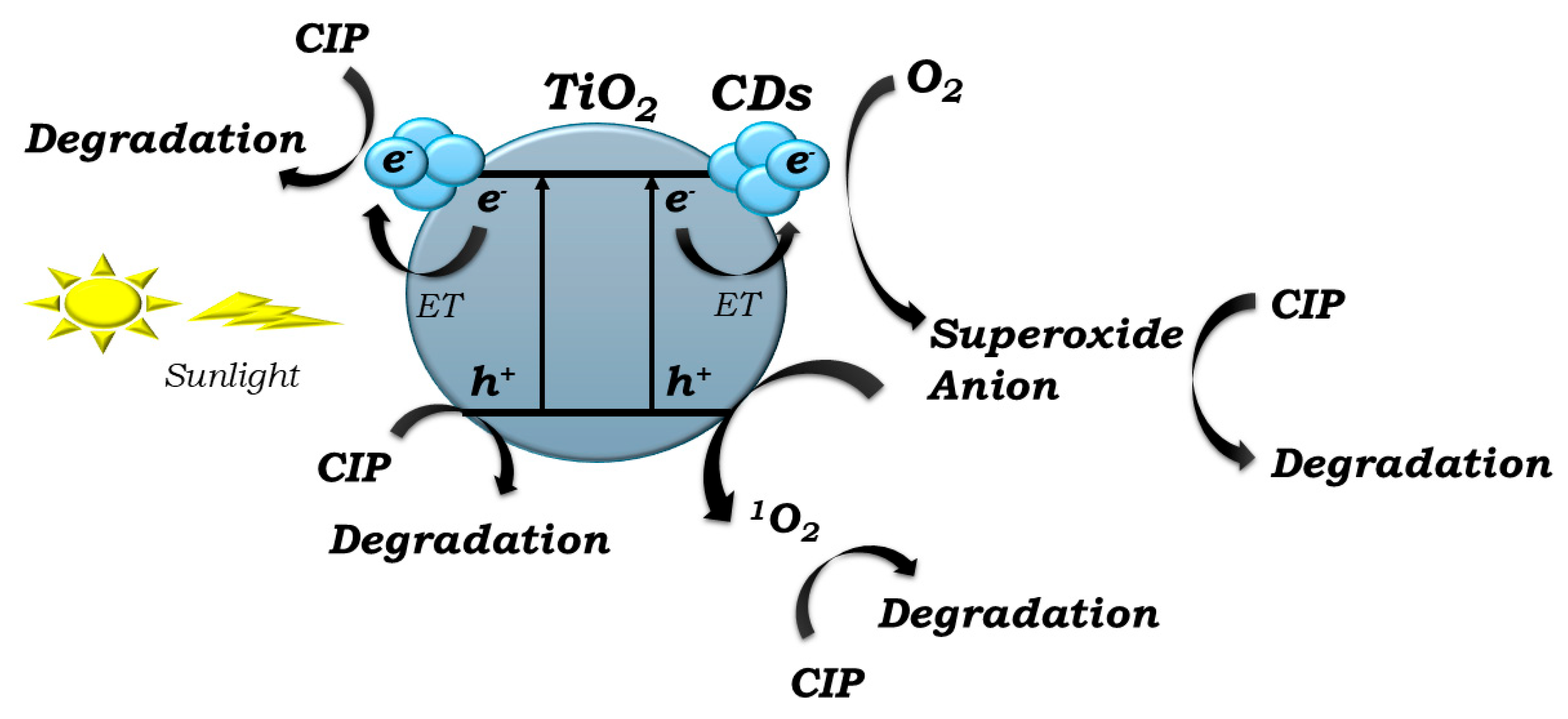
Graphical Abstract

1. Introduction

Water is an essential resource for humanity, and thus, its contamination by persistent organic pollutants, such as antibiotics, is a significant concern, especially when we consider that conventional water treatment techniques are unable to efficiently remove this type of pollutant from water supplies [1]. The ineffectiveness stemming from the complex structure of antibiotics allows these pollutants to reach water streams through the effluents of wastewater treatment plants, resulting in their widespread presence in countries worldwide [2]. Batt et al. detected ciprofloxacin (CIP), sulfamethoxazole, trimethoprim, tetracycline, and clindamycin in wastewater effluents from three treatment plants in New York State, USA [3]. Liu et al. found that quinolone antibiotics were major pollutant factors in Chinese lakes [4]. Rodriguez-Mozaz et al. reported the detection of ciprofloxacin in several European countries, with concentrations as high as 1435.5 ng L−1 being detected in Portugal [5].
The widespread presence of antibiotics in aquatic systems is further exacerbated by the absence of policies regulating their consumption in several countries, leading to excessive use. Ultimately, they reach wastewater treatment plants and are subsequently discharged into environmental water, where they range from the ng L−1 to the µg L−1 [6]. Additionally, industries such as pharmaceutics, agriculture, healthcare, and livestock farming can also lead to the infiltration of antibiotics into aquatic systems [7].
This widespread presence of traceable amounts of human and veterinary antibiotics poses a significant threat to public health, as it contributes to the development and dissemination of antibiotic resistance [8,9,10]. In aquatic ecosystems, the continuous release of antibiotics facilitates the selection of antibiotic-resistant bacteria and promotes the spread of antibiotic resistance genes, which are subsequently transferred within microbial communities [2]. As a result, bacterial infections become more difficult to treat, leading to higher healthcare costs and increased mortality. Moreover, the accumulation of antibiotics in aquatic environments also exerts toxic effects on non-target organisms, disrupting ecological balance and biodiversity [11]. Given these critical consequences, the effective degradation of antibiotics and their removal from aquatic systems is of paramount importance to mitigate their resulting environmental and public health impacts.
Among the antibiotics present in aquatic systems, we find CIP, a synthetic fluoroquinolone with antibacterial activity against both Gram-positive and Gram-negative bacteria, such as Escherichia coli and Staphylococcus aureus [12]. Regarding CIP, despite its broad-spectrum efficacy and widespread use in aquatic environments, concerns exist regarding its ecological impact and potential contribution to antibiotic resistance. As with most antibiotics, conventional wastewater treatment methods are often ineffective at fully degrading CIP, leading to its accumulation in surface water, groundwater, and sediments.
Considering the limitations and ineffectiveness of conventional wastewater treatment methods regarding removing antibiotics, it is no surprise that the scientific community has focused its efforts on alternative technologies. Photocatalysis is a potentially clean technology that has been widely studied for various applications, utilizing light irradiation as the energy source behind the intended catalytic reaction [13,14,15,16]. It is frequently a less impactful method than conventional alternatives for removing organic pollutants, as it exhibits high redox performance, produces minimal amounts of sludge, and can utilize a clean energy source, such as solar irradiation, to drive the degradation process [17].
Thus far, several photocatalysts have been investigated for environmental remediation and pollutant removal, primarily focusing on metal oxides and sulfides [16,18,19,20]. Among those studied by the scientific community, TiO2 is particularly important due to its widespread application, cost-effectiveness, and chemical stability. Furthermore, it is already extensively utilized in photocatalytic technologies for environmental remediation, including the degradation of organic pollutants such as pharmaceutical contaminants (e.g., ibuprofen), the photoreduction and removal of toxic heavy metals, and the generation of hydrogen via water splitting [13,14,16,21]. Despite these advantages, TiO2 presents several limitations that restrict its use in a wider range of applications. First and foremost, it exhibits a wide bandgap (around 3.2 eV) that prevents efficient utilization under sunlight (of which only around 5% is UV radiation) [22,23]. Additionally, TiO2 suffers from a rapid recombination of photogenerated holes (h+) and electrons (e), [24] and presents a poor affinity for organic pollutants [25].
Given these challenges, recent research efforts have focused on optimizing photocatalytic materials via methods using doping with both metals [26] and non-metals [27] and conjugation with alternative materials such as graphene [28]. Due to the increased structural stability of the crystalline framework and the introduction of new energy levels, which extend the light absorption capabilities, applying these strategies may significantly enhance photocatalytic efficiency under visible-light irradiation [26,27,28,29]. However, many of these techniques rely on incorporating potentially toxic metal elements, which, in addition to being expensive, can raise health and environmental concerns. Additionally, such modifications often lead to increased charge carrier recombination, ultimately reducing photonic efficiency and diminishing the overall catalytic performance [30].
An alternative approach to overcoming these limitations is the conjugation of semiconductors with carbon dots (CDs). These nanometric carbon-based particles exhibit spherical or quasi-spherical morphologies, possess either an amorphous or crystalline core, and a functionalized surface [31]. CDs possess several advantageous properties relevant to photocatalysis, including strong photoluminescence, a broadband absorption range that extends into the visible range, high water solubility, and low toxicity [32,33,34,35]. Due to being low cost, easy to prepare, and presenting versatile physicochemical properties, CDs have been tested and employed in various applications, such as sensing, [36] light-emitting devices, [37] photodynamic therapy, [38] and photocatalysis [15,16,39,40]. In the latter, CDs can function as independent photocatalysts or in conjunction with semiconductors, such as TiO2, to enhance light absorption and improve photonic efficiency, thereby improving overall photocatalytic performance.
The conjugation of CDs with TiO2 has the potential to enhance the sunlight-driven photocatalytic performance while avoiding the drawbacks associated with doping or coupling with metal-based materials. Unlike these strategies, adding CDs to TiO2 does not introduce additional toxicity or compromise the photonic efficiency of TiO2, making it a more environmentally and economically viable alternative [30,41,42]. CDs enhance photocatalytic activity through several mechanisms. For one, CDs can effectively accept photoexcited e from the conduction band of TiO2, thereby improving the separation of photoexcited e/h+ pairs [43]. Additionally, the broadband absorption range of CDs allows for an absorption range that extends into the visible region, enabling a more efficient utilization of solar irradiation [15,44,45]. Finally, the functionalized surface of CDs increases the affinity of the nanocomposites’ surface toward organic pollutants, enhancing adsorption onto the photocatalyst and facilitating their interaction with active sites. All these factors contribute to improved sunlight-driven photodegradation, making CD-TiO2 composites a highly effective and sustainable solution for photocatalytic applications [45].
Another significant advantage of using CDs over other methods is their versatility in synthesis, as they can be produced from a diverse range of carbon precursors, including organic waste. This can help to upcycle these residues into valuable nanomaterials. Moreover, life cycle assessment studies indicate that the most impactful stage of the life cycle of nanomaterials is their synthesis, and that the identity of the carbon precursor employed in the synthesis of CDs significantly influences the resulting potential environmental impacts of the process [46,47,48]. By using organic waste such as corn stover instead of commercially available reagents, we can avoid the impacts associated with the preparation of these chemicals and thus reduce the overall impact of the CDs. Corn stover, a major agricultural waste product consisting of the leaves, stalks, and cobs left after corn harvest, represents approximately 50% of the total corn crop yield; yet, only about 10% is repurposed for other applications [49]. Given its abundance, upcycling corn stover into a nanotechnology-based solution for wastewater treatment presents a promising opportunity for both environmental remediation and resource sustainability.
Herein, we report how the efficient and virtually complete sunlight-driven photodegradation of the emerging contaminant CIP can be achieved with a CDs and TiO2 nanocomposite (NC50:50), under both artificial and natural irradiation conditions. The CDs were prepared from corn stover, thereby combining circular-economy principles with solar-driven approaches to develop more environmentally sustainable wastewater treatment processes.
While this nanocomposite was characterized earlier [16], its sunlight-driven photocatalytic activity (under real-world irradiation and artificial conditions) and its performance as a catalyst toward the photodegradation of pharmaceutical contaminants were investigated here for the first time. This type of investigation, conducted under real-world conditions, is essential for future large-scale applications of TiO2-based photocatalysis for (waste)water treatment.
More specifically, when first using a solar simulator for assays in artificial conditions, NC50:50 was able to virtually fully degrade CIP within 20 min (k of 0.2372 min−1), while showing a 217% enhancement of photocatalytic activity toward commercial TiO2. Some potential degradation by-products were identified by HPLC-DAD and subsequently shown to be photodegraded by NC50:50. The photocatalyst was found to be stable over multiple photocatalytic cycles, and scavenger assays identified the reactive species involved. Finally, assays conducted under real-world irradiation conditions with natural sunlight showed that NC50:50 consistently fully degrades CIP within 30 min, even when prepared on different days under diverse meteorological conditions.
Furthermore, we observed that the addition of CDs led to a shift in the reactive species generation profile, with CIP being degraded by a combination of different reactive species (superoxide anion, h+, e, and singlet oxygen). This approach can then enable a strategy to tune the reactivity of TiO2-based photocatalysts and broaden their application to a wide range of contaminant classes.

2. Results and Discussion

2.1. Description of the Photocatalyst and Prior Characterization

The TiO2—CDs nanocomposite (NC50:50) used in this study was previously developed by our group and comprehensively characterized, including by XRD, SEM, XPS, solid-state (ss) NMR, FTIR, PL, and UV-Vis spectroscopy, as reported in [16]. In the present work, this material was reproduced following the previously reported synthesis and evaluated for the first time as a sunlight-driven photocatalyst for the degradation of pharmaceutical contaminants.
NC50:50 was prepared from TiO2 and CDs (prepared using corn stover and citric acid (CA) as co-carbon sources, and ethylenediamine (EDA) as N-dopant in a 1:1:2 ratio, respectively) [16]. Both NC50:50 and commercially available TiO2, thereon employed as a benchmark, were tested here as photocatalysts for the sunlight-driven photodegradation of CIP in aqueous solution. It should be noted that while NC50:50 was previously obtained, its photocatalytic performance under sunlight irradiation, either artificial or natural, had not been investigated prior to this work, nor had its application to pharmaceutical contaminants.
Given that the nanocomposite was first developed in a previous study, the results of its previous comprehensive characterization are summarized here for the benefit of the reader, with the full datasets being found in [16].
Regarding optical properties, the introduction of carbon dots (CDs) led to an extended absorption range up to 700 nm [16], enhancing their visible-light absorption capability without changing the bandgap of NC50:50 (3.26 eV) [16]. By their turn, photoluminescence studies suggested that adding CDs leads to suppressing the recombination of TiO2’s photoinduced charge carriers [16], due to lower photoluminescence than that measured for sole TiO2 [16]. Electrochemical impedance spectroscopy further supported this finding by indicating lower electron transfer resistance under irradiation [15,16]. These results indicate that CDs enhance visible-light absorption and facilitate more efficient charge separation [16], ultimately improving the photocatalytic performance of the nanocomposite.
In terms of structural and chemical composition, NC50:50 was assessed using various characterization techniques, including SEM, XRD, FTIR, XPS, and ss-NMR spectroscopy [16]. SEM analysis revealed that NC50:50 exhibited a spherical morphology with an average diameter of approximately 92.9 nm. XRD patterns were consistent with anatase-phase TiO2, while FTIR and XPS analysis identified functional groups such as carbonyl, hydroxyl, and amines, which may influence the nanocomposite’s interaction with pollutants and confirm the presence of the CDs on the TiO2. ss-NMR spectroscopy provided further insights into the organic structure of the CDs, revealing highly oxygenated aliphatic chains that interact with TiO2. These findings suggest that the CDs play a crucial role in modifying the nanocomposite’s surface properties, thereby further enhancing its photocatalytic performance and providing a foundation for our work [16].

2.2. Photocatalytic Optimization and Assays

The photocatalytic efficiency of NC50:50 under simulated sunlight toward CIP was evaluated via RP-HPLC-DAD. Before optimizing the photocatalytic conditions, preliminary tests were conducted with 20 mg of photocatalyst and 20 ppm of CIP under 60 min of irradiation, with samples collected every 15 min. Additionally, the same assay was performed using commercial TiO2 (<25 nm particle size, anatase phase, from Sigma-Aldrich), which served as a benchmark.
To evaluate NC50:50’s performance relative to TiO2, we quantified the percentage of CIP removed over a fixed irradiation period (%DR, Equation (1)) [50] and determined the corresponding rate constant (Equation (2)). The %DR was calculated using the following equation:
% D R =   C 0 C t C 0   × 100
Here, %DR corresponds to the % of CIP removed, C0 represents the initial CIP concentration, and Ct is the concentration of CIP after an irradiation period of t minutes.
Moreover, the kinetic equation of the degradation follows a pseudo-first-order reaction that can be expressed as follows [51]:
ln ( C t C 0 ) = k t
In this case, k corresponds to the estimated reaction rate constant.
The analysis of the initial results obtained revealed that, even prior to optimization, NC50:50 presented a significantly better CIP photodegradation potential than TiO2, both in terms of reaction rate constant (0.0536 min−1 vs. 0.0283 min−1, enhancement of 89.4%, depicted in Figure S1a) and degradation extent, with NC50:50 managing achieving a virtually complete removal of the initial CIP concentration within 60 min (Figure S1b).
Afterwards, we tested the effect of different CIP concentrations, pH level, and catalyst dosage on the efficiency of the catalytic process (Table 1 and Figure S1c–h). Starting with the initial CIP concentration, we found, as expected, that the lowest CIP concentration led to the highest reaction rate constant (0.0823 min−1 for 10 ppm versus 0.0537 and 0.0200 min−1 for 20 and 30 ppm, respectively). Although using 10 ppm of CP resulted in a higher rate constant, 20 ppm was selected for subsequent assays because it still achieved near-complete degradation using a higher pollutant concentration within a relatively short time frame.
Regarding the pH level, and already using a CIP concentration of 20 ppm, the results revealed that a pH of 7 resulted in the highest catalytic efficiency, achieving a rate constant of 0.0828 min−1 and a %DR of 99.1% within 60 min of irradiation (Figure S1e,f). Finally, regarding the catalyst dosage, using 20 ppm of CIP at pH 7, we found that a 60 mg dosage led to the best results, resulting in a rate constant over double that of second-best performer (0.2372 min−1 versus 0.1114 min−1 for a 40 mg dosage) and achieving a virtually complete degradation of the initial pollutant within 16 min of irradiation (Figure S1g,h).
While this dosage was the highest amount we tested, we decided not to continue the test further, as higher concentrations resulted in a large amount of catalyst being deposited at the bottom of the reaction mixture. Thus, there was no advantage in adding more material. In summary, for subsequent tests, we selected the following reaction conditions: 20 ppm of CIP, pH 7, and 60 mg of catalyst, with a total reaction volume of 100 mL.
Based on these reaction parameters, the photocatalytic efficiency of NC50:50 was compared to that of commercial TiO2, photolysis, and CDs by themselves (Figure 1a,b). Under the same conditions, NC50:50 exhibited a rate constant of 0.2372  ±  0.0032 min−1 and a %DR of 98.2 ± 0.6% within 16 min of irradiation, outperforming commercial TiO2, which achieved a rate constant of 0.0749  ±  0.0002 min−1 and a %DR of 89.2  ±  1.7% after 30 min under simulated sunlight. Furthermore, the effect of photolysis was minimal, with only 5.8% degradation observed after 30 min. Photodegradation experiments using CDs alone yielded comparable results to photolysis, indicating that CDs by themselves are not sufficient to degrade CIP under the same conditions. These findings demonstrate that incorporating the CDs into TiO2 substantially enhances the semiconductor’s photocatalytic performance under solar irradiation.
By analyzing the evolution of the chromatogram (Figure 1c) with increasing reaction times, we can observe that CIP’s initial peak, found at around retention time (RT) of 3.65 min, disappears quite rapidly (within 16 min of irradiation). Several peaks ascribed to potential degradation by-products appear during the course of the process. However, they also disappear as the photocatalytic process continues. Namely, when we prolonged the duration of the photocatalytic assay (Figure 1d), we observed that no significant peaks (with over 1% of initial CIP peak area) are found for an irradiation time of 300 min, suggesting that even the produced by-products are also degraded by NC50:50. To better demonstrate this, a full overview of the evolution of chromatogram peaks areas appearing over the course of the degradation and their evolution over time can be found in Figure 1e (with specific data on Table S1), which clearly demonstrated that all additional peaks appearing over the course of the experiment (P2–P6) tend to disappear when compared to the initial CIP peak (P1).
To further assess the impact of incorporating CDs into TiO2 on the catalytic performance, we quantified the enhancement of TiO2’s catalytic efficiency upon the incorporation of CDs by using Equation (3):
% ln ( C ) = 100   ×   k N C k T i O 2 k T i O 2
In this context, % ln ( C ) serves as a comparative metric for evaluating the enhancement of TiO2’s catalytic efficiency upon the incorporation of CDs regarding the photodegradation of CIP, k N C represents the reaction rate constant of NC50:50, while k T i O 2 corresponds to the reaction rate constant of commercial TiO2. By applying this formula, we estimated the % ln(C) to be 217%, demonstrating a very significant enhancement in catalytic performance compared to that of commercial TiO2. This was achieved by adding CDs, which, in addition to improving the catalytic performance, utilized corn stover in a manner that upcycled this otherwise discarded material.
However, aside from the increased photocatalytic efficiency, it is also worth noting that adding CDs also increased the adsorption of CIP to NC50:50 in the dark compared to TiO2 (Figure S2a). In fact, nearly half of the initial CIP concentration seems to be adsorbed by NC50:50 during the 30 min period in the dark. This is relevantly higher than what is observed for TiO2, where only around 4.1% of the initial CIP appears to be adsorbed. To assess if this higher adsorption could be responsible for the observed photodegradation with the lamp on, we compared the variation in Ct/C0 of CIP in the presence of NC50:50 both with the lamp on and off (Figure S2b). These results indicate that while there is a significant adsorption of CIP into the NC50:50 during the 30 min dark period before turning on the lamp, the adsorption is stabilized thereafter. That is, after the 30 min dark period, when the lamp is still off, the Ct/C0 ratio remains constant. While the lamp is on, a significant decrease in CIP levels is observed during the same period. These results confirm that the degradation observed during photocatalytic assays is due to photocatalysis itself, and not just continuous adsorption into NC50:50.
The different degrees of adsorption between NC50:50 and TiO2 can be explained by the fact that by adding a nanoparticle with a highly functionalized surface [31] with different functional groups that confer a better affinity towards organic compounds than that inherent to TiO2, the photocatalyst facilitates the adsorption of CIP, enhancing its interaction with active sites.
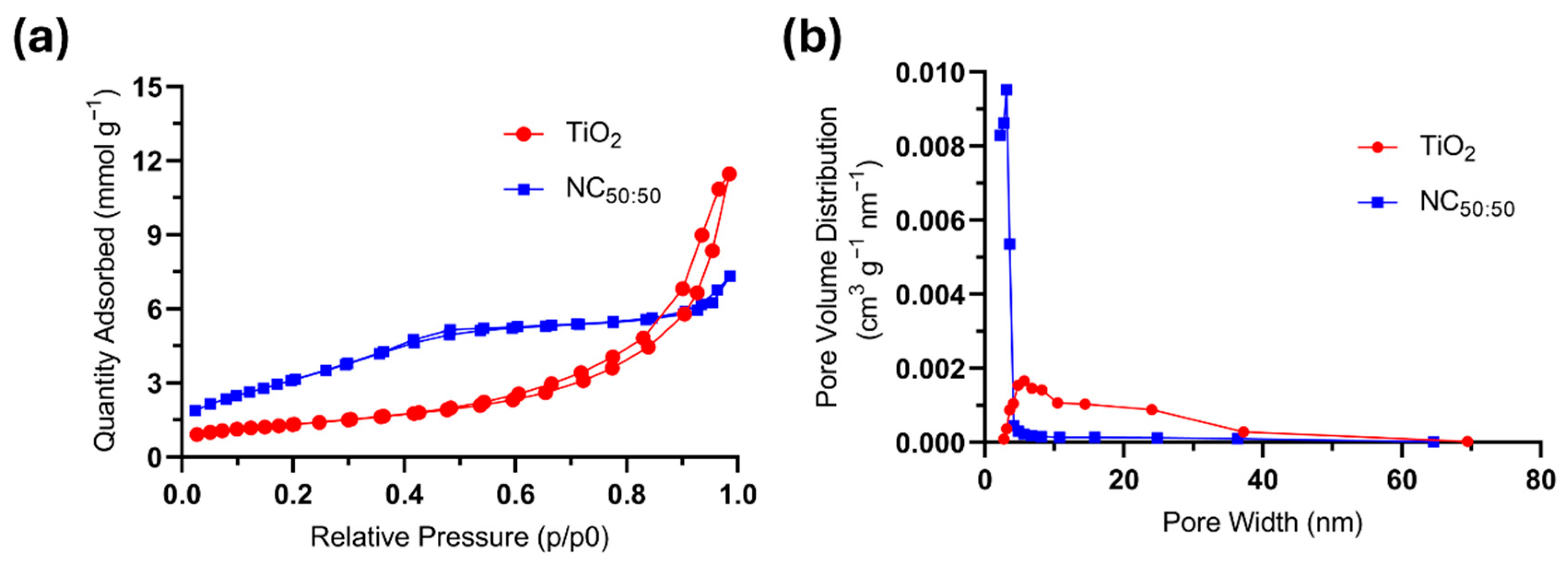
In fact, data from BET analysis revealed that NC50:50 presents a higher specific area (SBET) than TiO2 (Table 2). Namely, the results suggest that both TiO2 and NC50:50 exhibit Type III isotherms (Figure 2a), with the nanocomposite showing an SBET of 269.9 m2g−1, over 2.5× higher than that of TiO2 (105.2 m2 g−1). This increased surface area helps to explain the higher CIP adsorption observed with NC50:50. Regarding pore size, both TiO2 and NC50:50 are classified as mesoporous, presenting pore widths of 13.1 and 4.1 nm, respectively (estimated via the BJH method with pore size distribution represented in Figure 2b) [52].

2.3. Scavenger Assays

To investigate the reactive species responsible for the enhanced catalytic activity of NC50:50, sunlight-driven CIP degradation assays were conducted in the presence of specific radical scavengers. Hydroxyl radicals (·OH), superoxide radicals (O2), electrons (e), holes (h+), and singlet oxygen (1O2) were selectively scavenged using isopropyl alcohol (IPA, 10 mM), 1,2-dihydroxybenzene-3,5-disulfonate (Tiron, 10 mM), potassium nitrate (KNO3, 10 mM), potassium iodide (KI, 10 mM), and sodium azide (1 mM), respectively. These scavengers were selected based on their established roles in targeting reactive species commonly associated with TiO2 and TiO2-composites [41]. IPA and Tiron were of particular interest, as hydroxyl and superoxide radicals, their respective target species, are typically among the primary reactive species in the photocatalytic mechanism of bare TiO2 [26,53].
The influence of each reactive species was assessed by measuring the change in the %DR in the presence of the scavengers, as calculated using Equation (4) [15]:
% D R V = % D R t e s t % D R c o n t r o l
In this equation, %DRV represents the variation in %DR when a scavenger is introduced (%DRtest) relative to the control test (%DRcontrol), which represents standard photodegradation without scavengers. Therefore, the magnitude of the %DRV allows for a quantitative assessment of each species’ contribution: a higher degree of inhibition (more negative %DRV) corresponds to a greater relative importance of that species in the degradation process.
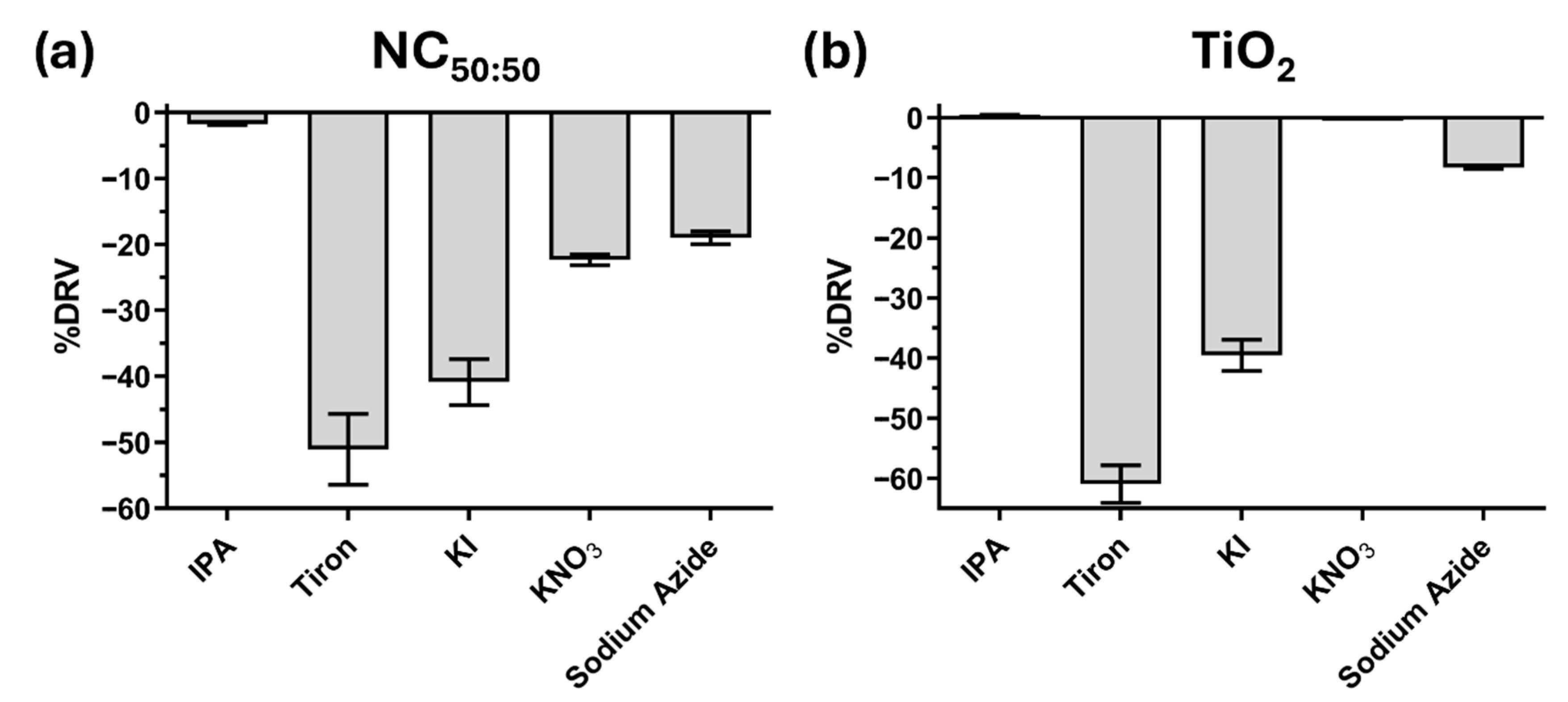
The results from the scavengers’ tests revealed that, for NC50:50, all tested reactive species, except for the hydroxyl radical, participated in the photodegradation mechanism (Figure 3a). Namely, tests using IPA did not yield any significant %DRV value. For their turn, the %DR was diminished significantly in the presence of Tiron (−51.1 ± 5.4%), KI (−40.9 ± 3.5%), KNO3 (−22.3 ± 0.8%) and sodium azide (−19.0 ± 1.0%). This indicates that the superoxide radical, h+, e and 1O2, by that order, have a role in the photocatalytic mechanism of NC50:50. Regarding TiO2 (Figure 3b), the reactive species responsible for the degradation mechanism were the superoxide radical, h+, and 1O2.

2.4. Recycling Studies

Recycling experiments for the photodegradation of CIP under simulated solar irradiation were conducted to evaluate the stability and performance of NC50:50 over three consecutive runs. In this experiment, consecutive cycles of CIP photodegradation were performed in 1 h periods of solar irradiation in the presence of NC50:50. After each cycle, the composite was collected, dried, and reused repeatedly without further processing.
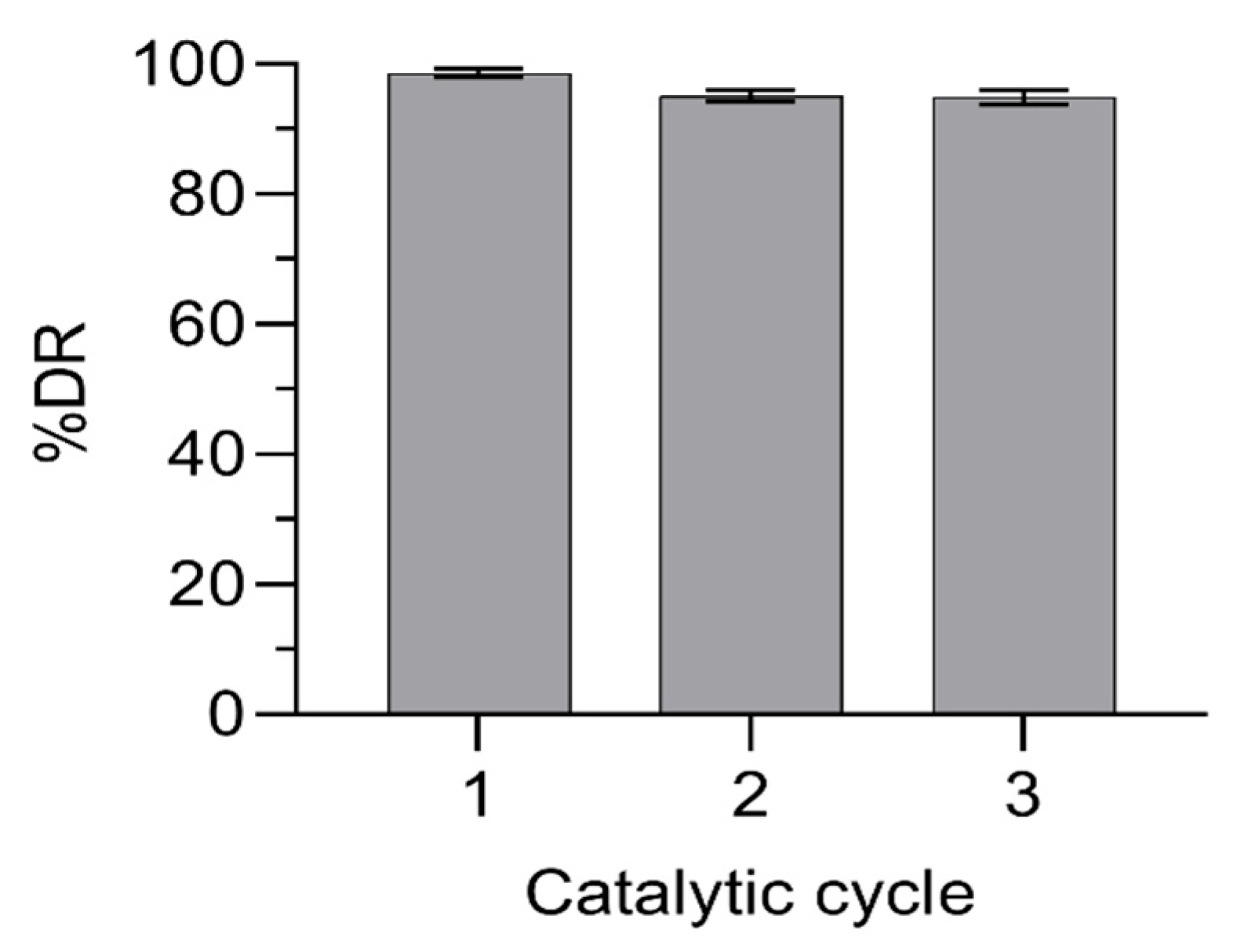
It was observed that the %DR obtained in the final cycle was still over 95%, compared to 99% in the first cycle (Figure 4). Given this, NC50:50 is considered to have good performance stability and still achieves a nearly complete degradation of the target pollutant within the same time period. The number of considered cycles is also consistent with literature data [54,55,56].
It should be noted that there were mass losses during material recovery that made it difficult to perform additional cycles. For one, this issue is nevertheless common for powder-based photocatalysts. In that sense, it can be considered a general limitation for this type of photocatalyst, and further exploration should be the focus of future studies. Namely, the addition of the nanocomposite to lightweight materials to provide floating capability, which should allow for facile separation from the matrix to be treated by skimming. Nevertheless, the obtained %DR variation over the performed cycles still allows us to characterize the photocatalytic activity of the material as stable.

2.5. Comparison to the Literature

To better evaluate the effectiveness of our composite, the photocatalytic performance of NC50:50 was compared to other TiO2-based systems reported for the photodegradation of CIP. The comparison (Table 3) was made regarding k and how much the k obtained by NC50:50 is enhanced relative to literature entries (% In(C)).
First, NC50:50 presents the highest rate constant (0.2372 min−1). In fact, the nanocomposite studied in this work presented a k that was enhanced, on average, by 1444% over all the other entries. Namely, the observed enhancement was over 500% for all entries (reaching enhancement values of 2691% and 5303%), except for entries 3 and 7. However, even considering those latter entries, the enhancement was also quite relevant (133% and 84%, respectively).
Furthermore, it should be noted that entry 3 only considered UV radiation (in which TiO2 is known to be intrinsically more efficient), and not sunlight (as the present work did). Regarding entry 7, the measured k was obtained by considering about double the catalyst dosage and half of the CIP concentration in the present study. Finally, while entry 7 did employ artificial solar radiation as an irradiation source, contrary to our study, the performance of the photocatalyst was not validated under natural sunlight (Section 2.6).
Moreover, it is worth noting that this was achieved employing CDs partially prepared from corn stover. Meaning that by using our waste-incorporating carbon nanoparticles, we not only obtain a significantly higher catalytic potential than other alternatives, but we also use otherwise discarded organic material, thus providing a way to upcycle this organic waste.
Future work should include the evaluation of NC50:50’s performance against other antibiotics, such as tetracycline and oxytetracycline [57,58,59,60,61,62].
Table 3. Comparison between the rate constant (k, min−1) obtained by NC50:50 and other TiO2-based photocatalysts for the photodegradation of CIP. Here, % ln(C) is also calculated according to Equation (3), but considering the k of each literature entry as a reference. Namely, here, % ln(C) measures how enhanced the k of NC50:50 is over each literature entry.
PhotocatalystCat. (g L−1)CIP Conc. (ppm)Lampk (min−1)% In(C)DOI
TiO2/CDs NC50:500.620Solar simulator0.2372 This work
Glass-deposited TiO20.1320365 nm
10 mW/cm2
0.00852691[63]
Graphitized carbon-TiO20.3515254 nm
14 W
0.102133[64]
Glass-deposited TiO213UV0.01971104[65]
TiO2 NPs0.7803 × 254 nm
8 W
0.004395303[66]
TiO2/SnO212.53 × 253 nm
35 W
0.0311663[67]
TiO2/CDs6 wt%110Xe Arc
350 W
290 Filter
0.12984[68]
TiO2/H2O20.59Solar
800 W Xe lamp
0.022978[69]
TiO2/WO30.520Sunlight0.034598[70]

2.6. Photocatalysis Under Natural Sunlight

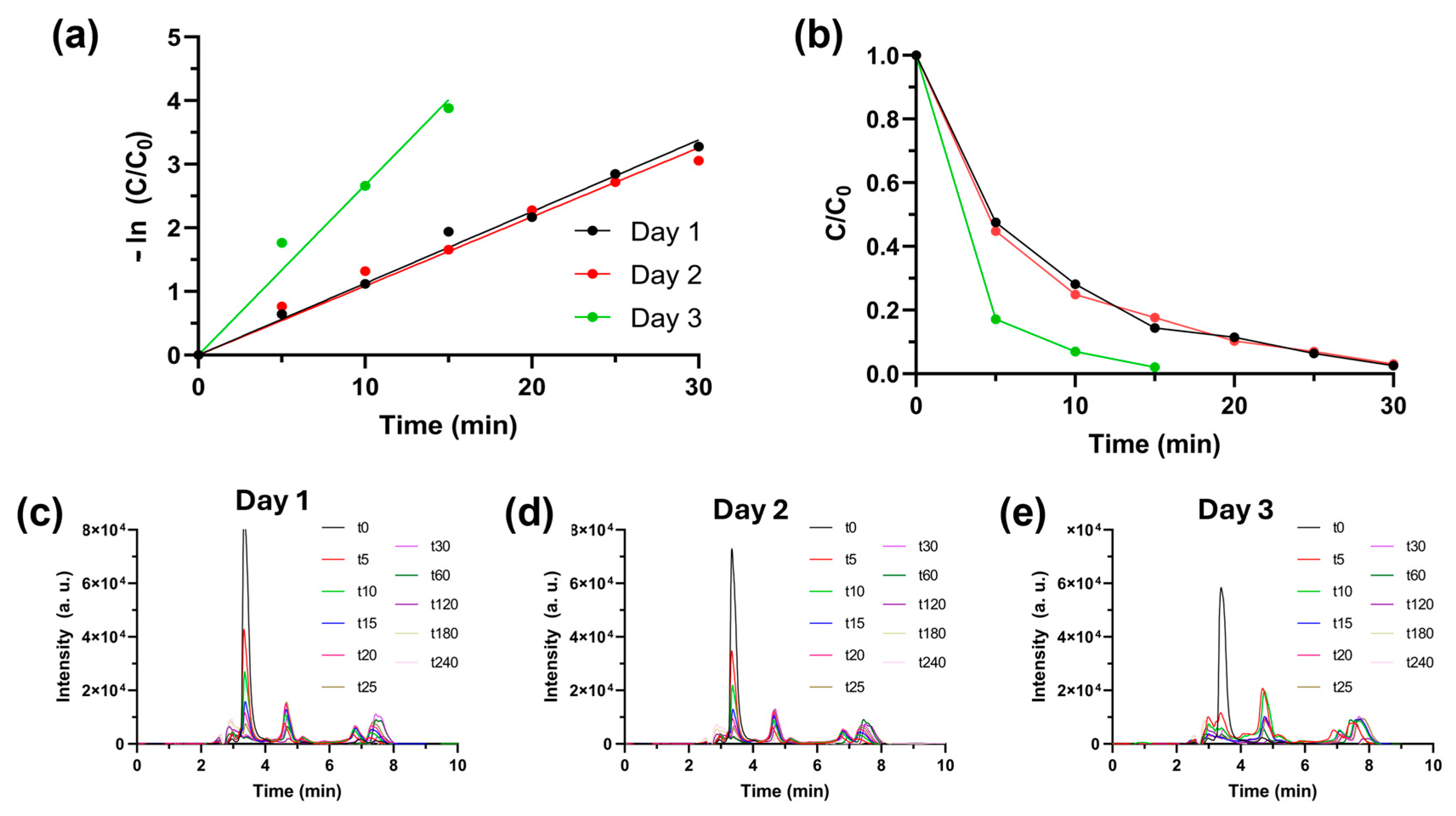
Finally, the last stage of our experiment consisted of analyzing the photocatalytic potential of NC50:50 under natural sunlight to further assess its practical applicability. Namely, an experiment was conducted on the roof of the FC3 Building of the Faculty of Sciences—University of Porto (Portugal), in which the photodegradation of CIP under direct sunlight irradiation was monitored (Figure 5 and Table 4). The assays were performed during three consecutive days with different meteorological conditions (Table 4).
The results demonstrate that, even under real sunlight, NC50:50 is very efficient at degrading CIP. In fact, on the day experiencing the highest UV index (Day 3), NC50:50 achieved an estimated reaction rate constant of 0.2676 min−1 (Figure 5a), which was even higher than that obtained with the solar simulator as the irradiation source (0.2372 min−1). The photocatalytic potential was further confirmed over three different days, in which CIP was virtually fully degraded within 30 min of irradiation, with Day 3 recording a %DR of ~100% within 15 min of exposure to sunlight (Figure 5b).
Interestingly, neither the temperature nor the atmospheric conditions seem to affect catalytic efficiency significantly. Instead, photocatalytic activity appears to be more closely related to variations in the UV index, as increasing the index from 8 to 9 led to halving the irradiation time required to achieve a %DR of 100%. It should be noted that the UV index is a meteorological measure of the intensity of sunburn-producing UV radiation, which is used here as a proxy for the intensity of natural sunlight (which includes visible light). The enhanced activity of the photocatalyst is attributed to its higher visible light absorption, which allows efficient utilization under sunlight.
In terms of degradation products, as observed in Figure 5c–e, the same peaks (with the same retention times) appear in the chromatograms in the same order as they did when using the solar simulator, suggesting that the degradation products are the same, independently of employing simulated solar irradiation or real sunlight. It should be noted that these potential degradation by-products were also degraded by NC50:50 under natural sunlight, similar to what was observed under simulated sunlight.
The ability of NC50:50 to degrade CIP under natural sunlight in an efficient manner can be attributed to the addition of CDs to TiO2. Namely, CDs are known to be good electron acceptors during photoinduced electron transfer, leading to an improved separation of photoexcited e/h+ pairs [43]. In fact, previously performed PL and EIS assays involved NC50:50 (mentioned in Section 3.1) [16] indicated that the addition of CDs led to suppression of the recombination of TiO2’s photoinduced charge carriers and to lower photoinduced electron transfer resistance. The NC50:50 was also previously shown to possess enhanced visible light absorption than TiO2 [16], which can be a result of the typical broadband absorption range of CDs [15,44,45]. Given that the main individual component of sunlight is visible light, this enhancement in visible light absorption indicates a more efficient activation under visible light. Herein, the superior performance of NC50:50 under real-world irradiation conditions can be explained by the addition of CDs, which enhances sunlight-driven photoactivation and facilitates efficient charge separation, ultimately improving the photonic efficiency of the photocatalyst.

2.7. Photocatalytic Mechanism

Scavenger assays indicated that superoxide radical, h+, e and 1O2 (in decreasing order of magnitude) all had a relevant role in the photodegradation of CIP (Figure 3a), when catalyzed by NC50:50.
It should be noted that while TiO2-based photocatalysts are mainly associated with the production of hydroxyl radicals (under UV radiation) [71], their reactive species generation profile can vary at different irradiation wavelengths. Namely, different groups observed that superoxide anion was the primary reactive oxygen species (ROS) in the visible light-driven activity of TiO2-based photocatalysts [72,73]. Also under visible light, Zhou et al. found that 1O2 to be a main reactive species in the studied TiO2-based system [74]. By their turn, Guo et al. attributed the sunlight-driven degradation of organic dyes by TiO2 photocatalysts to hole-mediated oxidation, rather than to hydroxyl radicals [75]. Thus, our results are consistent with existing literature.
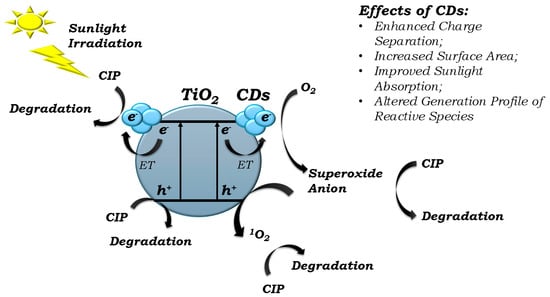
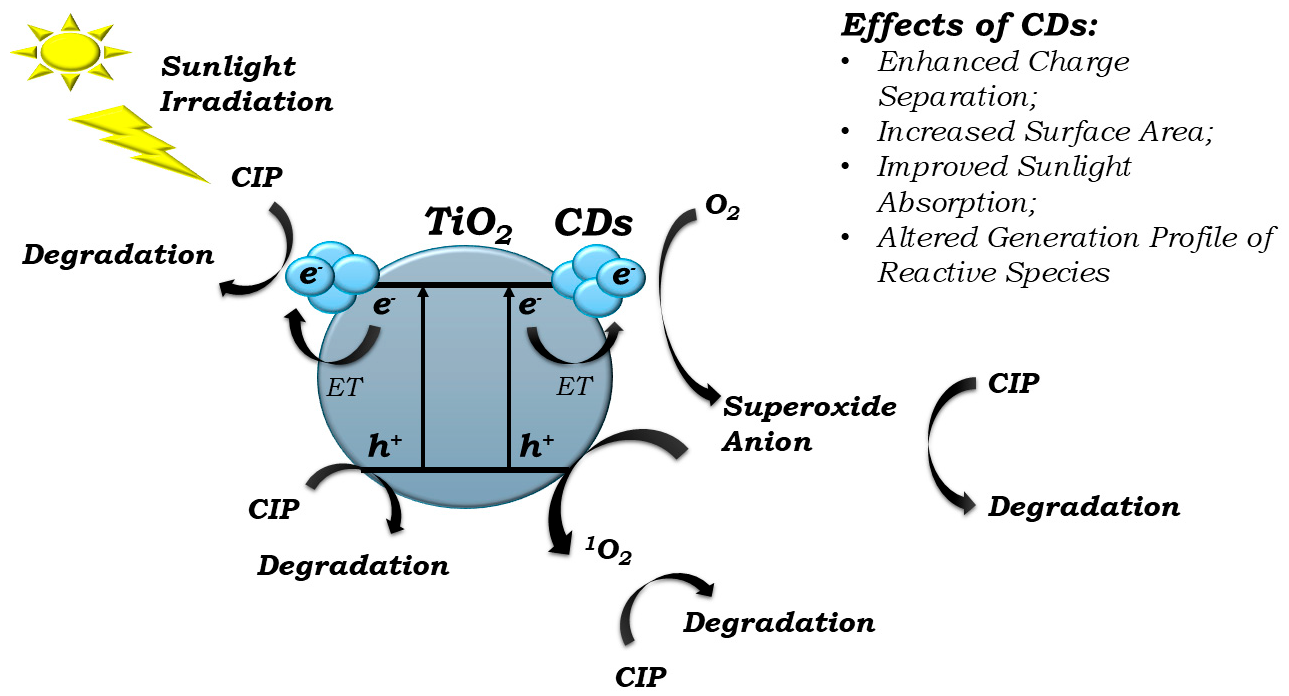
As for the specific photocatalytic mechanism, as mentioned in Section 2.1 [16], the addition of CDs to NC50:50 appeared to have led to an inhibited recombination of photogenerated charge carriers. This is attributed to the capacity of CDs (among other carbon nanomaterials) to act as electron reservoirs, thereby retaining photoexcited electrons transferred from TiO2 upon light irradiation [15,43,76]. This enhances charge separation and suppresses the recombination of holes and electrons [43,77]. Therefore, effectively extending their lifetime and allowing them to have a more direct role in the photodegradation reaction. This can explain the more prominent role of both h+ and e in the photodegradation of CIP observed in the study (Figure 3a).
The direct involvement of h+ and e might also be facilitated by the enhanced adsorption capability of NC50:50 (Figure 2 and Figure S2, Table 2). Namely, it was observed that the addition of CDs led to a 2.5× increase in the specific surface area of the nanocomposite, which resulted in a large adsorption of CIP to NC50:50 (Figure S2), during the dark period. This means that before the start of light irradiation, CIP molecules are already positioned at the surface of the photocatalyst, where they can interact more rapidly with photogenerated h+ and e.
Furthermore, CDs are typically considered both photoinduced electron acceptors (which allows them to retain e from TiO2) and donors [78]. The latter characteristic can also enable them to act as mediators/electron relays [79,80], and assist in the formation of superoxide anion. This latter ROS can then either induce the degradation of CIP or be oxidized in a hole-mediated process, to generate 1O2 [81]. The efficiency of these processes is expected to be enhanced by the inhibited recombination rate of photogenerated charge carriers, which justifies the observed involvement of superoxide anion and 1O2 in the degradation of CIP (Figure 3a).
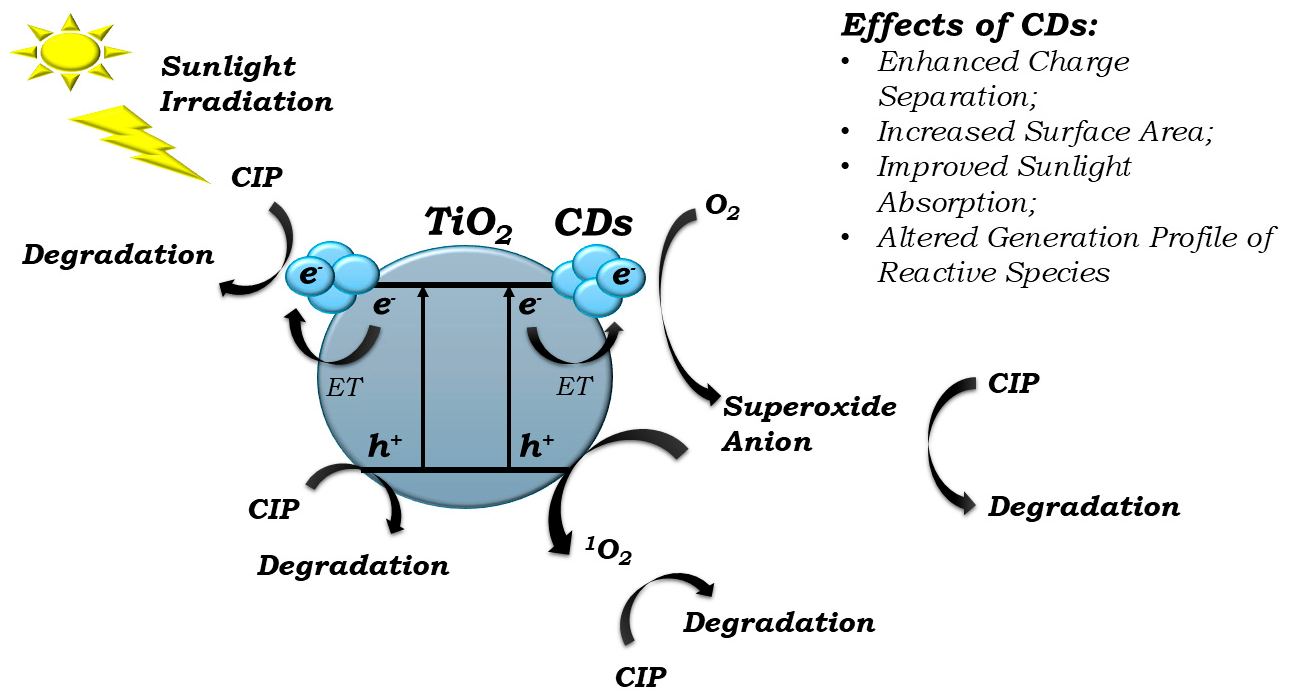
In short (Figure 6), the addition of CDs allows for sunlight-driven photoexcitation and enhanced charge separation, by retaining photoexcited electrons from TiO2. Given their extended lifetime, these e can generate superoxide anion, which is partially converted to 1O2 via a h+-mediated route. These two ROS, together with remaining h+ and e, directly oxidize CIP. The degradation process is also expected to be enhanced by the larger surface area of NC50:50, resulting from the addition of CDs, which allows for significant CIP adsorption prior to the irradiation phase. This pre-positions CIP in the reactive interface, which can enhance reaction rates once light irradiation starts.
It should also be highlighted that the addition of CDs also modulates the reactive species generation profile of the resulting photocatalytic nanocomposite. Namely, analysis of Figure 3 shows that the reactive species involved in CIP degradation differ for reactions catalyzed by NC50:50 or commercial TiO2. As mentioned, superoxide anion, h+, e and 1O2 are involved in photodegradation catalyzed by NC50:50. However, only superoxide anion, h+, and 1O2 were found to be involved in the commercial TiO2-catalyzed process.
Furthermore, the difference between reactive species profiles does not appear to end with the involvement or not of e. That is, the NC50:50 appears to be more balanced in terms of the reactive species involved (Figure 3). While higher, the impact of superoxide anion is close to that of h+. The impact of e is similar to that of 1O2, and their combined contribution to CIP degradation is still significant (about half of the combined contributions of superoxide anion and h+).
The profile is different for commercial TiO2 (Figure 3). Now, superoxide anion is more clearly the main contributor by a relevant margin to h+, and that of 1O2 is relatively residual. These differences can be ascribed to the charge separation-enhancing effect of CDs. Thereby, allowing the higher involvement of addition of h+ and e, and of additional ROS (such as 1O2).
Thus, the incorporation of CDs not only enhances photocatalytic efficiency but also appears to alter the charge-transfer dynamics of TiO2. By modulating the reactive species generation profile, CDs can change the available degradation pathways. This finding potentially opens a pathway for the rational design of sunlight-active TiO2-based photocatalysts with tunable surface reactivity and broader contaminant compatibility.

3. Materials and Methods

3.1. Preparation of CDs

The CDs were synthesized via a hydrothermal method, reproducing a synthesis procedure previously developed by us and thus, the morphological, structural, surface, and luminescent characterization of the material can be found in [16,82]. In summary, citric acid (CA), corn stover, and ethylenediamine (EDA) (1:1:2 mass ratio, in a total of 0.3 g) were dispersed in a NaOH solution (0.01 M). The reaction mixture was placed in a Teflon-lined autoclave reactor, which was then sealed stainless-steel outer shell. The mixture was subsequently subjected to a hydrothermal treatment (200 °C for 8 h), after which it was left to cool overnight. The resulting mixture was then subjected to purification by centri-fugation (6000 rpm for 30 min, while retaining the supernatant), and dialysis (3.5 kDa cutoff, 24 h). The former was performed to remove insoluble material, while the latter was performed to eliminate any remaining soluble contaminants that could interfere with the physicochemical properties [33]. Finally, the purified CD solution was lyophilized, weighed, and then redissolved in deionized water before being stored in the refrigerator (4 °C) until needed.

3.2. TiO2/CDs Nanocomposites Preparation

To synthesize the TiO2-CD nanocomposite, we modified a procedure previously developed by us [83,84], adapting it to include CDs [16]. In brief, titanium isopropoxide (TTIP) was initially added to IPA dropwise under continuous stirring. Afterwards, deionized water was introduced to precipitate TiO2. A controlled amount of CDs, equivalent to 4% of the total expected mass, was then added dropwise under stirring. Before incorporation, the CD solution was maintained under stirring at 70 °C to ensure homogeneity. After adding the CDs, the suspension was stirred for an additional 2 h before filtration, followed by drying overnight and annealing at 300 °C in a muffle furnace (Thermolyne 47900, 1000 W, Thermo Scientific, Waltham, MA, USA, EUA), resulting in NC50:50. In this nomenclature, 50:50 indicates that corn stover and CA were used in a 50:50 mass ratio as co-carbon precursors in the synthesis of CDs, which are then used in the preparation of the nanocomposite. NC50:50 was then kept in the dark until further use.

3.3. Photocatalytic Activity Assays

The sunlight-driven photocatalytic efficiency of commercial TiO2 and NC50:50 was evaluated using an Ossila LED Solar Simulator (1000 W m−2, Ossila, Sheffield, UK) as the irradiation source for the photodegradation of CIP. For these assays, 60 mg of photocatalyst was dispersed in 100 mL of CIP solution (20 mg L−1). Afterwards, the mixture was exposed to 1 min of ultrasonic agitation. Prior to switching on the irradiation source, the suspension was stirred in the dark for 30 min to reach an adsorption–desorption equilibrium [85]. Samples were collected at the beginning of that dark period (t = −30 min), to assess pollutant adsorption on the catalyst). Following this period, the solar simulator was turned on, and samples were collected at specific time intervals: at the start of irradiation (t = 0 min), and at several different irradiation times. To remove the catalyst from the sample prior to analysis, the aliquots were centrifuged at 10,000 rpm for 10 min and filtered using PTFE 0.45 µm syringe filters (LLG Labware).
The chromatographic analysis of the samples was performed using a reverse-phase HPLC with a diode array detector (RP HPLC-DAD) chromatographic system. The system employed a Thermo Scientific SpectraSystem P1000 pump (Thermo Scientific, Waltham, MA, USA, EUA), a Rheodyne manual injection valve, an Acclaim™ 120 column and a UV6000 LP diode array detector from Thermo Finnigan (San Jose, CA, USA). A mobile phase composed of 49.5% methanol, 49.5% deionized water, 1% acetic acid, and 1 mM ammonium acetate was used with a flow of 0.65 mL per minute.

3.4. Scavenger Assays

To gain insight into the potential participation of different reactive species in the photocatalytic degradation of CIP, additional photocatalytic assays were conducted using scavengers for each respective species, and the effect of the scavengers was monitored via RP-HPLC-DAD. Herein, IPA (10 mM) [26], Tiron (10 mM) [86], KNO3 (10 mM) [87], KI (10 mM) [26], and sodium azide (1 mM) [88] were used to evaluate the roles of hydroxyl radicals (·OH), superoxide radicals (O2), electrons (e), holes (h+) and singlet oxygen (1O2), respectively.

3.5. BET Analysis

The surface area and pore parameters were determined using a nitrogen adsorption analyzer (TriStar Plus, Micromeritics, Norcross, GA, USA). Prior to conducting the N2 adsorption–desorption measurements, the samples were degassed under N2 flow at 200 °C for 6 h to remove adsorbed water and volatile impurities, ensuring that the measured surface area and pore characteristics reflect only the properties of the materials and not those of surface contaminants. The pore size distributions were calculated using the desorption branch of the N2 isotherms, applying the Barrett–Joyner–Halenda (BJH) method.

4. Conclusions

This work demonstrates the efficient sunlight-driven degradation of the pharmaceutical contaminant CIP using a TiO2/CDs nanocomposite under real-world irradiation conditions, a crucial step toward large-scale water-treatment applications. Furthermore, the used CDs were prepared from a major agricultural waste, corn stover.
Initial testing was performed under simulated sunlight. Under these conditions, NC50:50 achieved a virtually full degradation of CIP within 20 min, with a rate constant of 0.2372 min−1. Moreover, the photocatalytic activity of the nanocomposite was found to be 217% enhanced compared with commercial TiO2. NC50:50 also showed good stability. Finally, while some potential by-products were detected, they were also photodegraded by NC50:50. When compared with other photocatalysts used for CIP degradation, NC50:50 showed the most promising performance.
Subsequently, the performance of NC50:50 was validated under real-world irradiation conditions. Namely, under natural sunlight over three consecutive days, with different meteorological conditions. This photocatalyst was found to retain its efficiency, fully photodegrading CIP under 30 min, irrespective of the day. Potential degradation by-products were also formed but were subsequently degraded by NC50:50. This indicates that the nanocomposite exhibits enhanced photodegradation catalytic effects even under real-world irradiation conditions.
The enhanced activity of NC50:50 was attributed to a combination of effects that resulted from the incorporation of CDs. More specifically, their incorporation resulted in more efficient activation by sunlight, due to enhanced visible-light absorption. It was also concluded that CDs suppressed the recombination of holes and electrons, increasing the photodegradation efficiency. The incorporation of CDs also increased the specific surface area of the photocatalyst, which enhanced CIP adsorption before the photocatalysis stage. This pre-positioned CIP in the surface interface, which facilitated the photodegradation after starting the light irradiation phase.
Finally, the incorporation of CDs not only significantly improved the sunlight-driven photocatalytic activity but also modulated the reactive species generation profile of TiO2. By altering the type and contribution magnitude of generated reactive species, CDs can modify the available degradation pathways. This finding potentially opens a pathway for the rational design of sunlight-active TiO2-based photocatalysts with tunable surface reactivity and broader contaminant compatibility.

Supplementary Materials

The following supporting information can be downloaded at https://www.mdpi.com/article/10.3390/catal16020142/s1, Figure S1: Representation of the preliminary results of CIP photodegradation with NC50:50 in terms of (a) ln (C/C0) and (b) C/C0 in function of different simulated sunlight irradiation times; (c) ln (C/C0) and (d) C/C0 values for different initial CIP concentrations; (e) ln (C/C0) and (f) C/C0 values at different pH and (g) ln (C/C0) and (h) C/C0 values for different catalyst dosages obtained during the optimization of the reactional conditions.; Figure S2: (a) CIP adsorption by NC50:50 and TiO2 occurred during the 30 min in the dark prior to turning on the lamp (corresponding to t-30 to t0). Calculated by using the following equation: CIP adsorption = ((C − C0)/C0) *100. (b) Representation of the C/C0 of CIP in the presence of NC50:50 with and without an irradiation source. Variation with the lamp off corresponds to the effect of adsorption alone, whereas lamp on represents photocatalytic degradation. Table S1: Overview of chromatogram peaks appearing over the course of a 300 min CIP degradation photocatalytic assay with NC50:50 under solar irradiation. Values are expressed as a percentage of the area of the initial CIP peak (A(P1 − t0)/A(Px − ty) * 100.

Author Contributions

Conceptualization, L.P.d.S.; investigation, R.M.S.S. and A.T.S.C.B.; writing—original draft preparation, R.M.S.S.; writing—review and editing, A.T.S.C.B., C.M.P., L.P.d.S. and J.C.G.E.d.S.; supervision, C.M.P., L.P.d.S. and J.C.G.E.d.S.; funding acquisition, C.M.P., L.P.d.S. and J.C.G.E.d.S. All authors have read and agreed to the published version of the manuscript.

Funding

The Portuguese “Fundação para a Ciência e Tecnologia” (FCT, Lisbon) is acknowledged for funding project 2023.13127.PEX, R&D Unit CIQUP (UID/00081/2025) and the Associated Laboratory IMS (LA/P/0056/2020). “Programa Regional do Norte 2021–2027” (Norte 2030) is acknowledged for funding projects Restaura (NORTE 2030-FEDER-02704900), iChem4M (NORTE2030-FEDER-02706400), and AGRO-CIRN (NORTE2030-FEDER-02703200). For the purpose of Open Access, the authors have applied a CC-BY public copyright license to any Author‘s Accepted Manuscript (AAM) version arising from this submission. Carlos Pereira acknowledges the Portuguese Recovery and Resilience Plan and by the NextGeneration EU European funds in its component 12—Sustainable Bioeconomy, Investment under project Bioshoes4All (TC-C12-i01). Luís Pinto da Silva acknowledges funding from FCT under the Scientific Employment Stimulus (CEECINST/00069/2021). Ricardo Sendão acknowledges FCT for his Ph.D. grant (2021.06149.BD).

Data Availability Statement

The data that support the findings of this study are available from the authors upon reasonable request.

Acknowledgments

The Portuguese “Fundação para a Ciência e Tecnologia” (FCT, Lisbon) is acknowledged for funding project 2023.13127.PEX, R&D Unit CIQUP (UID/00081/2025) and the Associated Laboratory IMS (LA/P/0056/2020). “Programa Regional do Norte 2021–2027” (Norte 2030) is acknowledged for funding projects Restaura (NORTE 2030-FEDER-02704900), iChem4M (NORTE2030-FEDER-02706400), and AGRO-CIRN (NORTE2030-FEDER-02703200). For the purpose of Open Access, the authors have applied a CC-BY public copyright license to any Author‘s Accepted Manuscript (AAM) version arising from this submission. Carlos Pereira acknowledges the Portuguese Recovery and Resilience Plan and by the NextGeneration EU European funds in its component 12—Sustainable Bioeconomy, Investment under project Bioshoes4All (TC-C12-i01). Luís Pinto da Silva acknowledges funding from FCT under the Scientific Employment Stimulus (CEECINST/00069/2021). Ricardo Sendão acknowledges FCT for his Ph.D. grant (2021.06149.BD).

Conflicts of Interest

The authors declare that they have no known competing financial interests or personal relationships that could have appeared to influence the work reported in this paper.

References

  1. Akhil, D.; Lakshmi, D.; Senthil Kumar, P.; Vo, D.-V.N.; Kartik, A. Occurrence and removal of antibiotics from industrial wastewater. Environ. Chem. Lett. 2021, 19, 1477–1507. [Google Scholar] [CrossRef]
  2. Fayaz, T.; Renuka, N.; Ratha, S.K. Antibiotic occurrence, environmental risks, and their removal from aquatic environments using microalgae: Advances and future perspectives. Chemosphere 2024, 349, 140822. [Google Scholar] [CrossRef] [PubMed]
  3. Batt, A.L.; Bruce, I.B.; Aga, D.S. Evaluating the vulnerability of surface waters to antibiotic contamination from varying wastewater treatment plant discharges. Environ. Pollut. 2006, 142, 295–302. [Google Scholar] [CrossRef] [PubMed]
  4. Liu, X.; Lu, S.; Guo, W.; Xi, B.; Wang, W. Antibiotics in the aquatic environments: A review of lakes, China. Sci. Total Environ. 2018, 627, 1195–1208. [Google Scholar] [CrossRef]
  5. Rodriguez-Mozaz, S.; Vaz-Moreira, I.; Varela Della Giustina, S.; Llorca, M.; Barcelo, D.; Schubert, S.; Berendonk, T.U.; Michael-Kordatou, I.; Fatta-Kassinos, D.; Martinez, J.L.; et al. Antibiotic residues in final effluents of European wastewater treatment plants and their impact on the aquatic environment. Environ. Int. 2020, 140, 105733. [Google Scholar] [CrossRef]
  6. Zhang, X.; Xu, Y.; Liu, Y.; Wei, Y.; Lan, F.; Wang, R.; Yang, Y.; Chen, J. Research progress and trend of antibiotics degradation by electroactive biofilm: A review. J. Water Process Eng. 2024, 58, 104846. [Google Scholar] [CrossRef]
  7. Yu, X.; Yu, F.; Li, Z.; Zhan, J. Occurrence, distribution, and ecological risk assessment of pharmaceuticals and personal care products in the surface water of the middle and lower reaches of the Yellow River (Henan section). J. Hazard. Mater. 2023, 443, 130369. [Google Scholar] [CrossRef]
  8. Pan, M.; Chu, L.M. Occurrence of antibiotics and antibiotic resistance genes in soils from wastewater irrigation areas in the Pearl River Delta region, southern China. Sci. Total Environ. 2018, 624, 145–152. [Google Scholar] [CrossRef]
  9. Salam, M.A.; Al-Amin, M.Y.; Salam, M.T.; Pawar, J.S.; Akhter, N.; Rabaan, A.A.; Alqumber, M.A.A. Antimicrobial Resistance: A Growing Serious Threat for Global Public Health. Healthcare 2023, 11, 1946. [Google Scholar] [CrossRef]
  10. Biswas, S.; Bal, M.; Pati, S.; Rana, R.; Dixit, S.; Ranjit, M. Antibiotic resistance in toxigenic E. coli: A severe threat to global health. Discov. Med. 2024, 1, 72. [Google Scholar] [CrossRef]
  11. Peltzer, P.M.; Lajmanovich, R.C.; Attademo, A.M.; Junges, C.M.; Teglia, C.M.; Martinuzzi, C.; Curi, L.; Culzoni, M.J.; Goicoechea, H.C. Ecotoxicity of veterinary enrofloxacin and ciprofloxacin antibiotics on anuran amphibian larvae. Environ. Toxicol. Pharmacol. 2017, 51, 114–123. [Google Scholar] [CrossRef]
  12. Zhang, G.F.; Liu, X.; Zhang, S.; Pan, B.; Liu, M.L. Ciprofloxacin derivatives and their antibacterial activities. Eur. J. Med. Chem. 2018, 146, 599–612. [Google Scholar] [CrossRef]
  13. Ansón-Casaos, A.; Hernández-Ferrer, J.; Vallan, L.; Xie, H.; Lira-Cantú, M.; Benito, A.M.; Maser, W.K. Functionalized carbon dots on TiO2 for perovskite photovoltaics and stable photoanodes for water splitting. Int. J. Hydrogen Energy 2021, 46, 12180–12191. [Google Scholar] [CrossRef]
  14. Aggarwal, R.; Saini, D.; Sonkar, S.K.; Sonker, A.K.; Westman, G. Sunlight promoted removal of toxic hexavalent chromium by cellulose derived photoactive carbon dots. Chemosphere 2022, 287, 132287. [Google Scholar] [CrossRef]
  15. Sendão, R.M.S.; Algarra, M.; Ribeiro, E.; Pereira, M.; Gil, A.; Vale, N.; Esteves da Silva, J.C.G.; Pinto da Silva, L. Carbon Dots–TiO2 Nanocomposites for the Enhanced Visible-Light Driven Photodegradation of Methylene Blue. Adv. Sustain. Syst. 2023, 8, 2300317. [Google Scholar] [CrossRef]
  16. Sendão, R.M.S.; Algarra, M.; Lázaro-Martínez, J.; Brandão, A.T.S.C.; Gil, A.; Pereira, C.; Esteves da Silva, J.C.G.; Pinto da Silva, L. Visible-light-driven photocatalytic degradation of organic dyes using a TiO2 and waste-based carbon dots nanocomposite. Colloids Surf. A Physicochem. Eng. Asp. 2025, 713, 136475. [Google Scholar] [CrossRef]
  17. Song, D.; Li, M.; Liao, L.; Guo, L.; Liu, H.; Wang, B.; Li, Z. High-Crystallinity BiOCl Nanosheets as Efficient Photocatalysts for Norfloxacin Antibiotic Degradation. Nanomaterials 2023, 13, 1841. [Google Scholar] [CrossRef] [PubMed]
  18. Singh, A.; Ahmed, A.; Sharma, A.; Sharma, C.; Paul, S.; Khosla, A.; Gupta, V.; Arya, S. Promising photocatalytic degradation of methyl orange dye via sol-gel synthesized Ag–CdS@Pr-TiO2 core/shell nanoparticles. Phys. B Condens. Matter 2021, 616, 413121. [Google Scholar] [CrossRef]
  19. Karthik, K.V.; Raghu, A.V.; Reddy, K.R.; Ravishankar, R.; Sangeeta, M.; Shetti, N.P.; Reddy, C.V. Green synthesis of Cu-doped ZnO nanoparticles and its application for the photocatalytic degradation of hazardous organic pollutants. Chemosphere 2022, 287, 132081. [Google Scholar] [CrossRef] [PubMed]
  20. Koedsiri, Y.; Amornpitoksuk, P.; Randorn, C.; Rattana, T.; Tandorn, S.; Suwanboon, S. S-Schematic CuWO4/ZnO nanocomposite boosted photocatalytic degradation of organic dye pollutants. Mater. Sci. Semicond. Process. 2024, 177, 108385. [Google Scholar] [CrossRef]
  21. Khedr, T.M.; El-Sheikh, S.M.; Ismail, A.A.; Bahnemann, D.W. Highly efficient solar light-assisted TiO2 nanocrystalline for photodegradation of ibuprofen drug. Opt. Mater. 2019, 88, 117–127. [Google Scholar] [CrossRef]
  22. Ren, W.; Ai, Z.; Jia, F.; Zhang, L.; Fan, X.; Zou, Z. Low temperature preparation and visible light photocatalytic activity of mesoporous carbon-doped crystalline TiO2. Appl. Catal. B Environ. 2007, 69, 138–144. [Google Scholar] [CrossRef]
  23. Barolet, D.; Christiaens, F.; Hamblin, M.R. Infrared and skin: Friend or foe. J. Photochem. Photobiol. B 2016, 155, 78–85. [Google Scholar] [CrossRef]
  24. Daghrir, R.; Drogui, P.; Robert, D. Photoelectrocatalytic technologies for environmental applications. J. Photochem. Photobiol. A Chem. 2012, 238, 41–52. [Google Scholar] [CrossRef]
  25. Dong, H.; Zeng, G.; Tang, L.; Fan, C.; Zhang, C.; He, X.; He, Y. An overview on limitations of TiO2-based particles for photocatalytic degradation of organic pollutants and the corresponding countermeasures. Water Res. 2015, 79, 128–146. [Google Scholar] [CrossRef]
  26. El Mragui, A.; Zegaoui, O.; Esteves da Silva, J.C.G. Elucidation of the photocatalytic degradation mechanism of an azo dye under visible light in the presence of cobalt doped TiO2 nanomaterials. Chemosphere 2021, 266, 128931. [Google Scholar] [CrossRef]
  27. Eslami, A.; Amini, M.M.; Yazdanbakhsh, A.R.; Mohseni-Bandpei, A.; Safari, A.A.; Asadi, A. N,S co-doped TiO2 nanoparticles and nanosheets in simulated solar light for photocatalytic degradation of non-steroidal anti-inflammatory drugs in water: A comparative study. J. Chem. Technol. Biotechnol. 2016, 91, 2693–2704. [Google Scholar] [CrossRef]
  28. Ni, J.; Wang, W.; Liu, D.; Zhu, Q.; Jia, J.; Tian, J.; Li, Z.; Wang, X.; Xing, Z. Oxygen vacancy-mediated sandwich-structural TiO(2-x)/ultrathin g-C(3)N(4)/TiO(2-x) direct Z-scheme heterojunction visible-light-driven photocatalyst for efficient removal of high toxic tetracycline antibiotics. J. Hazard. Mater. 2021, 408, 124432. [Google Scholar] [CrossRef]
  29. Singh, A.; Khare, P.; Verma, S.; Bhati, A.; Sonker, A.K.; Tripathi, K.M.; Sonkar, S.K. Pollutant Soot for Pollutant Dye Degradation: Soluble Graphene Nanosheets for Visible Light Induced Photodegradation of Methylene Blue. ACS Sustain. Chem. Eng. 2017, 5, 8860–8869. [Google Scholar] [CrossRef]
  30. Pan, D.; Jiao, J.; Li, Z.; Guo, Y.; Feng, C.; Liu, Y.; Wang, L.; Wu, M. Efficient Separation of Electron–Hole Pairs in Graphene Quantum Dots by TiO2 Heterojunctions for Dye Degradation. ACS Sustain. Chem. Eng. 2015, 3, 2405–2413. [Google Scholar] [CrossRef]
  31. Li, Y.; Liu, Z.; Wu, Y.; Chen, J.; Zhao, J.; Jin, F.; Na, P. Carbon dots-TiO2 nanosheets composites for photoreduction of Cr(VI) under sunlight illumination: Favorable role of carbon dots. Appl. Catal. B 2018, 224, 508–517. [Google Scholar] [CrossRef]
  32. Wang, R.; Lu, K.-Q.; Tang, Z.-R.; Xu, Y.-J. Recent progress in carbon quantum dots: Synthesis, properties and applications in photocatalysis. J. Mater. Chem. A 2017, 5, 3717–3734. [Google Scholar] [CrossRef]
  33. Sendao, R.M.S.; Crista, D.M.A.; Afonso, A.C.P.; Martinez de Yuso, M.D.V.; Algarra, M.; Esteves da Silva, J.C.G.; Pinto da Silva, L. Insight into the hybrid luminescence showed by carbon dots and molecular fluorophores in solution. Phys. Chem. Chem. Phys. 2019, 21, 20919–20926. [Google Scholar] [CrossRef]
  34. Vale, N.; Silva, S.; Duarte, D.; Crista, D.M.A.; Pinto da Silva, L.; Esteves da Silva, J.C.G. Normal breast epithelial MCF-10A cells to evaluate the safety of carbon dots. RSC Med. Chem. 2021, 12, 245–253. [Google Scholar] [CrossRef]
  35. Deng, Y.; Chen, M.; Chen, G.; Zou, W.; Zhao, Y.; Zhang, H.; Zhao, Q. Visible-Ultraviolet Upconversion Carbon Quantum Dots for Enhancement of the Photocatalytic Activity of Titanium Dioxide. ACS Omega 2021, 6, 4247–4254. [Google Scholar] [CrossRef]
  36. Crista, D.M.A.; Mello, G.P.C.; Shevchuk, O.; Sendao, R.M.S.; Simoes, E.F.C.; Leitao, J.M.M.; da Silva, L.P.; Esteves da Silva, J.C.G. 3-Hydroxyphenylboronic Acid-Based Carbon Dot Sensors for Fructose Sensing. J. Fluoresc. 2019, 29, 265–270. [Google Scholar] [CrossRef]
  37. An, Y.; Liu, C.; Li, Y.; Chen, M.; Zheng, Y.; Tian, H.; Shi, R.; He, X.; Lin, X. Preparation of Multicolour Solid Fluorescent Carbon Dots for Light-Emitting Diodes Using Phenylethylamine as a Co-Carbonization Agent. Int. J. Mol. Sci. 2022, 23, 11071. [Google Scholar] [CrossRef]
  38. Kong, T.; Liu, T.; Zhang, Y.; Wang, M. Carbon dots with intrinsic theranostic properties for photodynamic therapy of oral squamous cell carcinoma. J. Biomater. Appl. 2022, 37, 850–858. [Google Scholar] [CrossRef]
  39. Zhu, Z.; Li, X.; Luo, M.; Chen, M.; Chen, W.; Yang, P.; Zhou, X. Synthesis of carbon dots with high photocatalytic reactivity by tailoring heteroatom doping. J. Colloid Interface Sci. 2022, 605, 330–341. [Google Scholar] [CrossRef]
  40. Sendão, R.M.S.; Esteves da Silva, J.C.G.; Pinto da Silva, L. Applications of Fluorescent Carbon Dots as Photocatalysts: A Review. Catalysts 2023, 13, 179. [Google Scholar] [CrossRef]
  41. Sendao, R.M.S.; Esteves da Silva, J.C.G.; Pinto da Silva, L. Photocatalytic removal of pharmaceutical water pollutants by TiO2—Carbon dots nanocomposites: A review. Chemosphere 2022, 301, 134731. [Google Scholar] [CrossRef]
  42. Elbanna, O.; Zhang, P.; Fujitsuka, M.; Majima, T. Facile preparation of nitrogen and fluorine codoped TiO2 mesocrystal with visible light photocatalytic activity. Appl. Catal. B Environ. 2016, 192, 80–87. [Google Scholar] [CrossRef]
  43. Tian, J.; Leng, Y.; Zhao, Z.; Xia, Y.; Sang, Y.; Hao, P.; Zhan, J.; Li, M.; Liu, H. Carbon quantum dots/hydrogenated TiO2 nanobelt heterostructures and their broad spectrum photocatalytic properties under UV, visible, and near-infrared irradiation. Nano Energy 2015, 11, 419–427. [Google Scholar] [CrossRef]
  44. Zhou, H.; Zhang, B.; Jiang, Z.; Zhao, H.; Zhang, Y. Room-Temperature Synthesis of Carbon Dot/TiO2 Composites with High Photocatalytic Activity. Langmuir 2023, 39, 7184–7191. [Google Scholar] [CrossRef] [PubMed]
  45. Saini, D.; Garg, A.K.; Dalal, C.; Anand, S.R.; Sonkar, S.K.; Sonker, A.K.; Westman, G. Visible-Light-Promoted Photocatalytic Applications of Carbon Dots: A Review. ACS Appl. Nano Mater. 2022, 5, 3087–3109. [Google Scholar] [CrossRef]
  46. Crista, D.M.A.; Esteves da Silva, J.C.G.; Pinto da Silva, L. Evaluation of Different Bottom-up Routes for the Fabrication of Carbon Dots. Nanomaterials 2020, 10, 1316. [Google Scholar] [CrossRef] [PubMed]
  47. Sendão, R.; Yuso, M.d.V.M.d.; Algarra, M.; Esteves da Silva, J.C.G.; Pinto da Silva, L. Comparative life cycle assessment of bottom-up synthesis routes for carbon dots derived from citric acid and urea. J. Clean. Prod. 2020, 254, 120080. [Google Scholar] [CrossRef]
  48. Fernandes, S.; Esteves da Silva, J.C.G.; Pinto da Silva, L. Comparative life cycle assessment of high-yield synthesis routes for carbon dots. NanoImpact 2021, 23, 100332. [Google Scholar] [CrossRef]
  49. Zhao, W.; Cui, Y.; Sun, X.; Wang, H.; Teng, X. Corn stover biochar increased edible safety of spinach by reducing the migration of mercury from soil to spinach. Sci. Total Environ. 2021, 758, 143883. [Google Scholar] [CrossRef]
  50. Cardoso, I.M.F.; Cardoso, R.M.F.; Pinto da Silva, L.; Esteves da Silva, J.C.G. UV-Based Advanced Oxidation Processes of Remazol Brilliant Blue R Dye Catalyzed by Carbon Dots. Nanomaterials 2022, 12, 2116. [Google Scholar] [CrossRef]
  51. Rajender, G.; Kumar, J.; Giri, P.K. Interfacial charge transfer in oxygen deficient TiO2-graphene quantum dot hybrid and its influence on the enhanced visible light photocatalysis. Appl. Catal. B Environ. 2018, 224, 960–972. [Google Scholar] [CrossRef]
  52. Barrett, E.P.; Joyner, L.G.; Halenda, P.P. The Determination of Pore Volume and Area Distributions in Porous Substances. I. Computations from Nitrogen Isotherms. J. Am. Chem. Soc 2002, 73, 373–380. [Google Scholar] [CrossRef]
  53. Zhang, J.; Liu, Q.; He, H.; Shi, F.; Huang, G.; Xing, B.; Jia, J.; Zhang, C. Coal tar pitch as natural carbon quantum dots decorated on TiO2 for visible light photodegradation of rhodamine B. Carbon 2019, 152, 284–294. [Google Scholar] [CrossRef]
  54. Milojković, N.; Simović, B.; Žunić, M.; Radovanović, L.; Prekajski-Đorđević, M.; Dapčević, A. Modified Z-scheme heterojunction of TiO2/polypyrrole recyclable photocatalyst. J. Am. Ceram. Soc. 2025, 108, e20431. [Google Scholar] [CrossRef]
  55. Sorathiya, K.; Mishra, B.; Kalarikkal, A.; Reddy, K.P.; Gopinath, C.S.; Khushalani, D. Enhancement in Rate of Photocatalysis Upon Catalyst Recycling. Sci. Rep. 2016, 6, 35075. [Google Scholar] [CrossRef]
  56. Mohamed, I.M.A.; Hossam, G.; Shaker, A.M.; Nassr, L.A.E. Surface functionalization of TiO2 nanoparticles with hydrophobic tridentate Schiff base for a promising photocatalytic reduction of toxic Cr(VI) in aqueous solutions. Ceram. Int. 2025, 51, 16005–16016. [Google Scholar] [CrossRef]
  57. Escareno-Torres, G.A.; Pinedo-Escobar, J.A.; De Haro-Del Rio, D.A.; Becerra-Castaneda, P.; Araiza, D.G.; Inchaurregui-Mendez, H.; Carrillo-Martinez, C.J.; Gonzalez-Rodriguez, L.M. Enhanced degradation of ciprofloxacin in water using ternary photocatalysts TiO2/SnO2/g-C3N4 under UV, visible, and solar light. Environ. Sci. Pollut. Res. 2024, 31, 40174–40189. [Google Scholar] [CrossRef]
  58. Chen, Z.; Kuate, L.J.N.; Zhang, H.; Hou, J.; Wen, H.; Lu, C.; Li, C.; Shi, W. Photothermally enabled black g-C3N4 hydrogel with integrated solar-driven evaporation and photo-degradation for efficient water purification. Sep. Purif. Technol. 2025, 355, 129751. [Google Scholar] [CrossRef]
  59. Gao, X.; Sun, L.; Hao, P.; Zhang, S.; Shen, Y.; Hou, J.; Guo, F.; Li, C.; Shi, W. Construction of black g-C3N4/loofah/chitosan hydrogel as an efficient solar evaporator for desalination coupled with antibiotic degradation. Sep. Purif. Technol. 2025, 355, 129615. [Google Scholar] [CrossRef]
  60. Shi, W.; Hao, C.; Shi, Y.; Guo, F.; Tang, Y. Effect of different carbon dots positions on the transfer of photo-induced charges in type I heterojunction for significantly enhanced photocatalytic activity. Sep. Purif. Technol. 2023, 304, 122337. [Google Scholar] [CrossRef]
  61. Shi, W.; Sun, W.; Liu, Y.; Zhang, K.; Sun, H.; Lin, X.; Hong, Y.; Guo, F. A self-sufficient photo-Fenton system with coupling in-situ production H2O2 of ultrathin porous g-C3N4 nanosheets and amorphous FeOOH quantum dots. J. Hazard Mater. 2022, 436, 129141. [Google Scholar] [CrossRef]
  62. Pan, J.; Sun, H.; Chen, K.; Zhang, Y.; Shan, P.; Shi, W.; Guo, F. Nanodiamonds decorated yolk-shell ZnFe2O4 sphere as magnetically separable and recyclable composite for boosting antibiotic degradation performance. Chin. J. Chem. Eng. 2023, 54, 162–172. [Google Scholar] [CrossRef]
  63. Triquet, T.; Tendero, C.; Latapie, L.; Manero, M.-H.; Richard, R.; Andriantsiferana, C. TiO2 MOCVD coating for photocatalytic degradation of ciprofloxacin using 365 nm UV LEDs—Kinetics and mechanisms. J. Environ. Chem. Eng. 2020, 8, 104544. [Google Scholar] [CrossRef]
  64. Zheng, X.; Xu, S.; Wang, Y.; Sun, X.; Gao, Y.; Gao, B. Enhanced degradation of ciprofloxacin by graphitized mesoporous carbon (GMC)-TiO2 nanocomposite: Strong synergy of adsorption-photocatalysis and antibiotics degradation mechanism. J. Colloid Interface Sci. 2018, 527, 202–213. [Google Scholar] [CrossRef]
  65. Malakootian, M.; Nasiri, A.; Amiri Gharaghani, M. Photocatalytic degradation of ciprofloxacin antibiotic by TiO2 nanoparticles immobilized on a glass plate. Chem. Eng. Commun. 2019, 207, 56–72. [Google Scholar] [CrossRef]
  66. Akter, S.; Islam, M.S.; Kabir, M.H.; Shaikh, M.A.A.; Gafur, M.A. UV/TiO2 photodegradation of metronidazole, ciprofloxacin and sulfamethoxazole in aqueous solution: An optimization and kinetic study. Arab. J. Chem. 2022, 15, 103900. [Google Scholar] [CrossRef]
  67. Costa, L.N.; Nobre, F.X.; Lobo, A.O.; de Matos, J.M.E. Photodegradation of ciprofloxacin using Z-scheme TiO2/SnO2 nanostructures as photocatalyst. Environ. Nanotechnol. Monit. Manag. 2021, 16, 100466. [Google Scholar] [CrossRef]
  68. Zeng, Y.; Chen, D.; Chen, T.; Cai, M.; Zhang, Q.; Xie, Z.; Li, R.; Xiao, Z.; Liu, G.; Lv, W. Study on heterogeneous photocatalytic ozonation degradation of ciprofloxacin by TiO2/carbon dots: Kinetic, mechanism and pathway investigation. Chemosphere 2019, 227, 198–206. [Google Scholar] [CrossRef]
  69. Li, W.; Guo, C.; Su, B.; Xu, J. Photodegradation of four fluoroquinolone compounds by titanium dioxide under simulated solar light irradiation. J. Chem. Technol. Biotechnol. 2012, 87, 643–650. [Google Scholar] [CrossRef]
  70. Moghni, N.; Boutoumi, H.; Khalaf, H.; Makaoui, N.; Colón, G. Enhanced photocatalytic activity of TiO2/WO3 nanocomposite from sonochemical-microwave assisted synthesis for the photodegradation of ciprofloxacin and oxytetracycline antibiotics under UV and sunlight. J. Photochem. Photobiol. A Chem. 2022, 428, 113848. [Google Scholar] [CrossRef]
  71. Abdullah, A.M.; Gracia-Pinilla, M.A.; Pillai, S.C.; O’Shea, K. UV and Visible Light-Driven Production of Hydroxyl Radicals by Reduced Forms of N, F, and P Codoped Titanium Dioxide. Molecules 2019, 24, 2147. [Google Scholar] [CrossRef] [PubMed]
  72. Parnicka, P.; Mazierski, P.; Grzyb, T.; Lisowski, W.; Kowalska, E.; Ohtani, B.; Zaleska-Medynska, A.; Nadolna, J. Influence of the preparation method on the photocatalytic activity of Nd-modified TiO2. Beilstein J. Nanotechnol. 2018, 9, 447–459. [Google Scholar] [CrossRef]
  73. Zhao, C.; Pelaez, M.; Dionysiou, D.D.; Pillai, S.C.; Byrne, J.A.; O’Shea, K.E. UV and visible light activated TiO2 photocatalysis of 6-hydroxymethyl uracil, a model compound for the potent cyanotoxin cylindrospermopsin. Catal. Today 2014, 224, 70–76. [Google Scholar] [CrossRef]
  74. Zou, M.; Kong, Y.; Wang, J.; Wang, Q.; Wang, Z.; Wang, B.; Fan, P. Spectroscopic analyses on ROS generation catalyzed by TiO2, CeO2/TiO2 and Fe2O3/TiO2 under ultrasonic and visible-light irradiation. Spectrochim. Acta Part A 2013, 101, 82–90. [Google Scholar] [CrossRef]
  75. Guo, Y.; Cheng, C.; Wang, J.; Wang, Z.; Jin, X.; Li, K.; Kang, P.; Gao, J. Detection of reactive oxygen species (ROS) generated by TiO2(R), TiO2(R/A) and TiO2(A) under ultrasonic and solar light irradiation and application in degradation of organic dyes. J. Hazard. Mater. 2011, 192, 786–793. [Google Scholar] [CrossRef]
  76. Hoffmann, M.R.; Martin, S.T.; Choi, W.; Bahnemann, D.W. Environmental Applications of Semiconductor Photocatalysis. Chem. Rev. 2002, 95, 69–96. [Google Scholar] [CrossRef]
  77. Tong, S.; Zhou, J.; Ding, L.; Zhou, C.; Liu, Y.; Li, S.; Meng, J.; Zhu, S.; Chatterjee, S.; Liang, F. Preparation of carbon quantum dots/TiO2 composite and application for enhanced photodegradation of rhodamine B. Colloids Surf. A 2022, 648, 129342. [Google Scholar] [CrossRef]
  78. Wang, X.; Cao, L.; Lu, F.; Meziani, M.J.; Li, H.; Qi, G.; Zhou, B.; Harruff, B.A.; Kermarrec, F.; Sun, Y.P. Photoinduced electron transfers with carbon dots. Chem. Commun. 2009, 25, 3774–3776. [Google Scholar] [CrossRef]
  79. Chang, L.; Ahmad, N.; Zeng, G.; Ray, A.; Zhang, Y. N, S co-doped carbon quantum dots/TiO2 composite for visible-light-driven photocatalytic reduction of Cr (VI). J. Environ. Chem. Eng. 2022, 10, 108742. [Google Scholar] [CrossRef]
  80. Wang, H.; Zhang, L.; Chen, Z.; Hu, J.; Li, S.; Wang, Z.; Liu, J.; Wang, X. Semiconductor heterojunction photocatalysts: Design, construction, and photocatalytic performances. Chem. Soc. Rev. 2014, 43, 5234–5244. [Google Scholar] [CrossRef] [PubMed]
  81. Nosaka, Y.; Daimon, T.; Nosaka, A.Y.; Murakami, Y. Singlet oxygen formation in photocatalytic TiO2 aqueous suspension. Phys. Chem. Chem. Phys. 2004, 6, 2917–2918. [Google Scholar] [CrossRef]
  82. Fernandes, S.; Algarra, M.; Gil, A.; Esteves da Silva, J.; Pinto da Silva, L. Development of a Facile and Green Synthesis Strategy for Brightly Fluorescent Carbon Dots from Various Waste Materials. ChemSusChem 2025, 18, e202401702. [Google Scholar] [CrossRef]
  83. El Mragui, A.; Daou, I.; Zegaoui, O. Influence of the preparation method and ZnO/(ZnO + TiO2) weight ratio on the physicochemical and photocatalytic properties of ZnO-TiO2 nanomaterials. Catal. Today 2019, 321–322, 41–51. [Google Scholar] [CrossRef]
  84. El Mragui, A.; Logvina, Y.; Pinto da Silva, L.; Zegaoui, O.; Esteves da Silva, J.C.G. Synthesis of Fe- and Co-Doped TiO2 with Improved Photocatalytic Activity Under Visible Irradiation Toward Carbamazepine Degradation. Materials 2019, 12, 3874. [Google Scholar] [CrossRef]
  85. Farjadfar, S.; Ghiaci, M.; Kulinch, S.A.; Wunderlich, W. Efficient photocatalyst for the degradation of cationic and anionic dyes prepared via modification of carbonized mesoporous TiO2 by encapsulation of carbon dots. Mater. Res. Bull. 2022, 155, 111963. [Google Scholar] [CrossRef]
  86. Liubimovskii, S.O.; Ustynyuk, L.Y.; Tikhonov, A.N. Superoxide radical scavenging by sodium 4,5-dihydroxybenzene-1,3-disulfonate dissolved in water: Experimental and quantum chemical studies. J. Mol. Liq. 2021, 333, 115810. [Google Scholar] [CrossRef]
  87. Pastina, B.; LaVerne, J.A.; Pimblott, S.M. Dependence of Molecular Hydrogen Formation in Water on Scavengers of the Precursor to the Hydrated Electron. J. Phys. Chem. A 1999, 103, 5841–5846. [Google Scholar] [CrossRef]
  88. Bancirova, M. Sodium azide as a specific quencher of singlet oxygen during chemiluminescent detection by luminol and Cypridina luciferin analogues. Luminescence 2011, 26, 685–688. [Google Scholar] [CrossRef]
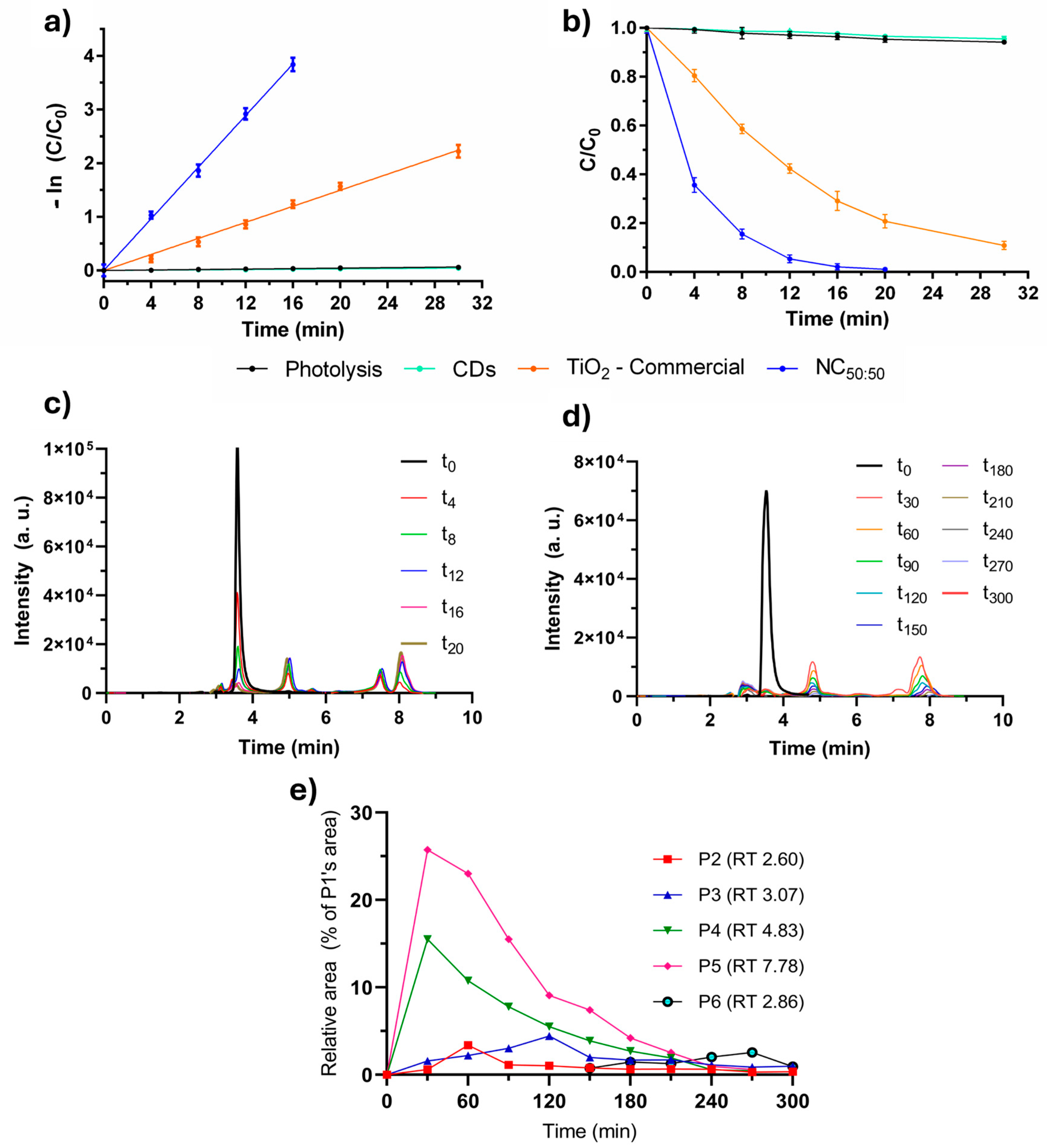
Figure 1. Representation of (a) −ln (Ct/C0) and (b) Ct/C0 versus time of irradiation for NC50:50, commercial TiO2, CDs and photolysis regarding the sunlight-driven photodegradation of CIP. (c,d) represent the evolution of the chromatograms depicting CIP’s photodegradation by NC50:50 over time for total irradiation periods of 20 and 300 min, respectively. (e) represents the area evolution of the additional peaks appearing during the photodegradation process (P2–P6) when compared to the area of the initial CIP peak (P1). Error bars for (a,b) represent uncertainty as calculated via the propagation of the standard error.
Catalysts 16 00142 g001
Figure 2. (a) N2 adsorption–desorption isotherms and (b) pore volume distribution calculated by the BJH (Barrett–Joyner–Halenda) pore size distribution method for TiO2 and NC50:50. Measured values for surface area, pore volume, and pore size can be found in Table 2.
Catalysts 16 00142 g002
Figure 3. Solar light-driven (a) NC50:50 and (b) TiO2-mediated photodegradation of CIP in the absence or presence of scavengers for reactive species. Results are presented in the form of %DRV. Negative %DRV values indicate an inhibition of the photocatalytic efficiency. Error bars represent uncertainty as calculated via the propagation of the standard error.
Catalysts 16 00142 g003
Figure 4. NC50:50 recycling studies regarding the photodegradation of CIP. Error bars represent uncertainty as calculated via the propagation of the standard error.
Catalysts 16 00142 g004
Figure 5. Graphic depiction of the (a) −ln (C/C0) and (b) C/C0 values for the sunlight-driven photodegradation of CIP by NC50:50. (ce) represent the evolution of the chromatograms with increasing sunlight irradiation times during the 1st, 2nd and 3rd day of assays under natural sunlight.
Catalysts 16 00142 g005
Figure 6. Proposed mechanism for the sunlight-driven degradation of CIP, when catalyzed by NC50:50. ET: electron transfer.
Catalysts 16 00142 g006
Table 1. k and %DR data regarding the optimization of the CIP concentration, pH level and catalyst dosage of the photodegradation of CIP with NC50:50. The corresponding plots are found in Figure S1.
TestParameter Valuek (min−1)%DRTime (min)
CIP concentration10 ppm0.082396.440
20 ppm0.053796.260
30 ppm0.020069.760
pH level50.025678.560
70.082899.160
90.076598.860
Catalyst dosage10 mg0.021873.460
20 mg0.076399.160
40 mg0.111498.040
60 mg0.237298.216
Table 2. Surface area, pore volume and pore size for TiO2 and NC50:50.
SampleSBET (m2 g−1)Vtotal (cm3 g−1)Dp (nm)
TiO2105.20.27613.1
NC50:50269.90.2124.1
Table 4. Prevailing atmospheric conditions and %DR obtained concerning the photocatalytic degradation of CIP by NC50:50 under direct sunlight. Meteorological data obtained from Instituto Português do Mar e da Atmosfera (IPMA).
DayTime PeriodTemperature RangeUV IndexConditions%DRTime to ~100%DR
23 August 202411.00 to 15.0030–32 °C8Sunny~100%30 min
24 August 202411.00 to 15.0026–29 °C8Clouded~100%30 min
25 August 202411.00 to 15.0023–26 °C 9Clouded~100%15 min
Disclaimer/Publisher’s Note: The statements, opinions and data contained in all publications are solely those of the individual author(s) and contributor(s) and not of MDPI and/or the editor(s). MDPI and/or the editor(s) disclaim responsibility for any injury to people or property resulting from any ideas, methods, instructions or products referred to in the content.