
Iron (Oxyhydr) Oxides in Heterogeneous Fenton Processes: Structure-Activity Relationships in Hydrogen Peroxide Decomposition Pathways

Abstract
1. Introduction
2. Physicochemical Properties of Iron (Oxyhydr)oxides
2.1. General Characteristics of Iron (Oxyhydr)oxides
2.1.1. Magnetite
2.1.2. Maghemite
2.1.3. Hematite
2.1.4. Goethite
2.1.5. Lepidocrocite
2.1.6. Ferrihydrite
2.2. Comparison of Physicochemical Properties
2.2.1. Crystal Packing and Pore Geometry

2.2.2. Conductivity and Electronic Structure
2.2.3. Surface Hydroxyl Density and Acidity
3. H2O2 Decomposition Mechanisms on Iron (Oxyhydr)Oxide Surfaces
3.1. Fundamental Steps of Interfacial Reactions
3.2. Reactive Species Formed from H2O2 Decomposition
3.2.1. Hydroxyl Radical and Spatial Confinement
3.2.2. High-Valent Fe(IV)-Oxo Species
3.2.3. Selective Singlet Oxygen
3.3. Regulation Mechanism of Phase Structure on Reaction Pathways
3.3.1. Geometric Configuration and Atomic Coordination
3.3.2. Electronic Structure and Charge Transport Mechanisms
3.3.3. Interfacial Micro-Environment and Ligand Interaction
3.4. Mechanistic Implications for Catalytic Performance and Stability
4. Strategies to Enhance the Performance of Iron (Oxyhydr)oxide/H2O2 Systems
4.1. Precision Synthesis and Morphology Engineering
4.2. Defect Engineering and Heteroatom Doping
4.3. Interface Construction and Composite Systems
5. Conclusions and Perspectives
Author Contributions
Funding
Data Availability Statement
Conflicts of Interest
Abbreviations
| 2,4-DCP | 2,4-Dichlorophenol |
| 3DOM | Three-Dimensionally Ordered Macroporous |
| 4-HBA | 4-Hydroxybenzoic Acid |
| AAO | Anodic Aluminum Oxide |
| AOPs | Advanced Oxidation Processes |
| ATZ | Atrazine |
| BA | Benzoic Acid |
| BET | Brunauer–Emmett–Teller |
| BSA | 5-Bromosalicylic Acid |
| BuCl | Butyl Chloride |
| CA | Carbonized Aerogel |
| CNTs | Carbon Nanotubes |
| DEP | Diethyl Phthalate |
| DFT | Density Functional Theory |
| DMSO | Dimethyl Sulfoxide |
| ESR | Electron Spin Resonance |
| ET | Electron Transfer |
| Fe(IV) | Iron(IV)-oxo Species |
| FFA | Furfuryl Alcohol |
| H2O2 | Hydrogen Peroxide |
| HCA | Hexachloroethane |
| HO• | Hydroxyl Radical |
| IEP | Isoelectric Point |
| MB | Methylene Blue |
| MNPs | Magnetic Nanoparticles |
| MOF | Metal–Organic Framework |
| NaN3 | Sodium Azide |
| NB | Nitrobenzene |
| NOM | Natural Organic Matter |
| OVs | Oxygen Vacancies |
| PAA | Phenylacetic Acid |
| PANI | Polyaniline |
| pCBA | para-Chlorobenzoic Acid |
| PMSO | Methyl Phenyl Sulfoxide |
| PZC | Point of Zero Charge |
| 1O2 | Singlet Oxygen |
| rGO | Reduced Graphene Oxide |
| ROS | Reactive Oxygen Species |
| XAS | X-ray Absorption Spectroscopy |
References
- Mantzavinos, D.; Petala, A.; Arvaniti, O.S. Advanced Catalytic Processes for Wastewater Treatment. Catalysts 2025, 15, 855. [Google Scholar] [CrossRef]
- Xu, Y.; Wang, Q.; Yoza, B.A.; Li, Q.X.; Kou, Y.; Tang, Y.; Ye, H.; Li, Y.; Chen, C. Catalytic ozonation of recalcitrant organic chemicals in water using vanadium oxides loaded ZSM-5 zeolites. Front. Chem. 2019, 7, 384. [Google Scholar] [CrossRef] [PubMed]
- Dong, C.; Fang, W.; Yi, Q.; Zhang, J. A comprehensive review on reactive oxygen species (ROS) in advanced oxidation processes (AOPs). Chemosphere 2022, 308, 136205. [Google Scholar] [CrossRef] [PubMed]
- Hübner, U.; Spahr, S.; Lutze, H.; Wieland, A.; Rüting, S.; Gernjak, W.; Wenk, J. Advanced oxidation processes for water and wastewater treatment–Guidance for systematic future research. Heliyon 2024, 10, e30402. [Google Scholar] [CrossRef]
- Feijoo, S.; Yu, X.; Kamali, M.; Appels, L.; Dewil, R. Generation of oxidative radicals by advanced oxidation processes (AOPs) in wastewater treatment: A mechanistic, environmental and economic review. Rev. Environ. Sci. Bio/Technol. 2023, 22, 205–248. [Google Scholar] [CrossRef]
- Zhang, M.H.; Dong, H.; Zhao, L.; Wang, D.X.; Meng, D. A review on Fenton process for organic wastewater treatment based on optimization perspective. Sci. Total Environ. 2019, 670, 110–121. [Google Scholar] [CrossRef]
- Lin, Y.M.; Qiao, J.L.; Sun, Y.K.; Dong, H.Y. The profound review of Fenton process: What’s the next step? J. Environ. Sci. 2025, 147, 114–130. [Google Scholar] [CrossRef]
- Ahmed, N.; Vione, D.; Rivoira, L.; Carena, L.; Castiglioni, M.; Bruzzoniti, M.C. A Review on the Degradation of Pollutants by Fenton-Like Systems Based on Zero-Valent Iron and Persulfate: Effects of Reduction Potentials, pH, and Anions Occurring in Waste Waters. Molecules 2021, 26, 4584. [Google Scholar] [CrossRef]
- Nidheesh, P.V. Heterogeneous Fenton catalysts for the abatement of organic pollutants from aqueous solution: A review. RSC Adv. 2015, 5, 40552–40577. [Google Scholar] [CrossRef]
- Thomas, N.; Dionysiou, D.D.; Pillai, S.C. Heterogeneous Fenton catalysts: A review of recent advances. J. Hazard. Mater. 2021, 404, 124082. [Google Scholar] [CrossRef]
- Chen, Y.; Huang, N.; Li, Y.; Lu, Y.; Jiang, Y.; Zhou, Z.; Wang, D. Physical and chemical processes driven by natural iron minerals in aquatic environments. Water Cycle 2025, 6, 36–48. [Google Scholar] [CrossRef]
- Jiménez-Vázquez, A.; Jaimes-López, R.; Morales-Bautista, C.M.; Pérez-Rodríguez, S.; Gochi-Ponce, Y.; Estudillo-Wong, L.A. Catalytic Applications of Natural Iron Oxides and Hydroxides: A Review. Catalysts 2025, 15, 236. [Google Scholar] [CrossRef]
- Faivre, D. Iron Oxides: From Nature to Applications; John Wiley & Sons: Hoboken, NJ, USA, 2016. [Google Scholar]
- Huang, J.; Jones, A.; Waite, T.D.; Chen, Y.; Huang, X.; Rosso, K.M.; Kappler, A.; Mansor, M.; Tratnyek, P.G.; Zhang, H. Fe (II) redox chemistry in the environment. Chem. Rev. 2021, 121, 8161–8233. [Google Scholar] [CrossRef] [PubMed]
- He, J.; Yang, X.F.; Men, B.; Wang, D.S. Interfacial mechanisms of heterogeneous Fenton reactions catalyzed by iron-based materials: A review. J. Environ. Sci. 2016, 39, 97–109. [Google Scholar] [CrossRef] [PubMed]
- Petigara, B.R.; Blough, N.V.; Mignerey, A.C. Mechanisms of hydrogen peroxide decomposition in soils. Environ. Sci. Technol. 2002, 36, 639–645. [Google Scholar] [CrossRef] [PubMed]
- Li, F.; Li, J.; Gao, L.; Hu, Y.; Long, X.; Wei, S.; Wang, C.; Jin, J.; Ma, J. Construction of an efficient hole migration pathway on hematite for efficient photoelectrochemical water oxidation. J. Mater. Chem. A 2018, 6, 23478–23485. [Google Scholar] [CrossRef]
- Fleet, M.E. The structure of magnetite. Struct. Sci. 1981, 37, 917–920. [Google Scholar] [CrossRef]
- Cornell, R.M.; Schwertmann, U. The Iron Oxides: Structure, Properties, Reactions, Occurrences and Uses; John Wiley & Sons: Hoboken, NJ, USA, 2003. [Google Scholar]
- Gualtieri, A.F.; Giacobbe, C.; Viti, C. The natural occurrence of asbestos-like magnetite fibers. J. Hazard. Mater. 2019, 373, 560–569. [Google Scholar]
- Usman, M.; Byrne, J.M.; Chaudhary, A.; Orsetti, S.; Hanna, K.; Ruby, C.; Kappler, A.; Haderlein, S.B. Magnetite and Green Rust: Synthesis, Properties, and Environmental Applications of Mixed-Valent Iron Minerals. Chem. Rev. 2018, 118, 3251–3304. [Google Scholar] [CrossRef]
- Wang, J.; Guo, H.; Wei, S.; Li, G. Heterogeneous Fenton degradation of bisphenol A catalyzed by efficient magnetic Fe3O4/GO nanocomposites. Chem. Eng. J. 2018, 334, 1886–1896. [Google Scholar]
- Sepyani, F.; Soltani-Felehgari, F.; Maleki, A. Immobilization of magnetite nanoparticles on a metal-organic framework for the degradation of organic pollutants. J. Clean. Prod. 2018, 203, 1073–1083. [Google Scholar]
- Skomurski, F.N.; Kerisit, S.; Rosso, K.M. Structure, charge distribution, and electron hopping dynamics in magnetite (Fe3O4)(1 0 0) surfaces from first principles. Geochim. Cosmochim. Acta 2010, 74, 4234–4248. [Google Scholar] [CrossRef]
- Gorski, C.A.; Handler, R.M.; Beard, B.L.; Pasakarnis, T.; Johnson, C.M.; Scherer, M.M. Fe atom exchange between aqueous Fe2+ and magnetite. Environ. Sci. Technol. 2012, 46, 12399–12407. [Google Scholar] [CrossRef] [PubMed]
- Gawande, M.B.; Branco, P.S.; Varma, R.S. Nano-magnetite (Fe3O4) as a support for recyclable catalysts in the development of sustainable methodologies. Chem. Soc. Rev. 2013, 42, 3371–3393. [Google Scholar] [CrossRef] [PubMed]
- Liu, M.Y.; Ye, Y.Y.; Ye, J.M.; Gao, T.; Wang, D.H.; Chen, G.; Song, Z.J. Recent Advances of Magnetite (Fe3O4)-Based Magnetic Materials in Catalytic Applications. Magnetochemistry 2023, 9, 110. [Google Scholar] [CrossRef]
- Lu, A.H.; Salabas, E.e.L.; Schüth, F. Magnetic nanoparticles: Synthesis, protection, functionalization, and application. Angew. Chem. Int. Ed. 2007, 46, 1222–1244. [Google Scholar] [CrossRef]
- Eskandari, M.J.; Hasanzadeh, I. Size-controlled synthesis of Fe3O4 magnetic nanoparticles via an alternating magnetic field and ultrasonic-assisted chemical co-precipitation. Mater. Sci. Eng. B 2021, 266, 115050. [Google Scholar] [CrossRef]
- Hu, Y.; Li, F.; Yuan, S.; Wang, Y.; Ai, Z. Facet-dependent Fenton-like catalysis of magnetite nanoprisms. Appl. Catal. B Environ. 2021, 286, 119856. [Google Scholar]
- Parkinson, G.S. Iron oxide surfaces. Surf. Sci. Rep. 2016, 71, 272–365. [Google Scholar] [CrossRef]
- Tombácz, E. pH-dependent surface charging of metal oxides. Period. Polytech. Chem. Eng. 2009, 53, 77–86. [Google Scholar] [CrossRef]
- Mansour, C.; Lefèvre, G.; Pavageau, E.; Catalette, H.; Fédoroff, M.; Zanna, S. Sorption of sulfate ions onto magnetite. J. Colloid Interface Sci. 2009, 331, 77–82. [Google Scholar] [CrossRef]
- Gao, L.; Zhuang, J.; Nie, L.; Zhang, J.; Zhang, Y.; Gu, N.; Wang, T.; Feng, J.; Yang, D.; Perrett, S. Intrinsic peroxidase-like activity of ferromagnetic nanoparticles. Nat. Nanotechnol. 2007, 2, 577–583. [Google Scholar] [CrossRef] [PubMed]
- Shmakov, A.; Kryukova, G.; Tsybulya, S.; Chuvilin, A.; Solovyeva, L. Vacancy ordering in γ-Fe2O3: Synchrotron X-ray powder diffraction and high-resolution electron microscopy studies. Appl. Crystallogr. 1995, 28, 141–145. [Google Scholar] [CrossRef]
- Bentarcurt, Y.; Calatayud, M.; Fernández-Sanz, J.; Klapp, J.; Ruette, F. Theoretical Study of Hydrogen Activation and Reduction of an Oxidized Maghemite Surface, γ-Fe2O3,(001) by Monovacancy Formation: An Analysis Using Density Functional Theory (DFT). Surf. Sci. 2025, 765, 122877. [Google Scholar] [CrossRef]
- Laurent, S.; Forge, D.; Port, M.; Roch, A.; Robic, C.; Vander Elst, L.; Muller, R.N. Magnetic iron oxide nanoparticles: Synthesis, stabilization, vectorization, physicochemical characterizations, and biological applications. Chem. Rev. 2008, 108, 2064–2110. [Google Scholar] [CrossRef]
- Teja, A.S.; Koh, P.-Y. Synthesis, properties, and applications of magnetic iron oxide nanoparticles. Prog. Cryst. Growth Charact. Mater. 2009, 55, 22–45. [Google Scholar] [CrossRef]
- Heiba, Z.K.; Ahmed, S.I.; Mohamed, M.B. Effects of composition ratio of nano ZnS on structural and optical characteristics of Eu-doped maghemite/ZnS nanocomposite system. Appl. Phys. A 2022, 128, 633. [Google Scholar] [CrossRef]
- Sherman, D.M. The electronic structures of Fe3+ coordination sites in iron oxides: Applications to spectra, bonding, and magnetism. Phys. Chem. Miner. 1985, 12, 161–175. [Google Scholar] [CrossRef]
- Shokrollahi, H. A review of the magnetic properties, synthesis methods and applications of maghemite. J. Magn. Magn. Mater. 2017, 426, 74–81. [Google Scholar] [CrossRef]
- Kosmulski, M. Compilation of PZC and IEP of sparingly soluble metal oxides and hydroxides from literature. Adv. Colloid Interface Sci. 2009, 152, 14–25. [Google Scholar] [CrossRef]
- Jarlbring, M.; Gunneriusson, L.; Hussmann, B.; Forsling, W. Surface complex characteristics of synthetic maghemite and hematite in aqueous suspensions. J. Colloid Interface Sci. 2005, 285, 212–217. [Google Scholar] [CrossRef]
- Das, S.; Hendry, M.J.; Essilfie-Dughan, J. Transformation of Two-Line Ferrihydrite to Goethite and Hematite as a Function of pH and Temperature. Environ. Sci. Technol. 2011, 45, 268–275. [Google Scholar] [CrossRef] [PubMed]
- Hansel, C.M.; Benner, S.G.; Nico, P.; Fendorf, S. Structural constraints of ferric (hydr)oxides on dissimilatory iron reduction and the fate of Fe(II). Geochim. Cosmochim. Acta 2004, 68, 3217–3229. [Google Scholar] [CrossRef]
- Sakurai, S.; Namai, A.; Hashimoto, K.; Ohkoshi, S.-I. First observation of phase transformation of all four Fe2O3 phases (γ→ ε→ β→ α-phase). J. Am. Chem. Soc. 2009, 131, 18299–18303. [Google Scholar] [CrossRef] [PubMed]
- Blake, R.; Hessevick, R.; Zoltai, T.; Finger, L.W. Refinement of the hematite structure. Am. Mineral. J. Earth Planet. Mater. 1966, 51, 123–129. [Google Scholar]
- Schöttner, L.; Ovcharenko, R.; Nefedov, A.; Voloshina, E.; Wang, Y.; Sauer, J.; Wöll, C. Interaction of Water Molecules with the α-Fe2O3(0001) Surface: A Combined Experimental and Computational Study. J. Phys. Chem. C 2019, 123, 8324–8335. [Google Scholar] [CrossRef]
- Souvi, S.M.O.; Badawi, M.; Paul, J.-F.; Cristol, S.; Cantrel, L. A DFT study of the hematite surface state in the presence of H2, H2O and O2. Surf. Sci. 2013, 610, 7–15. [Google Scholar] [CrossRef]
- Zhang, H.; Xu, Z.; Chen, D.; Hu, B.; Zhou, Q.; Chen, S.; Li, S.; Sun, W.; Zhang, C. Adsorption mechanism of water molecules on hematite (104) surface and the hydration microstructure. Appl. Surf. Sci. 2021, 550, 149328. [Google Scholar] [CrossRef]
- Liu, J.; Zhu, R.; Ma, L.; Fu, H.; Lin, X.; Parker, S.C.; Molinari, M. Adsorption of phosphate and cadmium on iron (oxyhydr) oxides: A comparative study on ferrihydrite, goethite, and hematite. Geoderma 2021, 383, 114799. [Google Scholar] [CrossRef]
- Cromières, L.; Moulin, V.; Fourest, B.; Giffaut, E. Physico-chemical characterization of the colloidal hematite/water interface: Experimentation and modelling. Colloids Surf. A Physicochem. Eng. Asp. 2002, 202, 101–115. [Google Scholar] [CrossRef]
- Huang, Z.; Han, F.; Li, M.; Zhou, Z.; Guan, X.; Guo, L. Which phase of iron oxyhydroxides (FeOOH) is more competent in overall water splitting as a photocatalyst, goethite, akaganeite or lepidocrocite? A DFT-based investigation. Comput. Mater. Sci. 2019, 169, 109110. [Google Scholar] [CrossRef]
- Zhao, J.-W.; Wang, H.-Y.; Feng, L.; Zhu, J.-Z.; Liu, J.-X.; Li, W.-X. Crystal-Phase Engineering in Heterogeneous Catalysis. Chem. Rev. 2024, 124, 164–209. [Google Scholar] [CrossRef] [PubMed]
- Chakraborty, M.; Ghosh, A.; Thangavel, R.; Asokan, K. Conduction mechanism in mesoporous hematite thin films using low temperature electrical measurements and theoretical electronic band structure calculations. J. Alloys Compd. 2016, 664, 682–689. [Google Scholar] [CrossRef]
- Liao, P.; Carter, E.A. Hole transport in pure and doped hematite. J. Appl. Phys. 2012, 112, 013701. [Google Scholar] [CrossRef]
- Navrotsky, A.; Mazeina, L.; Majzlan, J. Size-driven structural and thermodynamic complexity in iron oxides. Science 2008, 319, 1635–1638. [Google Scholar] [CrossRef]
- Namayandeh, A.; Borkiewicz, O.J.; Bompoti, N.M.; Chrysochoou, M.; Michel, F.M. Oxyanion surface complexes control the kinetics and pathway of ferrihydrite transformation to goethite and hematite. Environ. Sci. Technol. 2022, 56, 15672–15684. [Google Scholar] [CrossRef]
- Barrón, V.; Torrent, J. Surface hydroxyl configuration of various crystal faces of hematite and goethite. J. Colloid Interface Sci. 1996, 177, 407–410. [Google Scholar] [CrossRef]
- Hiemstra, T.; Van Riemsdijk, W.H. A surface structural approach to ion adsorption: The charge distribution (CD) model. J. Colloid Interface Sci. 1996, 179, 488–508. [Google Scholar] [CrossRef]
- Wang, F.; Xu, J.; Xu, Y.; Chen, H.; Liang, Y.; Xiong, J. Face-dependent phosphate speciation on goethite: CD-MUSIC modeling and ATR-FTIR/2D-COS study. Sci. Total Environ. 2024, 915, 169970. [Google Scholar] [CrossRef]
- Boily, J.-F. Water structure and hydrogen bonding at goethite/water interfaces: Implications for proton affinities. J. Phys. Chem. C 2012, 116, 4714–4724. [Google Scholar] [CrossRef]
- Sherman, D.M. Electronic structures of iron (III) and manganese (IV)(hydr) oxide minerals: Thermodynamics of photochemical reductive dissolution in aquatic environments. Geochim. Cosmochim. Acta 2005, 69, 3249–3255. [Google Scholar] [CrossRef]
- Shao, Y.; Hu, G.; Liu, Z.; Xu, X.; Zhang, M.; Ding, C.; Li, Y. Determination of band structure of naturally occurring goethite with Al substitution: A case study of Zhushan iron zone. Materials 2022, 15, 1465. [Google Scholar] [CrossRef] [PubMed]
- Xu, P.; Zeng, G.M.; Huang, D.L.; Feng, C.L.; Hu, S.; Zhao, M.H.; Lai, C.; Wei, Z.; Huang, C.; Xie, G.X. Use of iron oxide nanomaterials in wastewater treatment: A review. Sci. Total Environ. 2012, 424, 1–10. [Google Scholar] [CrossRef] [PubMed]
- Zhukhlistov, A. Crystal structure of lepidocrocite FeO (OH) from the electron-diffractometry data. Crystallogr. Rep. 2001, 46, 730–733. [Google Scholar] [CrossRef]
- Guo, H.; Barnard, A.S. Proton transfer in the hydrogen-bonded chains of lepidocrocite: A computational study. Phys. Chem. Chem. Phys. 2011, 13, 17864–17869. [Google Scholar] [CrossRef]
- Schwertmann, U.; Taylor, R. Natural and synthetic poorly crystallized lepidocrocite. Clay Miner. 1979, 14, 285–293. [Google Scholar] [CrossRef]
- Majzlan, J.; Grevel, K.-D.; Navrotsky, A. Thermodynamics of Fe oxides: Part II. Enthalpies of formation and relative stability of goethite (α-FeOOH), lepidocrocite (γ-FeOOH), and maghemite (γ-Fe2O3). Am. Mineral. 2003, 88, 855–859. [Google Scholar] [CrossRef]
- Schwertmann, U.; Taylor, R. The transformation of lepidocrocite to goethite. Clays Clay Miner. 1972, 20, 151–158. [Google Scholar] [CrossRef]
- Hansel, C.M.; Benner, S.G.; Neiss, J.; Dohnalkova, A.; Kukkadapu, R.K.; Fendorf, S. Secondary mineralization pathways induced by dissimilatory iron reduction of ferrihydrite under advective flow. Geochim. Cosmochim. Acta 2003, 67, 2977–2992. [Google Scholar] [CrossRef]
- Appelo, C.; Van der Weiden, M.; Tournassat, C.; Charlet, L. Surface complexation of ferrous iron and carbonate on ferrihydrite and the mobilization of arsenic. Environ. Sci. Technol. 2002, 36, 3096–3103. [Google Scholar] [CrossRef]
- Kosmulski, M. The pH dependent surface charging and points of zero charge. VI. Update. J. Colloid Interface Sci. 2014, 426, 209–212. [Google Scholar] [CrossRef] [PubMed]
- Stramel, R.; Thomas, J. Photochemistry of iron oxide colloids. J. Colloid Interface Sci. 1986, 110, 121–129. [Google Scholar] [CrossRef]
- Michel, F.M.; Ehm, L.; Antao, S.M.; Lee, P.L.; Chupas, P.J.; Liu, G.; Strongin, D.R.; Schoonen, M.A.A.; Phillips, B.L.; Parise, J.B. The Structure of Ferrihydrite, a Nanocrystalline Material. Science 2007, 316, 1726–1729. [Google Scholar] [CrossRef] [PubMed]
- Maillot, F.; Morin, G.; Juillot, F.; Bruneel, O.; Moulin, C.C.; Briois, V.; Calas, G.; Benedetti, M.F. New Insight into the Structure of Nanocrystalline Ferrihydrite: EXAFS Evidence for Tetrahedrally Coordinated Iron(III). Geochim. Cosmochim. Acta 2011, 75, 2708–2720. [Google Scholar] [CrossRef]
- Sassi, M.; Chaka, A.M.; Rosso, K.M. Ab Initio Thermodynamics Reveals the Nanocomposite Structure of Ferrihydrite. Commun. Chem. 2021, 4, 134. [Google Scholar] [CrossRef]
- Funnell, N.P.; Fulford, M.F.; Inoué, S.; Kletetschka, K.; Michel, F.M.; Goodwin, A.L. Nanocomposite Structure of Two-Line Ferrihydrite Powder from Total Scattering. Commun. Chem. 2020, 3, 22. [Google Scholar] [CrossRef]
- Mendez, J.C.; Hiemstra, T. Surface Area of Ferrihydrite Consistently Related to Primary Surface Charge, Ion Pair Formation, and Specific Ion Adsorption. Chem. Geol. 2020, 532, 119304. [Google Scholar] [CrossRef]
- Hiemstra, T.; Van Riemsdijk, W.H. A Surface Structural Model for Ferrihydrite I: Sites Related to Primary Charge, Molar Mass, and Mass Density. Geochim. Cosmochim. Acta 2009, 73, 4423–4436. [Google Scholar] [CrossRef]
- Wang, P.; Li, D.; Chi, H.; Zhao, Y.; Wang, J.; Li, D.; Pang, S.; Fu, P.; Shi, J.; Li, C. Unveiling the Hydration Structure of Ferrihydrite for Hole Storage in Photoelectrochemical Water Oxidation. Angew. Chem. Int. Ed. 2021, 60, 6691–6698. [Google Scholar] [CrossRef]
- Liu, J.; Sheng, A.; Li, X.; Arai, Y.; Ding, Y.; Nie, M.; Yan, M.; Rosso, K.M. Understanding the Importance of Labile Fe(III) during Fe(II)-Catalyzed Transformation of Metastable Iron Oxyhydroxides. Environ. Sci. Technol. 2022, 56, 3801–3811. [Google Scholar] [CrossRef]
- Engel, M.; Noël, V.; Pierce, S.; Kovarik, L.; Kukkadapu, R.K.; Pacheco, J.S.L.; Qafoku, O.; Runyon, J.R.; Chorover, J.; Zhou, W.; et al. Structure and Composition of Natural Ferrihydrite Nano-Colloids in Anoxic Groundwater. Water Res. 2023, 238, 119990. [Google Scholar] [CrossRef] [PubMed]
- Hu, J.; Li, S.; Chu, J.; Niu, S.; Wang, J.; Du, Y.; Li, Z.; Han, X.; Xu, P. Understanding the Phase-Induced Electrocatalytic Oxygen Evolution Reaction Activity on FeOOH Nanostructures. ACS Catal. 2019, 9, 10705–10711. [Google Scholar] [CrossRef]
- Dai, Y.; Bostick, B.C.; Du, H.; Gu, X.; Huang, G.; Liu, S.; Song, L.; Liu, Y.; Ning, Z.; Sun, J.; et al. The Overlooked Role of Mineral Pore Geometry in the Solid-Solution Partitioning of (Poly)Oxyanionic Metals. Geochim. Cosmochim. Acta 2025, 394, 393–404. [Google Scholar] [CrossRef]
- Lai, L.; He, Y.; Zhou, H.; Huang, B.; Yao, G.; Lai, B. Critical review of natural iron-based minerals used as heterogeneous catalysts in peroxide activation processes: Characteristics, applications and mechanisms. J. Hazard. Mater. 2021, 416, 125809. [Google Scholar] [CrossRef]
- Vafaei Molamahmood, H.; Geng, W.; Wei, Y.; Miao, J.; Yu, S.; Shahi, A.; Chen, C.; Long, M. Catalyzed H2O2 Decomposition over Iron Oxides and Oxyhydroxides: Insights from Oxygen Production and Organic Degradation. Chemosphere 2022, 291, 133037. [Google Scholar] [CrossRef]
- Huang, W.; Yuan, Y.; Zhong, D.; Zhang, P.; Liangdy, A.; Lim, T.-T.; Ma, W.; Yuan, Y. Catalytic activity of H2O2 by goethite and lepidocrocite: Insight from 5-bromosalicylic acid removal mechanism and density functional theory calculation. Chemosphere 2023, 329, 138551. [Google Scholar] [CrossRef]
- Xu, H.; Wang, M.; Hei, S.; Qi, X.; Zhang, X.; Liang, P.; Fu, W.; Pan, B.; Huang, X. Neglected Role of Iron Redox Cycle in Direct Interspecies Electron Transfer in Anaerobic Methanogenesis: Inspired from Biogeochemical Processes. Water Res. 2024, 262, 122125. [Google Scholar] [CrossRef]
- Qin, M.; Lu, B.; Feng, S.; Zhen, Z.; Chen, R.; Liu, H. Role of exposed facets and surface OH groups in the Fenton-like reactivity of lepidocrocite catalyst. Chemosphere 2019, 230, 286–293. [Google Scholar] [CrossRef]
- Liu, Y.; Hu, P.; Wang, H. Computationally revisiting pH- and ligand-dependence of Fenton reaction selectivity and activity in aqueous solution. Phys. Chem. Chem. Phys. 2025, 27, 12929–12937. [Google Scholar] [CrossRef]
- Kwan, W.P.; Voelker, B.M. Rates of hydroxyl radical generation and organic compound oxidation in mineral-catalyzed Fenton-like systems. Environ. Sci. Technol. 2003, 37, 1150–1158. [Google Scholar] [CrossRef]
- Lin, S.S.; Gurol, M.D. Catalytic decomposition of hydrogen peroxide on iron oxide: Kinetics, mechanism, and implications. Environ. Sci. Technol. 1998, 32, 1417–1423. [Google Scholar] [CrossRef]
- Wang, X.B.; Chen, N.; Liu, X.F.; Shi, Y.B.; Ling, C.C.; Zhang, L.Z. Ascorbate guided conversion of hydrogen peroxide to hydroxyl radical on goethite. Appl. Catal. B Environ. Energy 2021, 282, 119558. [Google Scholar] [CrossRef]
- Munoz, M.; Conde, J.; de Pedro, Z.M.; Casas, J.A. Antibiotics abatement in synthetic and real aqueous matrices by H2O2/natural magnetite. Catal. Today 2018, 313, 142–147. [Google Scholar] [CrossRef]
- Sun, F.W.; Liu, H.B.; Wang, H.L.; Shu, D.B.; Chen, T.H.; Zou, X.H.; Huang, F.J.; Chen, D. A novel discovery of a heterogeneous Fenton-like system based on natural siderite: A wide range of pH values from 3 to 9. Sci. Total Environ. 2020, 698, 134293. [Google Scholar] [CrossRef]
- Chen, Y.F.; Miller, C.J.; Waite, T.D. Heterogeneous Fenton Chemistry Revisited: Mechanistic Insights from Ferrihydrite-Mediated Oxidation of Formate and Oxalate. Environ. Sci. Technol. 2021, 55, 14414–14425. [Google Scholar] [CrossRef]
- Zhang, S.; Sun, M.; Hedtke, T.; Deshmukh, A.; Zhou, X.C.; Weon, S.; Elimelech, M.; Kim, J.H. Mechanism of Heterogeneous Fenton Reaction Kinetics Enhancement under Nanoscale Spatial Confinement. Environ. Sci. Technol. 2020, 54, 10868–10875. [Google Scholar] [CrossRef]
- Hug, S.J.; Leupin, O. Iron-catalyzed oxidation of arsenic(III) by oxygen and by hydrogen peroxide: pH-dependent formation of oxidants in the Fenton reaction. Environ. Sci. Technol. 2003, 37, 2734–2742. [Google Scholar] [CrossRef]
- Pestovsky, O.; Stoian, S.; Bominaar, E.L.; Shan, X.P.; Münck, E.; Que, L., Jr.; Bakac, A. Aqueous Fe=O: Spectroscopic identification and oxo-group exchange. Angew. Chem. Int. Ed. 2005, 44, 6871–6874. [Google Scholar] [CrossRef]
- Bataineh, H.; Pestovsky, O.; Bakac, A. pH-induced mechanistic changeover from hydroxyl radicals to iron(IV) in the Fenton reaction. Chem. Sci. 2012, 3, 1594–1599. [Google Scholar] [CrossRef]
- Chen, Y.F.; Miller, C.J.; Waite, T.D. pH Dependence of Hydroxyl Radical, Ferryl, and/or Ferric Peroxo Species Generation in the Heterogeneous Fenton Process. Environ. Sci. Technol. 2022, 56, 1278–1288. [Google Scholar] [CrossRef]
- Chen, Y.; Miller, C.J.; Xie, J.; Waite, T.D. Challenges Relating to the Quantification of Ferryl(IV) Ion and Hydroxyl Radical Generation Rates Using Methyl Phenyl Sulfoxide (PMSO), Phthalhydrazide, and Benzoic Acid as Probe Compounds in the Homogeneous Fenton Reaction. Environ. Sci. Technol. 2023, 57, 18617–18625. [Google Scholar] [CrossRef]
- Böhme, K.; Brauer, H. Generation of singlet oxygen from hydrogen peroxide disproportionation catalyzed by molybdate ions. Inorg. Chem. 1992, 31, 3468–3471. [Google Scholar] [CrossRef]
- Yang, Z.; Qian, J.; Yu, A.; Pan, B. Singlet oxygen mediated iron-based Fenton-like catalysis under nanoconfinement. Proc. Natl. Acad. Sci. USA 2019, 116, 6659–6664. [Google Scholar] [CrossRef] [PubMed]
- Moan, J.; Wold, E. Detection of singlet oxygen production by ESR. Nature 1979, 279, 450–451. [Google Scholar] [CrossRef] [PubMed]
- Song, B.; Wang, G.; Tan, M.; Yuan, J. A europium (III) complex as an efficient singlet oxygen luminescence probe. J. Am. Chem. Soc. 2006, 128, 13442–13450. [Google Scholar] [CrossRef] [PubMed]
- Miyamoto, S.; Martinez, G.R.; Medeiros, M.H.; Di Mascio, P. Singlet molecular oxygen generated from lipid hydroperoxides by the Russell mechanism: Studies using 18O-labeled linoleic acid hydroperoxide and monomol light emission measurements. J. Am. Chem. Soc. 2003, 125, 6172–6179. [Google Scholar] [CrossRef]
- Miyamoto, S.; Martinez, G.R.; Martins, A.P.B.; Medeiros, M.H.; Di Mascio, P. Direct evidence of singlet molecular oxygen [O2 (1Δg)] production in the reaction of linoleic acid hydroperoxide with peroxynitrite. J. Am. Chem. Soc. 2003, 125, 4510–4517. [Google Scholar] [CrossRef]
- Braun, A.M.; Dahn, H.; Gassmann, E.; Gerothanassis, I.; Jakob, L.; Kateva, J.; Martinez, C.G.; Oliveros, E. (2+4)-Cycloaddition with Singlet Oxygen. 17O-lnvestigation of the Reactivity of Furfuryl Alcohol Endoperoxide. Photochem. Photobiol. 1999, 70, 868–874. [Google Scholar] [CrossRef]
- Halladja, S.; Ter Halle, A.; Aguer, J.-P.; Boulkamh, A.; Richard, C. Inhibition of humic substances mediated photooxygenation of furfuryl alcohol by 2, 4, 6-trimethylphenol. Evidence for reactivity of the phenol with humic triplet excited states. Environ. Sci. Technol. 2007, 41, 6066–6073. [Google Scholar] [CrossRef]
- Scaria, J.; Nidheesh, P.V. The role of non-radical pathway in heterogeneous activation of persulfate and H2O2 by superparamagnetic magnetite-reduced graphene oxide nanocomposite. Sep. Purif. Technol. 2022, 299, 121764. [Google Scholar] [CrossRef]
- Nidheesh, P.V.; Boczkaj, G.; Ganiyu, S.O.; Oladipo, A.A.; Fedorov, K.; Xiao, R.Y.; Dionysiou, D.D. Generation, properties, and applications of singlet oxygen for wastewater treatment: A review. Environ. Chem. Lett. 2025, 23, 195–240. [Google Scholar] [CrossRef]
- Xu, L.J.; Wang, J.L. Fenton-like degradation of 2,4-dichlorophenol using Fe3O4 magnetic nanoparticles. Appl. Catal. B-Environ. 2012, 123, 117–126. [Google Scholar] [CrossRef]
- Shuai, W.J.; Gu, C.; Fang, G.D.; Zhou, D.M.; Gao, J. Effects of iron (hydr)oxides on the degradation of diethyl phthalate ester in heterogeneous (photo)-Fenton reactions. J. Environ. Sci. 2019, 80, 5–13. [Google Scholar] [CrossRef] [PubMed]
- Chen, L.; Yang, Z.C.; Qian, J.S.; Pan, B.C. Interaction between Organic Compounds and Catalyst Steers the Oxidation Pathway and Mechanism in the Iron Oxide-Based Heterogeneous Fenton System. Environ. Sci. Technol. 2022, 56, 14059–14068. [Google Scholar] [CrossRef] [PubMed]
- Zhang, R.; Chen, L.; Liang, Q.; Xi, J.; Zhao, H.; Jin, Y.; Gao, X.; Yan, X.; Gao, L.; Fan, K. Unveiling the Active Sites on Ferrihydrite with Apparent Catalase-like Activity for Potentiating Radiotherapy. Nano Today 2021, 41, 101317. [Google Scholar] [CrossRef]
- Wang, X.; Wang, J.Q.; Cui, Z.T.; Wang, S.G.; Cao, M.H. Facet effect of α-Fe2O3 crystals on photocatalytic performance in the photo-Fenton reaction. RSC Adv. 2014, 4, 34387–34394. [Google Scholar] [CrossRef]
- Huang, X.; Hou, X.; Zhao, J.; Zhang, L. Hematite facet confined ferrous ions as high efficient Fenton catalysts to degrade organic contaminants by lowering H2O2 decomposition energetic span. Appl. Catal. B Environ. 2016, 181, 127–137. [Google Scholar] [CrossRef]
- Huang, X.; Chen, Y.; Walter, E.; Zong, M.; Wang, Y.; Zhang, X.; Qafoku, O.; Wang, Z.; Rosso, K.M. Facet-Specific Photocatalytic Degradation of Organics by Heterogeneous Fenton Chemistry on Hematite Nanoparticles. Environ. Sci. Technol. 2019, 53, 10197–10207. [Google Scholar] [CrossRef]
- Choquehuanca, A.; Ruiz-Montoya, J.G.; Gómez, A.L.T. Discoloration of methylene blue at neutral pH by heterogeneous photo-Fenton-like reactions using crystalline and amorphous iron oxides. Open Chem. 2021, 19, 1009–1020. [Google Scholar] [CrossRef]
- Wang, J.Y.; Wu, B.B.; Zheng, X.S.; Ma, J.Y.; Yu, W.C.; Chen, B.L.; Chu, C.H. Insights into the Crystallinity-Dependent Photochemical Productions of Reactive Oxygen Species from Iron Minerals. Environ. Sci. Technol. 2024, 58, 10623–10631. [Google Scholar] [CrossRef]
- Zhong, Y.H.; Yu, L.; Chen, Z.F.; He, H.P.; Ye, F.; Cheng, G.; Zhang, Q.X. Microwave-Assisted Synthesis of Fe3O4 Nanocrystals with Predominantly Exposed Facets and Their Heterogeneous UVA/Fenton Catalytic Activity. Acs Appl. Mater. Interfaces 2017, 9, 29203–29212. [Google Scholar] [CrossRef] [PubMed]
- Wu, Y.B.; Dai, C.; Nie, Y.L.; Tian, X.K.; Yang, C. Effect of morphology especially leaf-like morphology on surface Fe content of a-Fe2O3 in photo-assisted fenton-like degradation of organic contaminants. Colloids Surf. A-Physicochem. Eng. Asp. 2023, 663, 131116. [Google Scholar] [CrossRef]
- Aeppli, M.; Voegelin, A.; Gorski, C.A.; Hofstetter, T.B.; Sander, M. Mediated Electrochemical Reduction of Iron (Oxyhydr-)Oxides under Defined Thermodynamic Boundary Conditions. Environ. Sci. Technol. 2018, 52, 560–570. [Google Scholar] [CrossRef] [PubMed]
- Yu, C.L.; Ji, W.W.; Li, X.Y.; Yuan, S.H.; Zhang, P.; Pu, S.Y. Critical Role of Mineral Fe(IV) Formation in Low Hydroxyl Radical Yields during Fe(II)-Bearing Clay Mineral Oxygenation. Environ. Sci. Technol. 2024, 58, 9669–9678. [Google Scholar] [CrossRef]
- Chen, P.; Song, D.; Liu, T.Y.; Chen, Y.; Zhou, Y.D.; Prange, M.P.; Chen, T.H.; Wang, D.Z.; Zhao, Y.T.; Wang, X.; et al. Facet-dependent Heterogeneous Fenton Reaction Mechanisms on Hematite Nanoparticles for (Photo)catalytic Degradation of Organic Dyes. Adv. Sci. 2025, 12, e08058. [Google Scholar] [CrossRef]
- Al-Ahmari, F.; Al-Zahrani, A.; Al-Ghamdi, A. Comparative Study on the Adsorption Capacity of Goethite and Hematite towards Organic Contaminants: The Role of Surface Hydroxyl Density. J. Environ. Chem. Eng. 2021, 9, 105432. [Google Scholar]
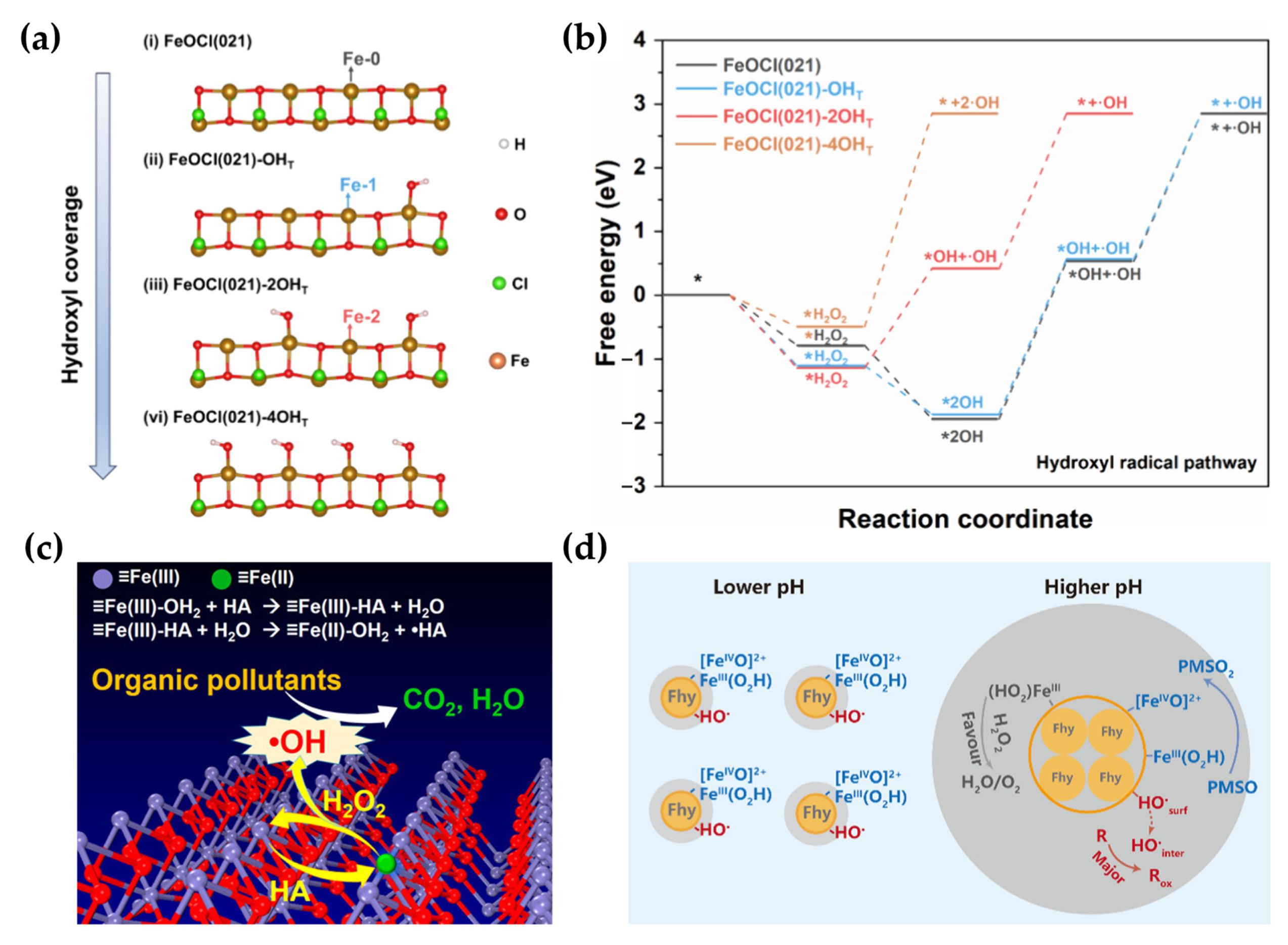
- Chen, S.X.; Liang, J.X.; Li, J.D.; Bao, C.Y.; Chen, Y.S.; Yue, D.T.; Fan, M.H.; Li, K.; Jia, J.P. Regulation of Surface Terminal Hydroxyl Coverage of FeOCl Catalyst via Crystal Facet Protection for Enhanced H2O2 Activation. Environ. Sci. Technol. 2025, 59, 10620–10630. [Google Scholar] [CrossRef]
- Hou, X.; Huang, X.; Jia, F.; Ai, Z.; Zhao, J.; Zhang, L. Hydroxylamine Promoted Goethite Surface Fenton Degradation of Organic Pollutants. Environ. Sci. Technol. 2017, 51, 5118–5126. [Google Scholar] [CrossRef]
- Huang, Q.Q.; Liu, H.Z.; Huang, M.J.; Wang, J.; Yu, H.Q. Ligand-assisted heterogeneous catalytic H2O2 activation for pollutant degradation: The trade-off between coordination site passivation and adjacent site activation. Appl. Catal. B Environ. Energy 2024, 342, 123403. [Google Scholar] [CrossRef]
- Boland, D.D.; Collins, R.N.; Miller, C.J.; Glover, C.J.; Waite, T.D. Effect of Solution and Solid-Phase Conditions on the Fe(II)-Accelerated Transformation of Ferrihydrite to Lepidocrocite and Goethite. Environ. Sci. Technol. 2014, 48, 5477–5485. [Google Scholar] [CrossRef]
- Pham, A.L.T.; Doyle, F.M.; Sedlak, D.L. Kinetics and efficiency of H2O2 activation by iron-containing minerals and aquifer materials. Water Res. 2012, 46, 6454–6462. [Google Scholar] [CrossRef] [PubMed]
- Xie, H.; Li, Y.Z.; Jin, S.F.; Han, J.J.; Zhao, X.J. Facile Fabrication of 3D-Ordered Macroporous Nanocrystalline Iron Oxide Films with Highly Efficient Visible Light Induced Photocatalytic Activity. J. Phys. Chem. C 2010, 114, 9706–9712. [Google Scholar] [CrossRef]
- Lu, J.-Y.; Yuan, Y.-R.; Hu, X.; Liu, W.-J.; Li, C.-X.; Liu, H.-Q.; Li, W.-W. MOF-Derived Fe2O3/Nitrogen/Carbon Composite as a Stable Heterogeneous Electro-Fenton Catalyst. Ind. Eng. Chem. Res. 2020, 59, 1800–1808. [Google Scholar] [CrossRef]
- Tiya-Djowe, A.; Ruth, N.; Kamgang-Youbi, G.; Acayanka, E.; Laminsi, S.; Gaigneaux, E.M. FeO-kaolinite catalysts prepared via a plasma-assisted hydrolytic precipitation approach for Fenton-like reaction. Microporous Mesoporous Mater. 2018, 255, 148–155. [Google Scholar] [CrossRef]
- Bondarenko, L.; Baimuratova, R.; Dzeranov, A.; Pankratov, D.; Kicheeva, A.; Sushko, E.; Kudryasheva, N.; Valeev, R.; Tropskaya, N.; Dzhardimalieva, G.; et al. Fenton reaction-driven pro-oxidant synergy of ascorbic acid and iron oxide nanoparticles in MIL-88B(Fe). New J. Chem. 2024, 48, 10142–10160. [Google Scholar] [CrossRef]
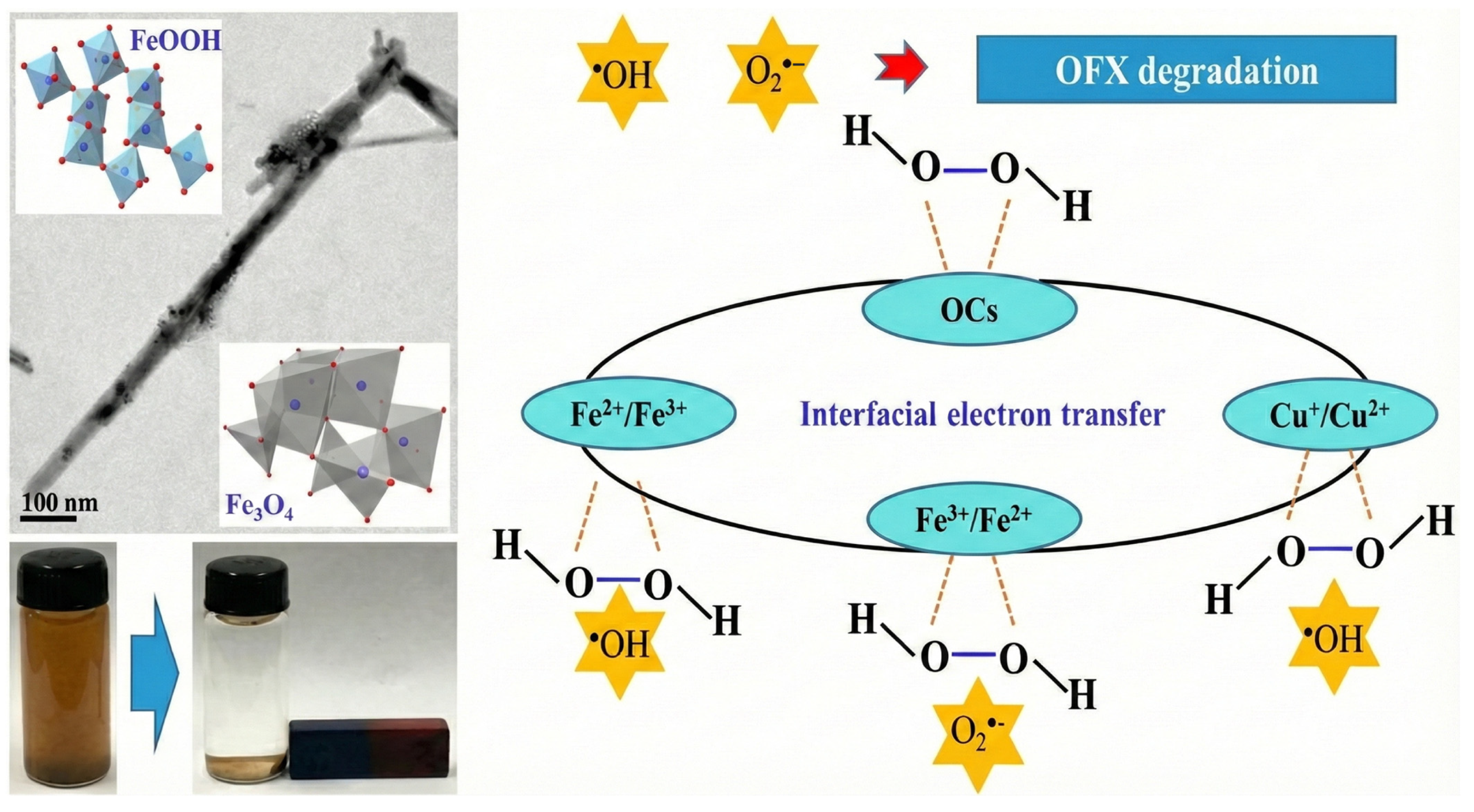
- Jin, H.; Tian, X.; Nie, Y.; Zhou, Z.; Yang, C.; Li, Y.; Lu, L. Oxygen Vacancy Promoted Heterogeneous Fenton-like Degradation of Ofloxacin at pH 3.2–9.0 by Cu Substituted Magnetic Fe3O4@FeOOH Nanocomposite. Environ. Sci. Technol. 2017, 51, 12699–12706. [Google Scholar] [CrossRef]
- Wu, X.C.; Liu, T.F.; Ni, W.X.; Yang, H.; Huang, H.; He, S.W.; Li, C.Y.; Ning, H.; Wu, W.T.; Zhao, Q.S.; et al. Engineering controllable oxygen vacancy defects in iron hydroxide oxide immobilized on reduced graphene oxide for boosting visible light-driven photo-Fenton-like oxidation. J. Colloid Interface Sci. 2022, 623, 9–20. [Google Scholar] [CrossRef]
- Chen, X.; Fu, W.; Yang, Z.; Yang, Y.; Li, Y.; Huang, H.; Zhang, X.; Pan, B. Enhanced H2O2 utilization efficiency in Fenton-like system for degradation of emerging contaminants: Oxygen vacancy-mediated activation of O2. Water Res. 2023, 230, 119562. [Google Scholar] [CrossRef]
- Li, Y.; Wang, J.; Xiang, Z.; Yang, J.; Yin, J.; Guo, X.; Wang, W. Mn doping accelerates regeneration of Fe2+ in FeOOH and promotes efficient H2O2 activation for degradation of As(III). Colloids Surf. A Physicochem. Eng. Asp. 2022, 655, 130166. [Google Scholar] [CrossRef]
- Li, B.; Gao, N.; Liao, Y.; Zhang, Y.; Mao, Y. Photo-Fenton ceramic composite membrane with Ag-doped FeOOH film for synergistically enhanced dye removal. J. Water Process Eng. 2024, 64, 105728. [Google Scholar] [CrossRef]
- Xu, J.; Li, Y.; Yuan, B.; Shen, C.; Fu, M.; Cui, H.; Sun, W. Large scale preparation of Cu-doped α-FeOOH nanoflowers and their photo-Fenton-like catalytic degradation of diclofenac sodium. Chem. Eng. J. 2016, 291, 174–183. [Google Scholar] [CrossRef]
- Nguyen, X.S.; Zhang, G.; Yang, X. Mesocrystalline Zn-Doped Fe3O4 Hollow Submicrospheres: Formation Mechanism and Enhanced Photo-Fenton Catalytic Performance. ACS Appl. Mater. Interf. 2017, 9, 8900–8909. [Google Scholar] [CrossRef]
- Sun, F.; Lu, T.; Feng, J.; Kang, Y. Dual-functional heterogeneous Fenton catalyst Cu/Ti co-doped Fe3O4@FeOOH for cyanide-containing wastewater treatment: Preparation, performance and mechanism. Environ. Pollut. 2024, 345, 123523. [Google Scholar] [CrossRef]
- Tian, X.; Luo, T.; Nie, Y.; Shi, J.; Tian, Y.; Dionysiou, D.D.; Wang, Y. New Insight into a Fenton-like Reaction Mechanism over Sulfidated β-FeOOH: Key Role of Sulfidation in Efficient Iron(III) Reduction and Sulfate Radical Generation. Environ. Sci. Technol. 2022, 56, 5542–5551. [Google Scholar] [CrossRef]
- Qian, X.; Ren, M.; Zhu, Y.; Yue, D.; Han, Y.; Jia, J.; Zhao, Y. Visible Light Assisted Heterogeneous Fenton-Like Degradation of Organic Pollutant via α-FeOOH/Mesoporous Carbon Composites. Environ. Sci. Technol. 2017, 51, 3993–4000. [Google Scholar] [CrossRef]
- Su, S.S.; Liu, Y.Y.; Liu, X.M.; Jin, W.; Zhao, Y.P. Transformation pathway and degradation mechanism of methylene blue through β-FeOOH@GO catalyzed photo-Fenton-like system. Chemosphere 2019, 218, 83–92. [Google Scholar] [CrossRef] [PubMed]
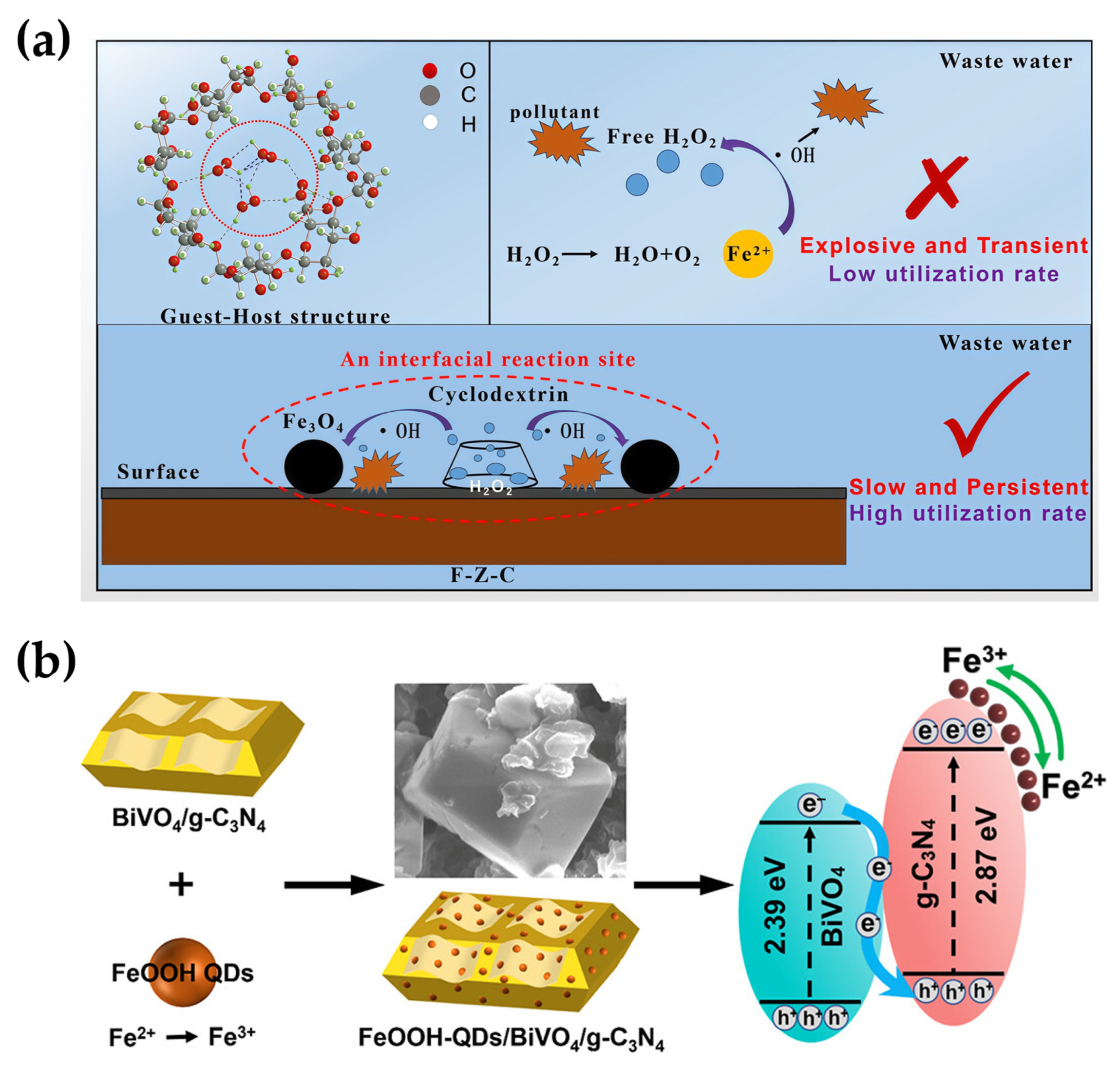
- Wang, X.; Liu, W.; Qin, J.; Lei, L. Improvement of H2O2 Utilization by the Persistent Heterogeneous Fenton Reaction with the Fe3O4-Zeolite-Cyclodextrin Composite. Ind. Eng. Chem. Res. 2020, 59, 2192–2202. [Google Scholar] [CrossRef]
- Liu, R.; Li, R.; Yang, L.; Wang, R.-X.; Chen, H.-Y.; Wang, N.; Li, Z.; Chen, Y.-Q.; Ramakrishna, S.; Long, Y.-Z. FeOOH Quantum Dot-Coupled Z-Scheme BiVO4/g-C3N4 Heterojunction for Enhancing Photo-Fenton Reactions. ACS Appl. Nano Mater. 2023, 6, 17009–17020. [Google Scholar] [CrossRef]






| Mineral | Formula | Crystal System a | Space Group a | Polyhedral Unit b | Pore Character c | Density d (g cm−3) | BET d (m2 g−1) | kobs, H2O2 (min−1) d |
|---|---|---|---|---|---|---|---|---|
| Magnetite | Fe3O4 | Cubic | m | FeO6 FeO4 | Non-porous | 5.18 | 42.5 | 0.303 |
| Maghemite | γ-Fe2O3 | Cubic | P4132 | FeO6 FeO4 | Non-porous | 4.87 | 29.8 | 0.105 |
| Hematite | α-Fe2O3 | Hexagonal | c | FeO6 | Non-porous | 5.26 | 7.36 | 0.011 |
| Goethite | α-FeOOH | Orthorhombic | Pbnm | FeO6 | Non-porous; Mesoporous | 4.26 | 33.4 | 0.050 |
| Lepidocrocite | γ-FeOOH | Orthorhombic | Cmcm | FeO6 | Mesoporous | 4.09 | 67.3 e | -- f |
| Ferrihydrite | Fe5HO8·4H2O | Hexagonal | P63mc | FeO6 FeO4 | Microporous | 3.96 | 252.7 | 1.985 |
| Mineral | Formula | pHPZC a |
|---|---|---|
| Magnetite | Fe3O4 | 6.5–6.9 |
| Maghemite | γ-Fe2O3 | 6.5–7.3 |
| Hematite | α-Fe2O3 | 7.2–9.1 |
| Goethite | α-FeOOH | 8.1–8.6 |
| Lepidocrocite | γ-FeOOH | 7.1–7.8 |
| Ferrihydrite | Fe5HO8·4H2O | 7.6–8.0 |
| Mineral | Key Characteristics a | Activation Pathway b | Dominant Product c | Reaction Conditions (pH/H2O2/Cat.) | Pollutant d | Reference |
|---|---|---|---|---|---|---|
| Magnetite | Structural Fe(II); Nanoparticles | Homogeneous Fenton (due to leaching); Heterogeneous Radical Pathway | HO• | pH 3.0 12 mM 1.0 g/L | 2,4-DCP | [114] |
| Magnetite | Nanoconfinement (Supported on AAO) | Heterogeneous Radical Pathway | HO• | pH 3.25 1 mM -- | pCBA | [98] |
| Magnetite | Structural Fe(II) | Heterogeneous Radical Pathway; Non-productive Disproportionation | HO•, O2•−, O2 | pH 3–9 7.2 mM 2.0 g/L | BA | [87] |
| Hematite | -- | Heterogeneous Radical Pathway | HO• | pH 3–9 7.2 mM 2.0 g/L | BA | [87] |
| Hematite | Surface oxygen vacancies | Non-productive Disproportionation; Heterogeneous Radical Pathway | O2; HO•(Minor) | pH 4.5 10 mM 1.0 g/L | DEP | [115] |
| Hematite | Nanoconfinement (Inside CNTs) | Non-Radical Pathway | 1O2 | pH 3–9 50 mM 0.015 g/L | MB | [105] |
| Hematite | Surface area | Heterogeneous Radical Pathway | HO• | pH 4.0 0.1 mM–1 M -- | Formate | [92] |
| Goethite | Exposed facets (Needle-like) | Heterogeneous Radical Pathway | HO•, O2•− | pH 6–8 14.7 mM 0.5 g/L | BSA | [88] |
| Goethite | Surface Area | Heterogeneous Radical Pathway (Surface complexation) | HO• | pH 7.0 1–10 mM 0.2–3 g/L | BuCl | [93] |
| Goethite | Surface oxygen vacancies | Heterogeneous Radical Pathway | HO• | pH 4.5 10 mM 1.0 g/L | DEP | [115] |
| Goethite | Surface Area | Heterogeneous Radical Pathway | HO• | pH 4.0 0.1 mM–1 M -- | Formate | [92] |
| Lepidocrocite | Exposed facets (Flake-like) | Heterogeneous Radical Pathway | HO• | pH 6–8 14.7 mM 0.5 g/L | BSA | [88] |
| Feroxyhyte | -- | Non-productive Disproportionation; Heterogeneous Radical Pathway | O2; HO• (Minor) | pH 3–9 7.2 mM 2.0 g/L | BA | [87] |
| Ferrihydrite | Surface ≡Fe(III) complexation sites | Non-Radical Pathway(for complexing pollutants); Heterogeneous Radical Pathway (for non-complexing) | ET (for BA, PAA, 4-HBA); HO• (for Others) | pH 3–5 ~10 mM 0.5 g/L | BA, PAA, 4-HBA; ATZ, NB, PMSO | [116] |
| Ferrihydrite | -- | Heterogeneous Radical Pathway; Non-Radical Pathway | HO•; Fe(IV) (Possible) e | pH 3–6 10 mM -- | Formate, PMSO | [102] |
| Ferrihydrite | Interfacial adsorption layer | Heterogeneous Radical Pathway | HO• | pH 4.0 0.1–10 mM 0.2 g/L | Formate | [97] |
| Ferrihydrite | Catalase-like active centers (≡Fe-OH) | Catalase-like Process | O2 | pH 4–9 100 mM 0.2 g/L | -- | [117] |
| Ferrihydrite | -- | Non-productive Disproportionation; Heterogeneous Radical Pathway | O2; HO• (Minor) | pH 3–9 7.2 mM 2.0 g/L | BA | [87] |
| Ferrihydrite | Surface oxygen vacancies | Non-productive Disproportionation; Heterogeneous Radical Pathway | O2; HO• (Minor) | pH 4.5 10 mM 1.0 g/L | DEP | [115] |
| Ferrihydrite | -- | Heterogeneous Radical Pathway | HO• | pH 4.0 1 mM 0.2 mM Fe | Formate | [92] |
Disclaimer/Publisher’s Note: The statements, opinions and data contained in all publications are solely those of the individual author(s) and contributor(s) and not of MDPI and/or the editor(s). MDPI and/or the editor(s) disclaim responsibility for any injury to people or property resulting from any ideas, methods, instructions or products referred to in the content. |
© 2026 by the authors. Licensee MDPI, Basel, Switzerland. This article is an open access article distributed under the terms and conditions of the Creative Commons Attribution (CC BY) license.
Share and Cite
Wang, Y.; Chen, Y.; Wu, D. Iron (Oxyhydr) Oxides in Heterogeneous Fenton Processes: Structure-Activity Relationships in Hydrogen Peroxide Decomposition Pathways. Catalysts 2026, 16, 169. https://doi.org/10.3390/catal16020169
Wang Y, Chen Y, Wu D. Iron (Oxyhydr) Oxides in Heterogeneous Fenton Processes: Structure-Activity Relationships in Hydrogen Peroxide Decomposition Pathways. Catalysts. 2026; 16(2):169. https://doi.org/10.3390/catal16020169
Chicago/Turabian StyleWang, Yi, Yufan Chen, and Deli Wu. 2026. "Iron (Oxyhydr) Oxides in Heterogeneous Fenton Processes: Structure-Activity Relationships in Hydrogen Peroxide Decomposition Pathways" Catalysts 16, no. 2: 169. https://doi.org/10.3390/catal16020169
APA StyleWang, Y., Chen, Y., & Wu, D. (2026). Iron (Oxyhydr) Oxides in Heterogeneous Fenton Processes: Structure-Activity Relationships in Hydrogen Peroxide Decomposition Pathways. Catalysts, 16(2), 169. https://doi.org/10.3390/catal16020169