


Abstract
The hydroisomerization reaction of light alkanes was used to improve their octane value. Industrial light alkane feeds usually contain a certain amount of cycloalkanes and aromatics (known as hydrocarbon impurities). In this study, the influence of hydrocarbon impurities on the isomerization activity of n-alkanes over Pt/SO42−/ZrO2/Al2O3 (PSZA) was investigated in a continuous flow fixed-bed reactor, TPSR, and pulse reactor. The reason for the influence of hydrocarbon impurities on the isomerization activity of n-alkanes was also discussed by using in situ adsorption–desorption and temperature-programmed reactions. The catalyst was characterized by XRD, PyIR, N2 adsorption–desorption, TEM, and XRF. The results showed that the prepared catalyst contained mainly tetragonal zirconia and possessed a large amount of strong B and L acid sites. A certain amount of hydrocarbon impurities obviously inhibited the isomerization conversion of n-alkanes. The extent of the inhibition was very dependent on the kind of hydrocarbon impurities, n-alkane carbon number, and reaction temperature. Lighter n-alkane isomerization conversion was influenced to a greater extent. And the increase of reaction temperature could weaken its inhibitory effect. The results provided a reference and base for the industrial application of light alkane hydroisomerization over PSZA.
1. Introduction
The light paraffin hydroisomerization process can convert low-octane n-alkanes into high-octane gasoline components without sulfur and aromatics. The Pt/SO42−/ZrO2-Al2O3 (PSZA) solid superacid catalyst has favorable low-temperature isomerization activity due to its strong acidity, and more branched-chain isomers can be obtained by the isomerization of n-alkanes on PSZA. The isomerization product has a high octane number. Therefore, light hydrocarbon isomerization on solid superacid has received more and more extensive attention.
There are many reports about the isomerization of light alkanes, mainly focusing on the optimization of catalyst preparation [1,2,3,4,5,6,7], the influence of trace water in raw materials [8,9,10], and the exploration of isomerization process conditions [11,12,13]. There are a very limited number of reports about the influence of hydrocarbon impurities, such as naphthene and aromatics, on the isomerization performance [12,14,15,16,17]. Guisnet et al. [15] studied the influence of aromatics, cyclopentane, and n-pentane on the isomerization properties of n-hexane over mordenite. The influence of these hydrocarbon impurities on the isomerization of n-hexane depends on the Si/Al ratio in mordenite. Furuta et al. [16] studied the benzene effect on the catalytic hydroisomerization conversion of PSZA prepared by different methods and found that the activity of 0.3–0.5%Pt/SZ through impregnating cationic Pt was hardly influenced by benzene, and the activity of 0.11%Pt/SZ obviously decreased due to benzene addition. Chen Jialing et al. [18] studied the isomerization performance of reformed head oil containing benzene and n-heptane on PSZA, and they found that the catalyst still showed good isomerization activity at a relatively high reaction temperature, i.e., 190 °C. In addition, Busto et al. [19,20] researched the effect of benzene and sulfur on the hydroisomerization and hydrocracking performance of n-hexane and long-chain alkane over Pt/WO3-ZrO2 and discovered that the presence of aromatics improved the liquid yield of long alkane hydrocracking and sulfur species lowered the conversion of n-alkane. Hydrocarbon feed, such as reformed head oil and hydrocracked light oil, always contains a trace of cycloalkanes and aromatics as well as hydrocarbons with higher carbon numbers, such as heptane. However, up to now, although some studies have demonstrated the existence of competitive adsorption among different hydrocarbons such as cycloalkanes, aromatics, and n-alkanes on some carriers [21,22,23,24,25,26], the influence mechanism of impurities hydrocarbon on the isomerization activity of n-alkanes on PSZA is rarely reported. Different adsorbents and different adsorbates would lead to different competitive adsorption behaviors.
In the present work, the mechanism of the effects of different hydrocarbon impurities, such as cycloalkanes, aromatics, and relatively high carbon, on the isomerization of normal alkanes was systematically studied in detail through an in situ programmed temperature reaction, pulse reaction, and continuous reaction. More importantly, the industrial feeds from different refineries were evaluated and the results possessed factual significance. The competitive adsorption of hydrocarbon impurities and the difference in adsorption capacity of different raw materials affected the isomerization activity of normal alkanes. Thus, the isomerization activity could be speculated when the feed composition was measured. The present study could provide theoretical guidance for optimizing the actual process conditions of the hydro-isomerization process over the solid superacid catalyst.
2. Results and Discussion
2.1. Catalyst Properties
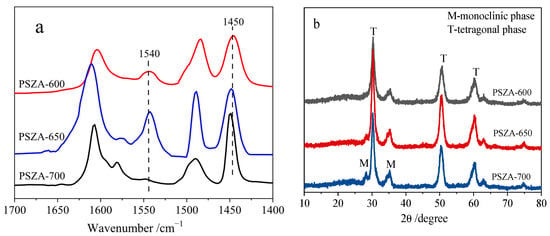
The acid properties were characterized by Py-IR, and the results are shown in Figure 1a. The pyridine adsorption peak centered at 1450 cm−1 and 1540 cm−1 was attributed to the L acid sites and B acid sites, respectively. It is apparent from Figure 1 that the prepared PSZA catalysts possessed both L and B acid sites. As the calcination temperature increased from 600 °C to 650 °C, the amount of B and L acid sites clearly increased and a further increase in the calcination temperature to 700 °C led to a drastic decrease in B acid sites and to an increase in the L acid sites. The chosen catalyst for the isomerization reaction was PSZA650, obtained through calcination at 650 °C.
Figure 1.
(a) PyIR of PSZA at 350 °C. (b) XRD patterns of PSZA. M: monoclinic phase; T: tetragonal phase.
XRD patterns are shown in Figure 1b. Apparently, PSZA mainly contained tetragonal zirconia, even if the calcination temperature increased up to 700 °C. In addition, the composition of PSZA in the oxide form was as follows: 76.5 wt% Al2O3:20 wt% ZrO2:3.5 wt% SO2.
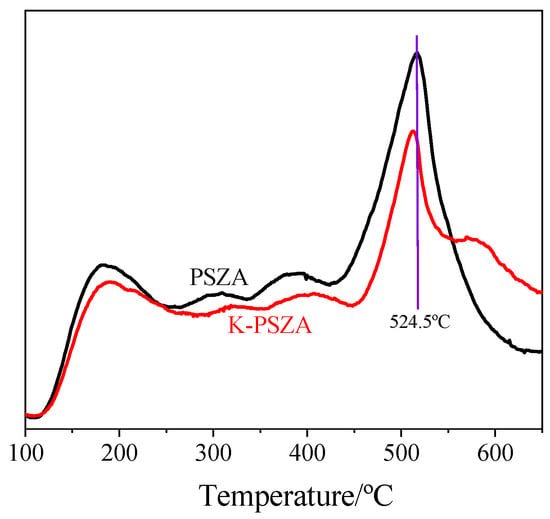
Figure 2 shows the NH3-TPD profiles of PSZA and K/PSZA catalysts. It can be clearly seen that as K was introduced onto PSZA, the amount of acid sites on PSZA especially showed obvious decreases, as verified by our previous investigation about zeolite. In addition, the real acid sites for the hydroisomerization reaction may be from the H-spillover during the reaction process. The addition of K led to the decrease in apparent acidity and it is more likely to inhibit H-spillover to some extent and to reduce the in situ creation of acid sites which may be the real active sites.
Figure 2.
Comparison of NH3-TPD profiles of PSZA and K/PSZA.
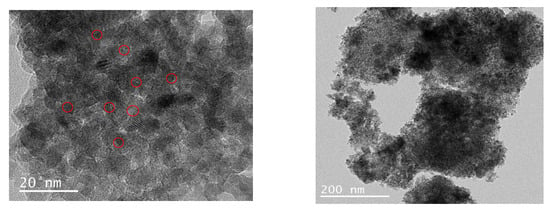
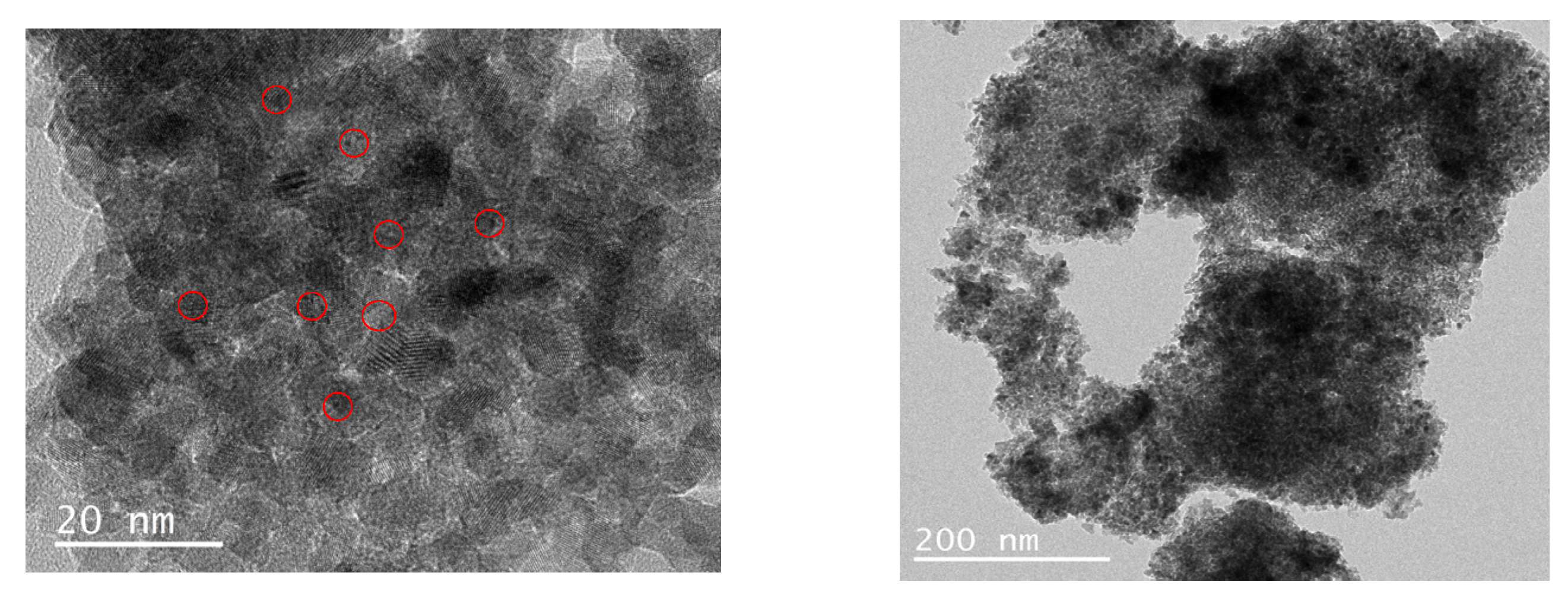
Figure 3 shows the surface morphology of PSZA and the size of the Pt particles. It can be seen that the morphology of zirconia was irregular in shape, and the size of the Pt particles (inside the red circles) was very small, about 2 nm. In addition, it was generally considered that XRD can detect the diffraction of crystallites larger than 3 nm. In Figure 1b, a Pt diffraction peak does not appear, further confirming the presence of Pt crystallites smaller than 3 nm. This was in agreement with the result from TEM.
Figure 3.
TEM images of PSZA. (The dot in the red circle represented Pt particles).
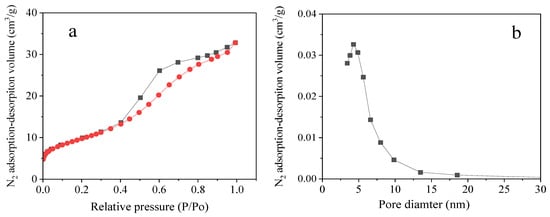
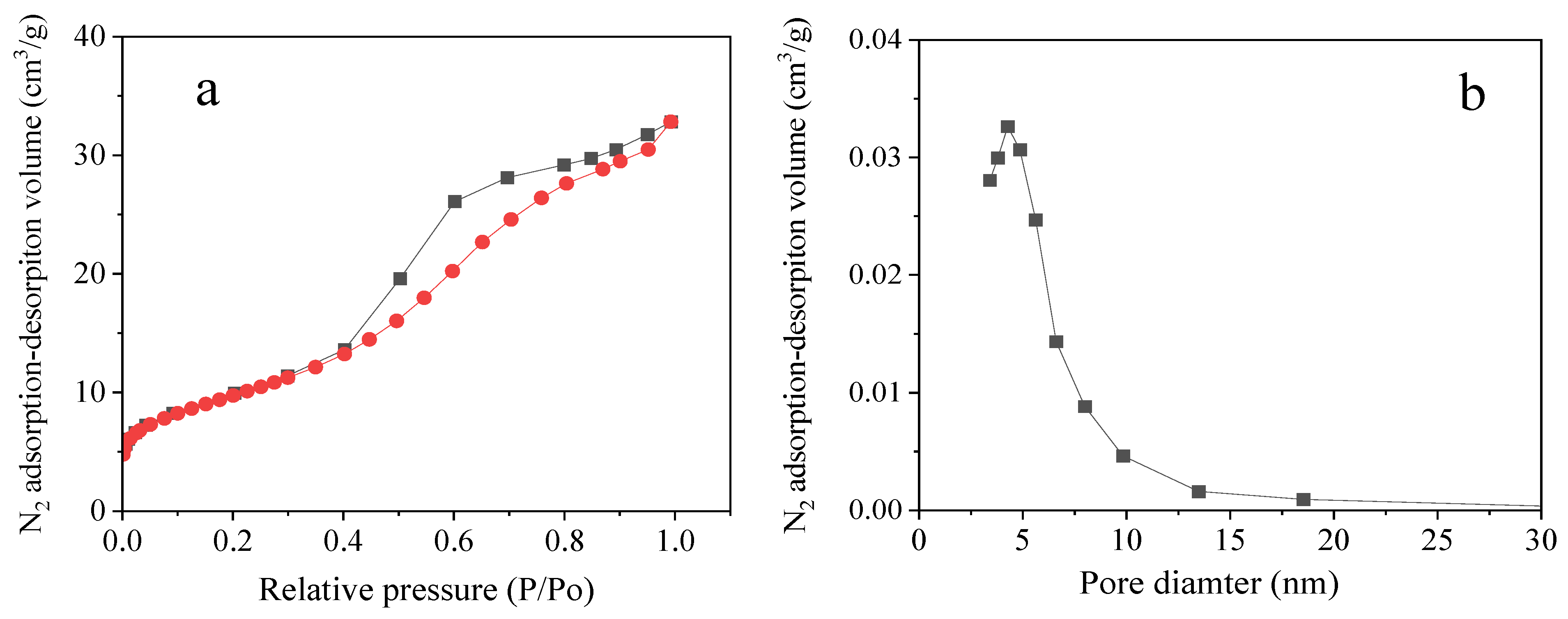
The N2 adsorption–desorption curves are shown in Figure 4a and the pore distribution was shown in Figure 4b. It can be seen that PSZA exhibits typical type-IV N2 adsorption isotherms and a hysteresis loop. The clear hysteresis loop in the adsorption curve at a P/P0 greater than 0.4 is consistent with the presence of a mesoporous structure, and the pore distribution also showed the mesopore structure of PSZA. The measured SBET and pore volume of PSZA were 116 m2/g and 0.16 cm3/g, respectively, and the average pore diameter was ca. 5.8 nm. Apparently, the PSZA catalyst possessed a relatively high SBET.
Figure 4.
N2 adsorption–desorption curves (a) red curve—adsorption one; and black curve—desorption and pore distribution; (b) of PSZA.
2.2. Isomerization Behavior of Different Feeds over PSZA in Continuous Reactions
2.2.1. Isomerization Behavior of n-C5 or n-C6 Feed and Mixed n-C5/n-C6
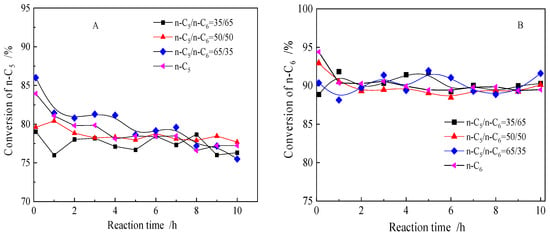
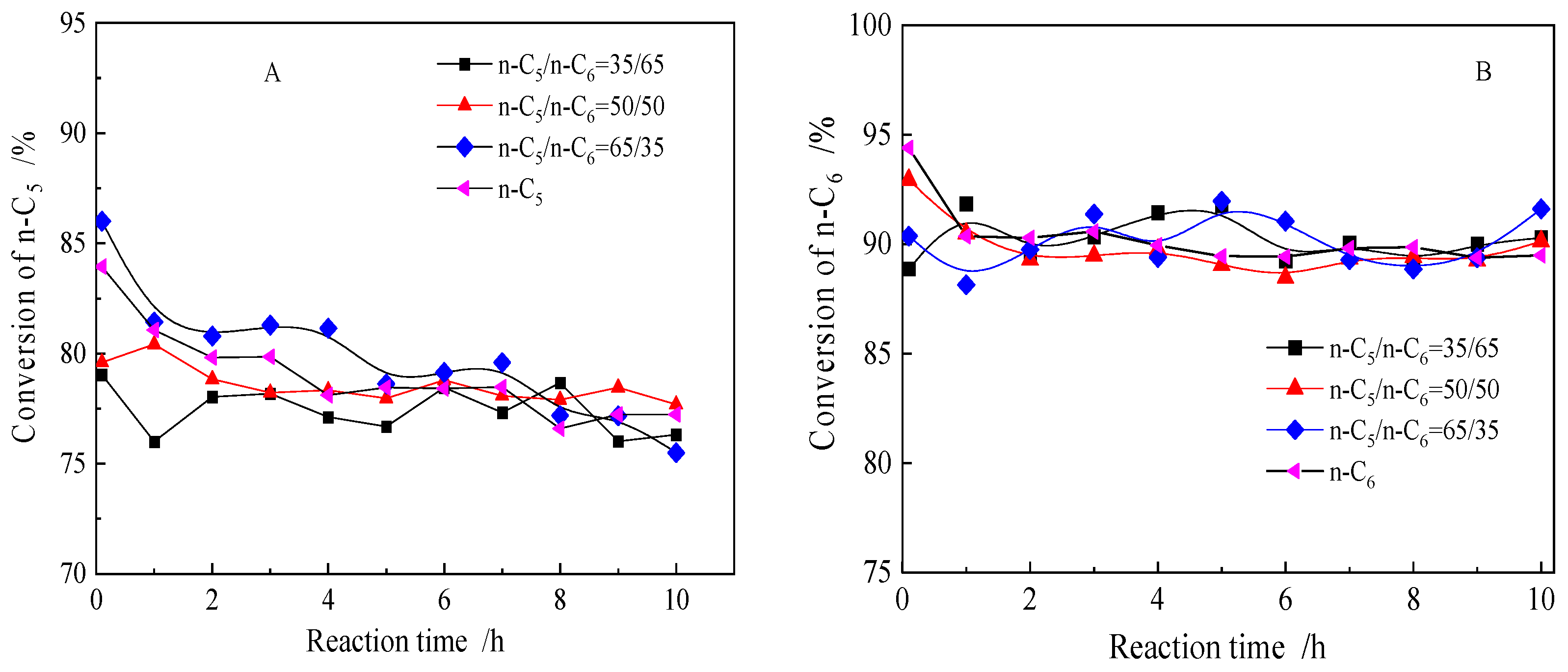
Figure 5 shows the isomerization conversion of single n-pentane, single n-hexane, and their mixture with different n-pentane/n-hexane molar ratios. For single n-pentane and n-hexane, stable conversion was about ca. 78% and 90%, respectively. For their mixture feed, the results were interesting. The stable conversion of n-pentane and n-hexane hardly varied with single-feed content. This indicated that the feed composition did not influence individual conversion. In addition, small alkane molecules of 2–4 wt%, such as C1–C4 were formed.
Figure 5.
Conversion of n-pentane (A) and n-hexane (B) in different feeds over PSZA. Mixed feed: ratio of nC5/nC6 was 35/65, 50/50, 65/35. Reaction conditions: T = 150 °C; P = 2 Mpa; molar ratio of H2 to hydrocarbon = 3; WHSV = 1.5 h−1.
2.2.2. n-Alkane Isomerization Activity Comparison of Different Mixed Feeds
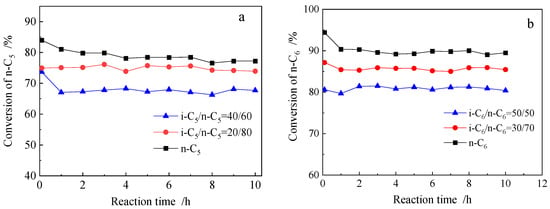
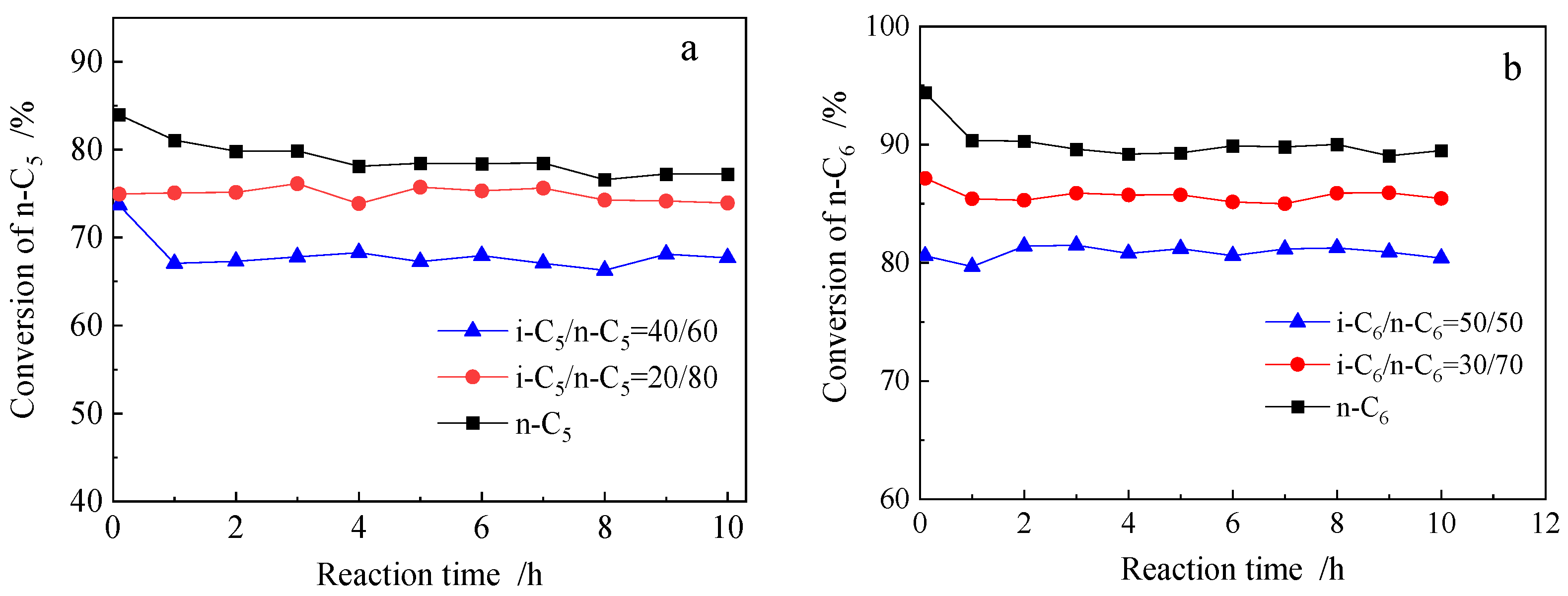
The effect of iso-alkane on n-alkane isomerization conversion is presented in Figure 6. It can clearly be seen that the addition of the corresponding iso-alkane into n-pentane or n-hexane lowered the corresponding n-alkane conversion. Moreover, the higher the iso-alkane concentration, the greater the extent of conversion reduction. Generally speaking, the reactant concentration influences the reaction rate, showing its reactivity. A reduction in reactant concentration would lead to low reactivity. However, the results in Figure 5 show that the conversion of n-pentane or n-hexane in the mixture was almost similar to that of the corresponding pure feed. Herein, the n-alkane concentration in the feed cannot influence its conversion. However, the case in Figure 6 was the opposite. The n-alkane isomerization reaction is an exothermic one. The maximum conversion is limited by a thermodynamic equilibrium. The equilibrium composition for pentane and hexane at 150 °C is listed in Table 1.
Figure 6.
Conversion of n-pentane (a) and n-hexane (b) in the prepared mixed feed with different iso-alkane concentrations. Reaction conditions: T = 150 °C; P = 2 Mpa; ratio of H2 to hydrocarbon = 3; WHSV = 1.5 h−1.
Table 1.
Isomerization equilibrium composition for pentane and hexane at 150 °C.
Therefore, in the presence of iso-alkane, the conversion of n-alkane decreased with the increase in iso-alkane content due to the impossibility of exceeding the equilibrium composition. In fact, the ratio of the total iso-alkane content to the corresponding n-alkane in products is very similar to that in Figure 5.
2.2.3. Isomerization Behavior of Industrial Feeds from Different Refineries
In order to make the present investigation closer to industrial conditions, the reactivity of industrial feeds (reforming head oil) from different refineries was also evaluated over PSZA. The compositions of the feeds from different refineries are shown in Table 2. Obviously, the industrial composition was more complex than the reagent raw material. That is, except for n-alkanes and iso-alkanes, the factual feed also contained benzene, cycloalkane, and C7 alkanes. These so-called hydrocarbon impurities may influence the reactivity of n-alkanes.
Table 2.
Product compositions of reforming head oil from different refinery plants.
The conversion behaviors of the feeds from different refineries are shown in Figure 7. It can be seen that the conversion of n-hexane in feed A was distinctly lower than that in feed B, while n-pentane conversion in feed A was a bit lower than that in feed B. According to the composition of the two feeds, feed B contained more n-alkanes than feed A and the total amount of benzene and methyl cyclopentane in feed A was very close to the one in feed B. Herein, the higher conversion of n-hexane in feed B should be attributed to the relatively higher n-hexane concentration compared with feed A, although the content of n-hexane in feed B was still low, only 15.6%. The content of n-pentane in feed B was slightly lower than that in feed A, while the relative content of n-hexane in feed A was lower than that in feed B. The hexane and pentane composition of feed B was even further away from the thermodynamic equilibrium than that of feed A. Thus, the driving force of the isomerization reaction is boosted, leading to notably enhanced n-alkane conversion.
Figure 7.
Comparison of isomerization conversion (a) and isomerization (b) rate of feed A and B (P = 2.0 MPa; ratio of H2 to hydrocarbon = 3:1; reaction temperature = 150 °C; WHSV = 1.5 h−1).
In addition, due to the occurrence of side reactions, such as cracking, the content of iso-alkane in products, especially iso-pentane, may originate from hydrocracking reaction, except for n-alkane isomerization. Therefore, the isomerization rate was also given in Figure 7b (right side). The pentane composition (that is, the ratio of isopentane to n-pentane) in production was very close to the point of thermodynamic equilibrium.
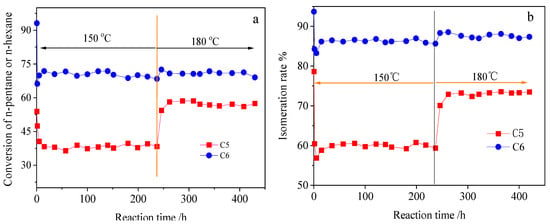
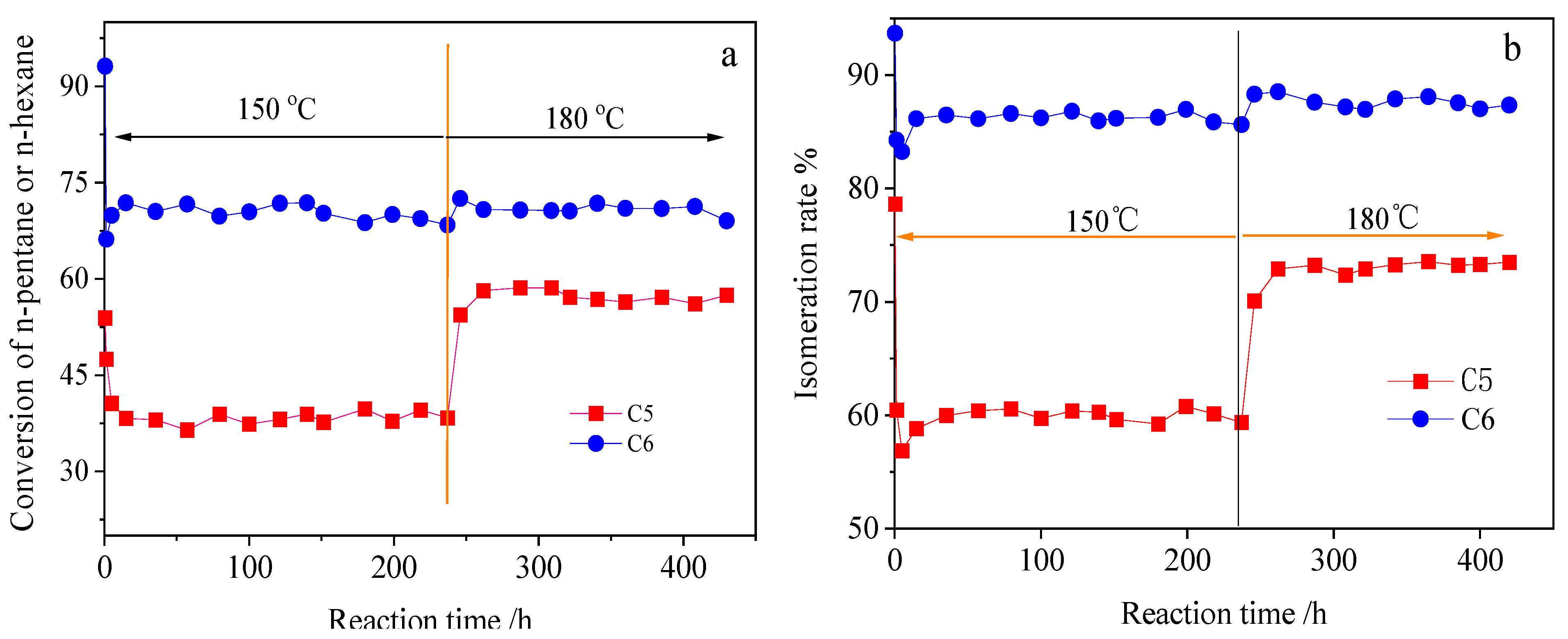
Compared with feeds A and B, feed C is more complex, notably containing more impurities. The variation in the conversion of n-pentane and n-hexane in feed C is presented in Figure 8. Apparently, these values were relatively lower. Especially at 150 °C, stable n-pentane conversion was only ca. 35% and n-hexane conversion was only ca. 70%. However, as the reaction temperature increased to 180 °C, n-pentane conversion sharply increased up to ca. 57%, while n-hexane conversion hardly changed. Meanwhile, the isomerization rate of n-pentane increased from ca. 59% to 74% at 180 °C, approaching the equilibrium composition. However, the ratio of iso-hexane to the total hexane in products at 150 °C temperature was close to the equilibrium value, and the temperature increase therefore could not lead to a conversion increment unless a serious cracking reaction occurred.
Figure 8.
N-alkane conversion (a) and isomerization rate (b) in feed C (P = 2.0 MPa; ratio of H2 to hydrocarbon = 3:1; WHSV = 1.5 h−1).
From the reaction results of different feeds, the isomerization rate of the same n-alkane showed a distinct difference. This may be related to the different feed compositions. However, based on the results in Figure 5 and Figure 6, the different concentrations of n-alkane seemed to hardly influence the isomerization rate. The case was different for the industrial feed. Compared with feed compositions of a blended mixture with pure normal and iso-alkanes, the industrial feeds contained a certain amount of impurities, such as cycloalkane and benzene. These impurities may influence the n-alkane isomerization conversion. In order to clarify the reason for the isomerization conversion difference in different feeds, the effect of hydrocarbon impurities on n-alkane isomerization is discussed in detail in the following section.
2.2.4. Influence of Hydrocarbon Impurities (Cycloalkanes and Benzene) on Isomerization Performance of PSZA
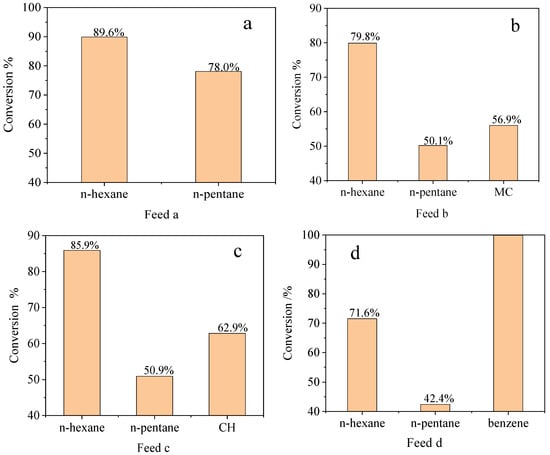
Hydrocarbon impurities, such as cycloalkanes or benzene, were intentionally added to the mixture of pure n-pentane and n-hexane. In order to investigate the effect of a single hydrocarbon impurity, every mixed feed contained only one kind of impurity. The composition of the mixed feed is listed in Table 3. The effects of methylcyclopentane, cyclohexane, and benzene on the isomerization conversion of n-alkanes (n-pentane + n-hexane), respectively, are shown in Figure 9.
Table 3.
Compositions of mixed feed of n-alkane and hydrocarbon impurities.
Figure 9.
Comparison of n-pentane and n-hexane isomerization conversion over PSZA with and without hydrocarbon impurities. Pressure = 2.0 MPa; WHSV = 1.5 h−1; temperature = 150 °C; reaction time = 4 h. (a–d) represented to the conversion n-alkane and impurities hydrocarbons in corresponding a–d feed listed in Table 3.
As can be seen from Figure 9a, when n-pentane and n-hexane mixtures were used as the feed, the conversion rate was 78.0% and 89.6%, respectively. When 6.5% methylcyclopentane was added to the n-alkane mixture feed (Figure 9b), the conversion of n-hexane dropped to 79.8%, and the conversion of n-pentane dropped to a very low value, i.e., 50.1%. Meanwhile, the conversion of the methylcyclopentane impurity was 56.9%. That is, n-pentane conversion showed a greater decrease by ca. 28%, while n-hexane conversion decreased only by ca10%. Obviously, the addition of MC inhibited n-pentane conversion more greatly than n-hexane. Likewise, the addition of cyclohexane (CH) also inhibited n-pentane conversion to the same extent. However, n-hexane conversion slightly decreased due to the introduction of CH (Figure 9c). As for 6.5% benzene introduction, its inhibition effect on n-pentane and n-hexane isomerization conversion was more obvious than cycloalkanes (Figure 9d). n-Pentane and n-hexane conversion dropped to 42.4% and 71.6%, respectively. Therefore, hydrocarbon impurities in the feed likely influenced or inhibited n-alkane conversion. The effect decreased in the order of benzene > HC > MC for n-hexane, and in the order benzene > HC, MC for n-pentane. This suggested that the difference in n-alkane reactivity in different industrial feeds is likely related to the presence of hydrocarbon impurities.
However, the research results from Chen et al. showed that the addition of benzene and n-heptane in the feed did not affect the isomerization conversion of n-alkanes on PSZA [18], which was different from the results in the present investigation. The possible cause of this may be related to the different reaction conditions. In addition, results from Guisnet et al. showed that toluene and methylcyclohexane had a significant effect on the isomerization conversion of n-alkanes on mordenite [15]. They proposed that the competitive adsorption of different hydrocarbons over the mordenite zeolite, with lower ratio of Si to Al, led to the decrease in the isomerization activity of n-alkanes, whereas for high-silicon ZSM-5, the results from Rodegheroa et al. also showed that n-C6 was preferentially adsorbed compared with toluene, and this competitive adsorption may be due to the influence of the relative size of the pores and the molecular size of the adsorbent [21]. Galinsky et al. investigated the adsorption capacity and diffusion coefficients of C1 to C5 through modeling and an adsorption heat experiment over sulfated zirconia and found that with the increase in the number of carbon atoms in the hydrocarbon, the adsorption strength of alkane was boosted [22], which may lead to high reaction activity.
There still does not exist a consistent opinion about the effect of impurities on n-alkane isomerization conversion. In order to elucidate the reasons for the influence of cycloalkanes or aromatics on the isomerization of normal alkanes over a superacid catalyst PSZA and to provide base data for industrial hydroisomerization of light alkane, a temperature programmed surface reaction and pulse reaction of different feeds were carried out as follows.
2.3. Programmed Temperature Surface Reaction of Different Feeds on PSZA
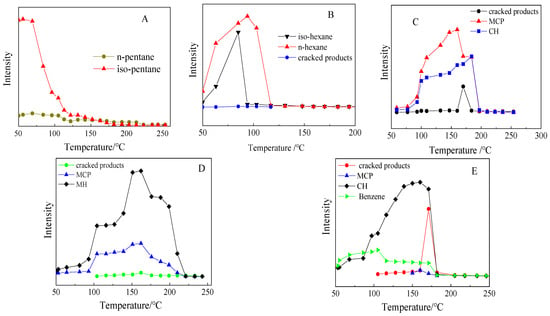
After treatment activation and reduction, the catalyst PSZA was cooled to 50 °C. In the hydrogen atmosphere, a small amount of a single feed, such as n-pentane, n-hexane, methylcyclopentane, cyclohexane, or benzene, was injected into the catalyst bed in a pulsed way until the catalyst was saturated. Then it was purged in hydrogen gas for 30 min, and finally heated in hydrogen at a speed of 3 °C/min. The exit gas containing the desorption products and feeds at different temperatures was analyzed by online GC. The amount of raw materials and products was calculated based on the area of the GC peak, as shown in Figure 10. As for n-pentane, a large amount of n-pentane began to desorb from the surface of PSZA at a very low temperature of 50 °C and continued to desorb with the increase in the temperature up to 150 °C, accompanied by the desorption of a very small amount of isopentane products (Figure 10A). This suggested that n-pentane adsorption capacity was very weak, even over the superacid catalyst PSZA, and its reactivity for isomerization was also very low, whereas TPSR of n-hexane over PSZA showed a great difference (Figure 10B). The desorbed n-hexane and the formed iso-hexane appeared at 50 °C and their amount increased with the reaction temperature. N-hexane and iso-hexane reached their maxima at 70 °C and 90 °C, respectively. And the desorption of n-hexane and iso-hexane was almost completely finished at 94 °C and 116 °C. Within the range of 50–200 °C, almost no cracking products were generated. This indicates that n-hexane reactivity was much higher than n-pentane, and the former is easily isomerized into iso-hexane at a relatively low temperature, and the iso-hexane products and n-hexane are also easily desorbed.
Figure 10.
TPSR of different feeds on catalyst PSZA. (A–E) n-pentane, n-hexane, methylcyclopentane, cyclohexane, and benzene feed, respectively.
The TPSRs of hydrocarbon impurities are shown in Figure 10C–E. Firstly, the methylcyclopentane feed and its isomer cyclohexane began desorption at a temperature lower than ca. 95 °C; only slight desorption of methylcyclopentane reactant and product cyclohexane occurred (Figure 10C). As the temperature increased up to 102 °C, the desorption of methylcyclopentane (MC) and the formed cyclohexane (CH) sharply ascended and then the increase obviously slowed down. The desorption of MC and CH reached the maximum at 158 °C and 184 °C and then dramatically decreased to a minimum, even reaching close to zero, as the temperature continuously increased to 200 °C. In addition, cracked small hydrocarbons appeared at 169 °C.
The TPSR of cyclohexane is shown in Figure 10D, which was similar to the case of methyl cyclopentane. At 100 °C, cyclohexane began to desorb and isomerize, and as the temperature increased up to 158 °C, the desorbed CH reactant and MCP product reached a maximum at 220 °C, which was higher than the final desorption temperature of MC, shown in Figure 10C.
The temperature-programmed surface reaction of benzene, as the aromatic representative, is shown in Figure 10E, and it was another different case. Only a very small amount of benzene was desorbed within the range of 50–250 °C and the hydrogenation product CH was detected at temperatures lower than 85 °C. As the temperature exceeded 100 °C, the formation of CH sharply increased with the reaction temperature increasing to 158 °C and then dramatically decreased with further temperature increase. This demonstrated that benzene has a high adsorption capacity and hydrogenation reactivity.
It can be seen from the above results that the adsorption capacity and reactivity of different hydrocarbons are quite different. That is, the order of adsorption capacity increased as follows: n-pentane < n-hexane < methylcyclopentane, cyclohexane < benzene. The reactivity of different feeds increased in the following order: n-pentane < methylcyclopentane, cyclohexane < benzene < n-hexane. For the mixed raw materials, there must exist competitive adsorption between different hydrocarbons, which likely influenced n-alkane isomerization activity. Generally, competitive adsorption includes two aspects: the direct competition of the adsorbent at the adsorption site and the adsorption competition caused by pore plugging. The pore size of the PSZA catalyst used in this paper is about 5–6 nm, which is about 10 times the size of the feed material molecule. Therefore, competitive adsorption should come from the competition of adsorbents at the adsorption sites. The adsorption of n-pentane is the weakest, followed by n-hexane, cycloalkanes, and benzene. The competitive adsorption of hydrocarbon impurities may be the main reason for the decrease in the conversion of n-pentane and n-hexane. The adsorption strength of impurities hydrocarbons was larger than n-alkane, which would lead to the preferential occupation of impurities hydrocarbons by impurities hydrocarbons on the more active sites over the catalyst. Thus, the isomerization activity of n-alkanes decreased to a greater extent due to the presence of impurities hydrocarbons.
There are several reports about competitive adsorption. It has been reported that the adsorption capacity of toluene on activated carbon is stronger than that of cyclohexane, and it will be preferentially adsorbed on the active site [24]. However, Rodegheroa et al. [21] believed that n-hexane was more preferentially adsorbed than toluene on high-silicon molecular sieve ZSM-5, which may be related to the small pore size of the adsorbent, with the competitive adsorption of toluene attributable to pore plugging. The results of Li et al. [25] showed that the competitive adsorption of cycloalkanes reduces the catalytic cracking conversion of alkanes. Lu et al. [23] revealed through computer simulation that the adsorption capacity of cyclohexane, methylcyclopentane, and cyclopentane in the mixture decreased successively. The study of Furuta et al. [16] showed that the effect of benzene on the isomerization activity of n-hexane on PSZA depends on the dispersion of Pt on PSZA, and the inhibition effect is low when the dispersion is high. In the following section, the effect of hydrocarbon impurities on n-alkane isomerization activity is further discussed.
2.4. Intrinsic Activity of n-Pentane and n-Hexane Isomerization on PSZA Through Pulse Reaction
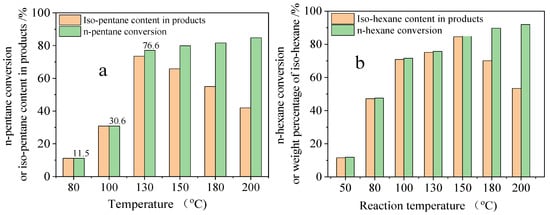
To further verify the intrinsic reactivity of n-alkane over PSZA, pulse isomerization reactions were conducted under atmospheric pressure, and the results are shown in Figure 11. As can be seen from Figure 11, the conversion rate of n-pentane at 80 °C is very low, only 11.5%. When the reaction temperature is increased to 100 °C, the conversion rate just rises to 30.6%. When the reaction temperature is raised to 130 °C, the conversion rate sharply increases to 76.6%. Further increasing the reaction temperature leads to a slow increase in the conversion rate, while the amount of isomerized products decreases due to serious cracking. As for n-hexane, the conversion rate at a reaction temperature of 50 °C can reach the conversion rate of n-pentane at 80 °C (11.8%). When the reaction temperature is 80 °C, n-hexane conversion sharply increases to 47.5%, which is even higher than the n-pentane conversion at 100 °C (30.6%). When the temperature is further raised to 100 °C, the n-hexane conversion rate further increases to 71.9%, still much higher than the conversion of n-pentane at the same temperature (30.6%). As the temperature increased up to 150 °C, both n-hexane conversion and iso-hexane selectivity reached a maximum. Further improvement in the temperature led to more serious cracking, although n-hexane conversion was gradually enhanced.
Figure 11.
Isomerization reactivity of n-pentane (a) and n-hexane (b) on PSZA in pulse reaction.
Based on the above results, it can be known that even when a single n-alkane acting as a raw material reacts, and there is no competitive adsorption, the intrinsic reactivity of n-pentane is much lower than that of n-hexane, which is consistent with the results of TPSR. In other words, the activation energy of n-hexane isomerization should be much lower than that of n-pentane isomerization. Thus, higher n-pentane conversion requires more active centers or a higher reaction temperature. As the competitive adsorption between cycloalkanes or benzene and n-alkane occurred, hydrocarbon impurities preferentially occupied the most active sites, which led to a greater decrease in n-pentane conversion than that of n-hexane conversion.
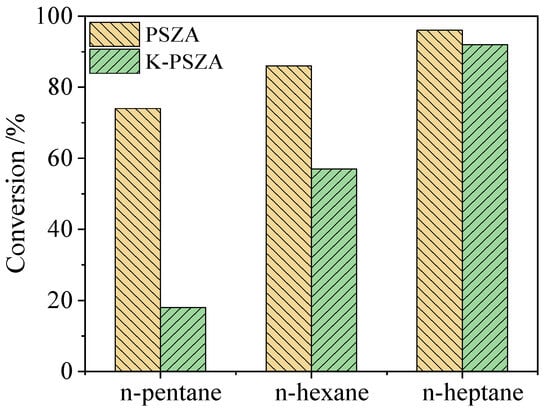
In order to further confirm the difference in the reactivity of different hydrocarbons, the isomerization reaction of n-alkanes was carried out over PSZA with different acidity. It was well known that traces of alkali metals, such as Na or K, could apparently reduce the acid sites over a catalyst [27]. Herein, the PSZA catalyst was modified with 0.05% K to reduce the amount of superacid sites (in Figure 2). The hydroisomerization conversion of n-alkanes with different carbon numbers over PSZA and K-PSZA was compared, as shown in Figure 12. Obviously, n-pentane conversion sharply declined over the K-doping of PSZA, while the extent of the reduction of n-hexane conversion was much smaller. More interestingly, n-heptane conversion only showed a slight decline after the addition of K into PSZA. This suggested that the conversion of n-pentane required stronger acid sites than for n-hexane and n-heptane. N-alkane conversion increased with carbon number in the hydrocarbons. This indirectly confirmed that the competitive adsorption of impurities led to a greater decrease in n-alkane with low reactivity or a low carbon number because impurities possessed stronger adsorption capacity and preferential occupation of stronger acid sites, which was very useful for n-pentane isomerization conversion.
Figure 12.
Comparison of n-alkane conversion over PSZA and K-PSZA (Reaction Temperature = 150 °C; P = 2.0 MPa; H2/hydrocarbon = 3:1; WHSV = 1.5 h−1).
2.5. Effect of Hydrocarbon Impurities in the Prepared Mixed Feed on Isomerization Activity of n-Alkane
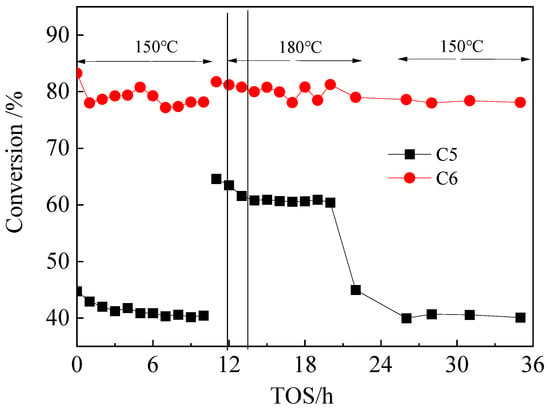
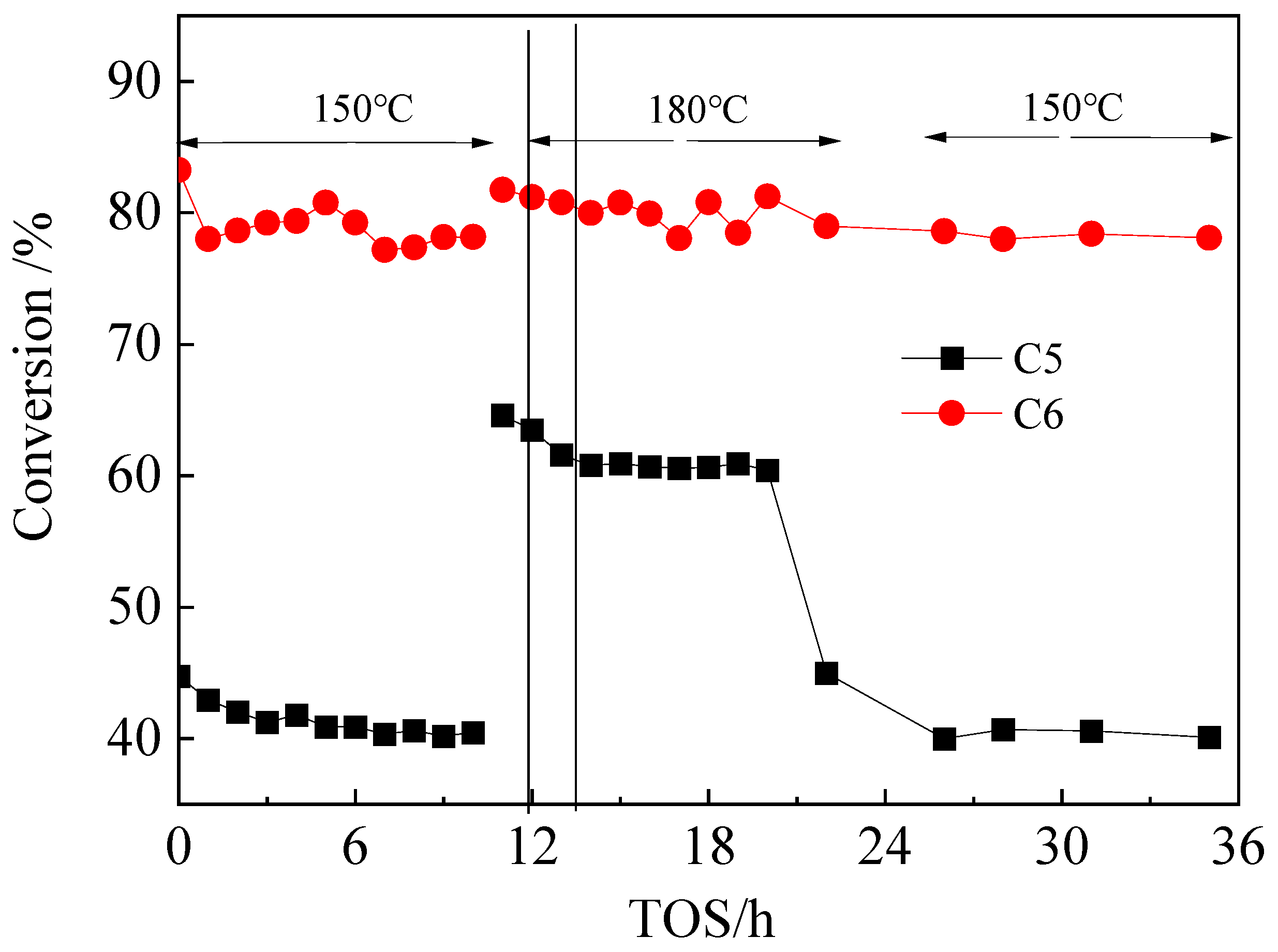
Since the industrial feed usually contained several kinds of hydrocarbon impurities, it was hard to distinguish the effect of every kind of impurity. Herein, the sole effect of methylcyclopentane (MCP) impurity on n-pentane and n-hexane isomerization behavior was investigated, as shown in Figure 13. Apparently, n-pentane conversion was very low, only ca. 41% at 150 °C. As the reaction temperature was increased to 180 °C, n-pentane conversion sharply increased to ca. 60%. In contrast, n-hexane conversion was high up to ca. 79% at 150 °C, and the enhancement in the temperature to 180 °C only led to a very slight increase in the n-hexane conversion. This showed that a single cycloalkane inhibited n-pentane conversion to a great extent, while the temperature increase distinctly weakened this inhibiting role and improved the conversion. However, for n-hexane, the effect was much weaker. As the reaction temperature dropped back to 150 °C, the conversion of n-pentane and n-hexane basically returned to its original value, indicative of the favorable stability of the PSZA catalyst.
Figure 13.
Conversion of n-alkanes in the prepared mixed feed on PSZA at different temperatures. (TOS: time on-stream, i.e., reaction time; feed b in Table 3: n-C5:n-C6:MCP = 48.2:45.3:6.5).
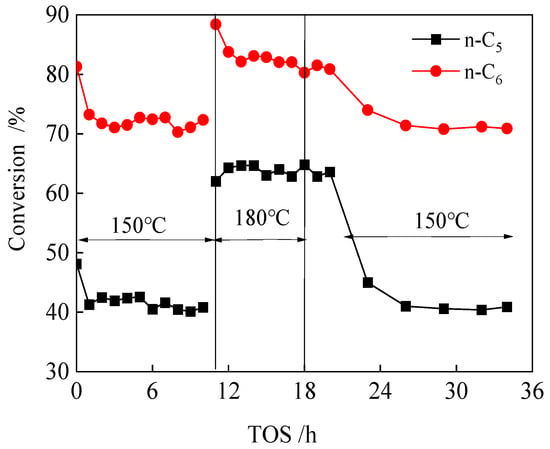
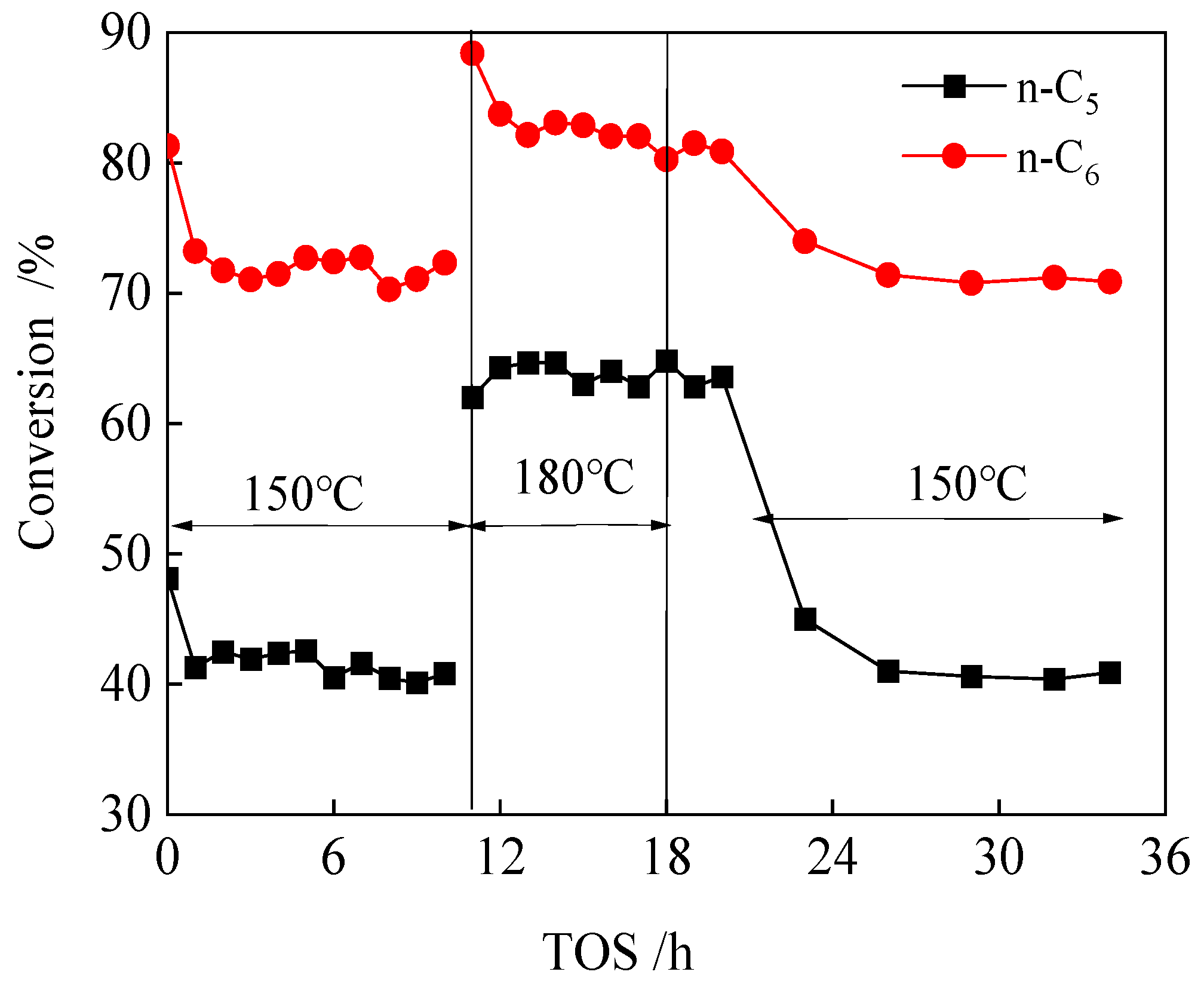
The effect of benzene on n-alkane isomerization is shown in Figure 14. Apparently, n-pentane conversion at 150 °C was very low, ca. 40%, while as the reaction temperature increased to 180 °C, n-pentane conversion sharply enhanced to ca. 60%, while n-hexane conversion at 150 °C was relatively high, ca. 70%, and the increase in the temperature to 180 °C led to a distinct boost of the n-hexane conversion to ca. 81%. This demonstrated that benzene in the feed inhibited the isomerization conversion of n-alkanes to a great extent. Moreover, the inhibition was more serious for n-pentane conversion than for n-hexane conversion. Meanwhile, this showed indirectly that n-hexane possessed higher isomerization reactivity. As the temperature was lowered to 150 °C, the conversion of n-pentane and n-hexane could still return to its initial value. Combined with the results from Figure 13, it could be concluded that the effect of benzene on n-alkane conversion was greater than that of cycloalkane.
Figure 14.
Effect of benzene on isomerization activity of n-alkanes in feed d. (TOS: time on-stream, i.e., reaction time; left: 150 °C; right: 180 °C; feed d in Table 3: n-C5:n-C6:benzene = 47.0:46.5:6.5).
3. Discussion
For mixed n-alkanes, the conversion of n-pentane and n-hexane was very close to the corresponding single n-alkane conversion. When the mixture of iso-alkane and n-alkane acted as the feed, the n-alkane conversion decreased due to the thermodynamic equilibrium limitation. However, the distribution of iso-alkane and n-alkane in the product was close to the equilibrium composition. When the feed contained some hydrocarbon impurities, n-alkane isomerization activity distinctly decreased and the decrease was more obvious for small-molecule n-alkanes, such as n-pentane. According to the results from TPSR, different hydrocarbons possessed different adsorption capacities. The adsorption capacity increased in the following order: n-pentane < n-hexane < cycloalkanes < benzene. This implied that as n-alkane, cycloalkane, and aromatics coexisted in the feed, the competitive adsorption of different hydrocarbons must occur, and aromatics and cycloalkane preferentially adsorbed on the stronger active sites over PSZA, meaning that n-alkane adsorbed on the relatively weak active sites. Thus, the competitive adsorption of hydrocarbon impurities would lead to a decrease in the isomerization activity of n-alkane, especially small alkanes. For example, n-pentane showed much lower reactivity than n-hexane, as the mixed feed contained a certain amount of hydrocarbon impurities (aromatics or cycloalkane). In addition, the results from the pulse reaction of different hydrocarbons in Figure 11 and the continuous reaction of different n-alkanes over K-modified K-PSZA in Figure 12 further confirmed that n-pentane possessed lower reactivity than n-hexane. Thus, as the feed contained n-alkane and iso-alkane, as well as hydrocarbon impurities (aromatics and or cycloalkanes), the competitive adsorption between different hydrocarbons led to a weak adsorption of n-alkanes, especially n-pentane due to the occupation of strong acid sites by cycloalkane and aromatics, which resulted in the lower isomerization activity of n-pentane. For the industrial feed, generally containing a small amount of impurities, the isomerization activity of n-alkanes, especially n-pentane, was obviously lowered. However, the enhancement of reaction temperature was shown to be capable of inhibiting the decrease in reactivity from competitive adsorption to a great extent. Therefore, for factual industrial feed, due to it containing several hydrocarbon impurities, a suitably high temperature was favorable to improve the isomerization of n-alkane, especially low-reactivity n-alkane.
In summary, the main reason for the influence of cycloalkanes and benzene impurities on the isomerization transformation of n-hexane should be attributed to two sides. One is the competitive adsorption of hydrocarbon impurities and the other is the difference in intrinsic reactivity of different n-alkanes.
4. Materials and Methods
4.1. Catalyst Preparation
The preparation of solid superacid catalyst Pt/SO42−/ZrO2-Al2O3 (PSZA) is detailed in the previous literature [10], where zirconium hydroxide supports were prepared by a precipitation method. A 25% ammonia solution was added dropwise to a 0.4 mol/L ZrOCl2·8H2O (64 g) solution with stirring, until the pH of the mother liquor was 9–10, and stirring was maintained for 1.0 h. After that, the slurry was statically aged at room temperature for 12 h. The slurry was filtered through vacuumizing and washed repeatedly with deionized water until the pH value of the filtrate was 7–8, and the obtained filter cake was dried at 110 °C for 24 h. The dried Zr(OH)4 weighed about 26 g. Then, it was ground to very fine powder and mixed with a given amount of pseudo-boehmite (AlOOH·nH2O, 69 wt% Al2O3). The mixture was impregnated with a 0.5 mol/L H2SO4 solution, with an impregnation ratio of 15 (15 mL H2SO4/gSZA), for 6 h with stirring, and was then filtered and dried at 110 °C for 24 h. Next, the dried powder was kneaded evenly with 13% HNO3 solution and extruded. The diameter of the extrudate was about 2 mm and the length was about 6–10 mm. Next, the extrudate was dried at 105 °C for 12 h and calcined at 650 °C for 3 h. The calcined sample (denoted as SZA) was crushed and sieved into small particles with a size of 20–40 mesh, and these particles weighed 12 g. Then, they were impregnated with H2PtCl6 solution for 24 h, and after that, they were dried at 105 °C for 12 h and calcined at 500 °C for 3 h. The final calcined catalyst was labeled as PSZA, in which the content of alumina binder was 23 wt% and the content of Pt was 0.5 wt%.
4.2. Catalyst Characterization
Pyridine adsorption infra-red (Py-IR) spectroscopy was carried out using an EQUIOX 55 Fourier transform infrared spectrometer (Bruker Corp., Billerica, MA, USA). Self-supporting wafers of the samples (ca. 14 mg, 15 mm diameter) were loaded on the IR cell. The wafers were degassed by evacuation at 450 °C for 1.0 h, cooled down to room temperature and background spectra of the sample were recorded on IR instrument. Then, the wafer was saturated with pyridine, evacuated at 150 °C for 1.0 h, cooled to room temperature, and FTIR spectra were recorded at a spectra resolution of 2 cm−1 with the subtraction of the sample background.
Temperature-programmed desorption of ammonia (NH3-TPD) of the catalyst was conducted using an AutoChem1 II 2920 (produced by Micromeritics Instrument Corporation, Norcross, GA, USA). The sample was placed in a quartz U-shape tube and pretreated by enhancing the temperature from room temperature to 500 °C at a rate of 10 °C/min under a flow of dry air for 1 h. The sample was then cooled to 50 °C and exposed to a saturated 10% NH3/He mixture for 1 h. The He flow was then switched on gradually, and the temperature was increased to 100 °C to remove weakly physically adsorbed NH3 on the surface until the baseline was stable. Finally, adsorbed NH3 was gradually desorbed, with the temperature increasing to 650 °C at a rate of 10 °C/min under He atmosphere, and the released gases were detected by TCD.
X-ray diffraction (XRD) was carried out using a Philips MagiX X-ray diffractometer (produced by Royal Philips, Eindhoven, The Netherlands). The scanning was performed within a range of 2θ from 10° to 70° at a scanning rate of 5 °/min.
X-ray fluorescence (XRF) experiments were conducted on a Philips MagiX X-ray fluorescence spectrometer (produced by Royal Philips, Eindhoven, The Netherlands), and IG+ standardless quantitative software (SPECTRAplus software 1.7, Beijing, China) was used for analysis and calculation.
N2 adsorption and desorption experiments were performed in liquid nitrogen at −196 °C on the NOVA 4000 gas adsorption analyzer (Quantachrome Corp., Boynton Beach, FL, USA). Each sample was degassed at 350 °C for 10 h before the measurement. The total surface area was calculated according to the BET isothermal equation, and the pore volume was evaluated using the BJH method.
Transmission electron microscopy (TEM) was carried out using a JEM-2010 (JEOL, Akishima, Japan) to determine the morphology and size of Pt particles over PSZA.
4.3. Catalyst Activity Evaluation
In the present investigation, a continuous flow fixed-bed microreactor and a U-shaped pulse reactor were used. For continuous reaction, the inner diameter of the reactor was 5 mm, and the length was 300 mm. A catalyst of 2 g (20–40 mesh) was loaded into the middle of the reactor, and the upper and lower parts were loaded with 20–40 mesh quartz sand to support the catalyst. Prior to reaction, the catalyst was activated in air at 500 °C for 1.5 h, and then the temperature was reduced to below 50 °C; nitrogen was introduced to replace and sweep the air. After that, hydrogen was introduced, and the catalyst bed temperature was increased to 250 °C, maintained for 1 h to reduce the catalyst, and then the temperature of the catalyst bed was lowered to the given temperature. Finally, the reactor was pressurized to 2.0 MPa, and the raw material was introduced by a double-plunger micro-pump into the fixed-bed reactor. The reaction pressure was 2.0 MPa, the molar ratio of hydrogen to oil was 3, and the WHSV was 1.5 h−1. All products of the reaction were analyzed using a GC-920 online chromatographer equipped with a capillary column with FID (produced by Shanghai Haixin Instrument Company, Shanghai, China). The conversion of n-alkane and the selectivity of isomeric products were calculated as follows:
X = (M0 − M1)/M0 × 100%
S = Mi-C6/X × 100%
x = W1/W0
X: n-C6 or n-C5 conversion rate; M0: n-C6 or n-C5 mass fraction in raw material; M1: n-C6 or n-C5 mass fraction in products.
S: selectivity of isomer products; Mi-C6: the sum of i-C6 mass fraction in isomer products.
x: isomerization rate; W1: weight percentage of iso-C5 or iso-C6 in products; W0: total weight percentage of n-C5 and iso-C5, or n-C5 and iso-C6 in products.
The in situ pulse reaction was performed under atmospheric pressure in a quartz microreactor (i.d = 3 mm) with an injection port. Pulse injection was performed at each temperature. The catalyst loading was 0.2 g. The catalyst pretreatment procedure is the same as that of a continuous reaction in a fixed-bed reactor. Hydrogen acted as a carrier gas (flow rate = 30 cm3.min−1) and the reaction pressure was 1 atmospheric pressure. As the pretreated catalyst in hydrogen was heated to a given temperature, a dose of about 10 µL feed was injected into the microreactor through the injection port using the injection needle. The formed products were directly analyzed by an online GC-950 with an FID and a capillary column (produced by Shanghai Linghua Instrument Company, Shanghai, China).
The programmed temperature surface reaction (TPSR) was carried out in a quartz U-shaped microreactor. The pretreatment condition of the sample was the same as that in the pulse reaction mentioned above. Different from pulse reaction, as for TPSR, the pretreated catalyst was first saturated with reactant through continuous pulse injection at room temperature. Then, the sample was heated to 250 °C at a heating rate of 2 °C/min in a hydrogen atmosphere at atmospheric pressure. The created products were continuously measured by an online GC-950 with an FID and a capillary column.
5. Conclusions
Light hydrocarbons from a refinery usually contain a certain amount of impurities, such as cycloalkanes and aromatics, except for n-alkanes and iso-alkanes. These hydrocarbon impurities have the potential to influence n-alkane isomerization conversion. For a mixed feed of n-pentane and n-hexane without hydrocarbon impurities, both feeds showed high isomerization activity over PSZA, regardless of the feed composition. However, for the mixed feed of n-pentane/iso-pentane or n-hexane/iso-hexane, n-alkane conversion decreased with the corresponding iso-alkane content due to the thermodynamic equilibrium limitation. Furthermore, for light hydrocarbons containing considerable impurities, such as refinery-reformed topped oil, the hydrocarbon impurities (cycloalkanes or benzene) had an obvious inhibiting effect on n-alkane isomerization conversion. This inhibition likely originates from the competitive adsorption of different hydrocarbons.
Firstly, hydrocarbon impurities possessed a stronger adsorption capacity than n-alkanes. Secondly, the adsorption capacity of n-pentane was lower than that of n-hexane. Moreover, the intrinsic reactivity of n-pentane was much lower than that of n-hexane. This led to a larger reduction in n-pentane conversion than in n-hexane conversion as the feed contained hydrocarbon impurities. In addition, for different hydrocarbon impurities, benzene adsorption was stronger than cycloalkane, and the inhibiting effect of benzene on n-alkane isomerization conversion was obviously larger than that of cycloakane. Therefore, n-pentane possessed much lower isomerization activity than n-hexane in the presence of different kinds of hydrocarbon impurities in the feed. In order to obtain high n-alkane isomerization conversion, a suitable improvement of the reaction temperature was essential. The present investigation provides an important reference for the industrial isomerization process.
Author Contributions
Y.S., Z.P. and L.H. prepared the catalysts, evaluated the catalyst activity, and co-wrote the manuscript. L.C. and X.Z. helped to direct the total experiment and to analyze results and correct the manuscript. All authors have read and agreed to the published version of the manuscript.
Funding
This work was financially supported by the State Key Laboratory of Heavy Oil Processing of China (No. WX20250151).
Data Availability Statement
The authors declare that the data supporting the findings of this study are available within the paper.
Conflicts of Interest
The authors declare no competing interests.
References
- Ai, G. Preparation of SO42−/ZrO2 solid superacid catalyst and its effect on the isomerization of n-hexane. China Ceram. 2019, 2, 15–23. [Google Scholar]
- Song, H.; Zhao, L.; Song, H.L.; Wang, N.; Li, F. Effect of La content on structure and isomerization of Ni-S2O82−/ZrO2-Al2O3 solid superacid catalyst. J. China Univ. Pet. (Nat. Sci. Ed.) 2015, 39, 150–156. [Google Scholar]
- Dai, H.K.; Song, H.; Qin, H. Preparation and catalytic performance of metal-modified solid superacid catalysts. Energy Chem. Ind. 2020, 41, 15–19. [Google Scholar]
- Zhong, X.P.; Yu, Z.W.; Liu, H.Q.; Chen, Y.H.; Huang, Y.K.; Xin, M.D. Influences of calcination temperature of Pt-SO42−/ZrO2-Al2O3 catalysts and their catalytic performance for isobutane isomerization. Acta Pet. Sin. (Pet. Process. Sect.) 2024, 40, 75–82. [Google Scholar]
- Song, Z.Y.; Xu, H.Q.; Liu, Q.J.; Jia, L.M. Pt-Ni/SZA catalyst for isomerization of n-hexane. Petrochemicals 2022, 51, 863–869. [Google Scholar]
- Yang, Y.; Liu, X.M.; Zheng, J.; Fu, J.Y.; Lyu, Y.C.; Cheng, Z.L.; Li, F.R.; Zhang, W.J. Zeolite pore confinement in adsorption and skeletal isomerization of n-hexane. Chem. Eng. Sci. 2025, 317, 122072. [Google Scholar] [CrossRef] [Scilit]
- Guo, K.; Ma, A.Z.; Li, J.Z.; Kong, L.J.; Liu, H.Q.; Yu, Z.W.; Li, D.D. Alkali-acid treated hierarchical Pt/Beta bifunctional catalyst for higher selectivity of multi-branched i-heptane in n-heptane hydroisomerization. React. Kinet. Mech. Catal. 2025, 138, 2277–2295. [Google Scholar] [CrossRef] [Scilit]
- Wang, P.Z.; Wang, S.Q.; Yang, C.H.; Li, C.Y.; Bao, X.J. Effect of Aluminum Addition and Surface Moisture Content on the Catalytic Activity of Sulfated Zirconia in n-Butane Isomerization. Eng. Chem. Res. 2019, 58, 14638–14645. [Google Scholar] [CrossRef] [Scilit]
- Tang, X.S.; Wang, X.P.; Jin, S. Mechanism of isomerization and cracking reaction of n-alkanes catalyzed by solid superacid SO42−/ZrO2. J. Hangzhou Univ. (Nat. Sci. Ed.) 1994, 3, 289–305. [Google Scholar]
- Zhou, S.N.; Song, Y.Q.; Zhao, J.G.; Zhou, X.L.; Chen, L.F. Study on the Mechanism of Water Poisoning Pt-Promoted Sulfated Zirconia Alumina n-Hexane Isomerization. Energy Fuels 2021, 35, 14860–14867. [Google Scholar] [CrossRef] [Scilit]
- Zhou, S.N.; Song, Y.Q.; Zhou, X.L. Study on the Role of Hydrogen in nHexane Isomerization Over Pt Promoted Sulfated Zirconia Catalyst. Catal. Lett. 2023, 153, 2406–2415. [Google Scholar] [CrossRef] [Scilit]
- Zhou, S.N.; Song, Y.Q.; Zhao, J.G.; Zhou, X.L. Impacts of Alumina Introduction on a Pt-SO42−/ZrO2 Catalyst in Light Naphtha Isomerization. Ind. Eng. Chem. Res. 2022, 61, 1285–1293. [Google Scholar] [CrossRef] [Scilit]
- Zhang, H.Y.; Song, Y.Q.; Ni, H.W.; Xu, J.; Zhou, X.L. Formation and life of solid superacid C5/C6 isomerization catalyst. Pet. Refin. Chem. Ind. 2018, 49, 79–86. [Google Scholar]
- Xu, C.M.; Yang, C.H. Petroleum Refining Engineering, 4th ed.; Petroleum Industry Press: Beijing, China, 2009. [Google Scholar]
- Guisnet, M.; Fouche, V. Isomerization of n-hexane on platinum dealuminated mordenite catalysts III. Influence of hydrocarbon impurities. Appl. Catal. 1991, 71, 307–317. [Google Scholar] [CrossRef] [Scilit]
- Furuta, S. The effect of electric type of platinum complex ion on the isomerization activity of Pt-loaded sulfated zirconia-alumina. Appl. Catal. A Gen. 2003, 251, 285–293. [Google Scholar] [CrossRef] [Scilit]
- Korica, N.; Hassine, A.B.; Thi, H.D.; Bergaoui, L.; Geem, K.M.V.; Mendes, P.S.F.; Clercq, J.D.; Thybaut, J.W. Mixture effects in alkane/cycloalkane hydroconversion over Pt/HUSY: Carbon number impact. Fuel 2022, 318, 123651. [Google Scholar] [CrossRef] [Scilit]
- Chen, J.L.; Liu, H.Q.; Lan, Y.; Zhang, H.B.; Yu, Z.W.; Zhang, X.; Su, Y.F.; Liang, S.K. Transformation of a semi-regenerative reforming unit into a solid superacid C5/C6 isomerization unit Industrial Practice. Pet. Refin. Chem. Ind. 2023, 54, 58–64. [Google Scholar]
- Busto, M.; Grau, J.M.; Canavese, S.; Vera, C.R. Simultaneous Hydroconversion of n-Hexane and Benzene over Pt/WO3-ZrO2 in the Presence of Sulfur Impurities. Energy Fuels 2009, 23, 599–606. [Google Scholar] [CrossRef] [Scilit]
- Busto, M.; Grau, J.M.; Sepulveda, J.H.; Tsendra, O.M.; Vera, C.R. Hydrocracking of Long Paraffins over Pt−Pd/WO3-ZrO2 in the Presence of Sulfur and Aromatic Impurities. Energy Fuels 2013, 27, 6962–6977. [Google Scholar] [CrossRef] [Scilit]
- Rodegheroa, E.; Chenetb, T.; Martuccia, A.; Ardita, M.; Sartib, E.; Pasti, L. Selective adsorption of toluene and n-hexane binary mixture from aqueous solution on zeolite ZSM-5: Evaluation of competitive behavior between aliphatic and aromatic compounds. Catal. Today 2020, 345, 157–164. [Google Scholar] [CrossRef] [Scilit]
- Galinsky, M.; Lutecki, M.; Bohm, J.; Papp, H.; Breitkopf, C. Sorption of alkanes on sulfated zirconias—Modeling of TAP response curves. Chem. Eng. Sci. 2011, 66, 1932–1939. [Google Scholar] [CrossRef] [Scilit]
- Lu, L.G.; Lu, M.Z.; Ying, H.J.; Zhang, H.Y.; Hu, X.Y.; Ji, J.B.; Tian, X.M.; Liu, X.J. Molecular Simulation of adsorption of three cycloalkanes in MCM-41 molecular sieve. Comput. Appl. Chem. 2014, 31, 921–924. [Google Scholar]
- Ji, W.X.; Xu, B.W.; Li, Q.C.; Long, C. Competitive adsorption properties of toluene and cyclohexane on activated carbon. Ion Exch. Adsorpt. 2019, 35, 385–394. [Google Scholar]
- Li, F.C.; Yuan, Q.M.; Wei, X.L. Effect of molecular structure of hydrocarbon on catalytic cracking performance. Acta Pet. Sin. 2020, 36, 661–666. [Google Scholar]
- Yu, Y.S.; Wu, L.Y.; Liu, H.J.; Long, C. Adsorption and penetration characteristics of two-component VOCs on adsorbent resin. China Environ. Sci. 2020, 40, 1982–1990. [Google Scholar]
- Song, Y.Q.; Zhu, X.X.; Xie, S.J.; Wang, Q.X.; Xu, L.Y. The effect of acidity on olefin aromatization over Potassium modified ZSM-5 catalyst. Catal. Lett. 2004, 97, 31–36. [Google Scholar] [CrossRef] [Scilit]

Disclaimer/Publisher’s Note: The statements, opinions and data contained in all publications are solely those of the individual author(s) and contributor(s) and not of MDPI and/or the editor(s). MDPI and/or the editor(s) disclaim responsibility for any injury to people or property resulting from any ideas, methods, instructions or products referred to in the content. |
© 2026 by the authors. Licensee MDPI, Basel, Switzerland. This article is an open access article distributed under the terms and conditions of the Creative Commons Attribution (CC BY) license.