
Article

Nitrogen-Doped MgO as an Efficient Photocatalyst Under Visible Light for the Degradation of Methylene Blue in Wastewater Treatment

1
Department of Chemistry and Biology “A. Zambelli” and INSTM Research Unit, University of Salerno, Via Giovanni Paolo II 132, 84084 Fisciano, Italy
2
CNR-SPIN (National Research Council—Institute for SuPerconductors, INnovative Materials, and Devices), c/o University of Salerno, Via Giovanni Paolo II 132, 84084 Fisciano, Italy
3
Department of Industrial Engineering, University of Salerno, Via Giovanni Paolo II 132, 84084 Fisciano, Italy
*
Author to whom correspondence should be addressed.
Catalysts 2026, 16(2), 162; https://doi.org/10.3390/catal16020162
Submission received: 29 November 2025 / Revised: 13 January 2026 / Accepted: 20 January 2026 / Published: 3 February 2026
(This article belongs to the Collection Catalysis in Advanced Oxidation Processes for Pollution Control)

Abstract

In this study, two nitrogen-doping strategies for magnesium oxide—an in situ method and a post-synthesis modification—were developed, and their visible-light photocatalytic activity was evaluated using methylene blue (MB) as a model organic pollutant. The materials were characterized using a combination of structural (SEM–EDX), spectroscopic (WAXRD, FTIR, Raman), optical (UV–DRS, PL), and thermal (TGA–MS) analyses. Both nitrogen-doped MgO samples exhibited significantly enhanced MB degradation compared to commercial MgO. Additional photocatalytic tests using phenol, a colorless contaminant, as a probe molecule suggested the occurrence of two distinct degradation pathways: direct photocatalysis for the in situ nitrogen-doped MgO, and a sensitization-mediated degradation process for the post-synthesis nitrogen-doped MgO. Based on the experimental results, a reaction mechanism is proposed.

Graphical Abstract

1. Introduction

Industrial development and rapid population growth have led to a significant increase in water pollution, compromising the quality of life for more than 15% of the global population [1]. Among the various contaminants, dyes released from textile effluents are particularly concerning due to their toxicity and environmental persistence [2]. Consequently, efficient wastewater treatment has become increasingly important. Conventional treatment approaches—such as adsorption, coagulation, and filtration—are widely used but exhibit major limitations, including high energy demand and the need for chemical additives [3,4].
Photocatalysis represents an attractive alternative, as photocatalysts can be activated by sunlight, a free and renewable energy source, and are generally stable, safe, and environmentally sustainable [5]. Several metal oxides, including TiO2 [6], ZnO [7], Fe2O3 [8], SnO2 [9], and BiVO4 [10], have been widely investigated due to their favorable photocatalytic properties. Upon light absorption, these semiconductors generate electron–hole pairs (e/h+) capable of oxidizing or reducing organic pollutants, ultimately mineralizing them into carbon dioxide (CO2) and water (H2O) [11]. Titanium dioxide, particularly in its anatase crystalline form, is among the most extensively studied photocatalysts owing to its high stability and reactivity under ultraviolet (UV) light. Zinc oxide offers comparable performance but may undergo photocorrosion under UV irradiation in aqueous environments, while nanoscale TiO2 can present potential toxicity issues [12].
Magnesium oxide (MgO) has recently attracted growing attention as a photocatalyst for dye degradation in aqueous media due to its wide band gap, low dielectric constant, low refractive index, and high chemical and thermal stability [13]. MgO, which crystallizes in the NaCl structure, is used in a variety of fields, including sensors [14], antimicrobial materials [15], water treatment [16], catalysis [17], adsorbents [18], and superconductors [19]. In its nanostructured form, MgO exhibits enhanced physicochemical characteristics such as increased ionic character, high specific surface area, non-toxicity, and biocompatibility [20]. These properties make it suitable for applications in ceramics [21], electronic devices [22], and even the food industry [23]. In this regard, MgO is approved as a food additive by the European Union (E 530) and recognized by the FDA, where it is used as a pH regulator, anti-caking agent, antacid, and decolorizer—for instance, in sugar refining—with specific usage limits depending on the food product [24,25].
MgO nanoparticles (NPs) can be synthesized using a wide range of physicochemical techniques, including sol–gel [26], microwave-assisted synthesis [27], solvothermal and hydrothermal methods [28], combustion synthesis [29], precipitation [30], green synthesis routes [31], plasma methods, and ultrasonic irradiation [32,33]. These techniques generally enable the production of small crystallites with high surface area, thereby enhancing photocatalytic activity in the degradation of organic dyes [34]. For example, Gatou et al. (2024) demonstrated that MgO nanoparticles efficiently degrade Rhodamine B (RhB) and Rhodamine 6G (R6G) under both UV and visible light irradiation [35]. Similarly, Algethami et al. (2021) synthesized MgO nanoparticles via a combustion method using glutamine and L-arginine as fuels, reporting nearly complete degradation of Orange G after 120 min of UV irradiation [36]. Piper betle leaf extract has also been used to produce biocompatible MgO nanoflowers with strong antibacterial properties and enhanced photocatalytic activity under sunlight for the degradation of methyl orange dye [37].
To overcome the moderate photocatalytic activity of MgO under UV light and extend its responsiveness to a broader portion of the electromagnetic spectrum, several studies have explored non-metal doping strategies [38,39,40]. In particular, Senevirathna et al. (2025) developed N-doped MgO exhibiting photocatalytic efficiencies exceeding 74.8% in the degradation of methylene blue under sunlight [41]. These results demonstrate that nitrogen doping can markedly enhance MgO’s photocatalytic properties by modifying its physical, chemical, and electronic characteristics. Nitrogen incorporation increases surface area and porosity, providing more active sites for pollutant adsorption, and narrows the MgO band gap, enabling visible-light absorption and promoting effective generation and separation of charge carriers [42]. The combined effect leads to significantly improved photocatalytic performance compared to undoped MgO [42].
To date, the literature reports on N-doped MgO mainly describe single doping routes, offering limited insight into how the doping strategy affects photocatalytic behavior. In contrast, the present work provides a comparative investigation of two different nitrogen-doping approaches—in situ and post-synthesis—and clarifies their impact on MgO’s electronic structure, visible-light activity, and pollutant degradation mechanism. An additional element of novelty lies in the use of both methylene blue and the colorless phenol, which allowed us to demonstrate that the two materials operate through distinct photocatalytic pathways: direct photocatalysis for the in situ–doped sample and a sensitization-mediated mechanism for the post-synthesis–doped one. Such mechanistic discrimination has not been previously described for MgO-based photocatalysts and provides new guidelines for the rational design of doped MgO for environmental remediation.

2. Results

2.1. Characterization of Samples

2.1.1. Wide-Angle X-Ray Diffraction

The structural properties of N–MgO(a) and N–MgO(b) were investigated by wide-angle X-ray diffraction (WAXRD) and compared with commercial MgO. As shown in Figure 1, all samples exhibit the characteristic diffraction peaks at 2θ = 36.7°, 42.9°, 62.1°, 74.4°, and 78.4°, which correspond to the (111), (200), (220), (311), and (222) crystallographic planes of MgO, respectively. These reflections are fully consistent with the face-centered cubic (FCC) structure of MgO and match the standard reference pattern (ICDD 00-045-0946).
Importantly, no diffraction peaks associated with Mg(OH)2 were detected in either N-doped sample, confirming their high phase purity. This finding demonstrates that both the in situ nitrogen-doping route used to obtain N–MgO(a) and the post-synthesis doping approach employed for N–MgO(b) successfully yield crystalline MgO without the formation of hydroxide impurities.
A shift toward lower diffraction angles is observed in the WAXRD pattern of N–MgO(a) compared to commercial MgO, whereas no appreciable shift is detected for N–MgO(b) (Figure 1B). This displacement suggests the presence of an overall lattice distortion or average lattice expansion within the MgO crystal structure, rather than a symmetry-breaking structural modification, and can be associated with defect formation induced during the nitrogen-doping process.
Consistently, the lattice parameters reported in Table 1 show an increase in the calculated lattice parameter c for N–MgO(a), which changes from 4.21 Å to 4.87 Å, reflecting a coherent modification of the unit cell dimensions. This variation occurs without a pronounced increase in lattice disorder, as supported by the relatively low dislocation density and microstrain values reported in Table 1. In contrast, commercial MgO and N–MgO(b) both exhibit lattice parameters consistent with a cubic unit cell, with c values nearly identical to those of pristine MgO. This indicates that the post-synthesis doping procedure does not produce a measurable long-range lattice expansion. Instead, the structural perturbation in N–MgO(b) is mainly reflected in a moderate increase in dislocation density and microstrain, suggesting the presence of localized lattice distortions rather than a global structural modification.
Crystallite size analysis further highlights the structural differences among the samples. Commercial MgO exhibits an average crystallite size of 37.3 nm, whereas N–MgO(b) shows a markedly reduced size of 4.60 nm, and N–MgO(a) displays an intermediate crystallite size of 12.0 nm [38]. Such size reduction in N–MgO samples may enhance surface reactivity.
Overall, these observations demonstrate that only the in situ doping pathway modifies the lattice parameter c in a structurally coherent manner, while the post-synthesis method produces defect-rich crystals without altering the observable unit-cell dimensions.

2.1.2. Raman Analysis

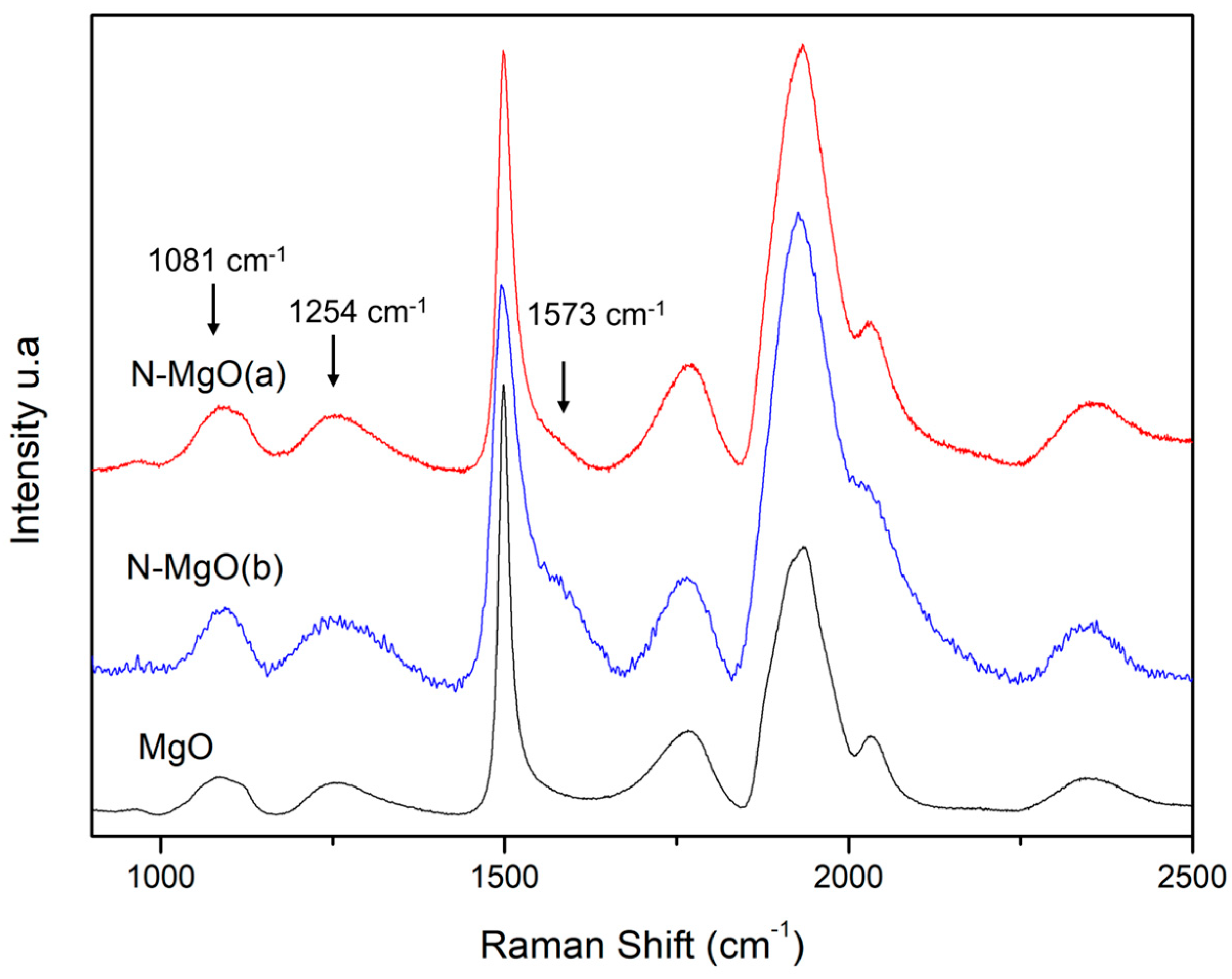
The Raman spectra of commercial MgO and the nitrogen-doped samples N–MgO(a) and N–MgO (b) are shown in Figure 2. All materials exhibit the characteristic MgO features, with two main bands of comparable intensity at approximately 1497 and 1927 cm−1, attributable to 2LO(T) phonons. Additional bands of intermediate intensity are observed at 1081 and 1254 cm−1, corresponding, respectively, to 2TA(X) modes, the (LO + TA(X)) combination, and the 2TO(X) and 2LO(L) phonons. These assignments are consistent with the literature data reported by Hattab et al. (2023) [43].
Although the overall spectral profile of the nitrogen-doped samples remains similar to that of pure MgO, a slight shift in the band near 1500 cm−1 toward lower wavenumbers is evident. This shift is likely related to nitrogen incorporation into the MgO lattice, which induces local structural distortions and generates defect states. Such behavior is consistent with the lattice perturbations inferred from the WAXRD analysis.
In addition, both N-doped samples display a shoulder around 1573 cm−1, which may be associated with surface-adsorbed species such as carbonate (CO32−) or molecular water (H2O)—a common feature on oxide surfaces and often enhanced by the increased surface reactivity induced by doping [44,45]. The emergence of these features further supports the presence of localized lattice modifications or internal macrostrain generated during the doping processes.

2.1.3. Fourier Transform Infrared (FT-IR) Spectroscopy

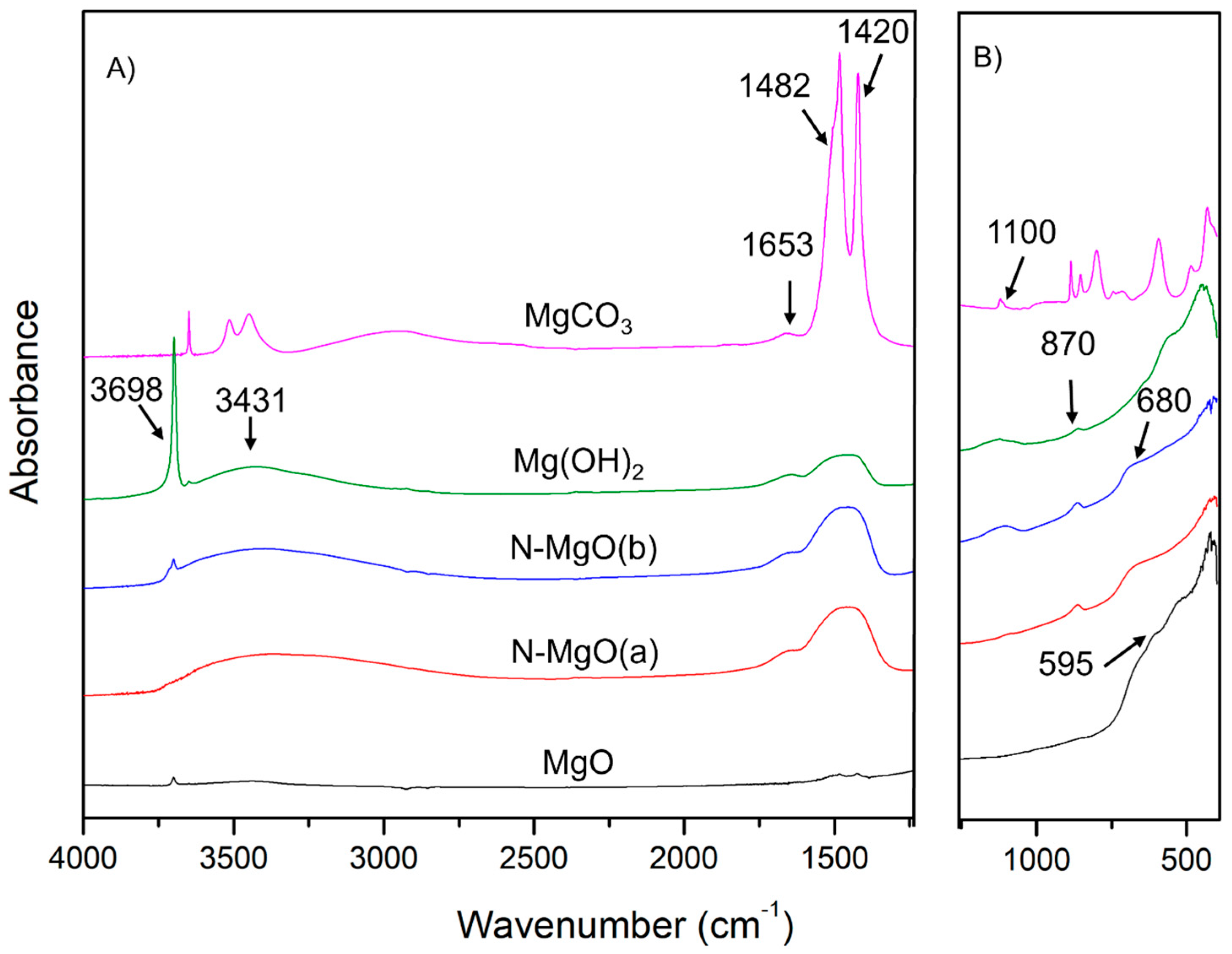
The FTIR spectra of commercial MgO and the nitrogen-doped samples N–MgO(a) and N–MgO(b) are shown in Figure 3. FT-IR spectra were recorded in the 3900–390 cm−1 range to identify the chemical bonds present in the samples (Figure 3). As shown in Figure 3A, all materials display a broad absorption band around 3600 cm−1, characteristic of the stretching vibration of hydroxyl groups (–OH). The band at approximately 1653 cm−1 is assigned to the bending vibration of physically adsorbed water molecules (H–O–H) [46].
Bands centered at 1100 and 1482–1420 cm−1 (Figure 3A) correspond to the stretching vibrations of C–O groups associated with surface carbonate species (CO32−), which form due to the reaction of atmospheric CO2 with MgO; this behavior is consistent with the FT-IR features of MgCO3 [47]. Notably, the band at approximately 3698–3700 cm−1, observed in the N–MgO(b) sample, also appears in the reference Mg(OH)2 spectrum (Figure 3A). This high-frequency O–H stretching vibration is typically associated with strongly bonded hydroxyl groups in Mg–OH environments, indicating that the post-synthesis nitrogen-doped sample retains hydroxyl species with local structural arrangements similar to those present in Mg(OH)2. Its presence does not imply free or weakly coordinated hydroxyls, but rather reflects the characteristic vibrational signature of Mg–OH groups bonded in a more ordered, less hydrogen-bonded environment.
In the low-frequency region (1000–390 cm−1; Figure 3B), commercial MgO exhibits the typical Mg–O stretching vibration near 595 cm−1. In contrast, this band shifts to approximately 680 cm−1 in the nitrogen-doped samples (N–MgO(a) and N–MgO(b)), a phenomenon that can be associated with lattice distortions induced by nitrogen incorporation, as previously reported by Rajagopa et al. (2022) [48,49]. Additionally, both doped samples present a band around 870 cm−1, which is typically related to structural defects or surface interactions [50].

2.1.4. TGA-MS Analysis

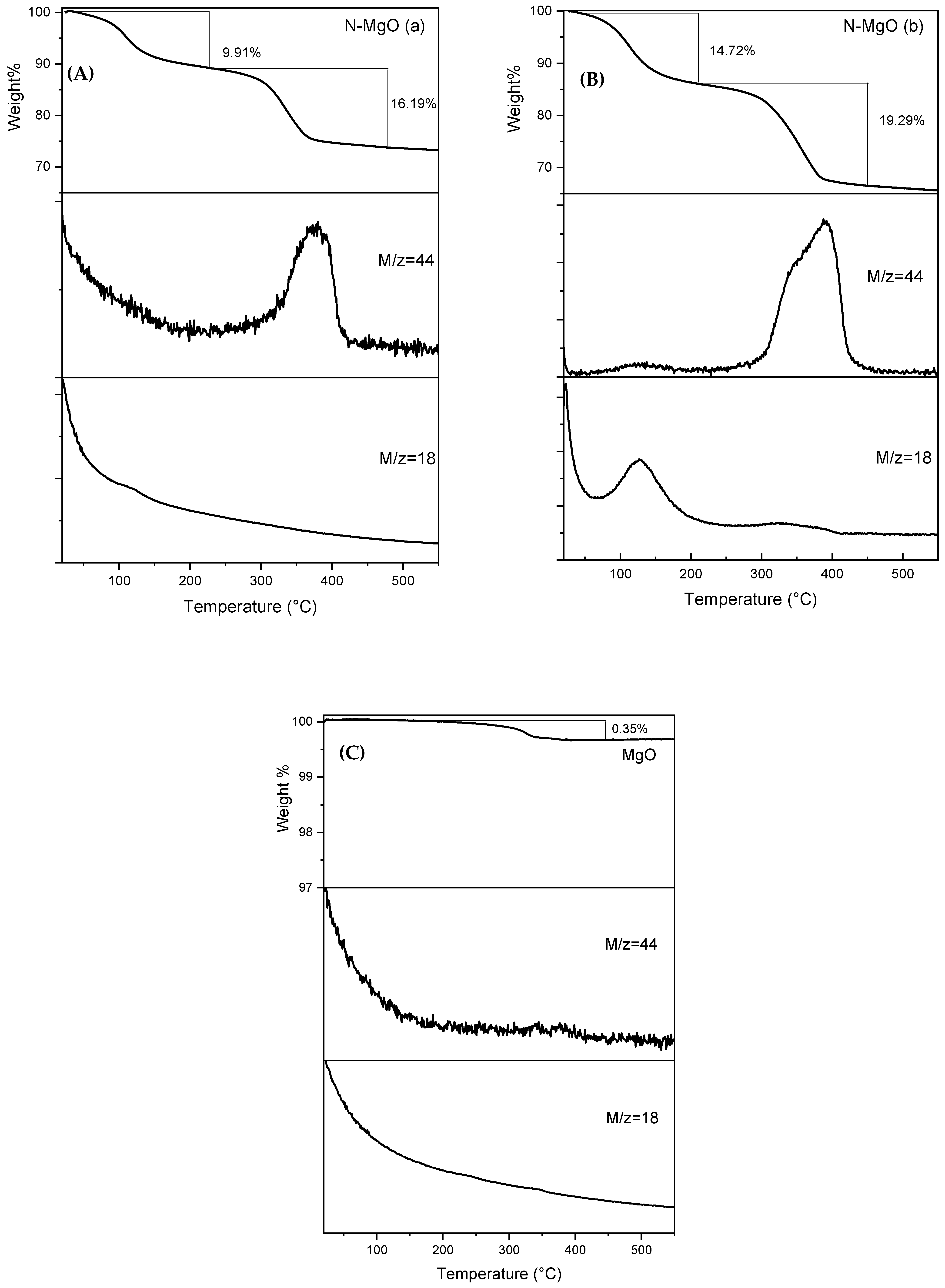
TGA–MS analyses performed in air for all samples are shown in Figure 4. Both N–MgO(a) and N–MgO(b) exhibit two main weight-loss events. The first event, observed between 25 and 110 °C, is associated with the removal of physiosorbed water, as confirmed by the MS signal at m/z = 18. This loss is more pronounced for N–MgO(a), indicating a higher amount of weakly bound surface moisture.
A second mass-loss process occurs between 200 and 400 °C, corresponding to the release of CO2 (m/z = 44) from the decomposition of surface carbonates formed through atmospheric CO2 adsorption. As evidenced in Figure 4B, the N–MgO(b) sample not only releases CO2 in this temperature range but also shows a simultaneous evolution of H2O (m/z = 18). This indicates that, in the post-synthesis–doped sample, a fraction of hydroxyl groups or Mg(OH)2-like domains is more strongly retained within the structure and decomposes at higher temperatures together with carbonates, in agreement with the FT-IR results.
In contrast, N–MgO(a) releases water and CO2 in two clearly separated steps, suggesting that its hydroxyl groups are mainly surface-bound and less strongly stabilized compared to N–MgO(b).
The commercial MgO sample, as expected based on its high purity (97%), shows only minimal mass loss across the entire temperature range, consistent with the very weak MS signals reported in Figure 4, which confirms the presence of a fraction of hydroxyl groups or Mg(OH)2-like domains, also shown in the FT-IR spectrum.

2.1.5. SEM-EDX Analysis

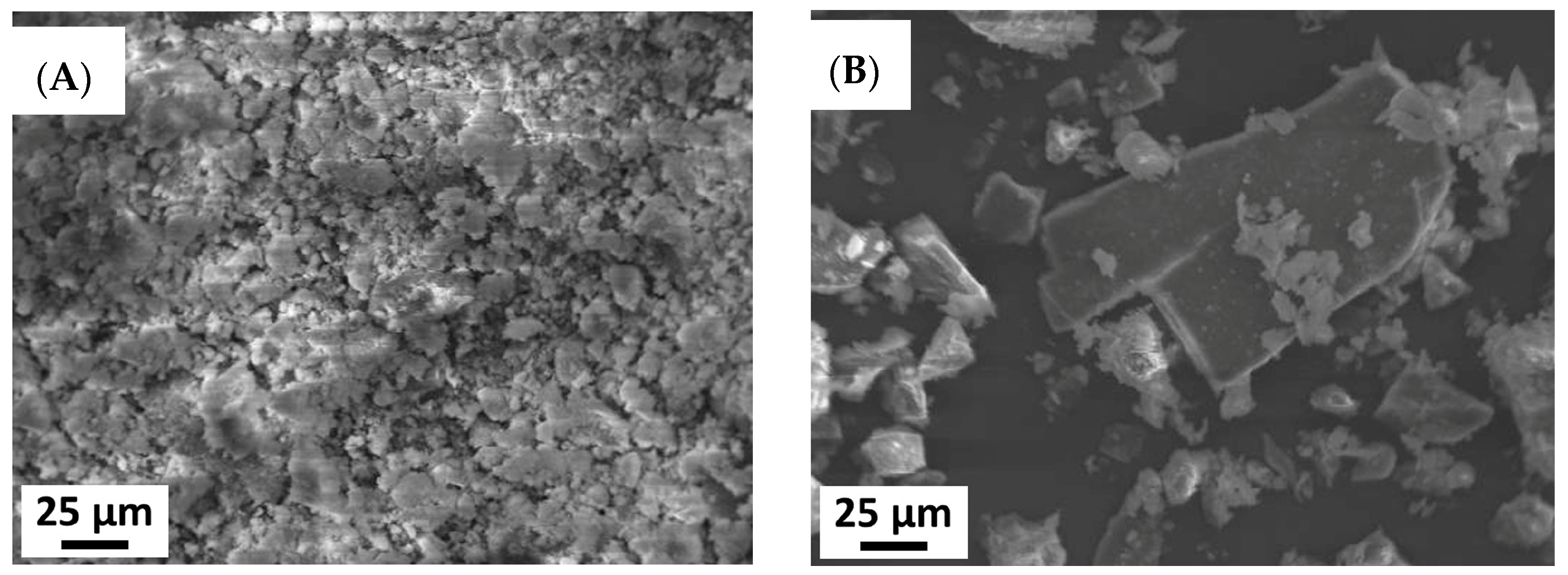
The SEM images of the nitrogen-doped MgO samples reveal two clearly distinct structures, as shown in Figure 5. The N–MgO(a) sample (Figure 5A) is composed of fine, irregular, and strongly agglomerated grains with smooth contours and no well-defined crystalline facets. This feature is indicative of rapid nucleation and growth, leading to nanoscale aggregates with high defect density. In contrast, the N–MgO(b) sample (Figure 5B) exhibits well-developed crystals with flat faces and sharp edges, corresponding to the characteristic cubic morphology of the periclase (MgO) phase.
EDX analysis was performed to estimate the relative nitrogen (N) content in the N–MgO samples by evaluating the N/Mg weight ratios. The results indicate that N–MgO(a) incorporates a higher amount of nitrogen, with an N/Mg ratio of 0.047, whereas N–MgO(b) shows a lower ratio of 0.031 (Table 2). This confirms that the in situ doping route is more effective in introducing nitrogen into the MgO lattice compared to the post-synthesis modification.

2.1.6. BET (Brunauer–Emmett–Teller) Analysis

The specific surface areas of the pure and nitrogen-doped MgO samples were determined from nitrogen adsorption isotherms measured at −196 °C, with the corresponding values reported in Table 2.
The surface area of MgO is strongly influenced by the calcination temperature. As observed by Huang et al. [51], intermediate thermal treatments (400–600 °C) promote an increase in surface area due to the decomposition of amorphous magnesite, which generates a porous structure. Commercial MgO exhibits a very low specific surface area of approximately 6 m2/g.
In contrast, both nitrogen-doped MgO samples show substantially higher surface areas. The N–MgO(a) sample, calcined at 350 °C, reaches a surface area of 35.6 m2/g, representing nearly a six-fold increase compared to commercial MgO. The N–MgO(b) sample, despite undergoing a higher calcination temperature (500 °C), displays the highest surface area, approximately 47.7 m2/g, corresponding to almost an eight-fold enhancement relative to the commercial material. These marked differences highlight the strong dependence of porosity and accessible surface area on both the calcination temperature and the nitrogen-doping strategy. In particular, the post-synthesis modification used for N–MgO(b) appears to inhibit grain coalescence more effectively, resulting in the largest specific surface area among the prepared samples.
Nevertheless, the surface areas of both doped MgO samples remain lower than those theoretically attainable under optimized, water-free calcination conditions. As discussed by Gliński et al. (2022), the thermal decomposition of Mg(OH)2 in the presence of water vapor promotes sintering of the newly formed MgO, drastically reducing its final specific surface area [52].

2.1.7. PZC Evaluation

The surface acidity of the prepared samples was assessed using the mass titration method, and the corresponding pH values—representative of the point of zero charge (PZC)—are reported in Table 2. The PZC value of commercial MgO was found to be 10.9, in good agreement with the literature values reported for high-purity MgO materials [53].
The N–MgO(a) sample exhibits a comparable PZC value (10.5), indicating that nitrogen incorporation through the in situ doping route does not significantly modify the overall acid–base character of the MgO surface. This suggests that, despite the presence of nitrogen-containing species, the fundamental surface chemistry remains largely governed by Mg–O structural units.
In contrast, the N–MgO(b) sample displays a slightly lower PZC value (10.2), which corresponds to a higher surface acidity relative to both commercial MgO and N–MgO(a). This increase in acidity is likely associated with the higher abundance of surface –OH groups, as evidenced by the FT-IR analysis (Section 2.1.3), where N–MgO(b) shows more pronounced O–H stretching features and Mg(OH)2-like signatures. The presence of these hydroxyl groups can act as Brønsted acidic sites, thereby shifting the PZC toward lower pH values.

2.1.8. UV–Vis Diffuse Reflectance Spectroscopy (DRS) and Photoluminescence Spectroscopy (PL)

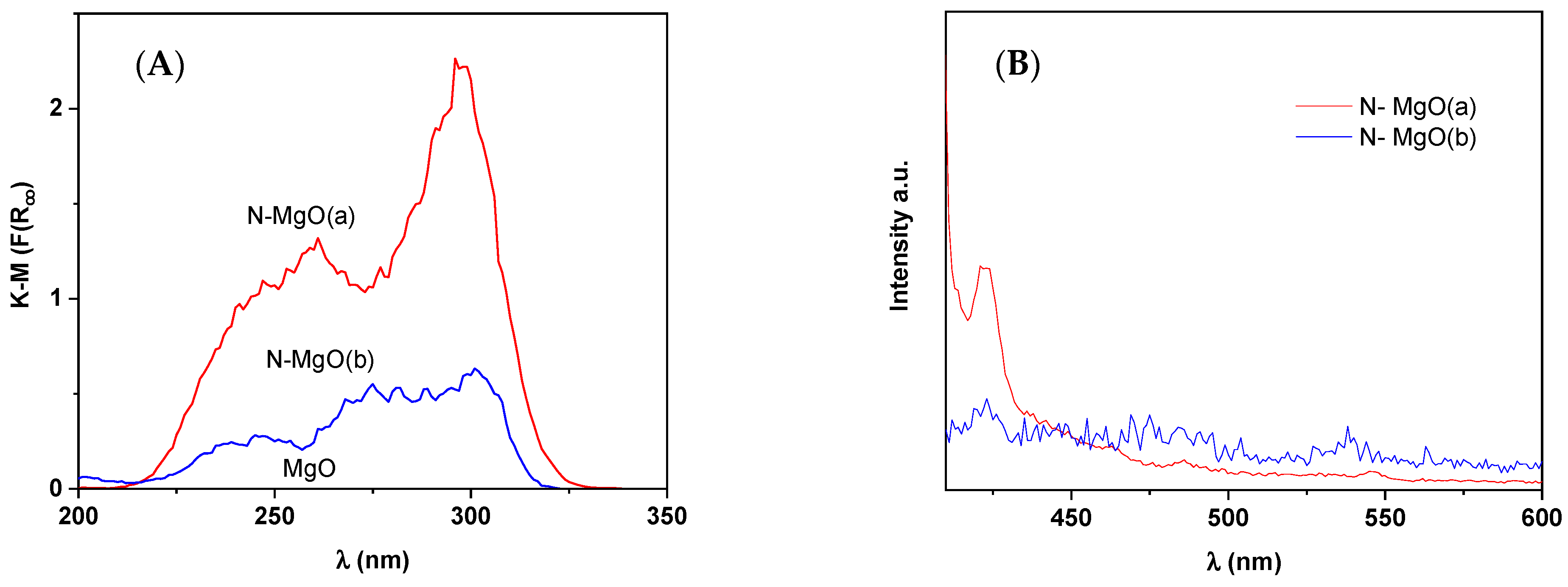
The absorption spectra of all samples, obtained from diffuse reflectance measurements using the Kubelka–Munk (K–M) function F(R), are reported in Figure 6A.
As expected, the commercial MgO sample does not exhibit absorption features in the UV–Vis range, consistent with its wide band gap and the absence of defect-related electronic states.
In contrast, both nitrogen-doped samples display a broad absorption band in the 240–340 nm region, which can be attributed to nitrogen-induced defect states within the MgO lattice. Notably, the spectrum of N–MgO(a) is red-shifted and exhibits higher absorption intensity compared to N–MgO(b).
Band gap energies (Ebg) were estimated using the Kubelka–Munk approach [54], and the results are summarized in Table 2. The commercial MgO sample does not exhibit a well-defined band gap in the measured spectral range. In contrast, the nitrogen-doped samples show band gaps of 3.8 eV for N–MgO(a) and 4.0 eV for N–MgO(b).
The PL properties of MgO and N–MgO nanoparticles were investigated at room temperature. It is well established that, in nanomaterials, PL intensity is commonly correlated with the presence and density of structural defects [55]. The PL spectra were recorded using an excitation wavelength of 400 nm. Figure 6B shows the PL emission spectrum of as-synthesized MgO nanoparticles dispersed in double-distilled water.
PL analysis of the nitrogen-doped samples highlights a clear difference between the two materials. While N–MgO(b) exhibits negligible emission, N–MgO(a) displays a well-defined emission peak centered at approximately 422 nm, together with a broader and less intense band around 550 nm. The distinct emission at 422 nm, located in the blue region of the visible spectrum, is generally attributed to defect-related electronic transitions involving localized states within the MgO band gap, commonly associated with dopant-induced or defect-induced energy levels [56,57].
The presence of these emission features in N–MgO(a), combined with their absence in N–MgO(b), indicates a higher density of optically active defect states in the former. Dopant incorporation can locally modify the crystal field and introduce additional electronic states, which enhance radiative recombination pathways and give rise to visible emission. Although PL analysis does not provide direct information on the specific nature or lattice position of nitrogen species, the observed trends support the conclusion that the two doping strategies generate distinct defect environments, consistent with the differences observed in UV–Vis absorption and photocatalytic behavior.

2.2. Photocatalytic Activity Results

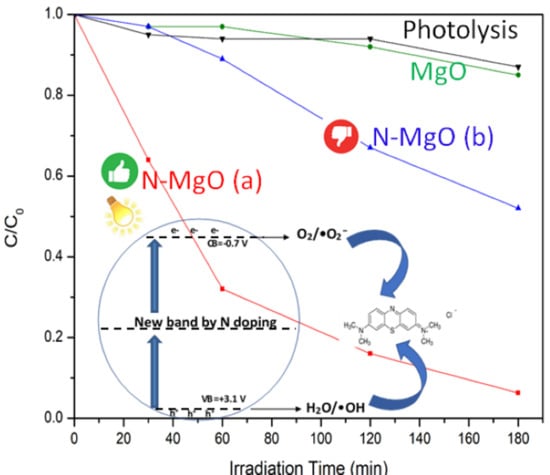
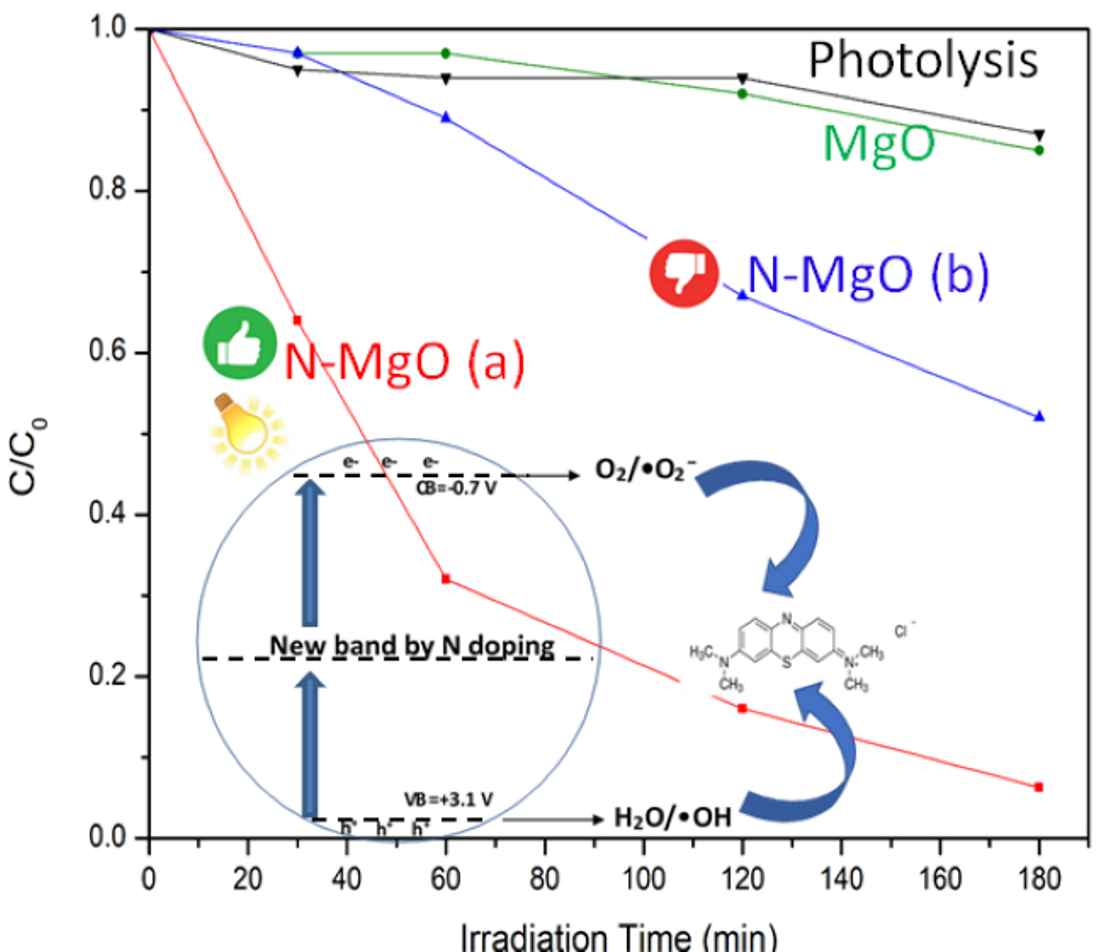
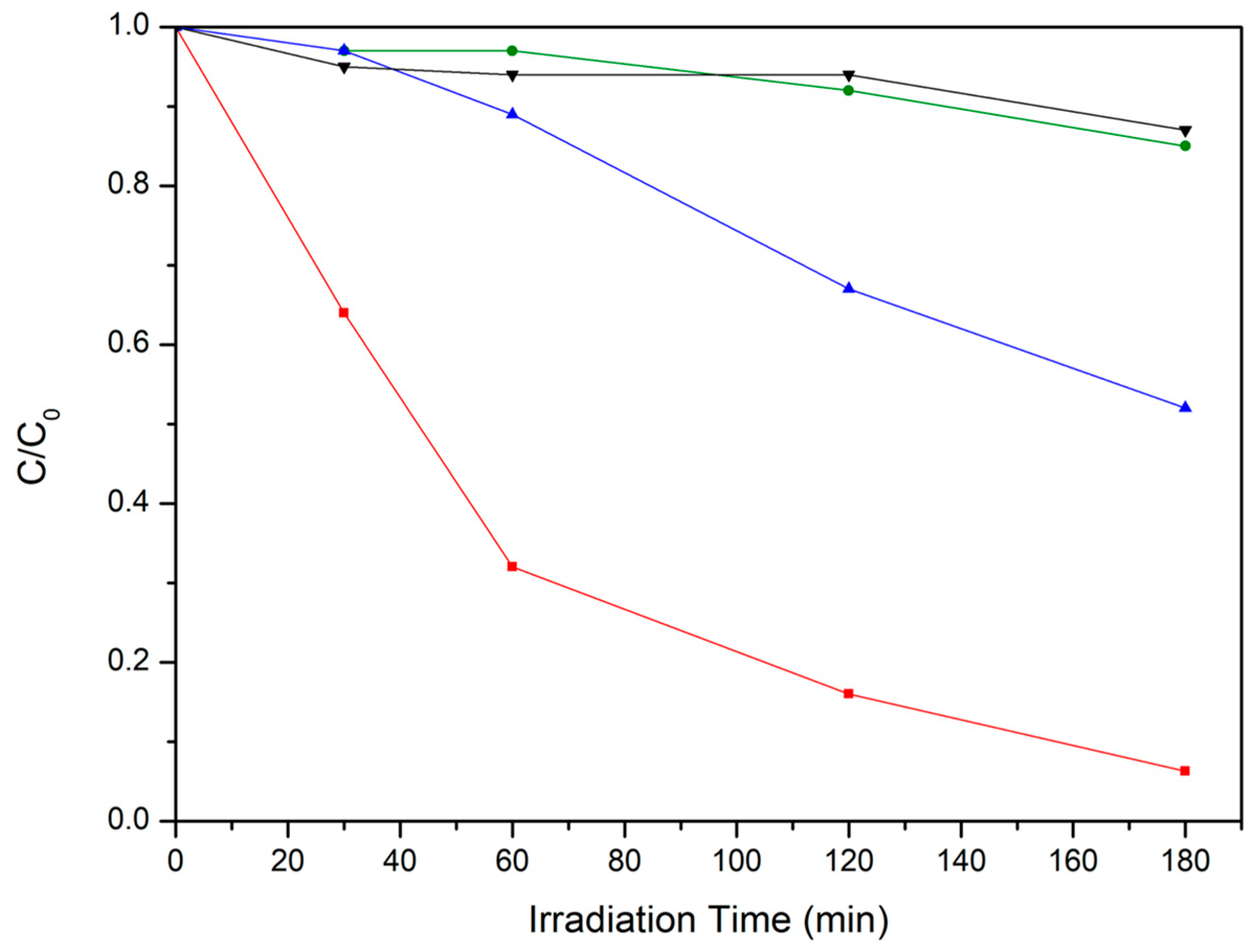
The photocatalytic performance of MgO, N–MgO(a), and N–MgO(b) was evaluated by monitoring the degradation of MB under visible-light irradiation, as shown in Figure 7. A control test performed in the absence of any photocatalyst revealed that photolysis alone leads to only 17% MB degradation after 180 min, confirming that direct light-induced decomposition is negligible under the employed conditions.
Among the investigated materials, N–MgO(a) exhibits the highest photocatalytic efficiency, achieving 94% degradation of MB. The N–MgO(b) sample shows moderate activity (50% degradation), while commercial MgO displays very poor performance (≈15%), essentially comparable to photolysis. These results clearly demonstrate that nitrogen incorporation plays a decisive role in enhancing the photocatalytic activity of MgO under visible-light irradiation, although the magnitude of the improvement strongly depends on the doping strategy.
To further assess the influence of nitrogen (N) on photocatalytic activity, the pseudo-first-order rate constant (k) for MB photocatalytic decolorization was calculated [58]. The k values were determined from the slope of the straight line obtained by plotting −ln(C/C0) versus irradiation time (t), according to the following Equation (1):
ln(C0/C) = kt,
where C0 is the initial MB concentration, C is the concentration at time t, and k is the rate constant of the pseudo-first-order reaction.
The kinetic parameters and degradation efficiencies of the catalysts are reported in Table 3.
The overall rate constants for MB decolorization followed the order:
kN-MgO(a) > kN-MgO(b) > kMgO
The contrasting behavior of the two nitrogen-doped samples can be rationalized by considering how nitrogen incorporation—introduced through different synthesis routes—affects the structural and electronic defect landscape of MgO. As suggested by Pesci et al. (2010) [59], nitrogen incorporation under oxygen-rich synthesis conditions may favor the formation of interstitial-like nitrogen-related defects, which are known to generate localized electronic states within the band gap. In the case of N–MgO(a), this interpretation is supported by the more intense and red-shifted UV–Vis absorption, as well as by the presence of defect-related features in PL spectroscopy, indicating an increased density of electronically active defect states.
Consistently, N–MgO(a) exhibits a shift in the diffraction peaks toward lower angles and an increase in the calculated lattice parameter c (from 4.21 Å to 4.87 Å), which reflects an overall lattice distortion or average lattice expansion within the MgO crystal structure. This modification occurs without a pronounced increase in lattice disorder, as indicated by the relatively low dislocation density and microstrain values, suggesting a coherent structural response to defect formation rather than a symmetry-breaking transformation.
In contrast, nitrogen incorporation under oxygen-poor conditions—such as those employed in the post-synthesis treatment used for N–MgO(b)—is commonly associated with substitutional-like defect configurations [59]. For this sample, the c parameter remains essentially identical to that of commercial MgO, consistent with the preservation of a cubic unit cell and the absence of measurable long-range lattice expansion. Instead, the structural response of N–MgO(b) is mainly reflected in an increased microstrain and dislocation density, pointing to localized lattice distortions rather than a global modification of the crystal structure. This interpretation is further supported by the Raman and PL results, which indicate defect formation without the emergence of strongly optically active states.
Furthermore, FT-IR and TGA–MS results indicate the presence of significant amounts of Mg(OH)2-like surface domains in N–MgO(b), evidenced by the intense O–H stretching band near 3700 cm−1 and by the release of H2O between 200–400 °C. These domains do not contribute positively to photocatalysis: the strongly bound Mg–OH groups they contain are not efficient precursors for hydroxyl radical (•OH) formation. This helps explain why N–MgO(b), despite being nitrogen-doped, displays a substantially lower activity compared to N–MgO(a).

2.2.1. Mechanism for MB Photodegradation

To verify whether the observed photocatalytic performance was genuinely associated with nitrogen incorporation—rather than being a false positive arising from dye photosensitization—a control test was carried out using phenol, a colorless pollutant that cannot act as a photosensitizer. Control experiments, including photolysis tests performed in the absence of the photocatalyst and dark adsorption tests conducted without light irradiation, are reported in Figures S1 and S2, respectively. These experiments confirm that no measurable phenol degradation occurs under either condition, indicating that neither direct photolysis nor adsorption contributes significantly to phenol removal under the applied experimental conditions.
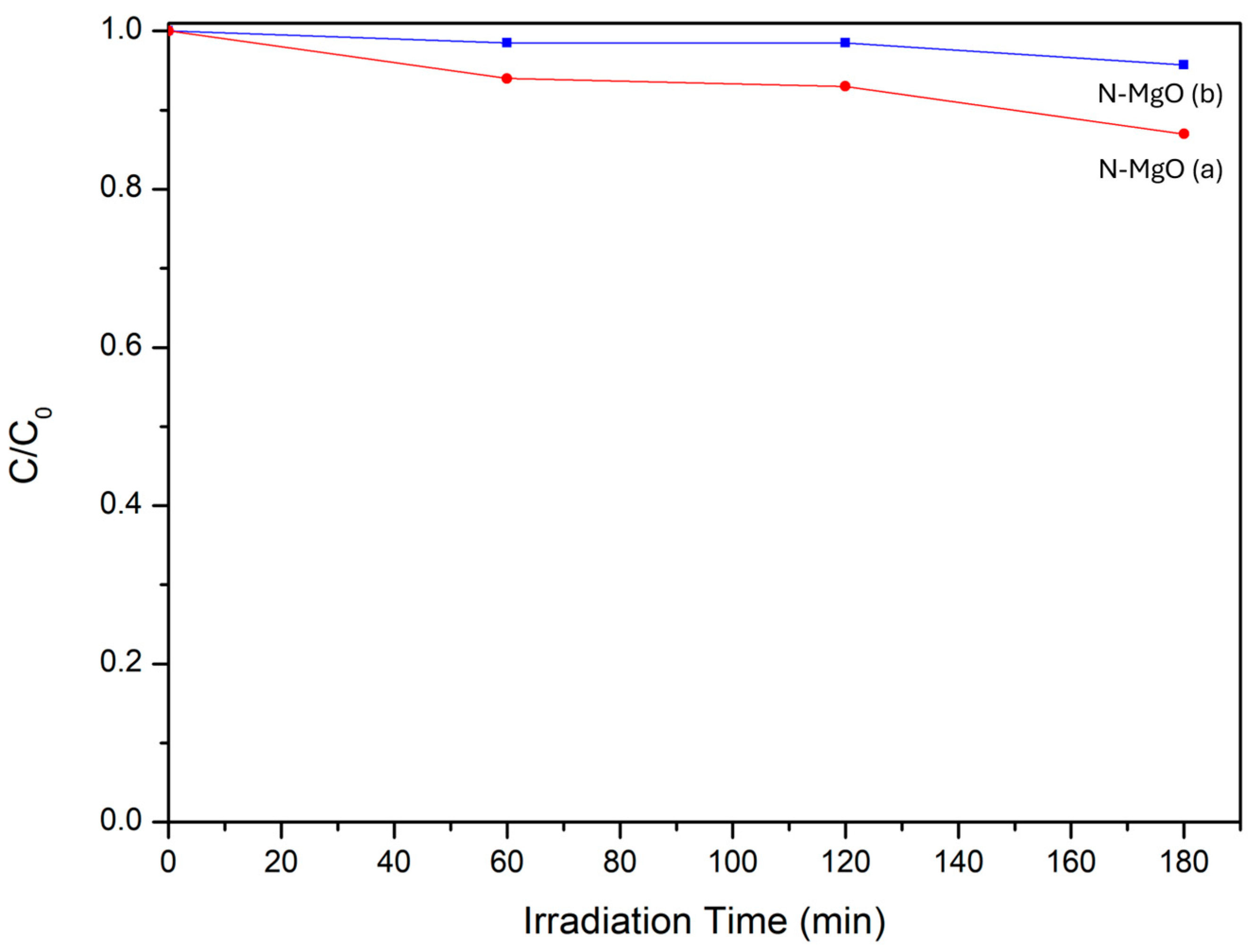
The results shown in Figure 8 reveal a clear difference between the two nitrogen-doped samples.
The N–MgO(a) sample exhibits measurable photocatalytic activity toward phenol, achieving approximately 15% removal during the irradiation period, a value that exceeds the experimental uncertainty of the absorbance measurements (≈5%) used to determine phenol concentration. In contrast, N–MgO(b) shows no detectable phenol degradation under identical conditions.
This divergent behavior supports the presence of different photodegradation pathways for the two samples. In particular, the activity observed for N–MgO(a) is consistent with a direct photocatalytic mechanism, whereas the lack of phenol degradation for N–MgO(b) indicates that its activity toward dyes arises predominantly from a sensitization-mediated process, as reported in the literature [60].
In the case of N–MgO(b), the degradation of methylene blue occurs only when the dye itself absorbs visible light. Under visible irradiation, MB molecules are excited from the HOMO to the LUMO, and if the LUMO energy lies above the conduction band (CB) of the photocatalyst, electrons can be injected into the CB. These transferred electrons generate reactive oxygen species (ROS) capable of degrading the dye. This mechanism (commonly referred to as photosensitization) has been widely reported for various semiconductor systems, including cationic new fuchsin/graphene quantum dots [61], RhB/Zn-BiOBr [62], MB-MO/Eu3+-ZnO [63], and RhB/Nb2O5 [64].
A different scenario emerges for N–MgO(a). This sample not only degrades methylene blue but also shows activity toward phenol, providing strong evidence for a direct photocatalytic pathway.
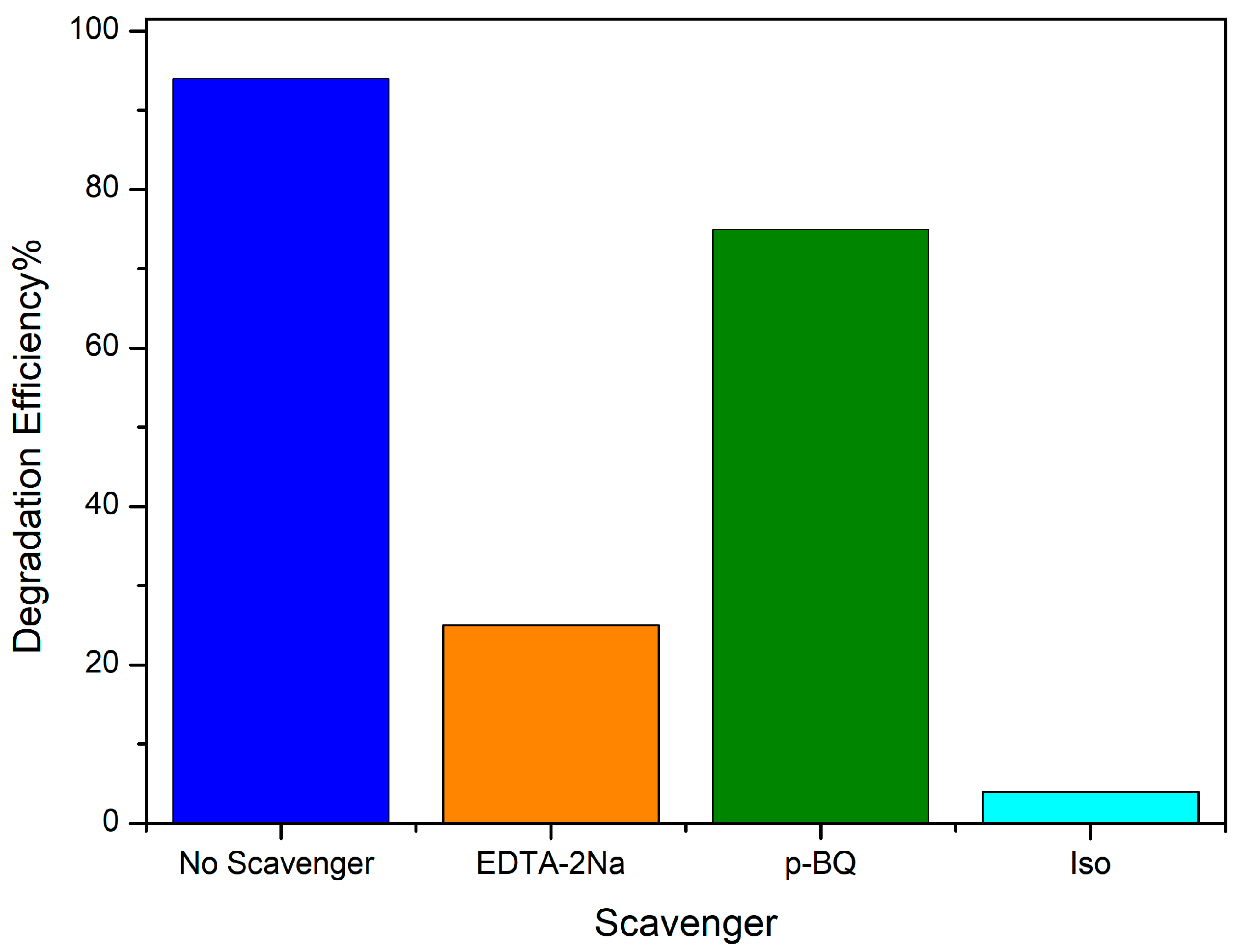
To further elucidate the mechanism, scavenger experiments were conducted using specific quenching agents for the main reactive oxygen species involved in photocatalysis. EDTA-2Na was used as a hole (h+) scavenger, isopropanol (IPA) as a hydroxyl radical (•OH) scavenger, and p-benzoquinone (p-BQ) as a superoxide radical (•O2) scavenger. The results are summarized in Figure 9.
The scavenger experiments clearly indicate that hydroxyl radicals are the primary reactive species responsible for methylene blue degradation. In fact, when isopropanol—used as a •OH scavenger—is added to the MB solution, the photocatalytic activity is completely suppressed, demonstrating that •OH radicals play a dominant role in the oxidation process.
Further confirmation comes from the experiment performed in the presence of EDTA, which acts as a hole scavenger. Under these conditions, the degradation efficiency drops to only 25%, as the removal of photogenerated holes prevents their reaction with water or surface hydroxyl groups, thereby inhibiting the formation of •OH radicals.
In contrast, when benzoquinone—an effective scavenger of superoxide radicals—is added, a significant level of degradation is still observed, indicating that superoxide radicals are not the primary oxidizing species involved in MB photodegradation. Taken together, these results demonstrate that •OH radicals are the main reactive oxygen species driving the photocatalytic activity.
Based on the results of the photocatalytic quenching experiments—which identified both •OH and •O2 as the main reactive species involved in MB degradation—and on the physicochemical characterization data, it can be inferred that nitrogen doping introduces additional electronic states within the band gap of MgO. These defect- or dopant-induced states enable visible-light absorption and facilitate charge carrier generation and separation. On this basis, a plausible mechanism for the visible-light activation of the N–MgO(a) sample is proposed.
To this end, the position of the conduction band (CB) edge of N–MgO(a) was estimated using the Mulliken electronegativity approach, according to the following relation [65]:
ECB = χ − Ee − 0.5Eg
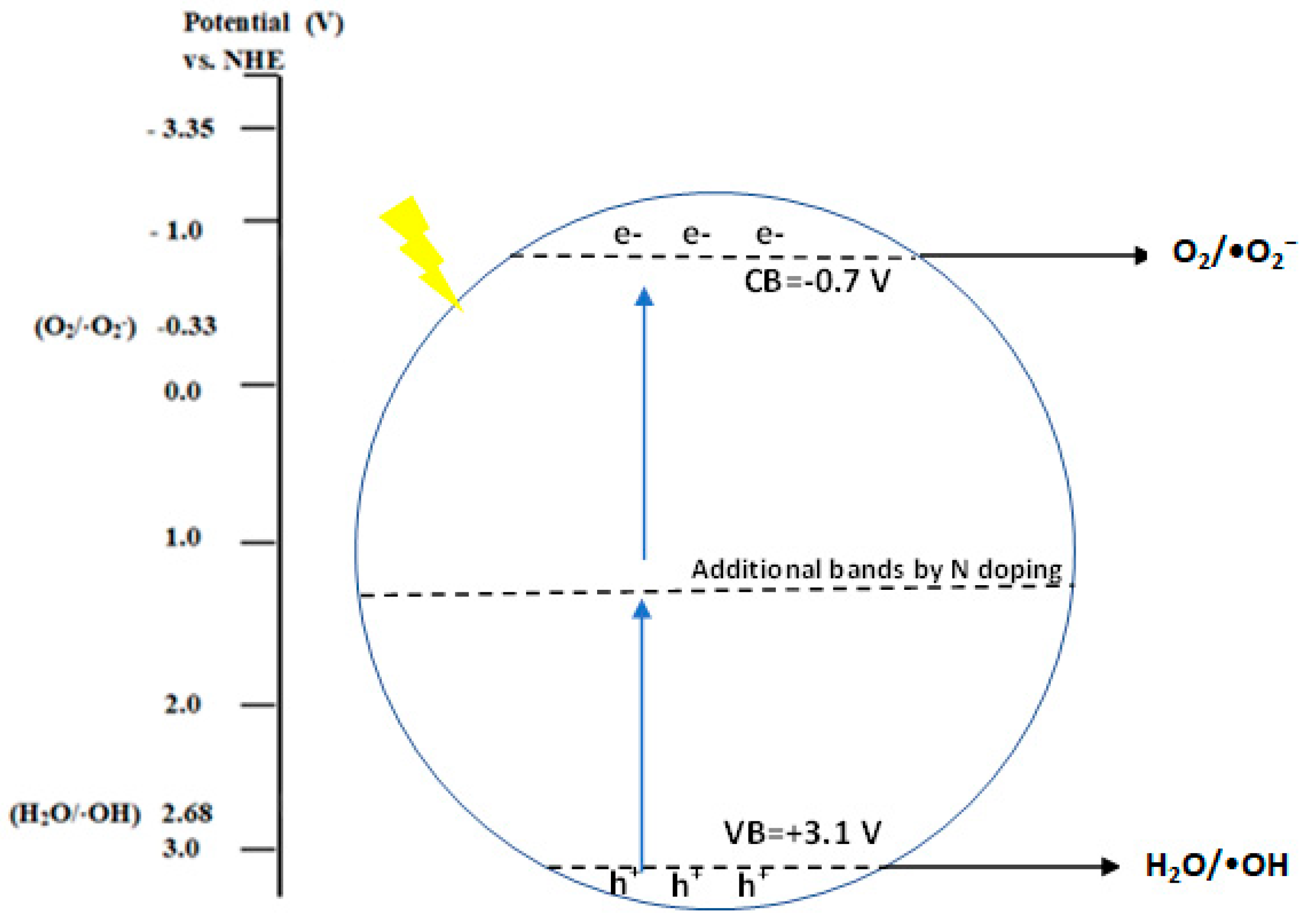
where χ is the absolute electronegativity of MgO (≈5.7 eV), Ee is the energy of free electrons on the hydrogen scale (4.5 eV), and _Eg is the optical band gap energy. Using the experimentally determined band gap value, ECB of N-MgO(a) is estimated to be approximately −0.7 V vs. NHE. Consequently, the valence band (VB) edge is located at about +3.1 V vs. NHE, as depicted in Figure 10.
The estimated CB position is significantly more negative than the O2/•O2 redox potential (−0.33 V vs. NHE), indicating that photogenerated electrons have sufficient thermodynamic driving force to reduce dissolved oxygen to superoxide radicals. Similarly, the VB position is more positive than the H2O/•OH redox potential (+2.68 V vs. NHE), confirming that photogenerated holes possess adequate oxidizing power to generate hydroxyl radicals [66]. These energetic considerations are in good agreement with the quenching experiments, which demonstrate the active involvement of both •OH and •O2 species in the photocatalytic degradation of MB.
Under visible-light irradiation, electrons are excited from nitrogen-induced mid-gap states or from the valence band to the conduction band, while holes remain in the VB or in localized defect-related levels. The generated charge carriers migrate to the catalyst surface, where electrons reduce molecular oxygen to •O2 radicals and holes oxidize surface-bound H2O or hydroxyl groups to •OH radicals. These highly reactive oxygen species subsequently drive the oxidative degradation of the MB dye, as schematically summarized in Figure 10.

2.2.2. Effect of N-MgO(a) Dosage in MB Photodegradation

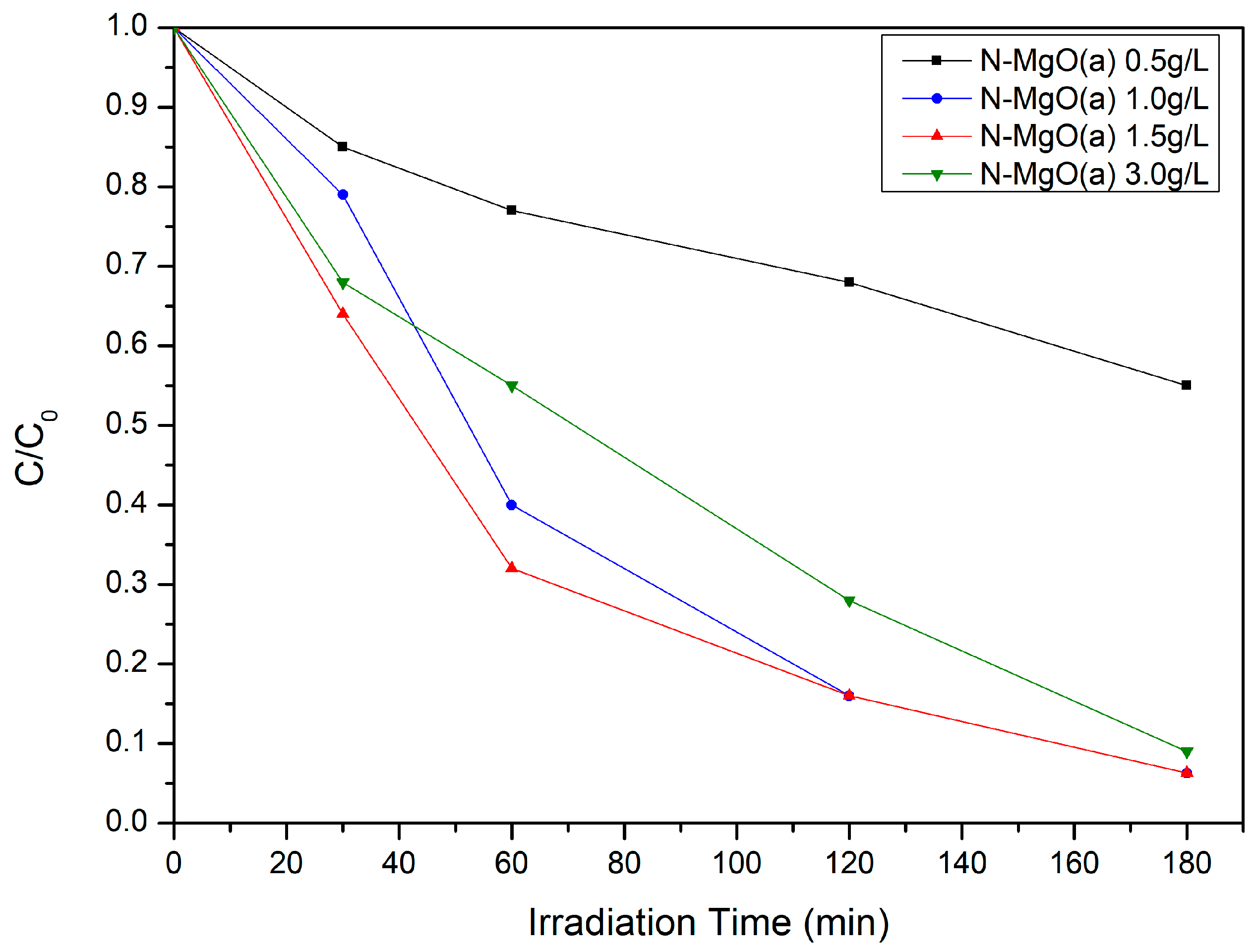
The effect of catalyst dosage on the photocatalytic degradation of MB was investigated using N–MgO(a), the most active photocatalyst among the tested samples. The catalyst concentration was varied from 0.5 to 3 g/L. As shown in Figure 11, the degradation efficiency increases markedly from approximately 40% to 94% when the dosage is raised from 0.5 to 1 g/L. This enhancement can be attributed to the greater number of available active sites on the catalyst surface and to the increased probability of photon absorption within the suspension, both of which promote more efficient formation of reactive species.
However, further increasing the catalyst concentration beyond 1 g/L results in a slight decrease in degradation efficiency. This behavior is commonly observed in heterogeneous photocatalysis and can be explained by light scattering and shielding effects, which reduce photon penetration into the reaction medium. Additionally, excessive catalyst loading may lead to particle aggregation and overlapping of adsorption sites, which diminishes the effective contact between dye molecules and the photocatalyst surface [67,68]. These combined effects ultimately limit the photocatalytic performance at higher dosages.

3. Materials and Methods

3.1. Materials

The reagents used include potassium hydroxide (KOH, pellets, VWR Chemicals, Radnor, PA, USA), magnesium acetate tetrahydrate (Mg(CH3COO)2·4H2O, Carlo Erba, Cornaredo, Italy), magnesium sulfate heptahydrate (MgSO4·7H2O, 99.5%, Sigma-Aldrich, St. Louis, MI, USA), urea (CH4N2O, Sigma-Aldrich), and aqueous ammonia solution (30 wt%, Carlo Erba) and magnesium oxide (MgO, 97% pure, Sigma-Aldrich). All compounds were used without further purification, and the solutions were prepared using deionized water (18 MΩ·cm).

3.2. Synthesis and Characterization of N-MgO

3.2.1. In Situ Doping of N-MgO(a)

N-MgO was synthesized via a sol–gel method by dissolving magnesium acetate and urea in a 1:2 molar ratio in 200 mL of deionized water. The solution was stirred for 2 h, and then an ammonia solution was added as a basic agent until the pH reached 9–10, while maintaining stirring at room temperature for 18 h. The resulting suspension was recovered by centrifugation, and the precipitate was washed several times with deionized water to remove residual ions and impurities. The washed gel was then dried in an oven at 100 °C and subsequently calcined in static air at 350 °C for 2 h, with a heating rate of 10 °C/min.

3.2.2. Post-Synthesis Doping of N-MgO(b)

In this procedure, the doping of MgO occurs during the calcination step. Five grams of magnesium sulfate were dissolved in 250 mL of deionized water. A 0.1 M KOH solution was then added, and the mixture was refluxed at 100 °C under continuous stirring for 4 h. The suspension was subsequently stirred at room temperature for 12 h, then centrifuged, washed several times, and dried in an oven overnight. The obtained solid was finally transferred to a muffle furnace under a nitrogen atmosphere and calcined at 500 °C for 2 h, with a heating rate of 10 °C/min.

3.3. Characterization of N-MgO

For the characterization of the synthesized samples, several techniques were employed. The structural properties of the prepared samples were analyzed using X-ray diffraction (WAXRD) with a Bruker D8 Advance diffractometer, employing Cu-Kα radiation (wavelength 1.5406 Å) and a scan step of 0.02° over the 2θ range of 20° to 80°. The crystallite size was evaluated using the Debye–Scherrer equation, shown in Equation (3).
D = kλ/βcos θ
where D represents the crystallite size, λ = 1.5406 Å is the wavelength of the Cu-Kα X-ray source, k = 0.9 is the Scherrer shape factor, β is the full width at half maximum (FWHM) of the peak, and θ is the peak position. To obtain a more reliable estimation, the average crystallite size was also determined using the Williamson–Hall (W–H) method [69]. The Williamson–Hall equation is given in Equation (4):
β c o s θ = 0.9 λ D + A ε s i n θ
where D is the average crystallite size (nm), β is the FWHM in radians, ε represents the microstrain, and A is a constant commonly taken as 1. The crystallite size D can be estimated from the intercept of the plot of βcosθ versus sinθ. The dislocation density is commonly estimated from the crystallite size using Equation (5):
δ = 1 D 2
where D is the crystallite size obtained from the Debye–Scherrer or Williamson–Hall methods.
The lattice parameter values were determined using the following equation (Equation (6)):
1 d 2 h   k   l =   h 2 a 2 + k 2 b 2 + l 2 c 2
where the value of d(h k l) for a WAXRD peak was determined from Bragg’s law:
2 d ( h   k   l )   sin θ = n λ
h, k and l are the crystal plane indices, d(h k l) is the distance between crystal planes of (h k l), while a and c are the lattice parameters. In order to calculate the lattice parameter values, the planes (2 0 0), (2 2 0) and (2 2 2) for MgO were considered.
The optical properties of the photocatalysts were investigated by UV–Vis diffuse reflectance spectroscopy (DRS) using a PerkinElmer Lambda 35 spectrophotometer equipped with an 88-position sample holder, ensuring total reflectance measurement conditions. The recorded spectra were referenced against a calibrated reflectance standard (SRS-010-99, Labsphere Inc., North Sutton, NH, USA).
Photoluminescence (PL) spectroscopy was performed at room temperature using a Shimadzu RF-5301PC spectrofluorometer equipped with a xenon flash lamp as the excitation source. The excitation wavelength was set at 400 nm. For each measurement, approximately 5 mg of photocatalyst powder was used. Prior to PL analysis, the samples were dispersed in chloroform and ultrasonicated for 5 min to ensure homogeneous suspension.
Raman spectra were acquired at room temperature using a dispersive MicroRaman system (Invia, Renishaw) equipped with a 633 nm diode laser, in the range of 200–2500 cm−1 Raman shift.
Fourier Transform Infrared Spectroscopy (FTIR), performed using a Vertex 70 spectrometer (Bruker Optik GmbH, Ettlingen, Germany) equipped with a deuterated triglycine sulfate (DTGS) detector and a Ge/KBr beam splitter, was used to identify the chemical bonds in the frequency range of 390–3900 cm−1. The thermal behavior of the samples was investigated using a simultaneous thermogravimetric analyzer (TGA–DSC, SDT Q600, TA Instruments, New Castle, DE, USA) operating under an air flow. The system was coupled to a quadrupole mass spectrometer (Pfeiffer Vacuum Benchtop Thermostar, Pfeiffer Vacuum GmbH, Aßlar, Germany) to monitor the evolution of gaseous products, specifically m/z = 18 (water) and m/z = 44 (carbon dioxide). Approximately 30 mg of each sample was analyzed under a 100 cm3/min air flow (chromatographic grade), using a heating rate of 10 °C/min over the temperature range of 20–800 °C. The surface characterization was performed by a scanning electron microscope (SEM) (LEO Evo 50, Carl Zeiss AG, Oberkochen, Germany). An energy dispersive X-ray (EDX) spectrometer (7650 INCA x-sight, Oxford Instruments, High Wycombe, UK), coupled to the SEM, was employed to determine the elemental composition of the photocatalyst powders. The SEM-EDX analyses were carried out on samples coated with gold; approximately 15 nm of gold was applied to provide a reduction in surface charging without decreasing the EDX peaks from every element of the sample. For all the investigations, the SEM operated at an acceleration voltage of 20 kV, with a working distance of 8.5 mm, an electron beam of 30 μA, and the probe currentset to 348 pA; the SEM images were recorded using secondary electrons; the EDX spectra were acquired and processed with the Oxford Inca software (v. 4.14); the percentage in weight of the elements was measured at three different points and the results were averaged.

3.4. Photocatalytic Activity Tests

The photocatalytic activity was evaluated through the degradation of methylene blue (MB), an organic dye, and phenol under visible light irradiation. Aqueous solutions of MB (initial concentration 5 mg/L) and phenol (initial concentration 10 mg/L) were prepared. For each test, a suspension containing 100 mL of the solution and 1.0 g/L of catalyst was placed in a Pyrex batch reactor. Visible-light irradiation was provided by four lamps (Philips, nominal power 8 W, emission range 400–750 nm) positioned at a distance of 10 cm from the external surface of the reactor. Prior to illumination, the suspension was kept in the dark for 2 h to reach adsorption–desorption equilibrium.
Subsequently, the solution was exposed to visible light under continuous stirring. At regular time intervals, 1.5 mL aliquots were withdrawn from the reaction mixture, centrifuged and filtered to completely remove the photocatalyst particles prior to analysis. The evolution of methylene blue concentration was then monitored by UV–Vis spectrophotometry using an Agilent Varian Cary 50 Probe spectrophotometer.
The absorbance measurements were recorded at a wavelength of 664 nm to determine the dye removal efficiency, calculated using the following Equation (8):
Degradation efficiency (D%) = [(A0 − At)/A0] × 100
where A0 is the initial absorbance of the dye after the dark equilibrium phase, and A is the absorbance of the dye at time t.

4. Conclusions

In this study, nitrogen-doped MgO photocatalysts were successfully synthesized via a sol–gel approach using two distinct doping strategies: in situ and post-synthesis. Structural and thermal analyses confirmed the effective incorporation of nitrogen into the N–MgO(a) sample, as evidenced by the shift in WAXRD reflections toward lower diffraction angles and the pronounced increase in the lattice parameter c (from 4.2 Å to 4.8 Å), indicating a coherent modification of the MgO FCC structure. In contrast, the N–MgO(b) sample exhibited no significant variations in lattice parameters, highlighting a fundamentally different nitrogen incorporation pathway. Optical characterization indicates that nitrogen doping introduces defect-related electronic states that slightly narrow the apparent band gap (3.8 eV for N–MgO(a)), without shifting it into a range compatible with intrinsic band-to-band visible-light excitation. The observed visible-light response is instead attributed to the presence of intermediate defect states within the band gap, as supported by photoluminescence analysis.
Photocatalytic tests using MB demonstrated that both nitrogen-doped materials outperform commercial MgO, which displayed negligible activity under visible-light irradiation. Among the doped samples, N–MgO(a) exhibited the highest photocatalytic efficiency, achieving 94% MB degradation after 180 min, while N–MgO(b) reached only 50%. To clarify the degradation pathway, phenol—a colorless, non-sensitizing contaminant—was used as a probe molecule. N–MgO(a) degraded 13% of phenol, whereas N–MgO(b) showed no activity, confirming the operation of two distinct mechanisms: direct photocatalysis for N–MgO(a) and sensitization-mediated degradation for N–MgO(b).
Scavenger experiments performed on N–MgO(a) identified hydroxyl radicals (•OH) as the dominant reactive species responsible for dye degradation, underscoring their central role in the photocatalytic mechanism. Nitrogen doping introduces defect-related electronic states in MgO that enable visible-light absorption and enhance charge carrier separation, leading to efficient photocatalytic degradation of methylene blue through the generation of •OH and •O2 radicals. Furthermore, catalyst dosage tests established that 1 g/L represents the optimal loading for maximizing photocatalytic performance.
Overall, this work demonstrates that nitrogen doping markedly enhances the photocatalytic properties of MgO, but the extent of improvement critically depends on the doping pathway. These findings highlight the strong potential of in situ nitrogen-doped MgO as a promising photocatalyst for the treatment of wastewater contaminated with organic pollutants.

Supplementary Materials

The following supporting information can be downloaded at https://www.mdpi.com/article/10.3390/catal16020162/s1. Figure S1: Phenol photolysis under visible light irradiation; Figure S2: Phenol adsorption in dark conditions on N-MgO(a).

Author Contributions

Conceptualization, V.V. (Vincenzo Venditto), V.V. (Vincenzo Vaiano) and O.S.; methodology, O.S. and V.V. (Vincenzo Vaiano); validation, V.V. (Vincenzo Venditto); formal analysis, O.S. and A.P.; investigation, A.P., M.L. and O.S.; resources, V.V. (Vincenzo Venditto); data curation, V.V. (Vincenzo Venditto), V.V. (Vincenzo Vaiano) and O.S.; writing—original draft preparation, A.P.; writing—review and editing, V.V. (Vincenzo Venditto), V.V. (Vincenzo Vaiano) and O.S.; supervision, V.V. (Vincenzo Venditto), V.V. (Vincenzo Vaiano) and O.S. All authors have read and agreed to the published version of the manuscript.

Funding

This research received no external funding.

Data Availability Statement

The original contributions presented in this study are included in this article/Supplementary Materials. Further inquiries can be directed to the corresponding authors.

Acknowledgments

During the preparation of this manuscript/study, the authors used ChatGPT 5.1 for the purposes of refining the English Language. The authors have reviewed and edited the output and take full responsibility for the content of this publication.

Conflicts of Interest

The authors declare no conflicts of interest.

References

  1. Abou Zeid, S.; Leprince-Wang, Y. Advancements in ZnO-based photocatalysts for water treatment: A comprehensive review. Crystals 2024, 14, 611. [Google Scholar] [CrossRef]
  2. Park, H.K.B.; Kumar, P.; Kebaili, I.; Boukhris, I.; Joo, Y.H.; Sung, T.H. Optimization and modelling of magnesium oxide (MgO) photocatalytic degradation of binary dyes using response surface methodology. Sci. Rep. 2024, 14, 9412. [Google Scholar] [CrossRef] [PubMed]
  3. Yagub, M.T.; Sen, T.K.; Afroze, S.; Ang, H.M. Dye and its removal from aqueous solution by adsorption: A Review. Adv. Colloid Interface Sci. 2014, 209, 172–184. [Google Scholar] [CrossRef] [PubMed]
  4. Song, Z.; Williams, C.J.; Edyvean, R.G.J. Treatment of tannery wastewater by chemical coagulation. Desalination 2004, 164, 249–259. [Google Scholar] [CrossRef]
  5. Opoku, F.; Govender, K.K.; van Sittert, C.G.C.E.; Govender, P.P. Recent progress in the development of semiconductor-based photocatalyst materials for applications in photocatalytic water splitting and degradation of pollutants. Adv. Sustain. Syst. 2017, 1, 1700006. [Google Scholar] [CrossRef]
  6. Han, F.; Kambala, V.S.R.; Srinivasan, M.; Rajarathnam, D.; Naidu, R. Tailored titanium dioxide photocatalysts for the degradation of organic dyes in wastewater treatment: A review. Appl. Catal. A Gen. 2009, 359, 25–40. [Google Scholar] [CrossRef]
  7. Lee, K.M.; Lai, C.W.; Ngai, K.S.; Juan, J.C. Recent developments of zinc oxide based photocatalyst in water treatment technology: A review. Water Res. 2016, 88, 428–448. [Google Scholar] [CrossRef]
  8. Hitam, C.N.C.; Jalil, A.A. A review on exploration of Fe2O3 photocatalyst towards degradation of dyes and organic contaminants. J. Environ. Manag. 2020, 258, 110050. [Google Scholar] [CrossRef]
  9. Babyszko, A.; Wanag, A.; Sadłowski, M.; Kusiak-Nejman, E.; Morawski, A.W. Synthesis and characterization of SiO2/TiO2 as photocatalyst on methylene blue degradation. Catalysts 2022, 12, 1372. [Google Scholar] [CrossRef]
  10. Ng, Y.H.; Iwase, A.; Kudo, A.; Amal, R. Reducing graphene oxide on a visible-light BiVO4 photocatalyst for an enhanced photoelectrochemical water splitting. J. Phys. Chem. Lett. 2010, 1, 2607–2612. [Google Scholar] [CrossRef]
  11. Khan, M.M.; Syed, F.A.; Al-Mayouf, A. Metal oxides as photocatalysts. J. Saudi Chem. Soc. 2015, 19, 462–464. [Google Scholar] [CrossRef]
  12. Hariharan, C. Photocatalytic degradation of organic contaminants in water by ZnO nanoparticles: Revisited. Appl. Catal. A Gen. 2006, 304, 55–61. [Google Scholar] [CrossRef]
  13. Balakrishnan, G.; Velavan, R.; Batoo, K.M.; Raslan, E.H. Microstructure, optical and photocatalytic properties of MgO nanoparticles. Results Phys. 2020, 16, 103013. [Google Scholar] [CrossRef]
  14. Hornak, J. Synthesis, Properties, and selected technical applications of magnesium oxide nanoparticles: A Review. Int. J. Mol. Sci. 2021, 22, 12752. [Google Scholar] [CrossRef] [PubMed]
  15. Leung, Y.H.; Ng, A.M.C.; Xu, X.; Shen, Z.; Gethings, L.A.; Wong, M.T.; Chan, C.M.N.; Guo, M.Y.; Ng, Y.H.; Djurišić, A.B.; et al. Mechanisms of antibacterial activity of MgO: Non-ROS mediated toxicity of MgO nanoparticles towards Escherichia coli. Small 2014, 10, 1171–1183. [Google Scholar] [CrossRef]
  16. Zheng, Y.; Cao, L.; Xing, G.; Bai, Z.; Huang, J.; Zhang, Z. Flower-like magnesium oxide microparticles for highly efficient photocatalytic degradation of organic dyes in aqueous solution. RSC Adv. 2019, 9, 7338–7348. [Google Scholar] [CrossRef]
  17. de Silva, R.T.; Ratnayake, S.P.; Amaratunga, G. Photocatalytic activity of electrospun MgO nanofibres: Synthesis, characterization and applications. Mater. Res. Bull. 2018, 99, 204–210. [Google Scholar] [CrossRef]
  18. Tahir, H.; Anwer, M.; Khan, S.; Saad, M. Enhancement of adsorption and photocatalytic activity of MgO nanoparticles for the treatment of textile dye using ultrasound assisted process by response surface methodology. Desalination Water Treat. 2024, 319, 100429. [Google Scholar] [CrossRef]
  19. Shiogai, J.; Ito, Y.; Mitsuhashi, T.; Nojima, T.; Tsukazaki, A. Electric-field-induced superconductivity in electrochemically etched ultrathin FeSe films on SrTiO3 and MgO. Nat. Phys. 2016, 12, 42–46. [Google Scholar] [CrossRef]
  20. Karthik, K.; Dhanuskodi, S.; Gobinath, C.; Prabukumar, S.; Sivaramakrishnan, S. Fabrication of MgO nanostructures and its efficient photocatalytic, antibacterial and anticancer performance. J. Photochem. Photobiol. B 2019, 190, 8–20. [Google Scholar] [CrossRef]
  21. Kruk, A. Fabrication of MgO high transparent ceramics by arc plasma synthesis. Opt. Mater. 2018, 84, 360–366. [Google Scholar] [CrossRef]
  22. Raveesha, H.R.; Kumar, P.; Raghavendra, G.M.; Yathisha, R.O.; Kumara, K.; Raghu, G.K.; Rangappa, D. The electrochemical behavior, antifungal and cytotoxic activities of phytofabricated MgO nanoparticles using Withania somnifera leaf extract. J. Sci. Adv. Mater. Devices 2019, 4, 57–65. [Google Scholar] [CrossRef]
  23. Yang, J.; Wang, X.; Khan, M.R.; Hammouda, G.A.; Alam, P.; Meng, L.; Zhang, Z.; Zhang, W. New opportunities and advances in magnesium oxide (MgO) nanoparticles in biopolymeric food packaging films. Sustain. Mater. Technol. 2024, 40, e00976. [Google Scholar] [CrossRef]
  24. Mittag, A.; Schneider, T.; Westermann, M.; Glei, M. Toxicological assessment of magnesium oxide nanoparticles in HT29 intestinal cells. Arch. Toxicol. 2019, 93, 1491–1500. [Google Scholar] [CrossRef] [PubMed]
  25. Chinthala, M.; Balakrishnan, A.; Venkataraman, P.; Manaswini Gowtham, V.; Polagani, R.K. Synthesis and applications of nano-MgO and composites for medicine, energy, and environmental remediation: A review. Environ. Chem. Lett. 2021, 19, 4415–4454. [Google Scholar] [CrossRef]
  26. Sim, H.T.; Gençaslan, M.; Merdan, M. Synthesis of MgO nanoparticles via the sol-gel method for antibacterial applications, investigation of optical properties and comparison with commercial MgO. Discover Appl. Sci. 2024, 6, 577. [Google Scholar] [CrossRef]
  27. Heo, Y.J.; Park, S.J. Facile synthesis of MgO-modified carbon adsorbents with microwave-assisted methods: Effect of MgO particles and porosities on CO2 capture. Sci. Rep. 2017, 7, 5653. [Google Scholar] [CrossRef]
  28. Zhao, Z.; Dai, H.; Du, Y.; Deng, J.; Zhang, L.; Shi, F. Solvo- or hydrothermal fabrication and excellent carbon dioxide adsorption behaviors of magnesium oxides with multiple morphologies and porous structures. Mater. Chem. Phys. 2011, 128, 348–356. [Google Scholar] [CrossRef]
  29. Tharani, K.; Jegatha Christy, A.; Sagadevan, S.; Nehru, L.C. Fabrication of magnesium oxide nanoparticles using combustion method for a biological and environmental cause. Chem. Phys. Lett. 2021, 763, 138216. [Google Scholar] [CrossRef]
  30. Sreekanth, R.; Pattar, J.; Anupama, A.V.; Mallikarjunaswamy, A.M.M. Synthesis of high surface area and plate-like Magnesium Oxide nanoparticles by pH-controlled precipitation method. Appl. Phys. A 2021, 127, 797. [Google Scholar] [CrossRef]
  31. Muhaymin, A.; Mohamed, H.E.A.; Hkiri, K.; Safdar, A.; Azizi, S.; Maaza, M. Green synthesis of magnesium oxide nanoparticles using Hyphaene thebaica extract and their photocatalytic activities. Sci. Rep. 2024, 14, 20135. [Google Scholar] [CrossRef]
  32. Sirota, V.; Selemenev, V.F.; Kovaleva, M.G.; Pavlenko, I.A.; Mamunin, K.N.; Dokalov, V.; Prozorova, M.S. Synthesis of magnesium oxide nanopowder by thermal plasma using magnesium nitrate hexahydrate. Phys. Res. Int. 2016, 2016, 6853405. [Google Scholar] [CrossRef]
  33. Baidukova, O.; Skorb, E.V. Ultrasound-assisted synthesis of magnesium hydroxide nanoparticles from magnesium. Ultrason. Sonochem. 2016, 31, 423–428. [Google Scholar] [CrossRef] [PubMed]
  34. Bartley, J.K.; Xu, C.; Lloyd, R.; Enache, D.I.; Knight, D.W.; Hutchings, G.J. Simple method to synthesize high surface area magnesium oxide and its use as a heterogeneous base catalyst. Appl. Catal. B 2012, 128, 31–38. [Google Scholar] [CrossRef]
  35. Gatou, M.-A.; Bovali, N.; Lagopati, N.; Pavlatou, E.A. MgO Nanoparticles as a Promising Photocatalyst towards Rhodamine B and Rhodamine 6G Degradation. Molecules 2024, 29, 4299. [Google Scholar] [CrossRef]
  36. Algethami, F.K.; Katouah, H.A.; Al-Omar, M.A.; Almehizia, A.A.; Amr, A.E.-G.E.; Naglah, A.M.; Al-Shakliah, N.S.; Fetoh, M.E.; Youssef, H.M. Facile synthesis of magnesium oxide nanoparticles for studying their photocatalytic activities against Orange G dye and biological activities against some bacterial and fungal strains. J. Inorg. Organomet. Polym. 2021, 31, 2150–2160. [Google Scholar] [CrossRef]
  37. Pammi, V.N.; Matangi, R.; Ummey, S.; Gurugubelli, T.R.; Datta, D.; Pallela, P.N.V.K.; Ruddaraju, L.K. Photocatalytic, antioxidant, and antibacterial activities of biocompatible MgO flake-like nanostructures created using Piper betle leaf extract. Ceram. Int. 2024, 50, 43248–43254. [Google Scholar] [CrossRef]
  38. Akbari, S.; Moussavi, G.; Decker, J.; Marin, M.; Bosca, F.; Giannakis, S. Superior visible light-mediated catalytic activity of a novel N-doped, Fe3O4-incorporating MgO nanosheet in presence of PMS: Imidacloprid degradation and implications on simultaneous bacterial inactivation. Appl. Catal. B Environ. 2022, 317, 121732. [Google Scholar] [CrossRef]
  39. Marschall, R.; Wang, L. Non-metal doping of transition metal oxides for visible-light photocatalysis. Catal. Today 2014, 225, 111–135. [Google Scholar] [CrossRef]
  40. Fanaei, F.; Moussavi, G.; Srivastava, V.; Sillanpää, M. The enhanced catalytic potential of sulfur-doped MgO (S-MgO) nanoparticles in activation of peroxysulfates for advanced oxidation of Acetaminophen. Chem. Eng. J. 2019, 371, 404–413. [Google Scholar] [CrossRef]
  41. Senevirathna, H.L.; Lee, W.C.; Wu, S.; Bai, K.; Wu, P. Facile synthesis of bandgap-engineered N-doped MgO/g-C3N4 nanocomposites for enhanced sunlight-driven photocatalytic degradation of organic dyes. Mater. Chem. Phys. 2024, 332, 130234. [Google Scholar] [CrossRef]
  42. Wang, W.; Tadé, M.O.; Shao, Z. Nitrogen-doped simple and complex oxides for photocatalysis: A review. Prog. Mater. Sci. 2018, 92, 33–63. [Google Scholar] [CrossRef]
  43. Hattab, M.; Oprea, O.C.; Cernea, M. Experimental study on thermal evolution from precursor gel to crystallized MgO for biomedical applications. J. Therm. Anal. Calorim. 2025, 150, 3225–3236. [Google Scholar] [CrossRef]
  44. Frost, R. Raman spectroscopic study of the magnesium carbonate mineral hydromagnesite (Mg5[(CO3)4(OH)2]·4H2O). J. Raman Spectrosc. 2011, 42, 1690–1694. [Google Scholar] [CrossRef]
  45. Mallick, L.; Samanta, K.; Chakraborty, B. Post-synthetic Metalation on the Ionic TiO2 Surface to Enhance Metal-CO2 Interaction During Photochemical CO2 Reduction. Chemistry 2024, 30, e202400428. [Google Scholar] [CrossRef]
  46. Yadav, P.; Saini, R.; Bhaduri, A. Facile synthesis of MgO nanoparticles for effective degradation of organic dyes. Environ. Sci. Pollut. Res. 2023, 30, 71439–71453. [Google Scholar] [CrossRef]
  47. Wahab, R.; Ansari, S.G.; Dar, M.A.; Kim, Y.S.; Shin, H.-S. Synthesis of Magnesium Oxide Nanoparticles by Sol-Gel Process. Mater. Sci. Forum 2007, 558–559, 983–986. [Google Scholar] [CrossRef]
  48. Vijaya Shanthi, R.; Kayalvizhi, R.; John Abel, M.; Neyvasagam, K. MgO nanoparticles with altered structural and optical properties by doping (Er3+) rare earth element for improved photocatalytic activity. Appl. Phys. A 2022, 128, 133. [Google Scholar] [CrossRef]
  49. Subash, M.; Chandrasekar, M.; Panimalar, S.; Inmozhi, C.; Parasuraman, K.; Uthrakumar, R.; Kaviyarasu, K. Pseudo-first kinetics model of copper doping on the structural, magnetic, and photocatalytic activity of magnesium oxide nanoparticles for energy application. Biomass Convers. Biorefin. 2023, 13, 3427–3437. [Google Scholar] [CrossRef]
  50. Jeevanandam, J.; Chan, Y.S.; Danquah, M.K. Calcination-Dependent Morphology Transformation of Sol-Gel- Synthesized MgO Nanoparticles. ChemistrySelect 2017, 2, 10393–10404. [Google Scholar] [CrossRef]
  51. Huang, L.; Yang, Z.; Wang, S. Influence of calcination temperature on the structure and hydration of MgO. Constr. Build. Mater. 2020, 262, 120776. [Google Scholar] [CrossRef]
  52. Gliński, M.; Czajka, A.; Ulkowska, U.; Iwanek, E.M.; Łomot, D.; Kaszkur, Z. A Hands-on Guide to the Synthesis of High-Purity and High-Surface-Area Magnesium Oxide. Catalysts 2022, 12, 1595. [Google Scholar] [CrossRef]
  53. Farooq, M.; Ramli, A. The determination of point zero charge (PZC) of Al2O3-MgO mixed oxides. In Proceedings of the 2011 National Postgraduate Conference, Perak, Malaysia, 19–20 September 2011; pp. 1–5. [Google Scholar]
  54. Mancuso, A.; Navarra, W.; Sacco, O.; Pragliola, S.; Vaiano, V.; Venditto, V. Photocatalytic degradation of thiacloprid using tri-doped TiO2 photocatalysts: A preliminary comparative study. Catalysts 2021, 11, 927. [Google Scholar] [CrossRef]
  55. Sharma, A.; Arya, S.; Singh, B.; Prerna; Tomar, A.; Singh, S.; Sharma, R. Sol-Gel Synthesis of Zn Doped MgO Nanoparticles and Their Applications. Integr. Ferroelectr. 2020, 205, 14–25. [Google Scholar] [CrossRef]
  56. Pathak, N.; Ghosh, P.S.; Gupta, S.K.; Kadam, R.M.; Arya, A. Defects induced changes in the electronic structures of MgO and their correlation with the optical properties: A special case of electron–hole recombination from the conduction band. RSC Adv. 2016, 6, 96398–96415. [Google Scholar] [CrossRef]
  57. Bishnoi, P.; Brajpuriya, R.; Sharma, A.; Chae, K.H.; Won, S.O.; Vij, A. Defect modulation and color tuning of MgO: Probing the influence of Sm and Li dopants through X-ray absorption, photoluminescence, and thermoluminescence spectroscopy. J. Alloys Compd. 2024, 1002, 175270. [Google Scholar] [CrossRef]
  58. Aziz, B.K.; Karim, M.A.H. Efficient catalytic photodegradation of methylene blue from medical lab wastewater using MgO nanoparticles synthesized by direct precipitation method. React. Kinet. Mech. Catal. 2019, 128, 1127–1139. [Google Scholar] [CrossRef]
  59. Pesci, M.; Gallino, F.; Di Valentin, C.; Pacchioni, G. Nature of defect states in nitrogen-doped MgO. J. Phys. Chem. C 2009, 114, 1350–1356. [Google Scholar] [CrossRef]
  60. Zhao, H.; Zhang, Y.; Li, G.; Tian, F.; Tang, H.; Chen, R. Rhodamine B-sensitized BiOCl hierarchical nanostructure for methyl orange photodegradation. RSC Adv. 2016, 6, 7772–7779. [Google Scholar] [CrossRef]
  61. Roushani, M.; Mavaei, M.; Rajabi, H.R. Graphene quantum dots as novel and green nano-materials for the visible-light-driven photocatalytic degradation of cationic dye. J. Mol. Catal. A-Chem. 2015, 409, 102–109. [Google Scholar] [CrossRef]
  62. Guo, J.; Liao, X.; Lee, M.-H.; Hyett, G.; Huang, C.-C.; Hewak, D.W.; Mailis, S.; Zhou, W.; Jiang, Z. Experimental and DFT insights of the Zn-doping effects on the visible-light photocatalytic water splitting and dye decomposition over Zn-doped BiOBr photocatalysts. Appl. Catal. B Environ. 2019, 243, 502–512. [Google Scholar] [CrossRef]
  63. Trandafilović, L.V.; Jovanović, D.J.; Zhang, X.; Ptasińska, S.; Dramićanin, M.D. Enhanced photocatalytic degradation of methylene blue and methyl orange by ZnO:Eu nanoparticles. Appl. Catal. B Environ. 2017, 203, 740–752. [Google Scholar] [CrossRef]
  64. Chen, J.; Wang, H.; Huang, G.; Zhang, Z.; Han, L.; Song, W.; Li, M.; Zhang, Y. Facile synthesis of urchin-like hierarchical Nb2O5 nanospheres with enhanced visible light photocatalytic activity. J. Alloys Compd. 2017, 728, 19–28. [Google Scholar] [CrossRef]
  65. Gao, P.; Zhang, X.J.; Zhou, W.F.; Wu, J.; Liu, Q.J. First-principles study on anatase TiO2 codoped with nitrogen and ytterbium. J. Semicond. 2010, 31, 032001. [Google Scholar] [CrossRef]
  66. Navarra, W.; Ritacco, I.; Sacco, O.; Caporaso, L.; Farnesi Camellone, M.; Venditto, V.; Vaiano, V. Density functional theory study and photocatalytic activity of ZnO/N-doped TiO2 heterojunctions. J. Phys. Chem. C 2022, 126, 7000–7011. [Google Scholar] [CrossRef]
  67. Saint, U.K.; Baral, S.C.; Sasmal, D.; Maneesha, P.; Datta, S.; Naushin, F.; Sen, S. Effect of pH on photocatalytic degradation of methylene blue in water by facile hydrothermally grown TiO2 nanoparticles under natural sunlight. JCIS Open 2025, 19, 100150. [Google Scholar] [CrossRef]
  68. Singh, J.; Chang, Y.-Y.; Koduru, J.R.; Yang, J.-K. Potential degradation of methylene blue (MB) by nano-metallic particles: A kinetic study and possible mechanism of MB degradation. Environ. Eng. Res. 2017, 22, 1–9. [Google Scholar] [CrossRef]
  69. Tamiji, T.; Nezamzadeh-Ejhieh, A. A comprehensive kinetic study on the electrocatalytic oxidation of propanols in aqueous solution. Solid State Sci. 2019, 98, 106033. [Google Scholar] [CrossRef]
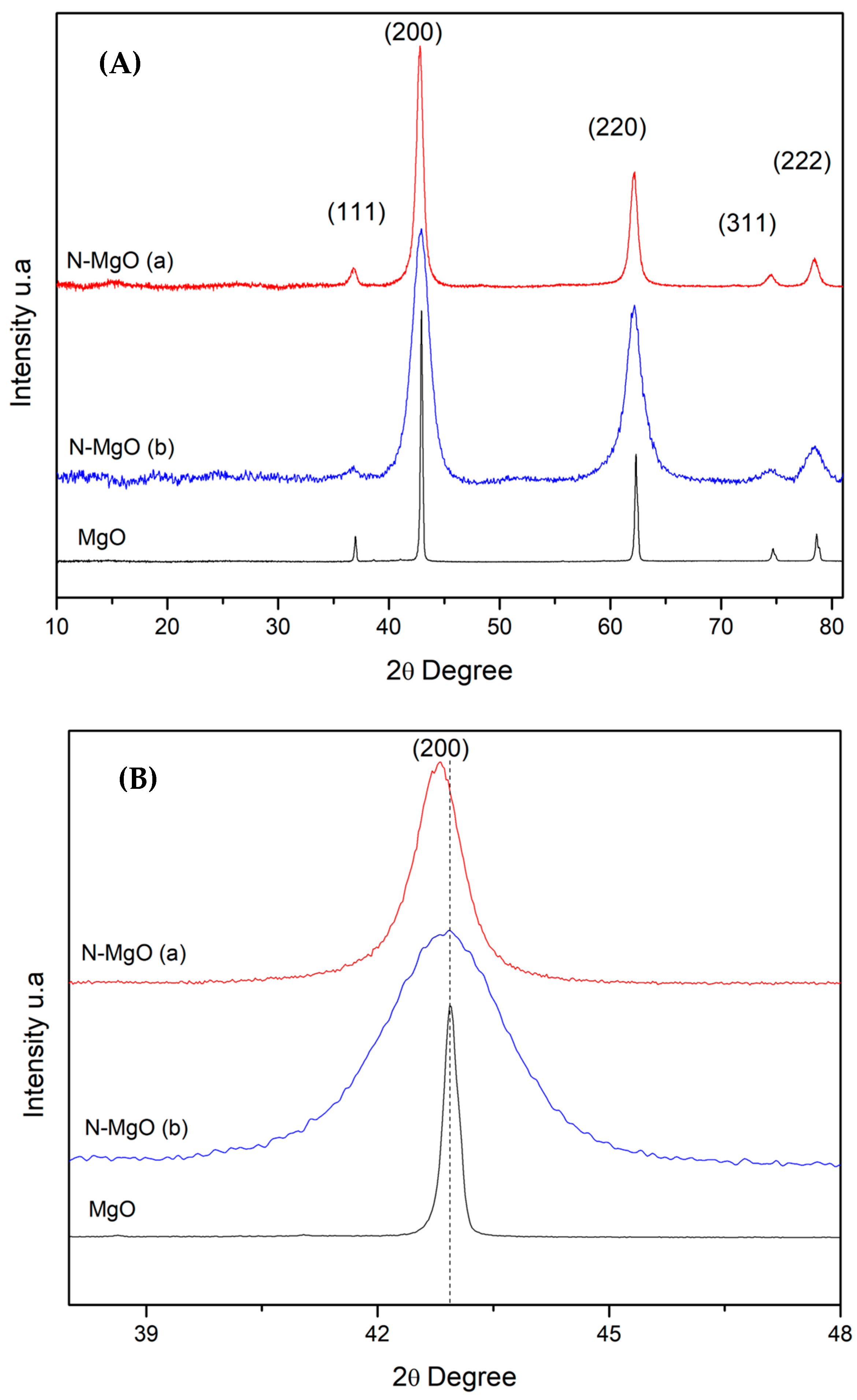
Figure 1. WAXRD patterns in the range (A) 2θ (10–80 degrees) and (B) 2θ (41–44 degrees) of commercial MgO and nitrogen-doped N-MgO(a) and N-MgO(b) samples.
Catalysts 16 00162 g001
Figure 2. Raman spectra of commercial MgO and nitrogen-doped N-MgO(a) and N-MgO(b) samples.
Catalysts 16 00162 g002
Figure 3. FT-IR spectra in the range (A) 3900–390 cm−1 and (B) 1000–390 cm−1 of commercial MgO and nitrogen-doped N-MgO(a) and N-MgO(b) samples.
Catalysts 16 00162 g003
Figure 4. TGA–MS analyses of: (A) N-MgO(a); (B) N-MgO(b) and (C) commercial MgO samples.
Catalysts 16 00162 g004
Figure 5. SEM images, taken at 1000× magnification, of the (A) N-MgO(a) and (B) N-MgO(b) samples.
Catalysts 16 00162 g005
Figure 6. (A) Kubelka–Munk (K–M) function F(R) and (B) PL spectra of commercial MgO and nitrogen-doped N-MgO(a) and N-MgO(b) samples.
Catalysts 16 00162 g006
Figure 7. Comparison of the photocatalytic degradation of methylene blue over commercial MgO and nitrogen-doped MgO samples under visible-light irradiation, including the photolysis experiment performed in the absence of any photocatalyst. Black: MgO; Green: Photolysis; Blue: N-MgO(b); Red: N-MgO(a).
Catalysts 16 00162 g007
Figure 8. Photocatalytic degradation of phenol using N-MgO(a) and MgO(b) catalyst under visible light.
Catalysts 16 00162 g008
Figure 9. Role of Reactive Oxygen Species (ROS) in the MB photodegradation in the presence of N-MgO(a).
Catalysts 16 00162 g009
Figure 10. Schematic diagram illustrating the proposed mechanism of MB degradation under visible light irradiation on N-MgO(a) catalyst.
Catalysts 16 00162 g010
Figure 11. Photocatalytic degradation of MB using different amounts of N-MgO(a) catalyst.
Catalysts 16 00162 g011
Table 1. Crystallite size and lattice parameter of all prepared samples.
SamplesCrystallite Size D (nm)Lattice ParametersDislocation Density *
δ = 1/D2
(1/nm2)
Microstrain **
ε
(by W-H Plot)
Debye–Scherrer SherrerW-H Plot
abc
MgO42.7242.024.214.214.210.0005671.25 × 10−4
N-MgO(a)12.3712.844.224.224.870.006107.50 × 10−6
N-MgO(b)4.7204.274.224.234.240.05511.025 × 10−3
* Equation (3); ** Equation (4).
Table 2. List of prepared photocatalyst, type and amount of chemicals used in the synthesis, N/Mg ratio, specific surface area (SBET), band gap (Ebg) and point of zero charge (PZC).
SamplesCalcination Temperature (°C)N/MgSBET
(m2/g)
Ebg
(eV)
PZC
(pH)
MgO--6-10.9
N-MgO(a)3500.04735.63.810.5
N-MgO(b)5000.03147.7410.2
Table 3. Summary of degradation efficiencies and kinetic parameters of the prepared photocatalysts.
SampleD *
(%)
Catalyst Dosage
(g/L)
k
(1/min)
R2
MgO151.00.00080.9763
N-MgO(b)481.00.00350.9976
N-MgO(a)941.00.01560.9964
* % of MB decolourization after 180 min of visible light irradiation.
Disclaimer/Publisher’s Note: The statements, opinions and data contained in all publications are solely those of the individual author(s) and contributor(s) and not of MDPI and/or the editor(s). MDPI and/or the editor(s) disclaim responsibility for any injury to people or property resulting from any ideas, methods, instructions or products referred to in the content.