Review

Recent Advances in Electrocatalytic Ammonia Synthesis: Integrating Electrolyte Effects, Structural Engineering, and Single-Atom Platforms

1
Department of Energy Engineering, Dankook University, Cheonan 31116, Republic of Korea
2
Department of Chemistry Education, Kongju National University, Gongju 32588, Republic of Korea
*
Author to whom correspondence should be addressed.
These authors contributed equally to this work.
Catalysts 2026, 16(2), 149; https://doi.org/10.3390/catal16020149
Submission received: 6 December 2025 / Revised: 1 January 2026 / Accepted: 16 January 2026 / Published: 3 February 2026
(This article belongs to the Special Issue Catalytic Technologies for Sustainable Energy Conversion)

Abstract

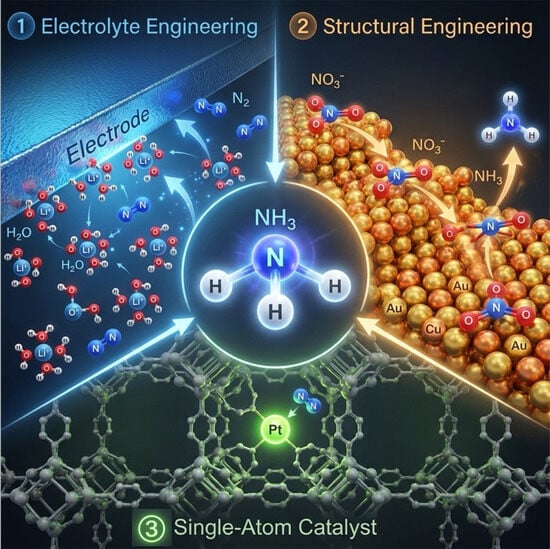
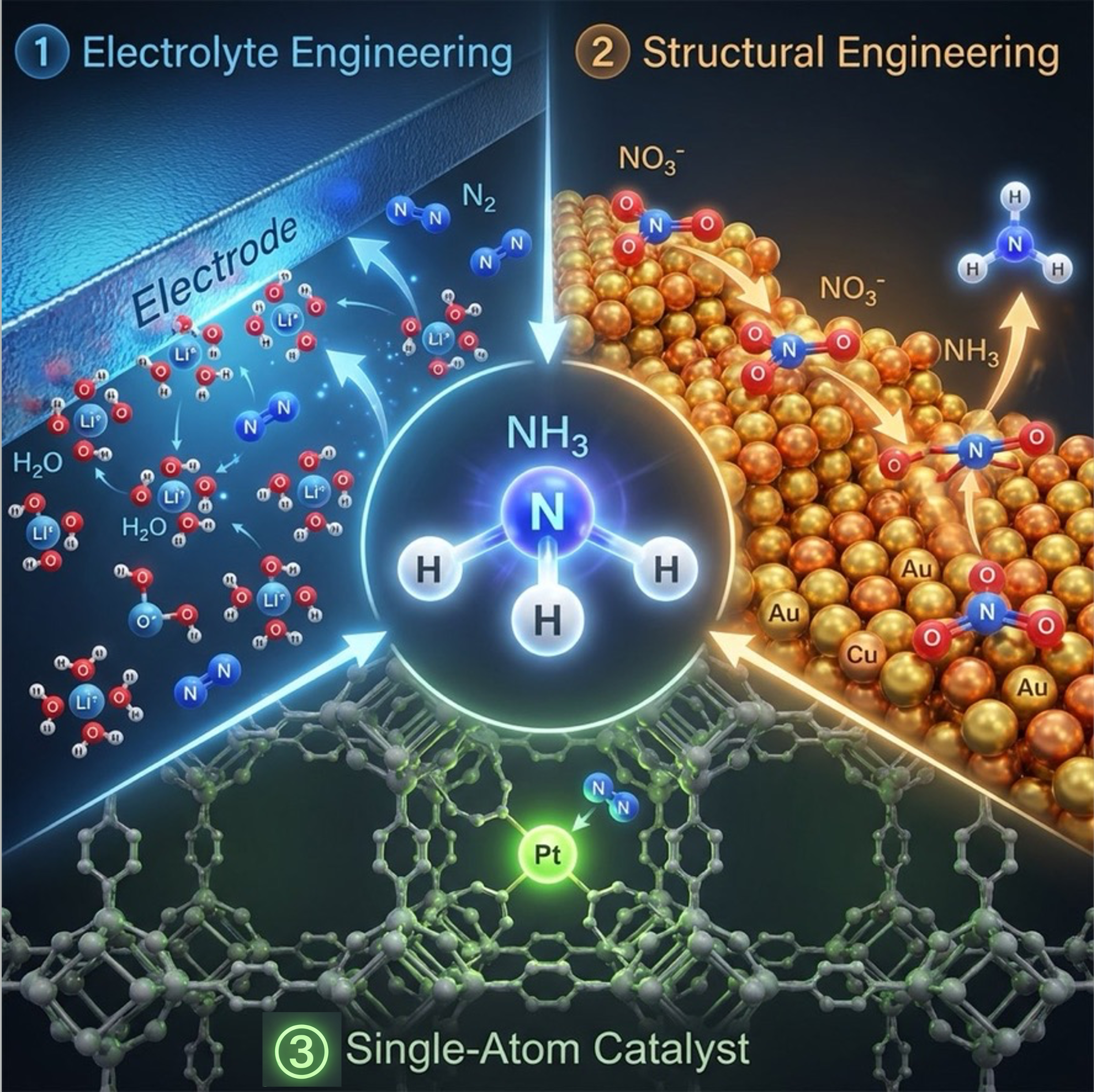
The pursuit of sustainable ammonia production has accelerated the development of electrocatalytic pathways capable of operating under ambient conditions with renewable electricity. Recent studies have revealed that the efficiency and selectivity of both electrochemical nitrogen reduction reaction (eNRR) and nitrate reduction reaction (eNO3RR) are not governed solely by catalyst composition, but by the synergistic interplay among electrolyte identity, interfacial solvation structure, and catalyst architecture. Hydrated cations such as Li+ profoundly reshape the electric double layer, polarize interfacial water, and lower activation barriers for key proton–electron transfer steps, thereby redefining the electrolyte as an active promoter. Parallel advances in structural engineering, including alloying, heteroatom doping, controlled defect formation, and nanoscale morphological control, have enabled the optimization of intermediate adsorption energies while simultaneously suppressing competing hydrogen evolution. In addition, the emergence of metal–organic-framework (MOF)-derived single-atom catalysts has demonstrated that atomically dispersed transition-metal centers anchored within dynamically adaptable matrices can deliver exceptional Faradaic efficiencies, high turnover rates, and long-term operational durability. These developments highlight a unified strategy in which electrolyte–catalyst coupling, rational structural modification, and atomic-scale design principles converge to enable predictable and high-performance ammonia electrosynthesis. This review integrates mechanistic insights across these domains and outlines future directions for translating molecular-level understanding into scalable technologies for green ammonia production.

Graphical Abstract

1. Introduction

Electrochemical ammonia synthesis via eNRR is thermodynamically feasible but kinetically hindered by the strong N≡N bond (941 kJ mol−1), which is substantially higher than typical bond energies such as H–H (432 kJ mol−1), C=C (602 kJ mol−1), and C=O (750 kJ mol−1) [1,2,3]. Beyond the challenge of N2 activation, ammonia is increasingly recognized as a carbon-free hydrogen carrier and an energy storage medium, positioning it as a strategic molecule for future sustainable energy systems [4,5]. This disparity underpins why N2 activation at low temperature and pressure is intrinsically more challenging than many other small molecule electroreductions (e.g., CO2). Moreover, the first bond cleavage of N2 (i.e., the initial step enabling an N=N configuration) requires a large cleavage energy, reinforcing that the bottleneck is not simply overall thermodynamics but the difficulty of initiating N≡N activation under mild conditions [6]. In aqueous electrolytes, this intrinsic activation challenge is compounded by severe mass-transport constraints arising from the weak interaction of nonpolar N2 with polar water. Similarly to the well-known limitations observed for gas-fed polymer electrolyte systems [2], the low solubility and slow replenishment of N2 in water restrict the local N2 availability at the catalyst/electrolyte interface, thereby suppressing achievable reaction rates and exacerbating competition from the hydrogen evolution reaction (HER). These coupled constraints have motivated a strong shift toward non-aqueous (typically aprotic) electrolyte platforms, where both interfacial chemistry and reactant availability can be more deliberately engineered [7].
Recent advances collectively reveal that electrocatalytic ammonia synthesis is governed not by isolated factors but by the coupled interplay of electrolyte-controlled interfacial fields, catalyst structural engineering, and atomic-scale active-site design. The work by Mao et al. exemplifies a broader principle: electrolyte-induced modulation of the electric double layer can be quantified through descriptors such as Δϕ_EDL and ΔG* (*NNH), enabling comparison across catalyst classes rather than isolated case studies [8]. The Li+ hydration shell polarizes interfacial water molecules and stabilizes N2 adsorption, converting an otherwise activated process (0.52 eV barrier) into a nearly barrierless event. The resulting enhancement in NNH formation lowers the Gibbs free-energy barrier by >0.3 eV compared with Na+ or K+ systems. Experimentally, Fe electrodes in Li+-containing electrolytes achieve Faradaic efficiencies of 27.9% at −0.3 V vs. RHE almost three-fold greater than those in Na+ media in eNRR. These findings redefined the role of electrolytes: hydrated cations are dynamic promoters, not inert spectators, and their solvation structure and field strength can be tuned to influence catalytic pathways. This understanding forms a new design dimension for future 2D and single-atom eNRR catalysts. Rather than treating eNRR and eNO3RR as independent reaction classes, this review frames them within a unified design logic based on interfacial electrostatics, adsorption-energy descriptors, and dynamic stability. These six strategies can be unified by a common descriptor framework centered on the adsorption free energies of NO2 and NH2OH intermediates, providing a comparative basis across alloys, doped systems, and SACs [9]:
(1)
alloying to tune the d-band center,
(2)
heteroatom doping to modify charge localization,
(3)
single-atom site creation for high utilization,
(4)
morphology and size control,
(5)
nanoconfinement to enhance mass transfer,
(6)
tandem catalysis to couple sequential reduction steps.
Each approach targets the delicate balance between NO3 and Had adsorption energies, which dictates whether NH3 formation or HER dominates. Notably, Fe–N4 single-atom catalysts (SACs) and CuNi bimetallic catalysts achieved Faradaic efficiencies above 95%, higher synthesis rate and maintained structural stability through dynamic reconstruction observed by operando X-ray absorption spectroscopy (XAS). This work established that controlling the atomic-level coordination and local electronic environment is essential for optimizing selectivity and durability in eNO3RR systems [10,11,12].
Building upon those principles, Shan et al. introduced a new platform of MOF-derived SACs for efficient eNO3RR under ambient conditions [13]. The UiO-66 framework, modified with isolated transition-metal ions (M = Mn, Fe, Co, Ni, Cu, Zn, Mo), provides atomically dispersed active centers stabilized by Zr6O8 nodes. Among them, Cu-SAC and Fe-SAC achieved NH3 yield rates exceeding 30 mg h−1 cm−2 and Faradaic efficiencies > 96%. During electrolysis, the crystalline UiO-66 transforms into an amorphous ZrOx matrix that preserves single-atom sites while enhancing electrical conductivity. Operando EPR, XANES, and 15N NMR analyses confirmed stable Cu (II)/Fe (III) centers and identified intermediates; NO2OH, NO, and NH. DFT calculations revealed that these sites reduce reaction barriers across all proton-coupled electron-transfer steps compared with Mn-SAC, explaining their high selectivity and turnover frequency (TOF ≈ 4579 h−1). Therefore, a scalable, noble-metal-free strategy where MOF architecture ensures both atomic precision and structural adaptability during catalysis was presented [13].
The three studies converge on a central paradigm: activity, stability, and predictability are inseparable in electrochemical ammonia synthesis. Hydrated Li+ illustrate how electrostatic field engineering can enhance N2 activation; alloyed, doped, and confined structures exemplify how lattice-level design can optimize NO3 conversion; and MOF-SACs embody atomic-scale precision with long-term durability [9,13,14]. Despite rapid progress, three critical challenges remain unresolved: (i) persistent HER competition at industrially relevant current densities (>100 mA cm−2), (ii) lack of quantitative correlation between operando-observed reconstruction and long-term performance decay, and (iii) limited transferability of powder-based catalyst metrics to device-level architectures. Table 1 provides a comparative benchmark of recent eNRR systems, illustrating both the rapid improvement in catalytic performance and the persistent limitations in current density, stability, and device relevance. Bridging these gaps requires integrating operando spectroscopy, constant-potential theory, and machine-learning descriptor frameworks into a unified predictive model [15,16].
This review synthesizes recent developments into a hierarchical design framework: electrolyte effects define interfacial boundary conditions (Section 2.1), structural engineering tunes reaction pathways within those boundaries (Section 2.2), and MOF-derived SACs extend this logic to the atomic limit (Section 2.3). The Outlook highlights practical directions for device translation and durability, including flow-cell and MEA integration, long-term stability evaluation, and descriptor-guided lifetime prediction. By linking electrolyte effects, atomic-structure control, and stability considerations, this review aims to support the rational design of next-generation electrocatalysts toward both high activity and durable operation in green ammonia synthesis.

2. Unified Design Framework for Electrocatalytic Ammonia Synthesis

2.1. Electric Double-Layer Field and Solvation Dynamics

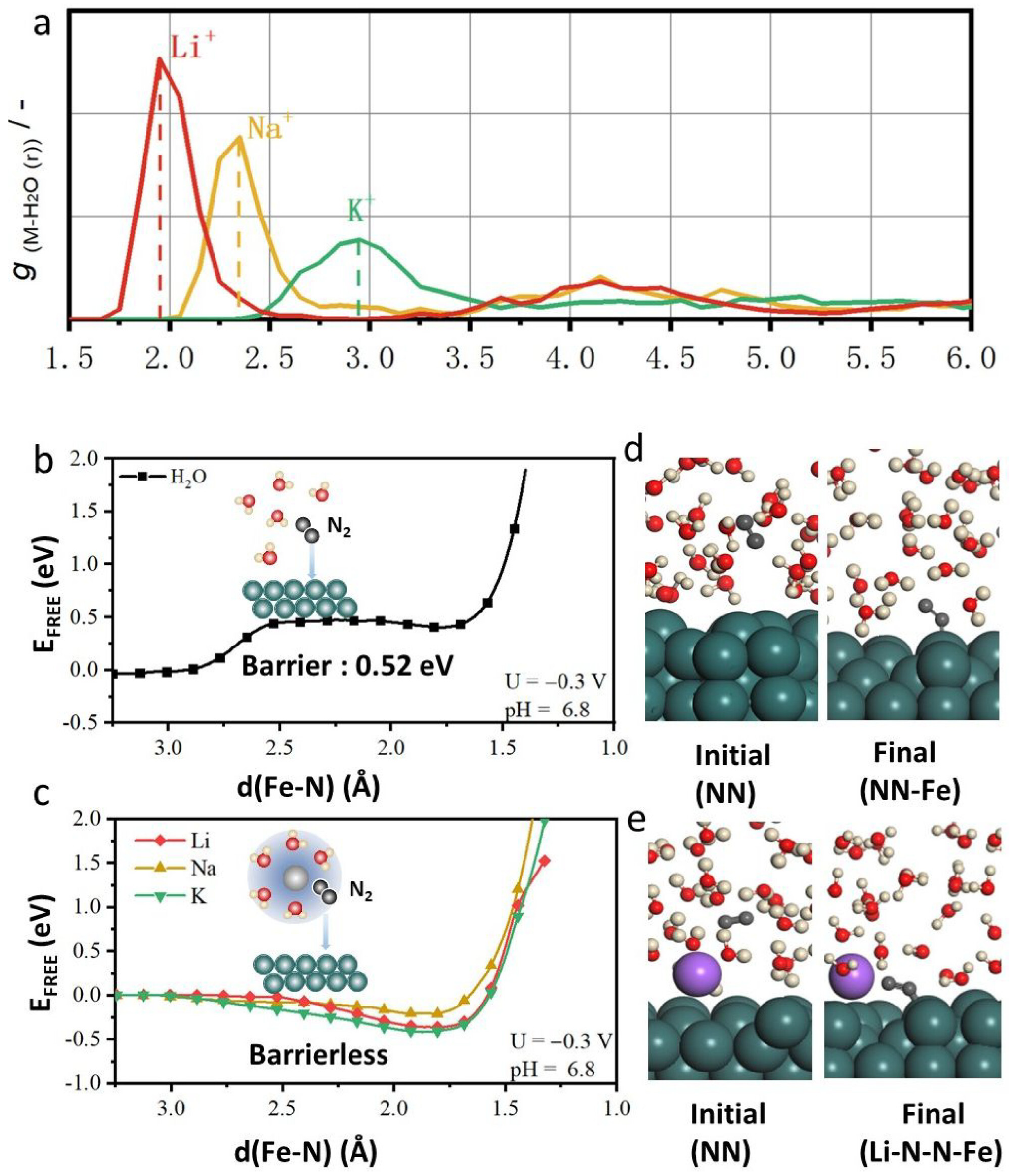
The eNRR at solid–liquid interfaces has traditionally been viewed as a surface-limited process governed by the intrinsic electronic structure of the catalyst. However, recent theoretical and experimental studies have overturned this static perspective, demonstrating that the electrolyte environment itself, particularly hydrated alkali cations, acts as an active participant in the catalytic cycle. As shown in Figure 1, the pioneering work by Mao et al. revealed that hydrated cations can fundamentally reshape the EDL, reorganize interfacial water orientation, and modulate the local potential drop, thereby altering the energetics of nitrogen adsorption and activation on transition-metal surfaces [8].
At the molecular scale, the electrode–electrolyte interface behaves as a complex capacitor consisting of solvated ions, oriented dipolar water molecules, and surface charges. In conventional models, this EDL merely screens the electrode potential; however, hydrated cations such as Li+ generate highly localized electrostatic fields due to their small ionic radius and strong hydration energy. Under operating potentials, Li+ forms a hydration shell (Li+(H2O)6) that partially penetrates the outer Helmholtz plane, aligning water dipoles toward the surface and increasing the effective field strength [21,22,23]. This enhanced field polarizes the N≡N triple bond, inducing an electron density shift from antibonding to bonding orbitals on Fe-active sites. Ab initio molecular dynamics (AIMD) simulations confirmed that this electrostatic compression lowers the adsorption barrier of N2 from 0.52 eV (Fe–H2O interface) to nearly zero when Li+ is present [24,25].
The hydration shell acts not only as an electrostatic modulator, but also as a proton shuttle that coordinates hydrogen-bond transfer during the rate-determining step (*N2 → NNH) [26,27]. Within the Li+ solvation sphere, water molecules are partially deprotonated, facilitating a Grotthuss-type proton relay that synchronizes with electron injection from the electrode [28,29]. The combined proton–electron coupling reduces the free energy barrier for NNH formation by ~0.31 eV relative to the bare interface. In contrast, Na+ and K+, with weaker hydration enthalpies and larger ionic radii, generate weaker local fields and less organized hydrogen-bond networks. As a result, Fe electrodes in Na+- or K+-containing electrolytes exhibit significantly lower Faradaic efficiencies (11–17%) compared with Li+ systems (~28%) [6,19].
Hydrated cations also govern charge partitioning at the interface. Bader charge analysis from DFT calculations indicates that ~0.95 electrons are transferred from the Li+–hydration complex to the Fe–N2 adsorption ensemble, effectively populating antibonding orbitals of N2 and facilitating bond elongation from 1.10 Å (gas phase) to 1.28 Å [8]. Simultaneously, this charge redistribution suppresses the HER by shifting the potential of zero charge (PZC) to more positive values [18]. The increased double-layer capacitance reduces proton availability near the electrode, thereby raising the activation energy of the Volmer step from 0.83 to 1.05 eV. This selective stabilization of NNH over intermediates leads to a marked increase in NH3 selectivity demonstrating that electrostatic control of the EDL is a viable alternative to conventional surface modification for achieving high-performance ammonia synthesis [30,31]. Chronoamperometric measurements conducted at −0.3 V vs. RHE under N2-saturated conditions yielded a Faradaic efficiency of approximately 27.9% toward NH3, with the current density remaining stable throughout the 10-h testing period. Complementary UV-vis spectroscopy based on the indophenol blue method verified the formation of NH3, while Ar-saturated control experiments produced negligible signals, indicating that the detected ammonia originates predominantly from N2-fed electroreduction rather than background contamination. These results firmly demonstrate that ion solvation and dynamic hydration are intrinsic components of the catalytic mechanism.
Although Li+ has emerged as the prototypical promoter in recent mechanistic studies, the underlying framework can be conceptually extended to a broader class of ionic species. Heavier alkali cations such as Rb+ and Cs+ may generate more diffuse electric double layers with attenuated interfacial fields, yet their larger hydration structures could facilitate proton shuttling through surface water reorganization. Multivalent cations, including Mg2+ and Ca2+, are expected to introduce stronger Coulombic interactions that compress the EDL more effectively while potentially stabilizing polar NxHy intermediates via electrostatic anchoring. In layered 2D catalysts such as FePS3 or MoS2, interlayer galleries and defect-induced cavities can serve as confined reservoirs for hydrated cations, producing locally intensified electric fields to a nano-capacitor effect that mimic Li+-type promotion without altering intrinsic surface chemistry [32,33]. Collectively, these possibilities highlight a broader design principle in which tailored ionic environments are deliberately paired with specific catalytic architectures to modulate interfacial fields, intermediate stabilization, and overall eNRR kinetics.
To rationalize these complex interfacial phenomena, Mao et al. developed a constant-potential hybrid solvation dynamic model (CP-HS-DM) capable of explicitly capturing both electrostatic and solvation effects under applied bias. In contrast to the conventional computational hydrogen electrode (CHE) framework, which remarks the electrode potential as spatially uniform, CP-HS-DM self-consistently adjusts the electron chemical potential while accounting for solvent polarization, thereby enabling more realistic simulations of potential-dependent free-energy landscapes [34,35]. The resulting descriptor, defined as the difference in electric-double-layer potential drop (Δϕ, EDL) between the NNH and Had transition states, exhibits trends that are consistent with experimentally observed selectivity variations across different cations. This approach represents a meaningful step toward predictive, data-driven design of electrochemical interfaces by integrating quantum-mechanical accuracy with continuum-scale field effects. In the broader context of this review, such insights have important implications for the rational design of 2D and single-atom catalysts. Many emerging layered materials (e.g., FePS3, MoS2, Ni2P) possess high dielectric constants, tunable defect densities, and accessible interlayer galleries, making them promising platforms for ion confinement and local field amplification [3,17,32,33,36]. Conceptually, embedding hydrated cations within these confined environments could reproduce the Li+-induced field modulation effects while preserving mechanical integrity. Extending this strategy to single-atom catalysts may further enhance turnover frequencies by stabilizing key transition states through localized dielectric polarization. These considerations reinforce that electrolyte engineering is not a secondary parameter but a co-equal design principle alongside catalyst composition and structure in establishing predictable activity–selectivity–stability relationships [27].
Hydrated cations therefore reshape the mechanistic picture of eNRR. Their ability to modulate the electric double layer, mediate proton transfer, and influence charge redistribution demonstrates that the electrolyte environment is functionally integral to catalytic performance. As operando spectroscopy, ab initio simulations, and descriptor-based modeling continue to converge, a unified paradigm is emerging in which interfacial ion dynamics become an explicit variable in catalyst optimization. This conceptual transition, from treating catalytic surfaces as static entities to recognizing them as components embedded in dynamically coupled electrochemical environments, sets the foundation for the next generation of field-modulated 2D ammonia electrocatalysts. Parallel to N2 reduction, the electrochemical conversion of nitrate (NO3) to ammonia offers an attractive alternative pathway due to its more favorable thermodynamics and intrinsically faster kinetics under ambient conditions. However, eNO3RR remains mechanistically intricate, involving multiple proton-coupled electron transfer steps and intermediates such as NO2, NO, NH2OH, and NH3. Achieving simultaneously high Faradaic efficiency and long-term operational stability therefore requires catalysts capable of finely controlling adsorption energetics, charge transport, and intermediate transformation pathways.

2.2. Structural Engineering Strategies for Enhanced Nitrate Electroreduction

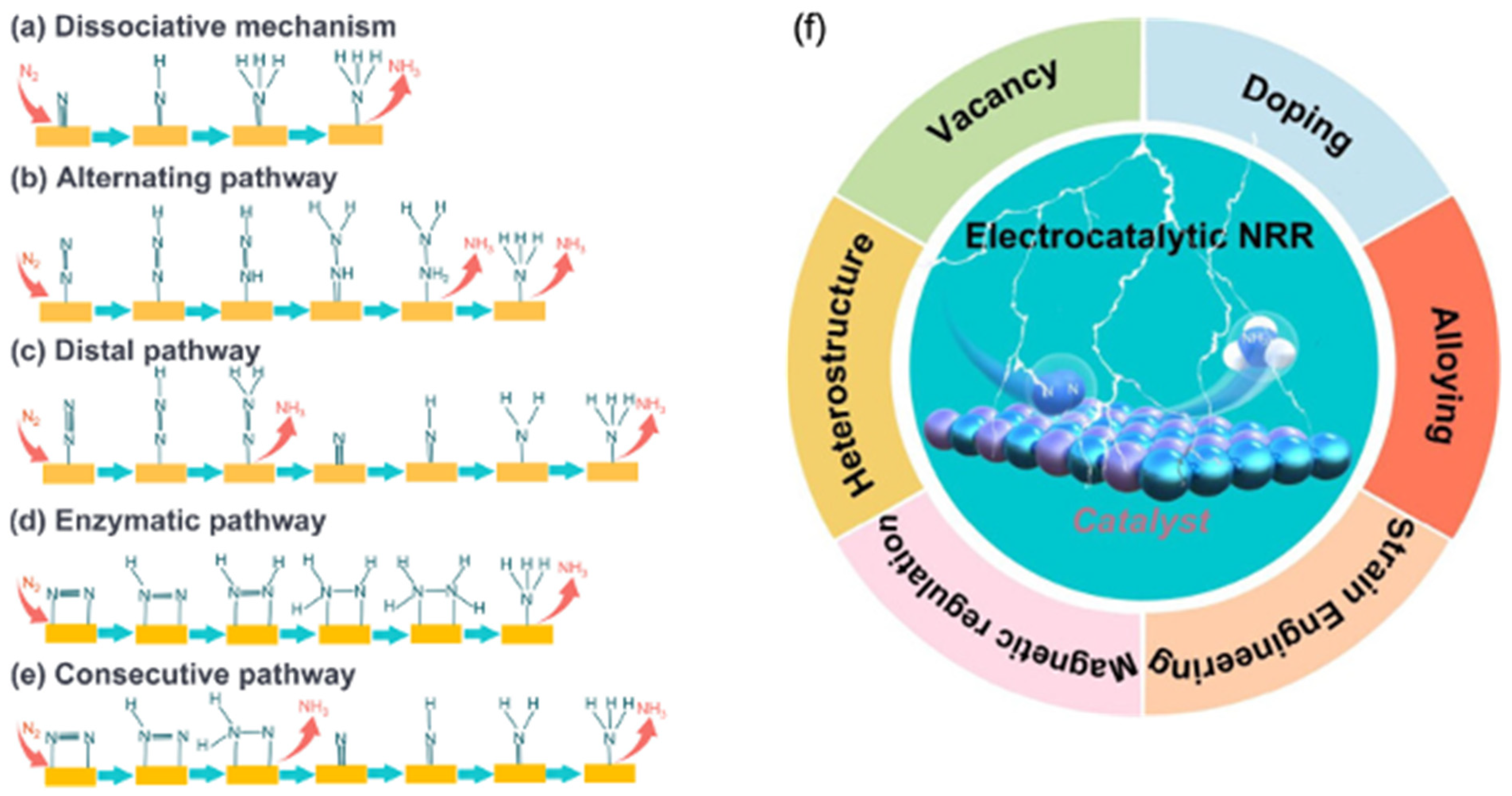
Qiu et al. and Tan et al. provided a systematic analysis of how structural engineering, from atomic coordination to nanoscale architecture, governs eNO3RR performance in Figure 2 [9,37]. Their work categorizes six key design principles, each addressing a specific limitation in electron transfer, intermediate stabilization, or structural degradation. These principles define the current blueprint for rational catalyst design in nitrate electroreduction. Bimetallic and alloy catalysts exploit synergistic electronic effects to adjust the d-band center, thereby modulating adsorption strength for both NO3 and Had. Cu-based alloys (i.e., CuNi, PdCu, and CuFe) are especially effective: Cu provides strong nitrate adsorption, while Ni or Fe donates electronic density to accelerate hydrogenation of intermediates [38]. DFT calculations show that CuNi alloys shift the d-band center closer to the Fermi level (−1.83 → −1.55 eV), enhancing the overlap between metal orbitals and NO3 π* orbitals. As a result, NO3 activation energy decreases by ~0.35 eV, while HER is simultaneously suppressed due to reduced Had binding [14]. Experimentally, CuNi nanospheres delivered a Faradaic efficiency (FE) of 97% and an NH3 yield of 25 mg h−1 cm−2, among the highest for non-noble-metal systems [39,40]. These findings highlight that electronic synergy between metals rather than simple elemental composition determines the optimal balance between adsorption and desorption in multi-step eNO3RR.
Incorporating heteroatoms such as N, B, or Fe into the catalyst lattice introduces localized charge redistribution, spin asymmetry, and defect-induced active centers. For example, B-doped TiO2 enhances local electron delocalization, stabilizing NO2 intermediates and lowering the barrier for subsequent proton-coupled electron transfer [41,42]. Similarly, N-doped carbon frameworks generate positively polarized carbon atoms adjacent to pyridinic N, which selectively adsorb nitrate anions and facilitate charge transfer to the adsorbed NO3. This targeted modification improves catalytic selectivity while maintaining mechanical integrity under extended electrolysis. The general trend observed is that heteroatom doping simultaneously enhances conductivity, increases defect density, and generates unsaturated coordination sites, which are the primary contributors to catalytic activity in both eNO3RR and eNRR systems [43,44].
The development of SACs represents the frontier of atomic-level design. By anchoring isolated metal centers (i.e., Fe, Ru, Cu, Co) on nitrogen-doped carbon or oxide supports, SACs achieve nearly 100% active-site utilization while maintaining tunable coordination environments [45]. For instance, Fe–N4SACs exhibit operando Fe valence oscillation between Fe2+ and Fe3+ during potential cycling, as confirmed by X-ray absorption near-edge structure (XANES) [46,47]. This dynamic reconstruction enables continuous reactivation of Fe sites, preventing deactivation and enhancing long-term stability. Moreover, Ru/TiOx SACs show high NH3 selectivity (>98%) with suppressed NO2 accumulation, owing to the optimal Gibbs free energy difference (ΔG* = 0.41 eV) for NH2OH formation. These results emphasize that precisely engineered coordination geometry rather than mere elemental identity is the key determinant of catalytic performance [48,49].
Nanostructure engineering the catalyst surface can expose high-index facets, edge sites, and defect terminations that serve as highly active reaction centers [14,50]. However, excessive downsizing leads to surface energy accumulation and particle sintering under operation. Therefore, a balance between surface reactivity and morphological robustness is required. Studies on Cu nanocubes and Ni nanowires demonstrate that controlling crystal orientation along (111) or (200) facets modify adsorption geometries and electron density distribution, tuning the selectivity toward ammonia over nitrogen gas [14,51]. The optimal particle size regime (ca. 10 nm) offers a high density of active edges while minimizing dissolution. This trade-off underlines a general rule: the most active surface is not necessarily the most stable, and durability must be co-optimized alongside intrinsic activity. Beyond particle-level control, nanoconfinement within porous supports such as carbon nanotubes, TiO2 nanotubes, or metal–organic frameworks can drastically improve mass transport and selectivity. Confined geometries create localized microenvironments that enhance reactant–catalyst contact and stabilize charged intermediates via dielectric screening. For instance, Cu nanoparticles confined in N-doped carbon shells exhibit stronger NO3 adsorption and reduced Had coverage, achieving nearly 100% NH3 selectivity [50,52]. In parallel, tandem catalysis, defined as the integration of distinct active sites that catalyze sequential steps (e.g., NO3 → NO2 → NH3), has gained traction. Bimetallic CuCoSP catalysts exemplify this approach: Cu facilitates nitrate activation, while Co accelerates the hydrogenation of intermediate NO2. This cooperative mechanism mimics biological denitrification, achieving continuous conversion with minimal intermediate accumulation [53,54].
The diversity of catalyst architectures necessitates quantitative descriptors that link structure to performance. Recent DFT analyses and operando spectroscopies converge on the adsorption free energy (ΔG*) of key intermediates, particularly NO2 and NH2OH, as the most predictive descriptor of selectivity [55]. An ideal catalyst maintains moderate binding (ΔG* ≈ 0.5 eV), strong enough for activation but weak enough for facile desorption. Volcano plots constructed using ΔG (NH2OH) reveal that Fe- and Cu-based catalysts sit near the apex, consistent with their experimentally observed high activity. This quantitative framework enables predictive screening of new compositions using machine-learning-assisted DFT databases [55].
A major conceptual breakthrough in recent years is recognizing that catalyst surfaces are dynamic entities, not static structures. Operando XAS, Raman, and Fourier-transform infrared (FTIR) spectroscopy now enable real-time tracking of oxidation states, lattice strain, and adsorbed species during electrolysis. For example, Fe/Ni2P catalysts exhibit reversible oxidation–reduction cycles (Fe3+ ↔ Fe2+) that correlate with NH3 production rate, confirming that lattice oxygen participates transiently in the reaction [56,57]. Similarly, Raman monitoring of Cu-based catalysts shows time-dependent Cu+/Cu0 fluctuations synchronized with NO3 conversion, supporting the notion of self-adaptive active sites. This understanding shifts the focus from static active sites to dynamic reconstruction networks, where the most active configurations appear only under operating conditions [40,48,58]. Despite remarkable progress, several intrinsic challenges remain. First, kinetic competition with the HER continues to limit efficiency at industrially relevant current densities. Second, long-term stability is hindered by surface oxidation, particle agglomeration, and dissolution in highly alkaline environments. Third, scalability remains a hurdle, as most high-performing nanocatalysts require complex synthesis routes that are not readily compatible with large-scale electrode fabrication.
To address these issues, future work should emphasize:
(i)
defect engineering to regulate electron density and prevent corrosion,
(ii)
integration of catalysts into conductive, binder-free electrodes for better electron transport,
(iii)
development of standardized eNO3RR testing protocols to ensure cross-study comparability.
The lessons learned from nitrate reduction extend beyond waste remediation. The principles of electronic coupling, confinement, and dynamic reconstruction are equally applicable to eNRR systems and 2D catalysts. In particular, the balanced binding energy design rule and tandem catalysis concept provide a conceptual bridge between eNO3RR and eNRR research. By merging insights from structural engineering with electrolyte effects, as discussed in Section 2, future ammonia electrocatalysts can achieve high activity under low overpotentials while maintaining stability through dynamic self-healing processes.
Structural engineering has evolved from a purely morphological optimization tool into a multi-scale design philosophy encompassing atomic, electronic, and architectural control. Qiu et al. demonstrated that the rational manipulation of alloying, doping, and confinement enables precise tuning of intermediate binding and charge transfer [9]. The combination of operando observation and theoretical modeling now provides the feedback loop necessary for predictive catalyst design. By integrating these insights with electrolyte engineering, researchers are approaching a coherent framework in which the structure–activity–stability relationship becomes quantitatively predictable, an essential step toward realizing scalable and durable electrochemical ammonia synthesis [8].

2.3. Single-Atom Catalysis Within Adaptive MOFs

The advent of SACs represents a paradigm shift in electrocatalysis, bridging the atomic precision of homogeneous catalysts with the stability of heterogeneous systems [40,59]. From an operando characterization perspective, X-ray absorption spectroscopy (XANES/EXAFS) plays a uniquely critical role in elucidating the dynamic structural evolution of single-atom sites embedded within MOF matrices during electrolysis. Operando XAS enables element-specific and quantitative tracking of oxidation states and coordination environments under working conditions, providing direct insight into the true active state of single-atom catalysts. While operando Raman spectroscopy, EPR, and NMR offer complementary information on surface intermediates, paramagnetic states, and nitrogen speciation, respectively, a multi-modal operando strategy anchored by XAS is essential for establishing reliable structure–activity–stability relationships in MOF-derived single-atom electrocatalysts. When combined with the structural tunability of MOFs, these materials provide unparalleled control over coordination geometry, electronic structure, and mass transport pathways [60,61]. The recent work by Wang et al. exemplifies this approach, demonstrating that MOF-stabilized SACs can achieve both high ammonia yield and exceptional Faradaic efficiency while maintaining long-term operational stability [13]. In traditional supported catalysts, metal nanoparticles tend to aggregate under electrochemical conditions, leading to deactivation and selectivity loss. MOFs, however, offer periodic, tunable coordination environments capable of anchoring isolated metal atoms via strong metal–oxygen or metal–nitrogen bonds. In the UiO-66 framework used in this study, the Zr6O8 cluster serves as a chemically robust node that can host single transition-metal atoms (M = Mn, Fe, Co, Ni, Cu, Zn, Mo) at defect sites [57]. This modularity allows fine-tuning of the local coordination symmetry (octahedral vs. square-planar) and oxidation state, creating site-specific electronic structures optimized for nitrate adsorption and reduction. Atomic-resolution HAADF-STEM and EXAFS analyses confirmed the absence of metallic clusters and the presence of isolated M–O coordination environments [62,63]. Such atomic dispersion maximizes active-site utilization and ensures uniform electric-field distribution throughout the catalyst, a key factor for maintaining consistent reaction kinetics during long-term electrolysis. Among the series of UiO-66–M catalysts, Cu- and Fe-based SACs emerged as the most effective for nitrate reduction, achieving NH3 yield rates of 30.0 and 29.0 mg h−1 cm−2 and Faradaic efficiencies above 96% at −1.0 V vs. RHE. The superior activity of these two metals can be traced to their intermediate binding strengths for NO3 and NH2OH intermediates, which prevent over binding (as seen for Co or Ni) while ensuring efficient hydrogenation steps. DFT simulations reveal that Cu- and Fe-SACs exhibit Gibbs free-energy barriers 0.3–0.4 eV lower than Mn- or Zn-based analogs across all proton-coupled electron transfer (PCET) steps. Spectroscopic evidence provides further mechanistic insight. EPR spectra confirmed that Cu maintained its Cu2+ oxidation state during catalysis, while Fe remained as Fe3+, suggesting redox-stable coordination environments. Operando Raman and 15N NMR spectroscopy identified key intermediates (*NO2OH, *NO, *NH, NH2), verifying the multi-step reduction mechanism [64]:
NO3 → NO2 → NO → NH2OH → NH3.
The persistence of isolated oxidation states after prolonged operation indicates that the MOF scaffold acts as a chemical stabilizer, mitigating metal dissolution or aggregation. Mechanistic simulations and synchrotron PXRD revealed that nitrate reduction proceeds via a sequence of adsorption–activation–hydrogenation steps, each facilitated by specific interactions between the metal center and the framework oxygen atoms [57,59]. The reaction begins with the formation of surface NO3 intermediates bound through Cu···ONO2 or Fe···ONO2 coordination. Protonation leads to NO2OH, which subsequently decomposes to NO and NH intermediates before complete hydrogenation to NH3. The key kinetic barrier corresponds to the NO2OH → NO step, where Cu and Fe single atoms lower ΔG by 0.45 eV relative to the less active Mn site.
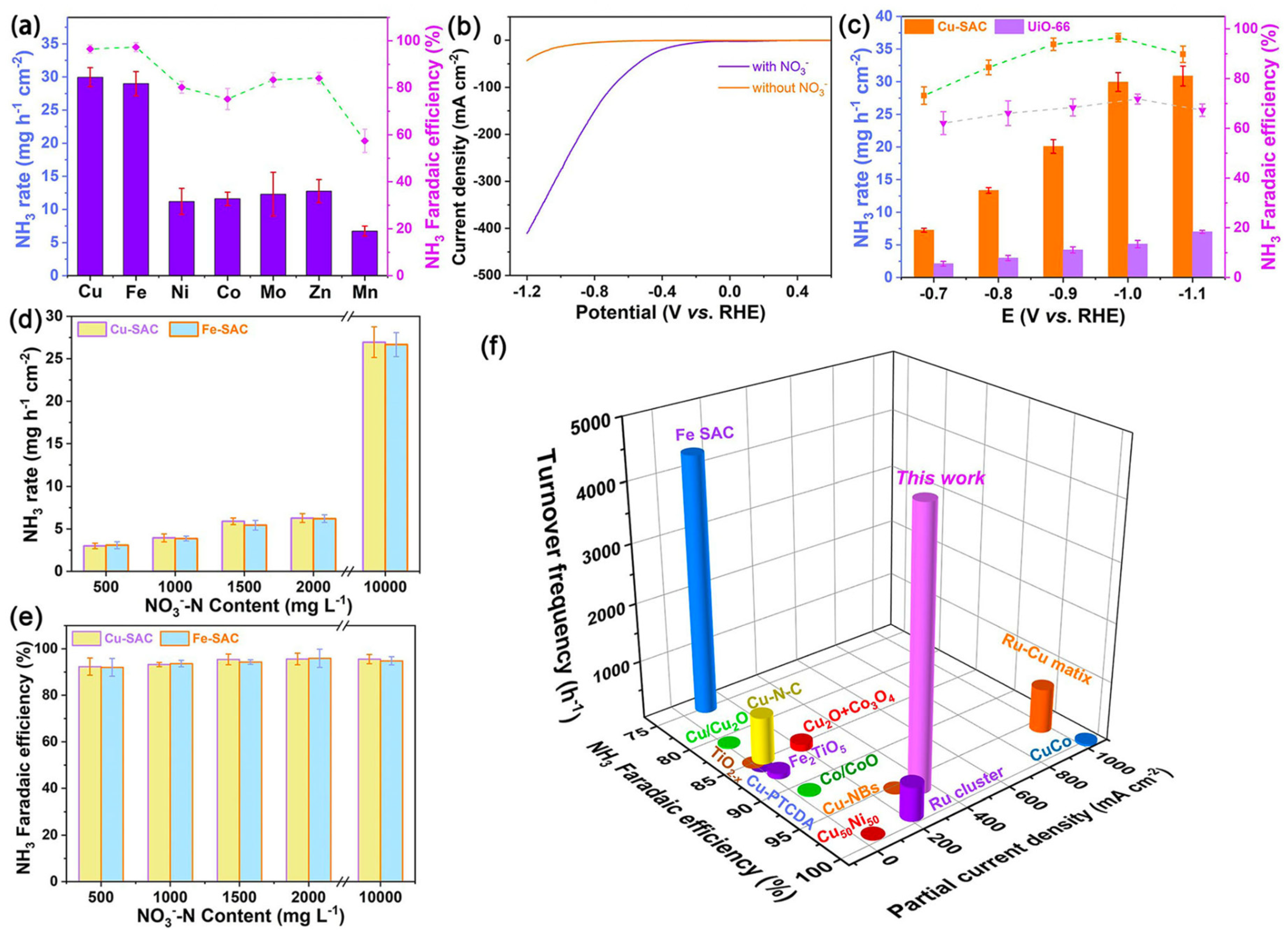
Figure 3 summarizes the electrocatalytic NO3 reduction performance of MOF-derived single-atom catalysts, including NH3 yield, Faradaic efficiency, and benchmarking against previously reported systems. Charge-density difference plots show significant electron delocalization between metal centers and the NO3 adsorbate, confirming strong electronic coupling. This delocalization facilitates efficient PCET while stabilizing reaction intermediates via π-back-donation from the metal center to the antibonding orbitals of NO3. Overall, Cu-SAC exhibits the lowest limiting potential (−1.0 V vs. RHE), consistent with its experimentally observed high activity. A striking observation from in situ characterizations is the structural adaptability of the UiO-66 matrix during operation. Upon prolonged electrolysis, the initially crystalline MOF gradually transforms into an amorphous ZrOx network, within which Cu or Fe atoms remain atomically anchored. This amorphization improves electrical conductivity and mass transport while retaining local coordination order [57,65]. XANES and EXAFS analyses confirm that Cu–O and Fe–O coordination remains intact even after 50 h of continuous reaction, evidencing the formation of a self-healing catalytic microenvironment. This transformation demonstrates an important design concept: controlled structural flexibility can be beneficial. Rather than degrading, the amorphous phase provides adaptive stabilization against overpotential-induced stress, maintaining catalytic activity over extended operation. Such dynamic stabilization echoes the metastability principle highlighted in earlier sections balancing reactivity and durability through reversible structural rearrangement [13].
Electrochemical performance tests further underscore the potential of these MOF-based SACs. Both Cu- and Fe-SACs maintained nearly constant current density and Faradaic efficiency during 20-h chronoamperometric operation. Ammonia formation rates exceeded those of most reported transition-metal catalysts, including Ni2P [66,67], Co3O4 [68,69], and Fe–N–C [70] systems, by an order of magnitude. Additionally, the catalysts demonstrated tolerance to complex electrolyte matrices such as simulated nuclear wastewater, maintaining 90% of their initial FE after ten cycles. This exceptional robustness stems from the strong metal–oxygen anchoring and inherent corrosion resistance of the UiO-derived amorphous ZrOx structure. From a descriptor perspective, the high efficiency of Cu- and Fe-SACs correlates with the moderate adsorption free energy (ΔG*) of the NO2OH intermediate (≈0.45 eV), which represents the optimal trade-off between activity and selectivity. By contrast, conventional nanoparticle catalysts often exhibit excessive binding (ΔG* < 0.2 eV), leading to intermediate accumulation or N2 by-production. The linear scaling relationship between ΔG* (NO2OH) and experimental NH3 yield suggests that electronic modulation through single-atom coordination is a reliable predictor of catalytic performance. This finding is consistent with the volcano-type dependence reported across alloy and doped systems, confirming that atomic dispersion enables precise control of adsorption energetics that are otherwise averaged out in polyatomic surfaces.
The insights gained from MOF-derived SACs have broader implications for 2D and hybrid catalyst systems. In 2D materials such as FePS3 or MoS2, interlayer voids and defect sites could similarly host single atoms stabilized by heteroatom coordination, replicating the MOF confinement effect. Furthermore, embedding SACs into conductive carbon matrices or lamellar supports could facilitate scale-up to membrane-electrode assemblies (MEAs), where uniform atomic dispersion ensures consistent performance under high current densities (>100 mA cm−2). This architectural approach bridges the gap between atomic-scale control and device-level integration, offering a realistic route toward industrially relevant ammonia electrosynthesis. Looking forward, the rational design of SACs for eNO3RR will increasingly rely on descriptor-based screening combined with machine-learning algorithms to predict optimal coordination environments and stability limits. Operando observables such as oxidation-state oscillation frequencies, local potential gradients, and intermediate residence times can serve as quantitative inputs for dynamic stability models. These models can then be used to predict catalyst lifetime and degradation pathways under industrially relevant operating conditions. Additionally, future studies should explore dual-site SACs (e.g., Cu–Fe or Fe–Ni pairs) that mimic enzymatic bifunctionality, potentially enabling tandem NO3 → NO2 → NH3 conversion on spatially adjacent sites. Integrating SACs with photoelectrochemical or plasma-assisted systems may further enhance efficiency by coupling electronic and photonic activation mechanisms.
MOF-based single-atom catalysts represent a significant milestone in the evolution of nitrate-to-ammonia electrocatalysis. Their atomically dispersed active centers, stabilized within adaptive coordination environments, achieve unprecedented efficiency, selectivity, and durability under mild conditions. The UiO-66–derived Cu and Fe SACs demonstrate how the convergence of atomic precision, structural flexibility, and electronic tunability can overcome long-standing trade-offs between activity and stability. By extending these concepts to 2D and hierarchical architectures, the field moves closer to developing predictive, scalable, and industrially viable platforms for sustainable ammonia production.

3. Outlook and Perspectives

The integration of electrolyte-controlled interfacial chemistry, atomic-level structural engineering, and single-atom precision has shifted electrochemical ammonia synthesis from empirical optimization toward mechanism-based, data-driven design. The studies highlighted in this review demonstrate that parameters such as local electric fields, atomic coordination environments, and solvation structures can be deliberately tuned to balance catalytic activity, selectivity, and durability. As the field matures, future catalyst development for both N2 and NO3 reduction will require a unified framework that links quantum-level descriptors with device-scale architectures.
From a practical application standpoint, the competitiveness of electrochemical nitrate reduction (eNO3RR) and nitrogen reduction (eNRR) differs markedly in terms of energy efficiency, feedstock availability, and scalability. eNO3RR offers clear near-term advantages, as nitrate is a more reactive nitrogen source and is abundantly available in many industrial and agricultural waste streams. When sufficiently nitrate-rich effluents are present, eNO3RR can be viewed as a form of ammonia mining, simultaneously enabling pollutant remediation and value-added NH3 production. In contrast, eNRR remains fundamentally constrained by the intrinsic inertness of molecular N2 and severe competition from the hydrogen evolution reaction, yet it represents the ultimate pathway for environmentally benign ammonia synthesis from ubiquitous N2 in the long term. Accordingly, these two pathways should be viewed as complementary rather than competing, defining near-term and long-term routes toward sustainable ammonia production.
From a device-integration perspective, translating promising electrocatalysts from half-cell studies to practical architectures requires explicit consideration of mass transport, ionic conductivity, and interfacial contact at the electrode–electrolyte interface. While most reported performances are still based on H-type or flow-cell configurations with gas diffusion electrodes (GDEs), full membrane–electrode assembly (MEA) or single-cell demonstrations remain limited, highlighting a critical gap between catalyst development and device-level validation. Bridging this gap will require systematic integration of advanced catalysts into MEA-compatible electrodes, where catalyst utilization, water management, and ionomer–catalyst interactions collectively determine achievable current density and energy efficiency.
In parallel, long-term stability evaluation must move beyond short-duration tests to more stringent protocols that better reflect device-relevant operation. Where feasible, extended chronoamperometric operation at constant current or constant potential should be conducted, accompanied by post-operation structural and compositional verification to confirm the persistence of active sites. For MOF-derived and single-atom catalysts in particular, post-reaction characterization is essential to assess dynamic reconstruction, metal migration, or framework degradation that may not be captured by initial ex situ analyses.
Based on the insights discussed in Section 2.1, Section 2.2 and Section 2.3, several strategic directions should guide the next phase of research, including electrolyte–catalyst co-design, defect-driven electronic engineering, dynamic stability mapping, descriptor-guided screening, scalable integration, and hybrid energy coupling strategies. Advancing these directions will help resolve long-standing trade-offs between catalytic activity, stability, and scalability. The field is now at a pivotal moment, evolving into a multidisciplinary effort that merges surface science, electrochemistry, data science, and systems engineering. Through continued interdisciplinary collaboration, scalable and carbon-neutral ammonia synthesis can move from conceptual vision to industrial reality.

Author Contributions

Conceptualization: S.B. and H.J., investigation: H.J.L. and S.B., writing—original draft preparation, S.B., writing—review and editing: H.J. and H.J.L. All authors have read and agreed to the published version of the manuscript.

Funding

This research was funded by the research grant of Kongju National University Industry-University cooperation foundation in 2025 and the National Research Foundation of Korea (NRF) grant funded by the Korea government (MSIT) (RS-2022-NR073879 to H.J.L.).

Data Availability Statement

No data was used for the research described in the article.

Conflicts of Interest

The authors declare that they have no known competing financial interests or personal relationships that could have appeared to influence the work reported in this paper.

References

  1. Ju, H.; Yoon, D.; Bong, S.; Lee, J. Challenge and opportunity in scaling-up hydrogen production via electrochemical ammonia electrolysis process. Curr. Opin. Electrochem. 2025, 49, 101609. [Google Scholar]
  2. Ju, H.; Kaur, G.; Kulkarni, A.P.; Giddey, S. Challenges and trends in developing technology for electrochemically reducing CO2 in solid polymer electrolyte membrane reactors. J. CO2 Util. 2019, 32, 178–186. [Google Scholar] [CrossRef]
  3. Cho, M.; Ju, H.; Bae, S.; Bong, S.; Lee, J. Scalable ammonia synthesis on the modified crystal structure of Cu3PS4 electrocatalyst. Electrochim. Acta 2024, 507, 145166. [Google Scholar] [CrossRef]
  4. Chung, S.; Ju, H.; Choi, M.; Yoon, D.; Lee, J. Local Proton Source Enhanced Nitrogen Reduction on a Combined Cobalt-Molybdenum Catalyst for Electrochemical Ammonia Synthesis. Angew. Chem. Int. Ed. 2022, 61, e202212676. [Google Scholar] [CrossRef]
  5. Ju, H.; Seo, D.H.; Chung, S.; Mao, X.; An, B.-S.; Musameh, M.; Gengenbach, T.R.; Shon, H.; Du, A.; Bendavid, A.; et al. Green ammonia synthesis using CeO2/RuO2 nanolayers on vertical graphene catalyst via electrochemical route in alkaline electrolyte. Nanoscale 2022, 14, 1395–1408. [Google Scholar]
  6. Jia, H.-P.; Quadrelli, E.A. Mechanistic aspects of dinitrogen cleavage and hydrogenation to produce ammonia in catalysis and organometallic chemistry: Relevance of metal hydride bonds and dihydrogen. Chem. Soc. Rev. 2013, 43, 547–564. [Google Scholar] [CrossRef] [PubMed]
  7. Hyung Kim, J.; Cha, J.-E.; Ju, H.; Choi, Y.-W.; Baek, J.; Georg Albers, J.; Shim, J.; Hyung Kim, S.; Lee, K.; Chul Yoon, H. Utilizing water as a proton source for sustainable Li-mediated electrochemical ammonia synthesis. Chem. Eng. J. 2024, 497, 154644. [Google Scholar] [CrossRef]
  8. Mao, X.; Bai, X.; Wu, G.; Qin, Q.; O’Mullane, A.P.; Jiao, Y.; Du, A. Electrochemical Reduction of N2 to Ammonia Promoted by Hydrated Cation Ions: Mechanistic Insights from a Combined Computational and Experimental Study. J. Am. Chem. Soc. 2024, 146, 18743–18752. [Google Scholar] [CrossRef]
  9. Qiu, W.; Liu, Y.; Xie, M.; Jin, Z.; Li, P.; Yu, G. Structural engineering of catalysts for ammonia electrosynthesis from nitrate: Recent advances and challenges. EES Catal. 2024, 2, 202–219. [Google Scholar] [CrossRef]
  10. Niu, Z.; Wang, G. Rational electrocatalyst design for selective nitrate reduction to ammonia. Chem. Phys. Rev. 2025, 6, 011307. [Google Scholar] [CrossRef]
  11. Liu, X.; Liu, J.; Chen, A.; Yang, S.; Jiang, L.; Sui, Y. 99.7% Faradaic Efficiency in Nitrate Reduction Enabled by Defect-Rich Copper Nanoparticles. ACS Appl. Nano Mater. 2025, 8, 17518–17526. [Google Scholar] [CrossRef]
  12. Jang, D.; Maeng, J.; Kim, J.; Han, H.; Park, G.H.; Ha, J.; Shin, D.; Hwang, Y.J.; Kim, W.B. Boosting electrocatalytic nitrate reduction reaction for ammonia synthesis by plasma-induced oxygen vacancies over MnCuOx. Appl. Surf. Sci. 2023, 610, 155521. [Google Scholar] [CrossRef]
  13. Shan, L.; Ma, Y.; Xu, S.; Zhou, M.; He, M.; Sheveleva, A.M.; Cai, R.; Lee, D.; Cheng, Y.; Tang, B.; et al. Efficient electrochemical reduction of nitrate to ammonia over metal-organic framework single-atom catalysts. Commun. Mater. 2024, 5, 104. [Google Scholar]
  14. Zhang, K.; Liu, Y.; Pan, Z.; Xia, Q.; Huo, X.; Christopher Esan, O.; Zhang, X.; An, L. Cu-based catalysts for electrocatalytic nitrate reduction to ammonia: Fundamentals and recent advances. EES Catal. 2024, 2, 727–752. [Google Scholar] [CrossRef]
  15. Cao, Y.; Yuan, S.; Meng, L.; Wang, Y.; Hai, Y.; Su, S.; Ding, W.; Liu, Z.; Li, X.; Luo, M. Recent Advances in Electrocatalytic Nitrate Reduction to Ammonia: Mechanism Insight and Catalyst Design. ACS Sustain. Chem. Eng. 2023, 11, 7965–7985. [Google Scholar] [CrossRef]
  16. Zhang, K.; Zou, X.; Liu, Y.; Zhang, X.; An, L. Progress and perspectives in the electroreduction of low-concentration nitrate for wastewater management. iScience 2025, 28, 111687. [Google Scholar]
  17. Ju, H.; Sanglay, G.D.; Bae, S.; Cho, M.; Ocon, J.D.; Jeong, B.; Bong, S.; Lee, J. Synthesis of 2D Nanosheet FePS3 Electrocatalyst via Salt-Template Method for Electrochemical Green Ammonia Production. J. Electrochem. Sci. Technol. 2025, 16, 180–187. [Google Scholar]
  18. Hao, Y.-C.; Guo, Y.; Chen, L.-W.; Shu, M.; Wang, X.-Y.; Bu, T.-A.; Gao, W.-Y.; Zhang, N.; Su, X.; Feng, X.; et al. Promoting nitrogen electroreduction to ammonia with bismuth nanocrystals and potassium cations in water. Nat. Catal. 2019, 2, 448–456. [Google Scholar] [CrossRef]
  19. Duan, F.; Chen, J.; Zhang, M.; Liu, Y.; Xue, H.; Sun, Y.; Li, Q.; Zhang, X.; Gao, Z.; Lu, Z.; et al. Lithium-Mediated Ammonia Electrosynthesis over Orderly Arranged Dipoles Regulated Solid-Electrolyte Interphase. J. Am. Chem. Soc. 2025, 147, 24317–24325. [Google Scholar]
  20. Paliwal, A.; Bandas, C.D.; Thornburg, E.S.; Haasch, R.T.; Gewirth, A.A. Enhanced Nitrate Reduction Activity from Cu-Alloy Electrodes in an Alkaline Electrolyte. ACS Catal. 2023, 13, 6754–6762. [Google Scholar] [CrossRef]
  21. Yu, S.; Levell, Z.; Jiang, Z.; Zhao, X.; Liu, Y. What Is the Rate-Limiting Step of Oxygen Reduction Reaction on Fe–N–C Catalysts? J. Am. Chem. Soc. 2023, 145, 25352–25356. [Google Scholar] [CrossRef]
  22. Bai, X.; He, M.; Xu, Y.; Xu, B.; Lu, Q.; Wang, J.; Ling, C. New Mechanistic Insights into CO2/CO Electroreduction to Acetate by Combining Computations and Experiments. ACS Catal. 2024, 14, 3171–3180. [Google Scholar] [CrossRef]
  23. Bai, X.; Zhao, X.; Zhang, Y.; Ling, C.; Zhou, Y.; Wang, J.; Liu, Y. Dynamic Stability of Copper Single-Atom Catalysts under Working Conditions. J. Am. Chem. Soc. 2022, 144, 17140–17148. [Google Scholar] [CrossRef] [PubMed]
  24. Mähler, J.; Persson, I. A Study of the Hydration of the Alkali Metal Ions in Aqueous Solution. Inorg. Chem. 2012, 51, 425–438. [Google Scholar] [CrossRef] [PubMed]
  25. Li, P.; Jiao, Y.; Huang, J.; Chen, S. Electric Double Layer Effects in Electrocatalysis: Insights from Ab Initio Simulation and Hierarchical Continuum Modeling. JACS Au 2023, 3, 2640–2659. [Google Scholar] [CrossRef]
  26. Rana, R.; Ali, S.M.; Maity, D.K. Structure and dynamics of the Li+ ion in water, methanol and acetonitrile solvents: Ab initio molecular dynamics simulations. Phys. Chem. Chem. Phys. 2023, 25, 31382–31395. [Google Scholar] [CrossRef] [PubMed]
  27. Huang, J.; Li, M.; Eslamibidgoli, M.J.; Eikerling, M.; Groß, A. Cation Overcrowding Effect on the Oxygen Evolution Reaction. JACS Au 2021, 1, 1752–1765. [Google Scholar] [CrossRef]
  28. Popov, I.; Zhu, Z.; Young-Gonzales, A.R.; Sacci, R.L.; Mamontov, E.; Gainaru, C.; Paddison, S.J.; Sokolov, A.P. Search for a Grotthuss mechanism through the observation of proton transfer. Commun. Chem. 2023, 6, 77. [Google Scholar] [CrossRef]
  29. Cioncoloni, G.; Roger, I.; Wheatley, P.S.; Wilson, C.; Morris, R.E.; Sproules, S.; Symes, M.D. Proton-Coupled Electron Transfer Enhances the Electrocatalytic Reduction of Nitrite to NO in a Bioinspired Copper Complex. ACS Catal. 2018, 8, 5070–5084. [Google Scholar] [CrossRef]
  30. Li, P.; Jiang, Y.-L.; Men, Y.; Jiao, Y.-Z.; Chen, S. Kinetic cation effect in alkaline hydrogen electrocatalysis and double layer proton transfer. Nat. Commun. 2025, 16, 1844. [Google Scholar] [CrossRef]
  31. Iqbal, M.S.; Ruan, Y.; Iftikhar, R.; Khan, F.Z.; Li, W.; Hao, L.; Robertson, A.W.; Percoco, G.; Sun, Z. Lithium-mediated electrochemical dinitrogen reduction reaction. Ind. Chem. Mater. 2023, 1, 563–581. [Google Scholar] [CrossRef]
  32. Xie, W.; Zhong, L.; Zeng, H.; Wang, X.; Xiao, Y.; Cheng, B.; Lei, S. MIL-88-derived porous carbon rod-supported FePS3 nanosheet arrays for robust sodium storage. J. Energy Storage 2025, 105, 114799. [Google Scholar] [CrossRef]
  33. Huang, H.; Song, J.; Yu, D.; Hao, Y.; Wang, Y.; Peng, S. Few-layer FePS3 decorated with thin MoS2 nanosheets for efficient hydrogen evolution reaction in alkaline and acidic media. Appl. Surf. Sci. 2020, 525, 146623. [Google Scholar] [CrossRef]
  34. Aissa, M.A.B.; Tremblay, B.; Andrieux-Ledier, A.; Maisonhaute, E.; Raouafi, N.; Courty, A. Copper nanoparticles of well-controlled size and shape: A new advance in synthesis and self-organization. Nanoscale 2015, 7, 3189–3195. [Google Scholar] [CrossRef] [PubMed]
  35. Devautour-Vinot, S.; Maurin, G.; Serre, C.; Horcajada, P.; Paula da Cunha, D.; Guillerm, V.; de Souza Costa, E.; Taulelle, F.; Martineau, C. Structure and Dynamics of the Functionalized MOF Type UiO-66(Zr): NMR and Dielectric Relaxation Spectroscopies Coupled with DFT Calculations. Chem. Mater. 2012, 24, 2168–2177. [Google Scholar] [CrossRef]
  36. Fujita, S.; Yamaguchi, S.; Yamasaki, J.; Nakajima, K.; Yamazoe, S.; Mizugaki, T.; Mitsudome, T. Ni2P Nanoalloy as an Air-Stable and Versatile Hydrogenation Catalyst in Water: P-Alloying Strategy for Designing Smart Catalysts. Chem.–A Eur. J. 2021, 27, 4439–4446. [Google Scholar] [CrossRef]
  37. Tan, W.; Zhao, H.; Ding, L.; Ren, N.; Yu, X.; Wang, A.; Zhao, M. Advancements in Electrocatalytic Nitrogen Reduction Reaction: A Review on the Role of Catalyst Electronic Structure and Design Strategies. ACS Appl. Nano Mater. 2025, 8, 2632–2651. [Google Scholar] [CrossRef]
  38. Zhou, P.; Niu, P.; Liu, J.; Zhang, N.; Bai, H.; Chen, M.; Feng, J.; Liu, D.; Wang, L.; Chen, S.; et al. Anodized Steel: The Most Promising Bifunctional Electrocatalyst for Alkaline Water Electrolysis in Industry. Adv. Funct. Mater. 2022, 32, 2202068. [Google Scholar] [CrossRef]
  39. Yu, W.; Yu, J.; Huang, M.; Wang, Y.; Wang, Y.; Li, J.; Liu, H.; Zhou, W. Laser-controlled tandem catalytic sites of CuNi alloys with ampere-level electrocatalytic nitrate-to-ammonia reduction activities for Zn–nitrate batteries. Energy Environ. Sci. 2023, 16, 2991–3001. [Google Scholar] [CrossRef]
  40. Wang, Y.; Zhou, W.; Jia, R.; Yu, Y.; Zhang, B. Unveiling the Activity Origin of a Copper-based Electrocatalyst for Selective Nitrate Reduction to Ammonia. Angew. Chem. Int. Ed. 2020, 59, 5350–5354. [Google Scholar] [CrossRef]
  41. Duan, J.; Chen, S.; Jaroniec, M.; Qiao, S.Z. Heteroatom-Doped Graphene-Based Materials for Energy-Relevant Electrocatalytic Processes. ACS Catal. 2015, 5, 5207–5234. [Google Scholar] [CrossRef]
  42. Chen, W.; Ge, C.; Li, J.T.; Beckham, J.L.; Yuan, Z.; Wyss, K.M.; Advincula, P.A.; Eddy, L.; Kittrell, C.; Chen, J.; et al. Heteroatom-Doped Flash Graphene. ACS Nano 2022, 16, 6646–6656. [Google Scholar] [CrossRef]
  43. Li, C.; Zhu, Q.; Song, C.; Zeng, Y.; Zheng, Y. Electrocatalysts for Urea Synthesis from CO2 and Nitrogenous Species: From CO2 and N2/NOxReduction to urea synthesis. ChemSusChem 2024, 17, e202401333. [Google Scholar] [CrossRef] [PubMed]
  44. Wang, F.; Mao, J. Effect of N-doping on graphene: NRR activity and N-source. Diam. Relat. Mater. 2021, 118, 108494. [Google Scholar] [CrossRef]
  45. Zhu, C.; Fu, S.; Shi, Q.; Du, D.; Lin, Y. Single-Atom Electrocatalysts. Angew. Chem. Int. Ed. 2017, 56, 13944–13960. [Google Scholar]
  46. Yang, F.; Song, P.; Ge, X.; Wang, Y.; Gunji, T.; Zhang, W.; Zhao, X.; Xu, W. Operando analysis reveals potential-driven in situ formation of single-Fe-atom electrocatalysts for green production of ammonia. Proc. Natl. Acad. Sci. USA 2023, 120, e2301011120. [Google Scholar] [PubMed]
  47. Zhang, P.; Chen, H.-C.; Zhu, H.; Chen, K.; Li, T.; Zhao, Y.; Li, J.; Hu, R.; Huang, S.; Zhu, W.; et al. Inter-site structural heterogeneity induction of single atom Fe catalysts for robust oxygen reduction. Nat. Commun. 2024, 15, 2062. [Google Scholar] [CrossRef]
  48. Zhang, S.; Wu, J.; Zheng, M.; Jin, X.; Shen, Z.; Li, Z.; Wang, Y.; Wang, Q.; Wang, X.; Wei, H.; et al. Fe/Cu diatomic catalysts for electrochemical nitrate reduction to ammonia. Nat. Commun. 2023, 14, 3634. [Google Scholar] [CrossRef]
  49. Zhang, H.; Zhang, W.; Luo, D.; Zhang, S.; Kong, L.; Xia, H.; Xie, Q.; Xu, G.; Chen, Z.; Sun, Z. Stabilizing Solid Electrolyte Interphase on Liquid Metal Via Dynamic Hydrogel-Derived Carbon Framework Encapsulation. Adv. Mater. 2024, 36, 2401234. [Google Scholar]
  50. Li, L.; Jiang, Y.-F.; Zhang, T.; Cai, H.; Zhou, Y.; Lin, B.; Lin, X.; Zheng, Y.; Zheng, L.; Wang, X.; et al. Size sensitivity of supported Ru catalysts for ammonia synthesis: From nanoparticles to subnanometric clusters and atomic clusters. Chem 2022, 8, 749–768. [Google Scholar] [CrossRef]
  51. Peng, J. Toward data-driven predictive modeling of electrocatalyst stability and surface reconstruction. J. Chem. Phys. 2025, 163, 040902. [Google Scholar] [CrossRef] [PubMed]
  52. Zybert, M.; Tarka, A.; Patkowski, W.; Ronduda, H.; Mierzwa, B.; Kępiński, L.; Raróg-Pilecka, W. Structure Sensitivity of Ammonia Synthesis on Cobalt: Effect of the Cobalt Particle Size on the Activity of Promoted Cobalt Catalysts Supported on Carbon. Catalysts 2022, 12, 1285. [Google Scholar] [CrossRef]
  53. Duca, M.; Weeks, J.R.; Fedor, J.G.; Weiner, J.H.; Vincent, K.A. Combining Noble Metals and Enzymes for Relay Cascade Electrocatalysis of Nitrate Reduction to Ammonia at Neutral pH. ChemElectroChem 2015, 2, 1086–1089. [Google Scholar] [CrossRef]
  54. Milton, R.D.; Minteer, S.D. Enzymatic Bioelectrosynthetic Ammonia Production: Recent Electrochemistry of Nitrogenase, Nitrate Reductase, and Nitrite Reductase. ChemPlusChem 2017, 82, 513–521. [Google Scholar] [CrossRef]
  55. Cook, A.R.; Dimitrijevic, N.; Dreyfus, B.W.; Meisel, D.; Curtiss, L.A.; Camaioni, D.M. Reducing Radicals in Nitrate Solutions. The NO32− System Revisited. J. Phys. Chem. A 2001, 105, 3658–3666. [Google Scholar]
  56. Zhang, R.; Guo, Y.; Zhang, S.; Chen, D.; Zhao, Y.; Huang, Z.; Ma, L.; Li, P.; Yang, Q.; Liang, G.; et al. Efficient Ammonia Electrosynthesis and Energy Conversion through a Zn-Nitrate Battery by Iron Doping Engineered Nickel Phosphide Catalyst. Adv. Energy Mater. 2022, 12, 2103872. [Google Scholar]
  57. Ma, Y.; Han, X.; Xu, S.; Wang, Z.; Li, W.; da Silva, I.; Chansai, S.; Lee, D.; Zou, Y.; Nikiel, M.; et al. Atomically Dispersed Copper Sites in a Metal–Organic Framework for Reduction of Nitrogen Dioxide. J. Am. Chem. Soc. 2021, 143, 10977–10985. [Google Scholar] [CrossRef] [PubMed]
  58. An, S.; Ren, J.; Xue, Y.; Tian, J. In Situ Construction of Cu1+/Cu0 and Cu2+/Cu0 Pairs of Cu-Based Catalysts for Electrocatalytic Nitrate Reduction. Adv. Sci. 2025, e17773. [Google Scholar] [CrossRef]
  59. Chen, G.-F.; Yuan, Y.; Jiang, H.; Ren, S.-Y.; Ding, L.-X.; Ma, L.; Wu, T.; Lu, J.; Wang, H. Electrochemical reduction of nitrate to ammonia via direct eight-electron transfer using a copper–molecular solid catalyst. Nat. Energy 2020, 5, 605–613. [Google Scholar]
  60. Jiao, L.; Wan, G.; Zhang, R.; Zhou, H.; Yu, S.-H.; Jiang, H.-L. From Metal–Organic Frameworks to Single-Atom Fe Implanted N-doped Porous Carbons: Efficient Oxygen Reduction in Both Alkaline and Acidic Media. Angew. Chem. Int. Ed. 2018, 57, 8525–8529. [Google Scholar]
  61. Yin, P.; Yao, T.; Wu, Y.; Zheng, L.; Lin, Y.; Liu, W.; Ju, H.; Zhu, J.; Hong, X.; Deng, Z.; et al. Single Cobalt Atoms with Precise N-Coordination as Superior Oxygen Reduction Reaction Catalysts. Angew. Chem. Int. Ed. 2016, 55, 10800–10805. [Google Scholar] [CrossRef] [PubMed]
  62. Kottwitz, M.; Li, Y.; Wang, H.; Frenkel, A.I.; Nuzzo, R.G. Single Atom Catalysts: A Review of Characterization Methods. Chem.-Methods 2021, 1, 278–294. [Google Scholar] [CrossRef]
  63. Sarma, B.B.; Maurer, F.; Doronkin, D.E.; Grunwaldt, J.-D. Design of Single-Atom Catalysts and Tracking Their Fate Using Operando and Advanced X-ray Spectroscopic Tools. Chem. Rev. 2023, 123, 379–444. [Google Scholar] [CrossRef]
  64. Dang, S.; Zhu, Q.-L.; Xu, Q. Nanomaterials derived from metal–organic frameworks. Nat. Rev. Mater. 2017, 3, 17075. [Google Scholar] [CrossRef]
  65. Tomboc, G.M.; Kim, T.; Jung, S.; Yoon, H.J.; Lee, K. Modulating the Local Coordination Environment of Single-Atom Catalysts for Enhanced Catalytic Performance in Hydrogen/Oxygen Evolution Reaction. Small 2022, 18, 2105680. [Google Scholar] [CrossRef] [PubMed]
  66. Lin, Y.; Yang, L.; Jiang, H.; Zhang, Y.; Cao, D.; Wu, C.; Zhang, G.; Jiang, J.; Song, L. Boosted Reactivity of Ammonia Borane Dehydrogenation over Ni/Ni2P Heterostructure. J. Phys. Chem. Lett. 2019, 10, 1048–1054. [Google Scholar] [CrossRef]
  67. Lou, Y.; He, J.; Liu, G.; Qi, S.; Cheng, L.; Chen, J.; Zhao, Y.; Zhu, J.-J. Efficient hydrogen evolution from the hydrolysis of ammonia borane using bilateral-like WO3−x nanorods coupled with Ni2P nanoparticles. Chem. Commun. 2018, 54, 6188–6191. [Google Scholar]
  68. Gomes, K.L.; Winkler, M.E.G.; Sales, M.P.; Souza Junior, J.B.; Bonacin, J.A.; Nagao, R. Electrocatalytic Nitrate Reduction to Ammonia Using Co3O4 Nanowires Supported on TiO2/Ti. ACS Appl. Energy Mater. 2025, 8, 15993–16001. [Google Scholar] [CrossRef]
  69. Sun, Y.; Shi, Y.; Gao, Y.; Sun, M.; Yao, Y.; Yu, H.; Xu, Y.; Wang, X.; Yang, Y. Electroreduction of nitrate into ammonia on Co3O4: Mechanistic insights into Co2+-promoted NO3RR performance. Chem. Eng. J. 2025, 512, 162506. [Google Scholar] [CrossRef]
  70. Murphy, E.; Sun, B.; Rüscher, M.; Liu, Y.; Zang, W.; Guo, S.; Chen, Y.-H.; Hejral, U.; Huang, Y.; Ly, A.; et al. Synergizing Fe2O3 Nanoparticles on Single Atom Fe-N-C for Nitrate Reduction to Ammonia at Industrial Current Densities. Adv. Mater. 2024, 36, 2401133. [Google Scholar] [CrossRef]
Figure 1. Electrostatic field modulation via hydrated Li+ ions. (a) Radial distribution function g(r) shows distinct hydration structures for Li+, Na+, and K+, with Li+ residing closest to the electrode interface. (b,c) Free energy profile for N2 adsorption on Fe under bare and Li+-solvated conditions, highlighting a significant barrier reduction. (d,e) AIMD simulations visualize structural evolution of the Fe-N2 interface with and without Li+ hydration [8]. Copyright 2024, ACS publications. The colored spheres in panels (d,e) denote different atomic species: Fe (teal), N (gray), O (red), H (white), and alkali-metal cations (purple).
Catalysts 16 00149 g001
Figure 2. (ae) depict distinct reaction pathways for the stepwise hydrogenation of molecular nitrogen to ammonia under electrocatalytic conditions. The arrows indicate the conceptual flow and relationship between different reaction pathways and catalyst design strategies, rather than a strict kinetic or mechanistic sequence. (a) Dissociative pathway involving direct N–N bond cleavage. (b) Alternating pathway characterized by sequential hydrogenation of N atoms. (c) Distal pathway where hydrogenation preferentially occurs at the distal N atom. (d) Enzymatic pathway mimicking biological nitrate/nitrogen reduction mechanisms. (e) Consecutive pathway involving stepwise hydrogenation without N–N bond dissociation. (f) Schematic overview of representative structural engineering strategies for electrocatalytic nitrate reduction, including vacancy engineering, heteroatom doping, alloying, strain engineering, magnetic modulation, and heterostructure construction. Copyright 2025, ACS publications.
Catalysts 16 00149 g002
Figure 3. Electrocatalytic performance of MOF-derived single-atom catalysts (SACs) for NO3 reduction. (a) Comparison of NH3 yield and Faradaic efficiency among various UiO-66–based SACs (Cu, Fe, Co, Ni, Mo, Zn, Mn), (b) Linear sweep voltammetry showing eNO3RR activity relative to HER, (c) NH3 yield and FE as a function of applied potential for selected SACs, (d,e) Catalytic performance under different NO3 concentrations, demonstrating robust activity, (f) Benchmarking 3D plot comparing this work to previous catalysts in terms of NH3 production rate and Faradaic efficiency (Dashed lines are provided as visual guides to highlight performance trends, while different colors denote distinct catalysts), Adapted from Communications Materials, 2024.
Catalysts 16 00149 g003
Table 1. Representative recent achievements in electrocatalytic ammonia synthesis (eNRR).
No.PathwayCatalystElectrolyte/CellCurrent Density (mA cm−2)Faradaic Efficiency (%)NH3 Yield Rate (µg h−1 mg−1)Key FeatureVerifiable Reference
1eNRRFe electrode (Li+-mediated)Li2SO4 (aq)~2027.9~23Hydrated Li+ EDL effect[8]
2eNRRRuO2/CeO2 on grapheneKOH (aq)~3522–25~30Oxide interface synergy[5]
3eNRRCu3PS4KOH (aq)~40~18~35Crystal-structure tuning[3]
4eNRRFePS3 nanosheetsKOH (aq)~25~21~282D confinement[17]
5eNRRBi nanocrystalsKOH (aq)~15~10~12Cation-assisted N2 activation[18]
6eNRRLi-mediated NRR (SEI-controlled)Organic electrolyte~50~60~40SEI-regulated pathway[19]
7eNRRCo–Mo catalystNeutral electrolyte~18~25~20Local proton source[4]
8eNRRCu–Ag alloyKOH (aq)~30~20~26Alloy electronic tuning[20]
9eNRRFe–N–C SACAlkaline~22~24~24Single-atom Fe sites[21]
Disclaimer/Publisher’s Note: The statements, opinions and data contained in all publications are solely those of the individual author(s) and contributor(s) and not of MDPI and/or the editor(s). MDPI and/or the editor(s) disclaim responsibility for any injury to people or property resulting from any ideas, methods, instructions or products referred to in the content.