Article

Mechanism and Performance of Melamine-Based Metal-Free Organic Polymers with Modulated Nitrogen Structures for Catalyzing CO2 Cycloaddition

1
State Key Laboratory of Advanced Technology for Materials Synthesis and Processing, Wuhan University of Technology, Wuhan 430070, China
2
School of Materials Science and Engineering, Wuhan University of Technology, Wuhan 430070, China
3
Sanya Science and Education Innovation Park, Wuhan University of Technology, Sanya 572000, China
4
Joint Institute of Chemical Research (FFMiEN), Peoples Friendship University of Russia (RUDN University), 6 MMiklukho-Maklaya Str., 117198 Moscow, Russia
5
Research School of Chemical and Biomedical Technologies, National Research Tomsk Polytechnic University, Lenin Avenue 30, 634050 Tomsk, Russia
*
Authors to whom correspondence should be addressed.
These authors contributed equally to this work.
Catalysts 2026, 16(2), 143; https://doi.org/10.3390/catal16020143
Submission received: 9 December 2025 / Revised: 14 January 2026 / Accepted: 20 January 2026 / Published: 2 February 2026

Abstract

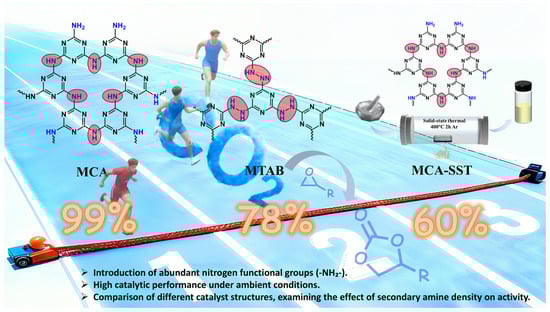
The efficient conversion of CO2 into valuable chemicals using highly efficient, environmentally friendly, and renewable heterogeneous catalysts is paramount for the progression of a carbon circular economy. In pursuit of this goal, this study introduces a metal-free, scalable melamine-based organic polymer catalyst designed to integrate CO2 adsorption with customizable functional properties. Employing both solid-state thermal synthesis (SST) and hydrothermal methods, we synthesized three amine-based hydrogen bond donor catalysts, thereby balancing environmentally conscious practices with scalable synthesis: MCA, a high-nitrogen-content polymer derived from trichlorocyanuric acid; MCA-SST; and MTAB, a triazine-trichlorocyanuric acid polymer. Under mild conditions (100 °C, 0.1 MPa, 24 h), MCA demonstrated superior catalytic performance in the CO2 cycloaddition of epichlorohydrin, achieving a 99% conversion rate, significantly surpassing MCA-SST (60%) and MTAB (78%). MCA’s high specific surface area and structural integrity facilitate efficient catalysis under mild conditions, and it retains 79% of its initial activity after five cycles, indicating exceptional stability. These results suggest that while the incorporation of secondary amines and increased nitrogen content generally promote the reaction, densely packed adjacent secondary amine linkages can induce repulsion between nitrogen atoms, thereby weakening active sites and reducing catalytic activity. Consequently, this study not only presents MCA as a novel metal-free catalyst exhibiting remarkable performance in catalyzing CO2 cycloaddition under ambient pressure and mild conditions, but also elucidates the structure–activity relationship between secondary amine density and catalytic activity. This work provides a deeper mechanistic understanding and offers a theoretical foundation for future rational catalyst design.

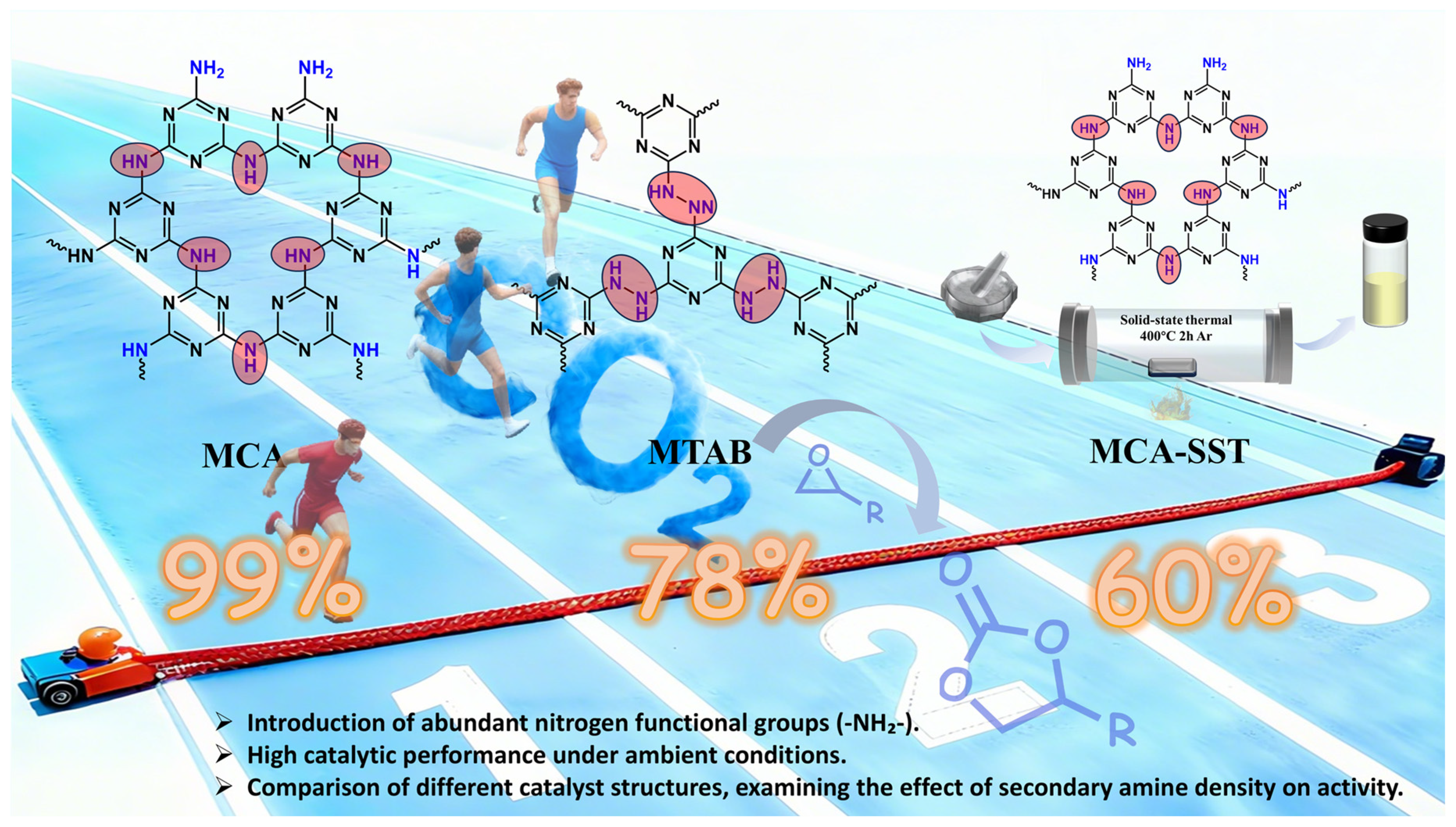
Graphical Abstract

1. Introduction

In recent years, the effective conversion and utilization of carbon dioxide (CO2) have attracted considerable political and environmental attention, spurring significant research efforts [1]. Among various strategies for converting CO2 into value-added products [2,3,4,5], the cycloaddition reaction between CO2 and epoxides is particularly promising for synthesizing high-value cyclic carbonates such as vinyl carbonate and propylene carbonate [6,7,8,9]. These cyclic carbonates find widespread application in diverse fields, including chemistry, polymers, pharmaceuticals, and electrolytes [10,11,12]. However, the inherent thermodynamic stability and kinetic inertness of CO2 necessitate substantial energy input to facilitate its use as a feedstock in organic synthesis [13,14,15,16]. Consequently, reducing the energy requirements for CO2 conversion, overcoming high reaction barriers, and developing high-performance catalysts are crucial objectives [17,18,19,20]. In this context, both metal-based (e.g., metal-organic frameworks [21,22], halide salts [23], complexes [24,25]) and metal-free (e.g., porous organic polymers [26], ionic liquids [27,28]) catalytic systems have been extensively investigated for CO2 cycloaddition reactions. The activity and selectivity of these catalysts directly influence the yield of cyclic carbonates, with highly efficient systems enabling high yields under milder reaction conditions.
Currently, metal-free catalytic systems are gaining increased attention due to their avoidance of metal-related complexities and cost issues. Among metal-free options, hydrogen bond donor (HBD)-modified organic polymers are emerging as promising heterogeneous catalysts, attributed to their high specific surface area and structural tunability [29,30]. The incorporation of amine-based hydrogen bonding groups effectively activates both epoxides and CO2, facilitating the reaction under milder conditions [31,32,33]. For example, Zhao et al. [34] reported a novel microporous organic polymer, HF-MOP, containing hydroxyl and imine CO2 -affinity groups, which exhibited outstanding catalytic activity and cycling stability for CO2 cycloaddition reactions under 2 MPa CO2 pressure and 80 °C. Melamine, a readily available and cost-effective triazine-structured molecule, is an attractive precursor for constructing such metal-free organic polymer catalysts due to its high nitrogen content (66%) and abundance of amino functional groups (–NH2, –NH–) [35,36]. It can modulate the material’s surface area and porosity, while also functioning as a multifunctional crosslinker or introducing functional sites into the polymer network [37,38]. Furthermore, it has been demonstrated that appropriately spaced, dual−NH−functionalized melamine-based organic polymers can induce redistribution of hydrogen bond donors, exhibiting outstanding ring-opening performance. For instance, Liu et al. [39] synthesized melamine-based organic polymers UM-OP and AM-OP with abundant N-sites and –NH– groups via hydrothermal synthesis. These polymers effectively catalyzed CO2 cycloaddition under metal-free, solvent-free, and co-catalyst-free conditions while exhibiting outstanding cyclic stability. Concurrently, discussions on introducing nitrogen-containing heterocyclic frameworks to regulate the position of nitrogen-based structural interactions and activate CO2 molecules have been explored. Liu et al. [40] hydrothermally synthesized the melamine polymer network PAN-IM containing imidazole rings. This catalyst exhibited excellent recyclability and broad epoxide substrate scope, showcasing the potential of metal-free catalysts in CO2 cycloaddition reactions via multi-site synergistic catalysis. While numerous studies have demonstrated that introducing various nitrogen structures significantly promotes the cycloaddition reaction between CO2 and epoxides to form cyclic carbonates, a systematic understanding of the underlying mechanisms and the influence patterns of these nitrogen structures remains limited. Furthermore, many existing preparation methods for metal-free organic polymer catalysts can result in environmental pollution and low product yields. Our group has previously discovered that within nitrogen-doped porous organic polymer (NPOP) frameworks, secondary amines exhibit higher catalytic activity compared to imine groups. This enhanced activity is attributed to synergistic effects arising from the N lone pair electrons and hydrogen bond formation, resulting in a reduced ring-opening energy barrier (36.3 kJ mol−1). Building upon this prior work, the present study aims to elucidate the distinct mechanisms of nitrogen-based structures, establish structure–property relationships for the resulting polymers, and develop green, efficient, and scalable metal-free catalysts for CO2 cycloaddition.
In this work, we present a green and rapid synthesis method for achieving efficient conversion of CO2 to epoxy substrates via cycloaddition reactions under ambient pressure. The central strategy involves incorporating additional N-skeletons and secondary amine linkers into melamine-based organic polymers to optimize their hydrogen-bonding-donor (HBD) catalytic structures. Specifically, we developed melamine-based hydrogen-bond donor polymers (MCA) from melamine and trichlorocyanuric acid, as well as the MCA-SST polymer via an all-solid-state thermal synthesis. By incorporating additional –NH– groups and nitrogen sources, we sought to investigate the influence of –NH– -rich polymers on CO2 cycloaddition. Concurrently, we investigated the influence of adjacent -NH- group-linked units on catalytic activity by synthesizing the high-density hydrogen-bonded network polymer MTAB from hydrazine triazine and trichlorocyanuric acid. Comprehensive characterization analysis, coupled with catalytic activity testing, provided insights into the influence patterns and catalytic mechanisms of these melamine-based HBD polymers on CO2 cycloaddition reactions. At 100 °C, after 24 h, and under 0.1 MPa CO2, MCA achieved a conversion of 99% for epichlorohydrin, significantly outperforming MCA-SST (60%) and MTAB (78%). These results indicate that incorporating secondary amines and increasing the N atom content promote the forward reaction. However, excessively dense adjacent secondary amine linkages can lead to repulsion between N atoms, thereby weakening active sites and paradoxically reducing catalytic activity. This study not only provides promising new catalyst candidates for CO2 cycloaddition to epoxy substrates but also offers valuable theoretical insights into the underlying catalytic mechanisms.

2. Results and Discussion

2.1. Analysis of Material Characterization Results

To elucidate the structural differences among MCA and the reference samples MCA-SST and MTAB, we performed detailed structural characterization and analysis. Initial investigations employed Fourier transform infrared spectroscopy (FT-IR) spectroscopy to compare the raw materials with the synthesized polymers, as depicted in Figure 1a. Comparative analysis of the infrared spectra of the raw materials (TATB, CC, and MA) revealed the disappearance of the characteristic C–Cl stretching vibration peak at 850 cm−1 and the broadening of the peak in the 3300–3400 cm−1 range, indicating that a substantial portion of the –NH2 groups in MCA and MTAB reacted with the C–Cl groups of CC via the Hoffmann alkylation reaction, reaching near completion. The formed –NH– linking group exhibited C–NH–C stretching vibrations at 1350 cm−1. Additionally, deformation vibrations of the triazine ring were observed in the 1472–1546 cm−1 range, confirming that the triazine ring was fully incorporated into the polymer structure [41,42]. Notably, MCA-SST exhibited multiple merged peaks within the 1250–1750 cm−1 range, suggesting that the high preparation temperature of 400 °C may have induced local stacking of the triazine ring, leading to structural rearrangement and the formation of graphitic N structural features [43]. Furthermore, the reduction and gradual disappearance of the infrared peak at 3400 cm−1 indicated that unstable bonds, such as –NH2, decomposed during carbonization annealing as the temperature decreased.
Complementary powder X-ray diffraction (XRD) analysis was performed to determine the synthesis status and crystal structure of the materials. As shown in Figure 1b, the diffraction peaks corresponding to TATB, CC, and MA were absent, confirming the successful synthesis of the three polymers (MCA, MTAB, and MCA-SST). The XRD patterns of MCA and MTAB displayed broad, diffuse peaks, indicating an amorphous structural state. MCA exhibited a broad diffraction peak centered around 22°, corresponding to the (002) crystal plane of amorphous carbon. XRD analysis of MCA-SST revealed the disappearance of the primary diffraction peaks of MA and CC, along with the formation of new substances. Integrating the XRD (Figure 1b) and FT-IR (Figure 1a) data, we observed the persistence of some terminal functional group diffraction peaks in the synthesized polymer structure. The appearance of three sharp diffraction peaks between 5° and 15° potentially indicated the formation of two-dimensional and three-dimensional covalent triazine framework networks during the high-temperature condensation sintering process. The diffraction peaks at 6.3°, 9.0°, and 10.5° in MCA-SST suggest that the interlayer structures between local structural layers were loosely stacked and had not achieved complete densification during condensation. However, maintenance at high temperatures can enhance interlayer interactions, leading to densification through C–C bond cross-linking and the subsequent formation of graphite N. Moreover, the sharp peaks, particularly those between 25° and 30°, suggest a tendency toward hexagonal prismatic crystal system growth during the condensation process.
To further probe the structural characteristics, solid-state 13C nuclear magnetic resonance (NMR) spectra were acquired and analyzed for MCA, MCA-SST and MTAB. As depicted in Figure 1c, the MCA spectrum displayed distinct resonance peaks at 165 ppm and 55 ppm, corresponding to the tertiary carbon atoms connected via the –C=N– group within the triazine ring and the –NH– linkage between MA and CC, respectively. In the spectrum, # denotes trace amounts of unreacted monomer end groups, including the C–Cl functional group in CC at 265 ppm and the –NH2 in MA at 155 ppm. The asterisk (*) at approximately 13 ppm indicates the residual DMSO methylene resonance peak in MCA. The 13C NMR spectrum of MCA-SST (Figure 1c) exhibited prominent resonance peaks at 264 ppm, 164 ppm, 156 ppm, and 59 ppm. The intense peak at 164 ppm confirmed that the triazine ring structure remained the primary backbone of MCA-SST, while the resonance peak at 156 ppm suggested the formation of localized graphitic N-linked C=C structures at 400 °C, along with the presence of localized –NH2 end groups. The resonance peaks at 59 ppm and 264 ppm indicated the presence of partially –NH– linked tertiary carbon atoms and trace amounts of polymer terminal C–Cl groups. These results suggest that the SST method necessitates further optimization to achieve more regular and complete synthetic structures during the functionalization modification of melamine-based polymers in a two-component molten state. MTAB exhibited a strong and singular resonance peak at 165 ppm, indicating that the triazine ring served as its structural backbone and that the TATB and CC connections were substantially complete. The symbol # represents trace amounts of unreacted C–Cl groups, and the symbol * denotes residual anhydrous ethanol from post-processing [44,45].
The thermal stability of the three polymers (MCA, MCA-SST, and MTAB) was investigated using thermogravimetric analysis (TGA). As shown in Figure 1d, MCA exhibited a weight change of approximately 5% before 200 °C, likely due to the desorption of water or gases, while its structure remained stable. As the temperature increased to 380 °C, the mass of MCA’s TGA curve dropped sharply to 62%, and the structure began to collapse. Between 400 and 800 °C, the aromatic structure began to carbonize, and the molecular structure was further decomposed and destroyed. Thus, MCA exhibited good thermal stability below 200 °C. The thermal stability of MCA-SST was also analyzed. MCA-SST experienced a 3% mass loss at 100 °C, which was attributed to water evaporation. When MCA-SST was heated to 400 °C, the mass loss was only 3%, demonstrating its excellent thermal stability at this stage. Further heating caused significant thermal decomposition and mass loss in MCA-SST. After 400 °C, the –NH– groups, the triazine ring skeleton, and the graphite N polymer structure gradually collapsed, decomposed, and carbonized. By 800 °C, the material was almost completely volatilized. For the thermogravimetric curves of MTAB polymers, structural collapse and decomposition began in stages after 280 °C. Compared to MTAB, MCA exhibited superior thermal stability before 300 °C.
To further investigate the influence of the –NH– linkage structure on the alkaline properties of the polymer itself, CO2 temperature-programmed desorption (CO2-TPD) tests were conducted on MCA and MTAB. As shown in Figure 1e, MCA and MTAB began to desorb CO2 when the desorption temperature was increased to 160 °C. The CO2 desorption at 160–200 °C was attributed to the presence of –NH– basic sites. The –NH– groups in MTAB exhibited a stronger CO2 desorption effect and a greater number of –NH– basic sites, consistent with the design rationale for comparing MCA and MTAB.
Elemental analysis, an essential technique for characterizing melamine-based polymers, was employed to determine the elemental composition of the polymers. In conjunction with FT-IR and solid-state 13C NMR spectroscopy, elemental analysis validated the elemental composition and structural characteristics of MCA, MTAB, and MCA-SST. As shown in Table 1, the elemental analysis results revealed C/N ratios of 0.540, 0.509, and 0.460 for MCA, MCA-SST, and MTAB, respectively. These findings confirmed the abundance of N elements and basic sites within the polymer structures. MTAB incorporates more –NH– groups and nitrogen sources than MCA by combining the C/N ratios of its three constituent polymers.
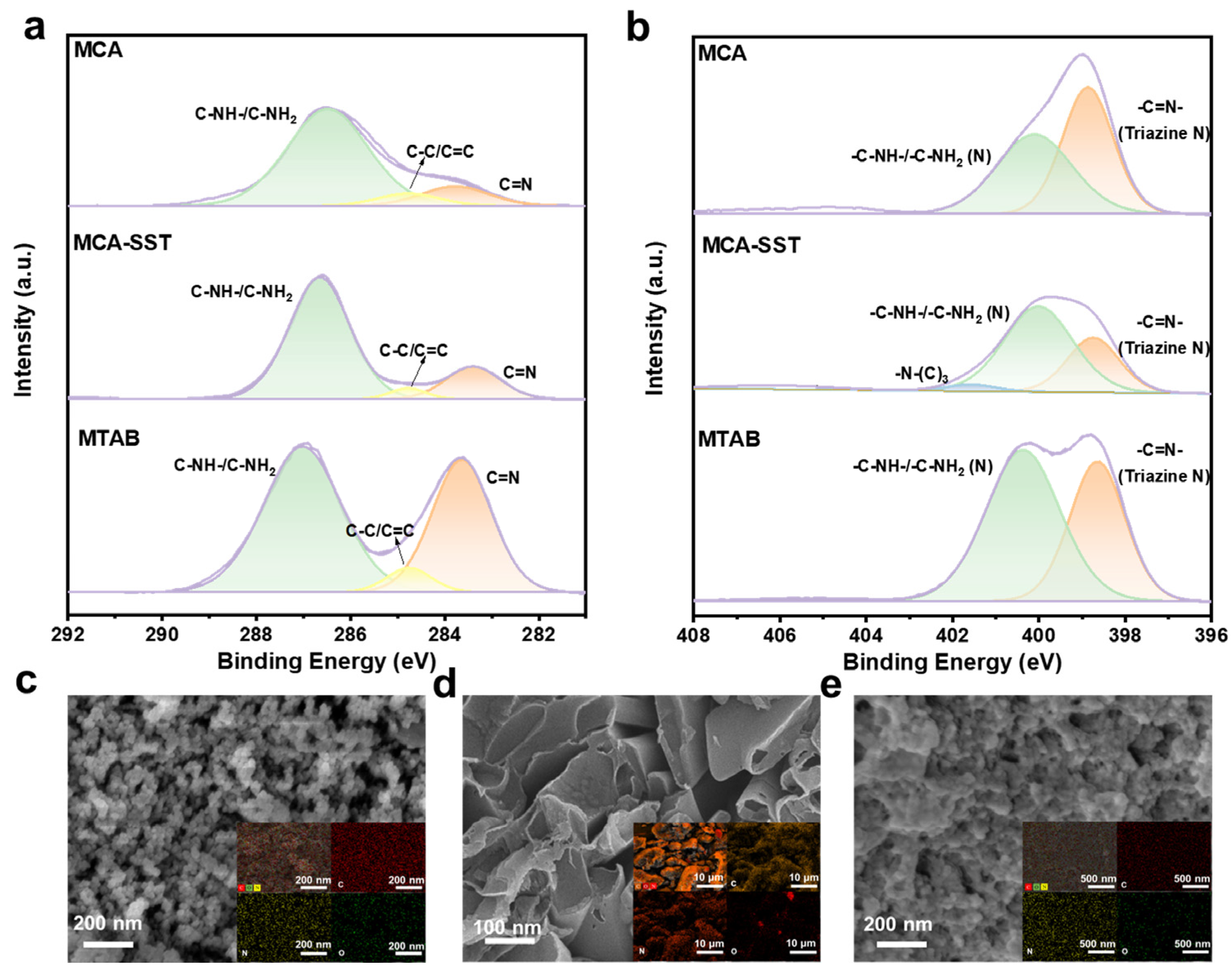
To further elucidate the elemental states within the synthesized materials, X-ray photoelectron spectroscopy (XPS) was performed on MCA, MCA-SST, and MTAB. The XPS spectra, detailed in Supplementary Information Figure S1, indicated the presence of carbon and nitrogen elements in varying proportions across the three polymers. To ensure accurate spectral alignment, the calibration of the C 1s was performed using the C–C/C=C peak in all spectra. High-resolution analysis of the C 1s spectrum of the samples (Figure 2a) revealed three peaks in each sample. The peaks at 283.8, 283.4, and 283.6 eV correspond to the C=N bond within the triazine rings for MCA, MCA-SST, and MTAB, respectively. The peaks at 284.8, 284.8, and 284.8 eV for MCA, MCA-SST, and MTAB, respectively, are attributed to the C–C/C=C bonds, mainly due to adventitious carbon and potentially to some self-polymerization in MCA-SST. The peaks at 286.5, 286.6, and 287.0 eV, for MCA, MCA-SST, and MTAB, correspond to the sp2-hybridized carbon bonded to the –NH–//NH2 groups. Analysis of the N 1s spectra (Figure 2b) showed two deconvoluted signals in MCA at 398.9 and 400.1 eV, representing the –C=N within the triazine ring and –NH2/–NH– species, respectively [46]. The N 1s spectrum of MCA-SST presented three peaks at 398.8, 400.0, and 401.6 eV. The peaks at 398.8 and 400.0 eV were attributed to –C=N within the triazine ring and –NH–/NH2 species, respectively. Notably, the peak at 401.6 eV indicated the presence of graphitic nitrogen within the structure. This observation aligns with the C=C bond peak at 284.8 eV in the MCA-SST C 1s spectrum (Figure 2a) and the 156 ppm signal in the MCA-SST 13C-NMR spectrum (Figure 1c), collectively suggesting that the polymerization of MCA-SST via the SST method at 400 °C induces not only polymerization between MA and CC in the molten state but also a partial, orderly, and overall disordered rearrangement of the triazine rings. This rearrangement leads to the formation of an amorphous layered structure containing localized graphitic nitrogen structures and C=C bonds. The N 1s spectrum of MTAB exhibited deconvoluted signals at 398.9 and 400.4 eV, corresponding to –C=N within the triazine ring and –NH–/NH2 species, respectively.
The morphological characteristics of the MCA, MTAB, and MCA-SST polymers were examined using scanning electron microscopy (SEM). SEM images at various magnifications are provided in Supplementary Information Figures S2–S4. MCA exhibited a morphology characterized by randomly arranged, small agglomerates and widely dispersed granular features. The majority of polymer particles displayed near-spherical structures with relatively smooth surfaces, ranging in size from approximately 20 to 40 nm. Figure 2c further illustrates the MCA morphology, showcasing locally contracted and slightly agglomerated particles, an irregular arrangement consistent with the amorphous nature indicated by XRD analysis. Energy-dispersive X-ray spectroscopy (EDS) analysis of MCA revealed a uniform distribution of carbon and nitrogen elements throughout the structure, with the polymer exhibiting a high nitrogen content. The presence of oxygen was attributed to atmospheric exposure. In contrast, MCA-SST displayed a macroscopically block-like structure comprising stacked phases. High-magnification SEM analysis (Figure 2d) revealed that the internal structure of MCA-SST consisted primarily of stacked lamellar structures exhibiting a tendency to form relatively regular prisms. This observation supports the presence of the sharp peak observed in the XRD pattern between 25–30 degrees. The surface morphology was relatively smooth, with interlamellar gaps ranging from approximately 100 to 500 nm. MTAB, as shown in Figure 2e, exhibited a dense layered, blocky, and granular morphology with an overall irregular distribution. The blocky structures ranged in size from 0.2 to 1 μm, while the granular structures measured between 20 and 200 nm. EDS analysis indicated a generally uniform elemental distribution, although regions of local elemental density were observed.
To investigate the specific surface area and CO2 adsorption characteristics of the materials, the Brunauer–Emmett–Teller (BET) adsorption model was used to calculate the specific surface area and CO2 adsorption capacity of MCA, MTAB, and MCA-SST based on N2 adsorption–desorption isotherms measured at 77 K. The Horvath–Kawazoe method was used to calculate the pore volume and pore diameter of the samples. The pore structure characteristics are presented in Table 2, and the N2 adsorption curves are detailed in Supplementary Information Figure S5. As shown in Table 2, MCA, due to its high nitrogen content and abundant amino functional groups, possessed a porous structure with a large specific surface area (227.6 m2/g) and pore volume (0.991 cm3/g). This provided abundant adsorption sites for CO2 molecules, resulting in a CO2 adsorption capacity of 13.6 cm3/g. While MTAB had a slightly higher specific surface area than MCA, its smaller pore volume resulted in a reduced CO2 adsorption capacity. MCA-SST experienced a significant reduction in both specific surface area and pore volume due to potential pore structure collapse and rearrangement during the high-temperature preparation process, resulting in a notable decrease in CO2 adsorption capacity. Furthermore, the adsorption–desorption isotherms of the synthesized materials exhibited hysteresis loops at P/P0 > 0.5, indicating that the materials matched the standard adsorption isotherm type IV, suggesting the presence of mesoporous structures.

2.2. Ring-Addition Catalytic Activity of MCA

The ring-addition reaction between CO2 and ECH was used as a model reaction to synthesize 3-chloropropylene carbonate. The catalytic performance of MCA was studied under conditions of 50 mg catalyst, 100 °C, 0.1 Mpa CO2 pressure, and 24 h. Additionally, the catalytic activity of the raw material monomer, MCA-SST, the triazine-based polymer MTAB, and their polymer monomers was compared under the same conditions.
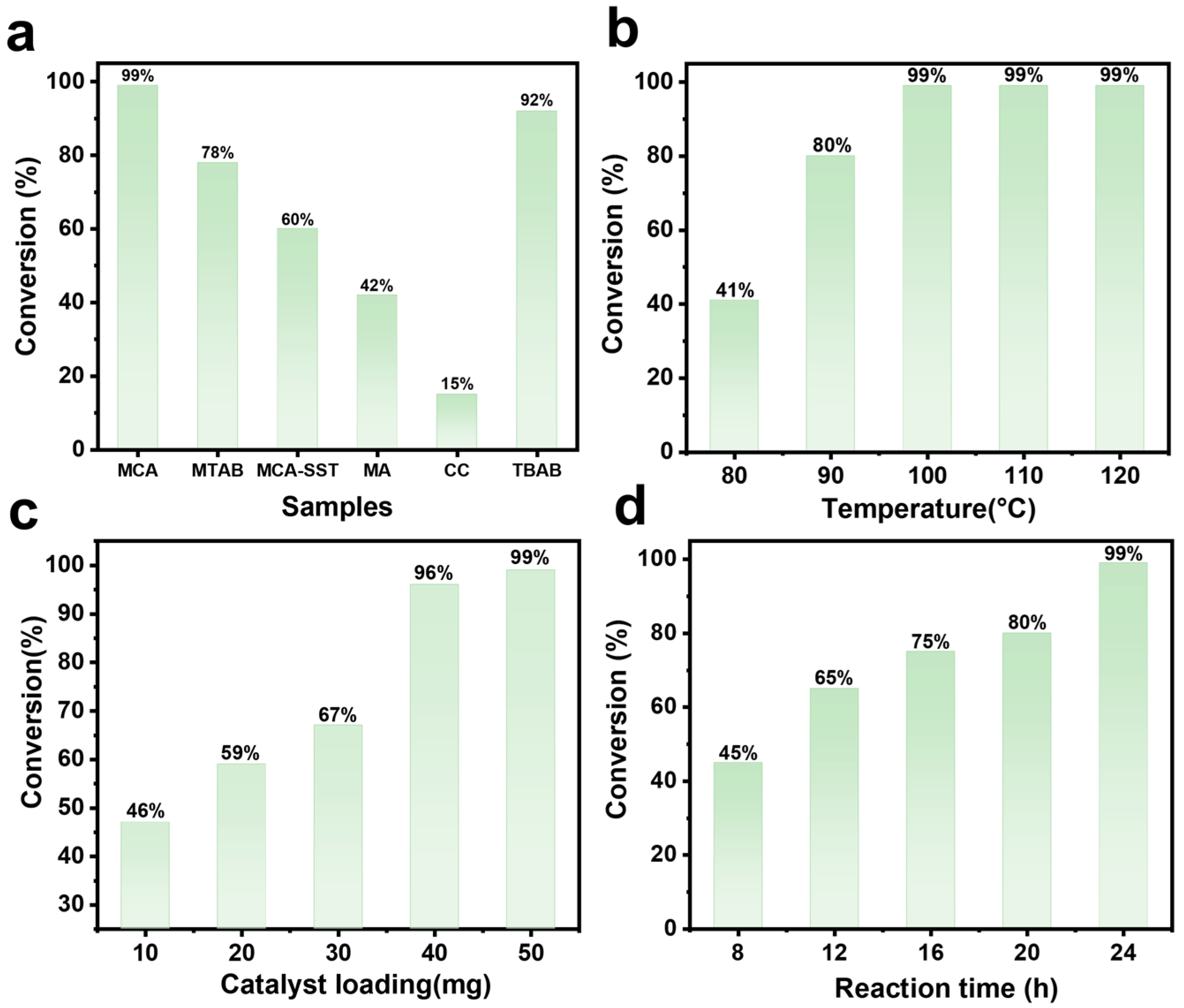
As shown in Figure 3a, MCA achieves an ECH conversion rate of 99% under the specified conditions, outperforming MTAB (78%) and MCA-SST (60%). The lower conversion rate of MCA-SST, synthesized via an all-solid-state method, can be attributed to its structure. Metal-free polymers produced by the SST method generally exhibit a non-porous, blocky layered morphology. In this case, MCA-SST displays localized triazine rings that form graphitic N with a regular arrangement. However, the connectivity of some of this graphitic N diminishes its effectiveness in epoxide ring-opening, limiting its ECH ring-addition catalytic activity to 60%. MTAB, synthesized at a lower temperature than MCA, likely possesses a less developed nanoscale granular morphology. Moreover, the close proximity of –NH– groups in MTAB creates electron repulsion between the lone pairs of adjacent N atoms. This spatial hindrance appears to limit its ring-opening capability, resulting in an ECH ring-addition conversion rate of only 78%, suggesting that simply increasing the density of adjacent –NH– groups and N sources does not necessarily enhance catalytic activity. In contrast, CC exhibited very low catalytic activity since it cannot promote the activation and ring-opening of epoxides. TATB, however, exhibited excellent catalytic performance, with a conversion rate of 92% when used as a monomolecular catalyst, indicating that the –NH– and –NH2 groups of the TATB molecule can activate the ring-addition reaction between ECH and CO2. Compared to MTAB, TATB has a greater number of more fully exposed active sites, resulting in higher catalytic activity. However, recyclability is a key characteristic of organic reaction catalysts. Since TATB is a small molecule and difficult to recover, it is not suitable for standalone application in organic reactions.
Based on these screening results, we selected MCA for process parameter optimization due to its optimal catalytic performance. First, the effect of CO2 pressure on catalytic activity was investigated, revealing that the catalytic activity of MCA was very high at CO2 pressures of 0.1–0.2 Mpa, indicating minimal influence of CO2 pressure on the catalytic reaction. Therefore, the catalytic reaction was conducted at 0.1 Mpa CO2 pressure to screen for the optimal reaction conditions.
Temperature is a critical factor influencing the reaction kinetics and catalytic activity of catalytic reactions. To determine the optimal reaction temperature for MCA catalysis, temperatures of 80, 90, 100, 110, and 120 °C were used to investigate the catalytic cycloaddition conversion rate (Figure 3b). The ring-opening of epoxides and the activation of CO2 are both endothermic reactions. As temperature increases, CO2 molecules are activated, and the vibration of the C–O bond in the ECH molecular structure intensifies, increasing the reaction kinetics and the collision probability with the MCA catalyst. The O atom in ECH forms a hydrogen bond with the –NH– group in the structure. Simultaneously, the more electrophilic C atom connected to O in ECH interacts with the free electrons of the –NH– group, further promoting product formation. The conversion rate of ECH catalyzed by MCA at 80 °C was only 41%, but it reached 80% at 90 °C and exceeded 99% at 100 °C, 110 °C, and 120 °C. Therefore, further increasing the temperature had a negligible effect on the reaction. From an environmental perspective, considering energy conservation, the optimal temperature for the MCA catalyst in this reaction was determined to be 100 °C. Subsequently, the effect of catalyst dosage on MCA catalytic activity was investigated. Increasing the catalyst dosage typically provides more active sites and accelerates reaction kinetics, as shown in Figure 3c. At catalyst dosages of 10, 20, 30, 40, and 50 mg, under conditions of 100 °C, 24 h, and 0.1 Mpa CO2 pressure, the conversion rate gradually increased with each 10 mg increment, rising from 46% to 99%. Since the conversion rate of ECH reached 99% at 50 mg of MCA catalyst, further increasing the catalyst dosage had little effect on the reaction. Therefore, the reaction achieved optimal conversion efficiency at 50 mg of MCA catalyst. To determine the optimal reaction time, the catalytic activity of MCA was investigated under conditions of 50 mg MCA catalyst, 100 °C, and 0.1 Mpa CO2 at different reaction times of 8, 12, 16, 20, and 24 h, as shown in Figure 3d. As the reaction time increased, the conversion rate of ECH increased from 15% to 99%, with the remaining epoxy substrate content dropping to less than 1% after 24 h. Further increasing the reaction time did not significantly alter the conversion rate or selectivity. Considering both catalytic activity and energy efficiency, a reaction time of 24 h was selected.
Based on the results of the screening experiments, the optimal reaction conditions for the CO2 cycloaddition reaction of MCA to form cyclic carbonates were determined to be 50 mg of catalyst, 100 °C, 24 h, and 0.1 Mpa CO2 pressure.
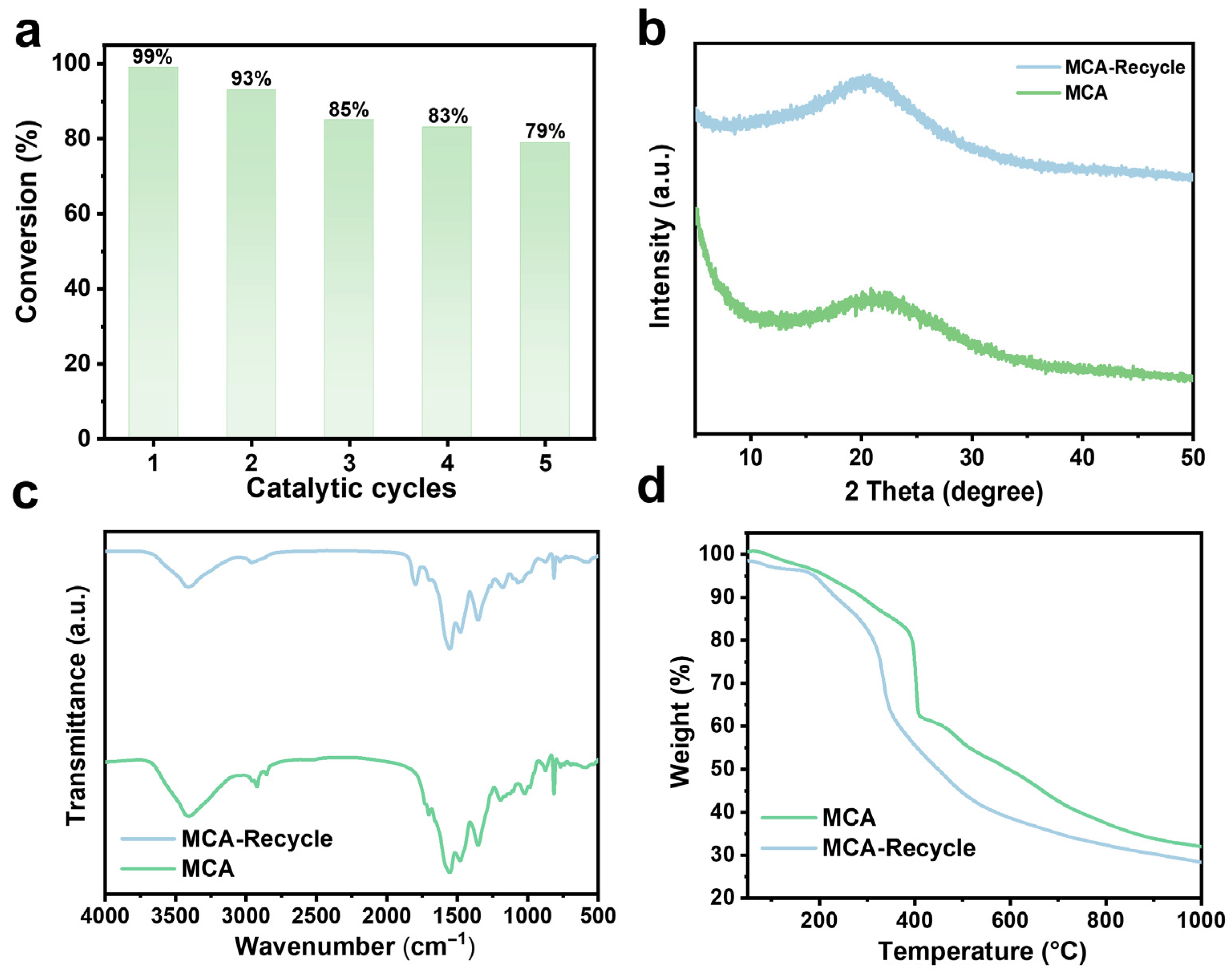
In addition to high catalytic activity, the catalyst’s cycle stability is also an important parameter. To assess the catalyst’s cyclization stability, we examined its performance and structural changes before and after cyclization. The MCA after the reaction was recovered, washed three times each with dichloromethane and methanol to ensure the removal of residual substrates and products, and then dried in a vacuum drying oven at 80 °C for 12 h before being collected and weighed. The mass loss was maintained at 10–15%, and the catalyst was used in subsequent reactions. Catalyst loss may be attributed to transfer and handling processes. As shown in Figure 4a, after five cycles of catalytic cycloaddition reactions at 100 °C, 24 h, and 0.1 Mpa CO2 pressure, the conversion rate of MCA decreased to varying degrees, with conversion rates of 99%, 93%, 85%, 83%, and 79% for the first to fifth ECH cycles, respectively. The catalyst still retained 79% catalytic activity after the fifth cycle, demonstrating significant cyclic catalytic activity.
Furthermore, as shown in Figure 4b, the XRD patterns before and after the reaction indicate that the samples exhibited broad diffraction peaks at 2θ between 20° and 30° both before and after cycling, suggesting that MCA remained structurally disordered and amorphous after five cycles. Additionally, as shown in Figure 4c,d, no significant differences were observed in the infrared and TG curves before and after the reaction, indicating that the MCA sample exhibited good stability during cycling.
To investigate the universality of MCA catalyst activity toward other epoxy substrates, 5% (2.5 mg) tetrabutylammonium bromide (TBAB) was used as a co-catalyst (due to potential differences in catalytic activity toward different epoxy substrates) under mild reaction conditions without high pressure. Details are provided in the Supporting Information.
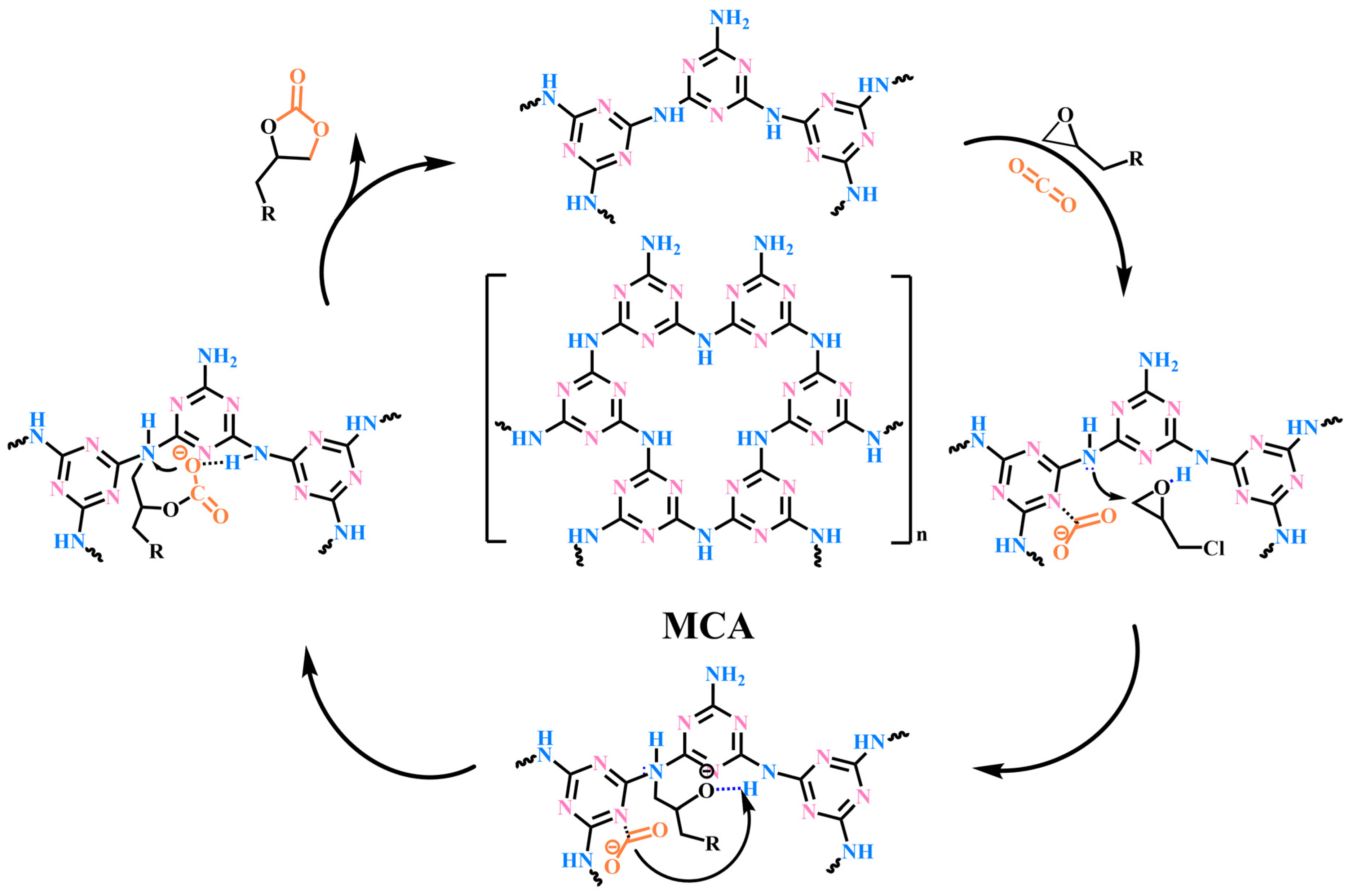
Based on FT-IR characterization analysis, a possible mechanism for the CO2 ring addition of epoxides by MCA was proposed. FT-IR was tested under conditions of 100 °C, 0.1 MPa CO2 pressure, and a CO2 gas flow maintained for 4 h in a reaction sealed tube. Details are provided in Supplementary Information Figure S6. In the absence of epoxy substrates in the system, the hydrogen bonds formed between the MCA structure and CO2 caused the N lone pair electrons of the triazine ring N or the –NH– groups to adsorb CO2, resulting in a blue shift in the infrared peak corresponding to –N+–COO. This may be the reason for the increased peak at 1725 cm−1, indicating that the N atoms in the structure could adsorb CO2 to some extent, reduce the CO2 bond angle, activate it, and enable it to participate in the ring addition process of epoxides, as shown in Mechanism Figure 5 [35,47].
Therefore, we speculate on the possible mechanism of the CO2 cycloaddition process on epoxy substrates. First, the –NH– group forms a hydrogen bond with the C–O of the epoxide, aiding in the activation of the epoxide. The lone pair of electrons on the N atom of the –NH– group has a lower activation energy required for ring-opening of the epoxide compared to the –C=N– group within the triazine ring, making it easier to overcome the ring-opening energy barrier. This is the key to MCA-catalyzed ring-opening of epoxides. Subsequently, the activated CO2 is incorporated into the opened epoxide to form an oxygen-containing anionic intermediate, which then forms a new alkyl carbonate intermediate at 1800 cm−1. Finally, intramolecular ring closure occurs to form a cyclic carbonate, and MCA proceeds to the next catalytic cycle [47].

3. Materials and Methods

3.1. Materials and Chemical Reagents

Melamine (MA, C3H6N6, 98%, Macklin, Shanghai, China), Cyanuric chloride (CC, C3Cl3N3, 98%, Macklin Reagent Co., Ltd.), Trihydrazinotriazine (TATB, C3H9N9, 98%, Shanghai Reagent Co., Ltd., Shanghai, China), potassium hydroxide (KOH, AR, 90%, Aladdin, Shanghai, China), sodium carbonate (Na2CO3, 99.9%, Aladdin), anhydrous methanol (CH3OH, AR, 98%, Shanghai Reagent Co., Ltd.), ethanol (C2H5OH, AR, 98%, Shanghai Reagent Co., Ltd.), deionized water (H2O, Pin Guan Instrument Co., Ltd., Wuhu, China), N,N-dimethylformamide (DMF, C3H7NO, AR, 98%, Shanghai Reagent Co., Ltd.), dimethyl sulfoxide (DMSO, C2H6OS, AR, 98%, Shanghai Reagent Co., Ltd.), Deuterated dimethyl sulfoxide (C2D6OS, 99.8%, CIL, Andover, MA, USA), and Deuterated chloroform (CDCl3, 99.8%, CIL), were used as received.

3.2. Synthesis

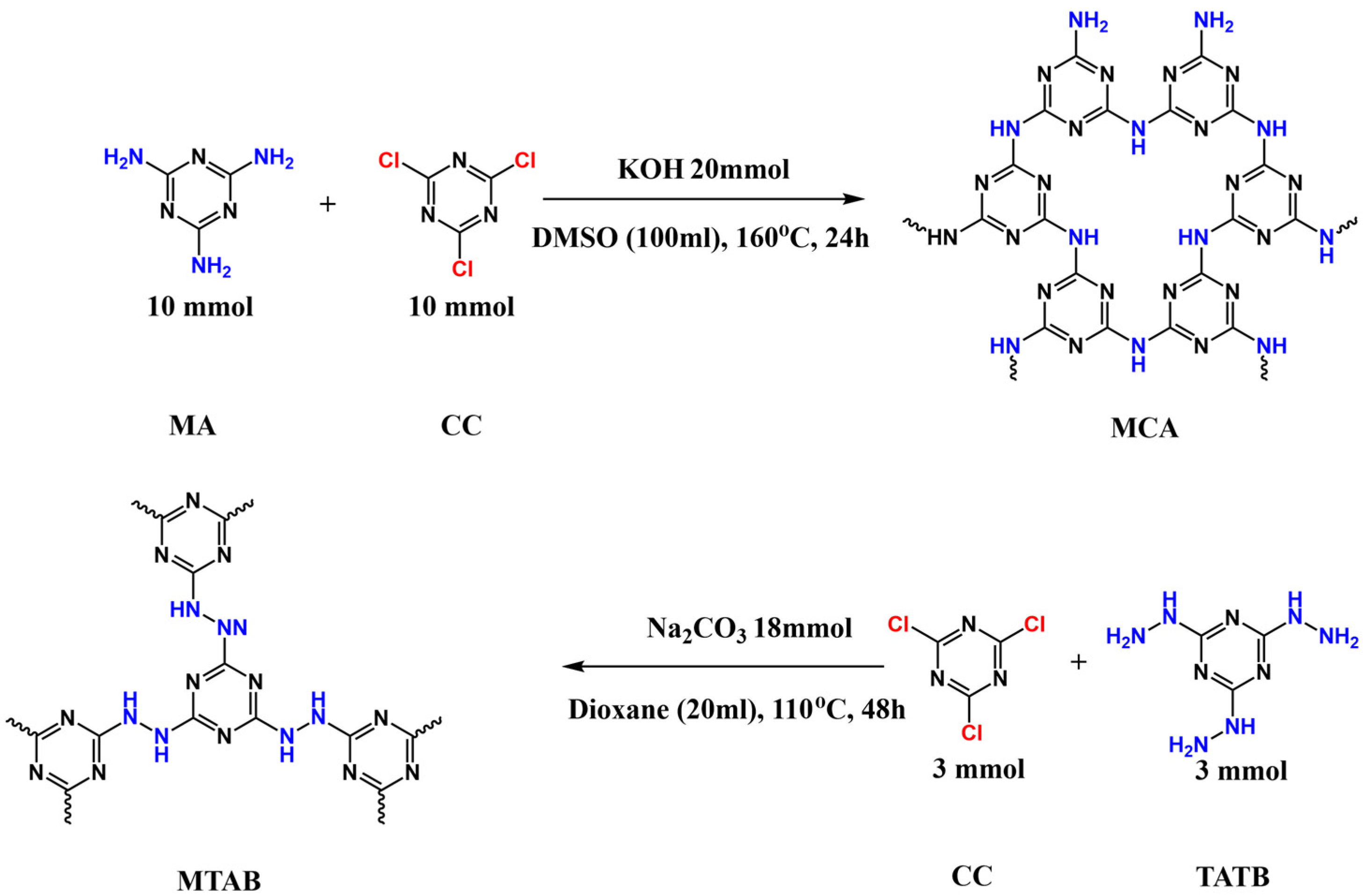
MCA Polymer Material Preparation: Melamine (MA, 10 mmol) and KOH (20 mmol) were dissolved in 100 mL of anhydrous DMSO. Under vigorous stirring at 25 °C, cyanuric chloride (CC, 10 mmol) was added dropwise to the solution. The temperature was then raised to 160 °C, and the mixture was refluxed under an argon atmosphere for 24 h. The resulting precipitate was collected by centrifugation and thoroughly washed with methanol and deionized water. The final brownish-yellow MCA polymer was dried overnight at 100 °C, affording MCA in 89% yield. Figure 6 illustrates the synthesis of both MCA and MTAB. Details regarding the preparation of the fully solid-state MCA (MCA-SST) and MTAB polymer materials are provided in the Supporting Information.

3.3. Catalytic Experiments

Cycloaddition Reaction between CO2 and Epoxides: The epoxide substrate (9 mmol) and catalyst (50 mg) were placed in a 15 mL high-pressure reaction tube equipped with a magnetic stirrer (XINGDA Company, Beijing, China). The reaction was conducted under solvent-free conditions. Prior to the reaction, the reaction vessel was degassed three times and then filled with CO2 (99.9%). The reaction was then carried out under specific CO2 pressure and temperature conditions. After the reaction, the reaction vessel was cooled to room temperature, and any remaining CO2 gas was released. 1,3,5-trimethoxybenzene (3 mmol) was added to the reaction tube as an internal standard, followed by 1 mL of CDCl3 as a solvent to prepare the reaction NMR sample. The 1H-NMR spectrum of the sample was then acquired using a nuclear magnetic resonance hydrogen spectrometer, and the reaction conversion efficiency was calculated based on the integration of the hydrogen spectrum data. In this work, the term “conversion” refers to the conversion of the organic substrate (e.g., epichlorohydrin, epibromohydrin) into the corresponding products (e.g., 4-(chloromethyl)-1,3-dioxolan-2-one, 4-(bromomethyl)-1,3--dioxolan-2-one), as determined by quantitative 1H NMR spectroscopy using an internal standard. CO2 is supplied in large excess, and its consumption is therefore not used to define the conversion; in particular, the headspace CO2 concentration is not employed as a metric for reaction progress in this study.

4. Conclusions

By integrating solid-state thermal (SST) synthesis with hydrothermal methods, an innovative preparation strategy for a melamine-based organic polymer multiphase catalyst was successfully implemented, opening a promising avenue for the construction of highly efficient, environmentally friendly, and scalable catalytic systems. In this approach, melamine and trichlorocyanuric acid are employed as core functional monomers to synthesize MCA polymers linked exclusively by –NH– bonds. The resulting polymer structure not only increases the density of hydrogen bond donors but also provides a sufficient number of nitrogen-containing Lewis base groups, facilitating CO2 adsorption. To elucidate the application characteristics of these melamine-functionalized polymers rich in –NH– linkages in CO2 cycloaddition, a series of characterization techniques were employed to compare the structural and intrinsic properties of MCA with those of MCA-SST (the fully solid-state synthesized polymer) and MTAB. The experimental results demonstrate that the synthesized MCA catalyst exhibits exceptional performance in CO2 cycloaddition reactions, achieving a high conversion of 99% for epichlorohydrin (ECH) within 24 h at 100 °C and 0.1 MPa CO2 pressure with only 50 mg of catalyst, surpassing the activity of conventional catalysts. Furthermore, cycling stability tests confirm the excellent durability and recyclability of the MCA catalyst. These findings suggest that increasing the number of secondary amine (–NH–) groups and enhancing the overall N atom content in the polymer matrix effectively promotes CO2 cycloaddition, thus enhancing catalytic activity. However, an excessively high density of adjacent secondary amine linkages can induce spatial crowding or alter the electronic environment surrounding the active nitrogen sites, thereby diminishing their substrate activation capacity and, consequently, reducing catalytic activity. This study not only introduces an excellent metal-free catalyst (MCA) for the efficient catalysis of CO2 cycloaddition under mild conditions and ambient pressure but, more importantly, elucidates the structure–activity relationship between the density of secondary amine groups within the polymer and the resulting catalytic activity through comparative analyses. This deeper understanding of nitrogen-based structural influences provides crucial theoretical underpinnings for the rational design of related catalysts and the further investigation of reaction mechanisms.

Supplementary Materials

The following supporting information can be downloaded at: https://www.mdpi.com/article/10.3390/catal16020143/s1, Figure S1: (a) XPS spectrum of MCA; (b) XPS spectrum of MCA-SST; (c) XPS spectrum of MTAB; Figure S2: SEM of the MCA; Figure S3: SEM of the MCA-SST; Figure S4: SEM of the MTAB; Figure S5: N2 adsorption and desorption curves of MCA, MTAB and MCA-SST; Figure S6: FT-IR spectrum of MCA only interacting with atmospheric CO2; Table S1: Universality of MCA to different epoxy substrates.

Author Contributions

Y.G.: Writing—original draft, Investigation, Data curation, Formal analysis. S.L.: Validation, Data curation, Software. M.J.: Investigation, Formal analysis. C.C.: Resources, Methodology, Conceptualization, Supervision, Funding acquisition. F.V.: Writing—review and editing, Supervision, Project administration, Funding acquisition. All authors have read and agreed to the published version of the manuscript.

Funding

This research received no external funding.

Data Availability Statement

The data presented in this study are openly available in the Supporting Information of this manuscript.

Acknowledgments

The authors are grateful to the State Key Lab of Advanced Technology for Materials Synthesis and Processing for financial support (Wuhan University of Technology).

Conflicts of Interest

The authors declare no conflicts of interest.

References

  1. Artz, J.; Müller, T.E.; Thenert, K.; Kleinekorte, J.; Meys, R.; Sternberg, A.; Bardow, A.; Leitner, W. Sustainable Conversion of Carbon Dioxide: An Integrated Review of Catalysis and Life Cycle Assessment. Chem. Rev. 2018, 118, 434–504. [Google Scholar] [CrossRef]
  2. Liu, Q.; Wu, L.; Jackstell, R.; Beller, M. Using Carbon Dioxide as a Building Block in Organic Synthesis. Nat. Commun. 2015, 6, 5933. [Google Scholar] [CrossRef] [PubMed]
  3. Zhang, Z.; Pan, S.-Y.; Li, H.; Cai, J.; Olabi, A.G.; Anthony, E.J.; Manovic, V. Recent Advances in Carbon Dioxide Utilization. Renew. Sust. Energ. Rev. 2020, 125, 109799. [Google Scholar] [CrossRef]
  4. Liang, J.; Wu, Q.; Cao, R. Reticular Frameworks and Their Derived Materials for CO2 Conversion by Thermo-catalysis. EnergyChem 2021, 3, 100064. [Google Scholar]
  5. Hepburn, C.; Adlen, E.; Beddington, J.; Carter, E.A.; Fuss, S.; Dowell, N.M.; Min, J.C.; Smith, P.; Williams, C.K. The Technological and Economic Prospects for CO2 Utilization and Removal. Nature 2019, 575, 87–97. [Google Scholar] [CrossRef]
  6. Tyagi, P.; Singh, D.; Malik, N.; Kumar, S.; Malik, R.S. Metal Catalyst for CO2 Capture and Conversion into Cyclic Carbonate: Progress and Challenges. Mater. Today 2023, 65, 133–165. [Google Scholar] [CrossRef]
  7. Guo, L.; Lamb, K.J.; North, M. Recent Developments in Organocatalysed Transformations of Epoxides and Carbon Dioxide into Cyclic Carbonates. Green Chem. 2021, 23, 77–118. [Google Scholar] [CrossRef]
  8. Rehman, A.; Saleem, F.; Javed, F.; Ikhlaq, A.; Ahmad, S.W.; Harvey, A. Recent Advances in the Synthesis of Cyclic Carbonates via CO2 Cycloaddition to Epoxides. J. Environ. Chem. Eng. 2021, 9, 105113. [Google Scholar] [CrossRef]
  9. Shukla, K.; Srivastava, V.C. Synthesis of Organic Carbonates from Alcoholysis of Urea: A Review. Catal. Rev. 2017, 59, 1–43. [Google Scholar] [CrossRef]
  10. Pescarmona, P.P. Cyclic Carbonates Synthesised from CO2: Applications, Challenges and Recent Research Trends. Curr. Opin. Green Sustain. Chem. 2021, 29, 100457. [Google Scholar] [CrossRef]
  11. Webster, D.C. Cyclic Carbonate Functional Polymers and Their Applications. Prog. Org. Coat. 2003, 47, 77–86. [Google Scholar]
  12. Yu, W.; Maynard, E.; Chiaradia, V.; Arnό, M.C.; Dove, A.P. Aliphatic Polycarbonates from Cyclic Carbonate Monomers and Their Application as Biomaterials. Chem. Rev. 2021, 121, 10865–10907. [Google Scholar] [CrossRef]
  13. Kumaravel, V.; Bartlett, J.; Pillai, S.C. Photoelectrochemical Conversion of Carbon Dioxide (CO2) into Fuels and Value-Added Products. ACS Energy Lett. 2020, 5, 486–519. [Google Scholar] [CrossRef]
  14. Sun, Z.; Ma, T.; Tao, H.; Fan, Q.; Han, B. Fundamentals and Challenges of Electrochemical CO2 Reduction Using Two-Dimensional Materials. Chem 2017, 3, 560–587. [Google Scholar] [CrossRef]
  15. Zhang, N.; Long, R.; Gao, C.; Xiong, Y. Recent Progress on Advanced Design for Photoelectrochemical Reduction of CO2 to Fuels. Sci. China Mater. 2018, 61, 771–805. [Google Scholar] [CrossRef]
  16. Ganesh, I. Conversion of Carbon Dioxide to Methanol Using Solar Energy—A Brief Review. Mater. Sci. Appl. 2011, 2, 1407–1415. [Google Scholar]
  17. Wang, J.; Zhang, G.; Zhu, J.; Zhang, X.; Ding, F.; Zhang, A.; Guo, X.; Song, C. CO2 Hydrogenation to Methanol over In2O3-Based Catalysts: From Mechanism to Catalyst Development. ACS Catal. 2021, 11, 1406–1423. [Google Scholar]
  18. Heard, A.W.; Suárez, J.M.; Goldup, S.M. Controlling Catalyst Activity, Chemoselectivity and Stereoselectivity with the Mechanical Bond. Nat. Rev. Chem. 2022, 6, 182–196. [Google Scholar] [CrossRef] [PubMed]
  19. Debruyne, M.; Van Speybroeck, V.; Van Der Voort, P.; Stevens, C.V. Porous Organic Polymers as Metal Free Heterogeneous Organocatalysts. Green Chem. 2021, 23, 7361–7434. [Google Scholar] [CrossRef]
  20. Xie, Y.; Wen, J.; Li, Z.; Chen, J.; Zhang, Q.; Ning, P.; Chen, Y.; Hao, J. Progress in Reaction Mechanisms and Catalyst Development of Ceria-Based Catalysts for Low-Temperature CO2 Methanation. Green Chem. 2023, 25, 130–152. [Google Scholar] [CrossRef]
  21. Ghasempour, H.; Wang, K.Y.; Powell, J.A.; ZareKarizi, F.; Lv, X.-L.; Morsali, A.; Zhou, H.-C. Metal-Organic Frameworks Based on Multicarboxylate Linkers. Coord. Chem. Rev. 2021, 426, 213542. [Google Scholar]
  22. Usman, M.; Iqbal, N.; Noor, T.; Zaman, N.; Asghar, A.; Abdelnaby, M.M.; Galadima, A.; Helal, A. Advanced Strategies in Metal-Organic Frameworks for CO2 Capture and Separation. Chem. Rec. 2022, 22, e202100230. [Google Scholar] [PubMed]
  23. Comerford, J.W.; Ingram, I.D.V.; North, M.; Wu, X. Sustainable Metal-Based Catalysts for the Synthesis of Cyclic Carbonates Containing Five-Membered Rings. Green Chem. 2015, 17, 1966–1987. [Google Scholar] [CrossRef]
  24. Beniwal, N.; Yadav, S.; Singh, L.; Rekha, P. Metal Phosphonates Find Their Way for CO2 Cycloaddition: A Mini-Review. Inorg. Chem. Commun. 2023, 156, 111220. [Google Scholar] [CrossRef]
  25. Shao, D.; Shi, J.; Zhang, J.; Tan, X.; Luo, T.; Cheng, X.; Zhang, B.; Han, B. Solvent Impedes CO2 Cycloaddition on Metal-Organic Frameworks. Chem. Asian J. 2018, 13, 386–389. [Google Scholar] [CrossRef] [PubMed]
  26. Song, W.; Zhang, Y.; Tran, C.H.; Choi, H.K.; Yu, D.-G.; Kim, I. Porous Organic Polymers with Defined Morphologies: Synthesis, Assembly, and Emerging Applications. Prog. Polym. Sci. 2023, 142, 101691. [Google Scholar] [CrossRef]
  27. Chen, Y.; Li, F.; Liu, L.; Zhou, Y.-H. Implanting Multi-Functional Ionic Liquids into MOF Nodes for Boosting CO2 Cycloaddition under Solventless and Cocatalyst-Free Conditions. Chem. Eng. J. 2024, 490, 151657. [Google Scholar] [CrossRef]
  28. Liu, Y.; Li, J.; Zhang, Z.; Hou, Y.; Wang, L.; Zhang, J. Hydroxyl-Imidazolium Ionic Liquid-Functionalized MIL-101(Cr): A Bifunctional and Highly Efficient Catalyst for the Conversion of CO2 to Styrene Carbonate. Inorg. Chem. 2022, 61, 17438–17447. [Google Scholar]
  29. Wang, Y.; Wei, W.; Wang, Y.; Xu, G.; Zhao, J.; Shi, L. Promotion Mechanism of Hydroxyl Groups in Catalyzing CO2 Cycloaddition. J. CO2 Util. 2025, 91, 102999. [Google Scholar]
  30. Yue, Z.; Hu, T.; Zhao, W.; Su, H.; Li, W.; Chen, Z.; Chen, Y.; Li, S.; Wang, L.; Liu, Y.; et al. Triazinyl-Imidazole Polyamide Network as an Efficient Multi-Hydrogen Bond Donor Catalyst for Additive-Free CO2 Cycloaddition. Appl. Catal. A Gen. 2022, 643, 118748. [Google Scholar] [CrossRef]
  31. North, M.; Pasquale, R.; Young, C. Synthesis of Cyclic Carbonates from Epoxides and CO2. Green Chem. 2010, 12, 1514–1539. [Google Scholar] [CrossRef]
  32. Gou, H.; Ma, X.; Su, Q.; Liu, L.; Ying, T.; Qian, W.; Dong, L.; Cheng, W. Hydrogen Bond Donor Functionalized Poly(Ionic Liquid)s for Efficient Synergetic Conversion of CO2 to Cyclic Carbonates. Phys. Chem. Chem. Phys. 2021, 23, 2005–2014. [Google Scholar] [PubMed]
  33. Ping, R.; He, L.; Wang, Q.; Liu, F.; Chen, H.; Yu, S.; Gao, K.; Liu, M. Unveiling the Incorporation of Dual Hydrogen-Bond-Donating Squaramide Moieties into Covalent Triazine Frameworks for Promoting Low-Concentration CO2 Fixation. Appl. Catal. B Environ. 2025, 365, 124895. [Google Scholar]
  34. Zhang, X.; Lv, Y.Z.; Liu, X.L.; Du, G.J.; Yan, S.H.; Liu, J.; Zhao, Z. A Hydroxyl-Functionalized Microporous Organic Polymer for Capture and Catalytic Conversion of CO2. RSC Adv. 2016, 6, 76957–76963. [Google Scholar] [CrossRef]
  35. Liu, Y.; Li, S.; Chen, Y.; Hu, T.; Pudukudy, M.; Shi, L.; Shan, S.; Zhi, Y. Modified Melamine-Based Porous Organic Polymers with Imidazolium Ionic Liquids as Efficient Heterogeneous Catalysts for CO2 Cycloaddition. J. Colloid Interface Sci. 2023, 652, 737–748. [Google Scholar] [CrossRef] [PubMed]
  36. Zhang, N.; Zou, B.; Yang, G.P.; Yu, B.; Hu, C.W. Melamine-Based Mesoporous Organic Polymers as Metal-Free Heterogeneous Catalyst: Effect of Hydroxyl on CO2 Capture and Conversion. J. CO2 Util. 2017, 22, 9–14. [Google Scholar]
  37. Wang, L.; Guo, J.; Xiang, X.; Sang, Y.; Huang, J. Melamine-Supported Porous Organic Polymers for Efficient CO2 Capture and Hg2+ Removal. Chem. Eng. J. 2020, 387, 124070. [Google Scholar]
  38. Zhang, S.; Lombardo, L.; Tsujimoto, M.; Fan, Z.; Berdichevsky, E.K.; Wei, Y.-S.; Kageyama, K.; Nishiyama, Y.; Horike, S. Synthesizing Interpenetrated Triazine-Based Covalent Organic Frameworks from CO2. Angew. Chem. Int. Ed. 2023, 135, e202312095. [Google Scholar]
  39. Liu, Y.; Li, S.; Chen, Y.; Li, M.; Chen, Z.; Hu, T.; Shi, L.; Pudukudy, M.; Shan, S.; Zhi, Y. Urea/Amide-Functionalized Melamine-Based Organic Polymers as Efficient Heterogeneous Catalysts for CO2 Cycloaddition. Chem. Eng. J. 2023, 474, 145918. [Google Scholar]
  40. Liu, Y.; Li, S.; Pudukudy, M.; Lin, L.; Yang, H.; Li, M.; Shan, S.; Hu, T.; Zhi, Y. Melamine-Based Nitrogen-Heterocyclic Polymer Networks as Efficient Platforms for CO2 Adsorption and Conversion. Sep. Purif. Technol. 2024, 331, 125645. [Google Scholar]
  41. Shen, K.; Wen, M.; Fan, C.; Lin, S.; Pan, Q. Melamine-Based Porous Organic Polymers Supported Pd(II)-Catalyzed Addition of Arylboronic Acids to Aromatic Aldehydes. Catal. Lett. 2021, 151, 2612–2621. [Google Scholar]
  42. Mariyaselvakumar, M.; Kadam, G.G.; Saha, A.; Samikannu, A.; Mikkola, J.-P.; Ganguly, B.; Srinivasan, K.; Konwar, L.J. Halogenated Melamine Formaldehyde Polymers: Efficient, Robust and Cost-Effective Bifunctional Catalysts for Continuous Production of Cyclic Carbonates via CO2-Epoxide Cycloaddition. Appl. Catal. A Gen. 2024, 675, 119634. [Google Scholar]
  43. Sadhasivam, V.; Harikrishnan, M.; Elamathi, G.; Balasaravanan, R.; Murugesan, S.; Siva, A. Copper Nanoparticles Supported on Highly Nitrogen-Rich Covalent Organic Polymers as Heterogeneous Catalysts for the Ipso-Hydroxylation of Phenyl Boronic Acid to Phenol. New J. Chem. 2020, 44, 6222–6231. [Google Scholar]
  44. Liu, A.; Zhang, J.; Lv, X. Novel Hydrazine-Bridged Covalent Triazine Polymer for CO2 Capture and Catalytic Conversion. Chin. J. Catal. 2018, 39, 1320–1328. [Google Scholar] [CrossRef]
  45. Liu, J.; Zhang, X.; Wen, B.; Li, Y.; Wu, J.; Wang, Z.; Wu, T.; Zhao, R.; Yang, S. Pre-Carbonized Nitrogen-Rich Polytriazines for the Controlled Growth of Silver Nanoparticles: Catalysts for Enhanced CO2 Chemical Conversion at Atmospheric Pressure. Catal. Sci. Technol. 2021, 11, 3119–3127. [Google Scholar] [CrossRef]
  46. Chaudhary, M.; Muhammad, R.; Ramachandran, C.N.; Mohanty, P. Nitrogen Amelioration-Driven Carbon Dioxide Capture by Nanoporous Polytriazine. Langmuir 2019, 35, 4893–4901. [Google Scholar] [CrossRef]
  47. Zhang, W.; Ping, R.; Lu, X.; Shi, H.; Liu, F.; Ma, J.; Liu, M. Rational Design of Lewis Acid-Base Bifunctional Nanopolymers with High Performance on CO2/Epoxide Cycloaddition without a Cocatalyst. Chem. Eng. J. 2023, 451, 138715. [Google Scholar]
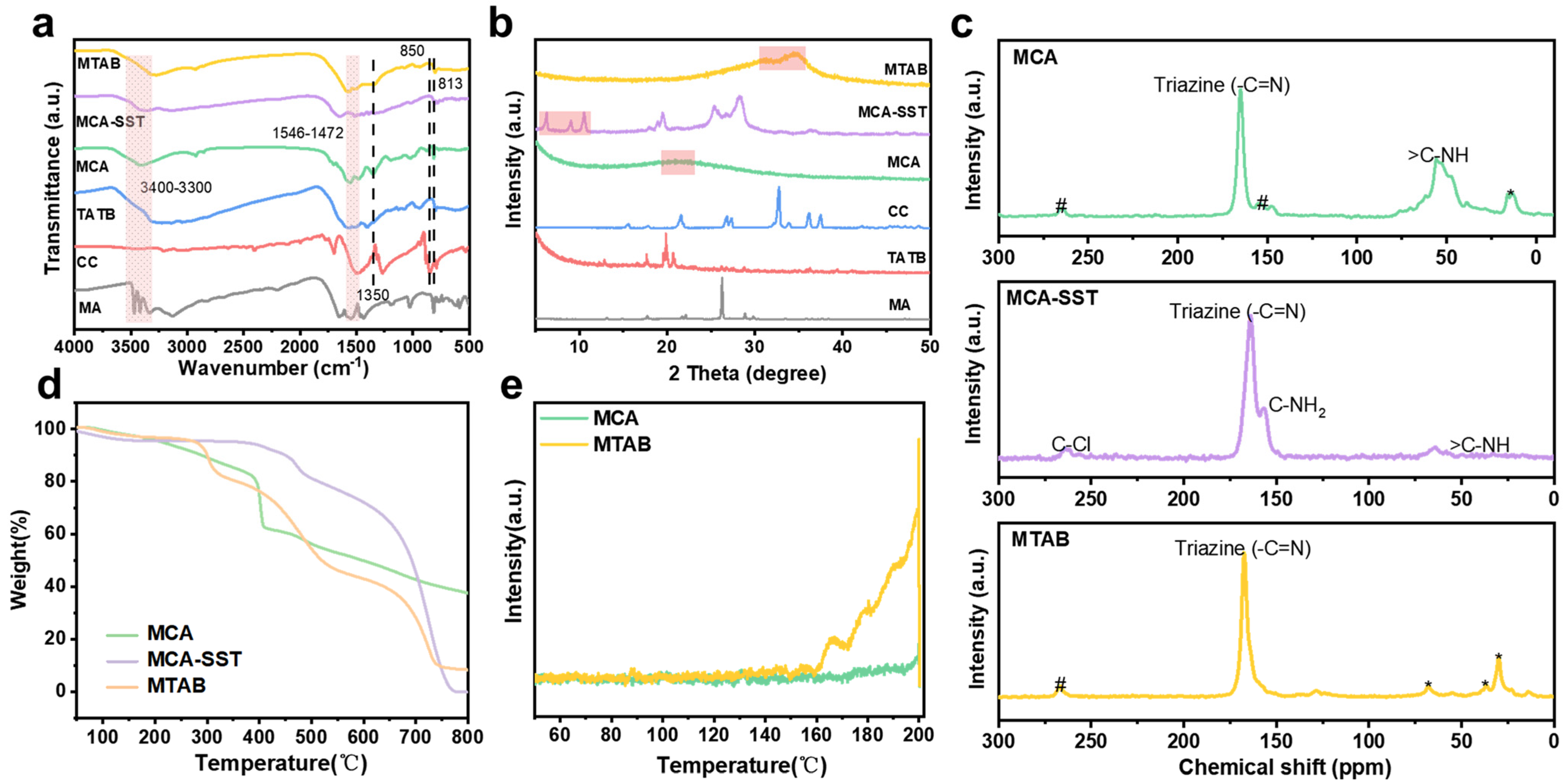
Figure 1. (a) FT-IR of MCA, MTAB, MCA-SST compared to synthesized monomers; (b) XRD corresponding spectra; (c) solid 13C-NMR spectra of MCA, MCA-SST, MTAB; (d) the TG curves of MCA, MCA-SST, MTAB; (e) comparative analysis of CO2-TPD alkaline sites between MCA and MTAB.
Catalysts 16 00143 g001
Figure 2. (a) High-resolution XPS C 1s spectrum of MCA, MCA-SST, and MTAB; (b) high-resolution XPS N 1s spectrum of MCA, MCA-SST, and MTAB; (c) SEM image of MCA; (d) SEM image of MCA-SST; (e) SEM image of MTAB.
Catalysts 16 00143 g002
Figure 3. (a) Comparison of conversion rates of epichlorohydrin addition by different 50 mg catalyst samples at 100 °C, 0.1 MPa CO2 pressure, and 24 h; (bd) Optimization of MCA-catalyzed epichlorohydrin addition reaction conditions.
Catalysts 16 00143 g003
Figure 4. (a) Recycle of MCA catalyzed epichlorohydrin addition reaction; (b) XRD patterns before and after MCA reaction; (c) FT-IR spectra before and after MCA reaction; (d) TG curves before and after MCA reaction.
Catalysts 16 00143 g004
Figure 5. Schematic diagram of possible mechanism reactions for CO2 cycloaddition of epoxides catalyzed by MCA.
Catalysts 16 00143 g005
Figure 6. Schematic diagram of MCA and MTAB synthesis route.
Catalysts 16 00143 g006
Table 1. Elemental analysis of MCA, MTAB, and MCA-SST.
Serial NumberSample NameN (%)C (%)H (%)C/N
1MCA58.1031.393.510.540
2MCA-SST59.0230.063.140.509
3MTAB59.1027.204.580.406
Table 2. The BET, pore structure parameters, and CO2 uptake of MCA, MTAB and MCA-SST.
EntrySample NameSpecific Surface AreaBET (m2 g−1)Pore Size a
(nm)
Pore Volume a
(cm3 g−1)
CO2 Adsorption b (cm3 g−1)
1MCA227.626.30.99113.6
2MCA-SST248.817.40.4074.4
3MTAB19.515.30.0751.6
a Calculated using the Horvath–Kawazoe method; b Gas adsorption at 273 K and pressures up to 101 Kpa.
Disclaimer/Publisher’s Note: The statements, opinions and data contained in all publications are solely those of the individual author(s) and contributor(s) and not of MDPI and/or the editor(s). MDPI and/or the editor(s) disclaim responsibility for any injury to people or property resulting from any ideas, methods, instructions or products referred to in the content.