
Review

Membranes for Electrochemical Carbon Dioxide Conversion to Multi-Carbon Products

Department of Chemical Engineering, Queen’s University, Kingston, ON K7N 3N6, Canada
*
Author to whom correspondence should be addressed.
Catalysts 2026, 16(2), 139; https://doi.org/10.3390/catal16020139
Submission received: 17 December 2025 / Revised: 11 January 2026 / Accepted: 20 January 2026 / Published: 2 February 2026

Abstract

Electrochemical carbon dioxide reduction reaction (CO2RR) offers a promising route to mitigate climate change while simultaneously enabling renewable energy storage and the sustainable production of value-added chemicals. A wide variety of CO2RR reactor designs have been developed, including both liquid-phase cells and gas-phase configurations. Among these, gas-phase systems, particularly flow-cell and membrane electrode assembly (MEA) designs, have become the primary focus of recent research due to their ability to overcome mass transport limitations and operate at high currents. While catalyst development has received considerable attention in advancing CO2RR performance, the role of membranes in these gas-phase electrolyzers has been less systematically reviewed. This article addresses that gap by critically examining the functions, advantages, and limitations of the major membrane classes used in CO2 electrolysis: anion exchange membranes, cation exchange membranes, bipolar membranes, and non-ion-exchange porous membranes within flow-cell and MEA configurations. We highlight how membrane properties influence local pH regulation, water management, crossover behavior, and overall reactor performance, while emphasizing that product identity is primarily catalyst-determined. By analyzing recent progress and remaining challenges, this review provides design insights for membrane selection and development toward efficient, stable, and scalable CO2 electrolysis systems.

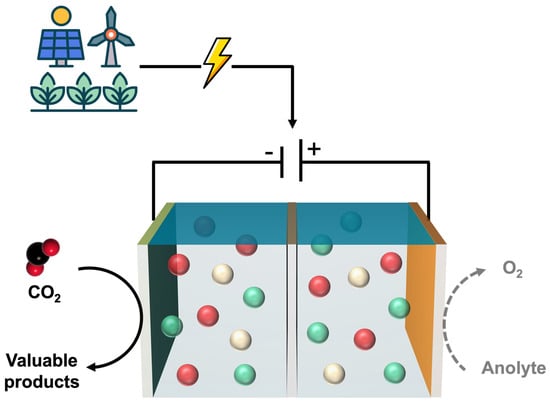
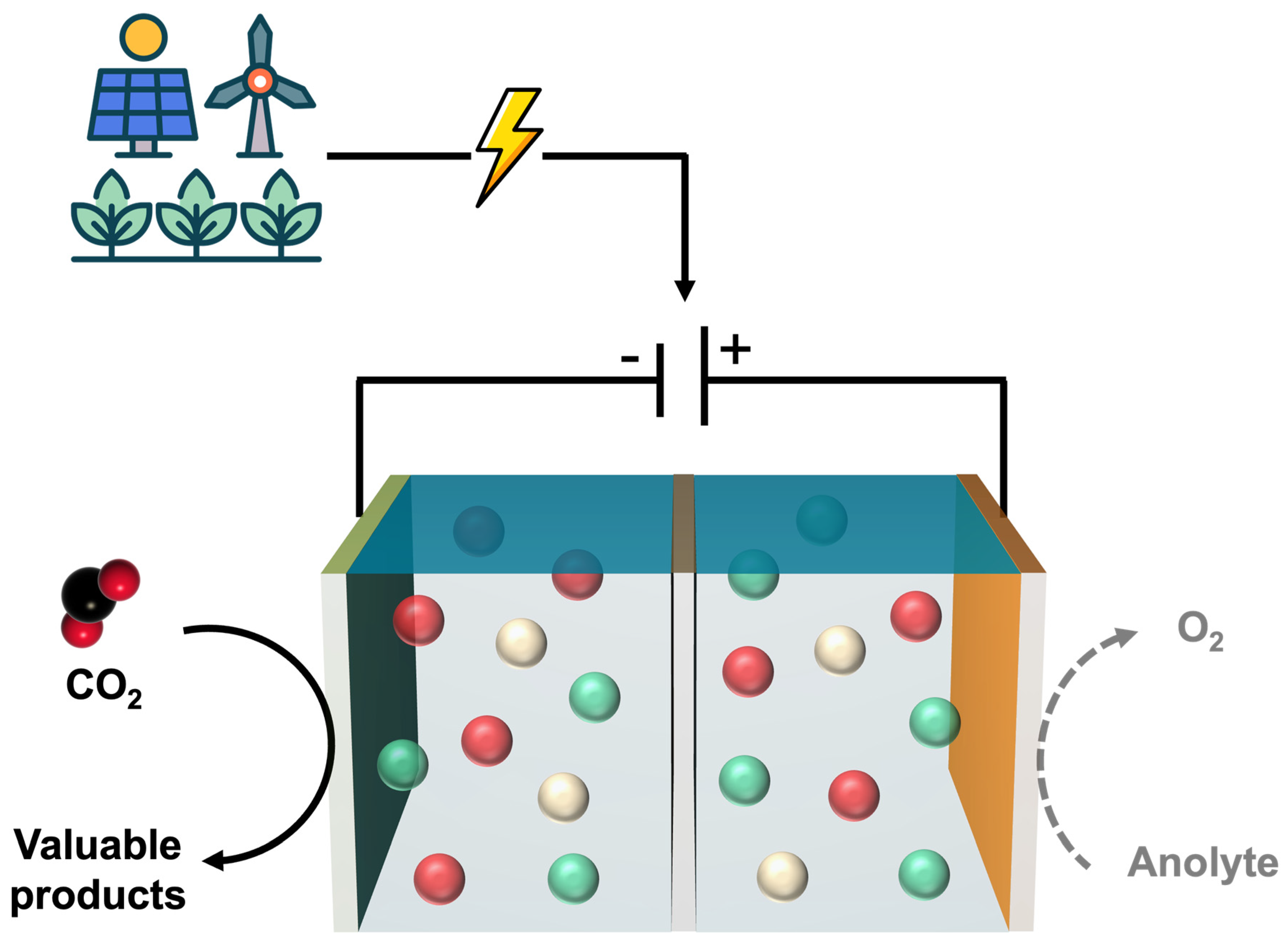
Graphical Abstract

1. Introduction

Since the 1950s, fossil fuel consumption and petrochemical production have increased more than fifteenfold, leading to a dramatic rise in carbon dioxide (CO2) emissions [1,2]. As CO2 accounts for roughly three-quarters of global greenhouse gas output, it is widely recognized as the main driver of global warming and environmental degradation [3]. Developing technologies that minimize CO2 accumulation in the atmosphere are therefore urgently needed [4]. One promising approach is the creation of an anthropogenic carbon cycle, in which CO2 is converted into fuels and chemicals using renewable energy [5]. Such a strategy not only addresses the environmental and energy challenges related to CO2 emissions but also creates a profitable carbon economy [6]. In such a system, renewable energy is converted to chemical energy stored in CO2-derived fuels and chemicals.
A variety of pathways have been explored for CO2 conversion, including biological, thermochemical, photochemical, and electrochemical methods [7,8,9,10,11]. Among these, the electrochemical CO2 reduction reaction (CO2RR) is particularly attractive as it operates under mild conditions, allows reaction rates and product selectivity to be tuned by the applied potential, and offers scalability through modular electrolyzer designs [12]. When coupled with intermittent renewable energy sources, CO2RR represents a compelling route for integrating renewable energy into the fuels and chemicals sector.
In CO2RR, CO2 is supplied to an electrochemical reactor, often referred to as a “cell” or “electrolyzer”, where it is converted on a catalyst surface under an applied electrical potential. Current electrolyzer configurations for CO2RR fall into three categories: H-cells, flow cells, and membrane electrode assembly (MEA) cells. An H-cell is a two-compartment design, with separate chambers for anode and cathode reactions, and connected by an ionic exchange membrane in between [13]. In this setup, the membrane acts as a central barrier that allows ionic transport while preventing bulk mixing of the solutions in the two compartments. The reference and the working electrodes are located in a sealed cathodic chamber, whereas the counter electrode is in the anodic chamber, thus establishing a three-electrode electrochemical system. However, because CO2 must first dissolve in the electrolyte and then diffuse to the catalyst layer, mass transport limitations severely restrict reaction rates and achievable current densities [14,15]. As a result, H-cells are not suitable for CO2RR at practical applications which require high operating current densities (>200 mA/cm2). In contrast, flow-cell and MEA designs have emerged as preferred configurations for achieving higher efficiencies and current densities [16]. These systems generally eliminate the use of bulk liquid chambers and instead rely on current collectors on both the anode and cathode sides. Together with gas diffusion electrodes (GDEs), such configurations shorten the diffusion path of CO2 to the reaction interface, thus enhancing mass transport and improving reaction rates [17].
Extensive research has been devoted to the development of catalysts for efficient CO2 conversion, but the role of membranes in gas-phase electrolyzers has received far less attention [18,19,20,21,22,23]. Broadly, membranes used in these systems can be divided into two categories: ion-exchange and non-ion-exchange membranes. Ion-exchange membranes include anion exchange, cation exchange, and bipolar membranes, while non-ion-exchange membranes are typically porous separators. Membranes have several critical functions, including preventing CO2 reduction products from crossing over to the anode where they may be re-oxidized to CO2, and limiting the transport of O2 evolved at the anode to the cathode, where it could participate in the oxygen reduction reaction and compete with CO2RR for electrons [8]. The selection of an appropriate membrane is therefore crucial, as it directly controls ion transport and strongly influences the local reaction environment at the cathode, which in turn affects the product selectivity and overall performance. In addition, CO2 electrolyzers also face recurring technical challenges arising from the tight coupling between ion transport, reaction environment, and mass transport, such as carbonate formation, pH imbalance, ohmic losses, and product crossover [24,25]. These challenges call for the use of different membrane types, each offering distinct advantages and trade-offs depending on the experimental conditions and performance priorities.
Motivated by the growing diversity of available membranes and their use across a wide range of configurations, this paper provides a comprehensive examination of the membranes commonly used in CO2 electrolyzers. While prior studies have largely focused on ion-exchange membranes, this work places particular emphasis on porous membranes, which have received comparatively less systematic attention despite their increasing relevance in MEA-based CO2 electrolyzers. The discussion begins with an overview of flow-cell and MEA systems, followed by an analysis of four membrane types (i.e., anion/cation exchange membranes, bipolar membranes, porous membranes) with emphasis on their functions and impacts in these configurations. Particular attention is given to their respective advantages and limitations, as well as recent strategies aimed at mitigating these challenges.

2. CO2 Electrolyzers

To address the mass transport limitations inherent in conventional H-cells, GDEs have been developed to deliver gaseous CO2 directly to catalysts supported on a gas diffusion layer (GDL) at the cathode side [26]. Both flow-cell and MEA systems adopt GDEs as a core component. The primary distinction between the two configurations lies in the cathode-membrane interface: in flow-cells, a liquid catholyte separates the cathode from the membrane, whereas MEA cells compress the GDE directly against the membrane, forming a zero-gap configuration.
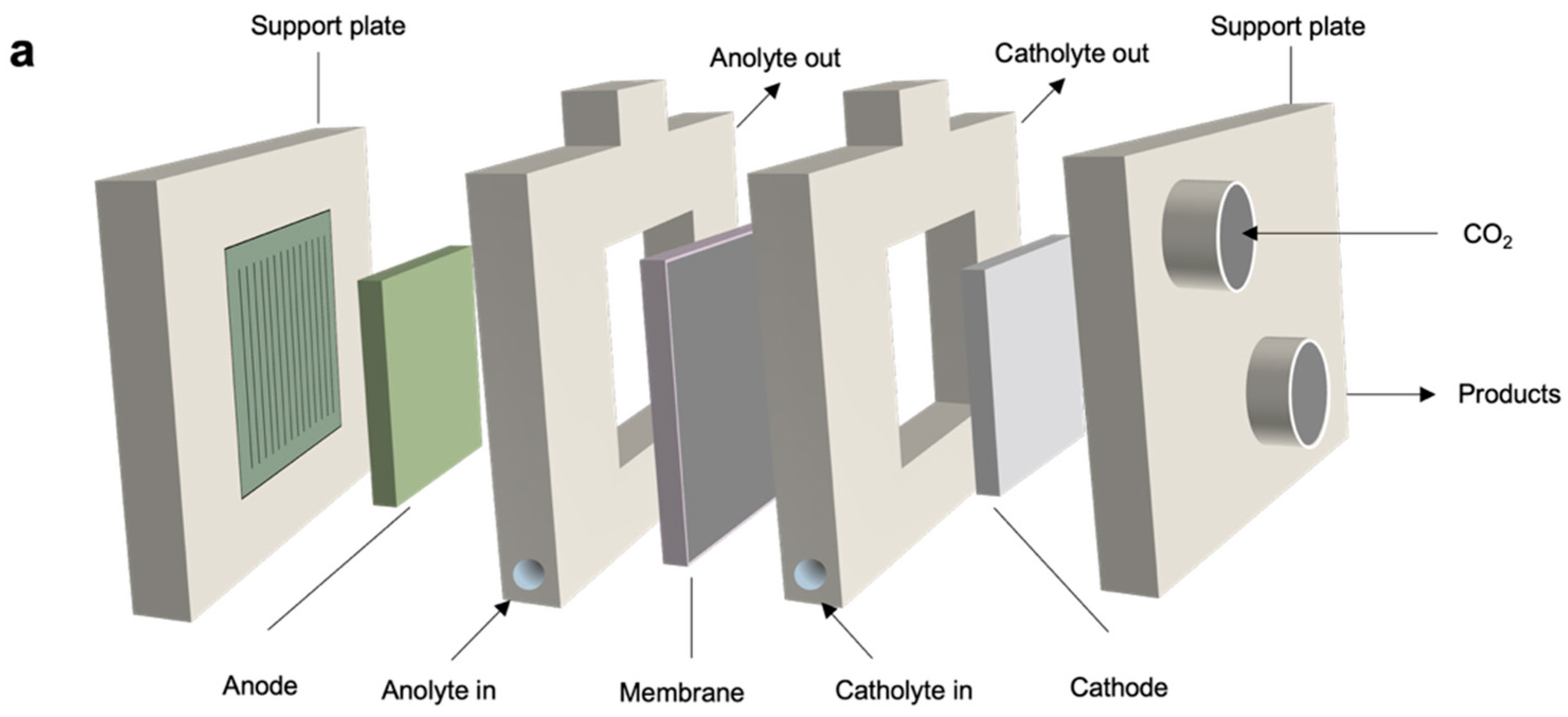
Flow-cells (Figure 1a) typically consist of a cathode, anode, reference electrode, electrolyte compartments, and a membrane, with current collectors that also function as flow channels for gas or electrolyte circulation [16,27,28]. The cathode commonly uses a GDE positioned with its GDL toward the current collector and catalyst layer facing the membrane, while the anode places its catalyst close to the membrane to reduce ohmic loss. This design overcomes low CO2 solubility and long diffusion path in aqueous media in H-cells, enabling significantly enhanced gas transport and allowing industrial-level current densities above 200 mA·cm−2 [29,30]. Compared to MEA architecture, the placement of a reference electrode enables in situ half-cell studies, making flow-cells highly attractive for mechanistic investigation and catalyst screening. Additionally, circulating with liquid catholyte improves ionic conductivity and thermal management throughout the catalyst layer, mitigates GDL/membrane dry-out, and permits electrolyte composition tuning to regulate the local reaction environment. Applying this approach with a 7M KOH electrolyte, Sargent’s research group reported a peak ethylene (C2H4) Faradaic efficiency (FE) of 75% at a partial current density of 1.3 A·cm−2, corresponding to a cathodic energy efficiency of 45% [31]. In an acidic environment (pH ≤ 1), Ma et al. [32] leveraged the combined effects of confinement and cations to obtain an FE exceeding 80% for C2+ products at 560 mA·cm−2. Their findings indicate that the presence of K+ ions in the Helmholtz plane enhances product selectivity by kinetically suppressing proton coverage at the electrode surface.
However, flow-cells also face challenges related to long-term materials durability, where prolonged electrolyte exposure can induce corrosion and metal ion leaching, while shear force may cause mechanical degradation or catalyst-layer delamination. The liquid electrolyte also introduces additional ionic resistance, often resulting in higher cell voltages and reduced energy efficiency. Furthermore, catholyte circulation, pumps, and fluid-handling components increase system complexity and cost, creating challenges for large-scale deployment.
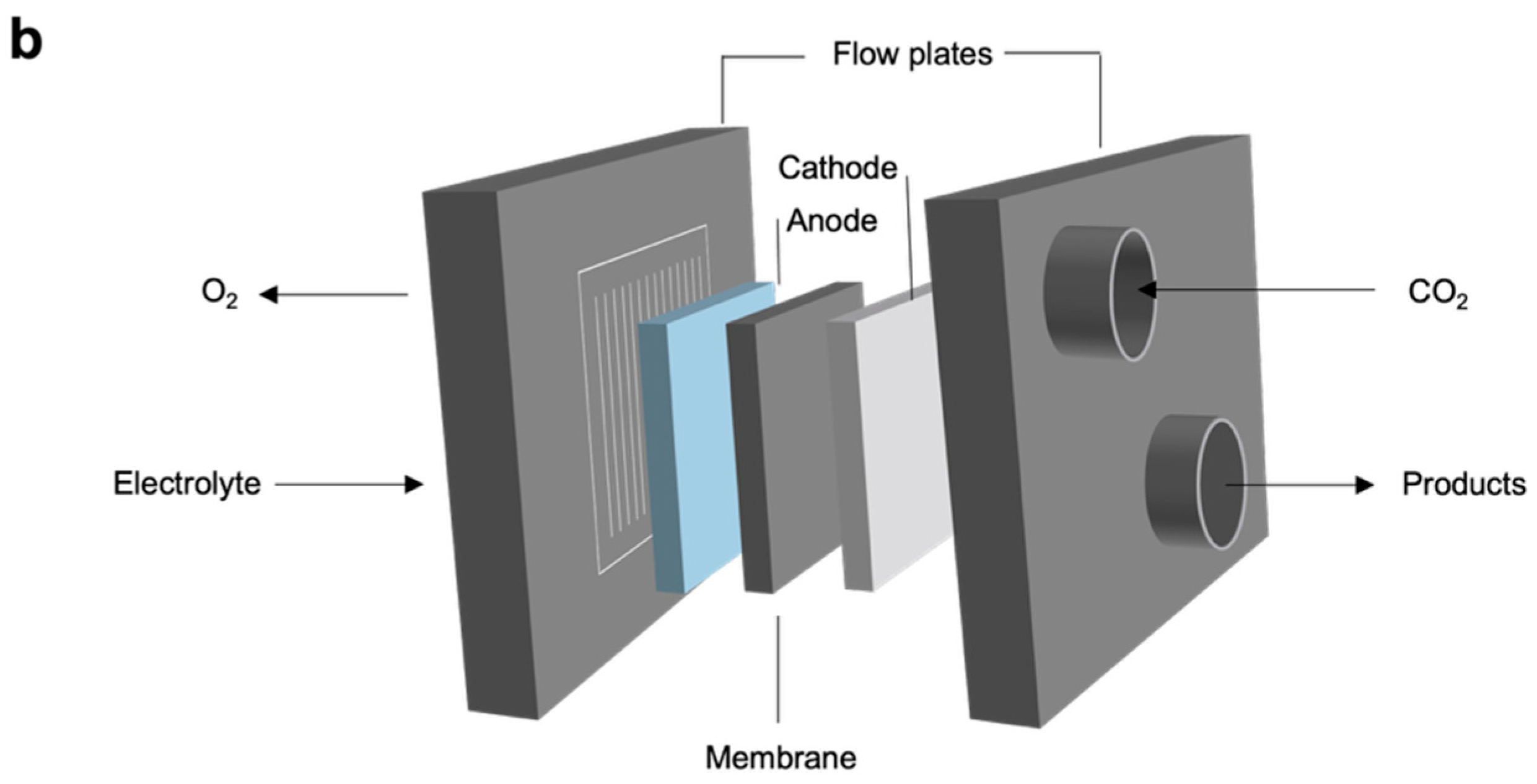
MEA cells (Figure 1b), also referred to as “zero-gap” or “catholyte-free” cells [33,34,35], eliminate the catholyte gap by placing the GDE directly against the membrane [36]. Humidified CO2 is commonly supplied to the cathode, whereas the anode is fed with a liquid anolyte as the water source [37]. A key advantage over the flow-cell is that this configuration reduces ion-transport distance and achieves lower cell voltages with improved energy efficiency, while its compact structure enhances stack integration and scalability. The absence of catholyte further helps prevent solution-induced GDE degradation, reduces flooding risks, and limits impurity deposition, improving long-term operational stability. Several studies have demonstrated the strong performance advantages of MEA-based CO2 electrolyzers. For instance, ethylene-dominant C2+ production with a total C2+ FE of nearly 90% was reported at a current density of over 1 A·cm−2, with C2H4 accounting for more than 60% of the product distribution [38]. In addition to high activity and selectivity, Li et al. [39] demonstrated excellent durability in an MEA configuration, achieving stable operation at 600 mA·cm−2 for up to 190 h while maintaining an C2H4 FE of around 60%. Moreover, a full-cell energy efficiency of 20% was reported, which showcases the potential of MEA cells for sustained, high-rate CO2RR.
Despite significant progress, both flow-cell and MEA systems suffer from salt precipitation within the GDE, where carbonate and bicarbonate species crystallize as CO2 reacts with locally generated OH. At high current densities, the sharp rise in interfacial alkalinity drives salt formation, progressively blocking GDE pores, increasing mass-transfer resistance, causing flooding, and restricting CO2 access to active sites, ultimately shifting selectivity toward H2.
Considerable efforts have been made to alleviate this issue. Xu et al. [40] proposed a self-cleaning strategy in which the applied cell voltage was periodically alternated between normal operating conditions and a lower regeneration voltage, effectively reducing the current density to nearly 0 mA·cm−2. Using this approach, system stability was improved by nearly 16-fold, which extended the operating time from 10 h to about 157 h while keeping an 80% FE for C2 products. However, this strategy was demonstrated at a partial current density of only 138 mA·cm−2, which remains lower than that achieved in many state-of-the-art systems. In a separate approach, Wang’s group introduced acid-humidified CO2 gas to suppress salt crystallization within the GDE [41]. This strategy enabled stable operation for up to 4500 h in a 100 cm2 electrolyzer without compromising catalyst activity. Nevertheless, the reported performance was limited to CO production rather than multi-carbon products. Thus, while these strategies effectively address one key drawback of MEA cells, limitations remain, and further development in reactor engineering is therefore required.
Overall, each electrolyzer design offers specific advantages that can be utilized based on the desired performance goals. While the formation of specific CO2RR products is primarily governed by the choice of catalyst, reactor design has become increasingly important for achieving stable operation, high efficiency, and scalability by shaping the local reaction environment. Membrane type and cell configuration do not uniquely determine product identity, but they regulate ion transport, hydration, and local pH, which in turn influence reaction pathways in conjunction with catalyst properties and operating conditions. Currently, four main categories of membranes are used in CO2 electrolyzers: anion exchange membranes (AEMs), cation exchange membranes (CEMs), bipolar membranes (BPMs), and non-ion-exchange porous membranes. The following section examines each membrane type in detail, highlighting its functional roles, operational advantages, and associated challenges in CO2 electrolysis systems.

3. Membranes for CO2 Electrolyzers

Membranes play a central role in CO2 electrolyzers by providing ion transport pathways, maintaining separation between anodic and cathodic environments, and suppressing the crossover of reactants and products [42]. Their performance is dictated largely by the functional groups within the polymer matrix, which determine whether the membrane operates under acidic, alkaline, or neutral conditions. These functional groups also control critical properties such as charge-carrier mobility and water uptake [43,44,45]. Given the wide diversity of membrane chemistries, fabrication methods, and testing conditions reported in the literature, this review does not attempt to comprehensively catalogue all membrane properties. Instead, we focus on representative membrane classes and the key properties most relevant to CO2 electrolysis performance.
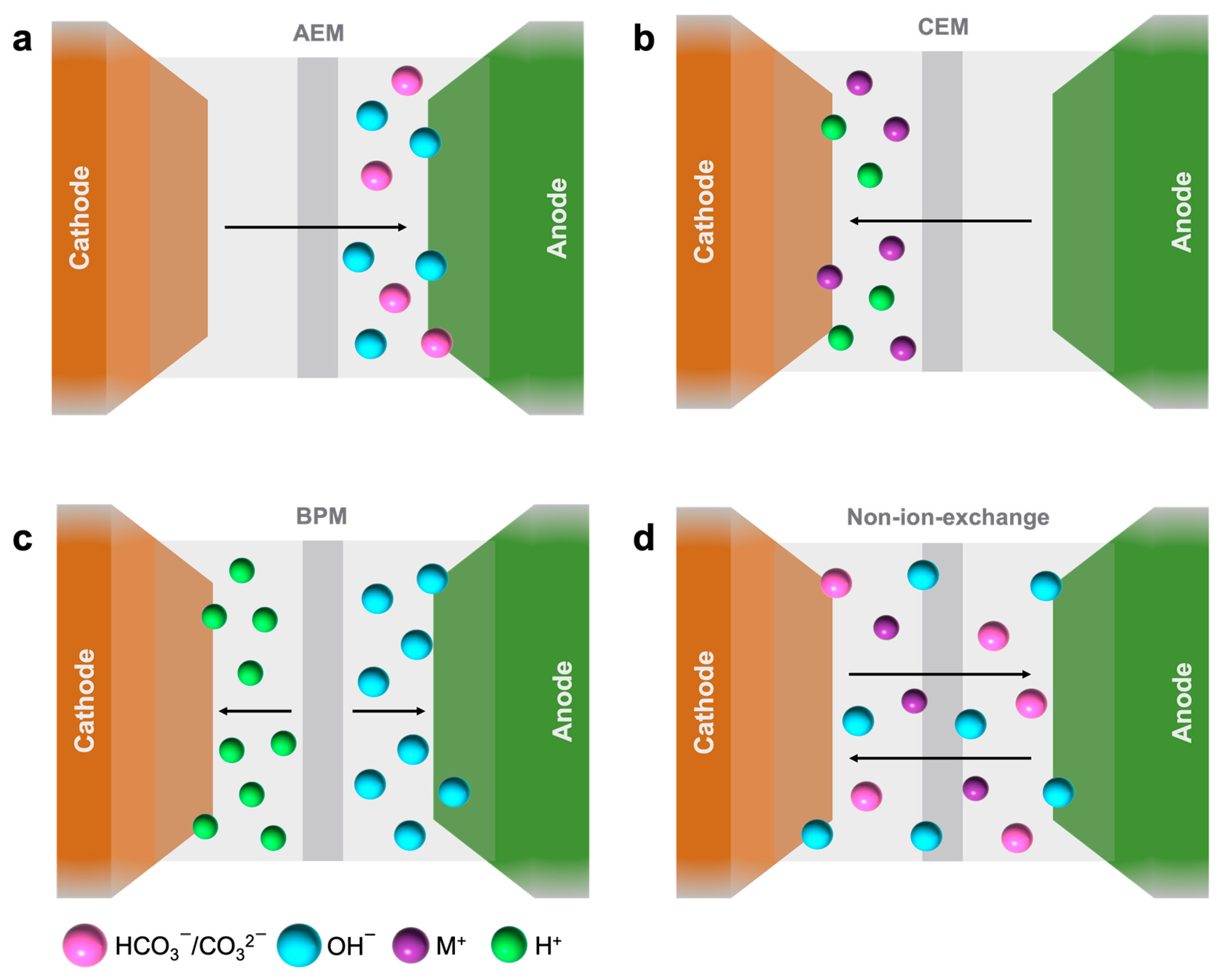
Traditionally, three classes of membranes have been used in CO2RR systems: AEMs, CEMs, and BPMs, similar to those applied in water splitting electrolyzers [46,47,48,49]. In this review, we additionally highlight the emerging class of porous membranes [50]. As illustrated in Figure 2a–d, the type of membrane directly defines the ion transport pathway across the electrolyzer, thus influencing both efficiency and product selectivity. The membrane type determines the dominant charge carriers (e.g., OH in AEMs, H+ in CEMs, H+/OH generated in BPMs), which controls the local pH, water activity, and ion availability near the catalyst surface. Unlike bulk liquid electrolytes, membrane-catalyst interactions are highly localized and arise from coupled ion transport, hydration, and mass-transfer effects rather than direct coordination chemistry.
In addition to intrinsic transport properties, long-term stability in CO2 electrolyzers is strongly influenced by membrane swelling, interfacial resistance, and chemical compatibility between the membrane and catalyst layers. Excessive membrane swelling can degrade mechanical integrity, alter interfacial contact, and increase ohmic resistance during extended operation, particularly in MEA configurations [51]. Similarly, increased interfacial resistance arising from poor membrane-electrode contact can lead to performance decay over time [52]. Chemical incompatibility between membranes, ionomers, and catalysts may further accelerate degradation through polymer decomposition, catalyst poisoning, or charges in local hydration and pH [47,53]. These interfacial effects highlight that membrane stability must be evaluated not only by bulk properties but also by long-term interactions within the complete electrolyzer design.
To better understand these effects, it is necessary to examine the fundamental membrane characteristics, including chemical composition, concentration and distribution of functional groups, and overall structural design.

3.1. Anion Exchange Membranes (AEMs)

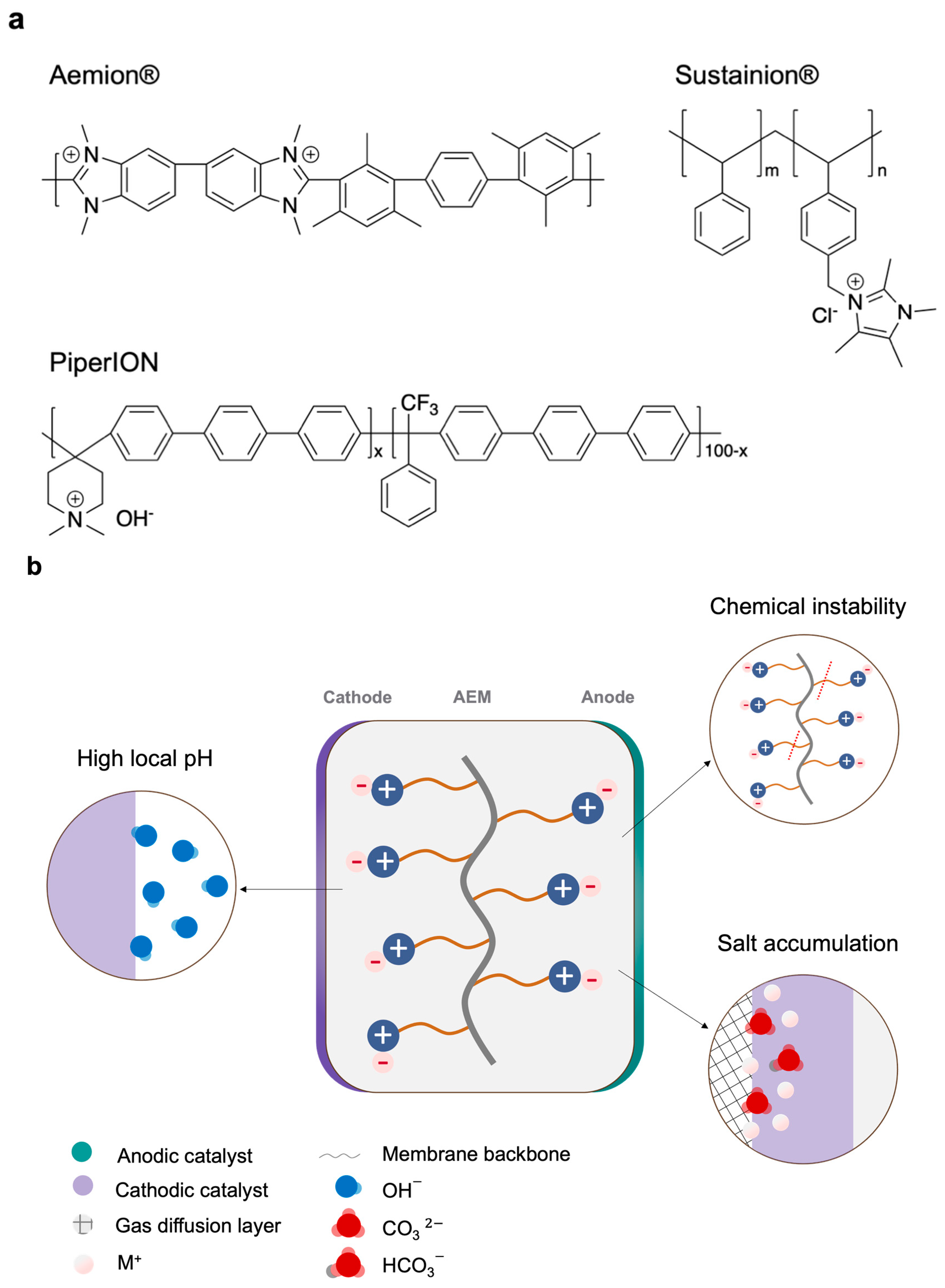
AEMs are polymeric membranes that transport anions such as hydroxide (OH) and carbonate/bicarbonate (CO32−/HCO3) between the cathode and anode in CO2RR systems (Figure 2a). Their structure consists of positively charged functional groups, typically ammonium, diammonium, imidazolium, and phosphonium, anchored to a polymer backbone [54] (Figure 3a). Adapted from mature technologies (i.e., water electrolysis, fuel cells), AEMs bring several well-established advantages to CO2RR applications [55,56,57]. Academic studies have further demonstrated the potential of imidazolium-functionalized AEMs, which exhibit high conductivity and enhanced alkaline stability, thus enabling long-term electrolysis performance [58].
In principle, the positively charged functional groups on the polymer backbone of AEMs facilitate anion transport from the cathode to the anode, allowing the CO2RR to occur in a basic environment through the generation of OH ions at the surface of the cathode [51]. In an MEA setup, the use of AEMs helps reduce cell voltage and enhance current density by minimizing ionic resistance and improving both mass and charge transport, thus increasing overall energy efficiency (Figure 3b). Their compatibility with gas-fed systems makes AEMs particularly attractive for industrial-scale CO2 electrolysis. The half-reactions occurring at the cathode and anode in AEM-based systems are summarized as follows.
  • Cathode:
2CO2 + (n)H2O + (2n)e ⟶ C2+ (oxygenates/hydrocarbons) + (m)OH (alkaline/neutral)
2CO2 + (2n)H+ + (2n)e ⟶ C2+ (oxygenates/hydrocarbons) + (n)H2O (acidic)
2H2O + 2e ⟶ H2 + 2OH (alkaline/neutral)
2H+ + 2e ⟶ H2 (acidic)
  • Anode:
4OH ⟶ O2 + 2H2O + 4e (alkaline)
2H2O ⟶ O2 + 4H+ + 4e (acidic/neutral)
AEMs have also shown promise in both zero-gap and flow-cell configurations for gas-phase CO2 reduction. In an MEA setup employing an AEM as the separator, Gabardo et al. [59] reported an FE of 50% for C2H4 and 80% for total C2+ products, with stable operation over 100 h at current densities >100 mA·cm−2. Similarly, Xu et al. [40] achieved an 80% FE for C2 products at roughly 180 mA·cm−2, maintaining stable performance over 236 h of total duration. In a flow-cell study, Dinh et al. [60] used a sputtered Cu catalyst on a polymer-based gas diffusion electrode, obtaining a 70% FE for C2H4 and 87% for total C2+ products at current densities exceeding 250 mA·cm−2. These results highlight the effectiveness of AEMs in enabling efficient ion transport and promoting selective CO2 conversion in high-performance systems. From an economic perspective, AEMs can be synthesized from common hydrocarbon polymers and functionalized with inexpensive quaternary ammonium (QA) salts, offering low cost and tunable water transport properties [61,62].
Despite their advantages, AEMs have yet to achieve widespread commercial application due to issues of chemical instability and salt accumulation [63,64] (Figure 3b). Under alkaline condition, CO2 readily reacts with OH ions to form CO32− and HCO3 species. Meanwhile, the diffusion of aqueous electrolyte through concentration gradients and electroosmotic drag over solvated cations promotes the migration of metallic cations from the anolyte to the cathode. This process leads to the formation of salt precipitates within the cathode, which can clog the pores of the gas diffusion electrode and obstruct the flow channels in the cathode field. As a result, CO2 transport to catalyst surface is hindered, increasing cell pressure and reducing system efficiency [65]. In addition, AEMs are prone to degradation in highly concentrated alkaline environments, which shortens their operational lifetime [66]. Under such conditions, both the cationic functional groups and the polymer backbone are vulnerable to nucleophilic attack by OH ions, leading to chemical breakdown. Meanwhile, mechanical durability is another major concern in CO2 electroreduction systems, as prolonged exposure to CO2 streams can make the membrane brittle [52,67]. This brittleness can lead to rupture and severe flooding, eventually lowering CO2RR selectivity and limiting long-term stability.
To mitigate the undesired crossover of CO2RR products through the AEM, careful control of water uptake and ion exchange capacity (IEC) is essential [68,69]. Regulating these parameters reduces the mixing of liquid products with water and minimizes electroosmotic drag toward the anode, while maintaining high anion conductivity. This balance also helps suppress CO32−/HCO3 transport by limiting the aqueous CO2 content within the membrane and reducing its reaction with OH. One effective strategy involves designing AEMs with internal microchannels, which not only lower K+ crossover but also enable operando water management for improved stability [70]. In another study, Kim et al. [71] developed a QA-based membrane paired with an ionomer binder, achieving high anion conductivity, low water uptake, and enhanced mechanical and chemical durability compared to commercial AEMs. Further advancements have been reported by Wang’s group [72] and Zhang’s group [73], who modified polybenzimidazole membranes through crosslinking and grafting to improve dimensional stability and mechanical robustness, highlighting ongoing efforts to balance conductivity, durability, and selective ion transport in next-generation AEMs.
At present, no standardized protocols or performance metrics exist for the commercialization of AEMs in CO2RR electrolyzers [43]. Thus, the development of AEMs tailored specifically for CO2RR is critical to advancing commercially viable MEA configurations. Although certain design principles and operational strategies can be adapted from related electrochemical technologies, novel membranes with different materials and morphologies will be required to address the unique challenges of CO2RR.

3.2. Cation Exchange Membranes (CEMs)

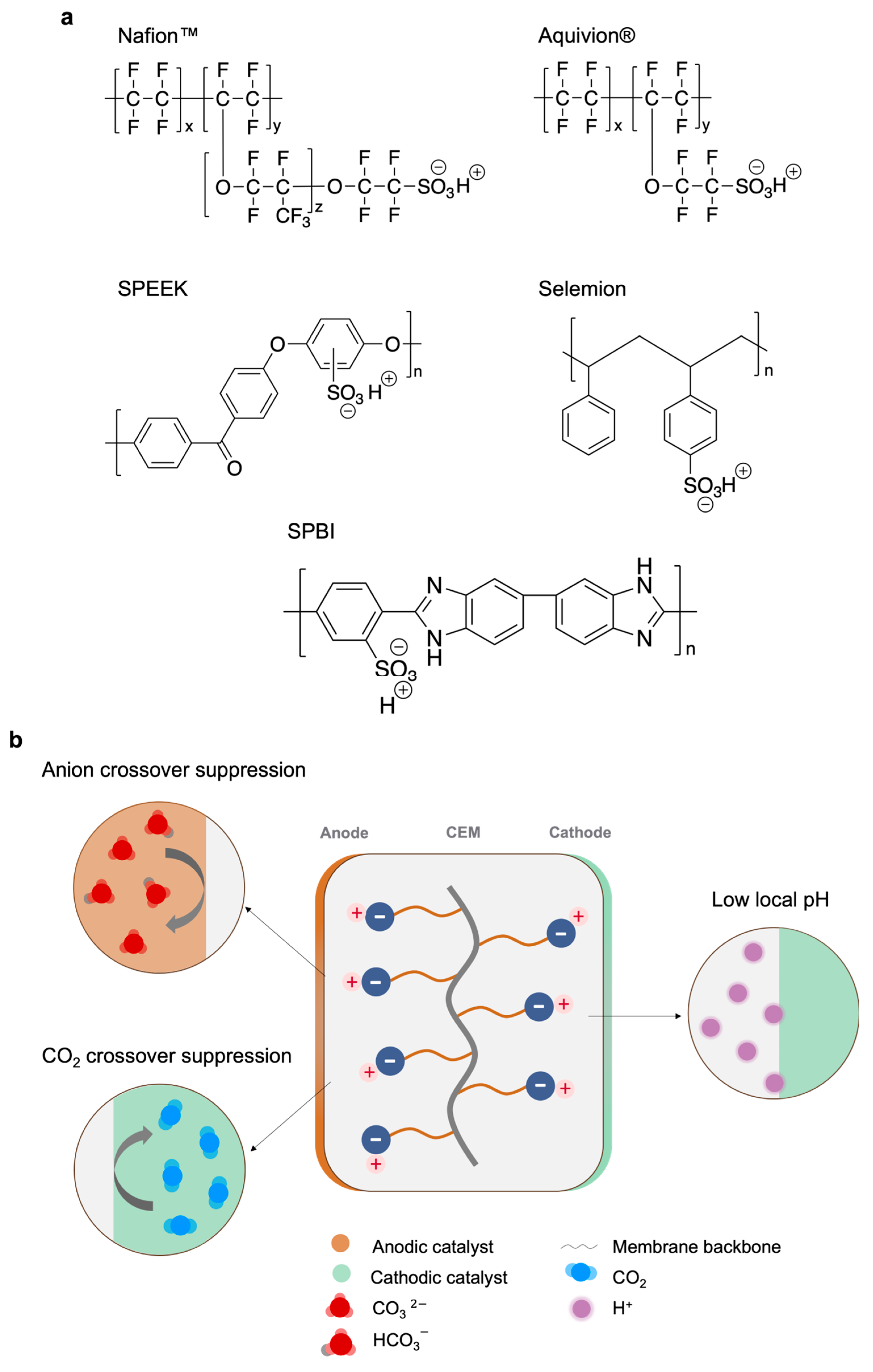
Cation-exchange membranes (CEMs) are composed of polymer backbones containing fixed anionic functional groups such as sulfonic (-SO3) or carboxylate (-COO). Common examples include perfluorosulfonic acid (PFSA)-based polymers like Nafion, as well as sulfonated hydrocarbon frameworks such as SPEEK, and Selemion (Figure 4a). These fixed negative sites facilitate selective transport of cations (e.g., H+, K+, Cs+) while effectively blocking anionic species such as HCO3 and CO32− (Figure 2b). CEM-based systems often operate with acidic electrolytes, in which the electrolyte itself supplies a high concentration of H+, thus establishing and maintaining an acidic environment at the cathode. This condition suppresses the formation of CO32− and HCO3 species, which otherwise consume CO2 and hinder reaction efficiency [74]. However, it is in principle possible to use neutral or alkaline electrolytes depending on the specific objectives and design choices of a given study. Under such conditions, the dominant ion transport pathways differ from those in acidic operation and must be reconsidered accordingly. The half-reactions occurring at the cathode and anode in CEM-based systems are summarized as follows.
  • Cathode:
2CO2 + (2n)H+ + (2n)e ⟶ C2+ (oxygenates/hydrocarbons) + (n)H2O (acidic)
2CO2 + (n)H2O + (2n)e ⟶ C2+ (oxygenates/hydrocarbons) + (m)OH (neutral/alkaline)
2H+ + 2e ⟶ H2 (acidic)
2H2O + 2e ⟶ H2 + 2OH (neutral/alkaline)
  • Anode:
2H2O ⟶ O2 + 4H+ + 4e (acidic/neutral)
4OH ⟶ O2 + 2H2O + 4e (alkaline)
CEMs facilitate the transport of H+ ions from the anode to the cathode, which in turn create and maintain an acidic interface. This localized acidity can help prevent salt precipitation and prevent CO2 crossover to the anode (Figure 4b).
Several studies have explored CEMs for CO2 electroreduction across both flow-cell and MEA configurations. In a flow-cell setup, Zhang et al. [75] employed a CEM, reporting an FE of ~75% and an energy efficiency of 40% for C2+ products, with stable operation for nearly 30 h and minimal catalyst degradation. Similarly, Huang et al. [76] incorporated a CEM to functionalize the surface of Cu catalyst, which enabled efficient ion transport and stable reaction environment at high current densities. Their system reached a CO2 single-pass utilization of 77% and an FE exceeding 40% for C2+ products at 1.2 A·cm−2. Collectively, these studies highlight the promise of CEM-based electrolyzers for high-rate CO2 electroreduction with enhanced carbon efficiency and operational durability.
Despite their advantages, CEM-based systems also face several drawbacks that limit their long-term performance (Figure 4b). One key issue is proton accumulation near the cathode, which can lower the local pH, suppress C-C coupling and favor the competing hydrogen evolution reaction (HER) [77]. However, both theoretical analyses and experimental observations suggest that such strongly acidic conditions primarily occur at low current densities or during the initial stages of operation. Beyond this, the major challenges in CEM-based configurations stem from catalyst deactivation and poor long-term durability [78]. Moreover, unintended ion crossover remains a critical concern. Acidic liquid products such as acetic acid or formic acid do not readily deprotonate into anionic species under operating conditions and can therefore diffuse across the membrane as neutral molecules [79]. This neutral species crossover not only lowers product selectivity and carbon utilization efficiency but also complicates downstream separation and recycling processes. Addressing these limitations requires careful optimization of membrane composition, ion exchange capacity, and interfacial architecture to stabilize the reaction environment and extend operational lifetime.
As established in mature electrochemical technologies, mitigation strategies for CEMs typically focus on optimizing their physical and chemical properties. These include tuning the ion exchange capacity and membrane thickness to restrict carbonate transport, designing ionomers that stabilize interfacial alkalinity, and incorporating crosslinked polymer matrices to enhance mechanical durability and suppress swelling [80,81,82]. Building on these principles, recent studies have explored tailored designs for CEM-based CO2RR systems. Park et al. [83] introduced an approach by coating an anion exchange ionomer (AEI) onto a CEM, thus creating a locally alkaline microenvironment at the cathode while preserving the advantages of a single-membrane system. They demonstrated that optimizing AEI content, alkali cation concentration, and catalyst layer thickness enhanced the pH gradient across the membrane, effectively expanding the alkaline reaction zone and improving CO2RR selectivity. Similarly, O’Brien et al. [77] developed a permeable CO2 regeneration layer that maintained an alkaline interface and facilitated local CO2 regeneration within a CEM configuration. This design reduced CO2 crossover to 15% and obtained a single-pass CO2 conversion of 85% at 100 mA·cm−2, with a hydrocarbon FE close to 60%. Moreover, hybrid approaches that integrate both AEM and CEM functionalities have also emerged as promising alternatives, as discussed in the following subsection.

3.3. Bipolar Membranes (BPMs) or CEM/AEM Hybrid

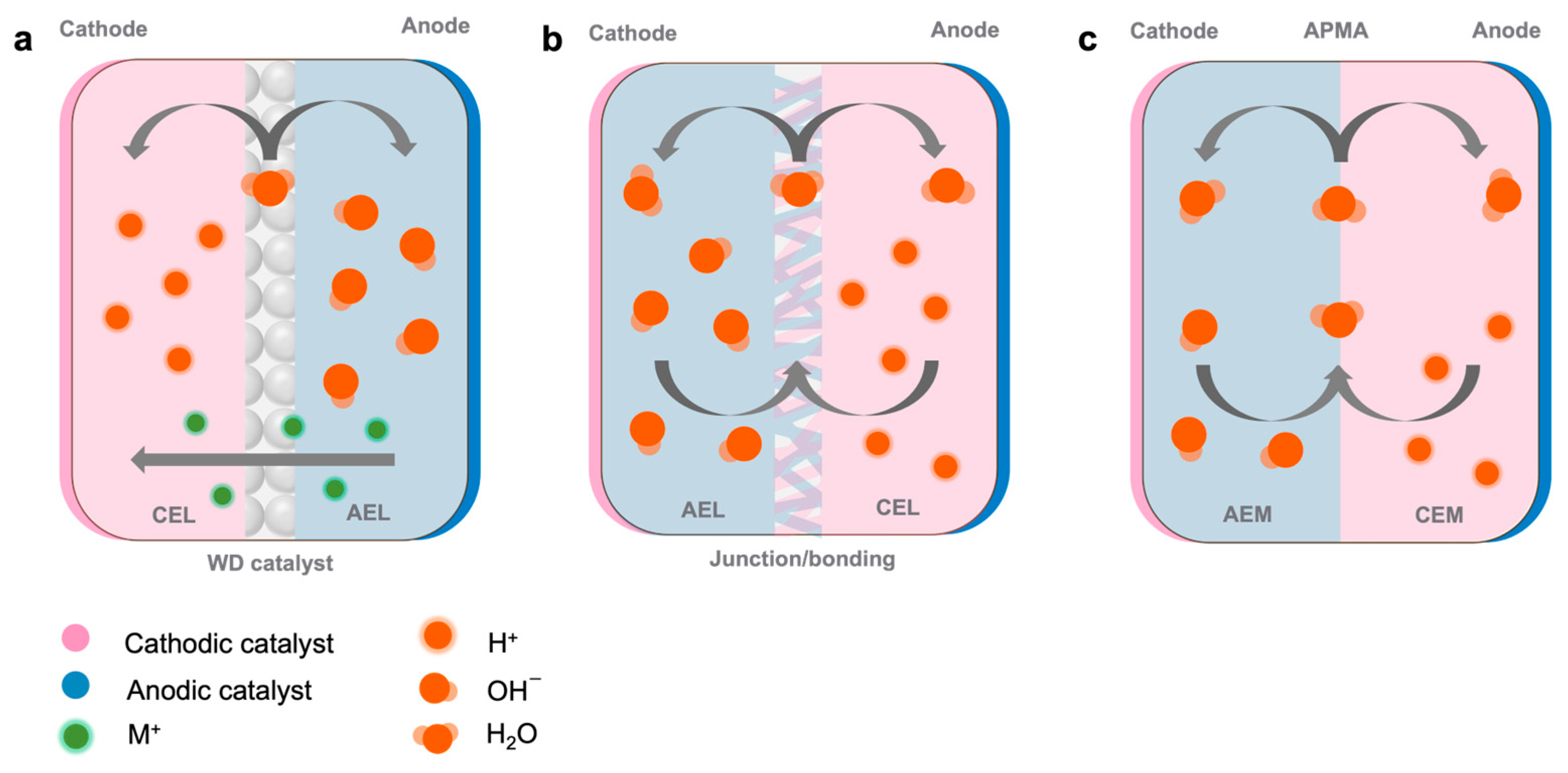
BPMs are composed of two layers: a cation exchange layer (CEL) containing fixed sulfonic acid groups and an anion exchange layer (AEL) with fixed QA groups. These layers form a junction, which may be a direct CEL-AEL interface or may incorporate a thin catalytic interlayer [84]. Importantly, the fundamental working mode of BPMs (reverse bias, forward bias) is controlled by the membrane polarity and electric field direction and is not altered by whether the interface is laminated or catalyst assisted. Under reverse bias (i.e., CEL at the cathode), water at this junction dissociates into H+ and OH ions. The generated H+ migrates through the CEL toward the cathode, while OH migrates through the AEL toward the anode (Figure 5a). Although H+ and OH generated at the bipolar junction are the dominant charge carriers under this working mode, alkali cations (M+) may still reach or accumulate near the cathode side due to electro-osmotic drag, and the local concentration polarization under high current density operation.
In contrast, under forward bias (i.e., CEL at the anode), H+ and OH ions are transported from the respective layers into the BPM, where they recombine to form water at the interface (Figure 5b). The distribution of ionic species under both bias directions is illustrated in Figure 2c.
The cathodic and anodic half-reactions, together with the BPM interfacial reaction (water dissociation or acid-based recombination) under the corresponding operating modes, are summarized below.
  • BPM interface:
H2O ⟶ H+ + OH (reverse bias, water dissociation)
H+ + OH ⟶ H2O (forward bias, acid-based recombination)
Cathode:
2CO2 + (2n)H+ + (2n)e ⟶ C2+ (oxygenates/hydrocarbons) + (n)H2O
2H+ + 2e ⟶ H2
  • Anode:
4OH ⟶ O2 + 2H2O + 4e
In conventional alkaline gas-fed cells, CO2 reacts with cathodic OH to form CO32−, which then migrates across the membrane, reducing overall efficiency [85]. In contrast, a BPM in a gas-fed MEA helps stabilize the cathode pH and suppress the product crossover [86,87]. The junction continuously generates H+ that neutralize cathodic OH, which minimizes CO32− formation and maintains a basic environment at the anode side [84]. This dynamic sustains charge balance: electrons flow from the anode to the cathode, while H+ and OH produced at the junction move in opposite directions to keep electro-neutrality. As a result, CO2 reaching the cathode is efficiently converted, and any CO32− or HCO3 formed is immediately reconverted by the BPM-derived H+, preventing loss through crossover. In essence, the BPM acts as a selective ionic conduit that directs H+ and OH where they are needed while blocking unwanted ion transport. Considering this principle, Wang et al. [88] coupled a BPM with a tandem catalyst architecture, achieving a total FE of approximately 77% toward C2+ products, of which 43% was attributed to C2H4, at a high current density of 726 mA·cm−2. Similarly, Khan et al. [89] employed BPM in a flow-cell configuration for the co-electrolysis of CO2 to C2H4 at the cathode and glycolic acid at the anode. Remarkably, FEs of 50% for C2H4 at current densities of 175–225 mA·cm−2 and around 50% for glycolic acid on the anode side were achieved. This dual-product operation highlights the economic potential of BPM-based systems, as two value-added products can be generated simultaneously within a single electrolyzer.
Despite recent advances in applying BPMs to CO2RR electrolyzers, these systems still face several drawbacks. The main limitation is the additional voltage required to drive water dissociation (WD) at the junction, which results in higher cell voltages compared to single-membrane systems operating at the same current density [90]. Mechanical stresses at the CEL/AEL interface, arising from swelling, water flux, or gas bubble formation, can further cause delamination or blistering during extended high-current operation [77,91]. In addition, the alkaline degradation of AEM chemistries remains a concern for long-term durability [92].
To overcome these challenges, researchers have focused on engineering specialized interfacial catalysts, polymer designs, and structural modifications. Enhancing the compatibility between the AEL and CEL has been shown to improve interfacial adhesion, ionic conductivity, and water management, which are all crucial for maintaining stable operation under high current densities [93,94]. Another effective strategy involves introducing a buffering catholyte layer between the CEL and the cathode to counteract cathode acidification, which helps stabilize local pH and sustain optimal reaction conditions [95,96].
Chen et al. [97] demonstrated that using optimally thin TiO2 nanoparticle films enabled a BPM-based cell to operate at 500 mA·cm−2 with a cell voltage below 2.0 V. They further showed that adding electronic conductors (e.g., carbon black) into the catalyst layer enhanced the local electric field at the junction, improving WD rates. In another study, Xie et al. [98] incorporated a stationary catholyte layer between the catalyst and the BPM, yielding a CO2 electrolysis system capable of producing multicarbon products with carbon efficiencies >70%. Their BPM-based cell attained around 78% single-pass CO2 utilization for C2+ products and exhibited C2H4 selectivity comparable to the best neutral MEAs. Remarkably, the system delivered ~42% FE for C2H4 at 200 mA·cm−2 and a full-cell voltage of roughly 3.8 V. This performance improvement was attributed to the controlled local pH and the optimized CO2 transport pathways provided by the buffered interface.
In addition to modified BPMs, many studies have highlighted the efficiency of integrating both AEM and CEM in CO2RR systems. For example, Alkayyali et al. [99] introduced a direct membrane deposition approach to fabricate a monolithic AEM|CEM composite structure within an MEA. This design offered flexibility in tuning the composite’s properties and optimizing the AEM:CEM ratio to achieve both low ionic resistance and reduced H2 evolution. Compared to a conventional BPM, their system decreased mass transport resistance by over 50% and increased selectivity toward multicarbon products from 29% to 65% at 300 mA·cm−2. Building on this, She et al. [100] demonstrated a pure-water membrane assembly with an AEM on the cathode side and a CEM on the anode side (referred to as an APMA configuration) that effectively eliminated CO32− formation. Their six-cell stack operated for over 1000 h at a total current of 10 A without any CO2 or electrolyte loss, achieving approximately 50% FE toward C2H4. In this configuration, OH ions produced at the cathode and H+ ions at the anode migrated through their respective membranes and recombined at the interface to form water, effectively shuttling water between compartments (Figure 5c). In the APMA system, the AEM interfaces with the cathode to establish an alkaline cathode environment that is favorable for CO2RR, while the CEM positioned at the anode effectively blocks anion crossover. Together, this configuration enables the use of pure water as the electrolyte. This research highlights that employing CEM/AEM hybrid can sustain high hydrocarbon yields with Cu catalysts while operating with dry gas feed.
Figure 5. Schematic illustration of ion transport in BPMs: (a) Conventional BPM under reverse bias, where water dissociation occurs at the junction, aided by a catalyst that promotes the splitting of H2O into H+ and OH ions, which migrate toward the cathode and anode, respectively; (b) Conventional BPM under forward bias, in which the AEL and CEL are bonded together, allowing spontaneous recombination of OH and H+ at the junction to form H2O; (c) Modified BPM, integrating an AEM and a CEM under forward bias, while supplying H2O as the electrolyte to maintain a basic environment near the catalyst and prevent salt precipitation [100]. Note that the junction shown in (a) and (b) may be interchanged, and the AEL/CEL junction can adopt different interfacial morphologies, without changing the fundamental operating modes of the BPM.
Catalysts 16 00139 g005
In summary, by tailoring both the structure and chemistry of BPMs or employing the AEM/CEM combination, recent designs have significantly improved alkaline stability and mechanical integrity. Therefore, despite the added complexity, BPM-based electrolyzers continue to offer a key advantage in delivering intrinsically high carbon efficiency [101], while hybrid AEM/CEM configurations mitigate the limitations associated with each membrane type when used individually.

3.4. Non-Ion-Exchange Membranes

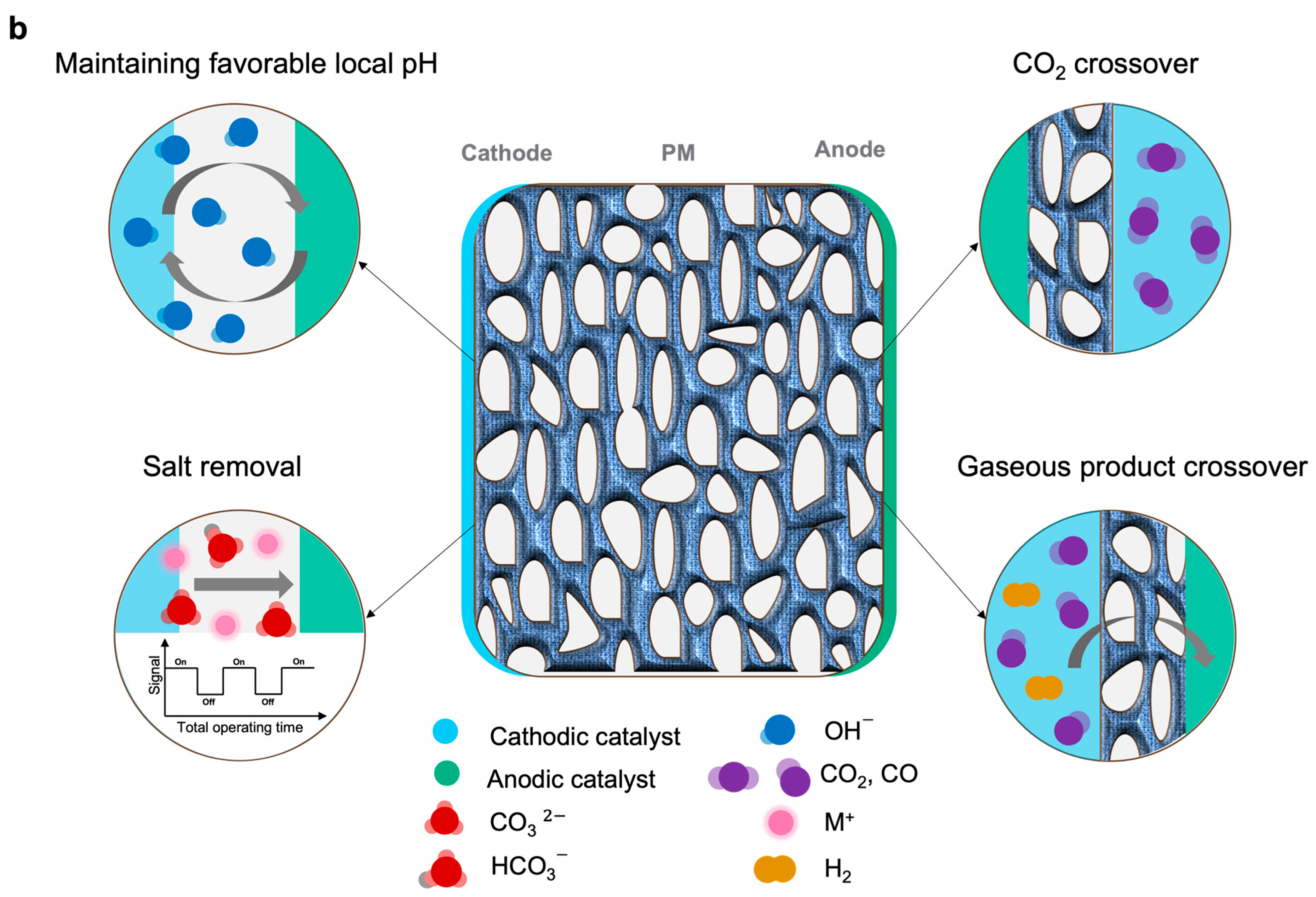
Porous membranes (PMs) or non-ion-exchange membranes have been widely studied for alkaline water electrolysis, but their use in CO2RR systems remains relatively underexplored. Acting as porous diaphragms or separators with open pores, PMs enable ionic transport without fixed charges [102] (Figure 2d). PMs are typically fabricated from low-cost inorganic or composite polymers such as polysulfone blends and zirconia-reinforced asbestos. Unlike polymer-based AEMs, these materials remain chemically stable in alkaline environments [103,104]. The key advantages of PMs lie in their tunable pore size, wettability, and thickness. These properties can be adjusted to optimize ionic transport and gas access, which allows PMs to meet the specific demands of different CO2RR systems.
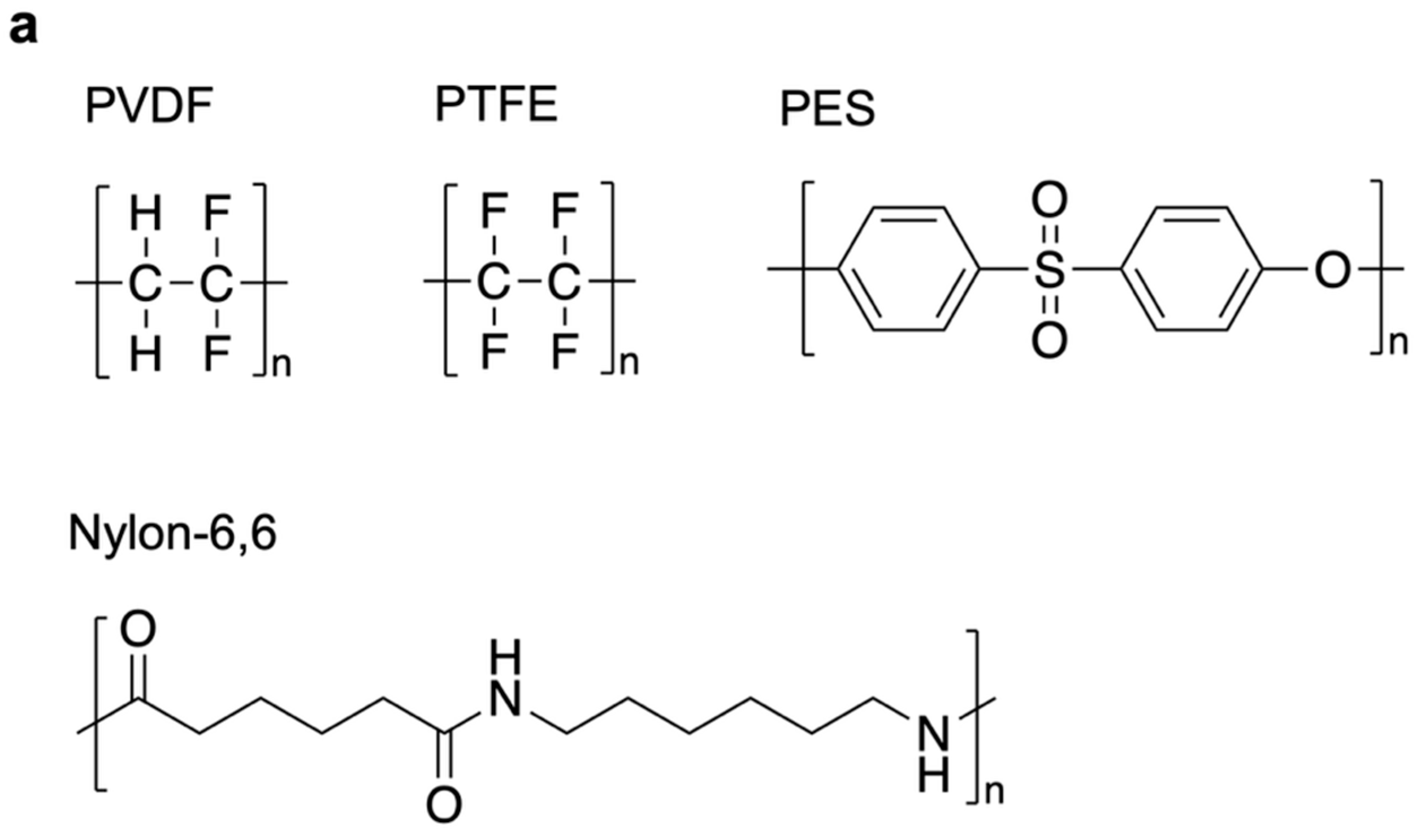
Representative examples of PMs include Zirfon PERLTM, a polysulfone-zirconia composite widely used for its chemical stability and mechanical strength, as well as polymer membranes such as polyvinylidene fluoride (PVDF), and polytetrafluoroethylene (PTFE) [50,105,106] (Figure 6a). PVDF is relatively hydrophilic, allowing strong electrolyte uptake and high ionic conductivity, while PTFE is intrinsically hydrophobic, less effective at retaining electrolyte but useful in mitigating flooding and influencing selectivity. Other tested materials include cellulose filters, nylon, and polyethersulfone (PES), which are all attractive for their robustness and ease of handling without chemical modification. In general, thinner hydrophilic membranes reduce ohmic loss, whereas thicker membranes with small pores increase resistance. For now, PMs are mainly used in MEA configurations. In this setup, they are placed between the anode and cathode electrodes, where their structural and transport properties significantly influence performance.
Deng et al. [106] demonstrated that the porous separators with well-defined structures can also be filled with KOH electrolyte, functioning in a similar way to AEMs by enabling K+ and OH transport between electrodes. This creates a strongly alkaline environment at the cathode, which suppress the HER and enhances CO2 reduction selectivity. The robustness of PMs under these conditions was further confirmed through long-term operation. Using a 5 μm PVDF membrane paired with a sputtered Cu catalyst, Pham et al. [107] achieved an FE of 75% toward C2 products at 110 mA·cm−2, maintaining stable performance for more than 950 h. Building on these insights into ionic transport and durability, Lee et al. [105] investigated the effect of membrane wettability by comparing PVDF (i.e., hydrophilic) with PTFE (i.e., hydrophobic) under identical conditions. Moreover, intermediate PVDF pore sizes were optimal, leading to an achievable FE(C2H4) of ~41% at 300 mA·cm−2.
Although the applications of PMs in CO2RR remains limited, recent studies on CO electrolysis suggest their strong potential for future integration. For instance, Deng et al. [106] demonstrated efficient CO conversion to hydrocarbon products at current densities ranging from 50 to 400 mA·cm−2 using Zirfon 500+, PES, and Nylon membranes. All tested membranes delivered C2+ FEs exceeding 80%, with product distributions comparable to those achieved using AEMs. These results underscore the potential of PMs as low-cost and scalable alternatives to conventional ion-exchange membranes for practical CO electrolysis. Moreover, the Zirfon-based cell maintained an acetate FE of 45% over 250 h, outperforming the ~150 h stability typically observed in AEM-based systems. Similar stable performance was also reported by Miao et al. [108] in a CO2-to-CO cascade followed by CO electroreduction, achieving an energy efficiency of 51% toward C2+ products and a CO single-pass conversion of up to 97%. The authors further compared different PMs, including polypropylene (PP), PES, PVDF, and PTFE, with varying pore sizes to identify the optimal configuration for their setup. They found that using a thin, highly porous separator with an interelectrode gap of ~60 μm resulted in the best performance, lowering the full-cell voltage by about 150 mV compared to an AEM-based system.
While ion-exchange membranes do not electrostatically block neutral products, their polymer chemistry and water uptake can influence the diffusion of neutral species by regulating membrane swelling, free volume, and hydrated transport pathways. In contrast, PMs suppress product crossover through a fundamentally different mechanism. In PM-based systems, the pores are typically fully wetted by the electrolyte, such that gas phase carbon-containing products must overcome capillary and osmotic pressure barriers to diffuse through liquid-filled pores, suppressing spontaneous gas crossover unless driven by significant pressure gradients. Moreover, the high FEs for C2+ products reported for PM-based systems also arise from system-level effects (e.g., reduced carbonate formation, efficient gas removal at the cathode, minimized product re-oxidation at the anode, improved carbon utilization) rather than superior intrinsic product-blocking capability.
Despite their advantages, studies have also highlighted notable drawbacks of PMs [105,106] (Figure 6b). A major issue is CO2 crossover, particularly in hydrophobic membranes, where unreacted CO2 and other gaseous products can diffuse through the porous structure. This direct penetration from cathode to anode arises from insufficient interaction between the membrane and the electrolyte. To address this, mitigation strategies such as reducing pore size or applying hydrophilic surface coatings have been proposed. In one study, switching to a 200 nm PTFE membrane modified with a hydrophilic layer effectively reduced crossover [105].
Overall, from an economic perspective, PMs remain more favorable than AEMs, though the savings are partially offset by the additional costs of CO2 capture. Finally, while PMs are mechanically robust and chemically stable, their long-term durability in CO2RR systems as well as product crossover have not yet been fully established, and achieving extended stable operation remains a key challenge for both membranes and catalysts.

4. Conclusions and Outlook

The electrochemical CO2RR has emerged as a promising strategy for closing the anthropogenic cycle by converting CO2 into fuels and chemicals using renewable electricity. Among the critical components in these electrolyzers, membranes play an essential role in facilitating ion transport, maintaining pH balance, and preventing reactant and product crossover. Through these functions, membrane properties strongly influence energy efficiency, operational stability, and achievable reaction environments. This makes membrane selection and design critical to overall electrolyzer performance. This review highlights four primary membrane types: AEMs, CEMs, BPMs, and PMs, with each offering distinct advantages and facing unique challenges that shape their applicability in CO2RR systems.
AEMs have shown strong potential for CO2RR in alkaline environments by enabling efficient anion transport and lowering cell voltage. Their compatibility with hydrocarbon polymers makes them cost-effective, but chemical instability and excessive swelling under basic conditions remain key challenges. Recent advances in crosslinked structures and more stable cationic groups have improved durability, yet large-scale commercialization still requires standardized testing and long-term validation.
CEMs provide selective cation transport and effective anion blocking, which can suppress carbonate crossover and enable operation under acidic or near-acidic conditions. While C2+ products can be achieved in CEM-based systems under appropriate catalyst and interface design, challenges related to proton availability, hydrogen evolution, and local acidification remain.
BPMs offer unique advantages by generating H+ and OH in situ, enabling decoupled pH control and high carbon efficiency while mitigating CO2 crossover. However, their broader adoption is constrained by additional voltage losses associated with water dissociation and ongoing concerns regarding mechanical and chemical durability, despite recent advances in catalytic interlayers and interfacial engineering.
PMs offer a simple, low-cost alternative with good mechanical strength and tunable transport properties. While they can facilitate efficient ion movement, CO2 crossover through their open structure remains a significant drawback. Surface modification and optimized pore structures show promise, but further improvements in stability and selectivity are needed for practical CO2RR applications.
Looking ahead, the development of next-generation membranes for CO2 electrolysis will require integrating material innovation with system-level engineering. Future research should focus on creating chemically stable and scalable polymers, improving ion selectivity to minimize crossover, and establishing standardized testing protocols for cross-comparability. Additionally, coupling membrane advances with optimized electrode and reactor designs will be crucial to achieving high energy efficiency and extended operational lifetimes. Ultimately, no single membrane type is likely to meet all performance criteria, but instead a hybrid or composite designs (e.g., CEM-AEM combinations or coated porous structures) may offer the best balance of cost, stability, and selectivity. As these technologies evolve, membranes will remain central to the advancement of efficient, durable, and commercially viable CO2 electrolyzers capable of enabling a sustainable carbon economy.

Author Contributions

Conceptualization, T.-N.H. and C.-T.D.; Investigation, T.-N.H., D.-M.P.-P., A.-D.H., T.A.B., G.G. and C.-T.D.; Resources, C.-T.D.; Writing—Original Draft Preparation, T.-N.H. (Section 1, Section 2, Section 3.3 and Section 4), D.-M.P.-P. (Section 3.2), A.-D.H. (Section 3.1) and T.A.B. (Section 3.4); Writing—Review and Editing, T.-N.H. and C.-T.D.; Visualization, T.-N.H.; Supervision, C.-T.D.; Project Administration, C.-T.D.; Funding Acquisition, C.-T.D. All authors have read and agreed to the published version of the manuscript.

Funding

This research was funded by the Natural Sciences and Engineering Research Council of Canada (NSERC), Canada Research Chairs Program and Queen’s University.

Data Availability Statement

Data sharing is not applicable to this article as no new data were created or analyzed in this study.

Conflicts of Interest

The authors declare no conflicts of interest.

References

  1. Woodruff, T.J. Health Effects of Fossil Fuel–Derived Endocrine Disruptors. N. Engl. J. Med. 2024, 390, 922–933. [Google Scholar] [CrossRef]
  2. Rahman, A.; Murad, S.M.W.; Mohsin, A.K.M.; Wang, X. Does Renewable Energy Proactively Contribute to Mitigating Carbon Emissions in Major Fossil Fuels Consuming Countries? J. Clean. Prod. 2024, 452, 142113. [Google Scholar] [CrossRef]
  3. Coskuner, C.; Paskeh, M.K.; Olasehinde-Williams, G.; Akadiri, S.S. Economic and Social Determinants of Carbon Emissions: Evidence from Organization of Petroleum Exporting Countries. J. Public Aff. 2020, 20, e2092. [Google Scholar] [CrossRef]
  4. Vasileff, A.; Zheng, Y.; Qiao, S.Z. Carbon Solving Carbon’s Problems: Recent Progress of Nanostructured Carbon-Based Catalysts for the Electrochemical Reduction of CO2. Adv. Energy Mater. 2017, 7, 1700759. [Google Scholar] [CrossRef]
  5. Zhang, X.; Guo, S.-X.; Gandionco, K.A.; Bond, A.M.; Zhang, J. Electrocatalytic Carbon Dioxide Reduction: From Fundamental Principles to Catalyst Design. Mater. Today Adv. 2020, 7, 100074. [Google Scholar] [CrossRef]
  6. Alli, Y.A.; Ejeromedoghene, O.; Dembaremba, T.O.; Adawi, A.; Alimi, O.A.; Njei, T.; Bamisaye, A.; Kofi, A.; Anene, U.Q.; Adewale, A.M.; et al. Perspectives on the Status and Future of Sustainable CO2 Conversion Processes and Their Implementation. Carbon Capture Sci. Technol. 2025, 16, 100496. [Google Scholar] [CrossRef]
  7. Sultana, S.; Chandra Sahoo, P.; Martha, S.; Parida, K. A Review of Harvesting Clean Fuels from Enzymatic CO2 Reduction. RSC Adv. 2016, 6, 44170–44194. [Google Scholar] [CrossRef]
  8. Kibria, M.G.; Edwards, J.P.; Gabardo, C.M.; Dinh, C.; Seifitokaldani, A.; Sinton, D.; Sargent, E.H. Electrochemical CO2 Reduction into Chemical Feedstocks: From Mechanistic Electrocatalysis Models to System Design. Adv. Mater. 2019, 31, 1807166. [Google Scholar] [CrossRef]
  9. Habisreutinger, S.N.; Schmidt-Mende, L.; Stolarczyk, J.K. Photocatalytic Reduction of CO2 on TiO2 and Other Semiconductors. Angew. Chem. Int. Ed. 2013, 52, 7372–7408. [Google Scholar] [CrossRef]
  10. Grodkowski, J.; Neta, P. Copper-Catalyzed Radiolytic Reduction of CO2 to CO in Aqueous Solutions. J. Phys. Chem. B 2001, 105, 4967–4972. [Google Scholar] [CrossRef]
  11. Wang, W.; Wang, S.; Ma, X.; Gong, J. Recent Advances in Catalytic Hydrogenation of Carbon Dioxide. Chem. Soc. Rev. 2011, 40, 3703. [Google Scholar] [CrossRef]
  12. Yu, F.; Deng, K.; Du, M.; Wang, W.; Liu, F.; Liang, D. Electrochemical CO2 Reduction: From Catalysts to Reactive Thermodynamics and Kinetics. Carbon Capture Sci. Technol. 2023, 6, 100081. [Google Scholar] [CrossRef]
  13. Zhao, J.Y.; Liu, Y.; Li, W.; Wen, C.F.; Fu, H.Q.; Yuan, H.Y.; Liu, P.F.; Yang, H.G. A Focus on the Electrolyte: Realizing CO2 Electroreduction from Aqueous Solution to Pure Water. Chem. Catal. 2023, 3, 100471. [Google Scholar] [CrossRef]
  14. Nesbitt, N.T.; Burdyny, T.; Simonson, H.; Salvatore, D.; Bohra, D.; Kas, R.; Smith, W.A. Liquid–Solid Boundaries Dominate Activity of CO2 Reduction on Gas-Diffusion Electrodes. ACS Catal. 2020, 10, 14093–14106. [Google Scholar] [CrossRef]
  15. Weekes, D.M.; Salvatore, D.A.; Reyes, A.; Huang, A.; Berlinguette, C.P. Electrolytic CO2 Reduction in a Flow Cell. Acc. Chem. Res. 2018, 51, 910–918. [Google Scholar] [CrossRef]
  16. Nguyen, T.N.; Dinh, C.-T. Gas Diffusion Electrode Design for Electrochemical Carbon Dioxide Reduction. Chem. Soc. Rev. 2020, 49, 7488–7504. [Google Scholar] [CrossRef]
  17. Zheng, H.; Shi, K.; Dong, H.; Yang, Y.; Yin, P.; Shen, B.; Wang, J. Electrochemical Reduction of CO2 to Multicarbon Products: A Review on Catalysts and System Optimization toward Industrialization. Energy Fuels 2025, 39, 9316–9344. [Google Scholar] [CrossRef]
  18. Yang, X.; Xiang, X.; Zhou, L.; Fan, J.; Chen, J.; Liu, Y.; Zhou, C.; Fan, W.; Han, M.; Pu, Z.; et al. Catalyst Design Strategies for Highly Efficient CO2 Electroreduction. Coord. Chem. Rev. 2025, 536, 216650. [Google Scholar] [CrossRef]
  19. Tan, X.; Zhu, H.; He, C.; Zhuang, Z.; Sun, K.; Zhang, C.; Chen, C. Customizing Catalyst Surface/Interface Structures for Electrochemical CO2 Reduction. Chem. Sci. 2024, 15, 4292–4312. [Google Scholar] [CrossRef]
  20. Ma, J.; Liu, C.; Bai, M.; Fu, Z.; Zhao, P.; Gao, Y.; Zhao, M.; He, Y.; Xiao, H.; Jia, J. Recent Advances in Application of Tandem Catalyst for Electrocatalytic CO2 Reduction. Mol. Catal. 2023, 551, 113632. [Google Scholar] [CrossRef]
  21. Lu, R.; Liu, Y.; Wang, Z. Advances in the Understanding of Selective CO2 Reduction Catalysis. EcoEnergy 2024, 2, 695–713. [Google Scholar] [CrossRef]
  22. Woldu, A.R.; Yohannes, A.G.; Huang, Z.; Kennepohl, P.; Astruc, D.; Hu, L.; Huang, X. Experimental and Theoretical Insights into Single Atoms, Dual Atoms, and Sub-Nanocluster Catalysts for Electrochemical CO2 Reduction (CO2 RR) to High-Value Products. Adv. Mater. 2024, 36, 2414169. [Google Scholar] [CrossRef]
  23. Ho, T.-N.; Pham, T.H.; Li, Y.; Esmaeili, H.; Dinh, C.-T. From Lab to Industry: Challenges in Scaling Cu-Based Electrodes for CO2 Electroreduction to Multi-Carbon Products. Curr. Opin. Electrochem. 2025, 54, 101769. [Google Scholar] [CrossRef]
  24. Lai, W.; Qiao, Y.; Wang, Y.; Huang, H. Stability Issues in Electrochemical CO2 Reduction: Recent Advances in Fundamental Understanding and Design Strategies. Adv. Mater. 2023, 35, 2306288. [Google Scholar] [CrossRef]
  25. Overa, S.; Ko, B.H.; Zhao, Y.; Jiao, F. Electrochemical Approaches for CO2 Conversion to Chemicals: A Journey toward Practical Applications. Acc. Chem. Res. 2022, 55, 638–648. [Google Scholar] [CrossRef]
  26. Lin, J.; Zhang, Y.; Xu, P.; Chen, L. CO2 Electrolysis: Advances and Challenges in Electrocatalyst Engineering and Reactor Design. Mater. Rep. Energy 2023, 3, 100194. [Google Scholar] [CrossRef]
  27. Li, G.; Liu, Y.; Zhang, Q.; Hu, Q.; Guo, W.; Cao, X.; Dou, Y.; Cheng, L.; Song, Y.; Su, J.; et al. Development of Catalysts and Electrolyzers toward Industrial-Scale CO2 Electroreduction. J. Mater. Chem. A Mater. 2022, 10, 19254–19277. [Google Scholar] [CrossRef]
  28. Fang, W.; Wang, M.; Cai, L.; Xia, B.Y. Fundamental Insights for Practical Electrocatalytic CO2 Reduction. Acc. Chem. Res. 2025, 58, 2365–2378. [Google Scholar] [CrossRef]
  29. Xu, D.; Li, K.; Jia, B.; Sun, W.; Zhang, W.; Liu, X.; Ma, T. Electrocatalytic CO2 Reduction towards Industrial Applications. Carbon Energy 2023, 5, e230. [Google Scholar] [CrossRef]
  30. Rabiee, H.; Li, M.; Yan, P.; Wu, Y.; Zhang, X.; Dorosti, F.; Zhang, X.; Ma, B.; Hu, S.; Wang, H.; et al. Rational Designing Microenvironment of Gas-Diffusion Electrodes via Microgel-Augmented CO2 Availability for High-Rate and Selective CO2 Electroreduction to Ethylene. Adv. Sci. 2024, 11, 2402964. [Google Scholar] [CrossRef]
  31. García de Arquer, F.P.; Dinh, C.-T.; Ozden, A.; Wicks, J.; McCallum, C.; Kirmani, A.R.; Nam, D.-H.; Gabardo, C.; Seifitokaldani, A.; Wang, X.; et al. CO2 Electrolysis to Multicarbon Products at Activities Greater than 1 A cm−2. Science 2020, 367, 661–666. [Google Scholar] [CrossRef]
  32. Ma, Z.; Yang, Z.; Lai, W.; Wang, Q.; Qiao, Y.; Tao, H.; Lian, C.; Liu, M.; Ma, C.; Pan, A.; et al. CO2 Electroreduction to Multicarbon Products in Strongly Acidic Electrolyte via Synergistically Modulating the Local Microenvironment. Nat. Commun. 2022, 13, 7596. [Google Scholar] [CrossRef]
  33. Lee, W.; Kim, Y.E.; Youn, M.H.; Jeong, S.K.; Park, K.T. Catholyte-Free Electrocatalytic CO2 Reduction to Formate. Angew. Chem. Int. Ed. 2018, 57, 6883–6887. [Google Scholar] [CrossRef]
  34. Ju, H.; Kaur, G.; Kulkarni, A.P.; Giddey, S. Challenges and Trends in Developing Technology for Electrochemically Reducing CO2 in Solid Polymer Electrolyte Membrane Reactors. J. CO2 Util. 2019, 32, 178–186. [Google Scholar] [CrossRef]
  35. Yin, Z.; Peng, H.; Wei, X.; Zhou, H.; Gong, J.; Huai, M.; Xiao, L.; Wang, G.; Lu, J.; Zhuang, L. An Alkaline Polymer Electrolyte CO2 Electrolyzer Operated with Pure Water. Energy Environ. Sci. 2019, 12, 2455–2462. [Google Scholar] [CrossRef]
  36. Yang, Y.; Li, F. Reactor Design for Electrochemical CO2 Conversion toward Large-Scale Applications. Curr. Opin. Green Sustain. Chem. 2021, 27, 100419. [Google Scholar] [CrossRef]
  37. Wheeler, D.G.; Mowbray, B.A.W.; Reyes, A.; Habibzadeh, F.; He, J.; Berlinguette, C.P. Quantification of Water Transport in a CO2 Electrolyzer. Energy Environ. Sci. 2020, 13, 5126–5134. [Google Scholar] [CrossRef]
  38. Zhang, T.; Bui, J.C.; Li, Z.; Bell, A.T.; Weber, A.Z.; Wu, J. Highly Selective and Productive Reduction of Carbon Dioxide to Multicarbon Products via in Situ CO Management Using Segmented Tandem Electrodes. Nat. Catal. 2022, 5, 202–211. [Google Scholar] [CrossRef]
  39. Li, F.; Thevenon, A.; Rosas-Hernández, A.; Wang, Z.; Li, Y.; Gabardo, C.M.; Ozden, A.; Dinh, C.T.; Li, J.; Wang, Y.; et al. Molecular Tuning of CO2-to-Ethylene Conversion. Nature 2020, 577, 509–513. [Google Scholar] [CrossRef]
  40. Xu, Y.; Edwards, J.P.; Liu, S.; Miao, R.K.; Huang, J.E.; Gabardo, C.M.; O’Brien, C.P.; Li, J.; Sargent, E.H.; Sinton, D. Self-Cleaning CO2 Reduction Systems: Unsteady Electrochemical Forcing Enables Stability. ACS Energy Lett. 2021, 6, 809–815. [Google Scholar] [CrossRef]
  41. Hao, S.; Elgazzar, A.; Zhang, S.-K.; Wi, T.-U.; Chen, F.-Y.; Feng, Y.; Zhu, P.; Wang, H. Acid-Humidified CO2 Gas Input for Stable Electrochemical CO2 Reduction Reaction. Science 2025, 388, eadr3834. [Google Scholar] [CrossRef]
  42. O’Brien, C.P.; Miao, R.K.; Shayesteh Zeraati, A.; Lee, G.; Sargent, E.H.; Sinton, D. CO2 Electrolyzers. Chem. Rev. 2024, 124, 3648–3693. [Google Scholar] [CrossRef] [PubMed]
  43. Salvatore, D.A.; Gabardo, C.M.; Reyes, A.; O’Brien, C.P.; Holdcroft, S.; Pintauro, P.; Bahar, B.; Hickner, M.; Bae, C.; Sinton, D.; et al. Designing Anion Exchange Membranes for CO2 Electrolysers. Nat. Energy 2021, 6, 339–348. [Google Scholar] [CrossRef]
  44. Mustain, W.E.; Kohl, P.A. Improving Alkaline Ionomers. Nat. Energy 2020, 5, 359–360. [Google Scholar] [CrossRef]
  45. Mauritz, K.A.; Moore, R.B. State of Understanding of Nafion. Chem. Rev. 2004, 104, 4535–4586. [Google Scholar] [CrossRef]
  46. Li, Y.; Chen, G.; Fei, L.; Zhou, W.; Shao, Z. Designing Better Electrocatalysts via Ion Exchange for Water Splitting. Adv. Funct. Mater. 2025, 35, 2417880. [Google Scholar] [CrossRef]
  47. Du, N.; Roy, C.; Peach, R.; Turnbull, M.; Thiele, S.; Bock, C. Anion-Exchange Membrane Water Electrolyzers. Chem. Rev. 2022, 122, 11830–11895. [Google Scholar] [CrossRef] [PubMed]
  48. Adisasmito, S.; Khoiruddin, K.; Sutrisna, P.D.; Wenten, I.G.; Siagian, U.W.R. Bipolar Membrane Seawater Splitting for Hydrogen Production: A Review. ACS Omega 2024, 9, 14704–14727. [Google Scholar] [CrossRef]
  49. Lee, J.W.; Kim, B.; Seo, J.Y.; Kim, Y.S.; Yoo, P.J.; Chung, C.-H. Water Electrolysis and Desalination Using an AEM/CEM Hybrid Electrochemical System. Appl. Surf. Sci. 2023, 610, 155524. [Google Scholar] [CrossRef]
  50. Ha, M.G.; Lim, C.; Oh, C.; Kim, H.; Choi, J.-Y.; Lee, W.H.; Oh, H.-S. Efficient and Durable Porous Membrane-Based CO2 Electrolysis for Commercial Zero-Gap Electrolyzer Stack Systems. Chem. Eng. J. 2024, 496, 154060. [Google Scholar] [CrossRef]
  51. Habibzadeh, F.; Mardle, P.; Zhao, N.; Riley, H.D.; Salvatore, D.A.; Berlinguette, C.P.; Holdcroft, S.; Shi, Z. Ion Exchange Membranes in Electrochemical CO2 Reduction Processes. Electrochem. Energy Rev. 2023, 6, 26. [Google Scholar] [CrossRef]
  52. Larrazábal, G.O.; Strøm-Hansen, P.; Heli, J.P.; Zeiter, K.; Therkildsen, K.T.; Chorkendorff, I.; Seger, B. Analysis of Mass Flows and Membrane Cross-over in CO2 Reduction at High Current Densities in an MEA-Type Electrolyzer. ACS Appl. Mater. Interfaces 2019, 11, 41281–41288. [Google Scholar] [CrossRef]
  53. Yan, J.; Yu, W.; Wang, Z.; Wu, L.; Wang, Y.; Xu, T. Review on High-performance Polymeric Bipolar Membrane Design and Novel Electrochemical Applications. Aggregate 2024, 5, e527. [Google Scholar] [CrossRef]
  54. Varcoe, J.R.; Atanassov, P.; Dekel, D.R.; Herring, A.M.; Hickner, M.A.; Kohl, P.A.; Kucernak, A.R.; Mustain, W.E.; Nijmeijer, K.; Scott, K.; et al. Anion-Exchange Membranes in Electrochemical Energy Systems. Energy Environ. Sci. 2014, 7, 3135–3191. [Google Scholar] [CrossRef]
  55. Barnes, A.M.; Liu, B.; Buratto, S.K. Humidity-Dependent Surface Structure and Hydroxide Conductance of a Model Quaternary Ammonium Anion Exchange Membrane. Langmuir 2019, 35, 14188–14193. [Google Scholar] [CrossRef]
  56. Pavel, C.C.; Cecconi, F.; Emiliani, C.; Santiccioli, S.; Scaffidi, A.; Catanorchi, S.; Comotti, M. Highly Efficient Platinum Group Metal Free Based Membrane-Electrode Assembly for Anion Exchange Membrane Water Electrolysis. Angew. Chem. Int. Ed. 2014, 53, 1378–1381. [Google Scholar] [CrossRef] [PubMed]
  57. Henkensmeier, D.; Najibah, M.; Harms, C.; Žitka, J.; Hnát, J.; Bouzek, K. Overview: State-of-the Art Commercial Membranes for Anion Exchange Membrane Water Electrolysis. J. Electrochem. Energy Convers. Storage 2021, 18, 024001. [Google Scholar] [CrossRef]
  58. Kutz, R.B.; Chen, Q.; Yang, H.; Sajjad, S.D.; Liu, Z.; Masel, I.R. Sustainion Imidazolium-Functionalized Polymers for Carbon Dioxide Electrolysis. Energy Technol. 2017, 5, 929–936. [Google Scholar] [CrossRef]
  59. Gabardo, C.M.; O’Brien, C.P.; Edwards, J.P.; McCallum, C.; Xu, Y.; Dinh, C.-T.; Li, J.; Sargent, E.H.; Sinton, D. Continuous Carbon Dioxide Electroreduction to Concentrated Multi-Carbon Products Using a Membrane Electrode Assembly. Joule 2019, 3, 2777–2791. [Google Scholar] [CrossRef]
  60. Dinh, C.-T.; Burdyny, T.; Kibria, M.G.; Seifitokaldani, A.; Gabardo, C.M.; García de Arquer, F.P.; Kiani, A.; Edwards, J.P.; De Luna, P.; Bushuyev, O.S.; et al. CO2 Electroreduction to Ethylene via Hydroxide-Mediated Copper Catalysis at an Abrupt Interface. Science 2018, 360, 783–787. [Google Scholar] [CrossRef]
  61. Lee, J.; Lim, J.; Roh, C.-W.; Whang, H.S.; Lee, H. Electrochemical CO2 Reduction Using Alkaline Membrane Electrode Assembly on Various Metal Electrodes. J. CO2 Util. 2019, 31, 244–250. [Google Scholar] [CrossRef]
  62. Mardle, P.; Chen, B.; Holdcroft, S. Opportunities of Ionomer Development for Anion-Exchange Membrane Water Electrolysis. ACS Energy Lett. 2023, 8, 3330–3342. [Google Scholar] [CrossRef]
  63. Willdorf-Cohen, S.; Zhegur-Khais, A.; Ponce-González, J.; Bsoul-Haj, S.; Varcoe, J.R.; Diesendruck, C.E.; Dekel, D.R. Alkaline Stability of Anion-Exchange Membranes. ACS Appl. Energy Mater. 2023, 6, 1085–1092. [Google Scholar] [CrossRef]
  64. Hagesteijn, K.F.L.; Jiang, S.; Ladewig, B.P. A Review of the Synthesis and Characterization of Anion Exchange Membranes. J. Mater. Sci. 2018, 53, 11131–11150. [Google Scholar] [CrossRef]
  65. Zhang, Z.; Huang, X.; Chen, Z.; Zhu, J.; Endrődi, B.; Janáky, C.; Deng, D. Membrane Electrode Assembly for Electrocatalytic CO2 Reduction: Principle and Application. Angew. Chem. 2023, 135, e202302789. [Google Scholar] [CrossRef]
  66. Zhao, Y.; Hua, H.; Wei, S.; Luo, J. Screening Anion Exchange Membranes for CO2 Electrolysis. ACS Appl. Mater. Interfaces 2025, 17, 56164–56174. [Google Scholar] [CrossRef]
  67. Weng, L.-C.; Bell, A.T.; Weber, A.Z. Towards Membrane-Electrode Assembly Systems for CO2 Reduction: A Modeling Study. Energy Environ. Sci. 2019, 12, 1950–1968. [Google Scholar] [CrossRef]
  68. Wang, Z.; Sun, G.; Lewis, N.H.C.; Mandal, M.; Sharma, A.; Kim, M.; Montes de Oca, J.M.; Wang, K.; Taggart, A.; Martinson, A.B.; et al. Water-Mediated Ion Transport in an Anion Exchange Membrane. Nat. Commun. 2025, 16, 1099. [Google Scholar] [CrossRef] [PubMed]
  69. Krödel, M.; Carter, B.M.; Rall, D.; Lohaus, J.; Wessling, M.; Miller, D.J. Rational Design of Ion Exchange Membrane Material Properties Limits the Crossover of CO2 Reduction Products in Artificial Photosynthesis Devices. ACS Appl. Mater. Interfaces 2020, 12, 12030–12042. [Google Scholar] [CrossRef]
  70. Petrov, K.V.; Bui, J.C.; Baumgartner, L.; Weng, L.-C.; Dischinger, S.M.; Larson, D.M.; Miller, D.J.; Weber, A.Z.; Vermaas, D.A. Anion-Exchange Membranes with Internal Microchannels for Water Control in CO2 Electrolysis. Sustain. Energy Fuels 2022, 6, 5077–5088. [Google Scholar] [CrossRef]
  71. Kim, Y.E.; Kim, J.H.; Kwon, H.; Lee, H.; Min, H.J.; Bae, B.; Ko, Y.N.; Chun, D.H.; Youn, M.H.; Rhim, G.B.; et al. Efficient and Stable CO2 Reduction Using Quaternary Ammonium-Based High-Durability Polymer Membrane and Ionomer in Zero-Gap Electrolyzers. J. Membr. Sci. 2026, 738, 124724. [Google Scholar] [CrossRef]
  72. Li, X.; Qiu, Z.; Yun, Y.; He, M.; Wang, L. Highly Performance Polybenzimidazole/Zirconia Composite Membrane with Loosened Chain Packing for Anion Exchange Membrane Water Electrolysis and Electrochemical CO2 Reduction. Sep. Purif. Technol. 2025, 362, 131675. [Google Scholar] [CrossRef]
  73. Li, J.; Li, J.; Cao, Z.; Zhang, B.; Zhang, X.; Liu, X.; Liu, T.; Zhang, Y. Enhanced OH Conductivity and Stability of Polybenzimidazole Membranes for Electrocatalytic CO2 Reduction via Grafting and Crosslinking Strategies. J. Membr. Sci. 2023, 685, 121985. [Google Scholar] [CrossRef]
  74. Pan, B.; Fan, J.; Zhang, J.; Luo, Y.; Shen, C.; Wang, C.; Wang, Y.; Li, Y. Close to 90% Single-Pass Conversion Efficiency for CO2 Electroreduction in an Acid-Fed Membrane Electrode Assembly. ACS Energy Lett. 2022, 7, 4224–4231. [Google Scholar] [CrossRef]
  75. Zhang, X.; Li, J.; Li, Y.-Y.; Jung, Y.; Kuang, Y.; Zhu, G.; Liang, Y.; Dai, H. Selective and High Current CO2 Electro-Reduction to Multicarbon Products in Near-Neutral KCl Electrolytes. J. Am. Chem. Soc. 2021, 143, 3245–3255. [Google Scholar] [CrossRef]
  76. Huang, J.E.; Li, F.; Ozden, A.; Sedighian Rasouli, A.; García de Arquer, F.P.; Liu, S.; Zhang, S.; Luo, M.; Wang, X.; Lum, Y.; et al. CO2 Electrolysis to Multicarbon Products in Strong Acid. Science 2021, 372, 1074–1078. [Google Scholar] [CrossRef]
  77. O’Brien, C.P.; Miao, R.K.; Liu, S.; Xu, Y.; Lee, G.; Robb, A.; Huang, J.E.; Xie, K.; Bertens, K.; Gabardo, C.M.; et al. Single Pass CO2 Conversion Exceeding 85% in the Electrosynthesis of Multicarbon Products via Local CO2 Regeneration. ACS Energy Lett. 2021, 6, 2952–2959. [Google Scholar] [CrossRef]
  78. Disch, J.; Bohn, L.; Metzler, L.; Vierrath, S. Strategies for the Mitigation of Salt Precipitation in Zero-Gap CO2 Electrolyzers Producing CO. J. Mater. Chem. A Mater. 2023, 11, 7344–7357. [Google Scholar] [CrossRef]
  79. Lees, E.W.; Mowbray, B.A.W.; Parlane, F.G.L.; Berlinguette, C.P. Gas Diffusion Electrodes and Membranes for CO2 Reduction Electrolysers. Nat. Rev. Mater. 2021, 7, 55–64. [Google Scholar] [CrossRef]
  80. Nara, M.; Fujii, K.; Matsui, D.; Ogura, A.; Murakami, T.; Ogawa, T.; Ito, S.; Cheng, C.D.; Scholes, C.A.; Wada, S. Evaluating Cation-Exchange Membrane Properties Affecting Polymer Electrolyte Membrane Water Electrolysis. ACS Omega 2025, 10, 10425–10431. [Google Scholar] [CrossRef]
  81. Lee, Y.-S.; Park, D.-H.; Park, S.-H.; Gu, Y.-H.; Lim, D.-M.; Han, S.-B.; Park, K.-W. Lithium-Ion Exchange Membrane Water Electrolysis Using a Cationic Polymer-Modified Polyethersulfone Membrane. ACS Sustain. Chem. Eng. 2023, 11, 10183–10190. [Google Scholar] [CrossRef]
  82. Barnett, A.; Karnes, J.J.; Clemens, A.L.; Oakdale, J.S.; Molinero, V. Post-Hydration Crosslinking of Ion Exchange Membranes to Control Water Content. J. Phys. Chem. C 2023, 127, 5613–5621. [Google Scholar] [CrossRef]
  83. Park, J.; Ko, Y.; Lim, C.; Kim, H.; Min, B.K.; Lee, K.-Y.; Koh, J.H.; Oh, H.-S.; Lee, W.H. Strategies for CO2 Electroreduction in Cation Exchange Membrane Electrode Assembly. Chem. Eng. J. 2023, 453, 139826. [Google Scholar] [CrossRef]
  84. Pärnamäe, R.; Mareev, S.; Nikonenko, V.; Melnikov, S.; Sheldeshov, N.; Zabolotskii, V.; Hamelers, H.V.M.; Tedesco, M. Bipolar Membranes: A Review on Principles, Latest Developments, and Applications. J. Membr. Sci. 2021, 617, 118538. [Google Scholar] [CrossRef]
  85. Rabinowitz, J.A.; Kanan, M.W. The Future of Low-Temperature Carbon Dioxide Electrolysis Depends on Solving One Basic Problem. Nat. Commun. 2020, 11, 5231. [Google Scholar] [CrossRef] [PubMed]
  86. Li, Y.C.; Zhou, D.; Yan, Z.; Gonçalves, R.H.; Salvatore, D.A.; Berlinguette, C.P.; Mallouk, T.E. Electrolysis of CO2 to Syngas in Bipolar Membrane-Based Electrochemical Cells. ACS Energy Lett. 2016, 1, 1149–1153. [Google Scholar] [CrossRef]
  87. Yan, Z.; Hitt, J.L.; Zeng, Z.; Hickner, M.A.; Mallouk, T.E. Improving the Efficiency of CO2 Electrolysis by Using a Bipolar Membrane with a Weak-Acid Cation Exchange Layer. Nat. Chem. 2021, 13, 33–40. [Google Scholar] [CrossRef]
  88. Wang, C.; Sun, Y.; Chen, Y.; Zhang, Y.; Yue, L.; Han, L.; Zhao, L.; Zhu, X.; Zhan, D. In Situ Electropolymerizing Toward EP-CoP/Cu Tandem Catalyst for Enhanced Electrochemical CO2-to-Ethylene Conversion. Adv. Sci. 2024, 11, 2404053. [Google Scholar] [CrossRef]
  89. Khan, M.A.; Nabil, S.K.; Al-Attas, T.; Yasri, N.G.; Roy, S.; Rahman, M.M.; Larter, S.; Ajayan, P.M.; Hu, J.; Kibria, M.G. Zero-Crossover Electrochemical CO2 Reduction to Ethylene with Co-Production of Valuable Chemicals. Chem. Catal. 2022, 2, 2077–2095. [Google Scholar] [CrossRef]
  90. Blommaert, M.A.; Sharifian, R.; Shah, N.U.; Nesbitt, N.T.; Smith, W.A.; Vermaas, D.A. Orientation of a Bipolar Membrane Determines the Dominant Ion and Carbonic Species Transport in Membrane Electrode Assemblies for CO2 Reduction. J. Mater. Chem. A Mater. 2021, 9, 11179–11186. [Google Scholar] [CrossRef]
  91. Shafaque, H.W.; Lee, C.; Fahy, K.F.; Lee, J.K.; LaManna, J.M.; Baltic, E.; Hussey, D.S.; Jacobson, D.L.; Bazylak, A. Boosting Membrane Hydration for High Current Densities in Membrane Electrode Assembly CO2 Electrolysis. ACS Appl. Mater. Interfaces 2020, 12, 54585–54595. [Google Scholar] [CrossRef]
  92. Fischer, R.; Dessiex, M.A.; Marone, F.; Büchi, F.N. Gas-Induced Structural Damages in Forward-Bias Bipolar Membrane CO2 Electrolysis Studied by Fast X-Ray Tomography. ACS Appl. Energy Mater. 2024, 7, 3590–3601. [Google Scholar] [CrossRef]
  93. Yu, W.; Zhang, Z.; Luo, F.; Li, X.; Duan, F.; Xu, Y.; Liu, Z.; Liang, X.; Wang, Y.; Wu, L.; et al. Tailoring High-Performance Bipolar Membrane for Durable Pure Water Electrolysis. Nat. Commun. 2024, 15, 10220. [Google Scholar] [CrossRef] [PubMed]
  94. Shen, C.; Wycisk, R.; Pintauro, P.N. High Performance Electrospun Bipolar Membrane with a 3D Junction. Energy Environ. Sci. 2017, 10, 1435–1442. [Google Scholar] [CrossRef]
  95. Ma, M.; Clark, E.L.; Therkildsen, K.T.; Dalsgaard, S.; Chorkendorff, I.; Seger, B. Insights into the Carbon Balance for CO2 Electroreduction on Cu Using Gas Diffusion Electrode Reactor Designs. Energy Environ. Sci. 2020, 13, 977–985. [Google Scholar] [CrossRef]
  96. Salvatore, D.A.; Weekes, D.M.; He, J.; Dettelbach, K.E.; Li, Y.C.; Mallouk, T.E.; Berlinguette, C.P. Electrolysis of Gaseous CO2 to CO in a Flow Cell with a Bipolar Membrane. ACS Energy Lett. 2018, 3, 149–154. [Google Scholar] [CrossRef]
  97. Chen, L.; Xu, Q.; Oener, S.Z.; Fabrizio, K.; Boettcher, S.W. Design Principles for Water Dissociation Catalysts in High-Performance Bipolar Membranes. Nat. Commun. 2022, 13, 3846. [Google Scholar] [CrossRef]
  98. Xie, K.; Miao, R.K.; Ozden, A.; Liu, S.; Chen, Z.; Dinh, C.-T.; Huang, J.E.; Xu, Q.; Gabardo, C.M.; Lee, G.; et al. Bipolar Membrane Electrolyzers Enable High Single-Pass CO2 Electroreduction to Multicarbon Products. Nat. Commun. 2022, 13, 3609. [Google Scholar] [CrossRef]
  99. Alkayyali, T.; Zeraati, A.S.; Mar, H.; Arabyarmohammadi, F.; Saber, S.; Miao, R.K.; O’Brien, C.P.; Liu, H.; Xie, Z.; Wang, G.; et al. Direct Membrane Deposition for CO2 Electrolysis. ACS Energy Lett. 2023, 8, 4674–4683. [Google Scholar] [CrossRef]
  100. She, X.; Zhai, L.; Wang, Y.; Xiong, P.; Li, M.M.-J.; Wu, T.-S.; Wong, M.C.; Guo, X.; Xu, Z.; Li, H.; et al. Pure-Water-Fed, Electrocatalytic CO2 Reduction to Ethylene beyond 1000 h Stability at 10 A. Nat. Energy 2024, 9, 81–91. [Google Scholar] [CrossRef]
  101. Wu, H.; Karamoko, B.A.; Wang, W.; Liu, J.; Petit, E.; Li, S.; Salameh, C.; Voiry, D. Engineering the Catalyst Interface Enables High Carbon Efficiency in Both Cation-Exchange and Bipolar Membrane Electrolyzers. Appl. Catal. B Environ. Energy 2025, 361, 124691. [Google Scholar] [CrossRef]
  102. Henkensmeier, D.; Cho, W.-C.; Jannasch, P.; Stojadinovic, J.; Li, Q.; Aili, D.; Jensen, J.O. Separators and Membranes for Advanced Alkaline Water Electrolysis. Chem. Rev. 2024, 124, 6393–6443. [Google Scholar] [CrossRef] [PubMed]
  103. Xu, Z.; Liu, Y.; Cheng, X.; Shang, Y.; Wang, Y.; Wang, J.; Li, W.; He, G. A Catalyst-Coated Diaphragm Assembly to Improve the Performance and Energy Efficiency of Alkaline Water Electrolysers. Commun. Eng. 2025, 4, 9. [Google Scholar] [CrossRef] [PubMed]
  104. Lira Garcia Barros, R.; Kraakman, J.T.; Sebregts, C.; van der Schaaf, J.; de Groot, M.T. Impact of an Electrode-Diaphragm Gap on Diffusive Hydrogen Crossover in Alkaline Water Electrolysis. Int. J. Hydrogen Energy 2024, 49, 886–896. [Google Scholar] [CrossRef]
  105. Lee, W.H.; Kim, K.; Lim, C.; Ko, Y.-J.; Hwang, Y.J.; Min, B.K.; Lee, U.; Oh, H.-S. New Strategies for Economically Feasible CO2 Electroreduction Using a Porous Membrane in Zero-Gap Configuration. J. Mater. Chem. A Mater. 2021, 9, 16169–16177. [Google Scholar] [CrossRef]
  106. Deng, W.; Xing, S.; Maia, G.W.P.; Wang, Z.; Crandall, B.S.; Jiao, F. Diaphragm-Based Carbon Monoxide Electrolyzers for Multicarbon Production under Alkaline Conditions. Nat. Commun. 2025, 16, 8444. [Google Scholar] [CrossRef]
  107. Pham, T.H.; Lai, H.D.T.; Dang, N.K.; Nguyen, T.N.; Golovanova, V.; Dias, E.H.; Ho, A.; Xia, L.; Crane, J.; de Arquer, F.P.G.; et al. Ambipolar Ion Transport Membranes Enable Stable Noble-Metal-Free CO2 Electrolysis in Neutral Media. Adv. Energy Mater. 2025, 15, e04286. [Google Scholar] [CrossRef]
  108. Miao, R.K.; Fan, M.; Wang, N.; Zhao, Y.; Li, F.; Liu, M.; Arabyarmohammadi, F.; Liang, Y.; Ni, W.; Xie, K.; et al. CO Electrolysers with 51% Energy Efficiency towards C2+ Using Porous Separators. Nat. Energy 2025, 10, 1197–1204. [Google Scholar] [CrossRef]
Figure 1. Visual representation of (a) a flow cell, and (b) an MEA setup.
Catalysts 16 00139 g001aCatalysts 16 00139 g001b
Figure 2. Illustration of ion transport in CO2RR systems using different membrane types: (a) AEM, (b) CEM, (c) conventional BPM, and (d) non-ion-exchange membrane (e.g., PVDF, Nylon).
Catalysts 16 00139 g002
Figure 3. (a) Structures of representative AEMs—methylated polybenzimidazole (commercialized as Aemion®), polystyrene tetramethyl imidazolium chloride (Sustainion®), poly(aryl piperidinium (PiperION); and (b) schematic of anion transport through the polymer network. These systems benefit from high local pH, which reduces cell voltage and ionic resistance. However, they suffer from CO2 crossover, chemical instability, and salt accumulation due to the reaction of HCO3/CO32− species with OH. The purple region denotes the cathode side, and the indicated salt accumulation corresponds to the cathode environment in AEM-based operation rather than within the membrane itself.
Catalysts 16 00139 g003
Figure 4. (a) Structures of representative CEMs—perfluorosulfonic acid (commercialized as Nafion™ and Aquivion®), sulfonated poly(ether ketone) (SPEEK), sulfonated polybenzimidazole (SPBI); and (b) schematic illustration of cation transport through the polymer network. CEMs effectively block the migration of anions from the anode to the cathode and prevent CO2 crossover to the anode side. Thus, CEM-based systems do not experience salt precipitation or pore blockage. However, the formation of acidic microenvironment near the catalyst layer remains a key limitation.
Catalysts 16 00139 g004
Figure 6. (a) Structures of representative PMs—polyvinylidene fluoride (PVDF), polytetrafluoroethylene (PTFE), polyethersulfone (PES), nylon-6,6; and (b) schematic illustration summarizing their advantages and limitations. PMs allow both cations and anions to move freely, maintaining a favorable local pH near the catalyst layer. In addition, salt deposits can be removed through operating with on-off strategy. However, CO2 and gaseous products crossover remain significant challenges for PM-based systems.
Catalysts 16 00139 g006aCatalysts 16 00139 g006b
Disclaimer/Publisher’s Note: The statements, opinions and data contained in all publications are solely those of the individual author(s) and contributor(s) and not of MDPI and/or the editor(s). MDPI and/or the editor(s) disclaim responsibility for any injury to people or property resulting from any ideas, methods, instructions or products referred to in the content.