Review

Recent Advances in Anion-Doping Transition Metal Layered Double Hydroxide for Water Oxidation to Hydrogen Evolution

1
School of Materials Science and Engineering, Jiangsu University, Zhenjiang 212013, China
2
College of Education, Qingdao Hengxing University of Science and Technology, Qingdao 266000, China
*
Authors to whom correspondence should be addressed.
Catalysts 2026, 16(2), 141; https://doi.org/10.3390/catal16020141
Submission received: 30 November 2025 / Revised: 5 January 2026 / Accepted: 7 January 2026 / Published: 2 February 2026
(This article belongs to the Special Issue Cutting-Edge Catalysts for Water Splitting and Hydrogen Production)

Abstract

Electrochemical water splitting for hydrogen production is limited by the slow kinetics of the oxygen evolution reaction (OER). The tunable structure and anion-exchange capability of layered double hydroxides (LDHs) underpin their promise as OER catalysts. Consequently, the strategic incorporation of foreign anions is viewed as a powerful approach to engineer their active sites and boost catalytic activity. This review summarizes how doping with anions such as NO3, PO43−, Cl, F, and Sq2− modifies the electronic structure of LDHs. These anions regulate the local coordination environment, induce oxygen vacancies, and alter metal oxidation states, thereby synergistically optimizing both the adsorption–evolution mechanism (AEM) and the lattice oxygen oxidation mechanism (LOM). For instance, NO3 promotes surface reconstruction, F activates lattice oxygen, PO43− stabilizes the interface, Cl reshapes reaction pathways, and Sq2− maintains interfacial alkalinity. Collectively, rational anion engineering lowers the overpotential, increases current density, and improves stability, establishing an effective design framework for advanced LDH-based OER electrocatalysts.

1. Introduction

With the global energy transition toward clean and low-carbon sources, hydrogen has been considered as an alternative energy carrier for fuel cell due to its high energy density as well as environmental friendliness [1,2,3,4,5,6,7,8,9,10,11]. Electrolytic water splitting driven by renewable energy power represents a prospective industrial strategy for high-purity hydrogen production [12,13,14,15,16,17,18,19,20,21,22,23,24], yet its efficiency remains primarily constrained by the sluggish kinetics of the oxygen evolution reaction (OER). Recently, two-dimensional (2D) transition metallic electrocatalysts have emerged as highly attractive catalysts owing to their tunable layered structure, rich redox chemistry, and remarkable anion exchange capacity [25,26,27,28,29,30]. These intrinsic properties enable precise regulation of the electronic environment and active sites, providing a multifunctional platform for enhancing OER activity and stability. Furthermore, the development of 2D transition metallic electrocatalysts with high performance should also be available for rigorous industrial conditions, including operation in complex electrolytes. Consequently, these materials possess not only excellent OER kinetics, but also rousted durability under industrial-relevant conditions. However, anodic OER progress often suffers from sluggish kinetics with high overpotential input and substantial energy barriers, which severely limit overall energy conversion efficiency and economic viability of water splitting in industrial [31,32,33,34,35,36,37,38,39]. In detail, OER progress involves a four-electron transfer process with a complex reaction pathway, typically following the adsorption–evolution mechanism (AEM), where the O-O bond forms sequentially through multiple intermediate adsorption steps [40,41,42,43,44]. However, in certain transition metal oxides or layered double hydroxides (LDHs), the lattice oxygen oxidation mechanism (LOM) may also occur, where lattice oxygen directly participates in oxygen formation [45,46]. This mechanism bypasses the adsorption energy scaling relationship of intermediates in AEM, theoretically enabling lower overpotentials and faster reaction kinetics. While LOM overcomes the restrictive scaling limitations of AEM, it also introduces structural instability and lattice oxygen loss issues.
To address the structural instability and lattice oxygen loss associated with LOM, researchers have recently proposed various strategies to modulate the electronic structure of OER electrocatalysts, which enhances lattice oxygen stability and balances reaction pathways, thereby improving material durability and maintaining high OER activity [47,48,49]. Among numerous candidate materials, NiFe/CoFe-LDHs-based elctrocatalysts exhibit significant advantages in alkaline OER due to their unique layered structure, tunable electronic structure, abundant active sites, and excellent anion exchange capacity [46,50,51,52]. Crucially, the layered structure and exchangeable interlayer anions of LDHs enable targeted enhancement of their tolerance in harsh electrolysis media (such as seawater) through anion engineering strategies, while simultaneously optimizing their intrinsic OER activity. In detail, the introduction of targeted anions can modulate the interfacial microenvironment, repel detrimental ions, or stabilize active sites [53,54]. This approach offers a unique design strategy for achieving efficient and stable practical electrolysis. In the past years, modification strategies for LDH materials have primarily focused on morphology control, interfacial engineering, and heteroatom doping [55,56,57,58,59]. Up to now, anion doping demonstrates significant potential as a strategy, enabling precise intervention at both the bulk electronic structure and interfacial chemical modification levels. By regulating the electronic structure and oxidation state of metal centers, the optimization of adsorption/desorption behavior of key intermediates (such as OOH/O) could be efficiently achieved for boosting OER performance [60,61].
This paper systematically reviews recent advances in promoting oxygen evolution reactions by regulating the electronic structure and catalytic mechanisms of NiFe-LDH through anion doping. By establishing an analytical framework linking “anion properties—electronic structure regulation—synergistic reaction pathways—enhanced catalytic performance”, we propose that various anions (e.g., NO3, PO43−, Cl) synergistically optimize adsorption mechanisms and lattice oxygen oxidation pathways by modulating the interlayer environment. Furthermore, we systematically analyze how diverse anions promote the adsorption and transformation of key intermediates in the AEM pathway. The specific mechanic progress where lattice oxygen participates in reaction activation via the LOM pathway is also presented. This work establishes the theoretical foundation and design strategy for developing highly efficient and stable anion-regulated LDH catalysts.

2. Fundamental Properties of LDHs

The structural basis of LDHs originates from their hydrotalcite-like crystal configuration, formed by alternating layers of positively charged metal hydroxide sheets with interlayer anions and water molecules. Their general chemical formula can be expressed as [M1−x2+ Mx3+ (OH)2] x+ (A n) x/n · mH2O), where M2+ and M3+ represent divalent and trivalent metal cations, respectively, and A n denotes the interlayer anion. Two core properties emerge from this structure and form the structural basis for LDH applications in catalysis, adsorption, energy storage, and other fields, including both the tunability of the metal ions and the anion exchange capacity. The synthesis methods of LDHs are focused on coprecipitation, hydrothermal, ion exchange, and topological transformation. Among these methods, coprecipitation is the most commonly employed strategy. By controlling pH, temperature, and metal salt ratios, it enables precise regulation of layer composition, grain size, and morphology. A hydrothermal approach facilitates the production of LDHs with higher crystallinity and more uniform layered structures. The ion exchange method allows for the flexible incorporation of functional anions, which could preserve the layered structure, enabling precise design of the interlayer chemical environment. By combining these synthetic strategies, a robust material foundation is established for subsequent anion doping and performance optimization.
LDHs feature a characteristic layered structure composed of positively charged metal hydroxide layers and interlayer anions. The unique architecture endows LDHs with unique advantages for OER electrocatalysis [62,63,64,65,66,67]. First, the layered structure provides highly tunable interlayer spacing and sheet composition, effectively exposing abundant active sites as well as facilitating mass transfer of reactants and products. Furthermore, the interlayer regions function as “nanoreactors,” where the insertion of anions (e.g., NO3, PO43−) can modulate the local electronic environment and reaction pathways, further optimizing the adsorption behavior of intermediates. The two-dimensional layered structure of LDHs facilitates the construction of ultrathin nanosheets or three-dimensional porous networks, significantly increasing the electrochemically active surface area and enhancing charge transfer efficiency. As a result, the overpotential for OER is markedly reduced, and reaction kinetics are significantly improved.

2.1. Adjustable Electronic Characteristics

The metal ion composition of LDH can be flexibly controlled at the atomic scale, endowing it with unique tunable electronic properties. By altering the divalent/trivalent metal ratio or introducing dopant elements, the d-band center position can be precisely regulated to optimize the adsorption strength of reaction intermediates (such as *OH, *O, *OOH), thereby overcoming the scaling limitations of traditional catalysts. This fine-tuned electronic control also promotes the formation of highly oxidized metal species (e.g., Ni3+/Ni4+, Fe4+), significantly enhancing intrinsic catalytic activity [68,69,70,71]. Among these approaches, introducing highly electronegative hetero-anions stands as one of the most effective strategies for achieving efficient electronic structure regulation [72,73,74,75]. The physical essence of this process involves significant electron redistribution between the dopant and the host metal ions. Taking typical Mo6+ doping as an example, its extremely high electronegativity makes it a potent “electron trap,” strongly attracting electrons from neighboring Ni/Fe centers through the M-O-M (M=Ni, Fe) bond path. This effect is directly reflected in the electronic spectrum in the form of increased XPS binding energies for Ni and Fe, indicating elevated oxidation states and reduced local electron density. The catalytic chemical implication is that depletion of the Ni site’s electron cloud significantly enhances its Lewis acidity, fundamentally altering the adsorption behavior toward oxygen-containing intermediates. On one hand, it enhances the initial capture of intermediates like *OH/*O; on the other hand, it reduces the electronic feedback between metal d orbitals and oxygen antibonding orbitals, thereby weakening the final adsorption strength of OOH/O. This results in more balanced reaction energy barriers across steps, effectively circumventing the scaling constraints between adsorption energies.
Simultaneously, this electronic regulation stems not only from electrostatic interactions but also involves orbital hybridization and the restructuring of valence band architecture [76,77,78]. The vacant d orbitals of dopant elements (e.g., Mo 4d) hybridize with Ni/Fe 3d orbitals and O 2p orbitals, forming new electronic states near the Fermi level. This hybridization not only facilitates rapid charge transfer between active sites and enhances the material’s intrinsic conductivity, but also potentially optimizes adsorption strength with reaction intermediates by directly modulating the position of Ni/Fe d-band centers. The downward shift in the d-band center (away from the Fermi level) typically implies reduced adsorption energy. For NiFe-LDH, which intrinsically exhibits excessively strong adsorption of intermediates, this shift is precisely the key to overcoming the energy barrier bottleneck.

2.2. Abundant Active Sites and Synergistic Effects

LDH possesses abundant intrinsic active sites, particularly edge sites and defect sites, exhibiting enhanced catalytic activity. Significant synergistic effects exist between different metal sites: Fe sites excel at stabilizing oxygen-containing intermediates and promoting O-O bond formation, while Ni sites dominate efficient redox cycling. This “functional complementarity” mechanism integrates the advantages of diverse metal sites, optimizing the catalytic pathway at the molecular scale. Dionigi et al. discovered via operando techniques that under oxygen evolution reaction conditions, the catalyst transforms into a γ-phase structure rich in intrinsic active sites (e.g., edge sites and defect sites). DFT calculations further reveal that its surface simultaneously hosts multiple reaction sites saturated by bridging OH and apical OH groups during the reaction state. This inherent site diversity enables the reaction to proceed via multiple pathways, creating conditions for the Fe-Ni co-center to select the optimal route [79]. Specifically, iron sites, with their flexible electronic structure, preferentially undergo oxidation and stabilize oxygen intermediates that are difficult to form on pure Ni-Ni centers. Simultaneously, Ni sites maintain efficient redox cycling. This abundance of active sites offers multiple potential pathways for the reaction. The Fe-Ni synergistic center selects the key pathway with the lowest energy barrier, and their combined action fundamentally explains why nickel–iron layered double hydroxides achieve overpotentials significantly lower than those of single-metal catalysts.

2.3. Efficient Charge Transfer Capabilities

Despite the limited electrical conductivity of bulk LDH, its unique electronic properties enable direct optimization through band engineering [80]. By regulating the Fermi level position and density of states distribution, charge transport efficiency can be significantly enhanced. The optimized electronic characteristics not only facilitate interfacial charge transfer but also accelerate the proton–electron coupling process, ensuring stable catalytic performance under high current densities. Wei et al. constructed an oxygen-vacancy-rich NiFe LDH catalyst (NiFe LDH/FF) on iron foam via an etching strategy. Electrochemical impedance spectroscopy (EIS) revealed that NiFe LDH/FF exhibited a charge transfer resistance of only 0.866 Ω, which is markedly lower than the control sample NiFe LDH/NF (2.87 Ω) prepared on nickel foam (Figure 1a–d). This result directly demonstrates that this strategy greatly enhances charge transfer processes at the electrode interface. Benefiting from this excellent charge transport capability, NiFe LDH/FF operated continuously and stably for over 100 h at a high current density of 500 mA cm−2, exhibiting outstanding catalytic durability [81].

2.4. Surface Chemical Modifiability

The surface chemistry of LDH exhibits high tunability, enabling precise control over its surface electronic structure, coordination environment, and adsorption behavior of reaction intermediates through component design, thereby optimizing reaction kinetics. The work by Du et al. provides an exemplary case: by constructing FeOOH heterojunctions within NiFe-LDH, they achieved deep regulation of the catalyst’s surface chemical state. Such strategy induced significant surface electron rearrangement, enhancing the deprotonation capability of Ni sites. This promoted surface reconstruction during catalysis, generating an (oxy)hydroxide surface enriched with highly active Ni3+. Optimization of this surface chemistry directly manifested as improved adsorption energy for the hydroxyl intermediate (OH*) and accelerated O-O bond formation, ultimately reducing the Tafel slope of the OER from 111.7 mV·dec−1 to 44.6 mV·dec−1 (Figure 1e) [82]. A rational design of surface chemistry can specifically induce favorable interfacial processes, significantly enhancing the intrinsic catalytic activity of LDH materials.

3. Theoretical Basis of Anion Doping

Anion doping of LDHs fundamentally stems from the charge-balancing properties of their magnesite-like layered sheets: the substitution of divalent metal cations by trivalent metal cations generates a net positive charge, which could be compensated by interlayer anions. Furthermore, a positive charge carrier permits the introduction and stabilization of diverse functional anions within the interlayer space through synthetic strategies such as ion exchange. The inherent synthetic operability provides a genuine strategy for theoretically investigating the electrostatic environment of the layers, inducing lattice distortion, or generating oxygen vacancies. Consequently, introducing different anions will directly alter the electrostatic environment and the number of charge-balancing sites. Since interlayer anions are held by relatively weak electrostatic and hydrogen bonding interactions, they can be exchanged or co-intercalated, allowing precise control over interlayer spacing, local polarity, and hydration degree. This, in turn, alters the electronic structure of adjacent metal hydroxide layers. Theoretical studies indicate that anionic guests can induce lattice distortion as well as generate oxygen vacancy defects, thereby elevating the oxidation state of transition metal centers and promoting electron delocalization between hydroxide layers. These electronic and structural perturbations exert two synergistic effects on the oxygen evolution reaction (OER):
Enhanced adsorption–evolution mechanism (AEM): Modified metal–oxygen bond strengths improves *OH/*O adsorption energies, bringing the *OH → *OOH step closer to optimal scaling relationships and reducing overpotentials required for conventional four-electron proton-coupled electron transfer (PCET) pathways. Liu et al. synthesized F-NiFe-LDH catalysts using a fluorine-doping strategy. The study demonstrates that highly electronegative F atoms induce electronic defects around Ni sites, promoting the formation of highly oxidized Ni3+/Ni4+ species. XPS and theoretical calculations reveal that F doping significantly strengthens metal–oxygen bond strength, optimizes the adsorption energy of *OH/*O intermediates, and lowers the energy barrier for the *OH → *OOH step, thereby approaching the ideal scaling relationship for OER [83]. This study demonstrates an electronic structure regulation perspective, where anion doping effectively reduces the overpotential of the four-electron PCET pathway by enhancing the kinetics of key steps in the AEM.
Promoting Lattice Oxygen Oxidation Mechanism (LOM): Anion-induced lattice strain and oxygen vacancies activate lattice oxygen, enabling its direct participation in O-O bond formation. This bypasses the scaling limitations of AEM, which may achieve higher intrinsic activity at elevated overpotentials. Wu et al. constructed a heterostructure-enhanced NiFe-LDH electrocatalyst via anion-tuning strategies. This study introduced a heterointerface via a two-step electrodeposition method, inducing lattice strain and optimizing electronic structure to promote oxygen vacancy formation and lattice oxygen activation. In situ spectroscopy and theoretical calculations confirmed that this modification strategy significantly enhanced adsorption of the hydroxyl intermediate, enabling direct participation of lattice oxygen in O–O bond formation and effectively following the LOM pathway (Figure 2a–c,f–i). This mechanism bypasses the scaling limitations of conventional adsorption–evolution pathways, enabling the catalyst to exhibit high intrinsic activity at lower overpotentials while significantly enhancing catalytic stability [84]. It provides a model for optimizing lattice oxygen reaction kinetics through anion regulation.
In recent years, some works have achieved multi-level regulation of the material’s interlayer microenvironment, electronic configuration, and reaction pathways by rationally selecting the type of intercalated anions (e.g., PO43−, NO3) [85,86,87]. Alves et al. explored the application of two-dimensional materials in electrocatalytic water splitting. The results demonstrated that introducing interlayer anions in NiFe-LDH not only expands the interlayer spacing and promotes mass transfer but also modulates the electronic states of metal centers. This, in turn, influences the adsorption behavior of reaction intermediates and alters the dominant mechanism of the oxygen evolution reaction (OER). Taking the typical NiFe-LDH system as an example, anion doping exhibits particularly pronounced regulation of OER mechanisms (AEM and LOM) [88]. Theoretical studies by Wang et al. demonstrate that introducing Fe into NiFe-LDH suppresses lattice oxygen participation (LOM pathway) while enhancing the adsorption–evolution mechanism (AEM) (Figure 2d,e). This stems from the fact that Fe doping could reduce the electron density of lattice oxygen and improve the formation energy barrier for oxygen vacancies, thereby inhibiting irreversible lattice oxygen loss and improving structural stability during cycling [89]. Furthermore, intercalating highly charged anions (e.g., PO43−) between layers allows their strong electronegativity to modulate the d-band centers at Fe/Ni sites. This optimizes adsorption energies for key intermediates like OOH and O, promoting the AEM pathway while simultaneously enhancing material conductivity and catalytic durability.
Thus, anion doping not only expands the structural regulation dimensions of LDH materials but also provides theoretical insights into the transformation of reaction mechanisms during OER. This strategy offers novel perspectives and experimental foundations for designing highly efficient and stable water-splitting catalysts.
However, the gap between theoretical models and real electrochemical operating conditions should be bridged for practical applications. Current theoretical models often rely on static or ideal structural characterization, which may fail to fully capture dynamic interfacial processes under actual operating conditions—such as electric field effects and solvation. Furthermore, interactions and competitive adsorption behaviors within multi-anion systems remain moderately understood. Therefore, rational anion doping offers a viable pathway for regulating interfacial microenvironments and reaction kinetics, thereby bridging the gap between theory and experiment. As a result, integrating dynamic simulations with in situ characterization will be crucial for constructing models that more closely approximate real catalytic sites. This approach will propel new advances in designing high-performance electrocatalysts based on layered double hydroxides.
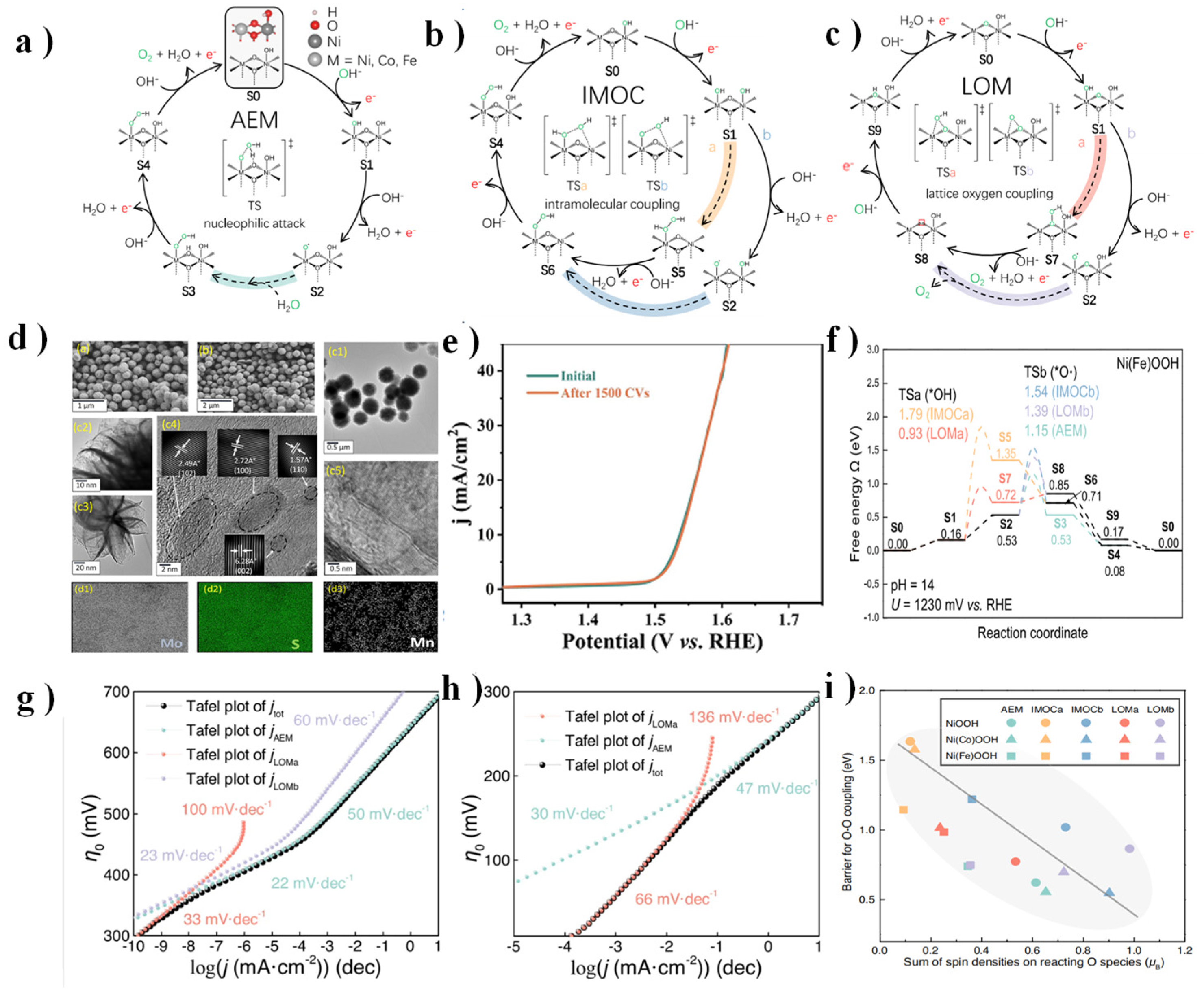
Figure 2. (ac) Distinctive types of reaction mechanisms for OER on Ni(M)OOH under alkaline conditions, including (a) AEM, (b) IMOC, and (c) LOM [88]; (d) Typical morphology obtained using hydrothermal/solvothermal synthesis, reprinted with permission from Elsevier, Shaikh et al. [90]. (a,b) FE–SEM images of 10p–MoS2þ⸹, (c1c5) Low and High magnification HR–TEM images of 10p–MoS2þ⸹ (d1d3) Corresponding EDX mapping images. (e) Linear polarization curves highlighting the stability of CoFe–LDH wrapped on Ni-doped carbon nanorods, reprinted with permission from Elsevier, Zhang and Hao [91]. (f) Grand free energy profiles at the equilibrium potential for OER on (a) Ni(Fe)OOH following different reaction mechanisms; (g,h) Calculated Tafel plots and slopes of (g) NiOOH, (h) Ni(Fe)OOH, with components by different types of mechanisms in the coupled reaction network. (i) a candidate descriptor for O–O coupling kinetics. Correlation between the barriers for O–O coupling in all the mechanisms and the sum of spin densities on reacting O species [89].
Catalysts 16 00141 g002

4. Mechanism of Different Anions’ Influence on OER Performance

Doping anions into NiFe-LDHs enables precise tuning of their catalytic performance for the oxygen evolution reaction (OER). The influence of anions is determined by their chemical properties—such as size, charge, electronegativity, and coordination ability—which defines their interactions with the host lattice and electrolyte. The following sections explore the functions of a series of anions, elucidating that anions regulate interlayer spacing and ion exchanges for active electronic structure modulation and interface stabilization via diverse activation pathways for the OER.

4.1. NO3 Promotes OH Exchange and Surface Reconfiguration

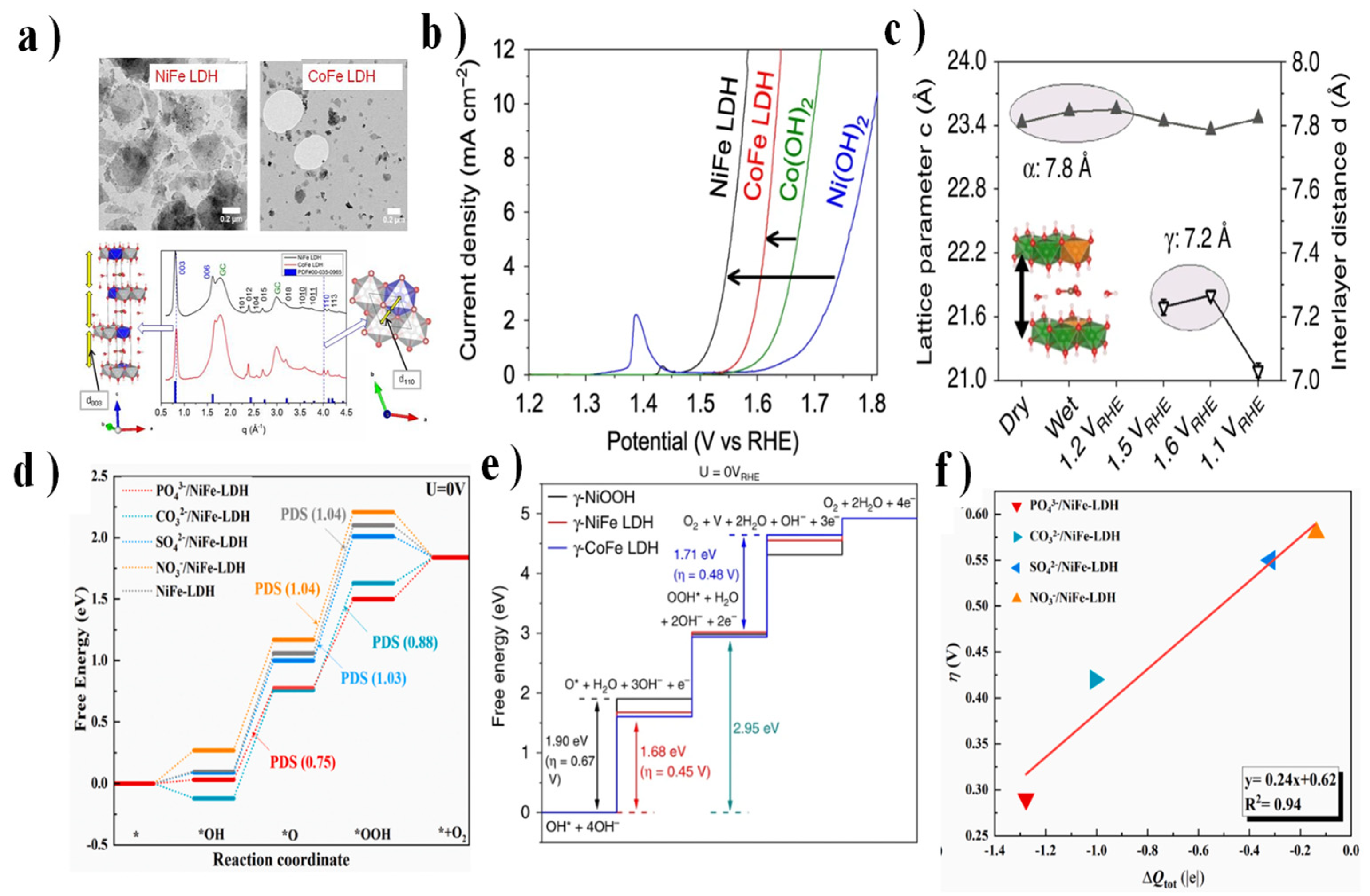
Interlayer anion engineering serves as an effective strategy for regulating the oxygen evolution reaction performance of NiFe-LDH [92]. Among various intercalated anions, nitrate (NO3) has garnered particular attention due to its significant promotion of surface reconstruction processes. Despite its relatively weak binding to the layered metal center, NO3 species could be used as a “catalyst” to induce profound surface restructuring in the material. Its susceptibility to replacement by OH provides the crucial kinetic impetus for the material’s transformation from the initial precursor to a highly active phase. The weak binding characteristics of NO3 facilitate its exchange with OH under electrochemical conditions, thereby triggering surface reconstruction towards the highly active γ-NiFeOOH phase and effectively reducing the overpotential for OER. Wang et al.’s density functional theory study elucidated this mechanism at the electronic structure level: the conjugate acid of NO3 possesses an extremely low pKa (−1.30), resulting in weak interactions with the catalyst surface. Consequently, it readily exchanges with OH ions in the electrolyte under electrochemical conditions. This highly efficient ion exchange directly triggers the profound surface reconstruction of NiFe-LDH (Figure 3a–f) [93]. Dionigi et al. combined electrochemical measurements with operando wide-angle X-ray scattering to confirm this reconstruction process at the atomic scale for the first time. Furthermore, this study combined electrochemical measurements, absorption spectroscopy techniques, and density functional theory (DFT) calculations to elucidate the catalytic active phase, reaction centers, and the mechanism of the oxygen evolution reaction (OER). Under anodic potential, NiFe-LDH transforms from the prepared α phase (interlayer spacing ~7.8 Å) to the catalytically active γ phase (interlayer spacing ~7.1 Å). The process involves approximately 8% of interlayer spacing contraction interlayer ion replacement. Such a rapid dissolution of NO3 endows a pathway for OH and K+, significantly accelerating nucleation and growth of the active γ-NiFeOOH phase.
Such a surface restructuring triggered by NO3 directly optimizes the catalytic interface and electronic structure of the material. The restructured γ-NiFeOOH phase effectively stabilizes OER intermediates (e.g., *O) that are difficult to form on pure Ni–Ni sites by constructing O-bridged Fe–Ni cooperative reaction centers. Significantly, such a configuration could lower the energy barrier of the rate-determining step [79]. Wang et al.’s calculations further confirm that OER follows an adsorption–evolution mechanism in this model, with optimized surface charge distribution due to ion exchange processes. This promotes the adsorption and transformation of key reaction intermediates, ultimately enhancing the material’s oxygen evolution catalytic performance.
In summary, the role of NO3 in NiFe-LDH extends far beyond simple charge balancing. Its core function lies in leveraging its readily exchangeable nature to promote OH transport and exchange, thereby acting as both a “trigger” and “accelerator” for surface reconstruction. The introduction of NO3 species helps to form the γ-NiFeOOH phase that is rich in highly active Fe-Ni synergistic centers. As a result, NO3 intercalation indirectly and effectively enhances the intrinsic activity and stability of NiFe-LDH for OER. Therefore, it enables efficient oxygen evolution reactions to proceed at lower overpotentials. While NO3 can effectively trigger surface reconstruction, the long-term stability of complex electrolytes such as seawater requires systematic evaluation. The competitive effects of coexisting ions may influence its exchange kinetics, warranting focused attention in future studies.

4.2. PO43−: Anchoring Effect and Maintenance of Interfacial Alkalinity

The anion intercalation process, particularly the doping of multivalent oxygen-containing anions, has proven to be an effective strategy for regulating the electronic structure of NiFe-LDH, thereby enhancing their OER performance. Among these, phosphate ions (PO43−) have garnered significant attention due to their unique “anchoring effect” and “interface alkalinity maintenance” capabilities, with important progress achieved in related mechanistic studies.
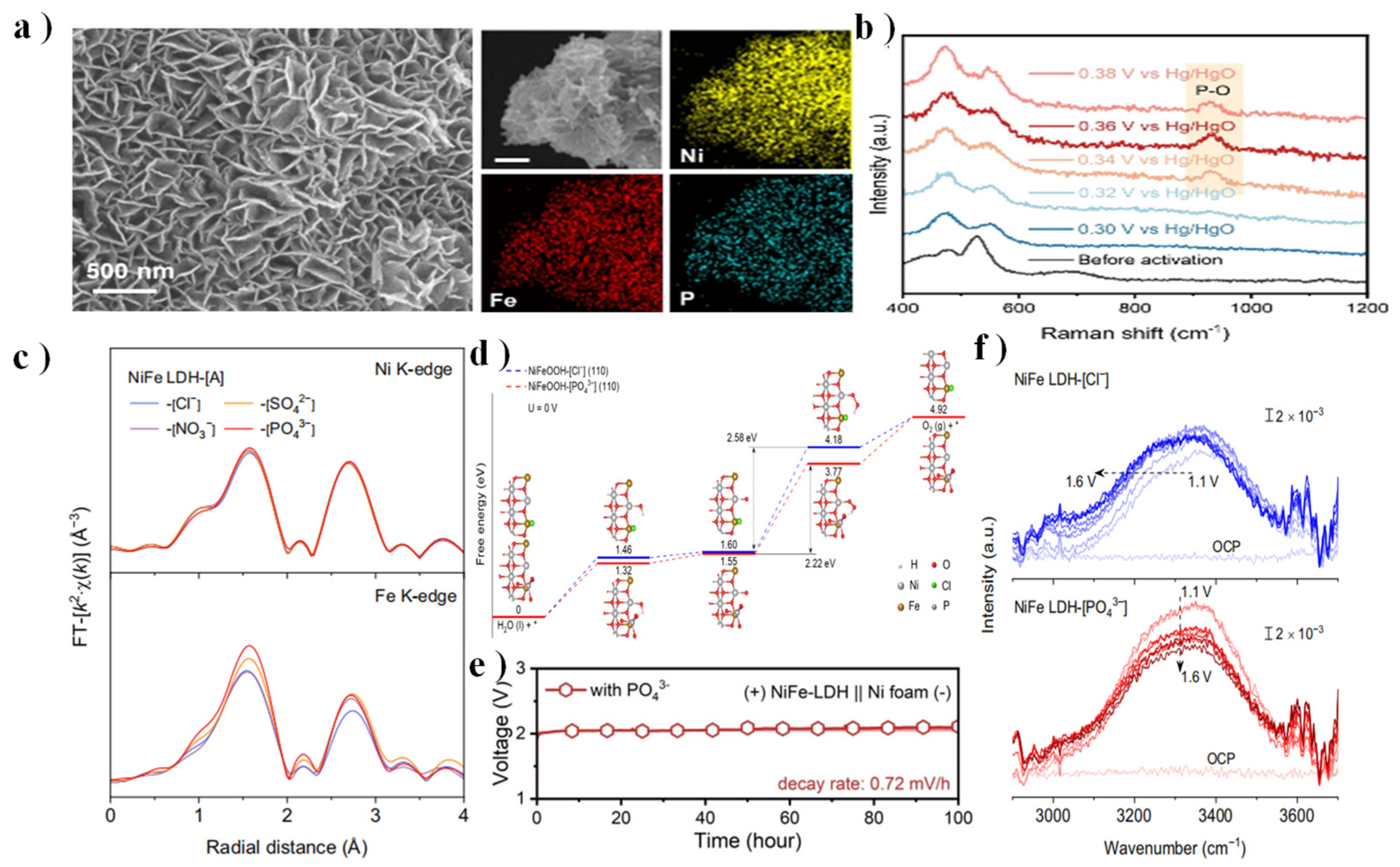
Regarding structural regulation and anchoring effects, studies have revealed that PO43− can be introduced into NiFe-LDH systems through various pathways to stabilize their structures. For instance, NiFe LDHs pre-intercalated with PO43− were successfully synthesized via ion exchange. This process enables highly charged PO43− ions to form strong coordination bonds with the metal centers within the layered structure, thereby establishing a stable, dissolution-resistant interface architecture from the outset. This pre-engineered ordered structure is pivotal for maintaining active site stability and regulating the microchemical environment at the interface under severe electrolytic conditions. Furthermore, Sun et al. successfully pre-intercalated PO43− between NiFe-LDH layers via ion exchange, synthesizing NiFe LDH-[PO43−]. By incorporating a series of alkaline anions, such as phosphate, NiFe layered double hydroxide (LDH)-based anodes with enhanced oxygen evolution reaction activity and corrosion resistance were obtained. Characterization techniques such as Extended X-ray Absorption Fine Structure (EXAFS) confirmed that PO43− selectively bonds with Fe sites on the layers, forming stable P-O-Fe coordination structures (Figure 4a,c) [94]. This strong interaction acts like an “anchor”, firmly immobilizing highly reactive metal sites. It enhances the material’s intrinsic structural stability at the atomic scale, effectively resisting metal ion dissolution and leaching—particularly in the harsh alkaline seawater electrolysis environment. Similarly, Liu et al. provided supporting evidence from an electrolyte engineering perspective. They found that at an industrially relevant operating temperature of 80 °C, the addition of PO43− to the electrolyte enables its in situ adsorption onto the surface during electrochemical reconstruction of the NiFe-LDH anode. The formation of characteristic nickel (iron) hydroxy phosphate signals was detected via operando Raman spectroscopy and X-ray photoelectron spectroscopy (XPS) (Figure 4b). The obtained active sites exhibit significantly lower solubility than conventional hydroxy oxides, thereby forming a protective layer on the catalyst surface. Inductively Coupled Plasma Mass Spectrometry (ICP-MS) analysis further quantitatively demonstrated that this strategy significantly reduced Ni and Fe dissolution by approximately 64%, clearly illustrating PO43−’s “anchoring” effect as a key contributor to suppressing active site loss [81].
Furthermore, another core function of PO43−—maintaining interfacial alkalinity—gradually emerged. Sun deeply elucidated this intrinsic connection. Using operando attenuated total reflection infrared spectroscopy (ATR-IRAS) and IrOx-modified rotating ring-disk electrode (RRDE) techniques, they discovered that intercalated highly basic PO43− acts as an efficient proton acceptor, significantly enhancing proton transfer efficiency at the reaction interface. More importantly, this study quantitatively confirmed that a higher local OH concentration is maintained within the electrical double layer (EDL) on PO43−-modified NiFe-LDH electrode surfaces, thereby creating and stabilizing a highly alkaline interfacial microenvironment. This microenvironment not only provides optimal reaction conditions for the adsorption–evolution mechanism (AEM)-driven OER pathway (verified via differential electrochemical mass spectrometry, DEMS), but also simultaneously repels corrosive anions like Cl in seawater, thereby enhancing both catalytic activity and corrosion resistance. Density functional theory (DFT) calculations provide a theoretical foundation, demonstrating that PO43− introduction optimizes the adsorption of the reaction intermediate (O) and significantly reduces the energy barrier of the rate-determining step (RDS) from O to *OOH, thereby fundamentally accelerating OER kinetics (Figure 4d,e). The theoretical findings align closely with experimental observations by Liu et al., who reported a reduction in OER overpotential and a 25-fold decrease in decay rate at a high current density of 400 mA cm−2 following PO43− addition.
Based on the above results, the enhancement effect of PO43− on NiFe-LDH stems from the synergy of its dual functions: firstly, it achieves an “anchoring effect” through strong chemical bonding, structurally ensuring the durability of active sites; secondly, it maintains interfacial alkalinity via its inherent basicity, optimizing OER kinetics and enhancing corrosion resistance at the reaction microenvironment level. This synergistic mechanism enables PO43−-modified NiFe-LDH to exhibit unprecedented high activity and exceptionally long lifetime in practical alkaline water/seawater electrolysis, providing crucial theoretical foundations and feasible technical pathways for designing next-generation high-performance water-splitting catalysts. The strong coordination of PO43− ions enhances structural stability but may also affect the intrinsic activity of the active sites. Therefore, optimizing the doping concentration and distribution to balance structural anchoring and catalytic activity represents a key direction for future research.

4.3. Cl: Selective Adsorption and Mechanism Reconstruction

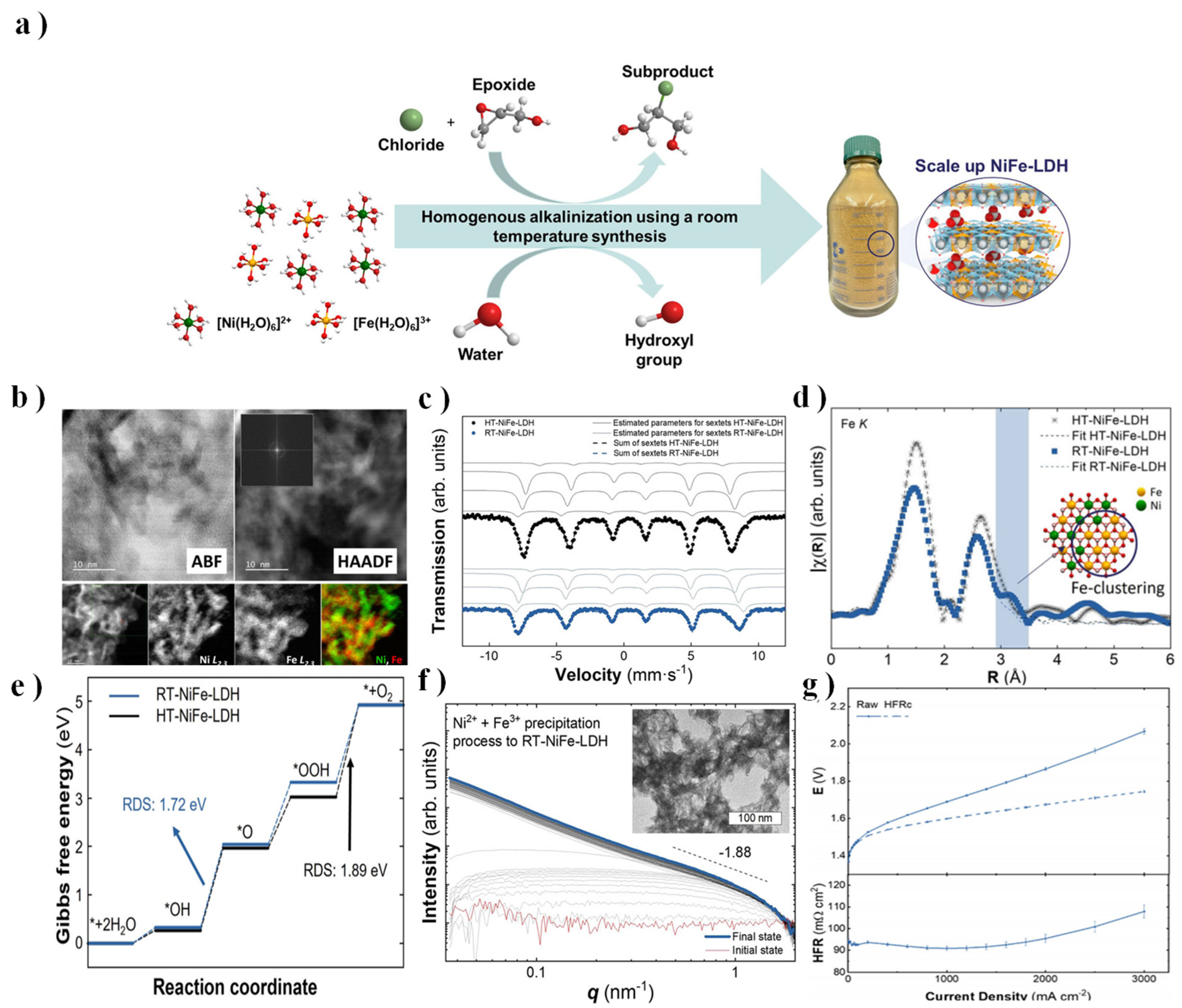
Chloride ions (Cl) exhibit unique roles beyond traditional anions in regulating NiFe-LDH electrocatalytic materials. Research indicates that chloride ions not only serve as key directing agents inducing specific microstructures during synthesis, but also significantly enhance the intrinsic OER activity and reaction selectivity of materials by restructuring the adsorption mechanism and reaction pathways of the active site. He et al. synthesized NiFe-LDH via a room-temperature strategy involving chloride ions. Their work illustrates that structural design and optimization could shield catalytic sites from chloride corrosion, alongside investigations into the chloride inhibition mechanism during oxygen evolution reactions. The results showed that Cl could act as a precipitating agent during synthesis to induce a low-crystallinity structure rich in Fe clusters. On the other hand, the doping Cl species would reconfigure the adsorption mechanism during subsequent OER. In situ XAS and Raman characterization revealed that Cl promotes the formation of the active NiOOH phase and modulates the local coordination environment of Fe, leading to preferential adsorption of OH over Cl on the NiFe-LDH surface. By virtue of Cl species, the Fe cluster reduces the energy barrier for the OH → O step in the OER pathway (from 1.89 eV to 1.72 eV), shifting the rate-determining step (RDS) from OOH → O2 in conventional NiFe-LDH to OH → *O, thereby reconfiguring the OER mechanism [95]. Therefore, the corporation of Cl species will help to reconstruct active sites, which not only enhances the intrinsic OER activity but also suppresses the competing ClER reaction through the surface repulsion effect of Cl, achieving highly selective oxygen evolution in Cl-containing electrolytes.
Furthermore, Seijas–Da Silva et al. revealed the structural and mechanistic reconstruction role of Cl in NiFe-LDH. Silva reported the synthesis of industrially scalable, active NiFe layered double hydroxide (NiFe-LDH) catalysts via a room-temperature combined with atmospheric-pressure process. They employed homogeneous alkalization, wherein chloride ions nucleophilically attack epoxy rings to generate low-dimensional, defect-rich NiFe-LDH with pronounced iron cluster structures. In situ spectroscopic and ab initio calculations reveal that these structural features maximize the conversion of NiFe-LDH into catalytically active phases while effectively lowering energy barriers, thereby substantially enhancing catalytic efficiency. Through a unique “epoxide pathway”, Cl acts as a structural organizer, which is helpful for the synthesis of an ultrathin structure rich in Fe clusters and defects at room temperature. The Cl species is beneficial for the regulation of Ni2+/Fe3+ precipitation order and coordination environment, thereby optimizing the adsorption energy of OER intermediates (particularly *O) and reconstructing the reaction pathway to significantly lower its activation energy. Synchrotron radiation and in situ spectroscopic characterization confirm this localized structure formation, while electrochemical testing achieves high performance at 1 A cm−2 @ 1.69 V in AEMWE (Figure 5a–g) [96]. Furthermore, the surface Cl adsorption layer enhances operational stability in chlorine-containing environments through electrostatic repulsion effects, synergistically improving both activity and stability.
In summary, chloride ion regulation of NiFe-LDH originates from its unique dual-synergistic pathway of structure induction and reaction mechanism reconstruction. On one hand, during synthesis, chloride ions act as structural directors, resulting in the formation of a low-crystallinity microstructure rich in iron clusters and defects for constructing highly active sites. Moreover, during electrocatalysis, chloride ions regulate the local coordination environment and adsorption behavior, reconstructing the oxygen evolution reaction pathway. Such a configuration significantly reduces the energy barriers of key steps and shifts the rate-determining step toward a more accessible pathway. Concurrently, the chloride adsorption layer formed on the electrode surface effectively suppresses competitive chloride adsorption and chlorine evolution side reactions through electrostatic repulsion, which significantly enhances the OER kinetics as well as robust stability in chloride-containing electrolytes. They provide novel design insights and theoretical support for developing high-performance electrocatalysts adapted to complex real-world operating conditions.

4.4. F: Spin Control and Lattice Oxygen Activation

Among various anions, fluoride ions (F) exhibit unique advantages in achieving spin state regulation and lattice oxygen activation due to their highest electronegativity, small ionic radius, and strong coordination ability, providing an ideal research system for understanding anion-mediated catalytic mechanisms.
F intercalation exerts a pronounced regulatory effect on the electronic structure of NiFe-LDH. The profound regulation of spin states and lattice oxygen by F ions commenced with their successful incorporation into LDH lattices. F species can optimize macroscopic morphology of host materials, inducing charge redistribution of the metal center. Such pre-programmed configuration of metallic could result in valence states of active sites and enhance metal–oxygen covalency under electrocatalytic conditions, thereby activating the lattice oxygen oxidation mechanism (LOM). As an example, Yan et al. synthesized F-intercalated NiFe-LDH (NiFe-LDH@NF-2) via a hydrothermal method. Their work demonstrated that F introduction not only induces the formation of a three-dimensional hierarchical porous structure but also significantly increases the Ni3+/Ni2+ to Fe3+/Fe2+ ratio, as confirmed by XPS analysis. The phenomenon stems from F’s strong electronegativity, which strongly attracts the d electron cloud of metal centers. It leads to enhanced covalent bonding between metal and oxygen, effectively regulating the spin configuration at Ni and Fe sites, laying the foundation for subsequent lattice oxygen participation in reactions.
During electrochemical activation, F further guides surface restructuring which conducive to lattice oxygen activation. Operando Raman spectroscopy reveals that F doping enables NiFe-LDH to transform into a highly active β-NiOOH phase at lower potentials (~1.40 V vs. RHE) while effectively suppressing overoxidation pathways. In this process, F-induced Ni-O bond compression and lattice distortion stabilize the Ni3+ coordination environment, lowering the activation energy barrier for lattice oxygen and creating favorable conditions for the lattice oxygen mechanism (LOM) [97].
Theoretical calculations further elucidate the microscopic mechanism where F regulates spin states and promotes lattice oxygen activation. DFT analysis indicates significantly reduced charge density at Ni and Fe sites in F-modified NiFe-LDH, and the corresponding Bader charge analysis further confirms pronounced electron transfer kinetics. Such an electron structural rearrangement optimizes the spin configuration at metal sites, enhances the covalent nature of metal–oxygen bonds, and facilitates the participation of lattice oxygen in reactions to form electrophilic oxygen species. Concurrently, F doping markedly lowers the energy barrier for the *OH → *O step, promoting the formation and conversion of oxygen intermediates, thereby providing thermodynamic driving force for the LOM pathway.
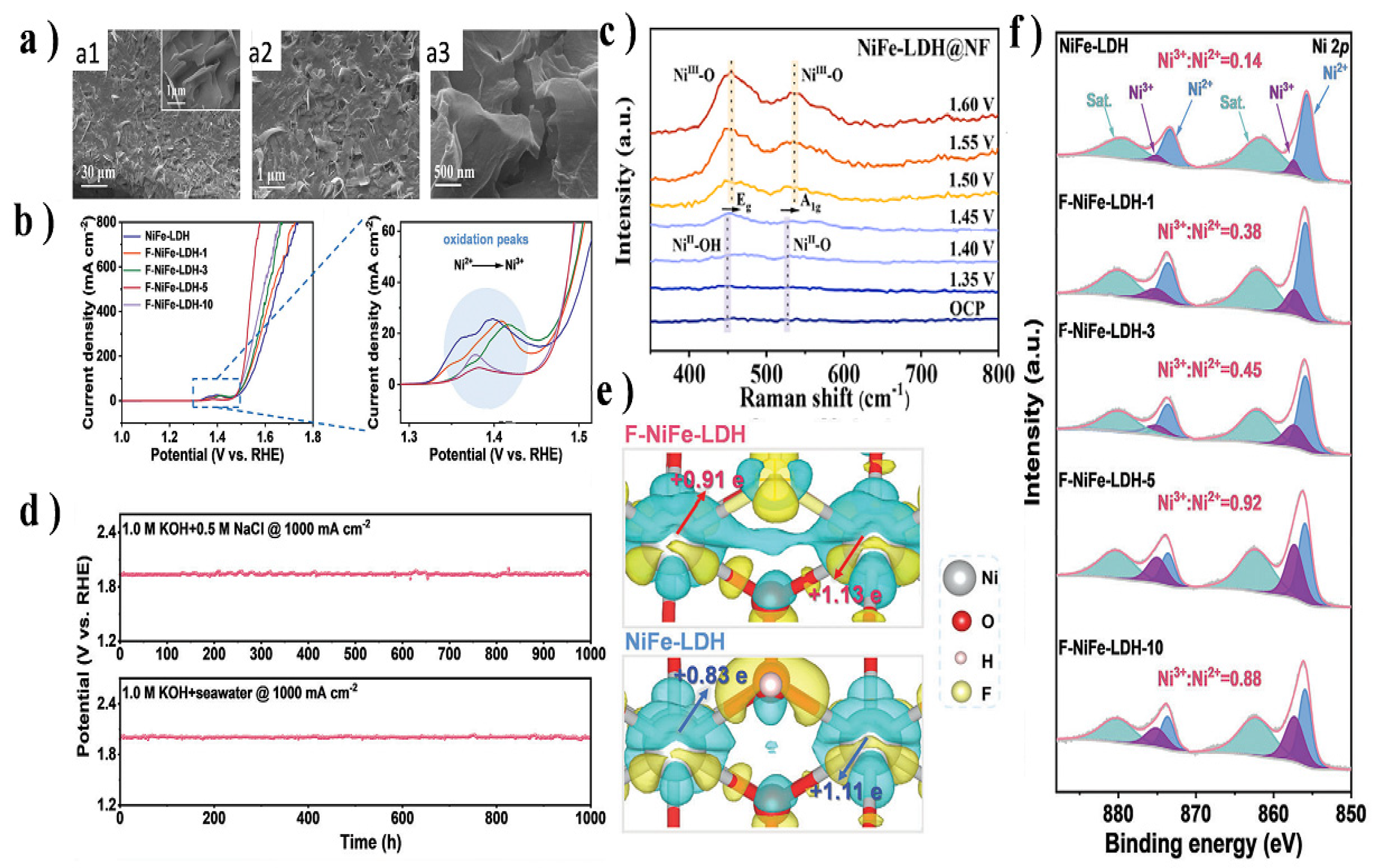
Notably, the regulatory effect of F can be further enhanced through electrolyte engineering strategies. Mu et al. constructed F-NiFe-LDH electrocatalyst via fluorination engineering, achieving isomorphous substitution of F atoms into NiFe-LDH crystal. This modification induces electron-deficient regions around Ni sites, elevating the intrinsic metal valence while enhancing Ni–O covalency, thereby activating lattice oxygen and promoting the LOM pathway. Benefiting from these merits, F-NiFe-LDH exhibits outstanding OER activity with an overpotential of only 306 mV to reach 500 mA cm−2 in alkaline simulated seawater, achieving sustained electrolysis for over 1000 h at 1000 mA cm−2 without chlorine oxidation and demonstrating the practicality and durability of F-mediated spin regulation and lattice oxygen activation mechanisms [98].
To summarize, the F species in NiFe-LDH optimizes the spin configuration of metal sites through strong electronic regulation, and enhances the covalent nature of metal–oxygen bonds, thereby lowering the lattice oxygen activation energy barrier for promoting LOM reaction pathway (Figure 6a–f). The multi-level regulation from electronic structure to reaction mechanism enables F-intercalated NiFe-LDH to maintain catalytic stability. New design insights are provided for developing highly efficient OER catalysts based on the lattice oxygen activation mechanism. The precise control of the electronic structure by F is key to activating lattice oxygen, but this may also accelerate lattice oxygen loss. Future efforts should focus on achieving an optimal balance between enhancing activity and maintaining structural stability through precise doping design.

4.5. Sq2−: Multiple Hydrogen Bonds and Interfacial Alkalization

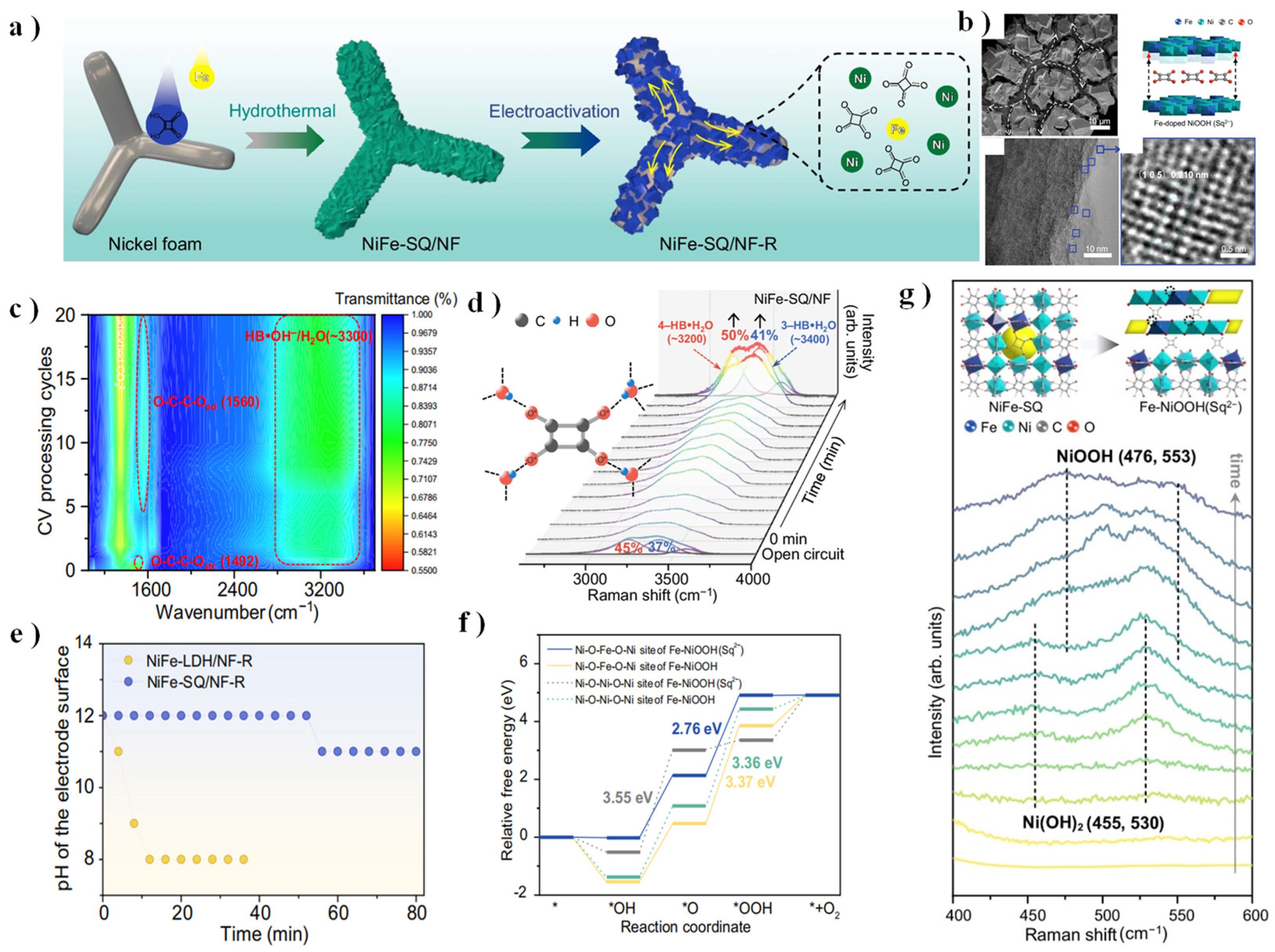
Compared with other anion species, the square-oxyanion (Sq2−) exhibits a unique mechanism of action. The stable intercalation of square anions (Sq2−) with unique planar structures into the interlayers of LDHs is pivotal to achieving their “interface alkalization” functionality, typically requiring meticulous synthetic design. Fan et al. employed a hydrothermal–electrochemical strategy to stably intercalate Sq2− into the interlayer space of Fe-NiOOH. Sq2− introduction not only expanded the interlayer spacing but also induced the formation of a micrometer-scale network-like fissure structure conducive to mass transport. Subsequently, this significantly enhanced the performance of the material under high current densities.
Intercalated Sq2− forms a multi-hydrogen bond network with interfacial OH and H2O through its four carbonyl oxygen atoms, acting as a “molecular sponge” to effectively capture and stabilize OH. The NiFe-SQ/NF-R electrode interface can sustain a highly alkaline environment for extended periods (pH decreases from 12 to 11 over 56 min), significantly outperforming conventional NiFe-LDH (pH drops to 8 within 12 min). Such unique “interface alkalization” capability primarily regulates electronic structure via high electronegativity, fundamentally mitigating interface acid corrosion caused by deprotonation during high current OER. OH fixed by Sq2− enhances the local effective concentration near the active site. As an efficient proton acceptor, it significantly reduces the rate-determining step energy barrier from O to OOH (from 3.37 eV to 2.76 eV) and greatly promotes the deprotonation process of the *OOH intermediate (energy barrier reduced from 1.07 eV to 0.01 eV). These findings indicate that Sq2− intercalation stabilizes key reaction intermediates, providing a thermodynamically more favorable reaction pathway for the adsorption–evolution mechanism (AEM), rather than inducing a lattice oxygen oxidation mechanism.
NiFe-SQ/NF-R catalyst exhibits an overpotential of only 284 mV at a current density of 1.0 A cm−2 and operates stably for over 700 h at an industrial-grade current density of 3.0 A cm−2. These results reveal a unique mechanism for Sq2−: Sq2− achieves “interface alkalization” through “multiple hydrogen bonds” (Figure 7a–g) [99]. Beyond significantly enhancing catalyst stability, this mechanism also boosts intrinsic activity by optimizing the AEM pathway, offering a novel anion engineering perspective for designing practical, high-performance OER catalysts.

5. Conclusions and Outlook

5.1. Conclusions

This review systematically integrates recent research advances in regulating the electronic structure of LDHs via anion-doping strategies to enhance their oxygen evolution reaction (OER) performance. By introducing functional anions such as NO3, PO43−, Cl, F, and Sq2−, anion engineering achieves multi-level precise regulation of LDH materials, and spans from bulk electronic configurations to interfacial microenvironments (Table 1). These anions not only provide charge compensation but also function as triple agents: “electron modulators”, “structural orienters”, and “reaction pathway switchers”. They synergistically optimize both the adsorption–evolution mechanism (AEM) and lattice oxygen oxidation mechanism (LOM). Specifically, NO3 promotes surface reconstruction through efficient OH exchange, guiding the formation of highly active γ-NiFeOOH phase; PO43− anchors active sites via strong coordination while maintaining local alkaline interfaces, significantly enhancing corrosion resistance and stability; Cl reshapes rate-determining steps and induces iron-rich cluster structures, optimizing OER kinetics; F anchors active sites via strong coordination while sustaining local alkaline interfaces, markedly enhancing corrosion resistance and stability; Sq2− anchors active sites via strong coordination while sustaining local alkaline interfaces, markedly enhancing corrosion resistance and stability. PO43− anchors active sites through strong coordination while preserving a locally alkaline interface, markedly enhancing corrosion resistance and stability. Cl governs rate-determining steps and induces iron-rich cluster structures, optimizing oxygen evolution pathways. F modulates metal site spin states via high electronegativity, strengthening metal–oxygen covalent bonds to activate oxygen oxidation pathways. The multi-hydrogen bond network formed by Sq2− achieves unique interfacial alkalization, creating thermodynamically favorable conditions for the AEM pathway. Such anion-customized, function-oriented design overcomes limitations imposed by conventional adsorption energy scaling and structural instability. Thus, it provides a robust theoretical framework and diversified material design dimensions for developing LDH-based electrocatalysts that combine high activity, durability, and adaptability to practical operating conditions.

5.2. Challenges and Outlook

Up to now, anion-doped LDH-based electrocatalysts demonstrate excellent OER performance. However, the efficient hydrogen evolution reaction (HER) at the cathode is also crucial in water electrolysis technology. LDHs, owing to their tunable composition and structure, provide an ideal platform for optimizing these two reactions separately or synergistically through anion engineering and interfacial design. Recent research indicates that the design of high-performance LDH catalysts primarily follows two pathways: firstly, deeply optimizing the intrinsic activity of a single reaction (such as HER) through anion/cation doping; secondly, synergistically enhancing bifunctional (OER/HER) performance through multi-component composites and heterostructure construction to achieve efficient total water splitting. Table 2 summarizes LDH catalysts that have significantly enhanced HER performance through doping strategies. These studies demonstrate that introducing anions such as S2− or rare earth cations like La3+ can effectively modulate the electronic structure of active metal sites. This substantially optimizes the hydrogen adsorption free energy (ΔG_H*), yielding activity levels approaching or even rivaling those of noble metals. The catalysts listed in Table 2 aim to balance and synergistically enhance the bifunctional activity of both OER and hydrogen evolution reaction (HER). Their design centers on constructing multi-metal interfaces or heterojunctions, leveraging electronic synergy and functional complementarity between components to reduce the overall voltage required for complete water splitting. Although LDH-based electrocatalysts prepared through anion doping have shown enhanced catalytic HER performance, most of the LDH-based electrocatalysts still cannot meet the requirement of industrial application due to the complex adsorption/desorption of H2O molecular and intermediated H*/OH* species. More efforts should be focused on developing straightforward as well as eco-friendly LDH-based electrocatalysts with high performance for bifunctional OER/HER, which can achieve large-scale hydrogen evolution.
In fact, these above results confirm the development of high-performance materials and contribute to a deeper understanding of underlying mechanisms and practical application validation. In the future, in situ characterization techniques should be used to reveal real active sites under operating conditions, the dynamic evolution of dopant ions, and interfacial stability, establishing precise structure–activity relationships. Furthermore, more investigations are needed to explore the long-term stability of LDH electrocatalysts in complex electrolytes such as seawater for an industrial-scale electrolyzer. This approach bridges the gap between exceptional laboratory conditions and reliable industrial-scale technologies. Through the continuous integration of atomically precise doping with nanoscale intelligent interface design, LDH-based catalysts hold promise as core materials propelling the realization of a green hydrogen economy.

Author Contributions

Conceptualization, Y.Z. and L.X.; visualization, L.X. and L.L.; investigation, T.J., S.T. and H.Q.; writing, Y.Z. and X.D.; project administration, F.S.; funding acquisition, F.S. All authors have read and agreed to the published version of the manuscript.

Funding

This research received no external funding.

Data Availability Statement

No new data were created or analyzed in this study. Data sharing is not applicable to this article.

Conflicts of Interest

The authors declare no conflicts of interest.

References

  1. van Renssen, S. The hydrogen solution? Nat. Clim. Change 2020, 10, 799–801. [Google Scholar] [CrossRef]
  2. Tian, H.C.; Li, W.; Lee, Y.L.; Zheng, H.K.; Li, Q.Y.; Ma, L.; Bhattacharyya, D.; Chen, X.J.; Zhang, D.W.; Li, G.S.; et al. Conformally coated scaffold design using water-tolerant PrBaNiO for protonic ceramic electrochemical cells with 5000-h electrolysis stability. Nat. Energy 2025, 10, 890–903. [Google Scholar] [CrossRef]
  3. Qin, H.T.; Tang, S.Y.; Xu, L.L.; Li, A.S.; Lv, Q.J.; Dong, J.L.; Liu, L.Y.; Ding, X.; Jiang, N.; Luo, R.; et al. Alkaline functional chromium carbide: Immobilization of ultrafine ruthenium copper nanoparticles for efficient hydrogen evolution from ammonia borane hydrolysis. J. Colloid Interface Sci. 2025, 697, 137897. [Google Scholar] [CrossRef] [PubMed]
  4. Long, J.-J.; Wu, H.-C.; Liu, Y.-T.; Ding, Y.-Y.; Yao, Q.-L.; Metin, O.; Lu, Z.-H. Hydrogen production from chemical hydrogen storage materials over copper-based catalysts. cMat 2024, 1, e10. [Google Scholar] [CrossRef]
  5. Pan, S.Y.; Zabed, H.M.; Wei, Y.T.; Qi, X.H. Technoeconomic and environmental perspectives of biofuel production from sugarcane bagasse: Current status, challenges and future outlook. Ind. Crops Prod. 2022, 188, 115684. [Google Scholar] [CrossRef]
  6. Prasad, C.; Tang, H.; Liu, Q.Q.; Bahadur, I.; Karlapudi, S.; Jiang, Y.J. A latest overview on photocatalytic application of g-C3N4 based nanostructured materials for hydrogen production. Int. J. Hydrogen Energy 2020, 45, 337–379. [Google Scholar] [CrossRef]
  7. Tang, S.Y.; Xu, L.L.; Ding, X.; Lv, Q.J.; Qin, H.T.; Li, A.S.; Yang, X.C.; Han, J.; Song, F.Z. Electronic engineering induced ultrafine non-noble nanoparticles for high-performance hydrogen evolution from ammonia borane hydrolysis. Fuel 2025, 381, 133424. [Google Scholar] [CrossRef]
  8. Wu, Q.; Zhong, Y.; Chen, R.; Ling, G.; Wang, X.; Shen, Y.; Hao, C. Cu-Ag-C@Ni3S4 with core shell structure and rose derived carbon electrode materials: An environmentally friendly supercapacitor with high energy and power density. Ind. Crops Prod. 2024, 222, 119676. [Google Scholar] [CrossRef]
  9. Yao, Q.L.; Zhu, F.H.; Long, J.J.; Huo, J.R.; Huang, M.S.; Lu, Z.H. Efficient ammonia borane dehydrogenation on Ni/P-Mo@MoC: The effect of P dopant and Mo@MoC heterostructure. Chem. Eng. J. 2025, 520, 166442. [Google Scholar] [CrossRef]
  10. Qin, H.; Tang, S.; Xu, L.; Li, A.; Lv, Q.; Dong, J.; Liu, L.; Ding, X.; Pan, X.; Yang, X.; et al. Alkaline titanium carbide (MXene) engineering ultrafine non-noble nanocatalysts toward remarkably boosting hydrogen evolution from ammonia borane hydrolysis. J. Alloys Compd. 2025, 1010, 177644. [Google Scholar] [CrossRef]
  11. Wang, J.; Qin, H.; Liu, M.; Tang, S.; Xu, L.; Ding, X.; Song, F. Pd Nanoparticles Confined by Nitrogen-Doped Carbon Architecture Derived from Zeolitic Imidazolate Frameworks for Remarkable Hydrogen Evolution from Formic Acid Dehydrogenation. Catalysts 2025, 15, 852. [Google Scholar] [CrossRef]
  12. Zhou, X.C.; Yang, S.S.; Yang, H.; Gao, S.; Yan, X.H. Mechanism of heteroatom-doped Cu catalysis for hydrogen evolution reaction. Int. J. Hydrogen Energy 2022, 47, 7802–7812. [Google Scholar] [CrossRef]
  13. Liang, J.K.; Li, H.X.; Chen, L.; Ren, M.N.; Fakayode, O.A.; Han, J.Y.; Zhou, C.S. Efficient hydrogen evolution reaction performance using lignin-assisted chestnut shell carbon-loaded molybdenum disulfide. Ind. Crops Prod. 2023, 193, 116214. [Google Scholar] [CrossRef]
  14. Yang, S.S.; Rao, D.W.; Ye, J.J.; Yang, S.K.; Zhang, C.N.; Gao, C.; Zhou, X.C.; Yang, H.; Yan, X.H. Mechanism of transition metal cluster catalysts for hydrogen evolution reaction. Int. J. Hydrogen Energy 2021, 46, 3484–3492. [Google Scholar] [CrossRef]
  15. Jiang, E.H.; Song, N.; Hong, S.H.; She, C.; Li, C.M.; Fang, L.Y.; Dong, H.J. Zn, S, N self-doped carbon material derived from waste tires for electrocatalytic hydrogen evolution. Int. J. Hydrogen Energy 2022, 47, 16544–16551. [Google Scholar] [CrossRef]
  16. Wen, J.F.; Tang, S.Y.; Wu, X.Y.; Xu, L.L.; Xie, Y.F.; Yin, Y.; Song, F.Z. Unraveling the mechanism of hydrogen evolution reactions in alkaline media: Recent advances in Raman spectroscopy. Chem. Commun. 2025, 61, 8778–8789. [Google Scholar] [CrossRef]
  17. Shah, S.S.A.; El Jery, A.; Najam, T.; Nazir, M.A.; Wei, L.; Hussain, E.; Hussain, S.; Ben Rebah, F.; Javed, M.S. Surface engineering of MOF-derived FeCo/NC core-shell nanostructures to enhance alkaline water-splitting. Int. J. Hydrogen Energy 2022, 47, 5036–5043. [Google Scholar] [CrossRef]
  18. Ji, Q.H.; Yu, X.J.; Chen, L.; Yarley, O.P.N.; Zhou, C.S. Facile preparation of sugarcane bagasse-derived carbon supported MoS2 nanosheets for hydrogen evolution reaction. Ind. Crops Prod. 2021, 172, 114064. [Google Scholar] [CrossRef]
  19. Xie, J.; Yan, L.; Wang, J.W.; Wang, G.Z.; Sun, Z.T.; Zhou, L.J.; Yang, J.; Dong, H.L. Two-dimensional V2O3 MOene as promising hydrogen evolution reaction electro-catalyst revealed by first-principles calculations. Int. J. Hydrogen Energy 2024, 58, 1587–1595. [Google Scholar] [CrossRef]
  20. Ding, X.; Liu, L.; Liu, M.; Liu, H.; Xiang, J.; Dong, J.; Zhang, Y.; Jiang, N.; Yin, Y.; Song, F. Manipulating electronic regulation of nickel sulfide for boosting water oxidation. Int. J. Hydrogen Energy 2025, 193, 152389. [Google Scholar] [CrossRef]
  21. Pan, X.; Qiu, J.; Tang, S.; Lv, Q.; Dong, J.; Jiang, N.; Liu, L.; Wan, Y.; Yang, X.; Han, J.; et al. Engineering cobalt coordination environment with dual heteroatom doping for boosting urea-assisted hydrogen evolution. Fuel 2025, 395, 135161. [Google Scholar] [CrossRef]
  22. Wang, A.; Dou, Y.; Yang, X.; Zhao, L.; Zhu, W.; Zhao, W. A facile approach to prepare metalloporphyrin-based porous organic polymer for boosting hydrogen evolution activity. Dyes Pigment. 2023, 219, 111627. [Google Scholar] [CrossRef]
  23. Zhang, Z.; Tang, S.; Xu, L.; Wang, J.; Li, A.; Jing, M.; Yang, X.; Song, F. Encapsulation of ruthenium oxide nanoparticles in nitrogen-doped porous carbon polyhedral for pH-universal hydrogen evolution electrocatalysis. Int. J. Hydrogen Energy 2024, 74, 10–16. [Google Scholar] [CrossRef]
  24. Zhao, J.; Qiao, F.; Sun, Q. Facile hydrothermal synthesis of ZnIn2S4/TiO2 nanosheets for promoted hydrogen evolution reaction. Int. J. Hydrogen Energy 2024, 82, 636–645. [Google Scholar] [CrossRef]
  25. Wen, J.; Tang, S.; Ding, X.; Yin, Y.; Song, F.; Yang, X. In Situ Raman Study of Layered Double Hydroxide Catalysts for Water Oxidation to Hydrogen Evolution: Recent Progress and Future Perspectives. Energies 2024, 17, 5712. [Google Scholar] [CrossRef]
  26. Shao, X.; Yue, X.; Xu, J.; Zhang, T.; Qiu, F. Upcycling black liquor lignin into superwetting carbon layer with switchable wettability for on-demand emulsion separation with high flux. Food Bioprod. Process. 2025, 152, 117–127. [Google Scholar] [CrossRef]
  27. Qureshi, W.A.; Haider, S.N.-U.-Z.; Naveed, A.; Ali, A.; Liu, Q.; Yang, J. Recent progress in the synthesis, characterization and photocatalytic application of energy conversion over single metal atoms decorated graphitic carbon nitride. Int. J. Hydrogen Energy 2023, 48, 19459–19485. [Google Scholar] [CrossRef]
  28. Premlatha, S.; Qin, H.; Ji, Z.; Zhou, H.; Zhou, H.; Shen, X. CoSe2/FeSe2-decorated Ti3C2Tx MXene nanohybrids on carbon cloth as efficient catalysts for oxygen evolution reaction. J. Power Sources 2025, 652, 237656. [Google Scholar] [CrossRef]
  29. Lu, R.; Wang, X.; Gong, S.; Lv, X. Constructing 0D/2D PtFeNiCoCu High-Entropy Materials for Efficient Water Oxidation. Energy Fuels 2025, 39, 19950–19958. [Google Scholar] [CrossRef]
  30. He, Q.; Wang, M.; Meng, L.; Zhao, Y.; Liu, S.; Liu, G. Tuning the Mechanical and Na-Ion Diffusion Properties of Boron Nitride via Twist Angle Engineering for Sodium-Ion Batteries. Ind. Eng. Chem. Res. 2025, 64, 19108–19120. [Google Scholar] [CrossRef]
  31. Ke, L.F.; Pang, S.L.; Long, C.; Fang, T.; Yang, G.M.; Song, Y.F.; He, X.D.; Ma, S.; Qian, Y.Z.; Shen, X.Q.; et al. Quenching-induced surface reconstruction of perovskite oxide for rapid and durable oxygen catalysise. Chem. Eng. J. 2023, 463, 142509. [Google Scholar] [CrossRef]
  32. Cao, C.S.; Ma, D.D.; Xu, Q.; Wu, X.T.; Zhu, Q.L. Semisacrificial Template Growth of Self-Supporting MOF Nanocomposite Electrode for Efficient Electrocatalytic Water Oxidation. Adv. Funct. Mater. 2019, 29, 1807418. [Google Scholar] [CrossRef]
  33. Zhang, C.; Xing, Z.; Peng, Y.; Zhou, H.; Zhang, L.; Lu, Z.-H. Inlaying CoP/Ni2P/Fe2P triple heterostructure in MOF-derived carbon nanobox for robust oxygen evolution reaction. Fuel 2024, 365, 131181. [Google Scholar] [CrossRef]
  34. Song, F.Z.; Ding, X.; Wan, Y.Y.; Zhang, T.; Yin, G.G.; Brown, J.B.; Rao, Y. Interface Charge Transfer of Heteroatom Boron Doping Cobalt and Cobalt Nitride for Boosting Water Oxidation. J. Phys. Chem. Lett. 2025, 16, 3535–3543. [Google Scholar] [CrossRef]
  35. Huang, M.H.; Cao, C.S.; Liu, L.; Wei, W.B.; Zhu, Q.L.; Huang, Z.G. Controlled synthesis of MOF-derived hollow and yolk-shell nanocages for improved water oxidation and selective ethylene glycol reformation. Escience 2023, 3, 100118. [Google Scholar] [CrossRef]
  36. Liu, L.; Ding, X.; Xiang, J.; Qin, H.; Tang, S.; Xu, L.; Dong, J.; Yin, Y.; Jiang, N.; Yang, X.; et al. Iron-induced charge density redistribution of medium entropy alloys for ampere-level seawater electrolysis. Fuel 2026, 406, 137084. [Google Scholar] [CrossRef]
  37. Tang, S.; Zhang, Z.; Lv, Q.; Pan, X.; Dong, J.; Liu, L.; Wan, Y.; Han, J.; Song, F. Heteroatom Engineering in Earth-Abundant Cobalt Electrocatalyst for Energy-Saving Hydrogen Evolution Coupling with Urea Oxidation. ACS Appl. Mater. Interfaces 2024, 16, 66008–66017. [Google Scholar] [CrossRef]
  38. Qiu, X.; Gao, P.; Liao, Y.; Chen, Y.; Liu, Y.; Han, Q.; Xie, L.; Zhu, L.; Cao, X. Reinforcing the rapid selective recycling of spent LiFePO4 materials through CO2 aeration under ambient-pressure conditions. J. Power Sources 2025, 640, 236796. [Google Scholar] [CrossRef]
  39. Ren, H.; Yaseen, W.; Ji, M.; Nie, Q.; Meng, S.; Xie, M.; Xie, J.; Xu, Y. Interface engineering and enhanced hydrophilicity in Ni(OH)2–CeO2 heterostructures enabling high-efficiency oxygen evolution reaction and overall water splitting. Int. J. Hydrogen Energy 2025, 194, 152420. [Google Scholar] [CrossRef]
  40. Hu, C.L.; Zhang, L.; Gong, J.L. Recent progress made in the mechanism comprehension and design of electrocatalysts for alkaline water splitting. Energy Environ. Sci. 2019, 12, 2620–2645. [Google Scholar] [CrossRef]
  41. Trotochaud, L.; Ranney, J.K.; Williams, K.N.; Boettcher, S.W. Solution-Cast Metal Oxide Thin Film Electrocatalysts for Oxygen Evolution. J. Am. Chem. Soc. 2012, 134, 17253–17261. [Google Scholar] [CrossRef] [PubMed]
  42. Grimaud, A.; Hong, W.T.; Shao-Horn, Y.; Tarascon, J.M. Anionic redox processes for electrochemical devices. Nat. Mater. 2016, 15, 121–126. [Google Scholar] [CrossRef]
  43. Zhang, D.D.; Wu, Q.L.; Wu, L.Y.; Cheng, L.N.; Huang, K.K.; Chen, J.; Yao, X.D. Optimal Electrocatalyst Design Strategies for Acidic Oxygen Evolution. Adv. Sci. 2024, 11, e2401975. [Google Scholar] [CrossRef] [PubMed]
  44. Zhang, R.R.; Wu, Q.L.; Sherrell, P.; Li, D.H.; Huang, K.K.; Chen, J.; Yao, X.D. Dynamic investigation of oxygen defects on transition metal-based electrocatalysts: Formation, characterization, and mechanism during alkaline oxygen evolution reaction. Sci. China Chem. 2023, 66, 2221–2237. [Google Scholar] [CrossRef]
  45. Mefford, J.T.; Rong, X.; Abakumov, A.M.; Hardin, W.G.; Dai, S.; Kolpak, A.M.; Johnston, K.P.; Stevenson, K.J. Water electrolysis on La1-xSrxCoO3-δ perovskite electrocatalysts. Nat. Commun. 2016, 7, 11053. [Google Scholar] [CrossRef]
  46. Dong, Y.Y.; Ma, D.D.; Wu, X.T.; Zhu, Q.L. Electron-withdrawing anion intercalation and surface sulfurization of NiFe-layered double hydroxide nanoflowers enabling superior oxygen evolution performance. Inorg. Chem. Front. 2020, 7, 270–276. [Google Scholar] [CrossRef]
  47. Hunter, B.M.; Gray, H.B.; Muller, A.M. Earth-Abundant Heterogeneous Water Oxidation Catalysts. Chem. Rev. 2016, 116, 14919. [Google Scholar] [CrossRef]
  48. Jiang, H.L.; He, Q.; Zhang, Y.K.; Song, L. Structural Self-Reconstruction of Catalysts in Electrocatalysis. Acc. Chem. Res. 2018, 51, 2968–2977. [Google Scholar] [CrossRef]
  49. Selvam, N.C.S.; Du, L.J.; Xia, B.Y.; Yoo, P.J.; You, B. Reconstructed Water Oxidation Electrocatalysts: The Impact of Surface Dynamics on Intrinsic Activities. Adv. Funct. Mater. 2021, 31, 2008190. [Google Scholar] [CrossRef]
  50. Xie, X.Y.; Cao, C.S.; Wei, W.B.; Zhou, S.H.; Wu, X.T.; Zhu, Q.L. Ligand-assisted capping growth of self-supporting ultrathin FeNi-LDH nanosheet arrays with atomically dispersed chromium atoms for efficient electrocatalytic water oxidation. Nanoscale 2020, 12, 5817–5823. [Google Scholar] [CrossRef]
  51. Zhang, T.; Zhao, B.C.; Chen, Q.Y.; Peng, X.M.; Yang, D.Y.; Qiu, F.X. Layered double hydroxide functionalized biomass carbon fiber for highly efficient and recyclable fluoride adsorption. Appl. Biol. Chem. 2019, 62, 12. [Google Scholar] [CrossRef]
  52. Li, Q.; Chen, Q.; Jiang, K.; Lei, S.; Deng, Y.; Bao, J. Boosting high-current water electrolysis: Superhydrophilic/superaerophobic nanosheet arrays of NiFe LDH with oxygen vacancies in situ grown on iron foam. Int. J. Hydrogen Energy 2023, 48, 17501–17511. [Google Scholar] [CrossRef]
  53. Qin, H.; Cheng, J.; Zhou, P.; Ji, Z.; Peng, H.; Shen, X.; Zhou, H.; Zhu, G.; Yang, J. In Situ semi-etching of bimetallic LDH nanosheet arrays into FeNi-LDH/MOF to boost oxygen evolution reaction. Chem. Eng. J. 2024, 493, 152721. [Google Scholar] [CrossRef]
  54. Jiang, H.; Qin, H.; Zhou, P.; Kong, L.; Wang, C.; Ji, Z.; Shen, X.; Zhu, G.; Yuan, A. Partial sulfidation strategy to NiCo-LDH@NiCoS coupled with NiFe-LDH for highly efficient overall water splitting. Int. J. Hydrogen Energy 2024, 58, 892–901. [Google Scholar] [CrossRef]
  55. Song, F.Z.; Debow, S.; Zhang, T.; Qian, Y.Q.; Huang-Fu, Z.C.; Munns, K.; Schmidt, S.; Fisher, H.; Brown, J.B.; Su, Y.Q.; et al. Interface Catalysts of NiFe Layered Double Hydroxide and Titanium Carbide for High-Performance Water Oxidation in Alkaline and Natural Conditions. J. Phys. Chem. Lett. 2023, 14, 5692–5700. [Google Scholar] [CrossRef]
  56. Qin, Y.Q.; Lu, G.P.; Yang, F.; Xu, C.H.; Jiang, S.J.; Wang, Y.Q.; Tang, Y.X.; Wang, P.C. Heteroatom-doped transition metal hydroxides in energy storage and conversion: A review. Mater. Adv. 2023, 4, 1226–1248. [Google Scholar] [CrossRef]
  57. Chen, K.; Cao, Y.H.; Yadav, S.; Kim, G.C.; Han, Z.; Wang, W.M.; Zhang, W.J.; Dao, V.; Lee, I.H. Electronic structure reconfiguration of nickel-cobalt layered double hydroxide nanoflakes engineered heteroatom and oxygen-vacancies defect for efficient electrochemical water splitting. Chem. Eng. J. 2023, 463, 142396. [Google Scholar] [CrossRef]
  58. Li, Y.; Wang, X.; Li, C.; Han, X.; Yin, S.; Xia, J.; Li, H. Al-etching-induced defect engineering in NiAl LDHs for promoting multifunctional electrocatalytic oxidations: Water oxidation and urea oxidation. Int. J. Hydrogen Energy 2024, 90, 1041–1050. [Google Scholar] [CrossRef]
  59. Meng, S.; Nie, Q.; Yaseen, W.; Mao, H.; Xie, M.; Chen, M.; Xie, J.; Xu, Y. One-step fabrication of hierarchically flower-like N-doped carbon-CoMo-LDH nanosheets for efficient overall alkaline water splitting. Int. J. Hydrogen Energy 2025, 99, 93–101. [Google Scholar] [CrossRef]
  60. Wang, Y.; Pan, S. Recent development of metal borate halides: Crystal chemistry and application in second-order NLO materials. Coord. Chem. Rev. 2016, 323, 15–35. [Google Scholar] [CrossRef]
  61. Khan, A.U.; Tahir, K.; Althagafi, T.M.; Alabbad, E.A.; Albaqawi, H.S.; Almarhoon, Z.M.; Zaki, M.E.A.; Ahmad, S. Constructing strain and defects modulated novel germanium doped zeolitic imidazolate framework-67 derived NiCo layer double hydroxide nanocomposites for boosted supercapacitor applications. J. Energy Storage 2025, 134, 118193. [Google Scholar] [CrossRef]
  62. Ou, Y.; Twight, L.P.; Samanta, B.; Liu, L.; Biswas, S.; Fehrs, J.L.; Sagui, N.A.; Villalobos, J.; Morales-Santelices, J.; Antipin, D.; et al. Cooperative Fe sites on transition metal (oxy)hydroxides drive high oxygen evolution activity in base. Nat. Commun. 2023, 14, 7688. [Google Scholar] [CrossRef]
  63. Chen, H.; Liu, P.; Li, W.; Xu, W.; Wen, Y.; Zhang, S.; Yi, L.; Dai, Y.; Chen, X.; Dai, S.; et al. Stable Seawater Electrolysis Over 10,000 H via Chemical Fixation of Sulfate on NiFeBa-LDH. Adv. Mater. 2024, 36, 2411302. [Google Scholar] [CrossRef]
  64. Batchellor, A.S.; Boettcher, S.W. Pulse-Electrodeposited Ni–Fe (Oxy)hydroxide Oxygen Evolution Electrocatalysts with High Geometric and Intrinsic Activities at Large Mass Loadings. ACS Catal. 2015, 5, 6680–6689. [Google Scholar] [CrossRef]
  65. Krivina, R.A.; Ou, Y.; Xu, Q.; Twight, L.P.; Stovall, T.N.; Boettcher, S.W. Oxygen Electrocatalysis on Mixed-Metal Oxides/Oxyhydroxides: From Fundamentals to Membrane Electrolyzer Technology. Acc. Mater. Res. 2021, 2, 548–558. [Google Scholar] [CrossRef]
  66. He, Y.; Liu, D.; Zhao, H.; Wang, J.; Sui, Y.; Qi, J.; Chen, Z.; Zhang, P.; Chen, C.; Zhuang, D. Carbon-coated NiMn layered double hydroxides/Ni3S2 nanocomposite for high performance supercapacitors. J. Energy Storage 2021, 41, 103003. [Google Scholar] [CrossRef]
  67. Zhang, M.; Zhou, W.; Yan, X.; Huang, X.; Wu, S.; Pan, J.; Shahnavaz, Z.; Li, T.; Yu, X. Sodium dodecyl sulfate intercalated two-dimensional nickel-cobalt layered double hydroxides to synthesize multifunctional nanomaterials for supercapacitors and electrocatalytic hydrogen evolution. Fuel 2023, 333, 126323. [Google Scholar] [CrossRef]
  68. Jiang, M.; Zhai, H.; Chen, L.; Mei, L.; Tan, P.; Yang, K.; Pan, J. Unraveling the Synergistic Mechanism of Bi-Functional Nickel–Iron Phosphides Catalysts for Overall Water Splitting. Adv. Funct. Mater. 2023, 33, 2302621. [Google Scholar] [CrossRef]
  69. Wu, W.; Gao, Z.; Li, Q.; Wang, Z.; Liu, S.; Wu, H.; Zhao, Y.; Jiao, Y.; Zhao, X. Structural transformation of metal–organic framework with constructed tetravalent nickel sites for efficient water oxidation. J. Energy Chem. 2022, 74, 404–411. [Google Scholar] [CrossRef]
  70. Liu, Z.; Gao, Y.; Wang, C.; Zhang, Y.; Gao, H.; Yang, P.; Liu, S.; Chen, J.; Liu, Z.; Wang, J.; et al. Lanthanum-mediated enhancement of low temperature hydrogenation activity and stability in nickel catalyst supported by MOFs. Chem. Eng. J. 2025, 512, 162497. [Google Scholar] [CrossRef]
  71. Zhang, C.; Li, Y.; Deng, Y.; Han, K.; Liu, W.; He, Z. H2 production via sorption-enhanced water-gas-shift using bimetallic catalysts doped CaO-Ca12Al14O33: Experiment and density functional theory study. Sep. Purif. Technol. 2024, 338, 126553. [Google Scholar] [CrossRef]
  72. Li, Z.; Zhao, W.; Li, C.; Yin, Y.; Wei, D.; Jin, Y.; Zhi, Y.; Qiu, J.; Zhang, Y.; Baek, J.-B. Electronegative Strategic Positions in Covalent Organic Frameworks: Unlocking High-Efficiency Gold Recovery. Angew. Chem. Int. Ed. 2025, 64, e202502199. [Google Scholar] [CrossRef]
  73. Wen, N.; Zhang, D.; Zhao, X.; Jiao, X.; Xia, Y.; Chen, D. Polarization Manipulation of NiO Nanosheets Engineered with Fe/Pt Single Atoms for High-Performance Electrocatalytic Overall Alkaline Seawater Splitting. ACS Catal. 2023, 13, 7868–7878. [Google Scholar] [CrossRef]
  74. Liu, J.; Zhao, J.; Li, C.; Liu, Y.; Li, D.; Li, H.; Valtchev, V.; Qiu, S.; Wang, Y.; Fang, Q. Precise Modulation of Carbon Activity Sites in Metal-Free Covalent Organic Frameworks for Enhanced Oxygen Reduction Electrocatalysis. Small 2024, 20, 2305759. [Google Scholar] [CrossRef]
  75. Xue, Y.; Liu, S.; Wang, J.; Zhang, H.; Wei, H.; Liu, Y.; Wang, X.; Tian, J.; Jiang, J.; Li, B. A Review on Understanding and Strengthening of Active Species in Titanium Silicalite-1 (TS-1) Catalysts. Adv. Sci. 2025, 12, e12531. [Google Scholar] [CrossRef]
  76. Tucker-Quiñónez, A.M.; Rivadeneira-Mendoza, B.F.; Gorozabel-Mendoza, M.L.; Pérez-Almeida, I.B.; García-Guerrero, A.J.; Dueñas-Rivadeneira, A.A.; Yadav, K.K.; Zambrano-Intriago, L.A.; Rodríguez-Díaz, J.M. Challenges and potential of layered double hydroxides as electrocatalytic materials for hydrogen production from water: A review of recent advances and applications. Energy Nexus 2025, 17, 100399. [Google Scholar] [CrossRef]
  77. Sahoo, D.P.; Das, K.K.; Mansingh, S.; Sultana, S.; Parida, K. Recent progress in first row transition metal Layered double hydroxide (LDH) based electrocatalysts towards water splitting: A review with insights on synthesis. Coord. Chem. Rev. 2022, 469, 214666. [Google Scholar] [CrossRef]
  78. Cho, S.; Jang, J.-W.; Kong, K.-j.; Kim, E.S.; Lee, K.-H.; Lee, J.S. Anion-Doped Mixed Metal Oxide Nanostructures Derived from Layered Double Hydroxide as Visible Light Photocatalysts. Adv. Funct. Mater. 2013, 23, 2348–2356. [Google Scholar] [CrossRef]
  79. Dionigi, F.; Zeng, Z.H.; Sinev, I.; Merzdorf, T.; Deshpande, S.; Lopez, M.B.; Kunze, S.; Zegkinoglou, I.; Sarodnik, H.; Fan, D.X.; et al. In-Situ structure and catalytic mechanism of NiFe and CoFe layered double hydroxides during oxygen evolution. Nat. Commun. 2020, 11, 2522. [Google Scholar] [CrossRef]
  80. Tian, J.; Cao, C.; He, Y.; Khan, M.I.; Wu, X.-T.; Zhu, Q.-L. Engineering hierarchical quaternary superstructure of an integrated MOF-derived electrode for boosting urea electrooxidation assisted water electrolysis. Green Energy Environ. 2024, 9, 695–701. [Google Scholar] [CrossRef]
  81. Liu, W.; Ding, X.Q.; Cheng, J.J.; Jing, J.L.; Li, T.S.; Huang, X.; Xie, P.P.; Lin, X.C.; Ding, H.L.; Kuang, Y.; et al. Inhibiting Dissolution of Active Sites in 80 °C Alkaline Water Electrolysis by Oxyanion Engineering. Angew. Chem. Int. Ed. 2024, 63, e202406082. [Google Scholar] [CrossRef]
  82. Du, X.; Tan, M.; Shi, J.; Zhang, L.; Qin, X.; Duan, Y.; Mao, S.; Mushina, S.; Liu, W.; Wang, Y.; et al. Accelerating Oxygen Evolution Activity via Premagnetization-Induced Active Sites in Ferromagnetic Nickel–Iron Hydroxide Catalysts. JACS Au 2025, 5, 2500–2512. [Google Scholar] [CrossRef]
  83. Liu, Y.; Hu, H.Y.; Wang, K.L.; Huang, J.T.; Wang, D.L. Advancing Seawater Electrolysis: NiFe-LDH-Based Electrocatalysts for the Oxygen Evolution Reaction. Adv. Energy Mater. 2025, 15, e04101. [Google Scholar] [CrossRef]
  84. Wu, F.Y.; Tian, F.Y.; Li, M.G.; Geng, S.; Qiu, L.Y.; He, L.; Li, L.L.; Chen, Z.Y.; Yu, Y.S.; Yang, W.W.; et al. Engineering Lattice Oxygen Regeneration of NiFe Layered Double Hydroxide Enhances Oxygen Evolution Catalysis Durability. Angew. Chem. Int. Ed. 2025, 64, e202413250. [Google Scholar] [CrossRef]
  85. Chu, X.; Wang, L.; Li, J.; Xu, H. Surface chemical microenvironment engineering of catalysts by organic molecules for boosting electrocatalytic reaction. Chin. Chem. Lett. 2024, 35, 109105. [Google Scholar] [CrossRef]
  86. Zhang, J.; Wang, L.; Lü, J.; Wang, Z.; Wu, H.; Zhu, G.; Wang, N.; Xue, F.; Zeng, X.; Zhu, L.; et al. Interlayer reconstruction phase transition in van der Waals materials. Nat. Mater. 2025, 24, 369–376. [Google Scholar] [CrossRef] [PubMed]
  87. Wang, Y.; Feng, H.; Zhang, C.; Liu, Q.; Tan, J.; Ye, C. Interlayer Nanoarchitecture Modification of Layered Materials in Rechargeable Metal-Ion Batteries. Electrochem. Energy Rev. 2025, 8, 19. [Google Scholar] [CrossRef] [PubMed]
  88. Alves, D.; Kasturi, P.R.; Collins, G.; Barwa, T.N.; Ramaraj, S.; Karthik, R.; Breslin, C.B. 2D layered double hydroxides and transition metal dichalcogenides for applications in the electrochemical production of renewable hydrogen. Mater. Adv. 2023, 4, 6478–6497. [Google Scholar] [CrossRef]
  89. Wang, Z.Y.; Goddard, W.; Xiao, H. Potential-dependent transition of reaction mechanisms for oxygen evolution on layered double hydroxides. Nat. Commun. 2023, 14, 4228. [Google Scholar] [CrossRef]
  90. Shaikh, N.; Mukhopadhyay, I.; Ray, A. Improved electrocatalytic hydrogen evolution characteristics in Mn-doped MoS2 nanosheets grown under a non-equilibrium condition. Int. J. Hydrogen Energy 2023, 48, 15944–15955. [Google Scholar] [CrossRef]
  91. Zhang, J.; Hao, L.; Chen, Z.T.; Gao, Y.J.; Wang, H.; Zhang, Y.F. Facile synthesis of Co-Fe layered double hydroxide nanosheets wrapped on Ni-doped nanoporous carbon nanorods for oxygen evolution reaction. J. Colloid Interface Sci. 2023, 650, 816–824. [Google Scholar] [CrossRef] [PubMed]
  92. Shi, K.; Sun, Z.; Yuan, M.; Zhao, Y.; Sun, G. “Polyoxometalate electron sponge” induces the accurate regulation of electron states at Ni sites to enhance oxidation of water. J. Colloid Interface Sci. 2024, 657, 37–45. [Google Scholar] [CrossRef] [PubMed]
  93. Wang, L.; Wang, Y.; Zhou, L.; Liu, J.Y.; Wu, Z.J. The critical effect of different additive interlayer anions on NiFe-LDH for direct seawater splitting: A theoretical study. J. Colloid Interface Sci. 2025, 680, 43–52. [Google Scholar] [CrossRef] [PubMed]
  94. Sun, X.G.; Shen, W.; Liu, H.; Xi, P.X.; Jaroniec, M.; Zheng, Y.; Qiao, S.Z. Corrosion-resistant NiFe anode towards kilowatt-scale alkaline seawater electrolysis. Nat. Commun. 2024, 15, 10351. [Google Scholar] [CrossRef]
  95. He, K.; Zhou, Y.; Wang, Z.; Huang, Y.; Dong, H.; Zhou, C.; Xia, H.; Lu, F.; Song, Y.; Ji, M. Advances in layered double hydroxides for direct seawater electrolysis: Challenges, strategies, and future perspectives. Clean Energy Sci. Technol. 2025, 3, 337. [Google Scholar] [CrossRef]
  96. Silva, A.S.D.; Hartert, A.; Oestreicher, V.; Romero, J.; Jaramillo-Hernández, C.; Muris, L.J.J.; Thorez, G.; Vieira, B.J.C.; Ducourthial, G.; Fiocco, A.; et al. Scalable synthesis of NiFe-layered double hydroxide for efficient anion exchange membrane electrolysis. Nat. Commun. 2025, 16, 6138. [Google Scholar] [CrossRef]
  97. Yan, X.Y.; Dai, X.X.; Deng, X.L.; Zeng, K.; Li, Y.B. Fluorine anion mediated rapid reactive phase reconstruction of NiFe layered double hydroxide for 1.0 A cm−2 anion-exchange membrane water electrolysis. Int. J. Hydrogen Energy 2025, 156, 150381. [Google Scholar] [CrossRef]
  98. Mu, J.; Yu, C.; Song, X.; Chen, L.; Zhao, J.; Qiu, J. A Super-Chlorophobic Yet Weak-Reconstructed Electrocatalyst by Fluorination Engineering toward Chlorine Oxidation-Free and High-Stability Seawater Electrolysis. Adv. Funct. Mater. 2025, 35, 2423965. [Google Scholar] [CrossRef]
  99. Fan, R.Y.; Lu, S.S.; Wang, F.L.; Zhang, Y.S.; Hojamberdiev, M.; Chai, Y.M.; Dong, B.; Zhang, B. Enhancing catalytic durability in alkaline oxygen evolution reaction through squaric acid anion intercalation. Nat. Commun. 2025, 16, 3407. [Google Scholar] [CrossRef]
  100. Ye, L.; Chen, Z.; Xu, X.; Ma, F.; Fan, K.; Zong, L.; Wang, L.; Chen, G.; Li, X.; Zhan, T. Ultrafast Room-Temperature Synthesis of Phosphate-Intercalated NiFe Layered Double Hydroxides for High-Performance Alkaline Seawater Oxidation. Inorg. Chem. 2024, 63, 20859–20869. [Google Scholar] [CrossRef]
  101. Jiang, L.; Chen, X.; Jiang, L.; Luo, X.; Li, R.; Zhou, Q.; Mu, X.; Chen, L.; Yu, J.; Mu, S. Oxyanion-Triggered Discrepant Oxide Pathways Via Tailoring Reconstruction of Non-Noble Catalysts for Water Oxidation. Nano Lett. 2025, 25, 13875–13884. [Google Scholar] [CrossRef]
  102. Cheng, J.; Liu, W.; Chen, S.; Zhang, Y.; Cao, A.; Zhang, Y.; Shen, Z.; Yang, Y.; Zhang, Y.; Li, Y.; et al. Fluoride-Engineered Electrolyte for Highly Stable and Efficient Alkaline Seawater Electrolysis at 2 A cm−2. Angew. Chem. Int. Ed. 2025, 64, e18106. [Google Scholar] [CrossRef]
  103. Sun, S.; He, Y.; Chen, T.; Sun, C.; Wu, C. Morphology regulated synthesis of NiFe-layered double hydroxide nanostructures on nickel foam toward efficient oxygen evolution reaction. J. Alloys Compd. 2023, 963, 171304. [Google Scholar] [CrossRef]
  104. Lei, H.; Wan, Q.; Tan, S.; Wang, Z.; Mai, W. Pt-Quantum-Dot-Modified Sulfur-Doped NiFe Layered Double Hydroxide for High-Current-Density Alkaline Water Splitting at Industrial Temperature. Adv. Mater. 2023, 35, e2208209. [Google Scholar] [CrossRef]
  105. Gao, G.; Wang, W.; Wang, Y.; Fu, Z.; Liu, L.; Du, Y.; Li, Z.; Liu, Y.; Wang, L. Synergistic coupling of NiCoS nanorods with NiCo-LDH nanosheets towards highly efficient hydrogen evolution reaction in alkaline media. J. Electroanal. Chem. 2023, 943, 117622. [Google Scholar] [CrossRef]
  106. Yu, J.; Lu, K.; Wang, C.; Wang, Z.; Fan, C.; Bai, G.; Wang, G.; Yu, F. Modification of NiFe layered double hydroxide by lanthanum doping for boosting water splitting. Electrochim. Acta 2021, 390, 138824. [Google Scholar] [CrossRef]
  107. Liu, T.; Yu, X.; Yu, S.; Yang, H.; Sun, Q.; Wang, C.; Li, S.; Zheng, J.Y. Robust CoP@NiFe LDH/Ni heterostructured electrodes for efficient overall water splitting with high current density. J. Alloys Compd. 2024, 973, 172886. [Google Scholar] [CrossRef]
  108. Wang, T.; Zhang, X.; Yu, X.; Li, J.; Wang, K.; Niu, J. Interfacial Interaction in NiFe LDH/NiS2/VS2 for Enhanced Electrocatalytic Water Splitting. Molecules 2024, 29, 951. [Google Scholar] [CrossRef]
  109. Zhang, B.; Zhang, N.; Zhao, G.; Mu, L.; Liao, W.; Qiu, S.; Xu, X. Regulation of electron density redistribution for efficient alkaline hydrogen evolution reaction and overall water splitting. J. Colloid Interface Sci. 2024, 665, 1054–1064. [Google Scholar] [CrossRef]
  110. Zhang, Y.-F.; Wang, X.-W.; Zheng, Z.-Y.; Zhang, W.-H.; Liu, X.; Niu, J.-Q. The interfacial synergy of hierarchical FeCoNiP@FeNi-LDH heterojunction for efficient alkaline water splitting. J. Colloid Interface Sci. 2024, 673, 797–806. [Google Scholar] [CrossRef]
  111. Chen, H.; Li, J.; Chen, L.; Li, G.; Zhao, W.; Tao, K.; Han, L. Electron-Redistributed NiCo@NiFe-LDH Core–Shell Heterostructure for Significantly Enhancing Electrochemical Water Splitting. Inorg. Chem. 2023, 62, 20194–20201. [Google Scholar] [CrossRef] [PubMed]
  112. Long, X.; Meng, J.; Gu, J.; Ling, L.; Li, Q.; Liu, N.; Wang, K.; Li, Z. Interfacial Engineering of NiFeP/NiFe-LDH Heterojunction for Efficient Overall Water Splitting. Chin. J. Struct. Chem. 2022, 41, 2204046–2204053. [Google Scholar] [CrossRef]
  113. Tan, W.; Qin, M.; Ma, G.; Fan, Z.; Li, X.; Xin, X. Efficient Overall Water Splitting Using NiFe-LDH Nanosheets Modified with CoP-Ni5P4 Heterojunction Nanoarray Electrodes. ACS Sustain. Chem. Eng. 2024, 12, 5139–5149. [Google Scholar] [CrossRef]
  114. Zhang, Y.; Feng, B.; Yan, M.; Shen, Z.; Chen, Y.; Tian, J.; Xu, F.; Chen, G.; Wang, X.; Yang, L.; et al. Self-supported NiFe-LDH nanosheets on NiMo-based nanorods as high-performance bifunctional electrocatalysts for overall water splitting at industrial-level current densities. Nano Res. 2024, 17, 3769–3776. [Google Scholar] [CrossRef]
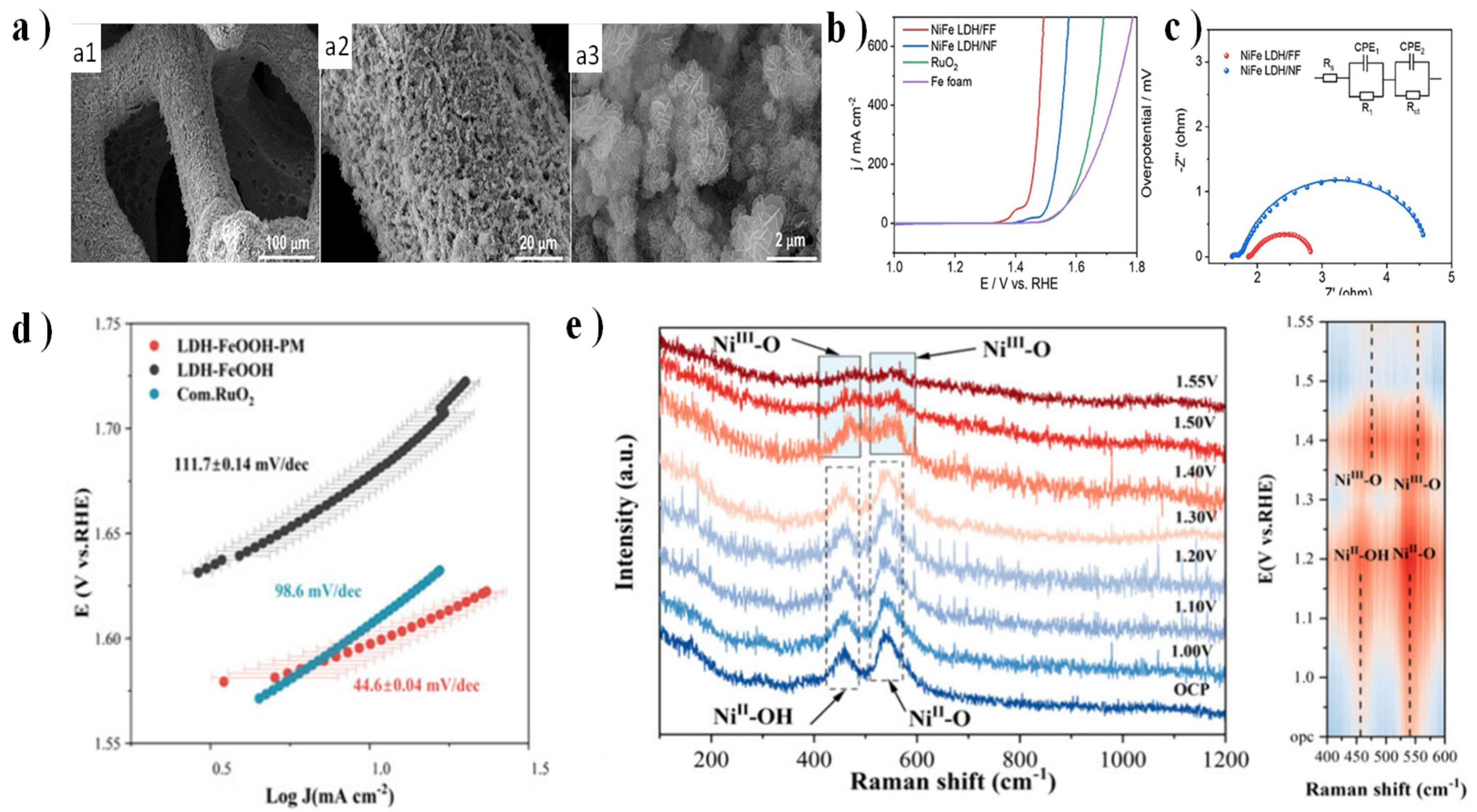
Figure 1. (a) SEM image of NiFe LDH/FF with different magnification (a1) Low-magnification overview (scale bar: 100 µm); (a2) Medium-magnification view showing surface morphology (scale bar: 20 µm); (a3) High-magnification image detailing the nanostructure (scale bar: 2 µm); (b) LSV curves of OER in 1.0 M KOH; (c) Nyquist curves of NiFe LDH/FF and NiFe LDH/NF [81]; (d) Tafel slope of OER; (e) In situ electrochemical Raman spectra of LDH-FeOOH with PM, respectively [82].
Catalysts 16 00141 g001
Figure 3. (a) Morphology and crystalline structure of as-prepared NiFe and CoFe LDH nanoplates. TEM images of as-prepared NiFe LDH and CoFe LDH, showing the nanoplatelet morphology. Ex situ WAXS of NiFe LDH (black) and CoFe LDH (red) in dry state including 3D structural models. The hydrotalcite pattern (PDF 00-035-0965) is shown as seen in the reference. In the models, Ni and Co atoms are shown in gray, Fe in blue, oxygen in red, hydrogen in white, and carbon in the carbonate anions in bronze color; (b) linear sweep voltammetry of NiFe LDH (black), CoFe LDH (red), β-Ni(OH)2 (blue), and β-Co (OH)2 (green) at a scan rate of 1 mV s−1 in purified 0.1 M KOH by RDE (1600 rpm). Catalyst loading on GC electrodes: 0.1 mg cm−2; (c) interlayer distances for NiFe LDH obtained by Rietveld refinement. Full and open symbols are used for different phases. The error bars represent the SE provided by Topas [79]; (d) OER free energy diagrams on various catalysts at pH = 13. PDS indicates the potential determining step with the largest thermodynamic energy barrier [93]; Note: The ‘*’ in the diagram indicates that the species (e.g., O, OH, OOH) is adsorbed onto the catalyst surface and represents an intermediate in the oxygen evolution reaction (OER) process; (e) Reaction free energy diagrams for OER on γ-NiOOH, γ-NiFe LDH, and γ-CoFe LDH; the potential limiting steps and the overpotentials are also given [79]; (f) Linear relationship between η and ΔQtot [93].
Catalysts 16 00141 g003
Figure 4. (a) SEM images of NiFe-LDH after activation in the electrolyte, containing 10 mM K3PO4 and EDS elemental mapping of NiFe-LDH after activation in the electrolyte containing 100 mM K3PO4; scale bar: 0.5 μm. (b) Operando Raman spectrum of NiFe-LDH; the electrode performed a CP test in the electrolyte containing 100 mM K3PO4, and the potential ranged from 0.30 to 0.38 V vs. Hg/HgO [81]; (c) Fourier-tranformed magnitudes of Ni/Fe K-edge extended X-ray absorption fine structure (EXAFS) spectra for NiFe LDH-[A]; (d) DFT free energy diagrams for OER-AEM pathway steps [94]; (e) Ni foam as the cathode; note that the electrolyte containing PO43− has a concentration of 10 mM [81]; (f) Operando ATR-IRAS spectra for NiFe LDH-[A] anodes under different polarized potentials; bands from 2900 to 3700 cm−1 are assigned to the O-H stretching mode (νO-H) of interfacial water 46–48. Potentials vs. RHE [94].
Catalysts 16 00141 g004
Figure 5. (a) Schematicre presentation of the NiFe-LDH catalyst synthesis using the nucleophilic attack of chloride over an epoxide ring to obtain a homogeneous alkalinization that allows the room temperature (RT) and atmospheric pressure synthesis of NiFe-LDH (the so-called epoxide route) regardless of the action volume used; (b) ABF and HAADF images (same scale bar) of the RT-NiFe-LDH and HT-NiFe-LDH. (c) Mössbauer spectra of the compound measured at 295 K and 4 K. (d) Mössbauer spectra taken at 4 K. (e) Linear sweep voltammetry at 5 mV s−1 in 1 M KOH over glassy carbon rotating disk electrode at RT and 1200 rpm after 30 activation cycles (50 mV s−1). (f) Inset: scanning electron microscopy (SEM) (scale bar: 1 µm) and transmission electron microscopy (TEM) (scale bar: 100 nm) inspection of the samples. (g) Polarization curves are always plotted as the mean value from three independent repetitions for each measurement, whereas error bars show the respective standard deviation [96].
Catalysts 16 00141 g005
Figure 6. (a) SEM images of NiFe-LDH@NF-2 (a1) Low-magnification view showing the overall morphology (scale bar: 30 µm); (a2) Higher-magnification image revealing the surface texture (scale bar: 1 µm); (a3) Detailed nanostructure at higher resolution (scale bar: 500 nm) [97]. (b) LSV curves and the enlarged curves of oxidation peaks [98]. (c) NiFe-LDH@NF during the OER process, respectively [97]. (d) Chronopotentiometry curves at 1000 mA cm−2. (e) Charge density difference plots and the corresponding Bader charge numbers (the yellow and blue represent electron accumulation and depletion, respectively); (f) Ni 2p XPS spectra [98].
Catalysts 16 00141 g006
Figure 7. (a) Diagram of the preparation process of NiFe-SQ/NF-R; (b) SEM images of NiFe-SQ/NF-R; AC-TEM image of NiFe-SQ/NF-R. The corresponding autocorrelated lattice fringe pattern of NiOOH(Sq2−) (1 0 5). (b) The change in interface pH with the test time; (c) contour plots of ATR-FTIR data of NiFe-SQ/NF after different CV scan cycles; (d) in situ Raman spectra of NiFe-SQ/NF for water structures. Source data are provided as a Source Data file. (e) The change in interface pH with the test time. (f) Gibbs free energy diagrams of Fe-NiOOH(Sq2−) (NiFe-SQ/NF-R) and Fe-NiOOH (NiFe-LDH/NF-R) at the Ni-O-Fe-O-Ni sites and Ni-O-Ni-O-Ni sites; Note: The ‘*’ in the diagram indicates that the species (e.g., O, OH, OOH) is adsorbed onto the catalyst surface and represents an intermediate in the oxygen evolution reaction (OER) process. (g) in situ Raman spectra of NiFe-SQ/NF [99].
Catalysts 16 00141 g007
Table 1. Catalytic performance of anion-doped transition metal layered double hydroxides in OER.
CatalystElectrolyteη10 (mV)Anionic Mode of ActionStabilityAnionRef.
NiFe LDH0.1 M KOH348Intercalation/NO3[79]
CoFe LDH0.1 M KOH404
NiFe-LDH1.0 M KOH + 10 mM K3PO4330Electrolyte Additive100 h@
400 mA cm−2
PO43−[81]
NiFe-LDH-[PO43−]1.0 M KOH + seawater260Intercalation>1000 h@1.0 A cm−2[94]
NiFe-P/NF1 M KOH + 0.5 M NaCl248@100 mA cm−2>60 h@
100 mA cm−2
[100]
1 M KOH + seawater298@100 mA cm−2/
R-PO4-NiCoFeOOH1 M KOH230@100 mA cm−2Induced Deep Reconstruction>1500 h@100 mA cm−2[101]
1.0 M KOH + seawater258@100 mA cm−2/
NiFe LDH1.0 M KOH + 0.5 M NaCl310Structure-Directing Agent/CL[95]
RT-NiFe-LDH1.0 M KOH290100 h@
1 A cm−2
[96]
NiFe-LDH@NF-21.0 M KOH208@100 mA cm−2Intercalation6 h@500 mA cm−2F[97]
F-NiFe-LDH-51.0 M KOH + 0.5 M NaCl306@500 mA cm−2Isomorphous substitution>1000 h @1000
mA cm−2
[102]
NiFe-LDH/NF-81.0 M KOH225@50 mA cm−2Morphogenesis Regulation62 h@100 mA cm−2[103]
239@100 mA cm−2
NiFe-SQ/NF-R1.0 M KOH220Intercalation>700@
3.0 A cm−2
Sq2−[99]
NiFe-LDH/NF-R1.0 M KOH250/65@3.0 A cm−2/
Table 2. Strategies for engineering LDH-based catalysts: from anion doping to heterojunction design for efficient HER and overall hydrolysis.
CatalystElectrolyteHERStabilityIonRef.
η10 (mV)Tafel Slope (mV dec−1)
Pt@S-NiFe LDHs1.0 M KOH71 mV @ 100 mA cm−2571200 h@100 mA cm−2S2−[104]
NiCoS@NiCo-LDH/NF1.0 M KOH9983.924 h@15 mA cm−2[105]
La-NiFe LDH-31.0 M KOH5773.712 h@75 mA cm−2La3+[106]
CoP@NiFe LDH/Ni1.0 M KOH260 mV @ 400 mA cm−271.860 h@400 mA cm−2P3−[107]
NiFe LDH/NiS2/VS21.0 M KOH767924 h@10 mA cm−2V2+/V4+[108]
CatalystElectrolyteWater SplittingStabilityIonRef.
HEROER
η10 (mV)Tafel Slope (mV dec−1)η10 (mV)Tafel Slope (mV dec−1)
Ni/NiFe LDH1.0 M KOH36103103.5103.572 h@10 mA cm−2/[109]
FeCoNiP@FeNi-LDH/CuO 1.0 M KOH147@100 mA cm−246.7535330 h@10 mA cm−2P3−[110]
NiCo@NiFe-LDH150/NF1.0 M KOH161/50.650.6200 h@20/200 mA cm−2Co2+/3+[111]
Ni07Fe03P/LDH/GO1.0 M KOH7961198/50 h@10 mA cm−2/[112]
NiFe-LDH@CoP-Ni5P41.0 M KOH4892.117938.4100 h@200 mA cm−2Co3+[113]
NiFe-LDH@NiMo-H2/NF1.0 M KOH2635.617248400 h@500 mA cm−2Mo4+[114]
Disclaimer/Publisher’s Note: The statements, opinions and data contained in all publications are solely those of the individual author(s) and contributor(s) and not of MDPI and/or the editor(s). MDPI and/or the editor(s) disclaim responsibility for any injury to people or property resulting from any ideas, methods, instructions or products referred to in the content.