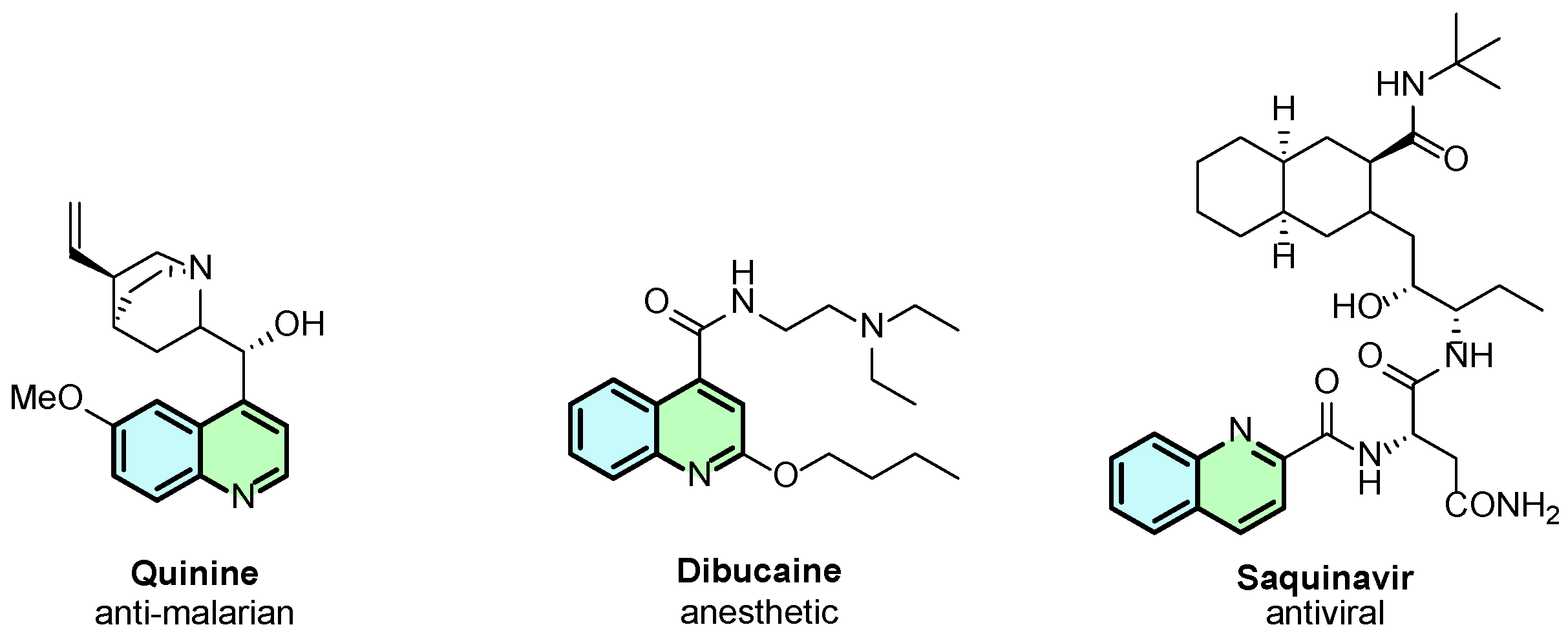
To provide a coherent and comparative overview of the most relevant advances in the field, the studies selected in this review are grouped according to the substitution pattern of the quinoline scaffold obtained. This classification allows for a clearer analysis of the synthetic strategies employed for each structural type, highlighting both general trends and specific methodological innovations associated with each substitution motif.
2.1. 2-Arylquinolines
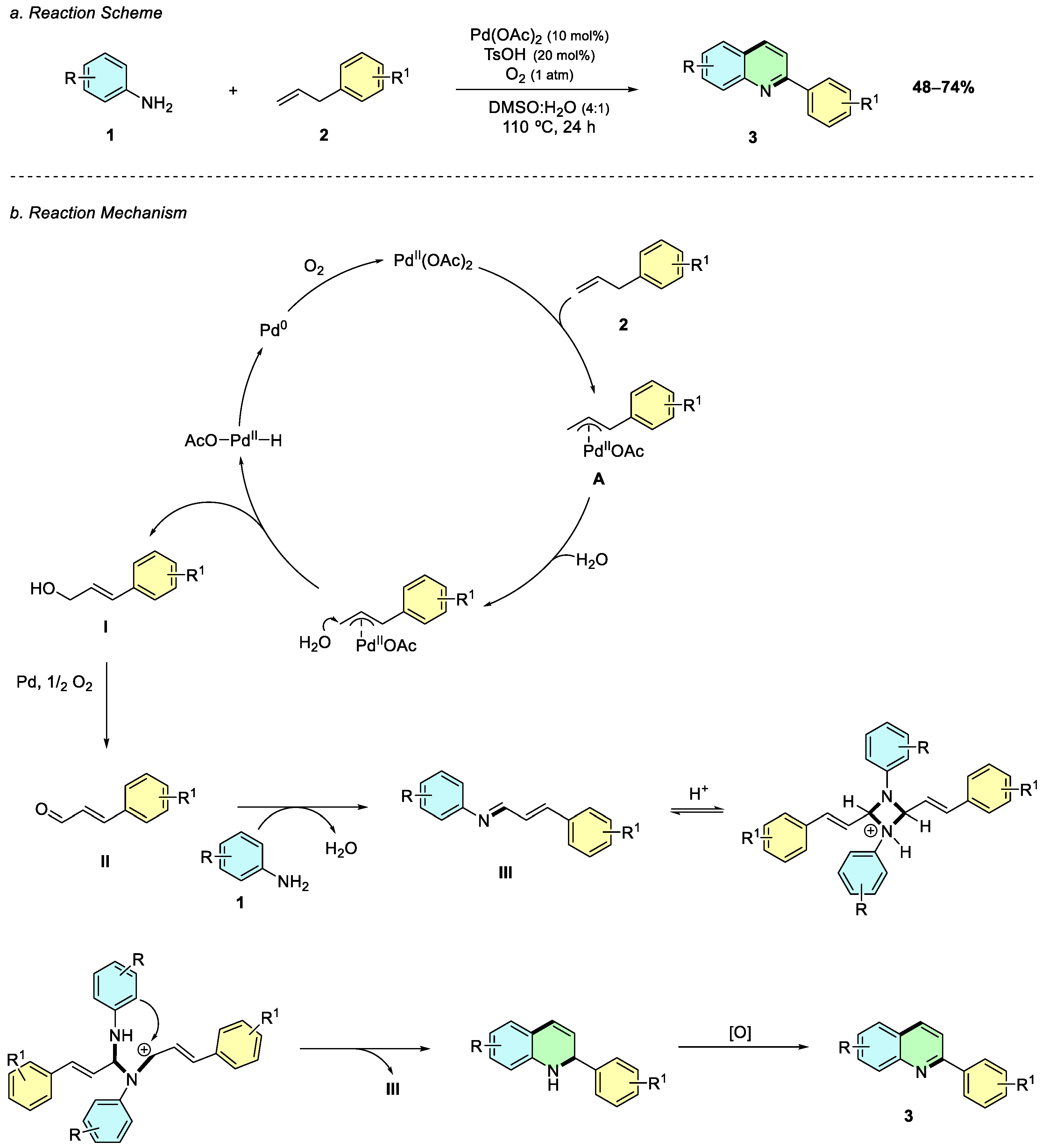
In 2016, Li et al. reported a palladium(II)-catalyzed oxidative annulation for the synthesis of 2-substituted quinolines
3 from anilines
1 and allylbenzenes
2 (
Scheme 1a) [
6]. The optimized reaction conditions employed Pd(OAc)
2 (10 mol%) as the catalyst, TsOH (20 mol%) as an additive, and DMSO as the solvent under an oxygen atmosphere in the presence of water at 110 °C for 24 h.
Mechanistically, the process initiates with palladium-mediated allylic C–H activation of allylarene
2, forming the π-allyl-palladium complex
A, followed by the nucleophilic addition of water to generate cinnamic alcohol
I (
Scheme 1b). This molecule undergoes oxidation to cinnamaldehyde
II, which reacts with aniline
1 to yield an imine intermediate
III. A final cyclization and oxidative aromatization step afford the quinoline product
3, with Pd(0) being reoxidized to Pd(II) by molecular oxygen.
The methodology exhibits a broad substrate scope, tolerating electron-donating (Me, OMe, tBu) and electron-withdrawing (F, Cl, Br, CF3, CN) groups on anilines. Various allylbenzenes successfully undergo annulation, though more functionalized derivatives such as pentafluorobenzene-, indole-, and pentyl-substituted fail to yield the desired products. The process demonstrates high atom economy, using molecular oxygen as the sole oxidant and represents a practical and environmentally friendly alternative for quinoline synthesis.
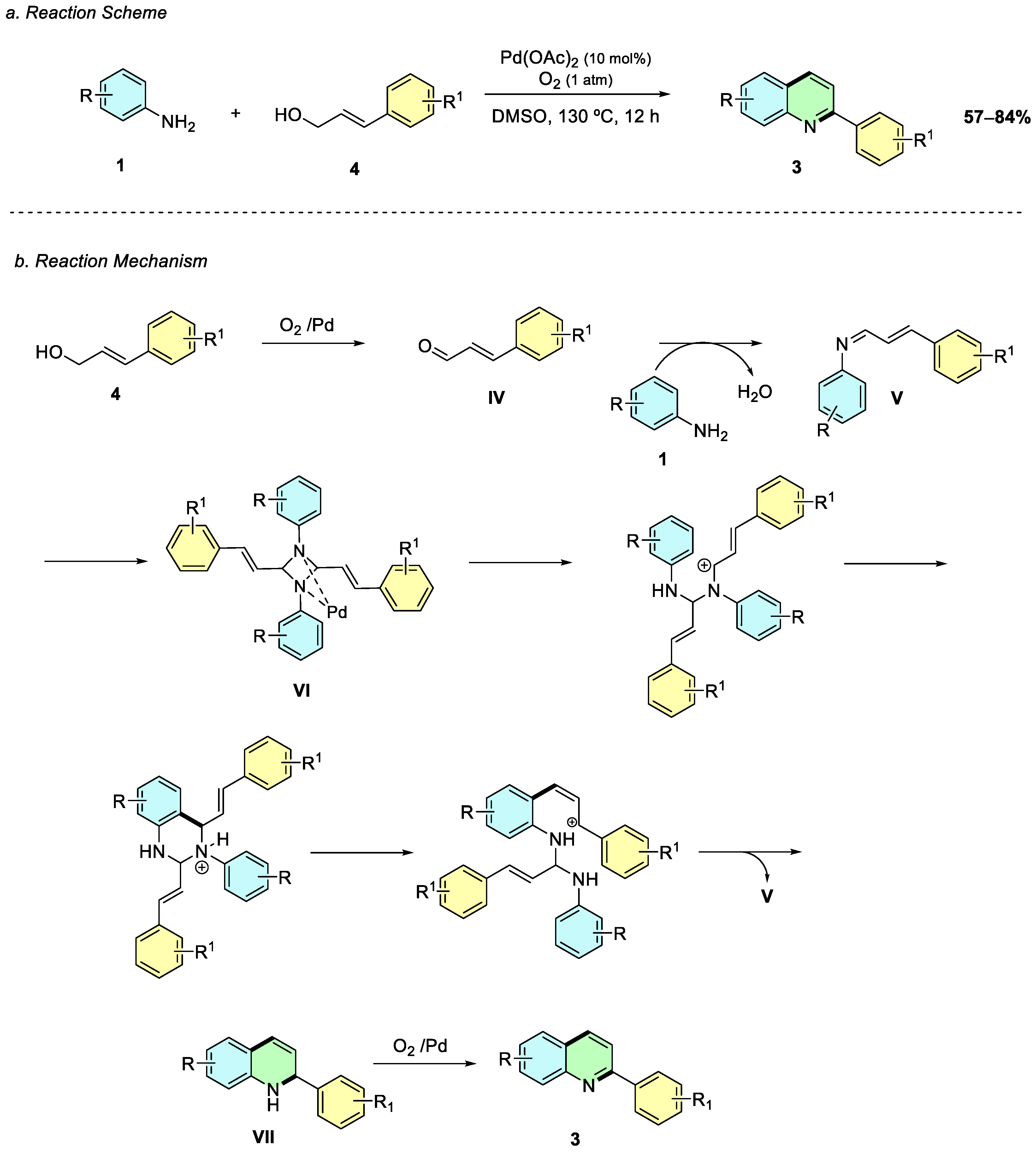
In 2017, Xu et al. reported a palladium-catalyzed oxidative cyclization of anilines
1 with allyl alcohols
4 for the synthesis of quinolines
3, operating without acids, bases, ligands, or additional additives under aerobic conditions (
Scheme 2a) [
7]. Using Pd(OAc)
2 (10 mol%) in DMSO at 130 °C under O
2 (1 atm) for 12 h, the protocol enabled the direct formation of 2-arylquinolines from cinnamyl alcohol derivatives and anilines.
Mechanistically, the reaction proceeds via in situ oxidation of the allyl alcohol
4 to cinnamaldehyde
IV, which condenses with the aniline
1 to form the imine intermediate
V (
Scheme 2b). Palladium then facilitates the dimerization to the diazetidine species
VI, which undergoes C–N cleavage and rearrangement to a cyclic intermediate, followed by intramolecular nucleophilic attack and elimination to afford the dihydroquinoline intermediate
VII, which is aromatized under oxidative conditions to yield the quinoline scaffold
3.
The substrate scope is broad: para-, meta-, and ortho-substituted anilines, including electron-donating and electron-withdrawing groups, afford moderate to excellent yields. For meta-substituted anilines, regioisomeric mixtures are observed due to multiple reactive positions, while ortho-substituted anilines yield single regioisomers efficiently. Various cinnamyl alcohol derivatives are tolerated, including electron-rich, electron-poor, and heteroaryl substrates, and aryl bromides are retained for further functionalization. This operationally simple, scalable, and green approach complements classical methods, providing an efficient pathway to biologically relevant 2-arylquinolines using molecular oxygen as the sole oxidant.
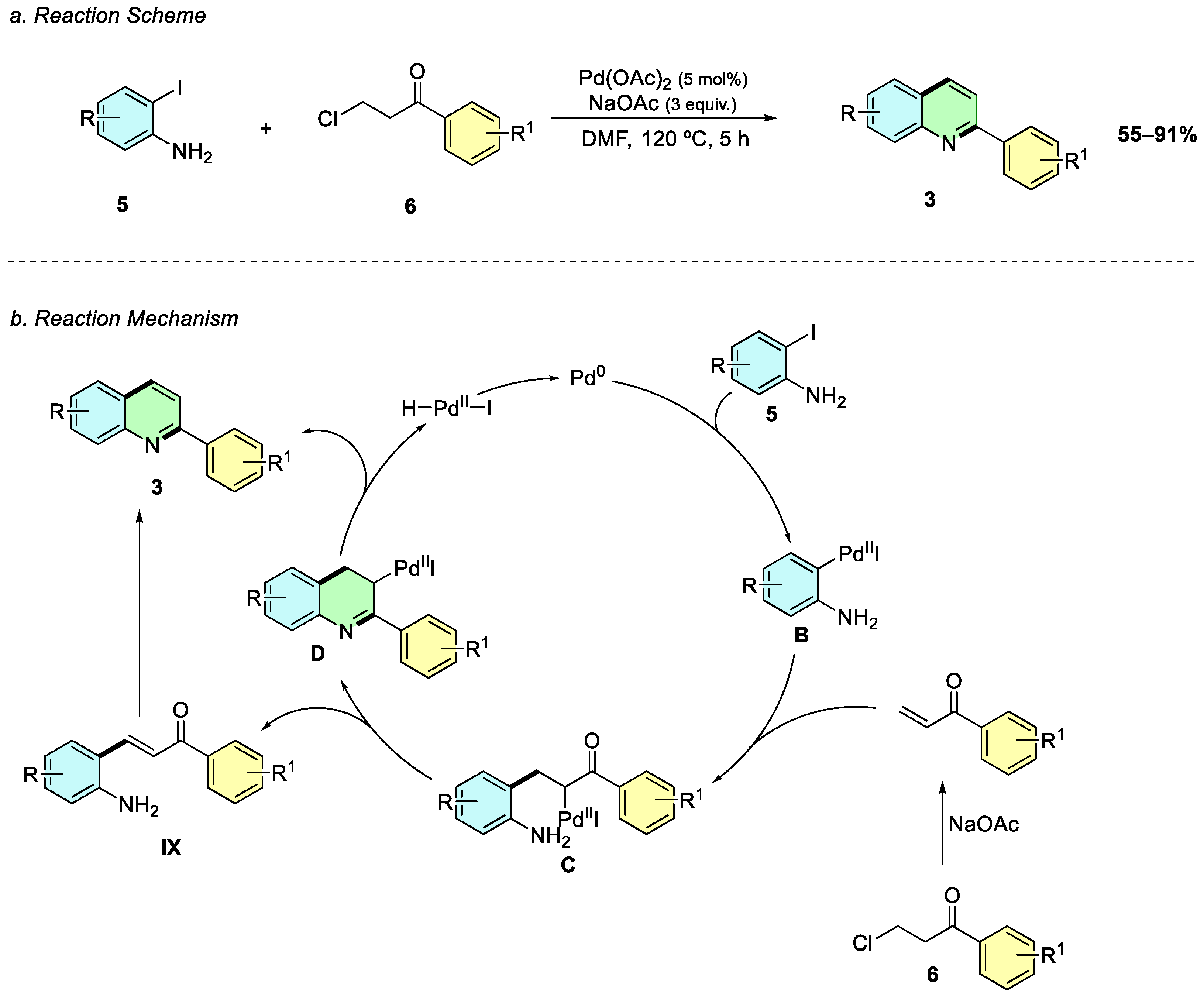
Yoon and Cheon (2019) introduced a novel Pd(II)-catalyzed cascade reaction enabling the regioselective synthesis of 2-arylquinolines
3 from 2-iodoanilines
5 and β-chloropropiophenones
6 (
Scheme 3a) [
8]. The optimized reaction conditions involve Pd(OAc)
2 (5 mol%) as the catalyst, NaOAc (3.0 equiv.) as a base, and DMF as the solvent at 120 °C for 5 h.
Mechanistically, the reaction follows an oxidative addition of the 2-iodoaniline
5 to Pd(0), generating the Pd(II) intermediate
B (
Scheme 3b). This species undergoes carbopalladation with the in situ-formed acrylophenone
VIII, forming the Pd(II) enolate
C. The system then follows two possible pathways: (i) direct condensation between the amino and carbonyl groups, leading to cyclization (intermediate
D) and subsequent β-hydride elimination to yield the quinoline
3, or (ii) β-hydride elimination forming a 2-aminochalcone
IX, which undergoes palladium-catalyzed dehydrative cyclization to afford the quinoline product
3.
The reaction displays broad substrate scope, tolerating electron-donating (-Me, -OMe) and electron-withdrawing (-F, -Cl, -NO2, -CF3) groups on both coupling partners. However, 6-substituted 2-iodoanilines fail to give quinolines, leading instead to Heck-type by-products. Additionally, β-chloropropiophenones with electron-rich aryl groups provide higher yields than those with electron-deficient substituents.
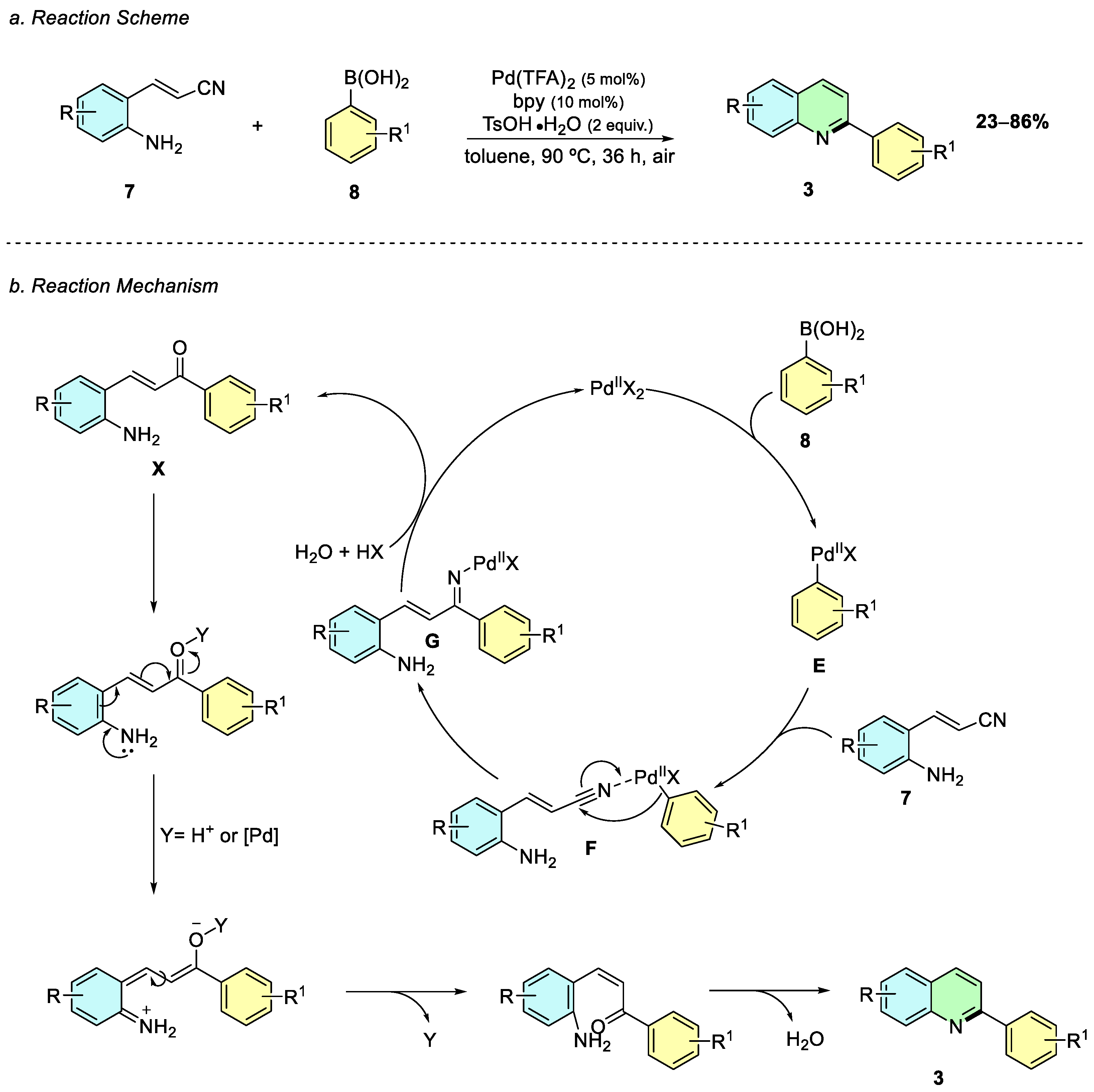
In 2019, Xu et al. reported a palladium-catalyzed tandem reaction between 2-aminostyryl nitriles
7 and arylboronic acids
8 for the synthesis of 2-arylquinolines
3 (
Scheme 4a) [
9]. The reaction proceeds under optimized conditions using Pd(CF
3COO)
2 (5 mol%), 2,2’-bipyridine (10 mol%) and TsOH·H
2O (2 equiv.) in toluene at 90 °C for 36 h.
The mechanism of the reaction initiates with the formation of the aryl-palladium complex
E via transmetalation, followed by carbopalladation of the nitrile (
F) to generate the ketimine-palladium intermediate
G (
Scheme 4b). Hydrolysis leads to the formation of the aminoketone
X, which subsequently undergoes acid-promoted intramolecular cyclization and dehydration to yield the quinoline product
3.
The methodology tolerates a broad range of functional groups in the arylboronic moiety, including halogens, alkyl, and electron-withdrawing groups, although steric hindrance at the ortho-position revealed to be fatal to the reaction efficiency.
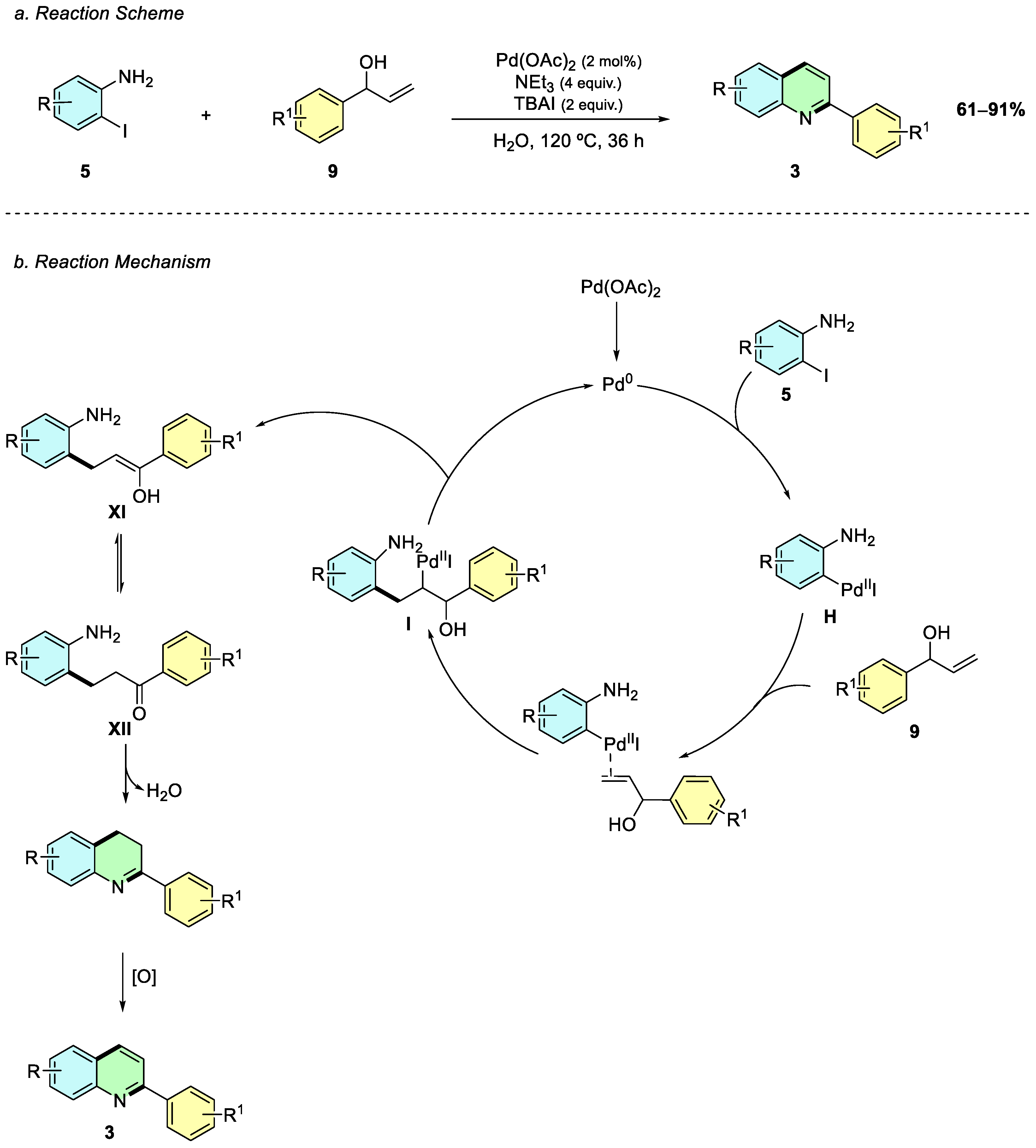
In 2022, Ghora et al. reported a palladium-catalyzed reaction between iodoanilines
5 and aryl allylic alcohols
9 to afford the 2-arylquinoline system
3 (
Scheme 5a) [
10]. The reaction conditions involved Pd(OAc)
2 (2 mol%), NEt
3 (4 equiv.), TBAI (2 equiv.), and, notably, water as a solvent at 120 °C for 36 h.
Mechanistically, this transformation closely resembles the previously covered Yoon and Cheon quinoline synthesis. The mechanism begins with the oxidative addition of 2-iodoaniline
5 to Pd(0), yielding the Pd(II) intermediate
H (
Scheme 5b). This intermediate interacts with the aryl allylic alcohol
9, undergoing a carbopalladation step to afford
I. Subsequent β-hydride elimination produces the enol intermediate
XI, which tautomerizes to the more stable ketone intermediate
XII. Finally, an intramolecular cyclodehydration occurs, followed by oxidation, affording the desired 2-arylquinoline
3.
This methodology is notable for its low catalyst loading (2 mol%) and the use of a green solvent, such as water. Moreover, it demonstrates a broad substrate scope and excellent functional group tolerance, providing an efficient and sustainable route to 2-arylquinoline derivatives.
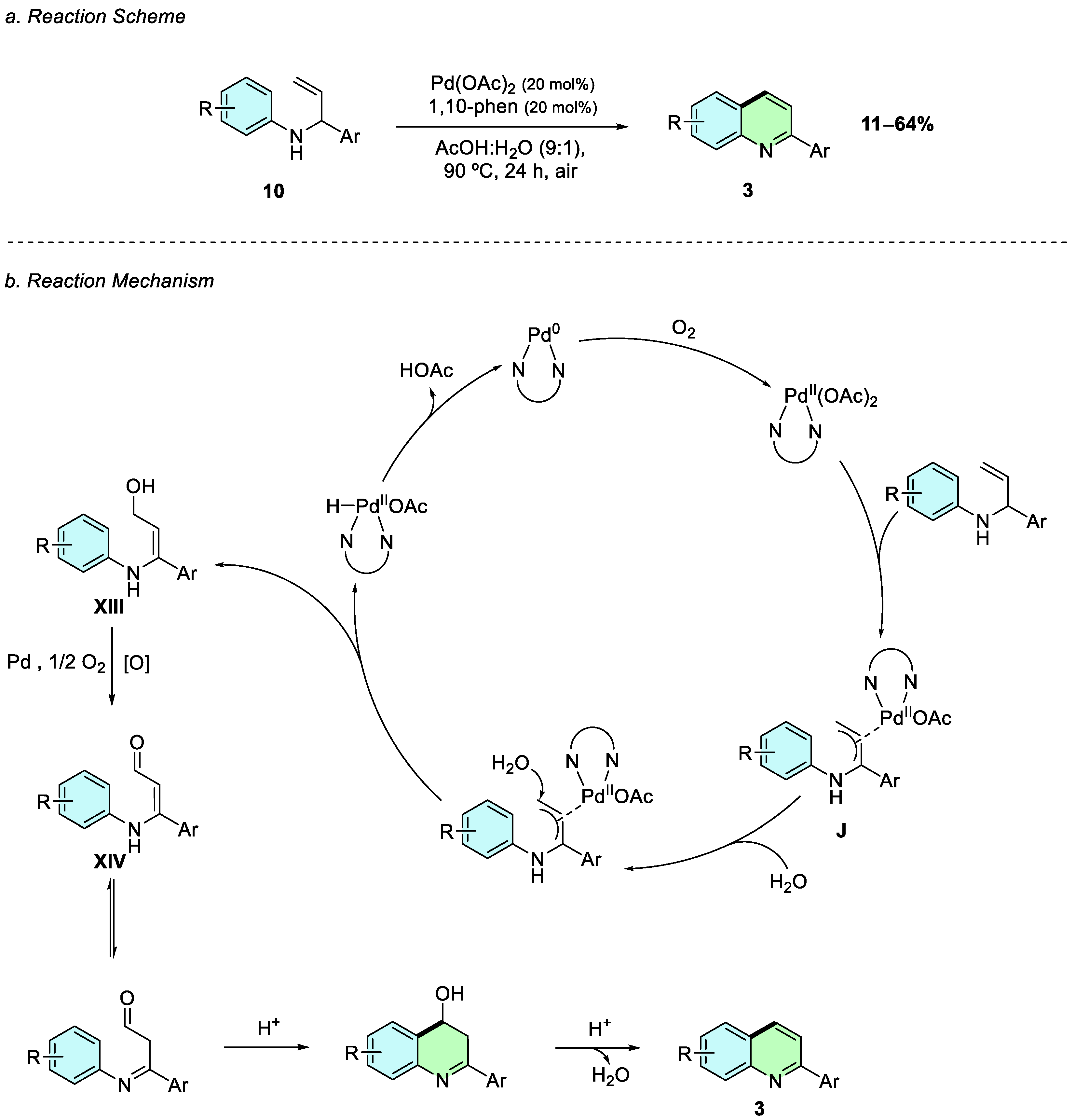
In 2025, Viduedo et al. reported an intramolecular palladium-catalyzed C−H activation reaction of aryl allyl amines
10 for the synthesis of 2-arylquinoline derivatives
3 (
Scheme 6a) [
11]. The optimized reaction conditions involved Pd(OAc)
2 (20 mol%) as the catalyst and 1,10-phenanthroline (20 mol%) as the ligand in a 9:1 mixture of AcOH and water at 90 °C for 24 h.
The proposed reaction mechanism proceeds via initial coordination of the Pd(OAc)
2/1,10-phenanthroline complex to the C=C bond of
10, forming a π-allyl-palladium intermediate
J (
Scheme 6b). Nucleophilic attack by water on this activated intermediate produces intermediate
XIII and a palladium hydride species.
XIII is then oxidized under oxygen (air atm) and palladium to form the corresponding aldehyde
XIV, which subsequently undergoes electrophilic aromatic substitution, followed by elimination, to yield the final 2-arylquinoline product
3.
This protocol is notable for its green chemistry approach, employing oxygen from air as the terminal oxidant, using acetic acid and water as the solvent system, and operating under mild conditions (90 °C). The reaction displayed excellent regioselectivity and moderate functional group tolerance. Substrates bearing electron-donating groups such as –OMe, –SMe, and –(OMe)3 afforded the products in moderate to good yields (55–60%), while electron-withdrawing substituents like –Cl and –CF3 led to poorer yields. Fused and nitrogen-containing analogs, including benzo[f]quinoline and 1,5-naphthyridine, were obtained in modest yields (35–36%), whereas heteroaryl and strongly deactivated substrates (e.g., furanyl, imidazolyl, 3,4-dimethoxyphenyl) showed poor or no reactivity.
Among the methodologies reported for the synthesis of 2-arylquinolines (
Table 1), palladium(II)-based catalytic systems clearly dominate, with Pd(OAc)
2 emerging as the most frequently employed catalyst. In most cases, the reactions proceed efficiently in the absence of added ligands; when ligands are required, they are predominantly simple nitrogen-based systems, highlighting the intrinsic reactivity and versatility of Pd(II) species in these transformations.
Oxidative annulation approaches typically employ non-prefunctionalized anilines as the nitrogen source, which constitutes an attractive feature from a step-economy and operational simplicity standpoint. However, despite these advantages, such methods generally afford moderate to good yields and, in some cases, display a narrower efficiency window depending on the nature of the coupling partner. In contrast, catalytic annulation strategies rely on prefunctionalized nitrogen sources, most notably 2-iodoanilines, which enable a more controlled catalytic cycle and consistently deliver higher yields, reaching up to 91%. These methods often benefit from the presence of suitable bases or additives, such as acetates or halide salts, which facilitate key steps of the catalytic process and enhance overall robustness.
Collectively, these observations underscore the balance between synthetic simplicity and performance in palladium-catalyzed routes to 2-arylquinolines, with substrate prefunctionalization and reaction additives emerging as critical parameters for method optimization.
2.2. 4-Substituted Quinolines
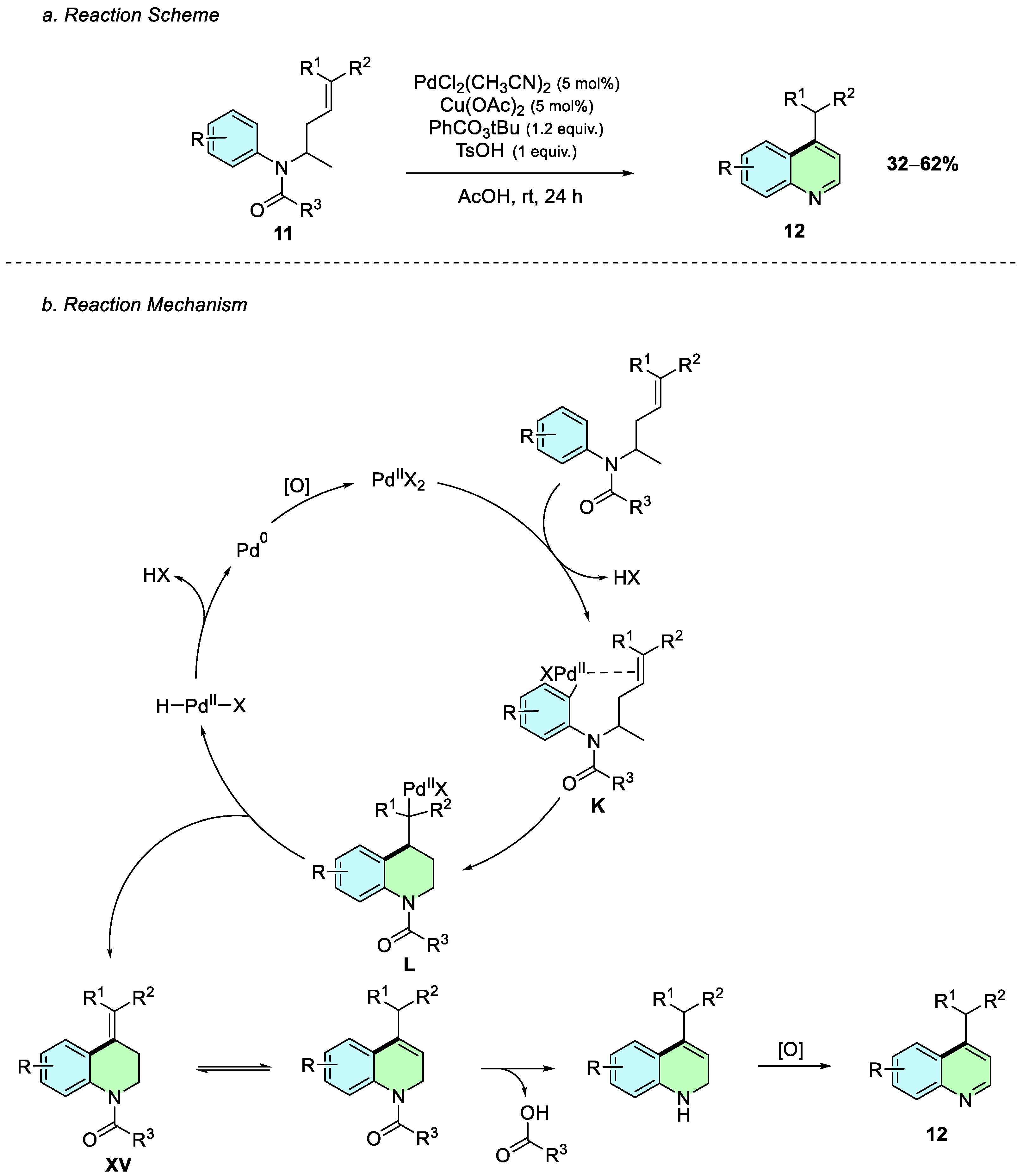
In 2017, Carral-Menoyo et al. reported a palladium-catalyzed intramolecular C−H alkenylation reaction of
N-buten-3-ylanilines
11 for the synthesis of 4-substituted quinolines
12 (
Scheme 7a) [
12]. The reaction procedure involves the use of PdCl
2(CH
3CN)
2 as catalyst, Cu(OAc)
2 and PhCO
3tBu as oxidants, and TsOH as an additive in acetic acid at room temperature for 24 h.
The reaction mechanism begins with the formation of an aryl-palladium(II) intermediate
K (
Scheme 7b). Several mechanisms could explain its formation; however, the presence of electron-donating amide or carbamate substituents on the aromatic ring suggests that it likely forms via an electrophilic palladation step. This is followed by a 6-
exo-
trig carbopalladation cyclization yielding intermediate
L. Subsequent β-hydride elimination regenerates Pd(0), which is reoxidized to Pd(II), while intermediate
XV is formed. This compound undergoes double-bond isomerization, followed by removal of the carbonyl moiety, and subsequent rearomatization, affording the desired 4-substituted product
29.
The methodology tolerated various electron-withdrawing R1 and R2 groups on the alkene in moderate to good yields. However, phenylsulfonyl derivatives showed satisfactory reactivity only when the oxidant was replaced with N-fluoro-2,4,6-trimethylpyridinium triflate and the reaction was conducted at 70 °C. The nature of the N-substituent R3 also influenced the outcome, with carbamates consistently displaying superior yields compared to amides.
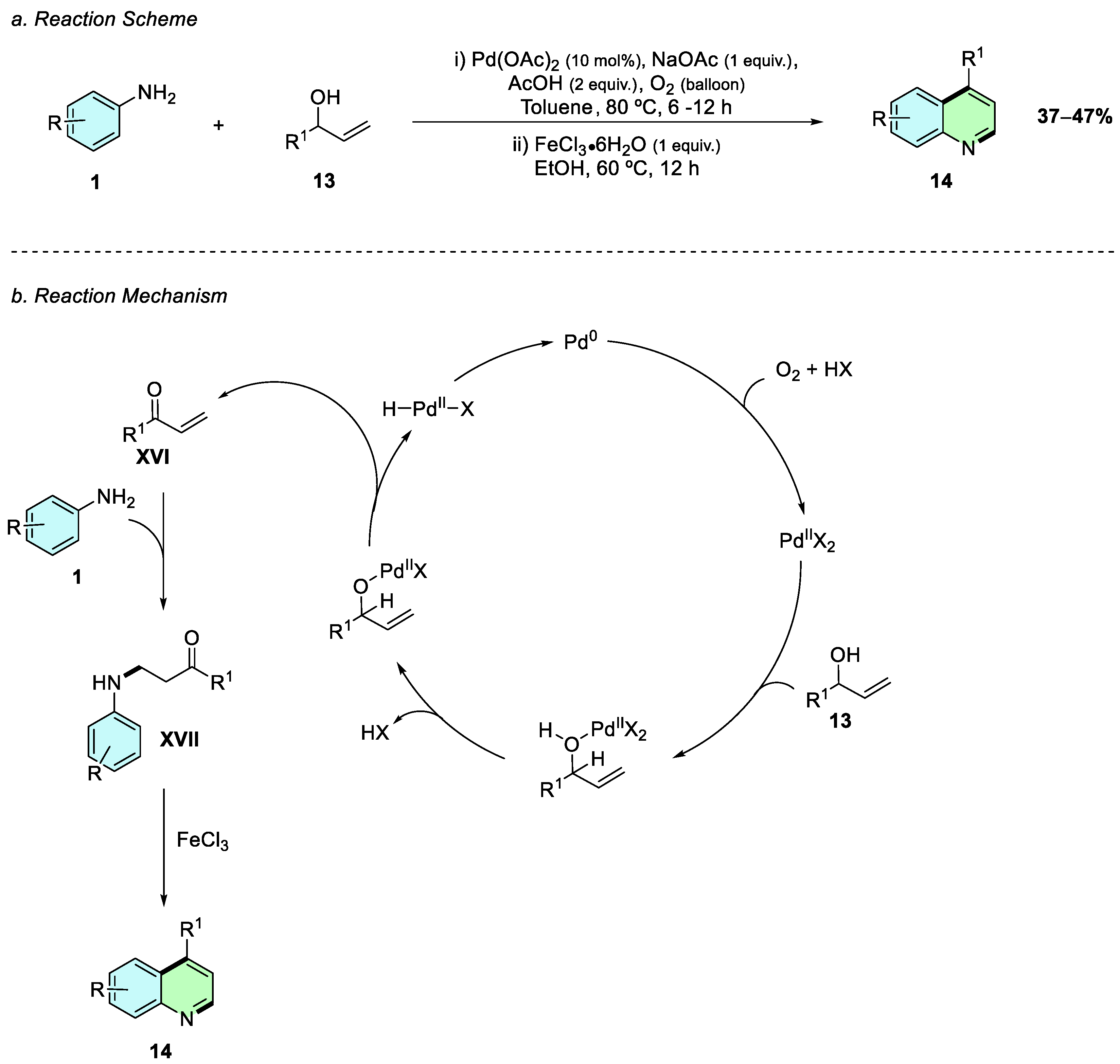
In 2018, Kumar et al. reported a Pd(II)-catalyzed aerobic oxidative coupling of anilines
1 with allylic alcohols
13, followed by a Lewis acid-mediated annulation to synthesize 4-substituted quinolines
14 in a one-pot domino protocol (
Scheme 8a) [
13]. The optimized conditions involved Pd(OAc)
2 (10 mol%), NaOAc (1 equiv.), and AcOH (2 equiv.) in toluene under O
2 (balloon) at 80 °C for 6–12 h, followed by FeCl
3·6H
2O (1 equiv.) in EtOH at 60 °C for 12 h to effect cyclization.
Mechanistically, the allylic alcohol
13 is first oxidized in situ to the enone
XVI, followed by the aza-Michael addition of the aniline
1, forming the β-aminoketone intermediate
XVII (
Scheme 8b). Upon addition of FeCl
3, electrophilic aromatic substitution (SEAr) with the aryl ring occurs, followed by dehydration and rearomatization to yield the 4-substituted quinoline
14.
The methodology tolerates α-naphthyl anilines, delivering benzo[h]quinolines in moderate yields, while meta-substituted anilines yield mixtures of regioisomers. Limitations include the tendency of reactive β-aminoketone intermediates to undergo premature cyclization or retro-aza-Michael during isolation, and competitive side reactions in electron-rich anilines. This strategy offers a straightforward entry into 4-substituted quinolines using bench-stable allyl alcohols and molecular oxygen, avoiding the need for preformed enones and demonstrating practical relevance for constructing quinoline derivatives under mild, scalable conditions.
Among the reported approaches for the synthesis of 4-substituted quinolines (
Table 2), both examples rely on Pd(II)-catalyzed oxidative annulation strategies that proceed without the need for prefunctionalized halide substrates. In both cases, external oxidants are required to regenerate the active palladium species, although different nitrogen sources and oxidizing systems are employed. While moderate yields are obtained in both methodologies, the use of
N-buten-3-yl anilines eliminates the need for an additional coupling partner at the expense of increased substrate complexity, whereas the aniline-based approach relies on a simpler nitrogen source but requires a distinct oxidative system.
2.3. 2,3-Disubstituted Quinolines
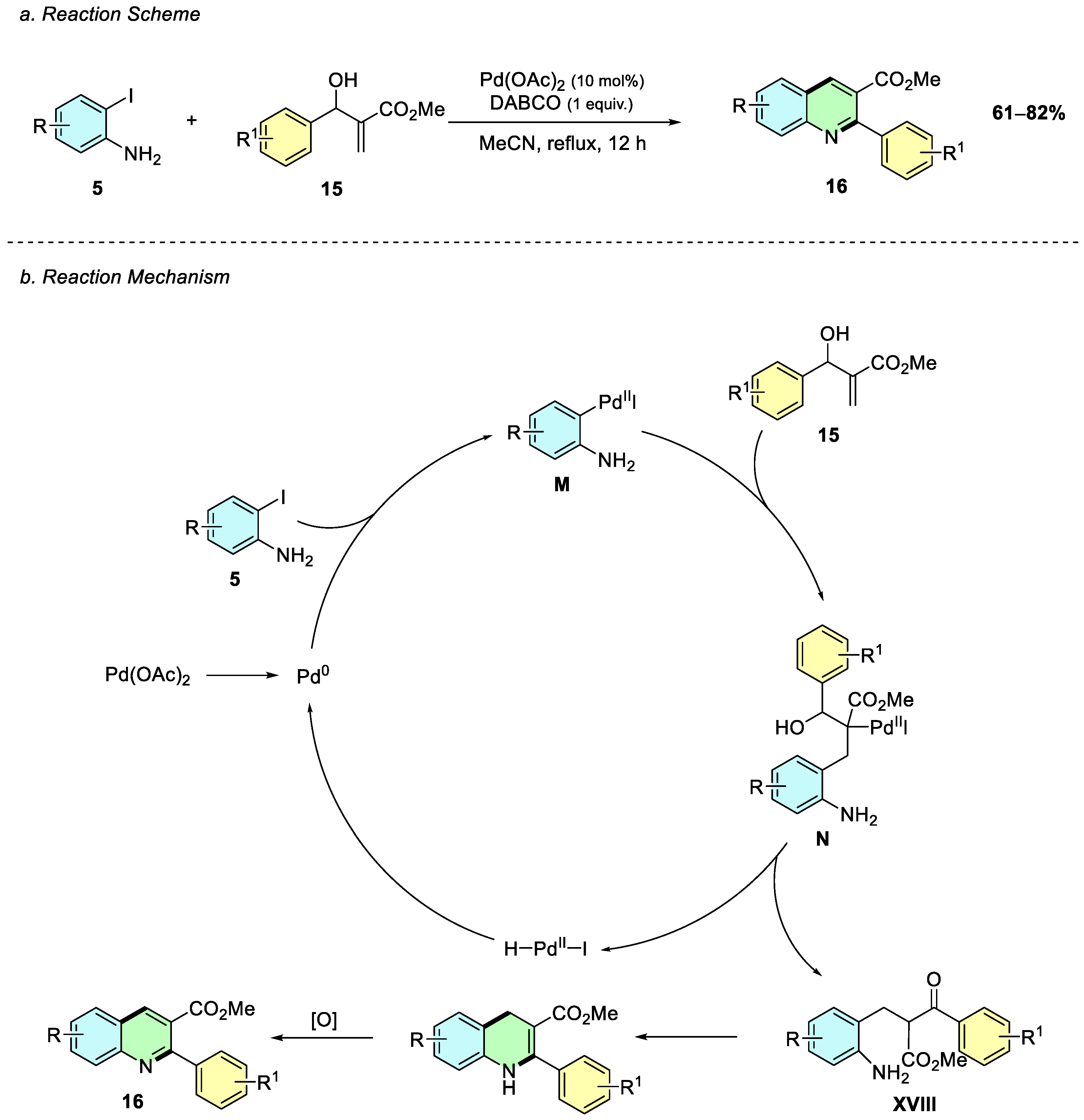
In 2015, K. Selvakumar et al. reported a palladium(II)-catalyzed synthesis of 2,3-disubstituted quinolines
16 from aryl-substituted Morita–Baylis–Hillman (MBH) adducts
15 and iodoanilines
5 (
Scheme 9a) [
14]. The reaction employed Pd(OAc)
2 (10 mol%) and DABCO (1 equiv.) in acetonitrile at reflux for 12 h. In some cases, however, a second DBU-mediated oxidative aromatization step was required, using 1.5 equivalents of DBU in acetonitrile at reflux for 24 h.
Mechanistically, the reaction begins with the oxidative addition of the
in situ generated Pd(0) species into the aryl iodine
5 forming intermediate
M (
Scheme 9b). A Heck-type reaction occurs at MBH alkene forming intermediate
N. A subsequent reductive elimination reaction generates the ketone adduct
XVIII, which after cyclization and oxidation, affords the product
16.
Only MBH adducts were evaluated for substrate scope, with electron-withdrawing substituents generally giving higher yields. Functional groups including nitro, hydroxyl, fluoro, bromo, and pyridine are tolerated, while heteroaryl adducts, such as pyrrole, fail.
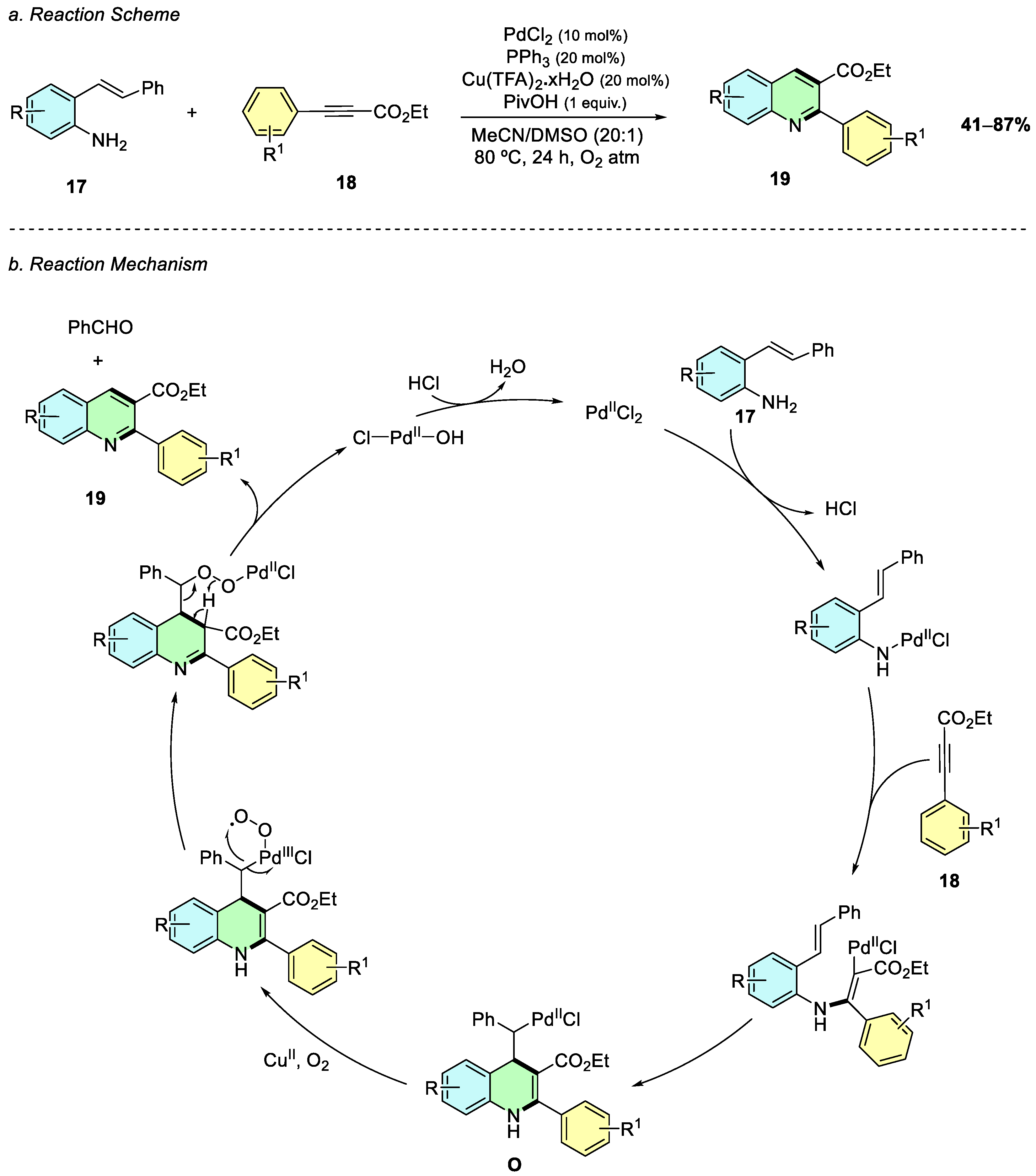
In 2016, Jiang et al. reported a palladium(II)-catalyzed intermolecular aerobic annulation of
o-alkenylanilines
17 and alkynes
18, enabling the efficient synthesis of 2,3-disubstituted quinolines
19 (
Scheme 10a) [
15]. The reaction proceeds in the presence of PdCl
2 (10 mol%), PPh
3 (20 mol%), Cu(TFA)
2·xH
2O (20 mol%), and PivOH (1 equiv.) in a MeCN/DMSO (20:1) solvent system at 80 °C under an oxygen atmosphere.
The proposed mechanism involves an initial palladium-mediated activation of the alkyne
18, followed by amination and alkenyl insertion to generate an alkyl-Pd complex O (
Scheme 10b). Oxidative cleavage of a C–C bond, facilitated by Cu(II)/O
2, leads to aromatization and formation of the quinoline
19.
The method is applicable to diverse o-alkenylanilines, with both electron-donating and electron-withdrawing substituents maintaining good yields. Additionally, functionalized anilines, including those bearing halogens, alkyl, CF3, CN, and ester groups, react well, although aminopyridines show no reactivity for this transformation.
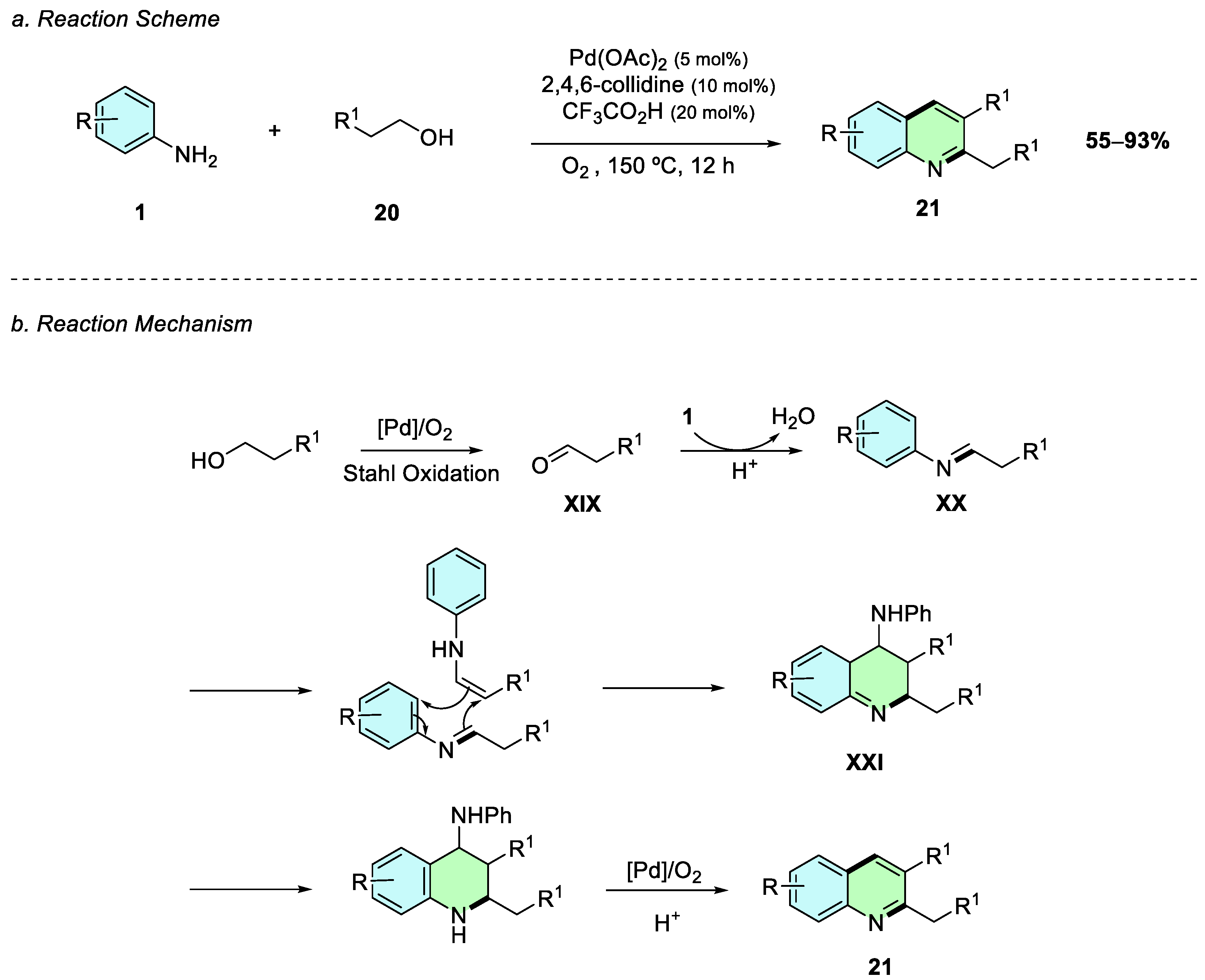
In 2017, Li et al. reported a palladium(II)-catalyzed oxidative aromatization of aliphatic alcohols
20 and anilines
1 affording 2,4-disubstitued quinolines
21 (
Scheme 11a) [
16]. The conditions involved the presence of Pd(OAc)
2 as the catalyst, 2,4,6-collidine as the ligand, and trifluoroacetic acid as an additive. The alcohol
20 acts also as a solvent in this reaction, which proceeds at 150 °C for 2 h.
Regarding the reaction mechanism, Pd(OAc)
2 firstly oxidizes the alcohol
20 to the corresponding aldehyde
XIX via a Stahl-type oxidation (
Scheme 11b).
XIX then condenses with the aniline
1 to form an imine intermediate
XX, which undergoes cycloaddition with its enamine tautomer to yield the intermediate
XXI. Finally, rearomatization, elimination of an aniline molecule, and aerobic oxidation afford the desired 2,3-disubstituted quinoline
21.
The reaction tolerated a broad range of functional groups, with both mono- and disubstituted anilines bearing electron-donating or electron-withdrawing substituents at various positions on the aromatic ring proceeding without significant loss in yield. It was also effective with diverse alcohol substrates, including linear and long-chain alcohols, while 1,3-diols enabled the synthesis of unsubstituted quinolines.
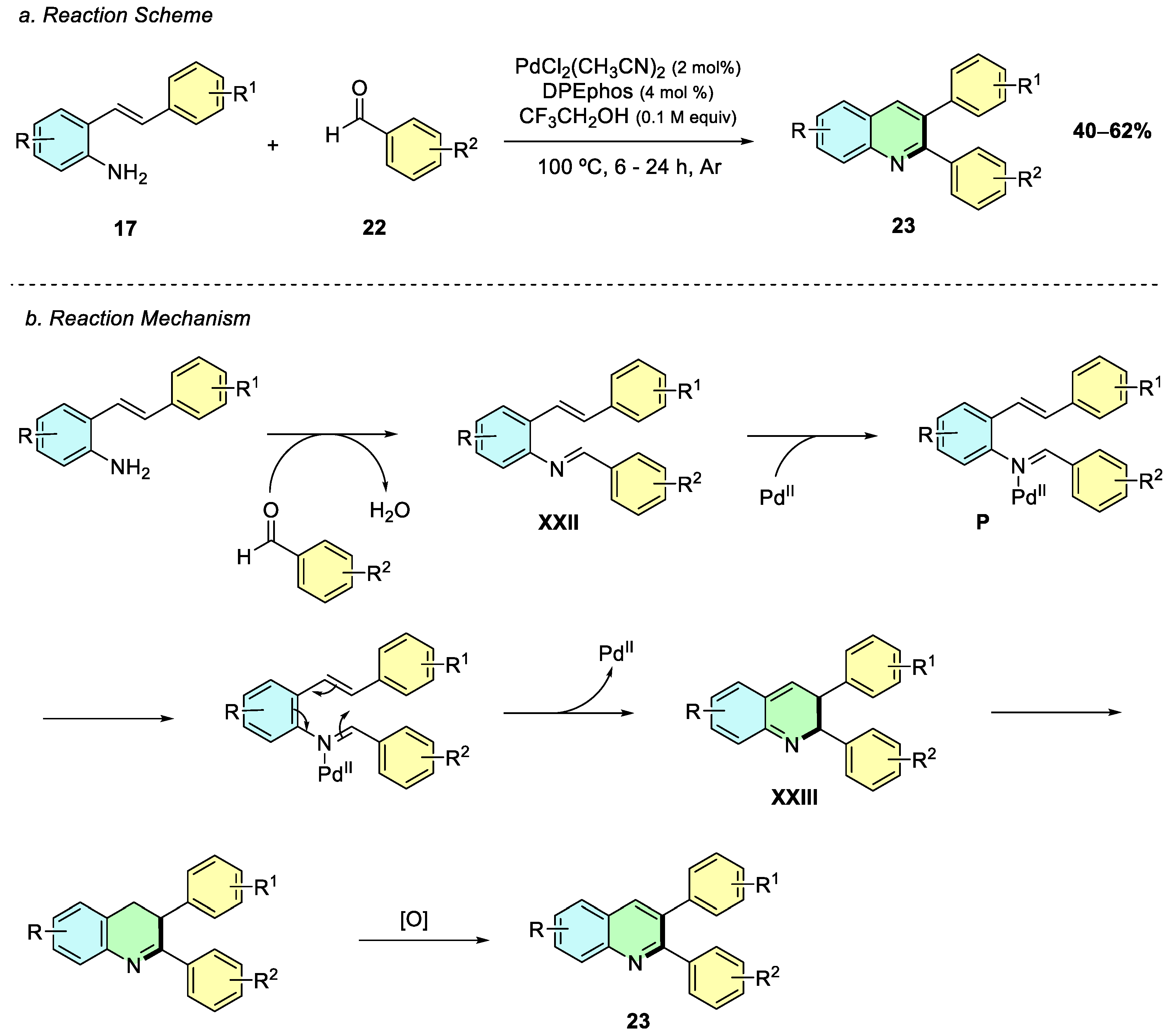
In 2020, Jang et al. developed a palladium(II)-catalyzed synthesis of 2,3-diaryl quinolines
23 from 2-alkenylanilines
17 and aldehydes
22 (
Scheme 12a) [
17]. The reaction conditions involved PdCl
2(PhCN)
2 (2 mol%) and DPEphos (4 mol%) in trifluoroethanol at 100 °C for 6–24 h under argon.
Mechanistically, the reaction begins with a condensation reaction between the 2-alkenylaniline
17 and the aldehyde
22, affording the imine intermediate
XXII (
Scheme 12b). Coordination of the latter to the Pd(II) species affords activated complex
P, which undergoes a 6π-electrocyclic ring-closure, forming the cyclic intermediate
XXIII. Subsequent double-bond isomerization and oxidation of
XXIII affords the quinoline product
23.
A wide variety of aryl aldehydes afforded the desired product in good yields, with functional groups including Me, OMe, CF3, and Cl. However, nitro-substituted aldehydes proved to be unreactive, leading either to no reaction or to the formation of undesired imine intermediates. Similarly, the reaction displayed good versatility with respect to the 2-alkenylaniline component. Various aryl-substituted alkenes underwent efficient transformation to furnish 2,3-diarylquinolines, demonstrating tolerance for both electron-donating and electron-withdrawing substituents on the aromatic ring, thereby highlighting the robustness of the catalytic system.
Across the methodologies summarized in
Table 3 for the synthesis of 2,3-disubstituted quinolines, all reported transformations rely on Pd(II)-based catalytic systems, in line with trends observed for other quinoline scaffolds. A notable diversity is observed in both the nitrogen sources and the coupling partners employed, ranging from prefunctionalized substrates such as 2-iodoaniline and
o-alkenylanilines to simple anilines combined with MBH adducts, alkynes, aliphatic alcohols, or aryl aldehydes. This diversity highlights the broad synthetic flexibility of palladium catalysis in assembling 2,3-disubstituted quinoline frameworks.
Both catalytic and oxidative annulation strategies are represented. Catalytic annulations typically require prefunctionalized nitrogen sources and proceed under ligand-assisted conditions, whereas oxidative annulations avoid halide prefunctionalization but rely on external oxidants and acidic additives. The reported yields span a wide range (40–93%), reflecting the increased structural complexity associated with simultaneous substitution at the 2- and 3-positions. In general, higher efficiencies are achieved when simpler coupling partners are employed, while reactions involving bulkier or more elaborate substrates tend to give more modest yields. As observed in other quinoline-forming methodologies, the choice of ligands, bases, and additives plays a decisive role in governing both reaction efficiency and reproducibility.
2.4. 2,4-Disubstituted Quinolines
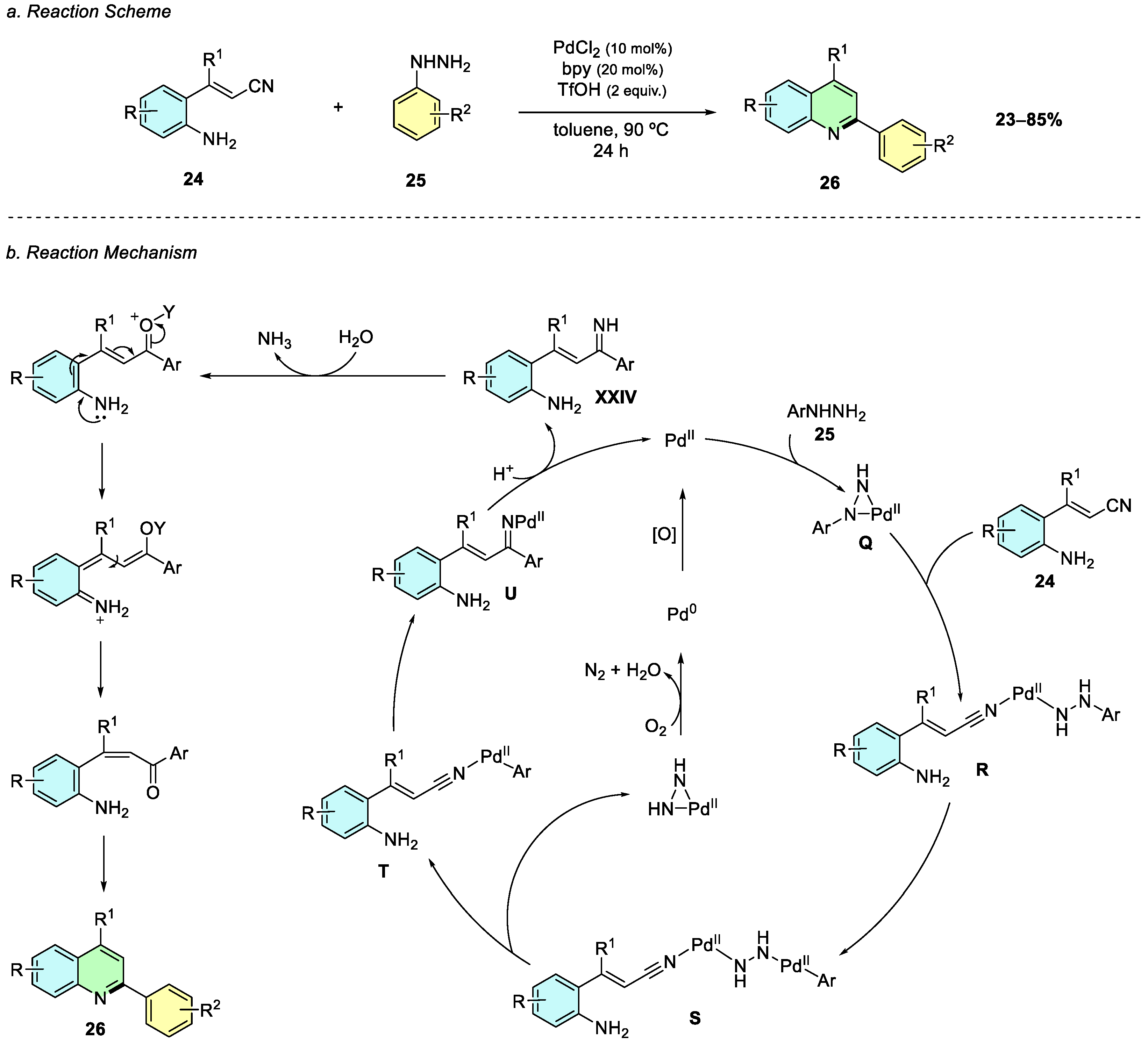
In 2020, Xie et al. reported a Pd(II)-catalyzed reaction of
o-aminocinnamonitriles
24 with arylhydrazines
25, providing 2,4-disubstituted quinoline products
26 (
Scheme 13a) [
18]. The optimal conditions employed PdCl
2 (5 mol%) as the catalyst, bpy (6 mol%) as the ligand, and triflic acid (2 equiv.) in toluene at 90 °C for 24 h.
Mechanistically, the first transformation begins with a metathesis reaction between the palladium catalyst and the arylhydrazine
25, affording a palladiaziridine intermediate
Q (
Scheme 13b). The cyano group of
24 coordinates to this intermediate, leading to ring opening of the palladiaziridine ring to form intermediate
R. Following, an oxidative addition occurs at the C−N bond of the arylhydrazine of
R, yielding intermediate
S. The latter subsequently fragments into two distinct species: one pathway generates a palladiaziridine ring, which becomes oxidized to N
2, reducing Pd(II) to Pd(0) and O
2 to H
2O; and the other pathway forms a palladium center bonded to the aryl fragment of the arylhydrazine, while being coordinated to the cyano group of
24, denominated intermediate
T. A subsequent carbopalladation at the cyano group generates intermediate
U, corresponding to a Pd-imine intermediate. Protonation of this intermediate releases the imine product
XXIV and regenerates the Pd(II) species. The imine then undergoes hydrolysis, double-bond isomerization, and intramolecular cyclization, affording the 2,4-disubstituted quinoline product
26.
In terms of substrate scope, the reaction exhibited good tolerance of aryl and alkyl groups as well as halogen substituents on both substrates, which is synthetically useful for further synthetic derivatization by cross-coupling reactions. However, the presence of strong electron-withdrawing substituents, such as CF3, significantly decreased the reaction yield under the optimized conditions.
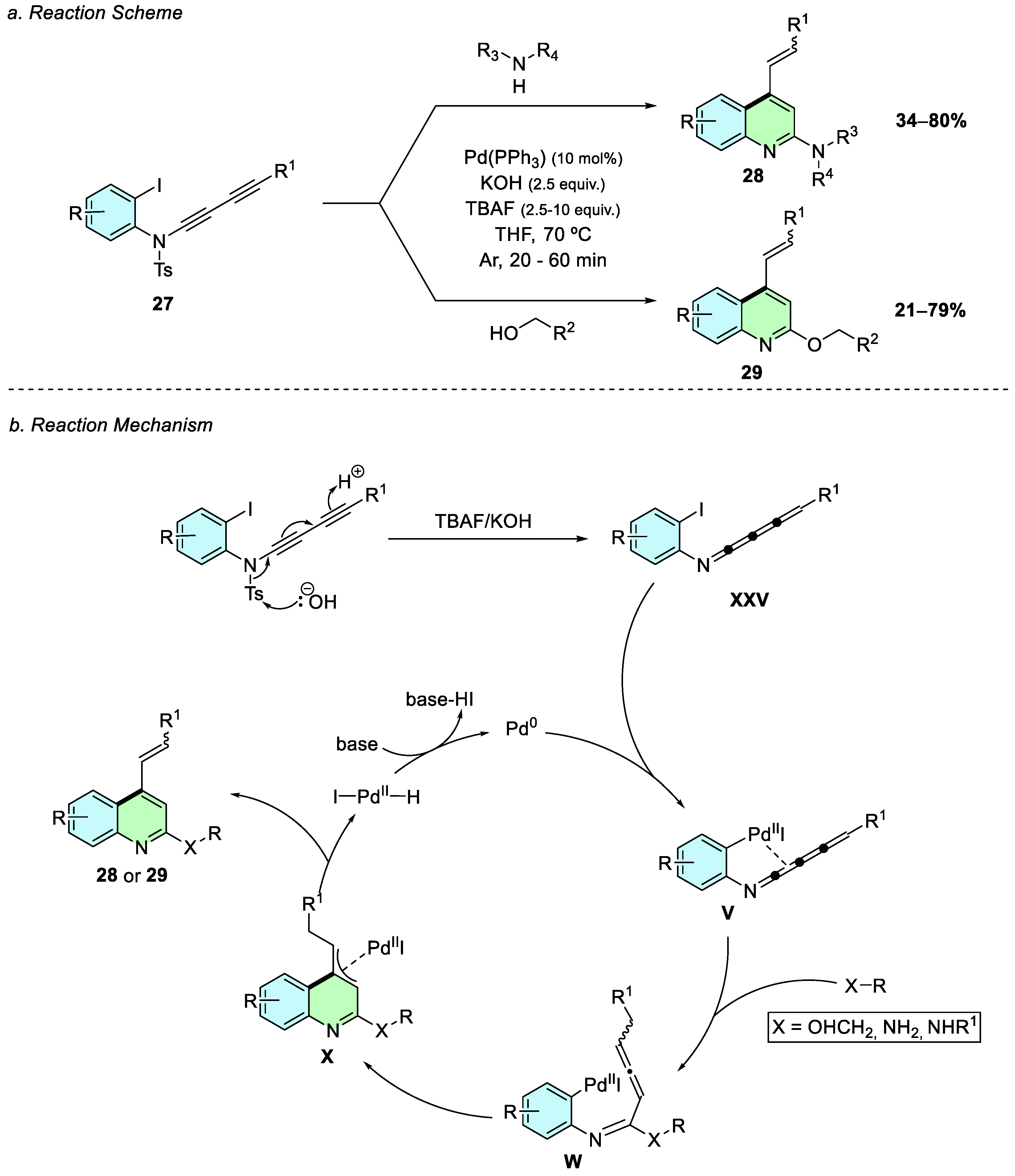
In 2021, Lenko et al. developed a novel palladium(0)-catalyzed method for the synthesis of 2,4-disubstituted quinolines, originally developed to afford 2-amino-4-alkenyl quinolines
28 (
Scheme 14a) [
19]. Three years later, a 2024 study by the same group expanded this methodology to O-alkylation at the C2-position instead of the original amination, accessing 2-alkoxyquinoline
29 derivatives, broadening the synthetic utility of this reaction [
20].
In both transformations, 1,3-butadiynamides 27 served as substrate, undergoing a Pd-catalyzed cyclization cascade to afford the quinoline core. The optimized reaction conditions involved Pd(PPh3)4 (10 mol%), KOH (2.5 equiv.), and TBAF (2.5 equiv.) in THF at 70 °C for 20–60 min under an argon atmosphere.
Mechanistically, both the amination and alkoxylation pathways proceed through analogous intermediates. The reaction starts by nucleophilic attack of hydroxide on the tosyl-protected 1,3-butadiynamide, leading to
N-deprotection and formation of a 4-cumulenimine
XXV (
Scheme 14b). Subsequent oxidative addition of Pd(0) generates intermediate
V, in which palladium(II) coordination to the π system facilitates nucleophilic addition of either the amine or alcohol, subsequently forming the allenic intermediate
W. The latter undergoes an intramolecular carbopalladation to produce intermediate
X, which after β-hydride elimination, releases the desired product
28 or
29 and regenerates the active Pd(0) catalyst.
In both reaction conditions, the 4-alkenyl substituent is formed in a stereoselective manner with a preferred (E)-geometry, with E/Z selectivity always greater than 90:10. For the amine substrate scopes, yields are directly affected by the nucleophilicity of the amine. In contrast, electron-donating or -withdrawing substituents on the 1,3-butadiynamide backbone showed minimal reduction in yields.
For the alcohol nucleophile scope, only primary alcohols were shown to give good results, with selectivity favoring reaction at the less hindered hydroxyl site in diols. Moreover, functionalized alcohols containing amino, olefinic, or aryl substituents—whether electron-rich or electron-poor—were successfully incorporated.
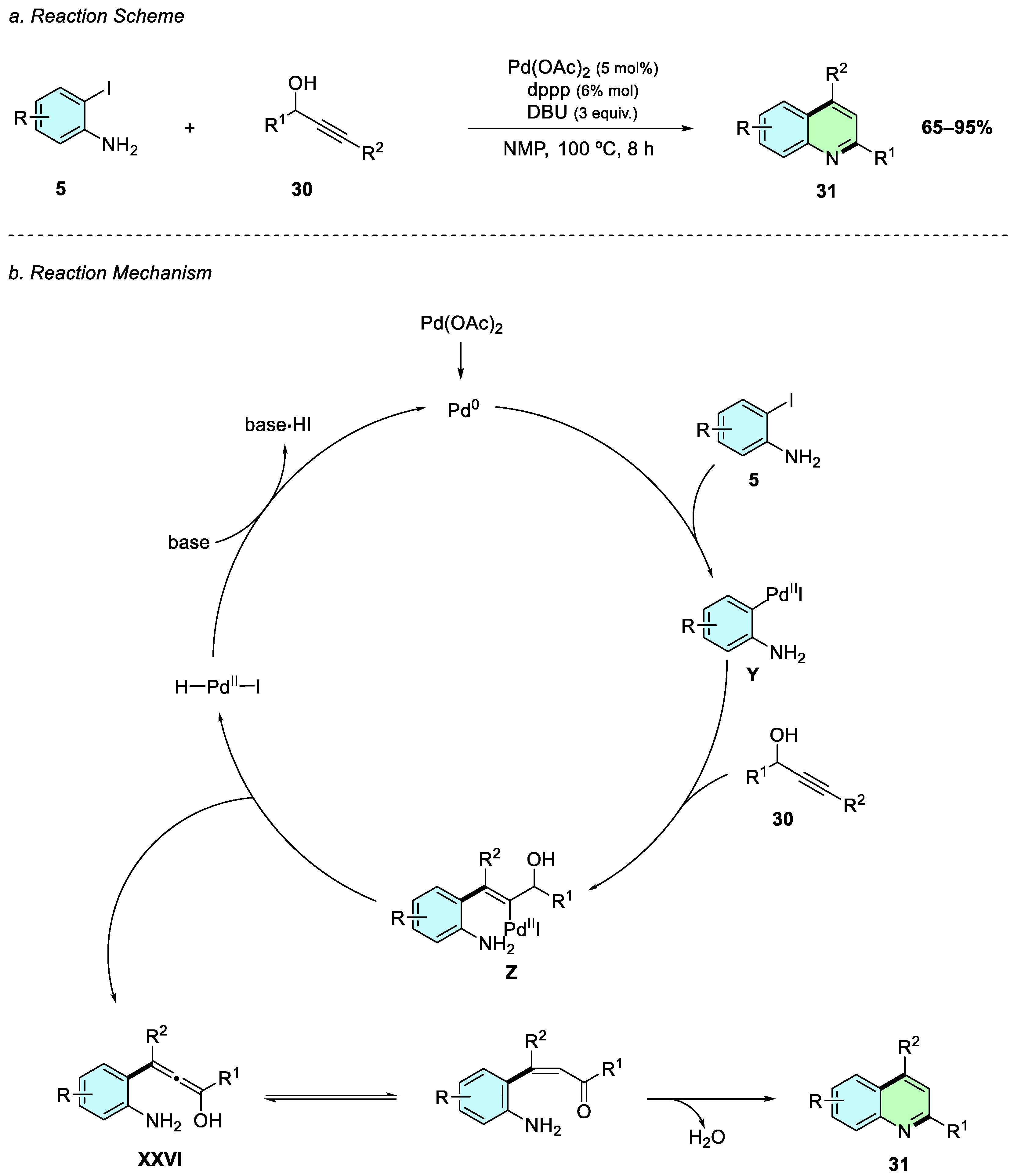
In 2023, Zhang et al. reported a Pd(II) catalyzed annulation of the 2,4-disubstituted quinolines
31 using iodoanilines
5 and propargyl alcohols
30 (
Scheme 15a) [
21]. The reaction proceeds in the presence of Pd(OAc)
2 (5 mol%), 1,3-Bis(diphenylphosphino)propane (dppp) (6 mol%), and DBU(3 equiv.) in NMP at 100 °C for 8 h under a nitrogen atmosphere.
A plausible reaction mechanism for this reaction begins with the oxidative addition of the in situ-generated Pd(0) species to the iodoaniline
5, forming the aryl-palladium intermediate
Y (
Scheme 15b). A subsequent carbopalladation reaction occurs between
Y and the propargyl alcohol
30, affording the alkenyl-Pd(II) intermediate
Z. A β-hydride elimination step then produces the allenol intermediate
XXVI, which rapidly tautomerizes to the corresponding β-unsaturated ketone. Finally, an intramolecular cyclodehydration reaction occurs yielding the desired 2,4-substituted quinoline derivative
31.
This methodology exhibits broad substrate scope, tolerating both electron-donating and electron-withdrawing substituents, including even halogens, delivering high yields consistently.
Among the reported methodologies for the synthesis of 2,4-disubstituted quinolines (
Table 4), all transformations proceed through palladium-catalyzed annulation processes and highlight the broad versatility of Pd-based catalytic systems. A diverse set of nitrogen sources is employed, including o-aminocinnamonitriles, 1,3-butadiynamides, and prefunctionalized 2-iodoanilines, in combination with structurally distinct coupling partners such as arylhydrazines, amines, alcohols, and propargyl alcohols. Both Pd(II) and Pd(0) precatalysts are represented, with Pd(PPh
3)
4 and Pd(OAc)
2/dppp complexes enabling efficient annulation under basic conditions. The reported yields span a wide range (21–95%), reflecting the influence of substrate complexity and reaction design. Notably, the highest efficiencies are achieved in the reaction employing the halogenated nitrogen source and a well-defined catalytic system, underscoring the importance of catalyst speciation and additive selection in controlling reactivity, efficiency, and reproducibility in these annulation processes.
2.5. 3,4-Disubstituted Quinolines
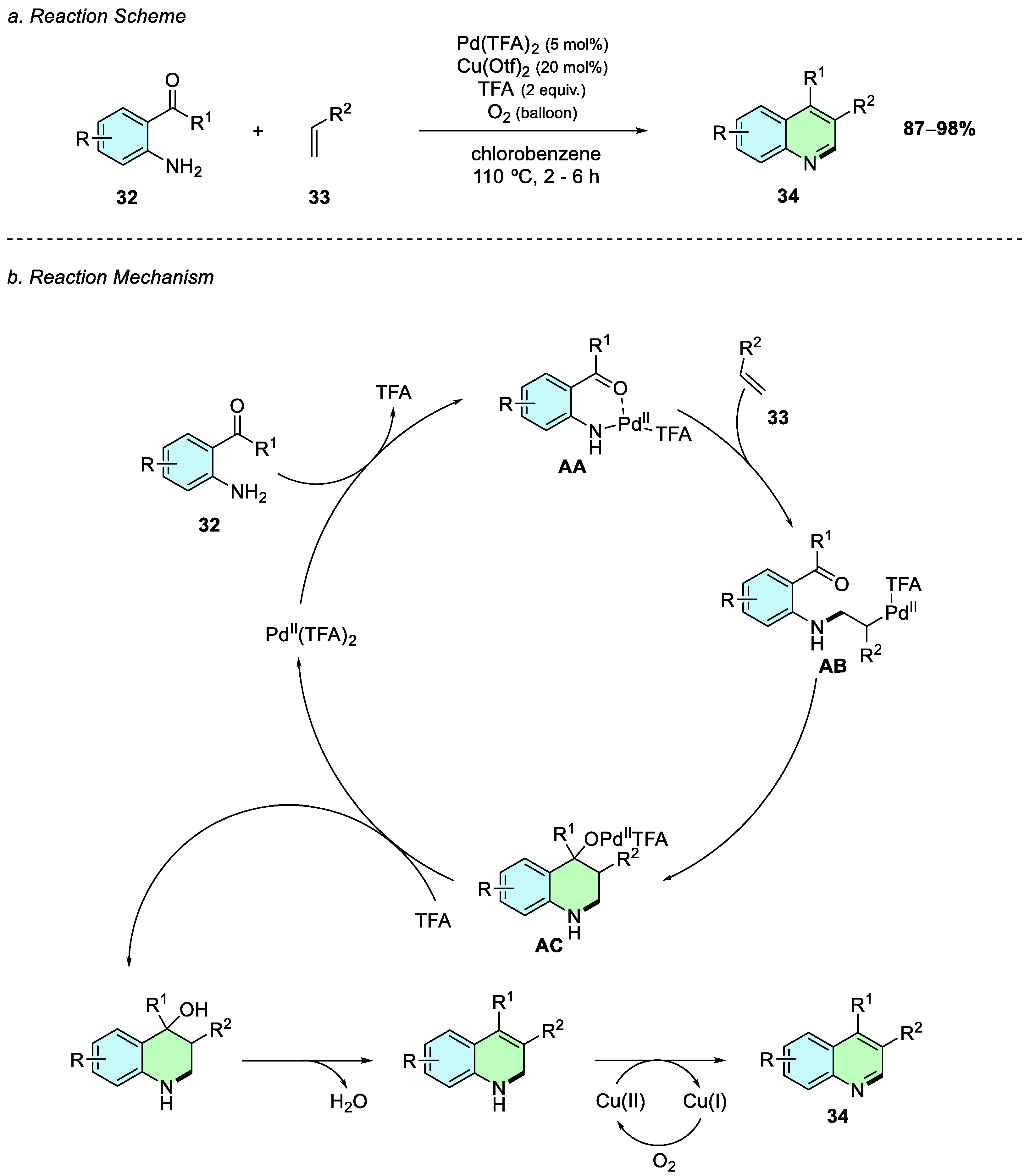
In 2015, Senadi et al. developed a regioselective Pd(II)-catalyzed synthesis of the 3,4-disubstituted quinolines
34 from
o-acylanilines
32 and simple alkenes
33 (
Scheme 16a) [
22]. The reaction was carried out using Pd(TFA)
2 (5 mol%), Cu(OTf)
2 as oxidant, TFA (2 equiv.), and O
2 as the terminal oxidant in chlorobenzene at 110 °C for 2–6 h.
Mechanistically, the reaction first involves the coordination of the Pd(II) catalyst to
32 through both the nitrogen and oxygen lone electron pairs, together with the elimination of one of the TFA molecules, forming intermediate
AA (
Scheme 16b). A second coordination of the alkene
33 to the palladium center occurs, where the Pd−N bond acts as nucleophile attacking the alkene, forming the thermodynamic anti-Markovnikov 2-amino alkyl palladium intermediate
AB. This intermediate undergoes intramolecular addition to the ketone, affording intermediate
AC, which, upon protonation, loss of water, and oxidation by the copper(II) species, gives the desired 3,4-disubstituted quinoline
34.
This methodology demonstrates moderate functional group tolerance on the aniline substrate, including substituents such as -CN, -Cl, and -Br, without significant yield losses. However, electron-donating groups (e.g., –OMe) were found to completely suppress the reactivity. Aliphatic alkenes were also found to be unreactive in these reaction conditions. In contrast, alkenes bearing electron-withdrawing groups at the α-position afforded the desired quinoline products in excellent yields. Despite its substrate limitations, this methodology employs simple and readily available starting materials to access complex quinoline scaffolds.
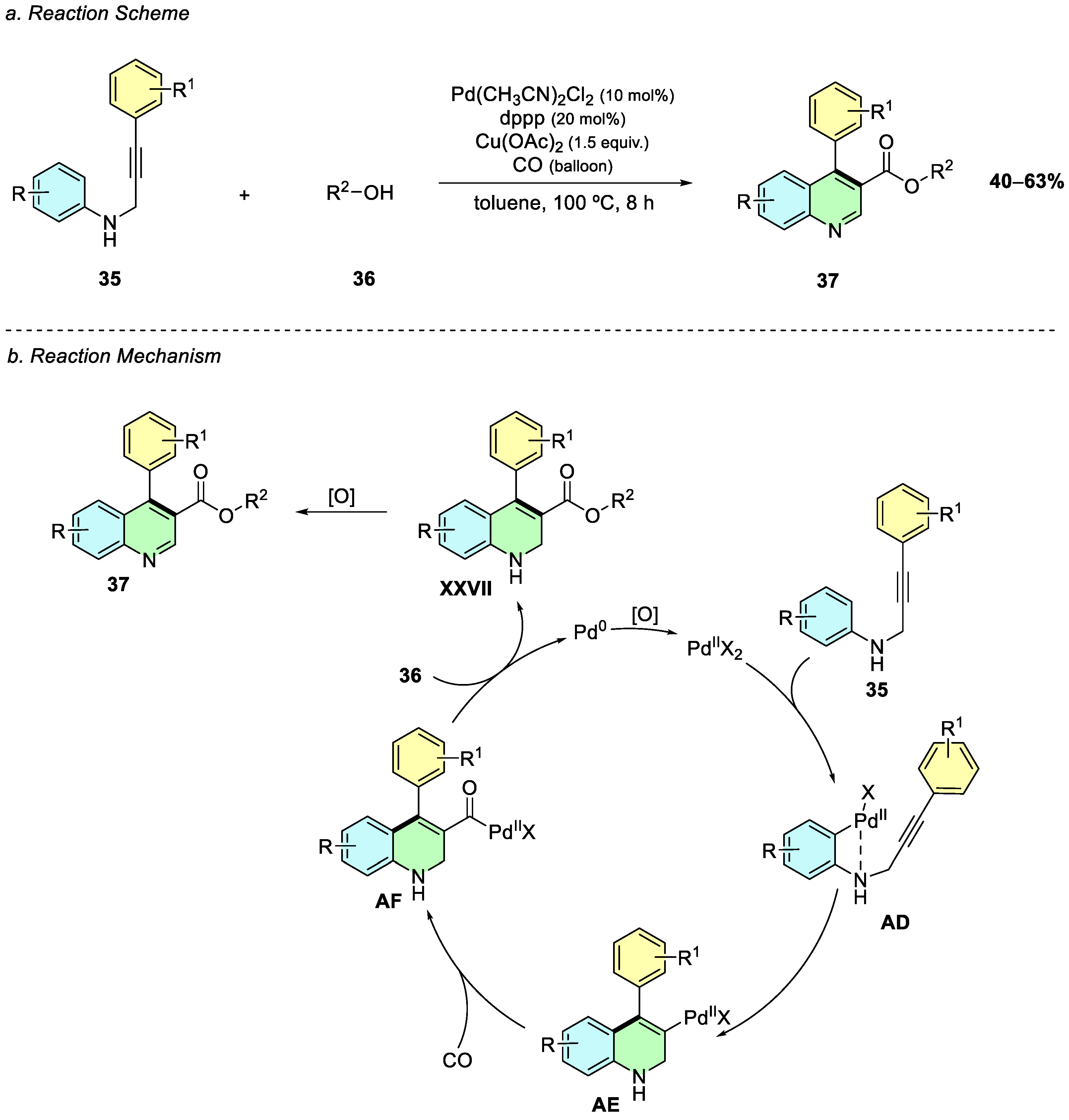
In 2018, Zhang et al. developed a palladium-catalyzed regioselective cyclocarbonylation of N-(3-phenylprop-2-ynyl)anilines
35 with CO and alcohols
36, enabling the efficient synthesis of 4-arylquinoline-3-carboxylic esters
37 under mild conditions (
Scheme 17a) [
23]. The optimized conditions employ Pd(CH
3CN)
2Cl
2 (10 mol%), dppp (20 mol%) as ligand, Cu(OAc)
2 (1.5 equiv) as oxidant, and toluene as solvent under a CO atmosphere (balloon) at 100 °C for 8 h with 5 equiv. of the alcohol nucleophile.
Mechanistically, the process initiates with Pd(II)-mediated C–H activation on the aniline ring of
35 (intermediate
AD), followed by migratory insertion into the alkyne, generating the vinyl-Pd intermediate
AE (
Scheme 17b). Subsequent CO insertion yields the acyl-Pd complex
AF, which undergoes alcoholysis to form 4-aryl-1,2-dihydroquinoline-3-carboxylic esters
XXVII, which are oxidized in situ by air or Cu(II) to yield the aromatic quinoline ester
37.
The method demonstrates a broad scope: substrates with electron-withdrawing groups (F, Cl, Br, CF3) on the aniline ring afford better yields (50–53%) than electron-donating substituents due to reduced side reactions, while thiophenyl and alkyl-substituted alkynes are well tolerated. A variety of alcohols (ethanol, n-propanol, n-butanol, cyclohexanol, benzyl alcohol) serve effectively as nucleophiles, whereas tert-butanol fails due to sterics. This approach avoids indole formation and proto-depalladation, achieving high atom economy and complementing Friedländer annulations by providing direct access to valuable quinoline-3-carboxylic esters relevant for medicinal chemistry.
The Pd-catalyzed strategies summarized in
Table 5 enable the synthesis of 3,4-disubstituted quinolines through both catalytic and oxidative annulation approaches. In both cases, Pd(II) complexes serve as the active catalytic species, albeit under distinct reaction manifolds. The catalytic annulation of o-acylanilines with alkenes proceeds with excellent efficiency, delivering high yields (87–98%) and benefiting from the combined use of Cu(OTf)
2 as a co-oxidant and trifluoroacetic acid. In contrast, the oxidative annulation of N-(3-phenylprop-2-ynyl)anilines employs carbon monoxide and alcohols as coupling partners under PdCl
2-based catalysis, affording moderate yields. While this latter approach expands structural diversity through multicomponent reactivity, it appears more sensitive to reaction conditions and substrate complexity. Overall, these examples highlight the versatility of Pd-catalyzed annulation strategies for accessing 3,4-disubstituted quinoline frameworks, with reaction efficiency being strongly influenced by the nature of the nitrogen source, coupling partners, and the oxidative system employed.
2.6. 2,3,4-Trisubstituted Quinolines
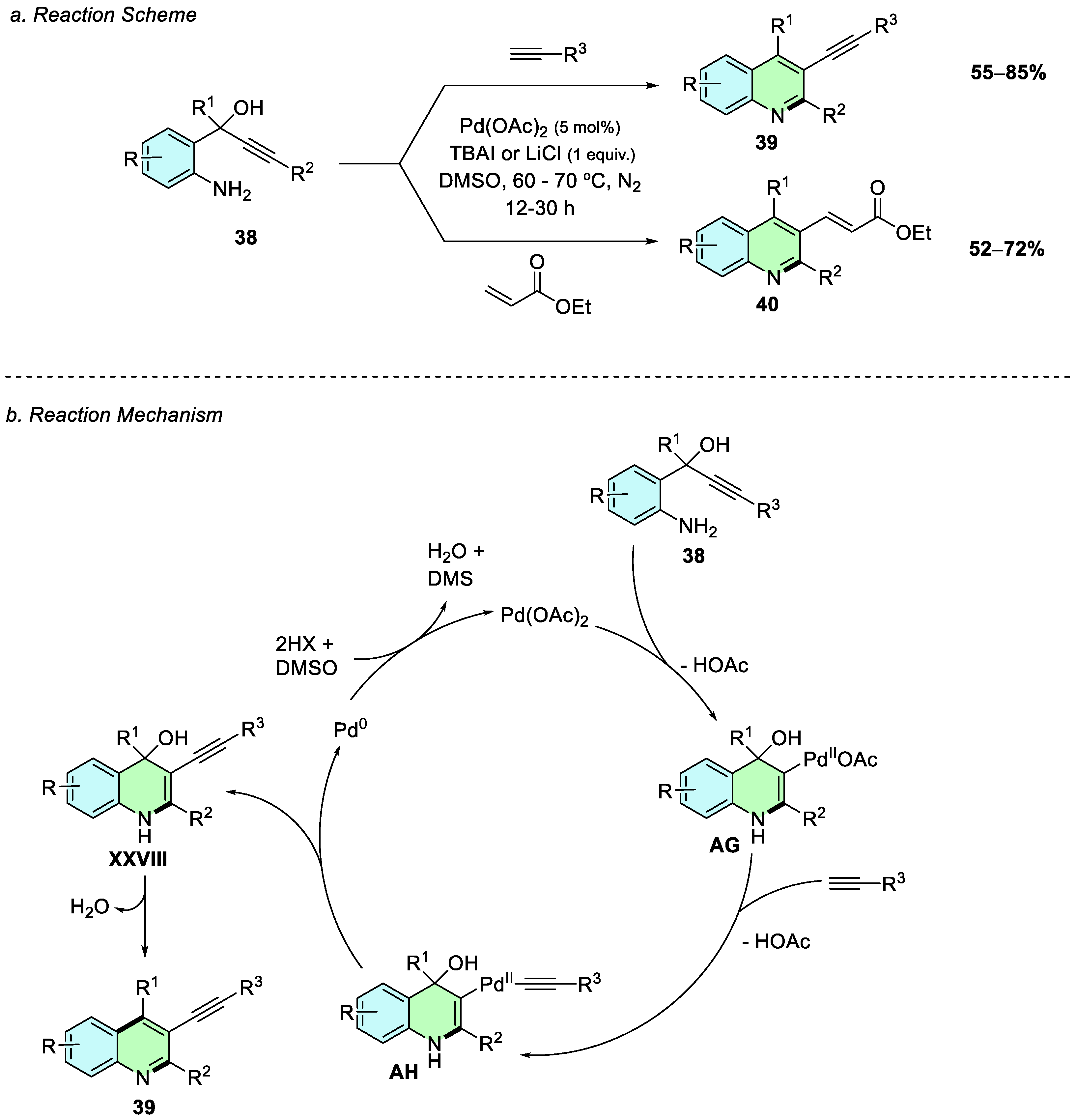
In 2015, Thirupathi et al. developed a palladium(II)-catalyzed method for the synthesis of trisubstituted quinolines, in which the substituent at the C3-position is either an alkynyl
39 or alkenyl
40 group (
Scheme 18a) [
24]. The reaction employs the aryl amino propargyl alcohols
38 as substrates, which react with alkynes or vinyl ketones. The method involves the use of Pd(OAc)
2 (5% mol) as the catalyst and TBAI or LiCl (1 equiv.) for the reactions with alkynes or vinyl ketones, respectively. The reaction proceeds in DMSO at 60–70 °C for 12–30 h under a nitrogen atmosphere.
Mechanistically, the triple bond of the aryl amino propargyl alcohol first coordinates to the palladium(II) species, facilitating an intramolecular aminopalladation to give intermediate
AG (
Scheme 18b). This intermediate undergoes ligand exchange wherein the remaining acetate ligand is replaced by the alkyne substrate, following deprotonation of the latter, to form intermediate
AH. Reductive elimination of
AH affords intermediate
XXVIII, which upon loss of water gives the desired trisubstituted product. Pd(0) is generated in this last elementary step, which is reoxidized to Pd(II) by the solvent DMSO, confirmed by the presence of DMS in the reaction. Although the reaction mechanism is illustrated with the alkenyl substrate, analogous elementary processes occur for the vinyl ketone.
The reaction conditions tolerate a great variety of aryl amino propargyl alcohols and alkynes, and even halogen-substituted substrates remain intact without undergoing undesired Sonogashira-type coupling. The resulting alkynyl group in the quinoline product offers a versatile functional group for further transformations leading to diketones, monoketones, or partially or fully hydrogenated derivatives.
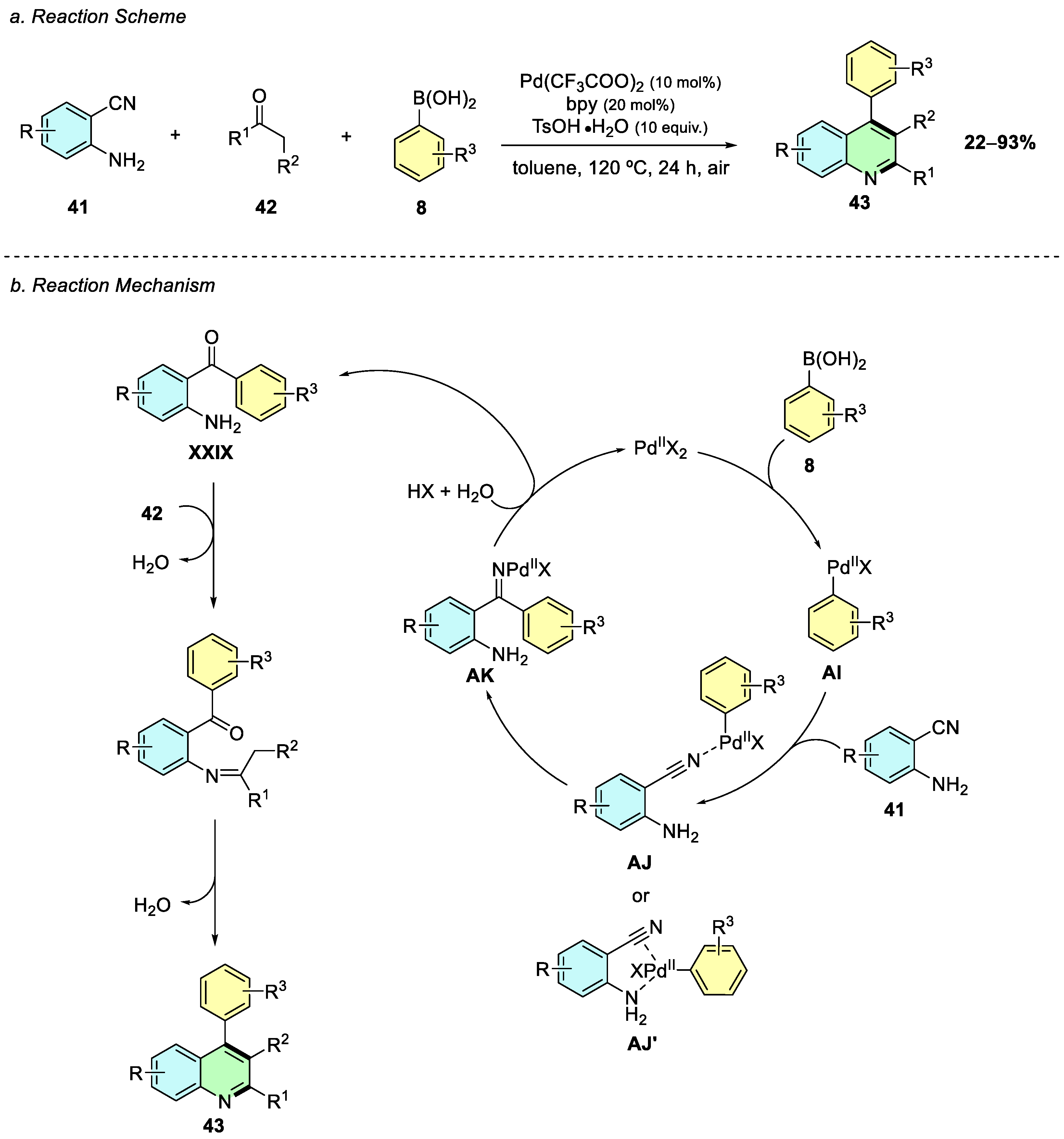
In 2021, Zhang et al. reported a palladium(II)-catalyzed three-component tandem reaction for the synthesis of polysubstituted quinolines
43 using 2-aminobenzonitriles
41, ketones
42, and arylboronic acids
8 (
Scheme 19a) [
25]. The optimized conditions employed Pd(CF
3COO)
2 as the catalyst, 2,2′-bipyridine (bpy) as the ligand, and
p-toluenesulfonic acid monohydrate (TsOH·H
2O) as an additive in toluene at 120 °C for 24 h under air.
The reaction proceeds via an initial transmetallation between Pd(II) and the arylboronic acid
8, generating the aryl-palladium species
AI, which then coordinates with the nitrile functionality (intermediate
AJ/
AJ’) (
Scheme 19b). The subsequent carbopalladation of the cyano group forms the imine-palladium intermediate
AK that, upon hydrolysis, generates the aminoketone
XXIX, which undergoes a Friedländer-type cyclization to yield the quinoline
43.
The methodology exhibits broad substrate scope, tolerating both electron-donating (e.g., -Me, -OMe) and electron-withdrawing (e.g., -NO2, -CF3) groups on all three components. The reaction is also compatible with heterocyclic boronic acids and ketones, enabling the synthesis of structurally diverse quinolines. Notably, the method avoids the formation of unwanted 4-aminoquinolines typically observed under similar conditions, showcasing high chemoselectivity. Additionally, the introduction of halogenated quinolines enables further functionalization via cross-coupling reactions, expanding the applicability of this method in synthetic chemistry.
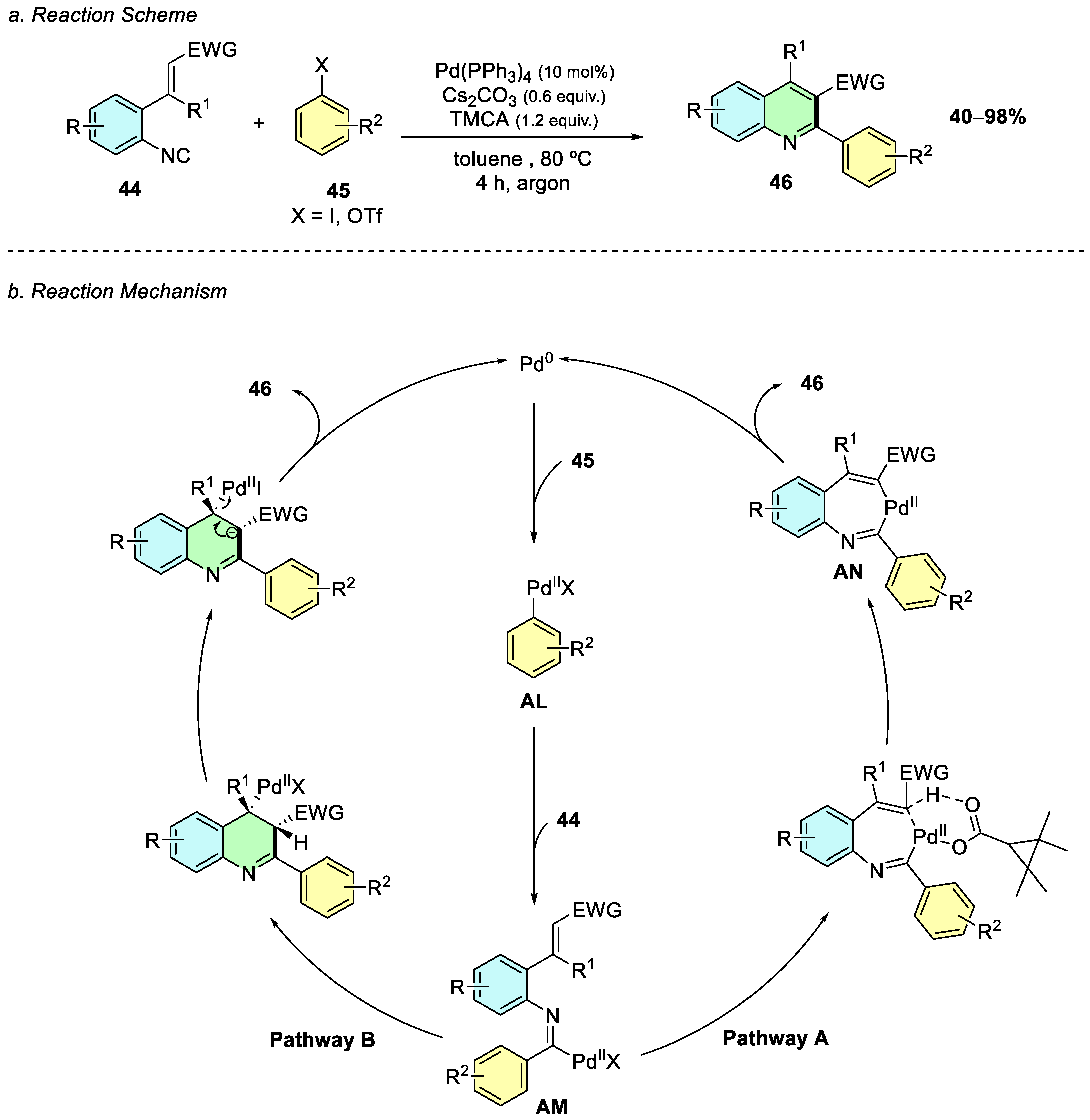
In 2025, Yao et al. reported a palladium-catalyzed cyclization of
o-alkenyl aryl isocyanides
44 with hetaryl halides
45, yielding trisubstituted quinoline derivatives
46 (
Scheme 20a) [
26]. The optimal conditions employed the use of Pd(PPh
3)
4 (10 mol%), Cs
2CO
3 (0.6 equiv.), and 2,2,3,3-tetramethylcyclopropanecarboxylic acid (TMCA, 1.2 equiv.) in toluene at 80 °C under an argon atmosphere.
Mechanistically, an initial oxidative addition of the palladium(0) species to the carbon−halogen (or pseudohalogen) bond generates intermediate
AL (
Scheme 20b). A carbopalladation reaction of
AL with the isocyanide group affords imidoyl-palladium intermediate
AM. From
AM two pathways are plausible, a concerted metalation–deprotonation (CMD) pathway (A) or 6-endo-trig cyclization pathway (B). In pathway A, a C−H activation of the vinyl C−H bond occurs, which is activated by the imidoyl-palladium species, assisted by the carboxylate base, through a CMD process, leading to a seven-membered palladacycle
AN. Subsequent reductive elimination of the latter affords the quinoline product
46 and regenerates the Pd(0) catalyst. Pathway B involves the same elementary steps as pathway A up to intermediate
AM. Subsequently, carbopalladation, deprotonation, and elimination of the Pd(II) species affords the product. Mechanistic experiments conducted by the authors indicate that pathway A is more likely.
The reaction showed broad substrate scope and high functional group tolerance. Various aryl iodides bearing halogen, electron-donating, or electron-withdrawing substituents, as well as heteroaryl halides, were well tolerated. Vinylic bromides and aryl/vinyl triflates also participated, underlining the versatility of electrophile scope. For the isocyanide component, an electron-withdrawing group (EWG) at the C2-position of the vinyl moiety was essential for cyclization, while non-electrophilic alkenes were unreactive. Substitution on the aryl ring and at the C1-position of the vinyl group was also compatible with the reaction conditions.
The methodologies summarized in
Table 6 illustrate the versatility of palladium catalysis for the construction of highly substituted 2,3,4-trisubstituted quinoline frameworks through both oxidative and catalytic annulation strategies. In the oxidative annulation approaches, aryl amino propargyl alcohols are employed as nitrogen sources and react with either alkynes or vinyl ketones under Pd(OAc)
2 catalysis. These transformations proceed efficiently in the presence of simple halide additives such as TBAI or LiCl and deliver the desired trisubstituted quinolines in moderate to good yields, highlighting the adaptability of this scaffold to different π-systems while maintaining reasonable reaction efficiencies. In contrast, catalytic annulation methods rely on prefunctionalized nitrogen-containing substrates, including 2-aminobenzonitriles and
o-alkenyl aryl isocyanides, which enable broader structural diversification at multiple positions of the quinoline core. The combination of Pd(TFA)
2 or Pd(PPh
3)
4 with nitrogen-based ligands allows for effective coupling with ketones, arylboronic acids, or heteroaryl halides, affording a wide yield range that can reach up to 93%. As observed in previous sections, the use of appropriate acids, bases, and additives is critical to achieving high efficiency and reproducibility. Overall, these examples underscore palladium catalysis as a powerful platform for accessing densely functionalized quinolines, albeit often requiring carefully optimized reaction conditions due to the increased structural complexity of the target molecules.
2.7. Annulated Quinolines
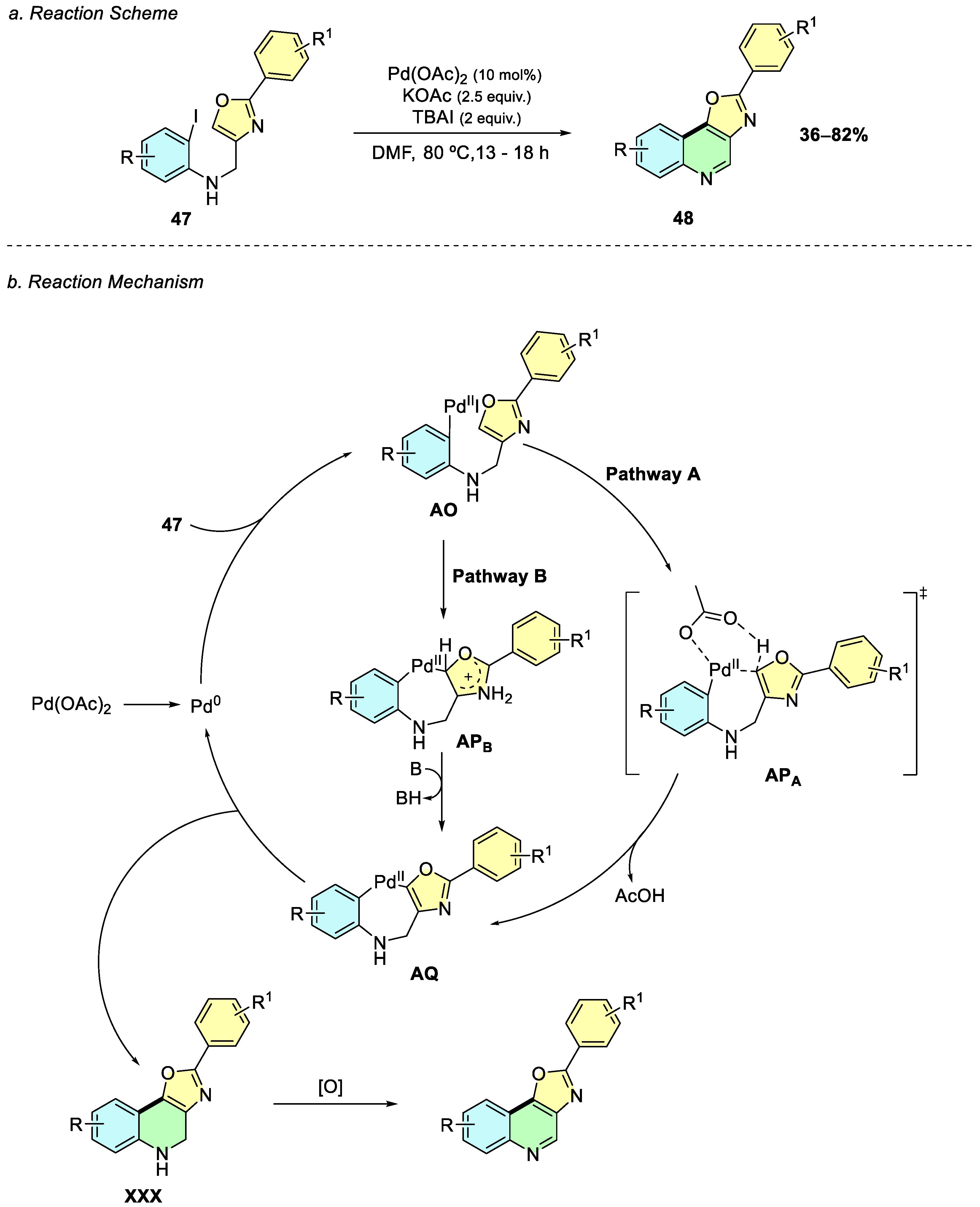
In 2022, Kajol et al. developed a palladium(II)-catalyzed intramolecular cyclization method for the synthesis of oxazolo [4,5-
c]quinolines
48 from 2-iodo-
N-((2-phenyloxazol-4-yl)methyl)anilines
47 (
Scheme 21a) [
27]. The reported conditions involved Pd(OAc)
2 (10% mol), KOAc (2.5 equiv.), and TBAI (2 equiv.) in DMF at 80 °C for 13–18 h.
The mechanism of this reaction initially involves the oxidative addition of the in situ-generated Pd(0) species to substrate
47, affording intermediate
AO (
Scheme 21b). The latter may then evolve through two possible mechanistic pathways. In pathway A, a CMD process occurs via transition state
APA, forming intermediate
AQ. Alternatively, in pathway B, an electrophilic palladation via electrophilic aromatic substitution (EAS) process on the oxazole ring forms intermediate
APB, which after deprotonation affords the common intermediate
AQ. Subsequently, this intermediate undergoes reductive elimination to afford intermediate
XXX, which upon oxidative aromatization gives the desired quinoline product
48.
This method exhibits good tolerance and broad substrate scope for substituents on both aryl rings of the quinoline, including functional groups such as alkyl, methoxy, fluoride, chloride, acetyl, and trifluoromethyl. Additionally, the 2-aryl moiety on the oxazole can be replaced by other heteroaryl systems such as 2-thiophenyl or 3-furyl while maintaining moderate yields. Moreover, the final product can undergo post-synthetic transformations and be functionalized at the C2-position of the quinoline, allowing for aryl substitution, sulfonation, arylamination, and phosphonation under different reaction conditions.
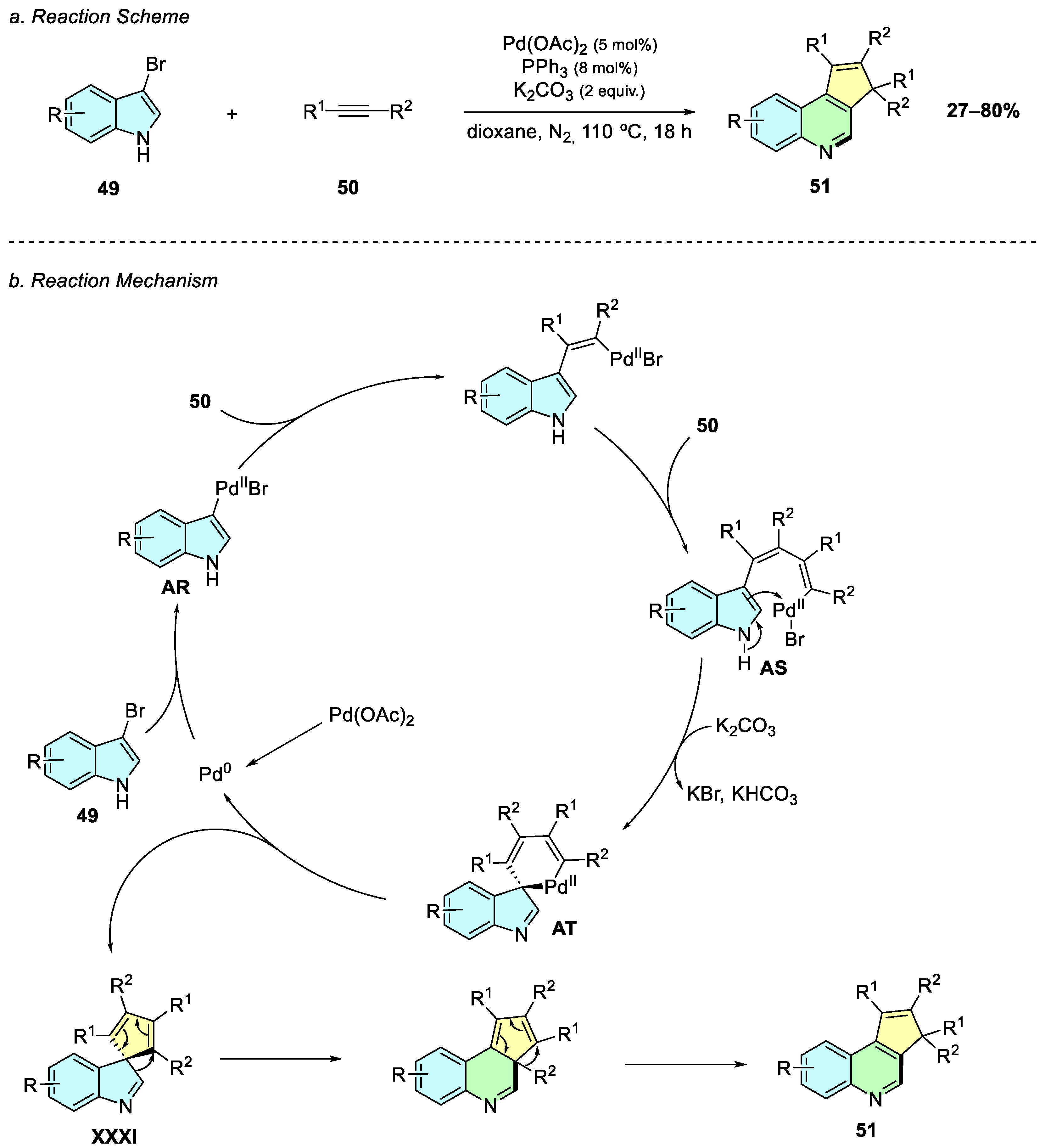
In 2023, Guo et al. reported a palladium(II)-catalyzed method for the construction of cyclopenta[c]quinoline
51 frameworks utilizing bromoindoles
49 and internal alkynes
50 as substrates (
Scheme 22a) [
28]. The reaction conditions involve the use of Pd(OAc)
2 (5% mol), PPh
3 (8% mol), and K
2CO
3 (2 equiv.) in dioxane at 110 °C for 18 h under a nitrogen atmosphere.
The proposed mechanism begins with the oxidative addition of the in situ generated Pd(0) species into the C−Br bond of
49, generating intermediate
AR (
Scheme 22b). A double carbopalladation sequence is followed, affording intermediate
AS. A subsequent electrophilic palladation, assisted by the base, forms the intermediate
AT. Reductive elimination of
AT affords intermediate
XXXI, which undergoes ring expansion and alkyl migration, giving the desired cyclopenta[
c]quinoline product
51.
The substrate scope of 3-bromoindoles bearing substituents at the 4-, 5-, or 6-positions afforded the desired products, however 4-chloroindole failed to react, likely due to stereoelectronic factors. The stereochemical properties of the substituents at the C2-position influenced the reactivity with bulkier substituents, resulting in lower yields. The reaction exhibited regioselectivity with monoaryl alkynes such as 1-phenyl-1-propyne, but selectivity dropped for longer chain analogs. Despite some scope limitations, this reaction offers a simple way to construct such complex scaffolds from readily available indole systems and alkynes.
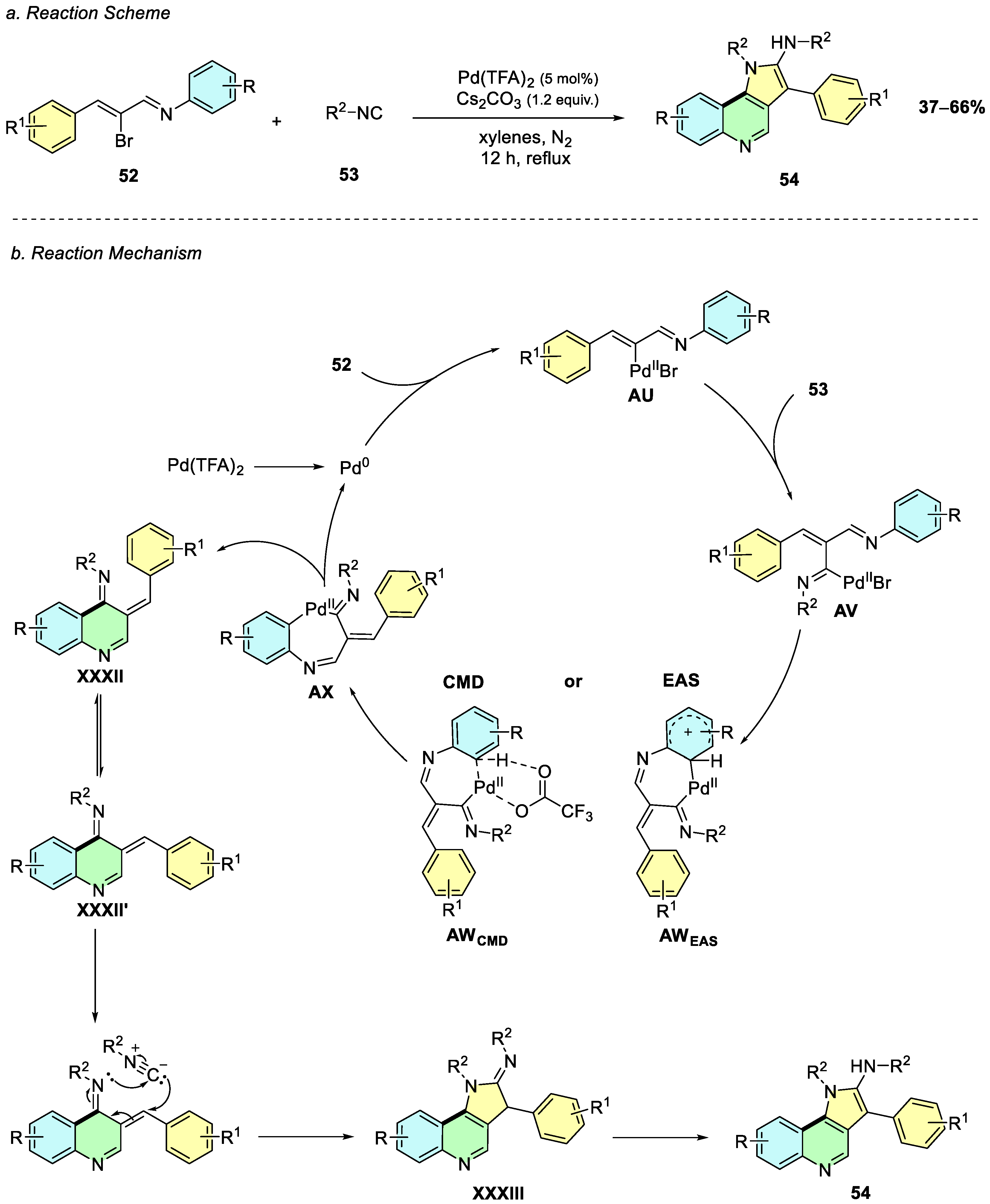
In 2025, Liu et al. reported a Pd(II)-catalyzed synthesis of the quinoline annulated derivatives
54 from imines
52 and arylisocyanides
53 (
Scheme 23a) [
29]. The protocol was carried out using Pd(TFA)
2 (5 mol%) and Cs
2CO
3 (1.2 equiv.) in xylenes in reflux for 12 h under a nitrogen atmosphere.
The proposed reaction mechanism starts with the oxidative addition of the in situ generated Pd(0) species to imine
52, forming intermediate
AU (
Scheme 23b). This species undergoes a carbopalladation step with the aryl isocyanide
53, forming intermediate
AV. Subsequently, two possible mechanistic pathways are proposed: a CMD pathway leading to
AWCMD or an electrophilic aromatic substitution (EAS) pathway leading to intermediate
AWEAS. Both pathways form the cyclic palladium intermediate
AX. Reductive elimination of
AX affords intermediate
XXXII, which, after double-bond isomerization, gives intermediate
XXXII’, which is in the proper geometry for a [4 + 1] cycloaddition with another molecule of aryl isocyanide, generating intermediate
XXXIII. Finally, tautomerization of
XXXIII affords the desired annulated-quinoline product
54.
In terms of substrate scope, both halogens and methyl substituents on the imine (R and R1) were well tolerated under the reaction conditions. However, when the imine moiety contained heteroatoms, the reactivity dropped and no product was detected. Regarding aryl isocyanides, only 2,6-dimethylphenylisocyanide gave measurable yields, while other examples of this moiety resulted in poor conversions, likely due to stereoelectronic factors.
In 2025, Ullah et al. developed a Pd(II)-catalyzed methodology for the synthesis of [
1,
2,
3]triazolo [4,5-c]quinoline derivatives
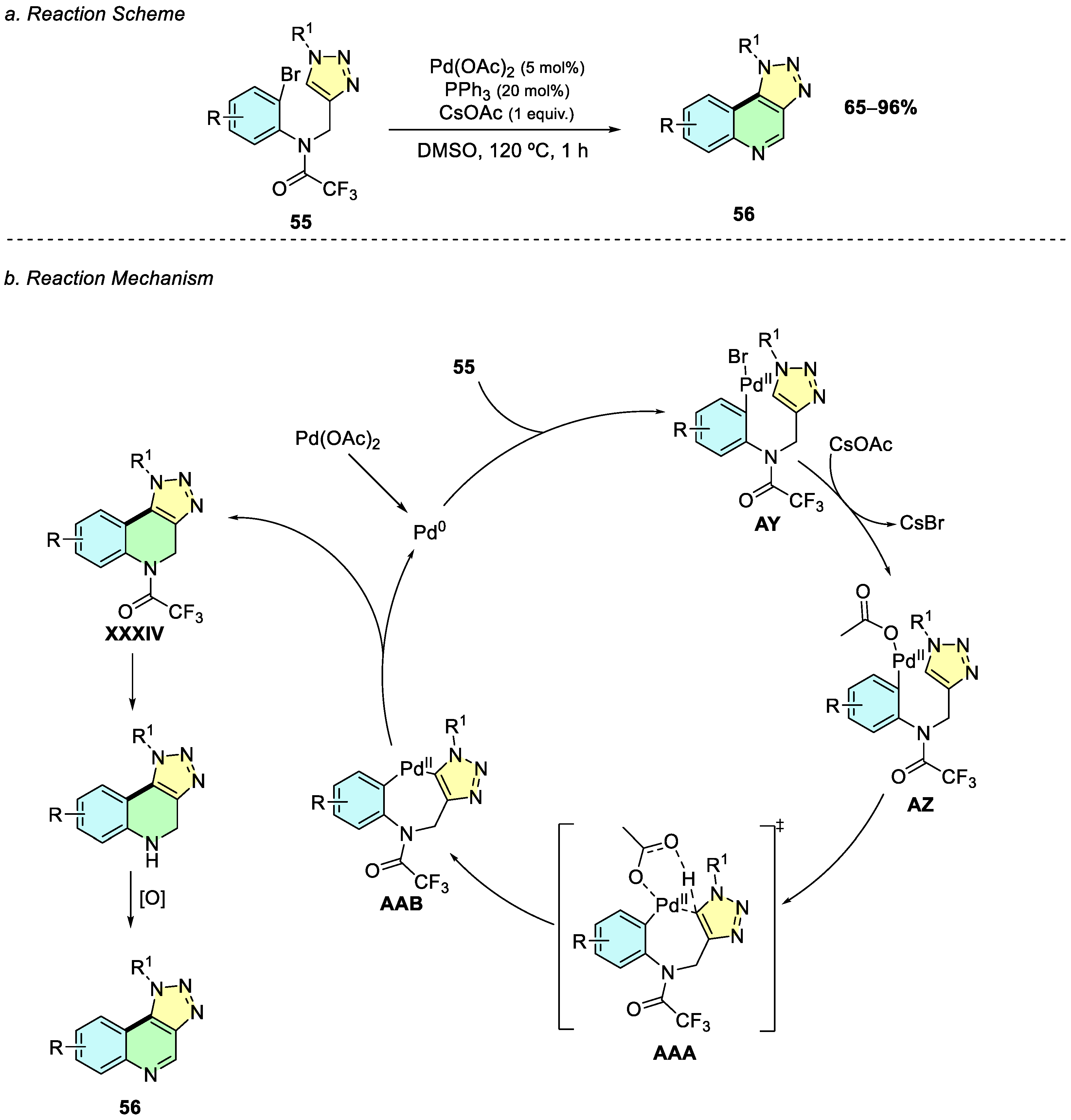
56 from N-((1-substituted-1H-1,2,3-triazol-4-yl)methyl)-N-(2-bromophenyl)-2,2,2-trifluoroacetamides
55 (
Scheme 24a) [
30]. The optimized reaction conditions employed Pd(OAc)
2 (5 mol%), PPh
3 (20 mol%), and CsOAc (1 equiv.) in DMSO at 120 °C for 1 h.
Mechanistically, the reaction begins with the reduction of Pd(OAc)
2 to Pd(0), which undergoes oxidative addition to substrate
55, forming the aryl-palladium(II) intermediate
AY (
Scheme 24b). The latter suffers rapid ligand exchange with an acetate ion, generating complex
AZ, which via a CMD transition state
AAA, forms the seven-membered palladacycle intermediate
AAB. Reductive elimination of
AAB regenerates Pd(0) and yields the cyclized intermediate
XXXIV, which, after amide deprotection and oxidation, affords the desired product
56.
Yields ranged from 50 to 90%, and the methodology exhibited moderate functional group tolerance. The substituents R and R1 could include electron-donating (EDG), electron-withdrawing (EWG), or benzyl groups. Substituents such as –OMe, –F, –Cl, and –Me were well tolerated; however, substituents such as –Br or –CN at the para-position failed, probably due to competitive oxidative addition or catalyst deactivation, respectively.
Among the methodologies summarized in
Table 7, palladium-catalyzed annulation strategies enable the construction of annulated quinoline derivatives featuring increased structural complexity and fused or embedded heterocyclic motifs. All reported transformations rely on Pd(II) or Pd(0) catalytic systems, most commonly Pd(OAc)
2 or Pd(TFA)
2, often in combination with phosphine or nitrogen-based ligands to fine-tune reactivity. The nitrogen sources range from highly functionalized
o-haloanilines and imines to heterocycle-containing substrates, while the coupling partners include internal alkynes and aryl isocyanides, or are generated intramolecularly without the need for an external coupling component. Reaction efficiencies span a broad range (27–96%), reflecting the increased steric and electronic demands associated with the formation of annulated frameworks. Notably, systems employing well-chosen bases or additives, such as CsOAc, KOAc, or TBAI, tend to afford higher and more reproducible yields. Overall, these examples highlight the versatility of palladium catalysis in assembling complex annulated quinoline architectures that would be challenging to access using more conventional synthetic approaches.