Perspective

Isotopic Labeling in IR Spectroscopy of Surface Species: A Powerful Approach to Advanced Surface Investigations


by
Konstantin Hadjiivanov
1,2,*,
Dimitar Panayotov
1 and
Mihail Mihaylov
1,2
1
Institute of General and Inorganic Chemistry, Bulgarian Academy of Sciences, 1113 Sofia, Bulgaria
2
National Centre of Excellence Mechatronics and Clean Technologies, Campus “Geo Milev”, akad. G. Bonchev str., bl. 29, 1113 Sofia, Bulgaria
*
Author to whom correspondence should be addressed.
Catalysts 2026, 16(1), 57; https://doi.org/10.3390/catal16010057
Submission received: 28 November 2025 / Revised: 25 December 2025 / Accepted: 31 December 2025 / Published: 3 January 2026
(This article belongs to the Section Catalytic Materials)

Abstract

This paper summarizes the main applications of isotopic substitution in infrared surface studies, including surface characterization, determination of the structure of adsorbed species, and clarification of catalytic reaction mechanisms. While acknowledging the key pioneering contributions to the field, we focus on the recent developments and the future potential of the technique. The applications are grouped into two main categories, according to the extent of isotopic substitution. The first category involves systems in which one or more atoms in specific positions are fully replaced by their isotopes. This classical approach remains fundamental for establishing whether the spectral signature of a given compound is related to the presence of a specific atom. The second category concerns partial isotopic exchange. These studies unravel different vibrational interactions and provide valuable structural information that cannot be obtained through full substitution. Finally, we discuss some applications related to the mechanisms of catalytic reactions. The perspective concludes with a discussion of the emerging opportunities and future perspectives for more systematic and effective implementation of isotopic substitution in infrared surface studies.

Graphical Abstract

1. Introduction

Since the pioneering contributions of Terenin and Filimonov [1], the early isotope-assisted surface IR studies by Garland et al. [2], and the seminal work of Eischens and Pliskin [3], in situ infrared (IR) spectroscopy has become one of the main methods for characterizing catalyst and adsorbent surfaces [4,5], determining the structures of adsorbed species and elucidating the mechanisms of catalytic and other surface-related processes. However, as with most techniques, conventional IR spectroscopy possesses some limitations. For instance, the assignment of specific absorption bands is not always straightforward. The application of isotopic labeling significantly enhances the power of the technique and allows one to obtain more unambiguous structural and mechanistic information. The same applies to Raman spectroscopy, the other widespread vibrational technique. Importantly, the isotopic effect is purely vibrational and does not appreciably alter the electronic structure.
The vibration of a diatomic molecule, AB, is well described by the harmonic oscillator model. Small deviations arise from the anharmonicity, but they are not essential. It is important for the isotopic effects that the stretching frequency depends on the reduced mass of the molecule:
μ = M A · M B M A + M B
where MA and MB are the atomic masses.
The frequency is proportional to the square root of the reciprocal of the reduced mass. Therefore, changing the atom A of the molecule by its heavier isotope, A, should decrease the vibrational frequency, and the isotopic shift can be easily calculated by the formulae [6]:
i = ν A B ν A B = μ A B μ A B
Here, i is the isotopic shift factor. When values from the literature use the reciprocal, they are given here as reported.
The above analysis refers to a diatomic molecule, while surface species are polyatomic. However, many stretching vibrations in real systems are sufficiently localized, and their isotopic shifts can still be accurately estimated using Equation (2). More important deviations arise when the vibrations are collective or delocalized, since the effective change in reduced mass upon isotopic substitution becomes smaller, resulting in a reduced frequency shift. A similar situation occurs when the substituted atom participates in mixed modes or contributes only marginally to the overall motion.
The use of isotopic substitution in IR spectroscopy has a history almost as long as the technique itself. It enables one to identify the spectral features associated with vibrations involving a specific atom. Moreover, because the isotopic shift factor depends on the two atoms forming the bond, it is also possible to draw conclusions on the nature of the chemical bond. Purpose-designed experiments can reveal the origin of a specific atom in a surface species. However, these applications represent only a subset of the possibilities offered by isotopic labeling. More advanced studies, typically involving partial isotopic substitution, are unique in determining the structure of surface species.
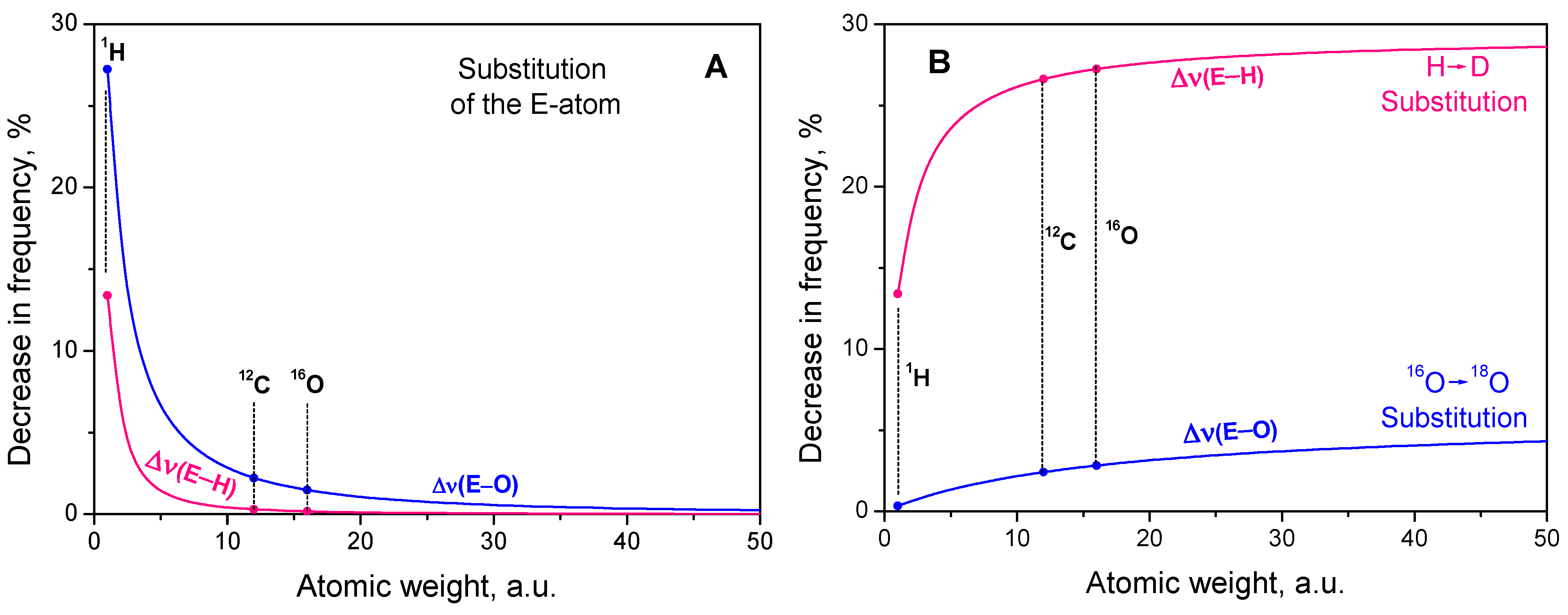
Despite its proven utility, isotopic studies have some limitations and complications. First, the isotopic shift becomes very small when the substituted atom is heavy. This is illustrated in Figure 1A, which shows the dependence of the E–H and E–16O stretching modes (E = element) on substitution of the E atom by its isotope that is heavier by one atomic mass unit. It is clearly seen that the isotopic effect rapidly decreases with increasing atomic mass. Even for the more sensitive E=O vibrations around 1000 cm−1, the shift remains small, around 2 cm−1 for elements with masses around 50 (e.g., Cr, V). Although the effect almost doubles when the mass difference is 2 atomic mass units instead of 1, it still remains negligible for heavy elements. Thus, chlorine seems to be one of the heaviest elements for which measurable isotopic shifts are practical in IR studies. Taking into account that several lighter elements have no stable isotopes suitable for exchange (Be, F, Na, Al, P, Sc, Mn, Co) and the inertness of the noble gases, the range of candidate elements for isotopic IR surface studies is rather limited. In practice, four labeled atoms are commonly used [7]: D (0.01%), 13C (1.07%), 15N (0.37%) and 18O (0.20%) (the values in brackets show the natural Earth’s abundance). A few studies also involve 34S (4.25%) and 37Cl (24.24%). It is worth noting that H, C, N, and/or O are present in the majority of surface species of catalytic interest, so the range of possible applications remains very broad.
Figure 1B shows the effect of H ⟶ D and 16O ⟶ 18O substitutions on the isotopic shift in E–O and E–H vibrations. Due to the small masses of H and D, the H ⟶ D substitution has the most pronounced effect, which increases with the mass of E. Although the 16O ⟶ 18O effect is smaller, it remains easily observable even for the less sensitive O–H vibrations, producing shifts of around 10 cm−1. Because of the smaller mass differences between 14N/15N and 12C/13C, the corresponding isotopic effects are roughly half as large, but still detectable.
The aim of this perspective paper is to systematize and illustrate the various strategies for using isotopically labeled molecules in infrared investigations of solid surfaces and to map the unexplored potential of isotopic substitution. While providing historical background, the paper is focused on some recent findings.
For methodological clarity, the use of isotopic labeling in IR spectroscopy will be classified into two conceptual categories, corresponding to full and partial isotopic substitution and providing different information.
The first category includes experiments that are based on full or nearly complete isotopic substitution of one or more atoms in a single surface species/complex. Such studies usually aim to map the vibrational bands associated with the exchanged atom, or to determine whether this atom—usually oxygen—originates from the lattice or from an adsorbed molecule. In some cases, complete isotope exchange is applied to reduce noise or to avoid overlap with other bands by changing the spectral region or to prevent Fermi resonance. For example, when the light scattering is significant, the spectra in the ν(OH) region are of poor quality, but are markedly improved after H ⟶ D substitution, which shifts the band to the less noisy ν(OD) region.
The second category consists of experiments in which the isotopic substitution is partial. These studies are more advanced and provide information that cannot be obtained by full substitution. Depending on the exchange degree, this category can be divided into two subcategories. With “trace-level” substitution, only very small quantities (just a few percent) of the target atoms in the species are isotopically substituted. Thus, the labeled species are too diluted, and no vibrational interaction can occur between them. This leads to simpler, more easily interpretable spectra. This approach is widely used in order to elucidate the magnitude of the vibrational interaction. Due to the relatively high natural 13C abundance (ca. 1%), the spectra of carbon-containing species could be analyzed in these terms without performing a special substitution procedure.
When the original and substituted atoms are present in comparable concentrations, vibrational coupling occurs only among identical dipoles that remain in close proximity. Consequently, the overall coupling effect in the spectra is reduced, but remains clearly observable. As a result, the spectra become more complex, yet their careful analysis provides valuable insights into the structure of the surface species.
In what follows, we will systematize the main applications of isotopic labeling in IR spectroscopy of surfaces, illustrating them with examples from our own studies and from other research groups. Generally, the complexity of the examples increases, starting with full isotopic substitution, then moving to partial substitution (trace-level and intermediate-level), and progressing from in situ to operando studies. Finally, we outline the unexplored potential of the technique and discuss future perspectives.

2. Full Isotopic Substitution

The full isotopic substitution is the classical approach for the unambiguous determination of whether a vibration involves a specific atom or not. As already noted, other applications, e.g., establishing the origin of a specific atom in a surface species, are also widespread. The approach is ideal when dealing with isolated stretching vibrations. Small deviations occur with mixed stretching modes, and the technique may even be misleading, with deformation modes involving a central atom that is practically not moving, because in these cases, the shift is very small. Full substitution is usually applied for adsorbates (e.g., 12CO vs. 13CO adsorption), but in some cases, pre-existing surface species are exchanged. A typical example is the deuteration of surface hydroxyls. Although the exchange is not always complete, the aim of the experiments remains the same.

2.1. Theoretical Background

2.1.1. Diatomic Molecule and Isolated Vibrations Between Two Atoms

With many adsorbates of practical importance, including widespread probe molecules, such as CO, NO, N2, and H2, the stretching vibrations remain highly isolated, and this facilitated the isotopic studies. The theoretical isotopic shift factors for bonds involving H, C, N and O atoms, calculated on the basis of the IUPAC-published atomic masses [8] are summarized in Table 1.
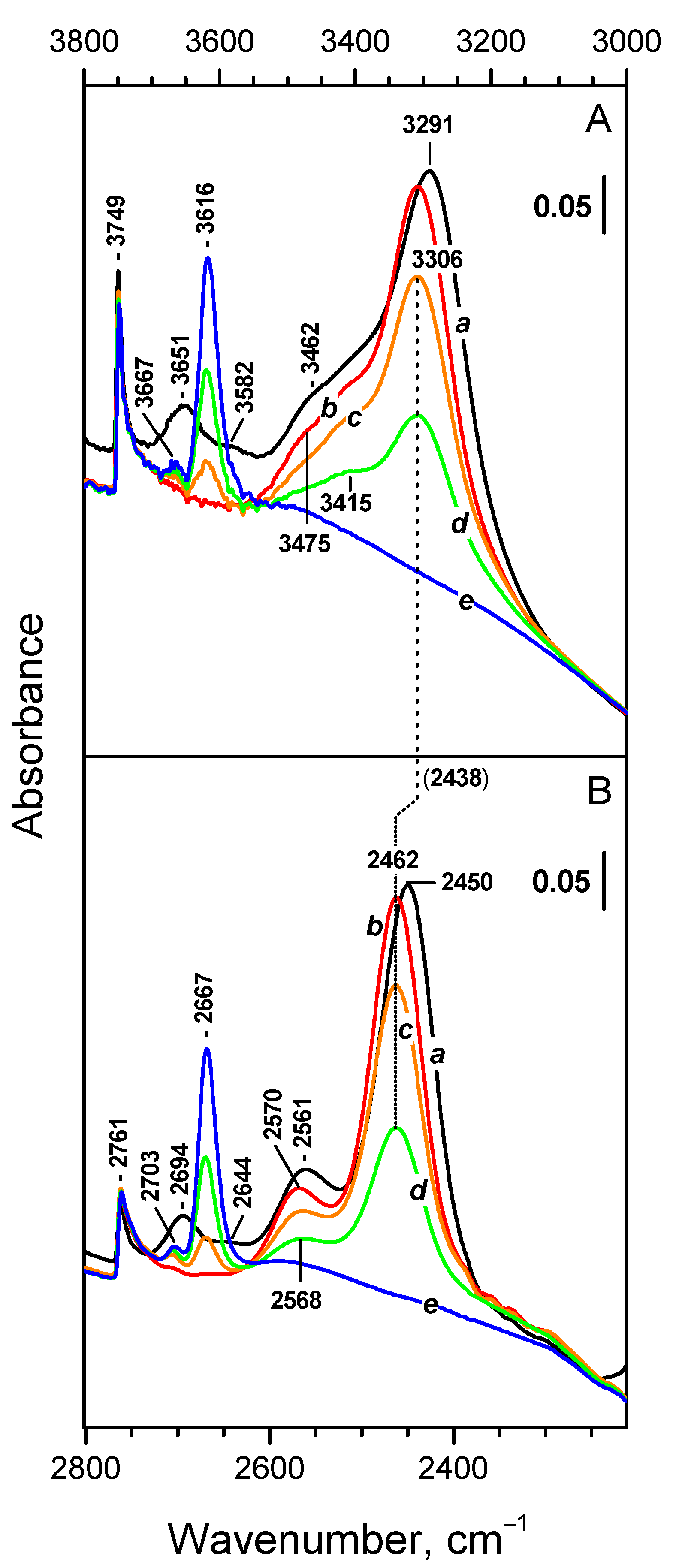
The experimentally observed isotopic shift factors (not reported in Table 1) coincide well with the predicted ones, but the exact values depend on different factors such as anharmonicity, bonding environment, and vibrational coupling. The greatest deviations are observed in vibrations involving hydrogen. Thus, the experimentally obtained OH/OD isotopic shift factor for free OH radicals is 0.7377 vs. the theoretical value of 0.7280. This deviation mainly arises from the anharmonicity, since the shift for the harmonic frequencies (calculated on the basis of overtone modes) coincides with the theoretical value [9]. The significant relative mass difference between H and D also leads to a slight but observable difference in their chemical properties. Thus, surface OD groups are slightly less acidic than the corresponding OH groups, as measured by the adsorption of CD3CN as a probe molecule [10]. Consequently, OD groups form weaker H-bonds, which is reflected in the isotopic-shift factor of the H-bonded hydroxyls. This is illustrated in Figure 2, where the CO-induced changes in the OH and OD modes of H–D–ZSM-5 are presented (the spectra are qualitatively the same as those of H–ZSM-5 and D–ZSM-5 samples) [11]. As seen from Figure 2 (spectrum e), the isotopic shift in the isolated hydroxyls (Si–OH at 3749 cm−1 and Si(OH)Al at 3616 cm−1) is practically the same. However, when the hydroxyls form adducts with CO, the isotopic effect is definitely lower. This is consistent with the weaker acidity of OD groups, which leads to a weaker OD···CO bond and smaller shift in the OD stretching modes. Thus, the OD/OH isotopic shift factor is a sensitive and reliable indicator of H-bonding.

2.1.2. Polyatomic Molecules

When two identical oscillators interact through weak inter- or intramolecular coupling, each normal vibration gives rise to two collective modes. In a simple AB2 system, for instance, the two A–B stretching vibrations combine to form symmetric and antisymmetric modes. The symmetric mode corresponds to simultaneous and parallel dipole changes in the two A–B bonds, whereas in the antisymmetric mode, the dipole changes occur in opposite directions. As a result, two distinct bands appear in the IR spectrum.
Both the symmetric and antisymmetric stretching modes involve simultaneous motion of the constituent atoms. However, the effective reduced mass differs slightly for the two modes, leading to small differences in their isotopic shifts. This arises because, in polyatomic systems, the effective reduced mass reflects the coupled motion of all atoms rather than a single atomic pair. The extent of the isotopic effect depends on the molecular geometry, bond angle, mass of the central atom, the degree of vibrational mixing, and the relative amplitudes of motion of the substituted atoms. In addition, Fermi-resonance phenomena often complicate the spectra and hinder accurate determination of isotopic shifts. From a practical point of view, however, it is important to note that for the stretching modes, the isotopic shifts remain of similar magnitude to those observed for diatomic molecules.
The bending modes, however, can behave differently. In bent molecules, where the central atom (A) is strongly involved in the vibrational motion, the isotopic effects generally follow the predictions of the harmonic oscillator model. For instance, in the H2O molecule, H → D substitution shifts the bending frequency almost exactly as expected from the harmonic approximation. The 16O → 18O substitution also follows the predicted square-root dependence, although the shift is slightly smaller. In contrast, for linear molecules such as CO2, the bending motion mainly involves the two outer atoms moving against each other, while the central atom contributes only modestly to the kinetic energy of the mode. Consequently, substitution of the central atom produces a weaker isotopic effect, whereas simultaneous substitution of both peripheral atoms results in shifts that closely follow the harmonic model prediction.
Deviations from the simple harmonic behavior become more pronounced as the number of atoms in the surface species increases beyond three, as in tetratomic or larger polyatomic anions [6]. In these systems, isotopic shifts depend strongly on molecular symmetry and vibrational coupling. For planar species such as carbonates and nitrates, the deformation modes involve little motion of the central atom, resulting in a weak isotopic effect upon its substitution.
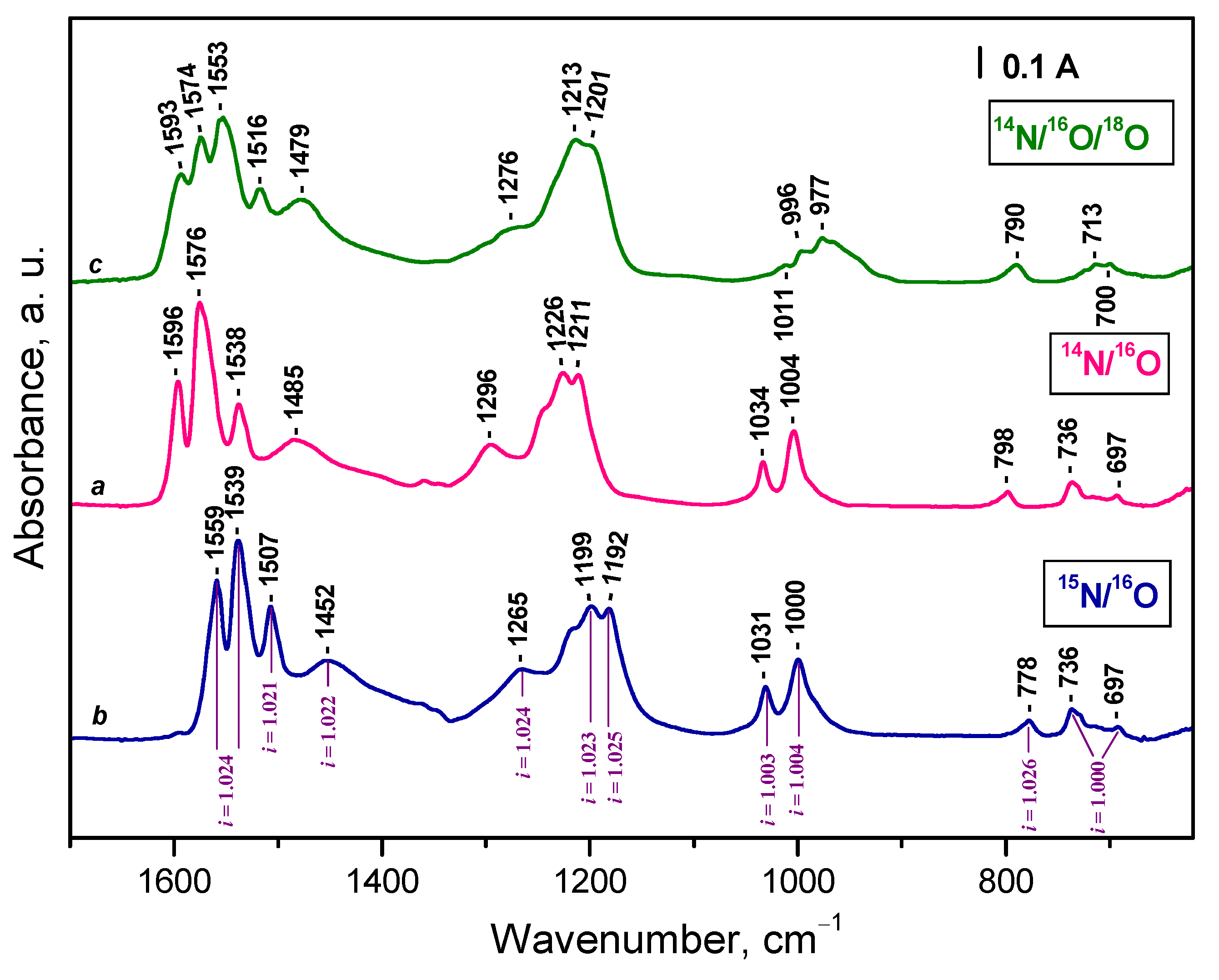
This behavior is illustrated in Figure 3a,b, where the spectra of co-adsorbed NO + O2 are compared for 14N- and 15N-containing species [12]. All bands in the 1600–700 cm−1 region characterize various surface nitrates. It is seen that the bands in the ranges 1600–1485 and 1296–1211 cm−1, as well as the band at 798 cm−1, exhibit isotopic shift with factors between 1.021 and 1.026 (expressed as 1/i), consistent with the expectations for the N–O stretching modes. In contrast, the bands at 1034, 1004, 736 and 697 cm−1 are shifted by a much smaller factor. For the out-of-phase deformation modes (1034 and 1004 cm−1), the factors are 1.003–1.004, while for the in-phase deformations (736 and 697 cm−1), which involve negligible motion of the nitrogen atom, the isotopic effect is not experimentally observable. Similar behavior was reported for the spectra of surface carbonates on ceria [13].
The 18O-labeling of nitrates (Figure 3c) supports the proposed assignment. Although the 16O → 18O substitution was only partial, the results clearly show that it affects all vibrations, consistent with the strong participation of oxygen atoms in all normal modes.
As discussed above for the AB2 molecule, the A–B vibrations are coupled and split. However, vibrational coupling can occur even when the two oscillators are not equivalent. Consider an ABC molecule in which the B–A and B–C bonds have comparable force constants and share a delocalized electronic system. In this case, the two bonds vibrate cooperatively, and the coupling gives rise to symmetric and antisymmetric stretching modes.
The most characteristic example, highly relevant to surface chemistry, is provided by isocyanates. A comparison of the C–N and C–O stretching modes in cyanic and isocyanic acids clearly illustrates the effect of bonding topology. In cyanic acid (H–O–C≡N), the C–O and C–N vibrations differ markedly in strength and remain essentially isolated. The C–O modes, although interacting with the O–H modes, are not influenced by the C–N vibration. Consequently, the effect of 13C or 15N labeling on the C≡N stretch closely resembles that predicted by the harmonic-oscillator model [14], confirming its localized, diatomic character.
However, isocyanic acid (H–N=C=O) and the related isocyanates behave differently. The C–N and C–O bonds are similar in strength and are linked through a delocalized π-system. This leads to strongly coupled νs(NCO) and νas(NCO) modes involving the concerted motion of all three atoms. Consequently, substitution of the central carbon atom has a more pronounced effect on both bands, since it participates in both bonds. In contrast, substitution of one of the peripheral atoms (N or O) produces smaller shifts, reflecting their more limited involvement in the collective motion [15].
Bion et al. [16] investigated the effect of isotopic substitution with 15N and 13C on the νas(NCO) bands of several surface isocyanates on alumina observed in the 2261–2187 cm−1 region. Substitution of the central carbon atom produced a shift with isotopic factor i = 0.973, which is in good agreement with the expected values for both C–O and C–N bonds (0.978–0.979). In contrast, 14N ⟶ 15N substitution yielded a smaller shift (i = 0.994), consistent with the limited participation of the nitrogen atom in the collective NCO modes.
The effect is similar to that observed for the CO2 molecule, where substitution of the central carbon or of both oxygen atoms produces the full isotopic shift, while substitution of only one oxygen atom results in approximately half the effect—illustrating the same principle of coupled symmetric and antisymmetric stretching vibrations. It should also be noted that isotopic substitution modifies the coupling itself: by disturbing the mass balance, it partially localizes the vibrations and thus changes their character, as observed in singly substituted C16O18O molecules.
Thus, full isotopic substitution can reveal valuable information about surface species with mixed modes. However, because multiple factors affect the band positions, parallel calculations are strongly recommended for a reliable interpretation of isotopic effects.

2.2. Tracing Vibrations Involving Specific Atoms

A primary application of full isotopic substitution is the unambiguous identification of whether a given vibrational band involves a specific atom.
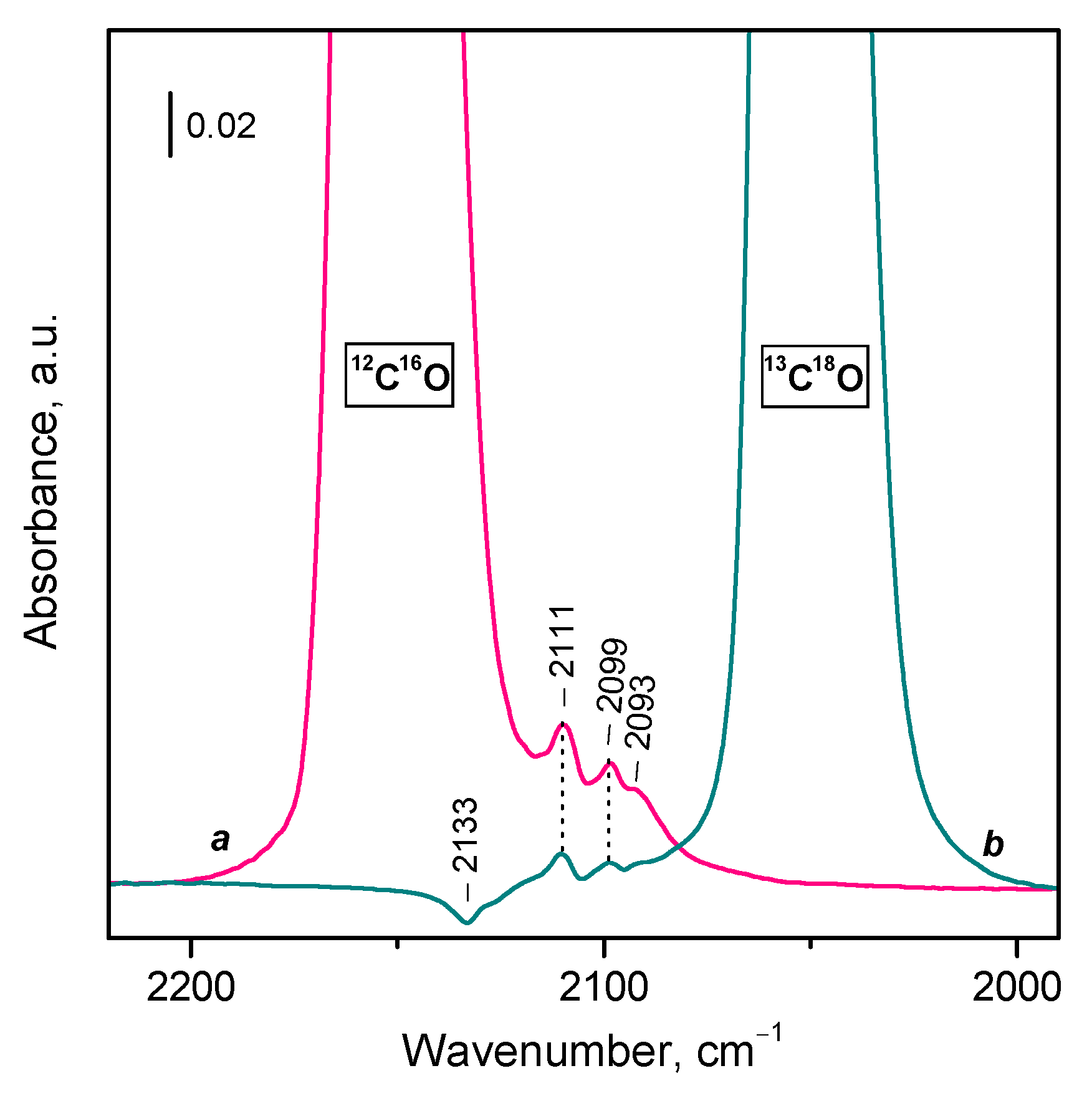
Case study: Carbonyl species on reduced ceria. The determination of whether a particular vibration involves a specific atom is relatively simple and is illustrated in Figure 4. After adsorption of CO on reduced ceria, an intense band at 2150 cm−1 appears together with several weaker bands between 2111 and 2093 cm−1 [17]. All bands are in the carbonyl stretching region and could, in principle, be assigned to adsorbed CO. A small contribution of 13CO to the envelope around 2100 cm−1 is expected, but its intensity is too high to arise solely from the natural 13C abundance. Upon adsorption of 13C18O, the main carbonyl band was red-shifted by ca. 100 cm−1, which unambiguously demonstrates that it is due to C–O stretching modes. However, no bands at lower frequencies were detected, which excludes the assignment of the bands at 2111–2093 cm−1 to C–O vibrations. Note that such bands are often attributed to Ce3+–CO species.
The background spectrum of reduced ceria contains a composite band between 2133 and 2110 cm−1 assigned to the 2F5/22F7/2 spin–orbit electronic transition of Ce3+ [18]. Based on the fact that some negative bands were detected around 2133 cm−1 after 13C18O adsorption, it was concluded that the bands at 2111–2093 cm−1 detected after CO adsorption on reduced CeO2 arise from a shifted component of the Ce3+ electronic transition band. Thus, the spectra unambiguously prove that Ce3+12C16O species do not produce IR bands around 2110 cm−1. Note that the confirmation or rejection of the assignment of bands to carbonyl species can also be performed using the 13CO isotopologue. However, 13C18O provides additional information about the origin of the bands in the 2111–2093 cm−1 region.
This example illustrates a general principle: full isotopic substitution makes it possible to establish whether a given IR band arises from a vibration involving a specific atom, thereby distinguishing such bands not only from vibrations involving other atoms but also from features of different origin, including electronic transitions.
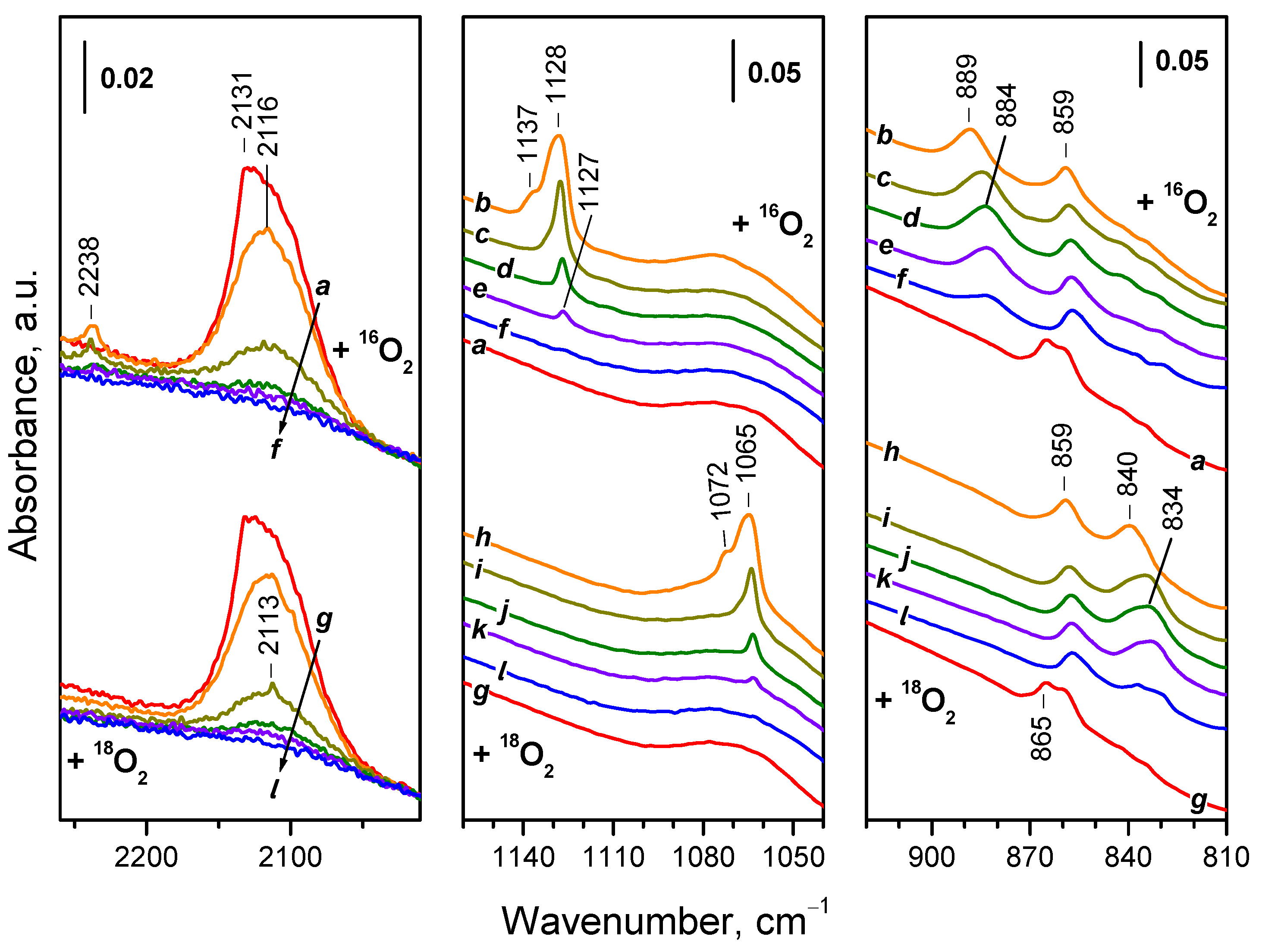
Case study: Oxygen adsorption on reduced ceria. Another example with reduced ceria shows how the isotopic studies can bring information on the structure of adsorbed species. Figure 5 presents the spectra of 16O2 and 18O2 adsorbed on the sample [19]. Four bands are affected by the isotopic substitution: at 2238, 1137, 1128 and 889 cm−1. All of them are shifted by a factor of ca. 0.944 when 18O2 was adsorbed. This factor indicates that the bands correspond to O–O modes. The absence of intermediate bands shows that no 16O–18O species are produced and provides direct evidence for the molecular integrity of the adsorbed oxygen species. The bands at 1128 and 1137 cm−1 have been attributed to superoxide anions, with the respective overtone at 2238 cm−1, while the band at 889 cm−1 has been attributed to peroxide species.
The results also allow monitoring the gradual oxidation of ceria by the decrease in the Ce3+ electronic transition band at 2131–2113 cm−1 and show that the bands at 865–859 cm−1 are not due to adsorbed oxygen in agreement with earlier assignment to carbonate-like structures [20].

2.3. Differentiating Vibrations in Coexisting Surface Species

When several surface species coexist, full isotopic substitution can be used to selectively identify which vibrations belong to which species, provided that no isotopic exchange occurs.
Case study: H2O adsorption on H–ZSM-5. A key finding obtained through isotopic labeling concerns the assignment of the IR bands observed after water adsorption on H-zeolites, which in turn clarified the nature of the interaction between acidic zeolite OH groups and weak bases. Wakabayashi et al. [21] compared the IR spectra of H–ZSM-5 recorded after adsorption of H216O and H218O. They observed two groups of bands—sensitive and insensitive to isotopic substitution—which were attributed to H2O and OH vibrations, respectively. It was thus demonstrated that the bands at 3698, 3558 and 1629 cm−1 correspond to adsorbed water, while bands at 2877, 2463, and 1353 cm−1 arise from perturbed bridging hydroxyls. The first two bands were assigned to the A and B components (arising from Fermi resonance) of the ν(OH) modes red-shifted upon interaction with water, and the band at 1353 cm−1 to the shifted δ(OH) vibrations. Importantly, these results ruled out the formation of hydronium ions (H3O+) as a result of proton transfer to the water molecule. Note, however, that this approach can only be used in studies where no isotopic exchange of labeled atoms occurs between the different surface species.

2.4. Controlling Fermi Resonance

Fermi resonance occurs when two vibrational modes of similar energy interact, leading to a perturbation of their frequencies and intensities. This coupling complicates the interpretation of IR spectra, as the observed bands no longer correspond to pure vibrational modes. A simple and effective way to suppress or eliminate Fermi resonance is through isotopic substitution. Since isotopic replacement shifts various vibrational frequencies to different extents, it can remove or significantly reduce the effect.
For example, in acetonitrile, the C–N stretching vibration is perturbed by interaction with the ν3 + ν4 combination band involving ν(C–C) and δ(CH3) modes. This interaction leads to Fermi resonance and splitting of the C–N band. In CD3CN, however, the frequencies of the CH3-related modes are strongly shifted to lower wavenumbers, while the C–N stretching vibration is only slightly affected. This unequal isotopic shift effectively removes the Fermi resonance, yielding a simpler spectrum. Therefore, deuterated acetonitrile is widely used as an IR probe molecule, providing reliable information through the position of the (C≡N) stretching band [22].
Case study: H-bonded hydroxyls in H–ZSM-5. Another illustration of how isotopic labeling can be used to identify Fermi resonance effects is presented in Figure 2. It is well established that adsorption of CO on H–ZSM-5 leads to the formation of hydrogen bonds with the zeolite’s acidic hydroxyl groups, resulting in a red shift in their ν(OH) band [23]. In addition to the main shifted band at 3291 cm−1, however, a pronounced shoulder appears at 3462 cm−1. This feature has often been attributed to heterogeneity of the zeolitic acidic hydroxyls [9]. If this were the case, the spectra in the ν(OD) region would be expected to exhibit a similar pattern, merely shifted to lower frequencies. As shown in Figure 2, however, the shape and relative intensities of the main band and the shoulder differ substantially. Consequently, it was concluded that the appearance of two shifted bands arises from Fermi resonance involving the second overtone of the δ(OH) bending vibration [11]. This indicates that the bridging hydroxyl groups are essentially homogeneous.

2.5. Identifying Atomic Origins in Surface Species

Case study: Methanol dissociation on oxide surfaces. Methanol is a widely used IR probe molecule that provides valuable information on the nature of surface oxygen vacancies. However, for correct interpretation, it is necessary to know the pathway of methanol dissociation on the surface, i.e., whether the C–O or O–H bond is cleaved. A classic investigation in this respect was carried out by Lavalley et al. [24]. By comparing the adsorption of CH316OH and CH318OH on ThO2 and CeO2, the authors observed a shift in the C–O stretching modes of the methoxy species when CH318OH was used, which demonstrates that the oxygen atom in the surface species originates from methanol rather than from the solid. This mechanism is now accepted for the adsorption of alcohols on oxide surfaces.
In these studies, the choice of an appropriate atom to be substituted is essential. For instance, replacement of 12CO with 13CO when studying CO oxidation [25] cannot answer the question of whether the oxygen in the produced adsorbed CO2 originates from the catalysts or not. For this purpose, the use of 12C18O is more appropriate.

2.6. Concluding Remarks

The examples discussed above demonstrate that the full isotopic substitution remains a cornerstone approach in the IR surface studies. By selectively shifting vibrational frequencies, it enables the unambiguous determination of whether a given atom is participating in a particular vibration, which is an essential step for the correct assignment of bands. In some cases, clarification of bonding geometries is also possible. The approach also provides a simple means of suppressing spectral complications such as Fermi resonance and band overlap.
At the same time, the technique has certain inherent constraints. The interpretation of spectra can be complicated when the substituted atom participates in delocalized or collective vibrations. Most importantly, the capability of this approach is restricted in terms of structural determination. These limitations motivate the use of partial and intermediate isotopic substitution strategies, which are discussed in the following sections and allow access to more detailed structural and mechanistic information.

3. Trace-Level Isotopic Substitution

3.1. Theoretical Background

As discussed above, the A–B modes in an AB2 molecule couple. If only one of the B atoms is replaced by its heavier isotope (B*), the two A–B oscillators are no longer equivalent. The degeneracy of the monomeric vibrations is lifted, the vibrational coupling is strongly reduced, and the splitting between the symmetric and antisymmetric modes disappears. Consequently, the mixed-isotope species ABB* exhibits single A–B and A–B* stretching bands. Such vibrations are referred to as decoupled modes, and their analysis provides valuable information about molecular geometry and bonding.
The isotopic shift for decoupled vibrations is usually larger than that for coupled ones. The A–B* vibration appears at a lower frequency and often lies closer to the antisymmetric mode of the homoisotopic AB2 molecule, whereas the A–B vibration is closer to the symmetric mode. This residual displacement indicates that weak coupling between the two oscillators still persists, although it is substantially diminished.
A similar situation is encountered in polyatomic molecules and ions with higher symmetry, where several normal modes are degenerate. Upon symmetry reduction—such as that occurring when a molecule is adsorbed on a surface—degeneracy is partially lifted, yet vibrational coupling often remains. A typical example of such a system is provided by the bidentate sulfates. The distinct SO2 group (oxygens not bonded to the surface) in these species displays both symmetric and antisymmetric S–O stretching modes that remain coupled. Here again, isotopic substitution serves as an efficient probe to distinguish between coupled and localized vibrations and to infer the geometry of the adsorbed species.
When the isotopic substitution is only at a trace level (a few percent), the labeled atoms are too diluted, and their bonds cannot participate in vibrational interaction, i.e., in this case, only decoupled modes are observed. This greatly simplifies spectral interpretation, which is one of the main advantages of the approach.

3.2. Static and Dynamic Interactions Between Adsorbed Molecules

A common application of trace-level isotopic substitution is to distinguish between the static and dynamic components of the interaction between adsorbed molecules. In most systems, the position of the IR band of adsorbed species shifts with increasing coverage. This shift results from two superimposed effects: a static shift, transmitted through the solid lattice and typically causing a frequency decrease, and a dynamic shift, arising from the dipole–dipole coupling between neighboring adsorbed molecules, which leads to a frequency increase. For dipole–dipole coupling to occur, the interacting molecules must be parallel (adsorbed on a regular flat crystal plane) and close to each other.
The relative contributions of static and dynamic shifts depend strongly on the nature of both the adsorption site and the adsorbate. With CO on metal surfaces, dynamic interaction usually dominates, resulting in an overall blue shift with increasing coverage, whereas on oxide surfaces, static effects prevail and the total shift is usually red [26].
Case study: CO adsorption on TiO2. With trace-level substitution, the measured shift in the labeled oscillators represents essentially the static contribution. The dynamic shift can then be obtained as the difference between the total and static shifts. Using this approach, the static shift in CO adsorbed on TiO2 (band at 2192 cm−1) was determined to be −17 cm−1, and the dynamic shift, +4 cm−1 [27]. A recent work [28] reported similar values (−15 and +4 cm−1, respectively). The presence of a measurable dynamic shift indicates that the adsorption sites are located on flat crystal planes, while the moderate static shift reflects the ability of titania to transmit interactions through the solid lattice.
This example demonstrates that trace isotopic substitution quenches not only intramolecular coupling effects but also intermolecular vibrational interactions between adsorbed molecules.

3.3. Number of Coordination Vacancies

The number of coordinative vacancies of a surface site is a key parameter for understanding the adsorption and catalytic performance of the material. It can be determined by adsorption of probe molecules (e.g., CO, N2), using intermediate isotopic substitution, which reveals vibrational coupling effects (see Section 4.1). However, when the adsorption sites are electrostatic acids, such as alkali or alkaline-earth cations, and adsorption is weak, no vibrational interaction occurs in the polyligand species, and alternative approaches must be employed.
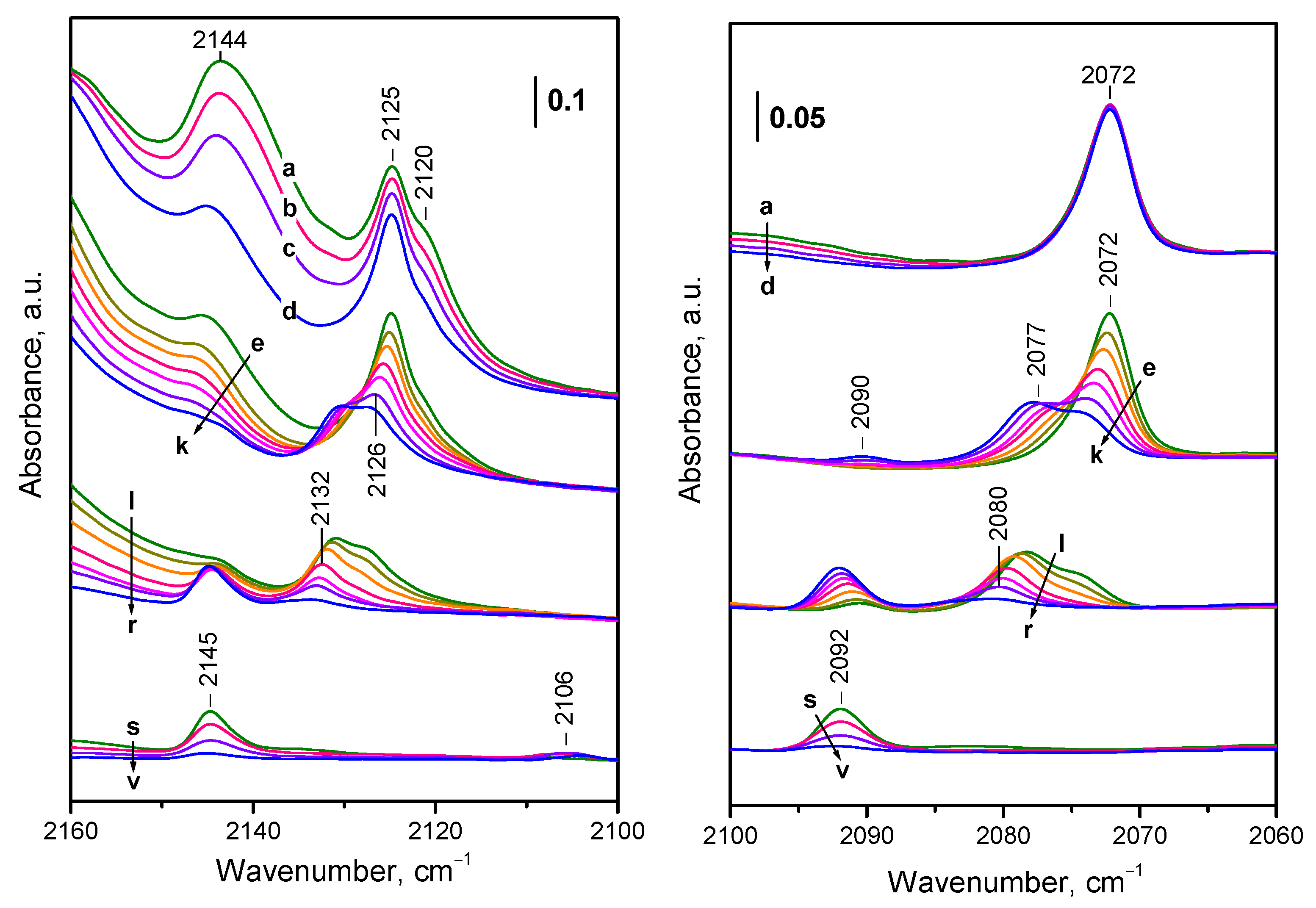
Case study: CO adsorption on CaX zeolite. In low-silica zeolites, the fundamental bands of adsorbed probe molecules are often very intense and exceed the dynamic range of the detector. In such cases, trace-level isotopic substitution proves particularly useful. Figure 6 (left panel) shows the spectra of CO (containing ~1% 13CO due to natural abundance) adsorbed at 100 K on CaX zeolite [29]. At low coverage (spectra s–v), a band at 2145 cm−1 dominates in the ν(13CO) region and is assigned to Ca2+13CO monocarbonyls. As coverage increases (spectra l–r), this band first grows and then declines, ultimately disappearing, while a new band at 2132 cm−1 develops, attributed to Ca2+(13CO)2 dicarbonyls. The frequency decrease reflects a static-type interaction between the two adsorbed CO molecules. At higher coverage (spectra e–k), a further discrete shift to 2126 cm−1 occurs, corresponding to the formation of tricarbonyl species, which have also been observed for other Ca-zeolites with lower cation densities. At very high coverages (spectra a–d), a weak shoulder at 2120 cm−1 appears. This feature might indicate the onset of tetracarbonyl formation but might also result from a minor 12CO satellite band.
To resolve this ambiguity, adsorption of CO enriched with ~0.5% 13C18O was studied (Figure 6, right panel). The mono-, di-, and tricarbonyl bands reappeared at lower frequencies, consistent with the expected isotopic shift, but no corresponding shoulder of the band near 2120 cm−1 was detected. This unambiguously excludes the presence of tetracarbonyl species.
These results highlight the importance of selecting an appropriate isotopologue and demonstrate how complementary isotopic labeling can decisively clarify complex adsorption spectra.
Case study: CO2 adsorption on FAU zeolites. The above example concerned a case where the vibrational coupling between the ligands is practically absent even without isotopic dilution. Below, we will demonstrate that the same approach can be helpful when a considerable coupling occurs just as a result of changing the ligand from CO to CO2, which forms a stronger bond with Ca2+ cations.
In view of the growing concern about global warming, studies on CO2 adsorption have become highly topical. Metal-exchanged zeolites are among the materials with the highest known CO2 adsorption capacities. Below, we show how trace-level isotopic substitution can provide insight into the evolution of the CO2 polyligand species on CaX with surface coverage. This technique is particularly suitable in such systems because the very high adsorption capacity leads to an extremely intense ν3(12C16O2) band with undetectable maxima.
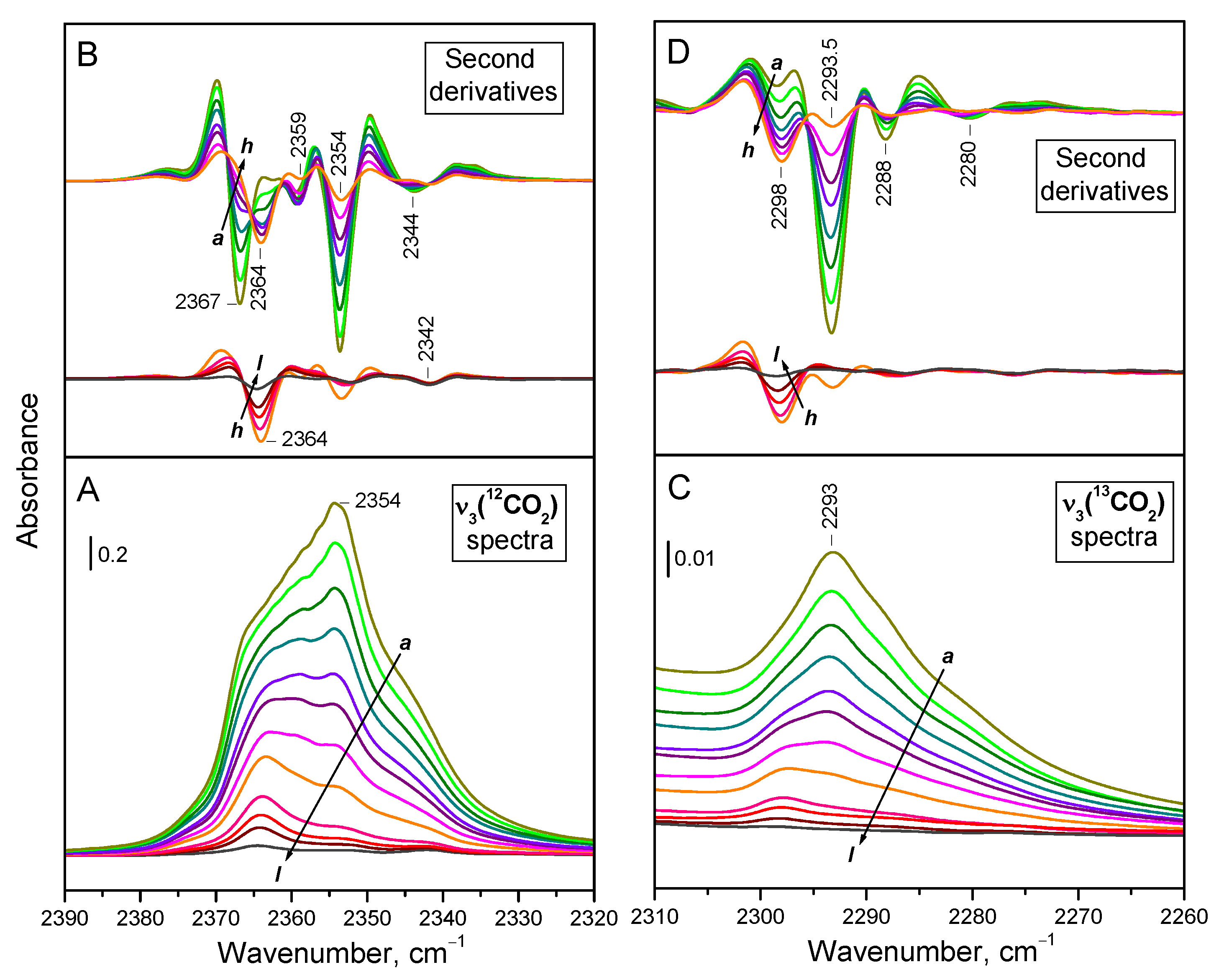
Figure 7 compares the ν3(12CO2) and ν3(13CO2) regions of the spectra of CO2 adsorbed on CaNaY [30]. At low coverages, bands at 2364 and 2298 cm−1 develop in concert and are attributed to complexes of Ca2+ with 12CO2 and 13CO2, respectively (see the bottom curves in panels B and D). At higher coverage, these bands decline and new bands develop at their expense: at 2367, 2354 cm−1 (12CO2) and 2293.5 cm−1 (13CO2). The former two bands are assigned to the ν3(12CO2) of geminal Ca2+(12CO2)2 complexes, which are split because of vibrational interaction. The band 2293.5 cm−1 is due to the ν3(13CO2) mode of Ca2+(12CO2)(13CO2) mixed ligand species, the respective 12CO2 band being masked by the other strong bands in the region.
At higher coverages, the bands in the ν3(12CO) region became too intense to allow determination of their maxima. However, in the ν3(13CO) region, a conversion of the band at 2293.5 cm−1 into another band at 2291 cm−1 was observed. The latter was attributed to triligand species. Thus, analysis of the 13C16O2 modes revealed a reversible conversion from mono- to di- and triligand species with increasing coverage, a conclusion impossible to be drawn from analysis of the spectra in the ν3(12CO) region. This finding is in full agreement with the stepwise formation of mono- di- and tricarbonyl species on one Ca2+ cation in FAU zeolites discussed above.
In NaY, only up to two CO2 molecules can be simultaneously coordinated to one Na+ cation [31]. This is in agreement with the fact that the Na+ sites can accommodate up to two CO molecules [32]. In summary, the above results demonstrate that trace-level isotopic substitution can be very useful for determining the number of CO2 molecules that can be accommodated by a single cationic site even when the dominant isotopologue bands are experimentally inaccessible.
The same approach can be used to suppress dynamic interactions in order to obtain distilled information about chemical effects. For instance, Feldt et al. [33] employed isotopic dilution of 12CO in 13CO to clearly distinguish three adsorption sites on a stepped Au(332) surface.

3.4. Concluding Remarks

Trace-level isotopic substitution yields spectra in which vibrational coupling between adsorbed molecules is effectively eliminated. This makes the approach uniquely suited for disentangling static and dynamic frequency shifts, suppressing vibrational interaction, and especially valuable for systems where the bands of the non-labeled species are excessively intense.
Despite these advantages, the method has notable limitations. The IR bands of trace isotopologues are intrinsically weak and may overlap with other spectral features, hindering reliable analysis. Another complicating factor is intensity transfer, which, though negligible on oxides, is pronounced with bulk and supported metals [34,35,36,37]. It leads to a strong enhancement of the higher-frequency band at the expense of the lower-frequency one. The effect is promoted by the close position of the bands and by high coverage.
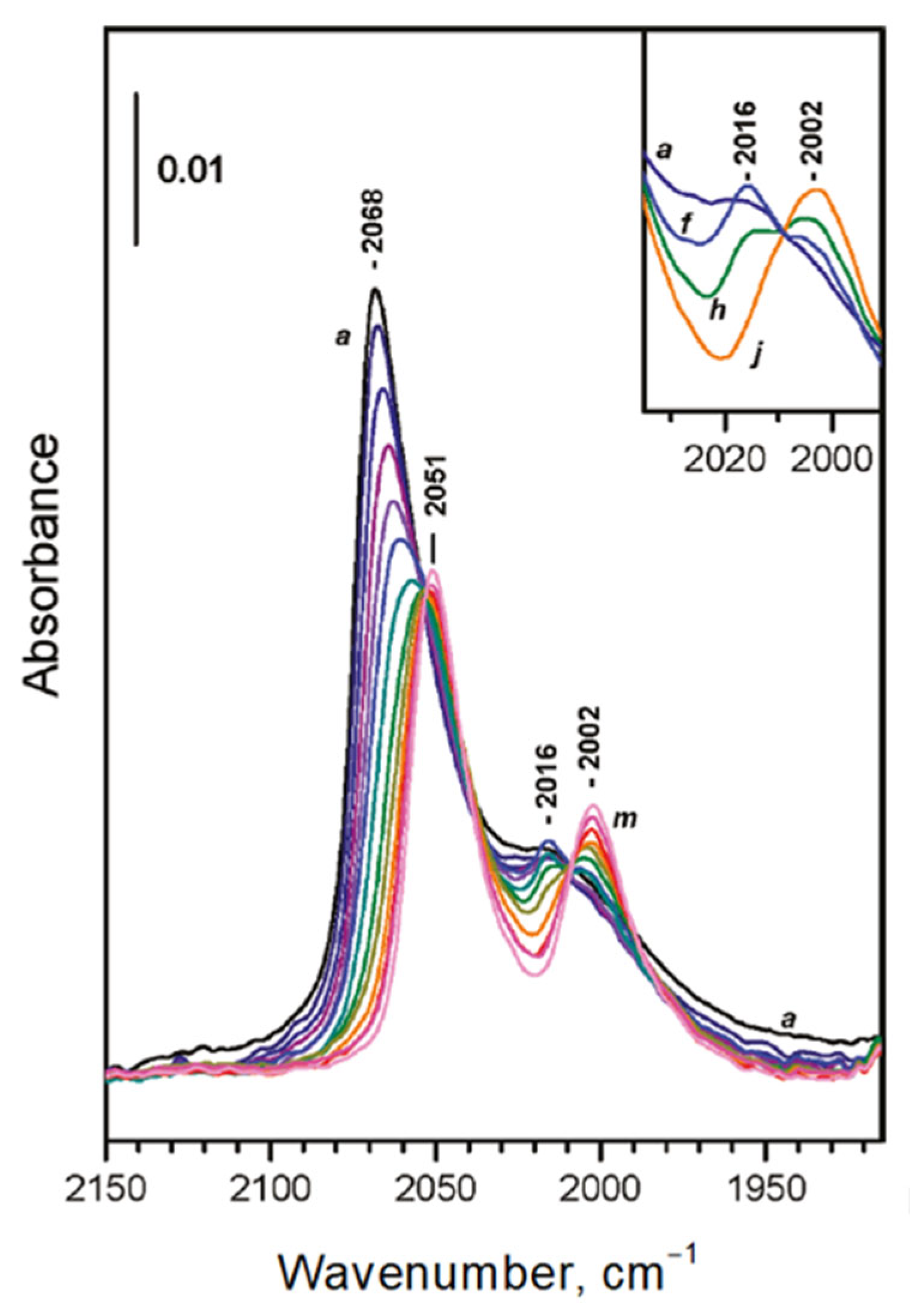
Intensity transfer is illustrated in Figure 8, which shows spectra of a 4:5 12CO + 13CO isotopic mixture adsorbed on reduced Au/SiO2 [35]. Although the molar ratio would suggest the 13CO bands (2016–2002 cm−1) to be slightly stronger than the 12CO band (2068–2051 cm−1), the spectra clearly reveal substantial intensity transfer even at low coverage. At higher coverages, this transfer becomes dominant and the 13CO band becomes hardly detectable. Consequently, trace amounts of 13CO would not be observable under these conditions. The effect also persists when 12C16O and 13C18O are co-adsorbed but is weaker owing to the larger separation of the corresponding bands, underscoring the importance of isotopologue selection.
While the absence of vibrational coupling simplifies interpretation, it may also remove information about intermolecular interactions. Consequently, the conclusions drawn from trace-level substitution are not always unambiguous, and complementary experiments at higher isotopic exchange levels are sometimes necessary.

4. Intermediate-Level Isotopic Substitution

4.1. Theoretical Background

Intermediate substitution refers to mixtures containing substantial fractions of both isotopes, so that several isotopologues coexist and their coupled/decoupled vibrations can be analyzed. This approach can be applied when a surface species or complex has at least two identical atoms, for instance, CO2, H2O, O3, NO3 and all polyligand complexes. To illustrate the principles of this approach, we first consider a random substitution of 50% of the B atoms with their heavier isotope (B*) in an AB2 compound. Statistical considerations predict that the resulting product should contain 25% AB2, 50% ABB* and 25% AB*2.
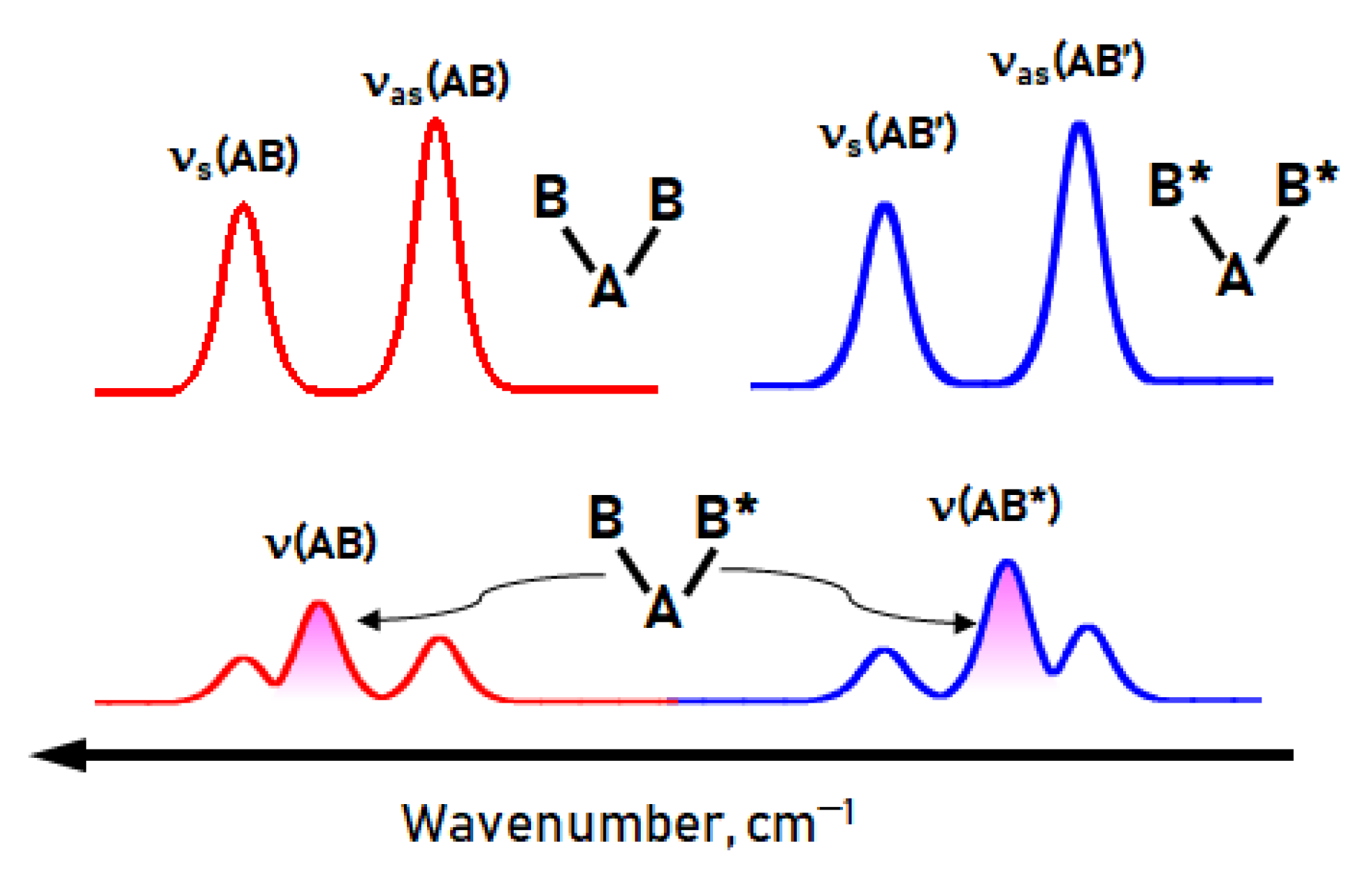
In the parent AB2 molecule, the two A–B stretching vibrations are coupled and give rise to the symmetric (νs) and antisymmetric (νas) stretching modes. The same pair of coupled modes is observed for the AB*2 isotopologue (Figure 9, top spectra). However, in the mixed-isotope ABB* molecule, the A–B and A–B* oscillators are no longer equivalent. The coupling between them is largely suppressed, and the two stretching vibrations become effectively decoupled. Consequently, two distinct A–B and A–B* stretching bands appear in the spectrum. Therefore, the overall IR spectrum of the mixture should contain six stretching bands (Figure 9, bottom spectrum).
Considering the statistical distribution of isotopologues, the AB2 species in the isotopic mixture represent 25% of the total population, and their IR bands will therefore be four times less intense than in the pure AB2 compound. The same relation holds for the AB*2 species. In contrast, the integral intensity of the decoupled A–B and A–B* bands amounts to half of the total intensity, i.e., the intensity of the coupled vibrations decreases in favor of the decoupled ones.
It should also be noted that the intensities of the A–B and A–B* bands are not identical, because weak residual coupling still exists. Moreover, their isotopic shifts are somewhat larger than those observed for the coupled modes. The exact band positions can be predicted using an approximate force-field model [38].
Varying the isotopic substitution degree changes the relative distribution of isotopologues, as illustrated in Table 2. Such statistical weighting of isotopologues forms the basis for quantitative analysis of mixed-isotope spectra. This approach can be particularly useful when multiple bands overlap in complex spectra.
For symmetric AB3 molecules (or species containing such fragments), the statistical pattern changes (Table 3). In this case, at 50% substitution, the intensities of the original bands of AB3 decrease to one-eighth of their values in the pure compound. This pronounced difference in the intensity patterns of substituted AB2 and AB3 molecules provides a useful, although often overlooked, diagnostic criterion for structural identification. As shown in Table 3, varying the substitution level offers an additional means to resolve overlapping features and confirm structural interpretations.
This approach, based on 16O ⟶ 18O substitution, appears to be particularly powerful for establishing the structure of surface anionic oxo-species, in which several vibrations involve coupled motions of different oxygen atoms. Intermediate oxygen substitution breaks degeneracies and alters the mode character, thereby providing valuable structural information. Such studies are still rare, largely because controlling the degree of oxygen exchange under realistic conditions is experimentally challenging.
In contrast, intermediate isotopic substitution has found broad application in the study of polyligand surface complexes, such as polycarbonyls and polynitrosyls. Note that in these systems, provided that the adsorption is not purely electrostatic, vibrational coupling between equivalent ligands also occurs. Controlled isotopic substitution can disentangle these couplings, revealing the number of coordinated ligands as well as the symmetry of the complexes.
The success of this approach depends critically on the choice of the labeled atom. For example, in studies of surface polyoxoanions, isotopic substitution of the central atom is of limited value because there is only one such atom per species. In these cases, full and intermediate substitution produce identical spectral effects, making labeling experiments uninformative. In contrast, intermediate oxygen substitution can lift degeneracies among coupled vibrations, yielding far more detailed structural information on the adsorbed species.
Gradual isotope exchange is particularly advantageous, as it allows one to follow the evolution of spectral changes and to achieve a consistent interpretation of complex band patterns. In some systems, dual labeling, i.e., substitution of both atoms in a given bond, provides the most comprehensive insight.
A related illustration is offered by isotope scrambling reactions, which highlight the importance of selecting an appropriate isotopologue pair. For example, in CO isotopic scrambling (intermolecular exchange of C or O atoms), a mixture of 12C16O and 13C16O remains spectroscopically unchanged before and after exchange, since the products are identical to the starting composition. Only when both oxygen and carbon are labeled (e.g., 12C16O–13C18O or 13C16O–12C18O mixtures) does the isotopic redistribution lead to new, spectroscopically detectable species [39].
Two approaches (described below) are particularly useful in intermediate isotopic substitution for facilitating the assignment of IR bands: (i) systematic variation in the isotopic ratio, and (ii) comparison of the experimental spectra with “synthetic non-coupled” spectra, obtained by linearly combining the spectra corresponding to 0% and 100% isotopic substitution in proportion to the actual degree of exchange. In other words, any deviation of the experimental spectra from the synthetic non-coupled spectra directly reveals the presence and extent of vibrational interaction. Both tools are essentially diagnostics for vibrational coupling: they reveal interactions that are invisible in fully substituted spectra.

4.2. Structure and Formation Pathways of Diatomic Species

Case study: NO+ in H–ZSM-5. A characteristic band at 2133 cm−1 is observed after NO + O2 coadsorption on H–ZSM-5 and M–H–ZSM-5 zeolites. Several assignments (e.g., NO2+, N2, N2O) were initially proposed [40]. It is now generally accepted that this band originates from nitrosonium cations (NO+) occupying cationic positions in zeolites, as demonstrated by experiments involving N16O + 18O2 coadsorption [41]. The reaction proceeds in three steps:
2 NO + ½ O2 ⟶ N2O3
Olattice–H+ + N2O3 ⟶ Olattice–NO+ + HNO2
Olattice–H+ + HNO2 ⟶ Olattice–NO+ + H2O
and the overall reaction is described by the equation:
2 NO + ½ O2 + 2 Olattice–H+ ⟶ H2O + 2 Olattice–NO+
More specifically, NO adsorption alone on H–ZSM-5 causes only minor spectral changes. However, upon dosing of O2, a band develops at 2133 cm−1, accompanied by (i) a decrease in intensity of a band at 3610 cm−1 due to acidic hydroxyls, and (ii) the appearance of water-related bands, including δ(H2O) at 1630 cm−1. When 18O2 is dosed instead of 16O2, the initial spectra are essentially the same as in the experiments with 16O2. However, at higher 18O2 doses, a new shoulder appears and grows at 2077 cm−1. The isotopic shift factor matches that expected for an N–O bond. The absence of an intermediate band excludes the assignment of the species to NO2+; consequently, they were attributed to NO+.
The results indicate that the first step of NO+ formation involves replacement of an acidic proton by NO from the adsorbed N2O3 intermediate (Equation (4)). Note that the N2O3 molecule consists of relatively weakly bound [NO] and [NO2] fragments, and upon initial dosing of 18O2, the labeled oxygen remains in the [NO2] part. This explains why no isotopic effect is observed at the initial reaction stages. The proton replacement is accompanied by the formation of 18O-labeled HNO2 (Equation (4)), which then reacts with another acidic OH group, producing labeled NO+ species.
Recent results [42], based on the IR spectra of different isotopologue mixtures (NO + O2, 15NO + O2, NO + 18O2 and 15N18O + O2) adsorbed on Cu-CHA, further confirmed that the majority of the adsorbed NO+ retains the isotopic signature of the feed gas.
Nitrosonium ion is considered a key intermediate in the selective catalytic reduction (SCR) of NOX over H-zeolites. In this context, it was demonstrated [43] that NO+ formed in Cu/H-SSZ-13 reacts with 15NH3 even at ambient temperature, leading to the formation of 14N15N dinitrogen.
The example demonstrates that partial isotopic substitution can provide information not only on the structure of the surface species but also on the mechanism of their formation.

4.3. Polyatomic Species with Identical Atoms

We now turn to species composed of equivalent atoms, where partial isotopic substitution reveals additional structural information that would otherwise remain inaccessible.
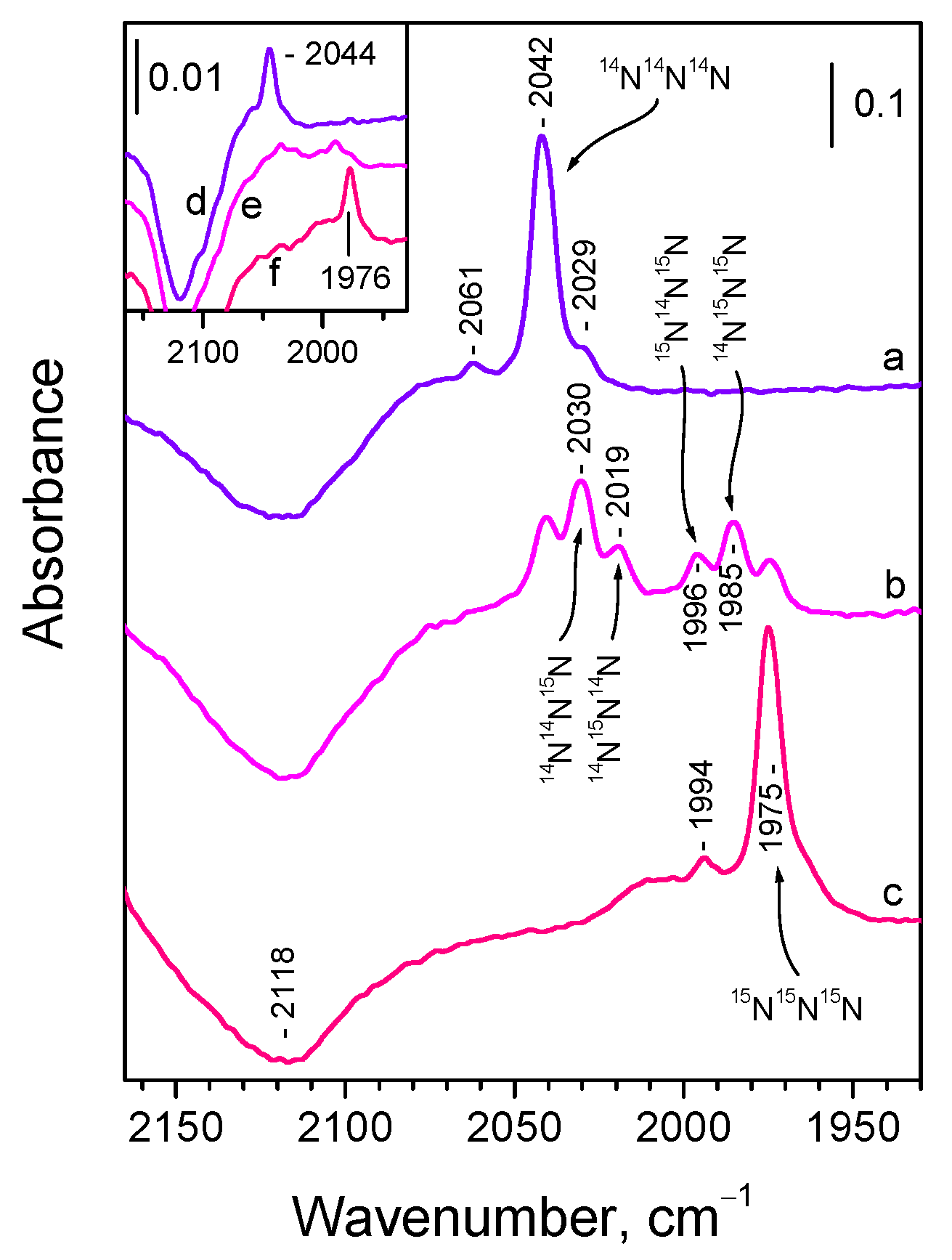
Case study: Azide anions on ceria. After adsorption of 14NO on reduced ceria, a band at 2042 cm−1 appears (Figure 10, spectrum a) [44]. Simultaneously, ceria is oxidized, as evidenced by the negative band at 2118 cm−1 corresponding to the 2F5/22F7/2 spin–orbit electronic transition of Ce3+ [20].
When 15NO was used instead of 14NO, the spectra were similar, except that the band at 2042 cm−1 shifted to 1975 cm−1 (Figure 10, spectrum c). The isotopic shift factor of 0.967 matches the expected value for 14N ⟶ 15N substitution in an N–N bond (see Table 1). However, this full isotopic substitution does not provide further structural information.
Adsorption of an almost equimolar 14NO–15NO isotopic mixture produces two distinct triplets: at (i) 2042, 2030 and 2019 cm−1 and (ii) at 1996, 1985 and 1975 cm−1 (Figure 10, spectrum b). In each triplet, the intensity of the central band is approximately twice that of each side band.
If the surface species contained two non-equivalent nitrogen atoms, intermediate isotopic substitution would generate four isotopologues and thus four IR bands. For species with three N-atoms, eight isotopologues in equal concentration should be formed. However, if the species are highly symmetric, i.e., coordinated via both terminal atoms to two cerium cations, two pairs of isotopologues (15N14N14N/14N14N15N and 14N15N15N/15N15N14N) will be spectroscopically indistinguishable and will produce bands of doubled intensities. Consequently, the band at 2042 cm−1 was assigned to the νas(N–N) mode of azide (N3) species bridging two cations. The spectral signature of each isotopologue is illustrated in Figure 10 and supported by DFT calculations.
Case study: Adsorbed ozone. Another example of a surface species consisting of three identical atoms is adsorbed ozone. Tsyganenko et al. [45,46] reported the IR spectra of ozone adsorbed on titania. The ν1 + ν3 combination mode of 16O3 was detected at 2136 cm−1. However, when ozone containing 50% 18O was adsorbed, eight bands of roughly equal intensity were detected. The lowest frequency band corresponds to adsorbed 18O3, and the isotopic shift is consistent with that expected for an O–O bond. The appearance of eight bands corresponds to all possible arrangements of the oxygen isotopes within the molecule. Thus, the results indicate that, unlike azides on ceria, adsorbed ozone has low symmetry, and each atomic arrangement produces a separate band.
These examples are particularly instructive as they directly link the observed spectral phenomena and isotopic statistics to molecular symmetry, clearly illustrating the diagnostic power of the intermediate isotopic substitution.

4.4. Surface AB3 Structures

Case study: Nitrates on ceria. Nitrate anions are planar and can interact with the surface in several coordination modes. Upon adsorption, they may form monodentate, bidentate, or tridentate species depending on the number and geometry of the surface bonds. The same situation applies to carbonate anions.
To understand their structure, it is instructive first to compare the stretching modes of monodentate and bidentate nitrates, both of which possess C2v symmetry.
Bidentate nitrates are characterized by a distinct high-frequency (HF) band corresponding to the terminal N=O bond, and by two split modes –symmetric and antisymmetric of the NO2 fragment involving the oxygen atoms coordinated to the surface.
In contrast, monodentate nitrates have one N–O bond involving a surface-bound oxygen, giving rise to a low-frequency (LF) ν(N–O) vibration, while the remaining NO2 fragment produces split symmetric and antisymmetric stretching modes. The antisymmetric NO2 bands appear at relatively high frequencies, which may overlap with the N=O vibrations of bidentate nitrates. As a result, differentiation between these two forms based solely on IR spectra is ambiguous and requires isotopic labeling studies.
Progressive substitution of 16O with 18O in bidentate nitrates leads to characteristic isotopic patterns [12]. The high-frequency N=O band shifts in a single step upon substitution, whereas each of the lower-frequency NO2-related bands exhibits an intermediate component before full exchange is achieved. Due to their similar symmetry, the same trend is expected for monodentate nitrates, although in that case, the HF band itself is among those that split, yielding an intermediate feature.
In practice, the IR spectra of surface nitrates are complex, as several species with different geometries usually coexist. Among them are tridentate nitrates, which often involve one or two weakly bound oxygen atoms and may therefore exhibit vibrational features similar to those of mono- or bidentate species. The presence of additional surface species, such as nitrites (NO2), may further complicate the spectra at lower frequencies.
To address these difficulties, a more practical diagnostic approach has been proposed, based on the analysis of the high-frequency region (1650–1450 cm−1), where nitrate bands are least affected by overlapping features. Upon intermediate 18O substitution, bidentate nitrates produce one new isotopic band, while monodentate and some tridentate nitrates each generate two. The criterion is attractive because it relies on the number of new isotopic components rather than absolute band positions. This strategy forms the methodological basis for analogous studies of more complex anions.
Using this criterion, supported by DFT calculations, the bands at 1596, 1576, and 1538 cm−1, already shown in Figure 3a, were assigned to bidentate nitrates, whereas the band at 1485 cm−1 was attributed to tridentate nitrates forming a single strong N–O–surface bond, thus resembling monodentate coordination.
Although this approach remains relatively unexplored, it offers a promising means to distinguish between different coordination modes of surface nitrates and carbonates. Importantly, the same principles can be extended to more complex oxyanions such as sulfates, where the number of possible coordination modes is higher.

4.5. Surface AB4 Structures

Case study: Sulfates on zirconia. Owing to their enhanced surface acidity, sulfated oxides exhibit high catalytic activity in reactions such as isomerization, alkylation, and esterification. Despite numerous investigations, however, there is still no consensus regarding the exact structure of the surface sulfate species.
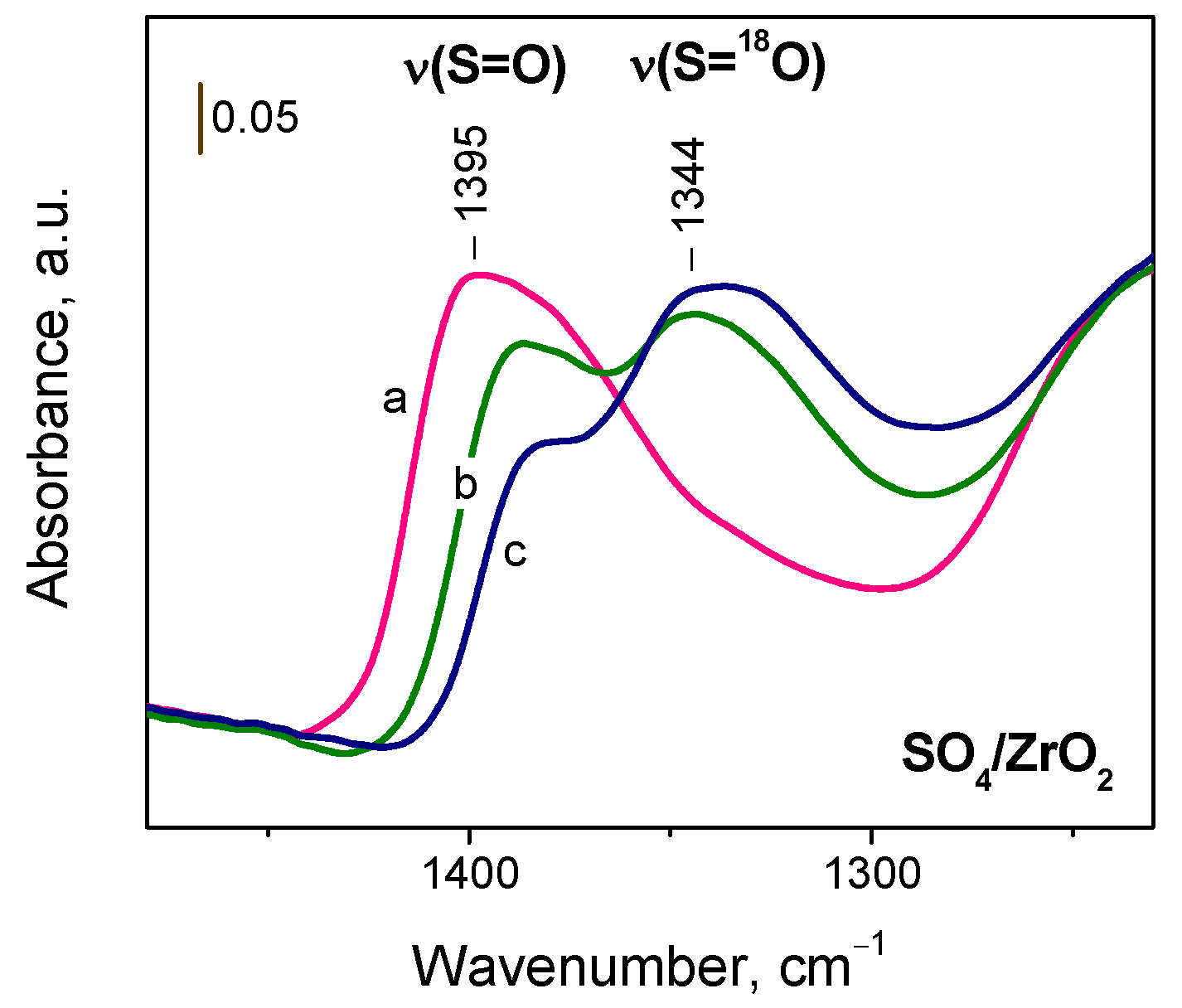
The IR spectrum of activated sulfated ZrO2 shows an intense band at 1395 cm−1 (Figure 11a), often assigned to the antisymmetric stretching mode of bidentate sulfates featuring distinct SO2 groups. This interpretation was recently challenged on the basis of partial 16O ⟶ 18O substitution [47]. As shown in Figure 11b,c, the stepwise isotopic exchange leads to a gradual depletion of the 1395 cm−1 band and the simultaneous appearance of a new band around 1344 cm−1. The observed isotopic shift factor agrees with that expected for an S–O stretching vibration. Notably, no intermediate bands were produced during substitution. These results indicate that the 1395 cm−1 band originates from an isolated S=O stretching mode and thus points to a tridentate coordination of the sulfate anion to the surface.
Upon hydration, the local symmetry of the sulfate species may change. It has been proposed that coadsorbed water promotes the formation of bidentate sulfates, characterized by lower-frequency bands owing to the loss of a distinct S=O double bond.
Using the same approach, Lauterbach et al. [48] have concluded on the co-existence of different rhenium oxo-anions on ceria, including bidentate species with two Re=O terminal bonds and tridentate species having one distinct Re=O bond. More recently, the approach was applied to decipher the structure of ReOX species supported on ZrO2 [49]. The authors combined Raman spectroscopy, which probes the fundamental vibrational modes, with infrared spectroscopy, used to detect overtone bands. A particularly original aspect of this study is that isotopic exchange was achieved through successive H2/18O2 reduction–oxidation cycles, allowing different degrees of isotopic substitution to be realized. Based on the spectroscopic results, the authors concluded that several types of surface species coexist. The species containing a single terminal Re=O bond exhibit a discrete Re=16O → Re=18O band conversion, while for species featuring O=Re=O fragments, intermediate 16O=Re=18O bands are observed.
Thus, despite their greater structural complexity as compared to nitrates, EO4n− anions provide clear isotopic signatures that facilitate distinguishing between different coordination modes.

4.6. Linkage Isomerism of Labeled Probes for Adsorption Mode Determination

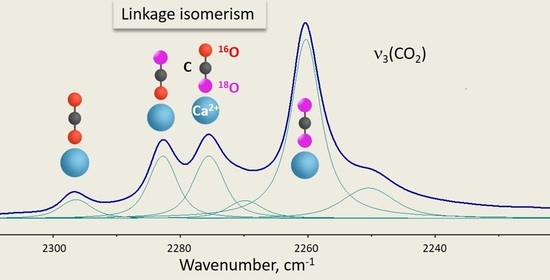
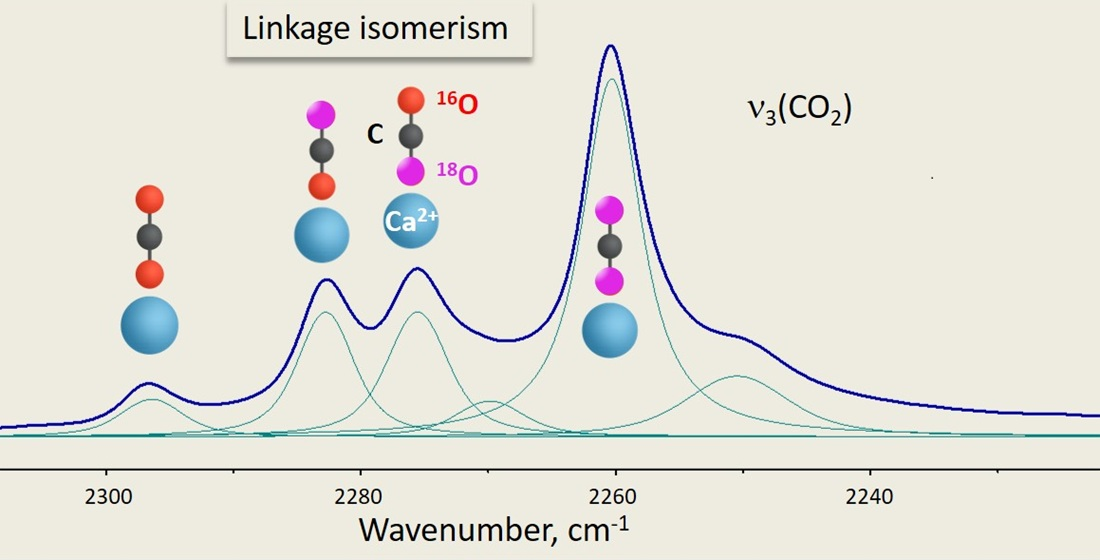
A molecule can adsorb in different ways on one active site (ensemble of sites), a phenomenon known as linkage isomerism. For instance, CO can bind either through its carbon or oxygen atom, forming carbonyl and isocarbonyl species, respectively. If a polyatomic molecule containing two or more identical atoms binds through either of them, the resulting species are equivalent, and no isomerism occurs. However, if one of these atoms is isotopically labeled, linkage isomerism becomes observable. Below, we illustrate how such isotopic substitution can provide structural insights for adsorbed CO2 species.
Case study: Adsorption of 13C16O18O on CaX. Adsorption of 12C16O2 on CaX at low coverage produces a ν3 band at 2296 cm−1, indicating the formation of complexes of Ca2+ cations with CO2 [50]. However, it remains unclear whether CO2 is bound linearly through one oxygen atom or bridges two Ca2+ cations, as might be expected given the high density of Ca2+ sites. To establish the CO2 adsorption mode, isotopic studies have been performed.
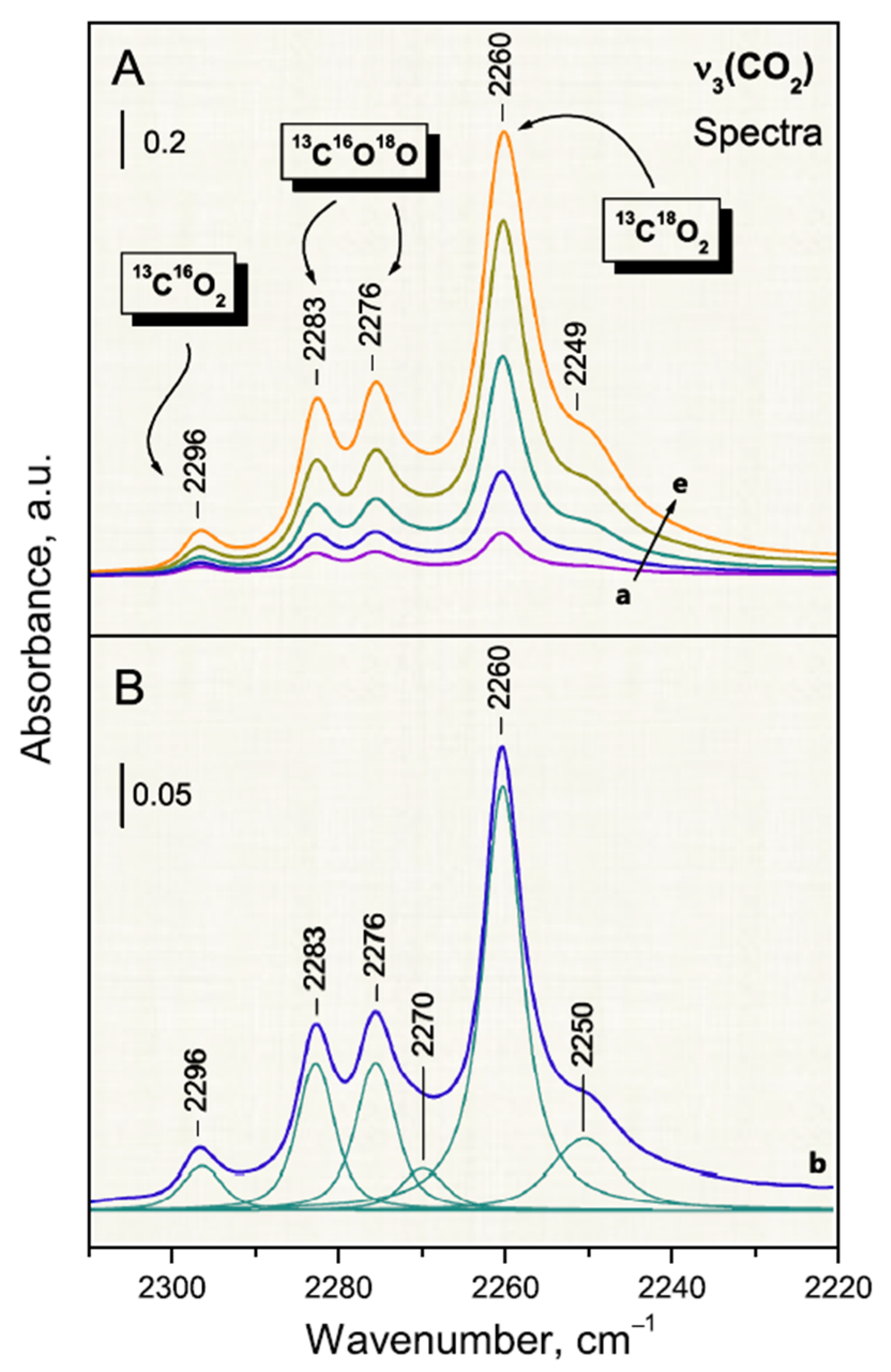
Figure 12 shows spectra recorded after successive adsorption of 13C18O2 doses. The adsorbate had high 13C isotopic purity, but the 18O enrichment was lower, resulting in some 13C16O18O and a trace of 13C16O2.
Four IR bands developed upon 13C18O2 adsorption. The most intense band at 2260 cm−1 is assigned to monomeric 13C18O2 species, while the minor amount of 13C16O2 gives rise to a weak band at 2296 cm−1. Two intermediate bands, at 2283 and 2276 cm−1, clearly originate from adsorbed 13C16O18O molecules. The presence of these two distinct bands demonstrates linkage isomerism.
Based on DFT calculations, the 2283 and 2276 cm−1 features were assigned to Ca2+18O–13C–16O and Ca2+16O–13C–18O species, respectively. These findings exclude a bridging Ca2+–O–C–O–Ca2+ adsorption geometry, because such a structure would not allow linkage isomerism, and the adsorbed 13C16O18O species would exhibit a single ν3 band only.
Note that at higher coverages, two shoulders of the main 2260 cm−1 band appear at 2270 and 2250 cm−1, attributed to geminal 13C18O2 species. In these cases, vibrational coupling between two molecules adsorbed on the same site leads to ν3-mode splitting. No such splitting was observed for the other isotopologues because their concentrations were too low to allow measurable vibrational coupling.
Analogous spectra were obtained for the ν1 symmetric modes, which split into two bands at 1338 and 1334 cm−1 for the adsorbed 13C16O18O species. In contrast, the 2ν2 modes did not split, indicating that deformation vibrations are less sensitive to linkage isomerism.
These results demonstrate that using partially labeled adsorbate molecules can provide valuable structural information about the binding mode of adsorbed species.

4.7. Di-Ligand Surface Complexes

The structures of polyligand surface species have been extensively studied using isotopic mixtures. We first consider diligand species. As already discussed, when the ligands are strongly bound, vibrational coupling between them can occur, giving rise to symmetric and antisymmetric stretching modes (Figure 9).
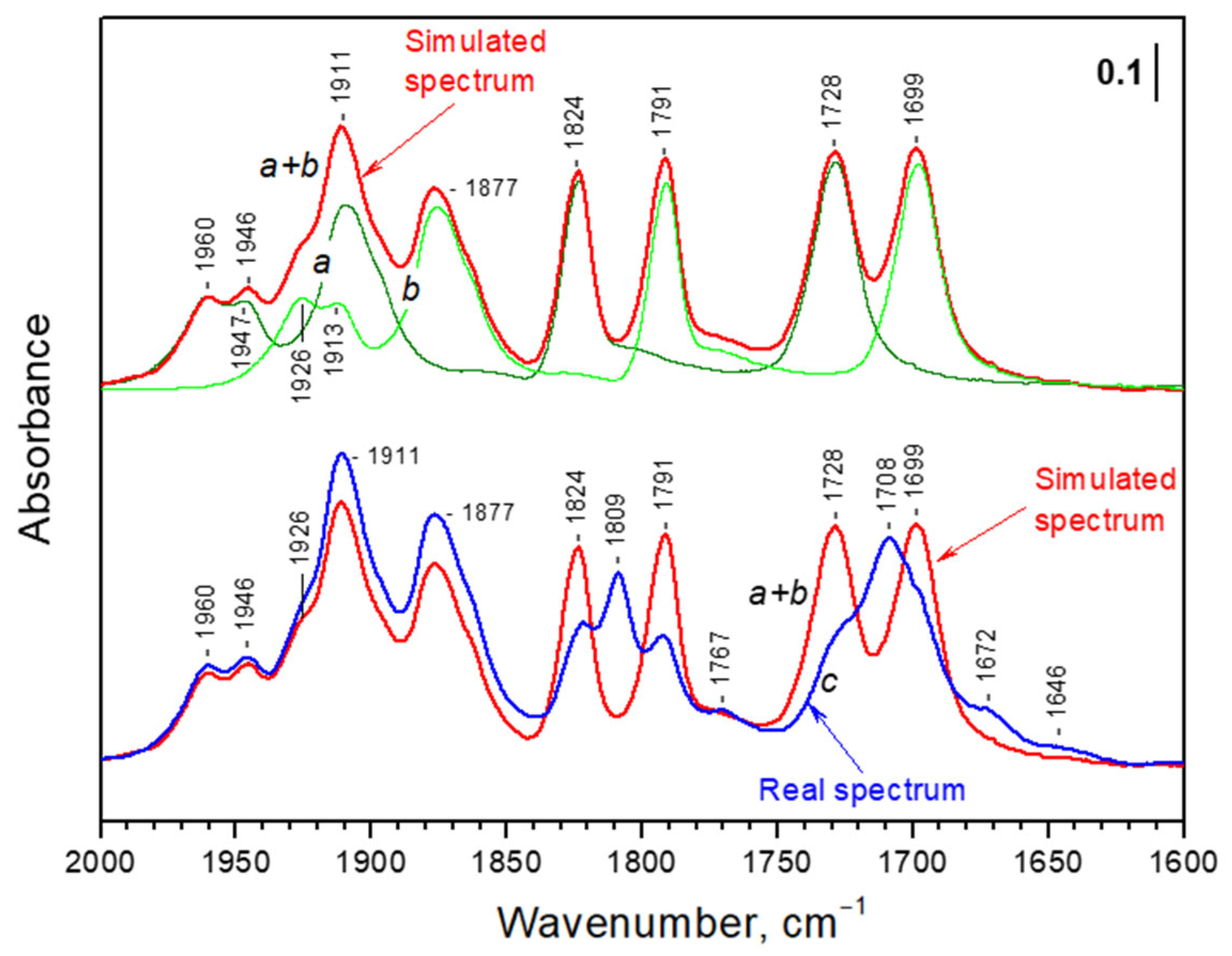
Case study: NO adsorption on Cu–ZSM-5. The spectrum of 14NO adsorbed at low temperature on Cu–ZSM-5 is presented in Figure 13a. It contains five main bands at 1960, 1946, 1877, 1824 and 1728 cm−1 [51]. Spectrum b represents 15NO adsorption and was obtained by shifting spectrum “a” by the corresponding isotopic factor. The sum of the two gives a “synthetic” spectrum (denoted as “simulated” in the Figure 13) expected to match that of an isotopic mixture if no vibrational coupling occurs, i.e., if no polynitrosyls are formed.
A comparison between the real spectrum obtained after adsorption of an equimolar 14NO + 15NO isotopic mixture (Figure 13c) and the synthetic one is presented at the bottom of the figure. The two spectra almost coincide in the 2000–1830 cm−1 region. Only a slight and synchronous decrease in intensity of the 1911/1877 cm−1 pair was observed and attributed to small variations in the population of the respective adsorption sites caused by the activation treatments. This indicates that all these bands correspond to mononitrosyl species, Cun+-NO.
In contrast, significant deviations appear in the 1830–1600 cm−1 region, indicating decoupling of some modes and the existence of polyligand species. The two pairs of bands, at 1824/1791 cm−1 and 1728/1699 cm−1, show half of their initial intensity. Since spectrum a had already been divided by two, their intensity corresponds to one quarter of the original 14NO adsorption spectrum, consistent with dinitrosyl structure (see Table 2). Moreover, additional, more intense bands at 1809 and 1708 cm−1 emerged at intermediate positions between the two components of each pair. These features are attributed to the 14N–O and 15N–O decoupled stretching modes of mixed ligand species Cu+(14N–O)(15N–O). The positions of the bands coincide well with the calculated values. Thus, the results unambiguously demonstrate that the original bands at 1824 and 1728 cm−1 (Figure 13a) correspond to the νs and νas modes, respectively, of copper dinitrosyls.
The same approach is widely used to determine dicarbonyl structures. For example, Felvey et al. [52] observed two sharp bands at 2173 and 2207 cm−1 after CO adsorption on Pt/ZSM-5. These bands shifted to 2156 and 2123 cm−1, respectively, after 13CO adsorption. Two additional bands at 2196 and 2134 cm−1 dominated the spectrum when an equimolar mixture of 12CO and 13CO was adsorbed; the overall intensity pattern was 1:2:1. This clearly showed the dicarbonyl structure, and the bands were assigned to Pt2+(CO)2 species.
These examples demonstrate that, besides the appearance of new bands, the band intensities—often neglected—provide a valuable diagnostic for identifying polyligand surface species.

4.8. Triligand Surface Complexes

The case of triligand surface species is considerably more complex because the number of isotopologue combinations increases sharply, making intensity analysis even more informative than frequency shifts alone. In such systems, simple approximate force-field models often fail to accurately predict the frequencies of mixed-ligand vibrations, since the results depend on the molecular symmetry, which is usually not known a priori. Nevertheless, careful spectral analysis—particularly of intensity variations—allows reliable conclusions and correct assignments. This is illustrated below by the example of tricarbonyl formation on Ru/ZrO2.
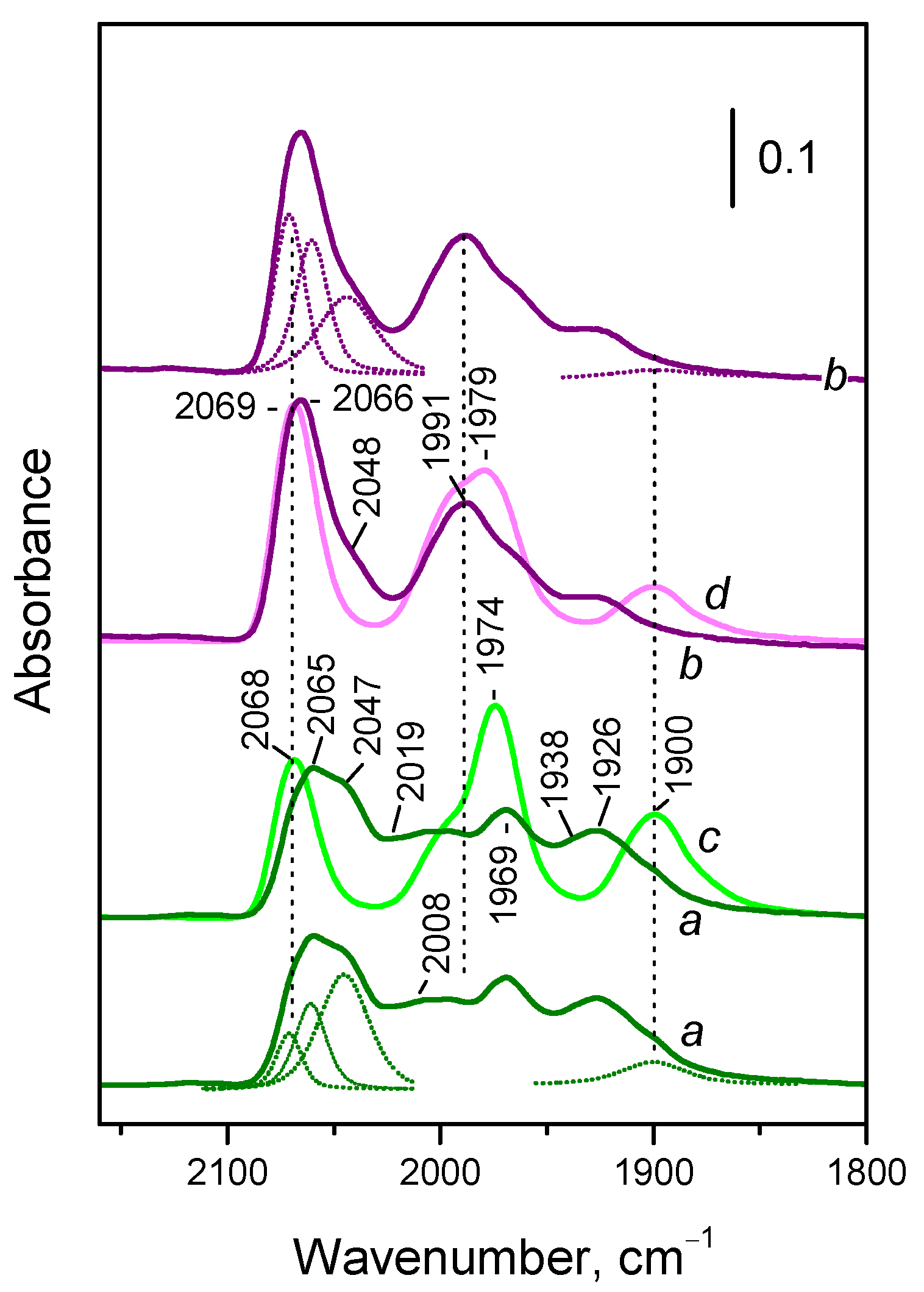
Case study: CO adsorption on Ru/ZrO2. CO adsorption on the sample produces a complex IR spectrum, reflecting the coexistence of several polycarbonyl species [53]. After evacuation at 473 K, however, the spectrum is dominated by two bands at 2069 and 1991 cm−1, which decrease together during further evacuation at increasing temperatures. This suggests the predominance of one well-defined species. To determine its structure, the adsorption of CO isotopic mixtures was studied.
Figure 14a presents the spectrum obtained after adsorption of an equimolar 12C16O + 13C18O mixture, followed by evacuation at 473 K. Spectrum (c) shows the synthetic non-interacting spectrum. The two spectra differ substantially, clearly demonstrating the presence of polycarbonyl species. The additional bands at 2065, 2047, 2019, 2008, 1996, 1969, 1938, and 1926 cm−1 originate from mixed-ligand polycarbonyls.
The first step is to examine whether the spectra could correspond to dicarbonyl species. This possibility can be ruled out for several reasons:
(i)
the approximate force-field model predicts two bands (at 2047 and 1926 cm−1) for mixed-ligand dicarbonyls, which should dominate the spectrum—but they do not;
(ii)
intense bands such as those at 2065 and 1969 cm−1 cannot be assigned to dicarbonyls;
(iii)
for species with identical CO ligands (2069 and 1991 cm−1 for 12CO), the experimental intensities should be about twice lower than those in the synthetic spectrum, which is not observed.
After excluding the dicarbonyl hypothesis, the next step is to assess the presence of tricarbonyl species. For more details, the reader is referred to the original paper [53]. Here, we only note that the intensities of the bands due to identical-ligand species agree with those predicted for tricarbonyls. This is clearly seen for the band near 1900 cm−1, which is largely free from overlapping features. Accordingly, the bands at 2069 and 1991 cm−1 were assigned to the symmetric and antisymmetric ν(CO) modes, respectively, of ruthenium tricarbonyls.
Further experiments with a 3:1 12C16O + 13C18O mixture (Figure 14b) confirmed this interpretation and clarified the spectral features of the mixed-ligand species: Run+(12C16O)2(13C18O) exhibits bands at 2060, 2008, and 1938 cm−1, while Run+(12C16O)(13C18O)2 gives rise to bands at 2046, 1969, and 1926 cm−1.
Tetracarbonyl structures will not be discussed here because their identification relies on the same principles.
The above example demonstrates that, although challenging, the identification of triligand surface species is entirely feasible when isotopic substitution is combined with detailed spectral and intensity analyses.

4.9. Concluding Remarks

Intermediate isotopic substitution reveals much of the analytical power of isotopic labeling. Although the resulting spectra are more complex and require careful interpretation, this approach often yields insights inaccessible by any other method.
The most widespread application of intermediate isotopic substitution in surface chemistry lies in the determination of the structure of polyligand complexes. This information is particularly crucial for systems involving small molecules. In addition to carbonyl and nitrosyl complexes, the method has been successfully applied to complexes with N2 [54], as well as to mixed-ligand species such as Ru2+(CO)2(N2) [55] and Rh2+(CO)2NO [56]. However, not all ligands possess vibrational modes suitable for such analysis, which introduces certain limitations. Another restriction arises from the strength of adsorption: when molecules are weakly bound through electrostatic interactions (e.g., CO or N2 on Na+ sites), vibrational coupling becomes too weak to be detected, requiring the use of alternative approaches.
A related and promising application involves the elucidation of the structure of charged surface species, particularly surface anions. Despite its great potential, this field remains relatively unexplored, likely due to the experimental difficulties associated with controlling the degree of isotopic substitution.
Finally, the use of partially substituted adsorbates represents an emerging and powerful direction in surface spectroscopy. It provides unique information on the bonding geometry of adsorbed species and enables conclusions inaccessible by other means.
The general principles of intermediate isotopic substitution have been outlined in this chapter, but the method’s success often depends on the creativity and insight of the researcher in designing specific experiments.

5. Isotopic Studies in Revealing Catalytic Reaction Mechanisms

The previous chapters have shown how isotopic substitution provides detailed information on the structure and reactivity of surface species, as well as on the origin of the atoms incorporated in them—insights of fundamental importance for surface science and catalysis. For catalytic applications, however, structural identification alone is not sufficient: elucidating the mechanism of a catalytic reaction is essential. Mechanistic investigations rely on the same basic principles of isotopic labeling, but their application requires different strategies tailored to experimental setups that mimic the conditions of real catalysis (reagent flow, high temperatures, etc.). In this context, isotopes are not used merely to shift vibrational bands; they act as tracers, enabling the researcher to follow the trajectory of a particular atom through the entire catalytic cycle. This allows one to determine the origin of atoms in reaction products, to establish which surface species are involved in turnover, and, simultaneously, to monitor the structural evolution of the catalyst under working conditions.
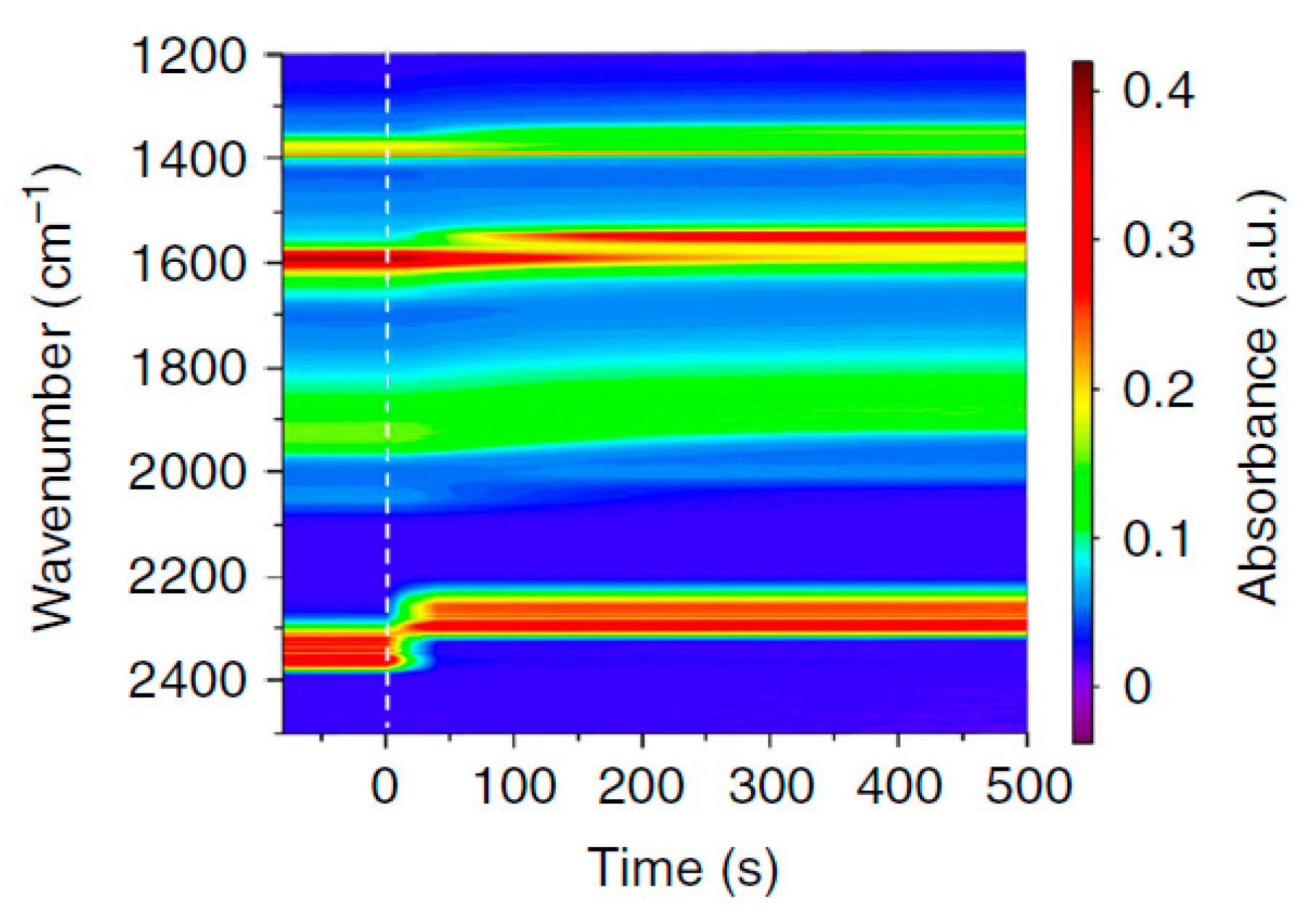
The main infrared technique currently used for mechanistic studies is operando spectroscopy [57,58]. It emerged at the beginning of this century [59] as a response to the growing realization that many conclusions drawn from in situ studies did not reflect the behavior of catalysts under true working conditions. Operando spectroscopy integrates real-time spectroscopic monitoring with a simultaneous measurement of catalytic activity. This allows one to conclude whether the observed structural or chemical changes on the surface are directly linked to the catalytic properties.
There are two main approaches within the operando framework, steady-state and transient experiments, which provide complementary mechanistic information. In steady-state experiments, the catalyst operates under constant reaction conditions, and the reactant flow, temperature and overall composition remain unchanged. Under these conditions, the concentrations of surface species and products are constant in time, and the measured spectra reflect a dynamic steady state of adsorption, reaction and desorption.
Transient experiments introduce a defined perturbation to the reaction system and monitor the time-dependent response. The perturbation may involve switching the feed composition, introducing or removing a reactant, or modifying the reaction environment in a controlled manner. These methods are especially powerful for identifying fast exchange processes, discriminating between parallel reaction pathways, and determining whether a given surface species participates in the catalytic cycle or behaves as a spectator.
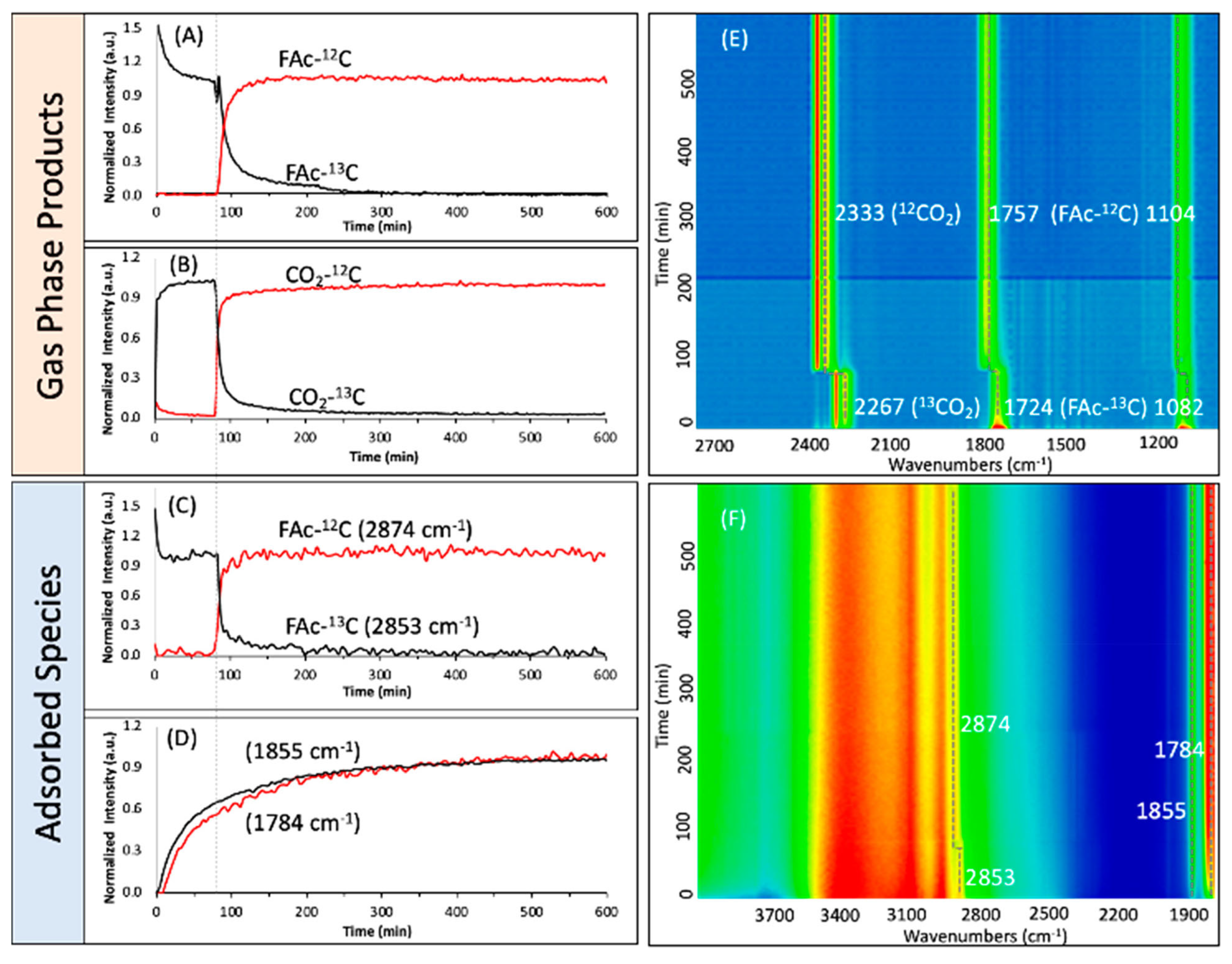
As in the in situ IR, isotopic labeling strongly enhances the power of the technique. The most widespread approach for isotopic operando studies is the steady-state isotopic transient kinetic analysis (SSITKA), which combines the advantages of the transient and steady-state approaches [60]. Here, the key perturbation is the switch from an unlabeled to a labeled reactant (or vice versa) performed under steady-state reaction conditions. SSITKA directly provides the surface residence times and coverages of the active intermediates, giving access to mechanistically relevant kinetic parameters.
In such experiments, labeled and unlabeled reactants are supplied under identical macroscopic conditions. For substitutions involving C, N or O, the isotopic switch alters only the isotopic composition, without changing the reaction rate. In contrast, H ⟶ D substitution may introduce kinetic isotope effects and must therefore be interpreted separately. Isotopic switching experiments allow discrimination between intermediate and spectator species, determining the origin of atoms incorporated into reaction products, identifying rate-limiting atom-transfer processes, and assessing the reversibility of specific elementary steps.
In some cases, combined transient techniques are applied. Thus, for intermediates with very short lifetimes, experiments conducted under nearly pre-catalytic conditions, where the reaction rate is extremely low, may facilitate their detection and assignment.
Below, we describe the main types of mechanistic information that can be obtained from isotopic substitution coupled with operando IR spectroscopy, illustrating the concepts with representative case studies.

5.1. Intermediate and Spectator Species

Identifying intermediate and spectator species is a central task in heterogeneous catalysis, and operando IR spectroscopy combined with isotopic labeling is among the most informative approaches for addressing this question. Intermediates are on-cycle surface species that actively participate in the primary reaction pathway, and changes in their concentration are directly related to the overall reaction rate. In SSITKA experiments, a true reaction intermediate exhibits an isotopic response that closely mirrors that of the corresponding gas-phase product, reflecting its direct engagement in the catalytic cycle.
In contrast, off-cycle species deviate from the main reaction pathway. They most often behave as spectators, and may act as temporary reservoirs of reactive fragments, open parallel, less efficient reaction routes, or contribute to catalyst deactivation. These species typically display a much weaker isotopic response, or none at all, because they are not directly connected to the formation of the reaction products.
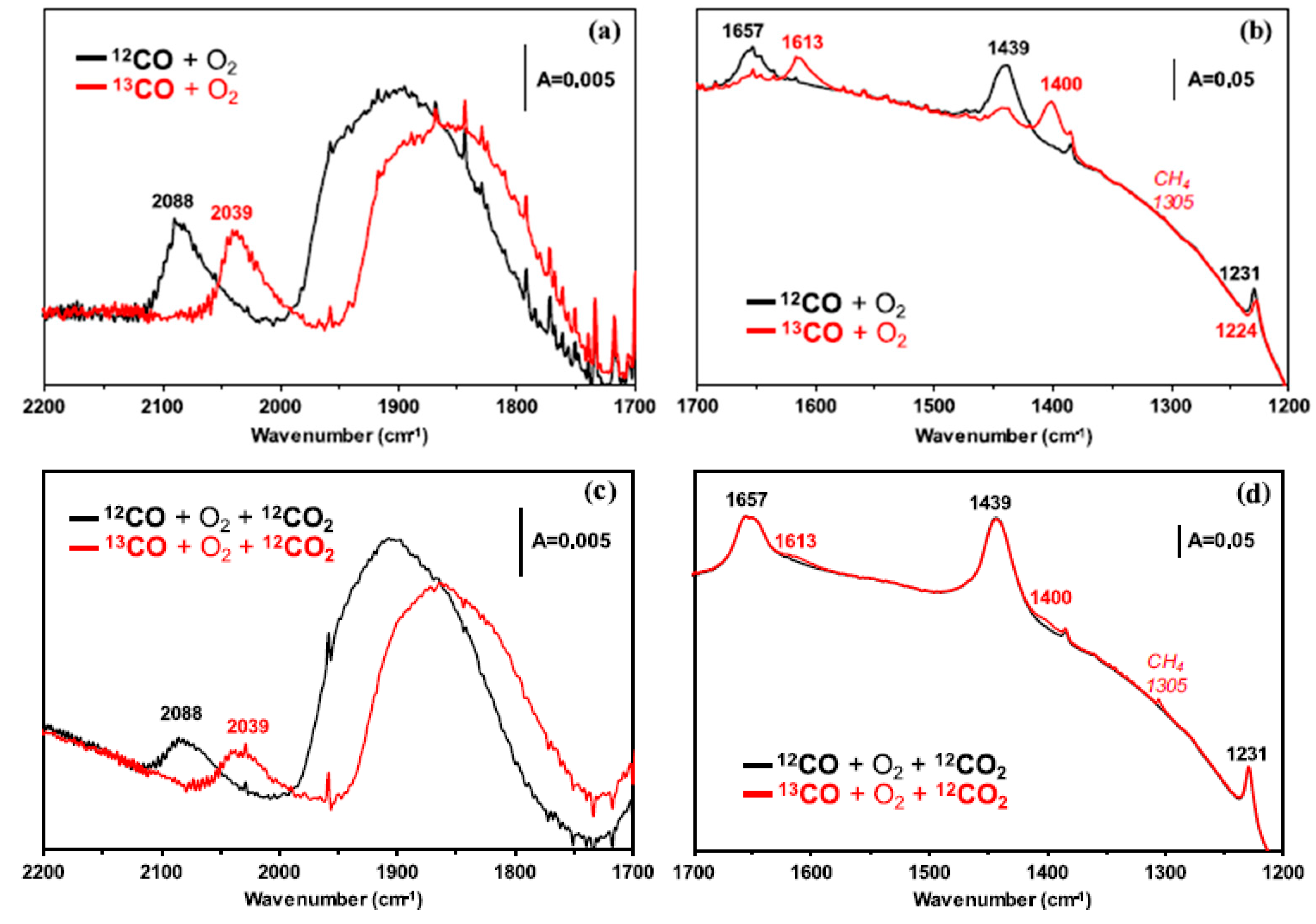
Case study: CO oxidation on Pd/Al2O3 catalysts. The low-temperature oxidation of CO is of considerable practical importance, particularly during the cold-start and warm-up phases of automotive catalytic converters. The nature of intermediates and spectator species formed during the initial transient period of this reaction on Pd/Al2O3 has been clarified by coupled SSITKA–IR studies [61].
As shown in Figure 15 (top, black lines), exposure of the catalyst to a feed of 12CO + O2 produces three types of surface species: (i) linear and bridging palladium carbonyls (2088 and ~1900 cm−1), (ii) hydrogencarbonates on the alumina support (1657, 1439 and 1213 cm−1), and (iii) an unassigned species giving rise to a band at 1384 cm−1.
When the experiment was repeated using 13CO, both the carbonyl and hydrogencarbonate bands were red-shifted, with isotopic factors consistent with vibrations involving C–O bonds. The only exception was the hydrogencarbonate band at 1213 cm−1, which showed a smaller shift, in agreement with its deformation character. In contrast, the 1384 cm−1 band remained unchanged. Based on the results of these experiments, it may be concluded that the species responsible for the 1384 cm−1 band is not directly involved in the catalytic reaction and is therefore a spectator. However, both palladium carbonyls and hydrogencarbonates could be considered as potential reactive intermediates.
To reach more definitive conclusions, 12CO2 was then added to the reaction feed. The spectra under unlabeled conditions (bottom, black lines) remained similar to those measured without CO2. However, when switching to a mixture containing 13CO and 12CO2, the carbonyl bands responded rapidly, whereas the hydrogencarbonate bands showed a negligible isotopic response. These results clearly indicate that only carbonyls participate directly in the catalytic turnover, while the hydrogencarbonates behave as spectator species. The same conclusions were reached for CO oxidation on Pt/Al2O3 [62], demonstrating the general character of this mechanistic pattern for noble-metal catalysts supported on alumina.
Case study: Hierarchy of intermediates in CO2 methanation on RuOx@MIL-101(Cr). Ramírez-Hernández et al. [63] studied the photo-assisted CO2 methanation over a RuOX@MIL-101(Cr) catalyst by combining operando FT-IR with a steady-state isotopic transient 12CO213CO2 switch. Operando FT-IR spectra as a function of temperature first map out a full sequence of surface intermediates: CO adsorbed on Ru and Cr sites, then formyl (1172 cm−1), monodentate formate (1343/1286 cm−1) and methoxy (1147 cm−1), which appear and grow in the same temperature window where CH4 is formed. The isotopic transient experiment, performed under identical steady-state conditions, shows that switching from 12CO2 to 13CO2 produces 13CH4 in amounts comparable to 12CH4, proving that CH4 carbon originates from CO2, and induces clear 3–4 cm−1 shifts in the formyl/formate/methoxy bands, directly linking these species to CO2-derived carbon. CO-related bands do not show a resolvable isotopic shift (poor signal under dilute conditions), but separate CO and CO + H2 experiments demonstrate that the same RuOX@MIL-101(Cr) solid can oxidize CO and hydrogenate it to CH4, supporting CO as an early intermediate. Taken together, operando FT-IR provides the qualitative hierarchy of intermediates (CO ⟶ formyl ⟶ formate ⟶ methoxy), while the isotopic transient confirms that these C1 surface species are genuine, CO2-derived intermediates on the pathway to CH4. This example highlights the potential of SSITKA—operando IR for determining the reaction pathway.
Case study: Shared intermediate network for the formation of CO and CH4 during CO2 hydrogenation on Pd/Al2O3. The catalytic reduction in CO2 is of growing interest because it provides a pathway for its chemical utilization. Depending on the catalyst and reaction conditions, CO2 hydrogenation can yield CO, CH4, CH3OH and other products. A particularly elegant SSITKA–operando IR study [64] has established viable mechanistic pathways for both CO2 methanation (formation of CH4) and the reverse water-gas shift (RWGS) reaction (formation of CO) over Pd/Al2O3 catalysts.
Under steady-state conditions in a 12CO2-H2 feed, the FTIR spectra (Figure 16, left) show four main families of signals. Gas-phase 12CO2 appears between 2400 and 2300 cm−1 (red zone). Two characteristic groups of surface intermediates are also observed: (i) carbonyls on metallic Pd, in the 1800–2100 cm−1 region (yellow), and (ii) formate species on the alumina support, with bands around 1600 and 1400 cm−1 (red and yellow, respectively).
Upon switching from 12CO2/H2 to 13CO2/H2, all formate and carbonyl bands undergo red shifts (Figure 16), consistent with the involvement of C–O vibrations in these species. A key observation is that the decay of 12C-labeled bands and the growth of 13C-labeled ones closely follow the evolution of the corresponding 12CH4/13CH4 and 12CO/13CO product transients. This tight correlation indicates that both formates and carbonyls are on-cycle intermediates.
Based on these and additional experiments, the authors constructed a coherent mechanistic picture. CO2 methanation and RWGS do not represent two independent, parallel reaction networks; instead, they share the same initial activation sequence: hydrogencarbonates → formates → carbonyls.
Under these conditions, the decomposition of formate to adsorbed CO occurs more rapidly than the hydrogenation of carbonyls to CH4. Because part of CO is only weakly adsorbed on Pd under these conditions, it desorbs directly as a reaction product, forming the RWGS branch. The rate-determining step for both CO2 reduction and RWGS is the conversion of formates, whereas the hydrogenation of carbonyls controls the formation rate of CH4. Consequently, the selectivity is dictated not by the initial CO2 activation step, but by the relative kinetics and capacities of the two on-path pools: formates and carbonyls.
Temperature and Pd loading tune the partitioning between these pools. With increasing temperature, the residence time of CH4-forming intermediates decreases more rapidly than that of CO-forming ones, shifting the surface population toward CH4-generating species. Similarly, increasing the Pd loading enlarges the pool of strongly bound carbonyls, driving the overall selectivity from CO toward CH4. The authors used these findings to design selective catalysts. Thus, they reported that raising the Pd loading from 2.5 to 10 wt% increased the CH4 selectivity from ~45% to ~90%.
The above examples demonstrate the power of SSITKA-operando IR to track the reaction intermediates and to distinguish them from spectator species. However, it is important to underline that coverage and exchange time alone are insufficient criteria to identify a species as an intermediate. Thus, an early (2007) DRIFTS–SSITKA study on Pt/CeO2 initially suggested a possible temperature-driven switch from a non-formate to a formate-based water-gas shift (WGS) mechanism [65]. However, subsequent quantitative analyses by Meunier [66,67] demonstrated that only a small fraction of the IR-detected formates participates in the catalytic cycle. The majority act as spectators or buffer species, meaning that the kinetically relevant formate population represents only a subset of all formates. In this way, the original “formate-based” interpretation was downgraded to a cautionary example of how operando IR can be dominated by kinetically irrelevant adsorbates.

5.2. Trajectory of the Reactants’ Atoms

In steady-state isotope-labeling experiments, the isotopic label may be introduced either into the catalyst (lattice or surface oxygen, hydroxyl groups) or into one of the reactants (prior to or during catalytic testing). Infrared spectroscopy is then applied to determine whether the isotopic label appears in surface intermediates and ultimately in the reaction products. In this way, one can establish whether the trajectory of a particular atom passes through intrinsic lattice or surface species before ending up in the products. This type of analysis is especially important in photocatalysis, where lattice oxygen participation is frequently discussed; representative examples have been summarized in a recent review [57].
Case study: Catalyst labeling in photocatalytic oxidation of cyclohexane on TiO2. The photocatalytic oxidation of cyclohexane over TiO2 (anatase) [68] provides a clear demonstration of pre-labeling the catalyst to track oxygen-atom transfer. The authors employed ATR-FTIR in combination with UV-assisted oxygen isotope exchange. First, TiO2 was irradiated in an 18O2/He atmosphere, generating a well-defined population of Ti–18OH and Ti–18O–Ti surface species. After this pre-treatment, cyclohexane was introduced, and the catalyst was irradiated in the presence of 16O2.
Under these conditions, the formation of labeled cyclohexanone (C=18O) was clearly detected. In contrast, without pre-labeling, the carbonyl product remained essentially unlabeled, even when 18O2 was present in the gas phase during the reaction. This behavior demonstrates that the oxygen incorporated into cyclohexanone originates from lattice-derived surface oxygen species, which are subsequently replenished through interaction with molecular oxygen. The experiment therefore provides direct evidence for a lattice-oxygen mechanism in this photocatalytic oxidation.
Case study: Photocatalytic water splitting on Ga2O3-based systems. A particularly instructive example of reactant labeling is the study of photocatalytic water splitting on Ga2O3-based catalysts [69]. Using operando ATR-FTIR coupled with online mass spectrometry, the authors examined the interaction of H2O, D2O and H218O with Rh0.5Cr1.5O3/Ga2O3(Zn) under UV irradiation.
After exposure to H2O, two O–O containing surface intermediates were detected: (i) Ga–OOH species, characterized by an O–O stretching vibration at 978 cm−1, and (ii) weakly adsorbed H2O2, with an O–O stretching mode at ≈872 cm−1 and a deformation mode at 1382 cm−1. These species were absent on the inactive rhodium-free catalyst, confirming the role of the Rh component in driving O–O bond formation.
In separate in situ experiments with H218O, the bands at 978 and 872 cm−1 shifted to 913 and 831 cm−1, respectively—close to the isotopic shift expected for O–O vibrations. Importantly, no intermediate bands corresponding to partially substituted 16O–18O species were detected. Consistently, MS analysis of products formed from H218O revealed exclusively 18O2 (with no 16O18O). These results demonstrate that the oxygen released originates solely from water, and that Ga2O3 lattice oxygen does not participate in the photocatalytic water-splitting mechanism.
Overall, the above examples demonstrate that tracking the trajectory of individual atoms—whether introduced through catalyst pre-labeling or reactant isotopic substitution—offers unique mechanistic insight that cannot be obtained from intermediate identification alone and thus represents a powerful complement to operando IR investigations. However, an established reaction pathway cannot be mechanically transferred to other systems. For instance, according to Kubota et al. [70], ammonium nitrate species are reaction intermediates in the NH3-SCR over H-zeolites. On the basis of isotopic studies, however, it was recently reported that NH4NO3–like surface species and other surface nitrates are not involved in the SCR process over Cu/SSZ-13 at low temperature [71]. Similar conclusions were drawn by Estefanou et al. [72], who found that at 413–473 K surface nitrates on a Mn2CuAlOx catalyst are spectator species in the SCR process.

5.3. Active Sites and Structural Evolution of Catalysts Under Reaction Conditions

Operando vibrational spectroscopy can also provide insight into structural changes in the catalyst during the reaction [73,74]. The infrared studies infer such information from the evolution of the bands associated with different lattice or surface modes. However, the interpretation is usually based on reliable pre-operando assignments, which are often based on isotopic substitution experiments. Consequently, explicit isotopic operando IR investigations aimed at monitoring catalyst restructuring remain relatively rare.
In practice, following structural changes is often more straightforward with operando Raman spectroscopy [75], which is intrinsically more sensitive to metal-oxygen vibrations and bulk lattice modes. Nevertheless, several operando IR studies demonstrate that isotopic substitution could be crucial for observing specific changes in the catalyst itself under operating conditions.
Case study: Light-induced catalyst restructuring in UiO-66(COOH)2-Cu during formic acid dehydrogenation. A compelling recent example of catalyst restructuring followed by operando IR and isotopic transients is provided by the photocatalytic dehydrogenation of formic acid over UiO-66(COOH)2-Cu, a noble-metal-free MOF-based catalyst [76]. The as-prepared material exhibits only moderate activity. However, when exposed to visible-light irradiation, the catalyst undergoes a profound in situ transformation. During the first tens of minutes, there is a notable induction period when the H2 profile does not match the CO2 or HCOOH conversion. Then, the catalytic activity dramatically increases and reaches a steady state.
Operando IR spectroscopy quantified gas-phase formic acid (1757, 1104 cm−1) and CO2 (2333 cm−1) and revealed the growth of three bands at 1855, 1798 (sh) and 1785 cm−1 in the spectra. These features appear under illumination but only in the presence of HCOOH. They are attributed to HCOOH-assisted intraframework cross-linking of the carboxylate linkers to form an anhydride-like UiO-66(COO)2-Cu phase. The species reach a steady value by the end of the first cycle, which is consistent with an irreversible restructuring toward a more active phase.
To obtain more information, the authors performed SSITKA experiments under identical steady-state conditions. Using H13COOH, gas-phase IR shows rapid formation of 13CO2 with only traces of 12CO2, confirming that CO2 originates from the labeled formic acid. Upon switching from H13COOH to H12COOH, the bands due to the gas-phase CO2 and the adsorbed HCOOH respond with clear 13C → 12C isotopic shifts, while the anhydride bands at 1855 and 1784 cm−1 remain unchanged in both position and intensity (see Figure 17). This absence of an isotopic response provides direct evidence that the anhydride phase does not originate from the decomposition or coupling of formic acid but instead results from cross-linking of the MOF carboxylate linkers. Thus, operando IR with isotopic labeling allows one to distinguish between reactant-derived surface species and intrinsic framework transformation—a capability rarely accessible by IR alone.
This study highlights how isotopic operando IR spectroscopy, when applied to materials with vibrationally active linkers such as MOFs, can directly resolve framework restructuring events and identify their origin, a capability whose potential is only beginning to be explored.
Although active sites can often be identified using non-labeled molecules, isotopic studies can provide essential additional information for complex catalytic processes involving consecutive surface reactions. A representative example is the electrochemical CO2 reduction to CO, followed by its further conversion to C2+ hydrocarbons and oxygenates on Cu surfaces [77]. In situ SEIRAS experiments combined with 13CO + 12CO2 feeding, together with comparison of the 12C/13C ratios in the feed and reaction products, indicated that the process proceeds on at least two distinct types of Cu active centers. One type is more active in the CO2-to-CO conversion, whereas the other preferentially promotes the subsequent reduction of CO to C2+ products.

5.4. Emerging Approaches

Although isotopic substitution in operando IR spectroscopy has already proven to be a powerful mechanistic tool, several promising directions remain underexplored. Recent advances in instrumentation, reactor design, and isotope-delivery strategies have opened new opportunities for probing surface intermediates under increasingly realistic conditions, improving sensitivity and expanding the range of catalytic systems amenable to isotopic analysis.

5.4.1. Mixed-Isotope Operando Infrared Spectroscopy (MIOIRS)

Monai [37] recently introduced the concept of mixed isotope operando infrared spectroscopy (MIOIRS), a promising development in the field of isotope-assisted operando studies. In MIOIRS, the catalyst operates under realistic reaction conditions while exposed to streams containing well-defined mixtures of isotopologues (typically CO or CO2). Steady-state infrared spectra are recorded as a function of the isotopic ratio, while the surface coverages remain quasi-stationary for each mixture. The key idea is that diluting one isotopologue with another mitigates the intensity transfer and vibrational interaction effects, such as band splitting and dynamic shift, which often complicate conventional operando CO-IR spectra.
Beyond attenuating vibrational interactions, the method may also enable site-specific reactivity studies. Thus, saturation of Pt catalysts with 13CO followed by partial thermal desorption, can generate a state in which 13CO remains bound only to low-coordinated Pt atoms (edge and corner sites). Subsequent introduction of 12CO preferentially populates terrace sites, thereby producing a surface layer with a controlled isotopic site distribution. Tracking the evolution of the 12CO and 13CO bands during CO oxidation can, in principle, reveal the differences in reactivity between terrace and defect sites—information that is difficult to obtain by other operando techniques.
Although MIOIRS is still on conceptual stage and its application may pose challenges, its further development could provide qualitatively new mechanistic information.

5.4.2. Expanding the Scope of Catalytic Systems

Many technologically relevant catalytic reactions, such as hydrocracking, methanol synthesis and hydroisomerization, operate under high pressure. Mechanistic studies should therefore be performed under relevant conditions. Recent high-pressure operando IR studies have significantly advanced our understanding of reaction mechanisms, although research involving isotopic substitution under high pressure is limited.
He et al. [78] combined high-pressure SSITKA-DRIFTS with 13C and D-labeling to study CO2 hydrogenation to methanol over a Cu/BaTiO2.8H0.2 catalyst. In this way, they were able to (i) demonstrate the involvement of surface hydride species in the catalytic cycle, (ii) distinguish between spectator and on-cycle carbonates and formates, and (iii) determine the residence times of the active intermediates under conditions approaching those of industrial operation. Extending this strategy to other high-pressure reactions represents an important and largely unexplored research direction. Therefore, developing SSITKA–operando IR for high-pressure applications is highly relevant for future mechanistic studies.
Another, still relatively underused, approach that has a big potential for future development is the systematic use of isotopic switches in operando IR studies of photocatalytic conversion. An excellent review in this respect was recently provided [79].

5.4.3. Emerging Advanced Operando IR Modalities

Several advanced modalities have recently emerged that combine isotopic labeling with enhanced spatial or spectral sensitivity.
A first example is spatially resolved operando IR–SSITKA, where DRIFTS spectra are recorded at several positions along the catalyst bed during isotopic switches under steady-state conditions. Correlating local isotope-shifted surface bands with the corresponding gas-phase transients gives both temporal and spatial resolution of the reaction network. For Pt/CeO2 in RWGS, such measurements reveal how bidentate carbonates on CeO2 feed interfacial Pt–CO and gaseous CO along the reactor, allowing one to locate active zones, detect internal gradients and quantify support–metal cooperation [80].
The combination of synchrotron-radiation IR sources with isotopic labeling represents another emerging direction [81,82]. Operando synchrotron radiation (SR) FTIR benefits from the much higher brilliance and superior time resolution of synchrotron radiation compared to laboratory sources, which is particularly advantageous for dilute active sites and very fast transients. Recent work on oxygen-reduction and CO2/CO electroreduction systems [81] has demonstrated operando SR-FTIR and surface-enhanced IR absorption spectroscopy (SR-ATR-SEIRAS) measurements in which 13CO2 and D2O were used to distinguish overlapping bands and to separate solvent-related features from genuine adsorbed intermediates. These studies show that isotope-labeled SR-FTIR can track subtle changes in the key intermediates at electrode interfaces under working conditions.
A related development is the use of ATR-SEIRAS with isotopic labeling. For example, Iijima et al. [83] employed in situ ATR-SEIRAS with 13CO2 to probe CO2 capture and release on redox-active organic polymer electrodes, using the isotopic shift in the adsorbed CO2 bands to confirm the nature of the bound species and to correlate spectral changes with electrochemical signals.
Thanks to their high signal-to-noise ratio, fast response and/or interfacial selectivity, synchrotron-based and surface-enhanced operando IR techniques combined with isotopic substitution are likely to become powerful tools for resolving transient intermediates and multi-step reaction networks in catalysis and electrocatalysis.

6. Conclusions and Perspectives

6.1. Complementary Insights Provided by Isotopic Substitution in IR Spectroscopy

Isotopic labeling has long been one of the most elegant and conceptually transparent approaches in infrared spectroscopy of solid surfaces. The examples discussed above illustrate the remarkable diversity of information that can be extracted. Thus, the technique allows the identification of atoms involved in specific vibrations, which is a fundamental prerequisite for the correct interpretation of vibrational bands. Moreover, by introducing controlled and well-understood perturbations into the vibrational system, isotopic substitution allows for revealing the structure and binding of adsorbed species. The use of operando spectroscopy allows for a direct connection of spectral features to the mechanism of catalytic processes.

6.2. Synergies with Complementary Techniques

Isotopic IR spectroscopy gains significant mechanistic power when combined with independent, non-spectroscopic techniques, and many of the examples discussed in this work illustrate such integrated approaches. A typical example is SSITKA, which can be applied without IR spectroscopy, but is frequently incorporated into operando IR studies, yielding a level of mechanistic insight unattainable by either method alone.
Another major synergy arises from theoretical analysis. Even simple harmonic-oscillator and reduced-mass calculations are extremely useful for predicting isotopic shifts, evaluating mode localization, and rapidly screening alternative spectral assignments. These simple models often provide the first, essential constraints for understanding complex spectra. The interpretation of isotopic effects in strongly coupled vibrations remains challenging and requires close synergy between experiment and theory. More advanced density functional theory (DFT) calculations extend this predictive capability, allowing one to explore adsorption geometries, vibrational couplings, and even reaction pathways. Agreement between calculated and experimental isotope effects frequently offers compelling support for specific structural models and mechanistic proposals.
Isotopic IR spectroscopy also integrates naturally with other vibrational techniques, especially Raman spectroscopy. Because IR and Raman share the same conceptual foundation for isotopic effects but obey different selection rules, they access complementary sets of vibrational modes. Raman is often more sensitive to symmetric stretches, lattice vibrations, and highly polarizable species, which may be weak or invisible in IR spectra. Additional vibrational methods, such as inelastic neutron scattering and sum-frequency generation, can further enrich structural insight. Combining these techniques with isotopic labeling provides a more complete vibrational picture and resolves ambiguities that cannot be addressed by IR alone.
A third group of complementary methods includes a wide range of structure- and reactivity-sensitive techniques. Temperature-programmed approaches (TPR, TPO, TPD, TPSR) provide information on the thermal stability and decomposition pathways of labeled intermediates. Electronic and magnetic spectroscopies (XPS, XANES/EXAFS, UV–Vis, EPR) reveal oxidation states, coordination environments, and metal–support interactions, offering essential context for interpreting isotopic IR spectra. Gas-phase isotopic analysis by mass spectrometry links surface intermediates to reaction products and closes the mechanistic loop between surface spectroscopy and catalytic performance.
Together, these synergies elevate isotopic IR spectroscopy to a multidimensional mechanistic tool, enabling a clear and coherent understanding of surface and catalytic processes at the molecular level.

6.3. Future Directions and Emerging Opportunities

Isotopic substitution in infrared spectroscopy has evolved into a powerful and reliable approach for elucidating the structure of surface species, their role in adsorption and catalytic transformations, and the pathways of surface reactions under well-defined conditions. Despite this progress, several promising directions remain insufficiently explored and offer significant opportunities for future development. These perspectives can be broadly divided into two interconnected areas: advances driven by the evolution of infrared spectroscopy itself and developments specific to isotopic methodologies.
Advances in IR spectroscopy and operando methodologies. The future impact of isotopic IR studies is closely linked to ongoing progress in infrared spectroscopy as a whole. Developments in instrumentation—such as higher brilliance sources, improved spectral sensitivity, enhanced temporal and spatial resolution, and more versatile operando cells—will substantially extend the range of systems accessible to isotopic investigations. In particular, synchrotron-radiation-based IR spectroscopy, nano-IR and spatially resolved techniques, as well as ultrafast and time-resolved IR methods, will enable the study of dilute active sites, short-lived intermediates, and dynamic surface restructuring under working conditions.
Equally important is the growing synergy between IR spectroscopy and complementary techniques, including Raman spectroscopy, X-ray spectroscopies, electron microscopy, and electrochemical methods, which were discussed in the previous section. This is expected to be particularly impactful for emerging classes of materials, such as metal–organic frameworks, polyoxoanions, multinuclear and single-atom catalysts, and dynamically reconstructed oxide and metal surfaces, where conventional characterization approaches often face intrinsic limitations.
Future developments specific to isotopic approaches. Beyond instrumental progress, significant opportunities lie in the further development and systematic application of isotopic methodologies themselves. One particularly promising direction is the design and use of new isotope probe molecules. Partially substituted probes, such as C16O18O or HDO, remain underutilized despite their unique ability to reveal adsorption geometry through their linkage isomerism and subtle differences between end-on, side-on, and bridging coordination modes. A more systematic exploitation of such probes would greatly expand the diagnostic power of vibrational spectroscopy.
Another largely underexplored area concerns the identification of bonds between identical atoms, such as C–C or N–N linkages. Statistical isotopic mixtures (e.g., 12C–13C or 14N–15N) provide a direct and often decisive means to establish the presence of such bonds, yet they are still rarely applied in surface studies. Similarly, intermediate isotopic substitution offers exceptional potential for elucidating ABx-type structures, including surface polyoxo species such as nitrates, sulfates, and molybdates. By breaking vibrational degeneracies and altering mode coupling, intermediate substitution can reveal symmetry, coordination number, and bonding motifs that remain inaccessible through full isotopic exchange alone. Progress in this area will strongly benefit from improved and better-controlled isotope exchange protocols.
Further advances will also depend on strengthening the theoretical framework underpinning isotopic IR spectroscopy. More systematic force-field analyses, improved computational modeling of mixed-isotope systems, and clearer classification of coupled and decoupled vibrational regimes will facilitate quantitative interpretation and help avoid ambiguous assignments. In this context, a broader systematization of isotopic strategies—illustrated by the present work—may assist researchers in selecting the most informative isotopic approach for a given problem.
In summary, the future of isotopic IR spectroscopy of surface species lies in the creative combination of advanced IR methodologies, carefully designed isotopic substitution strategies, and robust theoretical support. When applied thoughtfully, isotopic labeling remains unparalleled in its ability to provide molecular-level insight into surface structure and reaction mechanisms. We anticipate that continued methodological innovation and broader adoption of partial isotopic substitution will further strengthen the role of isotopic IR spectroscopy as a central tool in surface science and catalysis research.

Author Contributions

Conceptualization, K.H.; writing—original draft preparation, K.H., D.P. and M.M.; writing—review and editing, K.H., D.P. and M.M.; funding acquisition, K.H. All authors have read and agreed to the published version of the manuscript.

Funding

This research was funded by the Bulgarian Science Fund, grant number KП-06-H-59/5/2021.

Data Availability Statement

The data presented in this study are available in the article.

Acknowledgments

Research equipment of the National Centre for Mechatronics and Clean Technologies was used for some experiments (project BG05M2OP001-1.001-0008, funded by the European Regional Development Fund under the Operational Program “Science and Education for Smart Growth 2014–2020”).

Conflicts of Interest

The authors declare no conflicts of interest.

References

  1. Terenin, A.; Filimonov, V. Hydrogen bonds between adsorbed molecules and the structural hydroxyl groups at the surface of solids. In Hydrogen Bonding; Hadži, D., Ed.; Elsevier: Amsterdam, The Netherlands, 1959; pp. 545–554. [Google Scholar] [CrossRef]
  2. Pimentel, G.C.; Garland, C.W.; Jura, G. Infrared spectra of heavy water adsorbed on silica gel. J. Am. Chem. Soc. 1953, 75, 803–805. [Google Scholar] [CrossRef]
  3. Eischens, R.P.; Pliskin, W.A. The infrared spectra of adsorbed molecules. Adv. Catal. 1958, 10, 1–56. [Google Scholar] [CrossRef]
  4. Peri, J.B. in Infrared spectroscopy in catalytic research. Catal. Sci. Technol. 1984, 5, 171–220. [Google Scholar] [CrossRef]
  5. Sheppard, N. 50 years in vibrational spectroscopy at the gas/solid interface. In Surface Chemistry and Catalysis; Carley, A.F., Davies, P.R., Hutchings, G.J., Spencer, M.S., Eds.; Kluwer Acadernic/Plenum Publishers: New York, NY, USA, 2002; Chapter 3; pp. 27–54. [Google Scholar] [CrossRef]
  6. Pinchas, S.; Laulicht, I. Infrared Spectra of Labelled Compounds; Academic press: London, UK, 1971. [Google Scholar]
  7. Hadjiivanov, K.; Mihaylov, M.; Panayotov, D.; Ivanova, E.; Chakarova, K. Isotopes in the FTIR investigations of solid surfaces. In Spectroscopic Properties of Inorganic and Organometallic Compounds; Douthwaite, R., Duckett, S., Yarwood, J., Eds.; The Royal Society of Chemistry: London, UK, 2014; Volume 45, pp. 43–78. [Google Scholar] [CrossRef]
  8. Available online: https://ciaaw.org (accessed on 24 November 2025).
  9. Hadjiivanov, K. Identification and characterization of surface hydroxyl groups by infrared spectroscopy. Adv. Catal. 2014, 57, 99–318. [Google Scholar] [CrossRef]
  10. Chakarova, K.; Nikolov, P.; Hadjiivanov, K. Different Brønsted acidity of H−ZSM-5 and D−ZSM-5 zeolites revealed by the FTIR spectra of adsorbed CD3CN. Catal. Commun. 2013, 41, 38–40. [Google Scholar] [CrossRef]
  11. Chakarova, K.; Hadjiivanov, K. H-bonding of zeolite hydroxyls with weak bases: FTIR study of CO and N2 adsorption on H–D–ZSM-5. J. Phys. Chem. C 2011, 115, 4806–4817. [Google Scholar] [CrossRef]
  12. Mihaylov, M.Y.; Zdravkova, V.R.; Ivanova, E.Z.; Aleksandrov, H.A.; Petkov, P.S.; Vayssilov, G.N.; Hadjiivanov, K.I. Infrared spectra of surface nitrates: Revision of the current opinions based on the case study of ceria. J. Catal. 2021, 394, 245–258. [Google Scholar] [CrossRef]
  13. Vayssilov, G.N.; Mihaylov, M.; Petkov, P.S.; Hadjiivanov, K.I.; Neyman, K.M. Reassignment of the vibrational spectra of carbonates, formates, and related surface species on ceria: A combined density functional and infrared spectroscopy investigation. J. Phys. Chem. C 2011, 115, 23435–23454. [Google Scholar] [CrossRef]
  14. Teles, J.H.; Maier, G.; Hess, L.A., Jr.; Schaad, L.J.; Winnewisser, M.; Winnewisser, B.P. The CHNO isomers. Chem. Ber. 1989, 122, 753–766. [Google Scholar] [CrossRef]
  15. Morrow, B.A.; Cody, I.A. Infra-red studies of reactions on oxide surfaces. Part 3.—HCN and C2N2 on silica. J. Chem. Soc. Faraday Trans. 1 1975, 71, 1021–1032. [Google Scholar] [CrossRef]
  16. Bion, N.; Saussey, J.; Hedouin, C.; Seguelong, T.; Daturi, M. Evidence by in situ FTIR spectroscopy and isotopic effect of new assignments for isocyanate species vibrations on Ag/Al2O3. Phys. Chem. Chem. Phys. 2001, 3, 4811–4816. [Google Scholar] [CrossRef]
  17. Chakarova, K.K.; Karapenchev, B.S.; Drenchev, N.L.; Ivanova, E.Z.; Aleksandrov, H.A.; Panayotov, D.A.; Mihaylov, M.Y.; Vayssilov, G.N.; Hadjiivanov, K.I. FTIR study of low-temperature CO adsorption on reduced ceria nanoparticles with different morphology: A comparison with oxidized samples. J. Catal. 2025, 443, 115986. [Google Scholar] [CrossRef]
  18. Binet, C.; Daturi, M.; Lavalley, J.-C. IR study of polycrystalline ceria properties in oxidised and reduced states. Catal. Today 1999, 50, 207–225. [Google Scholar] [CrossRef]
  19. Chakarova, K.; Drenchev, N.; Mihaylov, M.; Hadjiivanov, K.I. Interaction of O2 with reduced ceria nanoparticles at 100–400 K: Fast oxidation of Ce3+ ions and dissolved H2. Catalysts 2024, 14, 45. [Google Scholar] [CrossRef]
  20. Binet, C.; Badri, A.; Lavalley, J.-C. A spectroscopic characterization of the reduction of ceria from electronic transitions of intrinsic point defects. J. Phys. Chem. 1994, 98, 6392–6398. [Google Scholar] [CrossRef]
  21. Wakabayashi, F.; Kondo, J.N.; Domen, K.; Hirose, C. FT-IR study of H218O adsorption on H-ZSM-5: Direct evidence for the hydrogen-bonded adsorption of water. J. Phys. Chem. 1996, 100, 1442–1444. [Google Scholar] [CrossRef]
  22. Pelmenschikov, A.G.; van Santen, R.A.; Jänchen, J.J.; Meijer, E.L. CD3CN as a probe of Lewis and Bronsted acidity of zeolites. J. Phys. Chem. 1993, 97, 11071–11074. [Google Scholar] [CrossRef]
  23. Kustov, L.M.; Kazanskii, V.B.; Beran, S.; Kubelkova, L.; Jiru, P. Adsorption of carbon monoxide on ZSM-5 zeolites: Infrared spectroscopic study and quantum-chemical calculations. J. Phys. Chem. 1987, 91, 5247–5251. [Google Scholar] [CrossRef]
  24. Lamotte, J.; Morávek, V.; Bensitel, M.; Lavalley, J.C. FT-IR study of the structure and reactivity of methoxy species on ThO2 and CeO2. React. Kinet. Catal. Lett. 1988, 36, 113–118. [Google Scholar] [CrossRef]
  25. Karagoz, B.; Hu, T.; Stenlid, J.H.; Hu, Z.; Soldemo, M.; Abild-Pedersen, F.; Marks, K.; Öström, H.; Stacchiola, D.; Weissenrieder, J.; et al. Cryogenic carbon monoxide oxidation on cuprous oxide. Angew. Chem. Int. Ed. 2025, e15673. [Google Scholar] [CrossRef]
  26. Dobrotvorskaia, A.N.; Pestsov, O.S.; Tsyganenko, A.A. Lateral interaction between molecules adsorbed on the surfaces of non-metals. Top. Catal. 2017, 60, 1506–1521. [Google Scholar] [CrossRef]
  27. Hadjiivanov, K.; Lamotte, J.; Lavalley, J.-C. FTIR study of low-temperature CO adsorption on pure and ammonia-precovered TiO2 (anatase). Langmuir 1997, 13, 3374–3381. [Google Scholar] [CrossRef]
  28. Uddin, M.J.; Cesano, F.; Chowdhury, A.R.; Trad, T.; Cravanzola, S.; Martra, G.; Mino, L.; Zecchina, A.; Scarano, D. Surface structure and phase composition of TiO2 P25 particles after thermal treatments and HF etching. Front. Mater. 2020, 7, 192. [Google Scholar] [CrossRef]
  29. Drenchev, N.; Lagunov, O.; Hadjiivanov, K.I. Coordination chemistry of Ca2+ sites in CaX zeolite: FTIR evidence of three coordination vacancies per cation. Microporous Mesoporous Mater. 2023, 362, 112768. [Google Scholar] [CrossRef]
  30. Drenchev, N.L.; Ivanova, E.Z.; Mihaylov, M.Y.; Aleksandrov, H.A.; Vayssilov, G.N.; Hadjiivanov, K.I. One Ca2+ site in CaNaY zeolite can attach three CO2 molecules. J. Phys. Chem. Lett. 2023, 14, 1564–1569. [Google Scholar] [CrossRef]
  31. Chakarova, K.; Mihaylov, M.; Hadjiivanov, K. Can two CO2 molecules be simultaneously bound to one Na+ site in NaY zeolite? A detailed FTIR investigation. Microporous Mesoporous Mater. 2022, 345, 112270. [Google Scholar] [CrossRef]
  32. Lagunov, O.; Drenchev, N.; Chakarova, K.; Panayotov, D.; Hadjiivanov, K. Isotopic labelling in vibrational spectroscopy: A technique to decipher the structure of surface species. Top. Catal. 2017, 60, 1486–1495. [Google Scholar] [CrossRef]
  33. Feldt, C.D.; Moreira, R.; Meyer, E.; Clawin, P.; Riedel, W.; Risse, T.; Moskaleva, L.; Dononelli, W.; Klüner, T. CO adsorption on Au(332): Combined infrared spectroscopy and density functional theory study. J. Phys. Chem. C 2019, 123, 8187–8197. [Google Scholar] [CrossRef]
  34. Hollins, P. Effects of dipolar coupling on the intensity of infrared absorption bands from supported metal catalysts. Spectrochim. Acta A 1987, 43, 1539–1542. [Google Scholar] [CrossRef]
  35. Chakarova, K.; Mihaylov, M.; Ivanova, S.; Centeno, M.A.; Hadjiivanov, K. Well defined negatively charged gold carbonyls on Au/SiO2. J. Phys. Chem. C 2011, 115, 21273–21282. [Google Scholar] [CrossRef]
  36. Gunathunge, C.M.; Li, J.; Li, X.; Waegele, M.M. Surface-adsorbed CO as an infrared probe of electrocatalytic interfaces. ACS Catal. 2020, 10, 11700−11711. [Google Scholar] [CrossRef]
  37. Monai, M. A new look at catalyst surfaces at work: Introducing mixed isotope operando infrared spectroscopy (MIOIRS). ACS Catal. 2025, 15, 1363−1386. [Google Scholar] [CrossRef]
  38. Hadjiivanov, K. Application of isotopically labelled IR probe molecules for characterization of porous materials. In Ordered Poropus Solids; Valtchev, V., Mintova, S., Tsapatis, M., Eds.; Elsevier: Amsterdam, The Netherlands, 2008; pp. 263–281. [Google Scholar] [CrossRef]
  39. Lagunov, O.; Chakarova, K.; Hadjiivanov, K. Silver-catalyzed low-temperature CO isotopic scrambling reaction: 12C16O + 13C18O → 12C18O + 13C16O. Phys. Chem. Chem. Phys. 2012, 14, 2178–2182. [Google Scholar] [CrossRef]
  40. Hadjiivanov, K. Identification of neutral and charged surface NOx species by IR spectroscopy. Catal. Rev.—Sci. Eng. 2000, 42, 71–144. [Google Scholar] [CrossRef]
  41. Hadjiivanov, K.; Saussey, J.; Freysz, J.-L.; Lavalley, J.-C. FTIR study of NO + O2 co-adsorption on H-ZSM-5: Re-assignment of the 2133 cm-1 band to NO+ species. Catal. Lett. 1998, 52, 103–108. [Google Scholar] [CrossRef]
  42. Chen, H.Y.; Kollar, M.; Wei, Z.; Gao, F.; Wang, Y.; Szanyi, J.; Peden, C.H.F. Formation of NO+ and its possible roles during the selective catalytic reduction of NOX with NH3 on Cu-CHA catalysts. Catal. Today 2019, 320, 61–71. [Google Scholar] [CrossRef]
  43. Khivantsev, K.; Kwak, J.-H.; Jaegers, N.R.; Koleva, I.Z.; Vayssilov, G.N.; Derewinski, M.D.; Wang, Y.; Aleksandrov, H.D.; Szanyi, J. Identification of the mechanism of NO reduction with ammonia (SCR) on zeolite catalysts. Chem. Sci. 2022, 13, 10383–10394. [Google Scholar] [CrossRef] [PubMed]
  44. Mihaylov, M.Y.; Ivanova, E.Z.; Aleksandrov, H.A.; Petkov, P.S.; Vayssilov, G.N.; Hadjiivanov, K.I. FTIR and density functional study of NO interaction with reduced ceria: Identification of N3 and NO2− as new intermediates in NO conversion. Appl. Catal. B 2015, 176–177, 107–119. [Google Scholar] [CrossRef]
  45. Tsyganenko, A.; Aminev, T.; Baranov, D.; Pestsov, O. FTIR spectroscopy of adsorbed ozone. Chem. Phys. Lett. 2020, 761, 138071. [Google Scholar] [CrossRef]
  46. Aminev, T.; Krauklis, I.; Pestsov, O.; Tsyganenko, A. Ozone activation on TiO2 studied by IR spectroscopy and quantum chemistry. Appl. Sci. 2021, 11, 7683. [Google Scholar] [CrossRef]
  47. Butova, V.V.; Burachevskaia, O.A.; Drenchev, N.D.; Tereshchenko, A.A.; Hadjiivanov, K.I. FTIR probing acidic and defective sites in sulfated UiO-66 and ZrO2 via adsorptive FTIR spectroscopy. Nanomaterials 2025, 15, 779. [Google Scholar] [CrossRef]
  48. MacQueen, B.; Ruiz-Yi, B.; Royko, M.; Heyden, A.; Pagan-Torres, Y.J.; Williams, C.; Lauterbach, J. In-situ oxygen isotopic exchange vibrational spectroscopy of rhenium oxide surface structures on cerium oxide. J. Phys. Chem. C 2020, 124, 7174−7181. [Google Scholar] [CrossRef]
  49. Andriopoulou, C.; Kentria, T.; Boghosian, S. Vibrational spectroscopy of dispersed ReVIIOx sites supported on monoclinic zirconia. Dalton Trans. 2024, 53, 4020–4034. [Google Scholar] [CrossRef] [PubMed]
  50. Drenchev, N.; Aleksandrov, H.A.; Vayssilov, G.N.; Shivachev, B.; Hadjiivanov, K. Why does CaX zeolite have such a high CO2 capture capacity and how is it affected by water? Sep. Purif. Technol. 2024, 349, 127662. [Google Scholar] [CrossRef]
  51. Tortorelli, M.; Chakarova, K.; Lisi, L.; Hadjiivanov, K. Disproportionation of associated Cu2+ sites in Cu−ZSM-5 to Cu+ and Cu3+ and FTIR detection of Cu3+(NO)x ( x = 1, 2) species. J. Catal. 2014, 309, 376–385. [Google Scholar] [CrossRef]
  52. Felvey, N.; Guo, J.; Rana, R.; Xu, L.; Bare, S.R.; Gates, B.C.; Katz, A.; Kulkarni, A.R.; Runnebaum, R.C.; Kronawitter, C.X. Interconversion of atomically dispersed platinum cations and platinum clusters in zeolite ZSM-5 and formation of platinum gem-dicarbonyls. J. Am. Chem. Soc. 2022, 144, 13874−13887. [Google Scholar] [CrossRef]
  53. Mihaylov, M.; Lagunov, O.; Ivanova, E.; Hadjiivanov, K. Nature of the polycarbonyl species on Ru/ZrO2: Re-assignment of some carbonyl bands. J. Phys. Chem. C 2011, 115, 13860–13867. [Google Scholar] [CrossRef]
  54. Pietrzyk, P.; Podolska-Serafin, K.; Góra-Marek, K.; Krasowska, A.; Sojka, Z. Redox states of nickel in zeolites and molecular account into binding of N2 to nickel(I) centers—IR, EPR and DFT study. Microporous Mesoporous Mater. 2020, 291, 109692. [Google Scholar] [CrossRef]
  55. Miessner, H.; Richter, K. Well-defined carbonyl and dinitrogen complexes of ruthenium supported on dealuminated Y zeolite. Analogies and differences to the homogeneous case. J. Mol. Catal. A 1999, 146, 107–115. [Google Scholar] [CrossRef]
  56. Ivanova, E.; Mihaylov, M.; Aleksandrov, H.; Daturi, M.; Thibault-Starzyk, F.; Vayssilov, G.; Rösch, N.; Hadjiivanov, K. Unusual carbonyl-nitrosyl complexes of Rh2+ in Rh-ZSM-5: A combined FTIR spectroscopy and computational study. J. Phys. Chem. C 2007, 111, 10412–10418. [Google Scholar] [CrossRef]
  57. Velisoju, V.K.; Kulkarni, S.R.; Cui, M.; Rabee, A.I.M.; Paalanen, P.; Rabeah, J.; Maestri, M.; Brückner, A.; Ruiz-Martinez, J.; Castaño, P. Multi-technique operando methods and instruments for simultaneous assessment of thermal catalysis structure, performance, dynamics, and kinetics. Chem. Catal. 2023, 3, 100666. [Google Scholar] [CrossRef]
  58. Li, Y.; Cheng, W.; Su, H.; Zhao, X.; He, J.; Liu, Q. Operando infrared spectroscopic insights into the dynamic evolution of liquid-solid (photo)electrochemical interfaces. Nano Energy 2020, 77, 105121. [Google Scholar] [CrossRef]
  59. Portela, R.; Perez-Ferreras, S.; Serrano-Lotina, A.; Bañares, M.A. Engineering operando methodology: Understanding catalysis in time and space. Front. Chem. Sci. Eng. 2018, 12, 509–536. [Google Scholar] [CrossRef]
  60. Holmen, A.; Yang, J.; Chen, D. Steady-state isotopic transient kinetic analysis (SSITKA). In Springer Handbook of Advanced Catalyst Characterization; Wachs, I.E., Bañares, M.A., Eds.; Springer: Cham, Switzerland, 2023. [Google Scholar] [CrossRef]
  61. Hatoum, I.; Richard, M.; Dujardin, C. Insight into the true role of hydrogen-carbonate species in CO oxidation over Pd/Al2O3 catalyst using SSITKA-transmission IR technique. Catal. Commun. 2023, 179, 106684. [Google Scholar] [CrossRef]
  62. Hatoum, I.; Bouchoul, N.; Richard, M.; Dujardin, C. Revealing origin of hydrogen-carbonate species in CO oxidation over Pt/Al2O3: A SSITKA-IR study. Top. Catal. 2022, 66, 915–921. [Google Scholar] [CrossRef]
  63. Ramírez-Hernández, J.J.; Fernandes de Almeida, V.; Abou-Khalil, Z.; Ferrer, B.; Llabrés i Xamena, F.X.; Daturi, M.; Clet, G.; Vayá, I.; Baldoví, H.G.; Dhakshinamoorthy, A.; et al. Photo-thermal catalytic CO2 methanation by RuOx@MIL-101(Cr) with 9.2% apparent quantum yield under visible light irradiation. ACS Appl. Mater. Interfaces 2025, 17, 49485–49499. [Google Scholar] [CrossRef]
  64. Wang, X.; Shi, H.; Szanyi, J. Controlling selectivities in CO2 reduction through mechanistic understanding. Nat. Commun. 2017, 8, 513. [Google Scholar] [CrossRef] [PubMed]
  65. Meunier, F.C.; Tibiletti, D.; Goguet, A.; Shekhtman, S.; Hardacre, C.; Burch, R. On the complexity of the water-gas shift reaction mechanism over a Pt/CeO2 catalyst: Effect of the temperature on the reactivity of formate surface species studied by operando DRIFT during isotopic transient at chemical steady-state. Catal. Today 2007, 126, 143–147. [Google Scholar] [CrossRef]
  66. Meunier, F.C. The power of quantitative kinetic studies of adsorbate reactivity by operando FTIR carried out at chemical-potential steady state. Catal. Today 2010, 155, 164–171. [Google Scholar] [CrossRef]
  67. Meunier, F.C. Hydrogenation of CO and CO2: Contributions of IR operando studies. Catal. Today 2023, 423, 113863. [Google Scholar] [CrossRef]
  68. Almeida, A.R.; Moulijn, J.A.; Mul, G. Photocatalytic oxidation of cyclohexane over TiO2: Evidence for a Mars−van Krevelen mechanism. J. Phys. Chem. C 2011, 115, 1330–1338. [Google Scholar] [CrossRef]
  69. Chen, T.; Ding, Q.; Wang, X.; Feng, Z.; Li, C. Mechanistic studies on photocatalytic overall water splitting over Ga2O3-based photocatalysts by operando MS-FTIR spectroscopy. J. Phys. Chem. Lett. 2021, 12, 6029–6033. [Google Scholar] [CrossRef] [PubMed]
  70. Kubota, H.; Liu, C.; Toyao, T.; Maeno, Z.; Ogura, M.; Nakazawa, N.; Inagaki, S.; Kubota, Y.; Shimizu, K. Formation and reactions of NH4NO3 during transient and steady-state NH3-SCR of NOx over H-AFX zeolites: Spectroscopic and theoretical studies. ACS Catal. 2020, 10, 2334−2344. [Google Scholar] [CrossRef]
  71. Zhang, Y.; Peng, Y.; Li, K.; Liu, S.; Chen, J.; Li, J.; Gao, F.; Peden, C.H.F. Using transient FTIR spectroscopy to probe active sites and reaction intermediates for selective catalytic reduction of NO on Cu/SSZ-13 catalysts. ACS Catal. 2019, 9, 6137−6145. [Google Scholar] [CrossRef]
  72. Gui, R.; Zhang, C.; Gao, Y.; Wang, Q.; Efstathiou, A.M. Unravelling the multiple effects of H2O on the NH3-SCR over Mn2Cu1Al1Ox-LDO by transient kinetics and in situ DRIFTS. Appl. Catal. B 2025, 361, 124611. [Google Scholar] [CrossRef]
  73. Groppo, E.; Rojas-Buzo, S.; Bordiga, S. The role of in situ/operando IR spectroscopy in unraveling adsorbate-induced structural changes in heterogeneous catalysis. Chem. Rev. 2023, 123, 12135−12169. [Google Scholar] [CrossRef]
  74. Morandi, S.; Castoldi, L.; Matarrese, R. In-situ and operando FT-IR investigation of Pd speciation in Pd/SSZ-13: The pivotal role of CO and NO adsorption with and without H2O. Appl. Catal. A 2025, 708, 120592. [Google Scholar] [CrossRef]
  75. Zhao, C.; Wachs, I.E. An operando Raman, IR, and TPSR spectroscopic investigation of the selective oxidation of propylene to acrolein over a model supported vanadium oxide monolayer catalyst. J. Phys. Chem. C 2008, 112, 11363–11372. [Google Scholar] [CrossRef]
  76. Hamoud, H.I.; Damacet, P.; Fan, D.; Assaad, N.; Lebedev, O.I.; Krystianiak, A.; Gouda, A.; Heintz, O.; Daturi, M.; Maurin, G.; et al. Selective photocatalytic dehydrogenation of formic acid by an in situ-restructured copper-postmetalated metal−organic framework under visible light. J. Am. Chem. Soc. 2022, 12, 16433–16446. [Google Scholar] [CrossRef]
  77. Gao, W.; Xu, Y.; Fu, L.; Chang, X.; Xu, B. Experimental evidence of distinct sites for CO2-to-CO and CO conversion on Cu in the electrochemical CO2 reduction reaction. Nat. Catal. 2023, 6, 885–894. [Google Scholar] [CrossRef]
  78. He, Y.; Li, Y.; Lei, M.; Polo-Garzon, F.; Perez-Aguilar, J.; Bare, S.R.; Formo, E.; Kim, H.; Daemen, L.; Cheng, Y.; et al. Significant roles of surface hydrides in enhancing the performance of a Cu/BaTiO2.8H0.2 catalyst for CO2 hydrogenation to methanol. Angew. Chem. Int. Ed. 2024, 63, e202313389. [Google Scholar] [CrossRef]
  79. Hamoud, H.I.; Wolski, L.; Pankin, I.; Bañares, M.A.; Daturi, M.; El-Roz, M. In situ and operando spectroscopies in photocatalysis: Powerful techniques for a better understanding of the performance and the reaction mechanism. Top. Curr. Chem. 2022, 380, 37. [Google Scholar] [CrossRef] [PubMed]
  80. Van Berkel, D.V.; Urakawa, A. Exploiting the continuity equation for mechanistic understanding through spatially resolved SSITKA-DRIFTS: The role of carbonyls in RWGS over Pt/CeO2. J. Catal. 2024, 433, 115470. [Google Scholar] [CrossRef]
  81. Zhou, W.; Jiang, J.; Cheng, W.; Su, H.; Liu, Q. In-situ synchrotron radiation infrared spectroscopic identification of reactive intermediates over multiphase electrocatalytic interfaces. Chin. J. Struct. Chem. 2022, 41, 221000. [Google Scholar] [CrossRef]
  82. Xu, Y.N.; Mei, B.; Xu, Q.; Fu, H.Q.; Zhang, X.Y.; Liu, P.F.; Jiang, Z.; Yang, H.G. In situ/operando synchrotron radiation analytical techniques for CO2/CO reduction reaction: From atomic scales to mesoscales. Angew. Chem. Int. Ed. 2024, 63, e202404213. [Google Scholar] [CrossRef]
  83. Iijima, G.; Naruse, J.; Shingai, H.; Usami, K.; Kajino, T.; Yoto, H.; Morimoto, Y.; Nakajima, R.; Inomata, T.; Masuda, H. Mechanism of CO2 capture and release on redox-active organic electrodes. Energy Fuels 2023, 37, 2164–2177. [Google Scholar] [CrossRef]
Figure 1. (A) Dependence of the decrease in the stretching frequencies of E–H and E–16O bonds (E = element) on substitution of the E atom by its isotope with a mass higher by one 1 a.u. (B) Dependence of the increase in the stretching frequencies of E–H and E–16O bonds on the substitution of the H atom with D and 16O with 18O.
Catalysts 16 00057 g001
Figure 2. FTIR spectrum of H–D–ZSM-5 after low-temperature adsorption of CO. Equilibrium CO pressure of 500 Pa (a) and development of the spectra under dynamic vacuum (b–e). Panel (A) shows the ν(OH) region, and panel (B), the ν(OD) region. The x-axis scale for panel (B) is chosen to correspond to the H ⟶ D isotopic shift factor. Reproduced with permission from ref. [11]. Copyright 2011 American Chemical Society.
Catalysts 16 00057 g002
Figure 3. IR spectra of surface nitrates with different isotopic compositions formed on CeO2(A). Co-adsorption of 14N16O (3 mbar) and 16O2 (3 mbar), followed by evacuation at 548 K (a); The same as “a” but using 15N16O (b); The same as “a” but using 18O2 and 18O-enriched ceria (c). The spectra are background corrected. Adapted from Ref. [12]. Copyright 2021 Elsevier Ltd.
Catalysts 16 00057 g003
Figure 4. Difference FTIR spectra of 12C16O (a) and 13C18O (b) adsorbed at 100 K on reduced CeO2 nanocubes. Reproduced from ref. [17]. Copyright 2025 by the authors. Published by Elsevier Ltd.
Catalysts 16 00057 g004
Figure 5. FTIR spectra of reduced CeO2 nanoparticles, registered at 100 K (a, g) and after interaction with 16O2 (b–f) or 18O2 (h–l): addition of 2 mbar of 16O2/18O2 to the sample at 100 K (b, h) after gradual increase in temperature (c, i), at ambient temperature (d, j) and after interaction with O2 at 323 K (e, k) and 373 K (f, l). Reproduced from Ref. [19]. Copyright 2024 by the authors. Published by MDPI.
Catalysts 16 00057 g005
Figure 6. FTIR spectra recorded after low-temperature adsorption of CO (left panel) and 0.5% 13C18O in CO on CaX zeolite. Equilibrium CO pressure of 3 (a), 2 (b), 1 (c) and 0.5 mbar (d) and development of the spectra in the conditions of dynamic vacuum at 100 K (e–t), at 130 K (u) and at 160 K (v). Reproduced from Ref. [29]. Copyright 2023 by the authors. Published by Elsevier Ltd.
Catalysts 16 00057 g006
Figure 7. (A,C) FTIR spectra of CO2 adsorbed on CaNaY at ambient temperature. Equilibrium CO2 pressure of (a) 6.8 mbar, (b) 5.8 mbar, (c) 4.0 mbar, (d) 3.0 mbar, (e) 2.2 mbar, (f) 1.7 mbar, (g) 1.0 mbar, and (h) 0.5 mbar and (i–l) development of spectra in dynamic vacuum. (B,D) Second derivatives of the spectra are presented in panels (A) and (C), respectively. Reproduced from Ref. [30]. Copyright 2023 by the authors. Published by the American Chemical Society.
Catalysts 16 00057 g007
Figure 8. FTIR spectra of the CO-13CO isotopic mixture (molar ratio of ca. 4:5) adsorbed at 298 K on reduced Au/SiO2: 1 kPa total equilibrium pressure (a) and evolution of the spectra during evacuation (b–m). Reproduced with permission from Ref. [35]. Copyright 2011, American Chemical Society.
Catalysts 16 00057 g008
Figure 9. Schematic presentation of the stretching modes of AB2 and AB*2 species (top spectra) and of a mixture containing AB2, ABB* and AB*2 species in a 1:2:1 molar ratio (bottom spectrum).
Catalysts 16 00057 g009
Figure 10. FTIR spectra of 14NO (a), 14NO + 15NO (b) and 15NO (c) adsorbed onto the reduced CeO2 sample. The inset shows analogous spectra for another CeO2 sample: adsorption of 14NO (d), 14NO + 15NO (e) and 15NO (f). Reproduced with permission from ref. [44]. Copyright 2015 Elsevier Ltd.
Catalysts 16 00057 g010
Figure 11. In situ FTIR spectra of sulfated zirconia sample after evacuation at 743 K (a), after interaction with H218O (20 mbar) at 743 K for 3 h followed by evacuation at the same temperature (b), and after repeating the treatment with H218O (c). Adapted from Ref. [47]. Copyright 2025 by the authors. Published by MDPI.
Catalysts 16 00057 g011
Figure 12. (A) FTIR spectra of 13C18O2 doses successively adsorbed on CaX at ambient temperature (a–e). (B) Computer deconvolution of spectrum (b). Reproduced from Ref. [50]. Copyright 2023 by the authors. Published by Elsevier Ltd.
Catalysts 16 00057 g012
Figure 13. FTIR spectra of 14NO and 15NO adsorbed and coadsorbed on Cu–ZSM-5 at 100 K. Spectrum “a” represents the spectrum recorded after adsorption of NO (200 Pa equilibrium pressure, followed by 15 min evacuation) divided by a factor of two; spectrum “b” is obtained by shifting of spectrum “a” along X-axis by the isotopic shift factor (1.018); spectrum “c” represents the spectrum recorded after co-adsorption of 14NO and 15NO (200 Pa equilibrium pressure, followed by 15 min evacuation). Reproduced with permission from Ref. [51]. Copyright 2014 Elsevier Ltd.
Catalysts 16 00057 g013
Figure 14. FTIR spectra of 12C16O + 13C18O isotopic mixtures adsorbed on a Ru/ZrO2 sample reduced in the isotopic mixture at 373 K and then evacuated at 473 K. Molar ratio between 12C16O and 13C18O of 1:1 (a) and 3:1 (b). Spectra (c) and (d) are synthetic spectra for molar ratios of 1:1 and 3:1, respectively. Reproduced with permission from ref. [53]. Copyright 2011 American Chemical Society.
Catalysts 16 00057 g014
Figure 15. IR spectra recorded on Pd/Al2O3 during CO oxidation. Top panels. Reaction temperature of 116 °C, spectra in the presence of 12CO/O2/12CO2/He (black) and 13CO/O2/12CO2/Kr/CH4/He (red): (a) carbonyl region and (b) carbonate region. Bottom panels: Reaction temperature of 131 °C, spectra in the presence of 12CO/O2/12CO2/He (black) and 13CO/O2/12CO2/Kr/CH4/He (red): (c) carbonyl region and (b) carbonate region. Reproduced from ref. [61]. Copyright the authors, 2023, published by Elsevier Ltd.
Catalysts 16 00057 g015
Figure 16. FTIR contour plot collected as a function of time, showing the response of surface intermediates after the steady-state isotopic switch at 0 s from 12CO2/H2/Ar to 13CO2/H2 over 5% Pd/Al2O3 at 533 K. Ar gas was used as an inert tracer. Reproduced from Ref. [64]. Copyright 2017 by the authors. Published by Springer Nature.
Catalysts 16 00057 g016
Figure 17. Figure 6. (AD) Evolution of (A,B) gas-phase products and (C,D) adsorbed species on UiO-66-(COO)2-Cu versus time in the FAc-13C/FAc-12C SSITKA experiment (t = 0 corresponds to the start of irradiation, and the dotted line corresponds to the FAc-13C/FAc-12C). (E,F) Relative evolution of the IR intensities from lower (blue color) to higher (red color) for (E) the reaction gas phase and (F) the photocatalyst surface. Reaction conditions: total flow rate = 25 cm3·min–1; [FAc-13C] = [FAc-12C] = 2400 ppm (0.24%) in Ar; T = 25 °C; 150 W Xe lamp with a visible-light-pass filter (λ > 390 nm); irradiance = 71 mW·cm-2; mcat = 20 mg (self-supported pellet with a surface are of 1.6 cm2) eproduced from Ref. [76]. Copyright 2022 by the authors. Published by American Chemical Society.
Catalysts 16 00057 g017
Table 1. Isotopic shift factors (i) of bonds between H, C, N and O atoms calculated on the basis of the harmonic oscillator model. S-O and Cl-O bonds are also included. The bond orders can be different. Substituted atoms are marked in red.
Initial BondAfter Substitution iDecrease in ν, %1/i
H–HH–D0.866113.391.155
DD0.707429.261.414
12C–H12C–D0.734226.581.362
13C–H0.99700.301.003
13CD0.730126.991.370
14N–H14N–D0.730726.931.369
15N–H0.99780.221.002
15ND0.727627.241.374
16O–H16O–D0.728027.201.374
18O–H0.99670.331.003
18OD0.723527.651.382
12C–12C12C–13C0.98061.941.020
13C13C0.96063.941.041
12C–14N12C–15N0.98451.551.016
13C14N0.97902.101.022
13C15N0.96323.681.038
12C–16O12C–18O0.97582.421.025
13C16O0.97772.231.023
13C18O0.95304.701.049
14N–14N14N–15N0.98321.681.017
15N15N0.96623.381.035
14N–16O14N–18O0.97372.631.027
15N16O0.98211.791.018
15N18O0.95534.471.047
16O–16O16O–18O0.97192.821.029
18O18O0.94275.731.061
32S–16O34S16O0.97192.821.029
35Cl–16O37Cl16O0.97192.821.029
Table 2. Statistical distribution (in %) of the isotopologues of AB2 species at different degrees of isotopic substitution of the B atom with B*.
B/B* RatioAB2ABB*AB*2
1:125.050.025.0
3:156.2537.56.25
Table 3. Statistical distribution (in %) of the isotopologues of AB3 species at different degrees of isotopic substitution of the B atom with B*.
B/B* RatioAB3AB2B*ABB*2AB*3
1:112.537.537.512.5
3:142.242.214.01.6
Disclaimer/Publisher’s Note: The statements, opinions and data contained in all publications are solely those of the individual author(s) and contributor(s) and not of MDPI and/or the editor(s). MDPI and/or the editor(s) disclaim responsibility for any injury to people or property resulting from any ideas, methods, instructions or products referred to in the content.