Article

LDH-Derived Preparation of Ce-Modified MnCoAl Layered Double Oxides for NH3-SCR: Performance and Reaction Process Study


1
China Building Materials Academy, Beijing 100024, China
2
Institute of Green Chemistry and Chemical Technology, School of Chemistry & Chemical Engineering, Jiangsu University, Zhenjiang 212013, China
3
Department of Advanced Materials Science, Faculty of Engineering Sciences, Kyushu University, 6-1, Kasugakoen, Kasuga 816-8580, Japan
*
Authors to whom correspondence should be addressed.
Catalysts 2026, 16(1), 55; https://doi.org/10.3390/catal16010055
Submission received: 24 October 2025 / Revised: 21 December 2025 / Accepted: 24 December 2025 / Published: 3 January 2026
(This article belongs to the Section Catalytic Materials)

Abstract

A series of novel Ce-modified MnCoAl layered double oxides (Ce/MCA LDOs) were prepared using solvothermal and impregnation methods for NH3-SCR denitration. Various characterizations, such as X-ray diffraction (XRD), scanning electron microscope (SEM), X-ray photoelectron spectroscopy (XPS), transmission electron microscopy (TEM), and H2 temperature-programmed reduction (H2-TPR) were used to investigate their structural properties and the mechanism of ammonia selective catalytic reduction (NH3-SCR). The incorporation of Ce was found to effectively integrate into the LDO framework and enhance the catalytic activity over a wide temperature window. Moreover, the thermal stability and resistance of H2O and SO2 were evaluated. In situ DRIFTS studies revealed that the reaction follows both the “Langmuir–Hinshelwood” (L–H) and “Eley–Rideal” (E–R) mechanisms. This work provides systematic insights into the design of LDO-based catalysts, demonstrating their potential for practical application in denitration.

1. Introduction

Countries around the world, particularly China, have successively implemented stricter air pollutant emission standards for industries such as thermal power, steel, and cement to address environmental issues like smog, photochemical smog, and acid rain. This has led to increasing attention toward research on deep denitration technologies [1,2]. As an efficient denitration method, ammonia selective catalytic reduction (NH3-SCR) technology has been widely used in traditional flue gas purification processes. Within this technical system, the performance of the catalyst directly determines the denitration efficiency. So far, vanadium-based catalysts have established a solid foundation in industrial applications. However, the industrialized vanadium catalysts still exhibit certain limitations in terms of operating temperature window, denitration efficiency, and environmental friendliness [3,4]. Therefore, developing novel catalysts with a broad temperature window, controllable activity, and poisoning resistance at low cost is crucial for advancing NH3-SCR technology toward deep denitration applications.
Layered double oxides (LDOs) are mixed metal oxides formed through the controlled calcination of their precursor, layered double hydroxides (LDHs) [5,6]. They are not simple physical mixtures of oxides but represent effective performance catalytic materials that inherit the homogeneously distributes elemental characteristics of LDH layers. Renowned for their unique properties—such as high specific surface area, abundant pore structures and acid-base bifunctionality—LDOs hold a crucial position in the field of heterogeneous catalysis. LDO materials exhibit a remarkable acid-base synergistic effect. Their surface simultaneously features Lewis acid sites derived from trivalent metal cations and basic sites provided by divalent metal oxides or residual hydroxyl groups [7]. This efficient cooperation between acid and base sites enables the concurrent activation of electrophilic and nucleophilic groups in reactants, thereby significantly accelerating catalytic reactions that require synergistic participation of both types of sites. Compared to LDHs, the oxide structure of LDOs offers greater tolerance to high-temperature reaction environments, reducing susceptibility in sintering and deactivation, which makes them suitable for many demanding catalytic processes. Furthermore, by precisely designing the types and ratios of metal elements in the precursor LDH layers, along with the calcination conditions, it is possible to effectively tailor the surface acidity/basicity strength, redox properties, and pore structure of LDOs to optimize their performance for specific reactions [8,9].
Layered double oxides with trivalent aluminum ions (Al3+) as the framework have recently attracted significant attention. Trivalent aluminum ions can combine with various divalent ions such as Ni, Co, Cu, and Mg to form LDO structures with excellent catalytic performance [10,11]. Al-based LDOs contain a large number of alkaline/acid sites with varying strengths, which exhibit strong chemical affinity for specific gases such as SO2 and CO2, enabling effective storage within the structure and facilitating efficient catalytic reactions. The abundant specific surface area and porosity also promote the reaction of reactants and the rapid diffusion of products, thereby enhancing the transport efficiency. However, the Al-based LDOs exhibit poor adsorption capacity for NOx. When NH3-SCR starts, competitive adsorption occurs, which is unfavorable for the catalytic degradation of pollutants [12]. Furthermore, in the presence of water vapor, a small portion of the LDO structure may revert to the LDH structure due to the unique memory effect, leading to a reduction in activity. According to the characteristics of LDO structures, introducing multiple elements to modify the catalysts’ properties is an effective way to enhancing the denitration activity [13,14,15]. For instance, Feng’s research group employed Mn and Co as the metal elements in the LDOs structure and found that LDO structures possess unique properties for which NOx conversion can reach around 90% over 60–275 °C [16]. Similarly, He et al. constructed LDH-derived MnCoFe layered mixed oxide catalysts, which exhibited conversion in the removal of NO and toluene simultaneously [17].
In the current study, many research groups have focused on Mn-, Cu-, Ni- and Fe-combined LDOs; there are few reports on the introduction of Ce into LDOs. Based on previous papers [18,19], Ce exhibits excellent oxygen storage and redox. However, its practical application in denitration is often limited by poor thermal stability, insufficient acidic sites, and a lack of hierarchically porous structure. Given the respective advantages and shortcomings of typical LDOs and Ce-based materials, we propose that incorporating Ce into Al-based LDOs represents a promising strategy to enhance NH3-SCR performance. The rationale behind this approach is as follows: during the conversion of LDHs precursors into LDOs, they can still maintain a specific surface area and abundant metal sites. These structural characteristics facilitate the dispersion of Ce species at the atomic or nanoscale on the surface or within the pores of LDOs, thereby significantly suppressing the sintering tendency of active components during reactions and exposing enough active sites. Furthermore, the inherent basic sites on the LDO surface can effectively adsorb and activate NH3 molecules, while Ce species provide acidic sites and oxygen vacancies for adsorbing and activating NO or O2. When these two types of sites are spatially adjacent, surface reactions can be promoted. Moreover, strong electronic interactions may occur between Ce and transition metal ions (such as Fe, Co, Ni etc.) present in LDOs, modulating the electron cloud density of Ce and the formation energy of oxygen vacancies, thereby enhancing its redox cycling capability.
In this work, we designed a series of Ce-modified MnCoAl-LDO catalysts via solvothermal and impregnation methods and applied in the NH3-SCR reaction. The experimental results revealed that the incorporation of Ce led to the decomposition of the original nanoflower-like MnCoAl-LDO structure into smaller nanosheets with reduced thickness. The properties of the MnCoAl-LDO catalyst can be effectively modified by Ce and exhibited incredible activity in NOx conversion across a broad temperature window, achieving nearly 100% denitration efficiency within the 150–225 °C range. Furthermore, the catalysts demonstrated strong thermal stability and resistance to H2O. Additionally, the reaction mechanism of Ce-modified MnCoAl-LDO catalysts in NH3-SCR was investigated through in situ DRIFS, elucidating relevant aspects of the catalytic process.

2. Results and Discussion

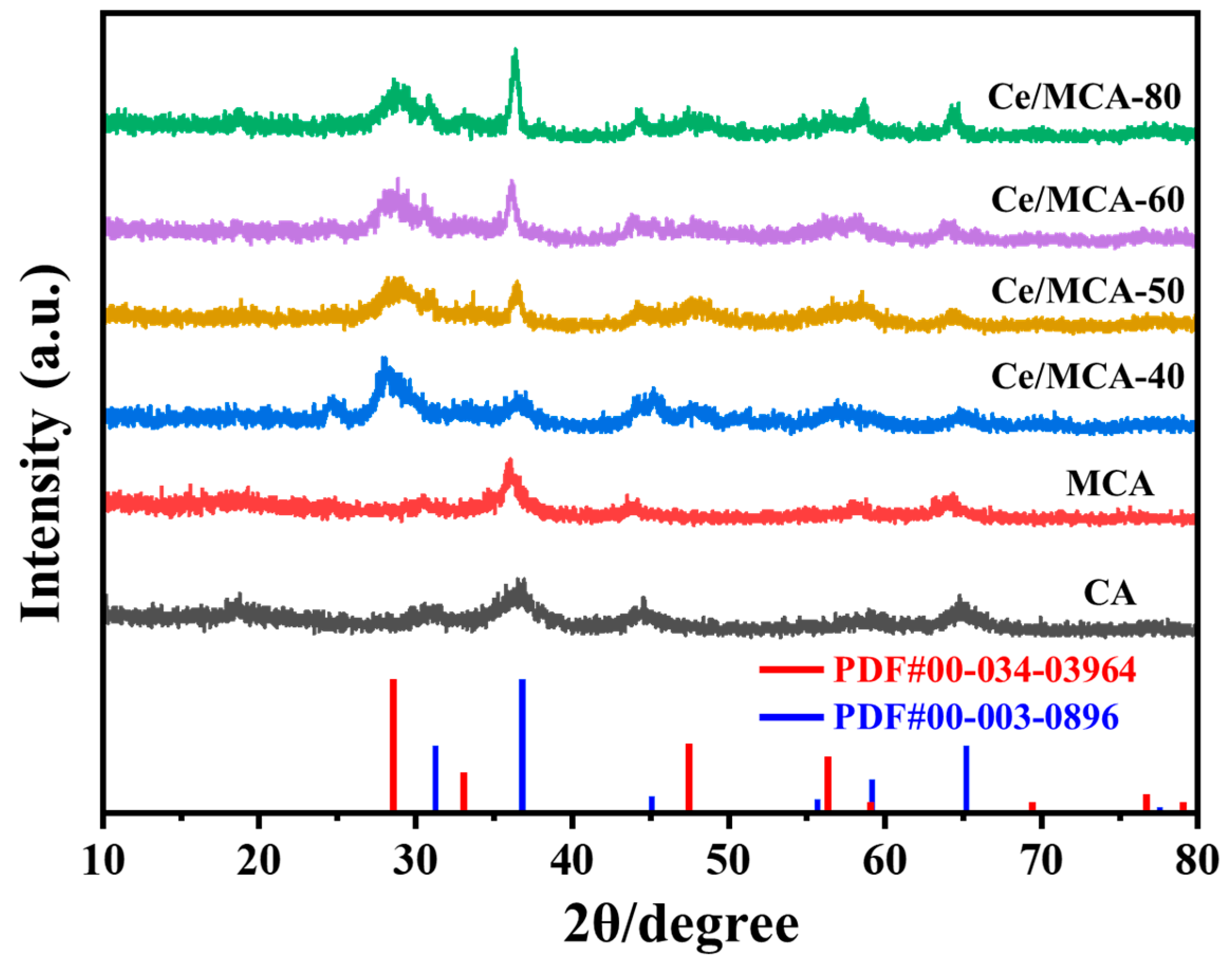
The crystal structure and crystallinity of CA, MCA, and Ce/MCA-X (X = 40, 50, 60, 80) samples were examined by XRD, as presented in Figure 1. The CA sample shown wide peaks, with diffraction peaks at 2θ = 31.25°, 36.81°, 45.01°, 59.18°, and 65.19° corresponding to the (220), (311), (400), (511), and (440) crystal planes of CoAl2O4 (PDF#00-003-0896), respectively, indicating the nanocrystalline or partially amorphous phases. Upon incorporation of Mn, the MCA sample exhibited a notable decrease in diffraction peaks without the emergence of additional peaks, suggesting that the introduction of Mn inhibited the grain growth of the CA sample. After further modification of Ce, the Ce/MCA-X composites displayed only weak diffraction peaks attributable to CeO2 (PDF#00-034-03964) and CoAl2O4. No MnOx phase was detected, owing to the relatively low content of Mn species [20]. As the Ce content increased, the diffraction peaks of Ce/MCA-60 and Ce/MCA-80 became sharper, reflecting enhanced crystallinity of the CeO2 phase. No diffraction peaks corresponding to Al2O3 were detected in any of the XRD patterns, implying that Al species remained dispersed within the LDO structure, likely contributing to the stabilization and dispersion of the active metal components [21].
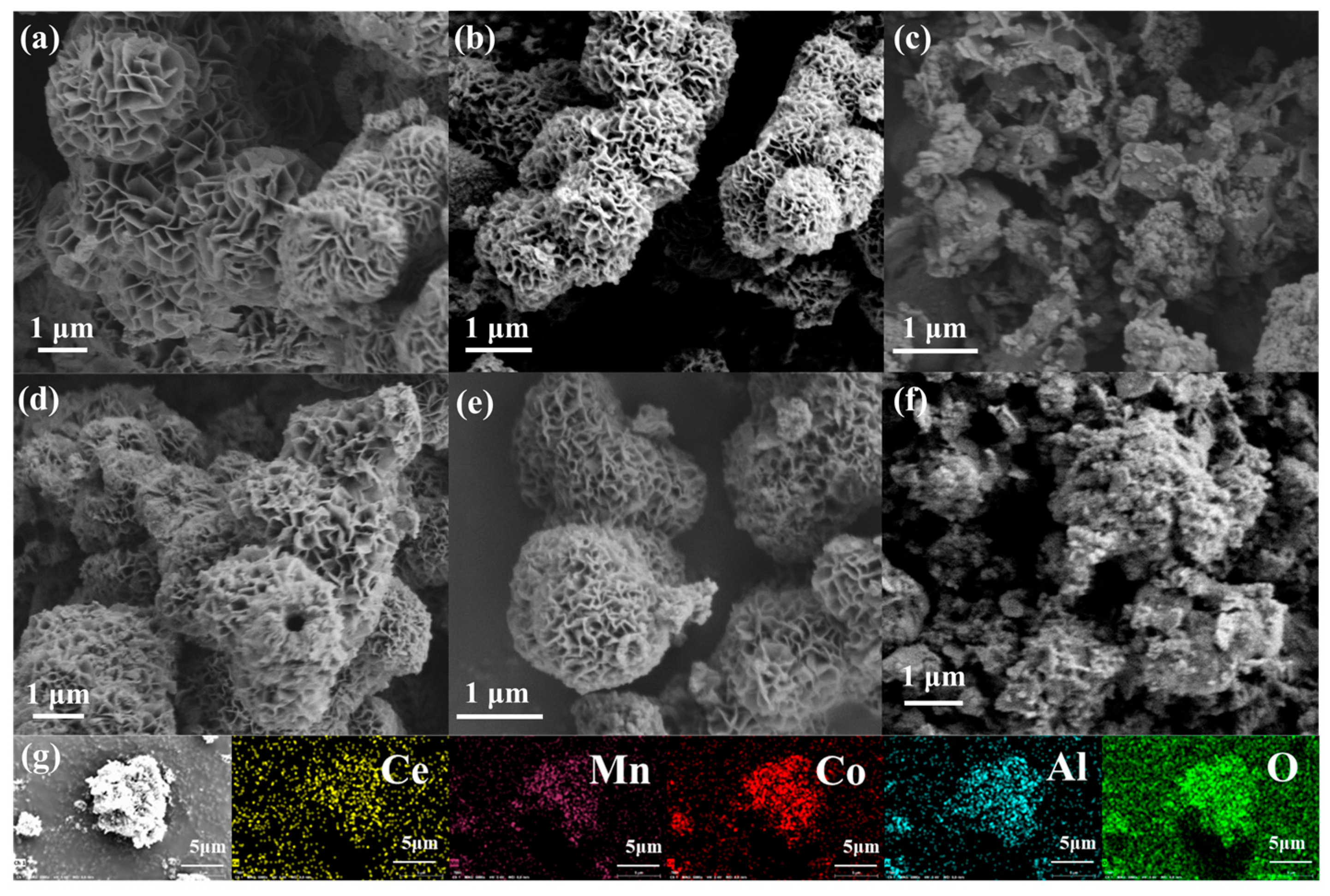
SEM observation revealed that the CA-LDH sample (Figure 2a) displayed a spherical layered morphology with a diameter of approximately 2–5 μm prior to calcination. This architecture was composed of numerous interlaced nanosheets about 10–20 nm in thickness, forming a hierarchical structure. The MCA-LDH (Figure 2b) exhibited similarly sized spherical particles as CA-LDH, but with more densely stacked layers, suggesting that the introduction of Mn ions promoted a more ordered assembly of the layered structure. After modifying by Ce element, the spherical structure gradually disappeared.
MCA-LDH-50 (Figure 2c) showed a partially lamellar morphology and nanoparticle aggregation. The particle size is significantly reduced, and a distinct flower ball structure is absent. This is likely due to the significant difference in ionic radius and charge between Ce3+ (1.034 Å) or Ce4+ (0.97 Å) and metal ions such as Co2+ (0.745 Å), Mn2+ (0.83 Å), and Al3+ (0.53 Å) in the LDH lattice, making it difficult for Ce3+ to stably replace these ions into the lamellar structure, leading to nanoparticle aggregation. Furthermore, the introduction of Ce interferes with the growth of MCA-LDH sheets, resulting in a partially lamellar structure. After calcination, CA (Figure 2d) retains a flower-ball-like morphology, but adhesion between the sheets is observed. High temperature causes partial collapse of the sheet structure, a slight contraction of pores, and surface roughening, likely due to dehydration between the LDH layers and decomposition of hydroxyl groups. The sintering degree of the flower-ball-like structure of MCA (Figure 2e) increases, and this agglomeration may lead to a decrease in pore volume and specific surface area. Ce/MCA-50, on the other hand, transforms into a fine, fragmented structure (Figure 2f), indicating that the presence of Ce exacerbates structural dissociation during calcination. The size distribution plots and the average diameter sizes of all samples are shown in Figure S1. The elemental distribution diagram (Figure 2g) confirms the uniform distribution of Ce, Mn, Co, Al, and O in the Ce/MCA-50 sample. ICP test shows that the percent of Al, Ce, Co, and Mn in Ce/MCA-50 is 0.68%, 1.25%, 0.26%, and 0.44%, respectively.
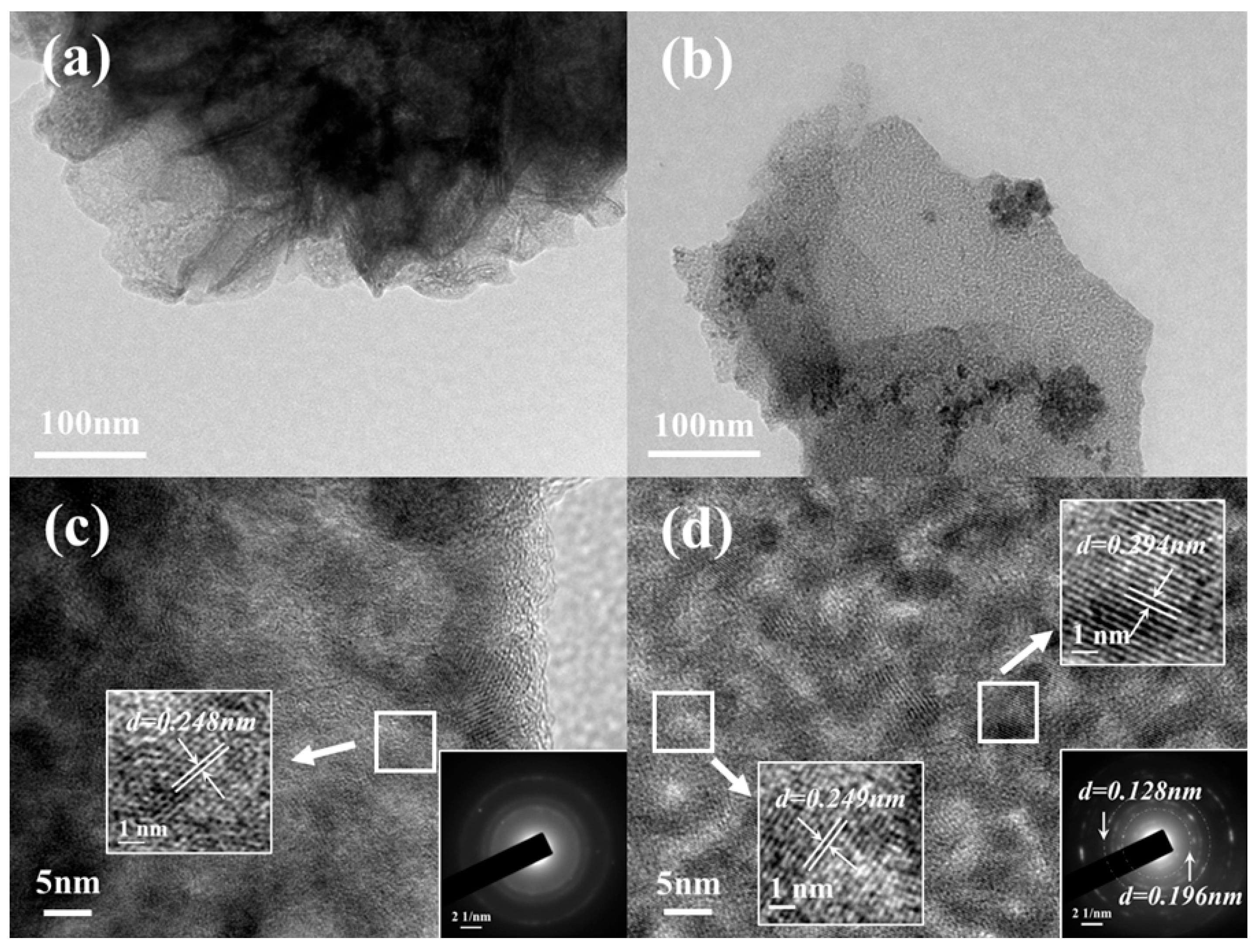
Further TEM characterization was conducted to systematically investigate the crystal structure of the MCA and Ce/MCA-50 samples. The low-magnification TEM image (Figure 3a) of MCA reveals a three-dimensional flower- like spherical architecture composed of layered units, consistent with the SEM observations. The HRTEM image (Figure 3c) indicates that MCA possesses discernible crystallinity. In specific regions, continuous lattice fringes with a spacing of approximately 0.248 nm are visible, corresponding to the (311) crystal plane of CoAl2O4 (PDF#00-003-0896). In addition, the selected- area electron diffraction (SAED) pattern exhibits both weak and diffuse rings, further confirming the partially crystalline nature of MCA with relatively low crystallinity. Upon incorporation of Ce, the low-magnification TEM image of Ce/MCA-50 (Figure 3b) displays a morphology distinct from that of pure MCA. The initial flower-like superstructure dissociates into dispersed sheet-like units, aligning with SEM results. Notably, dark aggregated regions are observed on the surface of these sheets, likely attributable to strong electron scattering caused by the higher atomic number of Ce. This suggests localized enrichment of Ce species in the form of CeO2 nanoparticles. The HRTEM image (Figure 3d) shows clearer lattice fringes. Multiple well-aligned fringes with a spacing of approximately 0.294 nm were identified, matching the (1 1 1) plane of (PDF#00-034-0394). Another set of fringes with a spacing of 0.249 nm corresponding to the (3 1 1) crystal plane of CoAl2O4 (PDF#00-003-0896) was observed. Moreover, the characteristic spacings of 0.196 nm and 0.128 nm, which were assigned to the (2 2 0) and (3 3 1) crystal planes of CeO2 (PDF#00-034-03964), respectively, proved the presence of CeO2 in the Ce/MCA-50 sample. However, neither sample displayed the information of Mn oxides, which was attributed to the low content of Mn species.
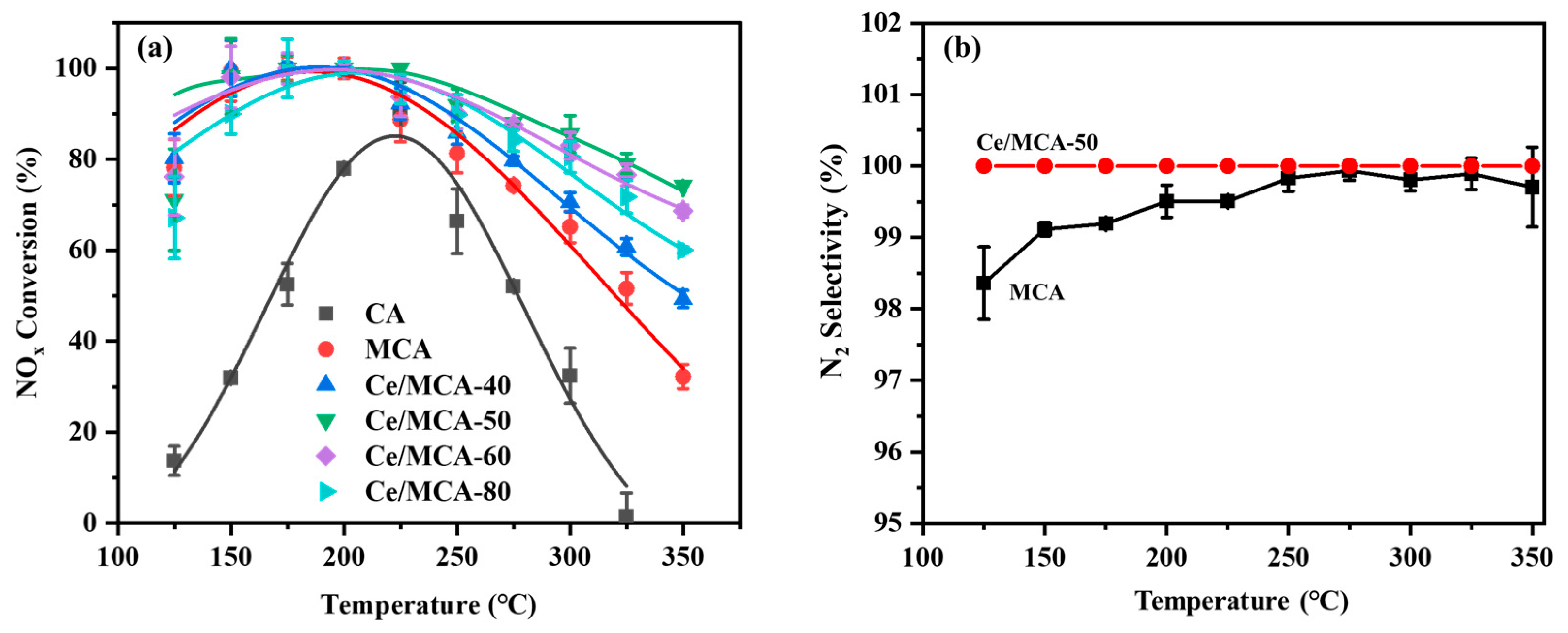
The results of the catalytic denitrification performance tests are presented in Figure 4a. The CA catalyst exhibits a typical “first increase, then decrease” trend in NOx conversion with rising temperature, reaching a maximum conversion of 90.42% at 225 °C. Beyond this temperature, the conversion decreases rapidly in the high-temperature region, even lose activity around 325 °C. This behavior is likely attributed to the strong oxidizing capability of Co, which leads to the over-oxidation of NH3 and the subsequent generation of additional NOx. The introduction of Mn significantly enhances the denitrification activity of the MCA catalyst in the low and medium-temperature range (100–225 °C), achieving nearly 100% conversion between 150 and 200 °C. However, the NOx conversion of MCA catalyst declines rapidly at higher temperatures, dropping to 32.24% at 350 °C, indicating still unsatisfactory catalytic performance in the high-temperature range (>300 °C).
In comparison with CA and MCA, the Ce/MCA catalysts with different Ce loadings demonstrate superior catalytic activity across the entire temperature range. The incorporation of Ce effectively broadens the operating temperature window. Notably, Ce/MCA-50, with a Ce/Mn molar percentage of 50%, exhibits the highest activity and the widest temperature window, maintaining average NOx conversion above 85% from 150 to 325 °C and nearly 100% during 150–225 °C range. Although Ce/MCA-60 and Ce/MCA-80 also show considerable catalytic activity, their performance declines slightly at high-temperatures, likely due to CeO2 agglomeration, which is consistent with XRD observations. The Ce-modified MCA-X exhibit effective denitration activity, which is primarily attributed to the synergistic effects with Ce and their thin two-dimensional nanosheets. Ce species can disperse on their surface and adjust the electronic structure and acid-base properties, thereby increasing reactant adsorption and expanding the catalytic reaction interface. The open channels and interlayer gaps in LDO structure facilitate the rapid diffusion of reactants, reduce mass transfer limitations, and enhance reaction kinetics. Moreover, both the MCA and Ce/MCA-50 display incredible N2 selectivity (nearly 100%) during the reaction temperature window (Figure 4b). Figure S2 shows the XRD patterns of the Ce/MCA-50 catalyst before and after the SCR reaction. No additional diffraction peaks are observed after the reaction, conforming the structure of the Ce/MCA-50 catalyst was stable before/after NH3-SCR reaction.
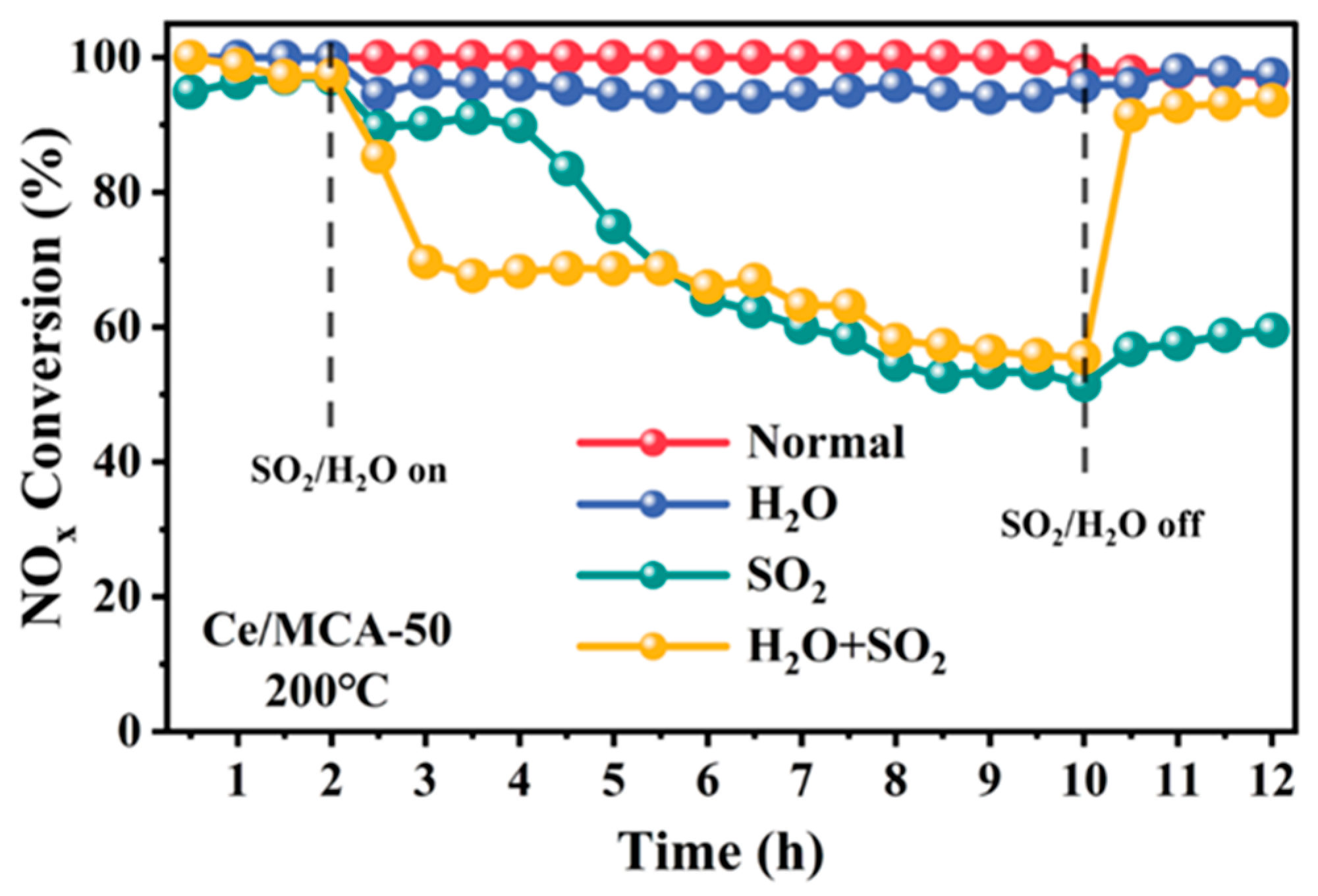
To evaluate the effects of SO2 and H2O on catalyst performance in a complex flue gas environment, the long-term stability and poisoning resistance to SO2 and H2O of the Ce/MCA-50 catalyst were tested at 200 °C. The results are shown in Figure 5. During 12 h of continuous operation, the Ce/MCA-50 catalyst demonstrated considerable stability, maintaining a NOx conversion rate near 100%. Upon introduction of 5 vol% H2O, the NOx conversion rate of Ce/MCA-50 slightly decreased but remained above 94%, demonstrating strong resistance to H2O poisoning. This temporary decline may be attributed to competitive adsorption between H2O and reactant molecules (NO/NH3) on the active sites. After the H2O supply was cut off, the activity fully recovered, indicating that H2O-induced deactivation is reversible. When 50 ppm SO2 was introduced, the NOx conversion continued to decline over time, reaching approximately 53% after 8 h. After ceasing SO2 exposure, the conversion recovered only to 59%, suggesting partially irreversible poisoning. This irreversible deactivation likely results from: (i) the deposition of ammonium sulfate species (e.g., NH4HSO4 and (NH4)2SO4 species) on the catalyst surface and inner pores, blocking active sites; and (ii) sulfidation of Mn active sites, leading to persistent catalyst degradation due to the formation of stable metal sulfates. Addressing the irreversible poisoning by SO2, constructing a core-shell protective layer to isolate SO2 from the active components is an effective approach to preserve catalyst activity. However, this method imposes high demands on the protective layer, as it must not hinder the mass transfer of NOx and NH3. Increasing the specific surface area and optimizing the pore structure can also mitigate SO2 poisoning by promoting reactant diffusion and preventing sulfate blockage of micropores. Since the Lewis and Bronsted acid sites on the surface of LDO are crucial for the NH3-SCR reaction, enhancing the stability of these surface acidic sites is another effective strategy to suppress SO2 poisoning [22,23].
When both SO2 and H2O were present simultaneously, the NOx conversion decreased to approximately 68% within 2 h and further declined to about 55.5% after 8 h. Notably, after 4 h, the NOx conversion in the presence of SO2 and H2O was higher than with SO2 alone. After the supply of SO2 and H2O was stopped, the NOx conversion quickly recovered to over 91%. According to reported papers [24,25], this phenomenon can be explained as follows: sulfate deposits from SO2 poisoning lead to insufficient activation of O2, reducing the availability of reactive oxygen species (ROS) and thus degrading catalytic activity. However, the presence of H2O promotes O2 activation and ROS generation, facilitating oxygen replenishment and electron transfer in the gas phase. This mitigates the SO2-induced deactivation of Mn sites. Catalysts with abundant ROS can enhance NH3 activation, promote NO oxidation to N2, accelerate the denitrification reaction and activity recovery.
In addition, to the 12 h stability tests mentioned above, long-term poisoning resistance experiments (45 h) were also conducted, as shown in Figure S3. After 45 h of continuous reaction, the catalytic activity of Ce/MCA-50 remained stable, without significant decline; after stopping the supply of SO2 and H2O, the activity could still recover to a high value, indicating that the LDO catalyst possesses considerable stability and the H2O molecules could effectively alleviate the poisoning effect of SO2 on the catalyst surface. To further investigate the structural information of the LDO catalyst, the XRD test of the Ce/MCA-50 after 45 h of reaction was performed in Figure S4. Compared with the fresh catalyst, the diffraction peak positions remained essentially unchanged, with only a slight decrease in intensity, indicating that the long-term anti-poisoning test did not cause obvious damage to the crystal structure of LDO. The SEM image (Figure S5) also revealed no significant changes in its nanosheet morphology.
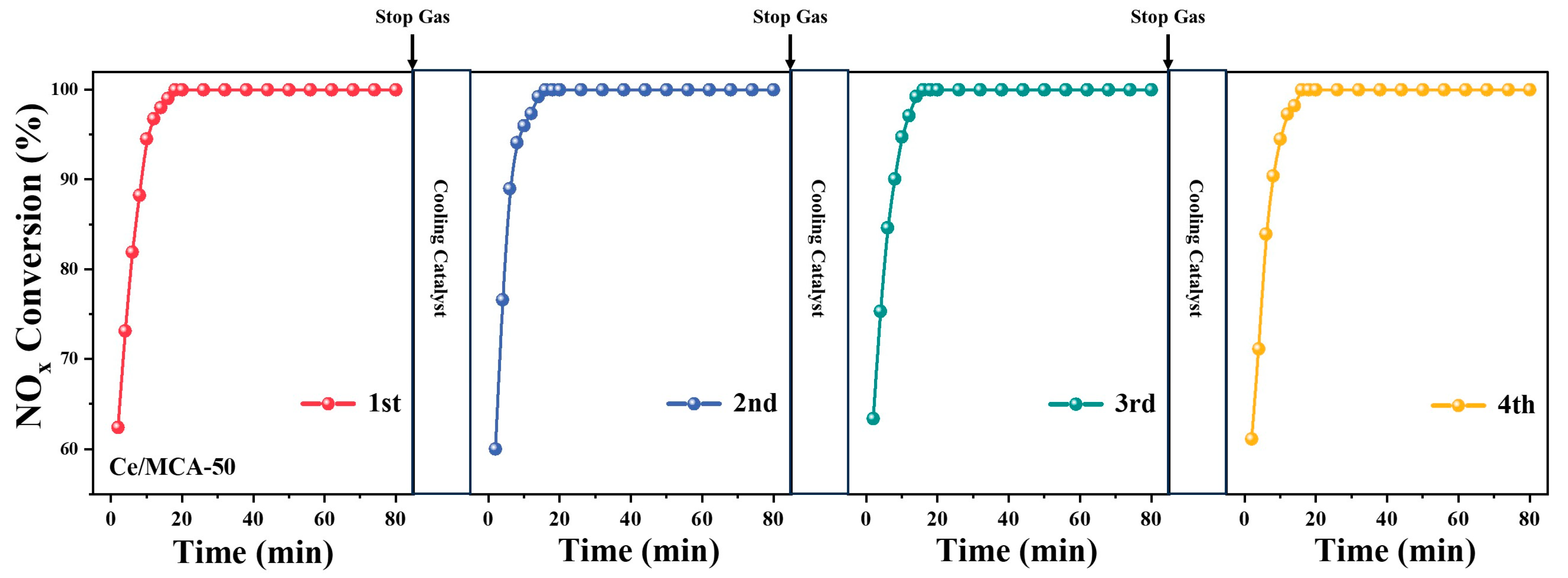
Short-term cycling tests were conducted to assess the reusability of the Ce/MCA-50 catalyst. As shown in Figure 6, the Ce/MCA-50 catalyst was pretreated, heated to 200 °C for 30 min and maintained at this temperature for NH3-SCR. After 50 min of reaction, the system was cooled to room temperature and pretreated again for next testing. At the first cycle reaction, the NOx conversion of the Ce/MCA-50 catalyst rapidly increased from approximately 60% to 98% with increasing time and remained at 98% for the entire test period. After four cycling tests, the NOx conversion rate of the Ce/MCA-50 catalyst still achieved 98% NOx conversion at 200 °C, demonstrating stable catalytic performance, reusability, and potential for industrial application.
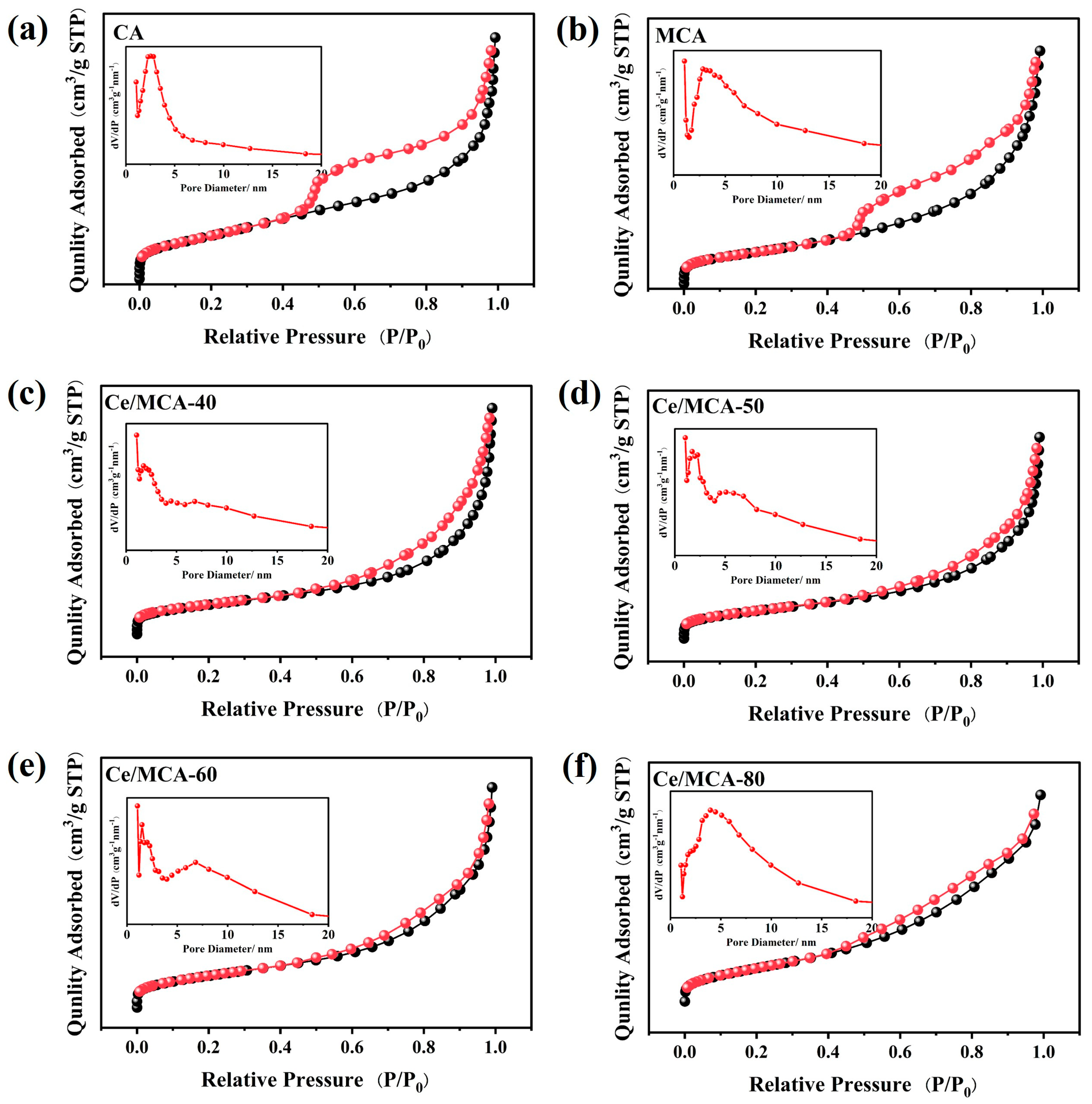
The N2 adsorption–desorption isotherms of the CA, MCA, and Ce/MCA-X (X = 40, 50, 60, 80) samples (Figure 7) all exhibited type IV isotherms with H3-type hysteresis loops, indicating the presence of mesoporous structures. The BJH pore size distribution further confirmed that the pore sizes were predominantly within 15 nm, demonstrating the formation mesopores in the samples’ structures. A summary of the pore structure parameters revealed that (Table 1) the CA sample possessed the highest specific surface area (163.89 m2/g) in all the samples. However, the introduction of Mn significantly reduced the specific surface area of MCA to 121.58 m2/g. SEM characterization indicated that although the introduction of Mn did not alter the flower-like layered structure of the LDO, it promoted more ordered stacking of the layers, resulting in a denser morphology, which may account for the decrease in surface area. Notably, the incorporation of Ce disrupted the flower-like layered structure of MCA, leading to the formation of finely divided flake-like structures. The specific surface areas of Ce/MCA-40 (126.05 m2/g) and Ce/MCA-50 (121.69 m2/g) showed no significant difference compared to MCA. However, with higher Ce loading, the surface areas of Ce/MCA-60 (95.14 m2/g) and Ce/MCA-50 (76.50 m2/g) decreased significantly, suggesting that excessive Ce incorporation may block mesopores and reduce the accessible surface area. This observation is further supported by the gradual decrease in pore volume with increasing Ce content. Larger specific surface areas and pore volumes facilitate the adsorption of reactant gases, which may contribute to the superior denitrification activity of the Ce/MCA-50 catalyst.
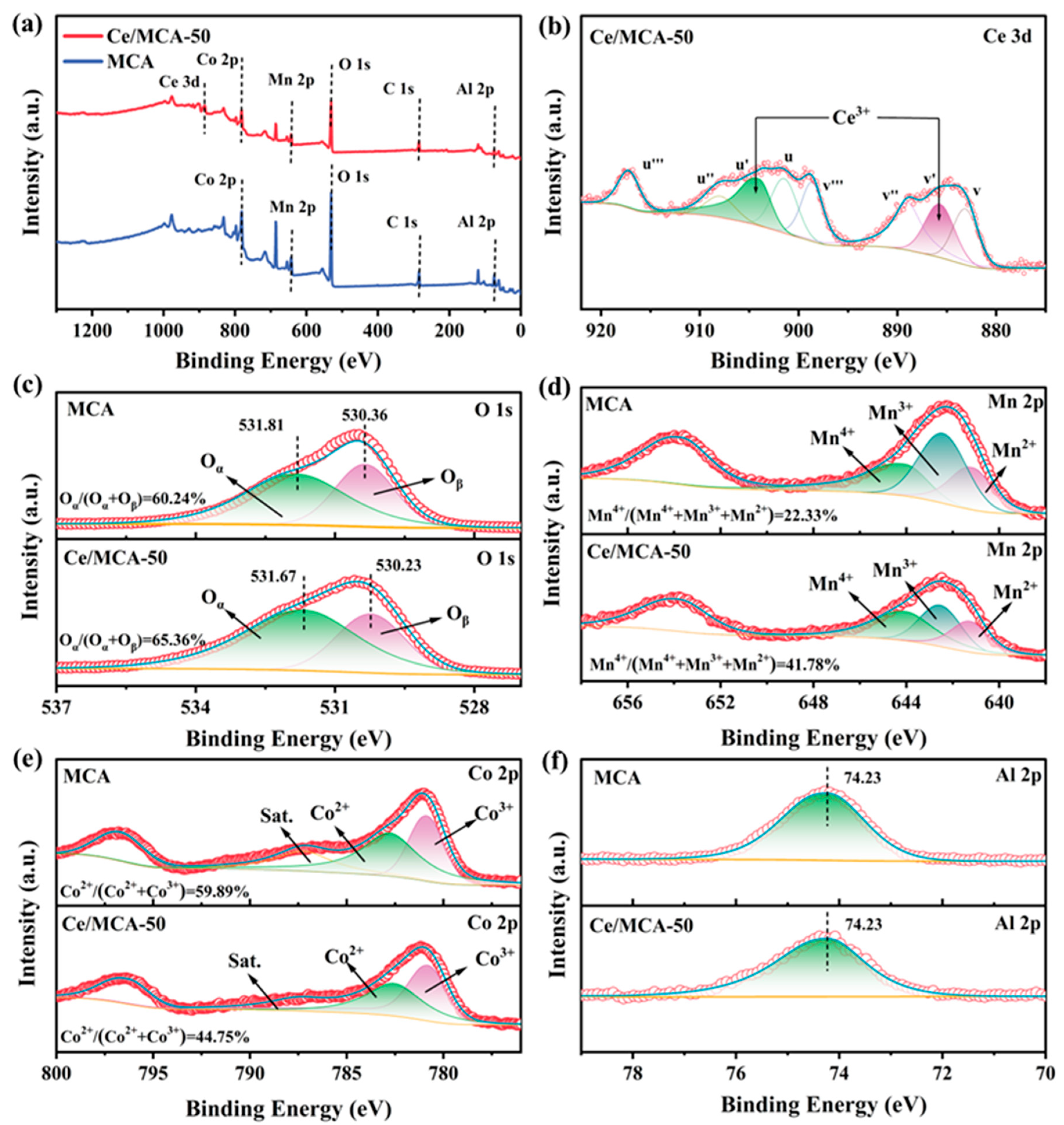
To investigate the influence of Ce incorporation on the surface elemental states of MCA, an XPS analysis was performed. The survey spectra (Figure 8a) confirm the presence of Mn, Co, O, and Al in MCA, while an additional Ce 3d peak appears in Ce/MCA-50, indicating successful introducing. The high-resolution Ce 3d spectrum of Ce/MCA-50 (Figure 8b) was deconvoluted into eight peaks u, u″, u‴, v, v″, and v‴ corresponding to Ce4+, and u′ and v′ to Ce3+. The coexistence of Ce3+ and Ce4+ suggests the presence of electron transfer on the catalyst surface [26]. The O 1s high-resolution spectra (Figure 8c) can be fitted into two components: peaks at 531.81 eV and 531.67 eV assigned to chemically adsorbed oxygen Oα, and those at 530.36 eV and 530.23 eV to lattice oxygen Oβ [27]. Generally, chemically adsorbed oxygen Oα has a stronger oxidizing ability, and its content is an important indicator for judging denitrification activity [28]. The Oα ratio (Oα/(Oα + Oβ)) in Ce/MCA-50 (65.36%) was significantly higher than that in the MCA sample (Oα/(Oα + Oβ) = 60.24%), indicating that Ce induction increases the oxygen vacancy concentration, promoting O2 adsorption and dissociation into active oxygen species, thereby improving denitrification performance.
The high-resolution Mn 2p spectra (Figure 8d) show peaks near ~654 eV and ~642 eV corresponding to Mn 2p1/2 and Mn 2p3/2, respectively. The Mn 2p3/2 envelop was fitted into three contributions: Mn2+, Mn3+, and Mn4+. For MCA, these components were located at 641. 15 eV, 642.43 eV, and 644.07 eV, respectively, while for Ce/MCA-50, they appeared at 641.25 eV, 642.54 eV, and 644.02 eV. The ratio of Mn4+/(Mn2+ + Mn3+ + Mn4+) increased significantly from 22.33% in MCA to 41.78% in the Ce/MCA-50. The considerable oxidative capability of manganese species (Mn4+), attributed to its half-filled 3d5 electron configuration, promotes NO oxidation to NO2 and facilitates the “fast SCR reaction” pathway, thereby enhancing catalytic activity [29]. The increased concentrations of Oα and Mn4+ are likely key factors contributing to the improved performance of Ce/MCA-50. The Co 2p3/2 energy level can be fitted into three peaks (Figure 8e), where the peaks at binding energies of 780.86 eV, 782.77 eV, and 787.23 eV, corresponding to the Co3+, Co2+, and Co satellite peaks of MCA, respectively, and the peaks at binding energies of 780.82 eV, 782.55 eV, and 787.54 eV are attributed to the Co3+, Co2+, and Co satellite peaks of Ce/MCA-50, respectively [30]. The results show that the ratio of Co2+/(Co3+ + Co2+) in the Ce/MCA-50 sample (44.75%) is lower than that in the MCA sample (59.89%), and it is speculated that the doping of Ce may have induced an increase in the valence state of Co. Figure 8f shows the Al 2p high-resolution spectra of the MCA and Ce/MCA-50. The binding energy of the Al 2p peak of both samples is located at 74.23 eV [31]. After inducing Ce, the chemical state of Al does not change significantly, indicating that Al mainly acts as a structural stabilizer, which is consistent with the XRD analysis results.
The chemical states on the surface of the Ce/MCA-50 after 45 h reaction were also tested to study the reaction process. Figure S6 was the survey spectrum, expressing Ce, Mn, Co, and Al were still detected on the Ce/MCA-50 surface. However, after the long-term poisoning resistance experiment, the characteristic peak of S appeared in 168.2 eV. By deconvoluting the S 2p orbitals, the peaks located at binding energies of 169.1 eV and 167.9 eV were assigned to sulfate (S6+) and sulfite (S4+), respectively, suggesting that surface-deposited sulfate and sulfite are the main causes of the slight decrease in catalytic activity (Figure S7a) [32]. On the other hand, the analysis of Mn and Co elements revealed that after reaction, the proportions of Mn4+ among Mn species and Co2+ among Co species remained 39.2% and 42.6%, respectively (Figure S7b,c). The amount of Mn species and Co species were stable during reaction, which is an important reason why LDO can maintain incredible activity over long-term operation. Meanwhile, the positions of the Ce 3d peaks (Figure S7d) showed no obvious shift, confirming that the existence of the Ce3+/Ce4+ redox pairs on the surface, which ensures the continuous progress of the catalytic reaction. Therefore, Ce-modified MnCoAl-LDOs have the potential for future industrial application as NH3-SCR catalysts.
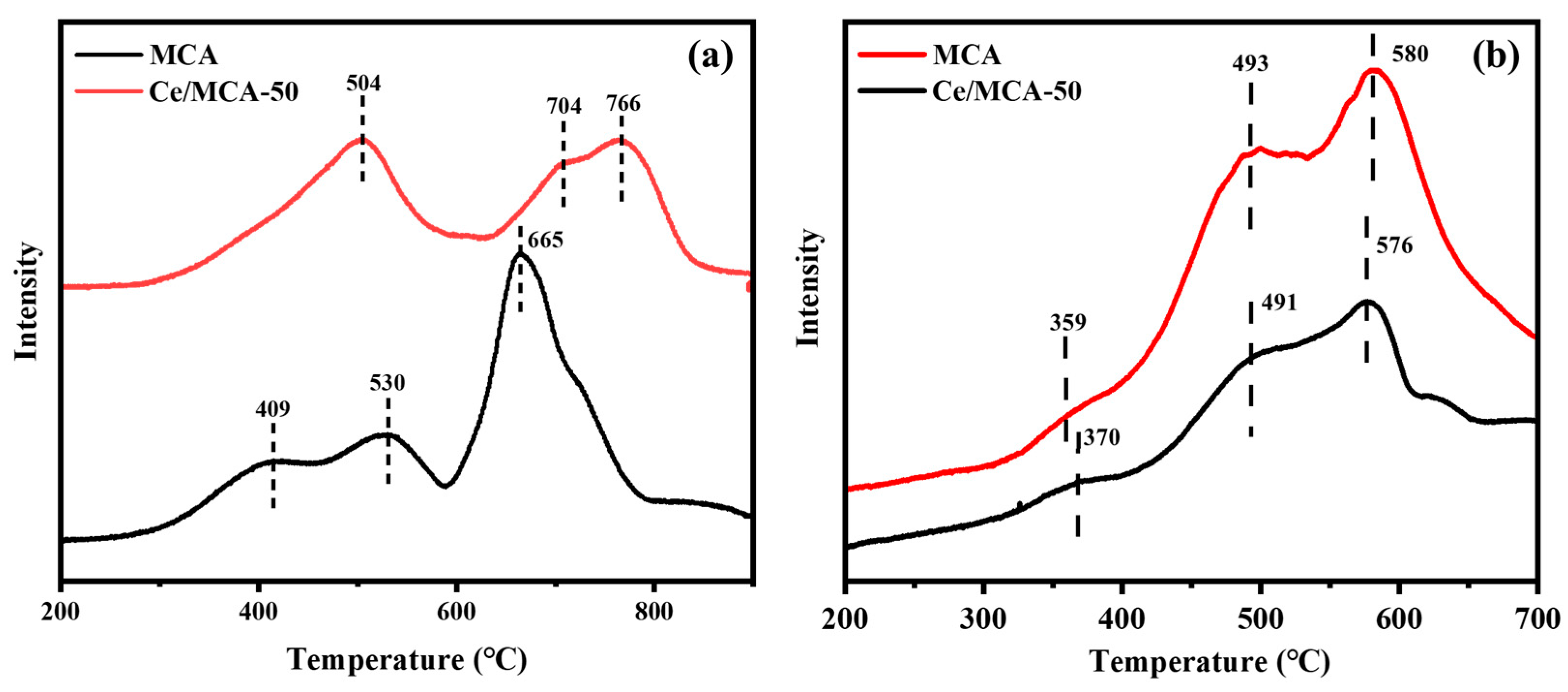
The H2 TPR was used to verify the redox ability of the MCA and Ce/MCA-50. In Figure 9a, the peaks appear at 409, 530 and 665 °C for MCA, while the reduced peaks of Ce/MCA-50 are located at 504, 704, and 766. Neither sample exhibits obvious Co3+/Co2+ reduced peaks (generally around 250–350 °C), indicating that the Co ions have strong interactions in the CoAl2O4 structure. Moreover, the strong reduction peak at 766 for Ce/MCA-50 illustrates that when a lattice oxygen with two negative charges is removed, two nearby Ce4+ ions will capture electrons and be reduced to Ce3+ in order to maintain electrical neutrality during the program. Although the reduced peaks shift to higher temperature range for Ce/MCA-50, the catalytic activity was higher than that of MCA. Based on the reports [33,34], the Ce element can disperse and form strong interactions with LDO structures that are less prone to sintering under reaction conditions and can expose more stable active sites. The O2-TPD measurement was employed to investigate the oxygen species and their quantities on the catalyst surface. As shown in Figure 9b, both MCA and Ce/MCA-50 exhibit three deposition peaks in the temperature range of 200–700 °C. The peak observed at 300–400 °C corresponds to weakly adsorbed oxygen species, such as superoxide species O2, which are characterized by weak binding energy and easy desorption. The peak appearing at 450–550 °C can be attributed to peroxide species (O22−) or certain weakly bound lattice oxygen. In contrast, the peak in the range of 550–650 °C represents strongly chemisorbed oxygen species, such as O or O2−, which possess strong binding energy and stability, usually requiring significant energy for activation. By calculating the peak areas, it was found that after the incorporation of Ce, the oxygen content in the Ce/MCA-50 (10.37) is higher than that in the MCA (6.82) [35]. This result is consistent with XPS analysis. These finding indicate that the addition of Ce facilitates the storage and release of oxygen during the NH3-SCR reaction, which explains the superior catalytic activity of Ce/MCA-50 compared to MCA.
The surface adsorption species of the Ce/MCA-50 catalyst under different conditions were investigated using in situ DRIFTS spectroscopy. The adsorption behavior of NH3/NO + O2 on the catalyst surface was examined to elucidate the NH3-SCR reaction mechanism and pathway at various temperatures.
(1)
Reaction of pre-adsorbed NH3 with NO + O2
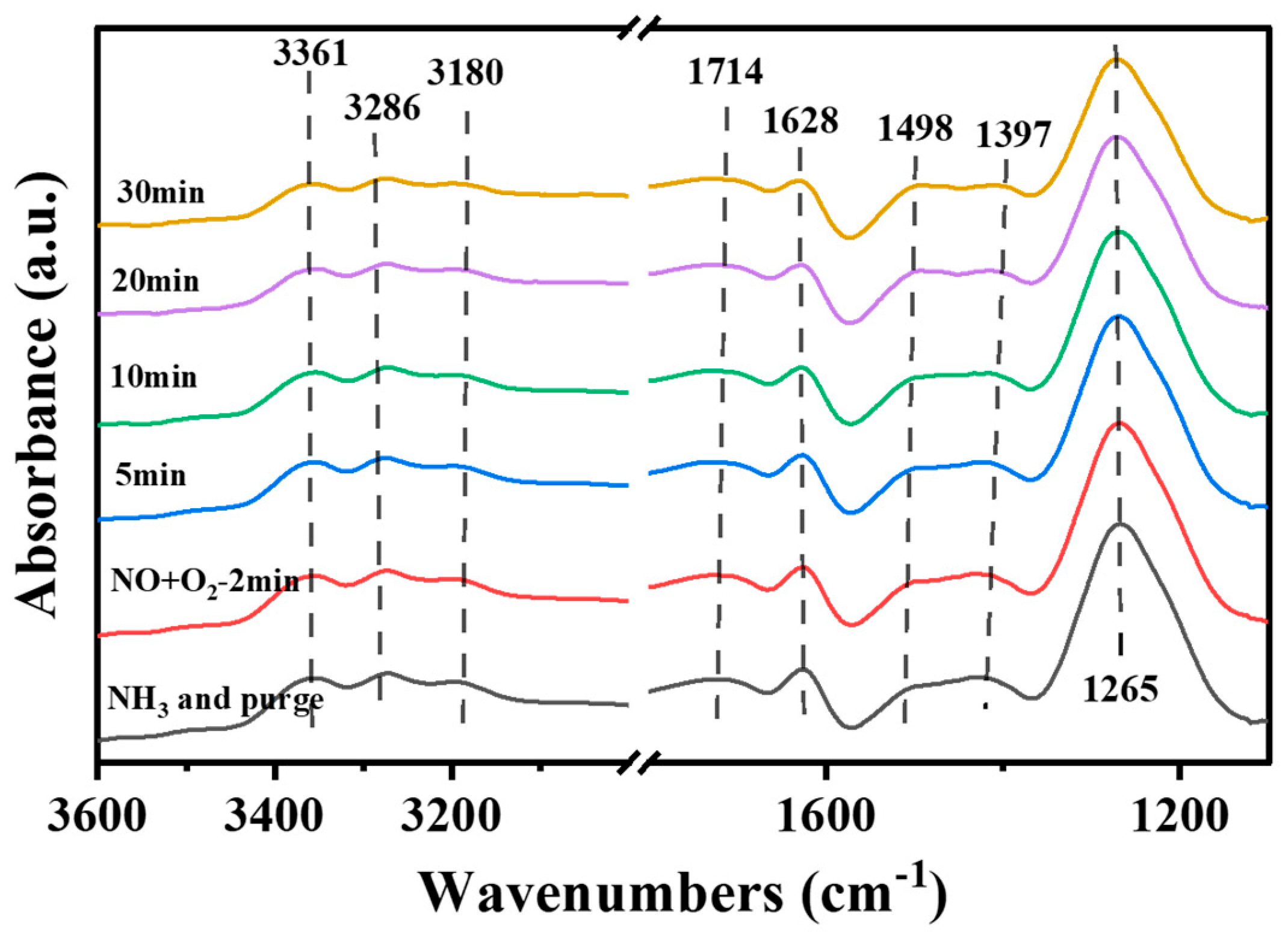
In situ DRIFTS transient experiments were conducted at 200 °C by first saturating the Ce/MCA-50 catalyst with NH3, followed by the introduction of NO + O2 (Figure 10). After 30 min of NH3 pre-adsorption, multiple NH3-related adsorption peaks were observed at 3361, 3286, 3180, 1714, 1628, 1498, 1397, and 1265 cm−1. The bands around 3361, 3296, and 3180 cm−1 are assigned to N-H stretching vibration; those at 1714 and 1397 cm−1 are attributed to NH4+ species bound to Bronsted acid sites; peaks at 1628 and 1265 cm−1 correspond to NH3 adsorbed on Lewis acid sites; and the band at 1498 cm-1 is associated with -NH2 species. After introducing NO + O2, the intensity of these peaks gradually decreased with time, indicating consumption of pre-adsorbed NH3 in the catalytic reduction of NO, the persistence of NH3 peaks even after 30 min of N2 purging demonstrates strong adsorption of NH3 on the catalyst. The gradual decline of these peaks under NO + O2 flow confirms that adsorbed NH3 species react with gaseous NO, supporting an E-R mechanism for the NH3-SCR reaction over Ce/MCA-50.
(2)
Reaction of NH3 with pre-adsorbed NO + O2
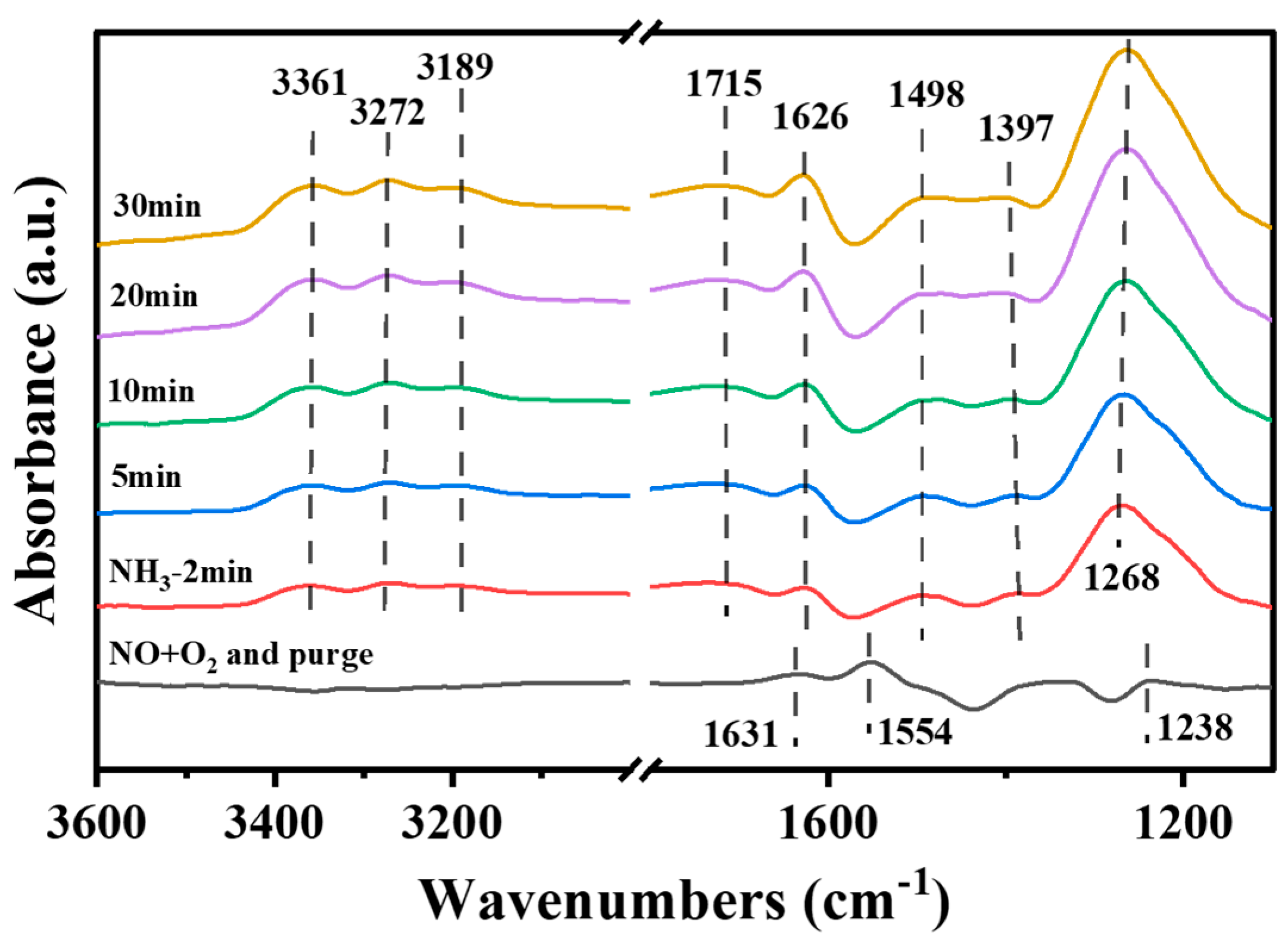
As shown in Figure 11, after pre-adsorption of NO + O2 at 200 °C, characteristic peaks of NOx species appeared at 1631, 1554, and 1238 cm−1. The band at 1631 cm−1 is assigned to adsorbed NO2, that at 1554 cm−1 to bidentate nitrate, and the peak at 1238 cm−1 to bringing nitrate. Upon introducing NH3, these NOx species peaks rapidly disappeared, and new peaks corresponding to NH3 adsorption emerged at 3361, 3272, 3189, 1715, 1626, 1498, 1397, and 1268 cm−1. These increased in intensity over time, with assignments consistent with those in Section 1. The swift consumption of pre-adsorbed NOx species upon NH3 introduction indicates a Langmuir–Hinshelwood Pathy way. The rapid disappearance of bidentate and bridging nitrates suggests they serve as key active intermediates. Thus, the NH3-SCR reaction on Ce/MCA-50 follows both E-R and L-H mechanisms, with the L-H pathway dominating at low temperatures, as evidenced by the faster reaction between NH3 and pre adsorbed NO + O2.
(3)
Reaction of NH3 and NO + O2 at different temperatures
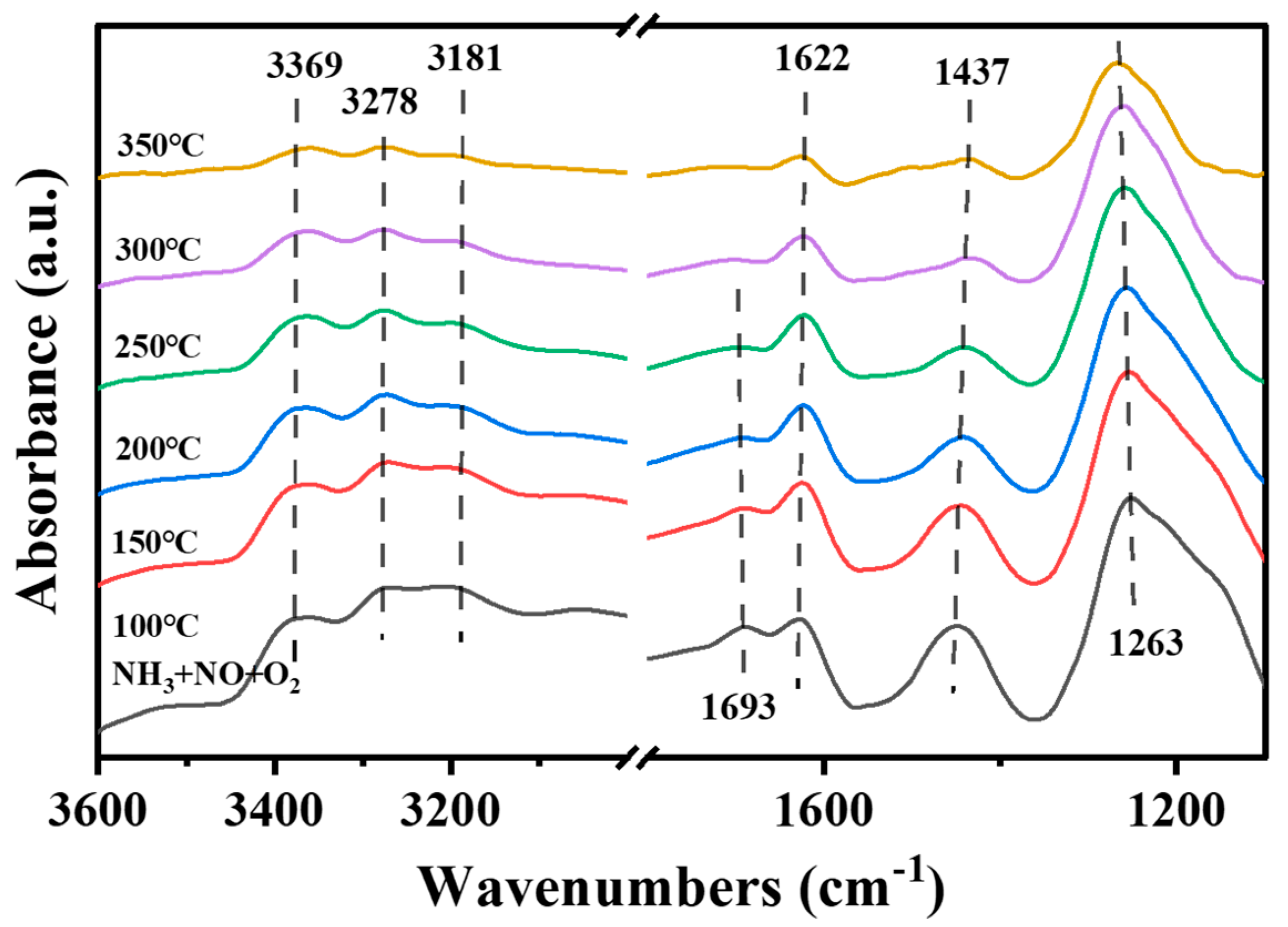
In situ DRIFTS spectra of the NH3-SCR reaction over Ce/MCA-50 at temperatures from 100 to 350 °C are presented in Figure 12. At 100 °C, N-H stretching vibrations (3369, 3278, and 3181 cm−1), NH4+ on Bronsted sites (1693 and 1437 cm−1), and NH3 on Lewis sites (1622 and 1263 cm−1) were observed. With increasing temperature, all peak intensities decreased. The NH4+ species on Bronsted sites (1693 cm−1) disappeared by 250 °C, while the band at 1437 cm−1 and Lewis-bound NH3 species (1622 and 1263 cm−1) persisted up to 350 °C, albeit with reduced intensity. These results indicate that the NH3 species adsorbed on Lewis acid sites remain stable and active even at high temperatures (>250 °C), whereas NH4+ species on Bronsted acid sites are largely removed, suggesting that Lewis acid sites play a more critical role in high-temperature NH3-SCR activity on Ce/MCA-50.

3. Experimental Procedure

3.1. Synthesis

All the chemical reagents were bought from Aladdin (Shanghai, China) and Sinopharm (Beijing, China) without any purification.
A series of Ce/MnCoAl-LDO catalysts were prepared via the solvothermal method. Specifically, Co(NO3)2·6H2O (10 mmol), Al(NO3)3·9H2O (5 mmol), urea (26 mmol), and NH4F (6 mmol) were dissolved in 60 mL of methanol and stirred at room temperature for 30 min. After the solution became completely transparent, it was transferred to a 100 mL polytetrafluoroethylene-lined stainless-steel autoclave and reacted at 150 °C for 3 h. Once the autoclave had cooled to the room temperature, the products were washed 5 times with deionized water and ethanol, respectively. A similar procedure was used to prepare MnCoAl-LDH, by incorporating a 50 wt.% aqueous solution of Mn(NO3)2 to achieve a Mn/Co molar ratio of 1. After calcination, the resulting catalyst was named MCA (MnCoAl-LDO). For the Ce-modified samples, Ce(NO3)3·6H2O was additionally introduced during the preparation of MCA-LDH to achieve Ce/Mn molar ratios of 40%, 50%, 60%, and 80%, respectively. The resulting precursors were named Ce/MCA-LDH-X (where X = 40, 50, 60, and 80), respectively. The corresponding LDO catalysts after calcination were named Ce/MCA-X (X = 40, 50, 60, and 80).

3.2. Characterization

The crystal structures of samples were characterized by X-ray diffraction patterns on a RINT D/MAX-2500 diffractometer (RIGAKU, Akishima, Japan) using a Cu-Kα radiation (1.54 Å). Morphological and microstructural analyses were performed using scanning electron microscopy (Thermo Fisher Scientific Apreo S HiVac, Waltham, MA, USA) and high-resolution transmission electron microscopy (TalosF200XG2, Thermo Fisher Scientific, USA). Surface elemental states were analyzed by X-ray photoelectron spectroscopy (K-Alpha, Thermo Fisher Scientific, USA). H2 temperature-programmed reduction (H2-TPR) experiments were conducted using a flow-type BELCAT-30 chemisorption analyzer (BEL Japan, Inc., Toyonaka, Japan). O2 temperature-programmed desorption (O2-TPD) experiments were conducted using a BelCata II chemisorption analyzer (BEL Japan, Inc). The N2 de/absorption was measured by Microtrac BELCat II (Microtrac BEL, Tokyo, Japan).
The DRIFTS experiments were conducted using Fourier transform infrared spectroscopy (Nicolet 6700, Thermo Fisher Scientific, USA). The testing gas composition consisted of 500 ppm NOx, 500 ppm NH3, and 5%vol O2, with a total gas flow rate of 100 mL/min. The heating rate of the catalyst during the test was 5 °C/min. All samples required pre-treatment before testing, and the background was collected at the desired temperature and atmospheric pressure. The spectra were recorded by accumulating 32 scans at a resolution of 4 cm−1. The acquisition time for a single spectrum was approximately 6.4 s.
i.
NO + O2 react with pre-adsorbed NH3
The sample was pre-treated at 200 °C for 30 min. While maintaining the temperature, NH3 was introduced to the system and the catalyst adsorbed NH3 for 30 min. Then, the supply of NH3 was stopped, and N2 was purged for 30 min; the first data point was recorded at this stage. Finally, N2 was stopped, and NOx + O2 were introduced for the reaction, with data recorded at different time (2 min, 5 min, 10 min, 20 min, and 30 min).
ii.
NH3 reaction with pre-adsorbed NO + O2
The procedure was almost identical to the method described above, except that the pre-adsorbed gas was changed to a mixture of NO + O2. Subsequently, NH3 was introduced to carry out the reaction test, and the data recording time was also set analogous to the aforementioned method.
iii.
The reaction of NH3 and NOx + O2 at different temperatures
First, the catalyst was pre-treated at 100 °C for 30 min under N2 atmosphere. Then, the supply of N2 was stopped, NH3 and NOx + O2 were purged into the system to start the reaction, and the data were recorded at different temperatures (100 °C, 150 °C, 200 °C, 250 °C, 300 °C and 350 °C).

3.3. NH3-SCR Performance and the Resistance of SO2/H2O

The catalytic performance was evaluated in a fixed-bed quartz flow reactor (the cylindrical catalyst carrier loaded had a diameter of 1cm and a length 1 cm) at atmospheric pressure using 0.2 g of the catalysts (40–60 mesh, 0.25–0.425 mm). The Weisz–Prater value of this system was calculated around 0.2, indicating the effective utilization of the catalyst. The reactant gas mixture consisted of 500 ppm NH3, 500 ppm NO, and 5 vol % O2 balanced with N2, with a total gas hourly space velocity (GHSV) of 30,000 h−1. The reaction temperature was increased from 150 to 350 °C at a ramp heating rate of 5 °C /min to determine the operating temperature window. To investigate the resistance to sulfur and water, 50 ppm SO2 and 5%vol H2O vapor (introduced via a micro-pump syringe) were added to the feed gas. The concentrations of the inlet and outlet gases were continuously monitored using an MRU NOVA PLUS gas analyzer and a Fourier transform infrared gas analyzer (Thermo Fisher IGS). The NOx conversion and the N2 selectivity were calculated using Equation (1) and (2) [26]:
NO x   conversion   =   N O x i n [ N O x ] o u t [ N O x ] i n
N 2   selectivity = 1 2 [ N 2 O ] o u t [ N O x ] i n + [ N H 3 ] i n [ N O x ] o u t [ N H 3 ] o u t

4. Conclusions

In summary, the series of Ce-modified MnCoAl LDOs catalysts were successfully synthesized by using simple methods. Various characterization techniques confirmed that Ce/MCA LDOs possesses a defined porous structure, with Ce ions homogeneously dispersed. The Ce/MCA LDOs presented a morphology of small, thin nanosheets. The incorporation of Ce significantly increased the concentration of chemisorbed oxygen and Mn4+ ions, which led to a NOx conversion that approached 100% in the range of 150–225 °C and an average NOx conversion of 85% across the entire range. Furthermore, the Ce/MCA LDOs exhibited considerable thermal stability and H2O resistance. Finally, in situ DRIFTs studies revealed that the reaction follows a dual mechanism, involving both Langmuir–Hinshelwood (L–H) and Eley–Rideal (E–R) pathways. We anticipate that this work will provide a solid theoretical foundation for the advanced treatment of industrial nitrogen oxides.

Supplementary Materials

The following supporting information can be downloaded at: https://www.mdpi.com/article/10.3390/catal16010055/s1, Figure S1. The size distribution of (a) CA-LDH; (b) MCA-LDH; (c) Ce/MCA-LDH-50; (d) CA; (e) MCA; (f) Ce/MCA-50. Figure S2. XRD patterns of Ce/MCA-50 catalyst before and after SCR reaction. Figure S3. Long-term effects of SO2+H2O on NOx Conversion on Ce/MCA-50 Catalyst at 200 °C. Figure S4. XRD patterns of Ce/MCA-50 catalyst before and after 45 h SCR reaction. Figure S5. The SEM image of Ce/MCA-50 catalyst after 45 h SCR reaction. Figure S6. The XPS survey spectrum of Ce/MCA-50 after 45 h SCR reaction. Figure S7. XPS spectra of Ce/MCA-50 after 45 h SCR reaction (a) S 2p (b) Mn 2p (c) Co 2p (d) Ce 3d. Table S1. Atomic ratios of the MCA, Ce/MCA-50, and Ce/MCA-50 after 45 h reaction catalysts obtained by the XPS. Table S2. The comparison table of Mn-Ce and V based catalysts. References [36,37,38,39,40,41,42,43,44,45,46] are cited in the Supplementary Materials.

Author Contributions

Conceptualization, X.L. and T.S.; methodology, T.S.; validation, X.L. and J.Z.; investigation, J.Z. and P.H.; resources, H.E. and H.H.; writing—original draft preparation, X.L.; writing—review and editing, J.Z. All authors have read and agreed to the published version of the manuscript.

Funding

This research was funded by National Key Research and Development Program of China, grant number “2021YFB3500604” and the Young Talent Support Fund (5501310020) from Jiangsu University.

Data Availability Statement

The original contributions presented in this study are included in the article and Supplementary Material. Further inquiries can be directed to the corresponding author.

Conflicts of Interest

The authors declare no conflicts of interest.

References

  1. Jafarsalehi, M.; Mashayekh, M.; Bagher Miranzadeh, M.; Mirzaei, N.; Ebrahimi, M. Primary measures for cleaner biomass combustion to reduce NOx: A narrative review on solid biomass fuels, NOx sources, small-scale boilers, axillary equipment, fuel management and fuel quality improvement. Fuel 2025, 396, 134891. [Google Scholar] [CrossRef]
  2. Dai, G.; Liu, B.; Wang, R.; Wang, H.; Miao, Y.; Hou, S.; Lian, D.; Chen, M.; Li, C.; Zhang, Z.; et al. Pretreatment techniques in CO-SCR and NH3-SCR: Status, challenges, and perspectives. J. Catal. 2025, 442, 115925. [Google Scholar] [CrossRef]
  3. Shi, Z.; Peng, Q.; Xie, B.; Wei, J.; Yin, R.; Fu, G. Mechanism, performance and modification methods for NH3-SCR catalysts: A review. Fuel 2023, 331, 125885. [Google Scholar] [CrossRef]
  4. Chen, Y.; Liu, X.; Wang, P.; Mansoor, M.; Zhang, J.; Peng, D.; Han, L.; Zhang, D. Challenges and perspectives of environmental catalysis for NOx reduction. JACS Au 2024, 4, 2767–2791. [Google Scholar] [CrossRef]
  5. Altalhi, A.A.; Mohamed, E.A.; Negm, N.A. Recent advances in layered double hydroxides (LDH)-based materials: Fabrications, modification strategies, characterization, promising environmental catalytic applications, and prospective aspects. Energy Adv. 2024, 3, 2136–2151. [Google Scholar] [CrossRef]
  6. Mohanty, U.A.; Sahoo, D.P.; Paramanik, L.; Parida, K. A critical review on layered double hydroxide (LDH)-derived functional nanomaterials as potential and sustainable photocatalysts. Sustain. Energy Fuels 2023, 7, 1145–1186. [Google Scholar] [CrossRef]
  7. Jiang, H.L.; Li, M.H.; Zhao, L.X.; Yan, Z.X.; Xie, M.; Lin, J.M.; Zhao, R.S. A novel oxygen vacancy enriched CoNi LDO catalyst activated peroxymonosulfate for the efficient degradation of tetracycline. J. Water Process Eng. 2023, 52, 103526. [Google Scholar] [CrossRef]
  8. Sun, T.; Wang, X.; Zhang, J.; Wang, L.; Song, X.; Huo, P.; Liu, X. A Short Review of Layered Double Oxide-Based Catalysts for NH3-SCR: Synthesis and NOx Removal. Catalysts 2024, 14, 755. [Google Scholar] [CrossRef]
  9. Abd El-Monaem, E.M.; Elshishini, H.M.; Bakr, S.S.; EI-Aqapa, H.G.; Hosny, M.; Andaluri, G.; EI-Subruiti, G.M.; Omer, A.M.; Eltaweil, A.S. A comprehensive review on LDH-based catalysts to activate persulfates for the degradation of organic pollutants. Npj Clean Water 2023, 6, 34. [Google Scholar] [CrossRef]
  10. Wang, J.; Xing, Y.; Zhang, H.; Su, W.; Tian, J.; Zhang, W.; Jia, H.; Wang, T.; Ma, M. In-situ DRIFTs study for synergistic removal of NOx and o-DCB over hydrotalcite-like structured Cr (x)/LDO catalysts. New J. Chem. 2023, 47, 13260–13268. [Google Scholar] [CrossRef]
  11. Su, Y.; Fan, Z.; Liu, J.; Liu, X.; Yang, M.; An, X.; Wu, X. Collaborative optimization of de-NOx & NH4HSO4 decomposition over Cu-based LDO catalysts: Perspective from the acidic and redox properties. Surf. Interfaces 2024, 48, 104377. [Google Scholar]
  12. Guo, Q.; Zhao, M.; Fan, H.; Zhu, R.; Zhong, R.; Bai, X. Low-Temperature NH3-SCR Technology for Industrial Application of Waste Incineration: An Overview of Research Progress. Catalysts 2024, 14, 766. [Google Scholar] [CrossRef]
  13. Yan, Q.; Xiao, J.; Gui, R.; Chen, Z.; Li, Y.; Zhu, T.; Wang, Q.; Xin, Y. Mechanistic Insight into the Promotion of the Low-Temperature NH3-SCR Activity over NiMnFeOx LDO Catalysts: A Combined Experimental and DFT Study. Environ. Sci. Technol. 2023, 57, 20708–20717. [Google Scholar] [CrossRef] [PubMed]
  14. Luan, X.; Zhai, Y.; Guo, Y.; Liu, W.; Zhang, J.; Wang, L.; Wang, Z. Unraveling Excellent Performance in NH3-SCR over Cr-Doped NiMn-LDO Catalysts: A Combined Experimental and Computational Study. Nano Lett. 2025, 25, 8450–8457. [Google Scholar] [CrossRef]
  15. Wang, H.; Chen, W.; Jin, W.; Liu, Y. Mn mixed oxide catalysts supported on Sn-doped CoAl-LDO for low-temperature NH3-SCR. Catal. Sci. Technol. 2023, 13, 3147–3157. [Google Scholar] [CrossRef]
  16. Feng, X.; Zhu, J.; Song, K.; Zeng, J.; Zhou, X.; Guo, X.; Lin, K.; Zhang, C.; Xie, C.; Shi, J. Insight into the reasons for enhanced NH3-SCR activity and SO2 tolerance of Mn-Co layered oxides. Sep. Purif. Technol. 2024, 336, 126285. [Google Scholar] [CrossRef]
  17. He, X.; Shen, B.; Gao, J.; Ji, Y.; Wu, M.; Wang, F. Constructing multi-active sites of LDH-derived MnCoFe layered mixed oxide catalysts for simultaneous removal of NO and toluene. Appl. Catal. B Environ. Energy 2025, 377, 125496. [Google Scholar] [CrossRef]
  18. Zhang, K.; Luo, N.; Huang, Z.; Zhao, G.; Chu, F.; Yang, R.; Tang, X.; Wang, G.; Gao, F.; Huang, X. Recent advances in low-temperature NH3-SCR of NOx over Ce-based catalysts: Performance optimizations, reaction mechanisms and anti-poisoning countermeasures. Chem. Eng. J. 2023, 476, 146889. [Google Scholar] [CrossRef]
  19. Luo, J.; Jia, Z.; Lan, Y.; Xu, S.; Chen, G.; Zhang, H.; Jiang, C. The Performance and Deactivation of Selective Catalytic Reduction of NOx with NH3 Over Cerium-based Catalysts: A Review. Top. Catal. 2025, 68, 2030–2065. [Google Scholar] [CrossRef]
  20. Choi, Y.; Lee, K.T.; Lee, K.B. Novel layered double hydroxide-based passive NOx adsorber: Synergistic effects of Co and Mn on low-temperature NOx storage and regeneration. Sep. Purif. Technol. 2023, 324, 124391. [Google Scholar] [CrossRef]
  21. Kanagalakshmi, M.; Kumar, T.R.N.; Janani, R.; Pius, A. Photocatalytic hydrogel impregnated CoMgAl layered double oxide and biochar for visible light driven degradation of agrochemical contaminants in real water matrices. Chem. Eng. J. 2025, 523, 168519. [Google Scholar] [CrossRef]
  22. Tang, J.; Wang, X.; Li, H.; Xing, L.; Liu, M. The Resistance of SO2 and H2O of Mn-Based Catalysts for NOx Selective Catalytic Reduction with Ammonia: Recent Advances and Perspectives. ACS Omega 2023, 8, 7262–7278. [Google Scholar] [CrossRef]
  23. Song, J.; Sun, X.; Zhang, G.; Cheng, S.; Xu, Y.; Jiang, Y. Recent advances in improving SO2 resistance of Ce-based catalysts for NH3-SCR: Mechanisms and strategies. Mol. Catal. 2024, 564, 114347. [Google Scholar] [CrossRef]
  24. Han, X.; Jiang, L.; Zhang, Z.; Liu, K.; Bian, M.; Yuan, Z.; Li, Y.; Rao, C.; Yang, X.; Zhang, Y. Photothermal-Enhanced Anti-SO2 Performance of a MoWOx/CeO2 Catalyst in Low-Temperature NH3-SCR. Environ. Sci. Technol. 2025, 59, 12364–12377. [Google Scholar] [CrossRef]
  25. Pei, Z.; Zhao, H.; Wang, H.; Xu, J.; Fu, Z.; Yu, G.; Wu, H. Synthesis of low-temperature NH3-SCR catalysts for MnOx with high SO2 resistance using redox-precipitation method with mixed manganese sources. Appl. Surf. Sci. 2025, 680, 161465. [Google Scholar] [CrossRef]
  26. Gao, F.; Niu, Y.; Cui, Y.; Liu, Y.; Luo, N.; Wen, J.; Duan, E.; Wang, C.; Yi, H.; Zhou, Y.; et al. Excellent performance of Ce doped CoMn2O4/TiO2 catalyst in NH3-SCR of NO under H2O&SO2 conditions. J. Environ. Chem. Eng. 2024, 12, 113849. [Google Scholar]
  27. Li, X.; Li, Y.; Wang, M.; Wang, C.; Jing, W.; Fang, L.; Hu, Y.; Liang, Y.; Wang, X. Synergistic Effect of Iron Doping and Oxide Hybridization Enables Enhanced Low-Temperature NH3-SCR Performance of Manganese Oxide Catalyst. Catal. Lett. 2025, 155, 322. [Google Scholar] [CrossRef]
  28. Zhao, J.; Zhang, T.; Ma, G.; Zhang, J.; Li, S.; Song, W.; Liu, J. Revealing the nature of dinuclear active sites on CenTiOx catalysts for the selective catalytic reduction NOx with NH3. J. Environ. Chem. Eng. 2023, 11, 109685. [Google Scholar] [CrossRef]
  29. Li, Y.; Leng, X.; Zhang, Z.; Niu, X.; Zhu, Y. Modulating NH3 oxidation and inhibiting sulfate deposition to improve NH3-SCR denitration performance by controlling Mn/Nb ratio over MnaNbTi2Ox (a = 0.6–0.9) catalysts. J. Hazard. Mater. 2025, 482, 136568. [Google Scholar] [CrossRef] [PubMed]
  30. Wang, M.; Ren, S.; Jiang, Y.; Su, B.; Chen, Z.; Liu, W.; Yang, J.; Chen, L. Insights into co-doping effect of Sm and Fe on anti-Pb poisoning of Mn-Ce/AC catalyst for low-temperature SCR of NO with NH3. Fuel 2022, 319, 123763. [Google Scholar] [CrossRef]
  31. Yang, Y.; Bian, X.; Xie, F.; Bai, Y.; Wang, J. Research progress in the composition and performance of Mn-based low-temperature selective catalytic reduction catalysts. Appl. Sci. 2024, 14, 10198. [Google Scholar] [CrossRef]
  32. Wang, X.; Guo, N.; Peng, J.; Wang, Y.; Li, H.; Ren, D.; Gui, K. Excellent operating temperature window and H2O/SO2 resistances of Fe-Ce catalyst modified by different sulfation strategies for NH3-SCR reaction. Environ. Sci. Pollut. Res. 2023, 30, 50635–50648. [Google Scholar] [CrossRef]
  33. Hojo, H.; Hirota, K.; Ito, S.; Einaga, H. Reduction Mechanism for CeO2 Revealed by Direct Observation of the Oxygen Vacancy Distribution in Shape-Controlled CeO2. Adv. Mater. Interfaces 2023, 10, 2201954. [Google Scholar] [CrossRef]
  34. Ahn, S.Y.; Jang, W.J.; Shim, J.O.; Jeon, B.H.; Roh, H.S. CeO2-based oxygen storage capacity materials in environmental and energy catalysis for carbon neutrality: Extended application and key catalytic properties. Catal. Rev. 2024, 66, 1316–1399. [Google Scholar] [CrossRef]
  35. Shuo, F. Experimental study of Fe modified Mn/CeO2 catalyst for simultaneous removal of NO and toluene at low temperature. J. Fuel Chem. Technol. 2023, 51, 1866–1878. [Google Scholar]
  36. Hou, L.; Sun, X.; Li, J.; Lu, L.; Wang, T.; Wu, W. Denitrification performance and mechanism of NH3-SCR rare earth tailings catalyst modified by Ce combined with Mn. Res. Chem. Intermed. 2025, 51, 721–741. [Google Scholar] [CrossRef]
  37. Zhang, Y.; Wang, X.; Liang, B.; Ren, H.; Zhang, X.; Liu, X.; Zheng, W.; Liu, X.; Zhang, H.; Zhang, X. An investigation on reaction principles of Mn-Fe-CeOx catalyst system: Guide the synthesis of low-temperature NH3-SCR catalytic filter. Environ. Technol. Innov. 2025, 37, 103926. [Google Scholar] [CrossRef]
  38. Yang, R.; Li, Z.; Cui, J.; Ma, Y.; Yang, C. Modulating the low-temperature NH3-SCR activity of bimetallic MOF-derived MnCeOx/C catalyst via the molar ratio of manganese and cerium. Adv. Powder Technol. 2025, 36, 105102. [Google Scholar] [CrossRef]
  39. Wang, C.; Tian, Z.; Huang, W.; Hu, J.; Xing, X. Investigation of long-term anti-sulfur and deactivation mechanism of monolithic Mn-Fe-Ce/Al2O3 catalysts for NH3-SCR: Changes in physicochemical and adsorption properties. Surf. Interfaces 2024, 48, 104295. [Google Scholar] [CrossRef]
  40. Ni, S.; Tang, X.; Yi, H.; Gao, F.; Wang, C.; Shi, Y.; Zhang, R.; Zhu, W. Novel Mn–Ce bi-oxides loaded on 3D monolithic nickel foam for low-temperature NH3-SCR de-NOx: Preparation optimization and reaction mechanism. J. Rare Earths 2022, 40, 268–278. [Google Scholar] [CrossRef]
  41. Li, T.Y.; Li, W.J.; Wey, M.Y. Strategies for designing hydrophobic MnCe-montmorillonite catalysts against water vapor for low-temperature NH3-SCR. Fuel 2023, 350, 128857. [Google Scholar] [CrossRef]
  42. Nellessen, A.; Villamaina, R.; Schaefer, A.; Raj, A.; Newman, A.; Martinelli, A.; Carlsson, P.A. Antimony modification of VOx/TiO2 NH3-SCR catalysts and the effect of thermal aging. J. Catal. 2025, 450, 116303. [Google Scholar] [CrossRef]
  43. Youn, J.R.; Mnoyan, A.; Kim, M.J.; Ku, B.J.; Lee, S.J.; Kim, M.; Hwang, S.M.; Jeong, S.K.; Lee, K.; Jeon, S.G. Impact of carbon coating on V/TiO2 catalysts for low-temperature NH3-SCR: Improving efficiency and SO2 resistance. J. Ind. Eng. Chem. 2025, 152, 307–316. [Google Scholar] [CrossRef]
  44. Jiang, J.; Hua, M.; Gu, M.; Jia, Y.; Guo, L.; Long, H.; Yu, J.; Zhang, S. Complex nitrogen modified promotion on vanadium phosphorus oxide catalysts with amorphous phases for low-temperature NH3-SCR of NOx. J. Environ. Sci. 2025; in press. [Google Scholar] [CrossRef]
  45. Yu, X.; Xu, S.; Wang, H.; Nie, R.; Wen, J.; Zhao, M.; Cao, J.; Chen, J.; Zhang, Q.; Ning, P. Unveiling the mechanistic insights into the potassium resistance of 3.5 WV-1% K NH3-SCR catalysts: The dual functionality of VOW structure as acid and redox sites. Sep. Purif. Technol. 2025, 354, 129192. [Google Scholar] [CrossRef]
  46. Qi, H.; Lai, J.; Yuan, Q.; Ma, Y.; Qian, Y.; Han, Z.; Lin, X.; Li, X. Unraveling the role of phosphorus on V2O5-WO3-CeO2/TiO2 catalysts: Mechanisms for enhanced NH3-SCR and water resistance. Chem. Eng. J. 2025, 520, 165979. [Google Scholar] [CrossRef]
Figure 1. XRD patterns of CA, MCA, and Ce/MCA-X (X = 40, 50, 60, 80).
Catalysts 16 00055 g001
Figure 2. SEM image of the sample: (a) CA-LDH; (b) MCA-LDH; (c) Ce/MCA-LDH-50; (d) CA; (e) MCA; (f) Ce/MCA-50; (g) element distribution map of Ce/MCA-50.
Catalysts 16 00055 g002
Figure 3. (a) TEM image of MCA; (b) TEM image of Ce/MCA-50; (c) HRTEM image of MCA and selected electron diffraction illustration; (d) HRTEM image of Ce/MCA-50 and selected electron diffraction illustration.
Catalysts 16 00055 g003
Figure 4. (a) NOx conversion of CA, MCA, and Ce/MCA-X (X = 40, 50, 60, 80) catalysts; (b) N2 selectivity of Ce/MCA-50 and MCA.
Catalysts 16 00055 g004
Figure 5. Effects of SO2, H2O, and SO2 + H2O on NOx conversion on the Ce/MCA-50 catalyst at 200 °C.
Catalysts 16 00055 g005
Figure 6. Cycling performance of Ce/MCA-50 at 200 °C.
Catalysts 16 00055 g006
Figure 7. The N2 adsorption–desorption isotherms of (a) CA, (b) MCA, and (cf) Ce/MCA-X (X = 40, 50, 60, 80) samples, with the BJH pore size distribution illustrated in the figure.
Catalysts 16 00055 g007
Figure 8. XPS spectra of MCA and Ce/MCA-50: (a) survey spectrum; (b) Ce 3d of Ce/MCA-50; (c) O 1s; (d) Mn 2p; (e) Co 2p; (f) Al 2p.
Catalysts 16 00055 g008
Figure 9. H2-TPR (a) and O2-TPD (b) curves of MCA and Ce/MCA-50.
Catalysts 16 00055 g009
Figure 10. In situ DRIFTS spectra of NO + O2 reacting with pre adsorbed NH3 on Ce/MAC-50 at 200 °C.
Catalysts 16 00055 g010
Figure 11. In situ DRIFTS spectra of NH3 reacting with pre adsorbed NO + O2 on Ce/MCA-50 at 200 °C.
Catalysts 16 00055 g011
Figure 12. In situ DRIFTS spectra of NH3 and NO + O2 reaction on Ce/MCA-50 at different temperatures.
Catalysts 16 00055 g012
Table 1. Pore structure parameters of the CA, MCA, and Ce/MCA-X samples.
SamplesBET Surface Area (m2/g)Pore Volume (cm3/g)Pore Diameter (nm)
CA163.890.338.08
MCA121.580.3310.83
Ce/MCA-40126.050.3711.74
Ce/MCA-50121.690.3310.79
Ce/MCA-6095.140.2410.19
Ce/MCA-8076.500.168.31
Disclaimer/Publisher’s Note: The statements, opinions and data contained in all publications are solely those of the individual author(s) and contributor(s) and not of MDPI and/or the editor(s). MDPI and/or the editor(s) disclaim responsibility for any injury to people or property resulting from any ideas, methods, instructions or products referred to in the content.