Article

Flavin Fixing in Old Yellow Enzyme from Thermus scotoductus: A Comparative Study of the Wild-Type Enzyme and Covalently Flavinylated Mutants

by
Alfi T. Fathurahman
1,2 and
Marco W. Fraaije
1,*
1
Molecular Enzymology Group, Groningen Biomolecular Sciences and Biotechnology Institute, University of Groningen, Nijenborgh 3, 9747 AG Groningen, The Netherlands
2
National Research and Innovation Agency (BRIN), Jakarta Pusat 10340, Indonesia
*
Author to whom correspondence should be addressed.
Catalysts 2026, 16(1), 42; https://doi.org/10.3390/catal16010042 (registering DOI)
Submission received: 8 December 2025 / Revised: 22 December 2025 / Accepted: 23 December 2025 / Published: 1 January 2026

Abstract

Ene reductases, belonging to the Old Yellow Enzyme (OYE) family, are widely used for biocatalysis. The OYE from Thermus scotoductus SA-01 (TsOYE) gained great attention due to its broad substrate scope, high stereoselectivity, thermostability, and catalytic versatility. Recently, the otherwise noncovalently bound flavin cofactor (FMN) was covalently anchored in several TsOYE mutants using the “flavin-fixing” method. However, the biochemical properties of these mutants remained unexplored. A detailed comparative study of wild-type (WT) TsOYE and the flavin-fixing variant F1 (F1 TsOYE) revealed that F1 TsOYE has a lower stability and poorer catalytic activity. Interestingly, both WT and F1 TsOYE have comparable redox potential values. These results suggest that the decrease in activity and stability is primarily caused by changes in structure and structural dynamics induced by the mutations and the covalent flavin-protein linkage. Replacing residues in the flavinylation recognition site did not result in significant repair of enzyme activity. Our findings highlight the sensitivity of TsOYE activity to covalent FMN incorporation and its associated mutations and underscore the necessity of structural insights for further rational design. This study also provides critical groundwork for optimizing the flavin-fixing strategy.

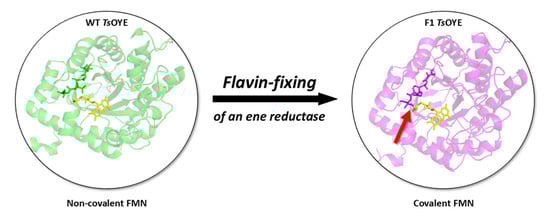
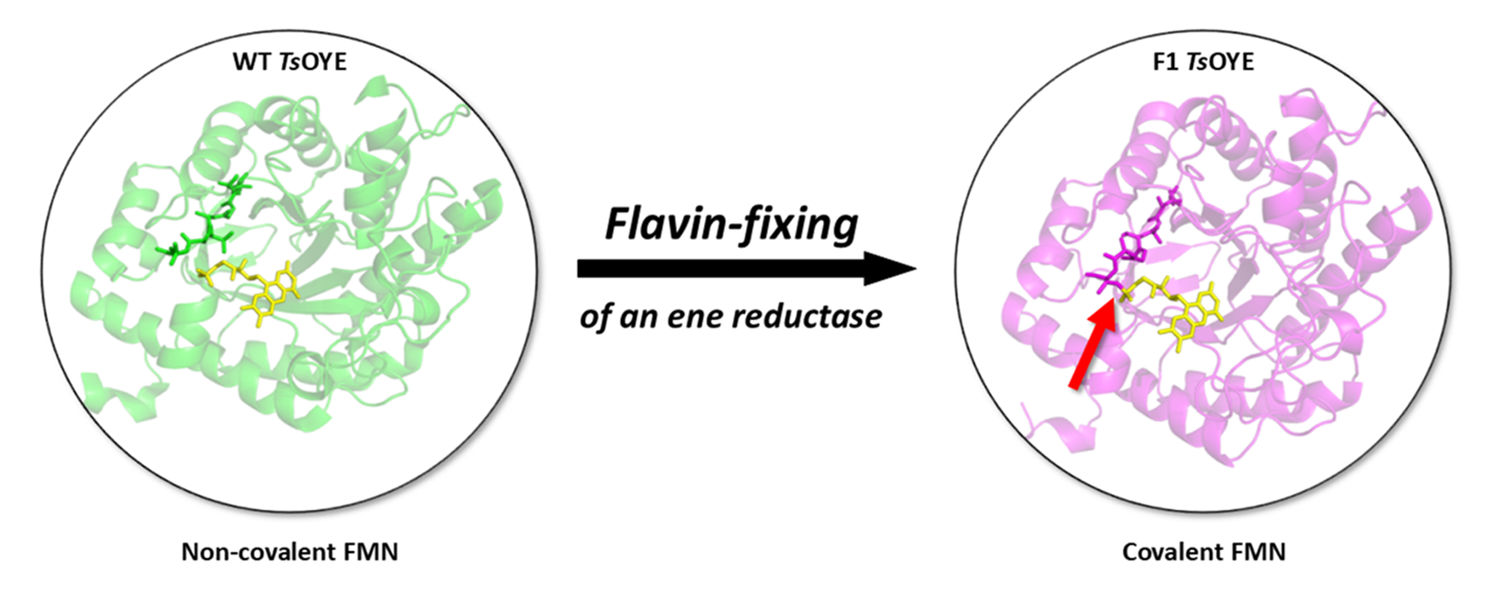
Graphical Abstract

1. Introduction

Old Yellow Enzymes (OYE; EC 1.6.99.1) are flavin-dependent enzymes catalyzing ene reductions. They catalyze the asymmetric reduction of α,β-unsaturated activated alkenes, where the C=C double bond is adjacent to an electron-withdrawing group, such as a nitro or carbonyl group [1,2,3]. OYEs rely for their activity on reduced nicotinamide adenine dinucleotide phosphate (NADPH) and contain a non-covalently bound flavin mononucleotide (FMN) as a prosthetic group to facilitate the electron transfer [4,5,6,7].
The first OYE was isolated in 1932 from Brewer’s bottom yeast (Saccharomyces pastorianus, formerly Saccharomyces carlbergensis) and later named OYE1, which became the prototype of this family [8]. The subsequent elucidation of recombinant OYE1 provided insights into the role of the flavin cofactor and uncovered the catalytic mechanism, contributing to the field of flavoenzyme biocatalysis [9,10,11,12,13,14]. OYEs are also present in many other microorganisms. In fact, often multiple OYE-encoding genes are found in microbial genomes. Due to their availability and versatility, OYEs have emerged as valuable biocatalysts, mainly to produce various enantiomerically pure compounds in the pharmaceutical and fine chemical industries. The utilization of OYEs provides a sustainable alternative to traditional asymmetric hydrogenation, which usually employs a transition metal-based catalyst, offering advantages such as lower cost, milder reaction conditions (pH and temperature), greener chemistry, and easier modification of its stereo- or enantioselectivity through protein engineering [15].
Over the last decades, the OYE family has expanded significantly and been reclassified into six distinct classes, formerly adapted from ‘classical’ and ‘thermophilic’ OYEs [16]. Among them, the OYE homolog from Thermus scotoductus SA-01 (TsOYE) has garnered significant attention due to its remarkable thermostability, stereoselectivity, and broad substrate scope. This enzyme was initially characterized for its ability to reduce metals, including reduction of toxic Cr(VI) to harmless Cr(III) [17]. TsOYE was later found to be active toward various α,β-unsaturated carbonyl compounds. Its crystal structure was resolved in 2010, which showed a high similarity with other OYEs [18]. More recently, TsOYE also demonstrated catalytic versatility beyond reductions. It can facilitate the aromatization of simple cyclohexanones to phenols [19]. As phenol and its derivatives are valuable building blocks for synthetic chemistry, this finding offers a promising alternative to replace traditional synthesis method. In another recent report, TsOYE was shown to catalyze the enantioselective desaturation of carbonyl compounds at ambient temperature and high pH [20]. These findings emphasize the potential of TsOYE as biocatalyst.
While the catalytic scope of TsOYE is continually expanding, another aspect of enzyme performance lies in the characteristics of its flavin cofactor. Most flavoenzymes harbor a non-covalently bound flavin, and only about 10% of enzymes form covalent flavin-protein linkages. The majority of flavin-protein linkages involve the benzyl moiety of the isoalloxazine ring of the flavin with specific residues, such as histidine, tyrosine, aspartate, or cysteine (Figure 1a). These linkages form through a self-catalytic process [21]. Another alternative type of covalent flavin attachment is formed via an ester bond between the phosphate moiety of FMN and a threonine or serine residue. These linkages are formed with the help of a dedicated enzyme, a flavin transferase (ApbE) (Figure 1b). This type of flavin attachment was observed in enzymes like the Na+-translocating NADH:quinone oxidoreductase from Vibrio alginolyticus [22,23]. In addition, it was shown that the ApbE from Vibrio sp. recognizes a conserved sequence motif within the target protein to facilitate the flavinylation using FAD as a precursor [24,25].
Recently, we adapted the ApbE system to establish a “flavin-fixing” method to introduce a covalent FMN in natural non-covalent flavoenzymes using Escherichia coli as a host for the expression of the engineered target flavoenzyme and the flavin transferase [26]. This approach successfully incorporated covalent FMN in several model FMN-dependent enzymes. The generated covalent variants typically displayed altered stability and functionality. For example, a flavin-fixing mutant of Light Oxygen Voltage from Pseudomonas putida KT2440 (PpSB1-LOV) exhibited faster dark recovery, increased fluorescence quantum yield, and enhanced thermostability. A flavin-fixed mutant of miniSOG from Arabidopsis thaliana obtained more singlet oxygen production, even though its melting temperature was slightly decreased. Similarly, one of the flavin-fixed mutants of Bacillus tequilensis nitroreductase (BtNR) showed improved thermostability but had a lower catalytic efficiency than the WT enzyme. These results suggest that flavin-fixing can enhance specific properties, but may also perturb other features.
TsOYE was used as one of the flavin-fixing model enzymes and was reported to incorporate covalent FMN with 100% efficiency [26]. However, unlike the other enzymes, the flavin-fixed mutant TsOYE has not yet been thoroughly characterized. The fact that the preliminary research showed a decrease in melting temperature of F1 TsOYE raises questions about the trade-offs between structural changes caused by the flavin incorporation and its catalytic performance.
In this report, we present a comprehensive study of a flavin-fixed mutant of TsOYE (F1 TsOYE), including biochemical characterization, mutational study, and structural analysis. The F1 TsOYE mutant contains 7 mutations (residues 292–296, RTGAVGL, replaced by DAASGAT, which was the best mutant established through computation-aided design in a previous report [26]). The introduced mutations enable the flavin transferase to covalently attach FMN to Thr296. By comparing various properties of the F1 mutant to WT TsOYE, the effects of covalent FMN incorporation in TsOYE were revealed. As the F1 TsOYE variant displayed decreased stability and activity, several other mutants were also prepared, in which residues in the flavinylation motif were replaced. This led to minor improvements in stability and activity when compared to F1 TsOYE.
Our study provides important insights into the strategy of flavin fixation. The results show that covalent flavinylation by the flavin-fixing method, dependent on the target flavoprotein, requires a more elaborate redesign to preserve enzyme activity and stability. Future work will focus on developing a more robust modeling approach for predicting mutations required for recognition by the flavin transferase while retaining functionality.

2. Results and Discussion

2.1. Expression and Purification of WT and F1 TsOYE

The WT and F1 TsOYE were successfully overexpressed as SUMO-tagged proteins in E. coli BL21 AI at 30 °C, yielding approximately 400 mg/L for the WT and 200 mg/L for the F1 mutant. Both variants exhibit good solubility and have a yellow color typical of flavoenzymes. Purification was performed using Ni-Sepharose resin with gravity flow. A heat treatment before the WT TsOYE purification effectively reduced the presence of non-target proteins, resulting in purer enzyme. Unfortunately, F1 TsOYE demonstrated poorer stability compared to the WT. After incubation at 60 °C and subsequent centrifugation, the pellet revealed a noticeable yellow color, indicating that F1 TsOYE was also denatured. Thus, we employed a gradient elution as an alternative to improve its purity, which resulted in satisfactory results. The purity levels of both TsOYE variants were comparable.
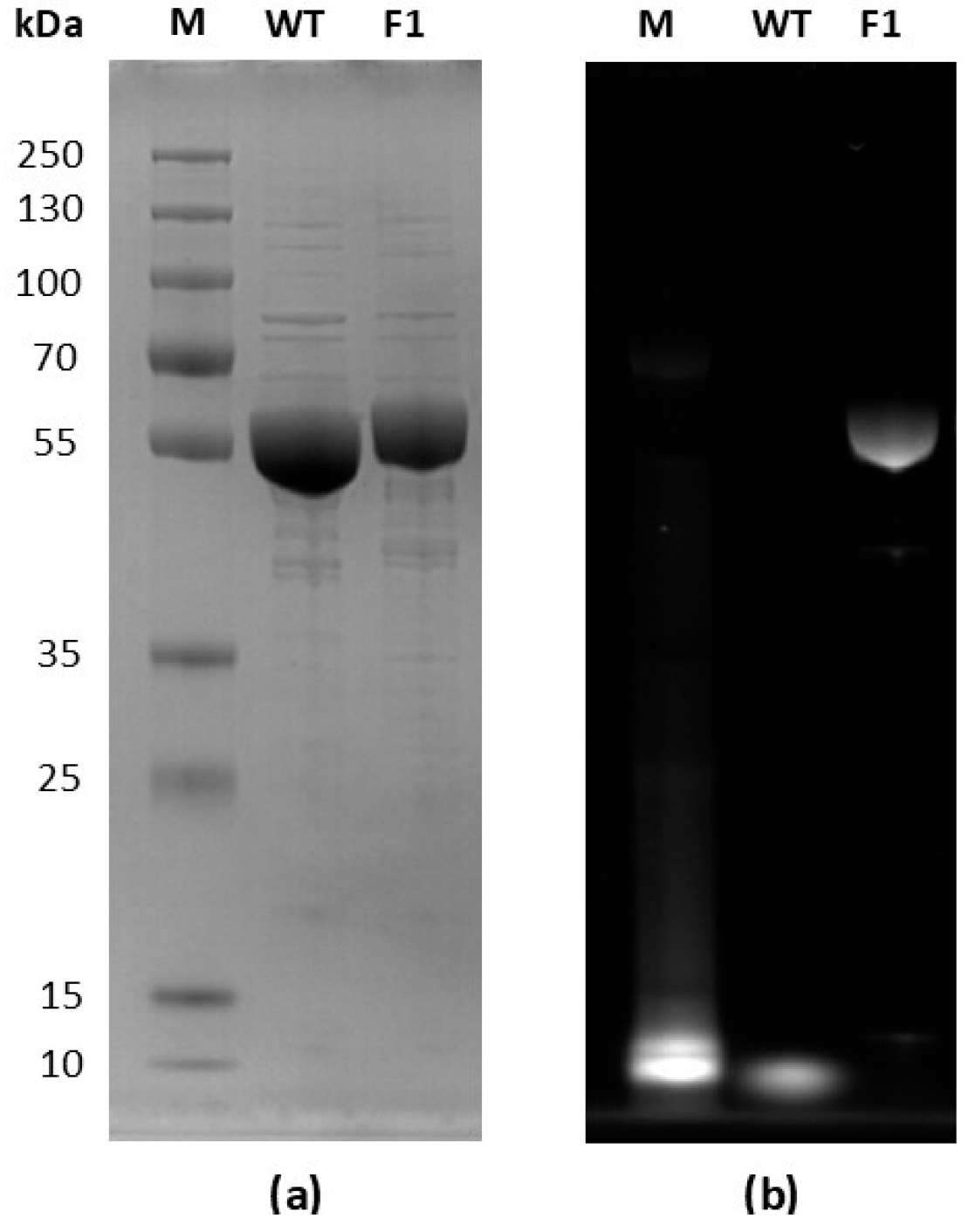
The predicted molecular mass of the SUMO-fused TsOYE is 51.3 kDa, consistent with the experimental size determined by SDS-PAGE (Figure 2a). When the polyacrylamide gel was exposed to UV light, only the band corresponding to F1 TsOYE fluoresced (Figure 2b), confirming covalent FMN incorporation. This observation was further supported by TCA treatment. After TCA precipitation, the F1 TsOYE pellet was yellow, while the supernatant was colorless, confirming that the FMN was still associated with the enzyme aggregate (Figure S1). These results verified that the flavin-fixing approach worked resulting in successful covalent flavinylation of TsOYE.

2.2. Spectroscopic and Biochemical Properties

The WT and F1 TsOYE exhibited similar UV/vis absorbance features, with absorption maxima around 375 and 457 nm. Notably, the maximum absorption of the F1 TsOYE slightly shifted from 457 to 460 nm (Figure S2), indicating a modified microenvironment around the covalent FMN [27,28], which may affect the enzyme’s reactivity or stability.
The substrate preference of the two TsOYE variants was examined using various α,β-unsaturated carbonyl compounds. The highest activity was observed with 2-cyclohexenone for both variants, although the F1 TsOYE exhibited significantly reduced activity (Table 1). When testing the pH dependence, both WT and F1 TsOYE displayed a similar pattern and showed the optimal activity at pH 7.5 in 50 mM phosphate buffer (Figure S3).
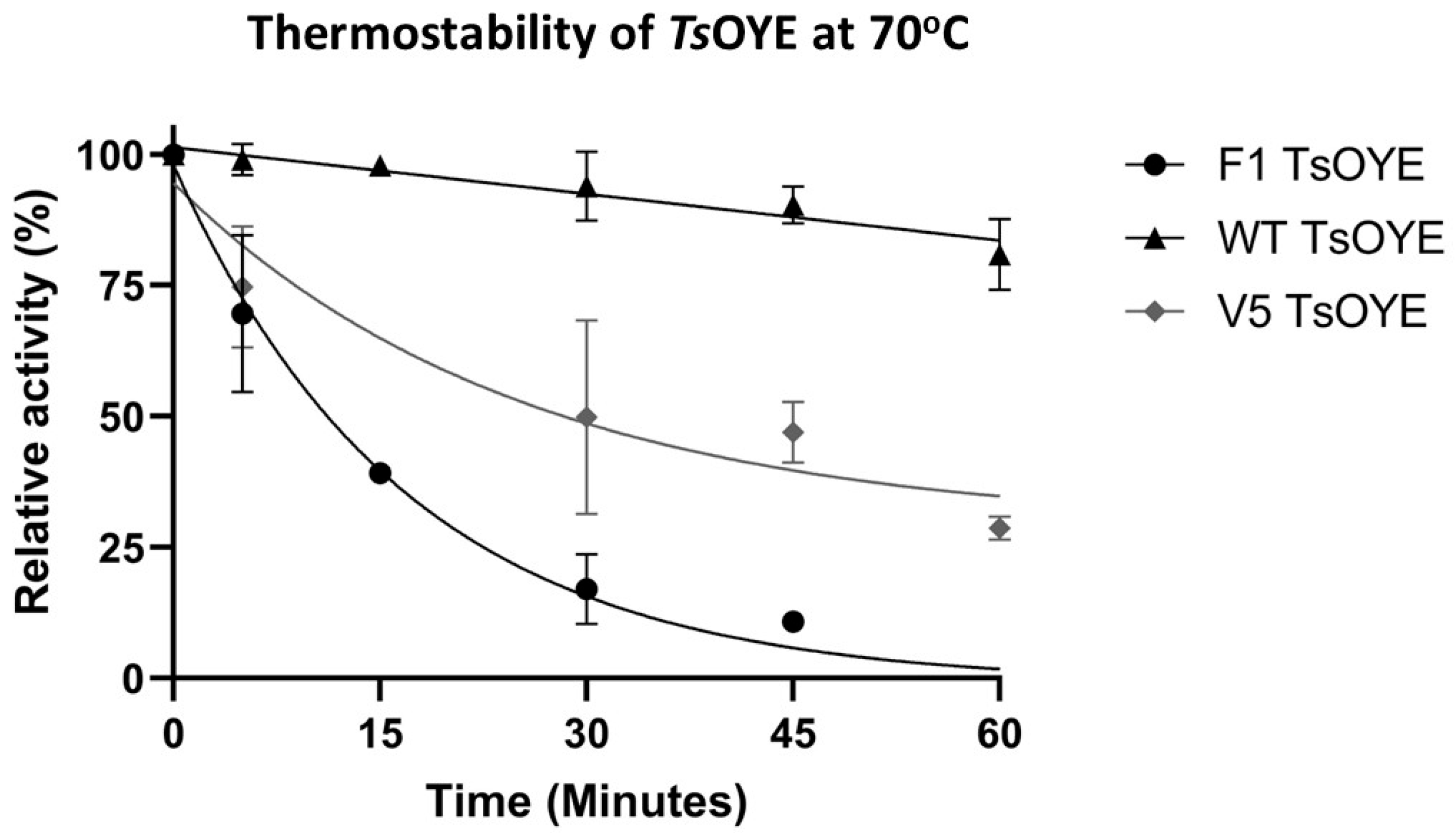
The enzyme thermostability was evaluated by determining melting temperatures using different buffer systems, covering pH 5.0 to 9.0. WT TsOYE exhibited superior stability with apparent melting temperatures (Tm) in the range of 93–98 °C. F1 TsOYE displayed somewhat lower Tm values (73–80 °C). Under the optimal condition (phosphate buffer pH 7.5), the Tm of WT enzyme and the F1 mutant were 98 °C and 76 °C, respectively (Figure S4). The impact of cosolvents (e.g., methanol, ethanol, acetone, acetonitrile) on stability was also evaluated. Both variants showed the same trend with all cosolvents progressively decreasing the stability when increasing their concentration (Figure S5). It is likely that the cosolvent primarily destabilizes the global protein structure rather than a localized region. The most significant melting temperature decrease was observed in the presence of 40% acetonitrile, lowering the melting temperature by about 50 °C for each enzyme variant, whereas the enzyme displayed the highest tolerance to acetone. In addition to the melting temperature, the thermotolerance of each enzyme variant was also tested by incubation at 70 °C and subsequence assaying enzyme activity. As expected from the melting temperature, WT TsOYE showed remarkable stability at 70 °C, while the F1 TsOYE rapidly lost activity, with a half-life of roughly 10 min (Figure 3, the figure also contains data of a mutant that will be discussed in Section 2.5).
The obtained results indicate that the F1 TsOYE has a lower stability and poorer activity when compared with the WT enzyme. This is likely due to structural perturbation induced by mutations upon introducing the flavinylation site and the covalent FMN–protein linkage. It causes one or more essential residues for substrate binding and catalysis to become misaligned. Moreover, covalent cofactor attachment may also increase the rigidity of the enzyme, hindering necessary movements during the catalytic process. Studies on monoamine oxidase showed that covalent flavinylation stabilizes the structure but can also restrict the dynamic transitions for optimal activity [29]. To understand better the underlying cause for the lower activity, more thorough kinetic and structural analyses were carried out.

2.3. Steady State and Pre-Steady State Kinetics

To better understand how the mutations and covalent FMN affect the kinetic properties of the enzyme, we examined the steady state kinetics of WT and F1 TsOYE towards 2-cyclohexenone (Figure S6). Due to the fact that the F1 mutant has a low activity, a ten-fold higher enzyme concentration was used for the kinetic measurements. The WT TsOYE exhibited a turnover number (kcat) of 4.31 s−1, approximately 60-fold higher than the F1 TsOYE (kcat = 0.07 s−1). Despite that F1 TsOYE demonstrated an apparent higher substrate affinity (Km), its overall catalytic efficiency was nearly four times lower than that of the WT (Table 2).
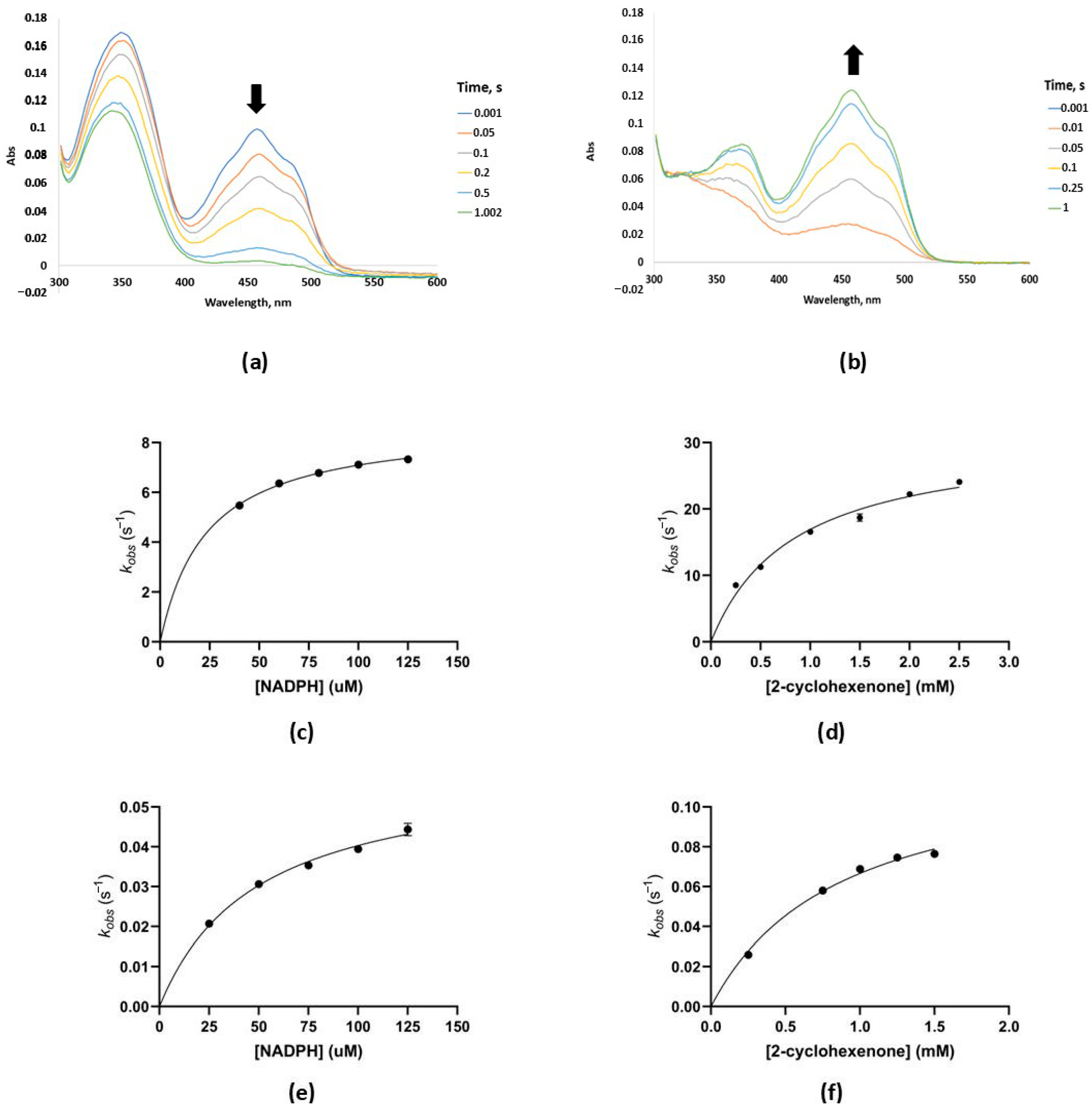
To gain a better insight into the kinetic mechanism of TsOYE and the effects of the mutations on the individual kinetic steps, pre-steady state kinetic analyses were also performed. For this, stopped-flow experiments were conducted to monitor NADPH-mediated flavin reduction and 2-cyclohexenone-mediated flavin reoxidation for both enzyme variants. First, we examined the reductive half-reaction using NADPH as a reductant. Rapid mixing of both enzyme and NADPH showed no indication of transient intermediates during the reaction: there was a clear transition from the oxidized flavoenzyme to the fully reduced form (Figure 4). No other flavin species were observed as intermediates. The observed rate constants (kobs) of flavin reduction were derived from the absorbance changes at 457 nm (WT) and 460 nm (F1). The oxidative half-reaction was studied using 2-cyclohexenone as an oxidant under anaerobic conditions to avoid interference from oxygen. The reoxidation was initiated by mixing the reduced enzyme with varying concentrations of 2-cyclohexenone, and the absorbance traces at the respective wavelengths were monitored. Both enzyme variants showed similar affinities towards 2-cyclohexenone and NADPH (Table 3). The kred and kox values suggest that flavin reduction is the slowest kinetic step for WT TsOYE. F1 TsOYE exhibited markedly lower kred and kox values than the WT enzyme. The kred was similar to the kcat which suggests that for F1 TsOYE the rate-limiting step in catalysis is the reduction of the bound FMN by NADPH. Also, the transfer of electrons from the flavin to the ene substrate was much less efficient when compared with the WT enzyme. This all hints to a perturbed active site in which proper positioning of substrate (NADPH and 2-cyclohexenone) with respect to the flavin is far from optimal but it could also be related to a change in redox behavior of the flavin cofactor.

2.4. Redox Potential

The midpoint potential (Em) of WT and F1 TsOYE was measured to investigate whether the covalent FMN in the mutant TsOYE displays altered redox behavior. Based on prior reports, OYE homologs typically have Em values between −200 and −241 mV [30,31,32]. Thus, anthraquinone-2-sulfonate (AQ2S) with a redox potential of −225 mV was chosen as a reference dye. The redox titrations revealed that the redox potential of WT and mutant TsOYE variants are highly similar: −221.7 ± 0.4 mV for WT TsOYE and −219.0 ± 1.0 mV for F1 TsOYE (Figure S7). Clearly, the covalent FMN in F1 TsOYE does not exhibit substantially altered redox properties. In fact, the flavin-protein linkage between the threonine residue and the FMN phosphate moiety is not expected to influence the redox behavior as the redox active moiety of FMN, the isoalloxazine ring, is relatively far from the phosphate. Thus, the linkage itself is unlikely to influence the electron distribution in the flavin the ring. However, conformational changes within the flavin binding pocket could still affect the FMN microenvironment, flavin-protein interactions, that can translate in a change in redox potential. Apparently, the flavin cofactor is not experiencing changes that result in a change in redox potential.

2.5. Replacing Residues in the Flavinylation Sequence Motif

With observing the detrimental effects of introducing the flavinylation sequence motif in TsOYE on activity and stabillity, we explored mutations in the introduced flavinylation sequence motif of F1 TsOYE. Point mutations were introduced within the sequence motif to test whether the catalytic and stability properties of F1 TsOYE could be improved. Specifically, at the second-to-fourth position of the seven residues in the recognition site, mutations were introduced. Five mutants were made by replacing one or more residues of the three residues following the conserved aspartate with alanine or serine (Table S1). The five mutants, V1–V5 TsOYE, were successfully obtained. All mutants were expressed in E. coli BL21 AI with yields similar to F1 TsOYE (approximately 200 mg/L). SDS-PAGE and in-gel fluorescence analyses confirmed that all new mutants contain covalent FMN with different degrees of covalent flavin incorporation (Figure S8). V4 TsOYE contained the lowest amount of covalent FMN while the other mutants contained a similar amount of covalent flavin to F1 TsOYE. It is estimated that the V4 mutant only harbors about 50% covalent FMN, while all other mutants are fully flavinylated. The reduced amount of covalent FMN in V4 TsOYE seems to be caused by the effect of two adjacent serines at position 2 and 3. These residues may reorient the backbone and/or their polarity may affect the flavinylation process.
Two mutants (V1, V5) displayed slightly higher thermostabilities with melting temperatures 1 °C higher compared with F1 TsOYE. The other mutants suffered from a loss in thermostability (7–11 °C lower melting temperatures, Table S2). Activity screening revealed that only the V5 TsOYE showed a similar activity when compared with F1 TsOYE. All other mutants displayed lower activities when compared with F1 TsOYE (Table S2). Next, the steady state kinetic parameters and thermostability of V5 TsOYE were investigated. The results revealed that the introduced mutation slightly improved its catalytic properties and thermostability. Although the turnover number of V5 TsOYE is comparable to that of F1 TsOYE (kcat = 0.06 ± 0.001 s−1), the V5 TsOYE exhibits slightly higher substrate affinity (Km = 4.9 ± 0.8 µM), resulting in a 1.6-fold increase in catalytic efficiency relative to the F1 TsOYE (Figure S9). Additionally, the V5 TsOYE demonstrates improved thermostability, where it could retain its activity for at least 2 h with a half-life of roughly 17 min at 70 °C (Figure 3). Nonetheless, the overall catalytic performance remained significantly below that of the WT enzyme. These findings show that replacing non-conserved residues within the flavinylation motif preserve FMN incorporation, but do not restore catalytic performance or stability.

2.6. Structural Analysis

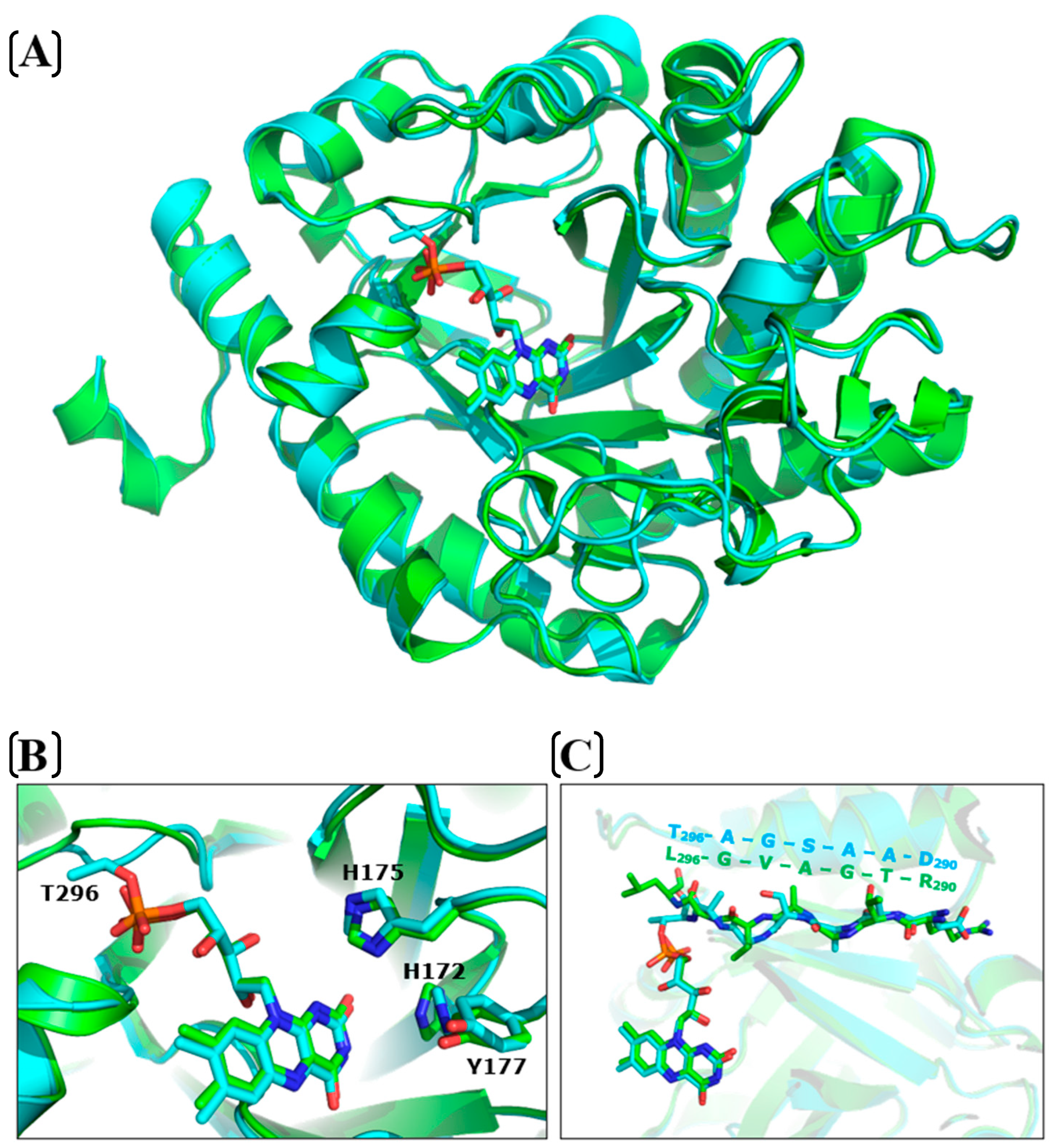
Unfortunately, no well-diffracting crystals of F1 TsOYE could be obtained. Therefore, we modeled the F1 TsOYE structure. As expected, structural alignment of the modeled structure of F1 TsOYE with the crystal structure of WT TsOYE (PDB:3HF3) indicates high similarity, with an RMSD of ~0.6 Å (Figure 5A). The introduced mutations within the flavinylation site and introduction of the covalent FMN–protein linkages only result in minor structural changes. For example, a slight shift of the loop close to the phosphate moiety of the covalent FMN seems inevitable while the orientation of activesite residues is largely unaffected (Figure 5B). The introduced mutations that introduce the flavinylation sequene motif are all located in a strand that forms a β-sheet flanking the active site (Figure 5C). Non-optimal interactions introduced in this structural motif may cause detrimental effects, such as a lower activity and stability of F1 TsOYE. The mutagenesis results of this study show that it is not straightforward to repair the activity of the reductase. A more promising engineering approach should also include residues neighboring the flavinylation sequence motif region, to better accommodate the required mutations.

3. Materials and Methods

3.1. Chemicals and Reagents

The pBAD-NHis-SUMO and pRSF-Duet1 (Novagen) vectors from the previous report were utilized to clone and express the protein of interest [26]. E. coli NEB 10-beta and E. coli BL21-AI (New England Biolabs, Ipswich, MA, USA) strains were used as hosts for cloning and protein expression. Ni-Sepharose 6 fast-flow resin was acquired from Cytiva (Marlborough, MA, USA). All primers used for the mutation study were synthesized by Sigma-Aldrich (St. Louis, MO, USA). Unless otherwise indicated, all other chemicals were ordered from Sigma-Aldrich (St. Louis, MO, USA).

3.2. Cloning, Expression, and Purification

The previously constructed pBAD-NHis-SUMO containing the gene encoding WT and F1 TsOYE was used to express the corresponding enzyme in E. coli BL21 AI cells. The F1 TsOYE was chosen in this study as it exhibits the highest activity among all flavin-fixed mutants reported [26]. Additionally, the E. coli BL21 AI cell was transformed with the modified pRSF-Duet1 for the co-expression of flavin transferase from V. cholerae (ApbE) and FAD synthetase from C. ammoniagenes (CaFADS) to incorporate the covalent FMN into the TsOYE mutant.
The expression of WT TsOYE was initiated by inoculating 500 mL of Terrific Broth medium containing 50 µg/mL ampicillin in a 2 L baffled flask with 5 mL overnight culture. The culture was grown at 37 °C until the OD600 reached 0.8–1. The expression was induced by adding a final concentration of 0.02% L-arabinose. After induction, the culture was continuously incubated for 20 h at 30 °C with a shaking speed of 200 r.p.m. On the following day, the cell was harvested by centrifugation (3700× g, 4 °C, 30 min). The cell pellet was resuspended in lysis buffer (50 mM Tris-HCl pH 7.5; 500 mM NaCl; 1 mM MgCl2; 1 µg/mL DNase; 1 mM PMSF) and subsequently disrupted by sonication (5 s on, 7 s off, 70% amplitude for 10 min). The mixture was centrifuged (17,000× g, 4 °C, 1 h) to obtain the cell-free extract. Then, the supernatant was heated at 60 °C for 30 min to eliminate non-target protein, followed by centrifugation (17,000× g, 4 °C, 20 min). After the pellet was discarded, the supernatant was applied to an equilibrated Ni-sepharose column and further incubated at 4 °C for 1 h. The column was rinsed with five column volumes of wash buffer (50 mM Tris-HCl pH 7.5, 500 mM NaCl, 20 mM imidazole). WT TsOYE was eluted from the column using an elution buffer (50 mM Tris-HCl pH 7.5, 500 mM NaCl, 500 mM imidazole). The eluate buffer was subsequently replaced with 50 mM potassium phosphate buffer pH 7.5 using a PD-10 desalting column. The expression and purification of TsOYE mutants followed the same protocol as described above. However, the expression culture was supplemented with 150 mg/L riboflavin, 50 µg/mL kanamycin, and 50 µg/mL ampicillin. Then, the expression was induced by 0.02% L-arabinose and 0.5 mM β-D-1-thiogalactopyranoside (IPTG). A dedicated elution protocol was used to enhance the purity of the TsOYE mutants because heat treatment of cell-free extract could not be applied. First, after applying the sample to the column and washing with five column volumes of wash buffer, the column was washed with two column volumes of 50 mM Tris-HCl pH 7.5, 500 mM NaCl, 50 mM imidazole followed by washing with 2 column volumes of 50 mM Tris-HCl pH 7.5, 500 mM NaCl, 75 mM imidazole. To elute the mutant enzyme, 50 mM Tris-HCl pH 7.5, 500 mM NaCl, 500 mM imidazole was used. All purified proteins were aliquoted and rapidly frozen using liquid nitrogen and stored at −80 °C for long-term storage.
The protein size and covalent FMN incorporation were validated by SDS-PAGE and in-gel fluorescence analysis. To quantify FMN incorporation, we compared the ratio of the in-gel fluorescence intensity to the Coomassie-stained protein band intensity using ImageJ 1.54G software (https://github.com/imagej/ImageJ, accessed on 10 September 2025). The trichloroacetic acid (TCA) method was also employed to confirm the covalent FMN, as outlined in the previous study [26]. The concentration of purified TsOYE was determined using its molar absorption coefficient at 457 nm (ε457 = 11.426 mM−1 cm−1), which was obtained through 0.2% SDS treatment using a JASCO V-650 spectrophotometer (Hachioji, Tokyo, Japan).

3.3. Activity Assay and Substrate Screening

The TsOYE activity was measured by monitoring the consumption of NADPH at 340 nm (ε340 = 6.22 mM−1 cm−1) for 1 min at 25 °C using a JASCO V-650 spectrophotometer. A 1 mL reaction was prepared with 50 mM potassium phosphate buffer pH 7.5, 0.10 mM NADPH, and 1.0 mM substrate as a standard assay. The reaction was initiated by adding the enzyme to a final concentration of 50 nM. The substrate preference of TsOYE was assessed by measuring the activity of TsOYE under standard assay conditions towards various activated alkene compounds, including 2-cyclohexenone, 2-methyl-2-cyclohexenone, 3-methyl-2-cyclohexenone, ketoisophorone, isophorone, (R)-carvone, (S)-carvone.

3.4. pH Optimum for Activity

To determine the optimum pH for TsOYE activity, the activity of TsOYE against 2-cyclohexenone was measured using the standard assay in the pH range of 5 to 9. The buffers used for these measurements were citrate (pH 5–6), potassium phosphate (pH 6–8), and Tris-HCl (pH 7.5–9) all at a concentration of 50 mM.

3.5. Thermostability Assay

The Tm values of the TsOYE variants were measured using the ThermoFluor assay [33,34]. For this, the purified enzyme was diluted to a final concentration of 20 µM using different buffers (citrate, potassium phosphate, and Tris-HCl) for establishing different pH values, ranging from pH 5 to pH 9, or in varied concentrations of cosolvent (acetone, acetonitrile, ethanol, methanol, 10–40%). The assay was conducted using an RT-PCR thermocycler (CFX96 from Bio-Rad, Hercules, CA, USA), starting from 20 to 99 °C with the temperature increasing 1 °C every 30 s. The apparent melting temperature was determined from the peak of the first derivative of observed flavin fluorescence.
The stability of the TsOYE variants was also tested by incubating each enzyme at 70 °C for a particular time periods. The residual activity was measured using 2-cyclohexenone as a substrate under standard assay conditions in triplicate. The half-life of thermal inactivation (T1/2) of the enzyme was estimated by plotting the observed rate constants (kobs) against incubation time using a one-phase exponential decay model.

3.6. Steady State Kinetic Analyses

The steady state kinetic parameters for the TsOYEs were determined spectrophotometrically using a JASCO V-650 instrument. The reaction was performed in duplicate within 50 mM potassium phosphate buffer pH 7.5, using a fixed concentration of 0.1 mM NADPH, 50 nM and 500 nM of TsOYE WT and the F1 mutant, respectively. The substrate concentration was varied, ranging from 25 to 4000 µM. The rates at different substrate concentrations were processed and fitted by a nonlinear regression curve of the Michaelis-Menten model using GraphPad Prism 10 software (La Jolla, CA, USA).

3.7. Pre-Steady State Kinetic Analyses

An SX20 stopped-flow spectrophotometer (Applied Photophysics, Surrey, UK) functioning in single-mixing mode was used to conduct a rapid kinetic study. The absorbance spectra and single wavelength traces were acquired using a photodiode array detector (PDA) and a photomultiplier tube (PMT) module. Each reaction was run in triplicate under anaerobic conditions. Prior to the measurements, the flow circuit of the stopped-flow instrument was deoxygenated by washing it three times using an anaerobic buffer, which was prepared by adding 5 mM glucose and 0.3 μM glucose oxidase from Aspergillus niger (Sigma-Aldrich, St. Louis, MO, USA) and purged with nitrogen for 15 min.
The reductive half-reaction was examined by mixing the enzyme and NADPH as a reductant. The enzyme was prepared with a final concentration of 10 μM within an anaerobic buffer. NADPH with varied concentrations ranging from 25 to 125 μM was placed in a separate vial within the same buffer as the enzyme. Upon mixing, the change in absorbance traces at 457 nm was recorded, and the obtained data were analyzed using ProKinetics v1.0.13 (Applied Photophysics, Surrey, UK) to determine the observed rate constant (kobs) for each NADPH concentration.
The oxidative half-reaction of TsOYE was measured using the same instrument under anaerobic conditions. The reduced form of TsOYE was prepared by mixing it with NADPH in a 1:3 ratio. Then, the solution was mixed with varying concentrations of 2-cyclohexenone as an oxidant. The kobs value was calculated using ProKinetics v1.0.13 software. All kobs data were used and analyzed in GraphPad Prism 10 software to determine the reduction rate (kred) and oxidation rate (kox) of WT and F1 TsOYE, fitted by the Michaelis-Menten equation.

3.8. Redox Potential Determination

The redox potential (Em) of WT and flavin-fixed mutant TsOYE was determined using the xanthine/xanthine oxidase method. The reaction was performed in 50 mM potassium phosphate pH 7.5 at 25 °C under anaerobic conditions by adding glucose/glucose oxidase and flushing the cuvette with nitrogen for 15 min. The 1 mL mixture comprised 15 μM benzyl viologen, 10 μM TsOYE, 5 μg/mL catalase, 400 μM xanthine, 5–10 μM xanthine oxidase, and 10 μM anthraquinone-2-sulfonate (AQ2S, Em = −225 mV) as a reference dye [32]. The spectra were recorded for 1–2 h using a JASCO V-650 spectrophotometer. The absorbance change was monitored at 331 nm for AQ2S and 460 nm for TsOYE and further used to calculate the Em value using the Nernst equation.

3.9. Preparation of Mutants and Structural Analysis

All new flavin-fixed mutants, named V1-V5 TsOYE, were obtained using the QuickChange Site-Directed Mutagenesis PCR protocol established by Stratagene (La Jolla, California), with modified primers presented in Table S3. The expression and purification were conducted by following the same protocol as described previously. The purified enzyme was subsequently characterized using SDS-PAGE and UV/Vis spectrophotometry. The activity and melting temperature for each variant were also measured and compared with the original F1 and WT TsOYE. Additionally, the best of the new mutants was further chosen for kinetic measurement and thermostability tests.
To better understand how the mutations affect the enzyme conformation, the predicted structure of F1 TsOYE was generated using AlphaFold 3 [35]. The covalent FMN incorporation and energy minimization of the model were conducted using YASARA 25.11.24 software (Biosciences GmbH, Vienna, Austria) [36]. The model structure was further analyzed and visualized using the PyMOL Molecular Graphics System 0.99 (Schrödinger, LLC, München, Germany).

4. Conclusions

This study provides a comprehensive analysis of the F1 TsOYE mutant containing covalent FMN, compared to the WT enzyme that harbors a dissociable FMN. We conducted detailed kinetic and other biochemical characterizations to analyze in detail the effect of covalent flavinylation of TsOYE. Unfortunately, the F1 TsOYE showed poorer activity when compared with WT enzyme, while the affinity towards the substrate 2-cyclohexenone was retained. The catalytic efficiency of the F1 TsOYE was nearly fourfold lower than that of the WT enzyme. This was largely due to a relatively low rate by which the flavin was reduced by the nicotinamide cofactor, and the rate of substrate reduction was also reduced. Intriguingly, the redox potential of the covalent flavoenzyme F1 TsOYE was virtually identical to the native enzyme. F1 TsOYE was also found to be less stable, though it retained its thermostability at temperatures up to 70 °C. Attempts at improving the catalytic efficiency and stability of the flavin-fixed mutant by mutating specific residues in the flavinylation sequence motif only resulted in marginal improvements in some mutants. The results suggest that there are subtle structural changes that lead to slightly altered positioning of the substrate, flavin and/or active site residues that lower the efficiency of hydride transfer to and from the flavin cofactor. Future enzyme engineering efforts on this flavoenzyme to render it a stable and active biocatalysts could focus on structural optimization by employing computational modeling and crystallography to identify and engineer regions that can accommodate the covalent flavin without compromising essential active site dynamics. Directed evolution could also be used to evolve variants with compensatory mutations that restore activity and stability. This should result in a catalytically competent ene reductases that would not suffer from inactivation and/or unfolding due to flavin cofactor dissociation.

Supplementary Materials

The following supporting information can be downloaded at: https://www.mdpi.com/article/10.3390/catal16010042/s1, Table S1: Sequences at the flavinylation site (292–296) for WT TsOYE, F1 TsOYE, and mutants V1–V5 TsOYE; Table S2: Melting temperatures (Tm) and observed rate constants (kobs) of V5 TsOYE; Table S3: Primers used for QuickChange PCR in this study. Figure S1: TCA precipitation results after centrifugation; Figure S2: UV/vis spectra of WT TsOYE and F1 TsOYE; Figure S3: Activity of WT TsOYE and F1 TsOYE against 2-cyclohexenone within different buffers and range of pH; Figure S4: Melting temperatures (Tm) of WT TsOYE and F1 TsOYE in different buffers and pH values; Figure S5: Decreasing of TsOYE melting temperature (Tm) in the presence of different cosolvent (acetone, acetonitrile, ethanol, methanol) with varied concentration (10–40%); Figure S6: Steady-state kinetics of (a) WT TsOYE and (b) F1 TsOYE using 2-cyclohexenone as substrate; Figure S7: Redox titration of WT and F1 TsOYE in the presence of reference dye A2QS (Eo = −225 mV); Figure S8: SDS-PAGE and in-gel fluorescence of purified WT, F1, and V1-V5 TsOYE; Figure S9: Steady-state kinetic of mutant V5 TsOYE towards 2-cyclohexenone.

Author Contributions

Conceptualization, M.W.F.; methodology, A.T.F. and M.W.F.; software, A.T.F. and M.W.F.; validation, A.T.F. and M.W.F.; formal analysis, A.T.F.; investigation, A.T.F.; resources, M.W.F.; data curation, A.T.F.; writing—original draft preparation, A.T.F.; writing—review and editing, M.W.F.; visualization A.T.F. and M.W.F.; supervision, M.W.F.; project administration, M.W.F.; funding acquisition, A.T.F. (PhD fellowship) and M.W.F. (lab project grant). All authors have read and agreed to the published version of the manuscript.

Funding

A.T.F. was supported by Lembaga Pengelola Dana Pendidikan (LPDP), the Ministry of Finance of the Republic of Indonesia (PhD fellowship).

Data Availability Statement

The original contributions presented in this study are included in the article/Supplementary Material. Further inquiries can be directed to the corresponding author.

Conflicts of Interest

The authors declare no conflicts of interest.

Abbreviations

The following abbreviations are used in this manuscript:
ApbEAlternative pyrimidine biosynthesis protein
BtNRBacillus tequilensis nitroreductase
FADFlavin adenine dinucleotide
FMNFlavin mononucleotide
miniSOGMini Singlet Oxygen Generator engineered
NADPHNicotinamide Adenine Dinucleotide Phosphate
OYEOld Yellow Enzyme
PDAPhotodiode array
PMTPhotomultiplier tube
PpSB-1-LOVPseudomonas putida Light Oxygen Voltage protein
SDS-PAGE Sodium dodecyl sulfate polyacrylamide gel electrophoresis
TsOYEThermus scotoductus SA-01 Old Yellow Enzyme
WTWild Type

References

  1. Swiderska, M.A.; Stewart, J.D. Stereoselective enone reductions by Saccharomyces carlsbergensis old yellow enzyme. J. Mol. Catal. B Enzym. 2006, 42, 52–54. [Google Scholar] [CrossRef]
  2. Hall, M.; Stueckler, C.; Hauer, B.; Stuermer, R.; Friedrich, T.; Breuer, M.; Kroutil, W.; Faber, K. Asymmetric bioreduction of activated C=C bonds using Zymomonas mobilis NCR enoate reductase and old yellow enzymes OYE 1-3 from yeasts. Eur. J. Org. Chem. 2008, 2008, 1511–1516. [Google Scholar] [CrossRef]
  3. Winkler, C.K.; Tasnádi, G.; Clay, D.; Hall, M.; Faber, K. Asymmetric bioreduction of activated alkenes to industrially relevant optically active compounds. J. Biotechnol. 2012, 162, 381–389. [Google Scholar] [CrossRef]
  4. Nygaard, A.P.; Theorell, H. The linkages between flavine mononucleotide (FMN) and the protein of the old yellow enzyme studied by fluores-cence measurements. Ark. Kemi 1954, 7, 205–209. [Google Scholar]
  5. Nygaard, A.P.; Theorell, H.; Bonnichsen, R.; Caglieris, A. On the Chemical Nature of the FMN-binding Groups in the Old Yellow Enzyme. Acta Chem. Scand. 1955, 9, 202. [Google Scholar] [CrossRef]
  6. Abramovitz, A.S.; Massey, V. Interaction of phenols with old yellow enzyme. Physical evidence for charge-transfer complexes. J. Biol. Chem. 1976, 251, 5327–5336. [Google Scholar] [CrossRef]
  7. Massey, V.; Schopfer, L.M. Reactivity of old yellow enzyme with alpha-NADPH and other pyridine nucleotide derivatives. J. Biol. Chem. 1986, 261, 1215–1222. [Google Scholar] [CrossRef]
  8. Warburg, O.; Christian, W. Ein zweites sauerstoffübertragendes Ferment und sein Absorptionsspektrum. Naturwissenschaften 1932, 20, 688. [Google Scholar] [CrossRef]
  9. Karplus, P.A.; Fox, K.M.; Massey, V. Structure-function relations for old yellow enzyme. FASEB J. 1995, 9, 1518–1526. [Google Scholar] [CrossRef] [PubMed]
  10. Fox, K.M.; Karplus, P.A. Old yellow enzyme at 2 Å resolution: Overall structure, ligand binding, and comparison with related flavoproteins. Structure 1994, 2, 1089–1105. [Google Scholar] [CrossRef]
  11. Saito, K.; Thiele, D.J.; Davio, M.; Lockridge, O.; Massey, V. The cloning and expression of a gene encoding old yellow enzyme from Saccharomyces carlsbergensis. J. Biol. Chem. 1991, 266, 20720–20724. [Google Scholar] [CrossRef] [PubMed]
  12. Niino, Y.S.; Chakraborty, S.; Brown, B.J.; Massey, V. A new old yellow enzyme of Saccharomyces cerevisiae. J. Biol. Chem. 1995, 270, 1983–1991. [Google Scholar] [CrossRef]
  13. Kohli, R.M.; Massey, V. The Oxidative Half-reaction of Old Yellow Enzyme. J. Biol. Chem. 1998, 273, 32763–32770. [Google Scholar] [CrossRef]
  14. Brown, B.J.; Deng, Z.; Karplus, P.A.; Massey, V. On the active site of old yellow enzyme: Role of histidine 191 and asparagine 194. J. Biol. Chem. 1998, 273, 32753–32762. [Google Scholar] [CrossRef] [PubMed]
  15. Toogood, H.S.; Gardiner, J.M.; Scrutton, N.S. Biocatalytic Reductions and Chemical Versatility of the Old Yellow Enzyme Family of Flavoprotein Oxidoreductases. ChemCatChem 2010, 2, 892–914. [Google Scholar] [CrossRef]
  16. Böhmer, S.; Marx, C.; Gómez-Baraibar, Á.; Nowaczyk, M.M.; Tischler, D.; Hemschemeier, A.; Happe, T. Evolutionary diverse Chlamydomonas reinhardtii Old Yellow Enzymes reveal distinctive catalytic properties and potential for whole-cell biotransformations. Algal Res. 2020, 50, 101970. [Google Scholar] [CrossRef]
  17. Opperman, D.J.; Piater, L.A.; Van Heerden, E. A novel chromate reductase from Thermus scotoductus SA-01 related to old yellow enzyme. J. Bacteriol. 2008, 190, 3076–3082. [Google Scholar] [CrossRef]
  18. Opperman, D.J.; Sewell, B.T.; Litthauer, D.; Isupov, M.N.; Littlechild, J.A.; van Heerden, E. Crystal structure of a thermostable Old Yellow Enzyme from Thermus scotoductus SA-01. Biochem. Biophys. Res. Commun. 2010, 393, 426–431. [Google Scholar] [CrossRef]
  19. Chen, J.; Qi, S.; Wang, Z.; Hu, L.; Liu, J.; Huang, G.; Peng, Y.; Fang, Z.; Wu, Q.; Hu, Y.; et al. Ene-Reductase-Catalyzed Aromatization of Simple Cyclohexanones to Phenols. Angew. Chem. Int. Ed. 2024, 63, e202408359. [Google Scholar] [CrossRef]
  20. van Hengst, J.M.A.; Wolder, A.E.; Sánchez, M.; Huijbers, M.M.E.; Opperman, D.J.; Gilles, P.; Martin, J.; Hilberath, T.; Hollmann, F.; Paul, C.E. Ene-Reductase-Catalyzed Oxidation Reactions. ChemCatChem 2024, 17, e202401447. [Google Scholar] [CrossRef]
  21. Heuts, D.P.H.M.; Scrutton, N.S.; McIntire, W.S.; Fraaije, M.W. What’s in a covalent bond?: On the role and formation of covalently bound flavin cofactors. FEBS J. 2009, 276, 3405–3427. [Google Scholar] [CrossRef] [PubMed]
  22. Nakayama, Y.; Yasui, M.; Sugahara, K.; Hayashi, M.; Unemoto, T. Covalently bound flavin in the NqrB and NqrC subunits of Na+-translocating NADH-quinone reductase from Vibrio alginolyticus. FEBS Lett. 2000, 474, 165–168. [Google Scholar] [CrossRef]
  23. Hayashi, M.; Nakayama, Y.; Yasui, M.; Maeda, M.; Furuishi, K.; Unemoto, T. FMN is covalently attached to a threonine residue in the NqrB and NqrC subunits of Na+-translocating NADH-quinone reductase from Vibrio alginolyticus. FEBS Lett. 2001, 488, 5–8. [Google Scholar] [CrossRef] [PubMed]
  24. Bertsova, Y.V.; Fadeeva, M.S.; Kostyrko, V.A.; Serebryakova, M.V.; Baykov, A.A.; Bogachev, A.V. Alternative pyrimidine biosynthesis protein ApbE is a flavin transferase catalyzing covalent attachment of FMN to a threonine residue in bacterial flavoproteins. J. Biol. Chem. 2013, 288, 14276–14286. [Google Scholar] [CrossRef]
  25. Tong, Y.; Rozeboom, H.J.; Loonstra, M.R.; Wijma, H.J.; Fraaije, M.W. Characterization of two bacterial multi-flavinylated proteins harboring multiple covalent flavin cofactors. BBA Adv. 2023, 4, 100097. [Google Scholar] [CrossRef]
  26. Tong, Y.; Kaya, S.G.; Russo, S.; Rozeboom, H.J.; Wijma, H.J.; Fraaije, M.W. Fixing Flavins: Hijacking a Flavin Transferase for Equipping Flavoproteins with a Covalent Flavin Cofactor. J. Am. Chem. Soc. 2023, 145, 27140–27148. [Google Scholar] [CrossRef]
  27. Nikolaev, A.; Yudenko, A.; Smolentseva, A.; Bogorodskiy, A.; Tsybrov, F.; Borshchevskiy, V.; Bukhalovich, S.; Nazarenko, V.V.; Kuznetsova, E.; Semenov, O.; et al. Fine spectral tuning of a flavin-binding fluorescent protein for multicolor imaging. J. Biol. Chem. 2023, 299, 102977. [Google Scholar] [CrossRef]
  28. Kabir, M.P.; Ouedraogo, D.; Orozco-Gonzalez, Y.; Gadda, G.; Gozem, S. Alternative Strategy for Spectral Tuning of Flavin-Binding Fluorescent Proteins. J. Phys. Chem. B 2023, 127, 1301–1311. [Google Scholar] [CrossRef]
  29. Edmondson, D.E.; Newton-Vinson, P. The Covalent FAD of Monoamine Oxidase: Structural and Functional Role and Mechanism of the Flavinylation Reaction. Antioxid. Redox Signal. 2001, 3, 789–806. [Google Scholar] [CrossRef] [PubMed]
  30. Stewart, R.C.; Massey, V. Potentiometric studies of native and flavin-substituted old yellow enzyme. J. Biol. Chem. 1985, 260, 13639–13647. [Google Scholar] [CrossRef]
  31. Schittmayer, M.; Glieder, A.; Uhl, M.K.; Winkler, A.; Zach, S.; Schrittwieser, J.H.; Kroutil, W.; MacHeroux, P.; Gruber, K.; Kambourakis, S.; et al. Old yellow enzyme-catalyzed dehydrogenation of saturated ketones. Adv. Synth. Catal. 2011, 353, 268–274. [Google Scholar] [CrossRef]
  32. White, D.W.; Iamurri, S.; Keshavarz-Joud, P.; Blue, T.; Copp, J.; Lutz, S. The Hidden Biocatalytic Potential of the Old Yellow Enzyme Family. bioRxiv 2023. [Google Scholar] [CrossRef]
  33. Ericsson, U.B.; Hallberg, B.M.; DeTitta, G.T.; Dekker, N.; Nordlund, P. Thermofluor-based high-throughput stability optimization of proteins for structural studies. Anal. Biochem. 2006, 357, 289–298. [Google Scholar] [CrossRef] [PubMed]
  34. Niesen, F.H.; Berglund, H.; Vedadi, M. The use of differential scanning fluorimetry to detect ligand interactions that promote protein stability. Nat. Protoc. 2007, 2, 2212–2221. [Google Scholar] [CrossRef] [PubMed]
  35. Abramson, J.; Adler, J.; Dunger, J.; Evans, R.; Green, T.; Pritzel, A.; Ronneberger, O.; Willmore, L.; Ballard, A.J.; Bambrick, J.; et al. Accurate structure prediction of biomolecular interactions with AlphaFold 3. Nature 2024, 630, 493–500. [Google Scholar] [CrossRef]
  36. Krieger, E.; Joo, K.; Lee, J.; Lee, J.; Raman, S.; Thompson, J.; Tyka, M.; Baker, D.; Karplus, K. Improving physical realism, stereochemistry, and side-chain accuracy in homology modeling: Four approaches that performed well in CASP8. Proteins Struct. Funct. Bioinform. 2009, 77, 114–122. [Google Scholar] [CrossRef] [PubMed]
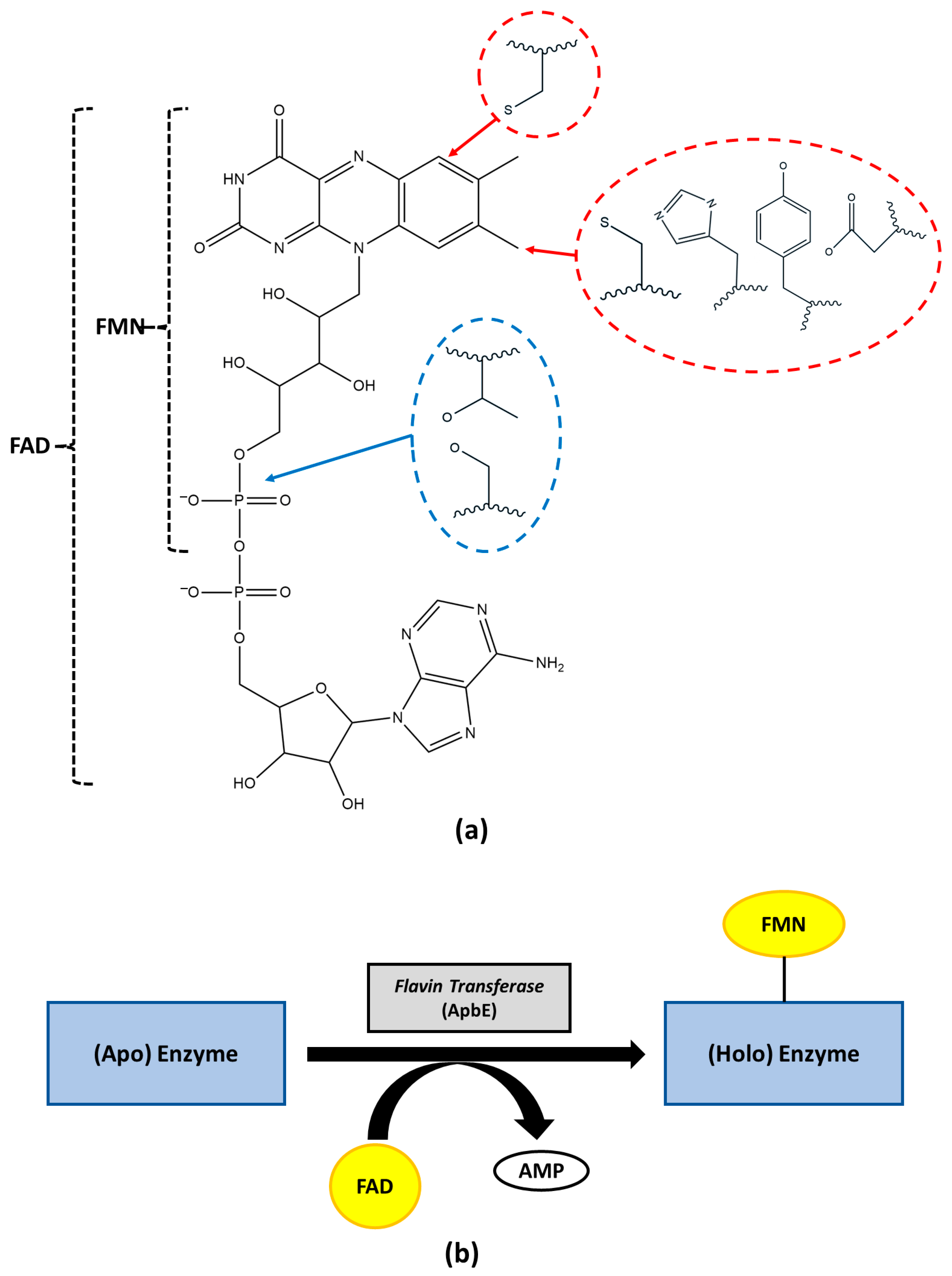
Figure 1. Covalent flavin attachment in covalent flavoproteins. (a) All types of covalent flavin-protein linkage. The amino acids inside the dashed red circle form the covalent bond with the benzyl moiety of the flavin via a self-catalytic process. The amino acids inside the dashed blue circle form a covalent linkage by action of a flavin transferase. (b) Simple scheme of FMN attachment via an ester bond between the phosphate moiety of the flavin cofactor and the hydroxyl group of the targeted serine or threonine. The flavin transferase (ApbE) will recognize the flavinylation motif within the protein (DxxxGAT) and use FAD as a source of FMN.
Catalysts 16 00042 g001
Figure 2. SDS-PAGE analysis of purified WT and F1 TsOYE. (a) Protein staining of gel, (b) in-gel fluorescence of the same gel (M = Marker/protein ladder). The F1 TsOYE protein band is fluorescent due to the covalently attached FMN while in the lane of WT TsOYE the dissociated FMN can be seen as fluorescent band at the bottom of the gel.
Catalysts 16 00042 g002
Figure 3. Residual activity after incubating WT, F1, and V5 TsOYE at 70 °C. All measurements were performed in duplicate (n = 2) and error bars represent the SD of the mean value.
Catalysts 16 00042 g003
Figure 4. Pre-steady state kinetic analysis of TsOYE variants. Spectral changes observed during (a) the reductive and (b) oxidative half reactions of the WT TsOYE. The black arrows indicate the decrease or increase in absorbance as a result of enzyme reduction and reoxidation, respectively. Observed rates of WT TsOYE are shown as a function of NAD(P)H and 2-cyclohexenone concentrations for (c) reduction and (d) oxidation, respectively. (e,f) The observed rates of F1 TsOYE as the same as the WT. Stopped-flow traces acquired at 457 or 460 nm were fitted to a single exponential function. All measurements were performed in duplicates (n = 2) and error bars represent the SD of the mean value.
Catalysts 16 00042 g004
Figure 5. TsOYE structures. (A) Overlay of the crystal structure of WT TsOYE (green) and the modeled structure of F1 TsOYE (in cyan), (B) close-up of the flavin cofactor, active site residues and covalent linkage in F1 TsOYE, (C) the introduced sequence for flavinylation in F1 TsOYE (sequence in blue) is highlighted together with the same sequence region in WT TsOYE (sequence in green).
Catalysts 16 00042 g005
Table 1. Activity of WT TsOYE and F1 TsOYE towards various α,β-unsaturated carbonyl compounds.
Substrateskobs (s−1)
WT TsOYEF1 TsOYE
2-cyclohexenone      Catalysts 16 00042 i0013.47 ± 0.020.18 ± 0.02
2-methyl-2-cyclohexenone Catalysts 16 00042 i0021.36 ± 0.030.11 ± 0.01
3-methyl-2-cyclohexenone Catalysts 16 00042 i0030.23 ± 0.020.10 ± 0.002
ketoisophorone      Catalysts 16 00042 i0040.53 ± 0.020.11 ± 0.01
isophorone       Catalysts 16 00042 i0050.25 ± 0.010.08 ± 0.001
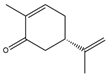
(S)-carvone       Catalysts 16 00042 i0061.91 ± 0.030.10 ± 0.001
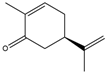
(R)-carvone       Catalysts 16 00042 i0072.76 ± 0.060.15 ± 0.001
Table 2. Steady-state kinetic parameters of WT and F1 TsOYE towards 2-cyclohexenone.
TsOYEkcat
(s−1)
KM
(µM)
kcat/KM
(s−1 mM−1)
WT4.31 ± 0.07154 ± 1327.9 ± 0.1
F10.07 ± 0.0029.7 ± 1.87.4 ± 0.2
Table 3. Pre steady state kinetic parameters of WT and F1 TsOYE.
TsOYEReductive-Half ReactionOxidative-Half Reaction
kred (s−1)KD (µM)kox (s−1)KD (µM)
WT8.75 ± 0.1123.4 ± 1.231.0 ± 1.8833 ± 130
F10.060 ± 0.00349.1 ± 5.70.12 ± 0.01871 ± 91
Disclaimer/Publisher’s Note: The statements, opinions and data contained in all publications are solely those of the individual author(s) and contributor(s) and not of MDPI and/or the editor(s). MDPI and/or the editor(s) disclaim responsibility for any injury to people or property resulting from any ideas, methods, instructions or products referred to in the content.