Article

Enhancing Thermal Uniformity and Ventilation Air Methane Conversion in Pilot-Scale Regenerative Catalytic Oxidizers via CFD-Guided Structural Optimization


1
Information Institute of the Ministry of Emergency Management, Beijing 100029, China
2
School of Chemical Engineering, University of Chinese Academy of Sciences, Beijing 100049, China
3
National Engineering Research Center of Green Recycling for Strategic Metal Resources, Institute of Process Engineering, Chinese Academy of Sciences, Beijing 100190, China
4
School of Safety Engineering, China University of Mining and Technology, Xuzhou 221126, China
5
State Key Laboratory of Biopharmaceutical Preparation and Delivery, Institute of Process Engineering, Chinese Academy of Sciences, Beijing 100190, China
*
Authors to whom correspondence should be addressed.
Catalysts 2026, 16(1), 38; https://doi.org/10.3390/catal16010038 (registering DOI)
Submission received: 6 November 2025 / Revised: 5 December 2025 / Accepted: 9 December 2025 / Published: 1 January 2026
(This article belongs to the Section Catalytic Materials)

Abstract

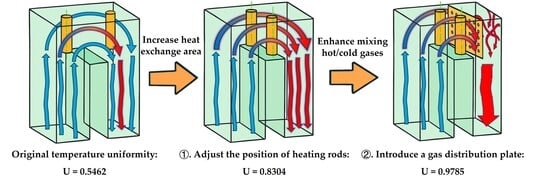
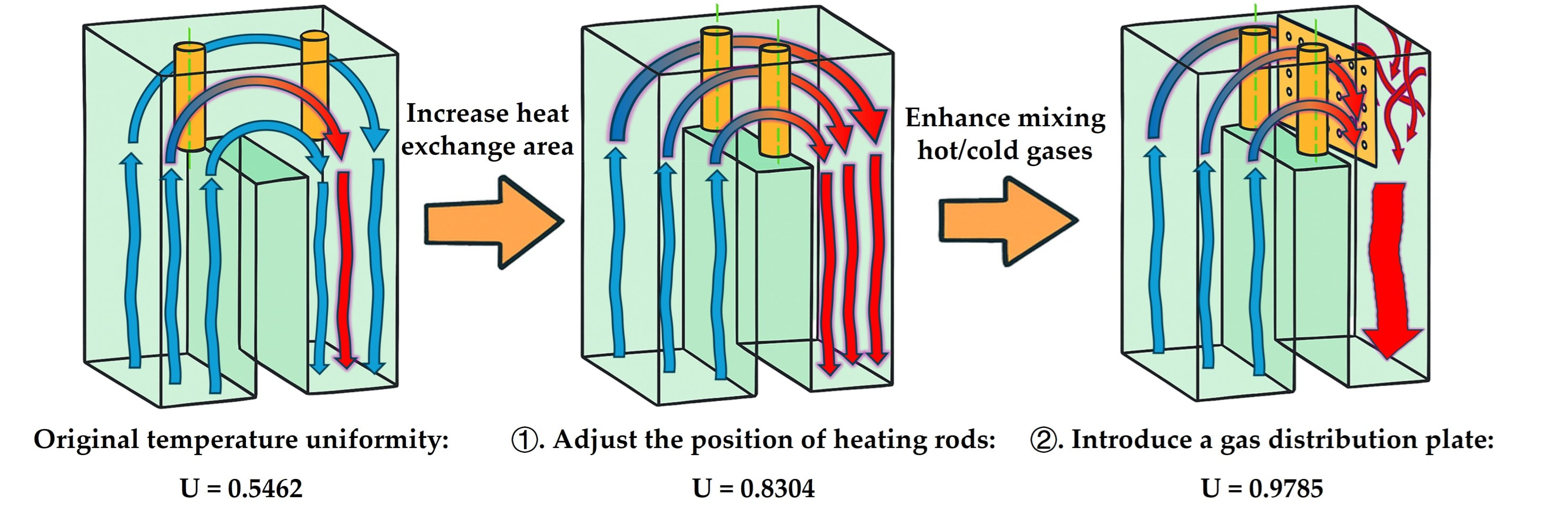
Catalytic oxidation has proven to be an effective method for treating low-concentration ventilation air methane. However, regenerative catalytic oxidizers (RCOs) used for ventilation air methane (VAM) treatment often face engineering challenges such as low oxidation efficiency and uneven heat transfer, which limit their overall performance and reliability. This study proposes a CFD-based structural optimization approach that couples flow field, temperature field, concentration field, and chemical reaction processes to systematically analyze the heat transfer and reaction mechanisms within the RCO. The key operational parameters of the reaction process were further discussed. The research focuses on improving temperature uniformity and enhancing methane conversion efficiency to achieve superior thermal efficiency and more effective methane mitigation. The results show that increasing the number of the electric heating rods and rearranging their configuration improved the temperature uniformity of the catalyst layer by 0.2842 (from 0.5462 to 0.8304). Additionally, the installation of a flow distribution plate further enhanced temperature uniformity by 0.1481 (from 0.8304 to 0.9785). As a result of these structural optimizations, the methane conversion rate of the new system increased significantly from 65% to 95%. This study offers valuable insights for future RCO design and optimization, paving the way for more efficient and reliable VAM treatment technologies.

Graphical Abstract

1. Introduction

In modern industrial society, the combustion of fossil fuels, industrial production, transportation, agricultural activities, and waste disposal are the primary anthropogenic sources of greenhouse gas emissions. Among these gases, carbon dioxide accounts for the largest share, contributing approximately 74% of the total. Methane, however, possesses a global warming potential that is more than 28 times greater than that of carbon dioxide over a 100-year timescale [1]. Despite its comparatively low atmospheric presence, methane wields an impact on climate change nearly equivalent to that of high-concentration greenhouse gases, making the task of mitigating it an extremely critical and time-sensitive challenge [2].
In 2020, global anthropogenic CH4 emissions reached 9.39 gigatons of CO2 equivalent, of which approximately 9% originated from coal mining. Coal methane emissions primarily originate from three sources: active mining areas, post-mining activities, and abandoned coal mines. During coal extraction processes, both underground and open-pit mining, emissions mainly result from disturbed coal–rock formations that release methane from adsorbed states into the atmosphere [3,4,5]. Specifically, underground mining emissions are released through subsurface extraction systems and ventilation networks [1,6,7]. The gas released from coal mines is referred to as ventilation air methane (VAM). VAM is characterized by its large volumetric flow rate (200–385 m3/s) and its composition, which consists primarily of air (approximately 79% N2, 20% O2, 0.13–0.19% CO2, along with trace amounts of other gases). It typically exhibits low and variable methane concentrations (0.1–1.5%), high relative humidity (70–100%), and elevated dust content (0.13–4.47 mg/m3) [6,7]. A stricter gas concentration limit is implemented in China to ensure the safety of miners. According to the coal mine safety regulations, the VAM concentration requirement is below 0.75%. In engineering practice, the VAM concentration in many coal mines is even lower, as low as 0.1–0.2%. VAM accounts for 60–70% of the total methane emissions from coal mining activities [8]. At present, the most straightforward approach to reducing CH4 emissions from VAM is thermal oxidation, in which methane undergoes the reaction CH4+2O2→CO2+2H2O. Converting methane into carbon dioxide can significantly mitigate its impact on climate change [9,10,11,12,13,14].
The regenerative oxidizer is currently the most effective technology capable of utilizing extremely low-concentration coalbed methane, and it is widely applied for processing low-concentration methane streams [15]. They consist of a fixed bed, in which the direction of the feed flow is periodically reversed. The fixed bed may be composed of a ceramic regenerator and catalysts. The regenerator is capable of storing the heat generated by the reaction, which is subsequently utilized to preheat the incoming cold feed once the flow direction is reversed [16]. The ceramic regenerative catalytic oxidizer (RCO) and the regenerative thermal oxidizer (RTO) are the two principal types of regenerative oxidizers. The RTO has been applied successfully in commercial operation cases because of its large processing capacity, simple structure, and smaller investment scale with high heat recovery efficiency. However, the complete methane oxidation temperature required usually reaches 900–1000 °C for RTOs, which means high energy consumption. Meanwhile, high temperature easily induces a side reaction with the production of nitrogen oxides, which brings new environmental pollution. Compared with RTOs, RCOs incorporate catalysts to lower the reaction temperature and are more suitable for treating lower concentration VAM and achieving a self-sustaining heat system at a lower methane concentration. Industrial trials have demonstrated that the VAM removal efficiency of RCOs can reach up to 96%, while achieving more than 70% energy savings compared with conventional direct oxidation systems [17,18,19]. Stable operation of an RCO requires uniform flow and temperature fields. Agrawal et al. showed that flow mal-distribution reduces the overall conversion compared to ideal uniform-flow assumptions of RCO [20]. Wang et al. found that flow homogenization is governed by the generation, distribution, conversion, and downstream transfer of radial flow. They combined a central perforated plate with vertical guiding baffles to optimize the distributor structure, which significantly reduced mal-distribution, lowering the deviation factor by about 40% and achieving flow uniformity above 90% [21]. Lee and Kim experimentally investigated a small CH4–air premixed heat-regenerative combustor and demonstrated that the placement and geometry of platinum wires significantly influenced flame stabilization and overall energy utilization. These studies indicate that the spatial arrangement of flow distribution devices and heating units has a significant impact on the thermal efficiency of RCOs [22]. In industrial practice, this often necessitates frequent adjustments of airflow velocity and switching intervals. In some cases, modifications to the equipment structure are also required. These measures result in the substantial consumption of manpower, resources, and time.
The numerical simulation based on computational fluid dynamics (CFD) has now been successfully applied in heat transfer research on heat exchangers [23], electronic equipment cooling systems, electric vehicle batteries [24], petroleum gasification units such as dewatering absorbers [25], cooling towers [26], fluidized beds [27,28] and so on. It is an effective method to explore the internal flow and temperature distributions of regenerative oxidizers. Liu [29] simulated the flow distribution system at the inlet of a preheated catalytic oxidation reactor. The results showed that the grid-shaped guide plates significantly improved the uniformity of velocity distribution across the inlet cross-section, reducing the non-uniformity coefficient to approximately 0.2. Hao [30] simulated the internal velocity and temperature distributions of an RTO during VOC treatment and compared the results with experimental measurements. The analysis showed that, for most relevant parameters, the discrepancies between the simulated and experimental values were less than 5%. Marín [16] coupled PID control with CFD simulations to address fluctuations in the feed concentration of VAM. By regulating the hot gas purge at the reactor center, the amount of heat extracted from the oxidizer was effectively controlled. However, industrial practice tends to focus more on how to optimize equipment design to achieve more uniform internal flow and temperature fields, yet studies in this area remain scarce.
This study performed a flow–temperature–concentration coupled simulation of a pilot-scale RCO with CFD simulations. The reaction kinetics of methane over the catalyst were obtained through experiments conducted in a fixed-bed microreactor. A full-scale model of the RCO was established. The accuracy of the coupled model was validated by comparing methane conversion rates. The optimization aimed to improve the thermal uniformity within the catalyst layer and methane conversion under simulated coal mine field test conditions. Through comparative CFD simulations of the temperature and flow fields, structural optimization was performed on the pilot-scale RCO involving increasing the number of electric heating rods, adjusting their arrangement, and incorporating an air distribution plate. Results showed that, by increasing the number of electric heating rods and rearranging their configuration, the temperature uniformity of the pilot RCO was increased by 0.2842 (from 0.5462 to 0.8304). Further enhancement to 0.9785 was achieved by introducing a gas distribution plate, increasing by 0.1481. Based on the simulation results, the methane conversion rate increased from 65% to 95% compared with the original configuration.

2. Results and Discussion

2.1. Catalytic Reaction Kinetics

Methane catalytic oxidation experiments were conducted at various temperatures using the microreactor shown in Scheme 1, and the corresponding methane conversion rates were recorded. To simplify the modeling of methane transport within the reactor, the flow of VAM is assumed to follow a one-dimensional plug flow pattern. Under this assumption, radial gradients and dispersion effects are neglected, and the steady species transport equation for methane reduces to the following:
u d C d x = A exp E a R T C
At a space velocity of 20,000 h−1, the axial velocity u is 55.56 mm/s. By integrating Equation (1) and rearranging the terms, we obtain the conversion rate η as follows:
η = 1 C C 0   = 1 exp A u exp E a R T x
The conversion rate at the outlet (x = 10 mm) is as follows:
η x = 10 m m = 1 exp 0.18 A exp E a 8.314 T
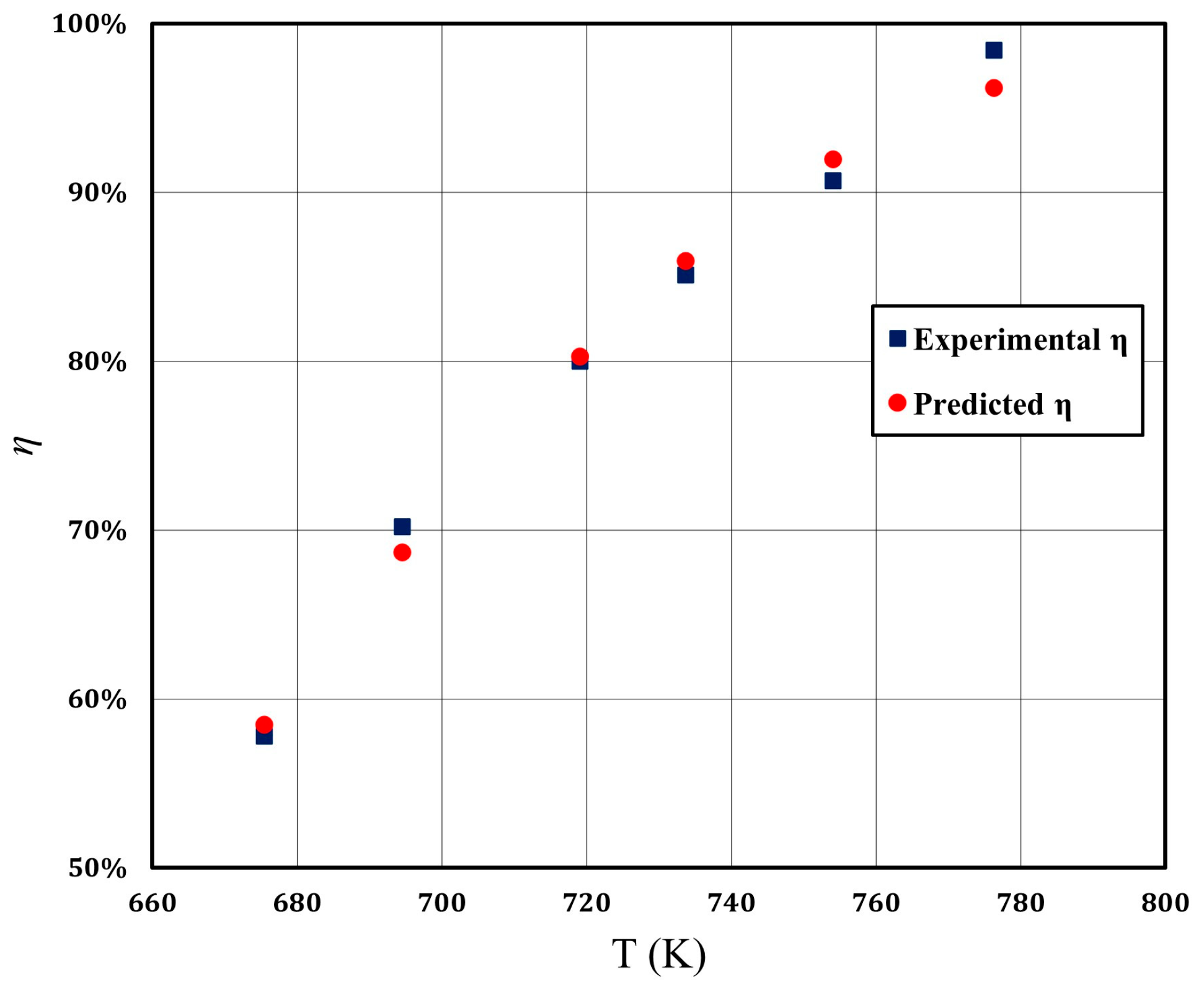
The methane catalytic oxidation data in Table 1 were used to fit Equation (3). The resulting parameter values are A = 120,574.84, Ea = 56,797.49 and the correlation coefficient R2 = 0.9906. The comparison of experimental values and predicted values is shown in Figure 1, which provides a good agreement.

2.2. Validation of the Coupled Model

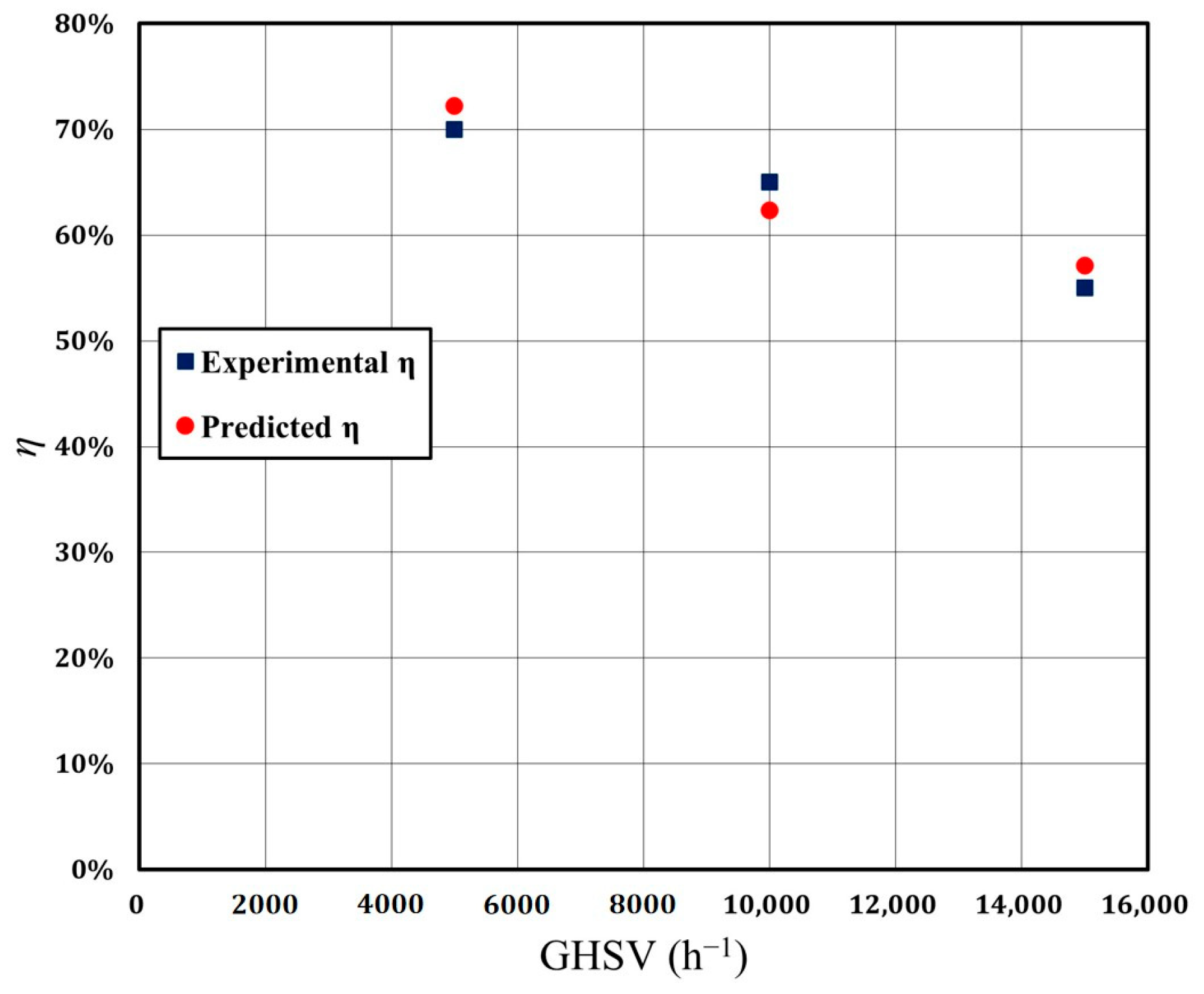
The reaction kinetics were coupled to the concentration, Equation (9), as a source term. To validate the accuracy of the coupled model, a full-process simulation of the flow field, temperature field, and concentration field within the RCO was conducted. The internal temperature of the RCO was jointly controlled by the heating rods and the heat generated from the catalytic reactions. Temperature variations, in turn, affected the catalytic reaction rate. Therefore, the conversion rate served as an important indicator for evaluating the accuracy of flow field, temperature field, and chemical reaction simulations. The conversion rates of experimental data and predicted data of pilot-scale RCO are shown in Figure 2. Under different gas hourly space velocity (GHSV), the coupled model demonstrates high predictive accuracy. The average relative error (AARE) is 5.47%, which indicates that the coupled model can accurately simulate the internal flow and catalytic reaction within the RCO.

2.3. Structural Optimization of the Pilot-Scale RCO System

2.3.1. Increasing the Number and Adjusting the Position of Heating Rods

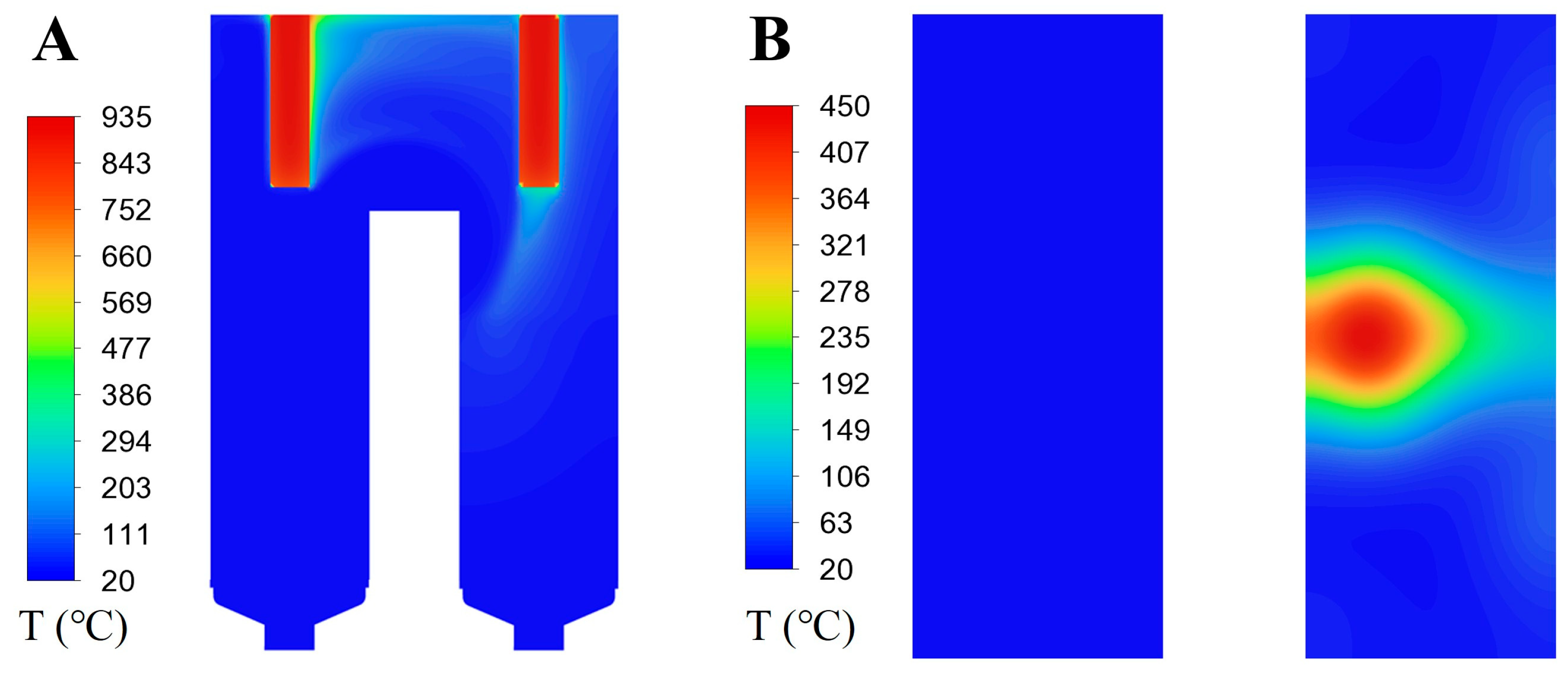
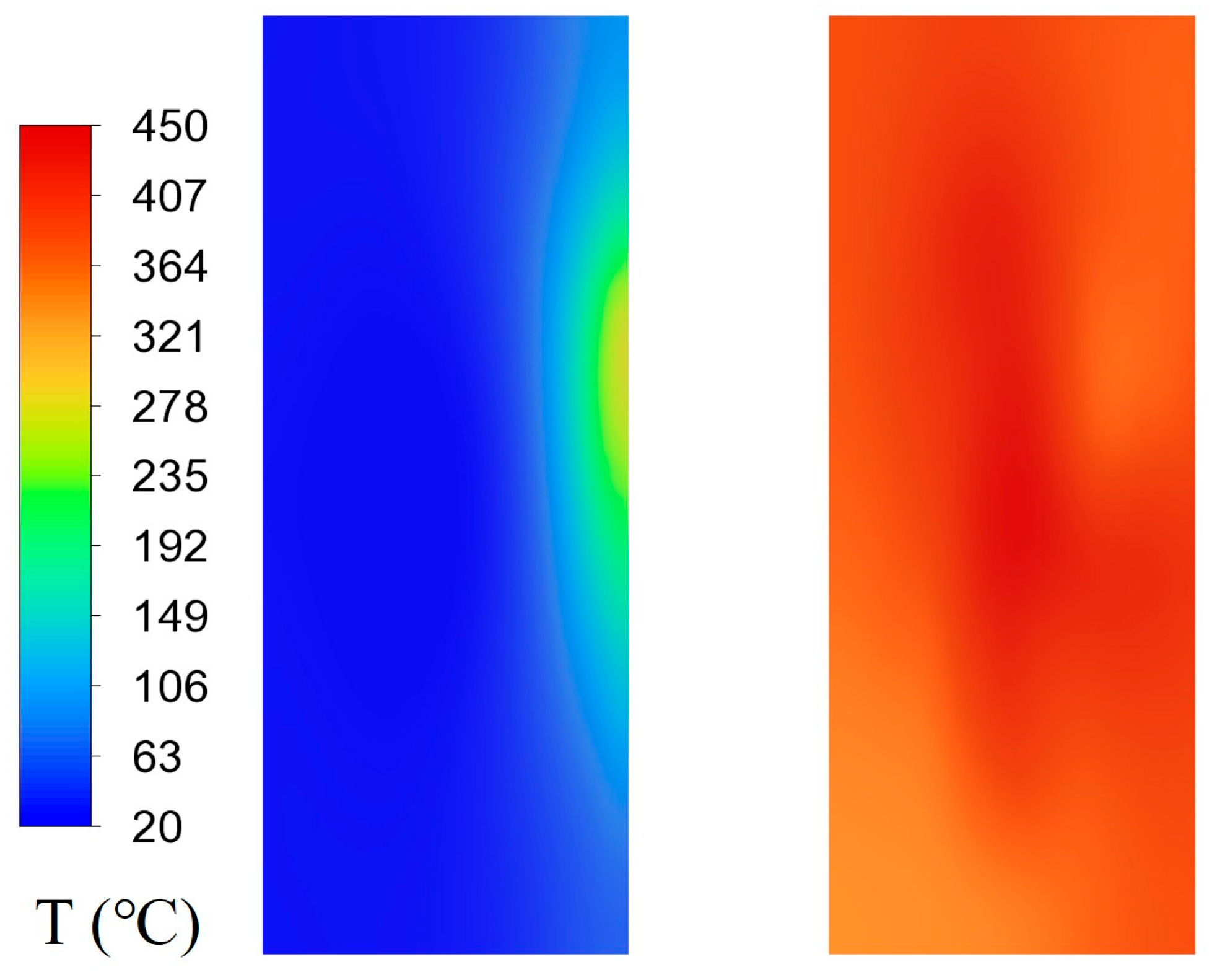
After validating the simulation methods, the temperature distributions of the catalytic reactions were analyzed, as shown in Figure 3. Considering that, in actual production, the cold VAM transfers heat from the ceramics regenerator on the inlet-side to the catalyst on the outlet side, this study focuses only on analyzing the temperature field at the outlet side. Figure 3B shows that the high-temperature region is concentrated in the central area of the catalyst. This is because, after passing through the two electric heating rods, only the gas in the central region is effectively heated (see Figure 3A).
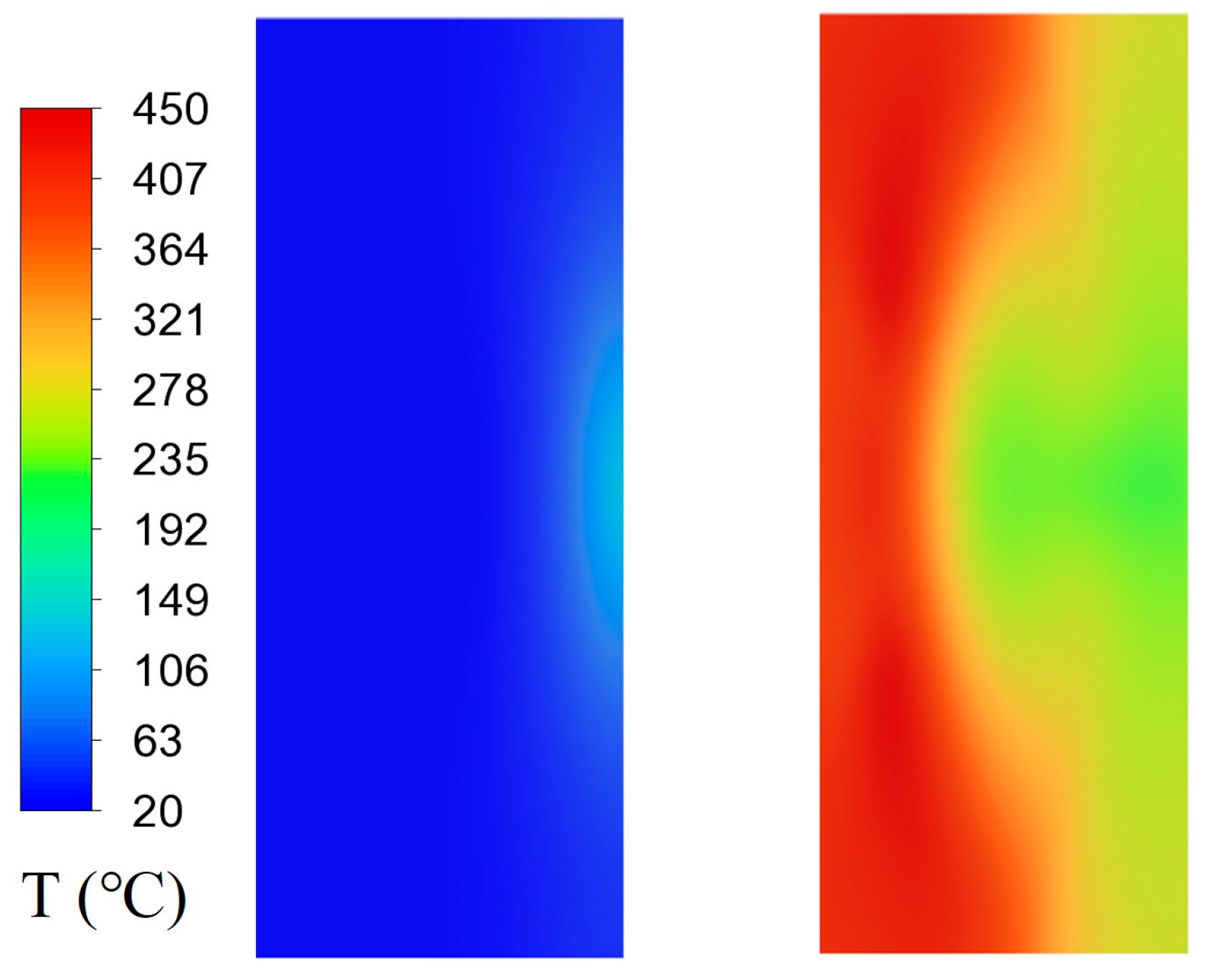
The improvement involves changing the arrangement of the heating rods from being parallel to the airflow direction to being perpendicular to it. In addition, the number of heating rods was increased from two to three. In this way, a larger portion of the incoming cold VAM could be heated. As shown in Figure 4, the area of the high-temperature region increased. The uniformity index of the temperature distribution increases by 0.2842 (from 0.5462 to 0.8304), which was improved significantly.

2.3.2. Introducing a Gas Distribution Plate

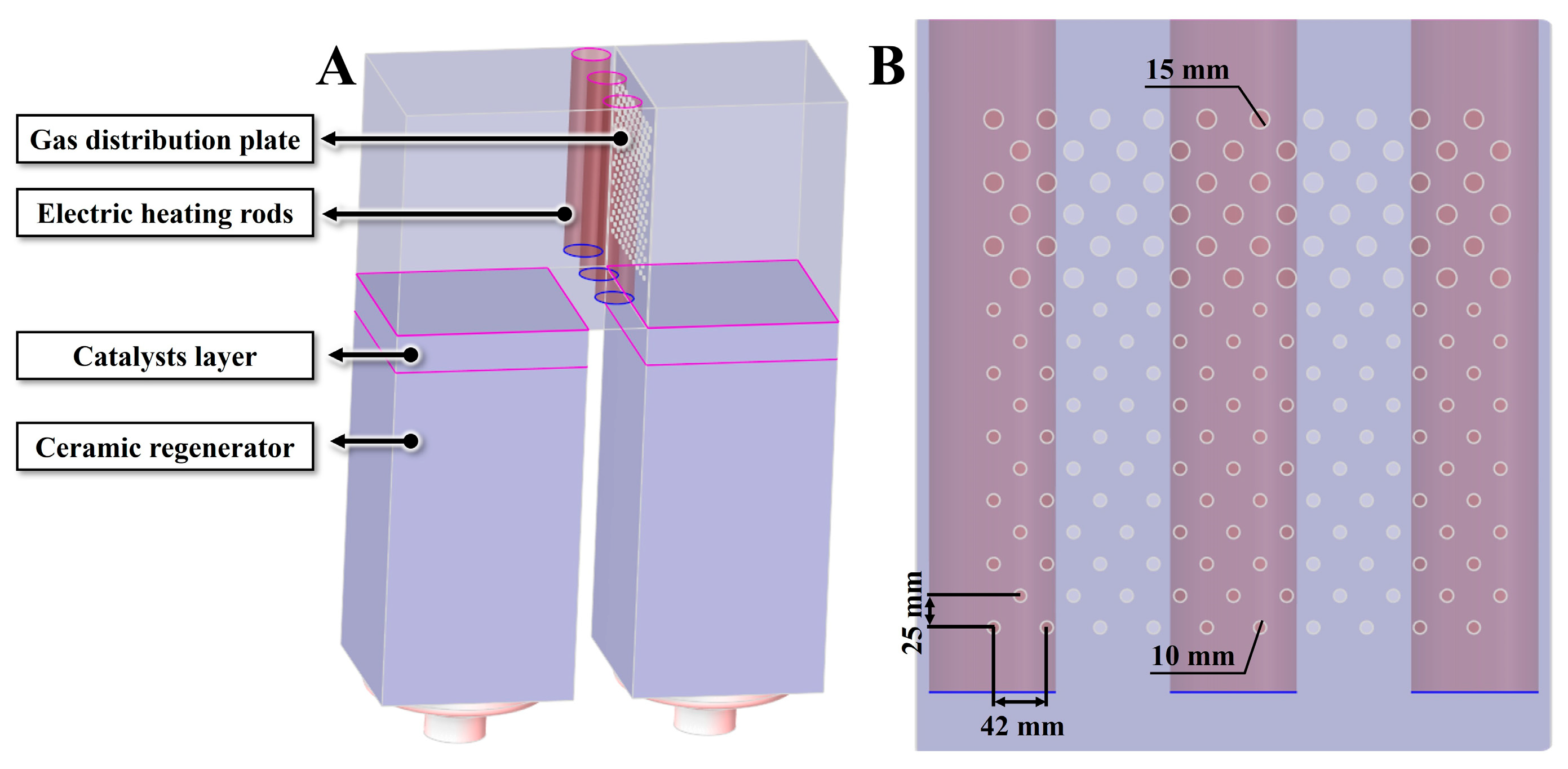
Although the uniformity was improved after increasing the number and repositioning the heating rods, Figure 3 still reveals a distinct separation between high-temperature and low-temperature regions in the temperature distribution. It indicates that the turbulence intensity of the flow field needs to be increased to promote thorough mixing between high-temperature and low-temperature gases. As shown in Figure 5A, a gas distribution plate was introduced to disturb airflow. The gas distribution plate is uniformly perforated with holes of different sizes. The diameter of the holes varies from 10 mm to 15 mm from the bottom-up. Figure 5B presents the structure parameters of the plate.
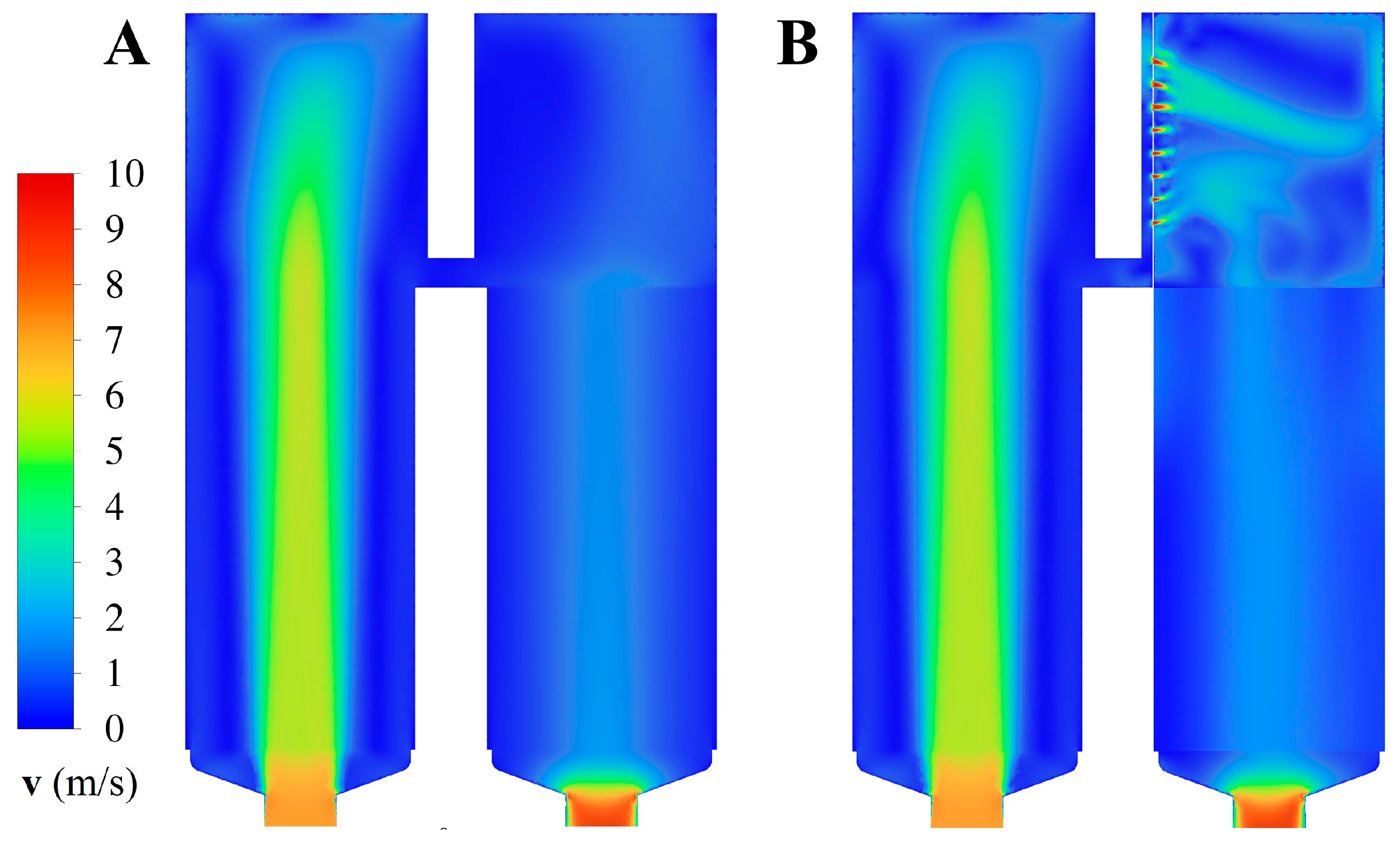
The new structure was used for simulation under the same operating conditions. The velocity distributions are shown in Figure 6. From Figure 6A, it can be observed that the velocity distribution of the RCO without a gas distribution plate is uniform, with relatively high velocity values in the central region. From Figure 6B, it is observed that after passing through the plate, the turbulence increases significantly, which facilitates the mixing of hot and cold air. After flowing through the catalyst, the velocity profile becomes smooth, while the velocity uniformity is higher than that shown in Figure 6A. The turbulent dissipation rates of the gas flow through the catalyst were calculated for two types of RCO. The results show that, without the gas distribution plate, the turbulent dissipation rate was 0.60 m2/s3. After installing the gas distribution plate, the turbulent dissipation rate increased to 2.47 m2/s3, approximately four times higher.
The temperature distribution after placing the gas distribution plate is shown in Figure 7. Obviously, the temperature uniformity was further improved. The uniformity index of the downstream side increases by 0.1481 (from 0.8304 to 0.9785). Pressure calculations show that the gas distribution plate induces a pressure drop of 54 Pa, which has no significant impact on the system.

2.4. Structural Modification of the Pilot-Scale RCO System

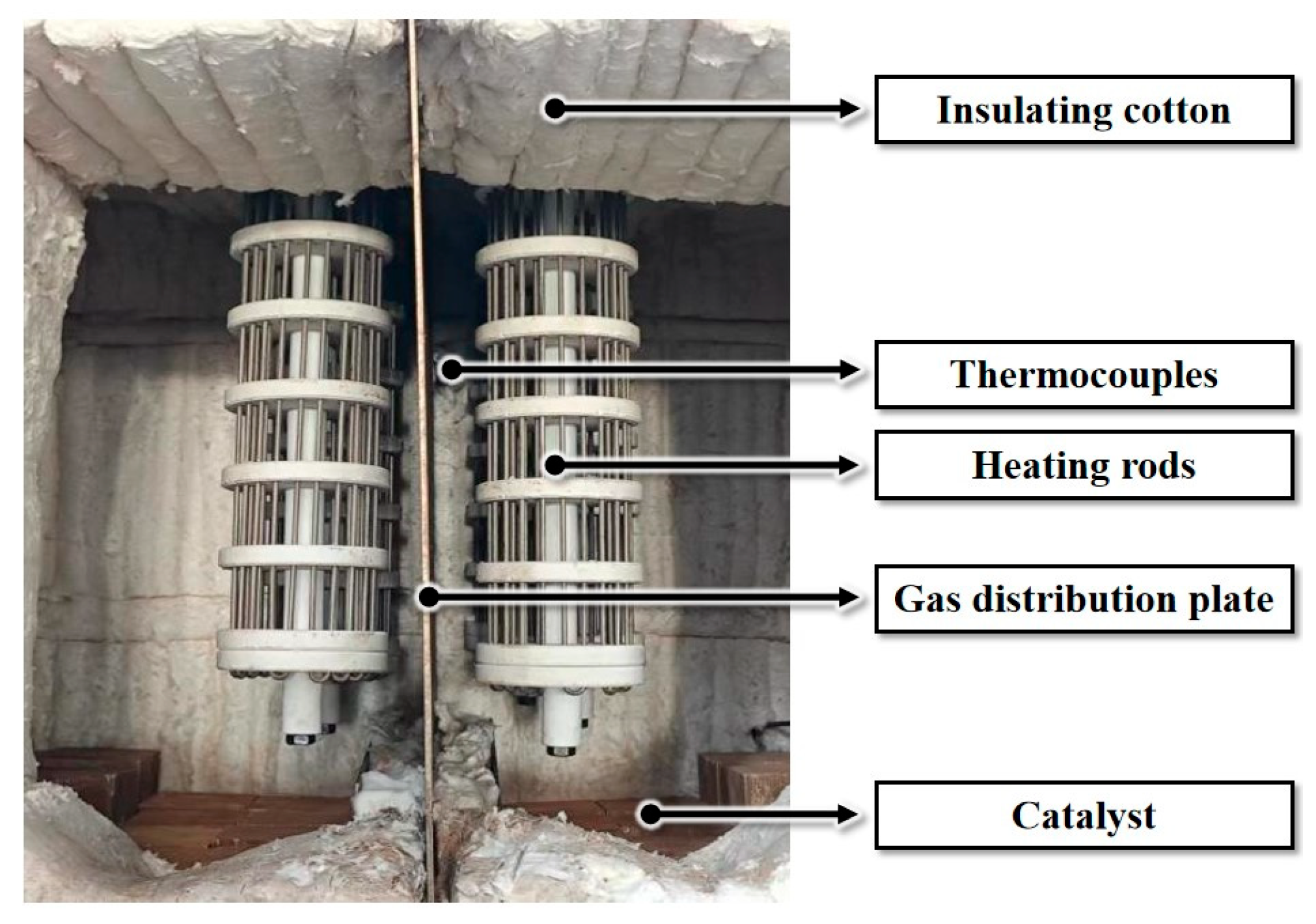
Based on the CFD simulation results, three structural optimization strategies were proposed for the pilot-scale RCO system: increasing the number of heating rods, adjusting their spatial arrangement, and incorporating a gas distribution plate. The modified configuration of the pilot-scale RCO is illustrated in Figure 8.
In the original configuration, since the three heating rods were aligned parallel to the airflow, only the gas in the central region was effectively heated, resulting in uneven temperature distribution (Figure 3). After the modification, more heating rods were aligned perpendicular to the airflow, which means more gas can come into contact with the heating rods. In other words, the modified configuration of the heating rods enhanced the thermal coverage, thereby enhancing the temperature uniformity across all of the catalyst bed layers, from 0.5462 to 0.8304 (Figure 4). This adjustment reduced temperature gradients and minimized cold zones, ensuring that a larger fraction of the catalyst operated under optimal conditions and directly enhanced the catalyst activity. The higher absolute temperature ensures a larger fully activated surface zone of the catalysts, and thereby promotes the complete oxidation of methane.
In the original design, distinct cold and hot zones appeared due to the uneven distribution of airflow, causing methane to be carried out of the reactor before complete oxidation in certain areas. After the modification, a gas distribution plate was installed centrally in the upper space of the catalyst bed layers. The gas distribution plate disrupts the airflow through its porous structure, promoting thorough turbulent mixing of hot and cold methane and further enhancing temperature uniformity from 0.8304 to 0.9785 (Figure 7). This adjustment redistributed the inlet gas evenly across the catalyst surface and reduced localized bypassing of unreacted methane, thereby improving contact between reactants and active sites and finally improving the methane conversion rate. Together, these modifications improved both thermal uniformity and gas-phase mixing, leading to more complete methane oxidation under different catalytic layer temperatures. As shown in Table 2, the modified reactor achieves substantially higher catalyst temperatures, such as 587 °C and 674 °C for layers A and B, respectively, which significantly exceed the light-off threshold for methane oxidation. The conversion rate of methane increased markedly from the original 65% to as high as 95% in the optimized RCO system.

3. Materials and Methods

3.1. Experimental Setup of Catalytic Reaction Kinetics

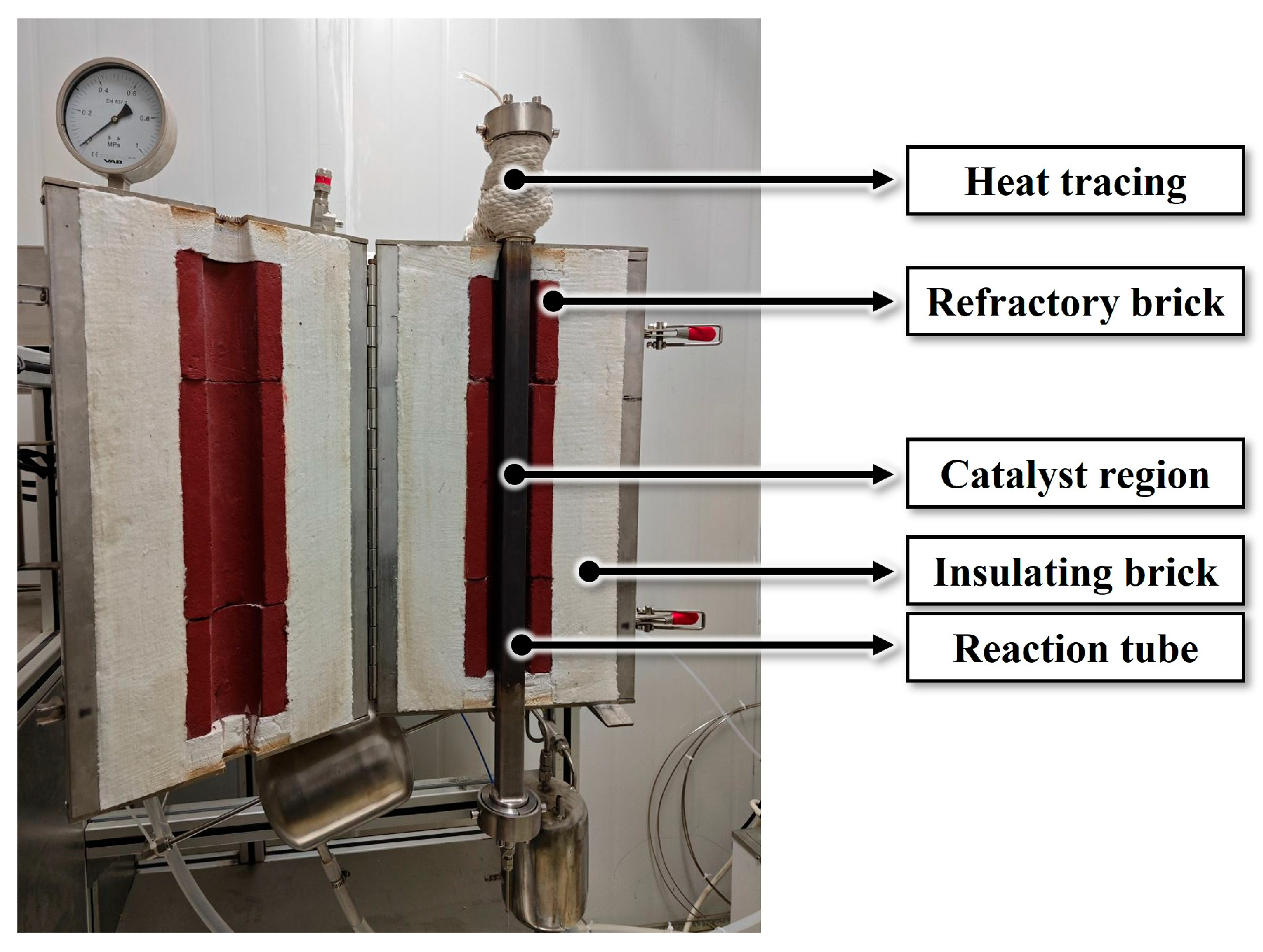
As shown in Scheme 1, a fixed-bed microreactor was employed to investigate the catalytic reaction kinetics. The system consists of a preheater, refractory and insulating bricks, a tubular reactor, and a designated catalyst zone. The preheater ensures that the reactant gases reach the desired inlet temperature before entering the reactor. The refractory and insulating bricks provide thermal stability and minimize heat loss, thereby maintaining a uniform reaction environment. The reactor itself is designed to have a heating function and to accommodate the catalyst bed, where the catalytic reactions take place. The size of the reactor was 15 × 15 × 600 mm, and the size of the catalyst inside the reactor was 15 × 15 × 10 mm. Gas flow and temperature were precisely controlled through mass flow controllers and an external heating system, ensuring reproducible and reliable kinetic measurements.
The kinetic mechanism was established using a concentration-dependent rate expression combined with the Arrhenius law [31,32]. The reaction rate was expressed as follows:
r = k × C  
The rate constant k follows the Arrhenius equation:
k = A exp E a R T
where
A: pre-exponential factor kg c a t 1 s 1 ,
Ea: activation energy J mol 1 ,
R: universal gas constant 8.314   J mol 1 K 1 ,
T: absolute temperature K .
In this work, the catalyst used was a Pd-Pt/Al2O3 cordierite catalyst, with a noble metal (palladium and platinum) content of 1250 g/m3 and a Pd to Pt ratio of 4:1. The gas composition was 0.2% CH4, with air as the balance. The inlet gas flow rate was set at 750 mL/min, resulting in a GHSV of 20,000 h−1. Experiments under different temperatures were performed to determine the A and Ea.

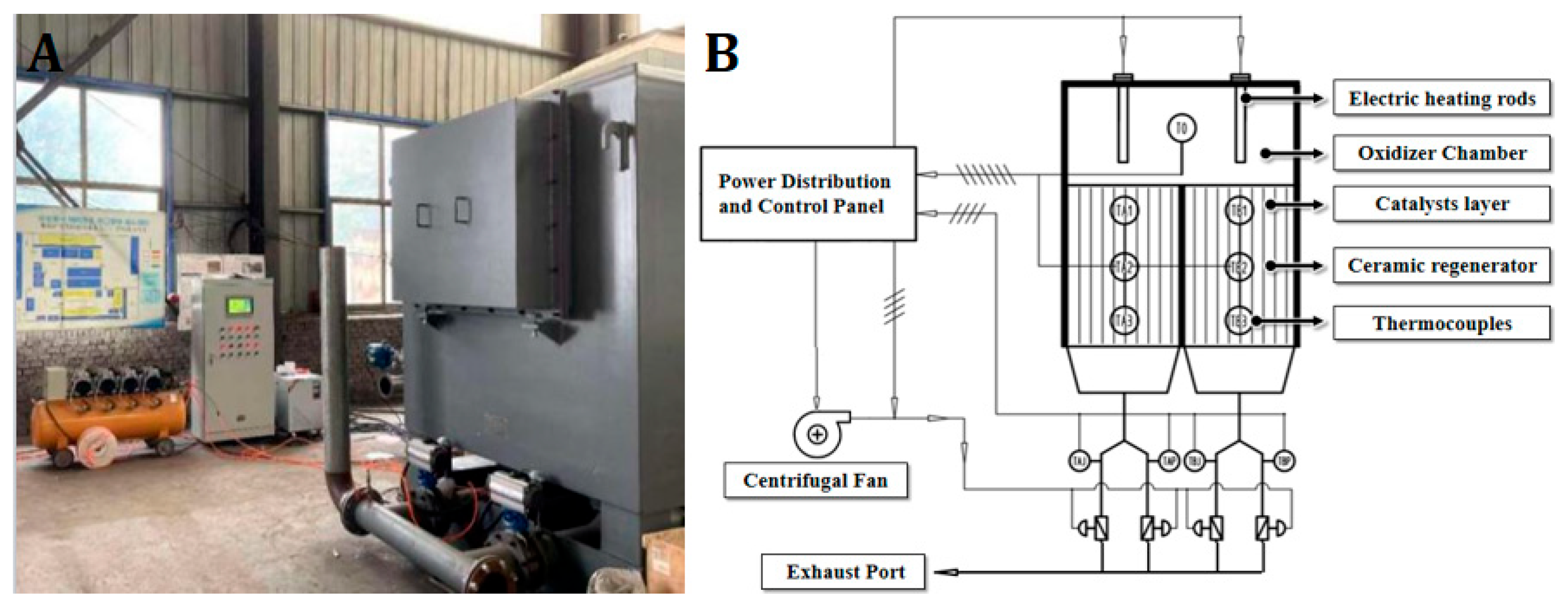
3.2. Experimental Setup of Pilot-Scale RCO

The pilot-scale RCO used in practice is shown in Scheme 2. The size of the internal space is 1540 × 1540 × 2140 mm, which is composed of electric heating rods, thermocouples, ceramic regenerators, and catalyst layers. The length, width, and height of a single catalyst are 100 × 100 × 50 mm, with a volume of 0.5 L. A total of 100 such catalysts are placed in the reaction, with a total volume of 50 L. The height of the oxidizer chamber is 746 mm. The power of electric heating rods is 20 kW, providing the initial thermal input required for system start-up. The catalyst used is a Pd-Pt/Al2O3 cordierite catalyst, with a palladium–platinum content of 1250 g/m3 and a Pd/Pt ratio of 4:1, with a quantity of 50 L. The height of the catalyst layer is 100 mm, with the ceramic regenerator located beneath it. Multiple thermocouples are distributed throughout the unit to monitor temperature profiles. The gas flow is regulated by valves and driven by a centrifugal fan, prepared as 0.26% CH4, with a flow rate reaching 500 m3/h and a space velocity of 10,000 h−1. Finally, the treated gases are discharged through the exhaust port, and their concentration is then detected.

3.3. Simulation Setup

The simulation of this work was based on the flow–temperature–concentration fields coupled method. The continuity equation of compressible fluid is as follows:
ρ t + × ρ v = 0
where ρ is the density of VAM, and v is the velocity. The momentum conservation equation is as follows:
ρ v t + × ρ v v = p + × τ + ρ f
where τ is the shear stress, p is the pressure, and f is the body force. The energy equation is as follows:
t ρ e + v 2 2 + × ρ v h + v 2 2 = × k T + S h
where e is the internal energy, h is the enthalpy, k is the thermal conductivity, T is the temperature, and Sh is the source term. The transport equation of concentration C is as follows:
C t + × v C = × D C + S R
where D is the molecular diffusion coefficient of methane in VAM. In the RCO system, the convective transport rate is significantly higher than the diffusion rate. Thus, the diffusion effect of methane can be neglected. The source term S R represents the methane consumption rate resulting from the chemical reaction.
CFD simulations were performed using Fluent 2021R1 (Academic Edition). The model employed a polyhedral mesh (~1.74 million cells) with no-slip wall boundaries and a standard k–ε turbulence model, ensuring accurate representation of flow and heat transfer. A geometric model with the same dimensions as the RCO shown in Scheme 2 was constructed, and a polyhedral mesh was generated by Fluent Meshing. The total number of cells is 1,741,803. No-slip conditions at the wall were applied, and the standard k–ε model was adopted for turbulence calculation. The time step was 0.001 s, and convergence conditions were set to 10−4. The regions containing the catalyst and the ceramic regenerator were modeled as porous media. The physical properties of the porous materials are shown in Table 3. The temperature uniformity index was used as the optimization criterion, and its calculation formula is given by the following:
U = 1 i = 1 n   T i T ¯ A i 2 T ¯ i = 1 n   A i
where Ti is the local temperature of the surface mesh or volume mesh, T ¯ is the average temperature, n is the number of mesh, and A i is the area of the surface mesh or the volume of the volume mesh.

4. Conclusions

To address the uneven temperature distribution and low methane conversion efficiency observed in pilot-scale RCO systems, this study implemented a coupled simulation integrating the flow field, temperature field, and concentration field, with catalytic reaction kinetics embedded into the model. This enabled accurate prediction of the internal thermal behavior within the RCO.
Structural optimization was carried out in two key stages:
1.
Heating rod reconfiguration: The orientation of the heating rods was changed from parallel to perpendicular relative to the airflow direction. This adjustment enhanced the interaction between the incoming air and the heat source, resulting in more uniform preheating across the cross-section. Consequently, the temperature uniformity index improved from 0.5462 to 0.8304.
2.
Introduction of a gas distribution plate: To further enhance mixing, a flow distribution plate was installed upstream of the catalyst bed. This modification significantly increased turbulence intensity, promoting better mixing of hot and cold air streams. As a result, the temperature field became even more homogeneous, with the uniformity index rising to 0.9785.
These sequential optimizations effectively mitigated thermal stratification and improved heat transfer uniformity within the reactor. Operational data confirmed that the methane conversion rate reached 95%, representing a 30% increase compared to the original configuration. This outcome underscores the predictive accuracy and engineering utility of the CFD-based structural optimization strategy.
Despite the promising results, several limitations remain. First, the current model assumes steady-state conditions and does not account for transient start-up or shutdown phases, which may exhibit different thermal behaviors. Second, the periodic reversal of VAM was not considered. The inlet-side dynamics and ceramic heat storage behavior warrant further investigation.
Future work will aim to incorporate transient simulations, catalyst degradation models, and full-cycle thermal analysis to better reflect real-world operating conditions. Additionally, experimental validation under varying flow rates and VOC compositions will be conducted to further verify the robustness of the optimized design.

Author Contributions

Conceptualization: W.L., Q.C., and J.Q.; methodology: X.X., and Q.C.; software: Q.C., and Q.W.; validation: Q.C., and Z.L.; formal analysis: X.X., Y.W., Z.L., and J.Q.; investigation: X.X., and Z.L.; resources: Q.C., and Z.L.; data curation: X.X.; writing—original draft: Q.C., and X.X.; writing—review and editing: W.L., Q.C., and J.Q.; visualization: Q.C., Z.L., and Q.W.; supervision: Y.W.; project administration: X.X.; funding acquisition, X.X., and Q.W. All authors have read and agreed to the published version of the manuscript.

Funding

This research was funded by the Science and Technology Innovation Development Project of the Information Institute of the Ministry of Emergency Management of PRC (2023503) and the National Natural Science Foundation of China (52274244, 52574298).

Data Availability Statement

All data investigated in this study are included in this published article.

Conflicts of Interest

The authors declare no conflicts of interest.

Abbreviations

The following abbreviations are used in this manuscript:
VAMVentilation air methane
CFDComputational fluid dynamics
RCORegenerative catalytic oxidizer
RTORegenerative thermal oxidizer
GHSVGas hourly space velocity

References

  1. World Meteorological Organization. Intergovernmental Panel on Climate Change; World Meteorological Organization: Geneva, Switzerland, 2007; Volume 52, pp. 1–57. [Google Scholar]
  2. Karakurt, I.; Aydin, G.; Aydiner, K. Mine ventilation air methane as a sustainable energy source. Renew. Sustain. Energy Rev. 2011, 15, 1042–1049. [Google Scholar] [CrossRef]
  3. Xu, X.; Liu, W.; Liu, H.; Li, Y.; Gao, X.; Lu, B.; Qi, J.; Li, Z.; Han, J.; Yan, Y. Self-supporting characteristics in hierarchical monolith catalyst with highly accessible active sites for boosting lean methane catalytic oxidation. Fuel 2026, 405, 136576. [Google Scholar] [CrossRef]
  4. Liu, W.; Xu, X.; Han, J.; Wang, B.; Li, Z.; Yan, Y. Trend model and key technologies of coal mine methane emission reduction aiming for the carbon neutralit. J. China Coal Soc. 2022, 47, 470–479. [Google Scholar]
  5. Ma, C.; Dai, E.; Liu, Y.; Wang, Y.; Wang, F. Methane fugitive emissions from coal mining and post-mining activities in China. Res. Sci. 2020, 42, 311–322. [Google Scholar] [CrossRef]
  6. Su, S.; Chen, H.; Teakle, P.; Xue, S. Characteristics of coal mine ventilation air flows. J. Environ. Manag. 2008, 86, 44–62. [Google Scholar] [CrossRef] [PubMed]
  7. Thiruvenkatachari, R.; Su, S.; Yu, X. Carbon fibre composite for ventilation air methane (VAM) capture. J. Hazard. Mater. 2009, 172, 1505–1511. [Google Scholar] [CrossRef]
  8. Su, S.; Beath, A.; Guo, H.; Mallett, C. An assessment of mine methane mitigation and utilisation technologies. Prog. Energ. Combust. Sci. 2005, 31, 123–170. [Google Scholar] [CrossRef]
  9. Wei, X.; Yang, K.; Zhu, Q.; Li, J.; Qi, J.; Wang, H. Lattice distortion in Co3O4/Mn3O4-guided synthesis via carbon nanotubes for efficient lean methane combustion. Catalysts 2023, 13, 1112. [Google Scholar] [CrossRef]
  10. Zhang, Y.; Wei, R.; Yang, L.; Ge, J.; Hu, F.; Zhang, T.; Lu, F.; Wang, H.; Qi, J. In situ growth of Mn-Co3O4 on mesoporous ZSM-5 zeolite for boosting lean methane catalytic oxidation. Catalysts 2024, 14, 397. [Google Scholar] [CrossRef]
  11. Wang, W.; Qiu, R.; Li, C.; Zhong, R.; Wang, H.; Qi, J. Advancing catalytic oxidation of lean methane over cobalt-manganese oxide via a phaseengineered amorphous/crystalline interface. Chem. Commun. 2024, 60, 8896. [Google Scholar] [CrossRef] [PubMed]
  12. Cao, S.; Ye, F.; Zhang, N.; Guo, Y.; Guo, Y.; Wang, L.; Dai, S.; Zhan, W. Synergistic effect of bimetallic RuPt/TiO2 catalyst in methane combustion. Rare Met. 2023, 42, 165–175. [Google Scholar] [CrossRef]
  13. Wang, W.; Fu, Z.; Yang, K.; Zhong, R.; Wang, H.; Qi, J. Deep understanding the formation of MnCoOx in-situ grown on foam nickel towards efficient lean methane catalytic oxidation. Colloids Surf. A Physicochem. Eng. Asp. 2024, 694, 134145. [Google Scholar] [CrossRef]
  14. Wang, W.; Wei, R.; Zhu, Q.; Fu, Z.; Zhong, R.; Wang, H.; Qi, J. ZIF-67-derived hollow dodecahedral Mn/Co3O4 nanocages with enrichment effect and good mass transfer for boosting low temperature catalytic oxidation of lean methane. J. Environ. Chem. Eng. 2024, 12, 113783. [Google Scholar] [CrossRef]
  15. Yang, J.; Yang, L.; Zhang, J.; Fan, X.; Li, S.; Zhang, L.; Zhang, W. Experimental study on ultra-low concentration methane regenerative thermal oxidation. Energies 2024, 17, 2109. [Google Scholar] [CrossRef]
  16. Marín, P.; Vega, A.; Díez, F.; Ordóñez, S. Control of regenerative catalytic oxidizers used in coal mine ventilation air methane exploitation. Process Saf. Environ. 2020, 134, 333–342. [Google Scholar] [CrossRef]
  17. Xiao, Q.; Jiang, Z.; Zhang, X. Improvement and application of regenerative thermal oxidizer. J. Environ. Eng. 2011, 5, 1347–1350. [Google Scholar]
  18. Nakayama, K.; Fujita, S.; Iijima, S.; Nishimura, I.; Shimota, H.; Katagiri, T. Combustion and decomposition of VOCs from shell moulds by regenerative thermal oxidiser. Int. J. Cast Metal. Res. 2008, 21, 265–268. [Google Scholar] [CrossRef]
  19. Ma, X.; Lin, J.; Branch, T. Analysis on feasibility of treating coated organic waste gas with regenerative thermal oxidizer. Environ. Sci. Manag. 2016, 41, 125–128. [Google Scholar]
  20. Agrawal, G.; Kaisare, N.; Pushpavanam, S.; Ramanathan, K. Modeling the effect of flow mal-distribution on the performance of a catalytic converter. Chem. Eng. Sci. 2012, 71, 310–320. [Google Scholar] [CrossRef]
  21. Wang, P.; Pan, W.; Dai, G. A CFD–based design scheme for the perforated distributor with the control of radial flow. AIChE J. 2020, 66, e16901. [Google Scholar] [CrossRef]
  22. Lee, M.; Kim, N. Experiment on the effect of Pt-catalyst on the characteristics of a small heat-regenerative CH4–air premixed combustor. Appl. Energ. 2010, 87, 3409–3416. [Google Scholar] [CrossRef]
  23. Li, C.; Wang, T.; Guo, C.; Jiang, Y.; Tan, S.; Guo, C. Thermal analysis and optimization of high-power beam deposition target cooling heat sink for accelerator radioisotopes application. Heat Transf. Res. 2021, 52, 39–56. [Google Scholar] [CrossRef]
  24. Hu, H.; Wang, X.; Wang, T.; Liang, C. Heat transfer characteristics of R134a vapor flow in a rectangular channel under vibration conditions. J. Mech. Sci. Technol. 2025, 39, 2929–2944. [Google Scholar] [CrossRef]
  25. Zhu, J.; Cao, H.; Wang, H.; Zhang, S.; Li, Y.; Ge, X.; Luo, J. Simulation analysis of gas–liquid flow and mass transfer in a shaking triethylene glycol dewatering absorber. Nat. Gas Ind. B 2024, 11, 420–431. [Google Scholar] [CrossRef]
  26. Jourdan, N.; Kanniche, M.; Neveux, T.; Potier, O. Numerical simulation of hydrodynamics in wet cooling tower packings. Int. J. Refrig. 2023, 153, 194–204. [Google Scholar] [CrossRef]
  27. Shah, S.; Jalali, P. Solid-solid drag for continuum models using CFD-DEM simulations in gas fluidized beds of bidisperse mixtures. Powder Technol. 2025, 469, 121785. [Google Scholar] [CrossRef]
  28. Wang, K.; Yuan, X.; Wang, P.; Xu, S.; Zhao, H.; Xue, J.; Li, Q. CFD and machine learning-based multi-objective optimization for structured packing design. Chem. Eng. Sci. 2025, 320, 122483. [Google Scholar] [CrossRef]
  29. Liu, Y.; Du, D.; Mao, M.; Chen, S.; Zheng, B.; Meng, J. Numerical simulation and optimization of diversion system in a preheating catalytic monolithic reactor. J. China Coal Soc. 2013, 38, 1800–1805. [Google Scholar]
  30. Hao, X.; Li, R.; Wang, J.; Yang, X. Numerical simulation of a regenerative thermal oxidizer for volatile organic compounds treatment. Environ. Eng. Res. 2018, 23, 397–405. [Google Scholar] [CrossRef]
  31. Pawlaczyk, A.; Gosiewski, K. Simplified kinetic model for thermal combustion of lean methane–air mixtures in a wide range of temperatures. Int. J. Chem. React. Eng. 2013, 11, 111–121. [Google Scholar] [CrossRef]
  32. Pawlaczyk, A.; Gosiewski, K. Combustion of lean methane–air mixtures in monolith beds: Kinetic studies in low and high temperatures. Chem. Eng. J. 2015, 282, 29–36. [Google Scholar] [CrossRef]
Scheme 1. Schematic of the fixed-bed microreactor.
Catalysts 16 00038 sch001
Figure 1. Comparison of methane conversions of the microreactor: Experimental data and predicted data.
Catalysts 16 00038 g001
Figure 2. Comparison of methane conversions of the RCO: Experimental data and predicted data.
Catalysts 16 00038 g002
Figure 3. The temperature distributions inside the origin RCO. (A) Vertical section. (B) Cross-section through the catalyst.
Catalysts 16 00038 g003
Figure 4. The temperature distributions inside the RCO with vertically arranged heating rods.
Catalysts 16 00038 g004
Figure 5. The placement and structural design of the gas distribution plate. (A) The structure of the RCO with a gas distribution plate. (B) The structure of the gas distribution plate.
Catalysts 16 00038 g005
Figure 6. The velocity distributions inside RCOs. (A) The RCO without a gas distribution plate. (B) The RCO with a gas distribution plate.
Catalysts 16 00038 g006
Figure 7. The temperature distributions inside the RCO with a gas distribution plate.
Catalysts 16 00038 g007
Figure 8. The specific view of the pilot-scale RCO after modification.
Catalysts 16 00038 g008
Scheme 2. (A) Photograph of the pilot-scale RCO; (B) Schematic of the pilot-scale RCO, with multiple thermocouples arranged to measure temperature variations.
Catalysts 16 00038 sch002
Table 1. The conversion rate of methane under different temperatures at the outlet.
Temperature (°C)Conversion Rate (%)
402.357.8
421.470.2
445.980.0
460.585.1
480.990.7
503.198.4
Table 2. The performance data of the new RCO (GHSV = 10,000 h−1).
Catalytic Layer ACatalytic
Layer B
Switchover
Duration
Input
Concentration
Output
Concentration
Conversion
Rate
413 °C408 °C120 s0.26%0.05%81%
328 °C512 °C120 s0.26%0.04%85%
451 °C624 °C120 s0.26%0.03%88%
587 °C674 °C120 s0.26%0.02%95%
Table 3. The physical properties of the catalyst and ceramic regenerator.
Porous RegionDensity
[kg/m3]
Specific Heat Capacity
[J/(kg·K)]
Thermal Conductivity
[W/(m·K)]
Porosity
Catalyst25008501.362%
Ceramic regenerator215010501.7540%
Disclaimer/Publisher’s Note: The statements, opinions and data contained in all publications are solely those of the individual author(s) and contributor(s) and not of MDPI and/or the editor(s). MDPI and/or the editor(s) disclaim responsibility for any injury to people or property resulting from any ideas, methods, instructions or products referred to in the content.