Article

In-Situ Fabrication of Double Shell WS2/TiO2 with Enhanced Photocatalytic Activity Toward Organic Pollutant Degradation


1
CNNC Engineering Research Center for Nuclear Facilities Decommissioning and Radioactive Management, China Nuclear Power Engineering Co., Ltd., China National Nuclear Corporation, Beijing 100048, China
2
State Key Laboratory of Nuclear Resources and Environment, East China University of Technology, Nanchang 330013, China
*
Author to whom correspondence should be addressed.
Catalysts 2026, 16(1), 25; https://doi.org/10.3390/catal16010025 (registering DOI)
Submission received: 25 November 2025 / Revised: 11 December 2025 / Accepted: 25 December 2025 / Published: 29 December 2025
(This article belongs to the Section Catalytic Materials)

Abstract

In this work, we have used the bubble template solvothermal method to prepare TiO2 Hollow Spheres (THS) for in situ growth of WS2 on their surfaces and a three-phase TiO2 Hollow Spheres/WS2 (THS/WS2) heterostructure composite. We also investigated the influence of W/Ti molar ratio on the morphology, structure, and optical properties of the delaminated THS/WS2 composite and studied its photocatalytic activity to degrade RhB in visible light. Experiment result expresses that THS/WS2-0.20 material shows the best photocatalytic activity, which is 3.9 times higher than that of THS alone. On this basis, the process of photogenerated charge carriers and photocatalytic charge transfer on the surface of the delaminated THS/WS2 composite was elucidated, which provides a technical support for the fabrication and research of the mechanism of a three-dimensional TiO2-based heterojunction photocatalyst.

1. Introduction

The increasing energy crisis and the deterioration of environment promote the research on photocatalytic technology [1]. As an excellent candidate for commercial photocatalysts, TiO2 has attracted tremendous attention in research. For this reason, great efforts are devoted to constructing various kinds of nanosized TiO2, including nanotube [2,3,4,5], nanorod [6,7], nanosheet [8,9,10,11,12], and hierarchical hollow microsphere [13,14,15].
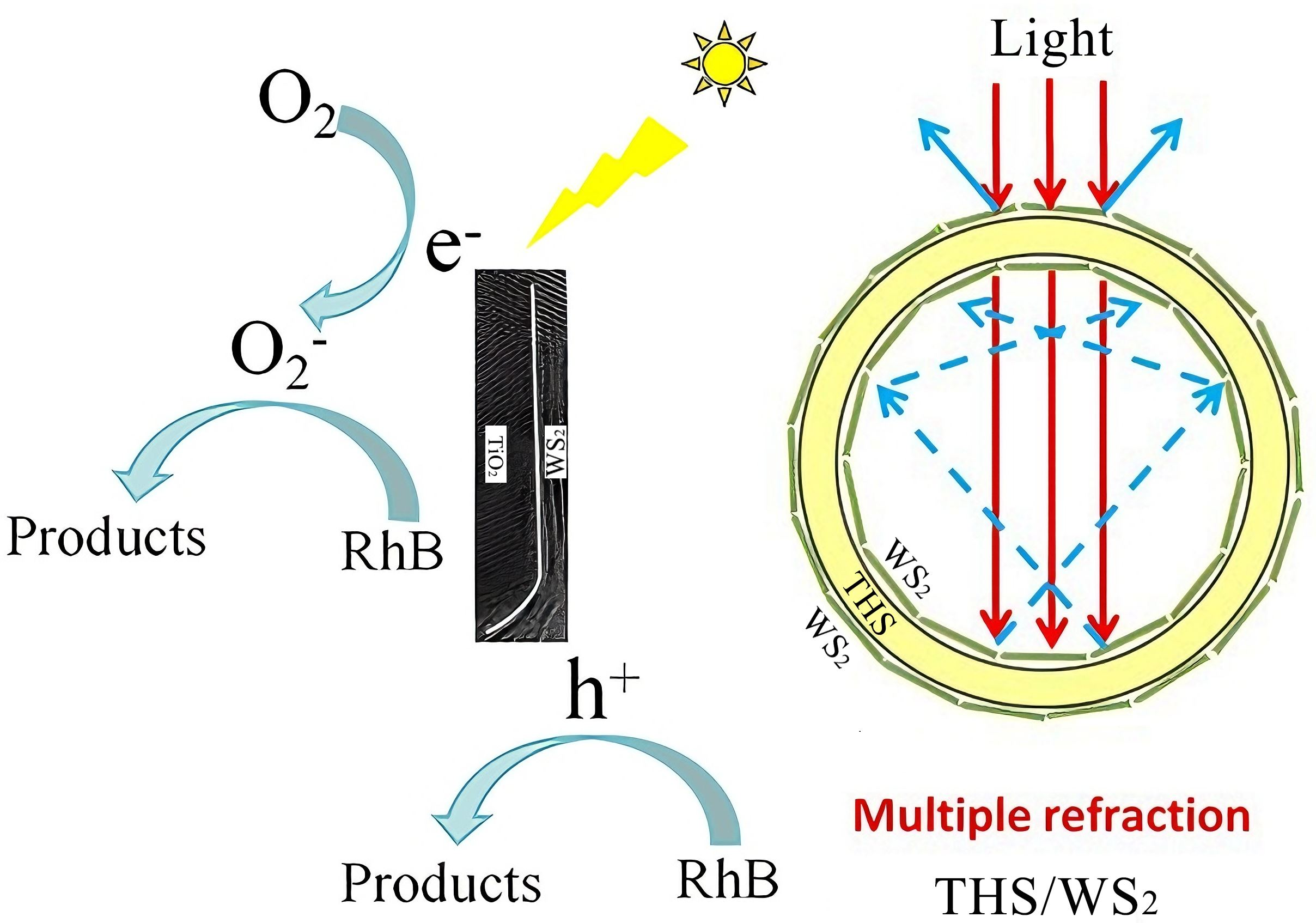
As a group of materials with a unique structure, hollow spheres refer to spherical shell-like materials ranging in size from nanometers to millimeters that are hollow inside. Recently, hollow spheres have attracted much attention from many researchers due to their usable spherical interior and controllable structure, which have the advantages of high specific surface area, low density, good filterability, and difficult agglomeration [16,17]. After light enters the hollow spheres, multiple light scattering enhances light absorption by the material [18]. In addition, the structure of the hollow spheres is suitable for the construction of multilayer hollow shells, which can simultaneously increase the molecular loading and effective light scattering, improving the efficiency of the material for energy conversion [19].
Recently, many scientists and technicians have extensively studied the photocatalytic properties of TiO2 hollow spheres. Among them, Song used styrene methyl methacrylate (PSMMAD-) as a template in combination with a sol-gel method to fabricate TiO2 hollow spheres with uniform particles [20]. This type of hollow sphere offers a large specific surface area, rich porous structure, and larger band gap energy, and thus has better catalytic performance for methyl blue degradation than TiO2 nanoparticles. Shang from Shandong University used TiCl4 as a raw material to prepare submicron TiO2 hollow spheres with a high (001) exposed surface area by the non-template method, and found that their photocatalytic activity toward phenol was much higher than that of P25 [21]. Liu’s study shows that the nano-sized TiO2 hollow spheres could be prepared by thermal deposition of TiO2 in a solvent on the surface of C spheres, followed by calcination in an air atmosphere to remove the C spheres [22]. Besides that, in order to improve the photocatalytic ability of TiO2 under visible light, many high-performance photoresponse materials were loaded on TiO2 substrates to form heterostructures, such as BiVO4 [23,24,25,26,27], MoS2 [11,28,29,30,31,32,33,34], and WS2 [35,36,37,38,39].
Transition metal dichalcogenides (TMDs) have long been a research focus due to their excellent optical and electrical properties [28,34]. WS2 is a typical TMDs and its bandgap is approximately 1.35 eV, which is close to the optimal bandgap value for the utilization of solar radiation energy. More importantly, compared with TiO2, WS2 has a higher conduction-band minimum, indicating that it may be a potential co-catalyst candidate material for visible-light photosensitization of TiO2. Therefore, some studies have been conducted on loading WS2 onto TiO2 surfaces to enhance photocatalytic activity. However, most research has focused on the two-dimensional TiO2 substrates, while research on the loading of WS2 onto three-dimensional TiO2 substrate surfaces is limited.
In this work, TiO2 Hollow Submicrospheres (THS) were prepared by the thermal method with tetrabutyl titanate as precursor, oxalic acid as bubble source, and isopropanol as solvent. They are considered as substrate materials on which WS2 was grown in situ. A three-phase TiO2 Hollow Spheres/WS2 (THS/WS2) heterostructure was constructed, characterized by SEM, FTIR, and XPS, and its photocatalytic performance and mechanism were analyzed by experiments. The research results of this work provide technical support and a theoretical basis for the exploration of a three-dimensional TiO2-based heterojunction photocatalyst.

2. Results and Discussion

2.1. SEM and TEM Analysis

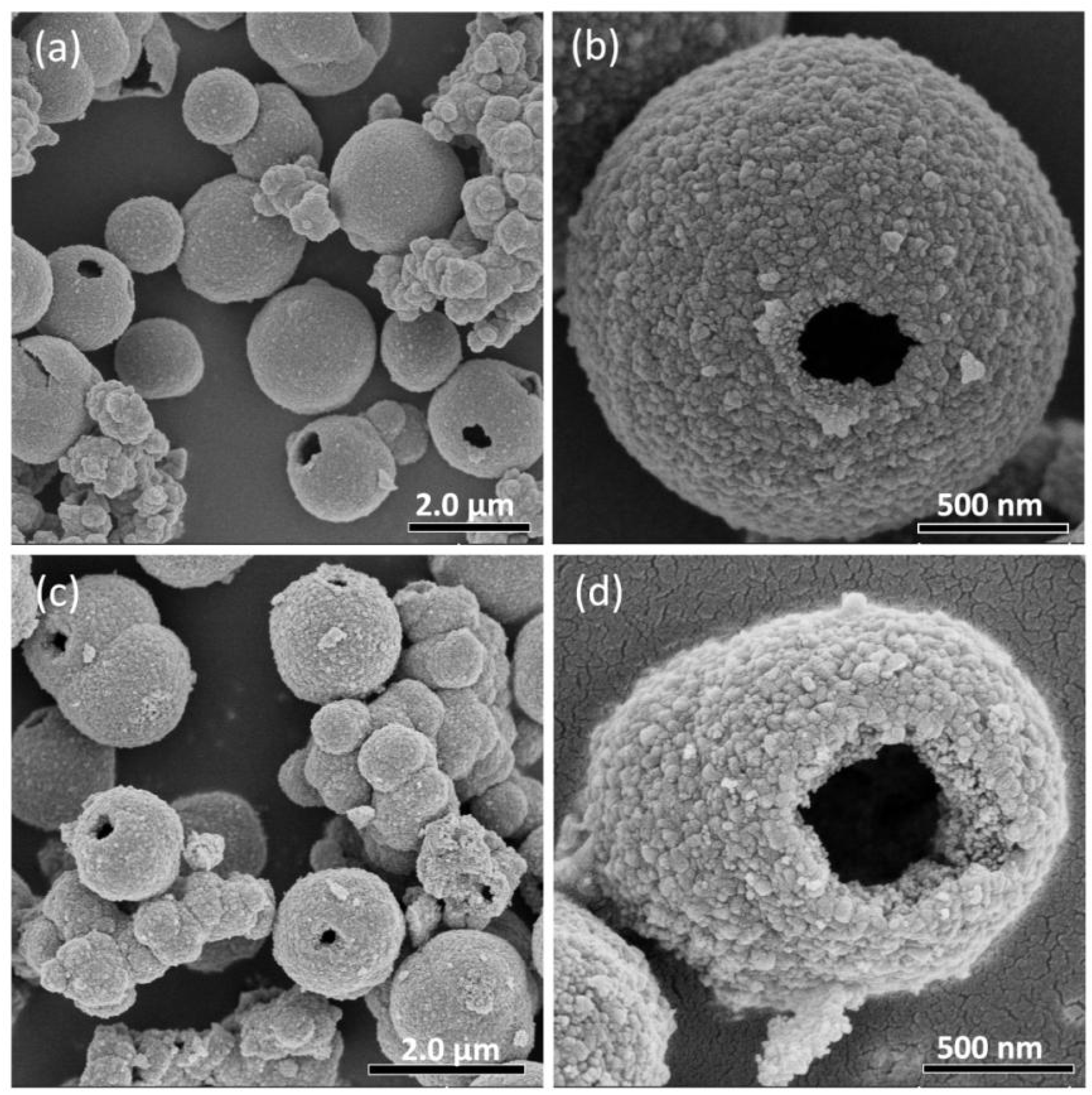
The morphology of materials is critical for maintaining material properties. To better analyze the effect of WS2 loading on THS, SEM analysis of samples before and after loading was performed (Figure 1). As can be seen in Figure 1a, the synthesized TiO2 is hollow, indicating a relatively smooth and uniform size. The magnified SEM results (Figure 1b) clearly show that the microspheres have a diameter of about 1.0 μm and a thin wall of about 50 nm. After loading with WS2, the surface of THS/WS2-0.20 protrudes slightly but still retains the hollow microsphere structure, as shown in Figure 1c. The enlarged SEM image (Figure 1d) shows an increase in the diameter of the composite material formed, significantly improved surface roughness, and improved inner surface wall roughness and wall thickness.
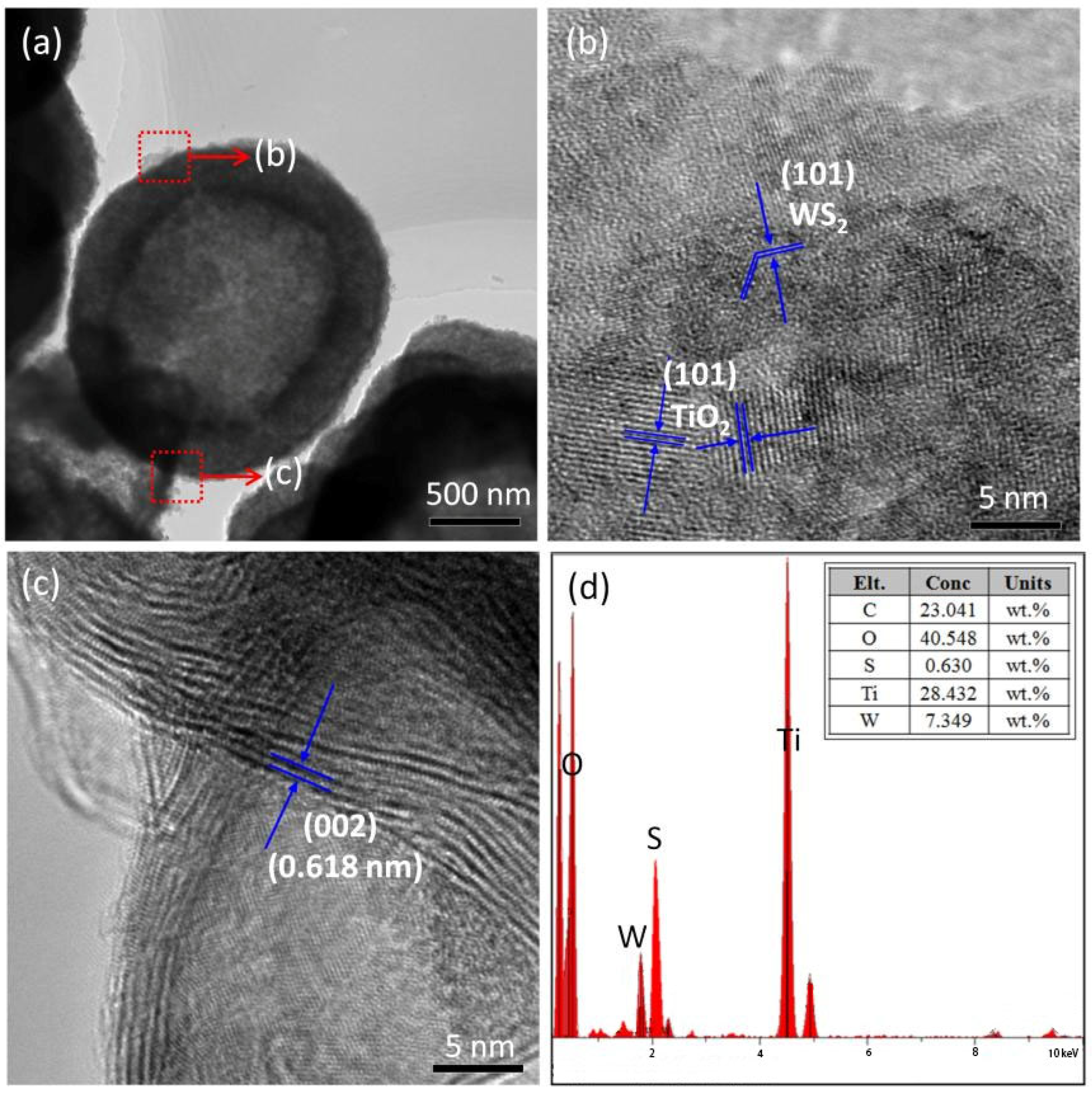
Figure 2 shows the TEM analysis results of THS/WS2-0.20. From Figure 2a, it can be seen that THS/WS2-0.20 has a clear void profile and many small thin layers protrude from the outer surface, with an outer diameter of about 1.80 μm, an inner diameter of about 1.25 μm, and a calculated wall thickness of about 275 nm. The lattice fringes of the TiO2 (101) plane of TiO2 can be seen in the HRTEM image (Figure 2b), and a lattice fringe with an angle of 120° caused by the (101) plane of WS2 can also be seen at the site mixed with WS2. Figure 2c is the HRTEM image of the overlapped part, in which the layered structure of WS2 is visible, and the lattice spacing is about 0.618 nm, which is due to the (002) plane. In addition, a qualitative analysis of the content of each element in THS/WS2-0.20 was performed by TEM-EDS. The peaks of O, W, S, and Ti are shown in Figure 2d, indicating that THS/WS2-0.20 consists of the four elements mentioned above. In summary, the THS/WS2-0.20 material was successfully fabricated, and its microstructure retained the THS morphology. This structure of the hollow spheres can simultaneously increase the molecular loading and effective light scattering, improving the efficiency of the material for energy conversion.

2.2. XRD Analysis

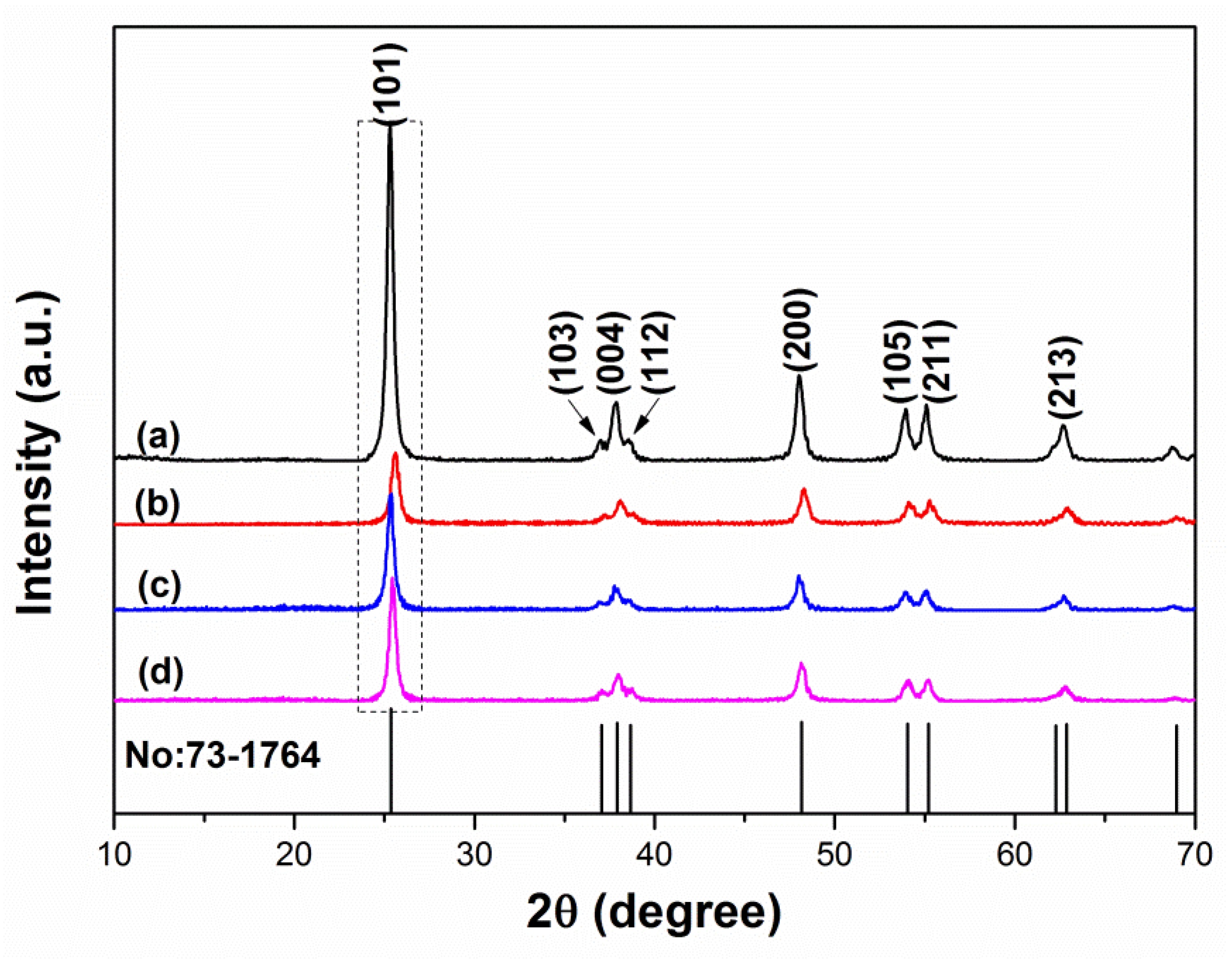
The crystal structure and phase purity of the original hollow submicron TiO2 microspheres and the delaminated THS/WS2 composites with different W/Ti molar ratios were analyzed by XRD test methods (Figure 3), with the standard XRD spectrum of TiO2 in the anatase phase as a comparison. It shows that the diffraction peaks of both pure THS and delaminated THS/WS2 composites with different W/Ti molar ratios are consistent with the standard spectrum of anatase TiO2 (JCP DS NO: 73-1764) [21]. Moreover, there are no other diffraction peaks, indicating that the fabricated THS samples are of high purity, and TiO2 as substrate material did not undergo any phase transformation after bonding with WS2. Interestingly, the intensity of the diffraction peaks corresponding to the (101) plane was reduced to different degrees in the delaminated THS/WS2 composites compared to pure THS. Moreover, the larger the molar ratio of W/Ti, the weaker the intensity. The intensity changes of the specific peaks are shown in Table 1. The reason for this change may be caused by the different layers of WS2 coating on the THS surface. The higher the WS2 content, the more layers there are on the THS surface, and the more the intensity of the diffraction light incident on the (101) plane is reduced, and the signal of the diffraction peak detected by the detector is also weakened. The same situation is also found for MoS2@TiO2 [14,40].

2.3. Raman Analysis

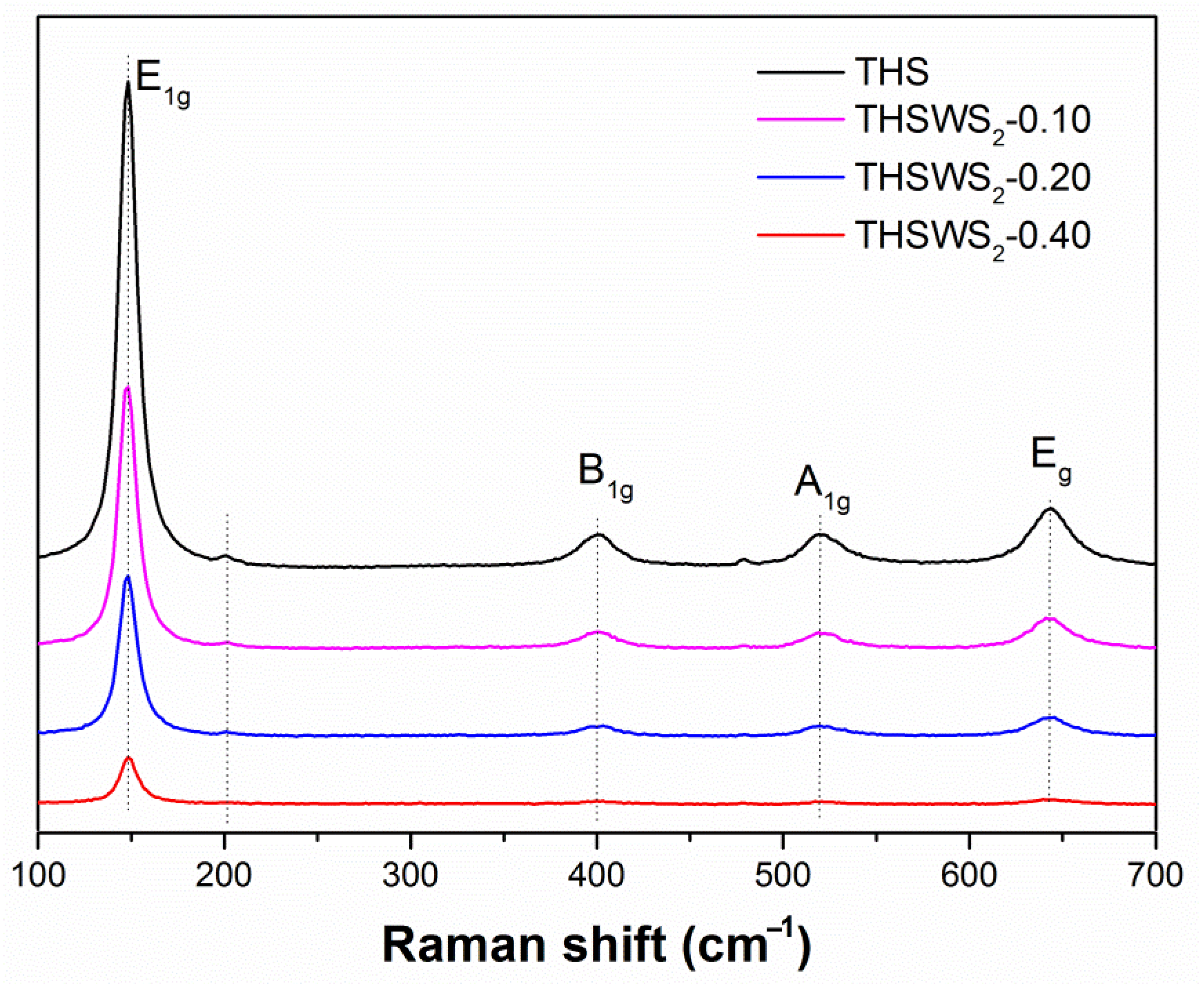
Raman analysis of THS and THS/WS2 delaminated composite nanomaterials is shown in Figure 4. Four peaks are visible in the THS-only sample, confirming the existence of anatase TiO2. After coupling with WS2 to form the composite material, the four peaks are still present. However, it can be seen that the intensity of the peaks becomes weaker as the W/Ti molar ratio increases. In particular, in the THS/WS2-0.40 sample, the three peaks B1g, A1g, and Eg of THS quickly weaken and disappear. Therefore, it can be inferred that WS2 was successfully introduced into the hollow submicron microspheres of TiO2 to form a heterojunction structure.

2.4. XPS Analysis

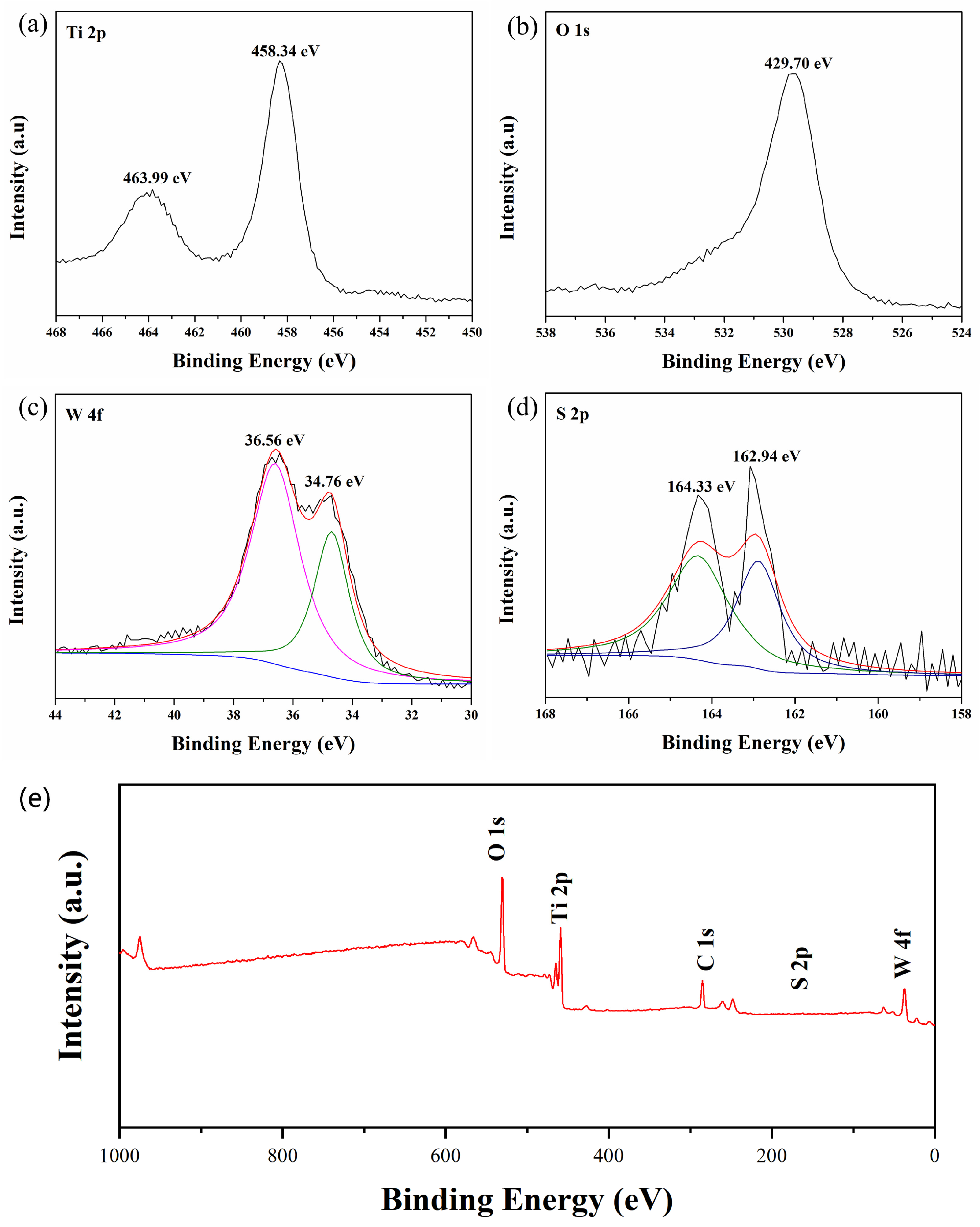
To clarify the chemical composition and energy distribution of the THS/WS2-0.20 surface, we performed XPS analysis. The results are shown in Figure 5. Figure 5e shows the full survey spectrum of THS/WS2-0.20, which demonstrates the presence of Ti, W, S, and O elements. Figure 5a is the Ti 2p diagram of THS/WS2-0.20. The binding energies at 463.99 and 458.34 eV are attributed to Ti 2p1/2 and Ti 2p3/2, respectively, and the distance between them is 5.65 eV, which is a typical feature of Ti+4 and indicates that the Ti element in the sample is in the form of +4. As can be seen in Figure 5b, the binding energy of the O element in the sample exhibits only one peak and is attributed to the O-2 valence. Figure 5c shows the fitting results of W 4f peak splitting, with peaks at 36.56 and 34.76 eV attributed to W 5p3/2 and W 4f5/2, respectively, indicating the presence of W+4. Figure 5d shows the fitting results of S 2p peak splitting with peaks at 162.94 and 164.33 eV assigned to S 2p3/2 and S 2p1/2, respectively, indicating the presence of S-2. Therefore, WS2 and TiO2 exist in the THS/WS2-0.20 sample, i.e., WS2 was successfully combined with hollow TiO2 microspheres to form a heterojunction structure.

2.5. FT-IR Analysis

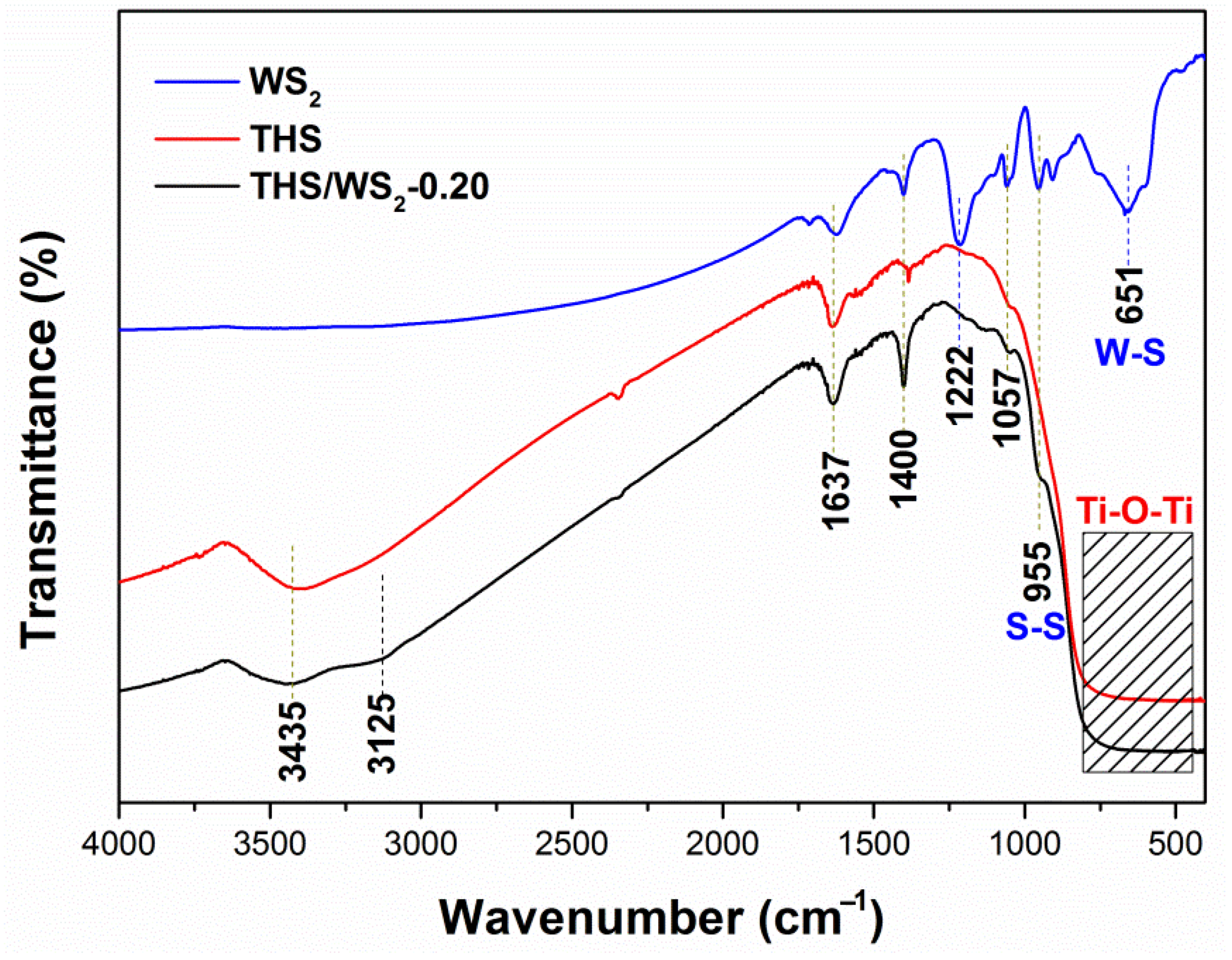
The FT-IR of the THS/WS2 composite is shown in Figure 6. For the WS2-only sample, in addition to the typical stretching vibration peaks of the W-S bond and the S-S bond at 651 cm−1 and 955 cm−1, there is also a sharp peak at 1222 cm−1, which could be the vibration peak of the S-S bond. This conclusion was also described in the article by Chan Byon on the immobilization of CdS in a WS2 mixture (CdS-WS2). In pure THS, a large broad peak is observed in the range 40 cm−1, which is the characteristic peak of the stretching vibration of the Ti-O-Ti bond [41]. In the THS/WS2-0.20 heterojunction composite, the respective characteristic peaks of WS2 and TiO2 can still be seen, demonstrating the successful preparation of the THS/WS2 heterojunction composite. However, it is very interesting to note that in addition to the characteristic peaks of the free -OH groups at 3435 cm−1 and 1637 cm−1, a new characteristic peak appears at 3125 cm−1, which is one of the pieces of evidence of the bonding between WS2 and TiO2. This chemical bonding makes the bond between WS2 and TiO2 more stable and can help to improve the transmission of electron-hole separation generated by the light, so it has better photocatalytic activity.

2.6. BET Analysis

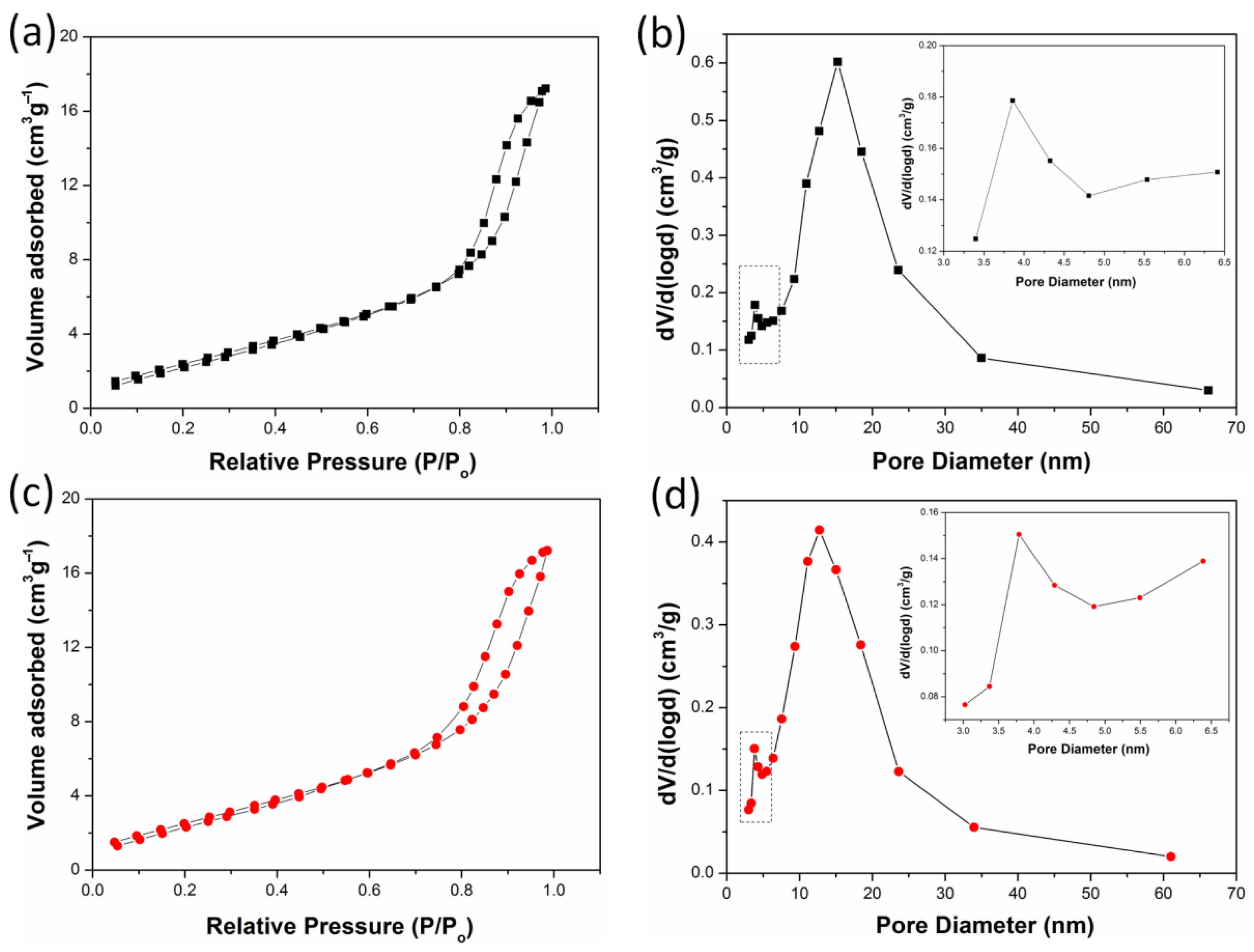
The N2 adsorption/desorption curves in Figure 7a,c are used to characterize the specific surface area and pore structure parameters of TiO2 hollow microspheres before and after WS2 coating. It can be seen that: (1) the shape of adsorption/desorption isotherm of TiO2 hollow microspheres before and after coating did not change, indicating that WS2 coating did not destroy the morphology of TiO2 hollow microspheres. Similar conclusions were drawn in SEM and TEM. (2) Both belong to the V-type adsorption/desorption isotherm, and the hysteresis loop is of H1 type, with micropores in the surface samples.
Table 2 shows their specific surface area and pore structure parameters. Compared with the TiO2 hollow microspheres, the specific surface area of THS/WS2-0.20 decreased from 99.6 m2/g to 76.1 m2/g because the thickness of the TiO2 hollow microspheres increased due to the coating of WS2 on the inside and outside of the TiO2 hollow microspheres, which resulted in a reduction of the internal void space, thus relatively reducing the specific surface area. According to the BJH method, the pore size distribution of each sample can be calculated based on the branch of the nitrogen desorption curve of the sample. As shown in Figure 7b,d, the pore structure did not change before or after coating, and there were two peaks in the pore size distribution, the first at 3.05 nm and 3.04 nm, and the second at 15.10 nm and 12.65 nm, respectively. Therefore, we can draw the following conclusions: WS2 coating does not change the surface micropore structure, which is due to the large size of the WS2 delamination structure, but WS2 coating increases the thickness of the shell layer of the TiO2 hollow microspheres, which can be verified by the second peak in the pore size distribution. Although the surface is rougher, the specific surface area of THS/WS2-0.20 is decreased by the coating of the inner and outer voids. Combined with the analysis of photocatalytic degradation of RhB by THS/WS2 and THS, although the specific surface area of THS/WS2 is lower than that of THS, it exhibits higher photocatalytic activity, demonstrating the importance of forming the THS/WS2 heterojunction in enhancing the photocatalytic performance of the material.

2.7. Optical Performance Analysis

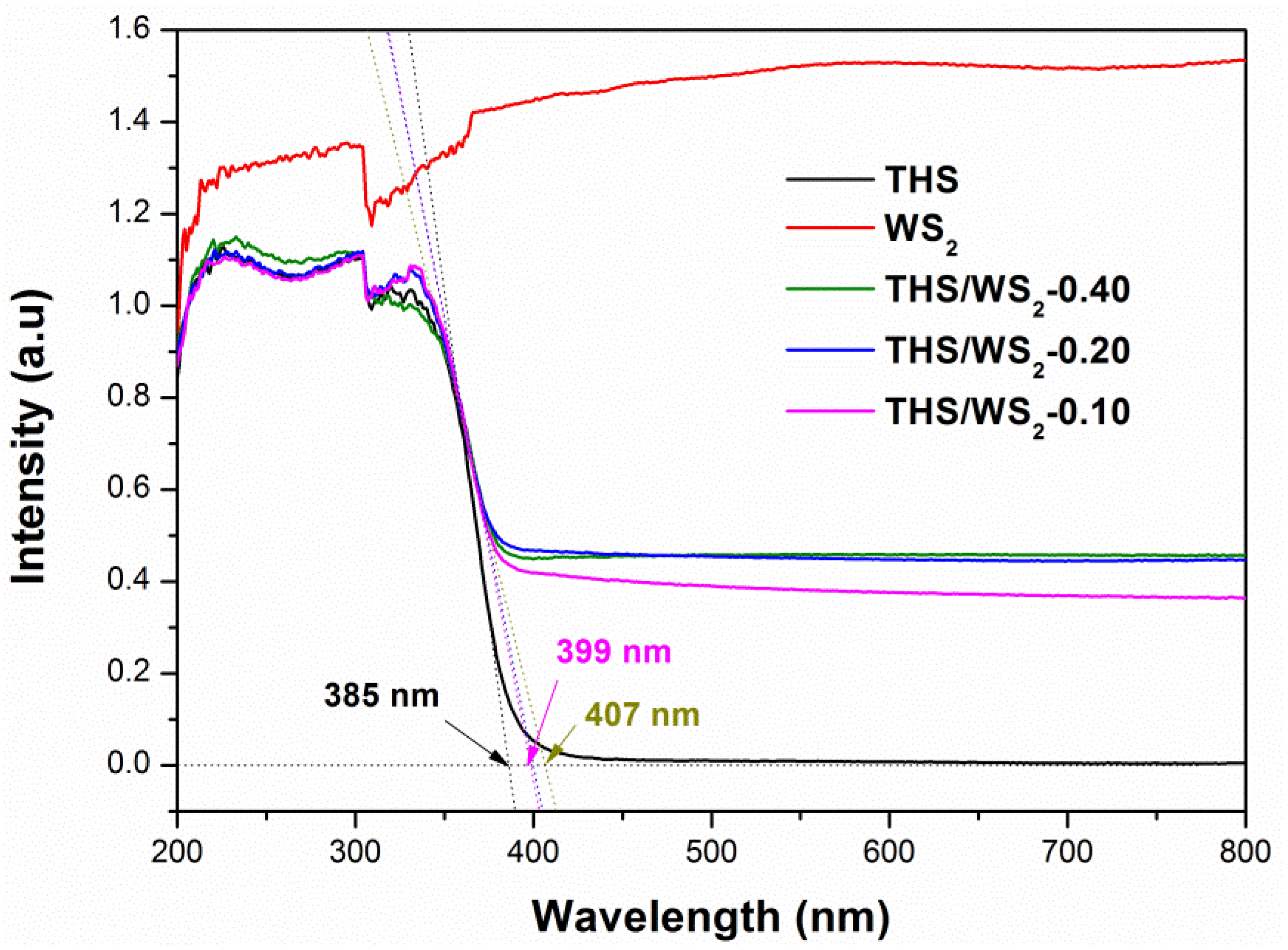
To analyze the light absorption performance of the samples, we also investigated THS and THS/WS2 delaminated composites with different TiO2/WS2 ratios using UV-Vis absorption spectra with diffuse reflection. As shown in Figure 8, the absorption edge of pure THS is at 385 nm. After WS2 coating, the absorption edge of THS/WS2-delaminated composites tends to be red-shifted, but the shift amplitude is very small, and the light absorption in the visible region between 400 nm and 800 nm is enhanced.
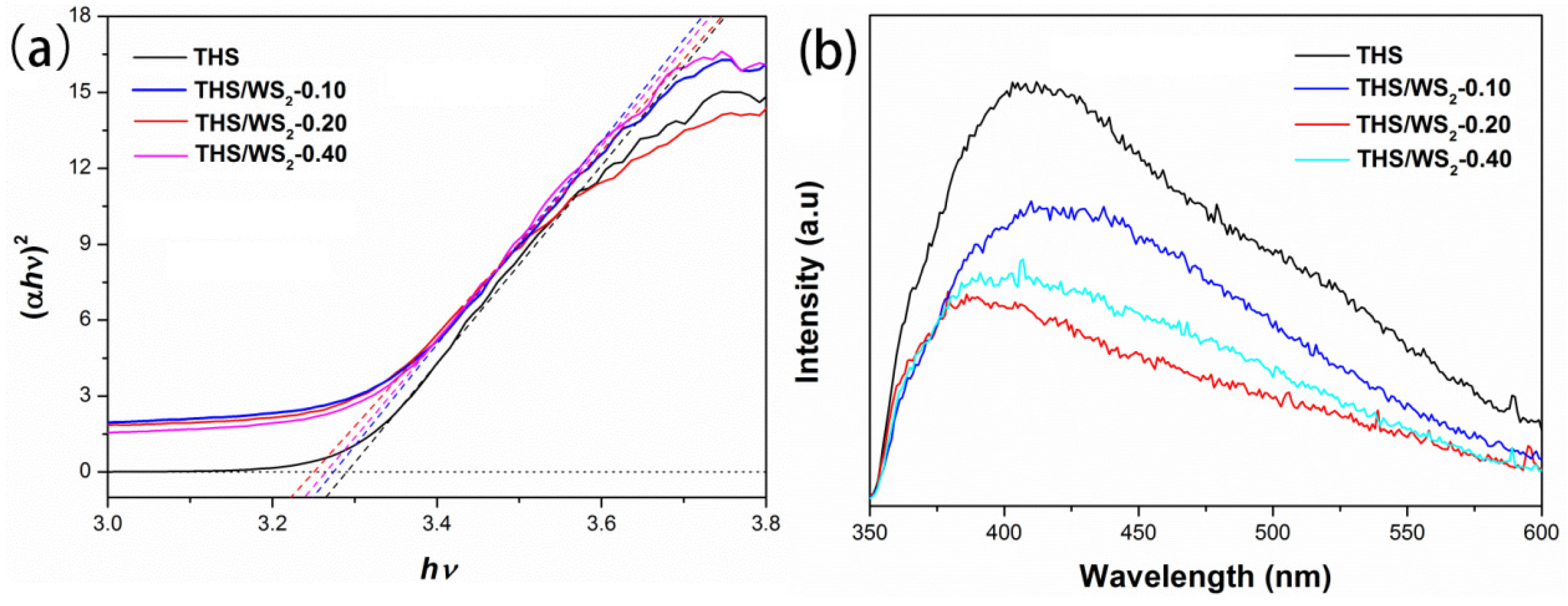
Figure 9a is a plot showing the calculated band gap results of THS and THS/WS2 delaminated composites. As can be seen from the figure, the band gap of the THS/WS2 delaminated composites is reduced compared to THS, but the range of reduction is very small, in the range of 0.1 eV, and the differences between the THS/WS2 delaminated composites with different W/Ti ratios are also very small. To determine whether the addition of WS2 promotes the photoinduced electron-hole separation effect of the sample, the PL spectra of THS and THS/WS2 delaminated composites were analyzed, and the results are shown in Figure 9b. The results are shown in Figure 9b. It can be seen that the quantum yield of the delaminated THS/WS2 composites is lower than that of pure THS, indicating that the introduction of WS2 promotes the efficiency of photogenerated electron-hole separation in the heterojunction. In particular, the THS/WS2-0.20 sample has the lowest peak intensity, i.e., it has the highest photogenerated electron-hole separation efficiency and better photocatalytic activity.

2.8. Analysis of Photocatalytic Degradation of RhB by THS/WS2

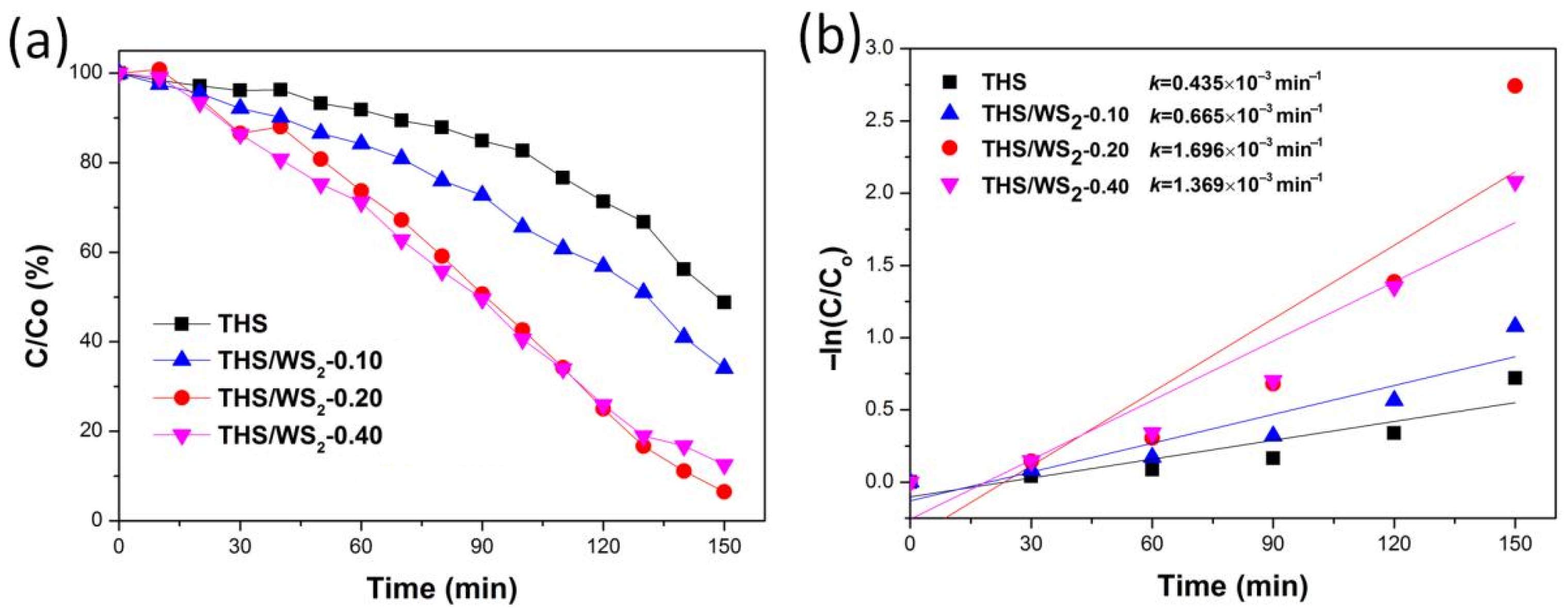
Figure 10a shows the experimental results of visible light degradation of RhB solution by THS alone and by THS/WS2 delaminated composites. After RhB reaches adsorption equilibrium in the dark environment, the degradation efficiency of RhB by THS alone is only 51.2% after 150 min of illumination. In contrast, the degradation efficiency of THS/WS2 delaminated composites is higher than that of THS, which shows that the growth of WS2 on the inner and outer surfaces of TiO2 hollow microspheres enhances the photocatalytic activity. Among the laminated THS/WS2 composites with different molar ratios of W/Ti, THS/WS2-0.20 exhibits the highest degradation efficiency of RhB. After 150 min of visible light irradiation, 93.6% of RhB is degraded. After sufficient degradation time, RhB can ultimately be degraded into H2O, CO2, and NO3, and the degradation products of RhB have been discussed in detail in previous studies [42].
To quantitatively analyze the differences in the photocatalytic ability of pure THS and THS/WS2 heterojunctions composites, we fitted them using the first-order dynamic equation, and the result is shown in Figure 10b. From Figure 10b, the photocatalytic activity of the materials is observed in the order of THS/WS2-0.20 > THS/WS2-0.40 > THS/WS2-0.10 > THS. The photocatalytic activity of THS/WS2-0.20 is 3.9 times higher than that of THS alone.

2.9. Analysis of the Mechanism of Photocatalytic Degradation of RhB by THS/WS2

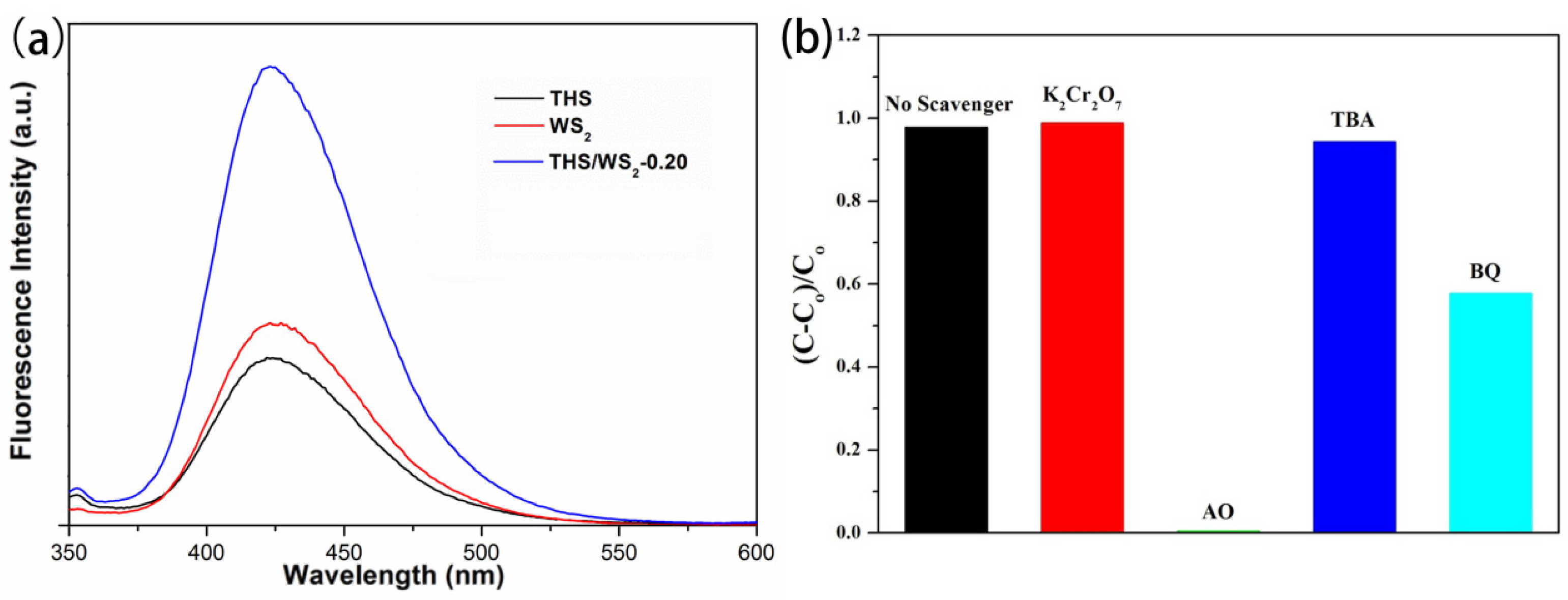
Compared to TiO2, WS2 can easily absorb the energy of visible or even near-infrared photons and then form photoinduced charge carriers on its surface. The specific yield of induced charge carriers can be measured using terephthalic acid (TA) as a tracer molecule and determined by PL technology. Unlike photocatalytic reactions such as hydrogen production by hydrolysis, the formation of TAOH with fluorescence effect does not require specific active sites. Therefore, the PL density of TAOH can be expressed as the efficiency of carrier deposition. As shown in Figure 11a, the PL analysis of THS/WS2 heterojunction was performed with different W/Ti ratios, and the PL density of TAOH was compared when the light was irradiated for 60 min. It is found that the PL density decreases on the order of THS/WS2-0.20 > WS2 > THS, so the THS/WS2 heterojunction has a stronger photoinduced charge separation efficiency than that of pure WS2 or TiO2.
In order to explore the main active species involved in the degradation process and to present the possible mechanism of photochemical degradation, we used different radical trapping agents, respectively, to study the free radicals that may play an important role in the photocatalytic process. Based on previous studies [2,4,16], electron (e), hole (h+), hydroxyl radical (·OH), and superoxide radical (O2) are generally considered the main active substances for degrading dyes in TiO2-based catalysts. In the experiment, potassium dichromate (K2Cr2O7) was used as electron trapping agent, ammonium oxalate (AO) as hole trapping agent, tert-butyl alcohol (TBA) as hydroxyl radical trapping agent, and p-benzoquinone (BQ) as superoxide radical trapping agent. The experimental results are shown in Figure 11b. The photocatalytic efficiency of THS/WS2-0.20 in degrading RhB is highest when no radical trapping agent is added. When AO was added to destroy the holes generated during the photocatalytic process, almost no degradation of RhB occurred, which suggests that holes play an important role in the photocatalytic reaction of THS/WS2-0.20 for RhB degradation. In contrast, after addition of K2Cr2O7 to remove the electrons, the reduction in photocatalytic activity can be neglected, which indicates the role of electrons in the degradation process of RhB is negligible. In addition, the roles of ·OH and O2 in the photocatalytic reaction with TBA and BQ were also investigated. It was found that the photocatalytic activity was only slightly reduced when ·OH were captured, whereas the photocatalytic activity was reduced by half when O2 were captured.
These results indicate that: (1) the holes act directly on RhB to achieve its degradation, rather than through the h+ + H2O → H+ + ·OH pathway. This is because the role of h+ in the photocatalytic degradation of RhB is much greater than that of·OH, and the contribution of ·OH to RhB degradation is very small. (2) the free O2 radical plays a secondary role in this photocatalytic degradation process, as only half of the RhB can be degraded when O2 are captured, which should be attributed to the action of h+ and ·OH (h+ greater than·OH). Thus, the following conclusion can be inferred: during the degradation of RhB by the THS/WS2 heterojunction, photo-generated h+ directly participate in the degradation of RhB, while the generated photogenerated electrons react with O2 to form O2, which are then utilized for the degradation of RhB. The h+ and O2 were the main active species in the reaction process, and h+ playing a dominant role in RhB degradation under visible-light irradiation.

2.10. Band Structure Analysis

The progress of photocatalytic reactions is determined by the position of the photocatalyst’s energy bands and the redox potentials of the adsorbed substances. And the band edge positions (conduction band, CB, and valence band, VB) of both TiO2 and WS2 could be calculated with the standard electronegativity approach [43]. From previous studies, the band gaps of TiO2 [10,23,28] and WS2 [44,45] are approximately 3.20 and 1.35 eV, respectively.
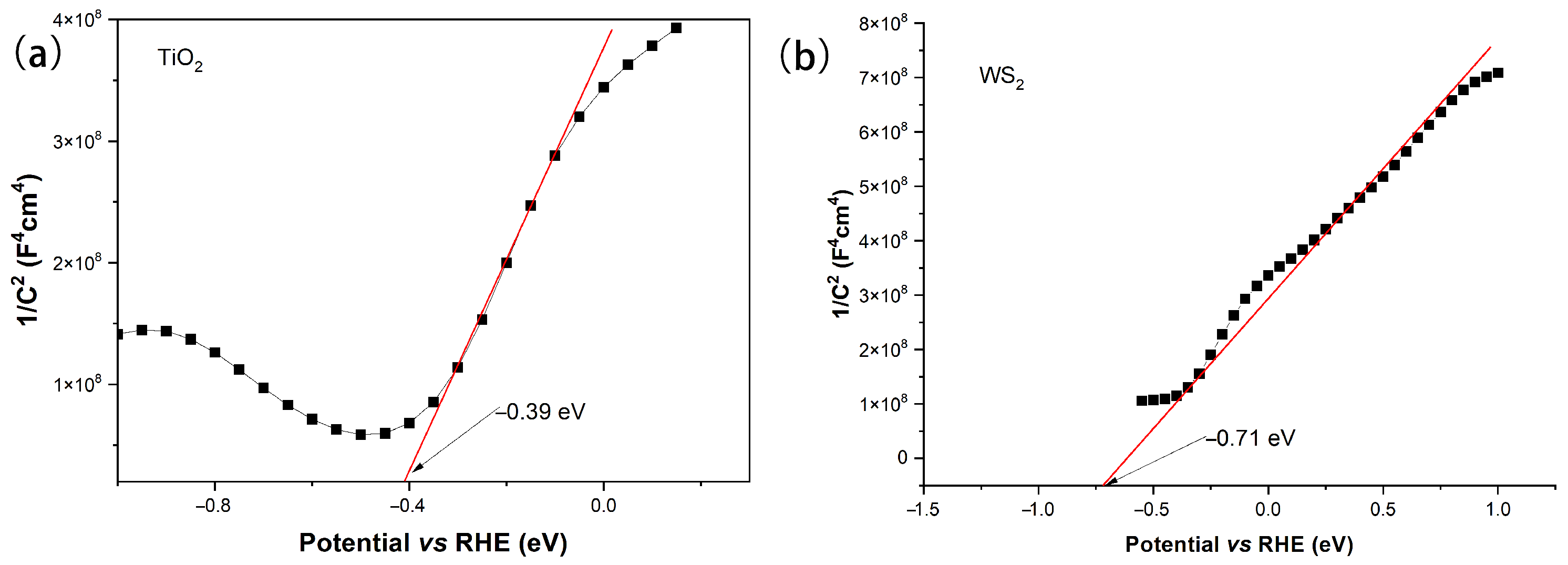
The Mott-Schottky curves of TiO2 and WS2 are shown in Figure 12. In Figure 12, the intercept where the linear range intersects the X-axis is the numerical value of conduction band (CB) for TiO2 and WS2. After calculation, the CB of TiO2 and WS2 are determined to be −0.39 and −0.71 eV, respectively. Therefore, according to the empirical formula EVB = ECB + Eg, the valence band (VB) of TiO2 and WS2 are calculated to be 2.81 and 0.64 eV, respectively. Thus, type-II band alignment is produced at the interface of the THS/WS2 heterojunctions, which is beneficial for the separation of electron-hole pairs.

3. Experimental

3.1. Preparation of THS/WS2 Composites

3.1.1. Preparation of TiO2 Hollow Submicrospheres

TiO2 Hollow Submicrospheres (THS) were prepared by the bubble template-solvothermal method [46]. After extensive experimental exploration, the optimal synthesis conditions for THS are as follows: First, 0.13 mol oxalic acid and 66 mL isopropanol were weighed and dissolved in isopropanol; second, 2.33 mmol of tetrabutyl titanate was added dropwise to the above mixture at an acceleration rate of 1 drop/second; After the solution was well mixed, it was transferred to a steel autoclave with a 100 mL PTFE liner and reacted at 180 °C for 6 h; After the reaction, the product was washed with ethanol and deionized water, dried and centrifuged to obtain a white precipitate; Finally, the white powder was put into a muffle furnace and calcined at 500 °C for 3 h to improve its crystallinity before use.

3.1.2. Preparation of THS/WS2 Delaminated Composites

After the preparation of THS, delaminated THS/WS2 composites were prepared based on this. First, 2.5 mmol of Na2WO4-2H2O was accurately weighed and added to 140 mL of deionized water and stirred to form a homogeneous, transparent solution; the pH of the solution was adjusted to 3 with addition of 2 M HCl, then 7.5 mmol of L- cysteine was added, and the solution was clarified with constant stirring; then a certain stoichiometric amount of THS was added with stirring to form a uniform suspension, and then the suspension was transferred to a steel autoclave with a 100 mL PTFE liner and kept at 200 °C for 24 h; after the reaction, the product was washed with ethanol and deionized water and dried to give a black powdery precipitate. The experimental conditions for THS/WS2-0.40, THS/WS2-0.20, and THS/WS2-0.10 with different molar ratios of W/Ti are listed in Table 3.

3.2. Characterization

The X-ray diffraction (XRD) patterns were recorded using Bruker AXS D8 Focus X-ray diffractometer (Bremen, Germany) equipped with Cu Kα radiation. The 2θ range used in the measurement was from 10° to 70°. The X-ray photoelectron spectroscopy (XPS) of the samples was observed using a PerkinElmer PHI 1600 ESCA X-ray photoelectron spectroscope (Waltham, MA, USA) with a monochromatic Mg Kα radiation, and the binding energies were normalized to the C1s peak at 284.6 eV. Scanning electron microscopy images (SEM) and energy-dispersive X-ray analysis (EDS) were recorded on a Hitachi S-4800 instrument (Tokyo, Japan). Transmission electron microscopy (TEM) was performed with a JEM-2100F (JEOL, Tokyo, Japan). Raman spectra were gathered from confocal microscope-based Raman spectrometer (Renishaw InVia, Gloucestershire, UK) in an ambient air environment with an excitation laser line of 532 nm. The Brunauer-Emmett-Teller (BET) surface area and Barrett-Joyner-Halenda (BJH) pore-size distribution measurements were tested on a NOVA-2000 volumetric gas sorption instrument (Quantachrome, Boynton Beach, FL, USA). UV-Vis diffuse reflectance spectra (DRS) of the samples were obtained using a Shimadzu UV-2550 spectrophotometer (Kyoto, Japan) using BaSO4 as reference. Photoluminescence (PL) spectra were measured with a Fluorolog3 spectrofluorometer (Horiba Jobin Yvon, Edison, NJ, USA) with an excitation of 325 nm wavelength.

3.3. Photoreaction Procedures

Photocatalytic activities of the samples were evaluated by the photocatalytic degradation of RhB under visible light. Visible light was generated by using 300 W Xe lamp irradiation with a 400 nm cut-off filter to remove light of <400 nm. 20 mg ptotocatalyst was dispersed in 100 mL of Rh B aqueous solution (20 mg·L−1). Prior to irradiation, the above mixture was stirred for 60 min in the dark to establish RhB adsorption equilibrium on the samples. After illumination, 4 mL of the mixture was collected and then centrifuged at 12,000 rpm for 3 min. The supernatant was then analyzed using a PerkinElmer Lambda 35 UV-visible spectrometer (Waltham, MA, USA) at a wavelength of 553 nm. All experimental data in this manuscript are the average values of three parallel experiments.

4. Conclusions

In this work, we fabricated TiO2 hollow microspheres (THS) using the bubble template solvothermal method to realize the in situ growth of WS2 on their surfaces and constructed a kind of three-phase TiO2 hollow microspheres/WS2 (THS/WS2) heterostructure. This structure has higher light source utilization efficiency and stronger light-induced charge separation efficiency than pure WS2 or TiO2, with a 3.9-fold increase in photocatalytic activity. Moreover, this work also proves that photogenerated h+ is the main oxidation active substance, while O2 plays the second role in RhB-degradation process by THS/WS2 heterojunction, through radical annihilation experiments.

Author Contributions

Conceptualization, J.Z. (Jingyu Zhao) and J.M.; methodology, Y.W.; validation, X.L.; data curation, J.Z. (Jinghui Zhang); writing—original draft preparation, J.Z. (Jingyu Zhao); writing—review and editing, J.Z. (Jinghui Zhang). All authors have read and agreed to the published version of the manuscript.

Funding

This work was financially supported by the National Natural Science Foundation of China (No. 22466004).

Data Availability Statement

The original contributions presented in this study are included in the article. Further inquiries can be directed to the corresponding author.

Conflicts of Interest

Jingyu Zhao, Jinghui Zhang, Xin Li and Jing Ma were employed by China Nuclear Power Engineering Co., Ltd.; Yongchuan Wu was employed by East China University of Technology. The research was conducted in the absence of any commercial or financial relationships that could be construed as a potential conflict of interest.

References

  1. Lee, Y.; Choi, J.H.; Jeon, H.J.; Choi, K.M.; Lee, J.W.; Kang, J.K. Titanium-embedded layered double hydroxides as highly efficient water oxidation photocatalysts under visible light. Energy Environ. Sci. 2011, 4, 914–920. [Google Scholar] [CrossRef]
  2. Wang, Q.; Huang, J.; Sun, H.; Zhang, K.-Q.; Lai, Y. Uniform carbon dots@TiO2 nanotube arrays with full spectrum wavelength light activation for efficient dye degradation and overall water splitting. Nanoscale 2017, 9, 16046–16058. [Google Scholar] [CrossRef] [PubMed]
  3. Quan, Q.; Xie, S.; Weng, B.; Wang, Y.; Xu, Y. Revealing the Double-Edged Sword Role of Graphene on Boosted Charge Transfer versus Active Site Control in TiO2 Nanotube Arrays@RGO/MoS2 Heterostructure. Small 2018, 14, 1704531. [Google Scholar] [CrossRef] [PubMed]
  4. Teng, W.; Wang, Y.; Huang, H.; Li, X.; Tang, Y. Enhanced photoelectrochemical performance of MoS2 nanobelts-loaded TiO2 nanotube arrays by photo-assisted electrodeposition. Appl. Surf. Sci. 2017, 425, 507–517. [Google Scholar] [CrossRef]
  5. Yu, J.; Yu, H.; Cheng, B.; Trapalis, C. Effects of calcination temperature on the microstructures and photocatalytic activity of titanate nanotubes. J. Mol. Catal. A-Chem. 2006, 249, 135–142. [Google Scholar] [CrossRef]
  6. Lu, D.; Fang, P.; Wu, W.; Ding, J.; Jiang, L.; Zhao, X.; Li, C.; Yang, M.; Li, Y.; Wang, D. Solvothermal-Assisted Synthesis for Self-Assembling TiO2 Nanorods on Large Graphitic Carbon Nitride Sheets with Their Anti-Recombination in Photocatalytic Removal of Cr (VI) and Rhodamin B Under Visible Light Irradiation. Nanoscale 2017, 9, 3231–3245. [Google Scholar] [CrossRef]
  7. David, S.; Mahadik, M.A.; Chung, H.S.; Ryu, J.H.; Jang, J.S. Facile Hydrothermally Synthesized a Novel CdS Nanoflower/Rutile-TiO2 Nanorod Heterojunction Photoanode Used for Photoelectrocatalytic Hydrogen Generation. ACS Sustain. Chem. Eng. 2017, 5, 7537–7548. [Google Scholar] [CrossRef]
  8. Li, Y.; Liu, Z.; Wu, Y.; Chen, J.; Zhao, J.; Jin, F.; Na, P. Carbon dots-TiO2 nanosheets composites for photoreduction of Cr (VI) under sunlight illumination: Favorable role of carbon dots. Appl. Catal. B Environ. 2018, 224, 508. [Google Scholar] [CrossRef]
  9. Zhang, J.; Zhang, L.; Shi, Y.; Xu, G.; Zhang, E.; Wang, H.; Kong, Z.; Xi, J.; Ji, Z. Anatase TiO2 nanosheets with coexposed {101} and {001} facets coupled with ultrathin SnS2 nanosheets as a face-to-face n-p-n dual heterojunction photocatalyst for enhancing photocatalytic activity. Appl. Surf. Sci. 2017, 420, 839–848. [Google Scholar] [CrossRef]
  10. Zhang, J.; Ma, X.; Zhang, L.; Lu, Z.; Zhang, E.; Wang, H.; Kong, Z.; Xi, J.; Ji, Z. Constructing a Novel n-p-n Dual Heterojunction between Anatase TiO2 Nanosheets with Coexposed {101}, {001} Facets and Porous ZnS for Enhancing Photocatalytic Activity. J. Phys. Chem. C 2017, 121, 6133–6140. [Google Scholar] [CrossRef]
  11. Chen, B.; Zhao, N.; Guo, L.; He, F.; Shi, C.; He, C.; Li, J.; Liu, E. Facile synthesis of 3D few-layered MoS2 coated TiO2 nanosheet core-shell nanostructures for stable and high-performance lithium-ion batteries. Nanoscale 2015, 7, 12895–12905. [Google Scholar] [CrossRef]
  12. Shi, H.; Zhang, S.; Zhu, X.; Liu, Y.; Wang, T.; Jiang, T.; Zhang, G.; Duan, H. Uniform Gold-Nanoparticle-Decorated {001}-Faceted Anatase TiO2 Nanosheets for Enhanced Solar-Light Photocatalytic Reactions. ACS Appl. Mater. Inter. 2017, 9, 36907–36916. [Google Scholar] [CrossRef]
  13. Jiang, Q.; Li, L.; Bi, J.; Liang, S.; Liu, M. Design and Synthesis of TiO2 Hollow Spheres with Spatially Separated Dual Cocatalysts for Efficient Photocatalytic Hydrogen Production. Nanomaterials 2017, 7, 24. [Google Scholar] [CrossRef] [PubMed]
  14. Wang, J.; Wei, B.; Xu, L.; Gao, H.; Sun, W.; Che, J. Multilayered MoS2 coated TiO2 hollow spheres for efficient photodegradation of phenol under visible light irradiation. Mater. Lett. 2016, 179, 42–46. [Google Scholar] [CrossRef]
  15. Yan, L.; He, X.; Wang, Y.; Li, J.; Wang, D. Template-free solvothermal synthesis and photocatalytic properties of TiO2 hollow spheres. J. Mater. Sci. Mater. Electron. 2016, 27, 4068–4073. [Google Scholar] [CrossRef]
  16. Jiang, Y.; Peng, Z.; Zhang, S.; Li, F.; Liu, Z.; Zhang, J.; Liu, Y.; Wang, K. Facile in-situ Solvothermal Method to synthesize double shell ZnIn2S4 nanosheets/TiO2 hollow nanosphere with enhanced photocatalytic activities. Ceram. Int. 2018, 44, 6115–6126. [Google Scholar] [CrossRef]
  17. Guo, N.; Zeng, Y.; Li, H.; Xu, X.; Yu, H. MoS2 nanosheets encapsulating TiO2 hollow spheres with enhanced photocatalytic activity for nitrophenol reduction. Mater. Lett. 2017, 209, 417–420. [Google Scholar] [CrossRef]
  18. Xie, L.; Liu, P.; Zheng, Z.; Weng, S.; Huang, J. Morphology engineering of V2O5/TiO2 nanocomposites with enhanced visible light-driven photofunctions for arsenic removal. Appl. Catal. B-Environ. 2016, 184, 347–354. [Google Scholar] [CrossRef]
  19. Kang, S.; Yin, D.; Li, X.; Li, L.; Mu, J. One-pot template-free preparation of mesoporous TiO2 hollow spheres and their photocatalytic activity. Mater. Res. Bull. 2012, 47, 3065–3069. [Google Scholar] [CrossRef]
  20. Song, C.; Yu, W.; Zhao, B.; Zhang, H.; Tang, C.; Sun, K.; Wu, X.; Dong, L.; Chen, Y. Efficient fabrication and photocatalytic properties of TiO2 hollow spheres. Catal. Commun. 2009, 10, 650–654. [Google Scholar] [CrossRef]
  21. Shang, S.; Jiao, X.; Chen, D. Template-free fabrication of TiO2 hollow spheres and their photocatalytic properties. ACS Appl. Mater. Interfaces 2012, 4, 860–865. [Google Scholar] [CrossRef] [PubMed]
  22. Zhang, Q.; Li, W.; Liu, S. Controlled fabrication of nanosized TiO2 hollow sphere particles via acid catalytic hydrolysishydrothermal treatment. Powder Technol. 2011, 212, 145–150. [Google Scholar] [CrossRef]
  23. Zalfani, M.; Hu, Z.; Yu, W.-B.; Mahdouani, M.; Bourguiga, R.; Wu, M.; Li, Y.; Van Tendeloo, G.; Djaoued, Y.; Su, B.-L. BiVO4/3DOM TiO2 nanocomposites: Effect of BiVO4 as highly efficient visible light sensitizer for highly improved visible light photocatalytic activity in the degradation of dye pollutants. Appl. Catal. B-Environ. 2017, 205, 121–132. [Google Scholar] [CrossRef]
  24. Lamdab, U.; Wetchakun, K.; Phanichphant, S.; Kangwansupamonkon, W.; Wetchakun, N. InVO4-BiVO4 composite films with enhanced visible light performance for photodegradation of methylene blue. Catal. Today 2016, 278, 291–302. [Google Scholar] [CrossRef]
  25. Wang, J.; Jin, J.; Wang, X.; Yang, S.; Zhao, Y.; Wu, Y.; Dong, S.; Sun, J.; Sun, J. Facile fabrication of novel BiVO4/Bi2S3/MoS2 n-p heterojunction with enhanced photocatalytic activities towards pollutant degradation under natural sunlight. J. Colloid Interface Sci. 2017, 505, 805–815. [Google Scholar] [CrossRef]
  26. Chen, F.; Yang, Q.; Wang, Y.; Zhao, J.; Wang, D.; Li, X.; Guo, Z.; Wang, H.; Deng, Y.; Niu, C.; et al. Novel ternary heterojunction photcocatalyst of Ag nanoparticles and g-C3N4 nanosheets co-modified BiVO4 for wider spectrum visible-light photocatalytic degradation of refractory pollutant. Appl. Catal. B-Environ. 2017, 205, 133–147. [Google Scholar] [CrossRef]
  27. Zhang, J.; Lu, Y.; Ge, L.; Han, C.; Li, Y.; Gao, Y.; Li, S.; Xu, H. Novel AuPd bimetallic alloy decorated 2D BiVO4 nanosheets with enhanced photocatalytic performance under visible light irradiation. Appl. Catal. B-Environ. 2017, 204, 385–393. [Google Scholar] [CrossRef]
  28. Zhang, J.; Zhang, L.; Yu, W.; Jiang, F.; Zhang, E.; Wang, H.; Kong, Z.; Xi, J.; Ji, Z. Novel dual heterojunction between MoS2 and anatase TiO2 with coexposed {101} and {001} facets. J. Am. Ceram. Soc. 2017, 100, 5274–5285. [Google Scholar] [CrossRef]
  29. Saha, A.; Sinhamahapatra, A.; Kang, T.H.; Ghosh, S.C.; Yu, J.S.; Panda, A.B. Hydrogenated MoS2 QD-TiO2 heterojunction mediated efficient solar hydrogen production. Nanoscale 2017, 9, 17029–17036. [Google Scholar] [CrossRef]
  30. Li, H.; Wang, Y.; Chen, G.; Sang, Y.; Jiang, H.; He, J.; Xu, L.; Liu, H. Few-layered MoS2 nanosheets wrapped ultrafine TiO2 nanobelts with enhanced photocatalytic property. Nanoscale 2016, 8, 6101–6109. [Google Scholar] [CrossRef]
  31. Xu, X.; Fan, Z.; Ding, S.; Yu, D.; Du, Y. Fabrication of MoS2 nanosheet@TiO2 nanotube hybrid nanostructures for lithium storage. Nanoscale 2014, 6, 5245–5250. [Google Scholar] [CrossRef] [PubMed]
  32. Hu, X.; Zhao, H.; Tian, J.; Gao, J.; Li, Y.; Cui, H. Synthesis of few-layer MoS2 nanosheets-coated TiO2 nanosheets on graphite fibers for enhanced photocatalytic properties. Sol. Energy Mater. Sol. Cells 2017, 172, 108–116. [Google Scholar] [CrossRef]
  33. Cao, L.; Wang, R.; Wang, D.; Li, X.; Jia, H. MoS2-hybridized TiO2 nanosheets with exposed {001} facets to enhance the visible-light photocatalytic activity. Mater. Lett. 2015, 160, 286–290. [Google Scholar] [CrossRef]
  34. Zhang, J.; Huang, L.; Lu, Z.; Jin, Z.; Wang, X.; Xu, G.; Zhang, E.; Wang, H.; Kong, Z.; Xi, J.; et al. Crystal face regulating MoS2/TiO2(001) heterostructure for high photocatalytic activity. J. Alloys Compd. 2016, 688, 840–848. [Google Scholar] [CrossRef]
  35. Wu, Y.; Liu, Z.; Chen, J.-T.; Cai, X.-J.; Na, P. Hydrothermal fabrication of hyacinth flower-like WS2 nanorods and their photocatalytic properties. Mater. Lett. 2017, 189, 282–285. [Google Scholar] [CrossRef]
  36. Ghorai, A.; Bayan, S.; Gogurla, N.; Midya, A.; Ray, S.K. Highly Luminescent WS2 Quantum Dots/ZnO Heterojunctions for Light Emitting Devices. ACS Appl. Mater. Inter. 2016, 9, 558–565. [Google Scholar] [CrossRef]
  37. Bayat, A.; Saievar-Iranizad, E. Synthesis of blue photoluminescent WS2 quantum dots via ultrasonic cavitation. J. Lumin. 2017, 185, 236–240. [Google Scholar] [CrossRef]
  38. Raja, A.; Selig, M.; Berghauser, G.; Yu, J.; Hill, H.M.; Rigosi, A.F.; Brus, L.E.; Knorr, A.; Heinz, T.F.; Malic, E.; et al. Enhancement of exciton-phonon scattering from monolayer to bilayer WS2. Nano Lett. 2018, 8, 6135–6143. [Google Scholar] [CrossRef]
  39. Lukowski, M.A.; Daniel, A.S.; English, C.R.; Meng, F.; Forticaux, A.; Hamers, R.J.; Jin, S. Highly active hydrogen evolution catalysis from metallic WS2 nanosheets. Energy Environ. Sci. 2014, 7, 2608. [Google Scholar] [CrossRef]
  40. Yu, Y.; Wan, J.; Yang, Z.; Hu, Z. Preparation of the MoS2/TiO2/HMFs ternary composite hollow microfibres with enhanced photocatalytic performance under visible light. J. Colloid Interface Sci. 2017, 502, 100–111. [Google Scholar] [CrossRef] [PubMed]
  41. El-Sabban, H.; Mady, A.; Diab, M.A.; Al Zoubi, W.; Kang, J.H.; Ko, Y.G. Novel environmentally-friendly 0D/3D TiO2@FeMoO4 binary composite with boosted photocatalytic performance: Structural analysis and Z-scheme interpretations. J. Alloys Compd. 2025, 100, 177265. [Google Scholar] [CrossRef]
  42. Wu, Y.; Liu, Z.; Li, Y.; Chen, J.; Zhu, X.; Na, P. Construction of 2D-2D TiO2 nanosheet/layered WS2 heterojunctions with enhanced visible-light-responsive photocatalytic activity. Chin. J. Catal. 2019, 40, 60–69. [Google Scholar] [CrossRef]
  43. Borik, M.A.; Diab, M.; El-Sabban, H.A.; El-Adasy, A.-B.A.; El-Gaby, M.S. Designed construction of boosted visible-light Z-scheme TiO2/PANI/Cu2O heterojunction with elaborated photocatalytic degradation of organic dyes. Synth. Met. 2024, 306, 117642. [Google Scholar] [CrossRef]
  44. Yang, J.; Voiry, D.; Ahn, S.J.; Kang, D.; Kim, A.Y.; Chhowalla, M.; Shin, H.S. Two-Dimensional Hybrid Nanosheets of Tungsten Disulfide and Reduced Graphene Oxide as Catalysts for Enhanced Hydrogen Evolution. Angew. Chem. Int. Ed. 2013, 52, 13751–13754. [Google Scholar] [CrossRef] [PubMed]
  45. Eftekhari, A. Tungsten dichalcogenides (WS2, WSe2, and WTe2): Materials chemistry and applications. J. Mater. Chem. A 2017, 5, 18299–18325. [Google Scholar] [CrossRef]
  46. Wang, C.; Liao, J.; Zhao, Y.; Manthiram, A. Template-free TiO2 hollow submicrospheres embedded with SnO2 nanobeans as a versatile scattering layer for dye-sensitized solar cells. Chem. Commun. 2015, 51, 2848–2850. [Google Scholar] [CrossRef] [PubMed]
Figure 1. SEM image of pure THS (a,b), THS/WS2-0.20 (c,d).
Catalysts 16 00025 g001
Figure 2. The TEM image (a), HRTEM image (b,c) of THS/WS2-0.20, and the EDS spectrum of THS/WS2-0.20 (d).
Catalysts 16 00025 g002
Figure 3. XRD patterns of hollow submicrosphere TiO2 (a), THS/WS2-0.40 (b), THS/WS2-0.20 (c), THS/WS2-0.10 (d).
Catalysts 16 00025 g003
Figure 4. Raman spectra of pure THS and THS/WS2 hierarchical nanocomposites.
Catalysts 16 00025 g004
Figure 5. Ti 2p (a), O 1s (b), W 4f (c), S 2p (d), and full survey spectrum (e) for THS/WS2-0.20.
Catalysts 16 00025 g005
Figure 6. The FT-IR spectrum of WS2, THS, and THS/WS2-0.20.
Catalysts 16 00025 g006
Figure 7. N2 adsorption-desorption isotherms and corresponding pore diameter distribution curves of THS (a,b), THS/WS2-0.20 (c,d).
Catalysts 16 00025 g007
Figure 8. UV-vis diffuses reflectance spectra of as-prepared samples.
Catalysts 16 00025 g008
Figure 9. The (αhν)2 vs. hν (a) and PL spectra of THS and THS/WS2 heterjunctions (b).
Catalysts 16 00025 g009
Figure 10. Photocatalytic degradation of Rh B solution by as-prepared samples (a); the first-order kinetic model fits the degradation kinetic curves (b).
Catalysts 16 00025 g010
Figure 11. PL density of TAOH of THS/WS2-0.20, WS2, and THS (a); Effect of the addition of different scavengers (b).
Catalysts 16 00025 g011
Figure 12. Mott-Schottky curves of TiO2 (a) and WS2 (b).
Catalysts 16 00025 g012
Table 1. The diffraction peak intensity of plane (101) for as-prepared samples.
SamplesDiffraction Peak Intensity of Plane (101)
THS1846.32
THS/WS2-0.101270.12
THS/WS2-0.201267.29
THS/WS2-0.40765.62
Table 2. Textural property of TiO2 hollow microsphere and THS/WS2-0.20.
SamplesSpecific Surface Area (m2/g)Pore Volume (cm3/g)Pore Diameter (nm)
12
THS99.60.283.0515.10
THS/WS2-0.2076.10.213.0412.65
Table 3. Content of THS/WS2 hierarchical nanocomposites.
Samplesn (Na2WO4·2H2O)
/mmol
n (TiO2)
/mmol
W/Ti Moral
Ratio
Weight
/mg
W
wt%
THS/WS2-0.402.56.250.40572.8215.71
THS/WS2-0.202.512.500.201058.645.54
THS/WS2-0.102.525.000.102045.032.20
Disclaimer/Publisher’s Note: The statements, opinions and data contained in all publications are solely those of the individual author(s) and contributor(s) and not of MDPI and/or the editor(s). MDPI and/or the editor(s) disclaim responsibility for any injury to people or property resulting from any ideas, methods, instructions or products referred to in the content.