Article

Improving the Efficiency of Hydrogen Spillover by an Alkali Treatment Strategy for Boosting Formic Acid Dehydrogenation Performance


1
Beijing Key Laboratory for Green Catalysis and Separation, College of Materials Science and Engineering, Beijing University of Technology, Beijing 100124, China
2
School of Undergraduate Education, Metal Materials Engineering, Shougang Institute of Technology, Beijing 100041, China
3
Qing Yang Chemical Industry Corporation, Liaoyang 111001, China
*
Author to whom correspondence should be addressed.
Catalysts 2026, 16(1), 26; https://doi.org/10.3390/catal16010026 (registering DOI)
Submission received: 19 November 2025 / Revised: 24 December 2025 / Accepted: 25 December 2025 / Published: 29 December 2025
(This article belongs to the Section Catalysis for Sustainable Energy)

Abstract

Defect engineering has been demonstrated to be an attractive strategy to improve the catalytic performance of g−C3N4−based catalysts. Herein, three graphite carbon nitrides (labeled “CN”) containing a certain number of cyano groups and nitrogen vacancies are prepared successfully by calcination of the dicyandiamide−based CN in the presence of KOH, and the performances of the corresponding Pd−based catalysts are evaluated by using the formic acid (FA) dehydrogenation as a probe reaction. The characterizations of X−ray diffraction (XRD), scanning transmission electron microscopy (STEM), X−ray photoelectron spectra (XPS), hydrogen temperature−programmed desorption (H2−TPD), and hydrogen spillover experiments indicate that the high catalytic activity of Pd/CNK−0.5 is mainly attributed to its high efficient hydrogen spillover, relatively high dispersity of Pd species, and basicity due to the introduction of a proper amount of cyano groups and nitrogen vacancies. The low initial activity of Pd/CNK−0.75 may mainly be ascribed to its low hydrogen spillover ability and the strongly chemisorbed hydrogen on Pd single atoms or small clusters.

1. Introduction

With population surge and economic development, energy resources have been excessively consumed, which is causing increasing consumption of fossil fuels constantly, such as coal, petroleum, and natural gas [1,2]. Consequently, the development of green and sustainable renewable energy is of paramount necessity to reduce the utilization of and dependence on traditional fossil fuels [3,4]. Hydrogen is widely considered a promising clean energy carrier due to its abundance, renewability, and high energy efficiency [5]. Compared with physical hydrogen storage, which faces challenges such as high costs, low efficiency, and leakage risks, chemical hydrogen storage offers notable advantages, including lower storage costs, higher hydrogen density, and improved transportation safety [6,7]. Among various chemical hydrogen storage methods, liquid organic hydrogen carriers (LOHCs) stand out due to their compatibility with existing fuel infrastructure and their physical similarities to conventional fuels like gasoline and diesel [8,9]. As a candidate compound of LOHCs, formic acid (FA) has attracted considerable attention for its high stability and low toxicity, especially compared with other alternatives, such as hydrazine, ammonia, and methylcyclohexane [10,11,12].
Generally, the decomposition of FA proceeds in two pathways: dehydrogenation and dehydration [13,14]:
(1)
HCOOH → H2+ CO2, ∆G = −48.4 kJ·mol−1
(2)
HCOOH → H2O+ CO, ∆G = −28.5 kJ·mol−1
It is evident that the dehydrogenation pathway is the preferred route, as the dehydration pathway generates CO, which strongly adsorbs onto the active metal sites and leads to catalyst poisoning [15,16,17]. Consequently, the development of catalysts that exhibit both high activity and excellent selectivity toward the dehydrogenation of FA has become a central focus of current research. Over recent decades, both homogeneous and heterogeneous catalysts for efficient FA dehydrogenation have been extensively investigated [12,18,19]. As early as 1967, Coffey used transition metal complex catalysts with phosphine ligands for the decomposition of FA [20]. Although homogeneous catalysts exhibit extremely high catalytic activity, and with turnover frequency (TOF) being up to tens of thousands, their development and application are restricted by high costs, easy leaching of active components, and difficulties in separation and recovery. By contrast, heterogeneous catalysts can address these challenges, so conducting research on efficient heterogeneous catalysts has great significance for hydrogen production from FA [18,21,22]. Currently, heterogeneous catalysts based on transition metals and noble metals as active centers, such as Pt [23], Au [24,25], Ag [14], Co [26], and Pd [27,28], as well as their bimetallic and multi−metallic counterparts [29,30,31], have been widely studied and reported. Among these, supported Pd−based catalysts exhibit the highest catalytic activity. In particular, the activity of FA dehydrogenation is strongly correlated with the nature and type of catalyst supports. The main physicochemical properties of the carrier—including surface acidity/basicity, heteroatom doping, pore architecture, functional groups, and defect sites—exhibit profound impacts on catalytic performance [16,27,32,33]. To clarify the role of the metal/organic interface on FA dehydrogenation activity, Wang et al. grew NPs with an active component of CrPd on various supports, including 3−aminopropyltriethoxysilane (APTES)−functionalized monochlortriazinyl β−cyclodextrin (M−β−CD−A), carbon (C), TiO2, ZrO2, and other materials. Experimental results showed that M−β−CD−A−supported catalysts exhibited superior activity, in the following order: M−β−CD−A > C > TiO2 > ZrO2 > CeO2 [34]. Similarly, Li et al. synthesized nitrogen−doped carbon (N−MSC−30) using urea and a two−step calcination strategy. Pd nanoparticles with an average size of merely 1.4 nm were uniformly dispersed on the N−MSC support, yielding a Pd/N−MSC catalyst with excellent performance (TOF = 8414 h−1 at 60 °C) [35]. Moreover, alkaline conditions are favorable for hydrogen production from FA [36,37,38]. In many reported studies, sodium formate (HCOONa) has been introduced as an additive in FA solution [39]. On one hand, the presence of HCOO facilitates the dehydrogenation pathway for hydrogen generation. On the other hand, the alkalinity of HCOONa helps maintain the pH of the reaction system, stabilizes the reaction rate, and mitigates catalyst deactivation [40,41]. Luo et al. enhanced the alkalinity of the catalyst support by grafting −NH2 groups onto SBA−15, which promoted the cleavage of the O−H bond in FA and improved the reaction rate. Additionally, the strengthened metal−support interactions contributed to the formation of highly dispersed nanoparticles [42].
Graphitic carbon nitride (CN) has emerged as a highly researched catalyst support due to its unique advantages: abundant source materials, facile synthesis, physicochemical stability, abundant active sites, nitrogen−rich functional groups, etc. Despite these advantages, its practical applications are limited by drawbacks such as low specific surface area and chemically inert stacking, which hinder catalytic efficiency [43,44,45,46,47]. Currently, researchers have developed various optimization strategies to enhance its catalytic performance, including morphology regulation, oxygen/phosphorus elemental doping, defect engineering design, and functional group modification [48,49,50,51]. Among them, introducing defect structures or functional groups into the g−C3N4 skeleton represents a key pathway to enhancing catalytic performance. This strategy can significantly boost catalytic activity by regulating the electronic structure between the support surface and metal active components, strengthening the anchoring effect on metal active sites to improve their dispersion while optimizing the adsorption capacity for reaction substrates [52,53,54]. Modified carbon nitride materials mainly include structural defects and functional groups such as carbon vacancies [55], nitrogen vacancies [56], cyano groups (−C≡N) [57], hydroxyl groups (−OH) [58], and carboxyl groups (−COOH) [59], with each conferring unique catalytic advantages. Cyano−functionalized carbon nitride has received significant attention due to its strong electron−absorbing ability and electron storage function. Current literature reports several −C≡N incorporation methods, including molten salt synthesis, assisted thermal polymerization, self−assembly, and chemical etching [60].
Supported ultrafine metal nanoparticles have been demonstrated to be a promising heterogeneous catalyst for FA dehydrogenation due to their more available surface active atoms [35]. However, ultrafine metal nanoparticles are easy to aggregate during the reaction due to their high surface energies and/or weak interactions with the supports. Developing highly efficient and stable metal heterogeneous catalysts for catalytic hydrogen generation from FA is still highly desired. Herein, we report an effective approach to successfully introduce cyano groups and nitrogen vacancies into the structure of carbon nitride by a post−treatment with a strong base. By precisely tuning the content of cyano groups and nitrogen vacancies, we successfully prepared Pd/CNK−X catalysts, which exhibit high activity and stability as well as excellent selectivity for hydrogen.

2. Results and Discussion

2.1. Characterization of CN and CNK−X

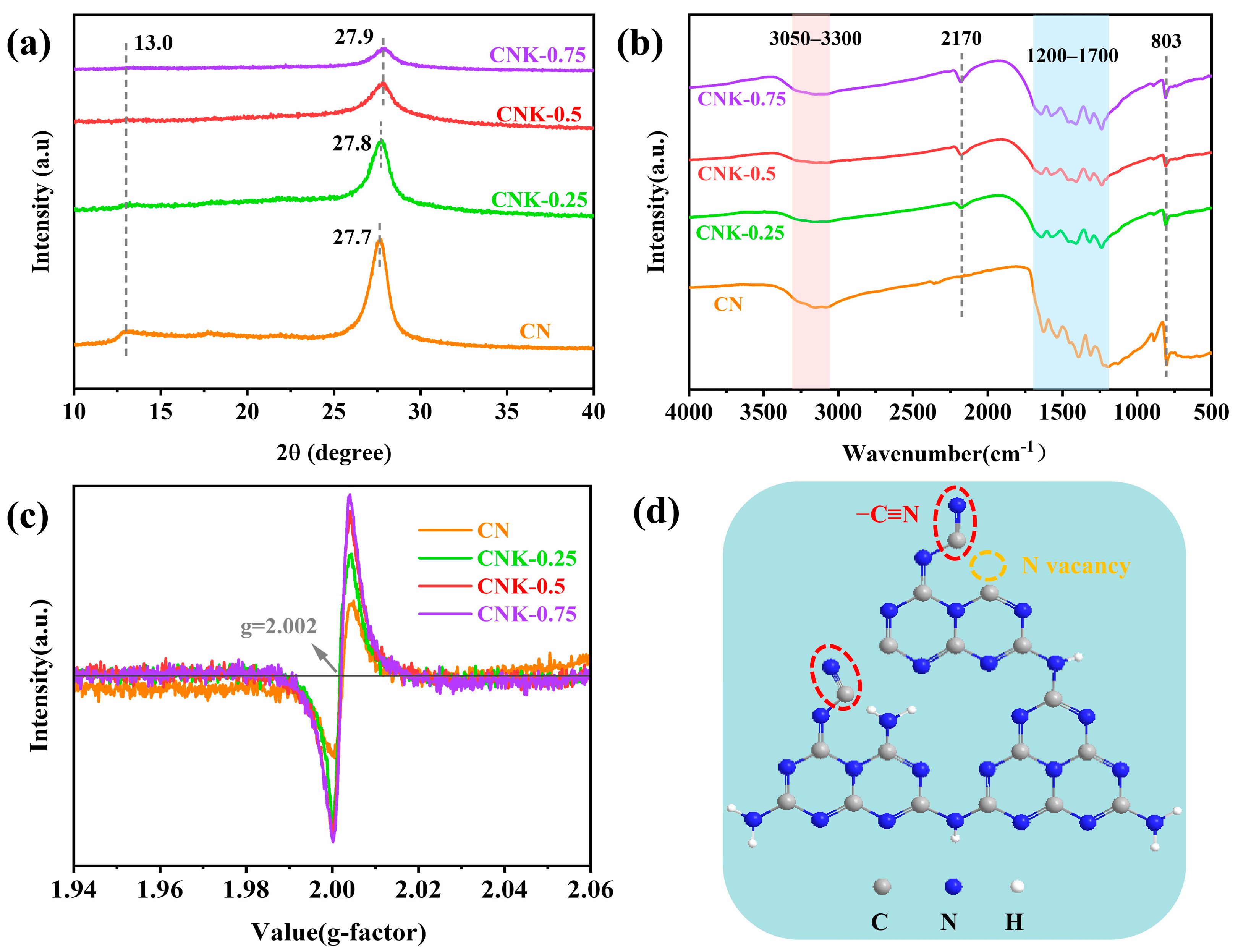
The surface microstructures of the CN and CNK−X supports were characterized by scanning electron microscopy (SEM) (Figure S1). All samples exhibit similar irregularly stacked sheet−like morphologies, with only slight etching traces observed on the surface of the CNK−X samples, indicating that KOH treatment does not significantly alter the overall morphology of CN. Nitrogen adsorption−desorption isotherms reveal typical type II curves accompanied by H3 hysteresis loops, indicating that there are stacked mesopores within the samples (Figure S2). As summarized in Table S1, with increasing amounts of KOH, the specific surface area of the supports decreases from 13 m2/g for CN to 8 m2/g for CNK−0.75; meanwhile, the average pore size increases from 16 nm to 28 nm, revealing that the etching effect of KOH results in obvious changes in the pore structure of CN. The XRD patterns display the crystal structures of pristine CN and CNK−X samples (Figure 1a). The peaks at around 13.0° and 27.7° are attributed to the (100) diffraction plane of in−plane structural packing motifs of heptazine units in the carbon nitride structure, and the characteristic interlayer spacing diffraction peak (002) of CN aromatic units, respectively [61]. With the increasing addition of KOH, the peak intensity decrease gradually, indicating the degradation of the long−range ordering of the in−plane structure. Meanwhile, the (002) diffraction signal shifts gradually from 27.7° to 27.9°, revealing the narrowing of the interlayer stacking distance. The chemical structures of CN and CNK−X are also supported by the Fourier transform infrared spectra (FT−IR) (Figure 1b). The sharp peak at 803 cm−1 is attributed to the typical vibration mode of tris−triazine units, and the broad band in the region of 1200 cm−1 to 1700 cm−1 and the band at around 3050–3300 cm−1 are assigned to the typical stretching vibration of heptazine rings and −NHx or absorbed H2O [62], respectively. The intensity of the peak at 803 cm−1 for CNK−X decreases gradually, further showing that the chemical structure of CN changes with the KOH treatment. It is worth noting that a new peak at 2170 cm−1 appears in the samples of CNK−0.25, CNK−0.5, and CNK−0.75 and strengthens in the same order, indicating the formation of cyano groups (−C≡N) within the CN skeleton.
An obvious electron paramagnetic resonance (EPR) signal centered at g = 2.002 shows the existence of unpaired electrons on paramagnetic aromatic carbon atoms (Figure 1c), which may result from the induction of defect sites [63]. The gradual increase in the C/N ratio for CN, CNK−0.25, CNK−0.5, and CNK−0.75 validates the formation of more nitrogen vacancies in the CNK−X samples (Table S2). Admittedly, the increase in the unpaired electron concentration may also be attributed to the incorporation of cyano groups, which effectively induce the delocalization of isolated valence electrons within the π−conjugated heteroaromatic framework owing to their strong electron−withdrawing nature [64]. The signal intensities of the Lorentzian line for CNK−X are much higher than that of CN, particularly for CNK−0.5 and CNK−0.75, reflecting the increase in nitrogen vacancies and cyano groups.
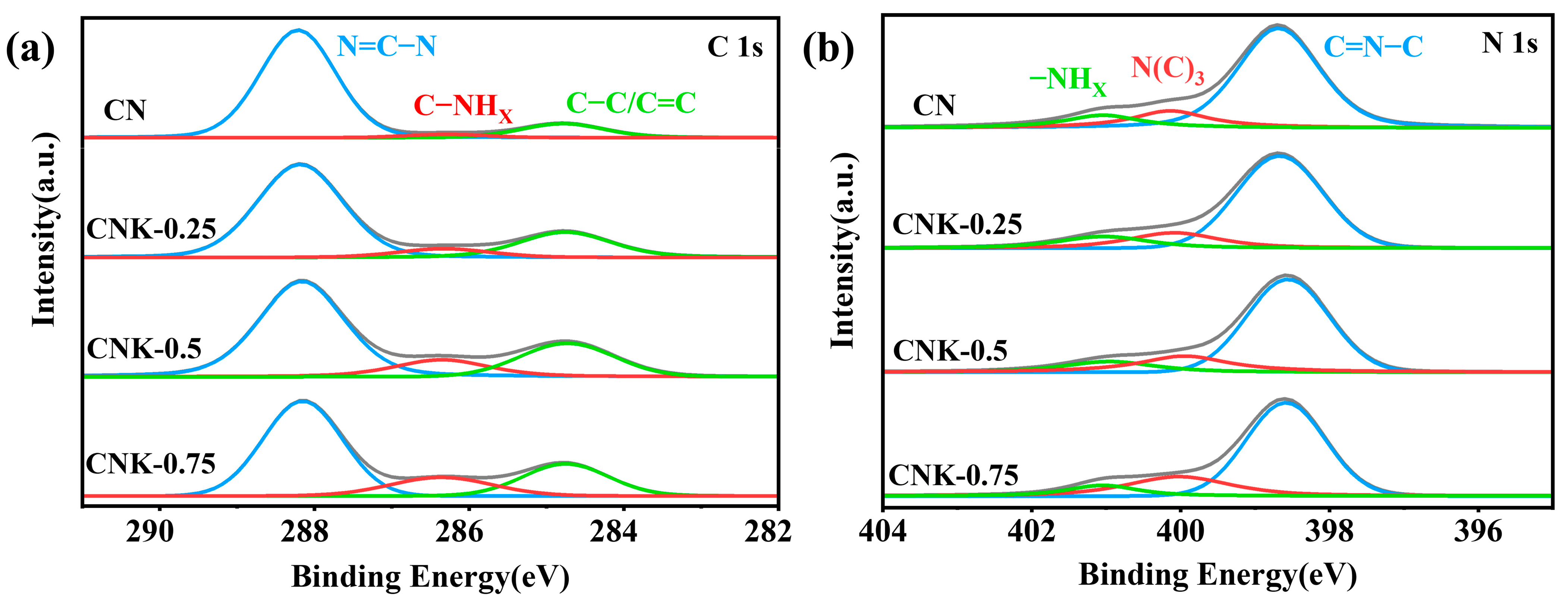
The surface element state of the samples is measured by X−ray photoelectron spectrum (XPS). The C 1s signals of CN comprise three peaks located at 284.8, 286.3, and 288.2 eV (Figure 2a), corresponding to C−C in adventitious hydrocarbon species, C−NHx at heptazine unit edges, and N−C=N in typical aromatic CN heterocycles, respectively [65]. Although the −C≡N signal overlaps with C−NHx due to the similar binding energies, the stronger C−NHx signals of CNK−X samples comparing to pristine CN still reveals the formation of cyano group [66]. Moreover, the N−C=N peak gradually shifts to lower binding energy with the increase in KOH, showing the formation of more nitrogen defects in CNK−0.5 and CNK−0.75, which lead to a shift in the electron cloud toward the C atoms. The N 1s spectra can also be deconvoluted into three peaks at 398.7, 400.2, and 401.1 eV (Figure 2b), which are attributed to the pyridine nitrogen in the heptazine unit (C−N=C, N2C), the ternary nitrogen (N−(C)3, N3C) at the center of the heptazine units, and the primary and secondary nitrogen in the −NHx groups, respectively. The content of C−N=C in the CNK−X samples decreases progressively with the increase in KOH loading. Meanwhile, the ratio of N2C/N3C decreases significantly from 4.8 for CN to 3.0 for CNK−0.75 (Table S3), indicating that a few N2C atoms of the tri−s−triazine unit are lost during the KOH treatment, resulting in the generation of nitrogen defects within the C3N4 structure. At the same time, the reduction in peak intensity of −NHx can be attributed to the KOH−induced deprotonation of terminal −NHx and the etching−induced cyano group formation, which is also corroborated by FT−IR characterization.
Solid−state 13C NMR spectroscopy of CN and CNK−X samples reveals two dominant resonance signals (Figure S3). The C1 signal is attributed to the carbon atoms in the −C−NHx environment, while the C2 signal corresponds to sp2−hybridized carbon atoms within the conjugated heptazine ring. The C1/C2 intensity ratio increases from 1.83 for CN to 3.13 for CNK−0.75, indicating the progressive disruption of the heptazine framework in CN [67]. In addition, both peaks shift towards the high field gradually due to the formation of nitrogen vacancies and cyano groups, which leads to the redistribution of local electrons around carbon atoms. These observations collectively suggest that the KOH treatment induces the formation of cyano groups and nitrogen vacancies within the CN structure. Based on these results, a schematic representation of the modified CN structure is proposed (Figure 1d).
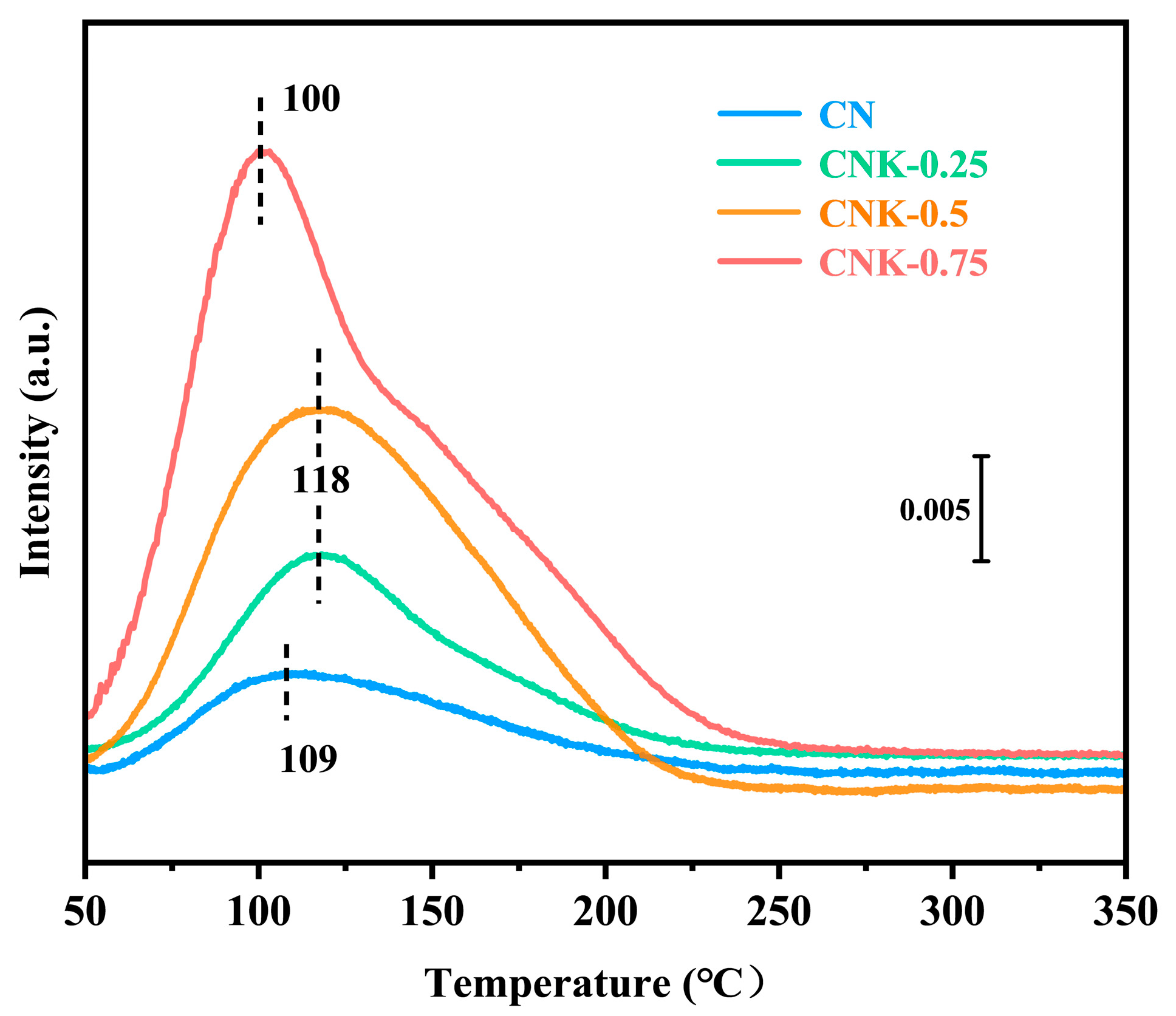
SO2−TPD analysis was conducted to investigate the alkalinity of CN and CNK−X (Figure 3). It can be seen that all the samples show a wide SO2 desorption peak in the range of 50–230 °C, attributed to the adsorption of SO2 on the alkaline sites. However, the intensities of the SO2 desorption peaks are quite different. Among them, CNK−0.75 displays the most intense desorption peak, followed by CNK−0.5, CNK−0.25, and CN in turn, indicating that the KOH treatment results in an obvious enhancement in the alkalinity of CN due to the introduction of cyano groups and nitrogen vacancies. It is well recognized that the alkalinity of catalyst supports is beneficial for enhancing the activity of the corresponding catalyst for FA dehydrogenation [42,68].

2.2. Catalytic Activity and Stability of Pd/CN and Pd/CNK−X

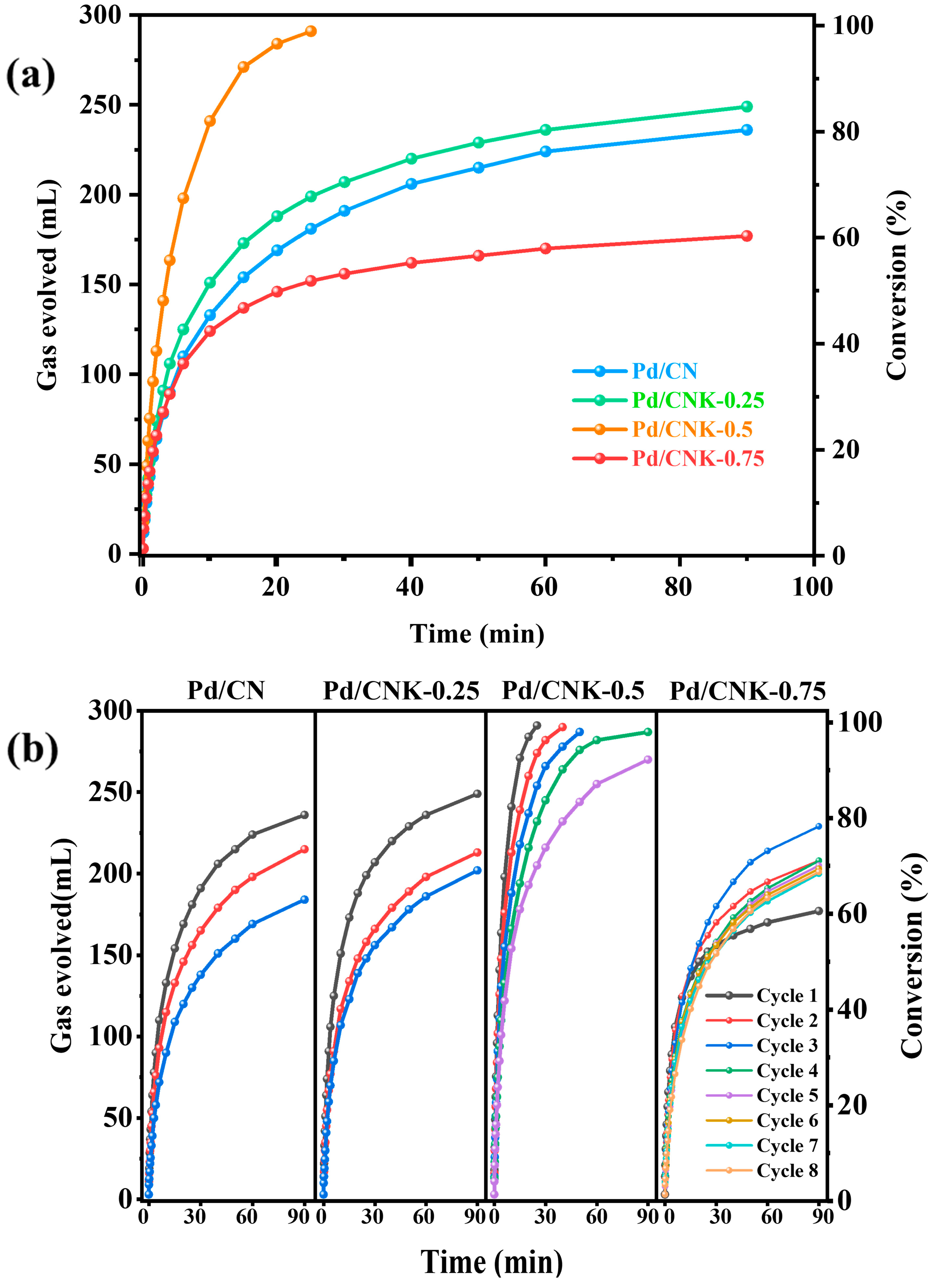
The reaction curves of Pd/CN and Pd/CNK−X in FA dehydrogenation are given in Figure 4a. Among them, Pd/CNK−0.5 exhibits the highest catalytic activity, which achieves complete FA conversion within 30 min at 60 °C in the presence of a ratio of 1 mol % Pd and gives a total gas evolution of 291 mL, which is much higher than that of Pd/CN (244 mL) after 90 min under identical conditions. The activity of Pd/CNK−0.25 is also slightly higher than that of Pd/CN. These data indicate that the KOH treatment is beneficial for improving the FA dehydrogenation activity of Pd/CNK−X. However, further increasing the KOH ratio to 0.75 leads to a decline in the catalytic performance of Pd/CNK−0.75. The activities of the four catalysts at all measured time points follow the order Pd/CNK−0.5 > Pd/CNK−0.25 > Pd/CN > Pd/CNK−0.75, which is consistent with the calculated TOF value (Table S4), indicating the importance of the introduction of proper numbers of cyano groups and nitrogen vacancies in the CN framework. The activity of Pd/CNK−0.5 is better than most of the reported Pd−based catalysts (Table S5). The composition of the gas obtained from FA dehydrogenation is determined by gas chromatography (Figure S4). There is only H2 and CO2, and no CO is detected, indicating the high selectivity of the catalysts for FA dehydrogenation.
The stability of Pd/CN, Pd/CNK−0.25, Pd/CNK−0.5, and Pd/CNK−0.75 in FA dehydrogenation was also investigated, and the results are shown in Figure 4b. Pd/CN and Pd/CNK−0.25 exhibit an obvious decrease in reaction rate and conversion efficiency during the first three cycles, and their gas production decreases from 236 mL and 249 mL for the first cycle to 184 mL and 202 mL for the third cycle, respectively. However, Pd/CNK−0.5 shows only a slight conversion rate reduction in the first three cycles, which still leads to complete FA conversion within 40 min in the third cycle. In the fourth and fifth cycles, the deactivation of Pd/CNK−0.5 intensifies to a certain extent, but its gas production within 90 min is still up to 270 mL, implying its relatively higher activity and stability comparing to Pd/CN and Pd/CNK−0.25. Interestingly, the catalytic activity of Pd/CNK−0.75 increases gradually in the first three cycles, although its initial activity (177 mL) is low. The gas production rises to 229 mL in the third cycle. Moreover, its activity is almost maintained at this level in the further cyclic experiments, showing the highest stability compared to the three others. These results suggest that the incorporation of cyano groups and nitrogen vacancies contributes positively to the stability of the catalyst.
The effects of reaction temperature on the FA dehydrogenation over Pd/CN, Pd/CNK−0.5, and Pd/CNK−0.75 were also investigated. The gas volumes produced by Pd/CN, Pd/CNK−0.5, and Pd/CNK−0.75 under high temperature at every detecting time point are higher than that at low temperatures, indicating that the reaction rates of the three catalysts are all highly sensitive to temperature. The plots of gas volume versus reaction time reveal an initial linear relationship between reaction time and FA concentration, showing that the FA dehydrogenation follows first−order kinetics (Figure S5). Based on the Arrhenius equation, the apparent activation energies for this reaction catalyzed by Pd/CN, Pd/CNK−0.5, and Pd/CNK−0.75 are calculated to be 43.72 kJ/mol, 37.77 kJ/mol, and 54.97 kJ/mol, respectively (Figure S6). Pd/CNK−0.5 exhibits the lowest activation energy, which is consistent with it having the highest catalytic activity.
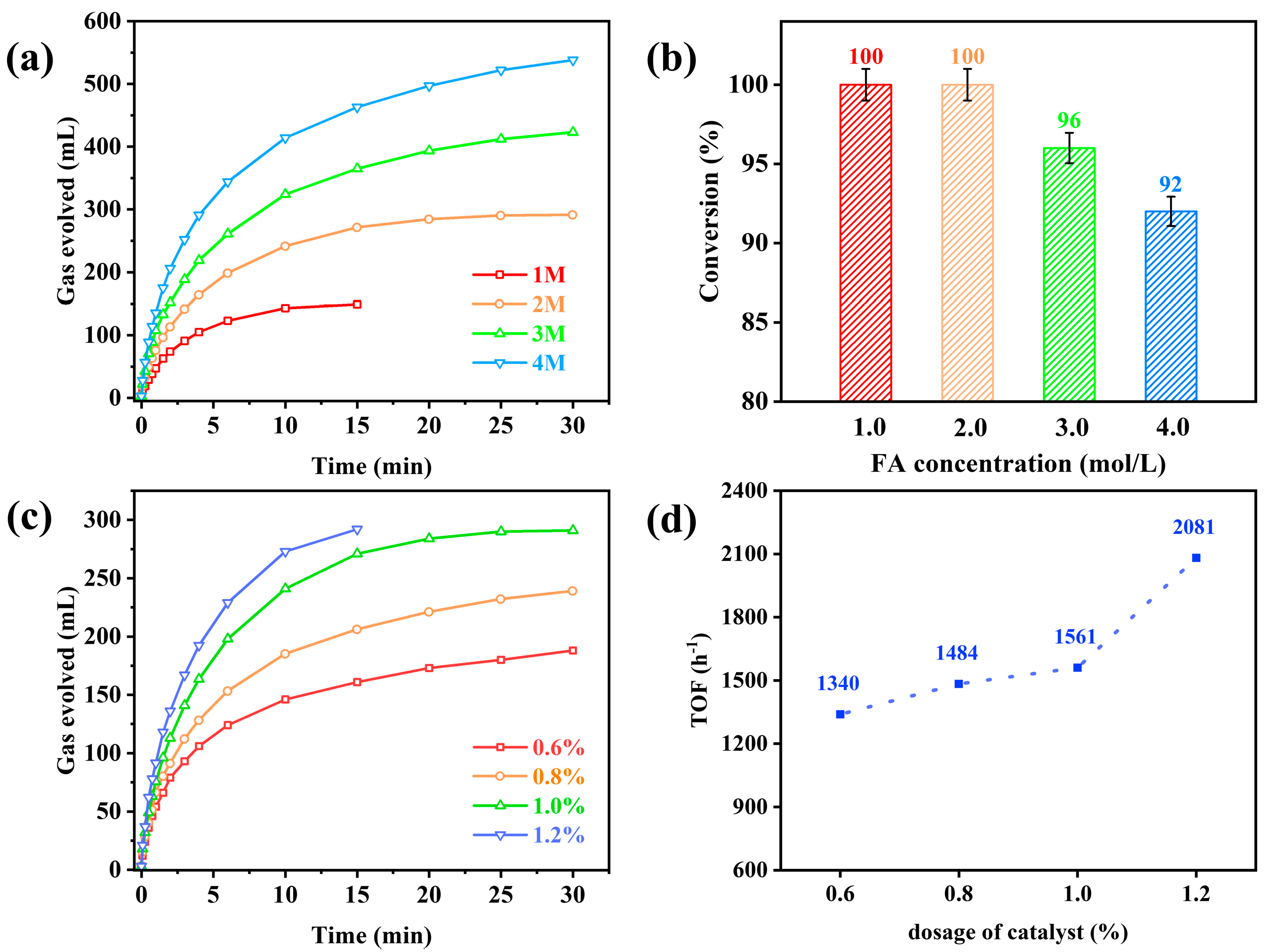
The effects of FA concentration and catalyst dosage on FA dehydrogenation were investigated further over Pd/CNK−0.5. As shown in Figure 5a, the gas evolution volumes increase with the increasing FA concentration from 1.0 mol/L to 4.0 mol/L at the same time, which can be attributed to the high number of substrate molecules available. However, the FA conversions start to decrease when the FA concentration is above 2 M within the same reaction time (Figure 5b), and the time required for complete conversion is prolonged. This may be attributed to the decrease in H2O concentration. H2O molecules as a weak Brønsted base can accept the H+ donated by Brønsted acid site and promote FA decomposition [69]. From Figure 5c,d, one can see that the FA dehydrogenation rate increases almost linearly with the catalyst dosage in the early stage of reaction due to the increase in catalytic active sites. When the catalyst dosage is 0.6%, the reaction only generates 188 mL of gas within 30 min, corresponding to a FA conversion of approximately 64%. Increasing the catalyst dosage to 1.2% results in the production of 292 mL gas within 15 min, corresponding to the almost complete conversion of FA. However, the calculated turnover frequencies (TOFs) under different catalyst dosages are quite different, increasing from 1340 h−1 to 2081 h−1 when the catalyst dosage increases from 0.6% to 1.2%, implying that there is a significant diffusion effect. Under high catalyst dosage, more surface Pd atoms are available, so fewer substrate molecules need to enter the catalyst pore.

2.3. Characterization of the Catalysts

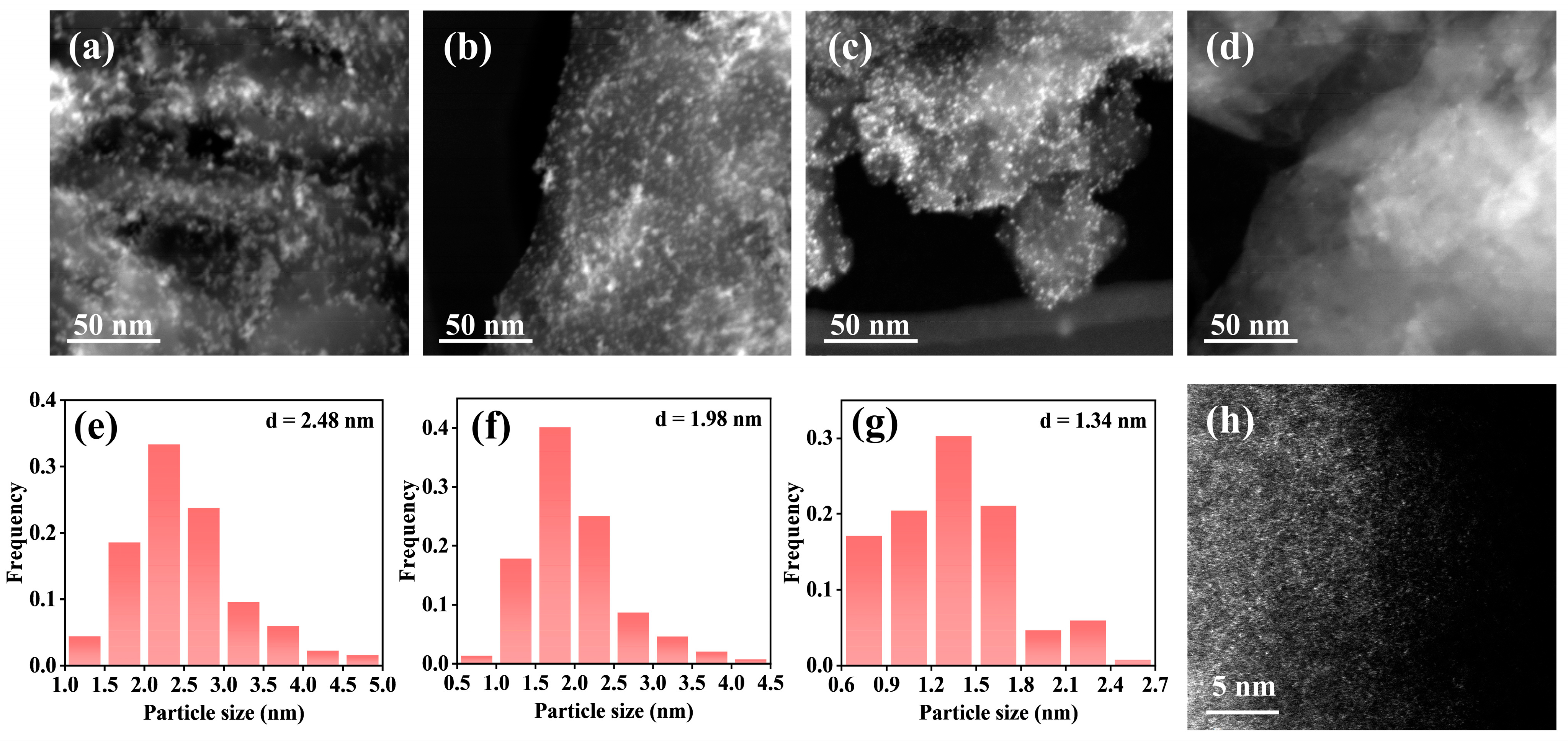
To elucidate the relationship between the catalyst structure and its catalytic performance, Pd/CN, Pd/CNK−0.25, Pd/CNK−0.5, and Pd/CNK−0.75 were thoroughly characterized. Inductively coupled plasma optical emission spectroscopy (ICP−OES) results reveal that the actual palladium loadings are around 2.85–2.91%, slightly lower than the nominal loading of 3% (Table S6). Additionally, no distinct diffraction peak corresponding to palladium species is observed in the X−ray diffraction (XRD) patterns, suggesting a high degree of Pd dispersion on all catalysts (Figure S7). To further investigate the distribution and particle size of Pd species on the catalysts, high−angle annular dark−field scanning transmission electron microscopy (HAADF−STEM) was employed to characterize all the samples (Figure 6). The STEM data show that the Pd species are uniformly distributed on all the catalysts. The average sizes of Pd nanoparticles on Pd/CN, Pd/CNK−0.25, and Pd/CNK−0.5 are 2.48 nm, 1.98 nm, and 1.34 nm, respectively. Especially for Pd/CNK−0.75, only a few Pd nanoparticles are observed, indicating an excellent dispersion of Pd species on CNK−0.75 (Figure 6d). This is further confirmed by the characterization of aberration−corrected HAADF−STEM (AC−HAADF−STEM), which shows that the majority of Pd species exist in single atoms (Figure 6h). The EDX elemental mapping data further confirm the uniform distribution of Pd species on the catalysts (Figure S8). These findings suggest that the introduction of cyano groups and nitrogen vacancies can enhance the dispersion of active Pd species and increase the number of accessible catalytic active sites. The activities of Pd/CN, Pd/CNK−0.25, and Pd/CNK−0.5 are consistent with the reverse order of their Pd particle size, indicating that the high dispersion of Pd species may be one factor influencing catalytic performance. However, Pd/CNK−0.75 does not follow this trend, suggesting that there may exist other factors that determine the catalytic activity for FA decomposition.
The recovered catalysts, Pd/CN−used and Pd/CNK−0.25−used after three cycles, as well as Pd/CNK−0.5−used after five cycles and Pd/CNK−0.75−used after eight cycles, were also characterized by STEM (Figure S9). Their average Pd sizes are 2.94, 2.11, 1.87, and 1.42 nm, respectively, which are larger than those of the fresh ones, indicating the aggregation of Pd species during FA decomposition. This may be the main reason why Pd/CN, Pd/CNK−0.25, and Pd/CNK−0.5 deactivate in the cycling experiment. The leaching ratio of Pd species in the first cycle is much lower, revealing that leaching of active components is not the key factor of catalyst deactivation (Table S6). The Pd leaching ratios of Pd/CNK−X (0.016‰–0.025‰) are lower than that of Pd/CN (0.039‰), also reflecting the facilitation of cyano groups and nitrogen vacancies for catalyst stability.
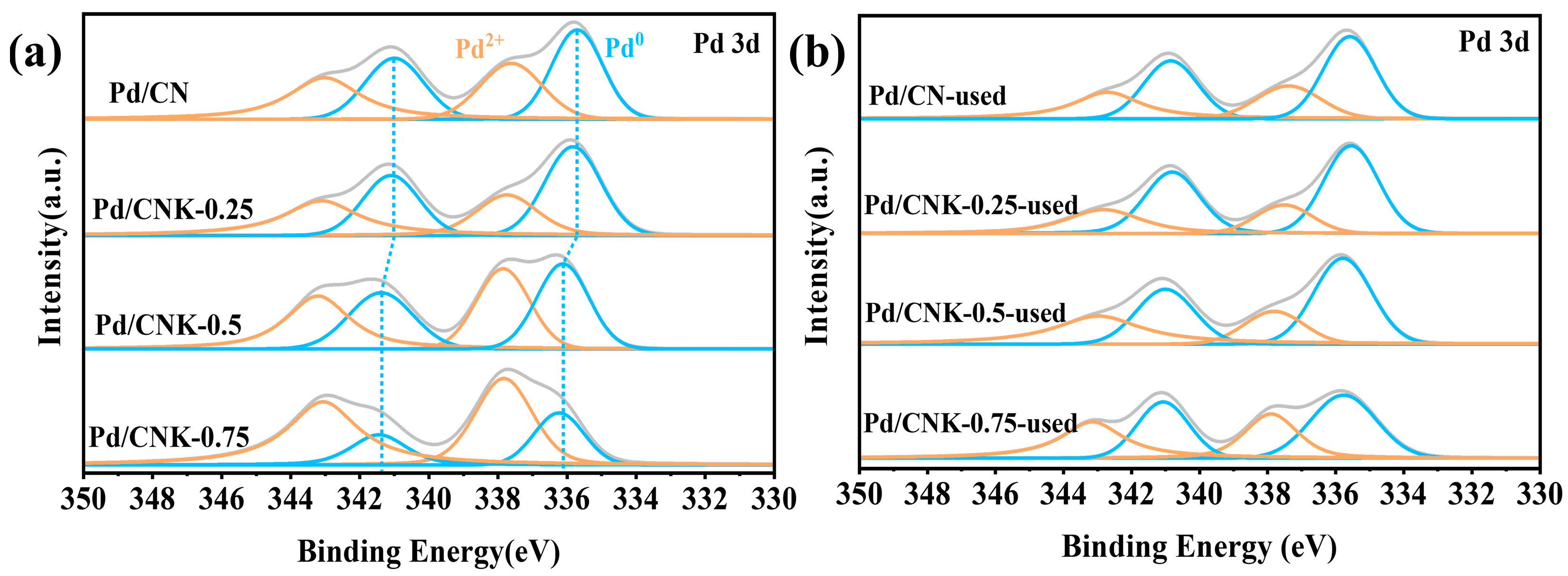
The electronic states of Pd species were characterized by X−ray photoelectron spectroscopy (XPS) for the fresh and recovered catalysts (Figure 7). The Pd 3d core−level XPS spectra display four main peaks: The peaks at around 335.7 eV and 341.0 eV correspond to metallic Pd0, while those at 337.6 eV and 343.1 eV attribute to Pd2+ species. The Pd0/Pd2+ ratios of Pd/CNK−0.5 (0.91) and Pd/CNK−0.75 (0.38) are lower than those of Pd/CN (1.04) (Table S6), owing to the introduction of more cyano groups and nitrogen vacancies, which leads to a strong interaction between Pd and support. However, the data of Pd/CNK−0.25 (1.25) are higher than those of Pd/CN, and the reason is still unclear. The Pd binding energies of Pd/CNK−X moving to higher values for 0.1−0.5 eV further demonstrates the stronger interaction between Pd and the CNK−X supports. The Pd0/Pd2+ ratios of the recovered catalysts after different reaction cycles increase significantly, revealing a reduction in Pd species by formic acid or hydrogen generated during the reaction process (Figure 7b, Table S7). The order of Pd0/Pd2+ ratios for the fresh catalysts or the used catalysts is not consistent with their activities, indicating that the Pd electronic states may not be the main factor influencing catalytic performance.
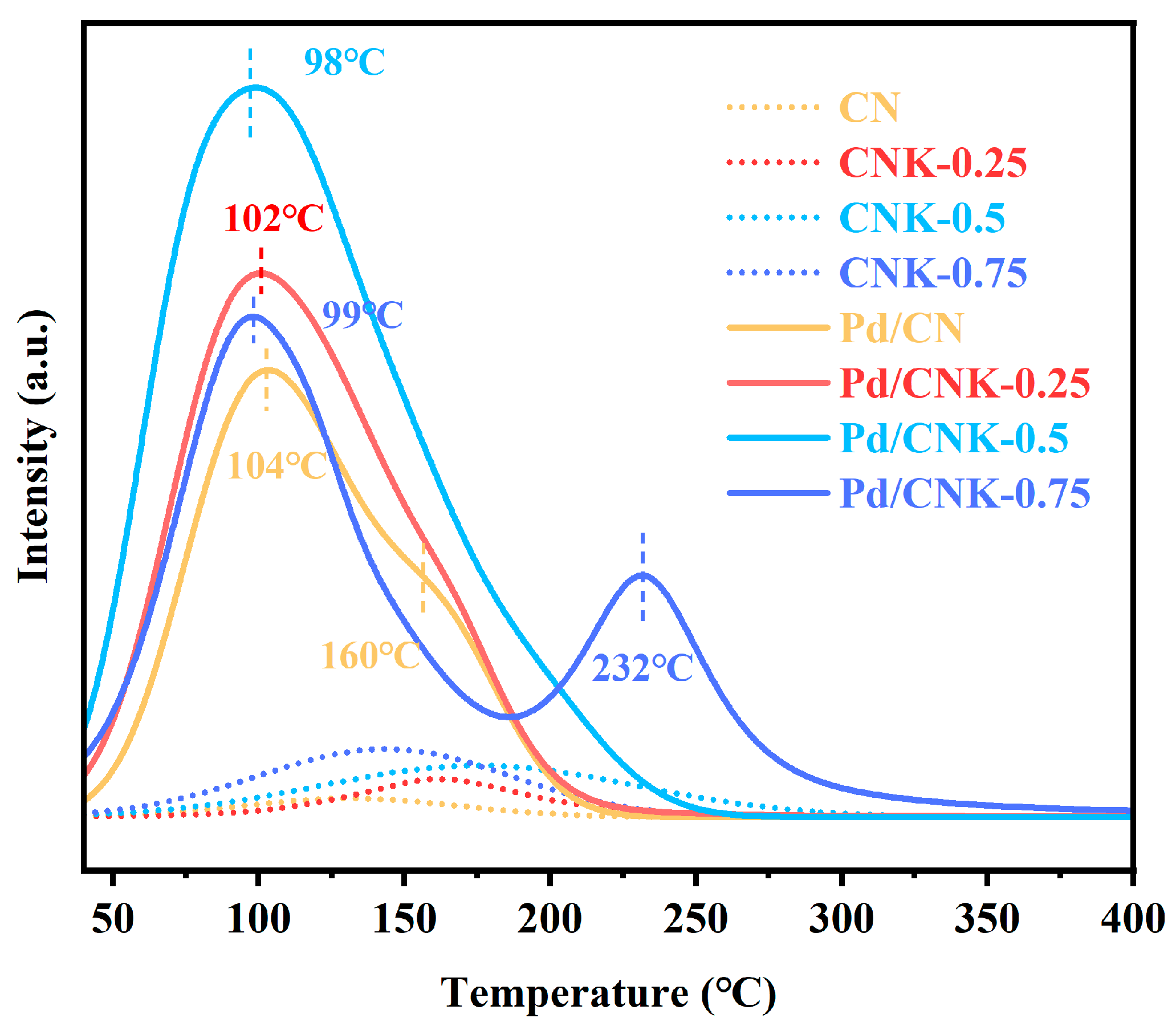
Numerous studies have demonstrated that the decomposition of β−PdHx and the subsequent desorption of hydrogen from the Pd surface constitute one of the rate−determining steps in the dehydrogenation of FA [37,70]. In order to investigate the H2 desorption capability of the catalysts, hydrogen temperature−programmed desorption (H2−TPD) experiments were conducted (Figure 8). The H2 desorption signals of the four pure supports are very weak, revealing that the supports show much lower H2 molecule adsorption. All four catalysts exhibit a broad main desorption peak centered at about 100 °C, attributed to the decomposition of Pd hydride and the H2 desorbed from metallic Pd nanoclusters or nanoparticles [71,72]. The Pd/CNK−X catalysts have higher peak intensities than that of Pd/CN, particularly for Pd/CNK−0.5, indicating that hydrogen spills over on these catalysts [73]. Notably, Pd/CNK−0.75 also exhibits another desorption peak at 232 °C except the above main desorption peak, which may be attributed to the strongly chemisorbed hydrogen on single Pd atoms or small clusters. It was found that the combination of active H and the desorption of molecular H2 are sluggish on ultra−small Pd species [72]. This may be one main reason why Pd/CNK−0.75 shows low catalytic activity in FA dehydrogenation. The increase in its activity in the first three cycles may be attributed to the aggregation of partial Pd atoms or clusters, which enhances the H2 desorption (Figure S9).
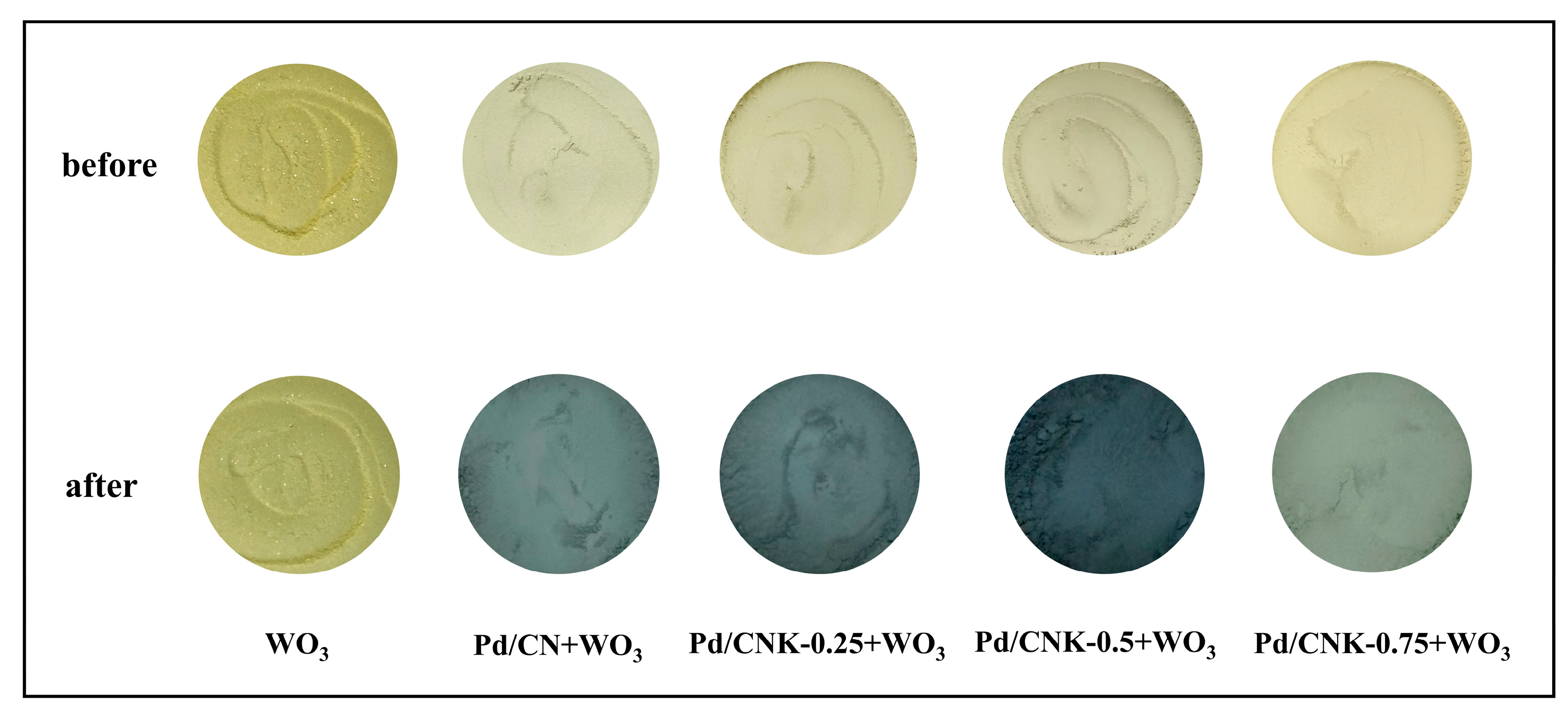
The hydrogen spillover of the catalysts was further investigated by using yellow WO3 as an indicator (Figure 9) [74]. The pure WO3 sample exhibit no observable color change after H2 treatment. The Pd/CNK−0.5 + WO3 mixture displays the most pronounced color change, indicating the highest hydrogen spillover capability of Pd/CNK−0.5, which is followed by Pd/CNK−0.25, Pd/CN, and then Pd/CNK−0.75. The hydrogen spillover capacities of the four catalysts are in the order Pd/CNK−0.75 < Pd/CN < Pd/CNK−0.25 < Pd/CNK−0.5, which is consistent with their activities, indicating that hydrogen spillover may be one main factor that influences the catalytic activity. Hydrogen spillover facilitates the transfer of activated H from Pd−H species to support and promote the regeneration of Pd active sites.
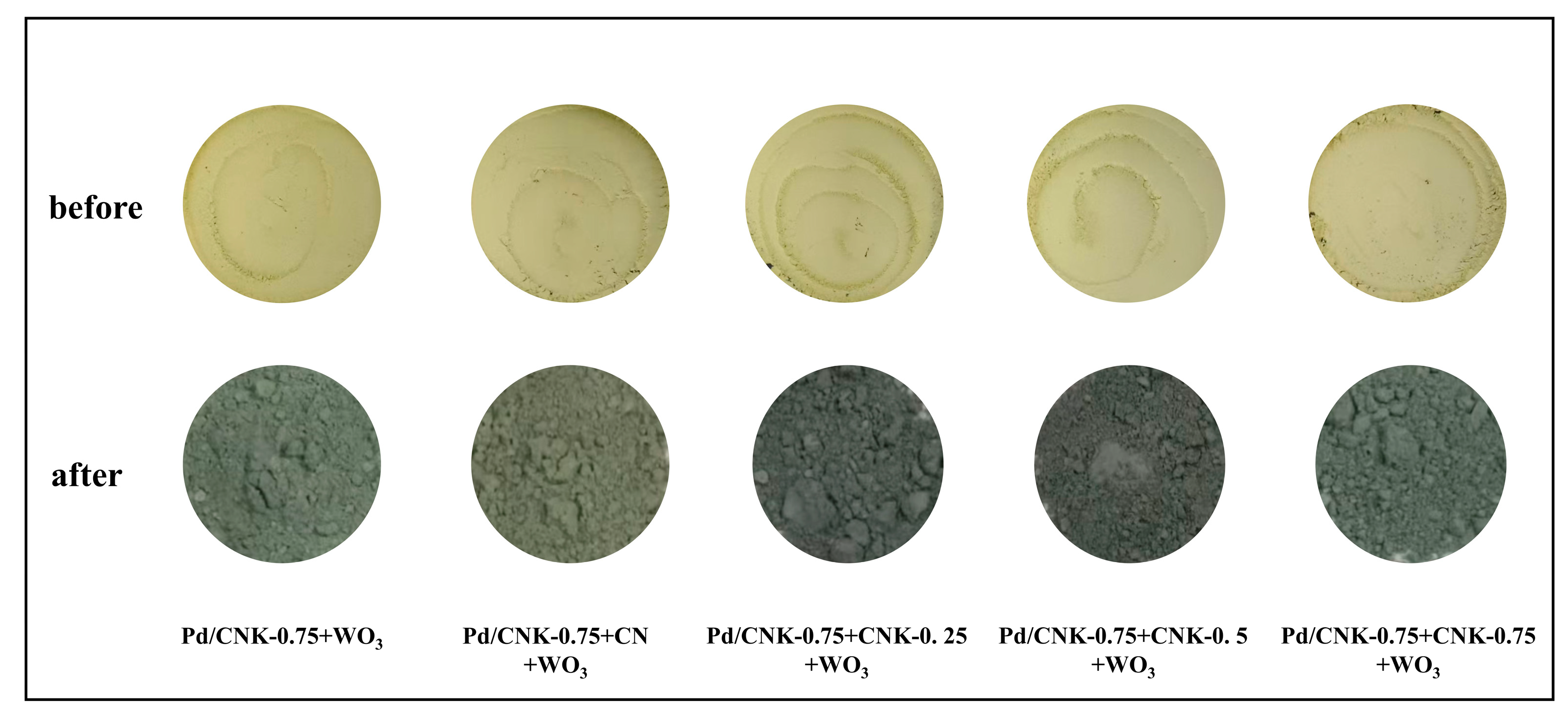
In order to reveal the hydrogen spillover of the supports, the color changes of the ternary systems of Pd/CNK−0.75, various supports, and WO3 were also detected (Figure 10). The color of the system containing CN after H2 treatment is even lighter than that of the binary system of Pd/CNK−0.75 + WO3, indicating that the presence of CN inhibits the active H atom transfer from the surface of Pd/CNK−0.75 to WO3 to a certain extent due to the low hydrogen spillover capability of CN. The colors of the systems containing CNK−0.25 and CNK−0.5 progressively deepen compared to the binary system of Pd/CNK−0.75 + WO3, demonstrating the enhancement of CNK−0.25 and CNK−0.5 to the hydrogen spillover between the catalyst and WO3, particular for CNK−0.5, due to the introduction of more cyano groups and nitrogen vacancies [75]. The color of the ternary system with CNK−0.75 is only slightly darker than that of Pd/CNK−0.75 + WO3, implying a relatively weaker hydrogen spillover of CNK−0.75 compared to CNK−0.25 and CNK−0.5, possibly owning to the excessive distortion of the CN structure. This result indicates that the hydrogen spillover of the supports is in the order CN < CNK−0.75 < CNK−0.25 < CNK−0.5, which is not consistent with the corresponding catalysts. Among the four catalysts, Pd/CNK−0.75 shows the weakest hydrogen spillover ability, which may be attributed to the much lower hydrogen activation capability of the single Pd atom [76]. The hydrogen spillover capacities of Pd/CNK−0.75 after one reaction cycle and two reaction cycles progressively improves owning to the aggregation of Pd atoms and clusters during FA dehydrogenation (Figure S10), which may be one main reason why Pd/CNK−0.75 shows increasing activity in the first three cycles. This further demonstrates the positive effect of hydrogen spillover on the activity of Pd/CNK−X.

3. Materials and Methods

3.1. Chemicals

Dicyandiamide (C2H4N4, AR) was purchased from Shanghai Haohong Biomedical Technology Co., Ltd. (Shanghai, China). Palladium chloride (PdCl2, Pd 59.5%) was obtained from Shanghai Jiuyue Chemical Co., Ltd. (Shanghai, China). Formic acid (HCOOH, FA) was provided by Tianjin Fuchen Chemistry Co., Ltd. (Tianjin, China). Sodium hydroxide (NaOH) was purchased from the Aladdin Company (Hong Kong, China). Potassium hydroxide (KOH) was obtained from Beijing Chemical Industry Group Co., Ltd. (Beijing, China). Hydrochloric acid (HCl) was obtained from Beijing Yili Fine Chemicals Co., Ltd. (Beijing, China). Sodium borohydride (NaBH4) was purchased from Xilong Scientific Co., Ltd. (Guangzhou, China).

3.2. Synthesis of Graphite Carbon Nitride (CN) and Potassium Hydroxide−Treated CN (CNK−X)

Synthesis of CN: Typically, 10 g of dicyandiamide was placed in a lidded alumina crucible and calcined at 550 °C for 4 h in a muffle furnace with a heating rate of 5 °C/min. After natural cooling to room temperature, the sample obtained from the crucible was thoroughly ground in an agate mortar, which was denoted as CN.
Synthesis of CNK−X: 2 g of pre−prepared CN was thoroughly ground with different amounts of KOH (0.25 g, 0.5 g, and 0.75 g) and placed in an alumina porcelain boat, then it was calcinated under N2 flow at 600 °C for 2 h with a heating rate of 10 °C/min in a quartz tube furnace. After cooling down to room temperature, the sample was washed with HCl solution (10 wt%) and water to dislodge K+ and adjust the samples to a neutral pH. Lastly, the samples were dried at 80 °C overnight and collected. The samples prepared with 0.25 g, 0.5 g, and 0.75 g of KOH were denoted as CNK−0.25, CNK−0.5, and CNK−0.75, respectively.

3.3. Synthesis of Pd/CN and Pd/CNK−X

The Pd/CN catalyst was prepared using a deposition−precipitation method. Specifically, 2 g of the as−prepared CN support was dispersed in 50 mL of deionized water and stirred vigorously at room temperature for 1 h. Then, PdCl2 (100 mg) solution in dilute HCl was added. The pH value of the mixture was gradually adjusted to 10 by dropwise adding NaOH solution (10 wt%) and stirred for an additional 4 h. Subsequently, 1 mol/L NaBH4 solution was added to the system with a 5:1 molar ratio relative to palladium. The mixture was then filtered, washed with abundant deionized water, and dried in an oven overnight at 60 °C. The Pd/CNK−X samples were prepared under a similar process.

3.4. Characterization of Catalysts and Supports

Crystal structures of the samples were obtained by means of the powder X−ray diffraction (XRD) technique on a Rigaku SmartLab SE instrument (Rigaku Corporation, Tokyo, Japan) using Cu Kα radiation (40 kV, 40 mA, λ = 0.15406 nm) with a scan range of 10 to 50°, and the scanning speed was 5°/min. The specific surface area and pore size distribution plots were determined using the Brunauer−Emmett−Teller (BET) and Barrett−Joyner−Halenda (BJH) methods of analysis, respectively, by nitrogen adsorption on a Micromeritics ASAP 2460 (Micromeritics Instrument Corporation, Norcross, GA, USA) analyzer at −196 °C. All samples were degassed at 150 °C for 6 h under vacuum before characterization. Elemental analysis (EA) of C, N, O, and H was performed on an elemental analyzer Elementar Vario MACRO (Elementar Analysensysteme GmbH, Langenselbold, Germany). Scanning transmission electron microscopic (STEM) images were taken with a JEM−2010 instrument (JEOL Ltd., Yamagata, Japan), and the sizes of the Pd nanoparticles were calculated by a statistical method from the sizes of about 150 particles in the selected area. The aberration−corrected HAADF−STEM (AC−HAADF−STEM) images were taken with a JEM−ARM300F instrument (JEOL Ltd., Yamagata, Japan). The FE-STEM SU9000 (Hitachi High-Tech Corporation, Tokyo, Japan). scanning electron microscope (SEM) was used to observe the morphology and microstructure of the samples. Electron paramagnetic resonance (EPR) was obtained on a Bruker EMXnano ESR spectrometer (Bruker Corporation, Rheinstetten, Germany). 13C cross−polarization−magic angle spinning nuclear magnetic resonance spectroscopy (13C CP−MAS NMR) was used to analyze the structure of samples on a Bruker Avance NEO 400 WB spectrometer (Bruker Corporation, Rheinstetten, Germany). Electron−binding energies of the as−obtained samples and the recovered samples were characterized with X−ray photoelectron spectroscopy (XPS, Thermo Fisher Scientific ESCALAB 250 Xi spectrometer, Waltham, MA, USA), with Mg Kα (hv = 1253.6 eV) as the excitation source.
The temperature−programmed desorption of H2 (H2−TPD) was carried out on a chemical adsorption analyzer (AutoChem II 2920, Micromeritics Instrument Corporation, Georgia, USA). Prior to the TPD test, a 50 mg sample (40–60 mesh) was loaded in a fixed−bed U−shaped quartz microreactor. The samples were initially pretreated with helium flow (30 mL/min) by heating to 200 °C at a rate of 5 °C/min, and this temperature was maintained for 30 min. Subsequently, the samples were exposed to a 10 vol% H2/N2 gas mixture at room temperature for 1.5 h to facilitate hydrogen adsorption, whereafter the sample was flushed with helium flow (30 mL/min) until baseline was smooth. The system was heated up to 400 °C with a ramp of 5 °C/min in the helium atmosphere. The products were detected by mass spectrometer. The SO2−TPD (Temperature−Programmed Desorption) procedure was identical to that described above, with the exception that a mixed gas of 10 vol% SO2/He was used in the adsorption step.
Hydrogen spillover test of the catalysts: A mixture of WO3 (500 mg) and catalysts (10 mg) was ground and then placed in a tube furnace and maintained at 30 °C for 10 min under an H2 flow (40 mL/min). After the H2 treatment, a photo was taken of the collected mixture for comparison.
Hydrogen spillover test of the support: The Pd/CNK−0.75 catalyst (5 mg) was thoroughly ground and mixed with different support materials (10 mg) (CN, CNK−0.25, CNK−0.5, and CNK−0.75) firstly, then WO3 (500 mg) was added and ground further. The subsequent H2 treatment was consistent with the above procedure.

3.5. Catalytic Activity Test

The catalytic performance of the as−synthesized samples was evaluated by the decomposition of FA. Typically, 210 mg of catalyst was added to a 15 mL two−neck round−bottom flask placed in a water bath maintained at 60 °C. One neck of the flask was connected to a gas burette for gas collection, while the other was used to introduce 3.0 mL of FA solution (2.0 mol/L). The reaction commenced upon the addition of FA, and the evolved gas volume was measured by monitoring the water displacement in the gas burette.
The conversion and the selectivity of products were analyzed on an Agilent 5977A gas chromatography analyzer with a thermal conductivity detector (TCD) and a hydrogen flame ionization detector (FID), which has a 1 ppm detection limit for CO. The pure CO2 (99.9 vol %) and H2 (99.99 vol %) as well as a mixture gas of CO/N2 (1.02 vol %) were used as the reference gases.
The conversion is determined by the ratio of the total gas volume (Vt) produced at desired time t to the theoretical gas volume (V0) under complete conversion, where the gases are treated as ideal gas. One mole FA gives two moles gas (H2 + CO2). Thus:
Conversion = Vt/V0 = Vt·P/2nRT
where P = 101,325 Pa, T = 298 K, and n is the number of moles of FA.
The turnover frequencies (TOFs) are calculated according to the released gas volume, which is considered the ideal gas:
T O F = P 0 V 2 R T n P d t
where P0 is the atmospheric pressure (101,325 Pa), V is the released gas volume (H2 + CO2), R is the universal gas constant (8.3145 m3·Pa·mol−1·K−1), T is the room temperature (298 K), nPd is the total mole number of Pd atoms in the catalyst, and t is the time required to achieve 25% conversion.

3.6. Durability Tests of the Catalysts

The catalysts were recovered by filtration after the first reaction, thoroughly washed with deionized water, and dried in air, and were reused in the FA dehydrogenation under the same condition as the first cycle.

4. Conclusions

In summary, three CNK−X supports containing a certain number of cyano groups and nitrogen vacancies are prepared successfully by CN calcination in the presence of KOH, and the performances of the corresponding Pd−based catalysts, Pd/CNK−0.25, Pd/CNK−0.5, and Pd/CNK−0.75, are evaluated for FA dehydrogenation. It is found that the introduction of cyano groups and nitrogen vacancies in CN skeleton enhances the support alkalinity and improves the Pd dispersion significantly. The high catalytic activity of Pd/CNK−0.5 is mainly attributed to its highly efficient hydrogen spillover and relatively high dispersity of Pd species, as well as its high basicity due to the introduction of proper number of cyano groups and nitrogen vacancies. The relatively high stability of Pd/CNK−0.75 is related to the strongest interaction between Pd species and the support, while its low initial activity may be owing to its low hydrogen spillover ability and the strongly chemisorbed hydrogen on single Pd atoms or small clusters.

Supplementary Materials

The following supporting information can be downloaded at: https://www.mdpi.com/article/10.3390/catal16010026/s1, Figure S1: SEM images of Pd/CN (a), Pd/CNK−0.25 (b), Pd/CNK−0.5 (c), and Pd/CNK−0.75 (d); Figure S2: N2 adsorption/desorption isotherms (a) and BJH pore size distribution curves (b) of Pd/CN, Pd/CNK−0.25, Pd/CNK−0.5, and Pd/CNK−0.75; Figure S3: 13C NMR spectra of CN, CNK−0.25, CNK−0.5, and CNK−0.75; Figure S4: Gas chromatograms of the reference gases of CO2 (a), H2 (b), air (d), mixture of CO and N2 (e), and the released gas from FA decomposition over Pd/CNK−0.5 using TCD detector (c); Figure S5: Time plots for gas (H2 + CO2) released from FA decomposition over Pd/CN (a), Pd/CNK−0.5 (b), and Pd/CNK−0.75 (c) at different temperatures. Rate equation fitting (ln Ct/C0 versus time) for Pd/CN (d), Pd/CNK−0.5 (e), and Pd/CNK−0.75 (f); Figure S6: Arrhenius plot (lnk versus 1/T) for Pd/CN, Pd/CNK−0.5, and Pd/CNK−0.75; Figure S7: XRD patterns of Pd/CN, Pd/CNK−0.25, Pd/CNK−0.5, and Pd/CNK−0.75; Figure S8: Elemental mappings of Pd/CN (a), Pd/CNK−0.25 (b), Pd/CNK−0.5 (c), and Pd/CNK−0.75(d); Figure S9: STEM images of Pd/CN after three cycles (denoted as Pd/CN−used) (a), Pd/CNK−0.25 after three cycles (denoted as Pd/CNK−0.25−used) (b), Pd/CNK−0.5 after five cycles (denoted as Pd/CNK−0.5−used) (c), and Pd/CNK−0.75 after eight cycles (denoted as Pd/CNK−0.75−used) (d), and the histograms of Pd particle size distribution of Pd/CN−used (e), Pd/CNK−0.25−used (f), Pd/CNK−0.5−used (g), and Pd/CNK−0.75−used) (h); Figure S10: Color changes of the mixtures of fresh Pd/CNK−0.75, recovered from the first cycle and recovered from the second cycle with WO3, respectively, after H2 treatment at room temperature; Table S1: Textural and structural properties of CN, CNK−0.25, CNK−0.5, and CNK−0.75; Table S2: Chemical composition of CN and CNK−X determined by EA; Table S3: Surface elemental compositions of CN and CNK−X calculated by XPS data; Table S4: FA dehydrogenation reaction results under different conditions; Table S5: Selected heterogeneous catalysts for the dehydrogenation of formic acid; Table S6: Results of ICP−OES analysis of the four catalysts and the filtrate after the first reaction; Table S7: XPS binding energies (eV) and compositions of Pd species of the samples.

Author Contributions

Conceptualization, W.Q. and J.S.; methodology, H.D. and W.Q.; validation, H.D. and Y.C.; formal analysis, H.D., Y.C., H.W. and J.Z.; investigation, H.D., H.W., S.Y. and W.Q.; resources, W.Q.; data curation, H.D., G.W. and W.Q.; writing original draft preparation, H.D.; writing review and editing, W.Q.; visualization, H.D. and W.Q.; supervision, W.Q. and J.S.; project administration, W.Q. and G.W.; funding acquisition, W.Q. All authors have read and agreed to the published version of the manuscript.

Funding

This research was funded by the National Natural Science Foundation of China (No. 22075005).

Data Availability Statement

Data is contained within the article or Supplementary Material.

Conflicts of Interest

Authors Gaixia Wei and Jianwei Song were employed by Qing Yang Chemical Industry Corporation. The remaining authors have no relevant financial or non-financial interests to disclose.

References

  1. Alconada, K.; Barrio, V.L. Evaluation of bimetallic Pt−Co and Pt−Ni catalysts in LOHC dehydrogenation. Int. J. Hydrogen Energy 2024, 51, 243–255. [Google Scholar] [CrossRef]
  2. Zhong, H.; Iguchi, M.; Chatterjee, M.; Himeda, Y.; Xu, Q.; Kawanami, H. Formic Acid-Based Liquid Organic Hydrogen Carrier System with Heterogeneous Catalysts. Adv. Sustain. Syst. 2018, 2, 1700161. [Google Scholar] [CrossRef]
  3. Hussain, I.; Saqib, A.; Lean, H.H. Economic policy uncertainty and green energy in BRICS: Impacts on sustainability. Energy 2025, 317, 134717. [Google Scholar] [CrossRef]
  4. Welsby, D.; Price, J.; Pye, S.; Ekins, P. Unextractable fossil fuels in a 1.5 degrees C world. Nature 2021, 597, 230–234. [Google Scholar] [CrossRef]
  5. Ghorbani, B.; Zendehboudi, S.; Monajati Saharkhiz, M.H.; Afrouzi, Z.A.; Mohammadzadeh, O.; Elkamel, A. Multi-objective Optimization of a Novel Hybrid Structure for Co-generation of Ammonium Bicarbonate, Formic Acid, and Methanol with Net-Zero Carbon Emissions. Energy Fuels 2023, 37, 12474–12502. [Google Scholar] [CrossRef]
  6. Paragian, K.; Li, B.; Massino, M.; Rangarajan, S. A computational workflow to discover novel liquid organic hydrogen carriers and their dehydrogenation routes. Mol. Syst. Des. Eng. 2020, 5, 1658–1670. [Google Scholar] [CrossRef]
  7. Yang, Z.X.; Li, X.G.; Yao, Q.L.; Lu, Z.H.; Zhang, N.; Xia, J.; Yang, K.; Wang, Y.Q.; Zhang, K.; Liu, H.Z.; et al. 2022 roadmap on hydrogen energy from production to utilizations. Rare Met. 2022, 41, 3251–3267. [Google Scholar] [CrossRef]
  8. Modisha, P.M.; Ouma, C.N.M.; Garidzirai, R.; Wasserscheid, P.; Bessarabov, D. The Prospect of Hydrogen Storage Using Liquid Organic Hydrogen Carriers. Energy Fuels 2019, 33, 2778–2796. [Google Scholar] [CrossRef]
  9. Sekine, Y.; Higo, T. Recent Trends on the Dehydrogenation Catalysis of Liquid Organic Hydrogen Carrier (LOHC): A Review. Top. Catal. 2021, 64, 470–480. [Google Scholar] [CrossRef]
  10. Martin, C.; Quintanilla, A.; Vega, G.; Casas, J.A. Formic acid-to-hydrogen on Pd/AC catalysts: Kinetic study with catalytic deactivation. Appl. Catal. B Environ. 2022, 317, 121802. [Google Scholar] [CrossRef]
  11. Wang, A.; He, P.; Wu, J.; Chen, N.; Pan, C.; Shi, E.; Jia, H.; Hu, T.; He, K.; Cai, Q.; et al. Reviews on Homogeneous and Heterogeneous Catalysts for Dehydrogenation and Recycling of Formic Acid: Progress and Perspectives. Energy Fuels 2023, 37, 17075–17093. [Google Scholar] [CrossRef]
  12. Dutta, I.; Chatterjee, S.; Cheng, H.; Parsapur, R.K.; Liu, Z.; Li, Z.; Ye, E.; Kawanami, H.; Low, J.S.C.; Lai, Z.; et al. Formic Acid to Power towards Low-Carbon Economy. Adv. Energy Mater. 2022, 12, 2103799. [Google Scholar] [CrossRef]
  13. Liu, C.; Liu, J.-Y. Computational study on graphdiyne supported PdxCuy clusters as potential catalysts for formic acid dehydrogenation. Int. J. Hydrogen Energy 2024, 79, 248–257. [Google Scholar] [CrossRef]
  14. Masuda, S.; Mori, K.; Futamura, Y.; Yamashita, H. PdAg Nanoparticles Supported on Functionalized Mesoporous Carbon: Promotional Effect of Surface Amine Groups in Reversible Hydrogen Delivery/Storage Mediated by Formic Acid/CO2. ACS Catal. 2018, 8, 2277–2285. [Google Scholar] [CrossRef]
  15. Qi, X.; Obata, K.; Yui, Y.; Honma, T.; Lu, X.; Ibe, M.; Takanabe, K. Potential-Rate Correlations of Supported Palladium-Based Catalysts for Aqueous Formic Acid Dehydrogenation. J. Am. Chem. Soc. 2024, 146, 9191–9204. [Google Scholar] [CrossRef]
  16. Wang, X.; Meng, Q.; Gao, L.; Jin, Z.; Ge, J.; Liu, C.; Xing, W. Recent progress in hydrogen production from formic acid decomposition. Int. J. Hydrogen Energy 2018, 43, 7055–7071. [Google Scholar] [CrossRef]
  17. Xue, G.; Jiao, Y.; Li, X.; Lin, T.; Yang, C.; Chen, S.; Chen, Z.; Qi, H.; Bartling, S.; Jiao, H.; et al. CO−Tolerant Heterogeneous Ruthenium Catalysts for Efficient Formic Acid Dehydrogenation. Angew. Chem. Int. Ed. Engl. 2025, 64, e202416530. [Google Scholar] [CrossRef]
  18. Li, H.; Song, D.; Wang, X.; Li, X.; Lei, G. Recent progress on heterogeneous catalytic formic acid decomposition for hydrogen production. Fuel 2025, 383, 133824. [Google Scholar] [CrossRef]
  19. Bai, S.; Jia, A.; Song, J.; Cao, S.; Wang, N.; Liu, X. Metal-support interactions in heterogeneous catalytic hydrogen production of formic acid. Chem. Eng. J. 2023, 474, 145612. [Google Scholar] [CrossRef]
  20. Coffey, R.S. The decomposition of formic acid catalysed by soluble metal complexes. Chem. Commun. 1967, 18, 923b–924. [Google Scholar] [CrossRef]
  21. Sordakis, K.; Tang, C.; Vogt, L.K.; Junge, H.; Dyson, P.J.; Beller, M.; Laurenczy, G. Homogeneous Catalysis for Sustainable Hydrogen Storage in Formic Acid and Alcohols. Chem. Rev. 2018, 118, 372–433. [Google Scholar] [CrossRef] [PubMed]
  22. Mellmann, D.; Sponholz, P.; Junge, H.; Beller, M. Formic acid as a hydrogen storage material-development of homogeneous catalysts for selective hydrogen release. Chem. Soc. Rev. 2016, 45, 3954–3988. [Google Scholar] [CrossRef]
  23. Lin, X.; Geng, S.; Du, X.; Wang, F.; Zhang, X.; Xiao, F.; Xiao, Z.; Wang, Y.; Cheng, J.; Zheng, Z.; et al. Efficient direct formic acid electrocatalysis enabled by rare earth-doped platinum-tellurium heterostructures. Nat. Commun. 2025, 16, 147. [Google Scholar] [CrossRef]
  24. Grad, O.; Mihet, M.; Dan, M.; Blanita, G.; Radu, T.; Berghian-Grosan, C.; Lazar, M.D. Au/reduced graphene oxide composites: Eco-friendly preparation method and catalytic applications for formic acid dehydrogenation. J. Mater. Sci. 2019, 54, 6991–7004. [Google Scholar] [CrossRef]
  25. Gu, X.; Lu, Z.H.; Jiang, H.L.; Akita, T.; Xu, Q. Synergistic catalysis of metal-organic framework-immobilized Au−Pd nanoparticles in dehydrogenation of formic acid for chemical hydrogen storage. J. Am. Chem. Soc. 2011, 133, 11822–11825. [Google Scholar] [CrossRef]
  26. Li, X.; Lu, G.; Wang, T.; Yang, J.Y.; Herrendorf, T.; Schwiderowski, P.; Schulwitz, J.; Chen, P.; Kleist, W.; Zhao, G.; et al. Efficient Atomically Dispersed Co/N−C Catalysts for Formic Acid Dehydrogenation and Transfer Hydrodeoxygenation of Vanillin. ChemSusChem 2024, 17, e202300871. [Google Scholar] [CrossRef] [PubMed]
  27. Navlani-García, M.; Salinas-Torres, D.; Vázquez-Álvarez, F.D.; Cazorla-Amorós, D. Formic acid dehydrogenation attained by Pd nanoparticles-based catalysts supported on MWCNT−C3N4 composites. Catal. Today 2022, 397–399, 428–435. [Google Scholar] [CrossRef]
  28. Sun, Q.; Chen, B.W.J.; Wang, N.; He, Q.; Chang, A.; Yang, C.M.; Asakura, H.; Tanaka, T.; Hulsey, M.J.; Wang, C.H.; et al. Zeolite-Encaged Pd−Mn Nanocatalysts for CO2 Hydrogenation and Formic Acid Dehydrogenation. Angew. Chem. Int. Ed. Engl. 2020, 59, 20183–20191. [Google Scholar] [CrossRef]
  29. Mori, K.; Dojo, M.; Yamashita, H. Pd and Pd−Ag Nanoparticles within a Macroreticular Basic Resin: An Efficient Catalyst for Hydrogen Production from Formic Acid Decomposition. ACS Catal. 2013, 3, 1114–1119. [Google Scholar] [CrossRef]
  30. Xue, Q.; Bai, X.-Y.; Zhao, Y.; Li, Y.-N.; Wang, T.-J.; Sun, H.-Y.; Li, F.-M.; Chen, P.; Jin, P.; Yin, S.-B.; et al. Au core−PtAu alloy shell nanowires for formic acid electrolysis. J. Energy Chem. 2022, 65, 94–102. [Google Scholar] [CrossRef]
  31. Zhou, X.; Huang, Y.; Xing, W.; Liu, C.; Liao, J.; Lu, T. High-quality hydrogen from the catalyzed decomposition of formic acid by Pd−Au/C and Pd−Ag/C. Chem. Commun. 2008, 30, 3540–3542. [Google Scholar] [CrossRef]
  32. Qin, X.; Li, H.; Xie, S.; Li, K.; Jiang, T.; Ma, X.-Y.; Jiang, K.; Zhang, Q.; Terasaki, O.; Wu, Z.; et al. Mechanistic Analysis-Guided Pd−Based Catalysts for Efficient Hydrogen Production from Formic Acid Dehydrogenation. ACS Catal. 2020, 10, 3921–3932. [Google Scholar] [CrossRef]
  33. Cheng, W.; Zhao, X.; Luo, W.; Wang, Y.; Fan, G. Air-mediated construction of O, N−rich carbon: An efficient support of palladium nanoparticles toward catalytic formic acid dehydrogenation and 4-nitrophenol reduction. Int. J. Hydrogen Energy 2020, 45, 29034–29045. [Google Scholar] [CrossRef]
  34. Wang, H.; Chi, Y.; Gao, D.; Wang, Z.; Wang, C.; Wang, L.; Wang, M.; Cheng, D.; Zhang, J.; Wu, C.; et al. Enhancing formic acid dehydrogenation for hydrogen production with the metal/organic interface. Appl. Catal. B Environ. 2019, 255, 117776. [Google Scholar] [CrossRef]
  35. Li, Z.; Yang, X.; Tsumori, N.; Liu, Z.; Himeda, Y.; Autrey, T.; Xu, Q. Tandem Nitrogen Functionalization of Porous Carbon: Toward Immobilizing Highly Active Palladium Nanoclusters for Dehydrogenation of Formic Acid. ACS Catal. 2017, 7, 2720–2724. [Google Scholar] [CrossRef]
  36. Ding, Y.; Sun, X.; Peng, W.-F.; Zhang, L.; Meng, S.; Yao, Q.; Feng, G.; Lu, Z.-H. Fast and Durable Dehydrogenation of Formic Acid over Pd−Cr(OH)3 Nanoclusters Immobilized on Amino-Modified Reduced Graphene Oxide. Ind. Eng. Chem. Res. 2023, 62, 6963–6972. [Google Scholar] [CrossRef]
  37. Qin, X.; Li, J.; Jiang, T.W.; Ma, X.Y.; Jiang, K.; Yang, B.; Chen, S.; Cai, W.B. Disentangling heterogeneous thermocatalytic formic acid dehydrogenation from an electrochemical perspective. Nat. Commun. 2024, 15, 7509. [Google Scholar] [CrossRef]
  38. Zhang, Q.; Zhu, Z.; Zhang, X.; Li, P.; Huang, Y.; Luo, X.; Liang, Z. Amine-functionalized sepiolite: Toward highly efficient palladium nanocatalyst for dehydrogenation of additive-free formic acid. Int. J. Hydrogen Energy 2019, 44, 16707–16717. [Google Scholar] [CrossRef]
  39. Yadav, M.; Singh, A.K.; Tsumori, N.; Xu, Q. Palladium silica nanosphere-catalyzed decomposition of formic acid for chemical hydrogen storage. J. Mater. Chem. 2012, 22, 19146–19150. [Google Scholar] [CrossRef]
  40. Chai, H.; Hu, J.; Zhang, R.; Feng, Y.; Li, H.; Liu, Z.; Zhou, C.; Wang, X. Efficient hydrogen production from formic acid dehydrogenation over ultrasmall PdIr nanoparticles on amine-functionalized yolk-shell mesoporous silica. J. Colloid. Interface Sci. 2025, 678, 261–271. [Google Scholar] [CrossRef]
  41. Xu, F.; Yan, J.; Wang, Y.; Liu, X. Mechanistic insight into efficient H2 generation upon HCOONa hydrolysis. iScience 2023, 26, 106504. [Google Scholar] [CrossRef]
  42. Luo, Y.; Yang, Q.; Nie, W.; Yao, Q.; Zhang, Z.; Lu, Z.H. Anchoring IrPdAu Nanoparticles on NH2−SBA−15 for Fast Hydrogen Production from Formic Acid at Room Temperature. ACS Appl. Mater. Interfaces 2020, 12, 8082–8090. [Google Scholar] [CrossRef]
  43. Wang, X.; Maeda, K.; Thomas, A.; Takanabe, K.; Xin, G.; Carlsson, J.M.; Domen, K.; Antonietti, M. A metal-free polymeric photocatalyst for hydrogen production from water under visible light. Nat. Mater. 2009, 8, 76–80. [Google Scholar] [CrossRef]
  44. Gudiño, L.; Rodriguez, J.J.; Belver, C.; Bedia, J. Effect of precursor on the solar photocatalytic production of hydrogen using C3N4. Sep. Purif. Technol. 2025, 365, 132686. [Google Scholar] [CrossRef]
  45. Wu, W.; Zhang, J.; Fan, W.; Li, Z.; Wang, L.; Li, X.; Wang, Y.; Wang, R.; Zheng, J.; Wu, M.; et al. Remedying Defects in Carbon Nitride To Improve both Photooxidation and H2 Generation Efficiencies. ACS Catal. 2016, 6, 3365–3371. [Google Scholar] [CrossRef]
  46. Tay, Q.; Kanhere, P.; Ng, C.F.; Chen, S.; Chakraborty, S.; Huan, A.C.H.; Sum, T.C.; Ahuja, R.; Chen, Z. Defect Engineered g−C3N4 for Efficient Visible Light Photocatalytic Hydrogen Production. Chem. Mater. 2015, 27, 4930–4933. [Google Scholar] [CrossRef]
  47. Li, Y.; Ouyang, S.; Xu, H.; Wang, X.; Bi, Y.; Zhang, Y.; Ye, J. Constructing Solid-Gas-Interfacial Fenton Reaction over Alkalinized−C3N4 Photocatalyst To Achieve Apparent Quantum Yield of 49% at 420 nm. J. Am. Chem. Soc. 2016, 138, 13289–13297. [Google Scholar] [CrossRef] [PubMed]
  48. Gu, K.; Pan, X.; Wang, W.; Ma, J.; Sun, Y.; Yang, H.; Shen, H.; Huang, Z.; Liu, H. In Situ Growth of Pd Nanosheets on g−C3N4 Nanosheets with Well-Contacted Interface and Enhanced Catalytic Performance for 4−Nitrophenol Reduction. Small 2018, 44, e1801812. [Google Scholar] [CrossRef] [PubMed]
  49. Marcì, G.; García-López, E.I.; Pomilla, F.R.; Palmisano, L.; Zaffora, A.; Santamaria, M.; Krivtsov, I.; Ilkaeva, M.; Barbieriková, Z.; Brezová, V. Photoelectrochemical and EPR features of polymeric C3N4 and O−modified C3N4 employed for selective photocatalytic oxidation of alcohols to aldehydes. Catal. Today 2019, 328, 21–28. [Google Scholar] [CrossRef]
  50. Chen, M.; Sun, M.; Cao, X.; Wang, H.; Xia, L.; Jiang, W.; Huang, M.; He, L.; Zhao, X.; Zhou, Y. Progress in preparation, identification and photocatalytic application of defective g−C3N4. Coord. Chem. Rev. 2024, 510, 215849. [Google Scholar] [CrossRef]
  51. Liu, M.; Jiao, Y.; Qin, J.; Li, Z.; Wang, J. Boron doped C3N4 nanodots/nonmetal element (S, P, F, Br) doped C3N4 nanosheets heterojunction with synergistic effect to boost the photocatalytic hydrogen production performance. Appl. Surf. Sci. 2021, 541, 148558. [Google Scholar] [CrossRef]
  52. Li, Y.; Ren, Z.; He, Z.; Ouyang, P.; Duan, Y.; Zhang, W.; Lv, K.; Dong, F. Crystallinity-defect matching relationship of g−C3N4: Experimental and theoretical perspectives. Green. Energy Environ. 2024, 9, 623–658. [Google Scholar] [CrossRef]
  53. Bi, Q.Y.; Lin, J.D.; Liu, Y.M.; He, H.Y.; Huang, F.Q.; Cao, Y. Dehydrogenation of Formic Acid at Room Temperature: Boosting Palladium Nanoparticle Efficiency by Coupling with Pyridinic-Nitrogen-Doped Carbon. Angew. Chem. Int. Ed. Engl. 2016, 55, 11849–11853. [Google Scholar] [CrossRef]
  54. Deng, Q.F.; Xin, J.J.; Ma, S.K.; Cui, F.J.; Zhao, Z.L.; Jia, L.H. Hydrogen Production from the Decomposition of Formic Acid over Carbon Nitride-Supported AgPd Alloy Nanoparticles. Energy Technol. 2018, 6, 2374–2379. [Google Scholar] [CrossRef]
  55. Li, Y.; Gu, M.; Shi, T.; Cui, W.; Zhang, X.; Dong, F.; Cheng, J.; Fan, J.; Lv, K. Carbon vacancy in C3N4 nanotube: Electronic structure, photocatalysis mechanism and highly enhanced activity. Appl. Catal. B Environ. 2020, 262, 118281. [Google Scholar] [CrossRef]
  56. Wang, J.; Wang, Y.; Li, G.; Xiong, Y.; Zhang, M.; Zhang, S.; Zhong, Q. Sodium doped flaky carbon nitride with nitrogen defects for enhanced photoreduction carbon dioxide activity. J. Colloid. Interface Sci. 2021, 603, 210–219. [Google Scholar] [CrossRef]
  57. Zhao, B.; Gao, D.; Liu, Y.; Fan, J.; Yu, H. Cyano group-enriched crystalline graphitic carbon nitride photocatalyst: Ethyl acetate-induced improved ordered structure and efficient hydrogen-evolution activity. J. Colloid. Interface Sci. 2022, 608, 1268–1277. [Google Scholar] [CrossRef]
  58. Singh, J.A.; Overbury, S.H.; Dudney, N.J.; Li, M.; Veith, G.M. Gold Nanoparticles Supported on Carbon Nitride: Influence of Surface Hydroxyls on Low Temperature Carbon Monoxide Oxidation. ACS Catal. 2012, 2, 1138–1146. [Google Scholar] [CrossRef]
  59. Lau, V.W.; Moudrakovski, I.; Botari, T.; Weinberger, S.; Mesch, M.B.; Duppel, V.; Senker, J.; Blum, V.; Lotsch, B.V. Rational design of carbon nitride photocatalysts by identification of cyanamide defects as catalytically relevant sites. Nat. Commun. 2016, 7, 12165. [Google Scholar] [CrossRef] [PubMed]
  60. Jing, L.; Xu, Y.; Xie, M.; Li, Z.; Wu, C.; Zhao, H.; Zhong, N.; Wang, J.; Wang, H.; Yan, Y.; et al. Cyano-Rich g−C3N4 in Photochemistry: Design, Applications, and Prospects. Small 2024, 20, e2304404. [Google Scholar] [CrossRef] [PubMed]
  61. Han, Q.; Wang, B.; Zhao, Y.; Hu, C.; Qu, L. A Graphitic−C3N4 “Seaweed” Architecture for Enhanced Hydrogen Evolution. Angew. Chem. Int. Ed. Engl. 2015, 54, 11433–11437. [Google Scholar] [CrossRef]
  62. Xu, L.; Li, L.; Hu, Z.; Yu, J.C. EDTA-enhanced photocatalytic oxygen reduction on K−doped g−C3N4 with N−vacancies for efficient non-sacrificial H2O2 synthesis. J. Catal. 2023, 418, 300–311. [Google Scholar] [CrossRef]
  63. Zhang, X.; Ma, P.; Wang, C.; Gan, L.; Chen, X.; Zhang, P.; Wang, Y.; Li, H.; Wang, L.; Zhou, X.; et al. Unraveling the dual defect sites in graphite carbon nitride for ultra-high photocatalytic H2O2 evolution. Energy Environ. Sci. 2022, 15, 830–842. [Google Scholar] [CrossRef]
  64. Wang, W.; Zhang, H.; Zhang, S.; Liu, Y.; Wang, G.; Sun, C.; Zhao, H. Potassium-Ion-Assisted Regeneration of Active Cyano Groups in Carbon Nitride Nanoribbons: Visible-Light-Driven Photocatalytic Nitrogen Reduction. Angew. Chem. Int. Ed. Engl. 2019, 58, 16644–16650. [Google Scholar] [CrossRef]
  65. Wang, X.; Meng, J.; Zhang, X.; Liu, Y.; Ren, M.; Yang, Y.; Guo, Y. Controllable Approach to Carbon-Deficient and Oxygen-Doped Graphitic Carbon Nitride: Robust Photocatalyst Against Recalcitrant Organic Pollutants and the Mechanism Insight. Adv. Funct. Mater. 2021, 31, 2010763. [Google Scholar] [CrossRef]
  66. Wang, Y.; Du, P.; Pan, H.; Fu, L.; Zhang, Y.; Chen, J.; Du, Y.; Tang, N.; Liu, G. Increasing Solar Absorption of Atomically Thin 2D Carbon Nitride Sheets for Enhanced Visible-Light Photocatalysis. Adv. Mater. 2019, 31, e1807540. [Google Scholar] [CrossRef] [PubMed]
  67. Tian, J.; Wang, D.; Li, S.; Pei, Y.; Qiao, M.; Li, Z.-H.; Zhang, J.; Zong, B. KOH−Assisted Band Engineering of Polymeric Carbon Nitride for Visible Light Photocatalytic Oxygen Reduction to Hydrogen Peroxide. ACS Sustain. Chem. Eng. 2019, 8, 594–603. [Google Scholar] [CrossRef]
  68. Wang, Z.; Zhang, H.; Li, L.; Miao, S.; Wu, S.; Hao, X.; Zhang, W.; Jia, M. Polyacrylonitrile beads supported Pd−based nanoparticles as superior catalysts for dehydrogenation of formic acid and reduction of organic dyes. Catal. Commun. 2018, 114, 51–55. [Google Scholar] [CrossRef]
  69. Yu, Z.; Yang, Y.; Yang, S.; Zheng, J.; Hao, X.; Wei, G.; Bai, H.; Abudula, A.; Guan, G. Selective dehydrogenation of aqueous formic acid over multifunctional γ−Mo2N catalysts at a temperature lower than 100 °C. Appl. Catal. B Environ. 2022, 313, 121445. [Google Scholar] [CrossRef]
  70. Wang, J.; Guo, J.; Zhou, Q.; Zhu, Y.; Liu, Q.; Hu, S.; Zhang, X. Unveiling the formic acid dehydrogenation dynamics steered by Strength-Controllable internal electric field from barium titanate. Chem. Eng. J. 2024, 491, 151703. [Google Scholar] [CrossRef]
  71. Amorim, C.; Keane, M.A. Palladium supported on structured and nonstructured carbon: A consideration of Pd particle size and the nature of reactive hydrogen. J. Colloid. Interface Sci. 2008, 322, 196–208. [Google Scholar] [CrossRef]
  72. Yu, W.Y.; Mullen, G.M.; Mullins, C.B. Hydrogen Adsorption and Absorption with Pd−Au Bimetallic Surfaces. J. Phys. Chem. C 2013, 117, 19535–19543. [Google Scholar] [CrossRef]
  73. Xing, S.; Xiong, M.; Zhao, S.; Zhang, B.; Qin, Y.; Gao, Z. Improving the Efficiency of Hydrogen Spillover by an Organic Molecular Decoration Strategy for Enhanced Catalytic Hydrogenation Performance. ACS Catal. 2023, 13, 4003–4011. [Google Scholar] [CrossRef]
  74. Zhang, Y.; Zhan, S.; Liu, K.; Qiao, M.; Liu, N.; Qin, R.; Xiao, L.; You, P.; Jing, W.; Zheng, N. Heterogeneous Hydrogenation with Hydrogen Spillover Enabled by Nitrogen Vacancies on Boron Nitride-Supported Pd Nanoparticles. Angew. Chem. Int. Ed. Engl. 2023, 62, e202217191. [Google Scholar] [CrossRef] [PubMed]
  75. Ding, X.; Gao, R.; Chen, Y.; Wang, H.; Zhou, B.; Wang, C.; Ye, S.; Du, H.; Song, J.; Wei, G.; et al. Functional groups and nitrogen vacancies synergistically boost the activity and stability of Pd/C3N4 for selective hydrogenation of quinoline. Appl. Catal. A Gen. 2025, 706, 120493. [Google Scholar] [CrossRef]
  76. Li, X.; Liu, J.; Wu, J.; Zhang, L.; Cao, D.; Cheng, D. Constructing a Highly Active Pd Atomically Dispersed Catalyst for Cinnamaldehyde Hydrogenation: Synergistic Catalysis between Pd−N3 Single Atoms and Fully Exposed Pd Clusters. ACS Catal. 2024, 14, 2369–2379. [Google Scholar] [CrossRef]
Figure 1. XRD spectra (a), FT−IR spectra (b), and EPR spectra (c) of CN, CNK−0.25, CNK−0.5, and CNK−0.75, as well as the schematic structure (d) of CNK−X with N vacancies and cyano groups.
Catalysts 16 00026 g001
Figure 2. C 1s (a) and N 1s (b) high−resolution XPS spectra of CN, CNK−0.25, CNK−0.5, and CNK−0.75.
Catalysts 16 00026 g002
Figure 3. SO2−TPD profiles of CN and CNK−X.
Catalysts 16 00026 g003
Figure 4. Time plots for gas (H2 + CO2) released from FA dehydrogenation over different catalysts (a) and the reusability test for FA dehydrogenation over different catalysts (b). Reaction condition: 3 mL 2 mol/L FA aqueous solution; Pd/Reactant = 1 mol %; 60 °C.
Catalysts 16 00026 g004
Figure 5. Gas (H2 + CO2) volumes as functions of time (a) and the FA conversions within 30 min (b) under different FA concentration, as well as gas (H2 + CO2) volumes as functions of time (c) and the TOFs (d) under different catalyst dosages during FA dehydrogenation over Pd/CNK−0.5. Typical reaction condition: 3 mL FA aqueous solution; Pd/reactant = 1 mol % or given ratio; 60 °C.
Catalysts 16 00026 g005
Figure 6. STEM images of Pd/CN (a), Pd/CNK−0.25 (b), Pd/CNK−0.5 (c), and Pd/CNK−0.75 (d), and the Pd nanoparticle size distribution of Pd/CN (e), Pd/CNK−0.25 (f), and Pd/CNK−0.5 (g), as well as the AC−HAADF−STEM image of Pd/CNK−0.75 (h).
Catalysts 16 00026 g006
Figure 7. Pd 3d high−resolution XPS spectra of fresh Pd/CN, Pd/CNK−0.25, Pd/CNK−0.5, and Pd/CNK−0.75 (a), as well as Pd/CN and Pd/CNK−0.25 after three cycles (denoted as Pd/CN−used and Pd/CNK−0.25−used), Pd/CNK−0.5 after five cycles (denoted as Pd/CNK−0.5−used), and Pd/CNK−0.75 after eight cycles (denoted as Pd/CNK−0.75−used) (b).
Catalysts 16 00026 g007
Figure 8. H2−TPD profiles of Pd/CN, Pd/CNK−0.25, Pd/CNK−0.5, and Pd/CNK−0.75, as well as CN, CNK−0.25, CNK−0.5, and CNK−0.75.
Catalysts 16 00026 g008
Figure 9. Color changes of WO3, Pd/CN + WO3, Pd/CNK−0.25 + WO3, Pd/CNK−0.5 + WO3, and Pd/CNK−0.75 + WO3 after H2 treatment at room temperature.
Catalysts 16 00026 g009
Figure 10. Color changes in the binary system of Pd/CNK−0.75 and WO3 as well as the ternary systems of Pd/CNK−0.75, WO3 and various supports after H2 treatment at room temperature.
Catalysts 16 00026 g010
Disclaimer/Publisher’s Note: The statements, opinions and data contained in all publications are solely those of the individual author(s) and contributor(s) and not of MDPI and/or the editor(s). MDPI and/or the editor(s) disclaim responsibility for any injury to people or property resulting from any ideas, methods, instructions or products referred to in the content.