Article

In Situ Anchoring of CQDs-Induced CuO Quantum Dots on Ultrafine TiO2 Nanowire Arrays for Enhanced Photocatalysis


1
Guangxi Key Laboratory of Calcium Carbonate Resources Comprehensive Utilization, Hezhou University, Hezhou 542899, China
2
State Environmental Protection Key Laboratory of Mineral Metallurgical Resources Utilization and Pollution Control, Wuhan University of Science and Technology, Wuhan 430081, China
3
Guangxi Guangtou Zhengrun New Materials Technology Co., Ltd., Hezhou 542800, China
*
Authors to whom correspondence should be addressed.
Catalysts 2026, 16(1), 23; https://doi.org/10.3390/catal16010023
Submission received: 8 December 2025 / Revised: 22 December 2025 / Accepted: 23 December 2025 / Published: 28 December 2025
(This article belongs to the Section Catalytic Materials)

Abstract

CuO/TiO2 is a highly active visible-light-driven photocatalyst. The precise structural regulation of TiO2 and the quantum dot-scale loading strategy of CuO have long been researching hotspots and challenges. This work presents an ingenious synthetic strategy, leveraging the photoinduced superhydrophilicity and dark-induced reversible hydrophobicity of TiO2, coupled with carbon quantum dots (CQDs) as “seeds” to induce the in situ synthesis of CuO quantum dots (CuO QDs). Specifically, CuO QDs with an average diameter of 5–10 nm were successfully anchored onto TiO2 nanowire arrays (TNWAs) with a diameter of 10–15 nm. By adjusting the dosage of “seeds” (CQDs), the loading amount of CuO QDs can be effectively controlled. Corresponding characterizations were performed, including ultraviolet-visible-near-infrared (UV-Vis-NIR spectroscopy) for optical absorption properties, photoluminescence (PL) spectroscopy for photoluminescent behavior, electron paramagnetic resonance (EPR) spectroscopy for free radical generation capability, and bisphenol A (BPA) degradation assays for photocatalytic performance. Loading 4.78 wt% CuO QDs can effectively inhibit the recombination of electron–hole pairs in TNWAs. Simultaneously, it prolongs the lifetime of charge carriers (photoelectrons) and enhances the yields of hydroxyl radicals (•OH) and superoxide radicals (•O2). The BPA degradation efficiency of the CuO QDs/TNWA composite is 2.4 times higher than that of TNWAs. Furthermore, we found that the loading of CuO QDs significantly modulates the depletion layer width of the P–N heterojunction, and the underlying mechanism has been discussed in detail.

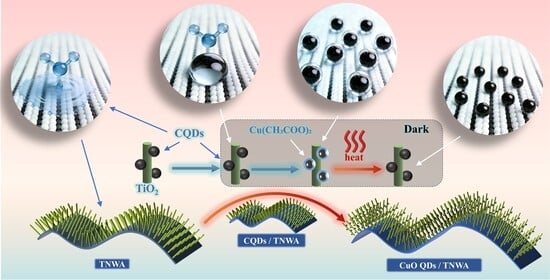
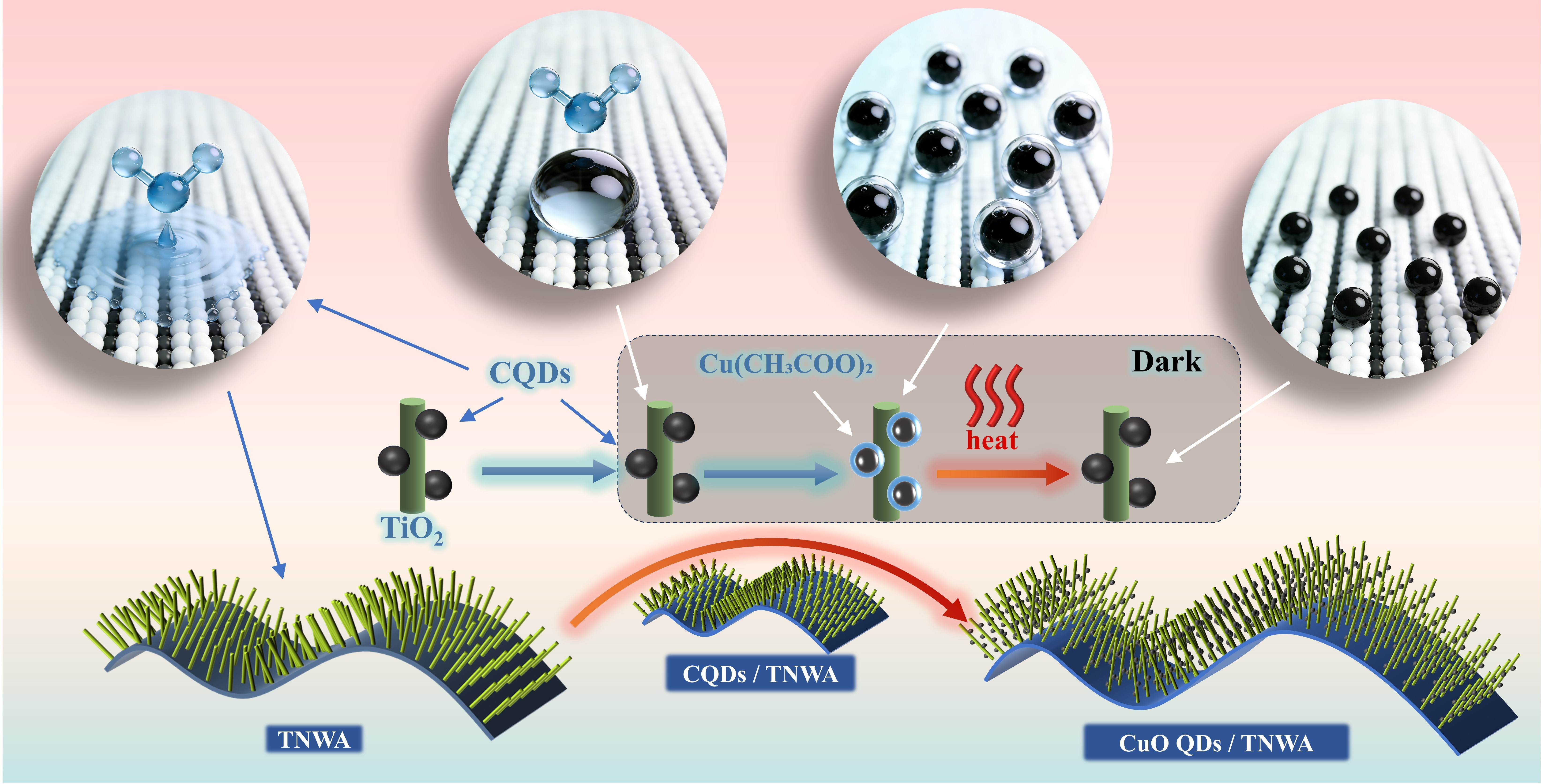
Graphical Abstract

1. Introduction

As a research hotspot in the field of semiconductor photocatalysis, CuO/TiO2 has demonstrated enormous potential in environmental purification and energy conversion [1,2,3]. In this catalyst, TiO2 serves as the primary catalytic phase, offering advantages such as stable photochemical properties, high catalytic activity, non-toxicity, low cost, and absence of secondary pollution. These merits underpin its long-standing recognition as a pivotal material among photocatalysts [4,5,6,7]. However, TiO2 (wide-bandgap semiconductor, ~3.2 eV) exhibits ultraviolet-only response and a high recombination rate of photogenerated charge carriers with holes [8,9,10,11]. CuO as a P-type semiconductor possesses advantages including a narrow bandgap, strong optical absorption (extending to the near-infrared region), low cost, and facile synthesis, thus being widely applied in solar cells, photocatalysis, photoelectrochemical sensors, and other fields [12,13]. With a conduction band (CB) position of −0.1 eV vs. NHE and a bandgap of 1.5 eV, CuO can form a standard p–n heterojunction with TiO2 (CB: ~−0.5 eV vs. NHE; bandgap: 3.2 eV) [14]. Intrinsically, p–n junctions belong to type-II heterojunctions, both of which can enhance the excitation and separation of photogenerated carriers while suppressing electron–hole pair recombination. Furthermore, the CuO has a wide absorption range for sunlight, which leads to extending the spectral response of the CuO/TiO2 to the near-infrared region [15,16].
The coupling enhancement effect of heterojunctions is confined to a few atomic layers at the interface. Therefore, from the perspective of nanostructures, utilizing quantum dots of zero-dimensional materials as cocatalysts enables the maximization of cocatalyst utilization. The advantage can also prevent any impact on the exposure of active sites in the main catalytic phase. For the CuO/TiO2 composite photocatalyst, the quantum dots dotization of CuO not only facilitates the improvement of heterojunction reaction efficiency but also contributes to the modification of TiO2 with well-defined nanostructures [17,18]. According to the reported literature, all current methods for preparing supported CuO QDs are achieved via chemical approaches. Nagappagari et al. [19] loaded CuO with a size of 2.2–4.6 nm onto P25 TiO2 particles via the molten salt method, which enhanced the hydrogen evolution performance by nine times. Yanlin Wang et al. [20] employed a two-step hydrothermal method to in situ load CuO QDs as a cocatalyst onto 40–50 nm TiO2 nanosheets. The hydrogen evolution performance of CuO/TiO2 was nearly 20 times higher than that of pristine TiO2. In terms of oxidation, Gullapelli Sadanandam et al. [21] loaded CuO QDs onto TiO2 nanosheets via hydrothermal and impregnation methods for water pollutant treatment. In two recent studies, IFarman Ullah et al. [22] deposited 10–20 nm CuO on the surface of 200–300 nm TiO2 nanorods via a hydrothermal. Beibei Yao et al. [23] deposited CuO on 50–100 nm TiO2 nanoparticles. Both of them can enhance the photocatalytic performance. However, the structure of the TiO2 used as the main catalytic phase in the above studies is relatively bulky, which limits the performance of the CuO/TiO2 catalyst and makes it difficult to maximize its potential. To achieve better performance, the main catalytic phase TiO2 should possess a large specific surface area, and nanostructured TiO2 (such as nanosheets, nanobelts, nanotubes, nanopores, nanorods, nanowires, etc.) meets this requirement. Among the nanostructures, TiO2 nanowires exhibit the largest specific surface area and are one-dimensional single-crystal materials. To a certain extent, this enables the separation, transfer, and collection of photogenerated electrons to be much easier compared to other structures [24,25,26,27]. Jie Liu et al. reported that maximizing the refinement of the nanowire structure to attain a higher aspect ratio can further promote the photocatalytic performance of TiO2 [28].
To maximize the performance of CuO QDs/TiO2 as much as possible, this work employed ultra-fine TiO2 nanowire array thin films (TNWAs) with a diameter of 10–15 nm as the main catalytic phase. TNWAs exhibit excellent photon quantum efficiency compared with other nanostructured TiO2 [29]. According to the groundbreaking study by Wang, R. et al. [30], TiO2 surfaces exhibit excellent affinity for both water and oil (amphiphilicity) after UV irradiation, while storage in dark conditions gradually restores their hydrophobicity. Leveraging this property, the present work employs CQDs as “seeds” for the in situ growth of CuO QDs on TiO2 nanowires. As reported in the literature [31], the variation in the width of the depletion layer of the P–N junction can be induced by controlling the loading amount of CuO on the surface of TiO2. Different degrees of energy band bending occur at the CuO and TiO2 ends of the heterojunction, thereby resulting in a change in catalytic performance. The loading amount of CuO QDs can be precisely regulated by controlling the number of CQDs “seeds”, thereby achieving the optimal catalytic performance. This novel material design exhibits versatile applicability and will provide a new feasible strategy for the synthesis of semiconductor quantum dots.

2. Results and Discussion

2.1. Morphology and Composition of CuO QDs/TNWAs

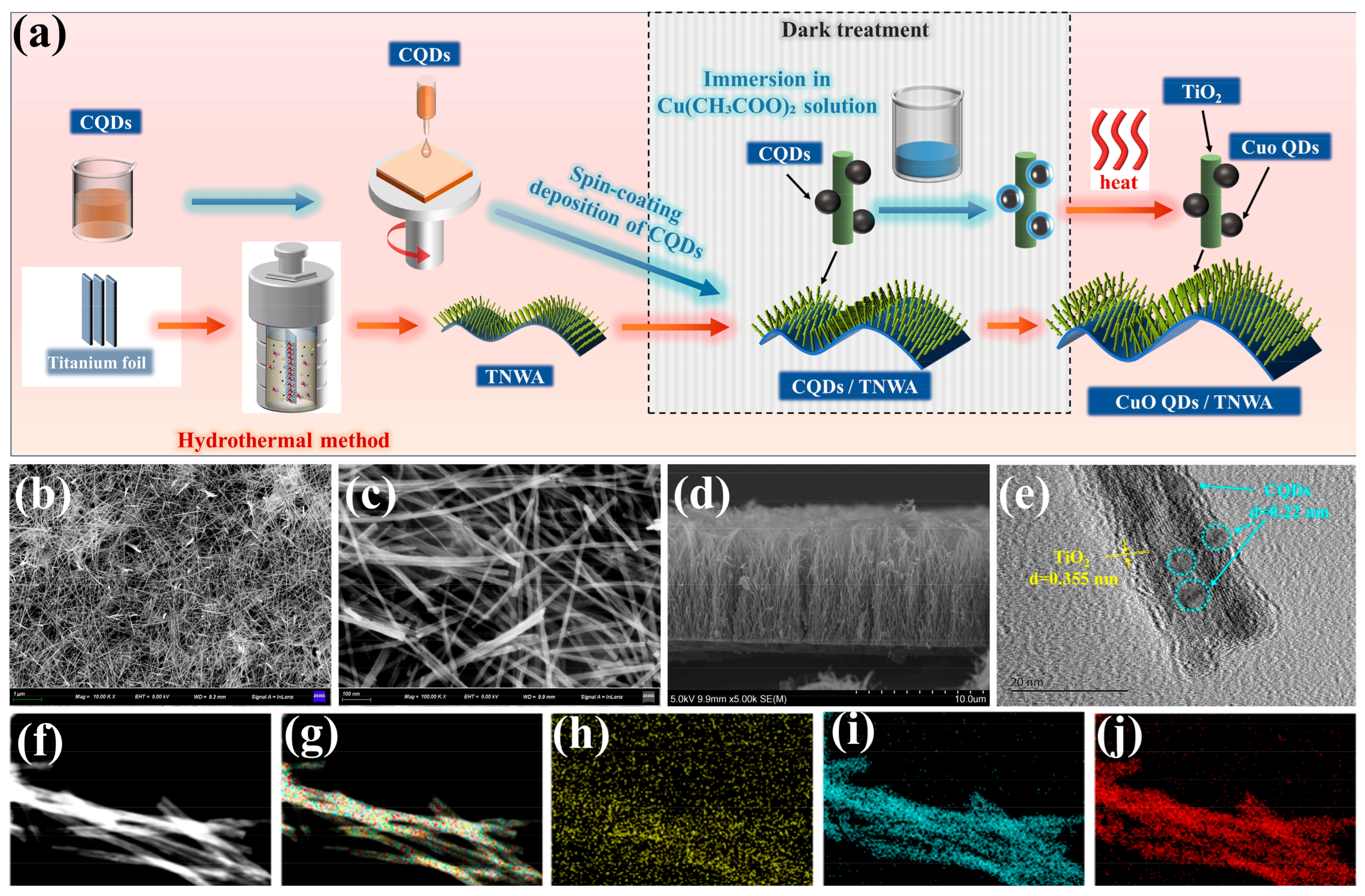
Figure 1a presents a schematic diagram of the preparation process that is termed the “seed-mediated method”. The key procedure resides in the simultaneous utilization of the hydrophilicity of CQDs and the hydrophobicity of titanium dioxide (TiO2) in the dark. After soaking in Cu(CH3COO)2 solution, the surface of CQDs absorbs a small amount of the solution, while the TiO2 portion remains unabsorbed. Calcination in air leads to the oxidative decomposition of CQDs, resulting in the in situ formation of CuO QDs. Figure 1b–d shows the TNWAs prepared using the method we previously developed [29]. The array maintains a highly ordered structure. The nanowires have a diameter of 10–15 nm and an aspect ratio ranging from 800 to 1100. The lattice morphology of TNWAs after CQDs deposition via spin-coating is presented in Figure 1e, with the CQDs exhibiting an average diameter of approximately 3–5 nm. Figure 1f–j are the elemental mapping images of CQDs/TNWAs. In addition to Ti and O elements from TiO2, the C element is also detected to be uniformly distributed on the TiO2 nanowires. The presence of the C element detected in other regions of Figure 1h is attributed to the carbon film on the TEM sample support grid used for the test.
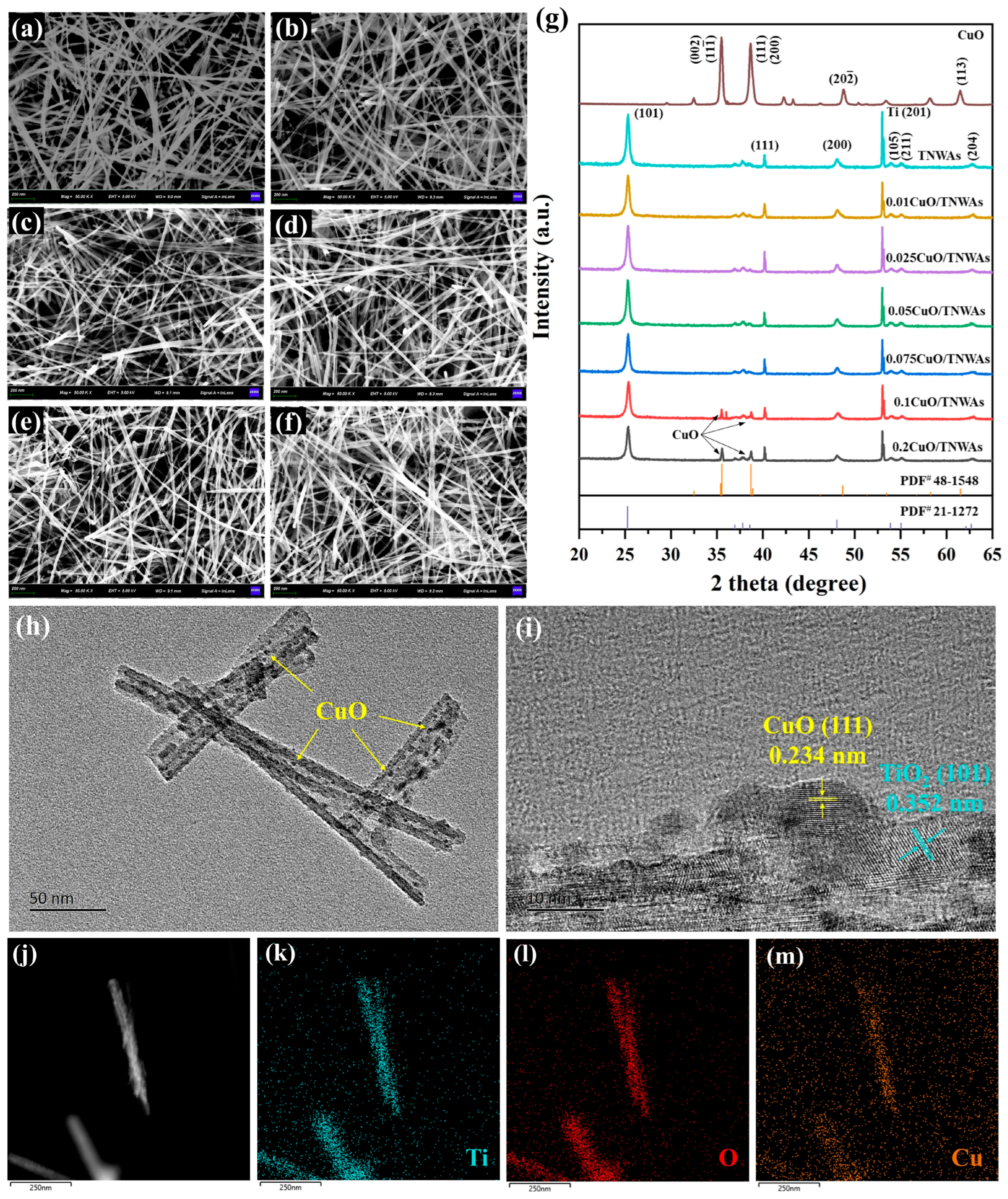
Figure 2a–f shows the SEM morphologies of 0.01 CuO/TNWAs, 0.025 CuO/TWNAs, 0.05 CuO/TNWAs, 0.075 CuO/TNWAs, 0.1 CuO/TNWAs, and 0.2 CuO/TNWAs. As the load of CuO increases, all the samples still maintain the same morphology as that of TNWAs. The particles or clusters formed by CuO could not be observed in the SEM. Therefore, it can be inferred that the CuO nanoparticles are present on the surface of TiO2 nanowires. Further phase analysis of 0.01 CuO/TNWAs, 0.025 CuO/TNWAs, 0.05 CuO/TNWAs, 0.075 CuO/TNWAs, 0.1 CuO/TNWAs, and 0.2 CuO/TNWAs was performed by XRD, as shown in Figure 2g. The diffraction patterns of CuO and TNWAs are consistent with the standard reference cards PDF#48-1548 and PDF#21-1272, respectively. The main phase of CuO exhibits two overlapping peaks, corresponding to the (002) and (11 1 ¯ ) crystal planes, and the (111) and (200) crystal planes, respectively. Other crystal planes, such as (20 2 ¯ ) and (113), show weak orientation. In the CuO/TNWAs composites, the anatase TiO2 (101) crystal plane remains the dominant phase. Compared with TNWAs, no deviation was observed in the diffraction peak of anatase TiO2 (101), indicating that no doping was formed between the two components. With the gradual increase in CuO, the intensity of the anatase (101) diffraction peak decreases progressively. This is attributed to the fact that XRD predominantly reflects surface layer information, and the loading of CuO on the surface weakens the detection signal of TNWAs. In comparison, no CuO diffraction peaks are observed in 0.01 CuO/TNWAs, 0.025 CuO/TNWAs, 0.05 CuO/TNWAs, and 0.075 CuO/TNWAs, as the CuO loading is below the detection limit of XRD. Additionally, CuO diffraction peaks are detected in 0.1 CuO/TNWAs and 0.2 CuO/TNWAs, indicating an increase in the CuO loading on the TNWAs surface and the formation of a composite between CuO and TNWAs.
To achieve the distribution regularity and approximate loading amount of CuO on TNWAs, the cross-sections of 0.01 CuO/TNWAs, 0.025 CuO/TNWAs, 0.05 CuO/TNWAs, 0.075 CuO/TNWAs, 0.1 CuO/TNWAs, and 0.2 CuO/TNWAs were subjected to further SEM-EDS characterization. As shown in Figure S1, with the gradual increase in CuO loading, the Cu element mapping detected by EDS area scanning gradually becomes more intense. Additionally, it is observed that CuO is not enriched near the substrate of TNWAs but is uniformly distributed across the entire cross-section, indicating that CuO QDs are uniformly loaded on the surface of TNWAs nanowires. Table S1 presents the EDS test results. Based on the atomic ratios and mass ratios of Ti, Cu, and O elements, the calculated CuO loading amounts in 0.01 CuO/TNWAs, 0.025 CuO/TNWAs, 0.05 CuO/TNWAs, 0.075 CuO/TNWAs, 0.1 CuO/TNWAs, and 0.2 CuO/TNWAs are 0.75%, 1.62%, 2.12%, 4.78%, 6.56%, and 8.49%, respectively. Due to the inherent characteristics of X-ray energy spectra, this result provides a more accurate reflection of the elemental distribution state at the surface.
To further clarify the distribution mode of CuO on TiO2 nanowires, the 0.2 CuO/TNWAs sample with the highest CuO content was selected for TEM analysis. The 0.2 CuO/TNWAs film was scraped off the Ti substrate, dispersed via ultrasonic treatment, and then prepared into a sample for observation. Figure 2h presents a low-magnification TEM image of CuO GQDs/TNWAs. It can be observed from the image that nanoscale CuO particles are dispersed and uniformly distributed on the surface of TiO2 nanowires, with all particle sizes below 10 nm and slight variations in dimensions. High-magnification observation of a local area reveals the lattice fringes of both CuO and TiO2, as shown in Figure 2i. The image displays CuO nanoparticles with a diameter of approximately 5 nm loaded on the TiO2 matrix. Software measurements indicate that the interplanar spacings of CuO and TiO2 are 0.234 nm and 0.352 nm, corresponding to the CuO (111) and TiO2 (101) crystal planes, respectively. Figure 2j–m shows the EDAX area scanning results. Comparison of the elemental mappings of Ti, Cu, and O confirms the formation of a composite between CuO and TNWAs, where CuO is dispersed and uniformly distributed on the surface of TiO2 nanowires in the form of nanoparticles. This conclusion is consistent with the results obtained from the SEM cross-sectional observation.

2.2. Chemical State Analysis of CuO QDs/TNWAs

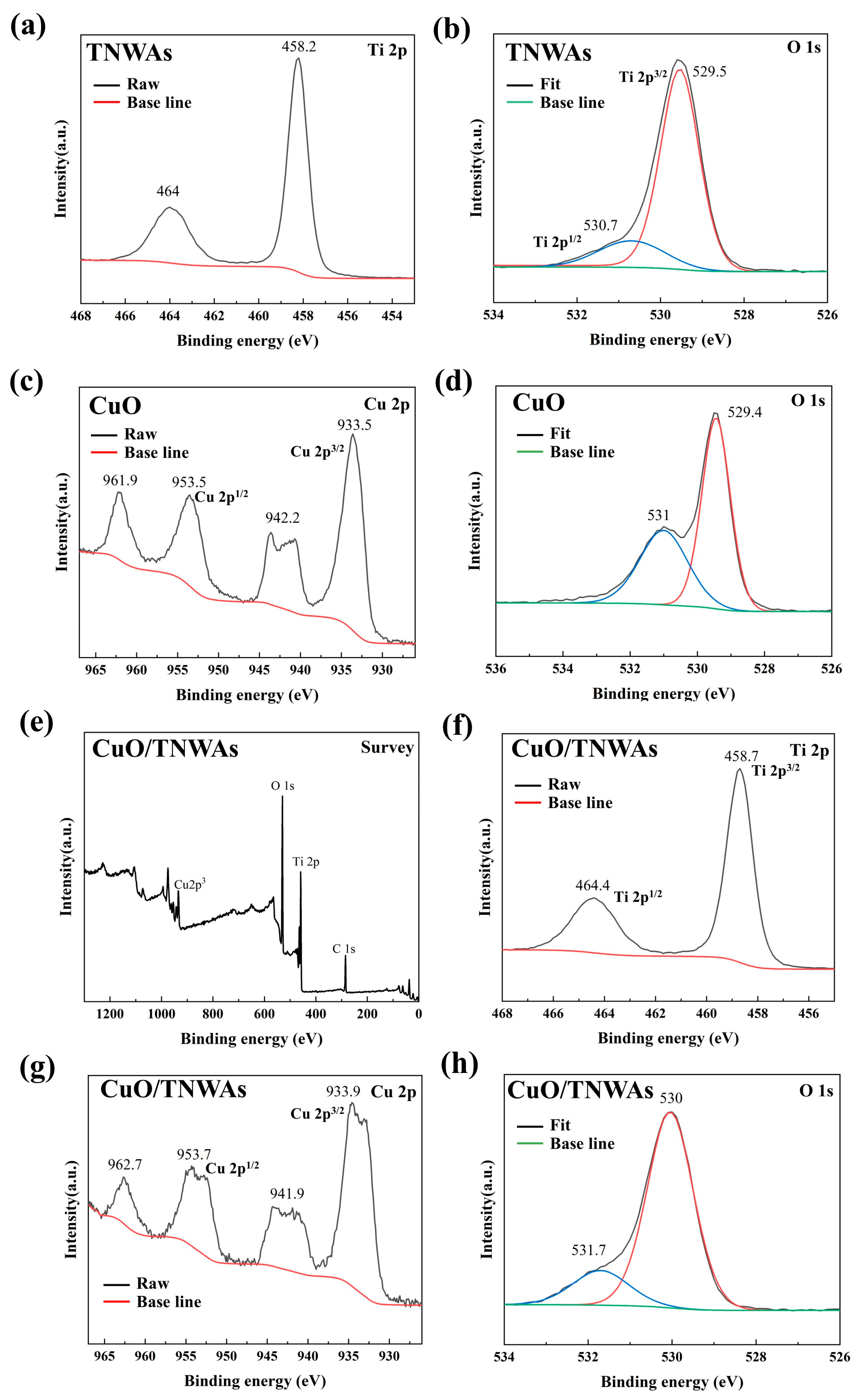
Figure 3 presents the XPS analysis results of TNWAs, CuO, and 0.2 CuO/TNWAs. From the fitting results of Ti 2p and O 1s for TNWAs (Figure 3a–d), the fitted peaks of Ti consist of a main peak at 458.2 eV and a spin–orbit splitting peak at 464 eV, which matches the standard binding energy of Ti4+ (458.5 eV), indicating that the material is TiO2. The fitted peaks of Cu 2p include a main peak at 933.5 eV, a spin–orbit splitting peak at 953.5 eV, and two satellite peaks at 942.2 eV and 961.9 eV. This is consistent with the standard binding energy of Cu2+ in copper oxides (933.1 eV), confirming that the synthesized material is CuO. For the CuO QDs/TNWAs composite, based on the survey spectrum (Figure 3f), the relative atomic ratios of Ti, O, and Cu are determined as shown in Table S2.
Compared with the results in Table S1, the atomic ratio of Cu element measured by EDS (Table S2) is slightly higher. Because XPS is a surface-sensitive analytical technique that only probes elements within a depth of 2–3 nm from the surface, in contrast, EDS can penetrate to the micrometer scale and respond to elements throughout the entire film. The CuO QDs loading on the surface of 0.2 CuO/TNWAs is approximately 8.59 At%, implying that the surface CuO QDs loading of other samples will be lower than this value. Fitting analysis of Ti 2p, Cu 2p, and O 1s spectra of the composite (Figure 3f–h) reveals no obvious chemical shifts, indicating that both TiO2 and CuO on the surface retain their original valence states.
Analysis of morphology, phase composition, and chemical state indicates that the phases of CuO QDs and TiO2 remained independent, and the composite CuO QDs/TNWAs were constructed via a P–N heterojunction. Further characterizations will be conducted on its light absorption properties, photoluminescence performance, carrier lifetime, and photoelectrochemical properties to explore the optimal loading amount of the co-catalyst CuO QDs.

2.3. Performance Analysis of CuO QDs/TNWAs

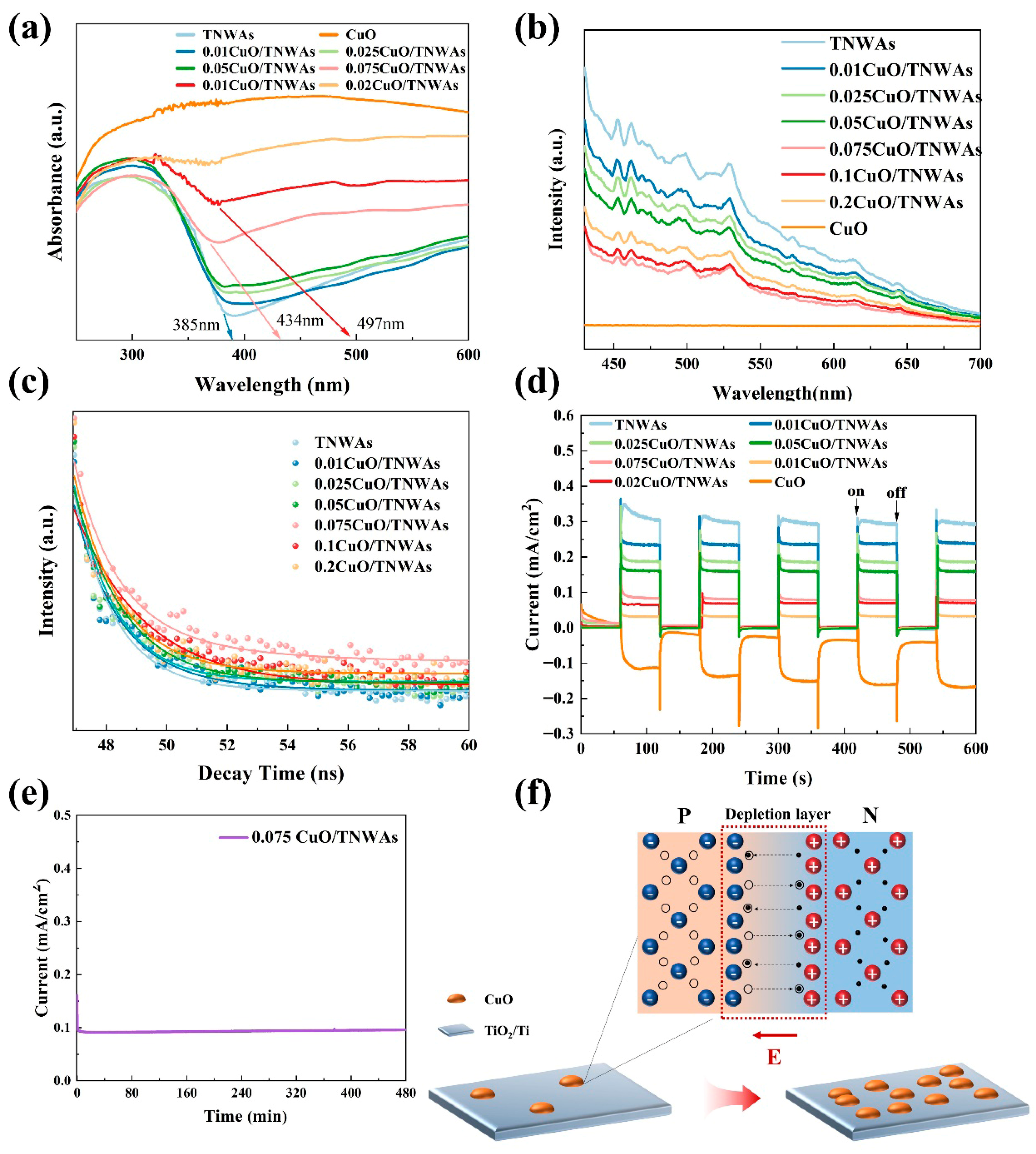
Figure 4a shows the UV-Vis DRS results of 0.01 CuO/TNWAs, 0.025 CuO/TNWAs, 0.05 CuO/TNWAs, 0.075 CuO/TNWAs, 0.1 CuO/TNWAs, and 0.2 CuO/TNWAs. As shown, the absorption region of CuO QDs covers ultraviolet (UV), visible, and infrared (IR) light, with the absorption center near the green light region of the visible spectrum. Due to the low CuO QDs loading, the light absorption ranges of TNWAs, 0.01 CuO/TNWAs, 0.025 CuO/TNWAs, and 0.05 CuO/TNWAs are very similar, all concentrated in the UV region around 385 nm. The increase in CuO QDs loading, the absorption edges of 0.075 CuO/TNWAs, 0.1 CuO/TNWAs, and 0.2 CuO/TNWAs gradually extend toward the visible light region. The absorption edges of 0.075 CuO/TNWAs and 0.1 CuO/TNWAs are 434 nm and 497 nm, respectively, while that of 0.2 CuO/TNWAs extends to the infrared light region. The band gaps were calculated using Equation (1) [29].
(αhγ)n = k (hυ − Eg)
Here, α is the absorption coefficient, h is Planck’s constant, γ is the photon frequency, K is the proportional constant, Eg is the band gap energy, and n is a constant with a value of 1/2, indicating that TiO2 is an indirect band gap semiconductor. Figure S2 shows the Tauc plots and corresponding band gap values of TNWAs, 0.01 CuO/TNWAs, 0.025 CuO/TNWAs, 0.05 CuO/TNWAs, 0.075 CuO/TNWAs, 0.1 CuO/TNWAs, 0.2 CuO/TNWAs, and CuO, which are 3.2 eV, 3.09 eV, 3.08 eV, 3.10 eV, 2.86 eV, 2.49 eV, 1.69 eV, and 1.53 eV, respectively. The results indicate that 0.075 CuO/TNWAs, 0.1 CuO/TNWAs, and 0.2 CuO/TNWAs have achieved visible light response, and the band gap gradually approaches 1.53 eV with the increase in CuO QDs loading. The reduction in the band gap of the samples not only indicates the expansion of the spectral absorption range but also correlates with the separation and recombination efficiency of electron–hole pairs. Therefore, photoluminescence (PL) and time-resolved fluorescence (TRF) spectra of the samples were further tested to investigate this correlation.
Figure 4b shows the PL spectra of TNWAs, 0.01 CuO/TNWAs, 0.025 CuO/TNWAs, 0.05 CuO/TNWAs, 0.075 CuO/TNWAs, 0.1 CuO/TNWAs, 0.2 CuO/TNWAs, and CuO QDs under an excitation wavelength of 350 nm. It can be observed that the fluorescence emission peaks are distributed between 450 and 550 nm. Among them, CuO is a typical photothermal material that hardly generates fluorescence [32], and the fact has also been verified in the PL test. With the increase in CuO loading on TNWAs, the fluorescence intensity shows a decreasing trend, indicating that CuO QD loading can inhibit the recombination of photogenerated electron–hole pairs [33]. However, when the CuO loading reaches 0.075 CuO/TNWAs, the fluorescence intensity increases instead, indicating that there is a certain coupling effect between CuO QDs and TNWAs rather than a simple superposition effect. To further verify this, the fluorescence lifetimes were tested in Figure 4c, and the lifetimes were fitted using Equation (2) [29], with the fitted values listed in Table S3.
τ = τ1 × A1% + τ2 × A2% + τ3 × A3%
Here, τ is the fluorescence lifetime, while τ1, τ2, τ3, and A1, A2, A3 represent the fitted lifetimes and their corresponding proportions, respectively. Corresponding to the PL results, the overall trend shows that the fluorescence lifetime gradually prolongs with the increase in CuO QDs loading, reaching a maximum of 11.21 ns at 0.075 CuO/TNWAs before gradually decreasing. This indicates that the main role of the co-catalyst CuO is to form a built-in electric field with TiO2, which extends the migration process of carriers (photogenerated electrons) and thereby inhibits the recombination of electron–hole pairs.
To determine the effect of the loading amount of CuO quantum dot (QD) catalyst on the separation and recombination of photogenerated electrons and holes, the photoelectrochemical properties of the samples were further analyzed. As shown in Figure 4d, CuO generates a cathodic current under light irradiation, indicating the p-type semiconductor characteristic of CuO with holes as the main charge carriers. For the CuO/TNWAs composites, the photocurrent gradually decreases with the increase in CuO surface loading. The responsive photocurrent densities of TNWAs, 0.01 CuO/TNWAs, 0.025 CuO/TNWAs, 0.05 CuO/TNWAs, 0.075 CuO/TNWAs, 0.1 CuO/TNWAs, and 0.2 CuO/TNWAs are 0.36 mA/cm2, 0.24 mA/cm2, 0.19 mA/cm2, 0.17 mA/cm2, 0.09 mA/cm2, 0.07 mA/cm2, and 0.04 mA/cm2, respectively. Herein, the decrease in photocurrent could not be definitively attributed to the reduction in the separation efficiency of electron–hole pairs but was correlated with the variation in the carrier states on the surface of the composite [34].
The mechanism can be explained based on the characteristics of P–N type semiconductor heterojunctions. As shown in Figure 4f, CuO (P-type) takes holes as the majority carriers, while TiO2 (N-type) takes free electrons as the majority carriers. When CuO QDs are loaded on the surface of TiO2, holes will diffuse at the interface, leading to the formation of a space charge layer (depletion layer). In the depletion layer, the electrons and holes in the two phases undergo mutual recombination, and the drift motion of the minority carriers can be neglected. The depletion layer is in a state of space-charge balance, resulting in the accumulation of positive charges on the N-side (TiO2) and negative charges on the P-side (CuO), thus forming a built-in electric field. The direction of the built-in electric field (N→P) is indicated in the figure. As shown, with the increase in CuO QD loading, the area of the depletion layer relatively expands. This reduces the exposed surface area of TNWAs and increases the number of electrons trapped in the depletion layer. Consequently, the number of photogenerated carriers (photoelectrons) excited from TNWAs decreases correspondingly. In summary, the following conclusion can be drawn: CuO QDs can inhibit electron–hole pair recombination and prolong carrier lifetime, but excessive loading leads to low charge separation efficiency. Therefore, the loading amount of CuO QDs must be optimally designed. Specifically, insufficient loading fails to achieve the co-catalytic effect, whereas excessive loading impairs the generation of photogenerated electrons. Based on the above research, 0.075 CuO/TNWAs is considered the optimal loading. To further characterize the photoelectrochemical stability of 0.075 CuO/TNWAs, a chronoamperometric (I–t) test was performed under light irradiation, as shown in Figure 4e. CuO/TNWAs maintained a relatively stable photocurrent density within 8 h of continuous illumination, with values ranging from 0.0911 mA/cm2 to 0.0958 mA/cm2. The results indicate that CuO/TNWAs exhibits excellent stability.

2.4. Degradation Performance of CuO QDs/TNWAs for BPA

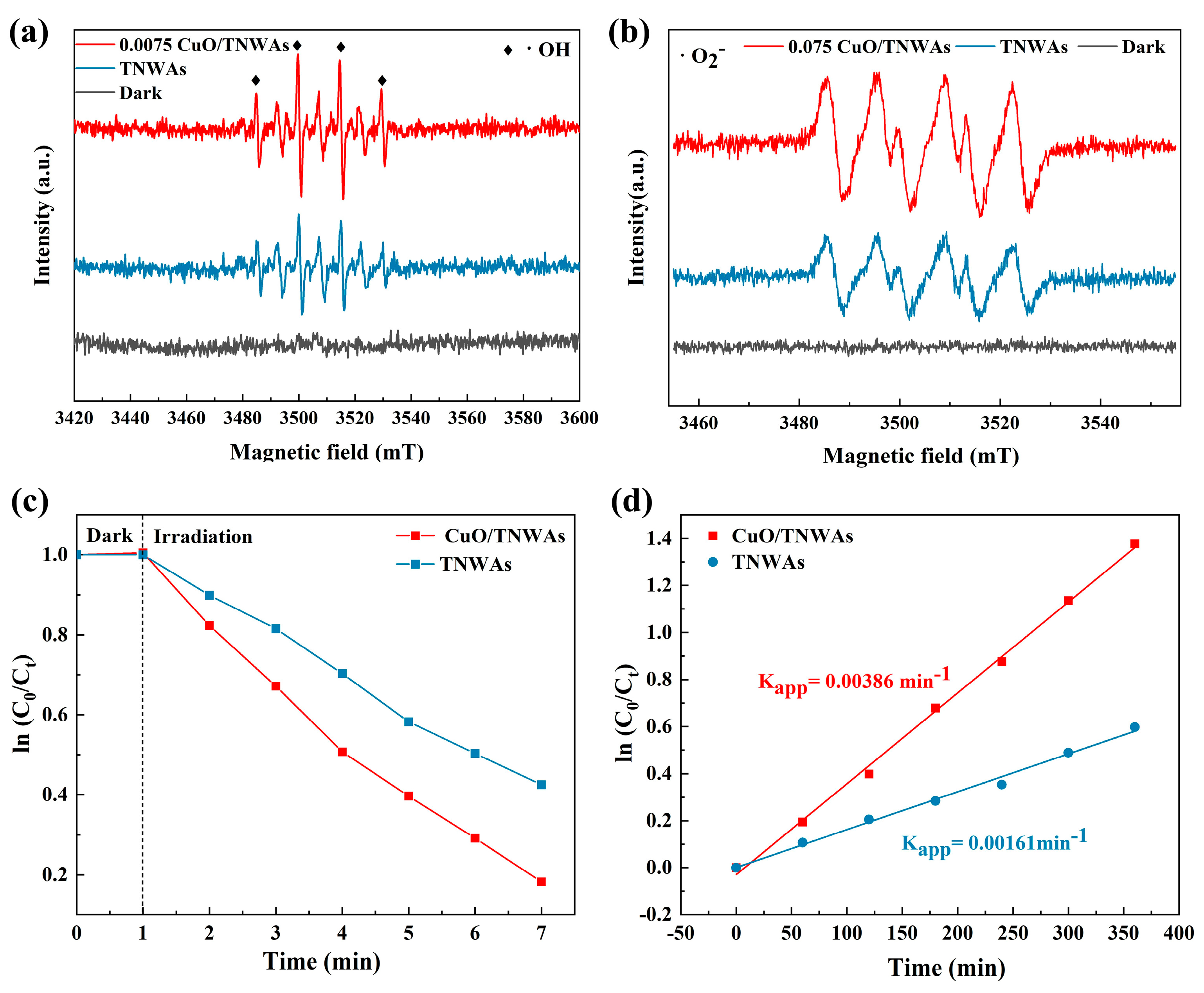
Figure 5a shows the test results of •OH radicals. No signal was detected under dark conditions. After turning on the light, both TNWAs and 0.075 CuO/TNWAs exhibited a typical quartet peak with a 1:2:2:1 intensity ratio, corresponding to the DMOP •OH adduct. Notably, the peak intensity of 0.075 CuO/TNWAs was significantly higher than that of TNWAs •OH radicals are generated by the reaction between holes (produced from photoelectron separation) and water molecules. Additionally, some impurity peaks were observed between the •OH peaks, which are attributed to the presence of superoxide anion radicals (•O2). For accurate quantification, methanol was used as the solvent to further test the superoxide anion radicals, as shown in Figure 5b. Similarly, there is not •O2 was generated under dark conditions. Under light irradiation, both samples displayed a typical six peaks with four strong and two weak, indicating it is superoxide free radicals (•O2). •O2 is formed by the combination of photoexcited electrons and dissolved oxygen in water. The yield of •O2 radicals in 0.075 CuO/TNWAs was slightly higher than that in TNWAs, indicating a moderate improvement in the photoelectron separation efficiency of 0.075 CuO/TNWAs under light excitation.
Figure 5c shows the degradation curves of BPA by 0.075 CuO/TNWAs and TNWAs. One h adsorption experiment was conducted prior to degradation. The results indicated that almost no adsorption of BPA occurred on the surface of 0.075 CuO/TNWAs, suggesting that degradation was the dominant process. Due to the solution/photocatalyst ratio of 10 mL/cm2, neither TNWAs nor 0.075 CuO/TNWAs achieved complete degradation of BPA within 6 h, with degradation efficiencies of 58.50% and 91.77%, respectively. The degradation curves were fitted with pseudo-first-order kinetics using Equation (3) [35]:
Ln (C0/Ct) = Kappt
Here, C0 is the initial concentration, Ct is the concentration of the pollutant at time, and Kapp is the apparent rate constant (min−1), which is used to characterize the degradation reaction rate, as shown in Figure 5d. The Kapp of TNWAs and 0.075 CuO/TNWAs were 0.00161 min−1 and 0.00386 min−1, respectively, indicating that the degradation rate of BPA by CuO/TNWAs was 2.4 times higher than that by TNWAs. These results demonstrate that the co-catalyst CuO QDs can significantly enhance the degradation capacity of TiO2.

2.5. Mechanism Investigation of P–N Heterojunction

To investigate the effect of loading amount on the band structure variation in composite photocatalysts, Mott–Schottky (M–S) curves of 0.01 CuO/TNWAs, 0.025 CuO/TNWAs, 0.05 CuO/TNWAs, 0.075 CuO/TNWAs, 0.1 CuO/TNWAs, 0.2 CuO/TNWAs, and pure CuO were tested. The data were processed using Equation (4) [29], and the results are shown in Figure S3.
1 C 2 = 2 ε ε 0 e N D     V V F B   K B T e
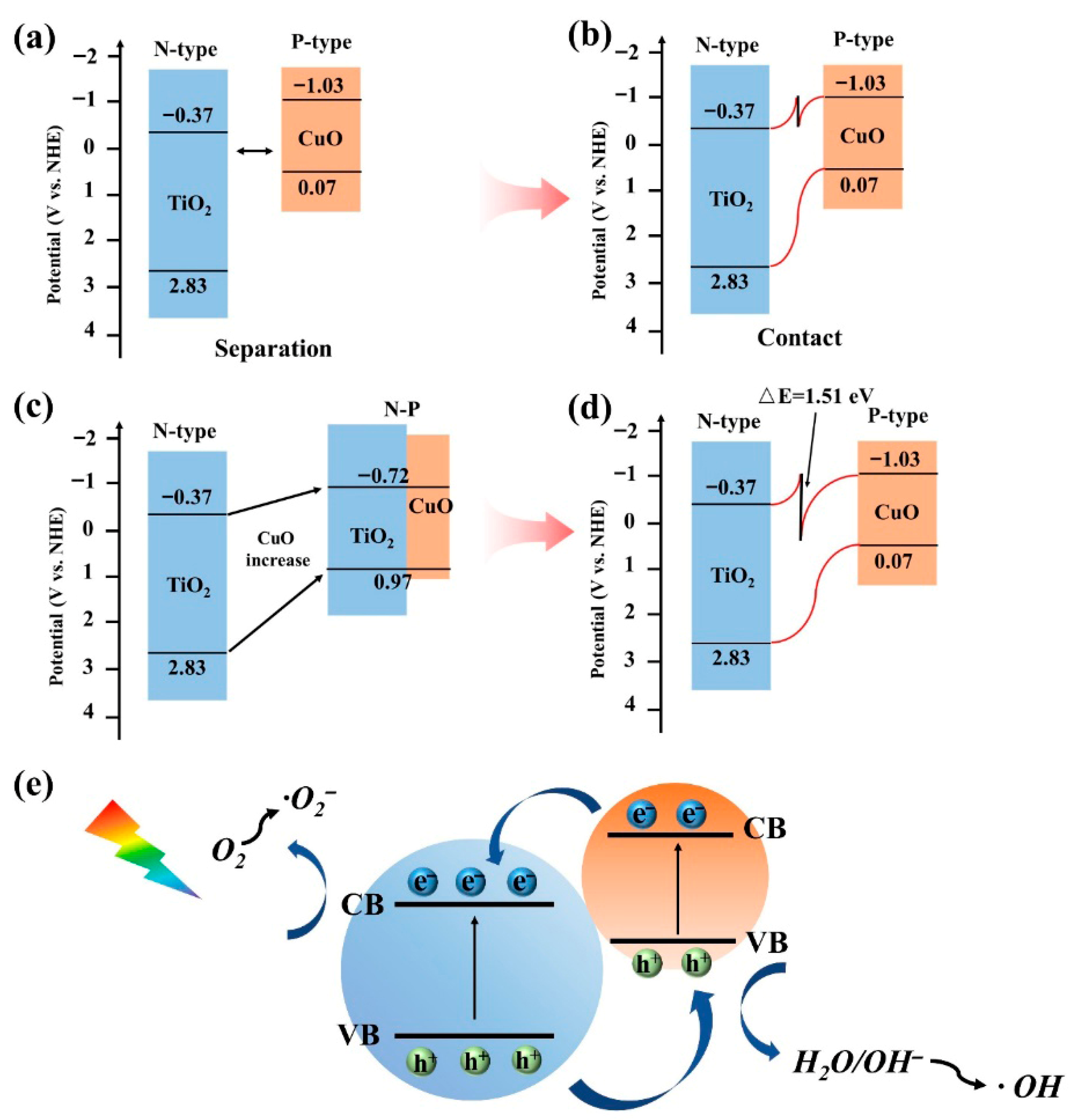
Here, VFB is the flat band potential, C is the interfacial capacitance, e is the elementary charge, ε is the dielectric constant of the semiconductor, ε0 is the permittivity of free space, ND is the donor concentration of the semiconductor, and V is the applied voltage, KB is the Boltzmann constant, and T is the absolute temperature. Among them, Figure S3a–f exhibits typical N-type semiconductor characteristics with TiO2 as the main catalytic phase, and their flat band potentials (Efb) were measured to be −0.39 V, −0.43 V, −0.43 V, −0.47 V, −0.51 V, and −0.52 V (vs. NHE), respectively. For N-type semiconductors, the flat band potential is 0.1 V~0.3 V more positive than the conduction band potential (ECB) [29]. Taking the intermediate value of 0.2 V, the conduction band positions were determined to be −0.59 V, −0.63 V, −0.63 V, −0.67 V, −0.71 V, and −0.72 V (vs. NHE). As shown in Figure S3g, the co-catalyst CuO exhibits a negative slope in the M–S curve, a characteristic of p-type semiconductors, with a flat band potential of 0.27 V (vs. NHE). For p-type semiconductors, the flat band potential is 0.1 V~0.3 V more negative than the valence band potential (EVB). Again, taking the intermediate value of 0.2 V, the valence band potential of CuO QDs was determined to be 0.47 V (vs. NHE). The valence band and conduction band positions of pure TNWAs are reported as 2.83 V and −0.37 V (vs. NHE), respectively. The band structure variations in CuO QDs and TiO2 before and after contact are summarized in Figure 6a–d. When CuO QDs and TiO2 are separated (Figure 6a), both maintain their individual band gaps. Upon contact (Figure 6b), the valence bands of both materials remain unchanged, while band bending occurs in the conduction bands. This results in a narrower band gap of CuO/TNWAs compared to pure TNWAs, accompanied by the formation of an energy level difference (△E) [31,33]. As shown in Figure 6c, when the loading amount of CuO QDs increases to 0.2 CuO/TNWAs, the band gap, conduction band, and valence band of the composite approach those of pure CuO QDs, with a conduction band bending magnitude of 1.51 eV (Figure 6d). At this point, the band gap of CuO/TNWAs is significantly reduced, enabling full-spectrum absorption in the visible light region. Furthermore, the N-type semiconductor characteristic of TNWAs (with free electrons as majority carriers) is replaced by hole migration. However, this is not an ideal scenario, as photocurrent tests revealed that few photoelectrons are injected into the solution to participate in reduction reactions. Therefore, it is crucial to maintain an optimal CuO QD loading level. Figure 6e illustrates the migration behavior of electrons and holes in a standard p–n heterojunction under light excitation. This type of heterojunction simultaneously promotes the generation of •OH and •O2 radicals [36].

3. Materials and Methods

3.1. Materials

Ti foil (4N) was purchased from Baoti Group Co., Ltd. (Baoji, China). Bisphenol A (BPA) are produced by Shanghai McLean Co., Ltd. (Shanghai, China) Sodium hydroxide (NaOH), hydrochloric acid (HCl), anhydrous ethanol (CH3CH2OH), sodium sulfate (Na2SO4), sulfuric acid (H2SO4), hydrogen peroxide (H2O2), Copper(II) acetate monohydrate Cu(CH3COO)2•H2O were purchased from China National Pharmaceutical Group Chemical Reagent Co., Ltd. (Shanghai, China). All reagents are of analytical or higher grade and were used directly without further purification. All the water used in this work was deionized water.

3.2. Preparation of CQDs/TNWAs

CQDs were synthesized by a hydrothermal method using a 0.1 mol/L aqueous glucose solution as the carbon source. High-purity titanium foils were cut into 7 cm × 7 cm squares; after roughening pretreatment, TNWAs were synthesized via the hydrothermal method. The synthesis protocols for both CQDs and TNWAs were performed in accordance with our previously reported work [29]. The synthesized TNWAs were flattened and immobilized on a spin coater. Aqueous CQD solutions with concentrations of 0.01 g/L, 0.025 g/L, 0.05 g/L, 0.075 g/L, 0.1 g/L and 0.2 g/L were coated onto the surface of TNWAs. The coating dosage was set to 0.04 mL/cm2, with a rotation speed of 2500 rpm and a coating duration of 30 s. This coating process was repeated three times to ensure the uniform coverage of CQDs. The coated samples were transferred to a vacuum drying oven and dried at 100 °C for 3 h to ensure dehydration. At this stage, the intermediate CQDs/TNWAs were obtained. since both TiO2 and CQDs are hydrophilic [37,38], the CQDs readily distribute on the TiO2 surface.

3.3. Preparation of CuO QDs/TNWAs

Given that the hydrophilic nature of TiO2 is largely derived from photoinduction, the CQDs/TiO2 samples were placed in a dark chamber for over 48 h, during which the reversible hydrophilic-to-hydrophobic transition of TiO2 was completed. At this stage, the CQDs on the sample surface exhibit hydrophilicity due to the presence of hydroxyl-rich functional groups, while the TNWAs matrix is hydrophobic. The samples were individually immersed in a 0.05 mol/L copper acetate solution, then promptly removed. The surface moisture of the sample is absorbed by means of air blowing combined with absorbent paper. Then, the samples were placed horizontally in an oven for drying at room temperature for 1 h. During this process, only the exposed CQD sites could absorb moisture, while TiO2 did not absorb any moisture. Subsequently, the samples were calcined in a muffle furnace at 400 °C in an ambient atmosphere for 1.5 h. At this stage, CQDs are categorized as amorphous carbon, with an ignition temperature of only 300–400 °C. Under the calcination condition of 400 °C, CQDs undergo rapid and complete oxidation and thus disappear, ultimately leading to the formation of CuO QDs/TNWAs. The corresponding chemical reaction equation is as follows:
2Cu(CH3COO)2 → 2CuO + 3CH4↑ + CO2
All the above steps were performed in a light-shielded dark environment. Based on the different concentrations of the “seeds” (CQDs) dispersion (0.01 g/L~0.2 g/L), in Section 3.2, the samples were simply named as 0.01 CuO/TNWAs, 0.025 CuO/TWNAs, 0.05 CuO/TNWAs, 0.075 CuO/TNWAs, 0.1 CuO/TNWAs, and 0.2 CuO/TNWAs, respectively.

3.4. Degradation of BPA

The degradation experiment used 100 mL of 20 mg/L BPA aqueous solution as the target. The usage ratio of the catalyst was 10 mL/cm2. The light source is a 300 W AM1.5G xenon lamp with an illumination intensity of 15 mW/cm2, and the degradation time ranges from 0 to 6 h. The HPLC was equipped with an Aquity UPLC BEH C18 chromatographic column. The mobile phase consisted of 0.1% formic acid in water and acetonitrile. The ionization mode was electrospray positive ion mode. The ion source voltage was 5500 V, the ion source temperature was 600 °C, and the nebulizing gas was nitrogen. The parent ion scan range of the first-level mass spectrometry was 100 to 1500. The IDA set the response values of the six peaks with a value exceeding 100 cps for secondary mass spectrometry scanning. The ion scan range was 100 to 4000. For all sample tests, automatic background subtraction (DBS) was enabled.

3.5. Characterization

Nano-nanostructures CuO QDs were analyzed by field emission scanning electron microscope (FE-SEM, Zeiss, Gemini 300, Carl Zeiss and Company/Oxford, Germany). The TiO2 lattice image was obtained by high-resolution transmission electron microscopy (HR-TEM, 2100F, JEOL, Tokyo, Japan). The phase was characterized by X-ray diffraction (XRD: PANalytical PRO PANalytical Empyrean, Almelo, The Netherlands). Chemical bonding and chemical shift were analyzed by X-ray photoelectron spectroscopy (XPS, ESCALAB 250Xi, Thermo Fisher Scientific, Waltham, MA, USA). The pollutant concentration was measured by high-performance liquid chromatography (HPLC, Agilent 1260, Santa Clara, CA, USA). The optical absorption properties and photoluminescence (PL) properties were analyzed using an ultraviolet-visible spectrophotometer (Lambda 750 PerkinElmer, Waltham, MA, USA) and a fluorescence spectrophotometer (Quantmaster 8000, HORIBA, Kyoto, Japan), respectively. The photoelectrochemical (PEC) performance was tested by a 300 W xenon lamp and an electrochemical workstation (CHI660E, Shanghai, China). Free radical detection was performed using an electron spin resonance (ESR) spectrometer (Bruker EMXplus, Mannheim, Germany).

4. Conclusions

This work ingeniously leverages the reversible hydrophilicity of TiO2. CuO QDs were synthesized on the surface of TNWAs using CQDs as “seeds” by the thermal decomposition method. Systematic investigations were conducted on CuO/TNWAs composites with different CuO QDs loadings, including characterizations of phase composition, morphology, chemical composition, light absorption properties, photoluminescence performance, photoelectrochemical properties, and degradation activity. CuO QDs synthesized via this method form the composite CuO/TNWAs with TNWAs. The co-catalyst CuO is attached to the surface of TiO2 nanowires in the form of quantum dots, with an average particle size of less than 10 nm and a uniform, discrete distribution. UV-Vis absorption spectroscopy and PL spectroscopy analyses indicate that the combination of CuO QDs with TNWAs modifies the spectral response range of TNWAs. When the CuO load exceeds 4.78 wt%, the absorption edge of CuO/TNWAs gradually extends toward the visible light region, and the band gap narrows, approaching that of pure CuO. PL and time-resolved fluorescence (TRF) lifetime analyses reveal that the co-catalyst CuO can effectively inhibit the recombination of electron–hole pairs in the main catalytic phase and prolong the lifetime of carriers (photoelectrons), which provides favorable conditions for enhancing the yields of hydroxyl radicals (•OH) and superoxide anion radicals (•O2). On the other hand, combined with UV-Vis absorption spectroscopy and photocurrent analysis, it is found that as the CuO QDs loading increases, the N-type semiconductor characteristic of the main catalytic phase (TiO2) in CuO/TNWAs weakens progressively, and the composite tends to exhibit p-type semiconductor behavior instead. This is attributed to the fact that the increase in CuO QD loading leads to a relative expansion of the space charge layer (depletion layer) formed at the interface between CuO QDs and TNWAs. As a result, photoelectrons on the surface of the main catalytic phase are more difficult to excite, and continuous recombination with holes generated in the n-type semiconductor further widens the depletion layer. Therefore, the CuO QDs loading should neither be too low nor too high, and the optimal loading is determined to be 4.78 wt%. Degradation experiments of BPA showed that CuO QDs/TNWAs show little adsorption capacity for BPA while maintaining excellent photoelectrochemical stability. Furthermore, the co-catalyst CuO significantly enhances the degradation performance, with a degradation rate 2.4 times higher than that of pure TNWAs.

Supplementary Materials

The following supporting information can be downloaded at: https://www.mdpi.com/article/10.3390/catal16010023/s1.

Author Contributions

X.H.: Conceptualization, Methodology, Validation, Formal analysis, Investigation, Data curation, Writing—original draft, Funding acquisition. X.X.: Data curation. J.Q.: Data curation, Writing—review &editing, Project administration, Funding acquisition. Q.L.: Investigation, Visualization. Conceptualization, Supervision. All authors have read and agreed to the published version of the manuscript.

Funding

This work was supported by the Natural Science Foundation of Guangxi Province (2025GXNSFAA069292, 2025GXNSFAA069732), the Scientific Research Fund for Doctor of Hezhou University (2025BSQD07), the Guangxi Technology Base and Talent Subject (GUIKEAD23026079), the Open Fund of the State Environmental Protection Key Laboratory of Mineral Metallurgical Resources Utilization and Pollution Control (HB202202), the National Natural Science Foundation of China (Grant No. 12404474).

Data Availability Statement

Data generated or analyzed during this study are provided in full within the article.

Conflicts of Interest

Author Qiurong Li was employed by the Guangxi Guangtou Zhengrun New Materials Technology Co., Ltd., Hezhou, China. The remaining authors declare that the research was conducted in the absence of any commercial or financial relationships that could be construed as a potential conflict of interest.

References

  1. Choi, J.-S.; Kim, S.; Choi, Y.; Kim, K.B.; Kim, H.-J.; Park, T.J.; Park, Y.M. Ag-Decorated CuO NW@TiO2 Heterojunction Thin Film for Improved Visible Light Photocatalysis. Surf. Interfaces 2022, 34, 102380. [Google Scholar] [CrossRef]
  2. Kadi, M.W.; Mohamed, R.M.; Ismail, A.A. Uniform Dispersion of CuO Nanoparticles on Mesoporous TiO2 Networks Promotes Visible Light Photocatalysis. Ceram. Int. 2020, 7, 8819–8826. [Google Scholar] [CrossRef]
  3. Méndez-Medrano, M.G.; Kowalska, E.; Lehoux, A.; Herissan, A.; Ohtani, B.; Bahena, D.; Briois, V.; Colbeau-Justin, C.; Rodríguez-López, J.L.; Remita, H. Surface Modification of TiO2 with Ag Nanoparticles and CuO Nanoclusters for Application in Photocatalysis. J. Phys. Chem. C 2016, 120, 4120–4130. [Google Scholar] [CrossRef]
  4. Allen, N.S.; Mahdjoub, N.; Vishnyakov, V.; Kriek, R. The Effect of Crystalline Phase (Anatase, Brookite and Rutile) and Size on the Photocatalytic Activity of Calcined Polymorphic Titanium Dioxide (TiO2). Polym. Degrad. Stab. 2018, 150, 31–36. [Google Scholar] [CrossRef]
  5. Luo, Y.; Benali, A.; Shulenburger, L.; Krogel, J.T.; Heinonen, O.; Kent, P.R.C. Phase Stability of TiO2 Polymorphs from Diffusion Quantum Monte Carlo. New J. Phys. 2016, 18, 113049. [Google Scholar] [CrossRef]
  6. Mamakhel, A.; Mahdjoub, N.; Vishnyakov, V.; Kriek, R. Tunable Composition Aqueous-Synthesized Mixed-Phase TiO2 Nanocrystals for Photo-Assisted Water Decontamination: Comparison of Anatase, Brookite and Rutile Photocatalysts. Catalysts 2020, 10, 407. [Google Scholar]
  7. Harada, K.; Yamamoto, H.; Okazaki, M.; Mallouk, T.E.; Maeda, K. Visible-light H2 evolution using dye-sensitized TiO2: Effects of physicochemical properties of TiO2 on excited carrier dynamics and activity. J. Mater. Chem. A 2025, 13, 36997–37007. [Google Scholar] [CrossRef]
  8. Ahmad, W.; Shah, R.; Khan, J.A.; Shah, N.S.; Al-Anazi, A.; Alelyani, S.S.; Kavil, Y.N.; Castro-Muñoz, R.; Boczkaj, G. TiO2 and Non-Metal Doped TiO2 Nanoparticles: Synthesis and Applications for Green Energy Production. Int. J. Hydrog. Energy 2025, 149, 150024. [Google Scholar] [CrossRef]
  9. Shayegan, Z.; Haghighat, F.; Lee, C. Surface Fluorinated Ce-Doped TiO2 Nanostructure Photocatalyst: A Trap and Remove Strategy to Enhance the VOC Removal from Indoor Air Environment. Chem. Eng. J. 2020, 401, 125932. [Google Scholar] [CrossRef]
  10. Guan, Z.; Jin, P.; Liu, Q.; Wang, X.; Chen, L.; Xu, H.; Song, G.; Du, R. Carbon Quantum Dots/Ag Sensitized TiO2 Nanotube Film for Applications in Photocathodic Protection. J. Alloy. Compd. 2019, 797, 912–921. [Google Scholar] [CrossRef]
  11. Synthiya, S.; Thilagavathi, T.; Uthrakumar, R.; Renuka, R.; Kaviyarasu, K. Studies of pure TiO2 and CdSe doped TiO2 nanocomposites from structural, optical, electrochemical, and photocatalytic perspectives. J. Mater. Sci. Mater. Electron. 2024, 35, 1943. [Google Scholar] [CrossRef]
  12. Gnanasekaran, L.; Pachaiappan, R.; Kumar, P.S.; Hoang, T.K.A.; Rajendran, S.; Durgalakshmi, D.; Soto-Moscoso, M.; Cornejo-Ponce, L.; Gracia, F. Visible Light Driven Exotic p (CuO)-n (TiO2) Heterojunction for the Photodegradation of 4-Chlorophenol and Antibacterial Activity. Environ. Pollut. 2021, 287, 117304. [Google Scholar] [CrossRef] [PubMed]
  13. Dong, L.; Chu, H.W.; Li, D.C. Enhanced Optical Nonlinearity and Ultrafast Carrier Dynamics of TiO2/CuO Nanocomposites. Compos. Part B Eng. 2022, 237, 109860. [Google Scholar] [CrossRef]
  14. Hajipour, P.; Eslami, A.M.; Bahrami, A.; Hosseini-Abari, A.; Saber, F.Y.; Mohammadi, R.; Yazdan Mehr, M. Surface Modification of TiO2 Nanoparticles with CuO for Visible-Light Antibacterial Applications and Photocatalytic Degradation of Antibiotics. Ceram. Int. 2021, 47, 33875–33885. [Google Scholar] [CrossRef]
  15. Cinar, B.; Kerimoglu, I.; Onbül, B.; Demirbiken, A.; Dursun, S.; Cihankaya, I.; Kalem, V.; Akyildiz, H. Hydrothermal/Electrospinning Synthesis of CuO Plate-Like Particles/TiO2 Fibers Heterostructures for High-Efficiency Photocatalytic Degradation of Organic Dyes and Phenolic Pollutants. Mater. Sci. Semicond. Process. 2020, 109, 104919. [Google Scholar] [CrossRef]
  16. Ma, J.; Tian, Z.; Li, L.; Lu, Y.; Xu, X.; Hou, J. Loading Nano-CuO on TiO2 Nanomeshes towards Efficient Photodegradation of Methylene Blue. Catalysts 2022, 12, 383. [Google Scholar] [CrossRef]
  17. Dutta, S.; Das, K.; Chakrabarti, K.; Jana, D.; De, S.K.; De, S. Highly Efficient Photocatalytic Activity of CuO Quantum Dot Decorated rGO Nanocomposites. J. Phys. D Appl. Phys. 2016, 49, 315107. [Google Scholar] [CrossRef]
  18. Yu, J.; Godiksen, A.L.; Mamahkel, A.; Søndergaard-Pedersen, F.; Rios-Carvajal, T.; Marks, M.; Lock, N.; Rasmussen, S.B.; Iversen, B.B. Selective Catalytic Reduction of NO Using Phase-Pure Anatase, Rutile, and Brookite TiO2 Nanocrystals. Inorg. Chem. 2020, 59, 15324–15334. [Google Scholar] [CrossRef]
  19. Sun, X.; He, W.; Yang, T.; Ji, H.; Liu, W.; Lei, J.; Liu, Y.; Cai, Z. Ternary TiO2/WO3/CQDs Nanocomposites for Enhancing Photocatalytic Mineralization of Aqueous Cephalexin: Degradation Mechanism and Toxicity Eval. Chem. Eng. J. 2021, 412, 128679. [Google Scholar] [CrossRef]
  20. Wang, Y.L.; Zhou, M.; He, Y.X.; Zhou, Z.R.; Sun, Z.Z. In Situ Loading CuO Quantum Dots on TiO2 Nanosheets as Cocatalyst for Improved Photocatalytic Water Splitting. J. Alloy. Compd. 2020, 813, 152184. [Google Scholar] [CrossRef]
  21. Sadanandam, G.; Luo, X.; Chen, X.X.; Bao, Y.W.; Homewood, K.P.; Gao, Y. Cu Oxide Quantum Dots Loaded TiO2 Nanosheet Photocatalyst for Highly Efficient and Robust Hydrogen Generation. Appl. Surf. Sci. 2021, 541, 148687. [Google Scholar] [CrossRef]
  22. Ullah, F.; Guan, B.H.; Zafar, M.; Hira, N.e.; Khan, H.; Saheed, M.S.M. Synergistic Enhancement in PEC Hydrogen Production Using Novel GQDs and CuO Modified TiO2-Based Heterostructure Photocatalyst. Mater. Chem. Phys. 2025, 340, 130781. [Google Scholar] [CrossRef]
  23. Yao, B.; Kang, J.; Li, S.; Mao, Z.; Tu, T. CuO Nanoparticle-Loaded TiO2 Catalyst for High-Performance Photocatalytic H2O2 Gen. Small 2025, 21, e2510644. [Google Scholar] [CrossRef] [PubMed]
  24. Burungale, V.; Seong, C.; Bae, H.; Mane, P.; Ryu, S.; Kang, S.; Ha, J. Surface Modification of p/n Heterojunction Based TiO2-Cu2O Photoanode with a Cobalt-Phosphate (CoPi) Co-Catalyst for Effective Oxygen Evolution Reaction. Appl. Surf. Sci. 2022, 573, 151445. [Google Scholar] [CrossRef]
  25. Liu, W.; Cheng, X.; Hong, H.; Wang, G.; Zhang, M. Enhanced Photovoltaic Performance of Fully Flexible Dye-Sensitized Solar Cells Based on Nb2O5-Coated Hierarchical TiO2 Nanowire-Nanosheet Arrays. Appl. Surf. Sci. 2016, 364, 842–849. [Google Scholar] [CrossRef]
  26. Liao, M.Y.; Fang, L.; Xun, C.L.; Wu, F.; Huang, Q.L.; Saleem, M. Effect of Seed Layer on Growth of Rutile TiO2 Nanorod Arrays and Their Performance in Dye-Sensitized Solar Cells. Mater. Sci. Semicond. Process. 2014, 24, 1–8. [Google Scholar] [CrossRef]
  27. Li, Y.; Guo, M.; Zhang, M.; Wang, X. Hydrothermal Synthesis and Characterization of TiO2 Nanorod Arrays on Glass Substrates. Mater. Res. Bull. 2009, 44, 1232–1237. [Google Scholar] [CrossRef]
  28. Liu, J.; Sheng, X.; Guan, F.Y.; Li, K.; Wang, D.D.; Chen, L.P.; Feng, X.J. Length-Independent Charge Transport of Well-Separated Single-Crystal TiO2 Long Nanowire Arrays. Chem. Sci. 2018, 9, 7400–7404. [Google Scholar] [CrossRef]
  29. Hao, X.; Sun, W.; Qin, A.; Li, J.; Huang, W.; Liao, L.; Zhang, K.; Wei, B. Carbon Quantum Dots Induced One-Dimensional Ordered Growth of Single Crystal TiO2 Nanowires While Boosting Photoelectrochemistry Properties. J. Alloy. Compd. 2023, 947, 169549. [Google Scholar] [CrossRef]
  30. Wang, R.; Hashimoto, K.; Fujishima, A.; Chikuni, M.; Kojima, E.; Kitamura, A.; Shimohigoshi, M.; Watanabe, T. Light-induced amphiphilic surfaces. Nature 1997, 388, 431–432. [Google Scholar] [CrossRef]
  31. Scuderi, V.; Amiard, G.; Sanz, R.; Boninelli, S.; Impellizzeri, G.; Privitera, V. TiO2 Coated CuO Nanowire Array: Ultrathin p–n Heterojunction to Modulate Cationic/Anionic Dye Photo-Degradation in Water. Appl. Surf. Sci. 2017, 416, 885–890. [Google Scholar] [CrossRef]
  32. Süngü Akdoğan, Ç.Z. Copper(II) Oxide Spindle-like Nanomotors Decorated with Calcium Peroxide Nanoshell as a New Nanozyme with Photothermal and Chemodynamic Functions Providing ROS Self-Amplification, Glutathione Depletion, and Cu(I)/Cu(II) Recycling. ACS Appl. Mater. Interfaces 2025, 17, 4422–4435. [Google Scholar]
  33. Lee, H.; Lee, J.-H.; Lee, Y.; Cho, E.-B.; Jang, Y.J. Boosting Solar-Driven N2 to NH3 Conversion Using Defect-Engineered TiO2/CuO Heterojunction Photocatalyst. Appl. Surf. Sci. 2023, 620, 156812. [Google Scholar] [CrossRef]
  34. Banas-Gac, J.; Radecka, M.; Czapla, A.; Kusior, E.; Zakrzewska, K. Surface and Interface Properties of TiO2/CuO Thin Film Bilayers Deposited by RF Reactive Magnetron Sputtering. Appl. Surf. Sci. 2023, 616, 156394. [Google Scholar] [CrossRef]
  35. Hao, X.; Huang, T.; Li, M.; Pan, Y.; Liao, L.; Zhang, K.; Qin, A. Low-frequency AC-photocatalysis coupling for high-efficiency removal of organic pollutants from water based on the self-powered triboelectric nanogenerator. J. Mater. Chem. A 2023, 11, 16403–16413. [Google Scholar] [CrossRef]
  36. Jia, P.W.; Li, Y.L.; Zheng, Z.S.; Wang, Y.; Liu, T.; Duan, J.X. Piezoelectricity-Enhanced Photocatalytic Degradation Performance of SrBi4Ti4O15/Ag2O P-N Heterojunction. Sep. Purif. Technol. 2023, 305, 122457. [Google Scholar] [CrossRef]
  37. Yu, J.; Zhao, X.; Zhao, Q.; Wang, G. Preparation and Characterization of Super-Hydrophilic Porous TiO2 Coating Films. Mater. Chem. Phys. 2001, 68, 253–259. [Google Scholar] [CrossRef]
  38. Chen, C.; Zhang, Y.; Gao, H.; Xu, K.; Zhang, X. Fabrication of Functional Super-Hydrophilic TiO2 Thin Film for pH Detection. Chemosensors 2022, 10, 182. [Google Scholar] [CrossRef]
Figure 1. (a) Schematic diagram of preparation. (b,c) The top views of titanium dioxide nanowire arrays (TNWAs), (d) The cross-sectional view of TNWAs, (e) The HRTEM image of CQDs/TNWAs, and (fj) The elemental mapping images of CQDs/TNWAs under TEM.
Catalysts 16 00023 g001
Figure 2. (af) SEM image of 0.01 CuO/TWNAs, 0.025 CuO/TWNAs, 0.05 CuO/TWNAs, 0.075 CuO/TWNAs, 0.1 CuO/TWNAs, and 0.2 CuO/TWNAs. (g) The XRD diffraction patterns of the samples. (h) The low magnification TEM image of 0.2 CuO/TWNAs, (i) The TEM lattice image of 0.2 CuO/TWNAs, (jm) The element mapping of Ti, O, Cu in 0.2 CuO/TWNAs.
Catalysts 16 00023 g002
Figure 3. (a,b) Ti2p, O1s fitting of TNWAs, (c,d) Cu2p and O1s fitting of CuO. (eh) Full spectrum scanning, Ti2p, Cu2p, and O1s fitting of CuO/TNWAs.
Catalysts 16 00023 g003
Figure 4. (ad) The UV-Vis absorption spectra, photoluminescence spectrum, fluorescence lifetime, and photocurrent–time curves of TNWAs, 0.01 CuO/TWNAs, 0.025 CuO/TWNAs, 0.05 CuO/TWNAs, 0.075 CuO/TWNAs, 0.1 CuO/TWNAs, 0.2 CuO/TWNAs and CuO. (e) The photoelectrochemical stability of 0.075 CuO/TNWAs. (f) Schematic diagram of CuO load variation.
Catalysts 16 00023 g004
Figure 5. (a) Hydroxyl radicals of TNWAs and 0.075 CuO/TNWAs. (b) Superoxide radicals of TNWAs and 0.075 CuO/TNWAs. (c) The degradation performance of TNS, TNWAs, and CQDs/TNWAs on BPA, (d) Kinetic fitting and reaction rate constant.
Catalysts 16 00023 g005
Figure 6. (a) The energy band position before the contact between TiO2 and CuO QDs, (b) the energy band position after the contact between TiO2 and CuO QDs, (c) the energy band change with the CuO QDs-loaded catalytic main phase TiO2, (d) the maximum band gap change, and (e) schematic diagram of catalytic reaction process of the P–N heterojunction.
Catalysts 16 00023 g006
Disclaimer/Publisher’s Note: The statements, opinions and data contained in all publications are solely those of the individual author(s) and contributor(s) and not of MDPI and/or the editor(s). MDPI and/or the editor(s) disclaim responsibility for any injury to people or property resulting from any ideas, methods, instructions or products referred to in the content.