Article

Weathering and Coupled Mineralization of Serpentine by Urease Gene Overexpression Strain

1
College of Life Sciences, Nanjing Normal University, Nanjing 210023, China
2
College of Marine Science and Engineering, Nanjing Normal University, Nanjing 210023, China
*
Author to whom correspondence should be addressed.
These authors contributed equally to this work.
Catalysts 2026, 16(1), 22; https://doi.org/10.3390/catal16010022 (registering DOI)
Submission received: 23 October 2025 / Revised: 19 December 2025 / Accepted: 24 December 2025 / Published: 27 December 2025
(This article belongs to the Special Issue Enzyme Engineering—the Core of Biocatalysis)

Abstract

Urease, a metalloenzyme widely present in various organisms, catalyzes the hydrolysis of urea to ammonia and CO2 and has been extensively utilized in studies and applications of microbially induced calcium carbonate precipitation (MICP). While microbially induced calcium carbonate precipitation (MICP) and silicate mineral bio-weathering are both important biogeochemical processes mediated by microorganisms, and their coupling has been verified in some geological environments, the potential role of urease (a key enzyme in MICP) in mineral weathering remains unreported. In this study, Bacillus velezensis LB002 served as the urease gene donor for the construction of a Bacillus subtilis strain with heterologous overexpression of urease genes. The effects of this engineered strain and the wild-type strain on serpentine weathering and secondary mineral formation were compared. The results showed that the urease activity of the overexpression strain was approximately 3.8 times higher than that of the wild-type strain, and the release of Mg2+ during serpentine weathering increased by 17 mg/L. XRD and SEM-EDS analyses revealed that the wild-type strain promoted the formation of vaterite as a secondary mineral, whereas the overexpression strain induced the precipitation of both vaterite and magnesium-containing calcite. These findings demonstrate that urease plays a synergistic role in mineral weathering and that urease overexpression significantly enhances the release of Mg2+ from serpentine and the formation of magnesium-containing calcite.

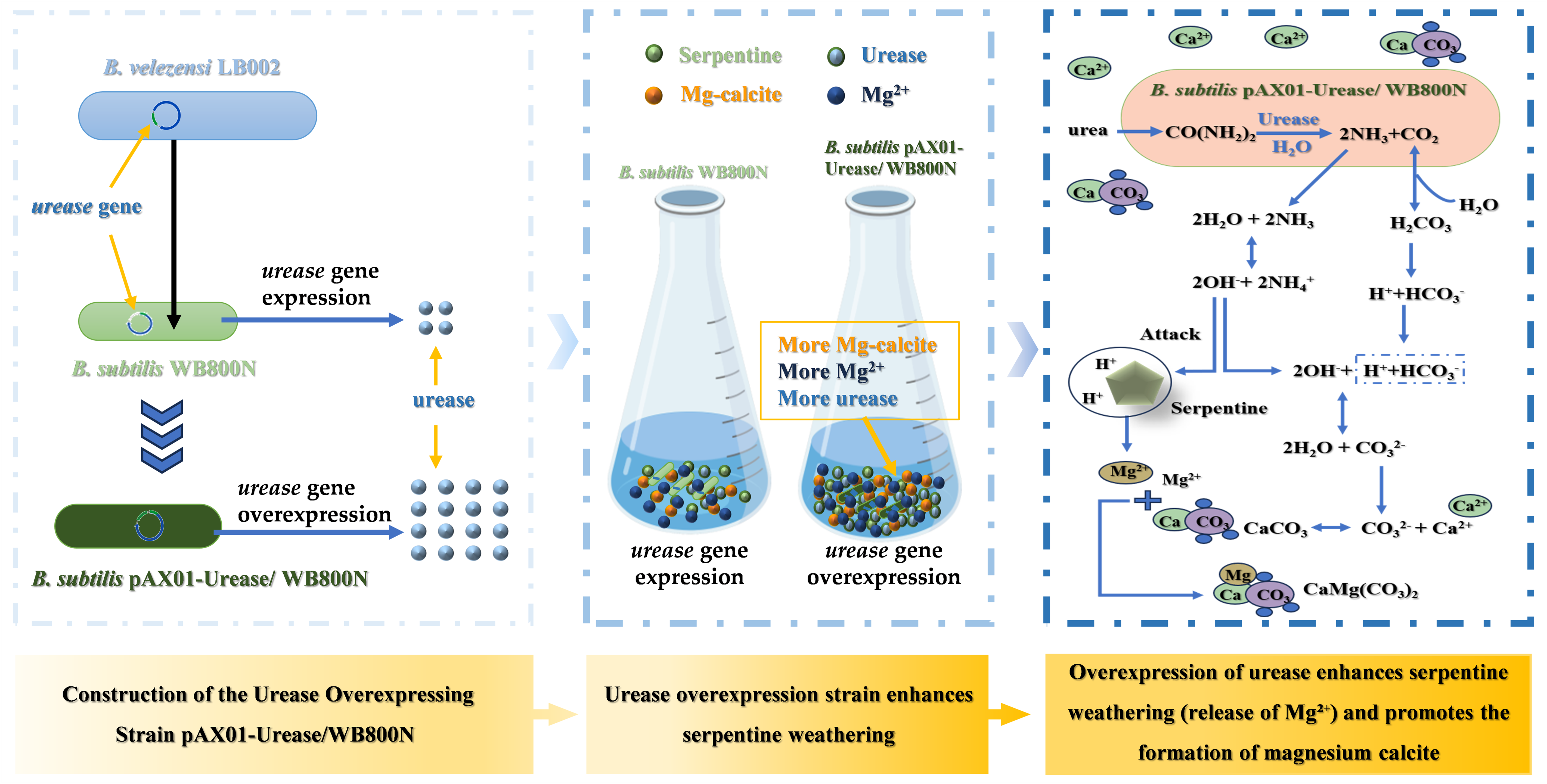
Graphical Abstract

1. Introduction

Microbial weathering, a ubiquitous geological process, serves as a vital driving force for the migration, transformation, and utilization of elements. The use of silicate mineral bio-weathering to capture atmospheric CO2 has attracted widespread research interest, which involves the biological weathering of specific silicate minerals and the bio-induced synthesis of carbonates [1]. In the process of microbially induced calcium carbonate precipitation (MICP), urease (EC 3.5.1.5) plays a critical role [2,3]. As a nickel-dependent metalloenzyme, urease efficiently catalyzes the hydrolysis of urea to produce CO2 and ammonia, with a catalytic efficiency approximately 1014 times higher than that of the uncatalyzed reaction [4,5,6]. Urease-producing microorganisms typically hydrolyze urea to generate ammonia and carbonic acid (Equations (1) and (2)), which further react to form NH4+ and CO32− (Equations (3) and (4)). Excess Ca2+ in the environment can be adsorbed onto the negatively charged surfaces of bacterial cells or organic matter, readily leading to the formation and precipitation of calcium carbonate (Equations (5) and (6)). The release of NH4+ results in an alkaline environment, which further promotes carbonate formation and precipitation.
CO(NH2)2 + H2O→NH2COOH + NH3
NH2COOH + H2O→NH3 + H2CO3
2NH3 + 2H2O↔2NH4+ + 2OH
2OH + H2CO3↔CO32− + 2H2O
Ca2+ + Cell→Cell-Ca2+
Cell-Ca2+ + CO32−→Cell-CaCO3
Current research on urease-based MICP technology has primarily focused on the formation of calcium carbonate and the analysis of key influencing factors [5,7,8,9]. While MICP and silicate mineral bio-weathering are both mediated by microbial metabolic activities, and previous studies have suggested their potential coupling through microbial regulation of the geochemical environment [10,11], whether microbial urease (a core functional enzyme in MICP) participates in silicate mineral bio-weathering remains unexplored. As indicated in Equations (1)–(3) above, the urease-catalyzed decomposition of urea yields both acid (H2CO3) and alkaline substances (OH), which may inevitably induce localized weathering of silicate minerals in heterogeneous culture systems. Given that the bio-weathering of silicate minerals coupled with the synthesis of secondary minerals such as carbonates constitutes a complete mineral biotransformation pathway, investigating whether urease gene expression products play a synergistic role in mineral weathering is not only a theoretical question but also crucial for selecting effective microbial strains in weathering-related studies and applications [1]. Considering that microbial mineral weathering often results from the combined effects of multiple factors, such as organic acids and redox reactions [11], constructing a urease-overexpressing strain using molecular techniques and comparing the weathering effects and secondary minerals produced by the wild-type and engineered strains on the same mineral may provide a practical research approach. Cruz-Ramos et al. [12] found that the mechanism of urease synthesis by B. subtilis is similar to that of B. velezensis, and neither of them requires the involvement of genes encoding urease accessory proteins. Therefore, using B. subtilis as a receptor strain can effectively avoid the unpredictable impact of the introduction of accessory protein genes on urease activity.
Serpentine (Mg3(Si2O5)(OH)4), a hydrous magnesium-rich silicate mineral primarily composed of MgO and SiO2 with associated elements such as Fe, Ni, and Mn, is widely distributed and abundant in China [13,14,15]. It serves as an important raw material for the production of calcium-magnesium phosphate fertilizer and for research on mineral weathering and carbon sequestration [14,16,17]. Liu et al. [18] have found that microbial weathering of serpentine can sequester atmospheric CO2 through coupled carbonate synthesis. However, Mg2+ released during serpentine weathering preferentially incorporates into Mg-calcite (magnesian calcite) rather than precipitating as magnesite (MgCO3), likely due to the kinetic inhibition of magnesite nucleation under low-temperature aqueous conditions.
In this study, the urease gene from B. velezensis LB002 was placed under the control of the strong promoter xylA to construct the urease overexpression vector pAX01-Urease. The recombinant plasmid was then introduced into competent cells of B. subtilis WB800N via electroporation. Through homologous recombination, the urease-overexpressing strain B. subtilis pAX01-Urease/WB800N was successfully generated to investigate the role of endogenously expressed urease in bio-serpentine weathering and coupled carbonate synthesis.

2. Results and Discussion

2.1. Construction of the Urease Gene Overexpression Vector and Verification of the Recombinant Strain

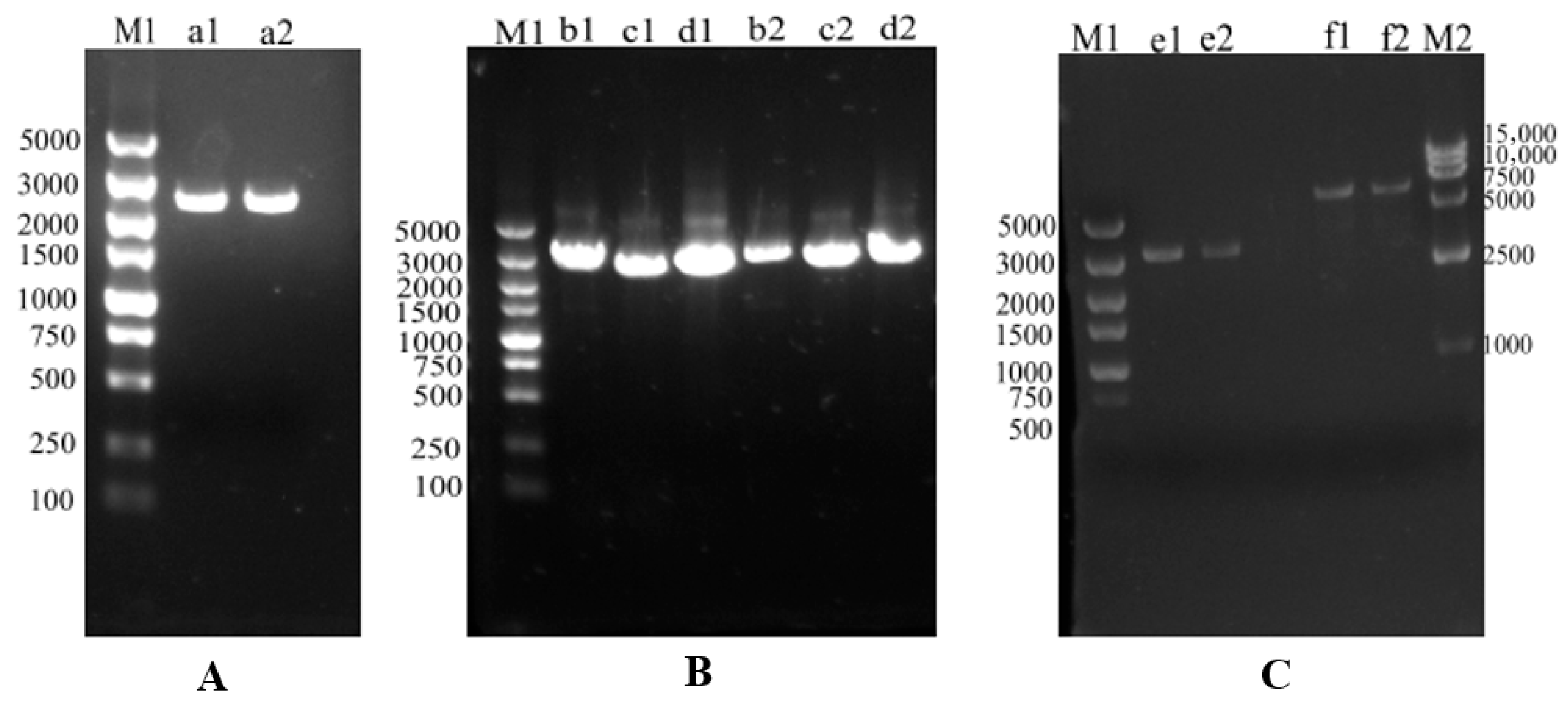
Using genomic DNA of B. velezensis LB002 as the template, PCR amplification with primers Urease-F/Urease-R yielded a urease gene fragment of 2395 bp, containing restriction enzyme sites for BamHI and SacII (Figure 1A). PCR amplification of the recombinant plasmid pAX01-Urease using three distinct primer pairs (Pax-F/Pax-R, Pax-F/Urease-R, and Urease-F/Pax-R) produced gene fragments of the following lengths: a: 3097 bp, b: 2790 bp, and c: 2743 bp, all consistent with the expected target sequences (Figure 1B). PCR amplification of the urease gene electroporated into B. subtilis competent cells using primer pairs Pax-F/Pax-R and lacA-F/lacA-R generated fragments of 3097 bp and 6266 bp, respectively, both matching the expected lengths (Figure 1C). These results confirm the successful introduction of the recombinant plasmid pAX01-Urease into B. subtilis WB800N, resulting in the construction of the urease-overexpressing strain B. subtilis pAX01-Urease/WB800N.
Urease, a key protease in bacterially induced mineralization [19], was overexpressed in this study not only to investigate its role in mineralization induction but also to explore its effects on mineral weathering. Currently, plasmid transformation in B. subtilis primarily involves three methods: protoplast transformation, CaCl2 transformation, and electroporation [12]. Considering transformation efficiency, conditions, and time requirements, electroporation—a method with higher efficiency—was selected for plasmid transfer [15]. By optimizing plasmid concentration, volume, competent cell concentration, and electroporation parameters, the optimal conditions were determined to be the addition of 1 μL of 150 ng·μL−1 recombinant plasmid to 60 μL of B. subtilis competent cells, followed by electroporation at 2.0 kV for 5 ms. Subsequent PCR verification (Figure 1) confirmed the successful transformation of the recombinant plasmid into B. subtilis WB800N, establishing the urease-overexpressing strain B. subtilis pAX01-Urease/WB800N. This work lays a foundation for further investigation into the role of urease in serpentine weathering and mineralization.

2.2. Growth and Urease Activity of the Urease Overexpression Strain

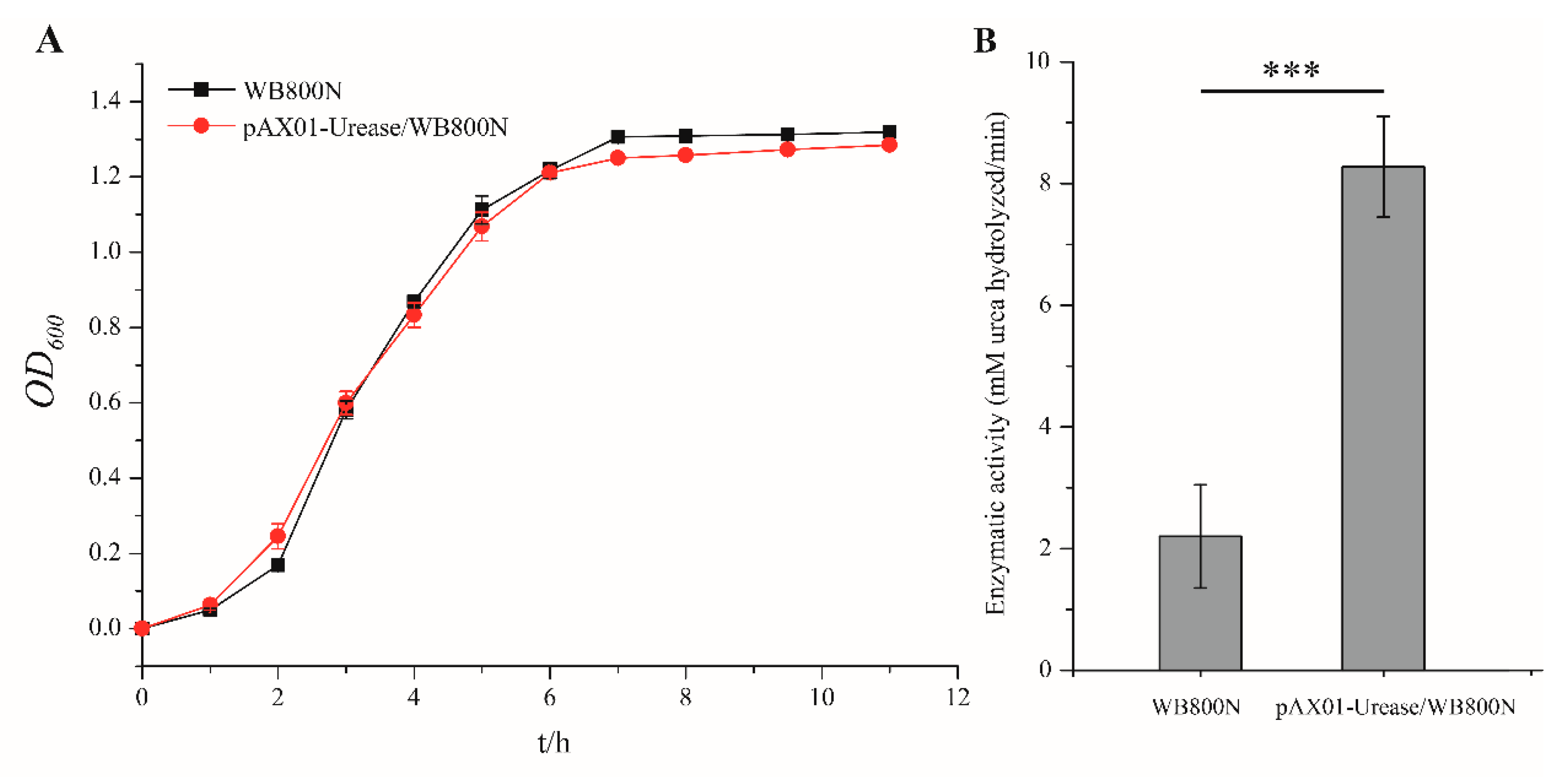
To investigate the impact of the successful urease gene insertion on bacterial growth and verify the occurrence of urease overexpression, the growth curves and urease activities of the wild-type strain B. subtilis WB800N and the urease-overexpressing strain B. subtilis pAX01-Urease/WB800N in LB medium were analyzed. As shown in Figure 2A, both strains exhibited slow growth during 0–2 h, entered the logarithmic growth phase between 2 and 7 h with substantial proliferation and a rapid increase in cell number, leading the OD600 value to rise to approximately 1.25. Between 7 and 11 h, they reached the stationary phase, where the growth and death rates balanced. Throughout the cultivation, the growth trends of B. subtilis WB800N and B. subtilis pAX01-Urease/WB800N were nearly identical, indicating that the insertion of the urease gene fragment did not affect the growth and reproduction of B. subtilis WB800N. To further assess the extent of urease overexpression in B. subtilis pAX01-Urease/WB800N, urease activity was measured (Figure 2B). Under the same conditions, the urease activities of B. subtilis WB800N and B. subtilis pAX01-Urease/WB800N were 2.20 mM urea hydrolyzed·min−1 and 8.27 mM urea hydrolyzed·min−1, respectively. This result indicates that the urease gene was overexpressed during the cultivation of B. subtilis pAX01-Urease/WB800N (p < 0.05), with activity approximately 3.8 times higher than that of the wild-type strain. This finding is consistent with previous research, such as the study by Bachmeier et al. [20], in which recombinant E. coli expressing the urease gene from B. pasteurei demonstrated a significant increase in induced calcite precipitation compared to the non-recombinant strain.

2.3. Analysis of the Serpentine Weathering Culture System by the Urease Overexpression Strain and Characterization of Solid-Phase Products

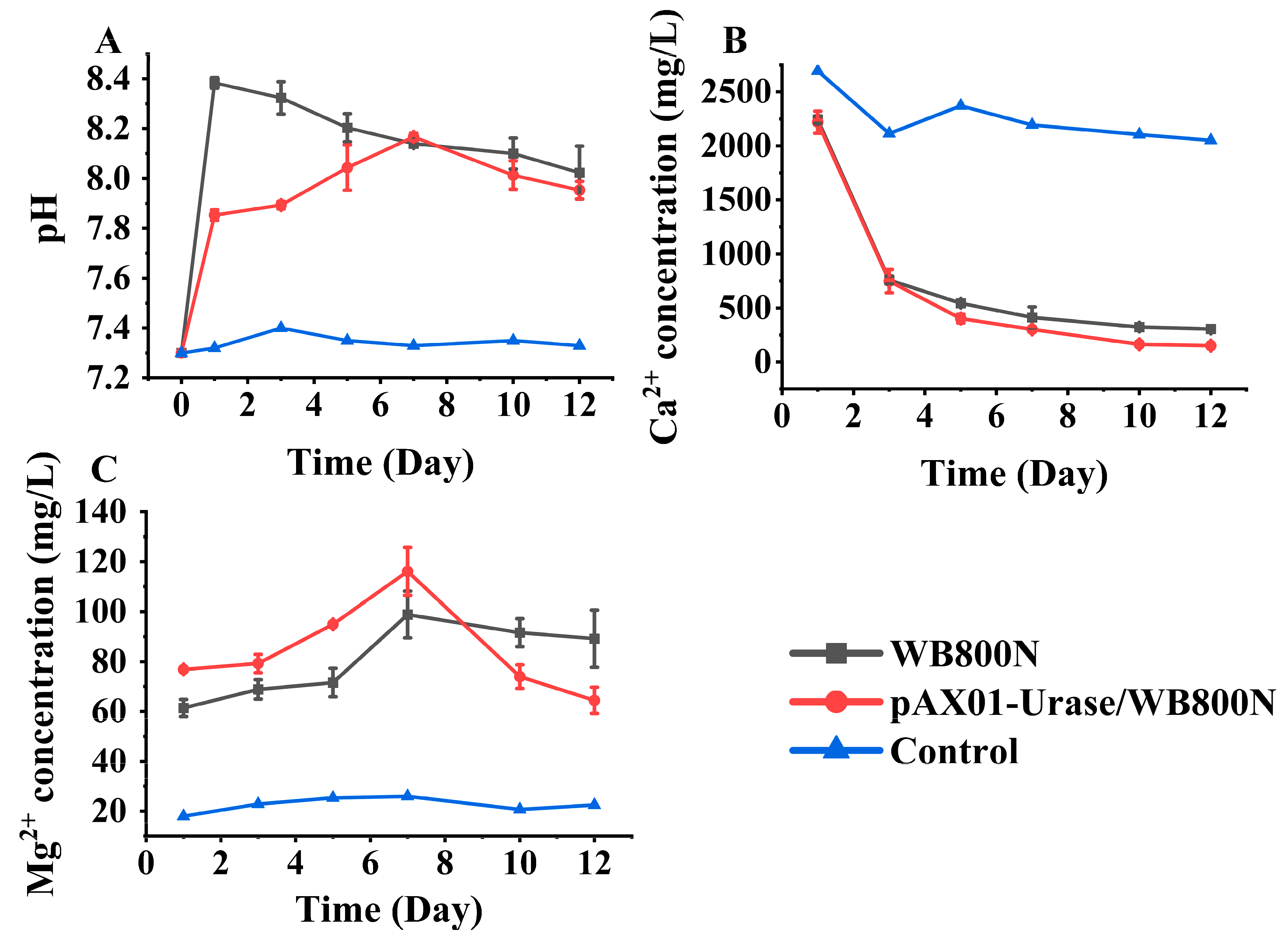
As the cultivation progressed, the pH of the media inoculated with either the wild-type strain or the overexpression strain initially increased and then decreased, remaining above 7.0 throughout (Figure 3A). The pH for B. subtilis WB800N reached its maximum value of 8.38 on day 1, then gradually decreased to 8.02 by day 12. In contrast, the pH for B. subtilis pAX01-Urease/WB800N peaked at 8.17 on day 7 before declining. Notably, the pH of B. subtilis pAX01-Urease/WB800N was slightly higher than that of B. subtilis WB800N only on day 7, but the difference was not significant (p > 0.05); for the remainder of the time, it was lower. This initial pH increase is primarily attributed to the alkaline environment created by CO2 dissolved in the medium from bacterial growth and metabolism, which favors induced carbonate mineralization [21,22]. The subsequent greater reduction in pH for the overexpression strain is likely due to enhanced carbonate mineralization consuming more CO32− from the solution [20].
Changes in Ca2+ concentration over time are shown in Figure 3B. In the uninoculated control group (CK), approximately 580 mg∙L−1 of Ca2+ precipitated within the first 3 days due to shaking incubation, after which the Ca2+ concentration stabilized around 2100 mg∙L−1 with no significant changes. In contrast, the precipitation of Ca2+ was consistently higher in the groups inoculated with B. subtilis WB800N and B. subtilis pAX01-Urease/WB800N. The fastest Ca2+ precipitation rates for both strains occurred within the first 3 days, with precipitation amounts of about 1480 mg∙L−1 and 1470 mg∙L−1, respectively. After day 3, although the Ca2+ concentration continued to decrease in both bacterial media, the precipitation rate slowed significantly. By day 12, the Ca2+ concentrations in the media of B. subtilis WB800N and B. subtilis pAX01-Urease/WB800N had decreased to 304 mg∙L−1 and 152 mg∙L−1, respectively. The high initial precipitation rate is likely due to strong bacterial activity in the early stage, which weakened later on [21]. Throughout the 12-day period, the Ca2+ precipitation was significantly higher in the urease overexpression strain than in the wild-type strain (Figure 3B), with a final precipitation amount 152 mg∙L−1 greater. This suggests that urease overexpression enhances the strain’s mineralization induction capability [20].
The change in Mg2+ concentration in the medium over time is shown in Figure 3C. The Mg2+ concentration in the CK group remained relatively stable with no significant changes. In the experimental groups inoculated with B. subtilis WB800N and B. subtilis pAX01-Urease/WB800N, the Mg2+ concentration in the supernatant increased from day 1 to day 7, peaking at 99 mg∙L−1 and 116 mg∙L−1, respectively, on day 7. The concentration was significantly higher in the urease overexpression strain than in the wild-type strain (p < 0.05). An elevated Mg/Ca ratio under weakly alkaline conditions tends to facilitate the formation of magnesian calcite [23], while urease-overexpressing strains apparently release more magnesium ions during its metabolism, thereby promoting magnesian calcite precipitation. This indicates that the urease overexpression strain has a stronger serpentine weathering capacity than the wild-type strain, and that urease gene overexpression enhances this weathering effect [18]. On day 7, the Mg2+ concentrations in the supernatants of the wild-type and overexpression strains were 73 mg∙L−1 and 90 mg∙L−1 higher than that in the CK group, respectively. From day 7 to day 12, the Mg2+ concentration decreased significantly in the supernatant of B. subtilis pAX01-Urease/WB800N, while it remained relatively stable for B. subtilis WB800N. This decrease may be related to the formation of secondary magnesium-containing minerals [10,18,24].
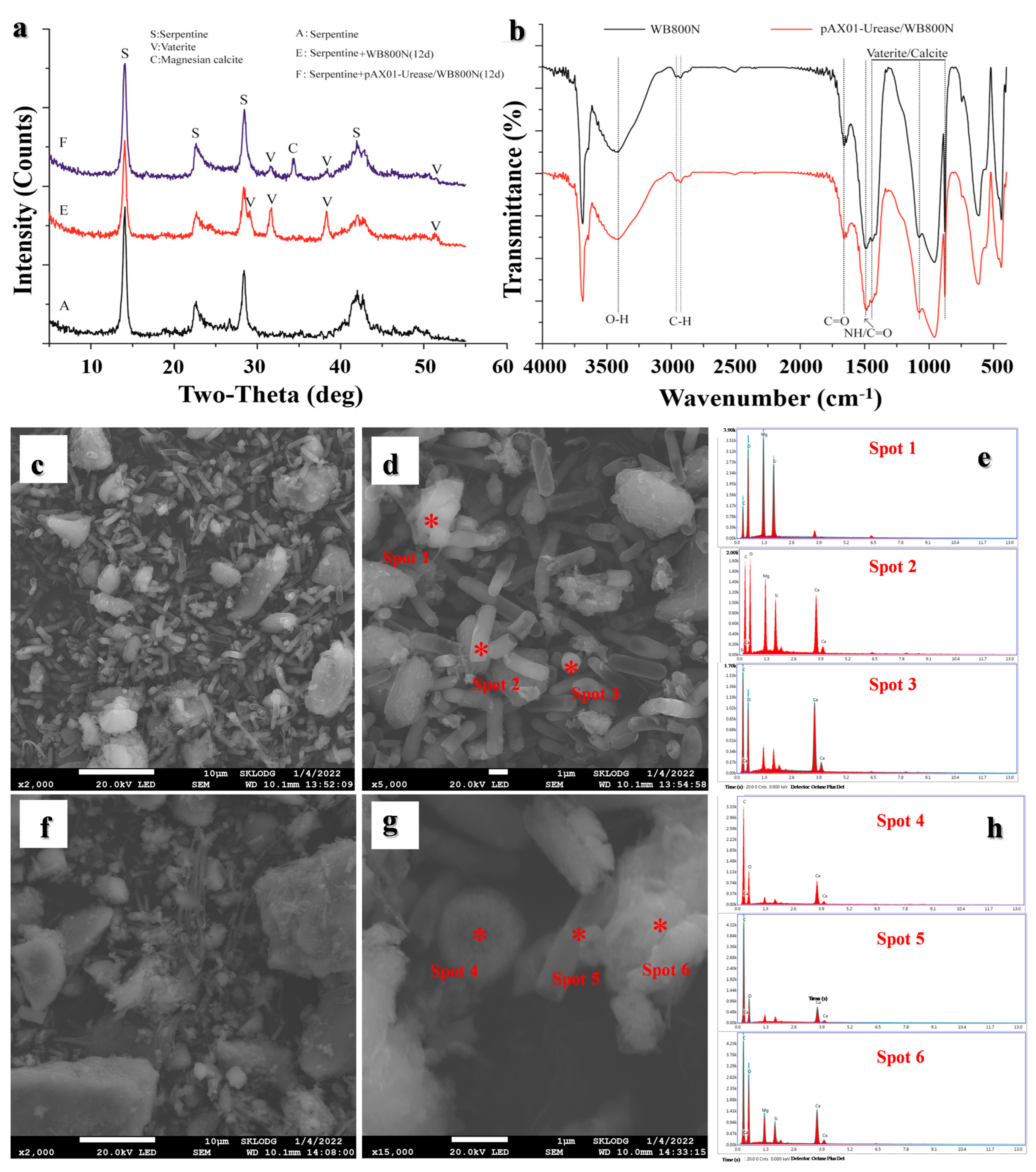
To verify the enhancing effect of the urease-overexpressing strain on serpentine weathering coupled with carbonate mineralization, the solid products from the aforementioned culture systems at day 12 were further characterized mineralogically. The results are shown in Figure 4.
Figure 4a shows the XRD analysis results of the solid products at day 12. Apart from residual serpentine, both B. subtilis WB800N and B. subtilis pAX01-Urease/WB800N induced the formation of carbonate minerals. However, the wild-type strain formed vaterite (ICDD PDF No.: 25-0127) after weathering serpentine, while the urease-overexpressing strain produced not only vaterite but also Mg-containing calcite (ICDD PDF No.: 89-1304).
The FTIR analysis results of the products are shown in Figure 4b. After 12 days of cultivation, although there were slight differences in the crystal forms of the mineralization products between B. subtilis WB800N and B. subtilis pAX01-Urease/WB800N, their functional groups were largely consistent. The characteristic vibration peaks at 1429, 1080, and 872 cm−1 are attributed to vaterite or Mg-calcite. The absorption peak at 872 cm−1 is primarily caused by the in-plane or out-of-plane bending vibration of CO32−. Additionally, other similar organic functional groups were present, such as O-H (3412 cm−1), C-H (2965, 2930 cm−1), C=O (1658 cm−1), and NH-CO (1507 cm−1).
Further observation and analysis of the solid products by SEM-EDS revealed that the precipitates from the wild-type strain culture contained structures of varying shapes and sizes, along with rod-shaped bacteria (Figure 4c,d). Combined with EDS analysis results (Figure 4e), the precipitates from the wild-type strain group at day 12 were identified as a complex of serpentine, vaterite, and bacterial cells surface-loaded with mineral particles. In the precipitates from the urease-overexpressing strain culture at day 12, rod-shaped bacteria and irregularly shaped massive precipitates were observed (Figure 4f,g). The EDS analysis areas (Figure 4h-Spot 4, Spot 5) primarily contained C, O, and Ca, indicating that the spherical structures are most likely vaterite. The rod-shaped bacterial surfaces were loaded with calcium carbonate, while the irregular massive structure (Figure 4h-Spot 6) contained C, O, Ca, Mg, and Si, with a higher Ca content than Mg. Combined with the XRD results, this small, irregular massive precipitate was identified as Mg-containing calcite.
In previous weathering experiments without an added calcium source, neither B. subtilis WB800N nor B. subtilis pAX01-Urease/WB800N successfully formed MgCO3 after weathering serpentine. This is related to the strong hydration of Mg2+, which makes it difficult to form MgCO3 [13,25]. Referring to our group’s previous work [25], the addition of 0.4% CaCl2 and 0.4% MgCl2 to the culture system led to the formation of calcium-magnesium carbonate precipitates. Furthermore, because the amount of newly formed secondary minerals is very small compared to the concentration of added serpentine (0.04 g∙mL−1), the characteristic peaks of the secondary minerals in XRD analysis can be easily masked by the strong peaks of serpentine, making mineral identification challenging. The XRD results (Figure 4a) show that the weathering and mineralization products of serpentine by B. subtilis pAX01-Urease/WB800N exhibited characteristic peaks for Mg-calcite in addition to those for vaterite. Combined with the changes in Ca2+ and Mg2+ concentrations in the medium (Figure 3B,C), this further indicates that the urease-overexpressing strain releases more Mg2+ through enhanced weathering and forms Mg-containing calcite. The SEM-EDS observations (Figure 4c–h) confirmed the formation of both vaterite and Mg-calcite. Meanwhile, the XRD results showed weaker vaterite characteristic peaks in the overexpression strain products compared to the wild-type strain (Figure 4a), possibly because the overexpression strain promotes the partial transformation of vaterite into Mg-calcite [18]. Additionally, the FTIR spectra of the weathering/mineralization products from both groups (Figure 4b) showed the presence of organic functional groups, indicating that the products from both strains contain a certain amount of organic matter. This organic matter primarily originates from the mineralizing bacteria, consistent with previous reports by our group, Liu et al. [18] and Liu and Lian [26].
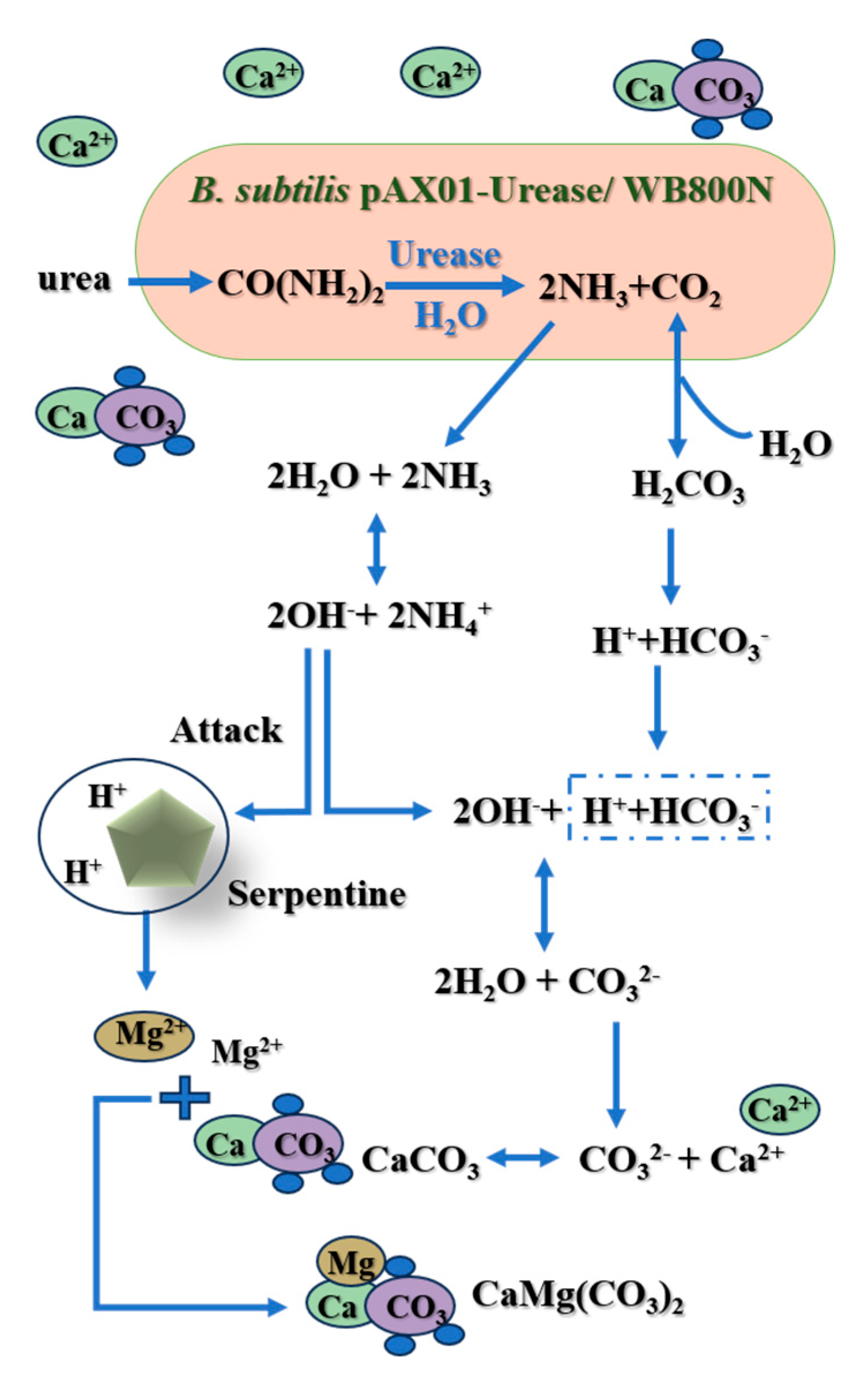
These results indicate that the urease-overexpressing strain exhibits significantly enhanced weathering capability compared to the wild-type strain and promotes the participation of released Mg2+ in the formation of Mg-containing calcite. The resulting weathering minerals also differ from those produced by the wild-type strain. Based on studies by Yu and Yue [2], Carter and Hausinger [3], Li et al. [21], we propose a coupled weathering-mineralization model for serpentine by the urease-overexpressing strain, as illustrated in Figure 5. When urea enters the bacterial cells, urease produced by the strain hydrolyzes urea, generating ammonia and carbonic acid, which rapidly dissociates into ammonium ions (NH4+) and carbonate ions (CO32−). When calcium ions (Ca2+) are present in the solution, they are adsorbed onto the negatively charged bacterial cell surfaces and combine with the carbonate ions generated from urea hydrolysis, forming calcium carbonate precipitates. Simultaneously, the protons (H+) and OH produced during urea conversion, along with other weathering factors, participate in the weathering of serpentine. This leads to the release of more Mg2+ from the serpentine structure, explaining why urease overexpression can enhance serpentine weathering to some extent. Under conditions of high Mg2+ concentration, Mg2+ can substitute for Ca2+, leading to the formation of Mg-containing calcite.

3. Materials and Methods

3.1. Experimental Strains and Mineral Materials

3.1.1. Strains and Cultivation

Bacillus velezensis LB002, preserved by our research group, has the NCBI accession number NZ_CP037417.1. Escherichia coli DH5α was purchased from Nanjing Vazyme Biotech Co., Ltd. (Nanjing, China), and Bacillus subtilis WB800N was acquired from Wuhan MiaoLing Biotechnology Co., Ltd. (Wuhan, China). LB medium was used for the cultivation of both strain LB002 and strain WB800N. For screening E. coli cells carrying the recombinant plasmid pAX01-Urease, LB medium supplemented with ampicillin was employed. Media A and B were used for the preparation of competent cells of B. subtilis WB800N. The composition and specific applications of all culture media used are detailed in Table 1.

3.1.2. Plasmid pAX01

The integrative plasmid pAX01 was obtained from Wuhan MiaoLing Biotechnology Co., Ltd. This shuttle vector carries ampicillin and erythromycin resistance genes, serving as a selectable marker in both Escherichia coli and Bacillus subtilis. It contains an inducible promoter, PxylA, which enables target protein expression upon induction with a specific concentration of xylose.

3.1.3. Serpentine

The serpentine sample used in this study was collected from Donghai County, Lianyungang City, Jiangsu Province, China. X-ray diffraction (XRD, BTX-526, Olympus, Center Valley, PA, USA) analysis indicated that its mineral composition primarily consisted of serpentine (PDF No.: 50-1606), forsterite (PDF No.: 01-1290), and enstatite (PDF No.: 84-0653). X-ray fluorescence (XRF) spectroscopy revealed the following chemical composition (wt.%): O 46.39, Mg 23.35, Si 20.34, Fe 5.30, C 3.46, Al 0.39, Ni 0.24, Cr 0.21, Ca 0.16, Mn 0.08, S 0.04, K 0.02, and Co 0.02 [27]. The raw serpentine mineral was crushed, ground, and sieved to obtain a 100-200-mesh (with a pore size of ~75 μm) powder. This powder was repeatedly washed with deionized water until the supernatant became clear, followed by immersion in 1% dilute hydrochloric acid until no gas bubbles were observed. Finally, the treated powder was rinsed three times with deionized water and dried at 60 °C for subsequent experiments.

3.1.4. Urease

The urease gene used for heterologous overexpression in this study was derived from Bacillus velezensis strain LB002. The amino acid sequence of the encoded urease has been deposited in the NCBI database under the accession number WP_129345678.1. This sequence consists of 797 amino acids and shares a homology of over 92% with the urease sequences of previously reported Bacillus species. Notably, it lacks genes encoding urease accessory proteins and is compatible with the urease synthesis machinery of B. subtilis, which ensures the feasibility of heterologous expression.

3.2. Construction of Urease Gene Overexpression Vector and Engineered Strain

3.2.1. Construction of the Urease Gene Overexpression Vector

Based on the urease gene sequence of B. velezensis LB002 available in the NCBI database and the flanking sequences of the BamHI and SacII restriction sites on the plasmid pAX01, specific primers Urease-F and Urease-R (see Table 2) were designed. These primers were used to amplify the urease gene fragment, including the BamHI and SacII restriction sites, from the genomic DNA of B. velezensis LB002. PCR amplification was performed under the following conditions: initial denaturation at 95 °C for 3 min; 30 cycles of denaturation at 95 °C for 15 s, annealing at 56 °C for 15 s, and extension at 72 °C for 2.5 min; and a final extension at 72 °C for 5 min. The amplified urease gene fragment was purified and recovered. The plasmid pAX01 was digested with BamHI and SacII restriction enzymes (Vazyme, Nanjing, China). The linearized plasmid and the urease gene fragment were ligated using the ClonExpress® II One Step Cloning Kit (Vazyme, Nanjing, China). The resulting ligation product was then transformed into competent E. coli DH5α cells and cultured. The transformed cells were spread onto solid LB medium containing ampicillin and incubated overnight. Single colonies were selected, resuspended in 20 μL of sterile water, and heated at 100 °C for 10 min using a metal bath, followed by centrifugation at 12,000 rpm for 10 min. The supernatant was used as a template for colony PCR verification with primer pairs Pax-F/Pax-R, Pax-F/Urease-R, and Urease-F/Pax-R (see Table 2). Positive clones showing the expected fragment size were sent to Sangon Biotech (Shanghai) Co., Ltd. (Shanghai, China) for sequencing. The sequencing results were aligned with the target sequence, and the correctly assembled recombinant vector was preserved for subsequent experiments.

3.2.2. Construction of the Urease-Overexpressing Strain pAX01-Urease/WB800N

Bacillus subtilis WB800N was inoculated into LB medium and cultured overnight at 37 °C with shaking at 220 rpm. A 2.5 mL aliquot of the bacterial culture was transferred into 100 mL of Medium A and incubated at 37 °C with shaking at 220 rpm for 4 h. When the OD600 reached between 0.8 and 1.0, the culture was immediately placed in an ice-water bath for 10 min, followed by centrifugation at 4 °C and 5000 rpm for 5 min. The supernatant was discarded, and the cell pellet was collected. The pellet was washed repeatedly with pre-chilled Medium B, centrifuged again, and then resuspended in 500 μL of electroporation medium. The suspension was aliquoted into sterile 1.5 mL centrifuge tubes (60 μL per tube) and stored at -80 °C. 1 μL volume of the recombinant plasmid pAX01-Urease, extracted from the sequence-verified E. coli strain (as described in Section 3.2.1), was added to 60 μL of competent B. subtilis WB800N cells. The mixture was gently combined and incubated on ice for 5 min. The mixture was then transferred to a pre-chilled electroporation cuvette and subjected to a single electric pulse (2.0 kV, 5 ms) using an electroporator. Immediately after electroporation, 1 mL of recovery medium was added, and the mixture was transferred to a sterile 1.5 mL tube. The cells were recovered by shaking at 37 °C and 180 rpm for 3 h. The recovered culture was spread onto an erythromycin-containing LB agar plate and incubated overnight at 37 °C. Transformants growing on the erythromycin-resistant LB plates were selected, and PCR verification was performed using primer pairs Pax-F/Pax-R and lacA-F/lacA-R. All media used in this procedure are listed in Table 1.

3.3. Growth and Urease Activity Assay of the Overexpression Strain

B. subtilis WB800N (wild-type strain) and B. subtilis pAX01-Urease/WB800N (overexpression strain) were transferred by inoculating each strain into LB medium followed by overnight incubation at 37 °C with shaking at 220 rpm. A 1 mL aliquot of each seed culture was transferred into 100 mL of fresh LB medium and incubated at 37 °C with shaking at 180 rpm. The optical density at 600 nm (OD600) was measured hourly to plot the bacterial growth curve. For urease activity analysis, 50 mL of seed culture was harvested by centrifugation at 4 °C and 8000 rpm for 10 min. The cell pellet was resuspended in 10 mL of phosphate-buffered saline (PBS; 20 mM, pH 7.4) and thoroughly mixed. After cell disruption, the lysate was centrifuged at 4 °C and 8000 rpm for 10 min, and the supernatant was collected. Urease activity was determined according to the method described by Miao et al. [28]. The reaction used 200 mg∙mL−1 urea as the substrate and p-dimethylaminobenzaldehyde (Sinopharm Chemical Reagent Co., Ltd., Shanghai, China) as the colorimetric agent. The absorbance at 430 nm (OD430) of the supernatant was measured spectrophotometrically. The urea concentration was calculated using a standard curve equation (see Figure S1; C = 124.96 × OD430-0.399, with a fitting coefficient R2 ≈ 0.999). Urease activity U (mM urea hydrolyzed per minute) in the supernatant was calculated according to the following formula:
U   =   C 0 C 1 t × 1000 60
In the equation:
U is the activity of urease in the bacterial fluid (mM urea hydralyzed·min−1);
C0 is the concentration of urea in the solution before enzymatic hydrolysis (mg·mL−1);
C1 is the concentration of urea in the solution after enzymatic hydrolysis (mg·mL−1);
t is the enzymatic hydrolysis reaction time (min);
60 is the Molar mass of urea (g·mol−1);
1000 mM =1 M.

3.4. Analysis of Bacterial Weathering of Serpentine and Its Secondary Products

A blank control group without bacteria containing 100 mL of serpentine weathering-coupled mineralization medium was set up, along with two experimental groups inoculated with 1% B. subtilis WB800N and 1% B. subtilis pAX01-Urease/WB800N, respectively, each containing 100 mL of serpentine weathering-coupled mineralization medium. Each group was set up with three replicates. The cultures were incubated at 37 °C and 180 rpm for 12 days. The pH, Ca2+, and Mg2+ contents of the medium were measured on days 0, 1, 3, 5, 7, 10, and 12. The Ca2+ and Mg2+ contents of the medium were determined by atomic absorption spectrometry (AAS, AA-6300C, Shimadzu, Kyoto, Japan), following the method described by Klaic et al. [29]. Precipitates were collected, washed with deionized water to remove adherent medium components, dried at 60 °C, and ground. The mineral composition was analyzed using XRD (testing parameters: voltage 30 kV, current 300 μA, cobalt target, λ = 1.79 Å). The microscopic morphology and elemental composition changes in the minerals were examined using a field emission scanning electron microscope equipped with an X-ray energy-dispersive spectrometer (Zeiss-Supra55, Oberkochen, Germany, SEM-EDS). The infrared spectra of the mineral products were determined using a Fourier transform infrared spectrometer (FTIR, Hyperion 2000, Thermo Fisher Scientific, Waltham, MA, USA).

4. Conclusions

This study successfully constructed a recombinant strain with heterologous overexpression of the urease gene to investigate the role of endogenously expressed urease in serpentine bio-weathering coupled with carbonate formation. The results demonstrated that, under identical conditions, the urease activity of the recombinant strain was approximately 3.8 times higher than that of the wild-type strain. In the presence of serpentine in the culture medium, the wild-type strain induced the formation of vaterite, whereas the overexpression strain promoted the formation of both vaterite and Mg-containing calcite. Furthermore, the urease-overexpressing strain exhibited a significantly enhanced ability to bio-weather serpentine, releasing Mg2+ and facilitating the coupled formation of Mg-containing calcite. This confirms that urease gene overexpression can markedly enhance mineral bio-weathering, further underscoring the critical role of urease in the mineral bio-weathering process. These findings contribute to a comprehensive understanding of the mechanisms underlying silicate mineral weathering coupled with carbonate synthesis and provide new insights into utilizing microorganisms to enhance silicate mineral weathering and carbon sequestration.

Supplementary Materials

The following supporting information can be downloaded at: https://www.mdpi.com/article/10.3390/catal16010022/s1, Figure S1: Standard curve of urea concentration.

Author Contributions

Conceptualization, B.L.; methodology, X.L., K.R. and Y.L.; validation, W.N., X.L., K.R. and Y.L.; formal analysis, W.N. and X.L.; investigation, W.N., X.L., K.R. and Y.L.; data curation, W.N. and X.L.; writing—original draft preparation, W.N., X.L., K.R., Y.L. and B.L.; writing—review and editing, W.N. and B.L.; project administration, B.L.; supervision, B.L.; funding acquisition, B.L. All authors have read and agreed to the published version of the manuscript.

Funding

This research was jointly supported by the National Natural Science Foundation of China (Grant No. 41772360) and the Major Scientific and Technological Achievement Transformation Project of Guizhou Province (Grant No. 2022-Major-010).

Data Availability Statement

The data presented in this study are available on request from the corresponding author.

Acknowledgments

We sincerely thank the editor’s work and three anonymous reviewers for their insightful comments and suggestions.

Conflicts of Interest

The authors declare no conflicts of interest.

References

  1. Sun, Q.B.; Lian, B. The different roles of carbonic anhydrases in wollastonite weathering accompanied by carbonation. Geochim. Cosmochim. Acta 2019, 244, 437–450. [Google Scholar] [CrossRef]
  2. Yu, Y.; Yue, J. Comparison of test methods for modification of cement-based materials using MICP technology. China Sci. 2021, 16, 382–389. [Google Scholar]
  3. Carter, E.L.; Hausinger, R.P. Characterization of the urease accessory protein ureD in fusion with the maltose binding protein. J. Bacteriol. 2010, 192, 2294–2304. [Google Scholar] [CrossRef] [PubMed]
  4. Real-Guerra, R.; Stanisçuaski, F.; Carlini, C.R. Soybean urease: Over a hundred years of knowledge. In A Comprehensive Survey of International Soybean Research-Genetics, Physiology, Agronomy and Nitrogen Relationships; Board, J., Ed.; IntechOpen: London, UK, 2013; pp. 317–339. [Google Scholar]
  5. Gebru, K.A.; Kidanemariam, T.G.; Gebretinsae, H.K. Bio-cement production using microbially induced calcite precipitation (MICP) method: A review. Chem. Eng. Sci. 2021, 238, 116610. [Google Scholar] [CrossRef]
  6. Callahan, B.P.; Yuan, Y.; Wolfenden, R. The burden borne by urease. J. Am. Chem. Soc. 2005, 127, 10828–10829. [Google Scholar] [CrossRef] [PubMed]
  7. Wen, K.; Li, Y.; Amini, F.; Li, L. Impact of bacteria and urease concentration on precipitation kinetics and crystal morphology of calcium carbonate. Acta Geotech. 2020, 15, 17–27. [Google Scholar] [CrossRef]
  8. Cui, M.; Fu, X.; Zheng, J.J.; Lü, S.Y.; Xiong, H.H.; Zeng, C.; Han, S.Y. Multivariate experimental study on soybean urease induced calcium carbonate precipitation. Rock Soil Mech. 2022, 43, 3027–3035. [Google Scholar]
  9. Qin, Y.; Cabral, J.M.S. Review properties and applications of urease. Biocatal. Biotransform. 2009, 20, 1–14. [Google Scholar] [CrossRef]
  10. Finlay, R.D.; Mahmood, S.; Rosenstock, N.; Bolou-Bi, E.B.; Köhler, S.J.; Fahad, Z.; Rosling, A.; Wallander, H.; Belyazid, S.; Bishop, K.; et al. Reviews and syntheses: Biological weathering and its consequences at different spatial levels—From nanoscale to global scale. Biogeosciences 2020, 17, 1507–1533. [Google Scholar] [CrossRef]
  11. Power, I.M.; Wilson, S.A.; Dipple, G.M. Serpentinite Carbonation for CO2 Sequestration. Elements 2013, 9, 115–121. [Google Scholar] [CrossRef]
  12. Cruz-Ramos, H.; Glaser, P.; Wray, L.V.; Fisher, S.H. The Bacillus subtilis ureABC operon. J. Bacteriol. 1997, 179, 3371–3373. [Google Scholar] [CrossRef] [PubMed]
  13. Fu, J.; Wang, H.; Chen, L.; Xue, J. Development status and trends of serpentine ore. Hydrometall. China 2007, 26, 132–135. [Google Scholar]
  14. Cheng, T.W.; Ding, Y.C.; Chiu, J.P. A study of synthetic forsterite refractory materials using waste serpentine cutting. Miner. Eng. 2002, 15, 271–275. [Google Scholar] [CrossRef]
  15. Li, Z.B.; Xu, J.; Teng, H.H.; Liu, L.W.; Chen, J.; Chen, Y.; Zhao, L.; Ji, J.F. Bioleaching of Lizardite by Magnesium- and Nickel-Resistant Fungal Isolate from Serpentinite Soils-Implication for Carbon Capture and Storage. Geomicrobiol. J. 2015, 32, 181–192. [Google Scholar] [CrossRef]
  16. Su, X.; Sun, C. Recovery pathway for serpentine tailings solid waste. China Ceram. Ind. 2010, 17, 37–39. [Google Scholar]
  17. Sheng, X.F.; Ji, J.F.; Chen, J. Potential of CO2 sequestration in ultramafic rocks of China. Quat. Sci. 2011, 31, 447–454. [Google Scholar]
  18. Liu, H.L.; Liu, X.R.; Li, X.F.; Fu, Z.Y.; Lian, B. The molecular regulatory mechanisms of the bacteria involved in serpentine weathering coupled with carbonation. Chem. Geol. 2021, 565, 120069. [Google Scholar] [CrossRef]
  19. Dai, G.; Xu, X.; Ding, C. Review of mechanism of microbial induced carbonate precipitation and its application in healing concrete cracks. China Concr. Cem. Prod. 2020, 1–7. [Google Scholar]
  20. Bachmeier, K.L.; Williams, A.E.; Warmington, J.R.; Bang, S.S. Urease activity in microbiologically-induced calcite precipitation. J. Biotechnol. 2002, 93, 171–181. [Google Scholar] [CrossRef]
  21. Li, X.F.; He, X.D.; Ren, K.Y.; Dong, H.L.; Lian, B. Mechanisms of carbonate precipitation induced by two model bacteria. Chem. Geol. 2023, 628, 121461. [Google Scholar] [CrossRef]
  22. Li, X.F.; Sun, M.L.; Zhang, L.T.; Finlay, R.D.; Liu, R.L.; Lian, B. Widespread bacterial responses and their mechanism of bacterial metallogenic detoxification under high concentrations of heavy metals. Ecotoxicol. Environ. Saf. 2022, 246, 114193. [Google Scholar] [CrossRef]
  23. Purgstaller, B.; Konrad, F.; Dietzel, M.; Immenhauser, A.; Mavromatis, V. Control of Mg2+/Ca2+ Activity Ratio on the Formation of Crystalline Carbonate Minerals via an Amorphous Precursor. Cryst. Growth Des. 2017, 17, 1069–1078. [Google Scholar] [CrossRef]
  24. Uroz, S.; Calvaruso, C.; Turpault, M.P.; Frey-Klett, P. Mineral weathering by bacteria: Ecology, actors and mechanisms. Trends Microbiol. 2009, 17, 378–387. [Google Scholar] [CrossRef] [PubMed]
  25. Wang, X.; Zhu, X.; Zhang, L.; Yu, C.; Lian, B. Synthesis of biogenic high-magnesium calcite and its experimental immobilization effect on Cd2+. Geomicrobiol. J. 2021, 38, 482–493. [Google Scholar] [CrossRef]
  26. Liu, R.L.; Lian, B. Immobilisation of Cd(II) on biogenic and abiotic calcium carbonate. J. Hazard. Mater. 2019, 378, 120707. [Google Scholar] [CrossRef]
  27. Lu, M.X.; Wang, X.X.; Li, Y.; Liu, H.L.; An, X.C.; Lian, B. Soil microbial community structure and environmental effects of serpentine weathering under different vegetative covers in the serpentine mining area of Donghai County, China. Sci. Total Environ. 2022, 835, 155452. [Google Scholar] [CrossRef]
  28. Miao, X.; Jiang, E.; Wang, J.; Du, Y. Using spectrophotometry with para-dimethyl-amino-benzaldehyde as chromogenic agent to determine macro and micro urea in aqueous solution. J. Northeast Agric. Univ. 2011, 42, 87–92. [Google Scholar]
  29. Klaic, P.M.A.; Nunes, A.M.; Moreira, A.D.; Vendruscolo, C.T.; Ribeiro, A.S. Determination of Na, K, Ca and Mg in xanthan gum: Sample treatment by acid digestion. Carbohydr. Polym. 2011, 83, 1895–1900. [Google Scholar] [CrossRef]
Figure 1. Electrophoresis of urease gene, recombinant plasmid and recombinant strain. (A): urease gene PCR product electrophoresis map (M1: DL5000 DNA Marker; a1–a2: urease gene PCR product); (B): recombinant plasmid pAX01-Urease PCR electrophoresis map (M1: DL5000 DNA Marker; b: bands obtained by amplifying Pax-F/Pax-R using primers; c: bands obtained by amplifying Pax-F/Urease-R using primers; d: bands obtained by amplifying Urease-F/Pax-R using primers; 1 and 2: single colonies with different positive clones); (C): PCR electrophoresis map of recombinant strain pAX01-Urease/WB800N (M1: DL5000 DNA Marker; M2: DL15000 DNA Marker; e1–e2: bands amplified by primer on Pax-F/Pax-R; f1–f2: bands amplified by primer on lacA-F/lacA-R.).
Catalysts 16 00022 g001
Figure 2. Growth curves (A) and urease activity (B) of bacterial strains cultured in LB liquid medium. (Note: *** indicates a highly significant difference at p < 0.01. The growth curves were determined by incubating the bacterial strains in LB liquid medium at 37 °C with constant shaking at 180 rpm. Control represents the culture system without bacterial inoculation; WB800N and pAX01-Urease/WB800N denote the wild-type strain and urease-overexpressing strain, respectively. The same applies below).
Catalysts 16 00022 g002
Figure 3. Changes of pH (A), Ca2+ concentration (B), and Mg2+ concentration (C) in medium over cultivation time in different treatment groups.
Catalysts 16 00022 g003
Figure 4. Mineralogical characterization of the weathering products. (a) XRD diagram of weathering products; (b) FTIR diagram of weathering products (A represents serpentine, E represents the serpentine weathering and mineralization products of the original strain WB800N after 12 days of culture, F represents the serpentine weathering and mineralization products of the urease gene overexpression strain pAX01-Urease/WB800N after 12 days of culture, S represents the serpentine peak, V represents the vaterite peak, and C represents the magnesium calcite peak.) (ch) SEM-EDS diagram of weathering products. ((c,d,f,g) are SEM images of the weathering and mineralization products of the original strain and the urease overexpression strain, respectively; * indicates the EDS scanning points on the mineral surface. (e,h) are EDS analysis diagrams of weathering and mineralization products of the original strain and urease overexpression strain, respectively).
Catalysts 16 00022 g004
Figure 5. Model for the coupled carbonate mineralization of weathered serpentine by urease gene overexpression strains.
Catalysts 16 00022 g005
Table 1. Composition and use of culture medium.
CategoryCompositionApplication
medium A1 g NaCl, 1 g tryptone, 0.5 g yeast extract, 9 g sorbitol, dissolved in 100 mL ddH2OCulture medium for preparing receptive cells of B. subtilis
medium B9.12 g mannitol, 9.1 g sorbitol, 10 mL 100% glycerol, dissolved in 100 mL ddH2OCulture medium for preparing receptive cells of B. subtilis
Electroporation medium0.45 g sorbitol, 0.95 g trehalose, 0.46 g mannitol, 0.5 mL 100% glycerol, dissolved in 5 mL ddH2OCulture medium during cell shock
Activating medium0.1 g NaCl, 0.1 g tryptone, 0.05 g yeast extract, 0.9 g sorbitol, 0.7 g mannitol, dissolved in 10 mL dd H2OCells must be revived in a hypertonic culture medium after an electric shock
Ampicillin-resistant LB medium1 g NaCl, 1 g tryptone, 0.5 g yeast extract, 100 mL ddH2O, ampicillin storage solution to a final concentration of 100 μg∙mL−1Screening of E. coli containing recombinant plasmid pAX01-Urease
Erythromycin-resistant LB medium1 g NaCl, 1 g tryptone, 0.5 g yeast extract, 100 mL ddH2O, erythromycin storage solution to make the final concentration of 50 μg∙mL−1Screening of B. subtilis culture medium containing recombinant plasmid pAX01-urease
Serpentine weathering coupled mineralization medium94.4 mL LB medium sterilized by high temperature and high pressure, 2 mL filtered sterilized xylose storage solution (0.5 g∙mL−1), 2 mL sterilized CaCl2 liquor (0.4 g∙mL−1), 0.6 mL urea mother liquor (0.5 g∙mL−1), 4 g serpentineWeathering coupled mineralization culture of overexpression strains
Note: Solid LB medium requires the addition of 2 g agar (Sinopharm Chemical Reagent Co., Ltd., Shanghai, China) in 100 mL. Tryptone and yeast extract were purchased from Oxoid Ltd., Hants, UK. NaCl, sorbitol, mannitol, glycerol, trehalose, xylose, CaCl2, and urea were purchased from Sinopharm Chemical Reagent Co., Ltd., Shanghai, China.
Table 2. Primers used for plasmid construction.
PrimersSequences 5′–3′
Urease-FCAAAGGGGGAAATGGGATCC ATGAAACTGACACCGGTT
Urease-RGAAGAGTGCGGCCGCCCGCGGTTAAAATAAGAAATAACG’
Pax-FGTTGCCCTGGAGACAGGGG
Pax-RGATATGGTGCAAGTCAGCACG
lacA-FTCGTCTTCAAGAATGATGGGC
lacA-RAAAGTCTACCGAGAAAAAACACG
Note: Enzyme digestion sites are marked with underscores.
Disclaimer/Publisher’s Note: The statements, opinions and data contained in all publications are solely those of the individual author(s) and contributor(s) and not of MDPI and/or the editor(s). MDPI and/or the editor(s) disclaim responsibility for any injury to people or property resulting from any ideas, methods, instructions or products referred to in the content.