Article

New Anionic Rhodium Complexes as Efficient Hydroboration and Hydrosilylation Catalysts

by
Magdalena Jankowska-Wajda
1,*,
Anna Schulmann
1,
Izabela Dąbek
2,
Błażej Rubiś
3,
Karol Szubert
1 and
Hieronim Maciejewski
1,2,*
1
Faculty of Chemistry, Adam Mickiewicz University in Poznań, Uniwersytetu Poznańskiego 8, 61-614 Poznań, Poland
2
Poznań Science and Technology Park, Adam Mickiewicz University Foundation, Rubież 46, 61-612 Poznań, Poland
3
Department of Clinical Chemistry and Molecular Diagnostics, Poznan University of Medical Sciences, Rokietnicka 3, 60-806 Poznań, Poland
*
Authors to whom correspondence should be addressed.
Catalysts 2026, 16(1), 12; https://doi.org/10.3390/catal16010012
Submission received: 1 December 2025 / Revised: 17 December 2025 / Accepted: 22 December 2025 / Published: 23 December 2025
(This article belongs to the Special Issue New Development of Catalysts for Organometallic Chemistry)

Abstract

This paper presents the synthesis and characterization of anionic rhodium(I) complexes obtained by the reaction of a homogeneous Wilkinson catalyst or a rhodium cyclooctadiene dimer with ionic liquids as precursors. All newly produced complexes were characterized spectroscopically (NMR, ESI-MS, FT-IR) and their thermal stability was examined (TGA, melting point). Moreover, their catalytic activity was determined in the hydrosilylation of octene or allyl glycidyl ether with 1,1,1,3,3,5-heptamethyltrisiloxane and in the hydroboration reaction of styrene with pinacolborane (HBpin). All catalysts used were insoluble in the reactants, which allowed for their isolation and repeated use. Their activity was compared in subsequent 10 (hydrosilylation) or 5 (hydroboration) catalytic cycles. The obtained results allowed the selection of the most effective catalytic systems, which can be a real alternative to traditional homogeneous catalysts, offering greater ease of recovery and reuse.

1. Introduction

Addition reactions of heteroatoms to multiple bonds, such as hydrosilylation [1,2] and hydroboration [3,4], are among the key processes in modern organic synthesis and materials chemistry. They enable the effective modification of alkenes and alkynes, leading to the formation of valuable organosilicon [5,6,7] and organoboron compounds [8,9,10,11,12,13], which are widely used in polymer chemistry, pharmaceutical synthesis, functional materials and further cross-coupling transformations, among others. Traditionally, these reactions are catalyzed by transition metal complexes such as platinum, palladium, ruthenium, iridium and rhodium. Rhodium complexes with different oxidation states (e.g., Rh(I), Rh(III)) have gained particular importance because they combine high catalytic activity with the possibility of controlling the reaction selectivity by selecting appropriate phosphine [14] or carbene [15] ligands. This makes it possible to control the regio-, stereo- and enantioselectivity of the processes, which is an important step towards more sustainable and precise synthesis. Homogeneous catalysts are most commonly used; although they exhibit high activity, their isolation from the post-reaction mixture and reuse is very difficult. Therefore, the priority is to search for new, alternative hydrosilylation catalysts that will enable easy isolation and reuse while maintaining high activity. One possible solution is to use ionic liquids to synthesize anionic rhodium complexes. Ionic liquids are compounds consisting of an organic cation and an organic or inorganic anion, characterized by a melting point below 100 °C. The physicochemical properties of this group of salts depend on the type of anion, while the cation determines the possible applications. In catalytic processes, ionic liquids can perform many functions, e.g., they can be solvents (constituting a “green” alternative to conventional solvents, due to their low vapor pressure and high stability), organocatalysts, immobilizing agents for metal complexes, or substituents or ligands of active catalysts [16,17,18,19,20,21]. Often, when using ionic liquids, regardless of whether they are to act as an immobilizing agent for a given metal complex or be a component (ligand) of the complex, the goal is to produce a heterogeneous catalyst that will enable the catalytic process to be carried out in a two-phase system [22]. A very interesting variant is the use of thermoregulated ionic liquids, for example, alkylpyridinium liquids [23] or dialkylimidazolium liquids [24] in combination with Wilkinson’s catalyst [Rh(Cl)PPh3)3]. As the temperature decreases, these liquids solidify together with the catalyst contained in them and can be easily isolated from the reaction mixture. It was found that the course of the reaction and the ease of isolation of the catalyst are strongly dependent on the type of alkyl substituent in both derivatives.
Our research group has been using ionic liquids to create effective catalytic systems for over two decades. Our experience has allowed us to design systems in which rhodium or platinum complexes are immobilized in various ionic liquids. These systems have demonstrated high activity and selectivity in hydrosilylation processes [22,25,26,27]. In turn, immobilization of the ruthenium catalyst in ionic liquids (ILs) provides an environmentally friendly hydroboration of alkynes [28]. All of the above catalytic systems are insoluble in the reaction mixture and can be successfully reused without losing activity. An alternative group of heterogeneous catalysts are metal complexes with ionic liquids as ligands. Appropriate selection of the ionic liquid ensures that the resulting complex will be insoluble in the reaction mixture. One way to obtain such complexes is to synthesize phosphine ligands functionalized with ionic liquids, which then bind to the metal [29,30,31]. An ionic liquid can also combine with a metal to form a complex ion. Examples of such combinations are halometallate ionic liquids obtained by reactions of metal halides with organic halides [32]. We have previously reported platinum complexes obtained by two high-yielding methods: by the reaction of potassium chloroplatinate or a platinum cyclooctadiene complex with organic halides [22,33]. Most of the literature reports on ionic rhodium complexes are devoted to cationic rhodium complexes [34,35], while the literature on anionic complexes of this element is scarce [22]. Luis A. Oro et al. described the first neutral and anionic rhodium clusters, linked by imide ligands, containing diene and carbonyl groups as auxiliary ligands and exhibiting interesting binding and structural properties [36]. In a recent study, anionic rhodium-gallium complexes were described as strong photoreducers for the catalytic activation of strong aryl-fluorine bonds [37].
In this article, continuing our work on heterogeneous rhodium complexes, we present the synthesis and characterization of new anionic rhodium(I) complexes using Wilkinson’s catalyst or a cyclooctadiene rhodium complex as precursors, in reaction with ionic liquids. Their catalytic activity was determined in the hydrosilylation of octene or allyl glycidyl ether with 1,1,1,3,3,5-heptamethyltrisiloxane and in the hydroboration of styrene with pinacolborane (HBpin). The possibility of their reuse in subsequent catalytic cycles was investigated. Furthermore, the influence of cations and anions from ionic liquids on the reaction efficiency was assessed and compared.

2. Results and Discussion

2.1. Synthesis of Anionic Rhodium(I) Complexes

The syntheses of anionic rhodium(I) complexes were carried out by reacting appropriate rhodium precursors with commercially available ionic liquids: 1-butyl-3-methylimidazolium chloride [BMIM]Cl and 1-butyl-1-methylpyridinium chloride [BMPy]Cl, according to Scheme 1. The rhodium precursors were [{Rh(µ-Cl)(cod)}2] and [Rh(Cl)(PPh3)3]. The reaction was carried out at 75 °C for 3–24 h, depending on the precursor used. An important point was the very simple synthesis method, ensuring high yields of products (over 90%), easy to isolate, and stable in air.
All obtained compounds were orange solids soluble in chloroform, acetonitrile, and water, but insoluble in benzene and ether. Due to the ionic nature of the complexes, their characterization was achieved by comparing the 1H and 13C NMR spectra of the complexes and the corresponding ionic liquids used for their synthesis, as well as by ESI-MS spectra.
Comparison of the 1H NMR spectra of the ionic liquid and the obtained complexes revealed the presence of a butylmethylimidazolium or butylmethylpyridinium group in each of the obtained complexes. The differences in the chemical shifts in the newly obtained rhodium complexes and the ionic liquids depended on the cation type and ranged from 0.38 to 0.96 ppm.
The most noticeable differences in chemical shift were found at the hydrogen atom at the C2 position, i.e., the atom connected to the carbon atom between the two nitrogen atoms in imidazolium salts. The chemical shift changed from 9.98 ppm to 9.12 ppm for [BMIM][Rh(Cl)2(PPh3)2], and from 10.92 ppm to 10.54 ppm for [BMIM][Rh(Cl)2(cod)]. A significant difference in chemical shift was also observed in the 1H NMR spectra of complexes with pyridinium cation, for the signal assigned to the hydrogen atom located between the nitrogen atom and the C3 carbon in the pyridinium salt. This change in chemical shift was explained by the formation of a weak hydrogen bond C-H…Cl between the proton and the chlorine atom of the anion. In the spectrum of [BMPy][Rh(Cl)2(PPh3)2] the change in chemical shift was from 9.98 ppm to 9.24 ppm, and in the spectrum of [BMPy][Rh(Cl)2(cod)] the corresponding change was from 9.98 ppm to 9.30 ppm. In addition to the above changes, the 1H NMR spectra of the catalysts prepared using the rhodium dimer show changes in chemical shifts from cyclooctadiene from 4.45, 2.43, and 1.99 ppm to 4.24, 2.39, and 1.71 ppm, respectively. Analysis of the number of protons, based on the area under the peaks, indicates the abstraction of the phosphine group from the Wilkinson catalyst and the cleavage of the cyclooctadiene rhodium dimer. The presence of hydrogen bonding does not significantly affect the chemical shifts in the 13C NMR spectra. NMR analyses were performed in deuterated acetonitrile, except for the [BMIM][Rh(Cl)2(cod)] complex, which was dissolved in deuterated chloroform.
The ESI-MS spectra show signals assigned to the MS(+) cation and MS(–) signals assigned to the anions of newly synthesized rhodium complexes. Due to the presence of three rhodium isotopes, these signals have a characteristic multiplet shape.
Each signal was assigned to a corresponding isotope based on the correlation between the signal intensity and the content of the given isotope in the sample. The most intense peaks in the MS(+) spectrum corresponded to the cations: m/z 139.12 [BMIM]+ and m/z 150.13 [BMPy]+.
The MS(–) spectra show peaks corresponding to anions. In the spectrum of rhodium cyclooctadiene complexes, the peaks were identified as originating from anions: m/z 172 [RhCl2], m/z 245 [RhCl(cod)], and m/z 281 [RhCl2(cod)], while in the spectra of phosphine complexes, the peaks were assigned to ions: m/z 434 [RhCl2PPh3], m/z 669 [RhCl(PPh3)2], and m/z 703 [RhCl2(PPh3)2]. The results are given in the Supplementary Material.

2.2. Melting Points and Thermal Stability of the Obtained Compounds

Melting points were determined for all anionic rhodium complexes tested, see Table 1. As shown by previous studies of our group and literature data, the melting points of such compounds depend on many factors, including the symmetry of cations [38] and anions [39].
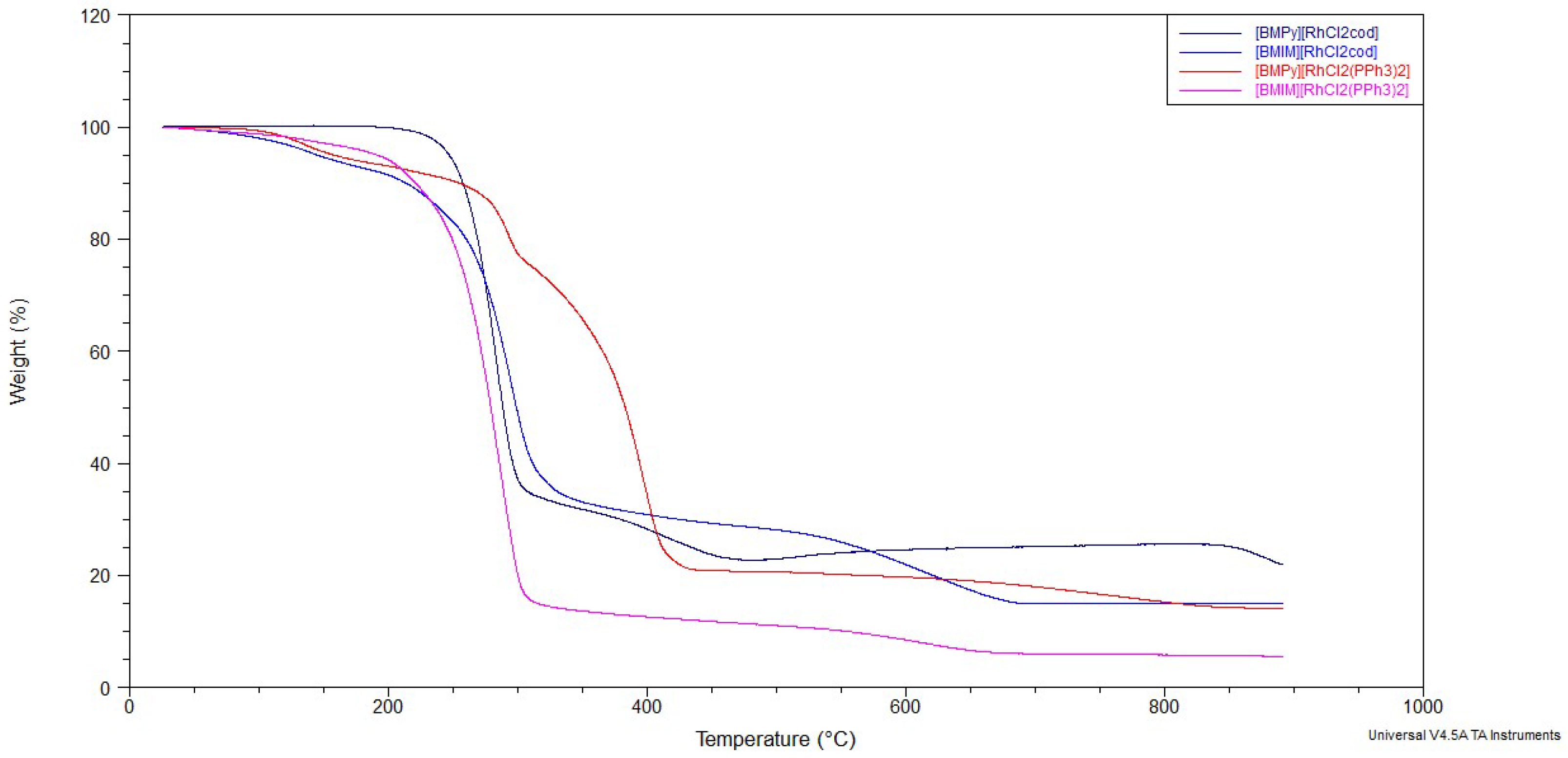
The greater the symmetry, the higher the melting point. To facilitate comparison, the four complexes obtained were divided into pairs, each containing the same anion and a different cation. Higher melting points were obtained for phosphine and cyclooctadiene complexes with pyridinium cation. The thermal stability of the obtained complexes was tested by thermogravimetric analysis (TGA), the results of which are presented in Figure 1. Their decomposition temperatures were estimated based on the temperatures of 10% mass loss (Table 1). The highest decomposition temperature at 10% mass loss, above 250 °C, was observed for complexes with pyridinium cation.
A very attractive feature of the obtained complexes was their thermal stability and insensitivity to oxygen and moisture, which allowed catalytic processes to be carried out in the presence of air.

2.3. Catalysis

The obtained anionic rhodium complexes were tested as catalysts for the hydrosilylation of nonpolar and hydrophobic 1-octene and polar and hydrophilic allyl glycidyl ether with 1,1,1,3,5,5,5-heptamethyltrisiloxane (HMTS), see Scheme 2.
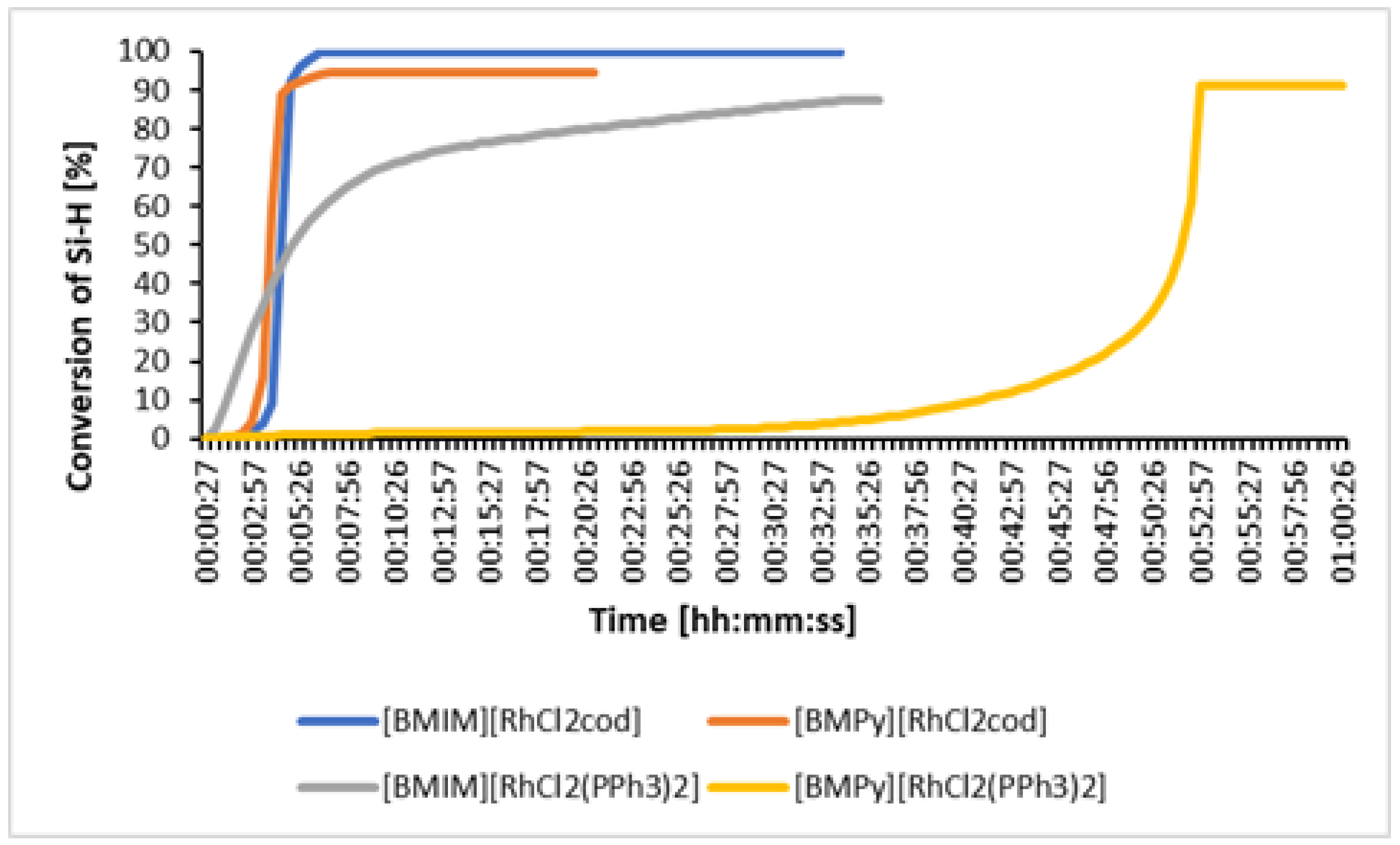
Chromatographic analysis of the post-reaction mixtures revealed only β-addition products, indicating that the reaction was selective. No byproducts, such as α-adducts or olefin isomerization products, were detected. To assess the catalytic activity of the synthesized catalysts, their stability, and optimize the reaction conditions, in situ FT-IR analysis was performed, monitoring the hydrosilylation of 1-octene using HMTS in real time. Individual reactions were performed at a catalyst concentration of 10−6 mol/mol Si-H, at a temperature of 90 °C. The obtained results allowed us to determine the reaction profiles and product yields (see Figure 2). Based on these data, we compared the catalytic activity of the studied complexes. Based on the profiles obtained, it can be concluded that all catalysts showed high activity (taking into account high conversions) but varied activity (taking into account induction periods). In the case of complexes with the [RhCl2(cod)] anion, the induction periods were very short and after a few minutes the reaction was practically complete and the conversion was close to 100%. However, complexes with the [RhCl2(PPh3)2] anion showed much longer induction periods, in particular the complex with the [BMPy] cation, which was activated after over 50 min. These observed differences in induction periods, in addition to the influence of the type of cation and anion, may also be related to diffusion processes that are characteristic of heterogeneous processes, especially in the absence of mixing of reagents. The reactions were monitored for 1.5 h, which was considered to be the time period allowing for a reliable comparison of catalytic efficiency. In the hydrosilylation of allyl-glycidyl ether with HMTS, both phosphine rhodium complexes, with the pyridinium and imidazole cations, showed long induction periods of above 50 min (like for octene) and 40 min, respectively.
All tested catalysts were characterized by high stability and catalytic activity. As mentioned above, these rhodium complexes are insoluble in reagents, so they can be easily isolated and reused after the reaction is complete. The reaction was repeated 10 times using the same portion of catalyst. However, it should be noted that in the in situ FT-IR studies, a catalyst concentration of 10−6 mol per mol of Si-H was used, whereas in the reusability studies, a 10-fold higher concentration was used due to the small amount of catalyst and the difficulty in separating it from the reaction mixture in subsequent cycles.
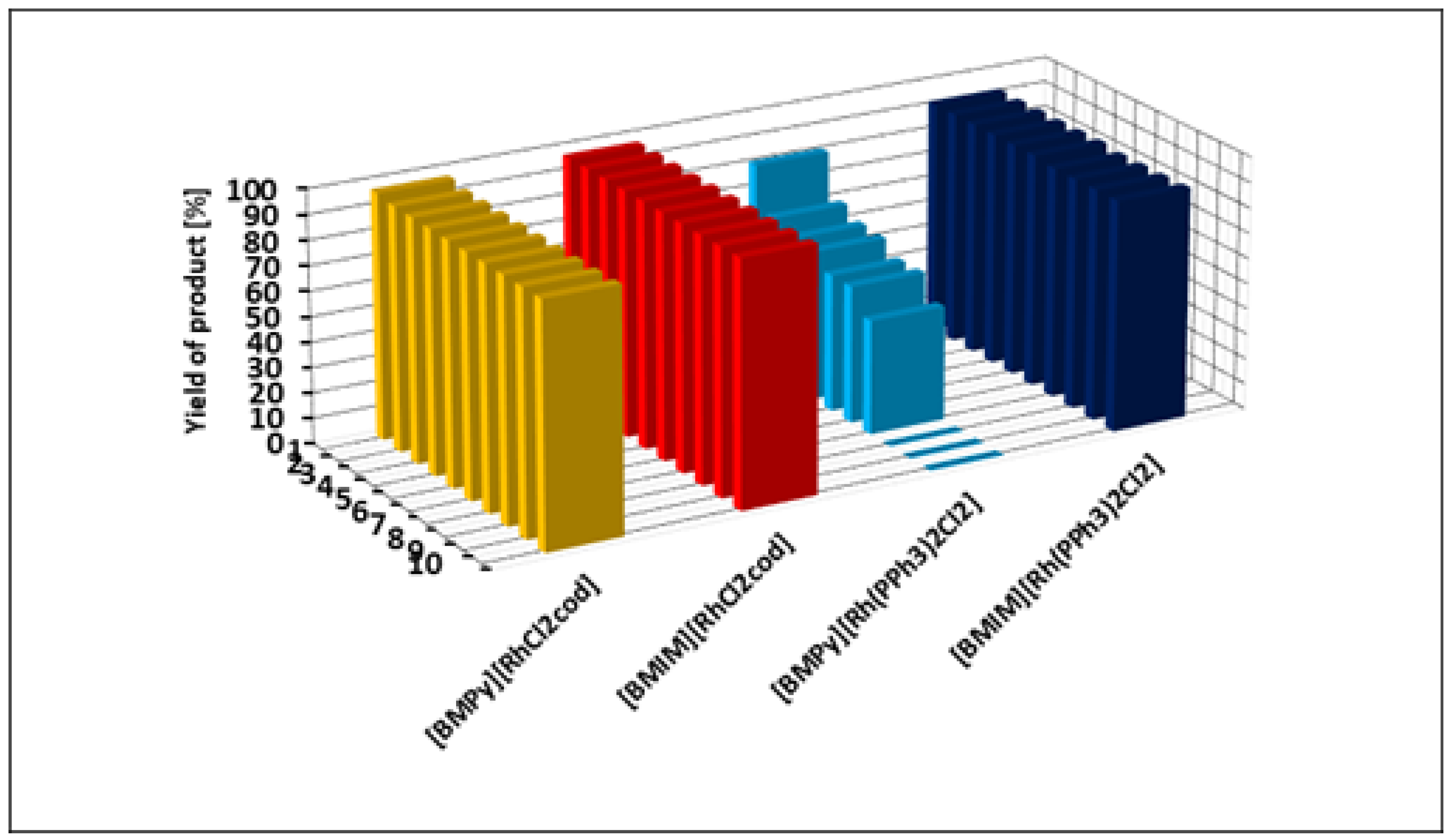
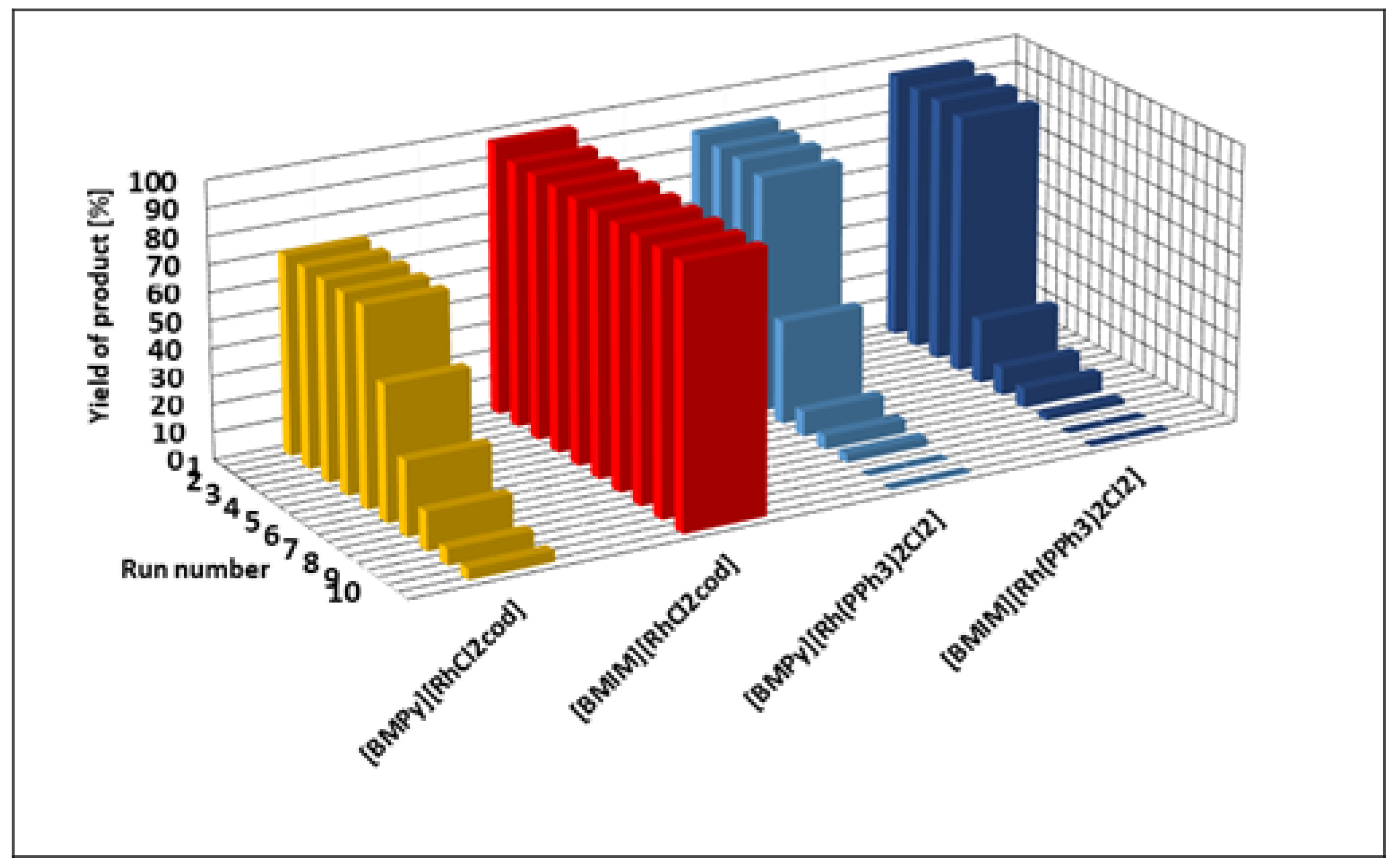
The yields of the products obtained in subsequent catalytic cycles of 1-octene hydrosilylation using HMTS are given in Table 2 and Figure 3. The catalysts containing the [RhCl2(cod)] anion showed the highest catalytic activity and stability, and in 10 subsequent catalytic cycles they provided product yields exceeding 96%. It should be emphasized that the tests were stopped after 10 cycles, even though the catalysts still showed high activity. Complexes with the anion [RhCl2(PPh3)2] proved to be less effective, in particular the complex with the cation [BMPy], which was no longer active after 7 cycles.
The studied catalysts were also tested in the hydrosilylation reaction of allyl glycidyl ether using HMTS (the results are presented in Table 3 and Figure 4). Based on the TON values, it can be concluded that the catalyst with the highest stability and the highest repeatability was the cyclooctadiene complex of rhodium with an imidazolium cation. Its use ensured a product yield of over 95% in 10 reaction cycles. The least effective catalysts, similarly to the reaction with 1-octene, were anionic rhodium complexes containing phosphine molecules. They provided good product yields in the first four catalytic cycles, after which their activity declined. One reason for this significant decline in activity is catalyst leaching by the reagents, which leads to a decrease in catalyst concentration after separation of the reaction products. Catalyst leaching is a consequence of the greater compatibility of the polar product with the ionic complex with a higher partial charge. This was confirmed by ICP analysis of the post-reaction mixtures, where for the rhodium phosphine complexes a significantly higher rhodium concentration was found after each cycle compared to practically zero concentration in the case of cyclooctadiene complexes.
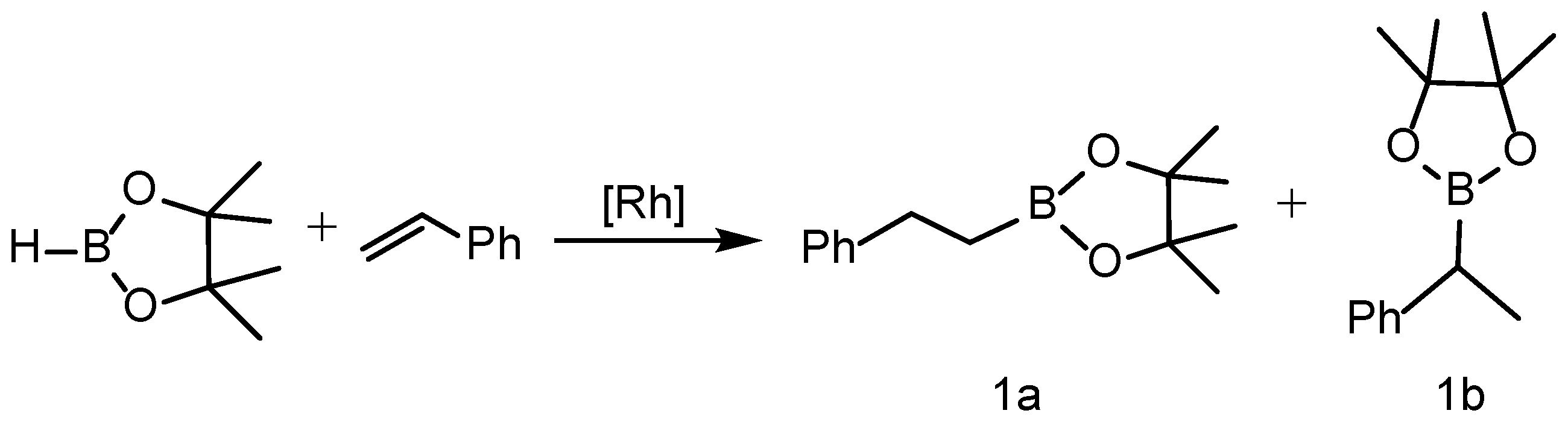
In the next stage of the research, we tested the catalytic activity of rhodium complexes and the possibility of recycling and multiple use in the hydroboration of styrene with pinacolborane (HBpin), see Scheme 3.
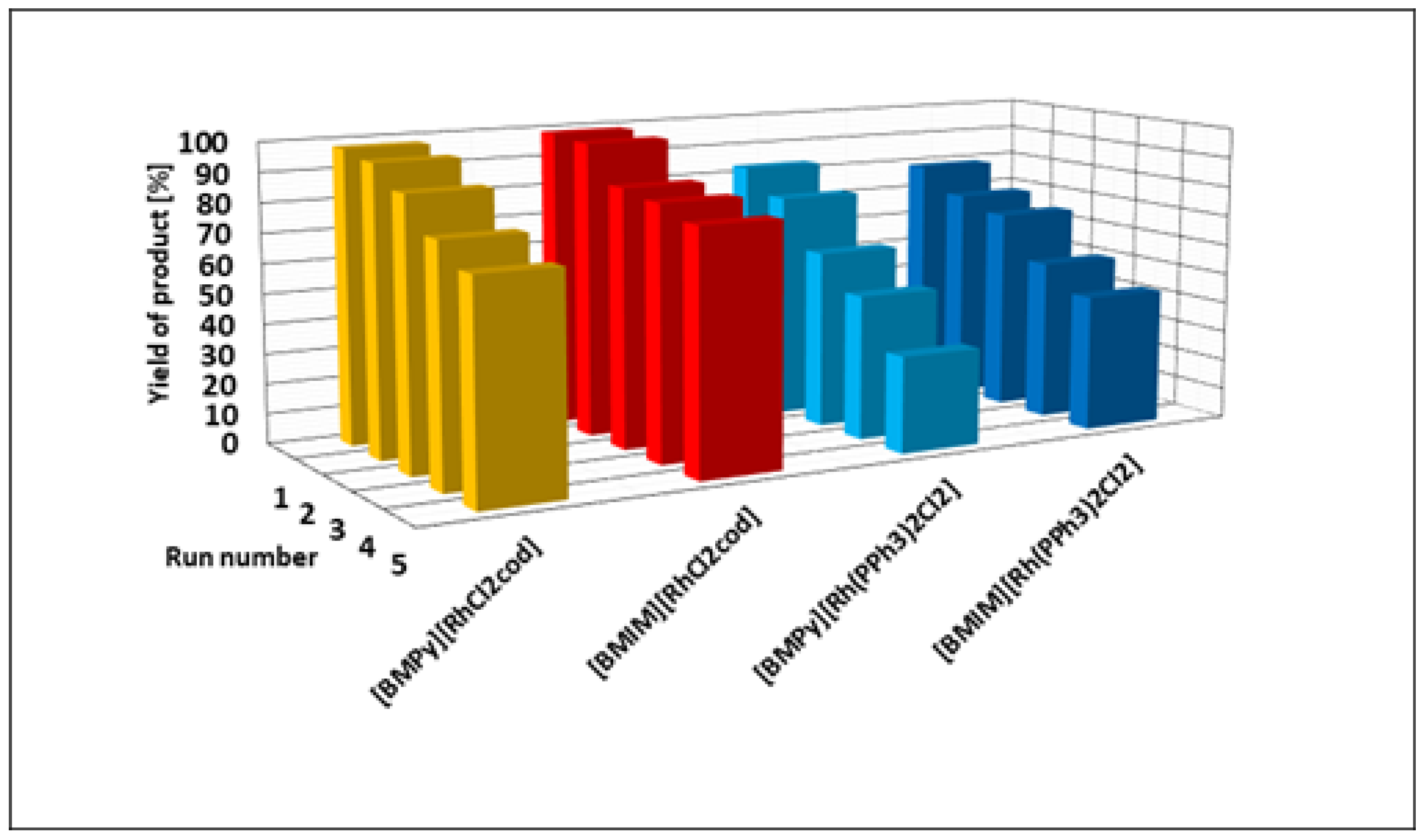
The reactions were carried out under conditions corresponding to the process parameters described in the literature; reactions without organic solvents, at a concentration of 5 × 10⁻² mol Rh per mol B-H at a temperature of 100 °C for 6 h. The process proceeded with excellent regioselectivity, yielding the linear alkylboronic ester anti-Markovnikov product 1a (Table 4 and Figure 5). Similarly to the hydrosilylation process, the catalysts were immiscible with the substrates and were reused in the next five catalytic cycles. After the reaction was completed, the mixture was analyzed by GC-MS and the isolated product by NMR analysis. The obtained results confirmed the high selectivity of the process.
Rhodium-cyclooctadiene complexes proved to be the most effective and stable catalysts, with better product yields observed for the imidazole derivative catalyst, achieving high yields (99–80%). Slightly lower yields were obtained in the process catalyzed by the rhodium-cyclooctadiene complex with a pyridinium cation (98–71%). Significantly lower product yields were obtained for phosphine-rhodium complexes. However, it should be noted that in all studies, the yield of the catalyst containing the imidazolium cation was higher compared to the pyridinium catalyst.
The authors demonstrated the possibility of using ionic liquids to modify homogeneous rhodium complexes (Wilkinson’s catalyst or dimeric rhodium complex) and produce heterogeneous, anionic rhodium(I) complexes. These complexes are an excellent alternative to the commonly used homogeneous rhodium catalysts.

3. Materials and Methods

3.1. Materials

All reagents applied in catalytic measurements, i.e., 1-octene, allyl glycidyl ether, 4,4,5,5-tetramethyl-1,3,2-dioxaborolane (pinacoloborane), styrene, n-decane and 1,1,1,3,5,5,5-heptamethyltrisiloxane were purchased from Sigma Aldrich (St. Louis, MO, USA) and used as received. The ionic liquids: 1-butyl-3-methylimidazolium chloride [BMIM]Cl and 1-butyl-4-methylpyridinium chloride [BMPy]Cl, were purchased from Iolitec GmbH, Heilbronn, Germany. Metal precursors: [{Rh(µ-Cl)(cod)}2], [Rh(Cl)(PPh3)3] were supplied by Sigma Aldrich.

3.2. Techniques

3.2.1. GC Analysis

The yields of the hydrosilylation products were quantified by gas chromatography using a PerkinElmer Clarus 680 instrument (Perkin Elmer, Waltham, MA, USA) fitted with an Agilent VF-5ms capillary column (30 m) (Santa Clara, CA, USA) and a thermal conductivity detector (TCD). The oven temperature was programmed as follows: initial temperature of 60 °C held for 3 min, followed by heating at a rate of 10 °C min−1 to 290 °C, which was maintained for 5 min.

3.2.2. NMR Analysis

1H and 13C NMR spectra were recorded on a Bruker BioSpin spectrometer (Billerica, MA, USA) operating at 400 MHz. Acetonitrile-d3 or chloroform-d was used as the solvent, and chemical shifts are reported in parts per million (ppm).

3.2.3. ICP-MS Analysis

Post-reaction samples were analyzed by inductively coupled plasma mass spectrometry (ICP-MS) using a PerkinElmer NexION 300D instrument.

3.2.4. ESI-MS Analysis

Electrospray ionization mass spectra were recorded using (QTOF) Impact HD—Bruker type.

3.2.5. TGA

Thermogravimetric analysis (TGA) was carried out using an analyzer TA Instruments model TG Q50 at a linear heating rate of 10 °C/min under synthetic air (50 mL/min). The tested samples were placed in a platinum pan and the weight of the samples was kept within 9–10 mg. The experimental error was 0.5% for weight and 1 °C for temperature.

3.3. Synthesis of Rhodium Complexes

Method 1
A 25 mL Schlenk tube fitted with a magnetic stir bar was charged with [Rh(Cl)(PPh3)3] (0.5 g, 0.5 mmol) and the ionic liquid (1 mmol), followed by the addition of toluene (2 mL). The reaction mixture was heated at reflux with continuous stirring for 24 h. After cooling to room temperature, the product was separated by cannula filtration, and the solvent was removed under reduced pressure. The product was washed with diethyl ether (3 × 5 mL) and subsequently dried under vacuum.
Method 2
A 25 mL Schlenk tube equipped with a magnetic stirrer was charged with the rhodium dimer [{Rh(μ-Cl)(cod)}2] (0.5 g, 1 mmol) and the ionic liquid (2 mmol), followed by the addition of toluene (2 mL). The reaction mixture was heated at reflux with continuous stirring for 24 h. After cooling to room temperature, the product was separated by cannula filtration, and the solvent was removed under reduced pressure. The product was washed with diethyl ether (3 × 5 mL) and subsequently dried under vacuum.
  • 1-Butyl-3-methylimidazoliumDichlorobis(triphenylphosphine)rhodate(I) [BMIM][RhCl2(PPh3)2]
  • 1H NMR (ACN-d6, δ, ppm): 9.12 (1H, s, N-CH=N), 7.74-7.44 (30 H, m, PPh) 7.40 (1 H, s, CH=CH), 7.37 (1 H, s, CH=CH), 4.18-4.14 (2 H, t, -N-CH2), 3.85 (3 H, s, N-CH3), 1.83-1.77 (2 H, m, J = 7.5, -CH2-), 1.32-1.29 (2 H, m, -CH2-), 0.91-0.87 (3 H, t, J = 7.5, -CH3)
  • 13C NMR (ACN-d6, δ, ppm): 133.21-132.21 (Ph), 129.29 (N-CH=N), 124.09 (-CH=CH-), 122.71 (-CH=CH-), 49.73 (N-CH3), 36.37 (N-CH2), 32.19, 22.12 (CH2), 19.53, 13.24 (CH3)
  • 31P NMR (ACN-d6, δ, ppm): 26.22 (PPh3)
  • ESI-MS(+): 139 [BMIM]+
  • ESI-MS(−): 434 [RhCl2PPh3], 669 [RhCl (PPh3)2], 703 [RhCl2(PPh3)2]
  • 1-Butyl-4-methylpyridiniumDichlorobis(triphenylphosphine)rhodate(I) [BMPy][RhCl2(PPh3)2]
  • 1H NMR (ACN-d6, δ, ppm): 9.24 (2 H, d, J = 6.57 Hz, Py-H), 8.33 (2 H, d, J = 7.14 Hz, Py-H), 7.77-7.52 (30 H, m, PPh), 3.26-3.24 (2 H, t, J = 7.31 Hz, -N-CH2-), 2.96 (3 H, s, -CH3), 1.80-1.70 (2 H, m, J = 6.23, -CH2-), 1.42-1.39 (2 H, m, J = 6.18, -CH2-), 1.01-0.97 (3 H, t, J = 7.13, -CH3)
  • 13C NMR (ACN-d6, δ, ppm): 131.72, 131.67, 131.63 (Ph), 128.72 (CAr), 128.60 (CAr), 65.05 (N-CH2), 25.23 (Ar-CH3), 21.28, 20.09 (CH2), 13.25 (CH3)
  • 31P NMR (ACN-d6, δ, ppm): 26.34 (PPh3)
  • ESI-MS(+):150.13 [BMPy]+
  • ESI-MS(−): 434 [RhCl2PPh3], 669 [RhCl(PPh3)2], 703 [RhCl2(PPh3)2]
  • 1-Butyl-3-methylimidazoliumDichloro(1,5-cyclooctadiene)rhodate(I) [BMIM][Rh(Cl2)(cod)]
  • 1H NMR (CDCl3, δ, ppm): 10.59 (1 H, s, N-CH=N), 7.39 (1 H, s, CH=CH), 7.30 (1 H, s, CH=CH), 4.38-4.35 (2 H, t, -N-CH2), 4.24 (2 H, m, cod =CH-), 4.13 (3 H, s, N-CH3), 2.41-2.39 (2 H, m, cod -CH2), 1.95-1.88 (2 H, m, J = 7.5, -CH2-), 1.71-1.65 (2 H, m, cod -CH2-), 1.45-1.35 (2 H, m, J = 7.5, -CH2-), 1.0-0.96 (3 H, t, J = 7.5, -CH3)
  • 13C NMR (CDCl3, δ, ppm): 138.68 (N-CH=N), 122.92 (-CH=CH-), 121.33 (CH=CH), 50.03 (N-CH3), 36.71 (-N-CH2-), 32.12, 30.84 (CH2), 19.38 (cod, CH2), 12.92 (CH3)
  • ESI-MS(+): 139 [BMIM]+
  • ESI-MS(−): 172 [RhCl2]3−, 245 [RhCl(cod)], 281 [RhCl2(cod)]
  • 1-Butyl-4-methylpyridiniumDichloro(1,5-cyclooctadiene)rhodate(I) [BMPy][Rh(Cl2)(cod)]
  • 1H NMR (CDCl3, δ, ppm): 9.30 (2 H, d, J = 6.57 Hz, Py-H), 8.22 (2 H, d, J =7.14 Hz, Py-H), 4.96-4.92 (2 H, t, J = 7.31 Hz, -N-CH2-), 4.23 (2 H, m, cod =CH-), 2.70 (3 H, s, -CH3), 2.42-2.40 (2 H, m, cod -CH2) 2.05-2.02 (2 H, m, J = 6.23 Hz, -CH2-), 1.71-1.69 (2 H, m, cod -CH2), 1.47-1.44 (2 H, m, J = 6.18, -CH2-), 1.02-0.98 (3 H, t J = 7.13 Hz, -CH3)
  • 13C NMR (CDCl3, δ, ppm): 145.07-139.22 (CAr), 127.69 (CAr), 61.88 (N-CH2), 33.82 (cod CH2), 31.10 (Ar-CH3), 19.49, 18.77 (CH2), 13.46 (CH3)
  • ESI-MS(+):150.13 [BMPy]+
  • ESI-MS(−): 172 [RhCl2]3−, 245 [RhCl(cod)], 281 [RhCl2(cod)]

3.4. General Procedure for Catalytic Tests

3.4.1. Hydrosilylation

The catalytic activity of the synthesized anionic rhodium complexes was evaluated in the hydrosilylation of 1-octene or allyl glycidyl ether with 1,1,1,3,5,5,5-heptamethyltrisiloxane (HMTS). The reactions were conducted using a catalyst loading of 1 × 10⁻⁵ mol per 1 mol of Si–H. In each experiment, 1 mmol of 1-octene or 1.2 mmol of allyl glycidyl ether and 1 mmol of HMTS were employed, with n-decane (0.10 mmol) added as an internal standard. The reactions were performed in air in a sealed reaction vessel at 90–100 °C for 1 h, without stirring. After completion, the mixture was allowed to cool to room temperature and analyzed by GC to determine the reaction yield. Due to the very small amount of catalysts, the products were taken entirely with a syringe with the needle, while the catalyst remaining in the vessel was neither washed nor regenerated. Subsequently, an identical portion of substrates was introduced, and the procedure was repeated under the same conditions. This sequence was carried out for a total of ten catalytic cycles. During the hydrosilylation reaction catalyzed by anionic rhodium catalysts, a heterogeneous system was formed. The products were isolated and characterized by NMR spectroscopy.
  • 3-octyl-1,1,1,3,5,5,5-heptametyltrisiolxane:
  • 1H NMR (CDCl3, δ, ppm): 0.02 (3 H, s, Si-CH3), 0.11 (18 H, m, Si-(CH3)3), 0.48 (2 H, t, Si-CH2), 0.9 (3 H, t, CH2-CH3), 1.36-1.27 (12 H, m, aliphatic CH2)
  • 13C NMR (CDCl3, δ, ppm): 0.28 (O-Si-CH3), 1.89 (Si-CH3), 14.10 (C-CH3), 17.63 (C-Si), 22.70 (Si-C-C), 23.07 (C-CH3), 29.35, 29.27 (C-C-C), 31.95 (C-C-C), 33.25 (C-C-C)
  • 29Si NMR (CDCl3, δ, ppm): −2.19 (-O-Si-O-), 6.75 (OSi(CH3)3)
  • 3-(3-glycidyloxypropyl)-1,1,1,3,5,5,5-heptametyltrisiloxane:
  • 1H NMR (CD3CN, δ, ppm): 0.05 (3 H, m, -SiCH3), 0.13 (18 H, m, -Si(CH3)3), 0.5 (2 H, m, -Si-CH2-), 1.59 (2 H, m, J = 11.3 Hz, -Si-CH2-CH2-), 2.54 (1 H, m, J = 5.1 Hz, HC-CH2-O), 2.74 (1 H, dd, J = 5.1 Hz, HC-CH2-O); 3.08 (1 H, m, J = 6.8 Hz, HC-O-CH2-), 3.27 (1 H, dd, J = 11.5 Hz, -O-CH2-); 3.43 (2 H, m, -CH2-O-CH2-); 3.69 (1 H, m, J = 17.1 Hz, -O-CH2-);
  • 13C NMR (CD3CN, δ, ppm): −1.0 (-Si-CH3), 0.37-1.39 (-Si(CH3)3); 12.77 (-Si-C-); 23.16 (-Si-C-C-); 43.56 (-C-O-C-); 50.71 (-C-O-C-); 71.41 (-O-C-C-); 73.67 (-C-C-O-);
  • 29Si NMR (CD3CN, δ, ppm): −20.52 (-O-Si-O-), 8.07 (OSi(CH3)3).

3.4.2. Hydroboration

The catalytic activity of Rh anionic complexes was tested in the hydroboration of styrene with pinacolborane (HBpin). The hydroboration reactions were carried out in a special glass reaction vessel, which was a 5 mL reactor with a side port for sampling. In addition, 5 × 10⁻² mol of catalyst, 1.0 mmol of styrene and 1.0 mmol of pinacoloborane, as well as 0.1 mmol of n-decane as an internal standard, were introduced into the reaction vessel in an argon atmosphere. The reaction was conducted at 100 °C for 6 h. Upon completion, the mixture was cooled to room temperature and analyzed by GC to evaluate the reaction yield. Owing to the extremely low catalyst loading, the reaction products were completely removed using a syringe equipped with a needle, while the catalyst remaining in the vessel was neither washed nor regenerated. After full withdrawal of the products, an identical portion of the substrates was introduced, and the reaction was repeated under the same conditions. This procedure was continued for a total of five consecutive catalytic cycles. Throughout the hydroboration reaction catalyzed by the anionic rhodium complexes, a heterogeneous reaction system was observed. The products were isolated and characterized by NMR spectroscopy.
  • 4,4,5,5-Tetramethyl-2-phenethyl-1,3,2-dioxaborolane
  • 1H NMR (CDCl3, δ, ppm): 7.28–7.20 (4 H, m, Ar), 7.19–7.12 (1 H, m, Ar), 2.75 (2 H, t, JH-H = 8.1 Hz, ArCH2CH2Bpin) 1.22 (12 H, s, C(CH3)2), 1.15 (2 H, t, JH-H = 8.0 Hz, ArCH2CH2Bpin)
  • 13C NMR (CDCl3, δ, ppm): 144.54, 128.30, 128.13, 125.62, 83.21 (C(CH3)2), 30.08 (ArCH2CH2Bpin), 24.93 (C(CH3)2), Cα to boron atom was not observed.
The TON (Turnover Number) is a key parameter for evaluating catalyst performance in organometallic catalysis. (TON = n products/Moles of Catalyst Used). Since TON (turnover number) provides a reliable basis for comparing catalytic performance, the corresponding values for all catalytic systems investigated in hydrosilylation and hydroboration reactions are summarized in Table 2, Table 3 and Table 4. The TON values were determined from the yields of the respective hydrosilylation or hydroboration products obtained in consecutive reaction cycles using the same catalyst sample.

4. Conclusions

Four new anionic rhodium(I) complexes were synthesized using ionic liquids with imidazolium and pyridinium ions in reactions with well-known and commercially available rhodium precursors. All newly synthesized complexes were isolated and spectroscopically characterized. These complexes were found to be thermally stable; most of them exhibited decomposition temperatures exceeding 200 °C.
The high catalytic activity of the resulting complexes allowed them to be reused in ten subsequent catalytic cycles of hydrosilylation of two olefins (1-octene and allyl glycidyl ether) using HMTS, and five catalytic cycles of hydroboration of styrene with pinacolborane. Important features of the resulting catalysts include their ease of isolation from post-reaction mixtures, as they are insoluble in the reaction medium, and the ability to reuse them in subsequent catalytic cycles without loss of activity.
The activity, and above all, the stability, of the complexes in subsequent cycles, depends on the type of olefin and product. If the products are nonpolar, the most active catalysts are those containing an imidazolium derivative. The most effective catalysts among the four complexes obtained were two cyclooctadiene rhodium complexes, which yielded products in 97–96% yield in almost all reactions, and the yield of the hydroboration product in subsequent cycles was 99–71%. It should be emphasized that in the case of both complexes, the catalytic activity studies were stopped after 10 (hydrosilylation) or after 5 (hydroboration) cycles, even though their activity was still very high.
To the best of our knowledge, this paper presents the first example of the transformation of a cyclooctadiene rhodium dimer and Wilkinson’s catalyst into anionic rhodium(I) complexes, which can be used as highly active hydrosilylation and hydroboration catalysts in many catalytic cycles without loss of activity. Due to their easy isolation and reuse, as well as the elimination of large amounts of organic solvents, the proposed catalysts represent an attractive alternative to previously used homogeneous catalysts.

Supplementary Materials

The following supporting information can be downloaded at: https://www.mdpi.com/article/10.3390/catal16010012/s1.

Author Contributions

Conceptualization, writing—original draft preparation—M.J.-W. and H.M.; writing—review and editing M.J.-W. and H.M.; supervision—H.M.; Visualization K.S.; Formal analysis A.S. and B.R.; Resources, I.D. All authors have read and agreed to the published version of the manuscript.

Funding

This research received no external funding.

Data Availability Statement

The original contributions presented in the study are included in the article; further inquiries can be directed to the corresponding author.

Conflicts of Interest

The authors declare no conflicts of interest.

References

  1. Mirghaffari, L.; Hosseininezhad, S.; Seydi, M.; Ramazani, A.; Ahankar, H.; Zhang, G. Recent Progress of Platinum and Rhodium Catalysts in Hydrosilylation Reactions. Chem. Sel. 2025, 10, e202501079. [Google Scholar] [CrossRef]
  2. Marciniec, B.; Maciejewski, H.; Pietraszuk, C.; Pawluć, P. Hydrosilylation. A Comprehensive Review on Recent Advances; Marciniec, B., Ed.; Springer: Berlin/Heidelberg, Germany, 2009. [Google Scholar]
  3. Whiting, A.; Fernández, E. Synthesis and Application of Organoboron Compounds; Springer: Cham, Switzerland, 2015. [Google Scholar]
  4. Lu, H.-X.; Wang, C.; Gao, T.-T.; Lin, E.-Z.; Lu, S.-L.; Hong, X.; Li, B.-J. Rhodium-Catalyzed Highly Enantioselective Hydroboration of Acyclic Tetrasubstituted Alkenes Directed by an Amide. J. Am. Chem. Soc. 2024, 146, 16194–16202. [Google Scholar] [CrossRef]
  5. Nakajima, Y.; Shimada, S. Hydrosilylation Reaction of Olefins: Recent Advances and Perspectives. RSC Adv. 2015, 5, 20603–20616. [Google Scholar] [CrossRef]
  6. Trogel, D.; Strohrer, J. Recent Advances and Actual Challenges in Late Transition Metal Catalyzed Hydrosilylation of Olefins from an Industrial Point of View. Coord. Chem. Rev. 2011, 255, 1440–1459. [Google Scholar] [CrossRef]
  7. Yang, H.; Zhou, Z.; Tang, C.; Chen, F. Recent Advances in Heterogeneous Hydrosilylation of Unsaturated Carbon-Carbon bonds. Chin. Chem. Lett. 2024, 35, 109257. [Google Scholar] [CrossRef]
  8. Walkowiak, J.; Szyling, J.; Franczyk, A.; Melen, R.L. Hydroelementation of diynes. Chem. Soc. Rev. 2022, 51, 869–994. [Google Scholar] [CrossRef]
  9. Szyling, J.; Szymańska, A.; Franczyk, A.; Walkowiak, J. [Pt(PPh3)4]-Catalyzed Selective Diboration of Symmetrical and Unsymmetrical 1,3-Diynes. J. Org. Chem. 2022, 87, 10651–10663. [Google Scholar] [CrossRef]
  10. Sokolnicki, T.; Szyling, J.; Franczyk, A.; Walkowiak, J. Regio- and Stereoselective Synthesis of Enynyl Boronates via Ruthenium-Catalyzed Hydroboration of 1,4-Diaryl-Substituted 1,3-Diynes. Adv. Synth. Catal. 2020, 362, 177–183. [Google Scholar] [CrossRef]
  11. Stefanowska, K.; Franczyk, A.; Szyling, J.; Salamon, K.; Marciniec, B.; Walkowiak, J. An effective hydrosilylation of alkynes in supercritical CO2—A green approach to alkenyl silanes. J. Catal. 2017, 356, 206–213. [Google Scholar] [CrossRef]
  12. Stefanowska, K.; Franczyk, A.; Szyling, J.; Pyziak, M.; Pawluć, P.; Walkowiak, J. Selective Hydrosilylation of Alkynes with Octaspherosilicate (HSiMe2O)8Si8O12. Chem. Asian J. 2018, 13, 2101–2108. [Google Scholar] [CrossRef]
  13. Stefanowska, K.; Sokolnicki, T.; Walkowiak, J.; Czapik, A.; Franczyk, A. Directed cis-hydrosilylation of borylalkynes to borylsilylalkenes. Chem. Commun. 2022, 58, 12046–12049. [Google Scholar] [CrossRef]
  14. Mandal, D.; Esposito, M.R.; Griffin, S.E.; Domecus, G.P.; Cohen, S.M. Selective hydrosilylation of olefins by a two-dimensional Rh(i) low-valent metal–organic framework. Chem. Commun. 2025, 61, 10526–10529. [Google Scholar] [CrossRef]
  15. Nath, S.; Baguli, S.; Mukherjee, D. A Hybrid Benzothiazolyl-NHC Ligand with a Flexible−CH2–Linker and Its Cationic Rh(I) Complex That Catalyzes the Olefin Hydrosilylation. Organometallics 2024, 43, 2458–2465. [Google Scholar] [CrossRef]
  16. Hallet, J.P.; Welton, T. Room-Temperature Ionic Liquids: Solvents for Synthesis and Catalysis 2. Chem. Rev. 2011, 111, 3508–3576. [Google Scholar] [CrossRef]
  17. Ozokwelu, D.; Zhang, S.; Okafor, O.C.; Cheng, W.; Litombe, N. Novel Catalytic and Separation Processes Based on Ionic Liquids; Elsevier: Amsterdam, The Netherlands, 2017. [Google Scholar]
  18. Dyson, P.J.; Geldbach, T.J. Metal Catalysed Reactions in Ionic Liquids; Springer: Dordrecht, The Netherlands, 2005. [Google Scholar]
  19. Dupont, J.; Kollar, L. Ionic Liquids (ILs) in Organometallic Catalysis; Springer: Dordrecht, The Netherlands, 2015. [Google Scholar]
  20. Hardacre, C.; Parvulescu, V. Catalysis in Ionic Liquids. From Catalysts Synthesis to Applications; RS: Cambridge, UK, 2014. [Google Scholar]
  21. Vekariya, R.L.A. A review of ionic liquids: Applications towards catalytic organic transformations. J. Mol. Liq. 2017, 227, 44–60. [Google Scholar] [CrossRef]
  22. Bartlewicz, O.; Dąbek, I.; Szymańska, A.; Maciejewski, H. Heterogeneous Catalysis with the Participation of Ionic Liquids. Catalysts 2020, 10, 1227. [Google Scholar] [CrossRef]
  23. Peng, J.J.; Li, J.; Bai, Y.; Qiu, H.; Jiang, K.; Jiang, J.; Lai, G. Ionic liquid (molten salt): Thermoregulated catalyst support for catalytic hydrosilylation process. Cat. Com. 2008, 9, 2236–2238. [Google Scholar] [CrossRef]
  24. Peng, J.J.; Li, J.Y.; Bai, Y.; Gao, W.H.; Qiu, H.Y.; Wu, H.; Deng, Y.; Lai, G. Rh(PPh3)3Cl/ionic liquid (molten salt) as a thermoregulated and recyclable catalytic system for hydrosilylation. J. Mol. Cat. A Chem. 2007, 278, 97–100. [Google Scholar] [CrossRef]
  25. Maciejewski, H.; Szubert, K.; Marciniec, B.; Pernak, J. Hydrosilylation of functionalised olefins catalysed by rhodium siloxide complexes in ionic liquids. Green Chem. 2009, 11, 1045–1051. [Google Scholar] [CrossRef]
  26. Jankowska-Wajda, M.; Kukawaka, R.; Smiglak, M.; Maciejewski, H. The effect of the catalyst and the type of ionic liquid on the hydrosilylation process under batch and continuous reaction conditions. N. J. Chem. 2018, 42, 5229–5236. [Google Scholar] [CrossRef]
  27. Maciejewski, H.; Jankowska-Wajda, M.; Dabek, I.; Fiedorow, R. The effect of the morpholinium ionic liquid anion on the catalytic activity of Rh (or Pt) complex–ionic liquid systems in hydrosilylation processes. RSC Adv. 2018, 8, 26922–26927. [Google Scholar] [CrossRef]
  28. Szyling, J.; Franczyk, A.; Stefanowska, K.; Maciejewski, H.; Walkowiak, J. Recyclable Hydroboration of Alkynes Using RuH@IL and RuH@IL/scCO2 Catalytic Systems. ACS Sustain. Chem. Eng. 2018, 6, 10980–10988. [Google Scholar] [CrossRef]
  29. Li, J.; Peng, J.; Bai, Y.; Zhang, G.; Lai, G.; Li, X. Phosphines with 2-imidazolium ligands enhance the catalytic activity and selectivity of rhodium complexes for hydrosilylation reactions. J. Org. Chem. 2010, 695, 431–436. [Google Scholar] [CrossRef]
  30. Li, J.; Peng, J.; Wang, D.; Bai, Y.; Jiang, J.; Lai, G. Hydrosilylation reactions catalyzed by rhodium complexes with phosphine ligands functionalized with imidazolium salts. J. Organomet. Chem. 2011, 696, 263. [Google Scholar] [CrossRef]
  31. Jankowska-Wajda, M.; Bartlewicz, O.; Szpecht, A.; Zając, A.; Smiglak, M.; Maciejewski, H. Platinum and rhodium complexes ligated by imidazolium-substituted phosphine as efficient and recyclable catalysts for hydrosilylation. RSC Adv. 2019, 9, 29396. [Google Scholar] [CrossRef]
  32. Wilkes, J.S. A short history of ionic liquids—From molten salts to neoteric solvents. Green Chem. 2002, 4, 73–80. [Google Scholar] [CrossRef]
  33. Jankowska-Wajda, M.; Bartlewicz, O.; Walczak, A.; Stefankiewicz, A.R.; Maciejewski, H. Highly efficient hydrosilylation catalysts based on chloroplatinate “ionic liquids”. J. Cat. 2019, 374, 266. [Google Scholar] [CrossRef]
  34. You, H.; Wang, Y.; Zhao, X.; Chen, S.; Liu, Y. Stable Ionic Rh (I, II, III) Complexes Ligated by an Imidazolium-Substituted Phosphine with π-Acceptor Character: Synthesis, Characterization and Application to Hydroformylation. Organometallics 2013, 32, 2698–2704. [Google Scholar] [CrossRef]
  35. Both, A.; Kaltwasser, F.; Priedigkeit, C.; Atwi, B.; Frey, W.; Buchmeiser, M.R.; Tallarek, U. Influence of the supported ionic-liquid layer thickness on Z-selectivity in 1-alkyne hydrosilylation under continuous flow. Catal. Sci. Technol. 2025, 15, 4012–4023. [Google Scholar] [CrossRef]
  36. Tejel, C.; Shi, Y.-M.; Ciriano, M.A.; Edwards, A.J.; Lahoz, F.J.; Oro, L.A. Novel Neutral and Anionic Rhodium Complexes Containing Imido Ligands. Angew. Chem. Int. Ed. 1996, 35, 633–634. [Google Scholar] [CrossRef]
  37. Fernandez-Bartolome, E.; Cruz, P.; Galán, L.A.; Cortijo, M.; Delgado-Martínez, P.; González-Prieto, R.; Priego, J.L.; Jiménez-Aparicio, R. Heteronuclear Dirhodium-Gold Anionic Complexes: Polymeric Chains and Discrete Units. Polymers 2020, 12, 1868. [Google Scholar] [CrossRef] [PubMed]
  38. Ngo, H.L.; LeCompte, K.; Hargens, L.; McEwen, A.B. Thermal properties of imidazolium ionic liquids. Termochim. Acta 2000, 357–358, 97–102. [Google Scholar] [CrossRef]
  39. Zhong, C.; Sasaki, T.; Jimbo-Kobayashi, A.; Fujiwara, E.; Kobayashi, A.; Tada, M.; Iwasawa, Y. Syntheses, Structures, and Properties of a Series of Metal Ion-Containing Dialkylimidazolium Ionic Liquids. Bull. Chem. Soc. Jpn. 2007, 80, 2365–2374. [Google Scholar] [CrossRef]
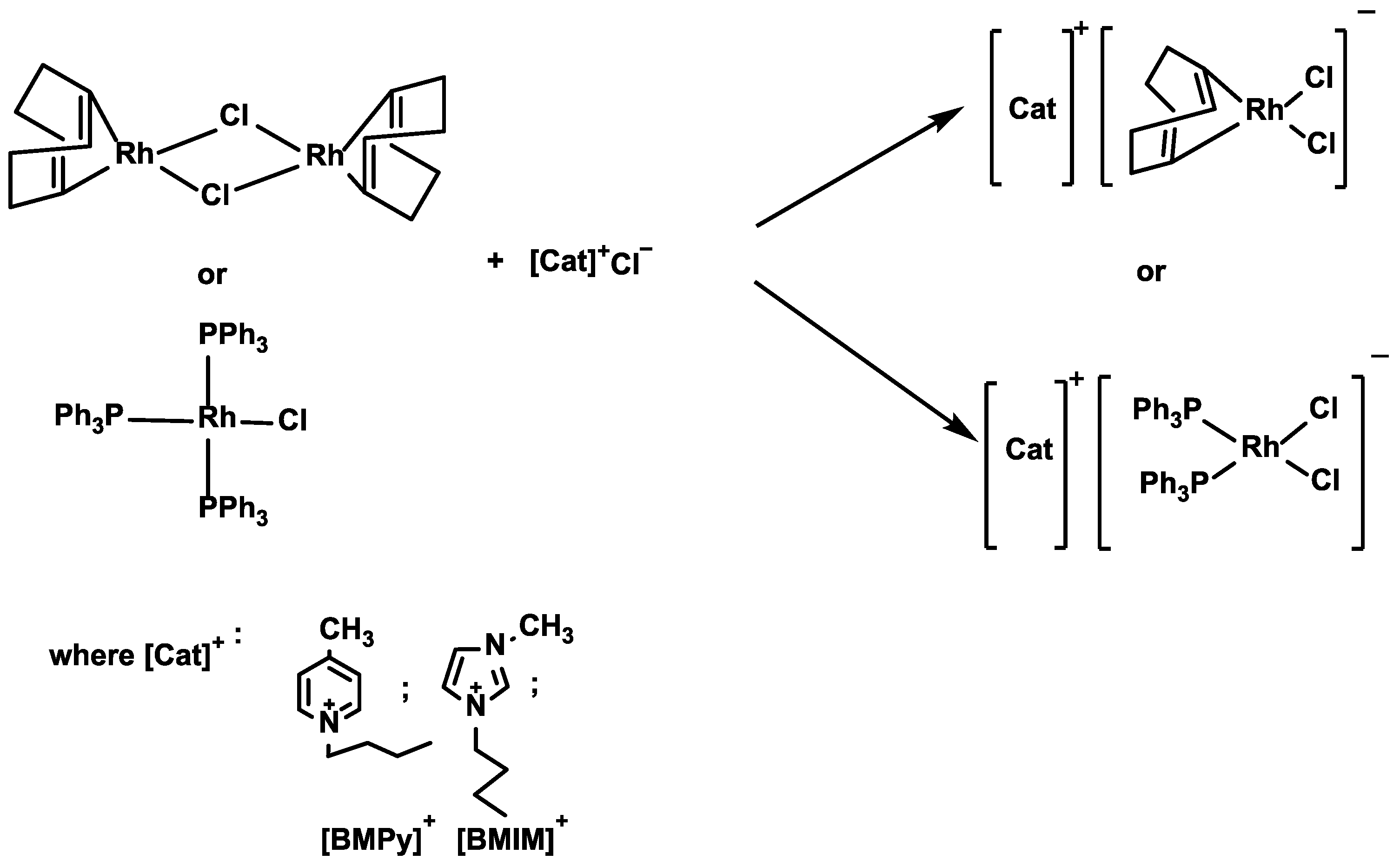
Scheme 1. Methods of the synthesis of anionic rhodium(I) complexes.
Catalysts 16 00012 sch001
Figure 1. Thermogravimetric curves of anionic rhodium (I) complexes.
Catalysts 16 00012 g001
Scheme 2. Reaction model for the hydrosilylation of 1-octene/allyl glycidyl ether with 1,1,1,3,5,5,5-heptamethyltrisiloxane.
Catalysts 16 00012 sch002
Figure 2. The change in the product yield as a function of time for the reaction of 1-octene hydrosilylation catalyzed by anionic rhodium complexes in the FT-IR in situ reaction ([HSi]:[CH=CH]:[cat] = 1:1:10−6; T = 90 °C; t = 1.5 h).
Catalysts 16 00012 g002
Figure 3. Yields of the product of hydrosilylation of 1-octene with 1,1,1,3,5,5,5-heptamethyltrisiloxane during 10 subsequent reaction runs catalyzed by the same catalyst portion.
Catalysts 16 00012 g003
Figure 4. Yields of the product of hydrosilylation of allyl glycidyl ether with 1,1,1,3,5,5,5-heptamethyltrisiloxane during 10 subsequent reaction runs catalyzed by the same catalyst portion.
Catalysts 16 00012 g004
Scheme 3. Model reaction of hydroboration of pinacoloborane with styrene.
Catalysts 16 00012 sch003
Figure 5. Yields of the product of hydroboration of pinacoloborane with styrene during 5 subsequent reaction runs catalyzed by the same catalyst portion.
Catalysts 16 00012 g005
Table 1. Melting point, decomposition temperatures of compounds at 10% of weight loss and yield of complexes.
ComplexMelting Point [°C]Decomposition Temperature [°C]Yield of Complex [%]
[BMPy][RhCl2(PPh3)2]142255.4292
[BMIM][RhCl2(PPh3)2]141221.0295
[BMPy][RhCl2(cod)]146257.7085
[BMIM][RhCl2(cod)]139213.8882
Table 2. Yields of product and TON values for hydrosilylation 1-octene with HMTS catalyzed by anionic rhodium complexes.
CatalystYield of Product in Subsequent Cycle * [%]Total TON
[BMPy][RhCl2cod]97 (96, 96, 96,96, 96, 96, 96, 96, 96)96,100
[BMIM][RhCl2cod]97 (97, 97, 97, 97, 97, 97, 97, 97, 97)97,000
[BMPy][Rh(PPh3)2Cl2]81 (64, 60, 59, 54, 54, 45, 0)41,700
[BMIM][Rh(PPh3)2Cl2]92 (92, 92, 92, 92, 92, 91, 91, 91, 91)91,600
[≡SiH]:[CH=CH]:[cat] = 1:1:10−5; T = 90 °C; t = 1 h * Yields were determined on the basis of GC analysis with n-decane as internal standard.
Table 3. Yields of product and TON values for hydrosilylation of allyl glicydyl ether with HMTS catalyzed by anionic rhodium complexes.
CatalystYield of Product in Subsequent Cycle * [%]Total TON
[BMPy][RhCl2cod]72 (72, 72, 72, 72, 49, 27, 14, 6, 4)46,000
[BMIM][RhCl2cod]98 (95, 95, 95, 95, 95, 95, 95, 95, 95)95,300
[BMPy][Rh(PPh3)2Cl2]88 (87, 87, 85, 37, 9, 5, 3, 0)40,100
[BMIM][Rh(PPh3)2Cl2]96 (95, 95, 93, 23, 10, 7, 2, 0)42,100
[≡SiH]:[CH=CH]:[cat] = 1:1.2:10−5; T = 100 °C; t = 1 h, * Yields were determined on the basis of GC analysis with n-decane as internal standard.
Table 4. Yields of product and TON values for hydroboration of pinacoloborane with styrene catalyzed by anionic rhodium complexes.
CatalystYield of Product (1a) in Subsequent Cycle [%] *Total TON
[BMPy][RhCl2cod]98, 96, 89, 78, 718640
[BMIM][RhCl2cod]99, 98, 86, 84, 808940
[BMPy][Rh(PPh3)2Cl2]83, 75, 59, 48, 325940
[BMIM][Rh(PPh3)2Cl2]79, 71, 67, 53, 451170
[styrene]:[HBPin]:[cat] = 1:1:5 × 10⁻²; T = 100 °C; t = 6 h, * Yields were determined on the basis of GC analysis with n-decane as internal standard.
Disclaimer/Publisher’s Note: The statements, opinions and data contained in all publications are solely those of the individual author(s) and contributor(s) and not of MDPI and/or the editor(s). MDPI and/or the editor(s) disclaim responsibility for any injury to people or property resulting from any ideas, methods, instructions or products referred to in the content.