Article

Influence of Ag/CeO2-Supported Catalysts Derived from Ce-MOFs on Low-Temperature Oxidation of Unregulated Methanol Emissions from Methanol Engines

1
Shaanxi Provincial Key Laboratory of New Transportation Energy and Automotive Energy Saving, School of Energy and Electrical Engineering, Chang’an University, Xi’an 710018, China
2
National Engineering Laboratory for Mobile Source Emission Control Technology, China Automotive Technology & Research Center Co., Ltd., Tianjin 300300, China
3
Shaanxi Fast Gear Co., Ltd., Xi’an 710119, China
*
Authors to whom correspondence should be addressed.
Catalysts 2025, 15(12), 1165; https://doi.org/10.3390/catal15121165
Submission received: 13 November 2025 / Revised: 7 December 2025 / Accepted: 10 December 2025 / Published: 12 December 2025
(This article belongs to the Section Environmental Catalysis)

Abstract

Methanol fuel engines can effectively reduce emissions of carbon monoxide and particulate matter, but they cause a substantial increase in emissions of unregulated pollutants like methanol and formaldehyde. In this study, Ag/CeO2 catalysts were prepared from metal–organic framework (MOF) and silver acetate precursors using different methods and applied to the deep oxidation of methanol. The influence of preparation conditions on the types of active oxygen, surface chemical state, and oxygen vacancies was revealed by changing the calcination conditions and compared with the Ag/CeO2 catalyst prepared by traditional methods. At the same time, the low-temperature reaction pathway of methanol was explored. The results showed that calcination conditions greatly affected the structure of the catalyst. Among them, Ag/CeO2-A500 obtained by calcining Ag/Ce BTC in air at 500 °C had the best catalytic performance for methanol oxidation. The surface chemical state, overall oxygen vacancies, and the proportion of metallic silver may be key factors for its superior catalytic performance.

1. Introduction

Methanol, a simple oxygenated organic compound, offers several advantages as an internal combustion engine fuel [1]. These properties contribute to improved engine compression ratio, charging efficiency, and thermal efficiency [2]. Due to being liquid at room temperature, methanol is also easy to store and transport. These features, combined with its high oxygen content and absence of sulfur, enable it to significantly lower emissions of carbon monoxide, carbon dioxide, and particulate matter as an alternative fuel [3] while entirely eliminating sulfur oxide and sulfate emissions [4]. However, methanol combustion leads to the emission of unregulated pollutants such as methanol, formaldehyde, acetaldehyde and n-butyraldehyde. Methanol and formaldehyde collectively represent the overwhelming majority of these emissions, constituting over 98% [5]. Methanol is a volatile organic compound, and studies have shown that inhalation or dermal exposure can cause poisoning, leading to neurological damage, poisoning, and blindness. High-concentration exposure and long-term inhalation and exposure can even lead to death [6,7].
To eliminate methanol emissions, H.S. Gandhi et al. employed conventional platinum-rhodium three-way catalysts in methanol-fueled vehicles as early as 1982. With the advancement of alcohol-based fuels and dedicated alcohol engines, research on catalysts for methanol deep oxidation gradually emerged. Currently, these catalysts are broadly categorized into precious metal and non-precious metal types. Supported precious metal catalysts, in particular, have seen widespread application owing to their exceptional low-temperature activity. For example, Andreas Hinz and his team [8] studied the effect of Pt/Al2O3 for methanol oxidation, finding that there was little difference in the activity of 1.0 wt% and 3.0 wt% Pt catalysts in air. Li and his team [9] studied the oxidative properties of Pd/CeO2 on methanol and found that complete methanol conversion (T90) can be achieved at only 155 °C. Although precious metals such as Pt have high activity, these catalysts can partially oxidize methanol to formaldehyde. This limitation directed attention to silver-based catalysts, which demonstrated unique properties. McCabe et al. [10,11] compared various catalysts and found that the activity of Ag was only lower than that of Pt and Pd, while the amount of formaldehyde generated was the least. In addition, they also found that CO has a strong inhibitory effect on Pt and Pd catalysts, but Ag catalysts are not affected. Owing to their unique catalytic properties and relatively low cost, silver-based catalysts have garnered significant research interest. For example, H.K. Plummer and his team [12] compared the methanol oxidation activity of Al2O3 impregnated with silver nitrate versus silver chloride solutions. They found that the catalyst derived from silver chloride and calcined in 3% H2 exhibited the highest activity, maximum metal retention, and most uniform silver distribution. Chen et al. [13] developed a CuAg alloy catalyst for deep oxidation of methanol. Benefiting from the synergistic effect of the CuAg alloy and strong metal–support interaction (MSI), methanol can be completely oxidized at 145 °C. Therefore, developing effective preparation methods and identifying optimal supports remain central to obtaining highly active silver catalysts.
Non-precious metal oxide catalysts, such as those based on Cu and Mn, all possess certain activity for the deep oxidation of methanol. Their catalytic activity, while typically lower than that of precious metal counterparts, is often counterbalanced by significant cost advantages, making them a widely investigated alternative. Among them, Ce-based catalysts are particularly notable due to their abundant oxygen vacancies and rapid redox cycling between Ce3+ and Ce4+ [14]. Common methods for preparing CeO2 include the hydrothermal method [15], redox reaction method, sol–gel method, and precipitation method [16]. In recent years, the preparation of MOF derivatives by calcining MOF precursors at high temperatures under specific atmospheres (air or inert gases such as nitrogen and helium) has become a research hotspot. The resulting MOF derivatives retain the transition metal elements and essential ligand elements (e.g., C, H, O, N) from the parent material and possess the rich porous structure of the precursor MOF. This inherited porosity facilitates reactant adsorption and catalysis, while the tunable pore size ensures high mass transfer and diffusion efficiency in catalytic reactions [17]. Consequently, Chen and his team [18] examined cerium-based catalysts derived from MOF precursors at various calcination temperatures in a plasma–catalytic system. They found that the superior activity of precious catalysts in oxidation reactions stems from a synergistic effect between the metal and the substrate, where the catalytic activity is highly dependent on the chemical state of both components. Utilizing sacrificial metal–organic framework template method to optimize the CeO2 structure, Xie et al. [19] successfully synthesized a Pd@Ce-BTC-N catalyst, which exhibits abundant surface Ce3+ species, a high concentration of surface-adsorbed oxygen, and excellent redox properties. In addition, Wang et al. [20] prepared MOF-derived Ag/CeO2 catalysts, which exhibited a good performance in toluene oxidation.
The above research underscores the significant potential of Ag catalysts and Ce-based catalysts in methanol deep oxidation. Benefiting from the structural optimization of CeO2 via the sacrificial MOF template method, Ag catalysts supported on CeO2 have demonstrated excellent catalytic oxidation performance. However, the deep oxidation of methanol over CeO2-supported silver catalysts derived from MOF precursors, and the influence of their preparation conditions, remain unexplored. In order to fill this research gap, this study prepared Ag/CeO2 catalysts by different methods using Ce-BTC impregnated with silver acetate, and applied them to the deep oxidation of methanol, exploring their oxidation pathway. Simultaneously, different tests were used to characterize the catalyst to elucidate the effects of preparation conditions on its surface chemical state, active oxygen species, and surface oxygen vacancies, while demonstrating its advantages over traditional preparation methods.

2. Results and Discussion

2.1. Structural Characteristics

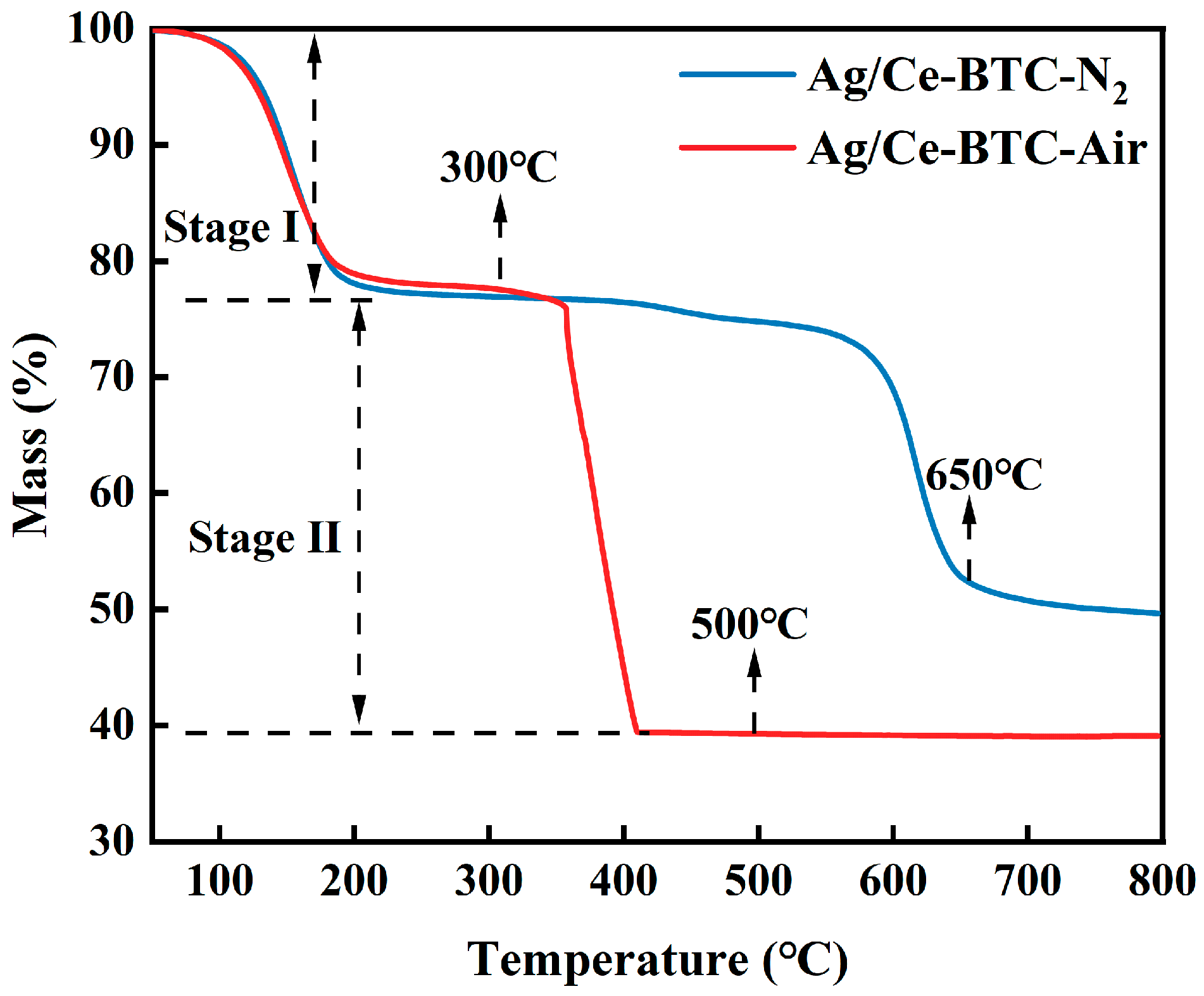
To clarify calcination temperature of catalyst, TGA was conducted on Ce BTC loaded with Ag (Ag/Ce-BTC). In Figure 1, Ag/Ce-BTC underwent two main stages of weight loss in both atmospheres. The first stage, observed between 40 and 200 °C in both air and nitrogen, is attributed to the desolvation process. Subsequently, the precursor exhibited relative thermal stability between 200 and 350 °C in air and between 200 and 550 °C under a nitrogen atmosphere. The second major weight loss occurred between 350 and 410 °C in air, corresponding to the combustion of the Ce-BTC. This stage was found at a higher temperature range of 550–680 °C under a nitrogen atmosphere and ascribed to the decomposition of framework. The sample weight remained relatively stable thereafter. Furthermore, Figure S1 compares the thermogravimetric profiles after calcination in nitrogen at 500 °C and 650 °C prior to air exposure. The Ce-BTC framework was observed to remain stable under nitrogen at 500 °C, but intense combustion still occurred between 240 and 360 °C. This alteration of the Ce-BTC framework is expected to induce significant structural changes in the resulting catalyst. Based on these findings, we selected calcination temperatures of 300 °C and 500 °C in air. For comparison, we also prepared catalysts by first removing the Ce-BTC framework at 650 °C in a nitrogen atmosphere and then heating in air.
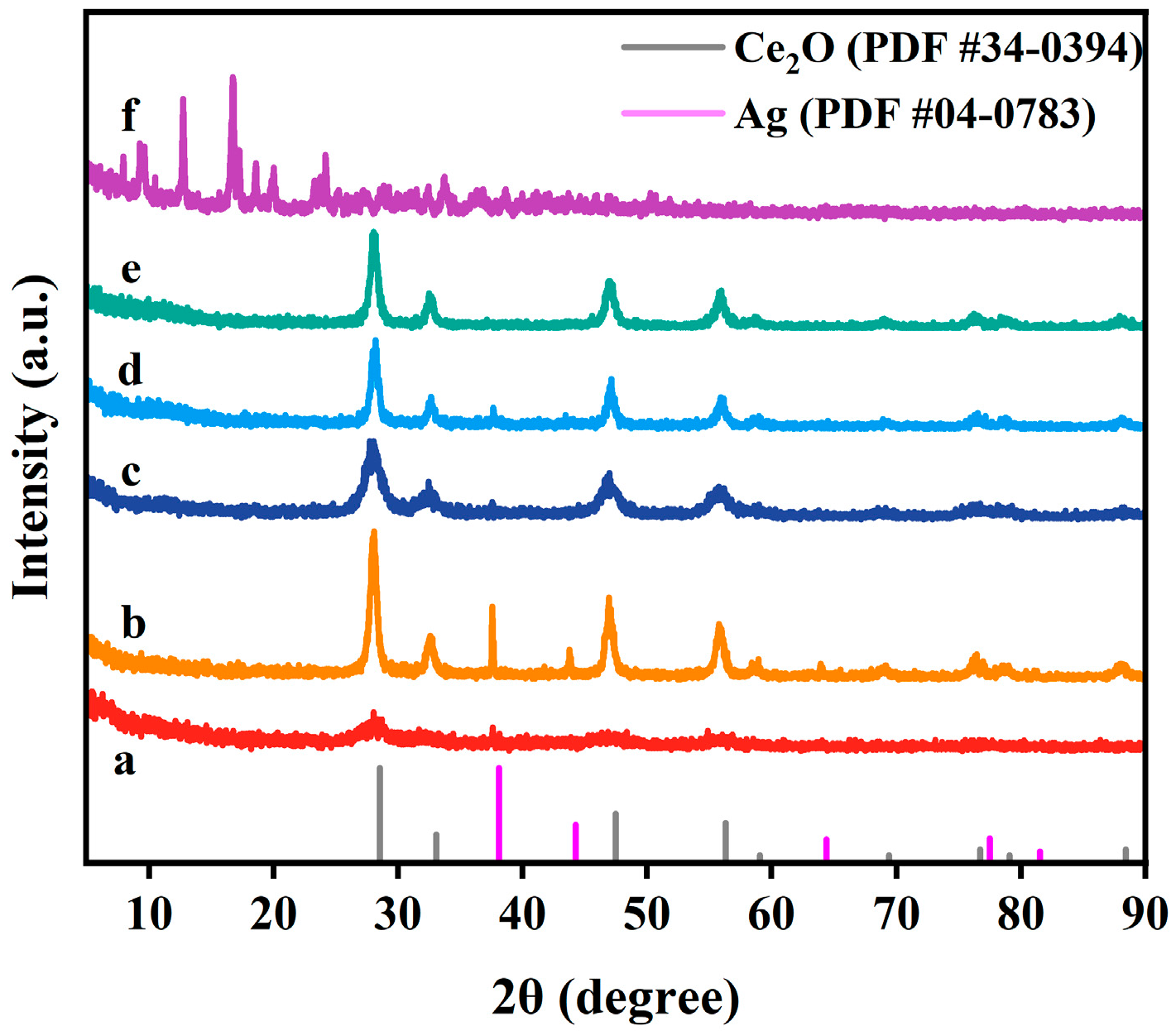
Figure 2 displays the XRD patterns of samples. It is found from the figure that the XRD pattern of Ag/Ce-BTC shows diffraction peaks at 2θ = 8.4°, 10.6°, 17.8°, and 24.5°, indicating its extremely high crystallinity. Compared to previous literature, these results are highly consistent with others [21], indicating that Ce-BTC has been successfully synthesized. Following calcination, the XRD pattern shows the disappearance of characteristic Ce-BTC peaks alongside the emergence of new peaks. For example, Ag/Ce-BTC calcined in air at 300 °C (i.e., Ag/CeO2-A300) exhibits diffraction peaks similar to the CeO2 crystal structure at 2θ of 28.5°, 33.0°, 47.4°, 56.2°, 58.9°, 69.3°, 76.7°, and 79.1°, corresponding to the (111), (200), (220), (311), (222), (400), (311), and (420) lattice planes of CeO2, indicating that some central Ce3+ nodes in MOF are oxidized to CeO2. At 500 °C, the diffraction peak intensity of CeO2 crystal structure significantly increases, indicating an increase in the crystallinity of the Ag/CeO2-A500. In addition to the CeO2 phase, the XRD pattern shows distinct peaks at 2θ = 38.1°, 44.3°, and 64.4°, which are indexed to the (111), (200), and (220) planes of metallic Ag, verifying the successful incorporation of Ag nanoparticles (NPs). In particular, the characteristic peaks of Ag are not obvious or not found in other catalysts, which can be explained by the high dispersion or low loading of Ag nanoparticles. Table 1 lists the calculated CeO2 crystallite sizes in the catalysts, as derived from the Scherrer equation. The CeO2 sizes for the various samples are determined as follows: Ag/CeO2-A300 is 2.0 nm, Ag/CeO2-A500 is 12.9 nm, Ag/CeO2-A300 obtained by first calcining Ag/Ce-BTC with nitrogen at 650 °C and then calcining it with air at 300 °C is 6.0 nm, Ag/CeO2-N500 obtained by first calcining it with nitrogen at 650 °C and then calcining it with air at 500 °C is 12.7 nm, and Ag/CeO2-C prepared by traditional methods is 9.8 nm. This significant variation underscores the profound influence of calcination conditions on the catalyst structure.
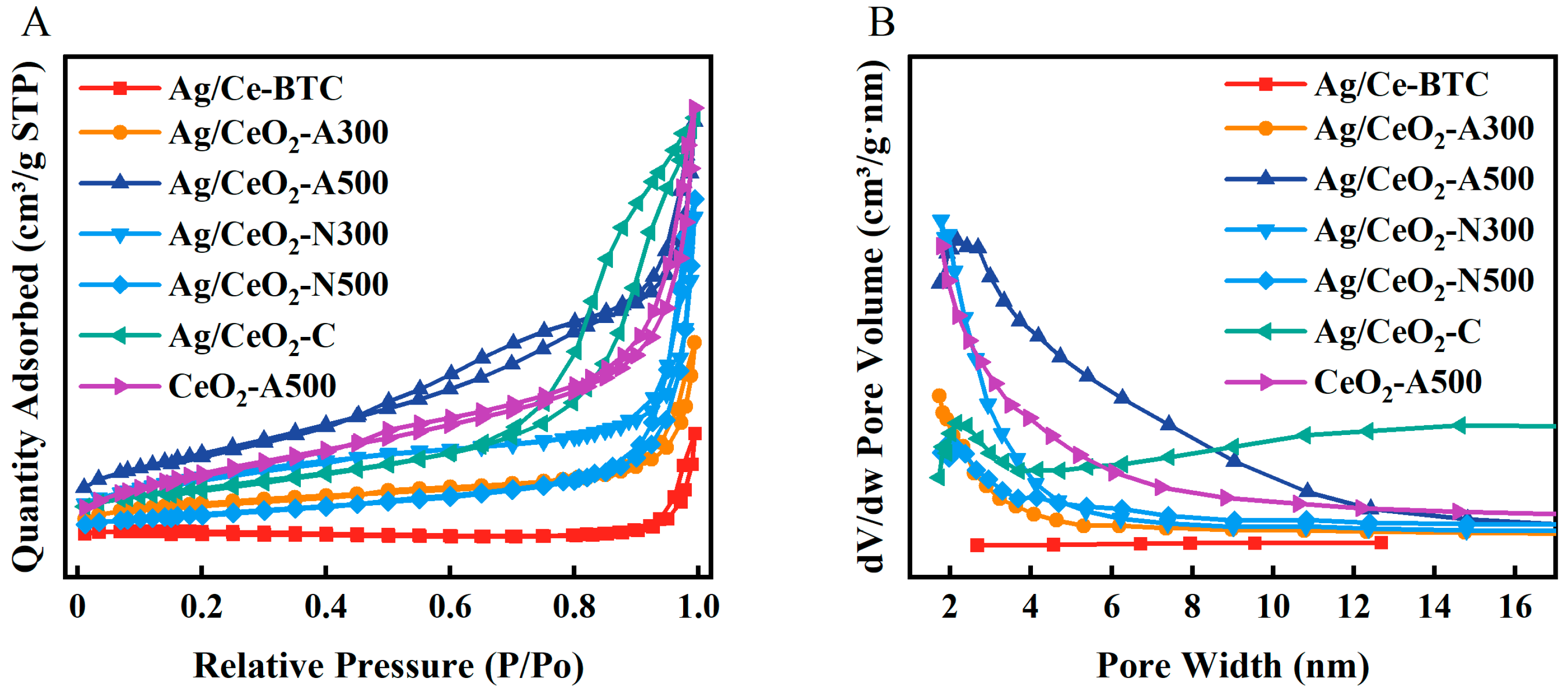
Larger specific surface areas and pore volumes generally favor catalytic activity by providing a greater density of active sites. The pore structures of the catalysts, as characterized by N2 adsorption–desorption (Figure 3), are examined to determine the impact of the calcination conditions. The pore size parameters and SBET for all catalysts are shown in Table 1. Figure 3A shows that the isotherms of the five catalysts all exhibit typical type IV characteristics accompanied by H3/H4-type hysteresis loops. This indicates that they have mesoporous structures [22,23]. The increase in the SBET of Ag/Ce-BTC after calcination (Table 1) results from the pyrolysis and removal of the organic solvents and the Ce-BTC framework during heating. Specifically, Ag/CeO2-A500 has the largest BET specific surface area, followed by Ag/CeO2-N300, while Ag/Ce-BTC has the smallest BET specific surface area of only 3.74 m2/g. As shown in Figure 3B, the formation of not only mesopores but also some micropores in the prepared Ag/CeO2 is observed. The distribution range of pore size in Ag/Ce-BTC increases after calcination, and the proportion of large pores significantly increases with the calcination temperature expands. A contributing factor is likely the interstitial spaces and pore size distribution arising from the aggregation of CeO2 particles [24]. The Ag/Ce-BTC precursor route offers distinct advantages over direct Ce (NO3)3•6H2O pyrolysis for Ag/Ce-BTC preparation, by generating a larger specific surface area and suppressing the development of large pores caused by CeO2 particle aggregation. The Ag/CeO2 obtained by first firing in nitrogen and then firing in air can reduce the aggregation of CeO2 particles, decrease the generation of large pores, and enhance the SBET of the catalyst. However, prolonged heating can lead to an increase in Ag2O particles and sintering of CeO2 particles [25], reducing the SBET and pore volume of the catalyst. Figure 3 also shows that the addition of Ag increases the specific surface area of the catalyst and also increases the diameter of the micropores.
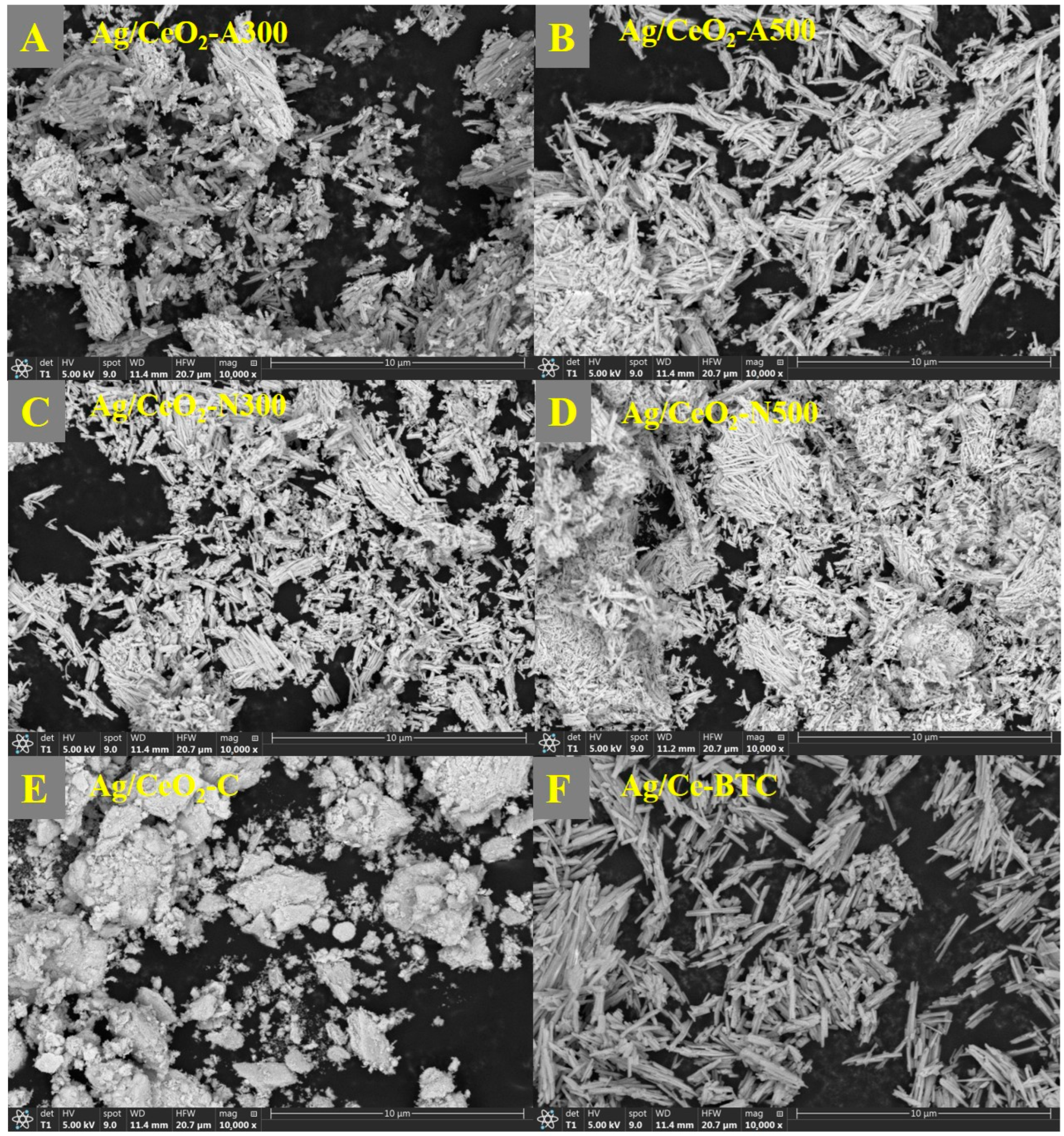
Figure 4 displays the SEM images of all samples. From the figure, it can be observed that Ag/CeO2-C exhibited a blocky morphology, whereas Ag/Ce-BTC had an elongated shape. The catalysts prepared using Ag/Ce-BTC as a precursor largely retained this elongated morphology of the precursor. in firing temperature promotes its elongation. After prolonged calcination, Ag/CeO2-N500 showed obvious agglomeration, a finding which is consistent with the BET measurements.
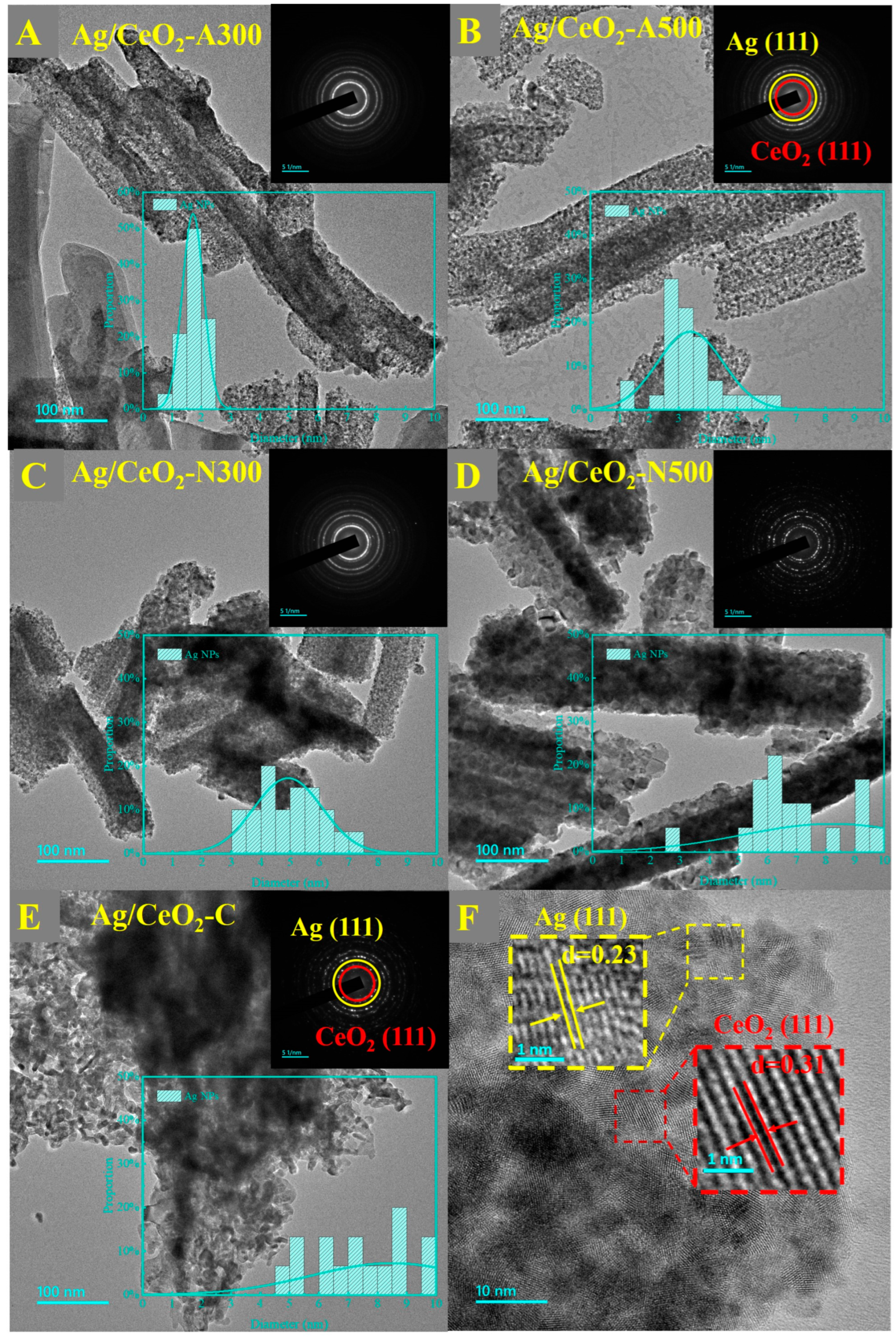
Figure 5A–E display the TEM images for all catalysts, while also statistically analyzing the size distribution of Ag nanoparticles in different catalysts. TEM images reveal that Ag NPs were uniformly distributed on the CeO2 support. However, depending on the preparation conditions, catalysts calcined in nitrogen followed by air—particularly Ag/CeO2-N500—exhibited a degree of particle enlargement and aggregation. Similarly, Ag/CeO2-C also contained significantly larger Ag NPs, comparable to those in Ag/CeO2-N500. These observations indicate that the porous structure of the MOF facilitates the filling of noble metal nanoparticles in their pores. This confinement reduces inter-particle contact and, to some extent, inhibits the aggregation of Ag NPs. However, this advantage is significantly diminished after prolonged high-temperature calcination. The Ag/CeO2-A500 and Ag/CeO2-C both showed the SAED patterns with diffraction rings assignable to the (111) planes of CeO2 and metallic Ag. This finding thereby confirms the crystallographic phases identified by XRD in Figure 2. Figure 5F presents a representative HR-TEM image of the Ag/CeO2-A500 catalyst. The observed lattice fringes, measuring 0.23 nm and 0.31 nm, correspond to the (111) planes of metallic Ag and CeO2, respectively. This finding provides direct evidence for the polycrystalline nature of the material. Additionally, it is noteworthy that upon increasing the calcination temperature, sharper and more distinct diffraction spots were found in the SAED patterns, characteristic of the enhanced crystallinity of CeO2.

2.2. Chemical State Characterization

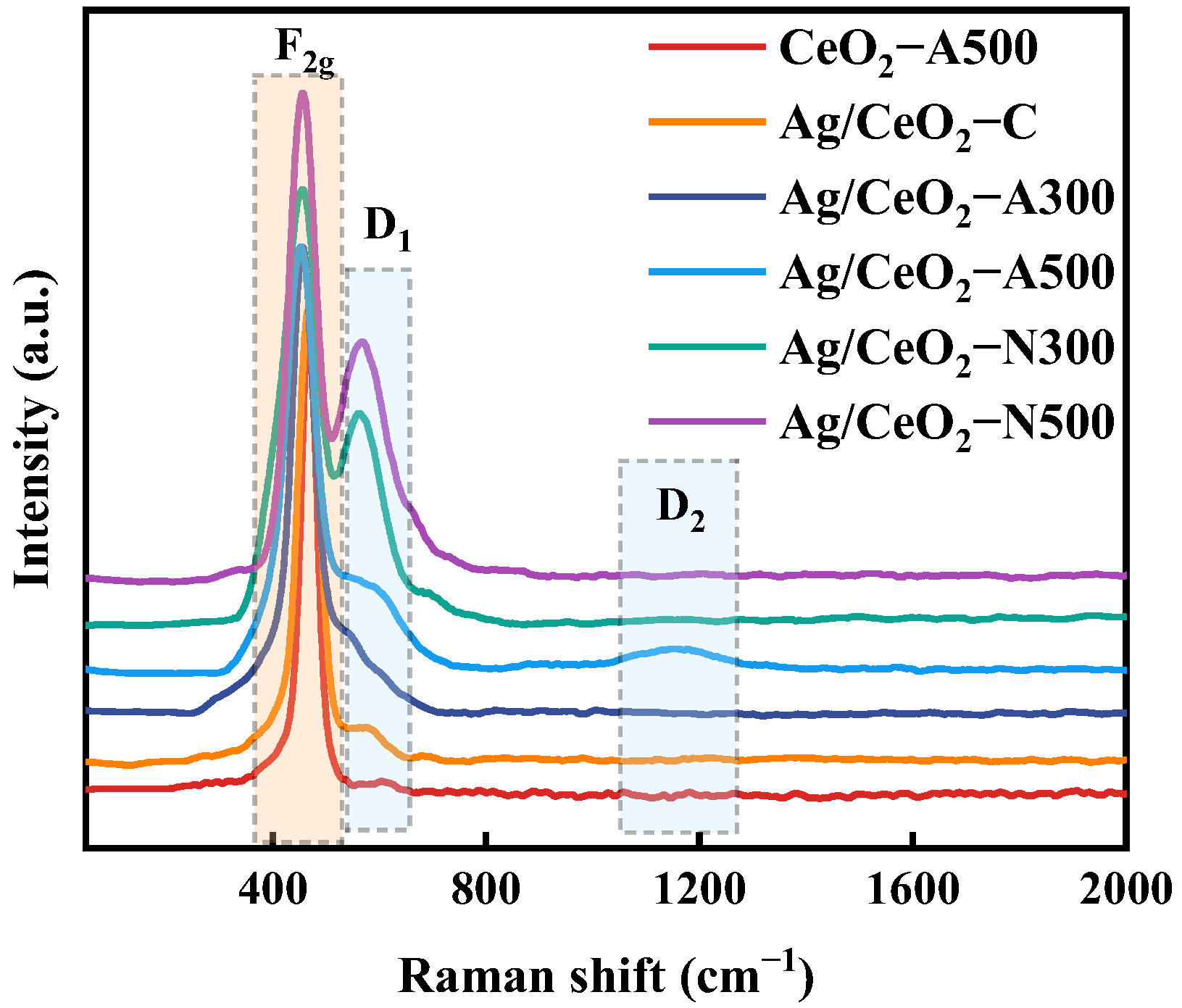
Figure 6 shows the Raman test results of the catalyst. Each catalyst exhibits a strong peak: the peaks of CeO2-A500 and Ag/CeO2-C appear at 468 cm−1, while the peaks of the other catalysts appear at around 456 cm−1, which can be attributed to the F2g vibrational mode of the fluorite structure of CeO2 [26]. Compared to the conventionally prepared catalysts, the F2g peaks of the Ag-loaded catalysts derived from Ce-BTC exhibit a redshift to lower wavenumbers. This indicates significant structural changes in CeO2 due to the interaction between Ag and Ce-BTC. Additionally, a broad peak appears in the range of 500–650 cm−1, which can be attributed to the defect-induced (D1) mode [27], indicating the formation of bulk oxygen vacancies [28]. With the incorporation of Ag, the D1 peak becomes significantly more intense and broader, which can be attributed to Ag ions entering the CeO2 lattice or an increase in bulk oxygen vacancies [29,30]. Notably, only the Ag/CeO2-A500 catalyst exhibits a D2 peak at 1158 cm−1, indicating the formation of peroxide species. This may be due to the high surface oxygen vacancy content affecting oxygen species [31,32], and the Ce-Ag-O interface may further promote this process [33]. The ID1/IF2g and ID2/IF2g ratios are typically used to semi-quantitatively compare the relative concentrations of bulk and surface oxygen vacancies, respectively [34]. As shown in Table 2, Ag/CeO2-A500 has the highest ID1/IF2g ratio, indicating that it possesses relatively higher concentrations of both bulk and surface oxygen vacancies.
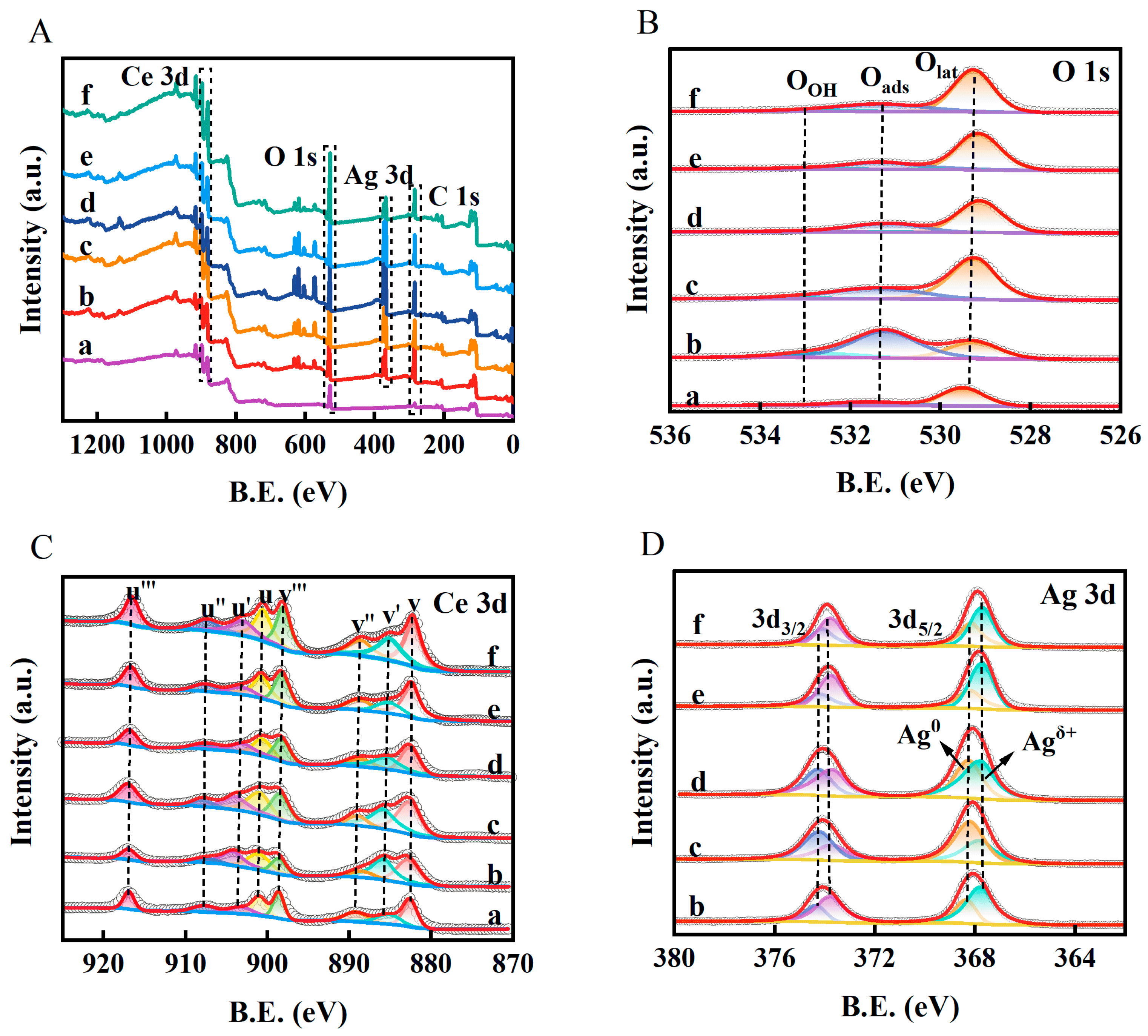
We employed XPS to probe the catalyst surface composition and elemental chemical states. Figure 7 displays the obtained full spectra and high-resolution regional spectra for each catalyst. At the same time, the proportion and relative content of different species were compared by calculating the area of fitting peaks for different elements and states, as shown in Table 2. Figure 7A shows the presence of Ce 3d, O 1s, C 1 speaks in all catalysts. The appearance of the Ag 3d peak once again confirms the successful introduction of silver. Figure 7B shows the spectrum of O 1s, from which three peaks can be identified. The O 1s spectra were fitted to lattice oxygen (Olat, 528.3–529.2 eV), adsorbed oxygen (Oads, 530.2–530.7 eV), and surface hydroxyls/water (OOH, >532 eV) [19,35], while the Oads/Olat ratio is an important descriptor for surface oxygen vacancy concentration and reactivity [36]. Among them, Ag/CeO2-A300 exhibits the highest Oads/Olat molar ratio (2.132). This exceptionally high value is primarily attributed to the residual hydroxyl groups from incompletely removed organic ligands [37]. This indicates that ligands in Ag/CeO2-A300 have not been completely removed. The XPS data in Figure S2 further confirm a substantially greater C=O (288 eV) in this catalyst relative to others [38], a finding consistent with the TGA analysis. A rise in calcination temperature causes the decomposition of organic ligands, thereby lowering the Oads/Olat molar ratio. Therefore, the ratio of Ag/CeO2-A500 drops to 0.488. However, this value is the highest among the catalysts calcined at temperatures high enough to ensure complete ligand removal, indicating that Ag/CeO2-A500 has more active oxygen species and oxygen vacancies. At the same time, it can be observed that the addition of Ag increases the Oads/Olat molar ratio of the catalyst, indicating that it can increase the proportion of active oxygen species on the catalyst surface.
The complex Ce 3d spectra in Figure 7C arise from multiple electron binding states. All catalysts exhibit four spin–orbit doublets, where the u′/v′ pairs are characteristic of Ce3+, while the u, u″, u‴, v, v″, v‴ features correspond to Ce4+ [39,40], confirming the coexistence of both species. The presence of Ce3+ in cerium oxide is intrinsically linked to oxygen vacancy formation to preserve electrostatic neutrality, thus establishing a correlation between higher Ce3+ content and increased surface oxygen vacancy concentration [41]. Ag/CeO2-A300 has the highest Ce3+/(Ce3+ + Ce4+) molar ratio of 0.389 (Table 2), which is consistent with the elevated Oads content observed in the O 1s XPS spectra. However, the higher Ce3+/(Ce3+ + Ce4+) molar ratio in Ag/CeO2-A300 is attributed to the reduction of Ce4+ by residual carbon species. This observation is consistent with the research findings of Zhang et al. [42]. As the calcination temperature increases and the calcination time prolongs, the residual carbon species decrease, and the molar ratio of Ce3+/(Ce3+ + Ce4+) decreases. In addition, besides Ag/CeO2-A300, Ag/CeO2-A500 has the highest Ce3+/(Ce3+ + Ce4+) ratio in thermally stable catalysts, providing further evidence for the abundance of oxygen vacancies on the surface of Ag/CeO2-A500. It is worth noting that the molar ratio of Ce3+/(Ce3+ + Ce4+) on the catalyst surface decreases after adding Ag, which is due to the redox reaction between Ce3+ and Agδ+.
The Ag 3d spectra in Figure 7D display two distinct doublets for all catalysts: one at 368.2 eV (Ag 3d5/2) and 374.2 eV (Ag 3d3/2), corresponding to metallic Ag0, and the other at 367.8 eV and 373.8 eV, assigned to oxidized Agδ+ species [33,43], confirming the coexistence of both Ag0 and Agδ+ on the catalyst surface. From Table 2, it is found that the Ag0/Agδ+ ratios of Ag/CeO2-A300, Ag/CeO2-A500, Ag/CeO2-N300, Ag/CeO2-N500, and Ag/CeO2-C are 0.469, 1.541, 0.737, 0.518, and 0.743, respectively. The significantly higher ratio in Ag/CeO2-A500 suggests a predominant presence of Ag0, in contrast to the other catalysts where Agδ+ is the major species. This distinct chemical state in Ag/CeO2-A500 is likely driven by a strong MSI, which promotes electron transfer from Ce3+ to Agδ+, thereby reducing it to Ag0. However, it is worth noting that although the catalyst Ag/CeO2-A500 prepared by traditional methods has more Ag0, it has organic ligands, so the proportion of Ce3+ is still higher than that of Ag/CeO2-C under the influence of residual carbon species. In addition, it can be observed that the Ag 3d signal intensity is significantly stronger for Ag/CeO2-N300 than for other catalysts, which may indicate a highly homogeneous dispersion of silver species on Ag/CeO2-N300 [31], which is highly consistent with the analysis results in TEM.
Figure 8 shows the test results of H2-TPR. It is worth noting that Ag/CeO2-A300 contains residual organic ligands and frameworks, which may lead to hydrogen spillover during thermal decomposition and significantly interfere with the hydrogen consumption profile, as shown in Figure S3. Therefore, it was excluded from this analysis. From Figure 8, it can be observed that the H2 consumption peaks of all catalysts are mainly concentrated in three temperature ranges. In the absence of Ag, the medium- to low-temperature H2 consumption peak of CeO2-A500 at 300–600 °C and the high-temperature H2 consumption peak around 800 °C can be attributed to the reduction in surface oxygen and bulk oxygen, respectively. After Ag addition, the low-temperature consumption of the catalysts shifts to below 300 °C, primarily due to the synergistic effect of Ag0 and Agδ+ species in activating H2. The resulting H atoms subsequently spill over to the Ag or CeO2 surface and react with surface oxygen species [44]. The low-temperature consumption peaks of the Ag-loaded catalysts were deconvoluted and integrated, as shown in Figure 8b. After Ag addition, the low-temperature consumption peaks can mainly be divided into three peaks. Peak 1 can be attributed to surface oxygen species O2, whose reactivity is enhanced by adjacent Ag species, thereby weakening the local Ce-O bonds [45,46]. Peak 2 can be attributed to the reduction of O- influenced by Ag [47]. Peak 3 can be attributed to the reduction of O2− in surface oxygen vacancies influenced by Ag. Additionally, broad reduction features appear between 400 and 650 °C, which are attributed to oxygen reduction on CeO2 surface regions unaffected by Ag [48]. The reduction of silver ions can also affect H2 consumption. However, based on the XPS results, Ag/CeO2-A500 has the lowest silver ion content, yet its low-temperature peak exhibits the most significant changes. This indicates that the shift in TPR peak temperatures strongly depends on changes in CeO2. Since the H2 consumption in the 100–300 °C range is proportional to the amount of chemisorbed surface oxygen and the reducibility of the catalyst [20], the H2 consumption in this region was also quantified (Table 2). The order of consumption is as follows: Ag/CeO2-A500 > Ag/CeO2-N300 > Ag/CeO2-C > Ag/CeO2-N500. Furthermore, from Figure 8B, it can be observed that Ag/CeO2-A500 possesses the most abundant O- oxygen species, indicating that Ag/CeO2-A500 exhibits the best redox capability.
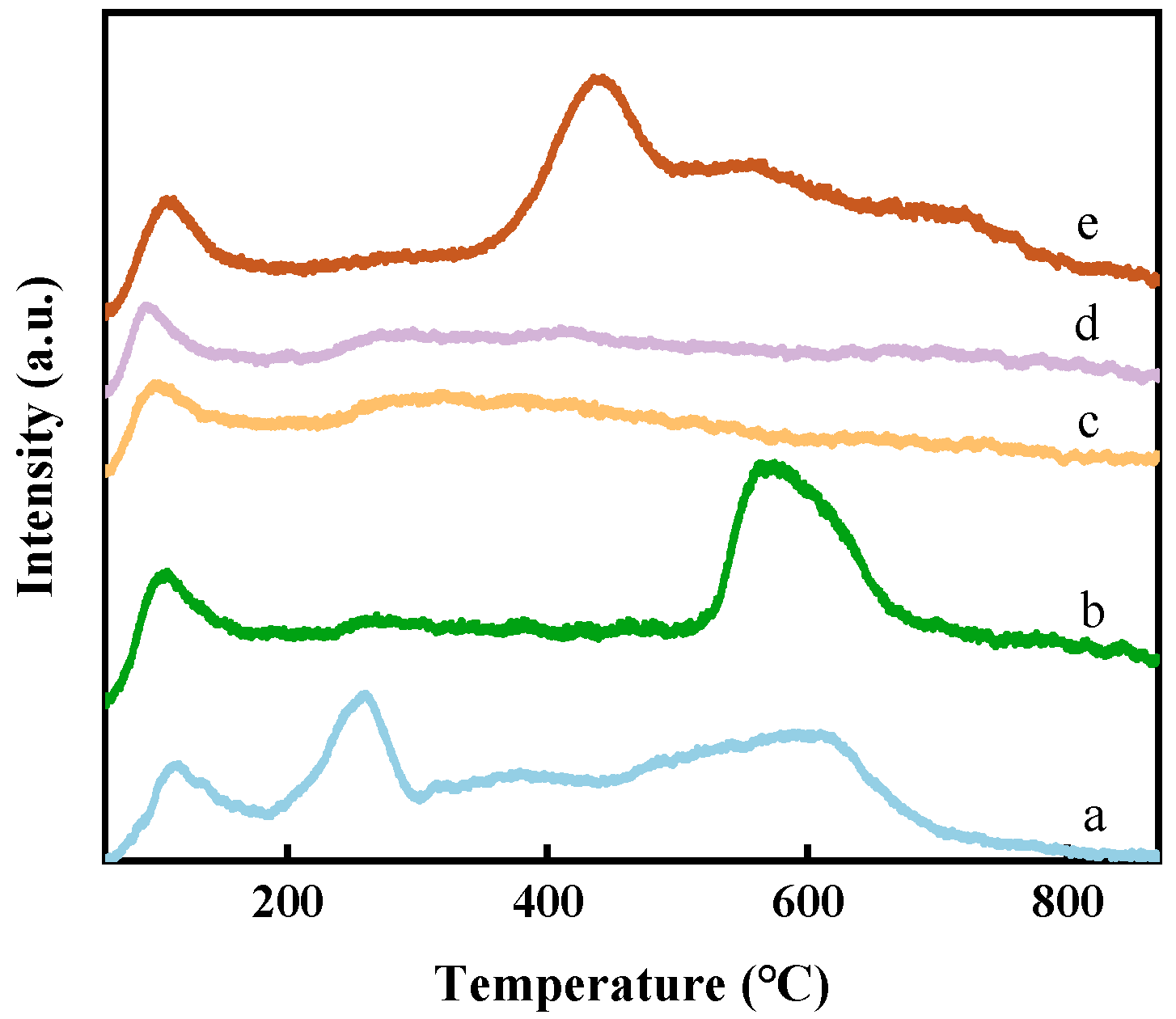
The oxygen desorption behavior of the catalysts, presented in Figure 9, is characterized by the presence of three to four distinct peaks. Previous studies [49] assign desorption peaks below 400 °C to the release of physically adsorbed and weakly bound oxygen species. In contrast, peaks above 500 °C originate from the evolution of lattice oxygen. Given that the intensity of the oxygen desorption peaks correlates with the concentration of oxygen defects, the notably higher overall desorption intensity observed for Ag/CeO2-A500 suggests it possesses a higher concentration of both surface and lattice oxygen defects. This conclusion is consistent with the findings from XPS and Raman spectroscopy. This enhanced lattice oxygen mobility is facilitated by the presence of abundant bulk oxygen vacancies, which provide a rapid diffusion pathway for bulk-to-surface oxygen transport. Moreover, an elevated concentration of Ce3+ concomitant surface oxygen vacancies synergistically enhance the activation and desorption of oxygen species. In addition, the addition of Ag allows the adsorbed oxygen on the surface to desorb at lower temperatures and increases the desorption of lattice oxygen, resulting in an increase in the analytical peak of Ag/CeO2-A300 at 600 °C. It is worth noting that due to the presence of residual organic ligands and frameworks in Ag/CeO2-A300, its O2-TPD results are shown in Figure S4. In addition to a desorption peak around 120 °C, there is also a clear peak around 593 °C.

2.3. Catalytic Performance

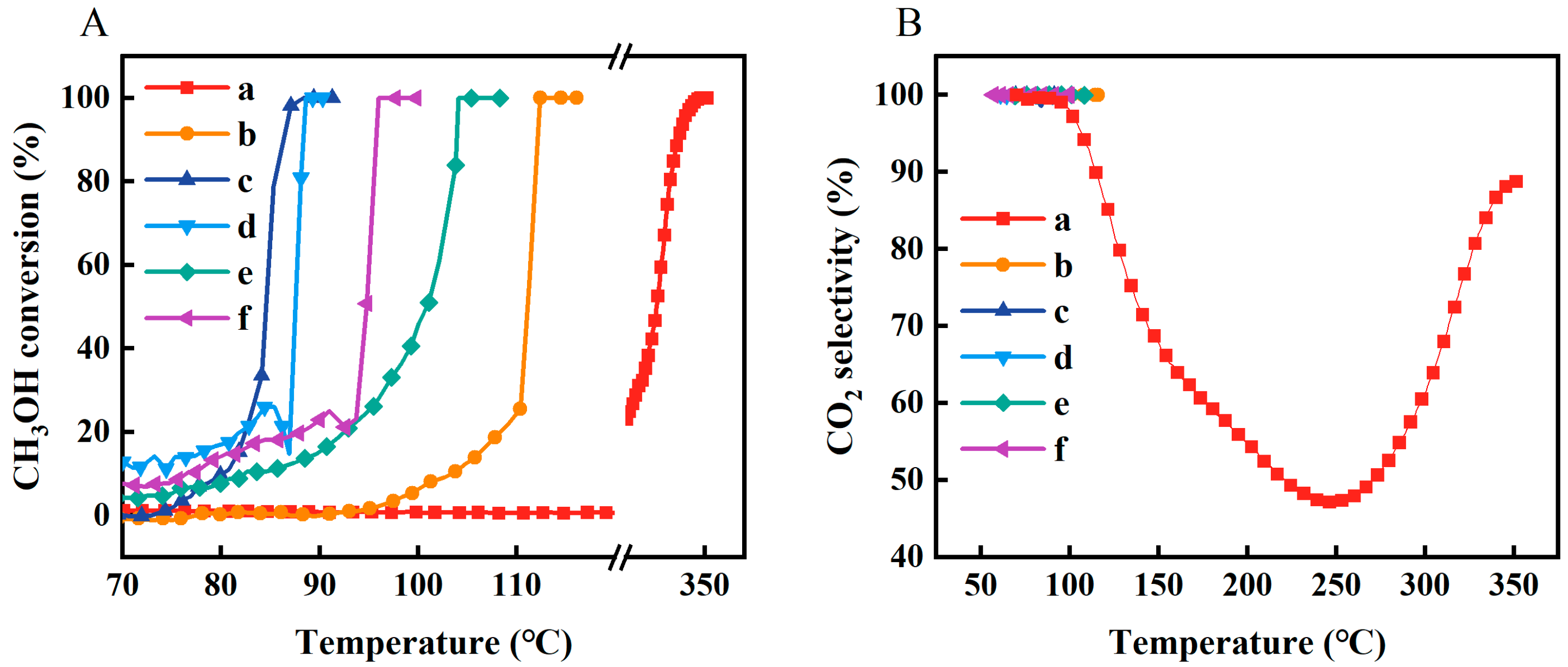
Figure 10 presents the methanol conversion rate and carbon dioxide selectivity of the catalyst. A significant influence of the synthesis method is evident from Figure 10A, where the MOF-derived Ag/CeO2-A500 and Ag/CeO2-N300 catalysts exhibit superior activity to the conventional Ag/CeO2-C catalyst. The pyrolysis conditions also strongly influence the catalyst activity. Ag/CeO2-A300, obtained by calcination at 300 °C in air, shows the lowest activity, followed by Ag/CeO2-N500, which was pyrolyzed in nitrogen followed by air calcination at 500 °C. All catalysts display a two-stage methanol conversion behavior. In the initial stage, the methanol conversion rate increases slowly with temperature and remains below 50%. After reaching a specific temperature, the conversion increases rapidly to 100%. Among them, Ag/CeO2-A500 achieves 100% methanol conversion at 88 °C. It is worth noting that in all performance tests of catalysts, methanol was selectively oxidized to CO2 with nearly 100% selectivity, indicating that very little CO and formaldehyde were generated. Compared with the absence of Ag, the conversion rate of methanol in CeO2-A500 only reaches 100% near 350 °C, and the selectivity of CO2 is also lower, especially at 200–300 °C. This fully demonstrates the advantages of silver as an active ingredient, which can significantly enhance the reactivity of methanol and reduce the production of harmful by-products. Among the supported silver catalysts compiled in Table 3, Ag/CeO2-A500 stands out for its excellent catalytic performance. The reason for this is that catalytic activity is typically determined by several key parameters, including specific surface area, reducibility, concentration of active oxygen species, oxygen vacancy concentration, and surface morphology. Therefore, comprehensive characterization analysis confirms that utilizing MOF precursors helps in preparing catalysts with increased specific surface area while preventing the aggregation of silver nanoparticles. This results in Ag/CeO2-A500 having the highest specific surface area, followed by Ag/CeO2-N300, which allows the catalyst to achieve better contact with methanol, thereby enhancing reaction activity. Simultaneously, Ag0 plays a crucial role in the catalytic oxidation of methanol [13,50]. The addition of silver enables the adsorbed oxygen on the catalyst surface to exhibit higher activity at lower temperatures, further influencing the overall catalytic performance [51]. Compared to catalysts prepared by traditional methods, MOF-derived catalysts possess a higher Ag0 content, which enhances the metal-support interaction (MSI) of the catalyst [52]. This leads to Ag/CeO2-A500 having the highest concentrations of surface and lattice oxygen vacancies, as evidenced by its higher proportion of Ce3+. Consequently, Ag/CeO2-A500 demonstrates the best low-temperature activity for methanol oxidation. Furthermore, the reusability and stability of the catalyst were tested, as shown in Figures S5 and S6. After three testing cycles, the loss in catalytic activity was negligible, indicating that the Ag/CeO2-A500 catalyst exhibits good reusability. At 150 °C, Ag/CeO2-A500 maintained high methanol conversion rates over extended periods. Combined with the TGA curve, which shows almost no weight change for Ag/CeO2-A500 after 450 °C, this confirms its excellent stability.

2.4. Reaction Mechanism

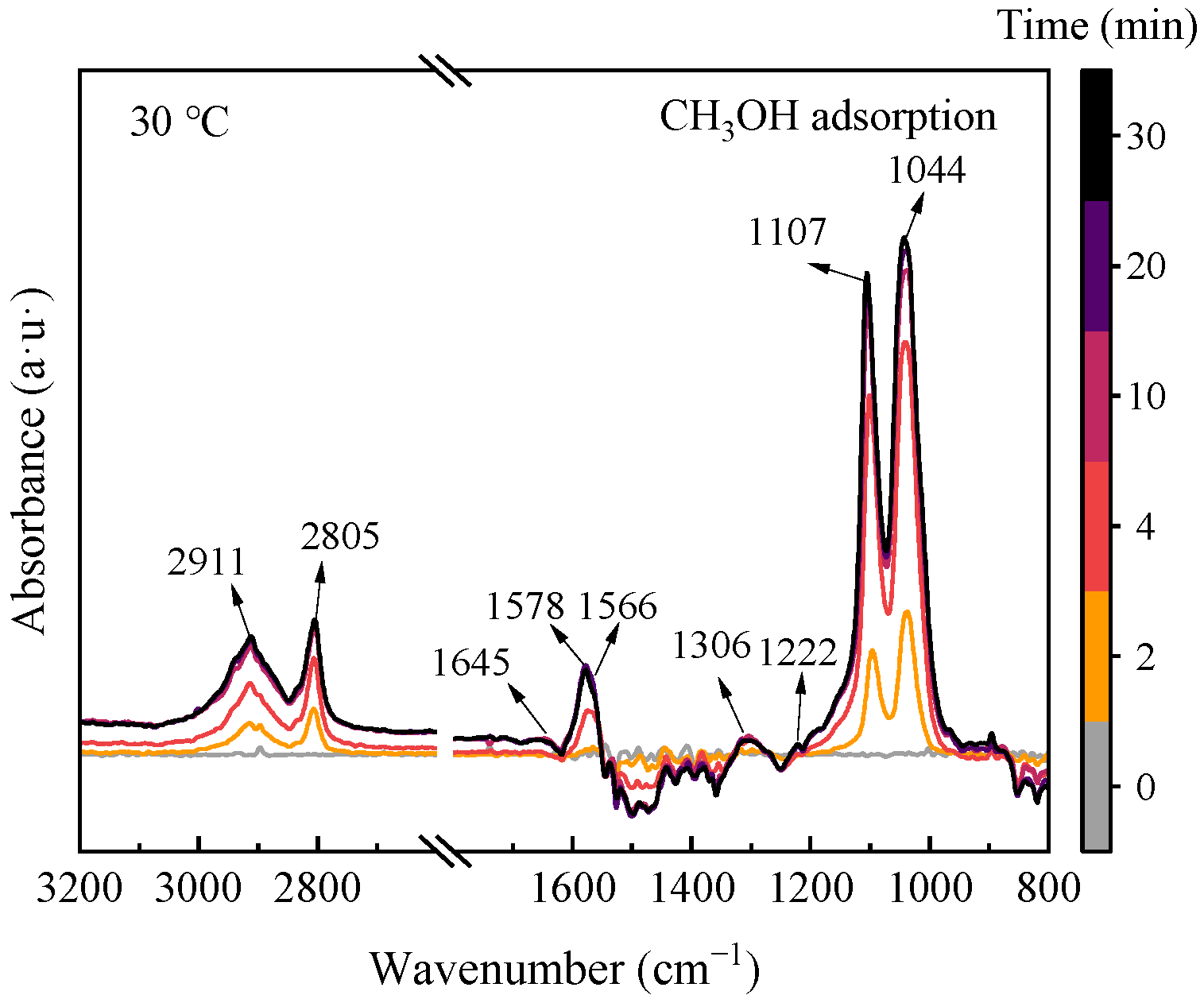
Finally, to investigate the reaction pathways and intermediate species of methanol oxidation on the catalyst surface, in situ DRIFTS was employed for tests. The results are shown in Figure 11. Initially, methanol adsorption was carried out at 30 °C. The results revealed that methoxy species and a small amount of methyl were first formed on the catalyst surface upon methanol introduction. Specifically, the peaks at 1044 cm−1 and 1107 cm−1 can be attributed to the vibrational modes of bidentate and monodentate methoxy species, respectively [57]. The peaks at 2911 cm−1 and 2805 cm−1 correspond to the characteristic vibrations of methyl groups [58]. The peak at 1566 cm−1 can be ascribed to the asymmetric stretching vibration of formate species [59]. Over time, the absorption peaks associated with methoxy and methyl groups gradually intensified, accompanied by the emergence of new absorption peaks. The peak at 1222 cm−1 is attributed to dioxymethyl [60], while the peaks at 1306 cm−1 and 1578 cm−1 are related to the symmetric and asymmetric stretching vibrations of formate species, respectively [61]. It is evident that as the adsorption time increased, the absorption peaks of methoxy, methyl, and formate species gradually overlapped, indicating progressive saturation of adsorbed species on the catalyst surface. Studies suggest that the formate species at 1566 cm−1, 1306 cm−1, and 1578 cm−1 are adsorbed on Ce3+ sites [62]. Additionally, absorption peaks corresponding to the stretching and bending vibrations of adsorbed water are observed at 1645 cm−1 in the figure [63]. These results demonstrate that at room temperature, methanol can be adsorbed on the Ag/CeO2-A500 surface, generating methoxy and methyl species, which subsequently transform into intermediate formate species. Among these, bidentate methoxy species are predominantly formed after adsorption, while the intermediate formate species primarily adsorb on Ce3+ sites.
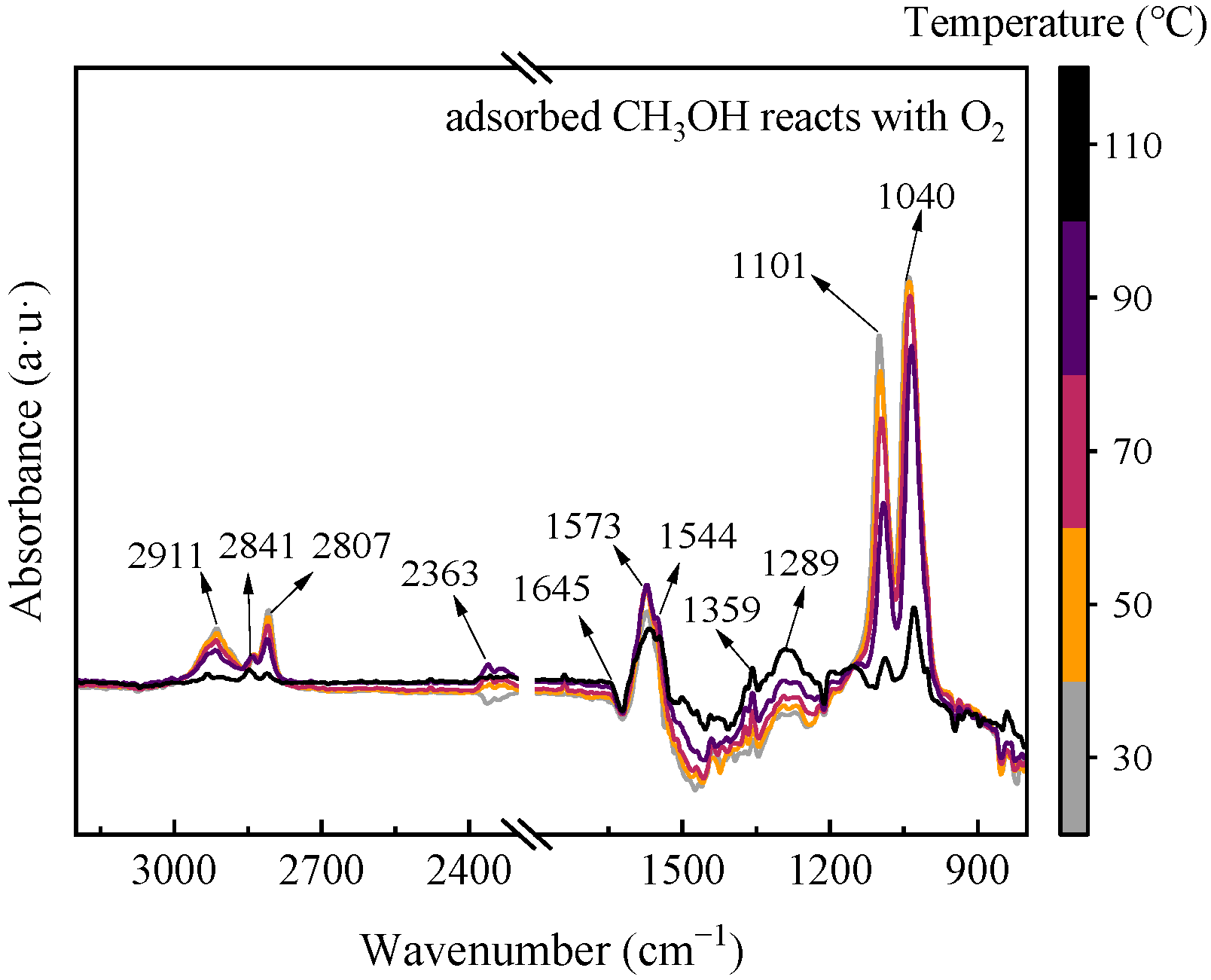
Subsequently, we investigated the intermediate species and reaction pathways during the oxidation of pre-adsorbed methanol with oxygen at 80 °C over time. The results from in situ DRIFTS are shown in Figure 12. As the temperature increased, the absorption peaks of bidentate methoxy species (1040 cm−1) and monodentate methoxy species (1101 cm−1), as well as the methyl group peaks at 2911 cm−1 and 2807 cm−1, decreased rapidly. Notably, the bidentate methoxy species declined more rapidly than the others. Simultaneously, the absorption peaks of formate species at 1573 cm−1, 1544 cm−1, and the corresponding peak at 2841 cm−1 began to diminish, while those at 1359 cm−1 and 1289 cm−1 increased. This may be attributed to the higher susceptibility of bidentate formate species (with strong νa signals) to oxidation or transformation, where their oxidation rate exceeded their formation rate. Additionally, as the temperature rose, the absorption peak of water at 1645 cm−1 gradually intensified, and a peak emerged at 2363 cm−1, which can be ascribed to the asymmetric stretching vibration of CO2 [61]. These findings indicate that as the temperature increased, the adsorbed methoxy and methyl species were gradually oxidized to formate species, while the formate species were further oxidized to CO2 and water. Moreover, the oxidation of bidentate formate species appears to be a key step in the methanol oxidation pathway. In summary, Ag/CeO2-A500 possesses a higher concentration of Ag0 and Ce3+, a greater number of oxygen vacancies, and more adsorbed active oxygen species. The interaction between Ce3+ and Ag0 facilitates the activation of adsorbed methanol by the active oxygen species on the catalyst surface, leading to the formation of methoxy and methyl intermediates. This enables methanol to be oxidized into carbon dioxide and water via intermediate formate species even at low temperatures.

3. Materials and Methods

3.1. Catalyst Preparation

According to the method reported in reference [21], Ce-BTC was synthesized using analytical grade reagents. Typically, 2.1 g of 1,3,5-H3BTC was added to 10 mL of deionized water and 10 mL anhydrous ethanol. Separately, 4.34 g of Ce (NO3)3•6H2O was added to 45 mL deionized water under vigorous stirring at room temperature. Then mixed the two solutions and stirred at 60 °C for 1 h and let it stand for 30 min. After filtration, it was rinsed with anhydrous ethanol and deionized water, and finally dried under vacuum at 60 °C for 12 h.
Ag/CeO2-A and Ag/CeO2-N were prepared by calcining Ag/Ce-BTC. Firstly, Ag was loaded onto Ce-BTC using the initial impregnation method. Usually, a certain amount of Ce-BTC is dispersed in a certain amount of silver acetate aqueous solution, stirred for 4 h, and left to stand overnight. We dried the remaining solid in a vacuum oven at 60 °C for 12 h. Then, Ag/CeO2-A-x catalysts were synthesized by directly calcining Ag/Ce-BTC in air at either 300 or 500 °C for 4 h (heating rate: 1 °C/min). By comparison, the Ag/CeO2-N-x series was prepared via a two-step protocol: first calcining in nitrogen at 650 °C, followed by a second calcination in air at 300 or 500 °C, each step maintained for 4 h at the same heating rate. Here, “x” denotes the final calcination temperature in air. To clarify the effect of Ag on the structure and performance of the catalyst, Ce-BTC was directly calcined in air at 500 °C for 4 h to obtain CeO2-A500.
In addition, to compare with conventional methods, CeO2 was prepared by pyrolyzing Ce (NO3)3•6H2O in air at a temperature of 500 °C. Similarly, Ag/CeO2 was prepared by initial impregnation using a precursor of silver nitrate, and the Ag/CeO2-C was obtained by calcining Ag/CeO2 at 500 °C for 4 h under air atmosphere, employing a controlled heating rate of 1 °C/min. Finally, the actual loading amounts of Ag in Ag/CeO2-A300, Ag/CeO2-A500, Ag/CeO2-N300, Ag/CeO2-N500, and Ag/CeO2-C were measured by ICP-OES to be 9.12, 9.21, 10.86, 11.09, and 9.92 wt%, respectively.

3.2. Catalyst Characterizations

A comprehensive characterization suite was employed, encompassing X-ray diffraction (XRD), transmission electron microscopy (TEM), X-ray photoelectron spectroscopy (XPS), Raman spectroscopy, and more. The Supplementary Materials provide the detailed instrument parameters and testing procedures.

3.3. Catalytic Performance Evaluation

Catalytic activity was evaluated using a fixed-bed flow microreactor with an 8 mm inner diameter. For each test, 0.5 mL of catalyst (40–60 mesh) was loaded into the reactor. Catalytic tests were performed using a feed gas with the following composition: 5000 ppm methanol, 10% oxygen, and nitrogen as the balance. The reaction was carried out at a total flow rate of 300 mL/min (GHSV = 36,000 h−1), and the flows of all gaseous components were independently controlled by mass flow controllers. The effluent gas from the reactor outlet was analyzed by a Fourier FTIR gas analyzer (Thermo Fisher iGS, Waltham, MA, USA) to monitor the concentrations of CO, CO2, methanol, and formaldehyde. Methanol conversion was calculated according to Equation (1). The selectivity of CO2 is calculated according to Equation (2).
C H 3 O H   conversion   ( % ) = C H 3 O H i n C H 3 O H o u t C H 3 O H i n × 100 %
C O 2   selectivity   ( % ) = C H 3 O H i n C H 3 O H o u t C O out C H 4 out H C H O o u t C H 3 O H i n C H 3 O H o u t × 100 %
where C H 3 O H i n is the methanol concentration at the reactor inlet, C H 3 O H o u t is the methanol concentration at the reactor outlet, C O o u t is carbon monoxide concentration at the reactor outlet, C H 4 o u t is methane concentration at the reactor outlet, and H C H O o u t is formaldehyde concentration at the reactor outlet.

4. Conclusions

This study utilized silver acetate and Ce-BTC as precursors to fabricate Ag/CeO2 catalysts for deep oxidation of methanol. A multi-technique characterization approach was adopted to elucidate the effects of preparation conditions on their surface chemical states, active oxygen species, along with oxygen vacancy density. The following conclusion can be drawn: MOF-derived catalysts can significantly increase the specific surface area and suppress the aggregation of Ag NPs under optimized calcination conditions. Specifically, Ag/CeO2-A500 has the highest specific surface area (86.62 m2/g) and the loaded Ag NPs are relatively small in size. Furthermore, the enhanced MSI in the MOF-derived catalyst contributes to the richest chemisorbed oxygen species and the optimal reducibility of Ag/CeO2-A500. Raman, XPS, and O2-TPD results consistently indicate that Ag/CeO2-A500 has the highest concentration of surface and lattice oxygen vacancies, along with a higher Ce3+/(Ce3+ + Ce4+) molar ratio. Notably, the strong MSI effect in Ag/CeO2-A500 also leads to the highest Ag0/Agδ+ ratio (1.541), which is the fundamental reason for its superior catalytic performance. Therefore, Ag/CeO2-A500 can adsorb and activate methanol at low temperatures and convert it into CO2 and water through intermediate formate.
In summary, this work demonstrates a promising avenue for designing efficient methanol oxidation catalysts. Future work should focus on the structural modification of Ce-BTC and further enhancement of the MSI effect.

Supplementary Materials

The following supporting information can be downloaded at: https://www.mdpi.com/article/10.3390/catal15121165/s1, Figure S1: Thermogravimetric curves of Ag/Ce BTC calcined at 500 °C or 650 °C in nitrogen and then in air; Figure S2: XPS spectra of catalysts: C 1 s; Figure S3: H2-TPR profiles for Ag/CeO2-A300 catalysts; Figure S4: O2-TPR profiles for Ag/CeO2-A300 catalysts; Figure S5: The circulation of Ag/CeO2-A500 catalysts; Figure S6: Stability test of Ag/CeO2-A500 catalysts.

Author Contributions

Conceptualization, H.C., Z.B. and P.Z.; methodology, Z.B. and H.C.; software, Z.B.; validation, P.Z., D.L. and K.W.; formal analysis, P.Z., D.L. and K.W.; investigation, H.C., Z.B. and Z.L.; resources, H.C., P.Z. and Z.L.; data curation, Z.B.; writing—original draft preparation, Z.B. and H.C.; writing—review and editing, L.G. and Z.C.; supervision, D.L. and L.G.; funding acquisition, H.C., P.Z. and Z.L. All authors have read and agreed to the published version of the manuscript.

Funding

This research was funded by National Natural Science Foundation of China (22272010), Ningbo Science and Technology Plan Project (2024Z250) and The Science Fund of State Key Laboratory of Engine (K2024-02).

Data Availability Statement

The original contributions presented in this study are included in the article/Supplementary Materials. Further inquiries can be directed to the corresponding authors.

Conflicts of Interest

Author Zhenguo Li was employed by China Automotive Technology & Research Center Co., Ltd. Author Kaifeng Wang was employed by Shaanxi Fast Gear Co., Ltd. The remaining authors declare that the research was conducted in the absence of any commercial or financial relationships that could be construed as a potential conflict of interest.

References

  1. Verhelst, S.; Turner, J.W.G.; Sileghem, L.; Vancoillie, J. Methanol as a fuel for internal combustion engines. Prog. Energy Combust. Sci. 2019, 70, 43–88. [Google Scholar] [CrossRef]
  2. Liu, F.; Guo, H.; Zheng, X.; Li, H.; Wang, X. Mechanism of methanol and formaldehyde emissions from methanol-fueled engines. Fuel Process. Technol. 2025, 268, 108177. [Google Scholar] [CrossRef]
  3. Wei, J.; Fan, C.; Qiu, L.; Qian, Y.; Wang, C.; Teng, Q.; Pan, M. Impact of methanol alternative fuel on oxidation reactivity of soot emissions from a modern CI engine. Fuel 2020, 268, 117352. [Google Scholar] [CrossRef]
  4. Valera, H.; Singh, A.P.; Agarwal, A.K. Prospects of Methanol-Fuelled Carburetted Two Wheelers in Developing Countries. In Advanced Combustion Techniques and Engine Technologies for the Automotive Sector; Singh, A.P., Sharma, N., Agarwal, R., Agarwal, A.K., Eds.; Springer: Singapore, 2020; pp. 53–73. [Google Scholar]
  5. Zhang, Y.; Mu, Z.; Wei, Y.; Zhu, Z.; Du, R.; Liu, S. Comprehensive study on unregulated emissions of heavy-duty SI pure methanol engine with EGR. Fuel 2022, 320, 123974. [Google Scholar] [CrossRef]
  6. Rezk, M.N.N.; Keryakous, M.M.S.; Fawzy, M.A.; Abd El-Aziz, F.E.-Z.A.; Dawood, A.F.A.; Yassa, H.D.; Welson, N.N. The role of nuclear receptor peroxisome proliferator-activated receptor gamma (PPAR-γ) and Nrf2 signalling in methanol-induced on brain, eye, and pancreas toxicity in rats. NeuroToxicology 2025, 110, 53–63. [Google Scholar] [CrossRef] [PubMed]
  7. Richter, P. Methanol. In Encyclopedia of Toxicology, 3rd ed.; Wexler, P., Ed.; Academic Press: Oxford, UK, 2014; pp. 238–241. [Google Scholar]
  8. Hinz, A.; Larsson, P.-O.; Andersson, A. Influence of Pt Loading on Al2O3 for the Low Temperature Combustion of Methanol with and Without a Trace Amount of Ammonia. Catal. Lett. 2002, 78, 177–183. [Google Scholar] [CrossRef]
  9. Li, Y.; Zhang, J.; Lin, Y.; Sanwal, P.; Zhou, L.; Li, G.; Chen, Y. Effects of metal doping on the methanol deep oxidation activity of the Pd/CeO2 monolithic catalyst. Mater. Chem. Front. 2025, 9, 280–287. [Google Scholar] [CrossRef]
  10. McCabe, R.W.; Mitchell, P.J. Exhaust-catalyst development for methanol-fueled vehicles: III. Formaldehyde oxidation. Appl. Catal. 1988, 44, 73–93. [Google Scholar] [CrossRef]
  11. McCabe, R.W.; Mitchell, P.J. Exhaust-catalyst development for methanol-fueled vehicles: 1. A comparative study of methanol oxidation over alumina-supported catalysts containing group 9, 10, and 11 metals. Appl. Catal. 1986, 27, 83–98. [Google Scholar] [CrossRef]
  12. Plummer, H.K.; Watkins, W.L.H.; Gandhi, H.S. Characterization of silver catalysts for the oxidation of methanol. Appl. Catal. 1987, 29, 261–283. [Google Scholar] [CrossRef]
  13. Chen, G.; Zhou, L.; Xiao, Y.; Chen, Y. Constructing Efficient CuAg Nanoalloys on Ce0.90In0.10Oδ for Methanol Deep Oxidation Catalysis at Low Temperature. ChemPlusChem 2024, 89, e202300740. [Google Scholar] [CrossRef]
  14. Zhang, Q.; Zhang, S.; Wu, Y. Research advances in volatile organic compounds catalytic removal using CeO2-based catalysts. J. Environ. Chem. Eng. 2025, 13, 119033. [Google Scholar] [CrossRef]
  15. Khan, M.G.I.; Nurfitria, R.; Anggraini, T.; Aini, Q.; Hanifah, I.R.; Nurfani, E.; Aflaha, R.; Triyana, K.; Taher, T.; Rianjanu, A. Hydrothermal synthesis of CeO2/ZnO heterojunctions for effective photocatalytic degradation of organic pollutants. Mater. Sci. Eng. B 2025, 322, 118630. [Google Scholar] [CrossRef]
  16. Abbasi, Z.; Haghighi, M.; Fatehifar, E.; Rahemi, N. Comparative synthesis and physicochemical characterization of CeO2 nanopowder via redox reaction, precipitation and sol–gel methods used for total oxidation of toluene. Asia-Pac. J. Chem. Eng. 2012, 7, 868–876. [Google Scholar] [CrossRef]
  17. Ahmad, B.; Ismail, A.; Li, Y.; Sun, Z.; Zhu, Y. Excellent low-temperature catalytic performance on toluene oxidation over spinel CeaMn3-aO4 catalyst derived from pyrolysis of metal organic framework. Sep. Purif. Technol. 2025, 360, 131130. [Google Scholar] [CrossRef]
  18. Chen, G.; Mao, M.; Chen, L.; Zhang, G.; Wang, Z.; Liu, F.; Ye, D.; Wu, J. Enhanced plasma-catalytic oxidation of methanol over MOF-derived CeO2 catalysts with exposed active sites. J. Environ. Chem. Eng. 2022, 10, 108981. [Google Scholar] [CrossRef]
  19. Xie, S.; Tan, W.; Xu, Y.; Wang, C.; Feng, Y.; Ye, K.; Ma, L.; Ehrlich, S.N.; Li, Y.; Zhang, Y.; et al. Pd-CeO2 catalyst facilely derived from one-pot generated Pd@Ce-BTC for low temperature CO oxidation. J. Hazard. Mater. 2024, 466, 133632. [Google Scholar] [CrossRef]
  20. Wang, Y.; Bi, F.; Wang, Y.; Jia, M.; Tao, X.; Jin, Y.; Zhang, X. MOF-derived CeO2 supported Ag catalysts for toluene oxidation: The effect of synthesis method. Mol. Catal. 2021, 515, 111922. [Google Scholar] [CrossRef]
  21. Alruwaili, H.A.; Alhumaimess, M.S.; Alsirhani, S.K.M.; Alsohaimi, I.H.; Alanazi, S.J.F.; El-Aassar, M.R.; Hassan, H.M.A. Bimetallic nanoparticles supported on Ce-BTC for highly efficient and stable reduction of nitroarenes: Towards environmental sustainability. Environ. Res. 2024, 249, 118473. [Google Scholar] [CrossRef]
  22. Wang, Y.; Wang, R.; Lin, N.; Wang, Y.; Zhang, X. Highly efficient microwave-assisted Fenton degradation bisphenol A using iron oxide modified double perovskite intercalated montmorillonite composite nanomaterial as catalyst. J. Colloid Interface Sci. 2021, 594, 446–459. [Google Scholar] [CrossRef] [PubMed]
  23. Sun, H.; Wang, C.; Zhao, R.; Wang, Z.; Zhao, H. Cobalt Supported on Ce-MOF-Derived CeO2 as a Catalyst for the Efficient Epoxidation of Styrene Under Aerobic Conditions. Catal. Lett. 2024, 154, 4649–4662. [Google Scholar] [CrossRef]
  24. Shen, W.; Dong, X.; Zhu, Y.; Chen, H.; Shi, J. Mesoporous CeO2 and CuO-loaded mesoporous CeO2: Synthesis, characterization, and CO catalytic oxidation property. Microporous Mesoporous Mater. 2005, 85, 157–162. [Google Scholar] [CrossRef]
  25. Nakano, M.; Fujiwara, T.; Koga, N. Thermal Decomposition of Silver Acetate: Physico-Geometrical Kinetic Features and Formation of Silver Nanoparticles. J. Phys. Chem. C 2016, 120, 8841–8854. [Google Scholar] [CrossRef]
  26. Pu, Z.-Y.; Liu, X.-S.; Jia, A.-P.; Xie, Y.-L.; Lu, J.-Q.; Luo, M.-F. Enhanced Activity for CO Oxidation over Pr- and Cu-Doped CeO2 Catalysts: Effect of Oxygen Vacancies. J. Phys. Chem. C 2008, 112, 15045–15051. [Google Scholar] [CrossRef]
  27. Weber, W.H.; Hass, K.C.; McBride, J.R. Raman study of CeO2: Second-order scattering, lattice dynamics, and particle-size effects. Phys. Rev. B 1993, 48, 178–185. [Google Scholar] [CrossRef]
  28. Chang, S.; Li, M.; Hua, Q.; Zhang, L.; Ma, Y.; Ye, B.; Huang, W. Shape-dependent interplay between oxygen vacancies and Ag–CeO2 interaction in Ag/CeO2 catalysts and their influence on the catalytic activity. J. Catal. 2012, 293, 195–204. [Google Scholar] [CrossRef]
  29. Wu, Z.; Li, M.; Howe, J.; Meyer, H.M., III; Overbury, S.H. Probing Defect Sites on CeO2 Nanocrystals with Well-Defined Surface Planes by Raman Spectroscopy and O2 Adsorption. Langmuir 2010, 26, 16595–16606. [Google Scholar] [CrossRef]
  30. Kang, Y.; Sun, M.; Li, A. Studies of the Catalytic Oxidation of CO Over Ag/CeO2 Catalyst. Catal. Lett. 2012, 142, 1498–1504. [Google Scholar] [CrossRef]
  31. Wang, H.; Liu, S.; Zhao, Z.; Zou, X.; Liu, M.; Liu, W.; Wu, X.; Weng, D. Activation and deactivation of Ag/CeO2 during soot oxidation: Influences of interfacial ceria reduction. Catal. Sci. Technol. 2017, 7, 2129–2139. [Google Scholar] [CrossRef]
  32. Pushkarev, V.V.; Kovalchuk, V.I.; d’Itri, J.L. Probing Defect Sites on the CeO2 Surface with Dioxygen. J. Phys. Chem. B 2004, 108, 5341–5348. [Google Scholar] [CrossRef]
  33. Grabchenko, M.V.; Mamontov, G.V.; Zaikovskii, V.I.; La Parola, V.; Liotta, L.F.; Vodyankina, O.V. The role of metal–support interaction in Ag/CeO2 catalysts for CO and soot oxidation. Appl. Catal. B Environ. 2020, 260, 118148. [Google Scholar] [CrossRef]
  34. López, J.M.; Gilbank, A.L.; García, T.; Solsona, B.; Agouram, S.; Torrente-Murciano, L. The prevalence of surface oxygen vacancies over the mobility of bulk oxygen in nanostructured ceria for the total toluene oxidation. Appl. Catal. B Environ. Energy 2015, 174–175, 403–412. [Google Scholar] [CrossRef]
  35. Huang, C.; Ji, Q.; Zhang, H.; Wang, Y.; Wang, S.; Liu, X.; Guo, Y.; Zhang, C. Ru-incorporated Co3O4 nanoparticles from self-sacrificial ZIF-67 template as efficient bifunctional electrocatalysts for rechargeable metal-air battery. J. Colloid Interface Sci. 2022, 606, 654–665. [Google Scholar] [CrossRef]
  36. Zheng, Y.; Liu, Q.; Shan, C.; Su, Y.; Fu, K.; Lu, S.; Han, R.; Song, C.; Ji, N.; Ma, D. Defective Ultrafine MnOx Nanoparticles Confined Within a Carbon Matrix for Low-Temperature Oxidation of Volatile Organic Compounds. Environ. Sci. Technol. 2021, 55, 5403–5411. [Google Scholar] [CrossRef]
  37. Dupin, J.-C.; Gonbeau, D.; Vinatier, P.; Levasseur, A. Systematic XPS studies of metal oxides, hydroxides and peroxides. Phys. Chem. Chem. Phys. 2000, 2, 1319–1324. [Google Scholar] [CrossRef]
  38. Sun, Y.; Zhao, Y.; Zhan, X.; Gao, R.; Chen, L.; Yu, J.; Wang, H.; Shi, H. A ZIF-8-derived copper-nitrogen co-hybrid carbon catalyst for peroxymonosulfate activation to degrade BPA. Chemosphere 2022, 308, 136489. [Google Scholar] [CrossRef]
  39. Nagajyothi, P.C.; Ramaraghavulu, R.; Pavani, K.; Shim, J. Catalytic reduction of methylene blue and rhodamine B using Ce-MOF-derived CeO2 catalyst. Mater. Lett. 2023, 336, 133837. [Google Scholar] [CrossRef]
  40. Hyok Ri, S.; Bi, F.; Guan, A.; Zhang, X. Manganese-cerium composite oxide pyrolyzed from metal organic framework supporting palladium nanoparticles for efficient toluene oxidation. J. Colloid Interface Sci. 2021, 586, 836–846. [Google Scholar] [CrossRef]
  41. Wang, J.; Shi, X.; Chen, L.; Li, H.; Mao, M.; Zhang, G.; Yi, H.; Fu, M.; Ye, D.; Wu, J. Enhanced performance of low Pt loading amount on Pt-CeO2 catalysts prepared by adsorption method for catalytic ozonation of toluene. Appl. Catal. A Gen. 2021, 625, 118342. [Google Scholar] [CrossRef]
  42. Zhang, X.; Hou, F.; Li, H.; Yang, Y.; Wang, Y.; Liu, N.; Yang, Y. A strawsheave-like metal organic framework Ce-BTC derivative containing high specific surface area for improving the catalytic activity of CO oxidation reaction. Microporous Mesoporous Mater. 2018, 259, 211–219. [Google Scholar] [CrossRef]
  43. Rao, R.; Shao, F.; Dong, X.; Dong, H.; Fang, S.; Sun, H.; Ling, Q. Effect of Ag-CeO2 interface formation during one-spot synthesis of Ag-CeO2 composites to improve their catalytic performance for CO oxidation. Appl. Surf. Sci. 2020, 513, 145771. [Google Scholar] [CrossRef]
  44. Wu, S.; Yang, Y.; Lu, C.; Ma, Y.; Yuan, S.; Qian, G. Soot Oxidation over CeO2 or Ag/CeO2: Influences of Bulk Oxygen Vacancies and Surface Oxygen Vacancies on Activity and Stability of the Catalyst. Eur. J. Inorg. Chem. 2018, 2018, 2944–2951. [Google Scholar] [CrossRef]
  45. Zhang, J.; Li, L.; Huang, X.; Li, G. Fabrication of Ag–CeO2 core–shell nanospheres with enhanced catalytic performance due to strengthening of the interfacial interactions. J. Mater. Chem. 2012, 22, 10480–10487. [Google Scholar] [CrossRef]
  46. Scirè, S.; Riccobene, P.M.; Crisafulli, C. Ceria supported group IB metal catalysts for the combustion of volatile organic compounds and the preferential oxidation of CO. Appl. Catal. B Environ. 2010, 101, 109–117. [Google Scholar] [CrossRef]
  47. Yao, H.C.; Yao, Y.F.Y. Ceria in automotive exhaust catalysts: I. Oxygen storage. J. Catal. 1984, 86, 254–265. [Google Scholar] [CrossRef]
  48. Qu, Z.; Yu, F.; Zhang, X.; Wang, Y.; Gao, J. Support effects on the structure and catalytic activity of mesoporous Ag/CeO2 catalysts for CO oxidation. Chem. Eng. J. 2013, 229, 522–532. [Google Scholar] [CrossRef]
  49. Ma, C.; Wang, D.; Xue, W.; Dou, B.; Wang, H.; Hao, Z. Investigation of Formaldehyde Oxidation over Co3O4−CeO2 and Au/Co3O4−CeO2 Catalysts at Room Temperature: Effective Removal and Determination of Reaction Mechanism. Environ. Sci. Technol. 2011, 45, 3628–3634. [Google Scholar] [CrossRef]
  50. Graf, M.; Haensch, M.; Carstens, J.; Wittstock, G.; Weissmüller, J. Electrocatalytic methanol oxidation with nanoporous gold: Microstructure and selectivity. Nanoscale 2017, 9, 17839–17848. [Google Scholar] [CrossRef]
  51. Zhang, X.; Qu, Z.; Yu, F.; Wang, Y.; Zhang, X. Effects of pretreatment atmosphere and silver loading on the structure and catalytic activity of Ag/SBA-15 catalysts. J. Mol. Catal. A Chem. 2013, 370, 160–166. [Google Scholar] [CrossRef]
  52. Sun, X.-C.; Li, X.-C.; Xie, Z.-W.; Yuan, C.-Y.; Wang, D.-J.; Zhang, Q.; Guo, X.-Y.; Dong, H.; Liu, H.-C.; Zhang, Y.-W. Strong metal-support interactions between highly dispersed Cu+ species and ceria via mix-MOF pyrolysis toward promoted water-gas shift reaction. J. Energy Chem. 2024, 91, 475–483. [Google Scholar] [CrossRef]
  53. Zhao, H.; Song, J.; Song, X.; Yan, Z.; Zeng, H. Ag/white graphene foam for catalytic oxidation of methanol with high efficiency and stability. J. Mater. Chem. A 2015, 3, 6679–6684. [Google Scholar] [CrossRef]
  54. Wang, W.; Zhang, H.-B.; Lin, G.-D.; Xiong, Z.-T. Study of Ag/La0.6Sr0.4MnO3 catalysts for complete oxidation of methanol and ethanol at low concentrations. Appl. Catal. B Environ. 2000, 24, 219–232. [Google Scholar] [CrossRef]
  55. Luo, Y.; Xiao, Y.; Cai, G.; Zheng, Y.; Wei, K. A study of barium doped Pd/Al2O3-Ce0.3Zr0.7O2 catalyst for complete methanol oxidation. Catal. Commun. 2012, 27, 134–137. [Google Scholar] [CrossRef]
  56. Klissurski, D.; Mitov, I.; Ivanov, K.; Tyuliev, G.; Dimitrov, D.; Chakarova, K.; Uzunov, I. Total catalytic oxidation of methanol on Au/Fe2O3 catalysts. React. Kinet. Mech. Catal. 2010, 100, 123–129. [Google Scholar] [CrossRef]
  57. Guo, J.; Lin, C.; Jiang, C.; Zhang, P. Review on noble metal-based catalysts for formaldehyde oxidation at room temperature. Appl. Surf. Sci. 2019, 475, 237–255. [Google Scholar] [CrossRef]
  58. Su, Z.; Yang, W.; Wang, C.; Xiong, S.; Cao, X.; Peng, Y.; Si, W.; Weng, Y.; Xue, M.; Li, J. Roles of Oxygen Vacancies in the Bulk and Surface of CeO2 for Toluene Catalytic Combustion. Environ. Sci. Technol. 2020, 54, 12684–12692. [Google Scholar] [CrossRef] [PubMed]
  59. Kattel, S.; Yan, B.; Yang, Y.; Chen, J.G.; Liu, P. Optimizing Binding Energies of Key Intermediates for CO2 Hydrogenation to Methanol over Oxide-Supported Copper. J. Am. Chem. Soc. 2016, 138, 12440–12450. [Google Scholar] [CrossRef]
  60. Du, Y.; Wu, C.; Liu, J.; Li, X.; Wu, X. Efficient Catalysts for Low-Temperature Methanol Oxidation: Mn-Coated Nanospherical CeO2. Catal. Lett. 2023, 153, 2471–2481. [Google Scholar] [CrossRef]
  61. Huttunen, P.K.; Labadini, D.; Hafiz, S.S.; Gokalp, S.; Wolff, E.P.; Martell, S.M.; Foster, M. DRIFTS investigation of methanol oxidation on CeO2 nanoparticles. Appl. Surf. Sci. 2021, 554, 149518. [Google Scholar] [CrossRef]
  62. Rousseau, S.; Marie, O.; Bazin, P.; Daturi, M.; Verdier, S.; Harlé, V. Investigation of Methanol Oxidation over Au/Catalysts Using Operando IR Spectroscopy: Determination of the Active Sites, Intermediate/Spectator Species, and Reaction Mechanism. J. Am. Chem. Soc. 2010, 132, 10832–10841. [Google Scholar] [CrossRef]
  63. Clarke, D.B.; Lee, D.K.; Sandoval, M.J.; Bell, A.T. Infrared Studies of the Mechanism of Methanol Decomposition on Cu/SiO2. J. Catal. 1994, 150, 81–93. [Google Scholar] [CrossRef]
Figure 1. TGA curves of Ag/Ce-BTC.
Catalysts 15 01165 g001
Figure 2. XRD pattern of the sample: (a) Ag/CeO2-A300, (b) Ag/CeO2-A500, (c) Ag/CeO2-N300, (d) Ag/CeO2-N500, (e) Ag/CeO2-C, (f) Ag/Ce-BTC.
Catalysts 15 01165 g002
Figure 3. (A) N2 adsorption–desorption isotherms and (B) corresponding pore size distributions.
Catalysts 15 01165 g003
Figure 4. SEM images of catalysts: (A) Ag/CeO2-A300, (B) Ag/CeO2-A500, (C) Ag/CeO2-N300, (D) Ag/CeO2-N500, (E) Ag/CeO2-C, (F) Ag/CeO2-BTC.
Catalysts 15 01165 g004
Figure 5. TEM images of catalysts: (A) Ag/CeO2-A300, (B) Ag/CeO2-A500, (C) Ag/CeO2-N300, (D) Ag/CeO2-N500, (E) Ag/CeO2-C, (F) HR-TEM image of the Ag/CeO2-A500.
Catalysts 15 01165 g005
Figure 6. Raman spectra of different catalysts at room temperature.
Catalysts 15 01165 g006
Figure 7. XPS spectra of catalysts: (A) full spectra, (B) O 1 s, (C) Ce 3d and (D) Ag 3d ((a) CeO2-A500, (b) Ag/CeO2-A300, (c) Ag/CeO2-A500, (d) Ag/CeO2-N300, (e) Ag/CeO2-N500, (f) Ag/CeO2-C).
Catalysts 15 01165 g007
Figure 8. (A) H2-TPR profiles for (a) CeO2-A500, (b) Ag/CeO2-A500, (c) Ag/CeO2-N300, (d) Ag/CeO2-N500, (e) Ag/CeO2-C, and (B) Corresponding quantities of reduction peaks.
Catalysts 15 01165 g008
Figure 9. O2-TPD profiles for (a) CeO2-A500, (b) Ag/CeO2-A500, (c) Ag/CeO2-N300, (d) Ag/CeO2-N500 and (e) Ag/CeO2-C catalysts.
Catalysts 15 01165 g009
Figure 10. CH3OH conversion (A) and CO2 selectivity (B) of catalyst: (a) CeO2-A500, (b) Ag/CeO2-A300, (c) Ag/CeO2-A500, (d) Ag/CeO2-N300, (e) Ag/CeO2-N500, (f) Ag/CeO2-C.
Catalysts 15 01165 g010
Figure 11. In situ DRIFTS spectra of the methanol adsorption process during catalytic oxidation on Ag/CeO2-A500 surfaces.
Catalysts 15 01165 g011
Figure 12. In situ DRIFTS spectra of pre-adsorbed methanol during catalytic oxidation on Ag/CeO2-A500 surfaces.
Catalysts 15 01165 g012
Table 1. The grain size, pore size parameters, and specific surface area of the sample.
SamplesCrystal Size (nm)SBET (m2/g)Pore Volume (cm3/g)Pore Diameter (nm)
Ag/Ce-BTC/3.740.0055.34
Ag/CeO2-A3002.029.920.0334.35
Ag/CeO2-A50012.986.620.1085.03
Ag/CeO2-N3006.058.720.0553.82
Ag/CeO2-N50012.724.010.0386.41
Ag/CeO2-C9.847.060.13911.87
CeO2-A500/64.620.0835.13
Table 2. Quantification results for Raman, XPS and H2-TPR.
SamplesID1/
IF2g
Oads/OlatCe3+/(Ce3+ + Ce4+)Ag0/Agδ+H2 Consumption (μmol/g)
CeO2-A500/0.3270.338//
Ag/CeO2-A300/2.1320.3890.469/
Ag/CeO2-A5001.1680.4880.3101.541182,428.3
Ag/CeO2-N3000.5070.4300.3070.737181,819.8
Ag/CeO2-N5001.0670.3640.1610.518180,791.8
Ag/CeO2-C0.1280.3860.2440.743181,603.8
Table 3. The physicochemical parameters of samples.
CatalystsMethanol Concentration (ppm)Oxygen Concentration (%)T50 (°C)T95 (°C)Reference
Cu40Ag60/Ce0.90In0.10Oδ2002115145–150[13]
Ag/γ-Al2O3200010110180[53]
6%Ag/γ-Al2O320001135175[54]
Pd/Al2O3-Ce0.3Zr0.7O2200015680–90[55]
Au/Fe2O340,00020100150[56]
Ag/CeO2-A5005000108587This work
Disclaimer/Publisher’s Note: The statements, opinions and data contained in all publications are solely those of the individual author(s) and contributor(s) and not of MDPI and/or the editor(s). MDPI and/or the editor(s) disclaim responsibility for any injury to people or property resulting from any ideas, methods, instructions or products referred to in the content.