Article

Facet-Engineered Parallel Ni(OH)2 Arrays for Enhanced Bubble Dynamics and Durable Alkaline Seawater Electrolysis

1
Institute for Advanced Materials and Technology, University of Science and Technology Beijing, Beijing 100083, China
2
Department of Materials Science and Engineering, National University of Singapore, Singapore 117575, Singapore
3
Shunde Innovation School, University of Science and Technology Beijing, Foshan 301811, China
4
Beijing Advanced Innovation Center for Materials Genome Engineering, University of Science and Technology Beijing, Beijing 100083, China
5
Institute of Materials Intelligent Technology, Liaoning Academy of Materials, Shenyang 110167, China
*
Authors to whom correspondence should be addressed.
These authors contributed equally to this work.
Catalysts 2025, 15(12), 1144; https://doi.org/10.3390/catal15121144 (registering DOI)
Submission received: 24 September 2025 / Revised: 24 November 2025 / Accepted: 1 December 2025 / Published: 4 December 2025

Abstract

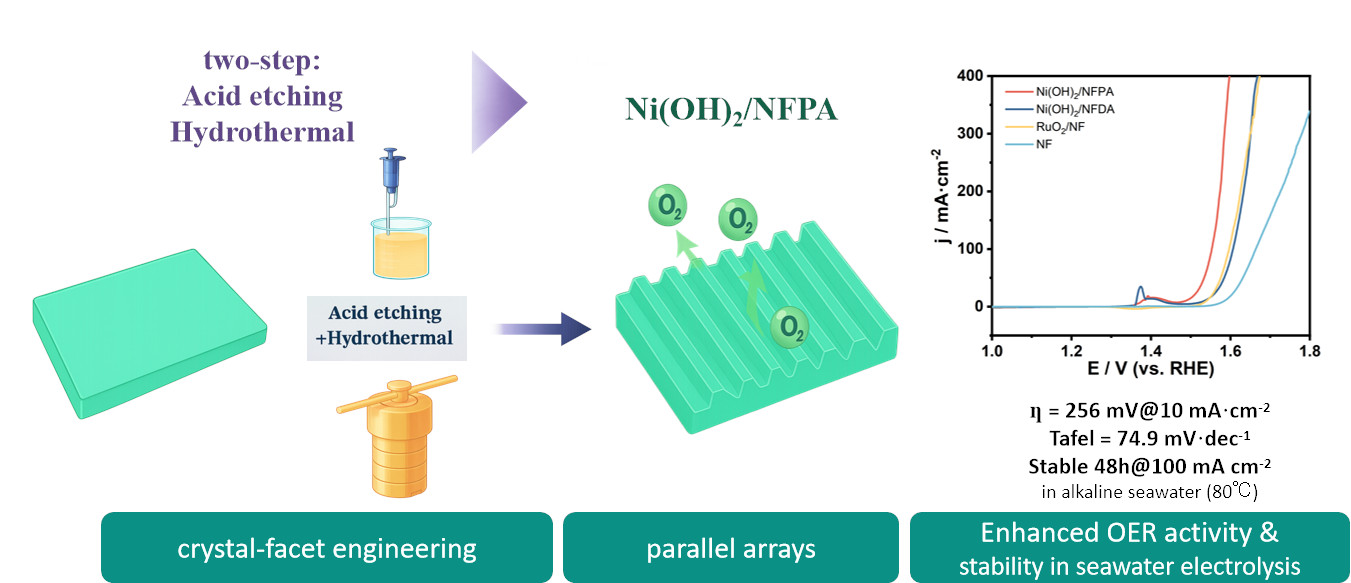
Electrolysis of seawater is considered a green route for hydrogen generation; however, its practical application is limited by strong electrode corrosion and slow OER kinetics in chloride-rich media. Herein, we report a crystal-facet engineering strategy to construct nickel hydroxide with a parallel array structure on nickel foil (denoted as Ni(OH)2/NFPA, where NFPA represents nickel foil with parallel array) via a facile two-step etching-hydrothermal method. Structural characterization confirms the formation of high-index Ni(220) surfaces and well-aligned hydroxide nanostripes, which promote more favorable bubble–electrode interactions and contribute to improved interfacial stability. Owing to its characteristic parallel array configuration, Ni(OH)2/NFPA exhibits outstanding OER performance in alkaline electrolyte, delivering a low overpotential of 256 mV at 10 mA·cm−2 together with a Tafel slope as small as 74.9 mV·dec−1, surpassing commercial RuO2 and disordered Ni(OH)2 nanosheets. The optimized electrode also delivers remarkable durability, maintaining stable operation for 48 h at 100 mA·cm−2 even under harsh alkaline seawater conditions at 80 °C. Bubble dynamics analysis reveals that the ordered array morphology produces a superaerophobic surface, enabling rapid detachment of oxygen bubbles and ensuring efficient mass transport. This study highlights facet-controlled construction of parallel nanoarrays as a promising approach to improve catalytic efficiency, corrosion resistance, and bubble management in seawater electrolysis, offering useful implications for the rational design of high-performance electrodes for practical hydrogen production.

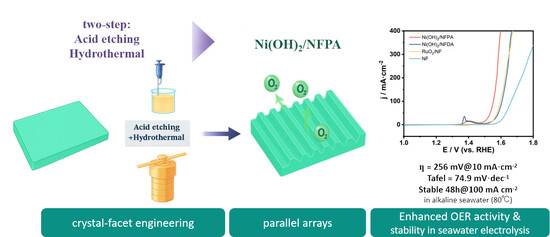
Graphical Abstract

1. Introduction

Hydrogen, regarded as a clean and renewable energy vector with excellent gravimetric energy density, is broadly acknowledged as an essential element in achieving global carbon neutrality [1,2,3]. Among various production pathways, hydrogen can be produced through electrochemical water splitting in a highly pure and eco-friendly manner. A major challenge lies in the intrinsically sluggish OER process, and the prohibitive price of noble-metal-based catalysts significantly limits the practical application of this technology [4,5]. Even though Pt- and Ru-derived materials demonstrate excellent catalytic efficiency, their high expense and low abundance remain significant barriers to large-scale commercialization, thereby motivating the development of alternative, earth-abundant electrocatalysts [6].
In recent years, a wide range of transition-metal-based materials, including sulfides [7,8], phosphides [9], carbides [10,11], oxides [12], and hydroxides [13], have been explored as cost-effective OER catalysts. Nevertheless, most of these investigations have been conducted in freshwater electrolytes. Given that seawater represents about 97% of the global water supply, electrolysis conducted directly in seawater is viewed as a feasible strategy to ease freshwater depletion and meet the increasing demand for hydrogen [14,15,16,17]. Yet, due to the elevated chloride ion content, seawater electrolysis is hindered by side reactions such as chlorine evolution, severe Cl-induced corrosion, and precipitation on electrode surfaces, collectively impairing catalytic activity and durability [18,19]. Nickel-based catalysts, particularly nickel hydroxides supported on nickel foam (NF), have been widely investigated for alkaline seawater oxidation due to their abundance, low cost, and decent OER activity [20]. Recent studies have further explored a variety of Ni(OH)2-based catalysts and their composites to enhance OER activity and durability. For instance, several Ni(OH)2-based hybrid systems have demonstrated improved conductivity and interfacial stability through structural and compositional engineering [21], providing valuable insights for catalyst optimization. However, the loose and porous structure of conventional NF electrodes renders metallic Ni susceptible to chloride corrosion and structural collapse, requiring additional protective layers or complex modifications [22].
Despite extensive efforts using strategies such as elemental doping, protective surface layers, and heterostructural engineering to improve seawater stability, these approaches often involve trade-offs among catalytic activity, structural robustness, and fabrication cost [23,24,25]. Most of these studies primarily focus on composition tuning to modify the electronic structure or corrosion resistance, as exemplified by NiFe-LDH [26] and compositionally doped Ni(OH)2 systems [27]. However, the role of crystal facet regulation and ordered nanoarray architectures—key structural factors that can strongly influence bubble dynamics and interfacial stability—has remained largely underexplored in the context of seawater electrolysis. In this work, we employ a facet-engineering strategy to construct parallel Ni(220)-oriented nanostripes, which enhance electronic conductivity, improve the wettability characteristics relevant to bubble removal, and strengthen corrosion resistance, offering a distinct advantage over composition-driven approaches.
We demonstrate a convenient two-step acid-etching–hydrothermal strategy in the present study to construct Ni(OH)2 with a parallel array structure on nickel foil (denoted as Ni(OH)2/NFPA, where NFPA represents nickel foil with parallel array). The process generates high-index Ni(220) facets and aligned hydroxide nanostripes, resulting in a superaerophobic surface that facilitates efficient bubble detachment and corrosion resistance. Benefiting from this unique architecture, Ni(OH)2/NFPA demonstrates high OER efficiency together with prolonged stability under both alkaline electrolyte and alkaline seawater conditions, even under high-temperature industrial conditions. This work demonstrates that rational facet engineering to design parallel nanostructures provides an effective route for enhancing electrocatalytic performance and stability in seawater electrolysis, offering new insights for practical hydrogen production.

2. Results and Discussion

The two-step procedure for the synthesis of the composite Ni(OH)2/NFPA is depicted in Figure 1. As schematically illustrated in Figure S1, the Ni foil with a parallel array (NFPA) was created by etching commercial Ni foil in HNO3 and KSCN solution [27]. Subsequently, Ni(OH)2 with a parallel array structure was fabricated on the NF surface using a hydrothermal method. The formation of Ni(OH)2/NFPA proceeds via a two-step pathway: acid–thiocyanate etching of Ni foil to expose high-index Ni(220) facets, followed by hydrothermal nucleation of Ni(OH)2 along these parallel grooves. The pre-etched anisotropic surface guides the oriented growth of hydroxide nanostripes, resulting in an ordered array structure.
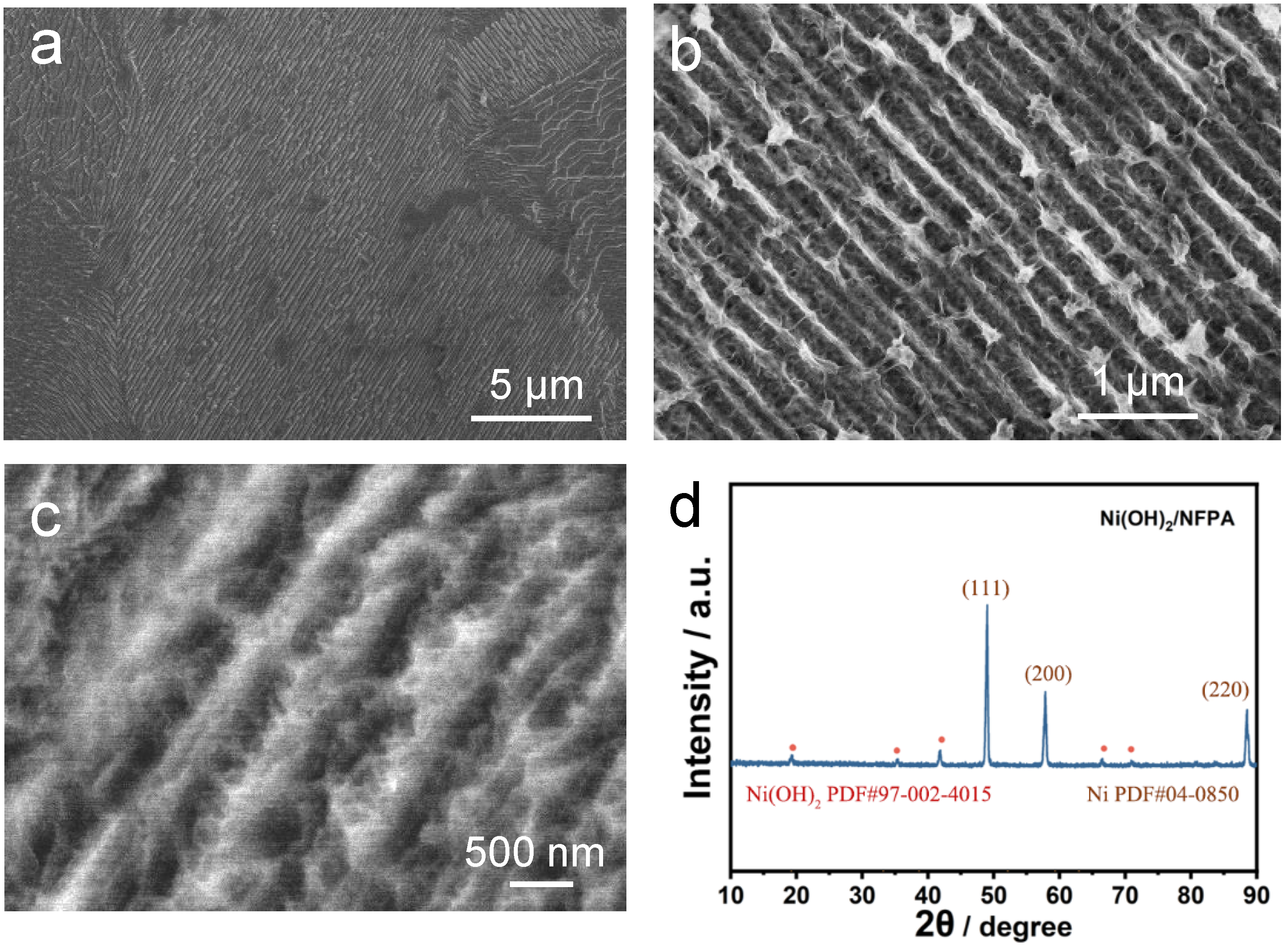
SEM observation (Figure S2) indicates that a flat surface with well-defined grain boundaries is observed on the unmodified NF substrate. Once subjected to the etching process, the surface morphology changes markedly: uniform nanostripes emerge on a roughened texture while the overall NF framework remains intact (Figure 2a). Within single crystal grains, the nanostripes run parallel, whereas misalignment is observed between neighboring grains, which can be attributed to their distinct orientations. Such stripe patterns are further confirmed in the enlarged SEM image (Figure S3).
As shown in Figure 2b,c, the Ni(OH)2 after hydrothermal reaction inherits the array structure of NF. As shown in Figure S4, the sample exhibits three prominent diffraction peaks corresponding to the Ni substrate at 44.5°, 51.9°, and 76.4° (JCPDS 04-0850). The intensities of the three diffraction peaks were rescaled so that their total equaled 100%. Under this normalization, the (111), (200), and (220) reflections account for 64.1%, 25.2% and 10.7%, respectively, in agreement with typical polycrystalline Ni [26,28]. The diffraction peaks of NFPA appear at the same positions as those of NF, verifying that the phase remains metallic nickel. A redistribution of intensity is observed, with (111), (200), and (220) peaks contributing 56.9%, 23.4%, and 19.7%, respectively. Such variation points to the presence of a high-index Ni (220) surface [29]. Furthermore, Figure 2d shows other diffraction peaks of Ni(OH)2 (JCPDS 97-002-4015) in addition to the Ni substrate.
The Ni(OH)2/NFPA catalyst, directly grown on NF and used as a binder-free electrode, was tested for electrocatalytic activity under ambient conditions in a conventional three-electrode configuration, together with reference samples. In contrast, we have grown disordered Ni(OH)2 nanosheets on the surface of NF without parallel arrays in the same way and named them NFDA (Figure S5).
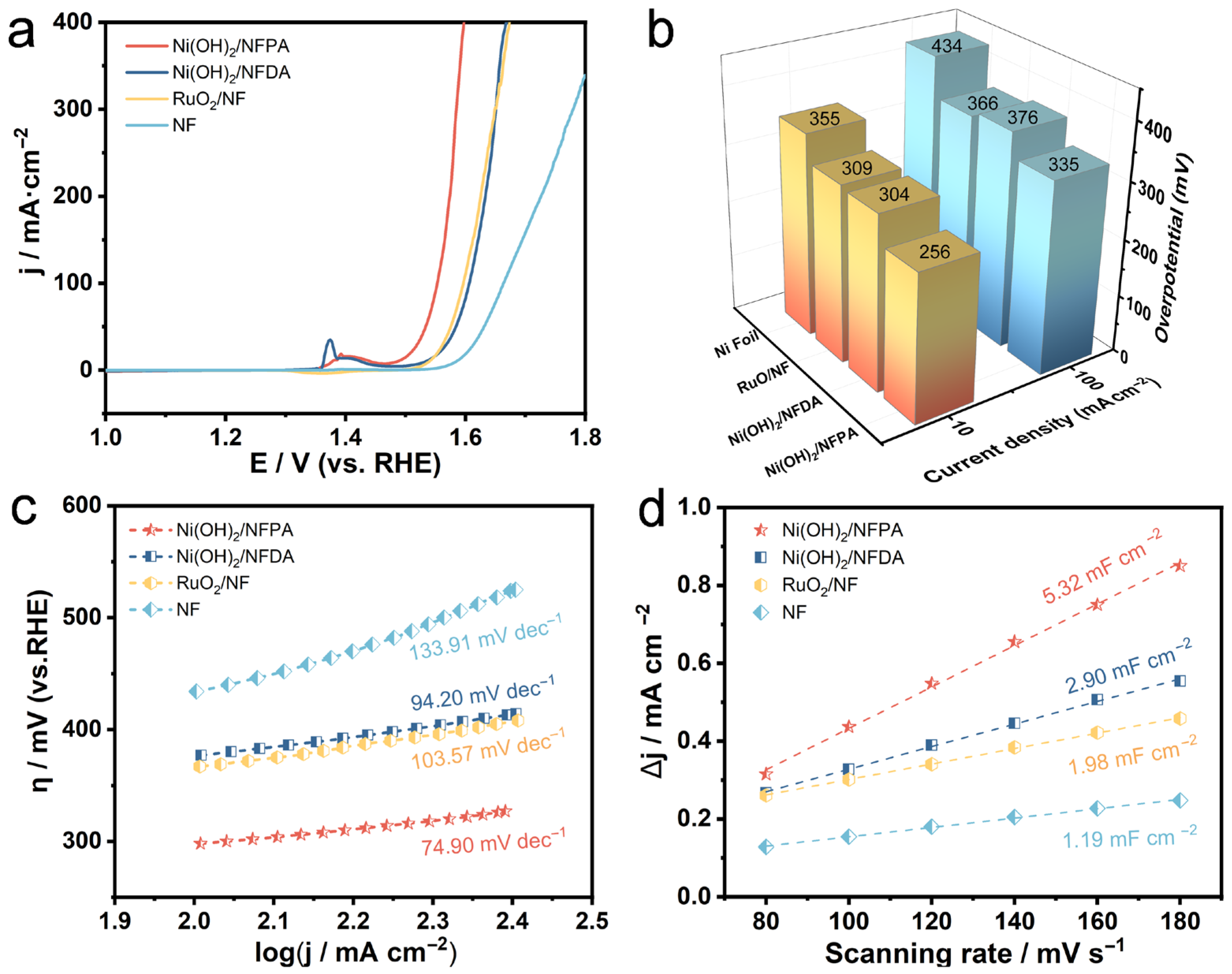
The polarization curves from LSV (Figure 3a) reveal that in 1 M KOH, Ni(OH)2/NFPA displays superior OER activity, operating at a minimum overpotential of 256 mV to achieve a current density of 10 mA·cm−2 (Figure 3b). This performance surpasses that of the benchmark catalyst RuO2 and other reference samples. The kinetics of the reaction are commonly characterized by the Tafel slope, which is determined from LSV measurements. Ni(OH)2/NFPA delivers the most favorable Tafel slope (74.90 mV·dec−1) relative to the counterparts in Figure 3c. This smaller Tafel slope indicates a higher transfer coefficient and faster OER kinetics, attributable to the coexistence of Ni(OH)2.
Furthermore, the excellent OER activity is further confirmed by a larger double-layer capacitance (Cdl) value of 5.32 mF·cm−2, calculated from cyclic voltammetry (CV) measurements (Figure 3d and Figure S6). By employing the equation ECSA = Cdl/Cs (with Cs set as 40 µF·cm−2) [30], the ECSA of Ni(OH)2/NFPA is calculated to be 133 cm2, significantly larger than that of the relevant samples. Even when normalized by ECSA, Ni(OH)2/NFPA still exhibits superior activity (Figure S7), confirming that the enhanced performance originates from both improved surface area and intrinsic activity. Additional details regarding the Cdl extraction and ECSA calculation are provided in Section 3.5 and Figures S6 and S7. Such behavior is consistent with the EIS results, as shown in Figure S8, where the Ni(OH)2/NFPA electrode exhibits the smallest charge-transfer resistance at an overpotential of 630 mV, indicating faster charge transfer compared with the other electrodes.
Approximately 97% of the Earth’s hydrosphere is composed of seawater, while freshwater only makes up a mere 3%. Given the vast reserves of seawater, electrolysis of seawater is regarded as a promising strategy to mitigate the energy challenge. In this context, the electrocatalytic behavior of Ni(OH)2/NFPA was investigated, as well as Ni(OH)2/NFDA, RuO2/NF, and NF (as control samples). Alkaline seawater collected from the Yellow Sea, China, was used under identical conditions.
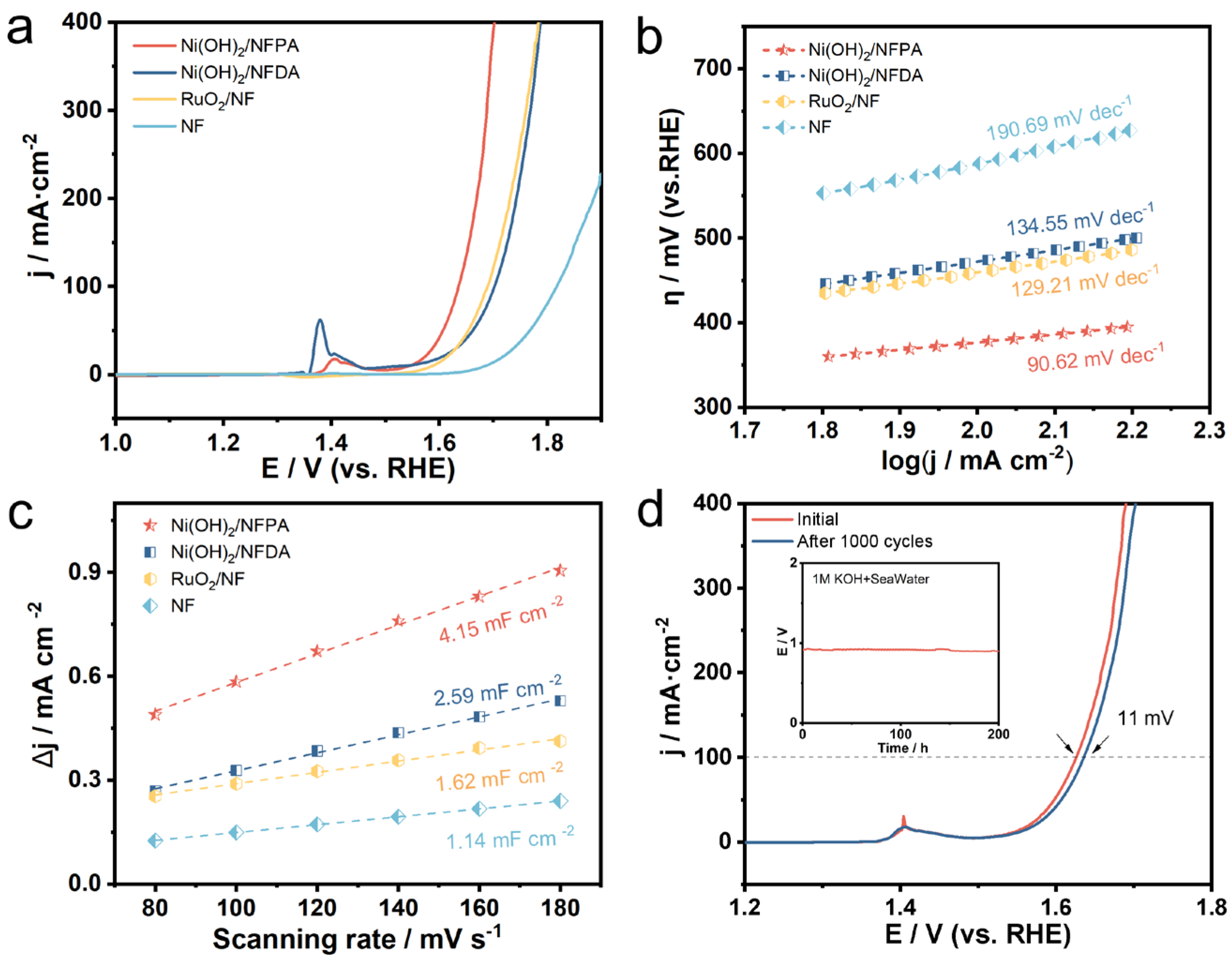
Figure 4a demonstrates that Ni(OH)2/NFPA exhibits remarkable OER activity, requiring the lowest overpotential of 395 mV to achieve a current density of 100 mA·cm−2, surpassing the control samples. In addition, the Tafel slope was examined to better understand the kinetic characteristics of the oxygen evolution reaction in alkaline seawater. It reveals that Ni(OH)2/NFPA exhibits a smaller value (90.62 mV·dec−1) compared to the relevant samples, indicating faster catalytic kinetics favorable to OER activity (Figure 4b). Importantly, the excellent intrinsic OER activity of Ni(OH)2/NFPA is further supported by its larger Cdl value, as assessed from CV measurements (Figure S9). As depicted in Figure 4c, Ni(OH)2/NFPA exhibits a remarkable Cdl value of 4.15 mF·cm−2, surpassing the other comparative samples, thereby confirming the presence of a greater number of exposed catalytic sites in Ni(OH)2/NFPA. In addition to catalytic activity, stability is a crucial characteristic for efficient OER electrocatalysts in practical applications.
Notably, Figure S10 demonstrates that even under high-temperature industrial conditions, the performance degradation of the Ni(OH)2/NFPA sample within 48 h is still negligible. Figure 4d demonstrates that Ni(OH)2/NFPA exhibits a minimal increase of only 11 mV in overpotential at 100 mA·cm−2 after 1000 cycles of CV scanning, providing evidence of the excellent stability of the designed material in alkaline seawater. The durability test, initially conducted through a chronopotentiometry test, demonstrates that Ni(OH)2/NFPA maintains a consistent potential response at 100 mA·cm−2 current densities (inset in Figure 4d). During the OER process, the reversible Ni2+/Ni3+ redox transition (the small anodic peak at ~1.40 V) observed in LSV (Figure 4d) is widely recognized as the electrochemical signature of the Ni(OH)2→NiOOH transformation, as demonstrated by in situ XAS/XRD studies [4]. Zhu et al. revealed that the shift in the Ni K-edge to higher energy, the shortened Ni-O bond, and the appearance of γ-NiOOH diffraction features are fully correlated with this redox transition. This mechanism is further supported by Raman and XPS results reported for Ni-based hydroxide catalysts [13]. Thus, the observed redox features provide reliable evidence of the reversible Ni(OH)2 oxidation during OER. And the negligible LSV performance decay (Figure 4d) shows the excellent stability after 1000 CV cycles, while the 200 h of continuous operation (inset in Figure 4d) suggests that this reversible surface reconstruction does not compromise the structural integrity of Ni(OH)2/NFPA during OER.
The RDE method serves as an effective tool for electrochemical characterization by establishing a steady-state diffusion environment controlled by the rotation velocity [31]. As the disk spins, the solution is pushed upward and outward due to centrifugal effects, which also assists in dislodging gas bubbles adhered to the electrode surface. Hence, while the technique is commonly utilized for analyzing OER kinetics, its scope is constrained when applied to bulk or non-powdered electrodes [32].
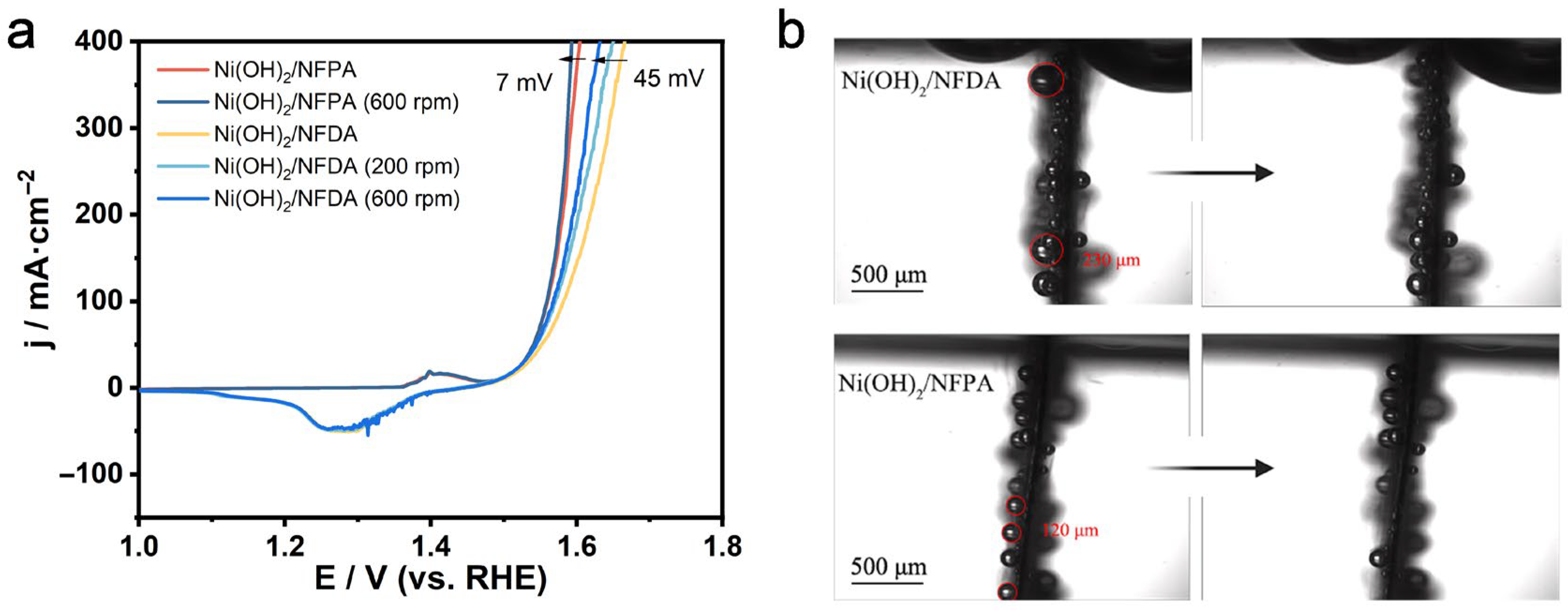
Alternatively, rotating the electrolyte can impose forced convection, assisting bubble removal and allowing examination of how structural features influence OER activity. Ni(OH)2/NFDA exhibits higher OER currents with increasing rotation rates from 0 to 600 rpm (in 200 rpm steps), mainly owing to the facilitated mass transport, as demonstrated by the polarization curves in Figure 5a. When the rotation speed reaches 600 rpm, Ni(OH)2/NFDA achieves an η400 of 401 mV, about 45 mV lower than the 446 mV observed under static conditions. By contrast, the polarization profiles of Ni(OH)2/NFPA remain essentially unaffected by changes in rotation speed.
When the rotation rate increases to 600 rpm, Ni(OH)2/NFDA shows a negative shift of about 7 mV in η400 compared with the static condition. However, Ni(OH)2/NFPA displays negligible sensitivity of its kinetics to rotation. The superior performance of Ni(OH)2/NFDA is likely linked to its parallel nanostripe architecture, where the periodic arrangement promotes bubble detachment and strengthens mass transport [33]. To support the proposed explanation, the O2 bubble release of Ni(OH)2/NFPA and Ni(OH)2/NFDA was investigated. At 100 mA·cm−2, Ni(OH)2/NFDA accumulates relatively large bubbles that adhere to the electrode (Figure 5b). During OER, Ni(OH)2/NFPA tends to produce bubbles with a smaller apparent size, and these bubbles are observed to leave the surface more readily compared with Ni(OH)2/NFDA. While this comparison is qualitative, it is consistent with the superaerophobic wetting characteristics revealed by the bubble contact-angle measurements (Figure S11) and with the negligible rotation-dependent variation in OER performance (Figure 5a), both of which indirectly indicate facilitated bubble removal on Ni(OH)2/NFPA. Reported superaerophobic Ni arrays typically release bubbles of 80–120 µm within <0.2 s [33], which is consistent with the rapid bubble removal observed in Figure 5b. This property originates from plentiful ridges that disrupt the TPCL and establish a superaerophobic character [34], supported by contact-angle data in Figure S11. Furthermore, the valleys between ridges may create confined vortices, accelerating the aggregation and release of small oxygen bubbles [35].

3. Experimental Section

3.1. Chemical and Materials

Nickel foil was purchased from Keshenghe Technology Co., Ltd. (Suzhou, China). Nitric acid (HNO3, 68%), ethanol (C2H6O, ≥99.7%), nickel (II) nitrate nonahydrate [Ni(NO3)3·6H2O, ≥98.5%], potassium hydroxide (KOH, ≥85%), and potassium hydrosulfide (KSCN, ≥99%) were purchased from Aladdin Chemical Reagent Co., Ltd (Shanghai, China). Deionized (DI) water with resistivity > 18 MΩ·cm−1 was used. All chemicals were analytically pure and used as received without any further purification.

3.2. Synthesis of NFPA

A solution containing 5.0 M KSCN and 0.5 M HNO3 was prepared. A piece of nickel foil (NF), measuring 1 × 1.5 cm2, was then submerged in 20 mL of this solution. After letting it stand for 12 h at room temperature, NFPA was obtained by thoroughly rinsing it several times with deionized water and ethanol.

3.3. Synthesis of Ni(OH)2/NFPA and Ni(OH)2/NFDA

After dissolving 0.2 g Ni(NO3)2·6H2O in 20 mL deionized water, the resulting solution was transferred into a 50 mL Teflon autoclave. The as-prepared NFPA was immersed in the solution for the hydrothermal treatment at 80 °C for 12 h. Before structural and electrochemical characterization, the resulting samples were washed with water and dried under vacuum. The preparation of Ni(OH)2/NFDA was the same as Ni(OH)2/NFPA, except that NFPA was replaced by pure Ni foil.

3.4. Materials Characterization

The phases were characterized using XRD on a Rigaku D/max-RB12 diffractometer with Cu Kα radiation in the 2-θ range of 10–90°. XPS was performed on an X-ray photoelectron spectrometer (Thermo Escalab 250XI, Waltham, MA, USA) using monochromatic Al Kα radiation (hv = 1486.6 eV). SEM was conducted using an SU8100 electron microscope (Hitachi High-Tech, Tokyo, Japan).

3.5. Electrochemical Measurement

All the electrochemical tests were performed in a typical three-electrode setup using an electrochemical workstation (CHI 760D) at room temperature. A graphite rod and Hg/HgO electrode were used as the counter and reference electrodes, respectively. The samples prepared on NiFe foam (1 cm2) served directly as the working electrode. The measured potentials vs. Hg/HgO were converted to potentials vs. RHE using the equation: ERHE = EHg/HgO + 0.059 pH + 0.098. The potential in the iR-corrected polarization curves was calculated by the equation ECorrected = E − iR, where R was the series resistance obtained from electrochemical impedance spectroscopy (EIS) Nyquist plots.
Linear sweep voltammograms (LSVs) were conducted at a scan rate of 5 mV·s−1 with 95% iR-correction. Electrochemical impedance spectroscopy (EIS) measurements were carried out in the frequency range from 100 kHz to 0.01 Hz with an amplitude of 5 mV. Long-term stability measurement was collected at a specific potential. In the measurement of ESCA, the calculation was performed using the equation: ECSA = Cdl/Cs, in which Cs is the specific capacitance for a flat surface and taken as 40 µF cm−2 in alkaline electrolytes. The CV potential window ranged from 0.85 to 0.95 vs. RHE. The scan rates were 80, 100, 120, 140, 160, and 180 mV·s−1. The double-layer capacitance (Cdl) was calculated using the equation: jc × A = vCdl, where v is the scan rate, jc is the current at 0.9 V vs. RHE, and A is the geometric area of the NiFe foam electrodes. The slope of the plot of jc×A as a function of v yields the value of Cdl.

4. Conclusions

In conclusion, we developed a two-step acid-etching–hydrothermal method to construct Ni(OH)2 with a parallel array structure on nickel foil. The electrode exposes high-index Ni(220) facets and ordered nanostripes, which enhance surface activity, superaerophobicity, and structural stability. As a result, Ni(OH)2/NFPA delivers superior OER performance in alkaline media, requiring only 256 mV at 10 mA·cm−2 and showing a favorable Tafel slope, while also maintaining long-term durability in alkaline seawater. The qualitative bubble observations together with wettability measurements suggest that the array morphology facilitates bubble detachment, thereby contributing to stable operation. This work highlights facet control and ordered nanoarchitectures as an effective strategy to synergistically optimize activity, bubble management, and corrosion resistance for seawater electrolysis.

Supplementary Materials

The following supporting information can be downloaded at: https://www.mdpi.com/article/10.3390/catal15121144/s1. Figure S1: SEM images of NFPA after different corrosion times (a) 6 h, (b) 12 h, (c) 18 h, and (d) 24 h; Figure S2: SEM image of pure Ni foil; Figure S3: SEM image of NFPA; Figure S4: XRD image of Ni foil before and after etching; Figure S5: SEM image of Ni(OH)2/NFDA; Figure S6: Electrochemical cyclic voltammetry curves at different scan rates for (a) Ni(OH)2/NFPA, (b) Ni(OH)2/NFDA, (c) RuO2/NF, and (d) NF in 1 M KOH; Figure S7: ECSA-normalized OER activity; Figure S8: Nyquist plots of Ni(OH)2/NFPA, NFPA, and NF in 1 M KOH at an overpotential of 630 mV with (a) the fitted EIS and (b) the equivalent circuit for impedance spectra data of catalysts. (Note: the fitting software is Z-view version 4.1b); Figure S9: Electrochemical cyclic voltammetry curves at different scan rates for (a) Ni(OH)2/NFPA, (b) Ni(OH)2/NFDA, (c) RuO2/NF, and (d) NF in alkaline seawater; Figure S10: Chronopotentiometry test of Ni(OH)2/NFPA in 6 M KOH + seawater at 80 °C; Figure S11: Contact angles and bubble contact angles of (a) Ni(OH)2/NFPA and (b) Ni(OH)2/NFDA.

Author Contributions

Conceptualization, L.L. and H.L.; methodology, L.L.; software, H.L.; validation, H.L.; formal analysis, H.L.; investigation, L.L.; resources, B.J.; data curation, H.L.; writing—original draft preparation, H.L.; writing—review and editing, L.L.; visualization, L.L.; supervision, B.J.; project administration, X.Q.; funding acquisition, M.Q. All authors have read and agreed to the published version of the manuscript.

Funding

This research was funded by the National Natural Science Foundation Program of China (52131307, 52130407, 52071013, 52104359 51774035, and 52174344); the National Key Research and Development Program of China (No. 2021YFB3701900, 2022YFB3705400, 2022YFB3708800); the Special Program (17th Batch) of the China Postdoctoral Science Foundation (No. 2024T170053); the Beijing Municipal Science & Technology Commission, Administrative Commission of Zhongguancun Science Park (Program No. Z221100005822001); the Natural Science Foundation Program of Beijing (2244098, 2224104, 2202031, 2174079, and 2162027); the Guangdong Basic and Applied Basic Research Foundation (2021A1515110202); the S&T Program of Hebei (20311001D); the Fundamental Research Funds for the Central Universities (FRF-IDRY-GD21-002, FRF-TP-19-003C2, FRF-IDRY-19-025, FRF-IDRY-20-022, FRF-TP-20-032A2, FRF-TP-20-100A1Z); the Scientific and Technological Innovation Foundation of Foshan (BK21BE007); and the Natural Science Foundation Program of Hunan (2021JJ30250).

Data Availability Statement

The data presented in this study are available in the article and Supplementary Materials.

Conflicts of Interest

The authors declare no conflicts of interest.

References

  1. Walter, M.G.; Warren, E.L.; McKone, J.R.; Boettcher, S.W.; Mi, Q.; Santori, E.A.; Lewis, N.S. Solar water splitting cells. Chem. Rev. 2010, 110, 6446–6473. [Google Scholar] [CrossRef]
  2. Dresselhaus, M.S.; Thomas, I.L. Alternative energy technologies. Nature 2001, 414, 332–337. [Google Scholar] [CrossRef] [PubMed]
  3. Wang, J.; Zhang, Z.; Song, H.; Zhang, B.; Liu, J.; Shai, X.; Miao, L. Water dissociation kinetic-oriented design of nickel sulfides via tailored dual sites for efficient alkaline hydrogen evolution. Adv. Funct. Mater. 2021, 31, 2008578. [Google Scholar] [CrossRef]
  4. Zhu, Y.; Kuo, T.; Li, Y.; Qi, M.; Chen, G.; Wang, J.; Xu, Y.; Chen, H.M. Emerging dynamic structure of electrocatalysts unveiled by in situ X-ray diffraction/absorption spectroscopy. Energy Environ. Sci. 2021, 14, 1928–1958. [Google Scholar] [CrossRef]
  5. Roger, I.; Shipman, M.A.; Symes, M.D. Earth-abundant catalysts for electrochemical and photoelectrochemical water splitting. Nat. Rev. Chem. 2017, 1, 3. [Google Scholar] [CrossRef]
  6. Li, D.; Chen, X.; Lv, Y.; Zhang, G.; Huang, Y.; Liu, W.; Li, Y.; Chen, R.; Nuckolls, C.; Ni, H. An effective hybrid electrocatalyst for the alkaline HER: Highly dispersed Pt sites immobilized by a functionalized NiRu-hydroxide. Appl. Catal. B Environ. 2020, 269, 118824. [Google Scholar] [CrossRef]
  7. Cui, B.; Hu, Z.; Liu, C.; Liu, S.; Chen, F.; Hu, S.; Zhang, J.; Zhou, W.; Deng, Y.; Qin, Z. Heterogeneous lamellar-edged Fe-Ni(OH)2/Ni3S2 nanoarray for efficient and stable seawater oxidation. Nano Res. 2021, 14, 1149–1155. [Google Scholar] [CrossRef]
  8. Zhao, Y.; Jin, B.; Vasileff, A.; Jiao, Y.; Qiao, S. Interfacial nickel nitride/sulfide as a bifunctional electrode for highly efficient overall water/seawater electrolysis. J. Mater. Chem. A 2019, 7, 8117–8121. [Google Scholar] [CrossRef]
  9. Zhang, H.; Zhou, W.; Dong, J.; Lu, X.F.; Lou, X.W.D. Intramolecular electronic coupling in porous iron cobalt (oxy) phosphide nanoboxes enhances the electrocatalytic activity for oxygen evolution. Energy Environ. Sci. 2019, 12, 3348–3355. [Google Scholar] [CrossRef]
  10. Wang, P.; Qin, R.; Ji, P.; Pu, Z.; Zhu, J.; Lin, C.; Zhao, Y.; Tang, H.; Li, W.; Mu, S. Synergistic coupling of Ni nanoparticles with Ni3C nanosheets for highly efficient overall water splitting. Small 2020, 16, 2001642. [Google Scholar] [CrossRef]
  11. Zhang, H.; Liu, Y.; Chen, T.; Zhang, J.; Zhang, J.; Lou, X.W. Unveiling the activity origin of electrocatalytic oxygen evolution over isolated Ni atoms supported on a N-doped carbon matrix. Adv. Mater. 2019, 31, 1904548. [Google Scholar] [CrossRef] [PubMed]
  12. Liu, J.; Zheng, Y.; Jiao, Y.; Wang, Z.; Lu, Z.; Vasileff, A.; Qiao, S.Z. NiO as a bifunctional promoter for RuO2 toward superior overall water splitting. Small 2018, 14, 1704073. [Google Scholar] [CrossRef] [PubMed]
  13. Gao, M.; Sheng, W.; Zhuang, Z.; Fang, Q.; Gu, S.; Jiang, J.; Yan, Y. Efficient water oxidation using nanostructured α-nickel-hydroxide as an electrocatalyst. J. Am. Chem. Soc. 2014, 136, 7077–7084. [Google Scholar] [CrossRef]
  14. Li, G.; Li, F.; Zhao, Y.; Li, W.; Zhao, Z.; Li, Y.; Yang, H.; Fan, K.; Zhang, P.; Sun, L. Selective electrochemical alkaline seawater oxidation catalyzed by cobalt carbonate hydroxide nanorod arrays with sequential proton-electron transfer properties. ACS Sustain. Chem. Eng. 2021, 9, 905–913. [Google Scholar] [CrossRef]
  15. Wu, L.; Yu, L.; Zhang, F.; McElhenny, B.; Luo, D.; Karim, A.; Chen, S.; Ren, Z. Heterogeneous bimetallic phosphide Ni2P-Fe2P as an efficient bifunctional catalyst for water/seawater splitting. Adv. Funct. Mater. 2021, 31, 2006484. [Google Scholar] [CrossRef]
  16. Dresp, S.; Dionigi, F.; Klingenhof, M.; Strasser, P. Direct electrolytic splitting of seawater: Opportunities and challenges. ACS Energy Lett. 2019, 4, 933–942. [Google Scholar] [CrossRef]
  17. Wu, L.; Yu, L.; Zhu, Q.; McElhenny, B.; Zhang, F.; Wu, C.; Xing, X.; Bao, J.; Chen, S.; Ren, Z. Boron-modified cobalt iron layered double hydroxides for high efficiency seawater oxidation. Nano Energy 2021, 83, 105838. [Google Scholar] [CrossRef]
  18. Dionigi, F.; Reier, T.; Pawolek, Z.; Gliech, M.; Strasser, P. Design criteria, operating conditions, and nickel-iron hydroxide catalyst materials for selective seawater electrolysis. ChemSusChem 2016, 9, 962–972. [Google Scholar] [CrossRef]
  19. Jadhav, A.R.; Kumar, A.; Lee, J.; Yang, T.; Na, S.; Lee, J.; Luo, Y.; Liu, X.; Hwang, Y.; Liu, Y. Stable complete seawater electrolysis by using interfacial chloride ion blocking layer on catalyst surface. J. Mater. Chem. A 2020, 8, 24501–24514. [Google Scholar] [CrossRef]
  20. Luo, X.; Ji, P.; Wang, P.; Tan, X.; Chen, L.; Mu, S. Spherical Ni3S2/Fe-NiPx magic cube with ultrahigh water/seawater oxidation efficiency. Adv. Sci. 2022, 9, 2104846. [Google Scholar] [CrossRef]
  21. Abd-Elrahim, A.G.; Chun, D.M. Kinetically induced one-step heterostructure formation of Co3O4-Ni(OH)2-graphene ternary nanocomposites to enhance oxygen evolution reactions. J. Alloys Compd. 2022, 906, 164159. [Google Scholar] [CrossRef]
  22. Li, T.; Zhao, X.; Sendeku, M.G.; Zhang, X.; Xu, L.; Wang, Z.; Wang, S.; Duan, X.; Liu, H.; Liu, W. Phosphate-decorated Ni3Fe-LDHs@CoPx nanoarray for near-neutral seawater splitting. Chem. Eng. J. 2023, 460, 141413. [Google Scholar] [CrossRef]
  23. Tu, Q.; Liu, W.; Jiang, M.; Wang, W.; Kang, Q.; Wang, P.; Zhou, W.; Zhou, F. Preferential adsorption of hydroxide ions onto partially crystalline NiFe-layered double hydroxides leads to efficient and selective OER in alkaline seawater. ACS Appl. Energy Mater. 2021, 4, 4630–4637. [Google Scholar] [CrossRef]
  24. Yu, L.; Zhu, Q.; Song, S.; McElhenny, B.; Wang, D.; Wu, C.; Qin, Z.; Bao, J.; Yu, Y.; Chen, S. Non-noble metal-nitride based electrocatalysts for high-performance alkaline seawater electrolysis. Nat. Commun. 2019, 10, 5106. [Google Scholar] [CrossRef]
  25. Li, J.; Liu, Y.; Chen, H.; Zhang, Z.; Zou, X. Design of a multilayered oxygen-evolution electrode with high catalytic activity and corrosion resistance for saline water splitting. Adv. Funct. Mater. 2021, 31, 2101820. [Google Scholar] [CrossRef]
  26. Zhong, B.; Kuang, P.; Wang, L.; Yu, J. Hierarchical porous nickel supported NiFeOxHy nanosheets for efficient and robust oxygen evolution electrocatalyst under industrial condition. Appl. Catal. B Environ. 2021, 299, 120668. [Google Scholar] [CrossRef]
  27. Du, H.; Wang, T.; He, S.; Li, B.; Wang, K.; Chen, Q.; Du, Z.; Ai, W.; Huang, W. Mountain-Shaped Nickel Nanostripes Enabled by Facet Engineering of Nickel Foam: A New Platform for High-Current-Density Water Splitting. Adv. Funct. Mater. 2024, 34, 2311854. [Google Scholar] [CrossRef]
  28. Hao, M.; Assresahegn, B.D.; Abdellah, A.; Miner, L.; Al Hejami, A.; Zaker, N.; Gaudet, J.; Roue, L.; Botton, G.A.; Beauchemin, D. Role of Ir decoration in activating a multiscale fractal surface in porous Ni for the oxygen evolution reaction. ACS Catal. 2023, 13, 1726–1739. [Google Scholar] [CrossRef]
  29. Han, L.; Tian, B.; Gao, X.; Zhong, Y.; Wang, S.; Song, S.; Wang, Z.; Zhang, Y.; Kuang, Y.; Sun, X. Copper nanowire with enriched high-index facets for highly selective CO2 reduction. SmartMat 2022, 3, 142–150. [Google Scholar] [CrossRef]
  30. Swesi, A.T.; Masud, J.; Nath, M. Nickel selenide as a high-efficiency catalyst for oxygen evolution reaction. Energy Environ. Sci. 2016, 9, 1771–1782. [Google Scholar] [CrossRef]
  31. Lazaridis, T.; Stühmeier, B.M.; Gasteiger, H.A.; El-Sayed, H.A. Capabilities and limitations of rotating disk electrodes versus membrane electrode assemblies in the investigation of electrocatalysts. Nat. Catal. 2022, 5, 363–373. [Google Scholar] [CrossRef]
  32. van der Heijden, O.; Park, S.; Eggebeen, J.J.; Koper, M.T. Non-kinetic effects convolute activity and tafel analysis for the alkaline oxygen evolution reaction on NiFeOOH electrocatalysts. Angew. Chem. Int. Ed. 2023, 62, e202216477. [Google Scholar] [CrossRef]
  33. Song, Q.; Xue, Z.; Liu, C.; Qiao, X.; Liu, L.; Huang, C.; Liu, K.; Li, X.; Lu, Z.; Wang, T. General strategy to optimize gas evolution reaction via assembled striped-pattern superlattices. J. Am. Chem. Soc. 2019, 142, 1857–1863. [Google Scholar] [CrossRef] [PubMed]
  34. Shang, L.; Zhao, Y.; Kong, X.; Shi, R.; Waterhouse, G.I.; Wen, L.; Zhang, T. Underwater superaerophobic Ni nanoparticle-decorated nickel-molybdenum nitride nanowire arrays for hydrogen evolution in neutral media. Nano Energy 2020, 78, 105375. [Google Scholar] [CrossRef]
  35. Varble, N.; Trylesinski, G.; Xiang, J.; Snyder, K.; Meng, H. Identification of vortex structures in a cohort of 204 intracranial aneurysms. J. R. Soc. Interface 2017, 14, 20170021. [Google Scholar] [CrossRef] [PubMed]
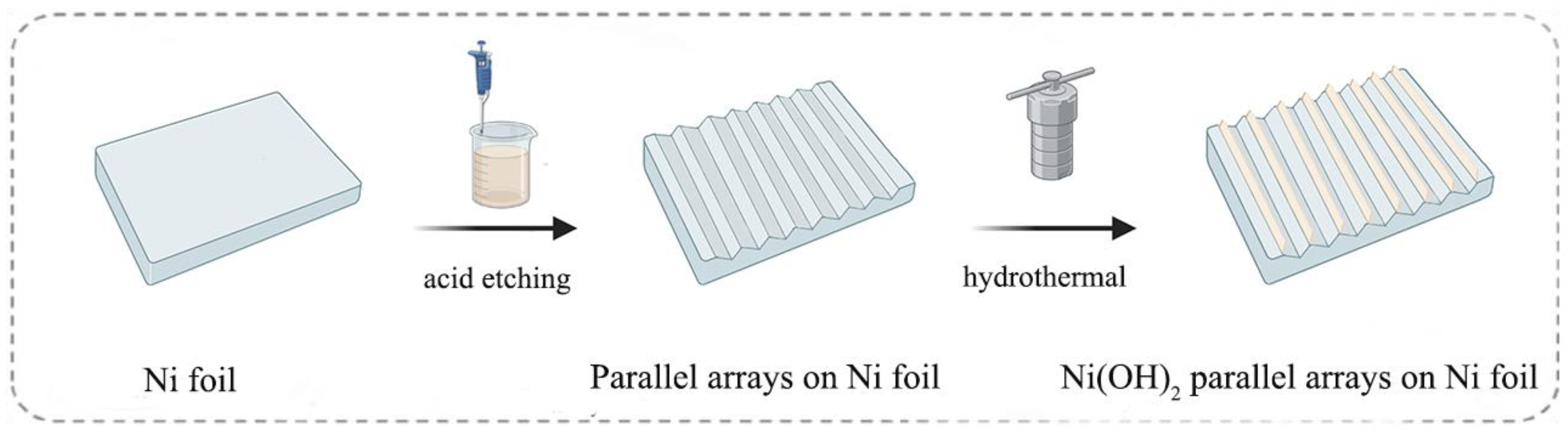
Figure 1. Fabrication process and structural features of Ni(OH)2/NFPA.
Catalysts 15 01144 g001
Figure 2. SEM image of (a) NFPA and (b) Ni(OH)2/NFPA, (c) dark field SEM image of Ni(OH)2/NFPA and (d) XRD patterns.
Catalysts 15 01144 g002
Figure 3. Electrochemical OER tests in 1 M KOH: (a) LSV polarization curves, (b) overpotential values of the catalysts measured at current densities of 10 and 100 mA·cm−2, (c) corresponding Tafel slopes, and (d) the calculated electrochemical surface area.
Catalysts 15 01144 g003
Figure 4. Electrochemical OER tests in alkaline seawater: (a) LSV curves, (b) Tafel slope, (c) electrochemical surface area, (d) LSV curves before and after 1000 CV cycles, the arrows indicate the overpotential difference (11 mV) before and after 1000 cycles, and the dotted line marks the current density of 10 mA·cm−2 used for comparison, and the inset in (d) shows the chronopotentiometry test of Ni(OH)2/NFPA in 1 M KOH + Seawater.
Catalysts 15 01144 g004
Figure 5. (a) LSV curves of Ni(OH)2/NFPA and Ni(OH)2/NFDA acquired at different rotation speeds. (b) Photographs of Ni(OH)2/NFPA and Ni(OH)2/NFDA with the current held at 100 mA·cm−2. The arrows in (a) highlight the measured overpotential differences between the two electrodes, where Ni(OH)2/NFPA shows a smaller gap (7 mV) compared to Ni(OH)2/NFDA (45 mV).
Catalysts 15 01144 g005
Disclaimer/Publisher’s Note: The statements, opinions and data contained in all publications are solely those of the individual author(s) and contributor(s) and not of MDPI and/or the editor(s). MDPI and/or the editor(s) disclaim responsibility for any injury to people or property resulting from any ideas, methods, instructions or products referred to in the content.