
Article

Rapid Preparation of g-C3N4/GO Composites via Electron Beam Irradiation for Enhanced Ofloxacin Removal

1
School of Environment and Architecture, University of Shanghai for Science and Technology, Shanghai 200093, China
2
Institute of Applied Radiation of Shanghai, School of Environmental and Chemical Engineering, Shanghai University, Shanghai 200444, China
3
Shanghai Institute of Optics and Fine Mechanics, Chinese Academy of Sciences, Shanghai 201800, China
4
Shanghai Noncarbon Energy Conversion and Utilization Institute, Shanghai 200240, China
*
Author to whom correspondence should be addressed.
Catalysts 2025, 15(12), 1118; https://doi.org/10.3390/catal15121118
Submission received: 31 October 2025 / Revised: 16 November 2025 / Accepted: 18 November 2025 / Published: 1 December 2025
(This article belongs to the Special Issue Recent Advances in Catalytic Materials for Water and Air Treatment)

Abstract

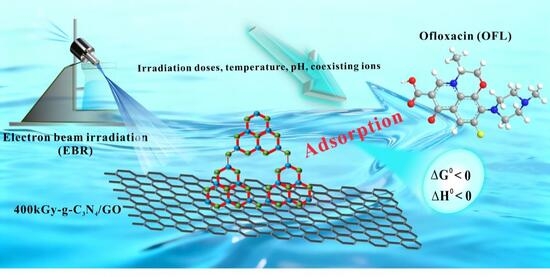
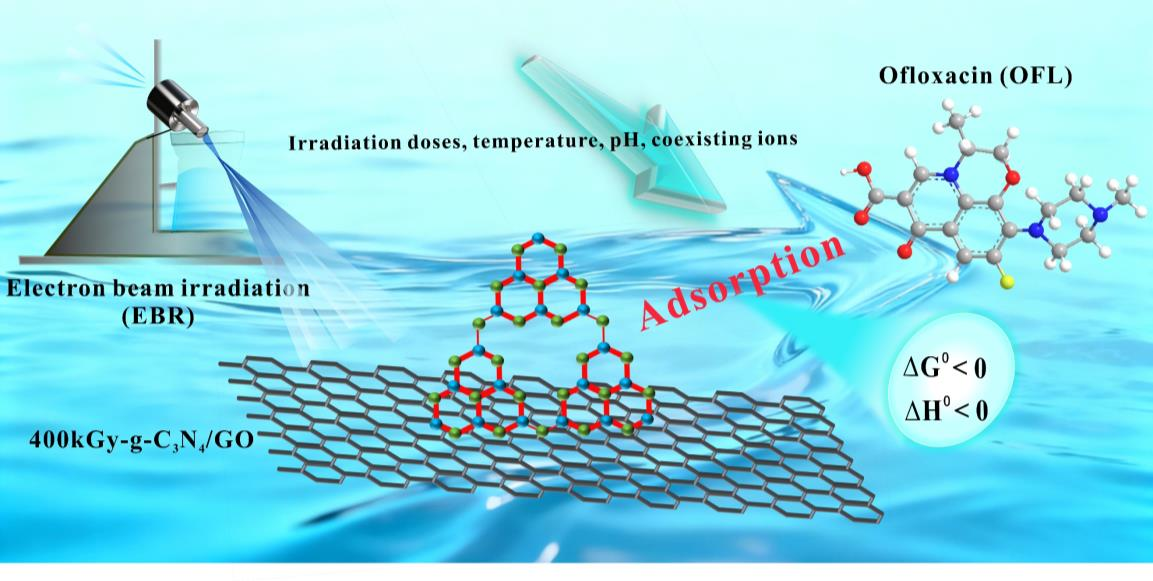
In this study, a highly efficient graphitic carbon nitride/graphene oxide (X kGy-g-C3N4/GO, X: mean different irradiation dose of 200, 300, 400, and 500 kGy) adsorbent was successfully prepared by electron beam irradiation method (EBR) and used for the adsorption of ofloxacin (OFL). Structure and morphology characterization results confirmed the successful composite of g-C3N4 and GO through EBR. The effects of various conditions on the adsorption capacity, including irradiation dose, pH, adsorbent dosage, and initial OFL concentration were analyzed in detail through experiments. Results indicated that 400 kGy-g-C3N4/GO exhibited the maximum adsorption capacity for OFL (222.0 mg·g−1), and the adsorption performance was affected by pH through electrostatic interactions, reaching optimum at pH = 7.0. Coexisting ion experiments revealed that CO32− reduced OFL adsorption capacity. The adsorption isotherm and kinetics were best described by the Langmuir model (R2 = 0.984) and pseudo-second-order model (R2 = 0.995), respectively. Thermodynamic studies of adsorption indicated a spontaneous and exothermic in adsorption process (∆G0 = −25.21, ∆S0 = 0.050, and ∆H0 = −10.25). This research provides a fresh approach to the reasonable design of g-C3N4/GO composites as adsorbent with potential applications in OFL wastewater treatment.

Graphical Abstract

1. Introduction

With the acceleration of society’s development and the improvement of living standards, the production and use of antibiotics has increased [1,2,3]. However, antibiotics are relatively stable and difficult to metabolize, thus persisting in the environment and thereby posing threats to both environmental and human health [4,5]. Among them, fluoroquinolone antibiotics are widely used to treat bacterial infections in both humans and animals because of their low cost and good effects [6]. As a typical fluoroquinolone antibiotic, ofloxacin (OFL) has a triazine ring stable structure, thermal stability, and acid-base stability, making it difficult to remove from the environment for a long time [7]. Therefore, effectively addressing the pollution issues of OFL in the aquatic environment is of great significance.
There are various ways of removing OFL from water, such as photocatalysis [8], biotechnology [9], and adsorption methods [10]. Among these, adsorption technology has attracted much attention because its low cost, simple operation, and non-toxic and harmless [11]. In adsorption techniques, the effectiveness of various adsorbents including activated carbon (AC) [12], graphene oxide (GO) [13], and chitosan [14] in eliminating OFL from wastewater has been investigated. Recently, GO has earned great scientific interest in adsorption technology for its high specific surface area and tunable surface functionality [15,16]. Moreover, GO possesses abundant carboxyl, hydroxyl, and epoxy groups, which can interact with antibiotics via H-bonding [17]. However, GO has poor stability, and compounding GO with other materials to improve the stability of materials is a common strategy used to remove antibiotics from water bodies [18]. Graphitic carbon nitride (g-C3N4) composed of triazine and tris-triazine/heptazine units and rich in amine groups (-NH2, NH3-, and =N-), possesses significant adsorption capacity for a variety of pollutants. Furthermore, its readily adjustable surface properties could reduce preparation costs [19].
The preparation methods for traditional carbon-based adsorbents suffer from numerous issues, such as prolonged preparation times and the requirement for high temperatures and pressures [20]. By using a high-energy electron beam produced by an electron accelerator, the electron beam irradiation method (EBR) can interact with materials or organisms to alter their structure and properties [21,22]. Compared to traditional methods, the EBR technique offers faster preparation speeds, enabling rapid material synthesis within a short timeframe. Consequently, research on preparing adsorbents using EBR technology has been paid increasing attention [23].
Herein, EBR at different irradiation doses was used to prepare g-C3N4/GO composites for absorbing OFL from aqueous solutions. The successful synthesis of X kGy-g-C3N4/GO (X mean different irradiation dose of 200, 300, 400, and 500 kGy) via EBR was confirmed by microstructure and chemical characterization. The effects of various conditions (irradiation doses, temperature, pH, and coexisting ions) on adsorption performance were investigated. Additionally, the adsorption mechanism was further investigated using adsorption isotherms, kinetics, and thermodynamic simulations. This study demonstrates that X kGy-g-C3N4/GO has great potential for efficient adsorption of antibiotics.

2. Result and Discussion

2.1. Characterization of X kGy-g-C3N4/GO

The X-ray diffraction (XRD) patterns of GO, g-C3N4, and X kGy-g-C3N4/GO are displayed in Figure 1a. The XRD patterns of GO exhibited a peak at 11.0° corresponding to its (002) plane, while g-C3N4 displayed two peaks at 13.1° and 27.5° corresponding to their (100) and (002) crystal planes, respectively [24]. Notably, all the XRD patterns of X kGy-g-C3N4/GO showed both the characteristic peaks of g-C3N4 and GO, demonstrating that the composites were synthesized successfully with EBR and without altering the lattice structures and properties of the original GO and g-C3N4. The chemical bond structure was also investigated using Fourier transform infrared (FT-IR) (Figure 1b). It could be observed that X kGy-g-C3N4/GO exhibited multiple spectral bands in the wavenumber range of 1200–1700 cm−1, with absorption peaks at approximately 1240 cm−1, 1320 cm−1, 1403 cm−1, and 1631 cm−1 originating from CN heterocycle vibrations [24]. Furthermore, the peak at 808 cm−1 provided strong evidence for the presence of thiotriazinone units [25,26]. There was also a small characteristic peak at 1050 cm−1, which corresponded to the stretching vibrations of C-O of alkoxy groups [27]. All the X kGy-g-C3N4/GO had similar infrared absorption peaks that matched the characteristic adsorption peaks of GO and g-C3N4 [28,29], which further illustrated the successful synthesis of the X kGy-g-C3N4/GO.
N2 adsorption–desorption was measured to evaluate the specific surface area and porous structure of X kGy-g-C3N4/GO, the findings are shown in Table S1 and Figure 1c,d. The results demonstrated the presence of mesoporous structures in all X kGy-g-C3N4/GO materials by displaying the H3 hysteresis loop and characteristic Type IV isotherms, which was well in agreement with the pore size distribution of X kGy-g-C3N4/GO. It was obvious that both specific surface area and pore volume increased and then decreased with the increasing irradiation dose. The 400 kGy-g-C3N4/GO sample exhibited the largest specific surface (61.91 m2·g−1) (Table S1), indicating 400 kGy-g-C3N4/GO possessed the highest adsorption capacity and molecular transfer among these materials [30]. In fact, when the irradiation dose was higher than 400 kGy, the g-C3N4/GO composite had undergone excessive reduction, leading to significant removal of oxygen-containing functional groups on the GO. This weakened the interlayer support function, causing the collapse of the layered structure. Such collapse blocked some pores, resulting in a decrease in specific surface area and pore volume [31]. Concurrently, the high-energy irradiation generated numerous defects on the g-C3N4 and GO surfaces, inducing agglomeration or densification of the material to lower its surface energy and consequently further reducing the porosity [32]. Additionally, below 400 kGy, EBR enhanced the interfacial bonding between g-C3N4 and GO. However, at 500 kGy, excessive irradiation might lead to unstable bonding at the interface or the formation of unstable defect states, thereby weakening their synergistic effect and consequently affecting the pore structure and adsorption performance [33]. The combined influence of these multiple factors resulted in a significant decrease in specific surface area and pore volume at 500 kGy.
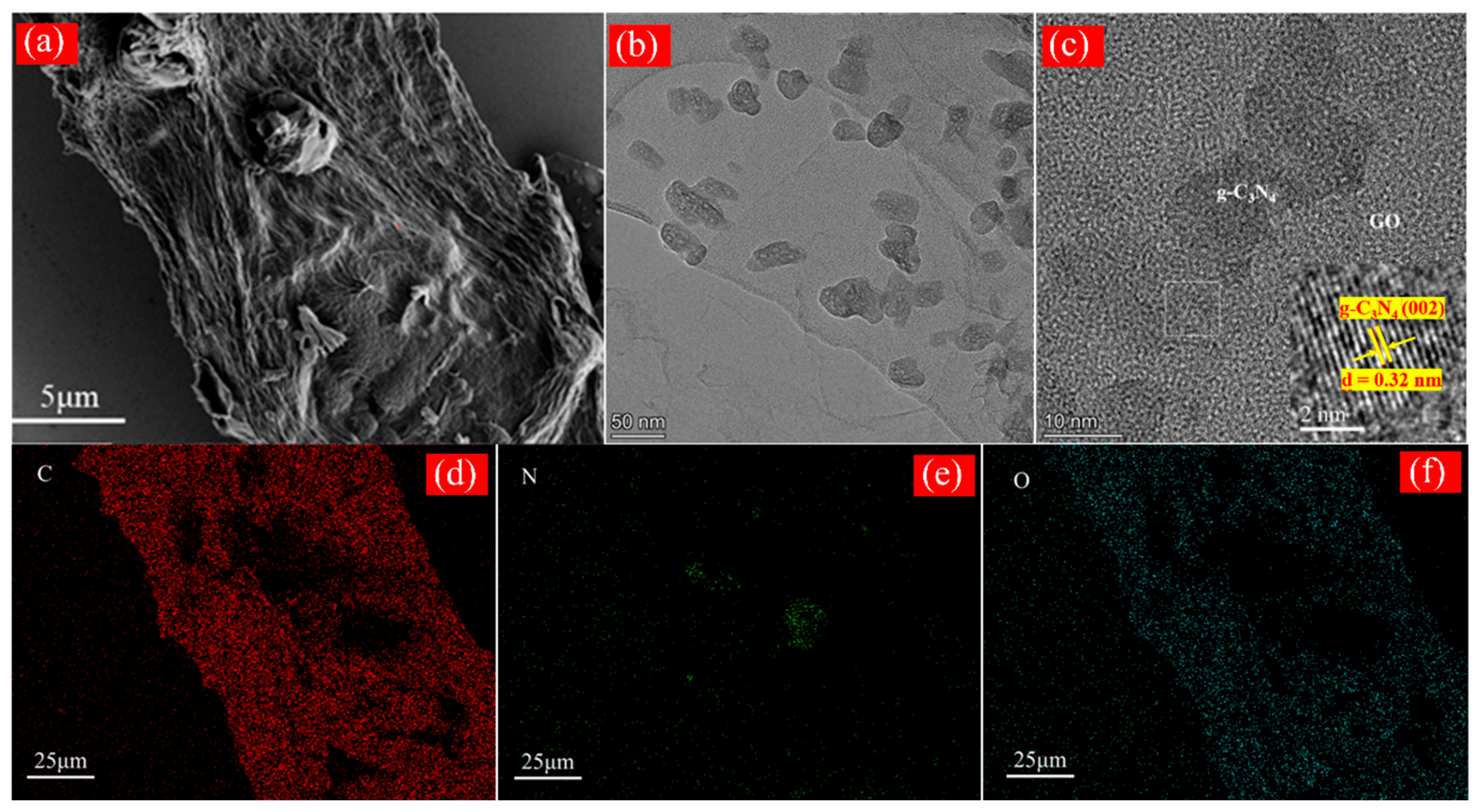
The morphology of the 400 kGy-g-C3N4/GO sample was researched with scanning electron microscopy (SEM) and transmission electron microscopy (TEM) (Figure 2). As illustrated in Figure 2a, the 400 kGy-g-C3N4/GO retained the layered structure of GO [34], with flexible nano lumpy structures exhibiting edge curling observed on its surface, which corresponded to the morphological state of g-C3N4 [35]. The TEM image and high-resolution TEM (HRTEM) further confirmed the morphology of 400 kGy-g-C3N4/GO. In Figure 2b the TEM image revealed GO as thin, transparent layered structures with wrinkled edges, while g-C3N4 exhibited irregular, multi-sized, and rough-surfaced agglomerates uniformly dispersed within the GO matrix, which were highly in agreement with those from the literature [29,36]. The clear boundary between g-C3N4 and GO displayed in Figure 2c further implied the intimate integration of g-C3N4 and GO. Moreover, there was a crystal lattice distance of 0.32 nm which corresponded to the (002) crystal plane of g-C3N4. X-ray energy dispersive spectroscopy (EDS) analysis revealed uniform distribution of C, N, and O elements in the 400 kGy-g-C3N4/GO (Figure 2d–f). The results further implied that the 400 kGy-g-C3N4/GO were synthesized successfully by EBR.
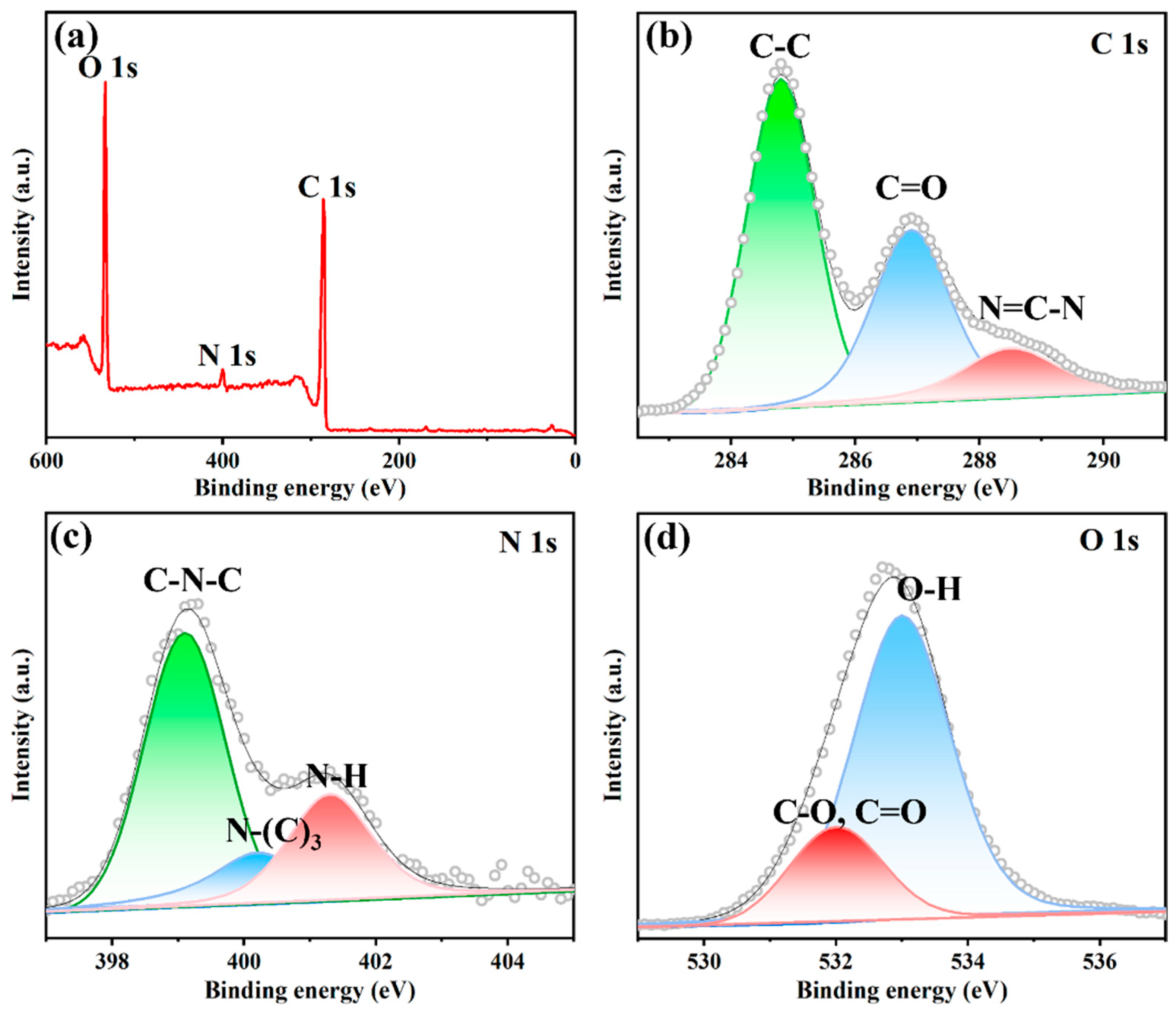
The chemical state and surface element components of 400 kGy-g-C3N4/GO were investigated using X-ray photoelectron spectroscopy (XPS) (Figure 3). The XPS survey spectrum (Figure 3a) displayed that 400 kGy-g-C3N4/GO was composed of C, O, and N elements, which was in line with the result of EDS. The high-resolution XPS spectrum of C 1s (Figure 3b) could be fitted into three smaller peaks. The peaks at 284.8 eV, 286.9 eV, and 288.9 eV were attributed to the C-C, C-O, and N=C-N bond in the sample [24,37]. As for the N 1s XPS spectrum of the 400 kGy-g-C3N4/GO, the presence of graphitic sp2-hybridized carbon-nitrogen bonds was confirmed by the peak at 399.2 eV, which was generally ascribed to nitrogen atoms forming sp2-hybridized c-bonds with two carbon atoms (C-N-C). The two peaks at 400.5 and 401.7 eV corresponded to tertiary nitrogen (N-(C)3) and hydrogen-containing amino functional groups (C-N-H), respectively [24,38]. As for O 1s XPS spectrum of the 400 kGy-g-C3N4/GO, the peaks of 531.9 and 533.4 eV were attributed to C-O/C=O and O-H, respectively [39].

2.2. Adsorption Properties of X kGy-g-C3N4/GO

Under various conditions, such as irradiation dose, reaction time, X kGy-g-C3N4/GO dosage, initial OFL concentration, pH, and coexisting ions, the adsorption performance of X kGy-g-C3N4/GO for OFL in solution was studied.

2.2.1. Effect of Irradiation Dose and Reaction Time

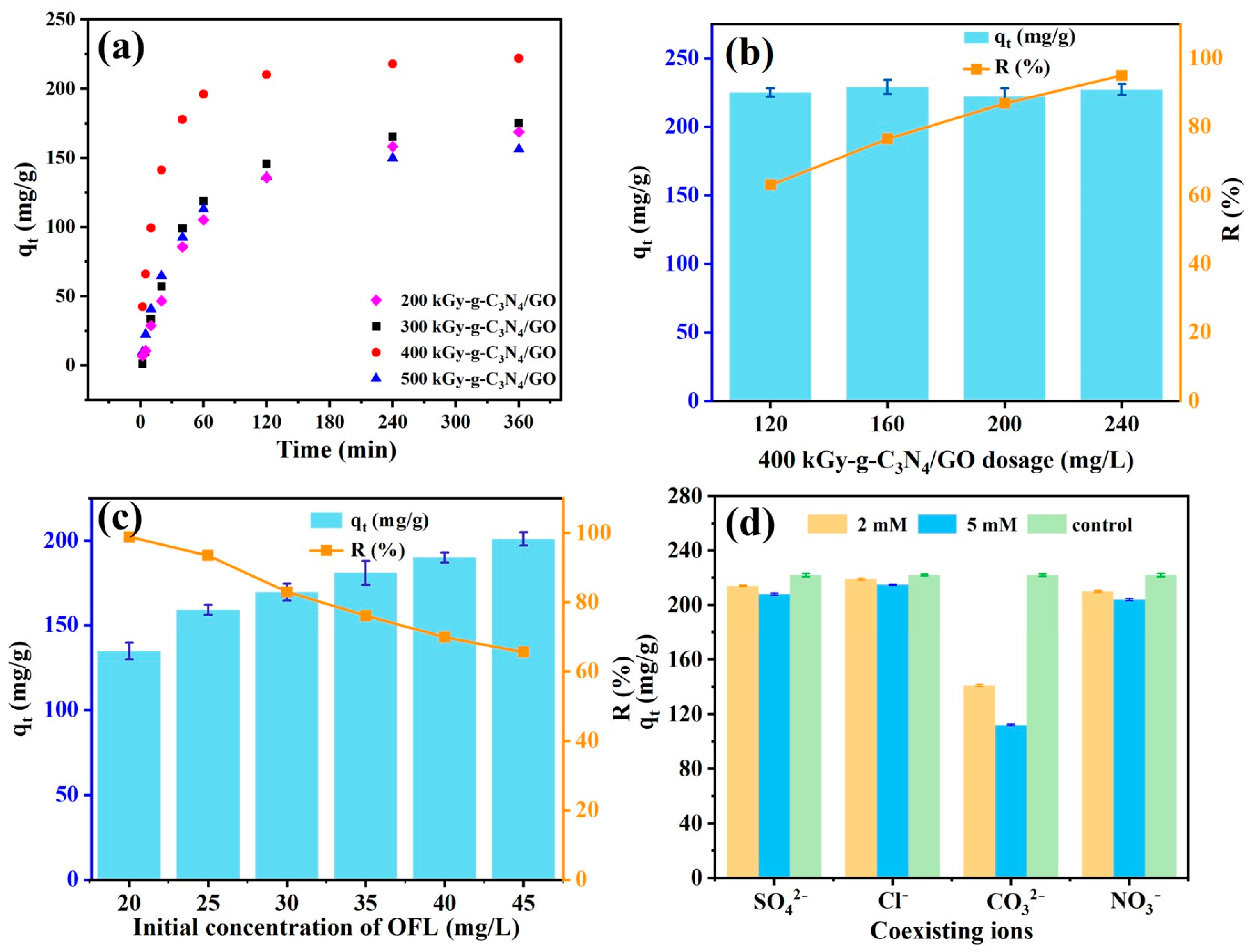
The removal efficiency of X kGy-g-C3N4/GO for OFL at different irradiation doses as a function of adsorption time is presented in Figure 4a. In the initial 60 min, the adsorption capacity of X kGy-g-C3N4/GO for OFL increased significantly with the increasing reaction time and then achieved equilibrium at 6 h. This observation could be attributed to the abundance of available adsorption sites on the X kGy-g-C3N4/GO surface during the initial stage, enabling the OFL to reach the maximum adsorption quickly and increasing the adsorption capacity rapidly [40]. As the adsorption time increased, both the number of active sites in X kGy-g-C3N4/GO and the concentration of OFL decreased, leading to a slower adsorption process and eventually reached equilibrium [41]. Furthermore, it was found that the adsorption capacity of X kGy-g-C3N4/GO for OFL increases with higher irradiation doses, reaching a maximum at 400 kGy, which was connected to the results of specific surface areas. In summary, X kGy-g-C3N4/GO exhibited optimal adsorption performance at an irradiation dose of 400 kGy. Therefore, 400 kGy-g-C3N4/GO was selected for subsequent studies.

2.2.2. Effect of Adsorbent Dosage and Initial OFL Concentration

The effect of X kGy-g-C3N4/GO dosage on removal performance for OFL was monitored (Figure 4b). With increasing X kGy-g-C3N4/GO dosage from 120 to 240 mg·L−1, the number of available adsorption sites on the adsorbent surface increased, leading to enhanced removal capacity for OFL. Additionally, the effect of varying OFL concentrations on adsorption efficiency was investigated (Figure 4c). The results indicated that the adsorption capacity gradually increased as the initial OFL concentration increased from 20 to 45 mg·L−1. This trend could be attributed to the enhanced mass transfer driving force, which promoted the movement of the OFL molecules towards the adsorbent surface [41,42].

2.2.3. Effect of Coexisting Ions

The presence of anions in aqueous solutions may compete with OFL for active adsorption sites on the adsorbent surface, thereby hindering the adsorption of OFL [10]. Therefore, under optimized conditions, the impact of coexisting ions on the removal performance of 400 kGy-g-C3N4/GO was evaluated (Cl, SO42−, CO32−, and NO3) (Figure 4d). It could be observed that the presence of CO32− significantly reduced the adsorption of OFL in 400 kGy-g-C3N4/GO, while Cl had almost no effect on the adsorption performance. Furthermore, as the ion concentration increased, the impact on 400 kGy-g-C3N4/GO became more pronounced.

2.2.4. Effect of pH

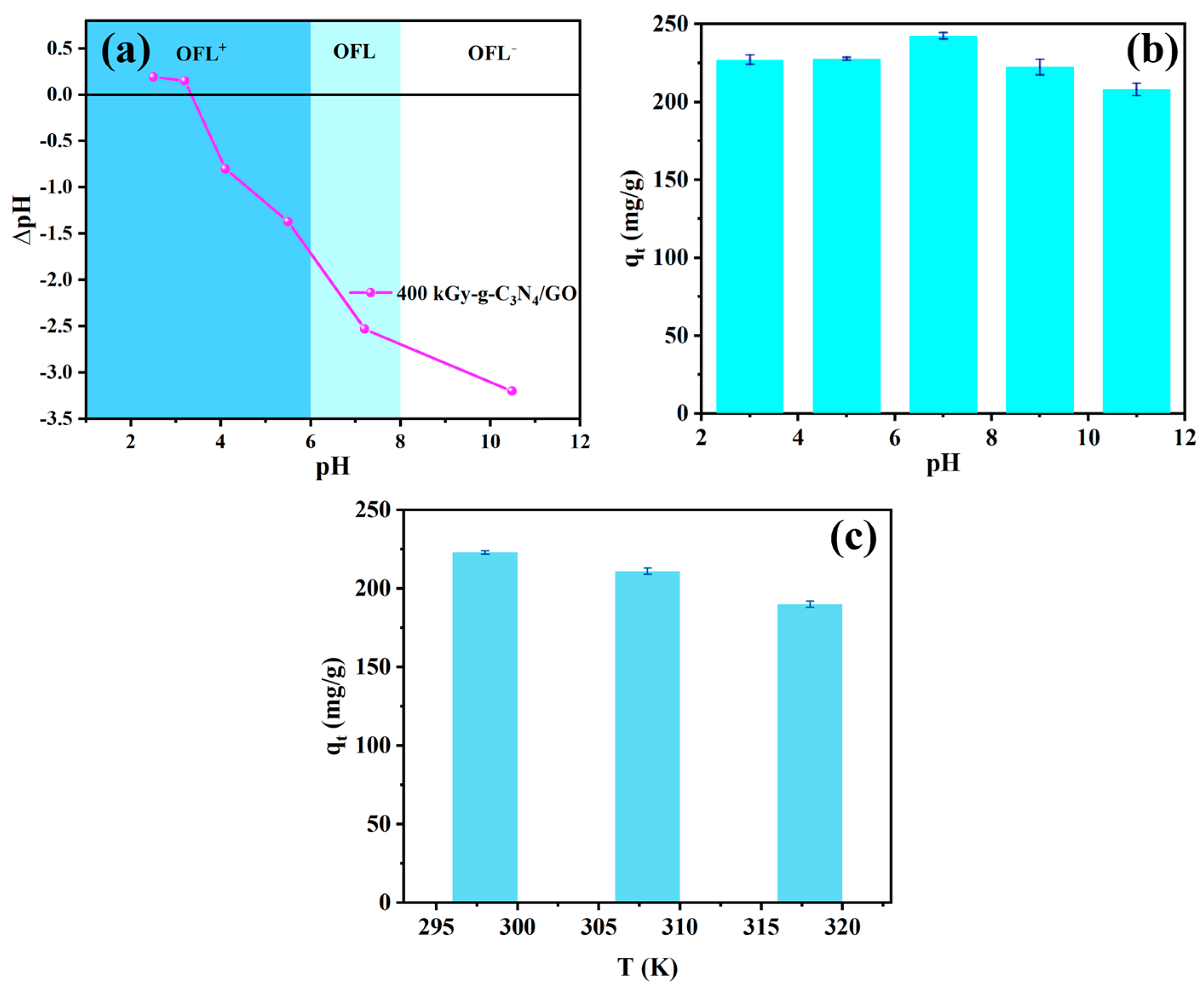
The pH of the solution could alter the ionization state of functional groups on the adsorbent surface, thereby enabling electrostatic interactions between the adsorbent and pollutants [43]. The zero-charge point (pHpzc = 3.3) of 400 kGy-g-C3N4/GO and the existence forms of OFL at different pH values are shown in Figure 5. In Figure 5a, OFL primarily existed as OFL+ at pH < 6.05, mainly existed as OFL0 at 6.05 < pH < 8.11, and predominantly existed as OFL at pH > 8.11 [44]. As depicted in Figure 5b, the OFL adsorption capacity first increased and then decreased with rising pH (3.0–11.0), reaching a maximum at pH 7.0. This result was ascribed to the existence of electrostatic gravitational force between 400 kGy-g-C3N4/GO and OFL+ at pH < 7.0. As pH increased, the surface negative charge of 400 kGy-g-C3N4/GO further intensified, consequently the adsorption capacity was enhanced. When the pH was higher than 7.0, OFL predominantly adopted the OFL form, there was electrostatic repulsion between the two and this lead to lower adsorption performance. At pH = 7.0, OFL predominantly existed as the neutral form OFL0, with electrostatic attraction nearly eliminated. However, the adsorption capacity still reached a peak of 222.0 mg g−1, indicating that electrostatic interactions were no longer the dominant mechanism. The abundant hydroxyl and amino groups on the composite surface formed hydrogen bonds with OFL. Additionally, the thiotriazinone and conjugated skeleton of the 400 kGy-g-C3N4/GO material acted as electron donors, generating π-π stacking interactions with OFL. Concurrently, hydrophobic effects further concentrated neutral molecules, resulting in electrostatic forces only having a minor auxiliary role near pH = 7.0.

2.2.5. Effect of Temperature

As shown in Figure 5c, the adsorption capacity of OFL on 400 kGy-g-C3N4/GO decreased monotonically with increasing temperature from 298 K to 318 K, indicating an exothermic process. The decline in adsorption capacity was attributed to the enhanced thermal motion of OFL molecules, which promoted their desorption, and a concomitant weakening of the interactions between OFL and the functional groups on the surface of 400 kGy-g-C3N4/GO [42].

2.3. Adsorption Kinetics

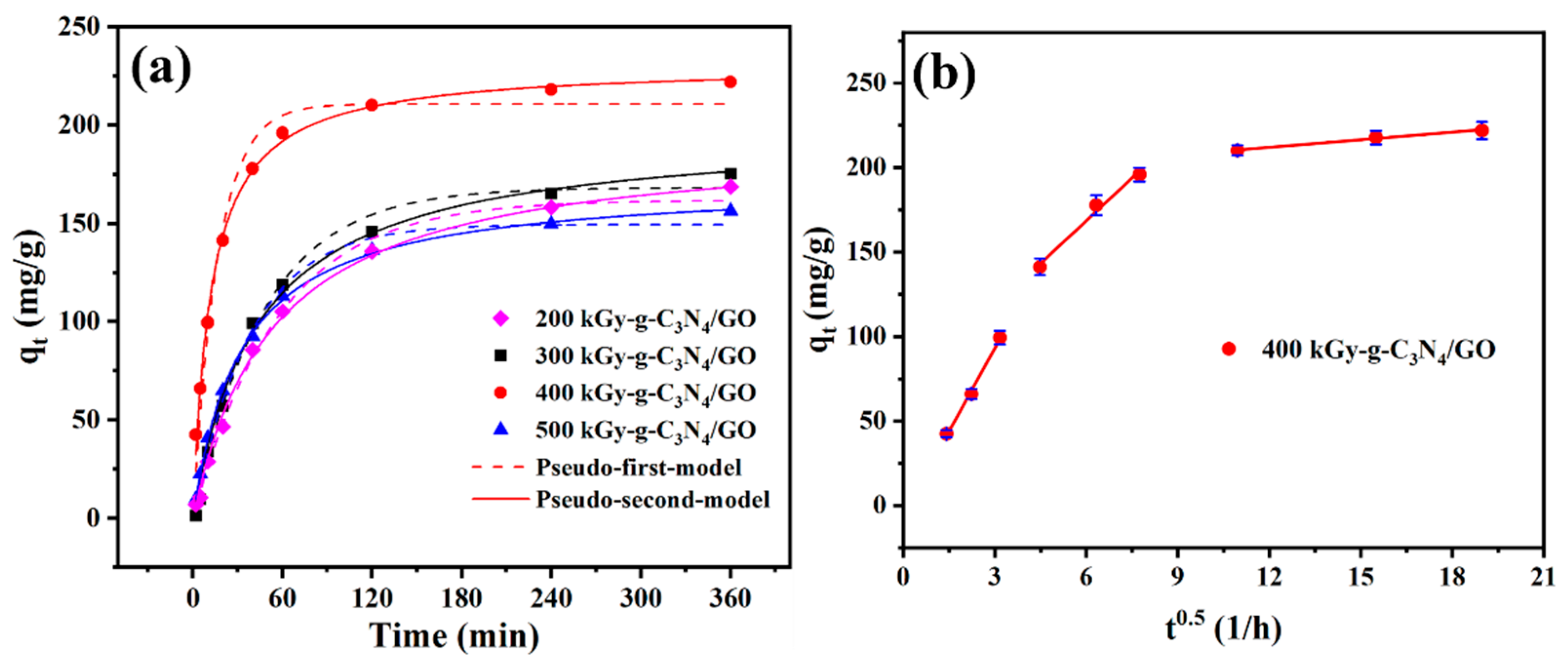
The kinetic study was performed by monitoring the adsorption capacity of OFL at various time intervals and fitting the experimental data to various kinetic models to gain information of the reaction rate between the adsorbent and adsorbate (Figure 6a,b) [45]. The findings of the kinetic fittings in relation to the various irradiation doses are shown in Table 1. The pseudo-second-order kinetics suited the relevance data better (R2 = 0.995). Additionally, the calculated values (230.6 mg·g−1) for the adsorption of the OFL on the 400 kGy-g-C3N4/GO showed high similarity to the experimental values (222.0 mg·g−1), indicating that the data fitted the model more effectively. This reaction process primarily occurred through chemisorption [46]. Furthermore, the pseudo-second-order adsorption capacity of the 400 kGy-g-C3N4/GO material prepared at the 400 kGy irradiation dose was 3.57 × 10⁻⁴ g·(mg·min−1), higher than that of other composites. This indicated that the composite material prepared at the 400 kGy adsorbed OFL significantly faster than those prepared at other irradiation doses.
The intra-particle diffusion model indicated that if qt exhibited a linear regression with t0.5 and the resulting regression line passed through the origin, then the reaction rate was influenced by intra-particle diffusion [47]. A certain level of boundary layer control was demonstrated by the linear regression curve in Figure 6b which was not crossing the origin. This implied that intra-particle diffusion might not be the only rate-limiting factor, and that additional mechanisms were also involved in controlling the adsorption [48].

2.4. Adsorption Isotherms and Thermodynamics

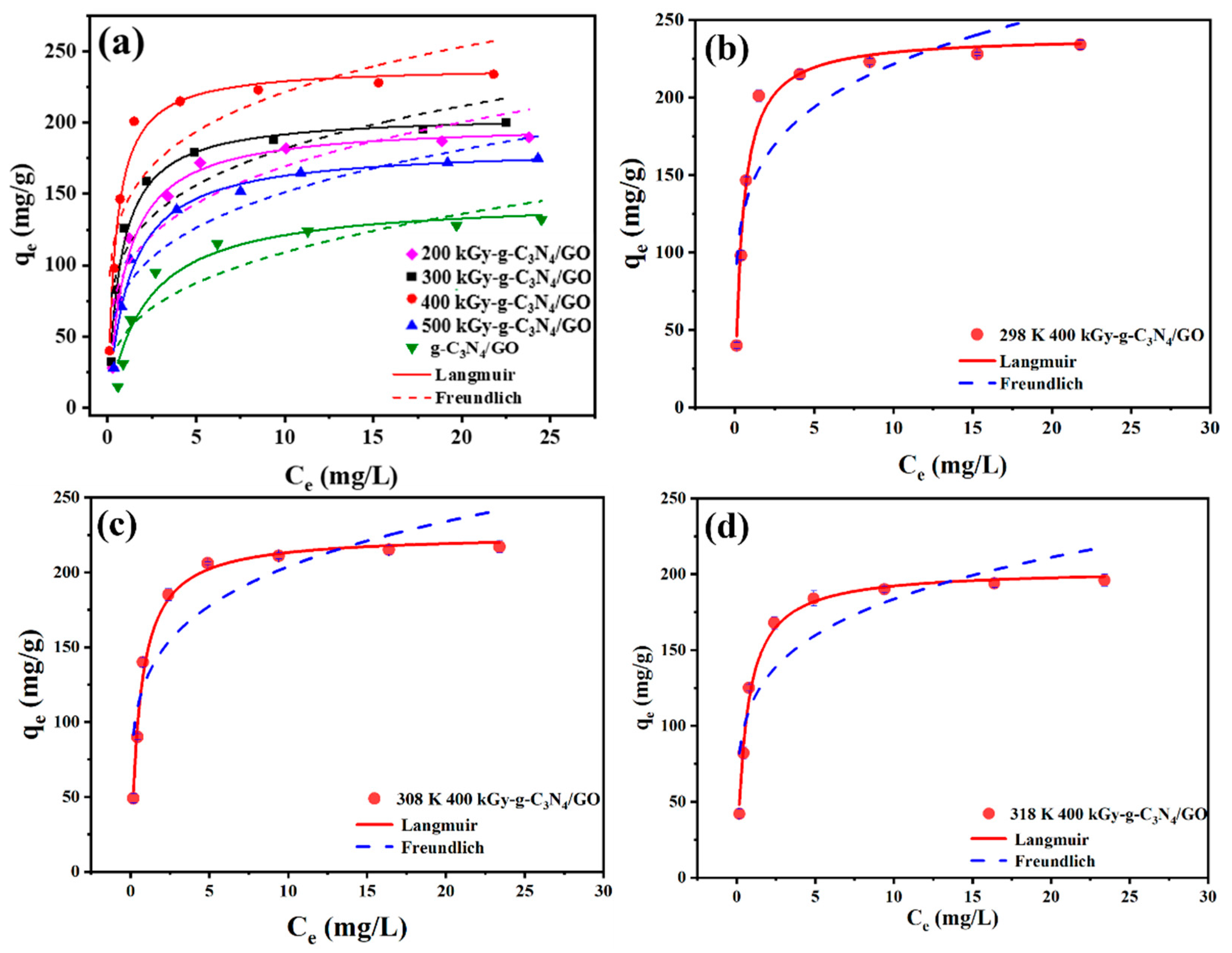
Figure 7 represents the Langmuir and Freundlich fitting results for the equilibrium data. The Langmuir model was detected to provide a good fit to the experimental data for different irradiation doses, as shown in Table 2 (400 kGy-g-C3N4/GO, 298 K, R2 = 0.984). Additionally, as the temperature increased from 298 K to 318 K, the adsorption capacity of 400 kGy-g-C3N4/GO for OFL gradually decreased, reaching its maximum value at 298 K. According to the adsorption isotherm model, the calculated value of the 400 kGy-g-C3N4/GO’s adsorption capacity for OFL was 239.6 mg·g−1, which was quite close to the experimental value (222.0 mg·g−1). Table 3 compares the maximum adsorption capacities of different adsorbents for OFL in different studies. Regarding the Freundlich model, the value of n provided an indication of the validity of the adsorption between the 400 kGy-g-C3N4/GO and OFL.
The temperature-dependent adsorption behavior of adsorbents had also been investigated at various temperatures (298, 308, and 318 K). The parameters of ∆G0, ∆H0, and ∆S0 derived from Gibbs-Helmholtz were further introduced to elucidate the thermodynamics. The obtained adsorption thermodynamic parameters are shown in Table 4. The spontaneous nature of the adsorption process was confirmed by the negative values of ∆G0. Furthermore, the ∆G0 values were more negative with increasing temperature, demonstrating that the adsorption process was more favorable with temperature decreases [55]. The negative value for ∆H0 indicated that the adsorption was an exothermic process. Finally, the positive ΔS0 value confirmed the randomness and the increased affinity of OFL during the adsorption [55].

2.5. Adsorption Mechanism

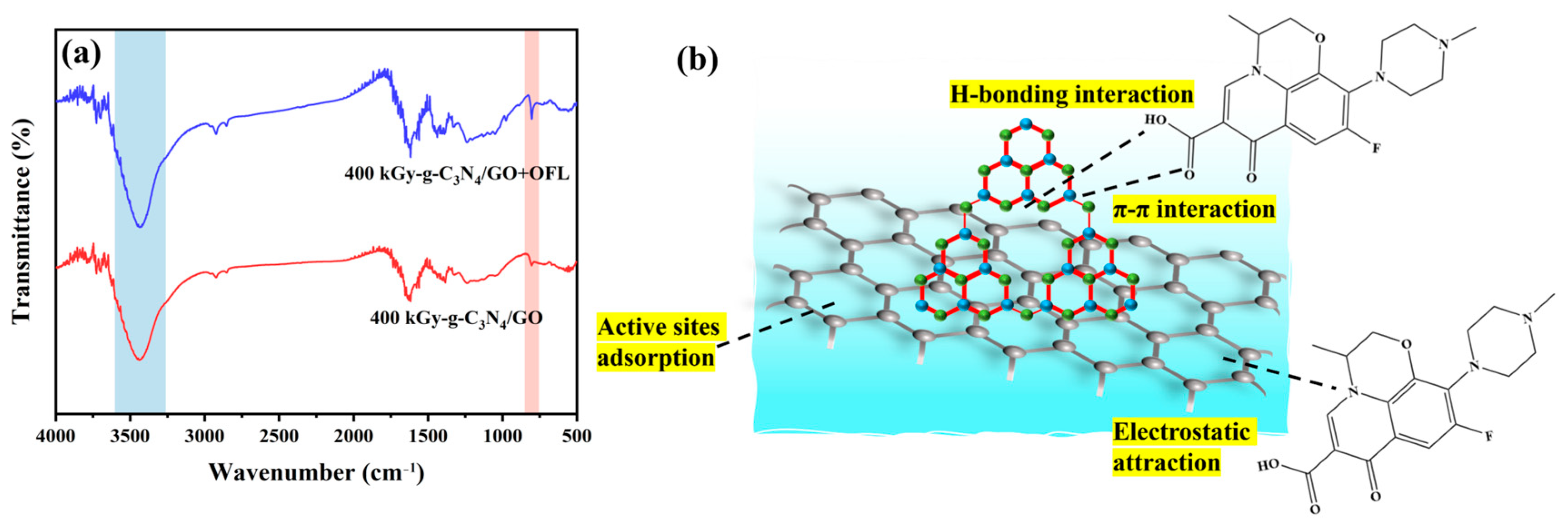
Figure 8a shows the FT-IR spectra of 400 kGy-g-C3N4/GO before and after loading with OFL. The peak at 3000–3500 cm−1 exhibited a redshift and broadening after loading with OFL, indicating hydrogen bonding between the -OH groups of 400 kGy-g-C3N4/GO and OFL. Additionally, following OFL adsorption, the peak at 808 cm−1 was enhanced, indicating the presence of π-π stacking between the aromatic rings of OFL and 400 kGy-g-C3N4/GO. Combined with the N2 adsorption–desorption analysis results discussed earlier, the adsorbent’s large specific surface area and mesoporous structure also provided numerous adsorption sites for OFL. These mesoporous structures and adsorption sites promoted the diffusion of OFL within the 400 kGy-g-C3N4/GO. pH results indicated that strong electrostatic attractions occurred between the -COOH and hydroxyl -OH in 400 kGy-g-C3N4/GO and OFL, which also promoted the adsorption. The possible adsorption mechanisms are shown in Figure 8b.

3. Materials and Methods

3.1. Chemicals and Reagents

The specific materials and reagents are detailed in the Supporting Information.

3.2. Adsorbents Preparation

3.2.1. Preparation for GO

GO was prepared via an optimized hummers method [56]. The main steps are as follows: (1) 3.0 g of graphite flakes and 1.5 g of NaNO3 were dissolved in H2SO4 (69 mL), cooled to 0 °C, followed by the slow addition of KMnO4 (9.0 g) below 20 °C, and subsequently stirred for 7 h at 35 °C; (2) another 9.0 g KMnO4 was added and stirred for 12 h and was subsequently cooled to room temperature, then, 400 mL ice water and 3 mL H2O2 (30%) was poured in the above solution; (3) the mixture was settled, and the supernatant was decanted, followed by washing with diluted HCl and dialysis (MD: 44 mm) for acid removal. When the solution pH approached 7.0, the product was freeze-dried to obtain GO.

3.2.2. Preparation of g-C3N4

Detailed preparation procedure for g-C3N4 is displayed in the Supporting Information.

3.2.3. Preparation of X kGy-g-C3N4/GO

A total of 180 mg of GO was dispersed in 60 mL of pure water, then thoroughly sonicated for half an hour. g-C3N4 (30 mg) was added into the GO solution, mixed thoroughly, then the mixture was transferred into a polyethylene plastic bag. Subsequently, the mixture was irradiated using a high-energy electron accelerator (GJ-2-II, Shanghai Xianfeng Power Plant, Shanghai, China) with a variable current of 0–10 mA, and an energy of 1.8 MeV at irradiation doses (200, 300, 400, and 500 kGy). The final composite was obtained, denoted as X kGy-g-C3N4/GO.

3.3. Characterization

Details of the characterization instruments were presented in Supporting Information.

3.4. Adsorption Experiments

For adsorption, 10 mg of X kGy-g-C3N4/GO was added to 50 mL of OFL solution (concentration ranged from 20 to 45 mg·L−1). Samples (1.5 mL) were collected at 2, 5, 10, 20, 40, 60, 120, 240, and 360 min, and the concentrations were detected using high-performance liquid chromatography (Waters 2695, Milford, MA, USA). The adsorption capacity of X kGy-g-C3N4/GO for OFL was investigated at different conditions, including irradiation dose (200–500 kGy), X kGy-g-C3N4/GO dosage (120–240 mg·L−1), coexisting ions at different concentrations (Cl, SO42−, CO32−, and NO3, 2 mM–5 mM), pH (3.0–11.0), and temperature (298–318 K). Each experiment was repeated at least three times, and the standard deviation was calculated. Equations (S1) and (S2) were used to calculate the adsorption capacity and removal rate, respectively, which were presented in Supporting Information [57].
Details of adsorption kinetics, isotherms, and thermodynamic calculation methods were shown in Supporting Information.

4. Conclusions

In this study, X kGy-g-C3N4/GO composites were successfully synthesized via EBR at different irradiation doses. Characterization results indicated that the EBR-synthesized composite material exhibited characteristic peaks and functional groups of both GO and g-C3N4, confirming the successful composite formation of the two materials. Adsorption experiments demonstrated that the 400 kGy-g-C3N4/GO material exhibited the optimal adsorption performance and maximum adsorption capacity (222.0 mg·g−1) for OFL. Within a certain range (20–45 mg·L−1), the adsorption performance of OFL over 400 kGy-g-C3N4/GO increased with initial OFL concentration increasing and exhibited the maximum ability at pH = 7.0. Concurrently, the presence of CO32− in the solution competed with OFL molecules for adsorption, reducing the adsorption performance. Kinetics and isotherm studies confirmed that the pseudo-second-order kinetics and Langmuir isotherm models accurately represented the adsorption process. According to the intra-particle diffusion model, both surface adsorption and intra-particle diffusion within particles had an impact on the adsorption process. Furthermore, the thermodynamic result of the process revealed the exothermic and spontaneous of the adsorption process. Consequently, the results of the present study suggest that the EBR synthesis is a viable method for preparing X kGy-g-C3N4/GO with enhanced OFL adsorption performance, and X kGy-g-C3N4/GO could be utilized as an adsorbent with high capability for OFL removal in practical applications.

Supplementary Materials

The following supporting information can be downloaded at: https://www.mdpi.com/article/10.3390/catal15121118/s1, Table S1: Physical parameters of materials at different irradiation doses; Section S2: Materials and Methods. References [58,59] are cited in the supplementary materials.

Author Contributions

Z.L. (Zhiying Li): Writing—original draft. S.G.: Validation, Visualization. B.N.: Data curation. Z.L. (Zhuopeng Lin): Investigation. T.H.: Methodology. D.W.: Data curation. J.L.: Supervision, Funding acquisition. N.L.: Writing—review and editing, Funding acquisition. All authors have read and agreed to the published version of the manuscript.

Funding

This research was funded by National Natural Science Foundation of China (Nos. 12075152, 42177405, 12075147), Innovation Program of Shanghai Municipal Education Commission (2021-03-147), and Energy Science and Technology discipline under the Shanghai Class IV Peak Disciplinary Development Program for the financial support.

Data Availability Statement

The raw data supporting the conclusions of this article will be made available by the authors on request.

Conflicts of Interest

The authors declare that they have no known competing financial interests or personal relationships that could have appeared to influence the work reported in this paper.

References

  1. Xu, J.; Jiao, G.H.; Sheng, G.; Lin, N.P.; Yang, B.J.; Wang, J.F.; Jiang, H.; Wang, Y.; Zhang, X.D. Microwave-assisted PMS activation Ti3C2/LaFe0.5Cu0.5O3-P catalysts for efficient degradation of CIP: Enhancement of catalytic performance by phosphoric acid etching. Sep. Purif. Technol. 2025, 354, 129357. [Google Scholar] [CrossRef]
  2. Xu, J.; Zhang, Z.; Yang, J.; Ma, Y.; Han, T.; Quan, G.; Zhang, X.; Lei, J.; Liu, N. Treatment of Pharmaceuticals and Personal Care Products (PPCPs) Using Periodate-Based Advanced Oxidation Technology: A Review. Chem. Eng. J. 2025, 512, 162355. [Google Scholar] [CrossRef]
  3. Liu, N.; Xu, J.; Zhai, Y.; Zhang, Z.; Dang, Y.; Cao, Y.; Li, Z.; Huang, W.; Zhang, X.; Tang, L. Structure–Activity Relationship in Periodate Activation by Fe-MOFs: Why MIL-101(Fe) Outperforms Other MIL-Series in Antibiotic Degradation. Green Energy Environ. 2025; in press. [Google Scholar] [CrossRef]
  4. Wang, Y.; Jiang, G.H.; Yang, Y.X.; Wang, J.F.; Zhang, J.H.; Jiang, H.; Liu, N.; Zhang, X.D. 3D structure of LaFe1-δCoδO3@carbon cloth composite catalyst for promoting peroxymonosulfate activation: Identification of catalytic mechanism towards multiple antibiotics. Desalination 2025, 602, 118643. [Google Scholar] [CrossRef]
  5. Wang, Y.; Xu, J.; Sheng, G.; Wang, J.F.; Yang, B.J.; Jiang, H.; Liu, N.; Zhang, X.D. LaFeO3 anchoring on ZIF-67 for the activation of peroxymonosulfate toward ofloxacin degradation: Radical and non-radical reaction pathways. Sep. Purif. Technol. 2025, 362, 131846. [Google Scholar] [CrossRef]
  6. Bai, H.J.; Zhang, Q.F.; Zhou, X.; Chen, J.H.; Chen, Z.H.; Liu, Z.Z.; Yan, J.; Wang, J. Removal of Fluoroquinolone Antibiotics by Adsorption of Dopamine-Modified Biochar Aerogel. Korean J. Chem. Eng. 2023, 40, 215–222. [Google Scholar] [CrossRef]
  7. Weng, X.; Cai, W.; Owens, G.; Chen, Z. Magnetic Iron Nanoparticles Calcined from Biosynthesis for Fluoroquinolone Antibiotic Removal from Wastewater. J. Clean. Prod. 2021, 319, 128734. [Google Scholar] [CrossRef]
  8. Zhang, Q.; Zheng, D.; Bai, B.; Hu, N.; Wang, H. Solar-Driven Photothermal-Fenton Removal of Ofloxacin through Waste Natural Pyrite with Dual-Function. Colloids Surf. A Physicochem. Eng. Asp. 2022, 641, 128574. [Google Scholar] [CrossRef]
  9. Yang, L.; Ren, L.; Tan, X.; Chu, H.; Chen, J.; Zhang, Y.; Zhou, X. Removal of Ofloxacin with Biofuel Production by Oleaginous Microalgae Scenedesmus Obliquus. Bioresour. Technol. 2020, 315, 123738. [Google Scholar] [CrossRef]
  10. Jaswal, A.; Kaur, M.; Singh, S.; Kansal, S.K.; Umar, A.; Garoufalis, C.S.; Baskoutas, S. Adsorptive Removal of Antibiotic Ofloxacin in Aqueous Phase Using rGO-MoS2 Heterostructure. J. Hazard. Mater. 2021, 417, 125982. [Google Scholar] [CrossRef]
  11. Barquilha, C.E.R.; Braga, M.C.B. Adsorption of Organic and Inorganic Pollutants onto Biochars: Challenges, Operating Conditions, and Mechanisms. Bioresour. Technol. Rep. 2021, 15, 100728. [Google Scholar] [CrossRef]
  12. He, S.; Chen, Q.; Chen, G.; Shi, G.; Ruan, C.; Feng, M.; Ma, Y.; Jin, X.; Liu, X.; Du, C.; et al. N-Doped Activated Carbon for High-Efficiency Ofloxacin Adsorption. Microporous Mesoporous Mater. 2022, 335, 111848. [Google Scholar] [CrossRef]
  13. Komal; Gupta, K.; Nidhi; Kaushik, A.; Singhal, S. Amelioration of Adsorptive Efficacy by Synergistic Assemblage of Functionalized Graphene Oxide with Esterified Cellulose Nanofibers for Mitigation of Pharmaceutical Waste. J. Hazard. Mater. 2022, 424, 127541. [Google Scholar] [CrossRef]
  14. Zhu, C.; Lang, Y.; Liu, B.; Zhao, H. Ofloxacin Adsorption on Chitosan/Biochar Composite: Kinetics, Isotherms, and Effects of Solution Chemistry. Polycycl. Aromat. Compd. 2019, 39, 287–297. [Google Scholar] [CrossRef]
  15. Ismail, N.; Imran, M.; Ramzan, M.; Anwar, A.; Alsafari, I.A.; Asgher, M.; Iqbal, H.M.N. Functionalized Graphene Oxide-Zinc Oxide Hybrid Material and Its Deployment for Adsorptive Removal of Levofloxacin from Aqueous Media. Environ. Res. 2023, 217, 114958. [Google Scholar] [CrossRef]
  16. Liu, N.; Tian, M.; Zhang, Y.; Yang, J.; Wang, Z.; Dai, W.; Quan, G.; Lei, J.; Zhang, X.; Tang, L. Three-Dimensional MIL-88A(Fe)-Derived α-Fe2O3 and Graphene Composite for Efficient Photo-Fenton-like Degradation of Ciprofloxacin. Chin. Chem. Lett. 2025, 36, 111063. [Google Scholar] [CrossRef]
  17. Ogunleye, D.T.; Akpotu, S.O.; Moodley, B. Adsorption of Sulfamethoxazole and Reactive Blue 19 Using Graphene Oxide Modified with Imidazolium Based Ionic Liquid. Environ. Technol. Innov. 2020, 17, 100616. [Google Scholar] [CrossRef]
  18. Rahman, N.; Raheem, A. Mechanistic Investigation of Levofloxacin Adsorption on Fe (III)-Tartaric Acid/Xanthan Gum/Graphene Oxide/Polyacrylamide Hydrogel: Box-Behnken Design and Taguchi Method for Optimization. J. Ind. Eng. Chem. 2023, 127, 110–124. [Google Scholar] [CrossRef]
  19. Ong, W.; Tan, L.; Ng, Y.; Yong, S.; Chai, S. Graphitic Carbon Nitride (g-C3N4)-Based Photocatalysts for Artificial Photosynthesis and Environmental Remediation: Are We a Step Closer to Achieving Sustainability? Chem. Rev. 2016, 16, 112. [Google Scholar] [CrossRef]
  20. Fan, M.; Zhu, C.; Yang, J.; Sun, D. Facile Self-Assembly N-Doped Graphene Quantum Dots/Graphene for Oxygen Reduction Reaction. Electrochim. Acta 2016, 216, 102–109. [Google Scholar] [CrossRef]
  21. Pavlov, Y.S.; Petrenko, V.V.; Alekseev, P.A.; Bystrov, P.A.; Souvorova, O.V. Trends and Opportunities for the Development of Electron-Beam Energy-Intensive Technologies. Radiat. Phys. Chem. 2022, 198, 110199. [Google Scholar] [CrossRef]
  22. Zhang, Z.; Dong, H.; Zhou, D.; Tang, K.; Ma, Y.; Han, T.; Lei, J.; Huang, S.; Zhang, X.; Tang, L.; et al. Electron Beam- Induced Defect Engineering Construction in MIL-68(In) for Enhanced CO2 Photoreduction: Unravelling Organic Framework Defects. J. Colloid Interface Sci. 2026, 702, 138990. [Google Scholar] [CrossRef] [PubMed]
  23. Gao, J.; Li, X.; Chen, T.; Zhao, Y.; Xiong, H.H.; Han, X.B. Application Progress of Electron Beam Radiation in Adsorption Functional Materials Preparation. Molecules 2025, 30, 1084. [Google Scholar] [CrossRef]
  24. Li, J.; Tang, Y.; Jin, R.; Meng, Q.; Chen, Y.; Long, X.; Wang, L.; Guo, H.; Zhang, S. Ultrasonic-Microwave Assisted Synthesis of GO/g-C3N4 Composites for Efficient Photocatalytic H2 Evolution. Solid State Sci. 2019, 97, 105990. [Google Scholar] [CrossRef]
  25. Li, H.T.; Li, N.; Wang, M.; Zhao, B.P.; Long, F. Synthesis of Novel and Stable G-C3N4-Bi2WO6 Hybrid Nanocomposites and Their Enhanced Photocatalytic Activity under Visible Light Irradiation. R. Soc. Open Sci. 2018, 5, 171419. [Google Scholar] [CrossRef]
  26. Zhou, D.; Zhang, Z.; Dong, H.; Liu, Y.; Hu, B.; Huang, S.; Zhang, X.; Lei, J.; Liu, N. In Situ Electronic Modulation of G-C3N4/UiO66 Composites via N Species Functionalized Ligands for Enhanced Photocatalytic CO2 Reduction. Sep. Purif. Technol. 2025, 379, 134964. [Google Scholar] [CrossRef]
  27. Molla, A.; Li, Y.; Mandal, B.; Kang, S.G.; Hur, S.H.; Chung, J.S. Selective Adsorption of Organic Dyes on Graphene Oxide: Theoretical and Experimental Analysis. Appl. Surf. Sci. 2019, 464, 170–177. [Google Scholar] [CrossRef]
  28. Svoboda, L.; Škuta, R.; Matějka, V.; Dvorský, R.; Matýsek, D.; Henych, J.; Mančík, P.; Praus, P. Graphene Oxide and Graphitic Carbon Nitride Nanocomposites Assembled by Electrostatic Attraction Forces: Synthesis and Characterization. Mater. Chem. Phys. 2019, 228, 228–236. [Google Scholar] [CrossRef]
  29. Molla, A.; Youk, J.H. Mechanochemical Synthesis of Graphitic Carbon Nitride/Graphene Oxide Nanocomposites for Dye Sorption. Dye. Pigment. 2023, 220, 111725. [Google Scholar] [CrossRef]
  30. Dou, S.; Ke, X.X.; Shao, Z.D.; Zhong, L.B.; Zhao, Q.B.; Zheng, Y.M. Fish Scale-Based Biochar with Defined Pore Size and Ultrahigh Specific Surface Area for Highly Efficient Adsorption of Ciprofloxacin. Chemosphere 2022, 287, 131962. [Google Scholar] [CrossRef] [PubMed]
  31. Yang, Y.; Chan, L.; Li, D.Y.; Yi, R.-B.; Mo, J.W.; Wu, M.H.; Xu, G. Controllable reduction of graphene oxide by electron-beam irradiation. RSC Adv. 2019, 9, 3597. [Google Scholar] [CrossRef] [PubMed]
  32. Lee, H.M.; Kim, J.H.; Kim, B.J. Effects of electron beam irradiation on dimethyl methlyphosphonate adsorption behavior of activated carbon fibers. Energy Convers. Manag. 2024, 314, 118641. [Google Scholar] [CrossRef]
  33. Sitek, J.; Czerniak-Łosiewicz, K.; Gertych, A.-P.; Giza, M.; Dąbrowski, P.; Rogala, M.; Wilczynski, K.; Sławomir, K.; Conran, B.R.; Wang, X.C.; et al. Selective Growth of van der Waals Heterostructures Enabled by Electron-Beam Irradiation. ACS Appl. Mater. Interfaces 2023, 15, 33838–33847. [Google Scholar] [CrossRef]
  34. Wang, G.; Zhang, Y.; Zhang, S.; Liu, P.; Zhu, L.; Huang, Z.; Cao, Z.; Meng, X. Fabrication of Graphene/Cu Composites with in-Situ Grown Graphene from Solid Carbon Source. J. Mater. Res. Technol. 2023, 24, 2372–2384. [Google Scholar] [CrossRef]
  35. Wang, M.; Ji, X.; Wang, L.; Li, X.; Lin, H.; Zhang, J.; Li, H.; Lin, Y.; Gradon, L.; Zheng, Y.; et al. Carbon Nitride Nanosheets Induce Pulmonary Surfactant Deposition via Dysfunction of Alveolar Secretion and Clearance. Nano Today 2024, 58, 102457. [Google Scholar] [CrossRef]
  36. Mao, H.H.; Wang, L.; Zhang, Q.; Chen, F.K.; Song, Y.Z.; Gui, H.G.; Cui, A.J.; Yao, C. Synergetic Adsorption–Photocatalytic Activated Fenton System via Iron-Doped g-C3N4/GO Hybrid for Complex Wastewater. Catalysts 2023, 13, 88. [Google Scholar] [CrossRef]
  37. Lyth, S.M.; Nabae, Y.; Moriya, S.; Kuroki, S.; Kakimoto, M.; Ozaki, J.; Miyata, S. Carbon Nitride as a Nonprecious Catalyst for Electrochemical Oxygen Reduction. J. Phys. Chem. C 2009, 113, 20148. [Google Scholar] [CrossRef]
  38. Cui, Y. In-Situ Synthesis of C3N4/CdS Composites with Enhanced Photocatalytic Properties. Chin. J. Catal. 2015, 36, 372–379. [Google Scholar] [CrossRef]
  39. Dong, F.; Sun, Y.J.; Fu, M.; Ho, W.K.; Lee, S.; Wu, Z.B. Novel in Situ N-Doped (BiO)2CO3 Hierarchical Microspheres Self-Assembled by Nanosheets as Efficient and Durable Visible Light Driven Photocatalyst. Langmuir 2011, 1, 28. [Google Scholar] [CrossRef]
  40. Shaha, C.K.; Mahmud, M.A.A.; Saha, S.; Karmaker, S.; Saha, T.K. Efficient Removal of Sparfloxacin Antibiotic from Water Using Sulfonated Graphene Oxide: Kinetics, Thermodynamics, and Environmental Implications. Heliyon 2024, 10, e33644. [Google Scholar] [CrossRef]
  41. Li, Z.Y.; Zhao, L.; Ao, V.Q.; Zhang, G.; Kang, D.Q.; Li, Y.L.; Liu, J.; Ding, G.T.; Ma, Z.R.; Tewo, Y.H.; et al. Exploring the cationic surfactant adsorption efficiency at concentrations relative to the critical micelle concentration by SA/SiO2 microspheres. J. Environ. Manag. 2024, 367, 122069. [Google Scholar] [CrossRef]
  42. Kong, Q.; He, X.; Shu, L.; Miao, M. Ofloxacin Adsorption by Activated Carbon Derived from Luffa Sponge: Kinetic, Isotherm, and Thermodynamic Analyses. Process Saf. Environ. Prot. 2017, 112, 254–264. [Google Scholar] [CrossRef]
  43. Derya, A.D.; Dilek, D.Y.; Yalçın, Ş.Y. Magnetic chitosan/calcium alginate double-network hydrogel beads: Preparation, adsorption of anionic and cationic surfactants, and reuse in the removal of methylene blue. Int. J. Biol. Macromol. 2023, 239, 124311. [Google Scholar] [CrossRef]
  44. Wen, Y.; Wang, Z.; Cai, Y.; Song, M.; Qi, K.; Xie, X. S-Scheme BiVO4/CQDs/β-FeOOH Photocatalyst for Efficient Degradation of Ofloxacin: Reactive Oxygen Species Transformation Mechanism Insight. Chemosphere 2022, 295, 133784. [Google Scholar] [CrossRef]
  45. Xie, H.; Xiong, X. A Porous Molybdenum Disulfide and Reduced Graphene Oxide Nanocomposite (MoS2-rGO) with High Adsorption Capacity for Fast and Preferential Adsorption towards Congo Red. J. Environ. Chem. Eng. 2017, 5, 1150–1158. [Google Scholar] [CrossRef]
  46. Wang, Z.; Jang, H.M. Comparative Study on Characteristics and Mechanism of Levofloxacin Adsorption on Swine Manure Biochar. Bioresour. Technol. 2022, 351, 127025. [Google Scholar] [CrossRef]
  47. Li, H.; Zhang, D.; Han, X.; Xing, B. Adsorption of Antibiotic Ciprofloxacin on Carbon Nanotubes: pH Dependence and Thermodynamics. Chemosphere 2014, 95, 150–155. [Google Scholar] [CrossRef]
  48. Yang, X.; Zhang, X.; Wang, Z.; Li, S.; Zhao, J.; Liang, G.; Xie, X. Mechanistic Insights into Removal of Norfloxacin from Water Using Different Natural Iron Ore–Biochar Composites: More Rich Free Radicals Derived from Natural Pyrite-Biochar Composites than Hematite-Biochar Composites. Appl. Catal. B Environ. 2019, 255, 117752. [Google Scholar] [CrossRef]
  49. Kaur, G.; Singh, N.; Rajor, A. RSM-CCD Optimized Prosopis Juliflora Activated Carbon for the Adsorptive Uptake of Ofloxacin and Disposal Studies. Environ. Technol. Innov. 2022, 25, 102176. [Google Scholar] [CrossRef]
  50. Michela, S.; Constantin, P.; Giulia, G.; Federica, M.; Giovanna, B.; Francesco, M.; Antonella, P.; Doretta, C. Combined Layer-by-Layer/Hydrothermal Synthesis of Fe3O4@MIL-100(Fe) for Ofloxacin Adsorption from Environmental Waters. Nanomaterials 2021, 11, 3275. [Google Scholar] [CrossRef]
  51. Yu, R.; Wu, Z. High Adsorption for Ofloxacin and Reusability by the Use of ZIF-8 for Wastewater Treatment. Microporous Mesoporous Mater. 2020, 308, 110494. [Google Scholar] [CrossRef]
  52. Ehtesabi, H.; Bagheri, Z.; Yaghoubi-Avini, M. Application of Three-Dimensional Graphene Hydrogels for Removal of Ofloxacin from Aqueous Solutions. Environ. Nanotechnol. Monit. Manag. 2019, 12, 100274. [Google Scholar] [CrossRef]
  53. Sulaiman, N.S.; Mohamad Amini, M.H.; Danish, M.; Sulaiman, O.; Hashim, R.; Demirel, S.; Demirel, G.K. Characterization and Ofloxacin Adsorption Studies of Chemically Modified Activated Carbon from Cassava Stem. Materials 2022, 15, 5117. [Google Scholar] [CrossRef]
  54. Alatawi, R.A.S. Construction of Amino-Functionalized Molecularly Imprinted Silica Particles for (±)-Ofloxacin Chiral Separation. Chem. Sel. 2023, 8, e202204455. [Google Scholar] [CrossRef]
  55. Ahmad, M.B.; Soomro, U.; Muqeet, M.; Ahmed, Z. Adsorption of Indigo Carmine Dye onto the Surface-Modified Adsorbent Prepared from Municipal Waste and Simulation Using Deep Neural Network. J. Hazard. Mater. 2021, 408, 124433. [Google Scholar] [CrossRef] [PubMed]
  56. Novoselov, K.S.; Geim, A.K.; Morozov, S.V. Electric field effect inatomically thin carbon films. Science 2004, 306, 666–669. [Google Scholar] [CrossRef] [PubMed]
  57. Dai, C.; Li, Y.; Qi, B.; Li, Z.; He, Z.; Wang, B.; Fang, F.; Dai, X.; Qin, X.; Wan, Y. Preparation of Amine-Modified Lignin Adsorbent for Highly Efficient and Selective Removal of Sodium Dodecyl Benzene Sulfonate from Greywater. Sep. Purif. Technol. 2025, 353, 128334. [Google Scholar] [CrossRef]
  58. Xiong, H.; Zhao, X.; Song, K.; Gao, D.; Yang, Z.; Han, L. Valorizing copper-contaminated manure into biochar for tetracycline adsorption: Dynamics and interactions of tetracycline adsorption and copper leaching. Waste Manag. 2025, 203, 114880. [Google Scholar] [CrossRef]
  59. Hu, W.; Chen, J.; Zhang, J. PEI-grafted graphene oxide modified phosphogypsum for the adsorption and removal of heavy metals and dyes in wastewater. Water Res. 2025, 286, 124236. [Google Scholar] [CrossRef]
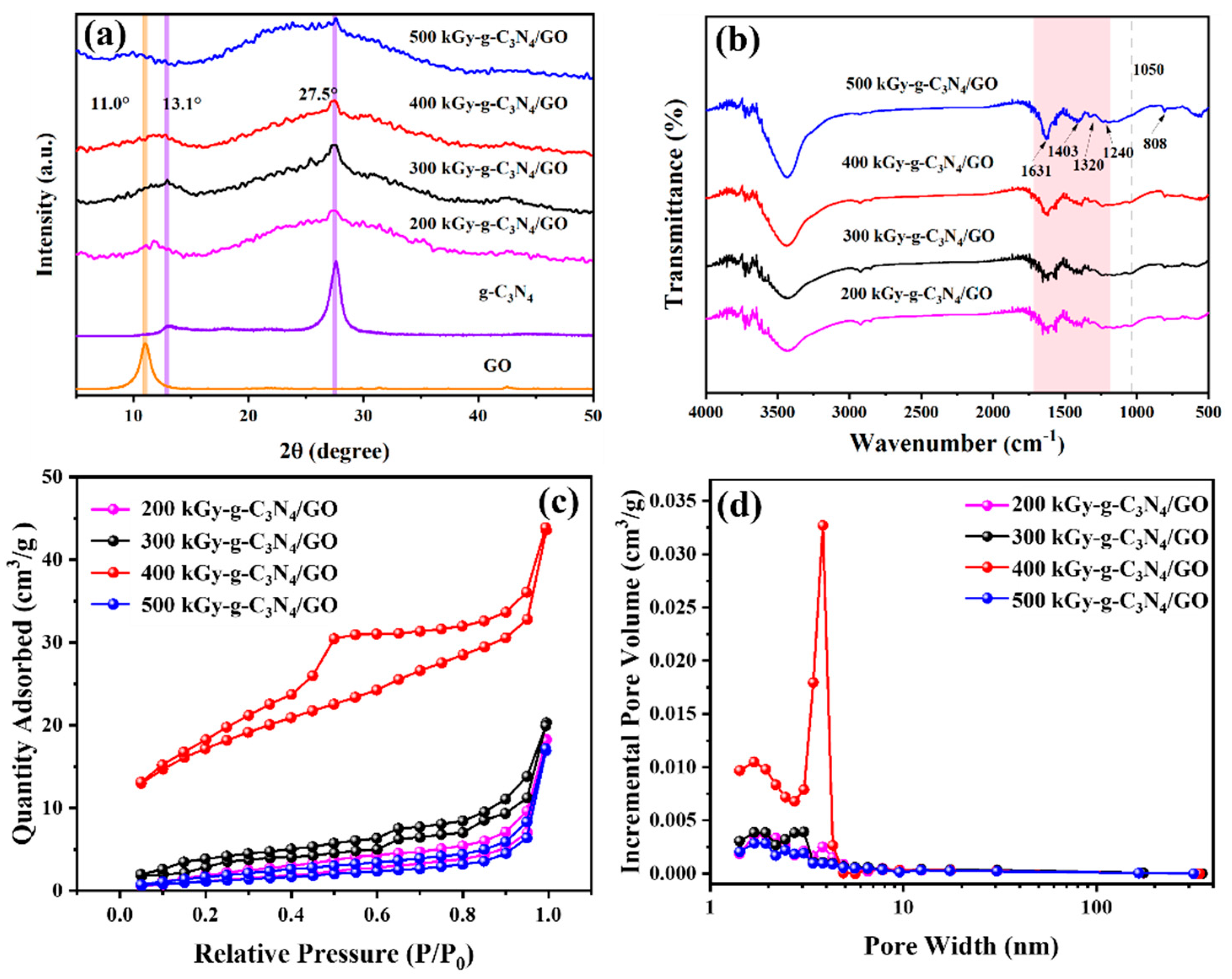
Figure 1. (a) XRD patterns of GO, g-C3N4, and X kGy-g-C3N4/GO (the orange and purple regions from left to right correspond to peaks at 11.0°, 13.1°, and 27.5°), (b) FT-IR spectra (the colored region encompasses multiple spectral bands at 1200–1700 cm−1, corresponding to CN heterocycle vibrations, and the dashed line indicates a peak at 1050 cm−1, corresponding to the stretching vibration of the C-O bond in the alkoxy group), (c) N2 adsorption–desorption isotherms and (d) pore size distribution of X kGy-g-C3N4/GO.
Catalysts 15 01118 g001
Figure 2. (a) SEM image, (b) TEM image, (c) HRTEM image, and (df) EDS elemental mapping of 400 kGy-g-C3N4/GO.
Catalysts 15 01118 g002
Figure 3. XPS spectra of 400 kGy-g-C3N4/GO, (a) survey, (b) C 1s, (c) N 1s, (d) O 1s.
Catalysts 15 01118 g003
Figure 4. Adsorption capacity for the removal of OFL using X kGy-g-C3N4/GO: (a) different irradiation doses, (b) 400 kGy-g-C3N4/GO dosage, (c) initial concentration of OFL, and (d) coexisting ions.
Catalysts 15 01118 g004
Figure 5. (a) Zero-charge point of 400 kGy-g-C3N4/GO and the presence of OFL forms at different pH, (b) effect of pH, and (c) temperature on adsorption capacity of 400 kGy-g-C3N4/GO.
Catalysts 15 01118 g005
Figure 6. Adsorption kinetics of OFL over X kGy-g-C3N4/GO (a) pseudo-first-model (dotted lines), and pseudo-second-model (solid lines), (b) intra-particle diffusion model.
Catalysts 15 01118 g006
Figure 7. Adsorption isotherms at different temperatures (a) Langmuir, and Freundlich (b) 298 K, (c) 308 K, (d) 318 K (solid line represents the Langmuir isotherm fitting, while the dotted line represents the Freundlich isotherm fitting).
Catalysts 15 01118 g007
Figure 8. (a) FT-IR spectra of 400 kGy-g-C3N4/GO before and after adsorption of OFL (blue region indicates the peak at 3000–3500 cm−1, while the red region corresponds to the peak at 808 cm−1), and (b) mechanism of OFL adsorption.
Catalysts 15 01118 g008
Table 1. The adsorption kinetic parameters of OFL over X kGy-g-C3N4/GO.
ModelsAdsorbentsParameters
qt (mg·g−1)K1 (min−1)R2
Pseudo-first-order200 kGy-g-C3N4/GO
300 kGy-g-C3N4/GO
400 kGy-g-C3N4/GO
500 kGy-g-C3N4/GO
161.7
168.2
210.7
149.5
0.018
0.020
0.060
0.026
0.998
0.996
0.970
0.990
qt (mg·g−1)K1 (min−1)R2
Pseudo-second-order200 kGy-g-C3N4/GO
300 kGy-g-C3N4/GO
400 kGy-g-C3N4/GO
500 kGy-g-C3N4/GO
193.4
197.6
230.6
171.0
9.68 × 10⁻⁵
1.16 × 10⁻⁴
3.57 × 10⁻⁴
1.81 × 10⁻⁴
0.996
0.989
0.995
0.999
Intra-particle diffusion400 kGy-g-C3N4/GOKb mg·(g·min1/2)−1C (mg·g−1)R2
32.680.2970.991
16.8779.640.974
1.477196.80.977
Table 2. The adsorption isotherm parameters of OFL over X kGy-g-C3N4/GO.
LangmuirFreundlich
AdsorbentsT (K)KL (L·mg−1)qm (mg·g−1)R2nKF [(mg·g−1) (L mg−1)1/n]R2
200 kGy-g-C3N4/GO2980.97199.90.9794.12697.000.809
300 kGy-g-C3N4/GO2981.36206.00.9834.559109.70.797
400 kGy-g-C3N4/GO2982.16239.60.9845.182142.00.765
3081.75225.30.9915.016128.80.795
3181.72203.20.9924.970115.50.795
500 kGy-g-C3N4/GO2980.81182.90.9833.84683.100.855
Table 3. Comparison of the maximum capacity of various adsorbents for OFL.
AdsorbentAdsorption Capacity (mg·g−1)Optimum pHTemperature (K)Reference
Rice husk ash6.266.0-[49]
Fe3O4 Metal–organic framework218.0-298[50]
ZIF-8 MOF194.17.0298[51]
3D Graphene hydrogel134.0-363[52]
Raw cassava stem42.378.0328[53]
Amino functionalized molecularly imprinted silica261.17.0-[54]
400 kGy-g-C3N4/GO222.07.0298This Work
Table 4. The parameters of thermodynamic adsorption of OFL over 400 kGy-g-C3N4/GO.
T (K)∆G0 (kJ·mol−1)∆H0 (kJ·mol−1)∆S0 (kJ·mol −1·K−1)
298−25.21−10.250.050
308−25.66
318−26.21
Disclaimer/Publisher’s Note: The statements, opinions and data contained in all publications are solely those of the individual author(s) and contributor(s) and not of MDPI and/or the editor(s). MDPI and/or the editor(s) disclaim responsibility for any injury to people or property resulting from any ideas, methods, instructions or products referred to in the content.