Article

Cobalt Nanoparticle-Modified Boron Nitride Nanobelts for Rapid Tetracycline Degradation via PMS Activation


Shandong Key Laboratory of Advanced Electrochemical Energy Storage Technologies, College of New Energy, China University of Petroleum (East China), Qingdao 266580, China
*
Authors to whom correspondence should be addressed.
Catalysts 2025, 15(12), 1117; https://doi.org/10.3390/catal15121117
Submission received: 3 November 2025 / Revised: 13 November 2025 / Accepted: 16 November 2025 / Published: 1 December 2025
(This article belongs to the Special Issue Catalysis and New Energy Materials)

Abstract

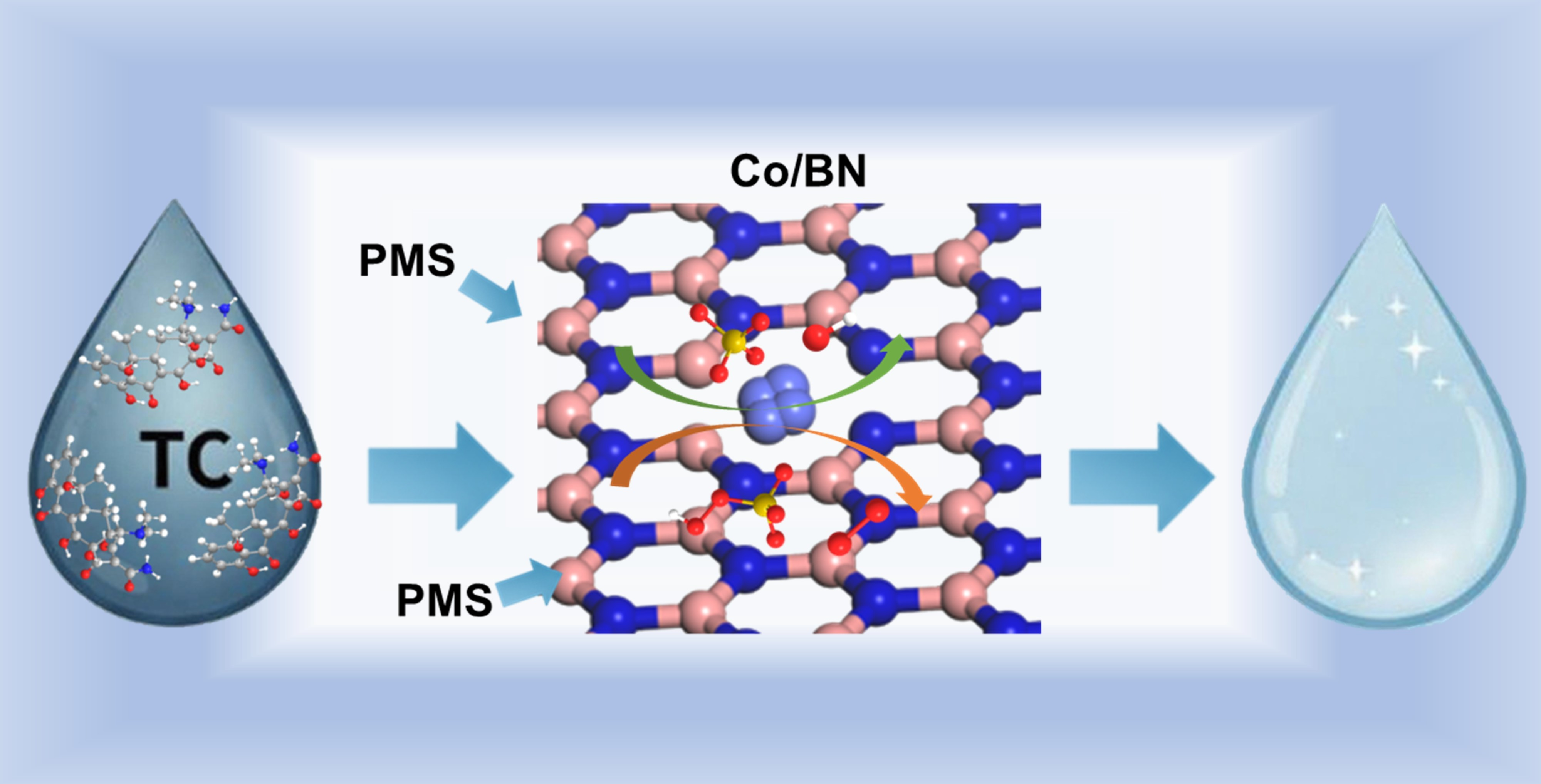
Tetracycline (TC), a widely used antibiotic, persists in aquatic environments due to its chemical stability, bioaccumulation potential, and role in promoting antimicrobial resistance, posing significant ecological and public health risks. To address the pressing need for effective wastewater treatment technologies, a cobalt nanoparticle-embedded boron nitride nanocomposite (Co/BN) was developed for efficient peroxymonosulfate (PMS) activation. Among the synthesized catalysts, Co/BN-1 exhibited outstanding performance, achieving near-complete TC degradation within 5 min under mild conditions, along with excellent stability and reusability over four consecutive cycles, accompanied by minimal cobalt leaching. Mechanistic studies combining radical scavenging assays and LC-MS analysis revealed the involvement of both radical species (SO4 and OH) and non-radical pathways (1O2), highlighting a synergistic effect between Co nanoparticles and the BN matrix. This work demonstrates the feasibility of Co/BN composites as highly efficient, stable, and eco-friendly catalysts for sulfate radical-based advanced oxidation processes (SR-AOPs), providing a promising strategy for the rapid and sustainable removal of antibiotic pollutants from water systems.

1. Introduction

Tetracycline (TC), a broad-spectrum antibiotic extensively used in human and veterinary medicine, exhibits high chemical stability and resistance to biodegradation [1,2,3]. As a result of incomplete metabolic clearance and insufficient removal during conventional wastewater treatment, substantial quantities of TC are discharged into aquatic ecosystems, where it accumulates and persists as an emerging contaminant [4,5]. Chronic exposure to TC in surface waters can disrupt aquatic microbial communities, accelerate the spread of antibiotic resistance genes, and pose indirect risks to human health via the food chain [6]. Therefore, there is an urgent need for efficient, sustainable, and eco-friendly technologies capable of effectively removing TC from contaminated water sources.
Conventional water treatment technologies-such as physical adsorption, coagulation-precipitation, and biological degradation-typically show limited efficacy in degrading persistent antibiotics, especially in complex real-world water matrices [7]. Furthermore, these methods may produce secondary pollutants or fail to mineralize the bioactive moieties of antibiotics, thereby limiting their practical applicability. In contrast, sulfate radical-based advanced oxidation processes (SR-AOPs), which rely on the activation of peroxymonosulfate (PMS) or peroxydisulfate (PDS), have gained increasing attention as effective alternatives [8,9,10]. Upon activation, PMS generates highly reactive sulfate radicals (SO4, E0 ≈ 2.5–3.1 V), capable of oxidizing a broad spectrum of recalcitrant organic compounds, including antibiotics, through bond cleavage and subsequent mineralization into CO2 and H2O [7]. Crucially, SR-AOPs operate under mild conditions (e.g., neutral pH, ambient temperature), exhibit high degradation efficiency, and minimize secondary pollution, positioning them as a paradigm for sustainable water treatment.
Among various PMS activators, transition metal cobalt (Co) stands out due to its exceptional catalytic activity in efficiently activating PMS [11,12,13,14,15]. Co-based catalysts have achieved near-complete degradation of diverse organic pollutants, including antibiotics, within 5–10 min under ambient conditions [16,17]. For instance, a monolithic cobalt-based catalyst (NaOH/WASG) reported by Jia et al. achieved 95.7% removal of TC within 20 min [18]. And the Co3O4/BC reported by Song et al. achieved 90% degradation of TC within 20 min [19]. Nevertheless, the widespread use of homogeneous or poorly immobilized Co catalysts remains limited by critical drawbacks such as cobalt leaching, poor reusability, and potential ecotoxicity. These limitations have spurred intense research into the development of heterogeneous, stable, and environmentally safe Co-based composite catalysts. Boron nitride (BN), a two-dimensional layered material with a graphite-like hexagonal lattice composed of equimolar B and N atoms, has emerged as a promising support material due to its high specific surface area, excellent thermal- chemical stability, and tunable surface functionality [20,21,22]. BN can effectively anchor Co nanoparticles, suppressing aggregation and migration, while simultaneously minimizing metal leaching, thus enhancing catalytic durability and environmental safety [23].
In this study, a series of cobalt nanoparticle-modified boron nitride nanobelts (Co/BN) were synthesized to construct a hierarchical porous architecture with high surface area, enabling uniform dispersion and enhanced accessibility of Co species. The resulting Co/BN composites were evaluated as efficient heterogeneous catalysts for PMS activation and rapid degradation of tetracycline in aqueous solutions. The strong interfacial interaction between Co nanoparticles and the BN matrix effectively suppressed cobalt leaching, significantly improving catalytic stability and reusability. Notably, Co/BN-1 demonstrated superior performance, achieving near-complete TC degradation within 5 min under mild conditions. Results from EPR and quenching experiments demonstrated that free radical oxidation (SO4/OH) and non-radical oxidation (1O2) synergistically contribute to pollutant degradation, continuously oxidizing tetracycline (TC) into small molecular compounds such as CO2 and H2O. This work presents a novel, stable, and low-leaching cobalt-based nanocomposite for PMS activation, providing valuable insights into the synergy between Co and BN supports and offering a viable approach for the sustainable removal of antibiotic contaminants from water.

2. Results and Discussion

2.1. Structural and Compositional Analyses

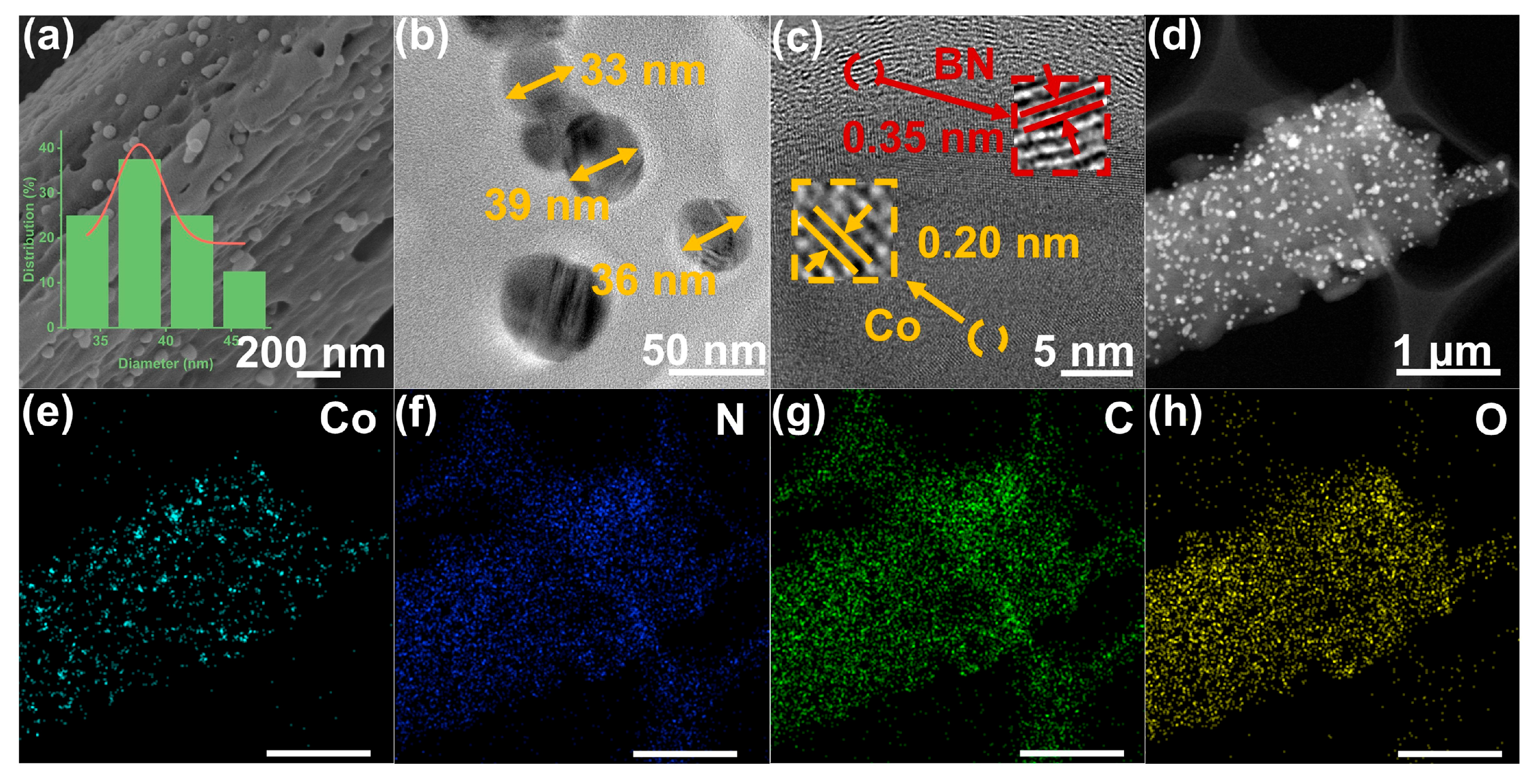
Co/BN nanorods were synthesized using a straightforward freeze-drying process followed by pyrolysis. The refined XRD pattern indicates that the precursor exhibits a phase structure similar to that of C3N6H6 2H3BO3 (M2B) [24] (Figure S1). And the Co/BN exhibits a rodlike morphology with a rough surface, onto which numerous Co nanoparticles are uniformly distributed, as evidenced by the SEM image in Figure 1a and Figure S2. The particle size distribution reveals a dominant range of 35–40 nm. Additionally, the TEM image (Figure 1b) further verifies the presence of abundant dark nanoparticles anchored on the surface of the BN support. High-resolution TEM analysis (Figure 1c) reveals distinct lattice fringes of 0.35 nm and 0.20 nm, corresponding to the (002) planes of BN and the (111) planes of metallic Co [25], respectively. These observations suggest that the BN support facilitates both the loading and stabilization of Co nanoparticles. Elemental mapping of Co/BN-1, shown in Figure 1d–h, confirms the uniform distribution of B, N, Co, and O elements.
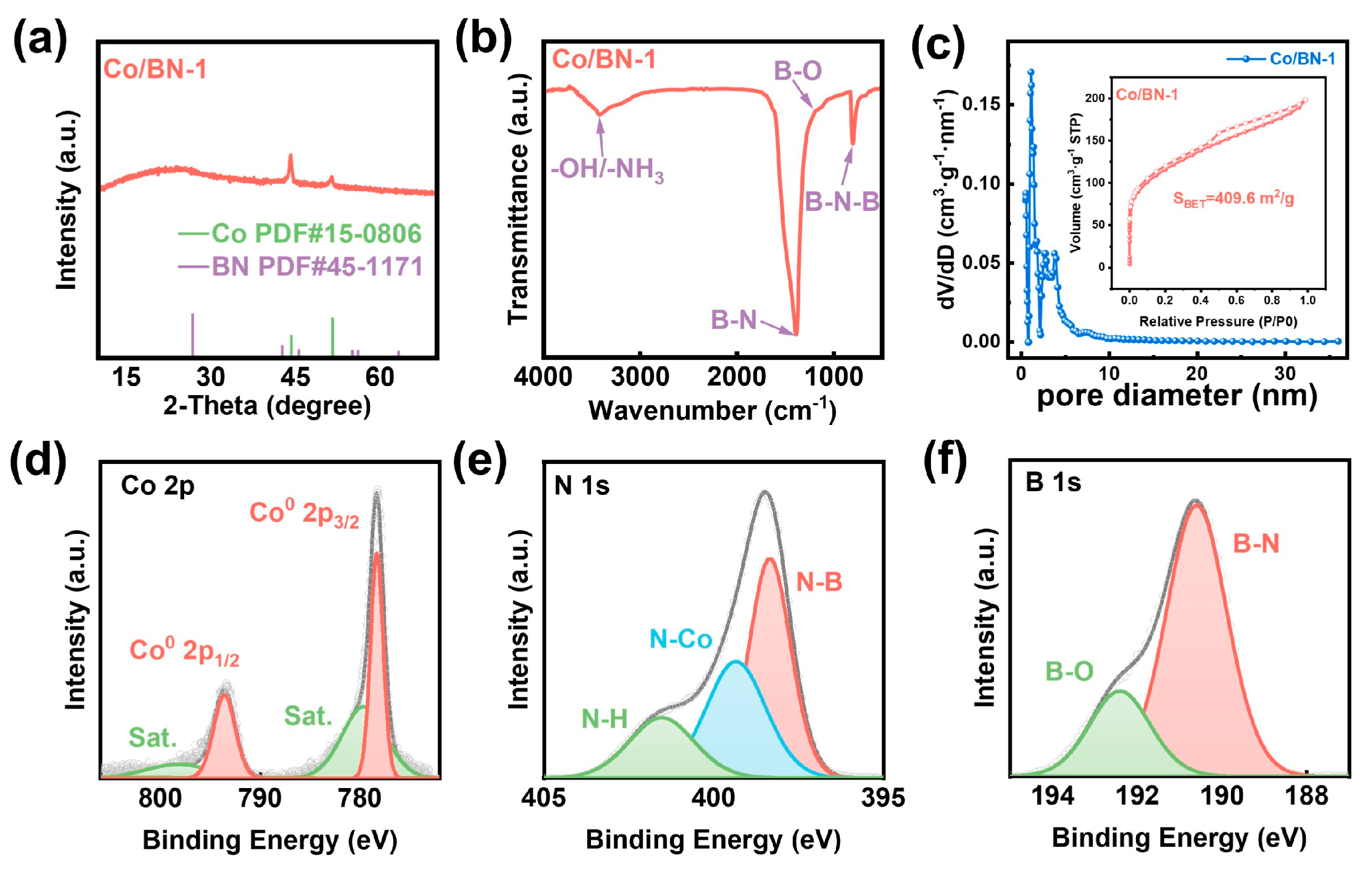
The XRD pattern of Co/BN-1 is shown in Figure 2a. Two distinct peaks at 25.6° and 42.6°, corresponding to the (002) and (100) crystal planes, respectively, are attributed to graphene-like BN. Compared with hexagonal BN (h-BN), the (002) peak of Co/BN-1 shifts to a lower angle, indicating an increased interplanar spacing. This suggests that the synthesized BN possesses lower crystallinity and a partially disordered structure. Additionally, diffraction peaks corresponding to metallic cobalt (PDF#15-0806) are observed in the Co/BN-X samples, confirming the successful loading of Co nanoparticles (Figure 2a and Figure S3). The intensity of Co-related peaks increases with higher cobalt content, indicating enhanced Co deposition on the BN matrix. FT-IR analysis (Figure 2b) reveals a broad absorption band at 3422 cm−1, attributed to the stretching vibrations of N-H and O-H groups. A weak peak observed at 1120 cm−1 is assigned to the B-O stretching vibration, likely originating from residual -NH2 groups and adsorbed water. Characteristic peaks at 1389 cm−1 and 804 cm−1 are ascribed to B-N stretching and B-N-B bending vibrations, respectively [22]. Collectively, the XRD and FT-IR results confirm that the synthesized Co/BN-X composites consist of a BN support embedded with metallic Co nanoparticles on the surface. Figure 2c presents the nitrogen adsorption–desorption isotherm and the pore size distribution of Co/BN-1, which exhibits a typical type IV isotherm, indicative of mesoporous structures, and the specific BET surface area of Co/BN-1 was calculated to be 409.58 m2/g. The pore size distribution falls primarily within the range of 1–8 nm, with two dominant pore diameters centered at approximately 1.2 nm and 3.4 nm, corresponding to the presence of both micropores and mesopores. The high surface area combined with hierarchical porosity can provide abundant active sites and facilitate efficient mass transfer, thereby enhancing the catalytic performance of Co/BN-1 in pollutant degradation [26,27].
XPS was conducted to evaluate the chemical composition and state of Co/BN-1. As shown in Figure S4, the survey spectrum confirms the presence of B, N, Co, and O, consistent with the elemental mapping results. Quantitative analysis (Table S1) reveals that B and N are the predominant elements, while Co, O, and C are present in relatively smaller amounts. The high-resolution Co 2p spectrum (Figure 2d) displays characteristic spin–orbit splitting peaks at 778.3 eV and 793.6 eV, which are assigned to Co0 2p3/2 and Co0 2p1/2, respectively, along with their corresponding satellite peaks [28]. The N 1s spectrum (Figure 2e) exhibits three distinct peaks at 398.1 eV, 399.4 eV, and 401.3 eV, corresponding to N-B, N-Co, and N-H bonds, respectively [29]. The dominant contribution of the N–B component suggests that BN constitutes the primary framework of the composite. In the B 1s spectrum (Figure 2f), peaks located at 190.5 eV and 192.4 eV are attributed to B–N and B-O bonds, respectively [30]. Additionally, the O 1s spectrum (Figure S5) presents a prominent peak at 532.4 eV, which is assigned to the O-B bond.

2.2. Degradation Performance of Co/BN Catalyst

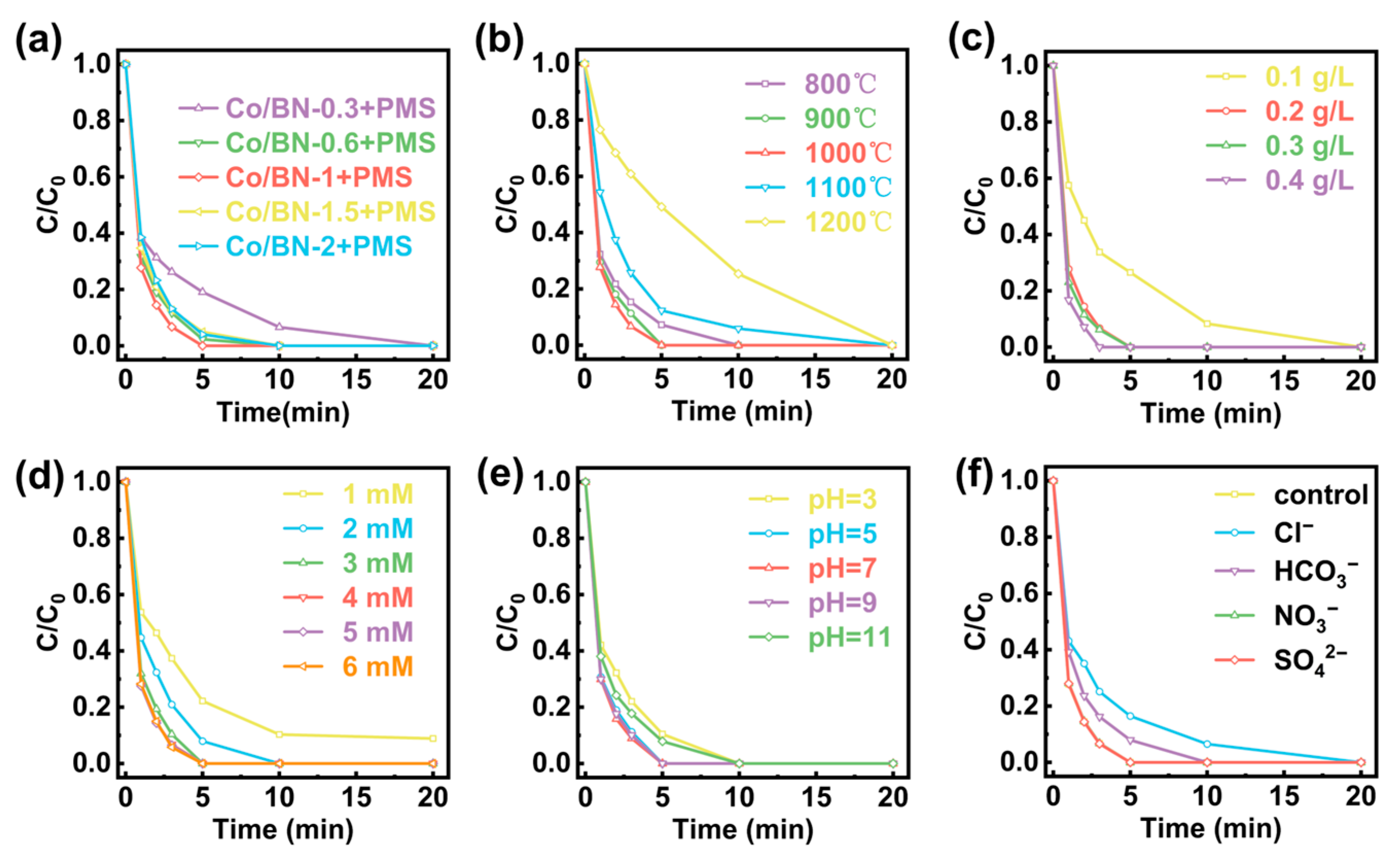
To evaluate the degradation performance of the Co/BN/PMS system toward tetracycline (TC), a standard calibration curve of TC concentration versus UV absorbance was first established (Figure S6). TC concentration displays a direct linear correlation with absorbance over the tested range. Subsequently, Co/BN-X catalysts with varying cobalt loadings were employed to activate PMS for TC degradation, as illustrated in Figure 3a. Complete removal of TC was achieved in all Co/BN-X/PMS systems, albeit with different reaction times, indicating that the presence of Co significantly enhances the PMS activation efficiency. Among the catalysts tested, Co/BN-1 exhibited the highest catalytic activity by achieving complete degradation of TC within five minutes, which is comparable to, or even better than, those of most state-of-the-art catalysts reported to date [31,32,33,34,35,36]. This superior performance is attributed to the optimal cobalt loading, which ensures efficient generation of reactive species without inducing particle aggregation or active site blockage [37].
The effect of pyrolysis temperature on the formation of Co nanoparticles and the crystallinity of boron nitride (BN) was investigated. XRD patterns of Co/BN-1 synthesized at different temperatures (Figure S7) show that the diffraction peak intensity of BN increases with rising temperature, indicating enhanced crystallinity. As shown in Figure 3b, the catalytic performance of Co/BN-1 in TC degradation improved as the pyrolysis temperature increased from 800 °C to 1000 °C, but declined when the temperature exceeded 1000 °C. The enhanced crystallinity at higher temperatures likely contributes to improved structural stability; however, it also reduces the material’s hydrophilicity, thereby hindering mass transfer between Co nanoparticles and PMS/TC in aqueous solution [38].
Figure 3c illustrates the influence of catalyst dosage on the degradation performance of TC. The degradation rate increased with the catalyst amount, indicating that a higher number of active sites accelerated the reaction. When the dosage exceeded 0.2 g/L, the degradation rate exhibited little change, suggesting that the active sites were no longer the limiting factor. To determine the optimal catalyst loading, the pseudo-first-order kinetic curves of Co/BN-1 at different loadings (Figure S8) and the ratio of the reaction rate constant (k) to catalyst dosage (Cat) was calculated (Figure S9), with the highest value observed at 0.2 g/L (k = 3.537 min−1·g−1). The effect of PMS concentration on TC degradation is shown in Figure 3d. As the PMS dosage increased from 1 g/L to 4 g/L, the degradation rate significantly improved, achieving complete TC removal. However, further increasing the PMS concentration beyond 4 g/L did not reduce the reaction time, indicating that excessive PMS does not enhance the degradation efficiency.
In addition, the initial pH plays a critical role in the degradation of TC, as both sulfate radicals (SO4) and hydroxyl radicals (OH) generated from PMS activation can interact with free H+ or OH in solution. As shown in Figure 3e, the Co/BN-1/PMS system maintained high catalytic efficiency across weakly acidic and weakly alkaline conditions, achieving complete TC removal within 5 min. Under more extreme pH conditions (pH = 3 and 11), the degradation efficiency slightly decreased, with complete TC degradation occurring within 10 min. These results indicate that the Co/BN-1/PMS system exhibits excellent pH tolerance and maintains robust degradation performance across a broad pH range.
The effects of coexisting anions, including Cl, HCO3, NO3, and SO42−, on PMS activation for TC degradation were investigated. As shown in Figure S10, the degradation efficiency of TC decreased with increasing Cl concentration. This inhibitory effect is attributed to the quenching of sulfate (SO4) and hydroxyl (OH) radicals by Cl, resulting in the formation of non-reactive SO42− and OH ions [39]. Moreover, HSO5 can be consumed in the presence of Cl to generate hypochlorous acid (HOCl), a species with comparatively weak oxidation potential [5]. Similarly, Figure S11 shows that TC degradation efficiency decreases by approximately 8% when the HCO3 concentration reaches 20 mM, due to the formation of weakly oxidative species such as HCO3 and H2O via reactions with SO4 and OH [40]. In contrast, the presence of NO3 and SO42− exhibited negligible influence on TC degradation performance, as demonstrated in Figures S12 and S13. A comparative analysis of the inhibitory effects of the four anions at equal concentrations (20 mM) is presented in Figure 3f, following the order of inhibition strength: Cl > HCO3 > NO3 > SO42−.
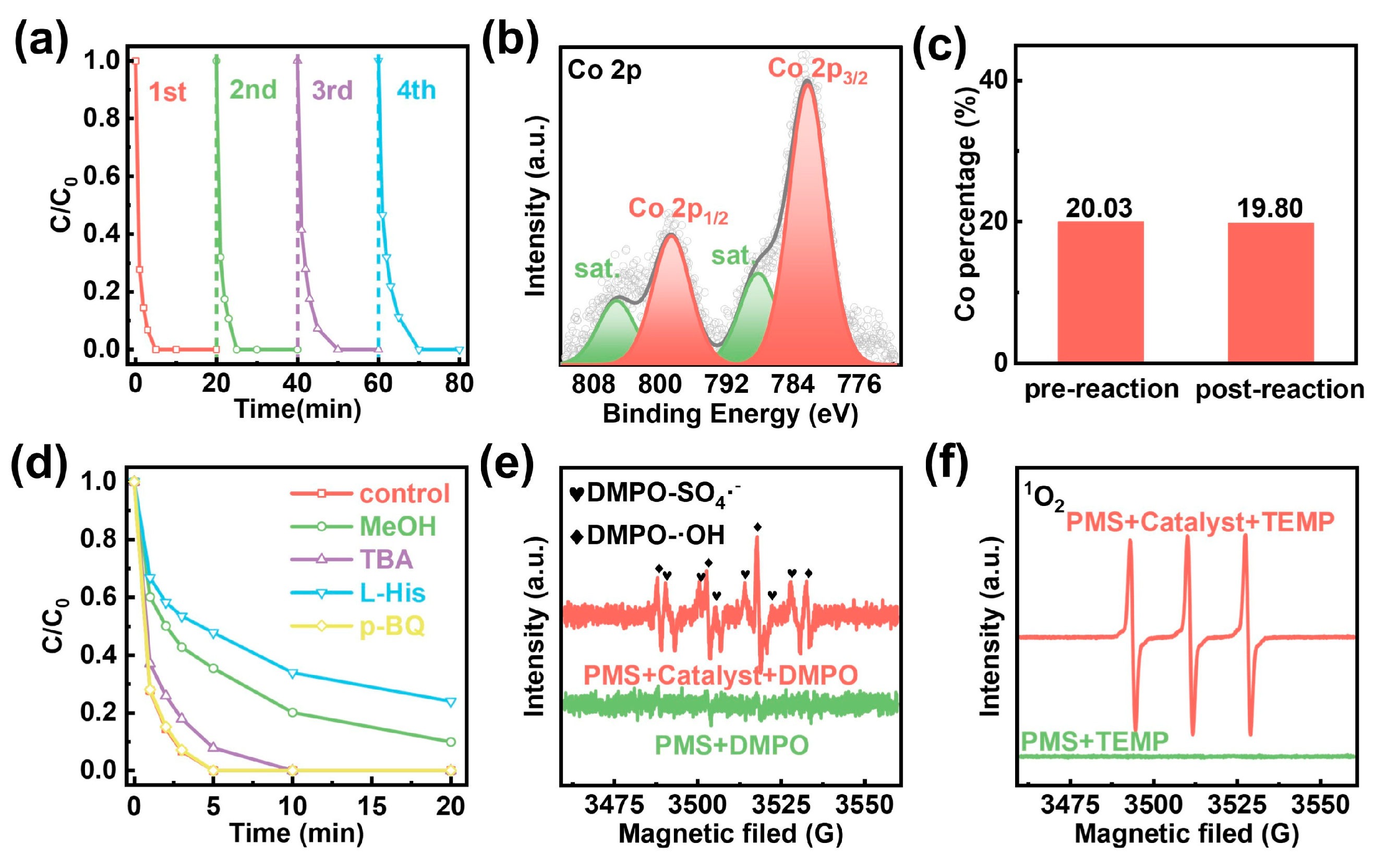
To assess the stability and reusability of the catalyst, four consecutive TC degradation cycles were performed. As shown in Figure 4a, although a slight decrease in degradation efficiency was observed with increasing cycle number, complete removal of TC was still achieved within 10 min after four cycles. And the SEM micrograph of the post-reaction Co/BN-1 shows no significant difference from the initial one (Figure S14). The high-resolution XPS spectrum of Co 2p for Co/BN-1 after catalysis is shown in Figure 4b. Two distinct peaks at 782.2 eV and 798.3 eV, along with their satellite features, are assigned to Co 2p3/2 and Co 2p1/2 of Co2+, respectively [41]. In contrast to the fresh catalyst, which exhibits characteristic signals of metallic Co0, the post-reaction spectrum indicates an oxidation of cobalt species. This shift suggests that Co nanoparticles undergo valence transition due to their involvement in PMS activation via electron transfer processes. Furthermore, Figure 4c reveals that cobalt loss after four cycles is only 0.17%, demonstrating the excellent resistance of the Co/BN-1 catalyst to metal leaching and its structural stability under reaction conditions. These results confirm the excellent structural and catalytic stability of the synthesized Co/BN-1.

2.3. Degradation Mechanism

To identify the reactive oxygen species (ROS) involved in the Co/BN-1/PMS system during TC degradation, a series of quenching experiments was conducted using excess amounts of methanol (MeOH), tert-butyl alcohol (TBA), L-histidine (L-His), and p-benzoquinone (P-BQ) as scavengers for SO4, OH, 1O2, and O2, respectively (Figure 4d). The addition of MeOH led to a moderate reduction in TC degradation, with the removal efficiency decreasing to 90% of the initial value, suggesting that SO4 plays a vital role in the oxidation process. In the presence of TBA, a more pronounced inhibition was observed, indicating that OH also contributes to the degradation as a secondary ROS. The introduction of L-His resulted in a significant decrease in degradation efficiency to approximately 76%, implying that 1O2 is a primary reactive species in this system. Conversely, the addition of P-BQ caused negligible changes in the degradation curve, suggesting that O2 is not significantly involved in the PMS activation pathway.
EPR spectroscopy was conducted to verify the presence of reactive oxygen species (ROS) in the Co/BN-1/PMS system. Spectra were recorded 2 min after PMS addition to capture baseline radical formation. The spin-trapping agent DMPO was employed to detect OH and SO4, which form DMPO-OH and DMPO-SO4 adducts, respectively. As shown in Figure 4e, the characteristic 1:2:1 signal pattern corresponds to OH, while the 1:1:1:1:1:1 sextet pattern is attributed to SO4, qualitatively confirming the generation of both species. To detect 1O2, TEMP was used as a spin-trap, which reacts with 1O2 to produce the stable nitroxide radical TEMPO [42]. The EPR spectrum in Figure 4f displays a distinct triplet signal, indicating the significant presence of 1O2 in the catalytic system. Although DMPO is also capable of trapping superoxide radicals (O2), no corresponding signals were detected in Figure S15, suggesting that O2 is not formed under these conditions.
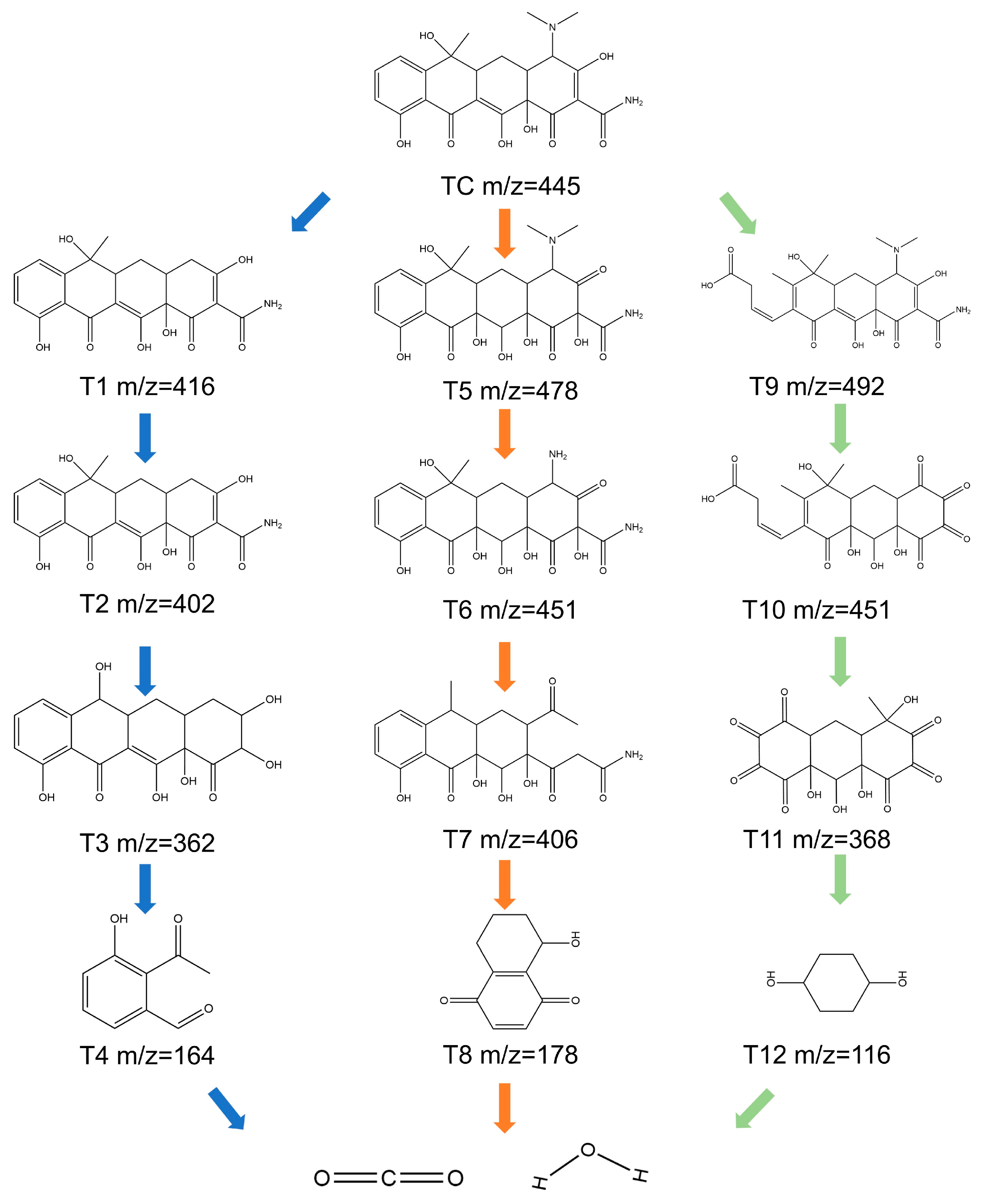
High-performance liquid chromatography-mass spectrometry (HPLC-MS) was employed to analyze the reaction mixtures, aiming to identify intermediate products formed during the TC degradation process (Figure S16). Based on both literature reports and the current experimental results, three major degradation pathways were proposed, with the corresponding molecular structures and m/z values of the intermediates illustrated in Figure 5 [43,44,45,46,47]. In Pathway I, demethylation occurs as reactive oxygen species (ROS) attack the terminal methyl groups of the TC molecule, resulting in the formation of intermediate T1 (m/z = 416). This is followed by successive deamination and deamidization reactions that further break down the molecular structure. Pathway II involves hydroxylation, in which specific double bonds in the TC backbone undergo addition reactions, leading to the formation of hydroxylated intermediates such as T5 (m/z = 478). These intermediates are subsequently degraded through a series of dehydration reactions. In Pathway III, over-oxidation by 1O2 and SO4 causes cleavage of the cyclic structures, forming intermediates such as T9 (m/z = 492). Intermediates containing multiple carbonyl groups are primarily degraded via oxidation and addition mechanisms. In summary, the intermediates of TC degradation are continuously attacked by ROS, leading to a decrease in m/z values and the ultimate formation of CO2, H2O, and inorganic salt ions.
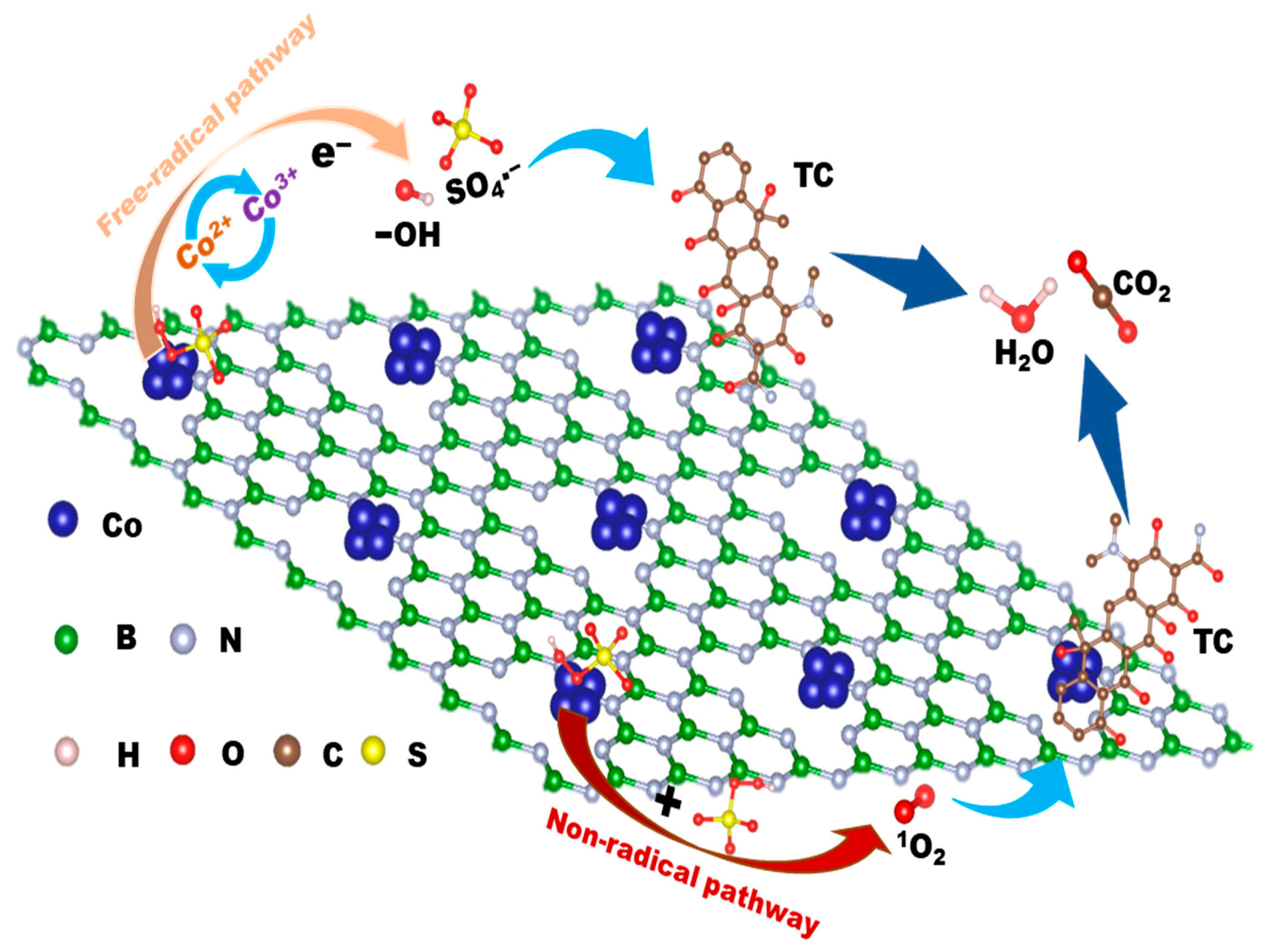
Based on the above results, a comprehensive reaction mechanism involving both radical and non-radical pathways for PMS activation by Co/BN-1 is proposed, as illustrated in Figure 6. The Co/BN-1 catalyst comprises Co nanoparticles anchored on a BN matrix, with abundant Co-N coordination structures. In these bonds, Co atoms bear partial positive charges while N atoms are negatively charged, creating strong electrostatic interactions that facilitate PMS adsorption. The Co atoms serve as active sites for PMS activation, while the adjacent N atoms promote electron transfer through the Co-N framework [44]. In the radical pathway, sulfate radicals (SO4) and hydroxyl radicals (OH) are generated through redox interactions between PMS and surface-bound Co species. The high density of Co nanoparticles enables efficient electron donation to PMS (HSO5), activating it into OH and SO4. During this process, Co is oxidized from its zero-valent state to Co2+ and Co3+. Subsequently, Co3+ can further activate PMS by accepting an electron, regenerating Co2+ and producing SO5, thereby facilitating a Co(III)/Co(II) redox cycle. In parallel, the generation of 1O2 occurs via a non-radical pathway, primarily driven by spontaneous electron transfer from adsorbed PMS on the Co/BN-1 surface [48]. The sulfur atoms in PMS molecules carry partial positive charges, which attract the negatively charged oxygen atoms of free PMS in solution. This electrostatic interaction promotes the coupling of two oxygen atoms from adjacent PMS molecules to form 1O2. Additionally, desorption of HSO3 and HSO5 from Co active sites leads to the formation of HSO4 and SO5 intermediates, which can further contribute to 1O2 generation. Overall, the synergistic action of radical (SO4, OH) and non-radical (1O2) pathways enables efficient degradation of TC, ultimately mineralizing the antibiotic into CO2, H2O, and other small molecular products.

3. Experimental

3.1. Materials

Melamine (analytical pure grade), cobalt(II) nitrate hexahydrate (analytical pure grade), boric acid (analytical pure grade), methanol (99.5%), potassium chloride (analytical pure grade), potassium bicarbonate (analytical pure grade), sodium sulfate (analytical pure grade), potassium nitrate (analytical pure grade), L-Histidine (analytical pure grade), and 1,4-Benzoquinone (analytical pure grade) were supplied by Sinopharm Chemical Reagent Co., Ltd. located in Shanghai, China. Tetracycline hydrochloride (TC, USP) and tert-Butyl alcohol (99.0%) were acquired from Shanghai Macklin Biochemical Technology Co., Ltd. (Shanghai, China). Potassium peroxymonosulfate (≥47%) was sourced from Shanghai Aladdin Biochemical Technology Co., Ltd. (Shanghai, China). Standardized solutions of 0.1 M hydrochloric acid and 0.1 M sodium hydroxide were provided by Shanghai Global Standard Analytical Solutions (Shanghai, China). Ammonia (99.9%) was procured from Tianyuan Gas Co., Ltd. in Qingdao, China. Deionized water was produced in the laboratory.

3.2. Synthesis of Co/BN

A mixture of 0.51 g boric acid and 0.25 g melamine, together with a specified quantity of cobalt(II) nitrate hexahydrate, was dissolved in a blended solvent of deionized water and tert-butyl alcohol under stirring at 85 °C for 30 min. The resulting solution was then subjected to 30 min of sonication, followed by 12 h of freezing in a container sealed with plastic wrap. A pale pink precursor was ultimately obtained after freeze-drying over a period of three days.
To synthesize Co/BN, 0.1 g of the precursor was calcined in a tube furnace at 1000 °C for 3 h under an ammonia flow of 100 mL·min−1, and then cooled naturally to ambient temperature. By varying the amount of cobalt added during precursor preparation, a series of products labeled Co/BN-X (where X = 0.3, 0.6, 1, 1.5, 2) were obtained.

3.3. Characterizations

The crystalline phases of the materials were characterized using an X-ray diffractometer (XRD, χPert Pro, Panalytical, Almelo, The Netherlands). Surface morphology of the samples was examined with a field emission scanning electron microscope (SEM, JEM-7500F, JEOL, Tokyo, Japan). Microstructural details were obtained via transmission electron microscopy (TEM, Tecnai G2F20, FEI, Hillsboro, OR, USA). Chemical bonding and functional groups were analyzed by Fourier transform infrared spectroscopy (FT-IR, Thermo Fisher Scientific, Waltham, MA, USA). Elemental composition, chemical states, and bonding configurations were determined using X-ray photoelectron spectroscopy (XPS, ESCALAB 250Xi, Thermo Fisher Scientific, Waltham, MA, USA). Specific surface area, pore volume, and pore size distribution were measured through low-temperature nitrogen adsorption–desorption experiments (Autosorb-iQ2, Quantachrome, Boynton Beach, FL, USA). Radical species formed during the reaction were detected and identified by electron paramagnetic resonance (EPR, Bruker EMX Plus-10/12, Billerica, MA, USA).

3.4. Calibration of Tetracycline (TC)

To prepare a series of tetracycline (TC) solutions with concentrations of 5, 10, 20, 30, 40, 50, and 60 mg/L, an initial 1 g/L TC stock solution was first prepared by dissolving 80 mg of TC. This stock solution was then diluted accordingly. The absorbance of each diluted solution was measured at 357 nm using a UV-Vis spectrophotometer (L8 Plus, Shanghai Yidian Analytical Instruments Co., Ltd., Shanghai, China). A standard calibration curve was constructed by plotting absorbance (y-axis) against concentration (x-axis).

3.5. Degradation Performance Analysis

A total of 20 mg of Co/BN catalyst was dispersed in 100 mL of deionized water under vigorous stirring for 10 min. Then, 0.5 mg of TC was introduced to achieve an initial concentration of 50 mg/L. The reaction was initiated by immediately adding 4 mM peroxymonosulfate (PMS, HSO5). The initial pH of the solution is around 6.5. At specified time intervals, 2 mL aliquots were withdrawn, filtered, and 1.6 mL of the filtrate was mixed with an equal volume of methanol. The residual concentration of TC was determined using a UV-Vis spectrophotometer.
The effects of Co loading capacity, catalyst dosage, the addition amount of PMS, PH (0.1 M HCL and 0.1 M NaOH for PH regulators), and coexisting anions on degradation were investigated. The degradation efficiency of TC was calculated using the equation:
Degradation efficiency = (c0 − ct)/c0 × 100%
where c0 is the initial concentration, in mg/L; ct presents the concentration at time t, in mg/L.

4. Conclusions

In summary, a series of cobalt nanoparticle-embedded boron nitride (Co/BN) nanocomposites was successfully synthesized. The optimized Co/BN-1 catalyst exhibited a high surface area of 409.6 m2/g, uniform cobalt dispersion, and enhanced stability due to effective encapsulation by the BN matrix. The Co/BN-1/PMS system achieved complete tetracycline (TC) removal within 5 min under diverse aqueous conditions (pH 3–11), with a high pseudo-first-order rate constant of 0.707 min−1. Notably, it maintained 100% degradation efficiency over four consecutive cycles, with negligible cobalt leaching (0.17%). Mechanistic studies revealed that both radical (SO4 and OH) and non-radical (1O2) pathways contributed to PMS activation, driven by the Co(II)/Co(III) redox cycle and synergistic cooperation between Co sites and the BN support. This work provides an efficient and stable catalyst for antibiotic wastewater remediation.

Supplementary Materials

The following supporting information can be downloaded at: https://www.mdpi.com/article/10.3390/catal15121117/s1, Figure S1. Refined XRD pattern of the precursor of Co/BN (The line in dark blue named Calculated represents the standard curve of M2B); Figure S2. SEM micrograph of Co/BN-1; Figure S3. XRD patterns of BN materials with different Co contents. The light blue vertical line represents Co (PDF#15-0806), while the light purple vertical line represents BN (PDF#45-1171); Figure S4. The XPS survey spectrum of Co/BN-1; Figure S5. The High-resolution XPS spectra of O 1s of Co/BN-1; Figure S6. Standard curve of tetracycline absorbance and concentration; Figure S7. XRD patterns of Co/BN-1 prepared at different pyrolysis temperatures; Figure S8. Pseudo-First order kinetic curves of Co/BN-1 at different loadings; Figure S9. The relationship between degradation rate k and catalyst dosage Cat; Figure S10. The effect of different concentrations of Cl on degradation; Figure S11. The effect of different concentrations of HCO3 on degradation; Figure S12. The effect of different concentrations of NO3 on degradation; Figure S13. The effect of different concentrations of SO42− on degradation; Figure S14. SEM micrograph of the post-reaction Co/BN-1; Figure S15. EPR spectra under different testing conditions of O2; Figure S16. HPLC-MS spectra of intermediates of Tetracycline at the degradation time of 1 min; Table S1. The composition and content of various elements in Co/BN-1; Table S2. Comparison of the catalytic activity of Co/BN-1 with reported Co-based catalysts for tetracycline degradation.

Author Contributions

Methodology, investigation, resources, X.W.; writing—original draft, Y.Z.; investigation, data curation, H.C. and L.X.; formal analysis, H.Z. and Z.Z.; methodology, L.C.; writing—review and editing, supervision, project administration, P.D. All authors have read and agreed to the published version of the manuscript.

Funding

This work was supported by the National Natural Science Foundation of China (22578505), the Natural Science Foundation of Shandong Province (ZR2022MB133), and the Taishan Scholar Program Special Fund Support of Shandong Province (ZX20250667).

Data Availability Statement

The data presented in this study are available upon request from the corresponding author.

Conflicts of Interest

The authors declare no conflicts of interest.

References

  1. Anjali, R.; Shanthakumar, S. Insights on the current status of occurrence and removal of antibiotics in wastewater by advanced oxidation processes. J. Environ. Manag. 2019, 246, 51–62. [Google Scholar] [CrossRef]
  2. Bodus, B.; O’Malley, K.; Dieter, G.; Gunawardana, C.; McDonald, W. Review of emerging contaminants in green stormwater infrastructure: Antibiotic resistance genes, microplastics, tire wear particles, PFAS, and temperature. Sci. Total Environ. 2024, 906, 167195. [Google Scholar] [CrossRef]
  3. Fatimazahra, S.; Latifa, M.; Laila, S.; Monsif, K. Review of hospital effluents: Special emphasis on characterization, impact, and treatment of pollutants and antibiotic resistance. Environ. Monit. Assess. 2023, 195, 393. [Google Scholar] [CrossRef]
  4. Nguyen, V.-H.; Smith, S.M.; Wantala, K.; Kajitvichyanukul, P. Photocatalytic remediation of persistent organic pollutants (POPs): A review. Arab. J. Chem. 2020, 13, 8309–8337. [Google Scholar] [CrossRef]
  5. Liu, Z.; Ren, X.; Duan, X.; Sarmah, A.K.; Zhao, X. Remediation of environmentally persistent organic pollutants (POPs) by persulfates oxidation system (PS): A review. Sci. Total Environ. 2023, 863, 160818. [Google Scholar] [CrossRef]
  6. Zango, Z.U.; Ibnaouf, K.H.; Lawal, M.A.; Aldaghri, O.; Wadi, I.A.; Modwi, A.; Zango, M.U.; Adamu, H. Recent trends in catalytic oxidation of tetracycline: An overview on advanced oxidation processes for pharmaceutical wastewater remediation. J. Environ. Chem. Eng. 2025, 13, 116979. [Google Scholar] [CrossRef]
  7. Chen, Y.; Ren, W.; Ma, T.; Ren, N.; Wang, S.; Duan, X. Transformative Removal of Aqueous Micropollutants into Polymeric Products by Advanced Oxidation Processes. Environ. Sci. Technol. 2024, 58, 4844–4851. [Google Scholar] [CrossRef]
  8. Scaria, J.; Nidheesh, P.V. Comparison of hydroxyl-radical-based advanced oxidation processes with sulfate radical-based advanced oxidation processes. Curr. Opin. Chem. Eng. 2022, 36, 100830. [Google Scholar] [CrossRef]
  9. Zhang, B.-T.; Yan, Z.; Liu, Y.; Chen, Z.; Zhang, Y.; Fan, M. Nanoconfinement in advanced oxidation processes. Crit. Rev. Environ. Sci. Technol. 2023, 53, 1197–1228. [Google Scholar] [CrossRef]
  10. Ding, A.; Li, M.; Liu, C.; Chee, T.-S.; Yan, Q.; Lei, L.; Xiao, C. Recovering palladium and gold by peroxydisulfate-based advanced oxidation process. Sci. Adv. 2024, 10, eadm9311. [Google Scholar] [CrossRef]
  11. Ding, T.; Zhu, M.; Yan, L.; Liu, Z.; Zhou, P.; Shi, G.; Yue, D. Resourceful recovery of WC@Co for organic pollutants treatment via Fenton-like reaction. Sep. Purif. Technol. 2024, 341, 126653. [Google Scholar] [CrossRef]
  12. Akçay, H.T.; Demir, A.; Özçifçi, Z.; Yumak, T.; Keleş, T. Treatment of wastewater containing organic pollutants in the presence of N-doped graphitic carbon and Co3O4/peroxymonosulfate. Carbon Lett. 2023, 33, 1445–1460. [Google Scholar] [CrossRef]
  13. Wang, Z.; Liang, X.; Liu, Z.; Huang, T.; Wang, S.; Yao, S.; Ding, Y.; Zhang, J.; Wan, X.; Wang, Z.L.; et al. Self-powered electrochemical water treatment system for pollutant degradation and bacterial inactivation based on high-efficient Co(OH)2/Pt electrocatalyst. Nano Res. 2023, 16, 2192–2198. [Google Scholar] [CrossRef]
  14. Żółtowska, S.; Miñambres, J.F.; Piasecki, A.; Mertens, F.; Jesionowski, T. Three-dimensional commercial-sponge-derived Co3O4@C catalysts for effective treatments of organic contaminants. J. Environ. Chem. Eng. 2021, 9, 105631. [Google Scholar] [CrossRef]
  15. Hwang, I.S.; Manikandan, V.; Patil, R.P.; Mahadik, M.A.; Chae, W.-S.; Chung, H.-S.; Choi, S.H.; Jang, J.S. Hydrogen-Treated TiO2 Nanorods Decorated with Bimetallic Pd–Co Nanoparticles for Photocatalytic Degradation of Organic Pollutants and Bacterial Inactivation. ACS Appl. Nano Mater. 2023, 6, 1562–1572. [Google Scholar] [CrossRef]
  16. Abdul Nasir Khan, M.; Kwame Klu, P.; Wang, C.; Zhang, W.; Luo, R.; Zhang, M.; Qi, J.; Sun, X.; Wang, L.; Li, J. Metal-organic framework-derived hollow Co3O4/carbon as efficient catalyst for peroxymonosulfate activation. Chem. Eng. J. 2019, 363, 234–246. [Google Scholar] [CrossRef]
  17. Xie, M.; Tang, J.; Kong, L.; Lu, W.; Natarajan, V.; Zhu, F.; Zhan, J. Cobalt doped g-C3N4 activation of peroxymonosulfate for monochlorophenols degradation. Chem. Eng. J. 2019, 360, 1213–1222. [Google Scholar] [CrossRef]
  18. Wang, H.; Jiang, H.; Luo, J.; Zhang, K.; Wan, Y.; Li, C.; Song, J.; Jin, X.; Yang, P.; Jia, H. NaOH-treated waste allochroic silica gel as an efficient catalyst for the degradation of tetracycline hydrochloride by peroxymonosulfate activation in a continuous flow fixed-bed system. J. Water Process Eng. 2025, 70, 107109. [Google Scholar] [CrossRef]
  19. Xiong, M.; Yan, J.; Fan, G.; Liu, Y.; Chai, B.; Wang, C.; Song, G. Built-in electric field mediated peroxymonosulfate activation over biochar supported-Co3O4 catalyst for tetracycline hydrochloride degradation. Chem. Eng. J. 2022, 444, 136589. [Google Scholar] [CrossRef]
  20. Yu, S.; Wang, X.; Pang, H.; Zhang, R.; Song, W.; Fu, D.; Hayat, T.; Wang, X. Boron nitride-based materials for the removal of pollutants from aqueous solutions: A review. Chem. Eng. J. 2018, 333, 343–360. [Google Scholar] [CrossRef]
  21. Park, Y.-G.; Nam, S.-N.; Jang, M.; Park, C.M.; Her, N.; Sohn, J.; Cho, J.; Yoon, Y. Boron nitride-based nanomaterials as adsorbents in water: A review. Sep. Purif. Technol. 2022, 288, 120637. [Google Scholar] [CrossRef]
  22. Zhao, Z.; Bai, C.; An, L.; Zhang, X.; Wang, F.; Huang, Y.; Qu, M.; Yu, Y. Biocompatible porous boron nitride nano/microrods with ultrafast selective adsorption for dyes. J. Environ. Chem. Eng. 2021, 9, 104797. [Google Scholar] [CrossRef]
  23. Wang, R.X.; Zhang, D.J.; Liu, C.B. Theoretical Study of Adsorption of Chlorinated Phenol Pollutants on Co-Doped Boron Nitride Nanotubes. Acta Phys. Chim. Sin. 2015, 31, 877–884. [Google Scholar] [CrossRef]
  24. Xue, Y.; Jin, X.; Fan, Y.; Lin, J.; Li, J.; Ren, C.; Xu, X.; Liu, D.; Hu, L.; Meng, F.; et al. Boron Nitride Quasi-Nanoscale Fibers: Controlled Synthesis and Improvement on Thermal Properties of PHA Polymer. Int. J. Polym. Mater. Polym. Biomater. 2014, 63, 794–799. [Google Scholar] [CrossRef]
  25. Wang, J.; Liu, D.; Li, Q.; Chen, C.; Chen, Z.; Song, P.; Hao, J.; Li, Y.; Fakhrhoseini, S.; Naebe, M.; et al. Lightweight, Superelastic Yet Thermoconductive Boron Nitride Nanocomposite Aerogel for Thermal Energy Regulation. ACS Nano 2019, 13, 7860–7870. [Google Scholar] [CrossRef]
  26. Liang, J.; Zhang, H.; Song, Q.; Liu, Z.; Xia, J.; Yan, B.; Meng, X.; Jiang, Z.; Lou, X.W.; Lee, C.-S. Modulating Charge Separation of Oxygen-Doped Boron Nitride with Isolated Co Atoms for Enhancing CO2-to-CO Photoreduction. Adv. Mater. 2024, 36, 2303287. [Google Scholar] [CrossRef]
  27. Du, M.; Liu, Q.; Huang, C.; Qiu, X. One-step synthesis of magnetically recyclable Co@BN core–shell nanocatalysts for catalytic reduction of nitroarenes. RSC Adv. 2017, 7, 35451–35459. [Google Scholar] [CrossRef]
  28. Guo, X.; Zheng, S.; Luo, Y.; Pang, H. Synthesis of confining cobalt nanoparticles within SiOx/nitrogen-doped carbon framework derived from sustainable bamboo leaves as oxygen electrocatalysts for rechargeable Zn-air batteries. Chem. Eng. J. 2020, 401, 126005. [Google Scholar] [CrossRef]
  29. Huang, C.; Chen, C.; Zhang, M.; Lin, L.; Ye, X.; Lin, S.; Antonietti, M.; Wang, X. Carbon-doped BN nanosheets for metal-free photoredox catalysis. Nat. Commun. 2015, 6, 7698. [Google Scholar] [CrossRef]
  30. Zhao, X.; Li, X.; Zhu, Z.; Hu, W.; Zhang, H.; Xu, J.; Hu, X.; Zhou, Y.; Xu, M.; Zhang, H.; et al. Single-atom Co embedded in BCN matrix to achieve 100% conversion of peroxymonosulfate into singlet oxygen. Appl. Catal. B Environ. 2022, 300, 120759. [Google Scholar] [CrossRef]
  31. Xu, B.; Zhang, X.; Zhang, Y.; Wang, S.; Yu, P.; Sun, Y.; Li, X.; Xu, Y. Enhanced electron transfer-based nonradical activation of peroxymonosulfate by CoNx sites anchored on carbon nitride nanotubes for the removal of organic pollutants. Chem. Eng. J. 2023, 466, 143155. [Google Scholar] [CrossRef]
  32. Gao, Y.; Fang, Y.; Wang, W.; Nie, G. Efficient Activation of Peroxymonosulfate to Produce Singlet Oxygen (1O2) for Degradation of Tetracycline over Cu-Co Nanocomposite Catalyst. Top. Catal. 2024, 67, 1–9. [Google Scholar] [CrossRef]
  33. Chen, Y.; Cui, K.; Cui, M.; Liu, T.; Chen, X.; Chen, Y.; Nie, X.; Xu, Z.; Li, C.-X. Insight into the degradation of tetracycline hydrochloride by non-radical-dominated peroxymonosulfate activation with hollow shell-core Co@NC: Role of cobalt species. Sep. Purif. Technol. 2022, 289, 120662. [Google Scholar] [CrossRef]
  34. Zhao, W.; Wang, G.; Li, P.; Shu, Y.; Wang, H.; Zhou, Y.; Meng, Z.; Zhu, W. Oxygen Vacancy-Enhanced Electrocatalytic Degradation of Tetracycline over a Co3O4–La2O3/Peroxymonosulfate System. ACS ES T Water 2024, 4, 1411–1421. [Google Scholar] [CrossRef]
  35. Hua, B.; Zheng, L.; Adeboye, A.; Li, F. Defect- and nitrogen-rich porous carbon embedded with Co NPs derived from self-assembled Co-ZIF-8 @ anionic polyacrylamide network as PMS activator for highly efficient removal of tetracycline hydrochloride from water. Chem. Eng. J. 2022, 443, 136439. [Google Scholar] [CrossRef]
  36. Han, S.; Xiao, P. Catalytic degradation of tetracycline using peroxymonosulfate activated by cobalt and iron co-loaded pomelo peel biochar nanocomposite: Characterization, performance and reaction mechanism. Sep. Purif. Technol. 2022, 287, 120533. [Google Scholar] [CrossRef]
  37. Li, Y.-F.; Wang, L.-F.; Gao, S.-J.; Yu, T.-L.; Li, Q.-F.; Wang, J.-W. Facile Fabrication of Co-Doped Porous Carbon from Coal Hydrogasification Semi-Coke for Efficient Microwave Absorption. Molecules 2024, 29, 4633. [Google Scholar] [CrossRef]
  38. Sun, Q.; Yu, J.; Zhao, J.; Zhang, J.; Sheng, J. Annealing temperature regulates the maneuverability of cobalt spinel sites decorated on halloysite nanotubes: Dynamic restructuring and catalytic performance. Ceram. Int. 2024, 50, 42798–42808. [Google Scholar] [CrossRef]
  39. He, X.; O’Shea, K.E. Selective oxidation of H1-antihistamines by unactivated peroxymonosulfate (PMS): Influence of inorganic anions and organic compounds. Water Res. 2020, 186, 116401. [Google Scholar] [CrossRef]
  40. Liu, S.; Zhang, Z.; Huang, F.; Liu, Y.; Feng, L.; Jiang, J.; Zhang, L.; Qi, F.; Liu, C. Carbonized polyaniline activated peroxymonosulfate (PMS) for phenol degradation: Role of PMS adsorption and singlet oxygen generation. Appl. Catal. B Environ. 2021, 286, 119921. [Google Scholar] [CrossRef]
  41. Obiedallah, F.M.; Abo Zeid, E.F.; Abu-Sehly, A.-H.; Aboraia, A.M.; El-Ghaffar, S.A.; El-Aal, M.A. Hydrothermal synthesis of CuWO4/Co3O4 nanocomposites for water remediation and antibacterial activity applications. Ceram. Int. 2025, 51, 13478–13492. [Google Scholar] [CrossRef]
  42. Zhang, X.; Chen, S.; Lian, X.; Dong, S.; Li, H.; Xu, K. Efficient activation of peroxydisulfate by g-C3N4/Bi2MoO6 nanocomposite for enhanced organic pollutants degradation through non-radical dominated oxidation processes. J. Colloid Interface Sci. 2022, 607, 684–697. [Google Scholar] [CrossRef]
  43. Hu, Q.; Cao, J.; Yang, Z.; Xiong, W.; Xu, Z.; Song, P.; Jia, M.; Zhang, Y.; Peng, H.; Wu, A. Fabrication of Fe-doped cobalt zeolitic imidazolate framework derived from Co(OH)2 for degradation of tetracycline via peroxymonosulfate activation. Sep. Purif. Technol. 2021, 259, 118059. [Google Scholar] [CrossRef]
  44. Zhang, X.; Xu, B.; Wang, S.; Li, X.; Wang, C.; Liu, B.; Han, F.; Xu, Y.; Yu, P.; Sun, Y. Tetracycline degradation by peroxymonosulfate activated with CoNx active sites: Performance and activation mechanism. Chem. Eng. J. 2022, 431, 133477. [Google Scholar] [CrossRef]
  45. Wang, L.; Wang, Y.; Zhang, L.; Li, T.; Yang, M.; Hu, C. CoO anchored on boron nitride nanobelts for efficient removal of water contaminants by peroxymonosulfate activation. Chem. Eng. J. 2022, 430, 132915. [Google Scholar] [CrossRef]
  46. Jiang, Y.; Wang, J.; Liu, B.; Jiang, W.; Zhou, T.; Ma, Y.; Che, G.; Liu, C. Superhydrophilic N,S,O-doped Co/CoO/Co9S8@carbon derived from metal-organic framework for activating peroxymonosulfate to degrade sulfamethoxazole: Performance, mechanism insight and large-scale application. Chem. Eng. J. 2022, 446, 137361. [Google Scholar] [CrossRef]
  47. Liu, Y.; Zou, H.; Ma, H.; Ko, J.; Sun, W.; Andrew Lin, K.; Zhan, S.; Wang, H. Highly efficient activation of peroxymonosulfate by MOF-derived CoP/CoOx heterostructured nanoparticles for the degradation of tetracycline. Chem. Eng. J. 2022, 430, 132816. [Google Scholar] [CrossRef]
  48. Hu, J.; Li, Y.; Zou, Y.; Lin, L.; Li, B.; Li, X.-y. Transition metal single-atom embedded on N-doped carbon as a catalyst for peroxymonosulfate activation: A DFT study. Chem. Eng. J. 2022, 437, 135428. [Google Scholar] [CrossRef]
Figure 1. (a) SEM image of Co/BN-1 (The internal figure is a particle size distribution diagram); (b) TEM images and (c) HRTEM images of Co/BN-1, with insets showing the corresponding pore size distribution of Co nanoparticles. (dh) Elemental mapping images of B, N, Co, and O in Co/BN-1. Scale bars: 1 μm.
Catalysts 15 01117 g001
Figure 2. (a) XRD patterns of BN materials with different Co contents; (b) FT-IR spectra; (c) Pore size distribution curve of Co/BN-1, with the inset showing the corresponding low-temperature nitrogen adsorption–desorption isotherm; High-resolution XPS spectra of (d) Co 2p, (e) N 1s, and (f) B 1s. The light gray circles represent the raw data, while the dark gray curve denotes the fitted curve.
Catalysts 15 01117 g002
Figure 3. (a) TC degradation efficiency with different Co loadings (pyrolysis temperature: 1000 °C); (b) Effect of pyrolysis temperature on TC degradation; (c) Effect of catalyst dosage; (d) Effect of PMS concentration; (e) Effect of initial pH; (f) Effects of coexisting anions.
Catalysts 15 01117 g003
Figure 4. (a) Cyclic performance of Co/BN-1 in TC degradation over four consecutive runs; (b) Co 2p XPS spectra of the spent catalyst (The light gray circles represent the raw data, while the dark gray curve denotes the fitted curve); (c) Changes in Co content before and after the reaction; (d) Radical quenching tests for the Co/BN-1/PMS system; EPR spectra for the detection of (e) SO4 and OH; and (f) 1O2 under different conditions.
Catalysts 15 01117 g004
Figure 5. Proposed degradation pathways of tetracycline in the Co/BN-1/PMS system.
Catalysts 15 01117 g005
Figure 6. Proposed degradation mechanism of tetracycline on the Co/BN-1 surface.
Catalysts 15 01117 g006
Disclaimer/Publisher’s Note: The statements, opinions and data contained in all publications are solely those of the individual author(s) and contributor(s) and not of MDPI and/or the editor(s). MDPI and/or the editor(s) disclaim responsibility for any injury to people or property resulting from any ideas, methods, instructions or products referred to in the content.