

Review

A Review of Simultaneous Catalytic Removal of NOx and VOCs: From Mechanism to Modification Strategy

1
College of Environment, Zhejiang University of Technology, Hangzhou 310014, China
2
Zhejiang Collaborative Innovation Center for Full-Process Monitoring and Green Governance of Emerging Contaminants, Zhejiang Shuren University, Hangzhou 310015, China
3
College of Geography and Environmental Science, Zhejiang Normal University, Jinhua 321004, China
4
State Key Laboratory of Multiphase Flow in Power Engineering, Xi’an Jiaotong University, Xi’an 710049, China
*
Authors to whom correspondence should be addressed.
Catalysts 2025, 15(12), 1114; https://doi.org/10.3390/catal15121114 (registering DOI)
Submission received: 4 November 2025 / Revised: 24 November 2025 / Accepted: 28 November 2025 / Published: 30 November 2025
(This article belongs to the Special Issue Advances in Environmental Catalysis for a Sustainable Future)

Abstract

Simultaneous catalytic elimination of nitrogen oxides (NOx) and volatile organic compounds (VOCs) represents a promising technology for addressing the synergistic pollution of fine particulate matters of <2.5 μm diameter (PM2.5) and O3. Nevertheless, it has been maintaining significant challenges in practical implementation, particularly the inherent mismatch in temperature windows between NOx reduction and VOCs oxidation pathways, coupled with catalyst poisoning and deactivation phenomena. These limitations have hindered the industrial application of bifunctional catalysts for the removal of concurrent pollutant. This review systematically explored the fundamental mechanisms and functional roles of active sites in controlling synchronous catalytic processes. The mechanism of catalyst deactivation caused by multiple toxic substances has been comprehensively analyzed, including sulfur dioxide (SO2), water vapor (H2O), chlorine-containing species (Cl*), reaction by-products, and heavy metal contaminants. Furthermore, we critically evaluated the strategies of doping regulation, nanostructure engineering and morphology optimization to enhance the performance and toxicity resistance of catalysts. Meanwhile, emerging regeneration techniques and reactor design optimizations are discussed as potential solutions to improve the durability of catalysts. Based on the above critical aspects, this review aims to provide insights and guidelines for developing robust catalytic systems capable of controlling multi-pollutants in practical applications, and to offer theoretical guidance and technical solutions to bridge the gap between laboratory research and industrial environmental governance applications.

1. Introduction

NOx and VOCs are the essential precursors of PM2.5 and O3, which could cause serious harm to the ecological environment and human health [1,2,3]. The Chinese government has set NOx and VOCs as two of the five key atmospheric targets, and made the stringent emission standards to achieve at least a 10% reduction in NOx and VOCs emissions during the 14th Five-Year Plan period (2021–2025) [4,5]. In recent years, waste incineration treatment technology has been vigorously developed due to its excellent capacity reduction effect and high energy efficiency [6,7]. However, the waste incineration process inevitably yields various pollutants, including NOx and VOCs [8]. Among these, toluene and chlorobenzene (CB) are highly representative constituents. Toluene originates predominantly from biomass burning and solid waste incineration, whereas CB is generated mainly in municipal and medical waste incinerators [9,10,11]. Nowadays, NOx and VOCs are generally removed separately in different units in the industrial application, which raises the cost of treatment. Thus, a simultaneous removal of NOx and VOCs in the same unit may be a reasonable technical and economic option [12,13]. A large number of studies found that these two pollutants could be simultaneously removed by a bifunctional catalyst with NOx reduction and VOCs oxidation [14]. Therefore, the simultaneous catalytic removal of NOx and VOCs has attracted much attention recently.
In the past several years, great effort has been made to develop highly efficient and poison-resistant bifunctional catalysts. The existing catalysts are faced with the problems of a narrow operating temperature window and poor poisoning resistance in the process of simultaneous removal [15,16,17]. Moreover, flue gas usually contains SO2, Cl species, and H2O etc., which will poison the active site and inhibit the activity of the catalysts [18,19,20]. Therefore, many researchers tried to improve the activity of bifunctional catalysts by doping elements, designing core–shell structures and adopting morphologies. So far, some reviews have been reported on the simultaneous catalytic removal and described the mechanisms of NOx reduction and VOCs oxidation, respectively. They focused on Mn-based catalysts, V-based catalysts, Cu-based catalysts, which mainly concentrated on the structure–performance correlation [21,22]. Nevertheless, there are very few comprehensive reviews that systematically report the performance and mechanism of the synergistic removal of NOx and VOCs, as well as the related modification strategies. In this review, we systematically summarized the control technologies for multiple pollutants such as NOx and VOCs, and mainly elaborated on the synergistic reaction mechanism, the role of acidity and active sites, as well as the mechanism of resistance to toxins. Figure 1 summarizes the roles of three modification techniques in simultaneous removal of NOx and VOCs, such as increasing the catalytic activity by doping elements to increase the number of catalyst acidic sites and oxygen vacancies, enhancing the sulfur resistance of the catalyst by adopting a core–shell structure to protect the active sites, and altering the morphology of the catalysts to enlarging the number of active sites exposed. This enables the establishment of a connection between the active sites and the modification strategies, providing more ideas for the development and design of bifunctional catalysts.

2. Reaction and Poisoning Mechanism

In NO reduction, the active intermediates, such as NHx species, adsorbed NH3, NH4+, and NH2 species, have been demonstrated to be decisive factor for the low-temperature activity of Selective Catalytic Reduction (SCR) catalysts [23]. The kinetic model and mechanism of VOCs oxidation can be divided into Eley–Rideal (E-R), Langmuir–Hinshelwood (L-H) and Mars-van Krevelen (MvK) models. Due to the complexity of VOCs, the intermediate products of VOCs reactions vary greatly. Benzyl alcohol, benzaldehyde, benzoic acid and phenol are the intermediate products in the oxidation process of toluene. Benzyl alcohol, benzaldehyde, benzoic acid and phenol are the intermediate products in the oxidation process of toluene. CB produces some chlorine-containing by-products during the oxidation process [24,25,26]. However, the intermediates undergo significant changes during the simultaneous catalytic removal, resulting in a modification of the reaction pathway. In addition, the SO2 and H2O present in the feed gas can adversely affect the performance of bifunctional catalysts in the simultaneous removal process. Therefore, the influence of these components must be considered during catalyst design to mitigate or prevent their negative effects. A fundamental understanding of the interaction mechanism between NOx reduction and VOCs oxidation, the role of active sites, and the poisoning mechanisms is essential for designing effective catalysts for the simultaneous removal of NOx and VOCs.

2.1. Mechanism of Simultaneous Removal of NOx and VOCs

2.1.1. Mechanism of Simultaneous Removal of NOx and Toluene

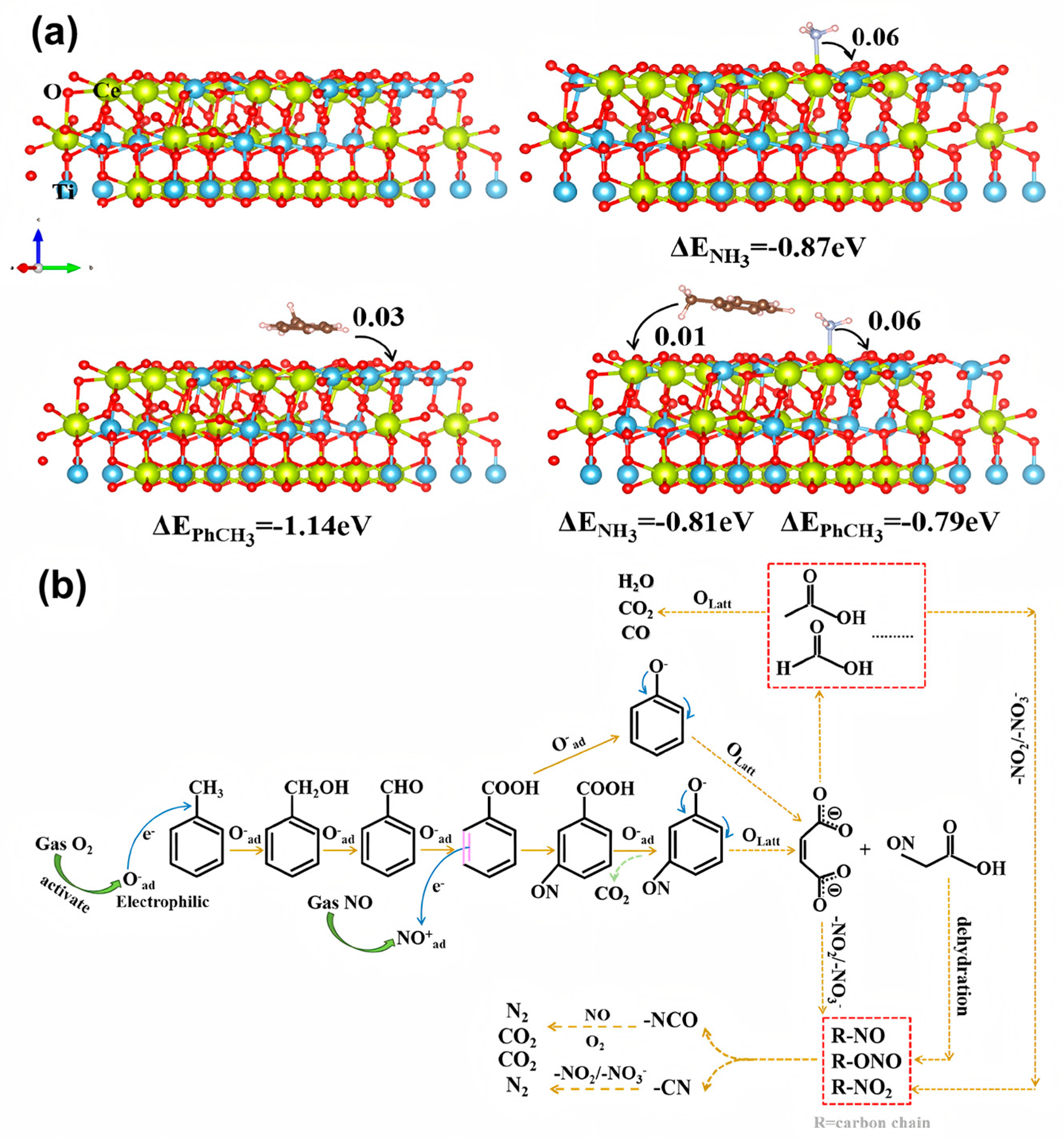
In the process of simultaneous removal of NOx and VOCs, the SCR reaction system will affect the toluene. Previous studies have shown that NH3 can inhibit the adsorption of toluene. As shown in Figure 2a, the adsorption energy of toluene was reduced, and the electron transfer of toluene to the catalyst was markedly hindered when NH3 existed on the catalyst surface [27]. Adsorbed NH3 will react with reactive oxygen species, which will reduce the conversion of toluene [28]. The intermediate products formed during the oxidation of NH3 and toluene are prone to generate by-products such as acetonitrile, depositing on the catalyst surface, which affected the deep oxidation of toluene and reduced the CO2 yield [29].
NOx can both promote and inhibit the oxidation process of volatile organic compounds. Zhao et al. [30] considered that the main reaction between toluene and NO is C7H8 + 18NO = 9N2 + 7CO2 + 4H2O. In the absence of NO, the oxidation path of toluene will change, and the specific mechanism is shown in Figure 2b. The reaction of NO with reactive oxygen species can promote the oxidation of toluene. NO2 has a certain oxidation ability and can promote the oxidation of toluene in the process of synchronous removal. The NO2 gas molecule is firstly adsorbed on the catalyst, releasing an oxygen atom, and then the recovered lattice oxygen oxidizes toluene according to the MvK mechanism [31]. During the oxidation of NO to NO2, NO2 generated in situ assisted O2 in enhancing the reoxidation capacity of metal, resulting in the higher conversion rate of VOCs [32]. The O atoms in NO2 can readily provide additional surface oxygen (Osur) and improved mobility and activity of lattice oxygen (Olat), S thereby accelerating the reoxidation of reduced metal sites, which can promote the oxidation of toluene [33]. In certain scenarios, NOx inhibits the oxidation of toluene. Lu et al. [34] found that NO would react with intermediates in the oxidation process of toluene to produce nitrogen-containing organic compounds, which would deactivate the catalyst. With oxygen, it is easy for NO to form nitrate, occupying the activation site, and hindering the oxidation of toluene [35]. NO can inhibit the removal of toluene at low temperature [27].
The oxidation process of toluene can have some effect on the SCR reaction. Many studies have shown that toluene can inhibit the reduction of NOx. The competitive adsorption between toluene and NH3 is the main reason for this phenomenon [36]. Compared with the single SCR reaction, the coordination with NH3 on the Lewis acid site was weakened under synergistic catalysis, implying that toluene inhibited the adsorption of NH3 and thus suppressed the NOx reduction reaction [37]. Ye et al. [38] discovered that toluene readily reacts with NH3 to form nitriles, which infringed on the active sites and decreased the available coordinated NH3 on Lewis acid sites. Toluene strongly affected the conversion of NO on catalyst surface, directly inhibiting the oxidation of NO at low temperature. Shao et al. [39] found the negative impact of the interaction between toluene and nitric oxide, and revealed a more significant inhibitory effect. However, the higher the temperature, the weaker the inhibitory effect becomes, and the catalytic activity of NO gradually recovers to the equivalent value as in the absence of toluene [40]. However, some researchers believe that toluene has a certain promotion effect on NH3-SCR. It was effectively co-removed with NOx with the advantage of N2O inhibition. Toluene suppressed the oxidation of NH3 and the generation of N2O in non-selective catalytic reduction (NSCR) [31]. At the same time, toluene can also act as a reducer of NO, which was beneficial to NH3-SCR reaction. Based on the results, the main principle is that toluene consumes a limited amount of reactive oxygen in the reaction, thus promoting the reduction of NOx [30]
In summary, there exist seemingly contradictory conclusions regarding the role of NOx in toluene oxidation: some studies report a promoting effect, while others indicate inhibition. The origin of this apparent paradox may lie in the following factors: (1) Differences in the operating temperature window: at lower temperatures, NO tends to react with intermediate products to form toxic by-products, whereas at elevated temperatures, the oxidizing capacity of NO2 becomes dominant; (2) Variations in the redox properties of catalysts: for metal oxides with facile valence cycling (e.g., CeO2), NO may enhance the mobility of lattice oxygen, whereas in other catalytic systems, NO may preferentially form stable surface nitrates, thereby blocking active sites [41].

2.1.2. Mechanism of Simultaneous Removal of NOx and CB
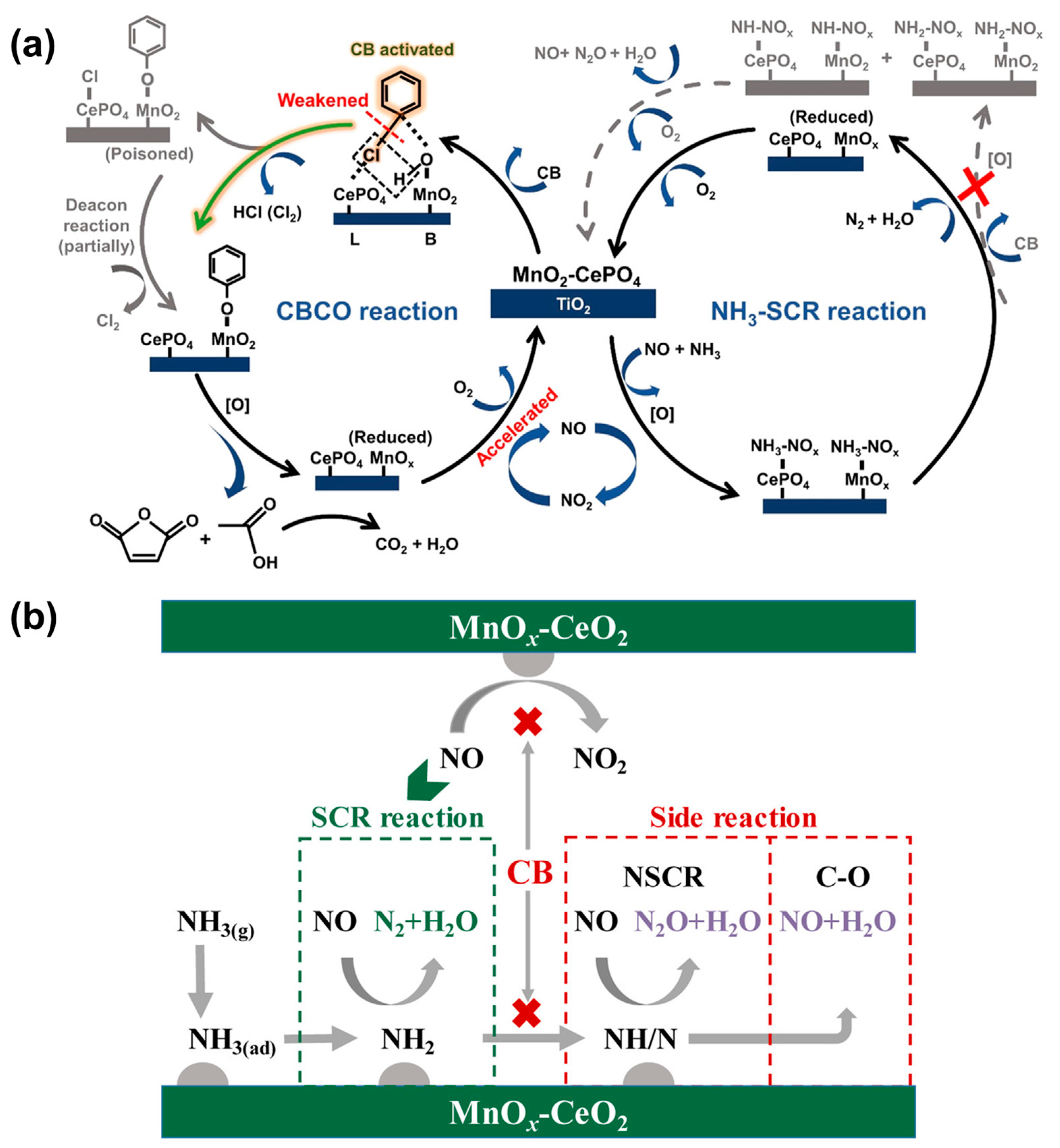
CB is a major challenge in air pollution control because of its attached chlorine-containing functional groups, and it is prone to generating polychlorinated by-products during the catalytic process, which complicates the catalytic conditions and causes significant damage to the environment [42]. The interaction between the oxidation of CB and reduction of NOx is shown in Figure 3a. During the simultaneous removal of CB and NOx, NOx and NH3 will promote the oxidation of CB, but this promotion condition is limited. NO can only promote the conversion of CB in the presence of O2 [32,43]. The possible reason is that NO is oxidized to NO2 by the metal oxides on the catalyst, and then NO2 assists the reoxidation step of the metal phase, thus accelerating the oxidation cycle and increasing the conversion rate of CB on a macro level [44]. NH3 inhibits the oxidation of CB during simultaneous removal process [45]. The competitive adsorption of NH3 is the main reason. The strong adsorption of NH3 by the catalyst leads to a decrease in CB oxidation efficiency. The certain NH3 spent under the stabilizing procedure not for NOx reduction but adsorbed on the catalyst surface [46,47]. This indicates that the adsorbed NH3 participates in the reduction of NOx to some extent, while the NH3 that does not participate in the reduction reaction hinders the adsorption of CB. Reducing the strong adsorption of NH3 is the key factor to improve the oxidation efficiency of CB [48].
Many studies have shown that CB can promote the reduction of NOx. CB can promote the oxidation of NOx, because the oxygen vacancy generated during the ring-opening process of CB is conducive to the adsorption of gas molecules, accelerating NH3-SCR reaction [49]. Li et al. [50] found that CB inhibited the side effects of SCR. The specific mechanism is shown in Figure 3b. Gan et al. [51] discovered, through reaction kinetics decoding, that both KNSCR and δC-O decreased significantly when CB was introduced into the flue, especially above 200 °C. This direct evidence proves that CB has a significant inhibitory effect on NSCR and C-O reaction at high temperatures. Meanwhile, CB decomposition at higher temperatures will provide additional acidic sites for the catalyst. This will facilitate the adsorption of NH3 and NOx, thus promoting the reduction of NOx [21]. At low temperatures, CB has a negative effect on NOx reduction. CB significantly inhibited the SCR reaction below 250 °C [9]. During the oxidation of CB, the dissociated Cl will react with NH3 to form NH4Cl, which will block the active site of the catalyst and inhibit the reduction of NOx [52]. Although the competitive adsorption between NH3 and CB is the direct reason for the decreased CB oxidation efficiency, the root cause lies in the significantly stronger adsorption energy of NH3 compared to CB on the catalyst surface. This insight suggests that future catalyst design should not solely focus on creating strong acidity. Instead, it should aim to precisely modulate the selectivity or spatial distribution of acid sites. For instance, spatially isolating SCR sites from oxidation sites could circumvent competitive adsorption at its fundamental level.
Figure 3. (a) A schematic illustration of the synergistic catalytic removal of NOx and CB over MnO2-CePO4/TiO2 catalysts [50]; (b) Simultaneous mechanism of the removal of NO and CB [53]. The ‘×’ symbol indicates an inhibited or ineffective reaction step.
Catalysts 15 01114 g003

2.2. The Role of Active Site

2.2.1. Acid Sites

The acidic site plays an important role in simultaneous removal of NOx and VOCs. Some studies have found that the acidic site can affect the reaction path of NOx and VOCs, improving the reaction efficiency on the surface of the catalyst [54,55]. Firstly, in the SCR reaction, the acidic site can interact with NH3 to form an active intermediate. These intermediates can effectively reduce NOx to N2, thereby improving the efficiency of NOx removal [56]. Under certain conditions, the existence of an acid site can improve the durability of catalysts, enabling them to maintain better stability in complex flue gas environments. For example, under the condition of coke oven flue gas, the acid level can improve the sulfur resistance and water resistance of the catalyst [57]. Secondly, acidic sites can enhance the adsorption ability of catalyst for VOCs, making VOCs more easily adsorbed on the catalyst surface [49]. At the same time, the acidic site can activate the chemical bonds in VOCs molecules and reduce the activation energy of the reaction, thus promoting the oxidation reaction of VOCs [40]. Lewis and Brønsted acids are two important catalysts, which play an important role in simultaneous removal reaction, which played different roles in simultaneous removal [58]. Lewis acid focuses on the oxidation of VOCs in synchronous removal, and the main reason is that Lewis acid site polarizes or activates VOCs molecules by accepting electron pairs in VOCs molecules, thereby reducing their reaction activation energy and promoting their adsorption on the catalyst surface and further oxidation reactions [52,59]. The Brønsted acid focuses on the removal of NOx, and NH3 was mainly adsorbed at the Brønsted acid site [60]. In the SCR reaction, the Brønsted acidic site provides the proton (H+), which reacts with the NH3 molecule by proton transfer, forming the NH4+ of the adsorbed state. The NH4+ of adsorbed state is able to react effectively with NOx, reducing it to N2 [61]. Su et al. [62] found that the Brønsted acid site helps stabilize the active intermediates in SCR reaction, such as N2O and NH2, etc. The stable existence of these intermediates on the catalyst surface is the key to achieving efficient NOx removal.

2.2.2. Metal Sites and Oxygen Vacancy

Metal active sites refer to the metal atoms or ions in the catalyst that possess catalytic activity. These sites can interact with reactant molecules to promote chemical reactions [63]. In the process of simultaneous removal of NOx and VOCs, metal sites can cooperate with acidic sites to achieve efficient collaborative removal of VOCs and NOx. In addition, metal sites can also regulate the reaction path of pollutants and improve the removal efficiency of NOx and VOCs [64]. It has been found that the interaction between the metal active site and the support can improve the thermal stability and anti-toxicity of the catalyst [65]. When metal or non-metal ions are doped in metal oxides, they will disturb the lattice structure of the catalyst and form oxygen vacancies [66], which is known as active defects and efficiently adsorb reactants. These vacancies also help to convert intermediates into CO2 and H2O, thereby accelerating the overall reaction process [67]. The reduction in metal cations from higher to lower valence states generates charge imbalance, vacancies, and unsaturated chemical bonds on the catalyst surface, which facilitates the formation of chemically adsorbed oxygen and/or weakly bonded oxygen species, and the generated oxygen species can migrate onto the metal oxide surface via oxygen vacancies [68,69,70]. For example, during the process from Ce4+ to Ce3+, more Ce3+ increases the number of oxygen vacancies and enhances the redox activity of the catalyst [40]. In addition, electron transfer can also occur between the metal active site and the oxygen vacancy, which can regulate the electronic structure of the catalyst, making it more conducive to the adsorption and activation of the reactants [71]. Furthermore, the metal active site and oxygen vacancy can synergistically promote catalyst regeneration. In the Mars-van Krevelen mechanism, the metal oxide catalyst forms an oxygen vacancy in the reduction reaction, and in the oxidation reaction, oxygen molecules can fill the oxygen vacancy, allowing the catalyst to be re-oxidize and regain its activity [72].

2.3. Poisoning Mechanisms

The catalyst is the core of the collaborative removal system, but in actual working conditions, flue gas contains trace pollutants (SO2, H2O, Cl and heavy metal, etc.), which seriously affect the structure and activity of the catalysts. The deactivation pathways include destroying the surface porous structures and Brønsted acid sites, inhibiting the redox cycle of active sites, competing adsorption between target and trace pollutants on the surface of catalysts, and blocking of by-products [73].

2.3.1. Sulfur Poisoning

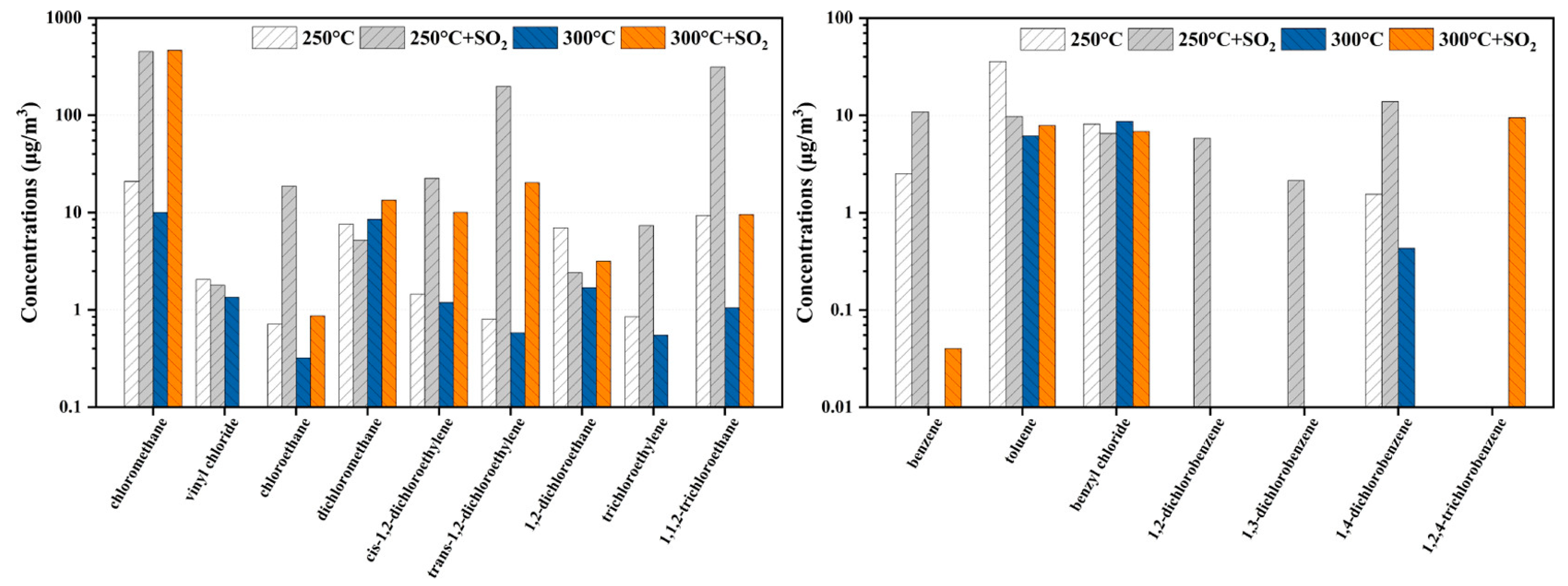
The detrimental impact of SO2 on bifunctional catalysts is a critical challenge, as extensively documented across various catalytic systems. For instance, Ye et al. [38] and Li et al. [49] reported the severe inhibition of NO and VOC (toluene or chlorobenzene) conversion upon SO2 introduction, a trend corroborated by the performance summary of multiple catalysts in Table 1. Moreover, it can be observed from the table that Mn-based catalysts are highly susceptible to deactivation in the presence of SO2. The poisoning mechanism is multifaceted. Conventionally, it is attributed to SO2 competing with reactants for active sites and reacting with NH3 to form ammonium sulfites/sulfates, leading to pore blockage [74]. However, a critical distinction must be made between reversible and irreversible poisoning. Sulfates like (NH4)2SO4 and NH4HSO4 can be decomposed at elevated temperatures (e.g., 400 °C), allowing for activity recovery [75]. In contrast, the formation of stable metal sulfites and sulfates (e.g., on MnOx-CeO2) constitutes a more severe, often irreversible deactivation pathway by directly destroying redox-active sites [76]. Beyond mere activity suppression, a profound consequence of SO2 poisoning is the potential alteration of reaction pathways, leading to undesirable by-product generation. As illustrated in Figure 4, the presence of SO2 over a V2O5-WO3/TiO2 catalyst significantly increased the yield of toxic polychlorinated by-products during chlorobenzene oxidation, which was linked to catalyst sulfation [77]. This highlights that SO2 not only deactivates catalysts but can also pervert their intrinsic selectivity, posing additional environmental risks.
The situation is further complicated in multi-pollutant atmospheres, where synergistic adsorption effects occur. Li et al. [78] demonstrated that, in a complex flue gas on activated carbon, the co-presence of pollutants paradoxically doubled the SO2 adsorption capacity while drastically reducing the adsorption of CB and NO. This indicates that SO2 can dominate the surface chemistry in complex mixtures, leading to a catastrophic performance deterioration. Strikingly, the role of SO2 is not universally inhibitory and can be paradoxically promotional under specific conditions. A study on a V2O5/AC catalyst showed that SO2 could enhance the conversion of dibenzofuran (DBF) and reduce its apparent activation energy, likely by participating in the reaction mechanism [79]. This critical observation reveals that the influence of SO2 is highly context-dependent, determined by the catalyst’s chemical nature and the specific reaction. The overall negative impact, however, often prevails as the ensuing formation of stable species like VOSO4 inevitably impairs the catalyst’s ultimate oxidation capacity [80].
Table 1. A summary of the effect of SO2 on the catalyst.
CatalystReactant
Composition
Space
Velocity
(mL·g−1·h−1)
Conversion
(Without SO2)
Conversion
(with SO2)
Reference
Mn-FeToluene 50 ppm, NO 500 ppm, SO2 300 ppm, 5% O2, 10% H2O24,000Toluene: 100% (230 °C)
NO: 89% (230 °C)
Toluene: 56% (230 °C)
NO: 0% (230 °C)
[40]
MnOx-CeO2CB 50 ppm, NO 500 ppm, NH3 500 ppm, 10%O2, 5%H2O60,000CB: >90% (230 °C)
NOx: >90% (250 °C)
Inactivation[51]
MnO2Toluene 100 ppm, NO 200 ppm, SO2 1000 ppm, 20%O224,000Toluene: 100% (310 °C)
NO: 89% (310 °C)
Toluene: 10% (310 °C)
NO: 5% (310 °C)
[39]
MnCe/TNTToluene 50 ppm, NO 500 ppm, NH3 500 ppm, SO2 250 ppm, 10% O2, 10% H2O60,000Toluene: >90% (200 °C)
NO: >90% (250 °C)
Toluene: 10% (200 °C)
NO: 60% (250 °C)
[81]
PdV/TiO2CB 600 ppm, NO 600 ppm, NH3 600 ppm, SO2 200 ppm, 10%O2, 5%H2O30,000CB: 90% (400 °C)
NOx: 80% (300 °C)
CB: 80% (400 °C)
NOx: 70% (300 °C)
[49]
VWTCB 100 ppm, 600 ppm NH3,600 ppm NO, 100 ppm SO2, 5 vol % O2 40,000CB: 90% (250 °C)
NOx: /
CB: 80% (250 °C)
NOx: /
[78]
MnOxToluene 100 ppm, NO 600 ppm, NH3 600 ppm, SO2, 200 ppm, 5% O2, 5% H2O15,000Toluene: /
NO: 100% (200 °C)
Toluene: /
NO: 60% (200 °C)
[82]

2.3.2. Heavy Metal Poisoning

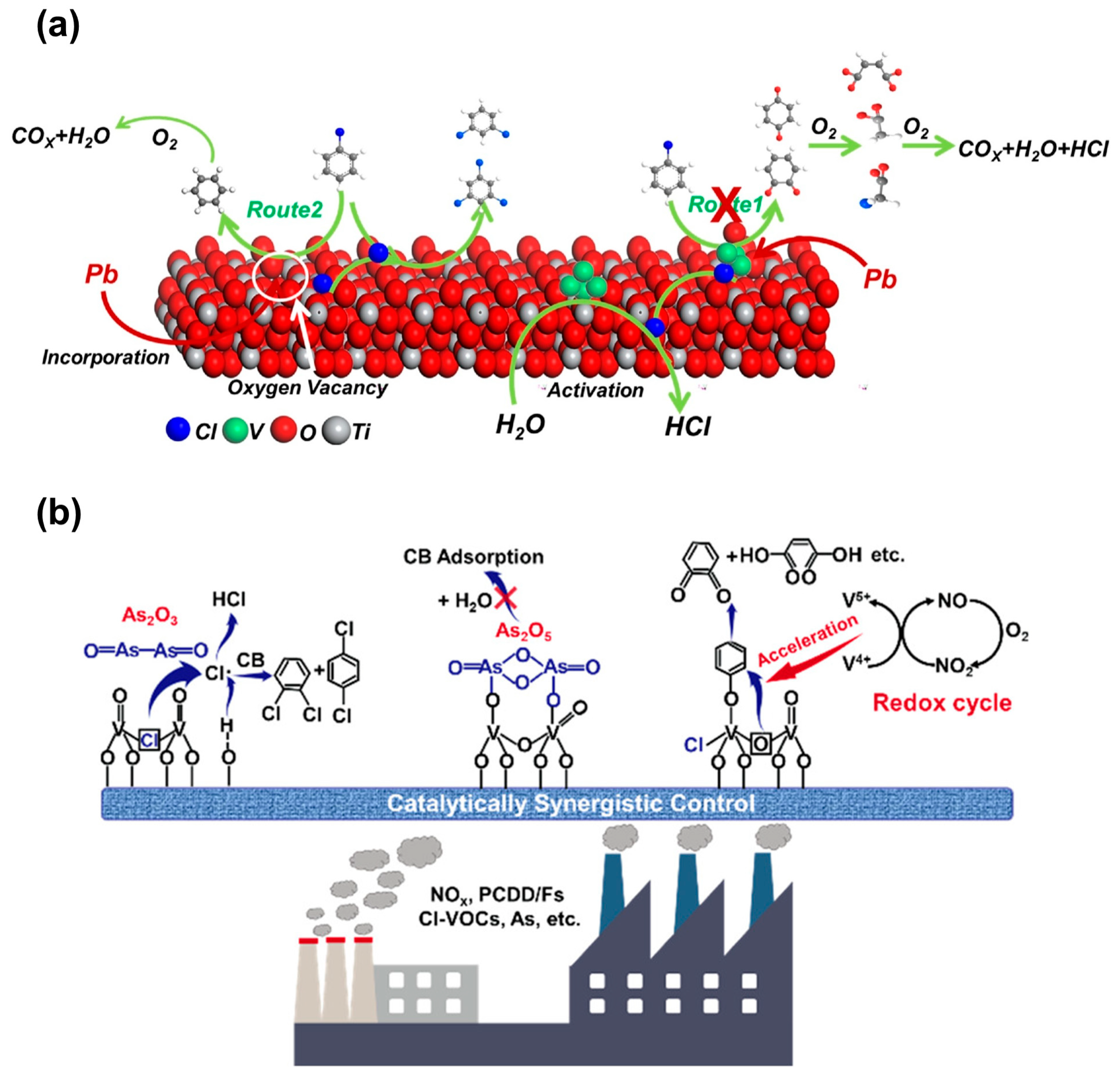
In the flue gas, lead (Pb) and arsenic (As) are the most common poisons [83,84]. There are many possible mechanisms for deactivation: heavy metals can clog the pores or block the active sites through irreversible reactions or change the adsorption capacity of other substances through electronic effects.
The deactivation of a catalyst by Pb is mainly chemical, and Pb not only accumulates on the catalyst surface and competes with gas phase reactants for adsorption at the active site, but also causes changes in the electronic properties of the catalyst surface, reducing surface acidity and redox capacity of the catalyst [85]. The accumulation of Pb will cause the loss of oxidation performance and surface acidity of catalyst and affect the selectivity of CB and CO2. It also affects the oxidation pathway of CB, as illustrated in Figure 5a [86]. Pb2+ induces more toxic polychlorinated by-products [87]. The acid sites are located in SCR correlation, and the loss of surface acidity will affect the conversion efficiency of NOx [59]. The existing literature has shown that the conversion rate of CB will fluctuate greatly, and the conversion rate of NO will decrease slightly under the condition of Pb poisoning [88].
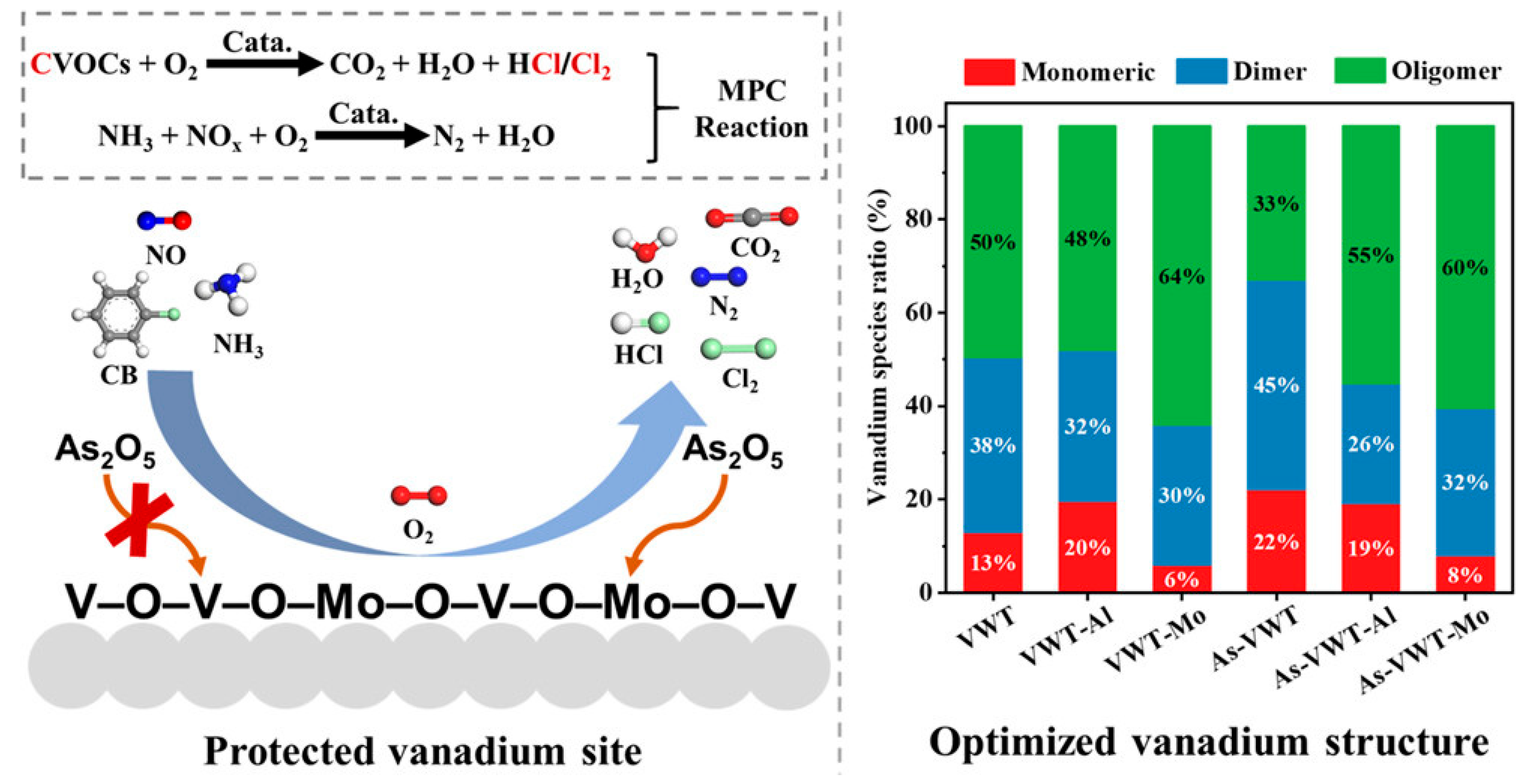
In the case of As poisoning, the SCR reaction was severely deactivated [89]. The reasons for this phenomenon are as follows: Gaseous As2O3 reacts on the catalyst surface to form stable compounds, leading to a reduction in the active component of the catalyst and a decrease in the synergistic removal efficiency [90]. Zhao et al. [30] indicated that Al2O3 significantly reduces the oxygen vacancy formation energy at the V-O-V site, which leads to the production of more toxic polychlorinated by-products during synchronous removal. As2O3 is adsorbed and oxidized to solid As2O5, which can block the pores and diminish the specific surface area, leading to the physical deactivation of the catalyst [91]. As2O5 on a V-based catalyst attacks the adjacent V=O site, forming an As–O–V band, which inactivates the deNOx reaction, as illustrated in Figure 5b [92].
Figure 5. (a) The elimination of chloroaromatic congeners on a commercial V2O5-WO3/TiO2 catalyst: The effect of heavy metal Pb [86]; (b) V2O5-WO3/TiO2 Catalyst for Efficient Synergistic Control of NOx and Chlorinated Organics: Insights into the Arsenic Effect [92]. The ‘×’ symbol indicates an inhibited or ineffective reaction step.
Catalysts 15 01114 g005

2.3.3. Other Effects

Chlorine species also exert a profound influence on catalyst activity. According to the literature, the poisoning mechanism can be attributed to the following pathways: First, chlorine species compete with reactants for adsorption sites, covering active centers and consequently reducing catalytic activity. Second, they can form reactive intermediates that deposit on the catalyst surface, blocking pore channels. Finally, chlorine in the flue gas may react with the catalyst to generate volatile metal chlorides or oxychlorides, leading to the loss of active components and irreversible catalyst deactivation [93,94,95]. Wang et al. [96] found that dissociated Cl on the catalyst surface promoted the adsorption of NH4+ and the formation of NH4Cl, which was not involved in the SCR reaction, leading to a considerable blockage on the catalytic active sites.
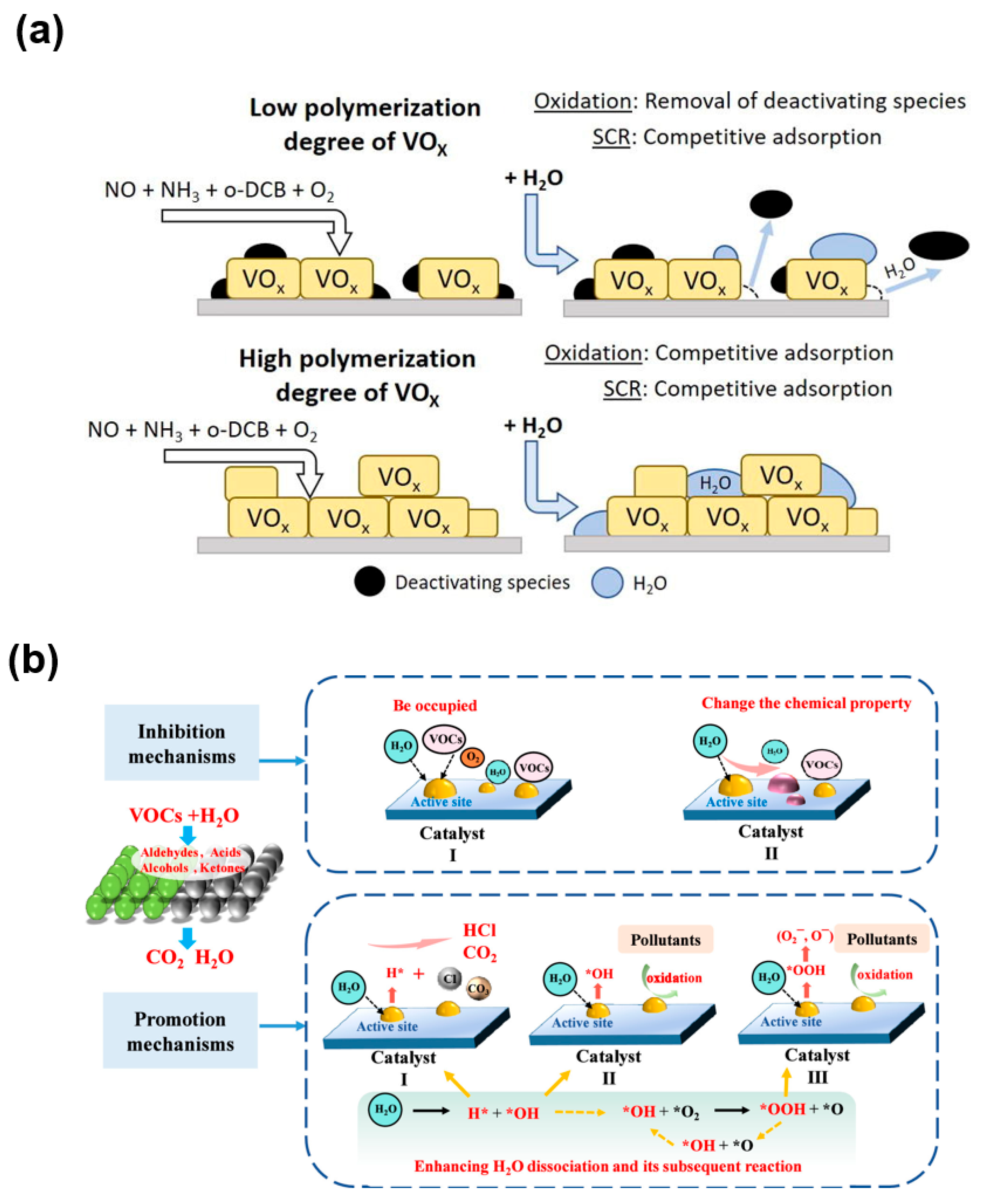
The influence of H2O on the simultaneous removal system is double-sided [63]. Wang et al. [97] found that when NOx and CB are removed at the same time under humid conditions, Co-SM has a significant conversion rate of NOx in the range of 160~300 °C, and the T90 of CB is about 270 °C, which is better than the catalytic performance in the absence of water vapor. However, Kang et al. [98] found that the conversion rate of Co-Mn to NOx and CB decreases at 250 °C when H2O enters the reaction system. NOx decreased slightly and CB decreased by 5%. Therefore, some scientists have started to research the above phenomenon. Long et al. [89] found that H2O can promote the SCR reaction on as-supported VWT catalyst, because H2O will spontaneously dissociate at the reduced V site to form a surface hydroxyl group (HO–V4+–O–V4+–OH), which accelerates the recovery of Brønsted acid. The influence of H2O on the removal of NOx and VOCs presents a dual role. As shown in Figure 6a,b, the impact of H2O on NOx and VOC abatement is of a bifunctional nature. Under high-temperature regimes, H2O plays a facilitative role by enhancing NO conversion and N2 selectivity through the suppression of excessive oxidation or NSCR. while simultaneously fostering the complete oxidation of VOCs, which elevates the selectivity for CO2 and HCl and suppresses by-product generation. Conversely, at low temperatures, H2O exerts a negative effect by competing with NO, NH3, and VOCs for adsorption sites [99].
During the simultaneous removal of dioxins and NOx, SCR and catalytic oxidation inevitably affect each other, and by-products can be generated, such as aniline, nitrobenzene, and benzonitrile. Among them, toluene reacts with NH3 to form nitrile, destroying the active site and reducing the effective coordination of NH3 at the Lewis acid site, thus affecting the SCR [100]. Excessive NH3 adsorption and polychlorinated species accumulation on the surface are the primary issues of poison of catalysts and reduce of their lifetime [47]. The by-products produced from CB are another deactivation factor, for example, some thermally stable and chemically inert organics (such as polychlorinated compounds) can accumulate on the catalyst surface. CCl4 and C2Cl4 were the two major deactivating species produced over V-Mo-Ti catalyst [9].
Figure 6. (a) Bimodal effect of water on V2O5/TiO2 catalysts [89]; (b) A schematic diagram of the reaction mechanisms of H2O in VOC oxidation [101].
Catalysts 15 01114 g006

3. Strategies for Improving the Activity and Poisoning Resistance

Conventional SCR catalysts have some problems, such as low removal efficiency of VOCs and narrow temperature window [15,16,17]. Therefore, the development of efficient bifunctional catalysts for the simultaneous removal of NOx and VOCs is of considerable importance. Leveraging the functions of the aforementioned active sites, the removal efficiency and poisoning resistance can be enhanced via strategies such as doping with metal elements, constructing core–shell structures, and engineering the catalyst morphology. Table 2 presents some modified anti-poisoning catalysts.

3.1. Doping of Catalyst

Doping could improve the dispersion of the active component and thus increase the surface area of the active component [82,108]. Moreover, metal could enhance the surface acidity, redox ability, chemically adsorbed oxygen content, and catalytic performance [109]. Conventional VWT and VMT catalysts often exhibit limited efficiency in the simultaneous removal of NOx and VOCs. Metal doping has been demonstrated as an effective strategy to address this limitation. Table 3 lists the activity of the doped catalysts.

3.1.1. Noble Metal

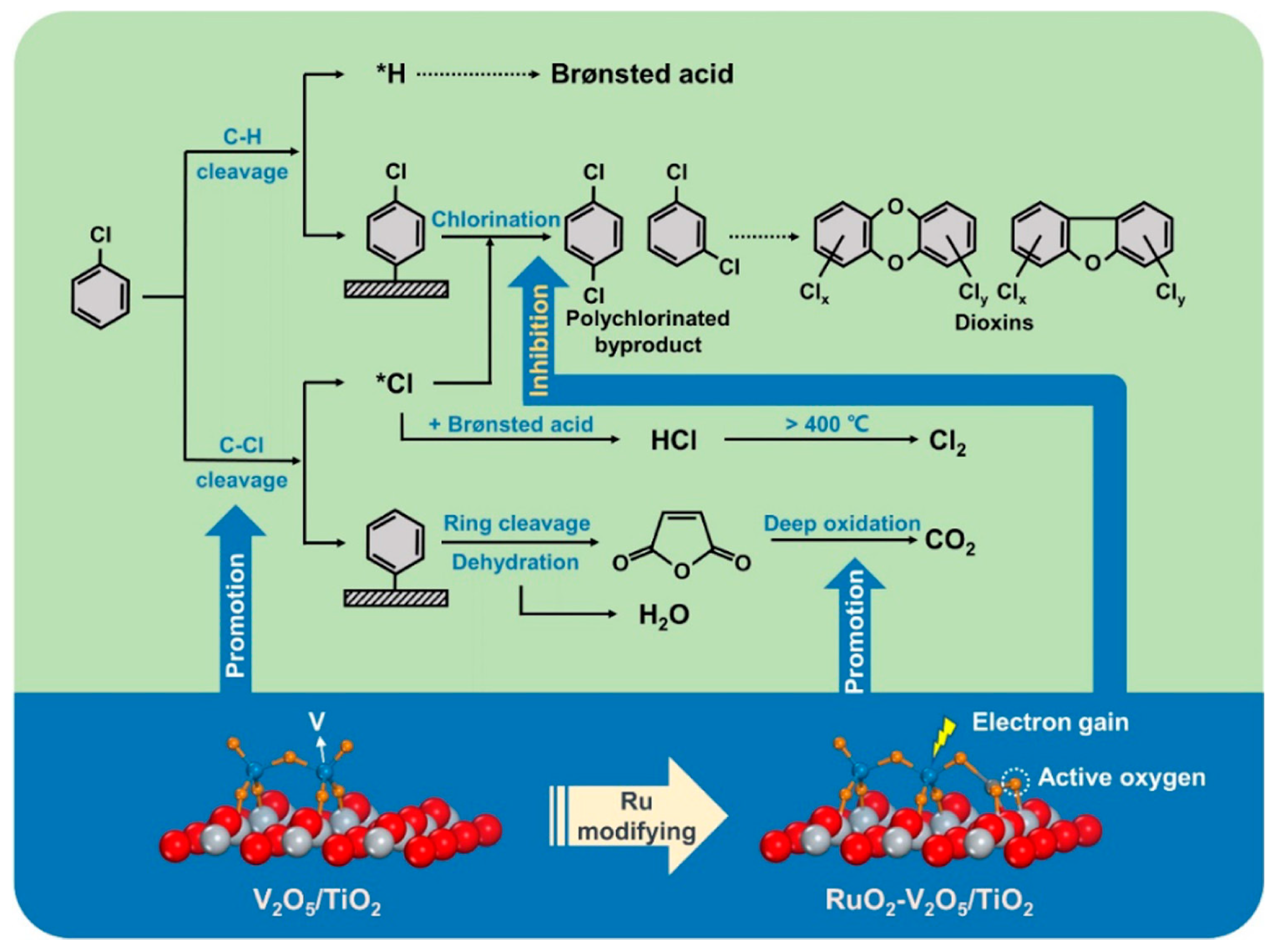
The doping of noble metal can improve the performance of catalyst effectively. Song et al. [113] reported that Ru-modified vanadia-based catalysts displayed a high bifunctional activity with high selectivity to N2, CO2, and HCl. The V–O–Ru chains strengthened the electron capability and narrowed down the band gap of vanadium, which weakened the Lewis acid sites to avoid the generation of polychlorinated species via electrophilic reactions (Figure 7). Zhang et al. [49] proposed that Pd doping created a multi-active center on PdV/TiO2 catalyst, which exhibited excellent synergistic removal efficiency of CB and NOx in the temperature range of 300–400 °C. The presence of Pd provided the adsorption center for each reaction gas and abundant oxygen vacancies with Brønsted acids, which promoted the formation of NO2, enhancing the efficiency of NH3-SCR and CB oxidation [20]. Additionally, Pd could provide the reactive sites on the catalyst surface, making it easy to redox cycle (2V4+ + Pd2+ ↔ 2V5+ +Pd0). This improves the catalytic performance for benzene oxidation and NOx reduction [114]. Although noble metal doping (e.g., Pd, Ru) can markedly enhance catalytic activity, their high cost, alongside a pronounced propensity for sintering and sulfur poisoning, presents paramount obstacles to their practical application. Consequently, research on noble metal modification should place greater emphasis on: (1) maximizing atomic utilization efficiency (e.g., via single-atom catalysts); (2) exploiting synergistic effects with transition metals to reduce noble metal loading.

3.1.2. Transition Metals

Doping with transition metals (such as Fe, Cu, Co, Ce, etc.) is an efficient and low-cost method to increase the acid site and oxygen vacancy of the bifunctional catalysts. Du et al. [110] modified commercial VWT catalysts with Cu doping, which significantly increased the number of acidic sites and reactive oxygen species, and the conversion of NO and toluene reached 100% and 95.56% at 300 °C, respectively. The synergism between MnOx and CeO2 promoted the formation of Lewis acid and oxygen vacancy, which enhanced NH3-SCR and toluene adsorption/activation, thus significantly reducing the operational temperature window. MnOx-CeO2 catalyst could achieve a simultaneous conversion of more than 80% of NO and toluene at the range of 182–300 °C [38]. Fan et al. [115] showed that the doping of Fe would cause lattice distortion, resulting in the (t2g)3 (eg)1 configuration of Mn3+, anisotropic distortion of α-MnO2 lattice, and a significant increase in local z direction Mn-O bond length, which causes the lattice oxygen bonds of manganese to be weakened and become more active in the oxidation reaction. The removal of NO and CB was promoted. Lin et al. [41] found that there is a strong interaction between V-Cu bimetallic oxide and TiO2 support, which can improve the redox ability of the catalyst. In addition, V-Cu/TiO2 has a higher total hydrogen consumption, which is conducive to the generation of more oxygen vacancies, accelerating oxygen migration, and further promoting the deep oxidation of toluene. Cu doping enables the catalyst to have uniform particle size and good dispersion [111]. The pore property of catalyst is the key to pollutant enrichment. The doping of Mo can inhibit the specific surface area loss of catalyst, promote the formation of porous structure, make a larger specific surface area, improve the activation point, and promote the decomposition of reactants. It is reported that the doping of FeOx also showed a good activity [108]. The experimental results showed that the doping of FeOx increased the specific surface area and pore volume of the catalyst, so that the active site of the catalyst was more dispersed, and the Fe and V positions would form a catalytic redox cycle. The adsorption and destruction efficiency of nitric oxide and dioxins were further improved [112]. By comparing the doping effects of different transition metals in Table 1, it can be found that there are significant differences in the degree of performance improvement. For instance, doping with Cu and Fe usually significantly enhances catalytic performance, while the improvement of NO conversion by Co and Mo is relatively limited. The underlying reason behind this lies in the fact that Cu2+/Cu+ and Fe3+/Fe2+ have excellent redox cycling capabilities, which can effectively activate oxygen and generate oxygen vacancies. At the same time, as Lewis acid sites, they enhance the adsorption of NH3.
The doping of Al and Mo can reduce the interference of some harmful components (e.g., As, Pb, SO2). As shown in Figure 8, arsenic species preferentially adsorb on both Al and Mo to form arsenate, thereby avoiding bonding to the catalytically active V sites, followed by tuning the polymetric vanadyl species and enriching the active V5+ sites to achieve excellent Multipollutant Control (MPC) performance and arsenic resistance [89]. Compared with other transition metal dopants, Co doping exhibits superior low-temperature activity. The Co-doped MnOx catalyst has excellent activity at low temperature, achieving over 90% NOx conversion within the temperature window of 105–275 °C, while CB conversion rates surpassed 90% above 180 °C. This phenomenon is attributed to the addition of Co, which increases the additional Lewis acid site, improves the adsorption of NH3 and CB, and effectively reduces the energy barrier of N-H cleavage and oxygen vacancy formation [116]. Among the current modification strategies, transition metal doping stands out as the most promising direction for industrial application. However, a frequently overlooked yet critical issue is the “optimal dosage” of dopants. Excessive doping may lead to coverage of active phases or pore blockage, consequently compromising the overall performance. Future research should integrate theoretical calculations with advanced characterization techniques to precisely determine the optimal doping thresholds in different catalytic systems.

3.1.3. Other Metals

Pr shows a variety of stable oxidation states, which allow for more oxygen exchange at lower temperatures. Especially, Pr could maintain its oxygen storage capacity during the high-temperature sintering process, which is also appropriate for VOCs oxidation [117]. Yu et al. found that the addition of catalyst could promote activity of the low temperature NH3-SCR [89]. After the addition of Pr and W in the vanadia-based catalyst, the redox capacity and surface active oxygen adsorption of the catalyst are significantly improved, and more abundant vanadia-based materials and crystals V2O5 are observed on the surface, which contributes to the oxidation activity of NH3-SCR and CB [118]. Zhao et al. [30] found that the Al2O3-modified CuO-CeO2 catalysts showed the excellent NH3-SCR performance at a broad temperature range (200–400 °C) and good low-temperature activity for toluene oxidation. The modification of Al2O3 significantly tunes the physical and textural properties and induces the formation of oxygen vacancies via the interaction between Ce4+/Ce3+ and Cu2+/Cu+ (Ce4+ + Cu+ ↔ Ce3+ + Cu2+). Long et al. constructed the preferred adsorption sites for arsenic by Al loadings to protect active V sites, followed by tuning the polymetric vanadyl species and enriching the active V5+ sites to achieve excellent MPC performance and arsenic resistance [89].
The doping of Sb has been demonstrated as a particularly effective strategy for enhancing both the activity and SO2 resistance of bifunctional catalysts. Its efficacy stems from a multifaceted mechanism that operates on electronic, structural, and acidic fronts. Li et al. [113] revealed that in PdV/TiO2 systems, Sb acts as an electronic mediator, significantly promoting the charge transfer between V and Pd centers. This electronic synergy not only elevated the conversion of CB and NOx to 90% at 250 °C but also conferred remarkable SO2 tolerance, as evidenced by a minimal temperature shift of only 250 °C to maintain the T90 target under sulfur-containing conditions. This sulfur resistance is further exemplified in Mn-based systems. The Sb-Mn catalyst showed superior NO and toluene conversions, and the NO conversion could reach 90% in 200–350 °C, while the toluene conversion could reach 100% in 200–400 °C. The conversion rates of NOx and toluene change slightly in SO2 gas environment. The primary role of Sb is to inhibit the oxidation of Mn by sulfur dioxide, thereby preventing the formation of inactive manganese sulfate and enhancing the catalyst’s durability. Furthermore, by modulating the surface adsorption of NH3, Sb alleviates its inhibitory effect on the toluene oxidation pathway, mitigating a key competitive adsorption conflict [82]. Yuan et al. [47] found that the formation of V-O-Sb bonds on the catalyst surface serves as the cornerstone of its anti-poisoning capability. This structural configuration is crucial for two primary reasons: First, it electronically modifies the active vanadium sites, potentially rendering them less susceptible to sulfation. Second, the concomitant formation of Sb-O-Ti bonds facilitates the generation of oxygen vacancies, which promote the critical ring-opening step of benzoate intermediates during VOC oxidation. Simultaneously, this surface configuration effectively reduces the adsorption energy of NH3, thereby optimizing the balance between SCR and oxidation cycles.

3.1.4. Nonmetallic Elements

The doping of nonmetallic elements is a novel modification method. Li et al. [63] found that the electronic structure of the catalyst was effectively modulated after N doping, resulting in effective charge flow between the catalyst surface and gas molecules. More importantly, the adsorption and deposition of sulfur species and reaction transient intermediates on active centers were restrained, while a new N adsorption center for NOx was provided. Dai et al. [119] found that phosphoric-acid-modified CeO2 (HP-CeO2) can decompose CB without forming polychlorinated congeners under the industry-relevant reaction conditions. In the removal system, the phosphate group can react with CB and water to form phenol and HCl and then undergo deep oxidation. Moreover, the DFT calculation shows that the formation of oxygen vacancy in the nearest (VO-1) and the second closest (VO-2) surface of the phosphoric-acid-modified catalyst can be significantly reduced, which plays a very important role in the oxidation of VOCs. The doping of Si can effectively increase the number of acidic sites of the CeO2 and regulate the adsorption interaction between NH3 and toluene, contributing to a wider temperature window [120].

3.2. Regulating the Structure

3.2.1. Core–Shell Structure
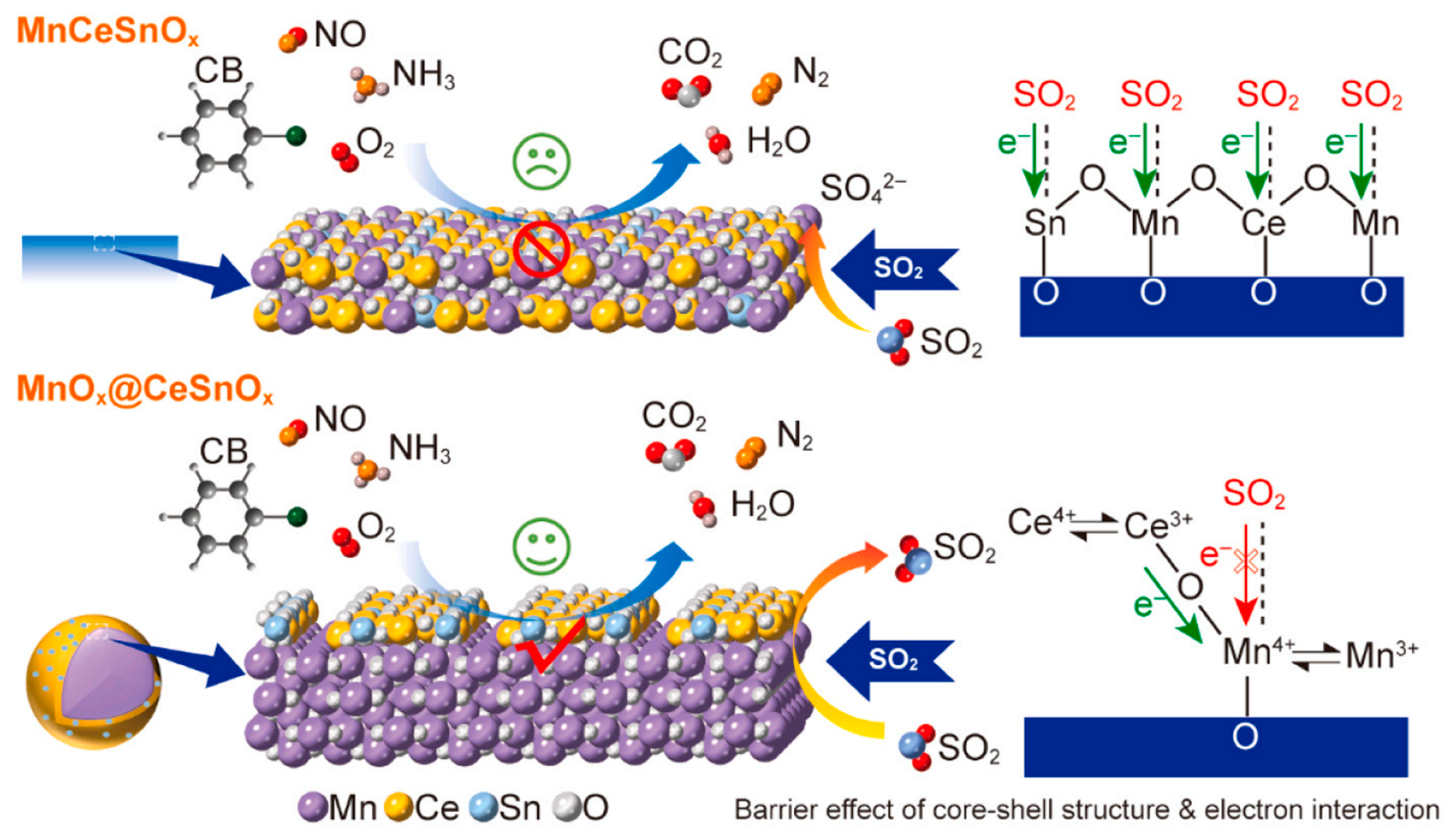
The strategic design of core–shell architectures represents a sophisticated approach to engineering high-performance bifunctional catalysts. Beyond simply providing larger pore diameters for enhanced gas diffusion and adsorption compared to traditional catalysts [81,121], the core–shell structure fundamentally decouples and protects functional sites. Its primary advantage lies in the spatial confinement effect, where the shell acts as a molecular sieve or a protective barrier. This configuration can effectively shield the active sites in the core from direct exposure to SO2, thereby mitigating irreversible poisoning [122]. Furthermore, the interface between the core and shell often creates synergistic sites that can act as sacrificial centers, preferentially interacting with SO2 and preserving the intrinsic activity of the core. As illustrated in Figure 9, the core–shell structure can provide a shielding effect for manganese species and preferentially guide the reaction pathway. Simultaneously, Sn4+ species act as sacrificial sites that react with SO2. This protective and synergistic mechanism is exemplified by Li et al., who synthesized a Cu-SSZ-13@Mn2Cu1Al1Ox core–shell catalyst [107]. The architecture not only provided a greater number of oxygen vacancies and surface acid sites but also effectively minimized the competitive adsorption between H2O and reactant molecules. As a result, it achieved nearly 100% conversion for both VOCs and NOx at 300 °C with 5% H2O present and notably maintained this high performance without significant degradation under SO2-containing atmosphere. This underscores the critical role of the shell in managing complex gas compositions and poisoning agents. In addition, the core–shell structure can promote the further oxidation of NOx and VOCs, thereby avoiding the production of NOx and N-containing organic intermediates with high toxicity to the environment [123].
The choice of shell material is paramount and dictates the primary enhancement mechanism. Jiang et al. [124] demonstrated that a CeO2 shell favors the exposure of active sites and augments the adsorption of key reactants like toluene, NH3, and NO. The strong metal-support interaction at the core–shell interface also facilitates the generation of oxygen vacancies, boosting redox activity. Conversely, employing TiO2 as a shell primarily enhances the catalyst’s surface acidity and improves oxygen mobility, which collectively elevates the SCR performance and N2 selectivity [125]. The inherent hydrophobicity of TiO2 also contributes to superior water resistance, ensuring stable conversion rates under humid conditions. Moreover, the hierarchy of the shell’s structure itself can be engineered for further optimization. Shi et al. [126] highlighted that using a hollow spherical TiO2 (h-TiO2) shell for CuO loading resulted in a catalyst (Cu@h-TiO2) with stronger acidic sites and superior redox capability compared to its conventionally loaded counterpart (Cu/h-TiO2). This structural advantage effectively lowered the toluene oxidation temperature, successfully aligning it with the operational window of the NH3-SCR reaction, which is a pivotal step towards practical simultaneous removal.
Figure 9. Sulfur resistance mechanism of catalyst in simultaneous removal of NOx and CB [127].
Catalysts 15 01114 g009

3.2.2. Pore Structure

The pore size of the catalyst will limit the specific surface area of the catalyst, resulting in low catalyst activity, limiting its industrial applications to remove NOx and VOCs at the same time. Tang et al. [128] found that porous CuZrCe catalyst, whose porous structure can provide a larger specific surface area, supply abundant surface reaction active sites, and facilitate the adsorption and mass transfer of the reactants. The catalyst with porous structure is more suitable for modification by doping. The doping of transition metals can improve their structural properties, enhance their redox properties, and produce abundant reactive oxygen species, including lattice oxygen with higher mobility, which significantly increases the conversion rates of NO and toluene at low and medium temperatures [129]. Different carrier pore sizes will affect the dispersion of the active components of the catalyst, which will affect the SCR performance, catalytic oxidation performance and related catalytic mechanisms [130]. The proper proportion of mesoporous pores in the catalyst can reduce the nitrogen-containing intermediates (benzonitrile and benzamide) generated by the reaction of toluene and oxidation intermediates with NH3 and NO, and reduce the direct oxidation of sexual nitrate/nitrite to toluene to a certain extent, and promote the utilization of active nitrate/nitrite in NH3-SCR reaction [131].

3.3. Regulating the Shape

The shape of the catalyst not only determines the catalytic efficiency of the catalyst, but also affects the diffusion of the reactants and the reaction rate [132]. Morphological changes may include changes in particle and crystal morphology, as well as changes in surface morphology. MnOx nanorods catalyst possessed greater catalytic activity than the MnOx nanocuboid catalyst. The content of Mn4+ on Mn nanorods is greater than that on Mn nanocuboid, because Mn4+ is conducive to NH3-SCR reaction and catalytic oxidation of toluene at low temperatures (200–300 °C)[41]. A four-direction α-MnO2-exposed surface (211) had better VOC oxidation performance and a better NOx conversion rate. The experimental results showed that the catalyst on the exposed crystal surface contained more low-priced Mn active sites, and a higher surface adsorbed oxygen (Oads)/lattice oxygen (Olatt) is retained in the outermost layer [133]. Fe induced a phase transition of MnO2, resulting in Fe-MnO2—F&R catalysts with a composite morphology of nanoflowers and nanorods that provided an abundant microporous structure to facilitate the diffusion of molecules of different sizes [134].

4. Summary and Perspective

This review has systematically examined the recent progress in bifunctional catalysts for the simultaneous removal of NOx and VOCs. We have delved into the complex synergistic and competitive interactions between these pollutants, the critical roles of active sites (including acid sites, metal sites, and oxygen vacancies), and the multifaceted poisoning mechanisms induced by flue gas components such as SO2, H2O, chlorine species, and heavy metals. Furthermore, we have critically assessed advanced modification strategies, including elemental doping, structural engineering (e.g., core–shell architectures), and morphological control, which collectively enhance catalytic performance and durability. Despite significant advancements, this review identifies several persistent challenges and gaps in the mechanistic understanding that warrant further investigation:
(1)
From Model Systems to Realistic Multi-Pollutant: Most current studies focus on the interaction between NOₓ and a single model VOC (e.g., toluene or chlorobenzene). The reaction network, synergistic pathways, and competitive adsorption landscapes in complex flue gas containing multiple VOCs (e.g., aromatics, oxygenates, and chlorinated compounds) remain poorly understood. Future research must employ more sophisticated experimental and theoretical approaches to decipher these complex interactions.
(2)
Precision in Active Site Engineering and Poisoning Resistance: While doping and structural design have proven effective, a more precise strategy is needed. The optimal dosage of dopants and the spatial architecture of multi-functional sites (e.g., physically separating SCR-active sites from oxidation-active sites to mitigate competitive adsorption) require finer control. Furthermore, a clearer distinction between reversible and irreversible deactivation pathways for different poisons (SO2, Cl, Pb, As) is crucial for developing more targeted, robust, and economically viable non-noble metal catalysts.
(3)
Bridging the Material–Reactor Gap for Industrial Translation: The inherent mismatch in optimal temperature windows for SCR and VOC oxidation remains a significant engineering hurdle. Future efforts should tightly integrate catalyst design with innovative reactor engineering, such as dynamic or multi-stage reactor systems (e.g., circulating fluidized beds, rotary reactors), to create spatially or temporally distinct zones for each reaction. Concurrently, establishing feasible in situ regeneration protocols and developing predictive catalyst lifetime models are indispensable steps toward successful industrial implementation.

Author Contributions

Conceptualization, H.P. and C.H.; methodology, J.C.; software, X.D.; writing—original draft preparation, Z.T.; writing—review and editing, Q.X. All authors have read and agreed to the published version of the manuscript.

Funding

This research was funded by National Primary Research & Development Plan (2024YFE0108600), Zhejiang Provincial Natural Science Foundation of China (LGF22B070005), and the Innovation and Entrepreneurship Talent Project of Jiangsu Province (JSSCRC2021236). And The APC was funded by National Primary Research & Development Plan (2024YFE0108600).

Conflicts of Interest

The authors declare no conflict of interest.

References

  1. Chaudary, A.; Mubasher, M.M.; Ul Qounain, S.W. Modeling the Strategies to Control the Impact of Photochemical Smog on Human Health. In Proceedings of the 2021 International Conference on Innovative Computing (ICIC), Lahore, Pakistan, 9–10 November 2021; IEEE: Lahore, Pakistan, 2021; pp. 1–9. [Google Scholar] [CrossRef]
  2. Luo, H.; Li, G.; Chen, J.; Wang, Y.; An, T. Reactor Characterization and Primary Application of a State of Art Dual-Reactor Chamber in the Investigation of Atmospheric Photochemical Processes. J. Environ. Sci. 2020, 98, 161–168. [Google Scholar] [CrossRef]
  3. Li, J.; Li, H.; Wang, X.; Wang, W.; Ge, M.; Zhang, H.; Zhang, X.; Li, K.; Chen, Y.; Wu, Z.; et al. A Large-Scale Outdoor Atmospheric Simulation Smog Chamber for Studying Atmospheric Photochemical Processes: Characterization and Preliminary Application. J. Environ. Sci. 2021, 102, 185–197. [Google Scholar] [CrossRef]
  4. Shao, J.; Lin, F.; Wang, Z.; Liu, P.; Tang, H.; He, Y.; Cen, K. Low Temperature Catalytic Ozonation of Toluene in Flue Gas over Mn-Based Catalysts: Effect of Support Property and SO2/Water Vapor Addition. Appl. Catal. B Environ. 2020, 266, 118662. [Google Scholar] [CrossRef]
  5. Liu, J.; Yu, S.; Shang, Y. Toward Separation at Source: Evolution of Municipal Solid Waste Management in China. Front. Environ. Sci. Eng. 2020, 14, 36. [Google Scholar] [CrossRef]
  6. Liu, Y.; Song, M.; Liu, X.; Zhang, Y.; Hui, L.; Kong, L.; Zhang, Y.; Zhang, C.; Qu, Y.; An, J.; et al. Characterization and Sources of Volatile Organic Compounds (VOCs) and Their Related Changes during Ozone Pollution Days in 2016 in Beijing, China. Environ. Pollut. 2020, 257, 113599. [Google Scholar] [CrossRef] [PubMed]
  7. Hui, L.; Liu, X.; Tan, Q.; Feng, M.; An, J.; Qu, Y.; Zhang, Y.; Jiang, M. Characteristics, Source Apportionment and Contribution of VOCs to Ozone Formation in Wuhan, Central China. Atmos. Environ. 2018, 192, 55–71. [Google Scholar] [CrossRef]
  8. Luo, H.; Cheng, Y.; He, D.; Yang, E.-H. Review of Leaching Behavior of Municipal Solid Waste Incineration (MSWI) Ash. Sci. Total Environ. 2019, 668, 90–103. [Google Scholar] [CrossRef]
  9. Wang, D.; Chen, Q.; Zhang, X.; Gao, C.; Wang, B.; Huang, X.; Peng, Y.; Li, J.; Lu, C.; Crittenden, J. Multipollutant Control (MPC) of Flue Gas from Stationary Sources Using SCR Technology: A Critical Review. Environ. Sci. Technol. 2021, 55, 2743–2766. [Google Scholar] [CrossRef]
  10. Braguglia, C.M.; Bagnuolo, G.; Gianico, A.; Mininni, G.; Pastore, C.; Mascolo, G. Preliminary Results of Lab-Scale Investigations of Products of Incomplete Combustion during Incineration of Primary and Mixed Digested Sludge. Environ. Sci. Pollut. Res. 2016, 23, 4585–4593. [Google Scholar] [CrossRef]
  11. Quaß, U.; Fermann, M.; Bröker, G. The European Dioxin Air Emission Inventory Project—Final Results. Chemosphere 2004, 54, 1319–1327. [Google Scholar] [CrossRef]
  12. Pan, Q.; Liu, Q.-Y.; Zheng, J.; Li, Y.-H.; Xiang, S.; Sun, X.-J.; He, X.-S. Volatile and Semi-Volatile Organic Compounds in Landfill Gas: Composition Characteristics and Health Risks. Environ. Int. 2023, 174, 107886. [Google Scholar] [CrossRef] [PubMed]
  13. Coggon, M.M.; Gkatzelis, G.I.; McDonald, B.C.; Gilman, J.B.; Schwantes, R.H.; Abuhassan, N.; Aikin, K.C.; Arend, M.F.; Berkoff, T.A.; Brown, S.S.; et al. Volatile Chemical Product Emissions Enhance Ozone and Modulate Urban Chemistry. Proc. Natl. Acad. Sci. USA. 2021, 118, e2026653118. [Google Scholar] [CrossRef]
  14. Zheng, F.; Liu, C.; Ma, X.; Zhou, Z.; Lu, J. Review on NH3-SCR for Simultaneous Abating NOx and VOCs in Industrial Furnaces: Catalysts’ Composition, Mechanism, Deactivation and Regeneration. Fuel Process. Technol. 2023, 247, 107773. [Google Scholar] [CrossRef]
  15. Debecker, D.P.; Bouchmella, K.; Delaigle, R.; Eloy, P.; Poleunis, C.; Bertrand, P.; Gaigneaux, E.M.; Mutin, P.H. One-Step Non-Hydrolytic Sol–Gel Preparation of Efficient V2O5-TiO2 Catalysts for VOC Total Oxidation. Appl. Catal. B Environ. 2010, 94, 38–45. [Google Scholar] [CrossRef]
  16. Zhao, S.; Peng, J.; Ge, R.; Wu, S.; Zeng, K.; Huang, H.; Yang, K.; Sun, Z. Research Progress on Selective Catalytic Reduction (SCR) Catalysts for NO Removal from Coal-Fired Flue Gas. Fuel Process. Technol. 2022, 236, 107432. [Google Scholar] [CrossRef]
  17. Fan, Z.; Shi, J.-W.; Gao, C.; Gao, G.; Wang, B.; Wang, Y.; He, C.; Niu, C. Gd-Modified MnOx for the Selective Catalytic Reduction of NO by NH3: The Promoting Effect of Gd on the Catalytic Performance and Sulfur Resistance. Chem. Eng. J. 2018, 348, 820–830. [Google Scholar] [CrossRef]
  18. Weng, X.; Meng, Q.; Liu, J.; Jiang, W.; Pattisson, S.; Wu, Z. Catalytic Oxidation of Chlorinated Organics over Lanthanide Perovskites: Effects of Phosphoric Acid Etching and Water Vapor on Chlorine Desorption Behavior. Environ. Sci. Technol. 2019, 53, 884–893. [Google Scholar] [CrossRef]
  19. Peng, Y.; Si, W.; Li, X.; Chen, J.; Li, J.; Crittenden, J.; Hao, J. Investigation of the Poisoning Mechanism of Lead on the CeO2—WO3 Catalyst for the NH3–SCR Reaction via in Situ IR and Raman Spectroscopy Measurement. Environ. Sci. Technol. 2016, 50, 9576–9582. [Google Scholar] [CrossRef]
  20. Li, G.; Shen, K.; Wu, P.; Zhang, Y.; Hu, Y.; Xiao, R.; Wang, B.; Zhang, S. SO2 Poisoning Mechanism of the Multi-Active Center Catalyst for Chlorobenzene and NOx Synergistic Degradation at Dry and Humid Environments. Environ. Sci. Technol. 2021, 55, 13186–13197. [Google Scholar] [CrossRef]
  21. Kang, D.; Bian, Y.; Shi, Q.; Wang, J.; Yuan, P.; Shen, B. A Review of Synergistic Catalytic Removal of Nitrogen Oxides and Chlorobenzene from Waste Incinerators. Catalysts 2022, 12, 1360. [Google Scholar] [CrossRef]
  22. Zhao, H. Recent Advances in Simultaneous Removal of NOx and VOCs over Bifunctional Catalysts via SCR and Oxidation Reaction. Sci. Total Environ. 2024, 906, 167553. [Google Scholar] [CrossRef]
  23. Han, L.; Cai, S.; Gao, M.; Hasegawa, J.; Wang, P.; Zhang, J.; Shi, L.; Zhang, D. Selective Catalytic Reduction of NOx with NH3 by Using Novel Catalysts: State of the Art and Future Prospects. Chem. Rev. 2019, 119, 10916–10976. [Google Scholar] [CrossRef]
  24. Piumetti, M.; Fino, D.; Russo, N. Mesoporous Manganese Oxides Prepared by Solution Combustion Synthesis as Catalysts for the Total Oxidation of VOCs. Appl. Catal. B Environ. 2015, 163, 277–287. [Google Scholar] [CrossRef]
  25. Zhao, Z.; Ma, S.; Gao, B.; Bi, F.; Qiao, R.; Yang, Y.; Wu, M.; Zhang, X. A Systematic Review of Intermediates and Their Characterization Methods in VOCs Degradation by Different Catalytic Technologies. Sep. Purif. Technol. 2023, 314, 123510. [Google Scholar] [CrossRef]
  26. Zheng, Y.; Fu, K.; Yu, Z.; Su, Y.; Han, R.; Liu, Q. Oxygen Vacancies in a Catalyst for VOCs Oxidation: Synthesis, Characterization, and Catalytic Effects. J. Mater. Chem. A 2022, 10, 14171–14186. [Google Scholar] [CrossRef]
  27. Liu, H.; Chen, J.; Wang, Y.; Yin, R.; Yang, W.; Wang, G.; Si, W.; Peng, Y.; Li, J. Interaction Mechanism for Simultaneous Elimination of Nitrogen Oxides and Toluene over the Bifunctional CeO2–TiO2 Mixed Oxide Catalyst. Environ. Sci. Technol. 2022, 56, 4467–4476. [Google Scholar] [CrossRef]
  28. Zhao, L.; Li, C.; Li, S.; Du, X.; Zhang, J.; Huang, Y. Simultaneous Removal of Hg0 and NO in Simulated Flue Gas on Transition Metal Oxide M′ (M′ = Fe2O3, MnO2, and WO3) Doping on V2O5/ZrO2-CeO2 Catalysts. Appl. Surf. Sci. 2019, 483, 260–269. [Google Scholar] [CrossRef]
  29. Li, Z.; Gao, Y.; Wang, Q. The Influencing Mechanism of NH3 and NOx Addition on the Catalytic Oxidation of Toluene over Mn2Cu1Al1Ox Catalyst. J. Clean. Prod. 2022, 348, 131152. [Google Scholar] [CrossRef]
  30. Zhao, L.; Huang, Y.; Zhang, J.; Jiang, L.; Wang, Y. Al2O3-Modified CuO-CeO2 Catalyst for Simultaneous Removal of NO and Toluene at Wide Temperature Range. Chem. Eng. J. 2020, 397, 125419. [Google Scholar] [CrossRef]
  31. Ye, L.; Lu, P.; Peng, Y.; Li, J.; Huang, H. Impact of NOx and NH3 Addition on Toluene Oxidation over MnOx-CeO2 Catalyst. J. Hazard. Mater. 2021, 416, 125939. [Google Scholar] [CrossRef]
  32. Bertinchamps, F.; Treinen, M.; Eloy, P.; Dos Santos, A.-M.; Mestdagh, M.M.; Gaigneaux, E.M. Understanding the Activation Mechanism Induced by NOx on the Performances of VOx/TiO2 Based Catalysts in the Total Oxidation of Chlorinated VOCs. Appl. Catal. B Environ. 2007, 70, 360–369. [Google Scholar] [CrossRef]
  33. Lu, P.; Ye, L.; Yan, X.; Chen, X.; Fang, P.; Chen, D.; Chen, D.; Cen, C. N2O Inhibition by Toluene over Mn-Fe Spinel SCR Catalyst. J. Hazard. Mater. 2021, 414, 125468. [Google Scholar] [CrossRef] [PubMed]
  34. Lu, P.; Ye, L.; Yan, X.; Chen, D.; Chen, D.; Chen, X.; Fang, P.; Cen, C. Performance of Toluene Oxidation over MnCe/HZSM-5 Catalyst with the Addition of NO and NH3. Appl. Surf. Sci. 2021, 567, 150836. [Google Scholar] [CrossRef]
  35. Aissat, A.; Courcot, D.; Cousin, R.; Siffert, S. VOCs Removal in the Presence of NOx on Cs–Cu/ZrO2 Catalysts. Catal. Today 2011, 176, 120–125. [Google Scholar] [CrossRef]
  36. Zhou, X.; Liao, W.; Cai, N.; Zhang, H.; Yang, H.; Shao, J.; Zhang, S. Experiment and Mechanism Investigation on Simultaneously Catalytic Reduction of NOx and Oxidation of Toluene over MnOx/Cu-SAPO-34. Appl. Surf. Sci. 2023, 611, 155628. [Google Scholar] [CrossRef]
  37. Pan, H.; Chen, Z.; Ma, M.; Guo, T.; Ling, X.; Zheng, Y.; He, C.; Chen, J. Mutual Inhibition Mechanism of Simultaneous Catalytic Removal of NO and Toluene on Mn-Based Catalysts. J. Colloid Interface Sci. 2022, 607, 1189–1200. [Google Scholar] [CrossRef]
  38. Ye, L.; Lu, P.; Xianhui, Y.; Huang, H. Boosting Simultaneous Catalytic Removal of NOx and Toluene via Cooperation of Lewis Acid and Oxygen Vacancies. Appl. Catal. B Environ. 2023, 331, 122696. [Google Scholar] [CrossRef]
  39. Shao, J.; Wang, Z.; Liu, P.; Lin, F.; Zhu, Y.; He, Y.; Cen, K. Interplay Effect on Simultaneous Catalytic Oxidation of NO and Toluene over Different Crystal Types of MnO2 Catalysts. Proc. Combust. Inst. 2021, 38, 5433–5441. [Google Scholar] [CrossRef]
  40. Liu, L.; Shen, B.; Lu, F.; Peng, X. Highly Efficient Mn-Fe Bimetallic Oxides for Simultaneous Oxidation of NO and Toluene: Performance and Mechanism. Fuel 2023, 332, 126143. [Google Scholar] [CrossRef]
  41. Jia, X.; Yu, C.; Fang, H.; Hou, D.; Wang, J.; Zhang, Y.; Zhu, F.; Xiong, J.; Dan, J.; He, D. MnOx Catalysts with Different Morphologies for Low Temperature Synergistic Removal of NOx and Toluene: Structure–Activity Relationship and Mutual Inhibitory Effects. J. Environ. Chem. Eng. 2022, 10, 108646. [Google Scholar] [CrossRef]
  42. Liu, X.; Chen, L.; Zhu, T.; Ning, R. Catalytic Oxidation of Chlorobenzene over Noble Metals (Pd, Pt, Ru, Rh) and the Distributions of Polychlorinated by-Products. J. Hazard. Mater. 2019, 363, 90–98. [Google Scholar] [CrossRef]
  43. Jin, Q.; Xu, M.; Lu, Y.; Yang, B.; Ji, W.; Xue, Z.; Dai, Y.; Wang, Y.; Shen, Y.; Xu, H. Simultaneous Catalytic Removal of NO, Mercury and Chlorobenzene over WCeMnOx/TiO2–ZrO2: Performance Study of Microscopic Morphology and Phase Composition. Chemosphere 2022, 295, 133794. [Google Scholar] [CrossRef] [PubMed]
  44. Bertinchamps, F.; Treinen, M.; Blangenois, N.; Mariage, E.; Gaigneaux, E. Positive Effect of NO on the Performances of VO/TiO-Based Catalysts in the Total Oxidation Abatement of Chlorobenzene. J. Catal. 2005, 230, 493–498. [Google Scholar] [CrossRef]
  45. Xu, Z.; Deng, S.; Yang, Y.; Zhang, T.; Cao, Q.; Huang, J.; Yu, G. Catalytic Destruction of Pentachlorobenzene in Simulated Flue Gas by a V2O5–WO3/TiO2 Catalyst. Chemosphere 2012, 87, 1032–1038. [Google Scholar] [CrossRef]
  46. Gan, L.; Li, K.; Niu, H.; Peng, Y.; Chen, J.; Huang, Y.; Li, J. Simultaneous Removal of NOx and Chlorobenzene on V2O5/TiO2 Granular Catalyst: Kinetic Study and Performance Prediction. Front. Environ. Sci. Eng. 2021, 15, 70. [Google Scholar] [CrossRef]
  47. Yuan, X.; Peng, Y.; Zhu, X.; Wang, H.; Song, Z.; Si, W.; Wang, Y.; Li, J. Anti-Poisoning Mechanisms of Sb on Vanadia-Based Catalysts for NOx and Chlorobenzene Multi-Pollutant Control. Environ. Sci. Technol. 2023, 57, 10211–10220. [Google Scholar] [CrossRef] [PubMed]
  48. Huang, X.; Liu, Z.; Wang, D.; Peng, Y.; Li, J. The Effect of Additives and Intermediates on Vanadia-Based Catalyst for Multi-Pollutant Control. Catal. Sci. Technol. 2020, 10, 323–326. [Google Scholar] [CrossRef]
  49. Li, G.; Shen, K.; Wang, L.; Zhang, Y.; Yang, H.; Wu, P.; Wang, B.; Zhang, S. Synergistic Degradation Mechanism of Chlorobenzene and NO over the Multi-Active Center Catalyst: The Role of NO2, Brønsted Acidic Site, Oxygen Vacancy. Appl. Catal. B Environ. 2021, 286, 119865. [Google Scholar] [CrossRef]
  50. Li, Y.; Hou, Y.; Li, B.; Yang, Y.; Ma, S.; Wang, B.; Qin, G.; Huang, Z. Inhibition Mechanism of Chlorobenzene on NH3-SCR Side Reactions over MnOx-CeO2 Confined Titania Nanotubes. Fuel 2023, 349, 128619. [Google Scholar] [CrossRef]
  51. Gan, L.; Shi, W.; Li, K.; Chen, J.; Peng, Y.; Li, J. Synergistic Promotion Effect between NOx and Chlorobenzene Removal on MnOx–CeO2 Catalyst. ACS Appl. Mater. Interfaces 2018, 10, 30426–30432. [Google Scholar] [CrossRef]
  52. Zhang, C.; Zhang, J.; Shen, Y.; He, J.; Qu, W.; Deng, J.; Han, L.; Chen, A.; Zhang, D. Synergistic Catalytic Elimination of NOx and Chlorinated Organics: Cooperation of Acid Sites. Environ. Sci. Technol. 2022, 56, 3719–3728. [Google Scholar] [CrossRef]
  53. Ye, L.; Lu, P.; Chen, X.; Fang, P.; Peng, Y.; Li, J.; Huang, H. The Deactivation Mechanism of Toluene on MnOx-CeO2 SCR Catalyst. Appl. Catal. B Environ. 2020, 277, 119257. [Google Scholar] [CrossRef]
  54. Lin, B.; Guo, Z.; Li, J.; Xiao, G.; Ye, D.; Hu, Y. V-Cu Bimetallic Oxide Supported Catalysts for Synergistic Removal of Toluene and NOx from Coal-Fired Flue Gas: The Crucial Role of Support. Chem. Eng. J. 2023, 458, 141443. [Google Scholar] [CrossRef]
  55. Guo, Z.; Lin, B.; Huang, Y.; Tang, J.; Chen, P.; Ye, D.; Hu, Y. Design of Bimetallic Catalyst with Dual-Functional Cu-Ce Sites for Synergistic NOx and Toluene Abatement. Appl. Catal. B Environ. 2024, 342, 123430. [Google Scholar] [CrossRef]
  56. Chen, Y.; Chen, L.; Liao, Y.; Chen, Z.; Ma, X. Copper/Nickel/Cobalt Modified Molybdenum-Tungsten-Titanium Dioxide-Based Catalysts for Multi-Pollution Control of Nitrogen Oxide, Benzene, and Toluene: Enhanced Redox Capacity and Mechanism Study. J. Colloid Interface Sci. 2024, 659, 299–311. [Google Scholar] [CrossRef] [PubMed]
  57. Pang, C.; Han, R.; Su, Y.; Zheng, Y.; Peng, M.; Liu, Q. Effect of the Acid Site in the Catalytic Degradation of Volatile Organic Compounds: A Review. Chem. Eng. J. 2023, 454, 140125. [Google Scholar] [CrossRef]
  58. Gallastegi-Villa, M.; Aranzabal, A.; González-Marcos, M.P.; Markaide-Aiastui, B.A.; González-Marcos, J.A.; González-Velasco, J.R. Effect of Vanadia Loading on Acidic and Redox Properties of VOx/TiO2 for the Simultaneous Abatement of PCDD/Fs and NOx. J. Ind. Eng. Chem. 2020, 81, 440–450. [Google Scholar] [CrossRef]
  59. Li, Y.; Hou, Y.; Li, B.; Yang, Y.; Ma, S.; Wang, B.; Huang, Z. Synergistic Promotion Effect of Acidity and Redox Capacity in the Simultaneous Removal of CB and NOx in NH3-SCR Unit. Fuel 2023, 342, 127838. [Google Scholar] [CrossRef]
  60. Wang, N.; Ye, C.; Xie, H.; Wang, L.; Zheng, B.; He, Y.; Yang, C.; Zhou, J.; Ge, C. High-Temperature Vanadium-Free Catalyst for Selective Catalytic Reduction of NO with NH3 and Theoretical Study of La2O3 over CeO2/TiO2. Catal. Sci. Technol. 2021, 11, 6112–6125. [Google Scholar] [CrossRef]
  61. Wang, Q.; Huang, X.; Feng, Y.; Zhou, J.; Shi, H.; Jin, J. Interaction Mechanism Study on Simultaneous Removal of 1,2-Dichlorobenzene and NO over MnOx–CeO2/TiO2 Catalysts at Low Temperatures. Ind. Eng. Chem. Res. 2021, 60, 4820–4830. [Google Scholar] [CrossRef]
  62. Hua, Z.; Song, H.; Zhou, C.; Xin, Q.; Zhou, F.; Fan, W.; Liu, S.; Zhang, X.; Zheng, C.; Yang, Y.; et al. A Promising Catalyst for Catalytic Oxidation of Chlorobenzene and Slipped Ammonia in SCR Exhaust Gas: Investigating the Simultaneous Removal Mechanism. Chem. Eng. J. 2023, 473, 145106. [Google Scholar] [CrossRef]
  63. Li, G.; Zhang, Y.; Wu, P.; Shen, K.; Zhang, S.; Ding, S. Improved Activity and Significant SO2 Tolerance of Sb-Pd-V Oxides on N-Doped TiO2 for Cb/Nox Synergistic Degradation. SSRN J. 2022. [Google Scholar] [CrossRef]
  64. Zhang, Q.; Gao, S.; Yu, J. Metal Sites in Zeolites: Synthesis, Characterization, and Catalysis. Chem. Rev. 2023, 123, 6039–6106. [Google Scholar] [CrossRef] [PubMed]
  65. Gong, P.; Cao, R.; Yu, Y.; Zhang, J. Promotion Effect of SO42−/Fe2O3 Modified MnOx Catalysts for Simultaneous Control of NO and CVOCs. Surf. Interfaces 2022, 33, 102253. [Google Scholar] [CrossRef]
  66. Yang, Y. Oxygen Vacancy Engineering on Copper-Manganese Spinel Surface for Enhancing Toluene Catalytic Combustion: A Comparative Study of Acid Treatment and Alkali Treatment. Appl. Catal. B Environ. 2024, 340, 123142. [Google Scholar] [CrossRef]
  67. Ma, Y.; Xiong, J.; Zhang, P.; Li, Y.; Zhang, S.; Wang, Z.; Xu, L.; Guo, H.; Chen, K.; Wei, Y. Recent Progress on Density Functional Theory Calculations for Catalytic Control of Air Pollution. ACS EST Eng. 2024, 4, 47–65. [Google Scholar] [CrossRef]
  68. Li, C.; Brewe, D.; Lee, J.-Y. Effects of Impregnation Sequence for Mo-Modified V-Based SCR Catalyst on Simultaneous Hg(0) Oxidation and NO Reduction. Appl. Catal. B Environ. 2020, 270, 118854. [Google Scholar] [CrossRef]
  69. Shi, J.; Wang, Z.; Mi, J.; Liu, H.; Wang, B.; Liu, H.; Wang, J.; Chen, J.; Li, J. To Be Support or Promoter: The Mode of Introducing Ceria into Commercial V2O5/TiO2 Catalyst for Enhanced Hg0 Oxidation. J. Hazard. Mater. 2023, 454, 131489. [Google Scholar] [CrossRef]
  70. Cheng, Y.; Liu, J.; Zhao, Z.; Song, W.; Wei, Y. A New 3DOM Ce-Fe-Ti Material for Simultaneously Catalytic Removal of PM and NOx from Diesel Engines. J. Hazard. Mater. 2018, 342, 317–325. [Google Scholar] [CrossRef]
  71. Liu, Y. Janus Electronic State of Supported Iridium Nanoclusters for Sustainable Alkaline Water Electrolysis. Nat. Commun. 2024, 15, 2851. [Google Scholar] [CrossRef]
  72. Yu, K.; Lou, L.-L.; Liu, S.; Zhou, W. Asymmetric Oxygen Vacancies: The Intrinsic Redox Active Sites in Metal Oxide Catalysts. Adv. Sci. 2020, 7, 1901970. [Google Scholar] [CrossRef] [PubMed]
  73. Ma, Y.; Lai, J.; Lin, X.; Zhang, H.; Du, H.; Long, J.; Yan, J.; Li, X. Implication of Operation Time on Low-Temperature Catalytic Oxidation of Chloroaromatic Organics over VOx/TiO2 Catalysts: Deactivation Mechanism Analysis. J. Clean. Prod. 2022, 372, 133477. [Google Scholar] [CrossRef]
  74. Sun, C.; Liu, H.; Chen, W.; Chen, D.; Yu, S.; Liu, A.; Dong, L.; Feng, S. Insights into the Sm/Zr Co-Doping Effects on N2 Selectivity and SO2 Resistance of a MnOx-TiO2 Catalyst for the NH3-SCR Reaction. Chem. Eng. J. 2018, 347, 27–40. [Google Scholar] [CrossRef]
  75. Marberger, A.; Ferri, D.; Elsener, M.; Kröcher, O. The Significance of Lewis Acid Sites for the Selective Catalytic Reduction of Nitric Oxide on Vanadium-Based Catalysts. Angew. Chem. Int. Ed. 2016, 55, 11989–11994. [Google Scholar] [CrossRef]
  76. Weng, X.; Sun, P.; Long, Y.; Meng, Q.; Wu, Z. Catalytic Oxidation of Chlorobenzene over Mnx Ce1xO2 /HZSM-5 Catalysts: A Study with Practical Implications. Environ. Sci. Technol. 2017, 51, 8057–8066. [Google Scholar] [CrossRef]
  77. Xu, L.; Wang, C.; Chang, H.; Wu, Q.; Zhang, T.; Li, J. New Insight into SO2 Poisoning and Regeneration of CeO2–WO3/TiO2 and V2O5–WO3/TiO2 Catalysts for Low-Temperature NH3–SCR. Environ. Sci. Technol. 2018, 52, 7064–7071. [Google Scholar] [CrossRef]
  78. Jiang, W.; Yu, Y.; Bi, F.; Sun, P.; Weng, X.; Wu, Z. Synergistic Elimination of NOx and Chloroaromatics on a Commercial V2O5–WO3/TiO2 Catalyst: Byproduct Analyses and the SO2 Effect. Environ. Sci. Technol. 2019, 53, 12657–12667. [Google Scholar] [CrossRef]
  79. Li, Y.; Guo, Y.; Zhu, T.; Ding, S. Adsorption and Desorption of SO2, NO and Chlorobenzene on Activated Carbon. J. Environ. Sci. 2016, 43, 128–135. [Google Scholar] [CrossRef]
  80. Yang, Y.; Hou, Y.; Ding, X.; Tian, J.; Li, Y.; Zeng, Z.; Wang, J.; Huang, Z. Unravelling the Impacts of Sulfur Dioxide on Dioxin Catalytic Decomposition on V2O5/AC Catalysts. Sci. Total Environ. 2023, 901, 166462. [Google Scholar] [CrossRef]
  81. Chen, X.; Wang, P.; Fang, P.; Ren, T.; Liu, Y.; Cen, C.; Wang, H.; Wu, Z. Tuning the Property of Mn-Ce Composite Oxides by Titanate Nanotubes to Improve the Activity, Selectivity and SO2/H2O Tolerance in Middle Temperature NH3-SCR Reaction. Fuel Process. Technol. 2017, 167, 221–228. [Google Scholar] [CrossRef]
  82. Xing, Y.; Feng, S.; Shen, B.; Li, Z.; Gao, P.; Zhang, C.; Shi, G. Simultaneous Removal NO and Toluene over the Sb Enhanced MnOx Catalysts. Fuel 2024, 360, 130533. [Google Scholar] [CrossRef]
  83. Otero-Rey, J.R.; López-Vilariño, J.M.; Moreda-Piñeiro, J.; Alonso-Rodríguez, E.; Muniategui-Lorenzo, S.; López-Mahía, P.; Prada-Rodríguez, D. As, Hg, and Se Flue Gas Sampling in a Coal-Fired Power Plant and Their Fate during Coal Combustion. Environ. Sci. Technol. 2003, 37, 5262–5267. [Google Scholar] [CrossRef]
  84. Eighmy, T.T.; Eusden, J.D.; Krzanowski, J.E.; Domingo, D.S.; Staempfli, D.; Martin, J.R.; Erickson, P.M. Comprehensive Approach toward Understanding Element Speciation and Leaching Behavior in Municipal Solid Waste Incineration Electrostatic Precipitator Ash. Environ. Sci. Technol. 1995, 29, 629–646. [Google Scholar] [CrossRef]
  85. Gao, X.; Du, X.; Fu, Y.; Mao, J.; Luo, Z.; Ni, M.; Cen, K. Theoretical and Experimental Study on the Deactivation of V2O5 Based Catalyst by Lead for Selective Catalytic Reduction of Nitric Oxides. Catal. Today 2011, 175, 625–630. [Google Scholar] [CrossRef]
  86. Weng, X.; Xue, Y.; Chen, J.; Meng, Q.; Wu, Z. Elimination of Chloroaromatic Congeners on a Commercial V2O5-WO3/TiO2 Catalyst: The Effect of Heavy Metal Pb. J. Hazard. Mater. 2020, 387, 121705. [Google Scholar] [CrossRef]
  87. Sun, P.; Long, Y.; Long, Y.; Cao, S.; Weng, X.; Wu, Z. Deactivation Effects of Pb(II) and Sulfur Dioxide on a γ-MnO2 Catalyst for Combustion of Chlorobenzene. J. Colloid Interface Sci. 2020, 559, 96–104. [Google Scholar] [CrossRef]
  88. Lv, X.; Jiang, M.; Chen, J.; Yan, D.; Jia, H. Unveiling the Lead Resistance Mechanism and Interface Regulation Strategy of Ru-Based Catalyst during Chlorinated VOCs Oxidation. Appl. Catal. B Environ. 2022, 315, 121592. [Google Scholar] [CrossRef]
  89. Long, Y.; Su, Y.; Chen, M.; Lu, S.; Luo, X.; Zhu, Z.; Wu, Z.; Weng, X. Polymerization State of Vanadyl Species Affects the Catalytic Activity and Arsenic Resistance of the V2O5–WO3/TiO2 Catalyst in Multipollutant Control of NOx and Chlorinated Aromatics. Environ. Sci. Technol. 2023, 57, 7590–7598. [Google Scholar] [CrossRef] [PubMed]
  90. Peng, Y.; Li, J.; Si, W.; Luo, J.; Dai, Q.; Luo, X.; Liu, X.; Hao, J. Insight into Deactivation of Commercial SCR Catalyst by Arsenic: An Experiment and DFT Study. Environ. Sci. Technol. 2014, 48, 13895–13900. [Google Scholar] [CrossRef] [PubMed]
  91. Qi, L.; Li, J.; Yao, Y.; Zhang, Y. Heavy Metal Poisoned and Regeneration of Selective Catalytic Reduction Catalysts. J. Hazard. Mater. 2019, 366, 492–500. [Google Scholar] [CrossRef] [PubMed]
  92. Long, Y.; Su, Y.; Xue, Y.; Wu, Z.; Weng, X. V2O5–WO3/TiO2 Catalyst for Efficient Synergistic Control of NOx and Chlorinated Organics: Insights into the Arsenic Effect. Environ. Sci. Technol. 2021, 55, 9317–9325. [Google Scholar] [CrossRef]
  93. Dong, T.; Liu, K.; Gao, R.; Chen, H.; Yu, X.; Hou, Z.; Jing, L.; Deng, J.; Liu, Y.; Dai, H. Enhanced Performance of Supported Ternary Metal Catalysts for the Oxidation of Toluene in the Presence of Trichloroethylene. Catalysts 2022, 12, 541. [Google Scholar] [CrossRef]
  94. Chen, Z.; Li, J.; Yang, P.; Cheng, Z.; Li, J.; Zuo, S. Ce-Modified Mesoporous γ-Al2O3 Supported Pd-Pt Nanoparticle Catalysts and Their Structure-Function Relationship in Complete Benzene Oxidation. Chem. Eng. J. 2019, 356, 255–261. [Google Scholar] [CrossRef]
  95. Deng, H.; Kang, S.; Ma, J.; Zhang, C.; He, H. Silver Incorporated into Cryptomelane-Type Manganese Oxide Boosts the Catalytic Oxidation of Benzene. Appl. Catal. B Environ. 2018, 239, 214–222. [Google Scholar] [CrossRef]
  96. Wang, D.; Chen, J.; Peng, Y.; Si, W.; Li, X.; Li, B.; Li, J. Dechlorination of Chlorobenzene on Vanadium-Based Catalysts for Low-Temperature SCR. Chem. Commun. 2018, 54, 2032–2035. [Google Scholar] [CrossRef]
  97. Wang, F.; Chen, A.; Lan, T.; Chen, X.; Wang, M.; Hu, X.; Wang, P.; Cheng, D.; Zhang, D. Synergistic Catalytic Removal of NOx and Chlorinated Organics through the Cooperation of Different Active Sites. J. Hazard. Mater. 2024, 468, 133722. [Google Scholar] [CrossRef] [PubMed]
  98. Kang, D.; Shi, Q.; Zhang, C.; Zhao, P.; Lyu, H.; Huang, A.; Shen, B. Modulation of Acidic and Redox Properties of Mn-Based Catalysts by Co Doping: Application to the Synergistic Removal of NOx and Chlorinated Organics. Sep. Purif. Technol. 2024, 339, 126695. [Google Scholar] [CrossRef]
  99. Martín-Martín, J.A.; Gallastegi-Villa, M.; González-Marcos, M.P.; Aranzabal, A.; González-Velasco, J.R. Bimodal Effect of Water on V2O5/TiO2 Catalysts with Different Vanadium Species in the Simultaneous NO Reduction and 1,2-Dichlorobenzene Oxidation. Chem. Eng. J. 2021, 417, 129013. [Google Scholar] [CrossRef]
  100. Lu, P.; Ye, L.; Yan, X.; Fang, P.; Chen, X.; Chen, D.; Cen, C. Impact of Toluene Poisoning on MnCe/HZSM-5 SCR Catalyst. Chem. Eng. J. 2021, 414, 128838. [Google Scholar] [CrossRef]
  101. Li, Y.-Y.; Ren, Y.; He, J.; Xiao, H.; Li, J.-R. Recent Advances of the Effect of H2O on VOC Oxidation over Catalysts: Influencing Factors, Inhibition/Promotion Mechanisms, and Water Resistance Strategies. Environ. Sci. Technol. 2025, 59, 1034–1059. [Google Scholar] [CrossRef]
  102. Chen, Y.; Chen, L.; Liao, Y.; Chen, Z.; Ma, X. Enhanced Dual-Catalytic Elimination of NO and VOCs by Bimetallic Oxide (CuCe/MnCe/CoCe) Modified WTiO2 Catalysts: Boosting Acid Sites and Rich Oxygen Vacancy. Sep. Purif. Technol. 2024, 335, 126160. [Google Scholar] [CrossRef]
  103. Li, G.; Ding, S.; Hou, X.; Shen, K.; Zhang, S.; Zhang, Y. Unlocking Low-Temperature and Anti-SO2 Poisoning Performance of Bimetallic Pdv/TiO2 Catalyst for Chlorobenzene/Nox Catalytic Removal by Antimony Modification Design. SSRN J. 2022. [Google Scholar] [CrossRef]
  104. Chen, Y.; Chen, Z.; Zhang, C.; Chen, L.; Tang, J.; Liao, Y.; Ma, X. Multiple Pollutants Control of NO, Benzene and Toluene from Coal-Fired Plant by Mo/Ni Impregnated TiO2-Based NH3-SCR Catalyst: A DFT Supported Experimental Study. Appl. Surf. Sci. 2022, 599, 153986. [Google Scholar] [CrossRef]
  105. Xiao, G.; Guo, Z.; Li, J.; Du, Y.; Zhang, Y.; Xiong, T.; Lin, B.; Fu, M.; Ye, D.; Hu, Y. Insights into the Effect of Flue Gas on Synergistic Elimination of Toluene and NO over V2O5-MoO3(WO3)/TiO2 Catalysts. Chem. Eng. J. 2022, 435, 134914. [Google Scholar] [CrossRef]
  106. Zhang, Z.; Lin, F.; Xiang, L.; Yu, H.; Wang, Z.; Yan, B.; Chen, G. Synergistic Effect for Simultaneously Catalytic Ozonation of Chlorobenzene and NO over MnCoO Catalysts: Byproducts Formation under Practical Conditions. Chem. Eng. J. 2022, 427, 130929. [Google Scholar] [CrossRef]
  107. Li, Z.; Xiao, J.; Gao, Y.; Gui, R.; Wang, Q. Design of Bifunctional Cu-SSZ-13@Mn2Cu1Al1Ox Core–Shell Catalyst with Superior Activity for the Simultaneous Removal of VOCs and NOx. Environ. Sci. Technol. 2023, 57, 20326–20338. [Google Scholar] [CrossRef]
  108. Chen, L.; Liao, Y.; Xin, S.; Song, X.; Liu, G.; Ma, X. Simultaneous Removal of NO and Volatile Organic Compounds (VOCs) by Ce/Mo Doping-Modified Selective Catalytic Reduction (SCR) Catalysts in Denitrification Zone of Coal-Fired Flue Gas. Fuel 2020, 262, 116485. [Google Scholar] [CrossRef]
  109. Tan, W.; Liu, A.; Xie, S.; Yan, Y.; Shaw, T.E.; Pu, Y.; Guo, K.; Li, L.; Yu, S.; Gao, F.; et al. Ce–Si Mixed Oxide: A High Sulfur Resistant Catalyst in the NH3–SCR Reaction through the Mechanism-Enhanced Process. Environ. Sci. Technol. 2021, 55, 4017–4026. [Google Scholar] [CrossRef]
  110. Du, Z.; Zhou, C.; Zhang, W.; Song, Y.; Liu, B.; Wu, H.; Zhang, Z.; Yang, H. Commercial SCR Catalyst Modified with Cu Metal to Simultaneously Efficiently Remove NO and Toluene in the Fuel Gas. Environ. Sci. Pollut. Res. 2023, 30, 96543–96553. [Google Scholar] [CrossRef]
  111. Chen, Y.; Liao, Y.; Chen, L.; Chen, Z.; Ma, X. Performance of Transition Metal (Cu, Fe and Co) Modified SCR Catalysts for Simultaneous Removal of NO and Volatile Organic Compounds (VOCs) from Coal-Fired Power Plant Flue Gas. Fuel 2021, 289, 119849. [Google Scholar] [CrossRef]
  112. Wu, Y.; Yu, Y.; Cai, Q.; Zhao, H.; Guo, R.; Zhou, J.; Hu, Z.; Zhou, X.; Zhao, L.; Lu, Q. Promotional Effects of FeOx on the Commercial SCR Catalyst for the Synergistic Removal of NO and Dioxins from Municipal Solid Waste Incineration Flue Gas. Energy Fuels 2023, 37, 8512–8522. [Google Scholar] [CrossRef]
  113. Song, Z.; Peng, Y.; Zhao, X.; Liu, H.; Gao, C.; Si, W.; Li, J. Roles of Ru on the V2O5–WO3/TiO2 Catalyst for the Simultaneous Purification of NOx and Chlorobenzene: A Dechlorination Promoter and a Redox Inductor. ACS Catal. 2022, 12, 11505–11517. [Google Scholar] [CrossRef]
  114. Li, G.; Wang, L.; Wu, P.; Zhang, S.; Shen, K.; Zhang, Y. Insight into the Combined Catalytic Removal Properties of Pd Modification V/TiO2 Catalysts for the Nitrogen Oxides and Benzene by: An Experiment and DFT Study. Appl. Surf. Sci. 2020, 527, 146787. [Google Scholar] [CrossRef]
  115. Fan, C.; Li, K.; Peng, Y.; Duan, R.; Hu, F.; Jing, Q.; Chen, J.; Li, J. Fe-Doped α-MnO2 Nanorods for the Catalytic Removal of NOx and Chlorobenzene: The Relationship between Lattice Distortion and Catalytic Redox Properties. Phys. Chem. Chem. Phys. 2019, 21, 25880–25888. [Google Scholar] [CrossRef] [PubMed]
  116. Kang, D.; Shi, Q.; Zhang, C.; Zhao, P.; Lyu, H.; Yang, M.; Bian, Y.; Shen, B. Synergistic Removal of NOx and CB by Co-MnOx Catalysts in a Low-Temperature Window. Chem. Eng. J. 2023, 476, 146369. [Google Scholar] [CrossRef]
  117. Luo, M.-F.; Yan, Z.-L.; Jin, L.-Y. Structure and Redox Properties of CexPr1−xO2−δ Mixed Oxides and Their Catalytic Activities for CO, CH3OH and CH4 Combustion. J. Mol. Catal. A Chem. 2006, 260, 157–162. [Google Scholar] [CrossRef]
  118. Xu, P.; Zhu, N.; Hou, L.; Wang, S.; Li, S. Pr-Modified Vanadia-Based Catalyst for Simultaneous Elimination of NO and Chlorobenzene. Mol. Catal. 2023, 548, 113430. [Google Scholar] [CrossRef]
  119. Dai, X.; Wang, X.; Long, Y.; Pattisson, S.; Lu, Y.; Morgan, D.J.; Taylor, S.H.; Carter, J.H.; Hutchings, G.J.; Wu, Z.; et al. Efficient Elimination of Chlorinated Organics on a Phosphoric Acid Modified CeO2 Catalyst: A Hydrolytic Destruction Route. Environ. Sci. Technol. 2019, 53, 12697–12705. [Google Scholar] [CrossRef]
  120. Gan, L.; Ye, P.; Tian, X.; Mi, J.; Xing, J.; Xue, Q.; Wu, Q.; Chen, J.; Li, J. Simultaneous Removal of NO and VOCs by Si Doping CeO2 Based Catalysts: An Acidity and Redox Properties Balance Strategy. Fuel 2024, 366, 131396. [Google Scholar] [CrossRef]
  121. Liu, Z.; Liu, H.; Feng, X.; Ma, L.; Cao, X.; Wang, B. Ni-Ce-Ti as a Superior Catalyst for the Selective Catalytic Reduction of NOx with NH3. Mol. Catal. 2018, 445, 179–186. [Google Scholar] [CrossRef]
  122. Yang, D.; Dong, F.; Wang, J.; Tang, Z.; Zhang, J. Constructing a Core–Shell Pt@MnOx /SiO2 Catalyst for Benzene Catalytic Combustion with Excellent SO2 Resistance: New Insights into Active Sites. Environ. Sci. Nano 2024, 11, 1926–1947. [Google Scholar] [CrossRef]
  123. Ma, M.; Xu, S.; Liu, Q.; Xu, J.; Li, Y.; Sun, Y.; Yu, Y.; Chen, C.; Chen, Z.; Li, L.; et al. Rationally Engineering a CuO/Pd@SiO2 Core–Shell Catalyst with Isolated Bifunctional Pd and Cu Active Sites for n-Butylamine Controllable Decomposition. Environ. Sci. Technol. 2022, 56, 16189–16199. [Google Scholar] [CrossRef]
  124. Jiang, S.; Zhao, L.; Zhang, J.; Huang, Y.; Wang, X. Core-Shell Structure CuO-TiO2@CeO2 Catalyst with Multiple Active Sites for Simultaneous Removal of NO, Hg0 and Toluene. Fuel 2023, 349, 128648. [Google Scholar] [CrossRef]
  125. Wang, J.; Xing, Y.; Jia, H.; Zhang, W.; Zhou, H.; Qian, D.; Su, W. TiO2-Coated CeCoOx-PVP Catalysts Derived from Prussian Blue Analogue for Synergistic Elimination of NOx and o-DCB: The Coupling of Redox and Acidity. Chem. Eng. J. 2023, 476, 146390. [Google Scholar] [CrossRef]
  126. Shi, H.; Li, X.; Deng, L.; Tian, M.; Cen, W.; Chen, Y.; Liu, X.; Zhu, T. Confining the Reactions on Active Facet Enhances the Simultaneous Removal of NO and Toluene by Copper-Titanium Catalysts. Fuel 2024, 365, 131157. [Google Scholar] [CrossRef]
  127. Zhang, X.; Lin, X.; Xue, Q.; Ding, X.; Tian, Z.; Wang, Y.; Jin, S.; Liu, S.; Hrynshpan, D.; Savitskaya, T.; et al. MnOx@CeSnOx with Core-Shell Structure and Electronic Interaction Boosting Sulfur Tolerance in Simultaneous Removal of NO and Chlorobenzene. Appl. Catal. B Environ. Energy 2026, 381, 125868. [Google Scholar] [CrossRef]
  128. Tang, J.; Zhao, L.; Jiang, S.; Huang, Y.; Zhang, J.; Li, J. Effect of Transition-Metal Oxide M (M = Co, Fe, and Mn) Modification on the Performance and Structure of Porous CuZrCe Catalysts for Simultaneous Removal of NO and Toluene at Low–Medium Temperatures. Energy Fuels 2022, 36, 4439–4455. [Google Scholar] [CrossRef]
  129. Zhao, L.; Jiang, L.; Huang, Y.; Zhang, J.; Tang, J.; Li, C. Mechanism Investigation of Three-Dimensional Porous A-Site Substituted La1-xCoxFeO3 Catalysts for Simultaneous Oxidation of NO and Toluene with H2O. Appl. Surf. Sci. 2022, 578, 151977. [Google Scholar] [CrossRef]
  130. Okhlopkova, L.B.; Lisitsyn, A.S.; Likholobov, V.A.; Gurrath, M.; Boehm, H.P. Properties of Pt/C and Pd/C Catalysts Prepared by Reduction with Hydrogen of Adsorbed Metal Chlorides Influence of Pore Structure of the Support. Appl. Catal. A Gen. 2000, 204, 229–240. [Google Scholar] [CrossRef]
  131. Yu, C.; Jia, X.; Liu, R.; Fang, H.; Wang, J.; Li, D.; Xiong, J.; Dan, J.; Dai, Z.; Wang, L. A Novel Supported Mn-Ce Catalyst with Meso-Microporous Structure for Low Temperature Synergistic Removal of Nitrogen Oxides and Toluene: Structure–Activity Relationship and Synergistic Mechanism. Chem. Eng. J. 2023, 477, 147149. [Google Scholar] [CrossRef]
  132. Horwath, J.P.; Lehman-Chong, C.; Vojvodic, A.; Stach, E.A. Surface Rearrangement and Sublimation Kinetics of Supported Gold Nanoparticle Catalysts. ACS Nano 2023, 17, 8098–8107. [Google Scholar] [CrossRef] [PubMed]
  133. Ling, X.; Chen, Z.; Zhao, B.; Pan, H.; Chen, J.; Wang, Z.; Zhang, X.; Ye, Z. Catalytic Reduction of NO and Oxidation of Dichloroethane over α-MnO2 Catalysts: Properties-Reactivity Relationship. Arab. J. Chem. 2023, 16, 104587. [Google Scholar] [CrossRef]
  134. Lin, B.; Guo, Z.; Tang, J.; Chen, P.; Ye, D.; Hu, Y. Modulating the Microstructure and Surface Acidity of MnO2 by Doping-Induced Phase Transition for Simultaneous Removal of Toluene and NOx at Low Temperature. Environ. Sci. Technol. 2024, 58, 10398–10408. [Google Scholar] [CrossRef] [PubMed]
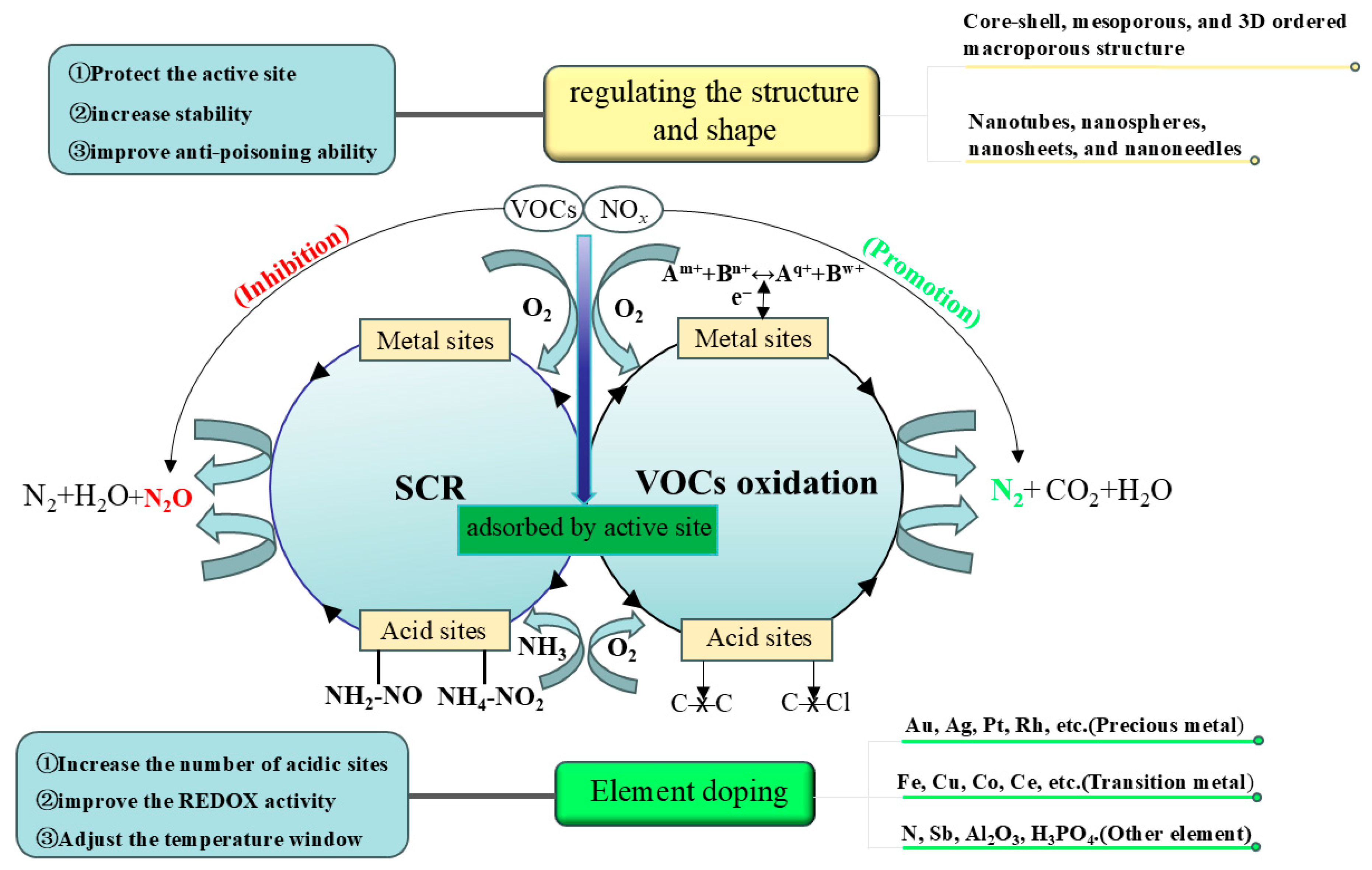
Figure 1. General strategies for improving the activity of bifunctional catalysts.
Catalysts 15 01114 g001
Figure 2. (a) The adsorption energy of reaction molecules (NH3 and PhCH3), and charge transfer number between the catalyst and reaction molecules; (b) Toluene Oxidation Mechanism (without/with NO) [27].
Catalysts 15 01114 g002
Figure 4. The influence of SO2 on by-products [78].
Catalysts 15 01114 g004
Figure 7. A schematic diagram of the reaction mechanisms of H2O in VOC oxidation [113].
Catalysts 15 01114 g007
Figure 8. Probable Improvement Mechanism of the Ru-Modified V-Based SCR Catalyst in the CB Oxidation Process [89].
Catalysts 15 01114 g008
Table 2. Performance of catalyst at 300 °C before and after doping.
CatalystReactant
Composition
Space
Velocity
(mL·g−1·h−1)
ConversionConversion
(After)
Reference
CuCeTiToluene 50 ppm, NO 500 ppm, NH3 500 ppm, SO2 0–500 ppm, 10% O2, 5% H2O60,000/Toluene: >90% (300 °C)
NO: >90% (300 °C)
[55]
Benzene 100 ppm, Toluene 100 ppm, NO 500 ppm, NH3 500 ppm, SO2 1000 ppm, 3.3% O245,000/Benzene: >85% (260–420 °C)
Toluene: >92% (260–420 °C)
NO: >91% (260–420 °C)
[102]
SbPdV/TiO2CB 600 ppm, NO 600 ppm, NH3 600 ppm, SO2 600 ppm, 10% O230,000CB: >90% (325 °C)
NO: >90% (200 °C)
CB: >90% (350 °C)
NO: >90% (225 °C)
[103]
Sb/VWTCB 100 ppm, NO 500 ppm, NH3 500 ppm, SO2 50 ppm, 10% O260,000CB: 100% (325 °C)
NO: ~95% (325 °C)
CB: 100% (325 °C)
NO: ~90% (325 °C)
[47]
Cu0.1-VWTBenzene 100 ppm, Toluene 100 ppm, NO 500 ppm, NH3 500 ppm, SO2 1000 ppm, 3.3% O245,000/Benzene: 98.65% (260–420 °C)
Toluene: 99.89% (260–420 °C)
NO: 86.5% (260–420 °C)
[104]
V-Mo/TiO2Toluene 50 ppm, NO 50–500 ppm, NH3 50–1000, 600 ppmSO2 1000 ppm120,000Toluene: ~97% (350 °C)
NO: /
Toluene: ~85% (350 °C)
NO: /
[105]
MnCoOxCB 50 ppm, NO 50 ppm, SO2 50 ppm12,000CB: ~97% (120 °C)
NO: /
CB: ~90% (120 °C)
NO: /
[106]
Cu-SSZ-13@Mn2Cu1Al1OxToluene 800 ppm, NOx 100 ppm, NH3 100 ppm, SO2 50 ppm, 20% O2, 5% H2O60,000Toluene: ~99% (300 °C)
NO: ~99% (300 °C)
Toluene: ~89% (300 °C)
NO: ~95% (300 °C)
[107]
Sb-MnToluene 100 ppm, NO 600 ppm, NH3 600 ppm, SO2 200 ppm, 5% O2, 5% H2O15,000Toluene: 100% (250)
NO: 100% (200 °C)
Toluene:80% (250)
NO: 80% (200 °C)
[82]
Table 3. Summary of sulfur-resistant catalysts.
CatalystDoping ElementReactant
Composition
Space
Velocity
(mL·g−1·h−1)
ConversionConversion
(After)
Reference
VWTCuToluene 50 ppm, NH3 500 ppm, NO 500 ppm, SO2 100 ppm, O2 5.5%, H2O 8%, 60,000Toluene: ~50%
NO: ~80%
Toluene: ~95%
NO: 100%
[110]
FeBenzene 100 ppm, Toluene 100 ppm, NH3 500 ppm, NO 500 ppm, SO2 1000 ppm, O2 3.33%45,000/Benzene: ~99%
Toluene: ~99%
NO: ~76%
[111]
CoBenzene 100 ppm, Toluene 100 ppm, NH3 500 ppm, NO 500 ppm, SO2 1000 ppm, O2 3.33%Benzene: ~94%
Toluene: ~99%
NO: ~74%
[111]
CeBenzene 500 ppm, Toluene 500 ppm, NO 0.5% vol, NH3 0.5% mol, SO2 0.5% vol, O2 20% vol45,000Benzene: ~98%
Toluene: ~85%
NO: ~20%
Benzene: ~99%
Toluene: ~99%
NO: ~25%
[108]
MoBenzene 500 ppm, Toluene 500 ppm, NO 0.5% vol, NH3 0.5% mol, SO2 0.5% vol, O2 20% volBenzene: ~98%
Toluene: ~99%
NO: ~15%
[108]
NiNH3 500 ppm, NO 500 ppm, Benzene 100 ppm, Toluene 100 ppm, SO2 1000 ppm, 3.33% O245,000Benzene: ~90%
Toluene: ~99%
NO: ~50%
Benzene: ~95%
Toluene: ~99%
NO: ~65%
[104]
[104]
VMTCeCB 50 ppm, NH3 300 ppm, NO 300 ppm, O2 10 vol%, H2O 5 vol %21,000CB: ~45%
NO: ~90%
CB: ~66%
NO: ~75%
[112]
FeCB 50 ppm, NH3 300 ppm, NO 300 ppm, O2 10 vol%, H2O 5 vol %CB: ~80%
NO: ~82%
[112]
MnCB 50 ppm, NH3 300 ppm, NO 300 ppm, O2 10 vol%, H2O 5 vol %CB: ~65%
NO: ~81%
[112]
CrCB 50 ppm, NH3 300 ppm, NO 300 ppm, O2 10 vol%, H2O 5 vol %CB: ~70%
NO: ~89%
[112]
Disclaimer/Publisher’s Note: The statements, opinions and data contained in all publications are solely those of the individual author(s) and contributor(s) and not of MDPI and/or the editor(s). MDPI and/or the editor(s) disclaim responsibility for any injury to people or property resulting from any ideas, methods, instructions or products referred to in the content.