Article

PVP-Assisted Synthesis of Fe-TiO2 for Efficient Tetracycline Degradation via Peroxymonosulfate Activation

1
Shandong Laboratory of Yantai Advanced Materials and Green Manufacturing, Yantai 264006, China
2
School of Chemistry and Chemical Engineering, Ludong University, Yantai 264025, China
*
Authors to whom correspondence should be addressed.
Catalysts 2025, 15(12), 1105; https://doi.org/10.3390/catal15121105
Submission received: 11 November 2025 / Revised: 23 November 2025 / Accepted: 25 November 2025 / Published: 26 November 2025
(This article belongs to the Topic Advanced Oxidation Processes for Wastewater Purification)

Abstract

Tetracycline (TC) is chemically stable and recalcitrant to natural degradation. Peroxymonosulfate (PMS)-based advanced oxidation processes offer an effective removal strategy, the efficacy of which relies on high-performance heterogeneous catalysts. Titanium dioxide (TiO2) is an ideal material due to its stability and environmental compatibility, yet its practical application is hindered by inadequate PMS activation capacity, particle agglomeration, and difficult recovery. To address these limitations, a heterogeneous Fe/TiO2 catalyst was constructed via Fe3+ doping, innovatively utilizing polyvinylpyrrolidone (PVP) as a structure-directing agent. PVP’s steric hindrance effectively suppressed nanoparticle agglomeration and enabled high dispersion of Fe active sites, simultaneously enhancing catalytic activity and stability. Under optimized conditions, the Fe/TiO2/PMS system achieved 94.3% TC degradation, following pseudo-first-order kinetics and significantly outperforming pure TiO2 used in this experimental system. Radical quenching verified sulfate radicals (SO4) as the dominant species. The catalyst demonstrated excellent recyclability, retaining over 80% degradation efficiency after six cycles and enabling convenient magnetic separation. Moreover, in complex water matrices (tap water and seawater), it sustained high removal efficiency (>90% initially, >70% after six cycles), highlighting its superior anti-interference capability and practical potential. This work offers a strategic material design strategy for efficient and robust TC removal in challenging water environments.

1. Introduction

With the rapid development of the economy and the continuous deepening of industrialization, water pollution issues have become increasingly severe. Among them, the widespread presence of antibiotic contaminants in water bodies and their potential ecological risks have attracted extensive attention [1]. Tetracycline (TC), a typical broad-spectrum antibiotic, is extensively used in human medicine and livestock farming. However, its persistence and tendency to accumulate in aquatic environments pose a serious threat to ecological balance and public health [2]. Moreover, the accumulation of TC in organisms may induce adverse physiological effects, including nephrotoxicity, mutagenicity, and teratogenicity [3]. Consequently, the development of efficient TC treatment technologies holds significant importance.
Currently, techniques such as adsorption, biodegradation, membrane separation, and catalytic degradation have been employed for TC removal [4,5,6]. Among them, advanced oxidation processes (AOPs) are regarded as one of the most promising approaches for TC elimination due to their high efficiency, low cost, and mild reaction conditions [7]. In particular, the peroxymonosulfate (PMS)-activated AOP has garnered widespread attention owing to its exceptional degradation capability for emerging contaminants and broad pH adaptability [8]. Conventional PMS activation strategies primarily rely on homogeneous Fenton-like catalytic systems (e.g., using soluble iron salts). However, these systems face significant limitations: the continuous leaching of transition metal ions not only leads to catalyst deactivation but also causes secondary pollution, severely restricting their practical application [9]. To address these issues, the development of stable heterogeneous Fenton-like catalysts has become a research focus [10,11,12]. Among various heterogeneous catalysts, titanium dioxide (TiO2) stands out due to its comprehensive advantages including non-toxicity, high chemical stability, abundance, and easily modifiable surface [13,14]. However, TiO2-based materials generally suffer from limitations such as restricted PMS activation capability and difficult recovery [15].
To address these challenges, researchers have explored modification strategies including crystal phase control, elemental doping, and surface sensitization [16,17,18]. Among these, metal ion doping has been demonstrated as an effective approach to enhance the overall performance of TiO2-based catalysts [19,20,21]. Fe3+-modified TiO2 composite materials have attracted significant attention due to their high stability and tunable surface properties. The Fe3+ ion, with its similar radius to Ti4+, can be firmly incorporated into the TiO2 lattice through lattice site substitution or surface anchoring [22]. For instance, Diamandescu et al. confirmed through extended X-ray absorption fine structure (EXAFS) analysis that Fe3+ can successfully substitute Ti4+ sites in the TiO2 lattice, inducing local structural distortion characterized by an increase in Ti-O bond length and a decrease in Ti-Ti bond length. This structural alteration provides a microscopic basis for explaining the enhancement of its catalytic performance [23]. This process not only establishes efficient and stable heterogeneous active centers within the material but also introduces ferromagnetic components through successful Fe3+ doping, endowing the catalyst with responsiveness to external magnetic fields. The resulting magnetic properties enable rapid catalyst recovery through magnetic separation after reaction completion, eliminating dependence on traditional solid–liquid separation techniques such as centrifugation or filtration. This approach significantly enhances recovery efficiency and operational convenience. For example, Sun et al. [24] fabricated a magnetic Fe2O3/mesoporous black TiO2 hollow-sphere heterojunction (M-Fe2O3/b-TiO2) via wet impregnation and surface hydrogenation strategies, which exhibits broad-spectrum response and magnetic separation capability. Furthermore, the Fe active centers can directly and efficiently activate PMS by triggering homolytic cleavage of its O-O bond through interfacial electron transfer, continuously generating highly reactive oxygen species dominated by sulfate radicals (SO4). Simultaneously, a unique synergistic mechanism may form between potential Ti3+ defects and Fe species in the material: Ti3+ acts as an endogenous electron donor, facilitating the reduction in surface Fe3+ to Fe2+, thereby significantly accelerating the Fe2+/Fe3+ interfacial catalytic cycle and enhancing both PMS activation efficiency and sustained radical generation capacity [25]. For instance, Xu et al. [26] activated the originally redox-inert TiO2 by inducing a surface Fe2+/Fe3+ cycle through Fe doping in TiO2. This modification not only confers exceptional Fenton-like activity to TiO2 but also substantially addresses the technical challenges associated with the recovery and reuse of TiO2 nanoparticles. Although the Fe3+ doping strategy can enhance the catalytic activity of TiO2 and improve its recovery performance, such materials still face a critical challenge in practical Fenton-like applications: nanoparticles are prone to agglomeration during synthesis, leading to reduced active sites and diminished mass transfer efficiency, which consequently causes significant attenuation of catalytic and stability performance [27,28].
In response to the issues outlined above, several strategies have been explored in existing studies. For instance, constructing hollow or mesoporous structures to increase specific surface area or introducing carbon materials as dispersion carriers has been proposed. However, these approaches often involve complex synthesis procedures, and the introduction of additional components may lead to unfavorable interfacial charge recombination [29,30,31]. On the other hand, the use of conventional polymers or surfactants as dispersing agents represents an alternative approach. However, their insufficient stability under Fenton-like reaction conditions often leads to desorption from the catalyst surface, resulting in non-persistent dispersion effects [32,33]. It is noteworthy that even polyvinylpyrrolidone (PVP), a polymer capable of effectively suppressing random nanoparticle aggregation through coordination by its polar groups and steric hindrance from its hydrophobic chains, has been predominantly utilized in existing studies merely as a physical barrier [34]. This limited utilization hinders the full exploitation of its potential as a "structure-directing agent" for synergistically optimizing the overall material performance. Consequently, existing strategies often focus predominantly on addressing isolated challenges, such as agglomeration during synthesis or recovery difficulties, while lacking an integrated design capable of simultaneously optimizing activity, stability, and operational convenience. Crucially, the deep integration of the interfacial modulation capability of PVP with the magnetic and catalytic properties of Fe3+ doping remains a significant challenge. The fundamental goal of constructing a catalytic material that concurrently possesses high-density active sites, superior operational stability, and convenient magnetic separation is thus a critically underexplored scientific problem.
Based on the above analysis, we propose a PVP-assisted Fe3+ doping strategy to construct a high-performance Fe/TiO2 catalyst via a facile one-step hydrothermal method. In this design, PVP molecules not only suppress particle agglomeration but also, through their coordination effect, guide and stabilize the highly dispersed state of Fe species while they are incorporated into the TiO2 lattice, thereby establishing a robust Fe-O-Ti interface at the nanoscale. This synergistic design effectively inhibits nanoparticle aggregation, thereby enhancing the initial catalytic activity while laying a structural foundation for long-term cycling stability. Furthermore, the successfully incorporated Fe3+ serves as highly efficient active sites while simultaneously endowing the material with convenient magnetic separability. Performance tests demonstrate that the material maintains over 90% TC removal efficiency under complex water matrix conditions, along with favorable cycling stability. These results strongly validate the effectiveness of our proposed integrated design strategy, using PVP as a structure-directing agent, in simultaneously enhancing catalytic activity, stability, and operational convenience, offering a new perspective for the treatment of TC-containing wastewater in practical environments.

2. Results and Discussion

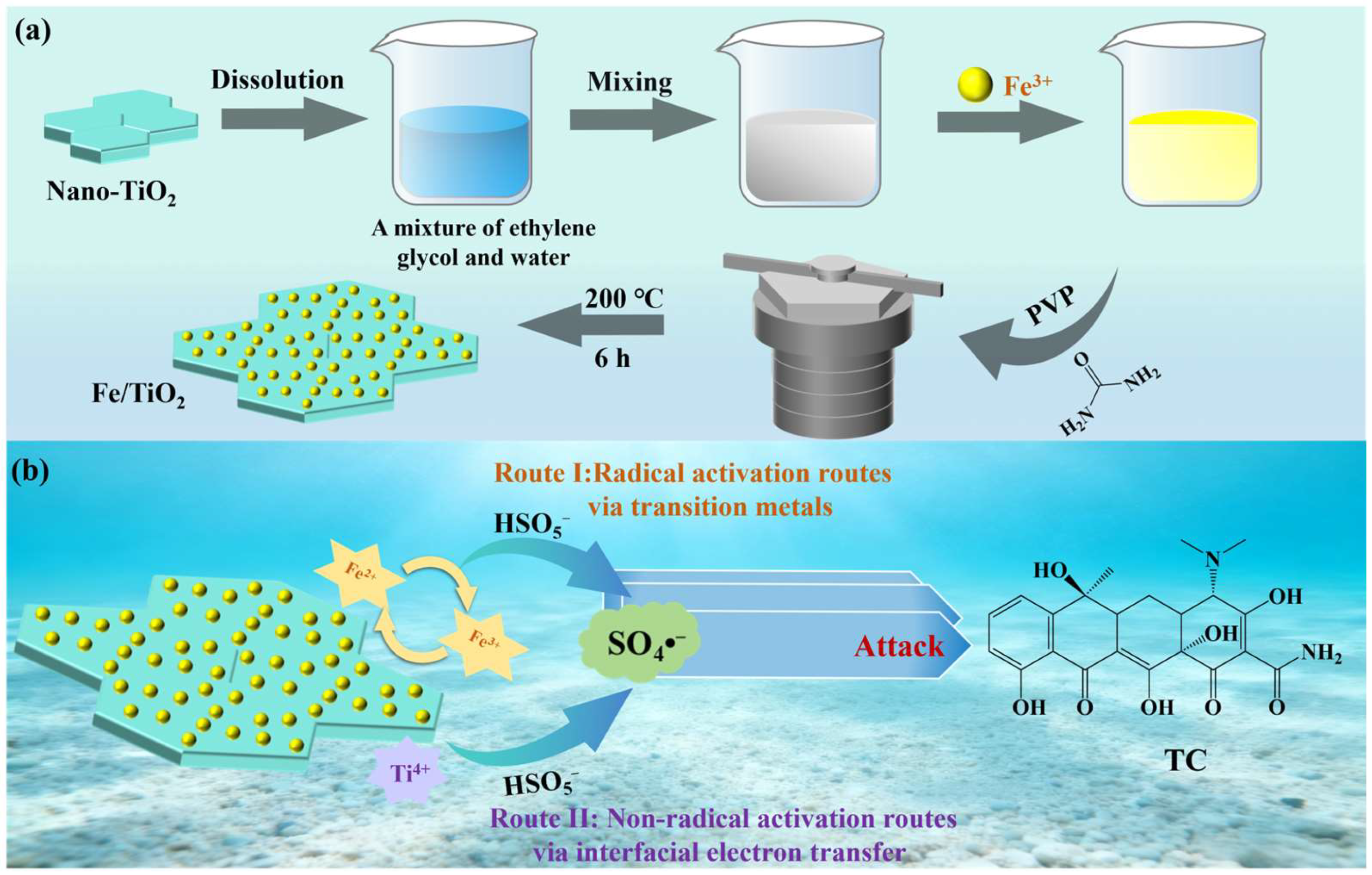
As illustrated in Scheme 1, a modified TiO2 catalyst (Fe/TiO2) was developed via a facile PVP-assisted hydrothermal method. The resulting catalyst effectively activated PMS through a synergistic action between TiO2 and Fe species, generating highly oxidative radicals that subsequently attacked and degraded TC.

2.1. Characterization of Fe/TiO2

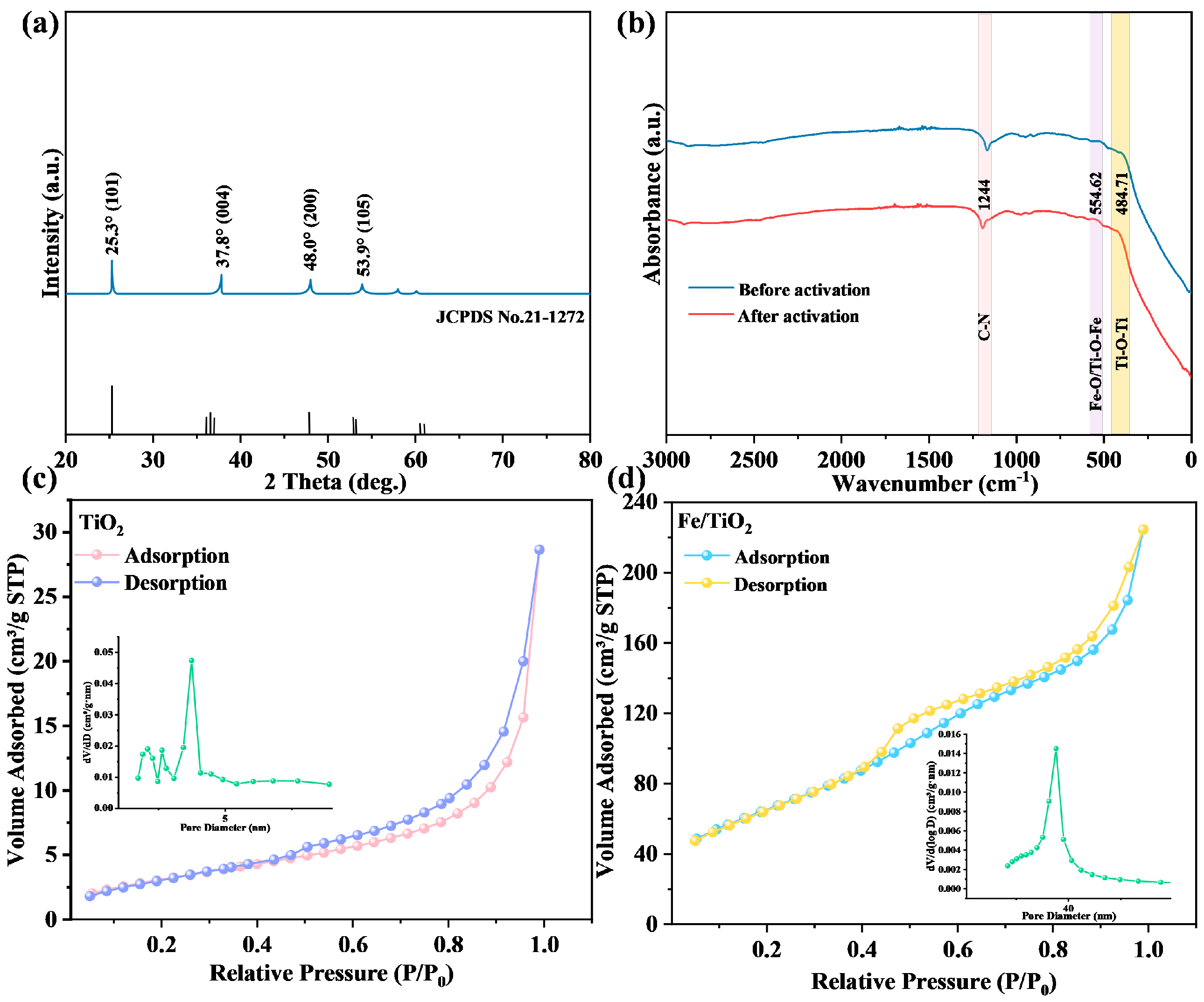
The crystal structure and chemical environment of Fe/TiO2 were systematically characterized by X-ray diffraction (XRD) and Fourier transform infrared (FT-IR) spectroscopy. The XRD pattern (Figure 1a) exhibits characteristic diffraction peaks at 25.3°, 37.8°, 48.0°, and 53.9°, which are indexed to the (101), (004), (200), and (105) crystal planes of anatase TiO2 (JCPDS No. 21-1272) [35], respectively, indicating the formation of a well-crystallized anatase matrix. Moreover, no diffraction peaks corresponding to free iron oxide phases were detected, suggesting that the Fe3+ precursor did not form separate crystalline phases but was highly dispersed within the TiO2 support. The chemical bonding states were further investigated by FT-IR spectroscopy (Figure 1b). The absorption band at 484.71 cm−1 is attributed to the Ti-O-Ti skeletal vibration, confirming the preservation of the anatase structure as determined by XRD. The observed shoulder peak at 554.62 cm−1, assigned to Fe-O bond vibration, directly demonstrates the successful incorporation of Fe species, forming stable configurations such as Fe-O-Fe or Ti-O-Fe, thereby constructing efficient heterogeneous active sites for PMS activation. Additionally, the appearance of the C-N stretching vibration peak at 1244 cm−1 indicates the residual presence of PVP in the material. After the catalytic reaction, these key spectral features remained largely unchanged, demonstrating the excellent chemical bond stability of the catalyst under strong oxidizing conditions. N2 adsorption–desorption analysis revealed fundamental differences in the pore characteristics between pristine TiO2 (Figure 1c) and Fe/TiO2 (Figure 1d). Fe/TiO2 exhibited an order-of-magnitude enhancement in both specific surface area (237.2 m2/g) and total pore volume (0.275 cm3/g) compared to pristine TiO2 (11.99 m2/g and 0.021 cm3/g, respectively), creating favorable conditions for high-density loading and full exposure of Fe active sites. The pore size distribution provided further structural insight: pristine TiO2 showed a concentration of pores around 3.7 nm, indicative of tight nanoparticle packing, whereas Fe/TiO2 displayed a dominant peak at 35.2 nm. This prominent shift confirms that PVP acted as a structure-directing agent, guiding the assembly of nanoparticles into a three-dimensional network with open mesoporous channels. Crucially, this mesoporous structure is highly advantageous over a microporous one, as it provides sufficiently large channels for the rapid diffusion of bulky PMS and TC molecules. Consequently, this optimized pore architecture significantly enhanced mass transfer of PMS and TC molecules, ensuring their efficient access to internal active sites [36].
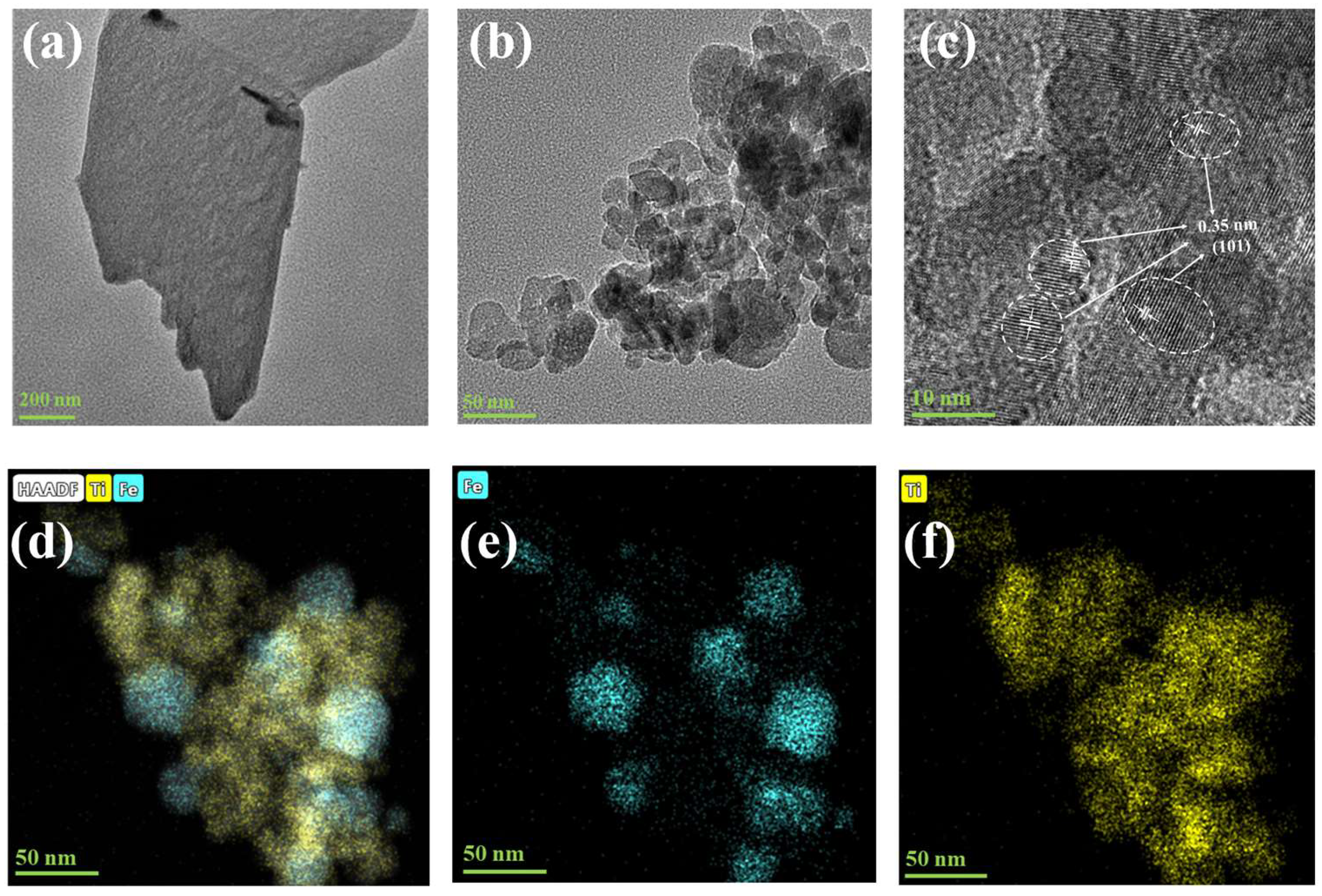
To further investigate the morphological and structural characteristics of the catalysts, TiO2 and Fe/TiO2 were characterized by transmission electron microscopy (TEM). As shown in Figure 2a, pure TiO2 exhibits a sheet-like morphology with poor crystallinity, as evidenced by vague lattice fringes. After Fe modification, Fe/TiO2 (Figure 2b) maintained a uniformly dispersed nanosheet morphology without significant agglomeration, confirming that PVP effectively functioned as both a steric hindrance agent and a dispersant during synthesis. The high-resolution TEM image (Figure 2c) further reveals that the Fe/TiO2 nanosheets possess clear and continuous lattice fringes with an interplanar spacing of approximately 0.35 nm, which corresponds well to the (101) plane of the anatase phase. This result is consistent with XRD analysis and indicates significantly enhanced crystallinity due to Fe doping and the hydrothermal process, providing a solid foundation for charge transfer and structural stability. Furthermore, the elemental mapping images (Figure 2d–f) clearly demonstrate a highly uniform distribution of Fe throughout the TiO2 matrix with no observable local aggregation. This provides direct microscopic evidence that Fe species were successfully doped and uniformly anchored onto the TiO2 surface.
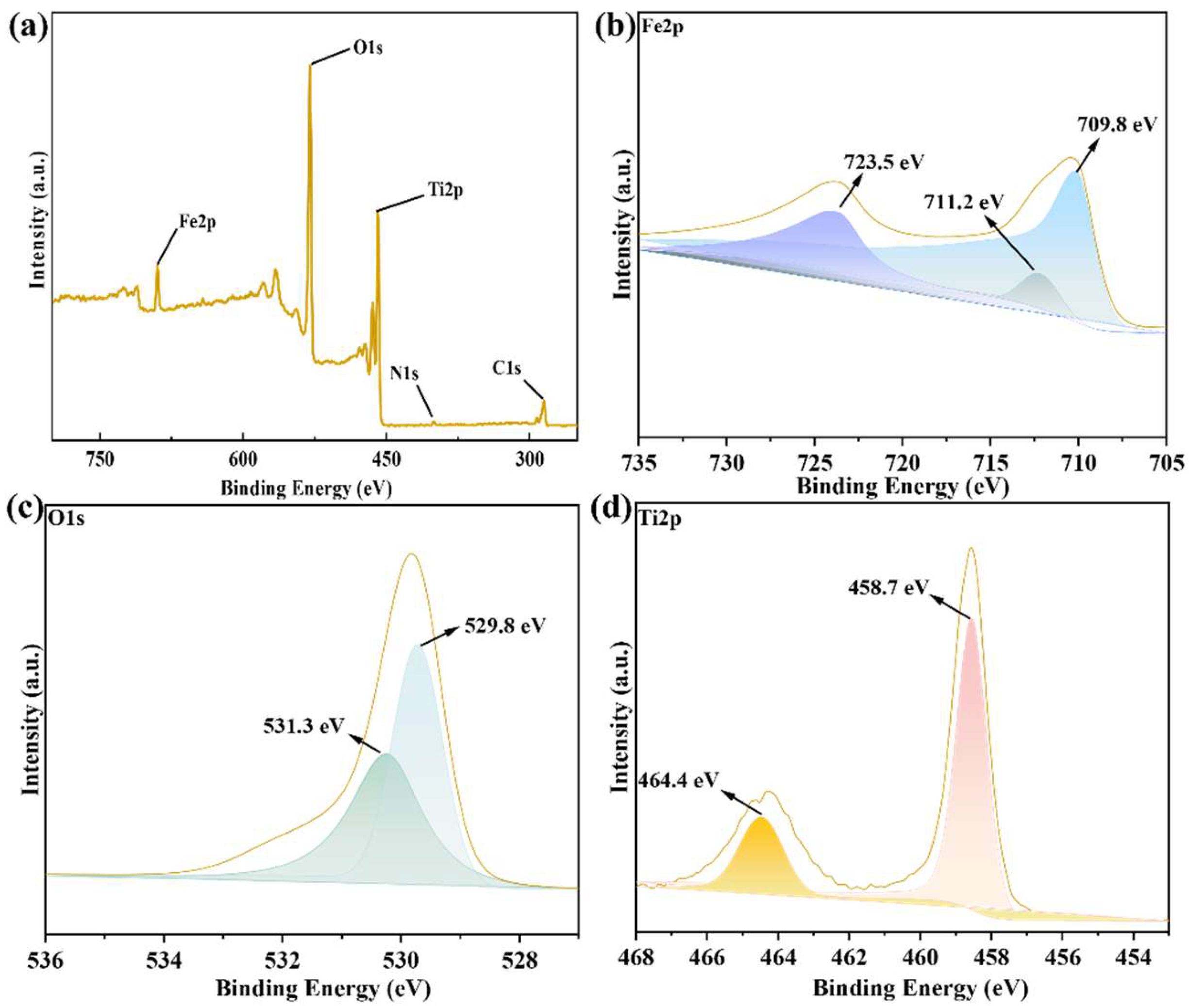
X-ray photoelectron spectroscopy (XPS) analysis was conducted to further investigate the surface elemental composition and chemical states of the Fe/TiO2 catalyst. The survey spectrum (Figure 3a) confirms the presence of Fe, Ti, and O elements. In the high-resolution Fe 2p spectrum (Figure 3b), the characteristic peaks observed at 711.2 eV and 709.8 eV are assigned to Fe3+ and Fe2+, respectively. The coexistence of the Fe3+/Fe2+ redox couple provides key sites for the electron transfer process in PMS activation during the Fenton-like reaction [37]. In the O 1s spectrum (Figure 3c), the peak located at 529.8 eV is attributed to contributions from both Fe-O and Ti-O bonds. The characteristic peak at 458.7 eV in the Ti 2p spectrum (Figure 3d) verifies the presence of Ti4+, corresponding to anatase TiO2. Collectively, the XPS spectral analysis reveals strong interfacial interactions between the Fe and Ti species, which stabilize their stable and dispersed coexistence.

2.2. Optimization of Catalytic Condition

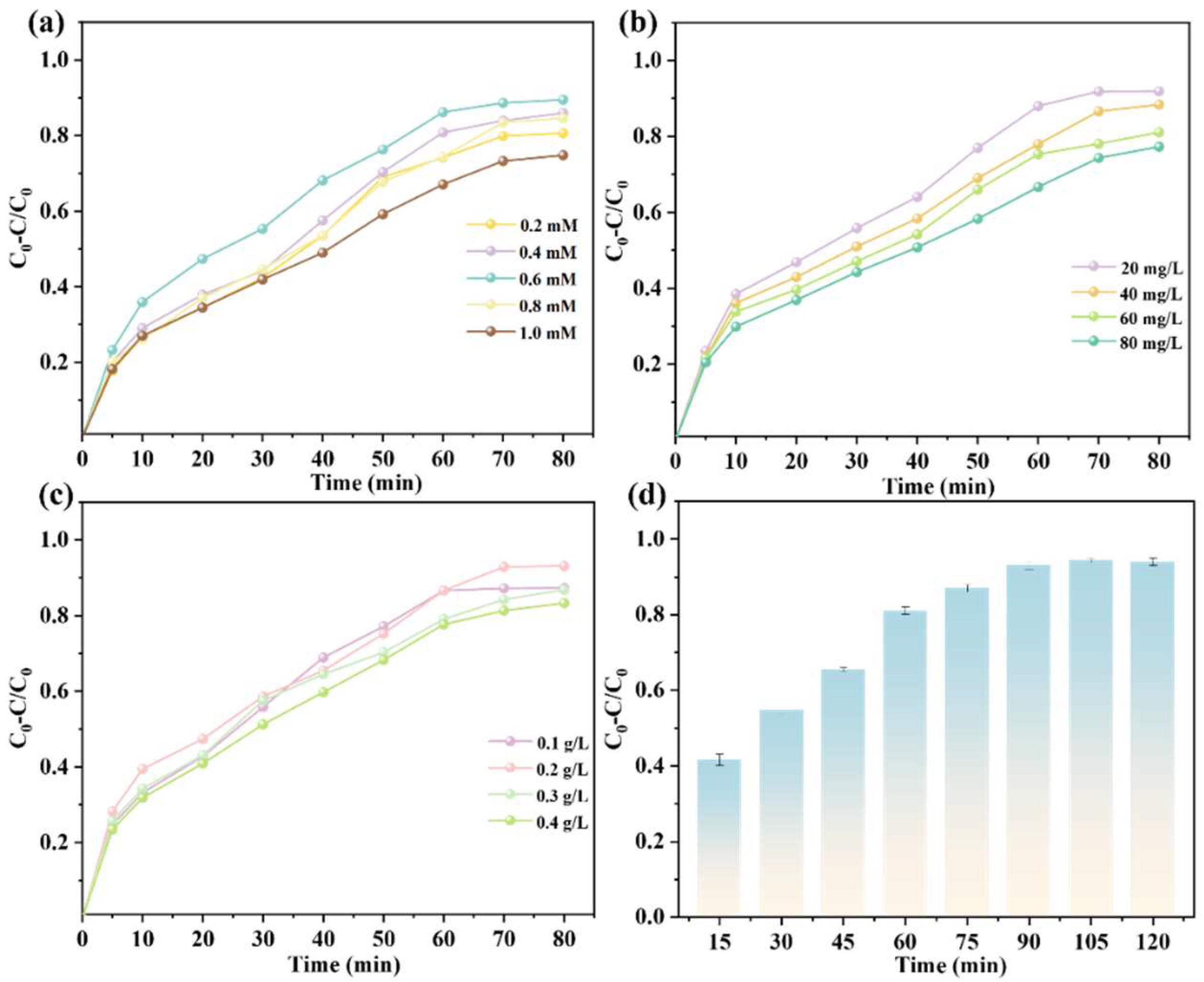
The optimal reaction conditions for TC degradation in the Fe/TiO2/PMS system were determined by systematically investigating key parameters, including PMS concentration, initial TC concentration, and catalyst dosage. As the oxidant precursor, the PMS concentration directly governs the yield of active radicals in the system. As shown in Figure 4a, the degradation efficiency of TC initially increased and then decreased with increasing PMS concentration, reaching a maximum at 0.6 mM. In the low-concentration range (0.2–0.6 mM), the enhancement in degradation efficiency can be attributed to the increased activation of PMS molecules by the active sites on the Fe/TiO2 catalyst surface, generating sufficient amounts of SO4 and •OH radicals, thereby accelerating the oxidative decomposition of TC. However, when the PMS concentration exceeded 0.6 mM, the TC degradation efficiency decreased. This decline can be attributed to two primary reasons: first, excess PMS may scavenge SO4 radicals in the system, consuming the highly reactive radical species; second, high PMS concentrations may lead to the occupation of catalyst active sites by its decomposition products or unreacted molecules, thereby reducing TC adsorption and inhibiting the reaction progress. Subsequently, the effect of initial TC concentration on the degradation performance was investigated. The effect of the initial TC concentration was also examined (Figure 4b). As expected, the degradation efficiency decreased with increasing TC concentration, which is consistent with expectations. This trend occurs because, at fixed catalyst and PMS loadings, the finite radical population becomes insufficient to degrade the higher quantity of TC molecules. Furthermore, TC and its degradation intermediates compete for the available radicals, ultimately leading to reduced apparent degradation efficiency.
Following the investigation of reactant concentrations, the role of catalyst dosage was evaluated. As the core component for PMS activation and radical generation, the catalyst dosage significantly influenced the process. As shown in Figure 4c, when the catalyst dosage increased from 0.1 g/L to 0.2 g/L, the degradation efficiency improved markedly and reached an optimum at 0.2 g/L, owing to the increased availability of active sites promoting PMS activation and sustained radical generation. However, a further increase to 0.4 g/L led to a decrease in efficiency, likely due to particle aggregation and increased mass transfer resistance at higher loadings, which reduced the accessibility of active sites. The reaction kinetics are shown in Figure 4d. The degradation of TC primarily occurred within the first 80 min, reaching 94.3%, after which the curve plateaued. This indicates that the catalytic oxidation reaction approached equilibrium by 80 min.
In summary, through systematic univariate optimization experiments, the optimal conditions for TC degradation were determined as follows: PMS concentration 0.6 mM, initial TC concentration 20 mg/L, Fe/TiO2 dosage 0.2 g/L, and reaction time 80 min.
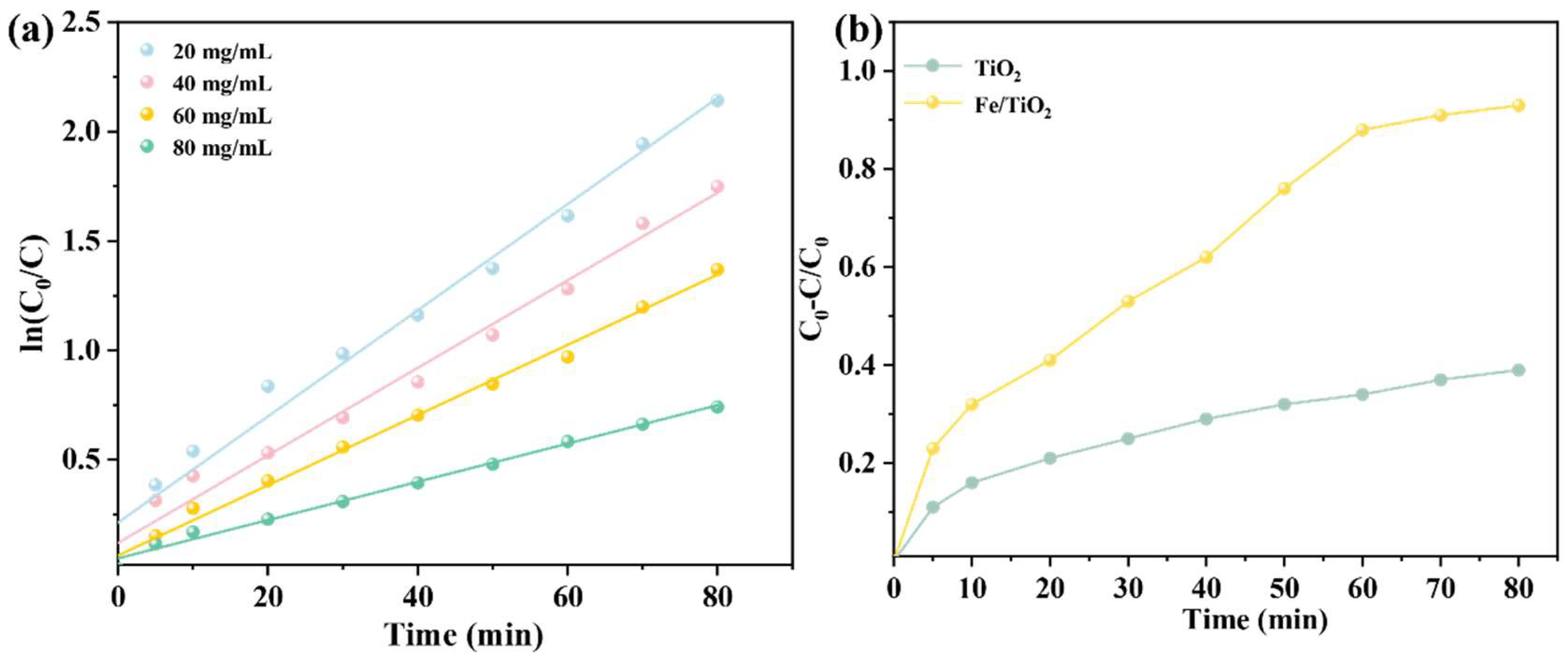
The reaction kinetics of the system and the enhancement effect of Fe modification on TiO2 were further investigated. The degradation kinetics of TC under optimal conditions were fitted, indicating that the process follows a pseudo-first-order kinetic model (Figure 5a). This behavior demonstrates that the degradation rate of TC is proportional to its instantaneous concentration when the catalyst and PMS concentrations are held constant, a characteristic of typical heterogeneous catalytic oxidation processes. Furthermore, by comparing the catalytic performance of Fe/TiO2 and pure TiO2 under identical conditions, the significant effect of Fe modification was directly verified. As shown in Figure 5b, under natural light conditions, Fe/TiO2 achieved a TC degradation rate three times that of pure TiO2 used in this experimental system within the 80 min reaction period. This significant enhancement is primarily attributed to the successful introduction of Fe species, which creates highly dispersed active sites (e.g., Fe2+/Fe3+) on the TiO2 surface. These sites are markedly more efficient than pure TiO2 in activating PMS to generate highly oxidative SO4 and •OH radicals.

2.3. Cycling Stability and Mechanism Investigation

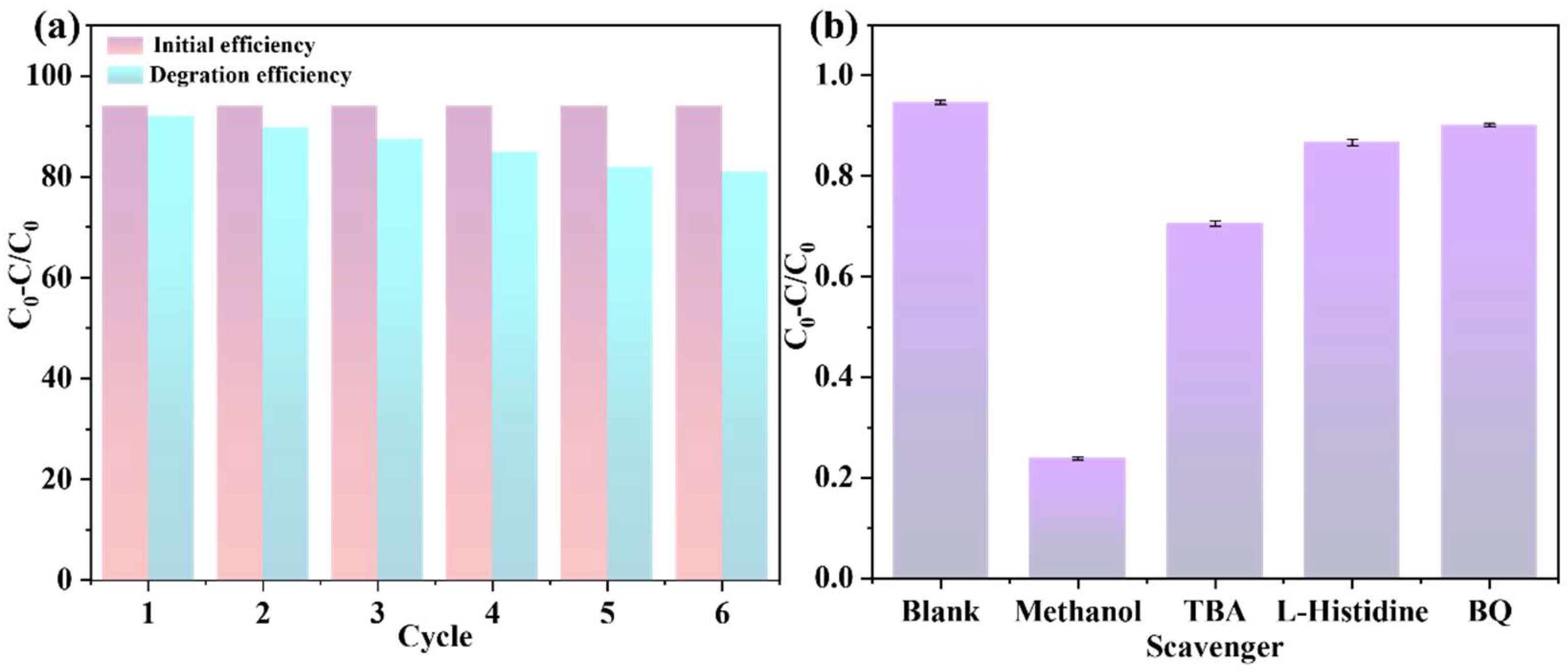
The cycling stability and reaction mechanism are crucial for assessing the practical application potential of a catalyst and understanding its underlying chemical kinetics. The cycling performance of the Fe/TiO2 catalyst was first evaluated. As shown in Figure 6a, the degradation rate of TC remained at approximately 80% after six consecutive cycles, indicating good structural stability and reusability. The slight decrease in the degradation rate could be attributed to the minor physical loss of the catalyst during each cycle. Furthermore, partial deactivation likely occurred because some active sites were occupied by intermediate products that were difficult to desorb during the reaction. To elucidate the dominant reaction mechanism, radical scavenging experiments were conducted. The inhibitory effects of different scavengers on the TC degradation rate showed significant differences (Figure 6b): Compared to the blank group, the reaction was strongly suppressed upon the addition of methanol, whereas the addition of TBA resulted in a relatively limited inhibitory effect. This contrast provides key evidence for identifying the dominant radical species. Methanol can efficiently quench both SO4 and •OH, while TBA primarily quenches •OH, with its quenching rate constant for SO4 being several orders of magnitude lower. Consequently, the experimental results clearly demonstrate that SO4 plays a dominant role in this degradation system, while •OH plays a secondary role. Moreover, the addition of L-histidine and BQ only slightly inhibited the TC degradation process, indicating that singlet oxygen (1O2) and superoxide radicals (O2) contributed minimally to the catalytic oxidation reaction. The possible degradation mechanism of TC in the Fe/TiO2/PMS system is proposed to proceed via synergistic activation pathways. Specifically, Ti4+ sites form a surface complex with HSO5, which undergoes interfacial electron transfer (likely from adsorbed TC molecules or the TiO2 substrate itself) to generate SO4 without altering the Ti oxidation state, which represents a non-radical activation route. Concurrently, the Fe species drive the radical-based activation through the Fe2+/Fe3+ redox cycle: Fe2+ reacts with HSO5 to yield SO4 and Fe3+, and the subsequent reduction of Fe3+ back to Fe2+ (facilitated by electron donors or TiO2-mediated electron transfer) is crucial for sustaining the catalytic activity. Notably, the two pathways reinforce each other: the TiO2 substrate not only contributes to direct PMS activation but also promotes the Fe3+/Fe2+ cycle, thereby collectively enhancing SO4 production and enabling efficient TC mineralization.

2.4. TC Degradation in Real Water Samples

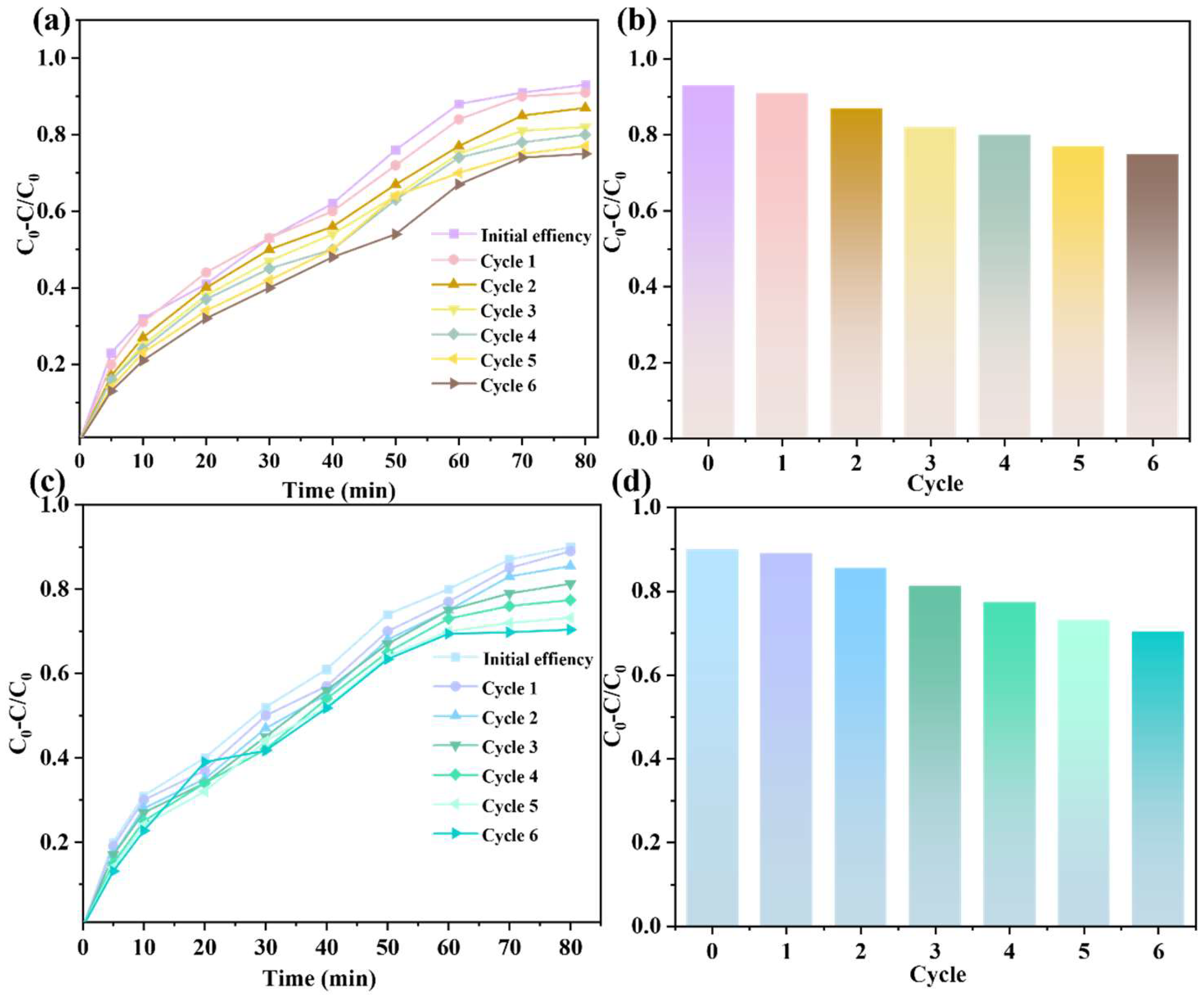
To evaluate the practical application potential of the catalyst, its performance and cycling stability for TC degradation were investigated in complex water matrices (tap water and seawater). As shown in Figure 7a,c, the TC degradation efficiency exceeded 90% in both real water matrices, with only a slight decrease compared to the ultrapure water system. This result indicates that the Fe/TiO2/PMS system maintained excellent intrinsic catalytic activity despite the presence of common inorganic ions (e.g., Cl, HCO3) in tap water or high salinity and complex organic matter in seawater. This robustness is likely due to the strong PMS activation capability of the stable Fe active sites on the catalyst surface, which were not readily completely poisoned by background constituents in the water. Furthermore, the degradation profiles over successive cycles (Figure 7a,c) and the corresponding histograms of degradation efficiency (Figure 7b,d) clearly show that after six consecutive cycles, the efficiency decreased to approximately 75% in tap water and 70% in seawater. This performance attenuation can be ascribed to competitive anions scavenging radicals, thereby reducing degradation efficiency and accelerating irreversible catalyst passivation. Additionally, natural organic matter (e.g., humic acid) or metal cations in seawater may form a surface coating on the catalyst, physically shielding active sites and hindering the diffusion and contact of PMS and TC. Nevertheless, the catalyst retained over 70% degradation efficiency after six cycles in these complex aqueous environments. This performance, superior to most reported results (Table S5), demonstrates its stable catalytic performance and potential for practical application.

3. Materials and Methods

3.1. Materials

Ferric chloride hexahydrate (FeCl3·6H2O) was purchased from Tianjin Opulent Chemical Co., Ltd., Shanghai, China. Other reagents including nano-titanium dioxide (TiO2), urea (CH4N2O), polyvinylpyrrolidone ((C6H9NO)n, PVP), potassium peroxymonosulfate (2KHSO5·KHSO4·K2SO4, PMS), tert-butanol (C4H10O, TBA), p-benzoquinone (C6H4O2, BQ), and tetracycline (C22H24N2O8, TC) were obtained from Aladdin Chemical Reagent Co., Shanghai, China. All chemicals were used as received without further purification.

3.2. Characterization

The morphological features of TiO2 and Fe/TiO2 were investigated using transmission electron microscopy (TEM, Libra 200, Zeiss, Carl Zeiss AG, Jena, Germany). Crystal structure analysis was performed by X-ray powder diffraction (XRD, Rigaku, Tokyo, Japan) with 2θ scanning from 10° to 80° at a rate of 2°/min. The N2 adsorption–desorption isotherms were measured using a Micromeritics ASAP 2020 surface area and porosity analyzer (Micromeritics, Norcross, GA, USA) to determine the specific surface area and pore structure. The elemental composition and surface chemical states of the materials were analyzed by X-ray photoelectron spectroscopy (XPS, Kratos AXIS ULTRA DLD, Kratos Analytical Ltd., Manchester, UK). Surface functional groups of the catalysts were characterized using Fourier transform infrared spectroscopy (FT-IR, JASCO FT-IR-420, JASCO Corporation, Tokyo, Japan). Additionally, ultraviolet-visible absorption spectra were recorded on a UV–Vis spectrophotometer (Purkinje General T700, Beijing Purkinje General Instrument Co., Ltd., Beijing, China).

3.3. Synthesis of Fe/TiO2

1.0 g of nano-titanium dioxide (TiO2) was dispersed in 50 mL of a solvent mixture of ethylene glycol and deionized water (1:1, v/v) and treated with ultrasonication to form a homogeneous suspension. Then, 0.56 g of ferric chloride hexahydrate (FeCl3·6H2O) was added to the suspension, and the mixture was stirred for 1 h to achieve sufficient adsorption of Fe3+ ions onto the TiO2 support. Subsequently, 0.3 g of urea (CH4N2O) and 0.2 g of polyvinylpyrrolidone ((C6H9NO)n, PVP) were added sequentially under continuous stirring, until a uniform mixture was obtained. The mixture was transferred into a Teflon-lined stainless-steel autoclave and reacted at 200 °C for 6 h. After the autoclave was naturally cooled to room temperature, the product was collected by centrifugation and washed three times with deionized water and twice with anhydrous ethanol. The solid was finally dried at 60 °C for 8 h under vacuum to obtain the powder sample.

3.4. Optimization of Catalytic Conditions

The effects of key operational parameters, including peroxymonosulfate (2KHSO5·KHSO4·K2SO4, PMS) concentration, tetracycline (C22H24N2O8, TC) initial concentration, catalyst dosage, and reaction time, on the degradation performance of Fe/TiO2 were systematically investigated using a one-factor-at-a-time approach. The specific procedure was as follows: a predetermined mass of Fe/TiO2 catalyst was placed in a beaker, and a TC solution of specified concentration was added. The mixture was sealed and then stirred at 500 rpm for 60 min in the dark to achieve adsorption–desorption equilibrium. Immediately after equilibrium, a sample was taken to measure the initial absorbance of TC at 355 nm. Subsequently, a PMS solution of given concentration was introduced to initiate the catalytic oxidation reaction. At predetermined time intervals, samples were continuously collected, and the variation in the characteristic absorption peak intensity of TC was monitored using a UV–Vis spectrophotometer. The degradation efficiency was calculated according to Equation (1):
D e g r a d a t i o n   ( % )   =   [ ( C 0     C ) / C 0 ]   ×   100 %
where C0 is the initial absorbance of the pollutant after adsorption equilibrium and before the catalytic oxidation reaction starts, and C is the absorbance of TC at a specific time during the catalytic reaction.
The parameter optimization procedure was as follows. First, with the catalyst dosage fixed at 10 mg and the initial TC concentration fixed at 40 mg/L, the influence of PMS concentration (0.2, 0.4, 0.6, 0.8, and 1 mM) was systematically investigated. Based on these optimization results, the optimal PMS concentration was applied to subsequently investigate the effects of the initial TC concentration (20, 40, 60, and 80 mg/L) and then the catalyst dosage (0.1, 0.2, 0.3, and 0.4 g/L) on the degradation performance. Finally, the reaction kinetics were evaluated over a time period of 15–120 min (Tables S1–S4).

3.5. Cycling Stability Test

The cycling stability of the Fe/TiO2 catalyst was evaluated through six consecutive rounds of recovery and reuse. After each reaction cycle, the catalyst was recovered by magnetic separation, followed by ultrasonic cleaning sequentially with 20 mL of anhydrous ethanol and 20 mL of ultrapure water. This washing procedure was repeated three times. After vacuum drying at 35 °C for 8 h, the catalyst was reintroduced into the next catalytic reaction under optimal conditions. The stability was assessed by monitoring the variation in degradation efficiency across the cycles.

3.6. TC Degradation in Real Water Samples

To evaluate the applicability and anti-interference capability of the as-prepared Fe/TiO2 in practical aquatic environments, its degradation behavior toward TC was systematically assessed in two complex aqueous matrices: tap water and seawater. All environmental water samples were filtered through 0.45 μm microporous membranes after collection to remove suspended particulate matter. Subsequently, TC solutions were prepared using these real water samples as the solvent, and degradation experiments were conducted under the optimized catalytic conditions. The performance was compared with that observed in an ultrapure water system.

4. Conclusions

This study demonstrates that PVP serves as a highly effective structure-directing agent for fabricating a high-performance Fe/TiO2 catalyst via a facile one-step hydrothermal route. Beyond suppressing nanoparticle agglomeration, PVP guided the formation of a robust Fe–O–Ti interface, which was crucial for creating highly dispersed and stable Fe active sites. This synergistic design resulted in a catalyst that integrates exceptional PMS activation capability (achieving 94.3% TC degradation under optimum conditions), remarkable recyclability (>80% efficiency after 6 cycles), and convenient magnetic separation. The dominance of sulfate radicals in the system and its robust performance in complex water matrices underscore its potential for practical wastewater treatment.

Supplementary Materials

The following supporting information can be downloaded at: https://www.mdpi.com/article/10.3390/catal15121105/s1, Table S1: Optimization of PMS concentration; Table S2: Optimization of initial TC concentration; Table S3: Optimization of Fe/TiO2 dosage; Table S4: Optimization of reaction time; Table S5: Comparison of degradation and cycling performance among some reported catalysts. References [38,39,40,41,42,43] are cited in the Supplementary Materials.

Author Contributions

Conceptualization, X.W.; methodology, L.Y.; validation, S.W. and L.X.; formal analysis, X.W. and L.Y.; investigation, Y.L. and Z.Q.; resources, Y.L., Z.Q., and X.L.; data curation, S.W.; writing—original draft preparation, X.W.; writing—review and editing, X.W.; visualization, L.Y.; supervision, X.L. and Z.Q.; project administration, X.L.; funding acquisition, Z.Q. All authors have read and agreed to the published version of the manuscript.

Funding

This research received no external funding.

Data Availability Statement

The data supporting the findings of this study are available from the corresponding author upon reasonable request. All data have been processed and analyzed as presented in the manuscript.

Acknowledgments

This work was financially supported by the Natural Science Foundation of Shandong Province (ZR2023MB024), the Yantai High-End Talent Introduction and Cultivation “Double Hundred Plan” Scholars and Young Experts, the Yantai Basic Research Project for Science and Technology Innovation Development Plan (2024JCYJ064), the Key R&D Program of Shandong Province (Major Innovative and Technological Engineering) (2024CXGC010316, 2024CXGC010406, 2025CXGC010506), the Science Fund of Shandong Laboratory of Yantai Advanced Materials and Green Manufacturing (AMGM2023A02, AMGM2024A06), and the National Natural Science Foundation of China (52073134).

Conflicts of Interest

The authors declare no conflicts of interest.

References

  1. Li, X.; Hu, J.; Deng, Y.; Li, T.; Liu, Z.-Q.; Wang, Z. High stable photo-Fenton-like catalyst of FeP/Fe single atom-graphene oxide for long-term antibiotic tetracycline removal. Appl. Catal. B Environ. 2023, 324, 122243. [Google Scholar] [CrossRef]
  2. Wang, A.; Zheng, Z.; Wang, H.; Chen, Y.; Luo, C.; Liang, D.; Hu, B.; Qiu, R.; Yan, K. 3D hierarchical H2-reduced Mn-doped CeO2 microflowers assembled from nanotubes as a high-performance Fenton-like photocatalyst for tetracycline antibiotics degradation. Appl. Catal. B Environ. 2020, 277, 119171. [Google Scholar] [CrossRef]
  3. Wang, C.; Lin, C.-Y.; Liao, G.-Y. Degradation of antibiotic tetracycline by ultrafine-bubble ozonation process. J. Water Process Eng. 2020, 37, 101463. [Google Scholar] [CrossRef]
  4. Zhang, X.; Hou, J.; Zhang, S.; Cai, T.; Liu, S.; Hu, W.; Zhang, Q. Standardization and micromechanistic study of tetracycline adsorption by biochar. Biochar 2024, 6, 12. [Google Scholar] [CrossRef]
  5. Chen, X.; Yang, Y.; Ke, Y.; Chen, C.; Xie, S. A comprehensive review on biodegradation of tetracyclines: Current research progress and prospect. Sci. Total Environ. 2022, 814, 152852. [Google Scholar] [CrossRef]
  6. Gan, J.; Wang, H.; Li, J.; Song, X.; Liu, X.; Jiang, J.; Huo, P. g-C3N4/BaTiO3/PVDF membrane photocatalytic degradation of tetracycline. J. Ind. Eng. Chem. 2025, 152, 461–473. [Google Scholar] [CrossRef]
  7. Sivanesan, J.; Sivaprakash, B.; Rajamohan, N.; Phanindra, V.S.S.; Sonne, C.; Liew, R.K.; Lam, S.S. Remediation of tetracycline pollution using microplastics, green materials, membranes and sonocatalysts: A review. Environ. Chem. Lett. 2024, 22, 2943–2975. [Google Scholar] [CrossRef]
  8. Hua, B.; Zheng, L.; Adeboye, A.; Li, F. Defect- and nitrogen-rich porous carbon embedded with Co NPs derived from self-assembled Co-ZIF-8 @ anionic polyacrylamide network as PMS activator for highly efficient removal of tetracycline hydrochloride from water. Chem. Eng. J. 2022, 443, 136439. [Google Scholar] [CrossRef]
  9. He, W.; Huang, L.; Wang, X.; Zhang, J. Molybdenum nitride(γ-Mo2N) as a novel co-catalyst to enhance Fe(III)/Fe(II) cycle for homogeneous and heterogeneous peroxymonosulfate activation: Performance and mechanism. J. Environ. Chem. Eng. 2024, 12, 112404. [Google Scholar] [CrossRef]
  10. Fu, W.; Huo, S.; Zhang, M.; Song, L.; Zhao, Q.; Wu, X.; Gao, M. Efficient degradation of oxytetracycline by glucose modified CuFeO2 in visible-light-assisted heterogeneous activation of peroxymonosulfate system: Performance, mechanism and DFT calculation. J. Environ. Chem. Eng. 2023, 11, 111225. [Google Scholar] [CrossRef]
  11. Wang, Y.; Lv, M.; Dong, H.; Hassan, M.; Wang, D.; Gong, Z. Electro-assisted heterogeneous peroxymonosulfate activation on NiFe2O4 coated nickel foam cathode for tetracycline degradation: Synergistic efficacy and mechanism. J. Taiwan Inst. Chem. Eng. 2024, 163, 105656. [Google Scholar] [CrossRef]
  12. Qiu, X.; Zhao, Y.; Jia, Z.; Li, C.; Jin, R.; Mutabazi, E. Fe and Zn co-doped carbon nanoparticles as peroxymonosulfate activator for efficient 2,4-dichorophenol degradation. Environ. Res. 2024, 240, 117313. [Google Scholar] [CrossRef] [PubMed]
  13. Azami, M.S.; Jalil, A.A.; Hassan, N.S.; Hussain, I.; Fauzi, A.A.; Aziz, M.A.A. Green carbonaceous material–fibrous silica-titania composite photocatalysts for enhanced degradation of toxic 2-chlorophenol. J. Hazard. Mater. 2021, 414, 125524. [Google Scholar] [CrossRef] [PubMed]
  14. Lim, C.; An, H.-R.; Lee, H.; Lee, R.; Choi, Y.; Park, J.-I.; Yoon, J.; Lee, H.U.; Lee, Y.-S. Carbon-titanium dioxide heterogeneous (photo)catalysts (C–TiO2) for highly efficient visible light photocatalytic application. Compos. Part B Eng. 2022, 241, 109997. [Google Scholar] [CrossRef]
  15. Ayappan, C.; Xing, R.; Zhang, X.; Luo, D.; Liu, S.; Fujishima, A. TiO2-based photocatalysts for emerging gaseous pollutants removal: From photocatalysts to reactors design. Coord. Chem. Rev. 2024, 515, 215960. [Google Scholar] [CrossRef]
  16. Marszewski, M.; Marszewska, J.; Pylypenko, S.; Jaroniec, M. Synthesis of porous crystalline doped titania photocatalysts using modified rrecursor strategy. Chem. Mater. 2016, 28, 7878–7888. [Google Scholar] [CrossRef]
  17. Chen, F.; Li, W.; Sahoo, B.; Kreyenschulte, C.; Agostini, G.; Lund, H.; Junge, K.; Beller, M. Hydrogenation of pyridines using a nitrogen-modified titania-supported cobalt catalyst. Angew. Chem.-Int. Edit. 2018, 57, 14488–14492. [Google Scholar] [CrossRef]
  18. Fang, W.; Xing, M.; Zhang, J. Modifications on reduced titanium dioxide photocatalysts: A review. J. Photochem. Photobiol. C Photochem. Rev. 2017, 32, 21–39. [Google Scholar] [CrossRef]
  19. Chen, L.; Lei, Y.; Yang, Y.; Huang, J.; Zhang, W.; Hoong Ng, K.; Lai, Y. Metal organic framework-assisted copper-modified titania (Cu/TiO2) with abundant exposed active sites and highly accessible pore channels for an enhanced photo-generation of hydrogen. J. Colloid Interface Sci. 2025, 677, 647–656. [Google Scholar] [CrossRef]
  20. Siemer, N.; Muñoz-Santiburcio, D.; Marx, D. Solvation-enhanced oxygen activation at gold/titania nanocatalysts. ACS Catal. 2020, 10, 8530–8534. [Google Scholar] [CrossRef]
  21. Shen, X.-Z.; Guo, J.; Liu, Z.-C.; Xie, S.-M. Visible-light-driven titania photocatalyst co-doped with nitrogen and ferrum. Appl. Surf. Sci. 2008, 254, 4726–4731. [Google Scholar] [CrossRef]
  22. Ahmad, I.; Zou, Y.; Yan, J.; Liu, Y.; Shukrullah, S.; Naz, M.Y.; Hussain, H.; Khan, W.Q.; Khalid, N.R. Semiconductor photocatalysts: A critical review highlighting the various strategies to boost the photocatalytic performances for diverse applications. Adv. Colloid Interface Sci. 2023, 311, 102830. [Google Scholar] [CrossRef]
  23. Diamandescu, L.; Vasiliu, F.; Tarabasanu-Mihaila, D.; Feder, M.; Vlaicu, A.M.; Teodorescu, C.M.; Macovei, D.; Enculescu, I.; Parvulescu, V.; Vasile, E. Structural and photocatalytic properties of iron-and europium-doped TiO2 nanoparticles obtained under hydrothermal conditions. Mater. Chem. Phys. 2008, 112, 146–153. [Google Scholar] [CrossRef]
  24. Sun, B.; Zhou, W.; Li, H.; Ren, L.; Qiao, P.; Xiao, F.; Wang, L.; Jiang, B.; Fu, H. Magnetic Fe2O3/mesoporous black TiO2 hollow sphere heterojunctions with wide-spectrum response and magnetic separation. Appl. Catal. B Environ. 2018, 221, 235–242. [Google Scholar] [CrossRef]
  25. Sood, S.; Umar, A.; Mehta, S.K.; Kansal, S.K. Highly effective Fe-doped TiO2 nanoparticles photocatalysts for visible-light driven photocatalytic degradation of toxic organic compounds. J. Colloid Interface Sci. 2015, 450, 213–223. [Google Scholar] [CrossRef]
  26. Xu, Q.-Q.; Cheng, X.-L.; Zhang, B.-Y.; Zhang, F.; Wang, X.; Li, S.-S.; Zhang, Y.-X. Fe-doping induced surface Fe2+/Fe3+ cycle and activated redox-inert TiO2 for enhanced Hg(II) electrochemical sensing: An efficient strategy to strengthen the redox activity. Anal. Chim. Acta. 2022, 1232, 340472. [Google Scholar] [CrossRef]
  27. Ji, Z.; Cai, R.; Ye, W.; Lu, P.; Dong, C.-L.; Huang, Y.-C.; She, X.; Butenko, D.S.; Liu, Y.; Zhu, Y.; et al. Confined Fe single atomic sites on (100) plane of anatase TiO2 nanofibers boost white LED driven Fenton-like norfloxacin degradation. J. Clean. Prod. 2023, 382, 135161. [Google Scholar] [CrossRef]
  28. Wei, Z.; Janczarek, M.; Endo, M.; Wang, K.; Balčytis, A.; Nitta, A.; Méndez-Medrano, M.G.; Colbeau-Justin, C.; Juodkazis, S.; Ohtani, B.; et al. Noble metal-modified faceted anatase titania photocatalysts: Octahedron versus decahedron. Appl. Catal. B Environ. 2018, 237, 574–587. [Google Scholar] [CrossRef]
  29. Kausar, F.; Varghese, A.; Pinheiro, D.; Devi K R, S. Recent trends in photocatalytic water splitting using titania based ternary photocatalysts—A review. Int. J. Hydrogen Energy 2022, 47, 22371–22402. [Google Scholar] [CrossRef]
  30. Li, Y.; Wei, Y.; He, W.; Tang, Z.; Xiong, J.; Zhao, Z. Ordered macroporous structured TiO2-based photocatalysts for CO2 reduction: A review. Chin. Chem. Lett. 2023, 34, 108417. [Google Scholar] [CrossRef]
  31. Singh, S.; Mahalingam, H.; Singh, P.K. Polymer-supported titanium dioxide photocatalysts for environmental remediation: A review. Appl. Catal. A-Gen. 2013, 462–463, 178–195. [Google Scholar] [CrossRef]
  32. Doustdar, F.; Ghorbani, M. ZIF-8 enriched electrospun ethyl cellulose/polyvinylpyrrolidone scaffolds: The key role of polyvinylpyrrolidone molecular weight. Carbohydr. Polym. 2022, 291, 119620. [Google Scholar] [CrossRef] [PubMed]
  33. Safira, A.R.; Alluhayb, A.H.; Aadil, M.; Alkaseem, M.; Fattah-alhosseini, A.; Kaseem, M. Enhanced photocatalytic reduction of p-nitrophenol by polyvinylpyrrolidone-modified MOF/porous MgO composite heterostructures. Compos. Part B Eng. 2024, 284, 111710. [Google Scholar] [CrossRef]
  34. Liu, L.; Song, D.; Kaiser, M.E.; Liu, J.; De Yoreo, J.J.; Sushko, M.L. Epitaxial growth of 2D core-crown SnS2/SnSe2 heterostructure through interfacial modification with polyvinylpyrrolidone. Small 2025, 21, 2410526. [Google Scholar] [CrossRef] [PubMed]
  35. Liu, W.; Yang, Y.; Li, Y.; Zhou, Y.; Wang, C.; Zhou, Y.; Shang, J.; Cheng, X. Oxygen vacancies enhanced natural manganese sand activation by PMS for CBZ degradation: Intermediate toxicity and DFT calculations. Sep. Purif. Technol. 2024, 329, 125015. [Google Scholar] [CrossRef]
  36. Wang, Y.; Wu, L.; Zhou, Y.; Zhang, Y.; Sun, S.-P.; Duo Wu, W.; Wang, X.; Wu, Z. Ternary FeS/γ-Fe2O3@N/S-doped carbon nanohybrids dispersed in an ordered mesoporous silica for efficient peroxymonosulfate activation. Chem. Eng. J. 2022, 435, 135124. [Google Scholar] [CrossRef]
  37. Cui, B.; Tian, T.; Duan, L.; Rong, H.; Chen, Z.; Luo, S.; Guo, D.; Naidu, R. Towards advanced removal of organics in persulfate solution by heterogeneous iron-based catalyst: A review. J. Environ. Sci. 2024, 146, 163–175. [Google Scholar] [CrossRef]
  38. Wei, Y.; Chen, M.; Guo, S.; Li, Y.; Zhang, Z.; Xie, Y.; Cai, C.; Wei, Q. Hierarchically porous TiO2 photocatalyst prepared by additive manufacturing and dealloying for highly efficient photocatalytic degradation of tetracycline. ACS Environ. Au 2024, 4, 1590–1600. [Google Scholar] [CrossRef]
  39. Moharrami, E.; Keshipour, S. Photocatalytic degradation of tetracycline antibiotic using nitrogen-doped reduced graphene oxide-supported titania/platinum nanoparticles. npj Mater. Degrad. 2025, 9, 57. [Google Scholar] [CrossRef]
  40. Liu, X.; Yang, Y.; Li, H.; Yang, Z.; Fang, Y. Visible light degradation of tetracycline using oxygen-rich titanium dioxide nanosheets decorated by carbon quantum dots. Chem. Eng. J. 2021, 408, 127259. [Google Scholar] [CrossRef]
  41. Luo, X.; Zhang, L.; Gong, X.; Liu, Y.; Tian, J. Defect-enriched ilmenite-type catalyst derived from titanium dioxide slag for peroxymonosulfate activation in efficient tetracycline removal. Chem. Eng. Sci. 2023, 280, 119068. [Google Scholar] [CrossRef]
  42. Liu, X.; Yang, Z.; Yang, Y.; Li, H. Construction of carbon quantum dots sensitized porous carbon nitride/titanium dioxide nanosheets for enhancing visible light photocatalytic degradation of tetracycline. J. Environ. Chem. Eng. 2022, 10, 108083. [Google Scholar] [CrossRef]
  43. Sun, S.; Ming, W.; Zhang, H.; Li, A.; Xu, G. Frustrated defect pairs of oxygen vacancies and doped nitrogen in amorphous titanium dioxide for enhanced photodegradation of tetracycline. New J. Chem. 2025, 49, 12716–12734. [Google Scholar] [CrossRef]
Scheme 1. Preparation of Fe/TiO2 (a) and its mechanism for TC degradation (b).
Catalysts 15 01105 sch001
Figure 1. (a) XRD pattern and (b) FT-IR spectra before and after the reaction of the Fe/TiO2 catalyst; N2 adsorption–desorption isothermsand the corresponding pore size distribution curves of pristine TiO2 (c) and Fe/TiO2 (d).
Catalysts 15 01105 g001
Figure 2. TEM image of TiO2 (a); TEM images of Fe/TiO2 (b,c); Elemental mapping images of Fe and Ti (df).
Catalysts 15 01105 g002
Figure 3. (a) XPS survey spectrum and high-resolution spectra of (b) Fe 2p, (c) O 1s, and (d) Ti 2p for the Fe/TiO2 catalyst.
Catalysts 15 01105 g003
Figure 4. Univariate optimization experiments. The degradation performance was evaluated under the following conditions: (a) Effect of PMS concentration with fixed reaction time (80 min), (b) initial TC concentration (40 mg/L), and Fe/TiO2 dosage (0.2 g/L); (c) Effect of initial TC concentration with fixed PMS concentration (0.6 mM), Fe/TiO2 dosage (0.2 g/L), and reaction time (80 min); (d) Effect of reaction time with fixed PMS concentration (0.6 mM), initial TC concentration (20 mg/L), and Fe/TiO2 dosage (0.2 g/L).
Catalysts 15 01105 g004
Figure 5. (a) Pseudo−first−order kinetic fitting curve for TC degradation; (b) Comparison of degradation performance between Fe/TiO2 and pure TiO2.
Catalysts 15 01105 g005
Figure 6. Investigation of catalyst cycling stability and reaction mechanism. (a) Degradation performance of the Fe/TiO2 catalyst over six consecutive cycles of reuse; (b) Effects of different radical scavengers on the TC degradation rate. Testing conditions: Methanol (50 mM), TBA (50 mM), L-histidine (20 mM), benzoquinone (10 mM).
Catalysts 15 01105 g006
Figure 7. Performance and stability of Fe/TiO2 for TC degradation in tap water and seawater. Degradation performance and stability in tap water matrix (a) and corresponding degradation efficiency histogram (b); Degradation performance and stability in seawater matrix (c) and corresponding degradation efficiency histogram (d).
Catalysts 15 01105 g007
Disclaimer/Publisher’s Note: The statements, opinions and data contained in all publications are solely those of the individual author(s) and contributor(s) and not of MDPI and/or the editor(s). MDPI and/or the editor(s) disclaim responsibility for any injury to people or property resulting from any ideas, methods, instructions or products referred to in the content.