Review

Recent Progress of Low Pt Content Intermetallic Electrocatalysts Toward Proton Exchange Membrane Fuel Cells


1
Institute for Energy Research, Jiangsu University, Zhenjiang 212013, China
2
Key Laboratory of Advanced Energy Materials Chemistry (Ministry of Education), Nankai University, Tianjin 300071, China
3
Dalian National Laboratory for Clean Energy, Dalian Institute of Chemical Physics, Chinese Academy of Sciences, Dalian 116023, China
*
Authors to whom correspondence should be addressed.
Catalysts 2025, 15(11), 1070; https://doi.org/10.3390/catal15111070
Submission received: 30 September 2025 / Revised: 20 October 2025 / Accepted: 6 November 2025 / Published: 11 November 2025
(This article belongs to the Special Issue Catalytic Materials in Electrochemical and Fuel Cells)

Abstract

Proton exchange membrane fuel cells are playing a crucial role in the widespread adoption of hydrogen energy. However, their large-scale commercialization has been hampered by the high cost and limited durability of Pt-based electrocatalysts. To overcome the issues, researchers are focusing on Pt-non-noble metal (PtM) intermetallic electrocatalysts due to their superior activity and durability. This review highlights key advances in this field, starting with a comparison of intermetallic compounds and solid-solution alloys, and an analysis of the composition and structure of PtM intermetallics. It then proceeds to the controllable synthesis and structure characterization of the carbon-supported PtM intermetallics electrocatalysts. The review also thoroughly discusses their activity and durability for the oxygen reduction reaction (ORR). Finally, some perspectives on remaining challenges and future development of the PtM intermetallics electrocatalysts are presented to guide the exploitation of the active and durable intermetallic electrocatalysts with high metal content and small size for practical substitution.

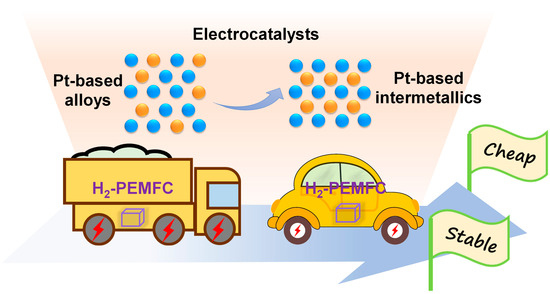
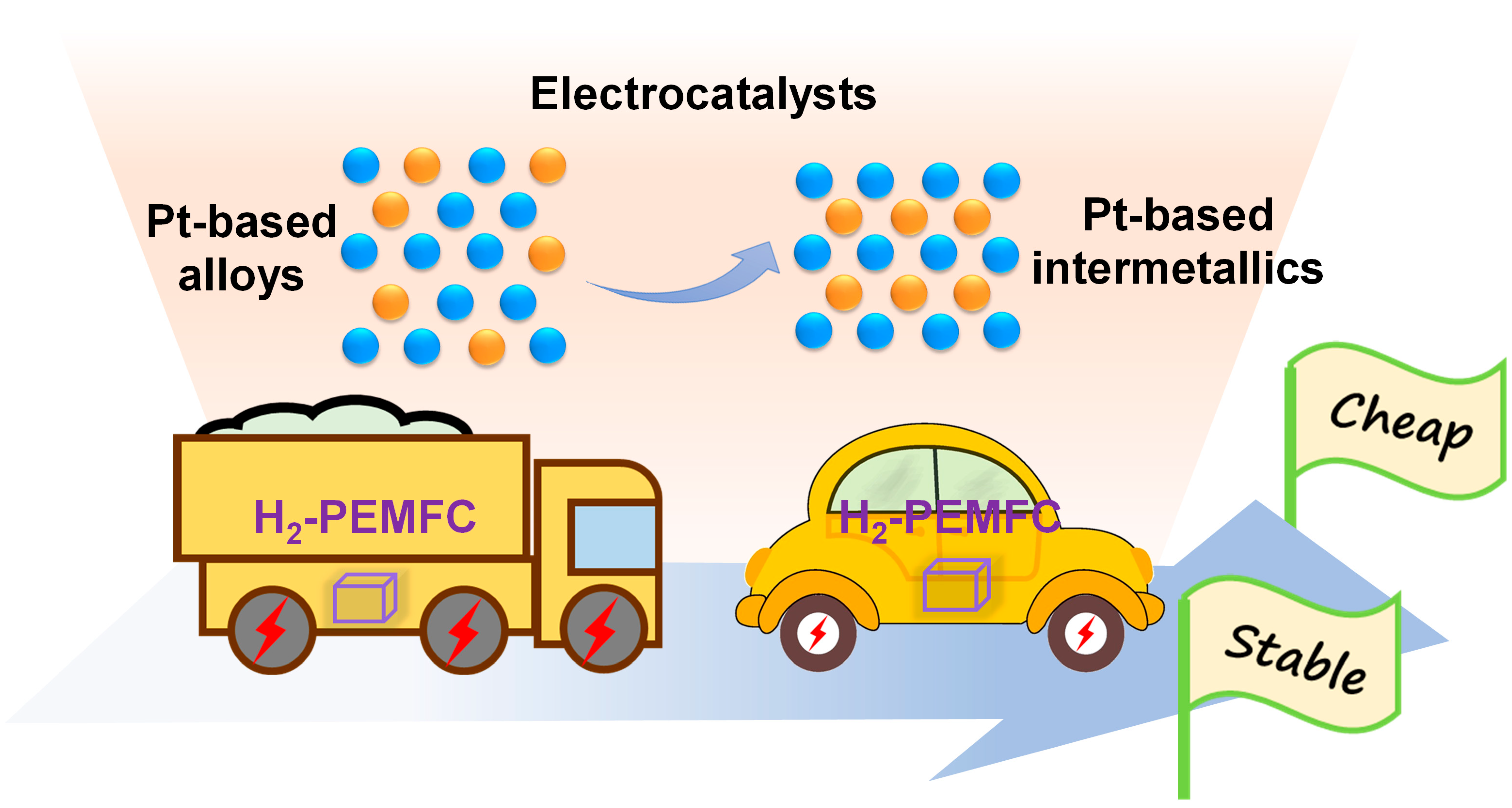
Graphical Abstract

1. Introduction

Hydrogen energy is a key part of the global shift toward clean energy. It has a high energy density (≈142 MJ kg−1, nearly three times that of gasoline) and can be produced from renewable sources, like solar or wind power, through water electrolysis. When used in fuel cells, it creates a “zero-carbon” cycle, emitting only water [1]. The widespread use of hydrogen energy closely depends on proton exchange membrane fuel cells (PEMFCs), which are the most mature technology for converting hydrogen into electricity for various applications, e.g., light-duty vehicles (LDVs) and heavy-duty vehicles (HDVs). However, PEMFCs are not yet widely commercialized because of the problems with their performance, lifespan, and cost, all of which are closely tied to the electrocatalysts they use [2,3]. For this reason, a lot of research is focused on improving the activity and durability of electrocatalysts to improve the performance and life span of PEMFCs, and then to lower the cost secondarily.
Among various metals, Pt demonstrates the best oxygen reduction reaction (ORR) activity in PEMFCs [4,5]. However, the high cost and scarcity of Pt, along with its insufficient long-term durability and the high loading required to achieve performance targets, hinder the wide commercialization of PEMFCs [6]. While the ultimate goal is to replace Pt entirely with non-precious metal electrocatalysts, such as the Fe/N/C system, this technology is still years away from practical application due to many unresolved fundamental issues [7,8]. A key strategy to address these limitations is to further increase the ORR activity and durability of Pt-based electrocatalysts. Nørskov and coworkers [9,10] found that the oxygen binding energy (ΔEO) on the surface of single metals exhibits a volcano-shaped curve relationship with ORR activity. A metal with a ΔEO that is too strong hinders the proton and electron transfer of ORR intermediate species, making the formation and subsequent desorption of H2O molecules difficult. Conversely, if ΔEO is too weak, it detrimentally limits the initial dissociation of O2 on the metal surface. The theory suggests that the optimal ORR activity, corresponding to the peak of the volcano plot, is achieved when the oxygen binding energy is reduced by approximately 0.2 eV relative to that on a pure Pt surface. According to the d-band center theory, this desired reduction in ΔEO on the Pt sites can be realized by inducing a downward shift in the Pt d-band center. This is typically accomplished by introducing non-noble transition metals (M), such as Fe, Co, Ni, or Cu, to create Pt-based alloys [11,12,13,14,15]. The introduction of M atoms generates two key synergistic effects, i.e., electronic (ligand) effect (due to the difference in electronegativity between Pt and M atoms, electron density transfers from the less-electronegative M to the Pt sites) and geometric (strain) effect (the relatively smaller atomic size of the M atoms creates compressive strain within the PtM lattice, resulting in a shorter Pt-Pt interatomic distance; this compression further induces a strong overlap of the 5d electron clouds on the surface Pt atoms) [16]. Both the ligand and strain effects contribute to the downward shift in the Pt d-band center and consequently decrease ΔEO [17]. This mechanistic tuning is why Pt-based alloys commonly demonstrate improved ORR activity compared to pure Pt. Additionally, the substitution of Pt with more abundant and less expensive non-noble metals effectively reduces the cost of ORR electrocatalysts. Nevertheless, the durability of many PtM alloys is often unsatisfactory because of continuous leaching of non-noble metals during long-term ORR electrocatalysis, bringing in strain and ligand effects and thereby substantial activity degradation.
Currently, structurally ordered PtM intermetallic compounds (IMCs) have attracted growing interest owing to superior activity and durability compared to disordered alloys, stemming from enhanced Pt-M bonds and stronger d-d orbital interactions between Pt and M, which lead to a higher resistance to dissolution of the non-noble metals. For example, the PtCo intermetallic lost only 6% of its Co after 24 h of etching, which is much better than the PtCo alloy (loss of 24% Co after only 7 h of etching) [18]. Research by Wu et al. [19] further demonstrated this by constructing a Pt3Co/NC intermetallic (NC: N-doped carbon, ZIF-8-derived carbon support). This electrocatalyst showed better ORR activity with a half-wave potential (E1/2) of 0.957 V (vs. RHE), outperforming both a pure Pt/NC (E1/2: 0.917 V (vs. RHE)) and disordered Pt3Co/NC (E1/2: 0.927 V (vs. RHE)). More importantly, its durability was exceptional. After a 150,000-cycle accelerated durability test (ADT) in membrane electrode assembly (MEA) (condition: H2-N2 at 80 °C, 100% RH, with a staircase voltage between 0.6 (6 s) and 0.95 (6 s) V), the intermetallic electrocatalyst only lost 7% of its current density at 0.7 V (1.45 to 1.35 A cm−2). In contrast, the disordered alloy showed a 25% decline after just 90,000 cycles. It was found that the Co leaching was effectively restrained and the ordered structure was maintained throughout the ADT. Similarly, carbon-supported ordered Pt3Fe nanowires (O-Pt3Fe NWs/C) were also found to have superior ORR activity and durability compared with their disordered counterparts [20].
So far, significant progress has been made on PtM intermetallic electrocatalysts, and many PtM intermetallic electrocatalysts with high activity and durability have been successfully synthesized by designing various reaction systems [3,19,21,22,23]. Timely summarizing the research developments of PtM intermetallic electrocatalysts, identifying factors that hinder their practical replacement, and exploring probable strategies are expected to facilitate their substitution for the commercial Pt/C or PtCo alloy (which has been applied in Toyota Mirai [24]). Although there are several reviews focused on the intermetallic nanocrystals, the development of Pt-based intermetallic electrocatalysts in partial sections, the research progress of PtCo3 intermetallic electrocatalysts [22,25,26,27,28], or a comprehensive summary that covers features, crystalline structure, controllable synthesis, ORR activity, and durability of Pt-based intermetallic electrocatalysts is still missing from the literature.
Herein, this review will focus on the critical advances in PtM intermetallic electrocatalysts in recent years. Firstly, a brief comparison of the intermetallic compounds and solid-solution alloys, and the composition and crystalline structure of PtM intermetallic electrocatalysts are presented. Then, it proceeds to the recent important development on the controllable preparation of the carbon-supported, highly dispersed, high-loading, and highly ordered PtM intermetallic electrocatalysts (the compositional regulation of Pt-based intermetallics can be found in existing reviews [27,28], this review does not focus on it). Next, their ORR activity and durability are summarized and discussed in detail. Finally, a brief perspective on the future research and development of PtM intermetallic electrocatalysts is provided.

2. Pt-Based Intermetallics vs. Pt-Based Alloys

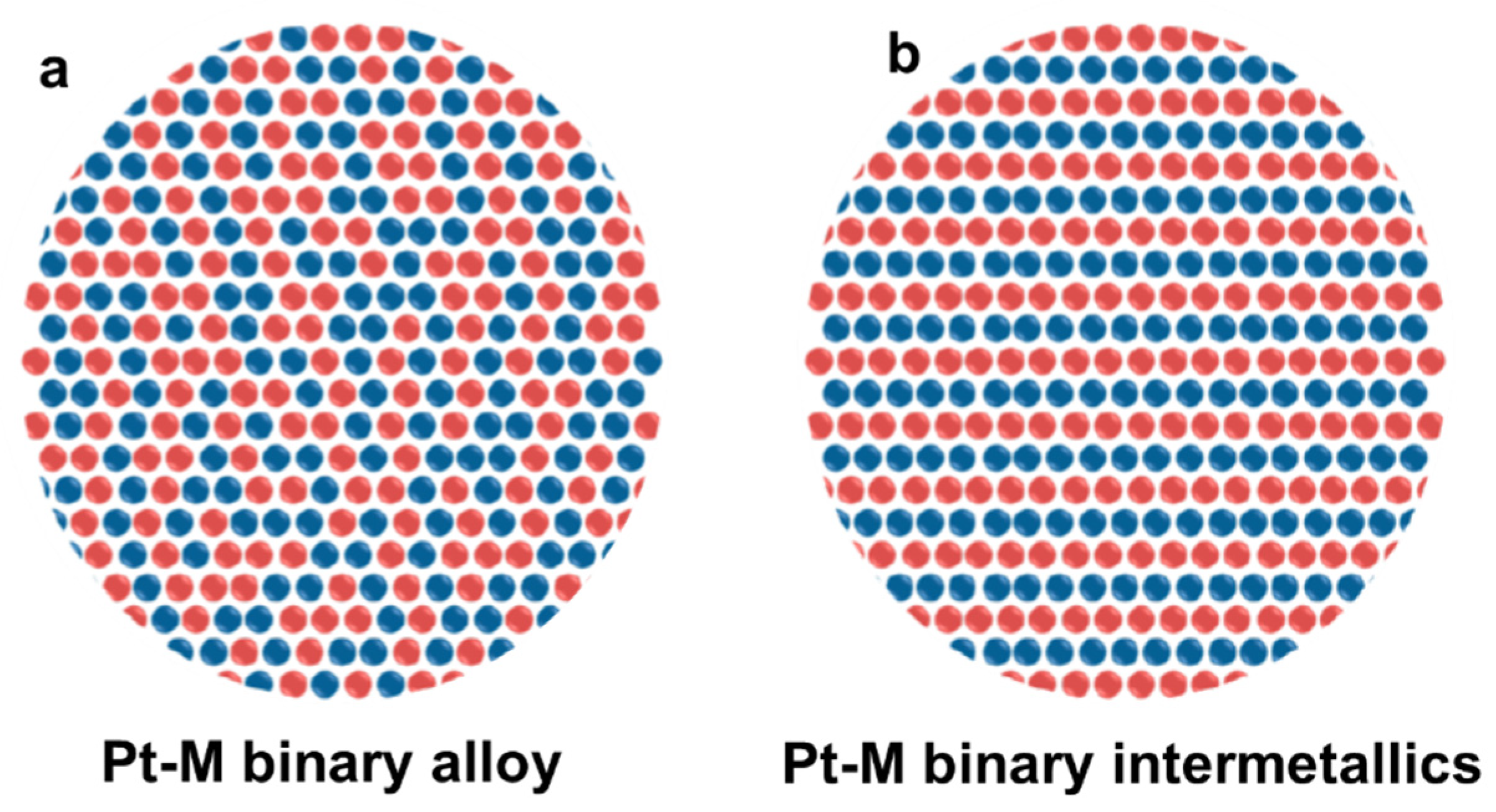
Alloys and intermetallics are two main classes of materials composed of two or more metallic elements with striking differences in their atomic arrangement and properties [29,30]. Alloys, frequently referred to as solid-solution alloys, feature a random atomic configuration and lack a fixed elemental ratio (Figure 1a). Imagine a crowd where people are mixed without any specific order. In contrast, intermetallic compounds possess a highly ordered and well-defined crystal structure, along with a fixed elemental composition (i.e., a specific stoichiometry). Taking the binary Pt-M system as an example, common stoichiometries are typically observed as 1:3, 1:1, or 3:1 (Pt:M) [31,32,33,34] (Figure 1b). This ordered structure is comparable to a perfectly organized stadium, where each “atom” has a specific and assigned “seat.” For instance, in a Pt3M intermetallic, every M atom is surrounded by a definite number of Pt atoms in a consistent, fixed pattern.
The distinct atomic arrangements of disordered alloys and intermetallics directly impact their bonding and electronic properties [30]. In a disordered alloy, the d-orbital interactions between Pt and M atoms are weak and non-uniform. This poor electronic interaction fails to stabilize the atomic structure effectively, leaving the non-noble metal atoms vulnerable to dissolution in the harsh, acidic environment of PEMFCs. This leaching of the non-noble metal leads to rapid material degradation and a loss of electrocatalytic activity. In contrast, the ordered structure of an intermetallic allows for maximum overlap of the d-orbital of Pt and M atoms, forming a strong Pt-M metal bond as well as strong and uniform d-d orbital interactions. This strong interaction will tightly lock the non-noble metal atoms into the stable crystal lattice, significantly enhancing their anti-dissolution capability, preventing them from leaching.
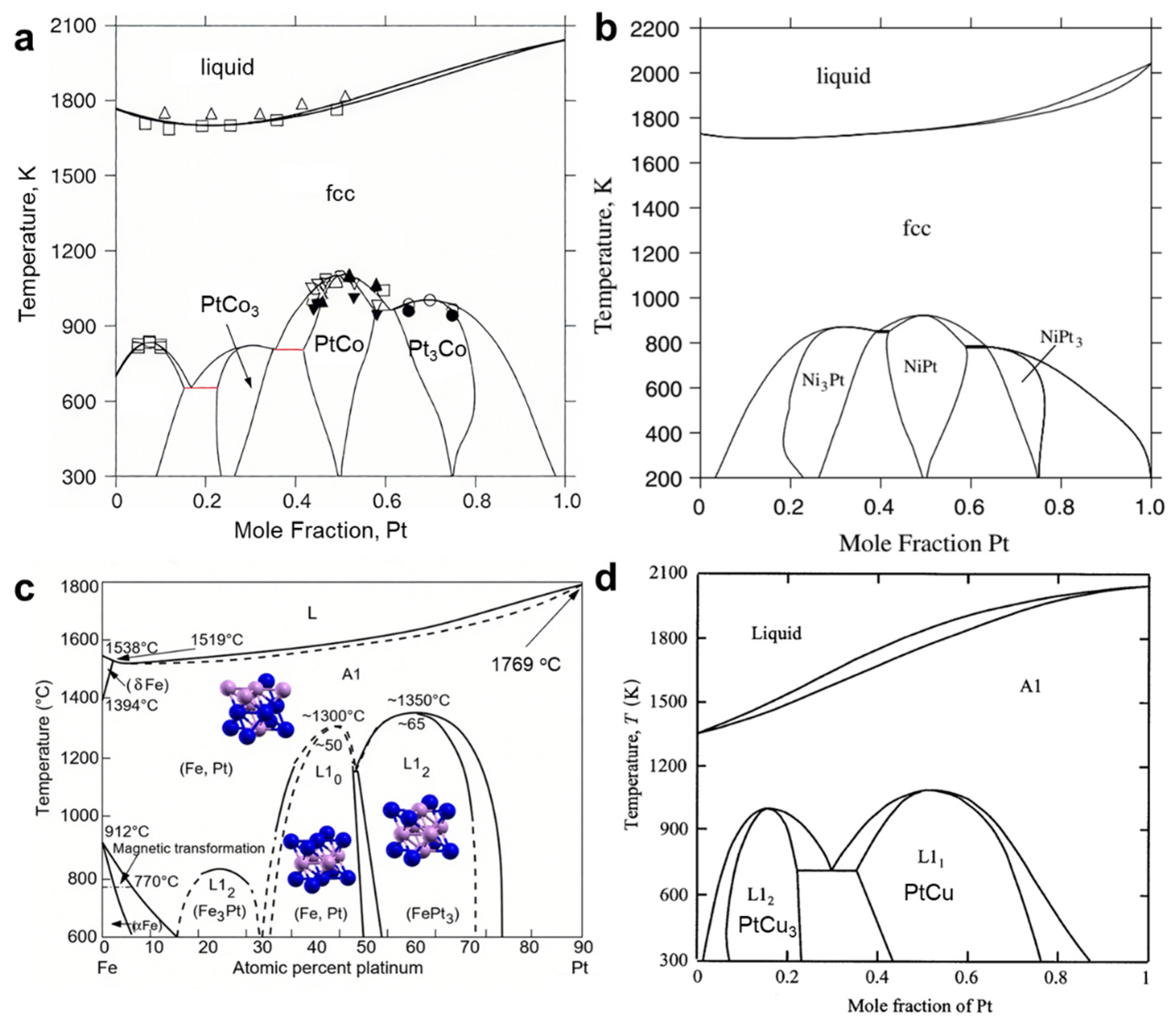
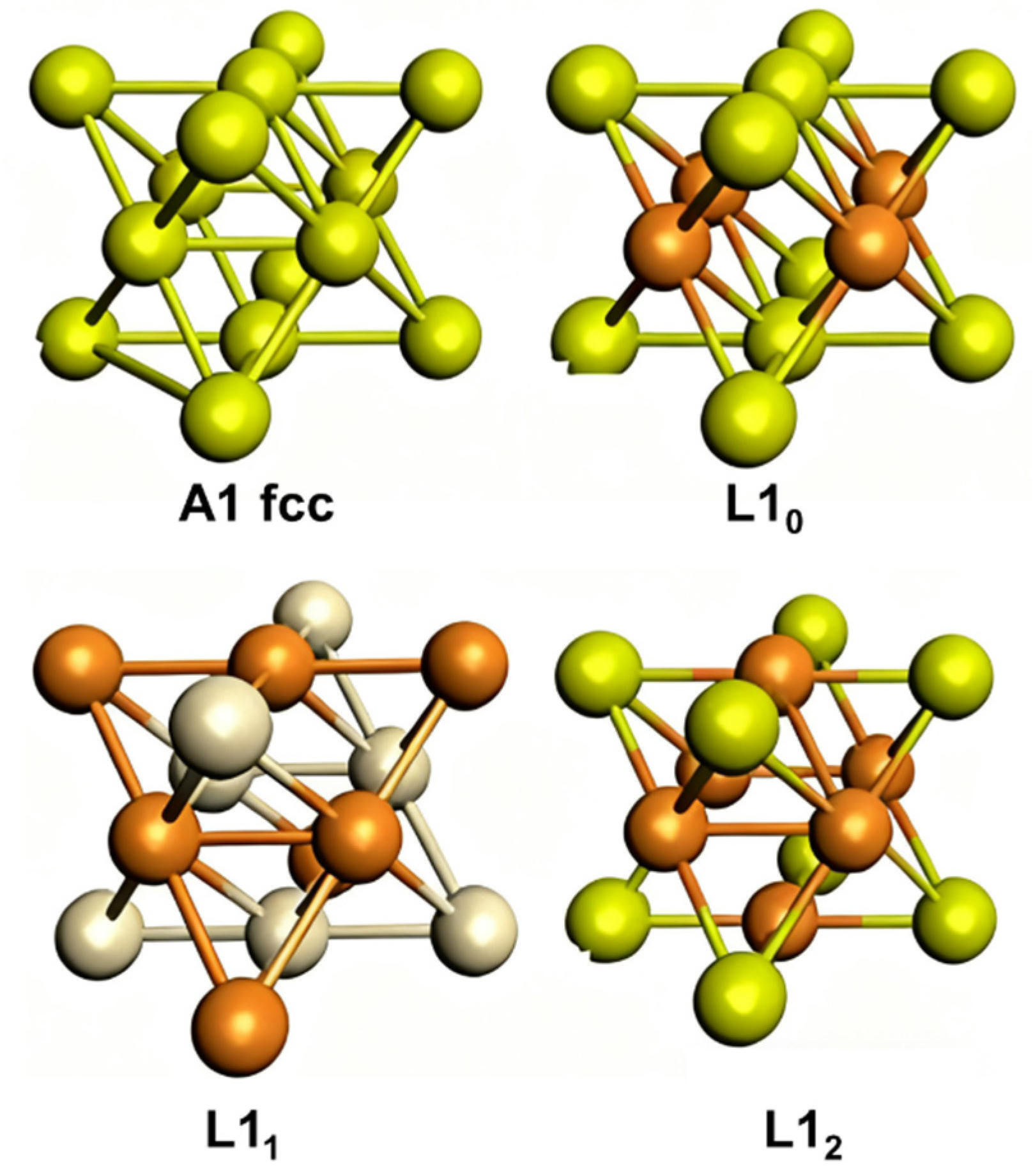
Thermodynamically, in addition to the Pt-based alloys, the Pt-M binary intermetallic phase does exist below a critical high temperature in the phase diagrams (as shown in Figure 2). Pure Pt and Pt-based alloys typically have a face-centered cubic (fcc) lattice (denoted as an A1 structure, Figure 3). Pt-M binary intermetallics often adopt three structures: L10 structure, L11 structure, and L12 structure (Figure 2 and Figure 3).
L10 structure: This is a tetragonal distortion of fcc type, i.e., face-centered tetragonal (fct) structure. It is commonly found in Pt1M1 intermetallics, such as PtCo, PtFe, and PtNi. In this structure, the Pt atom layer and M atom layer are stacked alternately along the [001] direction, which leads to a slight distortion from a perfect cube to a tetragonal shape.
L11 structure: This is a rhombohedral distortion of fcc type. It is commonly found in Pt1M1 intermetallics, such as PtCu. In this structure, the Pt atom layer and M atom layer are stacked alternately along the [111] direction, which causes rhombohedral distortion of the original cubic unit cell.
L12 structure: This is an fcc structure and is often found in Pt3M and PtM3 intermetallics, such as Pt3Co, Pt3Ni, Pt3Fe, PtCo3, PtNi3, PtFe3, or PtCu3. For Pt3M intermetallics, the corners of the cubic unit cell are occupied by Pt atoms, while the face-centered positions are occupied by M atoms. For PtM3 intermetallics, the corners of the cubic unit cell are occupied by M atoms, while the face-centered positions are occupied by Pt atoms. L12 structure maintains the overall cubic symmetry.

3. Synthesis and Characterization of Carbon-Supported Pt-Based Intermetallics

3.1. Synthesis of Carbon-Supported Pt-Based Intermetallics

Although non-carbon supports, e.g., metal oxides or nitrides, exhibit strong metal–support interaction and high stability in the PEMFC environment, their practical applications remain limited by low surface area and poor electrical conductivity [5]. In contrast, carbon materials are far more suitable as electrocatalyst supports due to their high surface area, excellent electrical conductivity, and comparatively high stability (though less stable than non-carbon alternatives). Consequently, carbon materials remain the primary choice of support for Pt-based electrocatalysts. For this reason, our discussion focuses exclusively on carbon-supported Pt-based intermetallic electrocatalysts.
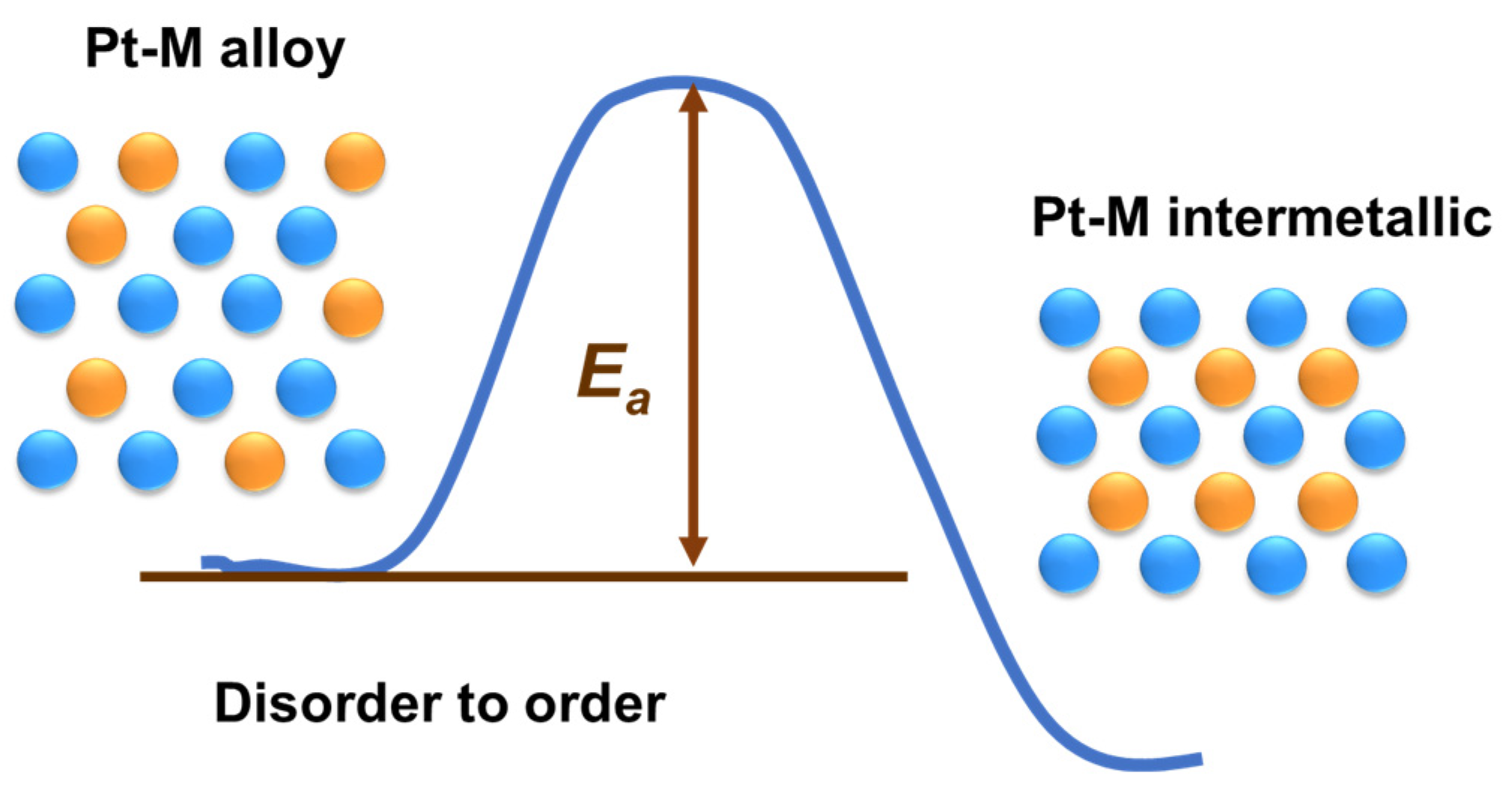
While Pt-based intermetallics are thermodynamically favorable, achieving the transition from a disordered to an ordered structure remains kinetically challenging [36]. This is due to the high activation energy required to break strong metal–metal bonds and facilitate atomic diffusion within the rigid lattice (Figure 4), making the process very slow. The wet chemical method shows several merits, like mild preparation conditions and allowing for precise control over the nanoparticle’s size and shape, which makes it the most commonly used method to prepare various Pt-based alloys. However, synthesizing highly ordered intermetallics directly via wet chemical methods is difficult because of the significant differences in the standard reduction potentials between Pt and non-noble metals (Pt2+/Pt: 1.18 V vs. SHE, Ni2+/Ni: −0.257 V vs. SHE, Cu2+/Cu: 0.3419 V vs. SHE, Fe2+/Fe: −0.447 V vs. SHE, Co2+/Co: −0.28 V vs. SHE [37]). To overcome this high energy barrier, the most common and effective strategy is high-temperature annealing, typically above 600 °C [18,19,38,39]. However, this process will cause nanoparticle sintering and aggregation. As a result, it becomes difficult to synthesize highly dispersed Pt-based intermetallic nanoparticles with small sizes. The nanoparticles can grow up to larger than 8 nm after high-temperature treatment [38,40]. This severe aggregation drastically reduces the electrocatalysts’ mass activity by decreasing the total surface area. Therefore, a critical goal for Pt-based intermetallic electrocatalysts is to find the pathways to control their nanoparticle size and size distribution.
Common experimental strategies for controlling the size and size distribution of Pt-based intermetallic nanoparticles involve optimizing the carbon support and/or constructing a protective layer. These pathways serve to immobilize the nanoparticles, thereby suppressing their migration and aggregation under high-temperature conditions.
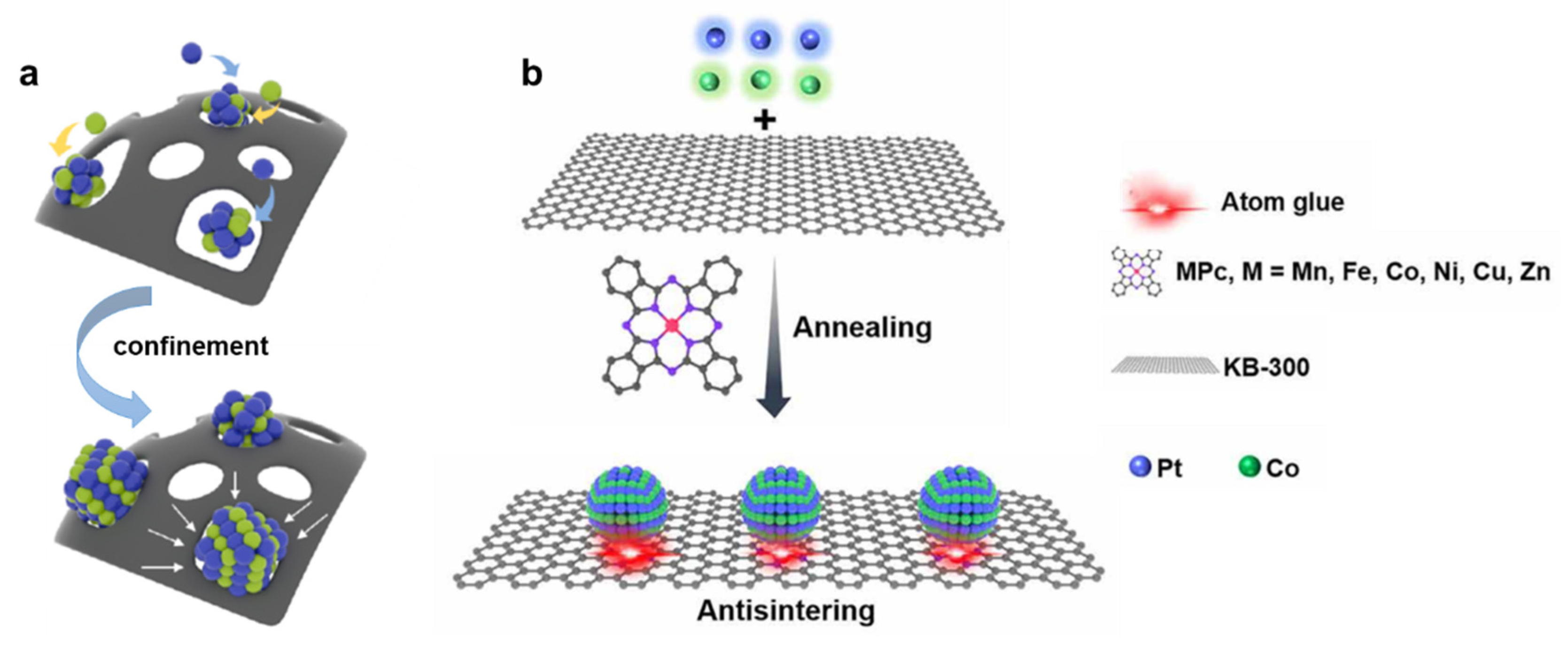
Optimizing carbon support: One approach is selecting the mesoporous carbons with a high specific surface area as support. Their mesopores physically trap the Pt-based nanoparticles, preventing them from moving and fusing with neighboring particles (Figure 5a). This is similar to placing marbles in a tray with individual indentations, restricting their movement and keeping them separated. In addition, the Pt-based nanoparticles can uniformly disperse on the surface of the mesoporous carbons with a high specific surface area, increasing the distance between them and reducing the likelihood of inter-particle migration and aggregation. For example, when PtCo nanoparticles were supported on Ketjenblack EC-300J (EC-300), a carbon material with a high specific surface area (~800 m2/g), the size remained the same during annealing at 650 °C (slightly increased from 8 nm to 9 nm) [18]. Although this pathway can mitigate particle growth at high temperature to some degree, it cannot completely prevent the migration and aggregation of nanoparticles over time due to the weak metal–support interaction.
Surface functionalization of carbon materials (the carbon materials mentioned here mainly refer to commercial carbon materials, like carbon black, carbon nanotubes (CNTs), graphene, or oxide graphene) is an effective and commonly used strategy to strengthen the metal–support interaction, which can tightly anchor nanoparticles onto a carbon support and thus prevent migration between nanoparticles under high temperature. This can be realized by doping heteroatoms (e.g., N, S, or B), introducing functional groups, or introducing metal oxides on the surface of carbon materials [5]. Huang and coauthors [39] introduced M-N-C (e.g., Zn-N-C) sites onto the surface of EC-300 by using zinc phthalocyanine (ZnPc) as a precursor to create a robust “glue-like” anchoring effect for PtCo nanoparticles on EC-300 carbon (Figure 5b). After annealing at 900 °C for 2 h, the size of PtCo nanoparticles can be stabilized at 3.3 ± 1.0 nm, even with an increased Pt loading of ~40 wt%. Based on theoretical calculations, the interaction between Pt-based nanoparticles and carbon can be increased five times through doping boron (B) into the carbon support due to the formation of Pt-B bonds [42]. Thanks to the strong metal–support interaction induced by the Pt-B interaction, Yang and coauthors [42] have successfully synthesized a wide range of Pt-based intermetallics with a small size of less than 4 nm and relatively narrow size distribution.
Aside from the commercial carbon materials, some novel carbon materials with a unique porous structure and/or abundant heteroatom-doped sites have also been developed to support Pt-based electrocatalysts, like metal–organic framework (MOF)-derived carbon materials [43,44]. The porous architecture can provide a physical confinement effect, which traps the Pt-based alloy nanoparticles within its micropores and mesopores. Simultaneously, the numerous heteroatom-doped sites create a strong chemical interaction with the Pt-based alloys, significantly improving their thermal stability. Beyond their function as a support, MOFs can also serve as a precursor for the transition metal component of the intermetallic. A notable example is the work by Chen et al. [23], who successfully synthesized 2.2 nm Pt3Co intermetallic with a Pt loading of 15 wt%. They did this by utilizing ZIF-8 (zeolitic imidazolium framework)-derived three-dimensional (3D) ordered mesoporous N-doped carbon as support. This highlights the dual benefit of MOF-derived materials in providing both a high-quality support and a source for the alloying metal.
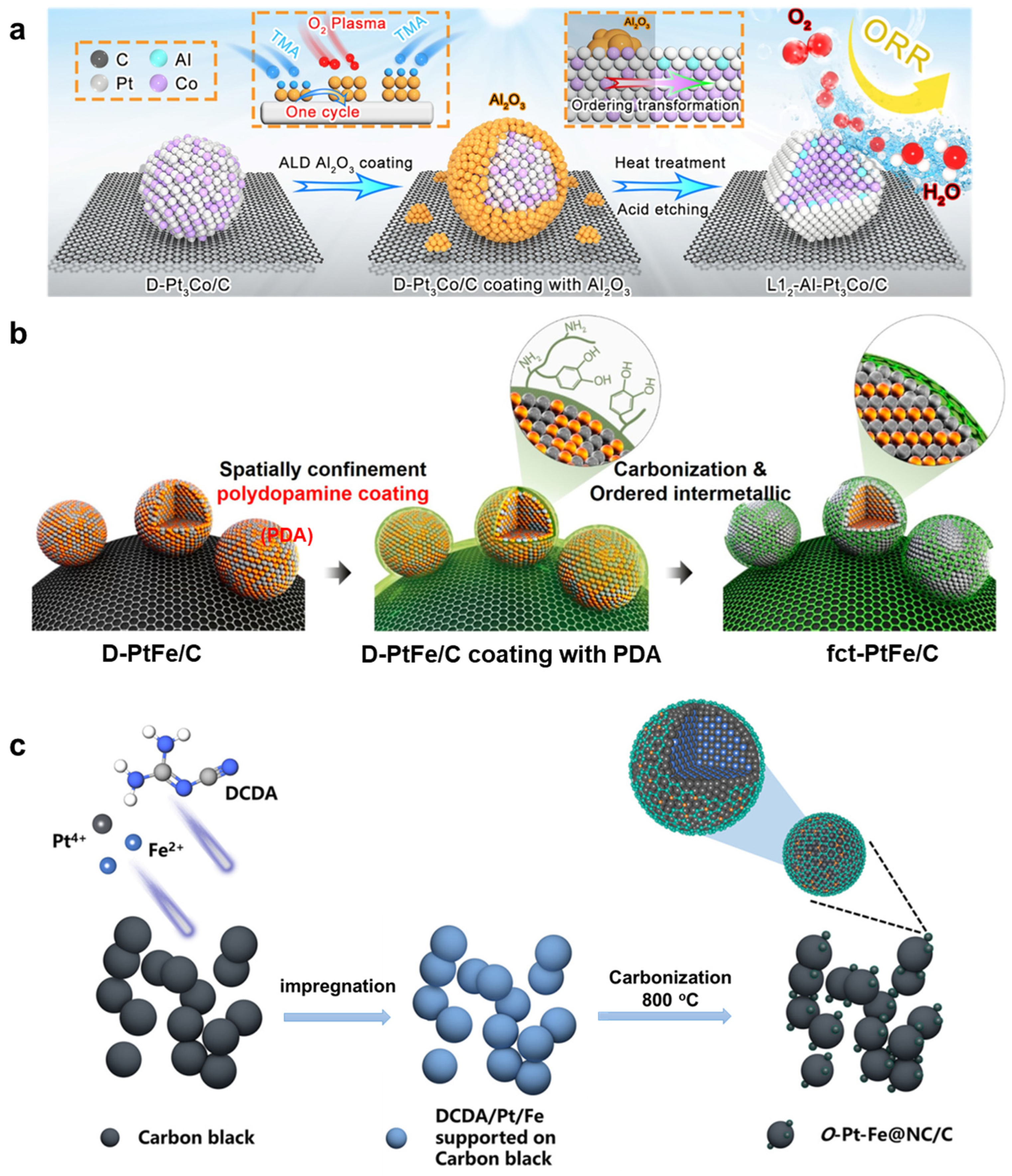
Forming a protective layer outside the Pt-based alloy nanoparticles: Coating Pt-based alloy nanoparticles with a protective layer is an efficient strategy to immobilize them, thus preventing their sintering and aggregation during high-temperature annealing. Common protective layers include robust oxides (e.g., MgO [38,45], SiO2 [46,47], or Al2O3 [48], Figure 6a) and a porous carbon-based layer (pure carbon layer or N-doped carbon layer, Figure 6c).
The preparation of Pt-based intermetallics using an oxide coating typically involves four steps: synthesizing Pt-based alloys, depositing the oxide coating, high-temperature annealing, and removing the coating. For instance, L10-PtFe has been successfully prepared by applying MgO or SiO2 coatings [38,45,46,47]. However, this method presents several drawbacks. The final nanoparticles are often big, sometimes exceeding 8–10 nm. The oxide coating drastically restricts the movement of atoms within the particles, which inhibits a complete crystal structure transition and usually leads to an only partially ordered PtM intermetallic [38,40]. The inert oxide shell covers the active sites of electrocatalysts. To expose these sites, removing the oxide layer (e.g., through an acid wash [38]) is essential but often difficult and time-consuming.
Encapsulating Pt-based alloy nanoparticles within the carbon-based layers during high-temperature annealing has recently become a very effective method for synthesizing stable Pt-based intermetallic compounds. There are two commonly used methods to form carbon-based protective layers. One approach is sequential preparation, that is, coating pre-synthesized alloys (Figure 6b). Initially, Pt-based alloy nanoparticles are synthesized. The pre-prepared alloys are then coated with an organic carbon precursor, e.g., polydopamine [49,51], melamine [52,53], oleylamine [54], glucose [55], dicyandiamide [50], or 2,2′-bipyridine [56]. The coated nanoparticles are then heated at high temperature to induce the carbonization (if the precursor contains nitrogen, the shell becomes N-doped) of the organic precursor, forming a protective carbon-based shell around the nanoparticles and simultaneously driving the transition of the disordered alloy into an ordered intermetallic phase (L10, L11, L12). For example, PtNi3 intermetallic was successfully synthesized by coating a pre-made PtNi3/C with a polydopamine layer and subsequently annealing at 700 °C under an N2 atmosphere [51].
Another method is the impregnation–reduction method, also called the one-pot synthesis method. In this approach, the Pt precursor, M precursor, or carbon-based precursor are deposited onto a carbon support at the same time (note: the organic ligand of the metal precursors can sometimes serve as the carbon-based precursor, such as the acetylacetonate of Pt acetylacetonate and M acetylacetonate [57] or bis(cyclopentadienyl) of bis(cyclopentadienyl)Ni(II) [58]). This is followed by a single high-temperature annealing step (Figure 6c). During this single heat treatment, several reactions happen concurrently: metal ions are reduced; the Pt-based alloy forms; the organic precursor carbonizes, creating the protective carbon-based shell; and the ordered intermetallic structure develops. For example, Wang et al. [50] prepared the well-dispersed PtFe intermetallic with an average size of ∼3.8 nm covered by an N-C shell on carbon support through directly loading H2PtCl6, FeCl2, and dicyandiamide onto Vulcan XC-72 carbon, followed by annealing at 800 °C under an Ar atmosphere. During the pyrolysis process, Pt4+ and Fe2+ are reduced, PtFe alloy is formed, dicyandiamide decomposes and converts into an ultrathin N-C layer under the catalysis of PtFe alloy and is coated on the PtFe nanoparticles’ surface, and the PtFe intermetallic phase is formed at the same time. Yoo and coauthors [56] designed a facile approach to prepare Pt-based intermetallics (2–6 nm for 24 wt.% PtFe/C, 3–8 nm for 37 wt.% PtFe/C) on various carbon supports by directly supporting a unique bimetallic compound composed of [M(bpy)3]2+ cations (bpy = 2,2′-bipyridine) and [PtCl6]2- anions on carbon and then annealing at 700 °C (bipyridine ligands is the precursor of the N-C layer).
Compared to the inert oxide coating, the carbon-based protective layer offers several benefits. First, the resulting carbon-based coatings are commonly porous, with an ultrathin thickness (~0.4–1.5 nm [49,50,51,56]), and their porosity and thickness can be tuned. For example, the shell thickness can be changed from 0.5 nm to 3.7 nm via increasing the polydopamine coating time from 1 h to 3 h [49]. Their pore size and porosity can be adjusted by introducing O2 [59] or altering H2 concentration [60] during the annealing process. If their pore size and porosity are suitable, the porous shells can exhibit a molecular sieve effect, allowing reactants to reach the active sites while potentially blocking larger molecules that can “poison” the catalyst. This has been successfully applied to improve the anti-poisoning capability toward H3PO4, which is crucial for Pt-based electrocatalysts used in the H3PO4/polybenzimidazole membrane-based high-temperature PEMFCs, where H3PO4 is necessary as a proton conductor but will poison electrocatalysts [60]. Second, unlike the oxide-coating method, removal of the carbon-based shell is generally not required, simplifying the overall process.
Significant advancements in fabrication methods have enabled the successful preparation of supported Pt-based intermetallic nanoparticles with controlled nanoparticle size and metal loading on carbon support. As summarized in Table 1, the size of recently reported carbon-supported Pt-based intermetallic nanoparticles can be decreased to 2~3 nm [23,61] and/or their Pt loading can be up to ~50 wt% [62,63]. However, these new synthetic routes are typically complex, multi-step, and unsuitable for large-scale production. Furthermore, the simultaneous optimization of both small size and high Pt loading (high Pt loading electrocatalysts yield a thinner catalyst layer, which is beneficial for decreasing gas transport resistance [63]) remains a formidable challenge. Therefore, there is a critical need to develop new preparation techniques that enable the production of these materials with a small size, high Pt loading, low cost, and high throughput.
In addition to strategies like enhancing the metal–support interaction and constructing protective layers, pre-synthesizing Pt-based alloy nanoparticles with uniform particle size is crucial for controlling the size and size distribution of the final Pt-based intermetallic nanoparticles. To tailor the size and uniformity of Pt-based electrocatalysts, various organic structure-directing agents, stabilizers, and solvents, such as 1-octadecene, oleic acid, oleylamine, ethylene glycol, or various surfactants, are commonly employed [5]. However, the use of these agents necessitates a complex post-treatment process for their removal to expose the active sites before the electrocatalysts can be utilized in electrochemical reactions. Thermal annealing at ~180–350 °C is a simple and effective post-synthesis method for removing these residual organics [5]. As heat treatment is also required for preparing Pt-based intermetallics, the removal of these organics may be unnecessary prior to the annealing step. Furthermore, these organic residuals may potentially be utilized as the organic precursor to form a carbon-based protective layer [54]. Besides these conventional approaches, several novel synthesis methods can be applied to pre-synthesize Pt-based alloys with small and uniform particle size, e.g., the microwave-assisted synthesis method [64] (with rapid, energy-efficient features), or microemulsion method [65] (a highly versatile wet chemical technique for synthesizing shape- and size-controlled nanoparticles).

3.2. Characterization of Carbon-Supported Pt-Based Intermetallics

Successful preparation of the target Pt-based intermetallics requires rigorous physical characterization. Since the detailed characterization techniques for intermetallic nanocrystals have been extensively reviewed elsewhere [25], this article will only focus on the two most common and essential techniques, X-ray diffraction (XRD) and aberration-corrected transmission electron microscopy (AC-TEM).
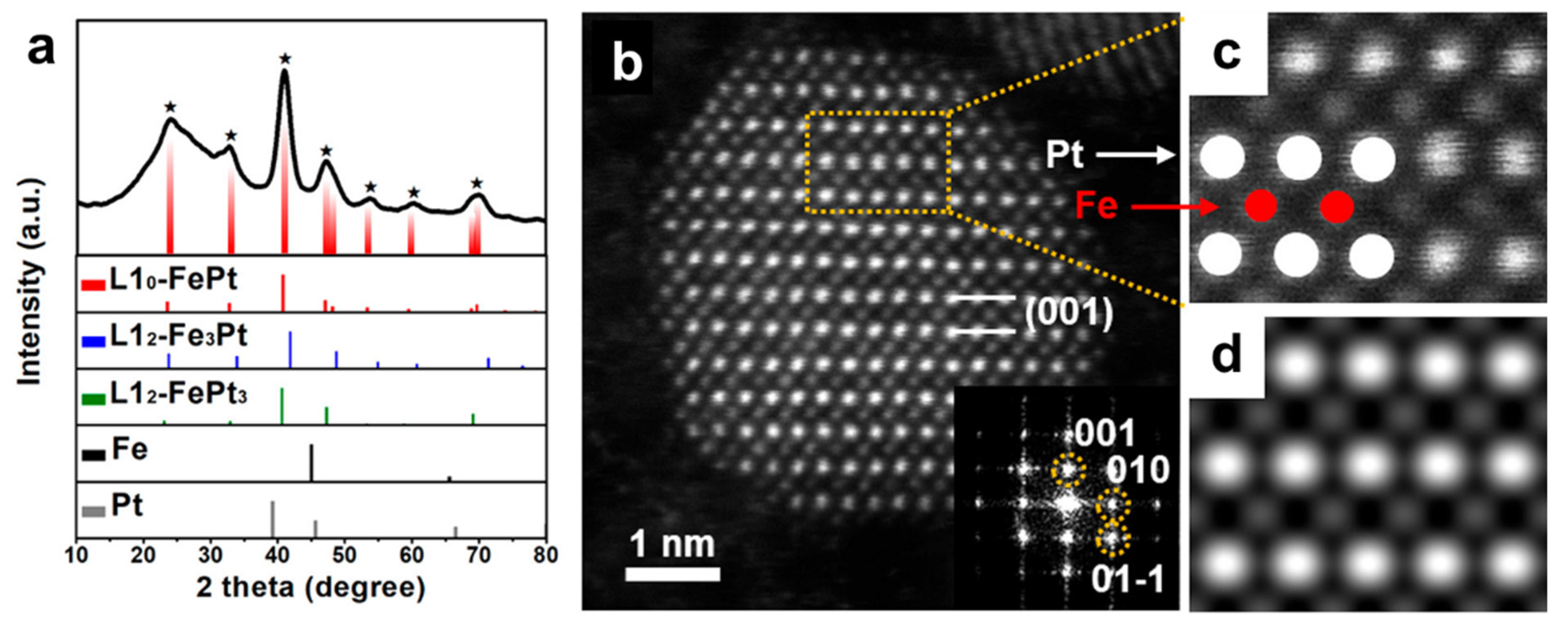
XRD is a fundamental and essential technique for determining the overall structural characteristics of a synthesized electrocatalyst. The successful preparation of a Pt-based intermetallic can be readily confirmed by comparing its XRD pattern to a standard Powder Diffraction File (PDF) card (Figure 7a). Ordered intermetallic structures exhibit unique characteristic diffraction peaks that are absent in the disordered alloy phase. By analyzing the location and intensity of these peaks, the desired intermetallic phase can be confirmed. For example, the appearance of characteristic peaks at 24°, 33°, and 49°, corresponding to the (001), (110), and (002) crystal planes, respectively, confirms the formation of the L10 PtFe structure [50]. Furthermore, XRD data allows for the quantitative estimation of the ordering degree (OD) within the synthesized Pt-based intermetallics. The ordering degree is defined by the following equation [66].
O D S ( 110 ) ( S ( 111 ) + S ( 200 ) + S ( 002 ) ) s a m p l e S ( 110 ) ( S ( 111 ) + S ( 200 ) + S ( 002 ) ) f u l l y   o r d e r e d × 100 %
where S ( 110 ) ( S ( 111 ) + S ( 200 ) + S ( 002 ) ) represents the ratio of the integrated area under the (110) peak to the sum of the areas under the (111), (200), and (002) peaks. The value of S ( 110 ) ( S ( 111 ) + S ( 200 ) + S ( 002 ) ) f u l l y   o r d e r e d are calculated from the standard PDF cards of Pt-based intermetallics, which correspond to 100% ordering of intermetallics. For example, the OD of L12 Pt3Co prepared on a ZIF-8-derived carbon support is approximately 80% [19]. The intermetallics’ OD can be enhanced by increasing annealing time and/or annealing temperature to ensure that there is enough time or energy for atoms to diffuse and then form an ordering structure, e.g., when increasing the annealing time from 1 h to 6 h, the OD of L10 PtCo can be increased from 55% to 88% [18].
In contrast to the bulk perspective provided by XRD, AC-TEM and its associated analysis techniques provide localized, high-resolution structural information by focusing on specific individual nanocrystals or microregions. AC-TEM allows for the direct visualization of the real atomic arrangement within a measured nanocrystal. By differentiating between the contrast between Pt atoms (which appear as bright points due to their higher atomic number) and the second metal (M) atoms (which appear as less bright points) (Figure 7b–d), researchers can visually confirm the atomic ordering. For example, the direct observation of alternating atomic layers in the AC-TEM image confirms the ordered L10 structure of the Pt-Fe nanocrystal [49]. A key limitation of AC-TEM is its focus on local information. While it definitively confirms the structure of the specific nanoparticle under observation, it cannot be used to estimate the overall ordering fraction for the entire sample population. Therefore, for a complete structural understanding of the catalyst, the local, atomic-scale detail obtained from AC-TEM must be correlated with the bulk, quantitative data provided by XRD.

4. Performance and Durability of Pt-Based Intermetallics

Pt-based intermetallic electrocatalysts have demonstrated superior activity and durability for the acidic ORR compared to both commercial Pt/C and traditional Pt-based alloys, due to their unique structural and electronic properties. As summarized in Table 1, their ORR activity and durability have been evaluated in both rotating disk electrode (RDE) and membrane electrode assembly (MEA) tests.
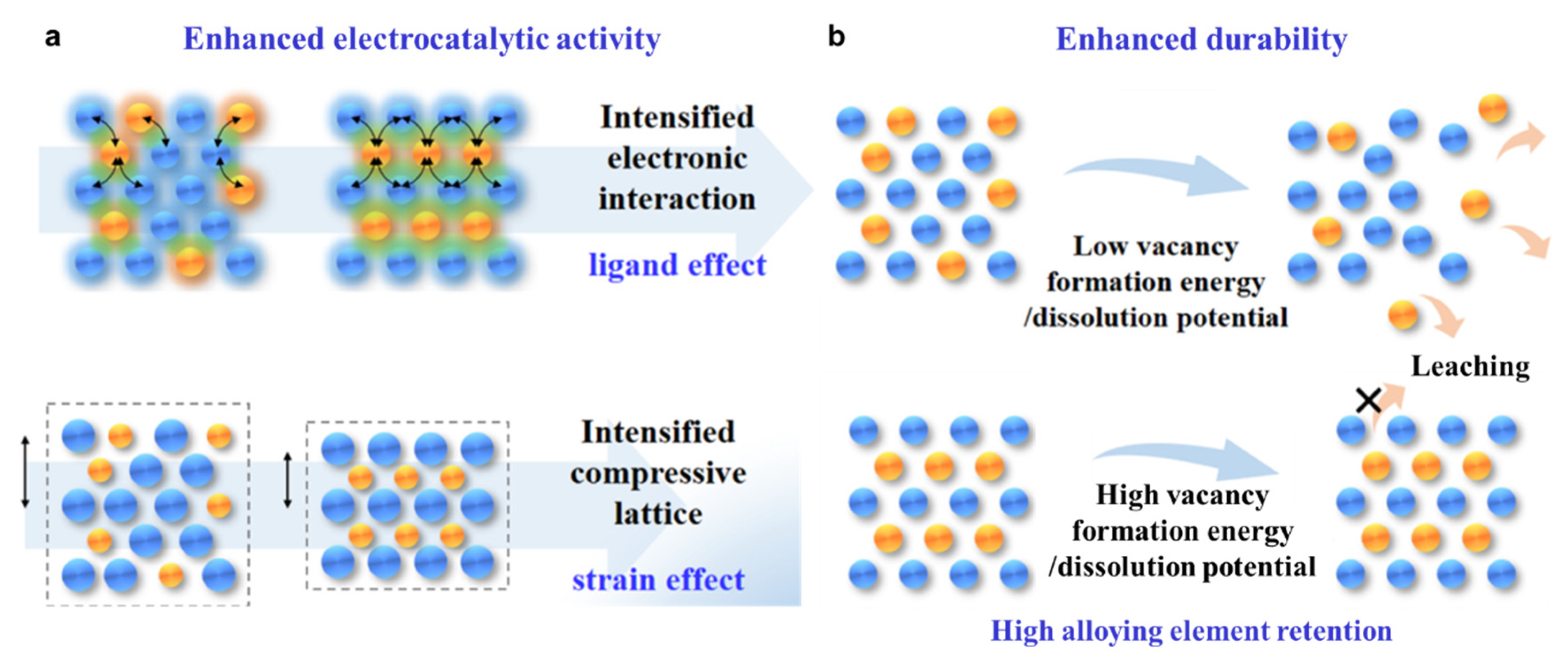
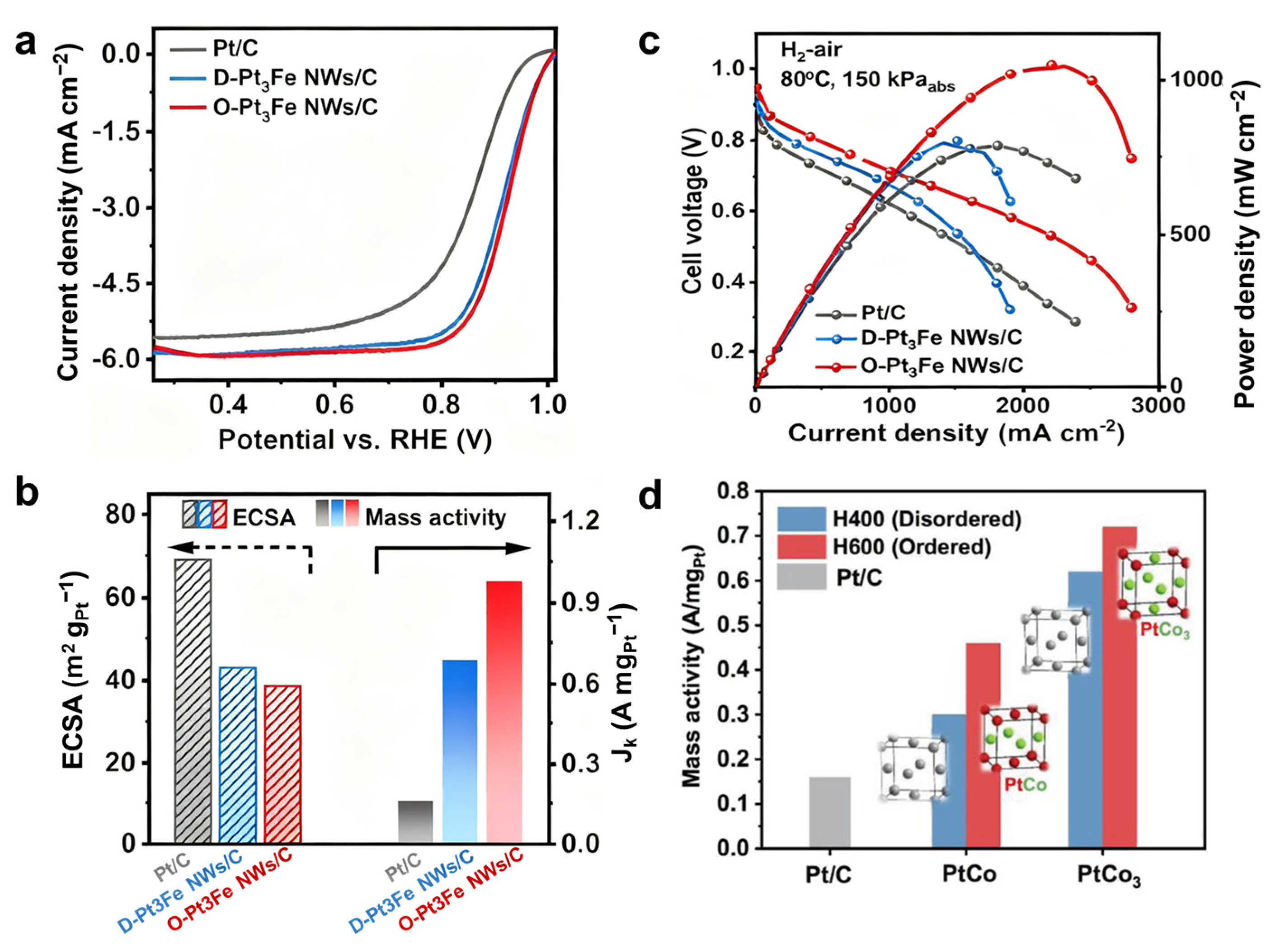
Owing to the larger particle size, Pt-based intermetallics typically have a lower electrochemical surface area (ECSA) than commercial Pt/C (60–100 m2 g−1 [67]) and their Pt-based alloy counterparts. Despite the lower ECSA, these intermetallics exhibit a higher mass activity (MA) than commercial Pt/C (190–230 mA mgPt−1) and Pt-based alloys (Figure 8). The combination of a lower ECSA and higher MA results in a significantly elevated specific activity (SA, SA = MA/ECSA), indicating superior intrinsic ORR activity. The enhanced intrinsic activity primarily results from the enhanced ligand effect and strain effect (Figure 8a). The ordered structure facilitates sufficient orbital interaction between Pt and M atoms, which in turn boosts the transfer of electron density from the less-electronegative M atoms to the Pt sites [68,69], i.e., the intensified ligand effect. Simultaneously, the significant difference in atomic radius between Pt and M creates an intensive compressive lattice, which can be verified by XAS analysis. For example, the Pt-Pt distance can be reduced by 1.12% in the PtCo intermetallic compared to the PtCo alloy [70]. The shorter Pt-Pt distance induces a stronger overlap of the 5d electron cloud on surface Pt sites, i.e., an intensive compressive lattice means increased stain effect. Both the intensified ligand effect and a compressive lattice will lead to a larger downward shift in the d-band center, resulting in weaker oxygen binding energy on surface Pt sites, thereby drastically improving Pt’s intrinsic ORR activity. For example, carbon-supported ordered Pt3Fe nanowires (O-Pt3Fe NWs/C) show higher half-wave potential (0.924 V), MA (0.98 A m gPt−1 (@0.9 V)), and SA (2.5 mA cm−2 (@0.9 V)) than Pt3Fe alloy NWs (0.915 V, 0.69 A m gPt−1, and 1.5 mA cm−2) and Pt/C (0.859 V, 0.98 A m gPt−1, and 0.17 mA cm−2) (Figure 9a,b) [20]. When they were employed at cathode electrocatalysts in MEA, the MEA containing O-Pt3Fe NWs/C exhibited a higher peak power density (PPD) of 1.05 W cm−2 under H2-air conditions (80 °C, back pressure: 150 kPaabs) than D-Pt3Fe NWs/C (0.80 W cm−2) or Pt/C (0.79 W cm−2) (Figure 9c) [20], fully demonstrating their great potential for practical applications. Gan et al. have also demonstrated that both PtCo and PtCo3 intermetallic electrocatalysts exhibit increased ORR activities compared to conventional Pt/C and their disordered counterparts, suggesting the benefits of the ordered phase (Figure 9d) [71].
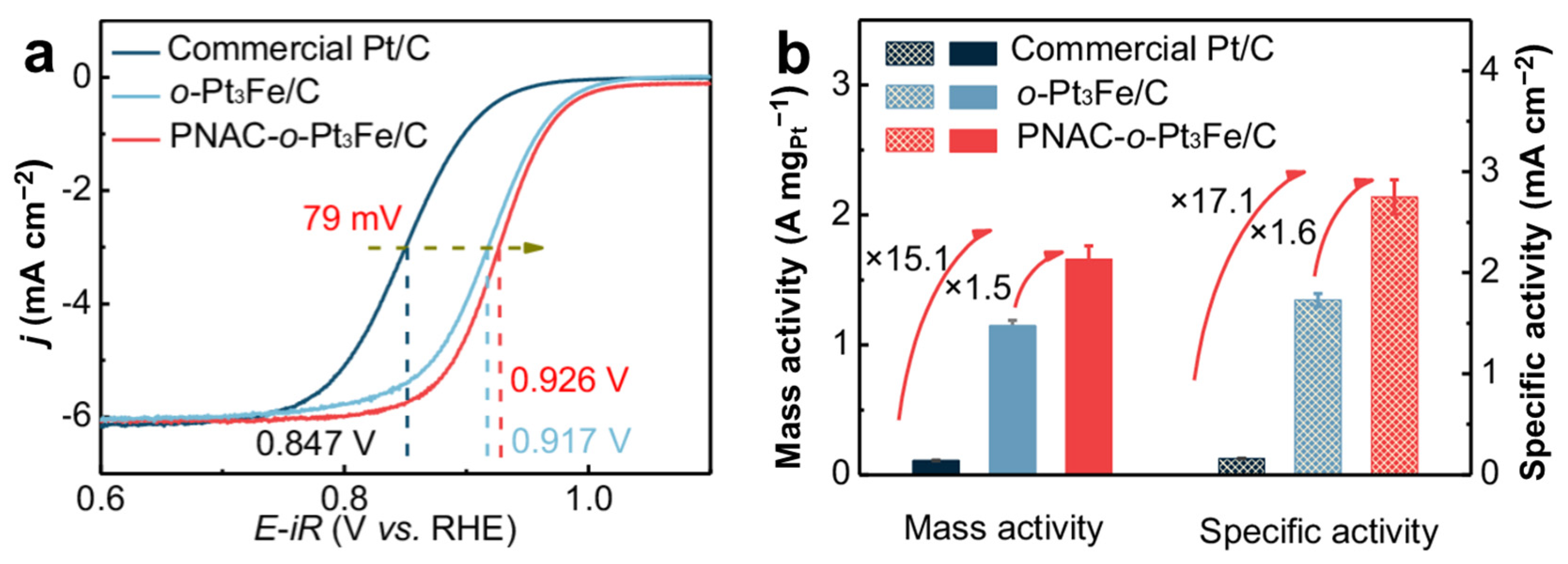
To control particle size during high-temperature annealing, N-doped carbon shells formed in situ are frequently used (Figure 10). Beyond acting as a protective layer, these shells provide additional benefits to ORR activity [54,70,72]. Guo and coauthors [54] found that the PNAC-O-Pt3Fe/C (PNAC: porous N-doped atomically thin carbon layer) shows a higher half-wave potential (0.926 V) than O-Pt3Fe/C without a PNAC shell (0.917 V), and the former’s MA and SA values are 1.5 times and 1.6 times greater than that of O-Pt3Fe/C, respectively (Figure 10a,b). The authors attributed the increased ORR activity of PNAC-O-Pt3Fe/C to one most probable reason: the PANC shell acts as a protective barrier, physically separating Nafion ionomers from electrocatalyst nanoparticles to release more Pt active sites. Uchiyama [70] et al. have also found that the N-doped carbon layer contributes to optimizing the electronic state of PtCo intermetallic by the hard X-ray photoelectron spectroscopy (HXAPES) analysis, which can weaken the oxygen binding energy and thereby improve ORR activity of PtCo intermetallic. Therefore, the Pt-based intermetallics at the N-doped carbon shell may exhibit higher ORR activity than both Pt-based alloys and uncovered Pt-based intermetallics due to the synergistic effect of the ordered structure and the N-doped carbon shell.
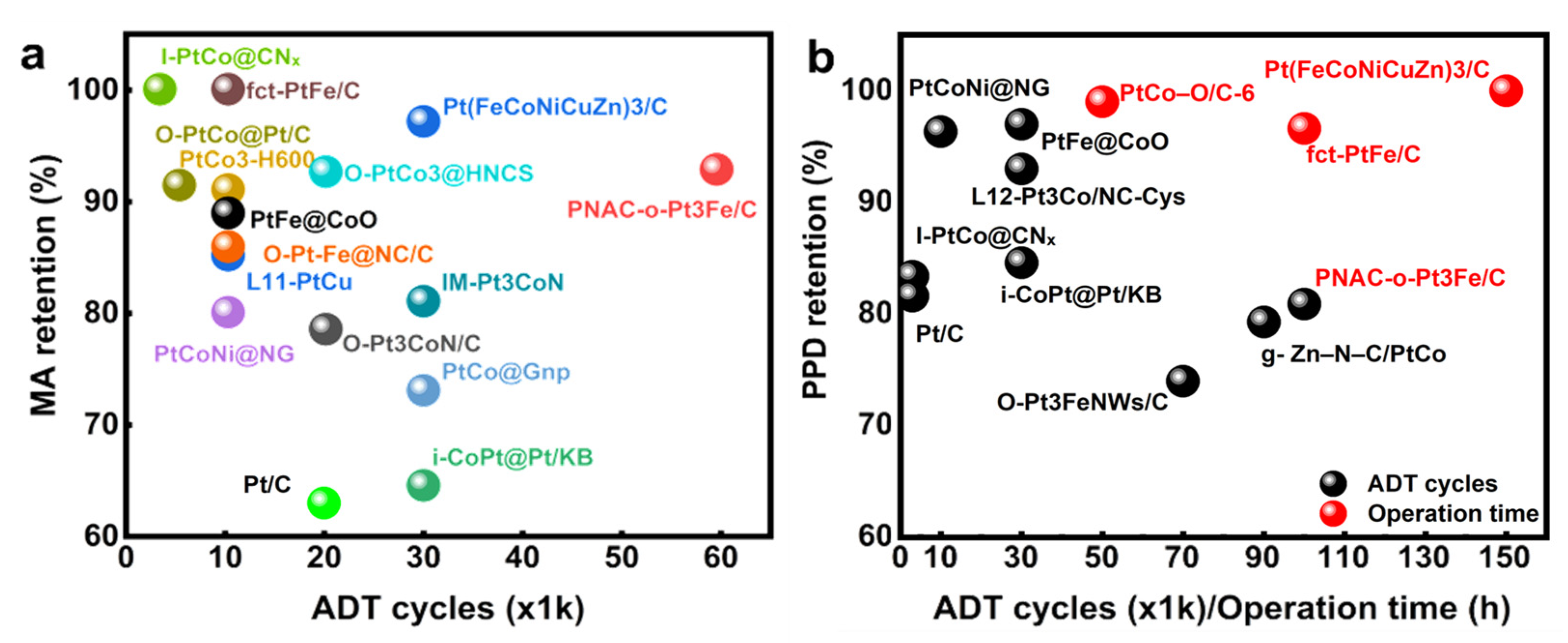
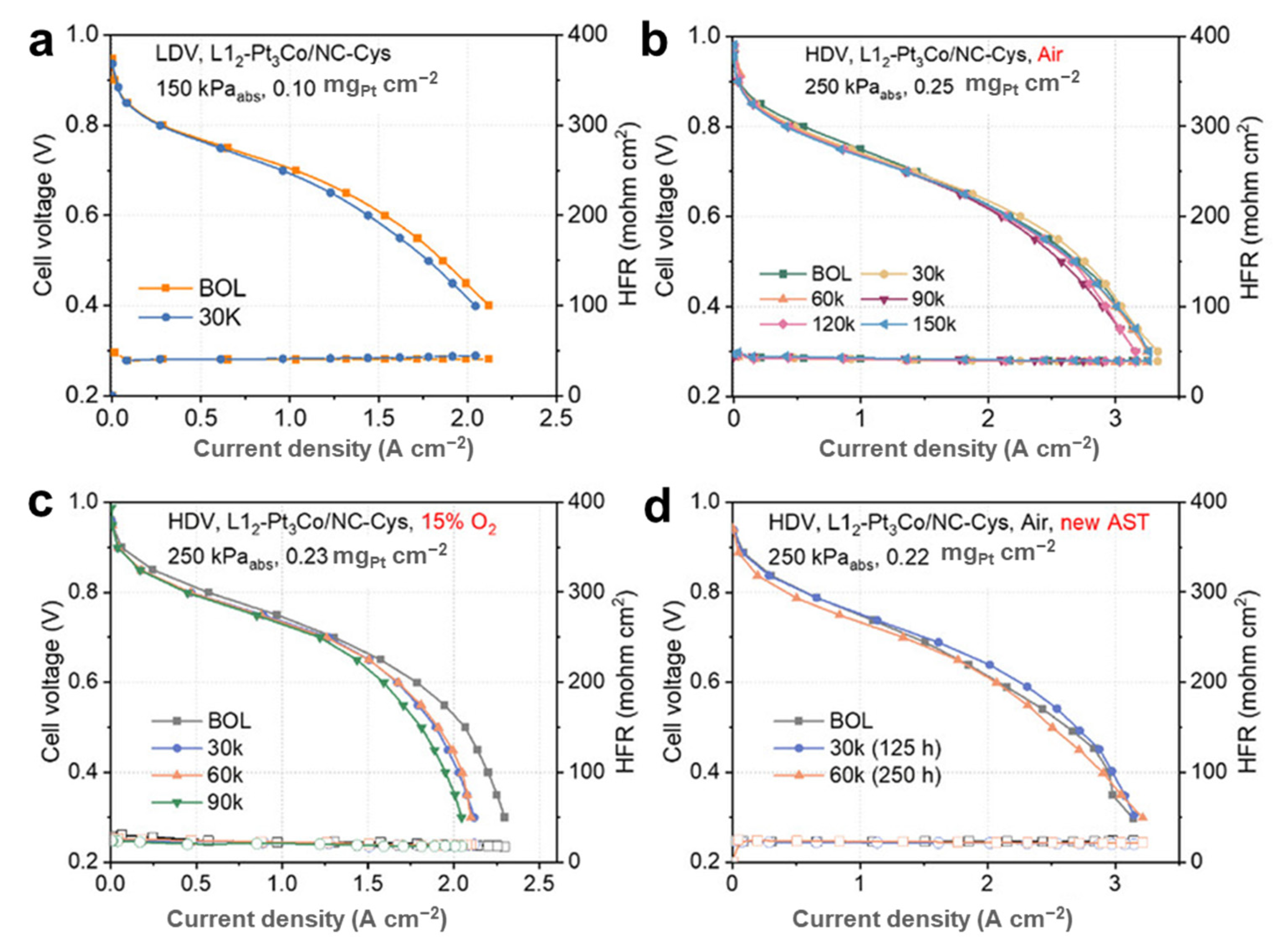
In PEMFCs, the durability of Pt-based intermetallic electrocatalysts is crucial for practical applications. Durability data, tested via ADT in both RDE and MEA, have been summarized in Figure 11 and Table 1. The superior durability of these materials is clearly suggested by their low MA loss (in RDE, less than 40%) and PPD loss (in MEA, less than 30%) after ADT (Figure 11). Several factors contributing to the improved durability of Pt-based intermetallic electrocatalysts have been proposed based on extensive characterization and theoretical calculations. The strong Pt-M interaction resulting from the ordered atomic arrangement significantly increases the vacancy formation energy (i.e., the vacancy formation energy of non-noble metals, which is the energy required to remove non-noble metals from the bulk of perfect Pt-based alloy or intermetallic nanoparticle to the surface) or dissolution potential of non-noble metal compared to Pt-based alloys (Figure 8b), which has been confirmed by DFT calculations [68]. This robust structure effectively suppresses the loss of the non-noble metal. Combined with XAS analysis, Uchiyama found that during ADT, the PtCo alloy forms more oxidation species on the surface, leading to greater lattice expansion, reduced stability, and accelerated dissolution. In contrast, the stable, ordered structure of PtCo intermetallics significantly restricts these degradation pathways, resulting in high non-noble metal retention. In addition, a strong interaction between Pt-based intermetallic nanoparticles and the carbon support physically inhibits nanoparticle migration and fusion. The presence of a protective carbon-based shell surrounding the intermetallic core also acts as a physical barrier, effectively inhibiting agglomeration and Ostwald ripening of the nanoparticles. Consequently, the high intrinsic ORR activity of Pt-based intermetallic electrocatalysts is maintained over time. Furthermore, minimizing the dissolution of M ions is crucial because it significantly reduces the contamination of the PEMFC membrane and ionomer, thereby maintaining sufficient proton conductivity. Due to their excellent durability, Pt-based intermetallic electrocatalysts are highly promising for application in PEMFCs for LDV and HDV. For example, Wu and coauthors [19] tested the durability of L12-Pt3Co/NC under LDV conditions and different HDV conditions (Figure 12), finding that the intermetallic electrocatalyst exhibited stable performance under various conditions, confirming its strong application value.
Table 1. Summary of particle size, Pt loading (on support), ORR performance (RDE and MEA), and durability (RDE and MEA) of the various Pt-based intermetallics. (Note: the names of Pt-based intermetallic electrocatalysts are formatted to indicate their preparation pathway. Normal text: optimizing commercial carbon; bold: self-prepared carbon or MOF-derived carbon; italic: using metal oxide protective layer; bold and italic: carbon-based protective layer; underline: one-pot synthesis method; bold and underline: other methods).
CatalystsParticle Size;
Pt Loading
Performance (RDE)Durability (RDE)Performance (MEA)Durability (MEA)Ref
O-PtCo/EC-300J~9 nm; 8 wt%SA: 8.26 mA cm−2; MA: 2.26 A mgPt−1; ECSA: 27.3 m2 g−11.5% ECSA loss, 31.6% SA loss, and 19% MA loss (30,000 cycles, 0.6–1.0 V, 100 mV s−1, 60 °C, O2, 0.1 M HClO4)SA: 2.12 mA cm−2; MA: 0.56 A mgPt−1; ECSA: 26.4 m2 g−1 (80 °C, 100% RH, H2/O2, 150 kPaabs)12.8% ECSA loss, 7% SA loss, and 19% MA loss (30,000 cycles 0.6 V (2.5 s)–0.95 V (2.5 s), 80 °C, 100% RH, H2/N2, 150 kPaabs)[18]
Pt3CoNiCu/B-C4 nm; 20 wt%E1/2: 0.893 V; MA: 1.0 A mgPt−1; SA: 2.8 mA cm−2 @0.9 V4 mV E1/2 loss; 16% MA loss and 6% SA loss (20,000 cycles, 0.6–1.0 V, 100 mV s−1)NANA[42]
L12-Pt(FeCoNiCuZn)3/C~5.75 nm; NAE1/2: 0.922 V; MA: 0.70 A mgₚₜ−1; SA: 1.34 mA cm−2 @0.9 V2 mV E1/2 loss; 2.9% MA loss (30,000 cycles, 0.6–1.0 V, 100 mV/s); 30% MA loss (1.0–1.5 V)PPD: 600 mW cm−2 (160 °C, HT-PEMFC, H2/O2)no degradation for 150 h @0.2 A cm−2 (160 °C, HT-PEMFC, H2/O2)[73]
O-PtCo3/C5.1 nm; 15 wt%MA: 0.74 A mg−1; SA: 1.74 mA cm−2 @0.9 V5 mV E1/2 loss; 9% MA drop (10,000 cycles, 0.6–1.0 V, 100 mV/s)NANA[71]
Pt3Co/MPC4.1 nm; 50.6 wt%E1/2: 0.914 V22% MA increase (40,000 cycles, 0.6–1.0 V, 200 mV s−1, O2,)PPD: 1 W cm−2 (80 °C, H2/Air, 1 bar)19% MA loss @ 0.9 V (30,000 cycles, 80 °C, 0.6 V (3 s)–0.95 V (3 s), H2/Air, 1 bar)[63]
O-PtCo3@HNCSNA; 20 wt%E1/2: 0.909 V; MA: 0.54 A mgPt−1 @0.9 VE1/2 barely degrade; 7.4% MA loss (20,000 cycles, 0.6–1.0 V, 100 mV s−1)NANA[74]
O-PtCo/ZIF-derived C5.0 nm; 18.17 wt%E1/2: 0.92 V; SA: 1.15 mA cm−2 @0.9 V12 mV E1/2 loss (30,000 cycles, 0.6–1.0 V, 50 mV s−1); 13 mV E1/2 loss (20,000 cycles, 1.0–1.5 V, 500 mV s−1)0.27 A cm−2 at 0.8 V (80 °C, H2/air, 1 bar)NA[75]
O-PtCo/Zn-N-C/C3.3 nm; 19 wt %MA: 2.99 A mgPt−1 @ 0.9 V1.7% activity loss (10,000 cycles, 0.6–0.95 V, 50 mV s−1)PPD: 1.45 W cm−2; MA: 0.99 A mgPt−1 @ 0.9 ViR-free (80 °C, 100% RH, H2/Air, 150 kPaabs)20.7% MA loss (90,000 cycles, 0.6 V (3 s)–0.95 V (3 s), 80 °C, 100% RH, H2/N2, 150 kPaabs)[39]
L12-Pt3Co/ZIF-8-derived C4.7–5.4 nm; 40 wt%E1/2: 0.957 V; MA: 1.5 A mgₚₜ−1 @0.9 V23% ECSA loss; 7% MA loss (30,000 cycles, 0.6–0.95 V, 100 mV s−1, 60 °C)MA: 0.76 A mgₚₜ−1 @0.9 Vᵢᵣ-free (LDV, 80 °C, 100% RH, H2/Air, 150 kPaabs); CD: 1.44 A cm−2 @ 0.7 V (HDV, 80 °C, 100% RH, H2/Air, 250 kPaabs)21% MA loss; 17% ECSA loss; 7% CD loss @ 0.7 V (LDV, 30,000 cycles, 0.6 V (3 s)–0.95 V (3 s), 80 °C, 100% RH, H2/N2, 150 kPaabs);
7% CD loss @ 0.7 V (HDV, 60,000 cycles, 0.675 V(5 s)–0.925 V (10 s), H2/air, 90 °C)
[19]
N-doped O-Pt3Co/C3.4 nm; 24 wt%E1/2: 0.943 V; MA: 2.11 A mgPt−1; SA: 4.02 mA cm−2 @0.9 Vno E1/2 decline; 19% MA loss (30,000 cycles, 0.6–1.1 V, 50 mV s−1)PPD: 2.40 W cm−2 (H2/O2), 1.01 W cm−2 (H2/air) (80 °C)21.3% MA loss (30,000 cycles, 0.6 V (3 s)–0.95 V (3 s), 80 °C, H2/N2); no obvious loss (100 h @1.5 A cm−2, H2/air, 80 °C, 100% RH)[76]
PtCoNi@NC/G5 nm; 6.1 wt%E1/2: 0.932 V; MA: 1.357 A mgPt−1; SA: 1.1 mA cm−2 @0.9 V10.1 mV E1/2 loss; <20% MA loss (10,000 cycles, 0.6–1.0 V, 200 mV s−1)PPD: 0.866 W cm−2 (80 °C, 100% RH, H2/Air, 150 kPaabs), 2.031 W cm−2 (H2/O2, 250 kPaabs)3.68% PPD loss (10,000 cycles, 0.6 V (2.5 s)–0.95 V (2.5 s), 80 °C, 100% RH, H2/N2, 150 kPaabs)[21]
O-PtCoFe/C4.4 nm; NAE1/2: 0.87 V; MA: 382.8 mA mgPt−110 mV E1/2 decay; 11.1% MA loss (10,000 cycles, 0.6–1.1 V, O2, 100 mV s−1)PPD: 599 mW cm−2 (65 °C, 100% RH, H2/O2, 1 bar)3% PPD loss (30,000 cycles, 0.6–1.1 V, 100 mV s−1, 65 °C, 100% RH)[77]
L12-Al-Pt3Co@Pt/C4–6 nm; ~15 wt%E1/2: 0.923 V; MA: 1.174 A mgPt−12 mV E1/2 loss; 7.1% MA loss (30,000 cycles, 0.6–1 V, O2, 50 mV s−1)PPD: 1 W cm−2 (80 °C, 100% RH, H2/Air, 1 bar)9% PPD loss (30,000 cycles, 0.6–1.1 V, 50 mV s−1, 80 °C, 100% RH, H2/Air, 1 bar)[48]
O-Pt3Fe@NC/C4.0 nm; 6–10 wt%E1/2: 0.926 V; MA: 1.66 A mgₚₜ−1 @ 0.9 V2 mV E1/2 loss; 7.2% MA loss; 4.8% SA loss (60,000 cycles)1.8 A cm−2 at 0.6 V; PPD: 1.6 W cm−2 (80 °C, 100% RH, H2/O2, 0.2 MPa)19.1% activity loss after 100 h at 0.5 V[54]
O-PtNi3/C@NCNA; 17 wt%E1/2: 0.940 V; MA: 1.16 A mgₚₜ−1; SA: 2.90 mA cm−2 @0.9 VNo obvious loss (10,000 cycles, 0.6–1.0 V, 100 mV s−1)NANA[47]
fct-PtFe/C@NC6.5 nm;MA: 1.2 A·mgₚₜ−1negligible activity loss (10,000 cycles, 0.6–1.0 V, Ar/O2, 50 mV s−1)PPD: 0.5 W cm−23.4% PPD loss (100 h)[49]
O-CoPt@Pt@NC/C3–4.5 nm; ~40 wt%ECSA: 58.2 m2 g−1; MA: 2.07 A mgPt−1@0.9 V; SA: 3.95 mA cm−218.8% ECSA loss; 35.5% MA loss (30,000 cycles, 0.6–1.0 V, O2, 0.1 M HClO4MA:0.53 A mg−1; PPD: 1.18 W cm−2 (80 °C, 100% RH, H2/air, 250 kPaabs)15.4% activity loss (30,000 cycles, 0.6 V (3 s)–0.95 V (3 s), 80 °C, 100% RH, H2/N2, 150 kPaabs)[62]
O-PtCo@C/C3.0 nm; NAMA: ~1.2 A mgₚₜ−1; SA:1.6 mA cm−2NAPPD: ~ 1 W cm−2 (80 °C, 100% RH, H2/O2 150 kPaabs)18.8 mV loss @0.8 A cm−2 (30,000 cycles, 0.6 V (3 s)–0.95 V (3 s), 80 °C, 100% RH, H2/N2, 150 kPaabs)[61]
O-PtCo@NC/C4.3 nm; 20 wt%SA: 1.51 A cm−2 @0.9 Vno loss in MA (30,000 cycles, 0.65 V (3 s)–1 V (3 s)150 mA cm−2 @0.8 V (80 °C, 80% RH, H2/O2)23.0% ECSA loss; 16.6% CD loss @0.8 V (30,000 cycles, 0.6 V (3 s)–0.95 V (3 s), 80 °C, H2/N2)[70]
L10-FePt@NC/rGO4–7 nm; 28.7 wt%MA: 1.96 A mgPt−1; SA: 4.1 mA cm−2 @0.9 VECSA, MA increase (20,000 cycles, 0.6–1.0 V)NANA[56]
O-Pt-Fe@NC/C3.8 nm; 27 wt%MA: 0.53 A·mgₚₜ−14 mV E1/2 loss; 14.1% MA loss (10,000 cycles, 0.6–1.0 V, 100 mV s−1)NANA[50]
L10-Pt2CuGa/C4.1 nm; NAECSA: 48.6 m2 g−1; E1/2: 0.936 V; MA: 1.39 A mgPt−1; SA: 2.86 mA cm−2 @0.9 V8 mV E1/2 loss; 23.9 % ECSA loss (30,000 cycles, 0.6–1.0 V, 100 mV s−1, O2,)PPD: 2.6 W cm−2; (80 °C, 100% RH, H2/O2 150 kPaabs); PPD: 1.24 W cm−2; (80 °C, 100% RH, H2/air, 150 kPaabs)15% PPD loss (H2/O2); 19% PPD loss (H2/air) (30,000 cycles, 80 °C, 100% RH, H2/N2, 100 mV s−1)[78]
N-doped O-Pt3Co/C~7.9 nm; 18.03 wt%ECSA: 25.23 m2 g−1; MA: 275.76 mA mgPt −1 @ 0.9 V21.5% MA loss (20,000 cycles, 0.6–1.1 V, 0.1 M HClO4, 200 mV/s)NANA[79]
PtCo/C3.2 nm; 29.4 wt%E1/2: 0.93 V; MA:1.28 A mgₚₜ−1 @0.9 V11 mV E1/2 loss (40,000 cycles, 0.6–1.0 V, 100 mV s−1)PPD: 2.38 W cm−2; MA:1.28 A mgₚₜ−1 @0.9 V (80 °C, 100% RH, H2/O2 150/200 kPaabs)1% PPD decay (50 h @ 0.6 V, 80 °C, 100% RH, H2/air 200 kPaabs)[41]
O-Pt3Co/C5 nm; 30.72 wt%E1/2: 0.943 V; MA: 0.51 m A mgₚₜ−1, SA: 1.1 mA cm−2 @0.9 V3% ECSA loss; 25 mV E1/2 loss (4000 cycles, 0.05–1.0 V, 50 mV s−1)NANA[80]
O-Pt3Fe NWs/C11 nm; 20.2 wt%SA:2.5 mA cm−2; MA: 0.98 A mgPt−1 @0.9 VNo obvious change (30,000 cycles, 0.6–1.0 V, 100 mV s−1, O2, 0.1 M HClO4)PPD: 1.05 W cm−2; MA: 0.67 A mgPt−1 @ 0.9 VIR-free (80 °C, 100% RH, H2/air, 150 kPaabs)26.0% current density loss at 0.7 V (7000 cycles, 0.6 V (5 s)–0.95 V (5 s), 80 °C, 100% RH, H2/N2)[20]
O-Pt3Mn/C4.23 nm; 20 wt%MA: 0.386 A mgPt−1; SA: 0.877 mA cm−2 @0.9 V26.5% MA loss; 20.5% SA loss; 10% ECSA loss (10,000 cycles, 0.6–1.1 V, O2, 50 mV s−1)550 mA cm−2 @ 0.7 V; PPD: 582 mW cm−2 (65 °C, 100% RH, H2/air)11.63% CD loss @ 0.7 V; 6.5% PPD loss (10,000 cycles, 0.6–1.1 V, H2/N2, 50 mV s−1)[68]
RDE: rotating disk electrode, MEA: membrane electrode assembly, SA: specific activity, MA: mass activity, ECSA: electrochemical surface area, NWs: nanowires, PPD: peak power density, RH: relative humidity, E1/2: half-wave potential, N-doped O-Pt3Co: N-doped Pt3Co intermetallic (doping of N atoms within the gaps of Pt3Co intermetallic nanocrystals), NC: N-doped C, rGO: reduced graphene, B-C: B-modified C, HNCS: hollow porous N-doped carbon sphere, MPC: mesoporous carbon, CD: current density; NA: not available.

5. Concluding Remarks

One of the current challenges in ORR research is the development of electrocatalysts that simultaneously possess excellent activity, high durability, and low cost, as well as can be prepared in a mass batch. While tremendous efforts have been made over the last decade to address these issues, a highly promising direction involves the synthesis of highly active and stable Pt-based intermetallic electrocatalysts on carbon supports. This strategy offers a viable pathway to reducing Pt usage and enhancing electrocatalyst durability without sacrificing electrocatalytic activity. To boost the development of the Pt-based intermetallic electrocatalysts with high activity and durability, recent progress related to the controlled synthesis, ORR activity, and durability of carbon-supported Pt-based intermetallic electrocatalysts has been examined in this review.
Different from alloys, intermetallics feature an ordered atomic configuration, a well-defined crystal structure, and fixed stoichiometry, resulting in a strong Pt-M metal bond as well as strong and uniform d-d orbital interactions. Based on the phase diagrams, Pt-based intermetallics mainly show L10 (e.g., PtCo, PtFe, and PtNi), L11 (e.g., PtCu), and L12 (e.g., Pt3Co, Pt3Ni, Pt3Fe, PtCo3, PtNi3, PtFe3, or PtCu3) crystal structures. So far, the direct and effective pathway to prepare Pt-based intermetallics is high-temperature annealing to overcome the high energy barrier of the structure transition from disordered to ordered. To avoid nanoparticle sintering and aggregation during the annealing process, several strategies have been developed to immobilize the nanoparticles, including optimizing carbon support to increase the metal–support interaction or preparing an oxide or carbon-based shell outside Pt-based alloy nanoparticles. The experiments have confirmed that surface functionalization of carbon materials, using MOF-derived carbon materials, or forming porous N-doped carbon shells, are relatively effective methods to control the size of Pt-based intermetallic nanoparticles. With persistent efforts, their nanoparticle size could have been decreased to 2–3 nm in some cases, and the Pt loading can be decreased by up to ~50%. To characterize the as-synthesized Pt-based intermetallics, it is necessary to combine XRD and AC-TEM. The former can provide the bulk perspective, tell us the electrocatalysts’ crystal structure, and allow for the quantitative estimation of OD within the synthesized Pt-based intermetallics. The latter provides localized, high-resolution structural information and allows for the quantitative estimation of the ordering degree (OD) within the synthesized Pt-based intermetallics. Due to the intensified ligand and strain effects and a high dissolution potential resulting from the ordered structure, as well as the presence of N-doped carbon shells in some situations, the Pt-based intermetallic electrocatalysts generally show excellent ORR activity and durability. In brief, Pt-based intermetallics are highly promising electrocatalysts for application in PEMFCs.
Although Pt-based intermetallic electrocatalysts have shown various advantages, there are still some challenges that need to be addressed to achieve the practical replacement of commercial Pt/C or PtCo/C. It has been demonstrated that when the Pt loading at the cathode is decreased to 0.05 mg cm−2, the performance of MEA will be greatly reduced, particularly at high current densities due to the significantly increased local oxygen transport resistance caused by the sharp reduction in the active sites. An effective strategy to address this issue is preparing the Pt-based electrocatalysts at a small size, such as a Pt-based nanometer cluster, to maximize their surface area [64]. Although the 2–3 nm Pt-based intermetallic nanoparticles can be successfully prepared in some reaction systems, the synthesis of Pt-based intermetallic nanometer clusters is a great challenge. In addition to small size, it is still difficult to obtain the carbon-supported Pt-based intermetallic electrocatalysts with high Pt loading (≥40 wt%, reduced catalyst layer thickness, and then decreased oxygen transport resistance) and high order degree (high durability), which are highly desirable to obtain high performance and durability in MEA. Non-spherical Pt-based electrocatalysts commonly exhibit higher activity and durability than spherical electrocatalysts, due to the exposure of high active facets. However, because of the lowest surface energy of spherical nanoparticles, the Pt-based intermetallic electrocatalysts usually show spherical shapes. So far, although there are several articles reporting the synthesis of non-spherical Pt-based intermetallics [20,81], their effective and controlled synthesis method is still lacking. In addition, to realize the mass production of well-defined carbon-supported Pt-based intermetallic electrocatalysts, it is necessary to develop simple and mild preparation methods, because such reaction systems are relatively easier to scale up.

Author Contributions

Writing—original draft preparation, H.L., Q.S. and Y.X.; writing—review and editing, Y.X., W.Z., Q.X. and H.S. All authors have read and agreed to the published version of the manuscript.

Funding

This research was funded by National Natural Science Foundation of China grant number 22308129.

Acknowledgments

This work was partially supported by the Fundamental Research Funds of Jiangsu University (Grant No. 22JDG019).

Conflicts of Interest

The authors declare no conflicts of interest.

References

  1. Johnson, N.; Liebreich, M.; Kammen, D.M.; Ekins, P.; McKenna, R.; Staffell, I. Realistic roles for hydrogen in the future energy transition. Nat. Rev. Clean Technol. 2025, 1, 351–371. [Google Scholar] [CrossRef]
  2. Zhang, F.; Zu, B.; Wang, B.; Qin, Z.; Yao, J.; Wang, Z.; Fan, L.; Jiao, K. Developing long-durability proton-exchange membrane fuel cells. Joule 2025, 9, 101853. [Google Scholar] [CrossRef]
  3. Zhou, Y.; Guo, W.; Xing, L.; Li, J.; Wang, N.; Meng, L.; Ye, S.; Yang, X.; Chen, H.; Du, L. Stability/Durability Challenges of Cathode Catalysts for PEM Fuel Cells: Experiments, Mechanisms, and Perspectives Beyond Three-Electrode System. Energy Environ. Sci. 2025, 18, 9054–9092. [Google Scholar] [CrossRef]
  4. Wang, J.X.; Markovic, N.M.; Adzic, R.R. Kinetic Analysis of Oxygen Reduction on Pt(111) in Acid Solutions:  Intrinsic Kinetic Parameters and Anion Adsorption Effects. J. Phys. Chem. B 2004, 108, 4127–4133. [Google Scholar] [CrossRef]
  5. Liu, H.; Zhao, J.; Li, X. Controlled Synthesis of Carbon-Supported Pt-Based Electrocatalysts for Proton Exchange Membrane Fuel Cells. Electrochem. Energy Rev. 2022, 5, 13. [Google Scholar] [CrossRef]
  6. James, B.D. Fuel Cell Cost and Performance Analysis. Available online: https://www.hydrogen.energy.gov/pdfs/review22/fc353_james_2022_o.pdf (accessed on 7 June 2022).
  7. Wang, J.; Kim, J.; Choi, S.; Wang, H.; Lim, J. A Review of Carbon-Supported Nonprecious Metals as Energy-Related Electrocatalysts. Small Methods 2020, 4, 2000621. [Google Scholar] [CrossRef]
  8. Wang, J.; Kong, H.; Zhang, J.; Hao, Y.; Shao, Z.; Ciucci, F. Carbon-based electrocatalysts for sustainable energy applications. Prog. Mater. Sci. 2021, 116, 100717. [Google Scholar] [CrossRef]
  9. Nørskov, J.K.; Rossmeisl, J.; Logadottir, A.; Lindqvist, L.; Kitchin, J.R.; Bligaard, T.; Jónsson, H. Origin of the Overpotential for Oxygen Reduction at a Fuel-Cell Cathode. J. Phys. Chem. B 2004, 108, 17886–17892. [Google Scholar] [CrossRef] [PubMed]
  10. Stamenkovic, V.; Mun, B.S.; Mayrhofer, K.J.J.; Ross, P.N.; Markovic, N.M.; Rossmeisl, J.; Greeley, J.; Norskov, J.K. Changing the activity of electrocatalysts for oxygen reduction by tuning the surface electronic structure. Angew. Chem. Int. Ed. 2006, 45, 2897–2901. [Google Scholar] [CrossRef]
  11. Kim, C.; Dionigi, F.; Beermann, V.; Wang, X.; Möller, T.; Strasser, P. Alloy Nanocatalysts for the Electrochemical Oxygen Reduction (ORR) and the Direct Electrochemical Carbon Dioxide Reduction Reaction (CO2RR). Adv. Mater. 2019, 31, 1805617. [Google Scholar] [CrossRef] [PubMed]
  12. Wu, D.; Shen, X.; Pan, Y.; Yao, L.; Peng, Z. Platinum Alloy Catalysts for Oxygen Reduction Reaction: Advances, Challenges and Perspectives. ChemNanoMat 2020, 6, 32–41. [Google Scholar] [CrossRef]
  13. Asset, T.; Chattot, R.; Fontana, M.; Mercier-Guyon, B.; Job, N.; Dubau, L.; Maillard, F. A Review on Recent Developments and Prospects for the Oxygen Reduction Reaction on Hollow Pt-alloy Nanoparticles. ChemPhysChem 2018, 19, 1552–1567. [Google Scholar] [CrossRef] [PubMed]
  14. Čolić, V.; Bandarenka, A.S. Pt Alloy Electrocatalysts for the Oxygen Reduction Reaction: From Model Surfaces to Nanostructured Systems. ACS Catal. 2016, 6, 5378–5385. [Google Scholar] [CrossRef]
  15. Feng, X.; Zhou, Z.; Zhang, H.-J.; Ma, Z.; Xue, Y. Pt-Based Ternary Alloy on Nanohoneycomb Nitrogen-Doped Carbon Support for Highly Active and Stable Oxygen Reduction Reaction. ACS Appl. Nano Mater. 2025, 8, 5775–5783. [Google Scholar] [CrossRef]
  16. Kitchin, J.R.; Nørskov, J.K.; Barteau, M.A.; Chen, J.G. Role of Strain and Ligand Effects in the Modification of the Electronic and Chemical Properties of Bimetallic Surfaces. Phys. Rev. Lett. 2004, 93, 156801. [Google Scholar] [CrossRef]
  17. Zhang, J.; Vukmirovic, M.B.; Xu, Y.; Mavrikakis, M.; Adzic, R.R. Controlling the Catalytic Activity of Platinum-Monolayer Electrocatalysts for Oxygen Reduction with Different Substrates. Angew. Chem. Int. Ed. 2005, 44, 2132–2135. [Google Scholar] [CrossRef]
  18. Li, J.; Sharma, S.; Liu, X.; Pan, Y.-T.; Spendelow, J.S.; Chi, M.; Jia, Y.; Zhang, P.; Cullen, D.A.; Xi, Z.; et al. Hard-Magnet L10-CoPt Nanoparticles Advance Fuel Cell Catalysis. Joule 2019, 3, 124–135. [Google Scholar] [CrossRef]
  19. Liang, J.; Yu, H.; Zachman, M.J.; Hwang, S.; Qi, M.; Zeng, Y.; Zhang, B.; Li, J.; Guo, J.; Dun, C.; et al. Creating Favorable Pt/Co Interfaces via a Two-Step Approach for Constructing Highly Durable PtCo Intermetallic Fuel Cell Catalysts. Adv. Mater. 2025, e10847. [Google Scholar] [CrossRef] [PubMed]
  20. Hu, X.; Jiang, K.; Wang, F.; Geng, S.; Liu, Y.; Meng, S.; Su, H.; Zhu, S.; Bu, L.; Chen, C.; et al. Gas Dynamically Confined Synthesis of Platinum-Based Intermetallic Nanowires for Active and Ultrastable Oxygen Reduction Catalysis. ACS Nano 2025, 19, 31201–31212. [Google Scholar] [CrossRef] [PubMed]
  21. Sun, L.; Yin, Y.; Ren, B.; Qin, Y.; Wen, G.; Chen, Z. ZIF-derived ternary Pt-Co-Ni alloy as the superior active and durable catalyst for PEMFC. Nano Energy 2024, 120, 109154. [Google Scholar] [CrossRef]
  22. Luo, C.; Wan, K.; Wang, J.; Li, B.; Yang, D.; Ming, P.; Zhang, C. A review of ordered PtCo3 catalyst with higher oxygen reduction reaction activity in proton exchange membrane fuel cells. J. Colloid Interface Sci. 2025, 679, 165–190. [Google Scholar] [CrossRef]
  23. Wu, R.; Zuo, J.; Zhao, L.; Zhu, Z.; Li, Q.; Niu, X.; Chen, J.S. MOF-derived ordered porous nitrogen-doped carbon integrated with Pt3Co alloy catalyst for efficient oxygen reduction reaction. Chem. Commun. 2025, 61, 5742–5745. [Google Scholar] [CrossRef] [PubMed]
  24. Available online: https://global.toyota/pages/news/images/2020/12/09/1200/20201209_01_02_en.pdf (accessed on 9 December 2020).
  25. Lin, F.; Li, M.; Zeng, L.; Luo, M.; Guo, S. Intermetallic Nanocrystals for Fuel-Cells-Based Electrocatalysis. Chem. Rev. 2023, 123, 12507–12593. [Google Scholar] [CrossRef] [PubMed]
  26. Nie, Y.; Shi, Z.; Li, B.; Meyer, Q.; Zhao, C. Engineering Platinum-Based Alloy Catalysts for Oxygen Reduction Reaction in Hydrogen Fuel Cells: A Mini-Review. Energy Fuels 2025, 39, 16049–16064. [Google Scholar] [CrossRef]
  27. Zuo, C.; Su, Q.; Wang, K.; Guo, Q. Recent advances of intermetallic nanocatalysts: From structure feature, synthetic control to the enhanced electrocatalytic performance in PEMFCs. Int. J. Hydrogen Energy 2025, 157, 150435. [Google Scholar] [CrossRef]
  28. Tian, H.; Wang, X.; Ge, J.; Wan, H.; Ma, W.; Xie, G.; Ge, J. Pt-based intermetallic compound catalysts for the oxygen reduction reaction: From problems to recent developments. J. Energy Chem. 2024, 99, 302–324. [Google Scholar] [CrossRef]
  29. Peng, H. 8-Brazing of nickel, ferrite and titanium–aluminum intermetallics. In Advances in Brazing; Sekulić, D.P., Ed.; Woodhead Publishing: Cambridge, UK, 2013; pp. 221–248. [Google Scholar] [CrossRef]
  30. Sauthoff, G. Intermetallics. In Ullmann’s Encyclopedia of Industrial Chemistry; Wiley: Hoboken, NJ, USA, 2006. [Google Scholar] [CrossRef]
  31. Kim, D.; Saal, J.E.; Zhou, L.; Shang, S.; Du, Y.; Liu, Z.-K. Thermodynamic modeling of fcc order/disorder transformations in the Co–Pt system. Calphad 2011, 35, 323–330. [Google Scholar] [CrossRef]
  32. Lu, X.-G.; Sundman, B.; Ågren, J. Thermodynamic assessments of the Ni–Pt and Al–Ni–Pt systems. Calphad 2009, 33, 450–456. [Google Scholar] [CrossRef]
  33. Entel, P.; Gruner, M.E.; Rollmann, G.; Hucht, A.; Sahoo, S.; Zayak, A.T.; Herper, H.C.; Dannenberg, A. First-principles investigations of multimetallic transition metal clusters. Philos. Mag. 2008, 88, 2725–2738. [Google Scholar] [CrossRef]
  34. Abe, T.; Sundman, B.; Onodera, H. Thermodynamic assessment of the Cu–Pt system. J. Phase Equilibria Diffus. 2006, 27, 5–13. [Google Scholar] [CrossRef]
  35. Li, J.; Sun, S. Intermetallic Nanoparticles: Synthetic Control and Their Enhanced Electrocatalysis. Acc. Chem. Res. 2019, 52, 2015–2025. [Google Scholar] [CrossRef]
  36. Yan, Y.; Du, J.S.; Gilroy, K.D.; Yang, D.; Xia, Y.; Zhang, H. Intermetallic Nanocrystals: Syntheses and Catalytic Applications. Adv. Mater. 2017, 29, 1605997. [Google Scholar] [CrossRef]
  37. Vanýsek, P. Electrochemical Series. In Corrosion: Materials; Cramer, S.D., Covino, B.S., Jr., Eds.; ASM International: Russell Township, OH, USA, 2010; Volume 13B. [Google Scholar]
  38. Kim, J.; Lee, Y.; Sun, S. Structurally Ordered FePt Nanoparticles and Their Enhanced Catalysis for Oxygen Reduction Reaction. J. Am. Chem. Soc. 2010, 132, 4996–4997. [Google Scholar] [CrossRef] [PubMed]
  39. Huang, Z.; Wang, Y.; Xia, J.; Hu, S.; Chen, N.; Ding, T.; Zhan, C.; Pao, C.-W.; Hu, Z.; Huang, W.-H.; et al. Atom-glue stabilized Pt-based intermetallic nanoparticles. Sci. Adv. 2024, 10, eadq6727. [Google Scholar] [CrossRef] [PubMed]
  40. Zhang, S.; Zhang, X.; Jiang, G.; Zhu, H.; Guo, S.; Su, D.; Lu, G.; Sun, S. Tuning Nanoparticle Structure and Surface Strain for Catalysis Optimization. J. Am. Chem. Soc. 2014, 136, 7734–7739. [Google Scholar] [CrossRef]
  41. Kong, F.; Huang, Y.; Yu, X.; Li, M.; Song, K.; Guo, Q.; Cui, X.; Shi, J. Oxygen Vacancy-Mediated Synthesis of Inter-Atomically Ordered Ultrafine Pt-Alloy Nanoparticles for Enhanced Fuel Cell Performance. J. Am. Chem. Soc. 2024, 146, 30078–30090. [Google Scholar] [CrossRef] [PubMed]
  42. Zeng, X.; Jing, Y.; Gao, S.; Zhang, W.; Zhang, Y.; Liu, H.; Liang, C.; Ji, C.; Rao, Y.; Wu, J.; et al. Hydrogenated borophene enabled synthesis of multielement intermetallic catalysts. Nat. Commun. 2023, 14, 7414. [Google Scholar] [CrossRef]
  43. Liu, F.; Guo, Y.; Zhong, Y.; Li, J.; Zhang, H.; Shi, L.; Lin, X.; Ye, F.; Ge, K.; Yuan, S.; et al. Sulfur-bridge ligands altering the microenvironment of single-atom CoN3S sites to boost the oxygen reduction reaction. Chem. Commun. 2024, 60, 4064–4067. [Google Scholar] [CrossRef]
  44. Ma, M.; Shen, L.; Zhao, Z.; Guo, P.; Liu, J.; Xu, B.; Zhang, Z.; Zhang, Y.; Zhao, L.; Wang, Z. Activation methods and underlying performance boosting mechanisms within fuel cell catalyst layer. eScience 2024, 4, 100254. [Google Scholar] [CrossRef]
  45. Kim, J.; Rong, C.; Liu, J.P.; Sun, S. Dispersible Ferromagnetic FePt Nanoparticles. Adv. Mater. 2009, 21, 906–909. [Google Scholar] [CrossRef]
  46. Yamamoto, S.; Morimoto, Y.; Ono, T.; Takano, M. Magnetically superior and easy to handle L1-FePt nanocrystals. Appl. Phys. Lett. 2005, 87, 032503. [Google Scholar] [CrossRef]
  47. Tamada, Y.; Morimoto, Y.; Yamamoto, S.; Takano, M.; Nasu, S.; Ono, T. Effects of annealing time on structural and magnetic properties of L10-FePt nanoparticles synthesized by the SiO2-nanoreactor method. J. Magn. Magn. Mater. 2007, 310, 2381–2383. [Google Scholar] [CrossRef]
  48. Wu, W.; Qu, W.; Wang, Z.; Tan, Y.; Chen, R.; Chen, S.; Lv, H.; Zhong, J.; Cheng, N. Single-atom Al precisely modulate the strain of Pt3Co intermetallic for superior oxygen catalytic performance. Chem. Eng. J. 2024, 491, 151987. [Google Scholar] [CrossRef]
  49. Chung, D.Y.; Jun, S.W.; Yoon, G.; Kwon, S.G.; Shin, D.Y.; Seo, P.; Yoo, J.M.; Shin, H.; Chung, Y.-H.; Kim, H.; et al. Highly Durable and Active PtFe Nanocatalyst for Electrochemical Oxygen Reduction Reaction. J. Am. Chem. Soc. 2015, 137, 15478–15485. [Google Scholar] [CrossRef]
  50. Hu, Y.; Shen, T.; Zhao, X.; Zhang, J.; Lu, Y.; Shen, J.; Lu, S.; Tu, Z.; Xin, H.L.; Wang, D. Combining structurally ordered intermetallics with N-doped carbon confinement for efficient and anti-poisoning electrocatalysis. Appl. Catal. B Environ. 2020, 279, 119370. [Google Scholar] [CrossRef]
  51. Sun, K.; Li, J.; Wang, F.; He, W.; Fei, M.; Lu, Z.; Zhang, H.; Liu, J.; Zou, Z. Highly enhanced durability of a graphitic carbon layer decorated PtNi3 alloy electrocatalyst toward the oxygen reduction reaction. Chem. Commun. 2019, 55, 5693–5696. [Google Scholar] [CrossRef] [PubMed]
  52. Ding, R.; Liu, Y.; Rui, Z.; Li, J.; Liu, J.; Zou, Z. Facile grafting strategy synthesis of single-atom electrocatalyst with enhanced ORR performance. Nano Res. 2020, 13, 1519–1526. [Google Scholar] [CrossRef]
  53. Li, J.; Liu, J.-X.; Gao, X.; Goldsmith, B.R.; Cong, Y.; Zhai, Z.; Miao, S.; Jiang, Q.; Dou, Y.; Wang, J.; et al. Nitrogen-doped graphene layers for electrochemical oxygen reduction reaction boosted by lattice strain. J. Catal. 2019, 378, 113–120. [Google Scholar] [CrossRef]
  54. Cao, X.; Guo, H.; Han, Y.; Li, M.; Shang, C.; Zhao, R.; Huang, Q.; Li, M.; Zhang, Q.; Lv, F.; et al. Sandwiching intermetallic Pt3Fe and ionomer with porous N-doped carbon layers for oxygen reduction reaction. Nat. Commun. 2025, 16, 2851. [Google Scholar] [CrossRef]
  55. Wang, B.; Lu, M.; Chen, D.; Zhang, Q.; Wang, W.; Kang, Y.; Fang, Z.; Pang, G.; Feng, S. NixFeyN@C microsheet arrays on Ni foam as an efficient and durable electrocatalyst for electrolytic splitting of alkaline seawater. J. Mater. Chem. A 2021, 9, 13562–13569. [Google Scholar] [CrossRef]
  56. Yoo, T.Y.; Yoo, J.M.; Sinha, A.K.; Bootharaju, M.S.; Jung, E.; Lee, H.S.; Lee, B.-H.; Kim, J.; Antink, W.H.; Kim, Y.M.; et al. Direct Synthesis of Intermetallic Platinum–Alloy Nanoparticles Highly Loaded on Carbon Supports for Efficient Electrocatalysis. J. Am. Chem. Soc. 2020, 142, 14190–14200. [Google Scholar] [CrossRef]
  57. Ko, K.; Kim, D.; Min, J.; Sravani, B.; Kim, Y.; Lee, S.; Sul, T.; Jang, S.; Jung, N. Redesign of Anode Catalyst for Sustainable Survival of Fuel Cells. Adv. Sci. 2024, 11, 2307073. [Google Scholar] [CrossRef] [PubMed]
  58. Labarde, Q.; Godoy, A.O.; Dubau, L.; Micoud, F.; Chatenet, M. Carbon-Capped PtNi Catalysts for the Oxygen Reduction Reaction in Acidic Environment: A Durability Study. Electrocatalysis 2025, 16, 117–131. [Google Scholar] [CrossRef]
  59. Tian, L.; Gao, X.; Zhu, M.; Huang, Z.; Wu, B.; Chen, C.; Ma, X.; Ruan, Y.; Guo, W.; Meng, X.; et al. Double Confinement Design to Access Highly Stable Intermetallic Nanoparticles for Fuel Cells. Adv. Mater. 2025, 37, 2417095. [Google Scholar] [CrossRef]
  60. Chougule, S.S.; Jeffery, A.A.; Roy Chowdhury, S.; Min, J.; Kim, Y.; Ko, K.; Sravani, B.; Jung, N. Antipoisoning catalysts for the selective oxygen reduction reaction at the interface between metal nanoparticles and the electrolyte. Carbon Energy 2023, 5, e293. [Google Scholar] [CrossRef]
  61. Zhao, Z.; Liu, Z.; Zhang, A.; Yan, X.; Xue, W.; Peng, B.; Xin, H.L.; Pan, X.; Duan, X.; Huang, Y. Graphene-nanopocket-encaged PtCo nanocatalysts for highly durable fuel cell operation under demanding ultralow-Pt-loading conditions. Nat. Nanotechnol. 2022, 17, 968–975. [Google Scholar] [CrossRef]
  62. Yoo, T.Y.; Lee, J.; Kim, S.; Her, M.; Kim, S.-Y.; Lee, Y.-H.; Shin, H.; Jeong, H.; Sinha, A.K.; Cho, S.-P.; et al. Scalable production of an intermetallic Pt–Co electrocatalyst for high-power proton-exchange-membrane fuel cells. Energy Environ. Sci. 2023, 16, 1146–1154. [Google Scholar] [CrossRef]
  63. Ke, F.; Cheng, Q.; Tong, D.; Liu, D.; Xu, X.; Chen, Y.; Zou, L.; Yang, H. Mesoporous confined Pt-based intermetallic compound with wrinkled carbon to enhance the performance towards oxygen reduction reaction for proton exchange membrane fuel cells. J. Power Sources 2024, 603, 234357. [Google Scholar] [CrossRef]
  64. Duan, X.; Cao, F.; Ding, R.; Li, X.; Li, Q.; Aisha, R.; Zhang, S.; Hua, K.; Rui, Z.; Wu, Y.; et al. Cobalt-Doping Stabilized Active and Durable Sub-2 nm Pt Nanoclusters for Low-Pt-Loading PEMFC Cathode. Adv. Energy Mater. 2022, 12, 2103144. [Google Scholar] [CrossRef]
  65. Malik, M.A.; Wani, M.Y.; Hashim, M.A. Microemulsion method: A novel route to synthesize organic and inorganic nanomaterials: 1st Nano Update. Arab. J. Chem. 2012, 5, 397–417. [Google Scholar] [CrossRef]
  66. Yang, C.-L.; Wang, L.-N.; Yin, P.; Liu, J.; Chen, M.-X.; Yan, Q.-Q.; Wang, Z.-S.; Xu, S.-L.; Chu, S.-Q.; Cui, C.; et al. Sulfur-anchoring synthesis of platinum intermetallic nanoparticle catalysts for fuel cells. Science 2021, 374, 459–464. [Google Scholar] [CrossRef]
  67. Lv, Y.; Liu, H.; Li, J.; Chen, J.; Song, Y. A convenient protocol for the evaluation of commercial Pt/C electrocatalysts toward oxygen reduction reaction. J. Electroanal. Chem. 2020, 870, 114172. [Google Scholar] [CrossRef]
  68. Lim, J.; Jung, C.; Hong, D.; Bak, J.; Shin, J.; Kim, M.; Song, D.; Lee, C.; Lim, J.; Lee, H.; et al. Atomically ordered Pt3Mn intermetallic electrocatalysts for the oxygen reduction reaction in fuel cells. J. Mater. Chem. A 2022, 10, 7399–7408. [Google Scholar] [CrossRef]
  69. Liu, J.; Sun, C.Q.; Zhu, W. Origin of efficient oxygen reduction reaction on Pd monolayer supported on Pd-M (M = Ni, Fe) intermetallic alloy. Electrochim. Acta 2018, 282, 680–686. [Google Scholar] [CrossRef]
  70. Gao, Y.; Uchiyama, T.; Yamamoto, K.; Watanabe, T.; Tominaka, S.; Thakur, N.; Sato, R.; Teranishi, T.; Imai, H.; Sakurai, Y.; et al. Origin of High Activity and Durability of Confined Ordered Intermetallic PtCo Catalysts for the Oxygen Reduction Reaction in Rotating Disk Electrode and Fuel Cell Operating Conditions. ACS Catal. 2023, 13, 10988–11000. [Google Scholar] [CrossRef]
  71. Wang, Z.; Yao, X.; Kang, Y.; Miao, L.; Xia, D.; Gan, L. Structurally Ordered Low-Pt Intermetallic Electrocatalysts toward Durably High Oxygen Reduction Reaction Activity. Adv. Funct. Mater. 2019, 29, 1902987. [Google Scholar] [CrossRef]
  72. Ren, X.; Liu, B.; Liang, X.; Wang, Y.; Lv, Q.; Liu, A. Review—Current Progress of Non-Precious Metal for ORR Based Electrocatalysts Used for Fuel Cells. J. Electrochem. Soc. 2021, 168, 044521. [Google Scholar] [CrossRef]
  73. Zhang, Q.; Shen, T.; Song, M.; Wang, S.; Zhang, J.; Huang, X.; Lu, S.; Wang, D. High-entropy L12-Pt(FeCoNiCuZn)3 intermetallics for ultrastable oxygen reduction reaction. J. Energy Chem. 2023, 86, 158–166. [Google Scholar] [CrossRef]
  74. Hu, Y.; Guo, X.; Shen, T.; Zhu, Y.; Wang, D. Hollow Porous Carbon-Confined Atomically Ordered PtCo3 Intermetallics for an Efficient Oxygen Reduction Reaction. ACS Catal. 2022, 12, 5380–5387. [Google Scholar] [CrossRef]
  75. Wang, X.X.; Hwang, S.; Pan, Y.T.; Chen, K.; He, Y.; Karakalos, S.; Zhang, H.; Spendelow, J.S.; Su, D.; Wu, G. Ordered Pt3Co Intermetallic Nanoparticles Derived from Metal-Organic Frameworks for Oxygen Reduction. Nano Lett. 2018, 18, 4163–4171. [Google Scholar] [CrossRef]
  76. Zhu, M.; Zhang, H.; Hu, Y.; Zhou, F.; Gao, X.; He, D.; Zhao, X.; Zhao, C.; Wang, J.; Tie, W.; et al. In Situ Nitrogen Infiltration into an Ordered Pt3Co Alloy with sp–d Hybridization to Boost Fuel Cell Performance. ACS Catal. 2024, 14, 5858–5867. [Google Scholar] [CrossRef]
  77. Xue, Y.; Deng, X.; Yan, Y.; Zhang, J.; Wang, G.; Wang, R.; Chen, J. PtCoFe Intermetallic Alloy Catalyst Derived from PtFe@CoO with High Stability for Oxygen Reduction Reaction. ChemElectroChem 2023, 10, e202300094. [Google Scholar] [CrossRef]
  78. Liu, X.; Zhao, Z.; Liang, J.; Li, S.; Lu, G.; Priest, C.; Wang, T.; Han, J.; Wu, G.; Wang, X.; et al. Inducing Covalent Atomic Interaction in Intermetallic Pt Alloy Nanocatalysts for High-Performance Fuel Cells. Angew. Chem. Int. Ed. 2023, 62, e202302134. [Google Scholar] [CrossRef]
  79. Liu, M.; Hu, A.; Ma, Y.; Wang, G.; Zou, L.; Chen, X.; Yang, H. Nitrogen-doped Pt3Co intermetallic compound nanoparticles: A durable oxygen reduction electrocatalyst. J. Electroanal. Chem. 2020, 871, 114267. [Google Scholar] [CrossRef]
  80. Xiong, Y.; Xiao, L.; Yang, Y.; DiSalvo, F.J.; Abruña, H.D. High-Loading Intermetallic Pt3Co/C Core–Shell Nanoparticles as Enhanced Activity Electrocatalysts toward the Oxygen Reduction Reaction (ORR). Chem. Mater. 2018, 30, 1532–1539. [Google Scholar] [CrossRef]
  81. Yuan, X.; Jiang, X.; Cao, M.; Chen, L.; Nie, K.; Zhang, Y.; Xu, Y.; Sun, X.; Li, Y.; Zhang, Q. Intermetallic PtBi core/ultrathin Pt shell nanoplates for efficient and stable methanol and ethanol electro-oxidization. Nano Res. 2019, 12, 429–436. [Google Scholar] [CrossRef]
Figure 1. Illustrations of atomic arrangement in Pt-M binary alloy (a) and Pt-M binary intermetallics (b), reprinted with permission from [25], copyright 2023 American Chemical Society.
Catalysts 15 01070 g001
Figure 2. Equilibrium phase diagram of PtCo (a) reprinted from [31], Copyright (2011), with permission from Elsevier; Pt-Ni (b) reprinted from [32], Copyright (2009), with permission from Elsevier; Pt-Fe (c) [33], reprinted by permission of the publisher (Taylor & Francis Ltd., http://www.tandfonline.com); and Pt-Cu (d) [34], reproduced with permission from Springer Nature.
Catalysts 15 01070 g002
Figure 3. Illustration of the pure Pt or Pt-M binary alloy structure and the Pt-M binary intermetallic structures. Adapted with permission from [35]. Copyright 2019 American Chemical Society.
Catalysts 15 01070 g003
Figure 4. Illustrations of the energy barrier in the disordered to ordered structure transition [41].
Catalysts 15 01070 g004
Figure 5. (a) Support-confined annealing strategy, reprinted with permission from [25], copyright 2023 American Chemical Society; (b) PtCo intermetallic based on the strong interaction between metal and support, e.g., “glue-like” anchoring effect, reproduced from [39], AAAS.
Catalysts 15 01070 g005
Figure 6. (a) The preparation of L12-Pt3Co@Pt/C electrocatalyst based on Al2O3 coating, reprinted from [48] with permission from Elsevier; (b) the preparation of fct-PtFe based on N-doped carbon shell formed from carbonization of polydopamine coating, reprinted with permission from [49], copyright 2015 American Chemical Society; and (c) the synthesis of O-Pt-Fe at the N-doped carbon shell/C via one-step pyrolysis method, reprinted from [50], copyright (2020), with permission from Elsevier.
Catalysts 15 01070 g006
Figure 7. (a) The XRD pattern of as-synthesized PtFe and reference peak positions and intensity of the candidate phases according to the standard PDF cards (note: the start represent the diffraction peaks corresponding to different crystal faces); (b,c) the high-angle annular dark-field scanning transmission electron microscopy (HAADF-STEM) images with different resolutions of prepared L10 PtFe intermetallic nanoparticle; and (d) the simulated atom arrangement structure of L10 PtFe intermetallic nanoparticle. Reprinted with permission from [56], copyright 2015 American Chemical Society.
Catalysts 15 01070 g007
Figure 8. Higher intrinsic ORR activity (a) and durability (b) of Pt-based intermetallics derived from the intensified ligand effect and strain effect, as well as high alloying element retention. Modified with permission from [25], copyright 2023 American Chemical Society.
Catalysts 15 01070 g008
Figure 9. ORR polarization curves (a), ECSA and MA (b), as well as H2-air fuel cell polarization curves (c) of O-Pt3Fe NWs/C, D-Pt3Fe NWs/C, and commercial Pt/C, reprinted with permission from [20], copyright 2025 American Chemical Society; (d) MA of Pt/C, D-PtCo/C, O-PtCo/C, D-PtCo3/C, and O-PtCo3/C reprinted with permission from [71].
Catalysts 15 01070 g009
Figure 10. ORR polarization curves (a) and MA and SA (b) of commercial Pt/C, O-Pt3Fe/C, and PNAC-O- Pt3Fe/C [54], reproduced with permission from SNCSC.
Catalysts 15 01070 g010
Figure 11. Comparison of the MA retention (in RDE) (a) and PPD retention (in MEA) (b) of several Pt-based intermetallic electrocatalysts listed in Table 1, note: the ADT data of commercial Pt/C are cited from the ref. [42,73].
Catalysts 15 01070 g011
Figure 12. Polarization curves of Pt3Co intermetallic tested under H2/air. (a) (LDV conditions: 0.1 mgPt cm−2, 150 kPaabs), H2/air; (b) H2-15% O2; (c) (HDV conditions: >0.2 mgPt cm−2, 250 kPaabs), before and after ADT (ADT conditions: H2/N2, 80 °C, 100% RH, 0.6 V (3 s)–0.95 V (3 s)); and (d) H2/air before and after ADT (HDV ADT conditions: H2/air, 90 °C, 100% RH, 0.675 V(5 s)–0.925 V (10 s)), reproduced with permission from [19].
Catalysts 15 01070 g012
Disclaimer/Publisher’s Note: The statements, opinions and data contained in all publications are solely those of the individual author(s) and contributor(s) and not of MDPI and/or the editor(s). MDPI and/or the editor(s) disclaim responsibility for any injury to people or property resulting from any ideas, methods, instructions or products referred to in the content.