Review

TiO2 Photocatalysis for the Transformation of Aromatic Water Pollutants into Fuels

by
Osama Al-Madanat
1,2,*,
Yamen AlSalka
1,3,
Wegdan Ramadan
4 and
Detlef W. Bahnemann
1,3,5,*
1
Institut für Technische Chemie, Leibniz Universität Hannover, Callin str. 3, 30167 Hannover, Germany
2
Chemistry Department, Mutah University, Mutah, Al-Karak 61710, Jordan
3
Laboratorium für Nano- und Quantenengineering, Leibniz Universität Hannover, Schneiderberg 39, 30167 Hannover, Germany
4
Faculty of Science, Physics Department, Alexandria University, Alexandria 21511, Egypt
5
Laboratory “Photoactive Nanocomposite Materials”, Saint-Petersburg State University, Ulyanovskaya str. 1, 198504 Saint-Petersburg, Russia
*
Authors to whom correspondence should be addressed.
Catalysts 2021, 11(3), 317; https://doi.org/10.3390/catal11030317
Submission received: 7 February 2021 / Revised: 23 February 2021 / Accepted: 24 February 2021 / Published: 28 February 2021

Abstract

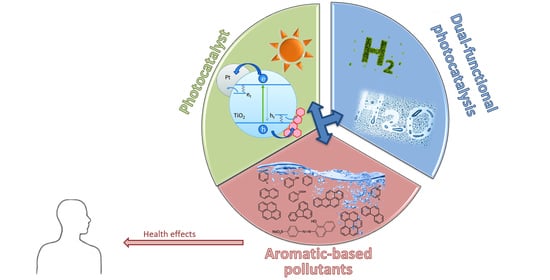
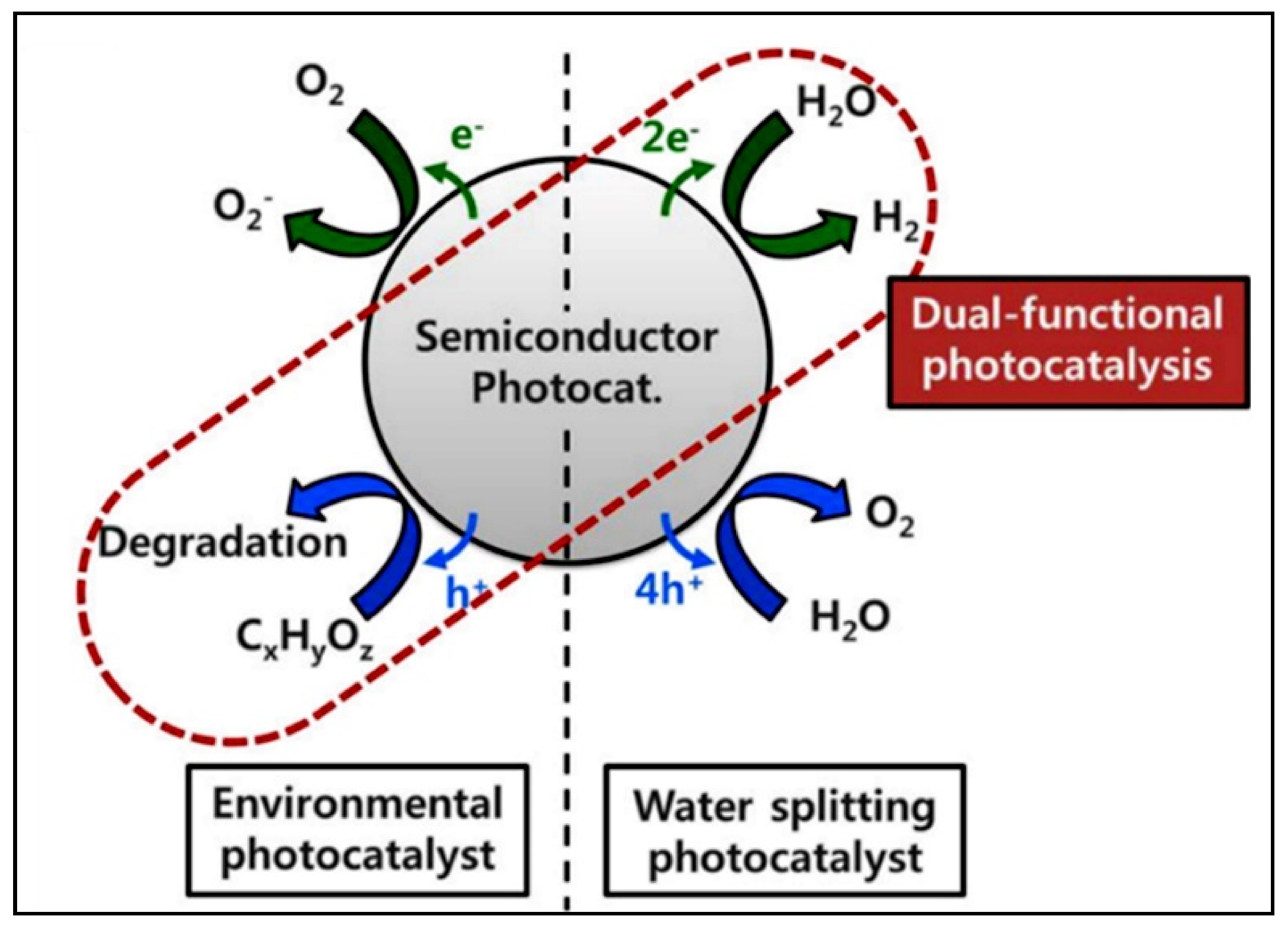
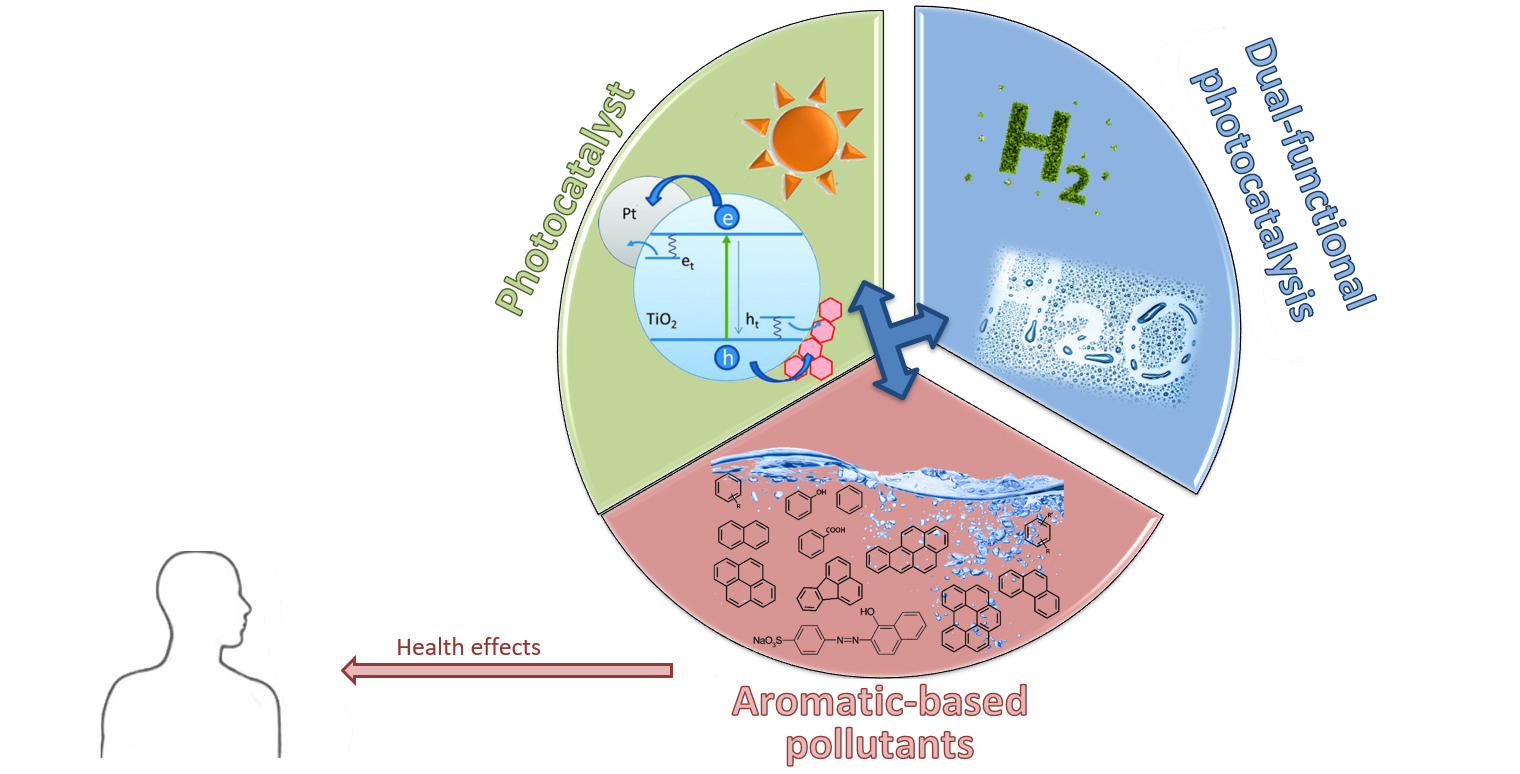
The growing world energy consumption, with reliance on conventional energy sources and the associated environmental pollution, are considered the most serious threats faced by mankind. Heterogeneous photocatalysis has become one of the most frequently investigated technologies, due to its dual functionality, i.e., environmental remediation and converting solar energy into chemical energy, especially molecular hydrogen. H2 burns cleanly and has the highest gravimetric gross calorific value among all fuels. However, the use of a suitable electron donor, in what so-called “photocatalytic reforming”, is required to achieve acceptable efficiency. This oxidation half-reaction can be exploited to oxidize the dissolved organic pollutants, thus, simultaneously improving the water quality. Such pollutants would replace other potentially costly electron donors, achieving the dual-functionality purpose. Since the aromatic compounds are widely spread in the environment, they are considered attractive targets to apply this technology. In this review, different aspects are highlighted, including the employing of different polymorphs of pristine titanium dioxide as photocatalysts in the photocatalytic processes, also improving the photocatalytic activity of TiO2 by loading different types of metal co-catalysts, especially platinum nanoparticles, and comparing the effect of various loading methods of such metal co-catalysts. Finally, the photocatalytic reforming of aromatic compounds employing TiO2-based semiconductors is presented.
Keywords: TiO2; aromatic compound; PAHs; H2 production; photocatalytic reforming; water remediation TiO2; aromatic compound; PAHs; H2 production; photocatalytic reforming; water remediation
Graphical Abstract