Review

Recent Developments of Advanced Ti3+-Self-Doped TiO2 for Efficient Visible-Light-Driven Photocatalysis

1
Department of Chemistry, Sungkyunkwan University, 2066 Seoburo, Jangan-gu, Suwon 16419, Korea
2
Center for Integrated Nanostructure Physics (CINAP), Institute for Basic Science (IBS), 2066 Seoburo, Jangan-gu, Suwon 16419, Korea
3
Department of Biophysics, Sungkyunkwan University, 2066 Seoburo, Jangan-gu, Suwon 16419, Korea
*
Author to whom correspondence should be addressed.
Catalysts 2020, 10(6), 679; https://doi.org/10.3390/catal10060679
Submission received: 30 April 2020 / Revised: 5 June 2020 / Accepted: 13 June 2020 / Published: 17 June 2020
(This article belongs to the Special Issue Recent Advances in TiO2 Photocatalysts)

Abstract

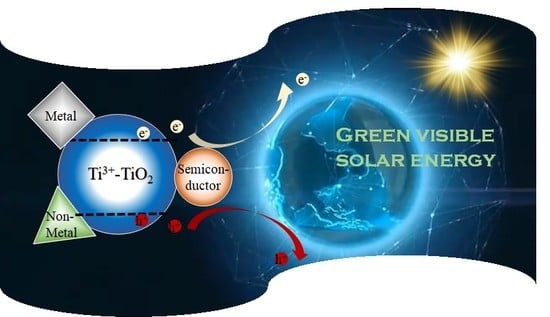
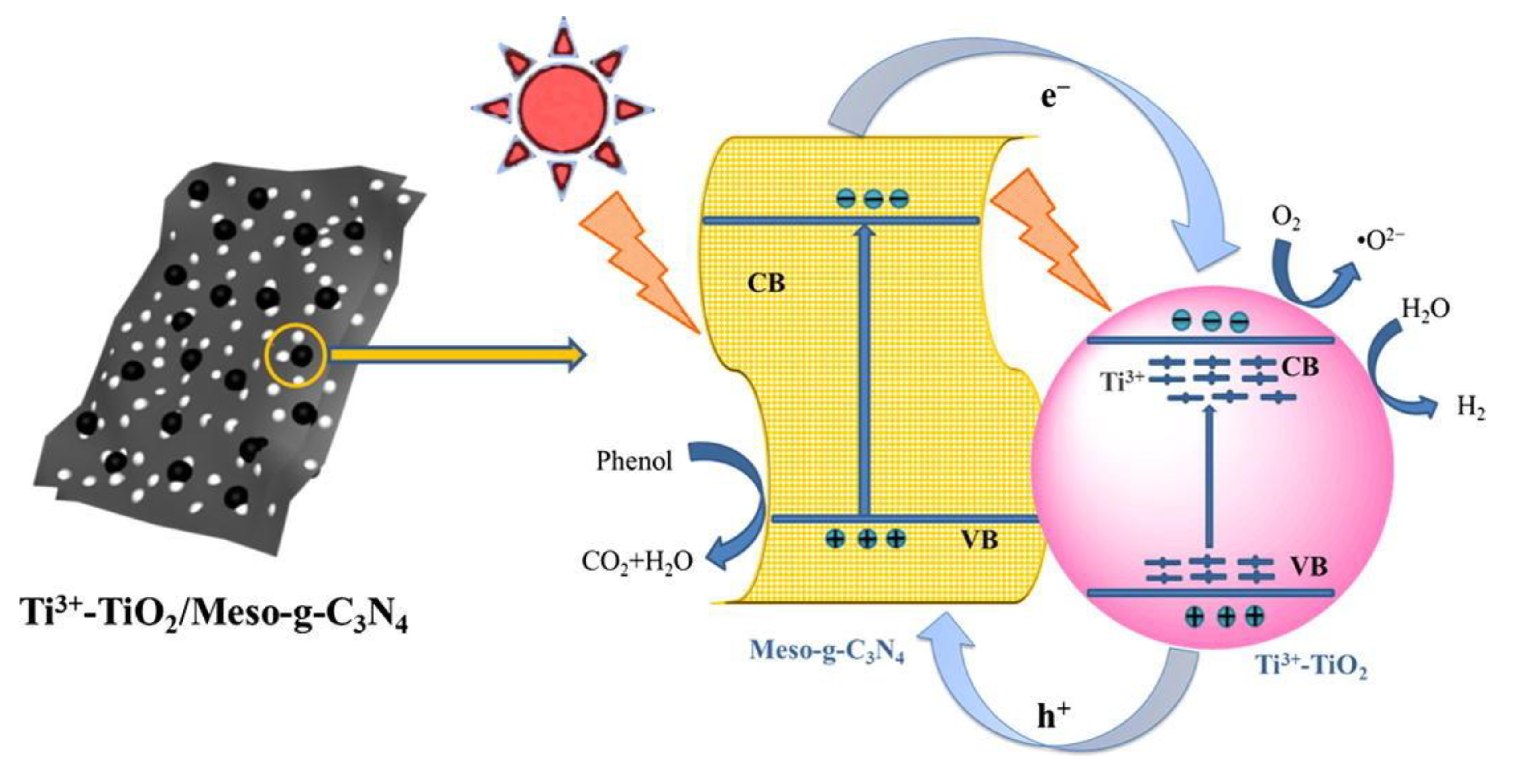
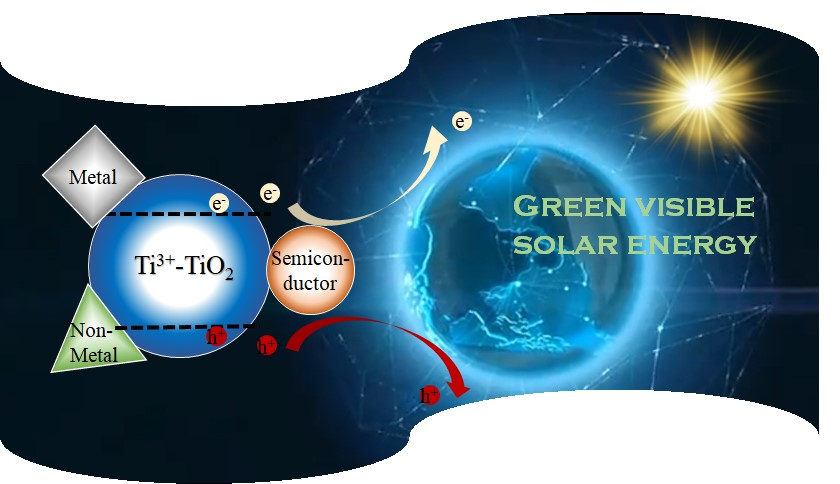
Research into the development of efficient semiconductor photocatalytic materials is a promising approach to solving environmental and energy problems worldwide. Among these materials, TiO2 photocatalysts are one of the most commonly used due to their efficient photoactivity, high stability, low cost and environmental friendliness. However, since the UV content of sunlight is less than 5%, the development of visible light-activated TiO2-based photocatalysts is essential to increase the solar energy efficiency. Here, we review recent works on advanced visible light-activated Ti3+-self-doped TiO2 (Ti3+–TiO2) photocatalysts with improved electronic band structures for efficient charge separation. We analyze the different methods used to produce Ti3+–TiO2 photocatalysts, where Ti3+ with a high oxygen defect density can be used for energy production from visible light. We categorize advanced modifications in electronic states of Ti3+–TiO2 by improving their photocatalytic activity. Ti3+–TiO2 photocatalysts with large charge separation and low recombination of photogenerated electrons and holes can be practically applied for energy conversion and advanced oxidation processes in natural environments and deserve significant attention.
Keywords: Ti3+-self-doping; photocatalysts; modification of TiO2; visible light application; modification of electronic structures Ti3+-self-doping; photocatalysts; modification of TiO2; visible light application; modification of electronic structures
Graphical Abstract